Topology Robustness of State Estimation Against False Data Injection and Network Parameter Attacks on Power Monitoring and Control Systems


Abstract
1. Introduction
- First, we develop a unified model integrating FDIA (targeting sensor measurements) and NPA (targeting branch parameters via devices like FACTS) to analyze their combined impact on power system state estimation, providing a theoretical framework that quantifies topology robustness through norm-based sensitivity measures-unlike prior works that focus primarily on attack design without deriving tolerance bounds.
- Second, we derive closed-form analytical bounds for topology robustness, including the metric for FDIA in fully measured systems and the metric for partially measured cases, extended to NPA and coordinated attacks, enabling operators to evaluate vulnerability without exhaustive simulations.
- Finally, we conduct extensive simulations on IEEE test systems (14-, 30-, 57-, 118-, and 300-bus), validating that lower robustness values correlate with reduced error propagation (e.g., up to 30% robustness improvement with partial measurements), under scenarios including noise and topology variations.
2. System Model and Threat Model
2.1. System Model
2.2. Measurement Matrix
2.3. State Estimation
2.4. Threat Model
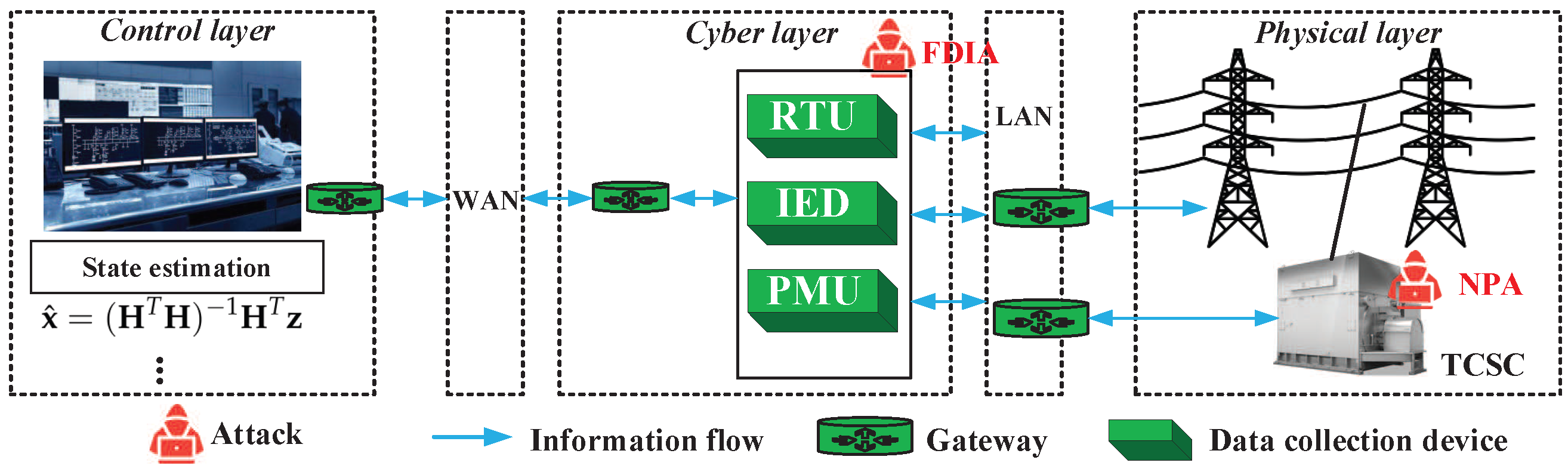
- FDIA: The attacker has the capability of tampering with the sensor measurements.
- NPA: The attacker has the capability of corrupting the control commands of the devices that adjust the branch parameter (i.e., the reactance).
- FDIA Feasibility: FDIA typically requires cyber access rather than physical contact, achieved by injecting malware into SCADA systems, remote terminal units (RTUs), or smart meters via phishing, supply-chain compromises, or network vulnerabilities. Real-world examples underscore this: the 2015 Ukraine blackout, caused by BlackEnergy malware, manipulated control systems to inject false commands, leading to widespread outages without physical intervention. Similarly, the Stuxnet worm (2010) targeted industrial controls, and more recent incidents, such as the 2019 Utah grid disruption and the 2021 ransomware attacks on U.S. and Australian power providers, demonstrate ongoing vulnerabilities. However, feasibility depends on attacker resources; stealthy FDIAs require topology knowledge, which can be obtained via reconnaissance or insider threats, but evading bad data detection (BDD) demands precise crafting to keep residuals below thresholds.
- NPA Feasibility: NPA often involves compromising devices like Flexible AC Transmission Systems (FACTS) or Thyristor-Controlled Series Compensators (TCSCs) to alter branch parameters (e.g., reactance). This can be cyber-based, requiring no physical access if control channels are hacked, as seen in simulations of physics-manipulated attacks. While fewer direct real-world examples exist than in FDIA, related incidents, such as the 2015 Ukraine attack, involved parameter manipulation in control logic. Detection is challenging, as NPAs can mimic legitimate variations (e.g., load changes) and bypass traditional BDD; advanced methods such as impedance monitoring or ML-based anomaly detection are needed, though not foolproof.
- Coordinated Attacks and Overall Difficulty: Coordinated FDIA+NPA increases impact but also complexity, requiring multi-domain access. Existing security measures (e.g., firewalls, encryption) raise the bar, but gaps in legacy systems persist, as evidenced by state-sponsored studies of grid vulnerabilities. Mitigation via robust estimators or moving target defenses can reduce feasibility.
3. Topology Robustness of the Power System State Estimation Against FDIA and NPA
3.1. Topology Robustness Under FDIA
3.1.1. Fully-Measured Case for FDIA
3.1.2. Partially-Measured Case for FDIA
3.2. Topology Robustness Under NPA
3.2.1. Fully-Measured Case for NPA
3.2.2. Partially Measured Case for NPA
3.3. Topology Robustness Under the Coordinated FDIA and NPA
4. Simulation Results
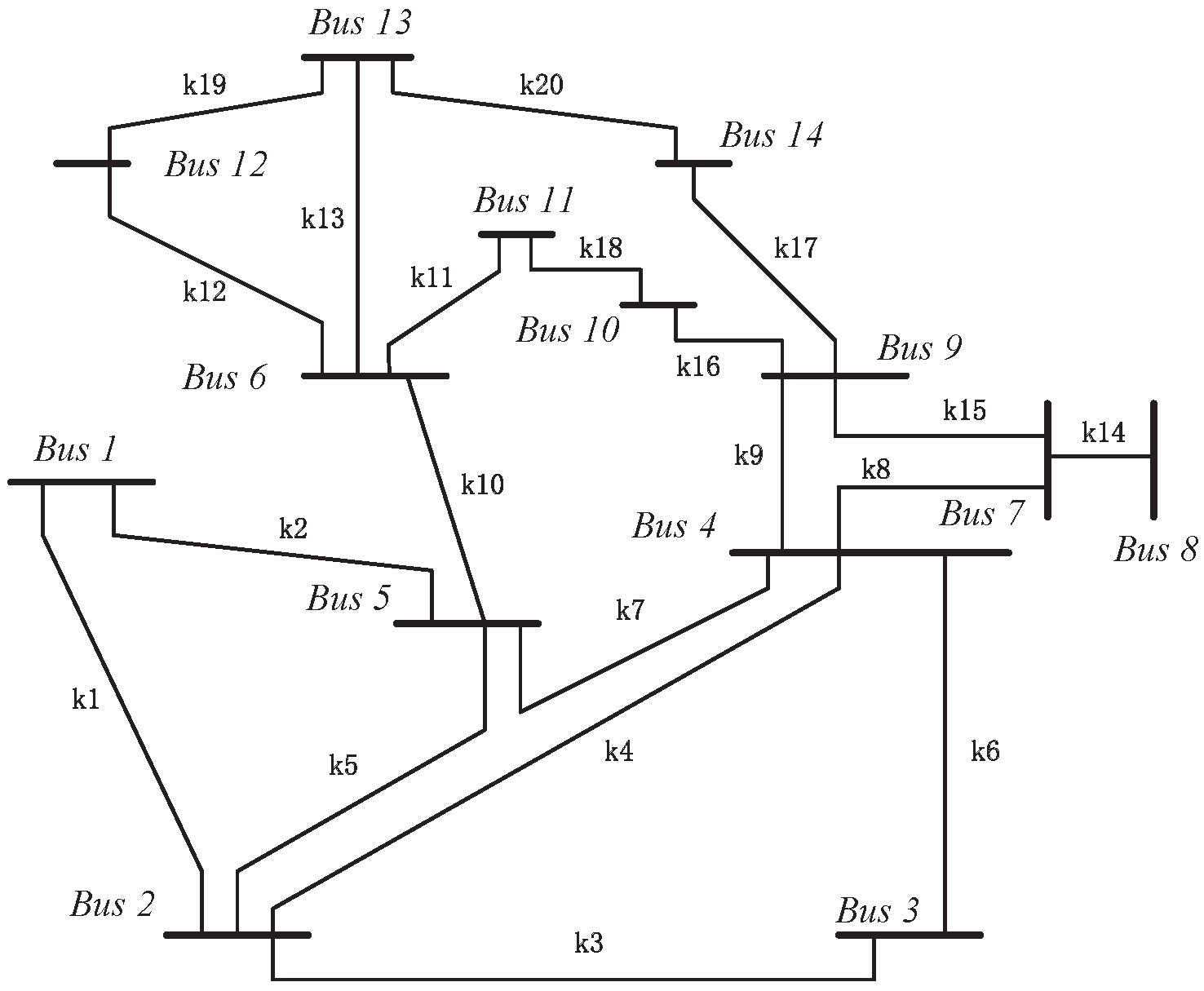
- Simulations are conducted on IEEE 14-, 30-, 57-, 118-, and 300-bus benchmark systems, sourced from MATPOWER’s case files (e.g., case14.m). These represent varying scales: small (14-bus, 20 branches, average degree 2.86) for detailed analysis, up to large (300-bus, 411 branches, average degree 2.74) to assess scalability. Topology matrices are derived from nominal branch parameters, with susceptances in per-unit (p.u.) ranging from 0.1 (long lines) to 10 (short/high-capacity lines), reflecting realistic transmission reactance values.
- Measurement Configurations: For fully measured cases, meters include all bus injections and bidirectional branch flows. Partial measurements reduce redundancy to 1.5–2.5 (e.g., all injections plus forward flows only), ensuring observability via rank checks on . Sensor placements prioritize critical buses (e.g., high-degree or generator-connected) to minimize , with noise p.u.
- Software and Computational Settings: MATPOWER 7.1 on MATLAB R2019a, with default tolerances (1 × 10⁻⁸ for convergence) and DC model flags. Runtime per system: 0.1s (14-bus) to 5s (300-bus) on a standard CPU.
4.1. Topology Robustness with Different Power Systems
4.2. Topology Robustness with Different System Parameters
4.3. Topology Robustness Against FDIA with the Partially Measured Cases
5. Implications for Power Grid Planning and Operation
6. Conclusions
Author Contributions
Funding
Data Availability Statement
Conflicts of Interest
References
- Kea, K.; Han, Y.; Kim, T.-K. Enhancing anomaly detection in distributed power systems using autoencoder-based federated learning. PLoS ONE 2023, 18, e0290337. [Google Scholar] [CrossRef]
- Illera, A.G.; Vidal, J.V. Lights Off! The Darkness of the Smart Meters. 2014. Available online: http://youtube.be/Z_y_vjYtAWM (accessed on 30 December 2025).
- Konstantinou, C.; Maniatakos, M. A case study on implementing false data injection attacks against nonlinear state estimation. In Proceedings of the 2nd ACM Workshop Cyber-Physical Systems Security Privacy (CPS-SPC), Vienna, Austria, 28 October 2016; pp. 81–91. [Google Scholar]
- Deng, R.; Xiao, G.; Lu, R.; Liang, H.; Vasilakos, A.V. False Data Injection on State Estimation in Power Systems Attacks, Impacts, and Defense: A Survey. IEEE Trans. Ind. Inform. 2017, 13, 411–423. [Google Scholar] [CrossRef]
- Liu, Y.; Ning, P.; Reiter, M.K. False data injection attacks against state estimation in electric power grid. ACM Trans. Inform. Syst. Secur. 2011, 14, 13. [Google Scholar] [CrossRef]
- Kosut, O.; Jia, L.; Thomas, R.J.; Tong, L. Malicious Data Attacks on Smart Grid State Estimation: Attack Strategies and Countermeasures. In Proceedings of the IEEE 1st International Conference Smart Grid Communications (SmartGridComm), Gaithersburg, MD, USA, 4–6 October 2010; pp. 1–6. [Google Scholar]
- Yang, Q.; Yang, J.; Yu, W.; An, D.; Zhang, N.; Zhao, W. On false data-injection attacks against power system state estimation: Modeling and countermeasures. IEEE Trans. Parallel Distrib. Syst. 2014, 25, 717–729. [Google Scholar] [CrossRef]
- Deng, R.; Liang, H. False data injection attacks with limited susceptance information and new countermeasures in smart grid. IEEE Trans. Ind. Informat. 2019, 15, 1619–1628. [Google Scholar] [CrossRef]
- Zhang, Z.; Deng, R.; Yau, D.K.; Chen, P. Zero-parameter-information data integrity attacks and countermeasures in IoT-based smart grid. IEEE Internet Things J. 2021, 8, 6608–6623. [Google Scholar] [CrossRef]
- Iranpour, M.; Narimani, M.R. AC False Data Injection Attacks in Power Systems: Design and Optimization. In Proceedings of the North American Power Symposium (NAPS), El Paso, TX, USA, 13–15 October 2024; pp. 1–7. [Google Scholar]
- Moayyed, H.; Moradzadeh, A.; Abdeltawab, H.; Mohammadi-Ivatloo, B.; Faria, P.; Muyeen, S.M.; Vale, Z. Innovative defense strategies: Fusion deep learning approach to counter false data injection attacks in power systems. Reliab. Eng. Syst. Saf. 2026, 268, 112003. [Google Scholar] [CrossRef]
- Wang, X.; Zhu, H.; Luo, X.; Guan, X. Data-Driven-Based Detection and Localization Framework Against False Data Injection Attacks in DC Microgrids. IEEE Internet Things J. 2025, 12, 36079–36093. [Google Scholar] [CrossRef]
- Pramanick, N.; Mathew, J.; Selvarajan, S.; Agarwal, M. Leveraging stacking machine learning models and optimization for improved cyberattack detection. Sci. Rep. 2025, 15, 16757. [Google Scholar] [CrossRef] [PubMed]
- Akpolat, A.N.; Kalay, M.S. Defense Mechanism of PV-Powered Energy Islands Against Cyber-Attacks Utilizing Supervised Machine Learning. Appl. Sci. 2023, 15, 5021. [Google Scholar] [CrossRef]
- Divan, D.; Johal, H. Distributed FACTs: A new concept for realizing grid power flow control. IEEE Trans. Power Electron. 2007, 22, 2253–2260. [Google Scholar] [CrossRef]
- Li, B.; Lu, R.; Deng, R.; Bao, H. On Feasibility and Limitations of Detecting False Data Injection Attacks on Power Grid State Estimation Using D-FACTS Devices. IEEE Trans. Ind. Infrom. 2020, 16, 854–864. [Google Scholar] [CrossRef]
- Zhang, Z.; Deng, R.; Yau, D.K. Vulnerability of the load frequency control against the network parameter attack. IEEE Trans. Autom. Control 2023, 15, 921–933. [Google Scholar] [CrossRef]
- Zhang, Z.; Deng, R.; Tian, Y.; Cheng, P.; Ma, J. SPMA: Stealthy physics-manipulated attack and countermeasures in cyber-physical smart grid. IEEE Trans. Inf. Forensics Secur. 2022, 18, 581–596. [Google Scholar] [CrossRef]
- Pajic, M.; Weimer, J.; Bezzo, N.; Tabuada, P.; Sokolsky, O.; Lee, I. Robustness of attack-resilient state estimators. In Proceedings of the 2014 ACM/IEEE International Conference on Cyber-Physical Systems (ICCPS), Berlin, Germany, 14–17 April 2014. [Google Scholar]
- Chakhchoukh, Y.; Ishii, H. Enhancing Robustness to Cyber-Attacks in Power Systems Through Multiple Least Trimmed Squares State Estimations. IEEE Trans. Power Syst. 2016, 31, 4395–4405. [Google Scholar] [CrossRef]
- PLEXOS Software. Plexos Overview & Tutorial. 2019. Available online: www.plexos.info (accessed on 30 December 2025).
- Li, F.; Wei, Y.; Adhikari, S. Improving an unjustified common practice in EX Post LMP calculation: An expanded version. In Proceedings of the IEEE Power & Energy Society General Meeting (PESGM), Minneapolis, MN, USA, 25–29 July 2010; pp. 1–4. [Google Scholar]
- Zhang, Q.; Li, F.; Shi, Q.; Tomsovic, K.; Sun, J.; Ren, L. Profit-Oriented False Data Injection on Electricity Market: Reviews, Analyses, and Insights. IEEE Trans. Ind. Infrom. 2021, 17, 5876–5886. [Google Scholar] [CrossRef]
- Wood, A.; Wollenberg, B.; Sheblé, G.B. Power Generation, Operation, and Control, 3rd ed.; John Wiley and Sons: Hoboken, NJ, USA, 2013. [Google Scholar]
- NESCOR. Electric Sector Failure Scenarios and Impact Analyses Version 3.0. 2019. Available online: http://smartgrid.epri.com/doc/NESCOR%20Failure%20Scenarios%20v3%2012-11-15.pdf (accessed on 30 December 2025).
- Naderi, E.; Asrari, A. A Remedial Action Scheme To Mitigate Market Power Caused by Cyberattacks Targeting a Smart Distribution System. IEEE Trans. Ind. Infrom. 2024, 20, 3197–3208. [Google Scholar] [CrossRef]
- Sun, X.; Tang, Q.; Lu, Q. Security load frequency control model of interconnected power system based on deception attack. PLoS ONE 2024, 19, e0298889. [Google Scholar] [CrossRef] [PubMed]
- NERC. Learned Lessons. 2019. Available online: https://www.nerc.com/pa/rrm/ea/Pages/Lessons-Learned.aspx (accessed on 30 December 2025).
- Case, D.U. Analysis of the Cyber Attack on the Ukrain Power Grid; Electricity Information Sharing and Analysis Center: Washington, DC, USA, 2016; Available online: http://ics.sans.org/media/E-ISAC$_$SANS$_$Ukraine$_$DUC$_$5.pdf (accessed on 30 December 2025).



| Power System | 14-Bus | 30-Bus | 39-Bus | 118-Bus | 300-Bus |
|---|---|---|---|---|---|
| 121.2855 | 492.5221 |
| Branch Number | Susceptance (Case 1) | Susceptance (Case 2) |
|---|---|---|
| 16.90 | 16.90 | |
| 4.48 | 1.35 | |
| 5.05 | 5.05 | |
| 5.67 | 5.16 | |
| 5.75 | 5.75 | |
| 5.85 | 1.75 | |
| 23.74 | 21.37 | |
| 4.78 | 2.87 | |
| 1.80 | 1.80 | |
| 3.97 | 3.97 | |
| 5.03 | 4.68 | |
| 3.91 | 3.64 | |
| 7.68 | 7.68 | |
| 5.68 | 1.70 | |
| 9.09 | 5.45 | |
| 11.83 | 11.12 | |
| 3.70 | 3.70 | |
| 5.21 | 1.56 | |
| 5.00 | 5.00 | |
| 2.87 | 2.87 |
Disclaimer/Publisher’s Note: The statements, opinions and data contained in all publications are solely those of the individual author(s) and contributor(s) and not of MDPI and/or the editor(s). MDPI and/or the editor(s) disclaim responsibility for any injury to people or property resulting from any ideas, methods, instructions or products referred to in the content. |
© 2026 by the authors. Licensee MDPI, Basel, Switzerland. This article is an open access article distributed under the terms and conditions of the Creative Commons Attribution (CC BY) license.
Share and Cite
Yu, Y.; Wang, Y.; Luo, F.; Dicha, M.; Li, S.; Zhang, Z. Topology Robustness of State Estimation Against False Data Injection and Network Parameter Attacks on Power Monitoring and Control Systems. Electronics 2026, 15, 550. https://doi.org/10.3390/electronics15030550
Yu Y, Wang Y, Luo F, Dicha M, Li S, Zhang Z. Topology Robustness of State Estimation Against False Data Injection and Network Parameter Attacks on Power Monitoring and Control Systems. Electronics. 2026; 15(3):550. https://doi.org/10.3390/electronics15030550
Chicago/Turabian StyleYu, Yunhao, Yu Wang, Fuhua Luo, Meiling Dicha, Song Li, and Zhenyong Zhang. 2026. "Topology Robustness of State Estimation Against False Data Injection and Network Parameter Attacks on Power Monitoring and Control Systems" Electronics 15, no. 3: 550. https://doi.org/10.3390/electronics15030550
APA StyleYu, Y., Wang, Y., Luo, F., Dicha, M., Li, S., & Zhang, Z. (2026). Topology Robustness of State Estimation Against False Data Injection and Network Parameter Attacks on Power Monitoring and Control Systems. Electronics, 15(3), 550. https://doi.org/10.3390/electronics15030550