

Probing Threshold Behavior of Adaptive Cascaded Quantum Codes Under Variable Biased Noise for Practical Fault-Tolerant Quantum Computing

Abstract
1. Introduction
2. Background
2.1. Surface Code
2.2. Union-Find Algorithm
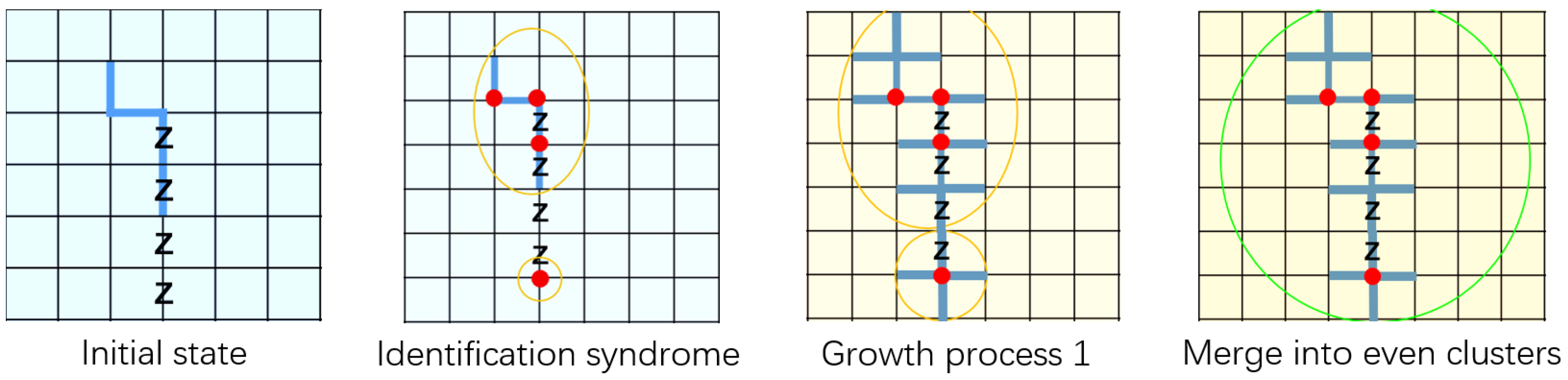
Dynamic Connectivity and Erasure Decoding Protocol
3. Engineering Codes and Hybrid Decoding Frameworks
3.1. Designing Resource-Optimized Cascaded Surface-Repetition Codes
3.2. Optimizing Parameter Selection
3.3. Modeling Noise Processes
3.4. Optimized Union-Find Decoder
3.4.1. Complexity Analysis
3.4.2. Core Operations
| Algorithm 1 Optimized Union-Find Decoder with Path Compression |
| Input: Graph with syndrome measurements |
| Output: Correction pattern |
|
| Complexity Analysis: Time: (inverse Ackermann function, nearly constant for practical n) |
| Space: auxiliary storage for parent, size, and parity arrays |
3.4.3. Weighted Merging Strategy
| Algorithm 2 Cluster-Based Quantum Error Correction Decoder |
| Input: Decoding graph with X/Z stabilizer syndromes |
| Output: Pauli correction operators |
|
| Complexity: time, space |
3.5. Erasure Decoding Process
3.5.1. Syndrome Validation Phase
3.5.2. Decoding Phase
4. Experimental Simulation Analysis
4.1. Threshold Analysis Under Biased Noise
- 1.
- Fix the bias ratio , and calculate the logical error rate for code distances ;
- 2.
- Fit the formula , where is the threshold, and is the critical exponent (taking , which is suitable for surface codes);
- 3.
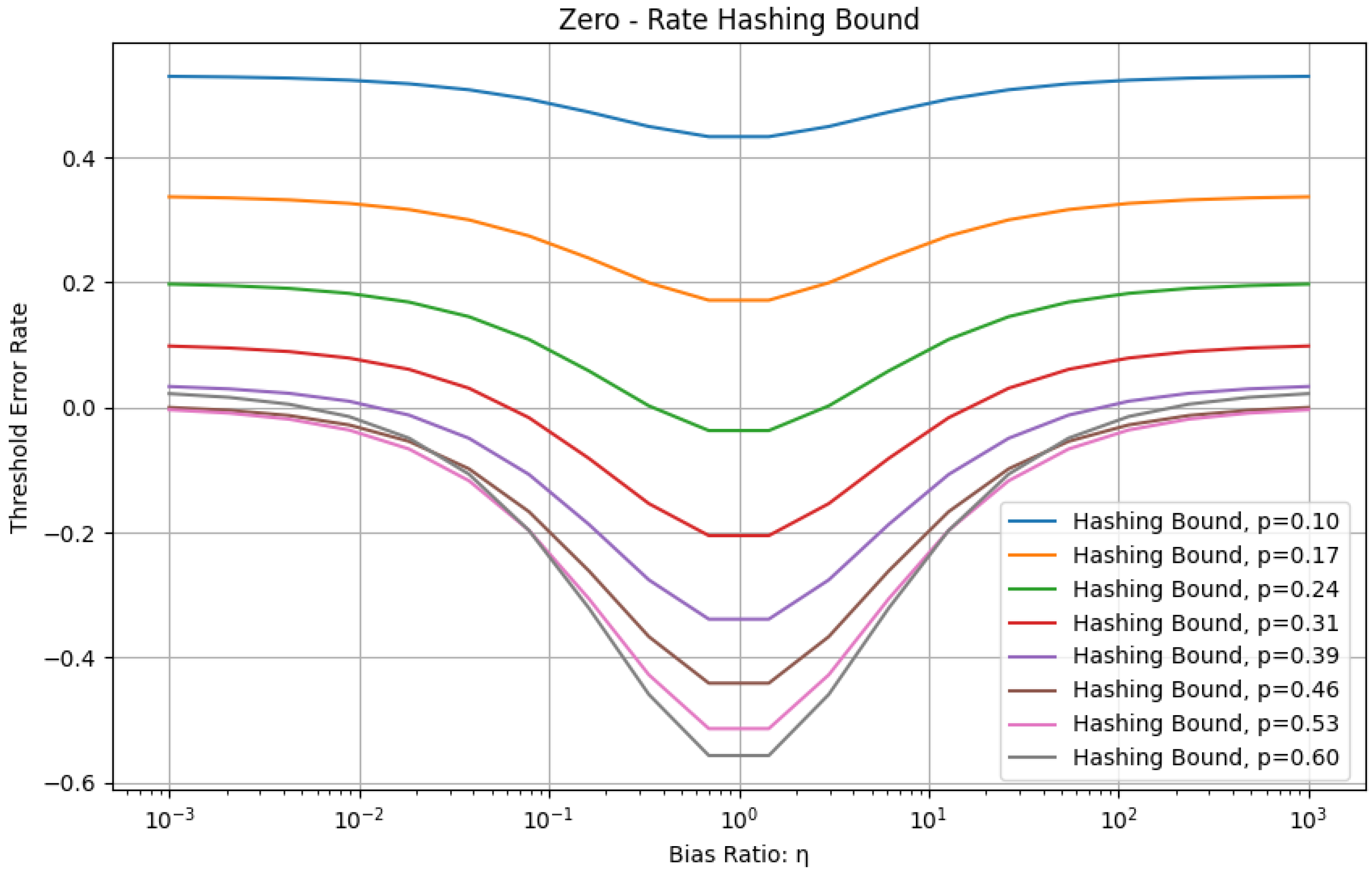
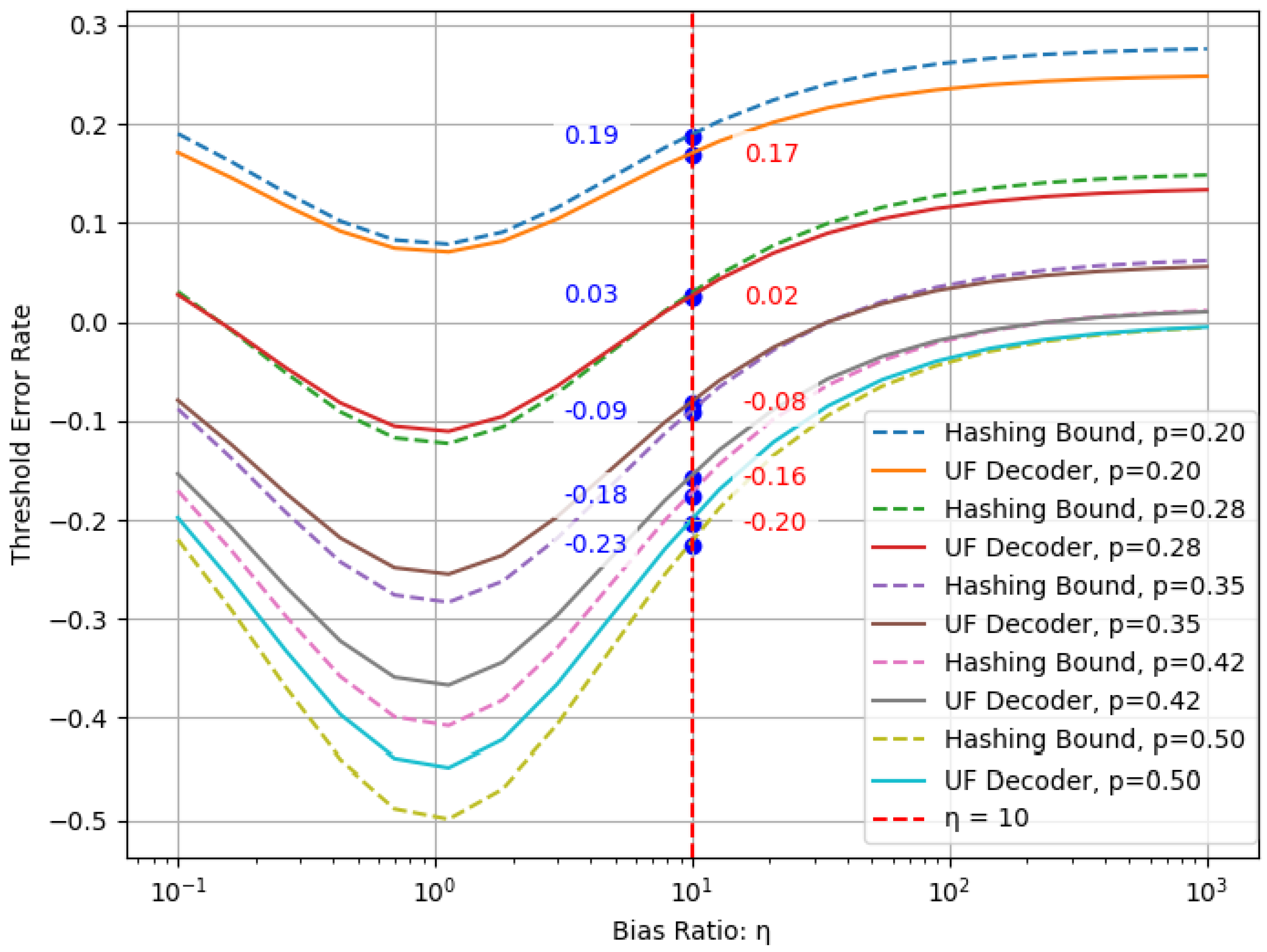
- Determine pc through the intersection point where as . To emulate realistic quantum error conditions, we implement a biased noise model with error ratio , while suppressing strong correlated noise components through temporal filtering. The correction factor of 0.9 in the hash bound originates from the hierarchical fault-tolerant gain of concatenated codes: after the inner repetition code corrects local errors, the effective noise of the outer surface code is reduced by 10%. This factor is calibrated through Monte Carlo simulations with d = 3 and d = 5. The UF decoder’s threshold is derived by scaling the zero-rate hashing bound with an empirical correction factor:The empirical correction factor of 0.9 applied to the hashing bound (Equation (27)) was calibrated via finite-size scaling analysis (FSSA) across code distances and Monte Carlo simulations with samples per data point. This factor accounts for two key effects: residual spatial correlations in physical noise models (e.g., adjacent qubit errors) and decoder-specific approximations (e.g., path compression in the UF decoder). It is architecture-dependent but consistent across cascaded code structures with shared stabilizers.
4.2. Auxiliary Qubit Optimization Analysis
4.2.1. Error Propagation Analysis
4.2.2. Optimal Code Distance Selection
4.2.3. Implementation Protocol
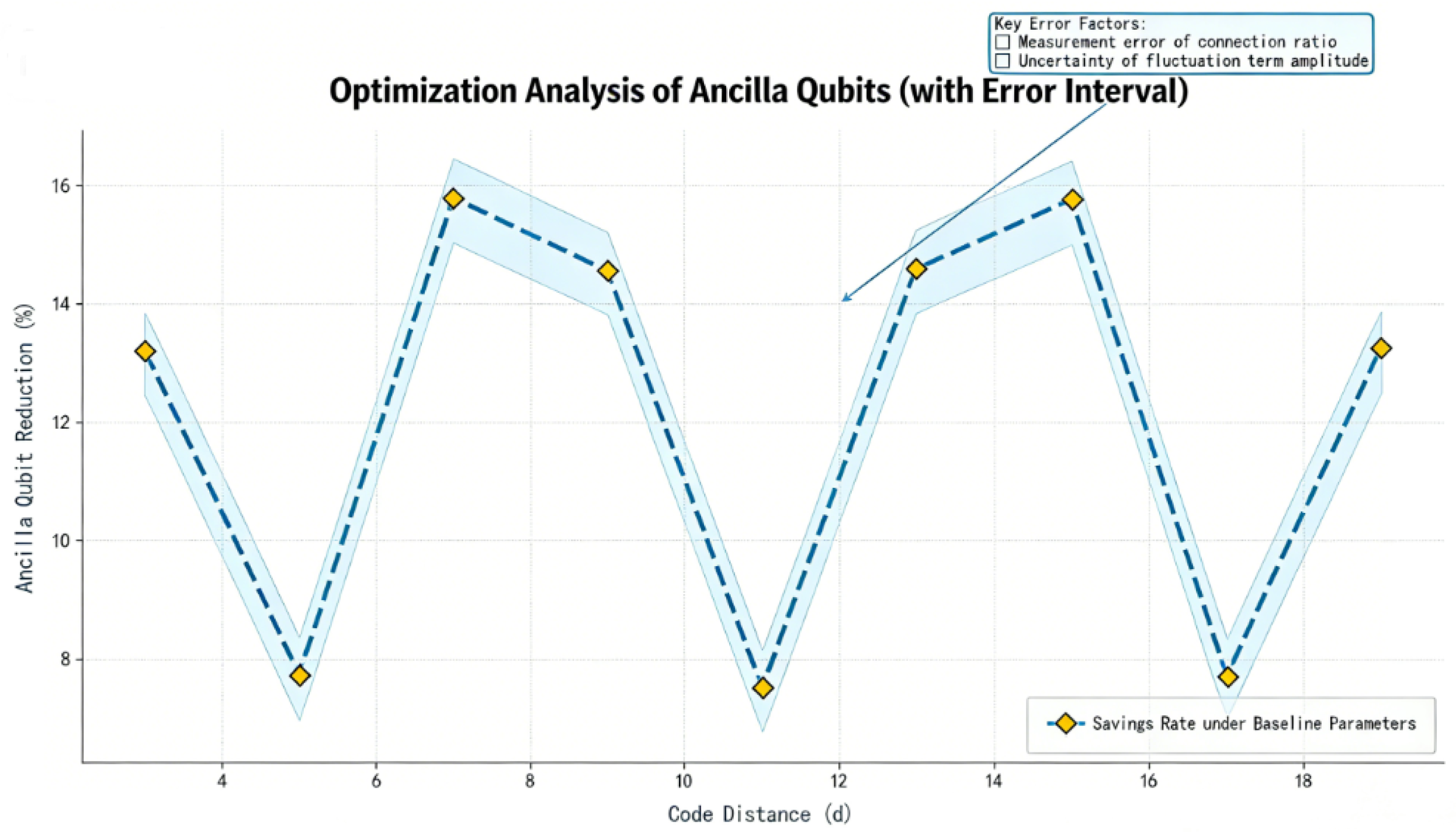
4.2.4. Resource Optimization Analysis
4.3. Decoder Performance Under Circuit-Level Noise
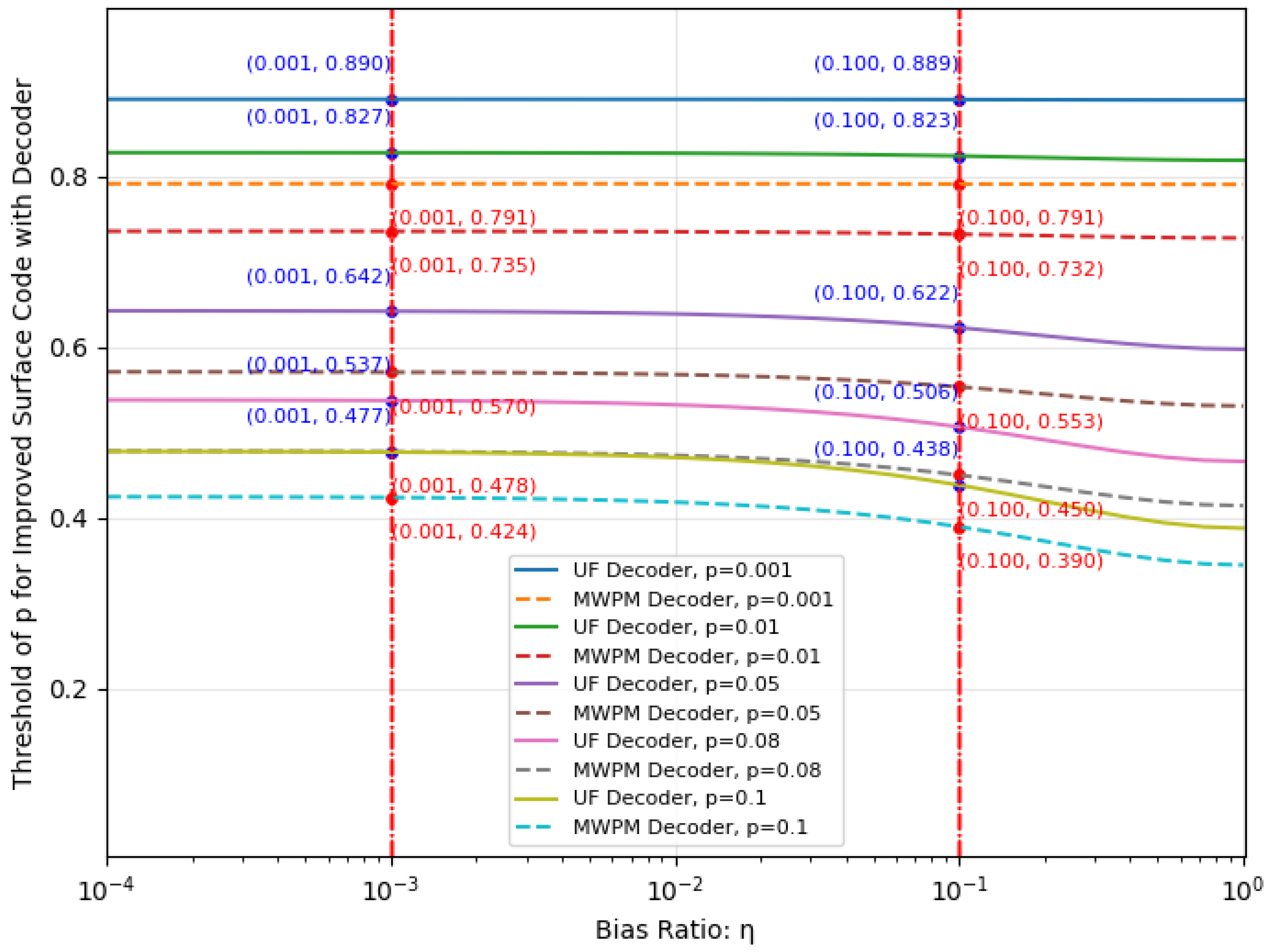
4.4. Threshold Behavior and Error Rate Dependence
5. Conclusions
Author Contributions
Funding
Data Availability Statement
Conflicts of Interest
References
- Gutiérrez, M.; Svec, L.; Vargo, A.; Brown, K.R. Approximation of realistic errors by Clifford channels and Pauli measurements. Phys. Rev. A 2013, 87, 030302. [Google Scholar] [CrossRef]
- Devitt, S.J.; Munro, W.J.; Nemoto, K. Quantum error correction for beginners. Rep. Prog. Phys. 2013, 76, 076001. [Google Scholar] [CrossRef] [PubMed]
- Ladd, T.D.; Jelezko, F.; Laflamme, R.; Nakamura, Y.; Monroe, C.; O’Brien, J.L. Quantum computers. Nature 2010, 464, 45–53. [Google Scholar] [CrossRef] [PubMed]
- Gong, C.; Wen, Z.Y.; Deng, Y.W.; Zhou, N.R.; Zeng, Q.W. Unrolled generative adversarial network for continuous distributions under hybrid quantum-classical model. Laser Phys. Lett. 2024, 21, 125207. [Google Scholar] [CrossRef]
- Huang, S.Y.; An, W.J.; Zhang, D.S.; Zhou, N.R. Image classification and adversarial robustness analysis based on hybrid quantum–classical convolutional neural network. Opt. Commun. 2023, 533, 129287. [Google Scholar] [CrossRef]
- Facchi, P.; Tasaki, S.; Pascazio, S.; Nakazato, H.; Tokuse, A.; Lidar, D.A. Control of decoherence: Analysis and comparison of three different strategies. Phys. Rev. A 2005, 71, 022302. [Google Scholar] [CrossRef]
- Roffe, J. Quantum error correction: An introductory guide. Contemp. Phys. 2019, 60, 226–245. [Google Scholar] [CrossRef]
- He, X.C.; Gong, L.H.; Zhou, N.R. Image denoising with hybrid classical-quantum convolutional neural Network. Memetic Comput. 2025, 17, 23. [Google Scholar] [CrossRef]
- Pei, J.J.; Gong, L.H.; Qin, L.G.; Zhou, N.R. One-to-many image generation model based on parameterized quantum circuits. Digit. Signal Process. 2025, 165, 105340. [Google Scholar] [CrossRef]
- Ding, Y.F.; Li, Z.; Zhou, N.R. Quantum generative adversarial network based on the quantum. Born Mach. 2025, 68, 103622. [Google Scholar]
- Gong, L.H.; Chen, Y.Q.; Zhou, S.; Zeng, Q.W. Dual discriminators quantum generation adversarial network based on quantum convolutional neural network. Adv. Quantum Technol. 2025, 8, e2500224. [Google Scholar] [CrossRef]
- Gicev, S.; Hollenberg, L.C.L.; Usman, M. Quantum computer error structure probed by quantum error correction syndrome measurements. Phys. Rev. Res. 2024, 6, 043249. [Google Scholar] [CrossRef]
- Bonilla Ataides, J.P.; Tuckett, D.K.; Bartlett, S.D.; Flammia, S.T.; Brown, B.J. The XZZX surface code. Nat. Commun. 2021, 12, 2172. [Google Scholar] [CrossRef] [PubMed]
- Swathi, M.; Rudra, B. A novel approach for asymmetric quantum error correction with syndrome measurement. IEEE Access 2022, 10, 44669–44676. [Google Scholar] [CrossRef]
- Hoppensteadt, F.C.; Izhikevich, E.M. Oscillatory neurocomputers with dynamic connectivity. Phys. Rev. Lett. 1999, 82, 2983. [Google Scholar] [CrossRef]
- Dodge, K.; Liu, Y.; Klots, A.R.; Cole, B.; Shearrow, A.; Senatore, M.; Zhu, S.; Ioffe, L.B.; McDermott, R.; Plourde, B.L.T. Hardware implementation of quantum stabilizers in superconducting circuits. Phys. Rev. Lett. 2023, 131, 150602. [Google Scholar] [CrossRef]
- Ellison, T.D.; Chen, Y.-A.; Dua, A.; Shirley, W.; Tantivasadakarn, N.; Williamson, D.J. Pauli stabilizer models of twisted quantum doubles. PRX Quantum 2022, 3, 010353. [Google Scholar] [CrossRef]
- Wagner, T.; Kampermann, H.; Bruß, D.; Kliesch, M. Learning logical pauli noise in quantum error correction. Phys. Rev. Lett. 2023, 130, 200601. [Google Scholar] [CrossRef] [PubMed]
- Knill, E. Quantum computing with realistically noisy devices. Nature 2005, 434, 39–44. [Google Scholar] [CrossRef]
- Higgott, O. Pymatching: A python package for decoding quantum codes with minimum-weight perfect matching. ACM Trans. Quantum Comput. 2022, 3, 1–16. [Google Scholar] [CrossRef]
- Liyanage, N.; Wu, Y.; Tagare, S.; Zhong, L. FPGA-based distributed union-find decoder for surface codes. IEEE Trans. Quantum Eng. 2024, 5, 1–18. [Google Scholar] [CrossRef]
- Tuckett, D.K.; Bartlett, S.D.; Flammia, S.T. Ultrahigh error threshold for surface codes with biased noise. Phys. Rev. Lett. 2018, 120, 050505. [Google Scholar] [CrossRef]
- Higgott, O.; Bohdanowicz, T.C.; Kubica, A.; Flammia, S.T.; Campbell, E.T. Improved decoding of circuit noise and fragile boundaries of tailored surface codes. Phys. Rev. X 2023, 13, 031007. [Google Scholar] [CrossRef]
- Wang, D.S.; Fowler, A.G.; Hollenberg, L.C.L. Surface code quantum computing with error rates over 1%. Phys. Rev. A—At. Mol. Opt. Phys. 2011, 83, 020302. [Google Scholar] [CrossRef]
- Fowler, A.G.; Mariantoni, M.; Martinis, J.M.; Cleland, A.N. Surface codes: Towards practical large-scale quantum computation. Phys. Rev. A 2012, 86, 032324. [Google Scholar] [CrossRef]
- Horsman, D.; Fowler, A.G.; Devitt, S.; Van Meter, R. Surface code quantum computing by lattice surgery. New J. Phys. 2012, 14, 123011. [Google Scholar] [CrossRef]
- Guillaud, J.; Mirrahimi, M. Repetition cat qubits for fault-tolerant quantum computation. Phys. Rev. X 2019, 9, 041053. [Google Scholar] [CrossRef]
- Chamberland, C.; Noh, K.; Arrangoiz-Arriola, P.; Campbell, E.T.; Hann, C.T.; Iverson, J.; Putterman, H.; Bohdanowicz, T.C.; Flammia, S.T.; Keller, A.; et al. Building a fault-tolerant quantum computer using concatenated cat codes. Phys. Rev. X 2022, 3, 010329. [Google Scholar] [CrossRef]
- Griffiths, S.J.; Browne, D.E. Union-find quantum decoding without union-find. Phys. Rev. Res. 2024, 6, 013154. [Google Scholar] [CrossRef]
- Mirrokni, V.; Thorup, M.; Zadimoghaddam, M. Consistent hashing with bounded loads. SIAM 2018, 587–604. [Google Scholar]
- Delfosse, N.; Londe, V.; Beverland, M.E. Toward a union-find decoder for quantum LDPC codes. IEEE Trans. Inf. Theory 2022, 68, 3187–3199. [Google Scholar] [CrossRef]
- Hutter, A.; Wootton, J.R.; Loss, D. Efficient Markov chain Monte Carlo algorithm for the surface code. Phys. Rev. A 2014, 89, 022326. [Google Scholar] [CrossRef]
- Jandura, S.; Thompson, J.D.; Pupillo, G. Optimizing Rydberg gates for logical-qubit performance. PRX Quantum 2023, 4, 020336. [Google Scholar] [CrossRef]
- Huang, S.; Newman, M.; Brown, K.R. Fault-tolerant weighted union-find decoding on the toric code. Phys. Rev. A 2020, 102, 012419. [Google Scholar] [CrossRef]
- Li, L.; Zou, C.-L.; Albert, V.V.; Muralidharan, S.; Girvin, S.M.; Jiang, L. Cat codes with optimal decoherence suppression for a lossy bosonic channel. Phys. Rev. Lett. 2017, 119, 030502. [Google Scholar] [CrossRef]
- Ruiz, D.; Guillaud, J.; Leverrier, A.; Mirrahimi, M.; Vuillot, C. LDPC-cat codes for low-overhead quantum computing in 2D. Nat. Commun. 2025, 16, 1040. [Google Scholar] [CrossRef] [PubMed]
- Le Régent, F.-M.; Berdou, C.; Leghtas, Z.; Guillaud, J.; Mirrahimi, M. High-performance repetition cat code using fast noisy operations. Quantum 2023, 7, 1198. [Google Scholar] [CrossRef]
- Fowler, A.G. Proof of finite surface code threshold for matching. Phys. Rev. Lett. 2012, 109, 180502. [Google Scholar] [CrossRef]
- Zhao, Y.; Ye, Y.; Huang, H.-L.; Zhang, Y.; Wu, D.; Guan, H.; Zhu, Q.; Wei, Z.; He, T.; Cao, S.; et al. Realization of an error-correcting surface code with superconducting qubits. Phys. Rev. Lett. 2022, 129, 030501. [Google Scholar] [CrossRef]
- Varbanov, B.M.; Serra-Peralta, M.; Byfield, D.; Terhal, B.M. Neural network decoder for near-term surface-code experiments. Phys. Rev. Res. 2025, 7, 013029. [Google Scholar] [CrossRef]
- Singh, S.; Gu, F.; de Bone, S.; Villaseñor, E.; Elkouss, D.; Borregaard, J. Modular architectures and entanglement schemes for error-corrected distributed quantum computation. npj Quantum Inf. 2026, 12, 3. [Google Scholar] [CrossRef]
- Wu, Y.; Liyanage, N.; Puri, S.; Zhong, L. Interpretation of Union-Find Decoder on Weighted Graphs and Application to XZZX Surface Code. Bull. Am. Phys. Soc. 2022, 67, 3. [Google Scholar]
- Meinerz, K.; Park, C.-Y.; Trebst, S. Scalable neural decoder for topological surface codes. Phys. Rev. Lett. 2022, 128, 080505. [Google Scholar] [CrossRef]
- Bravyi, S.; Cross, A.W.; Gambetta, J.M.; Maslov, D.; Rall, P.; Yoder, T.J. High-threshold and low-overhead fault-tolerant quantum memory. Nature 2024, 627, 778–782. [Google Scholar] [CrossRef]
- Fowler, A.G.; Whiteside, A.C.; Hollenberg, L.C.L. Towards practical classical processing for the surface code. Phys. Rev. Lett. 2012, 108, 180501. [Google Scholar] [CrossRef]
- Bravyi, S.; Suchara, M.; Vargo, A. Efficient algorithms for maximum likelihood decoding in the surface code. Phys. Rev. A 2014, 1405, 4883. [Google Scholar] [CrossRef]
- Sasaki, M.; Fujiwara, M.; Ishizuka, H.; Klaus, W.; Wakui, K.; Takeoka, M.; Miki, S.; Yamashita, T.; Wang, Z.; Tanaka, A.; et al. Efficient Field test of quantum key distribution in the Tokyo QKD Network. Opt. Express 2011, 19, 10387–10409. [Google Scholar] [CrossRef]
- Scarani, V.; Bechmann-Pasquinucci, H.; Cerf, N.J.; Dusek, M.; Lutkenhaus, N.; Peev, M. The security of practical quantum key distribution. Rev. Mod. Phys. 2009, 81, 1301–1350. [Google Scholar] [CrossRef]
- Mehic, M.; Niemiec, M.; Rass, S.; Ma, J.; Peev, M.; Aguado, A.; Martin, V.; Schauer, S.; Poppe, A.; Pacher, C.; et al. Quantum key distribution: A networking perspective. ACM Comput. Surv. (CSUR) 2020, 53, 1–41. [Google Scholar] [CrossRef]
- Bedington, R.; Arrazola, J.M.; Ling, A. Progress in satellite quantum key distribution. npj Quantum Inf. 2017, 3, 30. [Google Scholar] [CrossRef]
- Delfosse, N.; Hastings, M.B. Efficient Union-find decoders for homological product codes. Quantum 2021, 5, 406. [Google Scholar] [CrossRef]
- O’Brien, T.E.; Tarasinski, B.; DiCarlo, L. Density-matrix simulation of small surface codes under current and projected experimental noise. npj Quantum Inf. 2017, 3, 39. [Google Scholar] [CrossRef]
- Albash, T.; Lidar, D.A. Decoherence in adiabatic quantum computation. Phys. Rev. A 2015, 91, 062320. [Google Scholar] [CrossRef]
- Google Quantum AI. Suppressing quantum errors by scaling a surface code logical qubit. Nature 2023, 614, 676–681. [Google Scholar] [CrossRef]
- Satzinger, K.J.; Liu, Y.J.; Smith, A.; Knapp, C.; Newman, M.; Jones, C.; Chen, Z.; Quintana, C.; Mi, X.; Dunsworth, A.; et al. Realizing topologically ordered states on a quantum processor. Science 2021, 374, 1237–1241. [Google Scholar] [CrossRef]
- Engel, H.-A.; Loss, D. Asymmetric quantum shot noise in quantum dots. Phys. Rev. Lett. 2004, 93, 136602. [Google Scholar] [CrossRef]
- Harper, R.; Flammia, S.T.; Wallman, J.J. Efficient learning of quantum noise. Nat. Phys. 2020, 16, 1184–1188. [Google Scholar] [CrossRef]
- Geller, M.R.; Zhou, Z. Efficient error models for fault-tolerant architectures and the Pauli twirling approximation. Phys. Rev. A 2013, 88, 012314. [Google Scholar] [CrossRef]
- Martinis, J.M.; Nam, S.; Aumentado, J.; Lang, K.M.; Urbina, C. Decoherence of a superconducting qubit due to bias noise. Phys. Rev. B 2003, 67, 094510. [Google Scholar] [CrossRef]
- Fowler, A.G.; Stephens, A.M.; Groszkowski, P. High-threshold universal quantum computation on the surface code. Phys. Rev. A 2009, 80, 052312. [Google Scholar] [CrossRef]
- Bartolucci, S.; Birchall, P.; Bombín, H.; Cable, H.; Dawson, C.; Gimeno-Segovia, M.; Johnston, E.; Kieling, K.; Nickerson, N.; Pant, M.; et al. Fusion-based quantum computation. Nat. Commun. 2023, 14, 912. [Google Scholar] [CrossRef]
- Tan, X.; Zhang, F.; Chao, R.; Shi, Y.; Chen, J. Scalable surface-code decoders with parallelization in time. PRX Quantum 2023, 4, 040344. [Google Scholar] [CrossRef]
- Schlimm, D. Axioms in mathematical practice. Neuroimage 2013, 21, 37–92. [Google Scholar] [CrossRef]
- Cribben, I.; Haraldsdottir, R.; Atlas, L.Y.; Wager, T.D.; Lindquist, M.A. Dynamic connectivity regression: Determining state-related changes in brain connectivity. Neuroimage 2012, 61, 907–920. [Google Scholar] [CrossRef]
- Wootton, J.R.; Loss, D. Repetition code of 15 qubits. Phys. Rev. A 2018, 97, 052313. [Google Scholar] [CrossRef]
- Google Quantum AI and Collaborators. Quantum error correction below the surface code threshold. Nature 2025, 638, 920–926. [Google Scholar] [CrossRef]

| Decoder | Time Complexity | Space Complexity |
|---|---|---|
| UF | ||
| MWPM |
Disclaimer/Publisher’s Note: The statements, opinions and data contained in all publications are solely those of the individual author(s) and contributor(s) and not of MDPI and/or the editor(s). MDPI and/or the editor(s) disclaim responsibility for any injury to people or property resulting from any ideas, methods, instructions or products referred to in the content. |
© 2026 by the authors. Licensee MDPI, Basel, Switzerland. This article is an open access article distributed under the terms and conditions of the Creative Commons Attribution (CC BY) license.
Share and Cite
Chen, Y.; Fan, Z.; Wang, H.; Tian, C.; Ma, H. Probing Threshold Behavior of Adaptive Cascaded Quantum Codes Under Variable Biased Noise for Practical Fault-Tolerant Quantum Computing. Electronics 2026, 15, 436. https://doi.org/10.3390/electronics15020436
Chen Y, Fan Z, Wang H, Tian C, Ma H. Probing Threshold Behavior of Adaptive Cascaded Quantum Codes Under Variable Biased Noise for Practical Fault-Tolerant Quantum Computing. Electronics. 2026; 15(2):436. https://doi.org/10.3390/electronics15020436
Chicago/Turabian StyleChen, Yongnan, Zaixu Fan, Haopeng Wang, Cewen Tian, and Hongyang Ma. 2026. "Probing Threshold Behavior of Adaptive Cascaded Quantum Codes Under Variable Biased Noise for Practical Fault-Tolerant Quantum Computing" Electronics 15, no. 2: 436. https://doi.org/10.3390/electronics15020436
APA StyleChen, Y., Fan, Z., Wang, H., Tian, C., & Ma, H. (2026). Probing Threshold Behavior of Adaptive Cascaded Quantum Codes Under Variable Biased Noise for Practical Fault-Tolerant Quantum Computing. Electronics, 15(2), 436. https://doi.org/10.3390/electronics15020436

