Article

Comprehensive Parameter Optimization of Composite Harmonic Injection for Capacitor Voltage Fluctuation Suppression of MMC

State Grid Economic and Technological Research Institute Co., Ltd., Beijing 102209, China
*
Author to whom correspondence should be addressed.
Electronics 2026, 15(2), 359; https://doi.org/10.3390/electronics15020359
Submission received: 5 December 2025 / Revised: 28 December 2025 / Accepted: 29 December 2025 / Published: 13 January 2026
(This article belongs to the Special Issue Stability Analysis and Optimal Operation in Power Electronic Systems)

Abstract

Modular multilevel converter (MMC) is widely employed in high-voltage direct current (HVDC) systems for the long-distance renewable energy transmission, where the larger submodule (SM) capacitors significantly increase its size, weight and cost. Conventional capacitor voltage fluctuation suppression methods, such as composite harmonic injection (CHI) strategies, can achieve lightweight MMC. However, these approaches often neglect the dynamic constraints between harmonic injection parameters and their coupled effect on modulation wave, which not only leads to suboptimal global solutions but also increases the risk of system overshoot. Therefore, this paper proposes a comprehensive CHI parameters optimization method to minimize capacitor voltage fluctuations, thereby allowing for a smaller SM capacitor. First, the analytical expression of SM average capacitor voltage is developed, incorporating the injected second-order harmonic circulating current and third-order harmonic voltage. On this basis, an objective function is defined to minimize the sum of the fundamental and second-order harmonic components of the average capacitor voltage, with the harmonic injection parameters and modulation index as optimization variables. Then, these parameters are optimized using a particle swarm optimization (PSO) algorithm, where their constraints are set to prevent modulation wave overshoot and additional power loss. Finally, the optimization method is validated through a ±500 kV, 1500 MW MMC-HVDC system under various power conditions in PSCAD/EMTDC (version 4.6.3). In addition, simulation results demonstrate that the proposed method can achieve a 13.33% greater reduction in SM capacitance value compared to conventional strategies.

1. Introduction

Voltage source converter-based high-voltage direct current (VSC-HVDC) technology has become the preferred solution for long-distance high-capacity power transmission owing to no commutation failure, independent control of active and reactive power, and high control flexibility [1,2,3]. The modular multilevel converter (MMC), with its high modularity, superior scalability, low output harmonic distortion, and reduced switching losses, is regarded as the most feasible topology for VSC-HVDC technology [4,5,6,7]. At present, a number of MMC-based HVDC projects have been commissioned in China, such as the ±500 kV/3000 MW Zhangbei Flexible DC Project, ±800 kV/5000 MW KBL Hybrid Multi-terminal Ultra HVDC Project, ±400 kV/1100 MW Rudong Offshore Wind Power Flexible DC Project, and ±800 kV/8000 MW Baihetan–Jiangsu Hybrid Cascaded Ultra HVDC Project [8,9]. However, the distributed and cascaded submodules (SMs) in MMCs result in large size, heavy weight, and high manufacturing costs, presenting considerable challenges for practical implementation [10]. For instance, the MMC valve of Rudong project occupies approximately 347,000 m3, weighs 22,000 t, and costs about USD52.26 million [11]. As HVDC transmission technology advances toward higher voltage level and larger capacity, the need for MMC lightweight is becoming increasingly urgent.
The SM capacitors account for about 50%, 80%, and 30% of the total volume, weight, and cost in industrial applications, respectively, making the reduction in its capacitance value a primary target for MMC lightweighting [12,13]. The fundamental design principle for SM capacitor is to suppress its voltage fluctuation, as a larger capacitor inherently provides superior suppression effects [14]. Consequently, minimizing the capacitor voltage fluctuation within an acceptable range can reduce the required capacitance value, providing a direct pathway to achieve lightweight MMC designs. Existing research on SM capacitor voltage fluctuation suppression can be broadly categorized into two approaches: topology optimization and auxiliary control strategies [15,16,17]. Topology optimization modifies MMC topology to create additional control degrees of freedom or alternative energy exchange paths for capacitor voltage regulation [18]. In contrast, auxiliary control strategies can effectively suppress SM capacitor voltage fluctuations without hardware modifications, offering a low-cost and flexible alternative [17]. Common implementations include circulating current suppressing control (CCSC), second-order harmonic current injection (SHCI), third-order harmonic voltage injection (THVI), and composite harmonic injection (CHI).
The CCSC is the most widely adopted auxiliary control strategy in existing engineering projects, can slightly reduce arm current and SM capacitor voltage fluctuation. However, conventional proportional-integral (PI) controller based CCSC cannot fully suppress the high-order components of the arm circulating current. Hence, reference [19] uses two parallel proportional-resonant (PR) controllers to suppress the even-order components of the circulating current. In [20], a CCSC scheme based on a PR controller in α-β frame is proposed to suppress the circulating current under unbalance grid conditions. To leverage the high dynamic performance of PI controller and enhance the circulating current suppression performance, reference [21] a repetitive-plus-PI control scheme. According to the mathematical relationship between the arm circulating current and common-mode voltage, reference [22] proposes a CCSC strategy based on arm common-mode voltage control. However, the aforementioned control strategies exhibit limited effect in suppressing capacitor voltage fluctuation as the circulating current constitutes a low proportion in arm current.
In contrast to the CCSC, the SHCI strategy suppresses the capacitor voltage fluctuation by injecting a specific circulating current to eliminate the second-order component of arm power. This method is implemented in [23], but requires a lookup table indexed by MMC output current magnitude and phase to determine the injected circulating current reference value. Reference [24] employs an exhaustive search algorithm to obtain the optimal parameters of the injected second-order circulating current under different operating conditions. To minimize the second-order component of the SM capacitor voltage, reference [25] proposes a calculation method for the injected circulating current based on the magnitude of AC output current. Based on the phase of any phase voltage, the three-phase instantaneous currents, and the modulation index, the parameters of the injected circulating current can be calculated online [26]. However, the SHCI strategy is limited by the increased power losses arising from excessive circulating current injection.
The THVI strategy raises the upper limit of the modulation index by injecting a third-order harmonic voltage into the modulation wave, thereby increasing the fundamental component of the arm voltage. In other words, this strategy reduces the fundamental arm current required to transmit the same power, so that the SM capacitor voltage fluctuation can be appreciably suppressed. Reference [27] proposes a curve fitting method to determine the optimal parameters of THVI under different operating conditions, reducing online computational burden. Reference [28] proposes a design strategy for the amplitude and phase of THVI to reduce operating loss and increase the upper limit of the modulation index. However, when MMC-HVDC system adopts an Yg/Yg interface transformer, there will be a zero-sequence path that allows undesired third-order harmonic currents to flow into the AC grid, may lead to maloperation of the protection device [29]. Therefore, to avoid this issue, an Yg/Δ interface transformer is required in such applications [30]. In addition, while THVI effectively reduces the fundamental component of the capacitor voltage fluctuation, its ability to suppress the second-order harmonic component is limited.
The CHI strategy, which simultaneously injects two or more circulating currents and harmonic voltages into the MMC, offers greater potential for reducing the required capacitance value. The combination of SHCI and THVI is commonly employed in this method. For example, reference [31] enables online calculation of the injected second-order circulating current amplitude without relying on lookup tables. Reference [16] optimizes CHI parameters and the modulation index by minimizing the sum of the magnitudes of the fundamental, second, and third components of the instantaneous arm power. Nevertheless, the objective function does not accurately reflect the integral relationship between capacitor voltage fluctuation and instantaneous power, and the optimization process fails to account for the coupling between the modulation index and other injection parameters. Furthermore, reference [32] presents a CHI strategy based on third-order harmonic voltage combined with second- and fourth-order circulating current injections. This approach first determines the optimal THVI parameters and circulating current phases, then obtains the optimal amplitudes of the two injected circulating currents at different modulation index through iteration. However, since all parameters are optimized independently, the solution is not guaranteed to be globally optimal.
This paper proposes a comprehensive CHI parameter optimization method for half-bridge MMC to minimize its SM capacitor voltage fluctuation, addressing the limitations of existing strategies. Specifically, the optimization aims to minimize the combined magnitude of the fundamental and second-order components in the average SM capacitor voltage under CHI strategy. The harmonic injection parameters and the modulation index serve as the key optimization variables, with their feasible ranges determined by constraints on modulation margin and circulating current losses. The particle swarm optimization (PSO) algorithm is employed to identify the globally optimal parameter set. The effectiveness of the proposed method is validated through simulations of an MMC-HVDC system under various power conditions. Comparative results demonstrate its superiority over traditional methods in reducing the required SM capacitance value.

2. Capacitor Voltage Fluctuation Suppression Strategy Based on CHI Parameters Optimization

2.1. Calculation of Average SM Capacitor Voltage Under CHI Strategy

Figure 1 shows the topology of three-phase MMC based on half-bridge SMs (HBSMs). The MMC is composed of six arms, and each arm includes N SMs and a reactor Larm. The DC-side voltage and current are denoted by Udc and Idc, respectively; while the AC-side voltage and current for phase j (jϵ{a, b, c}) are represented by uj and ij, respectively. Correspondingly, uju and ujd represent the upper and lower arm voltages, respectively; while iju and ijd represent the respective arm currents. Csm is the SM capacitance value.
After injecting the second-order circulating current, the upper and lower arm currents of phase A can be expressed as
i au = I dc 3 + I a 2 sin ( ω t φ ) + i cir i ad = I dc 3 I a 2 sin ( ω t φ ) + i cir
where φ is the power factor angle, Ia is the amplitude of the ac side current, and icir is the second-order circulating current, which is shown in Equation (2), where I2 and φ2 represent its amplitude and phase angle, respectively.
i cir = I 2 sin ( 2 ω t + φ 2 )
The injection of a third-order harmonic voltage into the modulation wave modifies the arm voltages of MMC. Meanwhile, the injected second-order circulating current also induces a corresponding voltage component across the arm inductor Larm. Considering both effects, the upper and lower arm voltages for phase A can be expressed as
u au = U dc 2 1 m sin ( ω t ) U 3 sin ( 3 ω t + φ 3 ) + L arm d i cir d t u ad = U dc 2 1 + m sin ( ω t ) + U 3 sin ( 3 ω t + φ 3 ) + L arm d i cir d t
where m is the modulation index, which is defined as Equation (4); U3 and φ3 are the amplitude and phase angle of the injected third-order harmonic voltage, respectively.
m = 2 U a U dc
To facilitate the subsequent analysis, the coefficients for the injected second-order circulating current and the third-order harmonic voltage, defined as k2 and k3, can be expressed as
k 2 = 3 I 2 I dc k 3 = 2 U 3 U dc
Neglecting the arm power loss, the relationship between the DC- and AC-side active power of the MMC satisfies:
P dc = P ac U dc I dc = 3 U a I a 2 cos φ
where Pdc and Pac represent the DC- and AC-side active power of the MMC, respectively.
From Equation (6), the amplitude of the AC-side current Ia can be calculated by
I a = 2 U dc I dc 3 cos φ U a
Substituting Equations (2), (4), (5) and (7) into Equation (1), the upper and lower arm currents iau and iad can be rewritten as
i au = 1 3 I dc 1 + 2 m cos φ sin ( ω t φ ) + k 2 sin ( 2 ω t + φ 2 ) i ad = 1 3 I dc 1 2 m cos φ sin ( ω t φ ) + k 2 sin ( 2 ω t + φ 2 ) = i au ( ω t π )
Substituting Equations (2), (4) and (5) into Equation (3), the upper and lower arm voltages uau and uad can be rewritten as
u au = U dc 2 1 m sin ( ω t ) k 3 sin ( 3 ω t + φ 3 ) + k 2 β cos ( 2 ω t + φ 2 ) u ad = U dc 2 1 + m sin ( ω t ) + k 3 sin ( 3 ω t + φ 3 ) + k 2 β cos ( 2 ω t + φ 2 )
where the expression for the coefficient β is shown in Equation (10)
β = 4 ω I dc L arm 3 U dc
The upper and lower arm voltages and their corresponding switching functions satisfy:
u au = S au U dc u ad = S ad U dc
Therefore, based on Equations (9) and (11), the switching functions Sau and Sad under CHI strategy can be expressed as
S au = 1 2 1 m sin ( ω t ) k 3 sin ( 3 ω t + φ 3 ) + k 2 β cos ( 2 ω t + φ 2 ) S ad = 1 2 1 + m sin ( ω t ) + k 3 sin ( 3 ω t + φ 3 ) + k 2 β cos ( 2 ω t + φ 2 ) = 1 2 1 m sin ( ω t π ) k 3 sin ( 3 ( ω t π ) + φ 3 ) + k 2 β cos ( 2 ( ω t π ) + φ 2 ) = S au ( ω t π )
Assuming that the capacitor voltages of all SMs in the arm are approximately balanced, the average capacitor voltage of upper arm SMs in phase A, denoted as u - Cau , can be derived as
u ¯ Cau = 1 C sm S au i au d t
Substituting Equations (8) and (12) into Equation (13), and expressing u - Cau in terms of its harmonic components u - Cau , α , the individual harmonic components can be given by Equations (14)–(18), where α = 1, 2,…, 5.
u ¯ Cau , 1 = I dc 12 ω C sm 4 m cos φ cos ( ω t φ ) + 2 m cos ( ω t ) m k 2 sin ( ω t + φ 2 ) k 2 k 3 sin ( ω t + φ 3 φ 2 ) + 2 β k 2 m cos φ cos ( ω t + φ 2 + φ )
u ¯ Cau , 2 = I dc 12 ω C sm β k 2 sin ( 2 ω t + φ 2 ) + 1 cos φ sin ( 2 ω t φ ) k 2 cos ( 2 ω t + φ 2 ) k 3 m cos φ sin ( 2 ω t + φ 3 + φ )
u ¯ Cau , 3 = I dc 18 ω C sm m k 2 2 sin ( 3 ω t + φ 2 ) + k 3 cos ( 3 ω t + φ 3 ) β k 2 m cos φ cos ( 3 ω t + φ 2 φ )
u ¯ Cau , 4 = I dc 24 ω C sm k 3 m cos φ sin ( 4 ω t + φ 3 φ ) β k 2 2 2 cos ( 4 ω t + 2 φ 2 )
u ¯ Cau , 5 = I dc 60 ω C sm k 2 k 3 sin ( 5 ω t + φ 3 + φ 2 )
From Equations (8) and (12), it can be observed that the upper arm current and switching function exhibit a 180° phase difference compared to those of the lower arm, while their magnitudes remain the same. Combined with Equation (13), the magnitudes of all harmonic components in the average capacitor voltages of the upper and lower arms are identical. Given this symmetry, the following analysis focuses solely on the upper arm of phase A.

2.2. CHI Parameters Optimization Based on PSO

2.2.1. Objective Function

Based on the magnitude of the harmonic coefficients in Equations (14)–(18), it is evident that the fundamental and second-order harmonic components are significantly larger than the other higher-order harmonics. Therefore, the higher-order harmonics can be neglected, with only the fundamental and second-order components considered. In other words, the primary objective of this study is to suppress the fundamental and second harmonic components. Generally, the capacitor voltage fluctuation is evaluated using its peak-to-peak value, thus the minimum amplitude sum of the fundamental and second-order harmonic components, namely min { U - Cau , 1 + U - Cau , 2 } , is defined as the objective function for suppressing the SM capacitor voltage fluctuation. Accordingly, these two harmonic components in Equations (14) and (15) can be rewritten as
u ¯ Cau , 1 = A 1 cos ( ω t ) + B 1 sin ( ω t ) A 1 = I dc 12 ω C sm 2 m 2 4 m + 2 β k 2 m cos φ cos ( φ 2 + φ ) k 3 k 2 sin ( φ 3 φ 2 ) m k 2 sin φ 2 B 1 = I dc 12 ω C sm 4 tan φ m + 2 β k 2 m cos φ sin ( φ 2 + φ ) + k 3 k 2 cos ( φ 3 φ 2 ) + m k 2 cos φ 2
u ¯ Cau , 2 = A 2 cos ( 2 ω t ) + B 2 sin ( 2 ω t ) A 2 = I dc 12 ω C sm 2 m 2 4 m + 2 β k 2 m cos φ cos ( φ 2 + φ ) k 3 k 2 sin ( φ 3 φ 2 ) m k 2 sin φ 2 B 2 = I dc 12 ω C sm 4 tan φ m + 2 β k 2 m cos φ sin ( φ 2 + φ ) + k 3 k 2 cos ( φ 3 φ 2 ) + m k 2 cos φ 2
From Equations (19) and (20), the amplitudes of the fundamental and second-order harmonic components can be calculated by
U ¯ Cau , 1 = A 1 2 + B 1 2 = I dc 12 ω C sm 2 m 2 4 m + 2 β k 2 m cos φ cos ( φ 2 + φ ) k 3 k 2 sin ( φ 3 φ 2 ) m k 2 sin φ 2 2 + 4 tan φ m + 2 β k 2 m cos φ sin ( φ 2 + φ ) + k 3 k 2 cos ( φ 3 φ 2 ) + m k 2 cos φ 2 2 U ¯ Cau , 2 = A 2 2 + B 2 2 = I dc 12 ω C sm k 2 ( β sin φ 2 cos φ 2 ) tan φ k 3 m cos φ sin ( φ 3 + φ ) 2 + k 2 ( β cos φ 2 + sin φ 2 ) + 1 k 3 m cos φ cos ( φ 3 + φ ) 2
Based on Equation (21), the parameters k2, φ2, k3, and φ3 can be optimized to minimize the objective function U - Cau , 1 + U - Cau , 2 , thereby maximizing the suppression of the SM capacitor voltage fluctuation. However, the injection of the third-order harmonic voltage alters the feasible range of the modulation index m. Moreover, as indicated by Equation (21), m directly influences U - Cau , 1 + U - Cau , 2 . Given its dual impact on both operational constraints and the optimization objective, the modulation index m is consequently treated as the fifth optimization parameter. Subsequently, the feasible ranges of these optimization parameters need to be determined.

2.2.2. Constraints and Feasible Ranges of Optimization Parameters

  • Injection coefficient k2
Given that excessive circulating current increases MMC power loss and adversely impacts operational economy, the amplitude of the injected second-order circulating current should be constrained not to exceed its inherent value I20 without any auxiliary control strategy [33]. Consequently, the injection coefficient k2 must satisfy:
0 k 2 k 20 = 3 I 20 I dc
Then, the expression of I20 should be determined. Based on Equation (12), the switching function of the upper arm in phase A without any auxiliary control strategy can be expressed as
S au 0 = 1 2 1 m 0 sin ( ω t )
where m0 is the initial modulation index of MMC.
From Equation (8), the upper arm current in phase A without any auxiliary control strategy can be rewritten as
i au 0 = I dc 3 1 + 2 m 0 cos φ sin ( ω t φ ) + k 20 sin ( 2 ω t + φ 20 )
where φ20 represent the phase angle of the second-order circulating current in MMC without any auxiliary control strategy.
Based on Equations (13), (23) and (24), the upper arm voltage in phase A without any strategy can be derived as
u au 0 = N S au 0 u ¯ Cau 0 = N S au 0 C sm S au 0 i au 0 d t = N I dc 72 ω C sm 1 m 0 sin ( ω t ) 12 m 0 cos φ cos ( ω t φ ) 3 k 20 cos ( 2 ω t + φ 20 ) + 6 m 0 cos ( ω t ) + 3 cos φ sin ( 2 ω t φ ) 3 m 0 k 20 sin ( ω t + φ 20 ) + m 0 k 20 sin ( 3 ω t + φ 20 )
As indicated by Equation (25), the second-order component ucir0 in uau0 is approximately equal to the voltage across the arm inductor Larm, leading to the following relation:
L arm d i cir 0 d t = u cir 0 = N I dc 72 ω C sm 9 cos φ sin ( 2 ω t φ ) 3 m 0 2 sin ( 2 ω t ) ( 2 m 0 2 + 3 ) k 20 cos ( 2 ω t + φ 20 )
where icir0 = I20sin(2ωt + φ20) is the second-order circulating current in MMC without any auxiliary control strategy.
Therefore, the amplitude of icir0 can be derived as
I 20 = I dc 9 sec 2 φ 6 m 0 2 + m 0 4 48 ω 2 L arm C sm N ( 2 m 0 2 + 3 )
  • Phase angles of the injected harmonics
The phase angles of the injected second-order circulating current and the third-order harmonic voltage, φ2 and φ3, are both constrained to the interval [‒π, π].
  • Modulation ratio m and injection coefficient k3
To maintain a sufficient modulation margin as a safety buffer against disturbances, a linear constraint in Equation (28) must be applied to the switching function Sau. This prevents the modulation signal from saturating at the limits (0 or 1), thereby ensuring continuous control over the number of inserted SMs and avoiding overcurrent or converter blockings.
ε S au 1 ε
where ε is the preset modulation margin.
Theoretically, the modulation ratio m of a traditional half-bridge MMC is typically within the range of [0, 1]. This range can be extended through control strategies such as THI or the use of full-bridge SMs capable of generating negative voltage. In practical engineering, to maintain high DC voltage utilization rate, m is generally kept above 0.8. Existing studies indicate that when m lies within [1, 2 ], increasing m can reduce both the fundamental and second-order components of SM capacitor voltage, thereby allowing a reduction in capacitance value. However, this reduction effect becomes negligible once m exceeds 2 [34]. Therefore, the feasible range of m is set to [0.8, 2 ].
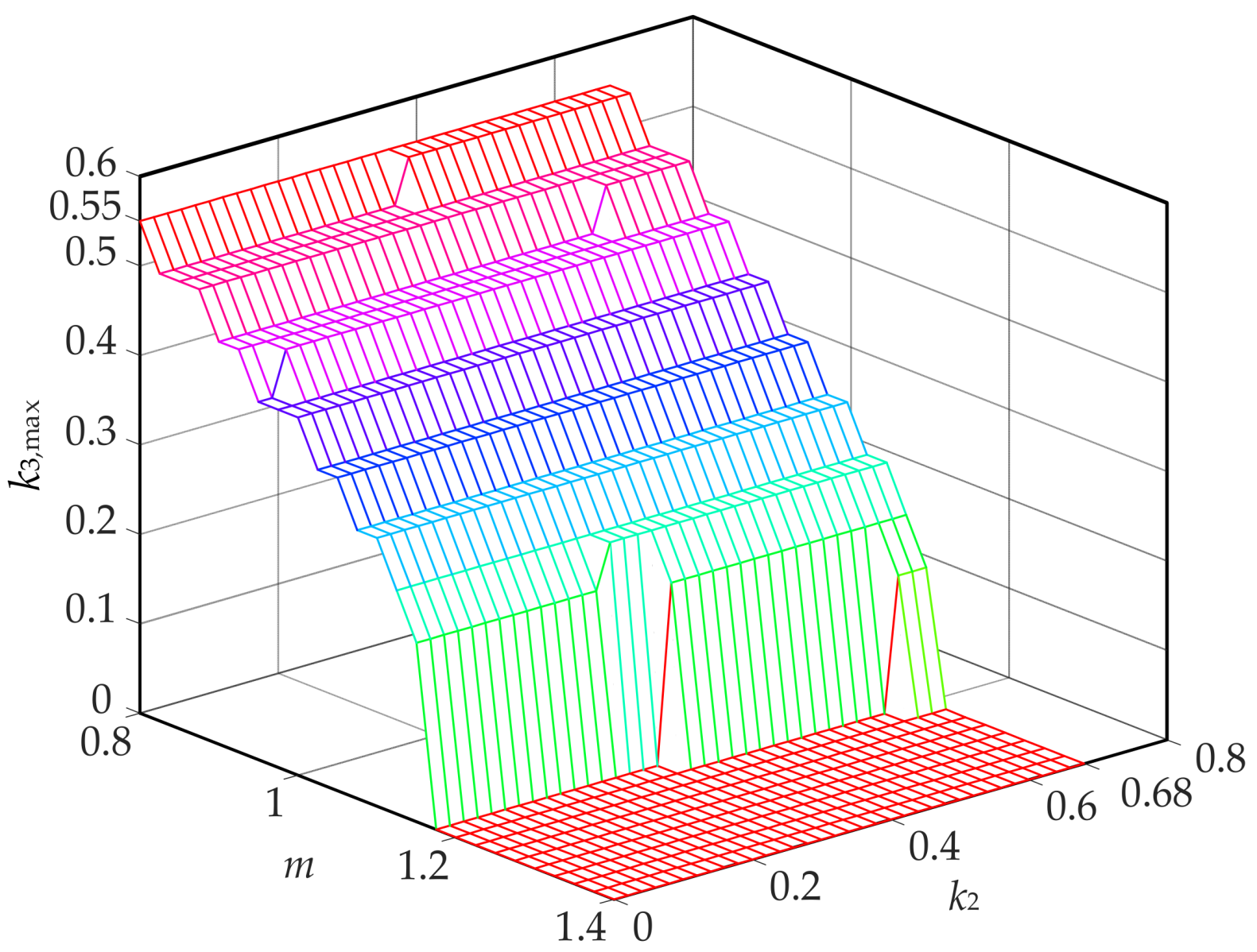
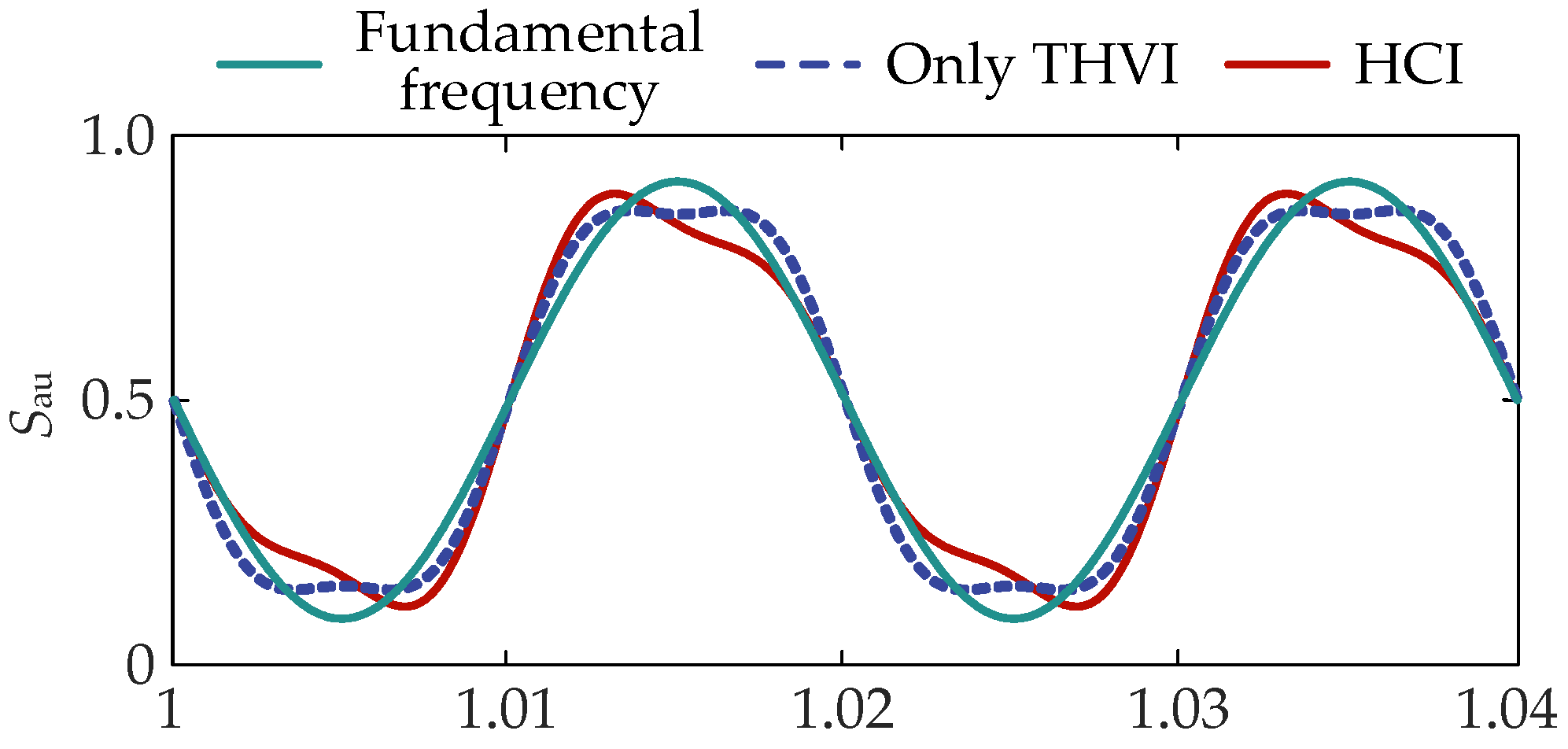
Finally, the range of the injected third-order harmonic voltage parameter k3 remains to be determined. Within an appropriate range, a larger k3 corresponds to a higher third-order harmonic voltage, which enhances the peak suppression effect of the switching function. Beyond this range, however, the effect is reversed. Therefore, k3 must be constrained to ensure that the modulation wave under CHI strategy does not exceed the preset modulation margin ε. It should also be noted that, according to Equations (12) and (28), the injected second-order circulating current further influences the modulation wave, as illustrated in Figure 2. Therefore, the relationship between k3max, m and k2 is illustrated in Figure 3. It shows that for m > 1.2, the modulation margin constraint on the switching function Sau is only satisfied when k3 = 0, meaning any injection of third-order harmonic voltage would exceed the margin limit. Therefore, the maximum permissible value of m is set to 1.2, and the feasible range for k3 is set as [0, 0.55].
Based on the preceding analysis, the feasible lower and upper bounds for all optimized parameters have been summarized in Table 1.

2.2.3. Parameters Optimization Based on PSO Algorithm

Given the complexity of the expression for U - Cau , 1 + U - Cau , 2 and the strong coupling among the parameters to be optimized, an analytical solution is infeasible. At present, many optimization algorithms exist for solving the proposed parameter optimization task. Given its straightforward implementation and effectiveness in global optimization within defined boundaries [35], the particle swarm optimization (PSO) algorithm is therefore selected for parameter optimization. Specifically, PSO algorithm usually converges rapidly, making it suitable for scenarios involving variable power conditions. Meanwhile, PSO algorithm operates with fewer parameters and relatively simple iterative computations, which meets the reliability requirements of control systems in high-voltage large-capacity MMCs.
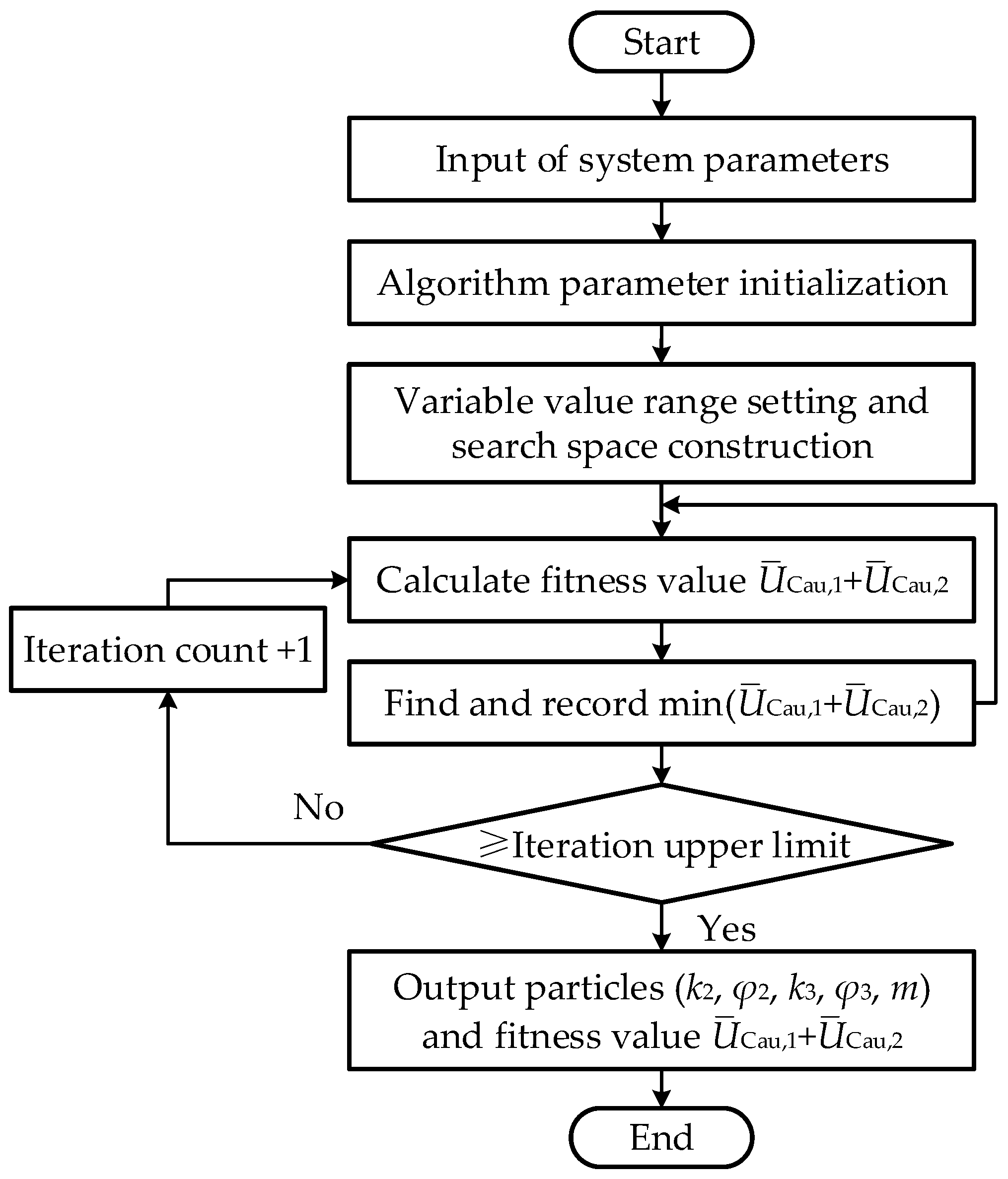
The specific workflow of the PSO algorithm is illustrated in Figure 4. The procedure starts with the input of system parameters. Then, the algorithm parameters are initialized. These parameters include swarm size, particle dimension, iteration count, inertia weight, acceleration constants, and velocity range. Next, the value ranges for the variables k2, φ2, k3, φ3, and m are set to define the search space. In each iteration, the fitness function U - Cau , 1 + U - Cau , 2 is evaluated for all particles, and the minimum fitness value is recorded. This iterative process continues until the preset iteration limit is reached. Finally, the algorithm outputs the optimal particle set, which contains the variables k2, φ2, k3, φ3, and m, together with the corresponding minimized fitness value.
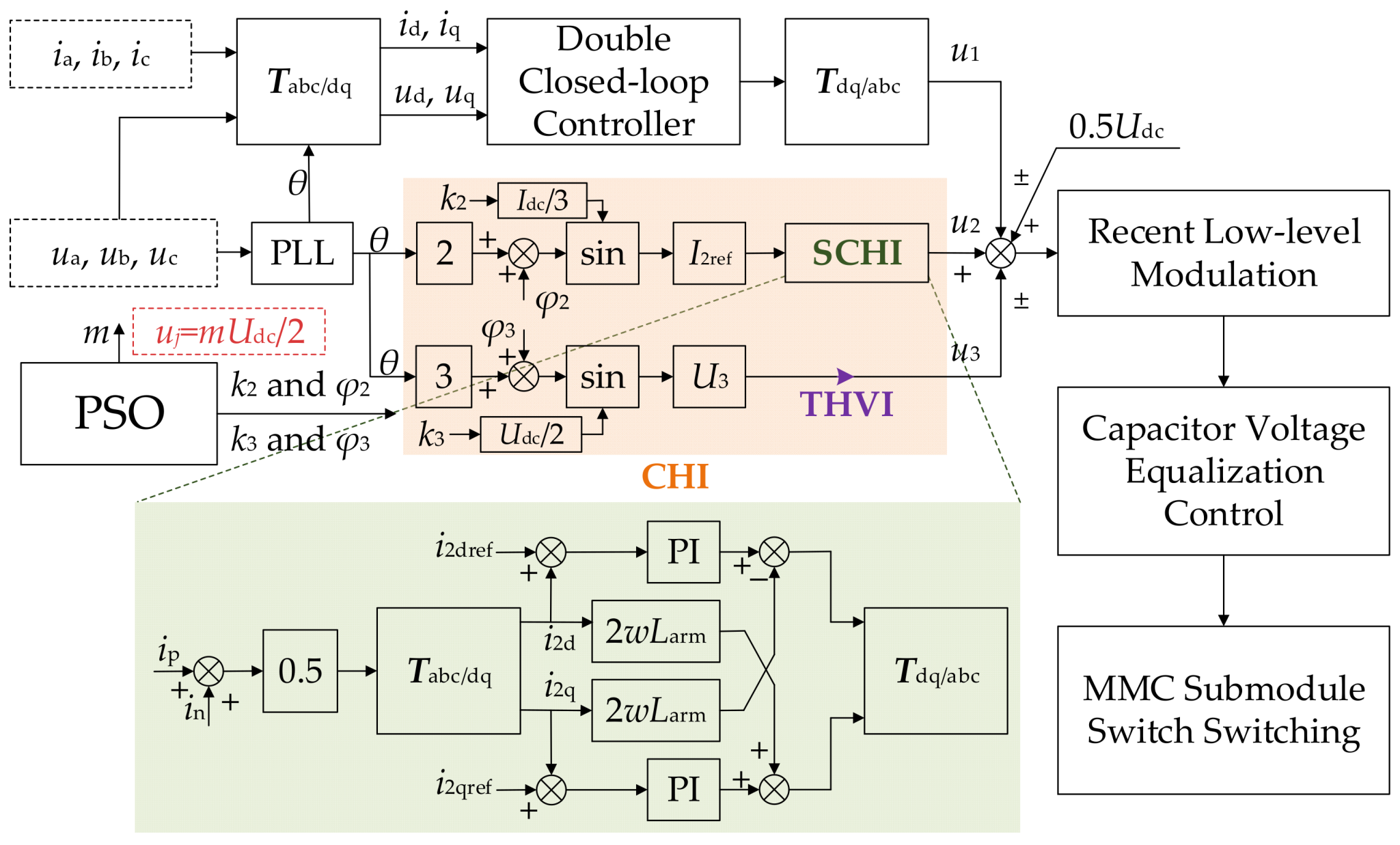
The control block diagram of the MMC with the proposed CHI strategy is presented in Figure 5. The optimally tuned parameters obtained from the PSO algorithm are fed into the CHI control module, which outputs the optimal common-mode second-order harmonic voltage and differential-mode third-order harmonic voltage. These harmonic components are superimposed onto the fundamental voltage generated by the dual-loop controller, together with half of the DC bus voltage, to form the final arm modulation signal. This composite signal then drives the nearest-level modulation and capacitor voltage equalization control, which govern the switching of the SMs in MMC.

3. Simulation Analysis and Verification

3.1. Simulation System Description

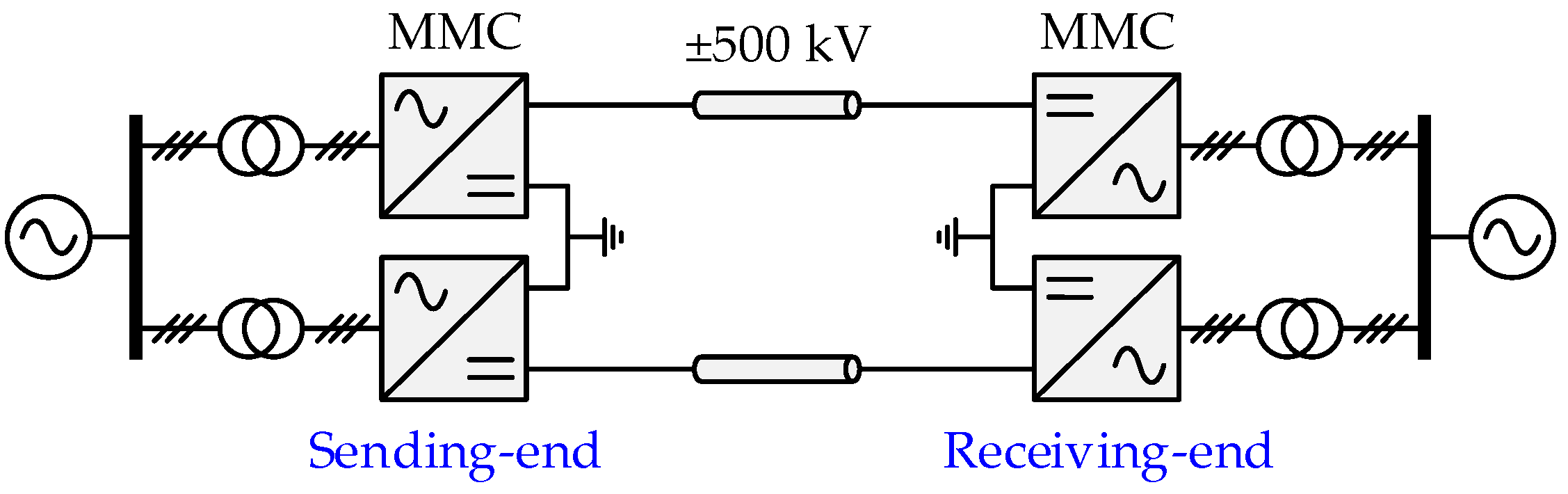
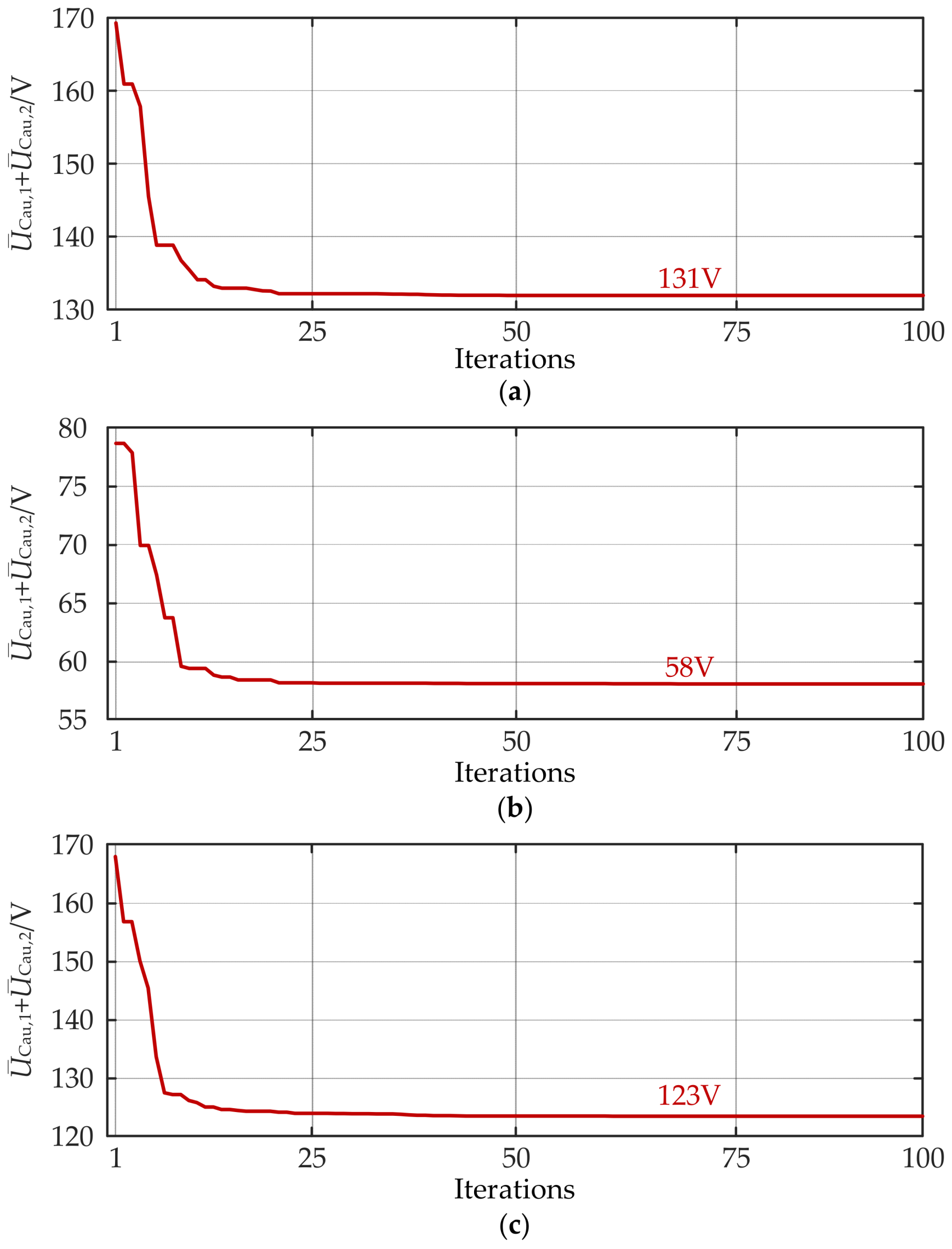
To further verify the effectiveness of the proposed optimization method, a ±500 kV, 1500 MW MMC-HVDC system is established in PSCAD/EMTDC, as shown in Figure 6. The main system parameters are shown in Table 2. The initial capacitance value used in MMC is 15 mF. To demonstrate the SM capacitance reduction effect of the proposed method under different system power levels, both rated-power and 50% rated-power conditions are set and simulated. The key parameters of the PSO algorithm are listed in Table 3. Figure 7 shows the relationship between iteration count and optimal solution in the PSO algorithm under these two conditions. It can be observed that the fitness value gradually decreases with increasing iteration count and converges within approximately 50 iterations, indicating that the algorithm reaches a stable optimum under each operating condition. Upon convergence, the algorithm outputs a distinct set of optimal parameters. The optimized values for five key parameters are shown in Table 4. These optimized values, comprising the key harmonic injection coefficients and the modulation index, are subsequently implemented in the CHI strategy of the simulation system model.

3.2. Simulation Results of Sending-End MMC Under Rated-Power Condition

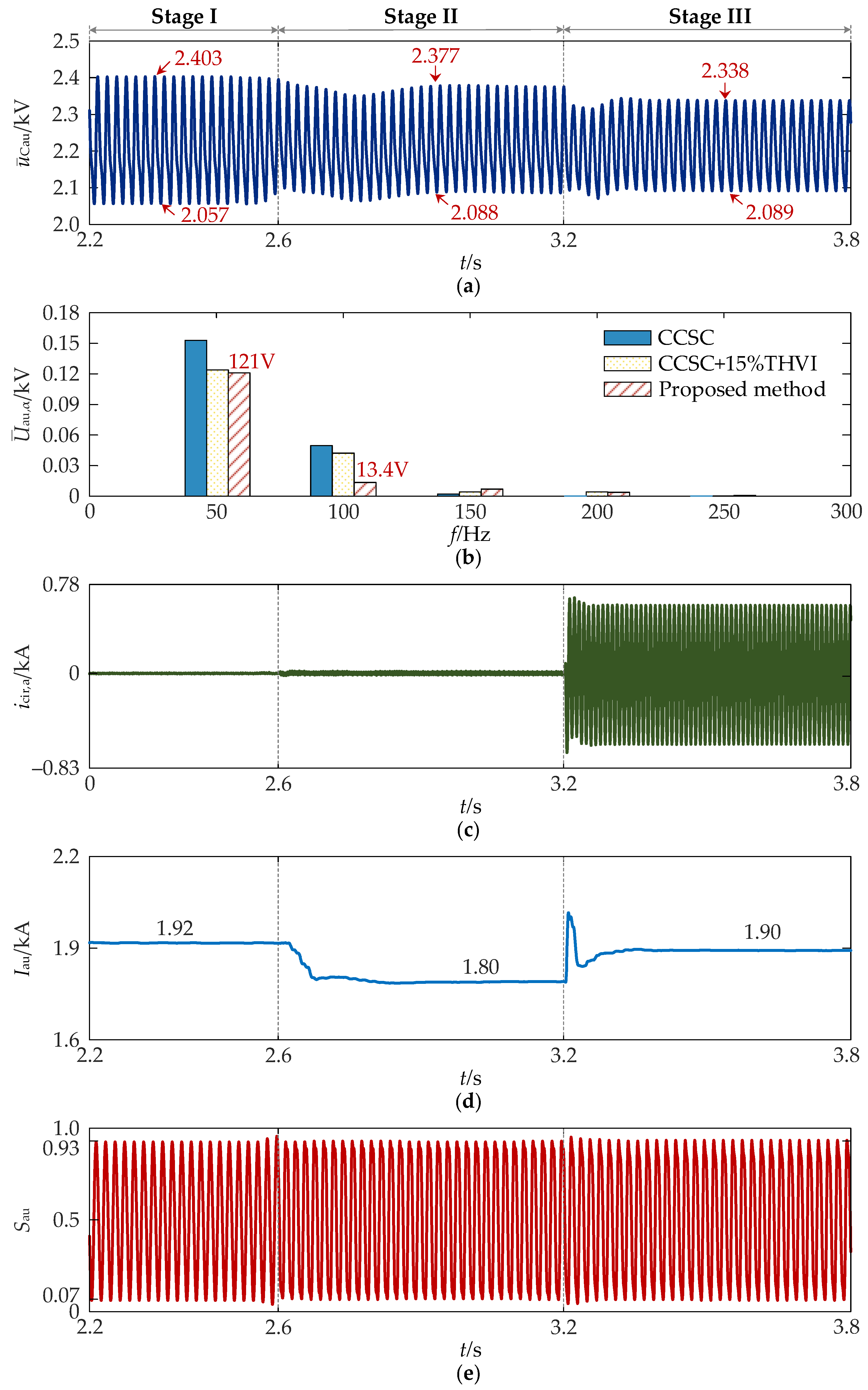
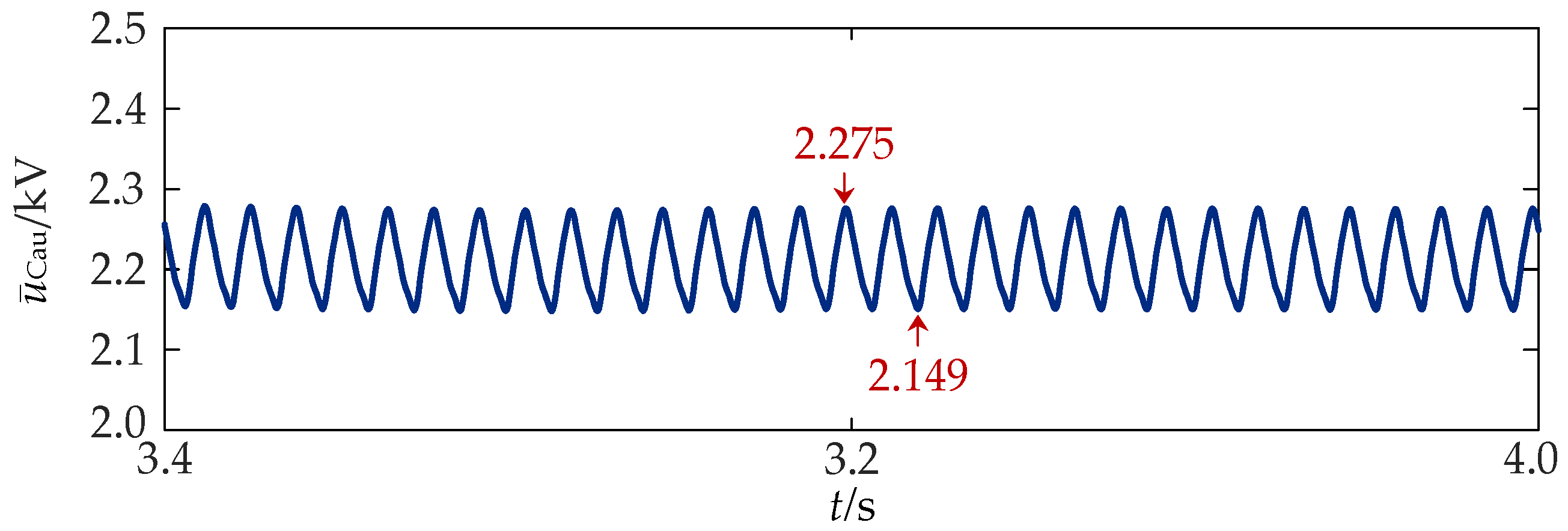
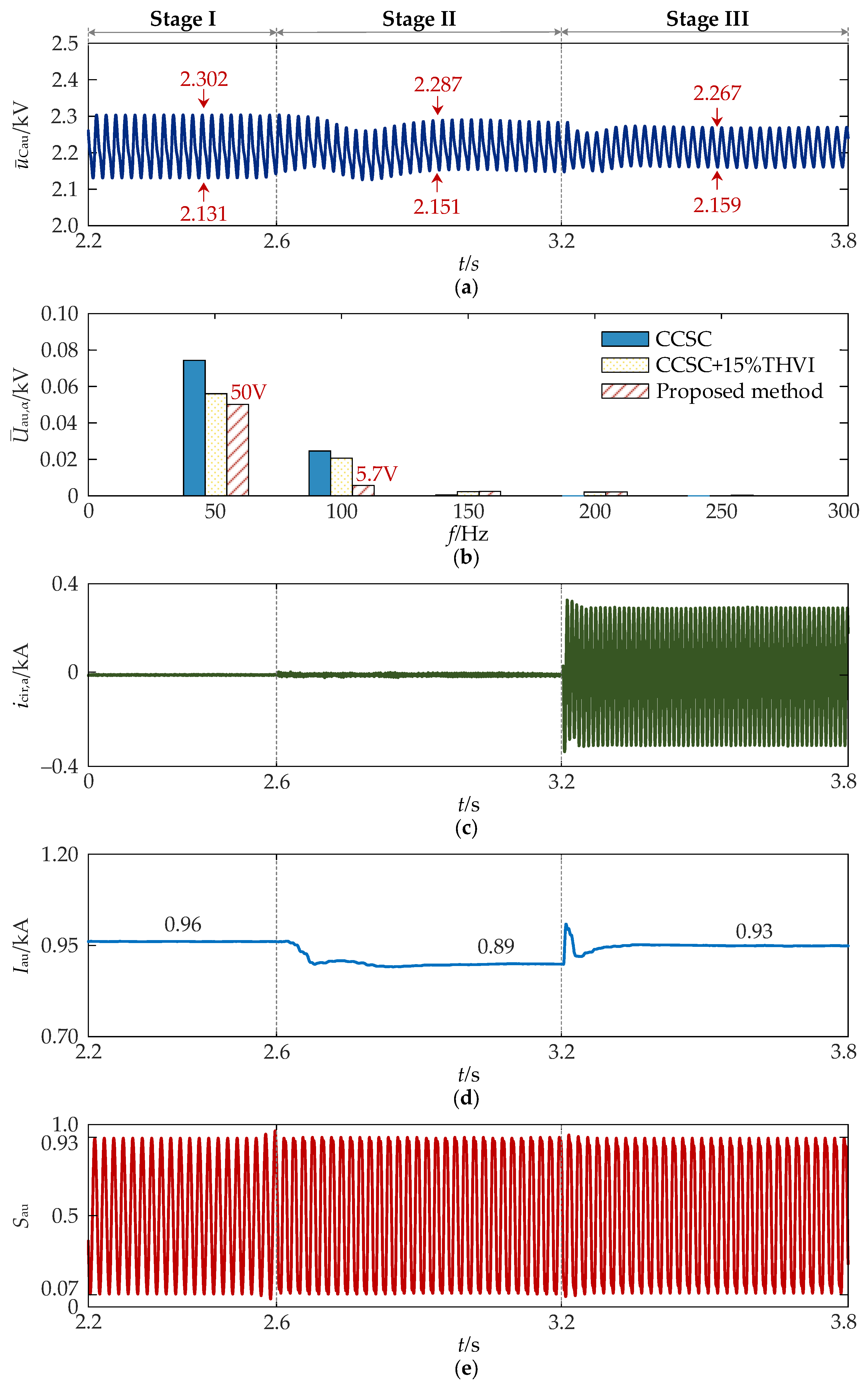
To evaluate the superiority and feasibility of the proposed method, comparative simulations are performed against some existing voltage fluctuation suppression strategies. The simulation waveforms are divided into three stages, each employing a different suppression strategy, as summarized in Figure 8. Stage I (2.2–2.6 s) adopts the conventional CCSC strategy. Stage II (2.6–3.2 s) introduces an additional 15% third-order harmonic voltage injection on the basis of Stage I. Stage III (3.2–3.8 s) implements the CHI strategy based on the proposed parameter optimization method.
As shown in Figure 8a, the average SM capacitor voltage exhibits a clear reduction in peak-to-peak fluctuation across the stages: 346 V in Stage I, 289 V in Stage II, and 249 V in Stage III. The fluctuation in Stage III represents reductions of 28.03% and 13.84% compared to Stage I and Stage II, respectively. The fast Fourier transform (FFT) analysis in Figure 8b confirms that the capacitor voltage fluctuation is dominated by fundamental and second-order harmonic components, with higher-order harmonics being negligible. This validates the selection of U - Cau , 1 + U - Cau , 2 as the optimization objective. Meanwhile, the amplitude sum of the fundamental and second-order harmonic components in capacitor voltage is approximately consistent with the optimal solution in Figure 7a. The improved performance in Stage III is primarily attributable to a further suppression of the second-order harmonic component compared to Stages I and II.
Figure 8c displays the circulating current in the upper arm of phase A. The proposed CHI strategy results in a higher peak circulating current compared to the other two stages, indicating a corresponding increase in the overall arm current. As shown in Figure 8d, the root-mean-square (RMS) values of the upper arm current are 1.92 kA in Stage I, 1.80 kA in Stage II, and 1.90 kA in Stage III. Although the RMS current in Stage III is lower than in Stage I, it is 5.6% higher than in Stage II. The increased arm current in Stage III will lead to higher conduction and switching losses than that of Stage II. According to [36], the power loss of a typical MMC represents about 0.73% of the transmitted power. Assuming constant equivalent loss resistances, the additional loss introduced in Stage III can be estimated at only (1.92 − 1.82)/1.82 × 0.73% = 0.083% of the transmitted power, which is an acceptable trade-off given the significant improvement in voltage fluctuation suppression.
Figure 8e illustrates the modulation wave for the upper arm of phase A. In Stage I, the waveform is a pure fundamental sinusoid. In Stages II and III, it exhibits a distinct non-sinusoidal shape due to harmonic injection. It should be pointed out that the modulation wave amplitude in all three stages remains strictly within the predefined safety margin 7%. This design prevents AC-side waveform distortion caused by modulation over-modulation and ensures system stability.
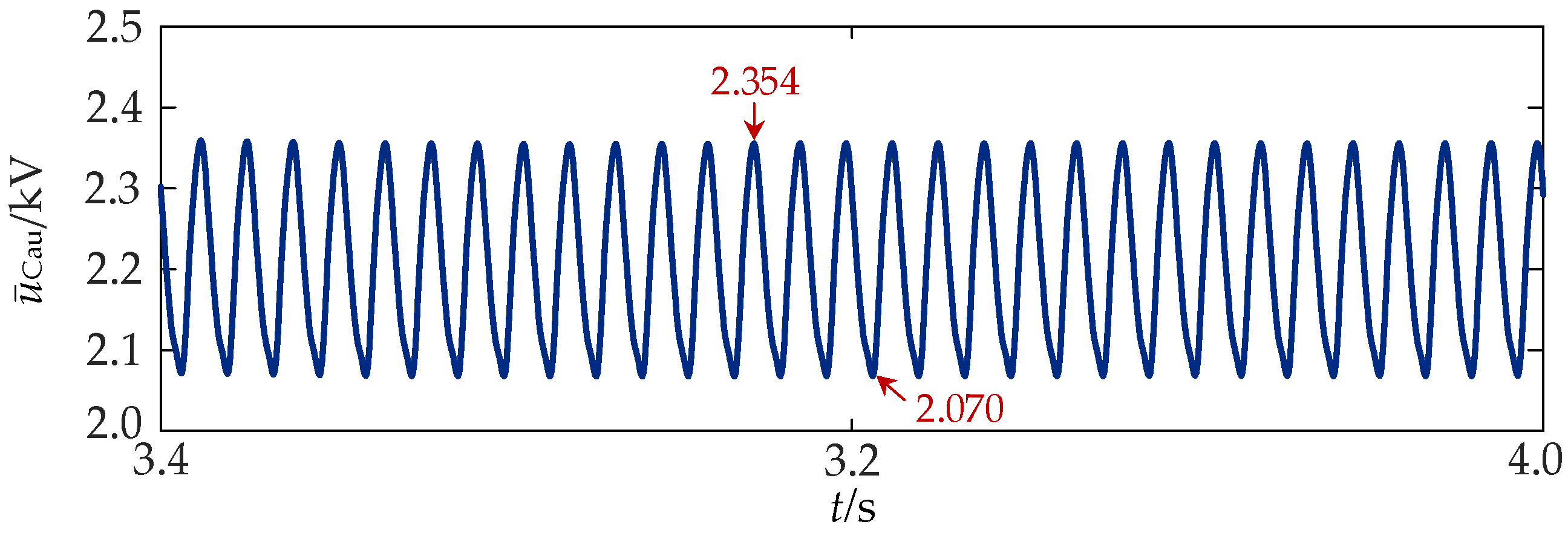
The potential of the proposed method for capacitance reduction is demonstrated in Figure 9, which shows the capacitor voltage fluctuation in Stage III after decreasing the SM capacitance from 15 mF to 13 mF, corresponding to a reduction of 13.33%. With the reduced capacitance, the peak-to-peak voltage fluctuation reaches 284 V. Although this value is higher than that observed in Stage III with the original capacitance, it is still lower than the fluctuation level measured in Stage II before the capacitance reduction. This result confirms that the proposed parameter optimization method enables a further reduction in SM capacitance under the rated-power condition compared to conventional strategies. Therefore, the optimized capacitor value is 13 mF for sending-end MMC.

3.3. Simulation Results of Sending-End MMC Under 50% Rated-Power Condition

Figure 10 presents the simulation waveforms of sending-end MMC under 50% rated-power condition, employing the same suppression strategies as those applied under rated-power condition for each stage. As shown in Figure 10a, the reduction in transmitted power decreases the capacitor voltage in peak-to-peak fluctuation in all stages: 171 V in Stage I, 136 V in Stage II, and 108 V in Stage III. It should be noted that, compared to the rated-power condition, the reduction in capacitor voltage fluctuation is attributable to the decrease in arm current. The fluctuation in Stage III represents reductions of 28.03% and 13.84% compared to Stage I and Stage II, respectively, demonstrating the superior effectiveness of the proposed strategy in suppressing voltage fluctuation under 50% rated-power condition. The FFT analysis results in Figure 10b similarly reveals that the voltage fluctuation is dominated by the fundamental and second-order harmonic components. Moreover, the better suppression effect in Stage III is clearly attributable to a further reduction in the second-order harmonic component compared to the preceding stages.
As shown in Figure 10c, the peak circulating current in the upper arm for Stage III is nearly half of that under rated power condition. As shown in Figure 10d, the RMS values of the upper arm current also nearly decreases by half compared to that under rated-power condition, which are 0.96 kA in Stage I, 0.89 kA in Stage II, and 0.93 kA in Stage III. The RMS current in Stage III is lower than in Stage I, but it is 4.5% higher than in Stage II. Therefore, the additional loss introduced in Stage III can be estimated at only (0.932 − 0.892)/0.892 × 0.73% = 0.092% of the transmitted power, which is acceptable. As shown in Figure 10e, the modulation wave amplitude for the upper arm of phase A still remains strictly within the predefined safety margin 7% in all three stages.
Figure 11 shows the capacitor voltage fluctuation in Stage III after a 13.33% reduction in capacitance value under 50% rated-power condition. With the reduced SM capacitor, the voltage fluctuation reaches 126 V. Although this value increases slightly after capacitance reduction, it remains lower than the voltage fluctuation level measured in Stage II before the capacitance reduction, which also confirms that the proposed parameter optimization method enables a further reduction in SM capacitance under 50% rated-power condition compared to conventional strategies.

3.4. Simulation Results of Receiving-End MMC Under Rated-Power Condition

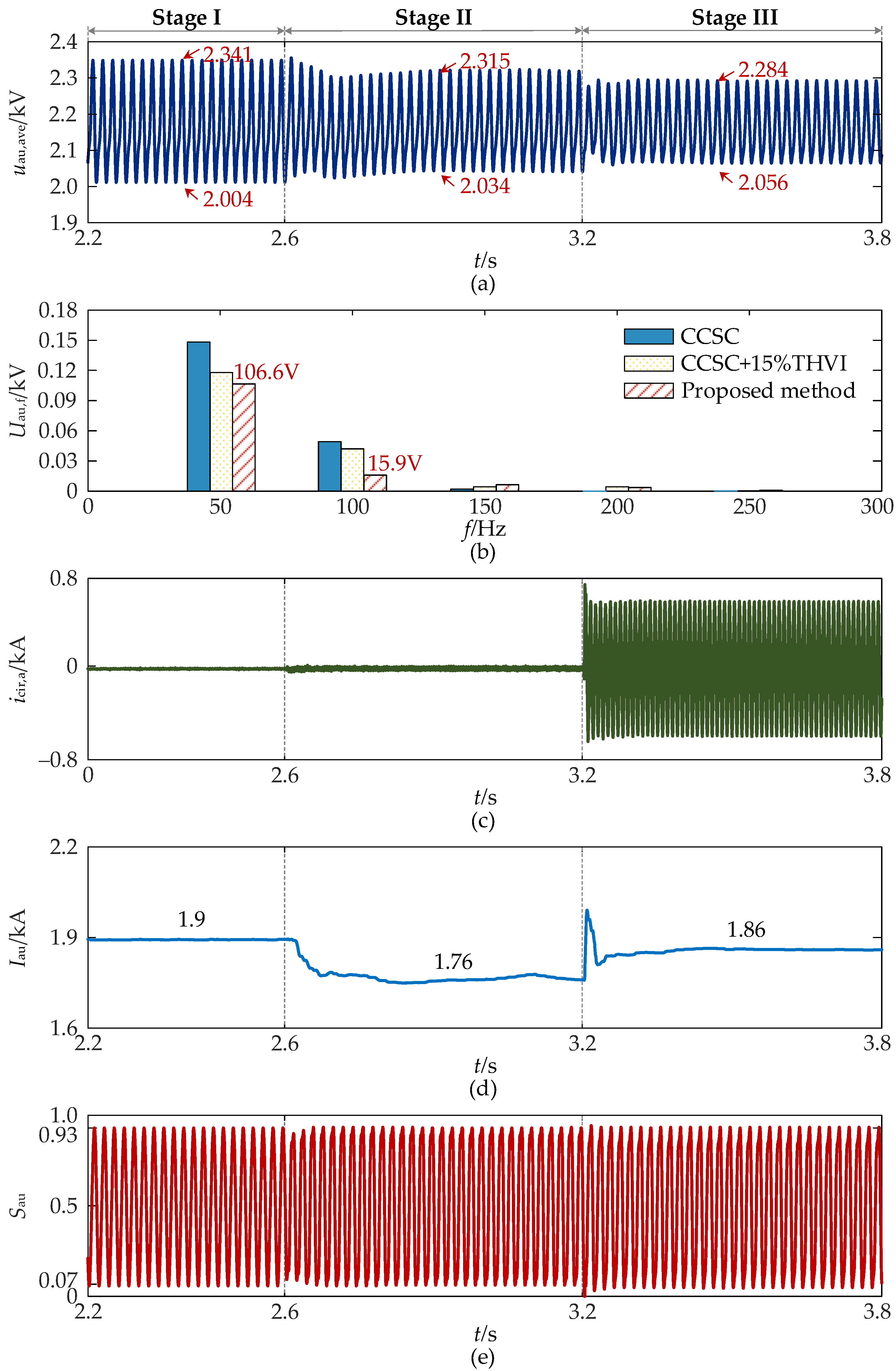
Figure 12a shows the peak-to-peak capacitor voltage fluctuation at the receiving end decreases sequentially across the three stages: 337 V, 281 V, and 228 V. Stage III achieves reductions of 32.34% and 18.86% compared to Stage I and Stage II, respectively. The FFT results in Figure 12b indicate that the voltage fluctuation is primarily composed of fundamental and second-order harmonic components. In Stage III, although higher-order harmonics show a slight increase, fundamental and second-order harmonic components are further suppressed, with the second-order harmonic being reduced by nearly 2/3.
As observed in Figure 12c, the proposed strategy raises the circulating current due to active second-harmonic injection. The corresponding RMS values of upper-arm current are 1.9 kA, 1.76 kA, and 1.86 kA in the three stages, as shown in Figure 12d. The additional power loss in Stage III is estimated at only 0.076% of the transmitted power, which is acceptable given the significant capacitor voltage fluctuation reduction.
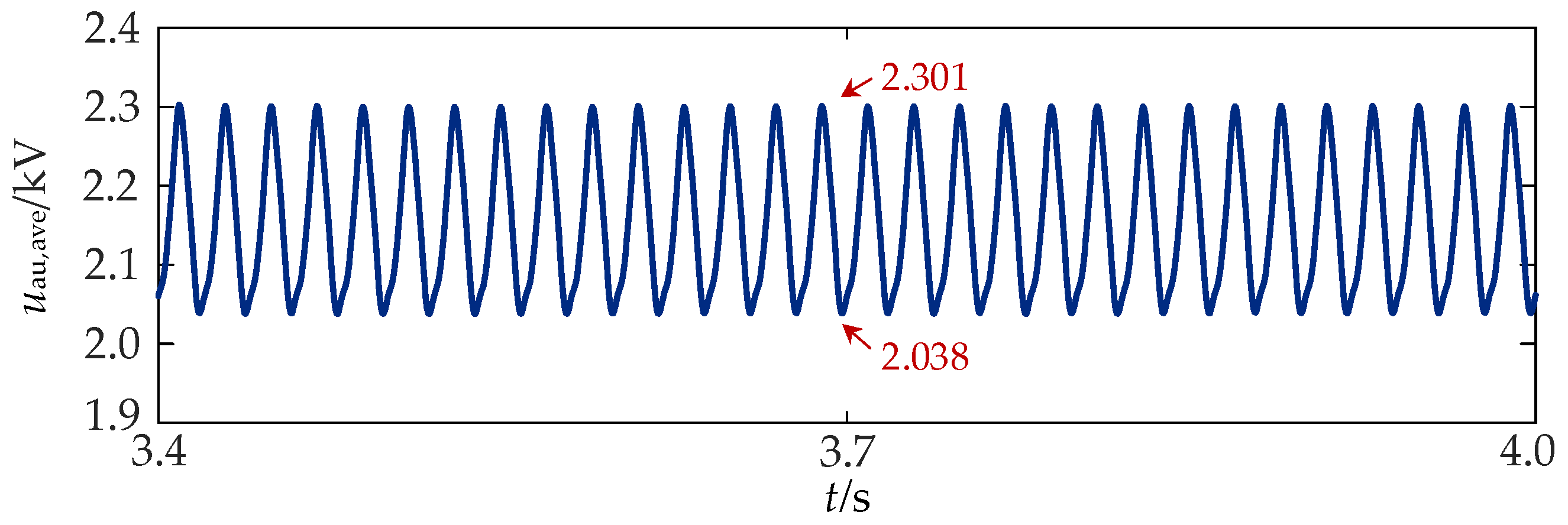
Figure 13 presents the results with a 13.33% reduction in capacitance. The peak-to-peak fluctuation reaches 263 V, which is still lower than 281 V in Stage II before capacitance reduction. This confirms that the proposed approach can effectively reduce capacitance values of receiving-end MMC under the rated-power condition. Therefore, the optimized capacitor value is 13 mF for receiving-end MMC.

3.5. A Brief Contribution Analysis of SM Capacitance Reduction to MMC Size and Cost

In practical MMC designs, the larger SM capacitor is typically implemented by connecting numerous low-capacitor units in parallel. Consequently, the required number of these individual capacitor units is directly proportional to the submodule capacitance. Reducing SM capacitance therefore enables a proportional decrease in the total component count. Industry data indicates that SM capacitors constitute approximately 50% of the total volume and 30% of the total cost in an MMC [12,13]. Since the method proposed in this paper achieves a further 13.3% reduction in the required SM capacitance compared to traditional strategies, this translates directly into estimated reductions in overall system volume and cost of 6.65% (50% × 13.3%) and 3.99% (30% × 13.3%), respectively.

4. Discussions

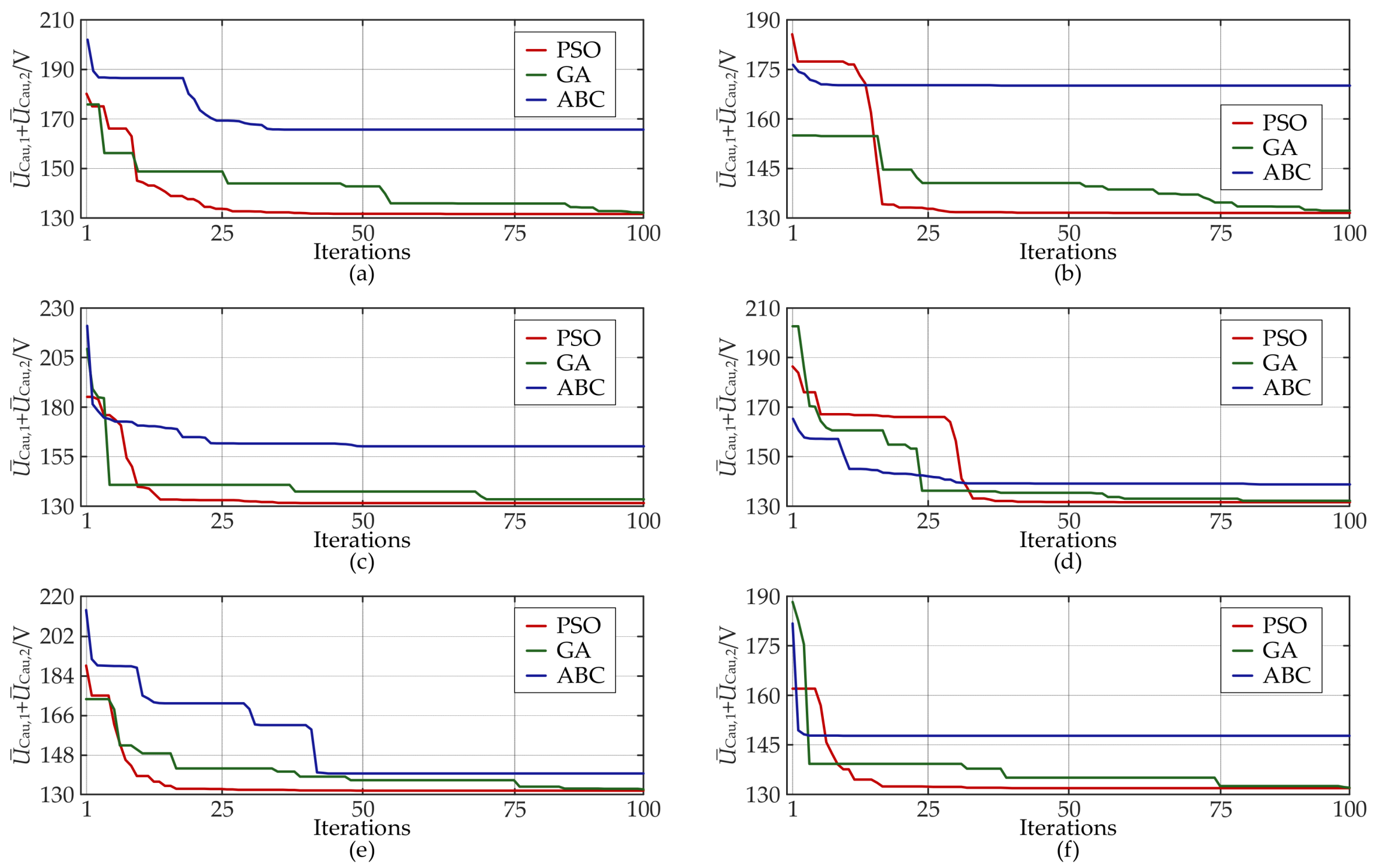
Many optimization algorithms exist for solving the proposed parameter optimization task. For example, genetic algorithm (GA) and artificial bee colony (ABC) algorithm. Therefore, a performance comparison with the GA and ABC algorithm is meaningful and will help address potential questions regarding algorithm selection. In this section, we conducted 30 independent optimization tests using the PSO, GA, and ABC algorithms, respectively. In each test, the maximum number of iterations is set to 100, and the swarm size for PSO algorithm, population size for GA, and bee colony size for ABC algorithm all set to 300. A summary of the optimization results is provided in Table 5.
From Table 5, the PSO algorithm achieves the smallest overall optimal solution and the lowest mean optimal solution among the three algorithms, indicating its superior solution quality. The standard deviation for PSO algorithm is 8.682, significantly lower than the values of 9.085 for GA and 14.332 for ABC algorithm, respectively. Furthermore, PSO yields the fewest instances where the solution exceeds 1.01 times the overall optimal solution, indicating its highest stability and consistency. To visualize the differences among the three algorithms, Figure 14 shows the relationship between iteration count and optimal solution for the 5th, 10th, 15th, 20th, 25th, and 30th tests. It can be observed that the ABC algorithm exhibits the poorest optimization performance. GA performs better and more stable than ABC algorithm, consistently converging close to the global optimum, but its convergence speed is noticeably slower than that of PSO algorithm. In summary, the PSO algorithm outperforms both GA and ABC algorithm and is more suitable for the proposed parameter optimization task.

5. Conclusions

With the continuous increase in transmission capacity and voltage levels of renewable-energy HVDC systems, the demand for lightweight MMCs has become both urgent and significant. This paper proposes a comprehensive CHI parameters optimization method to minimize the SM capacitor voltage fluctuation of MMC, thereby achieving a further reduction in capacitance value compared to existing strategies. The effectiveness of the proposed method is verified through detailed simulations and comparative evaluations against conventional strategies under rated-power and 50% rated-power conditions. The main conclusions are summarized as follows:
  • Analysis of the average SM capacitor voltage fluctuation characteristics reveals that the fundamental and second-order harmonic components dominate he voltage fluctuation, with other higher-order components contributing negligible. Consequently, the optimization objective in this paper is defined as minimizing the magnitude sum of these two dominant harmonic components.
  • Building upon the third-harmonic voltage, the injected second-order circulating current further modifies the modulation wave through the arm inductance. This interaction introduces significant coupling between the CHI parameters and the modulation index. By incorporating switching function modeling and modulation margin constraints, this paper refines the feasible ranges of these parameters and then employs PSO to effectively solve the resulting constrained optimization problem.
  • Simulation results under different power conditions demonstrate that, compared with the conventional CCSC strategy combined with 15% THVI, the proposed method further reduces the second-order harmonic component of the SM capacitor voltage, leading to enhanced voltage fluctuation suppression. Even with a 13.33% reduction in SM capacitance (from 15 mF to 13 mF), the resulting voltage fluctuation using the proposed method remains lower than that of the CCSC strategy with 15% THVI prior to capacitance reduction. This capacitance reduction translates directly into an estimated 6.65% decrease in overall MMC volume and a 3.99% reduction in system cost, confirming the potential of the proposed method for MMC lightweighting and cost efficiency.
  • The proposed method introduces a controllable second-order circulating current, which results in a corresponding increase in the conduction and switching losses of MMC. However, this additional loss is relatively small and is estimated to be below 0.1% of the transmitted power. In practice, if the magnitude of the injected circulating current is further constrained, the arm current and MMC losses can be correspondingly reduced, which will be further studied in the future.

Author Contributions

Conceptualization, T.L. and Y.W.; methodology, T.L. and Y.W.; validation, B.Y. and Y.M.; writing—original draft preparation, T.L. and Y.W. All authors have read and agreed to the published version of the manuscript.

Funding

This research was funded by State Grid Economic and Technological Research Institute Co., Ltd.—Non-Dissipative Surplus Power Suppression Technology for Ultra-High Voltage Flexible DC Transmission Systems, grant number ZZKJ-2025-27.

Data Availability Statement

The original contributions presented in this study are included in the article. Further inquiries can be directed to the corresponding author.

Conflicts of Interest

Authors Tan Li, Yingxin Wang, Bin Yuan and Yu Meng were employed by the company State Grid Economic and Technological Research Institute Co., Ltd. The remaining authors declare that the research was conducted in the absence of any commercial or financial relationships that could be construed as a potential conflict of interest. The authors declare that this study receive funding from State Grid Economic and Technological Research Institute Co., Ltd. The funder was not involved in the study design, collection, analysis, interpretation of data, the writing of this article or the decision to submit it for publication.

Abbreviations

The following abbreviations are used in this manuscript:
MMCModular multilevel converter
HVDCHigh-voltage direct current
CHIComposite harmonic injection
PSOParticle swarm optimization
VSC-HVDCVoltage source converter-based high-voltage direct current
SMsSubmodules
CCSCCurrent suppressing control
SHCISecond-order harmonic current injection
THVIThird-order harmonic voltage injection
PIProportional-integral
PRProportional-resonant
FFTFast Fourier transform

References

  1. Sahebkar Farkhani, J.; Çelik, Ö.; Ma, K.; Bak, C.L.; Chen, Z. A Comprehensive Review of Potential Protection Methods for VSC Multi-Terminal HVDC Systems. Renew. Sustain. Energy Rev. 2024, 192, 114280. [Google Scholar] [CrossRef]
  2. Li, Y.; Wen, T.; Cao, Y.; Zhang, Y.; Wang, W. High-Frequency Resonance Coordinated Suppression Method of MMC-HVDC Systems under Frequency Divided Voltage Feedforward Control. IEEE Trans. Power Del. 2025, 40, 938–950. [Google Scholar] [CrossRef]
  3. Hu, Y.; Ma, H.; Li, J.; Li, J.; Ekanayake, C.; Xu, Y. Investigating Transient Fault Characteristics of XLPE Cable in a Bipolar VSC-HVDC System-Cable Modeling and Field Verification. IEEE Trans. Power Del. 2025, 40, 2906–2917. [Google Scholar] [CrossRef]
  4. Xiao, Q.; Jin, Y.; Jia, H.; Tang, Y.; Cupertino, A.F.; Mu, Y.; Teodorescu, R.; Blaabjerg, F.; Pou, J. Review of Fault Diagnosis and Fault-Tolerant Control Methods of the Modular Multilevel Converter Under Submodule Failure. IEEE Trans. Power Electron. 2023, 38, 12059–12077. [Google Scholar] [CrossRef]
  5. Debnath, S.; Qin, J.; Bahrani, B.; Saeedifard, M.; Barbosa, P. Operation, Control, and Applications of the Modular Multilevel Converter: A Review. IEEE Trans. Power Electron. 2015, 30, 37–53. [Google Scholar] [CrossRef]
  6. Meng, J.; Song, Q.; Sun, Q.; Xu, S.; Zhao, B.; Yu, Z.; Zeng, R. Rethinking Linear Modulation Range of Modular Multilevel Converters. IEEE Trans. Power Electron. 2023, 38, 7241–7255. [Google Scholar] [CrossRef]
  7. Lv, X.; Wang, J.; Zhang, Z.; Liu, Z.; Li, Z. Adaptive Active Inertia Control Strategy of MMC-HVDC Systems for Flexible Frequency Support. Electronics 2023, 12, 4288. [Google Scholar] [CrossRef]
  8. Wang, W.; Li, G.; Guo, J. Large-Scale Renewable Energy Transmission by HVDC: Challenges and Proposals. Engineering 2022, 19, 252–267. [Google Scholar] [CrossRef]
  9. Rao, H.; Zhou, Y.; Li, W.; Zou, C.; Wang, Z. Engineering Application and Development Prospect of VSC-HVDC Transmission Technology. Autom. Electr. Power Syst. 2023, 47, 1–11. [Google Scholar]
  10. Lan, J.; Chen, W.; Li, X.; Sun, Y.; Shu, L.; Deng, F. A Three-Phase Multiplexing Arm Modular Multilevel Converter with High Power Density and Small Volume. IEEE Trans. Power Electron. 2022, 37, 14587–14600. [Google Scholar] [CrossRef]
  11. Li, T.; Wang, Y.; Wang, W. A Novel Suppression Strategy Design Method for Capacitor Voltage Fluctuation of Half-Bridge MMC. In Proceedings of the 2025 IEEE 3rd International Conference on Power Science and Technology (ICPST), Kunming, China, 16–18 May 2025; IEEE: Kunming, China, 2025; pp. 1004–1009. [Google Scholar]
  12. Li, M.; Dong, N.; Chang, X.; Yang, H.; Zhao, R. Analysis and Suppression of Capacitor Voltage Ripple for Hybrid MMCs Under Boosted AC Voltage Conditions. IEEE J. Emerg. Sel. Top. Power Electron. 2023, 11, 3775–3787. [Google Scholar] [CrossRef]
  13. Xu, J.; Deng, W.; Li, G.; Zhao, C.; Liu, C. Optimal Second-Harmonic Current Injection for Capacitor Voltage Fluctuation Reduction in Hybrid MMCs Under Grid-Side SLG Faults. IEEE Trans. Power Deliv. 2022, 37, 2857–2866. [Google Scholar] [CrossRef]
  14. Xiao, H.; Gan, H.; Huang, Y.; Zhang, L.; Yang, P. Review of Lightweight DC Transmission Technology for Offshore Wind Power. High Volt. Eng. 2025, 51, 2702–2719. [Google Scholar]
  15. Li, B.; Zhang, Y.; Wang, G.; Sun, W.; Xu, D.; Wang, W. A Modified Modular Multilevel Converter with Reduced Capacitor Voltage Fluctuation. IEEE Trans. Ind. Electron. 2015, 62, 6108–6119. [Google Scholar] [CrossRef]
  16. Xu, J.; Wang, J.; Yang, Y.; Wang, J.; Li, G. Optimal Suppression Strategy for Capacitor Voltage Ripples of Hybrid MMCs Under Unbalanced Grid Voltages. IEEE Trans. Power Deliv. 2023, 38, 244–254. [Google Scholar] [CrossRef]
  17. Xiao, H.; Gan, H.; Huang, Y.; Cai, Z. Capacitor Voltage Ripple Control Strategy of Lightweight Modular Multilevel Converter for Offshore Wind Power Transmission. IEEE Trans. Ind. Applicat. 2024, 60, 5398–5406. [Google Scholar] [CrossRef]
  18. Lan, J.; Chen, W.; He, X.; Xie, Y.; Wang, Y. The Wide Multiplexed Period Three-Phase Multiplexing Arm Modular Multilevel Converter. IEEE J. Emerg. Sel. Top. Power Electron. 2023, 11, 4929–4944. [Google Scholar] [CrossRef]
  19. Li, Z.; Wang, P.; Chu, Z.; Zhu, H.; Luo, Y.; Li, Y. An Inner Current Suppressing Method for Modular Multilevel Converters. IEEE Trans. Power Electron. 2013, 28, 4873–4879. [Google Scholar] [CrossRef]
  20. Li, S.; Wang, X.; Yao, Z.; Li, T.; Peng, Z. Circulating Current Suppressing Strategy for MMC-HVDC Based on Nonideal Proportional Resonant Controllers Under Unbalanced Grid Conditions. IEEE Trans. Power Electron. 2015, 30, 387–397. [Google Scholar]
  21. He, L.; Zhang, K.; Xiong, J.; Fan, S. A Repetitive Control Scheme for Harmonic Suppression of Circulating Current in Modular Multilevel Converters. IEEE Trans. Power Electron. 2015, 30, 471–481. [Google Scholar] [CrossRef]
  22. Yang, Z.; Song, P.; Song, J.; Wang, X.; Li, X. An MMC Circulating Current Suppressing Controller Based on Bridge Arm Common-Mode Voltage. IEEE Access 2020, 8, 189471–189478. [Google Scholar] [CrossRef]
  23. Picas, R.; Pou, J.; Ceballos, S.; Agelidis, V.G.; Saeedifard, M. Minimization of the Capacitor Voltage Fluctuations of a Modular Multilevel Converter by Circulating Current Control. In Proceedings of the IECON 2012—38th Annual Conference on IEEE Industrial Electronics Society, Montreal, QC, Canada, 25–28 October 2012; IEEE: Montreal, QC, Canada, 2012; pp. 4985–4991. [Google Scholar]
  24. Picas, R.; Pou, J.; Ceballos, S.; Zaragoza, J.; Konstantinou, G.; Agelidis, V.G. Optimal Injection of Harmonics in Circulating Currents of Modular Multilevel Converters for Capacitor Voltage Ripple Minimization. In Proceedings of the 2013 IEEE ECCE Asia Downunder, Melbourne, Australia, 3–6 June 2013; IEEE: Melbourne, Australia, 2013; pp. 318–324. [Google Scholar]
  25. Liang, C.; Ren, C.; Zhou, J.; Yue, W.; Liu, X.; Zhang, S.; Liu, L. Control strategy for suppressing capacitor voltage ripple of MMC-HVDC. Power Syst. Prot. Control 2017, 45, 45–50. [Google Scholar]
  26. Wang, J.; Han, X.; Ma, H.; Bai, Z. Analysis and Injection Control of Circulating Current for Modular Multilevel Converters. IEEE Trans. Ind. Electron. 2019, 66, 2280–2290. [Google Scholar] [CrossRef]
  27. Guo, G.; Song, Q.; Yang, W.; Wang, Y.; Liu, W.; Rao, H.; Xu, S. Application of Third-Order Harmonic Voltage Injection in a Modular Multilevel Converter. IEEE Trans. Ind. Electron. 2018, 65, 5260–5271. [Google Scholar] [CrossRef]
  28. Rong, F.; Huang, T.; Rao, H.; Zhou, B.; Huang, S. Optimal Method of Third Harmonic Injection to MMC Value. High Volt. Appar. 2019, 55, 20–26. [Google Scholar]
  29. Li, R.; Fletcher, J.E.; Williams, B.W. Influence of Third Harmonic Injection on Modular Multilevel Converter-Based High-Voltage Direct Current Transmission Systems. IET Gener. Transm. Distrib. 2016, 10, 2764–2770. [Google Scholar] [CrossRef]
  30. Xu, Z.; Xue, Y.; Zhang, Z. VSC-HVDC Technology Suitable for Bulk Power Overhead Line Transmission. Proc. CSEE 2014, 34, 5051–5062. [Google Scholar]
  31. Yang, X.; Wang, Z.; Wu, Z.; Meng, Z.; Zhang, Y.; Liu, C.; Wang, Y.; Fu, Y. Online Harmonic Injection for MMC Over a Wide Frequency Range in DC Offshore Wind Farms. IEEE J. Emerg. Sel. Top. Power Electron. 2024, 12, 5839–5851. [Google Scholar] [CrossRef]
  32. Han, X.; Li, R. Capacitance Optimization Method for Minimizing Submodule Capacitor Voltage Fluctuation of Modular Multilevel Converter. J. Power Supply 2021, 19, 40–51. [Google Scholar]
  33. Yuan, B.; Mei, N.; Chen, D.; Li, T.; Zheng, Y. Influences of Third Harmonic Injection on the Operation Characteristics of MMC System. High Volt. Eng. 2020, 46, 1059–1067. [Google Scholar]
  34. Hu, J.; Xiang, M.; Lin, L.; Lu, M.; Zhu, J.; He, Z. Improved Design and Control of FBSM MMC with Boosted AC Voltage and Reduced DC Capacitance. IEEE Trans. Ind. Electron. 2018, 65, 1919–1930. [Google Scholar] [CrossRef]
  35. Shen, K.; Zhao, D.; Mei, J.; Tolbert, L.M.; Wang, J.; Ban, M.; Ji, Y.; Cai, X. Elimination of Harmonics in a Modular Multilevel Converter Using Particle Swarm Optimization-Based Staircase Modulation Strategy. IEEE Trans. Ind. Electron. 2014, 61, 5311–5322. [Google Scholar] [CrossRef]
  36. Yang, L.; Li, Y.; Li, Z.; Wang, P.; Xu, S.; Gou, R. A Simplified Analytical Calculation Model of Average Power Loss for Modular Multilevel Converter. IEEE Trans. Ind. Electron. 2019, 66, 2313–2322. [Google Scholar] [CrossRef]
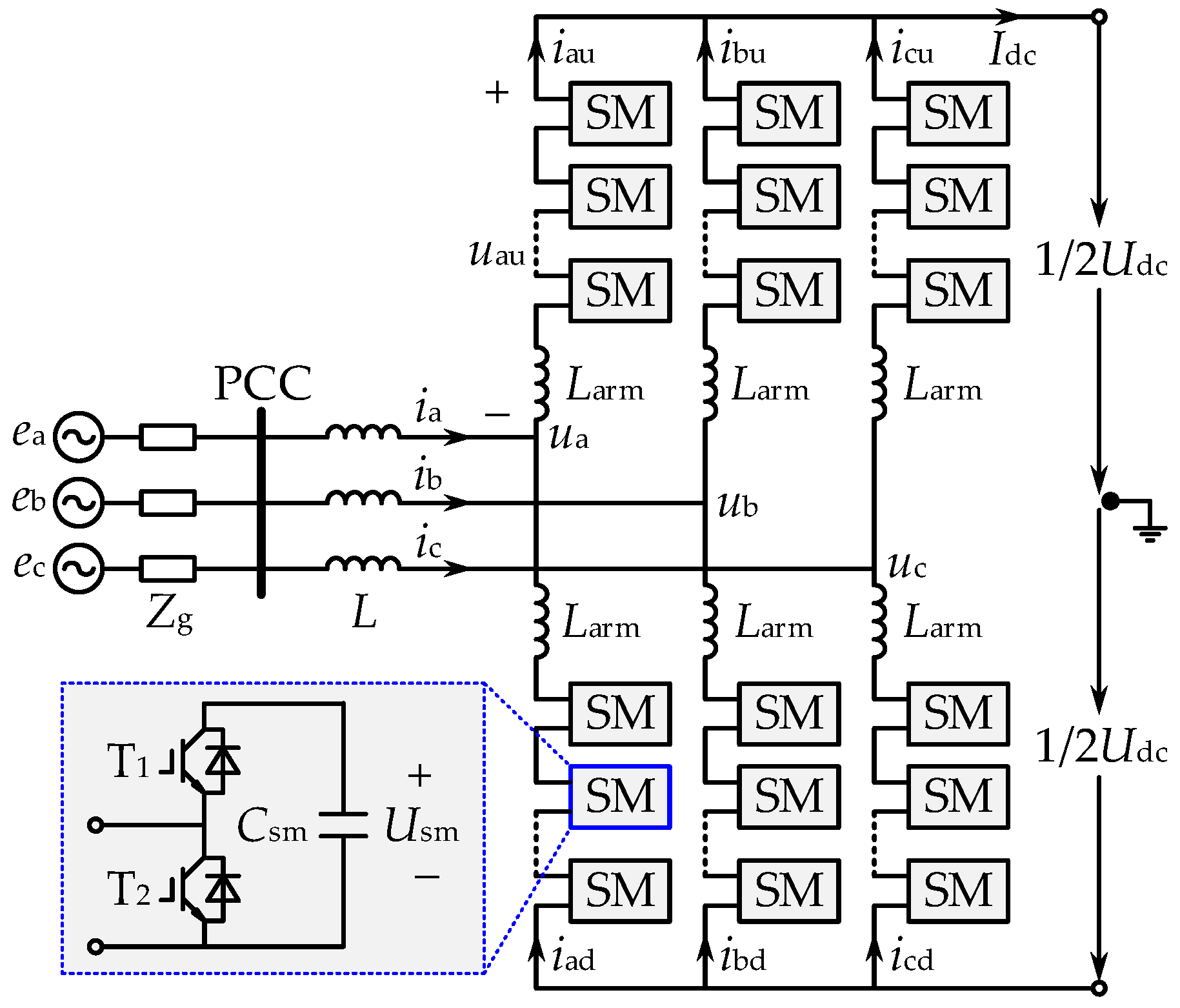
Figure 1. Topology of MMC based on HBSMs.
Electronics 15 00359 g001
Figure 2. Modulation waveforms under different harmonic injection strategies.
Electronics 15 00359 g002
Figure 3. Relationship diagram of k3,max, k2, and m.
Electronics 15 00359 g003
Figure 4. Flowchart of PSO algorithm application.
Electronics 15 00359 g004
Figure 5. Block diagram of MMC with the proposed CHI strategy.
Electronics 15 00359 g005
Figure 6. Configuration of the MMC-HVDC system.
Electronics 15 00359 g006
Figure 7. Relationship between iteration count and optimal solution in the PSO algorithm: (a) Sending-end MMC under rated-power condition, (b) Sending-end MMC under 50% rated-power condition, (c) Receiving-end MMC under rated-power condition.
Electronics 15 00359 g007
Figure 8. Simulation waveforms of sending-end MMC under rated-power condition: (a) average SM capacitor voltage, (b) FFT of SM capacitor voltage, (c) arm circulating current, (d) RMS value of arm current (e) modulation wave of phase A.
Electronics 15 00359 g008
Figure 9. SM capacitor voltage of sending-end MMC under rated-power condition when its capacitance value is reduced by 13.33%.
Electronics 15 00359 g009
Figure 10. Simulation waveforms of sending-end MMC under 50% rated-power condition: (a) average SM capacitor voltage, (b) FFT of SM capacitor voltage, (c) arm circulating current, (d) RMS value of arm current (e) modulation wave of phase A.
Electronics 15 00359 g010
Figure 11. SM capacitor voltage of sending-end MMC under 50% rated-power condition when its capacitance value is reduced by 13.33%.
Electronics 15 00359 g011
Figure 12. Simulation waveforms of receiving-end MMC under rated-power condition: (a) average SM capacitor voltage, (b) FFT of SM capacitor voltage, (c) arm circulating current, (d) RMS value of arm current (e) modulation wave of phase A.
Electronics 15 00359 g012
Figure 13. SM capacitor voltage of receiving-end MMC under rated-power condition when its capacitance value is reduced by 13.33%.
Electronics 15 00359 g013
Figure 14. Relationship between iteration count and optimal solution of 5th, 10th, 15th, 20th,25th and 30th tests using different algorithms: (a) waveforms of the 5th test; (b) waveforms of the 10th test; (c) waveforms of the 15th test; (d) waveforms of the 20th test; (e) waveforms of the 25th test; (f) waveforms of the 30th test.
Electronics 15 00359 g014
Table 1. Parameters to be optimized and their value ranges.
ParametersSymbolsValue Ranges
Coefficient of the injected second-order circulating currentk2[0, k20]
Phase angle of the injected second-order circulating currentφ2[−π, π]
Coefficient of the injected third-order harmonic voltagek3[0, 0.55]
Phase angle of the injected third-order harmonic voltageφ3[−π, π]
Modulation indexm[0.8, 1.2]
Table 2. Main parameters of simulation system.
System ParametersValues
Rated DC voltage±500 kV
Transformer turns ratio230 kV/262.26 kV
Rated power of the system1500 MW
Rated voltage of SM capacitor2.2 kV
Number of SMs227
Capacitance value of SM15 mF
Arm reactor50 mH
Initial modulation index0.85
Preset modulation margin7%
Table 3. Key parameters of PSO algorithm.
PSO ParametersValues
Swarm size300
Particle dimension5
Iteration count100
Inertia weight0.2~0.8
Acceleration constantsc1 = 2, c2 = 2
Velocity range[−2, 2]
Table 4. Optimal parameters based on the proposed method.
ParametersValues (Sending-End MMC
Under Rated-Power Condition)
Values (Sending-End MMC Under 50% Rated-Power Condition)Values (Receiving-End MMC
Under Rated-Power Condition)
k20.60920.60920.5940
φ2‒1.5714‒1.5804‒1.5708
k30.13510.15310.1483
φ30.00020.00120.0000
m0.89340.93170.9646
Table 5. Parameter optimization results of 30 tests using different algorithms.
AlgorithmsOverall Optimal
Solution
Average Optimal
Solution
Sample Standard
Deviation
Count of Error Within 1% of
Overall Optimal Solution
PSO algorithm131.637133.9978.68228
GA131.815135.4509.08522
ABC algorithm132.715155.42414.3321
Disclaimer/Publisher’s Note: The statements, opinions and data contained in all publications are solely those of the individual author(s) and contributor(s) and not of MDPI and/or the editor(s). MDPI and/or the editor(s) disclaim responsibility for any injury to people or property resulting from any ideas, methods, instructions or products referred to in the content.