Underwater Acoustic Data Transmission in the Presence of Challenging Multipath Conditions and Shadow Zones: Sea Trial Analysis and Lessons Learned

 , , , , , and
Abstract
1. Introduction
2. Sea Measurement Campaign
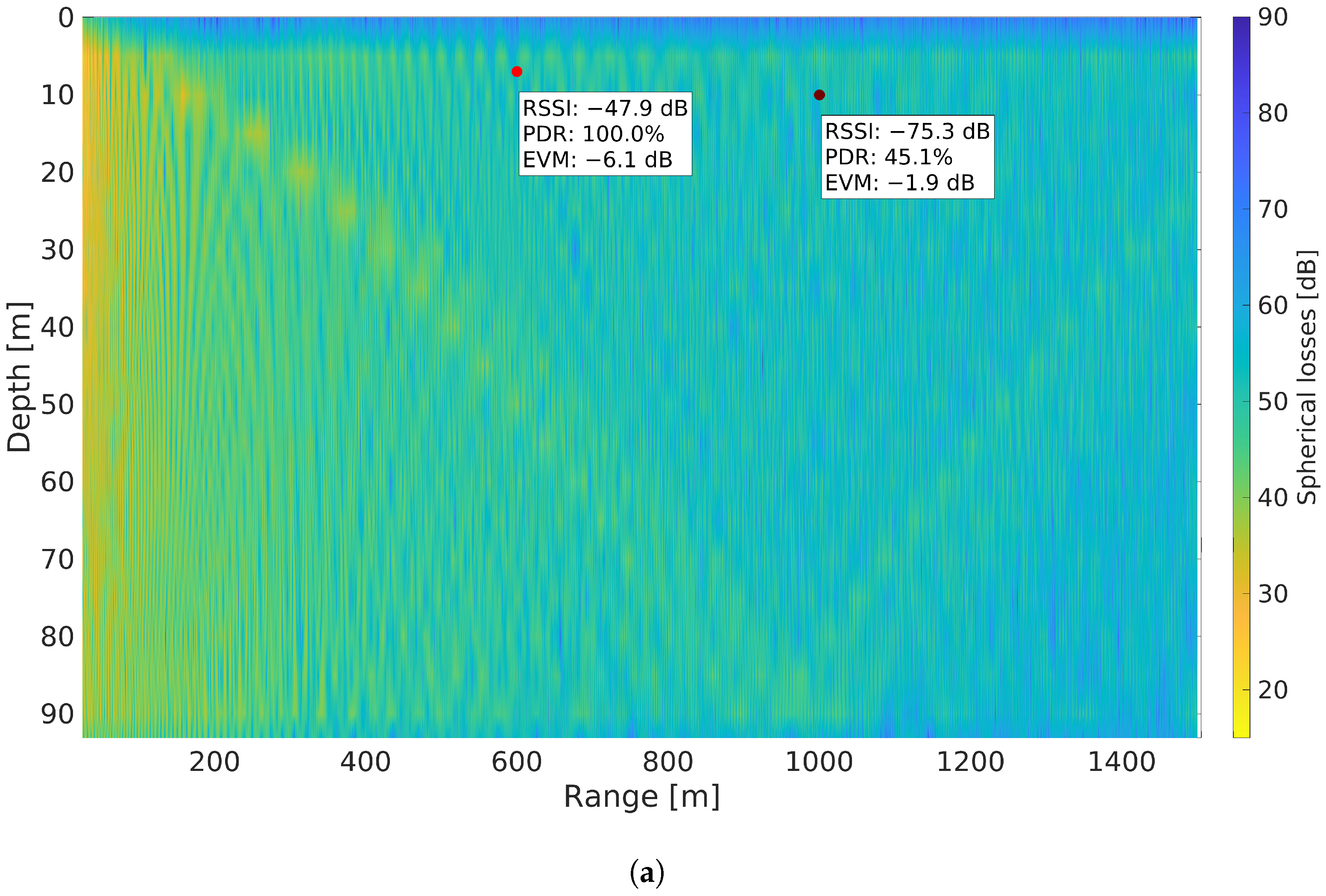
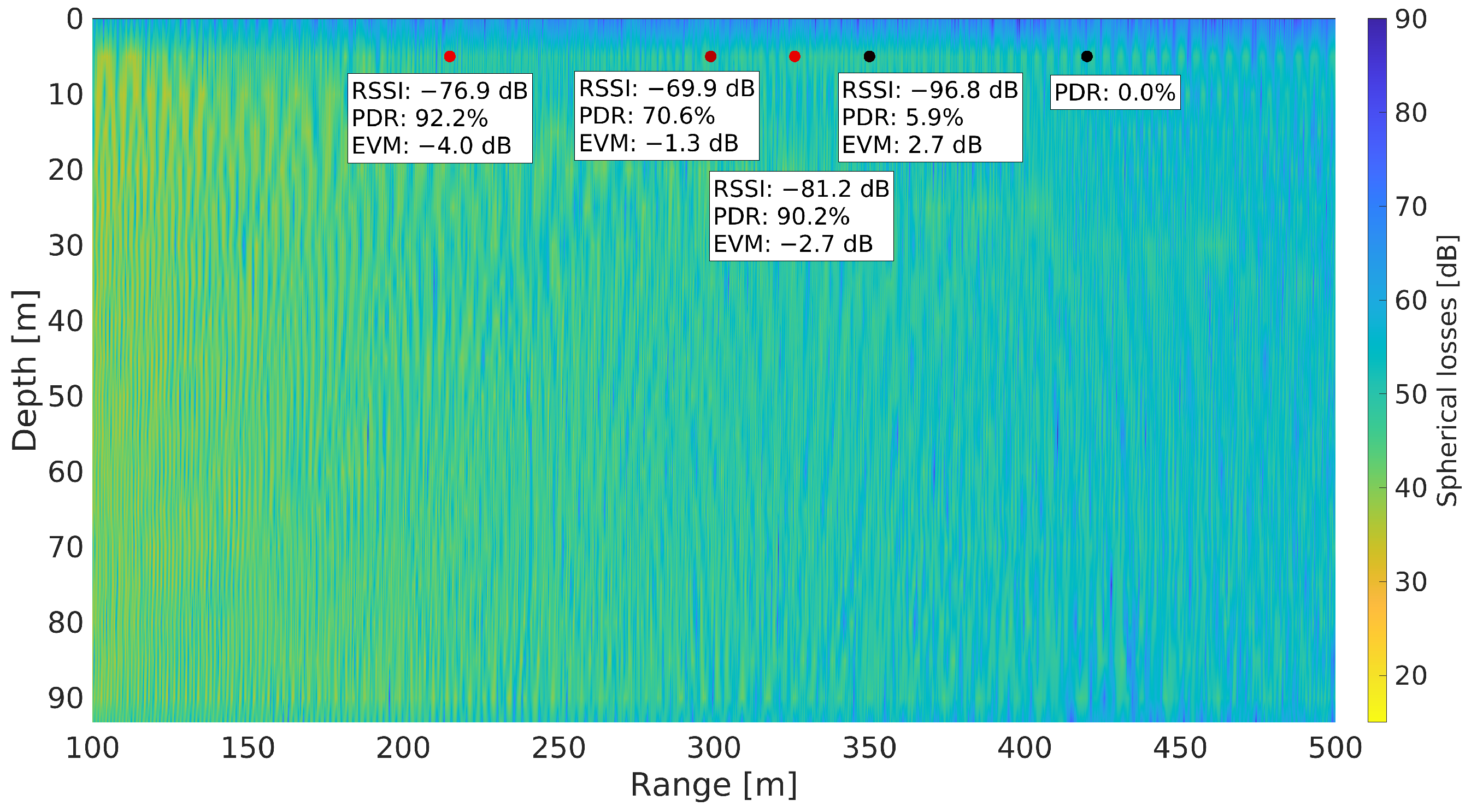
- The received signal strength indicator (RSSI), estimated from the power of the packet preamble.
- The error vector magnitude (EVM), calculated over N packet symbols aswhich measures the distance of each received symbol from its estimated constellation symbol and is indicative of the SNR of the channel.
- The packet delivery ratio (PDR), i.e., the percentage of demodulated and decoded packets that pass an 8-bit cyclic redundancy check (CRC).
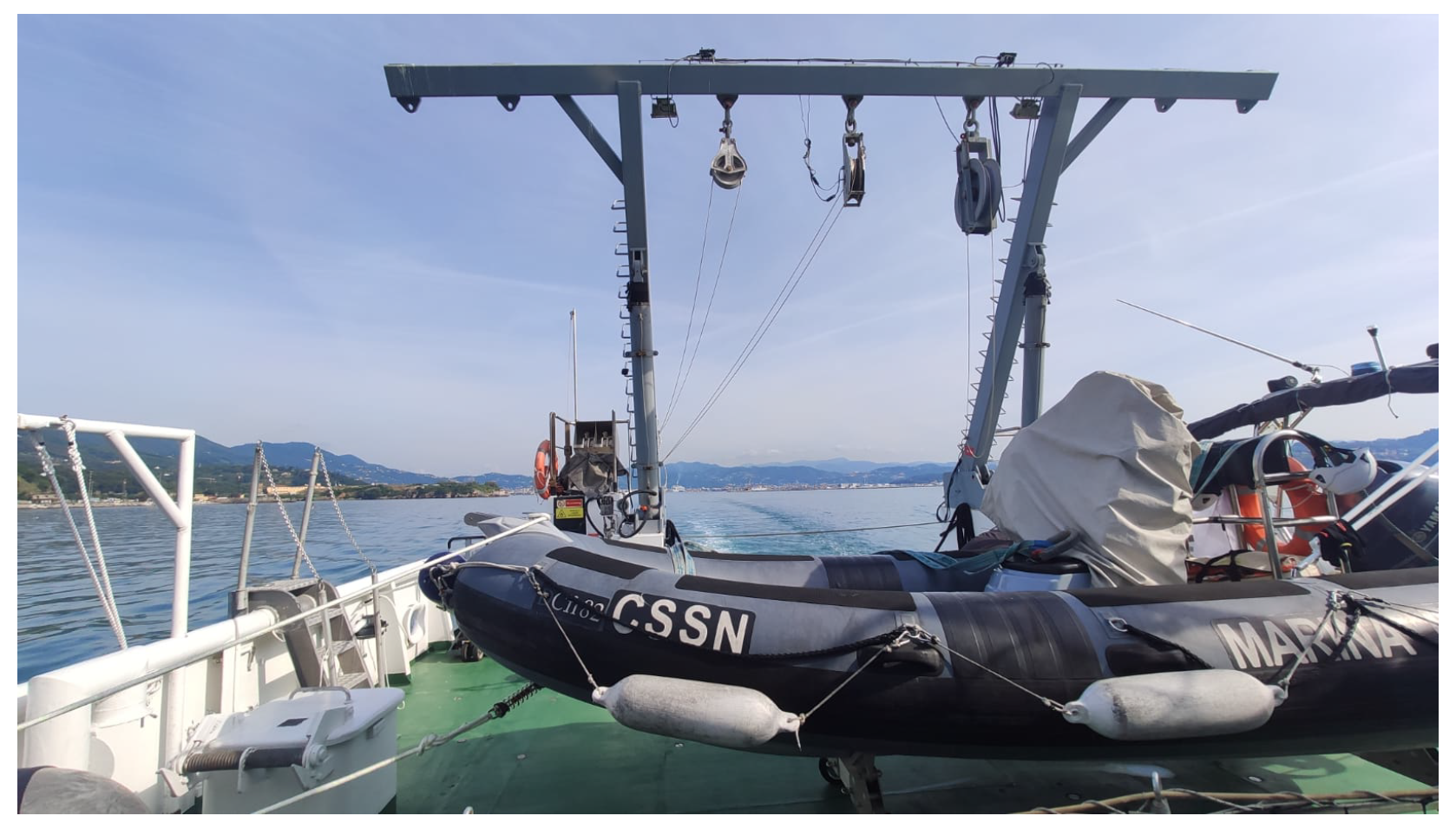
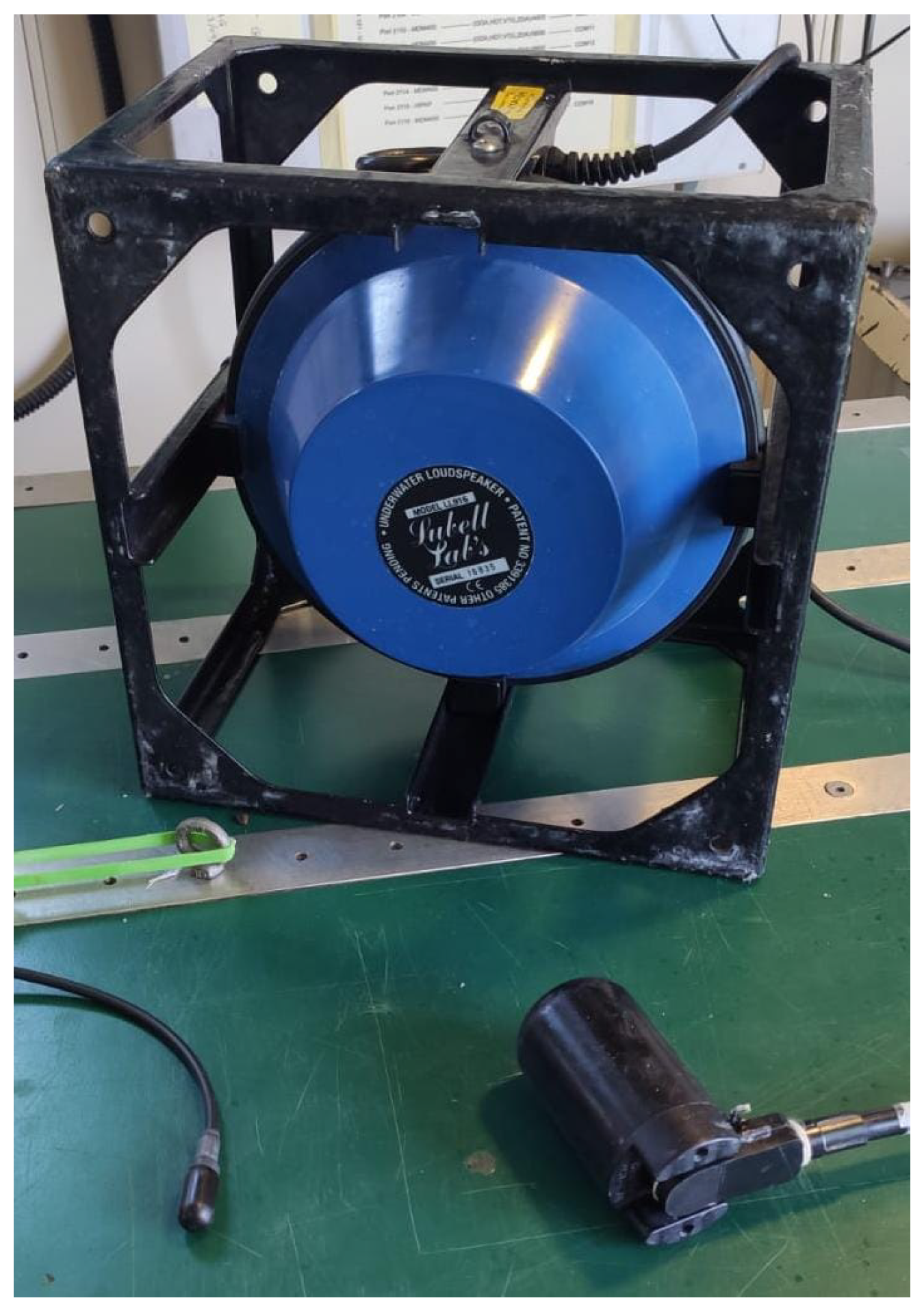
2.1. Sea Trial Description
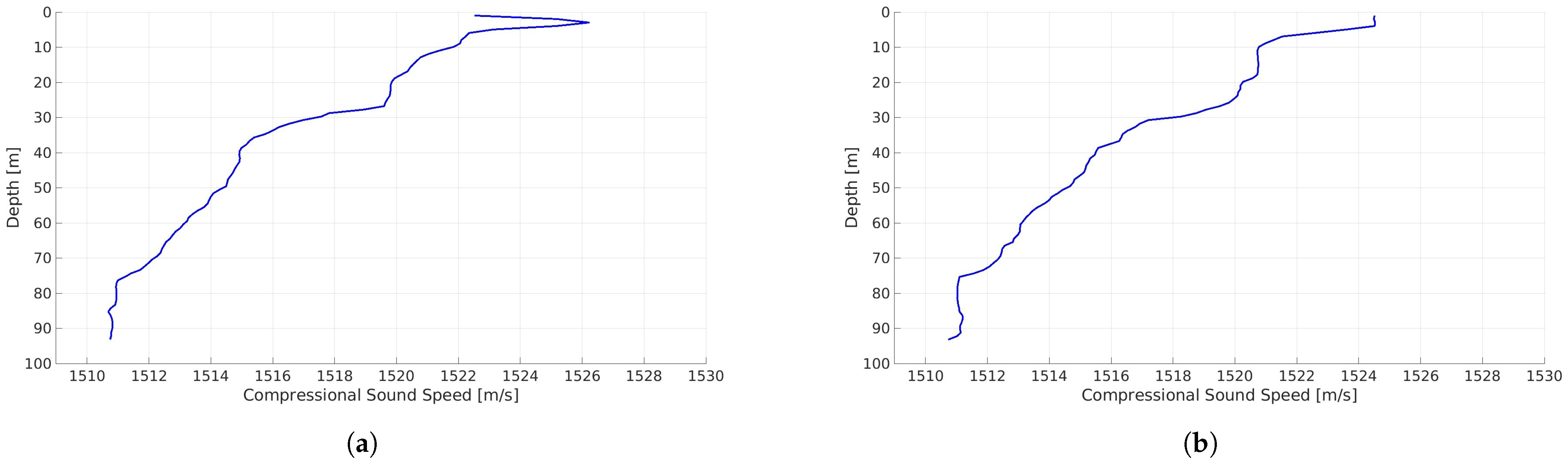
2.2. Sea Trial Results
3. Synthetic Channel
Synthetic Channel Model
4. FEC Optimization
5. Conclusions
Author Contributions
Funding
Data Availability Statement
Conflicts of Interest
References
- Stojanovic, M. On the Relationship Between Capacity and Distance in an Underwater Acoustic Communication Channel. SIGMOBILE Mob. Comput. Commun. Rev. 2007, 11, 34–43. [Google Scholar] [CrossRef]
- Cappelli, I.; Fort, A.; Mugnaini, M.; Parrino, S.; Pozzebon, A. Underwater to above water LoRaWAN networking: Theoretical analysis and field tests. Measurement 2022, 196, 111140. [Google Scholar] [CrossRef]
- Pal, A.; Campagnaro, F.; Ahraf, K.; Rahman, R.; Ashok, A.; Guo, H. Communication for Underwater Sensor Networks: A Comprehensive Summary. ACM Trans. Sens. Netw. (TOSN) 2022, 19, 1–44. [Google Scholar] [CrossRef]
- Cario, G.; Casavola, A.; Gjanci, P.; Lupia, M.; Petrioli, C.; Spaccini, D. Long lasting underwater wireless sensors network for water quality monitoring in fish farms. In Proceedings of the MTS/IEEE OCEANS 2017-Aberdeen, Aberdeen, UK, 19–22 June 2017; pp. 1–6. [Google Scholar] [CrossRef]
- Dol, H. EDA-SALSA: Towards smart adaptive underwater acoustic networking. In Proceedings of the IEEE/MTS OCEANS 2019-Marseille, Marseille, France, 17–20 June 2019. [Google Scholar] [CrossRef]
- Akyildiz, I.F.; Pompili, D.; Melodia, T. Underwater Acoustic Sensor Networks: Research Challenges. Ad Hoc Netw. 2005, 3, 257–279. [Google Scholar] [CrossRef]
- Guerra, F.; Casari, P.; Zorzi, M. World ocean simulation system (WOSS): A simulation tool for underwater networks with realistic propagation modeling. In Proceedings of the WUWNet ’09: 4th International Workshop on Underwater Networks, New York, NY, USA, 3 November 2009. [Google Scholar] [CrossRef]
- Rodriguez, O.C. General Description of the BELLHOP Ray Tracing Program, Version 1; Physics Department Signal Processing Laboratory Faculty of Sciences and the University of the Algarve Tecnologia, University of Algarve, Campus de Gambelas: Faro, Portugal, 2008. (In Galician)
- van Walree, P.A.; Socheleau, F.X.; Otnes, R.; Jenserud, T. The Watermark Benchmark for Underwater Acoustic Modulation Schemes. IEEE J. Ocean. Eng. 2017, 42, 1007–1018. [Google Scholar] [CrossRef]
- Li, Z. Underwater Acoustic Channel Library. Available online: https://github.com/uwa-channels (accessed on 10 November 2025).
- Masiero, R.; Azad, S.; Favaro, F.; Petrani, M.; Toso, G.; Guerra, F.; Casari, P.; Zorzi, M. DESERT Underwater: An NS-Miracle-based framework to DEsign, Simulate, Emulate and Realize Test-beds for Underwater network protocols. In Proceedings of the IEEE/OES OCEANS, Yeosu, Republic of Korea, 21–24 May 2012. [Google Scholar]
- Petrioli, C.; Petroccia, R.; Spaccini, D. SUNSET Version 2.0: Enhanced Framework for Simulation, Emulation and Real-life Testing of Underwater Wireless Sensor Networks. In Proceedings of the ACM WUWNet, Kaohsiung, Taiwan, 11–13 November 2013. [Google Scholar]
- Zhu, Y.; Le, S.; Pu, L.; Lu, X.; Peng, Z.; Cui, J.H.; Zuba, M. Aqua-Net Mate: A real-time virtual channel/modem simulator for Aqua-Net. In Proceedings of the MTS/IEEE Oceans, Bergen, Norway, 10–14 June 2013. [Google Scholar]
- UnetStack3—The Underwater Networks Project. Available online: https://unetstack.net/ (accessed on 12 November 2025).
- Toffolo, N.; Montanari, A.; Campagnaro, F.; Zorzi, M. Modeling acoustic channel variability in underwater network simulators from real field experimental data. In Proceedings of the OCEANS 2022, Hampton Roads, VA, USA, 17–20 October 2022; pp. 1–7. [Google Scholar] [CrossRef]
- Morozs, N.; Campagnaro, F.; Shen, L.; Henson, B.; Mahieu, F.; Zakharov, Y.; Mitchell, P.D. Statistical ON-OFF Link Modeling Based on Sea Trial Data. In Proceedings of the WUWNET ’24: 18th International Conference on Underwater Networks & Systems, Šibenik, Croatia, 28–31 October 2024; Association for Computing Machinery: New York, NY, USA, 2025. [Google Scholar] [CrossRef]
- Casari, P.; Campagnaro, F.; Dubrovinskaya, E.; Francescon, R.; Dagan, A.; Dahan, S.; Zorzi, M.; Diamant, R. ASUNA: A Topology Data Set for Underwater Network Emulation. IEEE J. Ocean. Eng. 2021, 46, 307–318. [Google Scholar] [CrossRef]
- Idronaut OS310 CTDS. Available online: https://www.idronaut.it/multiparameter-ctds/environmental-ctds/os310-environmental-ctds/ (accessed on 6 November 2025).
- Montanari, A.; Cimino, V.; Spinosa, D.; Donegà, F.; Marin, F.; Campagnaro, F.; Zorzi, M. PSK modulation for Underwater Communication and One-Way Travel-Time Ranging with the Low-Cost Subsea Software-Defined Acoustic Modem. In Proceedings of the WUWNET ’24: 18th International Conference on Underwater Networks & Systems, Šibenik, Croatia, 28–31 October 2024; Association for Computing Machinery: New York, NY, USA, 2025. [Google Scholar] [CrossRef]
- Cosimo, D.; Montanari, A.; Terracciano, D.S.; Bazzarello, L.; Costanzi, R.; Campagnaro, F.; Zorzi, M. Comparative Analysis of Throughput Maximization Strategies in Underwater Acoustic Networks: Results from At-Sea Experiments. In Proceedings of the 2024 IEEE International Workshop on Metrology for the Sea; Learning to Measure Sea Health Parameters (MetroSea), Portorose, Slovenia, 14–16 October 2024; pp. 52–57. [Google Scholar] [CrossRef]
- Montanari, A.; Marin, F.; Cimino, V.; Spinosa, D.; Donegà, F.; Cosimo, D.; Bazzarello, L.; Natale, D.; Campagnaro, F.; Zorzi, M. Experimenting Various JANUS Frequency Bands with the Subsea Software-Defined Acoustic Modem. In Proceedings of the 2024 Seventh Underwater Communications and Networking Conference (UComms), Sestri Levante, Italy, 3–5 September 2024; pp. 1–5. [Google Scholar] [CrossRef]
- Potter, J.; Alves, J.; Green, D.; Zappa, G.; Nissen, I.; McCoy, K. The JANUS Underwater Communications Standard. In Proceedings of the Underwater Communications and Networking (UComms) 2014, Sestri Levante, Italy, 3–5 September 2014. [Google Scholar]
- ANEP-87; Digital Underwater Signalling Standard for Network Node Discovery & Interoperability. NATO Standardization Office: Brussels, Belgium, 2024.
- JANUS Wiki [Archived]. Available online: https://web.archive.org/web/20190808050204/http://www.januswiki.com/tiki-index.php (accessed on 12 November 2025).
- Kebkal, O.; Komar, M.; Kebkal, K. D-MAC: Hybrid Media Access Control for Underwater Acoustic Sensor Networks. In Proceedings of the 2010 IEEE International Conference on Communications Workshops, Cape Town, South Africa, 23–27 May 2010. [Google Scholar]
- Spinosa, D.; Lazzarin, J.; Campagnaro, F.; Zorzi, M. A Practical Evaluation of Forward Error Correction Schemes and PSK Detection Parameters for Underwater Acoustic Transmissions. In Proceedings of the IEEE OCEANS 2025, Brest, France, 16–19 June 2025; pp. 1–8. [Google Scholar] [CrossRef]
- Hamming, R.W. Error detecting and error correcting codes. Bell Syst. Tech. J. 1950, 29, 147–160. [Google Scholar] [CrossRef]
- World Meteorological Organization. Manual on Codes—International Codes. Volume I.1, Annex II to the WMO Technical Regulations, Part A—Alphanumeric Codes; Table 3700 (Sea State code) on p. A-326; World Meteorological Organization: Geneva, Switzerland, 2019. [Google Scholar]
- Porter, M.B. The BELLHOP Manual and User’s Guide: Preliminary Draft; Technical Report; Heat, Light, and Sound Research, Inc.: La Jolla, CA, USA, 2011. [Google Scholar]
- Reed, I.S.; Solomon, G. Polynomial Codes Over Certain Finite Fields. J. Soc. Ind. Appl. Math. 1960, 8, 300–304. [Google Scholar] [CrossRef]







| Model | TVR [dB re 1 μPa/V] | RVR [dB re 1 V/μPa] |
|---|---|---|
| Lubell LL916H | 160 dB @ 10 kHz | −195 dB @ 10 kHz |
| Btech BT-28UF | 150 dB @ 28 kHz | −191 dB @ 28 kHz |
| Aquarian AS-1 | 125 dB @ 40 kHz | −208 dB @ 40 kHz |
| Carrier Frequency | Modulation | Bandwidth |
|---|---|---|
| 10 kHz | BPSK | 1200 Hz |
| 10 kHz | JANUS | 2600 Hz |
| 10 kHz | JANUS | 4160 Hz |
| 28 kHz | BPSK | 1200 Hz |
| 28 kHz | BPSK | 2400 Hz |
| 28 kHz | QPSK | 1200 Hz |
| 28 kHz | QPSK | 2400 Hz |
| 28 kHz | JANUS | 6500 Hz |
| 40 kHz | BPSK | 1200 Hz |
Disclaimer/Publisher’s Note: The statements, opinions and data contained in all publications are solely those of the individual author(s) and contributor(s) and not of MDPI and/or the editor(s). MDPI and/or the editor(s) disclaim responsibility for any injury to people or property resulting from any ideas, methods, instructions or products referred to in the content. |
© 2026 by the authors. Licensee MDPI, Basel, Switzerland. This article is an open access article distributed under the terms and conditions of the Creative Commons Attribution (CC BY) license.
Share and Cite
Lazzarin, J.; Montanari, A.; Spinosa, D.; Cosimo, D.; Costanzi, R.; Campagnaro, F.; Zorzi, M. Underwater Acoustic Data Transmission in the Presence of Challenging Multipath Conditions and Shadow Zones: Sea Trial Analysis and Lessons Learned. Electronics 2026, 15, 358. https://doi.org/10.3390/electronics15020358
Lazzarin J, Montanari A, Spinosa D, Cosimo D, Costanzi R, Campagnaro F, Zorzi M. Underwater Acoustic Data Transmission in the Presence of Challenging Multipath Conditions and Shadow Zones: Sea Trial Analysis and Lessons Learned. Electronics. 2026; 15(2):358. https://doi.org/10.3390/electronics15020358
Chicago/Turabian StyleLazzarin, Jacopo, Antonio Montanari, Diego Spinosa, Davide Cosimo, Riccardo Costanzi, Filippo Campagnaro, and Michele Zorzi. 2026. "Underwater Acoustic Data Transmission in the Presence of Challenging Multipath Conditions and Shadow Zones: Sea Trial Analysis and Lessons Learned" Electronics 15, no. 2: 358. https://doi.org/10.3390/electronics15020358
APA StyleLazzarin, J., Montanari, A., Spinosa, D., Cosimo, D., Costanzi, R., Campagnaro, F., & Zorzi, M. (2026). Underwater Acoustic Data Transmission in the Presence of Challenging Multipath Conditions and Shadow Zones: Sea Trial Analysis and Lessons Learned. Electronics, 15(2), 358. https://doi.org/10.3390/electronics15020358