1. Introduction
In recent years, with the continuous advancement of China’s “dual carbon” goals, wind power, as a crucial clean energy source, has been accounting for an increasingly larger share in the power system [
1,
2,
3]. Among wind power technologies, offshore wind power has gained widespread attention and experienced rapid development due to its advantages, such as abundant wind resources, high energy efficiency, and no occupation of land resources. However, as offshore wind farms expand in distance from the shore and installed capacity, the transmission power of wind farms has increased significantly, leading to frequent voltage fluctuations within the collector system, which severely affects the stable operation of wind farms. During the process of mitigating voltage fluctuations, reactive power scheduling generates additional active power losses in the internal components of wind turbines and transmission cables, significantly reducing the economic efficiency of stable wind farm operation. Therefore, it is essential to optimize the dispatch of reactive power resources in wind turbines from multiple perspectives to adapt to the complex and variable operating conditions of deep-sea offshore environments [
4,
5,
6,
7].
In recent years, research on reactive power optimization control for offshore wind farms has gained considerable attention in the academic and engineering communities. For instance, in reference [
8], a reactive power optimization model was established for distribution networks incorporating offshore wind farms, aiming to minimize network losses and voltage deviation, with a solution obtained via quantum particle swarm optimization. Reference [
9] formulated a reactive power optimization model targeting minimal active power loss in the distribution network, while also accounting for the correlation among wind turbine outputs. In reference [
10], a multi-objective reactive power optimization model was proposed, simultaneously minimizing network loss, voltage deviation, and investment in reactive power compensation devices. To enhance voltage stability, reference [
11] introduced a parallel reactive power compensation scheme for doubly fed wind farms, designed to balance the inductive and capacitive reactive power regulation capabilities of doubly fed induction generators. Considering the challenges posed by high penetration of renewable energy, reference [
12] addressed reactive power reserve optimization under grid fault scenarios and proposed a multi-objective optimization method for regional reactive power reserve in hybrid wind-solar-storage systems under a set of contingency conditions. Reference [
13] developed an active and reactive power optimization control strategy based on model predictive control, with the objective of minimizing voltage fluctuation at wind turbine terminals during fault ride-through events. Reference [
14] investigates the performance of a multi-resolution optimized relative step size random search (MR-ORSSRS) based method in maximizing the total power production of wind farms under circumstances of varying wind directions, turbine failures, and non-static wind conditions. Reference [
15] proposed a three-stage prior coalition game model for optimizing the layout planning of offshore wind farm clusters, simulating the cooperation and competition among wind farms. Reference [
16] applies the SPSA to data-driven online control of variable-speed wind turbines, aiming to achieve maximum wind energy capture without the need for an anemometer or a precise aerodynamic model. Reference [
17] proposes a data-driven approach for wind farm control, aiming to serve as an alternative or supplement to the traditional FLORIS simulator. A multi-scenario reactive power–voltage optimization control strategy based on adaptive model predictive control (MPC) is proposed in reference [
18]. To address the problem of insufficient optimization and control accuracy of wind farms caused by the uncertainty of wind power generation, reference [
19] proposes a fast tracking optimization method for reactive power/voltage in offshore wind farms that takes into account the uncertainty of wind turbine output.
Additionally, to further advance the reactive power operational optimization in wind farms equipped with front-end speed-regulated wind turbines, reference [
20] introduces a multi-scenario and multi-combination reactive power operation optimization strategy. In reference [
21], a coherent reactive power control method based on voltage sensitivity is proposed, which is realized through a two-level optimization framework. The study in reference [
22] provides a detailed analysis of the impacts of transformer tap blocking, reactive power compensation output, and grid power factor on system power losses and bus voltage profiles. For power systems incorporating doubly fed induction generators (DFIGs), reference [
23] establishes an oscillation stability constrained optimal power flow model based on reactive power optimization. To address short-term power fluctuations of wind turbines, reference [
24] proposes a reactive power fast tracking optimization method designed to track and optimize such fluctuations within a given period. Reference [
25] presents a control scheme that integrates energy storage with reactive power optimization, evaluating the low-voltage ride-through capability of individual wind turbines based on established evaluation indices, thereby effectively enhancing the overall reactive power output capacity of the wind farm. In reference [
26], a reactive power optimization model is formulated with the dual objectives of minimizing the reactive power compensation capacity of offshore wind farms and reducing node voltage deviations. In reference [
27], the influence of wind turbine power factor on node voltages, as well as on active and reactive power losses in distribution networks. Furthermore, reference [
28] proposed a power enhancement strategy for offshore wind farms that takes into account the influence of wake flow and fatigue loads. Tail wake interaction significantly complicates reactive power optimization in wind farms by creating non-uniform active power output and voltage distribution, which renders traditional control strategies based on uniform wind speed assumptions ineffective. Effective optimization must integrate high-fidelity wake models and adopt a coordinated control framework that simultaneously manages reactive power dispatch, active power regulation (e.g., via yaw control), and mechanical load constraints to achieve overall economic and stable operation.
Based on the above analysis, it can be seen that existing research has considered factors such as minimum network loss, minimum node voltage deviation, and minimum required reactive power compensation capacity to establish various reactive power optimization objective functions. However, it is worth noting that most existing studies set the weights of the optimization objective functions as fixed values. These weights enable each optimization objective to achieve good optimization results when the operating conditions of the power system remain stable or undergo slight changes. However, as the proportion of new energy generation in the grid gradually increases, the operating conditions of the new power system will frequently change with the fluctuation of new energy generation output. In the aforementioned multi-objective reactive power optimization strategies, the weight coefficients of each optimization objective are fixed values, which cannot be adjusted in real time according to the grid operating conditions. This may lead to the following situations: when the voltage at the grid connection point deviates significantly, the optimization objective prioritizes minimum network loss, which may affect the safe operation of the power system; conversely, when the voltage deviation is small, the optimization objective prioritizes minimum voltage deviation, which may cause waste of compensation capacity, increase network loss, and reduce the economic efficiency of the system.
In addition, the solution of multi-objective functions predominantly relies on particle swarm optimization and its improved variants. Reference [
29] integrates stochastic learning mechanisms with Lévy flight strategy characteristics, enabling particles to frequently perform short-distance transformations and occasional long-distance jumps during the position update process to enhance population diversity. Reference [
30] and others introduce sine-cosine acceleration coefficients to effectively strengthen local search capability, then apply opposition-based learning to particles and incorporate an inertia weight acceleration factor that follows sine-cosine variations, improving convergence speed. Reference [
31] incorporates the local optimal position into the velocity update process, dynamically adjusts the weights of individual optimal, local optimal, and global optimal positions in the velocity update formula, thereby enhancing the optimization performance of the PSO algorithm. Reference [
32] and others adopt arithmetic crossover in their improved particle swarm optimization to share information among particles, helping premature particles escape local optima and improving algorithm accuracy. Reference [
33] optimizes the parameters for the PID-type fuzzy logic controller to enhance the stability of the two-wheeled wheelchair system. Reference [
34] proposes a hybrid PSO-gradient descent framework for modeling and dynamically optimizing phase-locked loops in grid-connected systems.
The aforementioned algorithms each improve the standard PSO algorithm through unilateral strategies such as particle position updates, acceleration factors, dynamic weight adjustments, and population state division. While they alleviate issues such as particle diversity and time complexity to some extent, most lack holistic considerations. In addressing problems like particle diversity, they may introduce issues such as increased time complexity. Additionally, they all exhibit varying degrees of susceptibility to premature convergence, slow convergence speed, and low convergence accuracy, particularly evident in high-dimensional function optimization problems.
Therefore, aiming at the problems existing in the reactive power optimization control of existing offshore wind farms, this paper proposes an adaptive multi-objective reactive power optimization control method for offshore wind farms.
The main contributions of this work can be summarized as follows:
- (1)
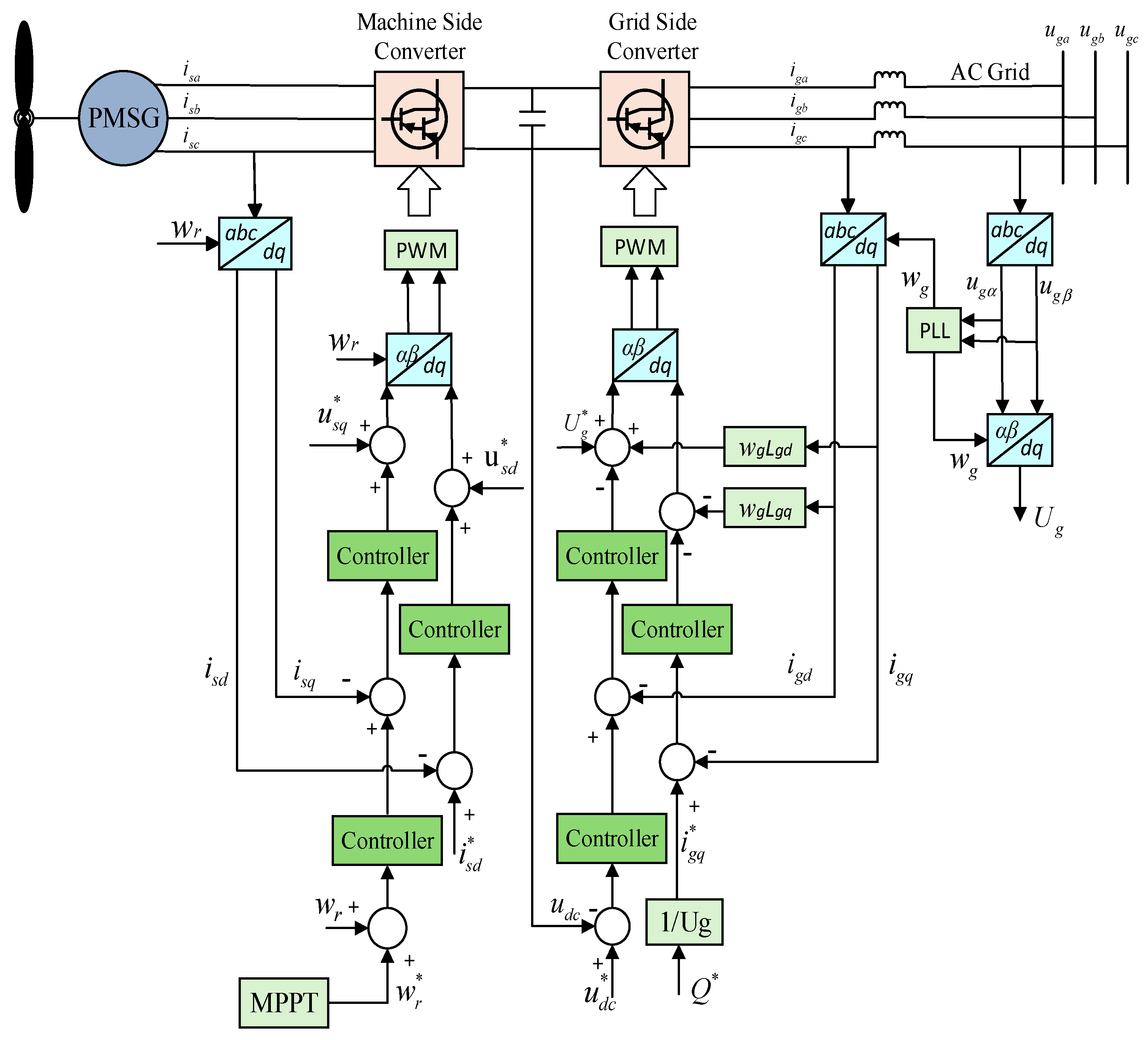
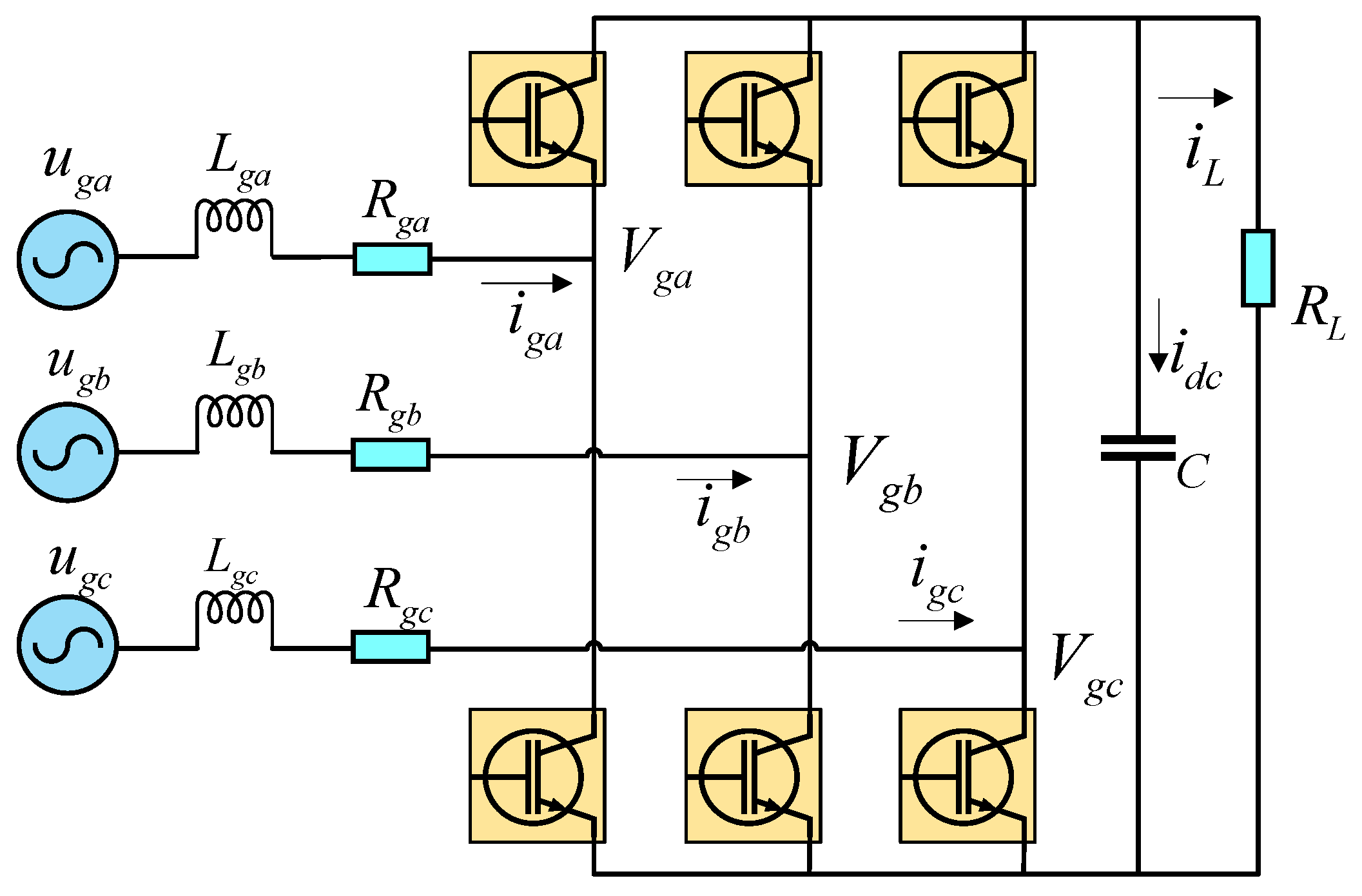
A reactive power control component allocation model of offshore wind farms and the reactive power control model of offshore wind turbines are constructed.
- (2)
Considering the active power network loss and voltage fluctuations at the grid connection point of offshore wind farms, the objective function of reactive power optimization control is set.
- (3)
An improved particle swarm optimization algorithm is used to solve the multi-objective reactive power optimization function.
The rest of this paper is organized as follows.
Section 2 establishes the reactive power control model for offshore wind farms.
Section 3 develops the adaptive multi-objective reactive power optimization control strategy for offshore wind farms.
Section 4 analyzes the numerical results on test systems. Eventually, this paper is concluded in
Section 5.
3. Adaptive Multi-Objective Reactive Power Optimization Control Strategy for Offshore Wind Farms
In this section, an objective function for reactive power optimization control is established, targeting the active power loss of the offshore wind farm and the voltage fluctuation at the point of common coupling (PCC). The weight coefficients of these sub-objectives are adaptively adjusted based on the voltage deviation at the PCC. Furthermore, a set of constraints for the optimization is constructed according to the output characteristics of the WTGs and the operational characteristics of the wind farm. Then an improved PSO algorithm is employed to solve this strategy, thereby achieving precise control over the reactive power output from each reactive power source within the offshore wind farm.
3.1. Adaptive Weight Design for the Reactive Power Control Objective Function of Offshore Wind Farms
The objective function is formulated as the minimization of a weighted sum of the total system active power loss and the voltage deviation at the PCC. The optimization variables include the reactive power output from the direct-drive PMSGs and the SVCs, as well as the tap positions of adjustable transformers. Accordingly, the reactive power optimization model is established. Specifically, the voltage deviation and active power loss are treated as sub-objectives, assigned respective weighting coefficients, and combined into the overall optimization goal. The objective function is defined as follows:
where
represents the optimization objective for minimizing voltage deviation;
indicates the optimization objective for minimizing active power loss within the wind farm;
,
are the weight coefficients for voltage deviation and active power loss, respectively.
In general, the voltage fluctuations of the wind turbine grid connection point within the range of −0.05 to 0.05 p.u. are deemed acceptable. When the voltage deviation exceeds 0.05 p.u., the grid connection point voltage exceeds the safe range, and the reactive power control strategy of the wind farm should primarily aim to reduce the grid connection point voltage deviation to within the specified range. When the voltage deviation is less than 0.03 p.u., the grid connection point voltage fluctuation is small, and the reactive power control strategy should primarily aim to minimize the active power loss of the wind farm. To fulfill these requirements, as expressed in [
35], due to the mathematical advantages of the sine function, including its periodicity, smoothness, and bounded nature, it is exceptionally well-suited to model and meet dynamic adjustment requirements. Thus, the weight assigned to the voltage deviation objective
is adaptively adjusted using a sine function, as follows:
where
where
represents the measured value of the grid connection point voltage;
is the reference value of the grid voltage;
represents the maximum deviation range difference specified by the target for wind turbines to operate without disconnection, which is 0.1 p.u. [
35].
The weight coefficient for active power loss
is calibrated as
Therefore, the total objective function can be derived as
where
represents the optimization variable vector,
;
represents the position vector of adjustable transformer taps,
;
is the number of adjustable transformers;
is the reactive power output vector of the SVGs;
is the reactive power output vector of the wind farm;
is the total number of branches in the offshore wind farm system;
,
are the resistance and voltage value of branch
, respectively;
are the active and reactive power of branch
, respectively.
3.2. Constraints for Offshore Wind Farm Reactive Power Control
In general, ensuring the security and stability of an offshore wind farm necessitates that the optimization model accounts for two categories of constraints: equality constraints and inequality constraints, which can be expressed as follows
The equality constraints are:
where
,
represents the active and reactive power inputs at node
, respectively;
indicates the voltage at node
;
,
are the real and imaginary parts of the elements in the nodal admittance matrix, respectively;
is the phase angle difference between node
and node
.
The inequality constraints are:
where
,
are the active and reactive power outputs of the
wind turbine, respectively;
,
are the minimum and maximum active power outputs of the
wind turbine, respectively;
,
are the minimum and maximum reactive power outputs of the
wind turbine, respectively;
,
are the minimum and maximum reactive power outputs of the
i-th SVG, respectively;
,
are the minimum and maximum tap positions of the
adjustable transformer, respectively;
,
are the minimum and maximum voltages of the
node, respectively.
3.3. Weighted Variation Particle Swarm Optimization
- (a)
Basic Particle Swarm Optimization
PSO initializes a population of random particles, where each particle in the swarm represents a potential solution to a given problem. These particles guide themselves by adjusting their flight direction, utilizing their own best values and those of other members of the swarm to find the optimal solution to the problem.
Assume that in a
D-dimensional search space, a swarm consists of
N particles. The
i-th particle is represented as
Xi = (
xi1,
xi2, …,
xiD), and its “flight” velocity is denoted as
vid. The best position found so far by the
i-th particle is called the individual best, recorded as
Pbest = (
pi1,
pi2,
…,
piD), where
i = 1, 2,
…,
N. The best position found so far by the entire particle swarm is called the global best, recorded as
gbest = (
pg1,
pg2,
…,
pgD). After obtaining the individual best and global best, each particle updates its velocity and position according to the following formulas [
36,
37,
40,
41]:
where
c1 and
c2 are the learning factors, also known as acceleration constants;
r1 and
r2 are the random numbers between 0 and 1.
- (b)
Weighted Variation Particle Swarm Optimization
To address the issues of the PSO algorithm being prone to premature convergence, slow convergence speed, and low convergence accuracy, this paper proposes the WVPSO algorithm. The improvements are mainly carried out from the following three aspects: (i) to ensure the global search capability of the algorithm’s optimization strategy while balancing its local search capability, this paper proposes a method of adaptive inertia weight and adaptive learning factors to automatically adjust the inertia weight w and c1, c2 the learning factors in Equation (26); (ii) to increase the diversity of the particle population and improve the search accuracy of the algorithm, this paper proposes a weighted mutation method. After each fitness evaluation, arithmetic crossover and a natural selection mechanism are incorporated to change the particles’ positions and velocities; (iii) to tackle the problem of the algorithm being prone to premature convergence, Gaussian perturbation is added when premature convergence is detected, allowing particles to have a better chance of jumping out of local optima.
During the iteration process of the PSO algorithm, the inertia weight needs to allow for faster step size changes in the early stages, enabling particles to reach the region of the global optimum as early as possible. In the later stages of iteration, the step size change should be reduced, allowing particles to perform precise searches within that region to find the global optimum solution. Regarding the learning factors, in the early stages of iteration, the self-learning rate should be high, and the social learning rate should be low. As iterations progress, the self-learning ratio should gradually decrease, while the social learning ratio should gradually increase. This can both accelerate the convergence speed and improve the convergence accuracy of the algorithm. Based on the above ideas, this paper proposes a method for adaptive inertia weight and adaptive learning factors:
where
and
are the current iteration number and the maximum iteration number of the algorithm, respectively;
is a random number between 0 and 1;
,
are the upper and lower bounds of the self-learning factor;
,
are the upper and lower bounds of the social learning factor. In Equation (28), the inertia weight
is set to the maximum value as much as possible in the early iterations to allow faster step size changes; as the algorithm iterates, the weight gradually decreases to meet the requirements of the adaptive inertia weight. Equation (29) is a decreasing function during the algorithm’s execution, while Equation (30) is an increasing function, conforming to the idea of adaptive learning factors.
Due to the relatively slow convergence speed of the standard PSO algorithm and the decrease in population diversity in the later stages of iteration, the algorithm often struggles to find the global optimum. To address this, this paper incorporates arithmetic crossover and a natural selection strategy to improve particle diversity, enhance convergence speed, and accuracy. The proportion of particles to be mutated is selected as follows:
All particle fitness values’ absolute values are arranged from smallest to largest according to Equation (31) and are segmented according to Equation (32):
The fitness values in Equation (31) are divided into four parts: , , , . Due to the randomness of the PSO algorithm, the particle fitness values are divided into good (, ) and bad (, ) groups. Here, and each account for 20% of the total population; and each account for 30% of the total population. The crossover operation is applied to and , fusing good and bad particles, which not only generates diverse offspring but also prompts bad particles to move towards good particles. Natural selection is applied to and , directly replacing the velocity and position of the bad particles () with those of the good particles (), similar to reducing the entire population by 20%, thereby greatly accelerating the particle convergence speed. The specific strategies are as follows:
Arithmetic Crossover: The improved arithmetic crossover formula in this paper is as follows:
where
,
are the particle positions at
,
in Equation (32);
,
are the particle velocities at
,
in Equation (32); rand is a random number between 0 and 1.
Natural Selection: Good particles are selected to replace bad particles, increasing the convergence speed of the particles. The specific method is as follows:
where
,
are the particle positions at
,
in Equation (32);
,
are the particle velocities at
,
in Equation (32).
As the algorithm iterates, particles tend to learn in the wrong direction when the region containing the global optimum is far from the current population’s best value, making particles highly susceptible to premature convergence. To help the algorithm escape local optima, Gaussian perturbation is added during the later iterations. If the current fitness value does not change after several iterations, the algorithm is judged to be in premature convergence. Gaussian perturbation is then added to cause particle oscillation, helping them escape local optima. Therefore, the Gaussian perturbation strategy is introduced in the early stages of iteration
In the basic PSO, the inertia weight and learning factors are typically fixed values. This often leads to insufficient global exploration capability in the early stages or an inability to perform fine-grained searches in the later stages due to excessive oscillation. The improved WVPSO algorithm introduces adaptive mechanisms. The inertia weight decays exponentially with the iteration process, enabling the algorithm to explore broadly with larger steps initially and perform fine-grained searches with smaller steps later. The learning factors can also be dynamically adjusted, encouraging individual exploration in the early stages and guiding the population toward the optimal solution in the later stages. This design allows the algorithm to intelligently switch strategies during different search phases, fundamentally improving search efficiency.
In the basic PSO, all particles follow the same update rules, which can easily lead to a rapid loss of population diversity and cause the entire group to converge too quickly, thus trapping them in local optima. In contrast, the improved WVPSO algorithm innovatively introduces a population classification and directed mutation mechanism. The algorithm categorizes particles into four tiers based on their quality and applies different strategies to each tier: “arithmetic crossover” is performed on average particles to blend desirable traits and produce diverse offspring, while the worst particles are directly replaced with the best particles (natural selection) to rapidly elevate the overall quality of the population. This approach not only maintains population diversity to prevent premature convergence but also significantly accelerates the convergence speed toward the global optimum region.
Significant improvements have also been made in the search for the optimal solution. In the basic PSO, once the entire particle swarm falls into a local optimum, the lack of an effective escape mechanism causes the search process to stagnate. The improved WVPSO algorithm addresses this by incorporating a premature convergence monitoring and Gaussian perturbation mechanism. When the algorithm detects stagnation in population evolution, it actively applies random perturbations to the particles, creating artificial “oscillations” that help the particles escape the current local optimum trap and continue searching for better solutions within the solution space. This greatly enhances the algorithm’s robustness and success rate in finding global optima, particularly for complex multimodal function problems.
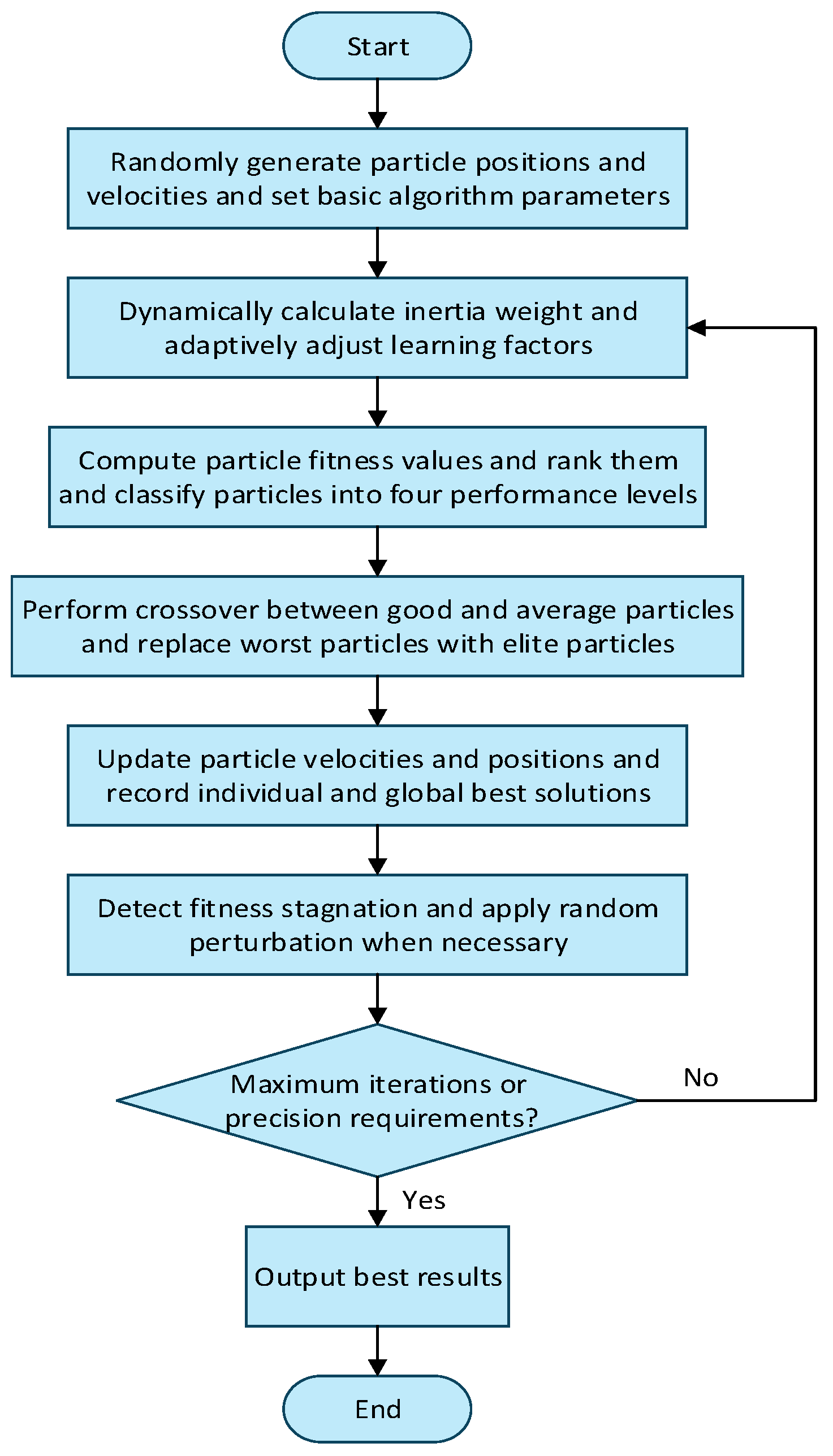
The iterative process of this method is illustrated in
Figure 3. The weighted mutation particle swarm optimization algorithm is not merely a minor adjustment to the basic PSO; instead, it systematically addresses the inherent limitations of the basic algorithm in balancing exploration and exploitation, maintaining population diversity, and escaping local optima through three synergistic mechanisms: parameter adaptation, population classification with mutation, and active perturbation.
3.4. Strategy Solution Process
The multi-objective optimization control strategy for the offshore wind farm, incorporating an adaptive weight objective function, is solved using the WVPSO algorithm. The computational steps are outlined below:
Step 1: Input data such as the number of direct-drive wind turbines, installed capacity, operating parameters, and wind speed.
Step 2: Calculate the active output power of each wind turbine based on the input data and the power characteristic curve.
Step 3: Assume the initial power factor of a single wind turbine is 1. Perform power flow calculation to determine the grid connection point voltage.
Step 4: Determine the reactive power output range for each wind turbine based on its active output.
Step 5: Set the particle swarm population size , acceleration coefficients and , maximum iteration count , and bounds for learning factors. Encode reactive power regulation capabilities and transformer tap positions as optimization variables.
Step 6: Initialize the particle swarm randomly. Evaluate fitness and set initial personal and global best positions.
Step 7: Update inertia weight and learning factors , based on current iteration. Update velocity and position for each particle. Apply velocity limits if exceeded.
Step 8: Rank particles by fitness and apply arithmetic crossover and natural selection. If premature convergence is detected, apply Gaussian perturbation.
Step 9: Evaluate updated particles and update personal and global best positions.
Step 10: If the maximum iteration count is reached, stop and output the reactive power control strategy; otherwise, return to Step 7.
Based on the above procedure, the reactive power optimization strategy is solved to determine the optimal setpoints for each WTG and SVC, as well as the tap positions of adjustable transformers. This enables coordinated control over the reactive power outputs from various sources, thereby allowing the offshore wind farm to provide active reactive power support to the power system under complex operating conditions.
4. Case Study Analysis
4.1. Analysis of WVPSO Performance
To test the performance of the WVPSO algorithm, some commonly used benchmark functions were selected for simulation experiments. The names and relevant information of each function are shown in
Table 1. Among them,
f1,
f2,
f3, and
f4 are the unimodal functions, which have only one global optimum and no local optima, and are typically used to test the convergence performance and local search capability of an algorithm. The remaining
f5,
f6, and
f7 are the multimodal functions, which not only have a global optimum but also multiple local optima. Algorithms are prone to becoming trapped in local optima, leading to convergence failure; therefore, these functions are often used to evaluate the global search ability of an algorithm and its capacity to suppress premature convergence.
Table 1 presents seven classic benchmark functions, among which four unimodal functions are used to test the convergence speed and accuracy of the algorithms, while three multimodal functions evaluate the algorithms’ ability to escape local optima. The parameter settings for each algorithm are as follows: the particle swarm size is 50; each algorithm is run independently 10 times, with a maximum of 1000 fitness evaluations per experiment; for WVPSO, the lower bound of the self-learning factor is c
1low = 0.5, the upper bound is c
1up = 2.5, the lower bound of the social learning factor is c
2low = 0.8, and the upper bound is c
2up = 3.5. In addition, to verify the performance of the WVPSO algorithm, the conventional PSO, and the modified PSO in [
31,
42] are also considered for comparison.
As can be seen from
Table 2, the WVPSO algorithm demonstrates a clear advantage in terms of the optimal value, mean value, and variance across all seven benchmark functions. Specifically, for the unimodal functions
f1,
f2, f3, and the multimodal function
f4, although WVPSO did not achieve the extreme value of 0 for the optimal value, its various metrics still show significant advantages compared to other algorithms. These results indicate the excellent performance of WVPSO. This improvement is attributed to WVPSO’s adoption of a natural selection strategy, which enables fast convergence and optimizes particle objectives, along with the use of arithmetic crossover to ensure particle diversity and flexibility. For the optimization of the multimodal function
f7, the optimal value and mean value of WVPSO are superior to those of the other intelligent algorithms, with only the variance being slightly weaker than that of AMBPSO.
For the multimodal functions f5 and f6, WVPSO is able to achieve the global optimum value of 0 for the optimal value, far outperforming the other intelligent algorithms. In the optimization of multimodal function f6, although both WVPSO and AMBPSO achieve the extreme value of 0 for the optimal value, the mean and variance of our proposed algorithm are both 0, indicating that WVPSO exhibits more stable performance compared to AMBPSO in optimizing multimodal function f6.
4.2. Test System
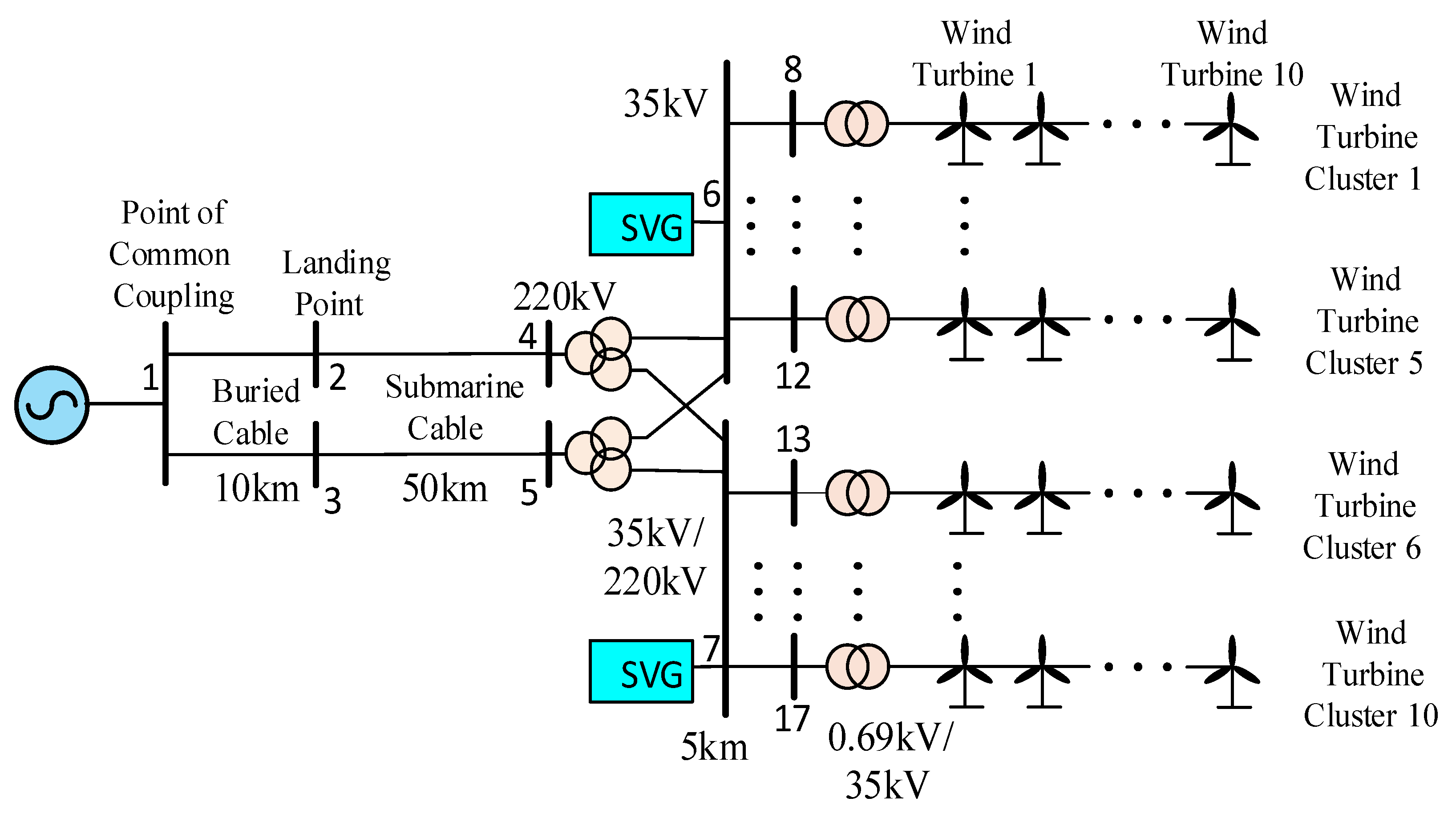
To validate the effectiveness of the proposed method, a practical offshore wind farm system was utilized for testing, with its structural model depicted in
Figure 4. The farm has a total capacity of 300 MW, comprising 100 Permanent Magnet Synchronous Generator (PMSG)-based wind turbines, each rated at 3 MW. Each turbine is connected to a 0.69 kV/35 kV pad-mounted transformer.
The turbines are grouped such that ten units form one branch, resulting in a total of ten 35 kV feeder lines. These collection lines, composed of 35 kV submarine cables, converge at the offshore substation’s low-voltage side. The power is then stepped up to 220 kV by two main transformers (35 kV/220 kV) and transmitted to the onshore grid connection point via two land cables. The distance from the offshore substation to the on-grid point is approximately 100 km. The submarine cables have a DC resistance of 0.268 Ω/km and an AC resistance of 0.342 Ω/km. The basic parameters of the 3 MW permanent magnet synchronous wind turbine are shown in
Table 3.
A comparative analysis was conducted to assess the performance of the fixed-weight multi-objective reactive power optimization strategy under different weight assignments. Three specific weight combinations were defined for this purpose:
Combination 1: A weight of 0.70 for voltage deviation and 0.30 for active power loss, and the corresponding three objective functions are as follows
Combination 2: Equal weights of 0.50 for both voltage deviation and active power loss, and the corresponding three objective functions are as follows
Combination 3: A weight of 0.30 for voltage deviation and 0.70 for active power loss, and the corresponding three objective functions are as follows
In addition, the objective function for the adaptive weight coefficient multi-objective reactive power optimization strategy is shown in Equation (19).
4.3. Comparison of Efficiency of Different Solution Methods
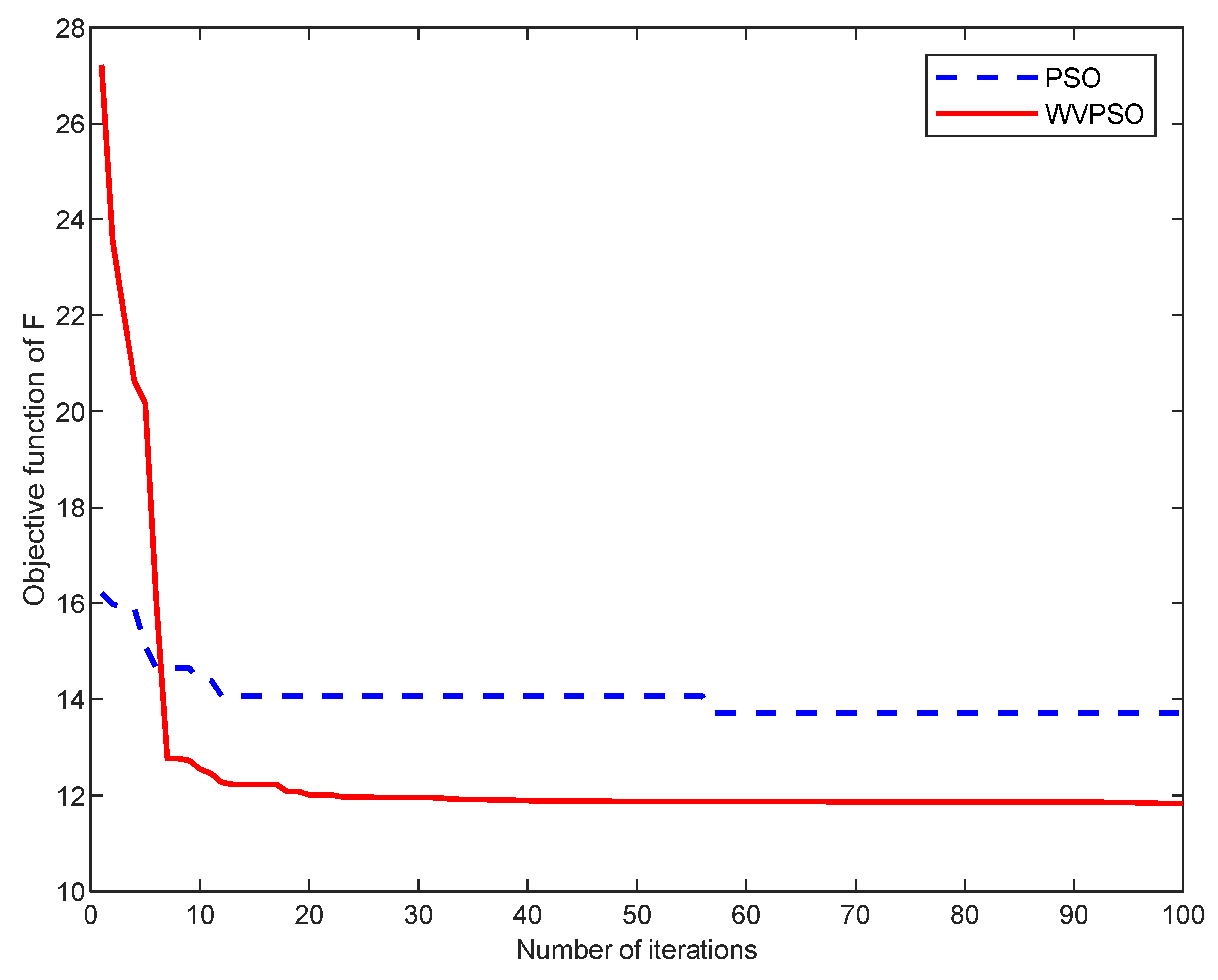
In this subsection, to verify the optimization performance of the WVPSO algorithm, a comparative experiment was conducted against the basic PSO method. The convergence curves of the two algorithms are compared in
Figure 5, where the wind farm grid connection point voltage is set to 1.01 p.u.
It can be seen that the WVPSO algorithm significantly outperforms the basic PSO algorithm in both convergence speed and convergence precision. In terms of convergence speed: The WVPSO algorithm exhibits a faster initial convergence rate, with its curve dropping sharply in the early iterations and rapidly approaching the optimal solution region. In contrast, the convergence curve of the basic PSO declines more gradually and shows obvious stagnation in the later stages. It is noteworthy that the WVPSO algorithm essentially converges around the 40th iteration, whereas the basic PSO continues to search slowly throughout the entire iteration cycle. This fully demonstrates the highly efficient optimization capability of the improved algorithm. In terms of convergence precision, the WVPSO algorithm eventually stabilizes at a lower objective function value, while the basic PSO converges to a higher value. This result clearly indicates that the WVPSO algorithm successfully finds a solution of superior quality. In terms of robustness, the convergence curve of the WVPSO algorithm is smoother and more stable, without significant fluctuations, indicating a robust search process that effectively balances global exploration and local exploitation. Conversely, the curve of the basic PSO still exhibits minor oscillations in the later stages, suggesting its tendency to become trapped in local optima and difficulty in escaping.
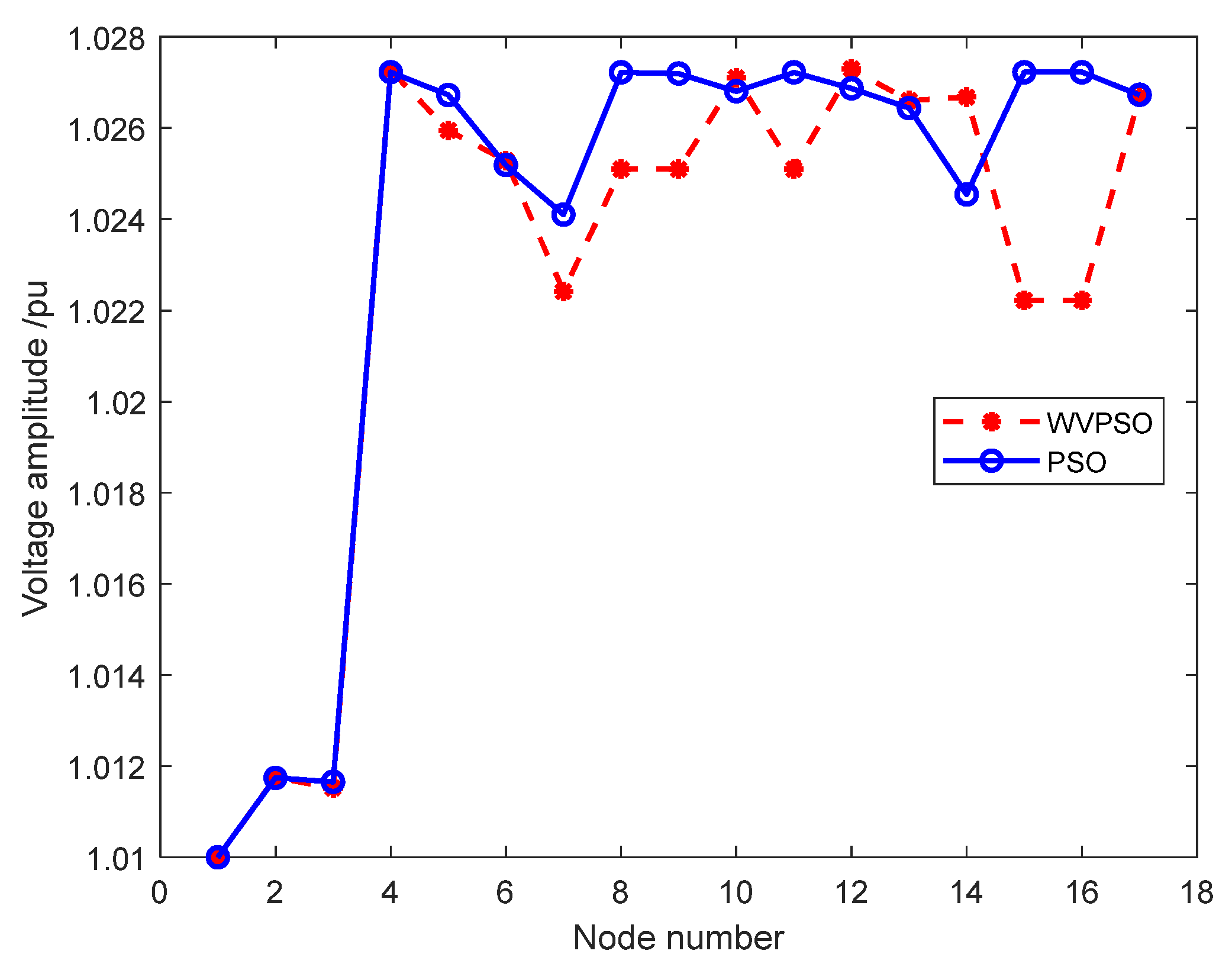
This convergence curve plot strongly validates the effectiveness of the weighted mutation strategy adopted in this paper. By introducing adaptive parameters, population classification with mutation, and a Gaussian perturbation mechanism, the algorithm not only greatly accelerates the convergence process but also significantly improves the quality of the final solution. Furthermore, it enhances the algorithm’s ability to escape local optima and stably search for the global optimum. The voltage optimization results at each node of the test system are shown in
Figure 6. It can be observed that the node voltages obtained by the weighted mutation particle swarm optimization algorithm are superior to those achieved by the conventional particle swarm optimization in most cases, which further validates the excellent performance of the proposed improved particle swarm optimization method.
In addition, to further accurately evaluate the performance of different PSO solvers, each test function was solved 100 times using different algorithms. To comprehensively assess the WVPSO algorithm from the perspectives of solution quality, convergence performance, and computational speed, the mean best fitness, standard deviation of fitness, convergence success rate, mean convergence generation, and average solution time were selected as evaluation metrics. The simulation results are summarized in
Table 4.
The evaluation metrics for solution quality of the optimization algorithms on the test functions mainly include the mean best fitness value and the standard deviation (SD) of fitness. Among these, the mean fitness is the most important indicator, reflecting the accuracy of the optimal solution found by the algorithm, while the standard deviation of fitness reflects the stability of the algorithm over multiple runs.
A comparison of
Table 3 shows that, in terms of the accuracy of the optimal solution, the WVPSO algorithm far outperforms all other algorithms, with its fitness curve exhibiting the steepest decline throughout the entire iteration cycle. The traditional PSO algorithm performs worst in terms of solution accuracy, as its fitness curve struggles to descend further from a relatively high level, which is attributed to its poor local fine search capability due to the larger fixed inertial weight. In terms of solution stability, the WVPSO algorithm demonstrates a significantly lower standard deviation of fitness compared to other algorithms, giving it a clear advantage and enabling it to explore more feasible solutions within the solution space.
4.4. Analysis of Test Results
In this section, to compare the optimization effects of the above reactive power optimization strategies under different operating conditions, the wind farm grid connection point voltage is set to 1.02 p.u., 1.06 p.u., and 1.09 p.u., respectively. The aforementioned various reactive power optimization strategies are used for optimization, and simulation analysis is performed. It worth pointing out that the particle swarm size is 50, the optimal tuning parameters are provided in
Table 5. All the tests are performed in MATLAB R2024b on a PC with the Intel Core CPU E5-1650, 3.5 GHz and 32 GB RAM.
The optimization effects of various reactive power optimization strategies under different operating conditions are shown in
Table 5 and
Table 6. It can be seen that different settings of voltage and loss weight coefficients affect the optimization results. Taking the initial grid connection point voltage of 1.06 p.u. as an example, among the optimization strategies corresponding to the three fixed weight coefficient combinations,
Combination 1 with voltage and loss weight coefficients of 0.70 and 0.30 achieved the best voltage optimization effect, reducing the grid connection point voltage from 1.06 p.u. to 1.016 p.u. However, the optimized network loss was 10.331 MW, which is the worst optimization effect for loss;
Combination 3 with voltage and loss weight coefficients of 0.30 and 0.70 had the worst optimization effect on the grid connection point voltage, only reducing it to 1.030 p.u., but its loss was reduced to 10.181 MW, achieving the best loss optimization effect;
Combination 2 with voltage and loss weight coefficients of 0.50 and 0.50 had a better voltage optimization effect than
Combination 3 but worse than
Combination 1, and a better loss optimization effect than
Combination 1 but worse than
Combination 3.
From the above data analysis, it can be seen that in multi-objective optimization, the larger the weight coefficient corresponding to an optimization objective, the better the optimization effect for that objective. However, for power grids under complex operating conditions, the voltage at the wind farm grid connection point will continue to fluctuate, and the voltage deviation at the grid connection point may vary significantly at different times. Reactive power optimization strategies with fixed weight coefficients may not consistently achieve good optimization results.
When the grid operating conditions are in a continuously changing scenario, the voltage at the wind farm grid connection point may continue to change drastically.
Comparing the optimization effects of the adaptive weight coefficient and fixed weight coefficient reactive power optimization strategies in
Table 6 and
Table 7, it can be seen that, when the grid connection point voltage remains within the safe range (corresponding to the row for 1.02 p.u. in
Table 6 and
Table 7), the adaptive reactive power optimization strategy has a weaker optimization effect on the grid connection point voltage compared to the fixed weight reactive power optimization strategy, but its optimization effect on active power loss is far superior to the fixed weight reactive power optimization strategy, reducing the active power loss to 10.071 MW; (2) When the grid connection point voltage approaches or exceeds the safety threshold (corresponding to the rows for 1.06 p.u. and 1.09 p.u. in
Table 6 and
Table 7), the adaptive reactive power optimization strategy has a weaker optimization effect on active power loss compared to the fixed weight reactive power optimization strategy, but its optimization effect on the grid connection point voltage is significantly better than that of the fixed weight coefficient reactive power optimization strategy, effectively ensuring that the grid connection point voltage remains within the safe range. When the grid connection point voltage is 1.09 p.u., the optimized grid connection point voltage using the optimization strategy with a weight coefficient ratio of 0.30:0.70 is 1.051 p.u., which still exceeds the safety threshold, seriously affecting the safe operation of the wind farm.
Based on above discussion, compared to the traditional fixed-weight reactive power optimization strategy, the adaptive reactive power optimization strategy provides better voltage optimization when large fluctuations occur at the grid connection point, enabling the voltage deviation to be quickly reduced to a safe range; when the grid connection point voltage is within the safe range, it can minimize active power loss, and its optimization effect is superior to the fixed-weight reactive power optimization strategy.