Article

Three-Parameter Agile Anti-Interference Waveform Design and Corresponding MUSIC-Based Signal Processing Algorithm


Key Laboratory of Near-Range RF Sensing ICs & Microsystems (NJUST), Ministry of Education, School of Electronic and Optical Engineering, Nanjing University of Science and Technology, Nanjing 210094, China
*
Authors to whom correspondence should be addressed.
Electronics 2026, 15(2), 303; https://doi.org/10.3390/electronics15020303
Submission received: 15 December 2025 / Revised: 7 January 2026 / Accepted: 8 January 2026 / Published: 9 January 2026

Abstract

Radar systems with exceptional anti-jamming performance are critical to meeting the high-performance requirements of future intelligent sensing systems. To address the deception jamming challenges encountered by intelligent sensing systems environments, a multi-parameter agile waveform is designed. The proposed waveform exhibits high flexibility across three dimensions—pulse width, pulse repetition interval, and carrier frequency. Compared to traditional single-parameter or two-parameter agile waveforms, which vary only one or two parameters, this multi-parameter approach significantly enhances anti-jamming performance by disrupting periodicity and providing higher flexibility in dynamic interference environments. To address the complex signal characteristics induced by multi-parameter agility, we further develop a low-complexity signal processing method based on a segmented multiple signal classification (MUSIC) algorithm, which accurately extracts Doppler information from pulse-compressed slow-time data to achieve high-precision velocity estimation. Both theoretical derivations and simulation results demonstrate that, compared with the conventional compressed sensing orthogonal matching pursuit method and the conventional MUSIC method that operate on the entire signal, our segmented approach divides the signal into smaller segments, reducing computational complexity and improving velocity estimation accuracy. Notably, even in high-intensity, densely jammed environments, the system reliably extracts target information.

1. Introduction

With the continuous development of the information society, radar systems are set to play an increasingly prominent role in future sensing applications. In particular, millimeter-wave radar, as an essential component of intelligent sensing systems, is irreplaceable in near-range detection due to its all-weather, high-resolution detection capabilities, strong stability, and ease of integration [1,2]. Although the International Telecommunication Union (ITU) and national regulatory authorities have established global spectrum allocation frameworks to minimize interference, millimeter-wave radar still faces significant electromagnetic interference issues in practical operations due to the surge in electromagnetic devices, the scarcity of spectrum resources, and complex factors such as environmental multipath and technological cross-applications [3,4]. In particular, with the integration of communication and sensing technologies, the operation of critical systems such as autonomous driving and industrial automation facilities relies heavily on real-time sensing and high-precision signal processing, thereby creating new attack surfaces and opportunities for malicious actors [5,6,7]. Malicious actors can exploit deception jamming techniques to inject counterfeit data resembling authentic signals into the electromagnetic environment. By inducing misjudgments and misleading decision-making systems, they may trigger traffic accidents or disrupt production, leading to economic losses and even endangering lives [8]. Therefore, robust radar systems capable of mitigating interference are an indispensable component of intelligent detection development in future intelligent sensing systems.
Previous researchers have primarily categorized measures against deception jamming into two types: passive anti-jamming and active anti-jamming [9]. Passive anti-jamming primarily reduces the probability of interception through radar system design [10], while active anti-jamming focuses on waveform design and associated signal processing techniques [11]. Sensing systems not only require high data transmission rates and low latency, but they also need to integrate multiple sources of information to meet the real-time, multidimensional, and high-precision sensing demands in complex scenarios. Traditional passive anti-jamming measures cannot handle the increasingly complex electromagnetic environment, and active anti-jamming techniques become particularly crucial. By designing novel interference-resistant waveforms and employing advanced signal processing algorithms, active anti-jamming techniques can effectively distinguish between authentic signals and various forms of structured interference. This ensures robustness and system stability during the sensing process and provides a solid technical foundation for future sensing systems.
Active anti-jamming techniques can be considered from both waveform design and signal processing perspectives. Waveform design can be considered in terms of orthogonal coding, parametric agility, and composite modulation. For example, J. Akhtar proposed a waveform diversity method that uses orthogonal coded signals to suppress deception jamming [12,13,14]. Qinyu Xie proposed a novel pulse-agile RFM waveform design for anti-jamming research [15]. Wang X. proposed an inter-pulse orthogonal transmit waveform based on OFDM technology to suppress deception jamming [16]. Compared to orthogonal coding, parameter agility does not rely on fixed subcarrier assignments or code structures. Unlike composite modulation schemes, parameter-agile designs retain conventional LFM or intrapulse forms, resulting in lower PAPR and RF linearity requirements than OFDM-based waveforms and enabling easier integration into existing radar platforms [17]. Therefore, designing new agile waveforms deserves an in-depth study. In recent years, there have been researchers studying more complex parametric waveform agility. Wang Xiaoge et al. designed an Intrapulse Frequency-Coded Joint-FM Slope Agile Waveform for ISRJ with 18 dB improvement in the main-side flap difference and a friendly linear FM structure [18]. Zhixing Liu et al. proposed a joint two-parameter agile waveform to resist intermittent forwarding interference [19]. Although there have been many approaches to parameter agility, single-parameter agility or two-parameter agility has been difficult to meet high-density jamming scenarios and the latest electronic countermeasures [20]. There is a need to consider higher-dimensional parametric agility methods [21]. However, complex waveform designs significantly increase the implementation difficulty of radio frequency systems [22,23], and complex reconstruction algorithms often lead to high computational burdens and processing delays [24]. For example, in frequency-agile radars, pulse-to-pulse carrier switching couples the range, Doppler, and carrier-frequency dimensions; state-of-the-art joint-estimation or compressive-sensing processors must therefore operate on an expanded 3-D dictionary, driving the computational load to one or two orders of magnitude higher than that of conventional fixed-carrier LFM processing [25]. Likewise, random-PRI waveforms break the uniform-sampling premise of classical Doppler processing; compensation techniques—such as Radon-based resampling or non-uniform FFTs—require multi-parameter searches whose complexity grows approximately with the cube of the pulse count, leading to intolerable latency on real-time embedded platforms [26].
Therefore, for practical systems, it is necessary to design innovative waveforms and corresponding low-complexity signal processing methods that are both practical and efficient.
To date, research on interference-resistant radar waveforms that simultaneously exhibit agility in pulse width, pulse repetition frequency, and carrier frequency is lacking. Such waveforms are expected to significantly enhance radar systems’ interference-resistant performance and hold important theoretical and practical value. Due to the more complex signal characteristics introduced by three-parameter agility, conventional radar signal processing methods are no longer applicable. Although CS techniques are often used for reconstructing and processing such signals, their high computational complexity and limited interference resistance make them less suitable. Therefore, there is an urgent need to develop a novel signal processing method that is both efficient and practical, fully leveraging the advantages of three-parameter agile waveforms in complex interference environments.
This paper proposes an anti-interference technique based on a three-parameter agile waveform. Unlike conventional single-parameter agile radar, the radar waveform designed in this study implements agile pulse width and pulse repetition frequency (PRF) within the inter-pulse domain and agile carrier frequency between coherent processing intervals (CPI). Agile pulse width can effectively suppress interference signals during pulse compression. In the slow-time coherent accumulation process, agile PRF helps distinguish and filter interference signals. In addition, agile carrier frequency further improves the interference resistance of radar signals. For signals that employ agile carrier frequency in the inter-pulse domain, complex algorithms are typically needed to recover the information [27]. To address this, the proposed approach applies agile carrier frequency between CPIs so as to enhance anti-interference capability without increasing the signal processing burden. The proposed multi-parameter agile radar waveform effectively suppresses interference at all stages of radar signal processing. Its anti-interference performance is significantly superior to that of traditional single-parameter agile waveforms.
To balance signal processing efficiency with low computational complexity, this study applies a segmented multiple signal classification (MUSIC) method in the slow-time domain to extract Doppler information. Theoretical derivations and simulation comparisons demonstrate that this segmented MUSIC-based signal processing method, applied to the new three-parameter agile waveform, not only significantly reduces computational complexity but also outperforms traditional CS-based methods in terms of both interference resistance and velocity measurement accuracy, especially in high-intensity, dense jamming environments. The main contributions of this paper are summarized as follows:
  • Unlike conventional methods that typically utilize two-parameter agility (e.g., pulse width and PRI), we propose a novel three-parameter agile waveform that jointly modulates pulse width, pulse repetition interval (PRI), and carrier frequency. This design significantly enhances waveform complexity and anti-jamming capabilities against intelligent jamming.
  • We propose a specialized signal processing method based on the segmented MUSIC algorithm, specifically adapted to address the coherence challenges of the new three-parameter agile waveform. This approach effectively improves the accuracy of target velocity estimation while substantially reducing computational complexity compared to global search methods.
  • Compared with traditional Compressive Sensing based methods, the proposed approach demonstrates distinct advantages in jamming suppression, detection accuracy, and computational efficiency. It is particularly robust in high-intensity and dense jamming environments, ensuring stable target information extraction.
In Section 2 the multi-parameter agile radar waveform is introduced. The signal processing method based on MUSIC is deduced and analyzed in Section 3. In Section 4 we simulated and compared the traditional CS method and the method adopted in this paper. The paper is concluded in Section 5.
Notation: Italic letters denote scalars. Italic bold letters denote vectors or matrices. ( ) T and ( ) H denote transpose and conjugate transpose, respectively.

2. Radar Signal Model

2.1. Parameter Agile Waveform

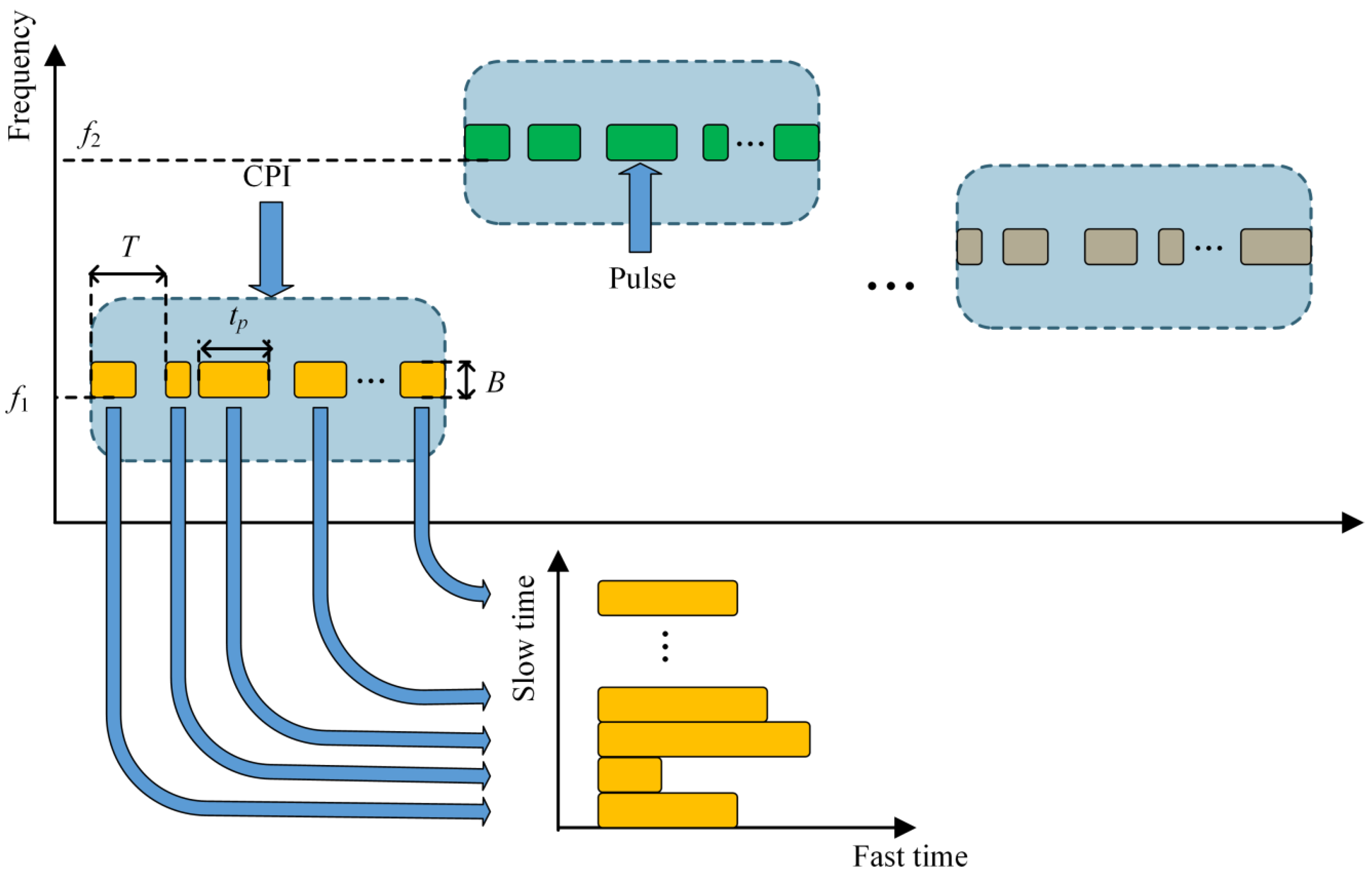
In this section, we introduce the three-parameter agile waveform, which features agility in pulse width, PRF, and carrier frequency. The agile signal is illustrated in Figure 1. As shown in Figure 1, the radar transmitter continuously transmits LFM signals with agile parameters. A CPI contains N pulses. The pulse width t p and the pulse repetition interval T are constantly changing in each CPI. For the n-th pulse, the pulse repetition interval T ( n ) is uniformly distributed in the interval [ T 0 Δ T , T 0 + Δ T ] , and the pulse width t p ( n ) is uniformly distributed in the interval [ t p 0 Δ t p , t p 0 + Δ t p ] , where T 0 and t p 0 are the center values of the pulse interval and pulse width, and the ranges of Δ T and Δ t p need to be determined according to the specific situation. The uniform distribution is chosen to ensure unbiased random variation in both parameters. Increasing Δ t p or Δ T increases the signal’s frequency diversity, which enhances the anti-jamming capability by broadening the signal’s bandwidth. However, this also results in a trade-off with resolution, as increased bandwidth can lead to reduced range or velocity resolution. In Figure 1, the carrier frequency agility varies between CPIs and is constant in one. As a result, carrier frequency agility offers some anti-jamming capability without significantly increasing signal-processing complexity.
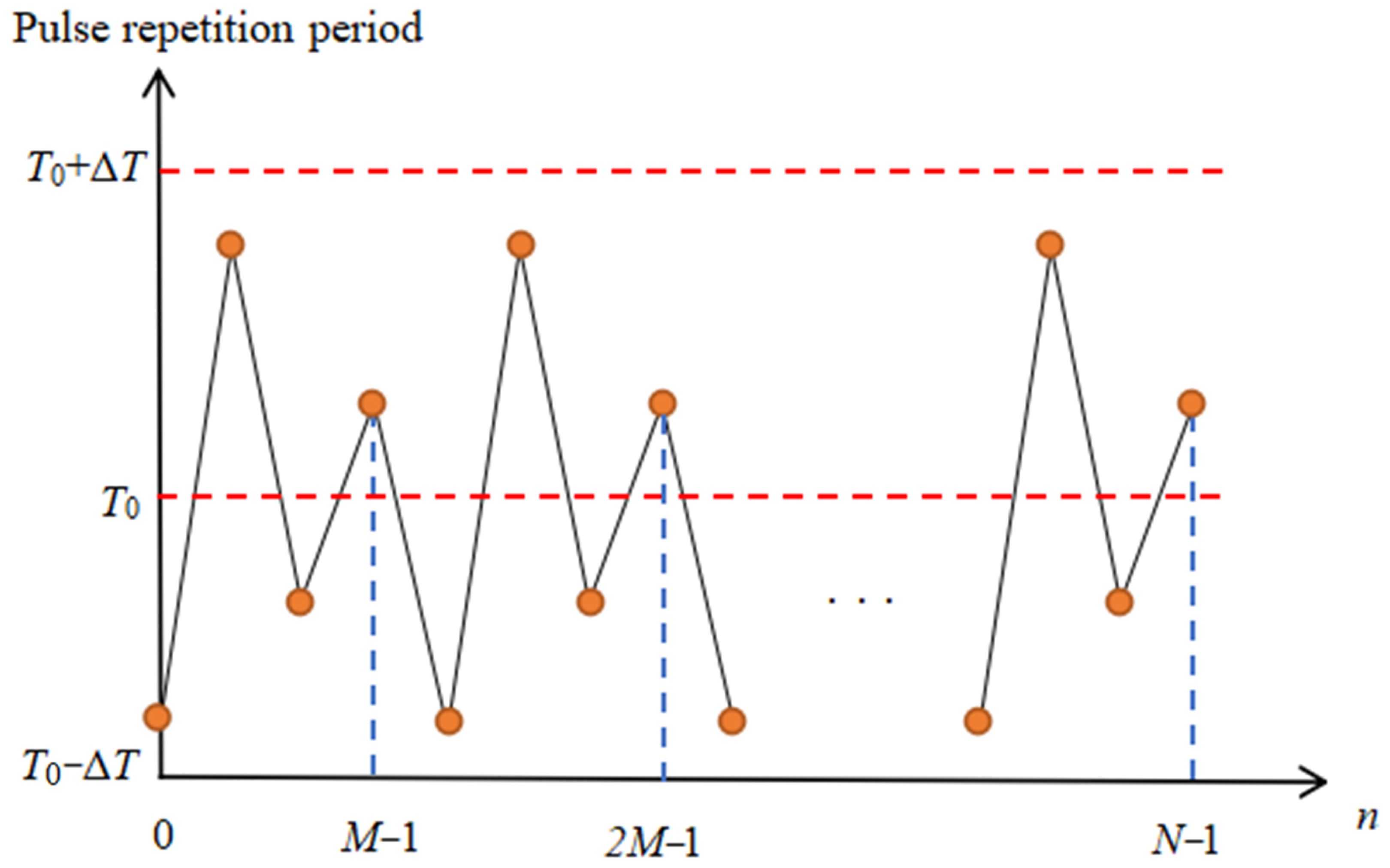
For the signal designed in this paper, the agility rule for the PRI is a critical design consideration. Conventional CS-based signal processing methods exhibit considerable complexity and inadequate anti-jamming performance when applied to such parameter-agile LFM signals. As a result, this study employs a segmented MUSIC-based signal processing method. For the segmented MUSIC algorithm to be used in signal processing, the pulse intervals at the corresponding positions of each segment must be equal. Adopting a periodic agility rule is one of the most straightforward approaches. That is, with a set of N pulses divided into L segments with M pulses per segment, as shown in Figure 2, T ( n ) can be expressed as:
T ( n ) = T l M + m , T ( m ) = T 0 Δ T + 2 Δ T rand ( 1 ) , ( l = 0 , 1 , , L 1 , m = 0 , 1 , , M 1 . )
where rand (1) denotes a random number uniformly distributed between 0 and 1.
However, for the anti-jamming research on which this work concentrates, the system’s anti-jamming performance will be reduced by the periodic agile signal. As a result, in order to meet the requirements for the use of the segmented MUSIC algorithm, it is essential to destroy the periodicity of parameter agility in order to achieve the ultimate objective of anti-jamming. That is, the pulse intervals between the last pulse of each segment and the first pulse of the next segment are not equal to one another. At this time, T ( n ) can be expressed as:
T ( n ) = T ( l M + m ) = T ( m ) , m = 0 , 1 , , M 2 , T ( l M + m ) T ( m ) , m = M 1 , l = 0 , 1 , , L 1 .
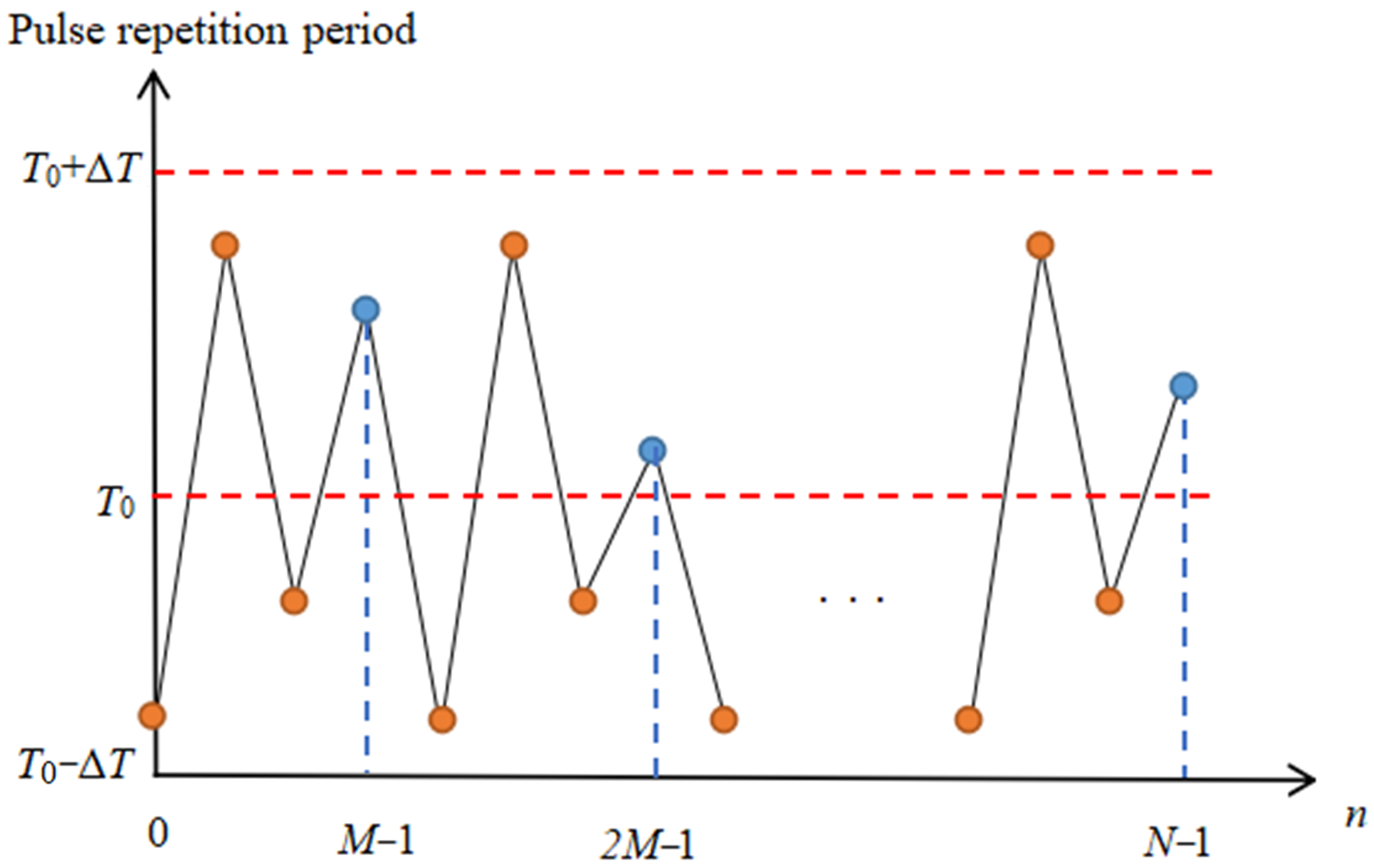
The final agility-rule diagram is shown in Figure 3.
Compared to Figure 2, Figure 3 randomizes the inter-segment boundary PRI, namely the interval between the last pulse of one segment and the first pulse of the next. This boundary PRI is made unequal across segments, thereby destroying the global periodicity. The PRI pattern at corresponding pulse positions is still replicated across segments, which preserves the structural requirement for segmented MUSIC in slow time.
According to the above agility rules, the transmitting signals of radar can be expressed as:
s t ( t ) = n = 0 N 1 s t n ( t ) , s t n ( t ) = rect t T Σ ( n ) t p ( n ) exp j 2 π f 0 t exp j π k ( n ) ( t T Σ ( n ) ) 2 , T Σ ( n ) = i = 0 n 1 T ( i ) ,
where t denotes the fast time, s t n ( t ) is the n-th pulse of the transmitted signal, t p ( n ) is the pulse width, f 0 is the carrier frequency in the current CPI, and k ( n ) = B t p ( n ) is the frequency-modulation coefficient.
s r ( t ) = n = 0 N 1 s r n ( t ) , s r n ( t ) = s t n t τ ( t ) , τ ( t ) = 2 R c + 2 v t c ,
where c denotes the speed of light, s r n ( t ) is the nth pulse of the echo signal, and R and v are the range and velocity of the target, respectively.

2.2. Deception Jamming Signal

To investigate the limits of the designed system’s interference mitigation capability, deception jamming is employed to generate interference signals. The parameters of the interference signal closely resemble those of the radar’s transmitted signal, and some interference is fully synchronized with the echo signal during processing. The interference signal is generated based on the transmitted signal’s pulse width, PRI, and other characteristics, with virtual target information incorporated. The expression for the single-pulse interference signal s j ( t ) is as follows:
s j ( t ) = rect t τ j t p j exp j π k j ( t τ j ) 2 exp j 2 π f j 0 τ j ,
where t p j denotes the intercepted pulse width, k j denotes the frequency-modulation coefficient, f j 0 denotes the carrier frequency, and τ j denotes the time delay of the dummy target.
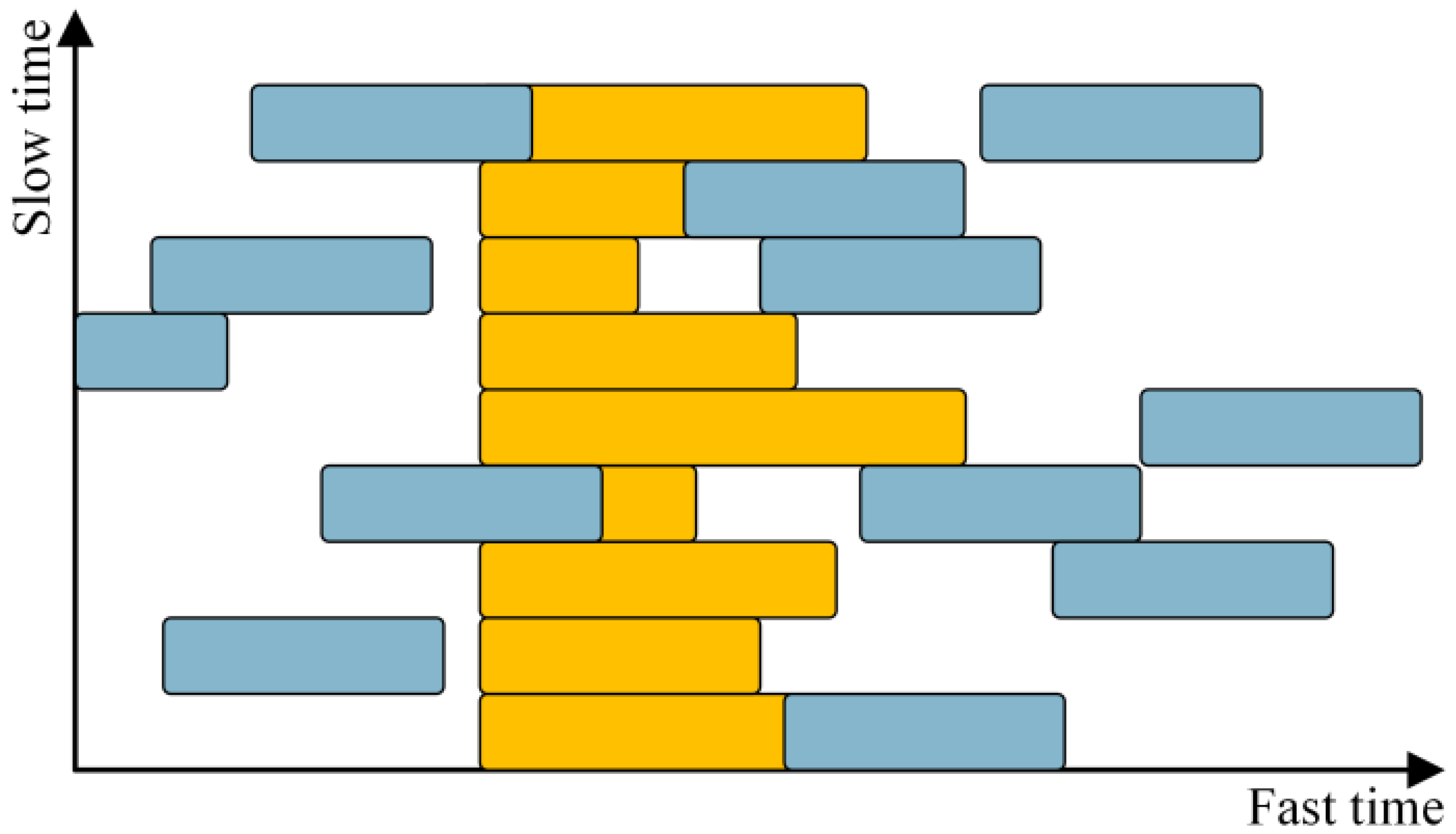
Due to synchronous sampling, while t p ( n ) and T ( n ) are constantly changing, the echo signal of each period of the same target has almost the same position in the range gate. Moreover, owing to the three-parameter agility of the designed signal, the interference source cannot accurately acquire the transmitted signal parameters. Consequently, the PRI and pulse width of the virtual target signal differ from those of the echo signal, resulting in a variable position within the range gate.
The Figure 4 shows the variation in the position of the jamming signal relative to the target echo within the range gate. The jamming pulses exhibit random jitter across the gate, causing the interference signal to shift in both time and range. As a result, some jamming pulses fall outside the range gate, while others overlap with the target’s echo. This variation allows the target signal to be distinguishable from the jamming signal, making it easier to identify and suppress the interference.

3. Signal Processing by Music Method

3.1. Pulse Compression

The conventional pulsed Doppler radar with fixed parameters uses pulse compression to obtain range information and the fast Fourier transform (FFT) to detect moving targets in the slow-time dimension. Considering the high-performance demands of radar systems in intelligent sensing scenarios, which require efficient extraction of multidimensional target information and reduced computational complexity, the MUSIC algorithm is adopted for target velocity estimation in this study.
Before using the MUSIC approach to estimate velocity, pulse compression is produced by matched filtering of the radar echo signal of each period. The matched filtering formula for the single-pulse signal is as follows:
f n ( t ) = + s r n ( s ) + s j ( s ) h ( t s ) d s ,
where h ( t ) = s t n * ( t ) . The input signals of the matched filter are composed of jamming and echo signals.
Because the parameters of the reference signal and the target echo signal are matched in this process, the target’s range information can be correctly derived. The echo signal and the jamming signal are combined and processed together. Due to the agility of the pulse width between pulses, the pulse width of the jamming signal in the matched filtering process does not match that of the transmitted signal, allowing the jamming signal to be suppressed. However, it can be inferred from (6) that the results of the pulse compression are proportional to the pulse width [28]. Due to the usage of the pulse-width-agile signal in this study, the peak value of pulse compression varies between periods. Before signal processing in the slow-time dimension, it is essential to properly compensate for the pulse-compression result of each period by multiplying by the factor t p / t p n . The final single-period pulse-compression result y n ( t ) is shown as follows:
y n ( t ) = t p t p n f n ( t ) ,
where t p denotes the reference pulse width, which is set to the center value in the waveform design, and t p n denotes the pulse width of the n-th pulse. Since the peak magnitude after pulse compression is proportional to the pulse energy, and for constant-envelope pulses the pulse energy is proportional to the pulse width, we normalize the pulse-compressed output of each pulse by the factor t p n to maintain a consistent amplitude level across different PRIs.

3.2. MUSIC Signal Processing Method

The necessary mathematical model for the MUSIC algorithm is constructed using the segmented pulse-compressed data. Let the total number of pulses N be divided into L segments, with each segment containing M pulses (i.e., N = L M ). We define the complex-valued data matrix X C M × L by stacking the data vectors of the L segments column-wise.
The signal model can be expressed as:
X = A S + N
where:
  • X = [ x 0 , x 1 , , x L 1 ] is the M × L complex data matrix, where x l C M × 1 denotes the pulse compression result vector of the l-th segment.
  • A = [ a ( ω 1 ) , , a ( ω K t ) ] is the M × K t steering matrix for K t targets. The steering vector a ( ω ) is defined based on the agile pulse repetition interval:
    a ( ω ) = [ 1 , e j φ 1 , , e j φ M 1 ] T .
    where the phase term is φ m = ω 0 i = 0 m T ( i ) T 0 ( m = 1 , , M 1 ), and ω 0 = 2 π f d T 0 .
  • S C K t × L is the complex source amplitude matrix, representing the scattering coefficients of the K targets across the L segments.
  • N C M × L is the additive noise matrix. Each element is modeled as zero-mean complex Gaussian white noise with variance σ 2 .
The covariance matrix is then estimated as:
R x x = 1 L X X H .
The steps of the MUSIC algorithm are well known [29,30]. Substituting the signal model into the covariance definition and assuming the noise is uncorrelated with the signals, the theoretical structure of R x x can be formulated. Let P = E [ S S H ] denote the source correlation matrix, where E [ · ] represents the statistical expectation operator. The covariance matrix and its eigenvalue decomposition are expressed as:
R x x = A P A H + σ 2 I = U Σ U H ,
Σ = diag ( α 2 , 0 , , 0 ) + σ 2 I ,
The maximum eigenvalue is α 2 + σ 2 , while the other eigenvalues are equal to the variance of additive white noise and are referred to as the signal and noise eigenvalues, respectively. When the signal-to-noise ratio is sufficiently high, the signal eigenvalue is significantly greater than the noise eigenvalues.
The noise subspace is then constructed.
P n τ = G G , G 1 G H = G G H ,
where G is the noise feature vector.
Finally, a function similar to the power spectrum is constructed:
P MUSIC ( ω ) = a H ( ω ) a ( ω ) a H ( ω ) G G H a ( ω ) .
The value of ω at the peak is ω 0 , and then according to ω 0 = 2 π f d T 0 , the value of the Doppler shift can be obtained, and the velocity of the target can be measured.
It should be noted that although the classical MUSIC spectrum shown in (14) can obtain the velocity of the target, the range information obtained in the pulse compression process cannot be retained. Since the amplitude information of pulse compression is mainly stored in the signal eigenvalue of the MUSIC algorithm, it is necessary to introduce the signal eigenvalue into the (12) as a product factor. At this time, we can get the range–velocity two-dimensional spectrum of the target and obtain the range and velocity information of the target. Furthermore, The Doppler estimate is converted to radial velocity using the wavelength determined by the carrier frequency of the current CPI. Therefore, when the carrier hops across CPIs, the Doppler-to-velocity mapping is updated accordingly, while the segmented MUSIC structure remains unchanged.

3.3. Detection Range Analysis

The range of radar distance and velocity measurement of this signal processing method is analyzed. For the signal waveform proposed in this study, the minimum stable distance measuring range is c ( t p 0 + Δ t p ) / 2 , which corresponds to the longest pulse width. The maximum limit of the stable distance measuring range is the difference between the distance c ( T 0 Δ T ) / 2 corresponding to the shortest pulse repetition interval and the distance c ( t p 0 + Δ t p ) / 2 corresponding to the largest pulse width. Therefore, the ultimate range for measuring distance is [ c ( t p 0 + Δ t p ) / 2 , c ( T 0 Δ T t p 0 Δ t p ) / 2 ] . For the agile signal in this paper, the range of Doppler frequency f d should be [ 1 / ( 2 ( T 0 Δ T ) ) , 1 / ( 2 ( T 0 Δ T ) ) ] . Consequently, based on the Doppler velocity calculation formula f d = 2 v / λ , where λ is the wavelength, the measurement range of velocity v is [ λ / ( 4 ( T 0 Δ T ) ) , λ / ( 4 ( T 0 Δ T ) ) ] .

3.4. Computational Complexity Analysis

This paragraph analyzes the time complexity of the MUSIC algorithm and the classical compressed sensing orthogonal matching pursuit (OMP) algorithm. For the input signal with length N, the time complexity of the OMP algorithm is O ( K 2 N 2 ) , where K represents the number of iterations. For the MUSIC algorithm, it is necessary to divide the signal with length N into L segments with M points in each segment, that is, N = L M . If L is equal to M, then N = M 2 . As a result, the OMP algorithm has a complexity of O ( K 2 M 4 ) . The MUSIC algorithm consists of two parts: eigenvalue decomposition of the covariance matrix and spectral peak search. The complexity of eigenvalue decomposition is O ( M 3 ) and the complexity of spectrum peak search is O ( M 2 ) . Therefore, compared with the CS-OMP algorithm, the MUSIC algorithm adopted in this paper has lower computational complexity.

4. Simulation and Analysis

4.1. Signal Processing Simulation

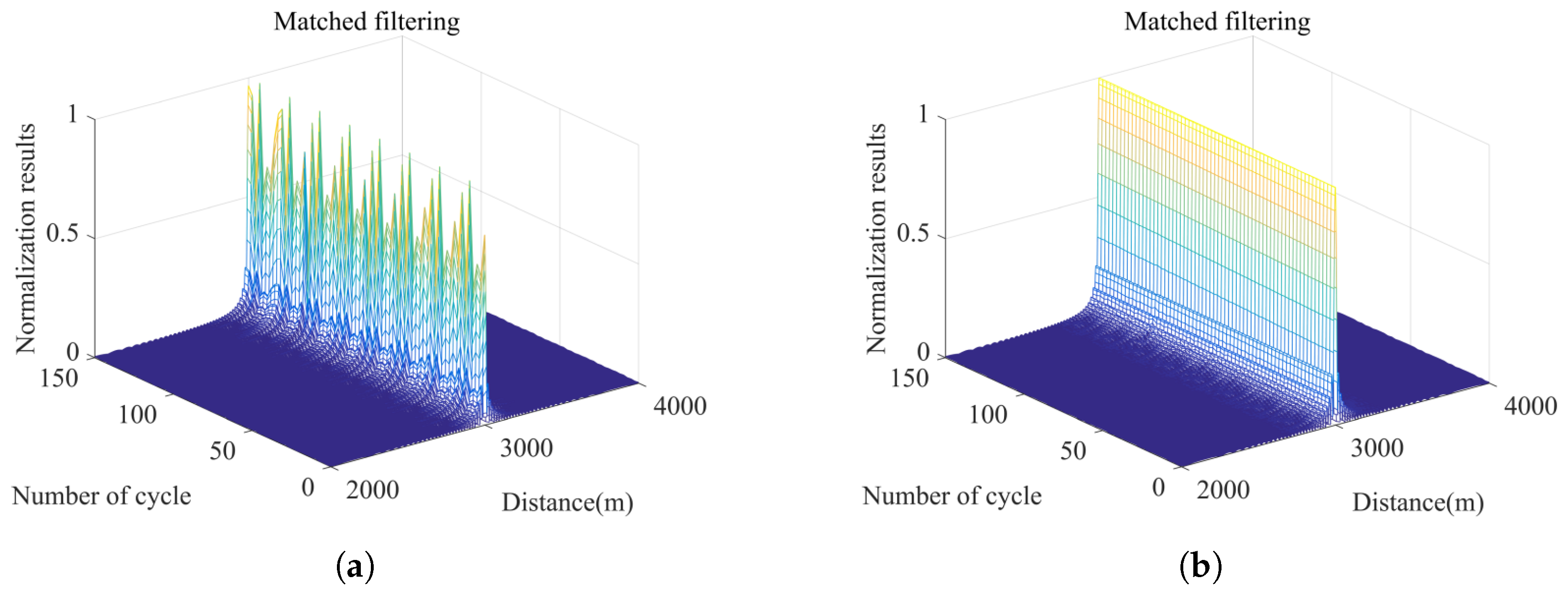
In this section, the signal processing process is simulated. The simulation parameters are as follows: carrier frequency f 0 = 10 GHz , bandwidth B = 10 MHz , sampling frequency f s = 100 MHz , number of pulses N = 64 , central pulse width t p 0 = 10 μ s , central pulse repetition interval T 0 = 100 μ s , range gate [ 2000 m , 4500 m ] , target range R = 3000 m , target velocity v = 50 m / s . The variation ranges of pulse width and pulse repetition interval were set as Δ t p = 0.5 t p 0 , Δ T = 0.15 T 0 . The simulation parameters are selected to represent a typical radar system scenario, considering both practical hardware constraints and recent research findings. Specifically, the maximum pulse width is constrained by the transmitter’s duty cycle to prevent overheating, while the agility extent is set to approximately 10–20% of the nominal values. This range is consistent with recent studies on multi-parameter agile waveform design [20,31], confirming that the chosen parameters are sufficient to disrupt intelligent jamming while maintaining the coherence required for the proposed processing. The simulations in this section validate the processing chain within a single coherent processing interval under a conservative worst-case full-overlap assumption, where the deception interference is assumed to fully overlap the radar signal in the frequency domain in each CPI. The Figure 5 compares the pulse compression results before and after normalization for different periods. Figure 5a shows the pulse compression results without compensation, where the peak magnitudes vary across periods due to differences in pulse width. Figure 5b displays the results after normalization, where the peak values of all pulses are adjusted to a consistent level, ensuring that the amplitude remains uniform across different periods. This compensation process improves the accuracy of subsequent signal processing, particularly in distinguishing between the target and interference signals.
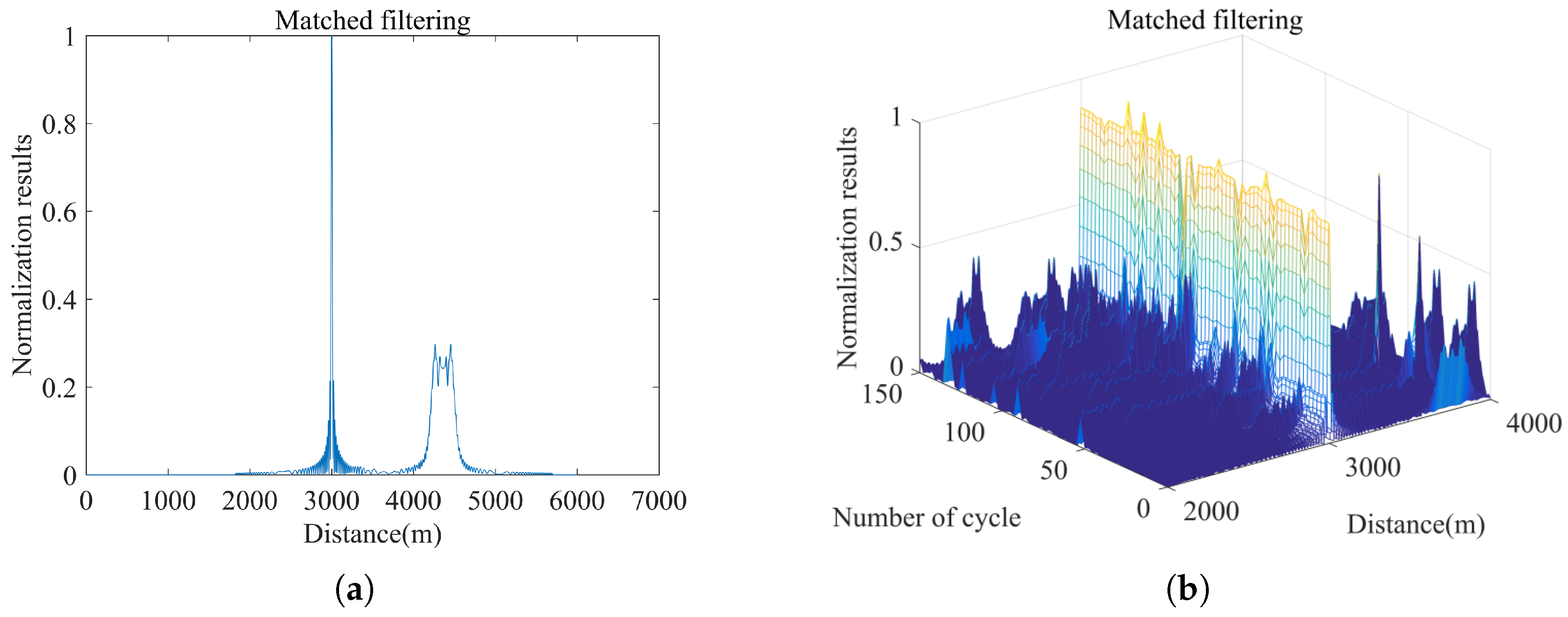
To verify the anti-jamming capability of pulse-width agility during pulse compression, a dummy-target jamming with jamming-to-signal ratio of 0 dB is introduced. The range of the dummy target is 3010 m, and the velocity is 55 m/s. The matched filtering results of the echo signal with jamming are shown in Figure 6.
It can be seen from Figure 6 that the pulse compression results of jamming signals are scattered in the figure, and the energy cannot be concentrated. The pulse compression process suppresses the jamming signal to some extent and prepares for the subsequent step of coherent accumulation in the slow time dimension.
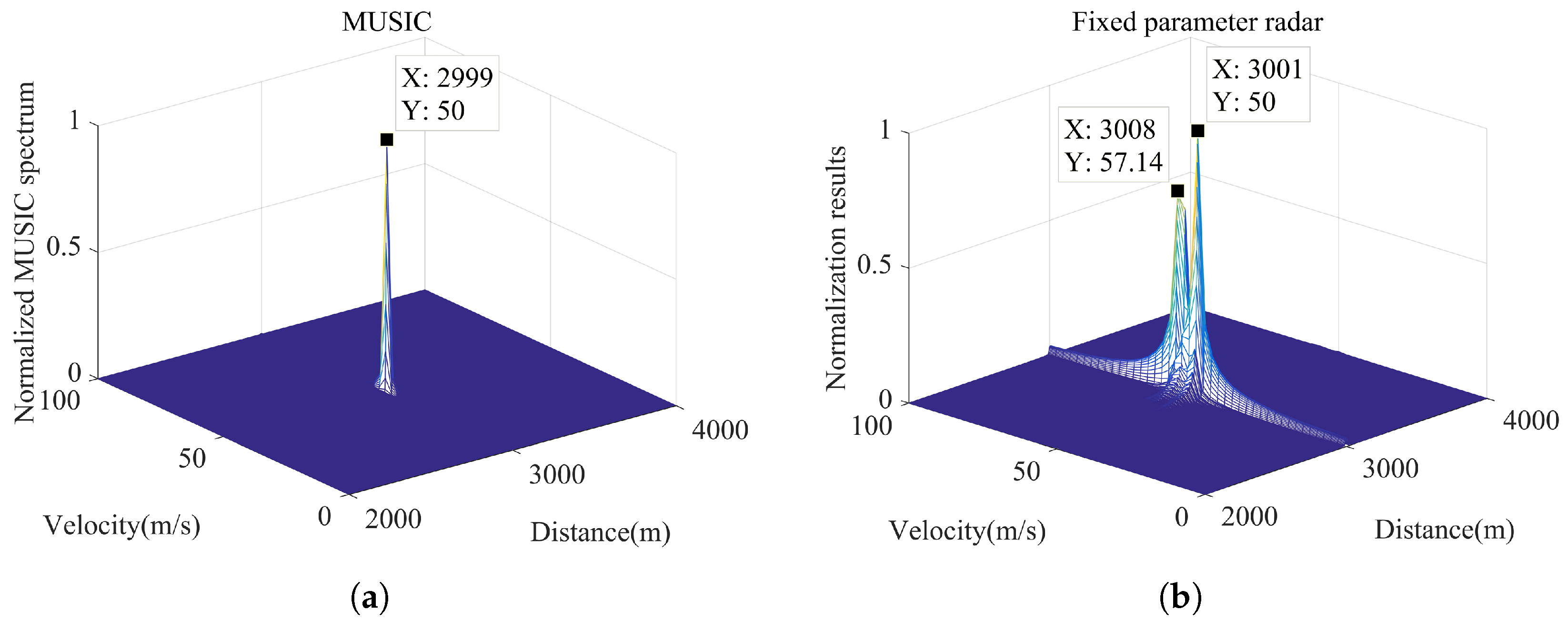
On the premise that the signal and jamming parameters remain unchanged, we simulated the complete signal processing process. In this study, we simulate the signal processing using the conventional fixed parameter radar signal and the agile radar signal. The signal processing method of matched filtering combined with FFT is used for the fixed parameter radar signal, and the MUSIC processing method in this paper is used for the agile signal. The performance improvement comes from the joint effect of waveform agility and MUSIC-based processing. The simulation results are shown in Figure 7 below.
It can be seen from Figure 7a,b that the traditional fixed parameter radar and its signal processing method cannot distinguish between echo and dummy target jamming, while the agile radar waveform and its corresponding MUSIC signal processing method in this paper can effectively suppress dummy target jamming and get accurate target information.

4.2. Anti-Jamming Performance Analysis

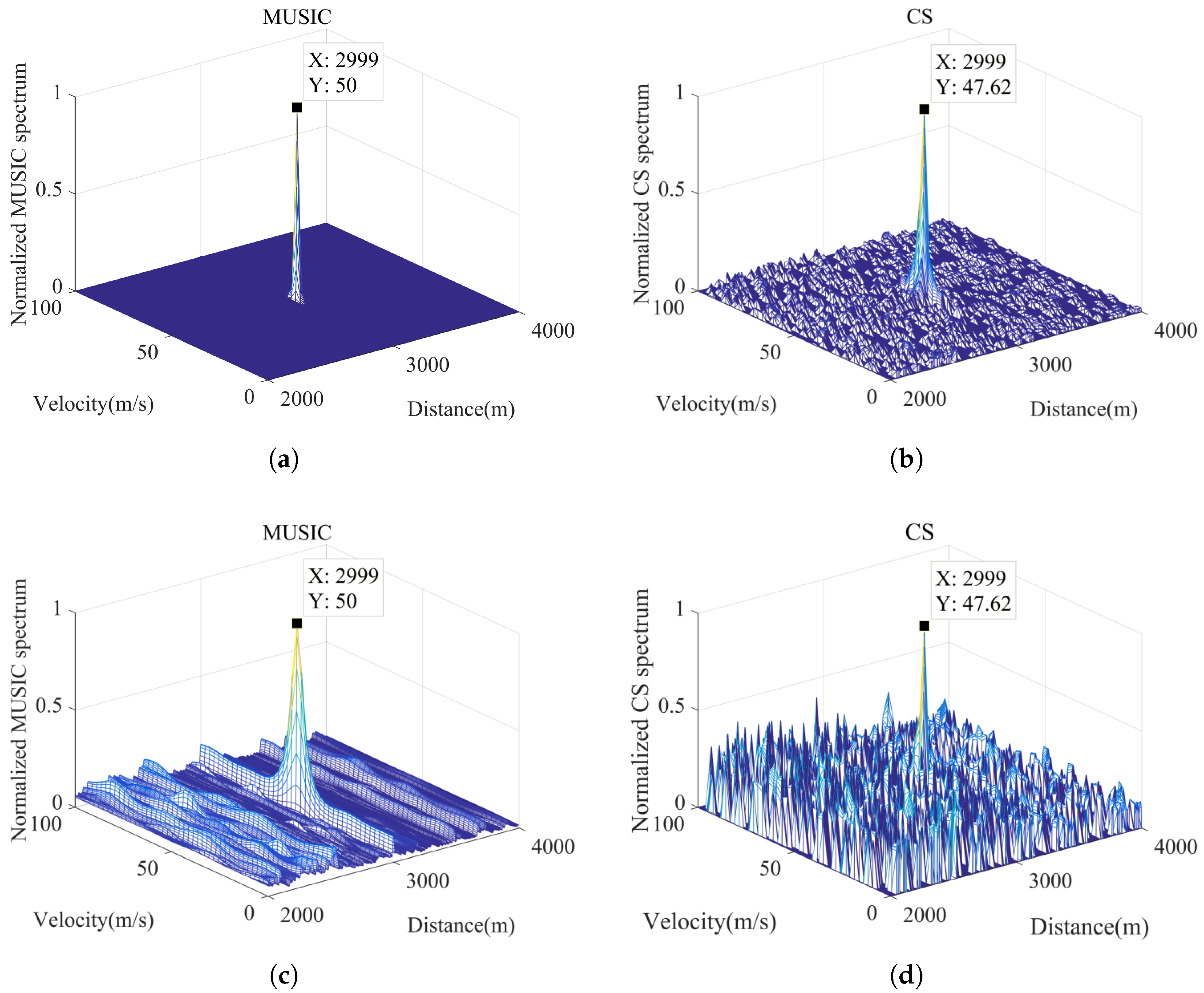
This study also simulated the CS-OMP method for comparison. The anti-jamming performance of the two algorithms is compared using 10 dense dummy-target jamming signals with jamming-to-signal ratios of 0 dB and 15 dB. The dummy-target parameters were randomly generated between 2990 m and 3010 m in range and 40–60 m/s in velocity. The simulation results of the two methods are shown in Figure 8.
It can be seen from Figure 8 that the target distance measured by the two methods is 2999 m, and the velocity measured by the MUSIC method is 50 m/s, which is closer to the actual value than 47.62 m/s measured by the CS method. And for the two jamming intensities, on the premise that the target distance and velocity information can be obtained correctly, the jamming residue in the spectrum processed by the CS-OMP algorithm is more obvious, while the jamming-filtering performance of the MUSIC algorithm is better. The signal-processing time of MUSIC is 10.55 s, while that of CS is 28.09 s (CPU: i5-1155G7, RAM: 8 G). The MUSIC method has a shorter signal processing time than the CS algorithm, which is consistent with the computational complexity analysis in Section 3.
In order to compare the anti-jamming capability of the algorithms, this paper uses the peak sidelobe ratio r m s as a performance metric of the signal processing performance. The peak sidelobe ratio is defined as the ratio of the amplitude of the mainlobe to the strongest sidelobe, typically expressed in decibels. The r m s is defined as
r m s = A m / A s ,
where A m is the amplitude value of the weakest target in the target scene, and A s is the strongest jamming sidelobe in the result of signal processing. The peak sidelobe ratios for the two algorithms are shown in Table 1.
As shown in Table 1, when the jamming-to-signal ratio is 0 dB , the peak sidelobe ratio of the MUSIC method is 48.05 dB , which is 27.24 dB higher than that of the CS-OMP algorithm. When the jamming-to-signal ratio is 15 dB , the peak sidelobe ratios of the two processing methods reduce significantly, and the peak sidelobe ratio of the MUSIC algorithm is 14.76 dB , which is still 8.26 dB higher than that of the CS-OMP algorithm. It can be seen that the MUSIC method provides much superior signal processing performance than that of the CS-OMP algorithm under different intensities of dense jamming environments.
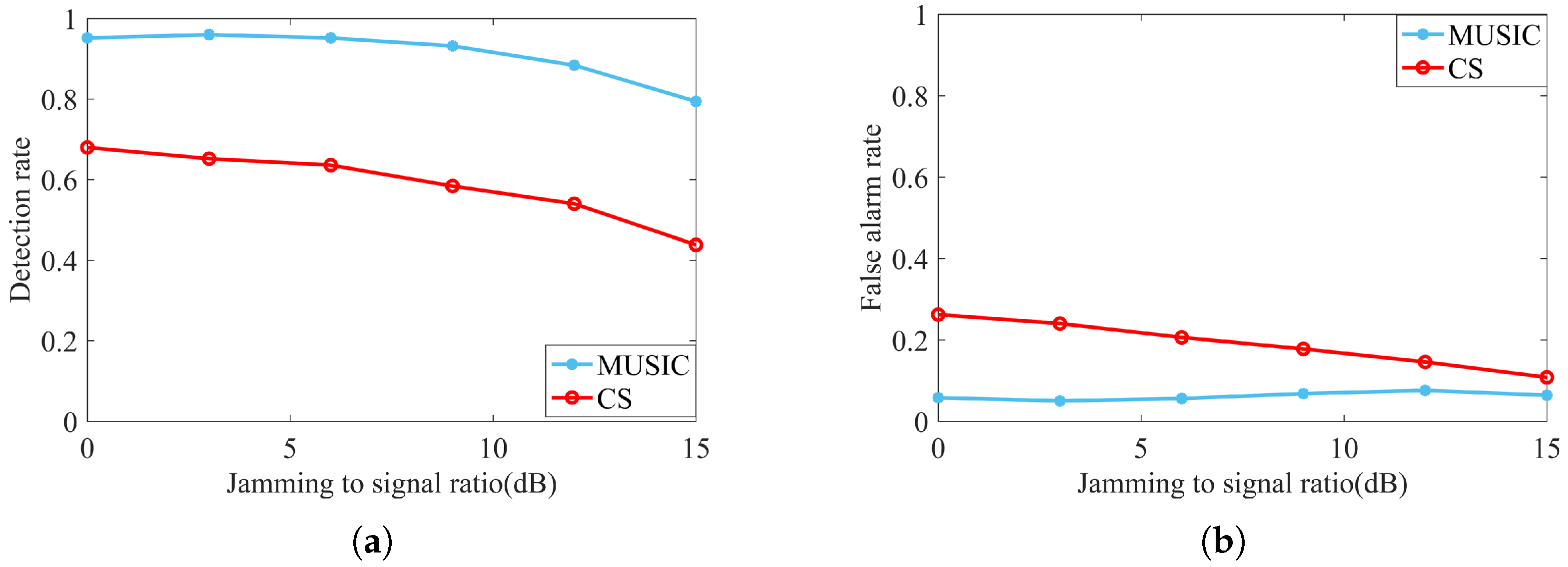
Next, we analyze the anti-jamming performance of the two algorithms using the approach of constant false alarm (CFAR) detection. The detection rate and false alarm rate are studied when the intensity of the jamming is increased. The Monte Carlo method is used to obtain the detection probability and false alarm probability under different jamming-to-signal ratios. The number of Monte Carlo experiments is set to 500. The detection rate and false alarm rate of each method are shown in Figure 9.
It can be seen from Figure 9 that under different jamming intensities, the MUSIC algorithm has a higher detection rate and lower false alarm rate than the CS algorithm. With the increase of jamming intensity, the MUSIC algorithm is less impacted. When the jamming-to-signal ratio is less than 9 dB , the detection rate of the MUSIC algorithm does not decrease appreciably. When the jamming-to-signal ratio increases from 9 dB to 15 dB , the detection rate of the MUSIC algorithm decreases by 13.8 % . However, for the CS algorithm, with the increase of jamming intensity, the real target is covered by dense jamming and it is difficult to detect the target, so the detection rate and false alarm rate will decrease. Therefore, in the dense jamming environment, the detection performance of the MUSIC algorithm is superior to that of the CS algorithm.
On the basis of the correct detection of the target, the errors of velocity measurement for the two processing methods is studied. The average velocity measurement errors obtained in the above Monte Carlo experiment is shown in Table 2.
Table 2 shows that, for a target moving at 50 m / s , the average velocity measurement errors for the MUSIC algorithm range from 0.02 % to 0.06 % under various jamming signal ratios, while the average velocity measurement errors for the CS method range from 4.76 % to 4.80 % . It can be seen that the MUSIC processing method not only has better anti-jamming performance and lower computational complexity but also has higher velocity estimation accuracy.

4.3. Multiple Targets Situation

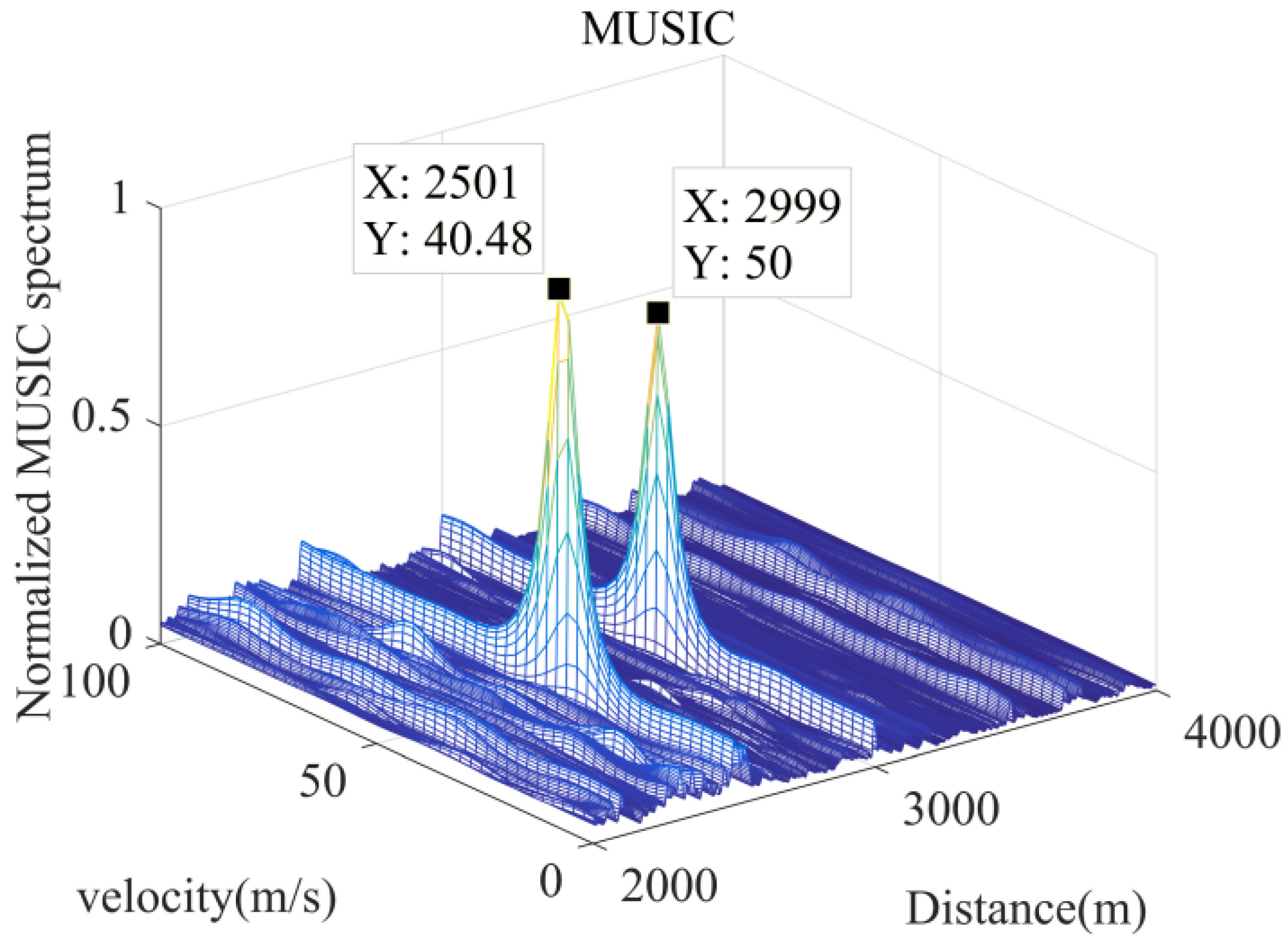
Finally, we simulate the multi-target situation. When the jamming-to-signal ratio is 15 dB , two targets are added and processed by the MUSIC method. The first target is 3000 m away with a velocity of 50 m / s , while the second target is 2500 m away with a velocity of 40 m / s . The simulation results are shown in Figure 10.
As can be seen from Figure 10, two targets can be detected simultaneously using the MUSIC method in the environment with a jamming-to-signal ratio of 15 dB . The range–velocity estimation results are 40.48 m / s 2501 m and 50 m / s 2999 m , respectively, which are close to the true values. Meanwhile, the peak sidelobe ratio of the simulation result is 16.6 dB , which is close to that of the single-target case. Therefore, the proposed anti-jamming signal processing method is applicable to multi-target scenarios.

5. Conclusions

This paper proposes an efficient, low-complexity radar anti-interference method to address the dense deception jamming challenges that intelligent sensing systems may face. To tackle this issue, a radar waveform is designed that exhibits agility in pulse width, PRF, and carrier frequency across CPI, thereby providing multidimensional interference mitigation. In parallel, an anti-interference signal processing method based on the MUSIC algorithm is developed. This method effectively suppresses interference throughout the signal processing chain, ensuring the accurate recovery of target velocity information. Simulation results confirm that the proposed approach can eliminate dense false-target interference and precisely extract target information. Compared with the conventional CS-OMP algorithm, the MUSIC-based method not only significantly reduces computational complexity but also offers superior interference resistance and velocity measurement accuracy, making it suitable for multi-target detection scenarios; specifically, it improves the peak sidelobe ratio by 27.24 dB at JSR = 0 dB and 8.26 dB at JSR = 15 dB and reduces the average velocity measurement error from 4.76–4.80% to 0.02–0.06%. Moreover, the processing time is decreased from 28.09 s to 10.55 s, corresponding to a speedup factor of 2.66.

Author Contributions

Conceptualization, C.M.; Methodology, C.M.; Software, Z.S.; Formal analysis, Z.S.; Resources, C.M., Y.M. and W.W.; Data curation, Y.M.; Writing—original draft, Z.S.; Supervision, W.W.; Project administration, W.W.; Funding acquisition, Y.M. and W.W. All authors have read and agreed to the published version of the manuscript.

Funding

This work was supported by the Natural Science Foundation of Jiangsu Province (BK20230916 and BK20210335), National Natural Science Foundation of China (No. 62301254, 62201266 and 62071440) and China Postdoctoral Science Foundation (No. 2023M731700).

Data Availability Statement

The data presented in this study are available on request from the corresponding author.

Conflicts of Interest

The authors declare no conflict of interest.

References

  1. Cong, J.; Li, X.; Zhang, Y.; Zhao, H.; Liu, F. Near-Field Integrated Sensing and Communication: Opportunities and Challenges. IEEE Wirel. Commun. 2024, 31, 162–169. [Google Scholar] [CrossRef]
  2. Zhang, W.; Miao, C.; Wu, W. An Optimization Algorithm-Based Coherence Method for the DCAR Tracking Process. IEEE Trans. Aerosp. Electron. Syst. 2024, 60, 1970–1984. [Google Scholar] [CrossRef]
  3. Zhang, R.; Zhang, S.; Wang, Z.; Song, Z.; Bai, C. A Novel Analytical Method for Eliminating the Multi-Probe Array and Environment Interference in Spherical Near-Field Measurement. IEEE Trans. Instrum. Meas. 2025, 74, 6002714. [Google Scholar] [CrossRef]
  4. Zhang, W.; Miao, C.; Wu, W. Joint DOA-Distance Estimation Method for Radar Using a Novel Time-Domain Wideband Synthesis System. IEEE Sens. J. 2023, 23, 17329–17340. [Google Scholar] [CrossRef]
  5. Niu, Y.; Wei, Z.; Wang, L.; Wu, H.; Feng, Z. Interference Management for Integrated Sensing and Communication Systems: A Survey. IEEE Internet Things J. 2024, 12, 8110–8134. [Google Scholar] [CrossRef]
  6. Zhang, W.; Miao, C.; Zhang, R.; Yang, J.; Wu, W. A Low-Complexity ISAC Method for LFM-PSK Signals Using De-Chirping and ISAC Phase Unwrapping Techniques. Digit. Signal Process. 2024, 153, 104588. [Google Scholar] [CrossRef]
  7. Sun, Z.; Miao, C.; Ma, Y.; Zhang, R.; Wu, W. Interference Mitigation Methods for Vehicular ISAC Systems in Dynamic Environments. Digit. Signal Process. 2026, 168, 105563. [Google Scholar] [CrossRef]
  8. Liu, F.; Cui, Y.; Masouros, C.; Xu, J.; Han, T.X.; Eldar, Y.C.; Buzzi, S. Integrated Sensing and Communications: Toward Dual-Functional Wireless Networks for 6G and Beyond. IEEE J. Sel. Areas Commun. 2022, 40, 1728–1767. [Google Scholar] [CrossRef]
  9. Zhang, J.; Wang, W.; Liang, Z.; Chen, X.; Liu, Q. Passive Anti-Jamming Decision-Making Based on Deep Reinforcement Learning. IET Conf. Proc. 2024, 2023, 3751–3757. [Google Scholar] [CrossRef]
  10. Ma, H.; Liao, Y.; Ren, C. Low Probability of Interception Radar Overlapping Signal Modulation Recognition Based on an Improved YOLOv8 Network. Eng. Appl. Artif. Intell. 2024, 137, 109150. [Google Scholar] [CrossRef]
  11. Pan, Y.; Xie, D.; Zhao, Y.; Wang, X.; Huang, Z. Overview of Radar Jamming Waveform Design. Remote Sens. 2025, 17, 1218. [Google Scholar] [CrossRef]
  12. Akhtar, J. An ECCM Scheme for Orthogonal Independent Range-Focusing of Real and False Targets. In Proceedings of the IEEE Radar Conference, Waltham, MA, USA, 17–20 April 2007; pp. 846–849. [Google Scholar] [CrossRef]
  13. Akhtar, J. Orthogonal Block Coded ECCM Schemes Against Repeat Radar Jammers. IEEE Trans. Aerosp. Electron. Syst. 2009, 45, 1218–1226. [Google Scholar] [CrossRef]
  14. Akhtar, J. Removal of Range Ambiguities with Orthogonal Block Coding Techniques. Circuits Syst. Signal Process. 2010, 29, 311–330. [Google Scholar] [CrossRef]
  15. Xie, Q.; Liu, C.; Mo, Z.; Li, W. A Novel Pulse-Agile Waveform Design Based on Random FM Waveforms for Range Sidelobe Suppression and Range Ambiguity Mitigation. IEEE Trans. Geosci. Remote Sens. 2023, 61, 5110612. [Google Scholar] [CrossRef]
  16. Wang, X.; Zhang, G.; Wang, X.; Song, Q.; Wen, F. ECCM Schemes Against Deception Jamming Using OFDM Radar with Low Global PAPR. Sensors 2020, 20, 2071. [Google Scholar] [CrossRef] [PubMed]
  17. Ramadan, K. Performance Improvement of MIMO-OFDM Communication Systems Based on Non-Linear Equalization. Comput. Electr. Eng. 2025, 124, 110287. [Google Scholar] [CrossRef]
  18. Wang, X.; Li, B.; Chen, H.; Liu, W.; Zhu, Y.; Luo, J.; Ni, L. Interrupted-Sampling Repeater Jamming Countermeasure Based on an Intrapulse Frequency-Coded Joint FM Slope Agile Waveform. Remote Sens. 2024, 16, 2810. [Google Scholar] [CrossRef]
  19. Liu, Z.; Quan, Y.; Du, S.; Wu, Y.; Sha, M.; Xing, M. A Novel ECCM Scheme Against Interrupted-Sampling Repeater Jamming Using an Intra-Pulse Dual-Parameter Agile Waveform. Digit. Signal Process. 2022, 129, 103652. [Google Scholar] [CrossRef]
  20. Chen, S.; Liu, L.; Wang, X.; Wang, L.; Yang, G. Research on SAR Active Anti-Jamming Imaging Based on Joint Random Agility of Inter-Pulse Multi-Parameters in the Presence of Active Deception. Remote Sens. 2024, 16, 3303. [Google Scholar] [CrossRef]
  21. Dao, X.; Gao, M.; Zhang, Z.; Li, C.; Wang, Y. Design of Multi-Parameter Composite Modulated Signal for Anti-Deceptive Jamming. AEU-Int. J. Electron. Commun. 2021, 132, 153646. [Google Scholar] [CrossRef]
  22. Chen, Y.; Cheng, Y.; Lin, R.; Li, J.; So, H.C. Efficient Binary Sequence Set Designs for MIMO PMCW Radar. Signal Process. 2023, 213, 109204. [Google Scholar] [CrossRef]
  23. Ma, R.; Ma, Y.; Lin, Z.; Ma, Y.; Yang, W.; Niyato, D. Covert Communication Assisted by Movable Time-Modulated Arrays. IEEE Commun. Lett. 2026, 30, 382–386. [Google Scholar] [CrossRef]
  24. Knill, C.; Schweizer, B.; Waldschmidt, C. Interference-Robust Processing of OFDM Radar Signals Using Compressed Sensing. IEEE Sens. Lett. 2020, 4, 7001104. [Google Scholar] [CrossRef]
  25. Wei, Z.; Lu, D.; Cao, Z. Efficient Signal Processing for Frequency-Agile Radar with Limited Computational Resources. Electron. Lett. 2025, 61, e70270. [Google Scholar] [CrossRef]
  26. Liu, H.; Tian, J.; Ning, C.; Cui, W.; Deng, J. Coherent Integration Method for Random Pulse Repetition Interval Radar Based on Non-Uniform Keystone Transform and Non-Uniform Fast Fourier Transform. J. Eng. 2019, 2019, 5744–5748. [Google Scholar] [CrossRef]
  27. Huang, T.; Liu, Y.; Xu, X.; Eldar, Y.C.; Wang, X. Analysis of Frequency Agile Radar via Compressed Sensing. IEEE Trans. Signal Process. 2018, 66, 6228–6240. [Google Scholar] [CrossRef]
  28. Blunt, S.D.; Gerlach, K. Adaptive pulse compression via MMSE estimation. IEEE Trans. Aerosp. Electron. Syst. 2006, 42, 572–584. [Google Scholar] [CrossRef]
  29. Schmidt, R.O. Multiple Emitter Location and Signal Parameter Estimation. IEEE Trans. Antennas Propag. 1986, 34, 276–280. [Google Scholar] [CrossRef]
  30. Lee, J.; Park, J.; Chun, J. Weighted Two-Dimensional Root MUSIC for Joint Angle-Doppler Estimation with MIMO Radar. IEEE Trans. Aerosp. Electron. Syst. 2019, 55, 1474–1482. [Google Scholar] [CrossRef]
  31. Yang, Z.; Zheng, H.; Zhang, Y.; Yan, J.; Jiang, Y. Joint Optimization of Carrier Frequency and PRF for Frequency Agile Radar Based on Compressed Sensing. Remote Sens. 2025, 17, 1796. [Google Scholar] [CrossRef]
Figure 1. The diagram of multiple parameter agility signals.
Electronics 15 00303 g001
Figure 2. An example of PRF periodic agility. The ordinate of the nth point indicates the pulse repetition interval of this pulse.
Electronics 15 00303 g002
Figure 3. An example of an improved agility rule. The blue points have different ordinates from each other.
Electronics 15 00303 g003
Figure 4. The diagrams of echo signals with dummy target jamming.
Electronics 15 00303 g004
Figure 5. (a,b) are the results of pulse compression before and after compensation.
Electronics 15 00303 g005
Figure 6. (a) and (b) are pulse compression results of single period and multi period echo signals with jamming, respectively. (a) Single period pulse compression. (b) Multi period pulse compression.
Electronics 15 00303 g006
Figure 7. (a) and (b) are signal processing results of fixed parameter radar and agile parameter radar, respectively. (a) Fixed parameter radar. (b) Agile parameter radar.
Electronics 15 00303 g007
Figure 8. (a) and (b) are the processing results of MUSIC method and CS method when the jamming-to-signal ratio is 0 dB, respectively. (c) and (d) are the processing results of MUSIC method and CS method when the jamming-to-signal ratio is 15 dB, respectively.
Electronics 15 00303 g008
Figure 9. (a) and (b) represent the detection rate and false alarm rate of the two algorithms under CFAR detection, respectively. (a) Detection rate. (b) False alarm rate.
Electronics 15 00303 g009
Figure 10. Multi-target situation.
Electronics 15 00303 g010
Table 1. Peak sidelobe ratio for both processing results. (unit: dB).
Jamming to Signal RatioMUSICCS
0 dB48.05 dB20.81 dB
3 dB41.95 dB19.16 dB
6 dB35.68 dB16.02 dB
9 dB29.40 dB12.92 dB
12 dB22.88 dB9.74 dB
15 dB14.76 dB6.50 dB
Table 2. Average velocity measurement error. (unit: %).
Jamming to Signal RatioMUSICCS
0 dB0.04%4.80%
3 dB0.04%4.80%
6 dB0.03%4.78%
9 dB0.06%4.80%
12 dB0.03%4.80%
15 dB0.02%4.76%
Disclaimer/Publisher’s Note: The statements, opinions and data contained in all publications are solely those of the individual author(s) and contributor(s) and not of MDPI and/or the editor(s). MDPI and/or the editor(s) disclaim responsibility for any injury to people or property resulting from any ideas, methods, instructions or products referred to in the content.