Next Article in Journal
Development and Validation of a GPS Error-Mitigation Algorithm for Mental Health Digital Phenotyping
Previous Article in Journal
Defending Against Backdoor Attacks in Federated Learning: A Triple-Phase Client-Side Approach
Previous Article in Special Issue
Vibration Suppression Strategy for Bearingless Interior Permanent Magnet Synchronous Motor Based on Proportional–Integral–Resonant Controller
error_outline You can access the new MDPI.com website here. Explore and share your feedback with us.
 
 
Article

Drain-Voltage Assessment-Based RC Snubber Design Approach for GaN HEMT Flyback Converters
by
Byeong-Je Park
,
Chae-Jeong Hwang
,
Geon-Ung Park
,
Min-Su Park
* and
Daeyong Shim
*
Department of Electronic Engineering, Dong-A University, Busan 49315, Republic of Korea
*
Authors to whom correspondence should be addressed.
Electronics 2026, 15(2), 271; https://doi.org/10.3390/electronics15020271
Submission received: 9 December 2025 / Revised: 30 December 2025 / Accepted: 6 January 2026 / Published: 7 January 2026

Abstract

Conventional RC snubber design relies on oscillation frequency-based estimation, which is often influenced by uncontrolled parasitic elements and can therefore limit the accuracy of surge voltage prediction in GaN HEMT flyback converters. To overcome this limitation, a drain-voltage assessment-based design approach is introduced, in which the snubber parameters are extracted directly from the measured voltage characteristics during the turn off transition. This method allows the surge voltage to be modeled more precisely and enables the snubber capacitance to be selected without unnecessary oversizing. Simulation results using the GaN Systems GS66516T device show that the proposed approach reduces the total power loss by 27.67% and 21.84% relative to two empirical design methods and achieves up to 53.64% lower loss compared with other RC combinations in the explored design space. The method suppresses the surge voltage from 877 V to 556 V, which closely aligns with the design target of 550 V, whereas the empirical methods result in maximum voltages of 637 V and 603 V. Finally, the thermal feasibility of the snubber resistor is analytically assessed, indicating that the estimated temperature rise remains within the safe operating range of commercial components.

1. Introduction

Gallium nitride (GaN) high electron mobility transistor (HEMT) devices have emerged as strong candidates for future power semiconductor technology and are considered potential replacements for conventional silicon (Si) devices. GaN HEMTs offer several advantages such as low on resistance, reduced switching loss, high power density and a high breakdown voltage. In addition, the absence of a body diode removes reverse recovery current and enables fast and efficient switching operation [1,2,3,4,5,6,7,8,9].
Among various converter topologies, the flyback converter is widely used in low power switched mode power supplies (SMPS) because it provides a simple structure, inherent galvanic isolation, low cost and a compact form factor [10,11,12]. By combining the flyback topology with the superior switching characteristics of GaN HEMTs, many studies have focused on achieving high efficiency and high power density in GaN HEMT-based flyback converters [13,14,15].
However, the fast-switching transition of GaN HEMTs, while beneficial for efficiency, also causes significant voltage overshoot at the drain node. These surge voltages increase switching losses, degrade electromagnetic interference (EMI) performance and threaten device reliability and lifetime [16,17]. Transcending traditional steady-state perspectives, recent studies have increasingly focused on the underlying dynamics of such switching-induced oscillations. Specifically, the work by Yang et al. characterizes transient ringing as an analytically tractable response rather than noise, a shift in perspective that reinforces the necessity of precise transient-voltage control in fast-switching applications [18]. From a practical circuit design perspective, such transient drain-voltage behavior is most commonly regulated using snubber circuits. Snubber circuits are widely used to mitigate these problems and are generally classified into non dissipative and dissipative types [16,19,20,21,22,23,24]. Non dissipative snubbers return the stored energy in the snubber capacitor to the input source or to the magnetizing inductance by using auxiliary inductors or additional transformer windings. Although these schemes can improve efficiency, they require extra components and dedicated control, which increases complexity and cost [25].
Dissipative snubbers such as RC and RCD types absorb surge energy in a capacitor and dissipate it as heat in a resistor. Because of their simple structure, effective suppression of surge voltage and ringing, and compatibility with standard control ICs, dissipative snubbers remain the most common choice in practical flyback converters [25]. Since the snubber is usually located close to the main switching device, the generated heat can directly influence device temperature and reliability. Unlike the RCD snubber, an RC snubber must discharge the stored energy in its capacitor in every switching period. In addition, the snubber resistor simultaneously dissipates energy while damping the drain-voltage ringing, which can further increase the thermal stress imposed on the resistor. Therefore, the RC snubber must be carefully designed so that it provides sufficient surge suppression while limiting conduction loss and thermal stress.
In Si power MOSFETs, avalanche breakdown through impact ionization can dissipate surge energy, and this intrinsic behavior has been used for power line surge protection. In contrast, commercial GaN HEMTs have limited avalanche capability [26], so they must withstand surge voltage directly without an internal energy dissipation path [27]. When a GaN HEMT is subjected to high drain voltage stress, electrons accelerated by the drain side electric field can be trapped in the surface or buffer regions. These trapped charges locally deplete the two-dimensional electron gas (2DEG) and increase the on resistance, which is known as dynamic R D S ( o n ) . As the drain bias level increases or is applied repeatedly, the hot electron trapping effect accumulates and leads to a larger increase in R D S ( o n ) and long-term degradation [28,29,30]. Consequently, the electrical behavior of GaN HEMTs is strongly affected by the drain voltage. In flyback converters the snubber must therefore keep the surge voltage below the breakdown limit while ensuring that the drain voltage reaches the intended target level.
The RC snubber design guideline referred to as method A [31] determines the snubber parameters by estimating parasitic components from the measured oscillation frequency. Method B [32] computes the snubber elements by substituting the measured oscillation frequency into an equivalent impedance expression. In practice, however, the oscillation frequency is strongly influenced by parasitic elements such as leakage inductance, device capacitances and printed circuit board interconnect inductances. These parasitic elements vary with temperature, device package and layout, so frequency-based estimation can become inaccurate and difficult to reproduce. Although these empirical approaches offer useful design insight, their reliance on oscillation frequency limits the ability to set the surge voltage at a desired target level.
To address these issues, including conduction loss in the RC snubber and the limitations of frequency-based design, a drain-voltage assessment-based RC snubber design approach for GaN HEMT flyback converters is proposed. The turn-off behavior of the converter is modeled as an RLC resonant network and the snubber parameters are extracted from the measured drain voltage V D waveform. Simulation results show that this method reduces the total power loss by up to 27.67% compared with conventional frequency-based design methods while achieving a surge voltage of 556 V, which is close to the 550 V target. In addition to surge voltage suppression, this work also presents a detailed thermal analysis of the snubber resistor to ensure that the proposed design satisfies practical reliability requirements.

2. Analysis of Surge Voltage Origins

Surge voltage in flyback converters is mainly caused by two mechanisms. The first is the rapid current change ( d i / d t ) in the transformer leakage inductance ( L l k ) during turn-off transition, and the second is the resonance interaction between L l k and the output capacitance ( C o s s ) of the switching device [11,17].
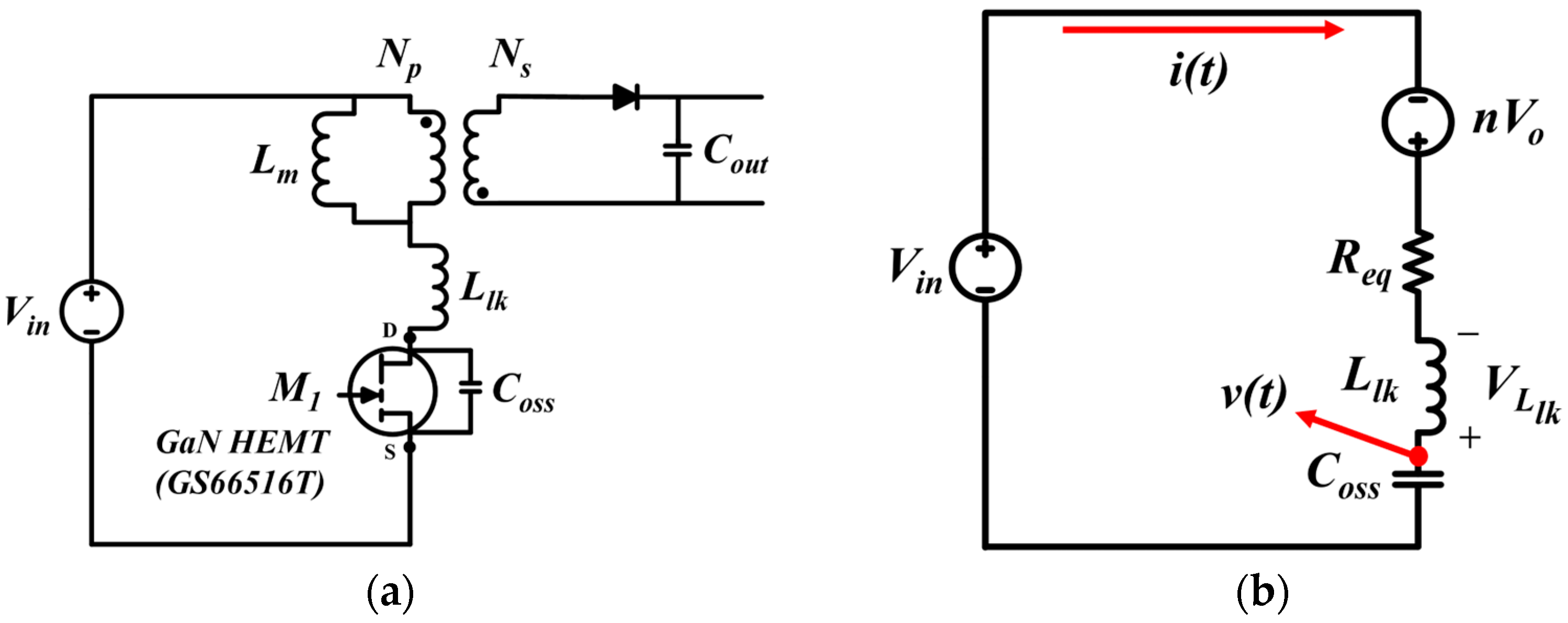
Figure 1a illustrates the conventional flyback converter, while Figure 1b shows its equivalent RLC resonant model during the turn-off interval. Higher-order system models have been reported in the literature for ringing suppression and transient response analysis, particularly for power converters employing SiC MOSFETs, where multiple parasitic resonant paths may coexist [33]. However, in flyback converters, the drain-voltage ringing during the turn-off transient is predominantly governed by the resonance between the transformer leakage inductance and the effective output capacitance of the switching device. This behavior is commonly approximated and analyzed using a second-order system, which captures the dominant oscillatory mode relevant to surge voltage suppression and snubber design [34]. Here, R e q represents the sum of the transformer AC resistance and parasitic resistances in the resonant loop. Since the flyback converter exhibits a lightly damped transient response, an under-damped case is assumed ( α < ω 0 ) , which accurately reflects practical GaN-based flyback converters where the leakage inductance and parasitic capacitances form a low-loss resonant network. Based on this equivalent circuit, the turn-off voltage behavior can be expressed by (1), where saturation voltage ( V s a t ) is defined as V i n + n V 0 , and v ( t ) denotes the voltage across C o s s .
V s a t = L l k C o s s d 2 v ( t ) d t 2 + R e q C o s s d v ( t ) d t + v ( t )
The initial conditions are determined by the voltage and current at the switch turn-off instant, as shown in (2).
v 0 = V 0 ,     i 0 = i 0 ,     d v ( 0 ) d t = i 0 C o s s  
The voltage v ( t ) can be expressed as in (3), and by applying the initial conditions in (2), the coefficients A and B are obtained as shown in (4).
v ( t ) = V s a t + e α t A cos ω d t + B sin ω d t
A = V 0 V s a t ,     B = i 0 C o s s + α ( V 0 V s a t ) ω d
Here, the damping factor, resonant angular frequency, and damped natural frequency are defined as α = R e q 2 L l k , ω 0 = 1 L l k C o s s , ω d = ω 0 2 α 2 , respectively. Based on (3) and (4), the resulting current i ( t ) is obtained as follows:
i ( t ) = e α t i 0 cos ω d t V 0 V s a t L l k ω d + α ω d i 0 sin ω d t = I 0 e α t sin ω d t + θ
In this equation, I 0 indicates the amplitude constant determined by the initial condition, and θ is the phase angle.

3. Proposed Design Method for RC Snubber

The design of an RC snubber for a flyback converter requires an evaluation method that reflects the actual behavior of the drain voltage during the turn-off transition. In practice, the maximum voltage and the shape of the transient waveform are determined by the interaction between the leakage inductance, the output capacitance of the device, and the energy stored in the transformer. These elements form a resonant network that varies from system to system, and therefore a design approach based on direct assessment of the drain voltage provides more reliable information than approaches derived from a single resonant frequency.
The frequency-based empirical methods estimate the snubber parameters from the observed oscillation frequency. However, this frequency is affected by parasitic elements in the device package and circuit layout, and these elements change with operating conditions and the physical structure of the converter. As a result, frequency-based estimation often leads to inconsistent peak voltage prediction and a non-optimal selection of the snubber capacitor.
To improve accuracy beyond the conventional approaches, a drain-voltage assessment-based design method is proposed, which determines the snubber parameters using the measured transient waveform. By modeling the turn-off behavior with an equivalent RLC network and extracting key parameters from the waveform, the proposed method identifies a near-minimum practical snubber capacitance that satisfies the voltage requirement and selects the resistance that provides proper damping and stable operation.
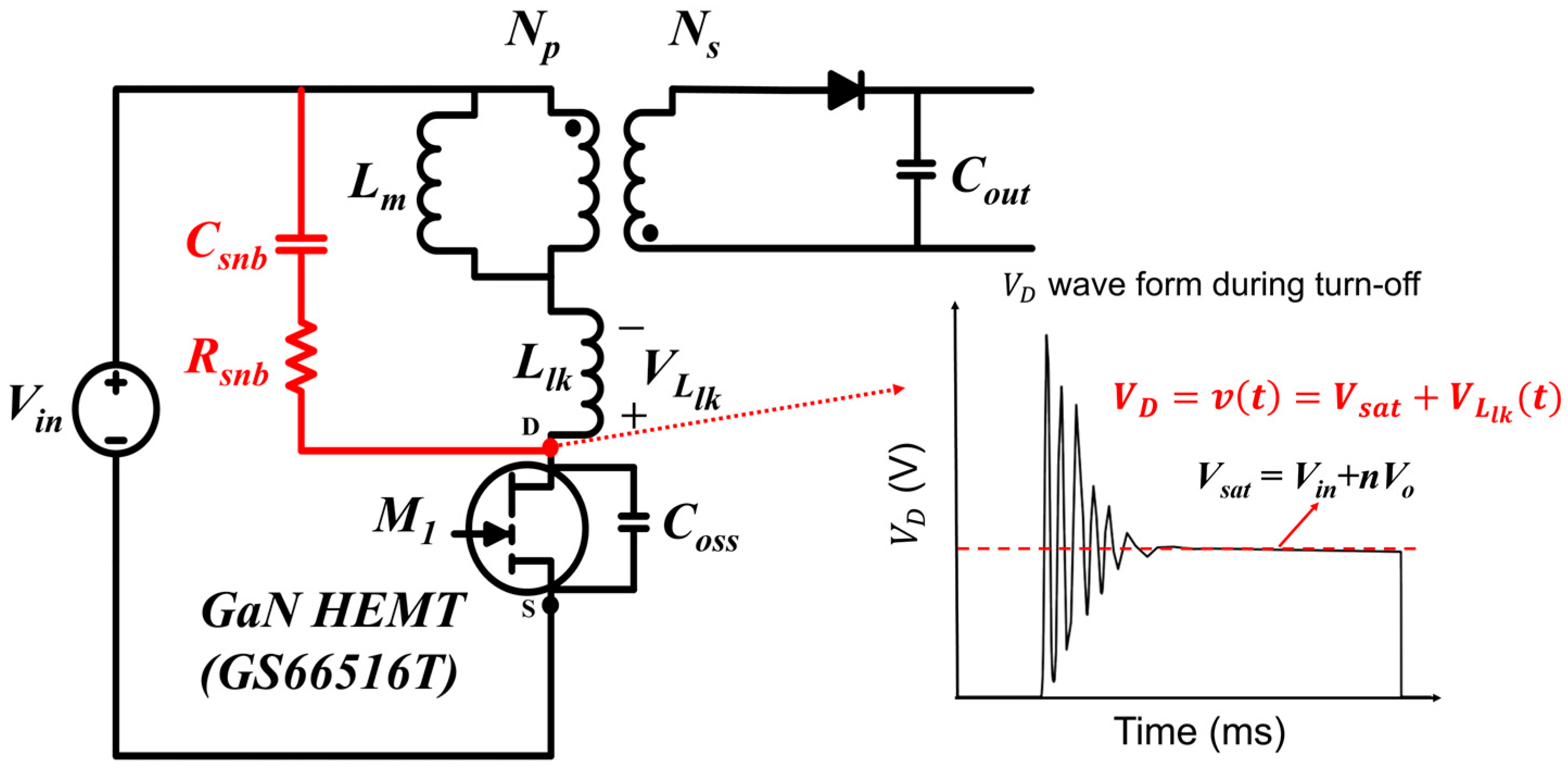
The flyback converter with the RC snubber is shown in Figure 2. The snubber capacitor and the snubber resistor are connected across the switch node, and this connection increases the effective capacitance that participates in the turn-off transition. By modifying the energy distribution during the transient, the RC snubber influences both the peak drain voltage and the damping of the waveform. When the switch is turned-off, the current flowing through the leakage inductance begins to charge the output capacitance of the device and the drain voltage follows a resonant trajectory. Under this condition, the drain voltage can be expressed as
V D t = V s a t + V L l k t
where V s a t is the sum of the input voltage and the reflected output voltage, and V L l k t is the transient voltage generated by the leakage inductance. The voltage drop across R e q is sufficiently small and therefore omitted from the expression. This expression provides the basis for the proposed method because it directly links the measured drain voltage to the resonant elements that determine the required snubber parameters.

3.1. Calculation of the Amplitude Constant I 0

The first step in determining the snubber parameters is to obtain the amplitude constant I 0 of the resonant current. The transient voltage across the leakage inductance can be written as
V L l k ( t ) = L l k d i d t
and substituting the current express of the RLC network produces the form (8).
V L l k ( t ) = v ( t ) V s a t = L l k I 0 e α t ω d cos ω d t + θ α sin ω d t + θ
Rearranging (8) gives the amplitude constant as
I 0 = v ( t ) V s a t L l k e α t ω d cos ω d t + θ α sin ω d t + θ
This value represents the initial condition of the leakage inductance current immediately after turn-off and is required for calculating the snubber capacitance.

3.2. Calculation of the Snubber Capacitance

When a snubber capacitor C s n b is added, the total capacitance becomes C o s s + C s n b . The corresponding resonant angular frequency is reduced to
ω 0 = 1 L l k ( C o s s + C s n b )
and the damped natural frequency becomes
ω d = ω 0 2 α 2
By replacing ω d into the transient voltage expression, the snubber capacitance can be obtained as
C s n b = L l k v ( t ) V s a t L l k I 0 e α t c o s ( ω d t + θ ) + α tan ω d t + θ 2 + α 2 1 C o s s  
The resulting capacitance corresponds to the minimum value needed to achieve the specified target maximum voltage.

3.3. Calculation of the Snubber Resistance

With the capacitance determined, the snubber resistor R s n b must be selected to ensure sufficient damping. If the resistance is too small, the circuit becomes underdamped and oscillation appears. If the resistance is too large, the snubber becomes ineffective. The damping ratio of the series RLC network is given by the following expression.
ζ = R s n b 2 ( C s n b + C o s s ) L l k
Solving for the resistance yields
R s n b = 2 ζ L l k ( C s n b + C o s s )    
A damping ratio close to one provides a stable waveform with minimal overshoot and minimal ringing.

3.4. Parameter Calculation Based on Post Turn-Off Approximation

The peak surge voltage appears almost immediately after the turn-off event. In this short interval, the damping effect is negligible and the resonant network can be approximated by the undamped natural response. Therefore, the following relation holds: α 0 ,   ω d ω 0 ,   θ 0 ,   cos ω 0 t 1 . Let V p e a k be the maximum drain voltage measured without a snubber and V t a r g e t be the desired peak voltage when only C s n b applied. Under these approximations, the amplitude constant of the transient current becomes
I 0 = V p e a k V s a t L l k ω 0
Using this relation, the snubber capacitance that limits the surge voltage to V t a r g e t is obtained as
C s n b = ( V t a r g e t V s a t ) 2 L l k I 0 2 1 C o s s  
These simplified expressions allow the snubber parameters to be determined directly from the measured drain-voltage characteristics rather than relying on oscillation-frequency-based estimation.

4. Simulation Result and Analysis

The effectiveness of the proposed drain-voltage assessment-based RC snubber design method was verified by circuit-level simulations using the GaN Systems GS66516T device model (GaN Systems Inc., Ottawa, ON, Canada). The key simulation parameters are summarized in Table 1, including a switching frequency of 100 kHz, an output voltage of 15 V, and a transformer leakage inductance L l k = 6.75 μH. The operating point was chosen such that the GaN HEMT experiences a severe turn-off surge in the absence of a snubber, representing a realistic worst-case condition for flyback converters employing fast GaN devices.

4.1. Analysis of Surge Voltage Suppression Characteristics

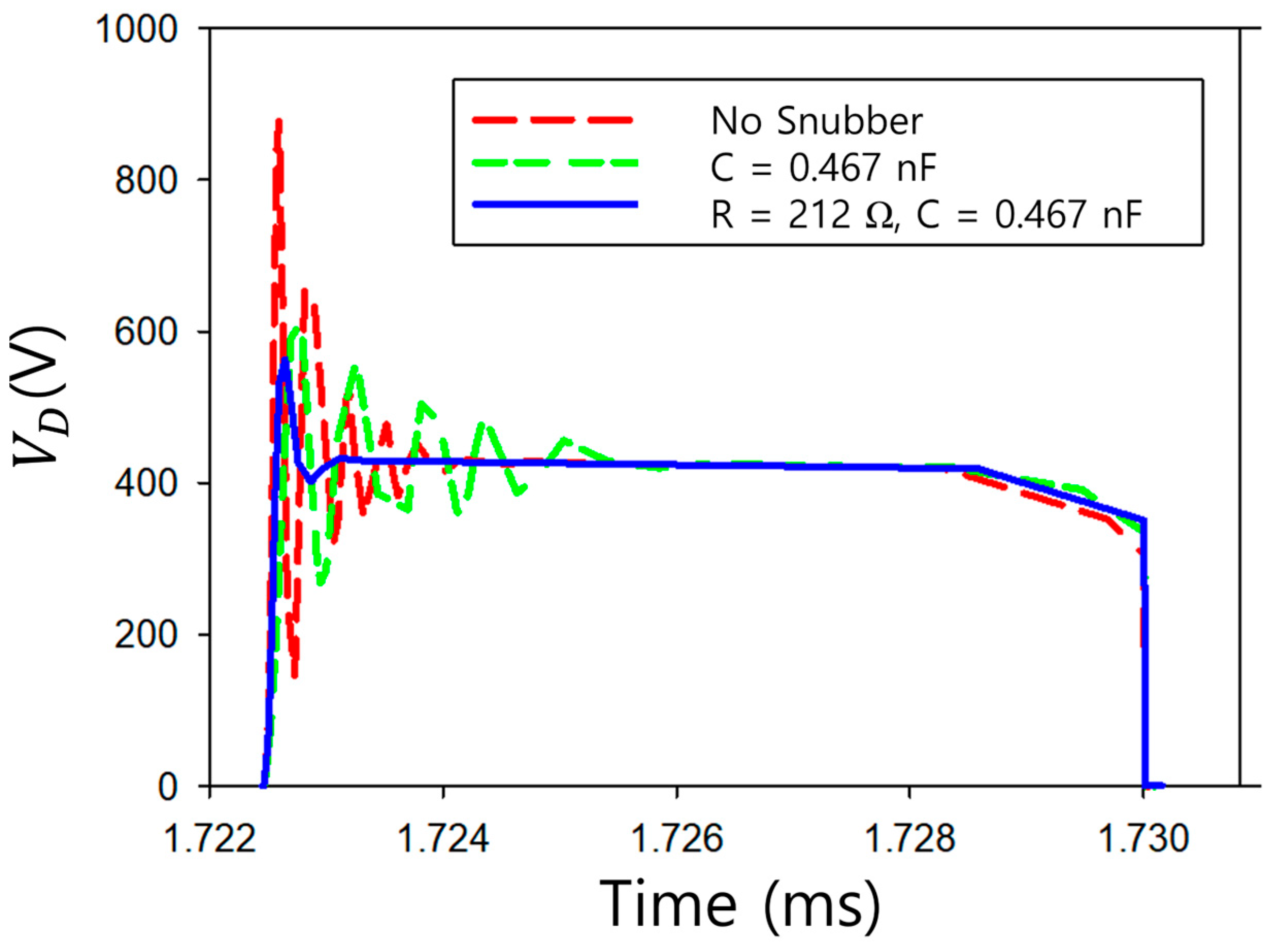
Figure 3 presents the simulated drain-voltage waveforms V D ( t ) under three conditions: without any snubber, with only the snubber capacitor C s n b , and with the complete RC snubber ( R s n b ,   C s n b ) using the proposed method. In the case without a snubber, the peak drain voltage V p e a k reaches 877 V, whereas the steady-state saturation voltage is V s a t = 419 V. The difference V p e a k V s a t represents the energy initially stored in the leakage inductance and is used to determine the amplitude constant I 0 in (15).
For the design example, a preliminary voltage target of 630 V was selected for the capacitor-only case, and a final design target of 550 V was chosen for the full RC snubber. This ensures adequate margin below the 650 V device rating [35] while considering dynamic R D S ( o n ) behavior and long-term reliability. Substituting the measured quantities V p e a k , V s a t , and the measured resonant frequency into (15) yields amplitude constant I 0 . The resulting snubber capacitance computed from (16) produces a simulated maximum voltage of 628 V when only C s n b is applied, which agrees closely with the preliminary target and verifies the accuracy of the post-turn-off approximation.
The snubber resistance R s n b is then determined using the damping-ratio condition in (14). Introducing this resistance in series with the snubber capacitor increases the damping of the resonant network, suppresses the high-frequency ringing, and reduces overshoot compared with the capacitor-only case. With the complete RC snubber in place, the simulated maximum voltage decreases to 556 V, which is close to the final design target of 550 V. As shown in Figure 3, the proposed RC snubber produces a smooth, well-damped waveform with a short settling interval.
These results indicate that the drain-voltage-based parameter extraction accurately captures the transient characteristics of the switching device and enables precise control of the surge voltage using the minimum required snubber capacitance.

4.2. Power Loss Characteristics and Trade-Off

In the designed RC snubber, power dissipation arises from both switching loss in the main device and conduction loss associated with the periodic charging and discharging of the snubber capacitor. To quantify these effects, the switching loss P s w is defined as the energy in the overlap between the drain-voltage and drain-current waveforms during turn-on and turn-off, and can be approximated by [36]
P s w = 1 6 V m a x I m a x ( t o n + t o f f ) f s w
where V m a x and I m a x   denote the maximum drain voltage and current, respectively, and t o n and t o f f   are the effective switching intervals. The conduction loss P c o n in the snubber resistor is given by
P c o n = 1 2 C s n b V c s n b 2 f s w  
where V c ,   m a x is the maximum voltage across C s n b .
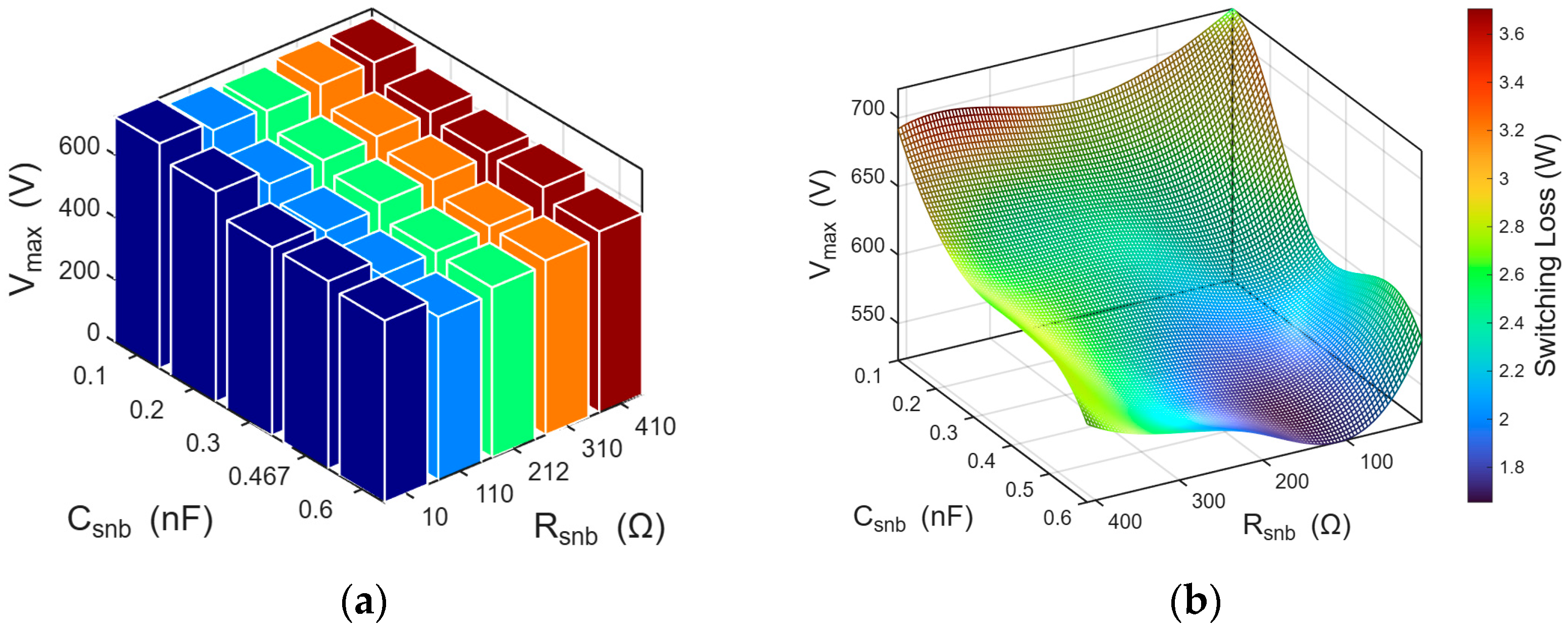
Figure 4a shows the variation of V m a x for different combinations of C s n b   and R s n b . As expected, increasing C s n b reduces V m a x   by absorbing more energy from the leakage inductance, while an appropriately chosen series resistance further lowers the peak voltage through additional damping. The corresponding switching loss as a function of V m a x   is presented in Figure 4b. The switching loss values are obtained from time-domain integration of the overlap between the drain–source voltage and the drain current during the switching transition E s w = v D S ( t ) i D ( t )   d t . The average switching loss is then calculated by multiplying the switching energy by the switching frequency. Equation (17) is used only to interpret the loss trends and is not employed to compute the absolute loss values. As implied by Equation (17), a lower V m a x generally leads to reduced switching loss. However, this dependence is not strictly monotonic because variations in C s n b and R s n b   also modify the effective switching intervals t o n and t o f f . Consequently, a parameter combination that yields a higher peak voltage can still result in relatively low switching loss if the transition interval is sufficiently shortened. For example, at C s n b = 0.1 nF and R s n b = 10 Ω, V m a x is relatively high, but the extremely small snubber capacitance significantly shortens the transition time, leading to a comparatively low P s w .
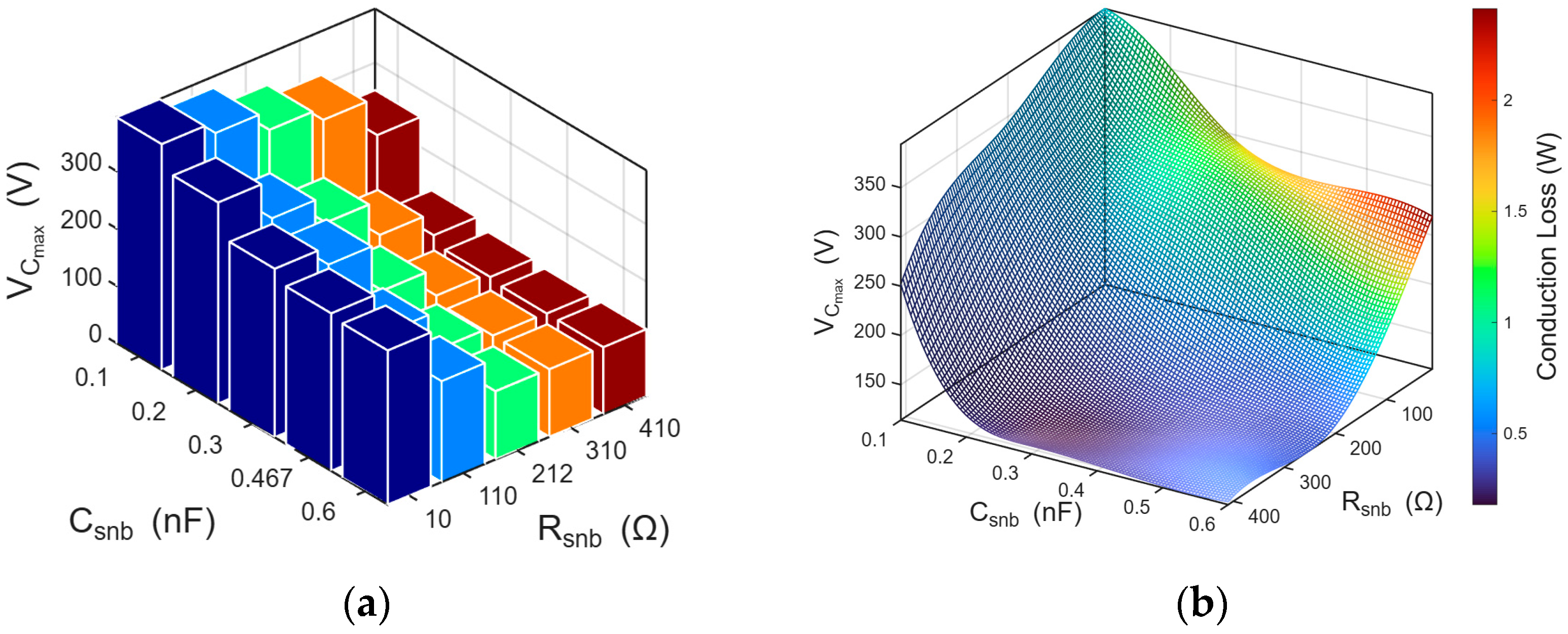
The behavior of the snubber-related conduction loss is examined in Figure 5a shows the maximum snubber-capacitor voltage V c ,   m a x for various ( C s n b ,   R s n b ) combinations. As both C s n b and R s n b increase, the slope of the capacitor-voltage waveform becomes gentler and the resulting V c ,   m a x decreases. Figure 5b presents the corresponding conduction loss P c o n over the same ( C s n b , R s n b ) grid, with V c ,   m a x on the vertical axis and P c o n encoded by the color scale. In contrast to the switching loss, which is mainly determined by V m a x , the conduction loss depends nonlinearly on both the snubber capacitance and the capacitor voltage, as indicated by (18). Consequently, the lowest V c ,   m a x does not necessarily coincide with the minimum P c o n . For instance, at R s n b = 10 Ω, the case of C s n b = 0.6 nF yields the smallest V c ,   m a x but the largest conduction loss because the large amount of charge is cycled each switching period, whereas C s n b = 0.1 nF results in the highest V c ,   m a x yet the smallest P c o n .
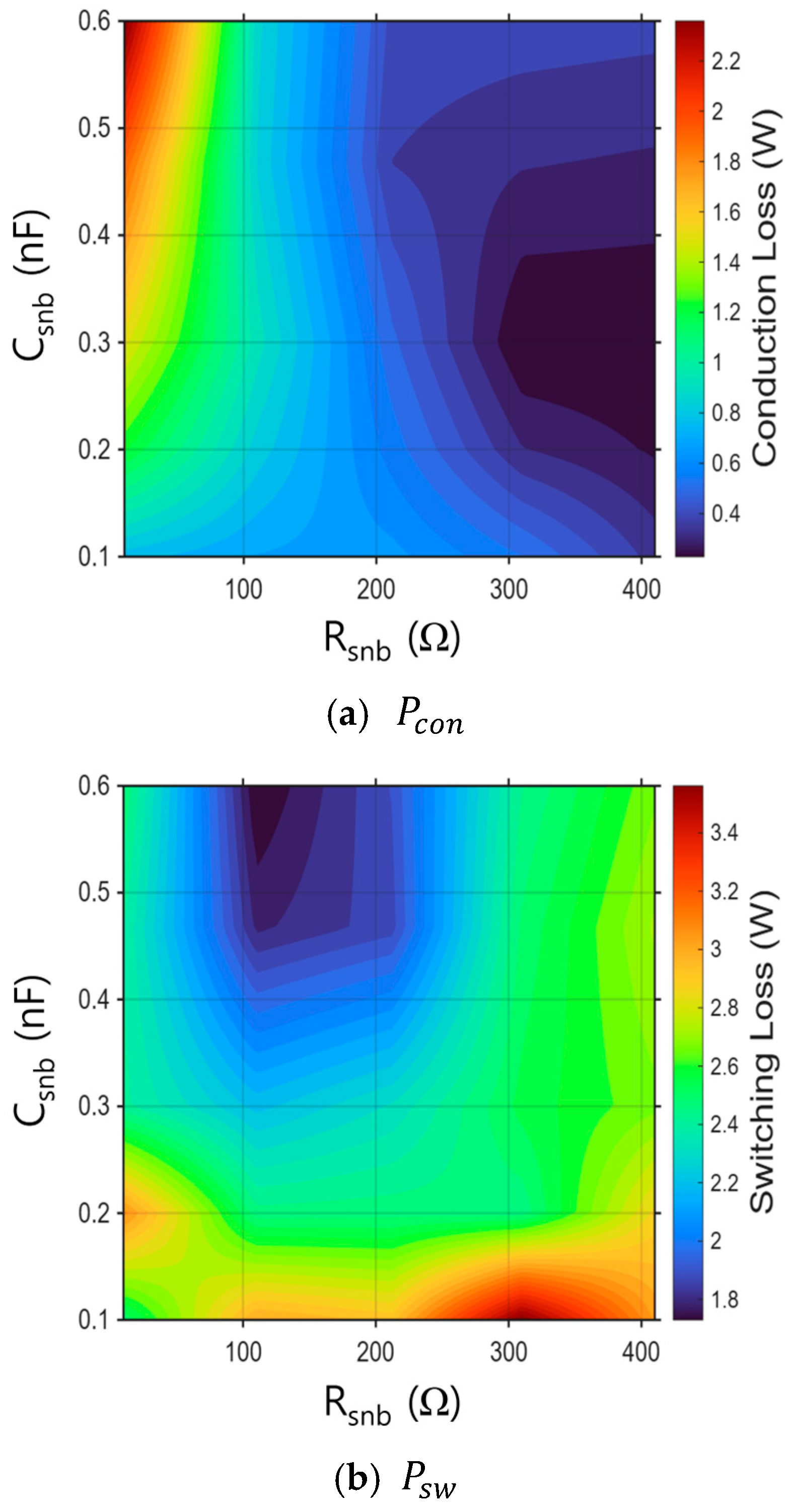
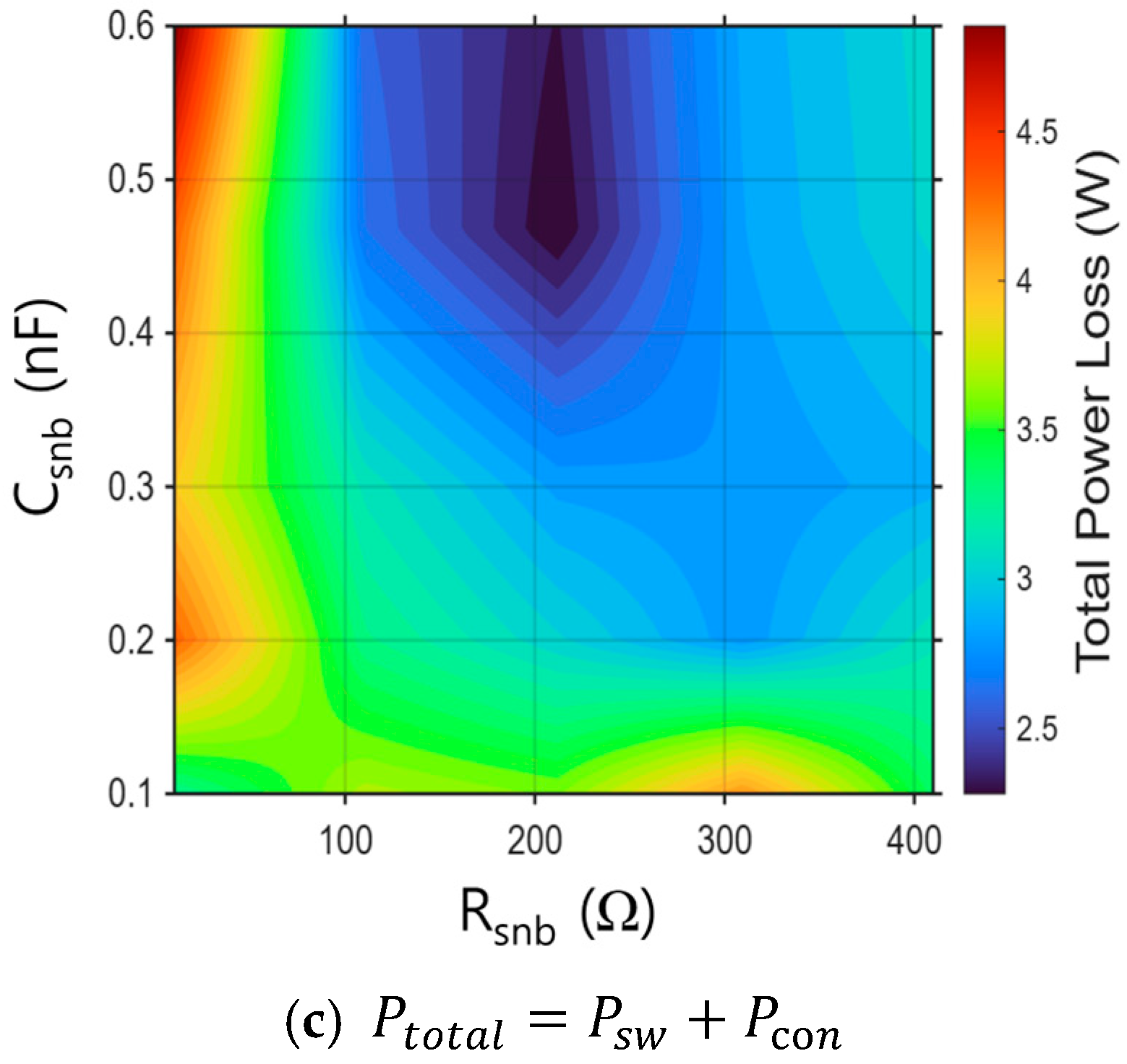
To investigate the impact of the snubber parameters on converter efficiency, the conduction loss P c o n , switching loss P s w , and total loss P t o t a l = P s w + P c o n were evaluated over a range of C s n b and R s n b . Figure 6a–c show the corresponding two-dimensional contour plots, which clearly reveal the distinct sensitivity of each loss component to the snubber parameter set. In Figure 6a, the P c o n rises markedly as the C s n b increases. Although the P c o n linearly proportional the C s n b in Equation (18), the combined dependence on both C s n b and V C , m a x causes the loss to increase more rapidly in practice. A larger capacitance leads to a greater amount of charge processed each cycle, resulting in higher P c o n . Consequently, the lowest P c o n occurs in the region of small capacitance and moderate resistance values. Figure 6b demonstrates the switching loss variation for each ( C s n b ,   R s n b ) pair. Since the P s w depends primarily on the peak drain voltage V m a x and the effective switching time interval, the lowest switching loss appears in the region where the snubber sufficiently suppresses the V m a x while avoiding excessive damping. In particular, the moderate values of both C s n b and R s n b minimize the voltage overshoot and shorten the oscillatory tail, leading to lower switching energy.
The combined effect of these two mechanisms is captured in Figure 6c, which presents the total loss distribution. Unlike Figure 6a,b, the total-loss contour reveals a narrow optimal valley where both conduction and switching losses are simultaneously minimized. This region occurs neither at the smallest C s n b (which minimizes conduction loss but increases V m a x ) nor at the largest capacitance (which excessively increases P c o n ), but near an intermediate capacitance and resistance pair. The snubber values selected by the proposed drain-voltage-based design method, ( C s n b = 0.467   nF , R s n b = 212   Ω ) , lie precisely within this valley, confirming that the proposed method naturally drives the design toward the minimum total-loss region without sweeping the entire parameter space. This behavior arises because the method determines the minimum capacitance that satisfies the required surge-voltage limit and pairs it with a damping resistance derived from the measured transient response. While not performing explicit loss minimization, the resulting design provides effective surge suppression with consistently low total loss.

4.3. Comparison with the Conventional Design Method A and B

To quantitatively benchmark the proposed drain-voltage assessment-based design approach, the RC snubber parameters were also determined using two representative empirical methods reported in the literature (denoted as method A and method B). Both methods estimate the snubber components from the measured oscillation frequency of the drain-voltage ringing, in contrast to the present work, which directly exploits the time-domain waveform. The resulting parameters and power-loss breakdowns are summarized in Table 2.
For a fair comparison, all three methods were designed with the same target maximum voltage V t a r g e t = 550 V. The proposed method yields C s n b = 0.467 nF and R s n b = 212   Ω, resulting in a simulated V m a x = 556 V, which is only 1.1% higher than the target. Method A selects a smaller capacitance C s n b = 0.180 nF and R s n b = 220 Ω, leading to a higher V m a x = 637 V, while method B gives C s n b = 0.285 nF and R s n b = 160 Ω with V m a x = 603 V. The larger deviation observed in methods A and B from the specified target indicates that frequency-based estimation can be influenced by various parasitic elements and may not always provide sufficient information to determine the resonant parameters with precision.
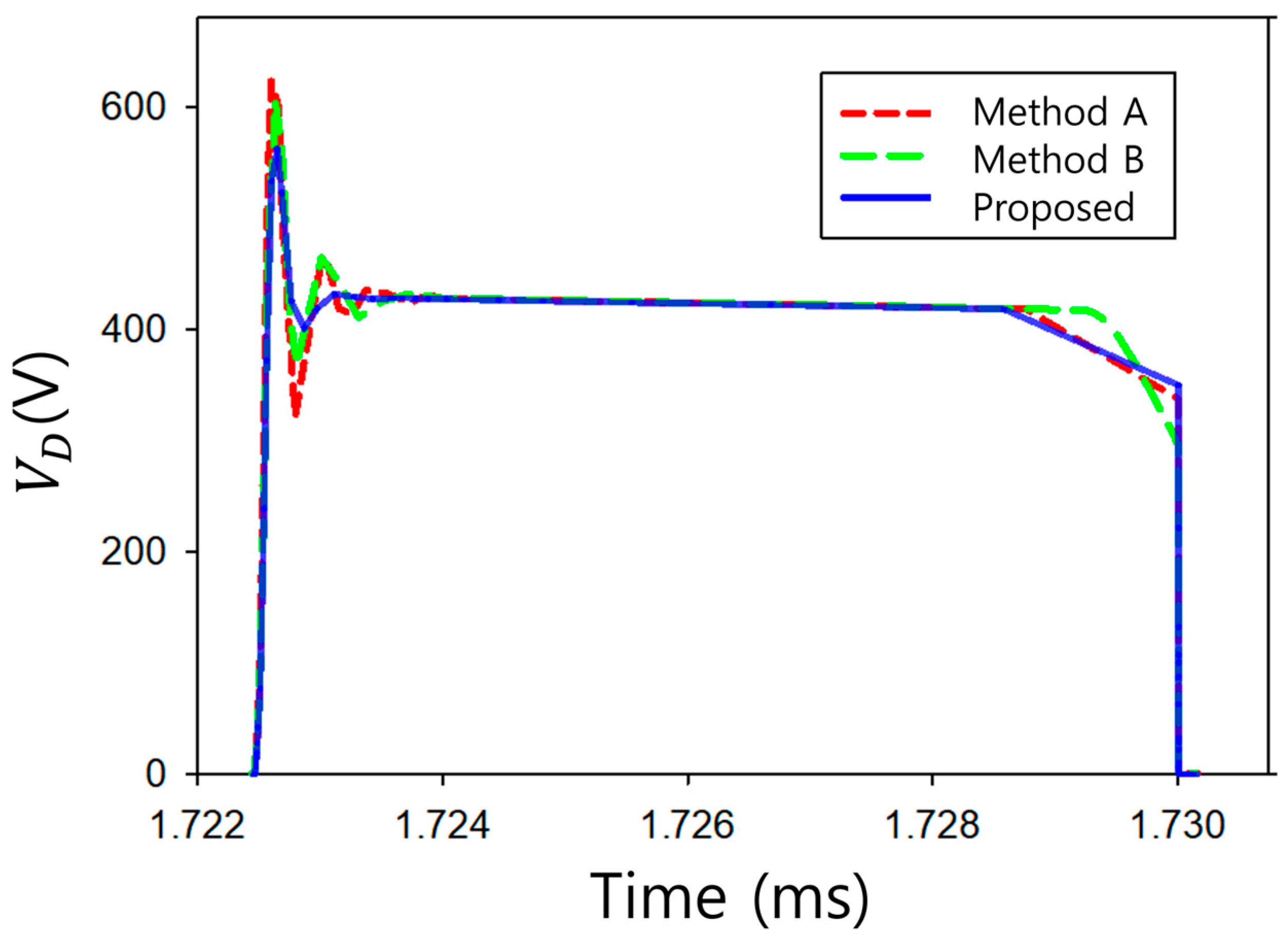
The corresponding drain-voltage waveforms are compared in Figure 7. The proposed method not only produces the lowest peak voltage and the smallest ringing amplitude but also achieves the fastest settling of V D ( t ) , which directly contributes to reduced switching loss. In agreement with this observation, Table 2 shows that the proposed method yields the lowest switching loss P s w = 1.893 W, compared with 2.626 W for method A and 2.289 W for method B. The proposed design further reduces the P c o n . Although its snubber capacitance C s n b is larger than those of methods A and B, the corresponding capacitor voltage is significantly lower and this results in a conduction loss of 0.387 W.
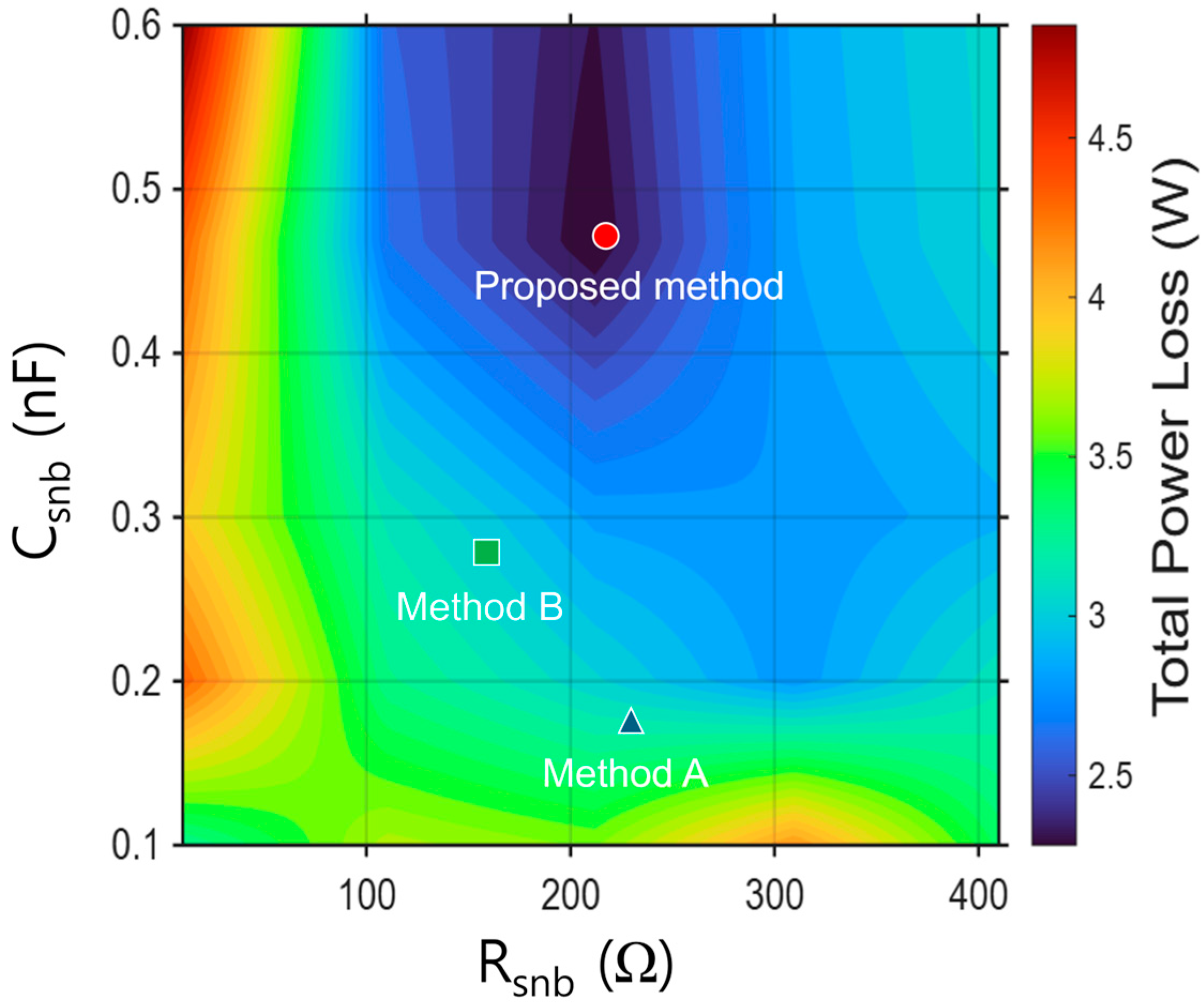
The overall impact on total power loss P t o t a l is illustrated in Figure 8, where the three design points are placed on the contour map of P t o t a l . The proposed method appears near the minimum loss region and its total power loss of 2.2807 W is lower than those of methods A and B by 27.67% and 21.84%. When compared with the RC combinations assessed in the design space, the proposed method achieves up to 53.64% lower total loss. This improvement arises from its ability to control the surge voltage at 556 V, which remains close to the intended 550 V level while maintaining a balanced selection of snubber parameters.
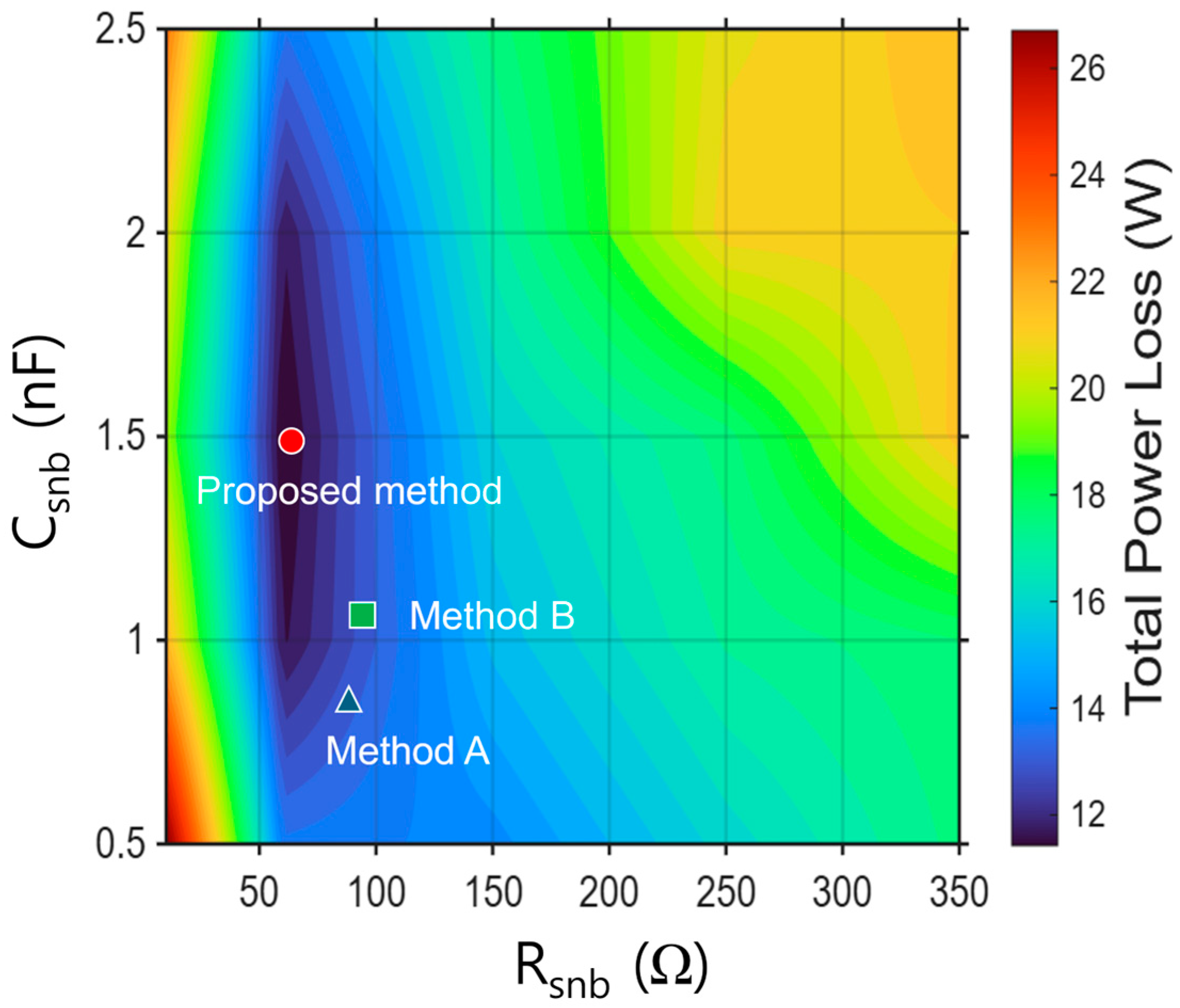
In power converters employing fast-switching devices such as GaN HEMTs, a switching frequency of 100 kHz may be regarded as relatively low. In this study, 100 kHz is selected as a baseline operating condition to clearly analyze the turn-off surge behavior and to evaluate the proposed drain-voltage–waveform-based snubber design method under controlled conditions. Since the proposed design approach is based on the extraction of resonant parameters from the turn-off transient waveform, its applicability is not inherently restricted to a specific switching frequency. To examine the robustness of the proposed method under higher switching-frequency conditions, additional simulations were conducted at f s w = 300 kHz.
As shown in Figure 9, at f s w = 300 kHz, the RC snubber designed using the proposed method ( C s n b = 1.5 nF, R s n b = 60 Ω) achieves a peak drain voltage of 546 V, which is closest to the target level of 550 V, while yielding the lowest total power loss of 11.34 W. In comparison, the snubbers designed using empirical Method A ( C s n b = 0.7 nF, R s n b = 80 Ω) and Method B ( C s n b = 1.1 nF, R s n b = 93 Ω) result in higher peak drain voltages of 647 V and 634 V, respectively, with correspondingly larger total power losses of 13.34 W and 13.12 W.
These results demonstrate that, even at an elevated switching frequency of 300 kHz, the proposed design method remains located in the minimum-loss region of the parameter space while effectively regulating the surge voltage, confirming its applicability to high-speed GaN-based flyback converters.
These comparisons indicate that the drain-voltage assessment-based approach supports a more consistent and effective configuration than frequency-based empirical methods. Therefore, it is well suited for GaN HEMT flyback converters where voltage stress and power loss limits are important.

4.4. Thermal Analysis and Design Considerations of the RC Snubber

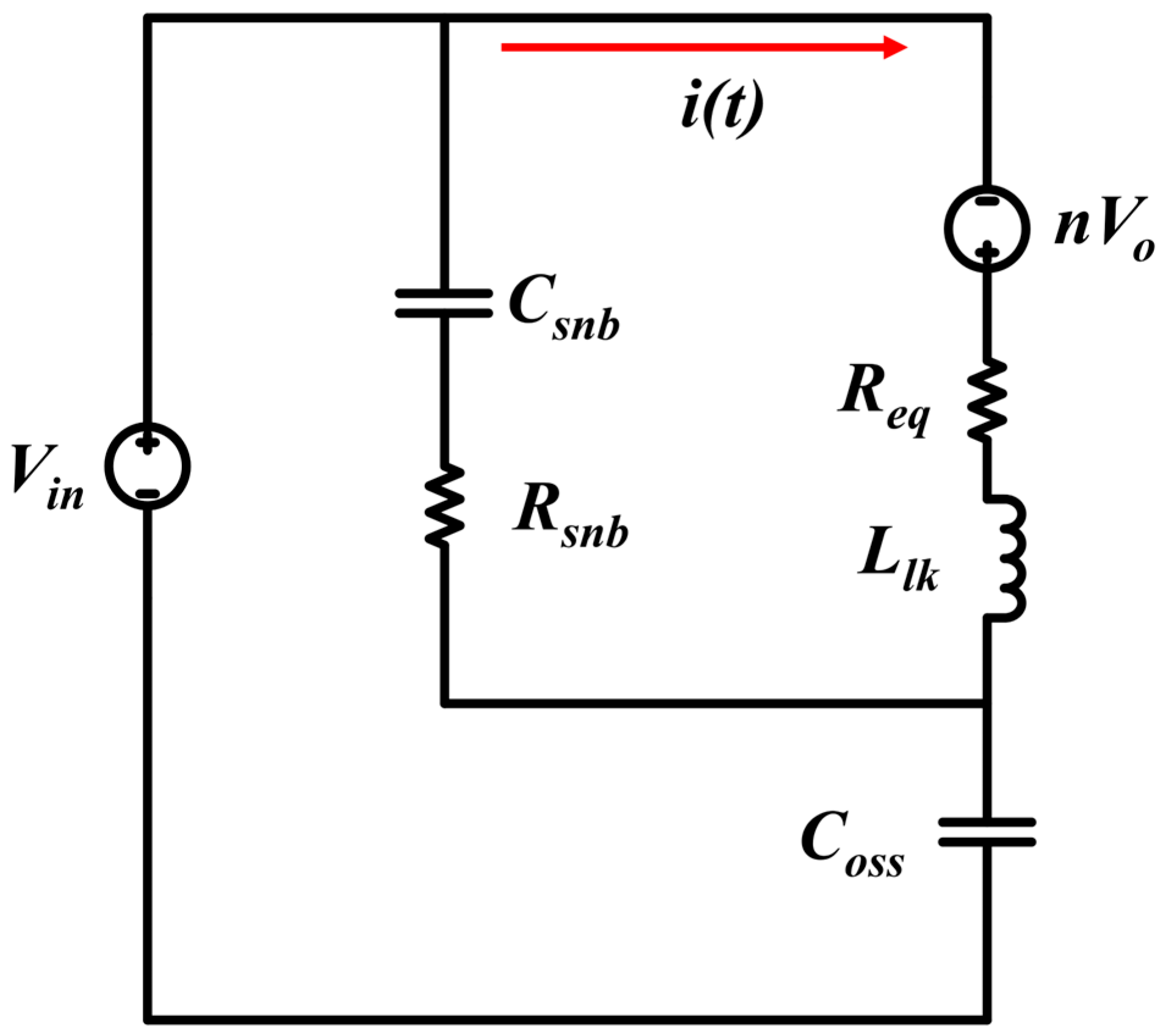
The RC snubber design approach proposed in this paper was shown in the previous section to achieve the lowest total power loss among the compared methods. However, the heat generation in the snubber resistor cannot be explained solely by the discharge loss of the snubber capacitor. In an RC snubber, the resistor not only serves to discharge the snubber capacitor but also plays a crucial role in stabilizing the transient drain-voltage response by damping the voltage ringing. As a result, the snubber resistor dissipates both the energy associated with the capacitor discharge and the energy consumed during the damping of the drain-voltage ringing within each switching cycle. When the RC snubber is employed, the equivalent circuit during the turn-off transition can be represented as shown in Figure 10. In this case, the leakage inductance current can be expressed in the form of a damped oscillation, as given by (19),
i t = I 0 e α t sin ω d t + θ
The damping factor α is defined by (20).
α = R e q + R s n b 2 L l k
The current i ( t ) is approximately equal to the current flowing through the snubber circuit, denoted as i s n b ( t ) . Accordingly, the voltage developed across the snubber resistor can be expressed as in (21).
v R s n b ( t ) R s n b I 0 e α t sin ω d t + θ
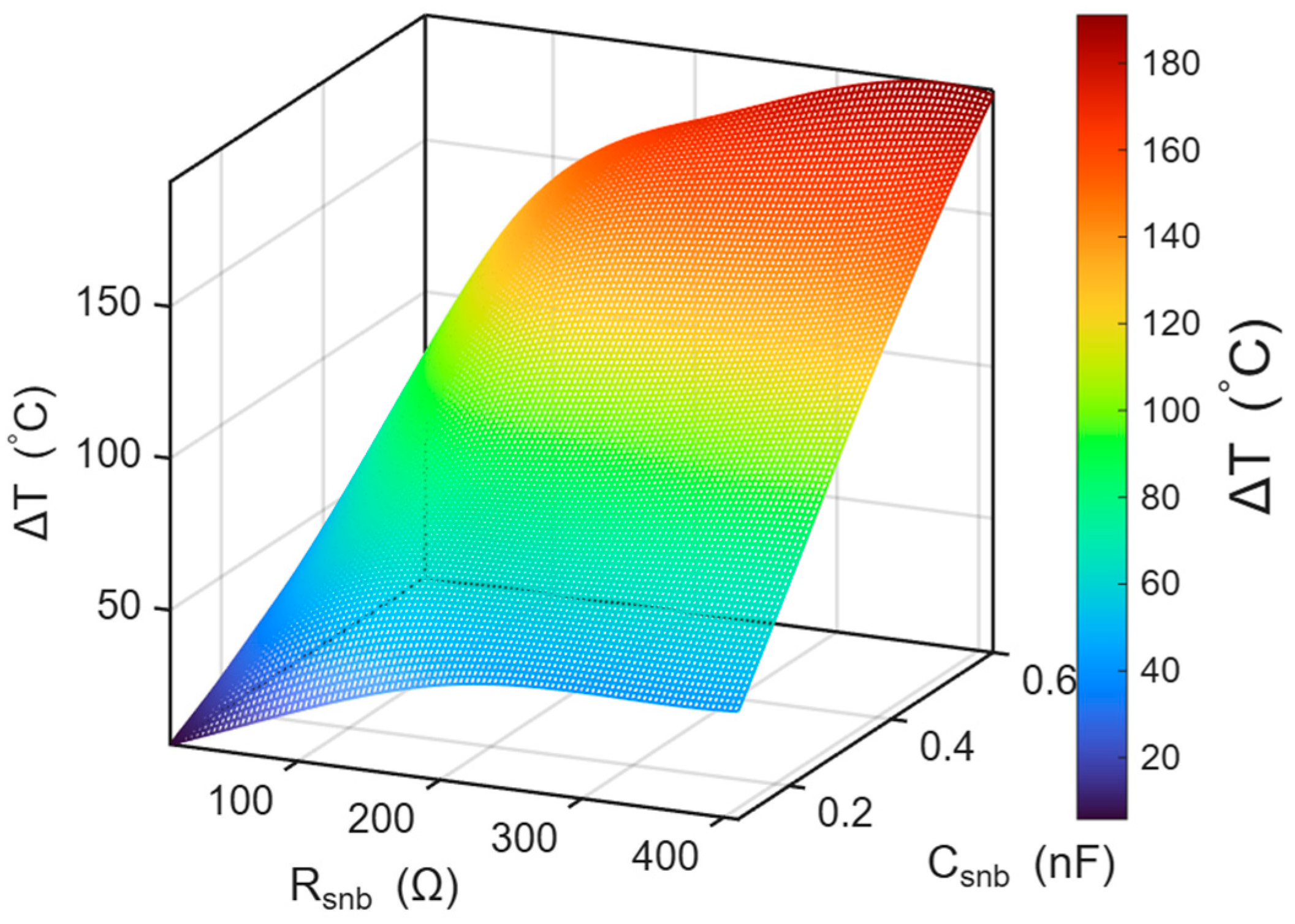
As the impedance of the snubber circuit decreases, the magnitude of the current flowing into the snubber circuit increases, which in turn leads to a larger voltage drop across the snubber resistor. In addition, as indicated by (21), an increase in the snubber resistance results in a higher voltage drop across the resistor under the same current condition. Owing to these characteristics, increasing either the snubber resistance or the snubber capacitance leads to higher energy dissipation and increased heat generation in the snubber resistor. Figure 11 illustrates the temperature rise Δ T of the snubber resistor as a function of the snubber resistance R s n b and capacitance C s n b . As shown in the figure, the temperature rise generally increases with increasing snubber capacitance, and this trend becomes more pronounced in regions with larger R s n b . This behavior can be attributed to the fact that a larger snubber capacitance smooths the transient drain-voltage response while simultaneously extending the duration of the high-voltage state. In conjunction with the altered damping characteristics, this results in increased energy dissipation in the snubber resistor. Equation (22) is used to calculate the average power dissipation in the snubber resistor over one switching period,
P R s n b = 1 T 0 T v R s n b 2 ( t ) R s n b d t
Equation (23) is used to estimate the temperature rise in the snubber resistor resulting from the corresponding power dissipation.
Δ T = P R s n b · R θ
According to [37], the thermal resistance R θ of power resistors commonly used in power electronics typically ranges from 10 to 30 K/W, depending on the package type and cooling condition. In particular, TO-220 packaged power resistors, such as the TPAN0220 series, exhibit a junction-to-case thermal resistance of approximately 2.1 K/W as specified in the datasheet, indicating efficient heat conduction from the resistive element to the flange [38]. When such devices are mounted on a heatsink with appropriate thermal interface materials, the dominant thermal resistance is governed by the heatsink-to-ambient path, resulting in an overall junction-to-ambient thermal resistance on the order of 10 K/W. Therefore, to ensure a conservative yet realistic estimation of the steady-state temperature rise under practical operating conditions, R θ = 10   K /W is assumed in this work.
Accordingly, in practical RC snubber design, it is advisable to first select the combination of snubber capacitance and resistance that satisfies the targeted drain-voltage range. Subsequently, the thermal suitability of the selected snubber parameters should be further examined by evaluating the average power dissipation in the snubber resistor and the resulting temperature rise. If the calculated temperature rise exceeds the allowable limit, the snubber resistance should be gradually reduced while reassessing the trade-off between drain-voltage suppression performance and resistor heat generation. Through this iterative verification process, RC snubber parameters that achieve the desired surge-voltage target without causing excessive thermal stress in the snubber resistor can be determined.

5. Conclusions

A drain-voltage assessment-based RC snubber design framework was established to address voltage stress and loss mechanisms in GaN HEMT flyback converters. The method identifies the resonant behavior directly from the measured drain voltage profile and this enables accurate parameter extraction while avoiding the limitations of empirical procedures. The approach provides a reliable means of governing the rapid transitions inherent in GaN switching. In addition, this study highlights that the final design of an RC snubber should not only satisfy the surge-voltage suppression requirement but also consider the thermal stress imposed on the snubber resistor, since the resistor dissipates energy associated with both capacitor discharge and ringing damping during each switching period. The simulation results confirm that the surge voltage is shaped to 556 V which is very close to the intended 550 V target while the total power loss is reduced by more than twenty percent compared with two conventional approaches. The overall results indicate that the proposed approach refines the practical design of dissipative snubbers for GaN-based flyback converters and supports more stable voltage regulation and improved efficiency in systems that operate with fast-switching devices. Future work will focus on hardware implementation to experimentally validate the thermal feasibility and measure the actual temperature rise i the snubber resistor under real-world operating conditions.

Author Contributions

Conceptualization, B.-J.P. and D.S.; Methodology, B.-J.P., M.-S.P. and D.S.; Software, B.-J.P., C.-J.H. and G.-U.P.; Validation, B.-J.P., M.-S.P. and D.S.; Formal analysis, B.-J.P., C.-J.H. and G.-U.P.; Investigation, B.-J.P., C.-J.H. and G.-U.P.; Data curation, B.-J.P., C.-J.H. and G.-U.P.; Writing—original draft preparation, B.-J.P., M.-S.P. and D.S.; Writing—review and editing, B.-J.P., M.-S.P. and D.S.; Visualization, B.-J.P. and M.-S.P.; Supervision, M.-S.P. and D.S.; Project administration, M.-S.P. and D.S.; Funding acquisition, M.-S.P. All authors have read and agreed to the published version of the manuscript.

Funding

This research was supported by Global-Learning and Academic research institution for Master’s·PhD students, and Postdocs (LAMP) Program of the National Research Foundation of Korea (NRF) grant funded by the Ministry of Education (RS-2025-25440216).

Data Availability Statement

The original contributions presented in this study are included in the article. Further inquiries can be directed to the corresponding authors.

Conflicts of Interest

The authors declare no conflicts of interest.

References

  1. Ambacher, O.; Baines, Y.; Beam, B.; Borga, M.; Bouchet, T.; Chalker, P.R.; Charles, M.; Chen, K.J.; Chowdhury, N.; Chu, R.; et al. GaN-Based Power Devices—Physics, Reliability and Technology. J. Phys. D Appl. Phys. 2018, 51, 163001. [Google Scholar]
  2. Mishra, U.K.; Parikh, P.; Wu, Y.F. AlGaN/GaN HEMTs—An Overview of Device Operation and Applications. Proc. IEEE 2002, 90, 1022–1031. [Google Scholar] [CrossRef]
  3. Zulauf, G.; Guacci, M.; Kolar, J.W. Dynamic On-Resistance in GaN-on-Si HEMTs: Origins, Dependencies, and Future Characterization Frameworks. IEEE Trans. Power Electron. 2020, 35, 5581–5588. [Google Scholar] [CrossRef]
  4. Wang, W.; Liang, Y.; Zhang, M.; Lin, F.; Wen, F.; Wang, H. Mechanism Analysis of Dynamic On-State Resistance Degradation for a Commercial GaN HEMT Using Double Pulse Test. Electronics 2021, 10, 1202. [Google Scholar] [CrossRef]
  5. Thönnessen, A.; Baumgärtner, J.; Fronczek, C.; De Doncker, R.W. Comparison of Switching Losses and Dynamic on Resistance of 600 V-Class GaN HEMTs. In Proceedings of the PCIM Europe 2024—International Exhibition and Conference for Power Electronics, Intelligent Motion, Renewable Energy and Energy Management, Nuremberg, Germany, 11–13 June 2024. [Google Scholar] [CrossRef]
  6. Wang, B.; Dong, S.; Jiang, S.; He, C.; Hu, J.; Ye, H.; Ding, X. A Comparative Study on the Switching Performance of GaN and Si Power Devices for Bipolar Complementary Modulated Converter Legs. Energies 2019, 12, 1146. [Google Scholar] [CrossRef]
  7. Sun, B. Does GaN Have a Body Diode? Understanding the Third Quadrant Operation of GaN. In Texas Instruments Application Report; Texas Instruments Inc.: Dallas, TX, USA, 2019; Available online: https://www.ti.com/lit/an/snoaa36/snoaa36.pdf (accessed on 27 November 2025).
  8. Medinceanu, P.C.; Antonescu, A.M.; Enachescu, M. Is GaN the Enabler of High Power Density Converters? An Overview of the Technology, Devices, Circuits, and Applications. Preprints 2025. [Google Scholar] [CrossRef]
  9. Mortazavizadeh, S.A.; Palazzo, S.; Amendola, A.; De Santis, E.; Di Ruzza, D.; Panariello, G.; Sanseverino, A.; Velardi, F.; Busatto, G. High Frequency, High Efficiency, and High Power Density GaN-Based LLC Resonant Converter: State-of-the-Art and Perspectives. Appl. Sci. 2021, 11, 11350. [Google Scholar] [CrossRef]
  10. Tanrikulu, U.; Akboy, E.; Akin, B. Design and Analysis of a Flyback Converter with Improved Snubber Cells. Sigma J. Eng. Nat. Sci. 2020, 38, 2205–2216. [Google Scholar]
  11. Papanikolaou, N.P.; Tatakis, E.C. Active Voltage Clamp in Flyback Converters Operating in CCM Mode under Wide Load Variation. IEEE Trans. Ind. Electron. 2004, 51, 632–640. [Google Scholar] [CrossRef]
  12. Park, H.P.; Jung, J.H. Design Methodology of Quasi-Resonant Flyback Converter with a Divided Resonant Capacitor. IEEE Trans. Ind. Electron. 2021, 68, 10796–10805. [Google Scholar] [CrossRef]
  13. Cheng, C.-A.; Lee, C.-M.; Chang, E.-C.; Lin, C.-K.; Lan, L.-F.; Hou, S.-H. Analysis and Reduction of Radiated EMI in High-Frequency GaN IC-Based Active Clamp Flyback Converters. In Proceedings of the Workshop on Wide Bandgap Power Devices and Applications in Asia (WiPDA-Asia 2023), Hsinchu, Taiwan, 27–29 August 2023; pp. 1–3. [Google Scholar]
  14. Varadarajan, K.; Singamaneni, S.; Kappala, S. Surge-Robust Flyback Power Supplies with GaN. In Proceedings of the IEEE Applied Power Electronics Conference and Exposition (APEC), New Orleans, LA, USA, 15–19 March 2020; pp. 2584–2586. [Google Scholar]
  15. Tang, S.; Xi, J.; He, L. A GaN-Based MHz Active Clamp Flyback Converter with Adaptive Dual Edge Dead Time Modulation for AC-DC Adapters. In Proceedings of the IEEE International Conference on Power Electronics and Applications, Shenzhen, China, 7–10 November 2025; pp. 547–554. [Google Scholar]
  16. Meng, P.; Wu, X.; Yang, J.; Chen, H.; Qian, Z. Analysis and Design Considerations for EMI and Losses of RCD Snubber in Flyback Converter. In Proceedings of the IEEE Applied Power Electronics Conference and Exposition (APEC), Palm Springs, CA, USA, 21–25 February 2010; pp. 642–647. [Google Scholar] [CrossRef]
  17. Zhang, Y.; Chen, M.; Jin, Z.; Ding, Q. Study of CM EMI and RCD-L-RC Snubber in a Multi-Winding Flyback Converter. In Proceedings of the IEEE International Symposium on Energy Storage and Conversion (ISESC), Xi’an, China, 8–11 November 2024; pp. 1160–1164. [Google Scholar] [CrossRef]
  18. Yang, X.; Li, J.; Ding, Y.; Xu, M.; Zhu, X.-F.; Zhu, J. Observation of Transient Parity-Time Symmetry in Electronic Systems. Phys. Rev. Lett. 2022, 128, 065701. [Google Scholar] [CrossRef] [PubMed]
  19. Lin, B.-R.; Chiang, H.-K.; Chen, K.-C.; Wang, D. Analysis, Design and Implementation of an Active Clamp Flyback Converter. In Proceedings of the International Conference on Power Electronics and Drives Systems, Kuala Lumpur, Malaysia, 28 November–1 December 2005; Volume 1, pp. 424–429. [Google Scholar]
  20. Sarkar, A.; Vankayalapati, B.T.; Anand, S. GaN-Based Multiple Output Flyback Converter with Independently Controlled Outputs. IEEE Trans. Ind. Electron. 2022, 69, 2565–2576. [Google Scholar] [CrossRef]
  21. Yao, Y.; Wang, C.; Sun, D.; Gu, W.; Sheng, C. An Accurate Output Current Prediction Scheme for Primary-Side Regulation Active-Clamp Flyback Converter. In Proceedings of the IEEE Energy Conversion Congress and Exposition (ECCE), Detroit, MI, USA, 9–13 October 2022; pp. 1–5. [Google Scholar] [CrossRef]
  22. Lindström, E.O.; Garcia-Rodriguez, L.A.; Oliva, A.R.; Balda, J.C. Designing an Optimum Non-Dissipative LC Snubber for Step-Up Flyback Converters in DCM. In Proceedings of the IEEE 8th Latin American Symposium on Circuits and Systems (LASCAS), Bariloche, Argentina, 20–23 February 2017; pp. 1–4. [Google Scholar] [CrossRef]
  23. Liu, S.; Zhang, F.; Zhang, Q. Optimal Design of RCD Parameters in Flyback Converter. In Proceedings of the International Symposium on Computer, Consumer and Control (IS3C), Xi’an, China, 4–6 July 2016; pp. 582–585. [Google Scholar] [CrossRef]
  24. McMurray, W. Selection of Snubbers and Clamps to Optimize the Design of Transistor Switching Converters. IEEE Trans. Ind. Appl. 1980, IA-16, 513–529. [Google Scholar] [CrossRef]
  25. Jin, S.; Choi, J. Analysis and Design of Damping Resistor for Mitigating Surge Voltage and Oscillation in Flyback Converter. IEEE Access 2024, 12, 163671–163683. [Google Scholar] [CrossRef]
  26. Kizilyalli, I.C.; Bui-Quang, P.; Disney, D.; Bhatia, H.; Aktas, O. Reliability Studies of Vertical GaN Devices Based on Bulk GaN Substrates. Microelectron. Reliab. 2015, 55, 1654–1661. [Google Scholar] [CrossRef]
  27. Bahl, S.R.; Brohlin, P. A New Approach to Validate GaN FET Reliability to Power-Line Surges under Use-Conditions. In Proceedings of the IEEE International Reliability Physics Symposium (IRPS), Monterey, CA, USA, 31 March–4 April 2019; pp. 1–7. [Google Scholar] [CrossRef]
  28. Ma, Y. EPC GaN Transistor Application Readiness: Phase One Testing; EPC Reliability Report; Efficient Power Conversion Corporation: El Segundo, CA, USA, 2019. [Google Scholar]
  29. Hou, P.C.; Hsieh, T.E.; Cheng, S.; del Alamo, J.A.; Chang, E.Y. Comprehensive Dynamic On-Resistance Assessments in GaN-on-Si MIS-HEMTs for Power Switching Applications. MIT Open Access Articles. Available online: https://hdl.handle.net/1721.1/126201 (accessed on 27 November 2025).
  30. Gajare, S.; Li, D.; Garcia, R.; Espinoza, A.; Green, J.; Tieu, P.; Wong, C.; Nguyen, A.; Wu, D.; Zhang, S. GaN Reliability and Lifetime Projections: Phase 17; Phase 17 Reliability Report; Efficient Power Conversion Corporation: El Segundo, CA, USA, 2025. [Google Scholar]
  31. Betten, J. Power Tips: Calculate an R–C Snubber in Seven Steps. Texas Instruments Technical Article; 2016; SSZTBC7. Available online: https://www.ti.com/lit/pdf/SSZTBC7 (accessed on 27 November 2025).
  32. Krellner, J. MC34670 Usage and Configuration. Freescale Semiconductor Application Note AN3279 Rev. 3.0. 2009. Available online: https://www.nxp.com/docs/en/application-note/AN3279.pdf (accessed on 27 November 2025).
  33. Li, Z.; Wang, X.; Zhang, Y.; Chen, H.; Qian, Z. Analytical Technique for Designing an RC Snubber Circuit for Ringing Suppression in a Phase-Leg Configuration. IEEE Trans. Power Electron. 2017, 32, 2876–2886. [Google Scholar] [CrossRef]
  34. Meng, P.; Chen, H.; Zheng, S.; Wu, X.; Qian, Z. Optimal Design for the Damping Resistor in RCD-R Snubber to Suppress Common-Mode Noise. In Proceedings of the IEEE Applied Power Electronics Conference and Exposition (APEC), Palm Springs, CA, USA, 21–25 February 2010; pp. 691–697. [Google Scholar] [CrossRef]
  35. GaN Systems Inc. GS66516T Top-Side Cooled 650 V E-Mode GaN Transistor; Datasheet, Rev. 210727; GaN Systems Inc.: Ottawa, ON, Canda, 2021. [Google Scholar]
  36. Halder, T. Comprehensive Power Loss Model of the Main Switch of the Flyback Converter. In Proceedings of the IEEE International Conference on Power, Energy and Control (ICPEC), Dindigul, India, 6–8 February 2013; pp. 792–797. [Google Scholar] [CrossRef]
  37. Isabellenhütte Heusler GmbH & Co. KG. Low-Ohmic Precision and Power Resistors; Technical Catalogue BE-E-03-2019; Isabellenhütte Heusler GmbH & Co. KG: Dillenburg, Germany, 2019; pp. 7–18. Available online: https://www.isabellenhuette.de (accessed on 27 November 2025).
  38. C&B Electronics Shenzhen Co., Ltd. TPAN0220 50 W TO-220 Non-Inductive High-Power Resistor; Datasheet No. E20004, Version V1; C&B Electronics Shenzhen Co., Ltd.: Shenzhen, China, 2024. [Google Scholar]
Figure 1. (a) Conventional flyback converter topology. (b) Equivalent RLC model representing the switch turn-off transient, where the leakage inductance, device output capacitance, and parasitic resistance form an under-damped resonant network responsible for the surge voltage.
Electronics 15 00271 g001
Figure 2. Configuration of the RC snubber ( R s n b ,   C s n b ) connected across the primary switch of the flyback converter, and the corresponding drain-voltage model during turn-off. The drain voltage is expressed as V D t = V s a t + V L l k t , where V s a t = V i n + n V 0 .
Electronics 15 00271 g002
Figure 3. Simulated drain-voltage waveforms V D ( t ) of the GaN HEMT device (GS66516T) under three conditions: (i) without snubber, (ii) with only the designed snubber capacitor C s n b , and (iii) with the full proposed RC snubber. The proposed method achieves the closest match to the target maximum voltage with minimal ringing.
Electronics 15 00271 g003
Figure 4. (a) Variation in peak drain voltage V m a x under different combinations of C s n b and R s n b using the GS66516T device. (b) Switching-loss characteristics as a function of V m a x , demonstrating how moderate snubber values effectively reduce the switching interval and loss.
Electronics 15 00271 g004
Figure 5. (a) Maximum snubber-capacitor voltage V C , m a x for various C s n b R s n b combinations. (b) Corresponding conduction-loss distribution, showing the nonlinear dependence on both capacitor voltage and snubber capacitance.
Electronics 15 00271 g005
Figure 6. Contour maps of loss characteristics for various snubber parameter combinations. (a) Conduction loss P c o n as a function of C s n b and R s n b . The loss increases with larger snubber capacitance due to the greater charge processed during each switching cycle. (b) Switching loss P s w distribution determined by the peak drain voltage and transient duration. Moderate snubber values yield the lowest switching loss by effectively damping the voltage overshoot. (c) Total loss P t o t a l = P s w + P c o n . The optimal low-loss region appears along a narrow valley formed by the trade-off between conduction and switching losses. The snubber values obtained from the proposed method lie within this minimum-loss region.
Electronics 15 00271 g006aElectronics 15 00271 g006b
Figure 7. Comparison of simulated drain-voltage waveforms under the three RC-snubber design methods (Method A, Method B, and the proposed method). The proposed method achieves the smallest overshoot and fastest damping.
Electronics 15 00271 g007
Figure 8. Comparison of total power loss for the three RC-snubber design methods (Method A, Method B, and the proposed method) plotted on the total-loss contour map. The proposed method resides in the minimum-loss region.
Electronics 15 00271 g008
Figure 9. Comparison of total power loss for the three RC snubber design methods at f s w = 300 kHz plotted on the total-loss contour map. The proposed method remains located in the minimum-loss region while satisfying the drain-voltage constraint.
Electronics 15 00271 g009
Figure 10. Equivalent model representing the switch turn-off transient with an RC snubber, where the leakage inductance and device output capacitance form a resonant network, and the RC snubber provides additional damping to suppress the surge voltage.
Electronics 15 00271 g010
Figure 11. Temperature rise in the snubber resistor ( Δ T ) as a function of R s n b and C s n b . The temperature rise increases with increasing snubber resistance and capacitance due to the higher energy dissipation in the snubber resistor.
Electronics 15 00271 g011
Table 1. Simulation parameters used for evaluating the proposed RC snubber design method.
ParameterValue
Switching device (M1)GS66516T
Switching frequency (fsw)100 kHz
Duty (D)0.24
Output Voltage (Vout)15 V
Leakage inductance (Llk)6.75 μH
Operating modeCCM
Table 2. Comparison of the extracted snubber parameters and resulting conduction loss, switching loss, and total loss for the proposed method and existing empirical methods (Method A and Method B).
ProposedMethod AMethod B
Rsnb (Ω)212224160
Csnb (nF)0.4670.1800.285
Target Vmax (V)550550550
Vmax (V)556637603
V C m a x   (V)129243210
Conduction loss (W)0.3870.5290.629
Switching loss (W)1.8932.6262.289
Total loss (W)2.2813.1552.918
Disclaimer/Publisher’s Note: The statements, opinions and data contained in all publications are solely those of the individual author(s) and contributor(s) and not of MDPI and/or the editor(s). MDPI and/or the editor(s) disclaim responsibility for any injury to people or property resulting from any ideas, methods, instructions or products referred to in the content.