Article

Enhanced Lightweight Image Super-Resolution via Residual Aggregation and Wavelet Loss

1
School of Artificial Intelligence and Automation, China University of Geosciences, Wuhan 430074, China
2
Hubei Key Laboratory of Advanced Control and Intelligent Automation for Complex Systems, Wuhan 430074, China
3
Engineering Research Center of Intelligent Technology for Geo-Exploration, Ministry of Education, Wuhan 430074, China
4
Hubei Provincial Center for Flood and Drought Disaster Prevention, Wuhan 430074, China
5
Key Laboratory of Termite Control of Ministry of Water Resources, Wuhan 430070, China
*
Author to whom correspondence should be addressed.
Electronics 2026, 15(18), 4271; https://doi.org/10.3390/electronics15184271 (registering DOI)
Submission received: 14 August 2026 / Revised: 11 September 2026 / Accepted: 16 September 2026 / Published: 18 September 2026

Abstract

Image super-resolution (SR), which aims to reconstruct a high-resolution image from a low-resolution input, has progressed from convolutional neural networks (CNNs) to transformer-based architectures. Despite this progress, lightweight transformer SR remains challenging: local or window-based operations provide limited long-range interaction, conventional query-key-value projections introduce parameter and computational redundancy, and pixel-domain loss alone provides insufficient frequency-domain constraints on fine structures. This study presents RAW, a lightweight SR network based on residual aggregation and wavelet loss. RAW uses local aggregation to preserve neighborhood textures, mesoscale grouped-residual attention to reduce projection redundancy while modeling regional dependencies, and non-local sparse aggregation to capture long-range information at a controlled cost. By integrating stationary-wavelet-transform loss with RGB-domain L1 loss, the model supervises structural and high-frequency information without adding an inference branch. Experiments on standard benchmarks demonstrate a competitive trade-off between reconstruction quality and computational complexity. For 4× SR, RAW reduces the numbers of parameters and MACs by 14.3% and 15.4%, respectively, relative to the baseline, while improving the PSNR and SSIM on Manga109 by 0.22 dB and 0.0015, respectively.

1. Introduction

Single-image super-resolution (SISR) is an important task in computer vision that involves reconstructing a visually sharp and detailed high-resolution image from a low-resolution input. Driven by rapid advances in deep learning, SISR techniques have transitioned from being based on conventional convolutional neural network frameworks to becoming grounded in transformer-based architectures. The SRCNN method, proposed in [1], is based on the convolutional neural network, and delivers impressive performance on SR tasks. It represents the first end-to-end deep learning-based approach that is specifically designed to address the challenges posed by SR. CNN-based SR techniques subsequently superseded classical interpolation methods [2,3]. Propelled by advances in transformer models [4], ViT-based super-resolution frameworks [5] have recently emerged, and have shown marked improvements in SR performance. Compared with earlier CNN-based approaches, transformer-based models excel at capturing long-range dependencies to improve the quality of the reconstructed images. Researchers have lately proposed hybrid SR networks [6] that fuse the components of the transformer and CNN to exploit their respective strengths. Despite the substantial advances in deep learning-based SISR, most research in the area has targeted large-scale architectures, while the development of lightweight models (with under 1 M parameters) remains challenging. Lightweight SISR requires a careful balance among reconstruction quality, parameter efficiency, and computational cost, making it impractical to rely solely on increasing network depth or feature dimensions. The challenges also differ across spatial ranges. Local convolutions efficiently recover edges and neighborhood textures but have limited receptive fields; window-based attention captures mesoscale relationships but is restricted by window boundaries; and dense global attention introduces substantial computational overhead. In particular, the self-attention mechanism used in transformer-based SR may involve considerable computational redundancy [7]. To improve its efficiency, Ref. [8] introduced a grouped multi-scale self-attention module that divides input features into groups and applies attention windows of different sizes to model multi-scale dependencies while controlling computational cost. Similarly, Ref. [9] proposed a linear residual grouping strategy for the conventional query, key, and value projections, thereby reducing projection redundancy, parameter count, and computational overhead. Moreover, RGB-domain L1 loss alone provides limited supervision for frequency-domain structures.
Currently available lightweight models are limited in terms of the diversity of their design, and use a single attention mechanism, single-scale handling, and uniform network structures. To overcome these limitations, Ref. [10] introduced a transformer-based deep global processing scheme that substitutes convolutional locality to endow the model with convolution-like spatial biases such that it can efficiently capture global representations. Reference [11] proposed a multi-scale attention network (MAN) for SISR that fuses the CNN and attention to deliver impressive SR performance, all the while achieving an optimal trade-off between the accuracy and footprint of the model at different levels of complexity. Moreover, to capture intricate high-frequency details, researchers have investigated techniques of frequency-domain processing for SR. While wavelet transforms have been applied to SR, their integration into transformer-based architectures is still in its infancy. Whereas prevalent research relies on the L1 loss, Ref. [12] pioneered the incorporation of wavelet loss into transformer-based SR models by introducing a wavelet sub-band loss term that overcomes the limitations of RGB pixel loss in capturing high-frequency details to enhance the fidelity of the reconstruction.
Motivated by recent advances in hierarchical feature aggregation, grouped-residual attention, and wavelet-domain supervision [6,9,12], we propose RAW, a lightweight image super-resolution network that combines residual aggregation with wavelet-domain loss. RAW is designed to balance reconstruction quality, parameter efficiency, and computational cost by coordinating feature interactions across different spatial ranges and introducing complementary frequency-domain supervision. Against this background, each component of RAW is designed to address a distinct requirement of lightweight SR. Specifically, LAB extracts local texture features through efficient convolution; MRGAB employs grouped-residual attention to model mesoscale interactions while reducing projection redundancy; NLSAB provides sparse long-range information aggregation at a controlled computational cost; and the SWT loss complements spatial-domain L1 supervision by imposing subband-level constraints. Together, these components address the local, mesoscale, non-local, and frequency-domain requirements of lightweight SR.
The main contributions of this work are summarized as follows:
  • We develop a lightweight SISR architecture that organizes feature aggregation across local, mesoscale, and non-local spatial ranges. LAB preserves neighborhood textures, MRGAB integrates grouped-residual attention for efficient regional interaction, and NLSAB captures long-range dependencies through sparse aggregation.
  • We integrate grouped residual linear projections into the mesoscale RGSA stage to reduce redundancy in conventional query, key, and value projections. This design coordinates efficient mesoscale interaction with the local features extracted by LAB and the non-local information aggregated by NLSAB.
  • We introduce a composite training objective that combines RGB-domain L1 loss with SWT-domain supervision. The SWT loss explicitly constrains low-frequency structures and directional high-frequency details without introducing an additional inference branch.
  • Experiments on five standard benchmark datasets demonstrate that RAW achieves a competitive trade-off between reconstruction quality and model complexity. For 4 × SR, the complete model reduces the parameter count and MACs by 14.3% and 15.4%, respectively, relative to the baseline, while improving the PSNR and SSIM on Manga109 by 0.22 dB and 0.0015, respectively.

2. Related Work

We now review CNN- and transformer-based methods and attention mechanisms that are pertinent to our proposed method.

2.1. CNN- and Transformer-Based SR Methods

SISR has evolved from being based on techniques of classical interpolation to deep learning-based paradigms. The SRCNN, introduced by Dong et al. [1], was the first instance of CNN-based end-to-end mapping via a three-layer convolutional network. Kim et al. [13] subsequently proposed the VDSR by leveraging residual learning to extend the depth of the network to 20 layers. The EDSR [14] achieved significant benchmark improvements by eliminating batch normalization layers and adopting channel expansion. The RCAN [15] developed by Zhang et al. further integrated channel attention to improve the PSNR on standard benchmarks. The advent of the transformer model provides new opportunities and challenges for SISR. SwinIR [16] pioneered window-based attention in image restoration. Its hierarchical design preserves linear complexity, and yielded a 0.39 dB increase in the PSNR over the RCAN on the 4× task in Urban100. The pure transformer-based IPT [17] models global attention via pre-training, but its substantial requirements pertaining to the data and computation as well as its complexity hinder its empirical deployment. Consequently, hybrid designs have garnered greater interest. The ESRT [18], developed by Lu et al., introduces a lightweight transformer–CNN interaction module that reduces the number of required computations to a ninth of the cost of the VDSR. In addition to CNN- and Transformer-based approaches, autoencoder architectures have also been investigated for image SR. Zhou et al. [19] introduced dense convolutional autoencoder blocks that extract multi-resolution features through paired encoding–decoding layers and facilitate feature reuse through skip and dense connections.
We investigate a hybrid architecture by using a module for global residual aggregation to improve the capability of the model to distinguish between multi-level features. We also integrate self-attention and sparse attention to bolster the capabilities of the global module for feature extraction.

2.2. Attention Mechanism

Dai et al. [20] pioneered self-attention in the SAN. This second-order attention module yielded an improvement of 0.20 dB in the PSNR on Set5 under 4× upscaling. PANet [21] introduces a pyramid attention structure that leverages interactions between features at multiple scales to reconstruct complex textures. The HAN [22] combines channel and spatial attention to boost the SSIM on Urban100’s 4× SR challenge to 0.8131.
A number of attention-based enhancements have been incorporated into the SR task. However, approaches based on global attention suffer from two critical drawbacks: inherent redundancy and an excessively high computational cost. For instance, SwinIR reduces its number of parameters to 11.8 M by using windowed attention, but still takes about 1.1 s to process images of the same resolution, whereas the CNN-based RCAN takes only 0.2 s. Moreover, even when SwinIR is reduced to six heads and C = 60 in lightweight trials, it still incurs 87.2 G MACs (3×) or 49.6 G MACs (4×), which reflects redundancy in contrast with IMDN’s costs of 71.5 G and 40.9 G, respectively [23].
GRFormer reduces query-key-value projection redundancy through grouped-residual self-attention [9], whereas OmniSR aggregates local, mesoscale, and global information to enlarge the effective receptive field [24]. Building on these ideas, RAW places grouped-residual projection specifically within the mesoscale RGSA stage and coordinates it with local convolution and non-local sparse aggregation. In addition, RAW incorporates SWT-domain supervision only during training to provide complementary frequency-domain constraints.

3. Proposed Method

3.1. Framework

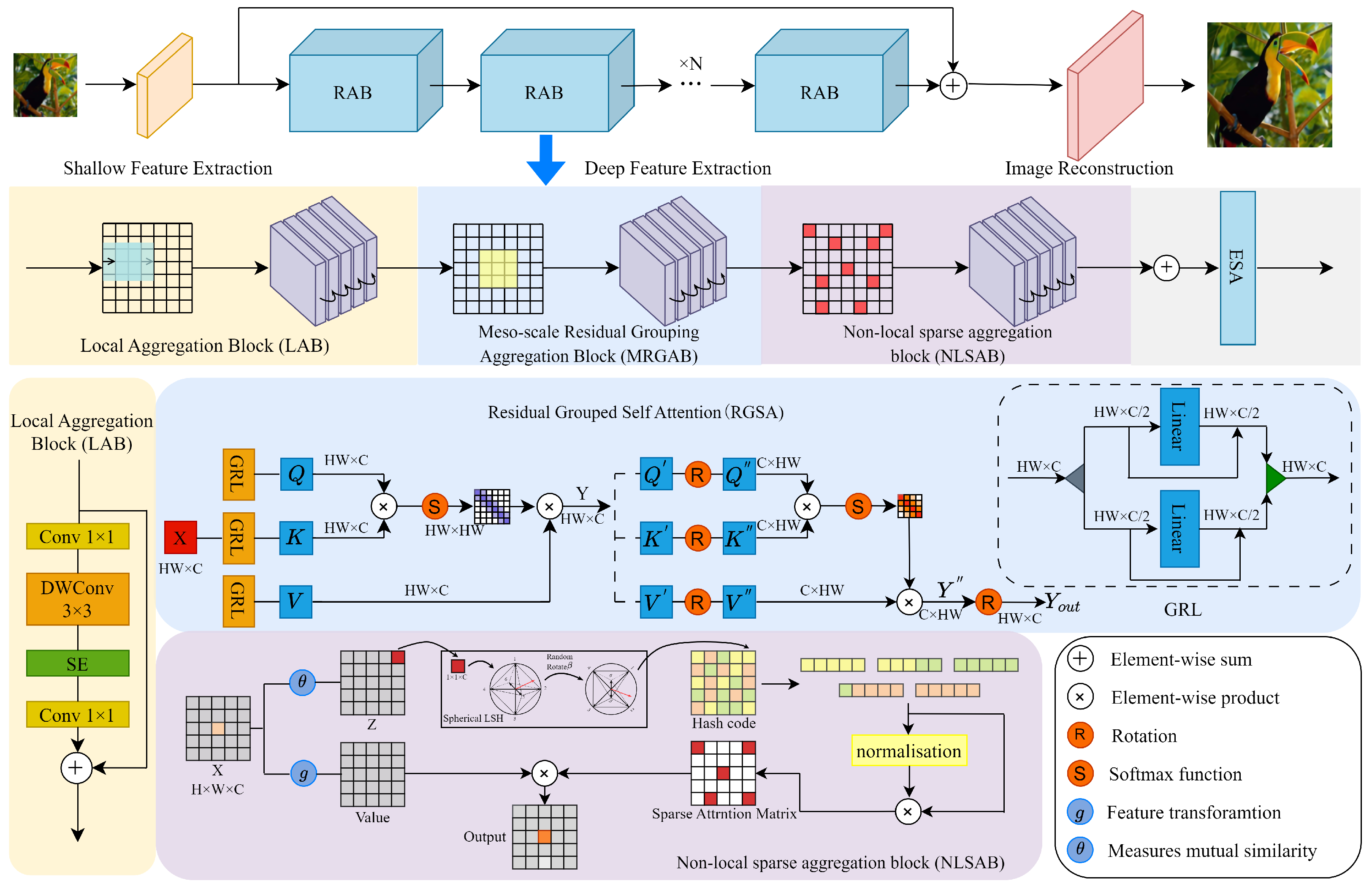
Figure 1 shows the overall pipeline of RAW together with an expanded residual aggregation block (RAB). The upper part consists of shallow-feature extraction, sequential RABs for deep-feature extraction, and an image-reconstruction module. The lower part expands one RAB to illustrate how features successively pass through LAB, MRGAB, and NLSAB, thereby extending feature aggregation from local neighborhoods to mesoscale regions and non-local positions. RGSA serves as an internal attention submodule of MRGAB rather than an independent stage in the overall pipeline. RAW adopts a sequential backbone [25] and adapts the omni-scale aggregation principle [24] through grouped-residual projection and non-local sparse interaction. During training, the reconstruction objective is further complemented by SWT-domain supervision to strengthen the recovery of structural and high-frequency information.

3.2. Residual Aggregation Block (RAB)

Window-based self-attention that is implemented through hierarchical stacking is the predominant design in current research. However, there are notable deficiencies in the efficiency of its long-range interactions, especially in shallow layers. We introduce the residual aggregation block (RAB), which is an efficient global interaction module that enables the progressive aggregation of features of the receptive field at a minimal computational cost. The RAB comprises three core components: a local aggregation block (LAB), a mesoscale residual grouping aggregation block (MRGAB), and a non-local sparse aggregation block (NLSAB).
The LAB is a lightweight, highly efficient convolutional module that integrates pointwise and depthwise convolutions, GELU activation, and SE-based channel attention. The SE module adaptively reweighs channel-wise features to improve the representational power of the model. Designed to reduce the computational cost via depth-separable convolutions, the LAB leverages the SE to improve the efficiency of the CNN while aggregating the local context to enhance its capacity for training. Given an input image L R R H W C i n ( C i n represents the input channel), the LAB extracts shallow features and projects inputs from the spatial domain into a high-dimensional feature space:
X S F = H S F ( I L R )
where X S F denotes the extracted shallow features and H S F refers to the LAB.
The MRGAB is designed for mesoscale feature aggregation and consists of RGSA and a mesoscale channel-attention mechanism. As illustrated by the expanded RAB in Figure 1, RGSA is implemented as an internal attention submodule within MRGAB, rather than as a separate stage alongside LAB and NLSAB. Following the design of GRFormer [9], RGSA replaces the conventional query, key, and value linear projections with grouped residual linear (GRL) projections. Group-wise processing combined with residual connections reduces projection redundancy, parameter count, and computational cost while preserving effective feature interaction. In RAW, the GRL-based RGSA is integrated into the mesoscale aggregation stage, where it works together with the local feature extraction of LAB and the non-local sparse aggregation of NLSAB. Specifically, the GRL splits the input features along the channel axis into two independent subgroups, each of which is handled by its own linear residual transformation branch. Given an input x R B × N × D (with B as the batch size, length of sequence N, and D feature dimensions), the GRL initially partitions it into x 1 , x 2 R B × N × D 2 . Then, each subgroup applies its own linear transformation to generate local features, which are combined with the original subgroup via residual connections. Finally, the outputs of the two subgroups are concatenated along the channel axis to yield the full query (Q), key (K), and value (V). This procedure can be formulated as follows:
q i ^ = x i + W q ( i ) ( x i )
k i ^ = x i + W k ( i ) ( x i )
v i ^ = x i + W v ( i ) ( x i )
where x i represents the i-th( i 1 , 2 ) partition of the input tensor in R B × N × D 2 , and W q ( i ) , W k ( i ) , and W v ( i ) are the linear projection matrices for Q, K, and V, respectively, of the partition, each in R B × N × D 2 . The terms q i ^ , k i ^ , and v i ^ denote the Q, K, and V vectors, respectively, post-residual fusion in the i-th subgroup. In summary, the MRGAB processes the feature maps as follows: The RGSA first partitions the input feature X R B × C × H × W into non-overlapping P × P blocks, and maps the spatial dimension blocks ( H , W ) into ( H P × P , W P × P ) . Then, these patches are stacked back into the spatial dimensions to generate the updated feature map X R B × H W P 2 × P 2 × C . By decomposing the global spatial context into local windows, this approach facilitates interactions between features at the mesoscale. Finally, the channel attention module inside each window optimizes inter-channel dependencies to strengthen feature integration across channels.
The NLSAB is centered on a non-local sparse attention mechanism for global feature aggregation and the modeling of long-range dependencies, as illustrated in Figure 1. It consists of locality-sensitive hashing (LSH), followed by an attention computation stage. LSH partitions the feature x R B × C × H × W into buckets of similar content, and restricts attention to intra- and inter-bucket interactions. Attention is then computed by ranking the buckets via their hash codes, and by calculating weights within and across neighboring buckets to capture both local and global dependencies.
Specifically, for the LSH operation, we first compute the input similarity to derive an intermediate feature encoding z, which acts both as the query vector in the attention mechanism and the foundation for the hash codes. We then apply a random projection to map z onto the unit hypersphere and normalize it. This procedure can be formulated as follows:
Z ^ = z z 2
where Z ^ R B × L × C ( L = H × W ) represents the normalized vector.
Subsequently, the normalized vector is rotated via a random rotation matrix A R c × k . This is represented as
Z = A ( Z ^ )
Finally, the rotated vector Z is allocated to one of k hash buckets. At each position i 1 L , the index of the maximum entry in z i is selected as the hash code to ensure that similar (directionally proximate) vectors are more likely to map to the same bucket post-rotation. This can be formulated as follows:
h ( z ) = a r g m a x ( z )
where h ( z ) represents the hash code. This mechanism makes similar vectors more likely to map to the same bucket post-projection, and allows the feature vectors to be ordered by their hash codes.
Once bucketing is complete, we calculate the attention weights between each query vector and all feature vectors within the same bucket. This attention mechanism captures local dependencies within each bucket by applying attention scores to weigh and aggregate the corresponding feature values.

3.3. Loss Function

Many lightweight SR models rely solely on a single loss function (e.g., L1 loss) during training. However, when restoring high-frequency details, its effect is often limited, and this strategy is prone to generating artifacts. To mitigate this issue, we adopt a composite loss that integrates loss from the wavelet domain with the traditional L1 loss to improve the capability of the model to discriminate between genuine high-frequency details and spurious artifacts. Despite some early applications of wavelet domain loss, its integration into transformer-based SR models for performance enhancement remains rare.
The stationary wavelet transform (SWT) decomposes an image across scales into a low-frequency approximation sub-band (LL) and multiple sub-bands of high-frequency detail (LH, HL, HH). Specifically, the LH sub-band captures horizontal details, the HL sub-band encodes vertical details, and the HH sub-band represents diagonal directional features. Given the vital role of the resolution in SR, the SWT outperforms the conventional discrete wavelet transform (DWT). Downsampling by using the traditional DWT in SR tasks often leads to the loss of high-frequency details, and is sensitive to image shifts that yield artifacts and a loss of the fidelity of detail. By preserving redundant frequency-related information, and eliminating downsampling and sensitivity to shifting, the SWT can restore the details of the image, particularly its high-frequency edges and textures.Benefiting from the absence of coefficient downsampling, SWT maintains the spatial resolution of each subband and yields translation invariance. This property eliminates spatial misalignment between the super-resolved result and the ground-truth high-resolution image, enabling pixel-wise comparison of wavelet coefficients. Subband supervision imposes explicit constraints on low-frequency structures and directional high-frequency components, serving as complementary guidance for the RGB-domain loss. In this work, we adopt a single-level 2-D SWT with the Symlet-19 (sym19) wavelet, applied only on the luminance channel using periodic boundary extension. This configuration is fixed in our implementation for reproducibility.
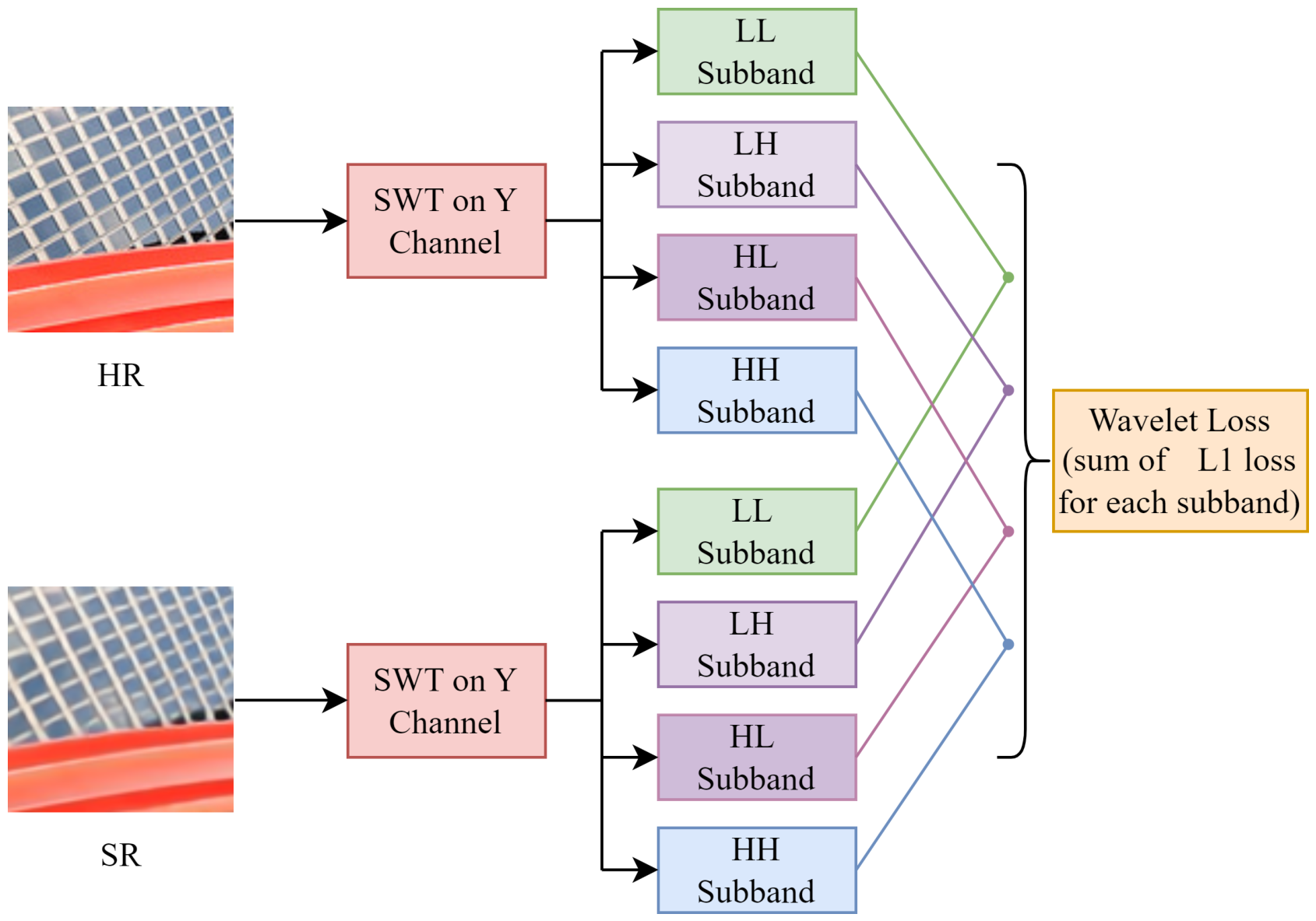
Figure 2 illustrates the computation of the SWT-domain loss during training. Given an LR input x and its corresponding HR target y, the proposed network first generates an SR image y ^ = G ( x ) . The luminance components of the SR image and the HR target are then extracted and transformed using the same single-level two-dimensional SWT. The resulting coefficient maps are decomposed into four subbands, namely LL, LH, HL, and HH. The SWT-domain loss is calculated by comparing the corresponding subbands of the SR output and the HR target using the weighted L1 distance:
L SWT = 1 B i = 1 B j { LL , LH , HL , HH } λ j S j Y ( y ^ i ) S j Y ( y i ) 1
where B denotes the mini-batch size, y ^ i = G ( x i ) is the SR output for the i-th LR input, and y i is the corresponding HR target. The operator Y ( · ) extracts the luminance channel, and S j ( · ) denotes the SWT coefficient map of the j-th subband. Thus, L SWT directly measures the differences between the corresponding wavelet coefficients of the SR output and the HR target. The subband weights are fixed as λ LL = 0.05 , λ LH = λ HL = 0.025 , and λ HH = 0.02 . The LL subband receives the largest weight because it mainly represents low-frequency structural information, whereas the LH, HL, and HH subbands provide directional high-frequency information related to edges and fine textures. These weights are fixed throughout training and are not learned adaptively.
The total training loss is defined as
L total = L RGB + L SWT
where L RGB is the RGB-domain L1 reconstruction loss between the SR output y ^ and the HR target y. During each training iteration, both y ^ and y are transformed into the luminance domain and processed by the same SWT operator to compute L SWT . The two loss terms are then summed to update the network parameters through backpropagation. The SWT operation is used only for training supervision and does not introduce an additional branch or computational operation during inference.
Overall, the contribution of RAW does not lie in proposing the GRL formulation itself, but in coordinating this existing projection strategy with LAB, NLSAB, and training-only SWT supervision to address local, mesoscale, non-local, and frequency-domain modeling requirements in lightweight SR.

4. Experimental Results and Analyses

4.1. Experimental Configuration

The experiments and code were executed on a Linux server with Ubuntu 22.04, featuring an NVIDIA RTX 4090 GPU with 24 GB of memory. We trained our model on the DIV2K dataset [26], which contained 800 training and 100 validation images. We tested it on five standard SR benchmarks: Set5 [27], Set14 [28], B100 [29], Urban [30], and Manga109 [31]. Its performance was quantified based on the PSNR and SSIM, which were measured on the luminance channel (Y) of the YCbCr color space.
We applied data augmentation via random horizontal flips and rotations during training. LR inputs were obtained through the bicubic downsampling of the HR images [32]. We trained the model by using Adam, with a batch size of 64 and over 800 K iterations. The initial learning rate was set to 10 4 , and was reduced by 50% after every 200 K iterations. Each batch input consisted of randomly cropped 64 × 64 LR patches.

4.2. Comparison with State-of-the-Art Methods

We benchmarked our method against 13 state-of-the-art SR methods for 2 × , 3 × , and 4 × upscaling tasks: EDSR-baseline [14], LatticeNet [33], ShuffleMixer [34], ESRT [18], MFCC [35], AFAN [36], FDSCSR [37], SPAN [38], PCRN [39], EFRDN [40], MWDIN [41], RTFN [42], and DCAE-Multi [19].
Table 1 compares the performance and computational complexity of lightweight SR methods across the five benchmark datasets. The results showed that the RAW substantially outperformed all other methods for 2 × , 3 × , and 4 × upscaling, and achieved PSNR and SSIM scores that were on par with or better than those of the best current models on most benchmarks. Notably, on Manga109, which is rich in structured anime content, the RAW attains the best PSNR and SSIM at every scale. This underscores its suitability for applications that demand accurate, high-frequency detail and edge restoration. Furthermore, the RAW delivered these gains in performance with significantly fewer parameters compared to most competing methods, achieving a competitive trade-off between computational cost and reconstruction fidelity.
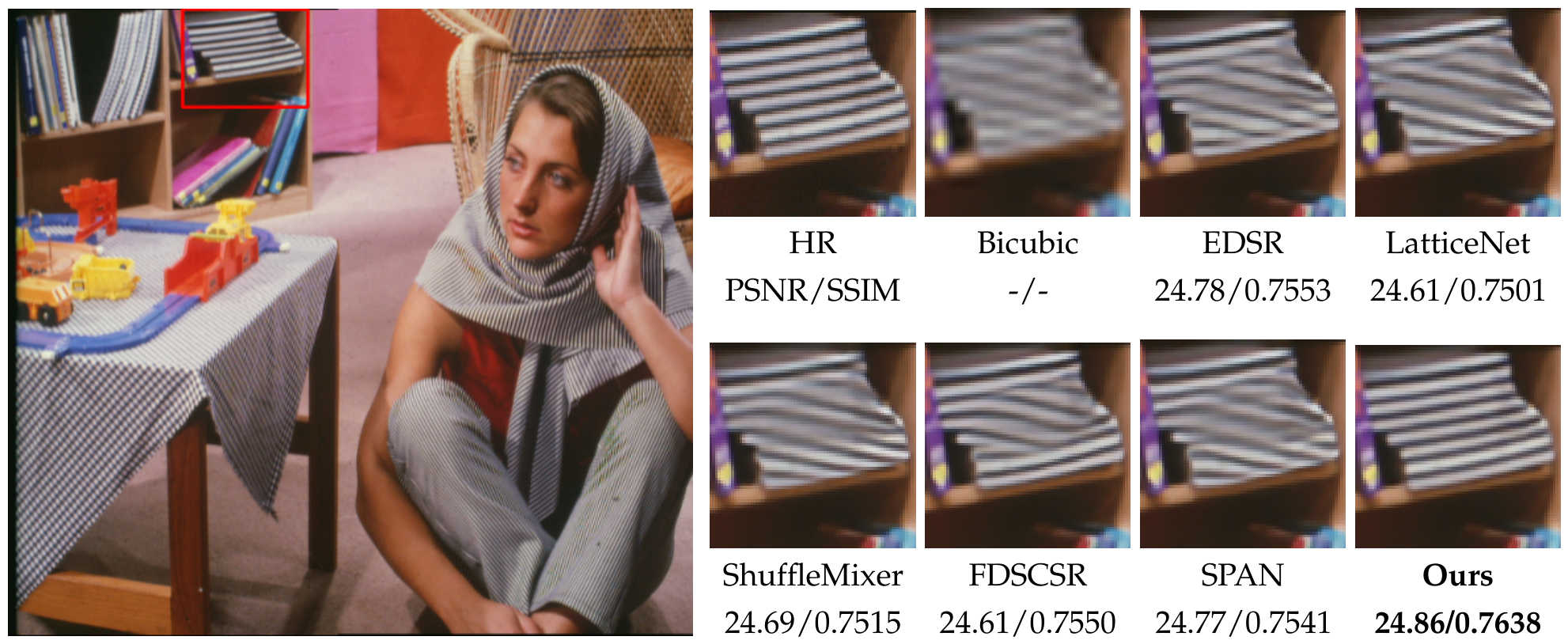
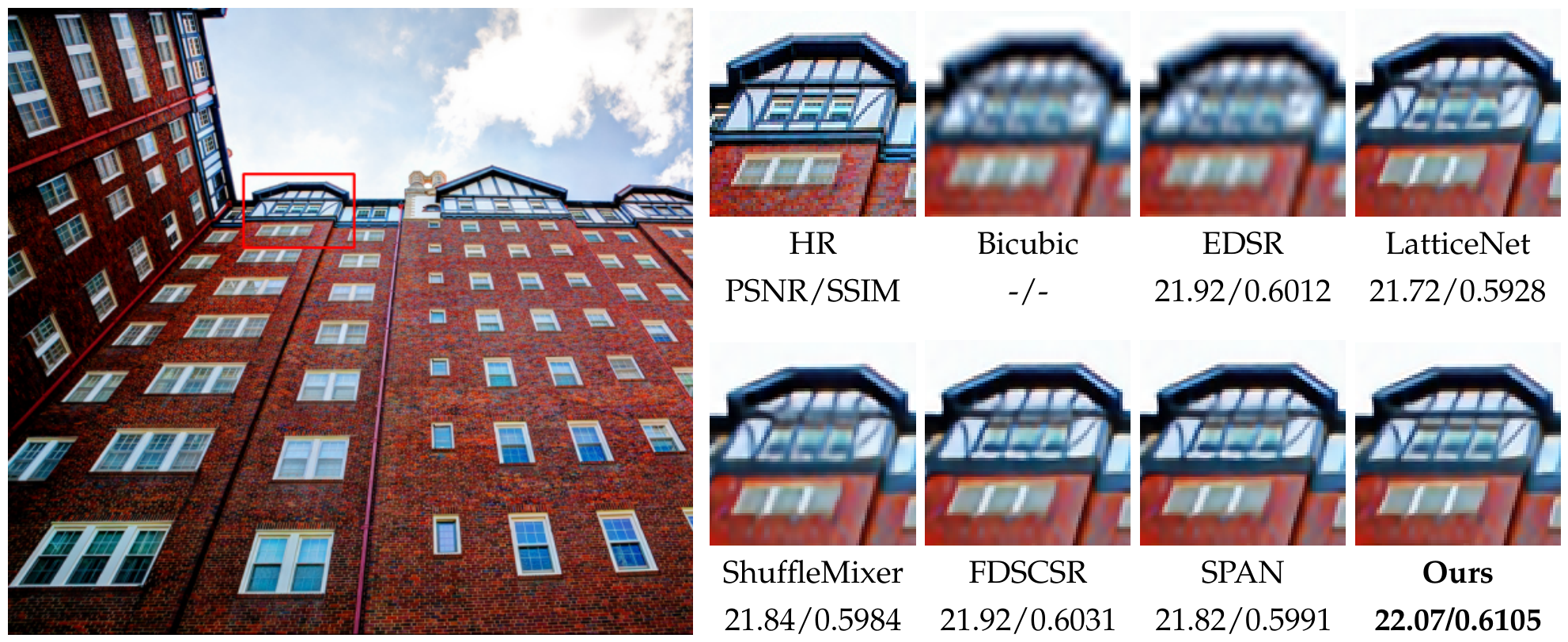
We visually compared five representative lightweight SR methods, namely EDSR, LatticeNet, ShuffleMixer, FDSCSR, and SPAN, under the 4 × super-resolution setting. The 4 × setting was selected because its more severe information loss makes the differences among the methods in edge recovery, texture reconstruction, and structural preservation more apparent. Figure 3, Figure 4 and Figure 5 present the reconstructed results of these methods on three representative test images, namely Set14-barbara, Set14-ppt3, and Urban100-img034. These visual comparisons provide representative qualitative evidence of the reconstruction performance of the evaluated methods.
The EDSR, LatticeNet, ShuffleMixer, FDSCSR, and SPAN all yielded prominent textural deformations and color biases on the Set14-barbara image. Especially acute was the loss of structural detail in the region of the bookshelf. By comparison, the RAW achieved superior color reproduction, with a PSNR of 24.86. The EDSR, LatticeNet, ShuffleMixer, FDSCSR, and SPAN generated letter reconstructions with blurred edges on the ppt3 text image, while the RAW recovered crisp and sharp character outlines. The RAW outperformed all other methods on the Urban-img034 sample in terms of reconstructing window-frame geometry, with an SSIM of 0.6105 (1.94% higher on average than competing models). This demonstrated its superior capability in retaining fine details.

4.3. Ablation Study

We conducted ablation experiments to investigate the effects of GRL projections, the NLSAB, and the SWT-domain loss on reconstruction performance and model efficiency. Table 2 and Table 3 report four progressively enhanced configurations under the 4 × upscaling setting. Model 1 (baseline) uses only the core network. Model 2 augments the baseline with GRL projections. Model 3 builds upon Model 2 by incorporating the SWT-domain loss into the composite training objective, whereas Model 4 further introduces NLSAB to form the complete RAW architecture. All experiments follow the same progressive order of component addition. Therefore, the difference between two adjacent models measures the conditional incremental effect of the newly added component under this specific sequence, rather than its independent effect in a complete factorial design.
The experimental results reveal the distinct roles of the components within the fixed progressive ablation sequence. From Model 1 to Model 2, introducing GRL projections reduces the parameter count from 792 K to 732 K and the MACs from 45.29 G to 41.67 G, corresponding to reductions of 7.6% and 8.0%, respectively. Along with this efficiency improvement, slight decreases in PSNR and SSIM are observed on several datasets, whereas the PSNR on Manga109 increases by 0.05 dB. This result indicates that GRL primarily serves as an efficiency-oriented component designed to reduce computational overhead, rather than consistently improve reconstruction performance across all datasets. The minor precision trade-offs are acceptable for lightweight deployment. From Model 2 to Model 3, the SWT-domain loss is applied only during training and introduces no additional parameters or computational cost during inference. It improves the PSNR by 0.01 dB, 0.01 dB, 0.02 dB, 0.08 dB, and 0.10 dB on Set5, Set14, B100, Urban100, and Manga109, respectively, demonstrating that the frequency-domain constraint complements conventional RGB-domain supervision for high-frequency texture restoration. From Model 3 to Model 4, incorporating the NLSAB further reduces the parameter count to 680 K and the MACs to 38.32 G. At the same time, consistent improvements in PSNR are obtained on all five benchmark datasets, reaching 26.64 dB on Urban100 and 31.32 dB on Manga109.
All performance and complexity variations described above represent conditional incremental changes between adjacent model variants under the specified additive order, rather than standalone independent effects evaluated through a full-factorial experimental design. These progressive ablation results demonstrate that the complete combination of components in Model 4 achieves a favorable trade-off between computational efficiency and reconstruction quality.

5. Conclusions

In this study, we presented RAW, a lightweight image super-resolution method that combines residual aggregation with wavelet-domain supervision. The network organizes feature interaction across three spatial ranges: LAB extracts local textures, MRGAB introduces grouped-residual attention for mesoscale aggregation, and NLSAB captures non-local dependencies through sparse interaction. Within MRGAB, GRL projections reduce redundancy in the query, key, and value projections, thereby lowering the parameter count and computational cost, although they may also lead to small dataset-dependent fluctuations in PSNR and SSIM. During training, the RGB-domain L1 loss is combined with a single-level Symlet-19 SWT loss to constrain low-frequency structures and directional high-frequency details without introducing an additional inference branch. The complete configuration therefore reflects the combined efficiency–fidelity trade-off of GRL, SWT supervision, and NLSAB, rather than a uniform accuracy gain from every individual component. For 4 × upscaling, RAW reduces the parameter count and MACs by 14.3% and 15.4%, respectively, relative to the baseline. It also improves the PSNR and SSIM on Manga109 by 0.22 dB and 0.0015, respectively. Across five standard benchmark datasets, RAW achieves competitive reconstruction performance with a compact computational footprint. These results demonstrate that RAW can effectively integrate local, mesoscale, non-local, and frequency-domain information within a lightweight architecture. In particular, its favorable balance between reconstruction quality and computational efficiency highlights its practical potential for resource-constrained image restoration applications.
However, the current work has certain limitations. The proposed method is evaluated exclusively under the bicubic downsampling degradation model, and its performance under real-world complex degradations, such as noise, blur, and compression artifacts, remains to be explored. In future work, we plan to extend RAW to handle more realistic degradation scenarios and further optimize its inference efficiency for practical deployment on resource-constrained devices. In addition, we will investigate the effects of different wavelet bases, including Haar, Daubechies, and other wavelet families, through systematic ablation studies. This may provide a deeper understanding of the sensitivity of SWT-domain supervision to wavelet selection and the potential need to adapt the subband weighting scheme to different wavelet configurations.

Author Contributions

Conceptualization, J.N., J.S., W.W. and F.Z.; methodology, J.N.; software, J.N., W.W. and F.Z.; validation, Y.L. (Ying Liu), L.S., L.C. and L.W.; formal analysis, J.N., W.W. and Y.L. (Ying Liu); investigation, J.N., Y.L. (Ying Liu), L.S., L.C., R.Z., Y.L. (Yiwen Liao), L.W. and X.F.; resources, J.S.; data curation, J.N., L.W. and Y.L. (Ying Liu); writing—original draft preparation, J.N.; writing—review and editing, J.S., W.W., F.Z. and J.N.; visualization, J.N., W.W. and X.F.; supervision, J.S.; project administration, J.S.; funding acquisition, J.S. All authors have read and agreed to the published version of the manuscript.

Funding

This research was funded by the Major Science and Technology Project of the Ministry of Water Resources of China, grant number SKS-2025041; the National Key Research and Development Program of China, grant number 2024YFC3211500; and the National Natural Science Foundation of China, grant number U2443229.

Data Availability Statement

The code supporting the findings of this study is available at https://github.com/Yvonne-1201/RAWNet.git (accessed on 15 September 2026). The benchmark datasets used in this study are publicly available from their original providers.

Acknowledgments

The authors would like to acknowledge the support from the funding agencies listed above.

Conflicts of Interest

The authors declare no conflicts of interest.

Abbreviations

The following abbreviations are used in this manuscript:
CNNConvolutional neural network
GRLGrouped residual linear
LABLocal aggregation block
MACsMultiply-accumulate operations
MRGABMesoscale residual grouping aggregation block
NLSABNon-local sparse aggregation block
OSAOmni-scale aggregation
PSNRPeak signal-to-noise ratio
RABResidual aggregation block
RAWResidual aggregation and wavelet loss
RGBRed–green–blue
SISRSingle-image super-resolution
SRSuper-resolution
SSIMStructural similarity index measure
SWTStationary wavelet transform
YCbCrYCbCr color space

References

  1. Dong, C.; Loy, C.C.; He, K.; Tang, X. Image super-resolution using deep convolutional networks. IEEE Trans. Pattern Anal. Mach. Intell. 2015, 38, 295–307. [Google Scholar] [CrossRef] [Scilit] [PubMed]
  2. Lai, W.S.; Huang, J.B.; Ahuja, N.; Yang, M.H. Fast and accurate image super-resolution with deep laplacian pyramid networks. IEEE Trans. Pattern Anal. Mach. Intell. 2018, 41, 2599–2613. [Google Scholar] [CrossRef] [Scilit] [PubMed]
  3. Zhang, Y.; Li, K.; Li, K.; Zhong, B.; Fu, Y. Residual non-local attention networks for image restoration. arXiv 2019, arXiv:1903.10082. [Google Scholar]
  4. Vaswani, A.; Shazeer, N.; Parmar, N.; Uszkoreit, J.; Jones, L.; Gomez, A.N.; Kaiser, Ł.; Polosukhin, I. Attention is all you need. Adv. Neural Inf. Process. Syst. 2017, 30, 5998–6008. [Google Scholar]
  5. Dosovitskiy, A. An image is worth 16x16 words: Transformers for image recognition at scale. arXiv 2020, arXiv:2010.11929. [Google Scholar]
  6. Talreja, J.; Aramvith, S.; Onoye, T. Dhtcun: Deep hybrid transformer cnn u network for single-image super-resolution. IEEE Access 2024, 12, 122624–122641. [Google Scholar] [CrossRef] [Scilit]
  7. Bian, Y.; Huang, J.; Cai, X.; Yuan, J.; Church, K. On attention redundancy: A comprehensive study. In Proceedings of the 2021 Conference of the North American Chapter of the Association for Computational Linguistics: Human Language Technologies, Online, 6–11 June 2021; pp. 930–945. [Google Scholar]
  8. Zhang, X.; Zeng, H.; Guo, S.; Zhang, L. Efficient long-range attention network for image super-resolution. In Proceedings of the European Conference on Computer Vision; Springer: Cham, Switzerland, 2022; pp. 649–667. [Google Scholar]
  9. Li, Y.; Deng, Z.; Cao, Y.; Liu, L. GRFormer: Grouped residual self-attention for lightweight single image super-resolution. In Proceedings of the 32nd ACM International Conference on Multimedia, Melbourne, VIC, Australia, 28 October–1 November 2024; pp. 9378–9386. [Google Scholar]
  10. Mehta, S.; Rastegari, M. Mobilevit: Light-weight, general-purpose, and mobile-friendly vision transformer. arXiv 2021, arXiv:2110.02178. [Google Scholar]
  11. Wang, Y.; Li, Y.; Wang, G.; Liu, X. Multi-scale attention network for single image super-resolution. In Proceedings of the IEEE/CVF Conference on Computer Vision and Pattern Recognition, Seattle, WA, USA, 16–22 June 2024; pp. 5950–5960. [Google Scholar]
  12. Korkmaz, C.; Tekalp, A.M. Training transformer models by wavelet losses improves quantitative and visual performance in single image super-resolution. In Proceedings of the IEEE/CVF Conference on Computer Vision and Pattern Recognition, Seattle, WA, USA, 16–22 June 2024; pp. 6661–6670. [Google Scholar]
  13. Kim, J.; Lee, J.K.; Lee, K.M. Accurate image super-resolution using very deep convolutional networks. In Proceedings of the IEEE Conference on Computer Vision and Pattern Recognition, Las Vegas, NV, USA, 27–30 June 2016; pp. 1646–1654. [Google Scholar]
  14. Lim, B.; Son, S.; Kim, H.; Nah, S.; Mu Lee, K. Enhanced deep residual networks for single image super-resolution. In Proceedings of the IEEE Conference on Computer Vision and Pattern Recognition Workshops, Honolulu, HI, USA, 21–26 July 2017; pp. 136–144. [Google Scholar]
  15. Zhang, Y.; Li, K.; Li, K.; Wang, L.; Zhong, B.; Fu, Y. Image super-resolution using very deep residual channel attention networks. In Proceedings of the European conference on computer vision (ECCV), Munich, Germany, 8–14 September 2018; pp. 286–301. [Google Scholar]
  16. Liang, J.; Cao, J.; Sun, G.; Zhang, K.; Van Gool, L.; Timofte, R. Swinir: Image restoration using swin transformer. In Proceedings of the IEEE/CVF International Conference on Computer Vision, Montreal, QC, Canada, 11–17 October 2021; pp. 1833–1844. [Google Scholar]
  17. Chen, H.; Wang, Y.; Guo, T.; Xu, C.; Deng, Y.; Liu, Z.; Ma, S.; Xu, C.; Xu, C.; Gao, W. Pre-trained image processing transformer. In Proceedings of the IEEE/CVF Conference on Computer Vision and Pattern Recognition, Nashville, TN, USA, 19–25 June 2021; pp. 12299–12310. [Google Scholar]
  18. Lu, Z.; Li, J.; Liu, H.; Huang, C.; Zhang, L.; Zeng, T. Transformer for single image super-resolution. In Proceedings of the IEEE/CVF Conference on Computer Vision and Pattern Recognition, New Orleans, LA, USA, 18–24 June 2022; pp. 457–466. [Google Scholar]
  19. Zhou, Y.; Zhang, Y.; Xie, X.; Kung, S.Y. Image super-resolution based on dense convolutional auto-encoder blocks. Neurocomputing 2021, 423, 98–109. [Google Scholar] [CrossRef] [Scilit]
  20. Dai, T.; Cai, J.; Zhang, Y.; Xia, S.T.; Zhang, L. Second-order attention network for single image super-resolution. In Proceedings of the IEEE/CVF Conference on Computer Vision and Pattern Recognition, Long Beach, CA, USA, 15–20 June 2019; pp. 11065–11074. [Google Scholar]
  21. Mei, Y.; Fan, Y.; Zhang, Y.; Yu, J.; Zhou, Y.; Liu, D.; Fu, Y.; Huang, T.S.; Shi, H. Pyramid attention network for image restoration. Int. J. Comput. Vis. 2023, 131, 3207–3225. [Google Scholar] [CrossRef] [Scilit]
  22. Niu, B.; Wen, W.; Ren, W.; Zhang, X.; Yang, L.; Wang, S.; Zhang, K.; Cao, X.; Shen, H. Single image super-resolution via a holistic attention network. In Proceedings of the European Conference on Computer Vision; Springer: Cham, Switzerland, 2020; pp. 191–207. [Google Scholar]
  23. Hui, Z.; Gao, X.; Yang, Y.; Wang, X. Lightweight image super-resolution with information multi-distillation network. In Proceedings of the 27th ACM International Conference on Multimedia, Nice, France, 21–25 October 2019; pp. 2024–2032. [Google Scholar]
  24. Wang, H.; Chen, X.; Ni, B.; Liu, Y.; Liu, J. Omni aggregation networks for lightweight image super-resolution. In Proceedings of the IEEE/CVF Conference on Computer Vision and Pattern Recognition, Vancouver, BC, Canada, 17–24 June 2023; pp. 22378–22387. [Google Scholar]
  25. Kim, J.; Lee, J.K.; Lee, K.M. Deeply-recursive convolutional network for image super-resolution. In Proceedings of the IEEE Conference on Computer Vision and Pattern Recognition, Las Vegas, NV, USA, 27–30 June 2016; pp. 1637–1645. [Google Scholar]
  26. Agustsson, E.; Timofte, R. Ntire 2017 challenge on single image super-resolution: Dataset and study. In Proceedings of the IEEE Conference on Computer Vision and Pattern Recognition Workshops, Honolulu, HI, USA, 21–26 July 2017; pp. 126–135. [Google Scholar]
  27. Bevilacqua, M.; Roumy, A.; Guillemot, C.; Alberi-Morel, M.L. Low-complexity single-image super-resolution based on nonnegative neighbor embedding. In Proceedings of the British Machine Vision Conference (BMVC), Guildford, UK, 3–7 September 2012. [Google Scholar]
  28. Zeyde, R.; Elad, M.; Protter, M. On single image scale-up using sparse-representations. In Proceedings of the International Conference on Curves and Surfaces; Springer: Berlin/Heidelberg, Germany, 2010; pp. 711–730. [Google Scholar]
  29. Martin, D.; Fowlkes, C.; Tal, D.; Malik, J. A database of human segmented natural images and its application to evaluating segmentation algorithms and measuring ecological statistics. In Proceedings of the Eighth IEEE International Conference on Computer Vision; ICCV 2001; IEEE: Piscataway, NJ, USA, 2001; Volume 2, pp. 416–423. [Google Scholar]
  30. Huang, J.B.; Singh, A.; Ahuja, N. Single image super-resolution from transformed self-exemplars. In Proceedings of the IEEE Conference on Computer Vision and Pattern Recognition, Boston, MA, USA, 7–12 June 2015; pp. 5197–5206. [Google Scholar]
  31. Matsui, Y.; Ito, K.; Aramaki, Y.; Fujimoto, A.; Ogawa, T.; Yamasaki, T.; Aizawa, K. Sketch-based manga retrieval using manga109 dataset. Multimed. Tools Appl. 2017, 76, 21811–21838. [Google Scholar] [CrossRef] [Scilit]
  32. Zhang, K.; Zuo, W.; Gu, S.; Zhang, L. Learning deep CNN denoiser prior for image restoration. In Proceedings of the IEEE Conference on Computer Vision and Pattern Recognition, Honolulu, HI, USA, 21–26 July 2017; pp. 3929–3938. [Google Scholar]
  33. Luo, X.; Xie, Y.; Zhang, Y.; Qu, Y.; Li, C.; Fu, Y. LatticeNet: Towards Lightweight Image Super-Resolution with Lattice Block. In Proceedings of the Computer Vision—ECCV 2020; Springer International Publishing: Cham, Switzerland, 2020; pp. 272–289. [Google Scholar]
  34. Sun, L.; Pan, J.; Tang, J. Shufflemixer: An efficient convnet for image super-resolution. Adv. Neural Inf. Process. Syst. 2022, 35, 17314–17326. [Google Scholar] [CrossRef] [Scilit]
  35. Ruangsang, W.; Aramvith, S.; Onoye, T. Multi-FusNet of cross channel network for image super-resolution. IEEE Access 2023, 11, 56287–56299. [Google Scholar] [CrossRef] [Scilit]
  36. Wang, L.; Li, K.; Tang, J.; Liang, Y. Image super-resolution via lightweight attention-directed feature aggregation network. ACM Trans. Multimed. Comput. Commun. Appl. 2023, 19, 1–23. [Google Scholar] [CrossRef] [Scilit]
  37. Wang, Z.; Gao, G.; Li, J.; Yan, H.; Zheng, H.; Lu, H. Lightweight feature de-redundancy and self-calibration network for efficient image super-resolution. ACM Trans. Multimed. Comput. Commun. Appl. 2023, 19, 1–15. [Google Scholar] [CrossRef] [Scilit]
  38. Wan, C.; Yu, H.; Li, Z.; Chen, Y.; Zou, Y.; Liu, Y.; Yin, X.; Zuo, K. Swift parameter-free attention network for efficient super-resolution. In Proceedings of the IEEE/CVF Conference on Computer Vision and Pattern Recognition, Seattle, WA, USA, 16–22 June 2024; pp. 6246–6256. [Google Scholar]
  39. Zhang, L.; Wan, Y. Partial convolutional reparameterization network for lightweight image super-resolution. J. Real-Time Image Process. 2024, 21, 187. [Google Scholar] [CrossRef] [Scilit]
  40. Liu, C.; Gao, G.; Wu, F.; Guo, Z.; Yu, Y. An efficient feature reuse distillation network for lightweight image super-resolution. Comput. Vis. Image Underst. 2024, 249, 104178. [Google Scholar] [CrossRef] [Scilit]
  41. Wang, S.; Liu, G.; Liu, X.; Liao, X.; Ren, C. Efficient image super resolution via Mixed Window and Dimension Interaction. Neurocomputing 2025, 620, 129211. [Google Scholar] [CrossRef] [Scilit]
  42. Chen, J.; Mao, M.; Guan, A.; Ayush, A. Residual trio feature network for efficient super-resolution. Complex Intell. Syst. 2025, 11, 9. [Google Scholar] [CrossRef] [Scilit]
Figure 1. Overall RAW framework and the expanded structure of one residual aggregation block (RAB). Each RAB successively contains LAB, MRGAB, and NLSAB; RGSA is located inside MRGAB.
Electronics 15 04271 g001
Figure 2. Principle diagram of the loss function of the wavelet domain. Per-pixel L1 loss across SWT sub-bands, with the hybrid model trained by the weighted fusion of RGB and SWT losses.
Electronics 15 04271 g002
Figure 3. Visual results for a scale factor of 4 × on image “Barbara” from Set14.
Electronics 15 04271 g003
Figure 4. Visual results for a scale factor of 4 × on image “ppt3” from Set14.
Electronics 15 04271 g004
Figure 5. Visual results for a scale factor of 4 × on image “img034” from Urban100.
Electronics 15 04271 g005
Table 1. Quantitative evaluation of state-of-the-art SR algorithms: average PSNR/SSIM for scale factors 2 × , 3 × , and 4 × . The best performance is shown in red and the second-best performance in blue (“-” indicates that the corresponding result is unavailable).
ScaleMethodParams (K)MACs (G)Set5Set14B100Urban100Manga109
PSNR/SSIMPSNR/SSIMPSNR/SSIMPSNR/SSIMPSNR/SSIM
2 × EDSR-baseline1370316.3037.99/0.960433.57/0.917532.16/0.899431.98/0.927238.54/0.9769
LatticeNet756169.5038.15/0.961033.78/0.919332.25/0.900532.43/0.9302-/-
ShuffleMixer39445.0538.01/0.960633.63/0.918032.17/0.899531.89/0.925739.83/0.9774
MFCC1861364.5038.16/0.961133.85/0.919532.28/0.901032.65/0.933139.11/0.9780
AFAN1208289.5038.06/0.960833.74/0.919832.20/0.900132.38/0.930538.79/0.9773
FDSCSR823215.8038.12/0.960933.69/0.919132.24/0.900432.50/0.931538.89/0.9775
SPAN481-38.08/0.960833.71/0.918332.22/0.900232.24/0.929438.94/0.9777
PCRN368-38.05/0.961133.62/0.918432.23/0.900032.23/0.928639.05/0.9779
EFRDN768111.6038.03/0.960933.65/0.918532.16/0.899732.34/0.929838.86/0.9776
MWDIN536112.8038.16/0.961433.97/0.920632.33/0.902132.58/0.931339.31/0.9785
DCAE-Multi--37.74/0.959433.29/0.914432.05/0.897731.44/0.9207-/-
Ours659145.1738.18/0.961933.88/0.922032.38/0.902432.95/0.936039.41/0.9786
3 × EDSR-baseline1555160.1034.37/0.927030.28/0.841729.09/0.805228.15/0.852733.45/0.9439
LatticeNet76576.3034.53/0.928130.39/0.842429.15/0.805928.33/0.8538-/-
ESRT770-34.42/0.926830.43/0.843329.15/0.806328.46/0.857433.95/0.9455
ShuffleMixer41521.5034.40/0.927230.37/0.842329.12/0.805128.08/0.849833.69/0.9448
MFCC2230374.1034.67/0.929430.51/0.845629.22/0.808028.64/0.861634.15/0.9478
AFAN1208143.1034.46/0.927130.38/0.843629.11/0.806428.31/0.855633.61/0.9451
FDSCSR83096.4034.50/0.928130.43/0.844229.15/0.806828.40/0.857633.78/0.9460
EFRDN76849.5034.44/0.927530.38/0.841429.10/0.805928.29/0.854233.73/0.9453
MWDIN54550.9034.58/0.929030.48/0.845029.21/0.809328.43/0.856734.14/0.9471
DCAE-Multi--34.12/0.925130.02/0.835329.00/0.801827.63/0.8394-/-
Ours66866.2234.46/0.930430.25/0.848429.21/0.811228.89/0.867034.44/0.9501
4 × EDSR-baseline1518114.2032.09/0.893828.58/0.781327.57/0.735726.04/0.784930.35/0.9067
LatticeNet77743.6032.30/0.896228.68/0.783027.62/0.736726.25/0.7873-/-
ESRT751-32.19/0.894728.69/0.783327.69/0.737926.39/0.796230.75/0.9100
ShuffleMixer41114.0032.21/0.895328.66/0.782727.61/0.736626.08/0.783530.65/0.9093
MFCC2157395.2032.42/0.897328.73/0.784927.67/0.739926.48/0.797730.98/0.9131
AFAN122690.1032.30/0.895128.66/0.783827.61/0.738326.27/0.791330.63/0.9109
FDSCSR83954.8032.36/0.897028.67/0.784027.63/0.738426.33/0.793530.69/0.9113
SPAN498-32.20/0.895328.66/0.783427.62/0.737426.18/0.787930.66/0.9103
PCRN389-32.28/0.896428.68/0.783227.64/0.736926.21/0.788330.68/0.9105
EFRDN76727.9032.33/0.896428.67/0.783327.63/0.738426.37/0.793930.76/0.9113
MWDIN55729.4032.42/0.898728.77/0.785727.70/0.741526.38/0.792031.06/0.9134
RTFN--32.26/0.895328.63/0.781827.61/0.736426.27/0.788730.55/0.9075
DCAE-Multi--31.79/0.889528.31/0.774127.42/0.729125.66/0.7695-/-
Ours68038.3232.41/0.899628.55/0.788727.80/0.744326.64/0.803331.32/0.9187
Table 2. Model configurations for the ablation study of the proposed network. The four RAW variants are progressively constructed under a fixed component-addition order, enabling conditional comparisons between adjacent configurations.
ModelBaselineGRLNLSABSWTParams/MACs
1 792 K/45.29 G
2 732 K/41.67 G
3 732 K/41.67 G
4680 K/38.32 G
Table 3. Performance results of the ablation study on the proposed network. PSNR/SSIM values are reported for four progressively constructed RAW variants under a fixed component-addition order.
ModelSet5Set14B100Urban100Manga109
132.34/0.899228.56/0.788427.77/0.743326.57/0.801731.10/0.9172
232.39/0.898728.50/0.787527.75/0.742826.52/0.800731.15/0.9169
332.40/0.899128.51/0.787827.77/0.743426.60/0.802331.25/0.9175
432.41/0.899628.55/0.788727.80/0.744326.64/0.803331.32/0.9187
Disclaimer/Publisher’s Note: The statements, opinions and data contained in all publications are solely those of the individual author(s) and contributor(s) and not of MDPI and/or the editor(s). MDPI and/or the editor(s) disclaim responsibility for any injury to people or property resulting from any ideas, methods, instructions or products referred to in the content.