Adaptive Multi-Objective Beamforming and Power Allocation for MIMO-ISAC in Low-Altitude Wireless Networks



Abstract
1. Introduction
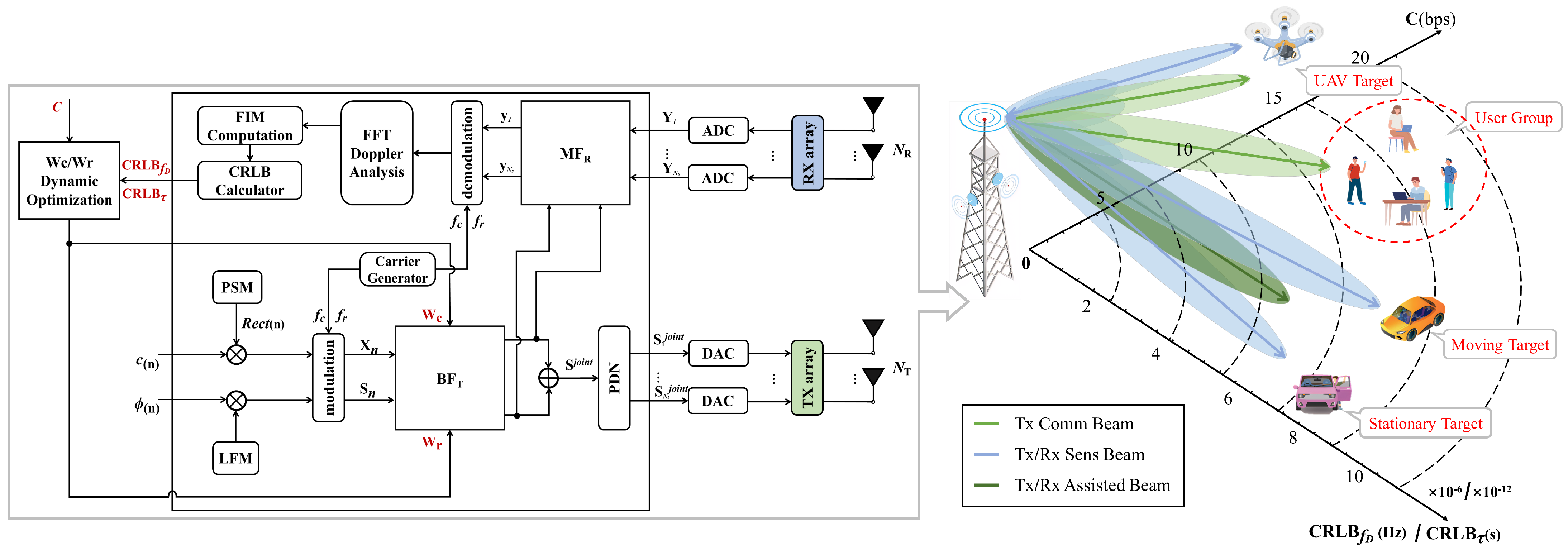
- We establish an MIMO-ISAC signal model for multi-user downlink transmission and target tracking. The target direction is supplied by a preceding acquisition stage and is treated as known during one beam design interval. Communication data and the radar probing signal are jointly transmitted, and both are exploited in delay–Doppler estimation.
- A dimensionless metric, termed the system effectiveness integrated metric (SEIM), is defined as a weighted sum of normalized communication sum spectral efficiency, delay information, and Doppler information. The normalization boundaries are evaluated over the same power, SINR, and radar-resource feasible set as the joint problem.
- The non-convex beamforming problem is lifted to transmit covariance variables and treated by semidefinite relaxation (SDR). An alternating successive convex approximation (SCA) procedure constructs convex lower-bound subproblems for the radar and communication covariance blocks while retaining the total power and per-user SINR constraints.
- The objective weights are obtained from an entropy-regularized scalarization subproblem. Its closed-form softmax solution and a damping step produce a simplex-preserving adaptive update between covariance iterations.
2. System Model, Communication and Sensing Metrics, and Problem Formulation
2.1. Signal Model
2.2. Multi-User Multiple-Input Single-Output Communication Subsystem
2.3. Multiple-Input Multiple-Output Radar Subsystem
2.4. Problem Formulation
3. Problem Solution Framework
3.1. Performance Boundary Determination
3.1.1. Cramér–Rao Lower Bound Minimization
3.1.2. Communication Efficiency Maximization
3.2. Waveform Optimization Design via Alternative Method
3.2.1. Radar Covariance Update
| Algorithm 1 Radar covariance update via SCA |
Input: , , , , , and tolerance .
|
3.2.2. Communication Covariance Update
| Algorithm 2 Communication covariance update via SCA |
| Input: , , , , , and . |
3.3. Multi-Objective Optimization with Adaptive Weight
| Algorithm 3 Alternating SDR–SCA with adaptive weights |
Input: , , , , , , , and tolerance .
|
3.4. Recovery of Transmit Beam Matrices
4. Performance Evaluation
4.1. Network Set-Up
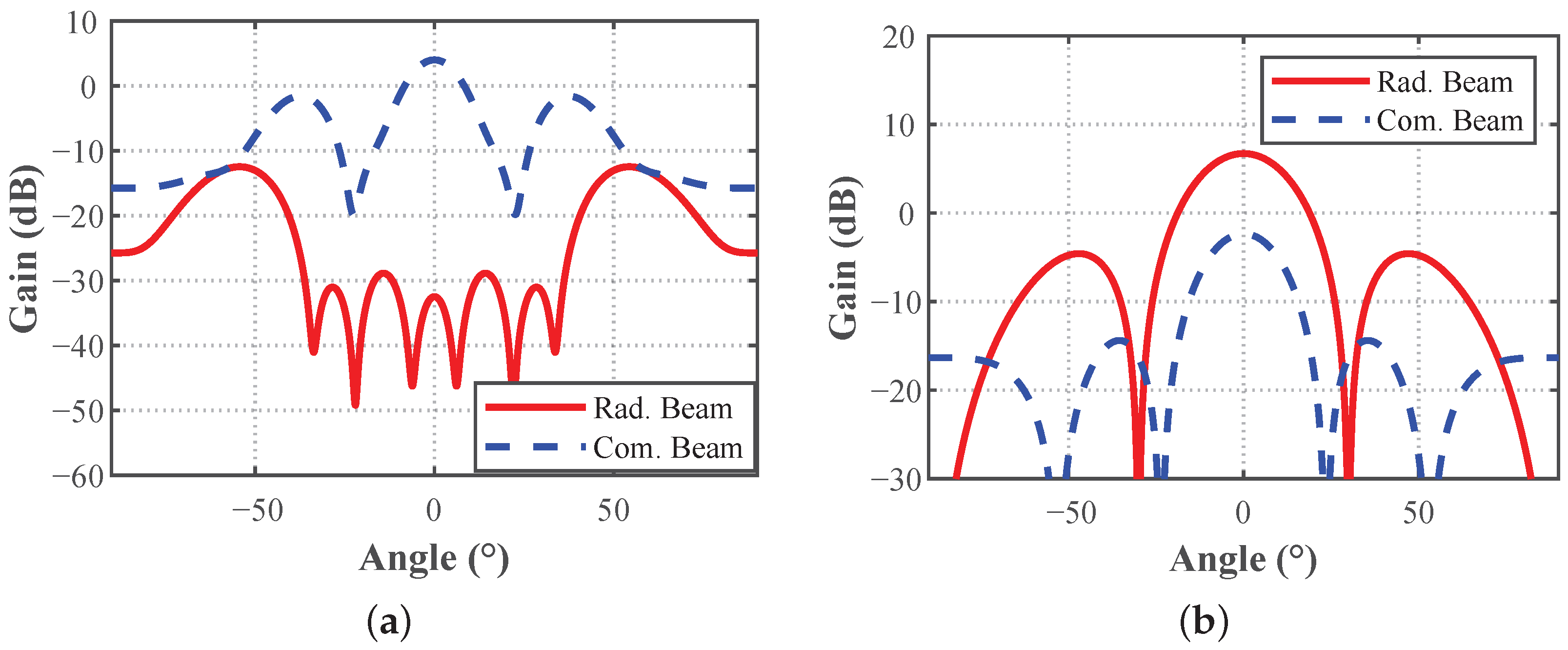
4.2. Beampatterns at Boundary Operating Points
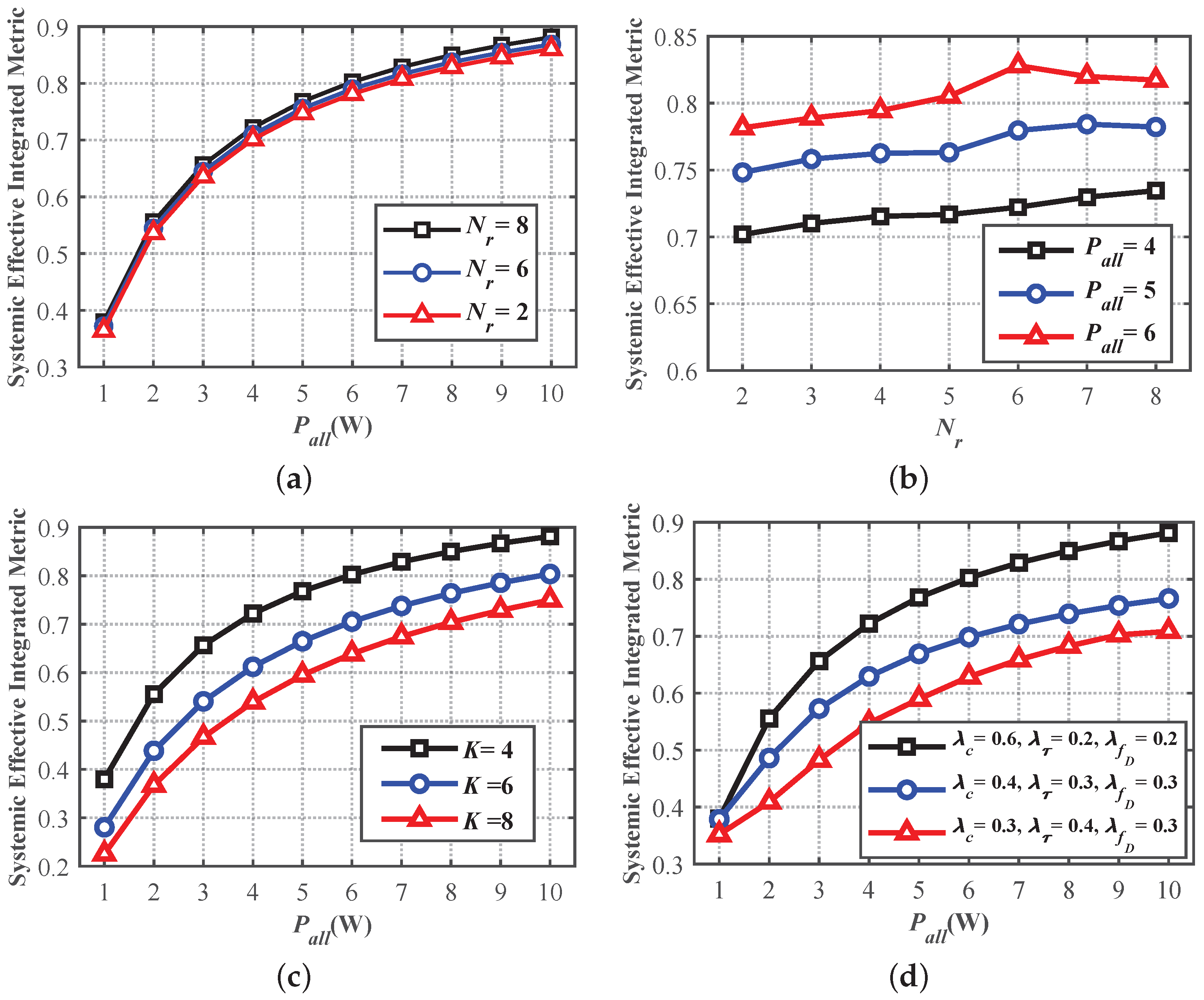
4.3. Impact of Transmit Power
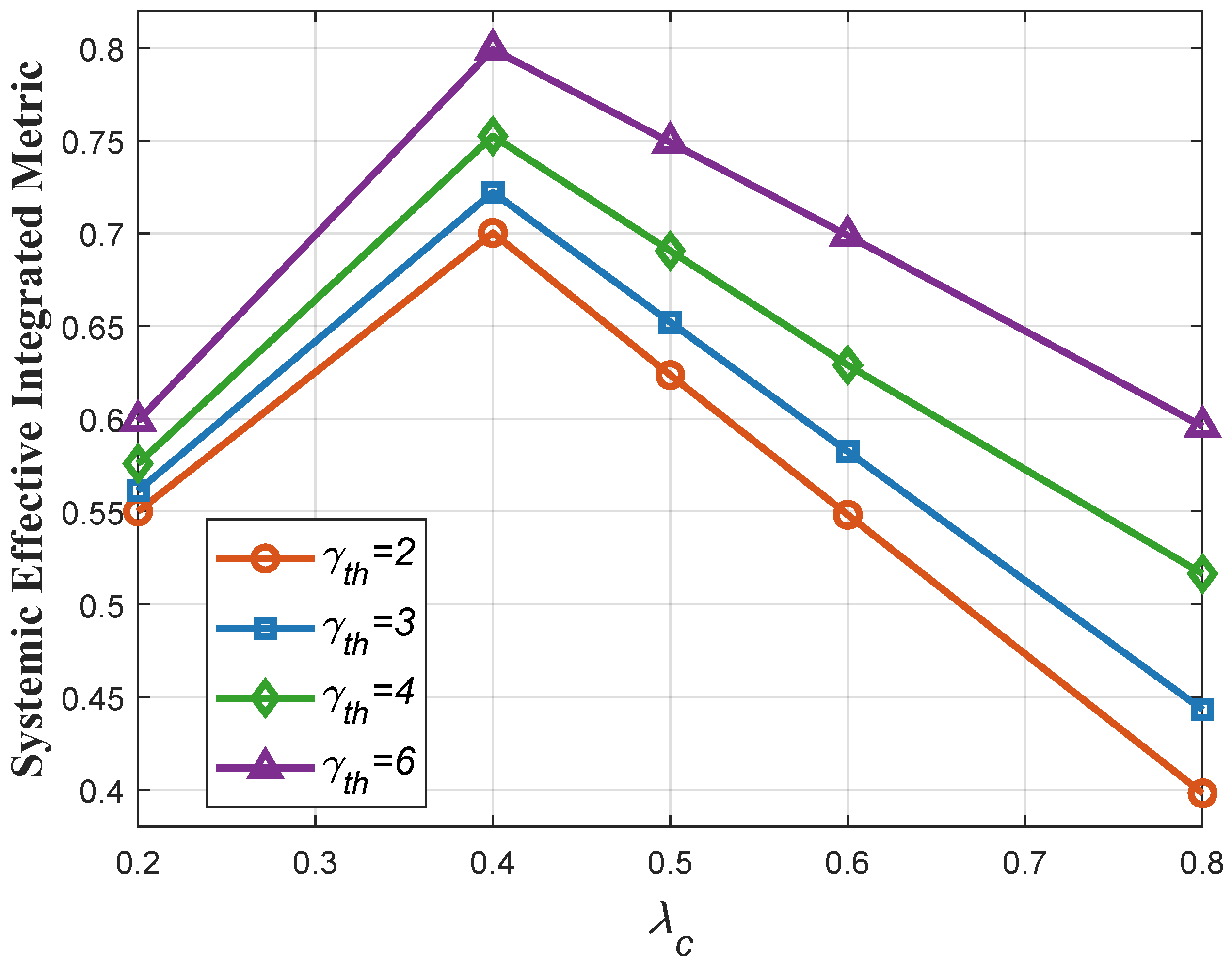
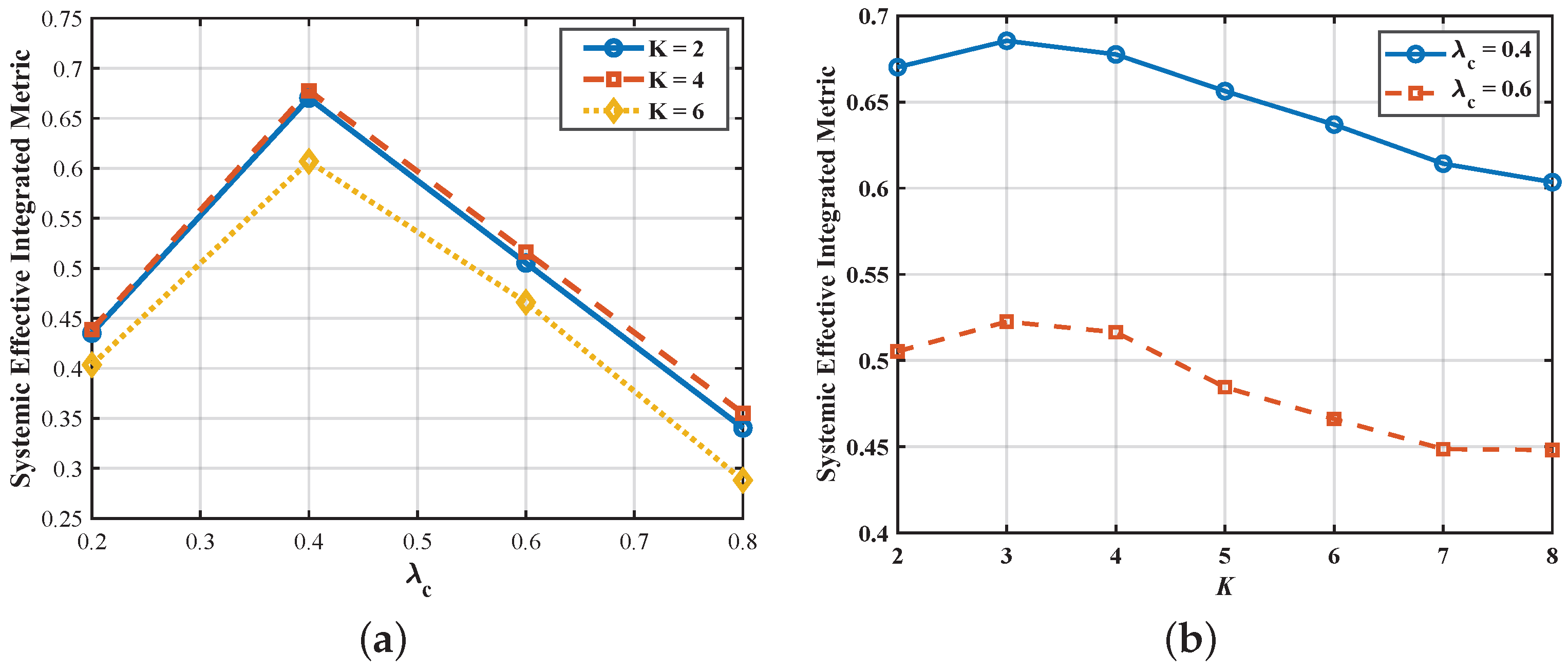
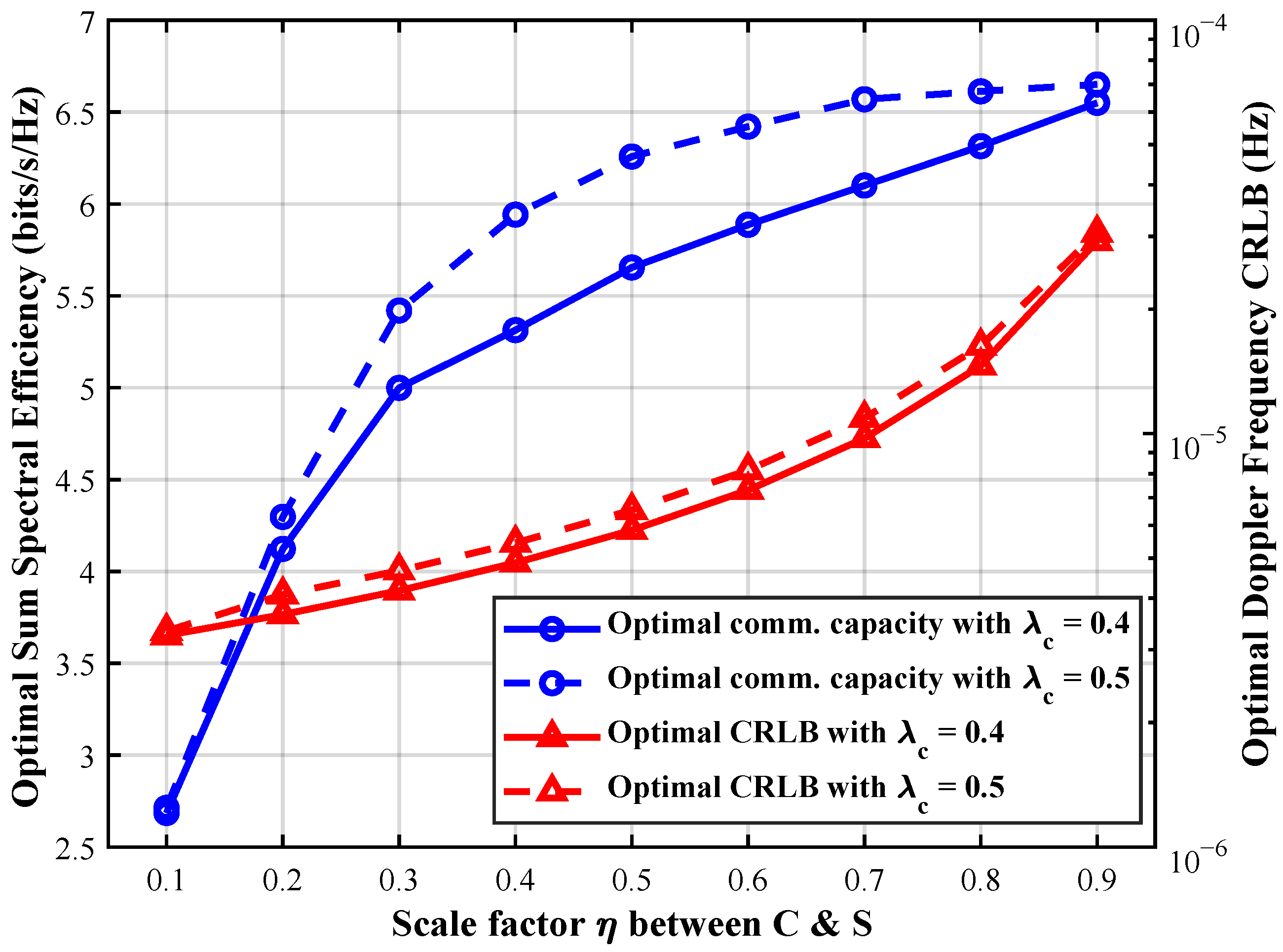
4.4. Impact of Communication Parameters
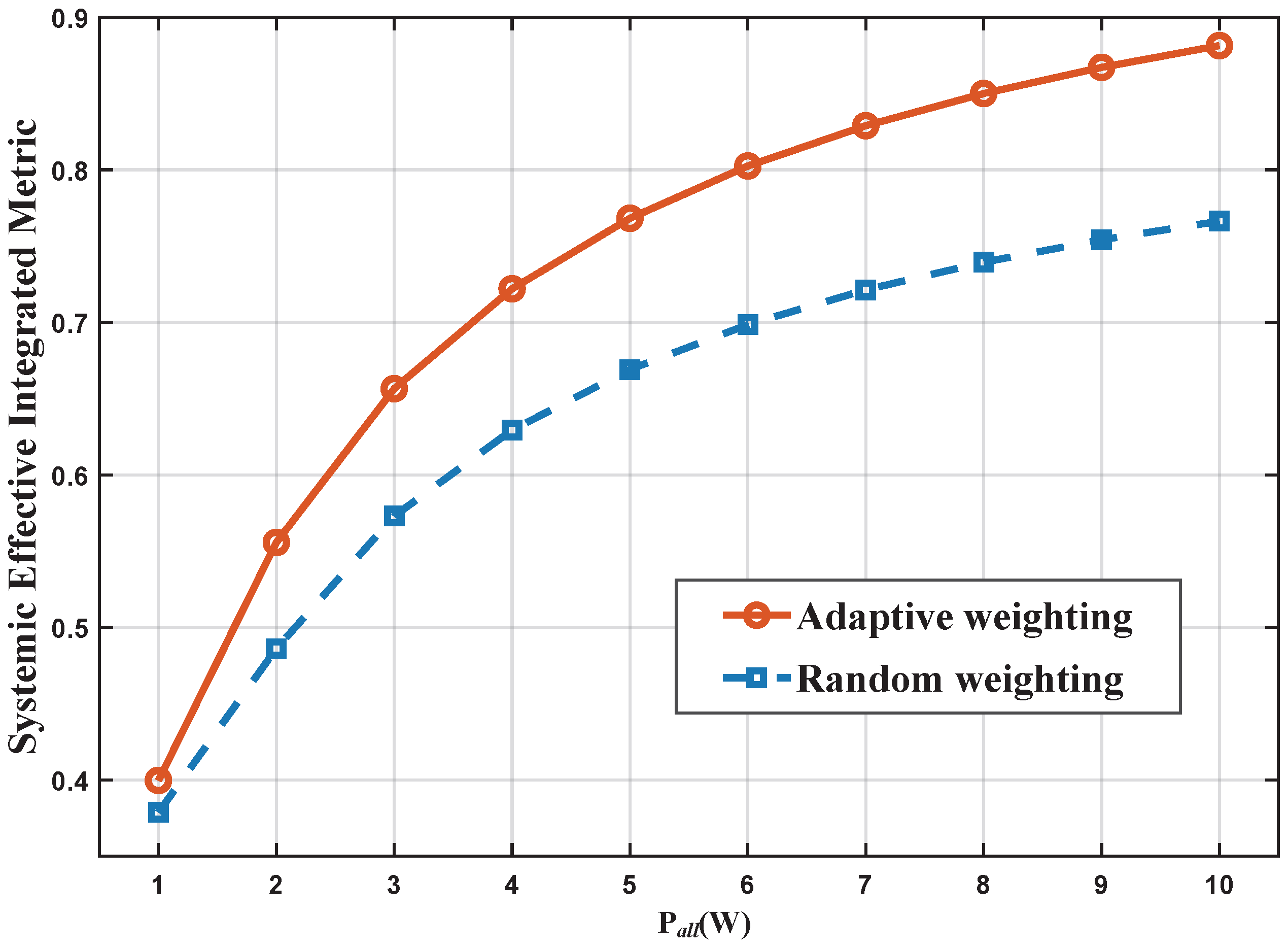
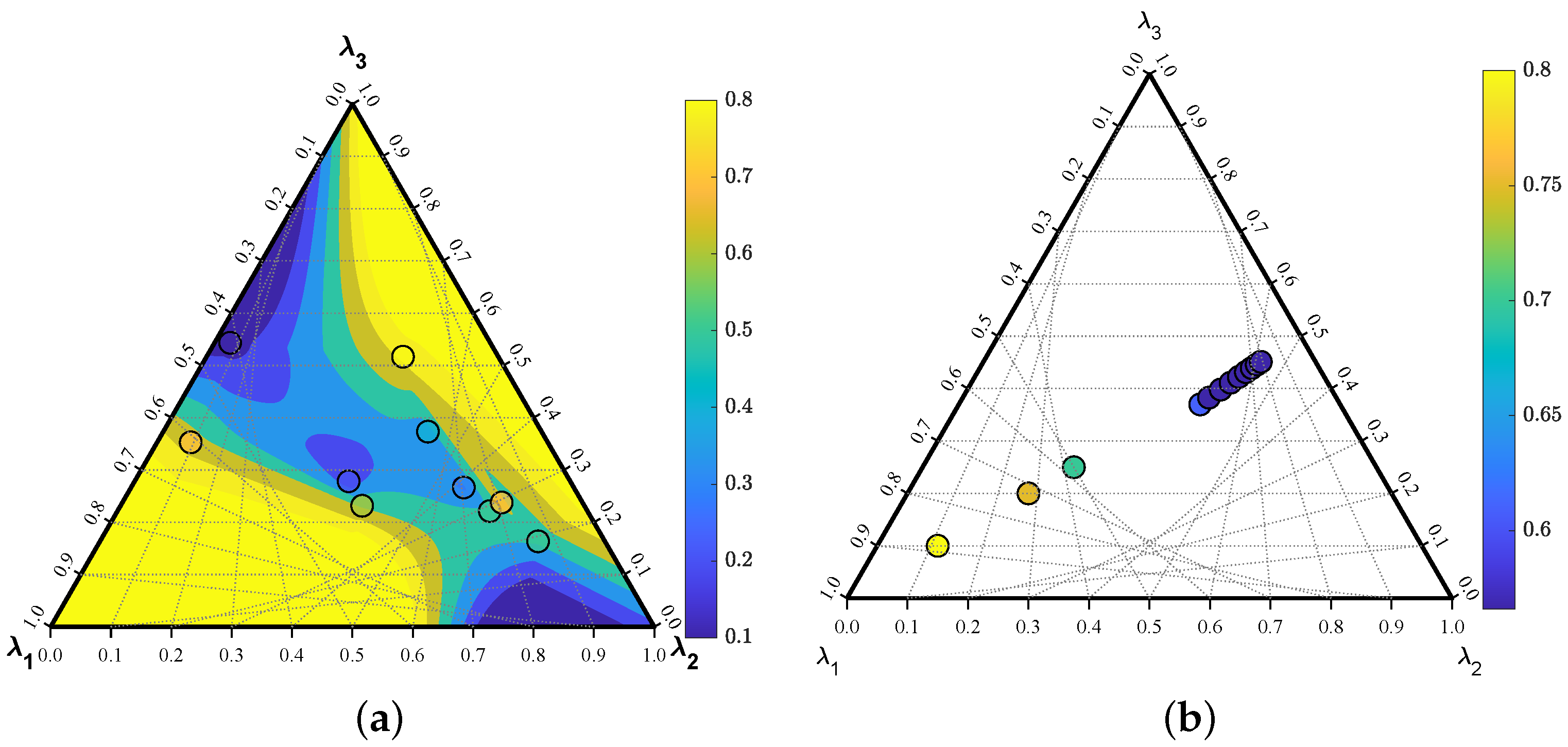
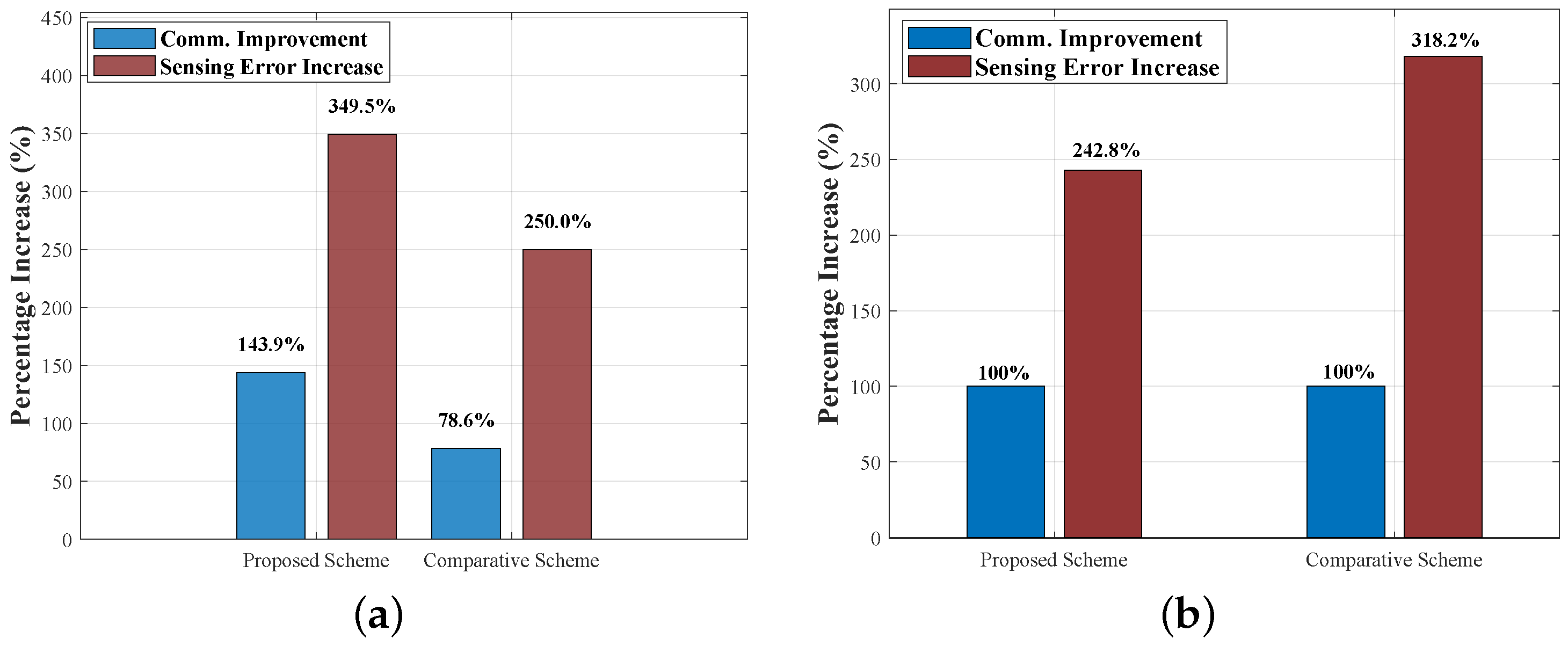
4.5. Comparison of Weighting Strategies for Multi-Objective Optimization
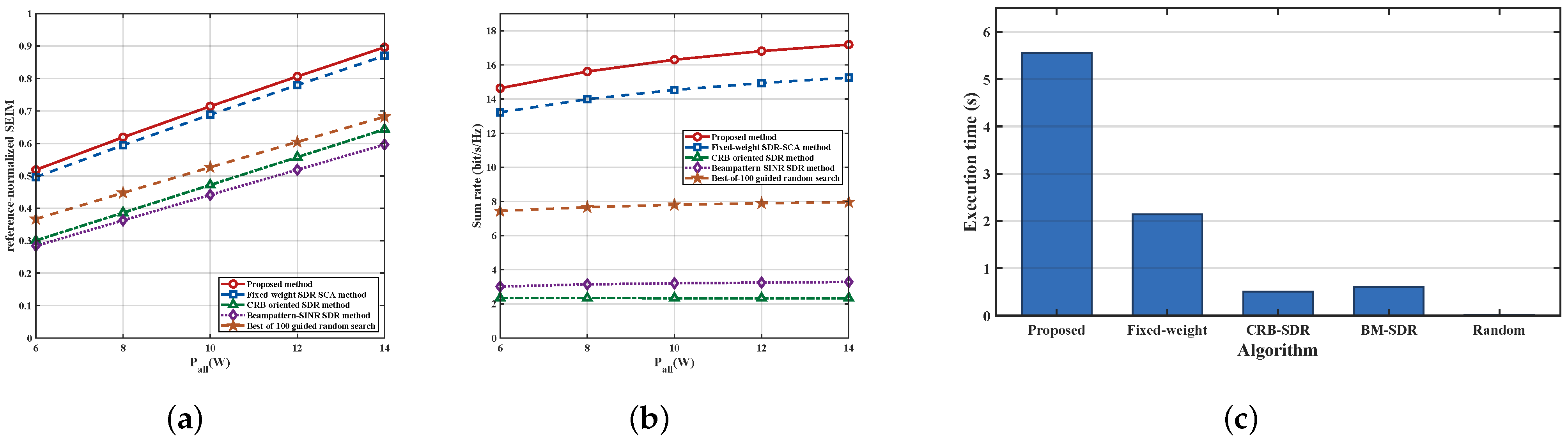
4.6. Comparative Analysis of Holistic Optimization Methods
5. Conclusions
Author Contributions
Funding
Data Availability Statement
Conflicts of Interest
Appendix A. Proof of Theorem 1
References
- Fang, X.; Feng, W.; Chen, Y.; Ge, N.; Zhang, Y. Joint Communication and Sensing Toward 6G: Models and Potential of Using MIMO. IEEE Internet Things J. 2023, 10, 4093–4116. [Google Scholar] [CrossRef] [Scilit]
- Liu, R.; Li, M.; Luo, H.; Liu, Q.; Swindlehurst, A.L. Integrated Sensing and Communication with Reconfigurable Intelligent Surfaces: Opportunities, Applications, and Future Directions. IEEE Wirel. Commun. 2023, 30, 50–57. [Google Scholar] [CrossRef] [Scilit]
- Zhu, X.; Liu, J.; Lu, L.; Zhang, T.; Qiu, T.; Wang, C.; Liu, Y. Enabling Intelligent Connectivity: A Survey of Secure ISAC in 6G Networks. IEEE Commun. Surv. Tutor. 2025, 27, 748–781. [Google Scholar] [CrossRef] [Scilit]
- Su, X.; Song, J.; Liu, Z.; Guan, X.; Yang, F.; Dong, Y.; Zhang, H.; Wang, J.; Pan, C.; Zhang, X. Optical Integrated Sensing and Communication: From Theory to Practice. Tsinghua Sci. Technol. 2025. [Google Scholar] [CrossRef] [Scilit]
- Pucci, L.; Paolini, E.; Giorgetti, A. System-Level Analysis of Joint Sensing and Communication Based on 5G New Radio. IEEE J. Sel. Areas Commun. 2022, 40, 2043–2055. [Google Scholar] [CrossRef] [Scilit]
- Hua, H.; Han, T.X.; Xu, J. MIMO Integrated Sensing and Communication: CRB-Rate Tradeoff. IEEE Trans. Wirel. Commun. 2024, 23, 2839–2854. [Google Scholar] [CrossRef] [Scilit]
- Liu, F.; Yuan, W.; Masouros, C.; Yuan, J. Radar-Assisted Predictive Beamforming for Vehicular Links: Communication Served by Sensing. IEEE Trans. Wirel. Commun. 2020, 19, 7704–7719. [Google Scholar] [CrossRef] [Scilit]
- Cui, Y.; Ding, H.; Ma, Y.; Li, X.; Zhang, H.; Fang, Y. Energy-Efficient Integrated Sensing and Communication in Collaborative Millimeter Wave Networks. IEEE Trans. Wirel. Commun. 2025, 24, 2341–2357. [Google Scholar] [CrossRef] [Scilit]
- Yin, L.; Liu, Z.; Shankar, M.R.B.; Alaee-Kerahroodi, M.; Clerckx, B. Integrated Sensing and Communications Enabled Low Earth Orbit Satellite Systems. IEEE Netw. 2024, 38, 252–258. [Google Scholar] [CrossRef] [Scilit]
- Gu, M.X.; Lee, M.C.; Liu, Y.S.; Lee, T.S. Design and Analysis of Frequency Hopping-Aided FMCW-Based Integrated Radar and Communication Systems. IEEE Trans. Commun. 2022, 70, 8416–8432. [Google Scholar] [CrossRef] [Scilit]
- Liyanaarachchi, S.D.; Riihonen, T.; Barneto, C.B.; Valkama, M. Optimized Waveforms for 5G–6G Communication With Sensing: Theory, Simulations and Experiments. IEEE Trans. Wirel. Commun. 2021, 20, 8301–8315. [Google Scholar] [CrossRef] [Scilit]
- Dong, F.; Wang, W.; Hu, Z.; Hui, T. Low-Complexity Beamformer Design for Joint Radar and Communications Systems. IEEE Commun. Lett. 2021, 25, 259–263. [Google Scholar] [CrossRef] [Scilit]
- Liu, F.; Liu, Y.F.; Li, A.; Masouros, C.; Eldar, Y.C. Cramér–Rao Bound Optimization for Joint Radar–Communication Beamforming. IEEE Trans. Signal Process. 2022, 70, 240–253. [Google Scholar] [CrossRef] [Scilit]
- Liu, Y.; Liao, G.; Yang, Z.; Xu, J. Multiobjective Optimal Waveform Design for OFDM Integrated Radar and Communication Systems. Signal Process. 2017, 141, 331–342. [Google Scholar] [CrossRef] [Scilit]
- Nguyen, N.T.; Shlezinger, N.; Eldar, Y.C.; Juntti, M. Multiuser MIMO Wideband Joint Communications and Sensing System With Subcarrier Allocation. IEEE Trans. Signal Process. 2023, 71, 2997–3013. [Google Scholar] [CrossRef] [Scilit]
- Barneto, C.B.; Liyanaarachchi, S.D.; Heino, M.; Riihonen, T.; Valkama, M. Full Duplex Radio/Radar Technology: The Enabler for Advanced Joint Communication and Sensing. IEEE Wirel. Commun. 2021, 28, 82–88. [Google Scholar] [CrossRef] [Scilit]
- Xu, C.; Zhang, S. MIMO Integrated Sensing and Communication Exploiting Prior Information. IEEE J. Sel. Areas Commun. 2024, 42, 2306–2321. [Google Scholar] [CrossRef] [Scilit]
- Zhu, Q.; Li, M.; Liu, R.; Liu, Q. Joint Transceiver Beamforming and Reflecting Design for Active RIS-Aided ISAC Systems. IEEE Trans. Veh. Technol. 2023, 72, 9636–9640. [Google Scholar] [CrossRef] [Scilit]
- Su, N.; Liu, F.; Masouros, C. Sensing-Assisted Eavesdropper Estimation: An ISAC Breakthrough in Physical Layer Security. IEEE Trans. Wirel. Commun. 2024, 23, 3162–3174. [Google Scholar] [CrossRef] [Scilit]
- He, X.; Huang, L. Joint MIMO Communication and MIMO Radar Under Different Practical Waveform Constraints. IEEE Trans. Veh. Technol. 2020, 69, 16342–16347. [Google Scholar] [CrossRef] [Scilit]
- Xiao, Z.; Zeng, Y. Waveform Design and Performance Analysis for Full-Duplex Integrated Sensing and Communication. IEEE J. Sel. Areas Commun. 2022, 40, 1823–1837. [Google Scholar] [CrossRef] [Scilit]
- Liu, W.; Hou, X.; Liu, J.; Chen, L. Low-Overhead Sensing RS Design for Integrated Sensing and Communication (ISAC). In Proceedings of the 2025 IEEE Wireless Communications and Networking Conference (WCNC), Milan, Italy, 24–27 March 2025; pp. 1–6. [Google Scholar] [CrossRef] [Scilit]
- Zhang, L.; Lei, X.; Ma, T.; Niu, H.; Yuen, C. Joint User Localization, Channel Estimation, and Pilot Optimization for RIS-ISAC. IEEE Trans. Wirel. Commun. 2024, 23, 19302–19316. [Google Scholar] [CrossRef] [Scilit]
- Rao, C.R. Information and the Accuracy Attainable in the Estimation of Statistical Parameters. Bull. Calcutta Math. Soc. 1945, 37, 81–91. [Google Scholar]
- Kay, S.M. Fundamentals of Statistical Signal Processing, Volume I: Estimation Theory; Prentice Hall PTR: Upper Saddle River, NJ, USA, 1993. [Google Scholar]
- Mao, W.; Lu, Y.; Chi, C.Y.; Ai, B.; Zhong, Z.; Ding, Z. Communication-Sensing Region for Cell-Free Massive MIMO ISAC Systems. IEEE Trans. Wirel. Commun. 2024, 23, 12396–12411. [Google Scholar] [CrossRef] [Scilit]
- Grant, M.; Boyd, S. CVX: Matlab Software for Disciplined Convex Programming, Version 2.2; CVX Research, Inc.: Austin, TX, USA, 2020; Available online: https://cvxr.com/cvx (accessed on 10 August 2026).
- Wang, H.; Yan, T.; Zhou, N.; Li, X.; Wen, F.; Du, W. Enhanced Polar-Domain Channel Estimation for Near-Field XL-MIMO in Low-SNR Scenarios. IEEE Trans. Veh. Technol. 2025, 74, 19407–19419. [Google Scholar] [CrossRef] [Scilit]



| Reference | Objective | Approach | Main Distinction |
|---|---|---|---|
| [12] | Beampattern-SINR design | Iterative convex relaxation | Beampattern-based sensing without parameter estimation CRLB optimization |
| [13] | Estimation accuracy optimization | CRLB-oriented beamforming | Sensing-oriented objective with communication QoS constraints |
| [14] | CRB-capacity tradeoff | Weighted multi-objective optimization | Prescribed objective weights |
| [15] | C&S resource allocation | Subcarrier allocation | Frequency-domain resource partitioning |
| [17] | Prior-aided sensing accuracy | Posterior CRLB optimization | Relies on prior target information |
| [18] | RIS-aided NLoS sensing | Joint transceiver and RIS design | Requires RIS configuration and associated CSI |
| [19] | Physical-layer security | DOA-assisted secure beamforming | Security-oriented design based on sensing-derived DOA |
| This work | Rate-delay-Doppler tradeoff | Adaptive SDR-SCA optimization | Boundary-normalized SEIM with adaptive objective-weight selection |
| Symbol | Description | Value |
|---|---|---|
| Transmit antennas | 8 | |
| Receive antennas | 8 | |
| K | Communication users | 4 |
| Normalized antenna spacing | ||
| Rician factor | 5 ( dB) | |
| User noise power | W | |
| Nominal total power | 10 W | |
| – | Total power sweep | 6–14 W |
| Comm. power fraction | 0.5 | |
| Minimum user SINR | 0.5 ( dB) | |
| Nominal user distances | m | |
| Nominal user azimuths | ||
| Relative distance perturbation | ||
| Azimuth perturbation | ||
| Antenna gains | 10 dBi | |
| Target RCS | ||
| BS–UAV slant range | 100 m | |
| Predicted target azimuth | ||
| Reflection phase | ||
| Gaussian randomization trials | 100 |
Disclaimer/Publisher’s Note: The statements, opinions and data contained in all publications are solely those of the individual author(s) and contributor(s) and not of MDPI and/or the editor(s). MDPI and/or the editor(s) disclaim responsibility for any injury to people or property resulting from any ideas, methods, instructions or products referred to in the content. |
© 2026 by the authors. Licensee MDPI, Basel, Switzerland. This article is an open access article distributed under the terms and conditions of the Creative Commons Attribution (CC BY) license.
Share and Cite
Yang, B.; Huo, Y.; Fan, X.; Wang, C. Adaptive Multi-Objective Beamforming and Power Allocation for MIMO-ISAC in Low-Altitude Wireless Networks. Electronics 2026, 15, 4121. https://doi.org/10.3390/electronics15184121
Yang B, Huo Y, Fan X, Wang C. Adaptive Multi-Objective Beamforming and Power Allocation for MIMO-ISAC in Low-Altitude Wireless Networks. Electronics. 2026; 15(18):4121. https://doi.org/10.3390/electronics15184121
Chicago/Turabian StyleYang, Bing, Yan Huo, Xin Fan, and Chang Wang. 2026. "Adaptive Multi-Objective Beamforming and Power Allocation for MIMO-ISAC in Low-Altitude Wireless Networks" Electronics 15, no. 18: 4121. https://doi.org/10.3390/electronics15184121
APA StyleYang, B., Huo, Y., Fan, X., & Wang, C. (2026). Adaptive Multi-Objective Beamforming and Power Allocation for MIMO-ISAC in Low-Altitude Wireless Networks. Electronics, 15(18), 4121. https://doi.org/10.3390/electronics15184121