1. Introduction
Healthcare delivery is undergoing a profound digital transformation that is reshaping how medical services are provided, managed, and accessed [
1]. In recent decades, the widespread adoption of EHRs, telemedicine platforms, and the IoMT has shifted healthcare infrastructure from isolated, institution-centric systems toward highly interconnected digital ecosystems [
1,
2,
3,
4]. These advancements have significantly improved clinical efficiency, remote patient monitoring, healthcare accessibility, and personalized treatment delivery. However, the increasing interconnectivity of healthcare infrastructures has also introduced substantial security, privacy, and interoperability challenges.
The rapid expansion of IoMT devices has further intensified these concerns. IoMT-enabled healthcare systems continuously collect, transmit, and analyze a large volume of sensitive patient information across clinical and remote environments [
5,
6]. Although such technologies enhance personalized healthcare services and real-time monitoring capabilities, they simultaneously enlarge the cyberattack surface of healthcare ecosystems. In recent years, the healthcare sector has experienced some of the highest rates of data breaches due to the high value and sensitivity of medical information [
7]. A notable example is the 2021 cyberattack on the Irish Health Service Executive, which severely disrupted healthcare operations nationwide and exposed vulnerabilities in modern digital healthcare infrastructure [
8].
Despite ongoing technological advancements, many healthcare institutions continue to rely on traditional centralized architectures for managing sensitive medical data. These systems often suffer from limited transparency, poor interoperability, single points of failure, and insufficient patient control over personal health records [
9]. Furthermore, compliance with regulatory frameworks, including the General Data Protection Regulation (GDPR) and the Health Insurance Portability and Accountability Act (HIPAA), introduces additional technical, operational, and ethical complexities related to data governance and secure information exchange.
To address these limitations, blockchain technology has emerged as a promising solution for secure and decentralized healthcare data management [
10,
11,
12]. Through distributed ledger mechanisms, cryptographic hashing, consensus protocols, and smart contract automation, blockchain enables immutable record-keeping, verifiable data provenance, transparent auditing, and decentralized access control. Consequently, blockchain-based healthcare applications have gained significant attention in areas such as EHR management, telemedicine, pharmaceutical supply chains, insurance claim processing, and patient consent management [
13,
14,
15].
Nevertheless, despite its advantages, blockchain technology remains structurally dependent on classical cryptographic primitives, including RSA, SHA-256, and ECDSA. These cryptographic mechanisms are theoretically vulnerable to future large-scale quantum computing attacks. Shor’s algorithm can efficiently solve the integer factorization and elliptic-curve discrete logarithm problems, thereby threatening the security of RSA- and ECDSA-based systems [
16]. Similarly, Grover’s algorithm reduces the effective security strength of cryptographic hash functions such as SHA-256 by significantly accelerating brute-force search operations [
17]. As major technology organizations, including IBM and Google, continue to advance quantum computing research, concerns regarding the long-term security of existing blockchain infrastructures are becoming increasingly significant [
18,
19].
1.1. Motivation of the Study
As mentioned above, the emergence of quantum computing presents a critical challenge for blockchain-enabled healthcare systems due to their reliance on quantum-vulnerable cryptographic algorithms. Although recent advancements in PQC, Quantum Key Distribution (QKD), and Quantum Random Number Generation (QRNG) provide promising directions for quantum-resilient security, existing studies remain fragmented and largely application-specific. Current research primarily focuses on either blockchain security, post-quantum cryptographic mechanisms, or quantum communication protocols independently, while comprehensive frameworks integrating these technologies within healthcare environments remain limited. Furthermore, the increasing adoption of IoMT devices, cross-institutional healthcare data exchange, and AI-driven healthcare services demand scalable, interoperable, and future-proof security architectures capable of resisting both classical and quantum-era cyber threats. These challenges highlight the urgent need for a systematic investigation into the convergence of blockchain and quantum technologies for secure e-health infrastructures.
1.2. Research Contributions
Motivated by these challenges, this study provides a comprehensive review and conceptual framework for quantum-resilient blockchain-based healthcare systems. The main contributions of this study are summarized as follows:
A structured review of 57 peer-reviewed studies published between January 2018 and June 2025 was conducted across IEEE Xplore, PubMed, ACM Digital Library, Google Scholar, and Crossref to analyze the intersection of blockchain, quantum security, and e-health systems.
Twenty representative studies at the blockchain–quantum–healthcare intersection were systematically compared across six analytical dimensions, including cryptographic design, blockchain platform, healthcare context, maturity level, security objectives, and implementation limitations.
The study analyses the impact of quantum computing threats on existing blockchain infrastructures, particularly focusing on vulnerabilities associated with RSA, ECDSA, SHA-256, and conventional key exchange mechanisms.
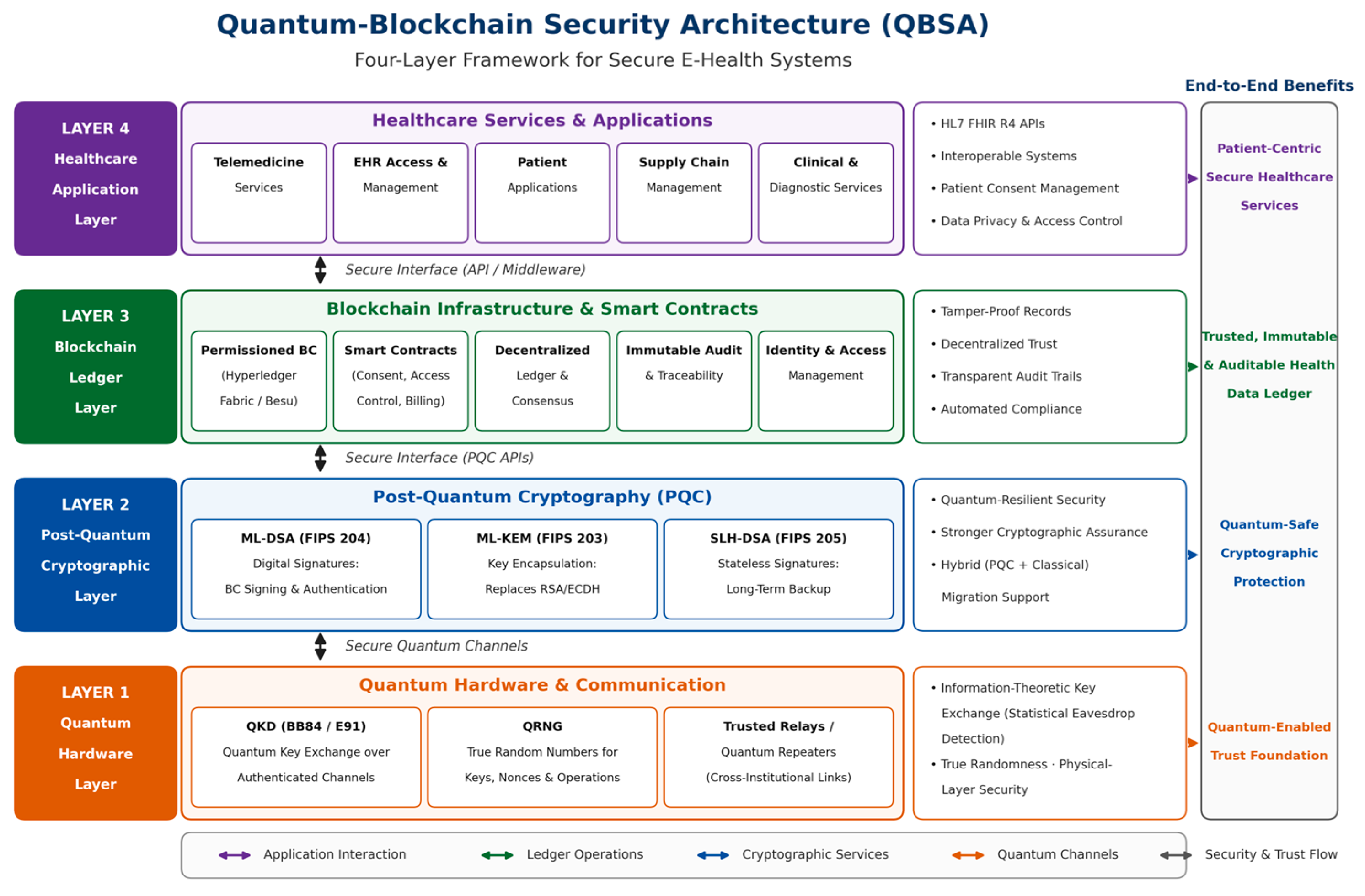
A novel four-layer Quantum-Blockchain Security Architecture (QBSA) is proposed to support secure, scalable, and quantum-resilient healthcare ecosystems through the integration of PQC, QKD, QRNG, and permissioned blockchain infrastructures.
The paper presents a comparative analysis of NIST-standardized PQC algorithms (FIPS 203, FIPS 204, and FIPS 205) with emphasis on computational efficiency, security strength, and suitability for IoMT-constrained healthcare deployments.
The study highlights unresolved challenges related to lightweight PQC integration, interoperability, regulatory compliance, quantum hardware limitations, and secure cross-border healthcare data exchange.
1.3. Research Methodology
This review follows a structured methodology based on the PRISMA 2020 (Preferred Reporting Items for Systematic Reviews and Meta-Analyses) guidelines [
20]. Relevant literature published between 1 January 2018 and 30 June 2025 was collected from five scientific sources: IEEE Xplore, PubMed, ACM Digital Library (queried through the Crossref metadata API), Google Scholar, and the Crossref scholarly metadata index. Crossref was adopted in place of Scopus—to which institutional access was not available—because it offers an open and fully reproducible query interface. The search was executed on 11 August 2026, during the revision of this article, and was restricted to records published within the review window. The generic search string combined three concept groups using Boolean operators: (“blockchain” OR “distributed ledger”) AND (“quantum” OR “post-quantum” OR “quantum key distribution” OR “quantum-resistant”) AND (“healthcare” OR “e-health” OR “EHR” OR “electronic health record” OR “Internet of Medical Things” OR “IoMT” OR “telemedicine”). The string was syntactically adapted to each source (e.g., “All Metadata” in IEEE Xplore, title/abstract fields in PubMed, six documented bibliographic queries in Crossref, and a publisher-scoped Crossref query for ACM content); for Google Scholar, the 200 highest-ranked results were screened. The complete source-specific search strategies are provided in
Supplementary File S1. This review was conducted and reported in accordance with the PRISMA 2020 statement [
20] (completed checklist in
Supplementary File S1); the review protocol was not registered.
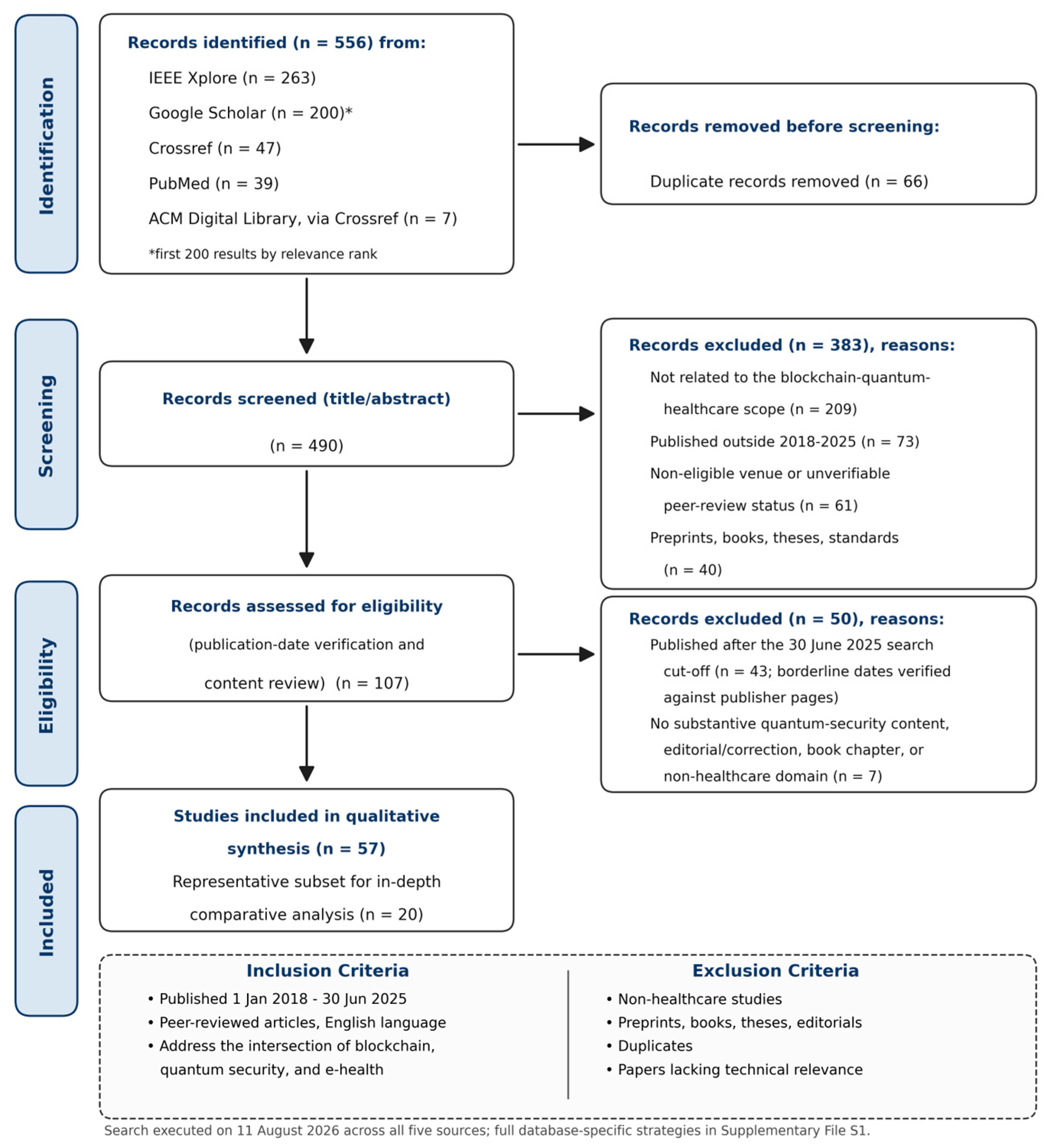
The search returned 556 records in total: IEEE Xplore (n = 263), Google Scholar (n = 200), Crossref (n = 47), PubMed (n = 39), and ACM Digital Library via Crossref (n = 7). After removal of 66 duplicates, 490 records underwent title and abstract screening, during which 383 records were excluded (209 not related to the blockchain–quantum–healthcare scope, 73 published outside 2018–2025, 61 from non-eligible venues or with unverifiable peer-review status, and 40 preprints, book chapters, theses, or standards documents). The remaining 107 records were assessed for eligibility through publication-date verification against the 30 June 2025 cut-off and a content review; 50 records were excluded at this stage (43 published after the cut-off—with the dates of ten borderline records verified individually against the publisher pages—and 7 that were editorials, correction notices, a book chapter identified at full-text review, non-healthcare applications, or lacked substantive quantum-security content), yielding 57 included studies. Screening was rule-assisted (keyword-based pre-classification of titles and abstracts) and performed by the author in two passes separated in time, with borderline records re-examined individually; a standardized extraction form recording publication year, source, technology focus, healthcare context, and key findings was used (
Supplementary File S1). As a single-author review, no inter-reviewer disagreement procedure was applicable, which is acknowledged as a methodological limitation. Study adequacy was appraised using a four-criterion checklist (clarity of security objectives, technical soundness, evaluation evidence, and healthcare relevance), and the resulting classification is reported in
Supplementary Table S2.
To avoid ambiguity regarding the composition of the evidence base, four categories of cited material are distinguished throughout this review: (i) the 57 studies forming the systematic-review corpus (peer-reviewed, January 2018–June 2025), listed in full in
Supplementary Table S2; (ii) background references cited for specific technical or contextual points but not retrieved by the systematic search, including foundational works published before 2018 (e.g., Shor’s and Grover’s algorithms, the BB84 protocol, and early systems such as MedRec); (iii) standards and institutional reports (e.g., NIST FIPS 203/204/205 and industry incident reports), which are treated as primary technical sources rather than corpus studies; and (iv) a representative subset of 20 studies selected for the in-depth comparative analysis in Table 3 (selection criteria are given in
Section 7.1), drawn from both the corpus and the foundational literature. Entries in Table 3 that fall outside the search corpus are explicitly marked. The inclusion criteria considered studies that:
were published between 1 January 2018 and 30 June 2025,
were peer-reviewed and written in English,
addressed blockchain, quantum security, or e-health technologies,
and demonstrated technical or architectural relevance to healthcare cybersecurity.
Studies were excluded if they:
lacked healthcare relevance,
were non-technical or editorial articles,
duplicated previously indexed works,
or did not contribute directly to blockchain or quantum-security applications in healthcare.
Figure 1 illustrates the PRISMA 2020–based study selection workflow adopted in this review [
20].
1.4. Organization of the Study
The remainder of this paper is organized in the following manner. Following the introduction,
Section 2 outlines the essential security and operational requirements of e-health systems.
Section 3 discusses blockchain technology and its healthcare applications.
Section 4 introduces the principles of quantum computing and its relevance to healthcare security.
Section 5 analyses quantum threats to blockchain-based e-health systems.
Section 6 examines opportunities enabled by quantum-enhanced blockchain technologies.
Section 7 presents hybrid frameworks and the proposed QBSA.
Section 8 discusses open challenges and research gaps.
Section 9 highlights future research directions, and finally,
Section 10 concludes the paper.
2. Requirements of Secure E-Health Systems
Having established the motivation for quantum-resilient healthcare security, this section distils the essential security and operational requirements that any secure e-health architecture must satisfy; these requirements also serve as the design criteria against which the QBSA proposed in
Section 7 was formulated [
21,
22]. Contemporary e-health ecosystems integrate Electronic Health Records (EHRs), telemedicine platforms, cloud infrastructures, wearable devices, and IoMT technologies to support efficient healthcare operations and real-time patient monitoring. Within this ecosystem, EHR systems play a critical role in storing, managing, and exchanging sensitive clinical information, including medical histories, prescriptions, diagnostic reports, and laboratory results. Despite these advancements, the increasing digitization and interconnectivity of healthcare systems pose substantial challenges to security, privacy, scalability, and governance. Consequently, the development of secure and resilient e-health infrastructures requires several fundamental operational and security requirements, as discussed below.
2.1. Data Security and Privacy
Healthcare data is highly sensitive and represents one of the most valuable targets for cybercriminals. E-health systems must therefore ensure strong protection against unauthorized access, data tampering, ransomware attacks, medical identity theft, and man-in-the-middle attacks. Recent studies indicate that the healthcare sector incurs some of the highest financial losses from cybersecurity breaches due to the critical nature of patient information [
23]. To maintain trust and regulatory compliance, healthcare systems must guarantee:
confidentiality of patient data,
integrity of medical records,
secure data transmission,
and the availability of healthcare services during cyber incidents.
2.2. Interoperability and Secure Data Exchange
Modern healthcare environments involve heterogeneous systems operated by hospitals, laboratories, pharmacies, insurance providers, and telemedicine platforms. These systems often rely on different communication standards and data formats, creating interoperability challenges [
21]. A robust e-health system must support secure and standardized data exchange while preserving data integrity and consistency across institutions. Standards such as HL7 FHIR and DICOM play an essential role in enabling interoperable healthcare communication. However, maintaining secure cross-platform interoperability remains a major technical challenge, particularly in decentralized and multi-institutional healthcare environments.
2.3. Patient Consent Management and Confidentiality
Healthcare regulations such as HIPAA and GDPR require healthcare organizations to provide patients with greater control over their personal data [
22]. E-health systems must therefore support transparent consent management mechanisms that allow patients to:
authorize or revoke access to medical records,
control data sharing permissions,
and ensure privacy-preserving access management.
In addition to regulatory compliance, maintaining patient confidentiality is essential for building trust in digital healthcare services. Consequently, secure authentication, cryptographic access control, and auditable data governance mechanisms are critical requirements for next-generation healthcare infrastructures.
2.4. Scalability and System Adaptability
The rapid growth of IoMT devices, wearable sensors, and healthcare data generation places increasing computational and storage demands on healthcare infrastructures. E-health systems must therefore remain scalable and adaptable while supporting real-time data processing, remote monitoring, and continuous clinical service availability [
24]. Traditional centralized systems frequently experience performance bottlenecks under high transaction volumes and large-scale data exchange scenarios. Consequently, modern healthcare architectures must support:
dynamic scalability,
distributed processing,
low-latency communication,
and efficient resource management without compromising security or reliability.
2.5. Access Control and Quantum-Resilient Security
Secure access control mechanisms are fundamental for protecting sensitive healthcare information from unauthorized disclosure. Role-Based Access Control (RBAC) and Attribute-Based Encryption (ABE) are widely adopted approaches for restricting access according to user roles, identities, and contextual permissions [
25]. However, many existing healthcare systems continue to rely on classical cryptographic algorithms that may become vulnerable in the era of large-scale quantum computing. As a result, future e-health infrastructures must transition to quantum-resilient cryptographic mechanisms that protect healthcare data against both classical and quantum-enabled cyber threats. The integration of PQC, QKD, and blockchain-based trust management is therefore emerging as a critical research direction for developing secure next-generation healthcare ecosystems.
2.6. Summary
In summary, a secure and reliable e-health system must balance confidentiality, integrity, interoperability, scalability, patient autonomy, and quantum-resilient security. As healthcare ecosystems continue to evolve toward highly interconnected digital environments, blockchain and quantum-safe cryptographic technologies are becoming increasingly important for establishing trustworthy, decentralized, and future-proof healthcare infrastructures, which will be discussed in detail in the forthcoming sections.
3. Blockchain Technology in E-Health
Blockchain technology has emerged as a transformative paradigm for secure and decentralized data management in healthcare systems. A blockchain is a distributed ledger technology that maintains immutable and chronologically ordered records across multiple network nodes without relying on a central authority. Its core characteristics, including decentralization, transparency, traceability, immutability, and auditability, make blockchain particularly suitable for addressing the growing challenges associated with healthcare data security, interoperability, and trust management in multi-stakeholder healthcare ecosystems [
10,
26]. In healthcare environments, blockchain enables secure information sharing among hospitals, laboratories, insurance providers, pharmacies, patients, and regulatory authorities while preserving data integrity and minimizing unauthorized access. Through cryptographic hashing, distributed consensus mechanisms, and smart contract automation, blockchain infrastructures can establish tamper-resistant healthcare systems with improved accountability and operational transparency.
3.1. Key Use Cases of Blockchain in Healthcare
Blockchain technology has gained significant attention across several healthcare domains due to its ability to provide secure, transparent, and decentralized data management capabilities. In the following, we discuss a few such use cases, and
Table 1 further describes the benefits of blockchain in healthcare.
Blockchain-based EHR systems enable secure storage and controlled sharing of patient medical records while preserving data integrity and confidentiality. Healthcare records stored through blockchain architectures become tamper-resistant and accessible only to authorized entities using cryptographic authentication mechanisms. In addition, smart contracts facilitate automated consent management, secure access control, and auditable healthcare transactions [
27,
28].
Blockchain technology improves transparency and traceability throughout pharmaceutical supply chains by enabling end-to-end tracking of drugs from manufacturers to patients. This capability helps reduce counterfeit medicine distribution, ensures compliance with temperature-controlled transportation requirements, and strengthens product authenticity verification [
29].
The rapid growth of telemedicine platforms and remote healthcare monitoring systems has increased the need for secure communication infrastructures. Blockchain-based frameworks support encrypted medical data exchange, secure remote consultations, and trusted inter-institutional communication among healthcare providers, thereby improving the reliability of distributed healthcare services [
3].
Smart contract-enabled blockchain systems can automate insurance claim verification, billing procedures, and healthcare dispute resolution processes. Automated verification mechanisms reduce fraudulent activities, improve operational transparency, and enhance trust among healthcare stakeholders [
30].
3.2. Limitations of Current Blockchain Implementations
Despite its advantages, blockchain technology still faces several technical and operational limitations that restrict its large-scale adoption in healthcare systems as follows.
Public blockchain infrastructures often experience limited transaction throughput and high latency under large-scale workloads. Healthcare systems generate substantial volumes of clinical and IoMT data, making conventional public blockchain architectures insufficient for handling real-time healthcare transactions efficiently [
31].
Direct on-chain storage of large healthcare datasets, including medical imaging and continuous IoMT monitoring data, is both economically and computationally inefficient. Consequently, hybrid architectures combining blockchain-based metadata management with off-chain storage systems are generally preferred for scalable healthcare deployments [
32].
Integrating blockchain infrastructures with legacy EHR systems, heterogeneous medical devices, and healthcare communication standards remains technically complex and resource intensive. The absence of universally adopted interoperability frameworks further complicates the seamless exchange of healthcare data across institutions [
33].
Although blockchain provides transparency and immutability, these characteristics may conflict with regulatory requirements such as GDPR and HIPAA, particularly regarding data modification, deletion rights, and cross-border data governance. Maintaining patient privacy while preserving blockchain auditability, therefore, remains an ongoing research challenge.
Most existing blockchain systems rely on classical cryptographic primitives such as RSA, SHA-256, and ECDSA for transaction authentication and integrity verification. These mechanisms are theoretically vulnerable to future quantum computing attacks, particularly through Shor’s and Grover’s algorithms [
2,
34]. Consequently, transitioning toward quantum-resilient cryptographic infrastructures has become increasingly important for securing next-generation healthcare blockchain ecosystems.
4. Quantum Computing: Principles and Healthcare Applications
Quantum computing represents a transformative computational paradigm based on the principles of quantum mechanics. Unlike classical computing systems, which process information using binary bits represented as either 0 or 1, quantum computing utilizes quantum bits (qubits) that can exist in multiple states simultaneously through the phenomenon of superposition. This capability enables quantum systems to perform highly parallel computations and solve specific classes of problems significantly faster than classical computers [
35]. The computational advantage of quantum computing is primarily derived from three fundamental quantum-mechanical principles:
A qubit can simultaneously exist in a combination of multiple states, enabling parallel computation across a vast solution space and significantly increasing computational efficiency relative to classical systems.
Quantum entanglement establishes strong correlations between qubits such that the state of one qubit becomes dependent on another, regardless of physical distance. This phenomenon enables highly complex computational interactions and forms the foundation of Quantum Key Distribution (QKD) protocols.
Quantum interference amplifies correct computational outcomes while suppressing incorrect solutions through constructive and destructive wave interactions. This principle is extensively utilized in quantum algorithms such as Grover’s search algorithm and quantum Fourier transform-based computations [
36].
Overall, these quantum-mechanical properties enable several promising applications across healthcare and biomedical domains, which are further discussed in the next subsection.
4.1. Healthcare Applications of Quantum Computing
Quantum computing can significantly accelerate pharmaceutical research by simulating molecular and atomic-scale interactions with higher computational precision than classical systems. Quantum simulations support faster identification of drug candidates, protein interaction analysis, and optimization of complex biochemical processes, thereby reducing drug development time and cost [
37].
Quantum algorithms offer substantial potential for accelerating genomic sequencing, mutation analysis, and large-scale biological data processing. These capabilities can enhance precision medicine workflows by enabling more efficient identification of genetic variations and personalized treatment strategies [
38].
Quantum-enhanced image reconstruction and noise-reduction techniques can improve the quality and diagnostic accuracy of medical imaging modalities such as Magnetic Resonance Imaging (MRI) and Computed Tomography (CT). Advanced quantum algorithms may further support faster image processing and real-time diagnostic analysis [
39].
Quantum optimization techniques, including quantum annealing, can improve healthcare logistics by optimizing hospital resource allocation, patient scheduling, treatment planning, and pharmaceutical supply chain management. Such approaches may significantly enhance operational efficiency within large-scale healthcare systems [
40].
Quantum computing introduces both opportunities and challenges for healthcare cybersecurity. While future large-scale quantum computers may threaten existing cryptographic infrastructures, quantum technologies also provide advanced security mechanisms. QKD, PQC, and QRNG offer promising approaches for establishing quantum-resilient healthcare communication and data protection systems [
41,
42,
43,
44].
4.2. Current Limitations and Future Outlook
Despite its transformative potential, quantum computing technology remains in an early stage of development. Current quantum systems are constrained by limited qubit stability, noise susceptibility, error correction challenges, and high hardware complexity [
45]. Consequently, present-day quantum computers are not yet capable of practically breaking widely deployed cryptographic systems at scale.
Nevertheless, major technology organizations, including IBM and Google, continue to make substantial progress toward fault-tolerant quantum computing architectures [
18]. As quantum hardware advances over the coming decades, the security implications for classical cryptographic systems and blockchain infrastructures are expected to become increasingly significant. This emerging transition highlights the urgent need for quantum-resilient security mechanisms capable of protecting future healthcare ecosystems against both classical and quantum-enabled cyber threats.
5. Quantum Threats to Blockchain-Based E-Health Systems
Blockchain-based e-health systems rely heavily on classical cryptographic primitives to ensure authentication, integrity, confidentiality, and non-repudiation. In many widely deployed blockchain infrastructures, elliptic-curve signatures such as ECDSA are used for transaction signing and identity authentication, while hash functions such as SHA-256 support block integrity, transaction validation, and, in public networks, proof-of-work consensus. It should be emphasized, however, that cryptographic choices vary considerably across platforms: blockchain systems combine different signature schemes (e.g., Ed25519, Schnorr, BLS), hash functions (e.g., SHA-3/Keccak, BLAKE2), consensus mechanisms, and permission models, and permissioned healthcare ledgers such as Hyperledger Fabric typically avoid proof-of-work altogether. The threat analysis below therefore applies to the common configurations that rely on quantum-vulnerable primitives rather than to all blockchain systems uniformly. Although these primitives are secure against classical adversaries, they may become vulnerable in the presence of sufficiently powerful quantum computers [
16,
17,
46].
Shor’s algorithm represents one of the most significant quantum threats to blockchain security. It can solve integer factorization and elliptic curve discrete logarithm problems in polynomial time, thereby undermining the security assumptions of RSA, ECDH, and ECDSA-based systems [
16,
47]. In blockchain-enabled healthcare environments, this could allow an adversary to recover private keys, forge digital signatures, impersonate healthcare entities, and authorize fraudulent transactions. Such attacks may compromise the integrity of patient records, enable unauthorized access to sensitive medical data, or disrupt trust among hospitals, insurers, laboratories, and patients.
Grover’s algorithm introduces a more limited, complementary threat to symmetric cryptography and cryptographic hash functions. It provides only a quadratic speedup for unstructured search and does not break SHA-256: it is the preimage and second-preimage resistance of the function that would be degraded, from 2
256 to approximately 2
128 quantum operations, while collision resistance is affected even less; both remain far beyond foreseeable quantum resources once realistic quantum-circuit costs and error-correction overheads are taken into account [
17,
48]. The practical impact therefore depends on which security property is targeted: mining-style search problems and proof-of-work difficulty assumptions are the most exposed, whereas hash-based integrity verification in permissioned healthcare ledgers is affected only marginally and can be hardened by doubling hash output lengths. The consequences of quantum-enabled attacks are particularly severe in e-health environments because medical data is highly sensitive, long-lived, and safety-critical. Compromised cryptographic credentials could allow attackers to manipulate patient records, falsify prescriptions, forge clinical authorizations, disrupt medical supply chains, or gain unauthorized access to insurance and billing systems [
3,
49]. Unlike many financial records, healthcare records must often remain confidential and trustworthy for decades, making them vulnerable to “harvest now, decrypt later” attacks, where encrypted medical data is collected today and decrypted once quantum capabilities mature.
Security agencies and standardization bodies have increasingly recognized the long-term risks posed by quantum computing compared to classical public-key cryptography. Although practical large-scale quantum attacks are not yet feasible, the potential future compromise of widely deployed schemes such as RSA and ECDSA highlights the urgent need for proactive migration toward quantum-safe cryptographic infrastructures [
41,
50]. Therefore, blockchain-based e-health systems must transition to post-quantum cryptography, quantum-secure key management, and hybrid migration strategies to ensure long-term resilience. For a better understanding,
Table 2 provides a threat assessment of blockchain components in e-health.
6. Opportunities: Quantum-Enhanced E-Health Blockchain
The emergence of quantum computing introduces significant security challenges for existing blockchain infrastructures; however, it also creates new opportunities for developing quantum-resilient healthcare systems. To protect blockchain-enabled e-health ecosystems against future quantum-enabled cyber threats, integrating quantum-safe technologies has become increasingly important. In particular, four major technological directions are emerging as key enablers of secure next-generation healthcare blockchain infrastructures.
6.1. Post-Quantum Cryptography
PQC refers to cryptographic algorithms designed to remain secure against attacks from both classical and quantum computers. In 2024, the National Institute of Standards and Technology (NIST) standardized several PQC algorithms under FIPS 203, FIPS 204, and FIPS 205 to support future quantum-resilient communication systems [
41,
42,
43].
The adoption of PQC within blockchain infrastructures can significantly strengthen the long-term security of healthcare systems by replacing vulnerable cryptographic primitives such as RSA and ECDSA. Blockchain platforms, including Ethereum and Hyperledger, have already begun research into integrating PQC mechanisms into transaction authentication, key exchange, and digital signature verification [
51]. In healthcare environments, PQC-based systems may provide secure EHR management, quantum-resilient patient authentication, and protected inter-institutional data exchange.
6.2. Quantum Key Distribution
QKD provides theoretically secure key exchange mechanisms based on the principles of quantum mechanics. Protocols such as BB84 [
44] and E91 [
52] leverage quantum phenomena, including superposition and the no-cloning theorem, to detect eavesdropping attempts during communication. Importantly, the security guarantees of QKD hold only under specific theoretical and implementation assumptions: QKD distributes symmetric key material but requires an authenticated classical channel, and it does not by itself provide endpoint security, application-level authentication, or availability. Eavesdropping detection is statistical rather than instantaneous—an elevated quantum bit error rate above a predefined threshold indicates probable interception—and practical implementations may deviate from ideal models through device imperfections [
53].
In healthcare systems, QKD can enhance the confidentiality and integrity of sensitive medical communications between hospitals, laboratories, insurance providers, and telemedicine platforms. By ensuring secure cryptographic key generation and exchange, QKD can strengthen the protection of EHR systems, patient monitoring infrastructures, and remote healthcare services against future quantum-enabled interception attacks.
Recent advancements in satellite-assisted QKD have further extended secure quantum communication over long distances, enabling large-scale and cross-border healthcare communication infrastructures [
54]. Although QKD was previously limited to laboratory-scale implementations, ongoing developments indicate growing potential for deployment in national and enterprise-level healthcare networks.
6.3. Quantum Random Number Generation
Secure cryptographic systems rely heavily on high-quality random number generation for encryption keys, authentication tokens, and digital signatures. Conventional pseudo-random number generators may become vulnerable to prediction or cryptanalysis under advanced attack scenarios. QRNG utilizes inherently unpredictable quantum processes to generate truly random values, thereby improving cryptographic security [
55,
56]. In blockchain-enabled healthcare systems, QRNG can strengthen authentication protocols, patient consent management systems, and cryptographic key generation processes by reducing the risk of predictable or compromised random number sequences.
6.4. Quantum-Enhanced Optimization in Healthcare Systems
Quantum computing techniques, including quantum annealing and hybrid variational algorithms, offer promising opportunities for optimizing complex healthcare operations [
40]. When integrated with blockchain-enabled healthcare infrastructures, these techniques may improve:
hospital resource allocation,
patient scheduling,
emergency response coordination,
medical supply chain optimization,
and large-scale healthcare data analytics.
Such optimization capabilities can enhance operational efficiency while maintaining secure and transparent healthcare management through blockchain-based infrastructures.
6.5. Toward Quantum-Resilient Healthcare Ecosystems
The convergence of blockchain technology with PQC, QKD, QRNG, and quantum-enhanced optimization techniques represents a promising direction for the development of secure next-generation healthcare ecosystems. Together, these technologies can improve data confidentiality, trust management, interoperability, and long-term resilience against quantum-enabled cyber threats. However, despite these opportunities, several technical, operational, and regulatory challenges remain unresolved, including hardware limitations, computational overhead, interoperability constraints, and large-scale deployment feasibility. These challenges are discussed further in the upcoming sections.
7. Hybrid Frameworks, Architectures, and the Proposed QBSA
The convergence of blockchain technology and quantum-security mechanisms has stimulated the development of next-generation architectures for secure healthcare systems. Existing research demonstrates growing interest in integrating PQC, QKD, QRNG, and blockchain infrastructures to establish quantum-resilient e-health ecosystems. However, most current implementations remain fragmented, application-specific, or limited to conceptual and prototype-level deployments. Based on the structured literature analysis conducted in this review, five major categories of hybrid quantum-blockchain healthcare frameworks were identified. These frameworks are comparatively analyzed in
Table 3 alongside the proposed Quantum-Blockchain Security Architecture (QBSA).
7.1. Systematic Comparison of Existing Studies
Table 3 presents a comparative analysis of 20 representative studies addressing the intersection of blockchain, quantum security, and healthcare systems. The comparison evaluates each framework according to cryptographic approach, blockchain (BC) platform, healthcare application domain, primary security objective, implementation maturity, and key technical limitations.
The 20 studies were selected from the review corpus and from the foundational and enabling-technology literature cited throughout this article (non-corpus entries are marked †) according to four criteria: (i) coverage—every major technology category identified in the corpus (QKD-based, PQC-based, hybrid, consent-oriented, IoMT-oriented, and enabling quantum-communication technologies) is represented by at least two studies; (ii) architectural completeness—preference was given to studies describing an implementable architecture or system over purely positional papers; (iii) citation impact within the corpus; and (iv) diversity of blockchain platforms and healthcare contexts. Surveys and non-healthcare enabling-technology demonstrations (e.g., satellite QKD) are retained deliberately and are labelled as such, because they define the technological envelope within which healthcare architectures must operate; the table is accordingly presented as a comparison of representative studies rather than of healthcare implementations. Maturity levels are assigned from the evidence reported in each study using the following six-level maturity scale (applied consistently in
Table 3): Conceptual/Theoretical—architecture or analysis only, with no implementation; Experimental—partial implementation evaluated in a laboratory setting; Prototype—an end-to-end working implementation evaluated at limited scale; Near-production—an implementation evaluated on production-grade infrastructure or in a pilot deployment; Field-tested/Demonstrated—operation demonstrated in a real operational environment; and Survey—a secondary study synthesizing prior work. For the corpus studies in this comparison, the assigned maturity level and its supporting evidence are recorded in
Supplementary Table S2; foundational and enabling-technology entries (marked †) are classified from their original publications. Thematically, the corpus itself is dominated by 2023–2025 proposals for quantum-resistant EHR sharing, IoMT authentication, and quantum-assisted or federated healthcare architectures [
57,
58,
59] (
Supplementary Table S2), which corroborates the trend analysis presented in this section.
Table 3.
Systematic comparison of 20 representative studies at the blockchain-quantum–healthcare intersection.
Table 3.
Systematic comparison of 20 representative studies at the blockchain-quantum–healthcare intersection.
| Study | Cryptography | BC Platform | Healthcare Context | Primary Challenge | Maturity | Key Limitation |
|---|
| Gajjar et al. [3] | QKD (BB84) | Hyperledger | Telehealth | Channel confidentiality | Prototype | Distance-limited QKD |
| Prajapat et al. [4] | PQC + GenAI | IoT Ledger | IoMT Healthcare | Device authentication | Experimental | Computational overhead |
| Mondal et al. [5] | Quantum + FL + BC (AI-driven) | Hybrid BC | Personalized medicine | Unified AI–quantum–BC analytics | Conceptual/Theoretical | Limited security evaluation |
| Agarwal et al. [1] | PQC (Hybrid) | Hyperledger Fabric | Healthcare 5.0 | Quantum-resistant access control | Prototype | Limited scale testing |
| Alam et al. [2] | PQC Analysis | Ethereum | EHR Management | Quantum threat modelling | Conceptual/Theoretical | No implementation |
| Fernandez-Carames [26] † | Lattice PQC | Generic BC | IoT Security | Post-quantum BC survey | Survey | No healthcare focus |
| Sun et al. [60] † | PQC + QRNG | Custom Ledger | EHR Sharing | Decentralised key mgmt | Prototype | Single-institution only |
| Yang et al. [51] † | PQC (multiple schemes) | Multiple platforms | Generic (cross-domain) | PQC–quantum BC survey | Survey | No healthcare focus |
| Rathee et al. [61] † | Hybrid Crypto | Blockchain-IoT | Remote Monitoring | Secure IoT-BC bridge | Prototype | No PQC integration |
| Dagher et al. [33] † | ABE + Hashing | Ethereum | EHR Access Control | Patient privacy | Prototype | Quantum-vulnerable |
| Albanese et al. [62] † | Consent smart contracts | Private permissioned BC | Clinical Consent | Revocable consent | Prototype | No quantum resilience |
| Griggs et al. [14] † | HTTPS + BC Hash | Ethereum | Remote Monitoring | Automated health alerts | Prototype | SHA-256 vulnerability |
| Kuo et al. [10] † | Standard BC Crypto | Various | Biomedical Data | Data provenance | Survey | Quantum-vulnerable |
| Azaria et al. [28] † | RSA + BC | Ethereum | EHR Permissions | Patient data access | Prototype | RSA breakable by Shor |
| Das et al. [63] † | Hybrid classical + PQC | Hyperledger Fabric | Permissioned BC | Quantum-safe consensus | Prototype | Limited health context |
| Shen et al. [64] † | AES + digest chains | Custom ledger (MedChain) | Data Sharing | Interoperability | Prototype | No PQC component |
| Yin et al. [54] † | Entangled QKD | N/A (channel) | Satellite Comms | Long-distance QKD | Field-tested/Demonstrated | No BC integration |
| Ebrahimi et al. [65] † | Lattice PQC (crypto-processor) | — (no ledger) | Edge/IoT medical devices | Constrained-device PQC | Experimental | No blockchain integration |
| Liao et al. [66] † | Satellite QKD | N/A | Telecom Backbone | QKD at continental scale | Field-tested/Demonstrated | No health application |
| Tanwar et al. [13] † | ECDSA + SHA-256 | Hyperledger Fabric | EHR Sharing | Data taxonomy | Survey | Quantum-vulnerable |
The structured analysis presented in
Table 3 reveals several important research observations. First, most existing studies focus on isolated components of quantum-secure healthcare systems rather than fully integrated architectures. Some frameworks primarily investigate blockchain-based healthcare management, whereas others focus independently on QKD communication or PQC-enabled authentication mechanisms. Comprehensive end-to-end integration of blockchain, PQC, QKD, and healthcare interoperability remains limited.
Second, many existing implementations remain at conceptual, experimental, or prototype stages. Large-scale deployment evaluations, real-world healthcare integration, and interoperability validation are still insufficiently explored. Third, lightweight quantum-safe cryptographic mechanisms suitable for constrained IoMT environments remain an open challenge. Although several studies propose lightweight PQC approaches, computational overhead, latency, and memory limitations continue to restrict practical deployment on wearable healthcare devices and edge-based medical systems. Overall, these findings highlight the need for unified, scalable, and quantum-resilient healthcare security architectures capable of integrating blockchain governance, post-quantum cryptography, secure communication, and healthcare interoperability standards.
7.2. Proposed Four-Layer Quantum-Blockchain Security Architecture (QBSA)
Based on the identified research gaps and the comparative findings summarized in
Table 3, this study proposes a novel four-layer QBSA for secure e-health ecosystems. The proposed architecture integrates quantum-safe cryptographic mechanisms, blockchain governance, and healthcare interoperability technologies to provide end-to-end protection for healthcare data and communication infrastructures. The QBSA consists of four interconnected layers, as illustrated in
Figure 2.
The hardware layer forms the foundational trust infrastructure of the proposed architecture. This layer integrates QKD and QRNG technologies to establish secure cryptographic foundations for healthcare communication systems. QKD protocols such as BB84 and E91 enable theoretically secure cryptographic key exchange between healthcare institutions by leveraging quantum-mechanical properties and the no-cloning theorem, with the classical reconciliation channel authenticated by post-quantum message authentication. For cross-institutional distances beyond direct fiber links, Layer 1 can accommodate trusted-relay QKD nodes where the requisite quantum-communication infrastructure is deployed and, as the technology matures, quantum repeaters [
67]; both are treated here as deployment assumptions and forward-looking options rather than presently ubiquitous healthcare infrastructure. Simultaneously, QRNG mechanisms generate highly unpredictable random values for secure cryptographic operations, authentication systems, and key generation processes. Together, these technologies establish a quantum-resilient foundation for secure healthcare communication.
To support gradual migration from legacy systems, the architecture adopts a hybrid cryptographic model in which classical and post-quantum algorithms operate simultaneously during transitional deployment phases.
The blockchain layer provides decentralized governance, immutable auditing, and secure healthcare transaction management. Healthcare records are anchored on permissioned blockchain infrastructures such as Hyperledger Fabric or Hyperledger Besu. Smart contracts automate patient consent management, access control enforcement, insurance adjudication, and healthcare transaction validation. A federated ledger model enables multiple healthcare institutions to maintain sovereign data ownership while participating in a shared and auditable trust infrastructure.
The application layer includes user-facing healthcare services and interoperable clinical systems. Applications communicate through standardized HL7 FHIR R4-compliant APIs to support interoperability across hospitals, telemedicine platforms, laboratories, and IoMT ecosystems. Lightweight PQC mechanisms are integrated into constrained medical devices to support secure authentication and encrypted communication. In addition, blockchain-linked pharmaceutical supply chain modules provide secure provenance tracking, while patient-facing applications support dynamic consent revocation and privacy-preserving healthcare data sharing.
7.3. Technical Comparison of NIST-Standardized PQC Algorithms for E-Health Deployment
Table 4 provides a comparative technical evaluation of NIST-standardized PQC algorithms relevant to blockchain-based healthcare systems. RSA-2048 is included as a classical reference for comparison.
Table 4 deliberately reports objective, specification-derived quantities—key and signature/ciphertext sizes and NIST security categories—rather than qualitative performance labels. Runtime behavior is platform-dependent and is best characterized by reproducible embedded benchmarks: on an ARM Cortex-M4-class microcontroller, the pqm4 project reports ML-KEM operations completing on the order of one million clock cycles, ML-DSA-65 signing requiring a few million cycles (with verification several times faster), FN-DSA-512 signing being considerably more expensive on devices without floating-point acceleration despite its compact signatures, and SLH-DSA signing costing on the order of billions of cycles, which effectively confines it to non-interactive, long-term backup roles [
68]. These characteristics indicate that ML-KEM-768 offers a practical balance of security and bandwidth for healthcare key encapsulation, that ML-DSA-65 is a reasonable default choice for blockchain transaction signing, and that compact-signature schemes such as FN-DSA-512 will become attractive for constrained IoMT links once FIPS 206 is finalized. A meaningful suitability assessment for IoMT devices must additionally account for key-generation cost, RAM and flash footprint, implementation complexity, numerical stability, side-channel resistance, and energy consumption;
Section 7.7 therefore complements this table with a quantitative feasibility analysis, and
Section 8.3 discusses lightweight deployment challenges.
7.4. QKD–Blockchain Integration Protocol
The integration of QKD with blockchain-enabled healthcare systems within the QBSA framework proceeds through four operational phases.
Healthcare institutions establish secure communication channels using QKD protocols such as BB84 or E91. Owing to quantum-mechanical properties and the no-cloning theorem, eavesdropping attempts perturb the exchanged quantum states and can be detected statistically: the measured quantum bit error rate is compared against a predefined threshold before any derived key is used. The classical post-processing channel is authenticated using post-quantum message authentication.
Patient data exchanged between healthcare institutions is encrypted using symmetric encryption mechanisms such as AES-256, where encryption keys are securely generated and distributed through QKD channels.
Encrypted healthcare transactions, digital signatures, and integrity hashes are securely anchored onto the permissioned blockchain infrastructure. PQC-protected signatures ensure long-term tamper resistance and auditability.
Authorized healthcare entities retrieve encrypted medical records through cryptographically verified authentication mechanisms. Blockchain-based audit trails ensure traceability, accountability, and integrity verification throughout the data lifecycle.
Table 5 summarizes the maturity levels of existing hybrid quantum-blockchain healthcare frameworks and positions the proposed QBSA as a comprehensive conceptual architecture integrating quantum hardware, PQC, blockchain governance, and interoperable healthcare applications into a unified security model.
7.5. Threat Model, Trust Assumptions, and Security Considerations
The QBSA is a conceptual architecture; accordingly, this subsection makes its underlying threat model and trust assumptions explicit and frames its protective properties as design objectives rather than experimentally validated guarantees.
Adversary model. The architecture considers a network adversary with full control over classical communication channels (a Dolev–Yao-style attacker able to intercept, replay, reorder, and inject messages) who may additionally (i) record encrypted traffic today for decryption once cryptographically relevant quantum computers become available (harvest-now-decrypt-later); (ii) mount key-recovery and signature-forgery attacks based on Shor’s algorithm against any residual RSA/elliptic-curve material; and (iii) compromise a bounded minority of consensus nodes or individual IoMT endpoints. Physical attacks on quantum hardware, malicious insiders holding legitimate administrative credentials, and denial-of-service attacks on the underlying network are addressed only partially—through auditability and redundancy—and remain open problems.
Trust assumptions. The model assumes that (i) the certificate and membership authorities of the permissioned ledger are honest at enrollment time; (ii) the classical post-processing channel of QKD is authenticated using PQC-based message authentication, since QKD itself does not provide entity authentication; (iii) trusted-relay QKD nodes, where used, are operated within the security perimeter of participating institutions; and (iv) endpoint devices execute cryptographic operations correctly, with IoMT devices provisioned with device-unique credentials at manufacture or enrollment.
Key lifecycle and data-management decisions. Patient data are stored off-chain in institutional repositories; only PQC-signed integrity digests, consent states, and access-control events are anchored on-chain. This on-chain/off-chain split keeps large clinical objects (e.g., medical imaging) off the ledger and enables GDPR-compatible erasure: deleting or re-keying the off-chain object and destroying its encryption key (crypto-shredding) renders the immutable on-chain digest permanently uninterpretable while preserving the audit trail. Keys follow a defined lifecycle—generation (QRNG-seeded), distribution (ML-KEM encapsulation, or QKD where links exist), scheduled and event-driven rotation, revocation through certificate-status transactions on the ledger, and escrow-free backup via institutional key-management services. Patient consent revocation is enforced by smart contracts that invalidate access tokens at the ledger layer. IoMT devices are enrolled through a registration transaction binding the device identity to its PQC public key; compromised devices are removed by revoking that binding, which consensus nodes enforce on all subsequent transactions. When QKD infrastructure is unavailable or out of range, the architecture degrades gracefully to a PQC-only mode (ML-KEM key establishment over classical channels), so quantum hardware remains an enhancement rather than a single point of failure.
Table 6 maps the threats identified in
Section 5 to the corresponding architectural controls.
End-to-end protection, scalability, interoperability, patient control, and quantum resilience should therefore be read as design objectives of the QBSA. Their formal verification—through security proofs, simulation, or prototype evaluation—is part of the research agenda described in
Section 7.7 and
Section 9.3, and data-flow and sequence diagrams for the principal clinical workflows are planned as part of the prototype specification.
7.6. Positioning of the QBSA Against Existing Frameworks
The novelty of the QBSA therefore lies not in any individual technology—each of which has been studied in isolation—but in three specific aspects. First, to the best of our knowledge, within the reviewed corpus, it is one of the few identified healthcare-specific architectures that explicitly align with the finalized 2024 NIST PQC standards (FIPS 203/204/205) rather than with pre-standard candidate algorithms. Second, it integrates all four quantum-security building blocks (PQC, QKD, QRNG, and hybrid migration) with permissioned blockchain governance and HL7 FHIR R4 interoperability in a single layered model, whereas prior frameworks combine at most two of these elements (
Table 7). Third, it makes the quantum-to-application trust chain explicit, defining how quantum-generated keys propagate upward through the cryptographic, ledger, and application layers under an explicit threat model (
Section 7.5), with a graceful PQC-only fallback when quantum hardware is unavailable.
7.7. Quantitative Feasibility Considerations
As a review, this study does not present a new experimental implementation; nevertheless, the practical feasibility of the QBSA can be bounded quantitatively from specification data and published benchmarks. Accordingly, all performance and feasibility figures reported here and in
Section 8.2 are specification-based projections or values inferred from published benchmarks, not measurements obtained from an implementation of the QBSA.
Table 8 quantifies the per-transaction bandwidth cost of post-quantum and hybrid signing for a representative blockchain transaction carrying a 250-byte payload.
Three observations follow. First, block capacity for signature-carrying transactions drops by roughly one order of magnitude when moving from ECDSA to ML-DSA-65, which translates into proportionally lower throughput at a constant block size and block interval, or into larger blocks and higher propagation latency at constant throughput; in permissioned deployments such as Hyperledger Fabric or Besu, where no gas market exists, the cost appears as increased block size, endorsement-message volume, and storage growth rather than fees. Published integration studies corroborate feasibility: PQFabric demonstrated hybrid classical/post-quantum signatures in Hyperledger Fabric with moderate end-to-end overhead dominated by signature size [
63], and recent surveys reach consistent conclusions across platforms [
51]. Second, during a hybrid migration phase, an IoMT device must transmit both a classical and a PQC signature, adding roughly 3.4 kB of signature payload per message for ECDSA plus ML-DSA-65 (excluding certificates)—negligible on hospital networks but material on low-power wide-area medical links, which motivates compact schemes such as FN-DSA-512 (≈1.6 kB including the public key) once FIPS 206 is finalized. Third, embedded benchmarks (pqm4, ARM Cortex-M4) show ML-KEM and ML-DSA operations completing within milliseconds at typical microcontroller clock rates, whereas SLH-DSA signing requires seconds, confirming the Layer-2 role assignments in the QBSA [
68]. For QKD, reported field deployments constrain the design space: metropolitan fiber links sustain kilobit-per-second secret-key rates over tens of kilometres, trusted-relay backbones extend range at the cost of relay trust, and satellite links have demonstrated intercontinental reach at lower key rates [
53,
54,
66]; the QBSA therefore reserves QKD-derived keys for high-value inter-institutional channels and relies on ML-KEM elsewhere. A full prototype implementing the QBSA on Hyperledger Fabric with liboqs-based signing, including a sensitivity analysis across classical, hybrid, and fully post-quantum configurations, is identified as priority future work in
Section 9.3.
9. Future Research Directions
Addressing the challenges discussed in the previous section requires a coordinated and interdisciplinary research strategy involving cybersecurity, healthcare informatics, quantum engineering, distributed systems, and regulatory governance. Based on the gap analysis presented in
Table 3, several critical future research directions can be identified for the development of secure and scalable quantum-resilient healthcare ecosystems.
9.1. Lightweight PQC for Resource-Constrained Healthcare Devices
One of the most important research priorities is the development of lightweight post-quantum cryptographic mechanisms optimized for constrained IoMT environments. Many wearable healthcare devices, implantable sensors, and edge-based monitoring systems operate using low-power processors such as ARM Cortex-M architectures with highly limited memory and computational resources. Thus, future research should focus on optimizing PQC implementations for constrained medical hardware, minimizing cryptographic latency and energy consumption, and developing lightweight secure communication protocols for healthcare environments. Algorithms such as ML-KEM and FALCON-512 represent promising candidates for developing PQC-optimized TLS handshake protocols suitable for real-time healthcare communication systems.
9.2. PQC-Native Blockchain Architectures
Most existing blockchain platforms were originally designed using classical cryptographic assumptions and therefore require substantial modification to support post-quantum security. Future blockchain infrastructures should be designed with quantum resilience as a foundational architectural requirement rather than as an external add-on mechanism. Hence, research efforts should focus on PQC-native smart contract execution environments, quantum-resilient consensus protocols, secure post-quantum identity management, and hybrid migration frameworks for legacy healthcare systems. In addition, healthcare interoperability standards such as HL7 FHIR R4 should be enhanced to support secure integration with PQC-enabled blockchain infrastructures and decentralized healthcare identity systems [
51,
63].
9.3. Federated Quantum-Blockchain Healthcare Testbeds
The practical deployment of quantum-secure healthcare systems requires realistic experimental environments that can evaluate interoperability, scalability, and security performance under real-world healthcare conditions. Future research should therefore prioritize the development of federated quantum-blockchain healthcare testbeds integrating QKD simulators, PQC-enabled blockchain platforms, IoMT communication systems, and existing hospital information infrastructures. Such test environments would enable comprehensive validation of the proposed Quantum-Blockchain Security Architecture (QBSA) and support performance evaluation within operational healthcare ecosystems. As an immediate next step, we plan a minimal QBSA prototype on Hyperledger Fabric using liboqs-based ML-DSA signing, reporting transaction latency, throughput, block-size growth, signature-verification time, memory footprint, and energy consumption on constrained IoMT hardware, together with a sensitivity analysis contrasting classical, hybrid classical/PQC, and fully post-quantum configurations (cf.
Section 7.7).
9.4. Ethical, Legal, and Regulatory Framework Development
The emergence of decentralized quantum-resilient healthcare systems introduces new ethical and legal considerations that extend beyond existing regulatory frameworks. Current regulations, such as GDPR and HIPAA, provide limited guidance regarding quantum-secure healthcare communication, decentralized patient identity management, cross-border healthcare data governance, and immutable blockchain-based medical records. Future interdisciplinary research should focus on developing globally accepted governance frameworks that ensure patient privacy protection, data sovereignty, transparent consent management, and regulatory compliance in distributed healthcare environments. Mechanisms such as reversible consent, privacy-preserving identity management, and quantum-safe auditability may play a critical role in future healthcare governance models [
48,
62].
9.5. AI–Quantum-Blockchain Convergence
The convergence of AI, blockchain technology, and quantum computing represents one of the most promising future directions for next-generation healthcare systems. AI-driven healthcare analytics combined with quantum-enhanced optimization and blockchain-based trust management may significantly improve personalized medicine, predictive diagnostics, genomic analysis, healthcare automation, and secure collaborative medical research. Federated learning models integrated with blockchain infrastructures may further support privacy-preserving distributed AI training while maintaining patient data confidentiality. Simultaneously, PQC and QKD mechanisms can provide quantum-resilient protection for inter-institutional AI communication and distributed healthcare analytics [
60,
63].
9.6. Toward Next-Generation Quantum-Resilient Healthcare Ecosystems
The future of secure digital healthcare will likely depend on the successful integration of blockchain governance, quantum-safe cryptography, AI, and interoperable healthcare communication infrastructures. Although current technologies remain at relatively early stages of maturity, continued advancements in quantum computing, PQC standardization, and decentralized healthcare systems are expected to accelerate the development of secure and patient-centric healthcare ecosystems. Consequently, future research should emphasize scalable implementation strategies, interdisciplinary collaboration, and practical deployment validation to ensure the safe transition toward trustworthy quantum-resilient healthcare infrastructures.
10. Conclusions
This study has systematically examined the convergence of blockchain technology and quantum computing within e-health systems through the analysis of 57 peer-reviewed studies published between January 2018 and June 2025. The findings demonstrate that although blockchain technology has significantly improved healthcare data management through decentralization, transparency, auditability, and secure information sharing, existing blockchain infrastructures remain vulnerable to future quantum-enabled attacks due to their dependence on classical cryptographic primitives such as RSA, ECDSA, and SHA-256. The analysis highlights that quantum algorithms, particularly Shor’s and Grover’s algorithms, pose substantial long-term threats to blockchain-based healthcare systems by potentially compromising digital signatures, key exchange mechanisms, and hash-based integrity verification processes. As healthcare data is highly sensitive, long-lived, and safety-critical, the transition toward quantum-resilient security infrastructures has become an increasingly important requirement for future digital healthcare ecosystems. This review further demonstrates that blockchain technology continues to provide significant advantages for patient-centric healthcare management through distributed trust, tamper-resistant medical record storage, decentralized governance, and secure multi-institutional collaboration. However, the long-term sustainability of these systems depends on the successful integration of quantum-safe cryptographic mechanisms capable of resisting future quantum computing threats.
The comparative analysis of existing studies revealed several important research gaps across the hardware, cryptographic, ledger, and application layers. Current implementations remain fragmented, with limited integration between blockchain infrastructures, PQC, QKD, and healthcare interoperability frameworks. In response to these limitations, this study proposed the Quantum-Blockchain Security Architecture, a four-layer conceptual framework designed to support secure, scalable, and quantum-resilient healthcare systems. Despite the promising opportunities offered by quantum-enhanced healthcare security, several open challenges remain unresolved. These include immature quantum hardware infrastructures, computational overhead associated with PQC deployment, lightweight security requirements for constrained IoMT devices, interoperability limitations, and the absence of globally standardized regulatory frameworks for quantum-secure healthcare systems. Future healthcare ecosystems will likely depend on the successful convergence of blockchain governance, post-quantum cryptography, quantum-secure communication, and AI-driven healthcare analytics. Consequently, interdisciplinary collaboration among researchers, healthcare providers, cybersecurity experts, policymakers, and standardization bodies will be essential for developing trustworthy, scalable, and patient-centric healthcare infrastructures capable of operating securely in the emerging quantum era.