





A Survey of Intelligent Methods Under Inadequate Pilots in 5G/6G MIMO Systems: Pilot-Domain Mitigation, Channel Estimation, and Receiver Processing


Abstract
1. Introduction
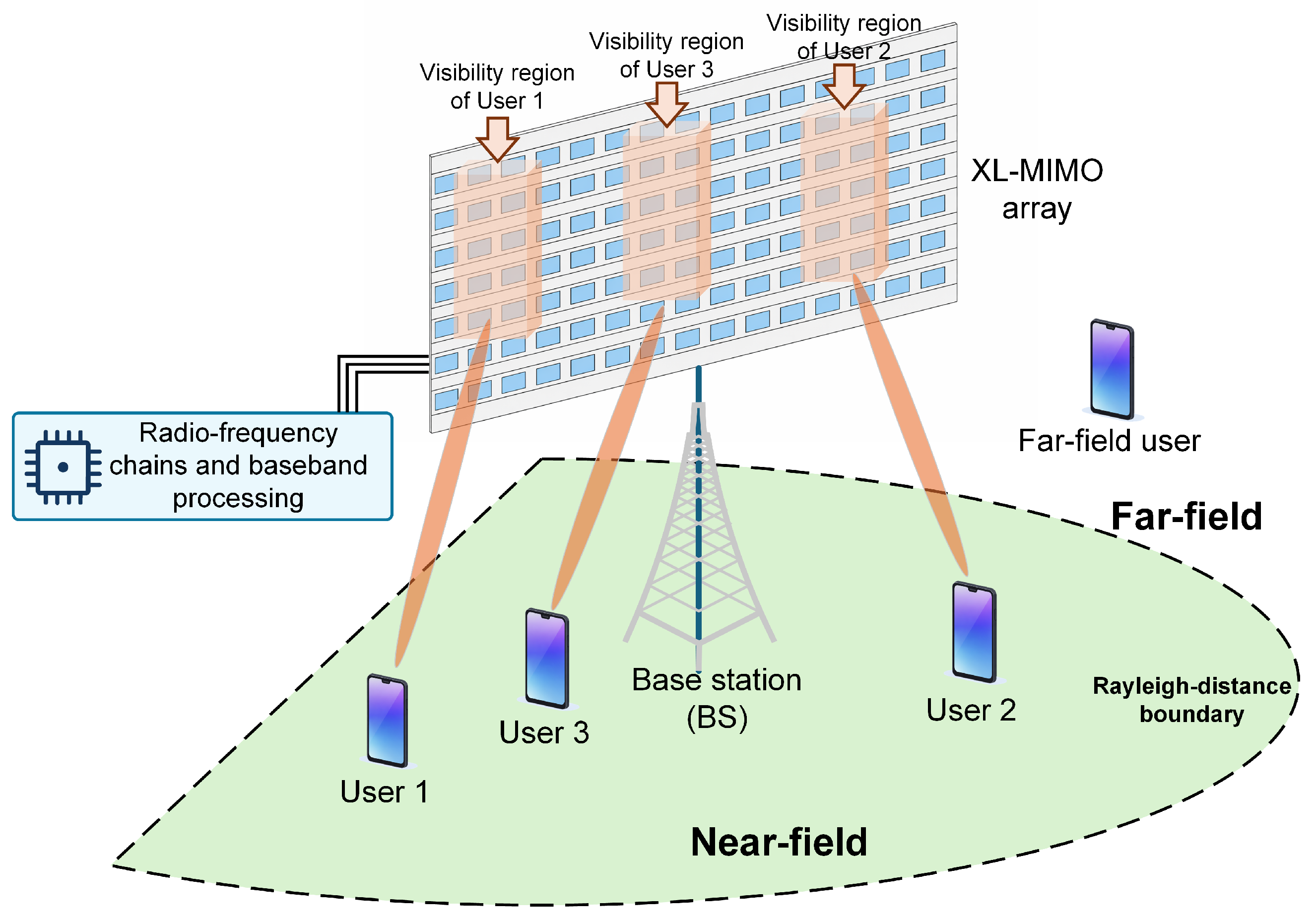
1.1. Large-Scale MIMO Evolution and Pilot-Resource Challenges
1.2. Pilot-Limited Channel and Receiver Impairments
1.3. Motivation for Intelligent Processing
1.4. Survey Scope, Contributions, and Structure
2. Survey Positioning and Scope
2.1. Positioning Against Existing Surveys
2.2. Scope of Learning-Based Methods
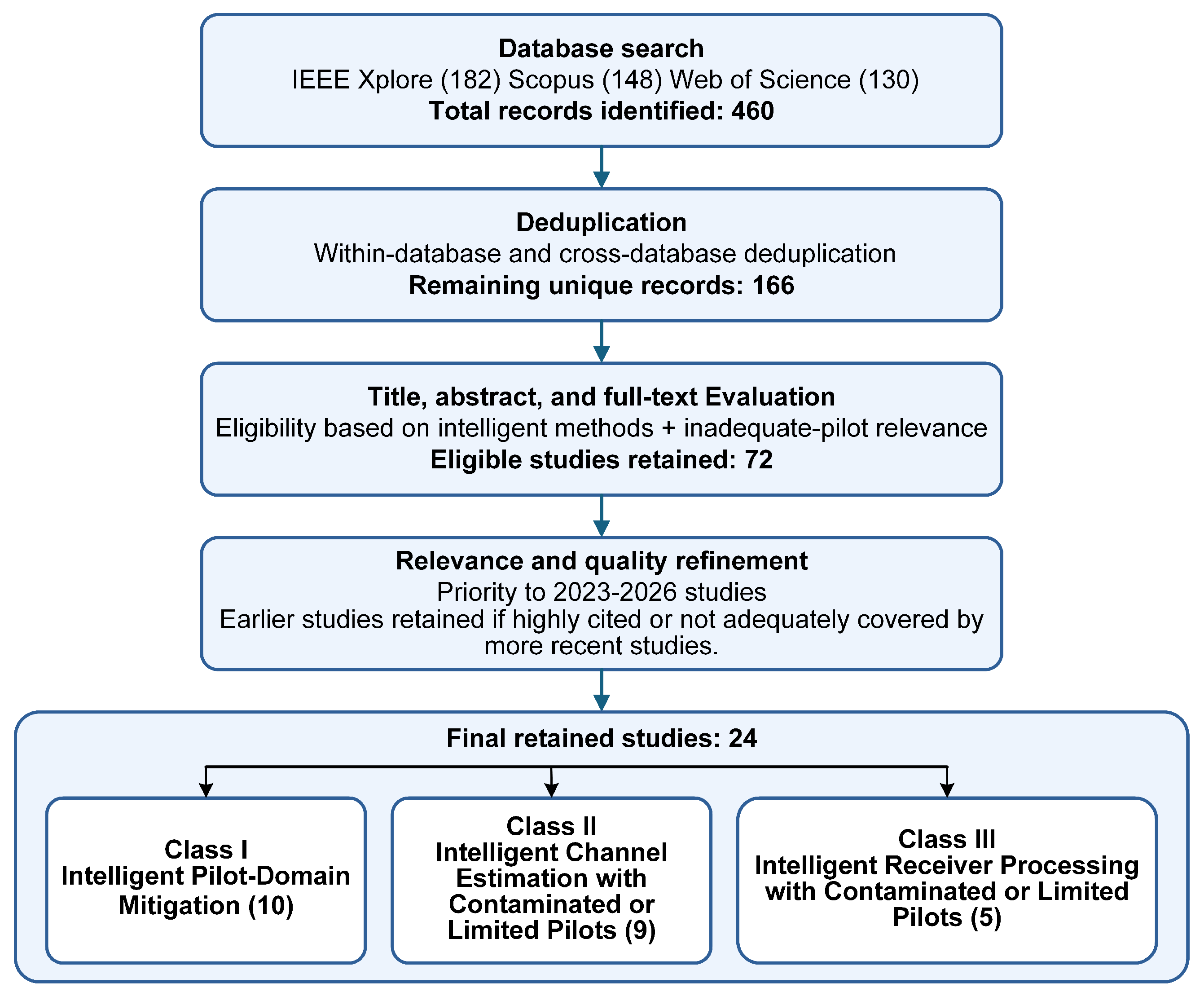
2.3. Literature Search and Study Selection
3. Pilot-Limited Estimation Errors and Problem Formulation
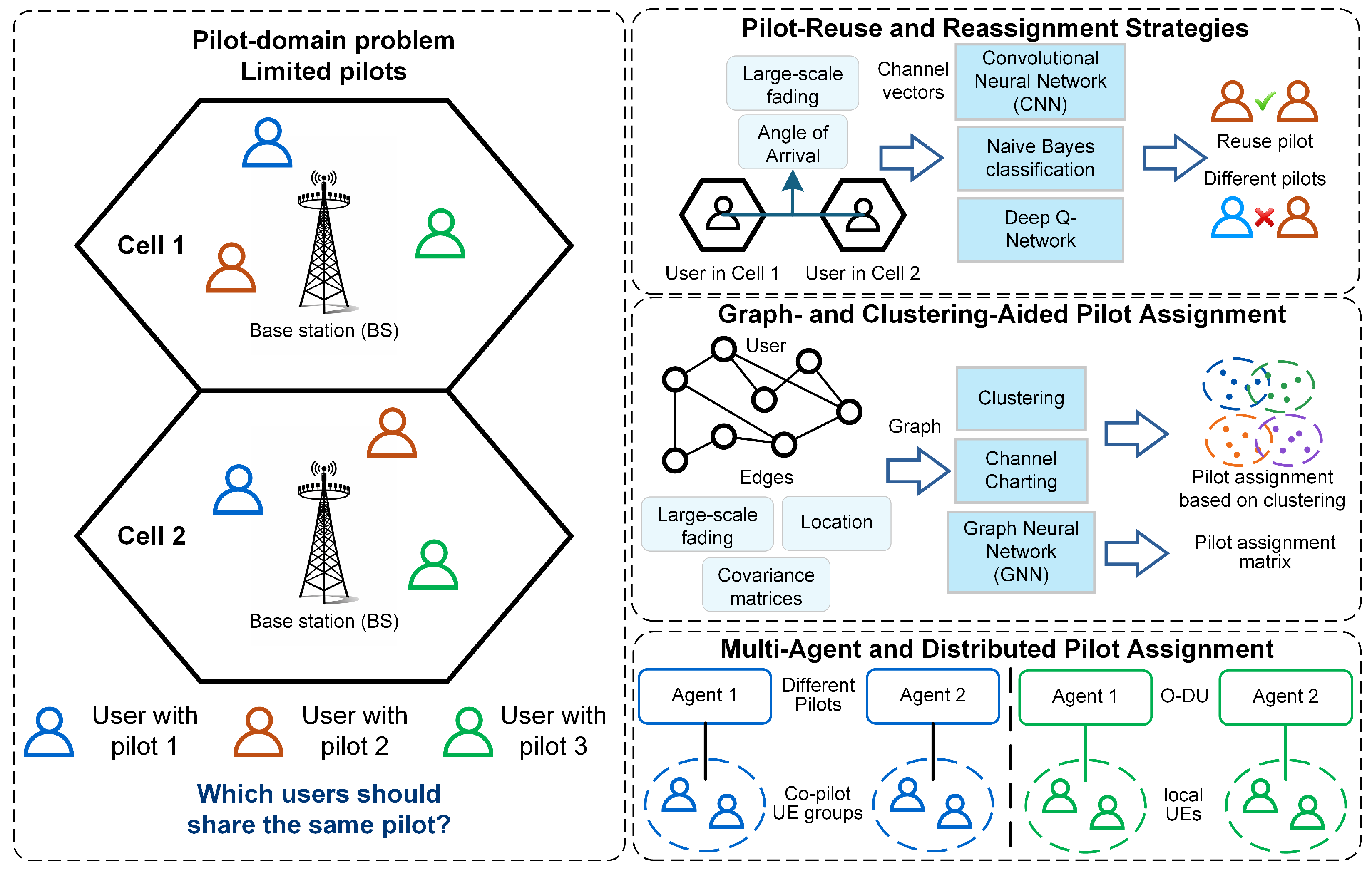
3.1. Limited Pilots, Pilot Reuse, and Nonorthogonality
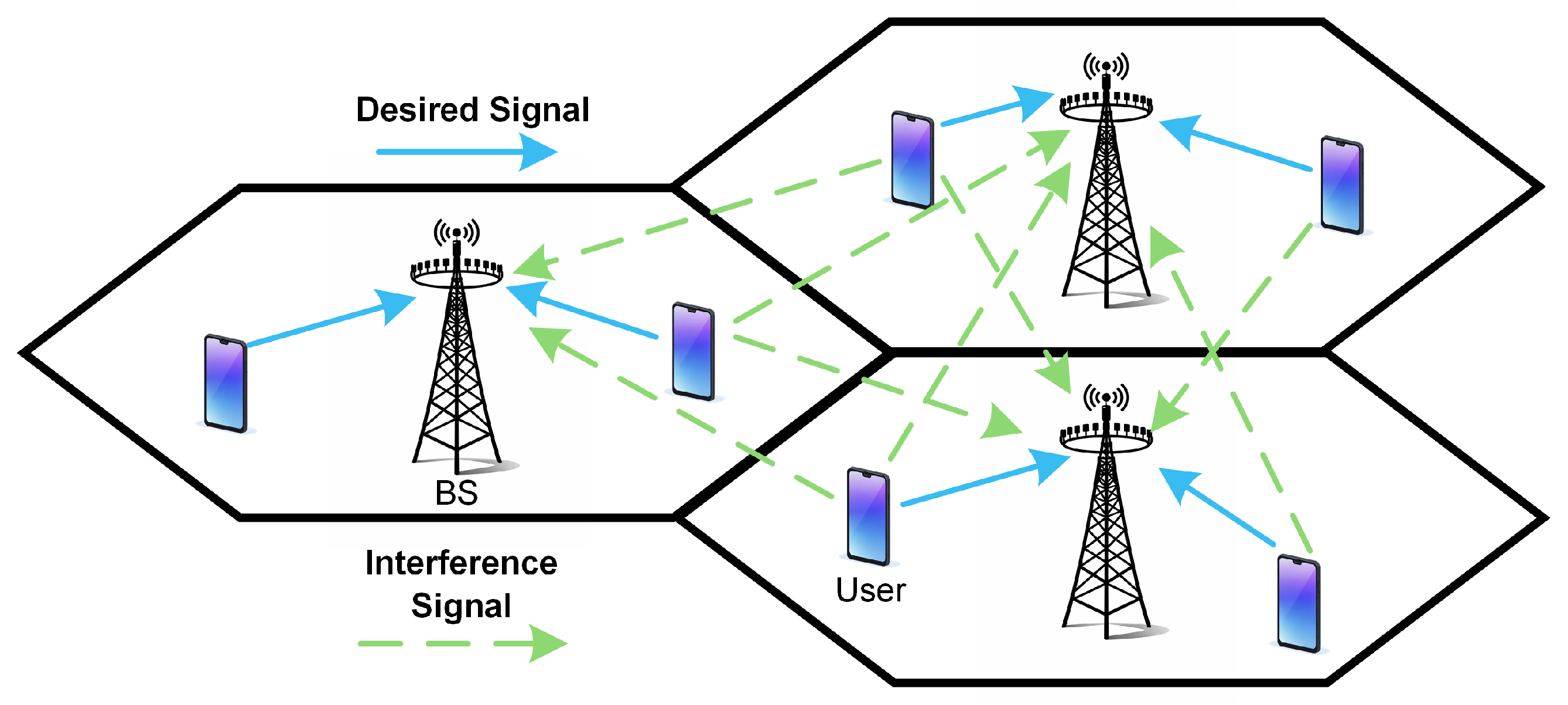
3.2. Pilot Contamination and Channel-Estimation Error
3.3. Finite-Sample Covariance Estimation and Receiver-Performance Degradation
4. Intelligent Pilot-Domain Mitigation
4.1. Learning-Based Pilot-Reuse and Reassignment Strategies
4.2. Graph- and Clustering-Aided Pilot Assignment
4.3. Multi-Agent and Distributed Pilot Assignment
4.4. Cross-Study Comparison and Pilot-Domain Limitations
5. Intelligent Channel Estimation with Contaminated or Limited Pilots
5.1. Channel Estimation Under Pilot Contamination and Nonorthogonal Pilots
5.2. Multi-Stage Channel Refinement
5.3. Channel Reconstruction from Sparse or Quantized Pilots
5.4. Cross-Study Comparison and Channel-Estimation Limitations
6. Intelligent Receiver Processing with Contaminated or Limited Pilots
6.1. Joint Channel Recovery and Data Detection
6.2. Equalization and Detection Without CSI Refinement
6.3. Cross-Study Evaluation and Receiver-Processing Limitations
7. Comparative Analysis and Research Gaps
7.1. Cross-Class Evidence and Complementary Roles
7.2. Classification by Learning Method
7.3. Minimum Benchmarking Requirements
7.4. Evidence-Based Research Gaps
8. Future Directions for Intelligent Processing Under Inadequate-Pilot Conditions
9. Conclusions
Author Contributions
Funding
Data Availability Statement
Conflicts of Interest
Appendix A. Database-Specific Search Strings
Appendix A.1. Keyword Modules
- Module A: Large-scale MIMO systems
- ("massive MIMO" OR "massive multiple-input multiple-output" OR "large-scale MIMO" OR "large scale MIMO" OR "cell-free massive MIMO" OR "cell free massive MIMO" OR "distributed massive MIMO" OR "multi-cell MIMO" OR "multicell MIMO" OR "XL-MIMO" OR "extremely large-scale MIMO")
- Module B: Inadequate-pilot conditions
- ("pilot contamination" OR "pilot reuse" OR "pilot scarcity" OR "pilot shortage" OR "limited pilot*" OR "inadequate pilot*" OR "non-orthogonal pilot*" OR "nonorthogonal pilot*" OR "pilot-impaired CSI" OR "sparse pilot*" OR "superimposed pilot*")
- Module C: Intelligent methods
- ("machine learning" OR "deep learning" OR "neural network*" OR "reinforcement learning" OR "deep reinforcement learning" OR "multi-agent reinforcement learning" OR "graph neural network*" OR "graph attention network*" OR transformer* OR "channel charting" OR "deep unfolding" OR "model-driven learning" OR "data-driven" OR "self-supervised" OR "unsupervised learning" OR "untrained neural network*" OR autoencoder* OR "generative model*")
- Module T1: Pilot-domain mitigation
- ("pilot assignment" OR "pilot allocation" OR "pilot design" OR "pilot reuse" OR "user grouping" OR "pilot scheduling" OR "pilot power control" OR "pilot resource management")
- Module T2: Pilot-limited estimation and reconstruction
- ("channel estimation" OR "interference estimation" OR "interference covariance" OR "covariance estimation" OR "subspace estimation" OR denoising OR reconstruction OR "joint estimation")
- Module T3: Suppression and detection
- ("interference suppression" OR "interference cancellation" OR "robust detection" OR "data detection" OR "neural receiver" OR "interference rejection combining" OR IRC OR "MMSE receiver" OR equalization OR "power control" OR coordination OR "AP selection" OR "access point selection" OR clustering)
Appendix A.2. Scopus Search Strings
- Q1: TITLE-ABS-KEY(A) AND TITLE-ABS-KEY(B) AND TITLE-ABS-KEY(C) AND TITLE-ABS-KEY(T1) AND PUBYEAR < 2027
- Q2: TITLE-ABS-KEY(A) AND TITLE-ABS-KEY(B) AND TITLE-ABS-KEY(C) AND TITLE-ABS-KEY(T2) AND PUBYEAR < 2027
- Q3: TITLE-ABS-KEY(A) AND TITLE-ABS-KEY(B) AND TITLE-ABS-KEY(C) AND TITLE-ABS-KEY(T3) AND PUBYEAR < 2027
Appendix A.3. Web of Science Search Strings
- Q1: TS=(A) AND TS=(B) AND TS=(C) AND TS=(T1)
- Q2: TS=(A) AND TS=(B) AND TS=(C) AND TS=(T2)
- Q3: TS=(A) AND TS=(B) AND TS=(C) AND TS=(T3)
Appendix A.4. IEEE Xplore Search Strings
- Q1: (A) AND (B) AND (C) AND (T1)
- Q2: (A) AND (B) AND (C) AND (T2)
- Q3: (A) AND (B) AND (C) AND (T3)
References
- Nadir, Z.; Taleb, T.; Flinck, H.; Bouachir, O.; Bagaa, M. Immersive Services over 5G and Beyond Mobile Systems. IEEE Netw. 2021, 35, 299–306. [Google Scholar] [CrossRef] [Scilit]
- Sampath, H.; Tinnakornsrisuphap, P.; Hande, P. Enabling Extended Reality Over 5G with Distributed Computing. IEEE Commun. Mag. 2024, 62, 32–37. [Google Scholar] [CrossRef] [Scilit]
- ITU-R. Framework and Overall Objectives of the Future Development of IMT for 2030 and Beyond; Technical Report Recommendation ITU-R M.2160-0; International Telecommunication Union: Geneva, Switzerland, 2023. [Google Scholar]
- Tataria, H.; Shafi, M.; Molisch, A.F.; Dohler, M.; Sjöland, H.; Tufvesson, F. 6G Wireless Systems: Vision, Requirements, Challenges, Insights, and Opportunities. Proc. IEEE 2021, 109, 1166–1199. [Google Scholar] [CrossRef] [Scilit]
- Ammar, H.A.; Adve, R.; Shahbazpanahi, S.; Boudreau, G.; Srinivas, K.V. User-Centric Cell-Free Massive MIMO Networks: A Survey of Opportunities, Challenges and Solutions. IEEE Commun. Surv. Tutor. 2022, 24, 611–652. [Google Scholar] [CrossRef] [Scilit]
- Chen, S.; Zhang, J.; Zhang, J.; Björnson, E.; Ai, B. A survey on user-centric cell-free massive MIMO systems. Digit. Commun. Netw. 2022, 8, 695–719. [Google Scholar] [CrossRef] [Scilit]
- Marzetta, T.L. Noncooperative Cellular Wireless with Unlimited Numbers of Base Station Antennas. IEEE Trans. Wirel. Commun. 2010, 9, 3590–3600. [Google Scholar] [CrossRef] [Scilit]
- Sedghi, R.; Azghani, M. Interference suppression in heterogeneous massive MIMO systems with imperfect CSI. Telecommun. Syst. 2022, 81, 323–332. [Google Scholar] [CrossRef] [Scilit]
- Mussbah, M.; Schwarz, S.; Rupp, M. Beam-Domain-Based Pilot Assignment for Energy Efficient Cell-Free Massive MIMO. IEEE Commun. Lett. 2024, 28, 2176–2180. [Google Scholar] [CrossRef] [Scilit]
- Mishra, A.; Mao, Y.; Thomas, C.K.; Sanguinetti, L.; Clerckx, B. Mitigating Intra-Cell Pilot Contamination in Massive MIMO: A Rate Splitting Approach. IEEE Trans. Wirel. Commun. 2023, 22, 3472–3487. [Google Scholar] [CrossRef] [Scilit]
- Ohtsuki, T. Machine Learning in 6G Wireless Communications. IEICE Trans. Commun. 2023, E106-B, 75–83. [Google Scholar] [CrossRef] [Scilit]
- Shafaei, S.; Palaios, A.; Ennaceur, Z.; Zhang, J.; Pandit, V.; Gautam, P.; Gharouni, A.; Gajic, B.; Banerjee, B.; Mallikarjun, S.B.; et al. Toward AI in 6G: Concepts, Techniques, and Standards. IEEE Access 2025, 13, 143843–143874. [Google Scholar] [CrossRef] [Scilit]
- Luong, N.C.; Hoang, D.T.; Gong, S.; Niyato, D.; Wang, P.; Liang, Y.C.; Kim, D.I. Applications of Deep Reinforcement Learning in Communications and Networking: A Survey. IEEE Commun. Surv. Tutor. 2019, 21, 3133–3174. [Google Scholar] [CrossRef] [Scilit]
- Zhao, D.; Yang, J.; Zhao, D.; Zhang, L.; Xu, Z.; Cao, A.; Lin, W.; Cheng, W.; Du, Q.; Li, L. AI for Wireless Waveform Recognition: A Survey from a Component Perspective. Electronics 2026, 15, 2112. [Google Scholar] [CrossRef] [Scilit]
- Yu, C.; Guo, M.; Guo, Q.; Zhao, D.; Zhang, L.; Xu, Z.; Cao, A.; Yang, J.; Lin, W.; Cheng, W.; et al. A Review on Electromagnetic Spectrum Map Construction: Methods, Challenges, and System Integration for 6G. Electronics 2026, 15, 2439. [Google Scholar] [CrossRef] [Scilit]
- Elijah, O.; Leow, C.Y.; Rahman, T.A.; Nunoo, S.; Iliya, S.Z. A Comprehensive Survey of Pilot Contamination in Massive MIMO—5G System. IEEE Commun. Surv. Tutor. 2016, 18, 905–923. [Google Scholar] [CrossRef] [Scilit]
- Misso, A.; Kissaka, M.; Maiseli, B. Exploring Pilot Assignment Methods for Pilot Contamination Mitigation in Massive MIMO Systems. Cogent Eng. 2020, 7, 1831126. [Google Scholar] [CrossRef] [Scilit]
- Saeed, M.K.; Khokhar, A.; Ahmed, S. Pilot Contamination in Massive MIMO Systems: Challenges and Future Prospects. In Proceedings of the 2024 International Wireless Communications and Mobile Computing (IWCMC); IEEE: Piscataway, NJ, USA, 2024; pp. 1504–1509. [Google Scholar] [CrossRef] [Scilit]
- Victor, C.; Mvuma, A.; Mrutu, S. A Review on Deep Learning Aided Pilot Decontamination in Massive MIMO. Cogent Eng. 2024, 11, 2322822. [Google Scholar] [CrossRef] [Scilit]
- Ma, H.; Du, J.; Wu, H.; Xing, L.; Zheng, R. A review of channel estimation research methods for massive MIMO systems. Phys. Commun. 2025, 71, 102632. [Google Scholar] [CrossRef] [Scilit]
- Tarafder, P.; Chun, C.; Ullah, A.; Kim, Y.; Choi, W. Channel Estimation in 5G-and-Beyond Wireless Communication: A Comprehensive Survey. Electronics 2025, 14, 750. [Google Scholar] [CrossRef] [Scilit]
- Trabelsi, N.; Chaari Fourati, L.; Chen, C.S. Interference management in 5G and beyond networks: A comprehensive survey. Comput. Netw. 2024, 239, 110159. [Google Scholar] [CrossRef] [Scilit]
- Omid, Y.; Hosseini, S.M.; Shahabi, S.M.; Shikh-Bahaei, M.; Nallanathan, A. AoA-Based Pilot Assignment in Massive MIMO Systems Using Deep Reinforcement Learning. IEEE Commun. Lett. 2021, 25, 2948–2952. [Google Scholar] [CrossRef] [Scilit]
- Hirose, H.; Ohtsuki, T.; Gui, G. Deep Learning-Based Channel Estimation for Massive MIMO Systems with Pilot Contamination. IEEE Open J. Veh. Technol. 2021, 2, 67–77. [Google Scholar] [CrossRef] [Scilit]
- Victor, C.M.; Mvuma, A.N.; Mrutu, S.I. Multi-Input Fully CNN for Joint Pilot Decontamination and Symbol Detection in 5G Massive MIMO. IET Commun. 2023, 17, 1899–1906. [Google Scholar] [CrossRef] [Scilit]
- Chen, Y.; Wiesel, A.; Eldar, Y.C.; Hero, A.O. Shrinkage Algorithms for MMSE Covariance Estimation. IEEE Trans. Signal Process. 2010, 58, 5016–5029. [Google Scholar] [CrossRef] [Scilit]
- Masood, M. Large-Scale MIMO Pilot Contamination: Deep Learning-Assisted Pilot Assignment Scheme. Wirel. Pers. Commun. 2023, 129, 613–621. [Google Scholar] [CrossRef] [Scilit]
- Li, P.; Wei, Y.; Huang, T.; Ge, J.; Zhao, X. Pilot Allocation for Multi-Cell Massive MIMO Circumstances. In Proceedings of the 2025 IEEE 102nd Vehicular Technology Conference (VTC2025-Fall); IEEE: Piscataway, NJ, USA, 2025; pp. 1–4. [Google Scholar] [CrossRef] [Scilit]
- Zhao, Y.; Zhang, F.; Gao, Y.; Zhou, Z.; Zhang, P. A Spectral Clustering-Based Pilot Assignment Method for Cell-Free Massive MIMO. In Proceedings of the 2024 3rd International Conference on Electronics and Information Technology (EIT), Chengdu, China, 20–22 September 2024; pp. 560–564. [Google Scholar] [CrossRef] [Scilit]
- Ribeiro, L.; Leinonen, M.; Al-Tous, H.; Tirkkonen, O.; Juntti, M. Channel Charting Aided Pilot Reuse for Massive MIMO Systems with Spatially Correlated Channels. IEEE Open J. Commun. Soc. 2022, 3, 2390–2406. [Google Scholar] [CrossRef] [Scilit]
- Shaikh, B.; Burguera, P.G.; Al-Tous, H.; Juntti, M.; Khan, B.M.; Tirkkonen, O. Pilot Allocation in Multi-Cell MIMO Systems Based on Missing Data Imputation. IEEE Access 2025, 13, 123764–123782. [Google Scholar] [CrossRef] [Scilit]
- Rehman, S.; Begh, G.R.; Singh, O. A Density-Based Clustering Approach for Pilot Assignment in Scalable Cell-Free Massive MIMO. IEEE Trans. Veh. Technol. 2026, 75, 14109–14120. [Google Scholar] [CrossRef] [Scilit]
- Zhao, Y.; Zhang, F.; Zhang, P.; Zhou, Z. Deep Graph Learning for Pilot Assignment in Cell-Free Massive MIMO. IEEE Trans. Veh. Technol. 2026; early access. [CrossRef] [Scilit]
- Wen, F.; Wang, X.; Gui, G.; Ohtsuki, T.; Niyato, D.; Adachi, F. Fast DOD/DOA Estimation for Massive Conformal MIMO Arrays with Unknown Gain-Phase Errors. IEEE Trans. Wirel. Commun. 2026, 25, 15866–15878. [Google Scholar] [CrossRef] [Scilit]
- Rahmani, M.; Dehghani, M.J.; Xiao, P.; Bashar, M.; Debbah, M. Multi-Agent Reinforcement Learning-Based Pilot Assignment for Cell-Free Massive MIMO Systems. IEEE Access 2022, 10, 120492–120502. [Google Scholar] [CrossRef] [Scilit]
- Oh, M.S.; Das, A.B.; Hosseinalipour, S.; Kim, T.; Love, D.J.; Brinton, C.G. A Decentralized Pilot Assignment Algorithm for Scalable O-RAN Cell-Free Massive MIMO. IEEE J. Sel. Areas Commun. 2024, 42, 373–388. [Google Scholar] [CrossRef] [Scilit]
- Kasibovic, A.; Fesl, B.; Baur, M.; Utschick, W. Addressing Pilot Contamination in Channel Estimation with Variational Autoencoders. In Proceedings of the ICASSP 2025–2025 IEEE International Conference on Acoustics, Speech and Signal Processing (ICASSP), Hyderabad, India, 6–11 April 2025; pp. 1–5. [Google Scholar] [CrossRef] [Scilit]
- Cao, J.; Tarboush, S.; Sarieddeen, H.; Kouzayha, N.; Al-Naffouri, T.Y. Multi-User Hybrid Far- and Near-Field THz UM-MIMO Channel Estimation via UNet-OAMP. IEEE Commun. Lett. 2026, 30, 1771–1775. [Google Scholar] [CrossRef] [Scilit]
- Hirose, H.; Yang, S.; Ohtsuki, T.; Bouazizi, M. Deep Learning-Based Channel Estimation to Mitigate Channel Aging in Massive MIMO with Pilot Contamination. IEEE Access 2025, 13, 1834–1845. [Google Scholar] [CrossRef] [Scilit]
- Hejazi, P.; Sabaei, M.; Hajmahmoudi, A. Pilot-Efficient Channel Estimation for 6G MU-mMIMO Using LS Initialization and GAN-Augmented CNN Refinement. J. Commun. Netw. 2026, 28, 401–408. [Google Scholar] [CrossRef] [Scilit]
- Jiang, J.; Lian, L.; Yu, T.; Shi, Q.; Zhang, S.; Chen, X.; Lau, V.K.N. A Novel Dual-Driven Channel Estimation Scheme for Spatially Non-Stationary Fading Environments. IEEE Trans. Wirel. Commun. 2024, 23, 7027–7042. [Google Scholar] [CrossRef] [Scilit]
- Guo, E.; Yu, L.; Zhao, J.; Zhang, Y.; Shi, L.; Tian, L.; Zhang, J. Can ChannelLM Serve as Strong Priors for CSI Reconstruction under Extremely Sparse Pilots? In Proceedings of the 2026 IEEE International Conference on Communications Workshops (ICC Workshops), Glasgow, Scotland, 24–28 May 2026; pp. 1–6. [Google Scholar] [CrossRef] [Scilit]
- Zhang, J.; Chen, Y. DoA-ISTA-Net: Dual-Order Adaptive Interpretable Deep Unfolding for Sparse Pilot Channel Estimation in High-Mobility Massive MIMO-OFDM. Phys. Commun. 2026, 77, 103158. [Google Scholar] [CrossRef] [Scilit]
- Habibur Rahman, M.; Abrar Shakil Sejan, M.; Abdul Aziz, M.; Tabassum, R.; Baik, J.I.; Song, H.K. Deep Learning Based One Bit-ADCs Efficient Channel Estimation Using Fewer Pilots Overhead for Massive MIMO System. IEEE Access 2024, 12, 64823–64836. [Google Scholar] [CrossRef] [Scilit]
- Wang, H.; Guo, P.; Li, X.; Wen, F.; Wang, X.; Nallanathan, A. MBPD: A Robust Algorithm for Polar-Domain Channel Estimation in Near-Field Wideband XL-MIMO Systems. IEEE Internet Things J. 2025, 12, 18461–18470. [Google Scholar] [CrossRef] [Scilit]
- Zhang, Y.; Sun, J.; Xue, J.; Li, G.Y.; Xu, Z. Deep Expectation-Maximization for Joint MIMO Channel Estimation and Signal Detection. IEEE Trans. Signal Process. 2022, 70, 4483–4497. [Google Scholar] [CrossRef] [Scilit]
- Korpi, D.; Honkala, M.; Huttunen, J.M.J.; Starck, V. DeepRx MIMO: Convolutional MIMO Detection with Learned Multiplicative Transformations. In Proceedings of the ICC 2021—IEEE International Conference on Communications, Virtual, 14–23 June 2021; pp. 1–7. [Google Scholar] [CrossRef] [Scilit]
- Zecchin, M.; Yu, K.; Simeone, O. Cell-Free Multi-User MIMO Equalization via In-Context Learning. In Proceedings of the 2024 IEEE 25th International Workshop on Signal Processing Advances in Wireless Communications (SPAWC), Lucca, Italy, 10–13 September 2024; pp. 646–650. [Google Scholar] [CrossRef] [Scilit]
- Korpi, D.; Honkala, M.; Huttunen, J.M.J. Deep Learning-Based Pilotless Spatial Multiplexing. In Proceedings of the 2023 57th Asilomar Conference on Signals, Systems, and Computers, Pacific Grove, CA, USA, 29 October–1 November 2023; pp. 1025–1029. [Google Scholar] [CrossRef] [Scilit]
- Kim, T.K.; Jeon, Y.S.; Li, J.; Tavangaran, N.; Poor, H.V. Semi-Data-Aided Channel Estimation for MIMO Systems via Reinforcement Learning. IEEE Trans. Wirel. Commun. 2023, 22, 4565–4579. [Google Scholar] [CrossRef] [Scilit]
- Liang, W.; Li, A.; Zhang, J.; Li, L.; Lin, W. Adaptive Coded Modulation Assisted ISAC Based AFDM Communication in SAGIN Networks. IEEE J. Sel. Areas Commun. 2026, 44, 5489–5505. [Google Scholar] [CrossRef] [Scilit]
- Li, M.; Li, L.; Lin, W.; Han, Z.; Başar, T. Beyond Gaussian Assumptions: A General Fractional HJB Control Framework for Lévy-Driven Heavy-Tailed Channels in 6G. IEEE Trans. Wirel. Commun. 2026, 25, 7535–7550. [Google Scholar] [CrossRef] [Scilit]
- Zheng, Y.; Li, L.; Lin, W.; Liang, W.; Du, Q.; Han, Z. Optimal Transport Framework for ISAC in Low-Altitude Networks: Joint Resource Allocation for Cooperative Communication and Non-Cooperative Localization. IEEE Trans. Commun. 2026, 74, 1984–2000. [Google Scholar] [CrossRef] [Scilit]
- Deka, S.; Deka, K.; Nguyen, N.T.; Sharma, S.; Bhatia, V.; Rajatheva, N. Comprehensive Review of Deep Unfolding Techniques for Next-Generation Wireless Communication Systems. IEEE Internet Things J. 2026, 13, 10379–10406. [Google Scholar] [CrossRef] [Scilit]
- Zhang, Y.; Sun, J.; Xue, J.; Xu, Z. Cross-Channel Model-Driven Learning for Massive MIMO Detection by HyperNetwork. IEEE Trans. Wirel. Commun. 2025, 24, 1964–1977. [Google Scholar] [CrossRef] [Scilit]
- Wang, O.; He, H.; Zhou, S.; Ding, Z.; Jin, S.; Letaief, K.B.; Li, G.Y. Fast Adaptation for Deep Learning-Based Wireless Communications. IEEE Commun. Mag. 2025, 63, 158–164. [Google Scholar] [CrossRef] [Scilit]
- Xu, J.; Jere, S.; Song, Y.; Kao, Y.H.; Zheng, L.; Liu, L. Learning at the Speed of Wireless: Online Real-Time Learning for AI-Enabled MIMO in NextG. IEEE Commun. Mag. 2025, 63, 92–98. [Google Scholar] [CrossRef] [Scilit]
- Kocharlakota, A.K.; Vorobyov, S.A.; Heath, R.W. Pilot Contamination Aware Transformer for Downlink Power Control in Cell-Free Massive MIMO Networks. IEEE Trans. Wirel. Commun. 2026, 25, 9656–9671. [Google Scholar] [CrossRef] [Scilit]
- Zheng, K.; Li, Z.; Liu, X.; Liu, J.; Taleb, T.; Shiratori, N. Throughput Maximization for Backscatter Communication in Cell-Free Symbiotic Radio Networks with Hybrid CSR-PSR. IEEE Internet Things J. 2026, 13, 16245–16262. [Google Scholar] [CrossRef] [Scilit]
- Wang, H.; Wen, F.; Wang, X.; Du, W.; Gui, G. Hierarchical Channel Estimation for Near-Field Spatial Non-Stationary Channels: A Pre-Selection and Multi-Level Dynamic Threshold Strategy. IEEE Trans. Cogn. Commun. Netw. 2026, 12, 4174–4185. [Google Scholar] [CrossRef] [Scilit]
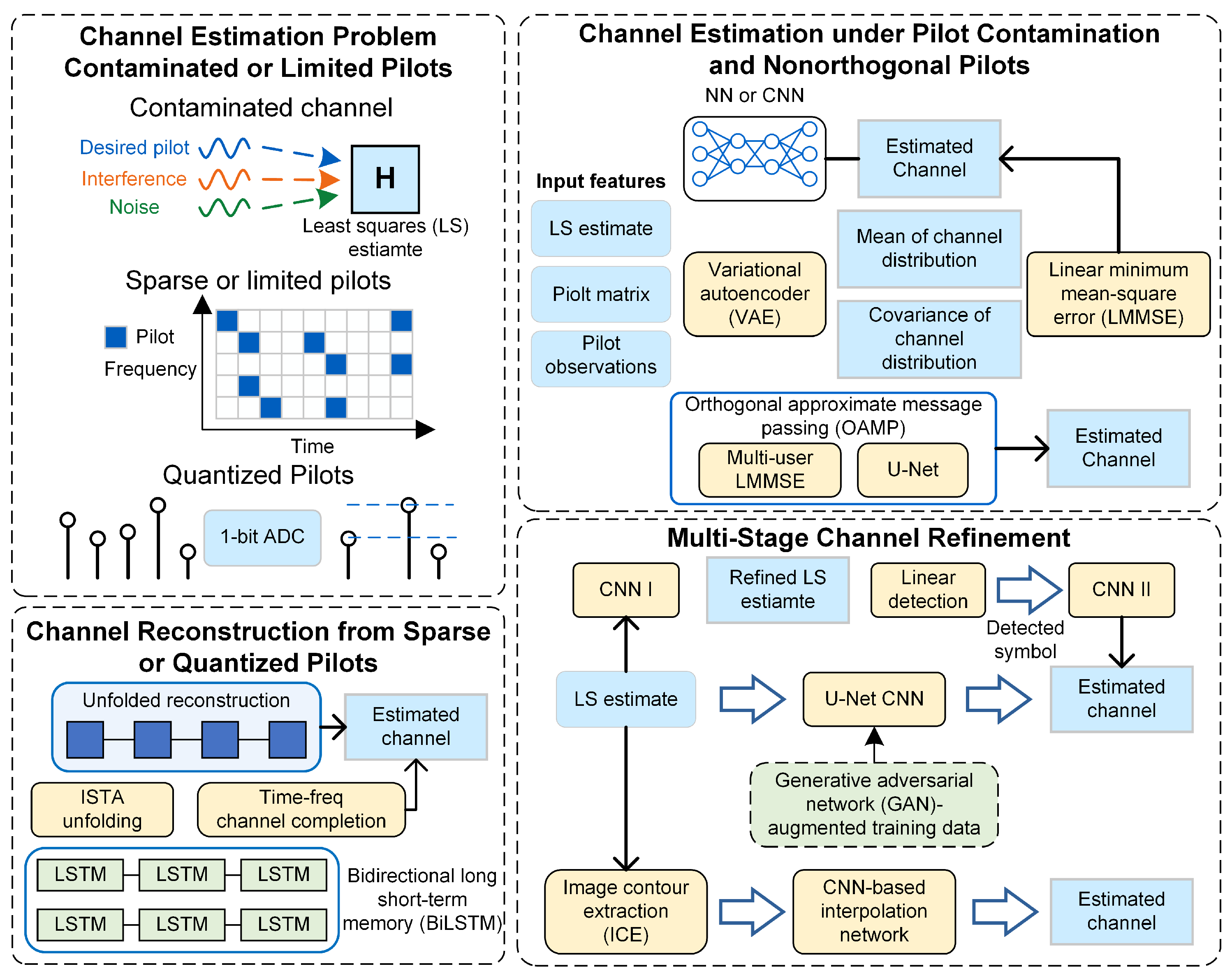
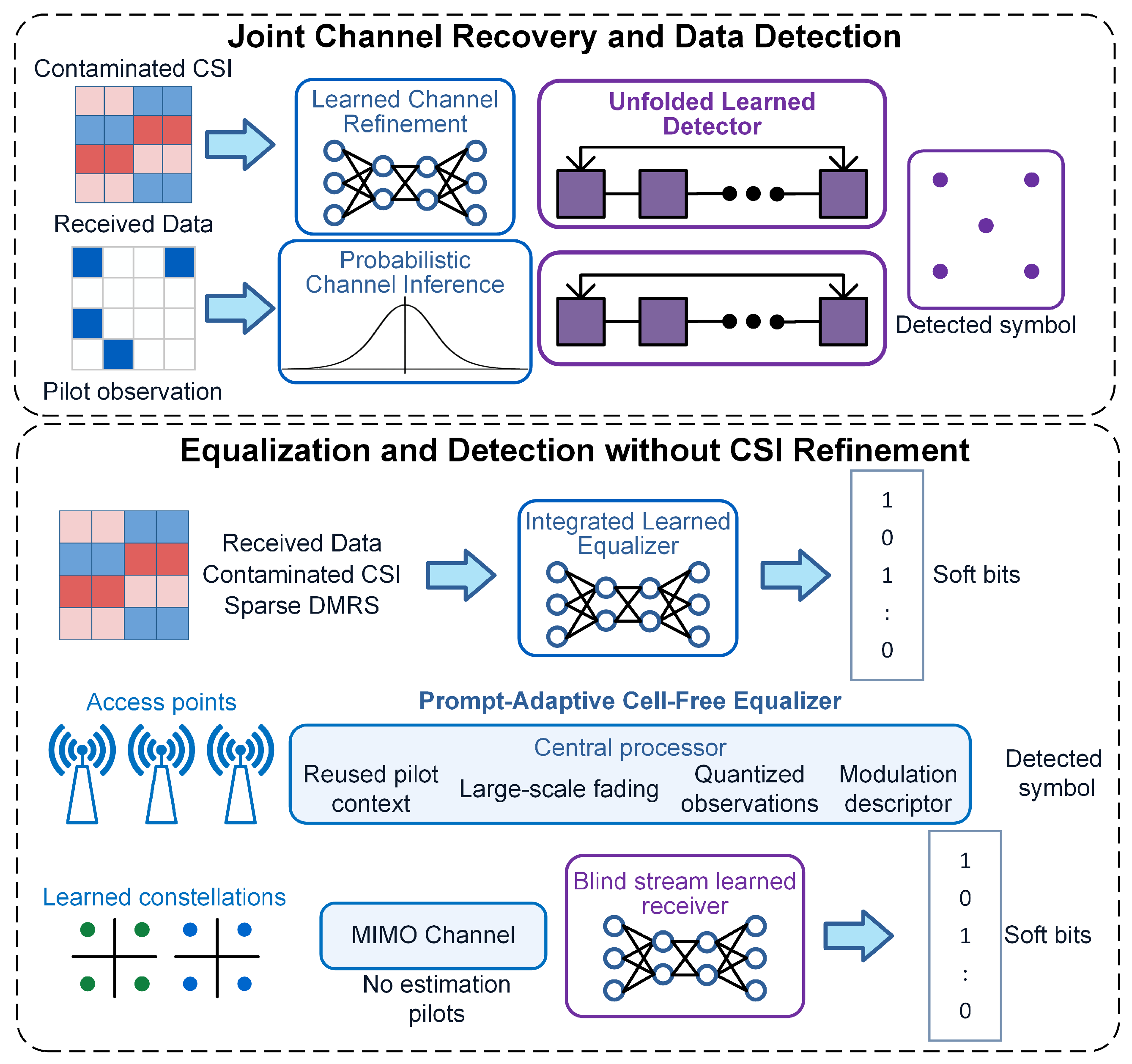

| Survey | Main Scope | Learning Coverage | Class I | Class II | Class III | Overlap and Main Difference |
|---|---|---|---|---|---|---|
| Elijah et al. [16] (2016) | Pilot contamination; pilot-based and subspace-based mitigation. | No | Yes | Partly | No | Conventional pilot-contamination mitigation; no overlap. |
| Misso et al. [17] (2020) | Pilot assignment for pilot-contamination mitigation | Partly | Yes | No | No | Pilot assignment only; no overlap. |
| Saeed et al. [18] (2024) | Pilot assignment, signal processing, and channel estimation | Partly | Yes | Yes | Partly | Overlap: [23,24]; organized by mitigation method rather than processing stage. |
| Victor et al. [19] (2024) | Deep-learning-aided pilot decontamination | Yes | Yes | Yes | Partly | Overlap: [23,24]; receiver processing is not treated as a separate class. |
| Chen et al. [6] (2022) | User-centric cell-free massive MIMO: resource allocation and signal processing | Partly | Yes | Yes | Partly | Organized around the cell-free architecture rather than inadequate pilots; no overlap. |
| Ma et al. [20] (2025) | Channel estimation for massive MIMO | Yes | Partly | Yes | Partly | Overlap: [25]; focuses on channel estimation. |
| Tarafder et al. [21] (2025) | Channel estimation under pilot contamination and feedback overhead | Yes | Yes | Yes | Partly | Learning-based methods focus mainly on channel estimation; no overlap. |
| Trabelsi et al. [22] (2024) | Interference management in 5G and beyond networks | Partly | No | No | Partly | Broad interference-management focus with limited coverage of learning-based receiver processing; no overlap. |
| Present survey (2026) | Learning-based methods under inadequate pilot resources, organized by processing stage | Yes | Yes | Yes | Yes | Covers all three processing stages and treats receiver-side suppression and detection as a separate category. |
| Study | Architecture/ Link | System Scale | Pilot Setting | Channel/ Dynamics | Baselines | Metrics/Level | Representative Result |
|---|---|---|---|---|---|---|---|
| Masood [27] | Multi-cell uplink (UL) mMIMO | 8 cells, 10 users/cell; BS antennas varied | At most 10 orthogonal pilots; cross-cell reuse | 5-path block-fading channel; angular spread | N/R | Co-pilot correlation (P) | Co-pilot correlation plateaus near the 0.2 labeling threshold; no E/L/N metric is reported. |
| Li et al. [28] | 3-cell UL mMIMO | 3 cells, 10 users/cell; BS antennas varied | 10 orthogonal pilots reused across cells | Large-scale fading, AoA intervals | Time-shifted, coloring, covariance/ location-based PA | Capacity per terminal (N) | At 128 BS antennas, capacity is about 0.27 bit/s/Hz higher than the location-based method. |
| Omid et al. [23] | 7-cell uplink massive MIMO | 100 BS antennas, 4 users/cell | 4 orthogonal pilots reused across cells | 50-path channel; time-varying AoA intervals and large-scale fading | Exhaustive, random, soft pilot reuse | Minimum rate (N) | Approaches exhaustive search; soft pilot reuse requires 2.5× as many orthogonal pilots. |
| Zhao et al. [29] | Cell-free (CF) massive MIMO; downlink data | 100 single-antenna access points (APs); 20 or 40 users | 10 pilot symbols in a 200-symbol coherence block | Independent Rayleigh fading | K-means, user grouping | Channel-estimation accuracy (E); SE (N); runtime | Per-user SE is 4.23/0.83 bit/s/Hz for 20/40 users; runtime is 0.02/0.03 s. |
| Ribeiro et al. [30] | Single-cell, 3-sector uplink massive MIMO | 512 registered users, 64 active; 3 sectors × 64 antennas | Pilot lengths 32/64/128; corresponding reuse factors 16/8/4 | Spatially correlated 200-path channel at 6 GHz | Random PA, AoA grouping, SGPS, CMD, position-based | NMSE (E), detection MSE (L), sum rate (N) | Approaches the position-based benchmark; at reuse factors 8 and 16, it outperforms the other practical baselines. |
| Shaikh et al. [31] | 7-site, 3-sector UL MIMO | 7 BSs × 3 sectors × 32 antennas; 4000 offline and 1000 online users | 10–80 pilots | 3GPP 3D-UMa NLoS, multiple layouts | Full-information methods based on covariance, AoA, or location; random PA | NMSE (E), imputation/chart quality | Channel-chart imputation approaches the performance of full-information covariance-based assignment with much lower computational overhead. |
| Rehman et al. [32] | User-centric CF-mMIMO downlink (DL) | 169 APs × 4 antennas; 40, 80, or 120 users | 5 or 10 pilot symbols in a 100-symbol coherence block | Correlated Rayleigh fading; separate 60 km/h mobility test | Random PA, WGF, K-means, BGC, approximation-ratio | NMSE (E), SE (N), runtime | At 120 users, SE gains are 6.25%, 30.18%, and 14.22% over three reported baselines. |
| Zhao et al. [33] | User-centric CF-mMIMO DL | 100 APs × 4 antennas; 20–100 users | 10 pilot symbols in a 200-symbol coherence block | Correlated Rayleigh fading; 1.4 m/s nominal and 10 m/s robustness test | Greedy-based PA, user grouping, spectral clustering, DQN | NMSE (E), SE (N), runtime | With 80 users under interference-aware AP selection, the average NMSE is 0.06 and SE is 0.59 bit/s/Hz. |
| Rahmani et al. [35] | CF-mMIMO UL | 100 APs × 2 antennas; 20–100 users | 10 pilot symbols in a 200-symbol coherence block | 3GPP UMi path loss/shadowing, static | Random PA, greedy-based PA, clustering | SE metrics (N) | Average and 95%-likely SE gains are 2.2% and 3.3% over the best competing method. |
| Oh et al. [36] | O-RAN CF-mMIMO UL/DL | 4 O-DUs, 96 O-RUs, | 4 or 8 pilots | 3GPP UMi, Rayleigh/Rician, 1–10 km/h | Random PA, exhaustive/Tabu Search, Hungarian algorithm | Sum-MSE (E), UL/DL SE (N), runtime | With 24 users and 4 pilots, sum-MSE is reduced by up to 27%; UL/DL SE reaches 10.18/9.40 bit/s/Hz. |
| Study | Learning Paradigm/Model | Inputs/Side Information | Training Data/Labels | Training/ Adaptation | Processing/ Deployment | Complexity/ Latency | Robustness/ Availability |
|---|---|---|---|---|---|---|---|
| Masood [27] | Supervised CNN | Channel-vector pairs | 500,000 synthetic channel pairs; labels from a correlation threshold | Offline | Parallel pairwise classification | FLOPs/runtime N/R | BS-antenna sweep only; no OOD test; code/data N/R. |
| Li et al. [28] | Supervised naive Bayes | Large-scale fading and AoA overlap features | Pilot-reuse labels from exhaustive search | Offline | Inter-BS feature sharing required | PA ; latency N/R | Training-set size and AoA spread varied; no mobility/OOD test; code/data N/R. |
| Omid et al. [23] | Deep Q-learning | Pilot-assignment state and contamination costs | No labels; experience-replay samples with rewards | Online learning with experience replay | Single centralized agent | FLOPs/runtime N/R | Tracks temporal AoA/fading changes; no held-out OOD test; code/data N/R. |
| Zhao et al. [29] | Unsupervised spectral clustering | User-distance graph | No labels/learned parameters | No offline training; recomputed from current user locations | Central eigendecomposition + K-means | Runtime 0.02/0.03 s for 20/40 users | 20- and 40-user static cases only; no mobility/OOD test; code/data N/R. |
| Ribeiro et al. [30] | Isomap charting + greedy reuse | Long-term channel covariance/pairwise covariance distance | Unlabeled long-term covariance statistics | Covariance/ chart updates required under mobility | Centralized BS; channel-chart maintenance required | Chart , reuse | Pilot reuse, angular spread, and antenna number varied; mobility requires chart updates; code/data N/R. |
| Shaikh et al. [31] | KNN/DNN + channel charting | Serving-cell path loss, AoA interval, or covariance | 4000 offline users; neural network uses train/validation/test split | Offline predictor construction; online out-of-sample imputation | Feature imputation at BS/cell; centralized graph construction and coloring | KNN imputation , similarity ; covariance scales with | 6/7/8-BS layouts and antenna/pilot settings tested; no mobility or OOD test; code/data N/R. |
| Rehman et al. [32] | Clustering + MLP + Tabu Search | Geometry distance, AP overlap, and large-scale gains | 150 setups, exact swap-gain labels | Offline MLP, event-triggered reassignment | Central CPU using serving-set information | Dominated by | User density, hardware impairment, and 60 km/h mobility tested; code/data N/R. |
| Zhao et al. [33] | Supervised GNN autoencoder + unsupervised GNN clustering | AP selection, large-scale fading | Supervised graph reconstruction; unlabeled clustering | Training over channel realizations; per-slot inference | Central CPU, global graph | Runtime 0.007–0.047 s for 20–100 users in the reported setting | Two AP-selection rules, 20–100 users, and a 10 m/s mobility test; code/data N/R. |
| Rahmani et al. [35] | Unsupervised DNN + multi-agent DQN | User locations and SINR | No ground-truth labels; unsupervised loss and replay-based RL | Pretrained user-selection network; iterative multi-agent Q-learning | Centralized training and decentralized execution | ; hardware latency N/R | User/pilot scaling only; no mobility/OOD test; code/data N/R. |
| Oh et al. [36] | Multi-agent DQN with message passing and codebook search | Channel-estimate power observations; optional inter-DU messages | No fixed dataset; online experience replay with reward-based targets | Near-real-time pilot updates; periodic non-real-time DQN training | Inter-DU message passing | Approx. linear in K; network/hardware latency excluded | Mobility, Rician fading, and topology variations tested; code/data N/R. |
| Study | Architecture/Link | System Scale | Pilot Setting | Channel/ Dynamics | Baselines | Metrics/Level | Representative Result |
|---|---|---|---|---|---|---|---|
| Hirose et al. [24] | 7-cell uplink massive MIMO | 8–64 BS antennas; 1 UE/cell in the main tests; 2 UEs/cell in the aging test | Cross-cell pilot reuse; 10 pilot symbols in the main tests and 2 in the aging test | Spatially correlated fading, timing mismatch, normalized Doppler 0.005/0.05 | LS, MMSE with known covariance, covariance-estimation method | NMSE (E) | At 64 BS antennas, CNN NMSE is approximately 0.26 versus 2.08 for LS. |
| Kasibovic et al. [37] | Multi-cell uplink channel estimation | 1 desired UE and 1 interfering UE; 128 BS antennas for 3GPP and 32 for QuaDRiGa | Same orthogonal pilot set reused across cells | 3GPP UMa with controlled AoA overlap, QuaDRiGa UMa, 6 GHz | LS, sample/genie-covariance estimator, single-cell VAE variants | NMSE (E) | Achieves lower NMSE than the single-cell VAE estimators, with larger gains when the desired and interfering AoAs are more separated. |
| Cao et al. [38] | THz UM-MIMO UL, hybrid far/near-field propagation | 4 subarrays; 1024 antenna elements; 2 UEs; 5 paths | Simultaneous nonorthogonal pilots | 300 GHz; target LoS path at 45 m; target scatterers spanning near and far fields | LS, OMP, OAMP variants, ResBlock-MU-LMMSE | NMSE (E), runtime | At 10 dB SNR, U2Net-MU-LMMSE achieves NMSE below dB, nearly 1 dB better than ResBlock-MU-LMMSE. |
| Hirose et al. [39] | 2-cell uplink massive MIMO | 32-antenna ULA, 2 UEs/cell, 200-symbol block | 2-symbol pilots reused across cells; detected data used as pseudo-pilots | Frequency-flat fading, angular spread, normalized Doppler 0–0.05 | CNN estimator, frame interpolation, data-aided estimation | NMSE over time/Doppler (E) | Lowest NMSE over most tested Doppler values, with a clear advantage above normalized Doppler 0.01. |
| Hejazi et al. [40] | Single-cell centralized uplink MU-mMIMO | 32 BS antennas, 20 single-antenna UEs | i.i.d. complex Gaussian pilots; 20–128 pilot symbols | DeepMIMO outdoor ray tracing, quasi-static mmWave | LS, MMSE, OMP, LS–U-Net, LS–ViT | NMSE (E), SE (N) | With 40 pilot symbols, the proposed method reaches dB NMSE, matching the reported LS/MMSE performance at 128 pilot symbols. |
| Jiang et al. [41] | U-MIMO-OFDM channel reconstruction | 1 UE; 16/64 BS antennas; 56 subcarriers × 56 time slots | and pilot patterns, LS recovery at pilot positions | GBSM training; WINNER II mismatch test; stationary and spatially non-stationary channels | DIGI-AMP/LAMP, DIGI-YOLO-Newton, ReEsNet, eCNN-RN | NMSE, visibility-region error, processing delay (E) | Under channel-model mismatch at 2 dB SNR, online refinement improves NMSE by 3.5 dB and 4.63 dB in the stationary and non-stationary cases, respectively. |
| Guo et al. [42] | Wideband CSI reconstruction | 128-antenna BS, 1 UE, 207 frequency bins | 26/13/6/2 pilot lines, 12.6/6.3/2.9/1.0% | Urban V2I ray tracing, 0.26 m spatial sampling | CNN and GPT2 priors in the same unfolded framework | Correlation, NMSE (E) | At 1% pilots, ChannelLM reaches 0.7147 correlation and dB NMSE, versus 0.5351 and dB for GPT2. |
| Rahman et al. [44] | Single-user uplink massive MIMO, one-bit ADCs | 2–100 BS antennas, 1 UE | 2, 4, 5, 8, 10, and 16 pilot symbols | DeepMIMO I1_2p4 indoor ray-tracing, SNR 0–30 dB | EM-GM-GAMP, MLP, LSTM, CNN | NMSE (E) | With 10 pilots at 0 dB SNR, the proposed method achieves dB NMSE, versus to dB for the compared models. |
| Zhang and Chen [43] | DL high-mobility massive MIMO-OFDM | 64-element 8 × 8 UPA, 1 UE, 512 subcarriers × 14 OFDM symbols | Comb pilots with 2/4/6/10% ratios | DeepMIMO O1_28 at 28 GHz; 120–350 km/h; Doppler and ICI stress tests | LS interpolation, LMMSE, ISTA-Net+, Restormer-CE | NMSE (E), 64/256-QAM BER (L) | At 4% pilots and 10 dB SNR, NMSE is dB; the gain over Restormer-CE is 0.31–1.21 dB across the tested SNR range. |
| Study | Learning Paradigm/Model | Inputs/Side Information | Training Data/Labels | Training/ Adaptation | Processing/ Deployment | Complexity/Latency | Robustness/ Availability |
|---|---|---|---|---|---|---|---|
| Hirose et al. [24] | Supervised FC network/CNN | Real/imaginary parts of the contaminated LS channel estimate | 20k training/10k test samples, desired-channel labels | Offline supervised training | BS-side channel estimation | Training time with 64 BS antennas: 209 s (FC network) and 498 s (CNN); parameter count, FLOPs, and inference latency N/R | Imperfect timing and Doppler mismatch tested; no cross-channel model OOD test; code/data N/R. |
| Kasibovic et al. [37] | Generative VAE + LMMSE | Contaminated channel observation | 100k/10k/10k train/validation/test samples, separate desired signal and interference observations | Offline | Local BS estimation; no ground-truth covariance required | Online complexity stated to match the single-cell VAE method; FLOPs and latency N/R | 3GPP and QuaDRiGa evaluated separately; code/data N/R. |
| Cao et al. [38] | Model-driven OAMP with MU-LMMSE and FPN U-Net | Nonorthogonal pilot measurements, sensing matrix, interference covariance | 40k samples, 80/10/10 split, SNR 0–20 dB | Offline | Iterative BS-side channel estimation | Analytical operation count reported; 33.4 M parameters, 176 M MACs; runtime comparison reported; inference latency N/R. | Statistical interference covariance tested; no test under a different channel scenario; code/data N/R. |
| Hirose et al. [39] | Two supervised CNNs + smoothing | LS channel estimate; received data; detected symbols | 200k/10k train/test samples; CNN II trained over normalized Doppler 0–0.05 | Offline | BS-side pilot- and data-aided channel estimation | Parameters, FLOPs, runtime, and latency N/R | Doppler varied within the training range; no OOD test under different channel scenarios; code/data N/R. |
| Hejazi et al. [40] | Regularized LS + U-Net, GAN augmentation | Coarse LS estimate, known pilot matrix | DeepMIMO ray-traced channels; GAN-generated samples; true channels used as supervised labels | Offline training with mixed precision | BS-side estimate followed by U-Net channel refinement | U-Net: 8.35 M, 0.12 ms/sample, ViT: 0.34 M, ms/sample, FLOPs/platform N/R | GAN/hybrid-training ablation reported; no cross-channel OOD test; code/data N/R |
| Jiang et al. [41] | Model–data hybrid denoising + eCNN-RN-based interpolation + online refinement | LS channel estimates at pilot positions | 5k training/2.5k validation samples, GBSM-generated channels | eCNN-RN trained offline; online refinement | BS-side uplink estimation with online refinement | Operation counts and processing-delay comparison reported; lower delay than DIGI–YOLO–Newton | GBSM-to-WINNER II channel-model mismatch test; online refinement improves robustness; code public, data N/R. |
| Guo et al. [42] | Unfolded reconstruction + frozen foundation-model prior | Sparse CSI observations and pilot mask | 3931/1123/562 train/validation/test samples | Frozen foundation LLM backbone; input/output projections trained offline | BS-side iterative unfolded reconstruction | Higher inference complexity; parameters, FLOPs, memory, and latency N/R | No cross-scenario test; broader generalization left open; code/data N/R. |
| Rahman et al. [44] | Supervised bidirectional LSTM | Real/imaginary one-bit pilot measurements | 105,981 samples, 70/30 train/test split, SNR 0–30 dB | Offline | BS-side uplink channel estimation | Parameters, FLOPs, runtime, and latency N/R; RTX 3060 used for training | Evaluated under matched antenna/pilot/SNR settings; no channel/array OOD test; DeepMIMO source data public, code N/R. |
| Zhang and Chen [43] | Nine-stage unfolding + dual-order bidirectional Mamba | LS-interpolated CSI, pilot mask, and observed pilots | Per pilot ratio: 7000/1000/2000 train/validation/test samples, SNR dB | Offline, separate model for each pilot ratio | BS-side inference; batch processing tested | 1.310 M parameters, 9.420 G FLOPs, 19.59 ms/sample, 32.6 MB peak GPU memory | 120–350 km/h, path-wise Doppler, pilot ICI, grid scaling, and batching tested; data on request and code N/R. |
| Study | Architecture/Link | System Scale | Pilot Setting | Channel/Dynamics | Baselines | Metrics/Level | Representative Result |
|---|---|---|---|---|---|---|---|
| Victor et al. [25] | 7-cell UL 5G massive-MIMO | 128 BS antennas; 1 single-antenna user/cell; 64-QAM | Nonorthogonal SRS | 3GPP UMi, TDL-A–E, 4 GHz, 30 km/h | LS, M-MMSE, DNN, DRCNN, MMSE-SD, MdNet | NMSE (E), BER (L) | FCNN outperforms DNN/DRCNN above 5 dB but remains below M-MMSE; 20-layer FCNN–PGD closely follows MMSE-SD in BER. |
| Zhang et al. [46] | Pilot-assisted point-to-point MIMO | , , ; QPSK, 16/64-QAM | Pilot length set to | Independent/ correlated Rayleigh; noise with outliers | LS/LMMSE + ZF/MMSE/TPG/SD; MdNet, JCESD | BER (L) | GEM-based joint methods outperform separate estimation/detection pipelines. |
| Korpi et al. [47] | 5G single-user UL MIMO | 4 spatial streams, 16 receive antennas, 312 subcarriers, 16-QAM | 1 or 2 DMRS symbols per 14-symbol TTI | Train: TDL-B/C/D; held-out validation: TDL-A/E; 2.6 GHz; 0–325 Hz Doppler | Practical LMMSE with one/two DMRS symbols; genie-aided LMMSE | Uncoded/ coded BER (L) | On TDL-E, DeepRx with one DMRS symbol is about 2 dB better than the practical two-DMRS LMMSE baseline; DeepRx with two DMRS symbols nearly reaches genie-aided LMMSE. |
| Zecchin et al. [48] | Cell-free multi-user uplink, quantized fronthaul | 4 APs with 2 antennas each, 1–4 users, central CPU | 8-symbol Walsh–Hadamard pilots; pilot reuse tested | Correlated Rayleigh; 3GPP UMi and local scattering; 2 GHz | Centralized LMMSE; infinite-fronthaul LMMSE; MAML | Data-symbol MSE (L) | Under pilot reuse, ICL achieves lower MSE than LMMSE, especially at high SNR. |
| Korpi et al. [49] | Single-user MIMO-OFDM spatial multiplexing | 2 spatial streams, 4 receive antennas, 72 subcarriers, learned constellations | No pilots, baseline uses 2 DMRS symbols/slot | CDL-A/B training; CDL-C validation; 3.5 GHz; 0–5 m/s | K-best with DMRS-based channel estimates or perfect CSI | BLER, spectral efficiency (L) | The pilotless scheme achieves about 15–20% higher spectral efficiency below 15 dB SNR; the gain largely disappears at higher SNR. |
| Study | Learning Paradigm/Model | Inputs/Side Information | Training Data/Labels | Training/ Adaptation | Processing/ Deployment | Complexity/Latency | Robustness/Availability |
|---|---|---|---|---|---|---|---|
| Victor et al. [25] | Supervised FCNN pilot decontamination + unfolded PGD detection | Contaminated LS channel estimate, received OFDM grid | 24,960/8320/8320 train/validation/test samples; semi-blind channel targets and transmitted-grid labels | Staged offline Adam, 8 epochs | gNB-side processing; inter-cell exchange N/R | 7.37 M parameters; reported elapsed time 6.98 s vs. 11.97 s for MdNet; per-sample latency N/R | TDL-A–E evaluated at fixed 30 km/h; no cross-channel OOD test; code/data N/R. |
| Zhang et al. [46] | Probabilistic GEM with Student’s t noise model + unfolded TPG | Pilot/data observations, constellation information | 5000 samples per round over 8 training rounds; 1000 test samples | Incremental offline training with Adam | Iterative joint channel estimation and detection | 17 shared parameters; analytical complexity order reported | Tested under changes in channel correlation, modulation, SNR, antenna size, and noise outliers; code/data N/R. |
| Korpi et al. [47] | Supervised DeepRx with learned multiplicative transformation | Received grid, interpolated pilot-based channel estimate | 500,000 TTIs per dataset; 60% for training; transmitted bits as labels | 160k iterations, batch size 96, 8 V100 GPUs | Receiver-side processing | Parameters, FLOPs, memory, and per-TTI latency N/R | Trained on TDL-B/C/D and validated on TDL-A/E; SNR, delay, Doppler, and pilot settings randomized; code/data N/R. |
| Zecchin et al. [48] | Decoder-only transformer with ICL | Pilot sequences, quantized received pilots/data, large-scale fading, modulation | 8192 tasks × 1024 examples, transmitted symbols as targets | Offline pretraining, prompt adaptation without fine-tuning | AP-to-CPU quantized observations, centralized equalization | 4-layer transformer, embedding dimension 64, 4 heads; FLOPs and latency N/R | User count, fronthaul capacity, pilot reuse, and SNR varied; no broader cross-scenario OOD test; simulation code available. |
| Korpi et al. [49] | Learned constellations + DeepRx receiver | Received grid; no channel estimate | Differentiable link with bit labels; CDL-A/B training, CDL-C validation | Offline end-to-end Adam; BCE + constellation penalty | Learned transmitter constellations + DeepRx receiver | DeepRx blocks use 512–2048 convolutional filters; total parameters, FLOPs, memory, and latency N/R | CDL-C used for validation; performance degrades with 64-point constellations at high SNR; code/data N/R. |
| Primary Learning Paradigm | Studies | Class | Data/Supervision | Deployment/Adaptation | Main Strength | Main Limitation |
|---|---|---|---|---|---|---|
| Supervised data-driven learning (9) | [24,27,28,31,39,40,44,47,49] | I–III | Labels include pilot decisions, CSI or channel features, and transmitted symbols; training data are mainly simulated or ray-traced. | Mostly offline training followed by fixed inference; changing test conditions may require retraining. | Learns task-specific mappings directly from labeled examples. | Requires labeled training data and can be sensitive to training–test mismatch. |
| Unsupervised clustering and representation learning (3) | [29,30,33] | I | Mostly unlabeled graphs or channel statistics; Ref. [33] also uses supervised graph reconstruction before unsupervised clustering. | Clustering requires updating when user geometry or channel conditions change. | Label-free use of spatial structure. | Depends on the quality of the features, graphs, or channel charts. |
| Reinforcement learning (3) | [23,35,36] | I | States, actions, rewards, and interaction experience; no ground-truth pilot-assignment labels. | Interaction-based learning with online, iterative, or near-real-time updates, depending on the study. | Learns sequential or distributed assignment policies without optimal pilot labels. | Interaction cost and convergence depend on reward design and exploration. |
| Generative and pretrained-prior learning (2) | [37,42] | II | Ref. [37] learns channel distributions from separated observations; Ref. [42] trains CSI reconstruction based on a frozen pretrained backbone. | Offline training followed mainly by fixed inference. | Provides learned priors for contaminated or sparse observations. | Sensitive to prior/channel mismatch; pretrained models can increase inference cost. |
| Model-driven and deep-unfolded learning (4) | [25,38,43,46] | II–III | Model-based iterations are combined with trainable modules using CSI or symbol supervision. | Offline training followed by iterative or fixed-stage model-based inference. | Preserves model-based processing structures and can reduce the number of trainable parameters. | Repeated stages and matrix operations remain computationally costly. |
| Model–data hybrid and learning-assisted methods (2) | [32,41] | I–II | Ref. [32] uses pilot-swap gains as labels to train a pruning model for Tabu Search; Ref. [41] combines model-driven denoising with a supervised CNN interpolator. | Offline training; Ref. [41] uses online model-based refinement. | Combines learning methods with model-based processing. | Multiple modules increase implementation and adaptation complexity. |
| In-context learning (1) | [48] | III | Quantized pilot/data observations, channel statistics and modulation. | Prompt-based adaptation without parameter updates. | Adapts at inference without retraining or fine-tuning. | Requires prompt/context construction. |
| Benchmark Criterion | Minimum Requirement |
|---|---|
| System and channel setting | Specify the system architecture and antenna scale. Report the bandwidth, channel and interference models, mobility, and major hardware assumptions. |
| Inadequate-pilot condition | Report the pilot length, pilot reuse or nonorthogonality, pilot locations, transmit power, and pilot correlation when applicable. Evaluate more than one pilot condition, including a less impaired reference case when meaningful. |
| Training, testing, and reproducibility | For trained models, report the train/validation/test split, sample counts, label source, and main hyperparameters. Use independent test data and, for stochastic training, report variation across multiple runs. State whether code, data, and configurations are available. |
| Baselines | Compare with conventional and competitive learning-based baselines using the same available information. Include a perfect-information benchmark or optimal solution when meaningful. |
| Performance metrics | Report the main metric for the target task, such as channel-estimation error, pilot-assignment performance, BER/BLER, or spectral efficiency. For example, if improved channel estimation is claimed to improve detection, report both channel-estimation error and receiver performance. |
| Additional information and overhead | Report any extra or reference samples, covariance/AoA/location information, pseudo-pilots, prompt information, and inter-node messages required by the method. |
| Complexity and implementation cost | Report trainable parameters, operation count or analytical complexity, memory use, inference latency, and the hardware/software platform. Report training and online-adaptation costs separately. |
| Robustness and adaptation | Test the method under at least one channel or system condition that differs from training, such as a different SNR, mobility, pilot pattern, user density, array size, channel model, or topology. State whether the model is used unchanged, fine-tuned, refined online, or adapted through in-context learning, and report the adaptation cost. |
Disclaimer/Publisher’s Note: The statements, opinions and data contained in all publications are solely those of the individual author(s) and contributor(s) and not of MDPI and/or the editor(s). MDPI and/or the editor(s) disclaim responsibility for any injury to people or property resulting from any ideas, methods, instructions or products referred to in the content. |
© 2026 by the authors. Licensee MDPI, Basel, Switzerland. This article is an open access article distributed under the terms and conditions of the Creative Commons Attribution (CC BY) license.
Share and Cite
Zhang, Y.; Dai, G.; Du, Q. A Survey of Intelligent Methods Under Inadequate Pilots in 5G/6G MIMO Systems: Pilot-Domain Mitigation, Channel Estimation, and Receiver Processing. Electronics 2026, 15, 3771. https://doi.org/10.3390/electronics15173771
Zhang Y, Dai G, Du Q. A Survey of Intelligent Methods Under Inadequate Pilots in 5G/6G MIMO Systems: Pilot-Domain Mitigation, Channel Estimation, and Receiver Processing. Electronics. 2026; 15(17):3771. https://doi.org/10.3390/electronics15173771
Chicago/Turabian StyleZhang, Yuhao, Gang Dai, and Qinghe Du. 2026. "A Survey of Intelligent Methods Under Inadequate Pilots in 5G/6G MIMO Systems: Pilot-Domain Mitigation, Channel Estimation, and Receiver Processing" Electronics 15, no. 17: 3771. https://doi.org/10.3390/electronics15173771
APA StyleZhang, Y., Dai, G., & Du, Q. (2026). A Survey of Intelligent Methods Under Inadequate Pilots in 5G/6G MIMO Systems: Pilot-Domain Mitigation, Channel Estimation, and Receiver Processing. Electronics, 15(17), 3771. https://doi.org/10.3390/electronics15173771

