Review

Power Electronics Applications in a 5G-Enabled EV Charging System—A Review

1
Electrical and Computer Engineering, The University of Memphis, Memphis, TN 38152, USA
2
Computer Science, The University of Memphis, Memphis, TN 38152, USA
*
Author to whom correspondence should be addressed.
Electronics 2026, 15(16), 3724; https://doi.org/10.3390/electronics15163724
Submission received: 10 July 2026 / Revised: 16 August 2026 / Accepted: 17 August 2026 / Published: 20 August 2026

Abstract

With the ever-evolving and constantly growing need for electric vehicles (EVs) in the automotive industry, the importance of reliable, efficient, and dynamic EV chargers is increasing. Power electronics is the enabler and forms the execution layer of any charging station. EV charging must now integrate fast control, wide adaptability, bidirectionality, and reliability. The existing literature provides overview studies on the EV charging system, its infrastructure, and necessary power electronics. However, the integration of 5G-enabled EV charging (i.e., data transmission/communication via the 5G network) has introduced new performance expectations that go beyond the capabilities of conventional power converters. This paper presents an in-depth overview of power electronics applications in a 5G-enabled EV charging system. Several key aspects such as advanced converter topologies, a resonant converter for 5G charging, the integration of power electronics with 5G communication, and anomaly and intrusion detection models for a 5G-enabled Blink-2-level EV charger are discussed. Moreover, the challenges and risks of integrating 5G into EV charging infrastructure are discussed. Some recommendations on future research opportunities are provided. This study provides a basic guideline on power electronics applications in a 5G-enabled EV charging system and is therefore valuable to the researchers, scientists, and engineers working in this interesting field.

1. Introduction

In the near future, the conventional fuel-based transportation system is expected to be entirely replaced by electric vehicles (EVs) due to their significant environmental benefits [1,2]. Electric vehicles (EVs) are becoming more popular worldwide due to environmental concerns, fuel security, and price volatility [3]. The performance of EVs relies on the energy stored in their batteries, which can be charged using either AC (slow) or DC (fast) chargers. Additionally, EVs can also be used as mobile power storage devices using vehicle-to-grid (V2G) technology. Moreover, wireless power transfer (WPT) technology transmits electrical energy from source to a device without physical connectors, typically using electromagnetic fields or waves. It enables convenient, safe charging for consumer electronics (phones, wearables), electric vehicles (EVs), and IoT devices by replacing cords with inductive coupling or radio frequency (RF). In case of EVs, the WPT enables convenient, safe, and automated battery charging without cables, using magnetic resonance coupling between ground-embedded transmitter pads and vehicle-mounted receiver pads. WPT supports both static (parked) and dynamic (in-motion) charging, offering up to 90%+ efficiency, reduced range anxiety, and potential for smaller battery packs. The details about the whole charging system and auxiliary modules are described in [4,5]. Power electronic converters (PECs) have a constructive role in EV applications, both in charging EVs and in V2G [6].
Several overview studies [1,2,6,7,8,9,10,11,12,13,14,15,16,17,18,19,20] on the EV charging system and required power electronics are available in the literature. The article [1] comprehensively reviewed power converter topologies, control schemes, output power, reliability, losses, switching frequency, operations, charging systems, advantages, and disadvantages. The primary concerns of EV charging technology include charging time, speed, cost, reliability, power converter performance, and its impact on the utility grid. With this background, the study [2] provides a detailed overview of various charging topologies used in EVs, which encompass the charging methods and power levels, as well as unidirectional and bidirectional AC-DC and DC-DC converters. Each analysis is carried out according to the viewpoints, effects, efficiency, power density, transfer speed, reliability, and limitations of charging converters, for both slow- and fast-charging phenomena.
Paper [6] comprehensively investigates the state of the art of EV charging topologies and PEC solutions for EV applications. It examines PECs from the point of view of their classifications, configurations, control approaches, and future research prospects and their impact on power quality. Also, this paper offers an overview of charging topologies, PECs, challenges with solutions, and future trends in the field of the EV charging station applications. The work in [7] presents a review on power electronics technologies for electric mobility where some of the main technologies and power electronics topologies are presented and explained. To address a broad scope of technologies, this paper covers road vehicles, lightweight vehicles and railway vehicles, among other electric vehicles.
Article [8] presents the emerging trends using an analytical assessment of power electronic converter technology incorporating energy storage management in EVs. This review adopts an analytical assessment that outlines various power converters, energy storage, controller, optimization, energy efficiency, energy management, and energy transfer, emphasizing various schemes, key contributions, and research gaps. In the work in [9], a run-through of the research work associated with the battery imbalance revolution module in EVs applications is offered. The significant values, key interests, challenges and framework related to the battery equalizer module and recommendations for future research were also provided.
In a plug-in electric vehicle, the battery or ultra-capacitor is charged by an AC supply connected to a grid line. In a hybrid electric vehicle, the internal combustion engine (ICE) charges the battery or ultra-capacitor. Regenerative braking is another way to charge the battery from the traction motor. In a plug-in electric vehicle, the energy from the battery or ultra-capacitor is put back into the AC grid line. Electronic converters are essential to converting power from the grid line to the traction motor and back again. Paper [10] examines the current state of the electric vehicle market throughout the world and its potential future developments.
Electric Vehicle Charging Stations (EVCSs) face growing cyber–physical threats—including spoofing, data injection, and firmware tampering—risking user privacy, grid stability, and EVCS reliability. While artificial intelligence (AI), blockchain, and cryptography have been applied in cybersecurity, comprehensive solutions tailored to EVCS challenges—such as real-time threat mitigation and scalability—are often lacking. Paper [11] addresses these critical cybersecurity gaps by presenting a comprehensive overview of novel strategies for enhancing EVCS security through the Internet of Digital Twins (IoDT) technology.
Paper [12] comprehensively reviews the control strategies and power converter topologies employed in bidirectional wireless charging systems for V2G applications. The study highlights key considerations such as compensation network design, power factor correction, and system efficiency optimization. A detailed analysis of control algorithms managing active and reactive power is conducted using simulation models and experimental setups. Moreover, the paper discusses the practical challenges of wireless V2G systems, such as grid synchronization, coil misalignment, and communication delays between primary and secondary controllers.
The work in [13] presents a review of the status of Resonant Inductive Wireless Power Transfer Charging technology, also highlighting the present status and its future of the wireless EV market.
Article [14] emphasizes the significance of power electronic converters (PECs), explores the factors influencing converters selection and their classifications, and provides an overview of various PECs at different stages of WPT systems, along with their characteristics. This article also outlines the characteristics, features, and limitations of various overview compensation topologies, serving as a valuable resource for researchers seeking to develop new topologies for wireless charging applications.
Article [15] reviews the power electronics and winding and resonant tuning network configurations for polyphase WPT systems for high-power wireless charging applications. In article [16], the authors reviewed the state-of-the-art EV charging infrastructure and focused on extreme fast charging (XFC) technology, which will be necessary to support the current and future EV refueling needs. The design considerations of the XFC stations were presented and the typical power electronic converter topologies suitable for delivering XFC were reviewed. The authors considered the benefits of using the solid-state transformers (SSTs) in the XFC stations to replace the conventional line-frequency transformers.
Paper [17] presents a review of state-of-the-art DC fast chargers, the charging infrastructure’s status and motivation, and challenges for medium-voltage (MV) UF charging stations (UFCSs). Furthermore, the possible UFCS architecture and suitable power electronics topologies for UF charging applications were considered. Article [18] presents the design, model, and control of a dynamic wireless power transfer (DWPT) system for a 30 kW electric vehicle charger application. This system allows an electric vehicle to receive electric power while running along a road, preserving or even charging its internal battery.
The concept of energy transfer between two electric vehicles and the communication between them is a promising one for the future of the electrified transportation sector. In response to the growing research and interest in vehicle-to-vehicle (V2V) technology, article [19] provides an in-depth review of the actual energy transfer between two vehicles and their communication aspects. The literature is addressed to analyze power electronics topologies for successful V2V power transfer and compare V2V charging optimization techniques. Communication protocols and standards relevant to V2V technology are also discussed with a focus on their potential applications for improving transportation safety and efficiency. For EV applications, several conductive charging rectifiers, powertrain dc-dc converters, and motor driving inverters have been discussed in paper [20].
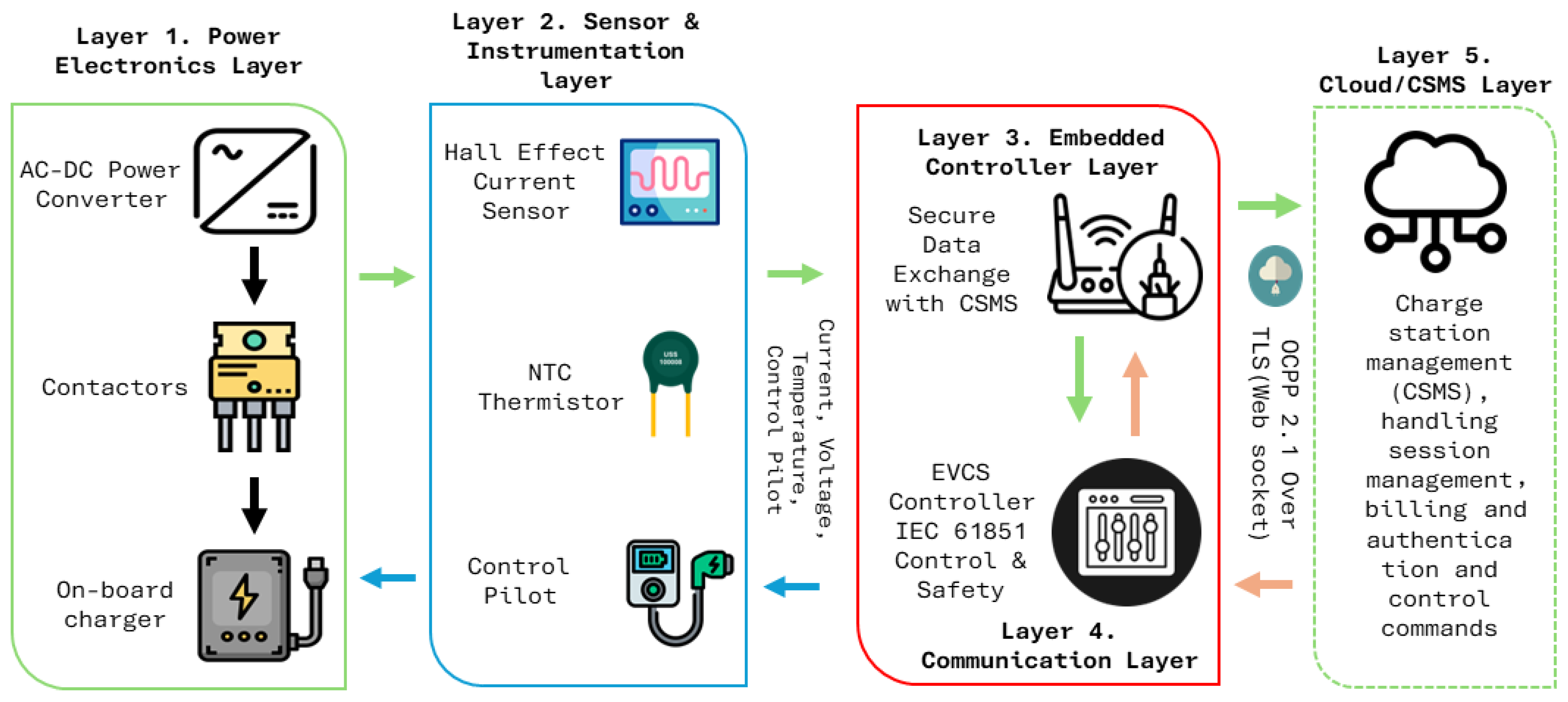
The above-mentioned overview studies have been summarized in Table 1 on the next page. Based on the table, it appears that although the power electronics aspects for the EV charging systems have been well reported, integration of power electronics with 5G communication and associated cybersecurity issues have not been fully covered. To fill in this gap, this paper presents an in-depth overview of power electronics applications in a 5G-enabled EV charging system (i.e., data transmission/communication via the 5G network) and associated cybersecurity issues. Recently, 5G technology has emerged as the paradigm shift for cellular communication due to its ultra-low latency and very high speed [21,22,23,24,25]. By providing real-time control and extremely fast communication, 5G can be an appropriate solution to successfully enable communication between the SCADA and various intelligent controllers needed for power electronic converters and smart components of EVCS. It is noteworthy that 5G in power systems is mainly used for supervisory, coordination, monitoring, and wide-area grid functions rather than microsecond-level switching converter control. Figure 1 shows the cyber–physical architecture of an EV charging system, which is a multi-layered structure combining high-power components, embedded control systems, communication protocols, and cloud-based management systems. Exploring appropriate methods for cyberattack detection and mitigation for EVCS is important.
This work provides a basic guideline on power electronics applications in 5G-enabled EV charging system and thus valuable for the researchers, scientists, and engineers working in this interesting field.
The main contributions of this paper are as follows:
(a)
Advanced converter topologies, resonant converter for 5G charging, and the integration of power electronics with 5G communication are discussed in detail.
(b)
Challenges and risks of integrating 5G into EV charging infrastructure are discussed.
(c)
The anomaly and intrusion detection models for a 5G-enabled EV charger and attack mitigation methods for EVCS are discussed.
(d)
Some recommendations on future research opportunities for power electronics with 5G communication and cybersecurity issues are provided.
The organization of this paper is as follows. Section 2 deals with advanced converter topologies. Section 3 describes features of 5G communication and integration of EV associated power electronics with 5G-communication. Section 4 describes the demands for power electronics in 5G-enabled EV charging. The anomaly and intrusion detection models for a 5G-enabled EV charging system and attack mitigation methods for EVCSs are discussed in Section 5. Section 6 provides some recommendations on future research opportunities. Finally, Section 7 concludes this paper.

Methodology

This review employs a systematic methodology to evaluate power electronics applications in 5G-enabled EV charging system. The search logic, screening steps, exclusion criteria, evaluation and classification procedure are described below.
(i)
Search Logic and Strategy
  • Databases: Primary searches are conducted across major scholarly repositories like IEEE Xplore, ScienceDirect (Elsevier), Scopus, and Google Scholar.
  • Keywords: Search queries are built using Boolean operators (AND, OR) to combine keywords into specific strings.
    • (“Electric Vehicle” OR “EV”) AND (“Charging System” OR “EVSE”) AND (“5G” OR “Communication”) AND (“Power Electronics” OR “Converters”)
(ii)
Screening Steps and Process
The screening process is a multi-step reduction cascade used to eliminate irrelevant papers and isolate high-quality research.
  • Identification: The initial database search yields a broad pool of papers (over 200 articles between 2005 and 2026).
  • Deduplication: Automatic or manual removal of identical records retrieved from multiple databases.
  • Title and Abstract Screening: Authors read only titles and abstracts to quickly filter out papers that stray entirely from the core topic.
  • Full-Text Retrieval and Eligibility Check: Remaining papers have their full PDFs retrieved and read in-depth to ensure they genuinely meet the predefined criteria.
(iii)
Exclusion Criteria
The exclusion criteria used for this review paper include the following:
  • Off-topic focus: Papers discussing EV policy, market trends, or battery chemistry rather than power electronics/5G infrastructure.
  • Language: Papers written in a non-English language.
  • Obsolete technology: Papers published prior to 2005.
  • Poor research quality: Pre-prints, white papers, patents, and conference abstracts lacking rigorous empirical or simulation data.
  • Out-of-scope scale: Studies focusing on micro-mobility (e.g., e-bikes) instead of commercial EV charging stations.
(iv)
Evaluation and Classification Procedure
Once the final list of papers (total 95) is selected, authors evaluate and group them to build the narrative of the review paper.
  • Data Extraction: Reviewers extract specific data points from each paper, such as hardware topology (e.g., SiC vs. GaN converters), 5G latency metrics, and simulation tools used (e.g., MATLAB/Simulink 2019).
  • Technical Categorization: Papers are classified by research direction and time span as shown below.
    Power electronics/Advanced converter topologies (2007 to 2026)
    5G Communication technology and advantages (2019 to 2026)
    Integration of EV associated power electronics with 5G communication (2015 to 2026)
    Cybersecurity issues in a 5G-enabled EV charging system, EVCS, and associated power electronic components (2007 to 2026)
    Cyberattack impact on 5G-enabled EVCSs (2020 to 2026)
    Cyberattack detection for 5G-enabled EVCSs and EV power electronics (2020 to 2026)
    5G-enabled Blink 2 EV charger: cyberattack detection (2020 to 2026)
    Machine learning anomaly detection for CAN-enabled EVCS (2007 to 2026)
    Cyberattack mitigation for 5G-enabled EVCSs (2020 to 2026)
  • Performance Comparison: The studies are evaluated and compared using Key Performance Indicators (KPIs) like power density, efficiency, bandwidth, and response times. This synthesis allows the authors to identify current technology gaps and future research directions.
  • Content analysis using a matrix framework to assess technological focus, EVCS layers, and cybersecurity functionalities.
  • Thematic synthesis to identify gaps and propose a 5G-enabled EV charging approach. Search terms included “EV charging,” “Power electronics,” “EVCS cybersecurity,” and “5G.”
Inclusion criteria prioritized peer-reviewed studies with technical depth, simulations, or regulatory insights. This entire process is summarized in a flow diagram in Figure 2. below.

2. Advanced Converter Topologies

Converters are essential for EV chargers to bridge the gap between grid AC electricity and battery DC requirements, facilitating power conversion, voltage regulation, and safety. They rectify and step up/down voltage, as well as ensuring efficient, safe charging by preventing overcharging and managing power factors.
Industrial EV charger architectures commonly use high-power AC (250 V–480 V) or DC bus systems, often employing modular, scalable designs to support fast (50–350 kW) and megawatt (up to 3.75 MW) charging for fleets. Key configurations include centralized AC-DC converters, distributed DC-DC converters for multiple loads, and integration with renewable energy sources via DC microgrids, managed by communication protocols like OCPP. The core architectural components are as follows:
AC-DC Rectifier/PFC: Converts grid power to DC, with power factor correction (PFC) for efficiency.
DC-DC Converters: Steps down voltage for specific EV loads; Dual Active Bridge (DAB) topologies are common for efficiency.
Isolation Transformers: Protects EVs by isolating them from the grid.
Modular Design: Allows power capacity to be increased by adding modules, enabling easier maintenance.
The common industrial architecture is described as follows:
DC Bus-Based Systems: Highly efficient, flexible, and cost-effective, using a common DC bus for multiple chargers.
AC Bus-Based Systems: Utilizes three-phase AC (250 V–480 V) for direct, high power delivery.
Megawatt Charging System (MCS): Specifically designed for heavy-duty vehicles, supporting up to 3.75 MW.
Hybrid Systems: Combines solar PVs, fuel cells, and energy storage with a common DC bus for improved efficiency.
Moreover, the key industrial application considerations are the following:
Scalability: Modular architecture allows for adding chargers as fleet size increases.
Safety and Reliability: Includes isolation monitors, residual current detectors, and advanced cooling systems for high-power electronics.
Communication Protocol: Uses OCPP (Open Charge Point Protocol) to manage, monitor, and maintain charging stations centrally.
Charging Standards: Supports CCS, NACS, and CHAdeMO, allowing for wide compatibility.
Conventional converters like buck, boost, or basic PWM designs are simple, cheap, and have been in power systems for years. They work well for steady loads but show their limits when applied to EV fast charging circuits. They suffer from large switching losses and significant electromagnetic interference (EMI) when used with high switching frequencies. Conventional converters struggle to handle wide voltage ranges efficiently; this makes them less suitable for universal chargers.
Due to these limitations, researchers lean to more advanced topologies. Resonant converters use reactive components to shape waveforms and enable soft switching. Soft switching reduces switching losses and improves efficiency. Multilevel inverters distribute voltage stress across multiple devices. This lowers EMI and improves harmonic performance. Hybrid designs combine the strengths of multiple approaches. Resonant DC-DC converters can achieve exceptionally high efficiency when operated over narrow ranges of input and output voltages [26], but they need advanced control methods to maintain that efficiency over wider ranges [27,28].

2.1. Conventional vs. Advanced Converters

Conventional PWM converters have been the backbone of power electronics because they are simple, proven, and inexpensive. They can get the job done in low-power or steady applications, but their limits become obvious at high frequencies. Switching losses climb, EMI increases, and efficiency drops when they are pushed outside their comfort zone. These weaknesses are especially problematic for EV charging stations that need to operate across wide voltage ranges.
Advanced topologies take a different approach. Resonant converters rely on soft switching to cut down on losses. Multilevel inverters divide voltage stress among devices, which not only improves efficiency but also reduces EMI. Hybrid converters try to combine the strengths of several designs to cover more operating conditions. Studies note that “resonant dc–dc converters can achieve exceptionally high efficiency when operated over narrow ranges of input and output voltages” [26], but they also make it clear that advanced control strategies are necessary to keep efficiency high across a broad operating range [27,28]. The work in [29] investigates the fixed-time control problem of DC-DC buck converter systems with mismatched disturbances.

2.2. Resonant Converters: LLC, LCL-T, and Wide-Range Variants

The LCL-T resonant converter offers a different set of advantages. Borage and colleagues found that the LCL-T “behave as a current source when operated at resonant frequency” [30]. That means it can maintain constant current across a wide voltage range, which is exactly what EVs require during the constant-current phase of charging. It also reduces circulating current at light loads, which lowers device stress and improves efficiency [30].
This property has applications outside EVs as well. In automotive LED drivers, the current-source behavior of the LCL-T makes it easy to regulate current even as voltage changes. More recently, wide-range LCL-T (WR-LCL-T) converters have been introduced. These use two control variables—phase shifts in the inverter and rectifier stages—to fine-tune performance. Mukherjee and colleagues explain that “output current can be controlled by the phase shift φinv … and φrec … to minimize conduction losses” [27]. Tests of a wide-range LCL-T (WR-LCL-T) prototype showed efficiencies above 92% even at MHz switching frequencies, pointing to its potential for high-power, high-frequency charging systems [27].

2.3. Multilevel Inverters and Wide-Bandgap Devices

While resonant topologies provide the foundation for efficient power conversion, additional gains are achieved through multilevel inverters and wide-bandgap semiconductors. Multilevel inverter structures reduce voltage stress across devices by distributing it among multiple levels, thereby lowering EMI and improving harmonic performance. This is particularly advantageous in high-power EV charging stations, where compliance with EMI standards is a significant challenge.
Wide-bandgap semiconductors—specifically gallium nitride (GaN) and silicon carbide (SiC)—further enhance converter performance. These two devices in 5G-enabled chargers offer extreme miniaturization, high-frequency switching, and superior thermal efficiency, but face challenges including charge-trapping effects, complex electromagnetic interference (EMI), and rigorous thermal management limits [31]. The specific advantages and reliability challenges in the context of 5G-enabled chargers are discussed below.

2.3.1. Key Advantages

High-Frequency Switching: Gallium Nitride (GaN) provides exceptional electron mobility, enabling rapid switching speeds that shrink passive components like filters and inductors.
Power Density and Size: Both materials handle higher voltages and temperatures than silicon, allowing 5G base stations and fast chargers to drastically reduce size and weight.
Thermal Stability: Silicon Carbide (SiC) delivers superior thermal conductivity, easing cooling system constraints in high-power continuous operations. Park et al. report that a DAB converter using bare-die SiC MOSFETs and a leakage-integrated planar transformer achieved a “peak efficiency of 98%” [32] while delivering 3.3 kW, with a remarkable “power density of 5.44 kW/L” [32]. Such results underscore the potential of SiC-based systems for next-generation fast chargers.

2.3.2. Reliability Challenges

Dynamic On-State Resistance: GaN devices suffer from charge trapping and current collapse under high electric fields, degrading performance over time.
Electromagnetic Interference (EMI): Ultra-fast voltage changes (dV/dt) generate high levels of noise and cross-talk, complicating circuit layout and filtering.
Thermal and Substrate Stress: GaN-on-Silicon thermal expansion mismatches create structural strain and potential failure points.

2.4. Hybrid and Multi-Stage Architectures

Beyond individual topologies, system-level architecture also plays an important role in advancing EV charging. Multi-stage architectures typically use a buck–boost or PFC front-end stage followed by a resonant DC–DC stage. This approach allows each stage to be optimized for its function: the front-end for regulation and power factor correction, and the resonant stage for isolation and efficiency. A two-stage buck–boost plus resonant architecture has been demonstrated in automotive LED applications, where it achieved over 88% efficiency across wide voltage ranges [26].
Topology morphing is another system-level technique. By dynamically altering the topology (e.g., switching between full-bridge and half-bridge LLC operation), converters can maintain efficiency over wide ranges without oversizing components. Jovanović and Irving showed that “the proposed on-the-fly topology-morphing control maintains a tight regulation of the output during the topology transitions” [28], avoiding transient disturbances common in rapid topology shifts. These adaptive methods are particularly valuable in 5G-enabled charging stations, where real-time adjustments are crucial.

2.5. Comparison of LLC, LCL-T, Dual Active Bridge (DAB), and Hybrid Structures

A systematic comparison of LLC, LCL-T, Dual Active Bridge (DAB), and Hybrid structures in terms of operating range, efficiency, control complexity, bidirectional capability, and practical EV charging use cases are described below.
(i)
Operating Range
  • LLC: Highly optimized for a fixed narrow voltage. When forced to operate far from its resonant frequency to handle wide battery voltage swings (200 V to 800 V), efficiency drops dramatically due to high circulating currents and loss of soft switching.
  • LCL-T: Functions as a constant-current source at resonant frequency. It inherently manages wide output voltage variations much better than standard LLC without requiring extreme frequency sweeps.
  • DAB: Uses phase-shift angles between the primary and secondary bridges to adjust power flow. It handles wide voltage variations smoothly, though its soft-switching zone shrinks if the input/output voltage matching ratio (M) deviates significantly from 1.
  • Hybrid: Combines the best of multiple topologies (e.g., combining an LLC loop with a phase-shifted full bridge, or reconfiguring from full-bridge to half-bridge). This allows the converter to cover ultra-wide voltage spans (200 V–1000 V) (passenger and commercial EV standards) while keeping the operating frequency near resonance.
(ii)
Efficiency and Soft-Switching (ZVS/ZCS)
  • LLC: Achieves Zero Voltage Switching (ZVS) on the primary side switches and Zero Current Switching (ZCS) on the secondary diodes/synchronous rectifiers. It offers the highest peak efficiency of all four options, but only when operating right at the resonant frequency.
  • LCL-T: Achieves ZVS for primary switches over a broad load profile. Circulating current losses are slightly higher than a perfectly tuned LLC, leading to a slightly lower absolute peak efficiency, but it maintains a flatter efficiency curve across wide load variations.
  • DAB: Achieves ZVS across all switches under nominal voltage conditions. However, at light loads or high voltage mismatches, the ZVS range is lost, causing switching losses to spike unless complex modulation schemes are used.
  • Hybrid: Automatically shifts its structural configuration or control scheme depending on the load. This ensures the switches remain within their optimal ZVS/ZCS zones across the entire charging cycle, leading to high overall mission efficiency.
(iii)
Control Complexity
  • LLC: Controlled via simple Pulse Frequency Modulation (PFM). The control loop is straightforward, though synchronous rectification at high frequencies requires precise timing.
  • LCL-T: Requires Hybrid Modulation (combining PFM with Phase-Shift Modulation) to maintain high efficiency when dealing with ultra-wide output variations.
  • DAB: Highly complex. Basic Single-Phase Shift (SPS) control introduces high reactive power. To optimize efficiency, controllers must implement Extended (EPS), Dual (DPS), or Triple Phase Shift (TPS) algorithms, which require high-performance DSPs to calculate optimal switching angles in real time.
  • Hybrid: Most complex. It demands advanced control state machines to smoothly handle the transitions between different operating modes (e.g., seamless switching from LLC mode to Phase-Shifted Full Bridge mode) without causing output current or voltage spikes.
(iv)
Bidirectional Capability
  • LLC: Inherently asymmetric. When power flows in reverse (rectifier acting as an inverter), the resonant tank parameters change (the magnetizing inductance is effectively shorted out on the new secondary side). This severely limits its voltage gain and eliminates its soft-switching advantages in reverse mode.
  • LCL-T: Structurally symmetric. The T-network functions identically regardless of power direction, making it an excellent candidate for bidirectional setups.
  • DAB: Inherently and perfectly symmetric. Power direction and magnitude are determined solely by leading or lagging the phase shift between the two active bridges. It is the gold standard for bidirectional power flow.
  • Hybrid: Can be designed to be fully bidirectional if both ends utilize active switch bridges. The complex control algorithm must account for bidirectional state mapping.
(v)
Practical EV Charging Use Cases
  • LLC Resonant: Best suited for unidirectional On-Board Chargers (OBCs) and fixed-voltage DC charging architectures where the battery voltage variant is narrow, or where a pre-regulating buck/boost stage handles the voltage swing.
  • LCL-T Resonant: Ideal for commercial DC Fast Charging stalls that need to service both older (400 V) battery packs and modern (800 V) powertrains without clipping current limits or dropping efficiency.
  • Dual Active Bridge (DAB): The premium choice for vehicle-to-grid (V2G)- and vehicle-to-home (V2H)-enabled OBCs. It is also extensively used in solid-state transformers (SSTs) and localized microgrid DC charging hubs where bidirectional energy storage integration is required.
  • Hybrid Converters: Increasingly deployed in premium, universal multi-protocol public DC Fast Chargers. Because public infrastructure must charge everything from small low-voltage electric scooters to (1000 V) heavy-duty electric trucks at peak efficiency, the hybrid structure’s wide adaptability justifies its high development cost.
Table 2 shows summarizes a comparison among LLC, LCL-T, DAB, and hybrid converters [33,34,35,36,37,38] considering rated power, input/output voltage range, semiconductor technology, switching frequency, isolation, thermal conditions, and experimental validation.

2.6. Topology Selection Summary for EV Charging Applications

The unified benchmarking results summarized in Table 2 highlight that no single converter topology is optimal across all EV charging scenarios. Instead, topology selection is strongly dependent on power level, voltage variability, bidirectional operation requirements, and system-level constraints.
(i)
On-Board Chargers (OBC, 3–22 kW).
OBCs prioritize high power density, wide battery voltage accommodation, and proven reliability under automotive constraints. LLC resonant converters remain the dominant solution due to their mature design ecosystem and high efficiency near resonance, while wide-range LLC and WR-LCL-T variants offer improved voltage adaptability at the cost of increased control and magnetic complexity.
(ii)
DC Fast Charging (DCFC and XFC, 50–350 kW).
High-power charging stations emphasize scalability, thermal management, and modularity. In this regime, Dual Active Bridge converters and multi-stage architectures combining PFC front-ends with isolated DC–DC stages are preferred due to their bidirectional capability, ease of parallelization, and compatibility with wide-bandgap devices.
(iii)
Modular and Multi-Port Charging Stations.
For stations serving multiple vehicles simultaneously, predictable current regulation and module-level power sharing become critical. Current-source-oriented resonant topologies such as LCL-T and WR-LCL-T offer advantages in constant-current operation and reduced circulating current, making them attractive for modular research platforms and next-generation architectures, even though commercial adoption remains limited.
Overall, Table 2 and the comparative analysis above provide a structured framework for selecting appropriate power-converter topologies based on application requirements rather than isolated performance metrics.

2.7. Impact of 5G in Converter Design, Control, or Performance Metrics

The converters, as discussed above, act as the interface between the communication layer and the vehicle battery in a charging station. 5G technology impacts EV charging by providing ultra-reliable, low-latency communication that connects power hardware to cloud intelligence. While 5G does not alter the physical power conversion inside a DC/DC converter or rectifier, it enables real-time edge control, dynamic grid balancing, and optimized performance telemetry across charging networks.
(i)
Converter Design and Hardware Integration
Modular Feedback Shielding: Power electronic building blocks integrate wireless communication modules directly into control boards. High switching frequencies (using SiC or GaN) create electromagnetic noise that requires physical shielding of the 5G transceiver to maintain link stability.
Distributed Topology Coordination: 5G allows multi-module parallel converters (such as interleaved Vienna rectifiers or Dual Active Bridge setups) to synchronize phase-shifting parameters across separate physical cabinets without hardwired connections.
(ii)
Control Strategies
Cloud-to-Edge Closed Loops: Ultra-low latency (<10 ms) enables supervisory control and data acquisition (SCADA) and model predictive control (MPC) frameworks to adjust power references remotely.
Vehicle-to-Grid (V2G) Orchestration: Real-time bi-directional power flow requires instant handshakes between the EV, the charging station, and grid operators. 5G network slicing prioritizes critical V2G active/reactive power dispatch packets over routine telemetry. In V2G scenarios, these rapid transitions are only possible when converters employ advanced control strategies, including predictive control algorithms [39]. Predictive and sliding-mode controllers have already demonstrated sub 2 ms response times in resonant converters, showing their compatibility with the low-latency demands of 5G systems [40,41].
Dynamic Tariff and Load Shifting: Edge computing paired with 5G allows chargers to instantly reallocate current capacity based on live grid congestion metrics.
(iii)
Performance Metrics
Total Harmonic Distortion (THD) and Power Factor (PF): Fast cellular reporting monitors grid-side power quality metrics in real time, allowing adaptive software loops to adjust harmonic compensation and keep PF close to unity (~0.99).
Latency and Packet Loss: Evaluated as a core communication metric, minimizing round-trip delay prevents sync errors during multi-vehicle load shedding.
Bandwidth Cost Efficiency: Advanced edge aggregation filters high-frequency 1 Hz local telemetry down to periodic metrics, optimizing 5G data utilization while preserving diagnostic accuracy.
The details about the 5G communication and its integration with EV-associated power electronics are described in the next section.

3. Features of 5G Communication and Integration of EV Associated Power Electronics with 5G Communication

3.1. 5G Communication Aspects

Recently, wireless technologies have been growing actively all around the world. In the context of wireless technology, the fifth generation (5G) technology has become the most challenging and interesting topic in wireless research. Although 4G, 3G, or other communication mediums can be used, to achieve ultra-low latency, wider bandwidth capabilities, and very high-speed communication, the 5G can provide superior performance. The superiority of 5G over other existing communication mediums has been discussed in [25].
Both 4G and 5G use radio towers to deliver wireless services (e.g., mobile, internet). However, 5G uses dense small cells to deliver data over mid- and high-frequency bands with small coverage ranges, compared to 4G, which uses large cell towers. Because radio waves can carry a maximum threshold of data depending on the operating frequencies, 5G—which operates on higher frequencies—can add more capacity and space to use and include much wider devices connected to the network with higher data speed. Further, since the 5G network is denser, it can support more users and more types of devices with faster speed (higher received data rate), lower latency (lower delay between sending/receiving the data), and greater connection reliability [42]. Although the current 5G network relies on the existing 4G towers, 5G operators are working on developing standalone 5G networks under the following core areas [43,44,45,46]:
(i)
Network Slicing: A network architecture that multiplexes multiple virtualized and independent networks on the same physical infrastructure. Network slicing optimizes the characteristics of each slice based on the specific needs of the requested service without wasting the available resources. This will make 5G networks much more flexible by functioning as multiple separate networks at the same time and replacing the need for special purpose networks.
(ii)
Massive MIMO: Large arrays and surfaces with many antenna elements have the advantage of enhancing the 5G network. Massive MIMO, as an extension of Multi-Input Multi-Output, expands beyond the legacy systems by having many more antennas in the wireless towers than the number of devices. Massive MIMO can help in narrowing and focusing the transmitted energy beams, which brings improvements in throughput and efficiency.
(iii)
Beamforming and Localization: Wireless links in 5G, especially high-frequency bands, suffer from high penetration losses, with added new implementation and design challenges. 5G aims to improve the network performance of the MIMO system using high-precision antenna arrays with the capability of transmitting the wireless signals in specified directions toward individual devices. This needs to implement dynamic and real-time localization algorithms to steer the wireless signals toward the receivers.

3.2. Integration of EV-Associated Power Electronics with 5G-Communication

Integrating a power electronics control layer with 5G communication in electric vehicle (EV) charging enables ultra-reliable, low-latency coordination between the grid, charging station hardware, and vehicle battery management systems (BMS). This architecture replaces slower legacy loops with real-time digital management, optimizing dynamic power delivery and bidirectional energy transfer.
(i)
Architecture of the Control and Communication Layers
  • Power Electronics Hardware Layer: Consists of wide-bandgap semiconductor devices (like Silicon Carbide/SiC) managing AC/DC rectification and high-frequency DC/DC conversion to handle wide output voltages (150 V to 1000 V).
  • Local Embedded Control Layer: Comprises real-time microcontrollers and isolated gate drivers managing inner-current and outer-voltage loops locally at the converter stage to protect hardware and regulate immediate power output.
  • 5G Connectivity Layer: Acts as the high-speed supervisory backbone utilizing 5G ultra-reliable low-latency communication (URLLC) and network slicing to interface the charger with cloud management and grid operators.
(ii)
Key Functional Benefits
  • Sub-millisecond Latency: Speeds up response times for safety interlocks, dynamic load balancing across dense charging hubs, and fast transactional authentications.
  • Vehicle-to-Grid (V2X) Orchestration: Coordinates real-time feedback loops necessary to stream power safely back to the grid during peak demand without destabilizing local converter control.
The necessity and technical role of 5G in power electronics systems are as follows:
  • Real-time Load Management and Grid Stability: 5G allows charging stations to communicate instantly with grid operators, adjusting power flow based on real-time grid demand, which is crucial for V2G and renewable integration.
  • Intelligent Diagnostics and Reliability: 5G-enabled stations can detect malfunctions, run diagnostic updates, and trigger remote resets instantly, reducing downtime and enabling proactive maintenance.
  • Enhanced Charging Experience: High-speed, low-latency data allows for immediate authentication, payment processing, and real-time, high-bandwidth communication between the vehicle and charger.
  • Advanced Power Electronics Control: 5G facilitates intelligent, distributed control of power electronics (inverters/converters) for efficient, fast charging by managing heat and power loads dynamically.
  • Security and Network Slicing: 5G allows operators to create dedicated, secure network slices, isolating critical payment and control data from general user traffic, strengthening the security of the charging infrastructure.
To further clarify the technical relationship between 5G communication and power-converter control, a hierarchical control architecture that distinguishes controller execution time, converter response time, radio latency, end-to-end communication latency, jitter, and packet loss is described below.
A 5G-enabled hierarchical control architecture for power converters distributes tasks across three execution levels such as Tertiary (EMS/SCADA), Secondary (Coordination/Sync), and Primary (PWM/Cell)—co-optimized with ultra-reliable low-latency communication (URLLC). End-to-end latency combines controller execution, radio transport, and converter actuation. This is to clarify here that 5G is primarily associated with supervisory, coordination, monitoring, and grid-level functions rather than switching-level converter control. The hierarchical control and timing breakdown are as follows:
  • Tertiary Control (Cloud/Control Center)
    Task: Economic dispatch, optimization, grid energy management.
    Controller Execution Time: 100 ms–5 s.
    End-to-End Latency: 20 ms–100 ms.
    Jitter: ±5 ms–20 ms.
    Packet Loss Tolerance: <1%.
  • Secondary Control (Local Edge/Substation gNB)
    Task: Synchronization, voltage/frequency restoration, droop control tuning.
    Controller Execution Time: 1 ms–20 ms.
    Radio Latency (5G URLLC air interface): 1 ms–5 ms.
    End-to-End Communication Latency: 5 ms–15 ms.
    Jitter: ±0.5 ms–2 ms.
    Packet Loss Tolerance: < 0.01%.
  • Primary Control (Local DSP/FPGA at Converter)
    Task: Inner current/voltage loops, space vector modulation (PWM).
    Controller Execution Time: 20 μs–200 μs.
    Converter Response Time: 100 μs–1 ms.
    Jitter: <10 μs (must remain strictly internal or hardwired via local fiber/SPI; unsuited for raw real-time 5G closed-loop feedback).
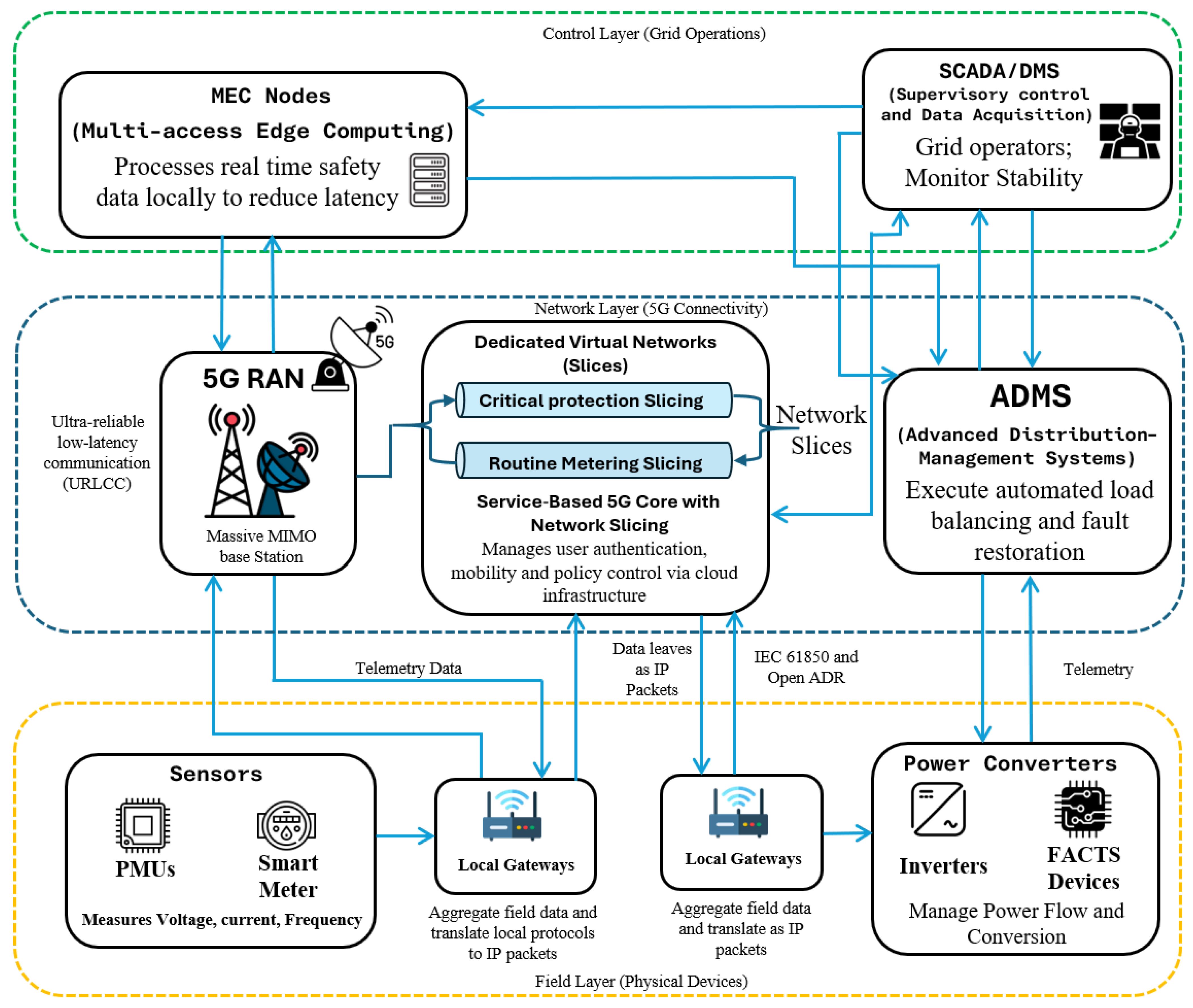
In summary, 5G is the backbone for making EV charging smarter, faster, and more reliable, transitioning it from simple power transfer to an integrated, intelligent energy node. A 5G smart grid architecture connects physical grid devices like sensors and power converters to grid operators using a 5G New Radio (NR) access network, a service-based 5G Core with network slicing, and edge computing nodes that route telemetry and control commands via protocols like IEC 61850 or OpenADR. Figure 3 shows an architecture diagram showing how 5G interfaces with power converters, sensors, and grid operators.

Benefits of 5G Integration

The integration of 5G communication with power electronic converters provides several benefits that extend beyond charging speed. One of the most important contributions of 5G integration is the ability to enable real-time adaptive charging. “5G-enabled control” refers to the use of fifth-generation wireless technology to manage, monitor, and operate machinery, devices, or systems in real-time with ultra-low latency and high reliability. This capability is defined numerically by the IMT-2020 standard, which includes key performance indicators (KPIs) such as 1 ms latency for critical applications, theoretical peak speeds of up to 20 Gbps, and support for up to 1 million devices per square kilometer [46]. Chargers can adapt based on grid conditions, battery characteristics, and station-level load demands.
In practice, this means a charging station can dynamically regulate current delivery depending on a vehicle’s state of charge (SoC), battery temperature, or health status. Grid disturbances such as frequency dips or sudden load spikes can be addressed by altering charging power within milliseconds, preventing instability. For multi-port stations, 5G enables sophisticated load balancing across multiple EVs, ensuring that available grid capacity is allocated efficiently. Power electronics converters with fast dynamic response—particularly resonant and DAB topologies—are critical for translating these real-time control signals into stable, reliable charging currents [32].
5G technology can significantly alter and enhance the control, stability, protection, and system architecture for EV charging. By providing ultra-low latency, high bandwidth, and massive device connectivity, 5G acts as a crucial, intelligent, and secure communication backbone that moves EV charging from simple power delivery to a complex, real-time, grid-interactive service. Detail descriptions are provided below.
(i)
Control and Management
  • Real-time Dynamic Control: 5G enables instantaneous, bidirectional communication between EVs, chargers, and the grid, allowing for precise real-time load management, demand-response, and dynamic pricing.
  • Remote Operations: 5G facilitates remote monitoring, diagnostics, and instant software updates or reboots, which can significantly reduce the downtime of charging stations.
  • Intelligent Scheduling: 5G-enabled, AI-powered systems can optimize charging schedules, shifting loads away from peak hours to reduce energy costs and prevent local grid overloading.
(ii)
System Stability
  • Vehicle-to-Grid (V2G) Integration: 5G provides the low latency needed for V2G, allowing EVs to act as distributed energy storage devices that can feed power back into the grid to stabilize energy supply during peak demand.
  • Grid Balancing: Real-time data from 5G-connected chargers allows grid operators to manage energy distribution actively, reducing the strain on the power infrastructure.
  • Reducing Oscillations: Advanced control systems using 5G can help mitigate instability in EV charging stations, preventing oscillations or shifts in DC operating points.
(iii)
Protection and Security
  • Predictive Maintenance and Fault Detection: High-speed, real-time monitoring allows for the instant identification of faults, enabling “self-healing” processes, such as rerouting power or isolating faulty chargers without human intervention.
  • Enhanced Cybersecurity: While 5G increases the digital attack surface, it also offers advanced features like network slicing, which allows operators to isolate critical charging, traffic, and security data from user infotainment traffic, creating a more secure, private channel.
  • AI-Enhanced Safety: 5G enables the use of AI and digital twins, to monitor and secure the cyber–physical, infrastructure, with some research indicating a 98.9% detection rate for cyberattacks on smart grid components.
(iv)
System Architecture
  • Service-Based Architecture (SBA): 5G introduces converged, microservices-based, architecture where charging functions are virtualized, allowing for easier, more flexible, and scalable deployment (e.g., edge computing).
  • Unified Charging Systems (5G CCS): 5G enables a “Converged Charging System” (5G CCS) that merges online (prepaid) and offline (postpaid) charging models into a single, efficient, platform.
  • Edge Computing (MEC): 5G supports Multi-access Edge Computing (MEC), allowing data to be processed near the charging station rather than in a distant central cloud, which drastically speeds up decision-making and reduces reliance on long-distance, wired connections.
It is noteworthy that the performance metrics of 5G—such as 1 ms latency, 20 Gbps peak data rate, 98.9% detection rate, and high reliability/availability (often specified to 99%) [47,48,49]—apply strictly under optimal, theoretical, or highly controlled test environments defined by international standards like the ITU (IMT-2020) and 3GPP. They do not reflect average everyday mobile usage. The Peak and Ideal Conditions are as follows:
  • Peak Data Rate—20 Gbps: Requires high-band millimeter-wave (mmWave) spectrum (above 6 GHz) with massive bandwidth channels (up to 1 GHz), an unobstructed line-of-sight to the cell tower, massive MIMO antenna setups, and a single user or unloaded cell capacity.
  • User Plane Latency—1 ms: Applies specifically to ultra-reliable low-latency communication (URLLC) profiles processing tiny data packets (e.g., zero-byte payload plus headers) on an unloaded network with edge computing or localized core routing, rather than standard internet traffic routing.
  • Reliability/Availability—99%/99.999%: Standardized parameters assume rigid channel quality metrics at a coverage edge or within engineered private network slices guaranteeing dedicated resource blocks without cross-traffic interference.
  • Detection Rates (e.g., ~98.9% or specific AI/ML accuracy bounds): Application-specific metrics (such as anomaly detection or sensor tracking) depend entirely on localized sensor quality, minimal packet-loss budget, and low jitter within a closed network slice rather than raw radio capabilities.

4. Demands for Power Electronics in 5G-Enabled EV Charging

Power electronics for the EV charging station must be designed to address four central demands: fast dynamic response, wide voltage adaptability, bidirectional operation, and high reliability [26,46]. Each of these demands is critical for ensuring that 5G-enabled EV charging systems can operate efficiently, flexibly, and reliably on a scale.

4.1. Fast Dynamic Response

One of the most significant demands placed on power electronics in 5G charging infrastructure is the ability to respond to control signals in near real-time. In power electronics, “real-time” is numerically defined by a simulation or control system operating with a fixed, deterministic time step (Ts) that is equal to or faster than the actual physical process (wall-clock time), typically requiring loop execution times in the range of 100 nanoseconds to 100 microseconds. A fast dynamic response ensures that converters can adapt instantaneously to changes in grid conditions, EV battery state of charge, and station loading balancing. In power electronics, a “fast dynamic response” is generally defined as the ability of a converter or system to return to a steady-state operating point within tens of microseconds to 1–2 milliseconds following a significant disturbance (such as a load step or input voltage change). Traditional control approaches often fail to meet these stringent requirements due to latency in their feedback mechanisms.
Recent advancements in control methodologies have demonstrated considerable improvements. Predictive control strategies for AC-DC and DC-DC converters significantly enhance transient behavior by anticipating system changes rather than simply reacting to them [39]. Similarly, sliding-mode active disturbance rejection controls applied to resonant converters have achieved transient response times on the order of 2 ms, demonstrating the feasibility of near-instantaneous adaptation to varying load and grid conditions [40,41]. In bidirectional applications, the inherent fast control characteristics of Dual Active Bridge (DAB) converters further support low-latency power flow regulation, which is essential for 5G-enabled charging systems where end-to-end communication latencies are expected to be below 1–5 ms [32].
Without such a rapid dynamic response, a charging station risks introducing instabilities into the grid or charging inefficiencies into the vehicle battery. The ability of power electronics to react quickly represents a cornerstone requirement for next generation charging stations.

4.2. Wide Voltage Adaptability

Another primary demand is compatibility with a wide range of battery voltages. Current EVs employ battery packs ranging from 150 V to 950 V, with luxury vehicles such as the Porsche Taycan already operating on 800 V platforms [26]. Charging stations must accommodate this diversity without sacrificing efficiency, creating the need for highly adaptable power electronics architectures.
Resonant converters, particularly inductor–capacitor–inductor in T-network configuration (LCL-T) topologies, have been shown to provide near-constant current outputs over wide voltage ranges, making them ideal candidates for universal charging systems [30]. Control advancements have further expanded this adaptability. For example, optimal control strategies applied to inductor–inductor–capacitor (LCL) resonant converters have been demonstrated to maintain efficiencies above 87% across wide variations in both input and output voltages [27]. Similarly, on-the-fly topology morphing enables LLC converters to dynamically adjust their structural configuration in real time, improving efficiency while operating over wide voltage ranges [28]. The challenge of wide voltage adaptability is not simply academic—it is fundamental to ensuring universal operation across vehicle platforms and to future proofing infrastructure against evolving battery technologies. Without it, charging stations risk obsolescence or the need for costly hardware redesigns.

4.3. Bidirectional Operation

The increasing integration of renewable energy and distributed generation into modern grids has made bidirectional operation a crucial requirement for EV chargers. This functionality enables both grid-to-vehicle (G2V) and vehicle-to-grid (V2G) power flows, allowing EVs to serve as distributed energy storage systems that can stabilize the grid during peak demand or support renewable integration.
Among the topologies suited for this application, the DAB converter stands out due to its symmetrical structure, inherent bidirectionality, and high efficiency under both charging and discharging modes [30]. Experimental designs employing silicon carbide (SiC) metal oxide semiconductor field-effect transistor (MOSFET) and leakage-integrated planar transformers have achieved efficiencies approaching 98% in bidirectional onboard chargers, further validating the topology’s suitability [32]. Hybrid approaches that combine LLC and DAB converters also show promise for enabling wide voltage bidirectional operation with minimal loss penalties [41].
Control advances play a vital role in enabling seamless bidirectional transitions. Predictive and model predictive control strategies have demonstrated the ability to smooth the reversal of power flow without inducing instability or excessive harmonic distortion [39]. When paired with 5G-enabled coordination, bidirectional chargers can participate in advanced grid services such as peak shaving, reactive power support, and load leveling, extending their role from vehicle support systems to active grid participants.

4.4. High Reliability

High reliability is essential for both public charging infrastructure and the broader power grid. Public chargers are expected to deliver near-constant availability, often with up-time requirements exceeding 99%. To achieve this, the power electronic converters must withstand wide temperature variations, high current stresses, and frequent dynamic load transitions without significant degradation in performance.
Wide-bandgap semiconductors such as GaN (Gallium Nitride) and SiC devices have enabled significant improvements in efficiency and power density, but they also introduce new reliability challenges. GaN devices, for instance, suffer from issues such as dynamic ON-resistance (RDS, on) shifts due to trapping effects, which can increase conduction losses under high-frequency operation [31]. Studies have also highlighted failure mechanisms in packaging and interconnects, particularly under thermal cycling and high-stress switching conditions [31]. To mitigate these risks, manufacturers are increasingly pursuing advanced qualification standards (e.g., JEDEC JC-70) and novel packaging strategies, such as bare-die SiC MOSFET modules with reduced parasitic inductance, which improve both thermal performance and long-term durability [32].
Additionally, resonant topologies such as the LCL-T reduce circulating currents at light loads, thereby lowering thermal stress and improving system longevity [28]. These innovations collectively support the high reliability of 5G-enabled chargers, where downtime affects not only customer satisfaction but grid balancing operations.

4.5. Challenges and Risks

Despite its advantages, integrating 5G into EV charging infrastructure presents challenges. One concern is latency variability. While 5G networks promise ultra-low latency, real-world performance can fluctuate due to congestion or coverage gaps. Converters must therefore employ robust predictive controls that can maintain stability even during brief communication delays [39].
Interoperability is also an issue. With different EV manufacturers and grid operators potentially using varying communication standards, establishing a unified framework for 5G-based charging control remains a hurdle [36]. Reliability is similarly critical: if communication is lost, chargers must fall back to safe, autonomous operation without compromising the vehicle battery or grid [31].
Cybersecurity represents another significant challenge. Cyberattacks on 5G-enabled EV-charging power electronics occur by exploiting vulnerabilities in interconnected layers—communication, software, and hardware—to compromise power flow. Attackers can remotely access chargers via weak cloud authentication, manipulate charging protocols like OCPP to alter charging rates or steal energy, or use 5G network flaws to trigger DDoS attacks that disrupt charging services and destabilize the grid. Key attack vectors and mechanisms include Cloud and Network Exploitation, False Data Injection (FDI) Attacks, 5G-Specific Threats, Man-in-the-Middle (MITM) Attacks, Firmware and Hardware Compromise, etc. These attacks convert cyber breaches into physical consequences, such as overheating batteries, damaging converter circuits, or causing grid instability. Thus, encryption, authentication, and resilient network protocols are critical. This point will be discussed in detail in the next section.

5. Cybersecurity Issues with 5G-Enabled EVCS, EV Charging and Associated Power Electronics Components

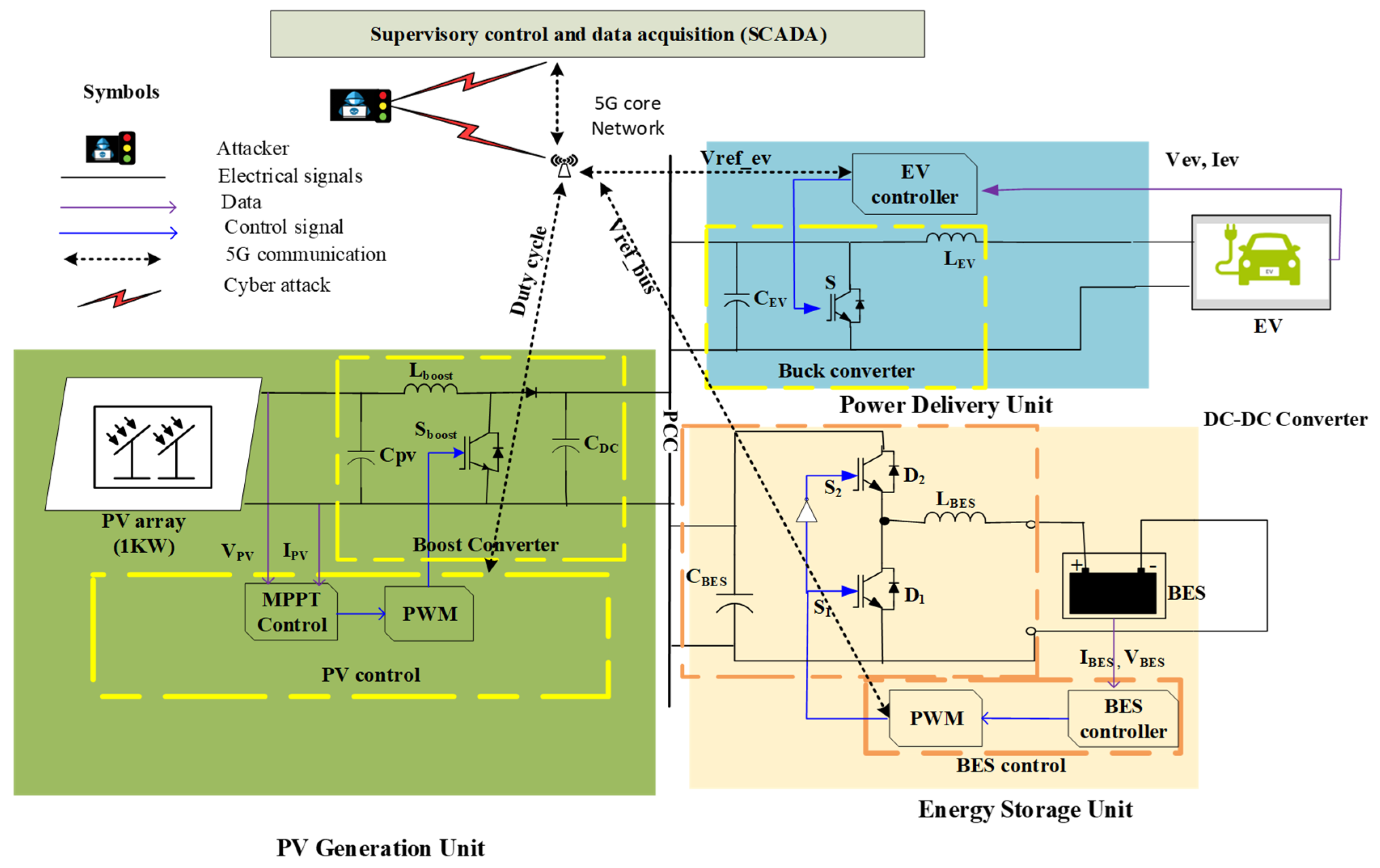
Recently research on EV charging is gaining increasing popularity because of cleaner, climate-friendly and reduced operational costs. EVs significantly reduce greenhouse gas emissions and society’s reliance on fossil fuels. It is reported that 2.1 million plug-in vehicles were sold globally in 2018—a 64% increase from 2017 [50,51,52,53]. The US Department of Defense (DoD), military, and army have lots of interest in EVs and their charging systems. However, the lack of charging infrastructure and prolonged charging time can lead to driving range anxiety. One of the preferred options is to improve the charging infrastructure and reduce charging time. Although plug-in electric vehicles (PEVs) can improve national energy security, they also present a new cybersecurity vulnerability to the U.S. transportation sector and the electricity grid. PEVs rely on an infrastructure of intelligent charging stations, energy generation units, and possibly stations for swapping batteries. A single hacking attack, initiated through the PEVs or the charging stations, could have serious physical implications. The energy flow in the charge/discharge process of PEVs might be modified by the attackers, and real-time data such as customer energy usage and the charging price from utility might be stolen. In addition, being a nascent technology, the electric vehicle charging station (EVCS) has myriad exploitable vulnerabilities in software, hardware, supply chain, and incumbent legacy technologies such as the network, communication, and control. These standalone stations or networks of EVCS open large attack surfaces. Moreover, the power electronics components associated with EV charging and EVCSs are also subject to cyberattacks [54,55,56,57,58,59,60,61,62]. For example, let us consider Figure 4, which shows a solar-powered EVCS including a photovoltaic (PV) power generation unit; a battery energy storage (BES) unit; a power delivery (PD) unit, i.e., the EV charge controller unit; and the EV itself.
As shown in Figure 4, the PV unit, the BES unit, and the PD unit have power electronic converters. On the top of the figure, a supervisory control and data acquisition (SCADA) system is shown. SCADA communicates with each unit through 5G. Also, the SCADA can store any reference or set points of the controllers (such as the duty cycle of MPPT controller of PV unit, voltage references of BES or PD unit, etc.) for the power electronic converters. Thus, a cyber hacker can change any set point in the SCADA and can hamper or destroy the 5G communication, etc., thus being able to affect any power electronics component or the entire EVCS system.

5.1. How Cyberattacks Affect Converter States, Battery Safety, Grid Interaction, and Control Stability

Cyberattacks on EV charging infrastructure can severely affect converter states, battery safety, grid interaction, and control stability by exploiting vulnerabilities in communications and power electronics, potentially causing physical damage and grid-wide instabilities. Attacks often involve injecting malicious code, altering sensor data, or overloading communication channels like the Controller Area Network (CAN) protocol.

5.1.1. Impact on Converter States and Power Electronics

  • DC Link Voltage Manipulation: Attackers can force the DC link voltage outside normal operating limits, disrupting the DC/DC converter, which can cause fast chargers to shut down.
  • Harmonic Distortion: Data tampering can lead to a 70% increase in harmonic distortion, decreasing efficiency and stressing the converter hardware.
  • Hardware Damage: Unauthorized firmware updates can lead to overloading power converters, resulting in physical damage to the charger infrastructure.

5.1.2. Impact on Battery Safety and Health

  • BMS Manipulation: Attackers can gain access to the battery management system (BMS) to alter charging protocols, creating overcharging or undercharging conditions.
  • Thermal Runaway Risks: Maliciously bypassing safety limits can cause battery overheating, significantly increasing the risk of fire or explosions.
  • Reduced Lifespan: Tampering with charging parameters leads to premature battery wear and reduced overall battery efficiency.

5.1.3. Impact on Grid Interaction and Stability

  • Frequency and Voltage Instability: Coordinated attacks can trigger widespread grid frequency and voltage deviations, potentially leading to city-scale blackouts.
  • Demand-Side Attacks: Attackers can force simultaneous charging across many vehicles, creating an artificial, massive demand spike that overwhelms the local power grid.
  • Vehicle-to-Grid (V2G) Vulnerabilities: Bi-directional charging allows attackers to manipulate power flow to feed back into the grid inappropriately, destabilizing grid-connected infrastructure.

5.1.4. Impact on Control Stability

  • Unreliable Sensor Data: False Data Injection (FDI) attacks can deceive controllers by providing inaccurate readings, causing them to make incorrect, unsafe adjustments.
  • Unresponsive Systems: Denial of service (DoS) attacks can render in-vehicle systems—such as charge controllers—unresponsive, leaving them in an unmanaged state.
  • Lost Control Authority: Attackers can hijack the charging process, overriding legitimate owner or grid-operator commands, and creating, modifying, or abruptly ending charging sessions.

5.1.5. Impact on Converter Stability

Cyberattacks on EV charging systems jeopardize converter stability by manipulating voltage and current setpoints, leading to equipment damage, battery degradation, and potential grid-level instability. Malicious actors can exploit communication protocols to send false commands, causing rapid, uncontrolled fluctuations in power conversion that threaten both the vehicle’s onboard charger and the local grid. The key impacts on converter stability due to various cyberattacks in the EV charging systems are described below.
Data Tampering and Manipulation: Attackers can alter charging parameters, such as voltage or current levels, causing the converter to operate outside its designed parameters, which can lead to overheating or component failure.
Man-in-the-Middle (MitM) Attacks: By intercepting and altering the communication between the EV and the charger, attackers can trick the converter into incorrect operation, resulting in reduced efficiency or safety shutdowns.
Voltage/Frequency Instability: Coordinated attacks (e.g., using a botnet of chargers) can trigger—or prevent—charging demands simultaneously, inducing voltage or frequency imbalances that destabilize the local power grid.
Denial of Service (DoS) Attacks: Disrupting communication protocols (like GOOSE messages) can cause the converter to malfunction or become inoperative, breaking the charging cycle unpredictably.
Thermal Runaway Risks: Manipulation of charging rates can lead to improper charging, potentially resulting in thermal runaway in the vehicle’s battery pack due to unstable power supply.
These attacks primarily target the communication link between the charger and the vehicle (e.g., ISO 15118), turning a stable energy transfer process into a volatile one.

5.1.6. Impact on 5G-Enabled EVCS

The surging usage of EVs demands the robust deployment of trustworthy EVCSs with millisecond-range latency and massive machine-to-machine communications where 5G could act. However, 5G suffers from inherent protocols, hardware, and software vulnerabilities that seriously threaten the communicating entities’ cyber–physical security. To overcome these limitations in the EVCS system, work [63] analyses the impact of False Data Injection (FDI) and distributed denial of services (DDoS) attacks on the operation of EVCSs. This paper simulates the FDI attack and the syn flood DDoS attacks on a 5G-enabled remote SCADA system that controls the solar photovoltaic (PV) controller, battery energy storage (BES) controller, and EV controller of the EVCS.
In summary, cyberattacks on EV charging stations target different layers such as the communication network, power electronics, and controllers. The communication network is specifically affected by both MitM and DDoS attacks. Power converters are affected by data tapering and manipulation/FDI attacks, as well as by Resonant Switching Attacks that force power switches to toggle at destructive frequencies, causing overheating. The controllers are affected by firmware tampering and malware injection. These attacks target the local microcontrollers and software that run the charging station’s core operations.

5.2. CyberAttack Detection Methods for 5G-Enabled EVCS, EV Charging System, and EV Power Electronics

The existing deep learning-based detection algorithms suffer from constrained performance due to insufficient cyberattack data. Inspired by synthetic data generation by the generative adversarial network (GAN), the work in [64] proposes the external classifier Wasserstein condition GAN (EC-WCGAN)-based network intrusion detection systems (NIDSs) to detect the distributed denial of service (DDoS) attacks in the EV Charging infrastructures.
The paper [65] proposes the deep learning-based novel ransomware detection framework in the SCADA controlled EVCS) with the performance analysis of three deep learning algorithms, namely, deep neural network (DNN), 1D convolution neural network (CNN), and long short-term memory (LSTM) recurrent neural network. Ransomware-driven distributed denial of service (DDoS) attack tends to shift the state of charge (SOC) profile by exceeding the SOC control thresholds. Also, ransomware-driven false data injection (FDI) attack has the potential to damage the entire BES or physical system by manipulating the SOC control thresholds. It is a design choice and optimization issue that a deep learning algorithm can deploy based on the tradeoffs between performance metrics.
The integration of the open communication layer to the physical layer of the power grids facilitates bidirectional communication, automation, remote control, distributed and embedded intelligence, and smart resource management in the grids. However, cybersecurity threats are inherent in the open communication layer, which can violate the confidentiality, integrity, and availability (CIA) of the grid resources. Article [66] proposes the novel deep learning-based intrusion detection systems (IDSs) to detect the denial of service (DoS) attacks in the EVCS. The deep neural network (DNN) and long-short term memory (LSTM) algorithms are implemented (in python 3.7.8) to detect and classify DoS attacks in the EVCS.

5.3. Conceptual Case Study for 5G-Enabled Blink 2 EV Charger (Anomaly and Intrusion Detection Models)

The rise in EVs and their associated charging infrastructure have introduced new challenges in cybersecurity. As charging systems become increasingly interconnected and complex, they are exposed to both cyber and physical threats that can disrupt functionality, compromise safety, and weaken user trust. To address these concerns, a cyber-resilient, 5G-enabled Blink 2 EV charger has been conceptualized. This system can leverage the power of next generation networks and machine learning (ML) anomaly detection systems (ADSs) and intrusion detection systems (IDSs) to ensure security, reliability, and resilience [67,68,69,70,71]. This paper evaluates a range of promising models and explores how they can be implemented within a 5G-enabled Blink charger ecosystem.
(i)
5G-Enabled Aspect: A critical enabler for advanced ADS and IDS integration is the inclusion of 5G capabilities. Many of the state-of-the-art models under consideration, including Cy-Phy ADS, MVGCRL, Wavelet + DL, ARF + ADWIN, and TCN, are computationally heavy and unsuitable for direct implementation on resource-constrained devices like onboard EVSE controllers. However, by utilizing 5G-enabled connectivity, these models can be hosted on edge servers or multi-access edge computing (MEC) nodes. This allows real time data transmission from the Blink charger to edge computing resources, where advanced models can be executed without local computational cost being a burden. Therefore, 5G enables a scalable and secure framework that blends high performance with practical deployment feasibility.
(ii)
Cy-Phy ADS: The Cy-Phy ADS is a novel anomaly detection framework that considers both cyber and physical layers. It provides a holistic view of system health by integrating diverse datasets and identifying anomalies that may span across layers. Compared to traditional ADS solutions, Cy-Phy ADS demonstrates more consistent detection across multiple test scenarios. Its main drawback, however, lies in its model size and training overhead, which are both significantly larger than most alternatives. While this may limit deployment on constrained hardware, the 5G-enabled charger allows Cy-Phy ADS to be effectively implemented on an edge server, providing comprehensive protection for EV charging infrastructure.
(iii)
MVGCRL: Another advanced IDS model is Multi-View Graph Contrastive Representative Learning (MVGCRL). This approach leverages graph-based learning for intrusion detection and is offered in both supervised and self-supervised variants. The system has demonstrated superior performance in experimental settings, outperforming many traditional IDS methods in terms of detection accuracy and robustness against complex cyberattacks. However, MVGCRL presents deployment challenges due to it having some of the largest computational demands and the need for extensive pre-training and fine tuning for specific task needs. This makes it unreasonable for embedded hardware, though again, 5G-based offloading enables its potential application through edge servers.
(iv)
Wavelet + DL: The Wavelet + Deep Learning approach emphasizes the early detection of anomalies within EV fast charging systems. By collecting time-series data and transforming them into wavelets, the system can detect disturbances and irregularities that may indicate cyber–physical attacks. This method is particularly effective in identifying disruptions at an early stage, offering preventive insights. However, the coverage of attack types is relatively limited, and the model may be vulnerable to noise in the data, thus reducing its reliability in highly dynamic environments. Despite these limitations, Wavelet + DL can play a valuable role in monitoring the physical side of EVCS operation.
(v)
ARF + ADWIN: Adaptive Random Forest combined with Adaptive Windowing (ARF + ADWIN) represents the first application of online learning in EVCS intrusion detection. Its strength lies in its ability to perform the real-time evaluation of evolving threats, mitigating the issue of concept drift in machine learning models. This makes ARF + ADWIN well suited for large and complex EVCS networks, where adversaries may attempt to exploit model drift. However, drift detection is not foolproof, and adversarial manipulation may still bypass defenses. Nonetheless, its lightweight and adaptive nature makes it a promising candidate for integration into 5G-enabled infrastructures.
(vi)
TCN: The Temporal Convolutional Network (TCN), proposed by Benfarhat and colleagues, provides a streamlined approach for intrusion detection within EV charging systems. Compared to earlier models, TCN offers lower computational overhead while retaining high effectiveness in classifying and detecting cyberattacks. This makes it more deployable in real-time scenarios. Its primary weaknesses are its susceptibility to adversarial drift and limited effectiveness against novel or adaptive attack types. Despite these constraints, TCN remains one of the fastest and most efficient solutions for short-term anomaly detection.
(vii)
Comparison Among Models: Each of the evaluated models offers distinct advantages and limitations. Cy-Phy ADS provides the broadest cyber–physical coverage but requires significant computational resources. MVGCRL delivers strong feature extraction and resilience against sophisticated threats, but at high training and tuning costs. ARF + ADWIN excels in lightweight adaptability but offers lower detection accuracy. Wavelet + DL contributes valuable insights into physical anomalies, although it has a narrower coverage. TCN provides the fastest response times, but it struggles with long-term robustness. The most promising path forward involves a hybrid approach, combining complementary models to create a more balanced and resilient system. For example, integrating Cy-Phy ADS with TCN could yield comprehensive cyber–physical coverage and fast real time detection. Alternatively, if computational limits restrict deployment, ARF + ADWIN may serve as an efficient fallback. Ultimately, the flexibility enabled by 5G edge computing makes it feasible to adopt hybrid approaches, strengthening the cyber-resilience of the Blink charger infrastructure.
Table 3 shows the detailed comparison of approaches considering attack coverage, dataset size and balance, false-positive rate, generalization to unseen attacks, inference latency, computational burden, robustness to concept drift, and deployment location.

5.4. Machine Learning Anomaly Detection for CAN-Enabled EVCS

With the ever-increasing number of EVs and hybrids on the market comes a growing demand for readily available, public EVCSs. A valuable addition to these charging stations is Controller Area Network (CAN) communication. The CAN bus can transmit data from the Battery Management System (BMS) to a CAN-enabled EVCS in real time, which provides many benefits both to consumers and EVCS manufacturers. However, CAN communication presents an additional attack vector for threat actors to exploit. This presents a challenge for EVCS manufacturers seeking to produce cyber-resilient infrastructure. As Internet of Things (IoT) devices become ubiquitously integrated with infrastructure, it becomes essential to ensure that Intrusion Detection Systems (IDSs) are put in place. In terms of methodology in IDS design, the focus here is on Machine Learning (ML) models that can detect anomalies in CAN data.
To introduce CAN, the Electronic Control Unit (ECU) must be discussed. An ECU in a vehicle monitors and controls various components, such as engine speed, windshield wipers, blinkers, spark plugs, etc. A single vehicle can contain over seventy of these ECUs. For a car to function properly, these components must be able to communicate with each other. The predominant protocol dictating this intra-vehicular communication is CAN—designed in 1980 by Robert Bosch GmbH, a German multinational engineering and technology company.
Designing an EVCS with CAN communication abilities provides benefits to both consumers and manufacturers. The CAN-enabled EVCS can receive information such as engine temperature, voltage, and State-of-Charge (SoC) from the BMS to perform a host of services. For example, the CAN-enabled EVCS may be able to optimize charging schedules, prevent battery overload, provide driver feedback, perform self-diagnostics, and receive Over the Air (OTA) updates [72,73].
Seeing as CAN was over 40 years old by 2025 and CAN 2.0—published in 1991—is over 30 years old, it does not provide effective guidance for modern-day security features, such as encryption or authentication [74]. Privacy concerns may also be raised by its collection of driver data, such as locations and address books. Additionally, CAN messages do not contain destination addresses, meaning every node on a bus can listen to messages from any other node [75]. This makes it vulnerable to interception. The successful injection of faulty messages has been demonstrated multiple times over the years.
Implemented on the electric window lift in a simulated environment, the first published attack on the CAN bus was performed by researchers Hoppe and Dittman [76] in 2007. In 2010, Koscher et al. [77] became the first to implement practical attacks on real cars. Using CAN bus network sniffing, fuzzing, and reverse engineering of ECU code, they succeeded in controlling a wide range of automotive functions, the most concerning of which being the disabling of the brakes and the halting of the engine. Driver control was completely hijacked. Woo et al. [78] proved the capability to perform long-range wireless attacks on the CAN bus in 2014, revealing serious implications. Valasek and Miller [79] demonstrated CAN attacks on Ford Escape and Toyota Prius cars, affecting the speedometer, navigation system, steering, braking, and more. In 2015, this duo remotely disabled a Jeep’s brakes during a test drive, causing Crysler to recall 1.4 million vehicles [80,81]. One of the more recent discoveries in EV CAN bus vulnerabilities was uncovered in 2024 by Telfor et al. [72]—using Tesla as their test vehicle, they carried out various attacks on the dashboard, displaying the pervasive nature of issues in CAN security.
When designing an IDS based on CAN data, some considerations must be made. A rule-based IDS offers faster detection but relies on pre-existing knowledge of anomalous signatures [82]. Since different manufacturers use different encodings, one hex value in a single vehicle’s CAN ID could carry a separate meaning in a separate vehicle.
There exists a way of decoding this raw data to translate the hex values into a human-readable format; these are called database container (DBC) files. To convince corporations to release DBC files for every vehicle make and model for the purpose of researching such a system would be a herculean task, practically impossible. Past researchers have gone so far as to develop their own simulators of CAN communication to evaluate the effectiveness of their models when they did not know the field structure or semantics of the real data [83].
Multiple architectures of ML models have been proposed for CAN anomaly detection, including a Deep Convolutional Neural Network [84], the Hidden Markov Model [85], a GAN-based model [86], a combination of Long-Short-Term Memory and ConvLSTM with a Gaussian Naïve Bayes classifier [87], and an LSTM with an added linear embedding layer [88]. Alternatively, researchers Karr and Shih [89] proposed a simpler model, which they called the One-Class Dense Network (OCDN). Originally developed for new particle discovery at the Large Hadron Collider, this model was built in Tensorflow, trained using binary cross entropy loss, and features three linear layers with 128 ReLU neurons followed by singular sigmoid output neuron. They refer to it as “the simplest possible one-class classification method for unsupervised AD”.

5.5. Key Aspects of Industry Implementation for ML-Based EV Charger Detection Methods

Real-world ML implementation in EV charging focuses on optimizing infrastructure, managing grid load, and enhancing user experience through predictive analytics and intelligent control. Key examples include reinforcement learning (RL) for dynamic, real-time power allocation in charging stations; and Long Short-Term Memory (LSTM) networks to forecast charging demand. These models improve efficiency, reduce operational costs, and handle the variability of user behavior.
The key aspects of industry implementation for ML-based EV charger detection models focus on balancing high diagnostic accuracy with strict, real-time computational constraints. Key solutions involve deploying lightweight models (XGBoost, shallow SVM), federated learning for privacy, and edge computing to achieve sub 15 ms response times.
The key implementation aspects based on current industry trends are described below.
(i)
Real-Time Feasibility and Data Processing
To be viable, ML models must operate within the strict timing constraints of EV Supply Equipment (EVSE), which requires almost instantaneous detection of faults or anomalies.
Low-Latency Performance: Effective systems (like the AD-GS framework) operate with sub 15 ms response times to ensure seamless charging.
Edge Computing vs. Cloud: While cloud-based systems are useful for long-term data aggregation and optimization (e.g., SC-CMP platform), real-time safety, anomaly detection, and fault diagnosis are increasingly moving to edge-based systems directly on the charger to minimize communication latency.
Data Stream Management: Real-time data—including voltage, current, temperature, and connector status—must be processed instantly. Techniques like down-sampling and online learning (e.g., Adaptive Random Forest—ARF) help manage high-volume data streams.
Concept Drift Mitigation: Models must be capable of adapting to changing data distributions (concept drift) without needing to be fully retrained, ensuring consistent accuracy over time.
(ii)
Computational Complexity and Model Selection
Industry prefers models that are accurate but not resource-intensive.
Lightweight Models: Models such as Random Forest, SVM, and XGBoost are favored for their ability to run efficiently on low-computation-power devices while maintaining high detection accuracy (over 95% for faults).
Shallow Models vs. Deep Learning: While deep learning (LSTM, BiLSTM) offers high accuracy for complex, non-linear problems, it is computationally intensive. In practice, these are sometimes used for offline training, while lighter “shallow” models are implemented for real-time monitoring.
Optimization Techniques: Techniques like Black Widow Optimization (BWO) paired with Bidirectional LSTM (BiLSTM) are used to enhance detection in complex, high-penetration scenarios without needing to define manual thresholds.
(iii)
Physical Interactions and Charger Integration
ML models must interact with both the physical hardware and the communication protocols (e.g., OCPP, ISO 15118).
Hardware-in-the-Loop (HIL): ML models are tested in simulated and real-time physical environments (using HIL testing) to validate their ability to identify faults (short-circuits, cable damage, thermal anomalies) before, during, or after charging.
Sensor Data Fusion: Models integrate data from various onboard sensors—such as voltage sensors, current, and temperature—to detect abnormalities like cell imbalance or connector overheating.
Communication Protocol Integration: ML-driven systems are designed to interact with OCPP protocols to provide actionable insights, such as predictive maintenance, preventing downtime.
Physical Safety Protocols: ML systems must interact safely, enabling automatic de-energizing of the charger when a fault is detected (e.g., if a connector is not properly seated or if there is a Ground Fault Circuit Interruption—GFCI).

5.6. CyberAttack Mitigation Methods for 5G-Enabled EVCS, EV Charging, and EV Power Electronics

The threat actors can exploit the vulnerabilities to freeze, disrupt, damage, and congest the charging services. State-of-the-art technologies are evolving for cyber threat detection and isolation in EV charging and EVCS at the network and physical levels. However, the current literature lacks the proper mitigation technologies to deal with cyber-enabled physical attacks and physically enabled cyberattacks through EV charging as well as EVCSs. To overcome these limitations, the work in [90] proposes the Long-Short Term Memory (LSTM)- and Gated Recurrent Unit (GRU)-based mitigation approaches to deal with the Advanced Persistent Threat (APT) attacks at standalone EVCSs. Article [91] discusses the latest hardware- and software-intensive cyberattack detection and countermeasure techniques for EV battery charger. Paper [92] discusses various mitigation strategies such as encryption and physical-layer security enhancements to enhance the resilience of the dynamic wireless charging of EV systems. The work in [93] investigates cyberattack prevention for the prosumer-based EVCSs. Paper [94] develops a novel resilient multi-task deep learning framework that simultaneously predicts EV charging demand, detects cyberattacks, and mitigates the impact of the attack to ensure trustworthy demand prediction. Study [95] presents a unique approach that combines Adaptive Kalman Filters with Isolation Forest algorithm to detect real-time anomaly and adjust the parameters to improve system resilience for EV charging.

6. Future Directions and Research Opportunities

In this work, some recommendations are made for future research on power electronics applications in a 5G-enabled EV charging system. Research challenges focus on merging ultra-reliable, low-latency 5G wireless networks with high-frequency power conversion. Key challenges include managing extreme thermal loads in ultra-fast 800 V+ chargers, mitigating severe electromagnetic interference (EMI) caused by rapid switching, securing real-time cyber–physical control loops, and maintaining efficient multi-port charging architectures. These challenges are described below:
(i)
Ultra-Fast Power Conversion and Wide-Bandgap Integration
  • High-Frequency Switching Stress: Utilizing Silicon Carbide (SiC) and Gallium Nitride (GaN) devices increases power density but creates extreme dv/dt and di/dt stress on converter components.
  • Magnetic Component Design: Developing miniaturized, high-efficiency transformers and inductors that operate stably under ultra-high switching frequencies without excessive core losses.
  • 1000 V+ Architecture Adaptation: Scaling off-board power electronics to safely handle higher voltage buses demanded by next-generation commercial and passenger EVs.
(ii)
Real-Time 5G Control and Cyber–Physical Resiliency
  • Closed-Loop Latency Coordination: Leveraging 5G ultra-reliable low-latency communication (URLLC) for real-time Vehicle-to-Grid (V2G) power balancing requires hardware-in-the-loop interfaces that react within milliseconds without destabilizing local converter control.
  • Cyber-Inverter Vulnerabilities: Protecting fast-charging power stages from malicious cyberattacks transmitted via 5G data streams that attempt to manipulate voltage/frequency response or trigger physical component failure.
  • Edge Computing Synchronization: Implementing decentralized intelligence directly on the power electronic controller hardware to process high-volume 5G telemetry data locally.
(iii)
Thermal Management and Power Quality
  • AI-Driven Thermal Diagnostics: Designing smart, real-time cooling algorithms that adjust liquid or phase-change cooling dynamically based on predicted 5G traffic surges and fast-charging loads.
  • Harmonic and Grid Mitigation: Managing acute power quality issues—such as harmonic distortion and phase imbalance—introduced by clustered, ultra-fast charging stations tied to intermittent renewable energy sources.
(iv)
Multi-Port Charging Architectures
  • As EV adoption accelerates, charging stations must scale to serve multiple vehicles simultaneously while maintaining efficiency. Multi-port charging architectures are a promising solution to this challenge. Future research should consider the 5G-enabled coordination that will enable flexible, scalable, and cost-effective charging infrastructure.

7. Conclusions

A detailed overview of power electronics applications in 5G-enabled EV charging system is presented in this paper. Some important aspects are discussed, such as advanced converter topologies, resonant converter for EV charging topologies, integration of power electronics with 5G communication, anomaly and intrusion detection methods as well as attack mitigation approaches for 5G-enabled EVCSs. Also, the paper discusses the challenges and risks of integrating 5G into EV charging infrastructure. An important aspect of this paper is that some recommendations on future research directions for power electronics with 5G communication and cybersecurity issues are provided.
It is hoped this study will work as a benchmark for power electronics applications in 5G-enabled EV charging system, and will benefit researchers, scientists, and engineers working in this field.

Author Contributions

Conceptualization, M.H.A. and B.W.; methodology, M.H.A. and B.W.; writing—original draft preparation, M.H.A. and B.W.; writing—review and editing, D.D.; supervision, M.H.A. and D.D.; project administration, M.H.A. and D.D.; funding acquisition, M.H.A. and D.D. All authors have read and agreed to the published version of the manuscript.

Funding

This research was funded by the National Security Agency (NSA), grant number H98230-22-1-0326.

Data Availability Statement

The original contributions presented in this study are included in the article. Further inquiries can be directed to the corresponding author.

Conflicts of Interest

The authors declare no conflicts of interest.

References

  1. Islam, R.; Rafin, S.M.S.H.; Mohammed, O.A. Comprehensive review of power electronic converters in electric vehicle applications. Forecasting 2022, 5, 22–80. [Google Scholar] [CrossRef] [Scilit]
  2. Masud Rana, M.; Alam, S.M.M.; Rafi, F.A.; Deb, S.B.; Agili, B.; He, M.; Ali, M.H. Comprehensive Review on the Charging Technologies of Electric Vehicles (EV) and Their Impact on Power Grid. IEEE Access 2025, 13, 35124–35156. [Google Scholar] [CrossRef] [Scilit]
  3. Lei, X.; Zhong, J.; Chen, Y.; Shao, Z.; Jian, L. Grid integration of electric vehicles within electricity and carbon markets: A comprehensive overview. eTransportation 2025, 25, 100435. [Google Scholar] [CrossRef] [Scilit]
  4. Niu, S.; Lyu, R.; Lyu, J.; Chau, K.T.; Liu, W.; Jian, L. Optimal Resonant Condition for Maximum Output Power in Tightly Coupled WPT Systems Considering Harmonics. IEEE Trans. Power Electron. 2025, 40, 152–156. [Google Scholar] [CrossRef] [Scilit]
  5. Niu, S.; Zhao, Q.; Chen, H.; Niu, S.; Jian, L. Noncooperative Metal Object Detection Using Pole-to-Pole EM Distribution Characteristics for Wireless EV Charger Employing DD Coils. IEEE Trans. Ind. Electron. 2024, 71, 6335–6344. [Google Scholar] [CrossRef] [Scilit]
  6. Afonso, J.L.; Cardoso, L.A.L.; Pedrosa, D.; Sousa, T.J.C. A review on power electronics technologies for electric mobility. Energies 2020, 13, 6343. [Google Scholar] [CrossRef] [Scilit]
  7. Ali, A.; Mousa, H.H.H.; Shaaban, M.F.; Azzouz, M.A.; Awad, A.S.A. A Comprehensive Review on Charging Topologies and Power Electronic Converter Solutions for Electric Vehicles. J. Mod. Power Syst. Clean Energy 2024, 12, 675–694. [Google Scholar] [CrossRef] [Scilit]
  8. Hossain Lipu, M.S.; Miah, M.S.; Ansari, S.; Meraj, S.T. Power electronics converter technology integrated energy storage management in electric vehicles: Emerging trends, analytical assessment and future. Electronics 2022, 11, 562. [Google Scholar] [CrossRef] [Scilit]
  9. Sabo, A.; Diyari, M.J.; Ogbodick, I.; Saddam, Y.O.; Mordi, M.; Pele, P.; Osaluwe, K. A Review on Power Electronics Technologies and Applications for EV Battery Charging Systems. In 2022 International Conference on Green Energy, Computing and Sustainable Technology (GECOST), Miri Sarawak, Malaysia; IEEE: New York, NY, USA, 2022; pp. 112–117. [Google Scholar] [CrossRef] [Scilit]
  10. Vishnuram, P.; R, N.; P, S.; K, V.; Bajaj, M.; Khurshaid, T.; Nauman, A.; Kamel, S. A comprehensive review on EV power converter topologies charger types infrastructure and communication techniques. Front. Energy Res. 2023, 11, 1103093. [Google Scholar] [CrossRef] [Scilit]
  11. Morgan, E.F.; Ali, M.H. Digital Twin-Driven Cybersecurity for 5G/6G-Enabled Electric Vehicle Charging Infrastructure: A Review. Energies 2025, 18, 6048. [Google Scholar] [CrossRef] [Scilit]
  12. Meraj, S.; Mekhilef, S.; Binti Mubin, M.; Ramiah, H.; Seyedmahmoudian, M.; Stojcevski, A. Bidirectional Wireless Charging System for Electric Vehicles: A Review of Power Converters and Control Techniques in V2G Application. IEEE Access 2025, 13, 75246–75264. [Google Scholar] [CrossRef] [Scilit]
  13. Mahesh, A.; Chokkalingam, B.; Mihet-Popa, L. Inductive Wireless Power Transfer Charging for Electric Vehicles–A Review. IEEE Access 2021, 9, 137667–137713. [Google Scholar] [CrossRef] [Scilit]
  14. Bharatiraja, C.; Mahesh, A.; Lehman, B. Power Electronic Converters in Inductive Wireless Charging Applications for Electric Transportation. IEEE J. Emerg. Sel. Top. Power Electron. 2025, 13, 2647–2683. [Google Scholar] [CrossRef] [Scilit]
  15. Asa, E.; Onar, O.C.; Mohammad, M.; Prakash Galigekere, V.; Su, G.-J.; Ozpineci, B. Overview of High-Power Wireless Charging Systems and Analysis of Polyphase Wireless Charging System Phase Winding and Resonant Tuning Network Connection Configurations. IEEE Trans. Transp. Electrif. 2025, 11, 6700–6718. [Google Scholar] [CrossRef] [Scilit]
  16. Tu, H.; Feng, H.; Srdic, S.; Lukic, S. Extreme Fast Charging of Electric Vehicles: A Technology Overview. IEEE Trans. Transp. Electrif. 2019, 5, 861–878. [Google Scholar] [CrossRef] [Scilit]
  17. Ahmad, A.; Qin, Z.; Wijekoon, T.; Bauer, P. An Overview on Medium Voltage Grid Integration of Ultra-Fast Charging Stations: Current Status and Future Trends. IEEE Open J. Ind. Electron. Soc. 2022, 3, 420–447. [Google Scholar] [CrossRef] [Scilit]
  18. Meira Gomes, Z.; Prado, E.D.O.; Le Gall, Y.; Damm, G.; Ripoll, C.; Pinheiro, J.R. Design, Model, and Control of a Dynamic Wireless Power Transfer System for a 30-kW Electric Vehicle Charger Application. IEEE J. Emerg. Sel. Top. Power Electron. 2025, 13, 3882–3894. [Google Scholar] [CrossRef] [Scilit]
  19. Shafiqurrahman, A.; Khadkikar, V.; Rathore, A.K. Electric Vehicle-to-Vehicle (V2V) Power Transfer: Electrical and Communication Developments. IEEE Trans. Transp. Electrif. 2024, 10, 6258–6284. [Google Scholar] [CrossRef] [Scilit]
  20. Rafin, S.M.S.H.; Islam, R.; Mohammed, O.A. Overview of Power Electronic Converters in Electric Vehicle Applications. In 2023 Fourth International Symposium on 3D Power Electronics Integration and Manufacturing (3D-PEIM), Miami, FL, USA; IEEE: New York, NY, USA, 2023; pp. 1–7. [Google Scholar] [CrossRef] [Scilit]
  21. Ghosh, A.; Maeder, A.; Baker, M.; Chandramouli, D. 5G Evolution: A View on 5G Cellular Technology Beyond 3GPP Release 15. IEEE Access 2019, 7, 127639–127651. [Google Scholar] [CrossRef] [Scilit]
  22. Fang, H.; Wang, X.; Tomasin, S. Machine Learning for Intelligent Authentication in 5G-and-Beyond Wireless Networks. IEEE Wirel. Commun. 2019, 26, 5. [Google Scholar] [CrossRef] [Scilit]
  23. Klautau, A.; Batista, P.; González-Prelcic, N.; Wang, Y.; Heath, R.W. 5G MIMO Data for Machine Learning: Application to Beam-Selection Using Deep Learning. In 2018 Information Theory and Applications Workshop (ITA), San Diego, CA, USA; IEEE: New York, NY, USA, 2018; pp. 1–9. [Google Scholar] [CrossRef] [Scilit]
  24. Cayamcela, M.E.M.; Lee, H.; Lim, W. Machine Learning for 5G/B5G Mobile and Wireless Communications: Potential, Limitations, and Future Directions. IEEE Access 2019, 7, 137184–137206. [Google Scholar] [CrossRef] [Scilit]
  25. Sofana, S.; Tomislav, D.; Pierluigi, S.; Prabaharan, S.R.S. Future Generation 5G Wireless Networks for Smart Grid: A Comprehensive Review. Energies 2019, 12, 2140. [Google Scholar] [CrossRef] [Scilit]
  26. Mukherjee, S.; Yousefzadeh, V.; Sepahvand, A.; Doshi, M.; Maksimović, D. High-frequency wide-range resonant converter operating as an automotive LED driver. IEEE J. Emerg. Sel. Top. Power Electron. 2021, 9, 5781–5794. [Google Scholar] [CrossRef] [Scilit]
  27. Wu, Y.; Yang, Y.; Blaabjerg, F. Optimal control of a wide range resonant DC–DC converter. IEEE Trans. Power Electron. 2022, 37, 940–947. [Google Scholar] [CrossRef] [Scilit]
  28. Jovanović, M.; Irving, B. On-the-fly topology-morphing control–efficiency optimization method for LLC resonant converters operating in wide input- and/or output-voltage range. IEEE Trans. Power Electron. 2023, 38, 2596–2609. [Google Scholar]
  29. Liu, Z.; Lin, X.; Gao, Y.; Xu, R.; Wang, J.; Wang, Y.; Liu, J. Fixed-Time Sliding Mode Control for DC/DC Buck Converters With Mismatched Uncertainties. IEEE Trans. Circuits Syst. I Regul. Pap. 2023, 70, 472–480. [Google Scholar] [CrossRef] [Scilit]
  30. Borage, V.; Tiwari, S.; Kotaiah, S. Analysis and design of an LCL-T resonant converter as a constant-current power supply. IEEE Trans. Ind. Electron. 2007, 54, 2793–2801. [Google Scholar] [CrossRef] [Scilit]
  31. Chowdhury, S.; Bhattacharyya, A.; Yadav, S.; Chattopadhyay, S. Stability, reliability, and robustness of GaN power devices: A review. IEEE Access 2023, 11, 8442–8455. [Google Scholar] [CrossRef] [Scilit]
  32. Park, Y.; Chakraborty, S.; Khaligh, A. DAB converter for EV onboard chargers using bare-die SiC MOSFETs and leakage-integrated planar transformer. IEEE Trans. Transp. Electrif. 2022, 8, 209–220. [Google Scholar] [CrossRef] [Scilit]
  33. Jin, N.-Z.; Feng, Y.; Chen, Z.-Y.; Wu, X.-G. Bidirectional CLLLC Resonant Converter Based on Frequency-Conversion and Phase-Shift Hybrid Control. Electronics 2023, 12, 1605. [Google Scholar] [CrossRef] [Scilit]
  34. Saha, T.; Bagchi, A.C.; Zane, R.A. Analysis and Design of an LCL–T Resonant DC–DC Converter for Underwater Power Supply. IEEE Trans. Power Electron. 2021, 36, 6725–6737. [Google Scholar] [CrossRef] [Scilit]
  35. Huang, T.-W.; Kuo, S.-H.; Wang, C.-C.; Chiu, H.-J. High Power Dual Active Bridge Converter in Wide Voltage Range Application. In 2021 International Conference on Fuzzy Theory and Its Applications (iFUZZY), Taitung, Taiwan; IEEE: New York, NY, USA, 2021; pp. 1–5. [Google Scholar] [CrossRef] [Scilit]
  36. Cárcamo, A.; Fernandez-Hernandez, A.; Gonzalez-Hernando, F.; Vázquez, A.; Rodríguez, A. Variable Switching Frequency for ZVS over Wide Voltage Range in Dual Active Bridge. Electronics 2024, 13, 1800. [Google Scholar] [CrossRef] [Scilit]
  37. Zhao, Q.; Zhang, J.; Gao, Y.; Wang, D.; Yang, Q. Hybrid Variable Frequency LLC Resonant Converter With Wide Output Voltage Range. IEEE Trans. Power Electron. 2023, 38, 11038–11049. [Google Scholar] [CrossRef] [Scilit]
  38. Zhang, J.; Hu, C.; Xu, D. A Hybrid Control Method for High Power LLC Converter with Wide Output Voltage Range. In 2023 IEEE 2nd International Power Electronics and Application Symposium (PEAS), Guangzhou, China; IEEE: New York, NY, USA, 2023; pp. 1254–1258. [Google Scholar] [CrossRef] [Scilit]
  39. Oliveira, R.; Freitas, D.; Silva, J.F. Predictive control applied to a single-stage single-phase bidirectional AC–DC converter. IEEE Trans. Ind. Electron. 2022, 69, 131–142. [Google Scholar]
  40. Ji, H.; Zhao, X.; Dong, Z. Research on LLC resonant converter control strategy based on sliding mode active disturbance rejection control. IEEE Trans. Power Electron. 2024, 39, 153–163. [Google Scholar]
  41. Ta, L.A.D.; Dao, N.D.; Lee, D.-C. High-efficiency hybrid LLC resonant converter for on-board chargers of plug-in electric vehicles. IEEE Trans. Power Electron. 2020, 35, 8324–8337. [Google Scholar] [CrossRef] [Scilit]
  42. Gupta, A.; Jha, R.K. A Survey of 5G Network: Architecture and Emerging Technologies. IEEE Access 2015, 3, 1206–1232. [Google Scholar] [CrossRef] [Scilit]
  43. López-Pérez, D.; Domenico, A.D.; Piovesan, N.; Baohongqiang, H.; Xinli, G.; Qitao, S.; Debbah, M. A Survey on 5G Radio Access Network Energy Efficiency: Massive MIMO, Lean Carrier Design, Sleep Modes, and Machine Learning. IEEE Commun. Surv. Tutor. 2022, 24, 653–697. [Google Scholar] [CrossRef] [Scilit]
  44. Nadeem, Q.; Kammoun, A.; Alouini, M. Elevation Beamforming With Full Dimension MIMO Architectures in 5G Systems: A Tutorial. IEEE Commun. Surv. Tutor. 2019, 21, 3238–3273. [Google Scholar] [CrossRef] [Scilit]
  45. Lin, X.; Grovlen, A.; Werner, K.; Li, J.; Baldemair, R.; Cheng, J.-F.T.; Parkvall, S.; Larsson, D.C.; Koorapaty, H.; Frenne, M.; et al. 5G New Radio: Unveiling the Essentials of the Next Generation Wireless Access Technology. IEEE Commun. Stand. Mag. 2019, 3, 30–37. [Google Scholar] [CrossRef] [Scilit]
  46. Anusha, G.; Sudhakar, A.V.V.; Deshmukh, R.R.R.; Basha, C.H.H. A bibliometric analysis of research trends in electric vehicle power electronics: Global perspectives and future directions. Discov. Appl. Sci. 2025, 7, 487. [Google Scholar] [CrossRef] [Scilit]
  47. Pocovi, G.; Kolding, T.; Pedersen, K.I. On the Cost of Achieving Downlink Ultra-Reliable Low-Latency Communications in 5G Networks. IEEE Access 2022, 10, 29506–29513. [Google Scholar] [CrossRef] [Scilit]
  48. Ford, R.; Zhang, M.; Mezzavilla, M.; Dutta, S.; Rangan, S.; Zorzi, M. Achieving Ultra-Low Latency in 5G Millimeter Wave Cellular Networks. IEEE Commun. Mag. 2017, 55, 196–203. [Google Scholar] [CrossRef] [Scilit]
  49. Alhaj, N.A.; Jamlos, M.F.; Manap, S.A.; Abdelsalam, S.; Bakhit, A.A.; Mamat, R.; Jamlos, M.A.; Gismalla, M.S.M.; Hamdan, M. Integration of Hybrid Networks, AI, Ultra Massive-MIMO, THz Frequency, and FBMC Modulation Toward 6G Requirements: A Review. IEEE Access 2024, 12, 483–513. [Google Scholar] [CrossRef] [Scilit]
  50. Mobarak, M.H.; Kleiman, R.N.; Bauman, J. Solar-Charged Electric Vehicles: A Comprehensive Analysis of Grid, Driver, and Environmental Benefits. IEEE Trans. Transp. Electrif. 2021, 7, 579–603. [Google Scholar] [CrossRef] [Scilit]
  51. Stenstadvolden, A.; Stenstadvolden, O.; Zhao, L.; Kapourchali, M.H.; Zhou, Y.; Lee, W.-J. Data-Driven Analysis of a NEVI-Compliant EV Charging Station in the Northern Region of the U.S. IEEE Trans. Ind. Appl. 2024, 60, 5352–5361. [Google Scholar] [CrossRef] [Scilit]
  52. Karim, S.; Chauhdary, S.T.; Kamil, H.; Mumtaz, F.; Farid, G. Wireless Power Transfer and IoT in EV Charging: Opportunities, Challenges, and Future Directions. IEEE Access 2026, 14, 40672–40689. [Google Scholar] [CrossRef] [Scilit]
  53. Hamdare, S.; Brown, D.J.; Cao, Y.; Aljaidi, M.; Kaiwartya, O.; Yadav, R.; Vyas, P.; Jugran, M. EV Charging Management and Security for Multi-Charging Stations Environment. IEEE Open J. Veh. Technol. 2024, 5, 807–824. [Google Scholar] [CrossRef] [Scilit]
  54. Chandwani, S.D.; Mallik, A. Cybersecurity of Onboard Charging Systems for Electric Vehicles—Review, Challenges and Countermeasures. IEEE Access 2020, 8, 226982–226998. [Google Scholar] [CrossRef] [Scilit]
  55. Fu, R.; Lichtenwalner, M.E.; Johnson, T.J. A Review of Cybersecurity in Grid-Connected Power Electronics Converters: Vulnerabilities, Countermeasures, and Testbeds. IEEE Access 2023, 11, 113543–113559. [Google Scholar] [CrossRef] [Scilit]
  56. Arena, G.; Chub, A.; Lukianov, M.; Strzelecki, R.; Vinnikov, D.; De Carne, G. A Comprehensive Review on DC Fast Charging Stations for Electric Vehicles: Standards, Power Conversion Technologies, Architectures, Energy Management, and Cybersecurity. IEEE Open J. Power Electron. 2024, 5, 1573–1611. [Google Scholar] [CrossRef] [Scilit]
  57. Dey, S.; Khanra, M. Cybersecurity of Plug-In Electric Vehicles: Cyberattack Detection During Charging. IEEE Trans. Ind. Electron. 2021, 68, 478–487. [Google Scholar] [CrossRef] [Scilit]
  58. Wang, H.; Schotten, H.D.; Goetz, S.M. Ultrafast Wireless Energy Hacking for Roadway Charging: Overcoming Frequency-Varying Encryption and Parameter Drift. IEEE Trans. Transp. Electrif. 2026, 12, 1188–1197. [Google Scholar] [CrossRef] [Scilit]
  59. Işık, Z.E.; Irmak, E. Cybersecurity in Electric Vehicle Infrastructure and the Impacts of Post-Quantum Encryption. In 2025 7th Global Power, Energy and Communication Conference (GPECOM), Bochum, Germany; IEEE: New York, NY, USA, 2025; pp. 890–895. [Google Scholar] [CrossRef] [Scilit]
  60. Reghunath, R.; Sayed, M.A.; Sarieddine, K.; Atallah, R.; Jafarigiv, D.; Kassouf, M.; Assi, C.; Ghafouri, M. A Real-time Monitoring Architecture for Enhanced Cybersecurity in the EV Ecosystem. In IECON 2024—50th Annual Conference of the IEEE Industrial Electronics Society, Chicago, IL, USA; IEEE: New York, NY, USA, 2024; pp. 1–6. [Google Scholar] [CrossRef] [Scilit]
  61. Nisar, F.; Ramachandran, G.; Vilathgamuva, M.; Jurdak, R. Manipulation of Actual Demand in Electric Vehicles (MaD EV): A Cyber-Security Perspective. In 2022 IEEE 7th Southern Power Electronics Conference (SPEC), Nadi, Fiji; IEEE: New York, NY, USA, 2022; pp. 1–8. [Google Scholar] [CrossRef] [Scilit]
  62. Gumrukcu, E.; Arsalan, A.; Muriithi, G.; Joglekar, C.; Aboulebdeh, A.; Zehir, M.A.; Papari, B.; Monti, A. Impact of Cyber-attacks on EV Charging Coordination: The Case of Single Point of Failure. In 2022 4th Global Power, Energy and Communication Conference (GPECOM), Nevsehir, Turkey; IEEE: New York, NY, USA, 2022; pp. 506–511. [Google Scholar] [CrossRef] [Scilit]
  63. Basnet, M.; Ali, M.H. Exploring cybersecurity issues in 5G enabled electric vehicle charging station with deep learning. IET Gener. Transm. Distrib. 2021, 15, 3435–3449. [Google Scholar] [CrossRef] [Scilit]
  64. Basnet, M.; Ali, M.H. WCGAN-Based Cyber-Attacks Detection System in the EV Charging Infrastructure. In Proceedings of the International Conference on Smart Power & Internet Energy Systems, Beijing, China, 27–30 October 2022; IEEE: New York, NY, USA, 2022. [Google Scholar]
  65. Basnet, M.; Poudyal, S.; Ali, M.H.; Dasgupta, D. Ransomware Detection Using Deep Learning in the SCADA System of Electric Vehicle Charging Station. In Proceedings of the 2021 IEEE PES Innovative Smart Grid Technologies Conference—Latin America (ISGT Latin America), Lima, Peru, 15–17 September 2021; IEEE: New York, NY, USA, 2021. [Google Scholar]
  66. Basnet, M.; Ali, M.H. Deep Learning-Based Intrusion Detection System for Electric Vehicle Charging Station. In Proceedings of the 2nd International Conference on Smart Power and Internet Energy Systems (SPIES), Bangkok, Thailand, 15–18 September 2020; IEEE: New York, NY, USA, 2020. [Google Scholar]
  67. Abu-Nassar, A.M.; Morsi, W.G. Early detection of cyber-physical attacks on electric vehicles fast charging stations using wavelets and deep learning. IEEE Trans. Ind. Cyber-Phys. Syst. 2024, 2, 220–231. [Google Scholar] [CrossRef] [Scilit]
  68. Benfarhat, I.; Goh, V.T.; Lim Siow, C.; Sheraz, M.; Chuah, T.C. Temporal Convolutional Network Approach to Secure Open Charge Point Protocol (OCPP) in Electric Vehicle Charging. IEEE Access 2025, 13, 15272–15289. [Google Scholar] [CrossRef] [Scilit]
  69. Li, Y.; Chen, G.; Dong, Z. Multi-view graph contrastive representative learning for intrusion detection in EV charging station. Appl. Energy 2025, 385, 125439. [Google Scholar] [CrossRef] [Scilit]
  70. Makhmudov, F.; Kilichev, D.; Giyosov, U.; Akhmedov, F. Online machine learning for intrusion detection in electric vehicle charging systems. Mathematics 2025, 13, 712. [Google Scholar] [CrossRef] [Scilit]
  71. Mavikumbure, H.S.; Cobilean, V.; Wickramasinghe, C.S.; Varghese, B.J.; Carlson, R.B.; Rieger, C.; Pennington, T.; Manic, M. Cy-Phy ADS: Cyber-physical anomaly detection framework for EV charging systems. IEEE Trans. Transp. Electrif. 2024, 10, 9904–9917. [Google Scholar] [CrossRef] [Scilit]
  72. How CAN Protocol Makes EV Charging Efficient and Safer. Power Electronic News, 5 July 2024. Available online: https://www.powerelectronicsnews.com/how-can-protocol-makes-ev-charging-efficient-and-safer/ (accessed on 9 May 2025).
  73. Revolutionizing Electric Vehicle Charging with CAN Bus Technology. Available online: https://onboard-charger.com/blogs/on-board-charger/revolutionizing-electric-vehicle-charging-with-can-bus-technology (accessed on 9 May 2025).
  74. Telfor, M.A.; Payne, B.R.; Abegaz, T.T. Reverse Engineering the CAN Bus: Vulnerability Analysis in the Tesla Model 3. In World Congress in Computer Science, Computer Engineering & Applied Computing; Springer Nature: Cham, Switzerland, 2024. [Google Scholar]
  75. Bozdal, M.; Samie, M.; Jennions, I. A survey on can bus protocol: Attacks, challenges, and potential solutions. In 2018 International Conference on Computing, Electronics & Communications Engineering (iCCECE); IEEE: New York, NY, USA, 2018. [Google Scholar]
  76. Hoppe, T.; Dittman, J. Sniffing/Replay Attacks on CAN Buses: A simulated attack on the electric window lift classified using an adapted CERT taxonomy. In Proceedings of the 2nd Workshop on Embedded Systems Security (WESS), Salzburg, Austria, 4 October 2007. [Google Scholar]
  77. Koscher, K.; Czeskis, A.; Roesner, F.; Patel, S.; Kohno, T.; Checkoway, S.; McCoy, D.; Kantor, B.; Anderson, D.; Shacham, H.; et al. Experimental security analysis of a modern automobile. In 2010 IEEE Symposium on Security and Privacy; IEEE: New York, NY, USA, 2010. [Google Scholar]
  78. Woo, S.; Jo, H.J.; Lee, D.H. A practical wireless attack on the connected car and security protocol for in-vehicle CAN. IEEE Trans. Intell. Transp. Syst. 2014, 16, 993–1006. [Google Scholar] [CrossRef] [Scilit]
  79. Miller, C.; Valasek, C. Adventures in automotive networks and control units. Def Con 2013, 21, 15–31. [Google Scholar]
  80. Fiat Chrysler recalls 1.4 million cars after Jeep hack. BBC News, 24 July 2015. Available online: https://www.bbc.com/news/technology-33650491 (accessed on 9 May 2025).
  81. Greenberg, A. Hackers remotely kill a jeep on the Highway—With me in it. WIRED, 21 July 2015. Available online: https://www.wired.com/2015/07/hackers-remotely-kill-jeep-highway/ (accessed on 9 May 2025).
  82. Bhattacharya, S.; Gallolukankanamalage, R.G.; Steward, B.L.; Govindarasu, M. Ml-based anomaly detection for can bus network in agriculture machinery. In Proceedings of the AAAI Symposium Series; AAAI Press: Washington, DC, USA, 2024; Volume 4. [Google Scholar]
  83. Markovitz, M.; Wool, A. Field classification, modeling and anomaly detection in unknown CAN bus networks. Veh. Commun. 2017, 9, 43–52. [Google Scholar] [CrossRef] [Scilit]
  84. Song, H.M.; Woo, J.; Kim, H.K. In-vehicle network intrusion detection using deep convolutional neural network. Veh. Commun. 2020, 21, 100198. [Google Scholar] [CrossRef] [Scilit]
  85. Levi, M.; Allouche, Y.; Kontorovich, A. Advanced analytics for connected car cybersecurity. In 2018 IEEE 87th Vehicular Technology Conference (VTC Spring); IEEE: New York, NY, USA, 2018. [Google Scholar]
  86. Seo, E.; Song, H.M.; Kim, H.K. GIDS: GAN based intrusion detection system for in-vehicle network. In 2018 16th Annual Conference on Privacy, Security and Trust (PST); IEEE: New York, NY, USA, 2018. [Google Scholar]
  87. Mansourian, P.; Zhang, N.; Jaekel, A.; Kneppers, M. Deep learning-based anomaly detection for connected autonomous vehicles using spatiotemporal information. IEEE Trans. Intell. Transp. Syst. 2023, 24, 16006–16017. [Google Scholar] [CrossRef] [Scilit]
  88. Tan, X.; Zhang, C.; Li, B.; Ge, B.; Liu, C. Anomaly detection system of controller area network (can) bus based on time series prediction. In International Conference on Smart Computing and Communication; Springer International Publishing: Cham, Switzerland, 2021. [Google Scholar]
  89. Karr, N.; Nachman, B.; Shih, D. One-Class Dense Networks for Anomaly Detection. In Proceedings of the Machine Learning and the Physical Sciences Workshop at NeurIPS, New Orleans, LA, USA, 3 December 2022. [Google Scholar]
  90. Basnet, M.; Ali, M.H. Deep-Learning-Powered Cyber-Attacks Mitigation Strategy in the EV Charging Infrastructure. In Proceedings of the 2023 IEEE PES General Meeting, Orlando, FL, USA, 16–20 July 2023; IEEE: New York, NY, USA, 2023. [Google Scholar]
  91. Ronanki, D.; Karneddi, H. Electric Vehicle Charging Infrastructure: Review, Cyber Security Considerations, Potential Impacts, Countermeasures, and Future Trends. IEEE J. Emerg. Sel. Top. Power Electron. 2024, 12, 242–256. [Google Scholar] [CrossRef] [Scilit]
  92. Yazdanipour, S.; Varaprasad Oruganti, V.S.R.; Son, J.; Arani, M.F.M.; Williamson, S.S. State-of-the-Art in Cyber-Physical Security for Dynamic Wireless Charging of Electric Vehicles. In IECON 2024—50th Annual Conference of the IEEE Industrial Electronics Society, Chicago, IL, USA; IEEE: New York, NY, USA, 2024; pp. 1–6. [Google Scholar] [CrossRef] [Scilit]
  93. Zou, L.; Vo, Q.H.; Kim, K.; Le, H.Q.; Thwal, C.M.; Zhang, C.; Hong, C.S. Cyber Attacks Prevention Toward Prosumer-Based EV Charging Stations: An Edge-Assisted Federated Prototype Knowledge Distillation Approach. IEEE Trans. Netw. Serv. Manag. 2025, 22, 1972–1999. [Google Scholar] [CrossRef] [Scilit]
  94. Babayomi, O.; Kim, D.-S. Resilient Multi-Task Deep Learning for EV Infrastructure Anomaly Detection and Mitigation. In 2025 International Conference on Mobile, Military, Maritime IT Convergence (ICMIC), Cebu, Philippines; IEEE: New York, NY, USA, 2025; pp. 43–46. [Google Scholar] [CrossRef] [Scilit]
  95. Anderson, B.; Hossain, G. Enhancing Kalman Filter Resilience in Electric Vehicles: Cyber-Attack Mitigation with Machine Learning Based Adaptive Filtering. In 2025 13th International Symposium on Digital Forensics and Security (ISDFS), Boston, MA, USA; IEEE: New York, NY, USA, 2025; pp. 1–6. [Google Scholar] [CrossRef] [Scilit]
Figure 1. Cyber–physical architecture of an EV charging system with multi-layered structure.
Electronics 15 03724 g001
Figure 2. Literature retrieval process.
Electronics 15 03724 g002
Figure 3. Architecture diagram for 5G interfacing with power converters, sensors, and grid operators.
Electronics 15 03724 g003
Figure 4. Circuit diagram of solar powered EVCS.
Electronics 15 03724 g004
Table 1. Summary of existing overviews on power electronics for an EV charging system.
ArticlesKey Analysis AspectEV Charging Type
and Application
Novelty
2022 [1]Comprehensive review of power converter topologies, control schemes, reliability, losses, switching frequency, charging systems, advantages, and disadvantagesWired and wireless charging in hybrid and all-electric vehiclesAdoption of wide-bandgap semiconductors and high-electron mobility transistors (HEMTs) in EV systems, forecasting calculations for automobile industry
2025 [2]Detailed overview of various charging topologies used in EVs, charging methods, power levels, unidirectional and bidirectional AC-DC and DC-DC convertersOn-board and off-board charging, slow and fast charging, wired and wireless chargingAnalysis of EV charging impact on electric grids
2020 [6]Review of various power electronics technologies for electric mobilityOn-board and off-board charging, wired and inductive wireless charging for road vehicles, lightweight vehicles and railway vehicles, among other electric vehiclesUnified traction systems, new topologies with innovative operation modes for supporting electric grids, and innovative solutions for electrified railways
2024 [7]Comprehensive investigation of classifications and configurations of EV charging topologies and power electronic converters (PECs) for EV applicationsWired EV chargingNovel control approaches, future research prospects and their impacts on power quality
2022 [8]Discussion on the power converters, energy storage, controller, optimization, energy efficiency, energy management, and energy transfer, emphasizing various schemes in EVsWired EV chargingEmerging power electronics converter technology incorporating energy storage management in EVs.
2022 [9]Conducting a run-through of research associated with the battery imbalance revolution module in EVs applicationsWired EV chargingDevelopment of advanced approach for battery equalizer circuit for EVs.
2023 [10]Examining the current state of the electric vehicle market throughout the world and its potential future developments.Wired EV chargingConsideration of efficiency of EVs with power electronic converters and energy storage devices
2025 [11]Addressing cybersecurity gaps and presenting overview of novel strategies for enhancing EVCS securityElectric vehicle charging station (EVCS) and Wired EV chargingConsideration of Internet of Digital Twins (IoDT) technology with artificial intelligence (AI) and blockchain
2025 [12]Comprehensive review of the control strategies and power converter topologies employed in bidirectional wireless charging systems for V2G applicationsVehicle-to-grid (V2G) and wireless charging techniquesAdvanced bidirectional wireless charging systems, compensation network design, advanced controls for power management, and efficiency optimization
2021 [13]Review of resonant inductive wireless power transfer charging technology and highlighting the present status and its future of the wireless EV marketWireless power transfer (WPT)Cybersecurity economic effects, health and safety, foreign object detection, and analysis of WPT impact on the distribution grid
2025 [14]Examining the significance of power electronic converters (PECs), and exploring the factors influencing converters selection and their classificationsInductive WPTRole of wide-bandgap devices and different semiconductor switches on resonant inductive WPT
2025 [15]Review of the power electronics and winding and resonant tuning network configurationsPolyphase WPT, extreme fast charging (XFC)Resonant tuning network configurations and high-power wireless charging
2019 [16]Review of the state-of-the-art EV charging infrastructure and focusing on extreme fast charging (XFC) technologyWPT, XFCUse of the solid-state transformer (SST) in the XFC charging stations
2022 [17]Review of state-of-the-art DC fast chargers, the charging infrastructure’s status, motivation, and challenges for medium-voltage (MV) UF charging stations (UFCS)DC fast charging, MV UFCSLine frequency transformer (LFT) application in UFCS
2025 [18]Presenting the design, model, and control of a dynamic wireless power transfer (DWPT) system for a 30 kW electric vehicle charger applicationDWPTDevelopment of mathematical modeling considering the dynamic behavior of self-inductance and mutual inductance for DWPT system
2024 [19]In-depth review of the actual energy transfer between two vehicles and their communication aspectsV2V wireless chargingComparison of optimization techniques and power electronics topologies for V2V charging
2023 [20]Discussion on conductive charging rectifiers, powertrain DC-DC converters, and motor driving invertersWired EV chargingThird harmonic injected seven-level inverter for the power train and multidevice interleaved DC-DC boost converter in EVs.
Table 2. Summary comparison of converter topology.
FeaturesConverter Types
LLC ResonantLCL-T ResonantDual Active Bridge (DAB)Hybrid Structures
Rated PowerLow-to-medium power (hundreds of watts up to 3–5 kW).Medium power ranges (50 W to several kilowatts)Medium-to-high power (1 kW to upwards of 100–200 kW)Medium-to-high power scaling (1 kW to 10+ kW)
Input/Output Voltage RangeNarrow to medium voltage gain range; wide output/input ranges for hybrid controlExcellent load-independent characteristics and stable voltage conversionWide input/output swings (e.g., 260 V–460 V or 530 V–900 V battery profiles)Wide voltage boundaries
Semiconductor TechnologyHigh-frequency Gallium Nitride (GaN) and Silicon MOSFETs for low/medium voltages, or Silicon Carbide (SiC) MOSFETs for higher voltageFast SiC or Si MOSFETs/diodesSiC MOSFETs at high power and high voltagesMixed or advanced fast-switching SiC/GaN devices
Switching FrequencyVery high frequency (100 kHz to over 1 MHz)Medium-to-high frequencies (typically 50 kHz to 250+ kHz)50 kHz to 200/500 kHzFixed or variable optimized frequencies
IsolationGalvanic isolationIsolated high-frequency transformerFully isolated via a high-frequency transformerGalvanic isolation
Thermal ConditionsExcellent thermal performance at light-to-nominal loads.Moderate thermal footprintsHeavy-load efficiency and thermal distribution are favorable, but light-load operation suffers from a loss of ZVS and high root-mean-square circulating currentsSpecifically engineered to flatten thermal distribution
Experimental ValidationExtensively verified via sub-megahertz and megahertz prototypes (e.g., 330 W to 1 kW setups) displaying 94–98% peak efficienciesValidated on scaled hardware implementations (e.g., 50 W–500 W systems)Validated across high-power platforms (kilowatt to 200 kW benchmarks)Verified via 1 kW to 3.5 kW experimental prototypes showing enhanced dynamic step-load performance
Table 3. Detailed comparison of attack detection approaches.
Evaluation
Criterion
Methods
Cy-Phy ADSWavelet + DLARF + ADWINTCNBlink 2 (Standard)
Type/ApproachDeep Learning (ResNet AE)Signal Processing + CNN + LSTMOnline Machine LearningDeep Learning (CNN-based)Hardware/Rule-based
Attack CoverageHigh (IT/OT & physical)Moderate (Network traffic)Broad (Generic data streams)High (Complex time-series)Limited (Motion & physical perimeter)
Dataset Size & BalanceSmall-to-Mid (Unsupervised)Large (Requires high volume)Adaptable (Continuous stream)Large (Deep historical memory)Small (Pre-trained/edge-native)
False-Positive RateLow (Cross-domain checks)Medium (Frequency noise)Low-to-Medium (Self-corrects)Low (Context-aware)Medium (Environment/shadows)
Generalization (Unseen)High (Anomaly-based)Moderate (Bound by frequency)Moderate (Lag in restructuring)High (Extracts deep patterns)Poor (Signature/heuristic bound)
Inference LatencyLow (<milliseconds)Medium (Wavelet overhead)Ultra-Low (Tree traversing)Medium (Parallel but deep)High (Cloud dependency lag)
Computational BurdenLow-to-MediumMedium-to-HighVery Low (Incremental)High (GPU-heavy for depth)Low (Local edge-processing)
Robustness to Concept DriftModerate (Static baseline)Poor (Fixed filter banks)Excellent (Active ADWIN)Poor (Requires retraining)None (Static rules)
Deployment LocationEdge Gateways/FogCentralized IDS/FogEdge Sensors/
Gateways
Centralized/Cloud ServersCloud/Smart Hub Gateway
Key AdvantagesHolistic (Cyber+Phys); Low training/inference time; UnsupervisedHigh Accuracy (>99%); Interpretability via LSTMHandles concept drift (changes in data over time), Continuous learningSuperior temporal modeling, Parallelization, Faster than LSTMImmediate safety shutdown (e.g., 2–5 s); No training needed
Best Use CaseReal-time monitoring of EVCS Testbeds (e.g., Idaho National Lab)Early detection of sophisticated power demand cyberattacksLong-term deployment with evolving user behaviorPredicting charging loads or battery status over timeImmediate safety against ground faults & thermal issues
Disclaimer/Publisher’s Note: The statements, opinions and data contained in all publications are solely those of the individual author(s) and contributor(s) and not of MDPI and/or the editor(s). MDPI and/or the editor(s) disclaim responsibility for any injury to people or property resulting from any ideas, methods, instructions or products referred to in the content.