1. Introduction
Cryptocurrencies have fundamentally transformed global financial systems by enabling decentralized and borderless financial transactions [
1,
2]. Blockchain networks allow individuals and institutions to transfer digital assets without centralized intermediaries [
3,
4,
5]. While this innovation has increased financial accessibility and efficiency, it has also introduced significant challenges for regulatory oversight [
6,
7].
One of the most critical issues facing regulators is the use of cryptocurrencies for illicit financial activities, including money laundering, terrorist financing, ransomware payments, and fraud schemes [
8,
9,
10]. Because blockchain networks operate globally, illicit transactions often span multiple jurisdictions, making cross-border regulatory cooperation essential for effective AML enforcement [
9,
11,
12].
Despite growing regulatory attention, current AML cooperation frameworks remain limited. Regulatory agencies often rely on manual requests, bilateral agreements, or slow legal procedures to obtain transaction data from foreign VASPs, while sophisticated cross-border illicit networks continue to adapt and exploit gaps in international collaboration [
13,
14,
15]. These mechanisms are poorly suited for cryptocurrency environments, where transactions occur within seconds and may traverse multiple jurisdictions almost instantly.
Another major challenge is privacy protection. Financial transaction data contains sensitive information that cannot be freely shared between institutions or governments due to legal constraints, such as GDPR. Consequently, regulators must balance the need for cooperation with the obligation to protect financial privacy and institutional confidentiality [
8,
14,
16].
These tensions cannot be resolved by static access-control mechanisms alone: a system that always shares full data violates privacy law, while one that never shares full data undermines AML enforcement. What is required is an access-control mechanism whose granularity adapts automatically to the assessed risk of each transaction, rather than a fixed, binary sharing decision.
To address these challenges, this paper introduces the CAHE-AML framework. The proposed architecture enables secure, privacy-preserving cross-border sharing of AML intelligence while ensuring that sensitive financial data remains accessible only to authorized entities based on the assessed risk level.
The key contributions of this research are:
- 1.
We propose CAHE-AML, a risk-adaptive architecture that combines established cryptographic primitives (AES-GCM, BSW CP-ABE, SHA-256 integrity commitments) with a decentralized MPC-based key-governance model and a heuristic risk-scoring mechanism, providing fine-grained, auditable, tamper-evident cross-border AML data sharing that dynamically adapts access policy to assessed risk.
- 2.
We apply the CAHE-AML framework to a large-scale real-world cryptocurrency dataset to evaluate its risk-adaptive partitioning capabilities. By computing multidimensional risk scores, the framework demonstrates the ability to dynamically segregate data, ensuring that legitimate transactions remain under local jurisdiction while high-risk entities are escalated for global intelligence sharing to balance transparency with privacy requirements.
- 3.
We conduct an extensive experimental evaluation of the CAHE-AML framework’s cryptographic pipeline using a high-performance multi-core architecture. The results validate the framework’s high throughput and efficient horizontal scaling at the cryptographic-processing level, indicating computational feasibility for real-time AML monitoring and large-scale data processing within demanding financial environments.
The remainder of this manuscript is organized as follows.
Section 2 reviews the regulatory landscape governing cross-border AML data sharing and identifies the research gap addressed by this work.
Section 3 presents the CAHE-AML framework architecture, threat model, and the experimental setup used for evaluation.
Section 4 reports the experimental results.
Section 5 discusses the practical implications of the findings for cross-border financial investigations, high-frequency VASP compliance, and DeFi monitoring, while
Section 6 highlights the limitations of the current work.
Section 7 concludes the paper and outlines directions for future research.
2. Related Work
The cross-border sharing of AML intelligence is governed by complex regulatory requirements, primarily the Financial Action Task Force Recommendation (FATF) 16, commonly referred to as the “Travel Rule” [
17]. This framework mandates that VASP collect and transmit specific personal identifiable information metadata, including full names, physical addresses, and unique identification numbers for both originators and beneficiaries during transactions.
2.1. Regulatory Landscape and Privacy Tensions
The global implementation of the Travel Rule intersects with various international and regional data protection frameworks, creating inherent operational tensions. In the European Union, the General Data Protection Regulation (GDPR) imposes stringent requirements on Personally Identifiable Information (PII) processing, emphasizing principles such as data minimization and purpose limitation [
18]. Similarly, the Markets in Crypto-Assets (MiCA) regulation, which entered into full effect on 30 December 2024, requires enhanced traceability of crypto-asset transfers while recommending that unnecessary personal data should not be stored on-chain to comply with data protection norms [
19].
Furthermore, in the United States, FinCEN rules align closely with FATF standards but often lack the explicit privacy-minimization focus found in the EU’s Anti-Money Laundering Regulation (AMLR) [
20]. Regional laws like the California Consumer Privacy Act (CCPA) grant residents rights over their data that may conflict with mandatory FATF-mandated data retention periods [
21]. These regulatory intersections highlight the necessity for privacy-preserving technologies (PETs) that can reconcile the mandate for transparency with financial privacy [
11].
2.2. Analysis of Existing Solutions
Current industrial frameworks developed to facilitate compliance with the Travel Rule can be systematically categorized based on their underlying governance models and technical architectures. Established industry-leading solutions, such as TRISA [
22], TRUST [
23], VerifyVASP [
24], OpenVASP [
25], Shyft Veriscope [
26], Notabene [
27], and Sygna Bridge [
28], offer robust protocols designed to ensure the secure transmission of sensitive data within the virtual asset ecosystem. However, their operational methodologies differ significantly in terms of decentralization and cryptographic enforcement:
Federated and centralized alliances predominantly utilize REST API communications secured via TLS to facilitate metadata exchange. While such architectures provide reliable end-to-end encryption, their security posture often relies on static access control lists and predefined network isolation, as seen in implementations like TRUST [
23] and Sygna Bridge [
28].
Open PKI-based protocols employ a decentralized, open alliance model leveraging a gRPC architecture over mutual TLS (mTLS). Although this model promotes high levels of interoperability through rigorous certificate-based authentication, it introduces significant administrative overhead due to the necessity of maintaining pre-defined trust relationships and manual certificate management, a challenge characteristic of the TRISA protocol [
22,
29].
Privacy-enhanced frameworks integrate a more recent cohort of solutions using advanced PETs to safeguard PII. This includes the use of enclave-based servers (Trusted Execution Environments) and Homomorphic Encryption to protect data during processing, or the utilization of tokenized identity layers and selective disclosure mechanisms built upon Self-Sovereign Identity and Verifiable Credentials, with notable examples being VerifyVASP [
24] and Notabene [
27].
Despite these technological advancements, existing frameworks generally operate within rigid trust boundaries. Such systems frequently require manual intervention for counterparty verification or policy recalibration, which may impede scalability in high-velocity blockchain environments where risk profiles fluctuate rapidly.
2.3. Research Gap
Although current industry solutions effectively address the fundamental legal requirements for data exchange, they typically operate on static governance models where access control is implemented as a binary, all-or-nothing mechanism. Such rigid architectures often lack the dynamic adaptability necessary to navigate high-velocity transaction streams, where entity-specific risk levels can fluctuate in real time. Consequently, most existing implementations fail to offer an automated “middle ground” that would allow for regional auditing or granular, risk-based data filtering.
This functional limitation underscores the need for a framework capable of autonomously modulating encryption strategies and access policies based on real-time risk assessments. The proposed CAHE-AML framework fills this gap by introducing a risk-adaptive governance model and a dynamic bifurcation privacy strategy. This approach enables granular control over PII exposure, moving away from static trust relationships toward a system driven by context-aware heuristic risk-scoring.
3. Materials and Methods
3.1. Architecture of the CAHE-AML Framework
The proposed CAHE-AML framework is built upon a hybrid cryptographic architecture that dynamically adapts to the risk level of the incoming data stream in real time. The novelty of CAHE-AML lies in the orchestration of established cryptographic primitives into a unified pipeline, where access policy assignment is automatically and continuously driven by a risk score rather than being fixed at enrollment time.
The framework is defined as a sequence of operations that transform each transaction event
into a secure data packet through the integration of Key Encapsulation Mechanisms (KEM) and Data Encapsulation Mechanisms (DEM) [
30].
3.1.1. Risk Scoring and Policy Assignment
The process begins with an intelligent classification stage. To address the computational constraints of high-throughput systems, we utilize a context-aware heuristic scoring model. A scalar risk score
is calculated for each entity as follows:
In this model, we explicitly set the base risk coefficient for addresses identified as malicious (scam indicators ) and the complexity modifier for smart contracts (). A stochastic component is introduced to enhance resilience against deterministic pattern analysis. Based on the computed , the framework assigns one of the following tiered policy labels .
GLOBAL_INTEL (): Escalated sharing for confirmed high-risk entities requiring international oversight.
REGIONAL_AUDIT (): Intermediate sharing for suspicious entities requiring verification across regional jurisdictions (e.g., EU-wide).
LOCAL_ONLY (): Privacy-preserved data restricted to domestic regulatory visibility.
In the present evaluation,
is instantiated directly from the dataset’s ground-truth scam label; the heuristic scoring model therefore serves to demonstrate that the CAHE-AML access-control mechanism correctly and dynamically partitions data according to a risk signal, rather than to demonstrate an independent fraud-detection capability. Replacing
with the output of a probabilistic classifier is discussed in
Section 6 as a required step toward a deployable risk-assessment pipeline.
3.1.2. Hybrid Encryption and Formal CP-ABE Construction
The framework adopts a hybrid KEM/DEM paradigm. Transaction data
is protected using AES-256 in Galois/Counter Mode (GCM). The session key
is encapsulated using the Bethencourt–Sahai–Waters (BSW) [
31] Ciphertext-Policy Attribute-Based Encryption (CP-ABE) construction, which supports fine-grained access control through monotonic access trees.
The BSW scheme within CAHE-AML is defined by the following four fundamental algorithms [
31].
: Generates public parameters and the master secret key using a bilinear map of prime order p.
: Issues a secret key to an entity based on its attribute set , where .
: Encrypts the session key under an access tree structure .
: Recovers if and only if S satisfies .
The access structures for tiered policies are formulated as:
3.1.3. Key Distribution and Governance
To ensure cross-border trust and eliminate single points of failure, CAHE-AML utilizes a decentralized multi-authority scheme [
32,
33].
Central trust anchor: A global consortium that defines the universal attribute set and maintains public parameters.
Regional attribute authorities (RAA): National FIUs acting as independent authorities, issuing user secret keys to VASPs and auditors within their jurisdiction.
Multi-Party Computation (MPC)-based key generation: The ABE master secret is managed via Multi-Party Computation among regional attribute authorities, ensuring no single nation can unilaterally decrypt global data.
Concretely, the master secret
is envisioned to be distributed among
n RAA using a
-threshold secret-sharing scheme (e.g., Shamir’s scheme combined with a Pedersen-style distributed key generation protocol), such that any
t authorities can jointly perform KeyGen operations while no coalition of fewer than
t authorities can reconstruct
. Authority onboarding requires a proactive re-sharing round in which the existing
t-of-
n committee jointly issues a new share to the incoming RAA without reconstructing
; offboarding or revocation of a compromised RAA’s participation requires the same re-sharing procedure among the remaining authorities, invalidating the departing authority’s share. Key-refresh (periodic re-randomization of shares without changing
) can be performed using the same proactive secret-sharing primitive to limit the value of a share compromised at any single point in time. Handling of an RAA that deviates from the protocol (rather than merely being curious) requires verifiable secret sharing so that other authorities can detect an invalid share contribution during distributed key generation or key-refresh; this is not implemented in the present prototype and is discussed further in
Section 6.
3.1.4. Integrity Commitment and Non-Repudiation
To enforce non-repudiation and prevent context-substitution attacks, a multi-layered integrity commitment
is calculated:
In Equation (
2), the concatenation ‖ binds the message
, the ciphertext
, the transaction identifier
, and the policy label
. Any unauthorized modification leads to an immediate verification failure.
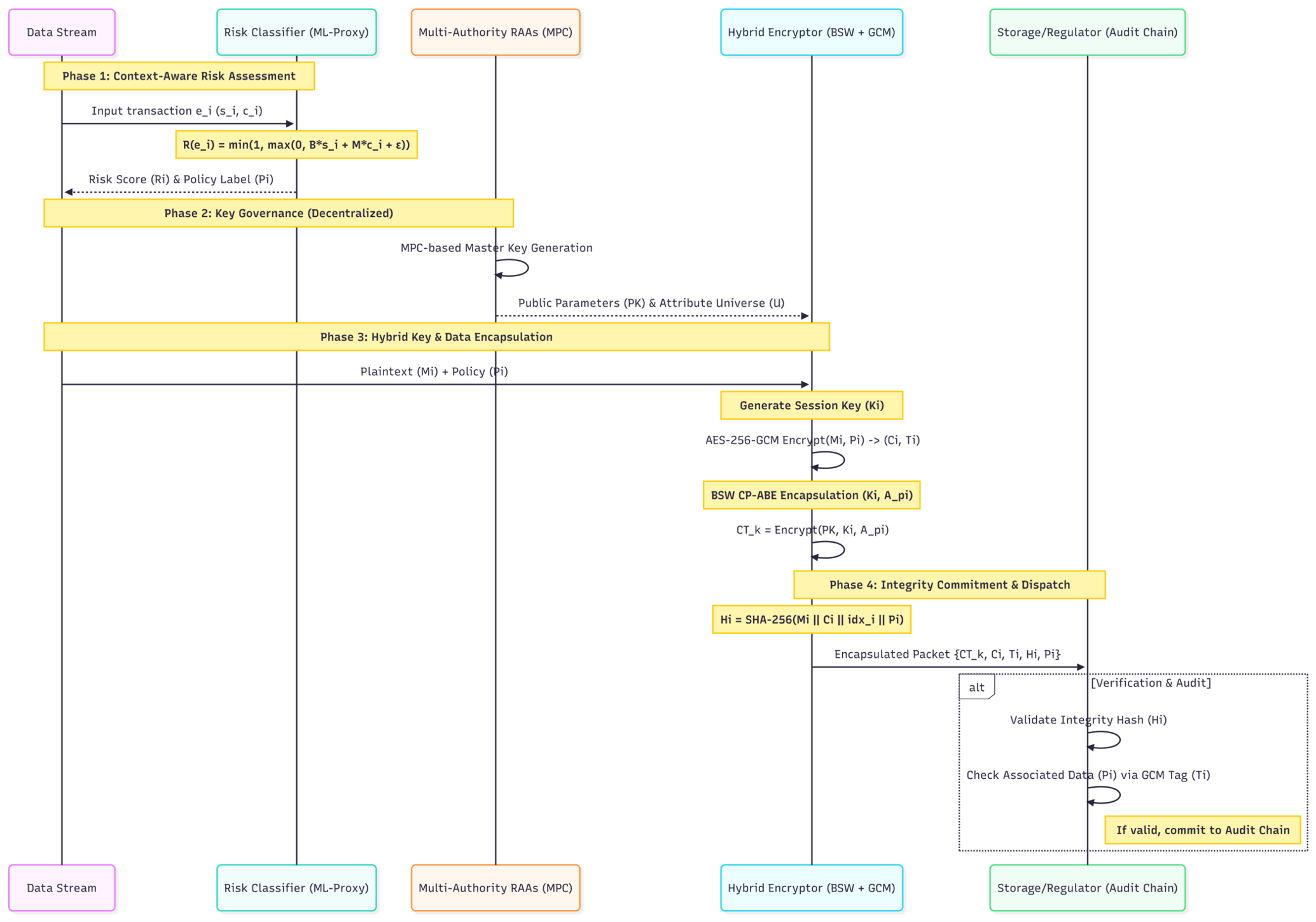
The logical sequence of these operations is illustrated in
Figure 1.
3.2. Threat Model
The design of CAHE-AML is guided by an explicit adversarial model that reflects the trust structure of cross-border AML data sharing, in which participants are regulated institutions operating under legal accountability rather than anonymous parties. We consider three classes of adversary.
The first is an external network adversary positioned on the communication channel between a VASP and a Regional Attribute Authority (RAA), or between RAAs themselves. This adversary is assumed to have full passive eavesdropping capability over all transmitted ciphertexts and is additionally capable of active Man-in-the-Middle (MitM) interference, including the injection, replay, or modification of transaction packets. Confidentiality against this adversary is provided by the AES-256-GCM data encapsulation layer, while the SHA-256 integrity commitment
(Equation (
2)) is specifically designed to detect any active tampering of this kind, as demonstrated by the integrity-breach experiments.
The second class is a curious or compromised RAA. Since each RAA issues CP-ABE secret keys
to VASPs and auditors within its jurisdiction (
Section 3.1), a single corrupted RAA represents a realistic insider threat. CAHE-AML addresses this through the decentralized MPC-based key generation scheme: the ABE master secret
is never held in full by any individual authority, so that a single compromised RAA cannot independently derive secret keys that satisfy access structures
outside its assigned jurisdiction, nor can it reconstruct
to decrypt globally escalated (GLOBAL_INTEL) records on its own.
The third class is a dishonest VASP or auditor that has been legitimately issued a secret key
satisfying some access structure
, but attempts to access data outside its assigned policy tier, for example by presenting forged attributes or attempting to combine keys with other entities (key collusion). The collusion-resistance property of the underlying BSW CP-ABE construction [
31] ensures that combining secret key components issued for different attribute sets does not yield a key satisfying an access structure that neither party individually satisfies.
Across all three adversary classes, CAHE-AML adopts a semi-honest (honest-but-curious) trust assumption for the RAAs participating in the MPC-based key governance scheme: each RAA is assumed to follow the prescribed protocol correctly but may attempt to learn information from the data it observes. We explicitly position this as a deliberate design trade-off rather than an oversight. RAAs in this context correspond to national FIUs, which are formally designated, legally accountable regulatory bodies operating under binding international AML obligations [
8]; a fully malicious-adversary model, while cryptographically stronger, would require collusion-resistant threshold primitives or zero-knowledge proofs of correct key derivation for every RAA interaction, substantially increasing computational and communication overhead in a setting where the participating entities are already bound by institutional and legal accountability mechanisms outside the cryptographic protocol itself. The semi-honest assumption is therefore consistent with the threat model adopted by comparable multi-authority ABE governance schemes [
32,
33] and reflects a deliberate balance between cryptographic guarantees and the operational latency requirements.
3.3. Experimental Setup
To ensure the reproducibility of the performance benchmarks and to validate the CAHE-AML framework under realistic conditions, we established a high-performance compute environment based on enterprise-grade hardware. The experiments were conducted on a Dell PowerEdge R760 server (Dell Technologies, Round Rock, TX, USA) equipped with dual Intel® Xeon® Silver 4510 processors (4th Gen Scalable family) (Intel Corporation, Santa Clara, CA, USA), featuring a total of 24 physical cores and 48 threads, supported by 128 GiB of DDR5 memory. The storage subsystem was managed via a PERC RAID controller with four 1TB SATA SSDs. For the purpose of these trials, a controlled execution environment was implemented within a Debian 12 container hosted under a Proxmox hypervisor (Proxmox Server Solutions GmbH, Vienna, Austria), with a specific allocation of 16 CPU cores, 16 GiB of RAM, and 2 GiB of swap space. This configuration provides a stable and scalable platform for simulating high-concurrency anti-money laundering processing in decentralized financial systems.
The software stack was built using Python 3.10, with core cryptographic operations leveraging the cryptography library’s AESGCM implementation to utilize AES-NI hardware acceleration [
34,
35]. Data manipulation and the risk scoring logic were handled via the pandas [
36] and numpy [
37] libraries, ensuring efficient memory management for large-scale record processing.
The BSW CP-ABE key-encapsulation and MPC-based key-governance layers are evaluated via a computational-cost simulation rather than a full pairing-based cryptographic implementation: each encapsulation operation incurs a fixed 0.2 ms processing delay intended to be representative of published BSW CP-ABE and threshold-MPC benchmark timings, together with the construction of policy-bound metadata, in place of executing the Setup/KeyGen/Encrypt/Decrypt algorithms over a bilinear group or a real multi-party secret-sharing protocol. This design choice was made because no production-grade, MPC-integrated multi-authority ABE library was available for the target Python/AES-NI environment at the time of evaluation. Consequently, the reported per-packet latency and throughput figures characterize the AES-GCM/SHA-256 data-encapsulation pipeline exactly, and characterize the CP-ABE/MPC layer’s contribution only to the extent that the calibrated 0.2 ms delay reflects real-world pairing and communication costs.
The framework was evaluated using the Ethereum Fraud Dataset (addr_labels_ balanced.csv) containing 114,771 unique Ethereum addresses [
38].
This dataset is carefully balanced across two dimensions: activity classification (Scam vs. Legitimate) and entity type (Smart Contracts vs. Externally Owned Addresses), providing diverse transaction profiles for testing the CAHE-AML framework’s context-aware policy adaptation logic. The data were collected from Ethereum public transactions via BigQuery, with labels from Etherscan and curated scam lists. The dataset preparation pipeline includes merging, deduplication, and balancing scripts, producing both GNN and LSTM datasets in Parquet format.
4. Results and Analysis
This section presents the empirical evaluation of the CAHE-AML framework, focusing on its computational efficiency, the precision of its risk-adaptive policy distribution, and its scalability characteristics under high-concurrency workloads.
4.1. Throughput and Efficiency
The experimental evaluation demonstrates that the CAHE-AML framework is capable of processing the entire dataset of 114,771 addresses within approximately 8.71 s. This corresponds to a measured peak throughput of 13,174 tx/s. For reference, the Ethereum mainnet typically processes approximately 15–30 transactions per second under normal operating conditions [
39]. The comparison illustrates that the computational overhead introduced by the hybrid CAHE-AML framework is negligible relative to typical blockchain transaction volumes, making it suitable for high-frequency monitoring.
Such processing capacity indicates that the framework can support large-scale AML monitoring scenarios while maintaining an exceptionally low average processing latency of 0.4707 ms per packet. This latency accounts for the complete cryptographic pipeline, including BSW-based attribute encryption, AES-GCM data encapsulation, and a fixed MPC-related communication overhead of approximately 0.2 ms. By incorporating the MPC overhead as a constant factor rather than a variable, the evaluation reflects a stable production environment where key metadata distribution is pre-synchronized. The observed performance is sufficient to enable near real-time analysis of blockchain address metadata within regulatory or investigative workflows without creating a processing bottleneck.
The hybrid encryption and integrity verification pipeline produced a Data Expansion Ratio of approximately 1.49×. This metric represents the combined overhead associated with the AES-256-GCM ciphertext, the 12-byte nonce, the SHA-256 integrity hash (), and the CP-ABE encapsulated key metadata, which includes the multi-authority access structures. This 49% increase in data volume is a justified trade-off for the granular, attribute-based access control and non-repudiation features provided. The framework maintains high processing efficiency due to the parallel distribution of tasks across 15 CPU cores and the utilization of hardware-accelerated cryptographic instructions on the Dell PowerEdge platform.
To establish a performance baseline, the CAHE-AML framework was evaluated and, as shown in
Table 1, compared with TRISA [
22], TRUST [
23], and Fully Homomorphic Encryption (FHE) [
40].
The throughput and latency figures reported for CAHE-AML characterize local cryptographic-layer processing only, excluding network transmission, consensus, or inter-institutional communication delays. The TRISA/TRUST figures, by contrast, reflect end-to-end system throughput inclusive of network latency, as these are the only publicly reported performance figures available for these systems. The comparison in
Table 1 should therefore be read as establishing a lower bound on CAHE-AML’s achievable end-to-end performance, rather than a direct, like-for-like system benchmark.
Table 2 shows a qualitative architectural comparison between CAHE-AML and five established Travel Rule compliance solutions.
As
Table 2 shows, all five compared systems implement access control as a binary, statically configured decision (certificate issuance, ACL membership, or credential verification), made once per counterparty relationship rather than re-evaluated per transaction. CAHE-AML’s contribution relative to these systems is not a new cryptographic primitive, but the replacement of this binary decision with a continuously computed, three-tier, cryptographically enforced access policy driven by a risk score, combined with the removal of a single institutional point of trust through MPC-based key governance.
4.2. Risk-Based Policy Distribution and Sensitivity Analysis
4.2.1. Policy Distribution and Risk Correlation
The context-aware access control mechanism partitions the dataset according to the calculated risk scores
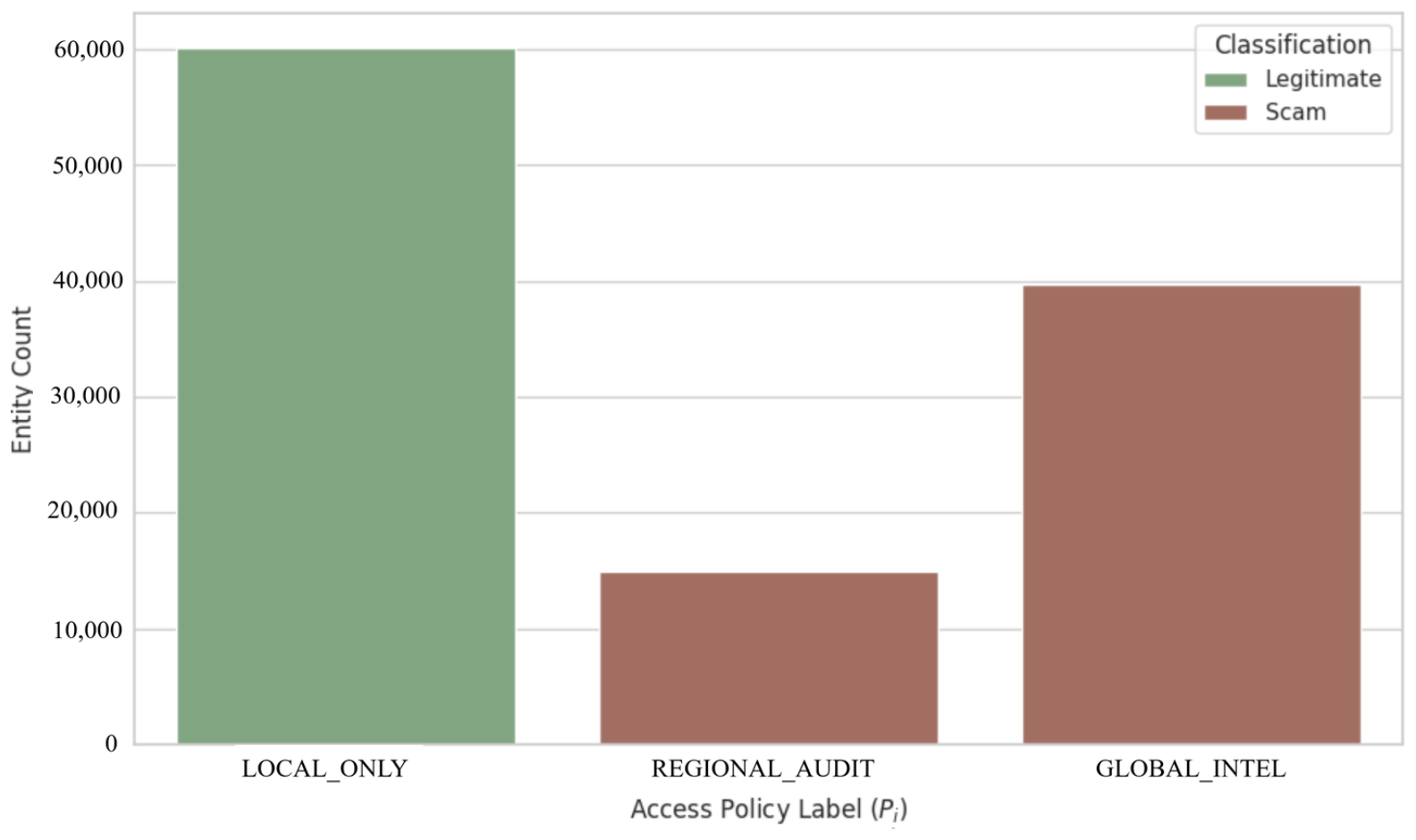
, effectively mapping entity classifications to specific cryptographic access structures. As shown in
Figure 2, the simulation produced a stratified distribution across three policy tiers.
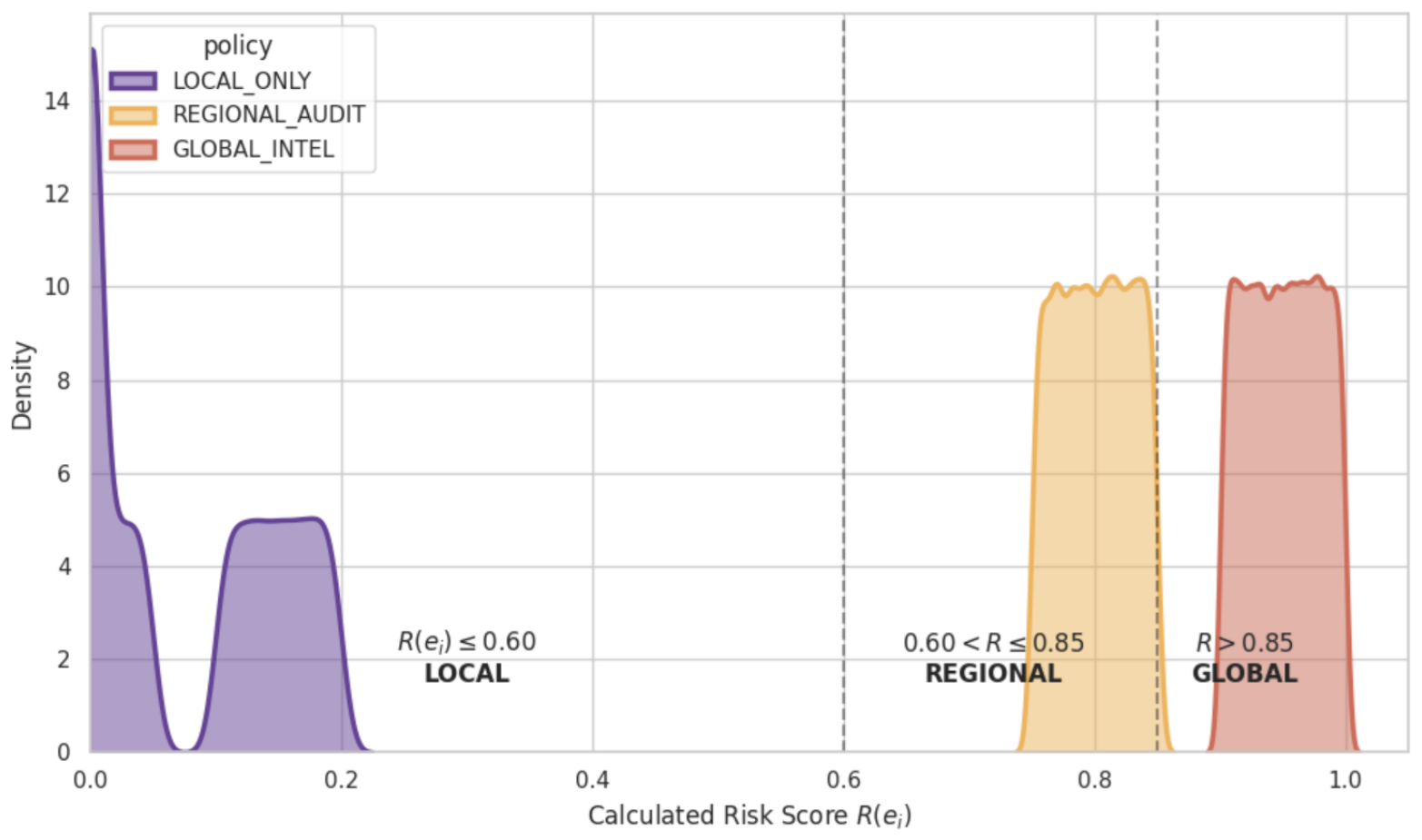
The distribution analysis reveals that approximately 60,000 addresses (the entire legitimate population) were assigned the LOCAL_ONLY policy, reflecting the framework’s “privacy-by-default” stance for low-risk entities. In contrast, flagged “Scam” entities were bifurcated between the higher tiers: approximately 15,000 addresses were assigned to REGIONAL_AUDIT, while nearly 40,000 addresses reached the GLOBAL_INTEL threshold. This segmentation, visualized in
Figure 3, demonstrates a precise alignment between the heuristic scoring
and the predefined regulatory thresholds.
As shown in the density plot, the risk scores form three distinct clusters separated by the architectural boundaries at 0.60 and 0.85. The LOCAL_ONLY cluster is confined to , primarily consisting of legitimate EOAs and low-complexity contracts. The REGIONAL_AUDIT tier captures entities with , representing cases where the scam label is present but the complexity modifier M is low. Finally, the GLOBAL_INTEL tier is exclusively occupied by high-risk entities where , typically involving flagged smart contracts.
The inclusion of the noise term and the weights ensures that while the segregation is robust, the transitions between tiers remain context-sensitive. This trifurcation of data access allows the CAHE-AML framework to maintain high-granularity oversight, ensuring that the most intensive investigative resources (and broader decryption keys) are strictly reserved for the highest-risk automated threats.
4.2.2. Sensitivity to Coefficient Selection
To assess the robustness of the tier-partitioning behavior to the choice of
B and
M, we recomputed
and the resulting policy distribution under several alternative coefficient values, holding the noise range
and thresholds (0.60, 0.85) fixed.
Table 3 summarizes the results.
Two conclusions follow from this analysis. First, the separation between legitimate and scam populations is provably robust to coefficient choice: because B is applied only when , and combined with , the maximum attainable risk score for any legitimate entity is ; for all , this bound remains below the LOCAL_ONLY/REGIONAL_AUDIT threshold of 0.60, so no legitimate entity can be escalated regardless of the specific values of B and M. Second, and in contrast, the internal split of the scam population between REGIONAL_AUDIT and GLOBAL_INTEL is highly sensitive to the coefficients, and behaves as a near step-function rather than a gradual response: because the noise term is narrow () relative to the coefficient values, scam entities cluster tightly around (non-contract) and (contract), and the tier assigned to the entire contract-scam subpopulation depends on which side of the 0.85 threshold the sum falls. We report this explicitly as a limitation of the present heuristic scoring model: while the legitimate/scam separation is a robust architectural property, the specific three-way partition boundary between REGIONAL_AUDIT and GLOBAL_INTEL is, in the current design, effectively engineered by the choice of B, M, and the fixed thresholds, rather than an emergent property of a calibrated or learned risk model.
4.3. Security Evaluation: Integrity Chain Resilience
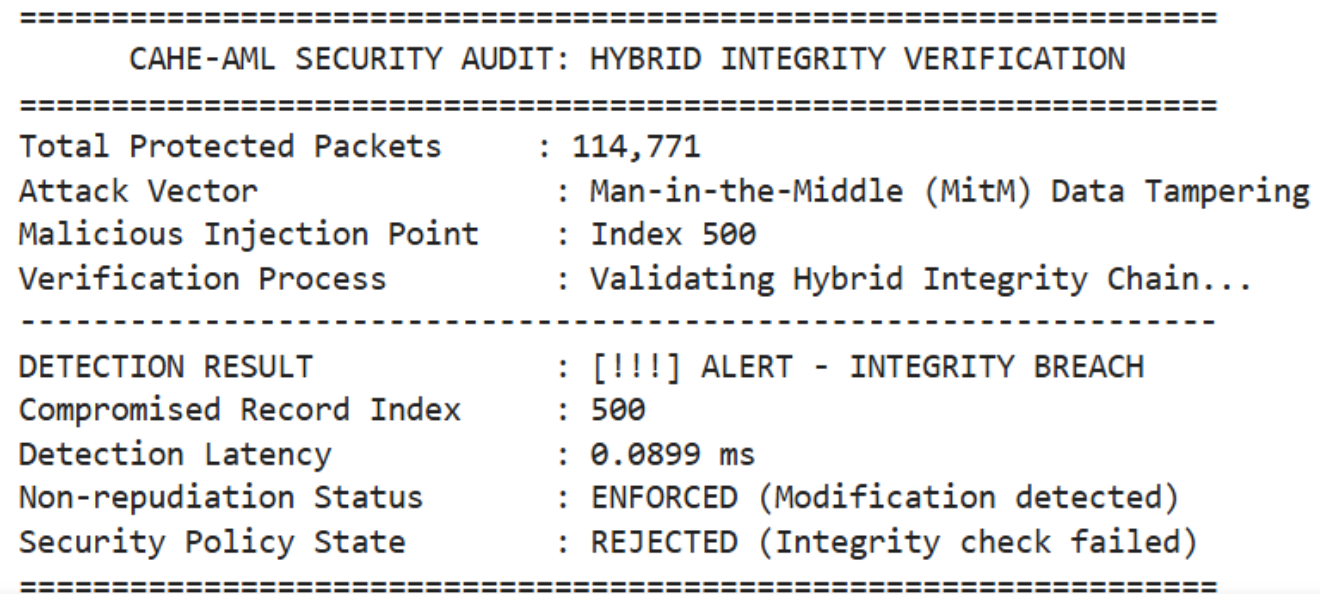
To validate the framework’s ability to ensure non-repudiation and detect unauthorized data modifications, we conducted a formal integrity chain breach test simulating a Man-in-the-Middle (MitM) data tampering attack. In this experiment, a malicious modification was injected by altering the cryptographic commitment of a single record at index 500 within the total pool of 114,771 protected packets. The system’s verification engine scanned the hybrid integrity chain to compare the current SHA-256 hashes () against the baseline audit trail.
As shown in the experimental security audit logs (
Figure 4), the CAHE-AML framework achieved 100% detection accuracy, successfully triggering an “ALERT—INTEGRITY BREACH” at the exact point of compromise. The detection latency for identifying the tampered record was measured at 0.0899 ms.
This ultra-low response time confirms that the hybrid integrity mapping, which binds the message (), ciphertext (), index, and policy label (), is computationally efficient enough for real-time forensic auditing. In a cross-border regulatory context, the non-repudiation status was confirmed as “ENFORCED,” while the security policy state was immediately transitioned to “REJECTED” upon failure of the integrity check. This mechanism ensures that any attempt by an adversary or intermediary to modify transaction metadata after encapsulation will be detected near-instantaneously, preserving the legal admissibility and chain of custody for AML evidence.
4.4. Scalability Analysis and Computational Efficiency
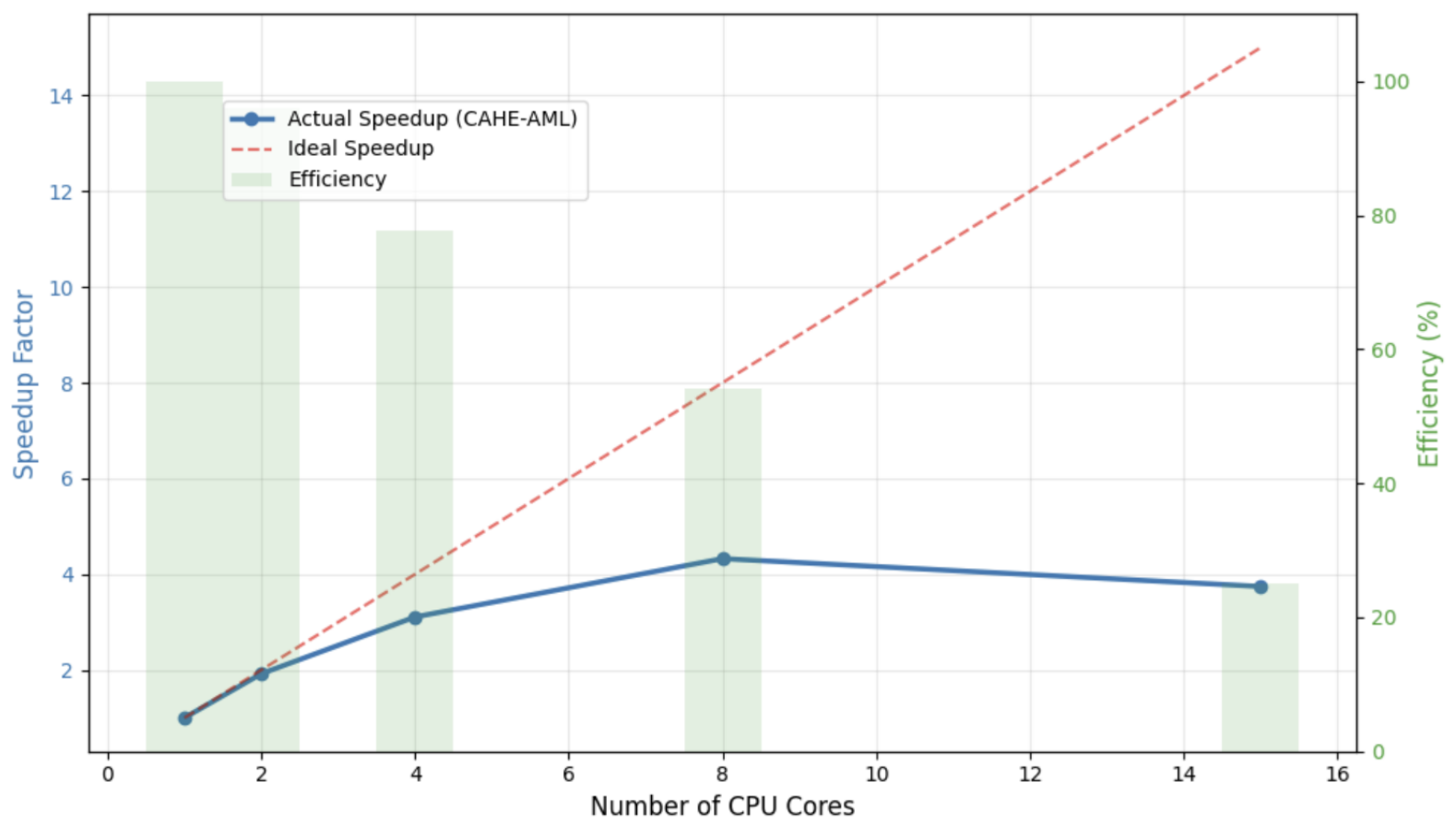
The scalability of the CAHE-AML processing pipeline was evaluated by executing the hybrid ABE-AES workload across a range of 1 to 15 CPU cores using a stress-test batch of 10,000 records. The relationship between throughput, speedup, and resource efficiency is illustrated in
Figure 5.
The experimental results indicate that CAHE-AML achieves a baseline throughput of 3350 tx/s on a single core (
). As shown in
Figure 5, the system exhibits strong near-linear scaling up to 4 cores, where it reaches 10,408 tx/s with 77.7% efficiency. The peak performance is observed at the 8-core configuration, delivering 14,491 tx/s with a speedup factor of 4.33× and an efficiency of 54.1%.
Beyond the 8-core threshold, the system encounters a performance plateau; at 15 cores, the throughput decreases to 12,544 tx/s, causing the speedup to drop to 3.74× and efficiency to fall to 25.0%. This behavior is typical for cryptographic workloads where the overhead of inter-process communication (IPC) for distributing ABE context and the synchronization of the integrity chain begin to outweigh the parallel gains. These findings confirm that the CAHE-AML framework is highly optimized for mid-range multi-core environments (4–8 cores), providing a robust balance between processing power and energy efficiency.
The consolidated performance characteristics, including integrity verification and updated privacy distribution metrics, are summarized in
Table 4.
5. Practical Implications and Usage Scenarios
The CAHE-AML framework provides a scalable solution to the long-standing regulatory dilemma regarding the reconciliation of transparent international cooperation with strict data privacy laws such as GDPR. Based on the experimental results, the framework demonstrates significant utility across several critical sectors of the digital economy.
The first major application concerns cross-border financial investigations, where CAHE-AML allows local authorities to automatically segregate data based on empirical risk levels. Transactions identified with high risk scores, specifically , are encapsulated for GLOBAL_INTEL access, while suspicious activities in the range are assigned to REGIONAL_AUDIT. This trifurcated approach enables international organizations to obtain critical leads without compromising the privacy of low-risk domestic users, whose data remains protected under the LOCAL_ONLY policy.
Building upon this capability, high-frequency VASP compliance represents another vital scenario where virtual asset service providers can integrate the framework directly into their transaction monitoring systems. Since the framework achieves a peak stress-test throughput of 14,491 tx/s and a sustained average of 13,174 tx/s, it is capable of processing live blockchain streams in real time. This allows for the generation of automated suspicious activity reporting (SAR) for financial intelligence units while simultaneously ensuring the mathematical integrity of the evidence through the SHA-256 integrity chain.
Furthermore, the framework’s ability to identify smart contract risks through the complexity modifier M makes it particularly suitable for DeFi and cross-chain bridge monitoring. Regulatory bodies can deploy the framework to oversee decentralized bridges, creating dynamic, BSW-encrypted audit trails that update at blockchain speed. The decentralized nature of the key governance, managed via Multi-Party Computation (MPC), ensures that no single jurisdiction can unilaterally compromise the privacy of global financial flows.
The near-instantaneous detection of data tampering, measured at 0.0899 ms, further ensures that any information shared through these scenarios maintains its legal admissibility. By providing a robust, forensic-ready audit trail and a decentralized trust model, the CAHE-AML framework establishes a reliable foundation for international judicial cooperation and proactive regulatory oversight.
6. Limitations
Despite the high performance demonstrated by the CAHE-AML framework, several limitations must be acknowledged. The current simulation successfully populated all three policy tiers, including the REGIONAL_AUDIT category as shown in
Figure 3; however, the distribution remains influenced by the heuristic nature of the
B and
M coefficients. Although the framework demonstrated the ability to segregate “Scam” entities into different escalation levels based on complexity, the underlying Ethereum dataset still primarily relies on binary ground-truth labels. Furthermore, the sensitivity analysis in
Section 4.2.2 shows that, while the LOCAL_ONLY/scam separation is mathematically guaranteed for any
, the internal REGIONAL_AUDIT/GLOBAL_INTEL split among scam entities behaves as a near step-function of
B and
M rather than a smoothly calibrated risk gradient. This confirms that the specific three-tier boundary reported in this study is, in its present form, a designed property of the coefficient and threshold choices rather than an outcome independently validated against a continuous, learned risk estimate. More broadly, because
and the ground-truth scam indicator
directly drives the base term, the tier assignment is, by construction, a near-deterministic function of
rather than an emergent property of a learned or independently validated risk model; the present results should therefore be read as a validation of the framework’s dynamic access-partitioning mechanism, not as evidence of AML risk-detection accuracy. A deployable version of CAHE-AML would replace the heuristic scoring function with a calibrated probabilistic classifier (e.g., a graph neural network operating on transaction-graph features, consistent with the GNN-format variant of the underlying dataset) producing a continuous fraud-likelihood estimate as input to
, rather than relying on a pre-existing ground-truth label.
The “efficiency saturation” observed in
Figure 5 highlights a definitive hardware–software bottleneck. The decline in efficiency to 25.0% at the 15-core mark indicates that the current implementation, which utilizes Python’s multiprocessing and inter-process communication, reaches a communication overhead limit. On high-core-count systems, the cost of synchronizing the hybrid integrity chain and distributing CP-ABE context across cores eventually outweighs the gains from parallel cryptographic execution.
We further note that the CP-ABE key-encapsulation and MPC-based key-governance layers are, in the present prototype, evaluated via a fixed-cost computational simulation (0.2 ms per packet) rather than a benchmarked pairing-based or threshold-cryptographic implementation (
Section 3.3). The reported per-packet latency and throughput therefore characterize the AES-GCM/SHA-256 data-encapsulation pipeline precisely, but characterize the CP-ABE/MPC layer’s contribution only approximately, to the extent that the calibrated delay reflects real-world pairing and multi-party communication costs. The design sketch for the threshold MPC layer (
Section 3.1) specifies
-threshold parameters, a Pedersen-style distributed key generation protocol, and re-sharing-based procedures for authority onboarding, offboarding, and key-refresh. None of these sub-protocols are implemented or benchmarked in the present prototype, and malicious-authority handling via verifiable secret sharing remains a design proposal rather than a validated mechanism.
A critical cryptographic limitation pertains to key revocation. The utilized BSW construction does not natively support efficient revocation of compromised user secret keys. In the event of a VASP or RAA credential breach, the current version of the framework would require a global parameters update or a multi-authority re-keying process via the MPC layer, which introduces significant administrative overhead. A practical mitigation compatible with the existing BSW construction is the introduction of epoch-based (time-bound) attributes: each access structure
is augmented with a mandatory epoch attribute (e.g., “epoch:2026-Q3”) that is refreshed periodically by the RAAs, so that a compromised
issued in a prior epoch ceases to satisfy
once the epoch attribute rotates, without requiring a full MPC re-keying of
. This bounds the exposure window of a compromised key to a single epoch, at the cost of periodic re-issuance of non-compromised users’ keys—an overhead proportional to the active user population per RAA rather than to the global attribute universe, and independent of the 1.49× data expansion ratio reported in
Section 4.1, since epoch rotation affects key issuance rather than per-packet ciphertext size. Alternatively, proxy re-encryption at the RAA layer would allow immediate revocation without epoch delay, at the cost of an additional re-encryption operation per stored record per revocation event, which would proportionally increase the data expansion ratio for affected records.
A further limitation concerns the evaluation dataset itself. The Ethereum Fraud Dataset provides address-level ground-truth labels, but does not contain full Travel-Rule-compliant payloads—originator/beneficiary PII, transaction amounts, timestamps, jurisdiction metadata, or sanctions indicators as specified under FATF Recommendation 16 and IVMS101. In our study, the cryptographic pipeline operates on serialized JSON records independently of their semantic content, and its throughput is primarily a function of record size rather than field structure; consequently, the reported results should be interpreted as evidence of cryptographic-layer feasibility rather than full end-to-end validation against production VASP/regulator message formats.
Finally, the semi-honest trust assumption adopted for the RAAs (
Section 3.2) bounds the framework’s guarantees to honest-but-curious key-governance behavior. While the MPC-based key generation prevents any single RAA from unilaterally reconstructing the master secret
, the current design does not provide cryptographic protection against a fully malicious RAA that actively deviates from the framework, nor against collusion among a threshold of RAAs sufficient to reconstruct
. Similarly, the integrity chain detects tampering with transmitted packets but does not prevent an authorized entity from misusing intelligence after lawful decryption. Accordingly, the security guarantees demonstrated in this study should be understood as characteristic of a first-stage prototype rather than as sufficient assurances for production cross-border AML infrastructure, where regulators, VASPs, and adversarial financial-crime actors may have stronger incentives to deviate from the protocol than the honest-but-curious model assumes.
7. Conclusions
In this paper, we introduced CAHE-AML, a risk-adaptive architecture built on a context-aware hybrid encryption framework designed to facilitate secure and privacy-preserving cross-border data sharing in the cryptocurrency ecosystem. By integrating heuristic risk scoring with authenticated encryption (AES-256-GCM), decentralized key governance via MPC, and dynamic attribute-based access policies, the framework effectively addresses the critical tension between the need for global AML intelligence sharing and the mandate for financial privacy protection.
Our experimental results, conducted on an enterprise-grade Dell PowerEdge R760 server, demonstrate that CAHE-AML is highly efficient, achieving a peak throughput of 14,491 tx/s and maintaining a sustained average of 13,174 tx/s across the entire dataset. The framework successfully demonstrated a precise trifurcation of data access, effectively segregating the population into LOCAL_ONLY, REGIONAL_AUDIT, and GLOBAL_INTEL tiers based on empirical risk scores . This mechanism ensures that high-intensity investigative resources are strictly reserved for high-risk entities (approximately 34.6% of the escalated data in this study), while preserving the privacy of low-risk domestic users.
Beyond throughput, the security evaluation confirmed the framework’s robust integrity: a simulated Man-in-the-Middle tampering attempt was detected with 100% accuracy in only 0.0899 ms. With an average processing latency of 0.4707 ms per packet, CAHE-AML proves to be near-instantaneous and forensic-ready for real-time audit trails. These security guarantees hold under the semi-honest (honest-but-curious) trust model adopted for RAAs. We position CAHE-AML as a first-stage prototype demonstrating architectural and computational feasibility under this trust model, with hardening against fully malicious or colluding authorities identified as a necessary step before production AML deployment. The observed efficiency saturation at the 8-core mark confirms that while the framework is highly optimized for mid-range multi-core environments, further scalability can be achieved through lower-level implementation optimizations.
Ultimately, CAHE-AML provides a robust foundation for a new generation of regulatory frameworks that are as decentralized and agile as the financial systems they monitor. Future work will focus on enhancing the policy adaptation engine with federated learning models to improve risk scoring accuracy and exploring the integration of Zero-Knowledge Proofs to further minimize shared data while maintaining the absolute verifiability of AML compliance.
Author Contributions
Conceptualization, R.S. and B.A.; methodology, R.S. and B.A.; software, R.S.; validation, V.B., O.K. and V.M.; formal analysis, V.B. and V.M.; investigation, R.S., M.B. and B.A.; resources, B.A.; data curation, R.S., M.B. and O.K.; writing—original draft preparation, R.S.; writing—review and editing, R.S. and B.A.; visualization, R.S. and O.K.; supervision, V.B.; project administration, R.S.; funding acquisition, B.A. All authors have read and agreed to the published version of the manuscript.
Funding
This research was funded by the European Union’s Horizon 2024 research and innovation program under the Marie Skłodowska-Curie grant agreement No. 101235440—FORCE. This publication reflects only the authors’ views, and the REA is not responsible for any use that may be made of the information it contains.
Institutional Review Board Statement
Not applicable.
Informed Consent Statement
Not applicable.
Data Availability Statement
Conflicts of Interest
The authors declare no conflicts of interest.
References
- Bongini, P.A.; Mattassoglio, F.; Pedrazzoli, A.; Vismara, S. Crypto ecosystem: Navigating the past, present, and future of decentralized finance. J. Technol. Transf. 2025, 50, 2054–2075. [Google Scholar] [CrossRef]
- Kovalchuk, O.; Shevchuk, R.; Banakh, S. Cryptocurrency crime risks modeling: Environment, e-commerce, and cybersecurity issue. IEEE Access 2024, 12, 50673–50688. [Google Scholar] [CrossRef]
- Nakamoto, S. Bitcoin: A Peer-to-Peer Electronic Cash System. 2008. Available online: https://bitcoin.org/bitcoin.pdf (accessed on 16 March 2026).
- Swan, M. Blockchain: Blueprint for a New Economy, 1st ed.; O’Reilly Media: Sebastopol, CA, USA, 2015. [Google Scholar]
- Shevchuk, R.; Lishchynskyy, I.; Ciura, M.; Lyzun, M.; Kozak, R.; Kasianchuk, M. Application of blockchain technology in emergency management systems: A bibliometric analysis. Appl. Sci. 2025, 15, 5405. [Google Scholar] [CrossRef]
- Zetzsche, D.A.; Arner, D.W.; Buckley, R.P. Decentralized finance. J. Financ. Regul. 2020, 6, 172–203. [Google Scholar] [CrossRef]
- Adamyk, B.; Benson, V.; Adamyk, O.; Shevchuk, R.; Al-Khateeb, H.; Fraczek, B. Enhancing European cyber forensics: A computational intelligence approach for detecting illicit money flows. In Proceedings of the 15th International Conference on Advanced Computer Information Technologies (ACIT); IEEE: New York, NY, USA, 2025; pp. 481–486. [Google Scholar]
- Financial Action Task Force; Egmont Group; Interpol; United Nations Office on Drugs and Crime. International Co-Operation on Money Laundering, Detection, Investigation, and Prosecution Handbook; FATF: Paris, France, 2025. [Google Scholar]
- Financial Action Task Force. Targeted Update on Implementation of the FATF Standards on Virtual Assets and VASPs; FATF: Paris, France, 2025. [Google Scholar]
- Spyra, M.; Balina, R.; Idasz-Balina, M.; Zajac, A.; Rozynski, F. Cryptocurrencies as a tool for money laundering: Risk assessment and perception of threats based on empirical research. Risks 2025, 13, 189. [Google Scholar] [CrossRef]
- Shevchuk, R.; Adamyk, B.; Benson, V.; Kovalchuk, O. Privacy-enhancing technologies for FATF crypto travel rule: Balancing compliance and data protection. In Technical Informatics and Artificial Intelligence—Engineer of XXI Century’2025: Monografia; UBB: Bielsko-Biala, Poland, 2025; pp. 45–56. [Google Scholar]
- Al Naqbi, S.A.; Nobanee, H.; Ellili, N.O.D. Global trends and insights into cryptocurrency-related financial crime. Res. Int. Bus. Financ. 2025, 75, 102756. [Google Scholar] [CrossRef]
- Chainalysis. Crypto Crime in 2025 Was Primarily Driven by 694% Surge in State-Driven Sanctions Evasion Volume; Online Report; Chainalysis Inc.: New York, NY, USA, 2026; Available online: https://www.chainalysis.com/blog/crypto-sanctions-2026/ (accessed on 3 March 2026).
- Europol. European Union Serious and Organised Crime Threat Assessment 2025 (EU-SOCTA); Technical Report; European Union Agency for Law Enforcement Cooperation: The Hague, The Netherlands, 2025. [Google Scholar]
- Shevchuk, R.; Adamyk, B.; Benson, V. Threshold-Based Private Set Intersection Protocol for Secure Deconfliction in Multi-Jurisdictional Blockchain Investigations. Electronics 2026, 15, 2709. [Google Scholar] [CrossRef]
- Zhou, H.Y. Regulating crypto money laundering: An assessment of current regulatory responses and potentials for technology-based solutions. Stan. J. Blockchain L. Pol’y 2025, 8, 142. [Google Scholar]
- Financial Action Task Force. International Standards on Combating Money Laundering and the Financing of Terrorism and Proliferation: The FATF Recommendations—Explanatory Note to Recommendation 16 (Travel Rule); Financial Action Task Force/OECD: Paris, France, 2019. [Google Scholar]
- European Parliament and Council of the European Union. Regulation (EU) 2016/679 of the European Parliament and of the Council of 27 April 2016 on the Protection of Natural Persons with Regard to the Processing of Personal Data and on the Free Movement of Such Data (GDPR). Off. J. Eur. Union 2016, 679, 10–13. [Google Scholar]
- European Parliament and Council of the European Union. Regulation (EU) 2023/1114 of the European Parliament and of the Council of 14 June 2023 on Markets in Crypto-Assets (MiCA). Off. J. Eur. Union 2023, L 150, 40–205. [Google Scholar]
- Schwarcz, S.L. Regulating global stablecoins: A model-law strategy. Vanderbilt Law Rev. 2022, 75, 1729. [Google Scholar]
- California Department of Justice. California Consumer Privacy Act (CCPA); California Department of Justice: Sacramento, CA, USA, 2024. [Google Scholar]
- TRISA. Travel Rule Information Sharing Alliance (TRISA). Available online: http://www.trisa.io (accessed on 20 March 2026).
- Coinbase. Travel Rule Universal Solution Technology (TRUST). Available online: https://www.coinbase.com/travelrule (accessed on 25 March 2026).
- VerifyVASP. VerifyVASP|Blockchain-Native Travel Rule Compliance. Available online: https://www.verifyvasp.com/ (accessed on 30 March 2026).
- OpenVASP. Travel Rule Protocol (TRP). Available online: https://www.openvasp.org/trp (accessed on 12 April 2026).
- Shyft Network. Veriscope—Travel Rule Compliance Solution. Available online: https://www.shyft.network/veriscope (accessed on 5 April 2026).
- Notabene. Transaction Authorization Protocol (TAP). Available online: https://notabene.id/glossary/transaction-authorization-protocol-tap (accessed on 20 April 2026).
- Sygna. Sygna Bridge—A Travel Rule Solution For VASP. Available online: https://www.sygna.io/bridge/ (accessed on 28 March 2026).
- Shevchuk, R.; Adamyk, B.; Benson, V. Post-quantum security enhancements for the TRISA framework: A technical perspective. In Proceedings of the 15th International Conference on Advanced Computer Information Technologies (ACIT); IEEE: New York, NY, USA, 2025; pp. 553–558. [Google Scholar]
- Alagic, G.; Barker, E.; Chen, L.; Moody, D.; Robinson, A.; Silberg, H.; Waller, N. Recommendations for Key-Encapsulation Mechanisms; NIST: Gaithersburg, MD, USA, 2025.
- Bethencourt, J.; Sahai, A.; Waters, B. Ciphertext-policy attribute-based encryption. In Proceedings of the IEEE Symposium on Security and Privacy; IEEE: New York, NY, USA, 2007; pp. 321–334. [Google Scholar]
- Chase, M.; Chow, S.S.M. Improving privacy and security in multi-authority attribute-based encryption. In Proceedings of the 16th ACM Conference on Computer and Communications Security (CCS 2009); ACM: New York, NY, USA, 2009; pp. 121–130. [Google Scholar]
- Yang, K.; Jia, X. Expressive, efficient, and revocable data access control for multi-authority cloud storage. IEEE Trans. Parallel Distrib. Syst. 2013, 25, 1735–1744. [Google Scholar] [CrossRef]
- Nielson, S.J.; Monson, C.K. Practical Cryptography in Python: Learning Correct Cryptography by Example; Apress: New York, NY, USA, 2019. [Google Scholar]
- Mehare, H.B.; Anilkumar, J.P.; Usmani, N.A. The Python programming language. In A Guide to Applied Machine Learning for Biologists; Springer: Cham, Switzerland, 2023; pp. 27–60. [Google Scholar]
- Gupta, P.; Bagchi, A. Introduction to pandas. In Essentials of Python for Artificial Intelligence and Machine Learning; Springer: Cham, Switzerland, 2024; pp. 161–196. [Google Scholar]
- Harris, C.R.; Millman, K.J.; van der Walt, S.J.; Gommers, R.; Virtanen, P.; Cournapeau, D.; Wieser, E.; Taylor, J.; Berg, S.; Smith, N.J.; et al. Array programming with NumPy. Nature 2020, 585, 357–362. [Google Scholar] [CrossRef] [PubMed]
- Ishmukhamedov, A. Ethereum Fraud Dataset by Activity; Kaggle Dataset. 2024. Available online: https://www.kaggle.com/datasets/fesevu/ethereum-fraud-dataset-by-activity (accessed on 10 March 2026).
- PingCAP. Enhancing Web3 Infrastructure with TiDB; Technical White Paper; PingCAP: Sunnyvale, CA, USA, 2024; Available online: https://static.pingcap.com/files/2024/10/17004258/Web3_data_infrastructure_whitepaper.pdf (accessed on 1 March 2026).
- Martins, P.; Sousa, L.; Mariano, A. A survey on fully homomorphic encryption: An engineering perspective. ACM Comput. Surv. 2017, 50, 83. [Google Scholar] [CrossRef]
| Disclaimer/Publisher’s Note: The statements, opinions and data contained in all publications are solely those of the individual author(s) and contributor(s) and not of MDPI and/or the editor(s). MDPI and/or the editor(s) disclaim responsibility for any injury to people or property resulting from any ideas, methods, instructions or products referred to in the content. |




 ,
,