Review

A Review on Electromagnetic Spectrum Map Construction: Methods, Challenges, and System Integration for 6G


1
School of Electronics and Information, Northwestern Polytechnical University, Xi’an 710129, China
2
Key Laboratory of Radio Spectrum Testing Technology, The State Radio_Monitoring_Center Testing Center, Ministry of Industry and Information Technology, Beijing 100037, China
3
No. 208 Research Institute of China Ordnance Industries, Beijing 102202, China
4
Xi’an Hengxiang Control Technology Co., Ltd., Xi’an 710071, China
5
Shanghai Institute of Satellite Engineering, Shanghai 201109, China
6
DecoreX Intelligent Technologies Co., Ltd., Xi’an 710075, China
7
State Key Laboratory of Integrated Services Networks, Xidian University, Xi’an 710071, China
8
School of Information and Communications Engineering, Xi’an Jiaotong University, Xi’an 710049, China
*
Authors to whom correspondence should be addressed.
Electronics 2026, 15(11), 2439; https://doi.org/10.3390/electronics15112439
Submission received: 6 May 2026 / Revised: 28 May 2026 / Accepted: 28 May 2026 / Published: 3 June 2026
(This article belongs to the Special Issue Multimodal Sensing and Communications for B5G/6G Systems)

Abstract

As wireless networks evolve from 5G toward 6G, the complexity of the electromagnetic environment increases sharply. Spectrum usage expands significantly into millimetre-wave (mmWave) and terahertz (THz) high-frequency bands. Network node density and mobility increase markedly. Moreover, communication-sensing-computation functions are deeply integrated. Accurate, real-time, full-band Electromagnetic Spectrum Maps (ESMs) have become a core infrastructure for 6G spectrum situational awareness, Dynamic Spectrum Access (DSA), interference coordination, and Integrated Sensing and Communication (ISAC). However, while a growing body of recent work extends radio mapping to multi-band and temporal domains, the predominant focus of existing Radio Map research remains the two-dimensional spatial power distribution at a single fixed frequency—essentially a degenerate special case of ESM after the frequency and time dimensions are collapsed—and no existing survey unifies 3D spatial construction, time-varying prediction, and full 6G system integration under a shared 4D formalism. This paper focuses on the three core research dimensions of ESMs, i.e., 3D spatial ESM construction, dynamic time-varying ESM modelling and prediction, and ESM integration with 6G systems. Under a unified four-dimensional ESM framework (space × frequency × time × power), we clarify the hierarchical relationships among ESM/SEM/REM/Radio Map/Channel Knowledge Maps (CKMs). Then, we systematically review 3D ESM construction, dynamic ESM modelling and prediction, and the integration of ESM with CKM/Digital Twin Networks (DTNs)/ISAC. Finally, we identify five, core open problems that constrain the development of the field to provide a systematic reference for 6G intelligent spectrum management research.

1. Introduction

Wireless communication technology is evolving toward 6G along three trends: spectra expanding into mmWave/THz bands [1,2,3,4]; sharply increasing density and mobility of base stations, UAVs, and LEO satellites [5,6,7,8]; and deep fusion of communication, sensing, and computation into ISAC [1,2,9]. ESMs—four-dimensional joint distributions of electromagnetic signals over space, frequency, time, and power—serve as shared knowledge infrastructure for spectrum situational awareness, DSA, interference coordination, ISAC, radio vortex communications, and DTN [10,11,12,13,14,15,16]. Freshness-sensitive DSA scenarios, including AoI minimization in ambient-backscatter-assisted energy-harvesting cognitive radio networks [17], exemplify settings where ESM timeliness directly determines system performance. Furthermore, in high-mobility 6G deployment scenarios, such as high-speed-train corridors and UAV communication links, the electromagnetic environment exhibits non-Gaussian heavy-tailed channel fading characterized by α -stable Lévy processes [18], imposing additional robustness requirements on ESM reconstruction methods that conventionally assume Gaussian measurement noise. The body of existing survey literature on radio environment mapping spans from early taxonomy work to recent deep learning-oriented reviews, as summarized in Table 1. Pesko et al. [19] provided a foundational survey of radio environment map (REM) construction methods, categorizing interpolation, model-driven, and measurement-based approaches at a 2D single-band resolution. Romero and Kim [20] established rigorous statistical theory for radio map estimation, introducing kernel-based and Gaussian process frameworks that remain widely referenced but focus exclusively on 2D spatial inference without frequency or temporal dimensions. Reddy et al. [21] surveyed multi-band spectrum cartography techniques, cataloguing challenges and opportunities across frequency bands while remaining within the 2D spatial domain. Feng et al. [22] reviewed recent machine learning-based radio map estimation techniques, classifying methods into model-driven, data-driven, and hybrid categories and compiling available public datasets, yet without addressing 3D spatial structure or 6G system integration. Most recently, Chen et al. [23] advanced closest to a multi-dimensional scope by jointly reconstructing spatial–spectral–temporal radio frequency maps via tensor completion, yet their work remains confined to the 2D horizontal plane. Considered jointly, these surveys reveal three residual structural gaps with respect to 6G requirements: (1) the absence of a unified 3D spatial construction framework addressing simultaneous multi-band coverage; (2) the lack of a systematic account of time-varying ESM in the 3D spatial context; (3) no existing survey connecting ESM, CKM, DTN, and ISAC under a common 4D formalism. No existing survey simultaneously addresses all three dimensions; this paper’s contribution lies therefore in their unification under a 4D ESM framework. Therefore, this paper takes three core research dimensions into consideration: (1) 3D spatial ESM construction, (2) dynamic time-varying ESM modelling and prediction, (3) integrating ESM with 6G systems. We review recent work under a unified four-dimensional ESM framework and clearly identify five core open problems that constrain the development of the field. Table 1 compares existing surveys with this paper.
The defining novelty of this survey lies in unification: no existing work simultaneously addresses all three dimensions—3D spatial construction, temporal dynamics, and full 6G system integration—under a shared 4D ESM formalism, as shown in Table 1. The main contributions of this paper are summarized as follows: (1) a unified four-dimensional ESM problem framework clarifying hierarchical relationships among ESM/SEM/REM/Radio Map/CKM; (2) a systematic survey of 3D spatial ESM construction covering model-driven and data-driven approaches with dataset status; (3) a systematic survey of time-varying ESM modelling and prediction, providing a dedicated 3D treatment absent from existing surveys; (4) a review of ESM integration frameworks with CKM, DTN, and ISAC; and (5) five explicit open problems providing a concrete agenda for future research. The overall structure is illustrated in Figure 1.

Review Methodology and Scope

The literature reviewed in this paper was assembled through systematic searches of IEEE Xplore, Google Scholar, arXiv, and Web of Science using the following primary search terms: radio map, radio environment map (REM), spectrum cartography, electromagnetic spectrum map (ESM), channel knowledge map (CKM), and spectrum situational awareness, combined in turn with modifiers 3D, time-varying, prediction, 6G, ISAC, and digital twin. The search window spanned January 2015 to March 2026, with selective inclusion of earlier foundational works. Inclusion criteria: (i) the work directly addresses the construction, estimation, or prediction of a spatially resolved radio or spectrum power field; (ii) it contributes to at least one of the three survey dimensions (3D spatial construction, temporal dynamics, or 6G system integration). Exclusion criteria: (i) pure physical-layer channel estimation without a spatial mapping dimension; (ii) spectrum sensing or occupancy monitoring without spatial field reconstruction; (iii) hardware contributions with no mapping or inference component. Retained papers were classified under the unified 4D ESM framework (Section 2) and further organized by method type (model-driven, data-driven, generative, hybrid). Approximately 120 references were reviewed in total.

2. Definition, Framework, and Classification of ESM

Conceptual Hierarchy and Unified Mathematical Framework

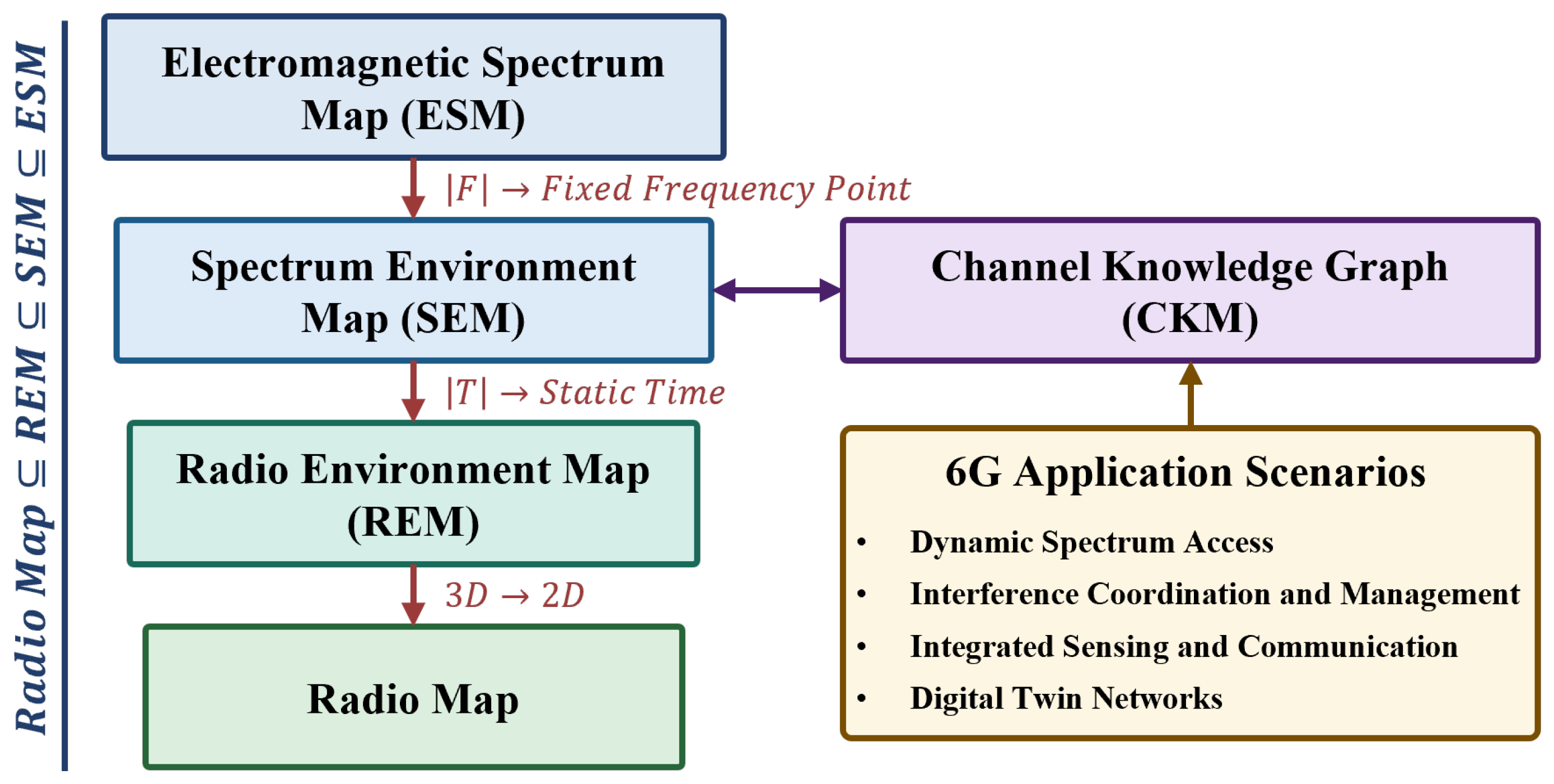
Figure 2 illustrates the relationships among key concepts. ESM is the core object of this paper: the joint distribution of electromagnetic signals over space, frequency, time, and power [11,16]. SEM is the primary instance emphasizing complete environmental description [23,24,25]. REM describes spatial power distribution at a fixed frequency ( | F | = 1 ) [19,21,26,27]. Radio Map is a simplified REM focusing on 2D static path loss or RSS [20,28,29]. CKM is a wideband channel prior database indexed by location, complementary to ESM [6,10,30,31]. The scope relationship is formally: ESM SEM REM Radio Map . Radio Map is a degenerate special case of ESM when | F | = 1 and | T | = 1 . Equating this degenerate case with the general problem results in research gaps [16].
Let R R 3 be the target geographic region, x R the spatial coordinate, f F the frequency, and t T the time. Each sparse measurement is modelled as:
y s = Γ ( x s , f s , t s ) + n s , s = 1 , , S ,
where n s N ( 0 , σ n 2 ) is additive noise, and S | R | · | F | · | T | reflects the sparse sampling condition. Let y S = [ y 1 , , y S ] collect all measurements, and I prior denote available prior information. Here, Γ ( x , f , t ) R denotes the received power spectral density (e.g., in dBm/MHz); the spatial, frequency, and temporal resolutions are Δ x , Δ f , and Δ t , respectively, (discretization detailed in (4)). Writing n = [ n 1 , , n S ] N ( 0 , σ n 2 I ) , the measurements take the matrix form y S = A vec ( Γ ) + n , where A { 0 , 1 } S × N is the binary sampling-selection matrix, with N = N x N y N z N f N t (see (4)) making the ill-posed nature of the inverse problem explicit. The posterior uncertainty σ 2 ( x , f , t ) = Var [ Γ ( x , f , t ) | y S ] quantifies reconstruction confidence and motivates active sensing strategies (Section 4); reconstruction quality is evaluated via the normalized mean squared error (NMSE, (7)). The unified ESM construction problem is:
Γ ^ ( x , f , t ) = F y S , I prior , ( x , f , t ) R × F × T ,
where F ( · ) may be a traditional interpolator, a machine learning model, or a generative model [20,32,33].
The ESM construction problem in (2) is fundamentally an ill-posed inverse problem: the power field over a continuous 4D domain must be recovered from a finite set of noisy sparse measurements. Romero et al. [32] provided a rigorous theoretical analysis of this problem, establishing upper and lower bounds on the spatial variability of power maps via the proximity coefficient:
ρ ( R ) = k = 1 K P k d k 3 ( R ) , d k ( R ) = min x R x x k 2 ,
where P k is the transmit power of the k-th source and d k ( R ) its minimum distance to the mapped region. Their analysis reveals that power maps exhibit relatively slow spatial variation with energy concentrated at low spatial frequencies, implying that a higher measurement density (larger ρ ) is required when sources are closer to the mapped region. This result theoretically motivates compressed-sensing-based recovery, exploiting the restricted isometry property (RIP) [34], and partially explains why data-driven CNN approaches can achieve good reconstruction from sparse measurements in practice. Nevertheless, the fundamental limits of 4D ESM reconstruction—including observability conditions for multi-source, multi-band scenarios and the precise interplay among sampling density, source sparsity, and reconstruction error—remain open.
The discretized 4D ESM is represented as a tensor:
Γ R N x × N y × N z × N f × N t , [ Γ ] i , j , k , l , m = Γ ( x i j k , f l , t m ) ,
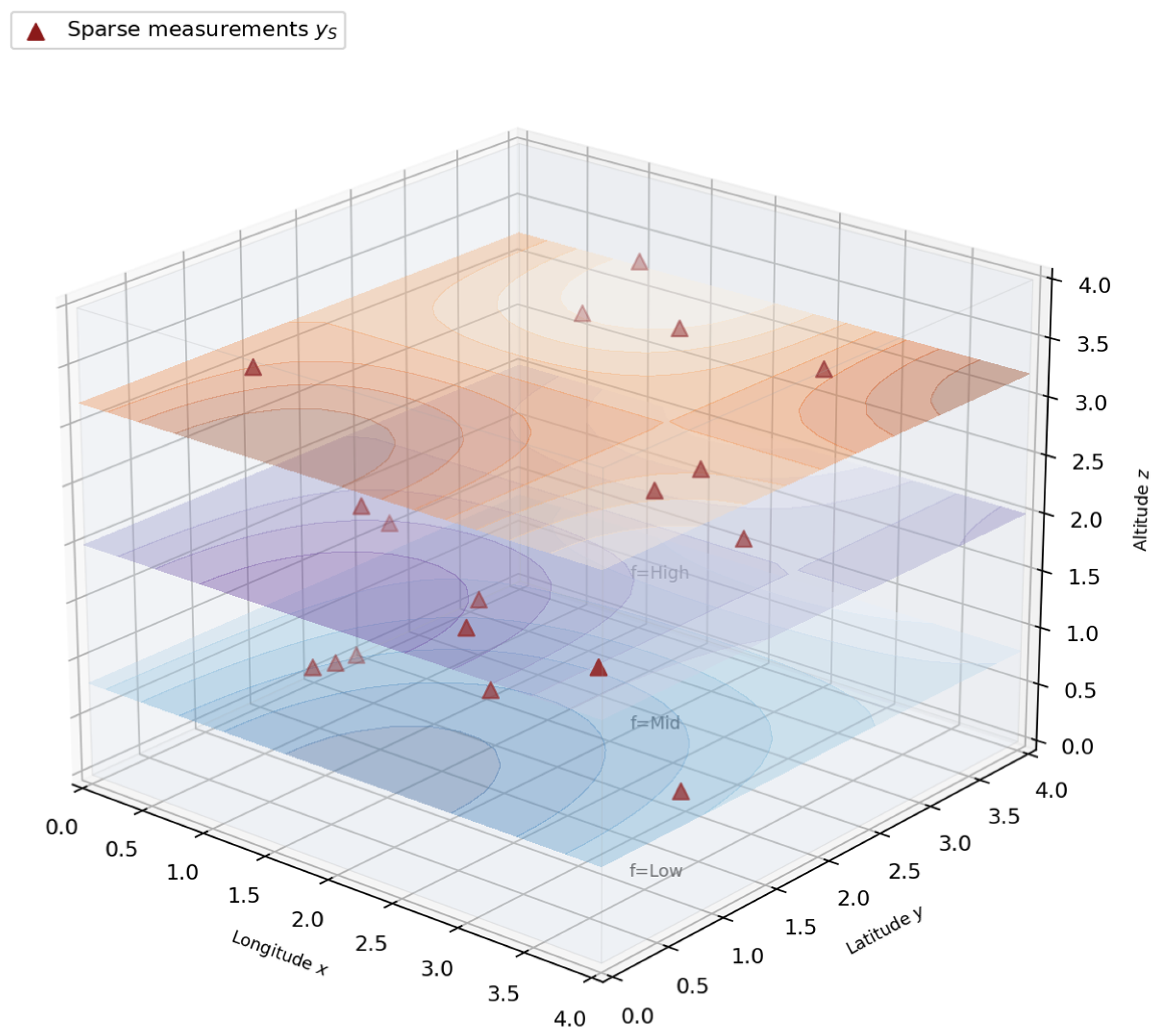
where N x , N y , N z , N f , N t are the discretization sizes along the spatial ( x , y , z ), frequency, and time dimensions, respectively. The four-dimensional ESM tensor structure is further depicted in Figure 3, and the unique physical constraints of the three extension dimensions are summarized in Table 2.

3. Construction Methods for 3D Spatial ESM

3.1. Overview and Method Taxonomy

The 2D planar assumption fails systematically with low-altitude UAV networks, vertical cell coverage, THz directional communication, and LEO satellite interference management [6,40,41,42]. Extending from 2D to 3D scales unknown variables from N 2 to N 3 , imposing higher demands under sparse sampling [32,43,44]. We review the literature from the following categories.
Model-driven methods. 3D ray tracing accurately models reflection, diffraction, and scattering but its high cost (minutes to hours per scene) limits it to generating synthetic training data [45,46,47]. Sparse Bayesian Learning (SBL) exploits spectral sparsity for low-sampling-rate recovery with strong physical interpretability [34,48]. The underlying sparse recovery is typically formulated as:
α ^ = arg min α 1 2 y S Φ α 2 2 + λ α 1 ,
where Φ R S × M is a dictionary (e.g., spatial Fourier basis) and λ is the regularization parameter. Krijestorac et al. [44] extended Kriging to 3D using UAV-mounted sensors and found that matrix completion outperforms Kriging at low measurement density. The Kriging predictor takes the form:
Γ ^ ( x ) = k x K + σ n 2 I 1 y S ,
where [ k x ] i = κ ( x , x i ) and [ K ] i j = κ ( x i , x j ) are evaluations of a kernel (covariance) function; the O ( S 3 ) matrix inversion exposes its scalability bottleneck. Cao et al. [49] proposed a novel electromagnetic-compliant model with mutual coupling for active RIS-assisted wireless systems.
Data-driven deep learning methods. RadioUNet [28] pioneered end-to-end path loss prediction from building maps; 3D UNet extensions exploit inter-layer altitude correlations [43,46]. PMNet [50,51] achieved NMSE 31.8 dB at ∼8 ms with 4.5× training data reduction. Wang et al. [46] proposed UrbanRadio3D—ray-traced with path loss, DoA, and ToA, 7× more altitude layers than prior datasets—and RadioDiff-3D, which supports transmitter-known and sparse-observation modes, significantly outperforming deterministic baselines. RadioDiff-k2 [52] injects the Helmholtz equation as a hard physical constraint, achieving NMSE 32 dB as the state of the art for physics-integrated generative ESM.
NeRF and 3D Gaussian Splatting methods. NeRF2 [53] achieves ∼50% accuracy improvement via physics–neural turbo learning. NeRF-REM [54] injects path loss and shadow fading priors for effective extrapolation to unobserved altitudes. WRF-GS+ [55] integrates electromagnetic constraints into deformable 3D Gaussian primitives, outperforming ray tracing at ∼25 ms inference. F4-CKM [56] and RadSplatter [57] further extend the NeRF/GS paradigm to CKM construction and RF map extrapolation.
Environment semantics-driven reconstruction. The Virtual Obstacle Model (VOM) was proposed in [58] to jointly reconstruct radio maps and virtual obstacles from RSS, achieving 10–18% accuracy improvement. Liu and Chen [42] constructed a full-dimensional (6D) radio map via joint virtual obstacle and propagation parameter estimation. Wang et al. [59] demonstrated the value of 3D point cloud geometric priors for low-altitude mmWave CKM construction.
To highlight the critical technical differences among these approaches, Table 3 systematically compares them across physical assumptions, scalability, and computational complexity [60]. Model-driven methods rely on explicit physical assumptions and offer high interpretability but suffer from poor scalability. Data-driven CNN methods make minimal physical assumptions but achieve the best engineering balance of accuracy and inference speed. Physics-constrained generative models inject hard physical constraints into the generative prior, breaking the accuracy ceiling of deterministic CNNs at the cost of higher inference latency. NeRF/GS methods employ a continuous implicit representation amenable to differentiable rendering analogies, enabling fine-grained 3D reconstruction with fast inference but requiring scene-specific training.

3.2. Accuracy–Complexity Tradeoff and Dataset Status

Throughout this paper, reconstruction quality is quantified by the normalized mean squared error (NMSE):
NMSE = 10 log 10 Γ ^ Γ F 2 Γ F 2 [ dB ] ,
where Γ ^ and Γ are the estimated and ground-truth ESM tensors, respectively.
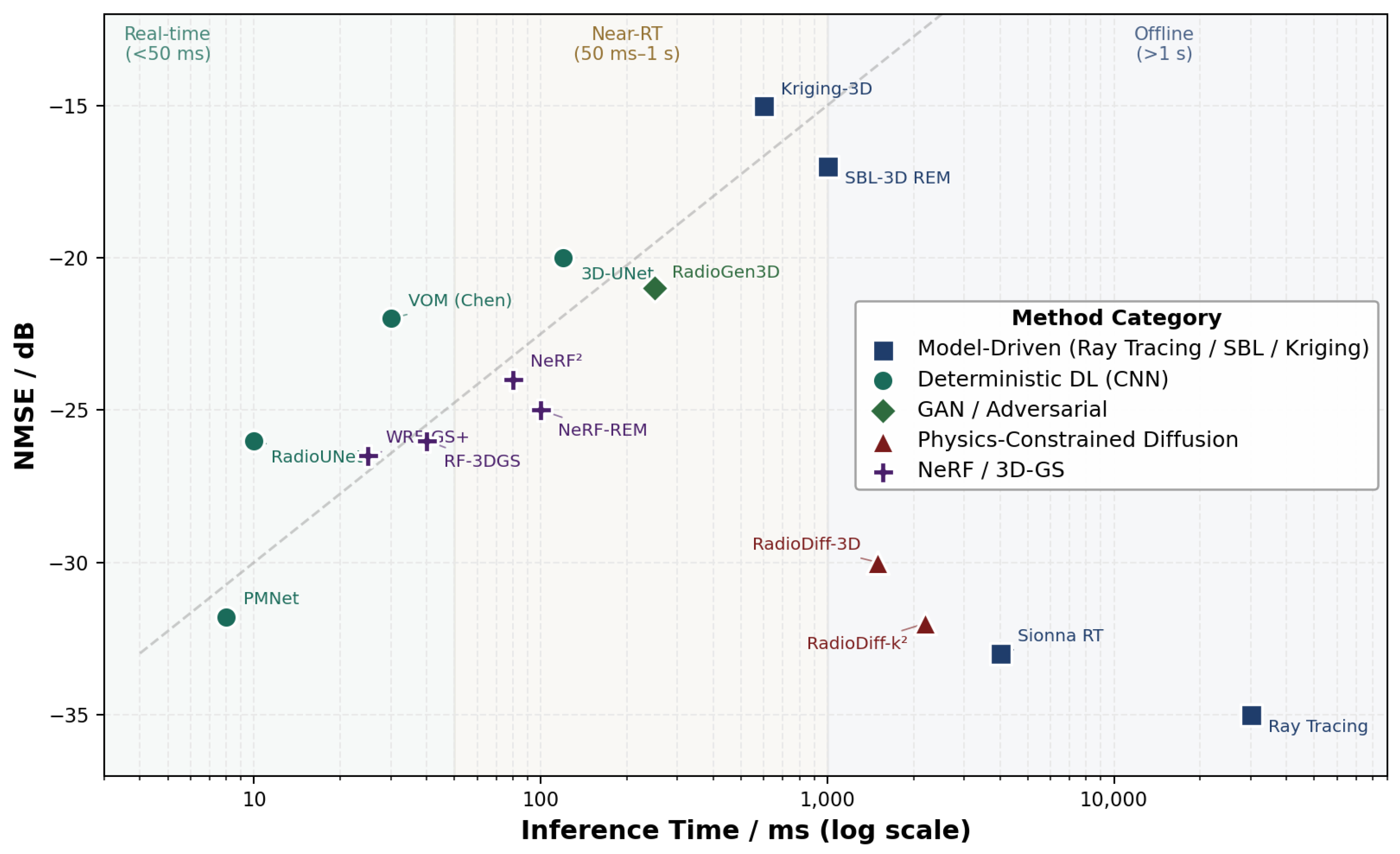
Each data point in Figure 4 is extracted from the best-reported result in the original publication under its respective experimental conditions: RadioUNet [28] and RadioDiff-k2 [52] were evaluated on the RadioMapSeer benchmark (56,000 ray-traced maps, 256 × 256 m2 urban area, 5.9 GHz; Quadro GV100 and RTX Pro 6000, respectively); PMNet [50] on real-world ray-traced datasets of three US cities (sub-6 GHz; RTX 3080 Ti, ∼8 ms, NMSE 31.8 dB); RadioDiff-3D [46] on the UrbanRadio3D three-dimensional dataset (5.9 GHz; DDIM 20-step inference at ≈2.4 s on NVIDIA 4090); WRF-GS+ [55] on an indoor NeRF2 laboratory dataset (RTX 3090, ∼25 ms); and model-driven baselines (ray tracing, SBL, Kriging) on simulated urban and measurement-derived campus environments [44,45,48]. Because heterogeneous datasets, frequency bands, spatial resolutions, and hardware platforms are involved, absolute NMSE values are not directly comparable across methods; the figure is intended to illustrate broad accuracy–latency trends across method categories rather than serve as a controlled pairwise benchmark.
This cross-category analysis reveals a systematic stratification. Model-driven methods (ray tracing, SBL, Kriging) are confined to the offline regime (>600 ms) by physics-intensive iterative computation—full electromagnetic ray casting, O ( N 3 ) matrix inversion in Kriging, and outer-loop optimization in SBL. Deterministic CNN methods (RadioUNet, PMNet) achieve the best engineering tradeoff at ∼8–30 ms and NMSE 26 to 32 dB, because a single feedforward pass replaces iterative solvers; their accuracy, however, is bounded by the purely discriminative training objective. Physics-constrained diffusion models (RadioDiff-3D/k2) achieve the highest reported accuracy (NMSE 30 to 32 dB) at 1500–2200 ms: T step iterative denoising passes incorporate Helmholtz-derived physical constraints into the generative prior, breaking the CNN accuracy ceiling without raising computation by an additional order of magnitude relative to classical model-driven approaches. WRF-GS+ bridges generative quality and real-time speed at ∼25 ms via a differentiable 3D Gaussian scene representation trained once offline. Critically, the region below 50 ms and NMSE < 20 dB remains unoccupied—no existing method simultaneously satisfies 6G real-time reconstruction constraints (Open Problem 1, Section 6).
Table 4 summarizes current 3D ESM datasets. A critical gap is that all existing 3D datasets are single-band and lack the time dimension. A benchmark combining multi-band and time-varying 3D coverage does not yet exist [11,16].
Beyond algorithm-level tradeoffs, translating ESM methods from simulation to real-world deployment introduces hardware-level challenges that the existing literature inadequately addresses. First, hardware synchronization: Distributed heterogeneous sensors (terrestrial base stations, UAVs, and LEO satellites) require sub-microsecond timestamp alignment; IEEE 1588 Precision Time Protocol (PTP) is standard in wireline infrastructure, but GPS-disciplined oscillator drift and frequency offset in mobile platforms introduce timing errors that propagate into the ESM as apparent spatial discontinuities. Second, sensing calibration: Receiver noise floors, antenna gain patterns, and frequency responses vary across sensor types, age, and temperature, causing systematic power biases that violate the homogeneous noise assumption in (1); calibration against known reference transmitters is rarely described in the surveyed datasets. Third, measurement inconsistency: Heterogeneous front-ends, scan resolutions, and co-channel interference produce non-identically distributed measurements whose naive aggregation degrades reconstruction quality in ways not captured by the NMSE metric alone. Establishing standardized hardware-in-the-loop testbeds and calibration procedures is a prerequisite for reliable real-world ESM deployment.

4. Dynamic Time-Varying ESM Modelling and Prediction

Dynamic time-varying ESM has received only limited systematic treatment in existing Radio Map surveys: while Chen et al. [23] address temporal spectrum prediction in a 2D setting, a dedicated account of 3D time-varying ESM construction and prediction has yet to be provided. Static-transmitter assumptions were acceptable before 5G, but the large-scale deployment of fast-moving radiation sources (vehicles, UAVs, LEO satellites) has made this a fundamental practical bottleneck.

4.1. Time Variability Sources and Online Update Methods

Time-variability sources span vastly different rates requiring different strategies (Table 5): slow variations (building construction, seasonal changes, weeks/months) handled by periodic offline reconstruction, medium variations (base station on/off, minutes/hours) by triggered online update, and fast variations (mobile sources; seconds/sub-second) requiring real-time prediction [23,24,37].
The updating of time-varying ESM faces two major challenges: efficiency in handling large-scale spectrum maps and the timeliness of updates. Recently, generative AI (GenAI) techniques have demonstrated significant potential in facilitating various information maintenance tasks, and thus can be leveraged for spectrum map reconstruction. Meanwhile, emerging evaluation metrics, such as the age of generative information [69], can be employed to quantify the freshness of the spectrum map updating strategy. Formally, the τ -step-ahead temporal prediction task is defined as:
Γ ^ t + τ = P Γ t , Γ t 1 , , Γ t K + 1 ; I prior ,
where τ 1 is the prediction horizon, K is the historical context window length, and P ( · ) is the prediction operator. Different strategies are applied for the three variability regimes in Table 5. For online updates, Kalman filter frameworks naturally support recursive Kriging map updates [70]:
γ ^ t | t = γ ^ t | t 1 + G t y t H γ ^ t | t 1 ,
where γ ^ t | t 1 is the prior map estimate, G t is the Kalman gain, and H is the linear measurement matrix. Li et al. [64] proposed Supreme using crowdsourced spatiotemporal modelling for cross-region transfer. Wang et al. [38] proposed a spatiotemporal graph attention network with dual graph structure for dynamic spectrum cartography. The iterative denoising nature of diffusion models causes second-level inference latency. Wang et al. [71] proposed RadioDiff-Flux, which precomputes and reuses static intermediate latent points shared across semantically similar scenes, reducing inference to real-time acceptable ranges—among the earliest works achieving real-time dynamic ESM inference. Diffusion- and Transformer-based spatiotemporal prediction frameworks [37,68] and multimodal SEM prediction combining historical sequences, environment images, and radiation source locations [25] further advance multi-step forecasting accuracy. For joint spatial–temporal–spectral modelling, Wang et al. [72] represented the spectrum map as a fourth-order tensor and proposed a two-stage framework combining a Transformer with forget-sparse interpolation attention and an ADMM-RLS online algorithm, achieving robust prediction under incomplete and corrupted measurements. Pan et al. [73] proposed ViTransLSTM, which integrates shifted-window visual self-attention into the LSTM gate structure to simultaneously capture local and global spatiotemporal dependencies, validated on real-world spectrum datasets. Uncertainty quantification is increasingly recognized as essential for reliable dynamic ESM. Gu et al. [74] formulated spectrum cartography as a conditional generation problem driven by a diffusion prior, deriving tractable closed-form posterior transition kernels to jointly address reconstruction and uncertainty-aware active sensing. Zeng et al. [75] introduced GeoUQ-GFNet, which jointly produces dense gain maps and spatial uncertainty estimates from sparse measurements with geometry-aware priors, demonstrating that uncertainty-guided measurement selection outperforms non-adaptive sampling under equal measurement budgets.

4.2. Mobile Radiation Source-Driven Prediction and Wide-Area Sensing

Zhao et al. [24] proposed a systematic optical flow-based SEM temporal prediction framework, using globally constrained optical flow to capture radiation source motion from historical sequences. Multi-band joint temporal prediction remains the most challenging open direction [23,36], with core challenges including unknown/dynamic radiation source counts [76], power discontinuities from building shadowing [42,58], and absence of systematic multi-band joint temporal modelling [16,36].
For wide-area sensing, Huang et al. [5] proposed LEO satellite-based global ESM using GANs for spatial correlation modelling and reinforcement learning for narrow-beam uplink monitoring. UAV-based active surveying [40,77,78,79] maintains uncertainty maps and plans trajectories to maximize information gain:
x t + 1 * = arg max x X cand σ t 2 x , f , t + 1 ,
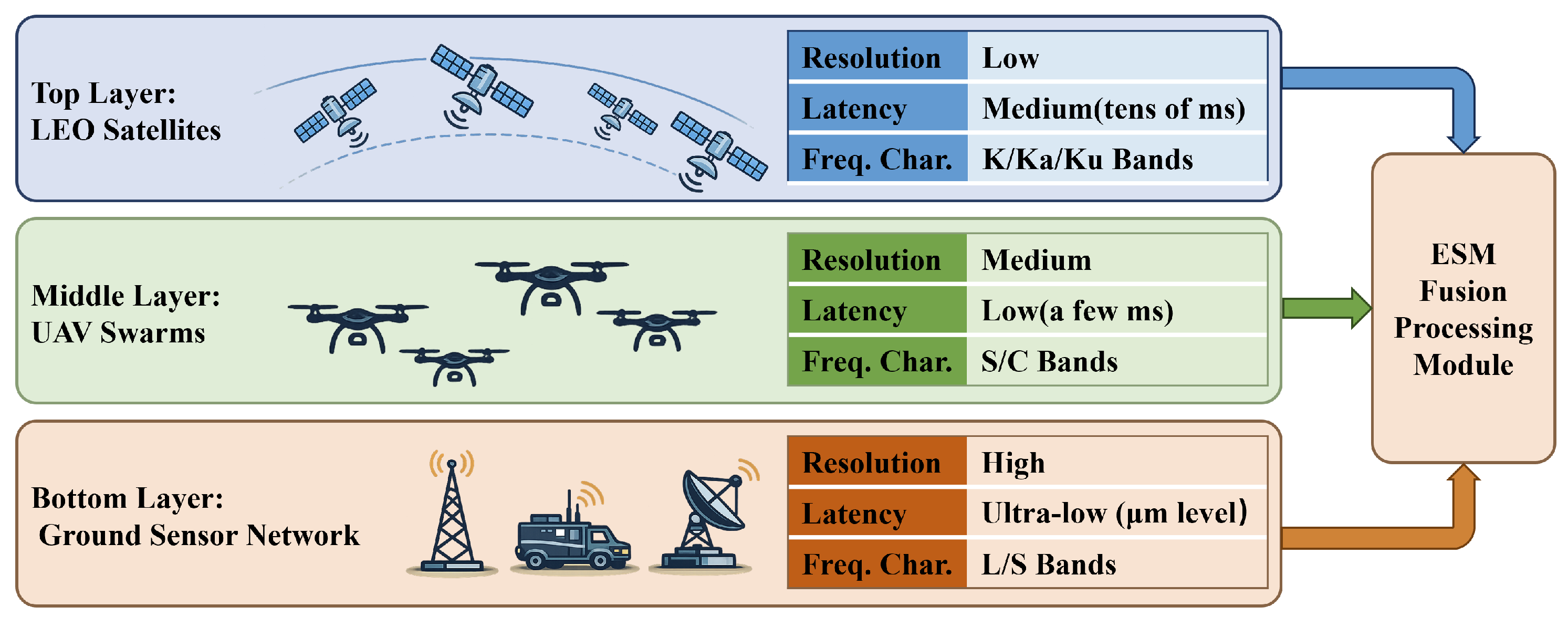
where σ t 2 ( x , f , t + 1 ) is the posterior predictive variance of Γ ( x , f , t + 1 ) , conditioned on all measurements up to time t, with multi-UAV cooperative approaches [76,80] enabling large-scale distributed sensing. Jiang et al. [81] proposed a three-tier (edge–aggregation–cloud) co-design framework for efficient distributed ESM updates, as illustrated in Figure 5. The heterogeneous sensing system faces serious bottlenecks in data fusion: inconsistency across platforms in spatial resolution (km level for satellites to m level for ground sensors), latency, frequency bands, and coverage range; optimal fusion weight design and distributed inference mechanisms remain theoretically underexplored [44,81]. Dynamic ESM also requires a dedicated evaluation framework beyond static RMSE, incorporating prediction-step/accuracy tradeoff curves, trajectory tracking accuracy, and end-to-end map update latency [82,83].

5. ESM–6G System Integration Framework

5.1. ESM-Driven Dynamic Spectrum Management and ISAC

Time-varying ESM enables “predictive spectrum management”: advance situational estimates from historical sequences support proactive interference avoidance, upgrading cognitive radio from reactive to anticipatory [13,14,66]. Representative works include REM-guided RIS-assisted cognitive ISAC [84], joint beamforming and spectrum sensing with REM prior [85], and RIS–movable-antenna ESM-driven resource optimization for low-altitude ISAC [86]. In low-altitude airspace management, where ground base stations must simultaneously serve authorized UAVs and localize non-cooperative intruders for collision avoidance, Zheng et al. [87] proposed an optimal-transport-based joint cell-association and power-allocation framework (J2OT) that directly handles discrete variables without relaxation, achieving a 1.5 bits/s/Hz improvement in system objective and a 7.5% reduction in localization Cramér–Rao bound over baselines; ESM-provided spatial interference priors are an enabling prerequisite for such dual-function resource allocation over distributed ground-station networks. In mmWave/THz bands, ESM-based beam management reduces training overhead [35]: probabilistic radio map representations support robust beam prediction under positioning uncertainty [88], while CKM-based position priors enable environment-aware hybrid beamforming [89]. ESM can also enhance the radio frequency identification accuracy by providing statistical knowledge and the time-varying nature of spectrum usage [90]. More broadly, electromagnetic signal waveform recognition (ESWR) is a key downstream beneficiary of ESM: Zhao et al. [91] proposed FUTUREs, a meta-transfer learning framework that transfers feature-extraction utility from seen to unseen signal modulations, achieving accurate recognition of 6G candidate waveforms, including OTFS and OFDM with limited labelled samples. A systematic AI-component survey of the ESWR field [92] further reveals that the deep-learning paradigms central to ESM construction—convolutional encoders, physics-informed networks, and diffusion models—also underpin state-of-the-art automatic modulation recognition, motivating a unified signal intelligence platform for 6G. Hardware-oriented assessments confirm that sharing a single phased-array platform across sensing and communication functions imposes tight and often divergent antenna-performance requirements, including control over beam shape, scanning resolution, and sidelobe tolerance [93,94]. As a concrete system-level illustration of the ESM-ISAC closed loop, the RIS-assisted cognitive ISAC framework [84] shows that a precomputed ESM suppresses candidate beams in predicted interference-null regions, reducing beam-sweeping overhead. The operational cycle proceeds as follows: (1) ESM predicts the interference field at horizon t + τ via (8); (2) the ISAC beamformer maximizes worst-case SINR using the predicted map as a soft constraint; (3) sensing echoes update the ESM through the Kalman correction in (9). Completing this closed loop within 50 ms remains the central engineering challenge (Open Problem 1, Section 6). In distributed cell-free ISAC architectures, where multiple geographically separated access points (APs) must be jointly coordinated, Guo et al. [95] proposed a cooperative beamforming framework that maximizes sensing signal-to-clutter-plus-noise ratio (SCNR) under communication SINR constraints via semidefinite relaxation, demonstrating superior performance over single-objective methods. The geographic diversity of APs amplifies the value of a shared ESM, since each AP observes a complementary spatial segment of the interference landscape and global ESM integration reduces the coordination overhead that otherwise limits distributed ISAC performance. Symbiotic radio (SR) [96] represents another emerging paradigm for 6G intelligent spectrum management: a backscatter device (BD) parasitically modulates onto the primary transmitter’s (PTx) radio-frequency signals, while the PTx is jointly designed to assist both primary and BD transmissions, realizing a mutualism spectrum-sharing relationship. Accurate ESMs play a dual enabling role in SR systems: they provide the BD with spatially resolved spectral opportunity maps to identify favourable PTx transmission periods, and supply the PTx with interference-geography priors for joint precoding that simultaneously serves primary communication and backscatter relay objectives. As SR is increasingly considered for 6G networks where ambient energy harvesting and ultra-low-power IoT connectivity are design priorities, the tight coupling between ESM update latency and SR coordination constitutes an open co-design challenge.

5.2. ESM and CKM Cooperative Construction

ESM and CKM form the core dual pillar of 6G environment-awareness infrastructure [6,10]: ESM provides regional-level multi-dimensional spectrum situational descriptions while CKM provides location-indexed wideband channel priors. Romero and Kim [97] derived the minimum sampling density theorem when using CKM priors for ESM construction, theoretically quantifying the value of CKM side information. Table 6 compares methodological parallels across the two domains.
At the generative AI level, CKMDiff [100] applies conditional diffusion to CKM construction. BeamCKMDiff [101] injects beamforming vectors into a Diffusion Transformer, enabling fine lobe reconstruction beyond discrete codebooks. A CKM-enabled NLoS ISAC scheme [105] converts channel angle-delay maps into sensing channel priors, simultaneously serving communication and target localization. The key unresolved framework is unified ESM-CKM construction theory, i.e., shared sparse sampling strategies and joint update mechanisms serving both communication and sensing needs [97]. Quantitatively, Romero and Kim [97] showed that incorporating CKM side information reduces the minimum required ESM measurement density by 30–50% in dense urban deployments where location-indexed path-loss priors from prior drive-test campaigns are available, directly motivating joint ESM-CKM sensing platform design.

5.3. ESM Integration with Digital Twin Networks and Dataset Status

DTN is the core enabling architecture for 6G network intelligence, and ESM is the core data source for the spatial spectrum layer of the Digital Twin Channel (DTC) [106,107,108]. Wang et al. [109] proposed the Radio Environment Knowledge (REK) framework, encoding propagation mechanism contributions as physical priors and enabling a lightweight CNN to achieve NMSE 28 dB at 3 ms inference latency—within the update budget for a 5 Hz DTN refresh cycle. The key ESM-DTN design tension is between update granularity (finer updates improve accuracy but increase uplink overhead) and model coherence time (coarser updates reduce overhead but allow larger state drift under rapid topology changes). ESM-DTN closed-loop updating faces three core challenges: the tradeoff between update frequency and computational overhead, simulation-to-measurement domain gap [47,110], and unified access for heterogeneous sensor data [111,112].
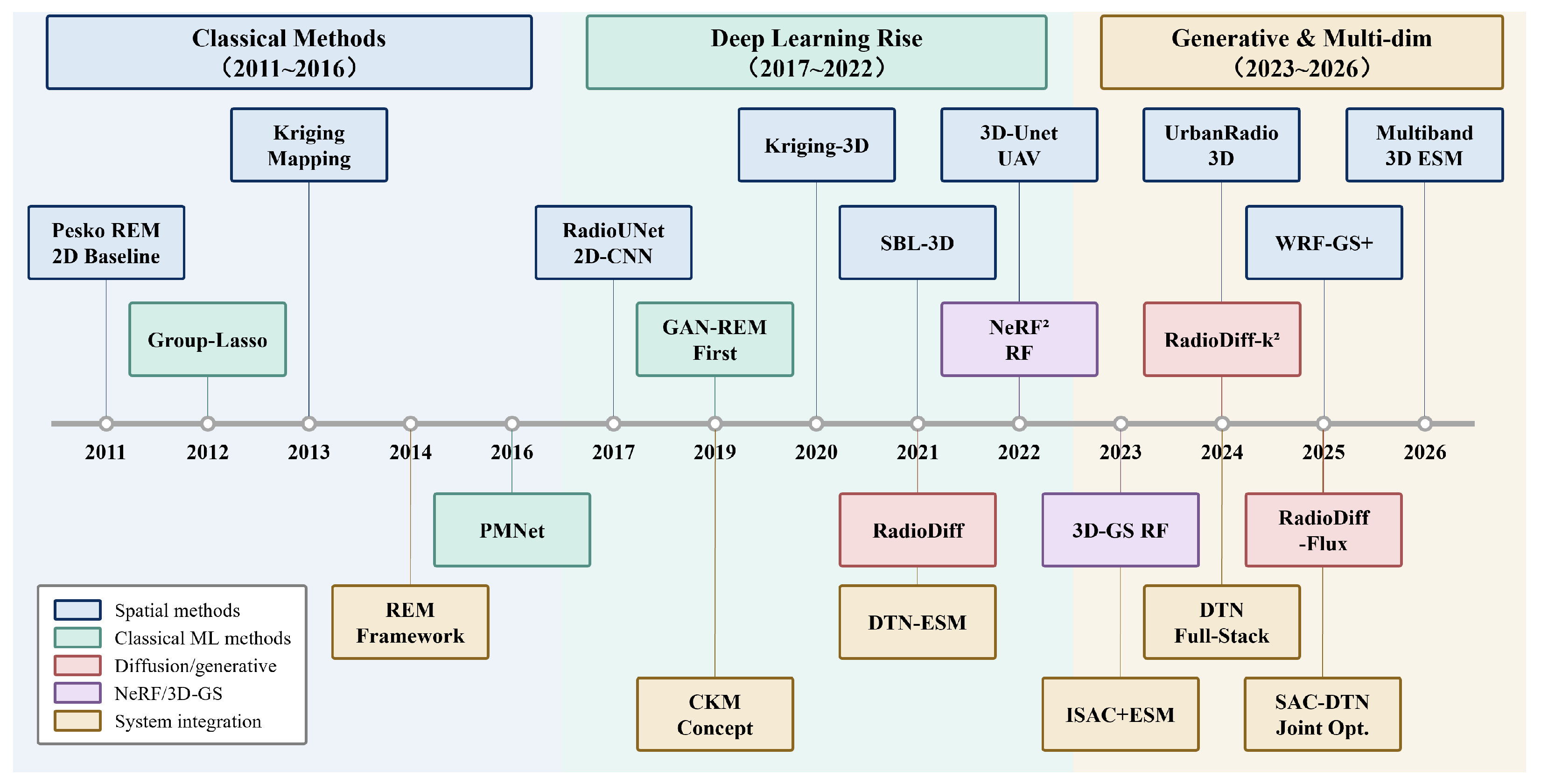
Table 7 summarizes ESM competition benchmarks and open evaluation environments; for construction research datasets, refer to Table 4 (Section 3). Beyond the structural dimension gaps, three additional quality dimensions limit ESM benchmark utility. (i) Dataset quality and simulation-to-reality gap: The overwhelming majority of datasets are ray-traced under idealized propagation conditions—smooth terrain, simplified building geometry, and no vehicular blockage dynamics—creating a domain shift that degrades trained models when transferred to real field measurements; DeepSense 6G remains among the most comprehensive publicly available multi-modal real-measurement datasets but is confined to 2D spatial coverage. (ii) Benchmark standardization: The ICASSP 2023 and 2025 competitions [82,83] adopt different sampling densities, path-loss models, and evaluation splits, making cross-paper NMSE comparisons unreliable; cross-band and time-varying scenarios remain largely absent from existing competition benchmarks. (iii) Reproducibility: A majority of reviewed works release neither code nor complete hyperparameter details, a critical gap for physics-constrained generative models where the diffusion schedule and constraint-weighting dominantly determine accuracy. A community-coordinated open dataset covering multi-band (sub-6G/mmWave/THz), time-varying, 3D, and large-scale urban scenarios, paired with a standardized evaluation harness, is the most urgent infrastructure investment for the ESM field. The evolution of key methods from 2011 to 2026 is summarized in Figure 6.
Table 7. ESM competition benchmarks and evaluation environments (for spatial construction research datasets, see Table 4).
Competition/DatasetYearDim.Freq. BandTask/FocusAccess
AI4MOBILE (iV2I+)20232D3.7 GHzVehicle-to-infrastructure received power mapPublic
ICASSP 2023 Challenge [82]20232DSinglePath-loss map prediction, 1–10% sampling densityCompetition
ICASSP 2025 Indoor [83]20252D (indoor)SingleIndoor RSS map predictionCompetition
ESM multi-dim. benchmark3D + freq. + timeMulti-bandMulti-dimensional ESM evaluation (needed)Does not yet exist

6. Challenges and Open Problems

6.1. Core Conclusions

Along the three dimensions: Spatially, 3D ESM methods (deep learning, diffusion, NeRF/GS) have taken initial shape and UrbanRadio3D fills the dataset gap, but methods remain single-band. Indoor 3D ESM has received very limited attention, and theoretical reconstruction bounds are unestablished. Temporally, this remains the most underexplored dimension—optical flow-driven SEM prediction [24] and real-time diffusion inference [71] are among the earliest dedicated works for dynamic ESM. Multi-band joint temporal prediction and dedicated evaluation systems remain insufficiently addressed. In system integration, ESM-CKM [97], ESM-DTN, and ESM-ISAC [85] are all in early stages with no system-level joint optimization framework. Radio Map is a degenerate special case of ESM; yet, 6G requires complete four-dimensional ESM, while current technological accumulation is far from ready.

6.2. Five Core Open Problems

The following five open problems were selected because each represents a bottleneck where the literature consistently acknowledges an unresolved gap: together they span all three axes of this survey—spatial construction, temporal dynamics, and 6G system integration—and their interdependencies are evidenced by the comparative analysis in Table 1.
Open Problem 1: Reliable Extremely Sparse 4D Reconstruction. Diffusion models achieve high-quality 2D reconstruction below 1% sampling [99,113], but “hallucination”—visually plausible but physically unrealistic maps—has unacceptable consequences in spectrum management. Bayesian uncertainty quantification [114], hard physical constraint injection [52], and active sampling [77,115] are candidate paths, yet no unified theoretical framework exists [97]. The key technical question is: At what minimum sampling density can reconstruction reliability be guaranteed across all four ESM dimensions? A suitable evaluation metric is worst-case NMSE over randomized (rather than fixed) sampling masks, paired with the calibration error of uncertainty estimates. Conformal prediction, deep-unfolding architectures with hard physical-constraint layers, and information-theoretic active sensing are the most applicable methodological tools.
Open Problem 2: Joint Modelling of Multi-Band Heterogeneous Propagation. Sub-6G, mmWave, and THz exhibit highly heterogeneous propagation within the same ESM framework [3,35,116]. Whether a unified cross-band physical constraint suffices, or whether per-band modelling followed by merging is unavoidable, remains theoretically unresolved [11,23]. The concrete technical question is: Does a shared latent propagation basis exist across sub-6G/mmWave/THz that permits unified tensor completion, or is per-band modelling with learned cross-band coupling the more tractable formulation? Progress should be measured by cross-band transfer gain when a new frequency band is added with zero additional measurements. Multi-task neural operators and physics-informed frequency-domain factorization are the primary candidate methodologies.
Open Problem 3: Establishing ESM-Dedicated Benchmark Datasets. Existing datasets predominantly operate in single-band, static, 2D settings—the principal infrastructure bottleneck [16,46]. A community-defined benchmark covering multi-band (sub-6G/mmWave/THz), time-varying dynamics, 3D space, mixed real/simulated data, diverse scenarios (urban/suburban/indoor/low-altitude), and standardized evaluation metrics remains absent [82,117]. The operational question is: What is the minimum scenario diversity and sampling protocol that enables statistically reliable cross-method comparison? Evaluation should specify fixed stratified sampling masks per scenario class, a held-out test split inaccessible during training, and NMSE leaderboards stratified by sampling density and frequency band. Community coordination modelled on the ImageNet challenge or 3GPP channel-measurement campaigns is the appropriate organizational framework.
Open Problem 4: Cooperative Fusion Theory for Space–Air–Ground Heterogeneous Sensing. Satellite, UAV, and ground sensors differ substantially in resolution, latency, frequency, and coverage, making unified fusion theoretically non-trivial [5,44,81]. Deriving optimal fusion weights, designing cooperative sampling strategies, and adapting federated learning [118,119] to ESM’s statistical structure are the key challenges for global-scale ESM. The core theoretical question is: What is the Cramér–Rao lower bound for heterogeneous-sensor ESM estimation as a function of sensor placement, resolution heterogeneity, and inter-sensor correlation? Fusion gain over the best single-modality baseline under equal measurement cost is the natural evaluation metric. Distributed Bayesian estimation with heterogeneous likelihood models and graph neural network-based cooperative sensor scheduling are the most mature methodological tools.
Open Problem 5: System-Level Optimization of the ESM-DTN-ISAC End-to-End Closed Loop. Each module in the pipeline—spectrum sensing, beamforming, interference coordination, and DTN updating—is independently optimized, producing local optima that fail to aggregate globally [79,81]. A unified multi-objective framework balancing ESM accuracy, ISAC performance, spectrum management quality, and update overhead is needed. Semantic communication [120] offers a promising direction, with task-oriented coding potentially reducing ESM sharing overhead by 95% while preserving downstream management quality. The fundamental question is: What is the Pareto frontier between ESM reconstruction accuracy and ISAC beamforming SINR under a joint update–latency constraint, and how does it scale with network density? A tandem metric combining NMSE, beamforming SINR, and spectrum efficiency under a fixed uplink-overhead budget would operationalize progress. Multi-objective Lyapunov network optimization and task-oriented semantic communication are the most applicable methodological frameworks.

7. Conclusions

This paper surveyed ESM across three core dimensions under a unified 4D ESM framework (space × frequency × time × power), revealing the fundamental limitations of existing Radio Map surveys. The key findings of this paper are as follows. Deep learning and generative methods have surpassed ray tracing for online 3D ESM, with UrbanRadio3D as a key dataset milestone. Temporal prediction driven by mobile radiation sources remains largely underexplored, with RadioDiff-Flux achieving a real-time diffusion inference breakthrough. ESM integration with CKM, DTN, and ISAC is converging but lacks a unified framework. The five open problems provide a concrete research agenda for advancing ESM from theoretical concept to 6G-enabled core technologies.

Author Contributions

Writing—original draft preparation, C.Y., M.G. and Q.G.; writing—review and editing, W.C. and Q.D.; investigation D.Z., L.Z. and Z.X.; funding acquisition A.C. and J.Y.; supervision W.L. and L.L. All authors have read and agreed to the published version of the manuscript.

Funding

This work was supported in part by National Natural Science Foundation of China under Grants 62571450 and 62101450, in part by Key Research and Development Program of Shaanxi under Grants 2025CY-YBXM-043 and 2025CG-GJHX-15, in part by Shanghai Academy of Spaceflight Technology under Grant SAST2025-037, in part by the Open Fund of Intelligent Control Laboratory, in part by the Fundamental Research Funds of Shaanxi Key Laboratory of Meta-Synthesis for Electronic and Information System under Grant SX-EILAB-202604, in part by the Open Fund of Key Laboratory of Radio Spectrum Testing Technology (The State Radio_monitoring_center Testing Center), Ministry of Industry and Information Technology.

Data Availability Statement

No new data were created or analyzed in this study. This article is a survey; all numerical results illustrated (including the accuracy–latency landscape in Figure 4) are extracted from the cited original publications under their respective experimental conditions. The publicly available ESM and radio map datasets reviewed in this article are listed in Table 4 and Table 7, with access links provided therein.

Conflicts of Interest

Lechi Zhang was employed by Xi’an Hengxiang Control Technology Co., Ltd. Wensheng Lin and Lixin Li were employed by DecoreX Intelligent Technologies Co., Ltd. The remaining authors declare that the research was conducted in the absence of any commercial or financial relationships that could be construed as a potential conflict of interest.

References

  1. Liu, F.; Masouros, C.; Petropulu, A.P.; Griffiths, H.; Hanzo, L. Joint Radar and Communication Design: Applications, State-of-the-Art, and the Road Ahead. IEEE Trans. Commun. 2020, 68, 3834–3862. [Google Scholar] [CrossRef]
  2. Wei, Z.; Liu, F.; Masouros, C.; Su, N.; Petropulu, A.P. Toward Multi-Functional 6G Wireless Networks: Integrating Sensing, Communication, and Security. IEEE Commun. Mag. 2022, 60, 65–71. [Google Scholar] [CrossRef]
  3. Rappaport, T.S.; Sun, S.; Mayzus, R.; Zhao, H.; Azar, Y.; Wang, K.; Wong, G.N.; Schulz, J.K.; Samimi, M.; Gutierrez, F. Millimeter Wave Mobile Communications for 5G Cellular: It Will Work! IEEE Access 2013, 1, 335–349. [Google Scholar] [CrossRef]
  4. Pi, Z.; Khan, F. An introduction to millimeter-wave mobile broadband systems. IEEE Commun. Mag. 2011, 49, 101–107. [Google Scholar] [CrossRef]
  5. Huang, Y.; Cui, H.; Hou, Y.; Hao, C.; Wang, W.; Zhu, Q.; Li, J.; Wu, Q.; Wang, J. Space-Based Electromagnetic Spectrum Sensing and Situation Awareness. Space Sci. Technol. 2024, 4, 0109. [Google Scholar] [CrossRef]
  6. Zeng, Y.; Xu, X.; Jin, S.; Zhang, R. Simultaneous Navigation and Radio Mapping for Cellular-Connected UAV with Deep Reinforcement Learning. IEEE Trans. Wirel. Commun. 2021, 20, 4205–4220. [Google Scholar] [CrossRef]
  7. Zhang, S.; Zhang, R. Radio Map-Based 3D Path Planning for Cellular-Connected UAV. IEEE Trans. Wirel. Commun. 2021, 20, 1975–1989. [Google Scholar] [CrossRef]
  8. Wang, J.; Cheng, W.; Zhang, W. Performance Boundary Analyses for Statistical Multi-QoS Framework Over 6G SAGINs. IEEE Trans. Wirel. Commun. 2025, 24, 4329–4343. [Google Scholar] [CrossRef]
  9. Zhang, J.A.; Rahman, M.L.; Wu, K.; Huang, X.; Guo, Y.J.; Chen, S.; Yuan, J. Enabling Joint Communication and Radar Sensing in Mobile Networks—A Survey. IEEE Commun. Surv. Tutor. 2022, 24, 306–345. [Google Scholar] [CrossRef]
  10. Zeng, Y.; Chen, J.; Xu, J.; Wu, D.; Xu, X.; Jin, S.; Gao, X.; Gesbert, D.; Cui, S.; Zhang, R. A Tutorial on Environment-Aware Communications via Channel Knowledge Map for 6G. IEEE Commun. Surv. Tutor. 2024, 26, 1478–1519. [Google Scholar] [CrossRef]
  11. Yiannis, K.; Theodor, P. Electromagnetic Field Distribution Mapping: A Taxonomy and Comprehensive Review of Computational and Machine Learning Methods. Computers 2025, 14, 373. [Google Scholar] [CrossRef]
  12. Jaradat, A.M.; Alayedi, M.; Arslan, H. A Survey of Radio Resource Scheduling for 6G and Future Wireless Networks. IEEE Open J. Commun. Soc. 2025, 6, 10191–10218. [Google Scholar] [CrossRef]
  13. Ding, G.; Jiao, Y.; Wang, J.; Zou, Y.; Wu, Q.; Yao, Y.D.; Hanzo, L. Spectrum Inference in Cognitive Radio Networks: Algorithms and Applications. IEEE Commun. Surv. Tutor. 2018, 20, 150–182. [Google Scholar] [CrossRef]
  14. Zhao, Q.; Sadler, B.M. A Survey of Dynamic Spectrum Access. IEEE Signal Process. Mag. 2007, 24, 79–89. [Google Scholar] [CrossRef]
  15. Cheng, W.; Jing, H.; Zhang, W.; Zhang, K.; Zhang, H. Quasi-Fractal UCA-Based OAM for Highly Efficient Orthogonal Transmission. IEEE Trans. Wirel. Commun. 2024, 23, 16513–16526. [Google Scholar] [CrossRef]
  16. Hou, G.; Chen, Z.; Chen, R. Spectrum Situational Awareness Model Based on Wave Propagation Loss Characteristics and Distributed Electromagnetic Spectrum Detection Method. In Proceedings of the 2024 Photonics & Electromagnetics Research Symposium (PIERS); IEEE: Piscataway, NJ, USA, 2024; pp. 1–6. [Google Scholar] [CrossRef]
  17. Liu, X.; Li, X.; Zheng, K.; Liu, J. AoI minimization of ambient backscatter-assisted EH-CRN with cooperative spectrum sensing. Comput. Netw. 2024, 245, 110389. [Google Scholar] [CrossRef]
  18. Li, M.; Li, L.; Lin, W.; Han, Z.; Başar, T. Beyond Gaussian Assumptions: A General Fractional HJB Control Framework for Lévy-Driven Heavy-Tailed Channels in 6G. IEEE Trans. Wirel. Commun. 2026, 25, 7535–7550. [Google Scholar] [CrossRef]
  19. Pesko, M.; Javornik, T.; Košir, A.; Štular, M.; Mohorčič, M. Radio Environment Maps: The Survey of Construction Methods. KSII Trans. Internet Inf. Syst. 2014, 8, 3789–3809. [Google Scholar] [CrossRef]
  20. Romero, D.; Kim, S.J. Radio Map Estimation: A data-driven approach to spectrum cartography. IEEE Signal Process. Mag. 2022, 39, 53–72. [Google Scholar] [CrossRef]
  21. Reddy, Y.S.; Kumar, A.; Pandey, O.J.; Cenkeramaddi, L.R. Spectrum cartography techniques, challenges, opportunities, and applications: A survey. Pervasive Mob. Comput. 2022, 79, 101511. [Google Scholar] [CrossRef]
  22. Feng, B.; Zheng, M.; Liang, W.; Zhang, L. A Recent Survey on Radio Map Estimation Methods for Wireless Networks. Electronics 2025, 14, 1564. [Google Scholar] [CrossRef]
  23. Chen, X.; Wang, J.; Huang, Q. Dynamic Spectrum Cartography: Reconstructing Spatial-Spectral-Temporal Radio Frequency Map via Tensor Completion. IEEE Trans. Signal Process. 2025, 73, 1184–1199. [Google Scholar] [CrossRef]
  24. Zhao, Y.; Zhu, Q.; Lin, Z.; Guo, L.; Wu, Q.; Wang, J.; Zhong, W. Temporal prediction for spectrum environment maps with moving radiation sources. IET Commun. 2022, 17, 538–548. [Google Scholar] [CrossRef]
  25. He, S.; Zhu, L.; Yu, L.; Cheng, K.; Qin, Z. A Spectrum Map Prediction Approach Based on Spatial-Temporal Residual Network. In Proceedings of the 2024 5th Information Communication Technologies Conference (ICTC); IEEE: Piscataway, NJ, USA, 2024; pp. 227–233. [Google Scholar] [CrossRef]
  26. Yilmaz, H.B.; Tugcu, T.; Alagöz, F.; Bayhan, S. Radio environment map as enabler for practical cognitive radio networks. IEEE Commun. Mag. 2013, 51, 162–169. [Google Scholar] [CrossRef]
  27. Sato, K.; Fujii, T. Kriging-Based Interference Power Constraint for Spectrum Sharing Based on Radio Environment Map. In Proceedings of the 2015 IEEE Globecom Workshops (GC Wkshps); IEEE: Piscataway, NJ, USA, 2015; pp. 1–6. [Google Scholar] [CrossRef]
  28. Levie, R.; Yapar, Ç.; Kutyniok, G.; Caire, G. RadioUNet: Fast Radio Map Estimation with Convolutional Neural Networks. IEEE Trans. Wirel. Commun. 2021, 20, 4001–4015. [Google Scholar] [CrossRef]
  29. Bi, S.; Lyu, J.; Ding, Z.; Zhang, R. Engineering Radio Maps for Wireless Resource Management. IEEE Wirel. Commun. 2019, 26, 133–141. [Google Scholar] [CrossRef]
  30. Liu, X.; Sun, S.; Tao, M.; Kaushik, A.; Yan, H. Channel Knowledge Maps for 6G Wireless Networks: Construction, Applications, and Future Challenges. ZTE Commun. 2025, 23, 46–59. [Google Scholar] [CrossRef]
  31. Ren, Z.; Zhou, J.; Xu, J.; Qiu, L.; Zeng, Y.; Hu, H.; Zhang, J.; Zhang, R. Channel Knowledge Map Construction: Recent Advances and Open Challenges. IEEE Wirel. Commun. 2026, 1–7. [Google Scholar] [CrossRef]
  32. Daniel, R.; Ngoc, H.T.; Raju, S.; Massimo, F. Theoretical Analysis of the Radio Map Estimation Problem. IEEE Trans. Wirel. Commun. 2024, 23, 13722–13737. [Google Scholar] [CrossRef]
  33. Romero, D.; Lee, D.; Giannakis, G.B. Blind Radio Tomography. IEEE Trans. Signal Process. 2018, 66, 2055–2069. [Google Scholar] [CrossRef]
  34. Bazerque, J.A.; Giannakis, G.B. Distributed Spectrum Sensing for Cognitive Radio Networks by Exploiting Sparsity. IEEE Trans. Signal Process. 2010, 58, 1847–1862. [Google Scholar] [CrossRef]
  35. Xue, Q.; Ji, C.; Ma, S.; Guo, J.; Xu, Y.; Chen, Q.; Zhang, W. A Survey of Beam Management for mmWave and THz Communications Towards 6G. IEEE Commun. Surv. Tutor. 2024, 26, 1520–1559. [Google Scholar] [CrossRef]
  36. Sato, K.; Inage, K.; Fujii, T. Radio Environment Map Construction with Joint Space-Frequency Interpolation. In Proceedings of the 2020 International Conference on Artificial Intelligence in Information and Communication (ICAIIC); IEEE: Piscataway, NJ, USA, 2020; pp. 51–54. [Google Scholar] [CrossRef]
  37. Fu, M.; Zhang, T.; Song, W.; Yang, Y.; Wang, M. Trajectory Prediction-Based Local Spatio-Temporal Navigation Map for Autonomous Driving in Dynamic Highway Environments. IEEE Trans. Intell. Transp. Syst. 2022, 23, 6418–6429. [Google Scholar] [CrossRef]
  38. Li, W.; Fei, J.; Jiang, Y.; Guo, X.; Geng, X.; He, X. Dynamic spatio-temporal graph interaction attention network for traffic flow prediction. Future Gener. Comput. Syst. 2026, 175, 108116. [Google Scholar] [CrossRef]
  39. Ivanov, A.; Muhammad, B.; Tonchev, K.; Mihovska, A.; Poulkov, V. Challenges for Volumetric Measurements Toward Radio Environment Map Construction for UAV Communications. In Proceedings of the 2022 25th International Symposium on Wireless Personal Multimedia Communications (WPMC); IEEE: Piscataway, NJ, USA, 2022; pp. 250–255. [Google Scholar] [CrossRef]
  40. Chai, Y.; Wang, Y.; Yang, X.; Im, S.-K.; He, Q. UAVRM-A*: A Complex Network and 3D Radio Map-Based Algorithm for Optimizing Cellular-Connected UAV Path Planning. Sensors 2025, 25, 4052. [Google Scholar] [CrossRef]
  41. Fu, H.; Wang, J.; Jiao, Z.; Zhang, X.; Du, H.; Jiang, C. Securing Low-Altitude Intelligent Networks: Challenges and Solutions. IEEE Wirel. Commun. 2025, 33, 195–203. [Google Scholar] [CrossRef]
  42. Liu, W.; Chen, J. UAV-Aided Radio Map Construction Exploiting Environment Semantics. IEEE Trans. Wirel. Commun. 2023, 22, 6341–6355. [Google Scholar] [CrossRef]
  43. Shawel, B.S.; Woldegebreal, D.H.; Pollin, S. A Deep-Learning Approach to a Volumetric Radio Environment Map Construction for UAV-Assisted Networks. Int. J. Antennas Propag. 2024, 2024, 9062023. [Google Scholar] [CrossRef]
  44. Maeng, S.J.; Ozdemir, O.; Güvenç, İ.; Sichitiu, M.L. Kriging-Based 3-D Spectrum Awareness for Radio Dynamic Zones Using Aerial Spectrum Sensors. IEEE Sens. J. 2024, 24, 9044–9058. [Google Scholar] [CrossRef]
  45. Mattia, L.; Paolo, T.; Michele, P.; Marco, G.; Michele, Z. Accuracy Versus Complexity for mmWave Ray-Tracing: A Full Stack Perspective. IEEE Trans. Wirel. Commun. 2021, 20, 7826–7841. [Google Scholar] [CrossRef]
  46. Wang, X.; Zhang, Q.; Cheng, N.; Chen, J.; Zhang, Z.; Li, Z.; Cui, S.; Shen, X. RadioDiff-3D: A 3D× 3D Radio Map Dataset and Generative Diffusion Based Benchmark for 6G Environment-Aware Communication. IEEE Trans. Netw. Sci. Eng. 2026, 13, 3773–3789. [Google Scholar] [CrossRef]
  47. Jakob, H.; Ait, A.F.; Sebastian, C.; Merlin, N.D.; Nikolaus, B.; Guillermo, M.; Alexander, K. Sionna RT: Differentiable Ray Tracing for Radio Propagation Modeling. In Proceedings of the 2023 IEEE Globecom Workshops (GC Wkshps); IEEE: Piscataway, NJ, USA, 2023; pp. 317–321. [Google Scholar] [CrossRef]
  48. Wang, J.; Zhu, Q.; Lin, Z.; Chen, J.; Ding, G.; Wu, Q.; Gu, G.; Gao, Q. Sparse Bayesian Learning-Based Hierarchical Construction for 3D Radio Environment Maps Incorporating Channel Shadowing. IEEE Trans. Wirel. Commun. 2024, 23, 14560–14574. [Google Scholar] [CrossRef]
  49. Cao, Y.; Cheng, W.; Wang, J.; Zhang, W. Active Reconfigurable Intelligent Surface Assisted MIMO: Electromagnetic-Compliant Modeling with Mutual Coupling. IEEE Trans. Wirel. Commun. 2026, 25, 4419–4434. [Google Scholar] [CrossRef]
  50. Lee, J.H.; Molisch, A.F. A Scalable and Generalizable Pathloss Map Prediction. IEEE Trans. Wirel. Commun. 2024, 23, 17793–17806. [Google Scholar] [CrossRef]
  51. Lee, J.H.; Lee, J.; Lee, S.H.; Molisch, A.F. PMNet: Large-Scale Channel Prediction System for ICASSP 2023 First Pathloss Radio Map Prediction Challenge. In Proceedings of the ICASSP 2023—2023 IEEE International Conference on Acoustics, Speech and Signal Processing (ICASSP), Rhodes, Greece, 4–10 June 2023. [Google Scholar] [CrossRef]
  52. Wang, X.; Zhang, Q.; Cheng, N.; Sun, R.; Li, Z.; Cui, S.; Shen, X. RadioDiff-k2: Helmholtz Equation Informed Generative Diffusion Model for Multi-Path Aware Radio Map Construction. IEEE J. Sel. Areas Commun. 2026, 44, 2318–2333. [Google Scholar] [CrossRef]
  53. Zhao, X.; An, Z.; Pan, Q.; Yang, L. NeRF2: Neural Radio-Frequency Radiance Fields. In Proceedings of the 29th Annual International Conference on Mobile Computing and Networking; IEEE: Piscataway, NJ, USA, 2023; pp. 1–15. [Google Scholar] [CrossRef]
  54. Han, X.; Liu, H.; Ding, Y.; Yang, L. RO-MAP: Real-Time Multi-Object Mapping with Neural Radiance Fields. IEEE Robot. Autom. Lett. 2023, 8, 5950–5957. [Google Scholar] [CrossRef]
  55. Wen, C.; Tong, J.; Hu, Y.; Lin, Z.; Zhang, J. WRF-GS: Wireless Radiation Field Reconstruction with 3D Gaussian Splatting. In Proceedings of the IEEE INFOCOM 2025-IEEE Conference on Computer Communications; IEEE: Piscataway, NJ, USA, 2025; pp. 1–10. [Google Scholar] [CrossRef]
  56. Zhou, K.; Zhang, G.; Li, H.; Cai, Y.; Liu, S.; Yu, G. F4-CKM: Learning Channel Knowledge Map with Radio Frequency Radiance Field Rendering. IEEE Trans. Commun. 2026, 74, 5684–5700. [Google Scholar] [CrossRef]
  57. Zhang, L.; Sun, H.; Berweger, S.; Gentile, C.; Hu, R.Q. RF-3DGS: Wireless Channel Modeling with Radio Radiance Field and 3D Gaussian Splatting. IEEE Trans. Wirel. Commun. 2026, 25, 10419–10433. [Google Scholar] [CrossRef]
  58. Chen, W.; Chen, J. Diffraction and Scattering Aware Radio Map and Environment Reconstruction Using Geometry Model-Assisted Deep Learning. IEEE Trans. Wirel. Commun. 2024, 23, 19804–19819. [Google Scholar] [CrossRef]
  59. Wang, Y.; Huang, C.; Zhang, S.; Chen, G.; Guo, W.; Lan, S.; Xu, L.; Cheng, X.; Tang, X.; Cui, S. Towards Precise Channel Knowledge Map: Exploiting Environmental Information from 2D Visuals to 3D Point Clouds. arXiv 2025. [Google Scholar] [CrossRef]
  60. Wang, X.; Pan, Y.; Cheng, N.; Yapar, Ç.; Sun, R.; Yin, Z.; Zhou, C.; Xu, W.; Zhang, Y.; Zhang, J.; et al. A Tutorial on Learning-Based Radio Map Construction: Data, Paradigms, and Physics-Awareness. arXiv 2026. [Google Scholar] [CrossRef]
  61. Wu, D.; Wu, Z.; Qiu, Y.; Fu, S.; Zeng, Y. CKMImageNet: A Comprehensive Dataset to Enable Channel Knowledge Map Construction via Computer Vision. In Proceedings of the 2024 IEEE/CIC International Conference on Communications in China (ICCC Workshops); IEEE: Piscataway, NJ, USA, 2024; pp. 114–119. [Google Scholar] [CrossRef]
  62. Ahmed, A.; Gouranga, C.; Tawfik, O.; Andrew, H.; Joao, M.; Umut, D.; Nikhil, S. DeepSense 6G: A Large-Scale Real-World Multi-Modal Sensing and Communication Dataset. IEEE Commun. Mag. 2023, 61, 122–128. [Google Scholar] [CrossRef]
  63. Huang, C.; Chan, W.; Hung-Nguyen, M. Unsupervised radio map learning for indoor localization. In Proceedings of the 2017 IEEE International Conference on Consumer Electronics-Taiwan (ICCE-TW); IEEE: Piscataway, NJ, USA, 2017; pp. 79–80. [Google Scholar] [CrossRef]
  64. Li, K.; Li, C.; Yu, B.; Shen, Z.; Zhang, Q.; He, S.; Chen, J. Model and Transfer Spatial-Temporal Knowledge for Fine-Grained Radio Map Reconstruction. IEEE Trans. Cogn. Commun. Netw. 2022, 8, 828–841. [Google Scholar] [CrossRef]
  65. Hervis, S.Y.; David, P.; Martinez, A.R.; Guillen, N.G.; Luc, M.; Wout, J. Radio Environment Map of an LTE Deployment Based on Machine Learning Estimation of Signal Levels. In Proceedings of the 2022 IEEE International Symposium on Broadband Multimedia Systems and Broadcasting (BMSB); IEEE: Piscataway, NJ, USA, 2022; pp. 1–6. [Google Scholar] [CrossRef]
  66. Marko, H.; Aarne, M.; Alessandro, C.; Sofie, P.; Martti, F.; Danijela, C. Database-Assisted Spectrum Prediction in 5G Networks and Beyond: A Review and Future Challenges. IEEE Circuits Syst. Mag. 2019, 19, 34–45. [Google Scholar] [CrossRef]
  67. Ren, X.; Mosavat-Jahromi, H.; Cai, L.; Kidston, D. Spatio-Temporal Spectrum Load Prediction Using Convolutional Neural Network and ResNet. IEEE Trans. Cogn. Commun. Netw. 2022, 8, 502–513. [Google Scholar] [CrossRef]
  68. Zeng, M.; Wu, F.; Cheng, Y. Remaining Useful Life Prediction via Spatio-Temporal Channels and Transformer. IEEE Sens. J. 2023, 23, 29176–29185. [Google Scholar] [CrossRef]
  69. Xiao, Y.; Du, Q.; Cheng, W.; Karagiannidis, G.K.; Nallanathan, A.; Guizani, M.; Wang, J. Age of Generative Information (AoGI): An Inference-Aware Metric for Freshness Evaluation in Real-Time Computer Vision. IEEE Trans. Mob. Comput. 2026, 1–13. [Google Scholar] [CrossRef]
  70. Deng, Y.; Zhou, B.; Li, F.; Wu, Q. Online Gaussian Process for Dynamic Radio Map Updating. In Proceedings of the 2025 IEEE 35th International Workshop on Machine Learning for Signal Processing (MLSP); IEEE: Piscataway, NJ, USA, 2025; pp. 1–6. [Google Scholar] [CrossRef]
  71. Wang, X.; Zheng, P.; Jia, H.; Cheng, N.; Sun, R.; Zhou, C.; Shen, X. RadioDiff-Flux: Efficient Radio Map Construction via Generative Denoise Diffusion Model Trajectory Midpoint Reuse. IEEE Trans. Cogn. Commun. Netw. 2026, 12, 4882–4895. [Google Scholar] [CrossRef]
  72. Wang, L.; Hu, J.; Jiang, D.; Chen, Z. A robust learning framework for spatial-temporal-spectral radio map prediction. Expert Syst. Appl. 2026, 297, 129351. [Google Scholar] [CrossRef]
  73. Pan, G.; Yau, D.K.; Zhou, B.; Wu, Q. Deep Learning for Spectrum Prediction in Cognitive Radio Networks: State-of-the-Art, New Opportunities, and Challenges. arXiv 2024. [Google Scholar] [CrossRef]
  74. Gu, Y.; Lin, Z.; Wu, S.; Kuang, L. Generative Bayesian Spectrum Cartography: Unified Reconstruction and Active Sensing via Diffusion Models. arXiv 2025. [Google Scholar] [CrossRef]
  75. Zeng, Z.; Wei, N.; Mollah, M.B.; Wang, K.; Yeoh, P.L.; Xu, F.; Xiu, Y.; Zhang, Z. Sparse Gain Radio Map Reconstruction with Geometry Priors and Uncertainty-Guided Measurement Selection. arXiv 2026. [Google Scholar] [CrossRef]
  76. Ruan, T.; Huang, Y.; Zhu, Q.; Hao, C.; Wu, Q. Multi-Stage RF Emitter Search and Geolocation with UAV: A Cognitive Learning-Based Method. IEEE Trans. Veh. Technol. 2023, 72, 6349–6362. [Google Scholar] [CrossRef]
  77. Shrestha, R.; Romero, D.; Chepuri, S.P. Spectrum Surveying: Active Radio Map Estimation with Autonomous UAVs. IEEE Trans. Wirel. Commun. 2023, 22, 627–641. [Google Scholar] [CrossRef]
  78. Chen, Y.; Zhu, Q.; Wang, J.; Jia, Z.; Wang, X.; Lin, Z.; Huang, Y.; Wu, Q.; Briso-Rodríguez, C. UAV-Aided Efficient Informative Path Planning for Autonomous 3D Spectrum Mapping. IEEE Trans. Cogn. Commun. Netw. 2026, 12, 1664–1677. [Google Scholar] [CrossRef]
  79. Lin, J.; Wang, H.; Wu, T.; Shen, Z.; Jiang, R. Multi-Stage Data Collection and Path Planning for Multiple UAV-enabled Aerial REM Construction. In Proceedings of the 2024 IEEE 24th International Conference on Communication Technology (ICCT); IEEE: Piscataway, NJ, USA, 2024; pp. 1168–1173. [Google Scholar] [CrossRef]
  80. Salt, N.M.; Arvin, F.; Hu, J. Hierarchical Multi-Agent Deep Reinforcement Learning for Cooperative Exploration of UAV Swarms. In Proceedings of the 2025 IEEE 31th International Conference on Parallel and Distributed Systems (ICPADS); IEEE: Piscataway, NJ, USA, 2025; pp. 1–8. [Google Scholar] [CrossRef]
  81. Qi, Q.; Chen, X.; Khalili, A.; Zhong, C.; Zhang, Z.; Ng, D.W.K. Integrating Sensing, Computing, and Communication in 6G Wireless Networks: Design and Optimization. IEEE Trans. Commun. 2022, 70, 6212–6227. [Google Scholar] [CrossRef]
  82. Yapar, Ç.; Jaensch, F.; Levie, R.; Kutyniok, G.; Caire, G. Overview of the First Pathloss Radio Map Prediction Challenge. IEEE Open J. Signal Process. 2024, 5, 948–963. [Google Scholar] [CrossRef]
  83. Bakirtzis, S.; Yapar, Ç.; Qiu, K.; Wassell, I.; Zhang, J. The First Indoor Pathloss Radio Map Prediction Challenge. In Proceedings of the ICASSP 2025—2025 IEEE International Conference on Acoustics, Speech and Signal Processing (ICASSP); IEEE: Piscataway, NJ, USA, 2025; pp. 1–2. [Google Scholar] [CrossRef]
  84. Taghavi, E.M.; Hashemi, R.; Rajatheva, N.; Latva-Aho, M. Environment-Aware Joint Active/Passive Beamforming for RIS-Aided Communications Leveraging Channel Knowledge Map. IEEE Commun. Lett. 2023, 27, 1824–1828. [Google Scholar] [CrossRef]
  85. Xu, Y.; Li, Y.; Quek, T.Q.S. RIS-Enhanced Cognitive Integrated Sensing and Communication: Joint Beamforming and Spectrum Sensing. IEEE J. Sel. Areas Commun. 2025, 43, 795–810. [Google Scholar] [CrossRef]
  86. Kuang, Z.; Liu, W.; Wang, C.; Jin, Z.; Ren, J.; Zhang, X.; Shen, Y. Movable-Antenna Array Empowered ISAC Systems for Low-Altitude Economy. In Proceedings of the 2024 IEEE/CIC International Conference on Communications in China (ICCC Workshops); IEEE: Piscataway, NJ, USA, 2024; pp. 776–781. [Google Scholar] [CrossRef]
  87. Zheng, Y.; Li, L.; Lin, W.; Liang, W.; Du, Q.; Han, Z. Optimal Transport Framework for ISAC in Low-Altitude Networks: Joint Resource Allocation for Cooperative Communication and Non-Cooperative Localization. IEEE Trans. Commun. 2026, 74, 1984–2000. [Google Scholar] [CrossRef]
  88. Ngoc, H.T.; Daniel, R.; Roberto, L.V. Radio Maps for Beam Alignment in mmWave Communications with Location Uncertainty. In Proceedings of the 2024 IEEE 99th Vehicular Technology Conference (VTC2024-Spring); IEEE: Piscataway, NJ, USA, 2024; pp. 1–7. [Google Scholar] [CrossRef]
  89. Dai, Z.; Wu, D.; Xu, X.; Zeng, Y. Generating CKM Using Others’ Data: Cross-AP CKM Inference with Deep Learning. IEEE Trans. Veh. Technol. 2026, 75, 3360–3365. [Google Scholar] [CrossRef]
  90. Xiao, Y.; Du, Q.; Zhao, Z.; Li, B.; Tang, X.; Zhang, S.; Song, H. RF-Based Identification Framework Against Unauthorized UAV Networking in Low-Altitude Economy. IEEE Trans. Netw. Sci. Eng. 2026, 13, 6538–6555. [Google Scholar] [CrossRef]
  91. Zhao, D.; Li, L.; Lin, W.; Hou, D.; Zhang, X.; Han, Z. FUTUREs: Feature Utility Transfer for Uncooperative Recognition of Electromagnetic Signals Toward 6G Wireless Communications. IEEE Trans. Cogn. Commun. Netw. 2026, 12, 644–657. [Google Scholar] [CrossRef]
  92. Zhao, D.; Yang, J.; Zhao, D.; Zhang, L.; Xu, Z.; Cao, A.; Lin, W.; Cheng, W.; Du, Q.; Li, L. AI for Wireless Waveform Recognition: A Survey from a Component Perspective. Electronics 2026, 15, 2112. [Google Scholar] [CrossRef]
  93. Umar, M.; Ramzan, M.; Kamal, S.; Sajjad Ahmad, M.; Sen, P. Possibilities and Challenges for a Phased Array Antenna System in ISAC: A Hardware Perspective. IEEE Access 2025, 13, 146032–146051. [Google Scholar] [CrossRef]
  94. Wang, S.; Wang, W.; Zheng, Y. Dual-Functional Quasi-Uniform Beam-Scanning Antenna Array with Endfire Radiation Capability for Integrated Sensing and Communication Applications. IEEE Trans. Veh. Technol. 2025, 74, 17829–17839. [Google Scholar] [CrossRef]
  95. Guo, J.; Li, L.; Zheng, Y.; Zhao, D.; Lin, W.; Han, Z. Multi-AP Cooperative Beamforming for Cell-Free ISAC Networks: Balancing Communication SINR and Sensing SCNR. IEEE Wirel. Commun. Lett. 2026, 15, 3004–3008. [Google Scholar] [CrossRef]
  96. Liang, Y.C.; Zhang, Q.; Larsson, E.G.; Li, G.Y. Symbiotic Radio: Cognitive Backscattering Communications for Future Wireless Networks. IEEE Trans. Cogn. Commun. Netw. 2020, 6, 1242–1255. [Google Scholar] [CrossRef]
  97. Falko, S. Knowledge-based wayfinding maps for small display cartography. J. Locat. Based Serv. 2008, 2, 57–83. [Google Scholar] [CrossRef]
  98. Shiyu, W.; Xiaoli, X.; Yong, Z. Deep Learning-Based CKM Construction with Image Super-Resolution. In Proceedings of the 2025 IEEE 101st Vehicular Technology Conference (VTC2025-Spring); IEEE: Piscataway, NJ, USA, 2025; pp. 1–5. [Google Scholar] [CrossRef]
  99. Wang, X.; Tao, K.; Cheng, N.; Yin, Z.; Li, Z.; Zhang, Y.; Shen, S. RadioDiff: An Effective Generative Diffusion Model for Sampling-Free Dynamic Radio Map Construction. IEEE Trans. Cogn. Commun. Netw. 2024, 11, 738–750. [Google Scholar] [CrossRef]
  100. Shen, F.; Zijian, W.; Di, W.; Yong, Z. Generative CKM Construction Using Partially Observed Data with Diffusion Model. In Proceedings of the 2025 IEEE 101st Vehicular Technology Conference (VTC2025-Spring); IEEE: Piscataway, NJ, USA, 2025; pp. 1–5. [Google Scholar] [CrossRef]
  101. Zhao, L.; Wang, Y.; Wang, X.; Fei, Z.; Zeng, Y. BeamCKMDiff: Beam-Aware Channel Knowledge Map Construction via Diffusion Transformer. arXiv 2026. [Google Scholar] [CrossRef]
  102. Wen, X.; Fang, S.; Fan, Y. Reconstruction of Radio Environment Map Based on Multi-Source Domain Adaptive of Graph Neural Network for Regression. Sensors 2024, 24, 2523. [Google Scholar] [CrossRef] [PubMed]
  103. Raissi, M.; Perdikaris, P.; Karniadakis, G.E. Physics-informed neural networks: A deep learning framework for solving forward and inverse problems involving nonlinear partial differential equations. J. Comput. Phys. 2019, 378, 686–707. [Google Scholar] [CrossRef]
  104. Salvatore, C.; Schiano, D.C.V.; Fabio, G.; Gianluigi, R.; Maziar, R.; Francesco, P. Scientific Machine Learning Through Physics–Informed Neural Networks: Where we are and What is Next. J. Sci. Comput. 2022, 92, 88. [Google Scholar] [CrossRef]
  105. Rong, H.; Zeng, Y.; Xu, X.; Li, R.; Xu, J. 3DCKMDiff: 3D CKM Construction Based on Generative Diffusion for Environment-Aware Low-Altitude Communication and Sensing. In Proceedings of the 2025 IEEE/CIC International Conference on Communications in China (ICCC Workshops); IEEE: Piscataway, NJ, USA, 2025; pp. 1–6. [Google Scholar] [CrossRef]
  106. Nguyen, H.X.; Trestian, R.; To, D.; Tatipamula, M. Digital Twin for 5G and Beyond. IEEE Commun. Mag. 2021, 59, 10–15. [Google Scholar] [CrossRef]
  107. Jin, D.; Xiao, Y.; Li, Y.; Shi, G. Personalized Federated Learning for Generative AI Empowered Digital Twin Networks. IEEE Trans. Netw. Sci. Eng. 2026, 13, 6174–6192. [Google Scholar] [CrossRef]
  108. Roland, R.; Stefan, B.; Annelie, S. Next Generation Digital Twin. ATP Mag. 2018, 60, 86–96. [Google Scholar] [CrossRef]
  109. Li, J.; Wang, C.-X.; Huang, C.; Qi, T.; Wu, T. Digital Twin Online Channel Modeling: Challenges, Principles, and Applications. IEEE Veh. Technol. Mag. 2025, 20, 94–103. [Google Scholar] [CrossRef]
  110. He, D.; Ai, B.; Guan, K.; Wang, L.; Zhong, Z.; Kürner, T. The Design and Applications of High-Performance Ray-Tracing Simulation Platform for 5G and Beyond Wireless Communications: A Tutorial. IEEE Commun. Surv. Tutor. 2019, 21, 10–27. [Google Scholar] [CrossRef]
  111. Ma, H.; Zhang, Z.; Chen, K.; Cui, S. FedRME: Importance-Aware Cooperative Radio Map Estimation Empowered by Vertical Federated Learning. In Proceedings of the 2025 IEEE International Conference on Communications Workshops (ICC Workshops); IEEE: Piscataway, NJ, USA, 2025; pp. 584–589. [Google Scholar] [CrossRef]
  112. Khan, S.U.; García, C.E.; Hwang, T.; Koo, I. Radio Environment Map Construction Based on Privacy-Centric Federated Learning. IEEE Access 2024, 12, 28109–28121. [Google Scholar] [CrossRef]
  113. Tong, S.; Lan, H.; Jiang, D.; Nie, L.; Luo, J.; Gao, F. Enhancing Sparse Photoacoustic Tomography Reconstruction with Score-Based Generative Models. In Proceedings of the 2024 IEEE International Symposium on Biomedical Imaging (ISBI); IEEE: Piscataway, NJ, USA, 2024; pp. 1–4. [Google Scholar] [CrossRef]
  114. Cai, X.; Pereyra, M.; McEwen, J.D. Uncertainty quantification for radio interferometric imaging: II. MAP estimation. Mon. Not. R. Astron. Soc. 2018, 480, 4170–4182. [Google Scholar] [CrossRef]
  115. Han, Z.; Liao, J.; Qi, Q.; Sun, H.; Wang, J. Radio Environment Map Construction by Kriging Algorithm Based on Mobile Crowd Sensing. Wirel. Commun. Mob. Comput. 2019, 2019, 4064201. [Google Scholar] [CrossRef]
  116. Hu, T.; Xie, Y.; Wang, S.; Ning, B.; Li, L.; Chen, Z. Towards THz-based Obstacle Sensing: A Generative Radio Environment Awareness Framework. In Proceedings of the GLOBECOM 2024-2024 IEEE Global Communications Conference; IEEE: Piscataway, NJ, USA, 2024; pp. 1425–1430. [Google Scholar] [CrossRef]
  117. Tugrul, O.M.; Tuna, T. Transmitter location estimation for radio environment map construction using software defined radio. In Proceedings of the 2014 IEEE 21st Symposium on Communications and Vehicular Technology in the Benelux (SCVT); IEEE: Piscataway, NJ, USA, 2014; pp. 94–99. [Google Scholar] [CrossRef]
  118. Huang, Y.; Hou, Y.; Zhu, Q.; Chen, X.; Chen, L. Towards the Metaverse: Distributed Radio Map Reconstruction based on Federated Learning Generative Adversarial Networks. In Proceedings of the 2024 International Wireless Communications and Mobile Computing (IWCMC); IEEE: Piscataway, NJ, USA, 2024; pp. 742–747. [Google Scholar] [CrossRef]
  119. Zhou, P.; Lin, Q.; Loghin, D.; Ooi, B.C.; Wu, Y.; Yu, H. Communication-efficient Decentralized Machine Learning over Heterogeneous Networks. In Proceedings of the 2021 IEEE 37th International Conference on Data Engineering (ICDE); IEEE: Piscataway, NJ, USA, 2021; pp. 384–395. [Google Scholar] [CrossRef]
  120. Wang, L.; Wu, W.; Tian, F.; Hu, H. Intelligent Resource Allocation for UAV-Enabled Spectrum Sharing Semantic Communication Networks. In Proceedings of the 2023 IEEE 23rd International Conference on Communication Technology (ICCT); IEEE: Piscataway, NJ, USA, 2023; pp. 1359–1363. [Google Scholar] [CrossRef]
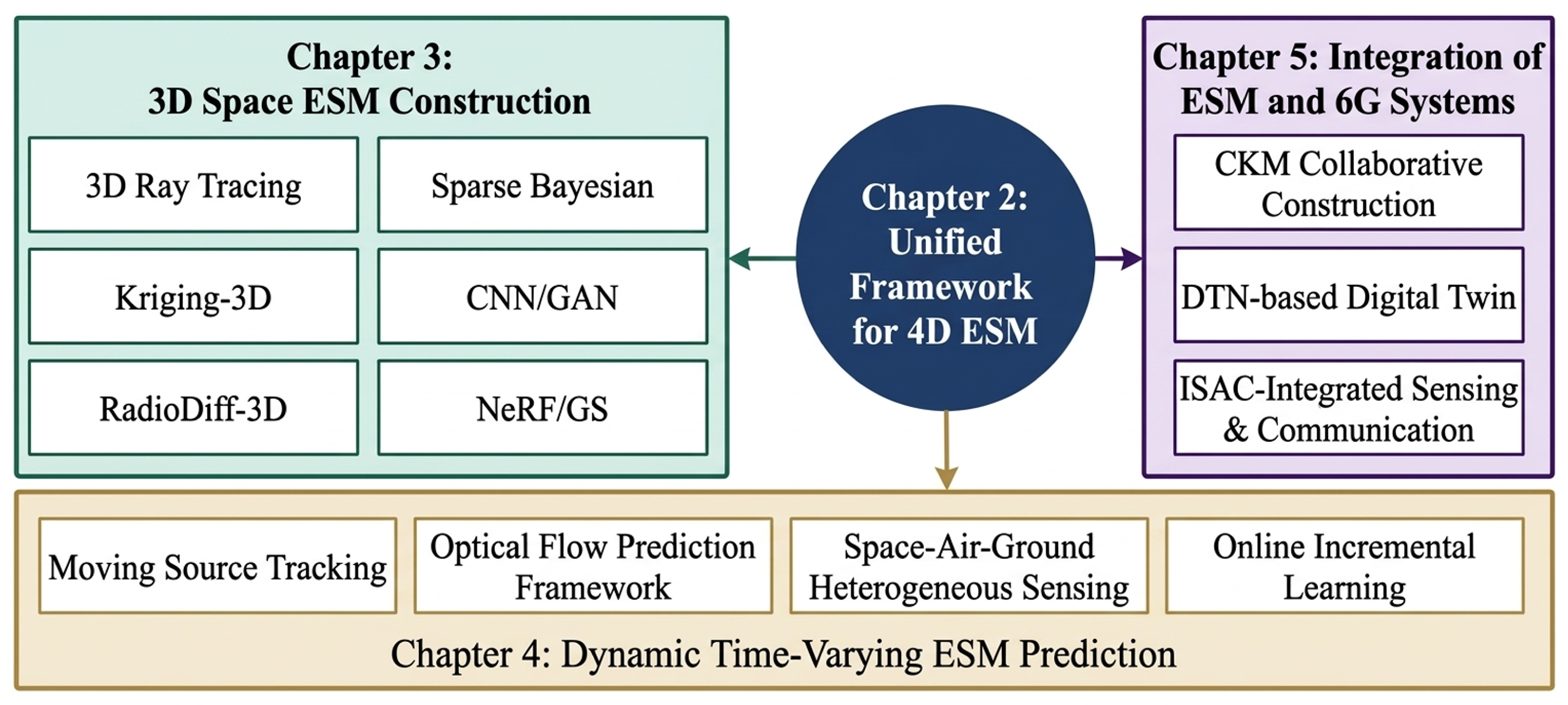
Figure 1. Survey structure overview.
Electronics 15 02439 g001
Figure 2. Hierarchical and scope relationship diagram of ESM and related concepts.
Electronics 15 02439 g002
Figure 3. Unified 4D ESM problem framework: space × frequency × time → power tensor.
Electronics 15 02439 g003
Figure 4. Indicative accuracy vs. latency landscape for 3D ESM construction methods (data points are not directly comparable across methods; each is extracted from the corresponding original publication under its own experimental conditions—see text for details).
Electronics 15 02439 g004
Figure 5. Space–air–ground integrated cooperative sensing ESM construction framework.
Electronics 15 02439 g005
Figure 6. Timeline of ESM and related key methods and datasets, 2011–2026.
Electronics 15 02439 g006
Table 1. Comparison of existing surveys and this paper.
SurveyYearSpatialFrequencyTemporal6G Integration
Pesko et al. [19]20142D××
Reddy et al. [21]20222D
Romero & Kim [20]20222D×××
Feng et al. [22]20252D××
Chen et al. [23]20252D
This paper20263D
✓: covered; ×: not covered; △: partially covered.
Table 2. Physical characteristics of the three core extension dimensions of the 4D ESM.
DimensionCore Physical CharacteristicsLimitation of Radio Maps
FrequencyHeterogeneous propagation mechanisms across frequency bands (sub-6G/mmWave/THz); physical correlations exist between frequency points [3,35,36]Independent construction per frequency point ignores cross-band coupling; computational cost grows linearly with the number of frequency points
TimeMobile radiation sources continuously change; spectral occupancy has temporal dependencies [23,24,37,38]Multiple static maps with misaligned timestamps cannot describe situational evolution or radiation source trajectories
AltitudeUAVs and LEO satellites invalidate the 2D planar assumption; vertical propagation characteristics differ significantly from horizontal ones [5,39,40,41]Two-dimensional planar maps cannot describe the signal distribution and shadowing relationships in three-dimensional space
Table 3. Comparison of ESM construction methods: Physical assumptions, scalability, and computational complexity.
CategoryCore Physical AssumptionsScalabilityInfer. CostRepresentative Works
Ray TracingFull 3D geometry; explicit EM propagation (reflection/diffraction/scattering); no statistical assumptionsPoor; exponential w.r.t. scene complexity>600 ms [45,47]
SBL/KrigingSpectral sparsity prior (SBL); Gaussian random field with stationary isotropic covariance (Kriging)Poor; O ( N 3 ) Seconds [34,44,48]
Deterministic CNNBuilding map input; translational equivariance; fully data-drivenGood; O ( N 2 × L ) 8–30 ms [28,50]
Physics-Constrained DiffusionHelmholtz equation as hard constraint; deep generative priorModerate; T step × O ( N 2 ) 1500–2200 ms [46,52]
NeRF/3DGSContinuous implicit radiance field; differentiable rendering analogyScene-specific training∼25 ms [53,55]
Environment SemanticsVirtual obstacle/point cloud priors; joint propagation parameter estimationModerate; depends on scene geometry granularityMedium [58,59]
N: spatial grid resolution per dimension; L: network depth; T step : diffusion step count.
Table 4. Publicly available ESM/Radio Map spatial construction research datasets (competition benchmarks: Table 7).
DatasetDim.Freq. BandTimeGenerationAccess
RadioMapSeer2D5.9 GHz (single)×Ray tracingGitHub
RadioMap3DSeer [51]3DSingle×Ray tracingGitHub
UrbanRadio3D [46]3DSingle (DoA/ToA)×Ray tracingarXiv
CKMImageNet [61]2D/3DMulti-band×Sim.+ImagearXiv
DeepSense 6G [62]2DMulti-modal×Real meas.Public
Indoor dataset [63]2D (indoor)Single×Real meas.IEEE Dataport
ESM multi-dim. benchmark3D + freq. + timeMulti-band✓ (needed)Does not yet exist
Table 5. Classification, sources, and countermeasures for dynamic ESM time variability.
TypeTypical SourceRateKey WorksStrategy
SlowBuilding construction, seasonal vegetation changesWeeks/months [19,64,65]Periodic offline reconstruction
MediumBase station on/off, new interference sourcesMin/hours [38,66,67]Triggered online update
FastMobile sources (vehicles, UAVs, LEO satellites)Seconds/sub-second [23,24,37,68]Real-time prediction
Table 6. Comparison and complementarity of ESM and CKM in methodological technical routes.
Method TypeRepresentative ESM WorkRepresentative CKM Work
Image super-resolutionRadioUNet series [28]CKM super-resolution [98]
Generative diffusionRadioDiff series [71,99]CKMDiff [100], BeamCKMDiff [101]
Cross-region inferenceDomain adaptive GNN [102]Cross-AP CKM inference [89]
3D environment awareness3D point cloud ESM [46]3D point cloud CKM [59]
Neural radiance fieldNeRF-REM [54]WRF-GS [55], F4-CKM [56]
Physical constraintRadioDiff-k2 [52]Physical CKM [103,104]
Disclaimer/Publisher’s Note: The statements, opinions and data contained in all publications are solely those of the individual author(s) and contributor(s) and not of MDPI and/or the editor(s). MDPI and/or the editor(s) disclaim responsibility for any injury to people or property resulting from any ideas, methods, instructions or products referred to in the content.