


Trustworthy Deep Learning for Cybersecurity: A Structured Review Across Detection, Robustness, Privacy, Explainability, and Deployment

 ,
, 

Abstract
1. Introduction
1.1. Context and Background
1.2. Motivation and Research Gap
1.3. Objective and Review Scope
1.4. Five-Axis Framework
1.5. Paper Organization
2. Review Methodology
2.1. Review Design and Rationale
2.2. Review Objectives and Research Questions
2.3. Information Sources and Search Strategy
2.4. Search Date and Search Update
2.5. Eligibility Criteria
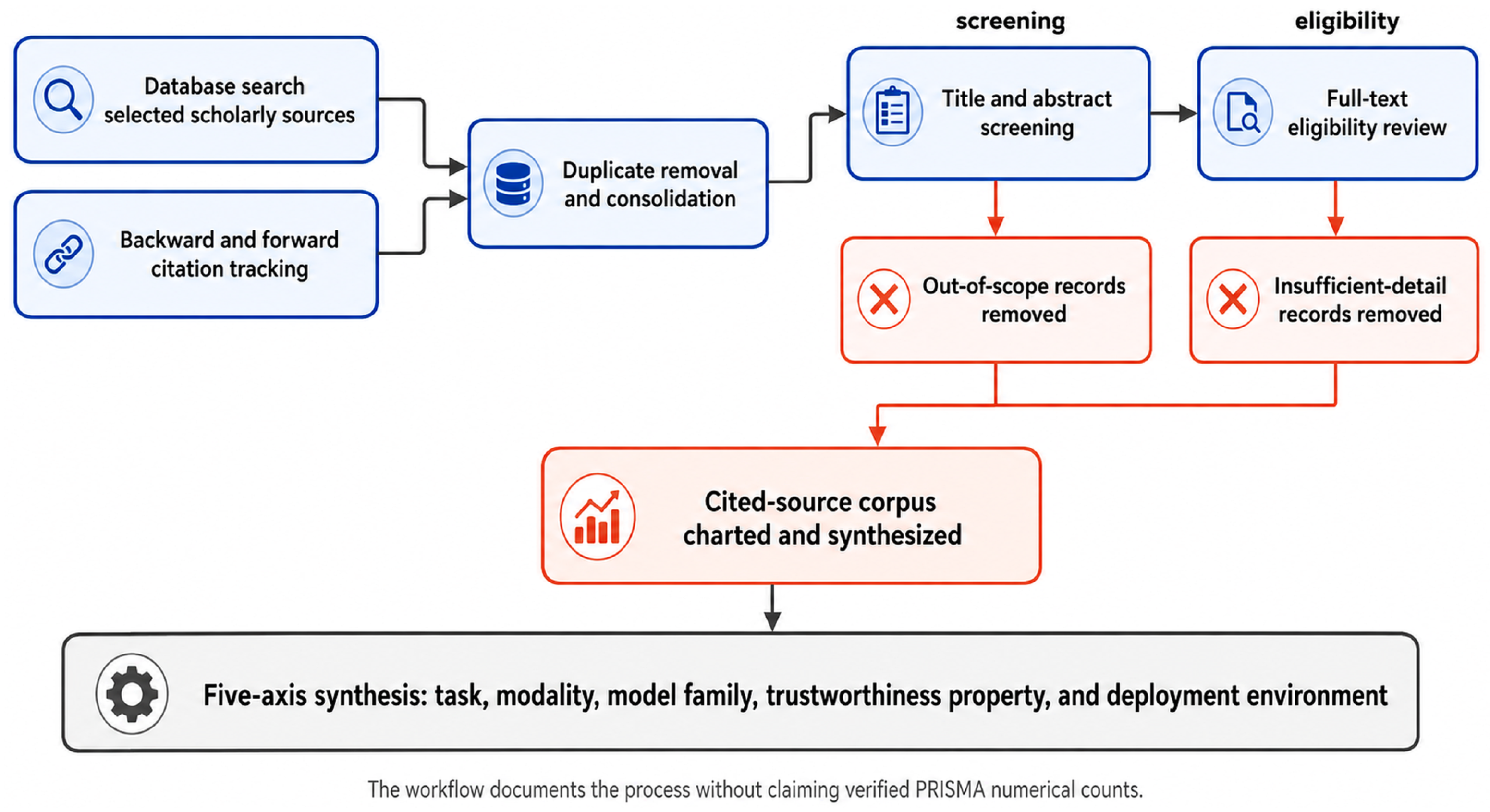
2.6. Study Selection Procedure
2.7. Data-Charting and Extraction
2.8. Data Synthesis and Evidence-Mapping
2.9. Methodological Appraisal Strategy
2.10. Reproducibility and Protocol Transparency
3. Search Results and Evidence-Oriented Map
3.1. Search and Selection Transparency
3.2. Distribution of the Cited-Source Corpus
3.3. Five-Axis Evidence Map
3.4. Bibliographic Age and Coverage Profile
4. Conceptual Background and Taxonomy of Deep Learning for Cybersecurity
4.1. Conceptual Background
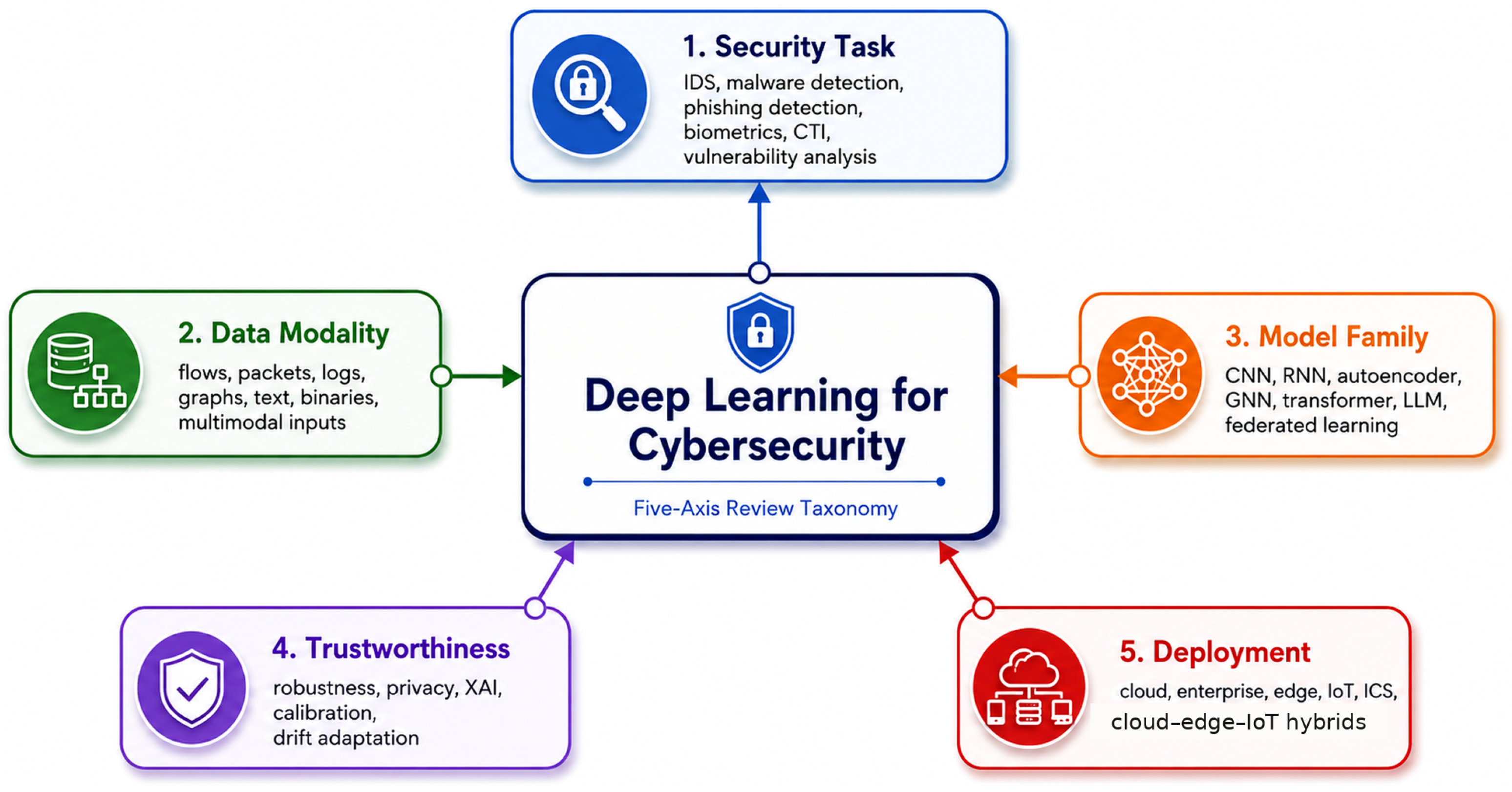
4.2. A Unified Taxonomy for Deep Learning in Cybersecurity
4.2.1. Security Task Dimension
4.2.2. Data Modality Dimension
4.2.3. Model Family Dimension
4.2.4. Trustworthiness Dimension
4.2.5. Deployment Environment Dimension
4.3. Interaction Among Taxonomy Dimensions
4.4. Implications for the Remainder of the Survey
5. Application Domains of Deep Learning in Cybersecurity
5.1. Intrusion Detection and Anomaly Detection
5.2. Malware Detection and Classification
5.3. Phishing, Spam, and Social Engineering Detection
5.4. Biometric Authentication and Identity Security
5.5. Cyber Threat Intelligence (CTI) and Multimodal Security Analytics
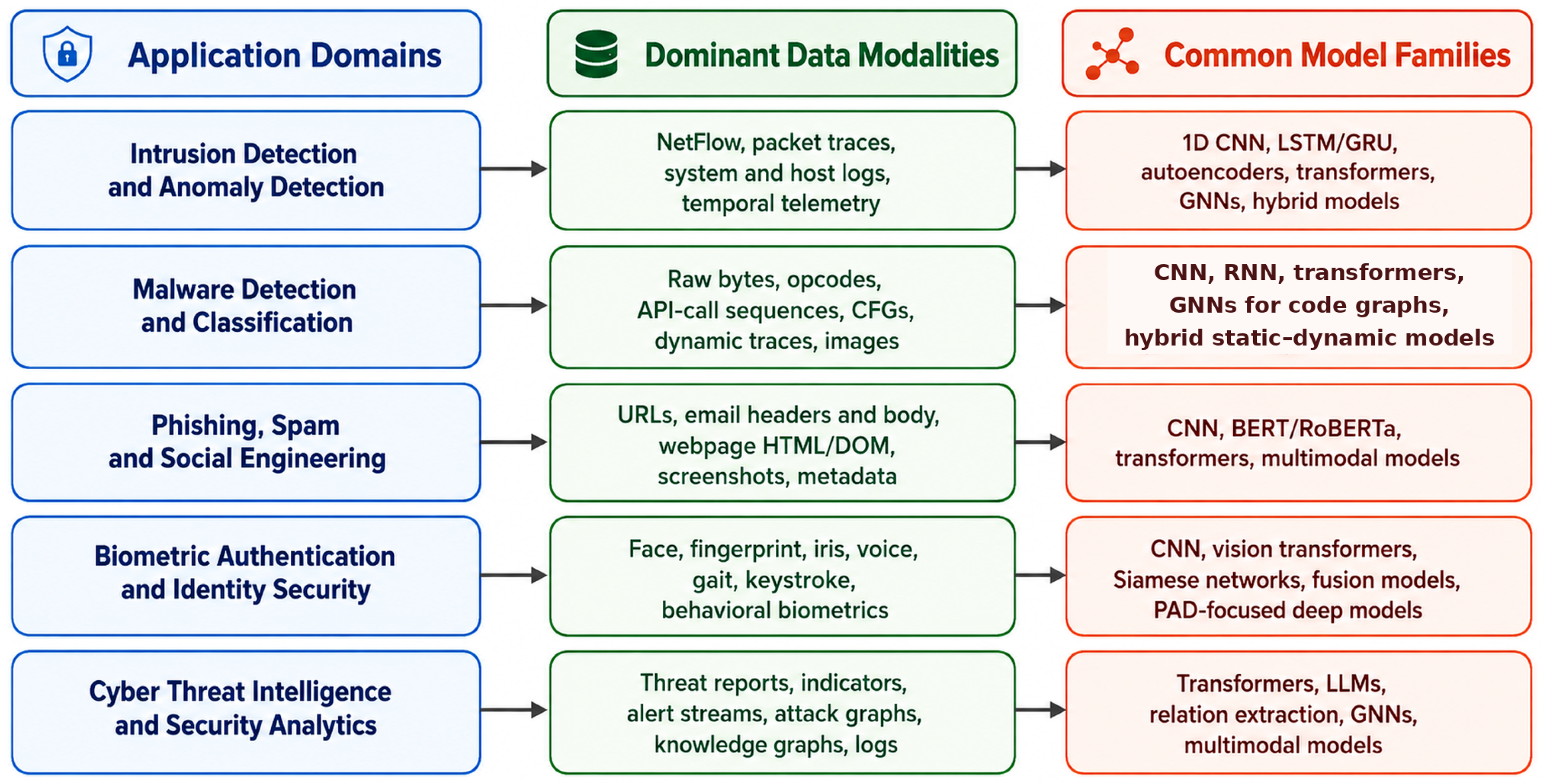
5.6. Synthesis Across Application Domains
6. Trustworthiness Dimensions of Deep Learning for Cybersecurity
6.1. Why Trustworthiness Is a Core Requirement in Cybersecurity
6.2. Adversarial Robustness and Security-Aware Evaluation
6.3. Poisoning, Backdoors, and Training Time Integrity
6.4. Privacy Preservation and Collaborative Learning
6.5. Explainability and Human Analyst Trust
6.6. Uncertainty Quantification and Confidence Calibration
6.7. Secure Deployment, Governance, and Lifecycle Assurance
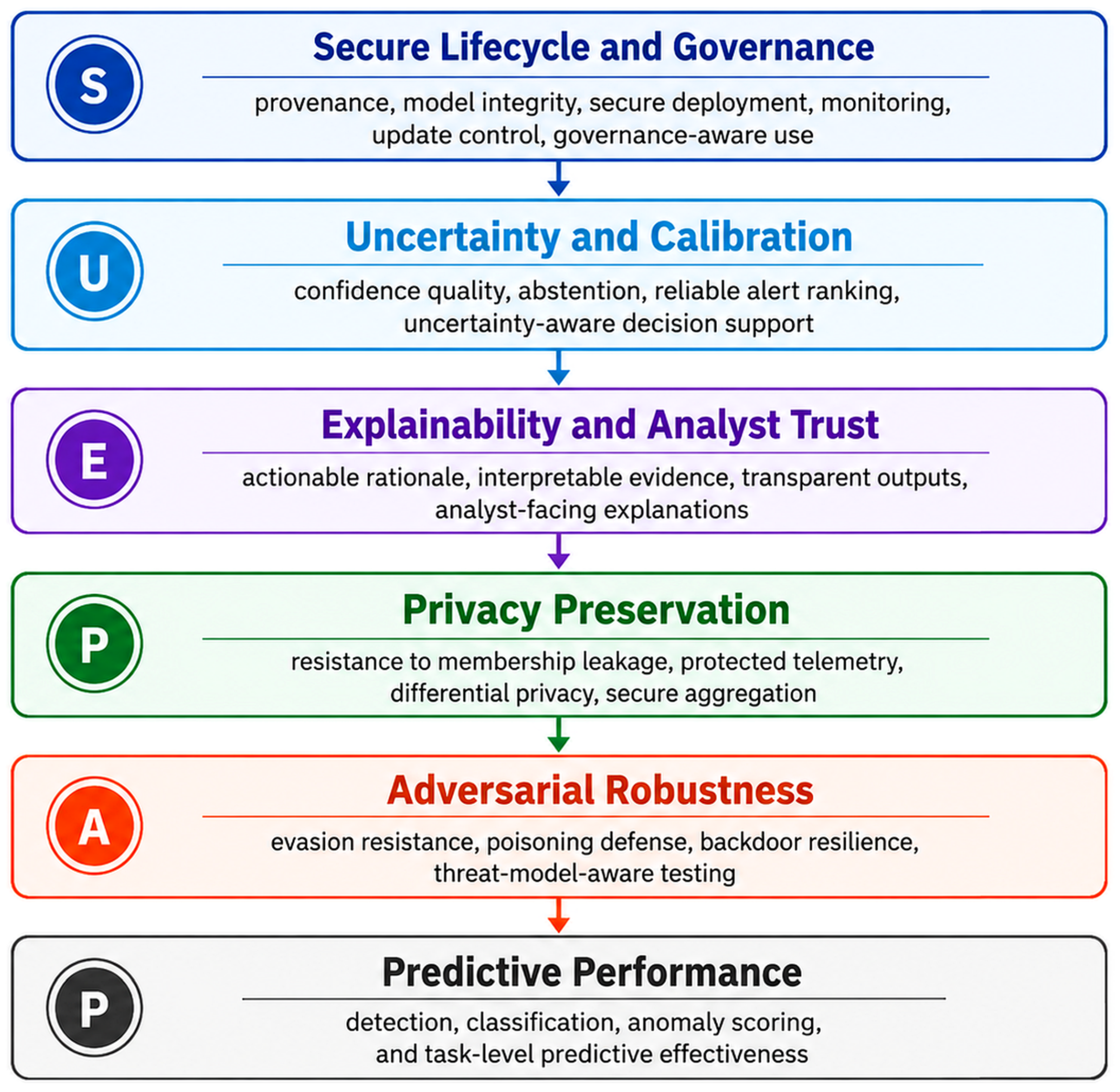
6.8. Synthesis
7. Datasets, Benchmarks, Evaluation Practices, and Reproducibility
7.1. Why This Section Is Methodologically Central
7.2. Public Cybersecurity Datasets: Availability, Diversity, and Structural Limitations
7.3. Dataset Construction Pipelines and the Importance of Data Provenance
7.4. Synthetic Data and Dataset Augmentation
7.5. Evaluation Protocols: Metrics, Preprocessing, and Fair Comparison
7.6. Temporal Validity, Drift, and External Generalization
7.7. Reproducibility and Artifact Availability
7.8. Synthesis and Recommended Evaluation Principles
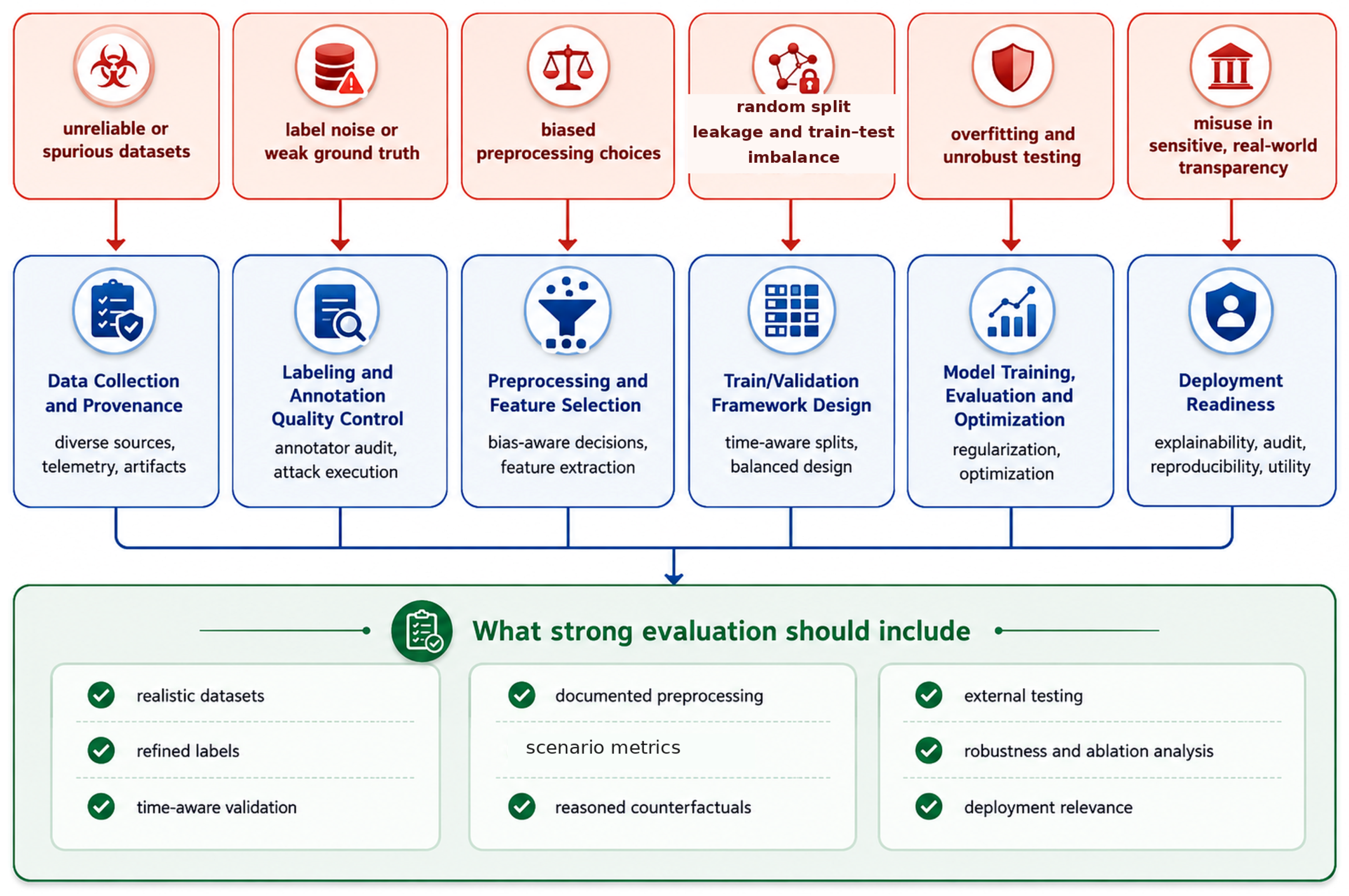
- Justify dataset choice by threat relevance, freshness, and deployment realism. The dataset should match the threat behavior, telemetry source, and operating conditions claimed in the study. Authors should explain whether the data are recent enough for the attack surface and realistic enough for the intended deployment setting.
- Document the full data-construction and preprocessing pipeline. Studies should report how raw evidence was collected, filtered, de-duplicated, labeled, normalized, encoded, aggregated, and converted into model inputs. This makes hidden design choices visible and helps readers identify leakage, label noise, class imbalance, or preprocessing bias.
- Avoid relying only on random splits when temporal change matters. Random splits can place near-duplicate, campaign-related, or future-like samples in both training and test sets. For streaming logs, malware families, phishing campaigns, and network traffic, time-aware partitions, future-period holdouts, update-latency analysis, or drift evaluation should be reported.
- Report metrics that reflect operational costs, not only predictive performance. Accuracy, precision, recall, F1 score, and receiver operating characteristic area under the curve (ROC-AUC) should be complemented with false-positive burden, missed-attack cost, alert volume, latency, throughput, memory footprint, and analyst workload. These measures show whether a model can support security operations rather than only score well on a benchmark.
- Test external or cross-dataset robustness where possible. A model evaluated only on one benchmark may learn dataset-specific artifacts instead of transferable threat patterns. External datasets, cross-organization validation, cross-family tests, or related benchmark variants can expose overfitting and improve claims about generalization.
- Publish code, environment details, split definitions, and rerun instructions. Reproducibility requires the training and evaluation code, software versions, dependencies, hardware assumptions, random seeds, split files, hyperparameters, and commands needed to rerun the study. When raw data cannot be released, authors should provide access constraints, derived-feature descriptions, or synthetic examples that preserve the evaluation logic.
- Evaluate synthetic data contributions for fidelity, utility, and risk before drawing security conclusions. Synthetic cyber data should be assessed for similarity to real threat behavior, usefulness for downstream tasks, and privacy or misuse risks. Studies should avoid claiming operational validity from synthetic data alone unless realistic and external checks support that claim.
8. Open Challenges and Future Research Directions
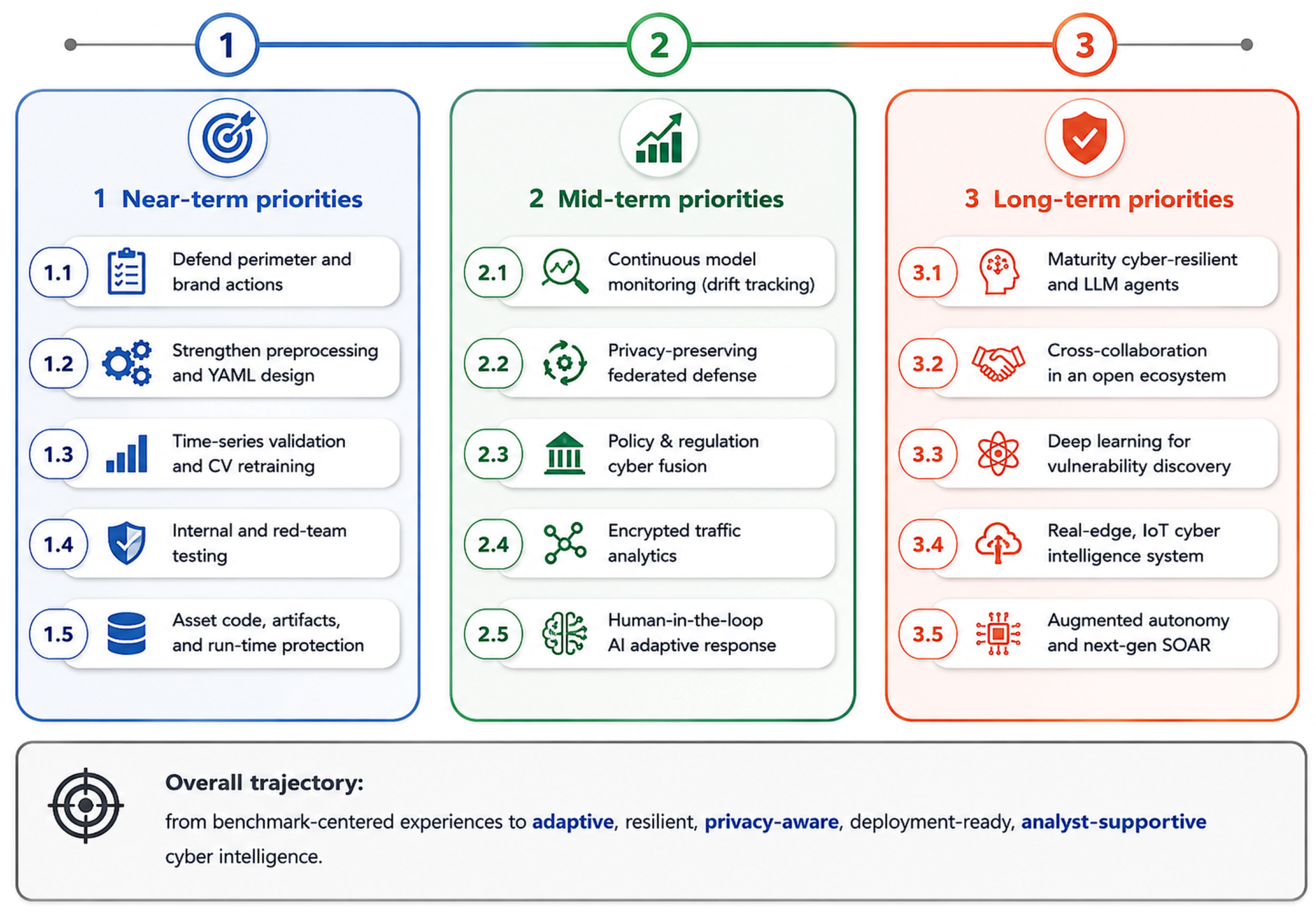
8.1. Deployment-Reporting Targets for Cloud, Enterprise, Edge, and IoT Settings
8.2. From Static Benchmarks to Living, Sector-Relevant Cyber Datasets
8.3. Drift-Aware, Continual, and Online Cyber Learning
8.4. Multimodal and Reasoning-Centric Cyber Defense
8.5. Privacy-Preserving Collaborative Defense Beyond Naive Federated Learning
8.6. Trustworthy LLMs, Cyber Copilots, and Agentic Security Workflows
8.7. Deep Learning for Software Security and Vulnerability Discovery
8.8. Encrypted Traffic, Edge Deployment, and Resource-Constrained Cyber AI
8.9. Human–AI Teaming and Analyst-Centered Evaluation
8.10. Overall Research Agenda
9. Limitations
10. Conclusions
Supplementary Materials
Author Contributions
Funding
Institutional Review Board Statement
Informed Consent Statement
Data Availability Statement
Conflicts of Interest
Abbreviations
| AI | Artificial intelligence |
| API | Application programming interface |
| CNN | Convolutional neural network |
| CPU | Central processing unit |
| CTI | Cyber threat intelligence |
| CVE | Common Vulnerabilities and Exposures |
| CWE | Common Weakness Enumeration |
| DL | Deep learning |
| DOM | Document Object Model |
| GAN | Generative adversarial network |
| GNN | Graph neural network |
| GPU | Graphics processing unit |
| GRU | Gated recurrent unit |
| HIDS | Host-based intrusion detection system |
| HTML | Hypertext Markup Language |
| ICS | Industrial control system |
| IDS | Intrusion detection system |
| IOC | Indicator of compromise |
| IoT | Internet of Things |
| LLM | Large language model |
| ML | Machine learning |
| NIDS | Network intrusion detection system |
| NLP | Natural language processing |
| NVD | National Vulnerability Database |
| PAD | Presentation attack detection |
| PCC | Population–Concept–Context |
| PRISMA | Preferred Reporting Items for Systematic Reviews and Meta-Analyses |
| PRISMA-ScR | PRISMA extension for scoping reviews |
| RAM | Random-access memory |
| RNN | Recurrent neural network |
| ROC-AUC | Receiver operating characteristic area under the curve |
| SOC | Security operations center |
| XAI | Explainable artificial intelligence |
References
- Sommer, R.; Paxson, V. Outside the Closed World: On Using Machine Learning for Network Intrusion Detection. In Proceedings of the 2010 IEEE Symposium on Security and Privacy, Oakland, CA, USA, 16–19 May 2010; pp. 305–316. [Google Scholar] [CrossRef]
- Buczak, A.L.; Guven, E. A Survey of Data Mining and Machine Learning Methods for Cyber Security Intrusion Detection. IEEE Commun. Surv. Tutor. 2016, 18, 1153–1176. [Google Scholar] [CrossRef]
- Xin, Y.; Kong, L.; Liu, Z.; Chen, Y.; Li, Y.; Zhu, H.; Gao, M.; Hou, H.; Wang, C. Machine Learning and Deep Learning Methods for Cybersecurity. IEEE Access 2018, 6, 35365–35381. [Google Scholar] [CrossRef]
- Milenkoski, A.; Vieira, M.; Kounev, S.; Avritzer, A.; Payne, B.D. Evaluating Computer Intrusion Detection Systems: A Survey of Common Practices. ACM Comput. Surv. 2015, 48, 1–41. [Google Scholar] [CrossRef] [PubMed]
- Berman, D.S.; Buczak, A.L.; Chavis, J.S.; Corbett, C.L. A Survey of Deep Learning Methods for Cyber Security. Information 2019, 10, 122. [Google Scholar] [CrossRef]
- Ring, M.; Wunderlich, S.; Scheuring, D.; Landes, D.; Hotho, A. A Survey of Network-Based Intrusion Detection Data Sets. Comput. Secur. 2019, 86, 147–167. [Google Scholar] [CrossRef]
- Ferrag, M.A.; Maglaras, L.; Moschoyiannis, S.; Janicke, H. Deep Learning for Cyber Security Intrusion Detection: Approaches, Datasets, and Comparative Study. J. Inf. Secur. Appl. 2020, 50, 102419. [Google Scholar] [CrossRef]
- Macas, M.; Wu, C.; Fuertes, W. Adversarial Examples: A Survey of Attacks and Defenses in Deep Learning-Enabled Cybersecurity Systems. Expert Syst. Appl. 2024, 238, 122223. [Google Scholar] [CrossRef]
- Makris, I.; Karampasi, A.; Radoglou-Grammatikis, P.; Episkopos, N.; Iturbe, E.; Rios, E.; Piperigkos, N.; Lalos, A.; Xenakis, C.; Lagkas, T.; et al. A Comprehensive Survey of Federated Intrusion Detection Systems: Techniques, Challenges and Solutions. Comput. Sci. Rev. 2025, 56, 100717. [Google Scholar] [CrossRef]
- Sharma, A.; Rani, S.; Shabaz, M. A Comprehensive Review of Explainable AI in Cybersecurity: Decoding the Black Box. ICT Express 2025, 11, 1200–1219. [Google Scholar] [CrossRef]
- Kheddar, H. Transformers and Large Language Models for Efficient Intrusion Detection Systems: A Comprehensive Survey. Inf. Fusion 2025, 124, 103347. [Google Scholar] [CrossRef]
- Zhong, M.; Lin, M.; Zhang, C.; Xu, Z. A Survey on Graph Neural Networks for Intrusion Detection Systems: Methods, Trends and Challenges. Comput. Secur. 2024, 141, 103821. [Google Scholar] [CrossRef]
- Chen, Y.; Cui, M.; Wang, D.; Cao, Y.; Yang, P.; Jiang, B.; Lu, Z.; Liu, B. A Survey of Large Language Models for Cyber Threat Detection. Comput. Secur. 2024, 145, 104016. [Google Scholar] [CrossRef]
- Macas, M.; Wu, C.; Fuertes, W. A survey on deep learning for cybersecurity: Progress, challenges, and opportunities. Comput. Netw. 2022, 212, 109032. [Google Scholar] [CrossRef]
- Munn, Z.; Peters, M.D.; Stern, C.; Tufanaru, C.; McArthur, A.; Aromataris, E. Systematic review or scoping review? Guidance for authors when choosing between a systematic or scoping review approach. BMC Med. Res. Methodol. 2018, 18, 143. [Google Scholar] [CrossRef]
- Arksey, H.; O’Malley, L. Scoping studies: Towards a methodological framework. Int. J. Soc. Res. Methodol. 2005, 8, 19–32. [Google Scholar] [CrossRef]
- Levac, D.; Colquhoun, H.; O’Brien, K.K. Scoping studies: Advancing the methodology. Implement. Sci. 2010, 5, 69. [Google Scholar] [CrossRef] [PubMed]
- Peters, M.D.J.; Marnie, C.; Tricco, A.C.; Pollock, D.; Munn, Z.; Alexander, L.; McInerney, P.; Godfrey, C.M.; Khalil, H. Updated methodological guidance for the conduct of scoping reviews. JBI Evid. Synth. 2020, 18, 2119–2126. [Google Scholar] [CrossRef]
- Tricco, A.C.; Lillie, E.; Zarin, W.; O’Brien, K.K.; Colquhoun, H.; Levac, D.; Moher, D.; Peters, M.D.; Horsley, T.; Weeks, L.; et al. PRISMA Extension for Scoping Reviews (PRISMA-ScR): Checklist and Explanation. Ann. Intern. Med. 2018, 169, 467–473. [Google Scholar] [CrossRef]
- Page, M.J.; McKenzie, J.E.; Bossuyt, P.M.; Boutron, I.; Hoffmann, T.C.; Mulrow, C.D.; Shamseer, L.; Tetzlaff, J.M.; Akl, E.A.; Brennan, S.E.; et al. The PRISMA 2020 statement: An updated guideline for reporting systematic reviews. BMJ 2021, 372, n71. [Google Scholar] [CrossRef]
- Wohlin, C. Guidelines for snowballing in systematic literature studies and a replication in software engineering. In Proceedings of the 18th International Conference on Evaluation and Assessment in Software Engineering (EASE ’14), London, UK, 13–14 May 2014; pp. 1–10. [Google Scholar] [CrossRef]
- Peters, M.D.J.; Godfrey, C.; McInerney, P.; Khalil, H.; Larsen, P.; Marnie, C.; Pollock, D.; Tricco, A.C.; Munn, Z. Best practice guidance and reporting items for the development of scoping review protocols. JBI Evid. Synth. 2022, 20, 953–968. [Google Scholar] [CrossRef]
- Ghayoumi, M. Deep Learning in Practice, 1st ed.; CRC Press/Chapman and Hall: Boca Raton, FL, USA, 2022. [Google Scholar]
- Baltrušaitis, T.; Ahuja, C.; Morency, L.-P. Multimodal Machine Learning: A Survey and Taxonomy. IEEE Trans. Pattern Anal. Mach. Intell. 2019, 41, 423–443. [Google Scholar] [CrossRef]
- Ometov, A.; Molua, O.L.; Komarov, M.; Nurmi, J. A Survey of Security in Cloud, Edge, and Fog Computing. Sensors 2022, 22, 927. [Google Scholar] [CrossRef] [PubMed]
- Vaswani, A.; Shazeer, N.; Parmar, N.; Uszkoreit, J.; Jones, L.; Gomez, A.N.; Kaiser, L.; Polosukhin, I. Attention Is All You Need. Adv. Neural Inf. Process. Syst. 2017, 30, 5998–6008. [Google Scholar] [CrossRef]
- Zhou, J.; Cui, G.; Hu, S.; Zhang, Z.; Yang, C.; Liu, Z.; Wang, L.; Li, C.; Sun, M. Graph Neural Networks: A Review of Methods and Applications. AI Open 2021, 1, 57–81. [Google Scholar] [CrossRef]
- Hochreiter, S.; Schmidhuber, J. Long Short-Term Memory. Neural Comput. 1997, 9, 1735–1780. [Google Scholar] [CrossRef] [PubMed]
- Gama, J.; Žliobaitė, I.; Bifet, A.; Pechenizkiy, M.; Bouchachia, A. A Survey on Concept Drift Adaptation. ACM Comput. Surv. 2014, 46, 44. [Google Scholar] [CrossRef]
- Andresini, G.; Pendlebury, F.; Pierazzi, F.; Loglisci, C.; Appice, A.; Cavallaro, L. INSOMNIA: Towards Concept-Drift Robustness in Network Intrusion Detection. In Proceedings of the 14th ACM Workshop on Artificial Intelligence and Security (AISec ’21), Virtual, 15 November 2021. [Google Scholar] [CrossRef]
- Ceschin, F.; Botacin, M.; Bifet, A.; Pfahringer, B.; Oliveira, L.S.; Gomes, H.M.; Grégio, A. Machine Learning (In) Security: A Stream of Problems. Digit. Threat. Res. Pract. 2024, 5, 1–32. [Google Scholar] [CrossRef]
- Shyaa, M.A.; Ibrahim, N.F.; Zainol, Z.; Abdullah, R.; Anbar, M.; Alzubaidi, L. Evolving cybersecurity frontiers: A comprehensive survey on concept drift and feature dynamics aware machine and deep learning in intrusion detection systems. Eng. Appl. Artif. Intell. 2024, 137, 109143. [Google Scholar] [CrossRef]
- Neto, E.C.P.; Iqbal, S.; Buffett, S.; Sultana, M.; Taylor, A. Deep learning for intrusion detection in emerging technologies: A comprehensive survey and new perspectives. Artif. Intell. Rev. 2025, 58, 340. [Google Scholar] [CrossRef]
- NIST AI 100-2e2025; Adversarial Machine Learning: A Taxonomy and Terminology of Attacks and Mitigations. National Institute of Standards and Technology: Gaithersburg, MD, USA, 2025. [CrossRef]
- Guidotti, R.; Monreale, A.; Ruggieri, S.; Turini, F.; Giannotti, F.; Pedreschi, D. A Survey of Methods for Explaining Black Box Models. ACM Comput. Surv. 2019, 51, 1–42. [Google Scholar] [CrossRef]
- Doshi-Velez, F.; Kim, B. Towards A Rigorous Science of Interpretable Machine Learning. arXiv 2017, arXiv:1702.08608. [Google Scholar] [CrossRef]
- Zhang, C.; Xie, Y.; Bai, H.; Yu, B.; Li, W.; Gao, Y. A Survey on Federated Learning. Knowl.-Based Syst. 2021, 216, 106775. [Google Scholar] [CrossRef]
- Tjoa, E.; Guan, C. A Survey on Explainable Artificial Intelligence (XAI): Toward Medical XAI. IEEE Trans. Neural Netw. Learn. Syst. 2021, 32, 4793–4813. [Google Scholar] [CrossRef]
- Zhang, Y.; Muniyandi, R.C.; Qamar, F. A Review of Deep Learning Applications in Intrusion Detection Systems: Overcoming Challenges in Spatiotemporal Feature Extraction and Data Imbalance. Appl. Sci. 2025, 15, 1552. [Google Scholar] [CrossRef]
- Wang, H.; Cui, B.; Yuan, Q.; Shi, R.; Huang, M. A Review of Deep Learning Based Malware Detection Techniques. Neurocomputing 2024, 598, 128010. [Google Scholar] [CrossRef]
- Kavya, S.; Sumathi, D. Staying Ahead of Phishers: A Review of Recent Advances and Emerging Methodologies in Phishing Detection. Artif. Intell. Rev. 2025, 58, 50. [Google Scholar] [CrossRef]
- Minaee, S.; Abdolrashidi, A.; Su, H.; Bennamoun, M.; Zhang, D. Biometrics Recognition Using Deep Learning: A Survey. Artif. Intell. Rev. 2023, 56, 8647–8695. [Google Scholar] [CrossRef]
- Ghayoumi, M. A review of multimodal biometric systems: Fusion methods and their applications. In Proceedings of the 2015 IEEE/ACIS 14th International Conference on Computer and Information Science (ICIS), Las Vegas, NV, USA, 28 June–1 July 2015; pp. 131–136. [Google Scholar] [CrossRef]
- Ghayoumi, M.; Ghazinour, K. An adaptive fuzzy multimodal biometric system for identification and verification. In Proceedings of the 2015 IEEE/ACIS 14th International Conference on Computer and Information Science (ICIS), Las Vegas, NV, USA, 28 June–1 July 2015; pp. 137–141. [Google Scholar] [CrossRef]
- Ghazinour, K.; Ghayoumi, M. An autonomous model to enforce security policies based on user’s behavior. In Proceedings of the 2015 IEEE/ACIS 14th International Conference on Computer and Information Science (ICIS), Las Vegas, NV, USA, 28 June–1 July 2015; pp. 95–99. [Google Scholar] [CrossRef]
- Ghazinour, K.; Ghayoumi, M. A Dynamic Trust Model Enforcing Security Policies. In Proceedings of the International Conference on Intelligent Information Processing, Security and Advanced Communication (IPAC ’15), Batna, Algeria, 23–25 November 2015; pp. 1–5. [Google Scholar] [CrossRef]
- Babaev, I.; Packer, T.; Ghayoumi, M.; Ghazinour, K. MAISON: A Model for Effective Hybrid Management of Cybersecurity and Cyber-Trust. Int. J. Inf. Technol. 2024, 1, 1–7. [Google Scholar]
- Ghayoumi, M.; Ghazinour, K. Advancing MAISON: Integrating Deep Learning and Social Dynamics in Cyberbullying Detection and Prevention. In Proceedings of the 2024 7th International Conference on Information and Computer Technologies, Honolulu, HI, USA, 15–17 March 2024; pp. 80–86. [Google Scholar]
- Lin, P.; Ye, K.; Hu, Y.; Lin, Y.; Xu, C.-Z. A Novel Multimodal Deep Learning Framework for Encrypted Traffic Classification. IEEE/ACM Trans. Netw. 2023, 31, 1369–1384. [Google Scholar] [CrossRef]
- Aceto, G.; Ciuonzo, D.; Montieri, A.; Pescapé, A. DISTILLER: Encrypted Traffic Classification via Multimodal Multitask Deep Learning. J. Netw. Comput. Appl. 2021, 183–184, 102985. [Google Scholar] [CrossRef]
- Hinton, G.E.; Salakhutdinov, R.R. Reducing the Dimensionality of Data with Neural Networks. Science 2006, 313, 504–507. [Google Scholar] [CrossRef]
- LeCun, Y.; Bengio, Y.; Hinton, G. Deep Learning. Nature 2015, 521, 436–444. [Google Scholar] [CrossRef]
- Pan, K.; Ong, Y.-S.; Gong, M.; Li, H.; Qin, A.K.; Gao, Y. Differential privacy in deep learning: A literature survey. Neurocomputing 2024, 589, 127663. [Google Scholar] [CrossRef]
- Zhang, Y.; Zeng, D.; Luo, J.; Fu, X.; Chen, G.; Xu, Z.; King, I. A Survey of Trustworthy Federated Learning: Issues, Solutions, and Challenges. ACM Trans. Intell. Syst. Technol. 2024, 15, 1–47. [Google Scholar] [CrossRef]
- Zhao, J.; Bagchi, S.; Avestimehr, S.; Chan, K.; Chaterji, S.; Dimitriadis, D.; Li, J.; Li, N.; Nourian, A.; Roth, H. The Federation Strikes Back: A Survey of Federated Learning Privacy Attacks, Defenses, Applications, and Policy Landscape. ACM Comput. Surv. 2025, 57, 1–37. [Google Scholar] [CrossRef]
- Ghazinour, K.; Ghayoumi, M. Dynamic Modeling for Representing Access Control Policies Effect. arXiv 2015, arXiv:1505.08154. [Google Scholar] [CrossRef]
- Das, B.C.; Amini, M.H.; Wu, Y. Security and Privacy Challenges of Large Language Models: A Survey. ACM Comput. Surv. 2025, 57, 1–39. [Google Scholar] [CrossRef]
- Hu, H.; Salcic, Z.; Sun, L.; Dobbie, G.; Yu, P.S.; Zhang, X. Membership Inference Attacks on Machine Learning: A Survey. ACM Comput. Surv. 2022, 54, 1–37. [Google Scholar] [CrossRef]
- NIST AI 100-1; Artificial Intelligence Risk Management Framework (AI RMF 1.0). National Institute of Standards and Technology: Gaithersburg, MD, USA, 2023. [CrossRef]
- NIST SP 800-218A; Secure Software Development Practices for Generative AI and Dual-Use Foundation Models: An SSDF Community Profile. National Institute of Standards and Technology: Gaithersburg, MD, USA, 2024. [CrossRef]
- Yang, T.; Qiao, Y.; Lee, B. Towards trustworthy cybersecurity operations using Bayesian Deep Learning to improve uncertainty quantification of anomaly detection. Comput. Secur. 2024, 144, 103909. [Google Scholar] [CrossRef]
- Guo, C.; Pleiss, G.; Sun, Y.; Weinberger, K.Q. On Calibration of Modern Neural Networks. In Proceedings of the 34th International Conference on Machine Learning (ICML), Sydney, Australia, 6–11 August 2017; pp. 1321–1330. [Google Scholar]
- Moskalenko, V.; Kharchenko, V.; Semenov, S. Model and Method for Providing Resilience to Resource-Constrained AI-System. Sensors 2024, 24, 5951. [Google Scholar] [CrossRef]
- Liu, H.-I.; Galindo, M.; Xie, H.; Wong, L.-K.; Shuai, H.-H.; Li, Y.-H.; Cheng, W.-H. Lightweight Deep Learning for Resource- Constrained Environments: A Survey. ACM Comput. Surv. 2024, 56, 267. [Google Scholar] [CrossRef]
- Aldhaheri, A.; Alwahedi, F.; Ferrag, M.A.; Battah, A. Deep Learning for Cyber Threat Detection in IoT Networks: A Review. Internet Things Cyber-Phys. Syst. 2024, 4, 110–128. [Google Scholar] [CrossRef]
- Aslam, M.M.; Tufail, A.; Irshad, M.N. Survey of Deep Learning Approaches for Securing Industrial Control Systems: A Comparative Analysis. Cyber Secur. Appl. 2025, 3, 100096. [Google Scholar] [CrossRef]
- Sharma, A.; Lashkari, A.H. A survey on encrypted network traffic: A comprehensive survey of identification/classification techniques, challenges, and future directions. Comput. Netw. 2025, 257, 110984. [Google Scholar] [CrossRef]
- Rahman, M.M.; Shakil, S.A.; Mustakim, M.R. A survey on intrusion detection system in IoT networks. Cyber Secur. Appl. 2025, 3, 100082. [Google Scholar] [CrossRef]
- Hoffpauir, K.; Simmons, J.; Schmidt, N.; Pittala, R.; Briggs, I.; Makani, S.; Jararweh, Y. A Survey on Edge Intelligence and Lightweight Machine Learning Support for Future Applications and Services. ACM J. Data Inf. Qual. 2023, 15, 20. [Google Scholar] [CrossRef]
- Yuan, Y.; Li, Z.; Zhao, B. A Survey of Multimodal Learning: Methods, Applications, and Future. ACM Comput. Surv. 2025, 57, 167. [Google Scholar] [CrossRef]
- Vinayakumar, R.; Alazab, M.; Soman, K.P.; Poornachandran, P.; Al-Nemrat, A.; Venkatraman, S. Deep Learning Approach for Intelligent Intrusion Detection System. IEEE Access 2019, 7, 41525–41550. [Google Scholar] [CrossRef]
- Gopinath, M.; Sethuraman, S.C. A Comprehensive Survey on Deep Learning Based Malware Detection Techniques. Comput. Sci. Rev. 2023, 47, 100529. [Google Scholar] [CrossRef]
- Deldar, F.; Abadi, M. Deep Learning for Zero-Day Malware Detection and Classification: A Survey. ACM Comput. Surv. 2023, 56, 1–37. [Google Scholar] [CrossRef]
- Alzubaidi, A. Detecting Android Malware Using Deep Learning Algorithms: A Survey. Comput. Electr. Eng. 2024, 119, 109544. [Google Scholar] [CrossRef]
- Asiri, S.; Xiao, Y.; Alzahrani, S.; Li, T. PhishingRTDS: A Real-Time Detection System for Phishing Attacks Using a Deep Learning Model. Comput. Secur. 2024, 141, 103843. [Google Scholar] [CrossRef]
- Ibrahim, M.; Elhafiz, R. Phishing Email Detection Using BERT and RoBERTa. Computation 2026, 14, 46. [Google Scholar] [CrossRef]
- Vennela, A.; Akarapu, R.B.; Rakshith, B.L.; Asirvatham, L.G.; Sunil, G. Intelligent Cybersecurity Systems for Phishing Attack Detection: An Overview. Comput. Electr. Eng. 2026, 130, 110829. [Google Scholar] [CrossRef]
- Shaheed, K.; Szczuko, P.; Kumar, M.; Qureshi, I.; Abbas, Q.; Ullah, I. Deep Learning Techniques for Biometric Security: A Systematic Review of Presentation Attack Detection Systems. Eng. Appl. Artif. Intell. 2024, 129, 107569. [Google Scholar] [CrossRef]
- Alrawili, R.; AlQahtani, A.A.S.; Khan, M.K. Comprehensive Survey: Biometric User Authentication Application, Evaluation, and Discussion. Comput. Electr. Eng. 2024, 119, 109485. [Google Scholar] [CrossRef]
- Zeng, L.; Shen, P.; Zhu, X.; Tian, X.; Chen, C. A Review of Privacy-Preserving Biometric Identification and Authentication Protocols. Comput. Secur. 2025, 150, 104309. [Google Scholar] [CrossRef]
- Furumoto, K.; Morikawa, T.; Kolehmainen, A.; Silverajan, B.; Takahashi, T.; Inoue, D. A Comprehensive Survey of Threat Intelligence Research: A Measurement-Based Study. ACM Comput. Surv. 2026, 58, 153. [Google Scholar] [CrossRef]
- Ahmed, K.; Khurshid, S.K.; Hina, S. CyberEntRel: Joint Extraction of Cyber Entities and Relations Using Deep Learning. Comput. Secur. 2024, 136, 103579. [Google Scholar] [CrossRef]
- Goldschmidt, P.; Chudá, D. Network Intrusion Datasets: A Survey, Limitations, and Recommendations. Comput. Secur. 2025, 156, 104510. [Google Scholar] [CrossRef]
- Du, M.; Li, F.; Zheng, G.; Srikumar, V. DeepLog: Anomaly Detection and Diagnosis from System Logs through Deep Learning. In Proceedings of the 2017 ACM SIGSAC Conference on Computer and Communications Security, Dallas, TX, USA, 30 October–3 November 2017; pp. 1285–1298. [Google Scholar] [CrossRef]
- Duan, Y.; Xue, K.; Sun, H.; Bao, H.; Wei, Y.; You, Z.; Zhang, Y.; Jiang, X.; Yang, S.; Chen, J.; et al. LogEDL: Log Anomaly Detection via Evidential Deep Learning. Appl. Sci. 2024, 14, 7055. [Google Scholar] [CrossRef]
- Bilot, T.; El Madhoun, N.; Al Agha, K.; Zouaoui, A. A Survey on Malware Detection with Graph Representation Learning. ACM Comput. Surv. 2024, 56, 1–36. [Google Scholar] [CrossRef]
- Saha, S.; Afroz, S.; Rahman, A.H. MAlign: Explainable Static Raw-Byte Based Malware Family Classification Using Sequence Alignment. Comput. Secur. 2024, 139, 103714. [Google Scholar] [CrossRef]
- Carlini, N.; Wagner, D. Towards Evaluating the Robustness of Neural Networks. In Proceedings of the 2017 IEEE Symposium on Security and Privacy (SP), San Jose, CA, USA, 22–26 May 2017; pp. 39–57. [Google Scholar] [CrossRef]
- Madry, A.; Makelov, A.; Schmidt, L.; Tsipras, D.; Vladu, A. Towards Deep Learning Models Resistant to Adversarial Attacks. In Proceedings of the International Conference on Learning Representations (ICLR), Vancouver, BC, Canada, 30 April–3 May 2018. [Google Scholar]
- Goodfellow, I.J.; Shlens, J.; Szegedy, C. Explaining and Harnessing Adversarial Examples. In Proceedings of the International Conference on Learning Representations (ICLR), San Diego, CA, USA, 7–9 May 2015. [Google Scholar] [CrossRef]
- Jedrzejewski, F.V.; Thode, L.; Fischbach, J.; Gorschek, T.; Mendez, D.; Lavesson, N. Adversarial Machine Learning in Industry: A Systematic Literature Review. Comput. Secur. 2024, 145, 103988. [Google Scholar] [CrossRef]
- Bena, N.; Anisetti, M.; Damiani, E.; Yeun, C.Y.; Ardagna, C.A. Protecting machine learning from poisoning attacks: A risk-based approach. Comput. Secur. 2025, 155, 104468. [Google Scholar] [CrossRef]
- Nguyen, T.D.; Nguyen, T.; Le Nguyen, P.; Pham, H.H.; Doan, K.D.; Wong, K.-S. Backdoor attacks and defenses in federated learning: Survey, challenges and future research directions. Eng. Appl. Artif. Intell. 2024, 127, 107166. [Google Scholar] [CrossRef]
- Bunko, T.; Johnstone, M.N.; Yang, W.; Scott, B.A. A survey of privacy-preserving federated learning for intrusion detection systems. Artif. Intell. Rev. 2026, 59, 125. [Google Scholar] [CrossRef]
- Rigaki, M.; Garcia, S. A Survey of Privacy Attacks in Machine Learning. ACM Comput. Surv. 2023, 56, 1–34. [Google Scholar] [CrossRef]
- Shokri, R.; Stronati, M.; Song, C.; Shmatikov, V. Membership Inference Attacks against Machine Learning Models. In Proceedings of the IEEE Symposium on Security and Privacy (SP), San Jose, CA, USA, 22–26 May 2017; pp. 3–18. [Google Scholar] [CrossRef]
- El Mestari, S.Z.; Lenzini, G.; Demirci, H. Preserving data privacy in machine learning systems. Comput. Secur. 2024, 137, 103605. [Google Scholar] [CrossRef]
- McMahan, H.B.; Moore, E.; Ramage, D.; Hampson, S.; Aguera y Arcas, B. Communication-Efficient Learning of Deep Networks from Decentralized Data. In Proceedings of the AISTATS, Fort Lauderdale, FL, USA, 20–22 April 2017; pp. 1273–1282. [Google Scholar] [CrossRef]
- Reynaud, S.; Roxin, A. Review of eXplainable artificial intelligence for cybersecurity systems. Discov. Artif. Intell. 2025, 5, 78. [Google Scholar] [CrossRef]
- Yang, Z.; Liu, X.; Li, T.; Wu, D.; Wang, J.; Zhao, Y.; Han, H. A systematic literature review of methods and datasets for anomaly-based network intrusion detection. Comput. Secur. 2022, 116, 102675. [Google Scholar] [CrossRef]
- Pekar, A.; Jozsa, R. Evaluating ML-based anomaly detection across datasets of varied integrity: A case study. Comput. Netw. 2024, 251, 110617. [Google Scholar] [CrossRef]
- Masukawa, R.; Yun, S.; Jeong, S.; Huang, W.; Ni, Y.; Bryant, I.; Bastian, N.D.; Imani, M. PACKETCLIP: Multi-modal embedding of network traffic and language for cybersecurity reasoning. Front. Artif. Intell. 2025, 8, 1593944. [Google Scholar] [CrossRef] [PubMed]
- Pinto, D.; Amorim, I.; Maia, E.; Praça, I. A review on intrusion detection datasets: Tools, processes, and features. Comput. Netw. 2025, 262, 111177. [Google Scholar] [CrossRef]
- Tory, A.R.; Hasan, F.K. An evaluation framework for network IDS/IPS datasets: Leveraging MITRE ATT&CK and industry relevance metrics. Comput. Secur. 2026, 161, 104777. [Google Scholar] [CrossRef]
- Wolf, M.; Tritscher, J.; Landes, D.; Hotho, A.; Schloer, D. Benchmarking of synthetic network data: Reviewing challenges and approaches. Comput. Secur. 2024, 145, 103993. [Google Scholar] [CrossRef]
- Ghayoumi, M. Generative Adversarial Networks in Practice, 1st ed.; CRC Press/Chapman and Hall: Boca Raton, FL, USA, 2023. [Google Scholar]
- Manocchio, L.D.; Layeghy, S.; Gallagher, M.; Portmann, M. An empirical evaluation of preprocessing methods for machine learning based network intrusion detection systems. Eng. Appl. Artif. Intell. 2025, 158, 111289. [Google Scholar] [CrossRef]
- Olszewski, D.; Lu, A.; Stillman, C.; Warren, K.; Kitroser, C.; Pascual, A.; Ukirde, D.; Butler, K.; Traynor, P. Get in Researchers; We’re Measuring Reproducibility: A Reproducibility Study of Machine Learning Papers in Tier 1 Security Conferences. In Proceedings of the 2023 ACM SIGSAC Conference on Computer and Communications Security (CCS ’23), Copenhagen, Denmark, 26–30 November 2023. [Google Scholar] [CrossRef]
- Hernandez-Ramos, J.L.; Karopoulos, G.; Chatzoglou, E.; Kouliaridis, V.; Marmol, E.; Gonzalez-Vidal, A.; Kambourakis, G. Intrusion Detection Based on Federated Learning: A Systematic Review. ACM Comput. Surv. 2025, 57, 1–65. [Google Scholar] [CrossRef]
- Zhang, J.; Bu, H.; Wen, H.; Liu, Y.; Fei, H.; Xi, R.; Li, L.; Yang, Y.; Zhu, H.; Meng, D. When LLMs meet cybersecurity: A systematic literature review. Cybersecurity 2025, 8, 55. [Google Scholar] [CrossRef]
- Karras, A.; Theodorakopoulos, L.; Karras, C.; Theodoropoulou, A.; Kalliampakou, I.; Kalogeratos, G. LLMs for Cybersecurity in the Big Data Era: A Comprehensive Review of Applications, Challenges, and Future Directions. Information 2025, 16, 957. [Google Scholar] [CrossRef]
- Liang, C.; Wei, Q.; Du, J.; Wang, Y.; Jiang, Z. Survey of source code vulnerability analysis based on deep learning. Comput. Secur. 2025, 148, 104098. [Google Scholar] [CrossRef]
- Baruwal Chhetri, M.; Tariq, S.; Singh, R.; Jalalvand, F.; Paris, C.; Nepal, S. Towards Human-AI Teaming to Mitigate Alert Fatigue in Security Operations Centres. ACM Trans. Internet Technol. 2024, 24, 1–22. [Google Scholar] [CrossRef]
- Ghayoumi, M.; Ghazinour, K. Human Rights in the Shadow of AI: Confronting Bias and Accountability. In Proceedings of the 2025 IEEE 16th Annual Ubiquitous Computing, Electronics & Mobile Communication Conference (UEMCON), Yorktown Heights, NY, USA, 22–24 October 2025. [Google Scholar] [CrossRef]
- Biggio, B.; Roli, F. Wild patterns: Ten years after the rise of adversarial machine learning. Pattern Recognit. 2018, 84, 317–331. [Google Scholar] [CrossRef]

| Survey | Main Scope | Main Strengths | Main Limitations Relative to This Paper |
|---|---|---|---|
| Berman et al. (2019) [5] | General survey of deep learning methods for cybersecurity | Foundational early overview of deep learning (DL) methods across cyber tasks | Published before the rapid rise of graph neural networks (GNNs), transformers, large language models (LLMs), trustworthy artificial intelligence (AI), and recent deployment-focused concerns |
| Macas et al. (2022) [14] | Broad survey of deep learning for cybersecurity | Covers progress, challenges, and opportunities across major DL-based cybersecurity applications | Does not provide a strong unified framework centered on trustworthiness, deployment feasibility, and recent LLM-centered cyber workflows |
| Zhong et al. (2024) [12] | GNNs for intrusion detection | Strong coverage of graph-based intrusion detection methods, trends, and challenges | Narrow task scope focused on intrusion detection systems (IDSs) and one model family |
| Chen et al. (2024) [13] | LLMs for cyber threat detection | Strong review of LLM-based cyber detection tasks and challenges | Focused on LLMs and threat detection rather than the broader DL cybersecurity landscape |
| Makris et al. (2025) [9] | Federated intrusion detection systems (IDSs) | Strong coverage of federated intrusion detection system (IDS) techniques, challenges, and solutions | Focused on federated IDS only; does not cover broader deep learning architectures or cross-domain cyber tasks |
| Sharma et al. (2025) [10] | Explainable AI in cybersecurity | Strong focus on explainable artificial intelligence (XAI) methods, transparency, and interpretability issues in cyber applications | Focused on one trustworthiness dimension rather than the full trustworthy-DL stack |
| Kheddar (2025) [11] | Transformers and large language models (LLMs) for intrusion detection systems (IDSs) | Strong synthesis of transformer-based and LLM-based IDS methods | IDS-centered and architecture-centered rather than system-level and trustworthiness-centered |
| Boundary | Included | Excluded or Treated Only as Context |
|---|---|---|
| Publication window | Primary synthesis: peer-reviewed work from 2015–2026; earlier papers used only for foundational concepts. | Older studies used as current deployment evidence; undated or unverifiable technical claims. |
| Cybersecurity task | intrusion detection systems (IDSs), network intrusion detection systems (NIDSs), host-based intrusion detection systems (HIDSs), malware, phishing, spam, biometrics, identity security, CTI, vulnerability analysis, security operations center (SOC) assistance, and cyber-trust/security analytics. | Non-cyber AI applications, general computer vision or natural language processing (NLP) without a cybersecurity task, and generic policy essays. |
| Deep learning criterion | Multilayer neural networks, representation learning, CNN/RNN/LSTM/GRU, autoencoders, GNNs, transformers, LLMs, multimodal neural systems, and federated deep learning. | Purely rule-based systems or traditional machine learning (ML) papers unless used as baselines, dataset sources, or methodological critiques. |
| Evidence role | Empirical studies, technical surveys, dataset/evaluation papers, adversarial/privacy/XAI studies, and deployment-aware cyber AI papers. | Editorials, abstracts, tutorials, posters, patents, theses, or papers without sufficient task/model/dataset/evaluation detail. |
| Synthesis rule | Studies are interpreted through task, modality, model family, trustworthiness property, and deployment environment. | Architecture-only comparison without attention to data, threat model, validation design, or operational setting. |
| Charting Field | Recorded Values or Examples | Purpose in Synthesis |
|---|---|---|
| Bibliographic profile | Year, venue type, review/empirical/methodological paper, DOI status. | Assesses freshness and traceability of the cited-source corpus. |
| Security task | IDS, malware, phishing, biometrics, CTI, vulnerability analysis, SOC support, cyber-trust. | Defines the first axis and prevents architecture-only comparison. |
| Data modality | Flow features, packets, logs, application programming interface (API) calls, binaries, graphs, text, images, multimodal evidence. | Links model design to evidence structure and preprocessing requirements. |
| Model family | CNN, RNN/LSTM/GRU, autoencoder, GNN, transformer, LLM, federated deep learning, hybrid. | Supports task–model and modality–model comparisons. |
| Trustworthiness evidence | Robustness, poisoning/backdoor resistance, privacy, XAI, calibration, drift, lifecycle security. | Identifies whether a study reports operational credibility beyond accuracy. |
| Evaluation protocol | Dataset, metric, preprocessing, random/time-aware split, external validation, zero-day or cross-family test. | Captures the methodological weaknesses most often noted by reviewers. |
| Deployment evidence | Cloud, enterprise, endpoint, edge, IoT, industrial control system (ICS), latency, memory, model size, energy, throughput, update cost. | Distinguishes benchmark evidence from deployable cyber AI evidence. |
| Reproducibility evidence | Code/data availability, environment details, hyperparameters, feature pipeline, artifact link. | Supports appraisal of whether results can be independently inspected or reproduced. |
| Protocol Element | Specification Used in This Survey |
|---|---|
| Review type | Structured narrative review with evidence-mapping components |
| Methodological basis | Arksey and O’Malley [16], Levac et al. [17], PRISMA-style transparency guidance [19,20], snowballing guidance [21], and updated JBI guidance [18,22] |
| Review objective | To synthesize deep learning for cybersecurity through the joint lenses of application domain, model family, trustworthiness, datasets, evaluation practice, and deployment setting |
| Framing approach | Population–Concept–Context (PCC) framework [18,22] |
| Population | Cybersecurity studies addressing tasks such as intrusion detection, malware analysis, phishing detection, authentication, cyber threat intelligence (CTI), and related security analytics |
| Concept | Deep learning and modern neural architectures, including CNNs, RNNs, LSTMs, autoencoders, GNNs, transformers, LLMs, and federated deep learning |
| Context | Enterprise, cloud, edge, Internet of Things (IoT), industrial, and multimodal cyber defense environments |
| Databases searched | Scopus, Web of Science, IEEE Xplore, ACM Digital Library, ScienceDirect, and SpringerLink |
| Search coverage | Broad database coverage across the available record period, documented through reproducible search-string families |
| Additional search process | Backward and forward snowballing [21] |
| Inclusion criteria | Peer-reviewed studies with a real cybersecurity task, a substantive deep learning component, and sufficient methodological detail |
| Exclusion criteria | Non-cybersecurity studies, non-DL-only studies, editorials, short abstracts, tutorials, posters, duplicates, and records with insufficient technical detail |
| Language restriction | English |
| Screening stages | Title/abstract screening followed by full-text screening |
| Screening process | Staged relevance screening with documented eligibility criteria and author-team resolution of ambiguous cases |
| Data extracted | Year, venue, task, modality, model family, environment, dataset, evaluation metrics, drift treatment, adversarial testing, privacy mechanism, XAI mechanism, computational constraints, deployment evidence, and reproducibility indicators |
| Synthesis strategy | Descriptive thematic synthesis, non-exclusive coded emphasis summaries, and cross-cutting evidence-mapping |
| Meta-analysis | Not performed due to high heterogeneity of tasks, datasets, models, and metrics |
| Reproducibility measure | Explicit search-string reporting, documented inclusion rules, charting fields, DOI audit notes, and protocol transparency [22] |
| Mapping Dimension | Coded Emphasis | Count | Interpretation for the Synthesis |
|---|---|---|---|
| Security task | Intrusion detection, anomaly detection, network datasets, drift-aware IDS | 32 | This is the most prominent coded task area, but the evidence is also strongly affected by dataset age, benchmark reuse, temporal leakage, and weak cross-dataset validation. |
| Security task | Malware, software vulnerability analysis, and code-security learning | 10 | Coverage is smaller than IDS coverage and often depends on family labels, obfuscation assumptions, static–dynamic trace design, and explainability of code or binary evidence. |
| Security task | Phishing, social engineering, spam, and online abuse/cyber-trust workflows | 7 | This area shows the value of text, metadata, visual, and social context, but it remains highly sensitive to distribution shift, adversarial mimicry, and multilingual variation. |
| Security task | Biometrics, identity security, access control, and dynamic trust | 10 | This cluster connects authentication, multimodal fusion, spoofing, privacy, and policy-aware security governance. |
| Security task | CTI, LLMs, SOC assistance, multimodal reasoning, and analyst support | 15 | Recent work is growing quickly, but evidence remains limited for grounded reasoning, prompt injection defense, tool-use safety, and human-centered validation. |
| Trustworthiness | Adversarial robustness, poisoning, backdoors, privacy, calibration, XAI, and AI risk guidance | 26 | Trustworthiness is widely recognized but still fragmented; most studies evaluate only one or two trust properties rather than the full lifecycle risk profile. |
| Deployment and evaluation | Datasets, benchmarks, reproducibility, edge/IoT/ICS deployment, and resource-aware operation | 25 | A recurring methodological message is that dataset provenance, temporal validation, computational cost, and deployment realism must be reported together. |
| Model family | CNNs, RNNs, LSTMs, GRUs, autoencoders, and hybrid deep models | 31 | Established deep models remain central in IDS, malware, biometrics, and phishing pipelines, especially when sequential or local structure is important. |
| Model family | GNNs, transformers, LLMs, federated learning, and multimodal models | 28 | Newer architectures expand the field toward relational reasoning, long-context modeling, collaborative defense, and analyst-facing cyber intelligence. |
| Application Area | Prominent Task Evidence | Main Modalities | Common Model Families | Recurring Evaluation Weakness | Deployment-Critical Trust Issue |
|---|---|---|---|---|---|
| Intrusion and anomaly detection | Broad and prominent coded evidence cluster, especially NIDS and traffic analytics | Flow features, packets, logs, event streams | CNN, LSTM, GRU, autoencoder, transformer, GNN, hybrid models | Benchmark reuse, random splits, dated datasets, limited temporal/external validation | Drift, evasion, false-positive burden, resource cost |
| Malware and vulnerability analysis | Moderate evidence cluster with static, dynamic, and code-oriented studies | Bytes, opcodes, API calls, control-flow graphs, code tokens | CNN, RNN, transformer, GNN, raw-byte and hybrid models | Family imbalance, obfuscation sensitivity, inconsistent static–dynamic settings | Evasion, interpretability, reproducibility of feature pipelines |
| Phishing and social engineering | More focused but practically important evidence cluster | URLs, emails, text, metadata, screenshots, social context | BERT/RoBERTa, transformer, CNN, multimodal models | Fast distribution shift, adversarial mimicry, multilingual and platform variation | Grounded real-time detection and low-latency deployment |
| Biometrics and identity security | Specialized coded evidence cluster linking DL, fusion, and authentication | Face, fingerprint, iris, voice, gait, keystroke, behavioral biometrics | CNN, vision transformer, Siamese networks, fusion models, presentation attack detection (PAD) models | Sensor variation, spoofing conditions, limited cross-device validation | Presentation attacks, template privacy, calibration |
| CTI, LLMs, and analyst support | Rapidly emerging coded evidence cluster centered on language, retrieval, and reasoning | Threat reports, indicators, alerts, logs, knowledge graphs, multimodal evidence | Transformer, LLM, relation extraction, GNN, multimodal models | Weak grounding, hallucination risk, limited SOC evaluation, unclear tool-use safety | Prompt injection, evidence traceability, human–AI teaming |
| Publication Period | Number of Cited Sources | Role in the Synthesis | Interpretation |
|---|---|---|---|
| Before 2015 | 7 | Foundational ML, IDS, drift, and security evaluation work | Used mainly to define long-standing evaluation problems and foundational concepts. |
| 2015–2019 | 26 | Early deep learning cybersecurity, adversarial ML, calibration, XAI, and baseline neural architectures | Provides historical grounding but is not treated as sufficient evidence for current deployment claims. |
| 2020–2022 | 14 | Federated learning, multimodal learning, scoping guidance, datasets, and cloud–edge security | Bridges earlier DL methods with newer trustworthiness and deployment concerns. |
| 2023–2024 | 38 | The recent adversarial, privacy, XAI, dataset, LLM, multimodal, and reproducibility literature | Represents a large recent coded cluster and supports many trustworthiness and evaluation critiques. |
| 2025–2026 | 30 | Current surveys and emerging work on LLMs, IDS, phishing, datasets, edge deployment, and CTI | Indicates that the review is weighted toward recent developments while preserving foundational context. |
| Security Task Cluster | CNN/ Conv. | RNN/LSTM/ GRU | AE/ Anomaly | GNN | Transformer/ LLM | FL/ Multimodal |
|---|---|---|---|---|---|---|
| Intrusion and anomaly detection | 12 | 14 | 13 | 7 | 9 | 8 |
| Malware and vulnerability analysis | 6 | 4 | 2 | 5 | 6 | 2 |
| Phishing, spam, and social engineering | 3 | 2 | 1 | 2 | 6 | 4 |
| Biometrics and identity security | 7 | 3 | 2 | 1 | 3 | 4 |
| CTI, SOC support, and LLM reasoning | 1 | 1 | 1 | 4 | 12 | 6 |
| Cross-cutting trustworthy-AI/evaluation papers | 4 | 3 | 3 | 3 | 5 | 5 |
| Application Cluster | Robustness | Privacy | XAI | Drift/Calibration | Reproducibility | Deploy. Cost |
|---|---|---|---|---|---|---|
| Intrusion and anomaly detection | 11 | 8 | 5 | 10 | 8 | 9 |
| Malware and vulnerability analysis | 8 | 2 | 4 | 3 | 5 | 4 |
| Phishing, spam, and social engineering | 5 | 2 | 3 | 4 | 3 | 3 |
| Biometrics and identity security | 6 | 7 | 5 | 3 | 3 | 4 |
| CTI, SOC support, and LLM reasoning | 7 | 4 | 5 | 3 | 4 | 5 |
| Cross-cutting methodology and policy | 14 | 10 | 9 | 9 | 11 | 8 |
| Taxonomy Dimension | Definition | Typical Categories/Examples | Why It Matters |
|---|---|---|---|
| Security task | The cybersecurity problem being addressed | Intrusion detection, anomaly detection, malware classification, phishing detection, biometric authentication, cyber threat intelligence, vulnerability analysis | Determines labels, decision goals, failure costs, and evaluation requirements |
| Data modality | The form and structure of the input data | Tabular flow features, packet sequences, event logs, API-call traces, binaries/raw bytes, graphs, natural language cyber threat intelligence (CTI), multimodal evidence | Determines what information is available and which architectures are appropriate |
| Model family | The deep learning architecture or training paradigm | CNNs, RNNs, LSTMs, GRUs, autoencoders, GNNs, transformers, LLMs, federated deep learning | Determines inductive bias, representation power, computational cost, and interpretability profile |
| Trustworthiness dimension | The properties required for reliable operational use | Adversarial robustness, poisoning resistance, privacy preservation, explainability, uncertainty calibration, drift adaptation, lifecycle security | Determines whether strong benchmark results are likely to translate into safe operational performance |
| Deployment environment | The operational context in which the model is used | Centralized cloud, enterprise network, edge, Internet of Things (IoT), industrial control systems, cloud–edge–IoT hybrid | Determines latency, memory, bandwidth, privacy exposure, and deployment feasibility |
| Application Domain | Prominent Data Modalities | Frequently Used Model Families | Main Strengths of DL Use | Recurring Limitations | Representative References |
|---|---|---|---|---|---|
| Intrusion detection and anomaly detection | Flow features, packet traces, logs, temporal event streams | CNNs, LSTMs, GRUs, autoencoders, transformers, GNNs, hybrids | Strong pattern learning for high-volume telemetry; useful for anomaly and traffic classification | Heavy dependence on benchmark quality; class imbalance; drift; weak external validation | [39,65,66,71] |
| Malware detection and classification | Raw bytes, opcode sequences, API-call traces, graphs, images, hybrid behavioral traces | CNNs, RNNs, autoencoders, transformers, GNNs, raw-byte models | Reduced need for manual feature engineering; useful for static, dynamic, and hybrid analysis | Dataset bias; family imbalance; obfuscation sensitivity; limited interpretability in many pipelines | [40,86,87] |
| Phishing, spam, and social engineering detection | URLs, webpage content, emails, text, metadata, visual cues | CNNs, RNNs, transformers, BERT/RoBERTa, multimodal models | Strong semantic and structural feature learning; suitable for email and web-based detection | Distribution shift, adversarial mimicry, multilingual variation, real-time deployment constraints | [41] |
| Biometric authentication and identity security | Face, fingerprint, iris, hand-vein, voice, behavioral biometrics | CNNs, multimodal fusion networks, PAD-focused deep models | High-capacity representation learning and multimodal authentication support | Spoofing risk, template privacy, sensor variation, deployment trade-offs | [42] |
| Cyber threat intelligence and multimodal security analytics | Reports, logs, indicators of compromise, knowledge graph evidence, encrypted traffic, text-plus-telemetry | LLMs, transformers, relation extraction models, GNNs, multimodal deep models | Useful for semantic extraction, summarization, contextualization, analyst support, and evidence fusion | Weak benchmark standardization, grounding issues, reasoning reliability, high complexity | [13,49,50,81,82] |
| Trustworthiness Dimension | Main Risk in Cybersecurity | Common Research Responses | Main Unresolved Gap | Representative References |
|---|---|---|---|---|
| Adversarial robustness | Evasion, adversarial examples, model manipulation during inference | Adversarial training, robust optimization, attack-aware testing, threat model formalization | Many defenses are evaluated under narrow or weak threat models and may not reflect operational cyber attacks | [34] |
| Poisoning and backdoors | Corrupted training data, malicious updates, trigger-based hidden behaviors | Data sanitization, robust aggregation, risk-based defenses, anomaly screening of updates | Training pipeline integrity remains under-addressed, especially in decentralized and continuously updated settings | [34,54,55] |
| Privacy preservation | Membership inference, gradient leakage, sensitive telemetry exposure | Differential privacy, secure aggregation, privacy-aware training, encrypted collaboration | Strong privacy often comes with utility costs, and federated learning alone does not guarantee privacy | [58] |
| Explainability | Analyst distrust, opaque decisions, weak justification for alerts | Feature attribution, local explanations, global explanations, analyst-facing interpretability tools | Many explanation methods are not evaluated for real analyst usefulness or decision support quality | [10,35,36,99] |
| Uncertainty and calibration | Overconfident false alarms, unreliable ranking of alerts, unsafe automation | Bayesian deep learning, calibration methods, uncertainty-aware ranking, abstention | Confidence quality is still underreported in many cyber studies | [61,62] |
| Lifecycle and deployment security | Unsafe integration, untrusted model lineage, insecure updates, workflow manipulation | Governance frameworks, secure ML pipelines, model provenance controls, secure development practices | Need for end-to-end secure MLOps and AI governance in cyber defense environments | [34,59,60] |
| Example | Useful Contribution | Main Limitation Exposed by the Review | Five-Axis Lesson |
|---|---|---|---|
| DeepLog [84] | Shows the value of sequential deep learning for log anomaly detection and diagnosis. | Strong benchmark results do not by themselves prove resilience to modern deployment drift, changing software stacks, or external log environments. | Model family must be interpreted with task, modality, and deployment context. |
| INSOMNIA [30] | Makes temporal drift explicit in network intrusion detection and extends evaluation beyond static splits. | Highlights how many IDS studies overestimate performance when random splits ignore time and update-latency. | Drift-aware validation is a trustworthiness requirement, not a post hoc analysis. |
| Pekar and Jozsa [101] | Compares anomaly detection across related datasets with different integrity and feature-generation conditions. | Shows that even closely related dataset variants can produce different conclusions because preprocessing and labeling are not neutral. | Dataset provenance is part of the evidence, not background metadata. |
| MAlign [87] | Provides an explainable static raw-byte malware-family classification approach. | Explainability remains architecture-specific and must still be judged by whether it helps analysts understand family-level evidence under obfuscation. | XAI must be evaluated for analyst utility, not only algorithmic visibility. |
| PhishingRTDS [75] | Demonstrates a real-time deep learning phishing detection system. | Real-time claims require careful reporting of latency, distribution shift, adversarial mimicry, and deployment environment. | Operational feasibility must be tested with task-specific constraints. |
| PACKETCLIP [102] | Links network traffic and language representations for cybersecurity reasoning. | Multimodal reasoning adds promise but also creates new failure points in grounding, missing modalities, and evidence traceability. | Multimodality should be evaluated as a system property. |
| Moskalenko et al. [63] | Provides a resilience-oriented method for resource-constrained AI systems under fault injections. | Cybersecurity deployment discussions often mention edge and IoT constraints without evaluating resilience under computational and disturbance limits. | Resource-aware resilience should be integrated into deployment-readiness evaluation. |
| Task | Common Dataset Families | Known Evaluation Risks | Recommended Protocol |
|---|---|---|---|
| IDS, NIDS, and HIDS | KDD99/NSL-KDD, UNSW-NB15, CICIDS2017/2018, Bot-IoT, ToN-IoT, Edge-IIoTset, log datasets such as HDFS/BGL. | Dataset age, artificial traffic, duplicate flows, temporal leakage, inconsistent feature extraction, label noise, and attack-class imbalance. | Prefer time-aware splits, future-period holdouts, cross-dataset testing, refined labels where available, and clear reporting of flow-generation tools and preprocessing. |
| Malware and vulnerability analysis | Drebin, EMBER, Malimg, AndroZoo, API-call traces, opcode corpora, control-flow/code-graph datasets, vulnerability and Common Vulnerabilities and Exposures (CVE)-linked code corpora. | Family imbalance, packer/obfuscation bias, vendor-label disagreement, static–dynamic mismatch, temporal malware evolution, and leakage from near-duplicate samples. | Use family-aware and time-aware splits, remove near duplicates, report packing/obfuscation assumptions, test on newer families, and include cross-family or zero-day-style evaluation. |
| Phishing, spam, and social engineering | PhishTank/OpenPhish-derived URLs, email corpora, webpage screenshots/Hypertext Markup Language (HTML)/Document Object Model (DOM) datasets, spam/social engineering collections. | Fast distribution shift, brand-template memorization, multilingual gaps, URL reuse, adversarial mimicry, and short-lived campaign artifacts. | Use temporal splits by campaign or collection date, evaluate on unseen brands/domains/languages, report collection windows, and include low-latency decision constraints. |
| Biometrics and identity security | Face, fingerprint, iris, voice, gait, keystroke, LivDet-style PAD datasets, replay/spoofing datasets, cross-sensor collections. | Sensor bias, subject overlap, presentation attacks, cross-device degradation, demographic imbalance, and template privacy leakage. | Use subject-disjoint and device-disjoint splits, PAD-specific evaluation, cross-sensor validation, calibration metrics, and privacy-preserving template handling. |
| CTI, LLM, and SOC assistance | MITRE ATT&CK-linked corpora, National Vulnerability Database (NVD)/CVE/Common Weakness Enumeration (CWE) records, threat reports, indicators of compromise (IOC) feeds, alert streams, logs, knowledge graphs, security Q&A/code datasets. | Weak grounding, outdated threat intelligence, benchmark contamination, hallucination, prompt injection, tool-misuse risk, and lack of analyst-centered validation. | Use retrieval-grounded tasks with citation traces, source-date controls, red-team prompt tests, held-out campaigns, human analyst evaluation, and tool permission auditing. |
| Federated, edge, and IoT cyber AI | IoT traffic datasets, cross-silo IDS datasets, device telemetry, encrypted traffic, simulated client partitions. | Non-IID clients, unrealistic client splits, communication overhead, poisoning, privacy leakage from updates, and missing device-cost reporting. | Report client partition design, heterogeneity statistics, poisoning/privacy tests, communication rounds, model size, latency, memory, and energy or power measurements. |
| Evaluation Principle | Score 0 | Score 1 | Score 2 | Evidence Expected |
|---|---|---|---|---|
| Dataset relevance and freshness | Dataset named only | Dataset justified briefly | Dataset matched to threat model, age, and deployment context | Dataset source, collection period, threat class, and deployment assumption. |
| Pipeline transparency | Preprocessing unclear | Main steps described | Reproducible pipeline or scripts provided | Filtering, labeling, encoding, balancing, splitting, and leakage checks. |
| Temporal validity | Random split only | Time split or drift discussion | Future-period holdout, update-latency test, or drift-aware evaluation | Time-aware partitions, drift metrics, or retraining protocol. |
| Operational metrics | Accuracy-centered metrics only | Some precision/recall or latency reporting | Predictive and operational costs jointly reported | False positives, alert volume, latency, throughput, memory, energy, and analyst workload. |
| External robustness | Single benchmark only | Related variant or ablation | Cross-dataset, cross-family, or cross-organization validation | External test set, variant benchmark, or domain-transfer analysis. |
| Reproducibility | Insufficient artifact detail | Partial code/data or settings | Code, splits, seeds, dependencies, and rerun instructions | Repository, environment, hyperparameters, split files, and access notes. |
| Synthetic data validity | Synthetic data used without validation | Fidelity or utility checked | Fidelity, utility, privacy, and misuse risks evaluated | Real-data comparison, downstream utility, privacy assessment, and failure analysis. |
| Methodological Issue | Why It Matters | Typical Manifestation in the Literature | Recommended Reporting or Practice | Representative References |
|---|---|---|---|---|
| Limited dataset realism | Inflates apparent performance and weakens transfer to deployment | Use of narrow, outdated, or laboratory-centered benchmarks | Justify dataset choice by threat relevance, freshness, and domain realism | [83,100,104] |
| Weak dataset provenance documentation | Makes comparisons hard to interpret | Incomplete reporting of traffic capture, labeling process, feature extraction, or postprocessing | Document capture tools, preprocessing pipeline, feature-construction workflow, and label-generation logic | [101,103] |
| Preprocessing variability | Changes results even when the same dataset and model family are used | Different scaling, encoding, filtering, balancing, and split procedures across studies | Publish preprocessing scripts and explain every major preprocessing decision | [107] |
| Lack of temporal validity | Fails to reflect concept drift and attacker adaptation | Random train–test splits on evolving data | Prefer time-aware splits, future-period holdouts, and drift-aware evaluation | [30,31] |
| Weak external generalization | Overstates robustness by relying on one benchmark only | Single-dataset evaluation without cross-dataset testing | Use external validation or cross-dataset evaluation when possible | [83,100,101] |
| Narrow metric reporting | Hides operational weaknesses | Reporting accuracy only, or limited use of false-positive-sensitive metrics | Report task-appropriate metrics, including false alarms, imbalance-aware scores, and operational costs | [100,104] |
| Poor reproducibility | Prevents independent verification and slows cumulative progress | Missing code, hidden preprocessing choices, incomplete environment details | Release code, data access details, splits, hyperparameters, and rerun instructions | [108] |
| Unvalidated synthetic data use | May create misleading conclusions if synthetic data lack utility or realism | Use of generated traffic without fidelity or downstream utility analysis | Benchmark synthetic data for fidelity, utility, and risk before drawing security conclusions | [105] |
| Deployment Setting | Typical Use Case | Minimum Reporting Fields | Indicative Target Budget to Justify |
|---|---|---|---|
| Cloud or SOC analytics | Batch or near-real-time alert enrichment, CTI correlation, malware triage, LLM-assisted investigation. | p50/p95 latency, throughput, graphics processing unit (GPU)/central processing unit (CPU) type, memory, token/context cost for LLMs, batch size, alert volume, and human-review time. | Seconds-level or lower for interactive triage; minutes acceptable only for offline enrichment; memory and cost must scale with alert volume. |
| Enterprise endpoint or gateway | Endpoint telemetry, local malware scoring, flow classification, phishing filtering, log anomaly screening. | Model size, random-access memory (RAM), CPU utilization, p95 inference latency, update frequency, false-positive burden, and rollback mechanism. | p95 latency normally below 100–500 ms for inline decisions; model footprint generally small enough for routine endpoint deployment; update cost explicitly reported. |
| Edge, fog, and industrial systems | IoT gateway IDS, encrypted traffic analytics, ICS monitoring, local anomaly detection. | Device class, CPU/accelerator, RAM, storage, p95 latency, throughput, bandwidth, energy or power proxy, and resilience under load. | Model size commonly below 10–200 megabytes (MB) depending on gateway class; sub-second inference for monitoring; graceful degradation under overload. |
| Constrained IoT or embedded node | On-device anomaly screening, sensor integrity checks, lightweight authentication, local feature extraction. | Parameter count, quantization/pruning, peak RAM, flash/storage footprint, energy per inference or power draw, and failure behavior. | Kilobyte-to-few-megabyte footprint where possible; millisecond-to-low-second inference depending on duty cycle; explicit energy and recovery analysis. |
| Federated or collaborative deployment | Cross-silo IDS, privacy-preserving institution/device collaboration, distributed threat learning. | Number of clients, non-IID partition, rounds, communication volume, aggregation method, privacy mechanism, poisoning defense, and client dropout handling. | Communication overhead and client runtime must be reported per round; privacy and robustness tested under realistic malicious client and straggler assumptions. |
| LLM Cyber Workflow | Main Risk | Required Evidence | Recommended Control |
|---|---|---|---|
| Retrieval-augmented CTI synthesis | Unsupported claims, stale intelligence, missing provenance, and source contamination. | Source timestamps, retrieval logs, evidence citations, and held-out threat-campaign tests. | Retrieval provenance checks, freshness filters, citation-required outputs, and uncertainty labels. |
| Alert summarization and triage | Hallucinated severity, missed context, and false prioritization under alert overload. | Analyst-rated usefulness, time-to-triage, escalation accuracy, false-negative analysis, and abstention behavior. | Human-in-the-loop review, calibrated confidence, safe fallback, and workload aware evaluation. |
| Tool-using SOC agents | Prompt injection, unsafe command execution, credential exposure, and unauthorized actions. | Red-team prompts, tool-call logs, permission boundaries, blocked-action counts, and recovery tests. | Least-privilege tools, allow listed actions, sandbox execution, approval gates, and audit trails. |
| Secure code and vulnerability assistance | Incorrect patches, insecure recommendations, hallucinated CVEs, and benchmark memorization. | Vulnerability-grounded test suites, patch validation, code-review traces, and contamination checks. | Static/dynamic analysis integration, test-driven patch validation, and mandatory human code review. |
| Collaborative or federated cyber copilots | Sensitive-log leakage, cross-tenant contamination, and governance failure. | Tenant-isolation tests, privacy threat modeling, data-retention rules, and access control evidence. | Data minimization, secure retrieval boundaries, privacy filters, tenant-aware authorization, and logging. |
Disclaimer/Publisher’s Note: The statements, opinions and data contained in all publications are solely those of the individual author(s) and contributor(s) and not of MDPI and/or the editor(s). MDPI and/or the editor(s) disclaim responsibility for any injury to people or property resulting from any ideas, methods, instructions or products referred to in the content. |
© 2026 by the authors. Licensee MDPI, Basel, Switzerland. This article is an open access article distributed under the terms and conditions of the Creative Commons Attribution (CC BY) license.
Share and Cite
Ghayoumi, M.; Ghazinour, K.; Marrero, A.; Barmas, D.; Cook, C.; May, M.; Liu, C.; Johnson, B.; Fofana, A. Trustworthy Deep Learning for Cybersecurity: A Structured Review Across Detection, Robustness, Privacy, Explainability, and Deployment. Electronics 2026, 15, 2421. https://doi.org/10.3390/electronics15112421
Ghayoumi M, Ghazinour K, Marrero A, Barmas D, Cook C, May M, Liu C, Johnson B, Fofana A. Trustworthy Deep Learning for Cybersecurity: A Structured Review Across Detection, Robustness, Privacy, Explainability, and Deployment. Electronics. 2026; 15(11):2421. https://doi.org/10.3390/electronics15112421
Chicago/Turabian StyleGhayoumi, Mehdi, Kambiz Ghazinour, Anthony Marrero, Dena Barmas, Cameron Cook, Michael May, Cory Liu, Behnaz Johnson, and Amadu Fofana. 2026. "Trustworthy Deep Learning for Cybersecurity: A Structured Review Across Detection, Robustness, Privacy, Explainability, and Deployment" Electronics 15, no. 11: 2421. https://doi.org/10.3390/electronics15112421
APA StyleGhayoumi, M., Ghazinour, K., Marrero, A., Barmas, D., Cook, C., May, M., Liu, C., Johnson, B., & Fofana, A. (2026). Trustworthy Deep Learning for Cybersecurity: A Structured Review Across Detection, Robustness, Privacy, Explainability, and Deployment. Electronics, 15(11), 2421. https://doi.org/10.3390/electronics15112421

