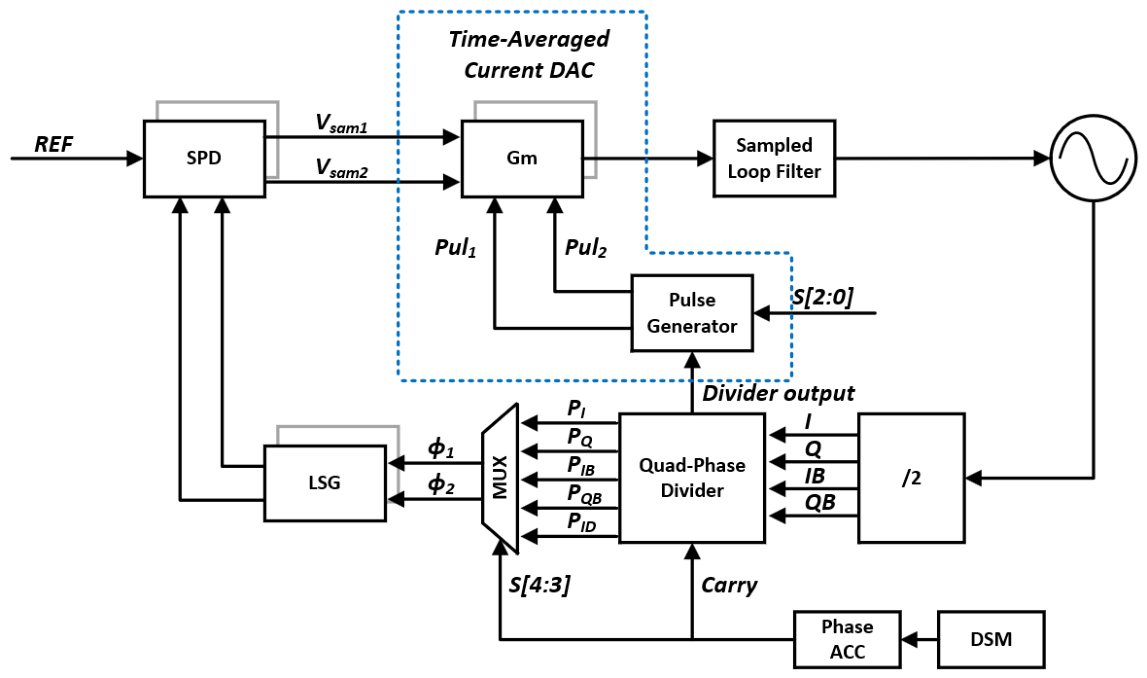
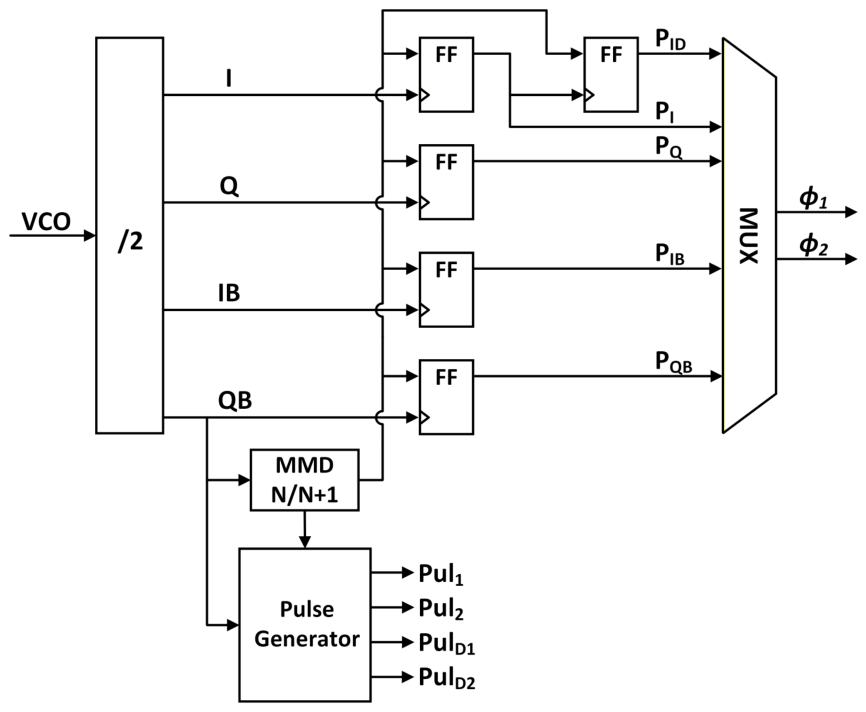
The overall architecture of the proposed PLL based on the time-averaged current DAC, which achieves fractional-N operation by controlling the pulse width of the output currents, is shown in
Figure 1. The output of the LC-VCO is first divided by two to generate quadrature phases
I,
Q,
, and
. The quad-phase divider synchronizes the MMD output with the
I,
Q,
, and
signals to generate signals
,
,
,
, and
, spaced by
(0°, 90°, 180°, 270°, and 360°). For phase wrapping operation, the output of a third-order DSM is accumulated by a 5-bit phase accumulator, and the carry output controls the division ratio of the MMD. A multiplexer selects one of two adjacent phases to generate the sampling edges (
,
), and the two most significant bits (
) of the phase accumulator are used as the selection signals.
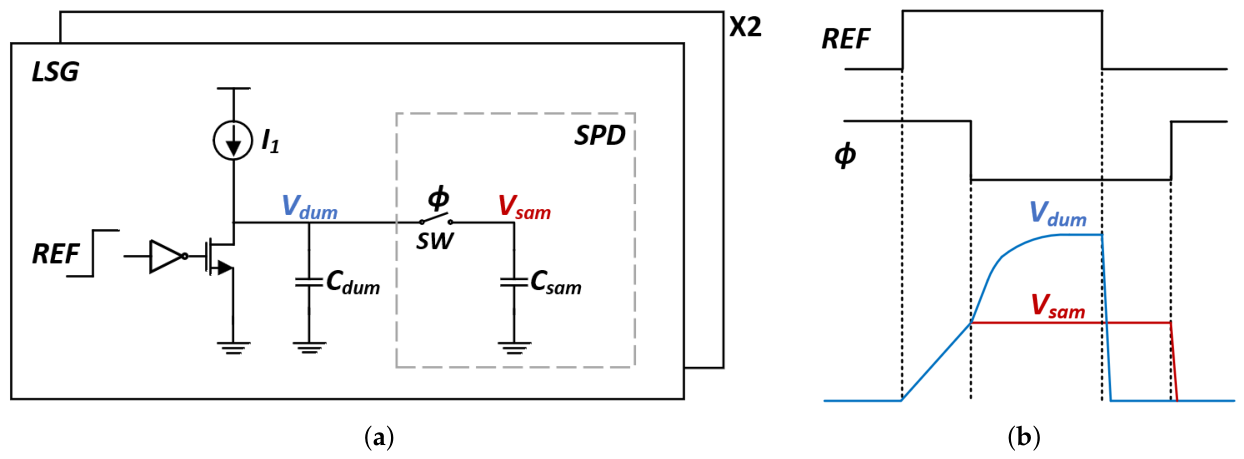
The phase difference between the reference edge and the selected sampling edges (
,
) is detected by two identical LSG/SPDs (linear slope generator/sampling PD). Two LSG/SPD circuits generate the sampled voltages
and
, which are proportional to the phase difference. The sampled voltages are then applied to the
cells, where they are converted into output currents. When
or
are high, the current sources in the
cells inject currents into the loop filter. Let
and
denote the pulse widths of
and
, respectively. The average current is determined by these pulse widths. Specifically, each
cell injects current of
and
for durations of
and
, respectively. As a result, the average output current of the
cells is determined by the time-weighted combination of the two currents, effectively achieving interpolation between adjacent phase samples. The pulse widths
and
are generated based on the least significant 3 bits (
) of the phase accumulator. This operation realizes fractional phase generation in the charge domain without requiring additional analog interpolation circuitry. By controlling
and
, the proposed structure performs time-averaging between two discrete phase points, thereby suppressing quantization noise and improving linearity. Consequently, fine phase resolution is achieved while maintaining a simple and calibration-free implementation. Finally, a sampled loop filter is used, as in [
6], to minimize spurs caused by current pulses injected into the loop filter by the
cells.
2.2. Cells and Time-Averaged Current DAC
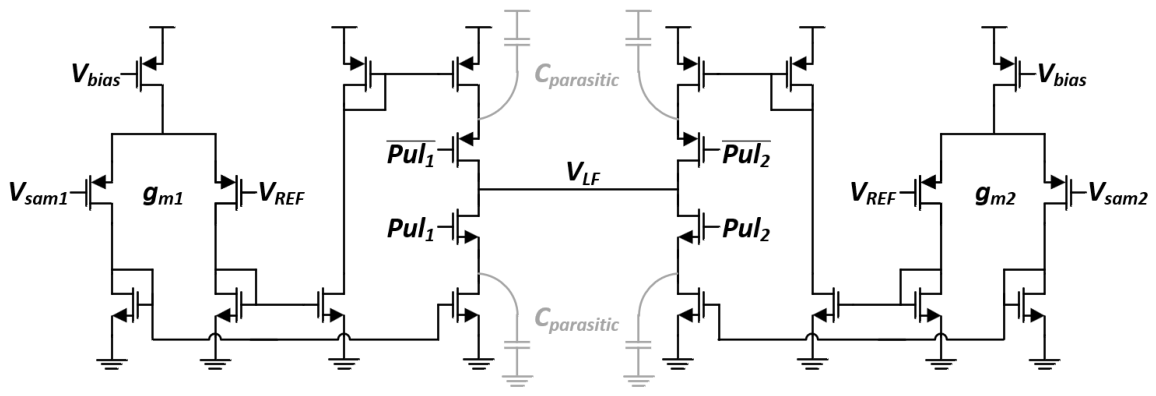
The schematics of the two
cells are shown in
Figure 3. Two identical
cells convert the sampled voltages
and
into output currents proportional to their differences from
. The reference voltage
is set to
so that the LSG operates within its linear region when the PLL is locked, and
and
are designed to be equal. When
is high and
is low, the UP and DN current sources of the
cells are connected to the loop filter and inject current into the loop filter.
and
are designed as non-overlapping pulses.
The proposed time-averaged current DAC is realized by the combination of the two
cells and the pulse signals
and
. The pulse signals are generated by a pulse generator using the divided VCO frequency. Let
denote the pulse width step. Then,
and
can be expressed as
where
ranges from 0 to 7 and is controlled by the least significant 3 bits,
, of the phase accumulator. Let
and
denote the currents injected into the loop filter by the two
cells. As
, the currents are given by
The average output current over the current injection interval
is then given by
Therefore, by adjusting the value of
, the proposed time-averaged current DAC can generate an average current between
and
. This operation yields an average current equivalent to the weighted summation of current sources in a current DAC [
4], under the same total current injection time. It should be noted that
in (5) is defined as the average current over the current injection interval
. The effective average current delivered to the loop filter over one reference period includes the duty factor
and is given by
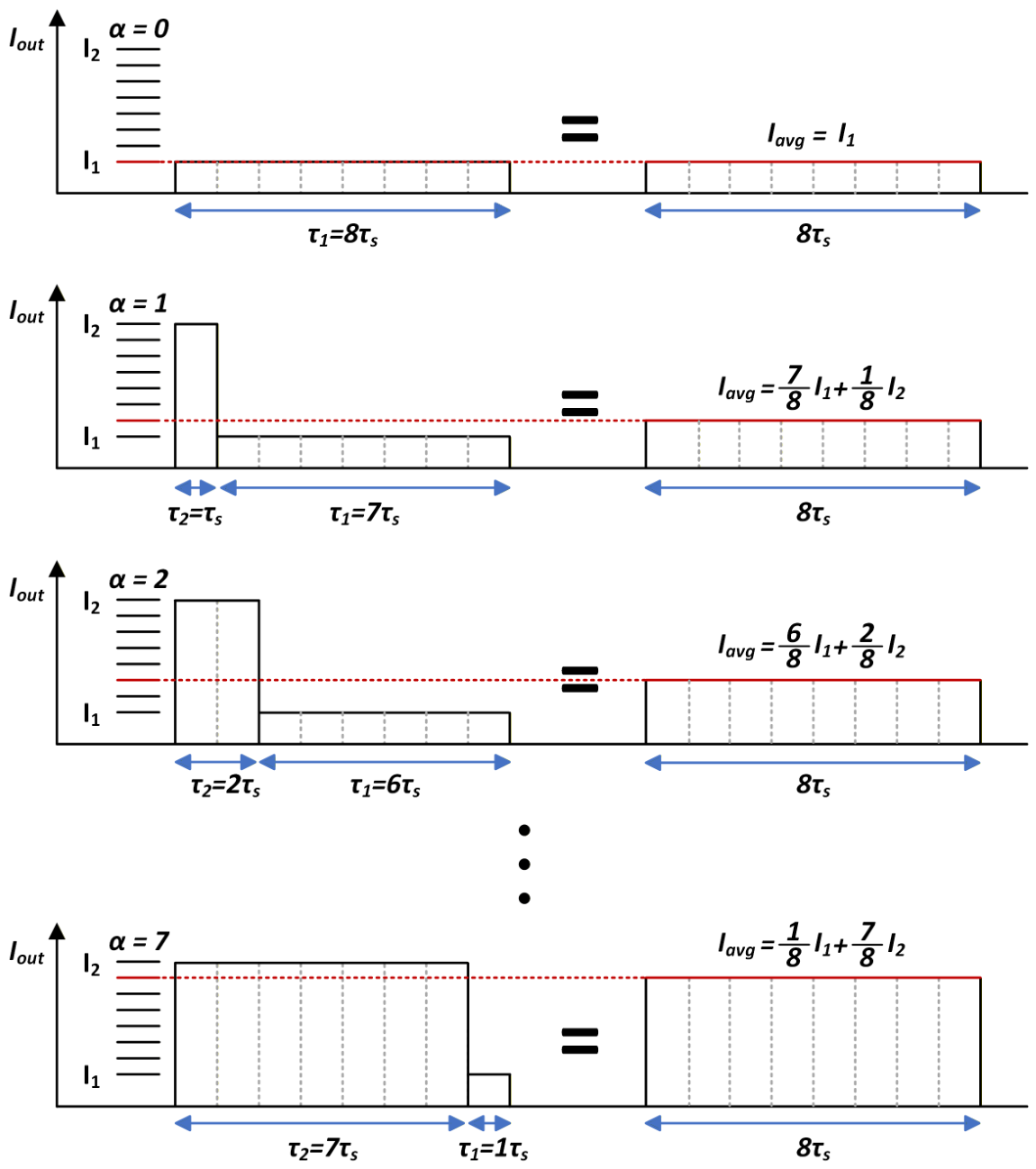
Figure 4 further illustrates the operation of the proposed time-averaged current DAC. For example, when
, the average current over
is equal to
. When
,
is injected into the loop filter for
, while
is injected for
. The resulting average current over
is
. This behavior can be generalized for all values of
, where the output current is interpolated between
and
with a resolution of
. Consequently, the proposed structure effectively realizes a 3-bit current DAC in the time domain, achieving current interpolation without requiring additional analog current sources. The 3-bit resolution was selected for fair comparison with the DAC-based architectures in [
4]. The maximum INL target was set below 0.1 LSB for improved linearity over [
4]. As the interpolation is performed in the time domain using digital pulse control over a reference period, the proposed approach achieves improved linearity.
However, in the proposed structure, when
is low and the switch is open, the drain nodes of the current sources are charged to
for the PMOS and to ground for the NMOS. When the switch turns on, charge sharing occurs between these nodes and the loop filter capacitor, leading to current distortion. This results in degraded linearity of the proposed current DAC. While a unity-gain amplifier could suppress this effect [
7], it incurs a severe power penalty. To address this trade-off, we employ an energy-efficient current dumping technique inspired by [
8]. This approach pre-charges the drain node, effectively resolving the charge sharing issue without the need for power-hungry active amplifiers. However, when the
signal is used to inject current into the dumping node as in [
8],
and
are not equal. This is because the average current injected into
differs from that injected into the loop filter. Therefore, a modified current injection scheme is required for the dumping node in the proposed structure. The final
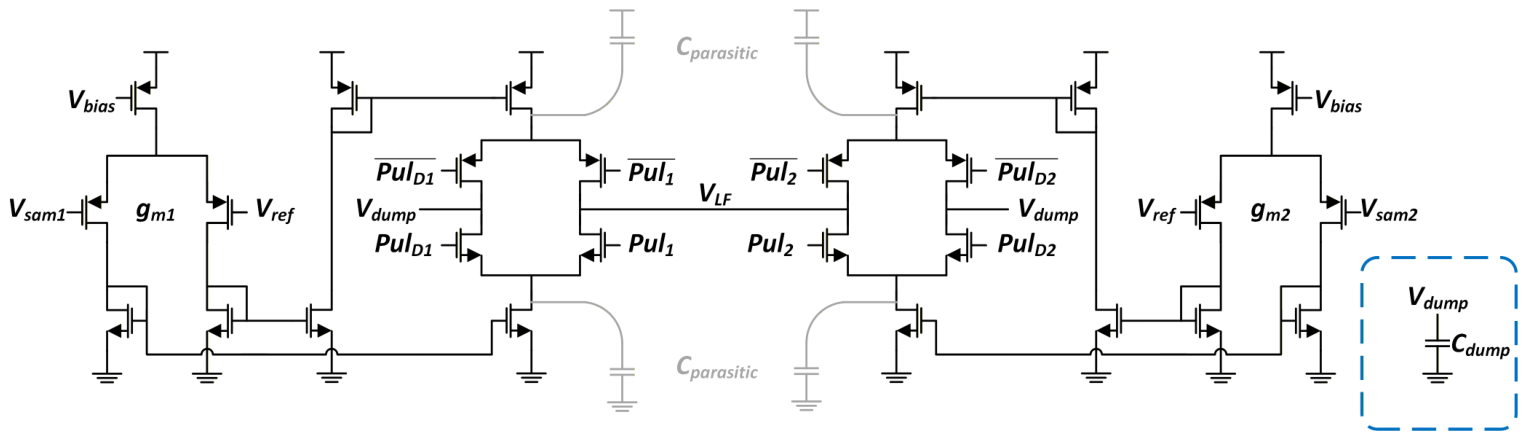
cells structure with improved charge sharing is shown in
Figure 5. In each
cell, an additional current path to
is introduced, and the current is steered to
when the
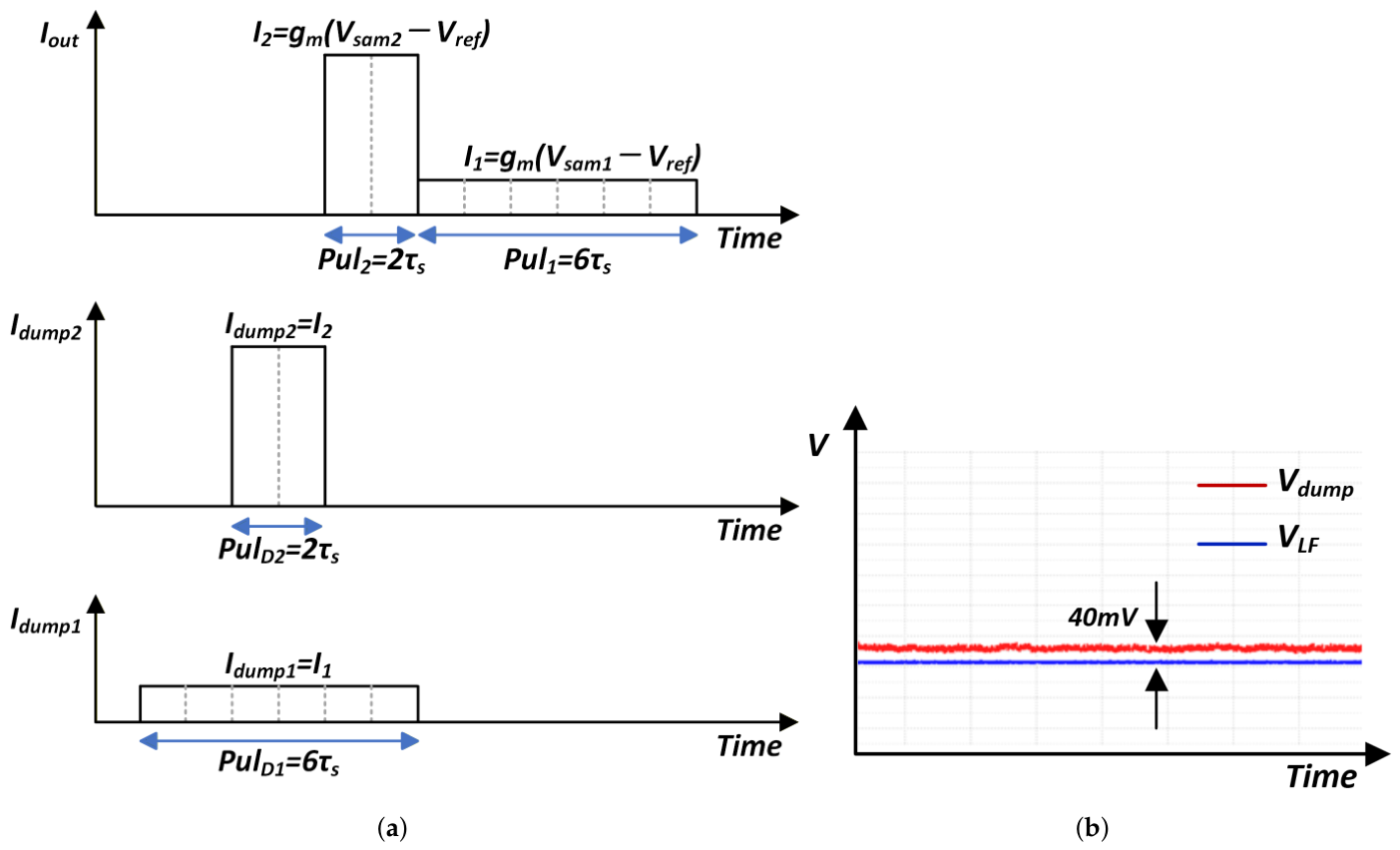
signal is high. The operation of the proposed structure is illustrated in
Figure 6a.
Before the main current is injected into the loop filter, auxiliary pulses
with the same pulse widths as
are used to inject the same amount of current into
. In this way, the voltage at
follows the loop filter voltage (
) and pre-charges the drain node of the current source to the same level. For example, when
,
and
operate in the same manner as in
Figure 4, injecting an average current of
into the loop filter. The auxiliary pulses
and
have the same pulse widths as
and
, respectively.
injects
into
for a duration of
, while
injects
into
for
. Therefore, the total injected current into
is identical to that injected into the loop filter over the same period. In steady state, the net charge delivered to the loop filter and
is zero, and the voltage at
(
) closely follows the loop filter voltage (
) due to channel length modulation. Moreover,
remains high until the
signal is applied, keeping the drain node of the current source at
prior to the main current injection. As a result, the drain node is pre-charged to the loop filter voltage, thereby significantly reducing charge sharing and improving linearity.
The simulated voltages at the
and
nodes are shown in
Figure 6b. The steady-state offset between
and
is mainly caused by parasitic capacitance mismatch at the PMOS and NMOS current source drain nodes. Before the auxiliary dumping pulse
turns on, the PMOS drain node is charged to
, whereas the NMOS drain node is discharged to ground. Thus, when
turns on, the capacitance mismatch between the two drain nodes introduces an additional charge error into
, resulting in the steady-state offset between
and
. The impact of this offset on the DAC linearity is further analyzed in
Section 2.2.2.
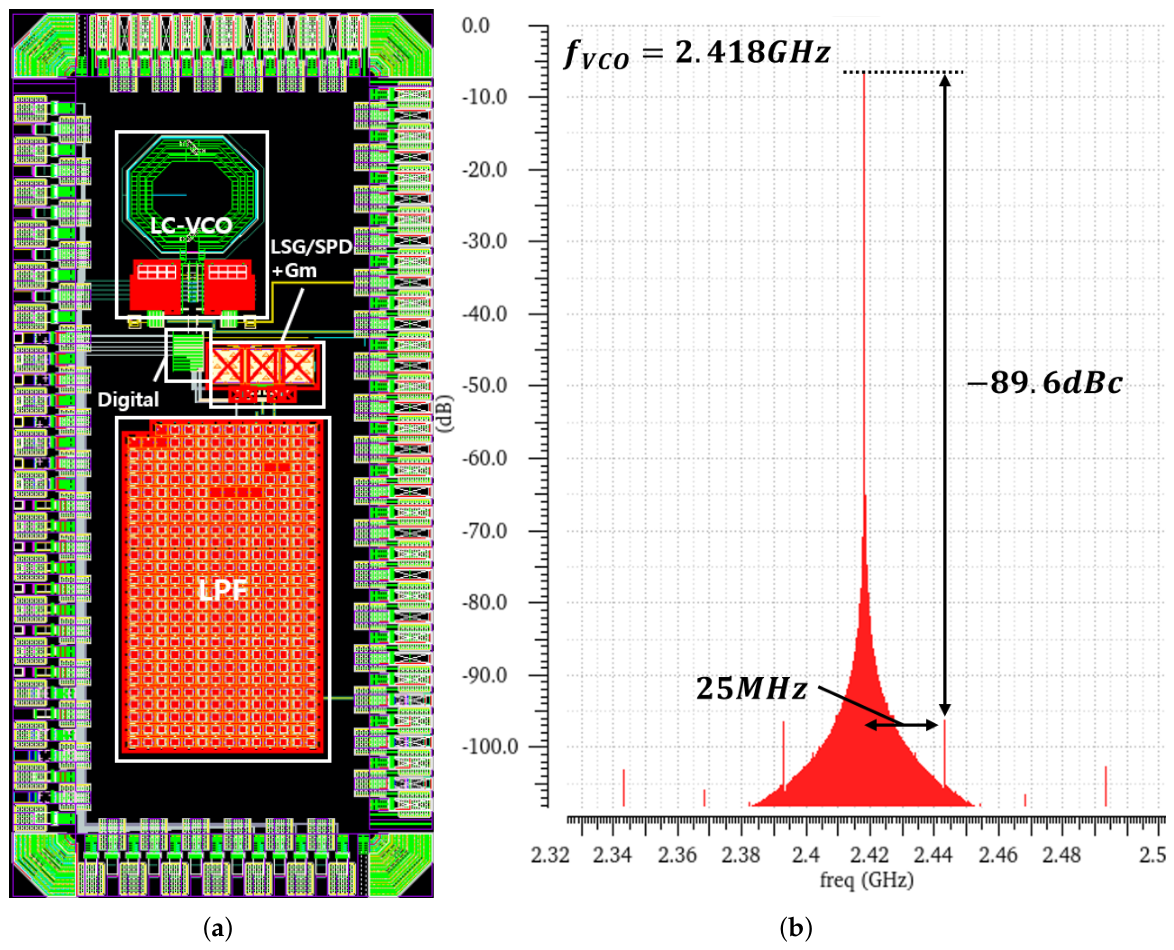
Another design consideration is the selection of the pulse width step . If the pulse width of is too short, the drain node of the current source does not have sufficient time to settle to , which still causes distortion in the output current. Therefore, in this work, the pulse width step is set to to ensure sufficient settling time. The reference frequency is also set to 25 MHz to provide sufficient current injection time within each reference period.
2.2.1. Analytical Linearity Modeling of the Time-Averaged Current DAC
To analytically explain the linearity behavior of the proposed time-averaged current DAC, the average current is modeled by considering charge sharing induced current error,
mismatch, and timing related non-idealities. For the 3-bit interpolation, the pulse widths
and
are determined by the interpolation code
as
where
is the pulse width step. Therefore, the total current injection time is kept constant as
The ideal average current delivered to the loop filter over one reference period can be expressed as
where
and
are the output currents of the two
cells. As
is constant, the ideal average current changes linearly with the interpolation code. In practical implementation, the residual average-current error can be decomposed into several error components as
where
,
, and
represent the residual errors due to charge sharing,
mismatch, and timing related non-idealities, respectively.
The current domain errors caused by charge sharing and
mismatch can be modeled as current errors during the two pulse intervals. In addition, timing related non-idealities, such as pulse edge jitter and duty cycle distortion, can be modeled as effective pulse width errors. When both current domain errors and time domain errors are included, the actual average current over one reference period can be written as
where
and
represent the current errors during
and
, respectively, and
and
represents the effective pulse width errors.
The residual average current error is then given by
As
and
are small current perturbations and
and
are small timing perturbations, the product terms
and
are much smaller than the first-order error terms. Therefore, these terms can be neglected, and the residual average current error can be approximated as
The first term represents the current domain residual error caused by charge sharing and
mismatch, while the second term represents the time domain residual error caused by pulse width errors. These pulse width errors mainly originate from the VCO timing variation used in the pulse generator. Even under free-running VCO conditions, the resulting timing error is expected to be only on the order of a few
, which is much smaller than the minimum pulse width
of approximately 1.67 ns. As
is a few μA, the time domain error term
is approximately two orders of magnitude smaller than the current-domain error term
under this design condition. Therefore, the time domain residual error is negligible compared with the current domain residual error. Consequently, the residual average current error is dominated by the current domain term and can be simplified as
The INL is then obtained by normalizing this residual error to the ideal LSB current:
where the ideal LSB current over one reference period is defined as
Based on this residual error model, the proposed time-averaged current DAC is designed to keep the maximum INL below 0.1 LSB. The charge sharing induced current error is identified as the dominant residual error, which is further verified through the offset sweep and Monte Carlo simulations. The corresponding simulation results are discussed in detail in the following paragraphs.
2.2.2. Linearity Verification of the Proposed Time-Averaged Current DAC
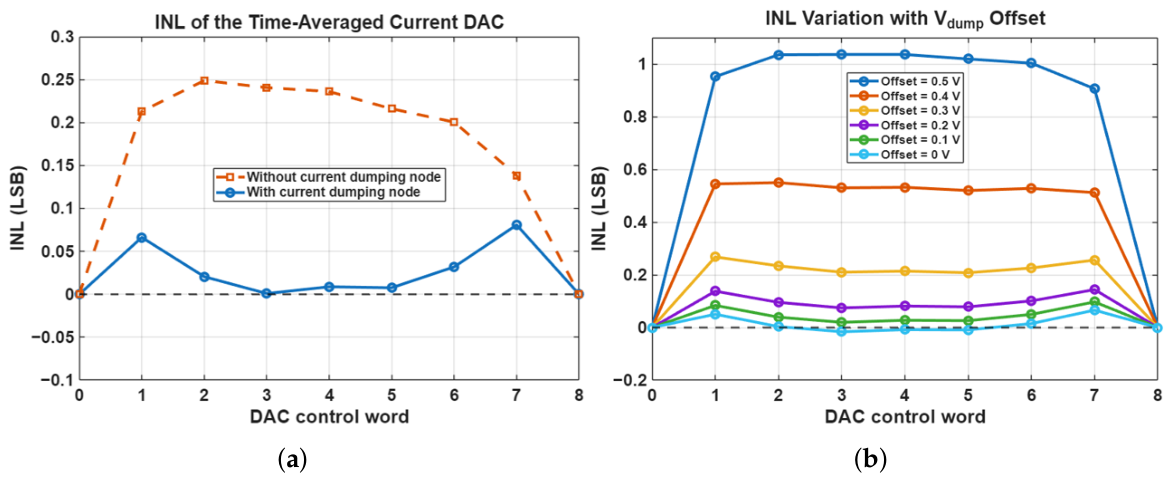
Figure 7a shows the linearity of the time-averaged current DAC with and without the charge sharing reduction structure for a typical simulation run. The structure with the current dumping node shows much better linearity than the one without it, confirming that the proposed charge sharing reduction structure effectively suppresses the current domain residual error. The INL degradation is mainly observed at DAC codes 001 and 111, where one of the pulse widths becomes the minimum value of
. It is meaningful to analyze the change in DAC linearity according to the offset between
and
.
Figure 7b shows the simulated INL for different offsets between
and
. When the offset is large, the charge sharing reduction structure cannot effectively suppress the charge sharing effect. As a result, the INL increases over the entire DAC code range. When the offset decreases, the overall charge sharing induced error is reduced, and the residual INL degradation is mainly observed at DAC codes 001 and 111. This indicates that, after the offset between
and
is sufficiently reduced, the DAC linearity is primarily limited by the insufficient pre-charging time of the current source drain node. In this work, the offset is designed to remain below 50 mV, which is sufficient to meet the target INL requirement. To reduce the offset, the PMOS current source is sized to match the NMOS parasitic capacitance, at the cost of voltage headroom. The lengths of the current source are selected by considering the area-matching trade-off and the required output resistance, which leads to an increase in the drain node parasitic capacitance.
In this work, the two cells are implemented with a carefully symmetric layout to minimize mismatch. Nevertheless, mismatch between the two cells produces unequal transconductance values. In the proposed time-averaged current DAC, the interpolated average current is determined by the weighted combination of the two outputs. Therefore, the mismatch appears as a code-dependent current error and can degrade the linearity, resulting in INL degradation and potentially increasing fractional spurs. To verify the robustness of the DAC-based interpolation against device mismatch, Monte Carlo simulations were performed with mismatch variations applied to the two cells.
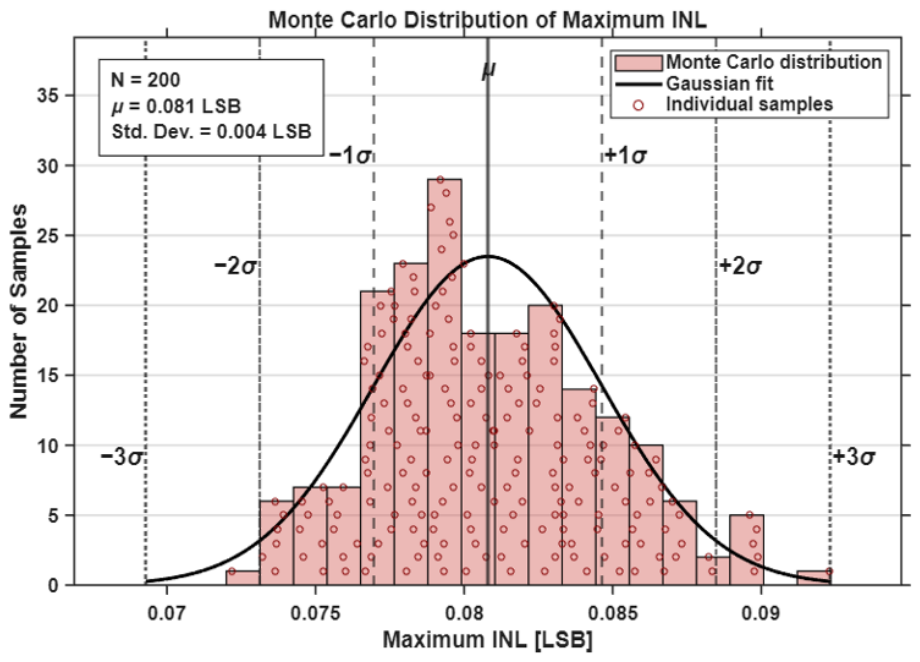
As shown in
Figure 8, the simulated maximum INL remains within 0.0923 LSB within the 3
range over 200 Monte Carlo runs, demonstrating that the DAC-based interpolation maintains sufficient linearity under
cell mismatch. In each Monte Carlo run, the maximum INL occurs at codes 001 and 111, indicating that the maximum INL is mainly dominated by charge sharing induced current distortion rather than by
cell mismatch.
2.3. Quad-Phase Divider and Pulse Generator
The MMD circuit is shown in
Figure 9. The MMD is implemented by cascading 2/3 divider cells, as in [
9]. When an input signal with a frequency of
(denoted as
) is applied,
is divided according to the division ratio selected by
. The resulting output frequency is denoted as
and is used in the quad-phase divider. In addition, the MMD generates another output,
, with the same division ratio and a pulse width of
, which is used in the pulse generator.
The quad-phase divider is shown in
Figure 10. The operation of the quad-phase divider is as follows. A frequency divide-by-2 receives the VCO output and generates quadrature phases
I,
Q,
, and
with a spacing of
. These signals are then used to synchronize the MMD output
, generating phase signals
,
,
,
, and
(corresponding to 0°, 90°, 180°, 270°, and 360°). A multiplexer uses the two most significant bits (
) of the phase accumulator to select two adjacent phases from
to
and uses them as the sampling edges (
,
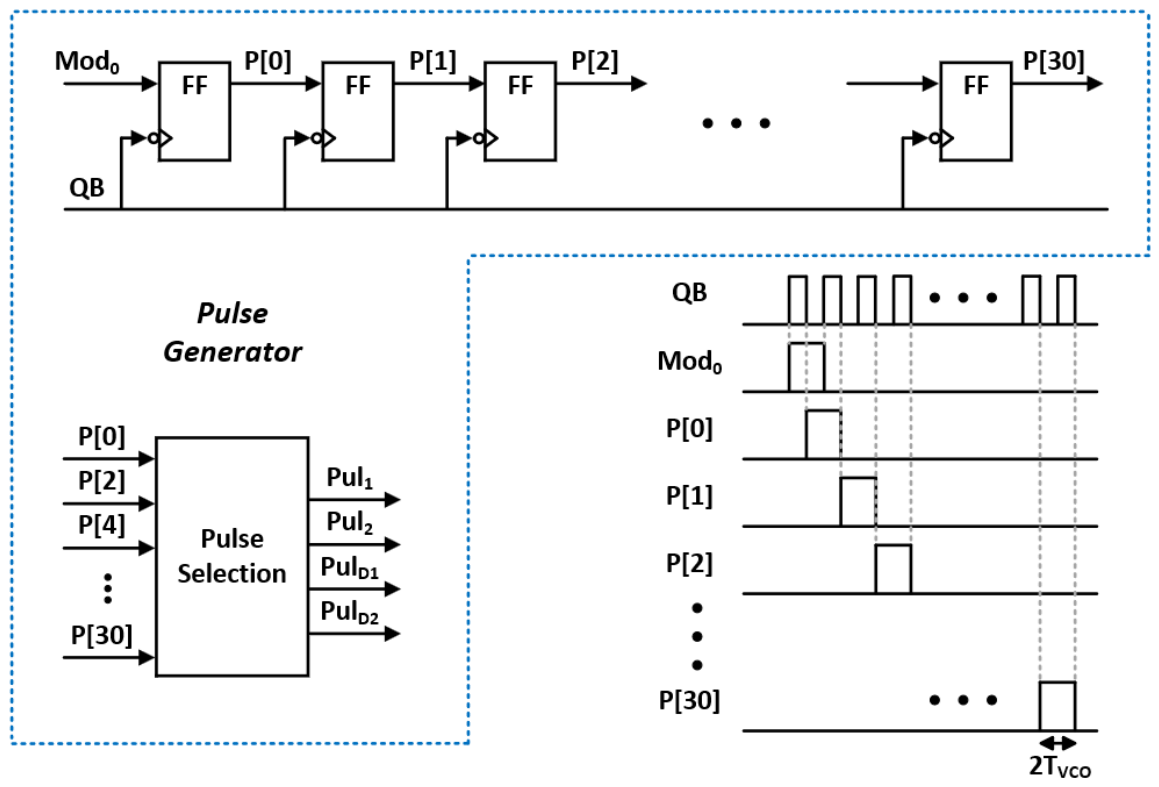
) for the LSG/SPD. To generate the pulse signals required for the time-averaged current DAC, a pulse generator is employed, as shown in
Figure 11. The pulse generator consists of two main blocks: a shift register that generates multiple delayed pulse edges and a pulse selection block that selects the rising and falling edges of the output pulses. The shift register is clocked by
and generates a pulse sequence with a constant edge spacing of
.
The operation of the shift register is as follows. The
signal is first aligned with the rising edge of
in the MMD. It is then sampled at the falling edge of
by the first flip-flop of the shift register to generate
. The shift register then shifts
through each stage with a delay of
per flip-flop, driven by the falling edge of
. This process generates the pulse sequence
to
. The corresponding waveform of this operation is shown in
Figure 11. The signals
to
are used in the pulse selection block to control the pulse widths of
,
,
, and
.
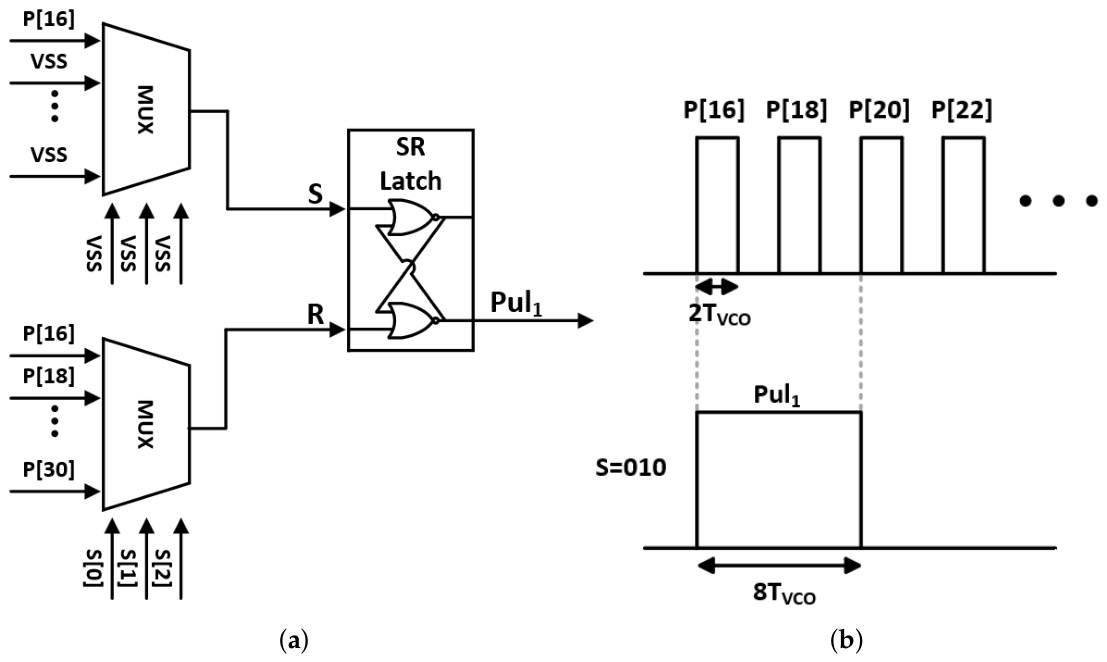
As shown in
Figure 12a, the pulse selection block consists of multiplexers and SR latches, and its operating waveform is illustrated in
Figure 12b. The multiplexers select two pulses from the delayed pulse sequence
and apply them to the
S and
R inputs of the SR latch. As the pulse step is set to
, only even-indexed pulses among
are used as inputs to the multiplexer. The rising edge of the
S-input pulse determines the rising edge of the latch output, while the rising edge of the
R-input pulse determines the falling edge. The selection signals of the multiplexer are determined by the least significant 3 bits (
) of the phase accumulator to generate the desired pulse width. For example, when
, the rising edge of
is aligned with the rising edge of
. The falling edge is aligned with
, resulting in a pulse width of
. The remaining signals,
,
, and
, are generated in the same manner, as illustrated in
Figure 6a.
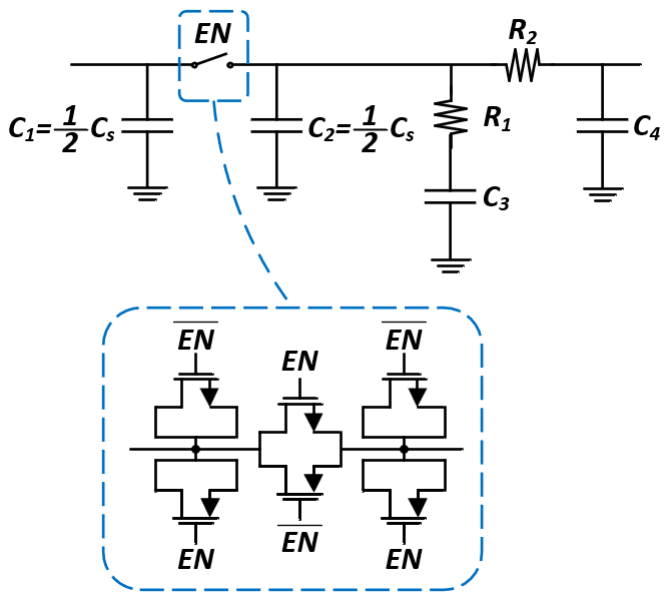
2.4. Sampled Loop Filter
When the proposed time-averaged current DAC operates, different currents from the two
cells are injected into the loop filter, which causes voltage variation at
and increases spurious tones. To minimize these spurs, a sampled loop filter structure, as in [
6], is used, and its schematic is shown in
Figure 13. The capacitor
is divided into two equal capacitors with a switch between them. When the
signal is high,
is connected to the rest of the loop filter. The switch is implemented using a transmission gate with a dummy switch to reduce charge injection. When current is injected from the
cells, the switch is open, and
integrates the current. After the current injection ends, the voltage on
settles. Then, the switch is closed to allow charge sharing between
and the rest of the loop filter. As a result, voltage variation is prevented from directly propagating to the loop filter, which suppresses spur components.
To quantify the contribution of the sampled loop filter, the fractional spur was compared with and without the sampled loop filter. When the sampled loop filter is enabled, the fractional spur is further reduced by approximately 1 dB. Compared to [
10], which employs a wide loop bandwidth, the sampled loop filter has a smaller impact in this work, as the narrow loop bandwidth already sufficiently attenuates the fractional spur.
Even under this condition, the sampled loop filter further suppresses the residual fractional spur that remains after the loop-dynamics attenuation. Thus, it serves as an auxiliary spur suppression mechanism that offers additional design margin and robustness.