Article

Design of a Dual-Band Doherty Power Amplifier with High Efficiency for Communication Systems

1
Institute of Telecommunication and Navigation Satellite, China Academy of Space Technology, Beijing 100080, China
2
Innovation Center of Satellite Communication System, China National Space Administration, Beijing 100080, China
*
Author to whom correspondence should be addressed.
Electronics 2026, 15(11), 2383; https://doi.org/10.3390/electronics15112383
Submission received: 4 April 2026 / Revised: 12 May 2026 / Accepted: 13 May 2026 / Published: 1 June 2026
(This article belongs to the Section Electronic Materials, Devices and Applications)

Abstract

Power amplifiers are one of the most important microwave components and key equipment in satellite transponder subsystems. It plays a significant role in enhancing the overall capabilities of satellite systems, optimizing thermal design, and ensuring reliability. The rapid development of High Throughput Satellites (HTS) and global mobile communication satellites imposes challenges to power amplifier design. This paper presents a dual-band Doherty power amplifier (DPA) with a hybrid GaN HEMT device and a commercial transistor that can operate simultaneously at 0.9 GHz and 2.14 GHz. At 6 dB output power back-off (OBO), the proposed amplifier achieves drain efficiencies of 42% and 37% at the two frequency bands respectively. When excited by a 20 MHz 16 QAM signal, it exhibits adjacent channel power ratios (ACPR) of −45.4 dBc and −48.6 dBc at output power levels of 34.8 dBm and 34.9 dBm respectively. A novel dual-band offset line structure was employed to achieve the required dual-band load modulation. The proposed DPA is well-suited for application in dual-band wireless communication systems.

1. Introduction

With the advancement of modern communication technologies, there is an increasing demand for dual-band, multi-band, and high-efficiency power devices in communication systems. It imposes higher requirements on multi-band components particularly Doherty power amplifier (DPA). The DPA was first proposed in 1936 [1]. Tsinghua University pioneered a concurrent dual-band DPA architecture, which was presented and awarded at the APMC (Asia-Pacific Microwave Conference) conference in Japan [2]. Subsequently, they successfully developed several DPAs including a high-linearity, high-efficiency dual-band DPA based on a frequency-dependent power division dual-band coupler [3], a three-way dual-band DPA utilizing a frequency-dependent power division dual-band power divider [4] and an asymmetric dual-band DPA also based on a frequency-dependent power division dual-band power divider [5]. Irish scholar Andrei Grebennikov effectively circumvented the need for dual-band impedance transformation between the combining network and output port by altering the characteristic impedance of the combining transmission lines, resulting in a parallel-structured dual-band DPA with enhanced bandwidth characteristics [6]. Swedish researchers Paul Saad achieved a high-performance 1.8/2.4 GHz dual-band DPA through comprehensive co-optimization of passive components like couplers, offset lines, and the power amplifier structure [7]. German scholar Xuan Anh Nghiem implemented multi-band DPAs for wireless communications based on a novel multi-band impedance transformer network [8]. The renowned research group of Canadian scholar Raafat R. Mansour successively designed reconfigurable multi-band DPAs and electrically tunable multi-mode, multi-band DPAs [9,10]. To meet modern communication demands, these concepts have been subsequently developed and refined [11,12,13,14,15,16,17,18].
We present the design of a DPA operating concurrently at 0.9 GHz and 2.14 GHz. The main amplifier operates in Class-AB, while the peaking amplifier operates in Class-C. By employing a novel dual-band offset line structure, the passive components of a traditional single-band DPA are replaced with the dual-band counterparts, successfully realizing a dual-band DPA prototype. And the designed dual-band DPA is fabricated and measured after linearizing using digital pre-distortion (DPD). This paper is organized as follows. Section 2 details the design of the dual-band DPA, including its key components. Section 3 presents the experimental results. Conclusions are drawn in Section 4.

2. Dual-Band Doherty Power Amplifier Design

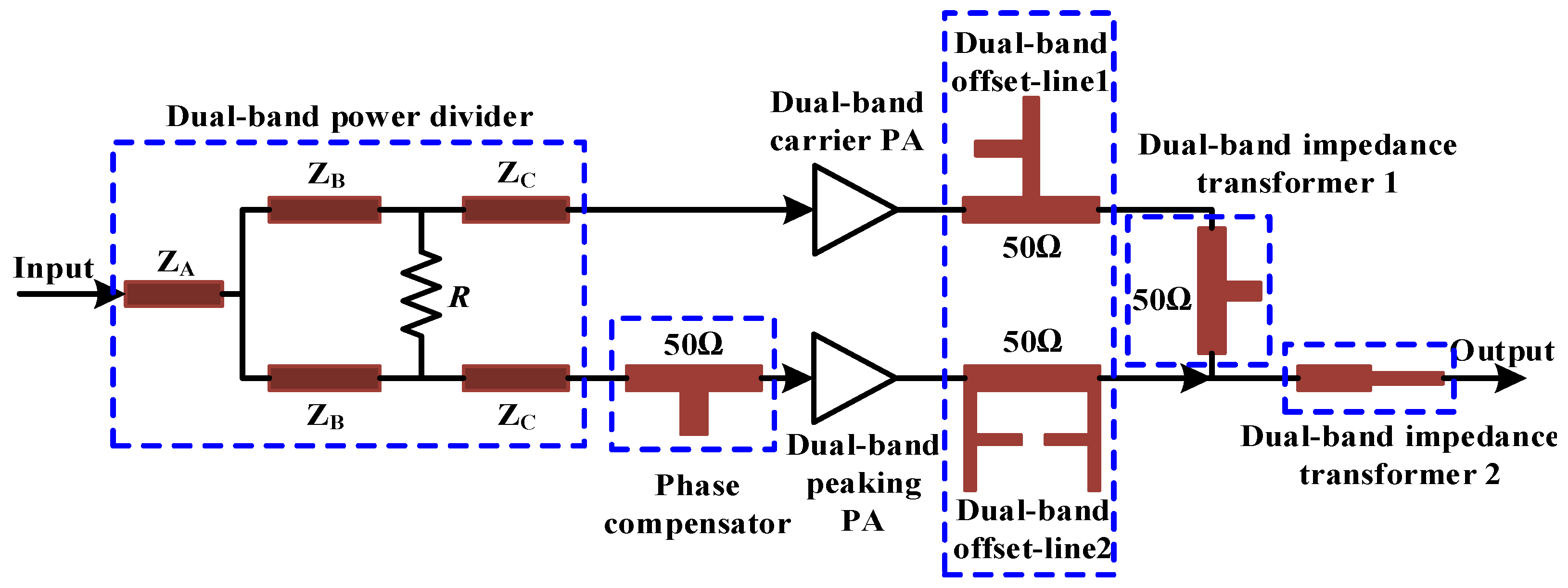
The architecture of the proposed dual-band DPA is derived from the conventional single-band DPA by substituting single-band components with dual-band equivalents, resulting in an overall circuit with dual-band characteristics. Figure 1 illustrates the block diagram of the proposed dual-band DPA, comprising a dual-band power divider, dual-band offset lines, dual-band carrier/peaking PAs, a phase compensation network, and a dual-band impedance transformer. The core active devices are the carrier and peaking amplifiers, biased in Class AB and Class C respectively. To achieve dual-band operation, all constituent parts must function effectively at both design frequencies.

2.1. Dual-Band Offset Lines

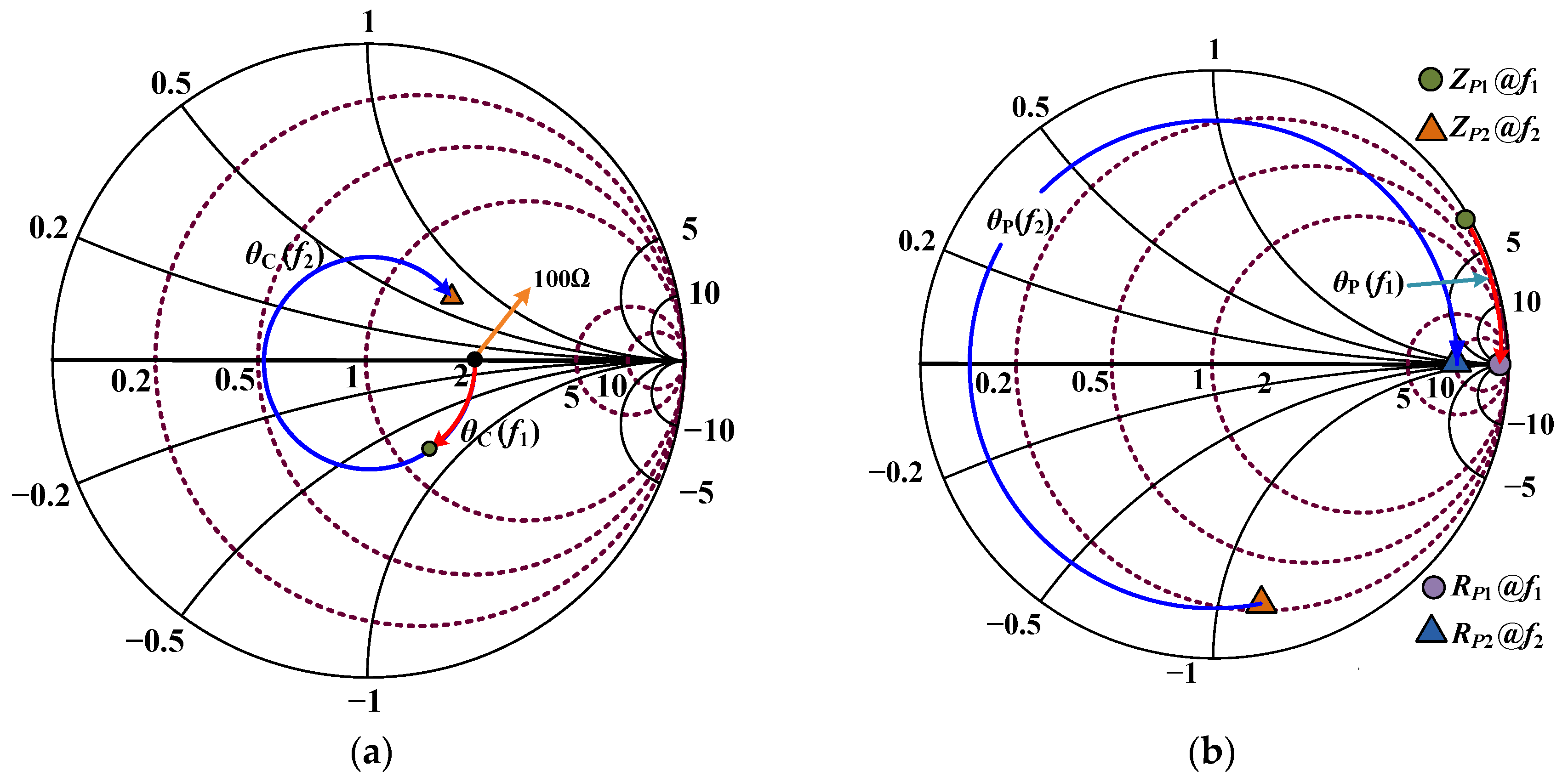
Offset lines are connected after the carrier and peaking PAs to ensure proper load modulation, as shown in Figure 2. When the dual-band carrier PA is saturated, the dual-band offset line 1 should appear as 50 Ω. To enhance efficiency, the output is matched to 100 Ω (twice the optimum load) when working at low input power levels. Based on the efficiency-optimized design of PA, the dual-band offset line 1 (T-section) provides phase shifts of θ C ( f 1 ) = 27 and θ C ( f 2 ) = 160 at frequencies f 1 and f 2 respectively. To present a high impedance at the output of the peaking PA, the dual-band offset line 2 (π-section) provides independent electrical lengths at the two frequency bands. Transforming the peaking amplifier output impedances Z p 1 = 2.1 + j 196.7 to high impedances Z p 1 = 9950   Ω and Z p 2 = 1.68 j 75.8 to Z p 2 = 4850   Ω requires electrical lengths of 14° and 146° respectively.
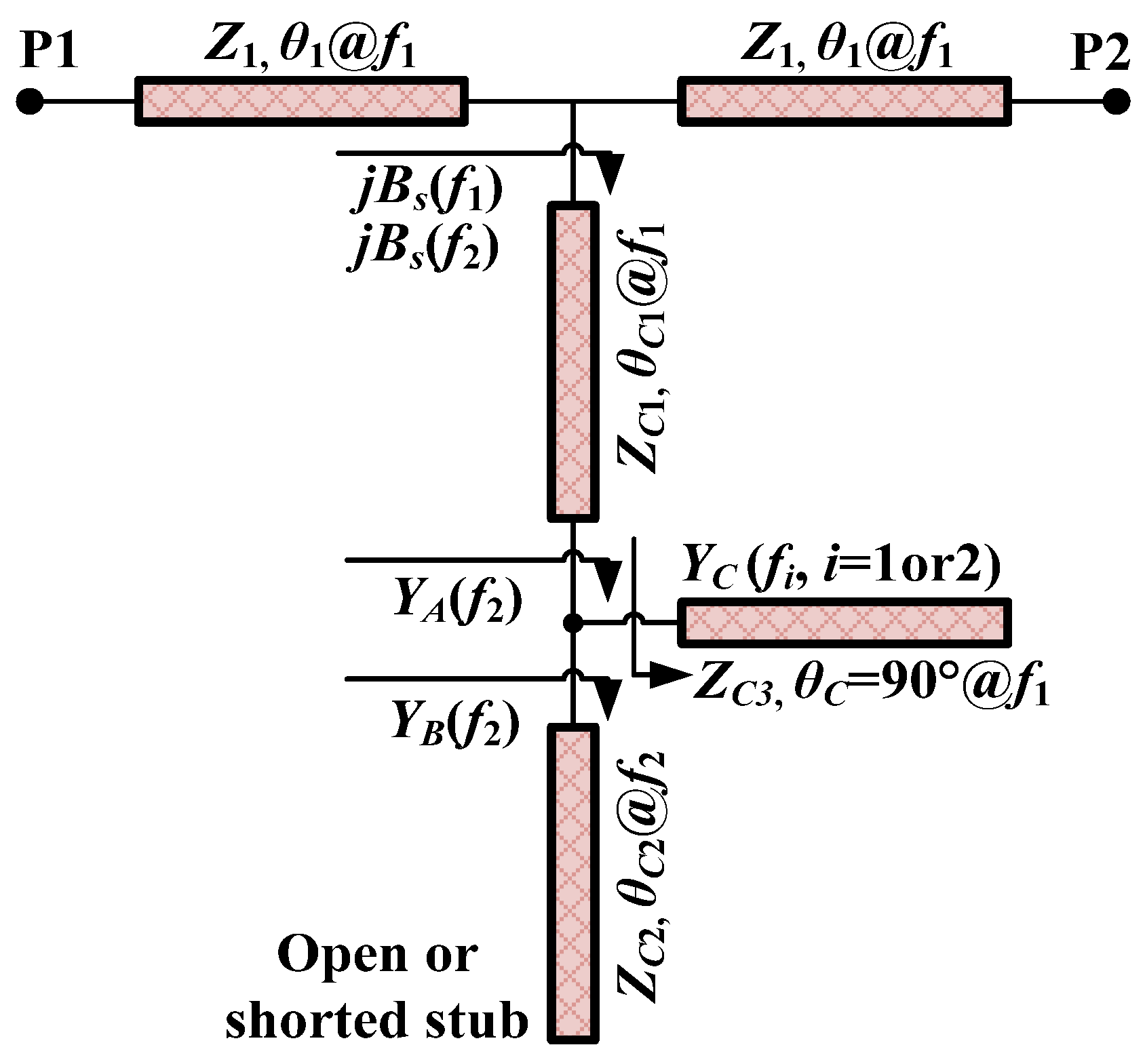
The proposed T-section dual-band offset line is depicted in Figure 3. It can be equivalent to a dual-band transmission line with arbitrary electrical lengths θ T 1 and θ T 2 at frequencies f 1 and f 2 , while maintaining a characteristic impedance Z T (50 Ω) at both bands.
Assume the two microstrip line sections connected to the shunt stub j B s have characteristic impedance Z 1 and electrical length θ 1 . The characteristic impedance and electrical length of the loaded structure are
cos ( θ T ) = cos ( 2 θ 1 ) 0.5 B s Z 1 sin ( 2 θ 1 )
Z T = Z 1 sin 2 θ 1 B S Z 1 sin 2 θ 1 sin 2 θ 1 + B S Z 1 cos 2 θ 1
If n is the frequency ratio n = f2/f1, then (1) and (2) can be rearranged as:
B S Z 1 sin 2 n θ 1 = 2 cos 2 n θ 1 cos θ T @ f 2   h e r e   n = 1 @ f 1
Z 1 2 Z T 2 = sin 2 n θ 1 + B S Z 1 cos 2 n θ 1 sin 2 n θ 1 B S Z 1 sin 2 n θ 1 @ f 2   h e r e   n = 1 @ f 1
And hence,
Z 1 = Z T tan θ T 1 2 tan θ 1   @ f 1 ,   Z 1 = Z T tan θ T 2 2 tan n θ 1   @ f 2    
The two tangent series can be expressed as:
tan ( n θ 1 ) tan ( θ 1 ) = a 0 + a 1 ( θ 1 ) 2 + + a 4 ( θ 1 ) 8 + , θ 1 k π 2 n , k = 1 , 2
The coefficients can be derived:
a 0 = n ,             a 1 = n 3 n 3 ,                 a 2 = 2 n 5 n 15 a 1 3 , a 3 = 17 n 7 n 315 2 a 1 15 a 2 3 ,         a 4 = 62 n 9 n 2835 17 a 1 315 2 a 2 15 a 3 3 ,
If θ T 1 , θ T 2 and n are known, the electrical length θ 1 and characteristic impedance Z 1 can be obtained:
θ C 1 = arctan 1 Z C 1 B S f 1
θ C 2 = arctan Z C 2 · i m a g Y B f 2                                                   for   open   stub arctan 1 Z C 2 · i m a g Y B f 2                         for   shorted   stub        
where
Y B f 2 = Y A f 2 j 1 Z C 3 tan π 2 f 2 f 1
Y A f 2 = j 1 Z C 3 Z C 1 B S f 2 tan θ C 1 f 1 · f 2 f 1 1 + Z C 1 B S f 2 tan θ C 1 f 1 · f 2 f 1
Given the required phase shifts θ T 1 ( f 1 ) = 27 and θ T 2 ( f 2 ) = 160 at f 1 and f 2 , the calculated parameters can be calculated:
Z 1 = 16   Ω Z C 1 = Z C 2 = Z C 2 = 50   Ω θ 1 = 36.5 θ C 1 = 14.6 θ C 2 = 70.7
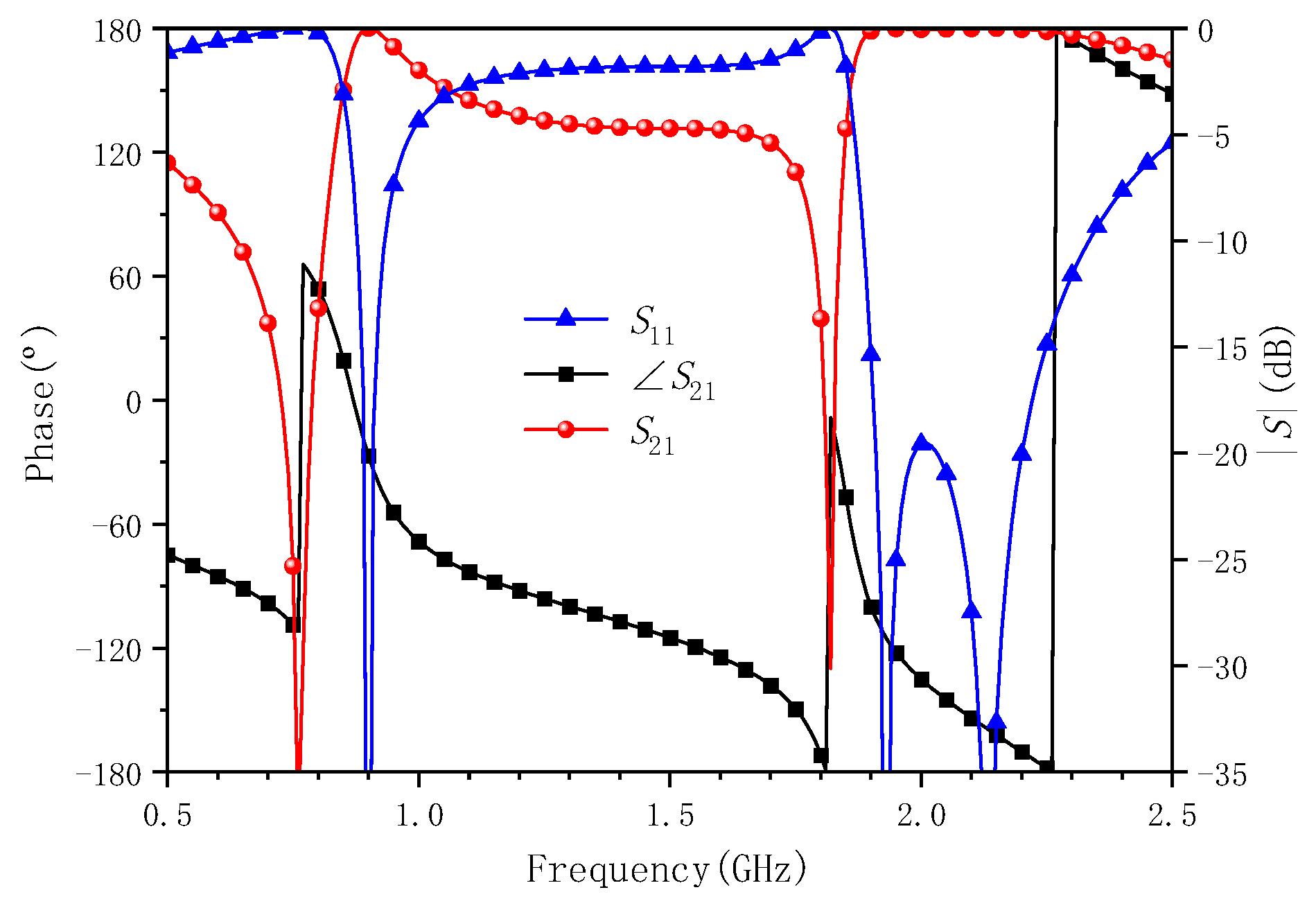
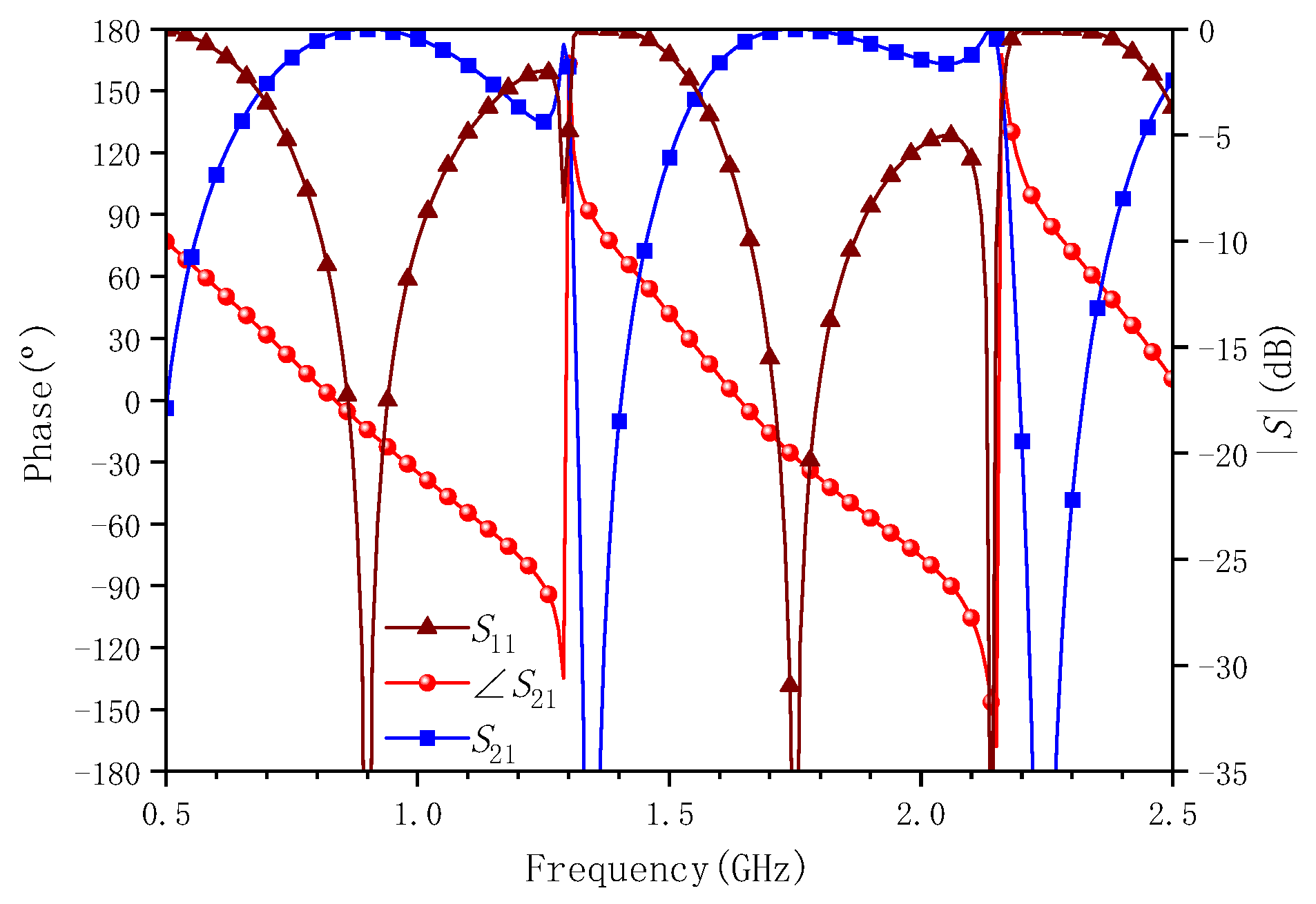
The design results for offset line 1 are shown in Figure 4.
The detailed design methodology for the dual-band offset line 2 (π-section) can be found in [19], and its design results are presented in Figure 5.

2.2. Dual-Band Power Divider

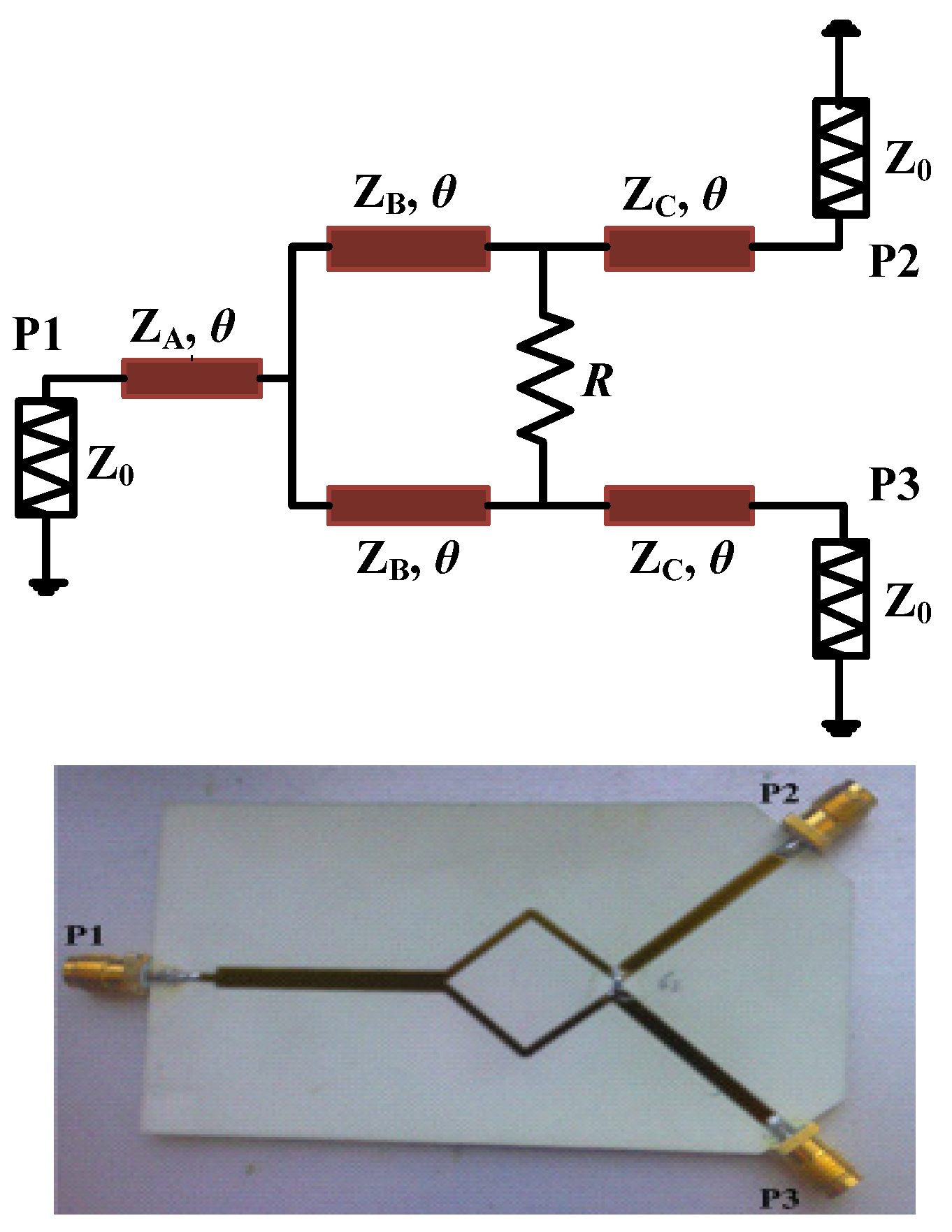
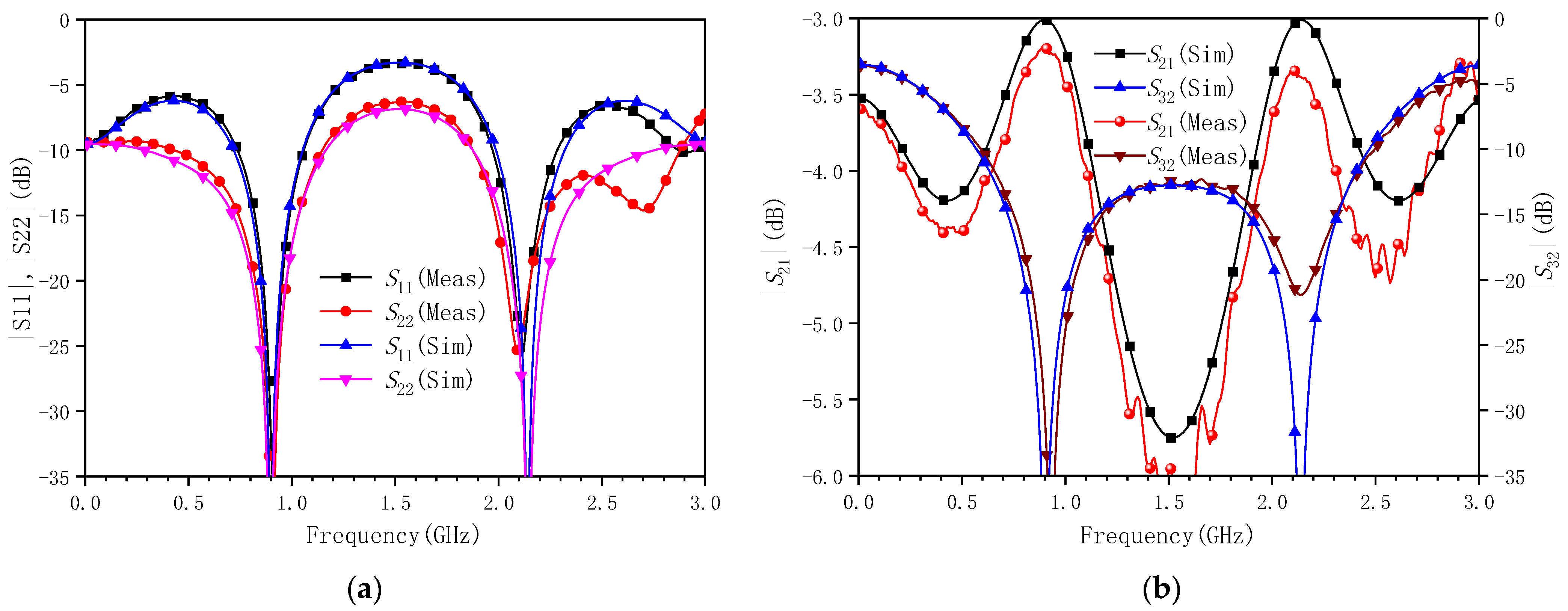
In a DPA, the power divider distributes the input signal appropriately to the carrier and peaking amplifier paths. For this dual-band DPA application, a dual-band 3 dB Wilkinson power divider is designed. We select a Wilkinson power divider with extended ports [20]. To achieve concurrent operation at 0.9 GHz and 2.14 GHz with equal power division, good port matching, and high-output port isolation, the structure and fabricated circuit are shown in Figure 6. The calculated parameters that can meet the specifications are: Z A = 24   Ω , Z B = 49   Ω , Z C = 31   Ω , θ = 53.3 , R = 61   Ω . Using Rogers 4350B substrate (the dielectric constant is 3.48 and the substrate thickness is 20 mil), the physical dimensions of the microstrip lines can be calculated ( W : width, L : length): W A = 125   mil , L A = 1127   mil , W B = 45   mil , L B = 1180   mil , W C = 88   mil , L C = 1145   mil , R = 62   Ω . The simulation and measurement results are shown in Figure 7. The power divider exhibits excellent port matching, with return loss better than 20 dB at the operating frequencies. It also demonstrates good power transmission and isolation, with isolation exceeding 20 dB and insertion loss better than 3.4 dB within the operating bands.

2.3. Dual-Band Carrier/Peaking Power Amplifiers

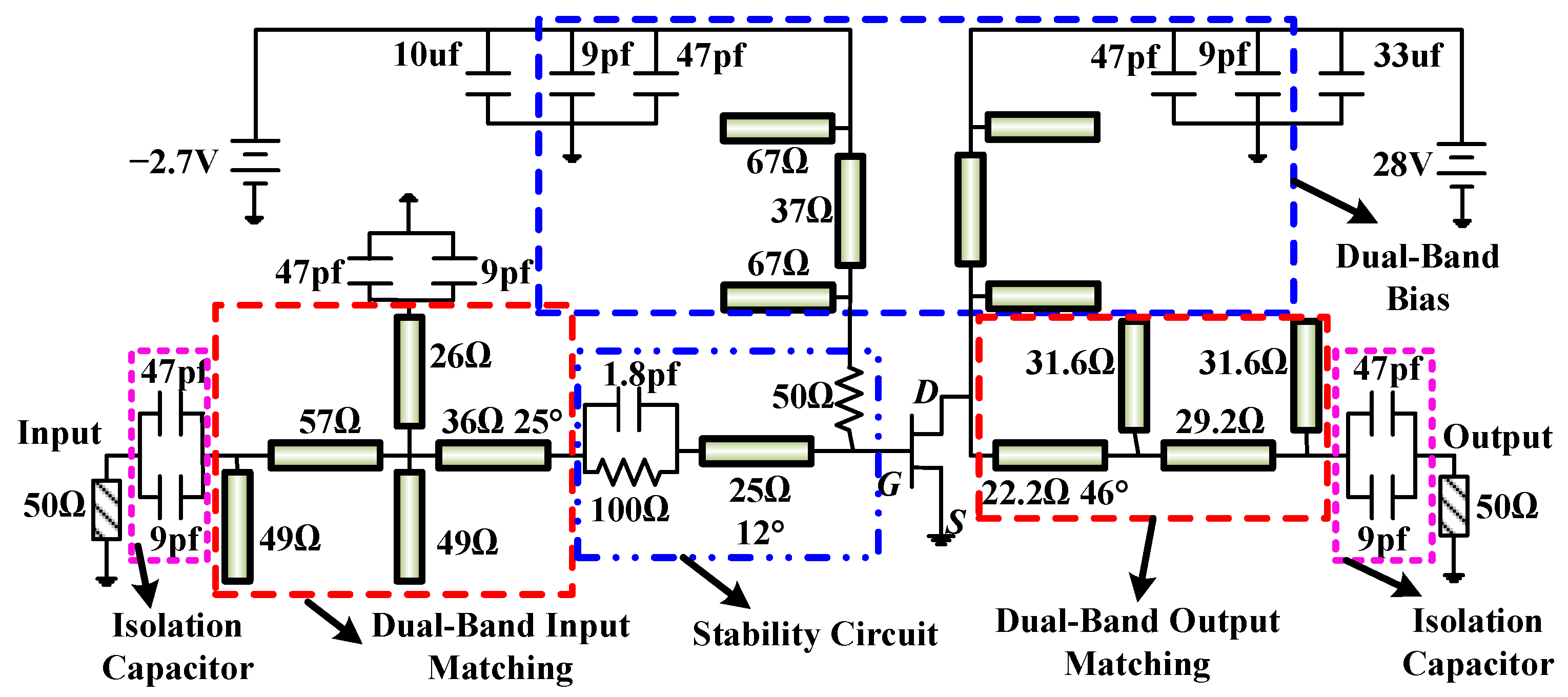
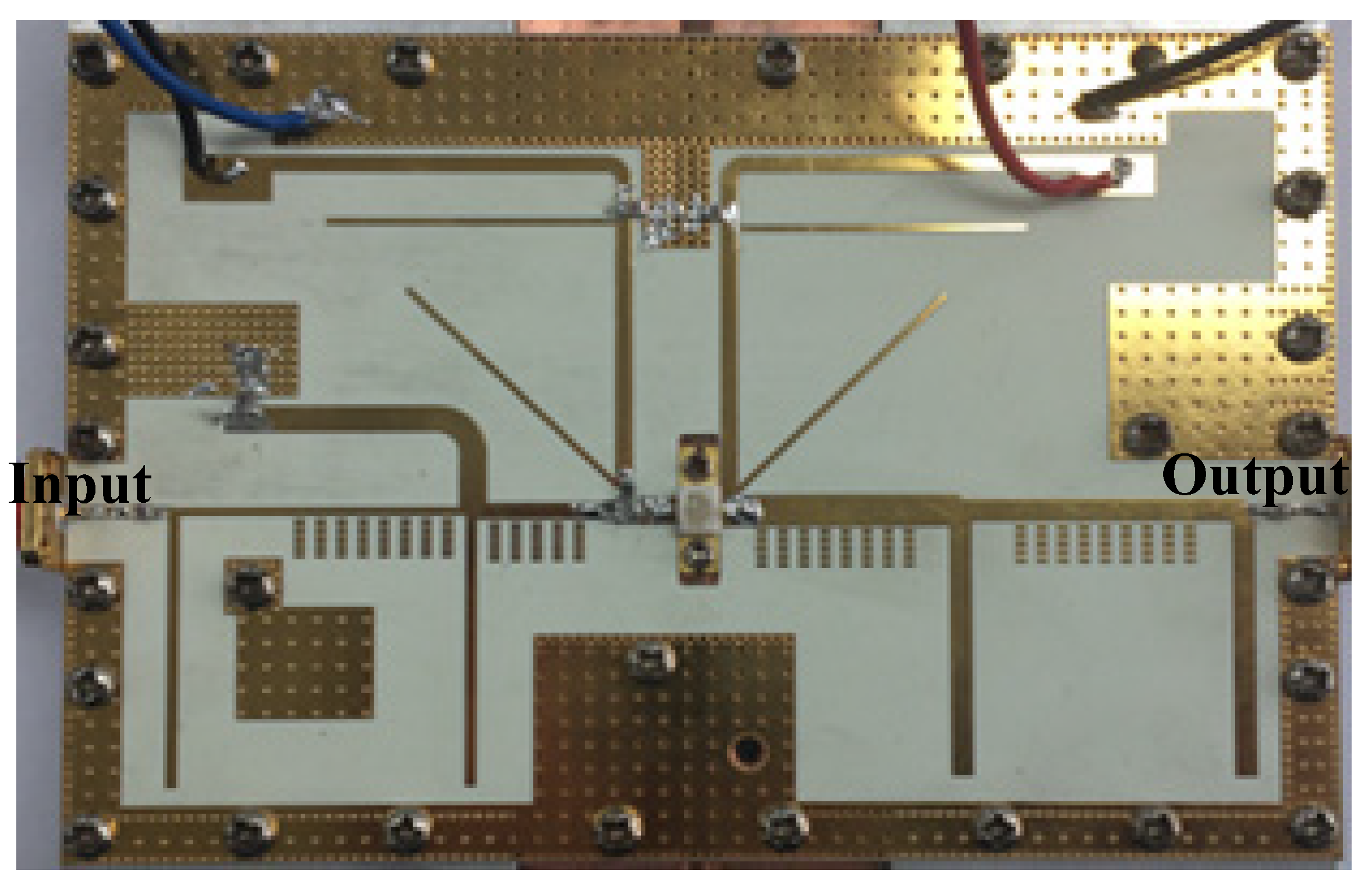
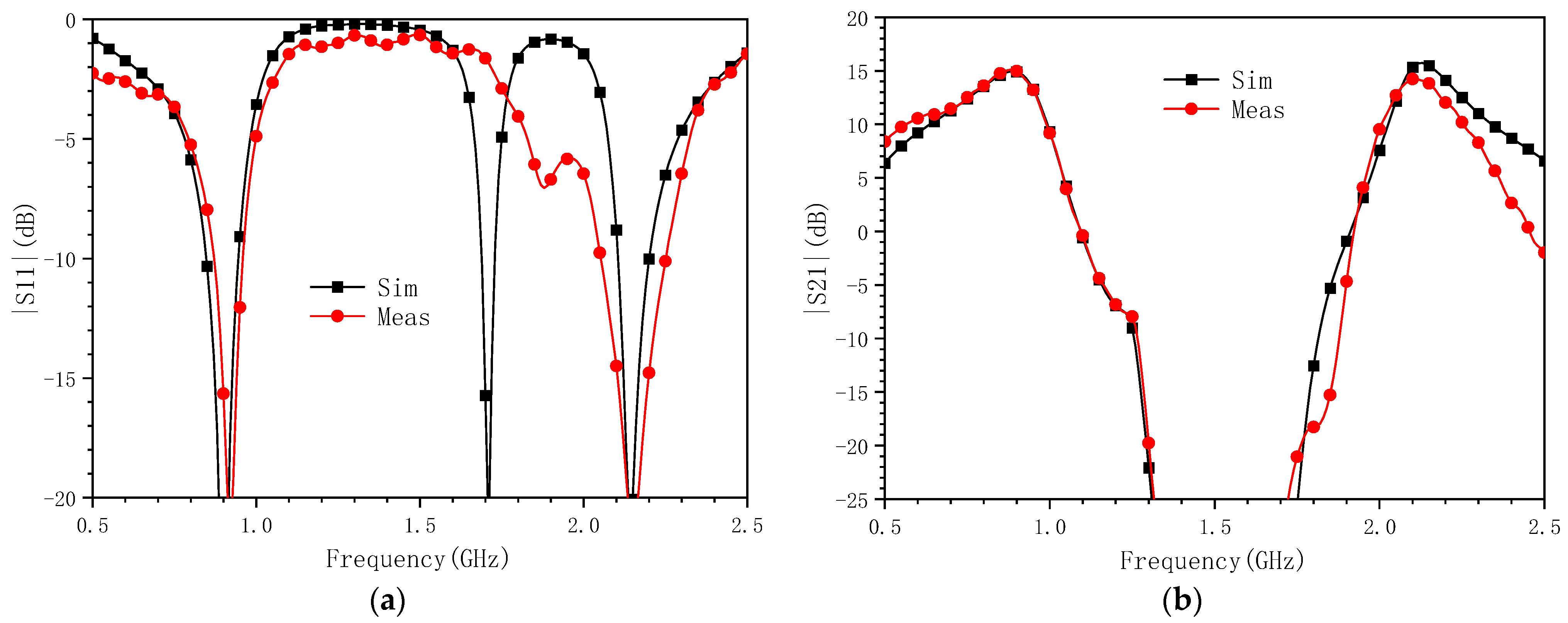
To achieve the dual-band operation of the proposed Doherty amplifier, the carrier/peaking PA should be designed with dual-band characteristics. A hybrid GaN HEMT device named Cree CGH40010 is used here. The design involves synthesizing dual-band input and output matching networks based on the optimized source and load impedances at both frequencies. The output dual-band matching network ensures maximum output power, while the input dual-band matching network achieves optimized gain. The matching networks for the carrier/peaking PA must handle frequency complex impedance transformation independently, enabling simultaneous matching of complex impedances to a real impedance at both operating frequencies [21]. The structure of the dual-band PA is shown in Figure 8, and the photograph is presented in Figure 9. The small-signal measurement and simulation results are shown in Figure 10. The dual-band PA was biased with a drain voltage of 28 V. The gate voltages were set to −2.7 V and −4.8 V respectively. The dual-band PA exhibits good performance at the frequencies of 0.9 GHz and 2.14 GHz. The small-signal gain value in both 0.9 and 2.14 GHz is 14.96 dB and 13.97 dB respectively.

2.4. Phase Compensation

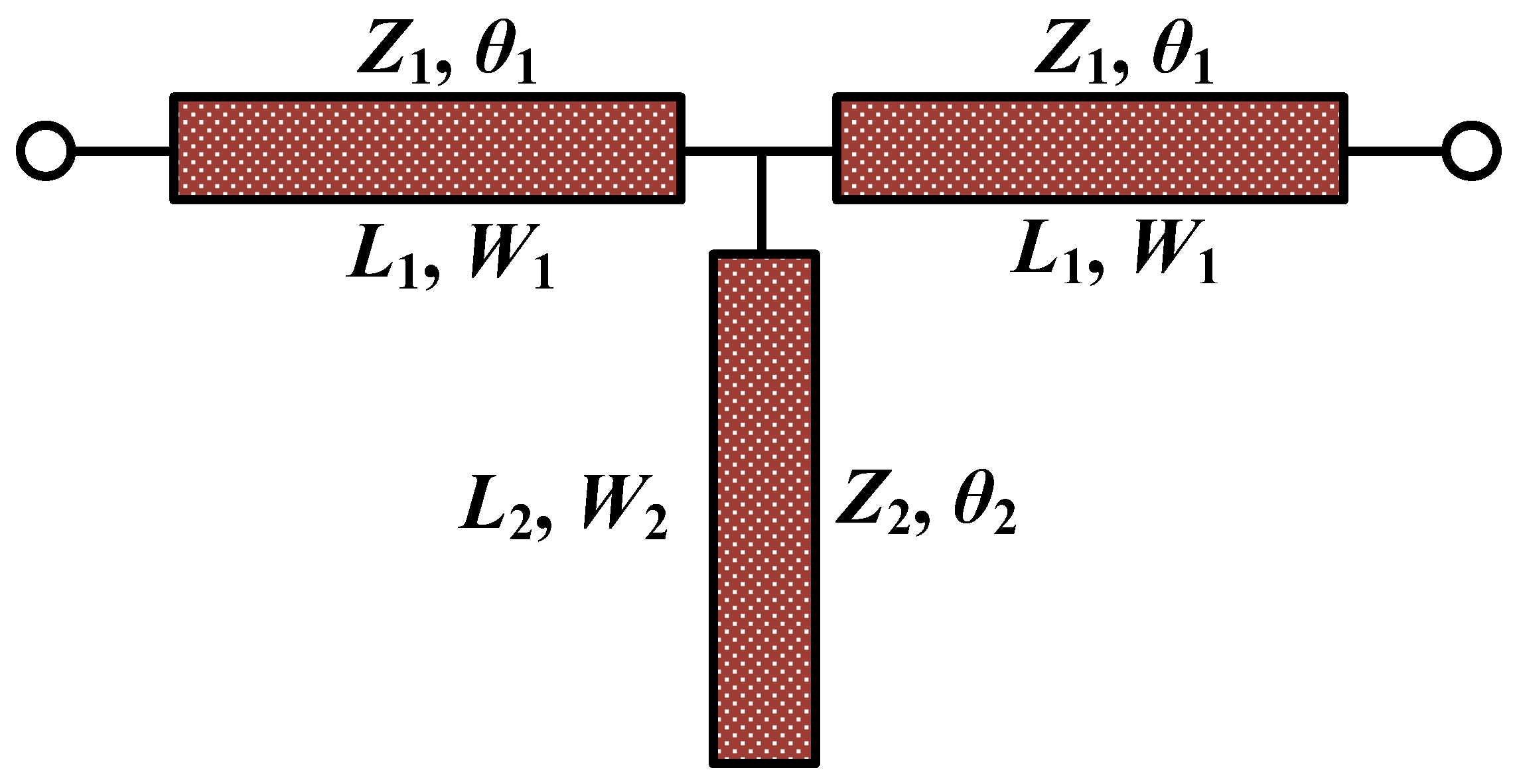
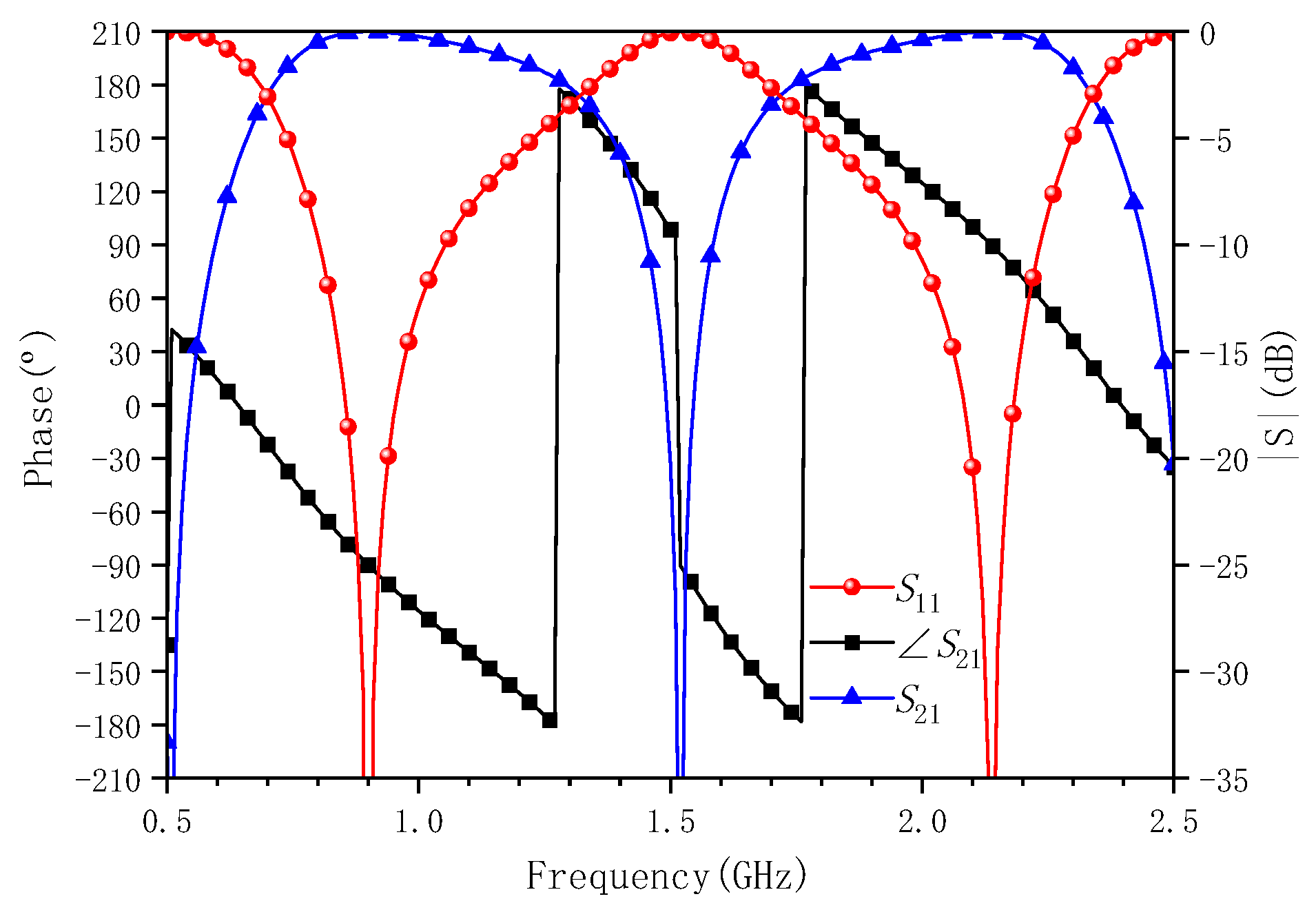
To achieve the required dual-band phase shift characteristics, a dual-band phase compensation structure is introduced at the input of the peaking power amplifier. The same T-section structure should also be used at the output for impedance transformation. For miniaturization, the phase compensation network is realized using the structure shown in Figure 11. It consists of two cascaded microstrip line sections with an open-circuit stub connected between them. This configuration provides a 90° phase shift while maintaining an equivalent characteristic impedance of 50 Ω at the frequencies of 0.90 GHz and 2.14 GHz. The designed parameters are Z 1 = 37   Ω , Z 2 = 23   Ω , θ 1 = 53.3 , θ 2 = 160 . The corresponding physical dimensions are W 1 = 69   mil , L 1 = 1158   mil , W 2 = 132   mil , L 2 = 3374   mil . The design results are shown in Figure 12. The dual-band structure indicates good return loss and insertion loss, making it suitable for integration into the dual-band DPA combining network.

2.5. Dual-Band Impedance Transformer

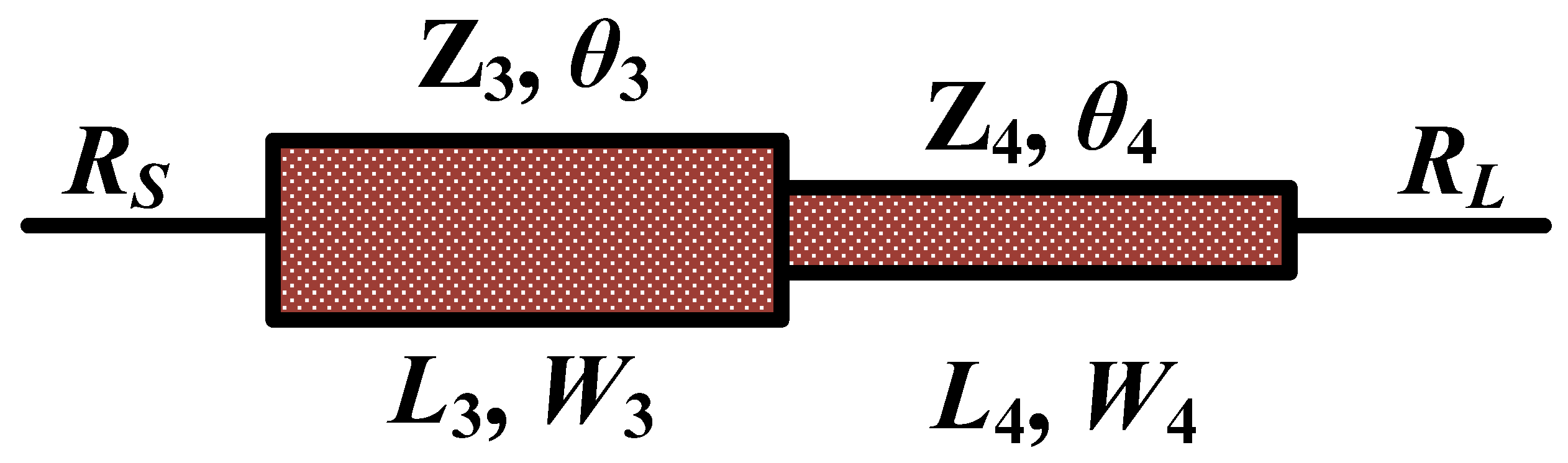
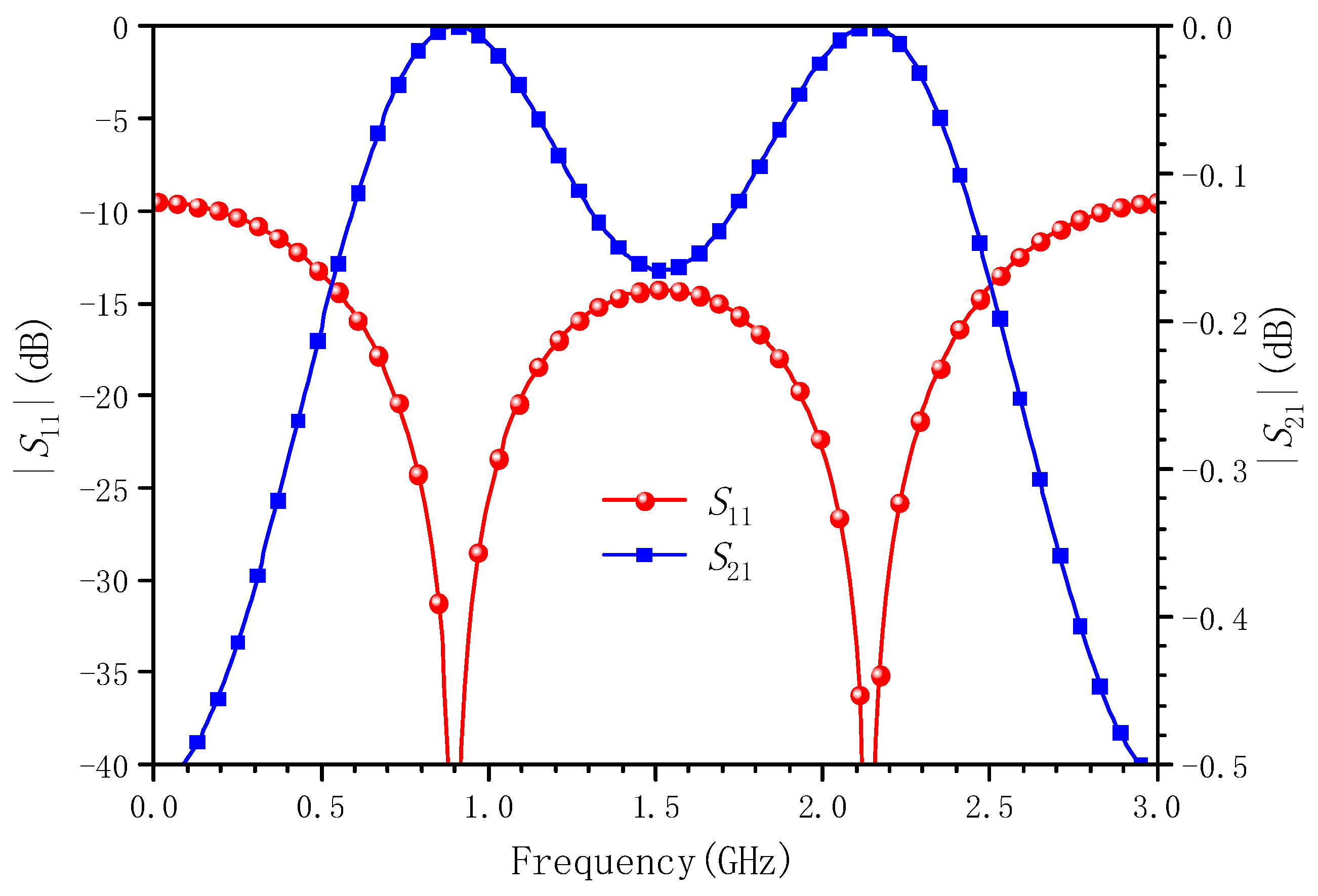
The dual-band transformer is crucial for achieving high efficiency at output power back-off levels for both frequency bands. As an impedance inverter, it mediates the relationship between the currents and impedances of the carrier and peaking PA, effectively controlling the power back-off region. Here, the dual-band transformation is realized using a two-section transmission line structure, as shown in Figure 13. The parameters are: Z 3 = 32.8   Ω , Z 4 = 38   Ω , θ 3 = θ 4 = 53.3 , W 3 = 83   mil , L 3 = 1149   mil , W 4 = 67   mil , L 4 = 1160   mil . The design results are shown in Figure 14, demonstrating good return loss and insertion loss characteristics across both bands.

3. Results

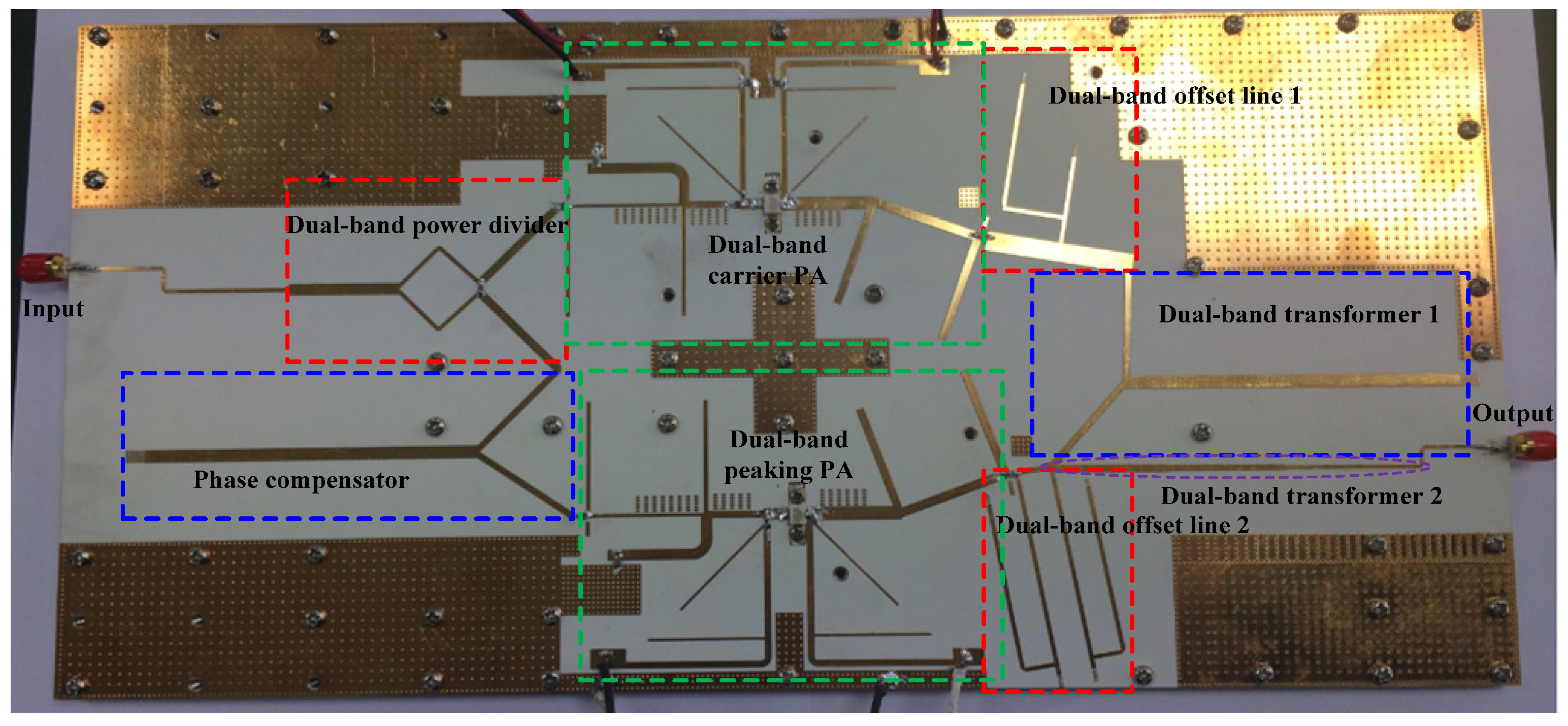
The proposed dual-band DPA was fabricated on Rogers 4350B substrate purchased from Rogers Corporation (Chandler, AZ, USA). Its dielectric constant is 3.48 and substrate thickness is 20 mil. A photograph of the fabricated circuit is shown in Figure 15.
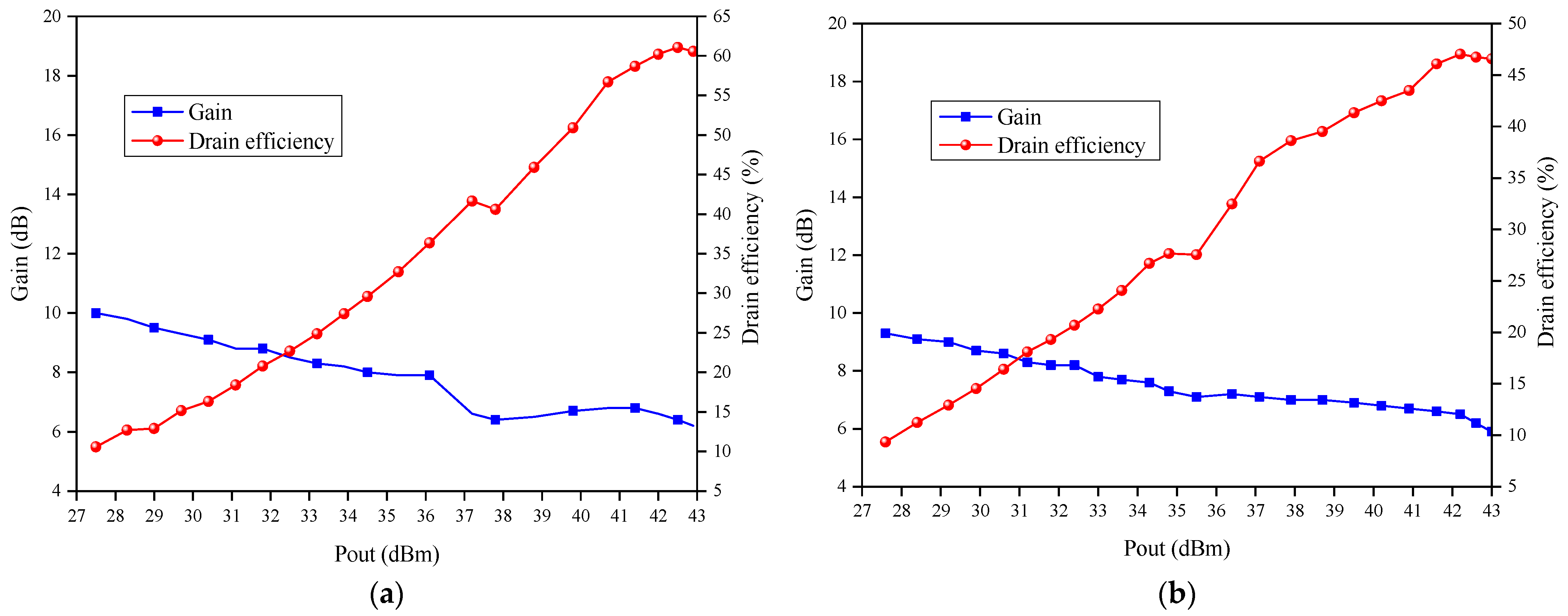
The measured gain and drain efficiency versus output power are shown in Figure 16. At the operating frequencies of 0.90 GHz and 2.14 GHz, the saturated output power is 42.9 dBm and 43.0 dBm respectively. The corresponding saturated drain efficiencies are 61% and 47%. At output power back-off of 6 dB, the drain efficiencies are better than 42% and 37% respectively. And the gains are 8.4 dB and 8.0 dB at the two bands.
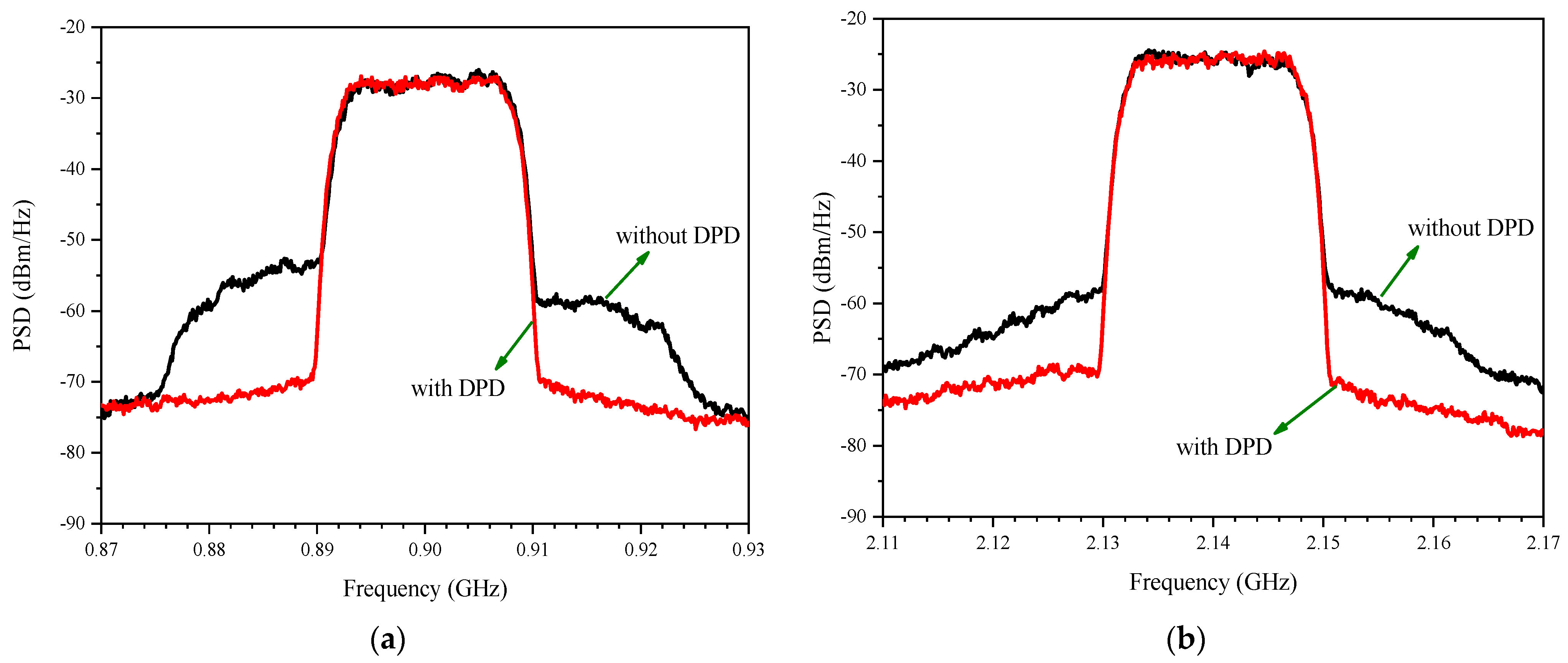
To evaluate the linearity of the dual-band DPA, measurements were performed using a modulated signal. The results are presented in Figure 17. A 20 MHz 16 QAM signal was used at an average output power of 34.8 dBm at 0.90 GHz and 34.9 dBm at 2.14 GHz. The adjacent channel power ratio (ACPR) was measured with and without digital predistortion (DPD). At 0.90 GHz, the ACPR was −30.1/−33.2 dBc without DPD and improved to −45.1/−45.4 dBc with DPD. At 2.14 GHz, the ACPR was −37.2/−37.1 dBc without DPD and improved to −45.4/−48.6 dBc with DPD. The measurement results demonstrate that the proposed dual-band DPA exhibits good linearity at both operating frequencies.

4. Conclusions

In this paper, we have presented a design methodology for a dual-band DPA. A novel dual-band offset line structure was employed to achieve the required dual-band load modulation. The fabricated dual-band DPA, operating at 2.14 GHz and 0.90 GHz, demonstrates drain efficiencies exceeding 37% and 42% at 6 dB output power back-off respectively. Under the 16 QAM modulated signal excitation, it achieves ACPR better than −48.6 dBc and −45.4 dBc at average output power. The proposed dual-band DPA is a promising candidate for deployment in mobile and satellite dual-band communication systems.

Author Contributions

Conceptualization, J.L.; Methodology, J.L., M.L. and X.C.; Software, J.L.; Validation, J.L. and M.L.; Formal analysis, J.L.; Resources, J.L.; Data curation, M.L.; Writing—original draft, M.L.; Writing—review & editing, X.C.; Visualization, M.L.; Supervision, J.L. and X.C.; Project administration, M.L. All authors have read and agreed to the published version of the manuscript.

Funding

This research received no external funding.

Data Availability Statement

The original contributions presented in this study are included in the article. Further inquiries can be directed to the corresponding author.

Conflicts of Interest

The authors declare no conflict of interest.

References

  1. Doherty, W.H. A New High Efficiency Power Amplifier for Modulated Waves. Proc. IRE 1936, 24, 1163–1182. [Google Scholar] [CrossRef]
  2. Li, X.; Chen, W.; Zhang, Z. A Concurrent Dual-Band Doherty Power Amplifier. In Proceedings of the Asia-Pacific Microwave Conference (APMC), Yokohama, Japan, 7–10 December 2010; IEEE: New York, NY, USA, 2010; pp. 653–657. [Google Scholar]
  3. Chen, W.; Bassam, S.; Li, X. Design and Linearization of Concurrent Dual-Band Doherty Power Amplifier with Frequency-Dependent Power Ranges. IEEE Trans. Microw. Theory Tech. 2011, 59, 2537–2546. [Google Scholar] [CrossRef]
  4. Li, X.; Chen, W.; Feng, Z. Design of Dual-Band Tri-way GaN Doherty Power Amplifier with Frequency Dependent Power Division. Electron. Lett. 2012, 48, 797–798. [Google Scholar] [CrossRef]
  5. Chen, W.; Zhang, S.; Liu, Y. A Concurrent Dual-Band Uneven Doherty Power Amplifier with Frequency-Dependent Input Power Division. IEEE Trans. Circuits Syst.-I Regul. Pap. 2014, 61, 552–561. [Google Scholar] [CrossRef]
  6. Grebennikov, A.; Wong, J. A Dual-Band Parallel Doherty Power Amplifier for Wireless Applications. IEEE Trans. Microw. Theory Tech. 2012, 60, 3214–3222. [Google Scholar] [CrossRef]
  7. Saad, P.; Colantonio, P.; Piazzon, L. Design of a Concurrent Dual-Band 1.8–2.4-GHz GaN-HEMT Doherty Power Amplifier. IEEE Trans. Microw. Theory Tech. 2012, 60, 1840–1849. [Google Scholar] [CrossRef]
  8. Nghiem, X.; Guan, J.; Hone, T. Design of Concurrent Multiband Doherty Power Amplifiers for Wireless Applications. IEEE Trans. Microw. Theory Tech. 2013, 61, 4559–4568. [Google Scholar] [CrossRef]
  9. Mohamed, A.M.M.; Boumaiza, S.; Mansour, R.R. Reconfigurable Doherty Power Amplifier for Multi-frequency Wireless Radio System. IEEE Trans. Microw. Theory Tech. 2013, 61, 1588–1598. [Google Scholar] [CrossRef]
  10. Mohamed, A.M.M.; Boumaiza, S.; Mansour, R.R. Electronically Tunable Doherty Power Amplifier for Multi-Mode Multi-Band Base Stations. IEEE Trans. Circuits Syst.-I Regul. Pap. 2014, 61, 1229–1240. [Google Scholar] [CrossRef]
  11. Chen, H.; Xu, J.; Chen, W.; Zhang, X. High-efficiency Dual-Band Filtering Doherty Power Amplifier Based on Multi-function Circuit. IEEE Trans. Microw. Theory Tech. 2022, 70, 2697–2709. [Google Scholar] [CrossRef]
  12. Su, Z.; Yu, C.; Tang, B. A Concurrent Dual-Band Doherty Power Amplifier with Performance Enhancement Using a Novel Impendence Invert Network. In Proceedings of the 2019 IEEE MTT-S International Wireless Symposium (IWS), Guangzhou, China, 19–22 May 2019; IEEE: New York, NY, USA, 2019; pp. 1–3. [Google Scholar]
  13. Yang, F.; Li, J.; Yu, H.; Yan, S.; Zhang, A.; Xu, K.; Jin, Z. Asymmetric Doherty Power Amplifier with Input Phase/Power Adjustment and Envelope Tracking. Electronics 2021, 10, 2327. [Google Scholar] [CrossRef]
  14. Nasri, A.; Estebsari, M.; Toofan, S.; Piacibello, A.; Pirola, M.; Camarchia, V.; Ramella, C. Design of a Wideband Doherty Power Amplifier with High Efficiency for 5G Application. Electronics 2021, 10, 873. [Google Scholar] [CrossRef]
  15. Chen, Y.; Choi, W.; Shin, J. Simplified All-in-one Load Network of The Broadband Doherty Power Amplifier. IEEE Trans. Microw. Theory Tech. 2025, 73, 953–964. [Google Scholar] [CrossRef]
  16. Sun, J.; Zhou, S. Cuckoo Search-ExtraTrees Model for Radio-Frequency Power Amplifier Under Different Temperatures. Frequenz 2025, 79, 433–438. [Google Scholar] [CrossRef]
  17. Zhang, Y.; Zhu, N.; Meng, F. Design and Analysis of a Compact CMOS SOI Power Amplifier with 29.2-dBm P SAT and 44.4% PAE for FR3 5G-Advanced/6G Beamforming Systems. IEEE J. Solid-State Circuits 2025, 1–14. [Google Scholar] [CrossRef]
  18. Zhang, G.; Zhou, S. A Methodology for Designing High-Efficiency Power Amplifiers Using Simple Microstrip Harmonic Tuning Circuits. Electronics 2025, 14, 4767. [Google Scholar] [CrossRef]
  19. Rawat, K.; Ghannouchi, F.M. Design Methodology for Dual-Band Doherty Power Amplifier with Performance Enhancement Using Dual-Band Offset Lines. IEEE Trans. Ind. Electron. 2012, 59, 4831–4842. [Google Scholar] [CrossRef]
  20. Park, M.J.; Lee, B. Wilkinson Power Divider with Extended Ports for Dual-Band Operation. Electron. Lett. 2008, 44, 916–917. [Google Scholar] [CrossRef]
  21. Zheng, X.; Liu, Y.; Li, S.; Yu, C.; Wang, Z.; Li, J. A Dual-Band Impedance Transformer Using Pi-section Structure for Frequency-dependent Complex Loads. Prog. Electromagn. Res. C 2012, 32, 11–26. [Google Scholar] [CrossRef]
Figure 1. The architecture of the proposed dual-band DPA.
Electronics 15 02383 g001
Figure 2. Operating principle of dual-band offset lines: (a) Offset line 1; (b) Offset line 2.
Electronics 15 02383 g002
Figure 3. Structure of the proposed dual-band offset line.
Electronics 15 02383 g003
Figure 4. Design results for the T-section dual-band offset line 1.
Electronics 15 02383 g004
Figure 5. Design results for the π-section dual-band offset line 2.
Electronics 15 02383 g005
Figure 6. Structure and photograph of the dual-band power divider.
Electronics 15 02383 g006
Figure 7. Measurement and simulation results of the dual-band power divider: (a) S-parameters; (b) Isolation and transmission.
Electronics 15 02383 g007
Figure 8. Structure of the dual-band PA.
Electronics 15 02383 g008
Figure 9. Photograph of the fabricated dual-band PA.
Electronics 15 02383 g009
Figure 10. Simulated and measured small-signal results of the dual-band PA: (a) S11; (b) S21.
Electronics 15 02383 g010
Figure 11. Structure of the dual-band phase compensation network.
Electronics 15 02383 g011
Figure 12. Design results of the dual-band phase compensation network.
Electronics 15 02383 g012
Figure 13. Structure of the dual-band transformer.
Electronics 15 02383 g013
Figure 14. Design results of the dual-band transformer.
Electronics 15 02383 g014
Figure 15. Photograph of the dual-band DPA fabricated on Rogers 4350B substrate.
Electronics 15 02383 g015
Figure 16. Gain and drain efficiency measurement of the dual-band DPA: (a) At 0.9 GHz; (b) At 2.14 GHz.
Electronics 15 02383 g016
Figure 17. Measured linearity of the dual-band DPA with DPD and without DPD: (a) At 0.9 GHz; (b) At 2.14 GHz.
Electronics 15 02383 g017
Disclaimer/Publisher’s Note: The statements, opinions and data contained in all publications are solely those of the individual author(s) and contributor(s) and not of MDPI and/or the editor(s). MDPI and/or the editor(s) disclaim responsibility for any injury to people or property resulting from any ideas, methods, instructions or products referred to in the content.