Article

A Non-Invasive Voltage Measurement Method for Power Grid Converter Valve Scenarios

1
School of Applied Science, Beijing Information Science and Technology University, Beijing 100192, China
2
College of Information Science and Technology, Beijing University of Chemical Technology, Beijing 100029, China
*
Author to whom correspondence should be addressed.
Electronics 2026, 15(11), 2264; https://doi.org/10.3390/electronics15112264 (registering DOI)
Submission received: 14 April 2026 / Revised: 18 May 2026 / Accepted: 21 May 2026 / Published: 23 May 2026

Abstract

Accurate non-invasive voltage measurement is critical for the stable operation of ultra-high-voltage direct-current (UHVDC) grids. In practical converter valve environments, voltage inversion based on the charge simulation method (CSM) may be affected by nearby charged conductors. To address this problem, this paper proposes a non-invasive voltage measurement method combining radially aligned near-conductor two-sensor differential electric-field measurement with three-dimensional electrostatic finite-element modelling. The differential electric field between two radial sensing positions is used for voltage inversion, which suppresses distant common-mode interference. When a nearby interference conductor exists, a weighted differential correction coefficient k is introduced to compensate for the residual radial interference component. Theoretical and simulation results show that k is a scenario-dependent coefficient affected by the measured voltage, sensor spacing, interference voltage, and geometric configuration. In an ultra-high-voltage (UHV) converter valve bridge-arm scenario with a 400 kV interference conductor, the absolute voltage inversion error is reduced from 0.50–1.57% FS before correction to below 0.20% FS after correction. Experiments on a 30 kV-scaled platform further verify the method under different measured voltages, sensor spacings, and interference-voltage levels, with the best-tested case reducing the maximum error from 0.93% FS to 0.16% FS.

1. Introduction

With the rapid growth of electricity demand, ultra-high-voltage direct-current (UHVDC) transmission has been increasingly deployed because of its large transmission capacity and long-distance capability. In recent years, an increasing number of UHVDC transmission projects have been commissioned. The converter valve is responsible for the conversion between alternating current and direct current in the power system and serves as a key interface between the UHVDC network and the existing alternating-current (AC) grid [1,2,3]. The bridge arm voltage of a converter valve can effectively reflect its operating condition [4]; therefore, there is a strong demand for reliable voltage measurement in practical engineering applications.
In conventional practice, voltage is measured invasively using voltage transformers or voltage dividers [5,6]. However, under transient faults, such devices may suffer from ferromagnetic saturation [7], resulting in poor frequency response and a limited bandwidth. In addition, invasive measurement equipment is typically bulky and expensive, which is not well aligned with the ongoing trends toward smart grids and miniaturized power measurement devices [8].
Against this background, non-invasive voltage measurement has become an active research topic in recent years [9]. Current non-invasive voltage measurement techniques are based on capacitive voltage division [10,11,12], electric field integration, or the charge-simulation method (CSM) [13,14,15,16]. The capacitive voltage division approach relies on establishing a capacitive divider between the measured conductor and ground using a floating conductor, thereby scaling high voltage down to a lower, measurable level. This approach usually requires air or other insulating materials such as polytetrafluoroethylene (PTFE) as the dielectric [17,18,19]. The former is sensitive to environmental variations, whereas the latter may accumulate charges during long-term operation and degrade measurement accuracy. Moreover, capacitive coupling is generally unsuitable for direct-current (DC) voltage measurement. Both electric field integration and CSM can be formulated as an inverse electric field problem [20], where the conductor voltage is inferred from measured electric field data around a charged conductor. Electric field integration was first proposed by Chavez et al. [21]. The basic idea is to deploy an array of electric-field sensors along an integration path between the measured conductor and ground and then reconstruct the conductor voltage using the Gaussian Integral. Using an array of Pockels-effect optical electric field sensors with the integration method, their group measured a 230 kV power-frequency AC voltage with an accuracy of 0.10% [22]. In 2018, Wang et al. developed a measurement setup based on a D-dot sensor array combined with electric field integration. Although the cost was significantly reduced compared with optical sensors, the reported accuracy was only 0.50% [23]. In principle, electric field integration can achieve high accuracy; however, in practical engineering environments, conductor disturbances and ground-potential fluctuations are common, which may substantially deteriorate measurement performance. The CSM is a numerical technique in which the actual charge distribution of a conductor is replaced by an equivalent set of fictitious charges—such as point or line charges—placed at appropriate locations, enabling the surrounding electric field distribution to be approximated using fundamental electrostatic principles. This greatly reduces modelling complexity and enables an explicit functional relationship between the electric field and the conductor voltage. Yang et al. measured a three-phase overhead transmission line using six pairs of sensing electrodes and a CSM-based approach, achieving a voltage magnitude error below 1.10% [24]. However, this study is primarily limited to AC measurement scenarios, and their effectiveness in practical UHVDC environments, especially under nearby external interference, remains unclear. In practical UHVDC transmission measurement scenarios, interference sources are often unavoidable and can significantly degrade measurement accuracy, yet their effects have not been adequately considered in existing studies. These include far-field interference, as well as nearby interference that may arise in converter valves and other complex environments. Such factors, however, have rarely been addressed in existing studies. Furthermore, it is worth noting that the converter valve technology itself is evolving. For instance, the controllable line-commutated converter (CLCC) has been proposed as a potential upgrade for Chinese UHVDC systems to enhance fault ride-through capability [25]. Such topological modifications may introduce new electromagnetic environments and interference characteristics, which in turn could impose additional requirements on non-invasive voltage measurement methods. Therefore, developing interference-robust measurement strategies—such as the one proposed in this work—is of particular importance for future UHVDC systems.
To address these issues, this paper investigates the practical engineering scenario of bridge arm voltage measurement in UHVDC converter valves. Based on the fundamental principle of the CSM, mitigation strategies are proposed for interference sources encountered in practical measurement environments, enabling the voltage inversion accuracy to be maintained at a high level. It should be noted that the term “interference” in this paper specifically refers to electromagnetic interference from nearby charged conductors in the converter valve environment. Other types of disturbances, such as sensor bias, data corruption, communication faults, or cyber-induced attacks [26], are beyond the scope of this work but represent important directions for future research. Existing mitigation strategies for such disturbances—e.g., resilient distributed control frameworks—can potentially be integrated with our measurement method to enhance overall system robustness.

2. Voltage Inversion Theory Under Near-Field Interference

2.1. Single-Point Inversion of Conductor Voltage

As shown in Figure 1, an infinitely long cylindrical charged conductor is considered, with voltage V, radius r0, and its geometric centre located at a height h above the ground plane. For such a long cylindrical conductor above a ground plane, the conductor-to-ground potential coefficient can be approximated using the classical image-charge result. Since the sensing point considered in this study is located close to the measured conductor, and the conductor height is much larger than the sensor-to-conductor distance, the direct contribution of the image charge to the local radial electric field at the sensing point is neglected. Under this approximation, the relationship between the conductor voltage V and the electric field magnitude E at an arbitrary point P near the conductor can be written as [27]:
V = r l n ( 2 h r 0 ) E
where r denotes the distance from point P to the geometric centre of the conductor.
According to (1), the conductor voltage can be inferred from the electric field strength at any point in space. In practical measurement environments, however, interference factors such as ground-potential fluctuations are usually present and may lead to measurement errors. Therefore, differential measurement is commonly adopted to mitigate distant interference in the environment.

2.2. Differential Inversion Without Nearby Interference

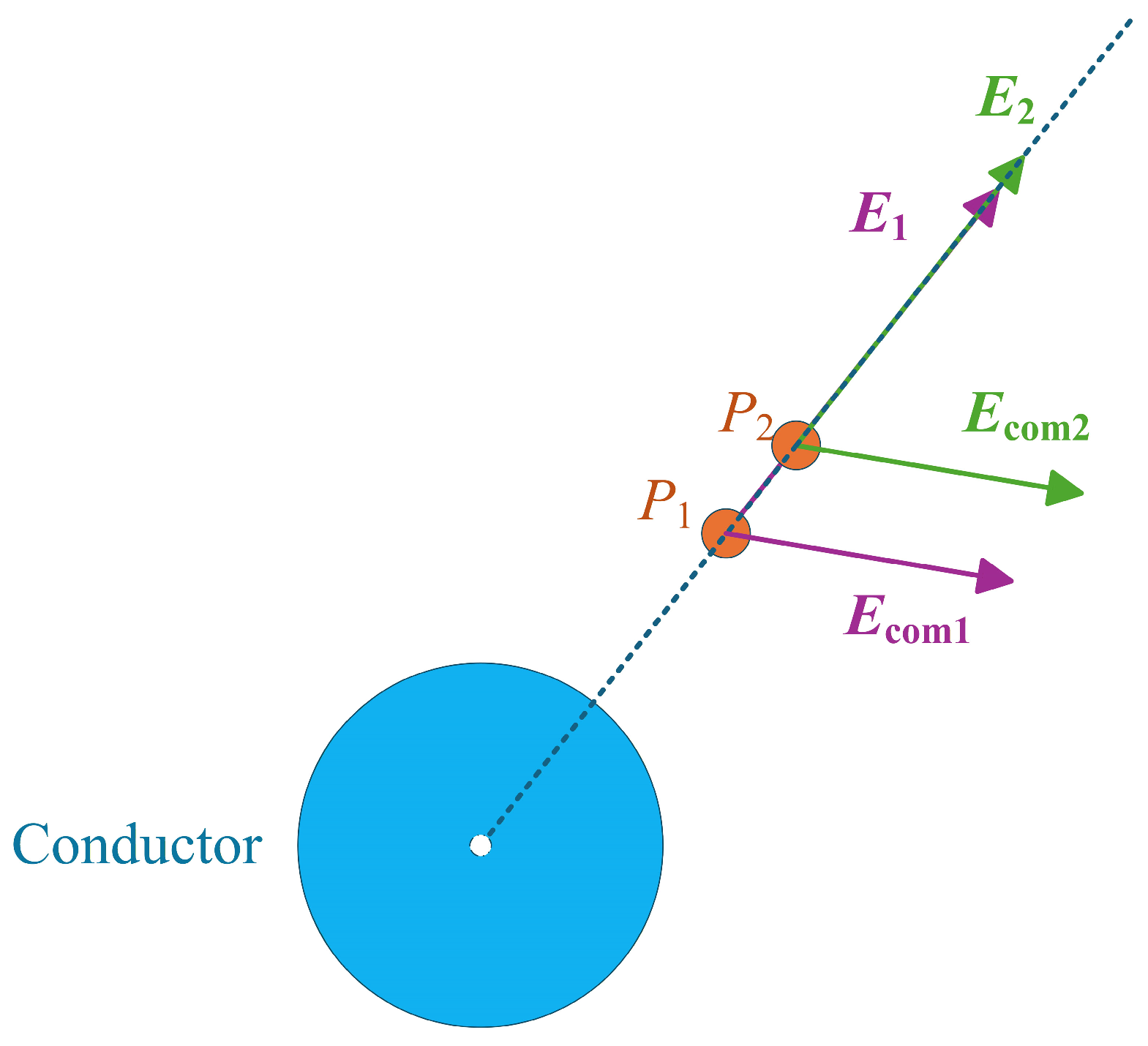
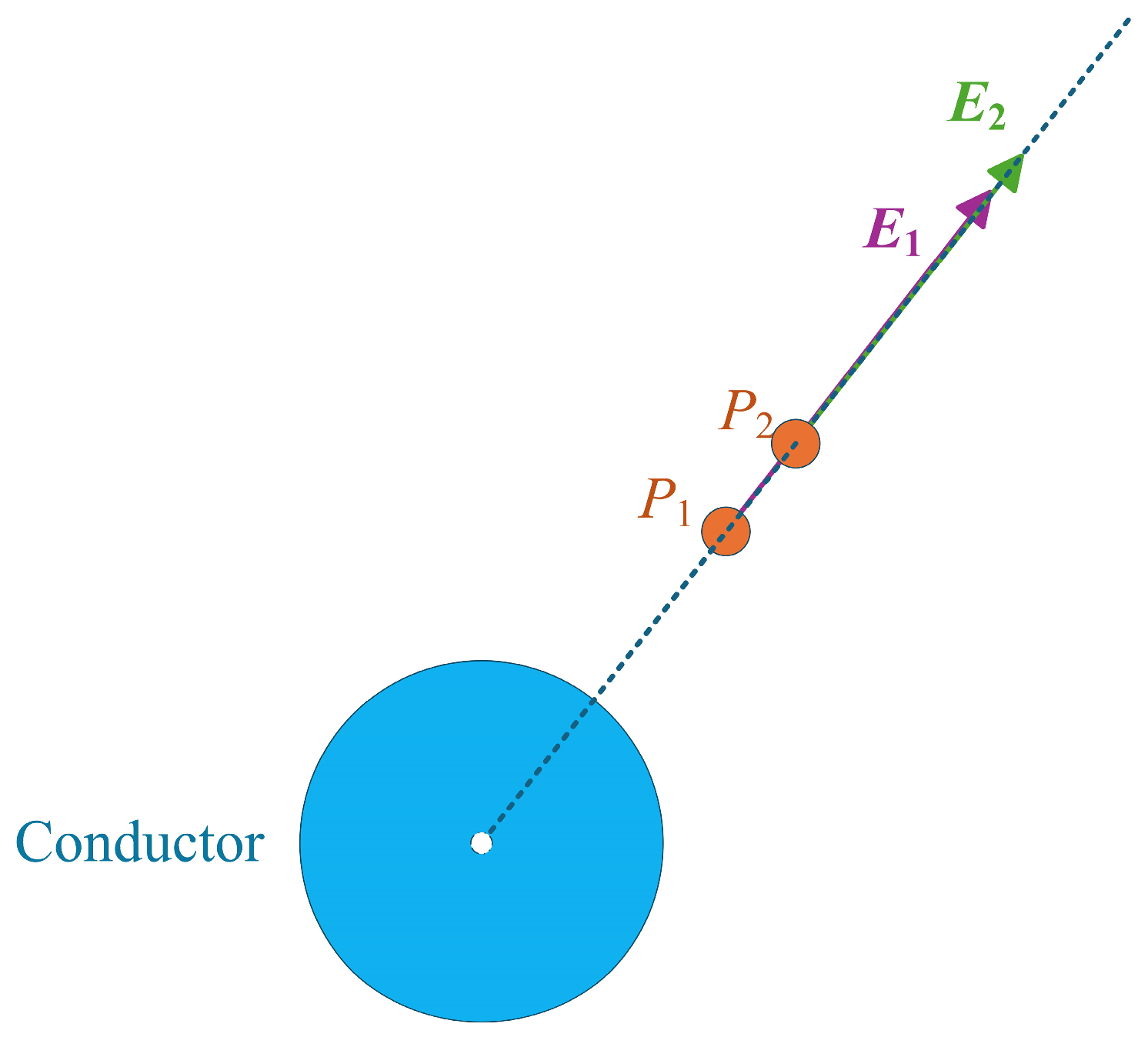
Differential inversion can effectively mitigate far-field interference in practical scenarios. The measurement points P1 and P2 are arranged such that they are collinear with the geometric centre of the measured conductor. The spacing between the two points should be as small as possible, with P1 positioned closer to the conductor than P2. As shown in Figure 2, assuming a positively charged conductor (the negatively charged case is analogous), the electric fields generated by the conductor at P1 and P2, namely E1 and E2, are both directed radially outward. According to (1), both E1 and E2 are linearly related to the conductor voltage V, which can be expressed as:
V = c 1 E 1
V = c 2 E 2
where c1 and c2 are constants obtained through calibration under practical measurement conditions. Combining (2) and (3) yields the following differential inversion expression:
V = c 1 c 2 c 2 c 1 ( E 1 E 2 )
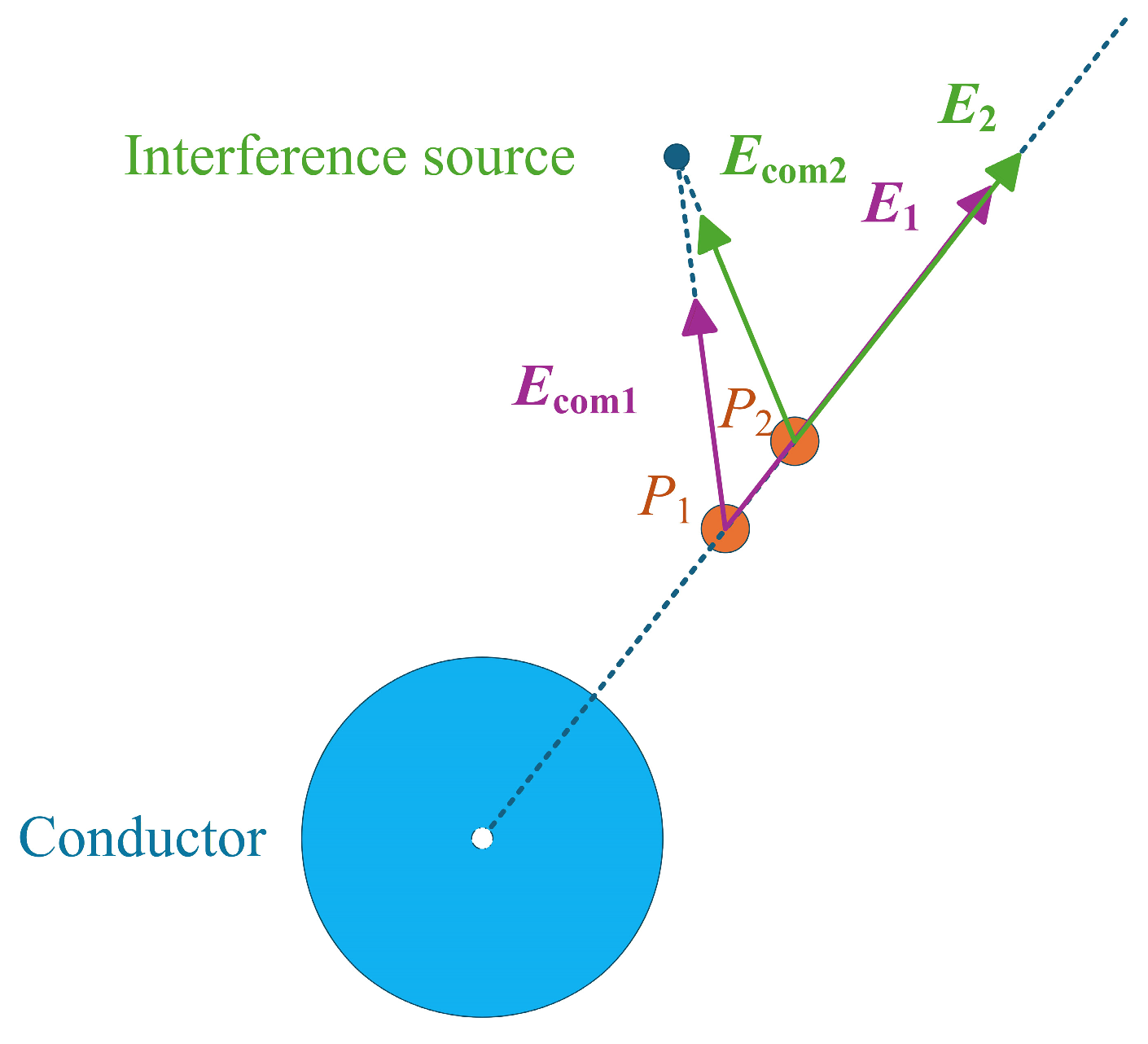
As shown in Figure 3, a distant interference source is present in the measurement environment, generating common-mode interference electric fields at P1 and P2, denoted as Ecom1 and Ecom2, respectively.
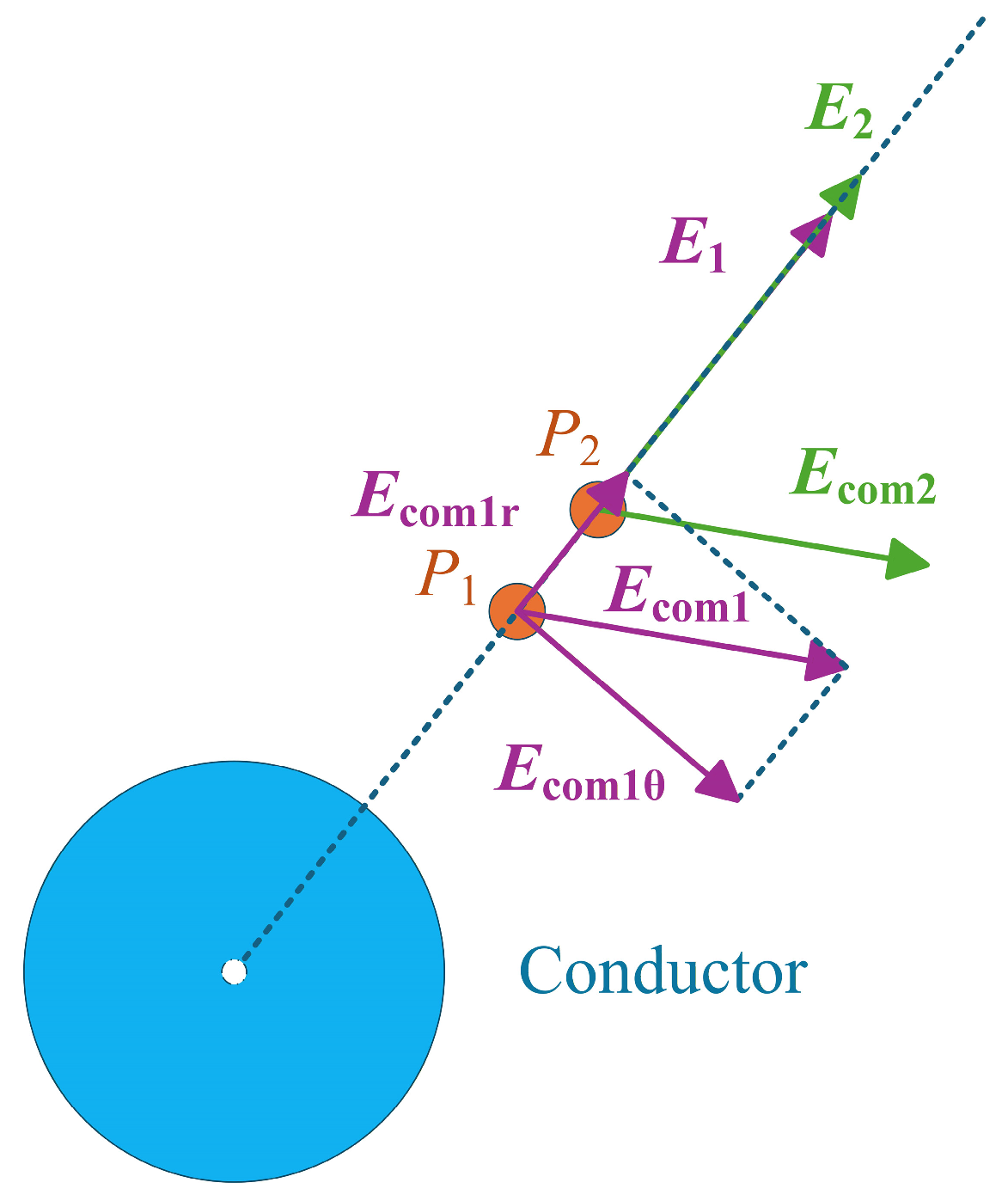
As shown in Figure 4, the common-mode interference electric fields, Ecom1 and Ecom2, are decomposed into radial and tangential components, which are given by:
E com 1 = E com 1 r + E com 1 θ
E com 2 = E com 2 r + E com 2 θ
where Ecom1r and Ecom2r are the radial components of the two common-mode interference electric fields, and Ecom1θ and Ecom2θ are their tangential components. Accordingly, the outputs of the two electric-field sensors, E 1   and   E 2 , are the sums of the radial electric field components at points P1 and P2, respectively, and can be expressed as:
E 1 = E 1 + E com 1 r
E 2 = E 2 + E com 2 r
According to (4), the inverted voltage in the presence of interference, V′, can be expressed as:
V = c 1 c 2 c 2 c 1 ( E 1 E 2 )
By combining (7) and (8), the final expression for the inverted voltage can be given by:
V = c 1 c 2 c 2 c 1 ( E 1 + E com 1 r E 2 E com 2 r )
When the distance between the sensor array and the interference source is more than two orders of magnitude larger than the sensor spacing, and the voltage level of the interference source is more than two orders of magnitude lower than that of the measured conductor, the spatial variation and magnitude of the common-mode interference field over the two sensing positions are sufficiently small. Under this condition, Ecom1 and Ecom2 can be considered approximately equal, and their influence can be effectively suppressed by the differential operation. As a result, their radial components, Ecom1r and Ecom2r, are effectively cancelled by the differential operation. Under these conditions, the inverted voltage V′ is approximately equal to the actual conductor voltage V, and no obvious error is introduced. In the presence of a nearby fixed interference source, however, this approximation no longer holds, and a correction coefficient must be introduced.

2.3. Differential Inversion with a Nearby Fixed Interference Conductor

In measurement environments such as converter valves, a nearby interfering conductor with a voltage level comparable to that of the measured conductor may be present, as shown in Figure 5. Following the same approach as in the previous analysis, the common-mode interference field generated by the interfering source is decomposed into tangential and radial components, as illustrated in Figure 4. Clearly, under this condition, differential processing can no longer completely eliminate the influence of common-mode interference.
To maintain high measurement accuracy in the presence of nearby interference, a correction coefficient k can be introduced to compensate for the result of the electric field differential calculation. It can be expressed as:
E 1 k E 2 = E 1 E 2
Accordingly, the expression for the inverted voltage is given by:
V = c 1 c 2 c 2 c 1 ( E 1 k E 2 = E 1 E 2 )
In theory, after correction, the inversion accuracy can be restored to the level achieved in the absence of interference sources. In practical measurement environments, however, the correction coefficient k is generally not a constant and is typically related to parameters such as the measured voltage V. Its explicit expression, therefore, needs to be determined for the specific scenario. In the following, a simplified analytical model is introduced to provide physical insight into the dependence trend of the correction coefficient k in the converter valve bridge-arm scenario.
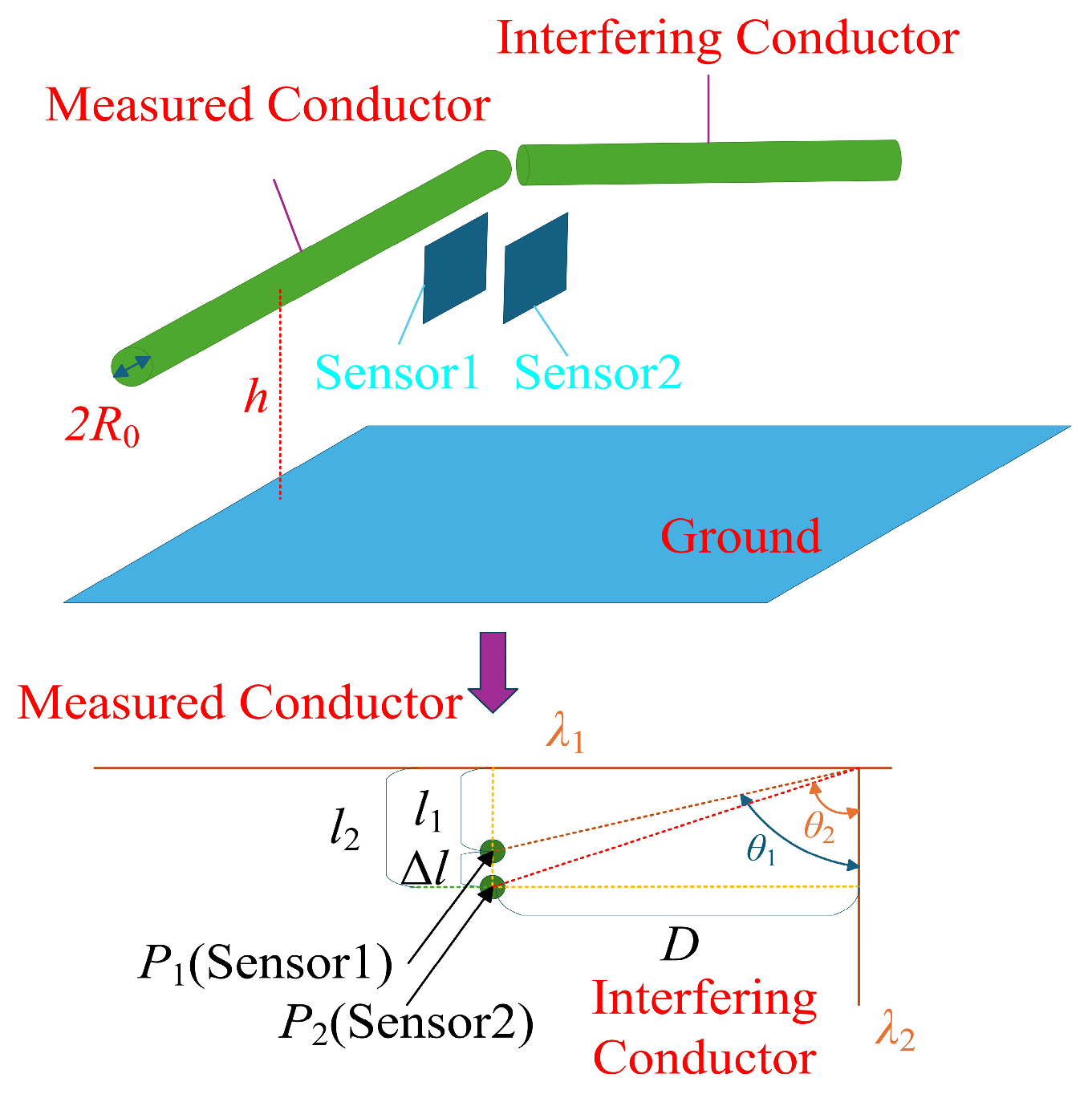
In measurement environments such as converter valves, a nearby interfering conductor is often present and is typically oriented perpendicular to the measured conductor. To describe the influence of this nearby conductor on the two-point differential measurement, the simplified analytical model shown in Figure 6 is introduced. It should be emphasized that this model is used to explain the main dependence trend of the correction coefficient k, rather than to provide a universal quantitative expression for practical converter valve geometries.
In this model, the measured conductor and the interfering conductor are represented as two mutually perpendicular conductors located in the same horizontal plane, both with radius R0 and geometric-centre height h above the ground. For analytical simplicity, the conductor-to-ground potential relationship is treated using the classical long-conductor approximation, while the direct contribution of image charges to the local radial electric field at the sensing positions is neglected. This treatment may introduce deviations between the simplified analytical field and the actual electric-field distribution, especially near conductor ends or the ground boundary. However, in the considered bridge-arm sensing region, the sensors are arranged close to the measured conductor and away from the conductor ends and the ground plane; therefore, the local radial field is mainly governed by the measured conductor.
The measured conductor is then treated as an infinitely long conductor and equivalently represented by a line charge λ1. This approximation neglects the axial variation of the charge distribution and the end effects of the conductor. Therefore, the resulting expression is mainly used for trend analysis in the sensing region rather than for direct quantitative correction. In the practical converter valve bridge-arm model, the finite conductor length, end effects, ground boundary, and neighbouring conductors are included in the three-dimensional FEM analysis, from which the quantitative value of k is obtained. Both sensors are arranged facing the measured conductor; therefore, the electric field component detected by each sensor is mainly along the normal direction of the measured conductor. Let the distance from the sensor position Pi to the line charge λ1 be li; then the magnitude of the electric field Ei generated by the measured conductor at position Pi can be expressed as:
E i = λ 1 2 π ε 0 1 l i
Similarly, the interfering conductor can be equivalently represented as a ray charge with a line charge density λ2, whose endpoint lies on the line where the measured conductor is located. Let the distance from the interfering conductor to this normal line be D, and let the angle between the line connecting position Pi to the endpoint of λ2 and λ2 itself be θi. Then, the magnitude of the electric field ΔEi generated by the interfering conductor at position Pi in the direction perpendicular to λ1 can be expressed as:
Δ E i = λ 2 4 π ε 0 D ( cos θ i 1 )
Under this condition, the total electric field at position Pi, denoted by E 1 , can be written as:
E i = E i Δ E i = λ 1 2 π ε 0 1 l i λ 2 4 π ε 0 D ( cos θ i 1 )
It is evident that the electric field difference between the two points is no longer the same as that in the interference-free case. Therefore, according to the weighted differential compensation condition in (11), a correction coefficient k can be introduced to compensate for this difference. Under the simplified line-charge model, an approximate form of k can be written as:
k = 2 λ 1 D λ 2 l 2 ( cos θ 1 1 ) 2 λ 1 D λ 2 l 2 ( cos θ 2 1 )
In practical measurement scenarios, the electric-field sensors are placed in close proximity to the measured conductor (typically within a few centimeters, i.e., li ≈ 0.1–0.2 m) to ensure a strong signal, while the nearby interfering conductor in a converter valve bridge arm is located at a distance on the order of meters (e.g., D ≈ 1–5 m) due to the structural layout of the valve hall. This yields a ratio D/li typically larger than 10, which comfortably satisfies the condition D >> li. Under this assumption, (16) can be further simplified to:
k = 1 + λ 2 ( l 1 + Δ l ) Δ l 2 λ 1 D 2 + λ 2 ( l 1 + Δ l ) D λ 2 ( l 1 + Δ l ) 2
It should be noted, however, that the simplification D >> li is valid when the interfering conductor is not placed extremely close to the sensor array. For scenarios where the interfering conductor is located at a distance comparable to li (e.g., D < 5li), the full expression (16) should be used directly without simplification. When the measured-conductor voltage V and the interfering-conductor voltage V2 are of the same or similar order of magnitude, the simplified model suggests that the dominant terms of k are related to the ratio between the interference-induced field and the measured-conductor field. Accordingly, the dependence of k on V and Δl can be qualitatively described, with reference to [28], as:
k = 1 + Δ l λ 2 ( l 1 + Δ l ) 2 λ 1 D 2
When Δl2 is negligible, the expression can be further simplified as:
k = 1 + Δ l λ 2 l 1 2 λ 1 D 2
According to [28], V is linearly and positively related to λ1. Therefore, the correction coefficient k can be expressed as a function of the measured-conductor voltage V and the sensor spacing Δl:
k = α Δ l + 1 k = γ V + β lim Δ l 0 k = 1
where α is independent of Δl, whereas β and γ are independent of V. It should be noted that (20) represents a first-order dependence trend obtained from the simplified analytical model. This approximation is mainly valid when the sensor spacing is sufficiently small so that the higher-order spatial variation of the nearby interference field between the two sensing positions can be neglected. When a wider sensor-spacing range is considered, the higher-order terms with respect to Δl may become non-negligible, leading to a nonlinear dependence of k on Δl. Therefore, (20) can be extended by including the second-order spacing term as:
k = α Δ l + 1 + O ( Δ l 2 ) k = γ V + β lim Δ l 0 k = 1
As discussed above, in converter-station scenarios with perpendicular interference, the correction coefficient k depends on both the measured-conductor voltage V and the sensor spacing Δl. Therefore, to determine its explicit expression for a practical converter valve scenario, finite-element modelling and simulation of the converter valve bridge arm are performed in Section 3.

3. Voltage Inversion in a Converter Valve Scenario

3.1. Finite-Element Simulation Model Description

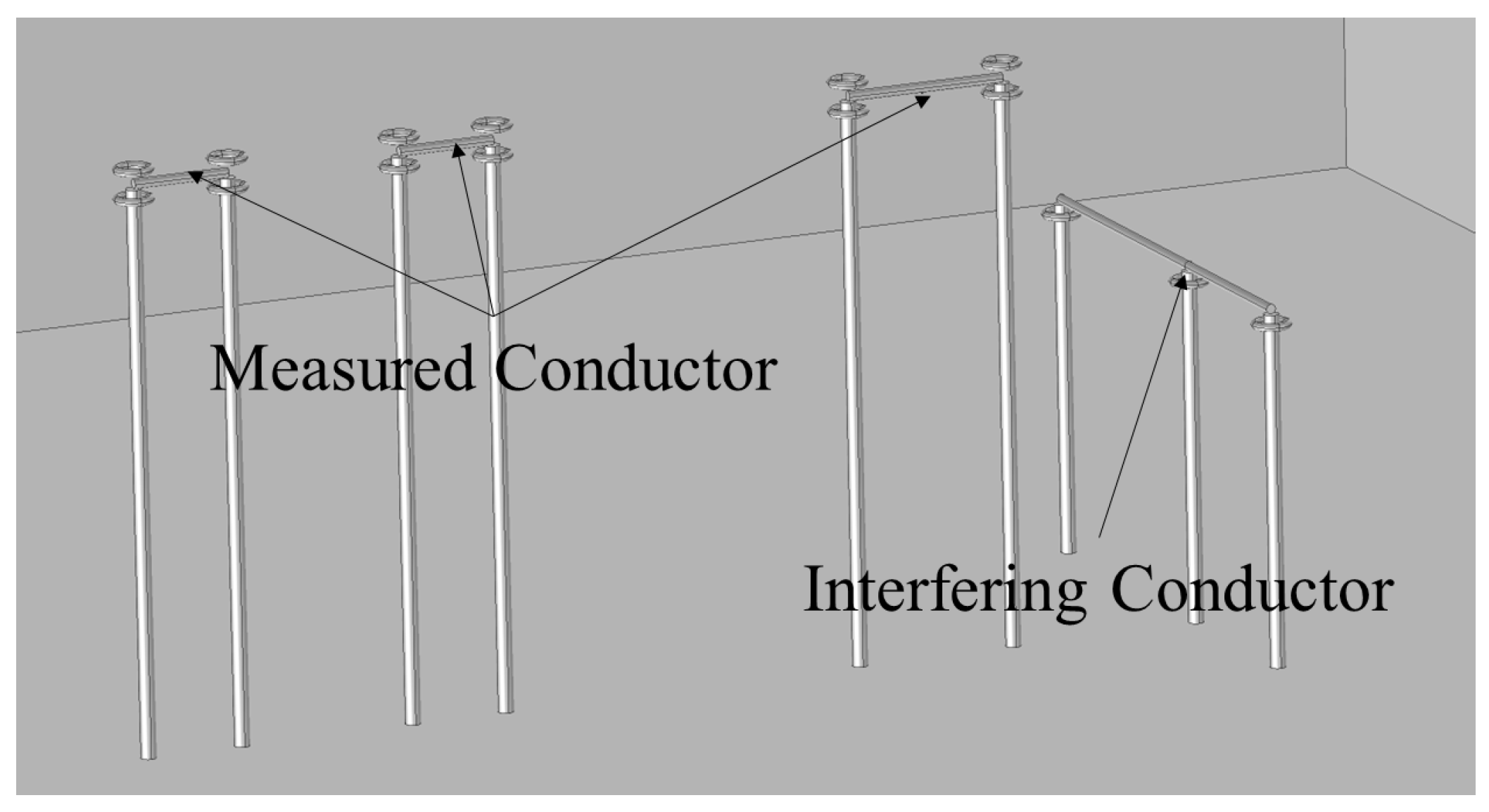
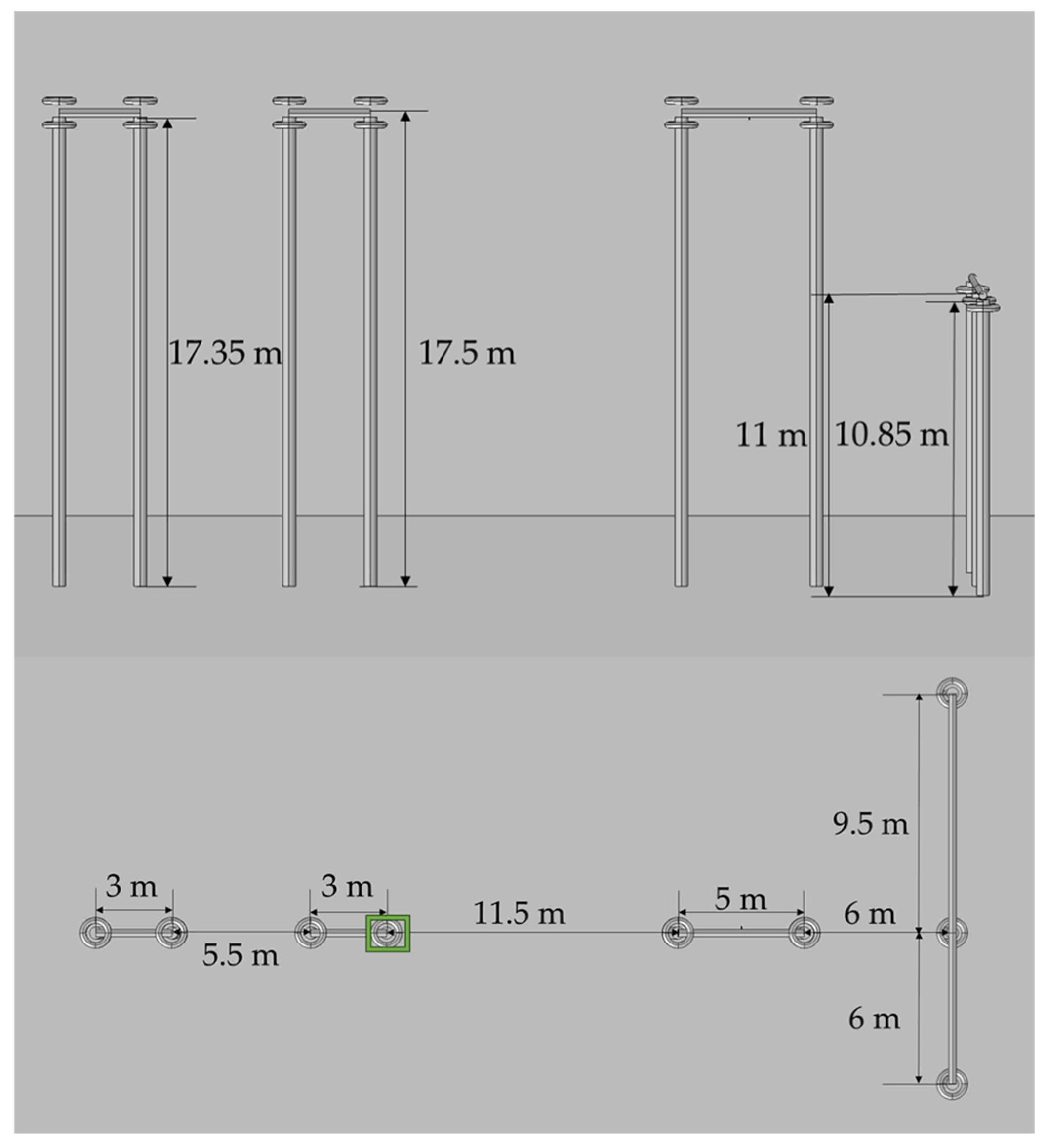
To implement the theoretical analysis presented in Section 2.3 and determine the explicit expression of the correction coefficient k in a practical converter valve scenario, a three-dimensional finite-element model is established in COMSOL Multiphysics 6.4 for the converter valve environment in a converter station, as shown in Figure 7. The model consists of two groups of conductors: one represents the measured conductor, and the other represents a nearby interfering conductor. Both are high-voltage tubular conductors supported by insulators. The geometric centre of the measured conductor is 17.5 m above the ground, and the maximum applied voltage is 1200 kV, while the interfering conductor is located 11 m above the ground and energized at 400 kV. The two conductors are arranged perpendicular to each other, in agreement with the representative interference configuration described in Section 2.3.
The overall geometry of the converter valve bridge-arm FEM model is shown in Figure 8. A 100 m × 100 m × 100 m air domain was established to represent the insulation space surrounding the bridge-arm assembly. The converter valve assembly was placed near the bottom of the air domain, and the ground plane was set at the bottom boundary. The insulator located at the centre of the ground plane is marked by the green rectangle in Figure 8. The model includes the measured conductor, the nearby interference conductor, insulators, and grading rings, which are retained to reproduce the practical three-dimensional electric-field distribution around the bridge arm. In the electrostatic simulation, the ground plane was set to 0 V, and fixed potentials were applied to the measured and interfering conductors. The outer boundary of the air domain was placed sufficiently far from the sensing region to reduce artificial boundary effects. A predefined global extra-fine mesh was used for the finite-element calculation.
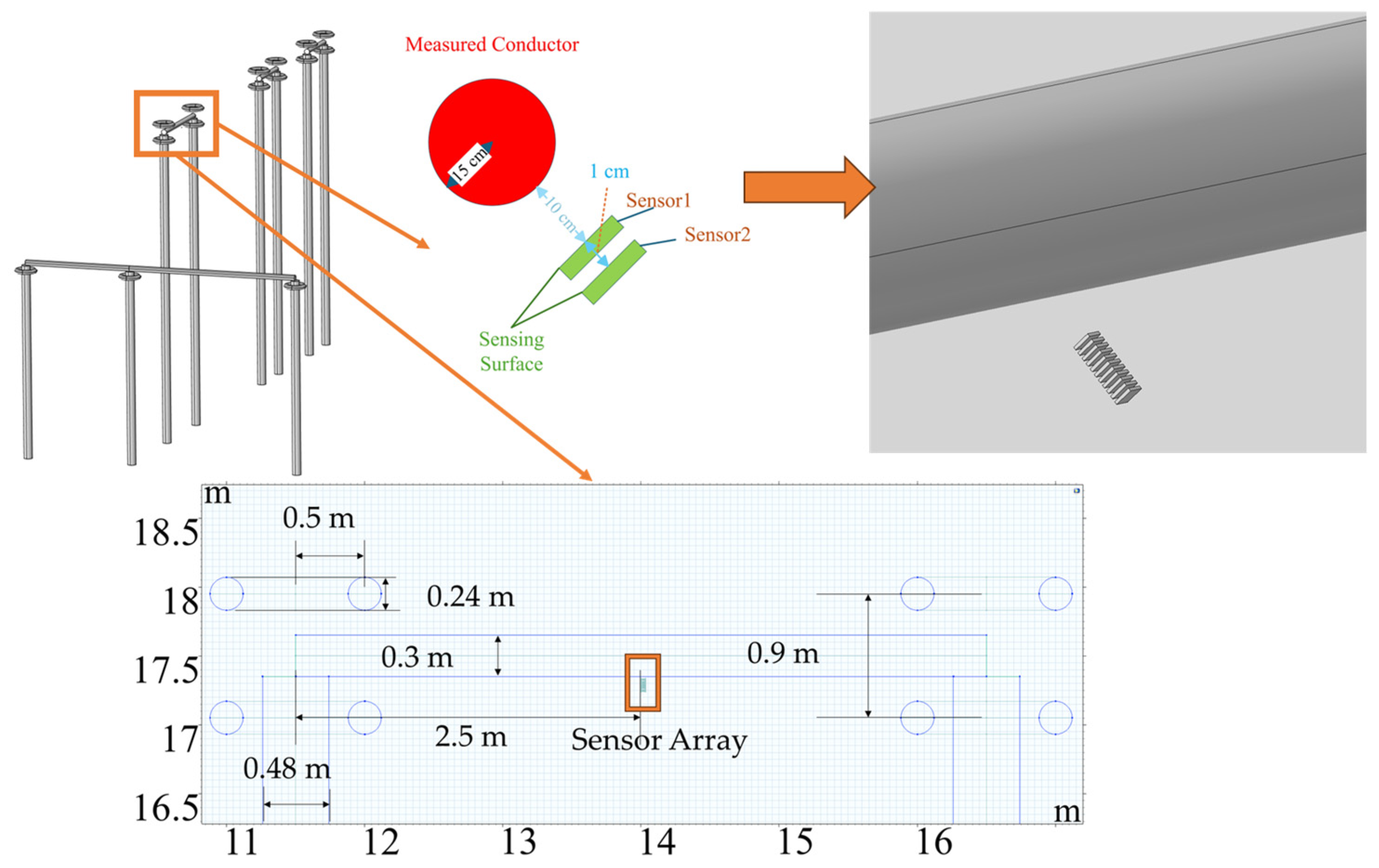
As shown in Figure 9, the local sensor-installation region on the measured-conductor side is further enlarged, together with the main structural dimensions around the sensing area. The figure also indicates the dimensions of the grading rings and the diameter of the supporting insulator. The measured conductor is equipped with upper and lower grading rings, whereas the nearby interfering conductor is equipped only with a lower grading ring; the corresponding spacing dimensions are the same as those of the measured conductor.
A series of sensing positions is arranged in the boxed region facing the measured conductor. Since accurate modelling of the practical sensors is relatively complex, rectangular air blocks are used in the FEM model to represent the sensing units. The sensing surfaces are oriented toward the measured conductor and are perpendicular to its local normal direction, which passes through the centres of all sensing surfaces.
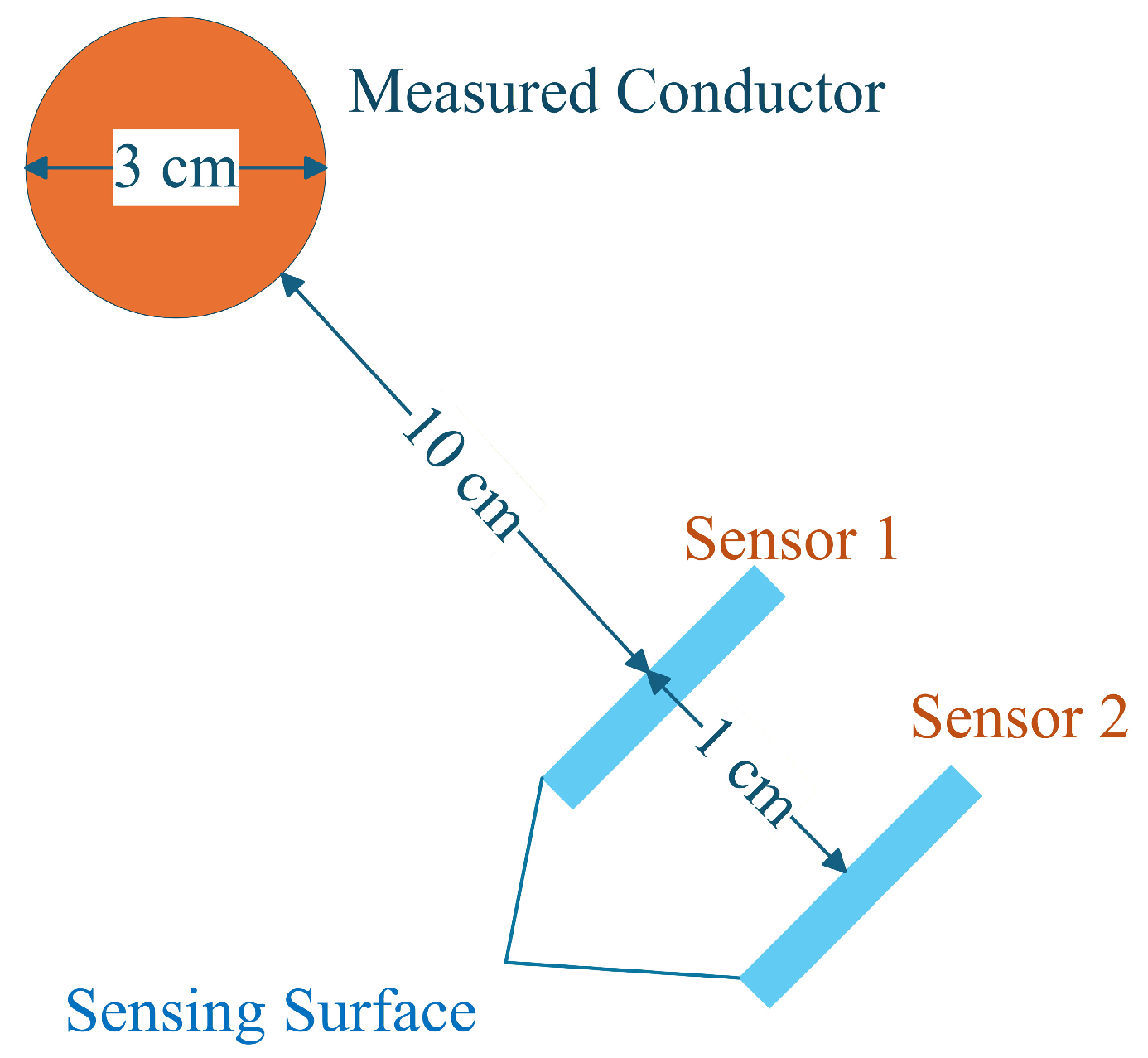
The distance from the sensing surface of Sensor 1 to the surface of the measured conductor is l1 = 10 cm. Sensor 2 is located 1 cm farther away from the measured conductor, corresponding to the main validation spacing Δl = 1 cm. To facilitate the analysis of the variation of the correction coefficient k with sensor spacing, nine additional sensing positions are further arranged behind Sensor 2 at intervals of 1 cm. Therefore, a total of 11 sensing positions are included in the model, and different values of Δl can be obtained by pairing Sensor 1 with the remaining sensing positions.
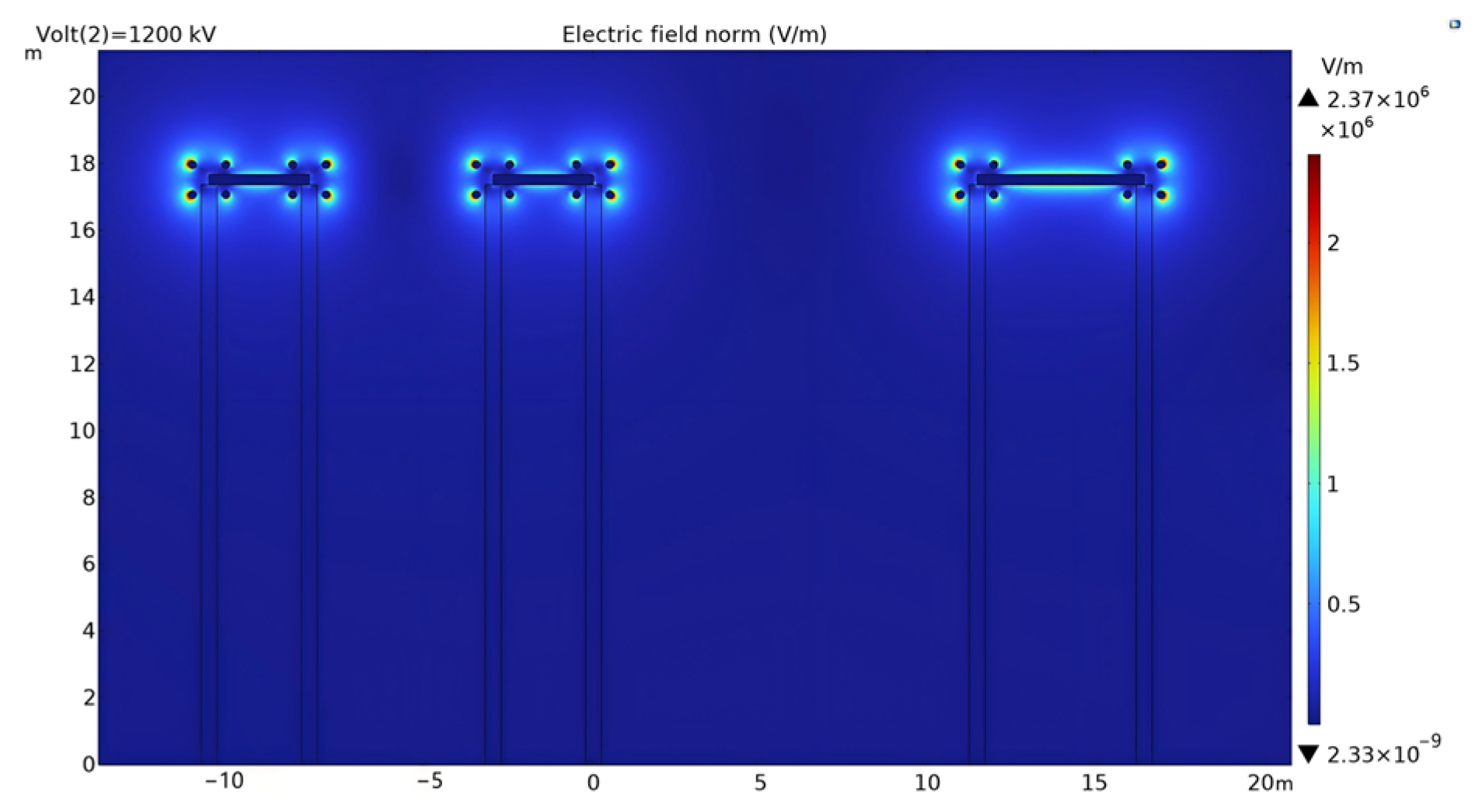
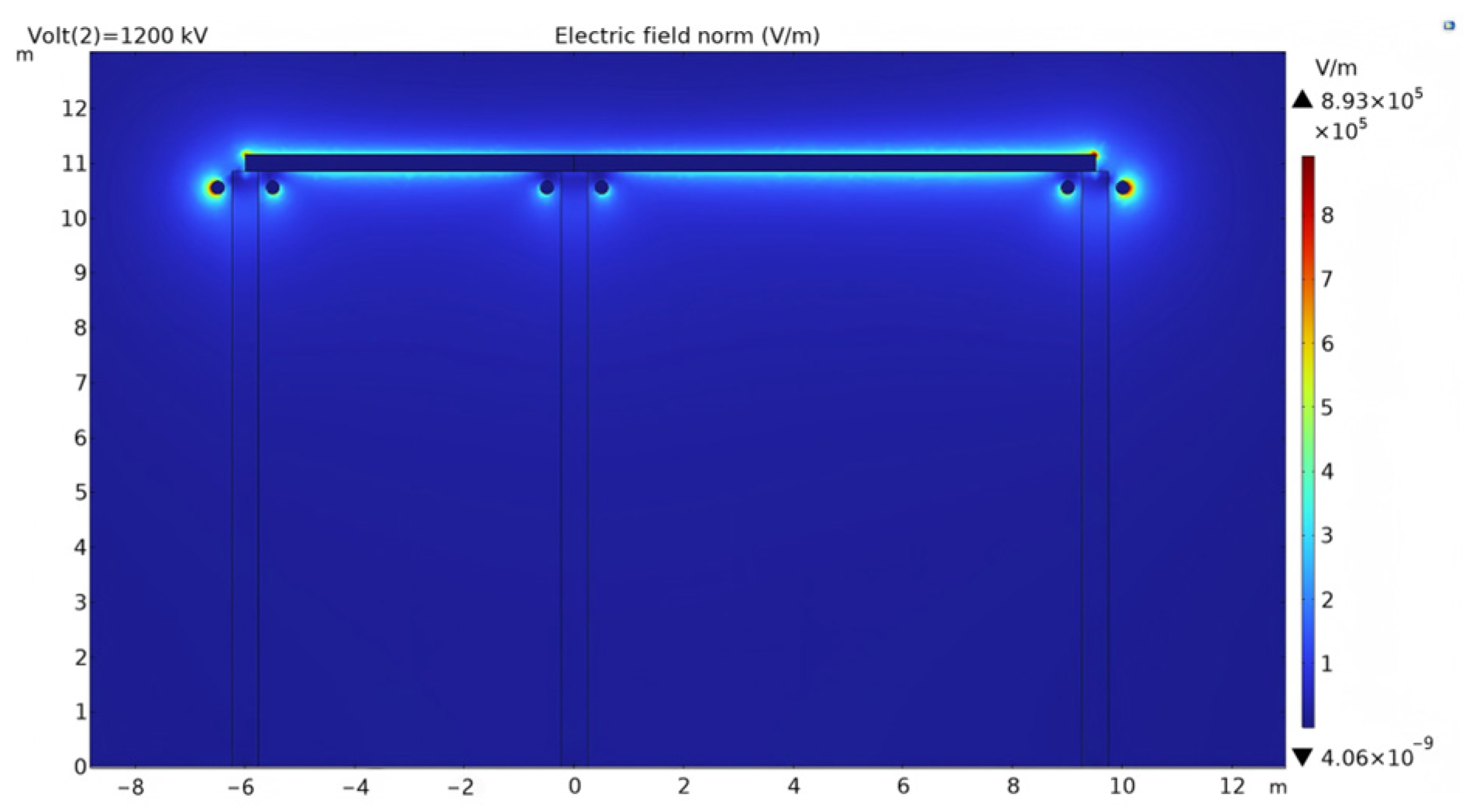
In the FEM model, all conductors, including the measured conductor, the nearby interfering conductor, and the grading rings, are assigned aluminium material. The supporting insulators are assigned X238 epoxy resin. The surrounding air domain is used to represent the insulation space around the converter valve bridge-arm assembly. The bottom surface of the air domain is set as the ground boundary. In the electrostatic simulation, the measured conductor is energized at 1200 kV, while the nearby interfering conductor is energized at 400 kV. A predefined global extra-fine mesh is adopted for the finite-element calculation. Under these simulation conditions, the electric-field distributions of the measured conductor and the interfering conductor are obtained, as shown in Figure 10 and Figure 11, respectively.

3.2. Voltage Inversion Calculation

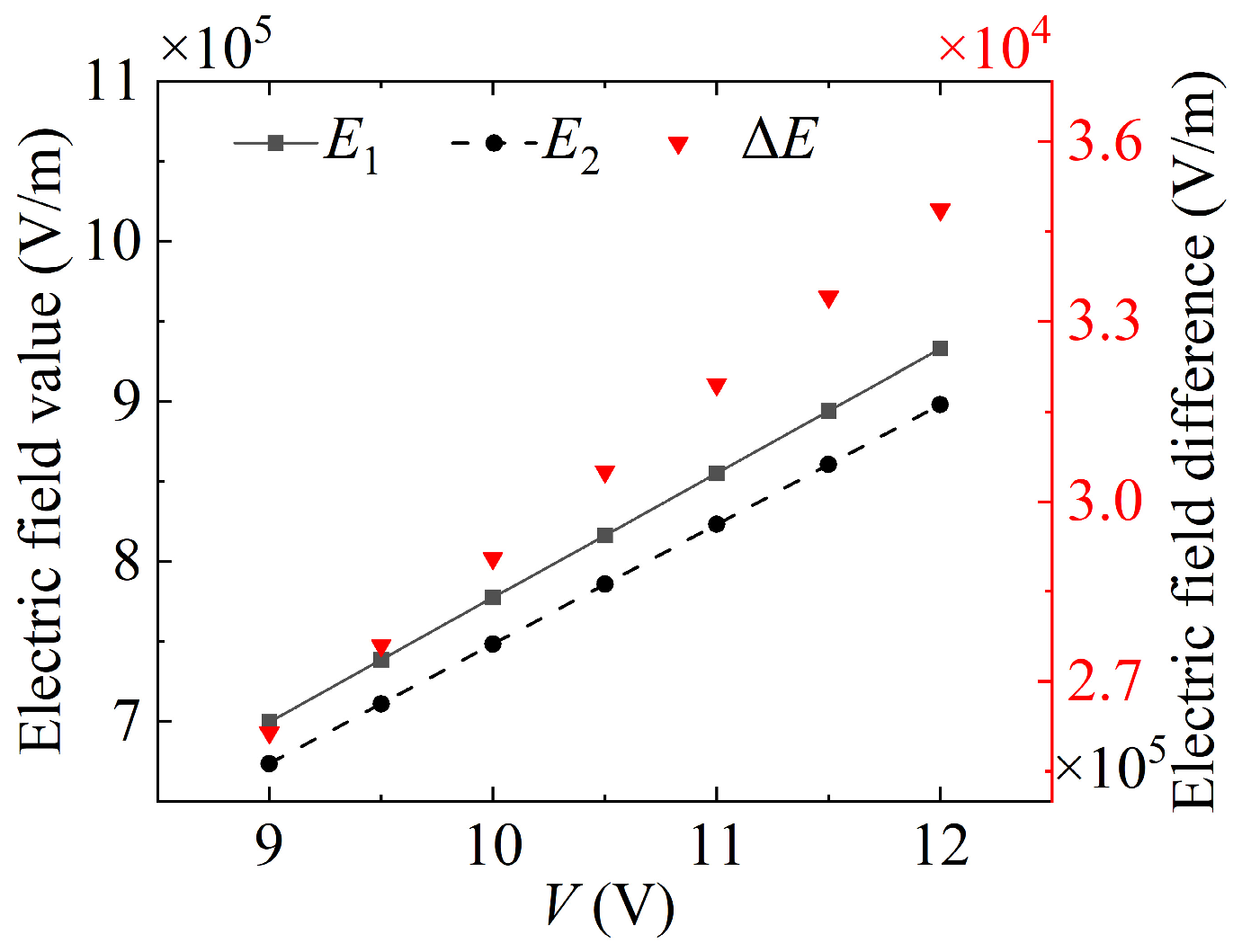
First, the interfering conductor is set to a floating potential, and the measured-conductor voltage V is varied to obtain the electric-field responses at the two sensing positions. In the FEM post-processing, the average normal electric-field value over each sensing surface is extracted and used as the electric-field value of the corresponding measurement position. The electric fields at Sensor 1 and Sensor 2 are denoted as E1 and E2, respectively, and their difference is denoted as ΔE = E1E2. The functional relationship between V, E1, E2, and ΔE is then obtained by fitting the simulation results, as shown in Figure 12.
Based on this fitted relationship, the inversion is carried out according to (4), and the results are presented in Table 1. For convenience, the voltage obtained by inversion is denoted by V′ throughout this section.
Keeping the fitted coefficients unchanged, the interfering-conductor voltage is then set to 400 kV, and the electric fields at positions of Sensor 1 and 2 under interference are substituted into (9) for inversion. The results are shown in Table 2. Due to the presence of nearby interference, the inversion accuracy deteriorates significantly and can no longer meet the high-accuracy requirement of practical measurements.
Under this condition, a correction coefficient k must be introduced to compensate for the biased electric-field difference. According to the trend analysis in Section 2.3, under a fixed interference-voltage condition and a fixed geometric configuration, k is mainly related to the measured-conductor voltage V and the sensor spacing Δl. To determine this relationship quantitatively, the values of k under different measured voltages and sensor spacings are obtained from the FEM results. During the simulation, the position of Sensor 1 is kept fixed, while different values of Δl are obtained by selecting different sensing positions behind Sensor 2. The average normal electric-field value over each sensing surface is extracted as the electric-field value of the corresponding measurement position.
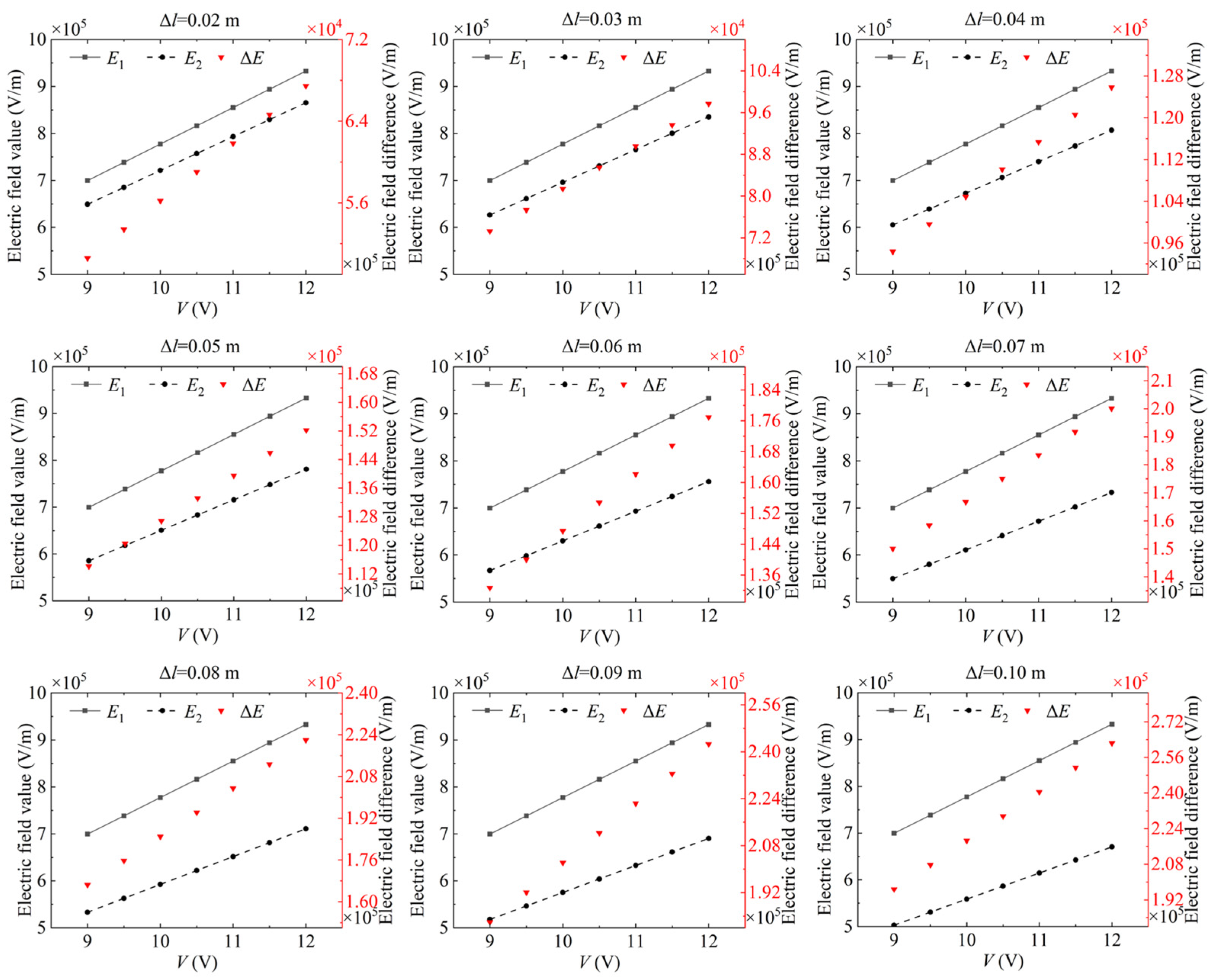
First, the interfering conductor is set to the floating potential, and the voltage–electric-field relationships under different sensor spacings are obtained by fitting the FEM results. The fitted curves are shown in Figure 13. These curves are used as the reference relationships for calculating the interference-free differential electric field under different Δl.
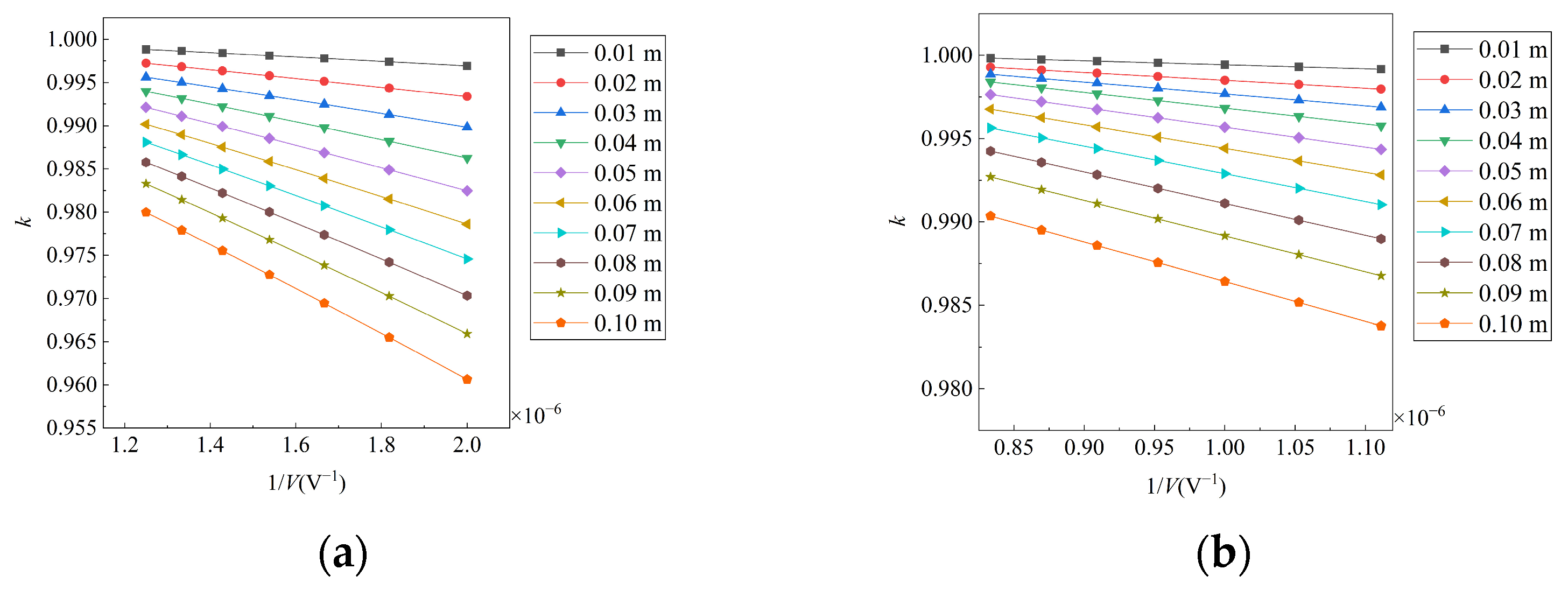
Based on the above data, the dependence of the correction coefficient k on the reciprocal of the measured voltage 1/V is investigated under fixed sensor spacings. As shown in Figure 14, k exhibits an approximately linear relationship with 1/V in both the 500–800 kV and 900–1200 kV voltage ranges. This result is consistent with the simplified trend analysis, indicating that the relative contribution of the interference-induced field decreases as the measured-conductor voltage increases. As a representative case corresponding to the main UHV converter valve scenario, the fitted relationship for Δl = 1 cm in the 900–1200 kV range can be written as:
k = 2363.51 V + 1.0018
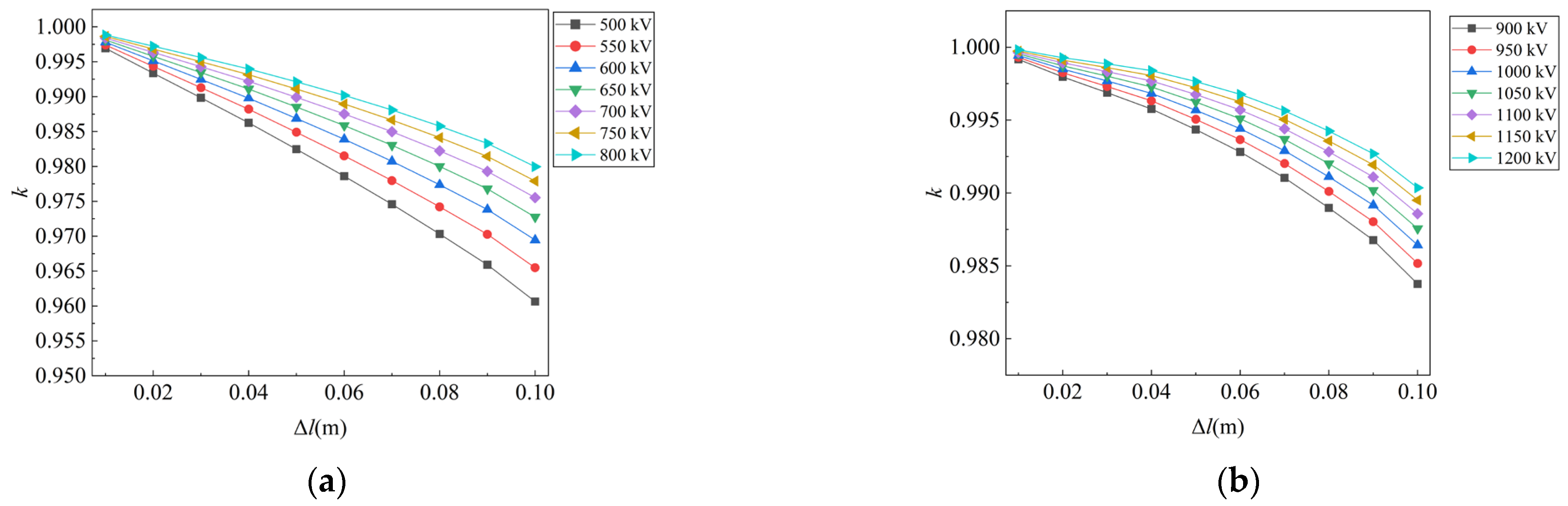
The relationship between k and the sensor spacing Δl is further investigated under fixed measured voltages, as shown in Figure 15. In the 500–800 kV range, the k − Δl relationship changes from an approximately linear trend to a weak nonlinear trend as the measured voltage increases. In the 900–1200 kV range, the nonlinear dependence becomes more evident over the investigated spacing range. This behaviour indicates that the first-order approximation with respect to Δl is mainly applicable to a limited spacing range, while higher-order spatial variations of the nearby interference field become non-negligible when a wider spacing range is considered. Therefore, a second-order spacing term is introduced in the fitted expression of k. For V = 1200 kV, the fitted relationship can be written as:
k = 1.0539 Δ l 2 + 0.0168 Δ l + 0.99951
When nearby interference exists in the measurement environment, differential inversion alone cannot completely eliminate the resulting error. Therefore, the correction coefficient k is introduced into the voltage inversion process to compensate for the residual interference component. Based on the finite-element model of the converter valve bridge-arm scenario, the corrected voltage inversion results under the representative 400 kV interference condition are obtained by incorporating k into (12), as shown in Table 3. The influence of different interference-voltage levels is further analyzed in the following subsection.
To evaluate the influence of the interference voltage level on the correction coefficient, additional FEM simulations are performed by varying the interfering conductor voltage V2. Two representative relationships are compared: the variation of k with sensor spacing Δl under V = 1200 kV, and the variation of k with the reciprocal of the measured-conductor voltage 1/V under Δl = 1 cm.
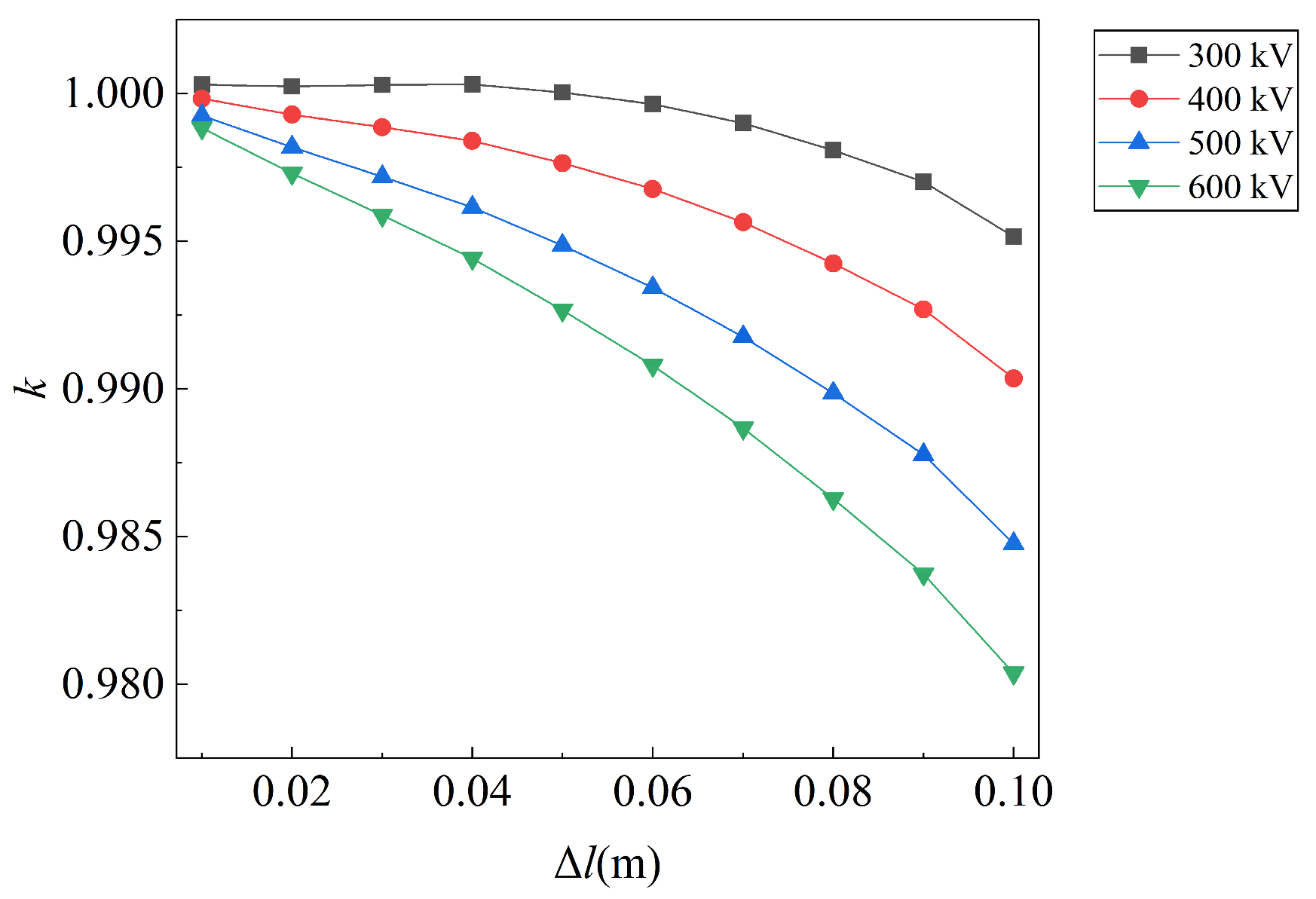
As shown in Figure 16, when the measured-conductor voltage is fixed at V = 1200 kV, k decreases as the sensor spacing Δl increases for all interference-voltage levels. This indicates that larger spacing leads to a larger difference between the residual radial interference components at the two sensing positions. As V2 increases from 300 kV to 600 kV, the deviation of k from unity becomes more significant. For example, when Δl = 10 cm, k decreases from 0.9952 under 300 kV interference to 0.9804 under 600 kV interference. In addition, the k − Δl curves exhibit a nonlinear decreasing trend over the investigated spacing range, indicating that the higher-order spatial variation of the nearby interference field becomes non-negligible.
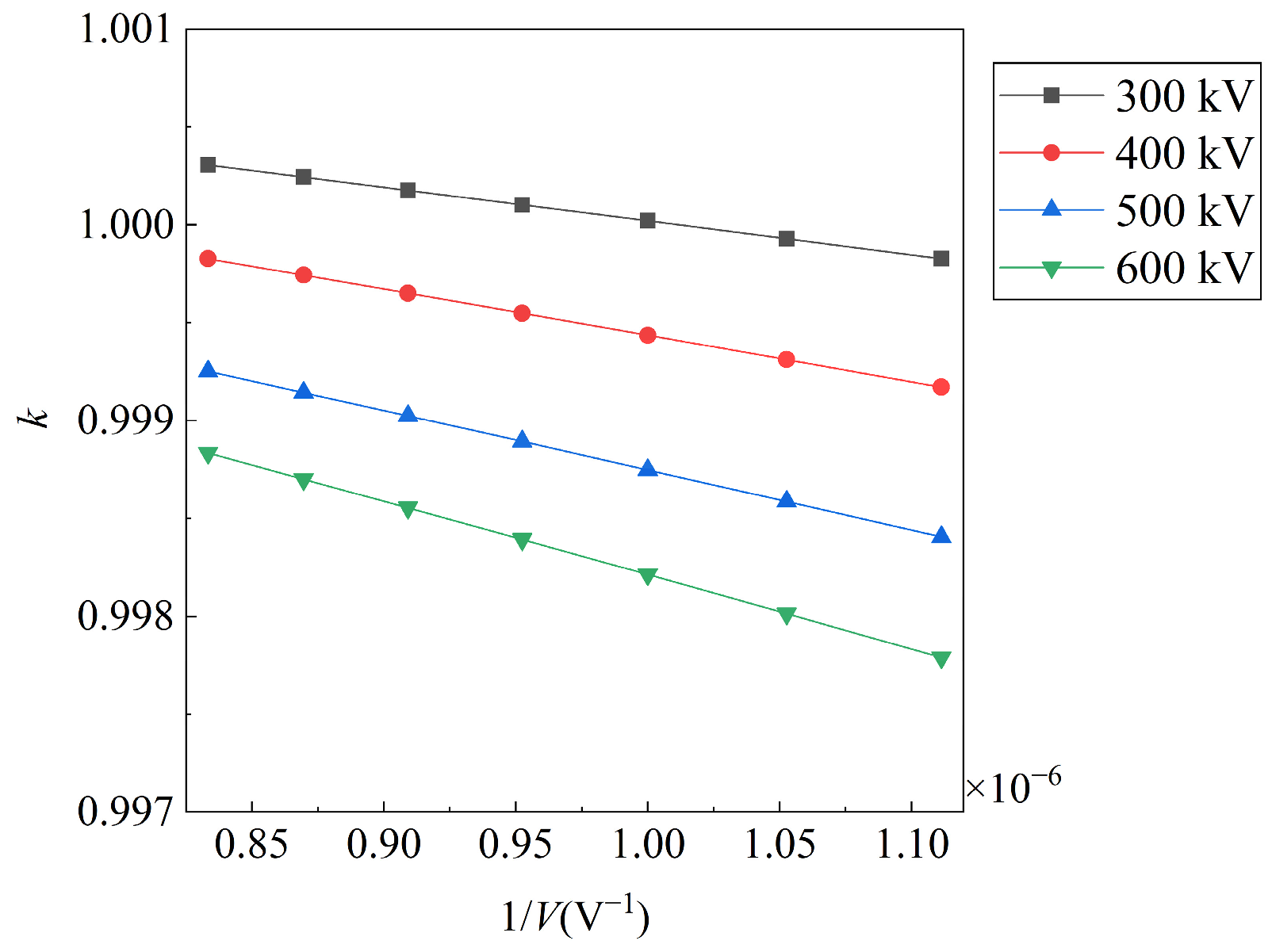
As shown in Figure 17, when the sensor spacing is fixed at Δl = 1 cm, k exhibits an approximately linear relationship with 1/V for all investigated interference-voltage levels. For a given V2, k gradually approaches unity as the measured-conductor voltage increases from 900 kV to 1200 kV, because the useful electric field generated by the measured conductor becomes stronger and the relative contribution of the interference-induced field decreases.
These results show that k is a scenario-dependent coefficient affected by V, Δl, and V2. For a given converter valve geometry and interference-voltage condition, the corresponding FEM-derived fitting relationship can be used for voltage correction. If the interference-voltage level or geometric configuration changes significantly, the coefficient should be re-determined. The experimental verification of the proposed correction strategy is presented in the next section.

4. Experimental Verification

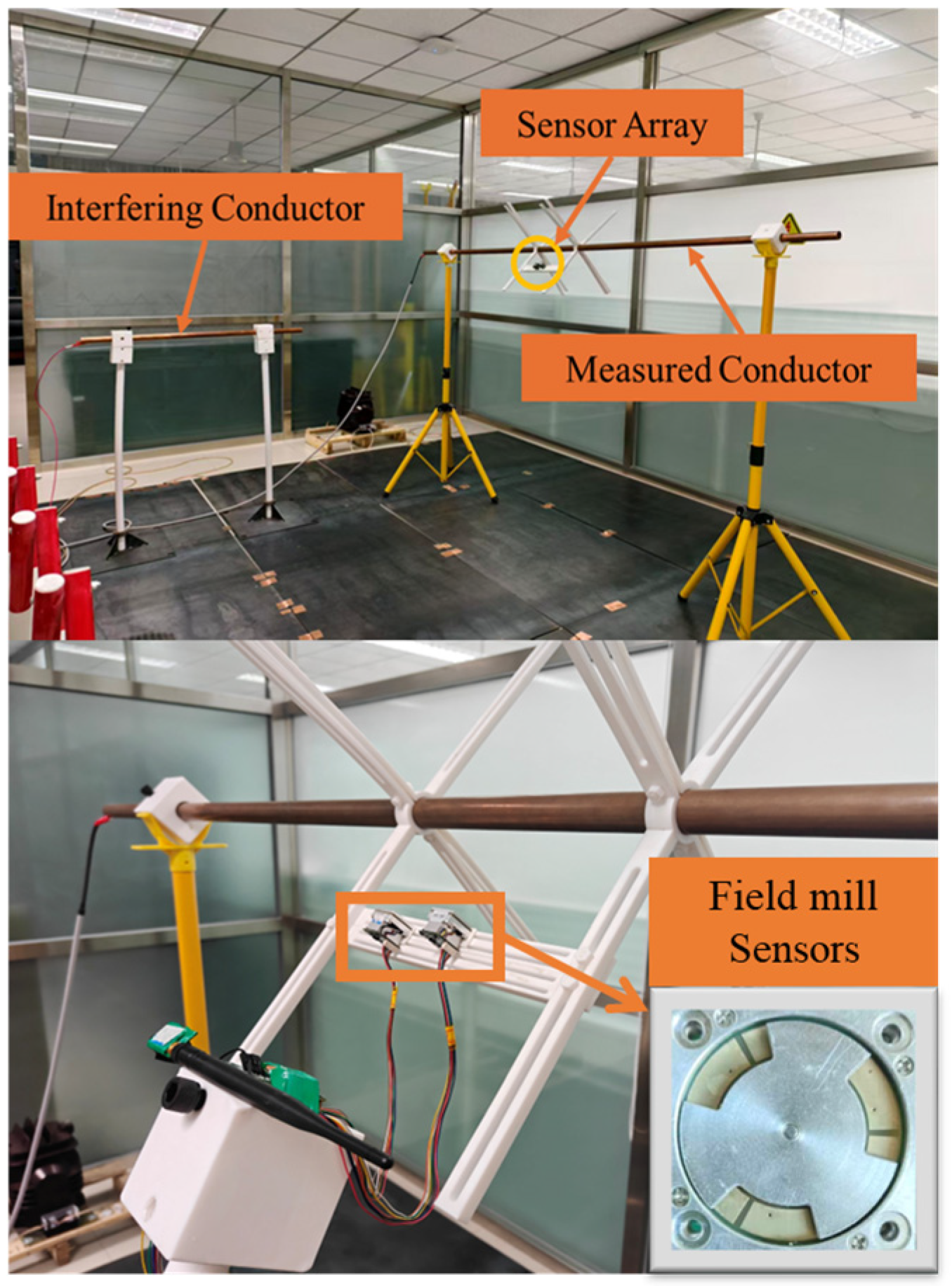
As mentioned in Section 3.2, because 1200 kV high-voltage equipment is difficult to obtain, a 30 kV low-voltage power supply and copper tubes were employed in the experimental validation stage to simulate the converter valve bridge arm. The experimental platform is shown in Figure 18 and mainly consists of a 30 kV power supply, the measured conductor, the interfering conductor, and a sensor array. The experiment employs a field mill electric-field sensor, which measures the DC electric field by periodically shielding the sensing electrode with a grounded rotor and thereby converting the field into a current signal.
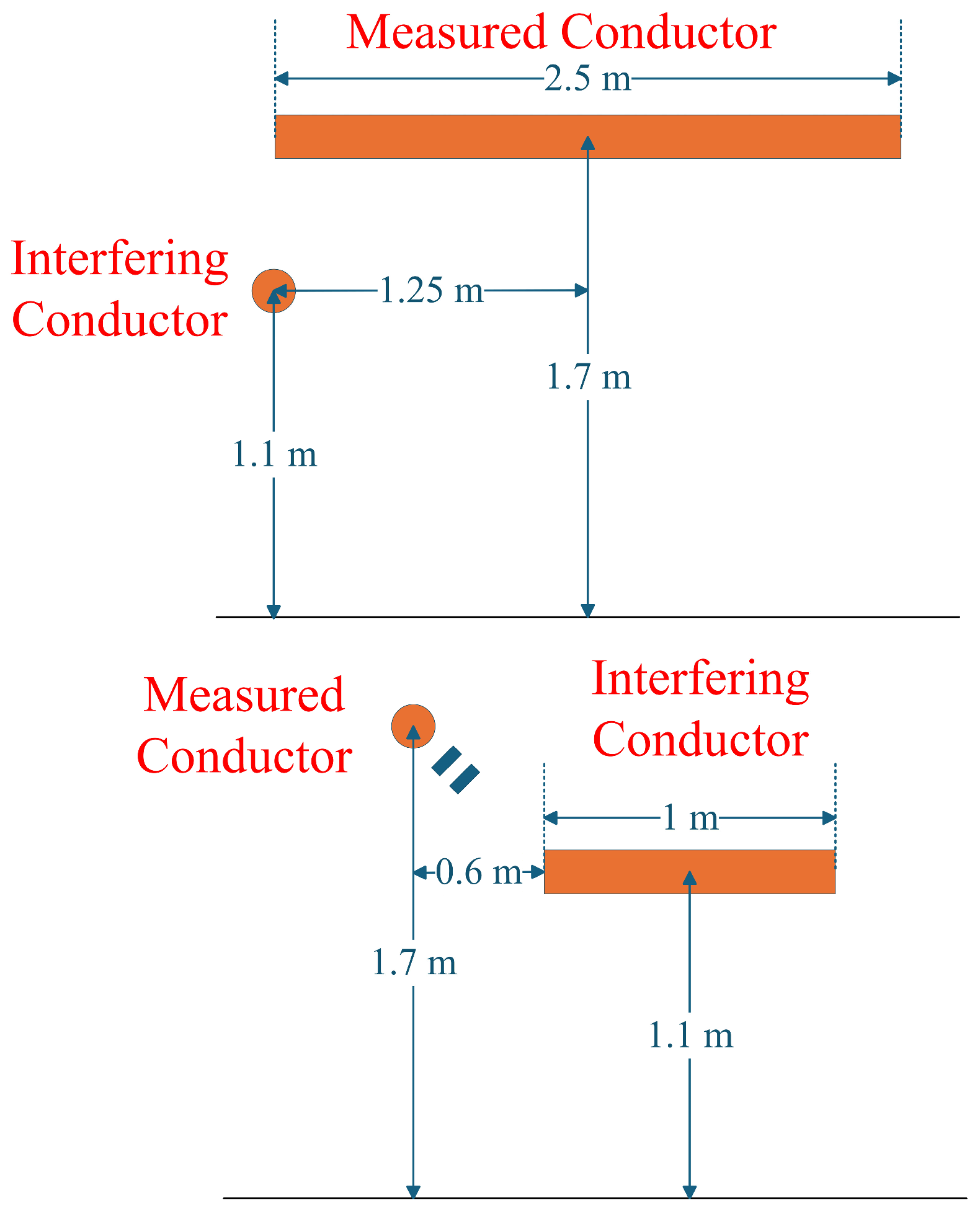
As shown in Figure 19, the measured conductor and the interfering conductor are both copper tubes with a diameter of 3 cm. The measured conductor is 2.5 m in length, and its geometric centre is located 1.7 m above the ground. The interfering conductor is 1 m in length, with its geometric centre 1.1 m above the ground. The two conductors are arranged perpendicular to each other, and one end of the interfering conductor is positioned 0.6 m from the geometric centre of the measured conductor.
The sensors are arranged along the radial direction of the measured conductor, with the geometric centres of the two sensors and the measured conductor aligned on the same straight line and are fixed by PTFE supports. In the initial operating condition, with sensor-to-conductor distances of 10 cm and 11 cm as shown in Figure 20, the measured conductor voltage is 15 kV, and the interfering conductor voltage is 7.5 kV. Subsequent experiments will verify the method under various measured conductor voltages, interfering conductor voltages, and sensor spacings.
The measured-conductor voltage was varied from 13 kV to 15 kV with a step of 0.5 kV. The interference-conductor voltage was first set to 7.5 kV. To evaluate the influence of sensor spacing, three sensor spacings, Δl = 1, 2, and 3 cm, were tested. In addition, to evaluate the influence of the interference voltage, supplementary experiments were carried out under Δl = 1 cm with interference voltages of 7 kV, 7.5 kV, and 8 kV.
In the first set of experiments, the interference-conductor voltage was set to 7.5 kV, which was selected as the representative interference condition of the low-voltage experimental platform. The measured-conductor voltage was varied from 13 kV to 15 kV with a step of 0.5 kV, and three sensor spacings, Δl = 1, 2, and 3 cm, were tested.
To obtain the correction coefficient corresponding to the experimental platform, a three-dimensional FEM model was established using the actual geometric parameters of the copper tubes and sensor positions. The average normal electric-field values on the sensing surfaces were extracted from the FEM results, and the correction coefficient k was calculated according to the weighted differential compensation condition. Since the experimental platform operates at a relatively low voltage level and the investigated sensor-spacing range is limited, the relationship between k and Δl can be approximated by a first-order expression. The fitted correction coefficient for the experimental platform under 7.5 kV interference is given by:
k = 2300.82 Δ l V + 0.0311 Δ l + 1
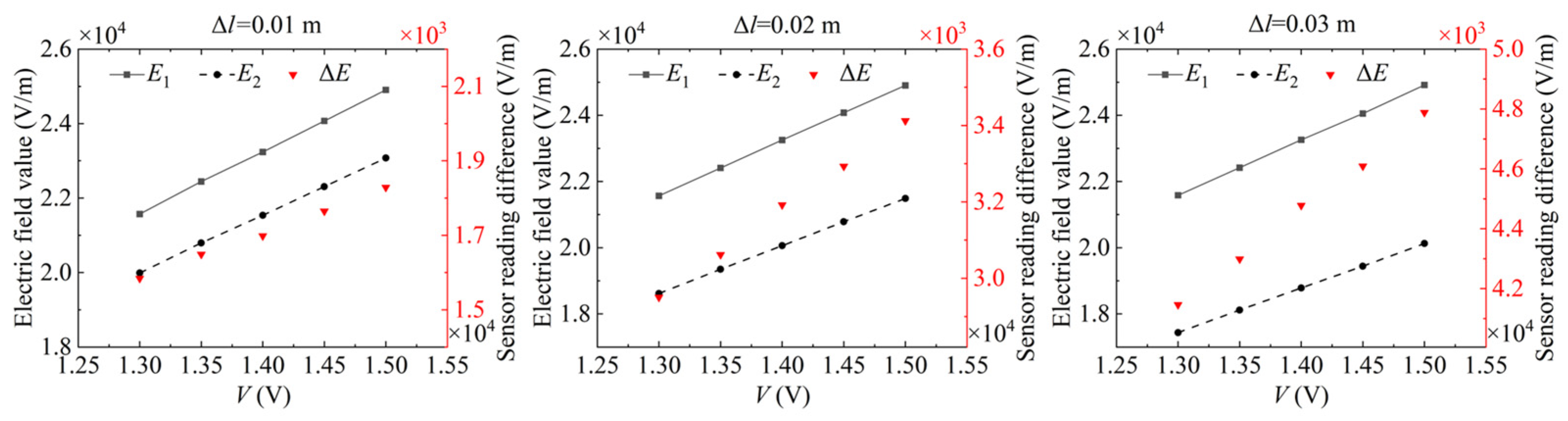
Before evaluating the influence of nearby interference, the voltage–electric-field relationships under the no-interference condition were first obtained for the experimental platform. The interference conductor was set to floating potential, and the measured-conductor voltage was varied from 13 kV to 15 kV with a step of 0.5 kV. For each sensor spacing, the average normal electric-field values on the sensing surfaces were extracted, and the differential electric field was calculated as ΔE = E1E2. The corresponding linear fitting results for Δl = 1, 2, and 3 cm are shown in Figure 21.
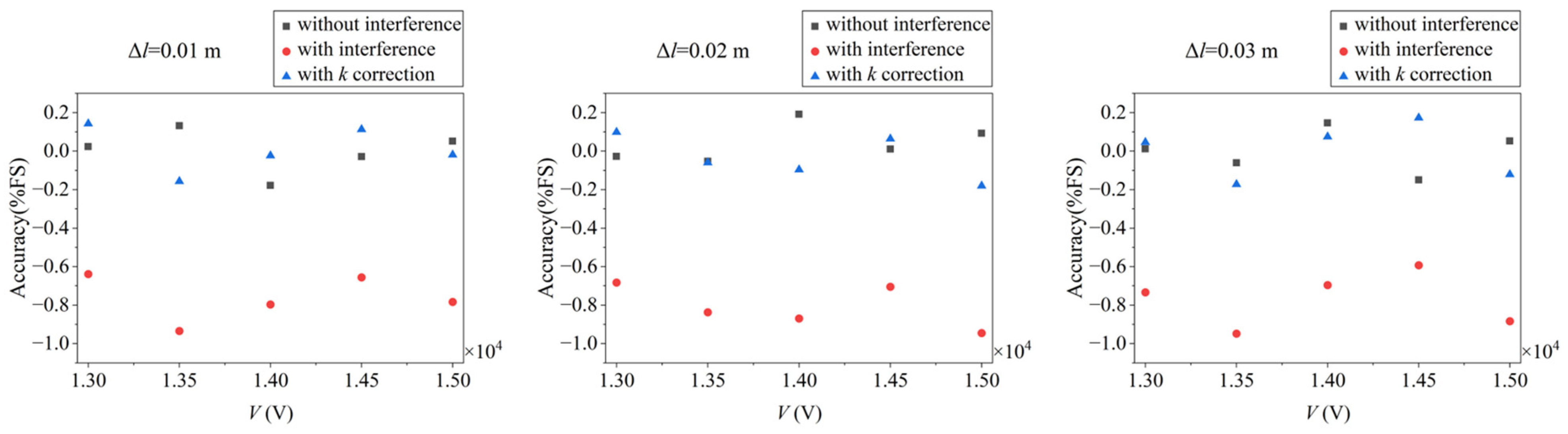
Figure 22 compares the full-scale voltage inversion errors under different sensor spacings before and after introducing nearby interference and after applying the correction coefficient. The measured-conductor voltage is varied from 13 kV to 15 kV, and the interference-conductor voltage is fixed at 7.5 kV. For the three tested sensor spacings, Δl = 1, 2, and 3 cm, the voltage inversion error remains relatively small under the no-interference condition, indicating that the experimental platform has good baseline inversion accuracy.
When the nearby interference conductor is energized, the inversion error increases significantly, which confirms that ordinary differential inversion cannot completely suppress the residual radial component of the nearby interference field. After the FEM-derived correction coefficient k is introduced, the inversion error is effectively reduced for all three sensor spacings. The corrected error is close to the no-interference error level, demonstrating that the proposed weighted differential compensation method remains effective under different measured voltages and sensor spacings within the tested range.
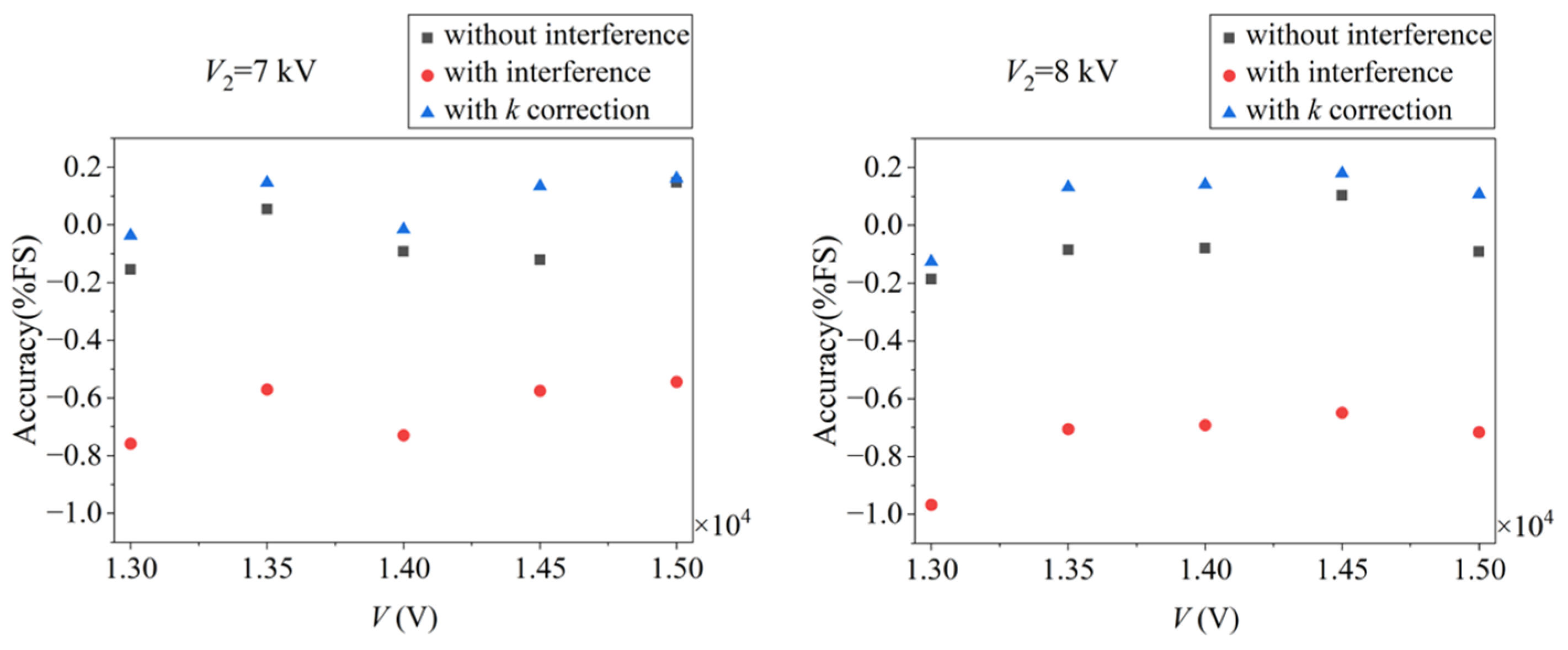
To further evaluate the influence of the interference-voltage level, additional experiments were carried out under the fixed sensor spacing of Δl = 1 cm. In addition to the 7.5 kV interference condition discussed above, two interference-conductor voltages, V2 = 7 kV and V2 = 8 kV, were tested. For each interference-voltage condition, the correction coefficient k was recalculated using the corresponding FEM model of the experimental platform, rather than directly using the coefficient obtained under 7.5 kV interference.
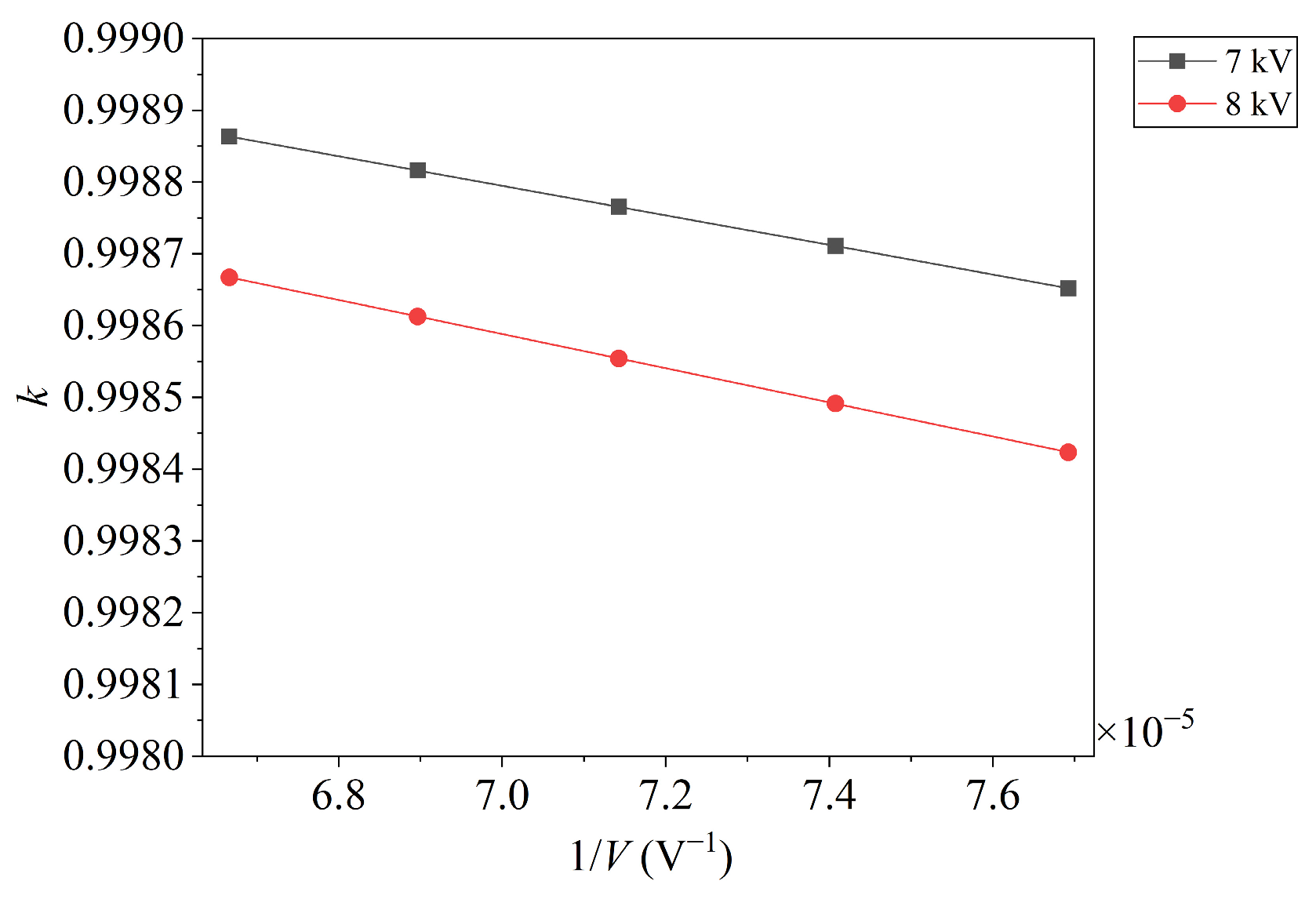
Based on the corresponding FEM models, the correction coefficients calculated for V2 = 7 kV and V2 = 8 kV are obtained under Δl = 1 cm. To illustrate the influence of the interference-voltage level more clearly, the relationships between k and 1/V for the two interference conditions are plotted together in Figure 23.
Using the FEM-calculated correction coefficients shown in Figure 23, the experimental electric-field data under V2 = 7 kV and V2 = 8 kV are corrected separately. The full-scale voltage inversion errors under the no-interference condition, the interference condition, and the corrected condition are compared in Figure 24.
It should be noted that the 30 kV platform experiment can only verify the feasibility of the weighted differential correction strategy—obtained from finite element calculations—under controllable nearby-conductor interference. Because the correction coefficient k is affected by the measured voltage, sensor spacing, interference voltage level, and geometric configuration, the k value obtained from the low-voltage platform cannot be directly transferred to practical UHVDC conditions; it must be recalculated according to the specific operating conditions.

5. Conclusions

This paper proposes a non-invasive voltage measurement method for converter valve bridge-arm scenarios by combining near-end two-point differential electric-field measurement with a FEM-based correction strategy. The two-point differential measurement suppresses distant common-mode interference, while the correction coefficient k is introduced to compensate for the residual radial interference caused by a nearby conductor. Theoretical analysis shows that k is a scenario-dependent weighted differential compensation coefficient rather than a universal constant. In the converter valve bridge-arm FEM model, k is affected by the measured-conductor voltage V, sensor spacing Δl, and interference-conductor voltage V2. Under the representative 400 kV nearby interference condition, the absolute voltage inversion error is reduced from 0.50–1.57% FS before correction to below 0.20% FS after correction. Experimental validation on a 30 kV platform further verifies the effectiveness of the proposed method under different measured voltages, sensor spacings, and interference-voltage levels. In the tested range of V = 13–15 kV, Δl = 1–3 cm, and V2 = 7–8 kV, the best interference suppression performance is obtained under V2 = 7.5 kV and Δl = 1 cm, where the maximum full-scale inversion error is reduced from 0.93% FS before correction to 0.16% FS after correction, and the mean absolute error is reduced by approximately 88.05%. This demonstrates that the FEM-derived correction coefficient can effectively restore the voltage inversion accuracy under nearby-conductor interference.
Several limitations should also be acknowledged. First, the correction coefficient k is scenario-dependent; its fitted or FEM-calculated value is applicable only to the investigated converter valve geometry, voltage range, interference-voltage condition, and sensor installation range. If the conductor arrangement, interference-voltage level, or sensor position changes significantly, k should be redetermined using the corresponding FEM model or an updated lookup relationship. Second, the present experimental validation is still based on a scaled 30 kV low-voltage platform, and the experimental k values cannot be directly transferred to full-scale UHVDC conditions. Third, the present study mainly considers a single nearby interference conductor, whereas multiple simultaneous interference sources may exist in practical converter valve environments. Future work will focus on validation under higher voltage levels, multiple interference-source configurations, complex and irregular conductor geometries, sensor-positioning errors, adaptive estimation of k , and extension of the method to transient or dynamic voltage measurement conditions.

Author Contributions

Conceptualization, Z.H., B.G., and P.Y.; methodology, Z.H. and B.G.; software, Z.H.; validation, Z.L. and B.G.; formal analysis, Z.H. and B.G.; investigation, Z.H. and Z.L.; resources, P.Y.; writing—original draft preparation, Z.H.; writing—review and editing, B.G., Z.L., and C.Y.; supervision, P.Y.; project administration, P.Y.; funding acquisition, P.Y. All authors have read and agreed to the published version of the manuscript.

Funding

This work was supported by the National Key R&D Program of China (Grant No. 2024YFB3213300).

Data Availability Statement

The original contributions presented in this study are included in the article. Further inquiries can be directed to the corresponding author.

Conflicts of Interest

The authors declare no conflicts of interest.

Abbreviations

The following abbreviations are used in this manuscript:
UHVDCUltra-High-Voltage Direct Current
UHVUltra-High-Voltage
CSMCharge Simulation Method
FSFull Scale
ACAlternating Current
DCDirect Current
PTFEPolytetrafluoroethylene

References

  1. Pan, S.; Tang, M.; Li, N.; Zuo, J.; Zhou, X. Anomaly Detection of Acoustic Signals in Ultra-High Voltage Converter Valves Based on the FAVAE-AS. Sensors 2025, 25, 4716. [Google Scholar] [CrossRef]
  2. Bang, S.; Kim, H.-S.; Koo, J.-H.; Lee, B.-W. Consideration of the Insulation Design Method on a ±200 kV Converter Valve Unit in an HVDC Converter Hall. Energies 2021, 14, 2296. [Google Scholar] [CrossRef]
  3. Schneider, J.B.; Olsen, R.G. Observations about Propagation, Attenuation, and Radiation of EMI from HVDC Converter Stations. Appl. Sci. 2024, 14, 6740. [Google Scholar] [CrossRef]
  4. Yu, J.; Zhang, Z.; Xu, Z. An Active DC Fault Current Limiting Control for Half-Bridge Modular Multilevel Converter Based on Arm Voltage Reconstruction. IEEE Trans. Power Deliv. 2024, 39, 565–577. [Google Scholar] [CrossRef]
  5. Wang, L.; Li, Z.; Lu, H.; Zhou, F.; Diao, Y. Modeling and Simulation of Wide-Frequency Characteristics of Electromagnetic Standard Voltage Transformer. Electronics 2024, 13, 4206. [Google Scholar] [CrossRef]
  6. Kluss, J.; Hallstrom, J.; Elg, A. Optimization of field grading for a 1000 kV wide-band voltage divider. J. Electrostat. 2015, 73, 140–150. [Google Scholar] [CrossRef]
  7. Heidary, A.; Rouzbehi, K.; Radmanesh, H.; Pou, J. Voltage Transformer Ferroresonance: An Inhibitor Device. IEEE Power Eng. Lett. 2021, 1, 2731–2733. [Google Scholar] [CrossRef]
  8. Li, H.; Ma, C.; Chen, Q.; Jiao, Y.; He, C. Knowledge-assisted differential evolution based non-contact voltage measurement for multiconductor systems in smart grid. Adv. Eng. Inform. 2024, 62, 102740. [Google Scholar] [CrossRef]
  9. Zhou, K.; Jin, Q.; Wang, X.; Feng, B.; Sun, H.; Yin, X. Research on decoupling method of non-contact voltage measurement. In Proceedings of the 2021 8th International Forum on Electrical Engineering and Automation (IFEEA), Xi’an, China, 3–5 October 2021. [Google Scholar]
  10. Shen, J.; Liu, L.; Li, X.; Tu, Y.; Liu, B.; Deng, S.; Yang, X. A novel non-contact voltage measurement based on distribution lines. IET Gener. Transm. Distrib. 2025, 19, e13336. [Google Scholar] [CrossRef]
  11. Lawrence, D.; Donnal, J.S.; Leeb, S.; He, Y. Non-contact measurement of line voltage. IEEE Sens. J. 2016, 16, 8990–8997. [Google Scholar] [CrossRef]
  12. Brunelli, D.; Villani, C.; Balsamo, D.; Benini, L. Non-invasive voltage measurement in a three-phase autonomous meter. Microsyst. Technol. 2016, 22, 1915–1926. [Google Scholar] [CrossRef]
  13. Wang, J.; Li, X.; Wang, Q.; Zhong, L.; Zhu, X. Research on transmission line voltage measurement method based on Gauss–Kronrod integral algorithm. Meas. Sci. Technol. 2020, 31, 085103. [Google Scholar] [CrossRef]
  14. Chen, K.-L.; Guo, Y.; Ma, X. Contactless voltage sensor for overhead transmission lines. IET Gener. Transm. Distrib. 2018, 12, 957–966. [Google Scholar] [CrossRef]
  15. El-Hawary, H.; Abdel-Salam, M. A novel extension of traditional charge simulation method for field calculation in multi-dielectric arrangements. Phys. Scr. 2025, 100, 125604. [Google Scholar] [CrossRef]
  16. Djekidel, R.; Bessedik, S.A.; Cavallini, A.; Bentouati, B.; El-Sehiemy, R.A. Optimization of electric field screening effect under EHV overhead transmission lines using hybrid computing CSM-GOA paradigm. Electr. Eng. 2025, 107, 363–381. [Google Scholar] [CrossRef]
  17. Zhu, X.; Zhang, Z.; Hu, C.; Wang, Z.; Liu, Z.; Yang, Q.; Zhou, J.; Qiu, Z.; Bao, S. Non-Invasive Voltage Measurement Device Based on MEMS Electric Field Sensor and Applications. Electronics 2025, 14, 2140. [Google Scholar] [CrossRef]
  18. Haberman, M.A.; Spinelli, E.M. A Noncontact Voltage Measurement System for Power-Line Voltage Waveforms. IEEE Trans. Instrum. Meas. 2020, 69, 2790–2797. [Google Scholar] [CrossRef]
  19. Wang, J.; Li, J.; Peng, C.; Wu, Z.; Ju, D.; Zhang, Q. A Self-Compensating Non-Intrusive Ring-Type AC Voltage Sensor Based on Capacitive Coupling. Micromachines 2024, 15, 1314. [Google Scholar] [CrossRef]
  20. Pichler, M. An inverse problem for Maxwell’s equations with Lipschitz parameters. Inverse Probl. 2018, 34, 025006. [Google Scholar] [CrossRef]
  21. Chavez, P.P.; Rahmatian, F.; Jaeger, N.A.F. Accurate voltage measurement with electric field sampling using permittivity-shielding. IEEE Trans. Power Deliv. 2002, 17, 362–368. [Google Scholar] [CrossRef]
  22. Rahmatian, F.; Chavez, P.P.; Jaeger, N.A.F. 230 kV Optical Voltage Transducers Using Multiple Electric Field Sensors. IEEE Trans. Power Deliv. 2002, 17, 417–422. [Google Scholar] [CrossRef]
  23. Wang, J.; Zhao, Y.; Li, W.; Zeng, X.; Tang, J.; Wang, Y.; Deng, X. Research on Transmission Line Voltage Measurement Method of D-Dot Sensor Based on Gaussian Integral. Sensors 2018, 18, 2455. [Google Scholar] [CrossRef] [PubMed]
  24. Yang, H.; Wu, Z.; Zheng, S.; Zhang, Z.; Nie, Y. An accurate voltage measurement method for electric field inversion in power lines with dual-stage model error reduction. Int. J. Electr. Power Energy Syst. 2025, 171, 111023. [Google Scholar] [CrossRef]
  25. Liu, K.; Li, B.; Jiang, Q.; Zhang, Y.; Liu, T. Fault Ride-Through Strategy for Hybrid Cascaded HVdc Systems Based on Controllable LCC. IEEE Trans. Circuits Syst. II Express Briefs 2026, 73, 88–92. [Google Scholar] [CrossRef]
  26. Hu, Z.; Liu, S.; Luo, W.; Wu, L. Resilient Distributed Fuzzy Load Frequency Regulation for Power Systems under Cross-Layer Random Denial-of-Service Attacks. IEEE Trans. Cybern. 2022, 52, 2396–2406. [Google Scholar] [CrossRef]
  27. Si, D.; Wang, J.; Wei, G.; Yan, X. Method and experimental study of voltage measurement based on electric field integral with Gauss–Legendre algorithm. IEEE Trans. Instrum. Meas. 2020, 69, 2771–2778. [Google Scholar] [CrossRef]
  28. Li, Z.; Xiao, X.; He, Z.; Jing, M.; Gao, B.; Yang, P. Research on a Differential High-Precision Non-Invasive DC Voltage Measurement Method Using the Charge Simulation Method. In Proceedings of the 2025 2nd International Conference on DC Technologies and Systems (DCTS), Beijing, China, 28–30 November 2025. [Google Scholar]
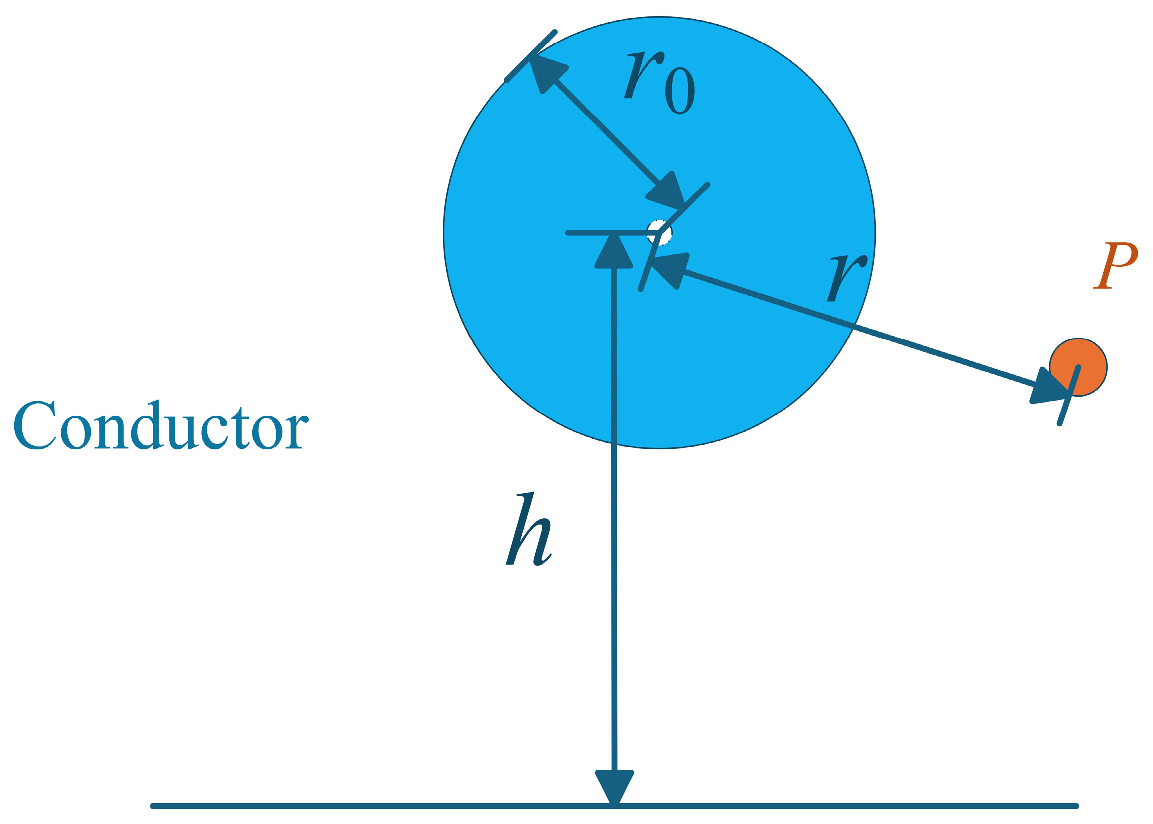
Figure 1. Schematic diagram of a cylindrical charged conductor in space.
Electronics 15 02264 g001
Figure 2. Schematic diagram of the differential inversion model.
Electronics 15 02264 g002
Figure 3. Interference electric fields (Ecom1 and Ecom2) generated by a distant interference source in the environment.
Electronics 15 02264 g003
Figure 4. Decomposition of the common-mode interference electric fields.
Electronics 15 02264 g004
Figure 5. Presence of a nearby interference source in the measurement environment.
Electronics 15 02264 g005
Figure 6. Simplified model for analyzing the dependence trend of the correction coefficient k.
Electronics 15 02264 g006
Figure 7. Finite element simulation model of the converter valve bridge arm voltage scenario.
Electronics 15 02264 g007
Figure 8. Overall geometry of the converter valve bridge-arm FEM model and the surrounding air domain.
Electronics 15 02264 g008
Figure 9. Specific sensor placement locations in the simulation model.
Electronics 15 02264 g009
Figure 10. Electric field distribution of the measured conductor.
Electronics 15 02264 g010
Figure 11. Electric field distribution of the interfering conductor.
Electronics 15 02264 g011
Figure 12. Linear least-squares fitted relationships between the measured-conductor voltage and the average normal electric fields at the two sensing surfaces under the no-interference condition (Δl = 1 cm). The markers represent the FEM simulation data, and the solid lines represent the corresponding linear fitting results.
Electronics 15 02264 g012
Figure 13. Linear least-squares fitted voltage–electric-field relationships for different sensor spacings Δl = 2–10 cm over the measured-conductor voltage range of 900–1200 kV. The markers represent the FEM simulation data, and the solid lines represent the corresponding linear fitting results.
Electronics 15 02264 g013
Figure 14. Linear least-squares fitted relationships between the correction coefficient k and the reciprocal of the measured-conductor voltage 1/V under different fixed sensor spacings Δl = 1–10 cm: (a) 500–800 kV; (b) 900–1200 kV.
Electronics 15 02264 g014
Figure 15. Second-order polynomial fitted relationships between the correction coefficient k and the sensor spacing Δl under fixed measured-conductor voltages: (a) 500–800 kV; (b) 900–1200 kV. The markers represent the FEM-derived k values, and the solid lines represent the corresponding second-order fitting results.
Electronics 15 02264 g015
Figure 16. Variation of k with Δl under different interference-conductor voltages (V = 1200 kV).
Electronics 15 02264 g016
Figure 17. Linear fitted relationship between k and 1/V under different interference-conductor voltages (Δl = 1 cm).
Electronics 15 02264 g017
Figure 18. 30 kV Experimental validation platform.
Electronics 15 02264 g018
Figure 19. Detailed parameters of the experimental platform.
Electronics 15 02264 g019
Figure 20. Schematic diagram of initial sensor placement.
Electronics 15 02264 g020
Figure 21. Linear fitted relationships between the measured-conductor voltage and the differential electric field ΔE under the no-interference condition for sensor spacings of Δl = 1, 2, and 3 cm.
Electronics 15 02264 g021
Figure 22. Comparison of full-scale voltage inversion errors before and after correction under different sensor spacings (V2 = 7.5 kV).
Electronics 15 02264 g022
Figure 23. Linear fitted relationship between the correction coefficient k and 1/V under V2 = 7 kV and V2 = 8 kV interference conditions (Δl = 1 cm).
Electronics 15 02264 g023
Figure 24. Comparison of full-scale voltage inversion errors before and after correction under V2 = 7 kV and V2 = 8 kV interference conditions (Δl = 1 cm).
Electronics 15 02264 g024
Table 1. Voltage inversion results in the absence of interference.
V (V)900,000950,0001,000,0001,050,0001,100,0001,150,0001,200,000
E1 (V/m)699,681.3738,552.4777,423.6816,294.8855,166.0894,037.2932,908.4
E2 (V/m)673,536.6710,955.3748,374.0785,792.8823,211.5860,630.2898,048.9
ΔE (V/m)26,144.627,597.129,049.630,502.131,954.533,407.034,859.5
V′ (V)899,374.9949,340.2999,305.51,049,270.71,099,236.01,149,201.31,199,166.5
Inversion accuracy (%FS)−0.05−0.05−0.06−0.06−0.06−0.07−0.07
Table 2. Voltage inversion results in the presence of interference.
V (V)900,000950,0001,000,0001,050,0001,100,0001,150,0001,200,000
E 1 (V/m)665,604.4705,059.7744,514.9783,970.2823,425.5862,880.7902,336.0
E 2 (V/m)639,990.4677,929.7715,869.0753,808.3791,747.6829,686.8867,626.1
ΔE′ (V/m)25,614.027,130.0028,646.030,161.931,677.933,193.934,709.9
V′ (V)881,121.9933,271.4985,420.91,037,570.41,089,720.01,141,869.51,194,019.0
Inversion accuracy (%FS)−1.57−1.39−1.21−1.04−0.86−0.68−0.50
Table 3. Corrected voltage inversion results.
V (V)900,000950,0001,000,0001,050,0001,100,0001,150,0001,200,000
E 1 (V/m)665,604.4705,059.7744,514.9783,970.2823,425.5862,880.7902,336.0
E 2 (V/m)639,990.4677,929.7715,869.0753,808.3791,747.6829,686.8867,626.1
k0.9991700.9993110.9994360.9995490.9996510.9997430.999828
V′ (V)899,374.9949,340.2999,305.51,049,270.71,099,236.01,149,201.31,199,166.5
Inversion accuracy (%FS)−0.05−0.05−0.06−0.06−0.06−0.07−0.07
Disclaimer/Publisher’s Note: The statements, opinions and data contained in all publications are solely those of the individual author(s) and contributor(s) and not of MDPI and/or the editor(s). MDPI and/or the editor(s) disclaim responsibility for any injury to people or property resulting from any ideas, methods, instructions or products referred to in the content.