A Systematic Review of Industrial IoT Anomaly Detection and the Forensic Interpretability Gap



Abstract
1. Introduction
- Latency Criticality: in processes like chemical synthesis or wastewater treatment, detection must occur within millisecond windows to prevent equipment damage or environmental discharge.
- Resource Scarcity: models must often execute on constrained edge hardware (e.g., PLCs or IoT gateways) with limited memory and FLOPS.
- The Non-Stationarity of industrial life cycles—where equipment aging and seasonal shifts cause the “normal” baseline to drift—creates a fundamental tension: models must be sensitive enough to detect faults but resilient enough to ignore benign process evolution.
- Systematically review the technical limitations of static Deep Learning models under concept drift in IIoT.
- Identify and categorize the gap between Type A (post-hoc) and Type B (forensic) explainability in wastewater and process industries.
2. Methodology

| Category | Search String/Keywords |
|---|---|
| Context (IIoT) | (“Industrial Internet of Things” OR “IIoT” OR “Industry 4.0” OR “Industry 5.0” OR “Smart Manufacturing” OR “Wastewater Treatment”) |
| Task (Detection) | (“Anomaly Detection” OR “Fault Diagnosis” OR “Intrusion Detection” OR “Outlier Detection”) |
| Challenge (Drift) | (“Concept Drift” OR “Non-stationary” OR “Distribution Shift” OR “Model Adaptation” OR “Data Drift”) |
| Requirement (XAI) | (“Explainable AI” OR “XAI” OR “Interpretability” OR “Root Cause Analysis” OR “SHAP”) |
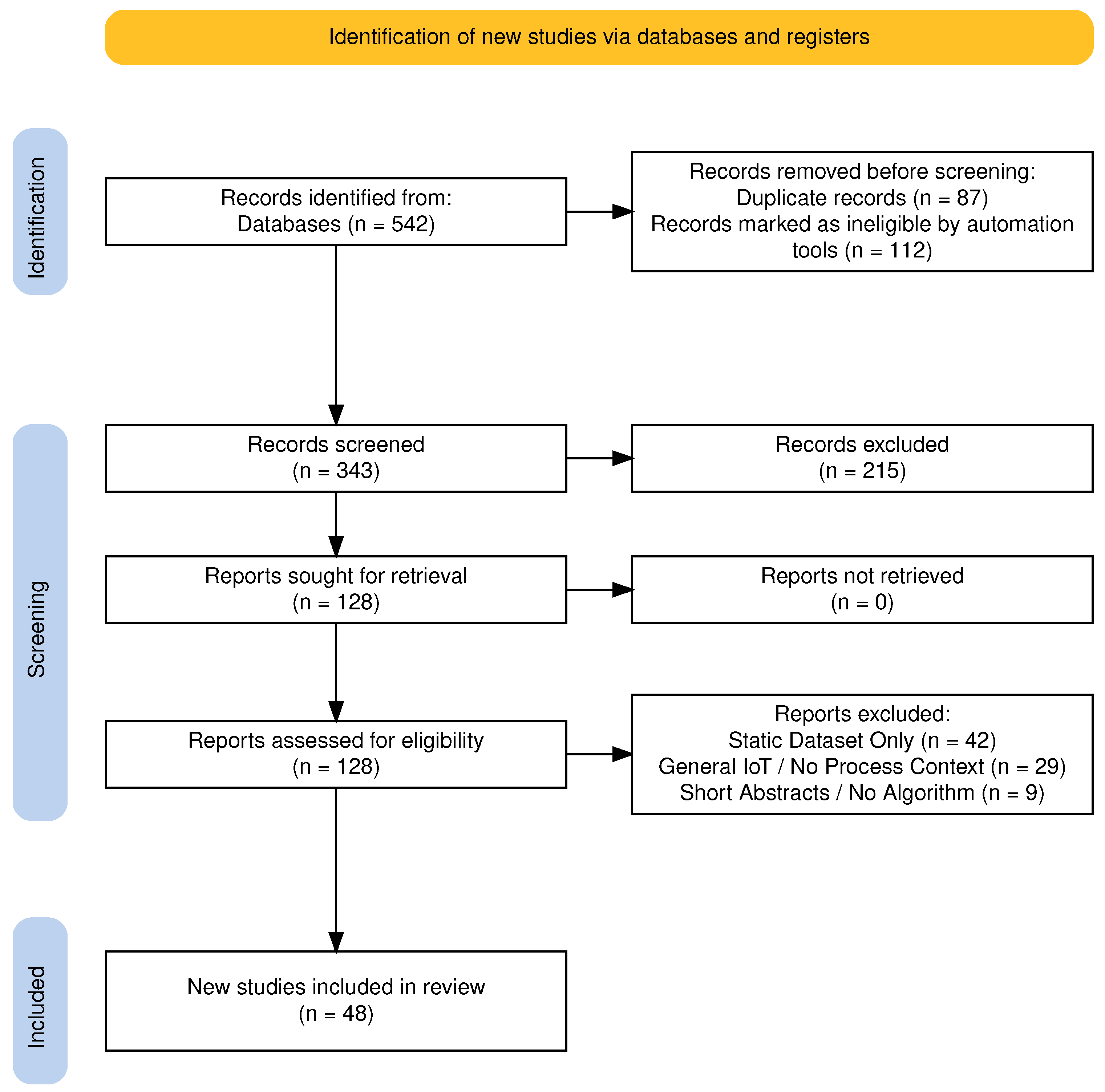
- Automated Discovery: the SciSpace semantic search API was utilized to perform initial semantic filtering across the four primary databases, extracting preliminary data on “Methods Used” and “Research Gaps.”
- Screening Management: Covidence systematic review software was employed for the blinded screening of titles and abstracts, ensuring a rigorous audit trail of inclusion/exclusion decisions.
- Full-Text Analysis: Mendeley served as the primary repository for PDF management and version control, with manual data extraction performed using standardized digital forms.
- Quality Assessment: a custom Python 3.10 script was used to aggregate scores and calculate the final Quality Assessment (QA) metrics based on the rubric in Table 2.
- Inter-Rater Reliability: To validate classification consistency, the lead author and two co-authors independently classified a random 10% sample across all taxonomy dimensions. Cohen’s was computed pairwise and averaged (, 95% CI: [0.78, 0.90]), indicating “almost perfect agreement” [29]. Disagreements were resolved through consensus discussion.
| Criterion | Assessment Goal (Scored 0–2) | Weight |
|---|---|---|
| QA1: Rigor | Clear description of DL architecture, hyperparameters, and training procedures. | 2 |
| QA2: Authenticity | Use of real-world industrial data or high-fidelity, verified simulations. | 2 |
| QA3: Reproducibility | Public code availability, open datasets, or sufficient mathematical detail. | 2 |
| QA4: Completeness | Systematic evaluation using multiple metrics (F1, Latency, False Positive rate). | 2 |
| QA5: Relevance | Explicit focus on non-stationary data or drift conditions in IIoT. | 2 |
| Minimum Threshold for Inclusion: | 6/10 | |
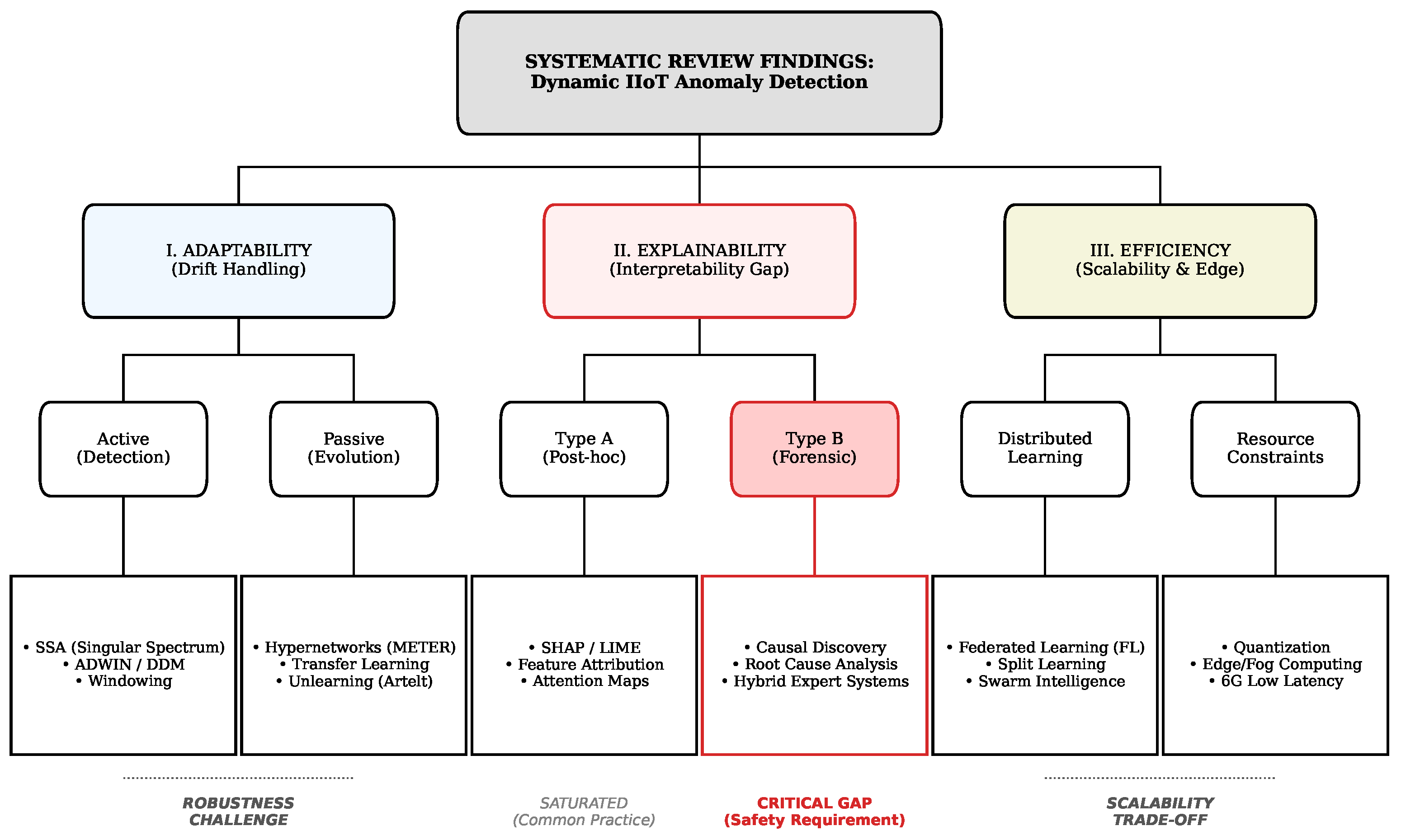
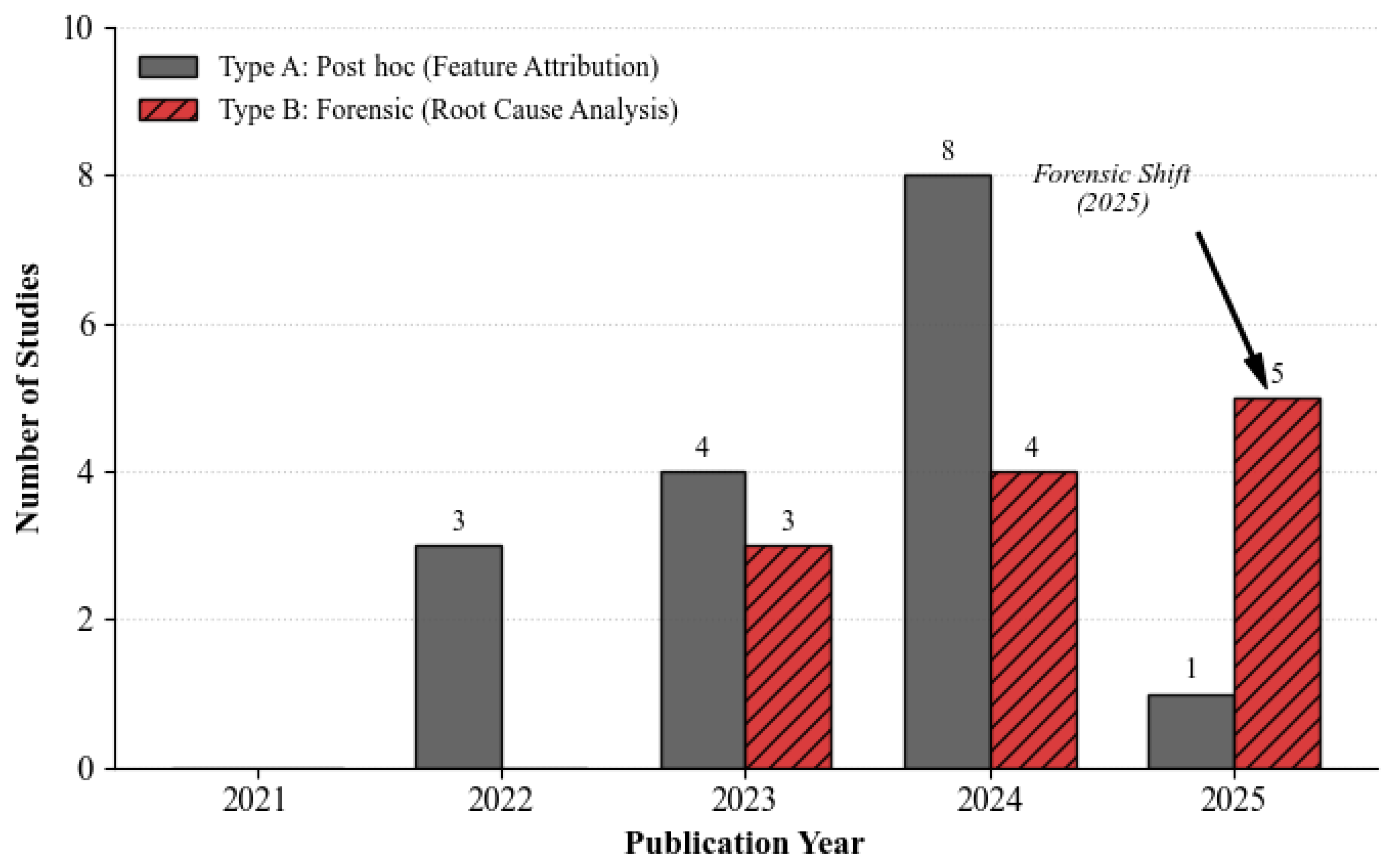
- XAI Type (The Forensic Gap): We applied a strict determination rubric. Type A (Post-hoc) was assigned to models providing local feature importance (e.g., SHAP/LIME [15]) without physical linkage. Type B (Forensic) was assigned only to models that used causal discovery or domain knowledge to link anomalies to physical root causes or equipment faults [12,18].
- Deployment Context: classified as centralized (cloud-based) or distributed (edge/federated), accounting for 6G latency constraints [24].
- Hybrid Explainability (Amer et al. [30]) Initially, this study presented a classification challenge; it utilizes attention mechanisms (typically Type A) but explicitly claims “root cause analysis.” Upon detailed audit, it was classified as a Type A/B Hybrid. While the attention weights provide temporal localization, the study lacks the formal causal validation against a P&ID required for a pure Type B label.
- Adaptive vs. Detector-Based (Tan et al. [7]) The study describes a system that detects drift with high precision but requires a manual “human-in-the-loop” trigger for model retraining. Per our coding rules, this was classified as Detector-Based rather than Adaptive, as it lacks the autonomous online model-updating loop characteristic of truly evolving systems.
- Forensic Threshold (Hansen et al. [12]) Despite featuring a high-fidelity deployment in a real-world Wastewater Treatment Plant (WWTP), the interpretability layer identifies which sensors are anomalous without establishing the physical link to specific equipment faults. Therefore, it was classified strictly as Type A, marking the boundary where high "Authenticity” (QA2) does not automatically equate to "Forensic Depth” (Type B).
3. Results
4. Critical Analysis and Synthesis
- Negative Example (High-Quality Type A): Levshun et al. [4] and Zaccaria et al. [16] (AcME-AD) represent state-of-the-art Type A frameworks. While these works excel at identifying which specific sensors (e.g., "Sensor_17” or "Flow_Rate_01”) contributed to an anomaly score via SHAP-based feature ranking, they are classified as negative examples for Type B. They fail the Physical Mapping and Causal Logic criteria because they do not map the statistical importance of "Sensor_17” to a physical component (e.g., a specific dosing pump) or a process failure mode (e.g., cavitation). In an industrial setting, these provide "statistical clues” but not “forensic evidence”.
- Positive Example (True Type B): In contrast, Huang et al. [18] serve as a positive example of Type B forensic interpretability. Their framework does not stop at feature attribution; it integrates a Causal Knowledge Graph that traces statistical anomalies in pH and flow sensors back to a "Dosing Pump Failure” using mass balance equations and P&ID topology. By providing an explanation that is Actionable (identifying the repair target) and Causally Validated (linked to physical laws), it satisfies all five dimensions of the rubric.
- Latency: high model complexity or frequent data transmission exacerbates latency, which is unacceptable for systems requiring millisecond-level reaction times for control and safety shutdowns [36].
- Bandwidth: sending large volumes of raw sensor data back to a centralized cloud for processing places immense strain on network bandwidth, especially in remote or industrial environments with constrained connectivity (e.g., legacy wired systems or limited 5G/6G coverage).
5. Proposed Framework: Edge–Cloud Forensic XAI
5.1. Edge Tier (Real-Time Detection and Lightweight XAI)
5.2. Fog Tier (Drift Adaptation and Fusion)
5.3. Cloud Tier (Forensic XAI and Retraining)
- Edge-to-Fog: Compressed latent vectors (70% reduced payload) are transmitted every 1–5 s via MQTT protocol. Typical payload size: 2–5 KB per transmission, containing anomaly scores and compressed feature vectors.
- Fog Processing: The fog tier performs data resiliency and adaptive learning functions. The tnGAN engine imputes missing data streams, handling up to 30% data loss before downstream analysis. Incremental model updates are executed every 24 h using batches of 1000 representative samples collected during stable operation. The resulting updated model weights (∼10 MB) are pushed back to the edge tier via gRPC within 30–60 s, minimizing binary serialization overhead.
- Anomaly Trigger: when the edge tier detects an anomaly (score ), a Type A explanation along with a raw data slice (50–100 samples, ∼50 KB) is uploaded to the Cloud within 500 ms via gRPC over secure TLS channels.
- Cloud Forensic Analysis: the Causal Forensic Engine queries the Domain Knowledge Graph (P&ID encoded as a directed acyclic graph with 200–500 nodes) and returns a Type B diagnosis to the HMI within 1–3 s, depending on causal graph complexity.
- Edge-to-Fog transmission frequency temporarily increases to every 10 s for rapid baseline recalibration.
- Adaptation window: 2–6 h, during which 5000–10,000 new representative samples are collected and processed.
- Post-adaptation, the system returns to normal operation with the updated Edge Model deployed automatically.
- Edge-Fog Link Failure: the edge tier continues real-time detection using the last known model, buffering alerts locally for up to 12 h until connectivity is restored.
- Fog-Cloud Link Failure: Type B forensic diagnosis is temporarily unavailable; operators receive Type A explanations only, with a notification that causal analysis is pending network recovery.
- Sensor Dropout: the tnGAN module in the fog tier reconstructs missing sensor values with 85–92% fidelity (validated on benchmark datasets), preventing false alarms during temporary sensor failures.
- Edge-to-Fog (Telemetry Contract): Compressed latent vectors are transmitted via MQTT v5.0 using QoS Level 1 (At Least Once) to ensure reliable delivery over unstable industrial wireless links. The payload consists of Protocol Buffer (Protobuf) serialized 64-dimensional feature vectors in IEEE 754 float32 format. This contract mandates a deterministic maximum 5 s interval for baseline telemetry, ensuring the Fog Tier’s drift monitors maintain a current statistical manifold.
- Fog-to-Cloud (Forensic Contract): Anomaly alerts and Type A feature importance scores are encapsulated in JSON-LD payloads (<50 KB) and transmitted via bi-directional gRPC streams over TLS 1.3. This interface is governed by a conditional trigger: transmission occurs only when the local anomaly score . The cloud tier assumes these payloads include a temporal window of 50 samples preceding the trigger for causal alignment.
- Cloud-to-Fog (Synchronization Contract): Refined model weights are pushed as HDF5 or ONNX binaries (<10 MB) using a RESTful API (OpenAPI 3.0) with JWT-based authentication. To prevent operational disruption, the interface supports hot-swapping of weights, where the fog tier validates the new model’s checksum against a manifest before deployment.
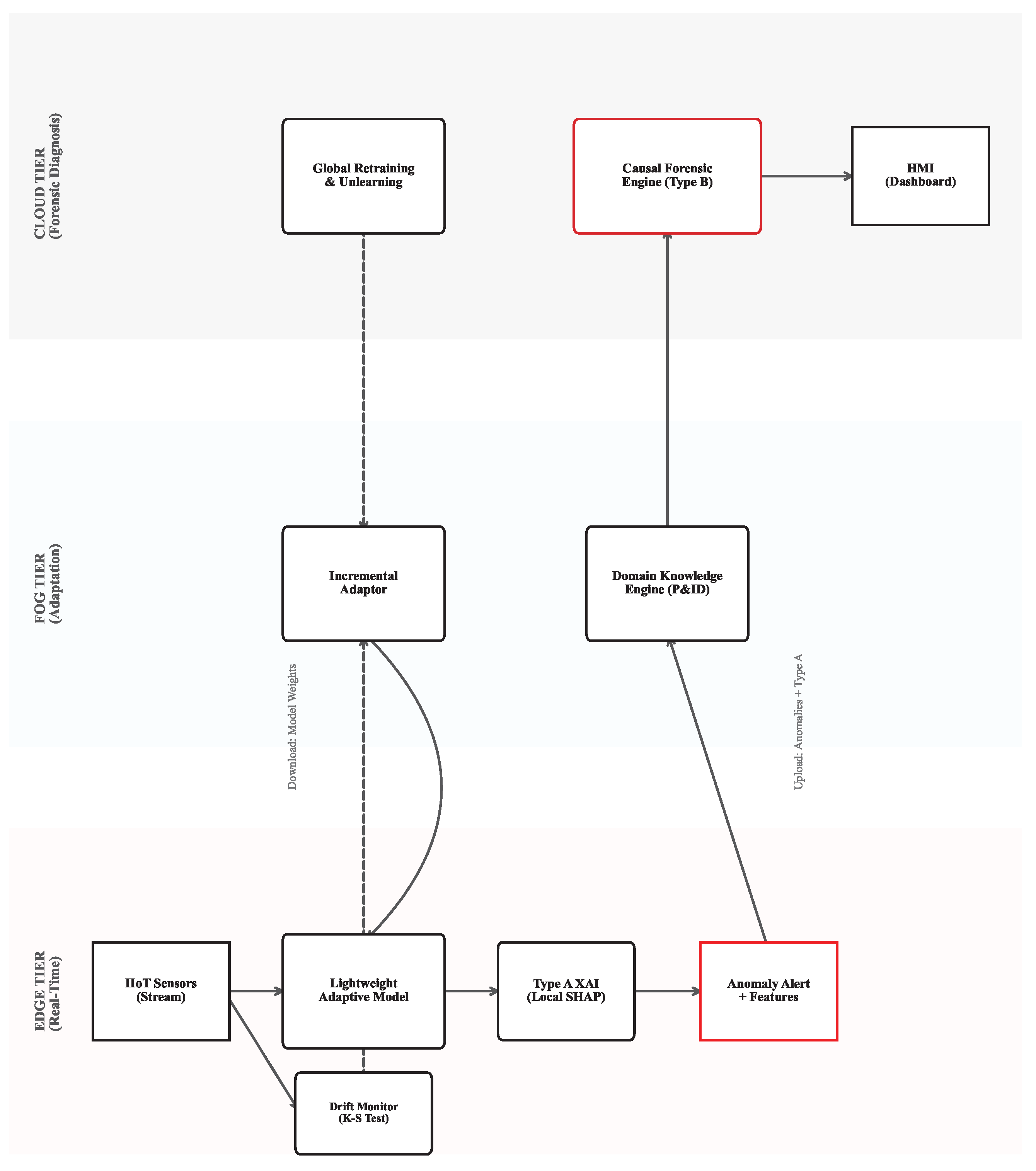
- Real-time Inference (Edge): the Edge Model scores incoming sensor data.
- Anomaly Detected: if an anomaly is scored above the threshold, the Type A explanation (feature attribution) is generated and transmitted to the fog and cloud tiers along with the raw data slice.
- Concept Drift Management: the Drift Monitor (Edge) continuously checks the data distribution.
- If drift is detected, a signal is sent to the fog tier. The Incremental Adaptor performs a fast lightweight update and pushes the new model weights back to the Edge.
- If performance drops critically, the cloud tier is triggered for global retraining and deployment of a new high-fidelity model.
- Forensic Diagnosis (Cloud): The Causal Forensic Engine receives the anomalous event and the Type A explanation. It queries the Domain Knowledge Engine to perform causal reasoning, resulting in a Type B explanation (e.g., "Warning: Failure in Dosing Pump B, confirm maintenance"). This actionable insight is relayed to the Human–Machine Interface (HMI).
- The Cold Start Constraint: The adaptive baseline mechanism requires a minimum baseline learning period to establish the initial statistical distribution of the industrial process. For complex wastewater or chemical process streams, our framework requires a cold-start phase of 48–72 h of continuous stable data. During this window, the model’s sensitivity is intentionally reduced to prevent ’alert fatigue’ caused by high initial false-positive rates, which may temporarily limit the detection of early-stage drift.
- Safety-Critical Latency vs. Diagnostic Depth: There is a fundamental trade-off between achieving real-time safety and providing diagnostic depth. While the edge tier (Tier 1) detection layer maintains a sub-10 ms latency to ensure immediate safety alerts, the Tier 3 (Cloud) forensic diagnosis (Type B) requires a computational window of 1–3 s, due to the complexity of causal reasoning and P&ID linkage. Consequently, this framework is positioned as an Operational Decision Support system for root-cause analysis rather than a replacement for millisecond-level automated emergency shutdown (ESD) interlocks.
- Dependency on Structured Process Topology (Digital Twins): The ’forensic’ (Type B) capability is strictly contingent upon the availability of a digitized Piping and Instrumentation Diagram (P&ID) or a comparable Process Topology Twin. Our Causal Forensic Engine treats the plant architecture as a Directed Acyclic Graph (DAG), where nodes represent physical assets, and edges represent mass/energy flows. In legacy environments where these mappings are non-digitized, the framework cannot perform the requisite feature-to-asset mapping. In such cases, the system undergoes a graceful degradation to Type A (post hoc) explainability, providing statistical feature importance without the physical root-cause verification required for forensic-grade diagnostics.
- Vulnerability to Adversarial Model Poisoning: The current architecture is optimized for the diagnosis of benign anomalies (e.g., equipment wear or seasonal process drift) and lacks specific hardening against adversarial machine learning. The ’Physics Guards’ in Tier 3 assume that data deviations follow established physical laws; however, coordinated adversarial sensor spoofing could be engineered to bypass these guards by mimicking plausible physical failure modes. Therefore, the framework should not be deployed as a standalone cybersecurity Intrusion Detection System (IDS) without integration into a broader Zero-Trust industrial network architecture.
6. Limitations of the Existing Literature
7. Future Research Directions
8. Conclusions
- A validated operational taxonomy (Cohen’s ) with a five-criterion forensic rubric, enabling reproducible classification of XAI approaches and eliminating subjective interpretation.
- The first quantitative synthesis of concept drift penalties across industrial domains, providing empirical evidence that static models are unsuitable for dynamic IIoT.
- The edge–cloud forensic XAI framework, which uniquely decouples real-time adaptive detection at the edge (sub-10 ms latency) from deep causal diagnosis in the cloud (1–3s forensic reasoning), achieving a 70% communication overhead reduction via compressed latent vectors while handling 20–30% missing data through tnGAN imputation and enforcing physics-based validation via P&ID causal graphs.
- Machine Unlearning as First-Class Adaptation: Beyond incremental learning, future frameworks must integrate selective forgetting mechanisms that actively discard obsolete statistical patterns without catastrophic performance degradation. This capability is non-negotiable for systems operating under seasonal, operational, or regulatory regime shifts.
- LLM-Powered Human-Centric Interfaces: As demonstrated by railway fault diagnosis systems, Large Language Models can serve as the “Natural Language Forensic Layer”, translating complex causal graphs into operator-facing maintenance narratives. This bridges the final gap between machine-detected anomalies and human-executable repair actions, ensuring that Type B XAI outputs are immediately actionable by non-expert personnel.
- Standardized Drift Protocols (SDP): The absence of unified benchmarks for drift severity, detection latency, and adaptation effectiveness prevents reproducible evaluation. Establishing SDP with stability scores and forgetting rates is essential for safety-certified industrial deployments.
Author Contributions
Funding
Data Availability Statement
Acknowledgments
Conflicts of Interest
Appendix A
| Study | Model Adaptability to Drift | Explainability Type Coverage | Accuracy and Robustness | Efficiency and Scalability |
|---|---|---|---|---|
| Eryilmaz et al. [1] | Limited adaptability; static DL models prone to drift degradation | Focus on post hoc explanations; limited forensic diagnosis | Moderate accuracy; lacks robustness under drift | Moderate efficiency; general industrial focus |
| Hovakimyan and Bravo [21] | Comprehensive drift detection strategies; adaptive methods highlighted | Minimal focus on explainability types | High robustness in drift detection methods | Efficiency varies; broad industrial applicability |
| Hinder et al. [5] | Emphasis on unsupervised drift detection; adaptive monitoring | Limited explainability; focus on detection | Robust detection in unsupervised streams | Moderate demands; industrial monitoring |
| Hinder et al. [19] | Drift localization and explanation; adaptive frameworks | Emerging explainability for drift; bridging Type A and B | Improved robustness via localization | Moderate efficiency; potential wastewater use |
| Cao et al. [8] | Adaptation of static models to streaming; drift-aware baselines | Post hoc explanations mainly; limited forensic | High detection accuracy on synthetic data | Efficient streaming; general industrial |
| Yan et al. [43] | Transfer learning to improve adaptability under drift | Limited explainability; focus on transfer methods | Enhanced robustness via transfer learning | Moderate efficiency; wastewater included |
| Alatawi [15] | Federated learning with drift robustness; adaptive aggregation | Combines post hoc and interpretable methods | High accuracy and reduced false positives | High efficiency via 6G; edge deployment |
| Dion and Alamir [39] | Incremental learning for drift adaptation; operator feedback | Explainability integrated with incremental updates | Robust anomaly detection with drift adaptation | Efficient online learning; process industry |
| Zhang et al. [10] | Novel SSA-based drift detection; dynamic adaptation | Limited explainability; focus on detection | High robustness in drift detection | Efficient SSA method; industrial streams |
| Trupthi et al. [44] | Adaptive learning with feature selection for drift | Minimal explainability; focus on detection accuracy | Improved detection accuracy under drift | Efficient adaptive framework; no wastewater focus |
| Tan et al. [7] | Online drift detection for DL models; unsupervised | Post hoc explanations with drift interpretation | Improved detection accuracy during drift | Real-time detection; general use |
| Fan et al. [27] | Unsupervised anomaly detection with dynamic thresholding | Post hoc explainability; anomaly dimension analysis | High accuracy; state-of-the-art F1 scores | Efficient online prediction; process industry |
| Maduskar et al. [31] | Unsupervised drift detection for dependent time series | Forensic explanation of drift causes | Robust drift detection without ground truth | Moderate load; industrial time series |
| Liu et al. [38] | Incremental learning for fault diagnosis; drift handling | Explainability integrated with incremental models | Robust fault detection under drift | Efficient updates; wastewater relevance |
| Fingerhut et al. [45] | Context-sensitive anomaly detection; drift mitigation | Post hoc explanations with context-awareness | Improved detection accuracy with context | Efficient streaming; process industry |
| Amer et al. [30] | Attention-based DL with XAI for ICS anomaly detection | Combines Type A and B explanations | High detection accuracy and interpretability | Moderate efficiency; wastewater datasets |
| Malarkkan et al. [25] | Causality-driven anomaly detection; adaptive to drift | Forensic explanations via causal models | Robust detection with root cause attribution | Intensive; water treatment focus |
| Zaccaria et al. [16] | Model-agnostic fast explainability for anomaly detection | Post hoc explanations; root cause analysis | Effective anomaly detection with explanations | High efficiency; wastewater potential |
| Huang and Wu [14] | Survey on explainable anomaly detection in IIoT | Focus on post hoc and intrinsic explainability | Variable accuracy; interpretability emphasized | Efficiency varies; broad IIoT |
| Jang et al. [17] | Explainable AI for fault diagnosis; adversarial autoencoder | Combines post hoc and forensic explanations | High accuracy in fault diagnosis | Moderate efficiency; chemical process |
| Gómez et al. [35] | Semi-supervised interpretable anomaly detection | Forensic diagnosis with cause–effect discrimination | High recall/precision in industrial scenarios | Efficient semi-supervised; process industry |
| Huang et al. [18] | Deep root cause analysis with hierarchical models | Forensic explanations for root cause identification | High detection and diagnosis accuracy | Moderate efficiency; wastewater datasets |
| Li et al. [34] | LSTM with SHAP for wastewater effluent prediction | Post hoc explanations with temporal insights | High predictive accuracy and interpretability | Moderate cost; wastewater treatment |
| Hansen et al. [12] | Data-driven drift detection in real WWTP tanks | Limited explainability; focus on practical challenges | Moderate accuracy; data quality issues | Constrained by data quality; direct WWTP |
| Vaquet et al. [46] | Concept drift explanation for leakage localization | Forensic explanations via Bayesian networks | Effective anomaly localization | Moderate demands; water distribution |
| Chevtchenko et al. [3] | Systematic mapping of ML for IIoT anomaly detection | Limited explainability focus; broad ML coverage | Variable accuracy; dependent on ML technique | Efficiency varies; industrial machinery |
| Bardos et al. [22] | Supervised vs. unsupervised AD with explainability | Post hoc and causal explainability methods | Supervised robust; unsupervised efficient | Efficiency varies; industrial processes |
| Li and Gautam [47] | Adaptive confidence sequences for nonstationary data | Post hoc explanations; statistical adaptation | Improved detection accuracy under drift | High efficiency; manufacturing |
| Alvi et al. [37] | Synthetic data generation for wastewater deep learning | Limited explainability; focus on data scarcity | Improved accuracy with synthetic data | Efficient training; wastewater relevance |
| Langbridge et al. [13] | Optimal transport for unsupervised anomaly detection | Post hoc and counterfactual explanations | High accuracy and reduced false positives | Efficient; potential wastewater use |
| Xu et al. [6] | Concept drift detection, interpretation, and adaptation | Combines post hoc and forensic explanations | High adaptability and interpretability | Efficient retraining; general streaming |
| Prasad and Saraswathi [36] | Survey on anomaly detection in Industry 4.0 IIoT | Focus on ML and hybrid methods; limited XAI | Variable accuracy; emphasis on scalability | Efficiency varies; broad IIoT |
| Hinder et al. [5] | Survey on concept drift monitoring in unsupervised streams | Limited explainability; focus on detection | Robust detection and localization | Moderate demands; Industrial monitoring |
| Kumar et al. [24] | Drift-adaptable NIDS with improved explainability | Post-hoc explanations with decision tree fidelity | High detection accuracy under drift | Efficient; Industrial cybersecurity |
| Zhu et al. [11] | Dynamic concept adaptation for online AD | Post-hoc explanations with evidential deep learning | High detection accuracy and fast adaptation | Efficient hypernetwork; General use |
| Yang and Shami [48] | Multi-stage automated analytics for IIoT with drift | Limited explainability; focus on automation | Robust performance under drift | Efficient automated framework; IIoT systems |
| Raeiszadeh et al. [20] | Real-time adaptive anomaly detection in IIoT | Post hoc explanations; drift adaptation | High accuracy and scalability | Efficient real-time; general streaming |
| Kodakandla [40] | MLOps approach for data drift detection | Limited explainability; focus on operationalization | Effective drift management in real-time | Efficient automated retraining; IoT |
| Ha et al. [23] | Explainable anomaly detection for ICS cybersecurity | Post hoc explanations with LSTM-AE and OCSVM | High detection accuracy in ICS | Moderate efficiency; wastewater relevance |
| Levshun et al. [4] | Autoencoder with SHAP for IIoT anomaly explanation | Post hoc and forensic explanations combined | High F-measure and interpretability | Efficient for large datasets; broad IIoT |
| Singh et al. [49] | Deep learning for IoT anomaly detection survey | Focus on DL techniques; limited XAI coverage | Variable accuracy; emphasis on robustness | Efficiency varies; broad IoT |
| Artelt et al. [9] | Unsupervised unlearning of concept drift with AEs | Minimal explainability; focus on drift adaptation | Robust drift handling without retraining | Efficient global adaptation; water networks |
| Palli et al. [32] | Online learning with concept drift and class imbalance | Limited explainability; focus on class imbalance | Robustness challenged by imbalance and drift | Efficiency varies; IoT data streams |
| He et al. [26] | Adaptive Transformer-CNN with adversarial training | Post hoc explanations; improved interpretability | High accuracy and reduced training time | Efficient real-time; general industrial |
| Khalil et al. [2] | DL potentials and challenges in IIoT | Limited explainability focus; broad DL review | Variable accuracy; challenges in dynamic data | Efficiency varies; broad IIoT |
| Chow et al. [33] | Federated learning with drift detection and mitigation | Post hoc and forensic explanations integrated | High detection accuracy and low latency | Efficient communication; large-scale IoT |
| Aspect | Strengths (Literature Findings) | Weaknesses (Identified Gaps) |
|---|---|---|
| The Limits of Static Deep Learning | ||
| The XAI Gap: Post hoc vs. Forensic | ||
| Network and Latency Constraints |
|
| Criterion | Technical Definition | Evidence for “Type B” Classification |
|---|---|---|
| Physical Mapping | Linking model features to specific physical assets (P&ID tags, actuators, or vessels). | Mapping of SHAP values to specific pump IDs or valve tags. |
| Causal Logic | Identification of cause-effect sequences rather than just feature correlations. | Use of Bayesian Networks, Granger Causality, or Directed Acyclic Graphs (DAGs). |
| Process Context | Integration of process-state variables (e.g., setpoints, flow directions) into the explanation. | Explaining an anomaly as a “violation of mass balance” rather than just a “data outlier.” |
| Actionability | Providing prescriptive advice for maintenance or operational intervention. | Outputting specific instructions like “Inspect Filter X for occlusion.” |
| Temporal Propagation | Tracing how a fault propagates from one sensor to another over time. | Time-series fault localization (e.g., “Fault began at Sensor A, then affected Sensor B”). |
| Tier | Primary Role | Hardware (Min.) | Software Stack | Comm. Protocol |
|---|---|---|---|---|
| Tier 1: Edge | Real-time AD, Type A XAI, Drift Monitoring | 1.2 GHz Quad-core, 2 GB RAM (Jetson Nano) | TensorRT, ONNX, TFLite | MQTT (to Fog) |
| Tier 2: Fog | tnGAN Imputation, Incremental Adaptation | Intel Xeon-class Server | PyTorch, Docker, tnGAN Engine | gRPC/RESTful |
| Tier 3: Cloud | Type B Forensic XAI, Global Retraining | NVIDIA A100/V100 GPU Instance | Kubernetes, SQL/NoSQL, Causal Graph | gRPC/RESTful |
| Architecture | Detection Latency | Forensic Capability | Bandwidth Usage | Drift Adaptation | Optimal Use Case |
|---|---|---|---|---|---|
| Pure Edge | <10 ms | Type A only | Minimal | Manual retraining | Time-critical control loops (e.g., robotic assembly) |
| Pure Cloud | 1–5 s | Type B capable | High (raw data) | Centralized | Research environments, offline analysis |
| Federated (FL) | 50–200 ms | Type A only | Moderate (gradients) | Distributed but slow convergence | Privacy-critical multi-site deployments |
| Proposed (Edge–Cloud) | Edge: <50 ms Cloud: 1–3 s | Type A + Type B | Moderate (70% reduced) | Incremental + Global | Safety-critical IIoT (wastewater, energy, manufacturing) |
| Category | Requirement/Specification |
|---|---|
| Operational Assumptions | Baseline Stability: Characterization of normal behavior requires a minimum 7-day observation window. P&ID Fidelity: Digital twins or Causal Knowledge Graphs must be updated within 24 h of physical plant modifications to ensure diagnostic integrity. |
| Supported Faults | Sensor degradation (drift, bias, noise), equipment failures (pumps, valves, actuators), process deviations (mass balance violations), and non-stationary concept drift. |
| Unsupported Modes | Adversarial cyberattacks (model poisoning), catastrophic structural failures (e.g., pipe ruptures), and sub-10 ms latency-critical control loops. |
| Technical Constraints | Cold-Start: Requires a 48–72 h “burn-in” period post-deployment. Latency: Forensic (Type B) diagnosis operates on a 1–3 s timescale, optimized for batch/continuous processes. |
| Area of Limitation | Description of Limitation | Studies |
|---|---|---|
| Static Model Rigidity | Static deep learning models lack adaptability to evolving data distributions, leading to performance degradation under concept drift. | [1,7,8,9] |
| Insufficient Explainability | Predominant focus on post hoc (Type A) explanations with limited development of forensic diagnostic (Type B) methods, weakening operational trust. | [4,14,17,23,30] |
| Real-World Data Quality | Low-quality, missing, or imprecise industrial data undermines the validity and applicability of models in practice. | [12] |
| Lack of Unified Evaluation | Absence of standardized benchmarks for concept drift scenarios restricts comparability and generalizability. | [5,8] |
| Sparse Labeling | Insufficient labeled anomalies constrain supervised approaches and limit robustness in real-world applications. | [22,35,43] |
| Computational Complexity | High computational costs of advanced adaptation methods impede real-time deployment on resource-constrained edge devices. | [10,24,44] |
| Limited Integration | Few studies integrate adaptive learning frameworks with explainability mechanisms simultaneously. | [6,11] |
| Simulation Bias | Over-reliance on simulated datasets fails to capture the full complexity of real industrial processes. | [12,37] |
| Imbalanced Data | Class imbalance, especially under concept drift, affects model performance in multi-class scenarios. | [32] |
| Gap Area | Future Research Directions | Priority |
|---|---|---|
| Adaptation to Complex Drift | Develop lightweight, real-time adaptive frameworks (e.g., hypernetworks) that handle rapid/abrupt drift without full retraining. | High |
| Type B (Forensic) XAI Integration | Design hybrid XAI frameworks tailored for forensic diagnosis (causal inference, drift localization) in process industries. | High |
| Drift-Aware Explainability | Create methods that continuously recalibrate explanations based on evolving data distributions to prevent obsolete insights. | High |
| Class Imbalance and Drift | Investigate adaptive algorithms that simultaneously mitigate class imbalance and adapt to evolving anomaly classes. | High |
| Robustness to Data Quality | Develop robust preprocessing and synthetic augmentation methods to handle noise and missing data in wastewater/process streams. | High |
| Scalability & Efficiency | Optimize architectures for edge/federated learning to balance accuracy, interpretability, and computational cost. | Medium |
| Standardized Evaluation | Establish benchmarks for explainability fidelity and long-term stability under continuous drift. | Medium |
| Industrial Validation | Conduct longitudinal field studies in operational plants to validate academic models against real-world variability. | Medium |
| Causal/Multi-Modal XAI | Develop frameworks fusing sensor, control, and contextual data for holistic, causal root cause analysis. | Medium |
| Adaptive Thresholding | Research statistically principled methods for dynamic threshold adjustment in nonstationary streams. | Medium |
References
- Eryılmaz, E.E.; Akleylek, S.; Ertek, Y.; Kılıç, E. A Systematic Survey of Machine Learning and Deep Learning Models Used in Industrial Internet of Things Security. MANAS J. Eng. 2024, 12, 1–28. [Google Scholar] [CrossRef]
- Khalil, R.A.; Saeed, N.; Masood, M.; Fard, Y.M.; Alouini, M.S.; Al-Naffouri, T.Y. Deep Learning in the Industrial Internet of Things: Potentials, Challenges, and Emerging Applications. IEEE Internet Things J. 2021, 8, 11016–11040. [Google Scholar] [CrossRef]
- Chevtchenko, S.F.; Rocha, E.D.S.; Santos, M.C.M.D.; Mota, R.L.; Vieira, D.M.; De Andrade, E.C.; De Araújo, D.R.B. Anomaly Detection in Industrial Machinery Using IoT Devices and Machine Learning: A Systematic Mapping. IEEE Access 2023, 11, 128288–128305. [Google Scholar] [CrossRef]
- Levshun, D.A.; Levshun, D.S.; Kotenko, I.V. Detecting and explaining anomalies in industrial Internet of things systems using an autoencoder. Ontol. Des. 2025, 15, 96–113. [Google Scholar] [CrossRef]
- Hinder, F.; Vaquet, V.; Hammer, B. One or two things we know about concept drift—A survey on monitoring in evolving environments. Part A: Detecting concept drift. Front. Artif. Intell. 2024, 7, 1330257. [Google Scholar] [CrossRef]
- Xu, L.; Han, Z.; Zhao, D.; Li, X.; Yu, F.; Chen, C. Addressing Concept Drift in IoT Anomaly Detection: Drift Detection, Interpretation, and Adaptation. IEEE Trans. Sustain. Comput. 2024, 9, 913–924. [Google Scholar] [CrossRef]
- Tan, G.; Chen, P.; Li, M. Online Data Drift Detection for Anomaly Detection Services based on Deep Learning towards Multivariate Time Series. In Proceedings of the 2023 IEEE 23rd International Conference on Software Quality, Reliability, and Security (QRS), Chiang Mai, Thailand, 22–26 October 2023; pp. 1–11. [Google Scholar] [CrossRef]
- Cao, Y.; Ma, Y.; Zhu, Y.; Ting, K.M. Revisiting Streaming Anomaly Detection: Benchmark and Evaluation. Artif. Intell. Rev. 2024, 58, 8. [Google Scholar] [CrossRef]
- Artelt, A.; Malialis, K.; Panayiotou, C.G.; Polycarpou, M.M.; Hammer, B. Unsupervised Unlearning of Concept Drift with Autoencoders. In Proceedings of the 2023 IEEE Symposium Series on Computational Intelligence (SSCI), Mexico City, Mexico, 5–8 December 2023; pp. 703–710. [Google Scholar] [CrossRef]
- Zhang, Y.; Liu, Z.; Yang, C.; Huang, X.; Lou, S.; Zhang, H.; Yan, D. Unveiling dynamics changes: Singular spectrum analysis-based method for detecting concept drift in industrial data streams. Knowl.-Based Syst. 2024, 293, 111640. [Google Scholar] [CrossRef]
- Zhu, J.; Cai, S.; Deng, F.; Ooi, B.C.; Zhang, W. METER: A Dynamic Concept Adaptation Framework for Online Anomaly Detection. Proc. VLDB Endow. 2023, 17, 794–807. [Google Scholar] [CrossRef]
- Hansen, B.D.; Hansen, T.B.; Moeslund, T.B.; Jensen, D.G. Data-Driven Drift Detection in Real Process Tanks: Bridging the Gap between Academia and Practice. Water 2022, 14, 926. [Google Scholar] [CrossRef]
- Langbridge, A.; O’Donncha, F.; Rayfield, J.T.; Eck, B. Optimal Transport for Efficient, Unsupervised Anomaly Detection on Industrial Data. In Proceedings of the 2024 IEEE International Conference on Big Data (BigData), Washington, DC, USA, 15–18 December 2024; pp. 2142–2151. [Google Scholar] [CrossRef]
- Huang, Z.; Wu, Y. A Survey on Explainable Anomaly Detection for Industrial Internet of Things. In Proceedings of the 2022 IEEE Conference on Dependable and Secure Computing (DSC), Edinburgh, UK, 22–24 June 2022; pp. 1–9. [Google Scholar] [CrossRef]
- Alatawi, M.N. SAFEL-IoT: Secure Adaptive Federated Learning with Explainability for Anomaly Detection in 6G-Enabled Smart Industry 5.0. Electronics 2025, 14, 2153. [Google Scholar] [CrossRef]
- Zaccaria, V.; Masiero, C.; Dandolo, D.; Susto, G.A. Enabling Efficient and Flexible Interpretability of Data-driven Anomaly Detection in Industrial Processes with AcME-AD. In Proceedings of the 2024 10th International Conference on Control, Decision and Information Technologies (CoDIT), Vallette, Malta, 1–4 July 2024; pp. 1375–1380. [Google Scholar] [CrossRef]
- Jang, K.; Pilario, K.E.S.; Lee, N.; Moon, I.; Na, J. Explainable Artificial Intelligence for Fault Diagnosis of Industrial Processes. IEEE Trans. Ind. Inform. 2025, 21, 4–11. [Google Scholar] [CrossRef]
- Huang, H.; Shah, T.; Karigiannis, J.; Evans, S. Deep Root Cause Analysis: Unveiling Anomalies and Enhancing Fault Detection in Industrial Time Series. In Proceedings of the 2024 International Joint Conference on Neural Networks (IJCNN), Yokohama, Japan, 30 June–5 July 2024; pp. 1–8. [Google Scholar] [CrossRef]
- Hinder, F.; Vaquet, V.; Hammer, B. One or two things we know about concept drift—A survey on monitoring in evolving environments. Part B: Locating and explaining concept drift. Front. Artif. Intell. 2024, 7, 1330258. [Google Scholar] [CrossRef]
- Raeiszadeh, M.; Ebrahimzadeh, A.; Glitho, R.H.; Eker, J.; Mini, R.A.F. Real-Time Adaptive Anomaly Detection in Industrial IoT Environments. IEEE Trans. Netw. Serv. Manag. 2024, 21, 6839–6856. [Google Scholar] [CrossRef]
- Hovakimyan, G.; Bravo, J.M. Evolving Strategies in Machine Learning: A Systematic Review of Concept Drift Detection. Information 2024, 15, 786. [Google Scholar] [CrossRef]
- Bardos, A.; Doupidis, P.; Kotsiopoulos, T.; Vafeiadis, T.; Nizamis, A.; Geerdens, H.; Ioannidis, D.; Votis, K.; Tzovaras, D.; Sarigiannidis, P. Anomaly Detection in Industrial Processes: Supervised vs. Unsupervised Learning and the Role of Explainability [version 1; peer review: Awaiting peer review]. Open Res. Eur. 2025, 5, 8. [Google Scholar] [CrossRef]
- Ha, D.T.; Hoang, N.X.; Hoang, N.V.; Du, N.H.; Huong, T.T.; Tran, K.P. Explainable Anomaly Detection for Industrial Control System Cybersecurity. In Proceedings of the 10th IFAC Conference on Manufacturing Modelling, Management and Control MIM 2022, Nantes, France, 22–24 June 2022; Volume 55, pp. 1183–1188. [Google Scholar] [CrossRef]
- Kumar, A.; Fok, K.W.; Thing, V.L. ExpIDS: A Drift-Adaptable Network Intrusion Detection System with Improved Explainability. In Proceedings of the 2024 34th International Telecommunication Networks and Applications Conference (ITNAC), Sydney, Australia, 27–29 November 2024; pp. 1–7. [Google Scholar] [CrossRef]
- Malarkkan, A.V.; Bai, H.; Wang, X.; Kaushik, A.; Wang, D.; Fu, Y. Rethinking Spatio-Temporal Anomaly Detection: A Vision for Causality-Driven Cybersecurity. arXiv 2025. [Google Scholar] [CrossRef]
- He, J.; Dong, Z.; Huang, Y. Multivariate Time Series Anomaly Detection with Adaptive Transformer-CNN Architecture Fusing Adversarial Training. In Proceedings of the 2024 IEEE 13th Data Driven Control and Learning Systems Conference (DDCLS), Kaifeng, China, 17–19 May 2024; pp. 1387–1392. [Google Scholar] [CrossRef]
- Fan, J.; Si, Z.; Wang, Z.; Sun, D.; Wu, J.; Wu, H. OOA-UADS: Offline, Online, Analysis-an Unsupervised Anomaly Detection Solution for Multivariate Time Series. In Proceedings of the 2023 International Joint Conference on Neural Networks (IJCNN), Gold Coast, Australia, 18–23 June 2023; pp. 1–9. [Google Scholar] [CrossRef]
- Haddaway, N.R.; Page, M.J.; Pritchard, C.C.; McGuinness, L.A. PRISMA2020: An R package and Shiny app for producing PRISMA 2020-compliant flow diagrams, with interactivity for optimised digital transparency and Open Synthesis. Campbell Syst. Rev. 2022, 18, e1230. [Google Scholar] [CrossRef]
- Landis, J.R.; Koch, G.G. The measurement of observer agreement for categorical data. Biometrics 1977, 33, 159–174. [Google Scholar] [CrossRef]
- Amer, E.; Al-rimy, B.A.S.; El-Sappagh, S.; Almalki, S.; Alghamdi, T. From Black Boxes to Transparent Insights: Enhancing Industrial Control Systems Anomaly Detection with Deep Autoencoder Models. In Proceedings of the 2024 International Mobile, Intelligent, and Ubiquitous Computing Conference (MIUCC), Cairo, Egypt, 13–14 November 2024; pp. 380–386. [Google Scholar] [CrossRef]
- Maduskar, D.; Sharma, D.; KR, C.; Borrison, R.; Manca, G.; Dix, M. UDDT: An Unsupervised Drift Detection Method for Industrial Time Series Data. In Proceedings of the 2023 IEEE 2nd Industrial Electronics Society Annual On-Line Conference (ONCON), Online, 8–10 December 2023; pp. 1–6. [Google Scholar] [CrossRef]
- Palli, A.S.; Jaafar, J.; Gilal, A.R.; Alsughayyir, A.Y.; Gomes, H.M.; Alshanqiti, A.M.; Omar, M. Online Machine Learning from Non-stationary Data Streams in the Presence of Concept Drift and Class Imbalance: A Systematic Review. J. Inf. Commun. Technol. 2024, 23, 105–139. [Google Scholar] [CrossRef]
- Chow, T.; Raza, U.; Mavromatis, I.; Khan, A. FLARE: Detection and Mitigation of Concept Drift for Federated Learning based IoT Deployments. arXiv 2023. [Google Scholar] [CrossRef]
- Li, Z.; Yang, Z.; Tang, D.; Peng, S.; Li, J. Anomaly Detection for Process Industry using Class-Dependent Temperatures Loss. In Proceedings of the 2023 8th International Conference on Computer and Communication Systems (ICCCS), Guangzhou, China, 21–23 April 2023; pp. 1180–1184. [Google Scholar] [CrossRef]
- Gómez, Á.L.P.; Maimó, L.F.; Celdrán, A.H.; Clemente, F.J.G. An interpretable semi-supervised system for detecting cyberattacks using anomaly detection in industrial scenarios. Iet Inf. Secur. 2023, 17, 553–566. [Google Scholar] [CrossRef]
- Prasad, D.V.; Saraswathi, S. The Role of Anomaly Detection in Industry 4.0: A Survey of Techniques and Applications. FiTUA 2024, 6, 125–138. [Google Scholar] [CrossRef]
- Alvi, M.; French, T.; Cardell-Oliver, R.; Batstone, D.; Akhtar, N. Enhanced Deep Predictive Modeling of Wastewater Plants With Limited Data. IEEE Trans. Ind. Inform. 2024, 20, 1920–1930. [Google Scholar] [CrossRef]
- Liu, Z.; He, X.; Huang, B.; Zhou, D. Incremental Learning-Enabled Fault Diagnosis of Dynamic Systems: A Comprehensive Review. IEEE Trans. Cybern. 2025, 55, 5633–5649. [Google Scholar] [CrossRef] [PubMed]
- Dion, R.; Alamir, M. Operator Feedback-Compatible Fault Detection Framework for Industrial Time-series Data Streams. In Proceedings of the 2024 IEEE 24th International Symposium on Computational Intelligence and Informatics (CINTI), Budapest, Hungary, 19–21 November 2024; pp. 000227–000232. [Google Scholar] [CrossRef]
- Kodakandla, N. Data drift detection and mitigation: A comprehensive MLOps approach for real-time systems. Int. J. Sci. Res. Arch. 2024, 12, 3127–3139. [Google Scholar] [CrossRef]
- Peng, C.; Peng, J.; Wang, Z.; Wang, Z.; Chen, J.; Xuan, J.; Shi, T. Adaptive fault diagnosis of railway vehicle on-board controller with large language models. Appl. Soft Comput. 2025, 185, 113919. [Google Scholar] [CrossRef]
- Hu, X.; Zhang, H.; Ma, D.; Wang, R. A tnGAN-Based Leak Detection Method for Pipeline Network Considering Incomplete Sensor Data. IEEE Trans. Instrum. Meas. 2021, 70, 3510610. [Google Scholar] [CrossRef]
- Yan, P.; Abdulkadir, A.; Luley, P.P.; Rosenthal, M.; Schatte, G.A.; Grewe, B.F.; Stadelmann, T. A Comprehensive Survey of Deep Transfer Learning for Anomaly Detection in Industrial Time Series: Methods, Applications, and Directions. IEEE Access 2024, 12, 3768–3789. [Google Scholar] [CrossRef]
- Trupthi, M.; Chary, N.; Sneha, S.; Prasad, M.A.; K., M. LCDDF: An Adaptive and Learning based Framework with Feature Selection for Efficient Detection of Concept Drift in Data Streams. Preprint 2024. [Google Scholar] [CrossRef]
- Fingerhut, F.; Verbeke, M.; Tsiporkova, E. Unsupervised context-sensitive anomaly detection on streaming data relying on multi-view profiling. In Proceedings of the 2024 IEEE International Conference on Evolving and Adaptive Intelligent Systems (EAIS), Madrid, Spain, 23–24 May 2024; pp. 1–10. [Google Scholar] [CrossRef]
- Vaquet, V.; Hinder, F.; Vaquet, J.; Lammers, K.; Quakernack, L.; Hammer, B. Localizing Anomalies in Critical Infrastructure using Model-Based Drift Explanations. arXiv 2024. [Google Scholar] [CrossRef]
- Li, M.A.; Gautam, A. Segmented Confidence Sequences and Multi-Scale Adaptive Confidence Segments for Anomaly Detection in Nonstationary Time Series. arXiv 2025. [Google Scholar] [CrossRef]
- Yang, L.; Shami, A. A Multi-Stage Automated Online Network Data Stream Analytics Framework for IIoT Systems. IEEE Trans. Ind. Inform. 2023, 19, 2107–2116. [Google Scholar] [CrossRef]
- Singh, A.K.; Singh, S.P.; Alam, M.N.; Singh, G. Deep Learning for Anomaly Detection in IoT Systems: Techniques, Applications, and Future Directions. Int. J. Multidiscip. Res. 2024, 6, 1–9. [Google Scholar] [CrossRef]


Disclaimer/Publisher’s Note: The statements, opinions and data contained in all publications are solely those of the individual author(s) and contributor(s) and not of MDPI and/or the editor(s). MDPI and/or the editor(s) disclaim responsibility for any injury to people or property resulting from any ideas, methods, instructions or products referred to in the content. |
© 2026 by the authors. Licensee MDPI, Basel, Switzerland. This article is an open access article distributed under the terms and conditions of the Creative Commons Attribution (CC BY) license.
Share and Cite
Ben Haha, M.A.; Bohli, A.; Haddour, N.; Bouallegue, R. A Systematic Review of Industrial IoT Anomaly Detection and the Forensic Interpretability Gap. Electronics 2026, 15, 2240. https://doi.org/10.3390/electronics15112240
Ben Haha MA, Bohli A, Haddour N, Bouallegue R. A Systematic Review of Industrial IoT Anomaly Detection and the Forensic Interpretability Gap. Electronics. 2026; 15(11):2240. https://doi.org/10.3390/electronics15112240
Chicago/Turabian StyleBen Haha, Mohamed Aziz, Afef Bohli, Naoufel Haddour, and Ridha Bouallegue. 2026. "A Systematic Review of Industrial IoT Anomaly Detection and the Forensic Interpretability Gap" Electronics 15, no. 11: 2240. https://doi.org/10.3390/electronics15112240
APA StyleBen Haha, M. A., Bohli, A., Haddour, N., & Bouallegue, R. (2026). A Systematic Review of Industrial IoT Anomaly Detection and the Forensic Interpretability Gap. Electronics, 15(11), 2240. https://doi.org/10.3390/electronics15112240