AI for Wireless Waveform Recognition: A Survey from a Component Perspective


Abstract
1. Introduction
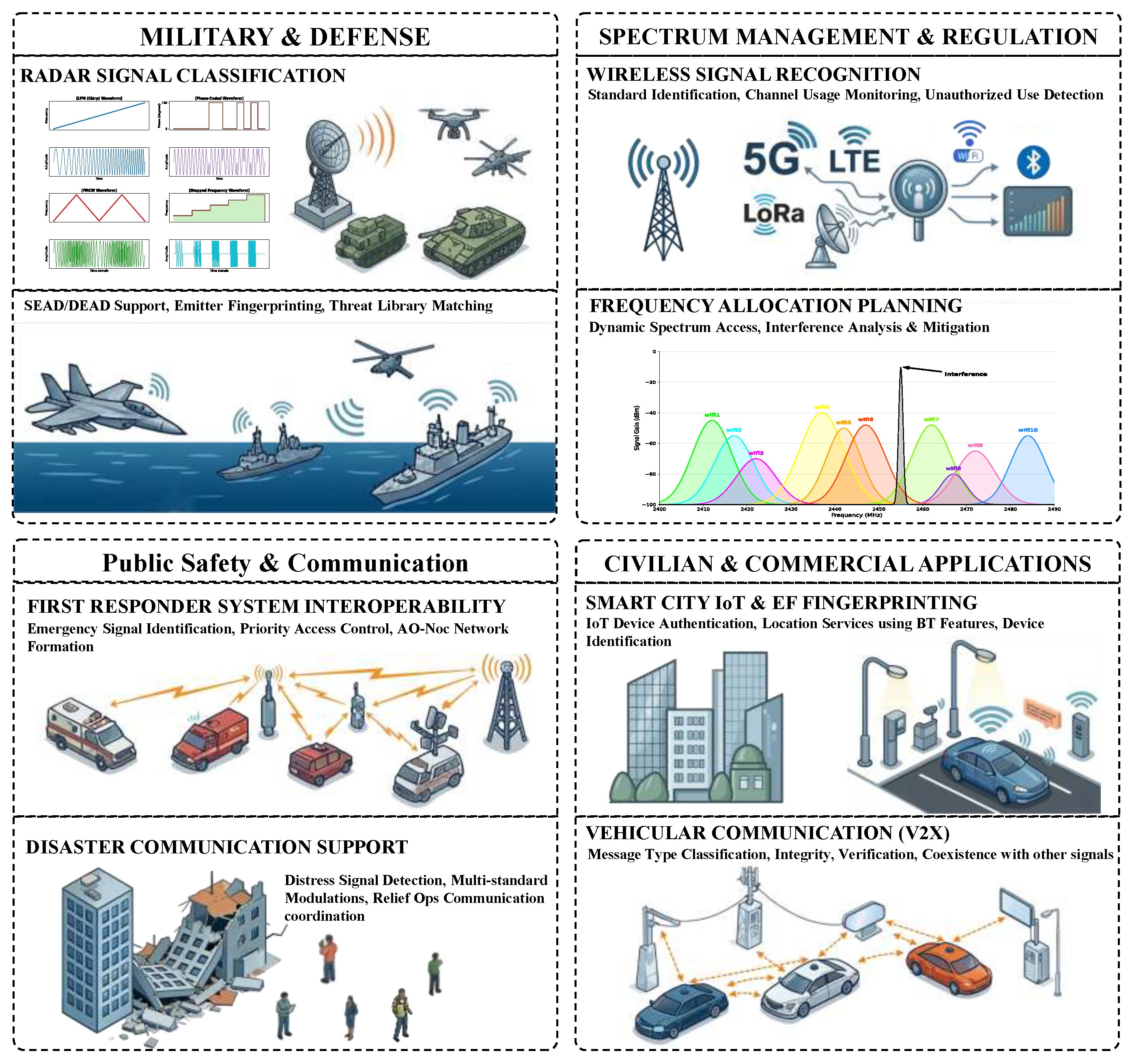
1.1. Background and Significance of ESWR
1.2. Limitations of Traditional ESWR Approaches
1.3. The Deep Learning Paradigm Shift
1.4. Related Work and Research Gaps
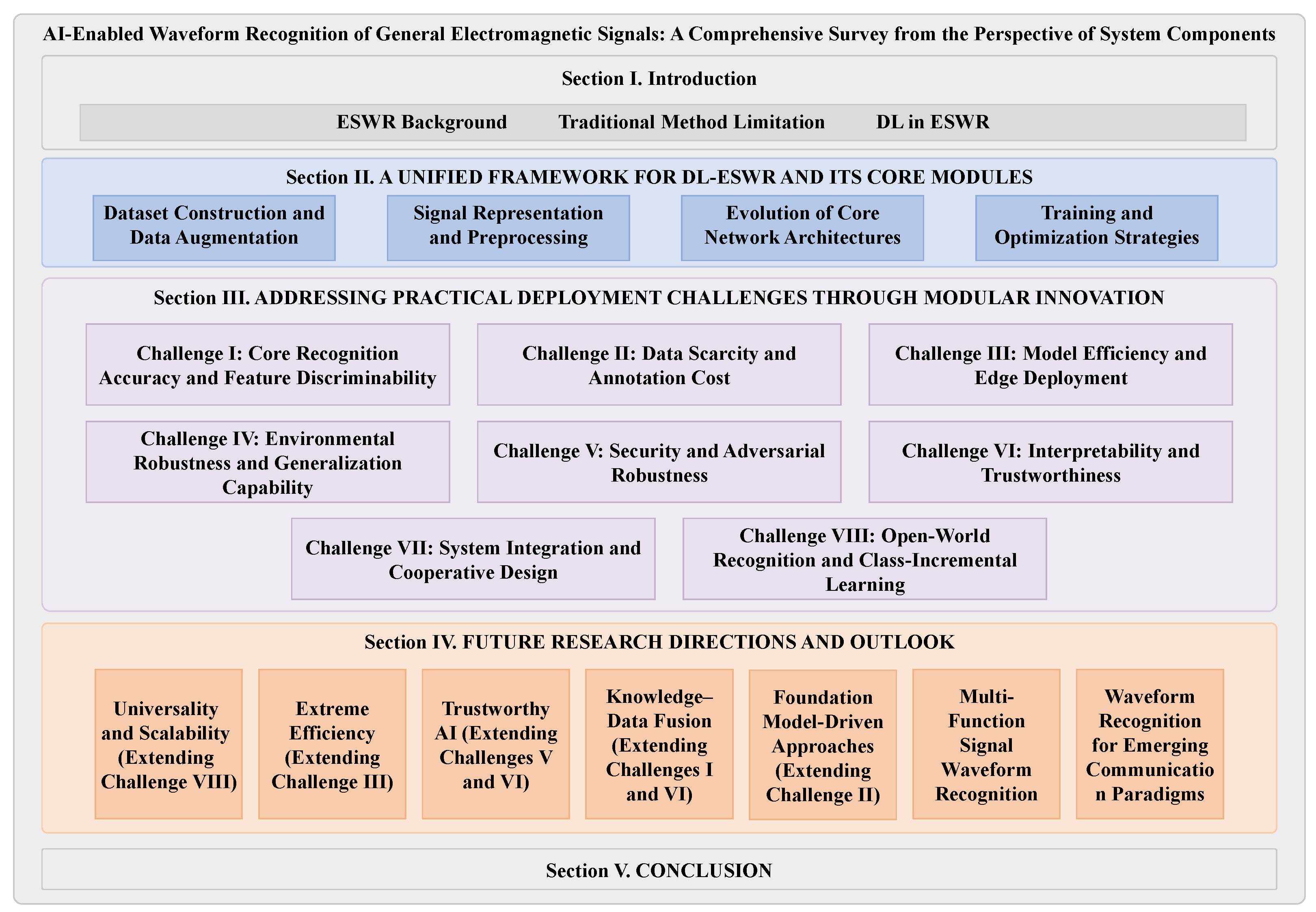
1.5. Contributions and Organization
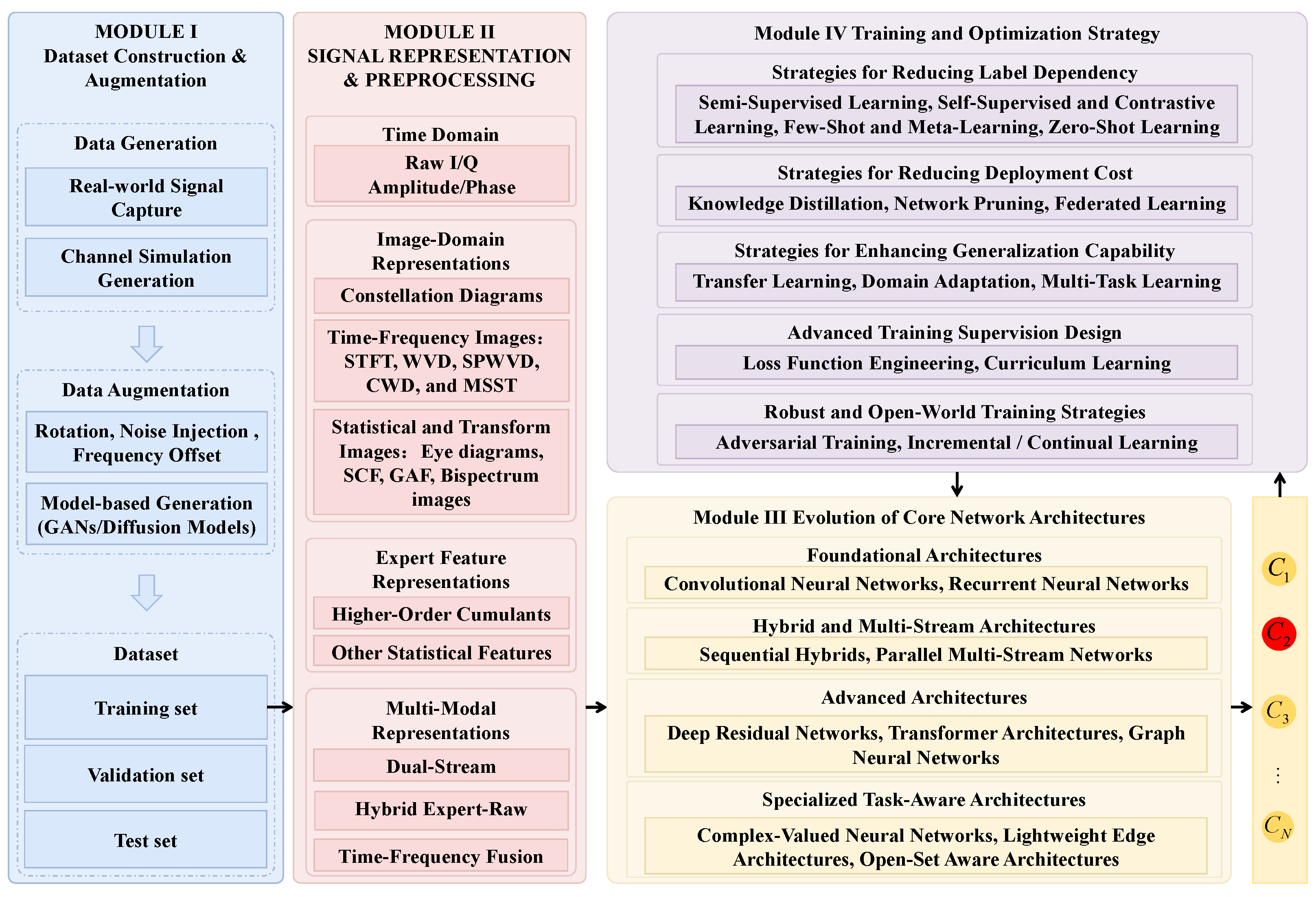
2. A Unified Framework for DL-ESWR and Its Core Modules

2.1. Module I: Dataset Construction and Data Augmentation
2.1.1. Benchmark Datasets for ESWR
2.1.2. Data Augmentation Techniques
2.1.3. Critical Analysis of Dataset Limitations
2.1.4. Toward an Ideal ESWR Dataset
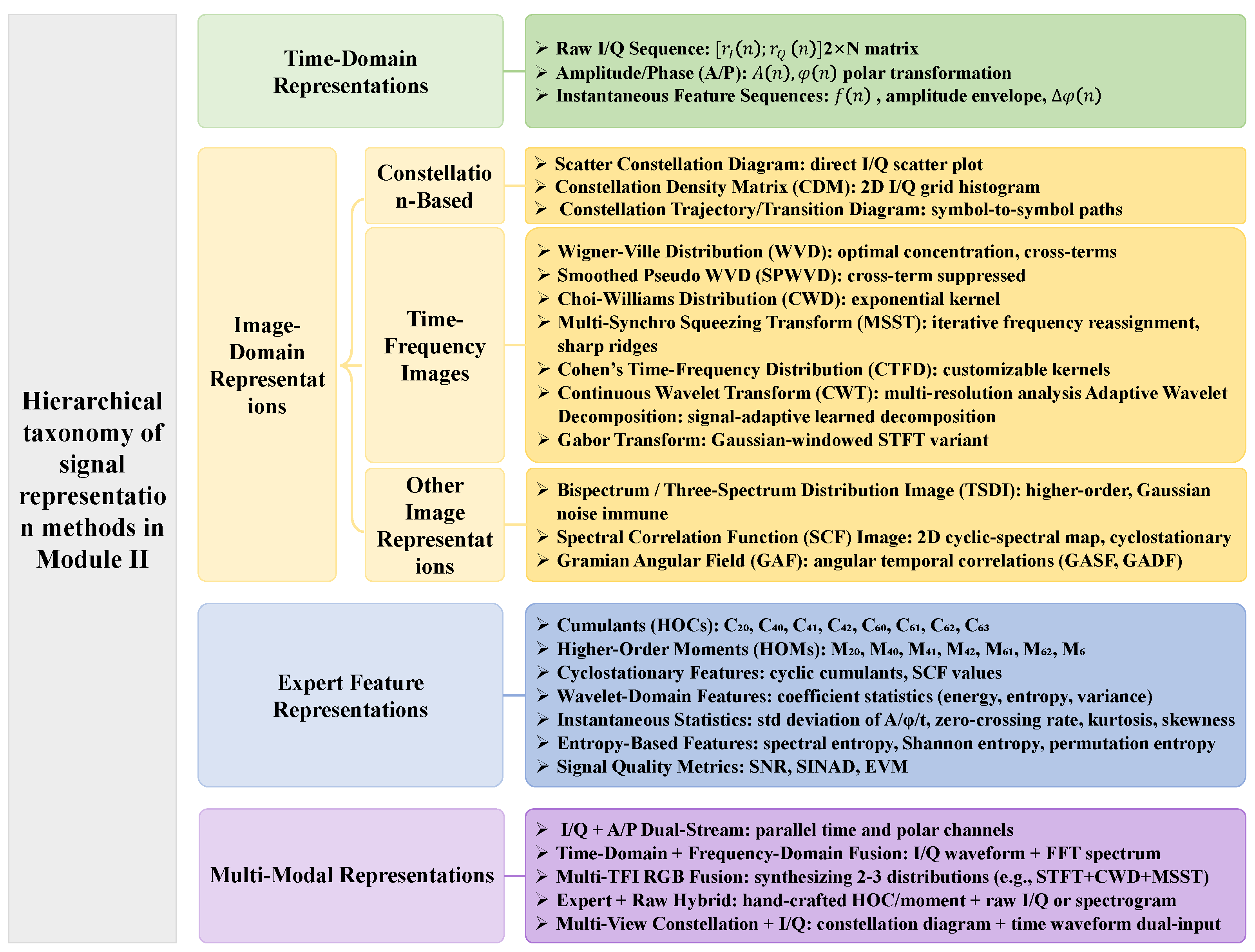
2.2. Module II: Signal Representation and Preprocessing
2.2.1. Time-Domain Representations
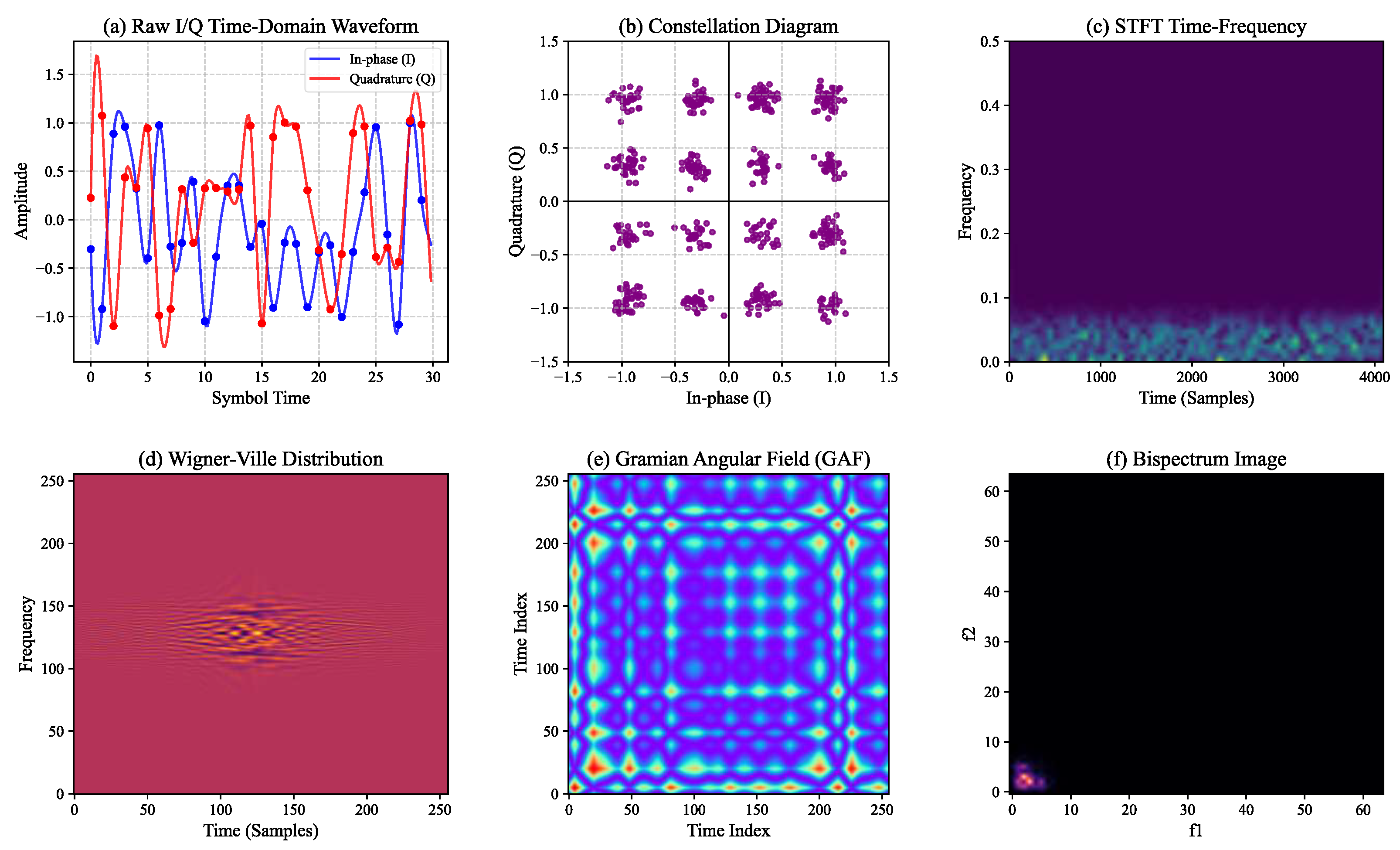
2.2.2. Image-Domain Representations
2.2.3. Expert Feature Representations
2.2.4. Multi-Modal Representations (Input-Level Fusion)
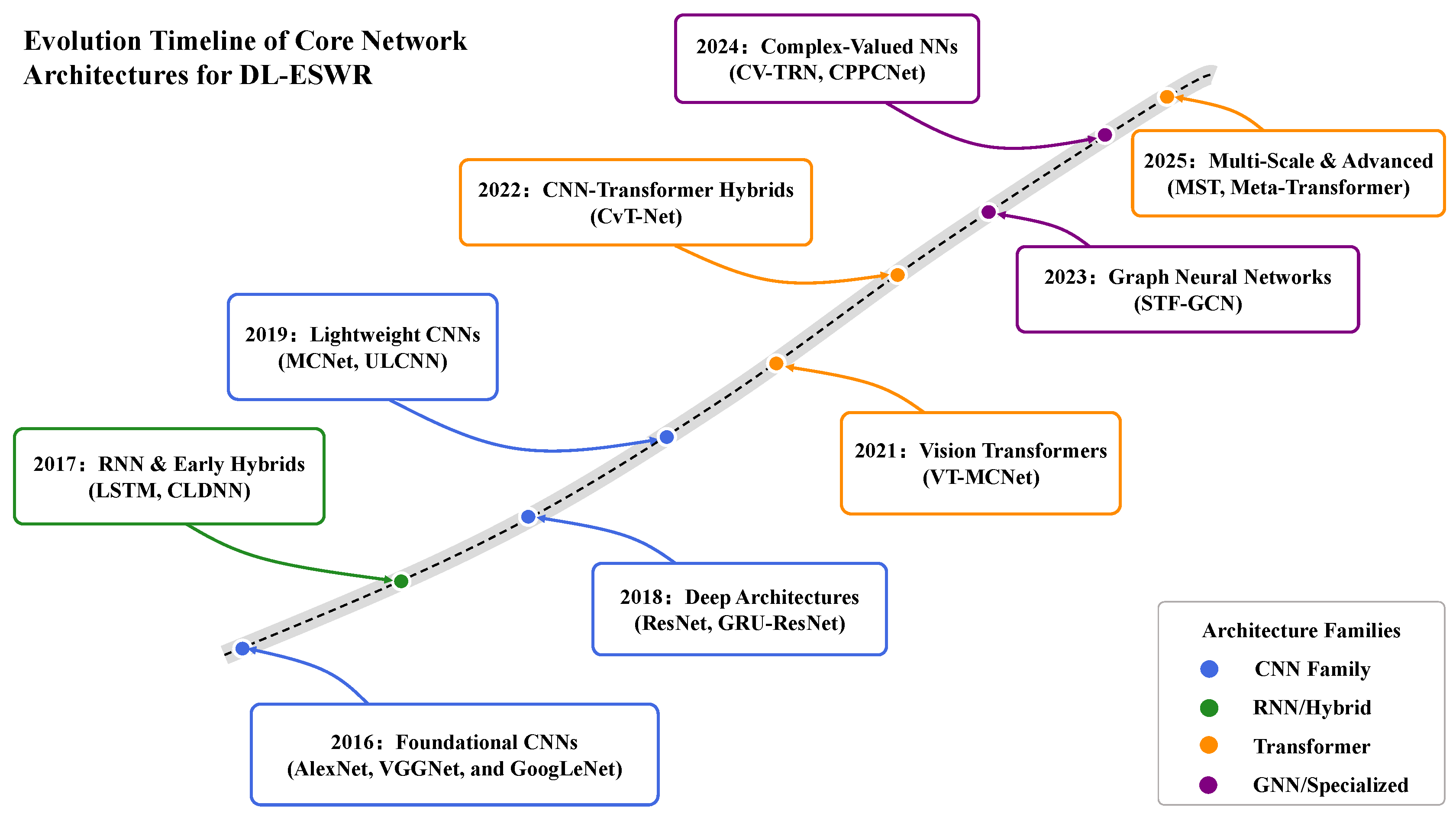
2.3. Module III: Evolution of Core Network Architectures
2.3.1. Foundational Architectures
2.3.2. Hybrid Architectures
2.3.3. Advanced Architectures
2.3.4. Specialized Architectures
2.3.5. Comparative Analysis of Architectural Paradigms
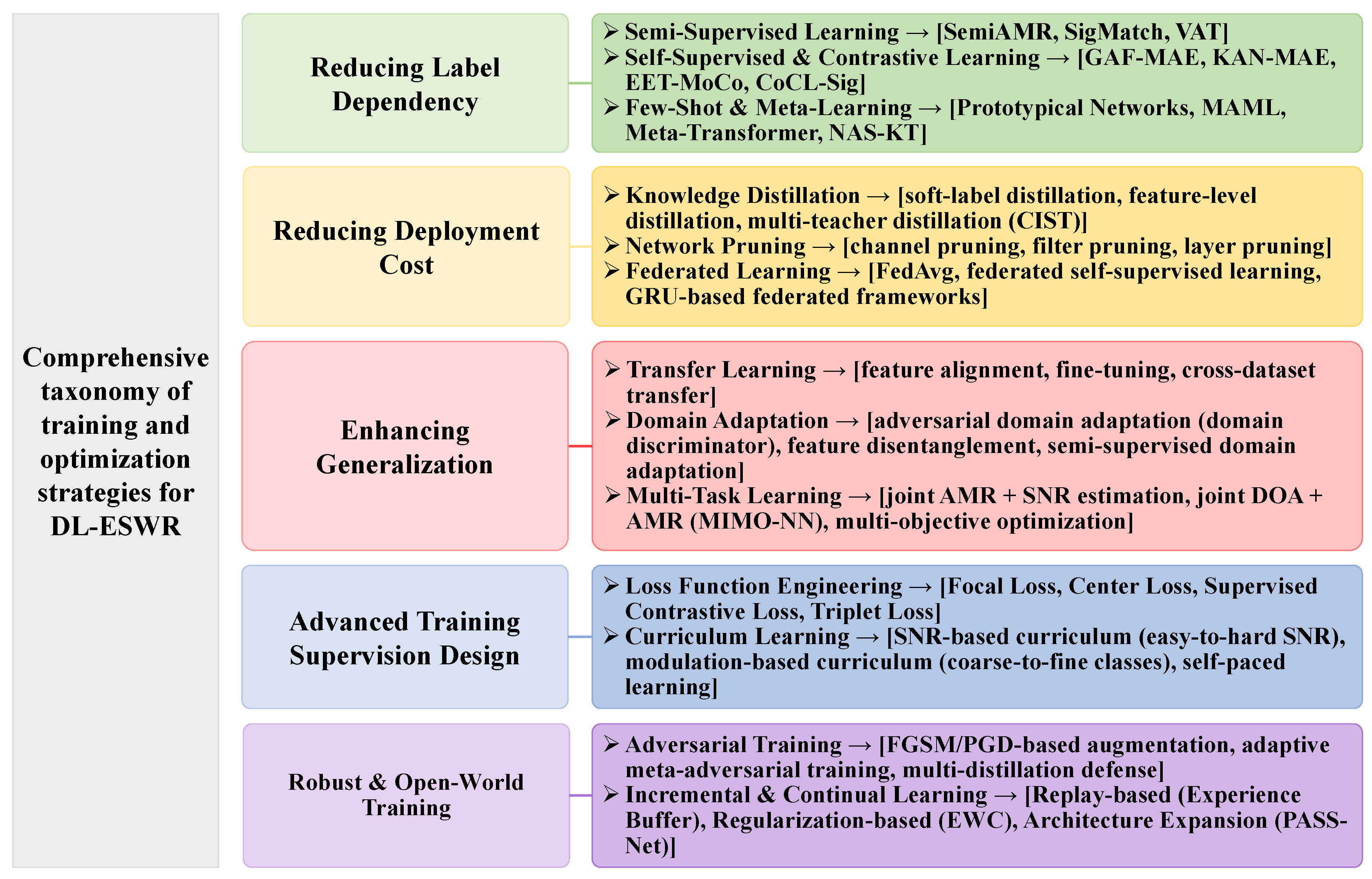
2.4. Module IV: Training and Optimization Strategies
2.4.1. Goal I: Reducing Label Dependency (Annotation Efficiency)
2.4.2. Goal II: Reducing Deployment Cost (Efficiency Orientation)
2.4.3. Goal III: Enhancing Generalization Capability
2.4.4. Goal IV: Advanced Training Supervision Design
2.4.5. Goal V: Robust and Open-World Training Strategies
2.4.6. Summary of Training Strategy Landscape
2.5. Evaluation Metric Taxonomy
3. Addressing Practical Deployment Challenges Through Modular Innovation
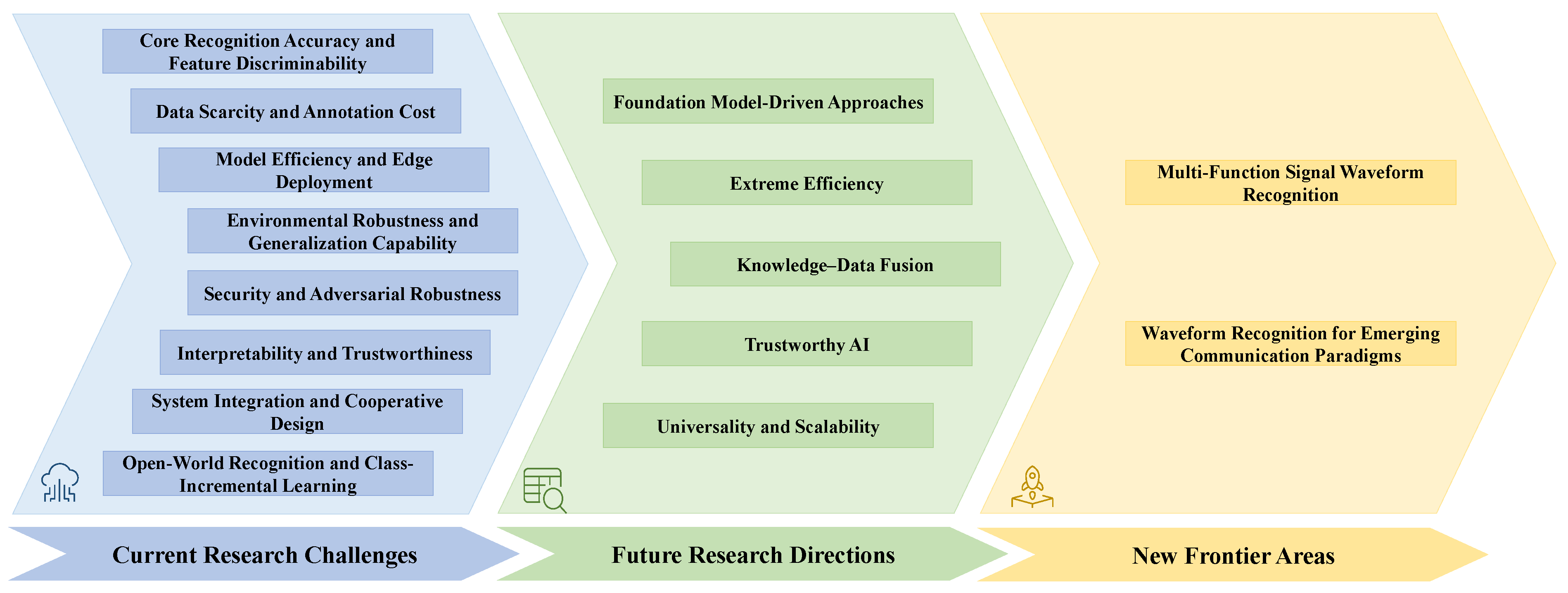
3.1. Challenge I: Core Recognition Accuracy and Feature Discriminability
A Critical Gap: Distance to Theoretical Optimality
3.2. Challenge II: Data Scarcity and Annotation Cost
3.3. Challenge III: Model Efficiency and Edge Deployment
3.3.1. Beyond Parameters and FLOPs: The Missing Deployment Metrics
3.3.2. Scalability Pathways for Real-Time Systems
3.4. Challenge IV: Environmental Robustness and Generalization
The Gap Between Laboratory and Real-World Acquisition
3.5. Challenge V: Security and Adversarial Robustness
3.5.1. Understanding and Implementing Adversarial Attacks
3.5.2. Adversarial Defense Strategies
3.6. Challenge VI: Interpretability and Trustworthiness
Model Uncertainty Quantification
3.7. Challenge VII: System Integration and Cooperative Design
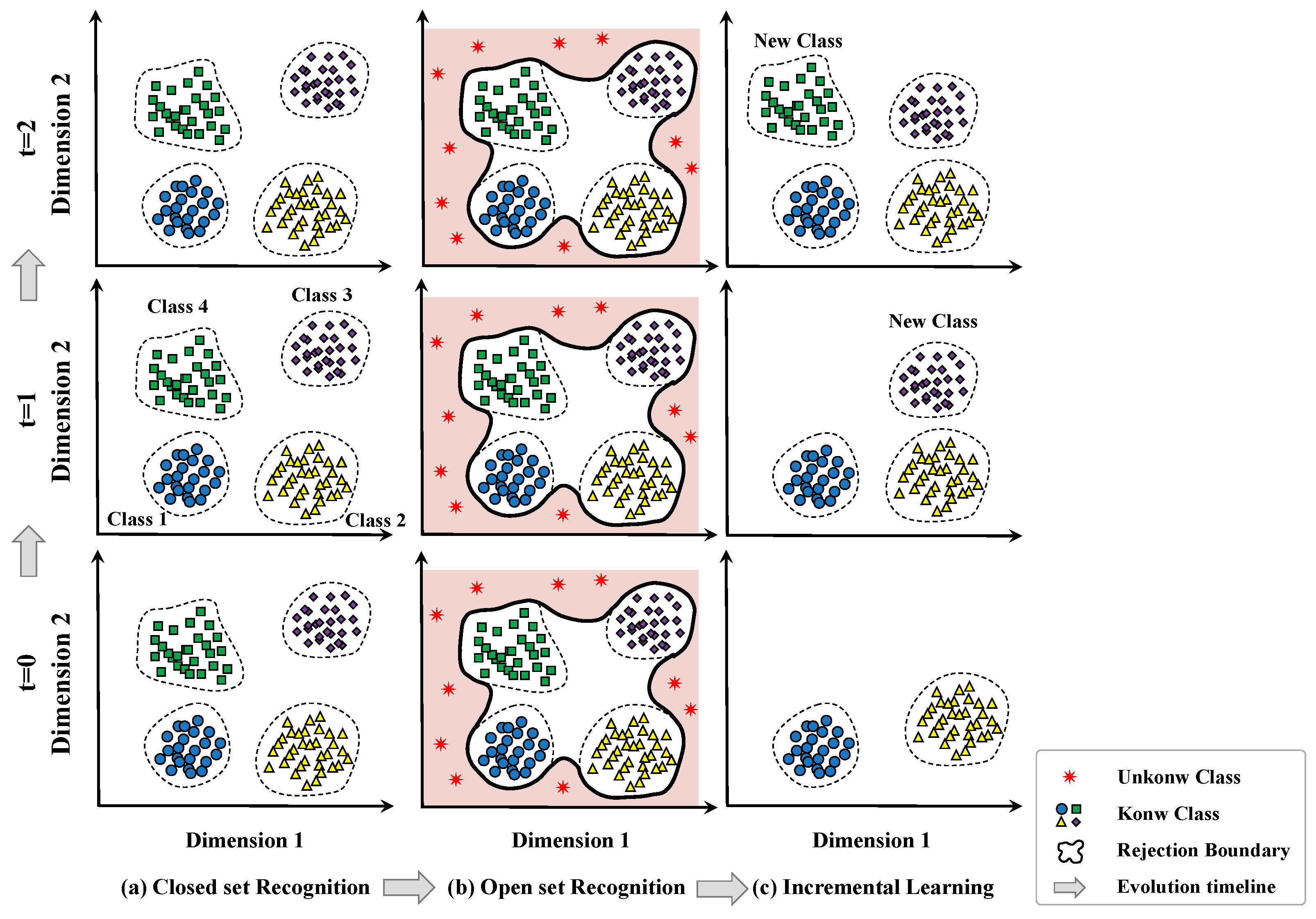
3.8. Challenge VIII: Open-World Recognition and Class-Incremental Learning
4. Future Research Directions and Outlook
4.1. Universality and Scalability (Extending Challenge VIII)
4.2. Extreme Efficiency (Extending Challenge III)
4.3. Trustworthy AI (Extending Challenges V and VI)
4.4. Knowledge–Data Fusion (Extending Challenges I and VI)
4.5. Foundation Model-Driven Approaches (Extending Challenge II)
4.6. Multi-Function Signal Waveform Recognition (New Frontier)
4.7. Waveform Recognition for Emerging Communication Paradigms (New Frontier)
5. Conclusions
5.1. Generalizability to Other Signal Processing Domains
5.2. Summary of Contributions and Findings
Funding
Data Availability Statement
Acknowledgments
Conflicts of Interest
References
- Xiao, Y.; Du, Q.; Zhao, Z.; Li, B.; Tang, X.; Zhang, S.; Song, H. RF-based Identification Framework against Unauthorized UAV Networking in Low-Altitude Economy. IEEE Trans. Netw. Sci. Eng. 2026, 13, 6538–6555. [Google Scholar] [CrossRef]
- Wang, F.; Wang, X. Fast and Robust Modulation Classification via Kolmogorov-Smirnov Test. IEEE Trans. Commun. 2010, 58, 2324–2332. [Google Scholar] [CrossRef]
- Luan, S.; Zhou, J.; Zhu, M.; Zhou, Z.; Ding, Z. KAN-MAE: KAN-Based Masked Autoencoder with Correntropy-Aided Near-Homogeneity Strategy for Automatic Modulation Classification. IEEE Trans. Veh. Technol. 2026, 75, 3429–3433. [Google Scholar] [CrossRef]
- Gan, X.; Wang, H.; Li, X.; Liu, Z.; Jiang, H.; Wang, J. Potential Threat to Cognitive Radio Networks: A Black-Box and Label-Consistent Backdoor Attack Against Modulation Recognition. IEEE Trans. Cogn. Commun. Netw. 2026, 12, 1395–1410. [Google Scholar] [CrossRef]
- Zhang, Z.; Wang, C.; Gan, C.; Sun, S.; Wang, M. Automatic Modulation Classification Using Convolutional Neural Network with Features Fusion of SPWVD and BJD. IEEE Trans. Signal Inf. Process. Netw. 2019, 5, 469–478. [Google Scholar] [CrossRef]
- Hazza, A.; Shoaib, M.; Alshebeili, S.A.; Fahad, A. An overview of feature-based methods for digital modulation classification. In 2013 1st International Conference on Communications, Signal Processing, and their Applications (ICCSPA); IEEE: New York, NY, USA, 2013; pp. 1–6. [Google Scholar] [CrossRef]
- Shi, Y.; Xu, H.; Zhang, Y.; Qi, Z.; Wang, D. GAF-MAE: A Self-Supervised Automatic Modulation Classification Method Based on Gramian Angular Field and Masked Autoencoder. IEEE Trans. Cogn. Commun. Netw. 2024, 10, 94–106. [Google Scholar] [CrossRef]
- Wang, Y.; Liu, M.; Yang, J.; Gui, G. Data-Driven Deep Learning for Automatic Modulation Recognition in Cognitive Radios. IEEE Trans. Veh. Technol. 2019, 68, 4074–4077. [Google Scholar] [CrossRef]
- Peng, S.; Jiang, H.; Wang, H.; Alwageed, H.; Yao, Y. Modulation classification using convolutional Neural Network based deep learning model. In 2017 26th Wireless and Optical Communication Conference (WOCC); IEEE: New York, NY, USA, 2017; pp. 1–5. [Google Scholar] [CrossRef]
- West, N.E.; O’Shea, T. Deep architectures for modulation recognition. In 2017 IEEE International Symposium on Dynamic Spectrum Access Networks (DySPAN); IEEE: New York, NY, USA, 2017; pp. 1–6. [Google Scholar] [CrossRef]
- Mendis, G.J.; Wei, J.; Madanayake, A. Deep learning-based automated modulation classification for cognitive radio. In 2016 IEEE International Conference on Communication Systems (ICCS); IEEE: New York, NY, USA, 2016; pp. 1–6. [Google Scholar] [CrossRef]
- Geng, Z.; Yan, H.; Zhang, J.; Zhu, D. Deep-learning for radar: A survey. IEEE Access 2021, 9, 141800–141818. [Google Scholar] [CrossRef]
- Huynh-The, T.; Pham, Q.V.; Nguyen, T.V.; Nguyen, T.T.; Ruby, R.; Zeng, M.; Kim, D.S. Automatic modulation classification: A deep architecture survey. IEEE Access 2021, 9, 142950–142971. [Google Scholar] [CrossRef]
- Wang, T.; Yang, G.; Chen, P.; Xu, Z.; Jiang, M.; Ye, Q. A survey of applications of deep learning in radio signal modulation recognition. Appl. Sci. 2022, 12, 12052. [Google Scholar] [CrossRef]
- Peng, S.; Sun, S.; Yao, Y.D. A survey of modulation classification using deep learning: Signal representation and data preprocessing. IEEE Trans. Neural Netw. Learn. Syst. 2021, 33, 7020–7038. [Google Scholar] [CrossRef] [PubMed]
- Wang, X.; Zhao, Y.; Huang, Z. A survey of deep transfer learning in automatic modulation classification. IEEE Trans. Cogn. Commun. Netw. 2025, 11, 1357–1381. [Google Scholar] [CrossRef]
- Huang, L.; Pan, W.; Zhang, Y.; Qian, L.; Gao, N.; Wu, Y. Data Augmentation for Deep Learning-Based Radio Modulation Classification. IEEE Access 2020, 8, 1498–1506. [Google Scholar] [CrossRef]
- Dong, G.; Liu, H. Signal Augmentations Oriented to Modulation Recognition in the Realistic Scenarios. IEEE Trans. Commun. 2023, 71, 1665–1677. [Google Scholar] [CrossRef]
- Manin, L.; Oliva, G.; Bianco, M.G.; Hossain, M.M.; Valić, S.; Islam, S.K.; Laganà, F.; Fiorillo, A.S.; Pullano, S.A. Application of FTIR and PCA-LR metabolites recognition for bergamot essential oil authentication. Spectrochim. Acta Part A Mol. Biomol. Spectrosc. 2026, 352, 127561. [Google Scholar] [CrossRef]
- Zhang, F.; Luo, C.; Xu, J.; Luo, Y. An Efficient Deep Learning Model for Automatic Modulation Recognition Based on Parameter Estimation and Transformation. IEEE Commun. Lett. 2021, 25, 3287–3290. [Google Scholar] [CrossRef]
- Oikonomou, T.K.; Evgenidis, N.G.; Nixarlidis, D.G.; Tyrovolas, D.; Tegos, S.A.; Diamantoulakis, P.D.; Sarigiannidis, P.G.; Karagiannidis, G.K. CNN-Based Automatic Modulation Classification Under Phase Imperfections. IEEE Wirel. Commun. Lett. 2024, 13, 1508–1512. [Google Scholar] [CrossRef]
- Peng, S.; Jiang, H.; Wang, H.; Alwageed, H.; Zhou, Y.; Sebdani, M.M.; Yao, Y. Modulation Classification Based on Signal Constellation Diagrams and Deep Learning. IEEE Trans. Neural Netw. Learn. Syst. 2019, 30, 718–727. [Google Scholar] [CrossRef]
- Song, G.; Jeon, G.; Yoon, D. Deep Learning-Based Automatic Modulation Classification for Composite Modulated Radar Signal Using Time-Frequency Image. In 2024 34th International Telecommunication Networks and Applications Conference (ITNAC); IEEE: New York, NY, USA, 2024; pp. 1–6. [Google Scholar] [CrossRef]
- Wang, J.; Yin, Y.; Shi, X.; Zhang, Z.; Zhang, Z. LPI Radar Signal Recognition Method Based on Adaptive Wavelet Decomposition and Deep Residual Shrinkage Network. IEEE Sens. J. 2025, 25, 41618–41633. [Google Scholar] [CrossRef]
- Konopko, K.; Grishin, Y.P.; Janczak, D. Radar signal recognition based on time-frequency representations and multidimensional probability density function estimator. In 2015 Signal Processing Symposium (SPSympo); IEEE: New York, NY, USA, 2015; pp. 1–6. [Google Scholar] [CrossRef]
- Mi, X.; Chen, X.; Liu, Q.; Hu, D. Radar signals modulation recognition based on bispectrum feature processing. In Proceedings of the Journal of Physics: Conference Series; IOP Publishing: Bristol, UK, 2021; Volume 1971, p. 012099. [Google Scholar]
- Dong, Z.; Lv, F.; Wan, T.; Jiang, K.; Fang, X.; Zhang, L. Radar Signal Modulation Recognition Based on Bispectrum Features and Deep learning. In 2021 International Conference on Computer Engineering and Application (ICCEA); IEEE: New York, NY, USA, 2021; pp. 63–67. [Google Scholar] [CrossRef]
- Bai, J.; Liu, X.; Wang, Y.; Xiao, Z.; Chen, F.; Zhou, H.; Jiao, L. Integrating Prior Knowledge and Contrast Feature for Signal Modulation Classification. IEEE Internet Things J. 2024, 11, 21461–21473. [Google Scholar] [CrossRef]
- Huynh-The, T.; Hua, C.; Pham, Q.; Kim, D. MCNet: An Efficient CNN Architecture for Robust Automatic Modulation Classification. IEEE Commun. Lett. 2020, 24, 811–815. [Google Scholar] [CrossRef]
- Huang, S.; Dai, R.; Huang, J.; Yao, Y.; Gao, Y.; Ning, F.; Feng, Z. Automatic Modulation Classification Using Gated Recurrent Residual Network. IEEE Internet Things J. 2020, 7, 7795–7807. [Google Scholar] [CrossRef]
- Saraswathi, V.; Dayana, R. Federated Learning-Driven GRU for Modulation Recognition in Cognitive Radio Networks. In 2025 6th International Conference on Data Intelligence and Cognitive Informatics (ICDICI); IEEE: New York, NY, USA, 2025; pp. 1055–1060. [Google Scholar] [CrossRef]
- Hong, D.; Zhang, Z.; Xu, X. Automatic modulation classification using recurrent neural networks. In 2017 3rd IEEE International Conference on Computer and Communications (ICCC); IEEE: New York, NY, USA, 2017; pp. 695–700. [Google Scholar] [CrossRef]
- Zhang, Z.; Luo, H.; Wang, C.; Gan, C.; Xiang, Y. Automatic Modulation Classification Using CNN-LSTM Based Dual-Stream Structure. IEEE Trans. Veh. Technol. 2020, 69, 13521–13531. [Google Scholar] [CrossRef]
- Qiu, K.; Zheng, S.; Zhang, L.; Lou, C.; Yang, X. DeepSIG: A Hybrid Heterogeneous Deep Learning Framework for Radio Signal Classification. IEEE Trans. Wirel. Commun. 2024, 23, 775–788. [Google Scholar] [CrossRef]
- Chen, B.; Wang, X.; Zhu, D.; Yan, H.; Xu, G.; Wen, Y. LPI Radar Signals Modulation Recognition in Complex Multipath Environment Based on Improved ResNeSt. IEEE Trans. Aerosp. Electron. Syst. 2024, 60, 8887–8900. [Google Scholar] [CrossRef]
- Yin, Y.; Wang, J.; Tang, Y.; Wang, X. ConvNeXt Architecture Enhanced with Modified SCConv for LPI Radar Modulation Classification. In 2025 IEEE 8th International Conference on Electronic Information and Communication Technology (ICEICT); IEEE: New York, NY, USA, 2025; pp. 295–300. [Google Scholar] [CrossRef]
- Hantouli, F.; Hall, G.; Brown, D.; Tieman, J.; Chakravarty, S. Implementing ResNet for Real-Time Radar Signal Classification in Electronic Warfare. In 2025 IEEE International Radar Conference (RADAR); IEEE: New York, NY, USA, 2025; pp. 1–6. [Google Scholar] [CrossRef]
- Wu, C.; Chen, S.; Sun, G. Automatic Modulation Recognition Framework for LPI Radar Based on CNN and Vision Transformer. In Proceedings of the 2024 8th International Conference on Computer Science and Artificial Intelligence; IEEE: New York, NY, USA, 2024; pp. 170–176. [Google Scholar] [CrossRef]
- Dao, T.; Noh, D.; Pham, Q.; Hasegawa, M.; Sekiya, H.; Hwang, W. VT-MCNet: High-Accuracy Automatic Modulation Classification Model Based on Vision Transformer. IEEE Commun. Lett. 2024, 28, 98–102. [Google Scholar] [CrossRef]
- Ma, W.; Cai, Z.; Wang, C. A Transformer and Convolution-Based Learning Framework for Automatic Modulation Classification. IEEE Commun. Lett. 2024, 28, 1392–1396. [Google Scholar] [CrossRef]
- Shao, M.; Li, D.; Hong, S.; Qi, J.; Sun, H. IQFormer: A Novel Transformer-Based Model with Multi-Modality Fusion for Automatic Modulation Recognition. IEEE Trans. Cogn. Commun. Netw. 2025, 11, 1623–1634. [Google Scholar] [CrossRef]
- Qi, P.; Zhou, X.; Zheng, S.; Li, Z. Automatic Modulation Classification Based on Deep Residual Networks with Multimodal Information. IEEE Trans. Cogn. Commun. Netw. 2021, 7, 21–33. [Google Scholar] [CrossRef]
- Zhang, J.; An, S.; Meng, F.; Liu, Q. MST: A Multi-Scale Transformer Framework with Cross-Scale Token Fusion for Automatic Modulation Recognition. IEEE Wirel. Commun. Lett. 2025, 14, 4112–4116. [Google Scholar] [CrossRef]
- Feng, Y.; Peng, K.; Wei, J.; Tang, Z. Window Attention Convolution Network (WACN): A Local Self-Attention Automatic Modulation Recognition Method. IEEE Trans. Cogn. Commun. Netw. 2025, 11, 1597–1608. [Google Scholar] [CrossRef]
- Liu, Y.; Liu, Y.; Yang, C. Modulation Recognition with Graph Convolutional Network. IEEE Wirel. Commun. Lett. 2020, 9, 624–627. [Google Scholar] [CrossRef]
- Shao, M.; Fu, Z.; Li, D.; Zhang, F.; Cai, Y.; Hong, S.; Cao, L.; Peng, Y.; Qi, J. STF-GCN: A Multi-Domain Graph Convolution Network Method for Automatic Modulation Recognition via Adaptive Correlation. IEEE Trans. Cogn. Commun. Netw. 2026, 12, 2036–2050. [Google Scholar] [CrossRef]
- Cai, Z.; Wang, C.; Ma, W.; Li, X.; Zhou, R. Lightweight Automatic Modulation Classification Based on Efficient Convolution and Graph Sparse Attention in Low-Resource Scenarios. IEEE Internet Things J. 2025, 12, 3629–3638. [Google Scholar] [CrossRef]
- Li, W.; Deng, W.; Wang, K.; You, L.; Huang, Z. A Complex-Valued Transformer for Automatic Modulation Recognition. IEEE Internet Things J. 2024, 11, 22197–22207. [Google Scholar] [CrossRef]
- Tu, Y.; Lin, Y.; Hou, C.; Mao, S. Complex-Valued Networks for Automatic Modulation Classification. IEEE Trans. Veh. Technol. 2020, 69, 10085–10089. [Google Scholar] [CrossRef]
- Zhang, H.; Zhou, F.; Wu, Q.; Al-Dhahir, N. SSwsrNet: A Semi-Supervised Few-Shot Learning Framework for Wireless Signal Recognition. IEEE Trans. Commun. 2024, 72, 5823–5836. [Google Scholar] [CrossRef]
- Guo, Y.; Zhong, D.; Sun, H.; Jiang, Z.; Ye, L.; Deng, Z.; Liu, H. SemiAMR: Semi-Supervised Automatic Modulation Recognition with Corrected Pseudo-Label and Consistency Regularization. IEEE Trans. Cogn. Commun. Netw. 2024, 10, 107–121. [Google Scholar] [CrossRef]
- Cai, J.; He, M.; Cao, X.; Gan, F. Semisupervised Radar Intrapulse Signal Modulation Classification with Virtual Adversarial Training. IEEE Internet Things J. 2024, 11, 9929–9940. [Google Scholar] [CrossRef]
- Yi, G.; Hao, X.; Yan, X.; Wang, J.; Dai, J. Automatic Modulation Recognition for Radio Frequency Proximity Sensor Signals Based on Masked Autoencoders and Transfer Learning. IEEE Trans. Aerosp. Electron. Syst. 2024, 60, 8700–8712. [Google Scholar] [CrossRef]
- Hou, K.; Du, X.; Cui, G.; Chen, X.; Zheng, J.; Rong, Y.; Ma, W. A Hybrid Network-Based Contrastive Self-Supervised Learning Method for Radar Signal Modulation Recognition. IEEE Trans. Veh. Technol. 2026, 75, 4437–4451. [Google Scholar] [CrossRef]
- Chen, T.; Liu, K.; Huang, Q. EET-MoCo: An Efficient Embedding Transformer with Momentum Contrast Learning for Automatic Modulation Recognition. IEEE Trans. Cogn. Commun. Netw. 2025, 11, 3784–3796. [Google Scholar] [CrossRef]
- Fu, Y.; Ma, Y.; Feng, Z.; Yang, S.; Wang, Y. Hybrid-View Self-Supervised Framework for Automatic Modulation Recognition. IEEE Internet Things J. 2025, 12, 7360–7375. [Google Scholar] [CrossRef]
- Bai, J.; Wang, X.; Xiao, Z.; Zhou, H.; Ali, T.A.A.; Li, Y.; Jiao, L. Achieving Efficient Feature Representation for Modulation Signal: A Cooperative Contrast Learning Approach. IEEE Internet Things J. 2024, 11, 16196–16211. [Google Scholar] [CrossRef]
- Feng, S.; Wang, Y.; Wen, Z.; Xu, L.; Yan, M. Fine-Grained Transductive Prototypical Network-Based Few-Shot Signal Modulation Classification Using Coarse Labels. IEEE Trans. Cogn. Commun. Netw. 2026, 12, 2189–2204. [Google Scholar] [CrossRef]
- Li, L.; Huang, J.; Cheng, Q.; Meng, H.; Han, Z. Automatic Modulation Recognition: A Few-Shot Learning Method Based on the Capsule Network. IEEE Wirel. Commun. Lett. 2021, 10, 474–477. [Google Scholar] [CrossRef]
- Jang, J.; Pyo, J.; Yoon, Y.; Choi, J. Meta-Transformer: A Meta-Learning Framework for Scalable Automatic Modulation Classification. IEEE Access 2024, 12, 9267–9276. [Google Scholar] [CrossRef]
- Zhang, X.; Zhao, H.; Zhu, H.; Adebisi, B.; Gui, G.; Gacanin, H.; Adachi, F. NAS-AMR: Neural Architecture Search-Based Automatic Modulation Recognition for Integrated Sensing and Communication Systems. IEEE Trans. Cogn. Commun. Netw. 2022, 8, 1374–1386. [Google Scholar] [CrossRef]
- Cao, X. Few-Shot and Zero-Shot Radar Active Jamming Recognition Based on a Vision-Language Model. IEEE Trans. Aerosp. Electron. Syst. 2025, 61, 14795–14808. [Google Scholar] [CrossRef]
- Hou, D.; Li, L.; Lin, W.; Liang, J.; Han, Z. ClST: A Convolutional Transformer Framework for Automatic Modulation Recognition by Knowledge Distillation. IEEE Trans. Wirel. Commun. 2024, 23, 8013–8028. [Google Scholar] [CrossRef]
- Chen, Z.; Wang, Z.; Gao, X.; Zhou, J.; Xu, D.; Zheng, S.; Xuan, Q.; Yang, X. Channel Pruning Method for Signal Modulation Recognition Deep Learning Models. IEEE Trans. Cogn. Commun. Netw. 2024, 10, 442–453. [Google Scholar] [CrossRef]
- Lu, Y.; Zhu, Y.; Li, Y.; Xu, D.; Lin, Y.; Xuan, Q.; Yang, X. A Generic Layer Pruning Method for Signal Modulation Recognition Deep Learning Models. IEEE Trans. Cogn. Commun. Netw. 2025, 11, 2123–2134. [Google Scholar] [CrossRef]
- Xu, F.; Zhu, Y.; Yang, F.; Zhang, X.; Mu, J.; Chen, H. Distributed Modulation Recognition for IoT Devices in Data-Limited Applications. IEEE Internet Things J. 2025, 12, 26740–26752. [Google Scholar] [CrossRef]
- Zhao, D.; Li, L.; Lin, W.; Hou, D.; Zhang, X.; Han, Z. FUTUREs: Feature Utility Transfer for Uncooperative Recognition of Electromagnetic Signals Toward 6G Wireless Communications. IEEE Trans. Cogn. Commun. Netw. 2026, 12, 644–657. [Google Scholar] [CrossRef]
- Zhang, Z.; Li, H.; Li, Y.; Chen, Z.; Wang, S.; Luo, T. A Hybrid Approach for Cross-Dataset Modulation Recognition of Wireless Interference. IEEE Trans. Commun. 2025, 73, 13677–13690. [Google Scholar] [CrossRef]
- Lin, W.; Hou, D.; Huang, J.; Li, L.; Han, Z. Transfer Learning for Automatic Modulation Recognition Using a Few Modulated Signal Samples. IEEE Trans. Veh. Technol. 2023, 72, 12391–12395. [Google Scholar] [CrossRef]
- Zhang, M.; Wei, G.; Tang, P.; Ni, X.; Ding, G.; Wang, H. Semi-Supervised Domain Adaptation for Automatic Modulation Recognition in Unseen Scenarios. IEEE Trans. Cogn. Commun. Netw. 2025, 11, 1609–1622. [Google Scholar] [CrossRef]
- Xing, H.; Wang, S.; Wang, C.; Quan, D.; Xu, Y.; Zhou, H.; Xu, H.; Jiao, L. Disentangling Domain-Invariant Features From Few Samples for Automatic Modulation Classification. IEEE Trans. Cogn. Commun. Netw. 2026, 12, 1525–1538. [Google Scholar] [CrossRef]
- Doan, V.; Le, H.; Hoang, V. Multi-In-Multi-Out Neural Network for Joint DOA Estimation and Automatic Modulation Classification. IEEE Commun. Lett. 2025, 29, 1993–1997. [Google Scholar] [CrossRef]
- Kong, W.; Jiao, X.; Liu, B.; Xu, Y.; Yang, Q. SCLMR: An End-to-End Network for Long-Tailed Modulation Recognition Based on Supervised Contrastive Learning. IEEE Trans. Aerosp. Electron. Syst. 2025, 61, 2871–2884. [Google Scholar] [CrossRef]
- Bamdad, A.; Owfi, A.; Afghah, F. Adaptive Meta-learning-based Adversarial Training for Robust Automatic Modulation Classification. In 2025 IEEE International Conference on Communications Workshops (ICC Workshops); IEEE: New York, NY, USA, 2025; pp. 292–297. [Google Scholar] [CrossRef]
- Tan, H.; Zhang, Z.; Li, Y.; Shi, X.; Wang, L.; Yang, X.; Zhou, F. PASS-Net: A Pseudo Classes and Stochastic Classifiers-Based Network for Few-Shot Class-Incremental Automatic Modulation Classification. IEEE Trans. Wirel. Commun. 2024, 23, 17987–18003. [Google Scholar] [CrossRef]
- Deng, Z.; Luo, C.; Tang, Z.; Pu, X.; Luo, Y. An Orthogonal Pseudo-Prototype and Pseudo-Target-Based Method for Few-Shot Class-Incremental Automatic Modulation Recognition. IEEE Trans. Cogn. Commun. Netw. 2026, 12, 2542–2557. [Google Scholar] [CrossRef]
- Yan, X.; Zhong, X.; Wu, H.; Yang, P.; Wang, Q.; Chen, Y. Automatic Composite-Modulation Classification Using Cyclic-Paw-Print Features for Cognitive Aerospace Communications. IEEE Trans. Commun. 2024, 72, 5486–5502. [Google Scholar] [CrossRef]
- Liu, G.; Qian, B.; Liu, Z.; Hao, C. A Modulation Recognition Method Based on Adaptive Feature Fusion. In 2025 International Conference on Communication Networks and Smart Systems Engineering (ICCNSE); IEEE: New York, NY, USA, 2025; pp. 244–249. [Google Scholar] [CrossRef]
- Yang, H.; Wang, D.; Liu, Y.; Liu, Y. An Automatic Modulation Recognition Model with Multi-Scale Triplet Attention. In 2025 17th International Conference on Communication Software and Networks (ICCSN); IEEE: New York, NY, USA, 2025; pp. 185–189. [Google Scholar] [CrossRef]
- Zhao, Y.; Wang, Y.; Zhang, C.; Li, C.; Xiong, Z.; Zhu, L.; Niyato, D. Boosting Robustness in Automatic Modulation Recognition for Wireless Communications. IEEE Trans. Cogn. Commun. Netw. 2025, 11, 1635–1648. [Google Scholar] [CrossRef]
- Sheng, H.; Chen, K.; Zeng, W.; Geng, H.; Ma, W.; Wang, S. Carrier Frequency Offset Robust Self-Compensating Neural Network. IEEE Trans. Wirel. Commun. 2025, 24, 4073–4085. [Google Scholar] [CrossRef]
- Zhou, F.; Ren, J.; Xu, F.; Wang, Y.; Wang, W.; Zhang, P. MATF-Net: Multiscale Attention with Tristream Fusion Network for Radar Modulation Recognition in S-Band. IEEE J. Sel. Areas Sens. 2025, 2, 247–258. [Google Scholar] [CrossRef]
- Park, D.; Jeon, M.; Jeong, J.; Sim, I.; Yun, S.; Seo, J.; Kim, H. Noise-Aware Ensemble Learning for Efficient Radar Modulation Recognition. IEEE Internet Things J. 2025, 12, 28937–28949. [Google Scholar] [CrossRef]
- Xu, J.L.; Su, W.; Zhou, M. Software-Defined Radio Equipped with Rapid Modulation Recognition. IEEE Trans. Veh. Technol. 2010, 59, 1659–1667. [Google Scholar] [CrossRef]
- Xing, H.; Wang, S.; Wang, C.; Quan, D.; Mo, H.; Mei, L.; Zhou, H.; Jiao, L. AFLNet: Auxiliary Feature Learning-Guided Cross-Channel Automatic Modulation Classification. IEEE Trans. Commun. 2025, 73, 13519–13534. [Google Scholar] [CrossRef]
- Li, L.; Lin, J.; Zhou, H.; Guo, Y.; Liu, X.; Liu, F.; Jiao, L. A Physics-Aware Collaborative Framework with Prototype Consistency for Noisy Labels Signal Modulation Classification. IEEE Internet Things J. 2025, 12, 44304–44317. [Google Scholar] [CrossRef]
- Lin, Y.; Zhao, H.; Ma, X.; Tu, Y.; Wang, M. Adversarial Attacks in Modulation Recognition with Convolutional Neural Networks. IEEE Trans. Reliab. 2021, 70, 389–401. [Google Scholar] [CrossRef]
- Bu, K.; He, Y.; Jing, X.; Han, J. Adversarial Transfer Learning for Deep Learning Based Automatic Modulation Classification. IEEE Signal Process. Lett. 2020, 27, 880–884. [Google Scholar] [CrossRef]
- O’Shea, T.J.; Roy, T.; Clancy, T.C. Over-the-air deep learning based radio signal classification. IEEE J. Sel. Top. Signal Process. 2018, 12, 168–179. [Google Scholar] [CrossRef]
- Oncu, S.; Karakaya, M.; Dalveren, Y.; Kara, A.; Derawi, M. Real-time radar classification based on software-defined radio platforms: Enhancing processing speed and accuracy with graphics processing unit acceleration. Sensors 2024, 24, 7776. [Google Scholar] [CrossRef]
- Jagannath, A.; Jagannath, J. Multi-task learning approach for modulation and wireless signal classification for 5G and beyond: Edge deployment via model compression. Phys. Commun. 2022, 54, 101793. [Google Scholar] [CrossRef]
- Zhou, X.; Yu, X.; Zhang, Y.; Zeng, W. Exploring Universal Adversarial Attacks on DNN-Based Automatic Modulation Recognition Using Joint Metrics. IEEE Trans. Wirel. Commun. 2025, 24, 4853–4863. [Google Scholar] [CrossRef]
- Gan, X.; Wang, H.; Li, X.; Liu, Z.; Jiang, H.; Wang, J. A Multitarget Backdoor Attack Against Automatic Modulation Recognition for IoT Wireless Signals. IEEE Internet Things J. 2025, 12, 27588–27605. [Google Scholar] [CrossRef]
- Zhang, R.; Li, Y.; Liu, J. Transferable Anti-Intelligence Recognition Radar Waveform Design Based on Adversarial Attacks. IEEE Trans. Aerosp. Electron. Syst. 2025, 61, 3798–3812. [Google Scholar] [CrossRef]
- Bao, Z.; Zhang, S.; Yang, S.; Fu, J.; Lin, Y. CCIFE: Channel-Resilient Ensemble Adversarial Attack Against DNN-Based Modulation Classifiers. IEEE Trans. Cogn. Commun. Netw. 2026, 12, 1775–1787. [Google Scholar] [CrossRef]
- Zhang, S.; Lin, Y.; Yu, J.; Zhang, J.; Xuan, Q.; Xu, D.; Wang, J.; Wang, M. HFAD: Homomorphic Filtering Adversarial Defense Against Adversarial Attacks in Automatic Modulation Classification. IEEE Trans. Cogn. Commun. Netw. 2024, 10, 880–892. [Google Scholar] [CrossRef]
- Zhang, S.; Song, Y.; Wang, S. Collaborative VQMAE: Defense Against Adversarial Attacks in Automatic Modulation Recognition. In ICC 2025—IEEE International Conference on Communications; IEEE: New York, NY, USA, 2025; pp. 434–439. [Google Scholar] [CrossRef]
- Bai, J.; Lian, Y.; Wang, Y.; Ren, J.; Xiao, Z.; Zhou, H.; Jiao, L. An Interpretable Explanation Approach for Signal Modulation Classification. IEEE Trans. Instrum. Meas. 2024, 73, 2514613. [Google Scholar] [CrossRef]
- Wang, Z.; Lai, B.; Liu, X.; Feng, Z.; Xiao, L.; Zhou, F. Knowledge Embedded Convolutional Transformer Hybrid Network for Automatic Modulation Classification. IEEE Trans. Cogn. Commun. Netw. 2026, 12, 1725–1738. [Google Scholar] [CrossRef]
- Xiao, Y.; Du, Q.; Cheng, W.; Karagiannidis, G.K.; Zhao, Z. Model-ML integrated intelligence in URLLC towards end-to-end delay fulfillment over vehicular networks. IEEE Internet Things Mag. 2023, 6, 62–68. [Google Scholar] [CrossRef]
- Hou, C.; Liu, G.; Tian, Q.; Zhou, Z.; Hua, L.; Lin, Y. Multisignal Modulation Classification Using Sliding Window Detection and Complex Convolutional Network in Frequency Domain. IEEE Internet Things J. 2022, 9, 19438–19449. [Google Scholar] [CrossRef]
- Chen, K.; Zhang, J.; Chen, S.; Zhang, S.; Zhao, H. Recognition and Estimation for Frequency-Modulated Continuous-Wave Radars in Unknown and Complex Spectrum Environments. IEEE Trans. Aerosp. Electron. Syst. 2023, 59, 6098–6111. [Google Scholar] [CrossRef]
- Yang, H.; Sahay, R. An Uncertainty Quantification Framework for Deep Learning-Based Automatic Modulation Classification. IEEE Internet Things J. 2025, 13, 5087–5096. [Google Scholar] [CrossRef]
- Luu, V.C.; Park, J.; Hong, J.P. Uncertainty-aware incremental automatic modulation classification with Bayesian neural network. IEEE Internet Things J. 2024, 11, 24300–24309. [Google Scholar] [CrossRef]
- Zhou, Y.; Shang, S.; Song, X.; Zhang, S.; You, T.; Zhang, L. Intelligent radar jamming recognition in open set environment based on deep learning networks. Remote Sens. 2022, 14, 6220. [Google Scholar] [CrossRef]
- Xiao, Y.; Zhang, R.; Yu, X.; Jiang, Y. Open-set recognition of compound jamming signal based on multi-task multi-label learning. IET Radar Sonar Navig. 2024, 18, 1235–1246. [Google Scholar] [CrossRef]
- Zecchin, M.; Park, S.; Simeone, O.; Kountouris, M.; Gesbert, D. Robust Bayesian learning for reliable wireless AI: Framework and applications. IEEE Trans. Cogn. Commun. Netw. 2023, 9, 897–912. [Google Scholar] [CrossRef]
- Wang, Y.; Gui, J.; Yin, Y.; Wang, J.; Sun, J.; Gui, G.; Gacanin, H.; Sari, H.; Adachi, F. Automatic modulation classification for MIMO systems via deep learning and zero-forcing equalization. IEEE Trans. Veh. Technol. 2020, 69, 5688–5692. [Google Scholar] [CrossRef]
- Wang, Y.; Gui, G.; Gacanin, H.; Ohtsuki, T.; Sari, H.; Adachi, F. Transfer Learning for Semi-Supervised Automatic Modulation Classification in ZF-MIMO Systems. IEEE J. Emerg. Sel. Top. Circuits Syst. 2020, 10, 231–239. [Google Scholar] [CrossRef]
- Zhang, J.; Liu, M.; Chen, Y.; Zhao, N. Spatial-Frequency Block Coding Automatic Recognition with Non-Gaussian Interference for Cognitive MIMO-OFDM Systems. IEEE Trans. Cogn. Commun. Netw. 2025, 11, 156–167. [Google Scholar] [CrossRef]
- Qian, L.P.; Wang, C.; Wang, Q.; Wu, M.; Wu, Y.; Yang, X. OFDM Receiver Design with Learning-Driven Automatic Modulation Recognition. IEEE Trans. Cogn. Commun. Netw. 2024, 10, 429–441. [Google Scholar] [CrossRef]
- Zhang, X.; Wang, Z.; Wang, X.; Luo, T.; Xiao, Y.; Fang, B.; Xiao, F.; Luo, D. STARNet: An Efficient Spatiotemporal Feature Sharing Reconstructing Network for Automatic Modulation Classification. IEEE Trans. Wirel. Commun. 2024, 23, 13300–13312. [Google Scholar] [CrossRef]
- Hou, J.; Xu, D.; Song, F.; Chen, Z.; Xuan, Q.; Zheng, S.; Lin, Y.; Yang, X. Multi-View Discriminant Framework for Automatic Modulation Open Set Recognition. IEEE Trans. Commun. 2025, 73, 4378–4393. [Google Scholar] [CrossRef]
- Flowers, B.; Buehrer, R.M.; Headley, W.C. Evaluating Adversarial Evasion Attacks in the Context of Wireless Communications. IEEE Trans. Inf. Forensics Secur. 2020, 15, 1102–1113. [Google Scholar] [CrossRef]
- Feng, Z.; Pei, H.; Yang, S.; Yang, C. Fine-Grained Open Set Signal Modulation Classification via Self-Supervised Pre-Training. IEEE Trans. Cogn. Commun. Netw. 2025, 11, 4011–4025. [Google Scholar] [CrossRef]



| Dataset | Year | Public | Source | Samples | Mod. Types | SNR Range (dB) |
|---|---|---|---|---|---|---|
| RML2016.10a | 2016 | Yes | Sim. | 220 K | 11 | to |
| RML2016.10b | 2016 | Yes | Sim. | 1.2 M | 10 | to |
| RML2018.01a | 2018 | Yes | Sim. | 2.56 M | 24 | to |
| HisarMod2019 | 2019 | Yes | Sim. | 780 K | 26 | to |
| DeepSig | 2018 | Yes | Sim. | M | 24 | to |
| Radar (custom) | Varies | No | Sim./meas. | Varies | 6–16 | to |
| Jamming (custom) | Varies | No | Sim. | Varies | 4–12 | to |
| Representation | Domain | Info. Preserved | Noise Robust. | Comp. Cost | Best For |
|---|---|---|---|---|---|
| Raw I/Q | Time | Complete (A+P) | Low | Minimal | General AMR |
| A/P | Time | Explicit A/P | Low | Low | Phase-sensitive mod. |
| Constellation | Spatial | Symbol-level | Medium | Low | Digital QAM/PSK |
| STFT | Time–freq. | Joint T–F | Medium | Medium | Radar/wideband |
| CWD/WVD | Time–freq. | High-res T–F | Medium–High | High | Chirp/LFM signals |
| Bispectrum | Spectral | Higher-order | High | High | Low-SNR scenarios |
| HOCs | Statistical | Order statistics | High (Gaussian) | Low | Theory-backed AMR |
| GAF | Angular | Temporal corr. | Medium | Medium | Self-supervised |
| Multi-modal | Hybrid | Complementary | High | High | Max. accuracy |
| Architecture | Category | Input | Params | Avg. Acc. (%) | Acc. at 0 dB (%) | Key Innovation |
|---|---|---|---|---|---|---|
| CNN-2 (O’Shea) | CNN | I/Q | K | First DL-AMR baseline | ||
| ResNet | Deep CNN | I/Q | K | Residual learning | ||
| CLDNN | Hybrid | I/Q | K | CNN+LSTM+DNN | ||
| GRU–ResNet | Hybrid | I/Q | K | GRU + residual | ||
| MCNET | Light CNN | I/Q | K | Efficient convolutions | ||
| ULCNN | Ultra-light | I/Q | K | UAV deployment | ||
| VT-MCNet | ViT+CNN | I/Q | K | Vision transformer | ||
| CVT-Net | CNN+trans. | I/Q | K | Conv-Transformer | ||
| CV-TRN | Complex ViT | I/Q | K | Complex attention | ||
| STF–GCN | GNN | Multi | K | Graph convolution | ||
| CPPCNet | Complex CNN | I/Q | K | Complex partial PWC | ||
| MST | Multi-scale T | I/Q | K | Cross-scale fusion |
| Strategy | Label Req. | Data Req. | Comp. Overhead | Key Advantage | Pub. Count |
|---|---|---|---|---|---|
| Supervised (baseline) | 100% labeled | Large | Standard | Simple, proven | 60+ |
| Semi-supervised | 5–20% labeled | Large (mixed) | Low–medium | Uses unlabeled data | |
| Self-supervised/CL | 0% (pretrain) | Large unlabeled | High (pretrain) | No labels needed | |
| few-shot/Meta | 1–5 per class | Small support | Medium | Fast adaptation | |
| Zero-shot (VLM) | 0 samples | Text descriptions | Very high | No signal data needed | |
| Transfer learning | Limited target | Source + target | Medium | Cross-domain | |
| Domain adaptation | 0 target labels | Source + unlabeled | Medium | Domain invariance | |
| Knowledge distill. | Same as teacher | Same | High (train) | Model compression | |
| Federated learning | Distributed | Distributed | Comm. overhead | Privacy preserving | |
| Multi-task | Multi-label | Standard | Low | Auxiliary supervision |
| Family | Representative Metrics | Primary Use Case |
|---|---|---|
| Accuracy | Overall acc., per-SNR acc., per-class acc., confusion matrix, macro-F1, balanced acc. | Core recognition performance |
| Efficiency | Params, FLOPs, latency (ms), throughput, memory (MB), energy (J/inference) | Edge/real-time deployment |
| Robustness | Attack success rate, min-perturbation norm, certified acc., cross-dataset acc. | Adversarial/environmental |
| Calibration | ECE, Brier score, negative log-likelihood, risk–coverage AUC | Trustworthy prediction |
| Open World | Open-set classification rate, AUROC, harmonic mean, forgetting measure | Unknown class & incremental |
| Challenge | Primary Modules | Approx. Pubs. | Research Maturity |
|---|---|---|---|
| 1. Core Recognition Accuracy | II, III, IV | 60+ | Mature |
| 2. Data Scarcity & Annotation Cost | I, IV | 40+ | Active Growth |
| 3. Model Efficiency & Edge Deploy. | III, IV | 20+ | Moderate |
| 4. Environmental Robustness | II, III, IV | 30+ | Active Growth |
| 5. Adversarial Security | II, IV | 28+ | Active Growth |
| 6. Interpretability & Trust | III, IV (ext.) | 10+ | Emerging |
| 7. System Integration & Co-Design | II, III, IV | 15+ | Moderate |
| 8. Open World & Incremental | III, IV | 8+ | Emerging |
| Model | Params | FLOPs | Acc. (%) | Latency | Platform |
|---|---|---|---|---|---|
| ResNet (baseline) | K | M | ms (GPU) | GPU server | |
| MCNet | K | M | N/R | CR edge | |
| ULCNN | K | M | N/R | UAV | |
| CPPCNet | K | M | N/R | IoT | |
| SNR-DSNet | K | M | N/R | Edge | |
| LightAMC | K | M | N/R | IoT sensor | |
| Pruned ResNet | K | M | N/R | FPGA | |
| KD Student | K | M | N/R | Mobile | |
| DLRT | K | M | ms (DSP) | SDR |
| Method | Type | Category | Threat Model | Key Mechanism |
|---|---|---|---|---|
| FGSM | Attack | Evasion | White box | Single-step gradient |
| PGD | Attack | Evasion | White box | Iterative gradient |
| C&W | Attack | Evasion | White box | Optimization-based |
| UAP | Attack | Universal | White/black | Input-agnostic perturbation |
| Backdoor | Attack | Trojan | Training phase | Trigger-activated misclass. |
| CCIFE | Attack | Ensemble | Black box | Channel-resilient transfer |
| CMA | Attack | Cross-modal | Black box | Cross-representation transfer |
| HFAD | Defense | Preprocessing | Any | Homomorphic filtering |
| Co-VQMAE | Defense | Preprocessing | Any | VQ + MAE purification |
| Adv. Training | Defense | Robust Train | Specific attacks | Augment w/ adv. examples |
| Meta-AT | Defense | Robust Train | Unseen attacks | Meta-learn adaptation |
| Multi-Distill. | Defense | KD-based | Multiple attacks | Multi-teacher distillation |
| Method | Task | Approach | Module | Known Acc. | Unknown Det. |
|---|---|---|---|---|---|
| OpenMax | Open set | EVT calibration | IV | High | Moderate |
| CIGR | Open set | Class-guided recon. | III | High | High |
| Multi-View DF | Open set | Multi-view discrim. | III | High | High |
| GNN–OSR | Open set | Graph topology | III | Moderate | High |
| Expert-Know. | Open set | HOC + DL hybrid | II, III | High | High |
| PASS-Net | Incremental | Pseudo-class + stoch. | IV | High | N/A |
| Orth. Proto. | Incremental | Orthogonal proj. | IV | High | N/A |
| OSDA–AMC | Joint OS+DA | Domain + class adapt. | IV | High | Moderate |
| FG-OSR–SSL | Open set | Self-sup. + fine-tune | IV | High | High |
| GAN–OSR | Open set | Gen. unknown + OpenMax | I, IV | High | Moderate–High |
| Future Direction | Corresponding Challenge | Type | Key Technologies |
|---|---|---|---|
| Section 4.1 Universality & Scalability | Ch. 8: Open World | Extension | Meta-learning, lifelong learning |
| Section 4.2 Extreme Efficiency | Ch. 3: Model Efficiency | Extension | HW-NAS, AutoML |
| Section 4.3 Trustworthy AI | Chs. 5+6: Security+Interp. | Extension | Certified defense, intrinsic XAI |
| Section 4.4 Knowledge–Data Fusion | Chs. 1+6: Accuracy+Interp. | Extension | PINNs, knowledge graphs |
| Section 4.5 Foundation Models | Ch. 2: Data Scarcity | Extension | VLMs, wireless FM |
| Section 4.6 Multi-Function Waveform | — | New Frontier | ISAC, composite signals |
| Section 4.7 Emerging Paradigms | — | New Frontier | Semantic comm., Deep JSCC |
Disclaimer/Publisher’s Note: The statements, opinions and data contained in all publications are solely those of the individual author(s) and contributor(s) and not of MDPI and/or the editor(s). MDPI and/or the editor(s) disclaim responsibility for any injury to people or property resulting from any ideas, methods, instructions or products referred to in the content. |
© 2026 by the authors. Licensee MDPI, Basel, Switzerland. This article is an open access article distributed under the terms and conditions of the Creative Commons Attribution (CC BY) license.
Share and Cite
Zhao, D.; Yang, J.; Zhao, D.; Zhang, L.; Xu, Z.; Cao, A.; Lin, W.; Cheng, W.; Du, Q.; Li, L. AI for Wireless Waveform Recognition: A Survey from a Component Perspective. Electronics 2026, 15, 2112. https://doi.org/10.3390/electronics15102112
Zhao D, Yang J, Zhao D, Zhang L, Xu Z, Cao A, Lin W, Cheng W, Du Q, Li L. AI for Wireless Waveform Recognition: A Survey from a Component Perspective. Electronics. 2026; 15(10):2112. https://doi.org/10.3390/electronics15102112
Chicago/Turabian StyleZhao, Decan, Junteng Yang, Dongwei Zhao, Lechi Zhang, Zhenyu Xu, Anjie Cao, Wensheng Lin, Wenchi Cheng, Qinghe Du, and Lixin Li. 2026. "AI for Wireless Waveform Recognition: A Survey from a Component Perspective" Electronics 15, no. 10: 2112. https://doi.org/10.3390/electronics15102112
APA StyleZhao, D., Yang, J., Zhao, D., Zhang, L., Xu, Z., Cao, A., Lin, W., Cheng, W., Du, Q., & Li, L. (2026). AI for Wireless Waveform Recognition: A Survey from a Component Perspective. Electronics, 15(10), 2112. https://doi.org/10.3390/electronics15102112