Article

Dynamic Time Warping-Based Differential Protection Scheme for Transmission Lines in Flexible Fractional Frequency Transmission Systems


1
College of New Energy Engineering, Jiangsu Vocational Institute of Architectural Technology, Xuzhou 221116, China
2
School of Electrical Engineering, China University of Mining and Technology, Xuzhou 221116, China
*
Author to whom correspondence should be addressed.
Electronics 2026, 15(1), 45; https://doi.org/10.3390/electronics15010045
Submission received: 15 November 2025 / Revised: 9 December 2025 / Accepted: 22 December 2025 / Published: 23 December 2025
(This article belongs to the Special Issue Cyber-Physical System Applications in Smart Power and Microgrids)

Abstract

The integration of large-scale offshore wind power, facilitated by Flexible Fractional Frequency Transmission Systems (FFFTS), presents significant challenges for traditional transmission line protection. The fault current fed by the Modular Multilevel Matrix Converter (M3C) exhibits weak-infeed and controlled characteristics during faults, severely degrading the sensitivity of conventional current differential protection. Moreover, the stringent synchronization requirement for data from both line ends further compromises reliability. To address this issue, this paper proposes a novel differential protection scheme based on the Dynamic Time Warping (DTW) algorithm. The method leverages the DTW algorithm to quantify and compare the variation trends of current waveforms on both sides of the line before and after a fault. By utilizing the pre-fault current as a reference sequence, the scheme constructs a protection criterion that is inherently insensitive to synchronization errors. A key innovation is its capability for fault identification and phase selection under weak synchronization conditions. Simulation results demonstrate that the proposed scheme operates correctly within 0.5 ms, exhibits high sensitivity with a DTW ratio significantly greater than 2.0 during internal faults, and remains stable during external faults. It also shows strong robustness against high transition resistance, noise interference, and current transformer sampling errors.

1. Introduction

The extensive harnessing of offshore wind resources and the construction of a new power system primarily based on new energy sources are vital strategies for supporting the achievement of global carbon peak and carbon neutrality objectives [1,2,3]. As offshore wind farms gradually extend from nearshore to mid- and far-sea areas, the challenge of long-distance power transmission has become a constraint on the rapid development of wind power. Flexible fractional frequency transmission technology has shown excellent potential for large-scale, long-distance transmission. It offers a novel solution for offshore wind grid integration by meeting the technical requirements for long-distance transmission and demonstrating good economic efficiency [4,5,6].
While the transmission line is a crucial link in the Flexible Fractional Frequency Transmission System (FFFTS) for guaranteeing secure and stable power transmission, the reliability of its relay protection is equally critical for safeguarding the entire system. The core challenge arises from the Modular Multilevel Matrix Converter (M3C). Its distinct topology and control mechanisms, unlike those of conventional synchronous generation, create substantial difficulties for traditional protection principles that rely on fault current characteristics. This incompatibility risks the converter’s operational security and poses a threat to system-wide stability. Thus, dedicated research into innovative protection technologies for these transmission lines carries significant theoretical and practical importance.
The existing protection schemes for power-frequency transmission lines in FFFTS are primarily adapted from conventional power grids, and their general applicability requires further investigation. The fault response characteristics of the M3C are pivotal in this paper. To ensure secure fault ride-through (FRT) for the M3C, it must coordinate with the wind farm during faults to maintain power balance across both sides and suppress the output current [7,8]. Based on the mathematical model utilizing a double dq-transform for decoupling the M3C’s power-frequency and low-frequency sides [9], the fault current fed by the M3C is recognized to possess weak-infeed and controlled characteristics, which are intrinsically linked to its control strategy during faults. Current research on FFFTS transmission line protection primarily focuses on two aspects:
  • Adaptability analysis of relay protection
The protection of transmission lines connected to power-electronics-based sources like the M3C presents unique challenges due to their fault current characteristics, which differ significantly from conventional synchronous generators. Research efforts have approached this problem from different angles. Reference [10] focused on detailed fault current modeling of the M3C. It derived a time-domain analytical expression and proposed a pilot protection scheme based on quantifying the difference in time-frequency characteristics of the currents on both sides. While innovative, this method has practical limitations, including high sampling rate demands and no inherent phase selection capability. In contrast, other studies leverage the conceptual similarity between the M3C and other inverter-based resources. Reference [11] provides a critical analysis of traditional current differential protection applied to inverter-based generation, revealing its susceptibility to misoperation during phase-to-phase faults, especially in weak system conditions. Furthermore, recognizing the specific issue of protection desensitization under MMC control, Reference [12] proposed a targeted enhancement. Its core contribution is a set of improved differential protection criteria based on sequence components, effectively addressing sensitivity concerns for various fault types while retaining the crucial function of fault phase selection.
The M3C grid-connected system is inherently a single-terminal weak-infeed source. Analyzing the FRT process of the M3C and the controlled, limited nature of its fault current is therefore imperative. This involves studying the issues of sensitivity degradation and the risk of protection failure in traditional differential protection schemes under fault conditions such as phase-to-phase short circuits and high-impedance ground faults. The uniqueness of the M3C’s FRT and control strategies must be thoroughly analyzed to ensure protection reliability.
  • Novel relay protection schemes
Several research directions have been pursued to develop new protection principles using advanced signal processing. The first direction, seen in [13,14,15,16], is based on similarity algorithms, where the core idea is to quantify the discrepancy between time-domain current sequences from both ends of the line. Another direction utilizes mathematical morphology, as in [17], to extract edge information and define gradient energy for current waveforms. A related approach, reference [18], borrows from computer vision by forming a Hankel matrix from current samples and applying the Sobel operator for edge detection. A common challenge shared by these novel schemes is their inherent design complexity, which leads to considerable computational load and poses difficulties for practical setting value determination.
While prior studies have established a foundational understanding for protecting power-frequency lines in FFFTS, existing protection schemes are frequently hampered by algorithmic complexity, significant computational burdens, and stringent data synchronization requirements. However, this paper bridges this critical gap by introducing a novel differential protection scheme based on the Dynamic Time Warping (DTW) algorithm, predicated on a detailed analysis of the M3C’s fault characteristics on its power-frequency side. The unique contributions of this work, which distinguish it from previous research, are summarized as follows:
  • In-depth Fault Characteristic Analysis: We present a comprehensive analysis of the M3C’s fault ride-through strategy, explicitly establishing the relationship between its control actions and the resulting post-fault current trends on both ends of the transmission line.
  • Novel DTW-based Protection Principle: We propose a new protection criterion that utilizes the DTW algorithm to quantify waveform trends by comparing post-fault currents to pre-fault references. This method inherently enables fault identification and phase selection without relying on strict synchronization between line terminals.
  • Comprehensive Validation under Challenging Conditions: We rigorously demonstrate the scheme’s efficacy and robustness through extensive simulations, confirming its high reliability and speed across a wide range of fault scenarios, including those with high impedance and noise.

2. Fault Analysis in Transmission Lines

A typical offshore wind FFFTS employs a single-ended M3C topology, comprising land-based and offshore segments. The land side primarily consists of the power grid, power-frequency transmission lines, grid-connection isolation transformers, and the M3C converter station. The offshore side is mainly composed of submarine low-frequency cables, step-up transformers, and the offshore wind farm. The overall system architecture is depicted in Figure 1.

2.1. M3C Fault Ride-Through Control Strategy

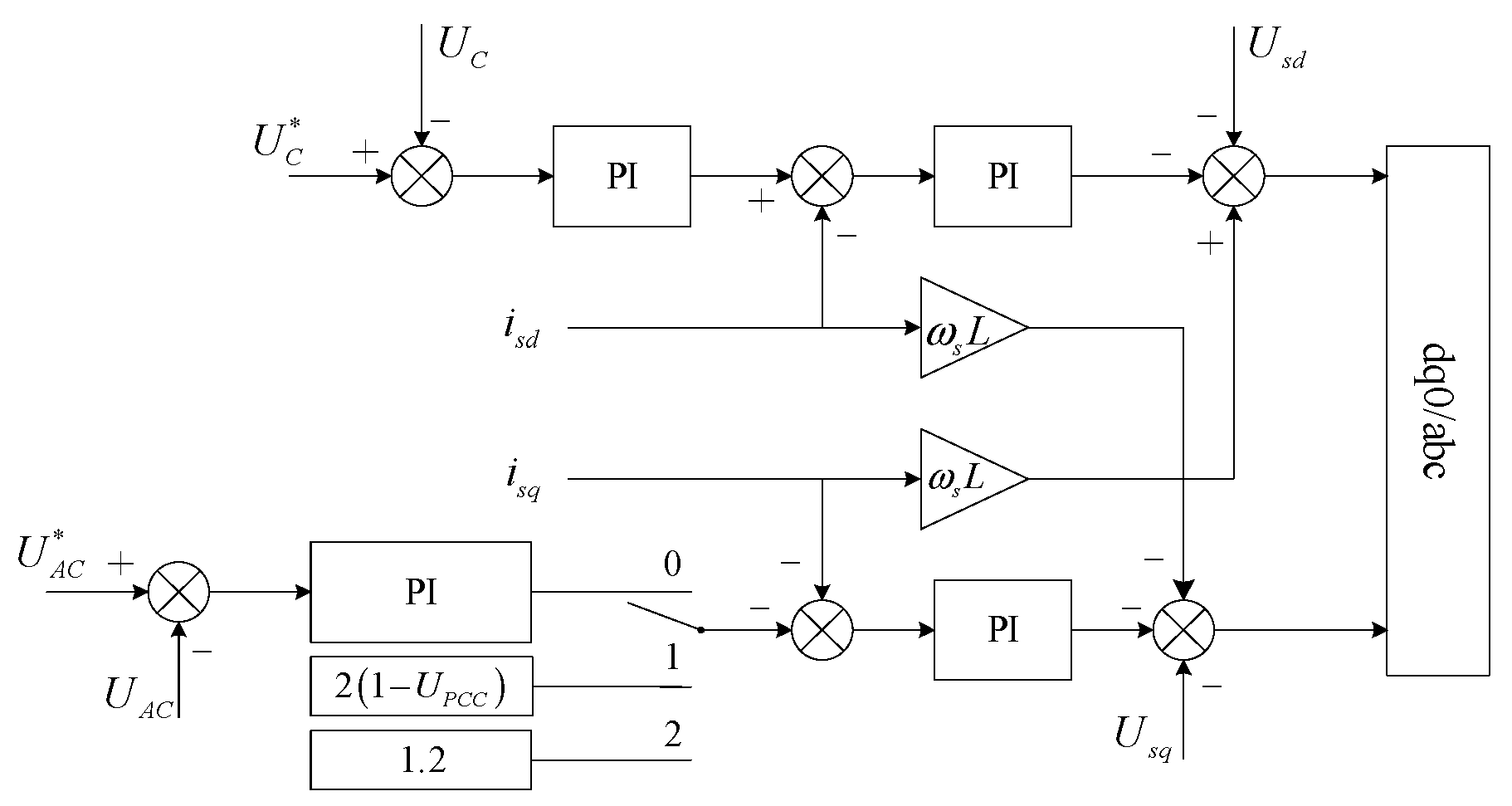
The M3C converter, which manages power transfer between power-frequency and low-frequency systems, commonly utilizes a dual-loop decoupling control scheme [19]. In steady state, it regulates the average capacitor voltage and AC output voltage on the power-frequency side. The core principle during a fault is to prioritize maintaining the average submodule capacitor voltage and overall system power balance. Subsequently, the control shifts to provide reactive power support for the grid. This is implemented through three operational modes:
  • Mode 0: Steady-state operation.
  • Mode 1: Activated in response to minor voltage dips.
  • Mode 2: Activated in response to deep voltage sags.
To guarantee that the M3C remains grid-connected during fault conditions, the M3C converter must provide reactive power support. The reference value for the reactive current in the current control loop is established according to the magnitude of the voltage sag on the power-frequency side, as defined in Equation (1).
i s q * = 0   U P C C > 0.9 2 ( 1 U P C C ) 0.2 < U P C C 0.9 1.2       U P C C 0.2  
where i s q * is the q-axis current reference, and U P C C is the PCC voltage (per-unit value).
The fault ride-through strategy for the M3C is designed to prevent disconnection during power-side faults. The control system transitions between modes depending on the PCC voltage sag: Mode 1 for minor sags, supplying graded reactive support, and Mode 2 for severe sags, which imposes a current limit while injecting maximum reactive power. The corresponding control strategy block diagram is shown in Figure 2.
The variables in Figure 2 are defined as follows: usd, usq: d/q-axis power-frequency voltage components; isd, isq: d/q-axis current components; UAC: low-frequency side voltage magnitude; UC: M3C DC capacitor voltage. The superscript * denotes a reference signal.

2.2. Analysis of Fault Current Characteristics

The current response on the power-frequency side of the M3C during a fault exhibits distinct staged characteristics. The magnitude of the fault current supplied by the M3C is limited to the maximum value set by the current inner loop’s limiter, demonstrating a clear weak-infeed feature with amplitude constraints. Furthermore, the initial phase angle of the fault current on the power-frequency side is determined by the d- and q-axis currents of the converter, indicating that the fault current also possesses a phase-controlled nature. In contrast, when a fault occurs, the fault current contributed by the synchronous generators in the main grid presents a power-frequency sinusoidal characteristic that decays exponentially [20,21]. This current comprises a decaying DC component, a fundamental frequency component, and other decaying harmonic components. Consequently, the composition of the fault currents on the two sides of the line differs significantly. Since the fault current from the power grid side is substantially larger than that from the M3C side, the ratio of the differential current to the restraining current for differential protection is marginally greater than 1. This situation leads to a considerable reduction in the protection sensitivity compared to traditional AC systems.
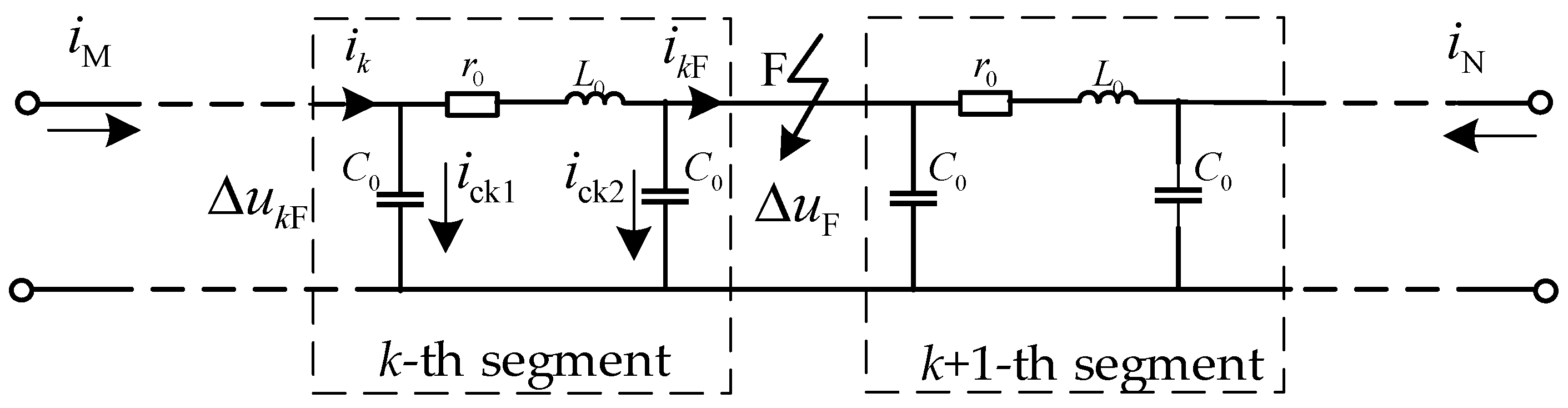
The power-frequency transmission line is represented by a π-type equivalent model, assuming uniformly distributed parameters. The capacitance, inductance, and resistance per unit length are denoted as C0, L0, and r0, respectively. The currents at the two ends of the entire line are iM and iN. For the k-th segment, the currents at its two ends are ik and ikf, and the currents through the shunt capacitors on both sides of this segment are ick1 and ick2. When a fault occurs at point F, the voltage variation across the k-th segment is Δuk, and the voltage change at the fault point is ΔuF. The equivalent circuit for the power-frequency transmission line with distributed parameters is shown in Figure 3.
The distributed capacitance of the line results in the vector sum of the currents at both ends no longer being zero. According to Kirchhoff’s Current Law (KCL), the following relationship is obtained:
  i k = i k f + i c k 1 + i c k 2 = i k f + C d Δ u k f d t + C d Δ u f d t
The magnitude of i k in Equation (2) is influenced by the voltage changes at both ends of the line segment and the associated capacitor charging/discharging behaviors. These distributed capacitors can be in one of three states: both charging, both discharging, or one charging and the other discharging. As a power-frequency transmission line comprises numerous such segments, the resulting transient fault current becomes highly complex. Although the distributed capacitor charging and discharging introduce volatility and uncertainty into the fault current, the voltage change trends on both sides of the line after a fault, along with the capacitor behaviors, exhibit similarity. Consequently, for internal faults, the overall changing trends of the currents on both line ends can still be characterized using a similarity measure.

3. DTW-Based Line Protection Scheme

3.1. Identifying Current Characteristics on Both Sides Using DTW

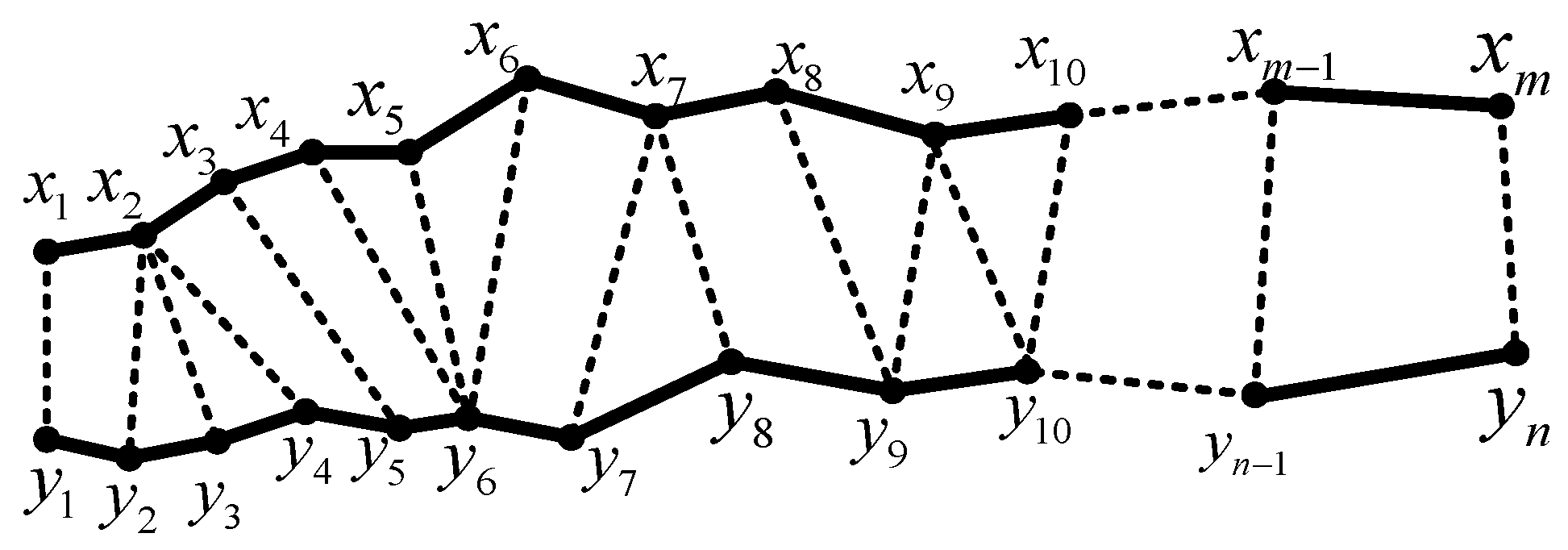
Misalignment and time-scale variations in the sampled data from both ends of a transmission line can prevent conventional similarity measures from accurately reflecting the true resemblance between the two sequences. As is shown in Figure 4, the Dynamic Time Warping (DTW) algorithm addresses this issue by employing a dynamic programming approach to “warp” and “stretch” the two time series along the temporal axis, thereby identifying an optimal matching path that minimizes the aggregated distance between them. This method allows for localized stretching or compression to achieve a better alignment of their inherent patterns, enabling a robust evaluation of the overall similarity between the two time series [22].
Implementation steps of the DTW algorithm: The DTW algorithm operates on two discrete time sequences, X and Y, of lengths m and n. The foundation of the algorithm is the computation of the Euclidean distance between each pair of elements across the two sequences. The Euclidean distance d ( x i , y j ) between an element x i from sequence X and an element y j from sequence Y is defined by the following equation:
d ( x i , y j ) = ( x i y j ) 2
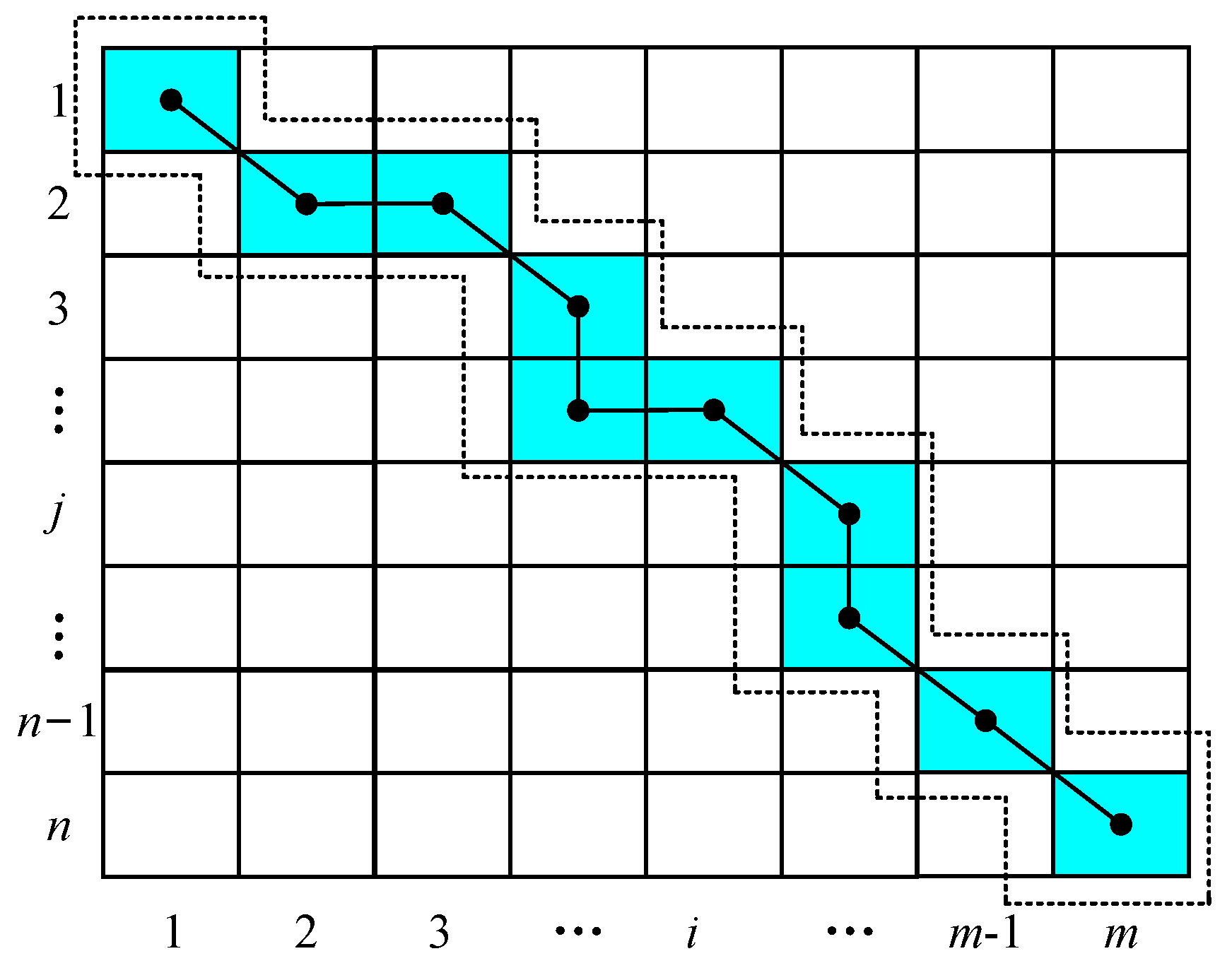
To formalize the dissimilarity between the sequences, a cost matrix D is generated by computing the pairwise Euclidean distances between all elements of the two discrete time sequences. This matrix D, an m × n real-valued matrix, is populated with these distances and depicted in Figure 5 [22].
The computation of the Dynamic Time Warping (DTW) distance, denoted as DTW(X,Y), requires finding an optimal warping path through the cost matrix D. This is achieved using dynamic programming. The core recurrence relation calculates the cumulative distance L(i,j) for each cell (i,j) by adding the local cost D(i,j) to the minimum cumulative distance from the three adjacent predecessor cells: directly above (i − 1,j), to the left (i,j − 1), and diagonally above-left (i − 1,j − 1). This relation is defined as
L ( i , j ) = D ( i , j ) + min { L ( i 1 , j ) , L ( i , j 1 ) , L ( i 1 , j 1 ) }
The initial condition is set as L(1,1) = D(1,1). This formulation ensures that the path to any cell (i,j) is constructed based on the optimal path leading to it, adhering to the common step constraints of monotonicity, continuity, and boundary conditions. Finally, the DTW distance is given by the value in the final cell of the cumulative distance matrix, i.e., DTW(X,Y) = L(m,n).
In addition, conventional similarity measures are highly sensitive to misalignments and time-scale variations in the sampled data. These misalignments are inevitable in practice due to communication delays and the lack of perfect synchronization. The DTW algorithm, however, is specifically designed to overcome this limitation by finding an optimal non-linear alignment path between two sequences. This allows for a robust comparison of the inherent shapes and trends of the current waveforms, even when they are slightly stretched or compressed in time. This property is fundamental to the scheme’s reliability.

3.2. Development of the Protection Criterion

The protection criterion is derived by comparing pre-fault and post-fault current waveforms. The time-domain pre-fault current vectors captured on the M3C side and the grid side are written as I M 3 C ref and I G r e f , respectively. To ensure a stable baseline, we use one full pre-fault cycle (20 ms) as the reference sequence. The post-fault M3C-side and grid-side current vectors are labeled I M 3 C and I G , with the equal length of data. In the event of an internal fault on the line, we have
D M = DTW ( I M 3 C , I M 3 C ref ) D G = DTW ( I G , I G ref )
where DM and DG are defined as the DTW values derived from the M3C side and the grid side, comparing post-fault data to their pre-fault references. If the fault is external, the current is characterized by a through fault condition, resulting in the following expression.
D G / D M 1
Consequently, the significant current discrepancy during an internal fault produces the fundamental ratio condition.
D G / D M > 1
The protection scheme leverages this principle: each endpoint device computes the DTW value (DM or DG) quantifying the change in its local current waveform. Fault discrimination is achieved by comparing the ratio of these values from both ends. For practical implementation, Equation (7) is refined to enhance robustness. A correction factor γ0 = 0.1 is incorporated to avoid division-by-zero exceptions, and an operational threshold K0 = 2 is introduced to provide security against system disturbances. Therefore, we have
( D G + γ 0 ) / ( D M + γ 0 ) > K 0

3.3. Protection Logic Flowchart

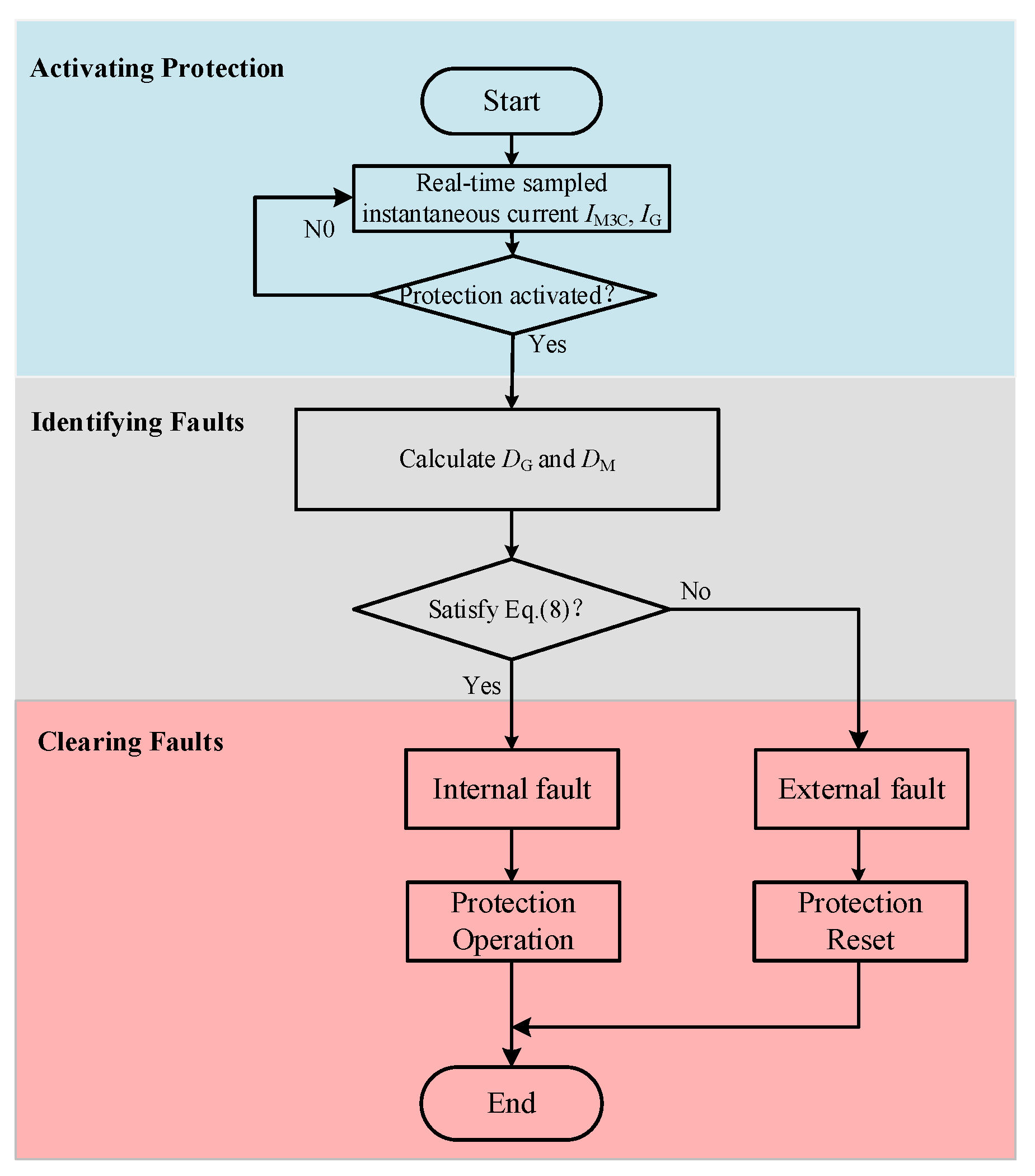
The complete step-by-step discrimination logic for the DTW-based FFFTS power-frequency AC line protection is shown in the flowchart in Figure 6.
The operational sequence, outlined in Figure 6, is a cyclic process of measurement, communication, and decision-making. The relays commence by computing the DTW value between the recent current data and a reference set from two cycles prior. After exchanging these values, the ratio (DG + γ0)/(DM + γ0) is calculated and evaluated against the threshold K0 as per Equation (8). A definitive decision is made only after three consecutive samples meet the internal fault condition of Equation (7), triggering an immediate trip. If not met, the system concludes an external fault has occurred and resets.

4. Simulation Analysis and Discussion

To validate the effectiveness and feasibility of the proposed DTW algorithm-based protection scheme for the power-frequency transmission line, a simulation model of the offshore wind FFFTS, as illustrated in Figure 1, was developed in PSCAD/EMTDC. The key system simulation parameters are listed in Table 1. Faults were applied at the simulation time of 3.0 s, which is defined as time zero (t = 0) for analysis. Internal faults were set at locations 5 km, 10 km, 25 km, 30 km, and 40 km away from the M3C-side 220 kV isolation transformer, denoted as fg1, fg2, fg3, fg4, and fg5, respectively. External faults were applied at the outlet of the M3C-side 220 kV isolation transformer and on the main grid side, denoted as fg6 and fg7. The sampling frequency was set to 10 kHz, and the data window length was chosen as 5 ms.

4.1. Analysis of Internal and External Fault Scenarios

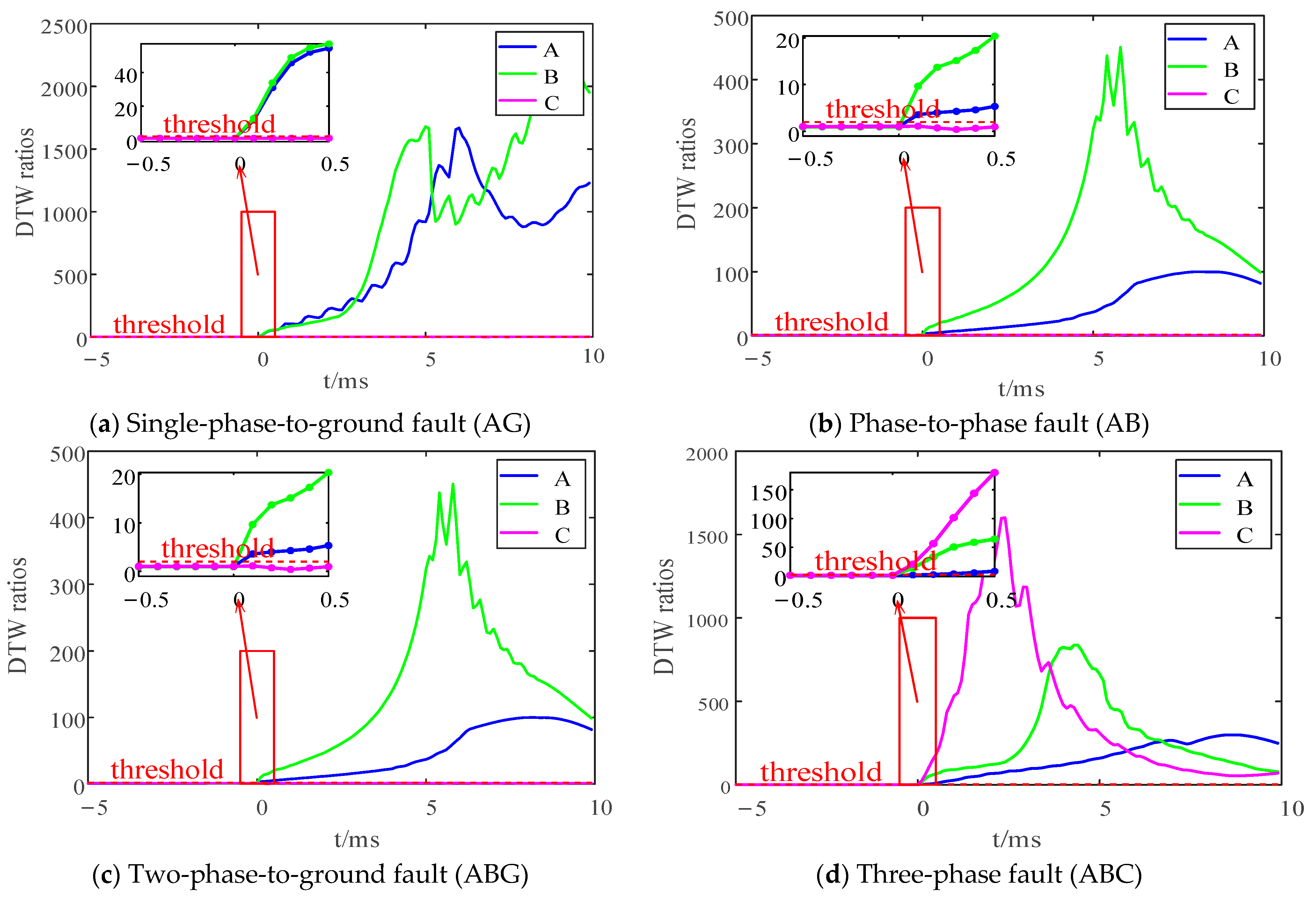
To validate the performance of the proposed protection scheme under internal fault conditions, four types of metallic faults were configured at location fg2: a single-phase-to-ground fault (AG), a phase-to-phase short circuit (AB), a two-phase-to-ground fault (ABG), and a three-phase short circuit (ABC). The simulation results of the proposed protection scheme for these different fault types at fg2 are presented in Figure 7.
For instance, during an AG fault at fg2, the fault currents increase markedly on both line ends. The grid-side current is substantially larger than the M3C-side current due to the weak-infeed nature of the converter. This behavior is a direct consequence of the system’s fault characteristics. The DTW value on the grid side, reflecting this significant current change, therefore greatly exceeds that on the M3C side. The ratio of these DTW values rises rapidly to surpass the threshold within 0.2 ms, and the protection operates within 0.5 ms, confirming the scheme’s rapid response and high sensitivity for internal faults. Similar reliability is observed for AB, ABG, and ABC faults.
An extensive evaluation was then performed by simulating all four fault types at locations fg1 through fg7. The corresponding DTW ratios, calculated 5 ms after the fault, are consolidated in Table 2 for detailed analysis.
As evidenced by the data in Table 2, for various types of internal faults occurring at locations fg1 to fg5, the ratio of the DTW values for the faulted phase currents significantly exceeds the operating threshold of 2. This indicates that the proposed protection scheme exhibits high sensitivity. Conversely, during external faults at locations fg6 and fg7, the system experiences a through-fault current condition. In this scenario, the current data captured by the protective relays on both ends of the line originate from the same source (either the M3C or the power grid side), resulting in highly similar current waveform dynamics on both sides. Consequently, the DTW values calculated from the currents at both ends change in a comparable manner, yielding a ratio close to 1, which is below the operation threshold. This confirms the scheme’s reliability in correctly restraining operation during external faults. Therefore, the proposed protection scheme demonstrates excellent selectivity and sensitivity across diverse internal and external fault scenarios. Furthermore, its capability to operate within 0.5 ms after a fault underscores its satisfactory speed.

4.2. Analysis of Transition Resistance Impact

In practical engineering, ground faults often involve transition resistance. To assess the sensitivity of the proposed protection scheme under such conditions, single-phase-to-ground (AG) and two-phase-to-ground (BCG) faults with transition resistances of 20 Ω, 50 Ω, 100 Ω, and 150 Ω were applied at location fg2. The corresponding calculation results are summarized in Table 3.
As observed in Table 3, the sensitivity of the proposed protection scheme gradually decreases as the transition resistance increases. The primary reason for this trend is that the presence of transition resistance attenuates the fault current, leading to a reduction in the DTW values calculated at both ends of the line, which in turn diminishes the protection sensitivity. However, the data in the table indicate that even with a transition resistance as high as 150 Ω, the ratio of the DTW values for the currents before and after the fault remains significantly greater than the operation threshold value of 2. This demonstrates that the protection scheme maintains satisfactory sensitivity and operates reliably under high-resistance fault conditions.

4.3. Analysis of Noise Impact

During signal transmission, noise is invariably present. To assess the impact of noise on the proposed protection scheme, various fault types (AG, AB, ABG, and ABC) were applied at locations fg2 and fg7, with additive white Gaussian noise introduced at a signal-to-noise ratio (SNR) of 20 dB. The simulation results of the proposed protection under different noise backgrounds are summarized in Table 4.
As delineated in Table 4, the sensitivity of the proposed protection scheme under internal faults exhibits a decreasing trend as the signal-to-noise ratio (SNR) increases. This phenomenon primarily stems from the inherent weak-infeed characteristic of the M3C. The fault current on the M3C side is significantly limited, resulting in a relatively small DTW value calculated from the current samples before and after the fault. When noise is superimposed on the current waveform, it disproportionately inflates this initially small DTW value on the M3C side. In contrast, the fault current supplied by the main grid side is typically several tens of times larger than its rated value. Consequently, the corresponding DTW value on the grid side is substantial and remains less susceptible to noise corruption. This asymmetric impact of noise on the DTW values from the two sides leads to a reduction in their ratio. Nevertheless, the ratio still remains above the protection setting threshold, ensuring reliable operation and demonstrating maintained satisfactory sensitivity. For external faults, while noise introduces some deviation in the calculated results, it does not lead to maloperation.
To comprehensively assess the scheme’s robustness against concurrent practical imperfections, a systematic analysis was conducted under a combined stress scenario. This combined scenario—integrating a high-impedance fault (100 Ω), significant noise (20 dB SNR), a CT sampling error of +10%, and a 2 ms synchronization error—was designed to test the system’s performance under challenging yet realistic conditions.
The proposed scheme demonstrates robust performance under concurrent errors, with the DTW ratio for internal faults (e.g., 8.92 for an AG fault) staying well above the K0 = 2 threshold, while remaining near 1 for external faults. This confirms its resilience to cumulative practical imperfections. The analysis shows that while different errors affect the algorithm in distinct ways, their impacts are non-linear and do not lead to failure. This inherent robustness is attributed to the core design principle of comparing current trends via DTW, which is less sensitive to absolute value distortions.

4.4. Analysis of the Impact of Data Synchronization Errors

To investigate the performance of the proposed protection scheme under asynchronous sampling conditions, AG, AB, ABG, and ABC fault types were applied at location fg6, with a synchronization error of 2 ms introduced between the data from the two line ends. The calculation results of the proposed protection under this synchronization error are presented in Table 5.
As evidenced in Table 5, the proposed protection scheme remains stable and reliably restrains from maloperation during external faults, even when a synchronization error exists between the data from both line ends. The fundamental reason for this robustness is that the DTW values on each side of the line are calculated independently using local data and do not rely on synchronous sampling between the two terminals. The relays only communicate the calculated scalar DTW results, not the raw current samples. In practical engineering, synchronization errors in transmission line protection typically do not exceed 2 ms. Therefore, the proposed scheme demonstrates reliable performance in weak synchronization environments and meets the requirements for practical engineering applications.

4.5. Impact Analysis of Current Transformer Sampling Errors

Current transformers in practical engineering applications typically exhibit certain levels of sampling or measurement errors. To assess the impact of CT measurement inaccuracies on the proposed protection scheme, sampling errors of ±10% and ±15% were deliberately introduced to the current measurements on the M3C power-frequency side in the simulation. The corresponding results are presented in Table 6.
As observed in Table 6, the sensitivity of the proposed protection scheme for internal faults generally exhibits a decreasing trend as the current transformer (CT) measurement error increases. This phenomenon can be attributed to the fact that the introduction of a positive sampling error (±10% or ±15%) on the M3C power-frequency side artificially inflates the current sampling values compared to the error-free scenario. Consequently, the DTW value calculated from the pre-fault and post-fault currents on the M3C side increases, leading to a reduction in the ratio of the DTW value from the grid side to that from the M3C side. This diminished ratio results in a decrease in protection sensitivity. Nevertheless, the scheme maintains correct operation as the ratio remains above the operational threshold. For external faults, the protection reliably restrains operation without maloperation. Given that the typical sampling error of CTs in practical engineering is constrained within ±10%, the proposed protection scheme demonstrates sufficient robustness to meet the requirements of real-world applications.

4.6. Discussion

The computational burden of the proposed scheme is primarily determined by the DTW algorithm’s complexity. In the specific implementation, both the real-time data window and the reference data window are set to 5 ms. At a sampling frequency of 10 kHz, this translates to 50 samples per window. This level of computation is well within the processing capabilities of modern digital signal processors (DSPs) commonly used in protective relays. We estimate the execution time for the DTW calculation on such hardware to be well below 0.1 ms. This ensures that the entire process—data sampling, DTW computation, logic decision, and trip signal issuance—is completed within the total demonstrated operation time of 0.5 ms, confirming the scheme’s high speed and practicality.
A significant strength of the scheme lies in its minimal data and communication demands, which directly support its robustness in weak-synchronization environments. The DTW values are calculated locally at each line terminal using only locally sampled current data. This design eliminates the need to stream raw, high-frequency current samples between the two ends of the line, which is a major burden for conventional differential protection. The only data that needs to be communicated between the two relays is the final, scalar DTW value from each side. This represents an extremely small data packet, essentially a single floating-point number per protection cycle. This minimal data exchange drastically reduces the required communication bandwidth and enhances the scheme’s reliability, as it is less susceptible to delays or packet losses compared to methods requiring synchronized raw data streams.
In conclusion, the proposed scheme is computationally efficient for standard relay hardware and imposes negligible communication demands. This combination makes it particularly suitable for practical applications where communication channel quality may be a constraint.

5. Conclusions

This paper proposed a novel differential protection scheme based on the DTW algorithm for the power-frequency transmission lines in an FFFTS. The scheme is particularly suitable for weak synchronization conditions and utilizes the variation trends of fault currents at both ends of the line. The conclusions are as follows:
The scheme demonstrates high-speed operation and sensitivity. For all internal fault types (AG, AB, ABG, ABC) at various locations, the protection operates correctly within 0.5 ms. The ratio of DTW values for the faulted phase significantly exceeds the threshold (K0 = 2), typically reaching values as high as 4.63 to over 920 for close-in solid faults, confirming high sensitivity.
The scheme exhibits remarkable robustness against adverse conditions. It reliably discriminates faults with transition resistance up to 150 Ω, maintains correct operation under noise interference with a signal-to-noise ratio (SNR) of 20 dB, and withstands current transformer sampling errors of up to ±15% without maloperation.
Security is ensured during external faults and system disturbances. For all external fault scenarios, the calculated DTW ratio remains close to 1 (between 0.87 and 1.32), well below the operating threshold, thus ensuring stability. A key advantage is the scheme’s independence from strict data synchronization. Tests with a synchronization error of 2 ms confirm that the protection remains secure and stable, highlighting its practicality for applications where precise timing is challenging. The proposed DTW-based protection scheme provides a reliable, high-speed, and practical solution for safeguarding FFFTS transmission lines, effectively overcoming the challenges posed by the weak-infeed characteristics of the M3C converter.
Although the proposed scheme has demonstrated strong performance in the tested scenarios, its evolution toward industry-ready application invites further exploration. We envision future research progressing along three main trajectories to incorporate a broader range of uncertainties and system complexities. First, the integration of machine learning techniques could be explored to create self-adaptive thresholds, making the scheme robust against unmodeled dynamics and complex, simultaneous disturbances. Second, the protection philosophy should be extended to secure multi-terminal systems, investigating its coordination with other protective devices and communication-assisted schemes. Finally, the transition from simulation to practical validation through Hardware-in-the-Loop (HIL) testing is a vital step to assess computational burdens and timing constraints under real-time operating conditions, ultimately proving its field readiness.

Author Contributions

Conceptualization, W.J., S.Z. and R.L.; methodology, W.J.; software, S.Z.; validation, W.J., S.Z., R.L. and J.Z.; formal analysis, W.J., S.Z., R.L. and J.Z.; investigation, S.Z.; resources, S.Z.; data curation, S.Z.; writing—original draft preparation, W.J. and S.Z.; writing—review and editing, W.J., S.Z., R.L. and J.Z.; visualization, W.J., S.Z., R.L. and J.Z.; supervision, W.J.; project administration, W.J.; funding acquisition, W.J. All authors have read and agreed to the published version of the manuscript.

Funding

This research was funded by Jiangsu Vocational Institute of Architectural Technology General Research Project, grant number JYA324-27.

Data Availability Statement

The original contributions presented in this study are included in the article. Further inquiries can be directed to the corresponding author.

Conflicts of Interest

The authors declare no conflicts of interest.

Abbreviations

DTWDynamic Time Warping
FFFTSFlexible Fractional Frequency Transmission System
M3CModular Multilevel Matrix Converter
FRTFault Ride Through
Symbols
usd/usdd/q-axis voltage of M3C
isd/isdd/q-axis current of M3C
UPCCthe PCC voltage (per-unit value)
UCM3C DC capacitor voltage
UACM3C low-frequency side voltage magnitude
superscript */refreference signal
C0, L0, and r0equivalent capacitance, inductance, and resistance per unit length
iM, iNM-side and N-side currents
ick1, ick2the currents through the shunt capacitors on both sides of k-th segment
Δukthe voltage variation across the k-th segment
ΔuFthe voltage change at the fault point
ik, ikFcurrent flowing into/out the k-th segment
DM, DGthe DTW values on the M3C side and the grid side
IM3C, IGthe M3C-side and grid-side curent vectors
γ0correction factor
K0operational threshold

References

  1. Bi, T.; Jia, K.; Zheng, L. Pilot protection of transmission line connected to wind farm based on cosine similarity. Proc. CSEE 2019, 39, 6263–6275. [Google Scholar]
  2. Liu, J.; Shi, Q.; Han, R.; Yang, J. A hybrid GA–PSO–CNN model for ultra-short-term wind power forecasting. Energies 2021, 14, 6500. [Google Scholar] [CrossRef]
  3. Duan, Z.; Meng, Y.; Ning, L.; Lin, J.; Zhang, H.; Wang, X. Overview of construction planning and key equipment technology for flexible fractional frequency transmission system. Autom. Electr. Power Syst. 2023, 47, 205–215. [Google Scholar]
  4. Gao, X.; Zhang, C.; Song, G.; Jiang, J.; Lv, Y. Control strategy of asymmetric fault on low-frequency side of offshore wind power low-frequency transmission system. Electr. Power Autom. Equip. 2023, 43, 160–166. [Google Scholar]
  5. Hong, C.; Zhang, Y.; Huang, J.; Liu, Q.; Lin, X.; Li, Z. A pilot protection criterion based on morphological edge-oriented operator and gradient energy matching for outgoing lines of wind farms. Electr. Power Autom. Equip. 2025, 45, 88–94+100. [Google Scholar]
  6. Huang, M.; Wang, X.; Liu, S.; Wang, X.; Meng, Y.; Ye, R. Techno-economic analysis of fractional frequency transmission system for integration of far-offshore wind power. Autom. Electr. Power Syst. 2019, 43, 167–174. [Google Scholar] [CrossRef]
  7. Huang, X.; Zhou, Y.; Zhou, W.; Yang, H.; Liu, Y. Low voltage ride through strategy of the D-PMSG offshore wind power farm based on energy storage and optimized reactive power. Electr. Meas. Instrum. 2024, 61, 57–64. [Google Scholar]
  8. Huang, Y.; Tao, Y.; Kong, Z.; Ning, L.; Ding, W.; Wang, S.; Wu, G.; Wang, Q. Techno-economic analysis of flexible low-frequency transmission system for offshore wind power. Power Syst. Technol. 2024, 48, 4865–4875. [Google Scholar]
  9. Lai, Y.; Wang, Z.; Wang, T. Adaptability analysis and improvement measures of current differential protection in AC grid integrated with VSC-HVDC. Power Syst. Prot. Control 2023, 51, 145–154. [Google Scholar]
  10. Li, M.; Wei, Y.; Zhang, D.; Wang, H.; Nei, M.; He, J. Pilot protection of submarine cables in flexible low frequency transmission systems for offshore wind power based on dynamic state estimation. Power Syst. Prot. Control 2025, 53, 1–12. [Google Scholar]
  11. Meng, Y.; Wang, J.; Li, L.; Wang, X.; Luo, H.; Bai, S. Research on mathematical model and control strategy of M3C converter based on double dq coordinate transformation. Proc. CSEE 2016, 36, 4702–4712. [Google Scholar]
  12. Shi, Z.; Kong, X.; Wang, Y. Single-phase grounding protection for outgoing lines of DFIG-based wind farms based on waveform similarity factor. Electr. Mach. Control Appl. 2021, 48, 108–113. [Google Scholar]
  13. Song, W. Research on Control Method and Protection Adaptability Analysis of Low-Frequency Transmission System. Master’s Thesis, North China Electric Power University, Beijing, China, 2023. [Google Scholar]
  14. Song, W. Research on Pilot Protection and Directional Element for Power Frequency AC Line of M3C in Low-Frequency Transmission System. Master’s Thesis, Xi’an University of Technology, Xi’an, China, 2024. [Google Scholar]
  15. Xu, J.; Wei, G.; Jin, Y.; Zhang, G.; Zahng, K.; Sun, H. Grid-connection mode and economic analysis for Rudong offshore wind farm in Jiangsu. High Volt. Eng. 2017, 43, 74–81. [Google Scholar]
  16. Xu, X.; Zhu, D.; Xu, X.; Wang, D.; Dai, X.; Wang, Y.; Yin, X. Study on cooperative reactive voltage sensitivity control strategy of AVC substations in clustered offshore wind farm. Electr. Meas. Instrum. 2025, 62, 53–64. [Google Scholar]
  17. Xu, Y.; Fan, Z.; Wang, P.; Lv, M. Pilot protection algorithm for outgoing lines of large-scale wind farms based on edge detection. Electr. Power Autom. Equip. 2023, 43, 90–99. [Google Scholar]
  18. Yang, Z.; Li, M.; Han, J.; Yang, F.; Shen, Y.; Kan, H. Research on fault location method for microgrid based on multi-source information fusion alarm. Electr. Meas. Instrum. 2025, 62, 45–55. [Google Scholar]
  19. Zha, M. Design of continuous speech control system for wheeled inspection robot based on improved dynamic time warping algorithm. Meas. Control Technol. 2025, 44, 52–57. [Google Scholar]
  20. Zhang, Z.; Kang, C. Challenges and prospects of constructing new power system under the target of carbon neutrality. Proc. CSEE 2022, 42, 2806–2819. [Google Scholar]
  21. Zheng, L.; Jia, K.; Bi, T.; Ren, L.; Yang, Z. A comprehensive criterion for pilot protection of outgoing lines from renewable energy stations based on structural similarity and squared error. Power Syst. Technol. 2020, 44, 1788–1797. [Google Scholar]
  22. Zheng, T.; Song, W.; Lü, W. Asymmetric fault ride-through control strategy for a low frequency AC transmission system based on a modular multilevel matrix converter. Power Syst. Prot. Control 2023, 51, 107–117. [Google Scholar]
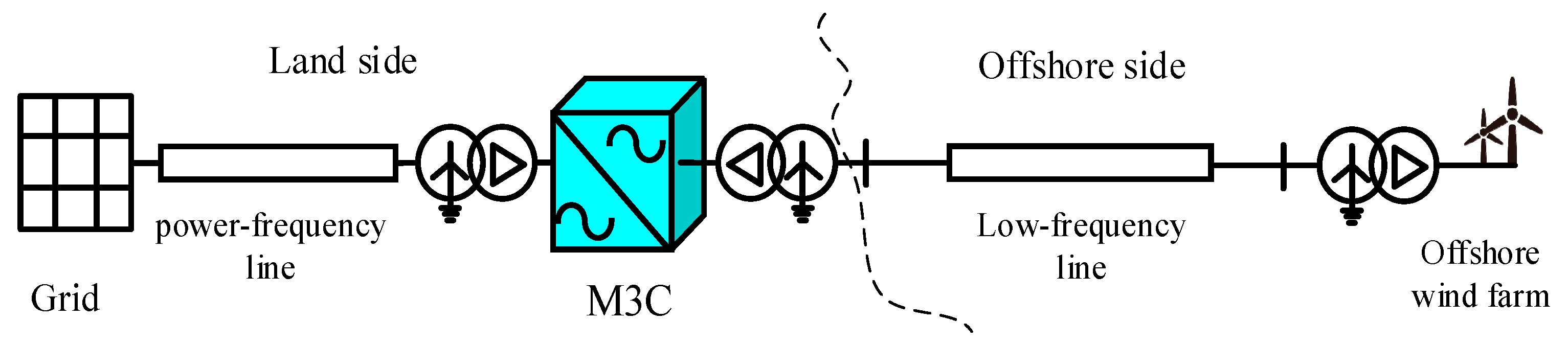
Figure 1. Topology diagram of offshore wind FFFTS.
Electronics 15 00045 g001
Figure 2. Schematic diagram of the M3C control strategy on the power-frequency side.
Electronics 15 00045 g002
Figure 3. Equivalent circuits for distribution parameters of transmission lines.
Electronics 15 00045 g003
Figure 4. Schematic diagram of DTW algorithm for aligning two sets of time series.
Electronics 15 00045 g004
Figure 5. Cost matrix D between two discrete time series.
Electronics 15 00045 g005
Figure 6. Logic flowchart of the protection scheme.
Electronics 15 00045 g006
Figure 7. The ratio of current DTW values on both sides after a fault.
Electronics 15 00045 g007
Table 1. Key parameters for system simulation.
ParameterValueUnit
Wind Farm Capacity200MW
M3C Submodules (per Arm)100-
Submodule Rated Voltage3kV
Submodule Capacitance0.25mF
Arm Inductor0.5H
Low-Frequency AC Voltage220kV
Low-Frequency AC Frequency16.67Hz
Power-Frequency AC Voltage220kV
Power-Frequency AC Frequency50Hz
Transformer Ratio1:1-
Line Length50km
Series Impedance per km0.076 + j0.328Ω/km
The low-frequency AC system operates at 50/3 Hz (approx. 16.67 Hz). The isolation transformer on the power-frequency side has a unity ratio (220/220 kV).
Table 2. Performance evaluation of the proposed protection scheme for internal faults (fg1–fg5) and external faults (fg6–fg7).
Fault LocationFault TypePhase-A DTW RatioPhase-B DTW RatioPhase-C DTW RatioProtection Action
fg1
(internal fault)
AG46.1921.0111.000Operates correctly
AB921.1361628.351.032Operates correctly
ABG76.918150.1711.385Operates correctly
ABC301.5651465.57330.744Operates correctly
fg2
(internal fault)
AG22.4171.0110.999Operates correctly
AB455.858839.3490.999Operates correctly
ABG35.791288.3671.152Operates correctly
ABC155.469693.574161.225Operates correctly
fg3
(internal fault)
AG8.1821.0090.999Operates correctly
AB172.445331.5090.989Operates correctly
ABG10.24620.8591.064Operates correctly
ABC65.913306.75257.132Operates correctly
fg4
(internal fault)
AG6.6051.0070.999Operates correctly
AB120.181213.8980.987Operates correctly
ABG56.0915.3481.0864Operates correctly
ABC58.092258.86549.411Operates correctly
fg5
(internal fault)
AG4.6311.0070.999Operates correctly
AB75.689134.2350.987Operates correctly
ABG4.7878.6591.031Operates correctly
ABC56.008225.97356.880Operates correctly
fg6
(external fault)
AG1.0171.0031.004Restrains correctly
AB1.0271.0211.002Restrains correctly
ABG1.0071.0640.998Restrains correctly
ABC1.0811.3170.999Restrains correctly
fg7
(external fault)
AG1.1260.8940.872Restrains correctly
AB1.0041.0071.019Restrains correctly
ABG1.0020.9240.997Restrains correctly
ABC1.0971.1070.992Restrains correctly
Table 3. Performance evaluation of the proposed protection scheme under faults with transition resistances of 20 Ω, 50 Ω, 100 Ω, and 150 Ω.
Fault TypeTransition ResistancePhase-A DTW RatioPhase-B DTW RatioPhase-C DTW RatioProtection Action
AG20 Ω25.5691.0230.988Operates correctly
50 Ω29.6621.0670.981Operates correctly
100 Ω33.0241.0290.969Operates correctly
20 Ω145.11278.3191.767Operates correctly
ABG50 Ω108.73269.0501.950Operates correctly
100 Ω80.98460.5241.086Operates correctly
20 Ω25.5691.0230.988Operates correctly
50 Ω29.6621.0670.981Operates correctly
Table 4. Performance evaluation of the proposed protection scheme with additive white Gaussian noise at a 20 dB SNR.
Fault LocationFault TypePhase-A DTW RatioPhase-B DTW RatioPhase-C DTW RatioProtection Action
fg2AG20.3431.1451.001Operates correctly
AB233.540250.5490.953Operates correctly
ABG38.467185.2421.039Operates correctly
ABC38.467341.93193.851Operates correctly
fg7AG1.2130.9050.894Restrains correctly
AB1.0711.0821.012Restrains correctly
ABG1.1031.0121.027Restrains correctly
ABC1.1241.1761.153Restrains correctly
Table 5. Protection performance with 2 ms data asynchrony.
Fault TypePhase-A DTW RatioPhase-B DTW RatioPhase-C DTW RatioProtection Action
AG1.0171.0031.004Restrains correctly
AB1.0271.0211.002Restrains correctly
ABG1.0071.0640.998Restrains correctly
ABC1.0811.3170.999Restrains correctly
Table 6. Performance evaluation of the protection scheme under varying CT sampling errors.
Fault TypeFault LocationError MagnitudePhase-A DTW RatioPhase-B DTW RatioPhase-C DTW RatioProtection Action
AGfg2+10%20.1760.9100.900Operates correctly
+15%19.0560.7320.850Operates correctly
fg6−10%1.1320.9010.882Restrains correctly
−15%1.2170.7030.814Restrains correctly
ABCfg2+10%139.924624.221145.104Operates correctly
+15%132.151589.544137.044Operates correctly
fg6−10%1.1821.2331.109Restrains correctly
−15%1.2641.2181.301Restrains correctly
Disclaimer/Publisher’s Note: The statements, opinions and data contained in all publications are solely those of the individual author(s) and contributor(s) and not of MDPI and/or the editor(s). MDPI and/or the editor(s) disclaim responsibility for any injury to people or property resulting from any ideas, methods, instructions or products referred to in the content.