Evaluating Middleware Performance in the Transition from Monolithic to Microservices Architecture for Banking Applications

Abstract
1. Introduction
2. Related Work
3. Methodology
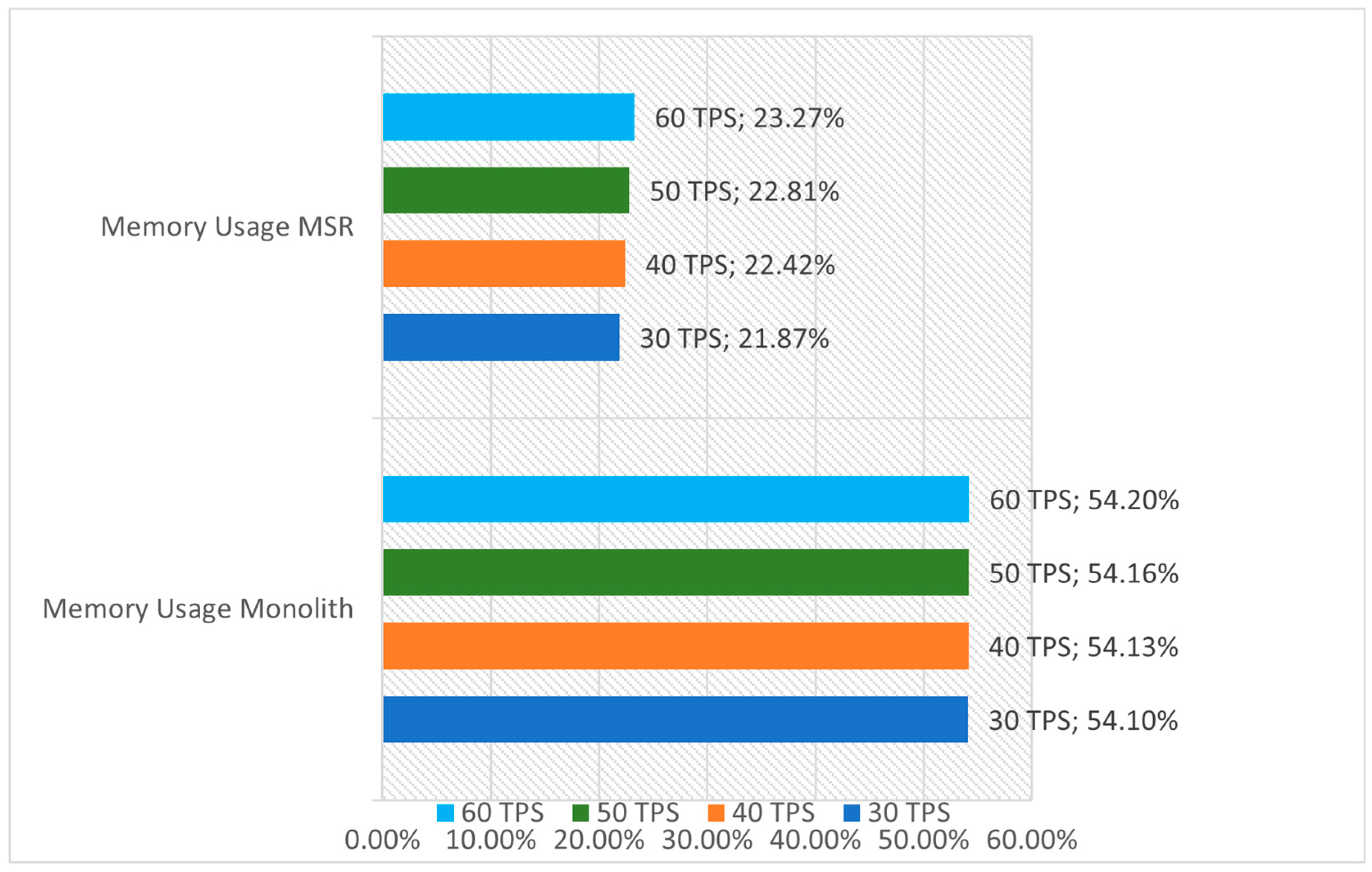
- NMon Visualizer for monolithic systems and OpenShift Dashboard for microservices are used to measure CPU and memory utilization.
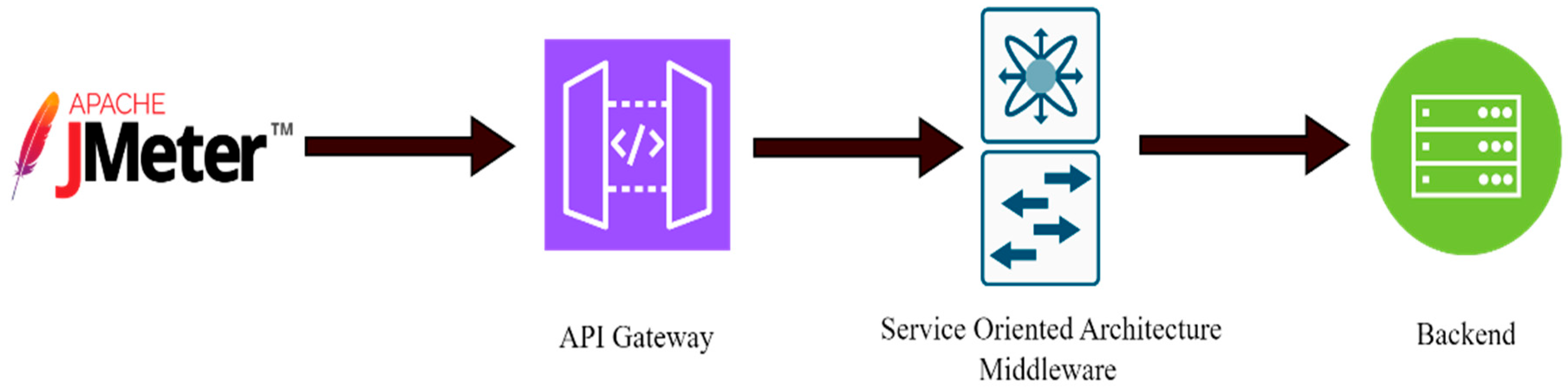
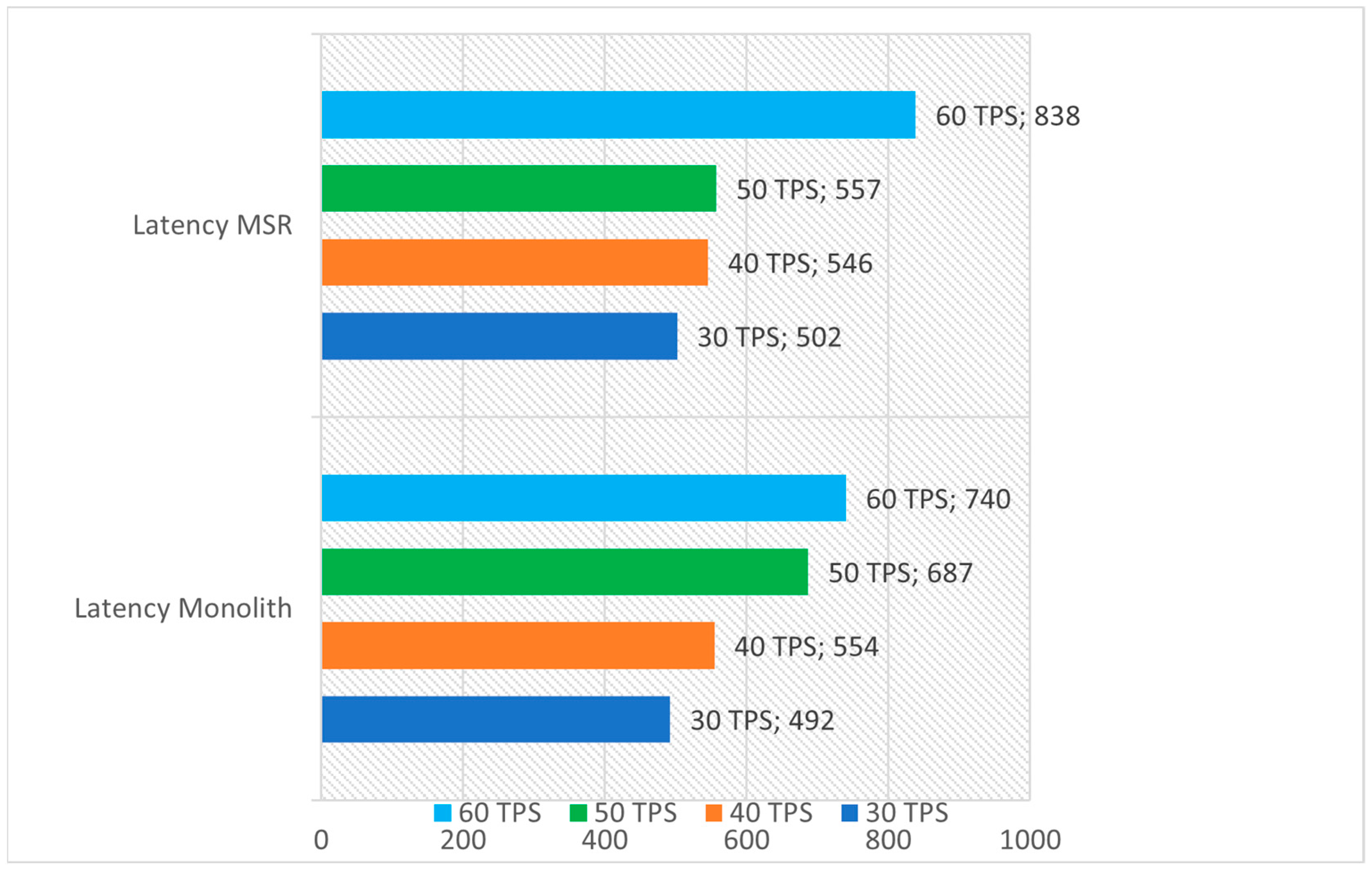
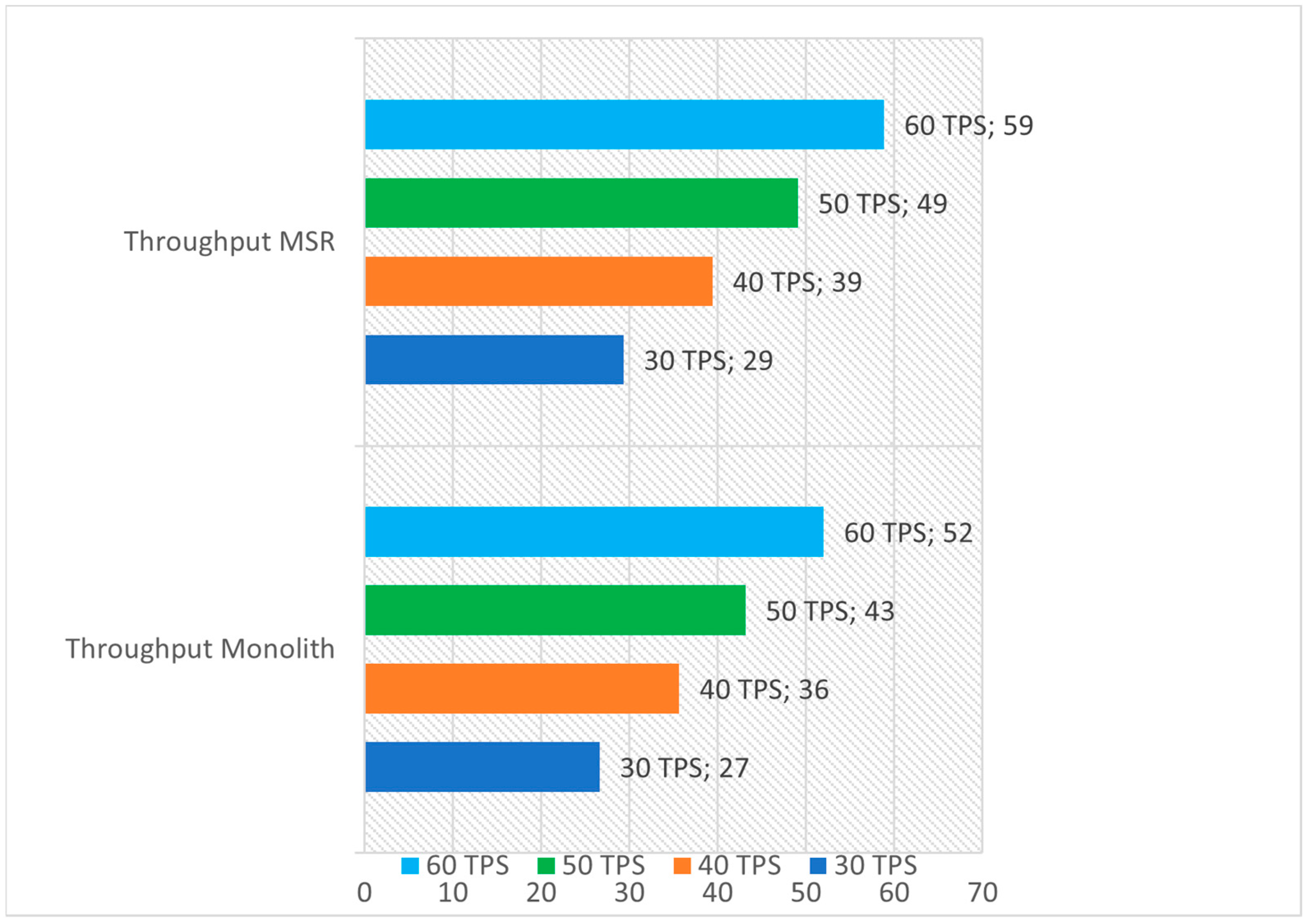
- To assess reaction time and processing capability, JMeter’s Summary Report is used to record throughput and latency.
- The number of instances measures how scalable each architecture is.
- Transactional accuracy and dependability in simulated operational settings are measured by error and success rates.
- Time to Recovery calculates how long it takes to get a system back up and running after an outage.
4. Results and Discussion
4.1. Simulation Setup
4.2. Performance Evaluation
4.2.1. CPU Utilization
4.2.2. Memory Utilization
4.2.3. Latency
4.2.4. Throughput
4.2.5. Rates of Success and Error
4.2.6. Recovery Time
4.2.7. Analysis
4.2.8. Discussion
System Performance and Scalability
The Role of Distributed Caching and Asynchronous Processing
Security and Performance Trade-Off
Implications for the Financial System
5. Threats to Validity
6. Conclusions
Author Contributions
Funding
Data Availability Statement
Conflicts of Interest
Abbreviations
| API | Application Programming Interface |
| CPU | Central Processing Unit |
| CRM | Customer Relationship Management |
| I/O | Input/Output |
| JWT | JSON Web Token |
| MSA | Microservices Architecture |
| RAM | Random Access Memory |
| SOA | Service-Oriented Architecture |
| WAF | Web Application Firewall |
| NGFW | Next-Generation Firewall |
References
- Thatikonda, V.K. Assessing the Impact of Microservices Architecture on Software Maintainability and Scalability. Eur. J. Theor. Appl. Sci. 2023, 1, 782–787. [Google Scholar] [CrossRef] [PubMed]
- Al-Debagy, O.; Martinek, P. A Comparative Review of Microservices and Monolithic Architectures. In Proceedings of the IEEE 18th International Symposium on Computational Intelligence and Informatics (CINTI), Budapest, Hungary, 21–22 November 2018; pp. 149–154. [Google Scholar]
- Shabani, E.; Mëziu, E.; Berisha, B.; Biba, T. Design of Modern Distributed Systems Based on Microservices Architecture. Int. J. Adv. Comput. Sci. Appl. 2021, 12, 33–40. [Google Scholar] [CrossRef]
- Dhandapani, A. Microservices Architecture in Financial Services: Enabling Real-Time Transaction Processing and Enhanced Scalability. Eur. J. Comput. Sci. Inf. Technol. 2025, 13, 145–159. [Google Scholar] [CrossRef]
- Ravalji, V.; Goel, D. Application of Microservices in Financial Data Integration. Integr. J. Res. Arts Humanit. 2024, 4, 414–426. [Google Scholar]
- Toomwong, N.; Viyanon, W. Performance Comparison between Monolith and Microservice Using Docker and Kubernetes. Int. J. Comput. Theory Eng. 2021, 13, 91–95. [Google Scholar] [CrossRef]
- Olaosegba, O. Microservices-Oriented Middleware for IoT Data Governance in Hybrid Cloud Environments. 2025. Available online: https://www.researchgate.net/publication/387971316_Microservices-Oriented_Middleware_For_Iot_Data_Governance_Microservices-Oriented_Middleware_For_Iot_Data_Governance_In_Hybrid_Cloud_Environments_Managing_Data_Governance_Challenges_For_Iot_Systems_Usi (accessed on 19 December 2025).
- Al-Wadi, R.; Maaita, A. Authentication and Role-Based Authorization in Microservice Architecture: A Generic Performance-Centric Design. J. Adv. Inf. Technol. 2023, 14, 758–768. [Google Scholar] [CrossRef]
- Bernsteiner, R.; Blasisker, M.; Kohlegger, M.; Ploder, C.; Schlögl, S. Performance Comparison between a Monolithic and a Microservice Application. In CEUR Workshop Proceedings, Proceedings of the Workshop on Software Quality, Analysis, Monitoring, Improvement, and Applications, Maribor, Slovenia, 20–12 September 2025; RWTH Aachen University: Aachen, Germany, 2025; Volume 4077, pp. 1–8. Available online: https://ceur-ws.org/Vol-4077/paper2.pdf (accessed on 19 December 2025).
- Ponce, L.; Márquez, G.; Astudillo, H. Migrating from Monolithic Architecture to Microservices: A Rapid Review. In Proceedings of the 38th International Conference Chilean Computer Science Society (SCCC), Concepcion, Chile, 4–9 November 2019; pp. 1–7. [Google Scholar] [CrossRef]
- Kumar, D.; Pareek, P.K.; Pawar, P.P.; Addula, S.R.; Meesala, M.K.; Shwetha, K.S. Enhanced Stock Market Trend Prediction on the Indonesia Stock Exchange Using Improved Bacterial Foraging Optimization and Elitist Whale Optimization Algorithms. In Proceedings of the International Conference on Integrated Intelligence and Communication Systems (ICIICS), Kalaburagi, India, 22–23 November 2024. [Google Scholar] [CrossRef]
- Maestro, A.; Surantha, N. Scalability Evaluation of Microservices Architecture for Banking in Public Cloud. In Proceedings of the International Conference on P2P, Parallel, Grid, Cloud and Internet Computing, Daegu, Republic of Korea, 6–8 November 2023; pp. 103–115. Available online: https://www.researchgate.net/publication/377039842_Scalability_Evaluation_of_Microservices_Architecture_for_Banking_Systems_in_Public_Cloud (accessed on 31 August 2024).
- Blinowski, G.; Ojdowska, A.; Przybylek, A. Monolithic vs. Microservices Architecture: A Performance and Scalability Evaluation. IEEE Access 2022, 10, 20357–20374. [Google Scholar] [CrossRef]
- Barczak, A.; Barczak, P.M.; Toledo, M. Performance Comparison of Monolith and Microservices Based Applications. In Proceedings of the 25th World Multi-Conference Systemics, Cybernetics and Informatics (WMSCI), Virtual, 18–21 July 2021; pp. 120–125. Available online: https://www.iiis.org/CDs2021/CD2021Summer/papers/SA354XK.pdf (accessed on 19 December 2025).
- Bjørndal, N.; Araújo, L.; Bucchiarone, A.; Dragoni, N.; Mazzara, M.; Dustdar, S. Benchmarks and Performance Metrics for Assessing the Migration to Microservice-Based Architectures. J. Object Technol. 2021, 20, 1–21. [Google Scholar]
- Ramu, V.B. Performance Impact of Microservices Architecture. IEEE Rev. Contemp. Sci. Acad. Stud. 2023, 3, 87–96. [Google Scholar] [CrossRef]
- Banerjee, P. System Integration, From Middleware to APIs. Int. J. Comput. Trends Technol. 2024, 72, 37–45. [Google Scholar] [CrossRef]
- Konidena, D. Securely Running High-Performance Workloads as Microservices in Cloud Environments. IEEE Access 2024, 12, 1872–1875. [Google Scholar] [CrossRef]
- Yang, J.; Hou, H.; Li, H.; Zhu, Q. User Fast Authentication Method Based on Microservices. In Proceedings of the 2021 IEEE International Conference on Power Electronics, Computer Applications (ICPECA), Shenyang, China, 22–24 January 2021; pp. 93–98. [Google Scholar] [CrossRef]
- Thalor, M. Analysis of Monolithic and Microservices System Architectures for an E-Commerce Web Application. Int. J. Intell. Syst. Appl. Eng. 2024, 12, 2400–2406. [Google Scholar]
- Matias, M.; Ferreira, E.; Mateus-Coelho, N.; Ferreira, L. Enhancing Effectiveness and Security in Microservices Architecture. Procedia Comput. Sci. 2024, 239, 2260–2269. [Google Scholar] [CrossRef]
- Ochuba, N.A.; Kisina, D.; Owoade, S.; Uzoka, A.C.; Gbenle, T.P.; Adanigbo, O.S. Systematic Review of API Gateway Patterns for Scalable and Secure Application Architecture. J. Front. Multidiscip. Res. 2021, 2, 94–100. [Google Scholar] [CrossRef]
- Kanthed, S. Improving Performance with API Gateway Caching and Throttling. Int. J. Innov. Res. Multidiscip. Prof. Stud. (IJIRMPS) 2023, 11, 1–10. [Google Scholar] [CrossRef]
- Weerasinghe, S.; Perera, I. Optimized Strategy for Inter-Service Communication in Microservices. Int. J. Adv. Comput. Sci. Appl. (IJACSA) 2023, 14, 272–279. [Google Scholar] [CrossRef]
- Barzotto, T.R.H.; Farias, K. Evaluation of the Impacts of Decomposing a Monolithic Application into Microservices: A Case Study. arXiv 2022, arXiv:2203.13878. [Google Scholar] [CrossRef]
- Meijer, W.; Trubiani, C.; Aleti, A. Experimental Evaluation of Architectural Software Performance Design Patterns in Microservices. J. Syst. Softw. 2024, 218, 112183. [Google Scholar] [CrossRef]
- Marieska, M.D.; Yunanta, A.; Aulia, H.; Utami, A.S.; Rizqie, M.Q. Performance Comparison of Monolithic and Microservices Architectures in Handling High-Volume Transactions. J. RESTI 2025, 9, 511–517. [Google Scholar] [CrossRef]




| Ref No | Research Title | Method | Test Results | Proposed Model |
|---|---|---|---|---|
| Maestro and Surantha, 2023 [12] | Scalability Evaluation of Microservices Architecture for Banking in Public Cloud | Scalability Evaluation includes CPU, Memory, Latency, Nodes, and Error Rate. | Microservice architecture is superior in resource utilization | Microservices on Google Cloud Kubernetes with dual-layer WAF and NGFW security. |
| Blinowski et al., 2022 [13] | Monolithic vs. Microservices Architecture: A Performance and Scalability Evaluation | Performance comparison of monolith and microservices includes Throughput, CPU, and RAM on each architecture, technology, and computer. | Monolithic architecture is superior to simple systems | The application is implemented on monolith and microservice architectures and uses Java 84 with Spring Boot framework 2.3.0 and .NET implemented in C# version 8 with ASP.NET Core framework 3.1. |
| Barczak et al., 2021 [14] | Performance comparison of monolith and microservices-based applications | Performance comparison of monoliths and microservices includes RAM, CPU, and service response time. | Monolith architecture is superior in the context of average response time. | Web implementation on two different architectures with analysis using Azure Application Insights module |
| Dhaouadi et al., 2021 [15] | Benchmarks and performance metrics for assessing the migration to microservice-based architectures | Microservice performance assessment includes latency, throughput, scalability, CPU, memory, and network utilization. | Monolith architecture is superior in simple systems, but microservices are superior in scalability. | Implementation of microservice and monolith architectures on local servers and clouds. |
| Ramu, 2023 [16] | Performance Impact of Microservices Architecture | Microservice performance evaluation includes response time, throughput, and error rate. | Resulting in shorter response times on microservices | Microservice performance improvement strategies include gRPC, instance scalability, cache, containerization, NoSQL, and asynchronous communication. |
| Banerjee, 2024 [17] | System Integration, From Middleware to API | Descriptive and evaluative approach with qualitative analysis, case studies, and the author’s experience to examine the evolution of system integration technology. | The evolution of system integration from middleware to modern APIs with microservices to increase flexibility, scalability, and efficiency in digital transformation | Composable Enterprise that leverages APIs, microservices, and Event-Driven Architecture (EDA). |
| Dheeraj Konidena, 2024 [18] | Securely Running High-Performance Workloads as Microservices in Cloud Environments | Qualitative data collection by interviewing cloud security experts, and quantitative data collection by benchmarking the performance of monolithic and microservice applications in the cloud. | Microservice architecture in the cloud reduces CPU usage by 21% and memory by 12% and speeds up response time compared to monolithic architecture with stronger security systems. | A cloud microservice integration framework that combines security, containerization, and Kubernetes to improve system efficiency, scalability, and resilience. |
| Yang et al., 2021 [19] | User Fast Authentication Method Based on Microservices | Comparing tiered and conventional authentication in terms of performance | Redis-based tiered authentication method improves performance by up to 50.22% on QPS 1000 compared to conventional database-based method. | Split authentication into two levels: advanced in API Gateway and basic in application server with Redis for abnormal user detection |
| Meenakshi Thalor, 2024 [20] | Analysis of Monolithic and Microservices System Architectures for an E-Commerce Web Application. International | Comparing monolithic and microservice architectures with parameters of average response time, minimum response time, maximum response time, standard deviation, error rate, throughput, and transmission speed. Testing was conducted using JMeter and Postman to simulate a high volume of transactions. | Microservices architectures have better response times and lower error rates than monoliths, but they also have higher minimum latency. Microservices architectures are considered more expensive due to their more complex configuration and hardware requirements than monoliths. This study found that microservice architectures are suitable for large applications. | Comparison of monoliths and microservices in e-commerce applications using Node.js and Express.js technology |
| Matias et al., 2024 [21] | Enhancing Effectiveness and Security in Microservices Architecture | Design and testing of API Gateway patterns with the use of HTTPS and JWT for transactions required with the NB-IoT communication protocol | System testing was conducted using security attack scenarios, including espionage and man-in-the-middle attacks. The results showed reduced internal communication latency, increased system efficiency, reduced system complexity, and maintained security under the assumption of a secure network. | Hybrid strategies can improve system performance, reduce communication latency between microservices, and increase security levels without reducing performance. |
| Parameter | Information |
|---|---|
| CPU Utilization | CPU and RAM measurements: monoliths with Nmon Visualizer, microservices with OpenShift. |
| Memory Utilization | |
| Throughput | JMeter’s Summary Report feature measures the number of successfully executed requests. |
| Latency | JMeter’s timer feature measures the server’s response time to requests |
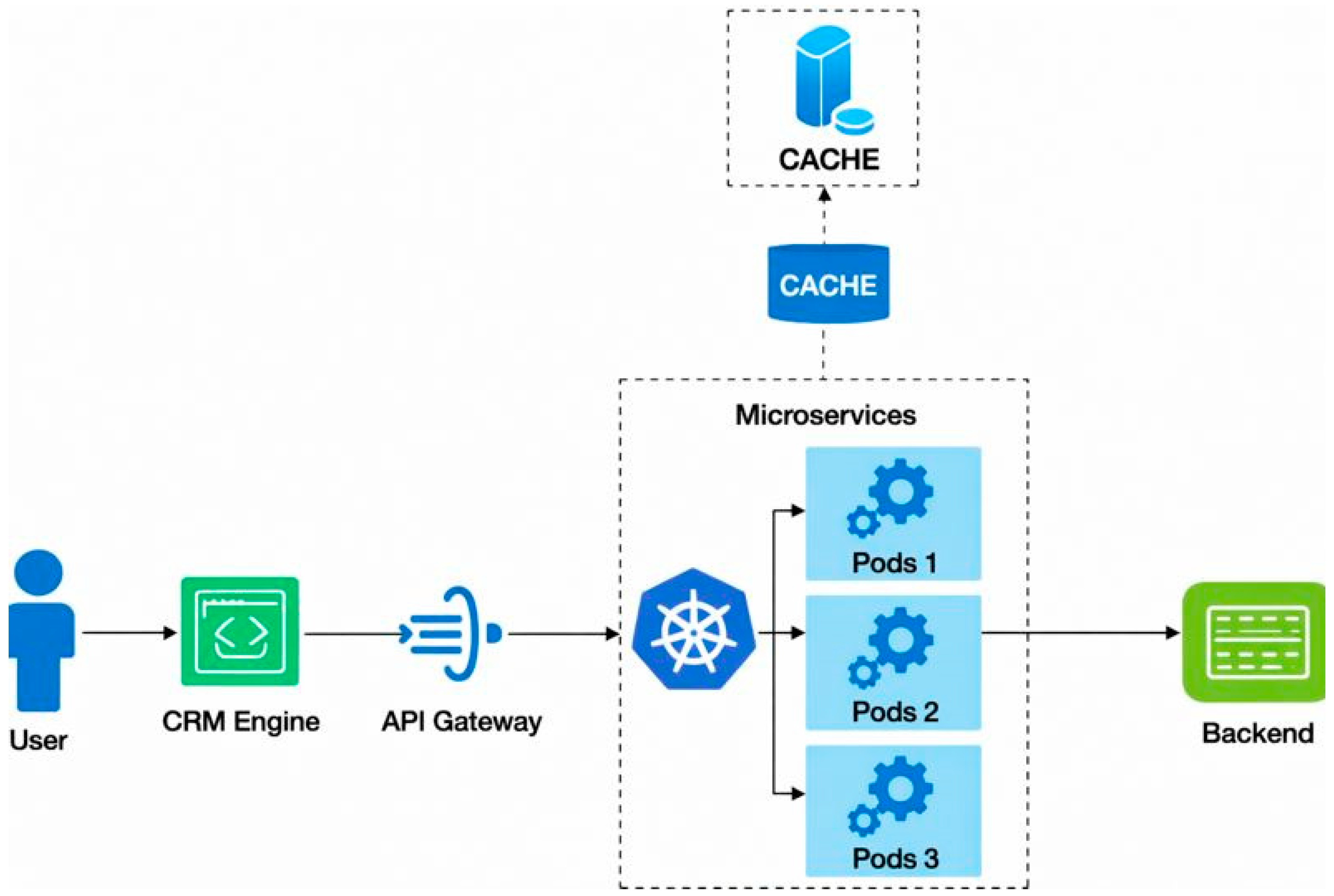
| Number of Instances | Instance count measurement: max 2 monoliths, max 4 microservices. |
| Error Rate | Comparison of total transactions and failed transactions (status ≠ 200) was performed 50 times in 10 s using the Summary Report feature |
| Success Rate | Comparison of total and failed transactions (success: status 200) was performed 50 times in 10 s using Summary Report |
| Time to Recovery System | The time it takes for an application to recover after going down. |
| Related Study | Experimental Results Summary |
|---|---|
| Scalability Evaluation of Microservices Architecture for Banking in Public Cloud | Microservices with 10K, 30K, 50K hits.
|
| Securely Running High-Performance Workloads as Microservices in Cloud Environments |
|
| User Fast Authentication Method Based on Microservices | Multilevel authentication by utilizing JWT authentication technology and Redis as storage for abnormal user data can improve performance from 15.25% to 50.22% compared to conventional database-based technology. |
Disclaimer/Publisher’s Note: The statements, opinions and data contained in all publications are solely those of the individual author(s) and contributor(s) and not of MDPI and/or the editor(s). MDPI and/or the editor(s) disclaim responsibility for any injury to people or property resulting from any ideas, methods, instructions or products referred to in the content. |
© 2026 by the authors. Licensee MDPI, Basel, Switzerland. This article is an open access article distributed under the terms and conditions of the Creative Commons Attribution (CC BY) license.
Share and Cite
Fauziah, R.; Surantha, N. Evaluating Middleware Performance in the Transition from Monolithic to Microservices Architecture for Banking Applications. Electronics 2026, 15, 221. https://doi.org/10.3390/electronics15010221
Fauziah R, Surantha N. Evaluating Middleware Performance in the Transition from Monolithic to Microservices Architecture for Banking Applications. Electronics. 2026; 15(1):221. https://doi.org/10.3390/electronics15010221
Chicago/Turabian StyleFauziah, Rizza, and Nico Surantha. 2026. "Evaluating Middleware Performance in the Transition from Monolithic to Microservices Architecture for Banking Applications" Electronics 15, no. 1: 221. https://doi.org/10.3390/electronics15010221
APA StyleFauziah, R., & Surantha, N. (2026). Evaluating Middleware Performance in the Transition from Monolithic to Microservices Architecture for Banking Applications. Electronics, 15(1), 221. https://doi.org/10.3390/electronics15010221