INVCAM: An Inverted Compressor-Based Approximate Multiplier

 ,
,  , , and
Abstract
1. Introduction
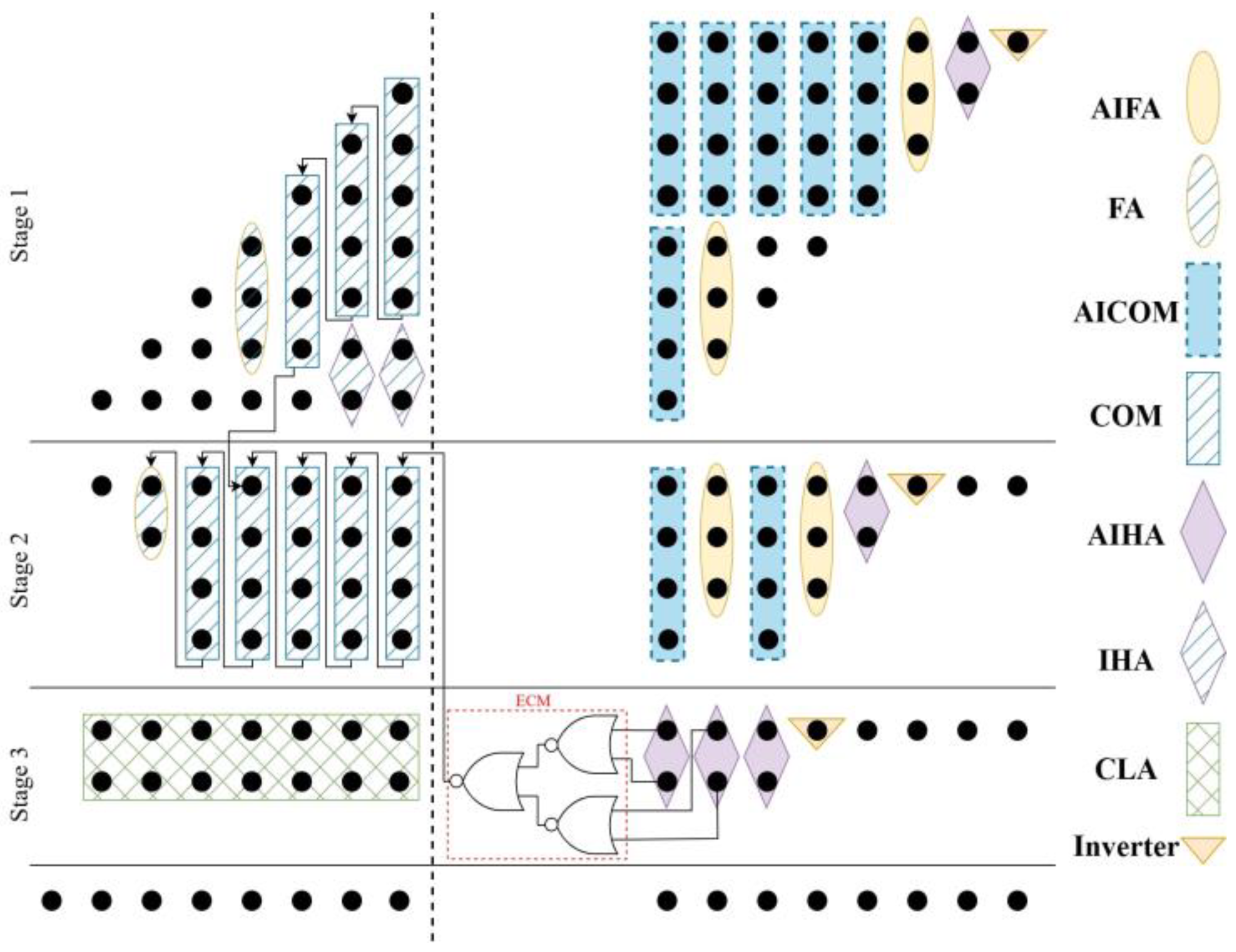
- Integrating NAND-based PPG with a zero-count-driven PPR stage to simplify arithmetic operations and reduce hardware complexity.
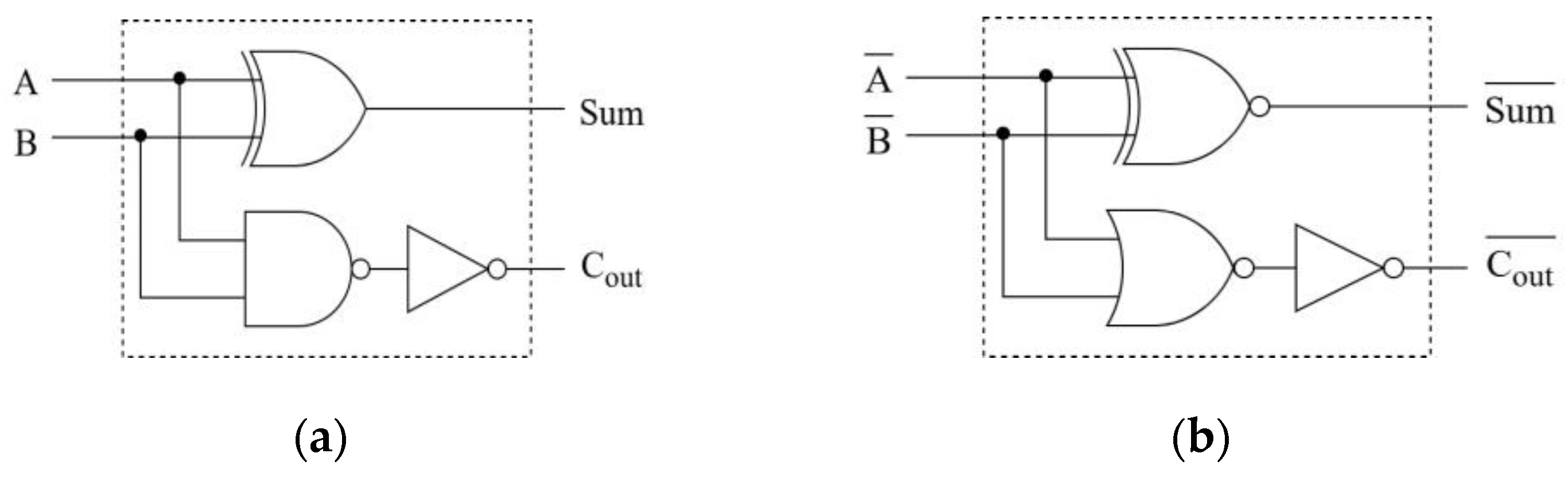
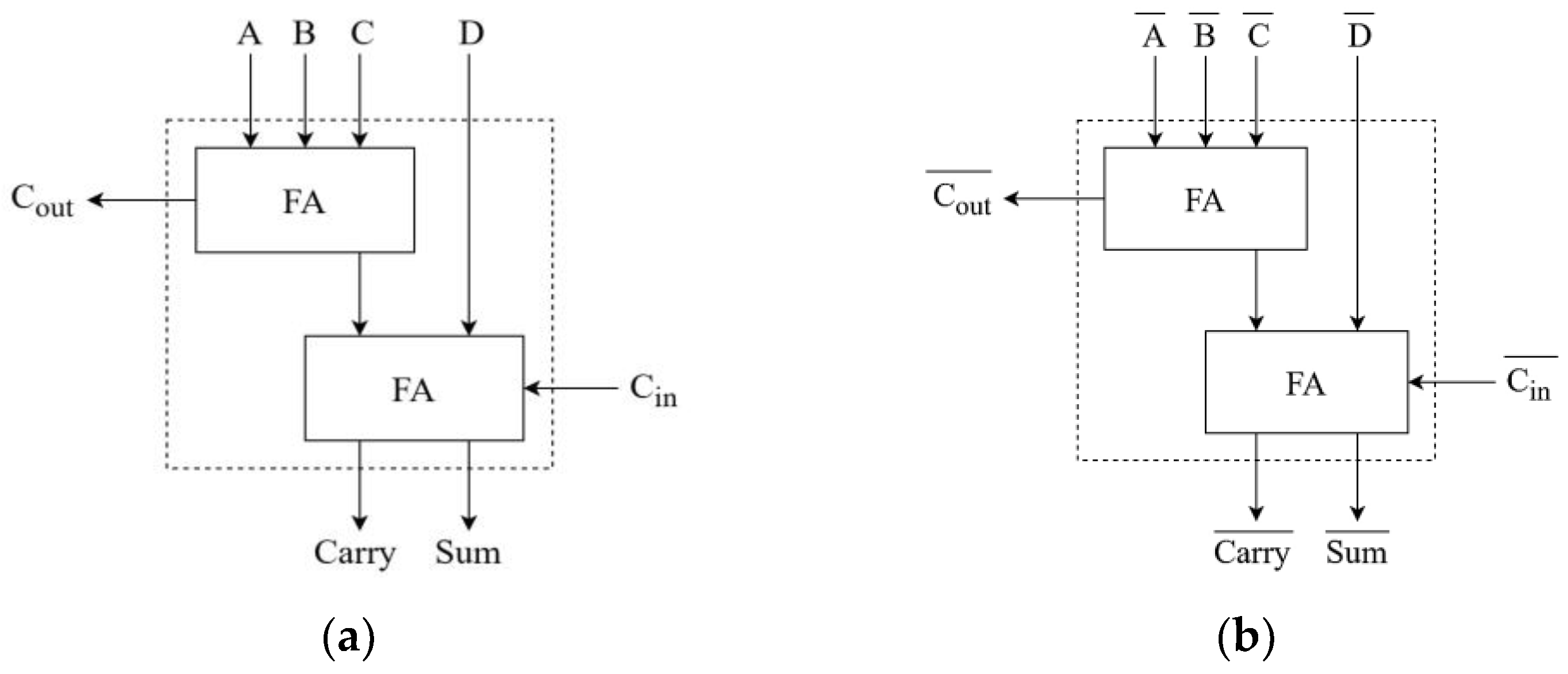
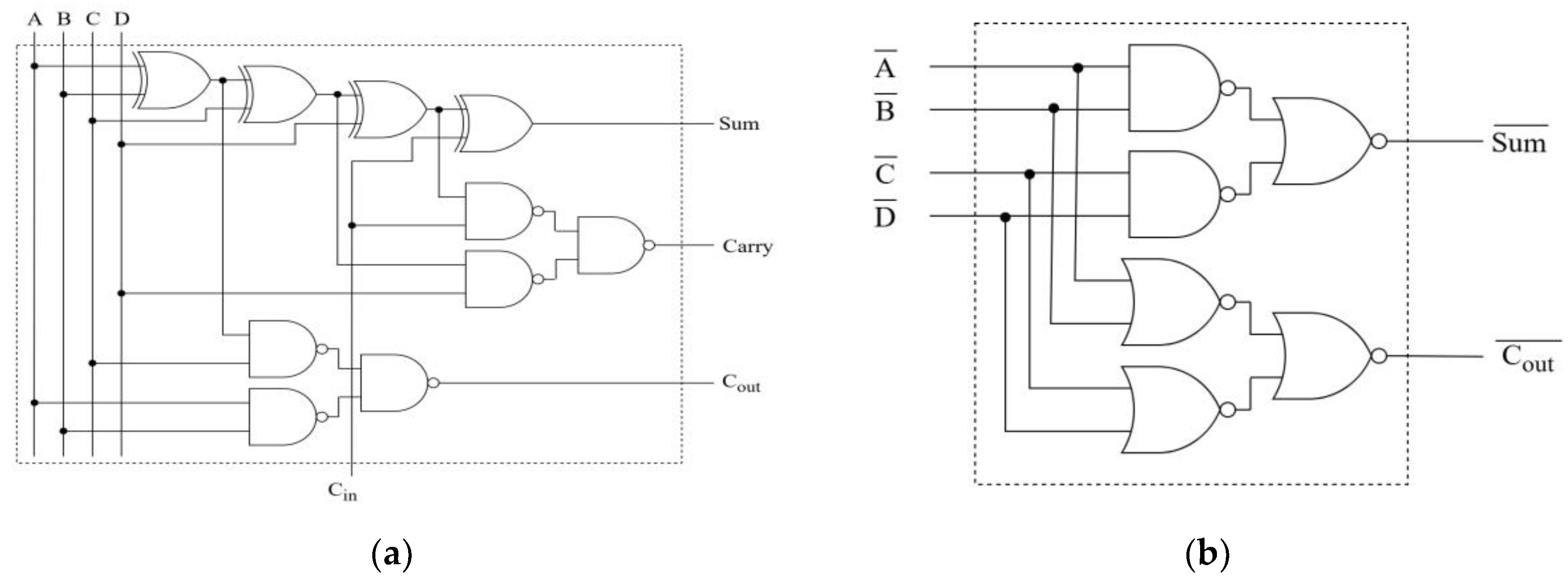
- Designing lightweight approximate inverted adder structures (inverted 4:2 compressor (AIC), half-adder (AIHA), and full-adder (AIFA)) specifically optimized for the zero-count PPR, providing reduced gate count and delay.
- Employing a carry-free accumulation approach tailored to the proposed architecture and enhancing it with an error correction module (ECM) to efficiently mitigate errors from truncated carries.
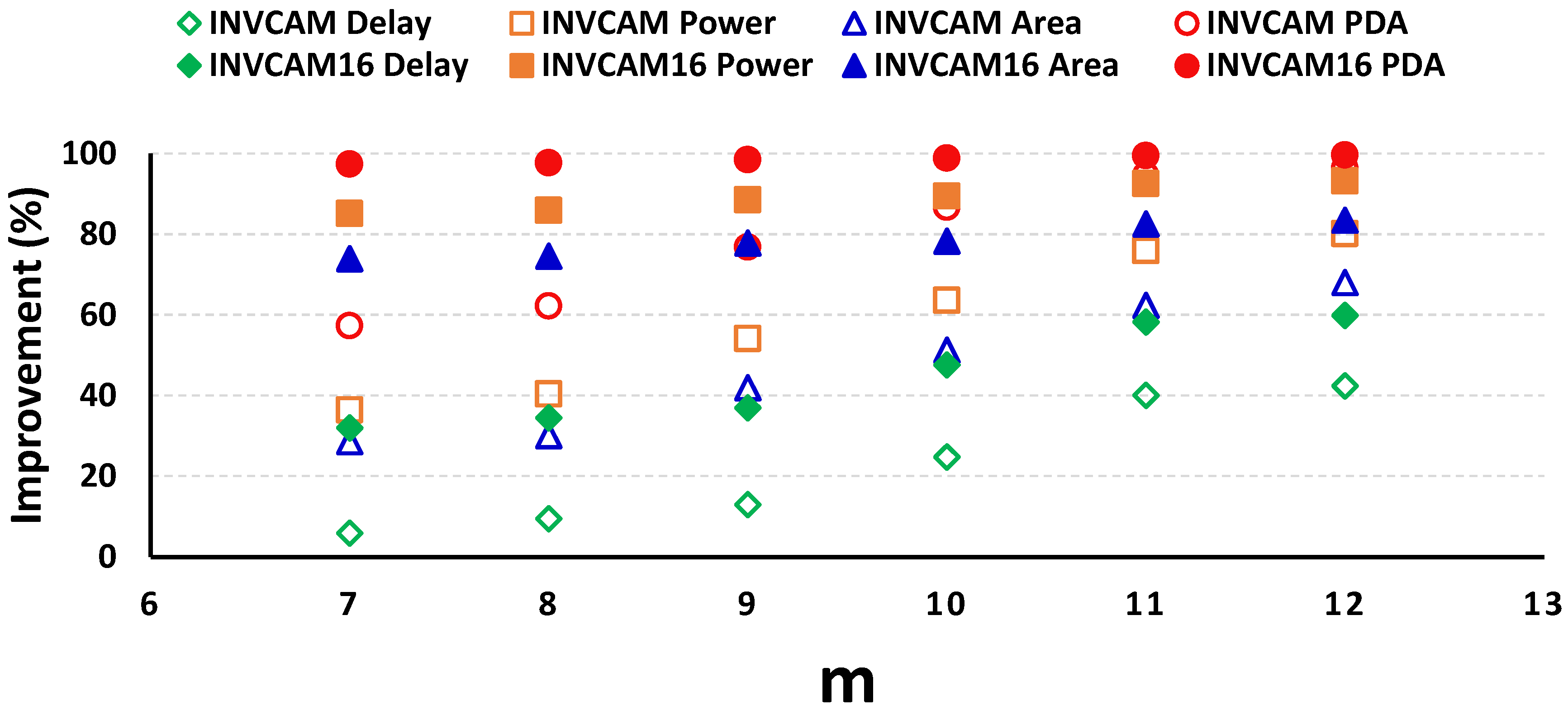
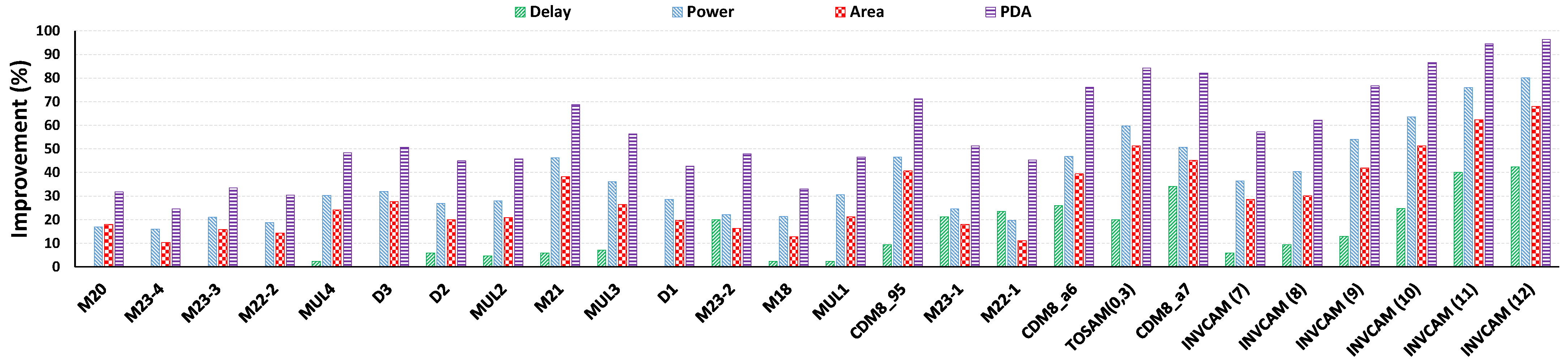
- Presenting a flexible approximate multiplier architecture with tunable approximation levels, which achieves up to 23%, 48%, and 38% improvements in delay, power, and area compared to prior designs with comparable accuracy.
2. Related Work
3. Proposed INVCAM and Its Hardware Implementation
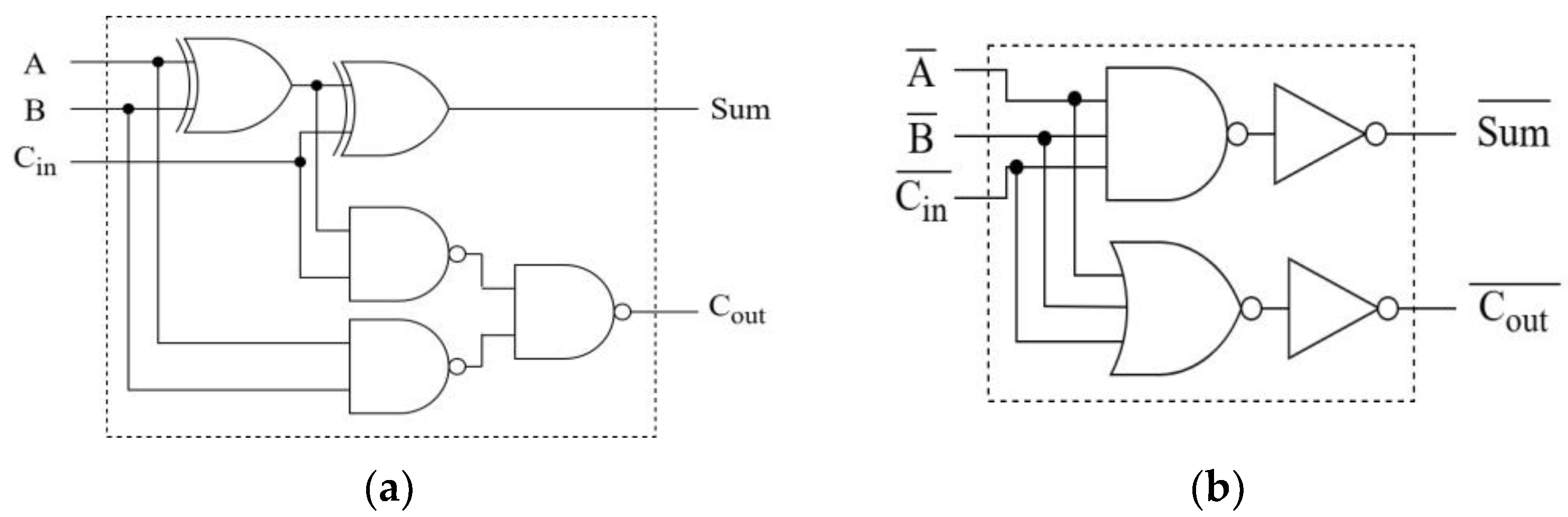
3.1. Exact Inverted Adder Block
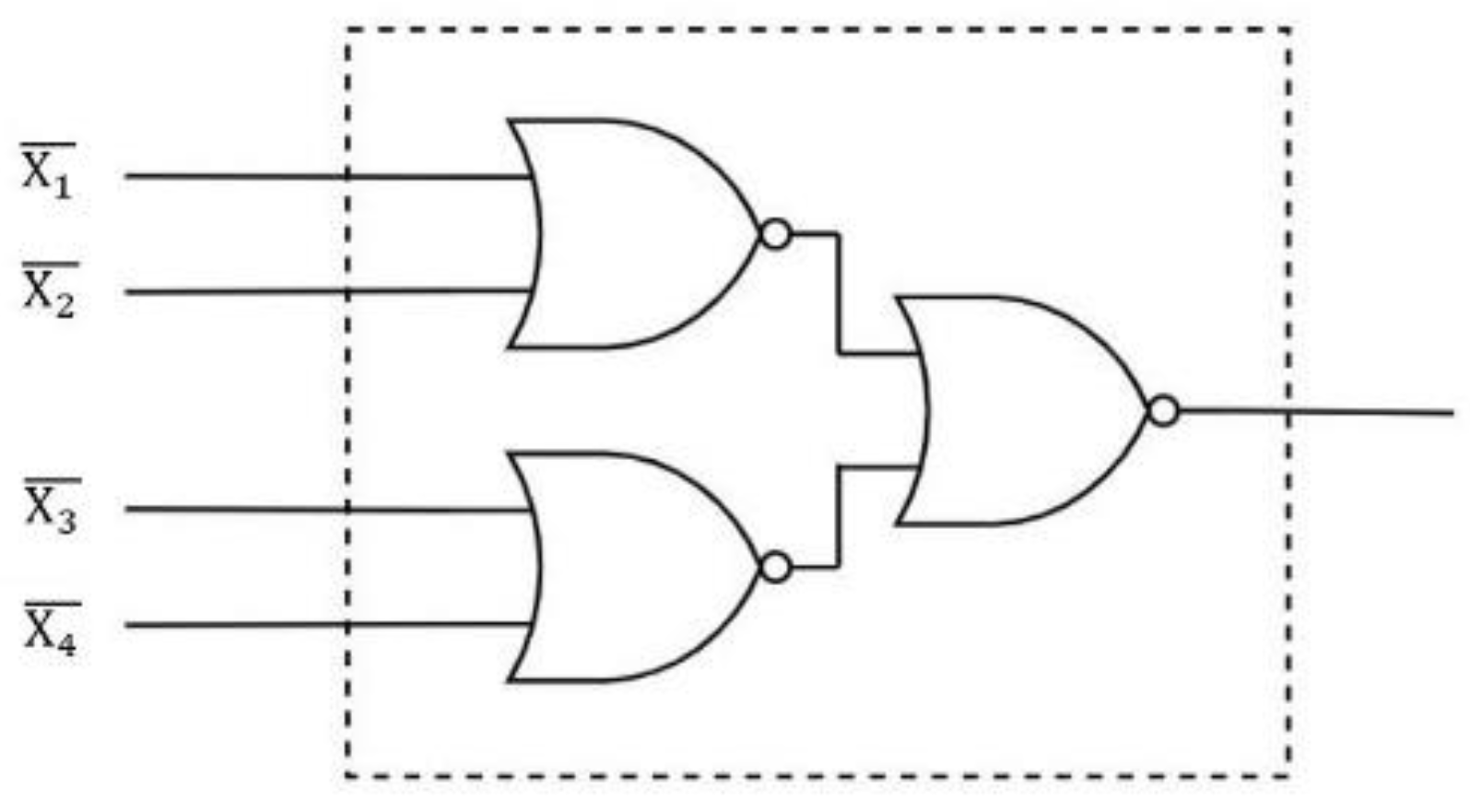
3.2. Proposed Approximate Inverted 4:2 Compressor (AICOM)
3.3. Proposed Approximate Inverted Full Adder (AIFA)
3.4. Proposed Approximate Adder for ACC Stage
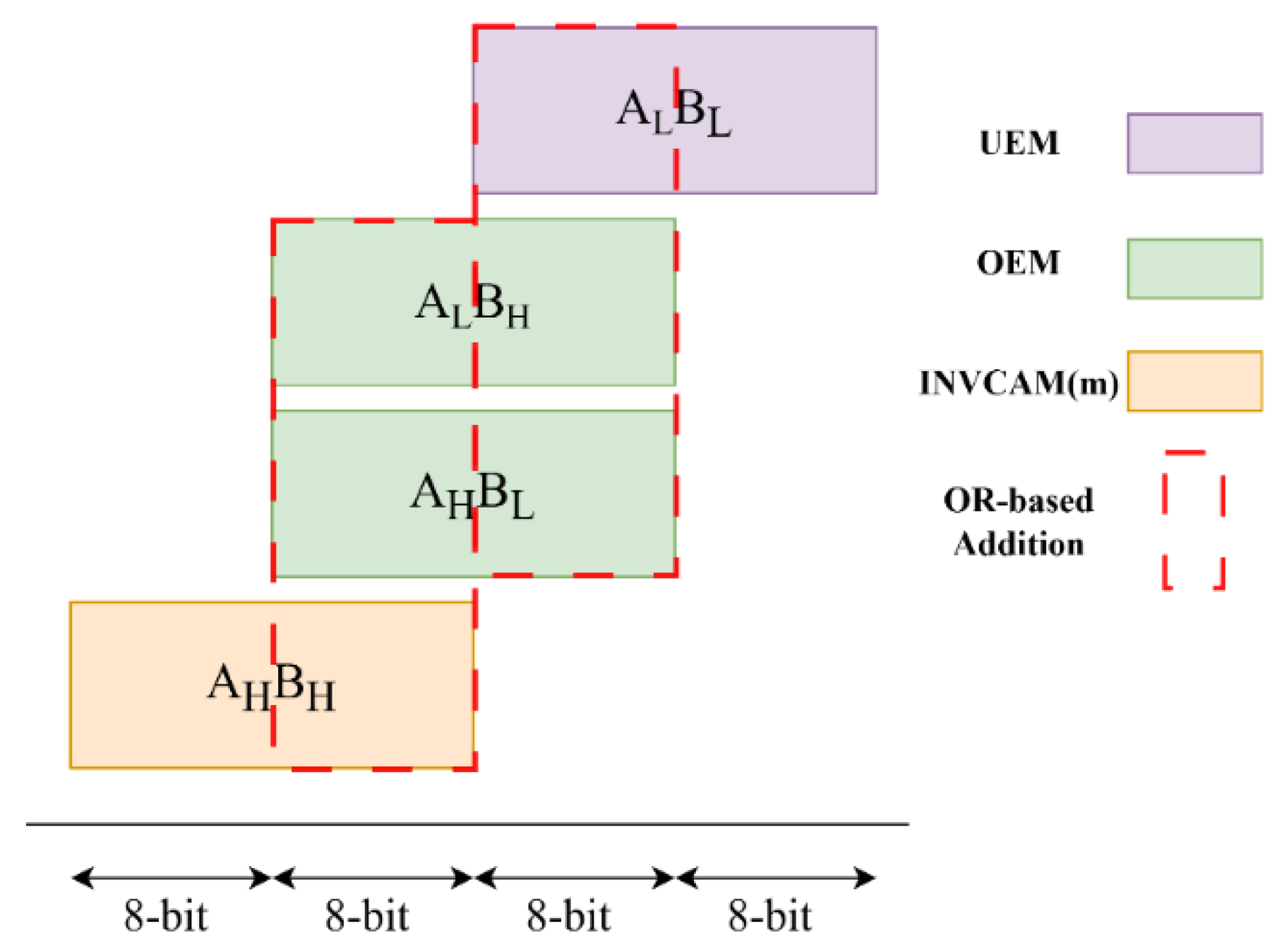
3.5. 16-Bit Multiplier
- An overestimating multiplier (OEM), constructed solely from overestimating adders.
- An underestimating multiplier (UEM), constructed solely from underestimating adders.
4. Results and Discussion
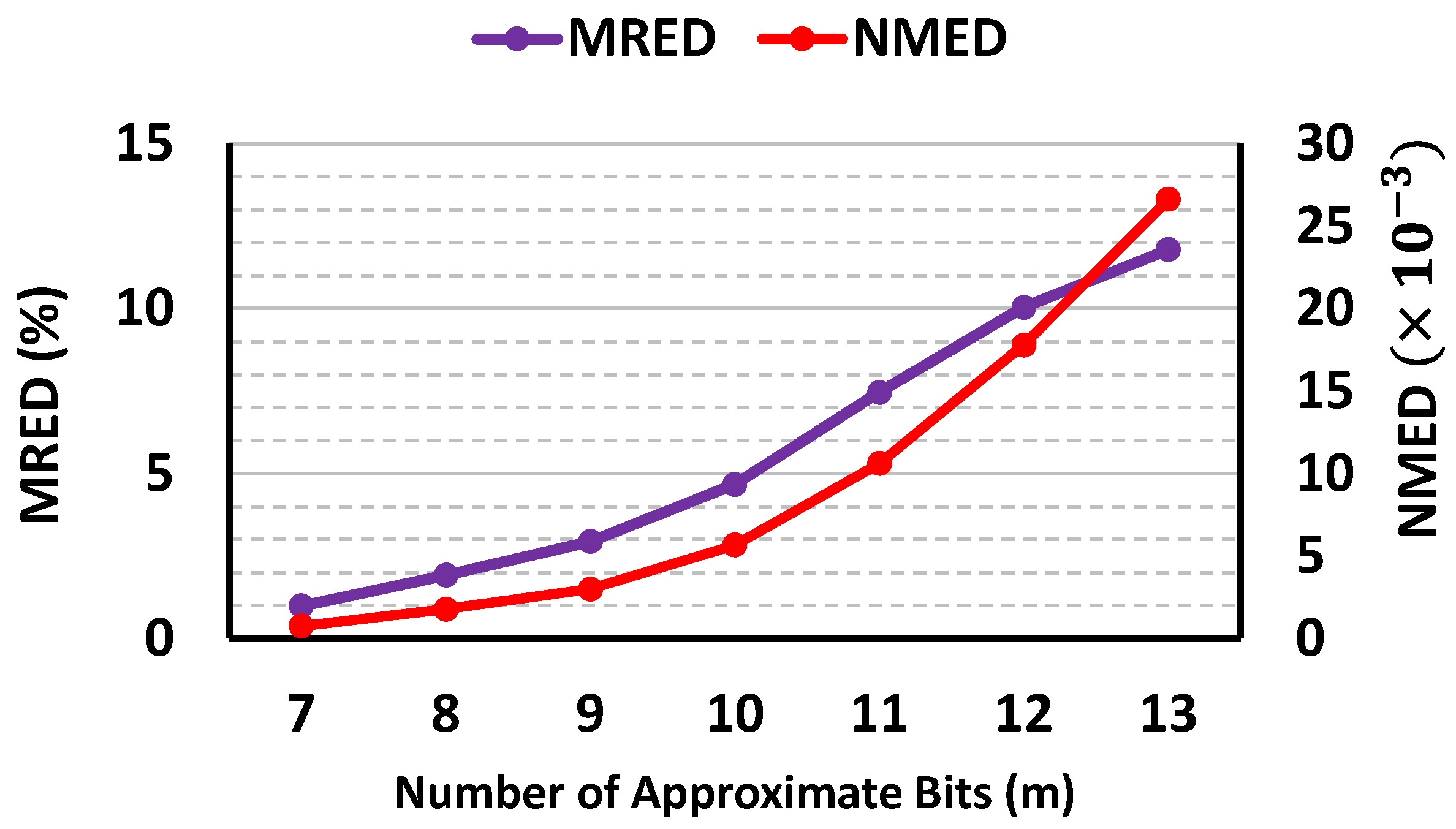
4.1. Error Metrics Evaluation
- Error Rate (-) is the ratio of the number of erroneous results to the total number of cases.
- Error distance () is the absolute difference between the exact () and approximate () results.
- is the maximum across all input combinations.
- Mean error distance () is the average of the s over all input combinations.
- Relative error distance () normalizes the error distance with respect to the exact value.
- Mean relative error distance () is the average of the s over all input combinations.
- Normalized mean error distance () normalizes with respect to the maximum output value (i.e., ). allows us to compare approximate multipliers with different bit widths.
4.2. Hardware Characteristics
4.3. Applications
4.3.1. Image Processing
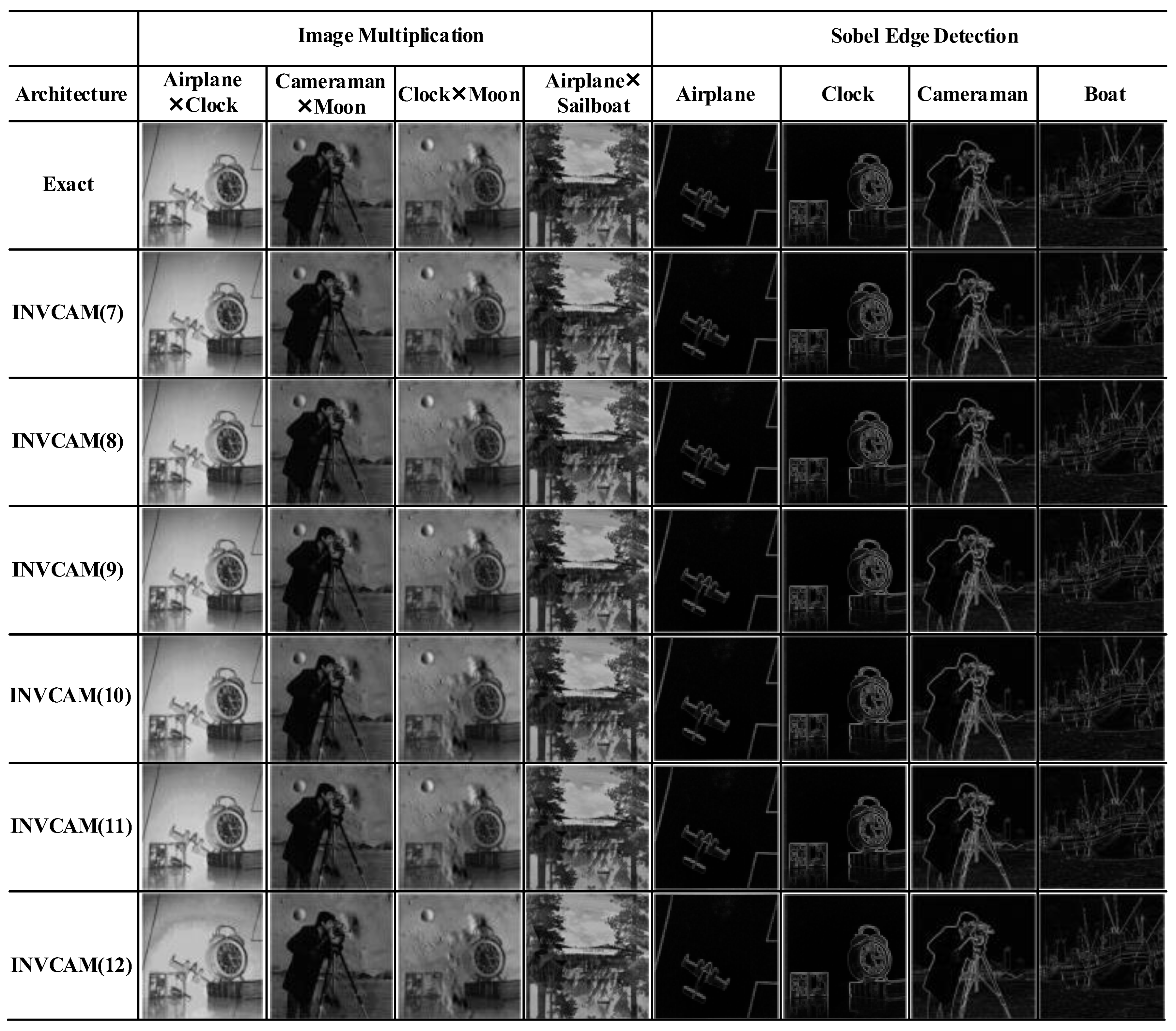
- Image Multiplication:
- Sobel Edge Detection:
4.3.2. Neural Networks
4.4. Discussion
5. Conclusions
Author Contributions
Funding
Data Availability Statement
Conflicts of Interest
Glossary of Abbreviations
| Abbreviation | Full Term |
| PPG | Partial product generation |
| PPR | Partial product reduction |
| ACC | Accumulation |
| AIHA | Approximate inverted half adder |
| IHA | Inverted half adder |
| AIFA | Approximate inverted full adder |
| FA | Full adder |
| AICOM | Approximate inverted compressor |
| COM | Compressor |
| CLA | Carry look-ahead adder |
| ER | Error Rate |
| ED | Error distance |
| MED | Mean error distance |
| RED | Relative error distance |
| MRED | Mean relative error distance |
| NMED | Normalized mean error distance |
References
- Akbari, O.; Kamal, M.; Afzali-Kusha, A.; Pedram, M. Dual-quality 4:2 compressors for utilizing in dynamic accuracy configurable multipliers. IEEE Trans. Very Large Scale Integr. (VLSI) Syst. 2017, 25, 1352–1361. [Google Scholar] [CrossRef]
- Wu, Q.; Pedram, M.; Wu, X. Clock-gating and its application to low power design of sequential circuits. IEEE Trans. Circuits Syst. I Fundam. Theory Appl. 2000, 47, 415–420. [Google Scholar]
- Höppner, S.; Vogginger, B.; Yan, Y.; Dixius, A.; Scholze, S.; Partzsch, J.; Neumärker, F.; Hartmann, S.; Schiefer, S.; Ellguth, G.; et al. Dynamic Power Management for Neuromorphic Many-Core Systems. IEEE Trans. Circuits Syst. I Regul. Pap. 2019, 66, 2973–2986. [Google Scholar] [CrossRef]
- Paolino, C.; Antolini, A.; Pareschi, F.; Mangia, M.; Rovatti, R.; Scarselli, E.F.; Gnudi, A.; Setti, G.; Canegallo, R.; Carissimi, M.; et al. Compressed Sensing by Phase Change Memories: Coping with Encoder non-Linearities. In Proceedings of the 2021 IEEE International Symposium on Circuits and Systems (ISCAS), Daegu, Republic of Korea, 23–26 May 2021; pp. 1–5. [Google Scholar]
- Balsa, J. Comparison of Image Compressions: Analog Transformations. Proceedings 2020, 54, 37. [Google Scholar] [CrossRef]
- Sayadi, L.; Amirany, A.; Moaiyeri, M.H.; Timarchi, S. Balancing precision and efficiency: An approximate multiplier with built-in error compensation for error-resilient applications. J. Supercomput. 2024, 81, 109. [Google Scholar] [CrossRef]
- Salehi Sheikhali Kelayeh, M.S.; Divsalar, S.; Vahdat, S.; TaheriNejad, N. ARTS: An Approximate Reduced Tree and Segmentation-based Multiplier. Future Gener. Comput. Syst. 2026, 175, 108098. [Google Scholar] [CrossRef]
- Jiang, H.; Angizi, S.; Fan, D.; Han, J.; Liu, L. Non-Volatile Approximate Arithmetic Circuits Using Scalable Hybrid Spin-CMOS Majority Gates. IEEE Trans. Circuits Syst. I Regul. Pap. 2021, 68, 1217–1230. [Google Scholar] [CrossRef]
- Kim, S.; Kang, Y.; Baek, S.; Choi, Y.; Kang, S. Low-Power Ternary Multiplication Using Approximate Computing. IEEE Trans. Circuits Syst. II Express Briefs 2021, 68, 2947–2951. [Google Scholar] [CrossRef]
- Amanollahi, S.; Kamal, M.; Afzali-Kusha, A.; Pedram, M. Circuit-Level Techniques for Logic and Memory Blocks in Approximate Computing Systemsx. Proc. IEEE 2020, 108, 2150–2177. [Google Scholar] [CrossRef]
- Esposito, D.; Strollo, A.G.M.; Napoli, E.; De Caro, D.; Petra, N. Approximate Multipliers Based on New Approximate Compressors. IEEE Trans. Circuits Syst. I Regul. Pap. 2018, 65, 4169–4182. [Google Scholar] [CrossRef]
- Amirafshar, N.; Baroughi, A.S.; Shahhoseini, H.S.; TaheriNejad, N. Carry Disregard Approximate Multipliers. IEEE Trans. Circuits Syst. I Regul. Pap. 2023, 70, 4840–4853. [Google Scholar] [CrossRef]
- Chen, K.; Liu, W.; Han, J.; Lombardi, F. Profile-Based Output Error Compensation for Approximate Arithmetic Circuits. IEEE Trans. Circuits Syst. I Regul. Pap. 2020, 67, 4707–4718. [Google Scholar] [CrossRef]
- Mohanty, B.K. Efficient Approximate Multiplier Design Based on Hybrid Higher Radix Booth Encoding. IEEE J. Emerg. Sel. Top. Circuits Syst. 2023, 13, 165–174. [Google Scholar] [CrossRef]
- Naresh, K.; Sai, Y.P.; Majumdar, S. Design of 8-bit Dadda Multiplier using Gate Level Approximate 4:2 Compressor. In Proceedings of the 35th International Conference on VLSI Design and 2022 21st International Conference on Embedded Systems (VLSID), Bangalore, India, 26 February–2 March 2022; pp. 269–274. [Google Scholar]
- Sayadi, L.; Timarchi, S.; Sheikh-Akbari, A. Two efficient approximate unsigned multipliers by developing new configuration for approximate 4:2 compressors. IEEE Trans. Circuits Syst. I Regul. Pap. 2023, 70, 1649–1659. [Google Scholar] [CrossRef]
- Pei, H.; Yi, X.; Zhou, H.; He, Y. Design of Ultra-Low Power Consumption Approximate 4–2 Compressors Based on the Compensation Characteristic. IEEE Trans. Circuits Syst. II Express Briefs 2021, 68, 461–465. [Google Scholar] [CrossRef]
- Zhang, Y.; Chen, X.; Guo, P.; Xie, G. Design and Analysis of Approximate Multiplier of Majority-Based Imprecise 4–2 Compressor for Image Processing. In Proceedings of the 2023 IEEE 23rd International Conference on Nanotechnology (NANO), Jeju City, Republic of Korea, 2–5 July 2023; pp. 1–5. [Google Scholar]
- Teja, T.S.A.; Teja, G.S.; Ravindra, J.; Maddisetti, L. High Speed Multiplier using Embedded Approximate 4-2 Compressor for Image Multiplication. In Proceedings of the First International Conference on Artificial Intelligence Trends and Pattern Recognition (ICAITPR), Hyderabad, India, 10–12 March 2022; pp. 1–5. [Google Scholar]
- Koshe, S.S.; Rajgure, Y.; Sridevi, S.A. Novel Implementation of Low Power and High Performance 4-2 Compressors for Approximate Multipliers. In Proceedings of the 2022 International Conference on Futuristic Technologies (INCOFT), Belgaum, India, 24–26 November 2022; pp. 1–5. [Google Scholar]
- Zhang, M.; Nishizawa, S.; Kimura, S. Area Efficient Approximate 4–2 Compressor and Probability-Based Error Adjustment for Approximate Multiplier. IEEE Trans. Circuits Syst. II Express Briefs 2023, 70, 1714–1718. [Google Scholar] [CrossRef]
- Krishna, L.H.; Rao, J.B.; Ayesha, S.; Veeramachaneni, S.; Mahammad, S.N. Energy Efficient Approximate Multiplier Design for Image/Video Processing Applications. In Proceedings of the 2021 IEEE International Symposium on Smart Electronic Systems (iSES), Jaipur, India, 18–22 December 2021; pp. 210–215. [Google Scholar]
- Krishna, L.H.; Sk, A.; Rao, J.B.; Veeramachaneni, S.; Sk, N.M. Energy-Efficient Approximate Multiplier Design With Lesser Error Rate Using the Probability-Based Approximate 4:2 Compressor. IEEE Embed. Syst. Lett. 2024, 16, 134–137. [Google Scholar] [CrossRef]
- Xiao, H.; Xu, H.; Chen, X.; Wang, Y.; Han, Y. Fast and High-Accuracy Approximate MAC Unit Design for CNN Computing. IEEE Embed. Syst. Lett. 2022, 14, 155–158. [Google Scholar] [CrossRef]
- Gu, F.-Y.; Lin, I.-C.; Lin, J.-W. A Low-Power and High-Accuracy Approximate Multiplier with Reconfigurable Truncation. IEEE Access 2022, 10, 60447–60458. [Google Scholar] [CrossRef]
- Kumar, U.A.; Bikki, P.; Veeramachaneni, S.; Ahmed, S.E. Power Efficient Approximate Multiplier Architectures for Error Resilient Applications. In Proceedings of the 2022 IEEE 19th India Council International Conference (INDICON), Kochi, India, 24–26 November 2022; pp. 1–5. [Google Scholar]
- Waris, H.; Wang, C.; Xu, C.; Liu, W. AxRMs: Approximate recursive multipliers using high performance building blocks. IEEE Trans. Emerg. Top. Comput. 2022, 10, 1229–1235. [Google Scholar] [CrossRef]
- Sabetzadeh, F.; Moaiyeri, M.H.; Ahmadinejad, M. An Ultra-Efficient Approximate Multiplier with Error Compensation for Error-Resilient Applications. IEEE Trans. Circuits Syst. II Express Briefs 2023, 70, 776–780. [Google Scholar] [CrossRef]
- Vahdat, S.; Kamal, M.; Afzali-Kusha, A.; Pedram, M. TOSAM: An energy-efficient truncation- and rounding-based scalable approximate multiplier. IEEE Trans. Very Large Scale Integr. (VLSI) Syst. 2019, 27, 1161–1173. [Google Scholar] [CrossRef]
- Yin, P.; Wang, C.; Waris, H.; Liu, W.; Han, Y.; Lombardi, F. Design and analysis of energy efficient dynamic range approximate logarithmic multipliers for machine learning. IEEE Trans. Sustain. Comput. 2021, 6, 612–625. [Google Scholar] [CrossRef]
- Zendegani, R.; Safari, S. AMCAL: Approximate multiplier with the configurable accuracy levels for image processing and convolutional neural network. IEEE Access 2024, 12, 94135–94151. [Google Scholar] [CrossRef]
- Nambi, S.; Kumar, U.A.; Radhakrishnan, K.; Venkatesan, M.; Ahmed, S.E. DeBAM: Decoder-based approximate multiplier for low power applications. IEEE Embed. Syst. Lett. 2021, 13, 174–177. [Google Scholar] [CrossRef]
- Shankar, R.G.; Ananthi, D.R. Approximate Booth Multipliers using Compressors and Counter. In Proceedings of the International Conference on Inventive Computation Technologies (ICICT), Lalitpur, Nepal, 26–28 April 2023; pp. 1658–1662. [Google Scholar]
- Ahmadinejad, M.; Moaiyeri, M.H. Energy- and Quality-Efficient Approximate Multipliers for Neural Network and Image Processing Applications. IEEE Trans. Emerg. Top. Comput. 2022, 10, 1105–1116. [Google Scholar] [CrossRef]
- Weste, N.H.E.; Harris, D.M. CMOS VLSI Design, 4th ed.; Addison-Wesley: Boston, MA, USA, 2011. [Google Scholar]
- Nangate. 45 nm Open Cell Library. 2012. Available online: http://www.nangate.com (accessed on 5 May 2012).
- Deng, L. The MNIST database of handwritten digit images for machine learning research [Best of the Web]. IEEE Signal Process. Mag. 2012, 29, 141–142. [Google Scholar] [CrossRef]
- Krizhevsky, A.; Nair, V.; Hinton, G. Learning Multiple Layers of Features from Tiny Images. 2009. Available online: http://cs.utoronto.ca/~kriz/learning-features-2009-TR.pdf (accessed on 15 December 2025).
- Danopoulos, D.; Zervakis, G.; Siozios, K.; Soudris, D.; Henkel, J. AdaPT: Fast Emulation of Approximate DNN Accelerators in PyTorch. IEEE Trans. Comput.-Aided Des. Integr. Circuits Syst. 2023, 42, 2074–2078. [Google Scholar] [CrossRef]
- Phan, H. huyvnphan/PyTorch_CIFAR10; v3.0.1; Zenodo: Geneva, Switzerland, 2021. [Google Scholar] [CrossRef]



| 1 | 1 | 1 | 1 | 00 | 00 | 11 | 0 | 81/256 |
| 1 | 1 | 1 | 0 | 01 | 01 | 10 | 0 | 27/256 |
| 1 | 1 | 0 | 1 | 01 | 01 | 10 | 0 | 27/256 |
| 1 | 1 | 0 | 0 | 10 | 11 | 00 | −1 | 9/256 |
| 1 | 0 | 1 | 1 | 01 | 01 | 10 | 0 | 27/256 |
| 1 | 0 | 1 | 0 | 10 | 01 | 10 | +1 | 9/256 |
| 1 | 0 | 0 | 1 | 10 | 01 | 10 | +1 | 9/256 |
| 1 | 0 | 0 | 0 | 11 | 11 | 00 | 0 | 3/256 |
| 0 | 1 | 1 | 1 | 01 | 01 | 10 | 0 | 27/256 |
| 0 | 1 | 1 | 0 | 10 | 01 | 10 | +1 | 9/256 |
| 0 | 1 | 0 | 1 | 10 | 01 | 10 | +1 | 9/256 |
| 0 | 1 | 0 | 0 | 11 | 11 | 00 | 0 | 3/256 |
| 0 | 0 | 1 | 1 | 10 | 11 | 00 | −1 | 9/256 |
| 0 | 0 | 1 | 0 | 11 | 11 | 00 | 0 | 3/256 |
| 0 | 0 | 0 | 1 | 11 | 11 | 00 | 0 | 3/256 |
| 0 | 0 | 0 | 0 | 100 | 11 | 00 | +1 | 1/256 |
| Architecture | (%) | (%) | (×10−3) |
|---|---|---|---|
| INVCAM(7) | 70.2 | 0.99 | 0.75 |
| INVCAM16(7) | ~100 | 2.64 | 1.87 |
| INVCAM(8) | 78.9 | 1.92 | 1.78 |
| INVCAM16(8) | ~100 | 3.56 | 3.07 |
| INVCAM(9) | 82.9 | 2.94 | 2.99 |
| INVCAM16(9) | ~100 | 4.52 | 4.02 |
| INVCAM(10) | 85.3 | 4.67 | 5.66 |
| INVCAM16(10) | ~100 | 5.94 | 5.86 |
| INVCAM(11) | 86.5 | 7.46 | 10.61 |
| INVCAM16(11) | ~100 | 8.70 | 10.90 |
| INVCAM(12) | 87.1 | 10.61 | 19.07 |
| INVCAM16(12) | ~100 | 11.94 | 19.35 |
| Architecture | (%) | (%) | (×10−3) |
|---|---|---|---|
| M20 | 3.6 | 0.05 | 0.09 |
| M23–4 | 29.9 | 0.40 | 0.54 |
| M23–3 | 42.4 | 0.88 | 0.71 |
| M22–2 | 42.1 | 0.99 | 0.72 |
| MUL4 [17] | 76.3 | 1.52 | 0.77 |
| D3 [26] | 93.4 | 1.65 | 0.70 |
| D2 [26] | 93.4 | 2.15 | 0.80 |
| MUL2 [17] | 90.9 | 2.44 | 1.07 |
| M21 | 99.1 | 2.61 | 1.14 |
| MUL3 [17] | 90.7 | 2.62 | 1.19 |
| D1 [26] | 93.4 | 2.92 | 1.35 |
| M23–2 | 47.3 | 3.24 | 11.97 |
| M18 | 85.2 | 3.88 | 3.26 |
| MUL1 [17] | 98.5 | 4.79 | 0.77 |
| CDM8_95 [12] | 70.9 | 5.18 | 6.79 |
| M23–1 | 62.0 | 6.53 | 13.34 |
| M22–1 | 61.8 | 7.59 | 13.04 |
| CDM8_a6 [12] | 73.6 | 7.66 | 11.95 |
| TOSAM(0,3) [29] | 99.1 | 7.66 | 20.78 |
| CDM8_a7 [12] | 75.4 | 10.84 | 20.32 |
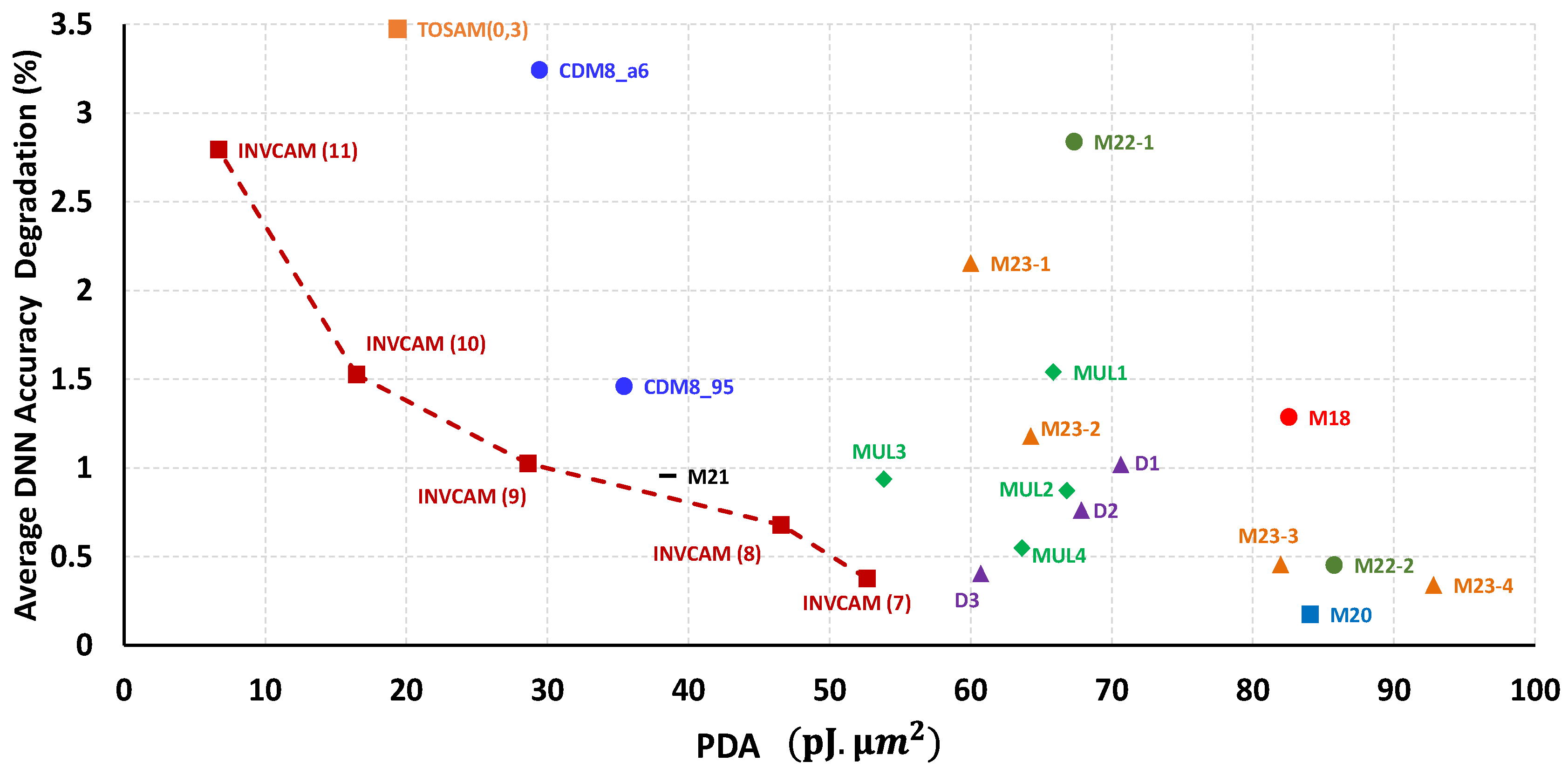
| Architecture | Delay (ns) | Power (µW) | Area (µm2) | PDP (fJ) | PDA (pJ × µm2) | EDP (fJ × ns) | MRED (%) |
|---|---|---|---|---|---|---|---|
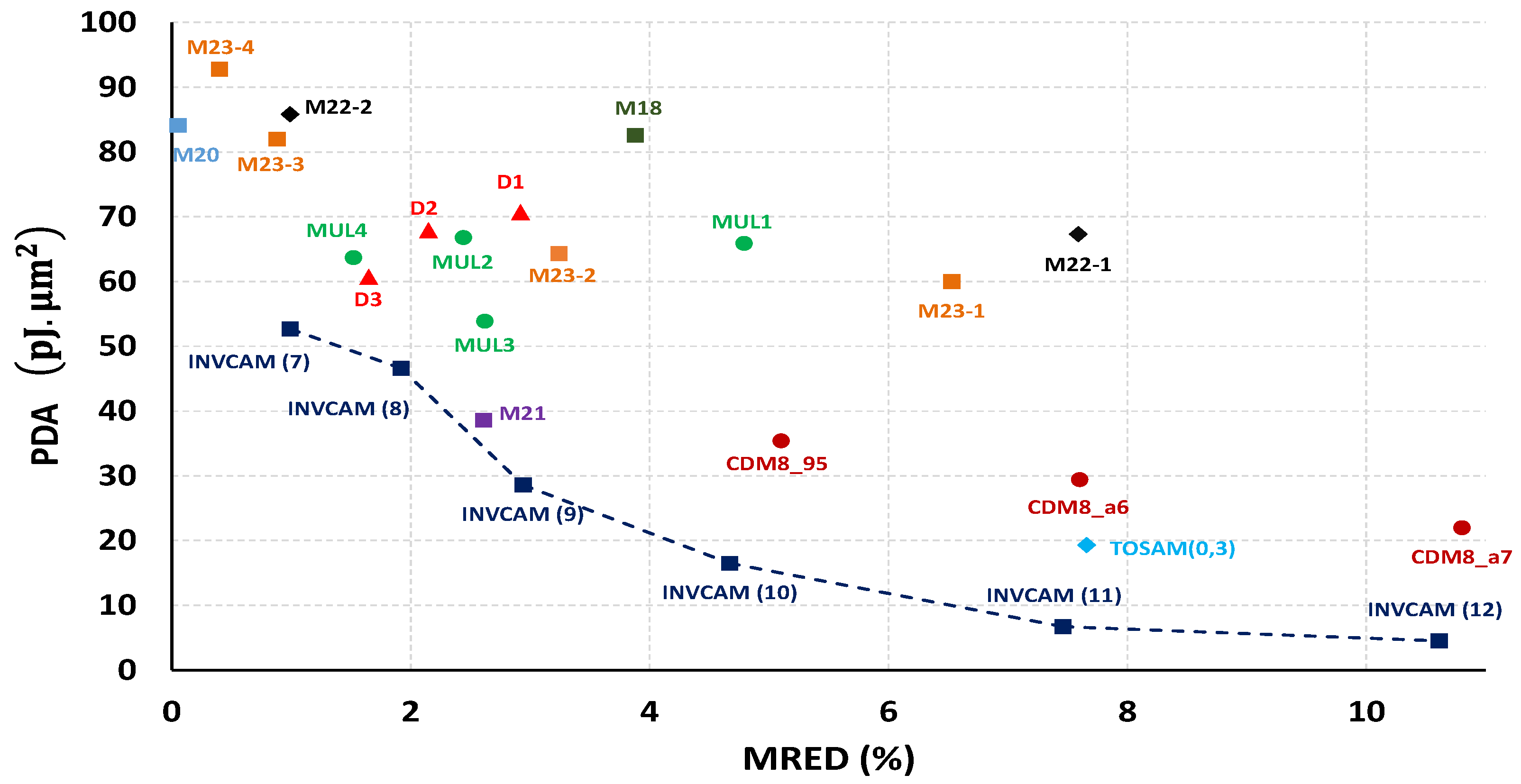
| Exact (Wallace) | 0.85 | 357 | 406 | 303 | 123.2 | 258 | - |
| M20 | 0.85 | 297 | 333 | 252 | 84.1 | 215 | 0.05 |
| M23–4 | 0.85 | 300 | 364 | 255 | 92.8 | 217 | 0.40 |
| M23–3 | 0.85 | 282 | 342 | 240 | 82.0 | 204 | 0.88 |
| M22–2 | 0.85 | 290 | 348 | 247 | 85.8 | 210 | 0.99 |
| MUL4 [17] | 0.83 | 249 | 308 | 207 | 63.7 | 172 | 1.52 |
| D3 [26] | 0.85 | 243 | 294 | 207 | 60.7 | 176 | 1.65 |
| D2 [26] | 0.80 | 261 | 325 | 209 | 67.9 | 167 | 2.15 |
| MUL2 [17] | 0.81 | 257 | 321 | 208 | 66.8 | 169 | 2.44 |
| M21 | 0.80 | 192 | 251 | 154 | 38.6 | 123 | 2.61 |
| MUL3 [17] | 0.79 | 228 | 299 | 180 | 53.9 | 142 | 2.62 |
| D1 [26] | 0.85 | 255 | 326 | 217 | 70.7 | 184 | 2.92 |
| M23–2 | 0.68 | 278 | 340 | 189 | 64.3 | 129 | 3.24 |
| M18 | 0.83 | 281 | 354 | 233 | 82.6 | 194 | 3.88 |
| MUL1 [17] | 0.83 | 248 | 320 | 206 | 65.9 | 171 | 4.79 |
| CDM8_95 [12] | 0.77 | 191 | 241 | 147 | 35.4 | 113 | 5.18 |
| M23–1 | 0.67 | 269 | 333 | 180 | 60.0 | 121 | 6.53 |
| M22–1 | 0.65 | 287 | 361 | 187 | 67.3 | 121 | 7.59 |
| CDM8_a6 [12] | 0.63 | 190 | 246 | 120 | 29.4 | 76 | 7.66 |
| TOSAM(0,3) [29] | 0.68 | 144 | 198 | 98 | 19.3 | 67 | 7.66 |
| CDM8_a7 [12] | 0.56 | 176 | 223 | 99 | 21.9 | 55 | 10.8 |
| INVCAM(7) | 0.80 | 227 | 290 | 182 | 52.7 | 145 | 0.99 |
| INVCAM(8) | 0.77 | 213 | 284 | 164 | 46.6 | 126 | 1.92 |
| INVCAM(9) | 0.74 | 164 | 236 | 121 | 28.6 | 90 | 2.94 |
| INVCAM(10) | 0.64 | 130 | 198 | 83 | 16.5 | 53 | 4.67 |
| INVCAM(11) | 0.51 | 86 | 153 | 44 | 6.7 | 22 | 7.46 |
| INVCAM(12) | 0.49 | 71 | 130 | 35 | 4.5 | 17 | 10.61 |
| Architecture | Delay (ns) | Power (µW) | Area (µm2) | PDP (fJ) | PDA (pJ × µm2) | EDP (fJ × ns) | MRED (%) |
|---|---|---|---|---|---|---|---|
| Exact (Wallace) | 1.22 | 2080 | 1785 | 2538 | 4529.6 | 3096 | - |
| INVCAM16(7) | 0.83 | 310 | 466 | 257 | 119.9 | 214 | 2.64 |
| INVCAM16(8) | 0.80 | 295 | 455 | 236 | 107.4 | 189 | 3.56 |
| INVCAM16(9) | 0.77 | 239 | 397 | 184 | 73.1 | 142 | 4.52 |
| INVCAM16(10) | 0.64 | 221 | 388 | 141 | 54.9 | 91 | 5.94 |
| INVCAM16(11) | 0.51 | 155 | 312 | 79 | 24.7 | 40 | 8.70 |
| INVCAM16(12) | 0.49 | 142 | 296 | 70 | 20.6 | 34 | 11.94 |
| Image Multiplication | Sobel Edge Detection | |||||||||||||||
|---|---|---|---|---|---|---|---|---|---|---|---|---|---|---|---|---|
| Architecture | Airplane × Clock | Cameraman × Moon | Clock × Moon | Airplane × Sailboat | Airplane | Clock | Cameraman | Boat | ||||||||
| PSNR | SSIM | PSNR | SSIM | PSNR | SSIM | PSNR | SSIM | PSNR | SSIM | PSNR | SSIM | PSNR | SSIM | PSNR | SSIM | |
| INVCAM(7) | 52.8 | ~1 | 53.9 | ~1 | 53.3 | ~1 | 52.7 | ~1 | 52.9 | ~1 | 50.1 | ~1 | 48.5 | ~1 | 46.6 | 0.99 |
| INVCAM(8) | 47.6 | ~1 | 48.4 | ~1 | 47.7 | ~1 | 48.0 | ~1 | 51.3 | ~1 | 48.2 | ~1 | 46.6 | ~1 | 45.1 | 0.99 |
| INVCAM(9) | 44.3 | 0.99 | 45.5 | 0.99 | 44.9 | 0.99 | 45.4 | 0.99 | 50.4 | ~1 | 47.0 | ~1 | 45.7 | ~1 | 44.2 | 0.99 |
| INVCAM(10) | 41.3 | 0.98 | 42.6 | 0.98 | 41.4 | 0.98 | 41.9 | 0.98 | 47.5 | ~1 | 43.8 | ~1 | 42.8 | 0.99 | 41.7 | 0.99 |
| INVCAM(11) | 35.6 | 0.93 | 37.4 | 0.94 | 35.9 | 0.93 | 36.0 | 0.94 | 45.9 | ~1 | 42.1 | 0.99 | 41.5 | 0.99 | 40.7 | 0.99 |
| INVCAM(12) | 28.9 | 0.81 | 31.2 | 0.83 | 30.3 | 0.82 | 29.8 | 0.84 | 40.9 | ~1 | 38.1 | 0.99 | 37.2 | 0.99 | 38.4 | 0.99 |
| Dataset | MNIST | CIFAR-10 | |||
|---|---|---|---|---|---|
| Model | FC-3 | LeNet-5 | VGG-11 | ResNet-18 | DenseNet-121 |
| Exact (Wallace) | 97.82 | 97.63 | 92.34 | 92.92 | 93.99 |
| M20 | 97.79 | 97.55 | 91.81 | 92.78 | 93.90 |
| M23–4 | 97.68 | 97.19 | 91.78 | 92.59 | 93.76 |
| M23–3 | 97.64 | 97.11 | 91.61 | 92.43 | 93.63 |
| M22–2 | 97.62 | 97.08 | 91.66 | 92.52 | 93.56 |
| MUL4 [17] | 97.64 | 97.16 | 91.53 | 92.31 | 93.32 |
| D3 [26] | 97.57 | 97.06 | 91.42 | 92.26 | 93.37 |
| D2 [26] | 97.52 | 97.14 | 91.18 | 92.02 | 93.03 |
| MUL2 [17] | 97.50 | 97.03 | 91.06 | 91.87 | 92.88 |
| M21 | 97.49 | 96.92 | 90.99 | 91.76 | 92.77 |
| MUL3 [17] | 97.52 | 97.05 | 91.03 | 91.72 | 92.70 |
| D1 [26] | 97.50 | 97.12 | 90.87 | 91.54 | 92.58 |
| M23–2 | 97.48 | 96.75 | 90.73 | 91.42 | 92.43 |
| M18 | 97.53 | 96.88 | 90.61 | 91.12 | 92.13 |
| MUL1 [17] | 97.41 | 96.76 | 90.58 | 90.87 | 91.38 |
| CDM8_95 [12] | 97.66 | 96.93 | 90.90 | 90.75 | 91.16 |
| M23–1 | 97.27 | 96.63 | 90.34 | 90.28 | 89.41 |
| M22–1 | 97.23 | 96.66 | 88.17 | 89.76 | 88.69 |
| CDM8_a6 [12] | 97.56 | 95.19 | 87.31 | 89.81 | 88.62 |
| TOSAM(0,3) [29] | 97.16 | 95.21 | 86.47 | 90.02 | 88.47 |
| CDM8_a7 [12] | 96.70 | 94.66 | 85.51 | 67.99 | 33.43 |
| INVCAM(7) | 97.77 | 97.14 | 91.74 | 92.53 | 93.54 |
| INVCAM(8) | 97.74 | 97.03 | 91.27 | 92.11 | 93.12 |
| INVCAM(9) | 97.72 | 96.97 | 90.79 | 91.57 | 92.57 |
| INVCAM(10) | 97.70 | 96.74 | 90.59 | 90.92 | 91.09 |
| INVCAM(11) | 97.43 | 96.41 | 88.23 | 90.08 | 88.71 |
| INVCAM(12) | 97.16 | 94.90 | 85.47 | 73.15 | 41.72 |
Disclaimer/Publisher’s Note: The statements, opinions and data contained in all publications are solely those of the individual author(s) and contributor(s) and not of MDPI and/or the editor(s). MDPI and/or the editor(s) disclaim responsibility for any injury to people or property resulting from any ideas, methods, instructions or products referred to in the content. |
© 2026 by the authors. Licensee MDPI, Basel, Switzerland. This article is an open access article distributed under the terms and conditions of the Creative Commons Attribution (CC BY) license.
Share and Cite
Darabi, K.; Divsalar, S.; Vahdat, S.; Amirafshar, N.; TaheriNejad, N. INVCAM: An Inverted Compressor-Based Approximate Multiplier. Electronics 2026, 15, 216. https://doi.org/10.3390/electronics15010216
Darabi K, Divsalar S, Vahdat S, Amirafshar N, TaheriNejad N. INVCAM: An Inverted Compressor-Based Approximate Multiplier. Electronics. 2026; 15(1):216. https://doi.org/10.3390/electronics15010216
Chicago/Turabian StyleDarabi, Kimia, Sahand Divsalar, Shaghayegh Vahdat, Nima Amirafshar, and Nima TaheriNejad. 2026. "INVCAM: An Inverted Compressor-Based Approximate Multiplier" Electronics 15, no. 1: 216. https://doi.org/10.3390/electronics15010216
APA StyleDarabi, K., Divsalar, S., Vahdat, S., Amirafshar, N., & TaheriNejad, N. (2026). INVCAM: An Inverted Compressor-Based Approximate Multiplier. Electronics, 15(1), 216. https://doi.org/10.3390/electronics15010216