Article

Digitally Adjustable Laser Diode Driver Circuit with 9 ps Resolution

by
Michał Pietrzak
,
Wiktor Porakowski
* and
Oleksandra Zhyhylii
Institute of Electronic Systems, Faculty of Electronics and Information Technology, Warsaw University of Technology, Nowowiejska 15/19, 00-665 Warsaw, Poland
*
Author to whom correspondence should be addressed.
Electronics 2026, 15(1), 210; https://doi.org/10.3390/electronics15010210
Submission received: 2 December 2025 / Revised: 24 December 2025 / Accepted: 29 December 2025 / Published: 1 January 2026

Abstract

Laser pulses are essential in various scientific fields, yet existing laser diode drivers offer limited adjustability. This paper presents a digitally adjustable subnanosecond gain-switched laser diode driver, a first one with step sizes of the control being in the single-digit picosecond range. The proposed circuit differentially drives the laser diode (LD) using two high-current gate drivers whose relative delay is digitally adjusted by a dual programmable delay line. Pulse width is defined by the delay difference between the two channels, enabling fine control without the need for high-speed semiconductor switching. Experimental results demonstrate stable optical pulse generation with widths tunable from 350 p s to 2.8 n s in 9 p s increments and repetition rates exceeding 150 M H z . Timing jitter remains below 15 p s , and amplitude variation is below 1% across the tested operating conditions. The proposed solution provides a compact, low-cost, and highly adjustable platform for applications that require precise timing and pulse-width control, such as time-resolved measurements, range finding, and nonlinear optical excitation.

1. Introduction

Some applications (rangefinders and machining) use nanosecond, high-energy pulses, most often generated utilising Q-switched solid-state lasers. Such devices are constructed from several components: an active medium, a pump source, a Q-switch, cavity mirrors, and, frequently, nonlinear crystals. Despite miniaturisation and integration, as well as improvements in pump sources, these devices remain bulkier and mechanically more sensitive than laser diodes.
At the same time, laser diodes have recently become an increasingly preferred candidate for rangefinders and machining. The availability of high-power pulsed multimode devices is the reason for this. Alternative solutions based on Master Oscillator Power Amplifier (MOPA) topology also utilise laser diodes as a seed source.
Other use cases, such as lifetime measurements [1,2] or nonlinear bioimaging [3,4] require shorter subnanosecond pulses. They are generally generated from mode-locked solid-state or fibre lasers. These devices are significantly more complex and sensitive than Q-switched sources, often having a long warm-up time due to thermal stabilisation. The semiconductor-based solution is favourable here as well because it combines active medium, cavity mirrors, and pumping into a single, small device. Additionally, thanks to the wide range of available wavelengths and the possibility of wavelength tuning, many applications can avoid employing optical parametric oscillators or amplifiers, which are required in more typical implementations.
Many authors have investigated the generation of picosecond pulses by semiconductor lasers. Pulse widths smaller than 1 ps have been achieved by mode-locking in the external cavity [5]. While simpler, external cavity mode-locking still requires a large, complicated, and sensitive cavity. When using a simpler gain-switching method, a full width at half maximum (FWHM) well below 10 ps can be generated [6]. Two methods of gain switching investigated in the literature are RF driving and pulse control. An analysis has been conducted on devices constructed of various materials (AlGaN and InAlGaAs), structures, and wavelengths (from UV to MIR) in both multimode and single-mode cases. Theoretically, the behaviour of the laser diode can be described by rate equations. An analysis of ultrashort pulse superimposed on a DC bias pumping the laser diode is available [7]. RF modulation is used primarily for the generation of frequency combs [8] or stable self-seeded pulse trains [9]. An extensive comparison of all methods can be found in [10]. The adjustable pulse laser diode driver presented in this work aims to expand the range of applications that can benefit from laser diodes while mitigating some drawbacks.

2. Operating Condition of the Gain-Switched Laser Diode

The operation of a laser diode can be described using a set of two coupled nonlinear differential Equations (1) and (2) for carrier and photon density [11]:
d N d t = I ( t ) e N τ S α ( N N 0 ) S
d S d t = α ( N N 0 ) S S τ p h + β N τ S
where N indicates the population count, N 0 indicates the population count without gain, e indicates elementary charge, S indicates light beam power, I ( t ) describes the change of the injection current over time, τ S indicates the fluorescent lifetime, τ p h describes the photon lifetime related to cavity losses, and α and β are constant coefficients.
Equation (1) describes the change in carrier density influenced by injection current, fluorescent decay, and stimulated emission, respectively. Equation (2) describes changes in internal flux influenced by stimulated emission, optical losses, and spontaneous emission aligned with resonator mode, respectively.
The factor α ( N N 0 ) S in Equations (1) and (2) represents the nonlinear coupling of the carrier density and the optical flux. This nonlinear coupling leads to dampened optical relaxation oscillations when the pump current is increased by injecting a short current pulse [7,12]. This leads to amplitude-dependent pulse sharpening if only one period of relaxation oscillations is allowed to be generated. In ref. [7] 50 ps optical pulses were obtained from 400 ps electrical pulses. In ref. [12] sub 100 ps optical pulses were obtained from both 100 ps and 300 ps electrical pulses. This illustrates a highly nonlinear dependence of the generated pulse width on the excitation width and amplitude. In ref. [13], around 100 ps optical pulses were obtained from over 1 ns electrical pulses. While this shortening is proving useful for obtaining the shortest pulses possible, in instances requiring the precise control of pulse properties, it becomes undesirable. The slew rate of driving pulses must be controlled to suppress relaxation oscillation peaks [14]. At the same time, amplitude has to be controlled precisely due to its influence on the pulse width. Additionally, the relaxation behaviour leads to asymmetric edges with a sharp rising edge and a much slower falling edge of wide pulses.
This leads directly to asymmetric driving requirements. Much stiffer control of the rising edge is needed than that of the falling edge. The rise time of a pulse defines how much carrier density and, consequently, gain will exceed the threshold, which controls the pulse power, width, and time until the next relaxation pulse. On the other hand, even if the laser diode is driven above the threshold, it temporarily turns off after the relaxation oscillation due to the depletion of carriers inside the structure [15], which makes the falling edge less critical. The falling edge only has to occur late enough not to disturb the first relaxation pulse and limit the injected charge so that a second pulse cannot build up. This reasoning is only valid if a single optical pulse with well-defined properties is required to be generated. Otherwise, if a multi-pulse or quasi-CW output is required, then the falling edge has to be equally well-defined. The electrical slew rate is not critical, as the falling edge would maintain its slowness and is primarily related to the cavity dampening time.

3. Existing Driving Methods

Current solutions are limited by the switching speed of semiconductors for generating short pulses of sufficient energy. There exist many methods for generating a single sharp edge using active semiconductors, but far fewer allow for the generation of pulses with both edges sharp. As a result, the fastest devices opt to use passive sharpening devices. In the last century, the most popular solutions were based on steps sharpened by step recovery diodes (SRDs) [7,12] or avalanche transistor pulses optionally shaped by LC networks [16,17,18,19,20]. More recently, fast semiconductor switches, primarily MOSFETs, have displaced avalanche transistors and are now used together with some form of LC pulse shaping [13,21,22,23]. All of these solutions share a significant similarity: they generate a single sharp edge and passively shape it into a pulse. Although solutions for a variable passive pulse shaper exist, they are primarily based on nonlinear transmission lines (NLTL) [24], and involve specific challenges that need to be addressed; they are also not used in laser diode driving circuits at the moment. Often, the pulse repetition rate is severely limited; LC networks require time to settle before retriggering, and avalanche transistors need time to cool off, limiting the pulse repetition rate to up to 10 MHz for low-power devices and up to 1 MHz for higher power. SRD-based generators need to return to steady state due to multiple internal reflections.

Review of the Available Commercial Units

There are very few articles describing modern, fast gain-switching laser diode drivers: a set of commercial products was selected to provide a basis for comparison. We decided to reference some high-end commercial devices with similar parameters, listed in Table 1. Because many devices target only butterfly-packaged telecom diodes with wavelengths ≥ 1 μm, they have very low compliance voltages (4, 5). Some come only with an integrated laser diode head, limiting the selection of wavelengths and peak powers (2, 3). All have much worse adjustment properties; (2, 4) do not allow any pulse width adjustment, and (3) has pulse width adjustable in 15 discrete steps, while (5) allows changing pulse width in 1 ns increments in the 1–100 ns range. Only (1) has continuous adjustment of the pulse width in the 100–750 ps range, but this adjustment must be regulated using an onboard potentiometer. Products that do not allow for the direct adjustment of pulse properties specify that pulse properties depend on the diode used and cannot be guaranteed. Many have limited repetition frequencies; (1, 2, 4, 5) support maximum rates of 1 MHz, 50 MHz, 30 MHz, and 20 MHz, respectively. A few even have minimum repetition rate requirements due to internal AC coupling (4, 5). The digital control is highly advantageous, as it allows further lab automation with experiments autonomously scanning pulse properties.

4. Proposed Solution

The proposed solution resolves all previously described issues with modern semiconductor devices, enabling the delivery of adjustable, short optical pulses. To circumvent the slow switching times of modern electronics, the laser diode is connected differentially between two gate drivers functioning as adjustable, high-current buffers.
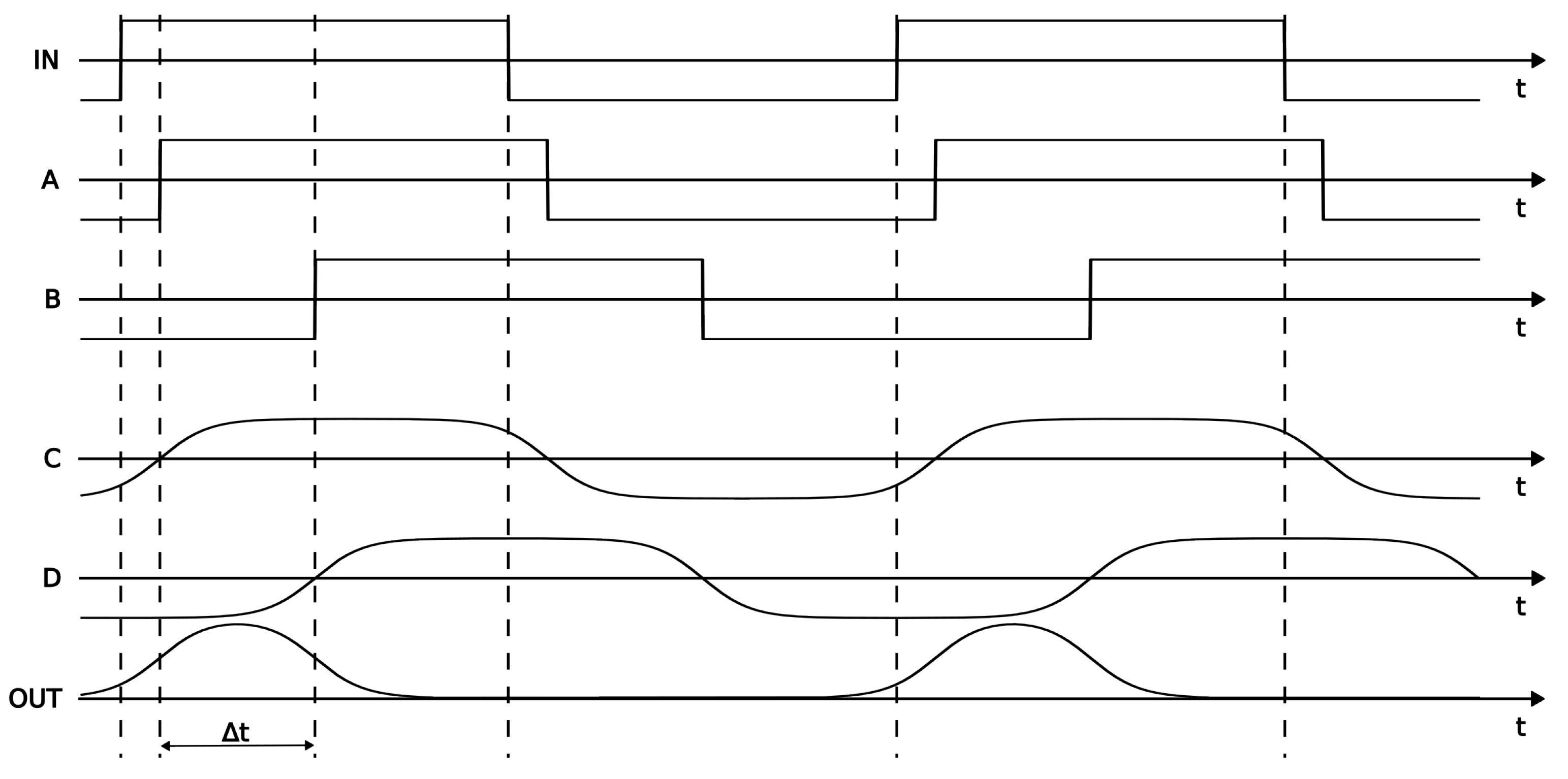
The operating principle of the proposed driver is based on the generation of short optical pulses using relatively slow gate drivers due to the nonlinear interaction of the pulses in the diode. The input square wave (Figure 1 IN) is split and sent to two delay lines. Those delay lines propagate divided signals to their output (Figure 1 A,B) without a change in sign but with a change in delay. Then signals are sent to the gate drivers (Figure 1 C,D) and are applied to the semiconductor laser diode inputs. The laser diode is the element that is responsible for the subtraction of signals from output buffers (LD power supply signal (Figure 1 OUT)) and where the output impulse is generated. The duration of the generated pulse is approximately equal to the delay difference ( Δ t on Figure 1).
The differential voltage between two gate drivers is approximately Gaussian-shaped (for pulse width 3 ns). It allows only a small part of the pulse to cross the threshold and generate laser emission, thereby shortening the 3 ns output switching times. The amplitude of the Gaussian-shaped differential voltage between two gate drivers depends on the rise time and pulse width. This enables precise regulation of the active medium pumping time. At the same time, slow rise and fall times reduce peaking due to relaxation oscillations inside the diode.
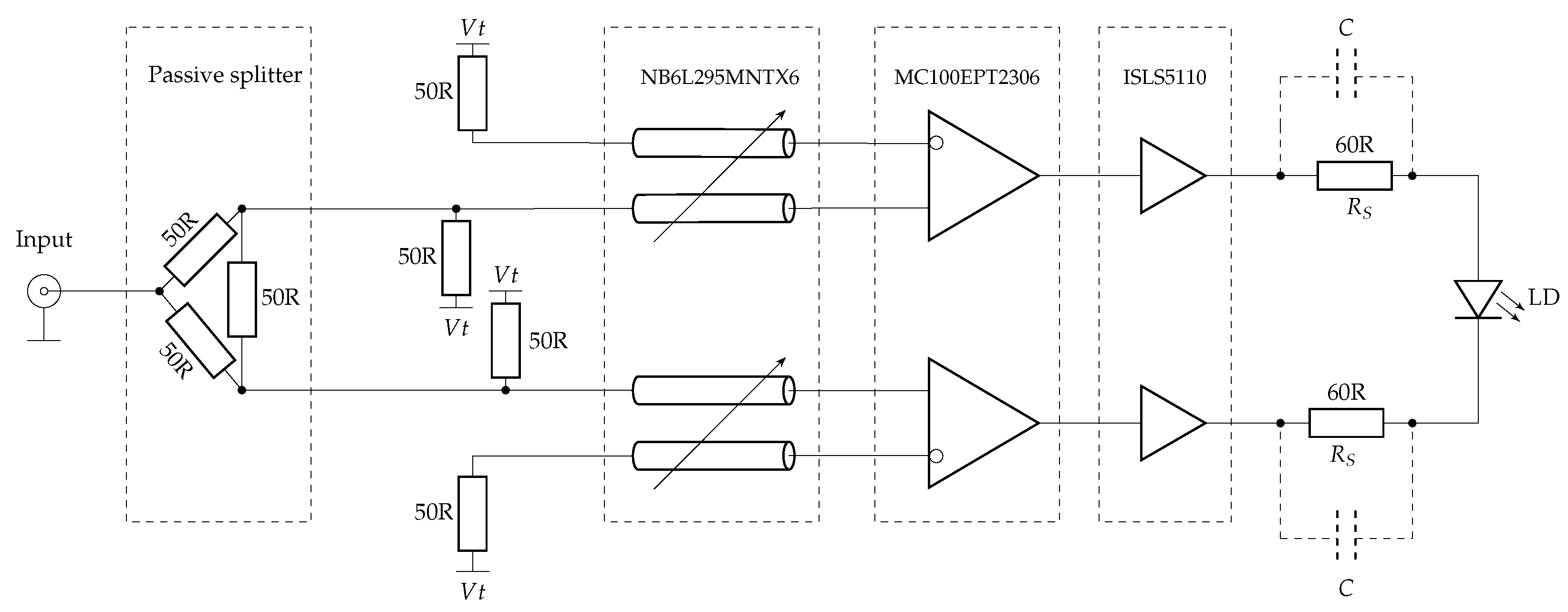
An electrical schematic for the realisation of the proposed solution is shown in Figure 2. The Input Low-Voltage Positive Emitter-Coupled Logic (LVPECL) electrical pulse becomes duplicated by a passive splitter, which is sent to the dual LVPECL digitally controlled delay line (NB6L295MNTX6, onsemi, AZ, USA). The LVPECL signal standard requires input termination, which is performed by the 50 Ω shunt resistors connected to V t . The delay line allows adjusting the pulse width in 9 ps increments up to 4.5 ns. For the chosen driving buffers to be used, the signal must be converted from LVPECL to CMOS, which is accomplished by a signal level converter (MC100EPT2306, onsemi, AZ, USA). That allows for output buffers (ISLS5110, Renesas Electronics, Japan) to drive the laser diode. Because both driving signals can be delayed, either edge of the trigger signal can be converted into an optical pulse.
The laser diode has parasitic capacitance that slows down the switching time. Most of the capacitance is due to diffusion capacitance, which is necessary to reach and cross the threshold current. To speed up switching, it is recommended to add peaking capacitors (C) in parallel with current-limiting resistors ( R S ), which will inject additional charge at the beginning of the pulse and remove it at the end. Because diffusion capacitance is proportional to injection current, the optimal value of the capacitance depends significantly on the operating point. This compensating capacitance will cause performance deterioration if one wishes to tune the output power by varying the supply voltage. Additionally, the negative pulse, clamped at the diode’s end by the ESD Schottky diode inside the LD, charges the peaking capacitors.
The offered repetition rate is much higher than in many other solutions, limited only by the power dissipated in the gate driver, to around 50 MHz when mounted on a PCB with no special cooling considerations. With active cooling, this limit increased to over 150 MHz. Even with no special cooling, the burst repetition rate is only limited by the output buffers’ switching times and the bandwidth of the LVPECL to CMOS converter and can achieve over 150 MHz under optimal loading. Certain pulse distortion occurs at repetition frequencies exceeding approximately 10 MHz due to the negative pulse precharging of peaking capacitors; however, it can be compensated for by adjusting the delay line setting. The diode’s compliance voltage is limited only by the maximum supply voltage of the gate driver, which is over 13 V. This allows driving all available laser diodes while leaving enough headroom for resistive drop on the gate driver and series resistors. Additionally, thanks to the high-voltage drop across the series resistance, the source approximates a current source with reasonable accuracy, even in the presence of thermal changes in the LD. Further compensation of the V f variation can be achieved by adjusting the supply voltage to compensate for the thermal dependencies of the laser diode, in many applications, thereby removing the need for temperature stabilisation.
Currently, the output current is limited to 1 A by the worst case resistance of two gate drivers in a series. Still, it can be increased by selecting units with lower r D S o n , reducing the allowed temperature range, or by choosing another gate driver integrated circuit. Parallelling multiple buffers is not recommended, as it is hard to keep the propagation delay matched to single picoseconds. If done, we suggest using independent delay lines for every output buffer and calibrating the propagation time mismatch. Because it is resistive loss, the maximum possible output current drops with increased forward voltage of the LD.
Although the rise and fall times of individual gate drivers are over 2 ns, only properties of differential pulse matter; the difference of two switching curves generates a pulse that is close to Gaussian when the switching of both gate drivers overlaps. When a longer pulse duration is selected, the trapezoidal waveform closely models the driving voltage. The time when differential voltage generates sufficient current through the laser diode to cross the threshold is shorter than the pulse width. By the appropriate choice of series resistance and supply voltage, only the very peak of the pulse can generate an optical pulse. This enables subnanosecond pulse lengths, depending on the details of the laser diode. For the diodes used in testing, pulse width was stably tuned down to 350 ps.
The one downside of the proposed solution is the generation of a negative pulse that is applied to the diode. The pulse has the same length and amplitude as the positive pulse and is generated on the opposite edge of the trigger signal. Some laser diodes have an internal ESD diode to protect against negative polarity. If a diode does not include one, an external Schottky diode antiparallel to the LD may be needed to protect the structure from reverse breakdown. An external diode may be helpful, even if an internal one is included, to limit power dissipation or prolong the system’s life. Internal protection diodes are not characterised for repeated pulse application, and no effort was made to characterise them. The negative pulse more than doubles (because of the lower forward voltage of the protection diode) the dissipation in gate drivers, limiting the repetition rate. It adds negligible thermal load to the laser diode.
Our solution does not bias the laser diode near the threshold current, unlike many others [7,12,15,25]. Instead, the choice was made to use an unbiased diode, as it desensitises the system to electrical rise and fall times. This is made possible by the fact that when the laser diode is well below the threshold, optical flux inside it is low, and the LD acts as a charge integrator. Additionally, the lack of DC bias simplifies the generation of a single relaxation oscillation [6,26]. Removing the bias current reduces power dissipation in the laser diode, enabling easier and more precise temperature control of the die.
Finally, because the delay at both channels is controlled independently when varying the pulse width, the user can keep the rising edge, falling edge, or pulse centre at a constant offset from the trigger signal.

5. Experimental Results

To validate the theory, an experiment was constructed. Four main experiments were conducted:
  • Pulse timing and amplitude jitter;
  • Pulse timing dependence on repetition rate;
  • Pulse properties dependence on supply voltage;
  • Pulse timing dependence on control word.
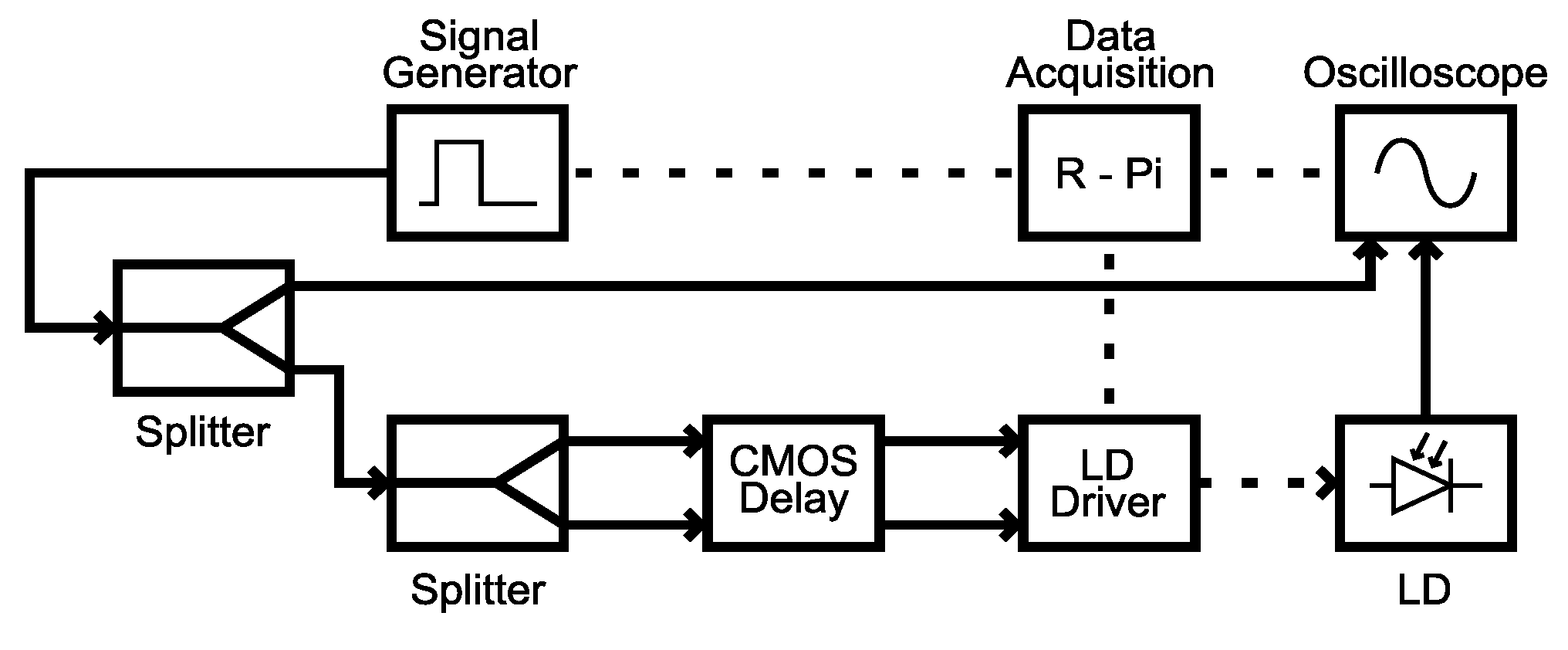
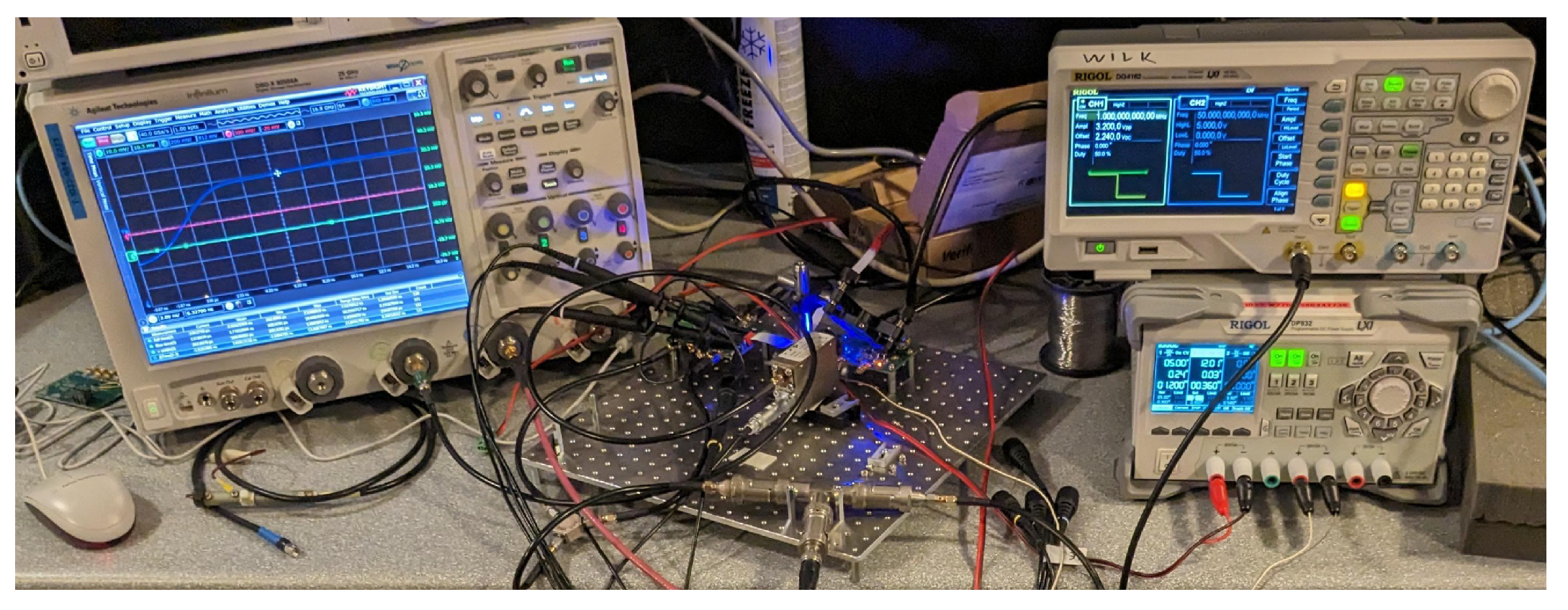
The experimental setup consists of two custom-made PCBs (Eurocircuits, Belgium) (CMOS dual delay and MOSFET gate driver), an arbitrary waveform generator (Rigol DG4162, Poland), an oscilloscope (Agilent DSOX92504A, Poland), a power supply (Rigol DP832, Poland), a photoreceiver (FEMTO HSA-X-1G4-Si, Germany), two resistive 1:1 splitters, and Raspberry Pi 4 (UK) (Figure 3 and Figure 4).
This complex circuitry enables triggering the oscilloscope directly from the laser diode driver’s input signal. While the generator used has a dedicated sync output, synchronisation derived from the output pulse with a passive splitter was needed to minimise jitter and frequency-dependent delay in the experimental setup. Various laser diodes are available on the market. Those diodes are made from different semiconductors, and have different electrical power requirements, different output power, and different wavelengths. To test whether the designed circuit is compatible with a wide range of available diodes, two laser diodes were measured: green PLT5 520EB_P from Osram (Austria) and red ADX-6305STL-5 from Arima Lasers (Taiwan). The choice was made to check parts with significantly different required electrical power levels (350 mW and 72 mW) and made from different semiconductors (GaN and AlGaInP). A photodiode was selected instead of an avalanche photodiode (APD) despite its slower response because APDs have a rise time dependent on the pulse amplitude [27].

5.1. Standard Deviation of Parameters

Timing jitter was evaluated using the scope’s built-in measurement statistics module. The average value and standard deviation of the following parameters were tested over a range of settings: rise time, fall time, pulse width, and trigger delay of the generated pulse. The jitter was independent of the repetition frequency and varied only with the supply voltage and device parameters. The results are presented in Table 2.
The amplitude deviation of the output pulse is ≤1% for all settings. The fall time jitter is ≤10 ps for the green GaN diode and as much as 20 ps for the red AlGaInP. The rise time jitter is lower than the fall time for short, low-power pulses and higher for longer, higher-power pulses. The relative pulse width jitter is around 0.5 % for all but the shortest pulses. The pulse delay jitter is dependent only on the pulse amplitude. Some of the jitter, especially for lower-amplitude pulses, can be attributed to the change in SNR with pulse power. In comparison, the inherent jitter of gain-switched diodes varies between 1 ps and 10 ps depending on the specific model and drive waveforms [28,29].

5.2. Repetition Rate Dependence

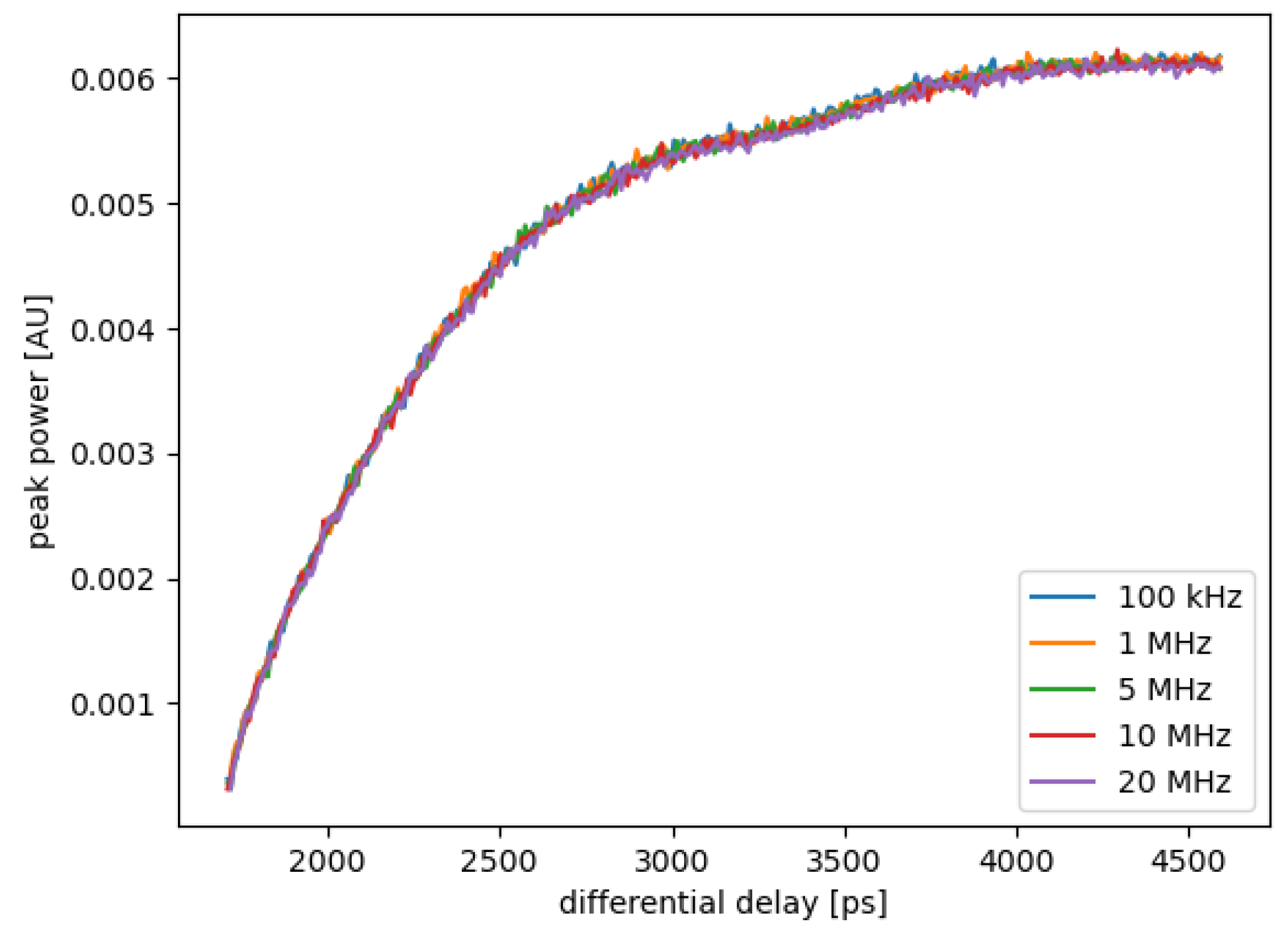
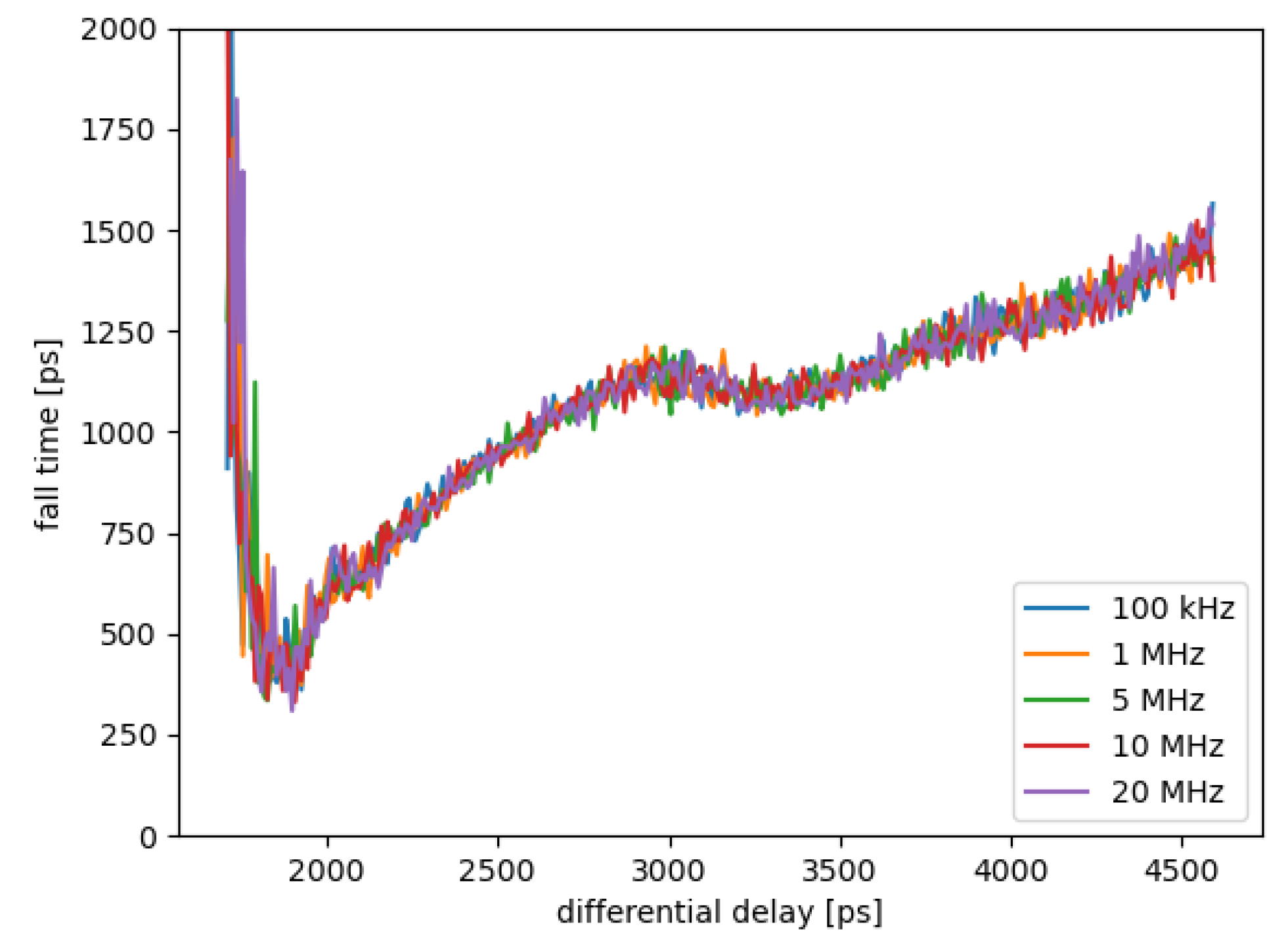
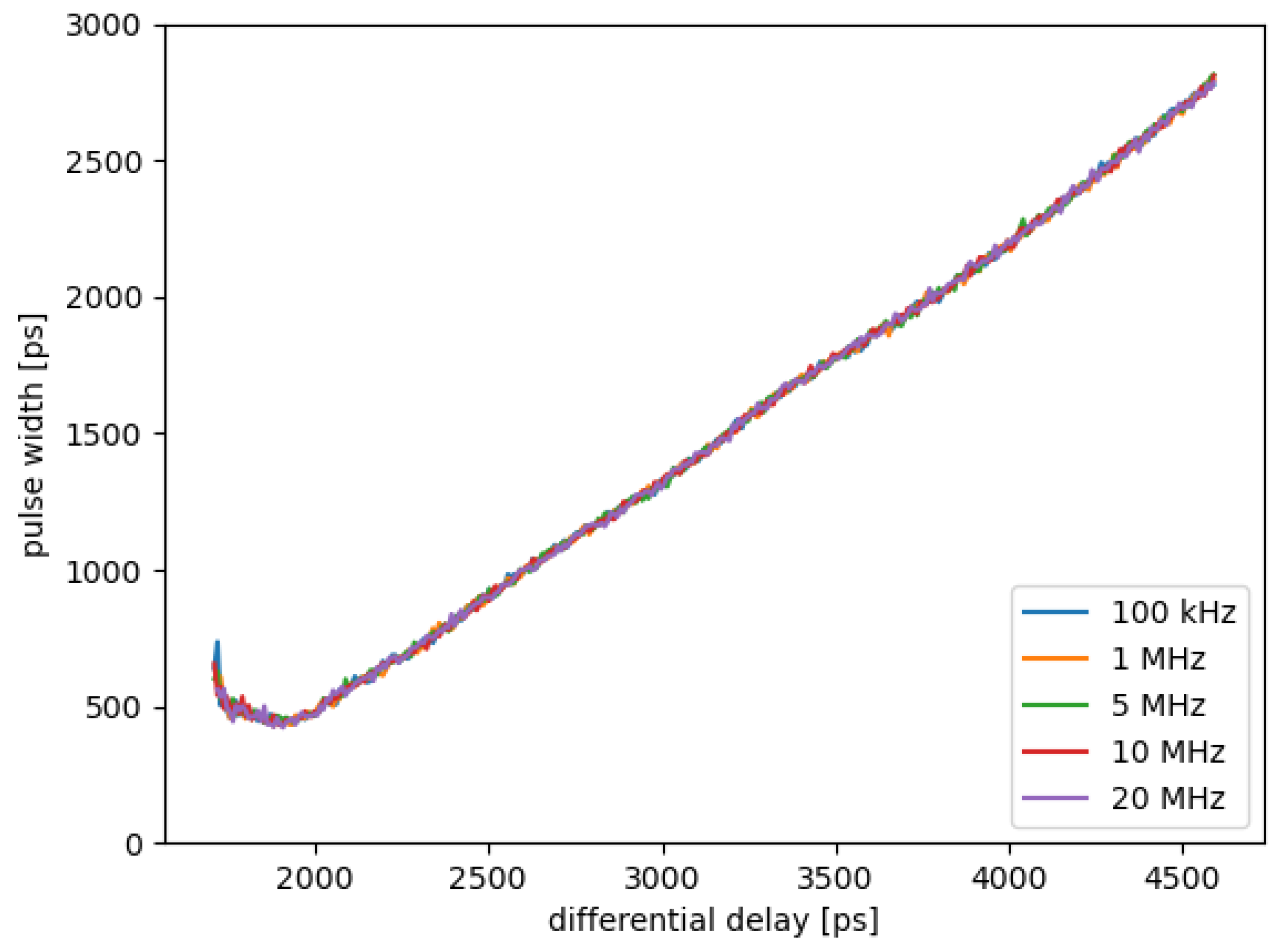
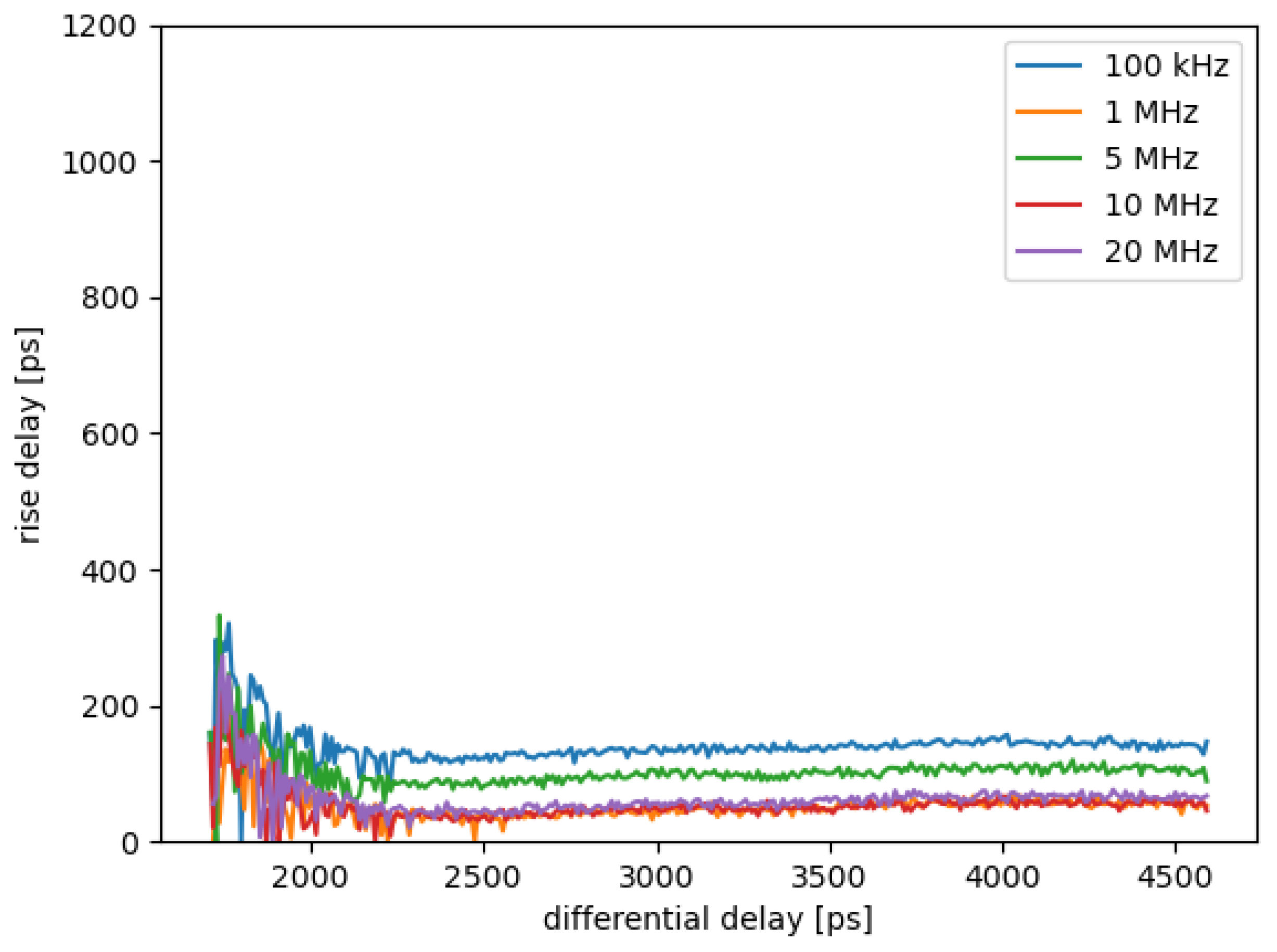
The repetition rate was tested up to 30 MHz as limited by the measurement setup. The pulse properties are consistent up to 100 kHz, where the time constant of the RC pulse-shaping network becomes comparable to the repetition rate and alters the pulse delay. No other properties change with the repetition rate, making compensation trivial (Figure 5, Figure 6, Figure 7 and Figure 8). After calibration, this effect can be eliminated. We expect the system to perform equally well at least up to 100 MHz.

5.3. Supply Voltage Dependence

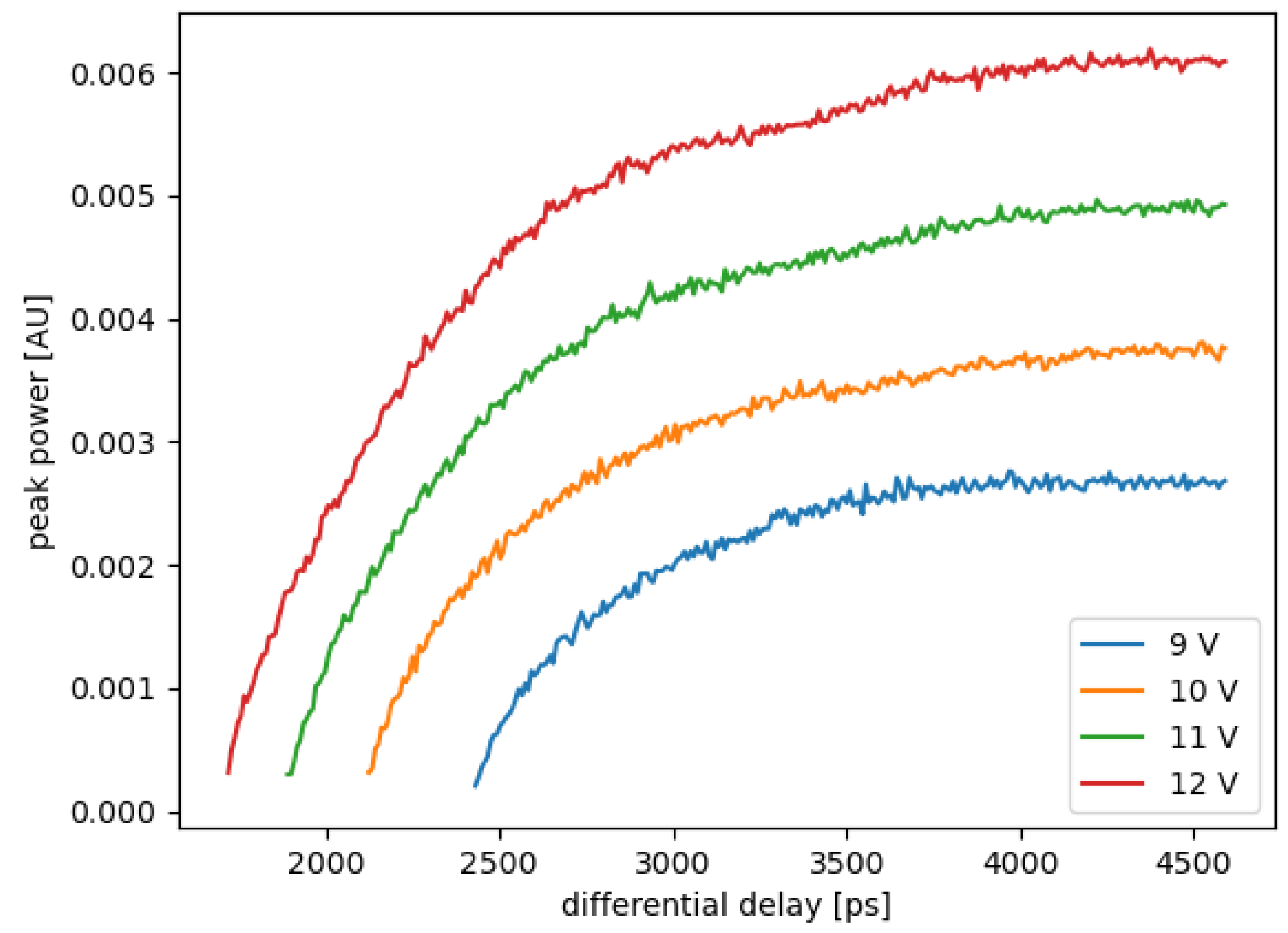
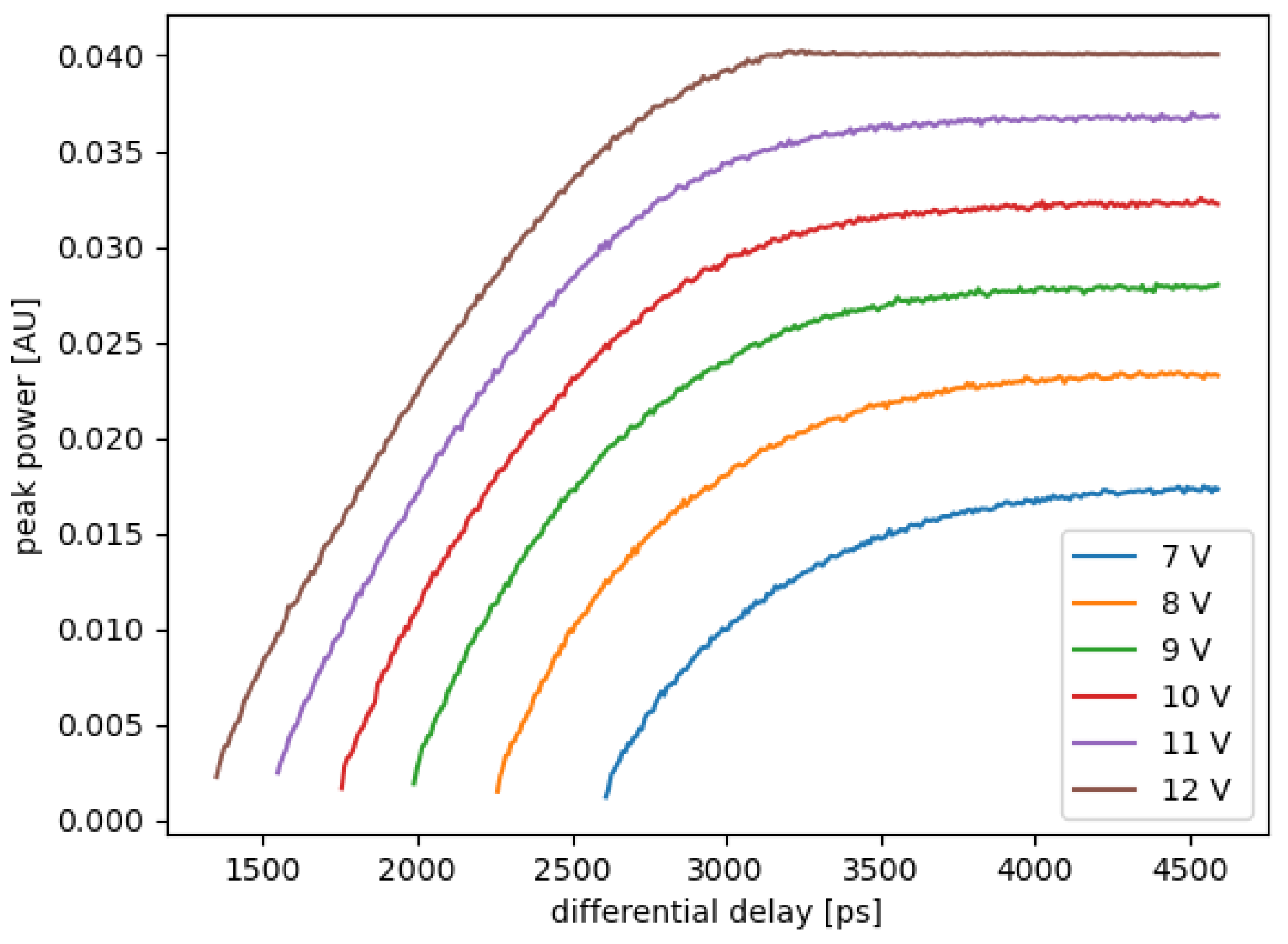
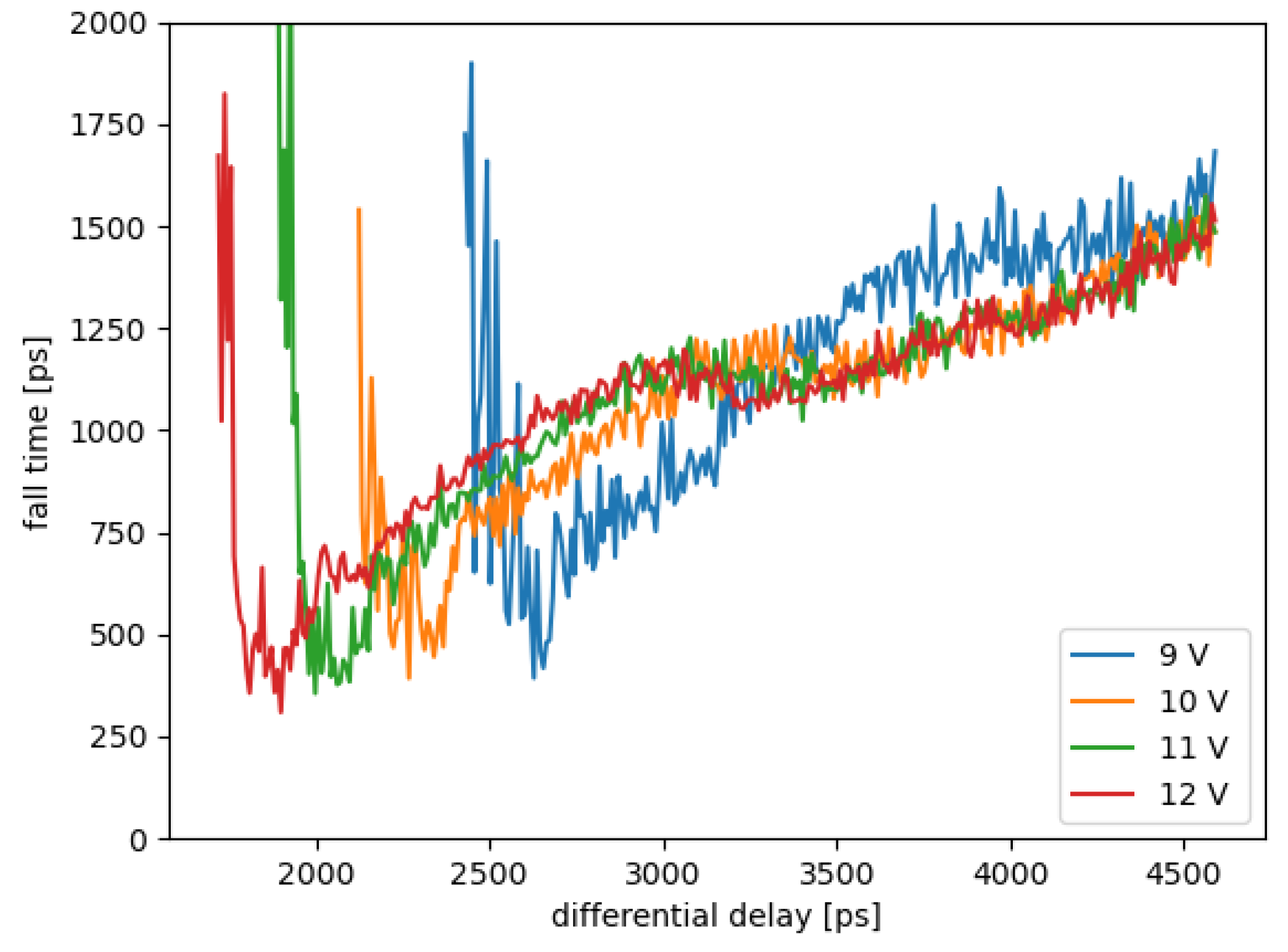
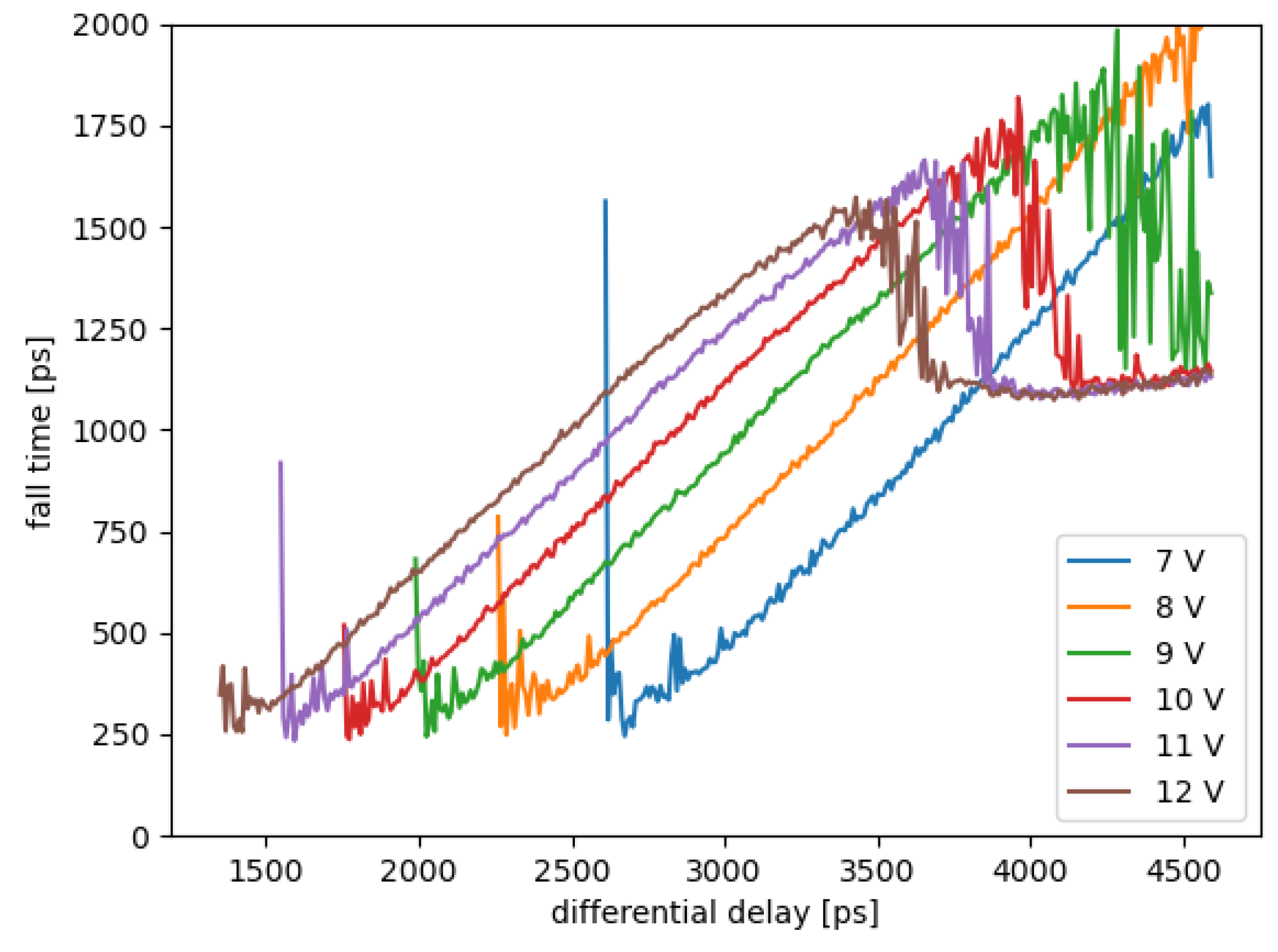
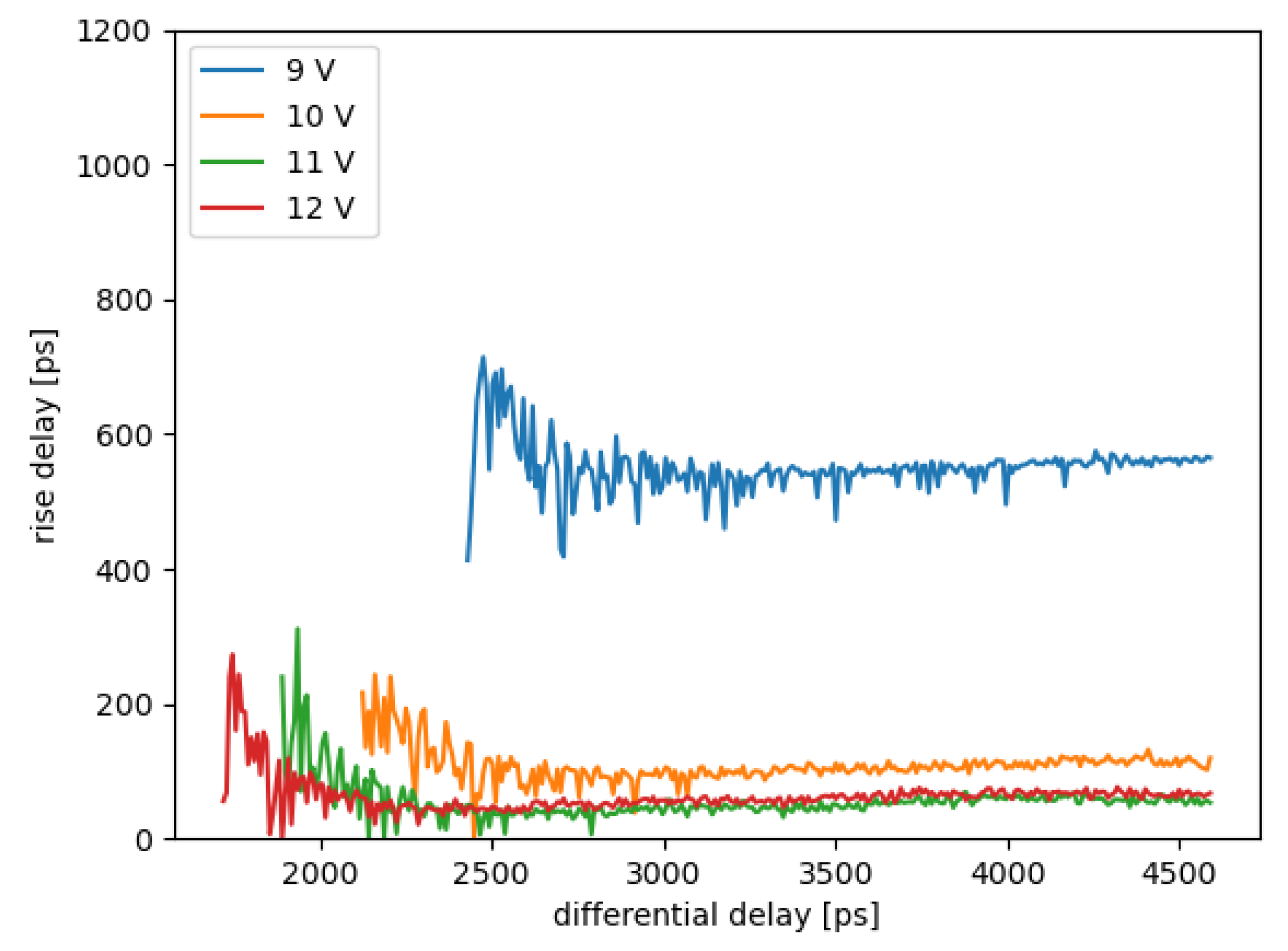
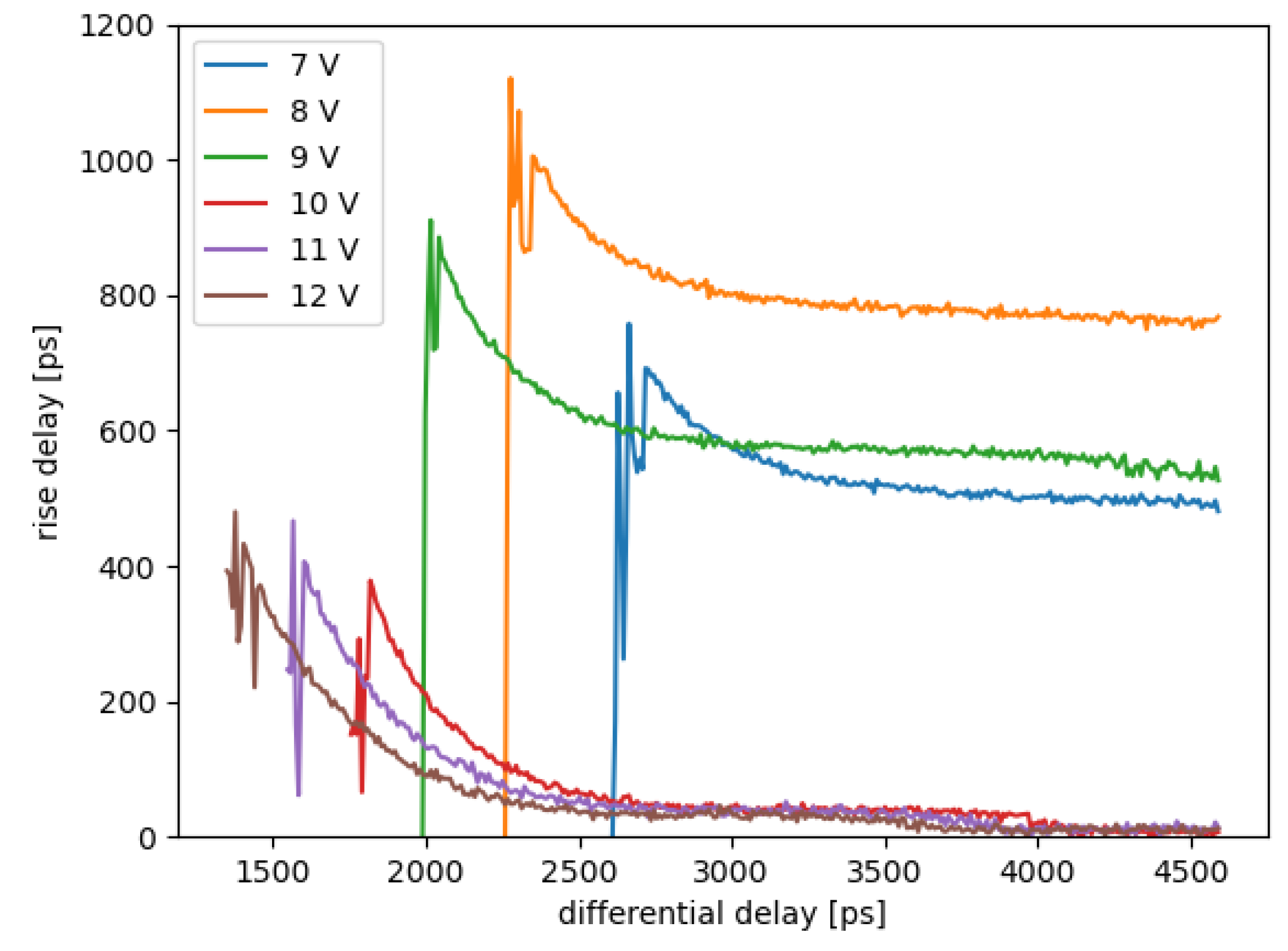
Variation of the supply voltage changes the amplitude of the injection pulse generated by the driver. A laser diode becomes excited only by a pulse exceeding a certain, constant threshold. Reducing the supply voltage decreases the minimum pulse width, as a smaller part of the pulse is above V f , generating a shorter and sharper current pulse, but also significantly decreases the pulse amplitude by reducing the available output current (Figure 9, Figure 10, Figure 11, Figure 12, Figure 13 and Figure 14).

5.4. Control Word Dependence

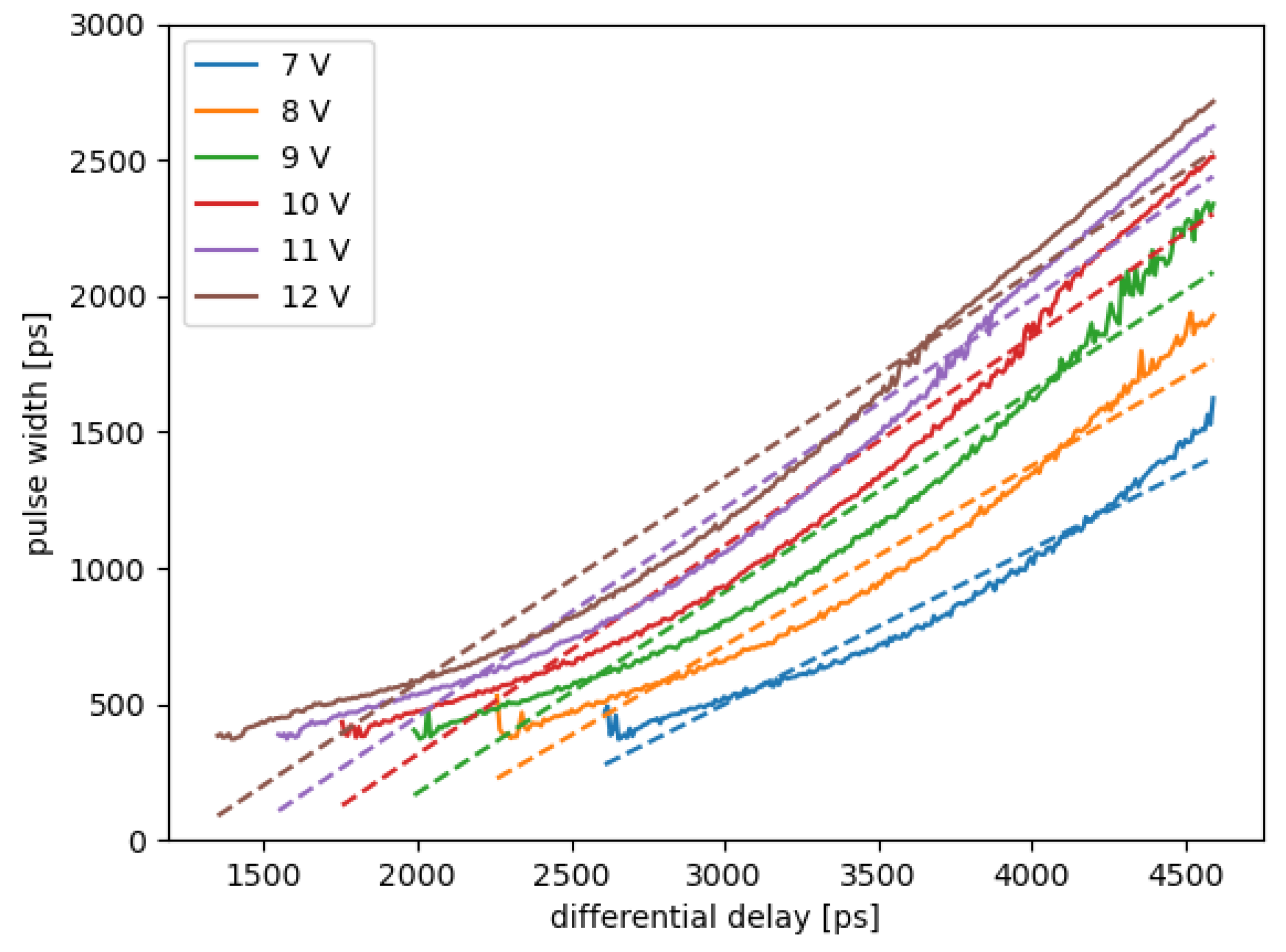
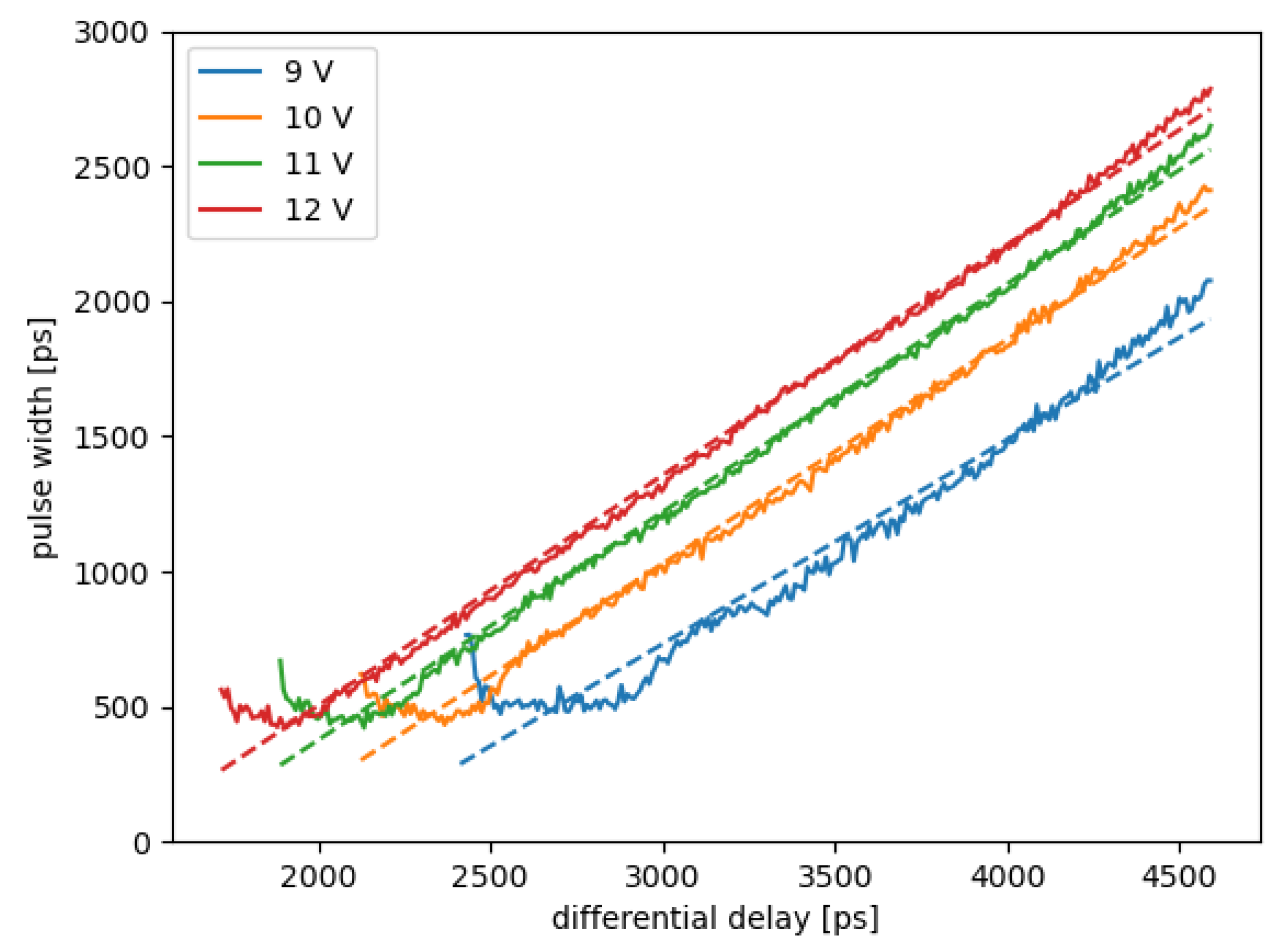
Below a certain delay difference, there is no optical output, as the peak amplitude of the generated electrical pulse is lower than V f . When the peak amplitude increases above V f , a current starts flowing through the laser diode, and it operates in LED mode. When the delay is further increased, the current increases until the threshold current is reached, and laser pulses begin to be generated. Due to the complex nonlinear interactions inside the laser diode, the optical pulse width does not change linearly with the driving pulse width. The relation depends on several factors, primarily semiconductor material, cavity length, and wavelength. For the red diode, the relation is highly nonlinear, whereas for the green one it is almost linear (Figure 15 and Figure 16). Because the nonlinearity is dependent on the diode’s construction, each diode has to be individually calibrated to maximise performance. We believe that the difference in linearity results from the different τ p h values of the two diodes as confirmed by direct time-domain measurements. The red diode exhibits dampened oscillations, whereas the green generates a single optical pulse.
The measured dependence of the optical pulse width on the applied differential delay is shown together with linear best-fit curves (Figure 15 and Figure 16). In all tested cases, the slope of this dependence remains consistently smaller than unity, indicating that changes in the electrical delay translate into proportionally smaller changes in the generated optical pulse width. Since the differential delay is digitally adjustable in discrete 9 ps steps, this sub-unity slope inherently limits the minimum achievable change in optical pulse width to a value not exceeding the delay resolution itself. As a result, the effective resolution of the generated optical pulses is naturally bounded by, and in practice equal to or better than, the 9 ps step size of the delay control. This behaviour arises from the nonlinear interaction between the electrical excitation waveform and the laser diode dynamics and is observed across different laser diode types and operating conditions.

6. Conclusions

This work presented a compact, digitally controlled laser diode driver capable of generating subnanosecond optical pulses with picosecond-scale adjustability. The proposed architecture employs differential excitation of an unbiased laser diode using two buffered signals with independently programmable delays, enabling the precise definition of the effective driving pulse without requiring ultrafast semiconductor switching.
Experimental results confirm stable operation with optical pulse widths tunable from 350 ps to 2.8 ns in discrete 9 ps steps and repetition rates exceeding 150 MHz. Across tested operating conditions and laser diode technologies, the timing jitter remains below 15 ps and amplitude variation below 1%. The absence of DC bias current reduces steady-state power dissipation and thermal load, simplifying thermal management and improving robustness against variations in electrical edge rates and diode parameters.
While the maximum output current is limited by the selected gate-driver devices and negative voltage excursions require appropriate diode protection, these constraints can be addressed through component selection and external clamping. Overall, the presented driver provides a flexible and cost-effective platform for applications requiring precise, digitally adjustable optical pulse timing and width, including time-of-flight ranging, lifetime measurements, and laboratory-scale optoelectronic experiments.

Author Contributions

Conceptualisation, M.P.; methodology, M.P.; software, M.P.; validation, O.Z.; verification, W.P.; investigation, M.P. and O.Z.; data analysis, W.P.; resources, W.P.; writing—review and editing, O.Z.; project administration, O.Z.; funding acquisition, W.P. All authors have read and agreed to the published version of the manuscript.

Funding

This research received no external funding.

Data Availability Statement

The data that support the findings of this study are available from the corresponding author upon reasonable request.

Acknowledgments

The authors wish to thank Maciej Radtke for making them interested in the topic and his valuable suggestions. We would also like to thank the Live Laser System company for providing us with laser diodes.

Conflicts of Interest

The authors declare no conflicts of interest.

References

  1. Moehring, D.L.; Blinov, B.B.; Gidley, D.W.; Kohn, R.N.; Madsen, M.J.; Sanderson, T.D.; Vallery, R.S.; Monroe, C. Precision lifetime measurements of a single trapped ion with ultrafast laser pulses. Phys. Rev. A 2006, 73, 023413. [Google Scholar] [CrossRef]
  2. Halip, H.; Yoshimura, Y.; Inami, W.; Kawata, Y. Ultrashort laser based two-photon phase-resolved fluorescence lifetime measurement method. Methods Appl. Fluoresc. 2020, 8, 025003. [Google Scholar] [CrossRef]
  3. Kumar, S.; Kamali, T.; Levitte, J.M.; Katz, O.; Hermann, B.; Werkmeister, R.; Považay, B.; Drexler, W.; Unterhuber, A.; Silberberg, Y. Single-pulse CARS based multimodal nonlinear optical microscope for bioimaging. Opt. Express 2015, 23, 13082–13098. [Google Scholar] [CrossRef]
  4. Campagnola, P.J.; de Wei, M.; Lewis, A.; Loew, L.M. High-Resolution Nonlinear Optical Imaging of Live Cells by Second Harmonic Generation. Biophys. J. 1999, 77, 3341–3349. [Google Scholar] [CrossRef]
  5. Reinhold, L.; Stefan, D.; Armin, E.; Lothar, K.; Wilhelm, P.; Weber, H.G. A Tunable Femtosecond Modelocked Semiconductor Laser for Applications in OTDM-Systems. IEICE Trans. Electron. 1998, E81-C, 140–145. [Google Scholar]
  6. Bimberg, D.; Ketterer, K.; Schöll, E.; Vollmer, H.P. Avalanche generator triggered picosecond light pulses from unbiased V-groove GaAs/GaAlAs LASERS. Physica 1985, 129, 469–472. [Google Scholar] [CrossRef]
  7. Paulus, P.; Langenhorst, R.; Jäger, D. Generation and Optimum Control of Picosecond Optical Pulses from Gain Switched Semiconductor Lasers. IEEE J. Quantum Electron. 1988, 24, 1519–1523. [Google Scholar] [CrossRef]
  8. Rosado, A.; Pérez-Serrano, A.; Tijero, J.M.G.; Gutierrez, A.V.; Pesquera, L.; Esquivias, I. Numerical and Experimental Analysis of Optical Frequency Comb Generation in Gain-Switched Semiconductor Lasers. IEEE J. Quantum Electron. 2019, 55, 1–12. [Google Scholar] [CrossRef]
  9. Hu, Y.; Dubov, M.; Khrushchev, I. Self-seeded gain-switched operation of an InGaN MQW laser diode. In Semiconductor Lasers and Laser Dynamics; Lenstra, D., Morthier, G., Erneux, T., Pessa, M., Eds.; International Society for Optics and Photonics; SPIE: Bellingham, DC, USA, 2004; Volume 5452, pp. 625–627. [Google Scholar] [CrossRef][Green Version]
  10. Lourtioz, J.-M.; Chusseau, L.; Stelmakh, N. Picosecond and sub-picosecond pulse generation in semiconductor lasers. J. Phys. III Fr. 1992, 2, 1673–1690. [Google Scholar] [CrossRef][Green Version]
  11. Demokan, M.; Nacaroglu, A. An analysis of gain-switched semiconductor lasers generating pulse-code-modulated light with a high bit rate. IEEE J. Quantum Electron. 1984, 20, 1016–1022. [Google Scholar] [CrossRef]
  12. Torphammar, P.; Eng, S. Picosecond pulse generation in semiconductor lasers using resonance oscillation. Electron. Lett. 1980, 16, 587–589. [Google Scholar] [CrossRef]
  13. Nissinen, J.; Kostamovaara, J. A High Repetition Rate CMOS Driver for High-Energy Sub-ns Laser Pulse Generation in SPAD-Based Time-of-Flight Range Finding. Electron. Lett. 2016, 16, 1628–1633. [Google Scholar] [CrossRef]
  14. Zhang, C.; Zhang, Y.; Tong, Z.; Zou, H.; Zhang, H.; Zhang, Z.; Lin, G.; Xu, J. Theoretical analysis and experimental demonstration of gain switching for a PPM based UWOC system with picosecond pulses. Opt. Express 2022, 30, 38663–38673. [Google Scholar] [CrossRef]
  15. Johnson, B.C.; Mooradian, A. Observation of gain compression in a GaAlAs diode laser through a picosecond transmission measurement. Appl. Phys. Lett. 1986, 49, 1628–1633. [Google Scholar] [CrossRef]
  16. Lopez, A.; Strong, H.N.; McGlothen, K.I.; Hines, D.J.; Baker, R.J. A Compact Avalanche-Transistor-Based Pulse Generator for Transcranial Infrared Light Stimulation (TILS) Experiments. Instruments 2022, 6, 20. [Google Scholar] [CrossRef]
  17. Bielecki, Z.; Chmielewski, J. application of avalanche effect in transistors for shaping the pulse driving diode laser. Opto-Electron. Rev. 1996, 4, 58–61. [Google Scholar]
  18. Kilpelä, A.; Kostamovaara, J. Laser pulser for a time-of-flight laser radar. Rev. Sci. Instrum. 1997, 68, 2253–2258. [Google Scholar] [CrossRef]
  19. Biernat, A.; Korapa, G. Generation of high-power picosecond laser pulses. In Proceedings of the Gallium Arsenide Applications Symposium, Amsterdam, The Netherlands, 5–6 October 1998. [Google Scholar]
  20. Rai, V.N.; Shukla, M.; Pant, H.C. Generation of picosecond optical pulses from single heterostructure GaAs diode laser and their emission characteristics. Pramana 1995, 45, 439–451. [Google Scholar] [CrossRef]
  21. semiconductor, R. Laser Diode Drive Circuit Design Method and Spice Model. Available online: https://fscdn.rohm.com/en/products/databook/applinote/opto/laser_diode/high_power/ld_for_lidar_spice_an-e.pdf (accessed on 1 December 2025).
  22. Tajfar, A.; Zamprogno, M.; Villa, F.; Zappa, F. A 20 A Sub-Nanosecond Integrated CMOS Laser Diode Driver for High Repetition Rate SPAD-Based Direct Time-of-Flight Measurements. In Proceedings of the 2018 International Conference on Computing, Electronics & Communications Engineering (iCCECE), Southend-on-Sea, UK, 16–17 August 2018; pp. 272–276. [Google Scholar] [CrossRef]
  23. Wens, M.; Redoute, J.M.; Blanchaert, T.; Bleyaert, N.; Steyaert, M. An integrated 10A, 2.2ns rise-time laser-diode driver for LIDAR applications. In Proceedings of the 2009 Proceedings of ESSCIRC, Athens, Greece, 14–18 September 2009; pp. 144–147. [Google Scholar] [CrossRef]
  24. Coleman, P.D.; Borchardt, J.J.; Alexander, J.A.; Williams, J.T.; Peters, T.F. Characterization of a synchronous wave nonlinear transmission line. In Proceedings of the 2011 IEEE Pulsed Power Conference, Chicago, IL, USA, 19–23 June 2011; pp. 173–177. [Google Scholar] [CrossRef]
  25. Torphammar, P.; Tell, R.; Eklund, H.; Johnston, A. Minimizing pattern effects in semiconductor lasers at high rate pulse modulation. IEEE J. Quantum Electron. 1979, 15, 1271–1276. [Google Scholar] [CrossRef]
  26. Klein, H.J.; Bimberg, D.; Beneking, H.; Kuhl, J.; Göbel, E.O. High peak power picosecond light pulses from a directly modulated semiconductor laser. Appl. Phys. Lett. 1982, 41, 394–396. [Google Scholar] [CrossRef]
  27. Bimberg, D.; Ketterer, K.; Schöll, E.; Vollmer, H.P. Optical distance meter using a short pulse width laser diode with a fast avalanche photodiode. Physica 1995, 66, 43–47. [Google Scholar] [CrossRef]
  28. Wada, K.; Kitagawa, N.; Matsukura, S.; Matsuyama, T.; Horinaka, H. Timing and amplitude jitter in a gain-switched multimode semiconductor laser. Jpn. J. Appl. Phys. 2016, 55, 042702. [Google Scholar] [CrossRef]
  29. Grant, K.J.; Liu, H.F.; Jan, R. Spectral technique for measuring the pulse-width jitter of a gain-switched laser. Opt. Commun. 2002, 213, 183–186. [Google Scholar] [CrossRef]
Figure 1. Conceptual timing diagram illustrating the operating principle of the proposed driver. IN denotes the input trigger signal; A and B are the delayed replicas generated by the programmable delay line; C and D are the corresponding buffer outputs driving the laser diode terminals; and OUT represents the resulting differential voltage applied to the laser diode.
Electronics 15 00210 g001
Figure 2. Schematic of the proposed laser diode driver circuit.
Electronics 15 00210 g002
Figure 3. Block diagram of the experimental setup used for pulse characterisation. Arrows show electircal connections, dashed lines show logical data flow through control plane and optical coupling.
Electronics 15 00210 g003
Figure 4. Photo of the experimental setup used for optical pulse measurements.
Electronics 15 00210 g004
Figure 5. Pulse peak power change with varying repetition rate for the green laser diode, 10 V supply.
Electronics 15 00210 g005
Figure 6. Fall time change with varying repetition rate for the green laser diode, 10 V supply.
Electronics 15 00210 g006
Figure 7. Pulse width change with varying repetition rate for the green laser diode, 10 V supply.
Electronics 15 00210 g007
Figure 8. Rise delay change with varying repetition rate for the green laser diode, 10 V supply.
Electronics 15 00210 g008
Figure 9. Pulse peak power change with varying supply voltage for green laser diode, 20 MHz repetition rate.
Electronics 15 00210 g009
Figure 10. Pulse peak power change with varying supply voltage for the red laser diode, 20 MHz repetition rate.
Electronics 15 00210 g010
Figure 11. Fall time change with varying supply voltage for the green laser diode, 20 MHz repetition rate.
Electronics 15 00210 g011
Figure 12. Fall time change with varying supply voltage for the red laser diode, 20 MHz repetition rate.
Electronics 15 00210 g012
Figure 13. Rise delay change with varying supply voltage for the green laser diode, 20 MHz repetition rate.
Electronics 15 00210 g013
Figure 14. Rise delay change with varying supply voltage for the red laser diode, 20 MHz repetition rate.
Electronics 15 00210 g014
Figure 15. Pulse width change with varying supply voltage for the red laser diode, 20 MHz repetition rate.
Electronics 15 00210 g015
Figure 16. Pulse width change with varying supply voltage for the green laser diode, 20 MHz repetition rate.
Electronics 15 00210 g016
Table 1. Properties comparison of proposed solution to relevant commercial products.
IDManufacturerMPNPulse
Width [ps]
Repetition
Rate [MHz]
Jitter [ps]Power
Efficiency [%]
1ANALOG MODULES, INC. (FL, USA)Model 767150–7501unspecified25
2Alphalas (Germany)ALPHALAS
PICOPOWER™-LD Series
60, 50, 400–100<4<0.1
3Thorlabs (NJ, USA)GSL series1–650.2–20012<0.01
4Innolume (Germany)LDD-14pin-2A-GS600.001–30unspecified10
5Innolume (Germany)LDD-14pin-2A-NS1n–100n0.001–10unspecified10
6Proposed solution370–2800 *0–1504–1520
* Can be expanded by daisy chaining additional delay lines.
Table 2. Standard deviation of output pulse parameters for different supply voltages.
Device
Type
Vcc   [ V ] τ f [ps] τ r [ps]Pulse
Width [ps]
Trigger
Delay [ps]
Amplitude [%]
green
laser
diode
99.33.95.83.60.42
109.92.54.94.40.51
116.22.54.34.50.29
125.62.04.86.30.26
red
laser
diode
78.34.99.33.90.29
88.44.67.74.60.47
911.117.315.218.00.76
1014.619.714.821.71.04
119.720.010.220.50.54
1212.718.09.520.00.83
Disclaimer/Publisher’s Note: The statements, opinions and data contained in all publications are solely those of the individual author(s) and contributor(s) and not of MDPI and/or the editor(s). MDPI and/or the editor(s) disclaim responsibility for any injury to people or property resulting from any ideas, methods, instructions or products referred to in the content.