
Article

Wide Beam Analysis of Phased EM Surfaces

1
Department of Electronic Engineering, Tsinghua University, Beijing 100084, China
2
State Key Laboratory of Space Network and Communications, Tsinghua University, Beijing 100084, China
3
Information Support Force Engineering University, Wuhan 430030, China
*
Author to whom correspondence should be addressed.
Electronics 2026, 15(1), 191; https://doi.org/10.3390/electronics15010191
Submission received: 25 November 2025 / Revised: 21 December 2025 / Accepted: 24 December 2025 / Published: 31 December 2025
(This article belongs to the Special Issue Advanced Antennas and Propagation for Next-Gen Wireless)

Abstract

Phased electromagnetic (EM) surfaces offer a versatile platform for beamforming, yet their application to wide-beam radiation—essential for broadcasting and target tracking—has been hindered by the absence of a foundational analytical model. This article establishes an effective model, quantitatively linking the maximum achievable beamwidth to the surface’s core physical parameters. A direct scaling equation is first derived for an idealized continuous aperture, revealing a proportionality among beamwidth, the quadratic phase coefficient, and aperture size, which demonstrates the potential for quasi-omnidirectional coverage. The model is then extended to practical scenarios, showing that the main-lobe taper is directly controlled by the aperture amplitude taper, establishing a decoupling principle for independent control of beam shape and width. Finally, by modeling the array factor of a discrete aperture, the trade-off between element spacing and maximum beamwidth is quantified, providing clear design rules to prevent grating lobe distortion. This work provides an intuitive, physics-based foundation for the systematic design and performance prediction of wide-beam phased EM surfaces.

1. Introduction

Phased electromagnetic (EM) surfaces offer a cost-effective route to versatile beamforming, making them prime candidates for next-generation radar and communication systems [1,2,3,4,5,6]. However, a critical knowledge gap concerning their achievable beamwidth limits their use in wide-beam applications like hierarchical target searching [7,8] and channel estimation [9,10,11]. The theoretical foundation for generating tiered beamwidths (as illustrated in Figure 1) remains unestablished, impeding both design guidance and system performance prediction.
The prevailing design approach for wide beams relies on numerical optimization, such as nonlinear programming [12,13,14], convex optimization [15,16], heuristic algorithms [17] and iterative projections [18,19,20]. Although capable of generating desired patterns (e.g., flattop [17], isoflux [18,19], or shaped beams [20]), these methods suffer from low efficiency due to their iterative nature and high computational complexity. More critically, they tend to operate as “black boxes” that lack analytical transparency. These methods often overlook a fundamental question: what are the intrinsic physical limits, imposed by the aperture’s parameters, that constrain the maximum achievable beamwidth? Consequently, they fail to yield a general theoretical understanding or intuitive design guidelines.
Analytical methods, in contrast, offer the potential for deeper physical insight. While well-established synthesis techniques exist for generating sector patterns from line sources or arrays [21], they typically require both control over amplitude and phase, especially the former. However, in many practical scenarios, the amplitude distribution is strictly constrained by the hardware architecture. For instance, high-efficiency phased arrays typically require uniform excitation to saturate power amplifiers, while spatially fed systems—such as transmitarrays and reflectarrays—have amplitude distributions determined solely by the feed illumination. Consequently, these systems necessitate pattern synthesis via pure phase control. A notable example involves the use of Zadoff–Chu (ZC) sequences for uniform linear arrays under a constant amplitude constraint imposed to maximum transmit power [22,23,24,25]. These approaches exploit the uniform amplitude property of both ZC sequences and their Discrete Fourier transform (DFT) counterparts, the latter of which corresponds to the discrete pattern samples. Nevertheless, the coarse treatment of beamwidth in these methods ignores in-band ripples, which translates into unpredictable link degradation within the coverage area [26,27]. Crucially, while these analytical pure phase works [22,23,24,25,26,27] achieve broadened coverage, they focus on discrete samples and fail to formulate a continuous model relating the wide-beam pattern to aperture parameters. Consequently, they lack a formally defined beamwidth in this context; therefore, the theoretical upper limit of the beamwidth remains unknown. This stands in stark contrast to the principle for focused narrow beams, where this relationship is well-understood [28,29,30,31], leaving a clear void in the literature for wide-beam analysis.
To fill this gap, this article moves beyond case-by-case numerical solutions by developing a theoretical model that quantitatively links the wide beamwidth of an EM surface to its core physical parameters. This analytical foundation is built progressively. Section 2 formulates the problem by decomposing it into the analysis of an idealized case and two practical constraints. Section 3 derives the analytical solutions for the idealized model, and Section 4 then incorporates the effects of aperture amplitude taper and aperture discretization. Section 5 discusses the model generalizability and comparison with common wide beam works. Section 6 concludes the study.

2. Problem Statement

The ultimate concern is the maximum beamwidth achievable by practically phased EM surfaces, which inherently possess discretized aperture arrangements, quantized phase distributions, and generally non-uniform amplitude profiles. However, while essential for physical realization, these implementation constraints collectively preclude direct analytical treatment of this problem.
Therefore, the fundamental inquiry gets strategically decomposed into two-tiered sub-problems through constraint relaxation and controlled reintroduction in this article:
Sub-problem 1: Fundamental Beamwidth Limit Under Idealized Conditions
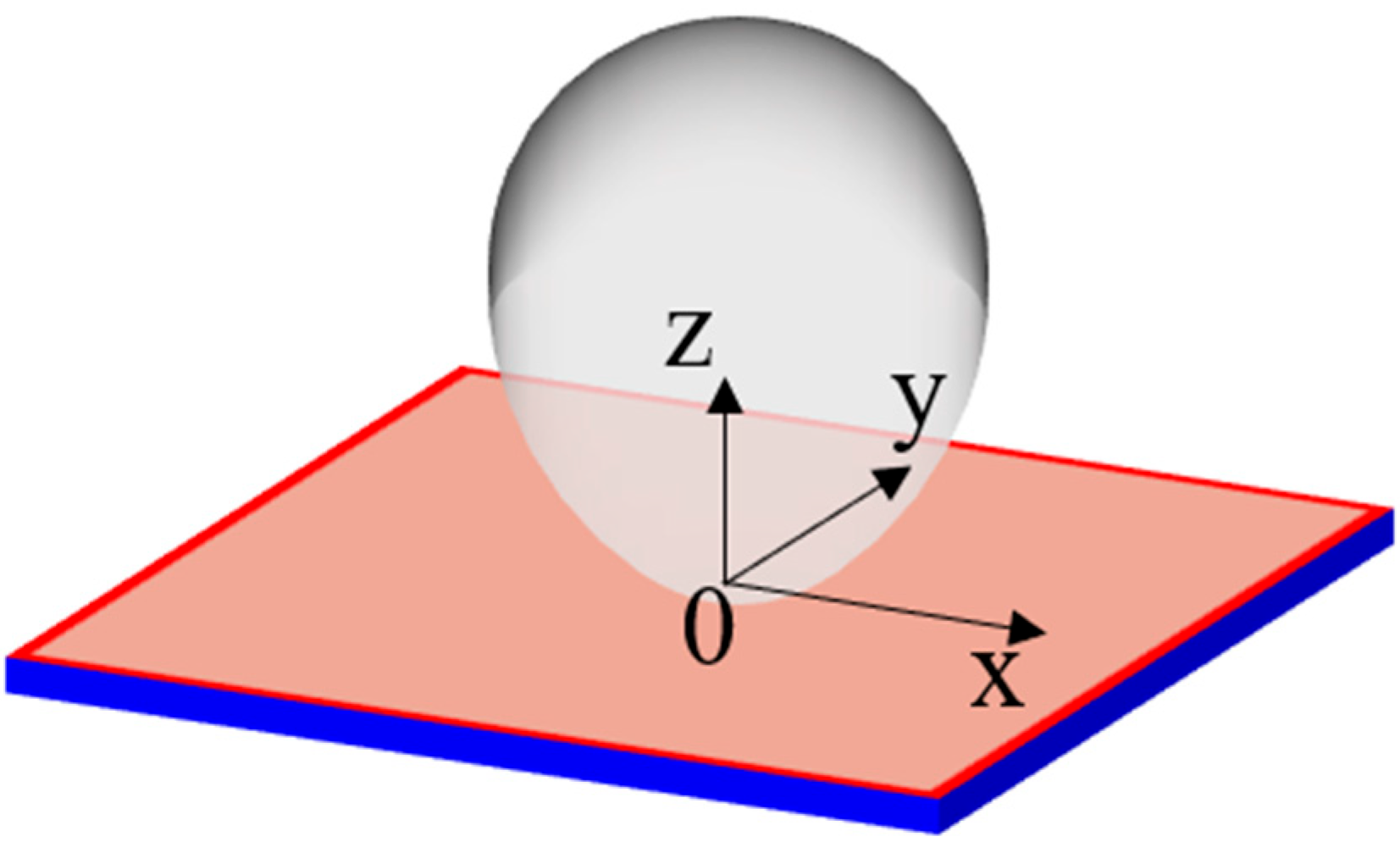
Determine the maximum beamwidth achievable by a phased EM surface (as sketched in Figure 2) with the following:
  • A fixed-size square aperture;
  • A uniform aperture amplitude profile;
  • A continuous aperture arrangement (non-discretized).
To establish this analytical baseline, two foundational questions are first resolved:
  • What is a suitable phase distribution for wide beams?
  • How do aperture parameters govern main-lobe broadening in an explicit form?
Sub-problem 2: Impacts of Non-ideal Implementation Constraints
Building on the previous foundation, two parallel studies sequentially investigate:
  • Amplitude distribution effect, by developing parameterized tapering models that balance analytical tractability with physical realizability, and characterizing the dependencies of main-lobe distortion on amplitude distribution parameters.
  • Aperture discretization impact, by defining the spectral equivalence between continuous and discretized apertures, quantifying the maximum beamwidth degradation versus element periods, and deriving discretization density requirements for target beamwidth preservation.

3. Wide Beam Forming of an Ideal Aperture

To establish a theoretical baseline, the analysis begins with an idealized aperture, as depicted in Figure 2. It is modeled as a square, continuous aperture with a uniform amplitude distribution, analogous to a planar holographic surface. Such an idealization facilitates direct analytical treatment and provides fundamental insights for more complex scenarios that follow.

3.1. Analytical Beam Control

3.1.1. Aperture Phasing Scheme

Simple yet effective, the quadratic aperture phase is adopted for wide-beam forming, inspired by ZC sequences [22]:
Φ a = a x 2 + y 2 ,
where the coefficient a is assumed positive ( a > 0 ) for simplicity. The ZC sequence’s property as a constant amplitude zero autocorrelation sequence ensures constant envelopes in both the spatial domain and its DFT [22,23], implying a potential for effective beam broadening.
Furthermore, the distribution for a broadside beam in (1) can be generalized to steer the beam to an arbitrary direction by modifying the expression to
Φ a = a x m 2 + y n 2 ,
where m and n are steering parameters.
The far-field radiation pattern, F u , v , is related to the aperture field distribution through the Fourier transform:
F u , v = L / 2 L / 2 L / 2 L / 2 A ( x , y ) exp [ j Φ a + j 2 π ( u x + v y ) ] d x d y ,
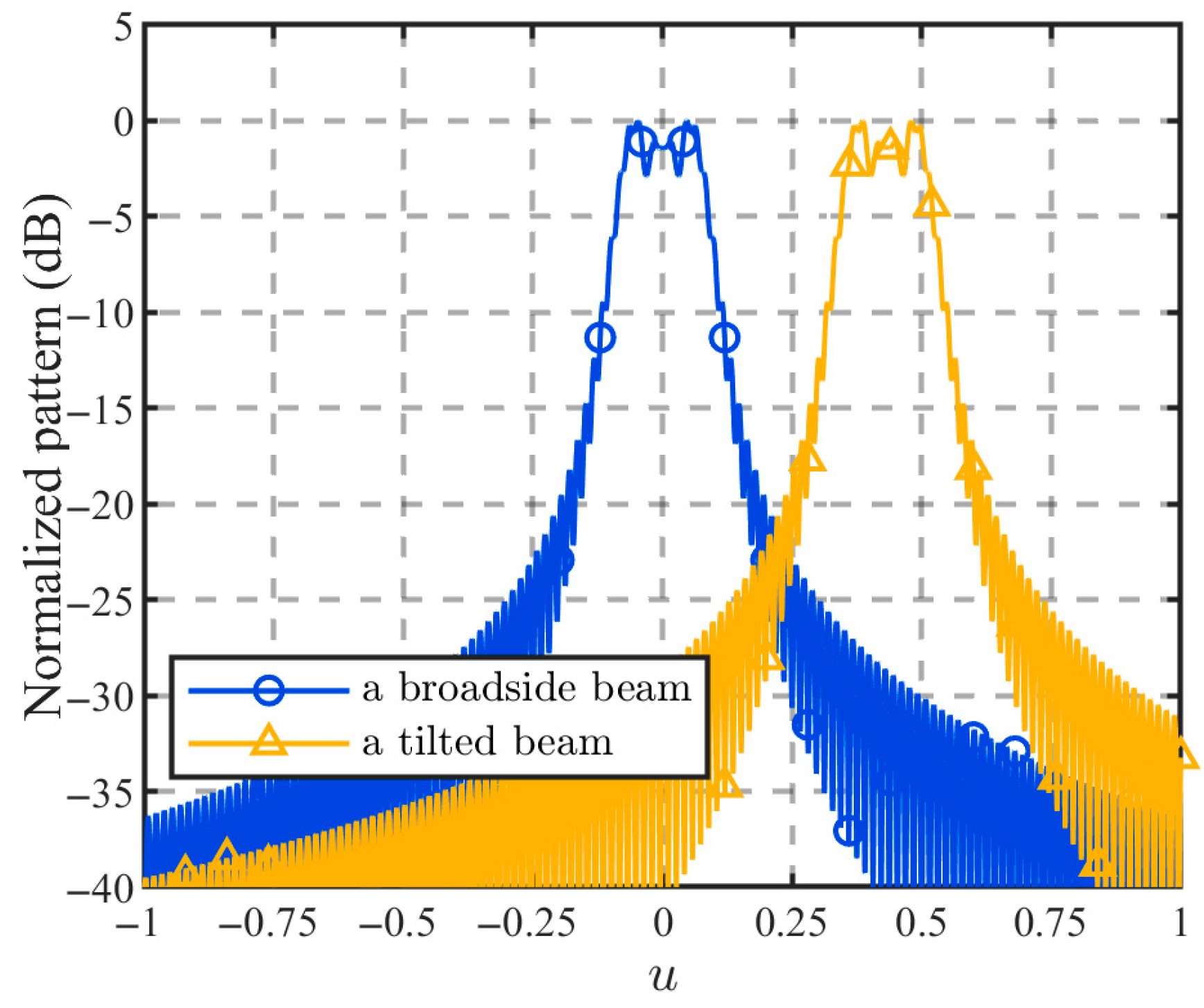
where A ( x , y ) is the aperture amplitude distribution, and L is the side length of the square aperture. The far-field patterns can be computed numerically by densely sampling the continuous aperture and applying the array method. Figure 3 shows the calculated patterns for an aperture with L = 64 λ , presented as cuts for a broadside beam (along v = 0 ) and a beam tilted to u center , v center = 0.43 , 0.25 (corresponding to θ , ϕ = 30 ° , 30 ° ) (along v = 0.25 ). These plots confirm that the quadratic phasing scheme can effectively generate wide beams in both broadside and tilted directions. However, neither (3) nor the numerical results yield an explicit analytical relationship between the beamwidth and the aperture parameters, which is essential for direct physical insight and design.

3.1.2. Radiation Pattern Analysis via Approximation

Analytical treatment is facilitated by the separability and symmetry of the aperture phase in (2), which allows the 2D far-field pattern to be expressed as a product of two equivalent 1D patterns:
F u , v = F 1 D u F 1 D v .
Analysis is thus simplified to a single dimension without loss of generality. For a broadside beam m = n = 0 , the 1D pattern along the u-axis is
F 1 D u = L / 2 L / 2 exp [ j ( a x 2 + 2 π u x ) ] d x .
The integral is solved by completing the square in the exponent, i.e., a x 2 + 2 π u x = [ a ( x + π u / a ) ] 2 π 2 u 2 / a . Applying the variable substitution t = a x + π u / a then yields a closed-form expression in terms of the standard Fresnel integral, F r x = 0 x exp ( j t 2 ) d t :
F 1 D u = exp ( j π 2 u 2 / a ) / a F r ( A ) + F r ( B ) ,
where A = a L / 2 π u / a and B = a L / 2 + π u / a . While exact, this form is complex. To reveal the underlying relationship between beamwidth and aperture parameters, several well-founded approximations are introduced.
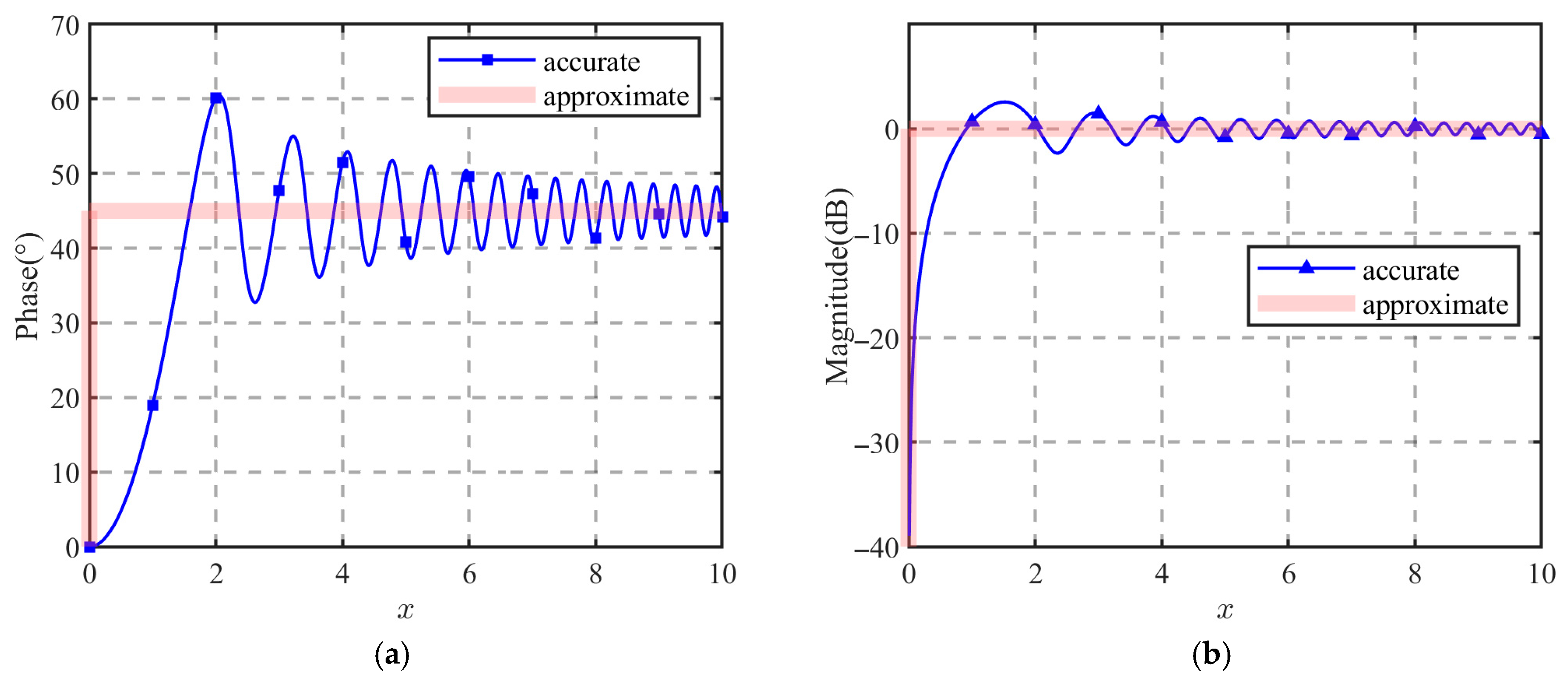
First, as plotted in Figure 4, the F r x phase (Figure 4a) varies mildly for large positive x. This allows approximating the pattern magnitude by directly considering the Fresnel term magnitudes. Specifically, for u a L / 2 π , both A and B are non-negative, and the terms add constructively. For u > a L / 2 π , one argument becomes negative, causing the terms to subtract due to the odd symmetry of the Fresnel integral F r x = F r x . Mathematically,
a · F 1 D u F r A + F r B , u a L / 2 π F r A F r B , u > a L / 2 π .
The simplified relation directly links F r x ’s behavior to the far-field pattern. Figure 4b depicts F r x normalized to its converged value for x > 0 . It oscillates around this value before dropping sharply to zero as x 0 . This oscillatory behavior, combined with the sum-or-difference nature of (7), implies that the radiation pattern will exhibit ripples and a distinct roll-off.
Next, to obtain a direct expression for the beamwidth, a more decisive approximation is employed based on the stationary phase method (SPM). This method simplifies F r x to a step function, highlighted by the thick curves in Figure 4, capturing the integral’s essential low-pass characteristic while ignoring oscillations. Substituting this model into (7) reduces the far-field radiation to a rectangular function:
a · F 1 D u 2 F r + , u < u c F r + , u = u c 0 , u > u c ,
where u c = a L / ( 2 π ) defines the boundary of the non-zero radiation interval. This idealized rectangular pattern implies an abrupt 6 dB gain drop at u = ± u c . Therefore, u c can be interpreted as the approximate 6 dB beamwidth boundary, leading to a simple, explicit formula for the total 6 dB beamwidth:
B W 6 dB B W c = 2 u c = a L / π .
This compact relationship reveals 2 critical insights: 1. the beamwidth is directly proportional to the product of quadratic phase coefficient a and aperture side length L; 2. the beam can be broadened to cover the entire visible half-space, achieving quasi-omnidirectional radiation.
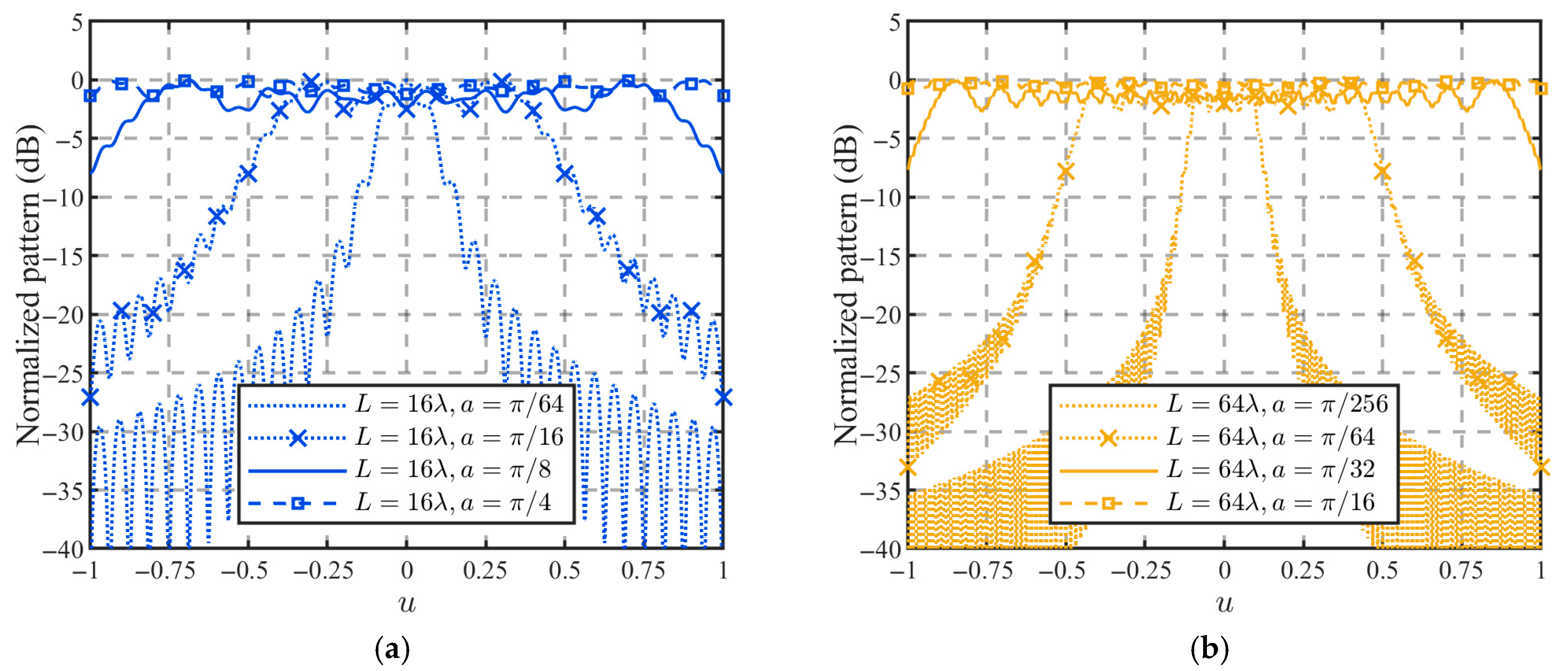
To validate the analysis, the Array Method is employed here and in subsequent sections, with its configuration details listed in Table 1. This approach isolates the specific variables under investigation by excluding external interference such as mutual coupling or structural scattering. The theoretical predictions from Equations (8) and (9) are clearly demonstrated by the normalized radiation patterns in Figure 5. In both Figure 5a for   L = 16 λ and Figure 5b for L = 64 λ , the beamwidth systematically expands as a increases. Moreover, a comparison across the two sub-figures shows that patterns sharing an identical a L product (e.g., L = 16 λ , a = π / 16 and L = 64 λ , a = π / 64 , where a L = π ) exhibit nearly the same beamwidth, further validating the scaling equation in (9). As depicted, this beam expansion culminates in quasi-omnidirectional coverage. At the threshold of a L = 2 π (the solid curves), the main lobe spans the entire visible half-space (approx. −6 dB at boundaries). Increasing a L beyond this point (e.g., to 4 π , plotted with square markers) flattens the patterns even further.
Finally, the analysis generalizes for beam steering. A similar derivation for the tilted phase profile in (2) shows that the resulting 1D patterns are simply translations of the broadside ones:
F 1 D u = F 1 D , broadside u a m / π ;
F 1 D v = F 1 D , broadside v a n / π .
As shown in (10), steering parameters m and n shift the pattern along the u and v axes, respectively, without affecting its width. The beam-direction is therefore given by
u center , v center = a m / π , a n / π .
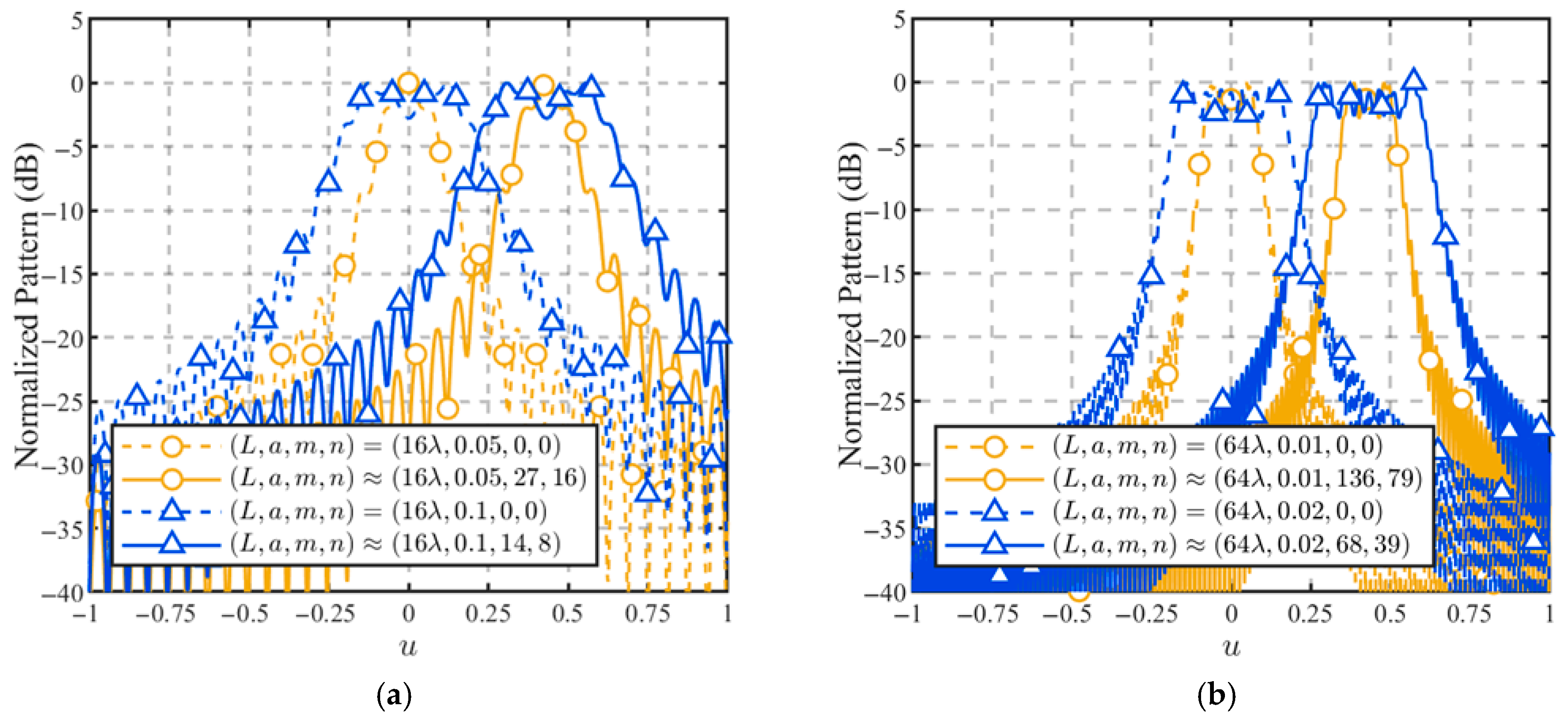
These equations demonstrate a versatile control mechanism where the beamwidth is primarily governed by a, while the beam direction is determined by the products am and an. The numerical results in Figure 6 provide clear validation. For both smaller ( L = 16 λ , Figure 6a) and larger ( L = 64 λ , Figure 6b) apertures, the patterns show that a beam of fixed width can be steered from broadside to a target direction (dashed vs. solid lines with identical markers). Furthermore, at a fixed target direction, beamwidth can be modified without affecting pointing accuracy (overlapping solid or dashed curves with circle and triangle markers). Such independent control over beamwidth and direction, afforded by the quadratic phasing scheme, holds true regardless of aperture size.

3.2. Main-Lobe Characteristics

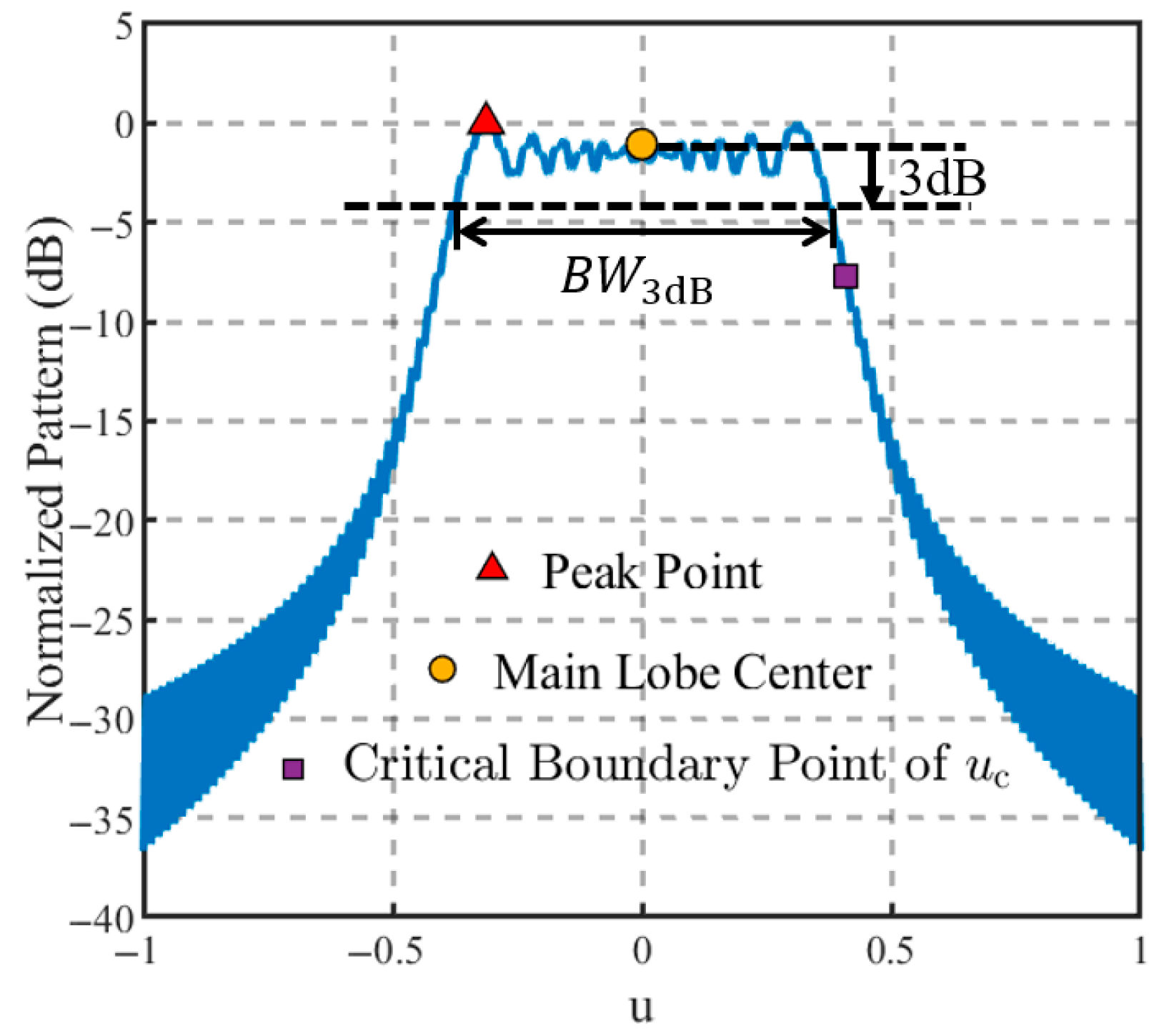
Analysis now proceeds to a more detailed characterization of the main lobe, focusing on its 3 dB beamwidth and its relative peak value, which are annotated in Figure 7. The lower-order model in (8), while useful for the preceding analysis of the general main-lobe extent, is insufficient for this task. In that model, stationary phase approximation of F r x obscures the gradual ramp-up—which is a prerequisite for determining the 3 dB beamwidth—and its oscillatory nature, essential for characterizing main-lobe ripples.
Therefore, this analysis reverts to the higher-fidelity model of (7), focusing on the broadside beam case. The scope is limited to u 0 due to symmetry, and a key approximation is employed. Specifically, the term F r B is approximated with its stable asymptotic value, F r + , simply assuming the argument B is large enough. Conversely, F r A is retained without approximation. As u increases from 0 to the critical value u c , the argument A decreases from a large positive value, such as 10 to 0. Referring to Figure 4b (where x represents A ), this dynamic corresponds to traversing the curve from right to left. Consequently, the magnitude F r A transitions from the stable asymptotic value, enters the oscillatory region, and eventually rolls off sharply.

3.2.1. 3 dB Beamwidth

A derivation of the 3 dB beamwidth—a standard figure of merit for conventional pencil beams [31]—is therefore also necessary for the wide beam under consideration.
To establish the reference level for this calculation, the field at the beam center, F 1 D 0 , is determined first. Setting u = 0 gives A = B = a L / 2 , leading to the expression F 1 D 0 = 2 / a F r a L / 2 from (6). For simplicity, this is approximated further by its asymptotic form:
F 1 D 0 2 / a F r + ,
with the trade-off of a small error kept below 1.5 dB when a L / 2 > 3 , as seen in Figure 4b. Notably, the central field value in (12) is identical to the constant main-lobe level assumed in the lower-order model (cf. (8)). Consequently, the previously established critical width BWc = 2 uc (which corresponds to the −6 dB level at the critical point uc) is understood to be relative to this beam-center gain. As validated in Table 2, this approximation (BW6dBBWc) shows excellent agreement with the center-referenced BW6dB values extracted from the computed patterns, holding true for both aperture configurations. For instance, the estimated 48.1° (i.e., BWc) closely matches the calculated 48.4° (for L = 16λ) and 47.3° (for L = 64λ).
Applying the 3 dB condition to the model in (7), and again approximating the term F r B with its asymptotic value, yields
F r A + F r + F 1 D , ref / 2 .
Setting the reference field F 1 D , ref to the beam-center value F 1 D ( 0 ) derived in (12) yields the argument A 0.369   a . The u-corresponding coordinate of the 3 dB point is
u 3 dB = ( a L / 2 0.369 a ) / π .
The 3 dB beamwidths in rad, given by B W 3 dB = 2 sin 1 u 3 dB , are then
B W 3 dB = 2 sin 1 ( a L / 2 0.369 a ) / π
As shown in Table 2, this estimation matches well with the extracted values from the numerically computed patterns. This consistency further validates the analytical model. A slight deviation stems mainly from the approximation of its beam-center reference level.

3.2.2. Relative Peak Value

For the wide beams under consideration, the gain peak notably does not coincide with the beam center, making the peak gain relative to the center value (derived in (12)) a key characteristic.
The peak field, F 1 D , peak , occurs as increasing u drives F r A to its maximum, which is 2.6 dB above F r + . This yields a relative peak gain, denoted as Gpeak, of approximately 1.4 dB (1.17 times):
F 1 D u peak F 1 D 0 10 2.6 / 20 + 1 F r + 2 F r + 1.17 .
Analysis is validated by the good agreement with the numerically computed results in Table 2. The estimated 1.4 dB gain closely matches the values of 1.4 dB and 1.1 dB extracted from the computed patterns for the L = 16 λ and L = 64 λ apertures, respectively. The minor discrepancies can be attributed to the simplifying assumptions, namely the constant approximation of F r B and the neglected phase differences.

4. Influence of the Practical Aperture Parameters

4.1. Aperture Amplitude Taper

While the preceding analysis assumed a uniform aperture amplitude for its analytical simplicity and relevance to phased arrays [23], practical applications often involve non-uniform or tapered amplitude distributions. Such tapers can be intentionally introduced in phased arrays to suppress sidelobes or may arise naturally in space-fed configurations like reflectarray and transmitarray systems. This section investigates how amplitude tapering affects the characteristics of the studied wide-beam pattern.

4.1.1. Radiation Pattern Approximation

To facilitate the analysis while capturing the essential characteristics of amplitude tapering, the aperture amplitude is modeled using a separable quadratic function:
A m x , y = b x 2 + y 2 + c A m > 0 , c > 0 .
Here, the aperture amplitude taper, Tap, is defined as the ratio of the amplitude at the center to that at the edge:
T ap = A m 0 , 0 A m L / 2 , 0 = 4 c b L 2 + 4 c .
Given a fixed c, Tap is inversely correlated with the coefficient b. A positive taper ( T ap > 0 , or > 0   dB ) corresponds to b < 0 , where the amplitude is highest at the center. Conversely, a negative taper ( T ap < 0 , or < 0   dB ) corresponds to b > 0 .
Substituting the tapered amplitude (17) and phase (1) into the far-field integral (3) gives
F u , v = L / 2 L / 2 b x 2 + b y 2 + c                                               × exp j a x 2 + y 2 + 2 π u x + 2 π v y d x d y .
This integral can be separated by variables, yielding a form that is key to the analysis:
F u , v = F 1 D , taper u F 1 D , 0 v + F 1 D , 0 u F 1 D , taper v .
This expression decomposes the 2D pattern into two fundamental 1D components: F 1 D , 0 , the pattern integral for a uniform-amplitude aperture, as defined in (5), and F 1 D , taper , a new term introduced, defined as
F 1 D , taper u = L / 2 L / 2 b x 2 + c / 2 exp j a x 2 + 2 π u x d x .
The behavior of the 2D pattern can be understood by analyzing its 1D components. Given the symmetric form of (20) with respect to u and v, the analysis can be conducted for the u variable without loss of generality. Applying SPM to (21), the critical boundary at u c = a L / ( 2 π ) is identified as consistent with Section 3, which separates two distinct integration regimes based on the location of the stationary point x 0 = π u / a . When u > u c , x 0 lies outside the integration interval [ L / 2 , L / 2 ] . The integrand’s phase oscillates rapidly, causing destructive interference that results in inefficient accumulation for the F 1 D , taper ( u ) integral. When u < u c , x 0 falls within the interval, leading to a dominant, coherent contribution from its neighborhood. The magnitude of this contribution is principally determined by the amplitude term A m ( x 0 ) = b x 0 2 + c / 2 .
These 1D behaviors dictate the 2D pattern’s characteristics. For the outer region ( u > u c ) , it is known from Section 3 that F 1 D , 0 ( u ) also decays to a negligible value. Examining the two terms in (20), each now contains a small u-dependent component ( F 1 D , taper ( u ) in the first term, F 1 D , 0 ( u ) in the second). Consequently, both terms are significantly suppressed, causing the total radiation level of F ( u , v ) to be very low in this region. This confirms that u c still serves as a sharp boundary for the main beam.
Within the main-lobe region ( u < u c ), the pattern’s shape is governed by the coherent integration process. For a positive aperture taper ( T ap > 0   dB , b < 0 ), the amplitude A m ( x ) peaks at x = 0 , causing F 1 D , taper ( u ) to peak at u = 0 and decrease towards the boundary, which results in a convex main-lobe taper. Conversely, a negative aperture taper ( T ap < 0   dB , b > 0 ) yields a concave main-lobe shape.
Further, an approximation for F 1 D , taper ( u ) (21) is formulated to quantify the insights from the SPM analysis. The SPM establishes that the integral’s value is primarily determined by the contribution from the neighborhood of the stationary point x 0 . Assuming the amplitude term A m ( x ) varies slowly within this dominant integration region—as verified to be robust for practical tapers in the subsequent analysis (see Figure 8)—it can be reasonably approximated by its constant value at the stationary point, A m ( x 0 ) . Factoring this constant term outside the integral in (21) simplifies the expression to
F 1 D , taper u b x 0 2 ( u ) + c / 2 L / 2 L / 2 exp j a x 2 + 2 π u x d x                                       = b x 0 2 ( u ) + c / 2 F 1 D , 0 u .
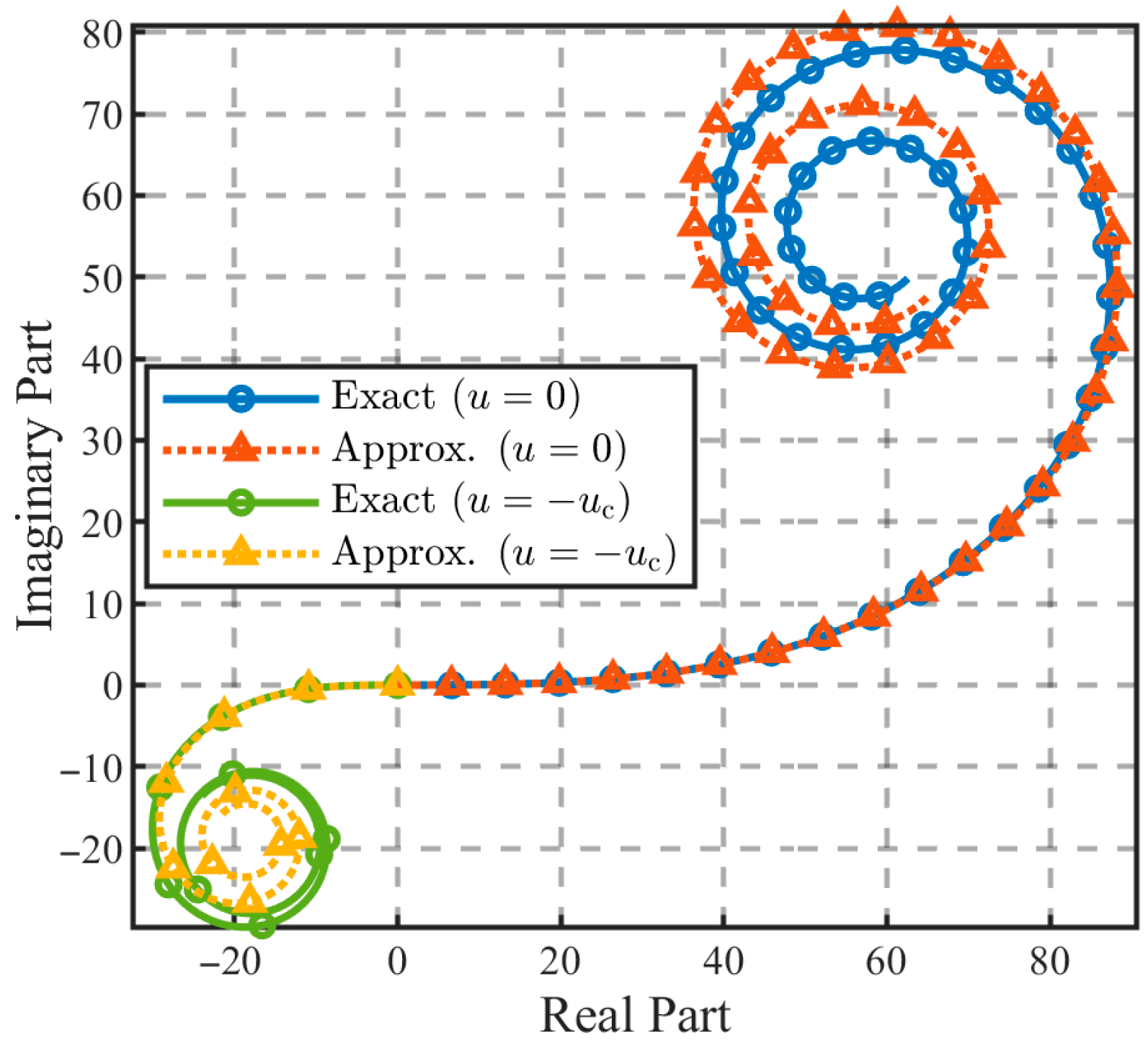
Figure 8 validates this approximation by comparing the complex integral buildup of the exact term (21) against the approximation. The analysis uses a typical configuration: an L = 64 λ aperture, a wide beam of B W c = 1 (set by a = π / 64 ), and a common +10 dB positive taper (b = −0.013, c = 20). The figure plots the integral trajectories for two critical locations: the beam center ( u = 0 ) and the critical boundary ( u = u c ). At u = 0 , the stationary point is x 0 = 0 . The exact integral (21) takes the form
F 1 D , taper 0 = L / 2 L / 2 ( b x 2 + c / 2 ) exp ( j a x 2 ) d x ,
while its approximation (22) simplifies to
F 1 D , taper 0 ( c / 2 ) L / 2 L / 2 exp ( j a x 2 ) d x .
At u = u c , the stationary point is x 0 = L / 2 . The exact integral (21) is
F 1 D , taper u c = L / 2 L / 2 b x 2 + c / 2 exp j a x 2 + 2 π u c x d x ,
while its approximation (22) takes the form
F 1 D , taper u c ( b x 0 x 0 2 + c / 2 ) L / 2 L / 2 exp j a x 2 + 2 π u c x d x .
To intuitively visualize the accumulation process, the trajectories are plotted starting from their respective stationary point. For the beam center ( u = 0 ), the integration is traced symmetrically (as x / 2 x / 2 ) as x increases from 0 to L. For the critical boundary ( u = u c ), a variable change t = x + L / 2 is used to trace the buildup from the stationary point x 0 = L / 2 . The cumulative integral is evaluated as 0 T d t , where T is the variable accumulation length from 0 to L. For visual clarity, the trajectories are shown truncated at an accumulation length of 33(λ) (i.e., x = 33 ( λ ) or T = 33 ( λ ) ).
The validation is demonstrated in several aspects. First, all four trajectories exhibit a similar spiral behavior—an initial large arc before circling a central region. This shared characteristic confirms that the integral’s value is fundamentally dictated by the contribution from the neighborhood of the stationary phase point, as predicted by SPM. Second, the trajectories of the approximation (22) (dashed lines) show reasonable resemblance to those of the exact integral (21) (solid lines) at both critical locations. This similarity in the integral buildup process suggests that the approximation (22) robustly captures the dominant SPM contribution, and implies that the final integrated values would also be close. The resemblance is visibly closer at u = 0 (blue and red trajectories) than at u = u c (green and yellow trajectories). This is expected, as the approximation (22) assumes a slowly varying amplitude. This assumption is well-satisfied at the amplitude’s vertex ( x 0 = 0 ) but is less accurate at the aperture edge ( x 0 = L / 2 ), where the amplitude varies most rapidly. It is worth noting that theoretically, if the amplitude varied extremely rapidly within the dominant integration region, the approximation error would increase. However, Figure 8 demonstrates that for the practical 10 dB taper modeled here, the approximation remains robust even when the stationary point is at the edge ( x 0 = L / 2 ). The reasonable agreement between the exact (green) and approximate (yellow) trajectories indicates that the amplitude variation within the effective stationary phase zone is limited, allowing the approximation A m ( x ) A m ( x 0 ) to validly capture the dominant energy contribution. Finally, the approximation (22) is shown to be acceptable for typical configurations of wide beams and aperture amplitude tapers.
Substituting the approximation (22) into (20) yields
F u , v b x 0 2 ( u ) + c 2 + b y 0 2 ( v ) + c 2 F 1 D , 0 u F 1 D , 0 v .
By recognizing the definitions in (4) and (17), a concise and insightful expression is obtained:
F u , v A m π u / a , π v / a F 0 u , v ,
where F 0 u , v is the far-field pattern for an aperture with uniform aperture amplitude.

4.1.2. Main-Lobe Analysis

Approximation in (28) elegantly shows that the pattern with a tapered aperture is roughly the uniform-amplitude pattern, weighted by the aperture amplitude function A m evaluated at the stationary points ( x 0 = π u / a ,   y 0 = π v / a ) which are determined by the observation point u , v . The main-lobe taper, T m , can now be defined as the ratio of the field magnitude at the center ( u = 0 ) to that at the main-lobe edge ( u = u c ), assuming v = 0 :
T m A m 0 , 0 F 0 0 , 0 A m π u c / a , 0 F 0 u c , 0       2 A m 0 , 0 A m L / 2 , 0 = 8 c b L 2 + 4 c .
Remarkably, T m 2   T ap , implying that the main-lobe taper is directly and predictably controlled by the aperture amplitude taper.
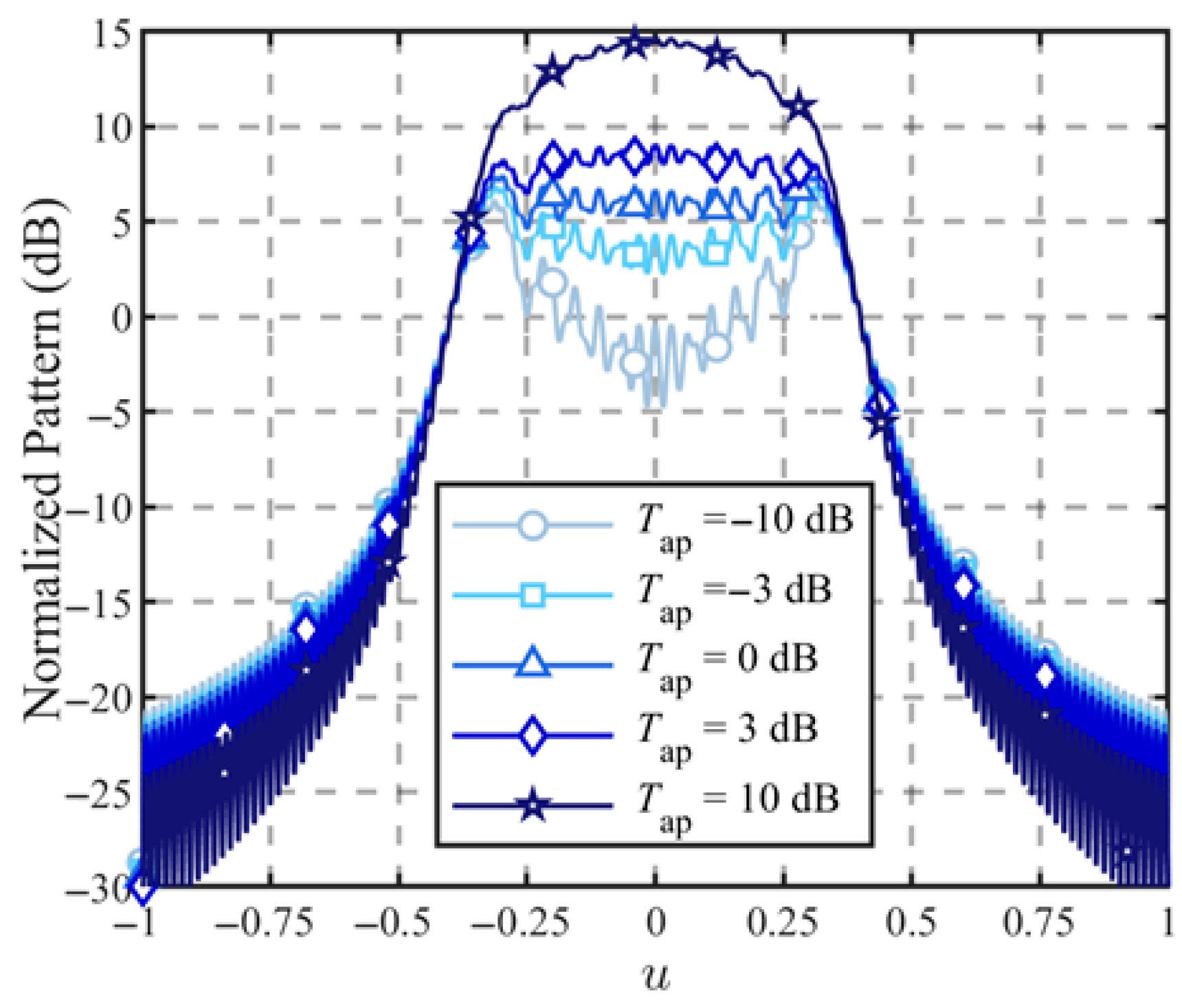
This relationship is validated by the patterns computed based on (20). Figure 9 shows the main-plane patterns for a 64λ·64λ aperture with a fixed uc = 0.4 but varying aperture tapers. Here, each pattern is normalized to its level at u = ±uc to compare the shape of the main lobe. As predicted, the patterns exhibit distinct main lobes for u < u c and a sharp decay for u > u c . Critically, it is visually clear that as Tap transitions from negative values (−10 dB and −3 dB) to zero (flat-top) and to positive values (+3 dB and +10 dB), the main-lobe shape changes correspondingly from concave to convex. Despite the quantitative discrepancy between Tm and 2 Tap due to the approximation, this visually confirms the monotonic relationship.
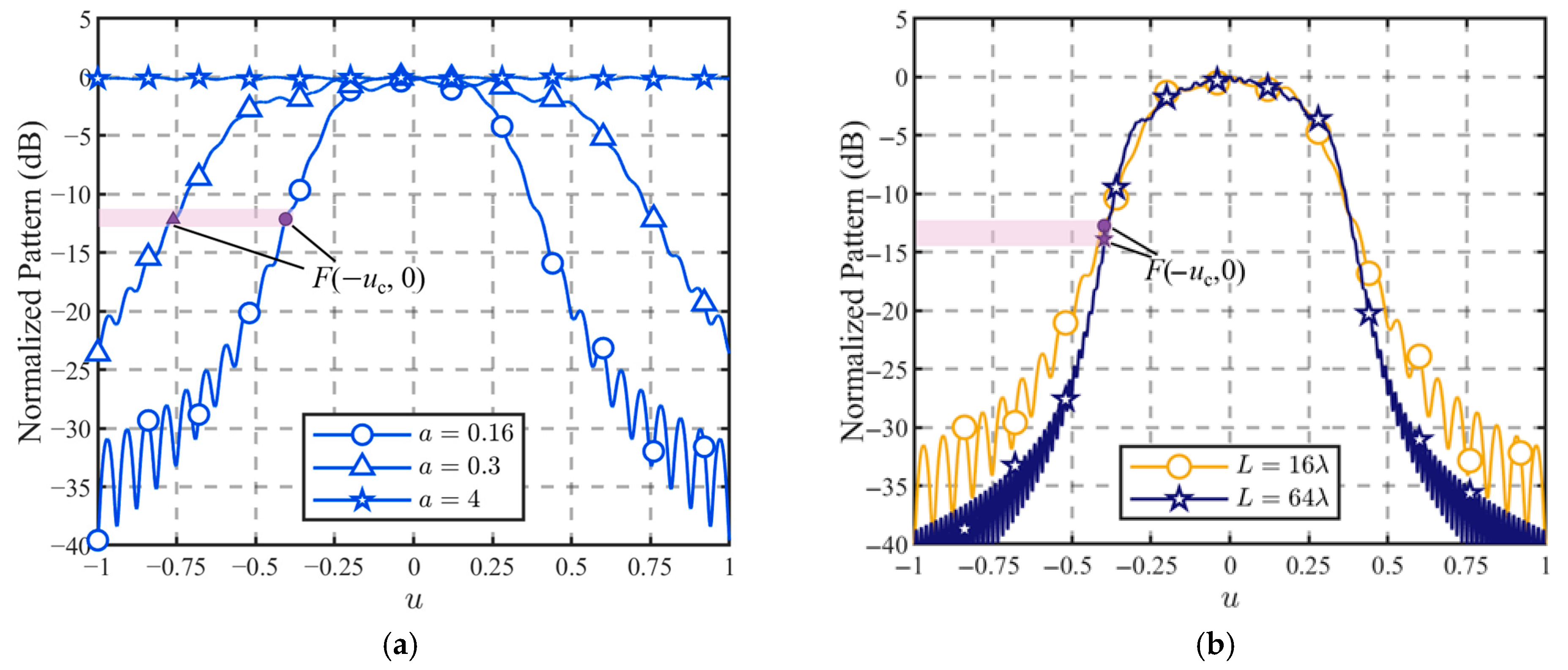
A further implication of T m 2   T ap is the decoupling of the main-lobe taper from other system parameters that do not affect Tap. Specifically, since the phase coefficient a is absent from (18) and (29), Tm is theoretically independent of a and, consequently, of the beamwidth defined by uc. In turn, the maximum achievable beamwidth—the quasi-omnidirectional pattern—can be implied to be decoupled from the aperture amplitude taper. Furthermore, if a specific Tap is maintained by design for different aperture sizes L (by adjusting b accordingly), Tm should also remain constant.
Figure 10 validates this decoupling principle numerically. Figure 10a plots patterns for a fixed Tap ≈ 10 dB with a value of 0.16, 0.4, and 4, respectively. As a increases, the beamwidth defined by uc clearly broadens. For the cases where the main-lobe edge is visible ( a = 0.16 and a = 0.4 ), Tm remains stable, aligning with the theoretical prediction. For the quasi-omnidirectional case ( a = 4 ), this implies the underlying taper is preserved even as the pattern is flattened across the visible space. These confirm that the main-lobe taper and the beamwidth defined by uc can be controlled as independent design parameters.
Figure 10b compares the normalized patterns of a 16λ and a 64λ aperture sharing the same Tap ≈ 10 dB and uc = 0.4. The two main-lobe tapers are observed to be nearly identical, confirming the predicted independence from aperture size L.

4.2. Aperture Discretization

The analysis in Section 3 has established the wide-beam characteristics for continuous apertures. This section now extends that framework to the practical case of discrete apertures, which are realized with an array of elements as seen in reflectarrays, transmitarrays, metasurfaces, and phased arrays. The far-field pattern of such an aperture is determined by the product of the element pattern and the Array Factor (AF). The AF, arising directly from the aperture discretization, dictates the formation of grating lobes and is thus the critical factor in achieving the desired wide-beam performance.

4.2.1. Array Factor Formation

The AF of a discrete aperture with element periods of px and py along the x- and y-axes is generally expressed as
A F u , v = m , n = + A c m p x , n p y exp j 2 π u m p x + v n p y ,
where A c x , y is the aperture field of the corresponding continuous aperture, which relates to its far-field, F c u , v , through the Fourier transform. To analyze the effects of discretization, the discrete aperture field, A d x , y can be modeled as the continuous field A c x , y being sampled with a Dirac comb:
A d x , y = A c x , y m , n = + δ x m p x , y n p y .
Using the sample model, the AF expression is mathematically equivalent to
A F u , v = F A d x , y ,
Consequently, by applying the sampling property of the Fourier transform, the AF is found to be a periodic replication of the continuous aperture’s far-field pattern, Fc (u, v):
A F u , v = 1 p x p y m , n = + F c u m Δ u , v n Δ v ,
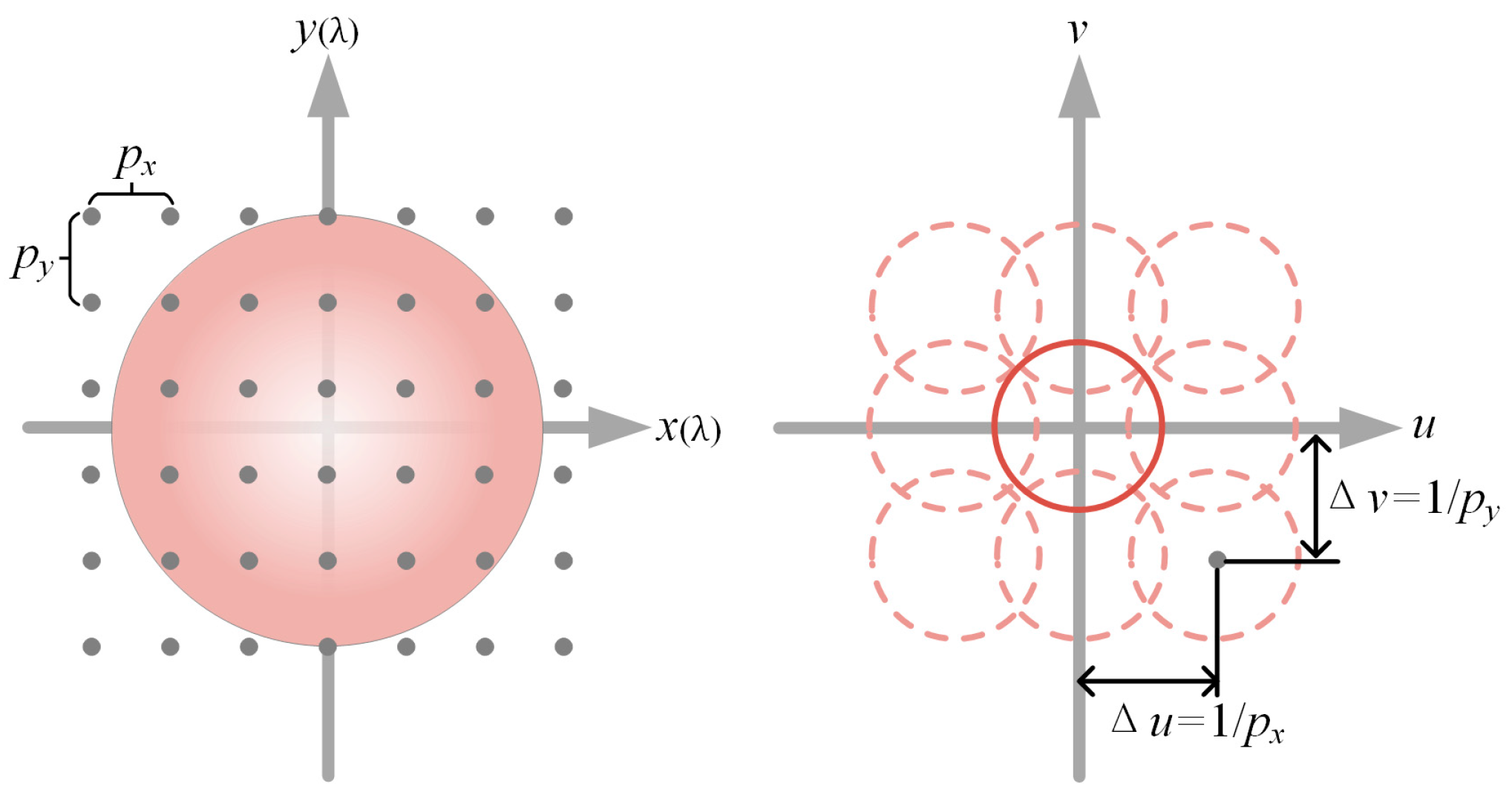
where the spectral shifts are Δ u = 1 / p x and Δ v = 1 / p y . As illustrated in Figure 11, the AF is a superposition of the primary pattern and its spectral copies (grating lobes).

4.2.2. Wide Beam Design Guidance

To prevent pattern distortion from grating lobes, a conservative condition can be set to keep them outside the visible region. For a given beamwidth, denoted as BW, this condition is:
Δ u u center + 1 + B W / 2 .
This condition defines the maximum allowable period and, conversely, the maximum achievable beamwidth. For a conservative design with sufficient margin, B W can be taken as B W c , i.e., B W = 2 u c = a L / π , which corresponds to a gain reduction of approximately 6 dB to the center. This leads to the maximum period being
Max .   p x = 1 / u center + 1 + a L / 2 π ,
and the maximum beamwidth being
Max .   B W c = 2 / p x 2 u center 2 .
These reciprocal relationships are summarized in Table 3 and Table 4, respectively. Table 3 presents the maximum allowable element period p to keep grating lobes outside the visible region for a given target beamwidth B W c . As it illustrates, achieving a wider beamwidth (e.g., increasing B W c from 30° to 90°) necessitates a smaller maximum period (e.g., from 0.79λ to 0.50λ for broadside). Furthermore, steering the beam (e.g., ucenter = sin(60°)) further constrains the maximum allowable period compared to the broadside case (ucenter = 0).
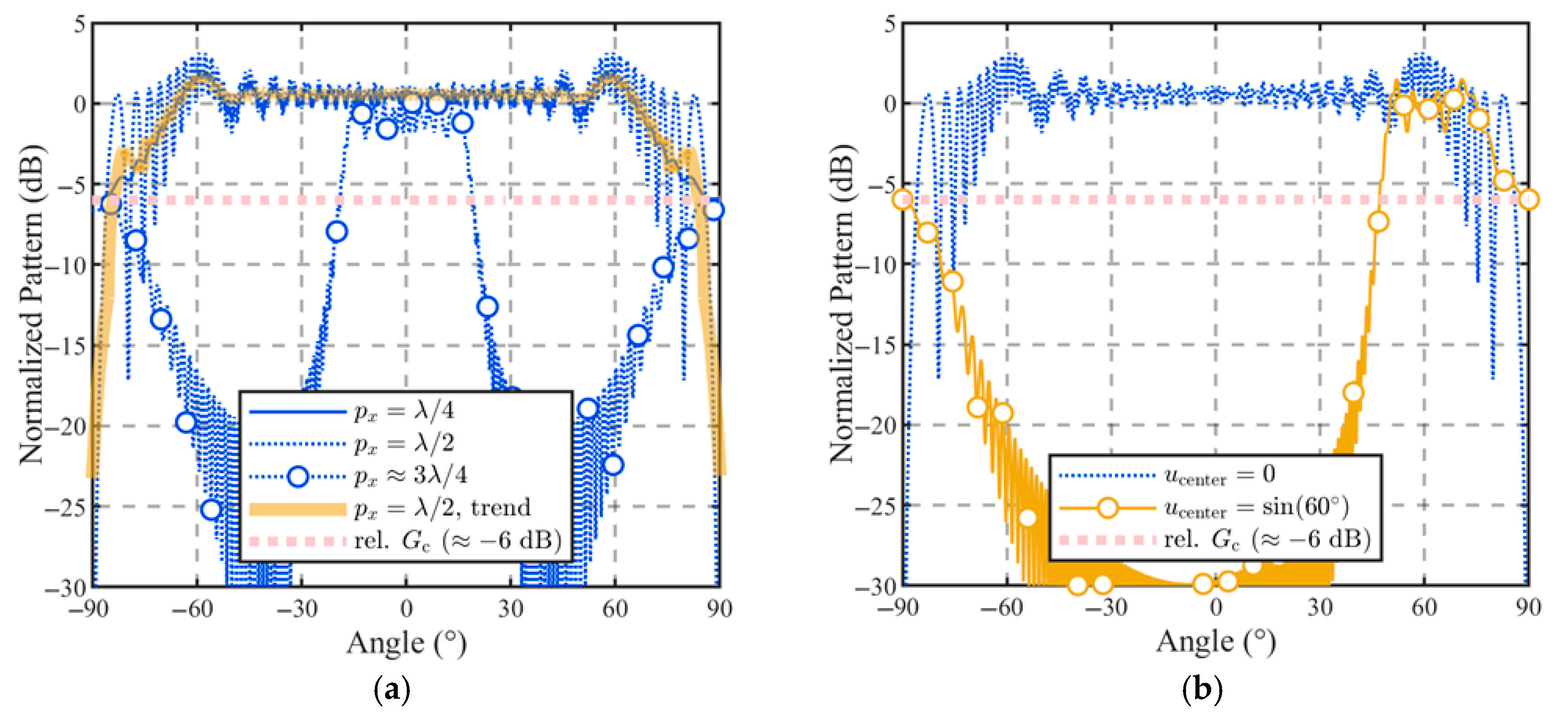
Conversely, Table 4 details the maximum achievable beamwidth B W c for a given element period p. For a broadside beam, an omnidirectional pattern (“omni”) is achievable for periods up to λ/2. As the period increases further, the maximum B W c becomes restricted (e.g., to 0.67 (38.9°) at p = 3λ/4). Furthermore, steering the beam (e.g., ucenter = sin (60°)) imposes a stronger constraint, reducing the maximum B W c from “omni” to 0.27 (42.9°) at p = λ/2.
The predictions in Table 4 are then directly validated by the numerical examples in Figure 12, which presents the AF patterns normalized to the beam center levels for a 64λ × 64λ aperture with uniform amplitude. The results demonstrate excellent agreement with the predictions in Table 4. For the broadside beam (Figure 12a), periods of λ/4 and λ/2 yield an omnidirectional pattern; for the latter, despite nulls near the horizon, the pattern trend remains above the −6 dB reference level. As the period increases to 3λ/4, the beamwidth becomes restricted to approximately 39°, at which point the grating lobe reaches the critical level.
Trade-off is also mirrored when steering. Figure 12b shows that for a fixed λ/2 period, scanning to 60° limits the achievable beamwidth to approximately 43° as its right edge reaches the visible boundary (θ = 90°) while the grating lobe (on the left) reaches the critical level.
Finally, the “GLL > −6 dB” entries in Table 4 signify that significant grating lobes are unavoidable in certain configurations. For example, at p = 1λ for a broadside beam, or at p = 3λ/4 when scanned to 60°, the grating lobes enter the visible region and approximately exceed the critical level, preventing the formation of any valid B W c . These numerical demonstrations precisely confirm the validity of the derived theoretical model.

5. Discussion: Generalizability and Comparison

Although the preceding analysis focuses on a square geometry for notational brevity, the proposed analytical model is inherently applicable to rectangular apertures. This generalizability stems from the separability of the aperture distribution in Cartesian coordinates—specifically, the quadratic phase and the separable amplitude taper. As indicated in (4) and (20), this separability allows the 2D radiation integrals to be mathematically decomposed into the product of two independent 1D integrals. Consequently, the beamforming physics in the two principal planes are effectively decoupled. This implies that the beamwidths in the x- and y-directions can be controlled independently by assigning distinct phase coefficients, ax and ay, respectively. According to (9), the beamwidth along each axis is determined by the specific product of the phase coefficient and the aperture side length (e.g., axLx). Furthermore, the design guidelines regarding amplitude tapering and aperture discretization remain valid for the general rectangular case. The amplitude taper parameters (bx, by) can be individually adjusted to achieve the desired main-lobe taper profile (Tm) in each dimension as governed by (29), while the element periods (px, py) can be determined using (35) to ensure grating-lobe-free operation.
Beyond the geometrical generalization, this analytical approach offers distinct advantages over existing heuristic optimization methods often used for wide-beam synthesis, such as Genetic Algorithms (GA) or Particle Swarm Optimization (PSO). These numerical approaches typically treat the phase of each array element as an optimization variable. They iteratively update the phase distribution to minimize a predefined cost function, which is usually constructed to enforce a target beamwidth while suppressing the gain ripple within the main lobe. While effective in finding specific numerical solutions, these methods often operate as “black boxes” dependent on trial-and-error processes. They generally fail to explain the underlying electromagnetic mechanisms or provide explicit design guidelines. In contrast, the model proposed in this work establishes a deterministic link between aperture parameters (size, taper, discretization) and performance metrics. Most importantly, it theoretically quantifies the physical limits of the system, such as the maximum achievable beamwidth derived in (9) and (36). This analytical insight allows for a rapid feasibility assessment before physical implementation, a capability that purely numerical optimization cannot offer.

6. Conclusions

This article has established a theoretical model for the beam broadening capability of phased EM surfaces. The analysis began with an idealized continuous aperture under quadratic phasing, which yielded a foundational scaling relationship. This relationship defines the main-lobe’s critical width (in u-space) as B W c = a L / π , which serves as the approximate 6 dB beamwidth relative to the beam-center gain. This reveals a direct proportionality between the beamwidth and the product of the quadratic phase coefficient (a) and the aperture size (L), and quantitatively confirms the theoretical potential for achieving quasi-omnidirectional coverage. The model also demonstrated that the wide beam can be steered by linear phase terms (am, an) without impacting the beamwidth. Furthermore, a detailed characterization of the main-lobe was developed, providing explicit derivations for the 3 dB beamwidth and the relative peak gain, which together quantify the main-lobe’s shape.
Building on this ideal foundation, the model was extended to incorporate practical implementation constraints. For aperture amplitude tapering, a key decoupling principle was discovered: the main-lobe taper (Tm) is directly and predictably controlled by the aperture amplitude taper (Tap). This finding allows the main-lobe shape (e.g., convex or concave) to be engineered independently of the beamwidth and aperture size. For aperture discretization, the analysis of the AF, as a periodic replication of the continuous pattern, established a clear reciprocal trade-off between the maximum allowable element period and the maximum achievable beamwidth. Explicit design rules essential for preventing grating lobe distortion at any given scan angle are provided.
In summary, this study provides a clear, physics-based analytical model that moves beyond the numerical “black-box” optimization. It systematically decomposes the complex problem of wide-beam forming into understandable physical principles. The derived scaling relationship, decoupling principle, and discretization trade-offs equip engineers with the intuitive and quantitative guidelines necessary for the systematic design and performance prediction of advanced wide-beam phased EM surfaces in next-generation radar and communication systems.

Author Contributions

Conceptualization, J.H., F.Y. and X.X.; methodology, J.H., F.Y. and S.X.; software, J.H.; validation, J.H.; formal analysis, J.H.; investigation, J.H.; resources, J.H., F.Y. and S.X.; data curation, J.H.; writing—original draft preparation, J.H.; writing—review and editing, F.Y., J.H. and X.X.; visualization, J.H.; supervision, F.Y. All authors have read and agreed to the published version of the manuscript.

Funding

This work was funded by the National Key Research and Development Program of China under Grant No. 2023YFB3811501.

Data Availability Statement

The data presented in this study are available on request from the corresponding author (The data are not publicly available due to privacy restrictions).

Conflicts of Interest

The authors declare no conflicts of interest. The funders had no role in the design of the study; in the collection, analyses, or interpretation of data; in the writing of the manuscript; or in the decision to publish the results.

Abbreviations

The following abbreviations are used in this manuscript:
EMElectromagnetic
ZCZadoff–Chu
DFTDiscrete Fourier transform
SPMStationary phased method
AFArray factor

References

  1. Wang, Y.; Xu, S.; Yang, F.; Li, M. A Novel 1 Bit Wide-Angle Beam Scanning Reconfigurable Transmitarray Antenna Using an Equivalent Magnetic Dipole Element. IEEE Trans. Antennas Propag. 2020, 68, 5691–5695. [Google Scholar] [CrossRef]
  2. Wang, M.; Mo, Y.; Xie, W.; Hu, N.; Chen, Z.; Tian, Z. A 1-Bit All-Metal Wide-Angle and Multipolarization Beam-Scanning Reconfigurable Reflectarray Antenna. IEEE Antennas Wirel. Propag. Lett. 2023, 22, 1015–1019. [Google Scholar] [CrossRef]
  3. Xu, H.; Xu, S.; Yang, F.; Li, M. Design and Experiment of a Dual-Band 1 Bit Reconfigurable Reflectarray Antenna with Independent Large-Angle Beam Scanning Capability. IEEE Antennas Wirel. Propag. Lett. 2020, 19, 1896–1900. [Google Scholar] [CrossRef]
  4. Li, H.; Zhang, H.; Du, Z.; Qi, J. A 1-Bit Programmable Reflectarray Antenna for Muti-Beam Scanning. In Proceedings of the 2022 International Conference on Microwave and Millimeter Wave Technology (ICMMT), Harbin, China, 12–15 August 2022; pp. 1–3. [Google Scholar]
  5. Huang, K.; Zhao, W.; Li, X.; Qiu, L.; Qi, Z. Dual-Polarized 1-Bit Reconfigurable Reflectarray for Generating Digital Vortex Beam. In Proceedings of the 2023 International Conference on Microwave and Millimeter Wave Technology (ICMMT), Qingdao, China, 14–17 May 2023; pp. 1–3. [Google Scholar]
  6. Valera, T.; Venkatakrishnan, S.B.; Madanayake, A.; Volakis, J.L. Reconfigurable Intelligent Surfaces for Adaptive Nulling and Beam Steering Using 1-bit Topology. In Proceedings of the 2023 United States National Committee of URSI National Radio Science Meeting (USNC-URSI NRSM), Boulder, CO, USA, 10–14 January 2023; pp. 254–255. [Google Scholar]
  7. Aykin, I.; Akgun, B.; Krunz, M. Multi-beam Transmissions for Blockage Resilience and Reliability in Millimeter-Wave Systems. IEEE J. Sel. Areas Commun. 2019, 37, 2772–2785. [Google Scholar] [CrossRef]
  8. Zhang, J.; Xu, W.; Gao, H.; Pan, M.; Han, Z.; Zhang, P. Codebook-Based Beam Tracking for Conformal Array-Enabled UAV mmWave Networks. IEEE Internet Things J. 2021, 8, 244–261. [Google Scholar] [CrossRef]
  9. Song, J.; Choi, J.; Love, D.J. Common Codebook Millimeter Wave Beam Design: Designing Beams for Both Sounding and Communication with Uniform Planar Arrays. IEEE Trans. Commun. 2017, 65, 1859–1872. [Google Scholar] [CrossRef]
  10. Xu, K.; Zheng, F.-C.; Cao, P.; Xu, H.; Zhu, X. Fast Beam Training for FDD Multi-User Massive MIMO Systems with Finite Phase Shifter Resolution. IEEE Trans. Veh. Technol. 2021, 70, 459–473. [Google Scholar] [CrossRef]
  11. Alkhateeb, A.; Leus, G.; Heath, R.W. Limited Feedback Hybrid Precoding for Multi-User Millimeter Wave Systems. IEEE Trans. Wirel. Commun. 2015, 14, 6481–6494. [Google Scholar] [CrossRef]
  12. Salmi, A.; Capek, M.; Jelinek, L.; Lehtovuori, A.; Viikari, V. Optimization of Embedded Element Patterns of Reactively Loaded Antenna Arrays. IEEE Trans. Antennas Propag. 2025, 73, 6420–6430. [Google Scholar] [CrossRef]
  13. Li, H.; Ding, Z.; Chen, S.; Feng, Q.; Ran, L.; Liu, Z. Shaped pattern synthesis for hybrid analog–digital arrays via manifold optimization-enabled block coordinate descent. Signal Process. 2025, 228, 109752. [Google Scholar] [CrossRef]
  14. Shen, Y.; Leng, P.; Chen, S.; Li, H. Phase-Only Transmit Beampattern Synthesis with Maximum Mainlobe Gain via Manifold ADMM. IEEE Antennas Wirel. Propag. Lett. 2024, 23, 184–188. [Google Scholar] [CrossRef]
  15. Cao, P.; Thompson, J.S.; Haas, H. Constant Modulus Shaped Beam Synthesis via Convex Relaxation. IEEE Antennas Wirel. Propag. Lett. 2017, 16, 617–620. [Google Scholar] [CrossRef]
  16. Fuchs, L.R.; Maki, A.; Gällström, A. Optimization Method for Wide Beam Sonar Transmit Beamforming. Sensors 2022, 22, 7526. [Google Scholar] [CrossRef]
  17. Kong, G.; Li, X.; Wang, Q.; Zhang, J. A Wideband Reconfigurable Dual-Branch Helical Reflectarray Antenna for High-Power Microwave Applications. IEEE Trans. Antennas Propag. 2021, 69, 825–833. [Google Scholar] [CrossRef]
  18. Imaz-Lueje, B.; Prado, D.R.; Arrebola, M.; Pino, M.R. Reflectarray antennas: A smart solution for new generation satellite mega-constellations in space communications. Sci. Rep. 2020, 10, 21554. [Google Scholar] [CrossRef]
  19. Prado, D.R. The Generalized Intersection Approach for Electromagnetic Array Antenna Beam-Shaping Synthesis: A Review. IEEE Access 2022, 10, 87053–87068. [Google Scholar] [CrossRef]
  20. Prado, D.R.; Naseri, P.; López-Fernández, J.A.; Hum, S.V.; Arrebola, M. Support Vector Regression-Enabled Optimization Strategy of Dual Circularly-Polarized Shaped-Beam Reflectarray with Improved Cross-Polarization Performance. IEEE Trans. Antennas Propag. 2023, 71, 497–507. [Google Scholar] [CrossRef]
  21. Stutzman, W.L.; Thiele, G.A. Antenna Theory and Design, 3rd ed.; Wiley: Hoboken, NJ, USA, 2013; pp. 433–446. [Google Scholar]
  22. Chu, D. Polyphase codes with good periodic correlation properties. IEEE Trans. Inf. Theory 1972, 18, 531–532. [Google Scholar] [CrossRef]
  23. Meng, X.; Xia, X.-G.; Gao, X. Constant-envelope omni-directional transmission with diversity in massive MIMO systems. In Proceedings of the 2014 IEEE Global Communications Conference, Austin, TX, USA, 8–12 December 2014; pp. 3784–3789. [Google Scholar]
  24. Meng, X.; Gao, X.; Xia, X.-G. Omnidirectional Precoding Based Transmission in Massive MIMO Systems. IEEE Trans. Commun. 2016, 64, 174–186. [Google Scholar] [CrossRef]
  25. Peng, R.; Tian, Y. Robust Wide-Beam Analog Beamforming with Inaccurate Channel Angular Information. IEEE Commun. Lett. 2018, 22, 638–641. [Google Scholar] [CrossRef]
  26. Guo, W.; Lu, A.-A.; Meng, X.; Gao, X.; Ma, N. Broad Coverage Precoding Design for Massive MIMO with Manifold Optimization. IEEE Trans. Commun. 2019, 67, 2792–2806. [Google Scholar] [CrossRef]
  27. Lu, A.-A.; Gao, X.; Meng, X.; Xia, X.-G. Omnidirectional Precoding for 3D Massive MIMO with Uniform Planar Arrays. IEEE Trans. Wirel. Commun. 2020, 19, 2628–2642. [Google Scholar] [CrossRef]
  28. Orfanidis, S.J. Electromagnetic Waves and Antennas; ECE Dept., Rutgers Univ.: Piscataway, NJ, USA, 2016; p. 751. [Google Scholar]
  29. Dolph, C.L. A Current Distribution for Broadside Arrays Which Optimizes the Relationship between Beam Width and Side-Lobe Level. Proc. IRE 1946, 34, 335–348. [Google Scholar] [CrossRef]
  30. Riblet, H.J. Discussion on “A Current Distribution for Broadside Arrays Which Optimizes the Relationship between Beam Width and Side-Lobe Level”. Proc. IRE 1947, 35, 489–492. [Google Scholar]
  31. Elliott, R.S. Beamwidth and directivity of large scanning arrays—First of two parts. Microw. J. 1963, 53–60. Available online: http://sina.sharif.edu/~aborji/25149/files/Beamwidth%20and%20directivity%20of%20large%20scanning%20arrays%20-%20first%20of%20two%20parts.pdf (accessed on 23 December 2025).
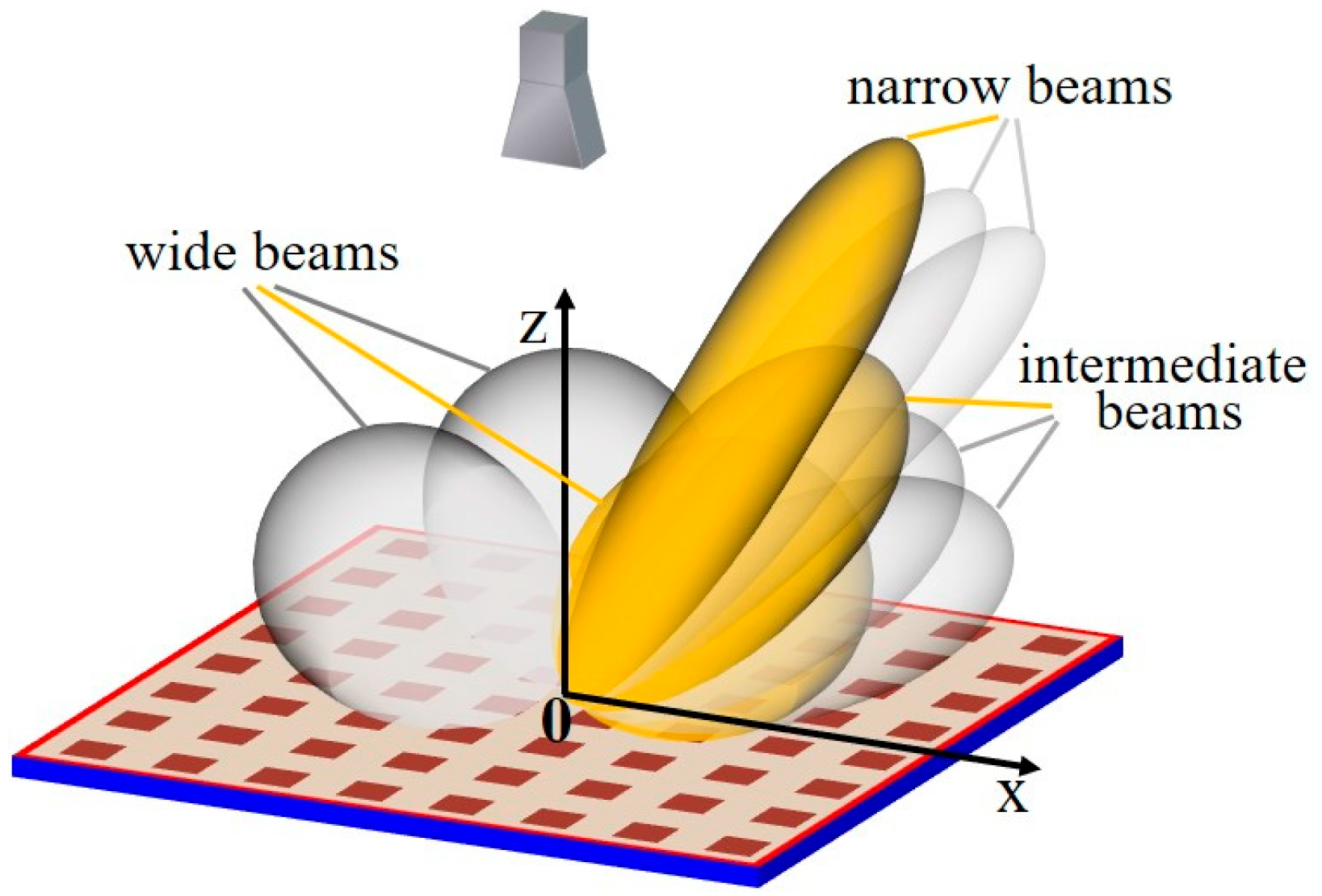
Figure 1. Conceptual demonstration of hierarchical beam-scanning with a reconfigurable reflectarray (RRA). Wide beams, intermediate beams, and narrow beams need to be generated by the RRA, and golden beams indicate the optimal one at each search tier.
Electronics 15 00191 g001
Figure 2. Sketch of the basic ideal continuous aperture with constant amplitude.
Electronics 15 00191 g002
Figure 3. Calculated 1D normalized patterns for a broadside wide beam along v = 0 (blue curve) and a tilted (ucenter = 0.43, vcenter = 0.25) wide beam along v = 0.25 (orange curve). The parameters are L = 64λ, a = 0.01; broadside case with m = n = 0, tilted case with m = 136, n = 79.
Electronics 15 00191 g003
Figure 4. Phase (a) and normalized magnitude (b) of the Fresnel integral F r x .
Electronics 15 00191 g004
Figure 5. Dependence of the 1D normalized radiation pattern on the parameter a for two different aperture sizes: (a) L = 16λ and (b) L = 64λ.
Electronics 15 00191 g005
Figure 6. Demonstration of beamwidth control and beam tilting for two aperture sizes: (a) L = 16λ and (b) L = 64λ. Each case compares a broadside beam (dashed lines) with a tilted beam (solid lines).
Electronics 15 00191 g006
Figure 7. Annotated radiation pattern of the studied wide beam, illustrating the key main-lobe characteristics.
Electronics 15 00191 g007
Figure 8. Integral trajectory buildup of the exact integral (21) and the approximation (22) for an L = 64λ aperture with a wide beam of BWc = 1 and aperture amplitude taper of +10 dB. The plot includes comparisons at the beam center (u = 0) and the critical boundary (u = −uc). The integration range expands outward from the stationary point x 0 , with trajectories shown up to 33λ for visual clarity.
Electronics 15 00191 g008
Figure 9. Effect of the aperture amplitude taper (Tap) on the main-lobe shape, calculated for a 64λ·64λ aperture with a fixed critical boundary of uc = 0.4. Each pattern is normalized to its level at the critical boundary (u = ±uc).
Electronics 15 00191 g009
Figure 10. Validation of the independence of the main-lobe taper. (a) Effect of the quadratic phase coefficient a on the main-lobe characteristics for a fixed aperture size (L = 16λ) and amplitude taper (Tap ≈ 10 dB). (b) Effect of the aperture size L on the main-lobe shape for a fixed beamwidth (uc = 0.4) and amplitude taper (Tap ≈ 10 dB).
Electronics 15 00191 g010
Figure 11. Illustration of the relationship between discrete aperture sampling in xy plane (left) and the resulting array factor in uv plane (right). The array factor consists of the continuous aperture’s far-field pattern periodically replicated into grating lobes, with spacing determined by the sampling periods (px, py). Magnitudes only are shown.
Electronics 15 00191 g011
Figure 12. Numerical examples of Array Factor (AF) patterns of a 64λ∙64λ aperture with uniform amplitude, validating the maximum achievable beamwidths predicted in Table 4. Each pattern is normalized to its own beam center level. (a) Broadside beam, illustrating the effect of varying the element period px. (b) Fixed period (px = λ/2), showing the effect of scanning the beam to 60°.
Electronics 15 00191 g012
Table 1. Specifications of the array model employed for numerical verification.
ParametersSpecifications
Calculation MethodArray Factor Summation (approximating continuous aperture integral)
Element Spacing (p)p << λ/2 (Baseline; discretization impacts are examined in Section 4.2)
Aperture Sizes (L × L)16λ × 16λ (Figure 5a); 64λ × 64λ (Figure 5b)
Amplitude DistributionUniform (Baseline; tapering effects are examined in Section 4.1)
Aperture Phase DistributionQuadratic phase profile (following Equation (1))
Table 2. Main-lobe characteristic values.
Aperture Parameters
(L & a)
MethodBW6dB
(°)
BW3dB
(°)
Rel. Gpeak 1
(dB)
16λ & 0.16Estimated 248.142.31.4
Calculated 348.440.71.4
64λ & 0.04Estimated48.145.21.4
Calculated47.343.61.1
1 Peak gain relative to that at the beam center. 2 BW6dB, BW3dB and rel. Gpeak are estimated by (9), (15) and (16), respectively. 3 The calculated values are extracted from the radiation patterns computed with the array method.
Table 3. Largest periods for different beamwidths and beam directions.
BWc 1Max. p
(ucenter 2 = 0)
Max. p
(ucenter = sin 60°)
0.52 (30°)0.790.47
1.00 (60°)0.670.42
1.41 (90°)0.590.39
2.00 (180°)0.500.35
All period (p) values are presented in units of λ. 1 Beamwidth defined on the u-axis as B W c = a L / π . Values in parentheses are the corresponding angular beamwidths (in degrees) for a broadside beam (ucenter = 0). 2 The u-component of the beam center direction, (ucenter, vcenter), in the uv plane.
Table 4. Largest beamwidths for different periods and beam directions.
p (λ)Max. BWc 1
(ucenter = 0)
Max. BWc
(ucenter = sin 60°)
0omniomni
1/4omniomni
1/2omni0.27 (42.9°)
3/40.67 (38.9°)GLL > −6 dB
1GLL > −6 dBGLL > −6 dB
Beamwidth is defined on the u-axis as B W c = a L / π , consistent with Table 3. 1 “omni” denotes B W c 2 (covering the entire visible region), which physically corresponds to the pattern remaining approximately above the −6 dB reference level (rel. to the beam center). Values in parentheses are the corresponding angular beamwidths in degrees, calculated using sin 1 ( u center + B W c / 2 ) sin 1 ( u center B W c / 2 ) . “GLL > −6 dB” indicates the grating lobe level enters the visible region and approximately exceeds the −6 dB reference level, thus a valid BWc is not achieved.
Disclaimer/Publisher’s Note: The statements, opinions and data contained in all publications are solely those of the individual author(s) and contributor(s) and not of MDPI and/or the editor(s). MDPI and/or the editor(s) disclaim responsibility for any injury to people or property resulting from any ideas, methods, instructions or products referred to in the content.