Article

Adaptive Primary Frequency Regulation Control Strategy for Doubly Fed Wind Turbine Based on Hybrid Ultracapacitor Energy Storage and Its Performance Optimization

1
State Grid Shanghai Energy Interconnection Research Institute, Shanghai 201203, China
2
Hebei Key Laboratory of Distributed Energy Storage and Microgrid, North China Electric Power University Baoding, Baoding 071003, China
*
Author to whom correspondence should be addressed.
Electronics 2026, 15(1), 182; https://doi.org/10.3390/electronics15010182
Submission received: 26 November 2025 / Revised: 24 December 2025 / Accepted: 29 December 2025 / Published: 30 December 2025

Abstract

The large-scale integration of doubly fed wind turbines reduces the inertia level of power systems and increases the risk of frequency instability. This paper analyzes the performance characteristics and application ranges of different types of energy storage technologies and addresses the limitations of conventional control methods, which cannot adjust energy storage power output in real time according to frequency variations and may hinder frequency recovery during the restoration stage. Based on a grid-forming doubly fed wind turbine model, this study adopts a hybrid ultracapacitor energy storage system as the auxiliary storage device. The hybrid configuration increases energy density and extends the effective support duration of the storage system, thereby meeting the requirements of longer-term frequency regulation. Furthermore, the paper proposes an adaptive inertia control strategy that combines an improved variable-K droop control with adaptive virtual inertia control to enhance the stability of doubly fed wind turbines under load fluctuations. Simulation studies conducted in MATLAB 2022/Simulink demonstrate that the proposed method significantly improves frequency stability in load disturbance scenarios. The strategy not only strengthens the frequency support capability of grid-connected wind turbine units but also accelerates frequency recovery, which plays an important role in maintaining power system frequency stability.

1. Introduction

As conventional fossil energy resources gradually deplete, the development and research of clean renewable energy have attracted increasing global attention [1,2]. The share of renewable energy integrated into power grids continues to rise. Although the large-scale integration of wind and photovoltaic power offers substantial potential, it also introduces new challenges to power system stability [3,4]. On the one hand, grid-connected renewable energy sources lack inherent rotational inertia; as their penetration increases, the overall system inertia declines, limiting the effectiveness of inertial support [5]. On the other hand, the stochastic and fluctuating characteristics of renewable generation increase the likelihood of frequency instability [6].
Under the context of a ‘double-high’ power system, relying solely on traditional units for frequency regulation cannot meet the rapid frequency regulation requirements of the power system [7,8]. This presents prospects for the application and development of energy storage technology in frequency regulation. By equipping energy storage systems at new energy power plants and leveraging their high ramp rate, fast response, and easy controllability, it is possible to suppress the volatility and randomness of new energy generation while improving the primary frequency regulation capability of the grid and enhancing power system stability [9].
Existing studies have investigated primary frequency regulation in renewable-dominated power systems from diverse control perspectives. Reference [10] achieves staged frequency support by coordinating virtual inertia and frequency damping and allocating power reserves according to frequency dynamics. However, this coordination mechanism primarily targets photovoltaic systems and relies heavily on predefined logic, which limits its robustness under rapidly changing operating conditions, particularly in wind power and hybrid energy storage scenarios. By incorporating state-of-charge (SOC) constraints into the control framework, reference [11] combines ACE SOC zoning with fuzzy control to enhance adaptability during frequency regulation and to prevent excessive battery discharge. Nevertheless, this approach strongly depends on zoning thresholds and fuzzy rules, and its battery-centered control logic restricts its applicability to hybrid systems comprising multiple types of energy storage units. At the fast-response level, the control strategy proposed in [12] enables rapid and non-oscillatory power injection, effectively mitigating the initial frequency deviation. However, this work mainly focuses on short-term power compensation and does not systematically address the coordinated allocation of hybrid energy storage resources across different stages of frequency response. Reference [13] quantitatively evaluates the releasable energy of wind turbines and introduces an energy scaling factor to achieve adaptive cooperative frequency regulation between wind turbines and hybrid energy storage. Despite its effectiveness, the method relies on accurate characterization of turbine energy boundaries and operating regions, and its applicability under wider wind speed ranges and more complex operating scenarios requires further validation. Data-driven control methods have also opened new avenues for primary frequency regulation. In [14], reinforcement learning is introduced to enhance control adaptability through online or offline learning. However, practical deployment still faces challenges related to training data representativeness, policy generalization, and frequency regulation safety. Regarding power allocation in hybrid energy storage systems, reference [15] exploits the complementary characteristics of different storage units in terms of power and energy density, thereby improving frequency response speed and energy utilization efficiency. Nonetheless, such approaches often depend on fixed decomposition rules or parameter tuning, which makes them sensitive to operating condition variations and difficult to maintain consistent frequency support across different response stages when system inertia and reserve capacity change.
Overall, existing research has made substantial progress in virtual inertia emulation, energy storage participation, and intelligent control for frequency stability in low-inertia power systems with large-scale doubly fed induction generator (DFIG) integration. However, limitations remain in terms of multi-condition adaptability, coordinated control of heterogeneous energy storage systems, and systematic evaluation of multi-stage frequency response.
This study achieves the following contributions:
(1)
In grid-connected doubly fed wind power systems, the adoption of a hybrid ultracapacitor-based energy storage configuration enables both rapid high-power output adjustment and sustained frequency regulation over longer time scales.
(2)
This paper improves conventional droop control by introducing a variable-K-based droop strategy, which allows the droop coefficient to adapt to both the state of charge (SOC) and the magnitude of frequency deviation. Under favorable SOC conditions, the proposed approach strengthens the participation of energy storage in frequency regulation and enhances the frequency stability of grid-connected doubly fed wind turbines.
(3)
The study further refines conventional virtual inertia control by allowing the virtual inertia coefficient to adapt to different frequency regulation stages and the rate of change in frequency. This adaptive inertia adjustment slows down frequency deviations and accelerates frequency recovery.
(4)
Comprehensive MATLAB 2022/Simulink simulations verify the effectiveness of the proposed adaptive inertia control framework, which integrates the improved variable-K droop control with the adaptive virtual inertia control. The results demonstrate a significant reduction in frequency deviations from the rated value, a shorter frequency regulation time, and improved overall dynamic stability of wind turbine systems.

2. Principle and Modeling of Hybrid Ultracapacitors

2.1. Comparison of Frequency Regulation Performance of Different Energy Storage Modules

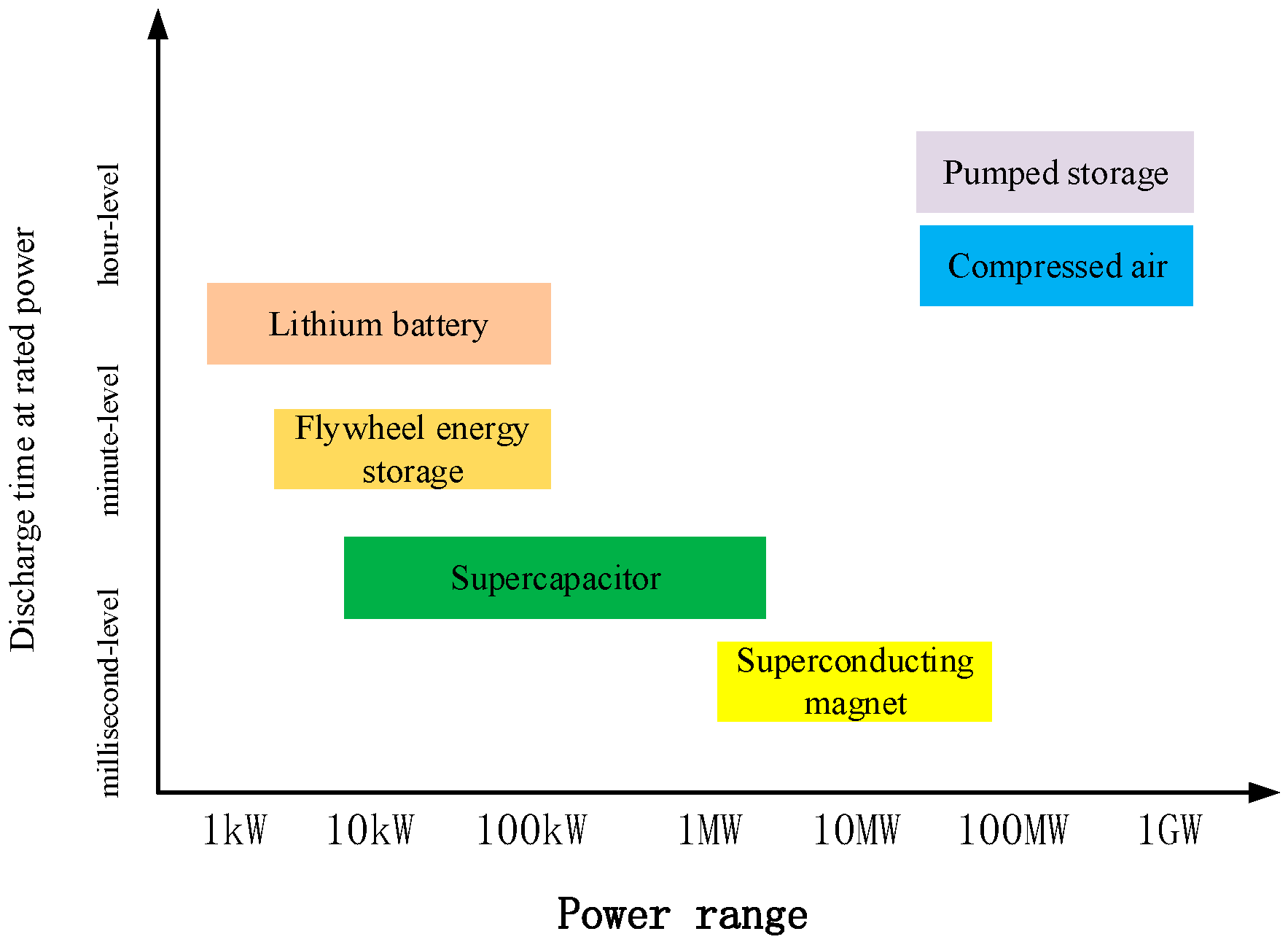
Energy storage technology is a method of converting excess or low-cost electricity into other forms of energy and storing it, so that the stored energy can be converted back into electricity when needed. Common energy storage technologies include pumped hydro storage, flywheel storage [16], compressed air energy storage [17], lithium battery storage [18], and ultracapacitor storage. The performance comparison of different energy storage technologies is shown in Figure 1.
Figure 1 illustrates the typical performance ranges of different energy storage technologies in terms of power capability and discharge duration. The horizontal axis represents the power range, which reflects the power density characteristics of each technology, while the vertical axis denotes the discharge time at rated power, serving as an intuitive indicator of energy density. Different energy storage technologies exhibit markedly distinct performance characteristics. Ultracapacitors offer superior power density, fast response, and long cycle life; however, their low energy density results in short discharge durations, which limit their ability to provide sustained support for primary frequency regulation. Lithium-ion batteries feature relatively high energy density and can deliver long-duration support, but their low power density and slower response hinder rapid high-power output. Moreover, their limited life cycle makes frequent participation in frequency regulation detrimental to service lifetime. Pumped hydro storage and compressed air energy storage are suitable for large-scale, long-duration applications, yet they suffer from slow response and strong geographical constraints.

2.2. Comparison of Ultracapacitor Energy Storage Technology Characteristics

Ultracapacitors are energy storage devices that store electrical energy through reversible ion adsorption at electrode interfaces or rapid surface redox reactions [19,20,21]. They combine the high power density of conventional capacitors with the high energy density of batteries. According to their charge storage mechanisms, ultracapacitors can be broadly classified into three categories: electric double-layer capacitors, pseudocapacitors, and hybrid capacitors. A comparison of key parameters for ultracapacitors employing different electrode materials is presented in Table 1.
Hybrid ultracapacitors are electrochemical energy storage devices that employ asymmetric electrode configurations, in which one electrode primarily stores charge through the electric double-layer mechanism, while the other involves non-ideal double-layer behavior, typically manifested as Faradaic reactions or battery-type energy storage. According to their internal architectures and charge storage mechanisms, hybrid ultracapacitors can be further categorized into internally series-connected and internally parallel-connected configurations.
In internally series-connected hybrid ultracapacitors, one electrode adopts a battery-type material capable of lithium-ion intercalation/deintercalation, whereas the other functions as a capacitive electrode based on the electric double-layer mechanism. These two electrodes integrate in series within a single device. In contrast, internally parallel-connected devices further optimize this configuration by introducing activated carbon into the positive or negative electrode of a lithium-ion battery, thereby enabling the parallel integration of capacitive and battery-type electrodes within the device.
In internally parallel-connected hybrid ultracapacitors, the capacitive electrode provides fast response owing to the electric double-layer mechanism, which enhances the rate capability of the device. Meanwhile, the battery-type electrode delivers high specific capacity through redox reactions or ion intercalation mechanisms, significantly increasing the overall energy density. This synergistic combination effectively overcomes the limitations of conventional ultracapacitors, including low energy density and short discharge duration, and enables balanced and superior performance in applications that require both high power and moderate energy, such as primary frequency regulation in wind farms.
Compared with the battery–ultracapacitor (BUC) architecture, the hybrid ultracapacitor (HUC) offers distinct structural and operational advantages. By integrating capacitive and battery-type electrodes within a single device, the HUC achieves intrinsic power–energy coordination without relying on external energy management or power allocation schemes. This high level of integration enables the use of a single power converter interface, whereas the BUC architecture typically requires multiple converters on both the battery and ultracapacitor sides. The resulting unified electrical characteristics reduce control complexity and allow direct implementation of droop and inertia control, while BUC systems generally depend on hierarchical or optimization-based coordination strategies. The integrated device structure also enables SOC management at the component level, eliminating the need for separate SOC regulation of individual storage units. Strong tolerance to high-frequency charge–discharge cycling further enhances durability under frequent power fluctuations. From an engineering standpoint, the compact configuration simplifies system integration and maintenance and lowers overall implementation complexity and cost. Although hybrid ultracapacitors involve a higher initial investment than conventional battery energy storage systems, their long cycle life, high power density, and minimal performance degradation under frequent cycling make them well suited for primary frequency regulation. In applications dominated by short-duration, high-power responses, reduced replacement and maintenance requirements allow the lifecycle cost of HUCs to remain competitive.

2.3. Hybrid Ultracapacitor Energy Storage Modeling

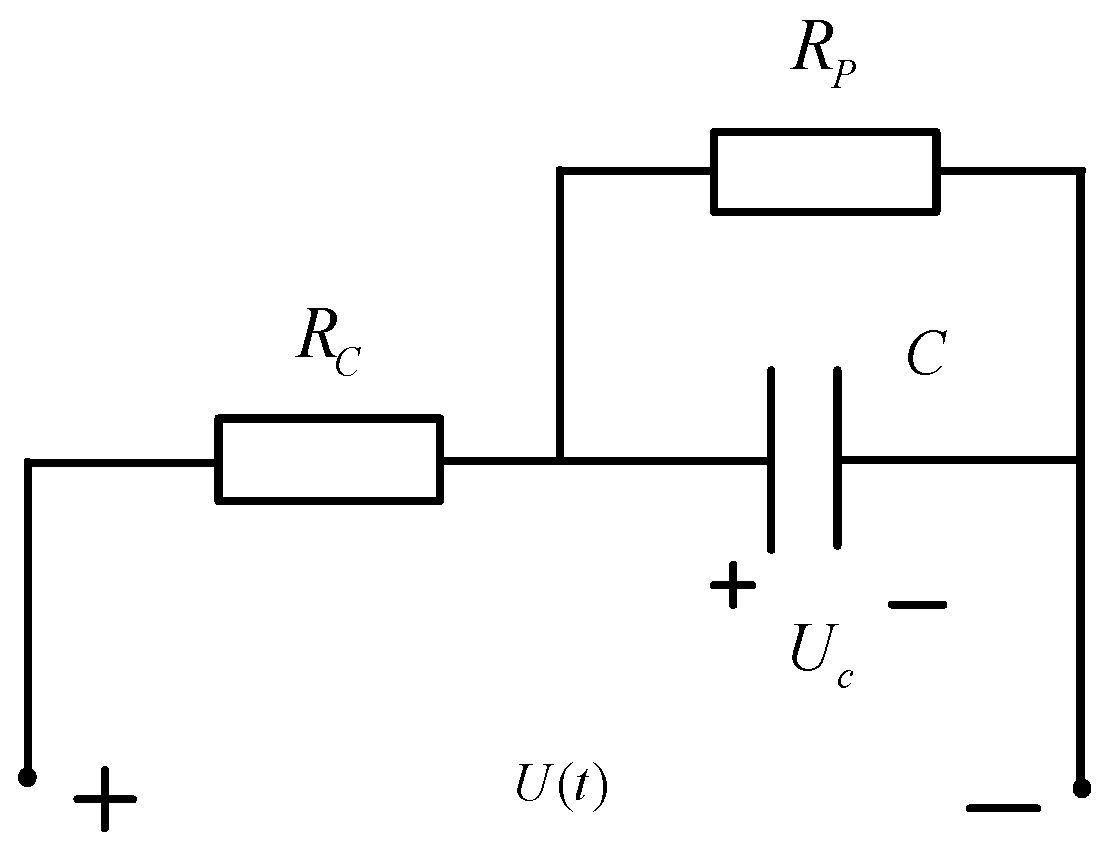
Hybrid ultracapacitors have the ability to release current instantaneously and are power-type energy storage devices, suitable for power-type discharge applications. This paper models the hybrid ultracapacitor using a series RC circuit. The equivalent circuit focuses on short-term dynamic behavior during primary frequency regulation. Temperature effects, aging processes, and nonlinear electrochemical dynamics mainly influence long-term energy management and lifetime evaluation, and exert negligible impact on the fast power response considered in this study. Therefore, the series RC model sufficiently represents the dynamic characteristics required for primary frequency regulation analysis. The corresponding circuit model is illustrated in Figure 2.
Here, R C is the internal resistance of the hybrid ultracapacitor, R P is the leakage resistance, C is the capacitance, and U c is the voltage across the capacitor. In practical applications, the leakage current of the hybrid ultracapacitor can be neglected, so the output voltage across the hybrid ultracapacitor can be expressed as:
U ( t ) = R C I s c + U c
In the formula, I s c is the charge and discharge current of the hybrid ultracapacitor. Its usable capacity is
E c max = 1 2 C ( U s c max 2 U s c min 2 )
In the formula, U s c max is the rated voltage of the hybrid ultracapacitor, and U s c min is the minimum voltage.
The remaining capacity of the hybrid ultracapacitor can be expressed as:
S O C = E E c m a c = U s c 2 U s c min 2 U s c max 2 U s c min 2
From the above formula, it can be seen that the remaining capacity of a hybrid ultracapacitor is related to its actual voltage variations, and the voltage changes at its terminals determine the range of output energy and the depth of charge and discharge.

3. Energy Storage Participation in Primary Frequency Regulation Control Strategy

3.1. Traditional Energy Storage Frequency Modulation Control Strategy

At present, energy storage systems participate in grid frequency regulation mainly through three categories of control strategies: droop control, which enables autonomous power adjustment based on frequency deviations; virtual inertia control, which emulates the inertial response characteristics of synchronous generators; and hybrid inertia control, which integrates the advantages of the former two approaches to achieve coordinated operation across multiple time scales [22,23].
(1)
Droop Control
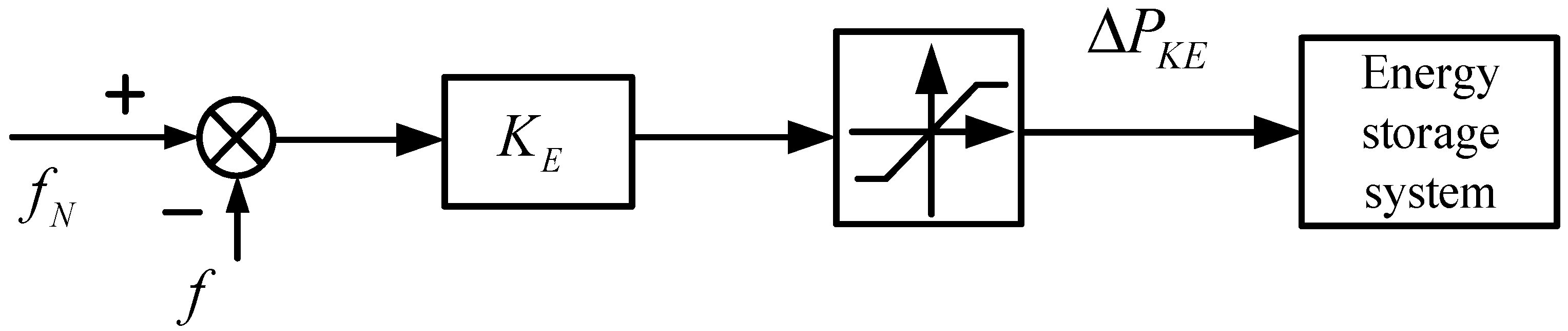
The core principle of droop control for energy storage systems lies in establishing a linear proportional relationship between system frequency and output power, which enables the energy storage system to respond to grid frequency variations. This approach emulates the active power–frequency droop characteristics of synchronous generator governors, thereby endowing energy storage devices with frequency regulation capabilities similar to those of conventional synchronous generators [24]. Figure 3 illustrates the control block diagram of the energy storage droop control scheme, and the corresponding output power can be expressed as:
Δ P K E = K E Δ f
In the formula: Δ P K E is the droop control output power; K E is the droop coefficient. When an active power imbalance occurs in the system, droop control plays a key role in maintaining system frequency stability by dynamically adjusting the generator output, and it can significantly reduce the final steady-state frequency deviation.
(2)
Virtual Inertia Control
Virtual inertia control for energy storage systems is analogous to the virtual inertia control employed in wind turbine generators, with the primary objective of emulating the inertial response characteristics of synchronous generators [25]. Although hybrid ultracapacitor-based energy storage systems inherently lack physical rotational inertia, their fast charge–discharge capability enables them to provide short-term inertial support during system frequency disturbances. Figure 4 presents the system block diagram of the energy storage virtual inertia control scheme, and the corresponding virtual inertia control output power can be expressed as:
Δ P M E = M E 0 d Δ f Δ t
In the formula: Δ P M E is the virtual inertia controlling the output power; M E 0 is the virtual inertia coefficient.
Virtual inertia control can rapidly inject or absorb power at the instant of a power disturbance, thereby suppressing the rate of change in frequency and mitigating frequency degradation. This fast dynamic response creates a critical time window for the activation of subsequent control layers, such as primary frequency regulation.
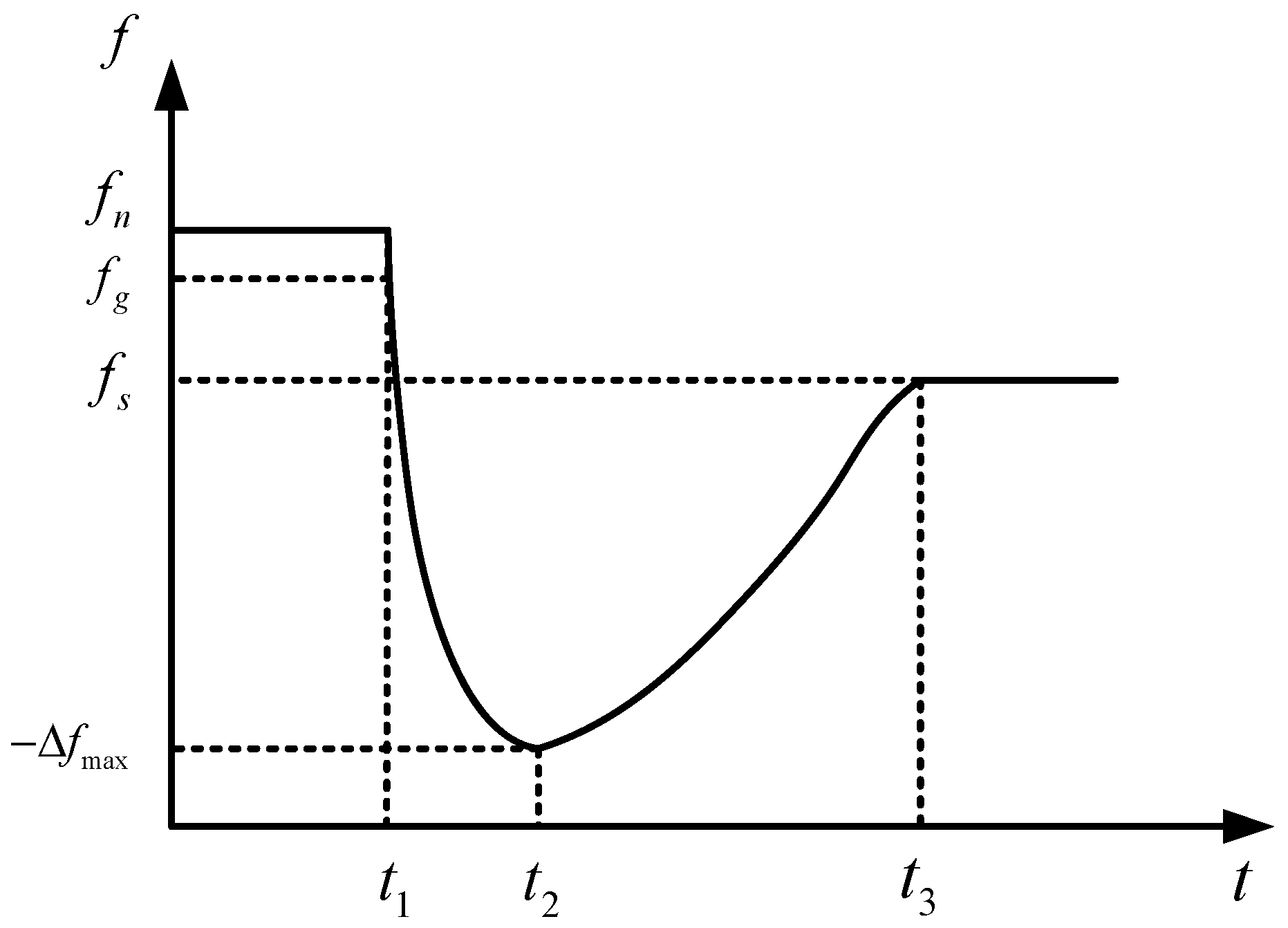
In the figure, f n denotes the nominal system frequency, while f g represents the deadband frequency of the energy storage system, typically set to ±0.033 Hz. The frequency f s indicates the steady-state frequency after primary frequency regulation. The maximum frequency deviation is denoted by Δ f max .
Taking the scenario of frequency decline as an example, we analyze the control response mechanism of energy storage. As shown in Figure 5, at time t 1 , the system suddenly experiences a disturbance, causing the frequency to deviate. At this moment, the rate of change in frequency is relatively large and positive. According to the comprehensive inertia control formula, the energy storage system responds quickly, releasing power to the grid and providing strong support for the system frequency. As time progresses, by time t 2 , the frequency drops to its lowest point, at which moment the rate of change in frequency becomes zero; from time t 2 to t 3 , the frequency gradually rebounds to a steady state. During this period, the absolute value of the rate of change in frequency is large and negative. In this phase, although the frequency deviation is still positive, droop control causes the energy storage to continuously output power. However, because the rate of change in frequency is less than zero, the virtual inertia control switches to absorbing power, which has a negative effect on the restoration of the grid frequency. Similarly, in the case of a rising frequency, during the frequency recovery phase, virtual inertia control can also become a factor that hinders the recovery of the grid frequency.
(3)
Integrated Inertia Control
Composite inertia control is a hybrid strategy that integrates droop control and virtual inertia control [26]. During the dynamic process of a frequency disturbance, the controller generates power commands based on the rate of change in frequency to emulate the inertial response of synchronous generators, thereby suppressing rapid frequency deviations. Subsequently, once the frequency dynamics become smoother, the control mode automatically transitions to frequency-deviation-based droop control, providing sustained power support until the system frequency returns to the allowable nominal range.

3.2. Adaptive Droop Control Based on Variable K Method

Conventional droop control fails to effectively track the severity of frequency nadirs, resulting in delayed and insufficient responses from energy storage systems. In addition, the fixed- K approach tends to cause excessive charging and discharging during prolonged disturbances, driving the battery state of charge beyond a reasonable operating range and thereby degrading battery lifetime. To address these issues, an adaptive droop control strategy based on a variable- K scheme is introduced to enhance the control performance of the energy storage system, ensure stable operation, and extend the service life of the storage device.
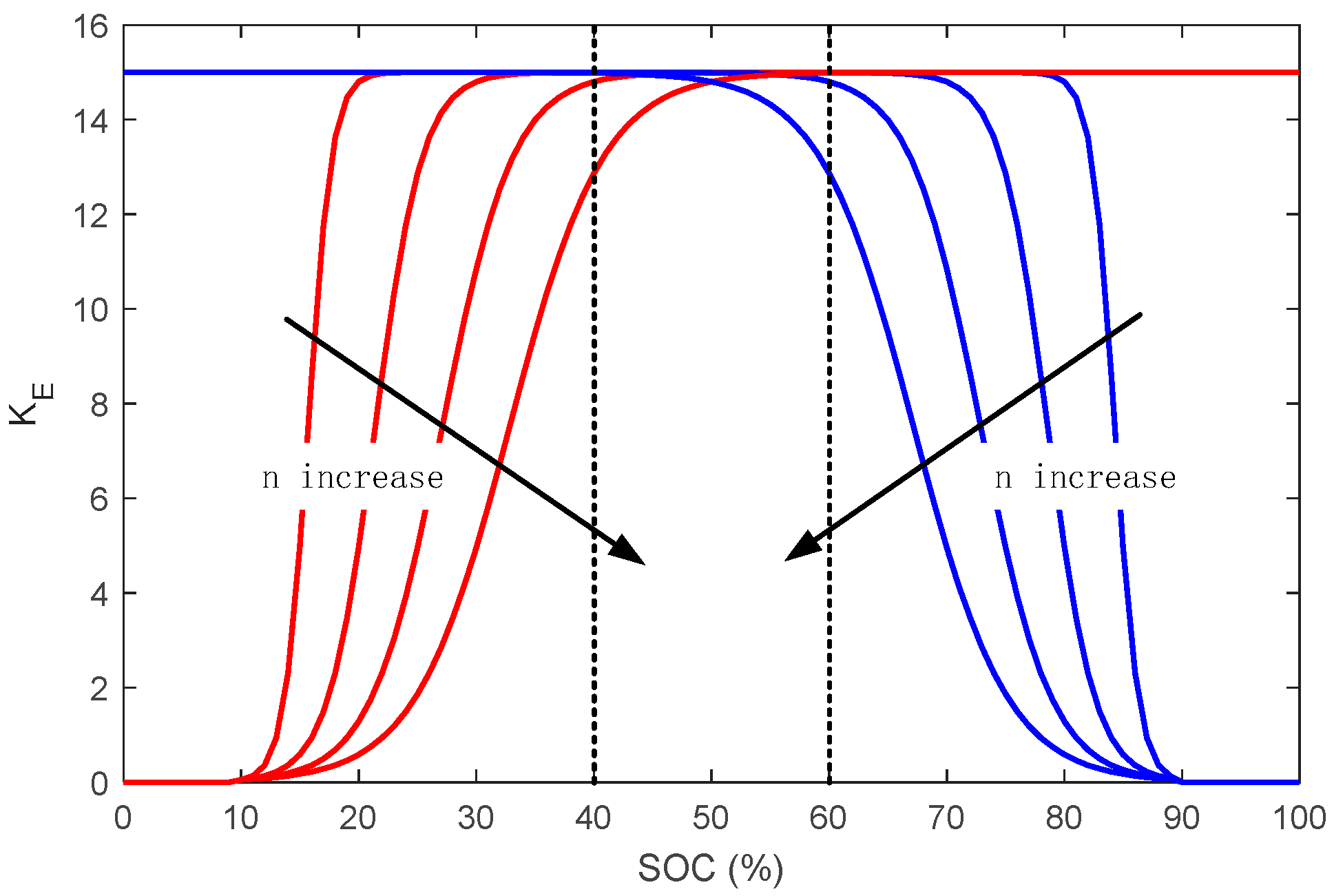
The variable K method usually calculates the K value by constructing the functional relationship curve between the energy storage S O C and K E . In this paper, four S O C marker values are set, dividing the S O C range into five segments, namely 0 ~ S O C min , S O C min ~ S O C n l , S O C n l ~ S O C n h , S O C n h ~ S O C max , and S O C max ~ 100 . The expressions for the energy storage discharge coefficient K E d and the energy storage charge coefficient K E c are as follows:
K E d = 0 S O C 0 , S O C min K E _ b a s e K E d 1 S O C S O C min , S O C n l K E _ b a s e S O C S O C n l , 100
K E c = K E _ b a s e S O C 0 , S O C n h K E _ b a s e K E c 1 S O C S O C n h , S O C max 0 S O C S O C max , 100
Among them, K E d 1 and K E c 1 are:
K E d 1 = 1 1 + 300 e 1 ( S O C S O C min ) n
K E c 1 = 1 1 + 300 e 1 ( S O C max S O C ) n
The SOC thresholds adopted in this study are set to S O C min = 10 and S O C max = 90 , which are determined by jointly considering the electrochemical characteristics of the hybrid ultracapacitor and the system-level frequency regulation requirements. Maintaining a sufficiently wide usable SOC range is crucial for ensuring continuous and effective power support during frequency disturbances. When the energy storage system operates outside this SOC range, for example, further reducing S O C min can slightly enhance short-term frequency support under severe under-frequency conditions; however, it significantly increases the occurrence of deep discharge events, thereby noticeably shortening the service life of the energy storage system. Conversely, increasing S O C max beyond 90% may marginally improve charging capability during over-frequency events, but it also raises the risk of overvoltage and accelerates device aging. Figure 6 illustrates the energy storage output coefficient curve as n varies for a foundation sag coefficient K E _ b a s e = 15 , where red denotes the discharge coefficient and blue denotes the charge coefficient.
In the figure: the abscissa is the SOC of energy storage, and the ordinate K E is the sag coefficient of energy storage sag control.
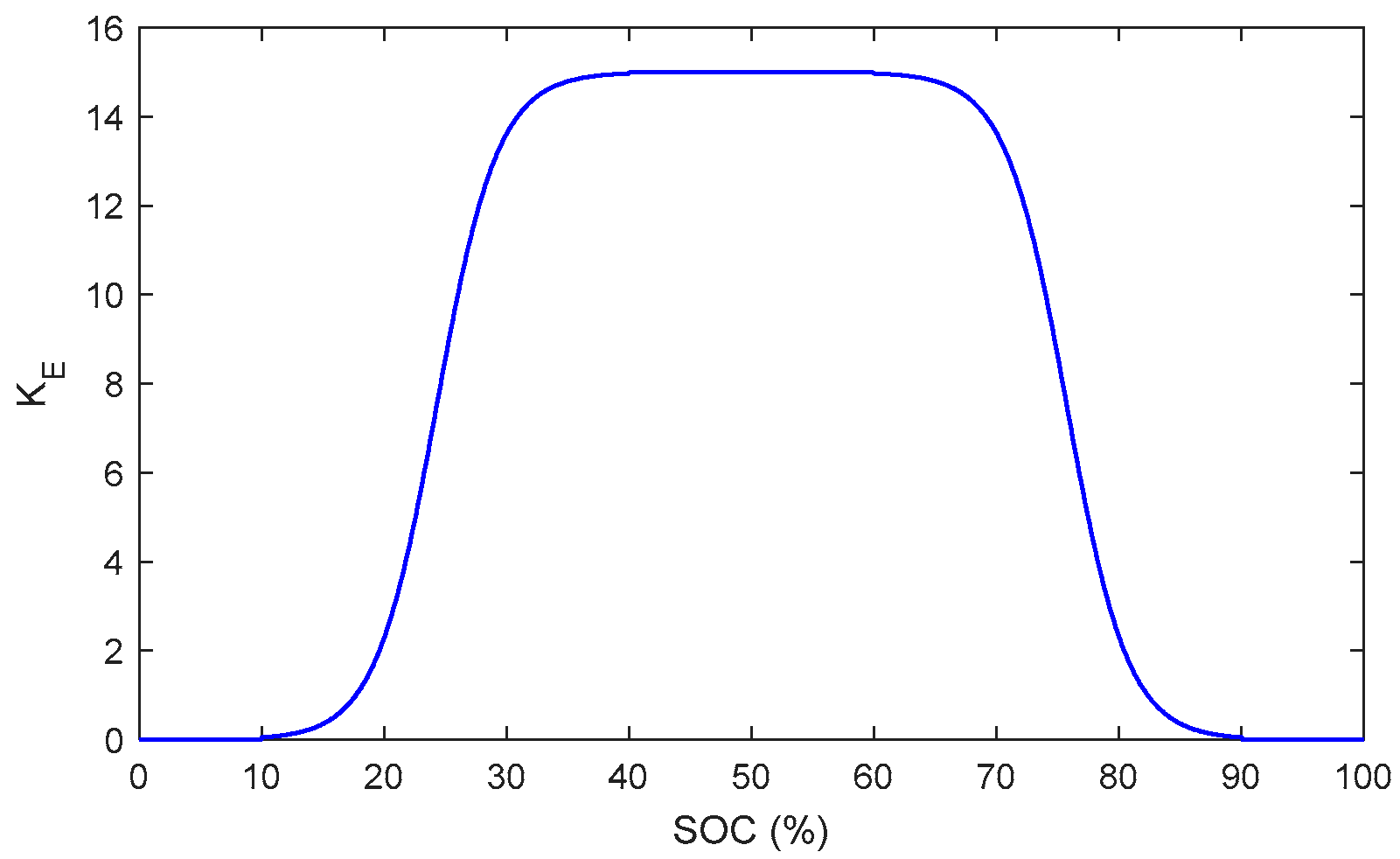
When performing frequency modulation, it is necessary to ensure that the energy storage is in a good condition, and set S O C n l = 40 and S O C n h = 60 . In the 0 ~ S O C min and S O C max ~ 100 sections, the droop coefficient is 0; in the S O C min ~ S O C n l and S O C n h ~ S O C max sections, the droop coefficient changes in an S-shaped curve with the increase in SOC; in S O C n l ~ S O C n h , the droop control coefficient is the basic droop coefficient K E _ b a s e = 15 . Dividing the SOC into five segments allows a smooth and nonlinear transition of the droop coefficient between inactive, adaptive, and full-support regions. Compared with coarse SOC partitioning methods, the five-segment structure prevents abrupt changes in control gains near SOC boundaries, thereby improving control smoothness and reducing unnecessary power oscillations. The variation in the energy storage output coefficient is shown in Figure 7.
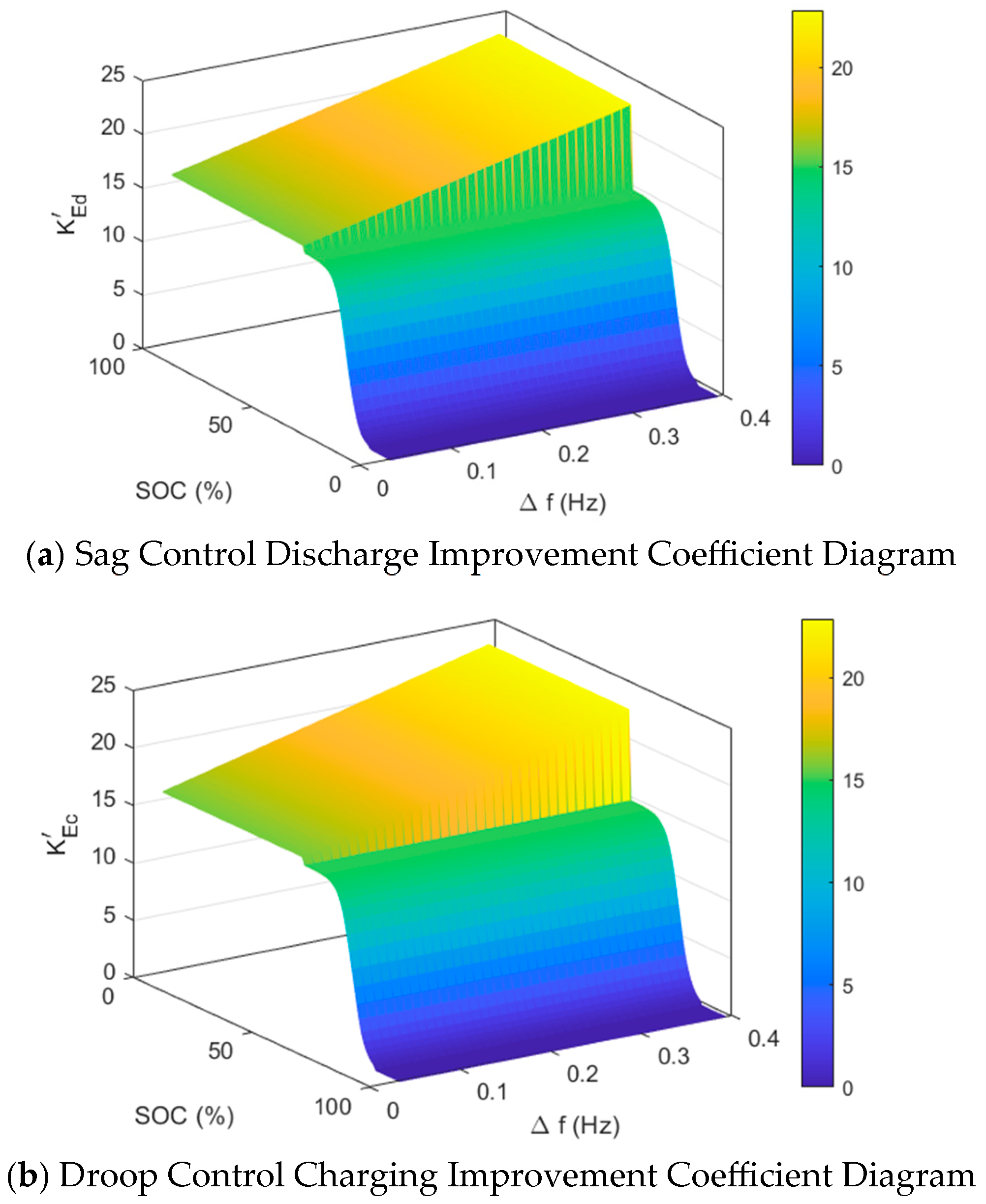
Furthermore, to enable the droop coefficient to adaptively adjust according to the depth of frequency decline, a local optimization improvement was made to the variable K method. When the energy storage system is within a favorable SOC range, that is, between S O C n l ~ S O C n h , the droop coefficient increases correspondingly with the severity of the frequency deterioration. In this way, the system’s ability to support the grid frequency can be significantly enhanced. Under this optimization strategy, the expressions for the energy storage discharge coefficient K E d and the energy storage charge coefficient K E c are as follows:
K E d = 0 S O C 0 , S O C min K E _ b a s e K E d 1 S O C S O C min , S O C n l K E _ b a s e + K E d 2 S O C S O C n l , 100
K E c = K E _ b a s e + K E c 2 S O C 0 , S O C n h K E _ b a s e K E c 1 S O C S O C n h , S O C max 0 S O C S O C max , 100
Among them, K E d 2 and K E c 2 are:
K E d 2 = Δ f K e K E c 2 = Δ f K g
In the formula, K e represents the droop control discharge coefficient; K g represents the droop control charging coefficient
The improved droop coefficient under the variable K method is shown in Figure 8. It can be clearly seen that, based on the variable K method, when the SOC is within the specific range from S O C n l to S O C n h , the droop control coefficient is not fixed but dynamically increases as the depth of the frequency drop increases. The deeper the frequency drop, the higher the droop control coefficient becomes. This allows the energy storage system to respond more quickly and effectively to frequency changes, providing more power support when the frequency decreases, thereby better maintaining the stability of the power system frequency.
In most cases of droop control, the energy storage K E d is the same as K E c , so K e and K g are usually set equal. This means that the system’s ‘stiffness’ or response speed to frequency rises (charging) and drops (discharging) is the same. In certain specific scenarios or requirements, for example, to avoid deep charging or deep discharging of the energy storage, K e can be reduced when the SOC approaches the lower limit, or K g can be reduced when the SOC approaches the upper limit. At this time, the control coefficient is K e K g .

3.3. Adaptive Virtual Inertia Control

In conventional virtual inertia control, the virtual inertia coefficient is set as a fixed constant. During the frequency deterioration stage, this inertia coefficient can effectively mitigate the rate of frequency decline. However, during the frequency recovery stage, conventional virtual inertia control may hinder frequency restoration and slow down system recovery. Therefore, an improved adaptive virtual inertia control strategy is adopted, and the corresponding virtual inertia control formulation is modified as follows:
M E = M E 0 + M q d Δ f / d t d Δ f / d t > 0 M E 0 M q d Δ f / d t d Δ f / d t < 0
During grid frequency fluctuations, the virtual inertia coefficient is adjusted in real time according to the rate of change in frequency. In the frequency deterioration stage, the introduction of the M q control coefficient strengthens the compensation and optimization capability of the virtual inertia loop with respect to frequency dynamics, thereby enhancing overall system stability. When the grid enters the frequency recovery stage, a timely reduction in the virtual inertia coefficient alleviates the restrictive effect of virtual inertia control on frequency restoration, effectively accelerating the return of system frequency to its normal range and ensuring stable grid operation.

3.4. Adaptive Inertia Control and Its Comparison with Traditional Control Methods

The traditional fixed-parameter inertia control strategy employs constant droop and virtual inertia coefficients, which limits its adaptability to varying frequency disturbances, leading to excessive energy storage response and losses under small disturbances, insufficient power support and large frequency deviations under severe disturbances, delayed frequency recovery due to continuous inertia action during the restoration stage, and increased battery degradation risks caused by the lack of effective SOC monitoring and protection.
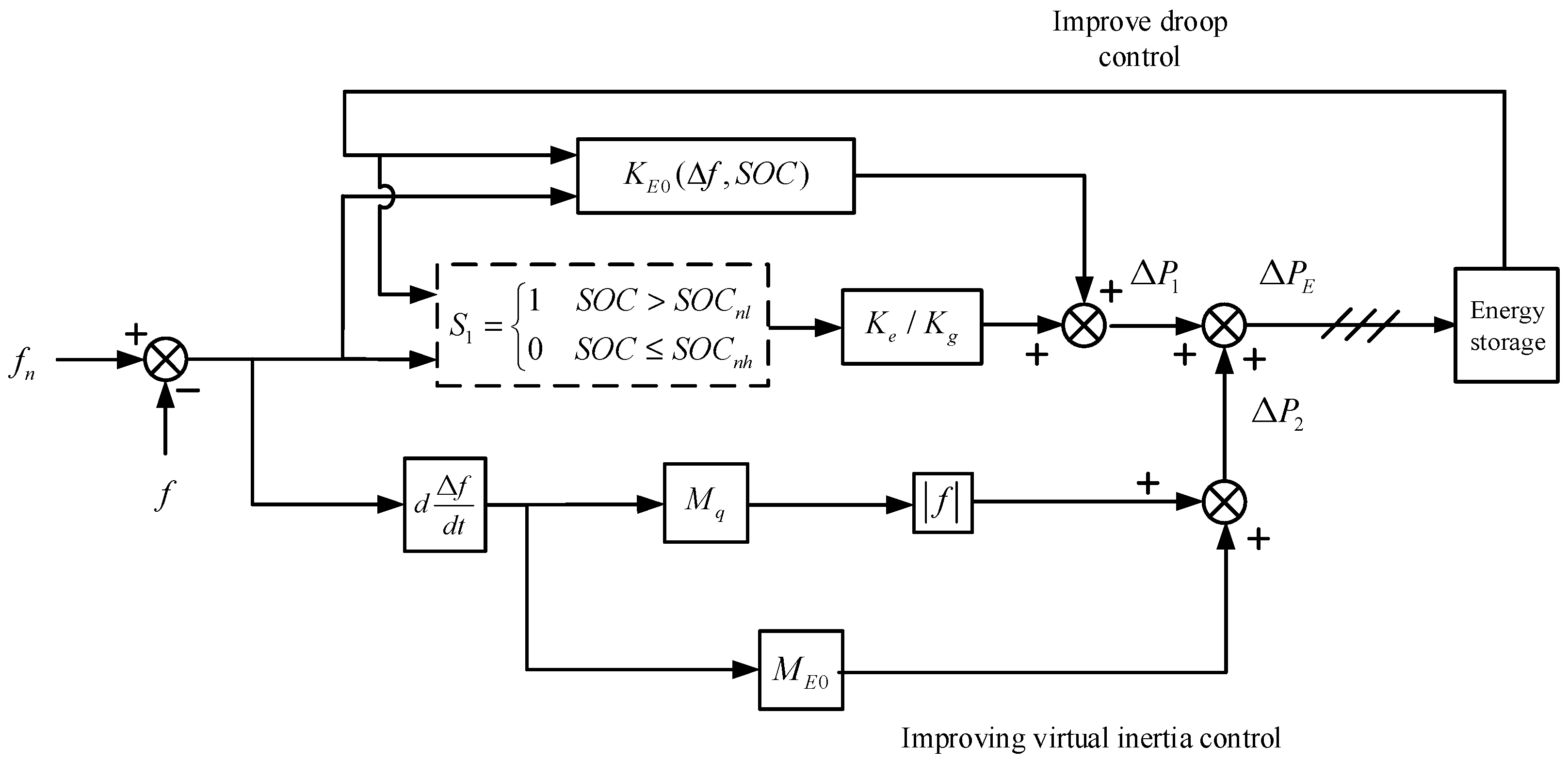
The combination of improved variable K-method droop control with adaptive virtual inertia control forms an adaptive inertia control system, whose overall control block diagram is illustrated in Figure 9.
Adaptive droop control nonlinearly and dynamically adjusts the droop coefficient based on the magnitude of frequency deviation and the state of charge of the energy storage system. When the frequency deviation is large and the SOC remains within a safe operating range, the droop coefficient increases to enhance power support. In contrast, when the frequency deviation is small or the SOC approaches its limits, the droop coefficient decreases or even drops to zero, preventing excessive responses and potential damage to the energy storage system. Adaptive virtual inertia control, meanwhile, dynamically regulates the virtual inertia coefficient according to the rate of change in frequency. During frequency deterioration, the virtual inertia coefficient increases to reinforce inertial support and suppress the rate of frequency change. During frequency recovery, the coefficient is significantly reduced to eliminate the adverse effects of conventional virtual inertia control on power absorption, thereby accelerating system frequency restoration. By integrating SOC-aware protection logic, this dynamic parameter adjustment mechanism substantially enhances frequency stability, resulting in smaller frequency deviations, faster recovery dynamics, and improved steady-state frequency levels. Moreover, it optimizes the power output efficiency of the energy storage system while ensuring safe operation and prolonged service life.

3.5. Comparison with Other Adaptive Control Strategies

To address the frequency stability challenges of low-inertia power systems, particularly under large-scale integration of renewable energy sources, various adaptive frequency support control strategies have been proposed in recent years. Table 2 presents a comparison between the proposed hybrid ultracapacitor (HUC)-based adaptive inertia control strategy and two representative approaches, namely fuzzy adaptive control and model predictive control (MPC). These three methods represent different control design philosophies for frequency regulation: rule-based intelligent control, optimization-based predictive control, and inertia-oriented adaptive control, respectively. The comparison focuses on key aspects including control mechanisms, computational complexity, response speed, and engineering implementation feasibility.
Compared with fuzzy adaptive control and MPC-based approaches, the proposed adaptive inertia control achieves a better balance between dynamic frequency support performance and implementation complexity, making it particularly suitable for hybrid ultracapacitor-based fast frequency regulation applications.

3.6. Selection of Primary Frequency Regulation Capacity for Energy Storage Systems

According to the technical requirements and testing methods for virtual synchronous generator technology for wind turbines from the State Grid: ‘The maximum active power output is 0.1 P n and the primary frequency regulation time is not less than 30   s . Under this requirement, to cope with bilateral frequency regulation and to provide longer frequency support, the energy capacity of the energy storage system E e s should be greater than 2 0.1 P n 60   s , and the charging/discharging power of the energy storage system P e s should be 0.1 P n . Its overall circuit efficiency is η c , and E e s , P e s should meet:
E e s η c > 0.2 P n 60   s P e s η c > 0.1 P n
For the energy storage configuration of a 1.5 MW wind turbine, according to Formula (14) power constraint: P e s 0.1 P n / η c 157.90   k W ; capacity constraint: E e s 0.2 P n × 60   s / η c 5.264   k W h .

4. Simulation Verification Analysis

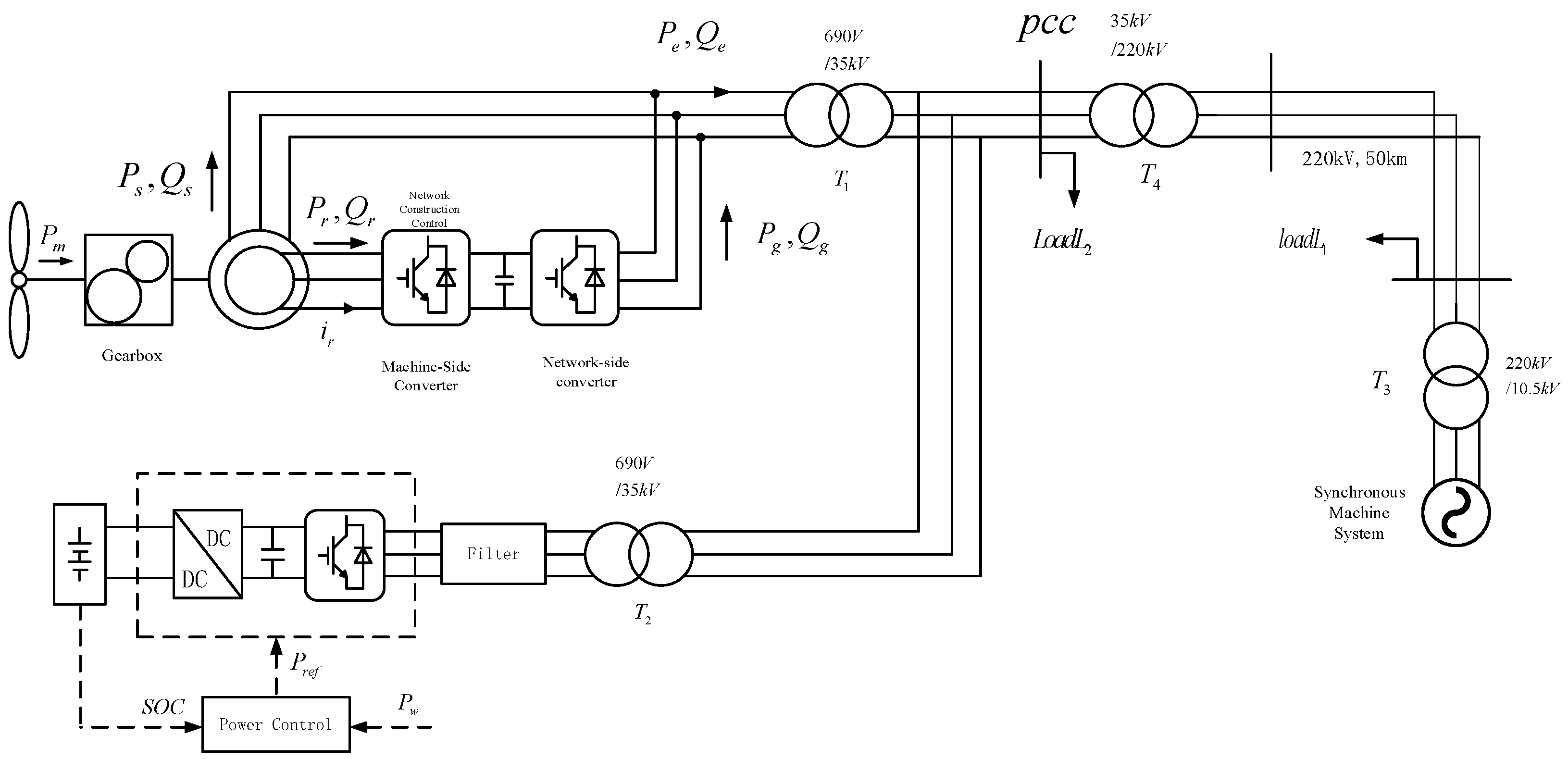
To evaluate the frequency regulation performance of the proposed control strategy, a hybrid ultracapacitor energy storage system is integrated at the point of common coupling of a grid-forming doubly fed wind turbine in the MATLAB 2022/Simulink environment. Moreover, since the time scale of primary frequency regulation is much slower than that of converter switching dynamics, switching harmonics and bandwidth limitations have a negligible impact on the frequency response analyzed in this study and are therefore not explicitly modeled.
The simulation model includes a 1.5 MW doubly fed induction generator wind turbine with a rated voltage of 690 V. The stator resistance and stator inductance of the generator are set to 0.018 p.u. and 0.07 p.u., respectively, and the DC-link capacitance is 12,000 μF. The wind speed is fixed at 10 m/s. The synchronous generator system consists of a 9 MW synchronous generator and a corresponding load of L 1 = 9 . 8   M W . After voltage boosting, the DFIG wind turbine and the hybrid supercapacitor energy storage system are connected to the grid through a 50 km transmission line. The model of the double-fed wind turbine and energy storage system is shown in Figure 10.
A hybrid ultracapacitor energy storage system mainly consists of an energy storage module, a management system, a bidirectional DC/DC converter, a DC/AC converter, a power control system, and an LC filter. The bidirectional DC/DC converter performs voltage step-up and step-down regulation, ensuring efficient bidirectional power flow. The DC/AC converter is responsible for precise regulation of the output power of the energy storage system. Based on the real-time state information of the storage device and grid power demand, the power control system designs appropriate control strategies and coordinates the operation of each converter to achieve bidirectional energy transfer. The LC filter primarily suppresses harmonics generated by the converters, thereby improving power quality and ensuring stable power delivery to the grid.

4.1. System Simulation Analysis of Energy Storage Integration

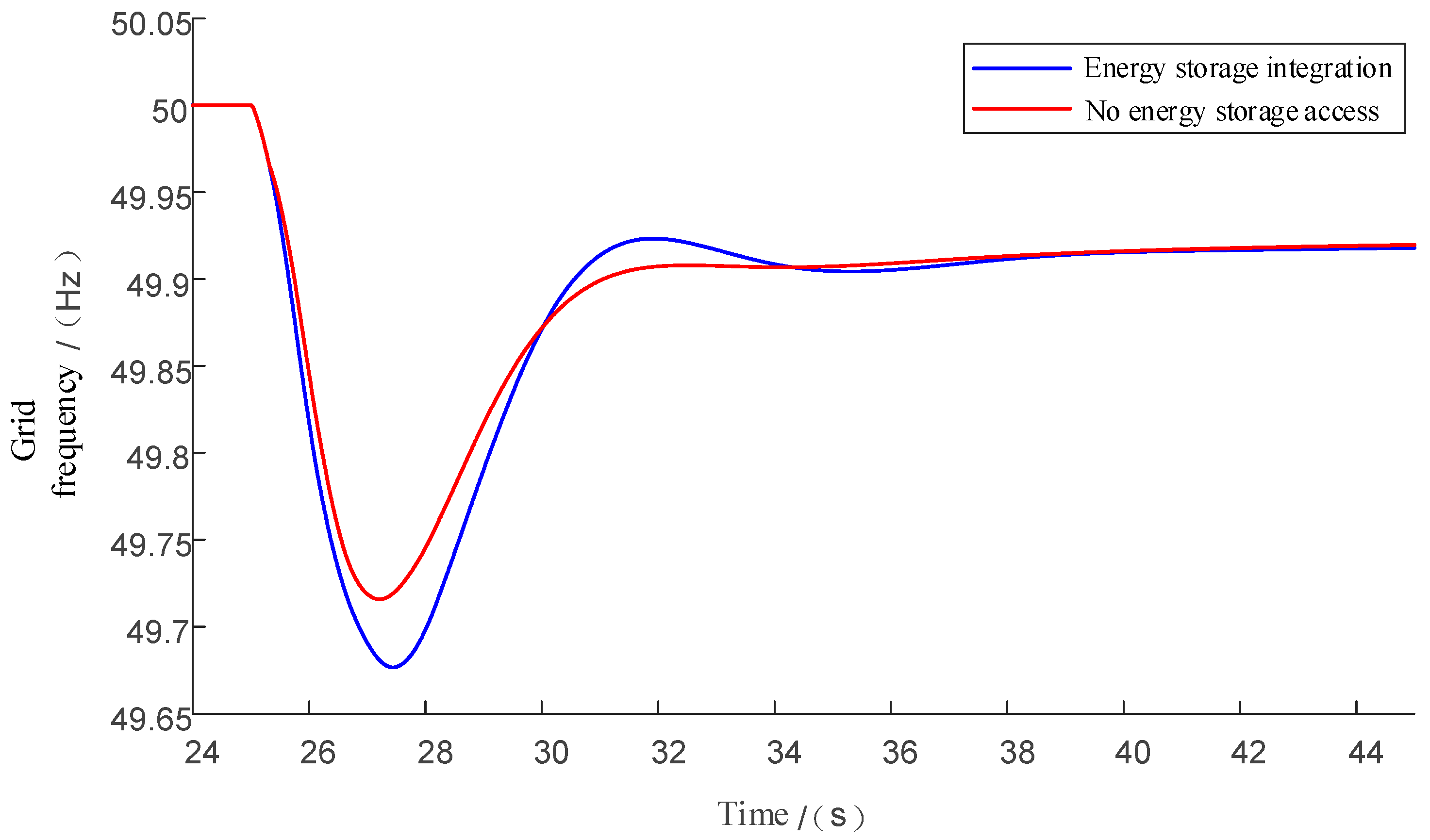
In a grid-connected system of doubly fed wind turbines, a hybrid ultracapacitor energy storage system is added. The droop coefficient uses the basic droop control coefficient K E _ b a s e = 15 , and the virtual inertia control coefficient uses the basic virtual inertia control coefficient M E 0 = 2 . A load increase of L 2 = 0 . 8   M W is set at 25 s.
As illustrated in Figure 11, the increase in system load inevitably leads to a decline in grid frequency. Compared with the system without energy storage, the system integrated with a hybrid ultracapacitor energy storage system exhibits a smaller frequency deviation. During frequency disturbances, the energy storage system can rapidly deliver the required power support, effectively suppressing excessive grid frequency fluctuations. Moreover, the integration of the energy storage system not only enhances frequency performance during disturbances but also contributes to an improvement in the steady-state grid frequency after the system reaches equilibrium.

4.2. Simulation Analysis of Changes in Droop Control Coefficient

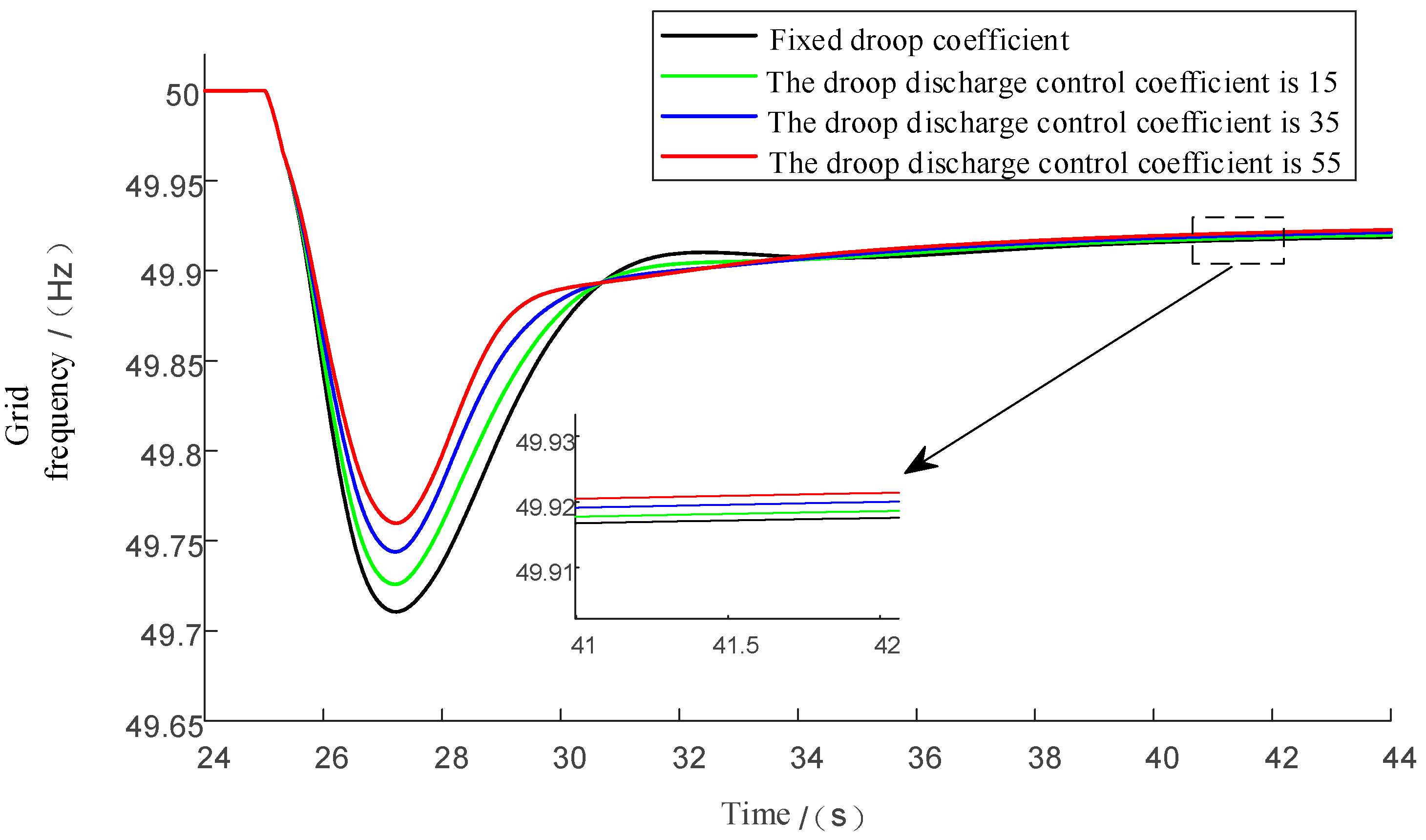
Taking load increase as an example, we explore the impact of changes in the droop control coefficient K e on energy storage output and system frequency. The system is set to increase the load L 2 = 0 . 8   M W at 25 s, with virtual inertia control unchanged and the virtual inertia coefficient M E 0 = 2 . Droop control adopts an adaptive droop control method based on the variable K method. The simulation results are shown in Figure 12.
As the droop control coefficient K e increases from 15 to 35, the discharge coefficient K E d also increases, and the magnitude of the frequency drop in the power grid after a disturbance gradually decreases. A higher K E d enables the energy storage system to respond more quickly and effectively to changes in grid frequency, thereby providing greater active power support and mitigating the frequency decline. Compared with fixed droop coefficient control, the lowest frequency point rises from 49.71 Hz to 49.76 Hz when adjusting the K e = 55 coefficient. In addition, after the system reaches a steady state, simulation results also show a certain degree of frequency improvement. When the experiment is set to a load decrease in the system, causing the frequency to rise, increasing the energy storage K g allows the storage to quickly respond to frequency changes, absorb excess electrical power, reduce the magnitude of the frequency rise, and lower the steady-state system frequency. This indicates that by optimizing the K E control method, the frequency stability of the grid under disturbance conditions can not only be improved, but the grid frequency can also be further enhanced under steady-state conditions, thereby improving the overall performance of the power grid.
To provide a more comprehensive evaluation of the proposed control strategy, Table 3 summarizes several key performance indicators under fixed droop control and different droop control coefficients. As shown in Table 3 increasing the droop control coefficient significantly improves the frequency nadir and shortens the settling time, while eliminating frequency overshoot during the recovery process. Meanwhile, the total harmonic distortion of the output voltage after LC filtering remains at a low level for all operating conditions, indicating that the proposed adaptive control strategy enhances dynamic frequency performance without compromising output voltage quality.

4.3. Simulation Analysis of Virtual Inertia Control Coefficient Variations

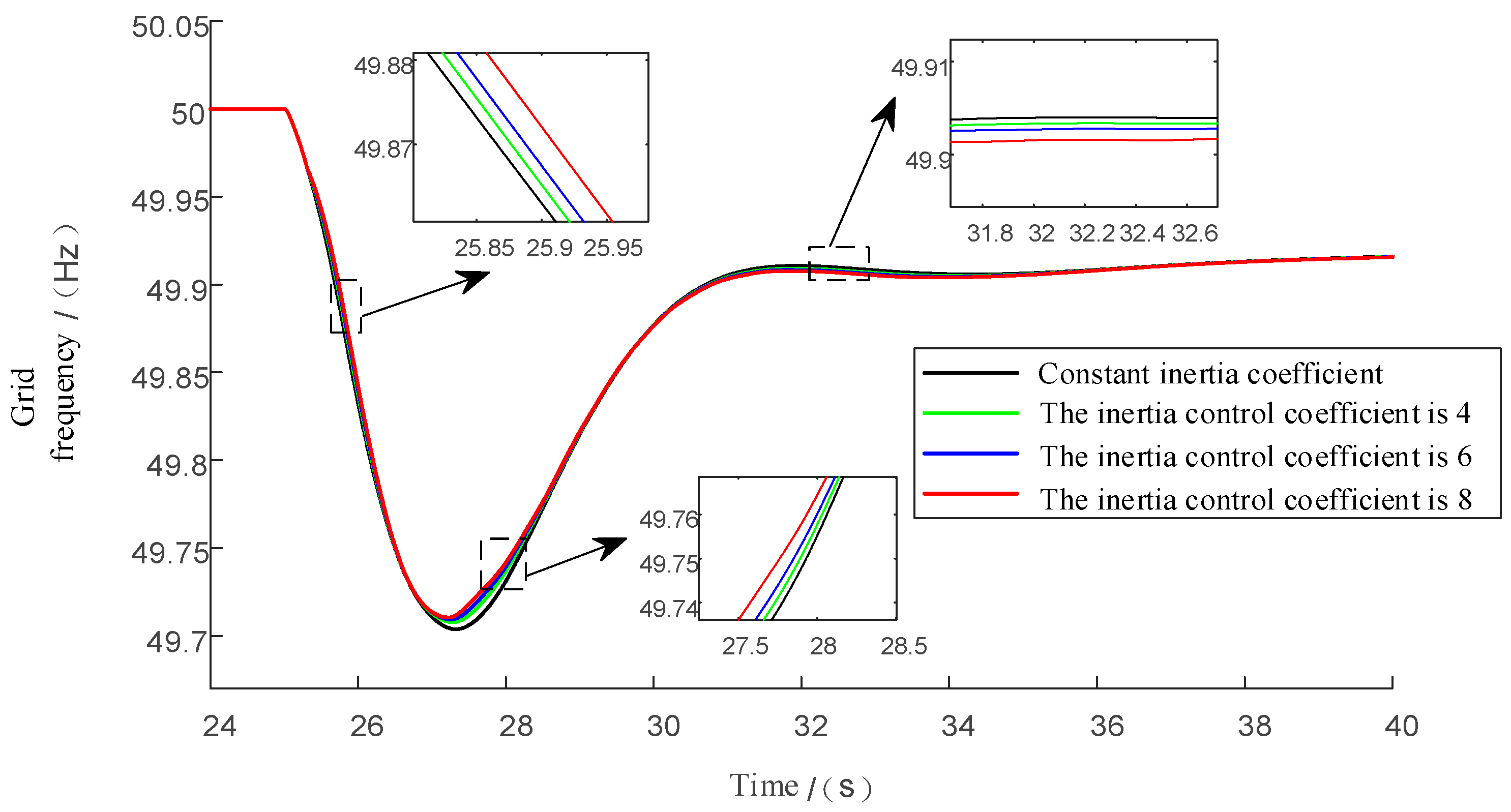
Investigate the impact of changes in the virtual inertia control coefficient M q on energy storage output and system frequency. The system is set to increase the load of L 2 = 0 . 8   M W at 25 s. The droop control uses the traditional fixed-parameter control, with the droop coefficient being the basic droop coefficient K E _ b a s e = 15 . During the frequency regulation process, an adaptive virtual inertia adjustment strategy is used to optimize the dynamic response of the grid frequency. The simulation results are shown in Figure 13.
As the virtual inertia control coefficient M q increases from 4 to 8, during the stage of grid frequency deterioration, with the increase of M q , the rate of frequency decline gradually slows down, and the magnitude of frequency drop also gradually decreases. Appropriately increasing M E can provide effective damping during the grid frequency decline stage, thereby improving system stability. In addition, during the frequency recovery stage, M q = 8 compared with fixed inertia coefficient control, reducing M E accelerates frequency recovery.

4.4. Comparative Analysis of Traditional Control and Adaptive Control

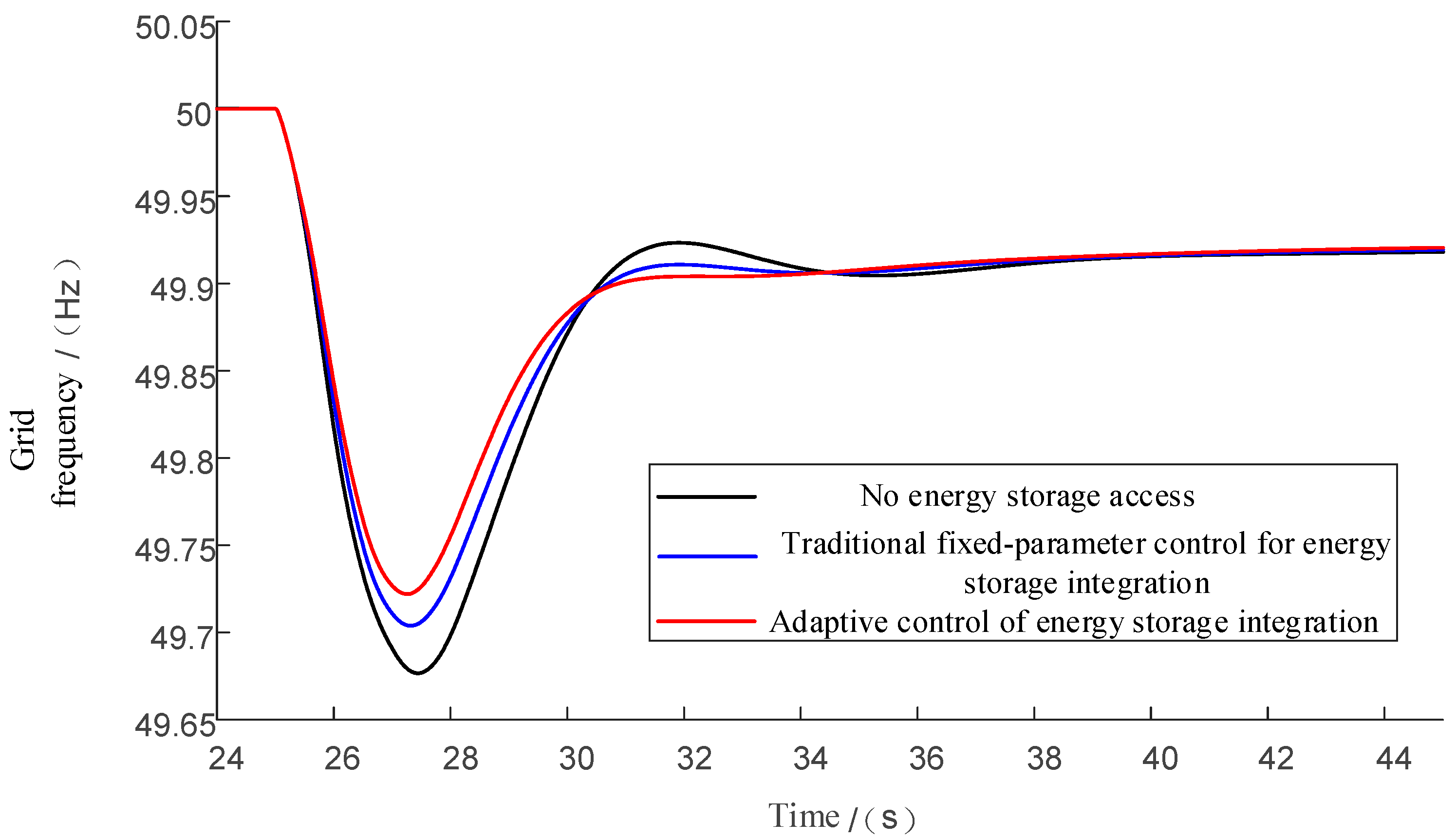
For the network-type doubly fed grid-connected system, at 25 s the load L 2 = 0 . 8   M W is increased. To investigate the impact of different control strategies on system frequency, simulations are conducted to compare the scenarios without energy storage, with energy storage using conventional fixed-parameter inertia control with droop coefficient K E _ b a s e = 15 , virtual inertia control coefficient M E 0 = 2 , and the adaptive inertia control proposed in this paper with droop coefficient K e = 35 , virtual inertia control coefficient M q = 6 . The simulation results are shown in Figure 14.
Figure 14 compares the system frequency responses under three different operating conditions: without energy storage integration, with energy storage employing conventional fixed-parameter inertia control, and with energy storage governed by the proposed adaptive inertia control strategy. At 25 s, a sudden load increase is introduced to evaluate the dynamic frequency regulation performance of each control scheme. In the absence of energy storage devices, the system exhibits the greatest frequency deviation and slowest recovery process due to insufficient inertial support. When employing traditional inertial control combined with ultracapacitor energy storage, the minimum frequency value is effectively mitigated; however, the use of fixed droop and virtual inertia parameters limits the depth of the energy storage response, resulting in suboptimal frequency deviation suppression and prolonged recovery cycles. In contrast, the proposed adaptive inertia control strategy demonstrates superior dynamic performance. The system’s minimum frequency rises to 49.73 Hz, significantly exceeding values achieved by traditional inertia control and no-energy-storage schemes. The frequency decline rate is substantially reduced, indicating enhanced inertia support capability during disturbance initiation. Through adaptive coordination between droop control and virtual inertia control, the frequency recovery process is markedly accelerated, enabling the system to reach a new steady-state operating point within a shorter timeframe.
These results demonstrate that the proposed adaptive inertia control strategy effectively reduces the maximum frequency deviation, improves system damping characteristics, and enhances overall dynamic stability. By dynamically adjusting control parameters in response to real-time frequency variations, the hybrid ultracapacitor energy storage system is able to provide precise and timely frequency support, thereby improving the resilience of grid-forming doubly fed wind turbine systems operating under low-inertia conditions.

5. Conclusions

The final simulation results indicate that the adaptive inertia control, composed of droop control based on the improved variable-K method and adaptive virtual inertia control, shows significant advantages in terms of frequency stability for a networked double-fed wind turbine system compared to traditional inertia control. Under frequency disturbance conditions, the hybrid ultracapacitor energy storage can respond quickly to frequency changes, accurately adjusting output power and inertia coefficients, providing effective dynamic frequency support, effectively suppressing frequency deviations, shortening the time for the system frequency to return to the rated value, and improving the system’s dynamic performance.
This paper proposes an adaptive inertia control strategy for a grid-connected doubly fed wind turbine system equipped with a hybrid ultracapacitor energy storage system to enhance frequency support under load-induced frequency disturbances. Based on simulation studies conducted in MATLAB 2022/Simulink, the following conclusions can be drawn.
(1)
The hybrid ultracapacitor energy storage system combines high power density with enhanced energy density, which enables flexible power regulation. In practical operation, the storage system responds rapidly during the initial stage of frequency disturbances by delivering high power to suppress frequency deviations. During sustained frequency deviations, its extended support duration ensures continuous power injection, thereby significantly improving the overall frequency stability of renewable energy-integrated power systems.
(2)
When controlled by the proposed adaptive inertia strategy, the hybrid ultracapacitor energy storage system employs an improved variable-K droop control to adjust the droop coefficient in real time according to the magnitude of frequency deviations. Under load increase conditions, this approach effectively mitigates the frequency nadir and improves the steady frequency level during primary frequency regulation. At the same time, the control strategy explicitly considers the state of charge of the energy storage system. By monitoring and regulating SOC in real time, the strategy meets frequency regulation requirements while preventing excessive charging and discharging, thereby enhancing the reliability and economic performance of the storage system.
(3)
The proposed adaptive inertia control strategy assigns different virtual inertia coefficients during the frequency decline and recovery stages. During frequency decline, the strategy increases the effective system inertia to slow down the rate of frequency drop. During frequency recovery, it reduces the virtual inertia coefficient, allowing the energy storage system to track frequency variations more rapidly and accelerate frequency restoration. This coordinated inertia adjustment significantly improves the dynamic recovery performance of the system following frequency disturbances.
Overall, simulation results demonstrate that the proposed adaptive inertia control strategy outperforms conventional fixed-parameter inertia control in terms of maximum frequency deviation, frequency recovery speed, and dynamic stability. By enabling fast and accurate adjustment of output power and inertia parameters, the hybrid ultracapacitor energy storage system provides effective frequency support for grid-forming doubly fed wind turbine systems. From an engineering perspective, the proposed strategy significantly enhances system robustness and operational reliability under low-inertia conditions, making it well suited for large-scale renewable energy integration in future power systems. It should be noted that this study validates the proposed control strategy through MATLAB 2022/Simulink simulations, and experimental or hardware-based verification has not yet been conducted. Nevertheless, the control framework is developed with practical implementation considerations in mind. The adaptive droop control and virtual inertia control loops can be directly deployed on DSP- or FPGA-based wind turbine controllers and evaluated in a hardware-in-the-loop (HIL) environment through real-time interaction between controllers and power system simulators. Future work will therefore focus on HIL testing and experimental validation to further assess the effectiveness and robustness of the proposed control strategy under practical operating conditions.

Author Contributions

Conceptualization, G.N. and X.Y.; methodology, G.N.; software, G.N.; validation, P.S., L.H. and M.W.; formal analysis, P.S.; investigation, Y.J.; resources, N.Z.; data curation, P.S.; writing—original draft preparation, P.S.; writing—review and editing, G.N.; visualization, G.N.; supervision, G.N.; project administration, X.Y. All authors have read and agreed to the published version of the manuscript.

Funding

This work is supported by the Science and Technology Project of State Grid Corporation of China “Research on Operation Control and Development Pattern of Hybrid Ultracapacitor Energy Storage System for Grid Frequency Regulation” (Grant No. 4000-202355726A-3-3-JC).

Data Availability Statement

All original data are included in this manuscript. For any questions, please contact the corresponding author.

Conflicts of Interest

The authors declare no conflicts of interest.

References

  1. Verma, P.; K, S.; Dwivedi, B. A Self-Regulating Virtual Synchronous Generator Control of Doubly Fed Induction Generator-Wind Farms. IEEE Can. J. Electr. Comput. Eng. 2023, 46, 35–43. [Google Scholar] [CrossRef]
  2. Tang, Z.; Yang, Y.; Blaabjerg, F. Power electronics: The enabling technology for renewable energy integration. CSEE J. Power Energy Syst. 2022, 8, 39–52. [Google Scholar] [CrossRef]
  3. Wang, J.; Zhao, H.; Wang, P.; Gui, Y. Characterization of Impedance and Stability for Doubly-Fed Induction Generator Based on Voltage-Modulated Direct Power Control. IEEE Trans. Power Electron. 2025, 40, 15529–15544. [Google Scholar] [CrossRef]
  4. Zhou, X.; Cheng, S.; Wu, X.; Rao, X. Influence of Photovoltaic Power Plants Based on VSG Technology on Low Frequency Oscillation of Multi-Machine Power Systems. IEEE Trans. Power Deliv. 2022, 37, 5376–5384. [Google Scholar] [CrossRef]
  5. Xu, C.; Zou, Z.; Quan, X.; Wang, Z.; Chen, W. DC Voltage Control of Grid-Forming Converter for Transient Stability Enhancement. IEEE Trans. Energy Convers. 2025, 40, 1670–1673. [Google Scholar] [CrossRef]
  6. Haegel, N.M.; Kurtz, S.R. Global Progress Toward Renewable Electricity: Tracking the Role of Solar. IEEE J. Photovolt. 2021, 11, 1335–1342. [Google Scholar] [CrossRef]
  7. Akram, U.; Nadarajah, M.; Shah, R.; Milano, F. A review on rapid responsive energy storage technologies for frequency regulation in modern power systems. Renew. Sustain. Energy Rev. 2020, 120, 109626. [Google Scholar] [CrossRef]
  8. Sun, Y.; Zhao, Z.; Yang, M.; Jia, D.; Pei, W.; Xu, B. Overview of energy storage in renewable energy power fluctuation mitigation. CSEE J. Power Energy Syst. 2020, 6, 160–173. [Google Scholar] [CrossRef]
  9. Mahfuz-Ur-Rahman, A.M.; Islam, M.R.; Muttaqi, K.M.; Sutanto, D. An Effective Energy Management with Advanced Converter and Control for a PV-Battery Storage Based Microgrid to Improve Energy Resiliency. IEEE Trans. Ind. Appl. 2021, 57, 6659–6668. [Google Scholar] [CrossRef]
  10. Peng, Q.; Yang, Y.; Liu, T.; Blaabjerg, F. Coordination of virtual inertia control and frequency damping in PV systems for optimal frequency support. CPSS Trans. Power Electron. Appl. 2020, 5, 305–316. [Google Scholar] [CrossRef]
  11. Meng, G.; Chang, Q.; Sun, Y.; Rao, Y.; Zhang, F.; Wu, Y.; Su, L. Energy Storage Auxiliary Frequency Modulation Control Strategy Considering ACE and SOC of Energy Storage. IEEE Access 2021, 9, 26271–26277. [Google Scholar] [CrossRef]
  12. Palla, N.; Kumar, V.S.S. Control of an Ultracapacitor-Based Energy Storage System for Source and Load Support Applications. IEEE Trans. Energy Convers. 2021, 36, 2079–2087. [Google Scholar] [CrossRef]
  13. Duan, J.; Ni, H.; Tao, J.; Li, Z.; Zhang, Y.; Wang, J. Adaptive primary frequency regulation method based on energy perspective for integrated unit-level wind storage systems. Int. J. Electr. Power Energy Syst. 2025, 169, 110822. [Google Scholar] [CrossRef]
  14. Sun, R.; Wang, J.; Ma, Y.; Zhang, X.; Hu, H. Adaptive control strategy for primary frequency regulation for new energy storage stations based on reinforcement learning. Energy Storage Sci. Technol. 2024, 13, 858–869. [Google Scholar]
  15. Papageorgiou, P.G.; Oureilidis, K.O.; Christoforidis, G.C. Adaptive frequency regulation in a low-inertia low-voltage AC microgrid with multiple hybrid storage systems and photovoltaics. Sustain. Energy Grids Netw. 2025, 44, 102040. [Google Scholar] [CrossRef]
  16. García-Pereira, H.; Blanco, M.; Martínez-Lucas, G.; Pérez-Díaz, J.I.; Sarasúa, J.-I. Comparison and Influence of Flywheels Energy Storage System Control Schemes in the Frequency Regulation of Isolated Power Systems. IEEE Access 2022, 10, 37892–37911. [Google Scholar] [CrossRef]
  17. Kokaew, V.; Sharkh, S.M.; Moshrefi-Torbati, M. Maximum Power Point Tracking of a Small-Scale Compressed Air Energy Storage System. IEEE Trans. Ind. Electron. 2016, 63, 985–994. [Google Scholar] [CrossRef]
  18. Wu, X.; Liu, C.; Li, R.; Wu, F.; Cai, X. Four Quadrant Operation Control for Cascade H-Bridge Converter-Based Battery Energy Storage System. IEEE J. Emerg. Sel. Top. Ind. Electron. 2024, 5, 1181–1191. [Google Scholar] [CrossRef]
  19. Zhu, Z.; Xiao, F.; Huang, Z.; Liu, J.; Chen, P.; Ren, Q. Bidirectional Power Control Strategy for Super Capacitor Energy Storage System Based on MMC DC-DC Converter. IEEE Access 2022, 10, 53225–53233. [Google Scholar] [CrossRef]
  20. Bi, K.; Yang, W.; Xu, D.; Yan, W. Dynamic SOC Balance Strategy for Modular Energy Storage System Based on Adaptive Droop Control. IEEE Access 2020, 8, 41418–41431. [Google Scholar] [CrossRef]
  21. Surulivel, N.; Sunny, A.C.; Dev, D.; Samanta, A.K.; Debnath, D. A Novel Four-Port Converter with All Bi-Directional Ports Having Common Ground for Photo-Voltaic Hybrid Energy Storage DC System. IEEE Trans. Circuits Syst. II Express Briefs 2024, 71, 4571–4575. [Google Scholar] [CrossRef]
  22. Xue, S.; Zeng, S.; Song, Y.; Hu, X.; Liang, J.; Qing, H. Adaptive Secondary Frequency Regulation Strategy for Energy Storage Based on Dynamic Primary Frequency Regulation. IEEE Trans. Power Deliv. 2024, 39, 3503–3513. [Google Scholar] [CrossRef]
  23. Li, X.; Wang, S. Energy management and operational control methods for grid battery energy storage systems. CSEE J. Power Energy Syst. 2021, 7, 1026–1040. [Google Scholar] [CrossRef]
  24. Wang, C.; Zhang, Q.; Han, L.; Xiao, Y.; Xie, K.; Wu, T.; Liang, M. A Novel Construction Method and Control Strategy of Modular Battery Energy Storage Systems Based on Improved Droop Control. IEEE Trans. Power Electron. 2025, 40, 11490–11508. [Google Scholar] [CrossRef]
  25. Hamanah, W.M.; Shafiullah, M.; Alhems, L.M.; Alam, M.S.; Abido, M.A. Realization of Robust Frequency Stability in Low-Inertia Islanded Microgrids with Optimized Virtual Inertia Control. IEEE Access 2024, 12, 58208–58221. [Google Scholar] [CrossRef]
  26. Li, J.; Huang, Y.; Dou, X.; Wang, S.; Chu, T. Optimal Energy Storage Configuration for Primary Frequency Regulation Performance Considering State of Charge Partitioning. IEEE Trans. Sustain. Energy 2025, 16, 2659–2668. [Google Scholar] [CrossRef]
Figure 1. Comparison of performance of different energy storage technologies.
Electronics 15 00182 g001
Figure 2. hybrid ultracapacitor model.
Electronics 15 00182 g002
Figure 3. Traditional drooping control chart.
Electronics 15 00182 g003
Figure 4. Traditional virtual inertia control chart.
Electronics 15 00182 g004
Figure 5. The frequency variation curve of the system after being disturbed.
Electronics 15 00182 g005
Figure 6. Trend of droop control coefficient variation when n changes.
Electronics 15 00182 g006
Figure 7. Variation diagram of droop control coefficient with variable K.
Electronics 15 00182 g007
Figure 8. Improvement coefficient diagram for droop control charge and discharge.
Electronics 15 00182 g008
Figure 9. Adaptive inertia control overall control diagram.
Electronics 15 00182 g009
Figure 10. Primary frequency modulation logic diagram of hybrid ultracapacitor energy storage.
Electronics 15 00182 g010
Figure 11. Frequency diagram of hybrid ultracapacitor energy storage connection.
Electronics 15 00182 g011
Figure 12. Simulation analysis diagram of droop control coefficient variation.
Electronics 15 00182 g012
Figure 13. Simulation analysis diagram of virtual inertia control coefficient variation.
Electronics 15 00182 g013
Figure 14. Comparison between Traditional Inertia Control and Adaptive Inertia Control.
Electronics 15 00182 g014
Table 1. Comparison Table of Performance of Different Ultracapacitors.
Principle and PerformanceDouble-Layer CapacitorPseudo-CapacitorHybrid Capacitor
Work mechanismStoring energy through charge separation at the electrode-electrolyte interfaceBased on reversible redox reactions on the electrode surfaceOne electrode undergoes double-layer adsorption, while the other undergoes pseudocapacitive reactions
Typical Electrode MaterialsActivated carbon, graphene, carbon nanotubesRuO2, MnO2, conductive polymersactivated carbon, graphene/Na+, carbon/Li+, etc.
Energy Density (W·h/kg)5~1020~5030~60
Power density/(kW/kg)10~1001~1010~50
Efficiency (%) 95–9880–9090–95
Cycle life/time>1,000,00010,000~50,00010,000~20,000
AdvantagesUltra-high-power density, extremely long lifespan, high efficiencyRelatively high energy density, fast responseBalanced energy and power density, wide adaptability
DisadvantagesLow energy density, high system integration costHigh self-discharge rate, limited cycle lifeRelatively high cost, complex preparation process
Table 2. Comparison of Different Adaptive Control Strategies.
Control StrategyAdaptive MechanismComputational ComplexityResponse SpeedEngineering Implementation DifficultyMain Characteristics
Fuzzy adaptive controlOnline adjustment of control parameters based on fuzzy rulesHighFastMediumStrong robustness; experience-driven rules
Model predictive control (MPC)Online rolling optimization based on system modelsVery highRelatively slowHighExcellent performance, but high computational burden
Proposed adaptive inertia control strategySOC-aware adaptive droop control combined with stage-dependent adaptive virtual inertiaLow–MediumFastLowFast response, simple structure, well suited for HUC-based systems
Table 3. Performance comparison under different droop control schemes.
Control StrategyFrequency Nadir (Hz)Settling Time (s)Peak Overshoot (Hz)THD of Output Voltage After LC Filter
Fixed droop coefficient49.71110.760.32%
Droop control coefficient = 1549.72900.45%
Droop control coefficient = 5549.76900.29%
Disclaimer/Publisher’s Note: The statements, opinions and data contained in all publications are solely those of the individual author(s) and contributor(s) and not of MDPI and/or the editor(s). MDPI and/or the editor(s) disclaim responsibility for any injury to people or property resulting from any ideas, methods, instructions or products referred to in the content.