Article

Optimal Control for Networked Control Systems with Stochastic Transmission Delay and Packet Dropouts

School of Automation and Electrical Engineering, Linyi University, Linyi 276000, China
*
Author to whom correspondence should be addressed.
Electronics 2026, 15(1), 180; https://doi.org/10.3390/electronics15010180 (registering DOI)

Submission received: 10 December 2025 / Revised: 23 December 2025 / Accepted: 24 December 2025 / Published: 30 December 2025

Abstract

This paper investigates an optimal decision-making and optimization framework for networked systems operating under the coupled effects of stochastic transmission delays, packet dropouts, and input delays, which is a critical unresolved challenge in data-driven intelligent systems deployed over shared communication networks. Such uncertainty-aware optimization problems exhibit strong similarities to modern recommender and decision support systems, where multiple performance criteria must be balanced under dynamic and resource-constrained environments while addressing the disruptive impact of coupled network-induced uncertainties. By explicitly modeling stochastic transmission delays and packet losses in the sensor to controller channel, together with input delays in the actuation loop, the problem is formulated as a stochastic optimal control task with multi-stage decision coupling that captures the interdependency of communication uncertainties and system performance. An optimal feedback policy is derived based on a discrete time Riccati recursion explicitly quantifying and mitigating the cumulative impact of network-induced uncertainties on the expected performance cost, which is a capability lacking in existing frameworks that treat uncertainties separately. Numerical simulations using realistic traffic models validate the effectiveness of the proposed framework. The results demonstrate that the proposed decision optimization approach offers a principled foundation for uncertainty-aware optimization with potential applicability to data-driven recommender and intelligent decision systems where coupled uncertainties and multi-criteria trade-offs are pervasive.

1. Introduction

Network Control Systems (NCSs) are control systems, where system components, including sensors, controllers, actuators, etc., exchange information over a shared network such as a communication network. NCSs find excellent applications in various fields such as smart grids [1], smart manufacturing lines [2], UAV swarms [3], autonomous vehicle platoons [4], remote medical device control [5], and smart home systems [6]—scenarios where distributed components rely on efficient networked communication to achieve coordinated control objectives. There are many advantages to NCSs, which are well-received [7,8,9,10], but there are also numerous challenges and unresolved issues.
A prominent issue in NCSs is packet loss, which is usually caused by network congestion, transmission errors, equipment failures, and security attacks, among other reasons [11,12,13]. When network traffic exceeds the processing capacity of network devices, routers may actively discard some packets to alleviate the burden; at the same time, data may be damaged during transmission due to electromagnetic interference or other physical factors, leading to packet loss. Research on packet loss issues assumes that packet loss is random and employs stochastic modeling. Ref. [14] uses Linear Matrix Inequalities (LMIs) to derive conditions for stability and optimal control, and [15] analyzes system stability using Lyapunov functions. Ref. [16] considers the issue of packet loss in both the sensor-to-controller link and the controller-to-actuator link, which is an aspect less addressed in many existing studies. Ref. [17] bridges a key research gap by comprehensively accounting for packet loss in both critical communication links, providing a more realistic and robust analytical basis for NCS performance optimization. Assuming that the system matrix is lower block triangular, ref. [18] proves that the linear optimal controllers exist and gives the explicit expression of the linear optimal control strategies. Inspired by these works, refs. [19,20,21] investigate the control of NCSs with local and remote controllers by using dynamic programs and the maximum principle, respectively. However, refs. [19,20,21] assume that the local controller can access the exact state information of the system, which is generally not possible in practice. Ref. [22] investigated the more general case where the two controllers can observe the standard noisy measurements and obtained the optimal decentralized controllers. The authors in [23,24,25,26] focus on diverse systems, including autonomous underwater vehicles (AUVs), 3-DOF helicopters, networked multi-agent systems, and stochastic systems with multiple controllers. They respectively investigate modeling and linear quadratic tracking (LQT) control, adaptive interval observer-based fault-tolerant control, jointly optimal local and remote control, and optimal control under multiple information structures. All of this research centers on optimizing system modeling, designing control strategies, and verifying their effectiveness, thereby providing theoretical and technical support for enhancing the performance of related complex systems.
Another significant issue in NCSs is the network-induced delay, which refers to the time it takes for a packet to travel from the sending node to the receiving node, including transmission delay, processing delay, and queuing delay, among other components [27,28,29]. Ref. [30] combines network delay and packet loss issues and proposes a modeling method based on switched system models, as well as a state-feedback-based stable controller design. Ref. [31] provides a review of NCSs control methods and introduces various control methods for different delay characteristics, such as observer-based delay compensation methods, predictor-based delay compensation methods, robust control methods, and fuzzy logic control methods. Ref. [32] investigates the tracking performance limitations of multi-input multi-output (MIMO) discrete-time NCSs under multiple constraints. It describes the impact of factors such as quantization errors, packet loss, and communication delays on the system’s tracking performance.
In NCSs, packet loss and delay often coexist [33,34,35,36]. When both problems occur simultaneously, their combined effects can lead to a severe degradation in system performance or even loss of stability. This stabilizes ncs with delay/packet loss by employing switching systems/CCL methods and state/output feedback [37]. In [38], the paper proposes necessary and sufficient conditions for the unique positive definite solution of the coupled algebraic Riccati equation (CARE) for stabilization and establishes the existence and uniqueness theorems for the maximum packet loss rate. For one-dimensional single-input systems and decoupled multi-input systems, explicit formulas for calculating the maximum packet loss rate and the maximum allowable delay are derived. Ref. [39] provides a method for designing an optimal LQR controller based on a state estimator and establishes the relationship between packet loss rate and system stability. Ref. [40] proposes a multimodal deep learning system for estimating large-scale network latency using the KING dataset, with an average accuracy of 96.1 % and a 90th percentile relative error of 0.25. Ref. [41] studies the tracking control of nonlinear networked and quantized control systems with communication delays, develops a hybrid model, derives sufficient conditions via the Lyapunov approach, and clarifies the MATI-MAD tradeoff while constructing Lyapunov functions. Ref. [42] offers a method for designing an optimal LQG controller based on a state estimator and analyzes the impact of traffic-related delays and packet loss on Quality of Control (QoC). Refs. [38,42] provide important theoretical foundations and methodologies for studying the issues of packet loss and delay in NCSs and offer references for practical applications. Inspired by the aforementioned literature, we focus on the study of discrete-time networked control systems with multiple delays and packet losses. The main contributions of this work are summarized as follows:
(1) A novel uncertainty-aware decision optimization framework is developed for networked systems with coupled traffic-dependent delays and packet losses, establishing a direct cross-domain connection with optimization problems in data-driven intelligent systems.
(2) A structured optimal feedback policy is derived to explicitly balance multi-dimensional system performance trade-offs under stochastic information availability, with rigorous theoretical guarantees from a Riccati-based formulation.
(3) The impact of traffic parameters on expected performance metrics is systematically quantified, delivering actionable insights transferable to adaptive optimization and recommendation scenarios under communication constraints. The proposed method has improved the existing methods [43] by 13%.
The rest of this brief is organized as follows. Section 2 introduces the network traffic model. Section 3 presents the solution for the optimal controller. Numerical results are reported in Section 4. Section 5 provides the conclusion.
Notation:  R n denotes the n-dimensional real Euclidean space. Denote E as the mathematical expectation operator. t r ( X ) stands for the trace of matrix X. A T denotes the transpose of the matrix A. I and I s denote the identity matrix with appropriate dimension, and the s-dimensional identity matrix.

2. Traffic Networked Control Systems Model

2.1. System Model

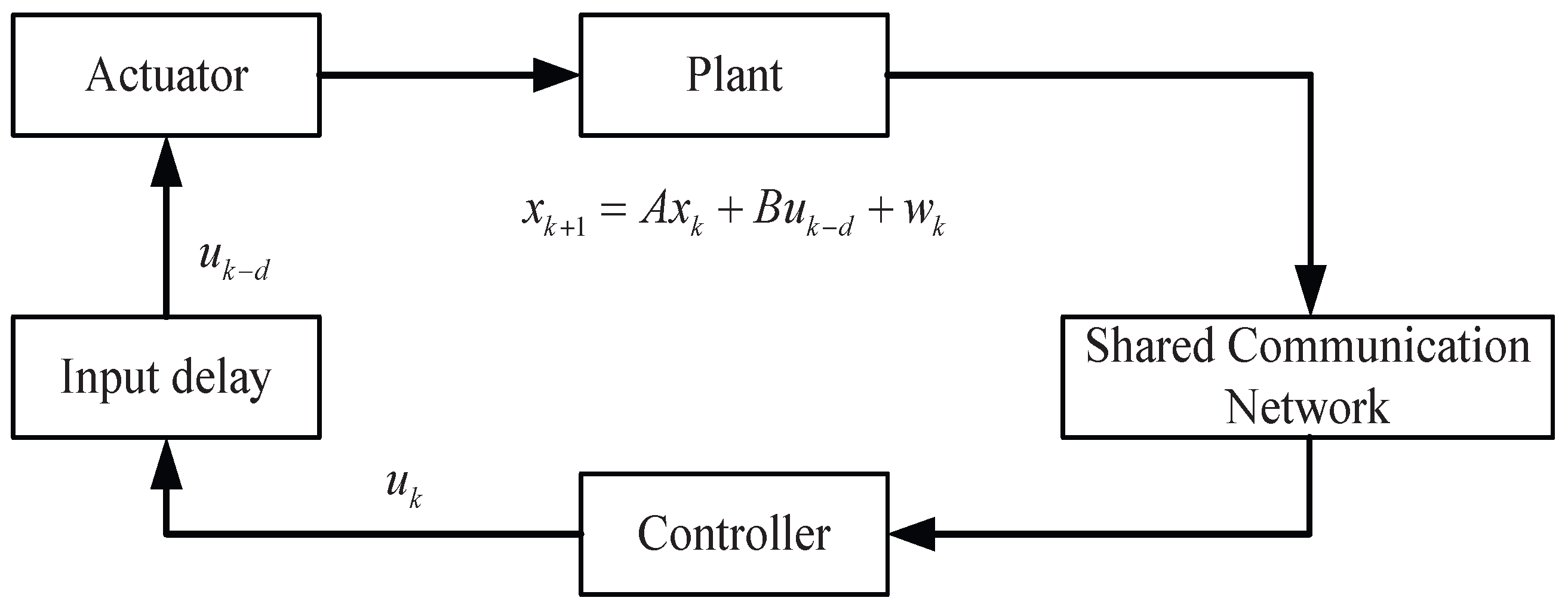
As shown in Figure 1, we consider a scenario based on the classic networked control system framework, with extensions to reflect practical operating conditions where the sensor transmits collected state data to the controller through a shared communication channel, and an input delay exists between the controller and the actuator. Based on the aforementioned scenario, the following discrete-time linear system equation is formulated:
x k + 1 = A x k + B u k d + w k ,
where x k R n and u k d R m are state and control input, respectively. A and B are constant matrices with appropriate dimensions. d > 0 is the input delay. The input noise w k is an independent and identically distributed sequence following w k N ( 0 , Q w ) for some covariance matrix Q w 0 . The initial state x 0 N ( x ¯ 0 , σ 0 ) is Gaussian distributed and independent of the noise sequence { w k } . The inital values u 1 , , u d are known.
The associated cost function for system (1) is given by
J N = E [ k = 0 N x k T Q x k + k = d N u k d T R u k d   + x N + 1 T P N + 1 x N + 1 ] ,
where Q and P N + 1 are semi-definite matrices, while R is a positive definite matrix.

2.2. Shared Communication Channel Model

In the shared communication network, the transmission of data packets depends on the availability of transmission resources. When resources are limited, data packets are stored and transmitted at a later time. Moreover, due to the unreliability of the network, packet loss and delays are prone to occur between the sensor and controller. Let d k represent the transmission delay experienced by the data packet at time k. The delay d k is a random variable associated with the traffic network. For the simplicity of this exposition, assume that the delays d k and d s experienced by data packets sent at different times are independent, where k s .
At time k, the packet loss follows the 0−1 distribution of the random variable α k , with the packet loss rate P ( α k = 0 ) = α , where α [ 0 , 1 ] . If the packet is not lost, the data sent at time k may experience delay d D , where D represents the sample space of the discrete delay random variable. Therefore, the modeling of coupled delay and packet loss is as follows:
P ( d k = η ) = q k ( η ) ( 1 α k ) p k ( η ) ,         η D α k ,         η =
where the infinite delay η = essentially represent packet loss.

3. Optimal Estimation and Control

This section primarily addresses the optimal controller design for a traffic network with input delay.

3.1. Optimal Estimation

Due to the delay in packet transmission, packets sent before time k may not arrive at the controller by time k. To facilitate the construction of the measurement set, Equation (3) can be used to determine whether the packets sent at time s are valid before time k. For all s < k , let γ s , k represent whether the data sent at time s is available for the controller at time k, with availability indicated by { γ s , k = 1 } . Additionally, for ease of estimation, define the random variable θ k as the last time the packet arrives at the controller, i.e., θ k max { s | γ s , k = 1 } 0 s k . When the network load is excessive, if { γ s , k = 0 } holds for all 0 s k , define θ k = 1 to represent that no packets sent before time k have arrived at the controller. Define the measurement information arriving at the controller before time k as X k = { x 0 , x 1 , , x θ k } . The impact of packet loss and delay on θ k will be discussed below. If the event { θ k = k } occurs, then the packet sent at time k experiences delay d k = 0 , i.e., P ( θ k = k ) = P ( d k = 0 ) = q k ( 0 ) . Similarly, if the event { θ k = k 1 } holds, it indicates that the packet sent at time k 1 experiences delay d k of at most 1, and the data sent at time k experiences delay d k of at least 1, i.e., P ( θ k = k 1 ) = P ( d k 1 ) P ( d k 1 1 ) = ( 1 q k ( 0 ) ) ( q k 1 ( 0 ) + q k 1 ( 1 ) ) . Further, the following conclusions can be derived:
P ( θ k = k i ) = n = 0 i 1 1 s = 0 n q k n ( s ) m = 0 i q k i ( m ) ,
P ( θ k = 1 ) = n = 0 k 1 s = 0 n q k n ( s ) .
As introduced in the previous section, delays and packet loss are directly influenced by network traffic, which in turn affects the random variable θ k , thereby impacting the estimation performance. Therefore, the optimal estimation for the shared communication network satisfies the following condition:
E [ x k | X k ]       = E A k θ k x θ k + i = θ k k 1 A k i 1 ( B u i d + w i ) | X k       = A k θ k x θ k + i = θ k k 1 A k i 1 B u i d
In the next section, the impact of the shared communication channel model and input delay on the cost function will be discussed.

3.2. Optimal Control

The optimal control strategy for u k d is given in the theorem below.
Theorem 1. 
The optimal controller for network traffic with input delay is as follows:
u k = L k + d x ^ k + d / θ k = L k + d E [ x k + d | X k ] , k = 0 , 1 , , N d
where the feedback matrix  L k   and the Riccati equation  P k   are given by  L k = ( B T P k + 1 B + R ) 1 B T P k + 1 A   and  P k = Q + A T P k + 1 A L k T Λ k L k , respectively, with  Λ k = B T P k + 1 B + R . Additionally,  E [ x k + d | X k ]   satisfies 
E [ x k + d | X k ]   = E A k + d θ k x θ k + i = θ k k + d 1 A k + d i 1 ( B u i d + w i ) | X k   = A k + d θ k x θ k + i = θ k k + d 1 A k + d i 1 B u i d .
The optimal cost function for solving (2) is as follows:
J N * = E k = 0 d 1 x k T Q x k + x d T P d x d   + k = d N E Ξ k T L k T Λ k L k Ξ k + t r ( P k + 1 Q w ) ,
where
E Ξ k T L k T Λ k L k Ξ k = s = 1 k d i = s k 1 t r ( A k i 1 ) T L k T Λ k L k A k i 1 Q w   × P ( θ k d = s ) ,
with  Ξ k = i = θ k d k 1 A k i 1 w i
Proof. 
Let the value function related to the cost function at time N be denoted as V N ( x N ) , i.e.,
V N ( x N ) = E [ x N T Q x N + u N d T R u N d   + x N + 1 T P N + 1 x N + 1 ] .
Substituting (1) into (11) yields the following result:
  V N ( x N ) = E [ x N T Q x N + u N d T R u N d   + x N + 1 T P N + 1 x N + 1 ] = E [ x N T ( Q + A T P N + 1 A L N T Λ N L N ) x N   + Ξ N T L N T Λ N L N Ξ N ] + t r P N + 1 Q w   + E ( u N d + L k x ^ N / θ N d ) T Λ N ( u N d + L k x ^ N / θ N d ) .
The optimal value function can be obtained as follows:
V N ( x N ) = E x N T P N x N + Δ N ,
where Δ N = E Ξ N T L N T Λ N L N Ξ N + t r P N + 1 Q w + Δ N + 1 , with Δ N + 1 = 0 .
Now assume that the value function V k ( x k ) at time k satisfies
V k ( x k ) = E x k T P k x k + Δ k ,
where Δ k = E Ξ k T L k T Λ k L k Ξ k + t r P k + 1 Q w + Δ k + 1 .
Using (1) and (6), (14) is processed as follows:
V k ( x k ) V k + 1 ( x k + 1 ) = E x k T P k x k x k + 1 T P k + 1 x k + 1 + Φ k Φ k + 1 = E [ x k T P k x k ( A x k + B u k d + w k ) T ×   P k + 1 ( A x k + B u k d + w k ) ] +   t r P k + 1 Q w + E Ξ k T L k T Λ k L k Ξ k = E x k T ( P k A T P k + 1 A ) x k 2 u k d T Λ k L k x k   u k d T B T P k + 1 B u k d + Ξ k T L k T Λ k L k Ξ k = E [ x k T ( P k A T P k + 1 A + L k T Λ k L k ) x k   x ^ k / θ k d T L k T Λ k L k x ^ k / θ k d   2 u k d T Λ k L k x ^ k / θ k d u k d T ( Λ k R ) u k d x ˜ k / θ k d T L k T Λ k L k x ˜ k / θ k d ] = E x k T Q x k + u k d T R u k d E ( u k d + L k x ^ k / θ k d ) T Λ k ( u k d + L k x ^ k / θ k d ) .
Summing (15) from k = d to k = N , the cost function (2) becomes
J N = E k = 0 d 1 x k T Q x k + x d T P d x d + k = d N E Ξ k T L k T Λ k L k Ξ k + t r ( P k + 1 Q w ) + k = d N E [ ( u k d + L k x ^ k / θ k d ) T ×   Λ k ( u k d + L k x ^ k / θ k d ) ] .
According to Ξ k , the estimation error is affected by the random variable θ k d ; thus, it can be obtained
E Ξ k T L k T Λ k L k Ξ k T θ k d       = i = θ k d k 1 t r [ ( A k i 1 ) T L k T Λ k L k A k i 1 Q w ] .
Then, it can be obtained
E Ξ k T L k T Λ k L k Ξ k       = s = 1 k d i = s k 1 t r ( A k i 1 ) T L k T Λ k L k A k i 1 Q w       ×   P ( θ k d = s ) .
This completes the proof. □

3.3. Traffic Networked Control Systems: A Special Case

To simulate the traffic network model, the Poisson arrival process with parameter λ is employed. The discrete delay d k induced by the traffic network follows the geometric distribution with parameter p ( λ ) ( 0 , 1 ) , i.e., P ( d k = η ) = p ( λ ) ( 1 p ( λ ) ) η . The relationship between the delay distribution and the traffic network parameter λ is established using p ( λ ) , with the dependency between λ and p ( λ ) determined by the available communication resources. Specifically, p ( λ ) is non-increasing, meaning that larger values of the traffic network parameter λ result in greater delay.
The Gilbert–Elliott Markov model is used to model packet loss, where the transition probabilities of packet loss are given by P ( τ k = 1 | τ k 1 = 1 ) = τ ¯ ( λ ) and P ( τ k = 0 | τ k 1 = 0 ) = τ ̲ ( λ ) , with the initial probability of P ( τ k = 0 ) = δ 0 . Thus, the packet loss model is as follows:
δ k 1 δ k   = P ( τ k = 0 ) P ( τ k = 1 ) = τ ̲ ( λ ) 1 τ ¯ ( λ ) 1 τ ̲ ( λ ) τ ¯ ( λ ) k δ 0 1 δ 0 .

4. Simulation Results

In this section, we use numerical examples to illustrate the theoretical results. Consider a stable system with the following parameters:
A = 0.95 0.5 0.02 0.7 ,   B = I 2 ,   Q w = 0.25 I 2 ,   δ 0 = 0.5 ,   d = 1 .
We analyzed the system performance variations using the aforementioned network traffic model.
Model: Consider parameters of the following p ( λ ) , τ ̲ ( λ ) , τ ¯ ( λ ) model:
p ( λ ) = 1 λ + 1 ,   τ ̲ ( λ ) = 0.7 ( 1 e λ ) ,   τ ¯ ( λ ) = e λ .
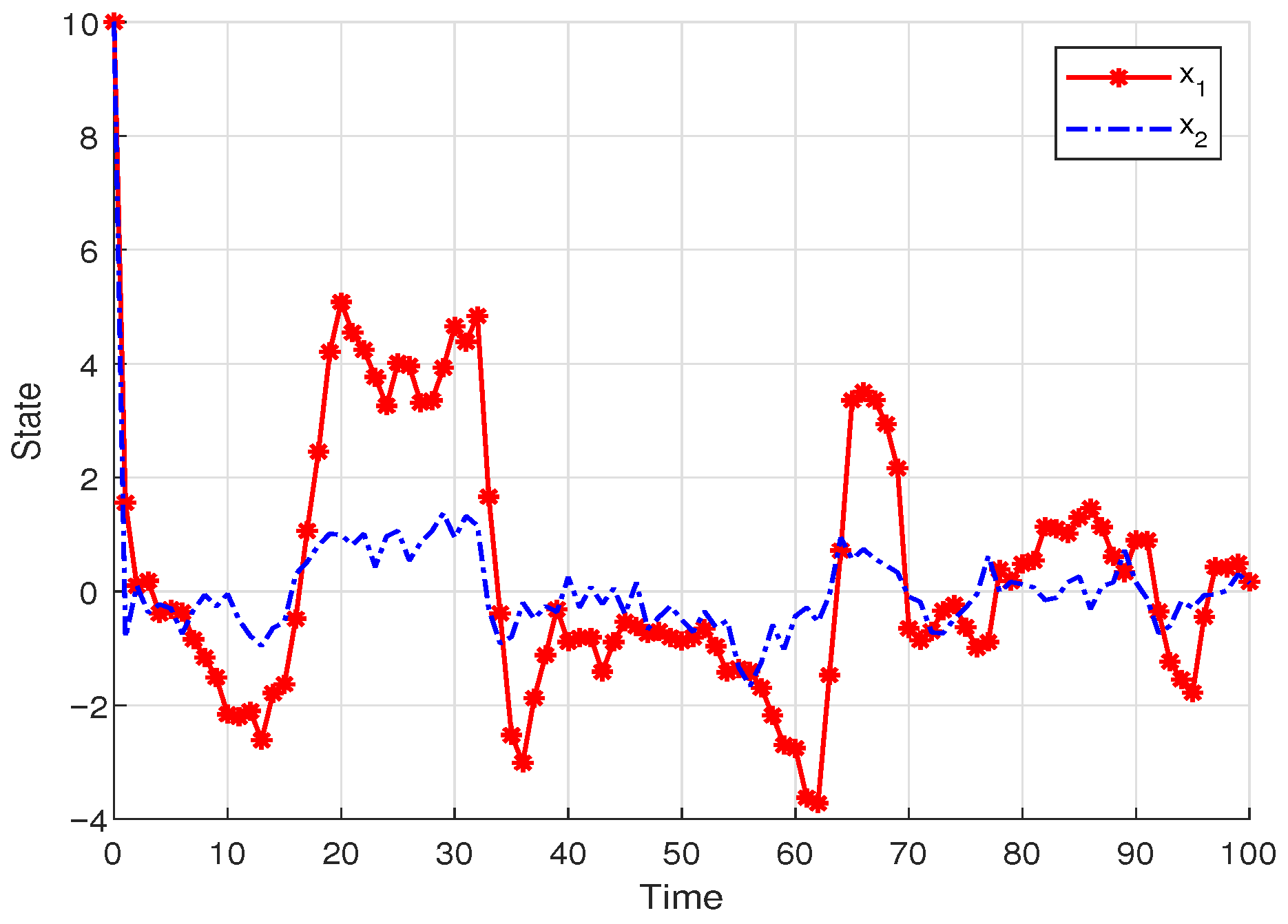
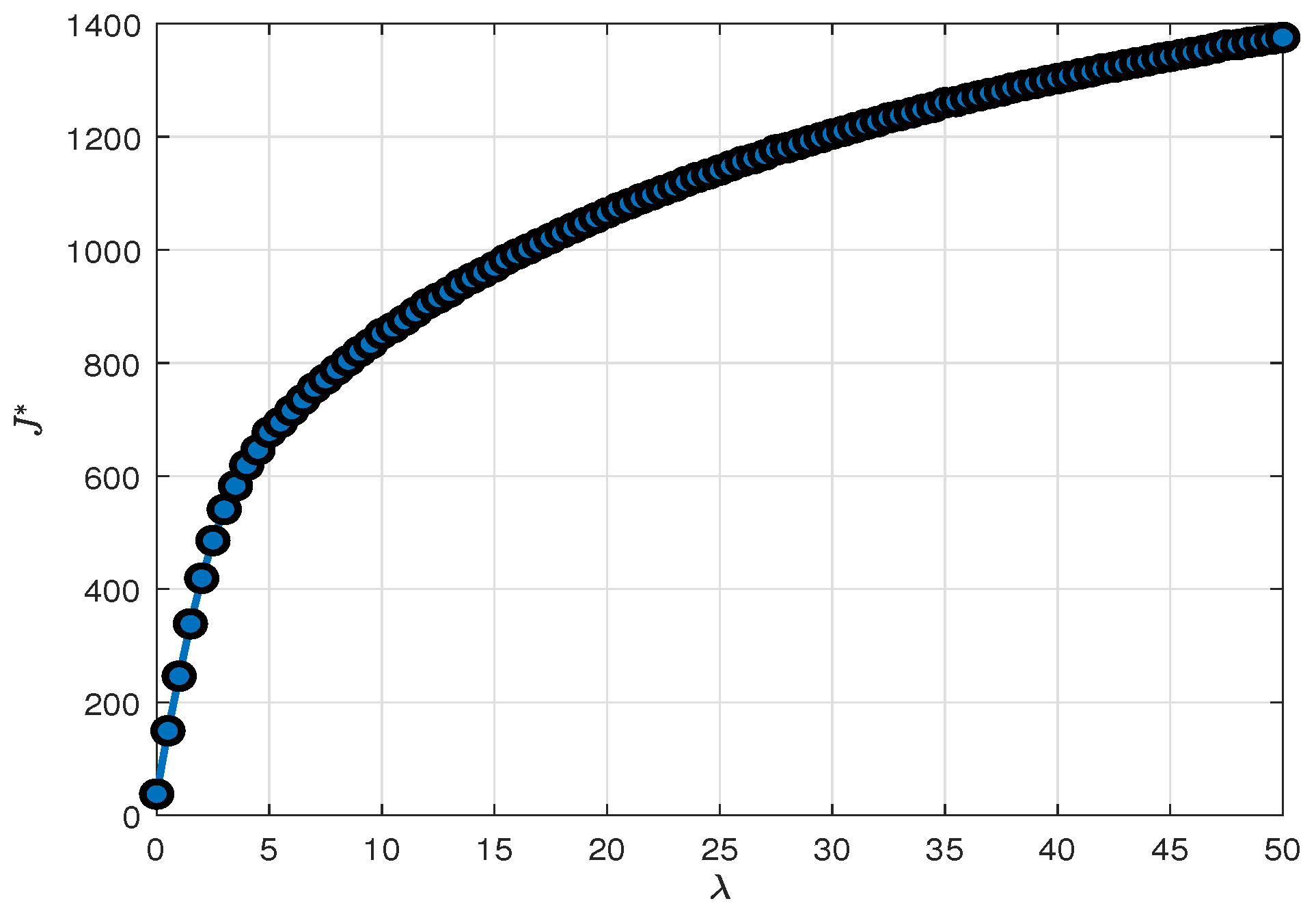
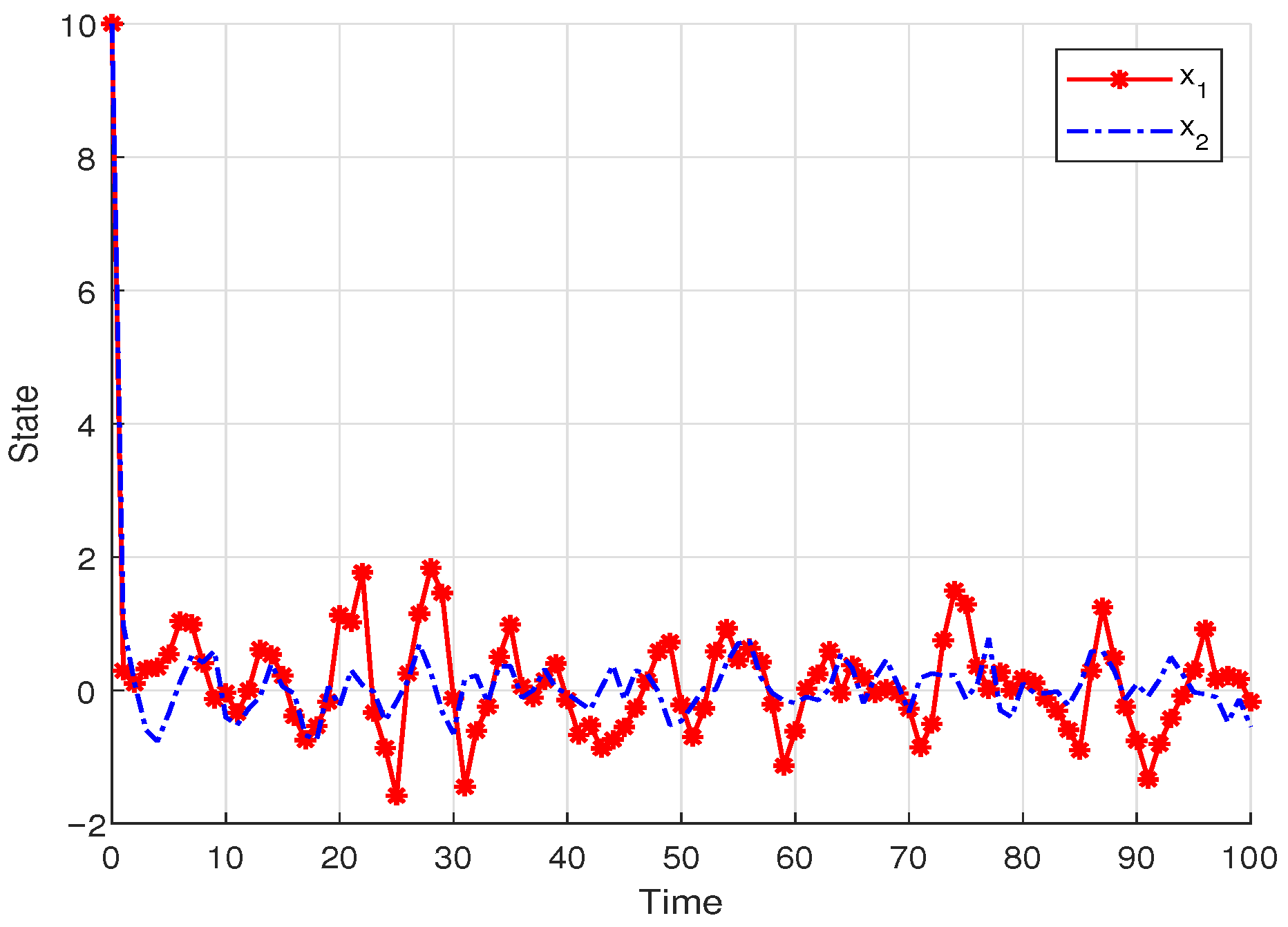
Based on the selected parameters above, when the arrival rate λ , data packets will experience infinite delay. Note that when λ 0 , data packets pass through a communication channel without packet loss or delay. We plotted the control performance for λ = 0.1 and λ = 10 , as shown in Figure 2 and Figure 3, respectively. According to the results, as λ increases, system state x 1 struggles to maintain equilibrium around 0. According to Figure 4, the optimal control cost J * increases as λ increases. It has been verified that under multiple delays, the increase in λ leads to a significant degradation in system performance.
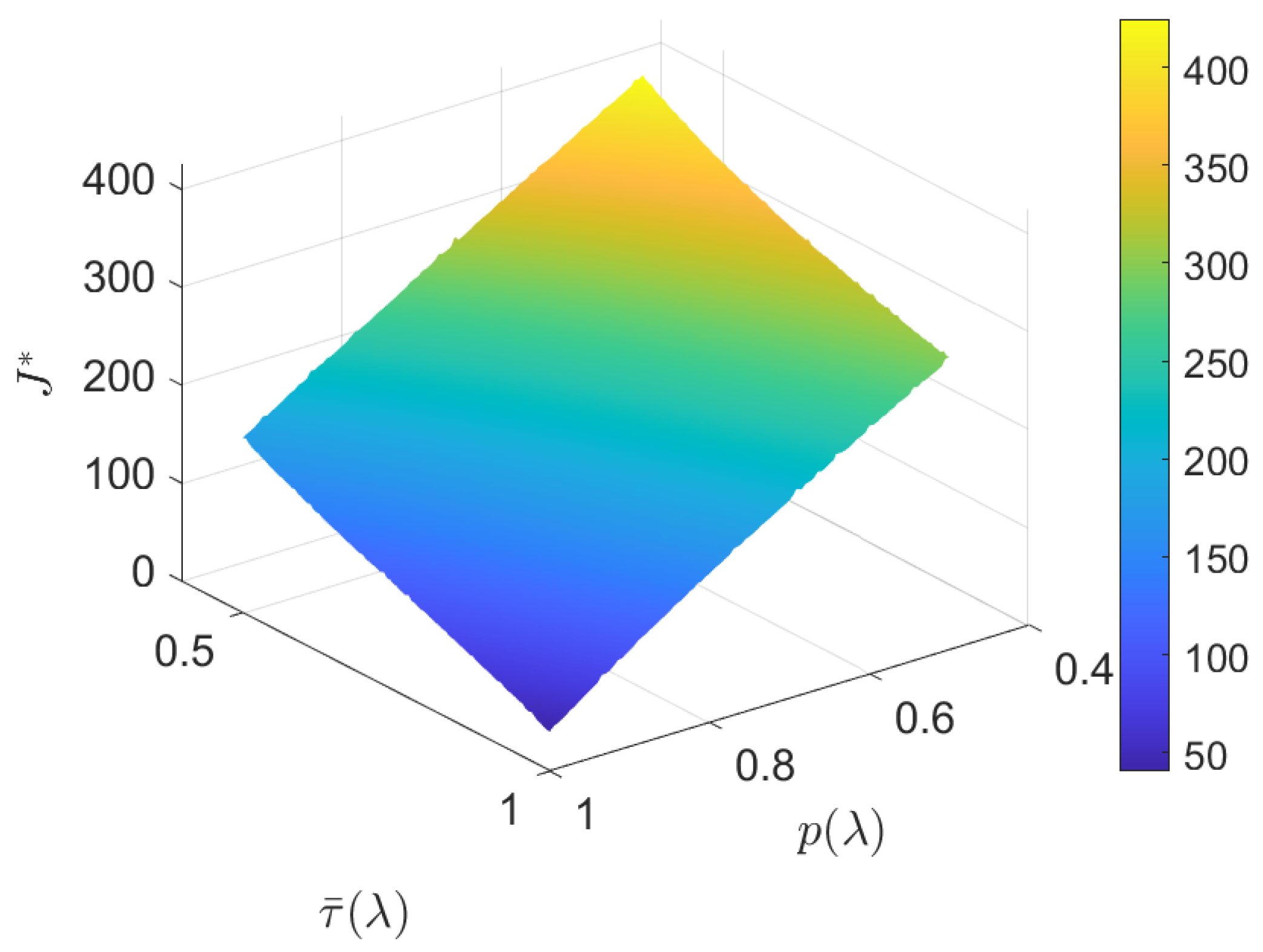
The impacts of network traffic on delay and packet dropouts are intertwined and dependent on the network infrastructure. Depending on accessible resources and network technology, for a given traffic rate, it is feasible to exchange a higher delay for a lower dropout probability (e.g., adopting longer queuing buffers and retransmitting packets that were dropped earlier) or vice versa. As can be seen in Figure 5, many combinations of p ( λ ) and τ ¯ can lead to the same optimal cost J * . For example, if the optimal cost J * tends to 50, i.e., the deep purple, p ( λ ) and τ ¯ may range from 0.8 0.85 and 0.85 0.95 respectively. In other words, by fixing one parameter, we can find the maximum tolerance of the other parameter to achieve the given optimal cost J * .

5. Conclusions

This paper addresses the challenges posed by multiple delays and packet losses in NCSs, particularly when data transmission between the sensor and controller is influenced by real-time network traffic parameters. The study designs the optimal feedback controller capable of handling multiple delays and packet losses, with its feedback gain satisfying the requirements of the standard discrete Riccati equation. Additionally, it describes how traffic parameters affect system performance metrics in the presence of multiple delays and packet losses. The effectiveness of the proposed approach is validated through the real network traffic model. Future research can extend the framework to nonlinear NCSs or integrate adaptive learning mechanisms to dynamically adjust control strategies for time-varying network environments and unknown disturbance characteristics.

Author Contributions

Conceptualization, J.L. and X.M.; Methodology, J.L. and B.T.; Software, B.T.; Writing—original draft, J.L. and X.M.; Writing—review & editing, J.L., B.T. and X.M. All authors have read and agreed to the published version of the manuscript.

Funding

This work was supported in part by the Youth Innovation Team Program of Shandong Higher Education Institution under Grant 2023KJN049.

Data Availability Statement

The original contributions presented in this study are included in the article. Further inquiries can be directed to the corresponding author.

Conflicts of Interest

The authors declare no conflicts of interest.

References

  1. Lee, C.K.; Hui, S.Y. Reduction of energy storage requirements in future smart grid using electric springs. IEEE Trans. Smart Grid 2013, 4, 1282–1288. [Google Scholar] [CrossRef]
  2. Xu, J.; Sun, Q.; Han, Q.-L.; Tang, Y. When Embodied AI Meets Industry 5.0: Human-Centered Smart Manufacturing. IEEE/CAA J. Autom. Sin. 2025, 12, 485–501. [Google Scholar] [CrossRef]
  3. Li, W.; Ma, Y.; Zhang, Y.; Li, B.; Shi, Y.; Chu, L. A Multiangle Observation and Imaging Method for UAV Swarm SAR Based on Consensus Constraints. IEEE Sens. J. 2025, 25, 19776–19793. [Google Scholar] [CrossRef]
  4. Li, K.; Wang, J.; Zheng, Y. Cooperative Formation of Autonomous Vehicles in Mixed Traffic Flow: Beyond Platooning. IEEE Trans. Intell. Transp. Syst. 2022, 23, 15951–15966. [Google Scholar] [CrossRef]
  5. Zhang, M.; Raghunathan, A.; Jha, N.K. MedMon: Securing Medical Devices Through Wireless Monitoring and Anomaly Detection. IEEE Trans. Biomed. Circuits Syst. 2013, 7, 871–881. [Google Scholar] [CrossRef]
  6. Li, M.; Lin, H.-J. Design and Implementation of Smart Home Control Systems Based on Wireless Sensor Networks and Power Line Communications. IEEE Trans. Ind. Electron. 2015, 62, 4430–4442. [Google Scholar] [CrossRef]
  7. Zhang, X.-M.; Han, Q.-L.; Ge, X.; Ding, D.; Ding, L.; Yue, D.; Peng, C. Networked Control Systems: A Survey of Trends and Techniques. IEEE/CAA J. Autom. Sin. 2020, 7, 1–17. [Google Scholar] [CrossRef]
  8. Mu, T.; Pang, Z.-H.; Guo, H.; Liu, G.-P.; Han, Q.-L. Output Tracking Predictive Control of Uncertain Networked Control Systems. IEEE Trans. Circuits Syst. II Express Briefs 2024, 71, 3141–3145. [Google Scholar] [CrossRef]
  9. Sleiman, M.; Bouyekhf, R.; El Moudni, A. Urban transportation network analysis from a thermodynamic perspective. J. Frankl. Inst. 2019, 356, 351–381. [Google Scholar] [CrossRef]
  10. Gupta, R.A.; Chow, M.-Y. Networked Control System: Overview and Research Trends. IEEE Trans. Ind. Electron. 2010, 57, 2527–2535. [Google Scholar] [CrossRef]
  11. Sun, H.-Y.; Hou, S.; Du, S.; Han, H.-G.; Qiao, J.-F. Sampled-Data H∞ Dynamic Output-Feedback Control for NCSs With Successive Packet Losses and Stochastic Sampling. IEEE Trans. Cybern. 2024, 54, 6024–6034. [Google Scholar] [CrossRef]
  12. Zhu, X.L.; Zhang, X.; Wei, J.; Lin, H. Output-Based Dynamic Event-Triggered Control for Networked Control Systems with Delays and Packet Losses Without Acknowledgements. IEEE Trans. Autom. Control 2023, 68, 7120–7135. [Google Scholar] [CrossRef]
  13. Li, C.; Zhao, X.; Chen, M.; Xing, W.; Zhao, N.; Zong, G. Dynamic Periodic Event-Triggered Control for Networked Control Systems Under Packet Dropouts. IEEE Trans. Autom. Sci. Eng. 2024, 21, 906–920. [Google Scholar] [CrossRef]
  14. Sun, Y.; Qin, S. Stability and Stabilization of Networked Control Systems with Bounded Packet Dropout. Acta Autom. Sin. 2011, 37, 113–118. [Google Scholar] [CrossRef]
  15. Wang, Y.; Ye, H.; Ding, S.X.; Wang, G.; Zhou, D. Residual generation and evaluation of networked control systems subject to random packet dropout. Automatica 2009, 45, 2427–2434. [Google Scholar] [CrossRef]
  16. Imer, O.C.; Yüksel, S.; Başar, T. Optimal control of LTI systems over unreliable communication links. Automatica 2006, 42, 1429–1439. [Google Scholar] [CrossRef]
  17. Liu, J.; Wu, L.; Wu, C.; Luo, W.; Franquelo, L.G. Event-triggering dissipative control of switched stochastic systems via sliding mode. Automatica 2019, 103, 261–273. [Google Scholar] [CrossRef]
  18. Nayyar, N.; Kalathil, D.; Jain, R. Optimal decentralized control with asymmetric one-step delayed information sharing. IEEE Trans. Control Netw. Syst. 2018, 5, 653–663. [Google Scholar] [CrossRef]
  19. Asghari, S.; Ouyang, Y.; Nayyar, A. Optimal local and remote controllers with unreliable uplink channels. IEEE Trans. Autom. Control 2019, 64, 1816–1831. [Google Scholar] [CrossRef]
  20. Liang, X.; Xu, J. Control for networked control systems with remote and local controllers over unreliable communication channel. Automatica 2018, 98, 86–94. [Google Scholar] [CrossRef]
  21. Liang, X.; Xu, J.; Zhang, H. Optimal control and stabilization for networked control systems with asymmetric information. IEEE Control Netw. Syst. 2020, 7, 1355–1365. [Google Scholar] [CrossRef]
  22. Liang, X.; Qi, Q.; Zhang, H.; Xie, L. Decentralized control for networked control systems with asymmetric information. IEEE Trans. Autom. Control 2022, 67, 2076–2083. [Google Scholar] [CrossRef]
  23. Lu, M.; Liu, S.; Luo, Y.; Qi, Q.; Sun, Y.; Li, J. Modeling and Output Feedback Tracking Control of Self-Developed Autonomous Underwater Vehicle. Unmanned Syst. 2025, 13, 1639–1660. [Google Scholar] [CrossRef]
  24. Wang, X.; Tan, C.P.; Wang, Y.; Qi, Q.; Wang, X. Adaptive Interval Observer-Based Fault-Tolerant Control for a 3-DOF Helicopter Without Angular Velocity Measurement. IEEE Trans. Control Syst. Technol. 2025, 33, 2476–2482. [Google Scholar] [CrossRef]
  25. Qi, Q.; Xie, L.; Zhang, H.; Liang, X. Jointly Optimal Local and Remote Controls for Networked Multiple Systems With Multiplicative Noises and Unreliable Uplink Channels. IEEE Trans. Autom. Control 2025, 70, 1054–1067. [Google Scholar] [CrossRef]
  26. Qi, Q.; Xie, L.; Zhang, H. Optimal Control for Stochastic Systems With Multiple Controllers of Different Information Structures. IEEE Trans. Autom. Control 2021, 66, 4160–4175. [Google Scholar] [CrossRef]
  27. Lai, C.L.; Hsu, P.-L. The Butterfly-Shaped Feedback Loop in Networked Control Systems for the Unknown Delay Compensation. IEEE Trans. Ind. Inform. 2014, 10, 1746–1754. [Google Scholar] [CrossRef]
  28. Qiu, L.; Dai, L.; Ahsan, U.; Fang, C.; Najariyan, M.; Pan, J. Model Predictive Control for Networked Multiple Linear Motors System Under DoS Attack and Time Delay. IEEE Trans. Ind. Inform. 2023, 19, 790–799. [Google Scholar] [CrossRef]
  29. Tan, C.; Zhang, H.; Wong, W.S.; Zhang, Z. Feedback Stabilization of Uncertain Networked Control Systems Over Delayed and Fading Channels. IEEE Trans. Control Netw. Syst. 2021, 8, 260–268. [Google Scholar] [CrossRef]
  30. Zhang, W.-A.; Yu, L. Modelling and control of networked control systems with both network-induced delay and packet-dropout. Automatica 2008, 44, 3206–3210. [Google Scholar] [CrossRef]
  31. Tipsuwan, Y.; Chow, M.-Y. Control methodologies in networked control systems. Control Eng. Pract. 2003, 11, 1099–1111. [Google Scholar] [CrossRef]
  32. Jiang, X.; Zhang, B.; Chen, X.; Yan, H. Tracking performance limitations of MIMO discrete-time networked control systems with multiple constraints. Sci. China Inf. Sci. 2023, 66, 189203. [Google Scholar] [CrossRef]
  33. Du, X.; Zhan, X.; Wu, J.; Yan, H. Effects of Two-Channel Noise and Packet Loss on Performance of Information Time Delay Systems. IEEE Trans. Neural Netw. Learn. Syst. 2024, 35, 8549–8556. [Google Scholar] [CrossRef] [PubMed]
  34. Dai, H.; Fu, J.; Duan, P.; Wen, G.; Huang, T. Distributed State Estimation Under Multistep Random Transmission Delay and Packet Loss. IEEE Trans. Aerosp. Electron. Syst. 2025, 61, 11875–11887. [Google Scholar] [CrossRef]
  35. Yu, Y.; Liu, G.P.; Hu, W. Coordinated Distributed Predictive Control for Voltage Regulation of DC Microgrids With Communication Delays and Data Loss. IEEE Trans. Smart Grid 2023, 14, 1708–1722. [Google Scholar] [CrossRef]
  36. Zhao, J.; Li, B. Finite-Time H∞ Robust Controller Design for a Class of Singular Discrete-Time Markov Jump Delay Systems With Packet Loss Compensation and Input Saturation. IEEE Access 2022, 10, 101465–101473. [Google Scholar] [CrossRef]
  37. Song, Y.; Wang, J.; Shi, Y.; Li, C. Packet-loss-dependent stabilization of NCSs with network-induced delay and packet dropout. J. Syst. Eng. Electron. 2012, 23, 408–413. [Google Scholar] [CrossRef]
  38. Tan, C.; Li, L.; Zhang, H. Stabilization of networked control systems with both network-induced delay and packet dropout. Automatica 2015, 59, 194–199. [Google Scholar] [CrossRef]
  39. Liang, X.; Xu, J.; Zhang, H. Optimal Control and Stabilization for Networked Control Systems With Packet Dropout and Input Delay. IEEE Trans. Circuits Syst.-II Express Briefs 2017, 64, 1087–1091. [Google Scholar] [CrossRef]
  40. Mohammed, S.A.; Shirmohammadi, S.; Altamimi, S. A Multimodal Deep Learning-Based Distributed Network Latency Measurement System. IEEE Trans. Instrum. Meas. 2020, 69, 2487–2494. [Google Scholar] [CrossRef]
  41. Ren, W.; Xiong, J. Tracking Control of Nonlinear Networked and Quantized Control Systems With Communication Delays. IEEE Trans. Autom. Control 2020, 65, 3685–3692. [Google Scholar] [CrossRef]
  42. Maity, D.; Mamduhi, M.H.; Hirche, S.; Johansson, K.H. Optimal LQG Control of Networked Systems Under Traffic-Correlated Delay and Dropout. IEEE Control Syst. Lett. 2022, 6, 1280–1285. [Google Scholar] [CrossRef]
  43. Liu, X.; Zhang, A.; Liang, X. LQG control for networked control systems with packet dropouts and input delay: UDP case. Optim. Control Appl. Methods 2025, 41, 259–270. [Google Scholar] [CrossRef]
Figure 1. Overviewof the network traffic system with multiple delays and packet losses.
Electronics 15 00180 g001
Figure 2. The trajectory of the system state x under λ = 0.1 .
Electronics 15 00180 g002
Figure 3. Thetrajectory of the system state x under λ = 10 .
Electronics 15 00180 g003
Figure 4. Optimal cost J * under different traffic arrival rates λ .
Electronics 15 00180 g004
Figure 5. Optimal cost J * versus p ( λ ) and τ ¯ ( λ ) .
Electronics 15 00180 g005
Disclaimer/Publisher’s Note: The statements, opinions and data contained in all publications are solely those of the individual author(s) and contributor(s) and not of MDPI and/or the editor(s). MDPI and/or the editor(s) disclaim responsibility for any injury to people or property resulting from any ideas, methods, instructions or products referred to in the content.