
Article

Congestion-Aware Scheduling for Large Fleets of AGVs Using Discrete Event Simulation

Department of Industrial Management Engineering, Dong-A University, Busan 49315, Republic of Korea
*
Author to whom correspondence should be addressed.
Electronics 2026, 15(1), 139; https://doi.org/10.3390/electronics15010139 (registering DOI)
Submission received: 29 November 2025 / Revised: 25 December 2025 / Accepted: 27 December 2025 / Published: 28 December 2025
(This article belongs to the Special Issue 5G and Beyond Technologies in Smart Manufacturing, 2nd Edition)

Abstract

Conventional large fleets of Automated Guided Vehicles (AGVs) suffer from issues related to the network environment, including handoff latency and interference. Recently, 5G technology has emerged as a practical tool to resolve these network issues. Consequently, there is a growing trend toward deploying large AGV fleets based on 5G technology. Typically, AGVs are controlled by an AGV control system (ACS), which is responsible for tasks such as path planning and AGV scheduling. AGV scheduling is the process of assigning the right task to the right vehicle at the right time. This process has a significant impact on the performance of an AGV fleet, particularly for large-scale fleets. However, existing AGV scheduling approaches hardly consider traffic congestion, which often occurs in large fleets. To fill this gap, this study proposes a simulation-based congestion-aware AGV scheduling approach for large AGV fleets. The proposed approach is characterized by three components: congestion functions, congestion penalties, and congestion-aware scheduling rules. Congestion functions are employed to compute the degree of congestion at a specific point or area within the shop floor. Congestion penalties represent the loss incurred when a vehicle traverses a specific segment within the AGV path network. Congestion-aware scheduling rules provide the decision-making logic for task and vehicle dispatching. We outline the components and apply them to a discrete event simulation (DES) model containing an AGV fleet. The experimental results demonstrate that the proposed approach reduces the inefficiencies of the AGV system caused by traffic congestion.

1. Introduction

In recent years, there has been a progressive shift toward unmanned and automated systems in smart factory environments. Mobile robots such as Automated Guided Vehicles (AGVs) have emerged as a practical automated material handling system [1,2]. These systems are widely utilized not only in manufacturing but also in intelligent warehousing and logistics sectors, where efficient task allocation and routing are critical [3,4]. Typically, AGVs communicate with an AGV control system (ACS) via a network during their operation, which is responsible for tasks such as path planning and scheduling to execute transportation [5,6,7]. However, the wireless network in practical shop floors can sometimes become unstable, which can lead to inaccurate or delayed operation. Thus, conventional large fleets of AGVs suffer from issues related to the network environment, including handoff latency and interference [8,9].
5G technology provides a more stable network environment and helps AGV systems operate efficiently [10]. In this context, 5G is one of the most important enablers of large AGV fleets. However, the stability of 5G networks in large AGV fleets is closely tied to the physical distribution of vehicles. High vehicle density in specific zones can lead to signal interference and packet loss. While the resulting latency may be minimal, it poses a significant risk to safety protocols and collision avoidance systems that rely on real-time data [11]. Sub-areas on a shop floor utilizing a large AGV fleet can sometimes become heavily congested, and this congestion can lead to collisions or network instability. Thus, managing large AGV fleets presents significant challenges, such as collision prevention and congestion control [12,13]. These challenges can be mitigated by appropriate AGV scheduling.
AGV scheduling is the process of assigning the right task to the right vehicle at the right time [5,14]. This process has a significant impact on the performance of an AGV fleet. Congestion-aware scheduling would be particularly beneficial for large fleets. However, while some previous studies have addressed congestion in path planning [9,10], it has received little attention in AGV scheduling. To fill this gap, this study proposes a simulation-based congestion-aware AGV scheduling approach for large AGV fleets.
Evaluating heuristic dispatching rules using discrete event simulation (DES) is a popular and practical approach to AGV scheduling [5,15]. In line with this, our study aims to identify the best-performing heuristic dispatching rules through simulation experiments. The proposed approach is characterized by three components: congestion functions, congestion penalty, and congestion-aware scheduling rules. A congestion function is used to determine the congestion level of a specific point or area, which is proportional to the number of nearby AGVs. Congestion penalties represent the loss incurred when a vehicle traverses a specific segment within the AGV path network. An example of a congestion penalty is reduced speed in a highly congested area. Congestion-aware scheduling rules are heuristic rules for job and AGV dispatching. To validate the effectiveness of the proposed approach, this study applies it to a shop floor model inspired by a real manufacturing company. The experimental results demonstrate that the proposed approach can reduce inefficiencies caused by traffic congestion within the AGV system.
This study is structured as follows. Section 2 surveys the literature on AGV scheduling problems. Section 3 introduces the simulation-based, congestion-aware AGV scheduling approach proposed herein; in particular, congestion functions, congestion penalties, and congestion-aware scheduling rules are explained in this section. Section 4 presents a simulation model for the proposed approach and experimental results obtained through simulation. Finally, Section 5 summarizes the conclusions and outlines directions for future work.

2. Literature Review

AGV scheduling is an optimization problem that aims to minimize or maximize given performance measures, such as throughput, waiting time, and makespan. Its solution methods are primarily grouped into several categories [15,16]. The most important ones are mathematical optimization-based scheduling and rule-based scheduling.
In mathematical optimization-based scheduling, the AGV scheduling problem is formulated as a mathematical programming model, such as mixed integer linear programming (MILP). Due to the NP-hardness of these models, they are often solved by applying approximate solution methods such as metaheuristic algorithms [17]. By contrast, rule-based scheduling utilizes dispatching rules. For instance, a job dispatching rule is used to choose which transportation job to perform next. Compared with mathematical optimization-based scheduling, rule-based scheduling provides several advantages. First, the rule-based scheduling procedure is easier to implement since we do not need to formulate complex MILP models. Second, the AGV scheduling decision is made more quickly since we do not need to explore a complex solution space. Third, the dispatching rules can be used to define the action space of reinforcement learning, which enables the dynamic AGV scheduling [14,18,19]. In this context, rule-based scheduling is adopted in this study.
The proposed approach utilizes two types of scheduling rules: job dispatching and AGV dispatching. The rules are employed to match a specific job with an available AGV. Once an assignment is made, the designated AGV moves to the job’s pickup point to load the item(s). The AGV then proceeds to the dropoff point to unload the item(s). The objective of these rules is to select the right job and the right AGV. Scheduling rules significantly impact the performance measures of AGV systems, such as throughput and waiting time. However, these rules are heuristic in nature, and the best combination for a specific shop floor is typically identified through simulation experiments. Table 1 lists previous research that investigated AGV scheduling using dispatching rules.
Ho and Chien (2004) proposed a control process for multi-load AGVs, defining four key control problems: task determination, delivery dispatching, pickup dispatching, and load selection [20]. In a follow-up, in-depth study, Ho and Liu (2006) compared the performance of the “pickup dispatching” rule among these four control problems using nine AGV dispatching strategies [21]. In the context of these comparative studies on dispatching rules, Angra et al. (2018) extended the research by evaluating the performance of “job selection” rules for multi-load AGVs within variable-sized flexible manufacturing system layouts [24].
Beyond these fundamental operational rule studies, research has also addressed issues arising from the expansion of AGV systems. Pisuchpen (2012) proposed a method of managing AGVs in groups to address traffic congestion and queueing problems caused by an increasing AGV fleet [23]. Azimi (2011) proposed a method to prevent system halts by allowing AGVs to autonomously mitigate deadlocks through actions such as reversing or rotating without operator intervention, utilizing rule-based methods to determine the optimal number of AGVs and assignment rules [22].
Hu et al. (2020) applied deep learning technology to the AGV scheduling problem. They defined an action as a vector (Jobn, AGVn) combining a job selection rule and the determination of an AGV to transport the selected FlowItem [19]. They proposed a mixed rule approach using deep reinforcement learning to dynamically derive the optimal combination of the most suitable job selection (e.g., FIFO; EDD) and the AGV for transportation based on real-time states.
Meanwhile, Park and Kim (2024) focused on issues related to limited buffer capacity and AGV battery charging to comprehensively reflect the physical constraints of actual manufacturing shop floors [14]. They aimed to derive optimal operational rules by considering these practical issues during the scheduling process, performing simulations that combined three types of rules: job selection, AGV selection, and charging station selection.
In summary, existing scheduling studies utilizing rule-based methods have insufficiently considered potential problems arising from the wireless communication infrastructure used by multiple AGVs. Bennis et al. found that collisions and interference between devices, which occur when competing for limited communication resources in dense industrial environments, can degrade communication reliability [25]. Such degradation in communication reliability can lead to the loss of real-time location data or delays in control signals within AGV systems, potentially causing fatal problems such as vehicle malfunctions or collisions [8]. Moreover, operational limitations of simple rules in complex physical environments have also been highlighted. Heger and Voss (2018) demonstrated that standard priority rules result in poor performance in job–shop environments characterized by reentrant flows and blocking, indicating that simple heuristics are insufficient to handle system complexity [26]. Therefore, this study aims to develop a simulation model for operating a large-scale AGV fleet with buffer capacity and battery capacity constraints. We seek to explore optimized scheduling rules using rule-based methods and strategies to control congestion.

3. AGV Scheduling for Minimizing Congestion

3.1. Congestion Function and Congestion Penalty

Figure 1 illustrates the schematic representation of the AGV system considered in this paper. Jobs 1 and 2 are waiting at pickup points 1 and 2, respectively, and we have two AGVs, AGV 1 and AGV 2, available for these jobs. The AGVs are currently idle at their charge stations but will begin transport once a job is assigned.
The AGV path network contains four areas, each with a congestion level that indicates the “density” of the AGVs. As illustrated in Figure 1, this level is simplified into two categories: 1 (low) and 2 (high). A high congestion level implies that an area is congested with many AGVs. Alternatively, the congestion level can be represented by continuous values for greater detail.
An AGV in an area k moves at speed v k , determined by the area’s congestion level, c k . In Figure 1, this speed is simplified into two levels ( v ( 1 ) > v ( 2 ) ): v 2 (slow) for high congestion ( c k = 2) and v ( 1 ) (fast) for low congestion ( c k = 1). Consequently, the AGVs can move fast in areas 2 and 4, while they have to move slowly in areas 1 and 3. The speed levels ( v 1 and v 2 ) reflect the operations of large AGV fleets in practice, in that AGVs are typically instructed to slow down or stop when they are too close to other AGVs.
A congestion function maps an area’s status to its congestion level. In this study, the status of area k is represented by n A G V , k , the number of AGVs in that area. Let T l , k be the threshold values for discretizing n A G V , k , and n l is the number of congestion levels. Then, c k can be determined by applying a simple congestion function in (1).
f k n A G V , k = c k = 0 , i f   n A G V , k < T 1 , k                                                                                                   l , i f   T l , k n A G V , k < T l + 1 , k   ( l = 1 ,   2 ,   3 ,   , n l )
A congestion penalty is a mechanism that degrades an AGV’s performance based on the congestion level of the area it is traversing. In this study, an AGV in an area with a high congestion level is penalized by a reduction in move speed. Thus, we have
v k = v c k = v ( f k ( n A G V , k ) )
where
v l = V 0 , i f   l = 0 V l , i f   l = 1,2 , 3 , , n l   a n d   V 0 V 1 V 2 V n l
The areas for which the congestion level is defined are called congestion control areas (CCAs) in this study. For instance, the AGV path network in Figure 1 contains four CCAs. To apply the proposed AGV scheduling approach, these CCAs must be identified in advance. Basically, an area should contain points and segments in the AGV path network with similar properties. However, defining these areas is not straightforward; it can be ambiguous which area a point belongs to. Moreover, the AGV path network may also contain segments that are not part of any defined CCA. Nevertheless, we suggest three types of CCAs worth monitoring: pickup, dropoff, and intermediate areas.
A pickup area is a CCA that contains one or more pickup points and their incoming and outgoing path segments. A pickup area’s congestion level should be appropriately considered in AGV scheduling. For instance, let us assume that a job arrives at a pickup point in a pickup area with a high congestion level. Prioritizing this job assignment would cause the associated AGV to incur a large congestion penalty while it visits and loads the job. An alternative is to transport other jobs first and wait for the congestion in that pickup area to subside. This approach, however, results in a longer waiting time for the original job. Similarly, one or more dropoff points in proximity and their incoming and outgoing path segments can form a dropoff area. By contrast, an intermediate area bridges one area and another. The congestion levels of dropoff areas and intermediate areas are also important. However, an AGV path network does not necessarily have to include all three types of CCAs. For instance, in Figure 1, areas 1 and 2 can be regarded as pickup areas, while areas 3 and 4 are intermediate areas. No dropoff area is specified in Figure 1.

3.2. Congestion-Aware Scheduling Rules

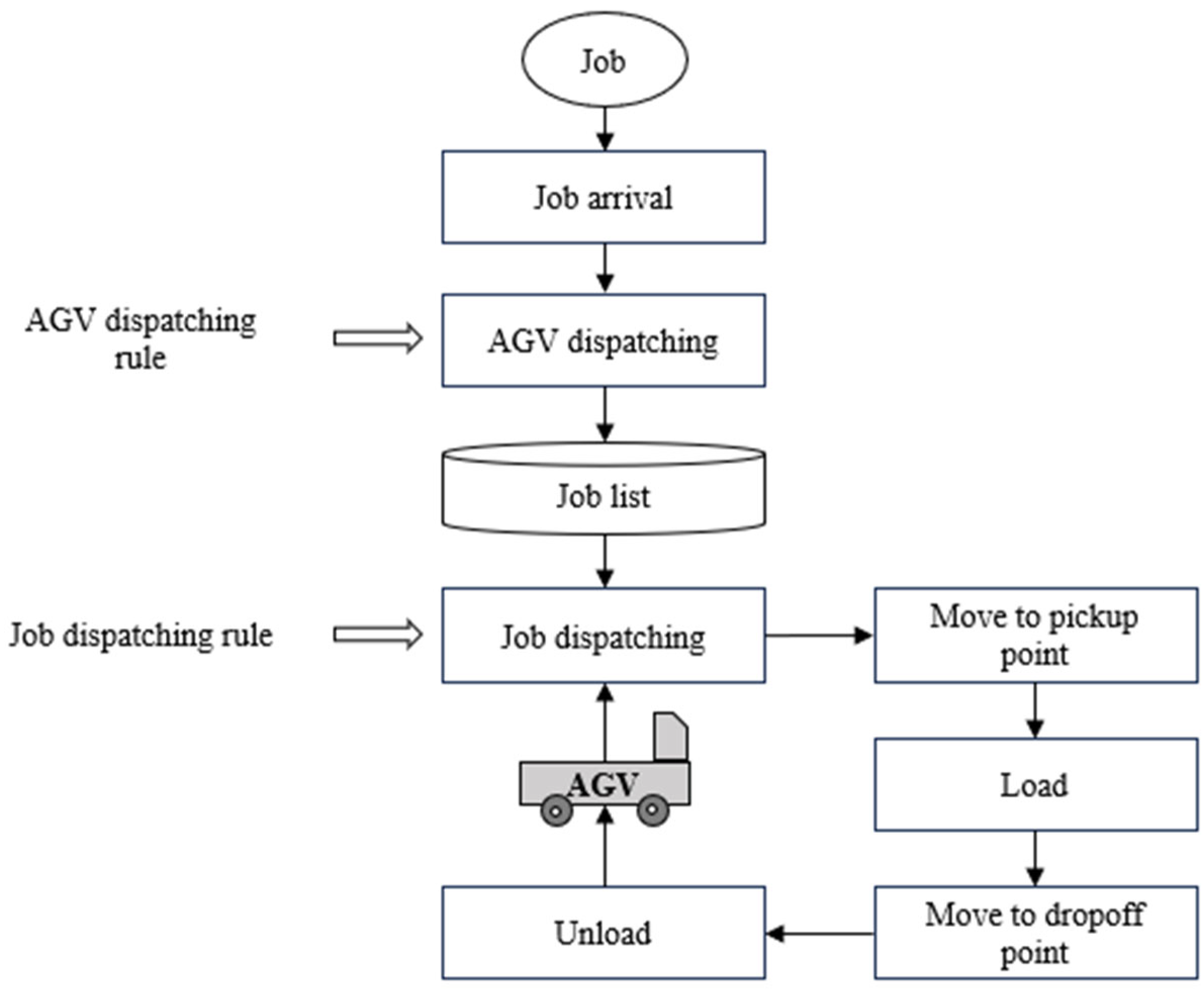
Transporting jobs from pickup to dropoff points requires assigning each job to an AGV. This assignment procedure involves two key decisions: job selection and AGV selection. These decisions are made using scheduling rules. This study considers two types of such rules: job dispatching rules and AGV dispatching rules. Scheduling rules must be appropriately incorporated into the entire AGV scheduling logic, and Figure 2 summarizes the main flow of AGV scheduling logic utilized herein.
Once a job arrives at a pickup point, it must be pre-assigned to a specific AGV, so AGV dispatching rules are applied at this moment to select the most suitable AGV for the job. The job is then added to the job list. An available AGV consults the job list to find the next job to transport. If the job list contains two or more jobs assigned to the AGV, job dispatching rules are required for the AGV to select one of them. Once a job is selected, the AGV performs transportation by moving to a pickup point, loading, moving to dropoff point, and unloading. If a transport for a job is completed, the AGV becomes available and is ready to transport another job.
If an AGV path network contains CCAs with different congestion levels and movement speeds, these factors should be considered in AGV dispatching and job dispatching to optimize the system’s performance. In this context, we propose “congestion-aware” AGV dispatching rules (listed in Table 2) and “congestion-aware” job dispatching rules (listed in Table 3). Like conventional dispatching rules, they are simple but designed to select an AGV or a job while considering the congestion levels of the associated CCAs. The performance of these congestion-aware scheduling rules is evaluated and compared with that of existing scheduling rules through simulation.

4. Experiment Results

4.1. Simulation Model of AGV Fleet

Simulation modeling for a large-scale multi-AGV system is a non-trivial task due to the intricate interactions and dependencies among the entities, including complex path networks and high-density traffic. Moreover, to reflect realistic operational constraints, such as traffic congestion and safety distance, sophisticated custom logic needs to be integrated into the simulation model. In this study, a simulation model of a shop floor, based on a Korean automobile part manufacturer, is developed using the FlexSim 2024 update 2. FlexSim provides rich 3D visualization for manufacturing shop floors, a built-in library for modeling AGV networks, and a flexible logic builder for implementing custom control mechanisms. The simulation model serves as a testbed for evaluating and analyzing the performance of proposed scheduling rules.
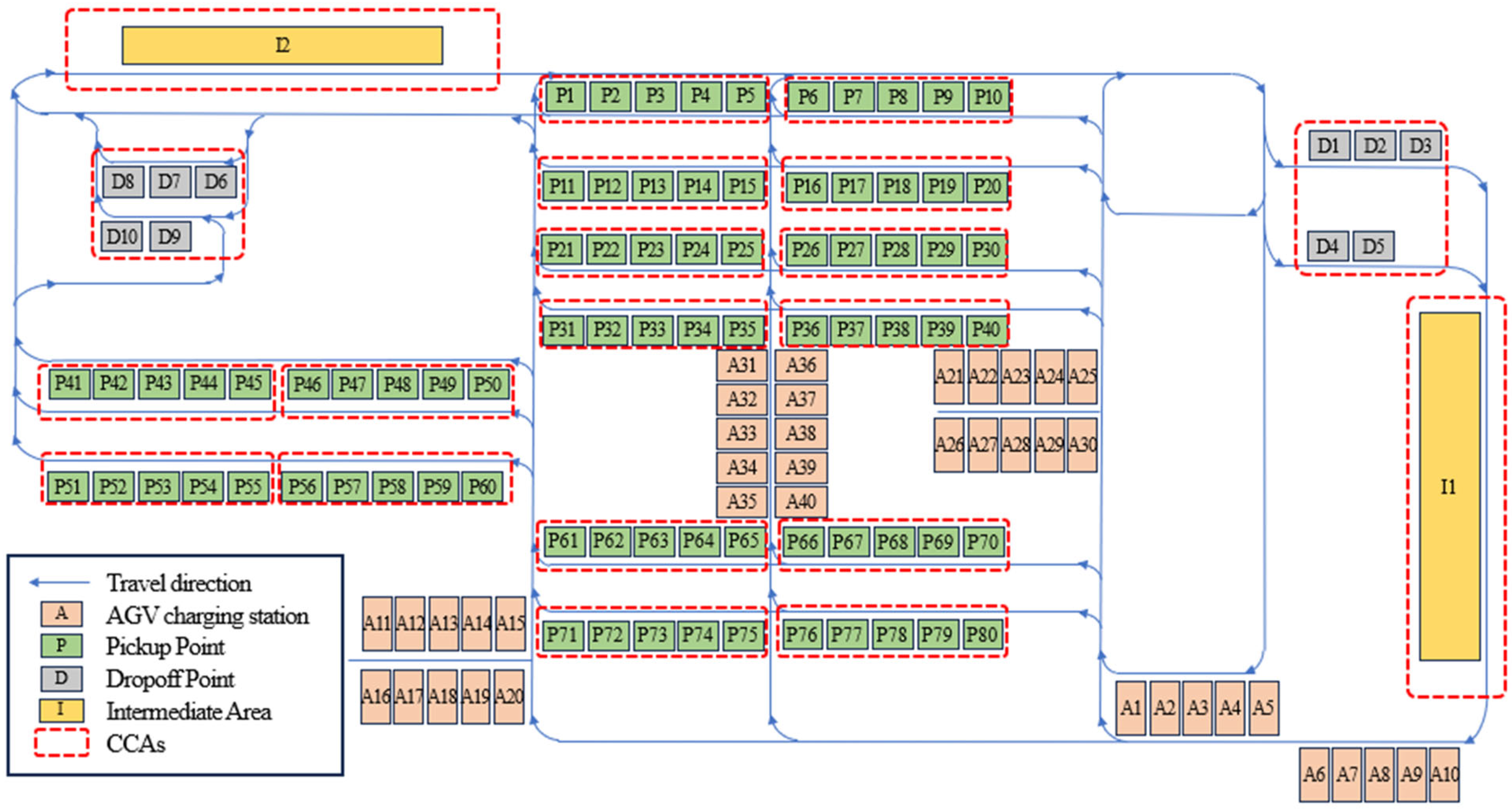
Figure 3 depicts a schematic representation of the experimental simulation model, where AGV paths are unidirectional to facilitate smooth material flow. The layout comprises 80 pickup points (P1–P80), 10 dropoff points (D1–D10), and 40 charging stations (A1–A40). This layout is designed to support the sequential operational procedure of AGVs: moving from pickup points to dropoff points, and subsequently to the intermediate area. Upon reaching the intermediate area, the system determines the next destination for each AGV based on its remaining battery level, either proceeding to a charging station or returning to a pickup point for a new task. All AGVs are initialized at their respective stations at t = 0.
The pickup points are aligned along the path to create aisles, whereas the dropoff points form separate zones on the left and right sides of the layout. This structure is based on a real-world shop floor of an automobile parts manufacturer, but it has been modified to introduce additional complexity. To apply the proposed AGV scheduling approach, we defined CCAs, indicated by the red dashed boxes in Figure 3.
The experimental simulation model features two dropoff areas: one on the left containing D6–D10, and the other on the right containing D1–D5. Additionally, as shown in Figure 3, two intermediate areas (I1 and I2) serve as exits from their respective dropoff areas. Compared with dropoff areas, the number and configuration of intermediate areas are less intuitive and rely more on the analyst’s discretion. However, the key principle is to define any path segment or zone as a CCA if its congestion level can significantly impact the overall system performance. For instance, as shown in Figure 3, if intermediate areas I1 and I2 become congested, access to the dropoff points may be impeded. By contrast, 16 pickup areas are shown in Figure 1, where each consists of a series of five pickup points. This pickup area configuration implies that a loading operation performed by one AGV at a specific point could obstruct access to an adjacent pickup point for another AGV.
The AGV path network in Figure 3 also contains a substantial number of path segments that do not belong to any CCA. In other words, congestion penalties are not imposed on these non-CCA segments, regardless of the congestion level. However, basic collision avoidance mechanisms remain active on non-CCA segments. That is, if a preceding AGV is stationary at a certain point, the following AGV is required to either wait or reroute via an alternative path.
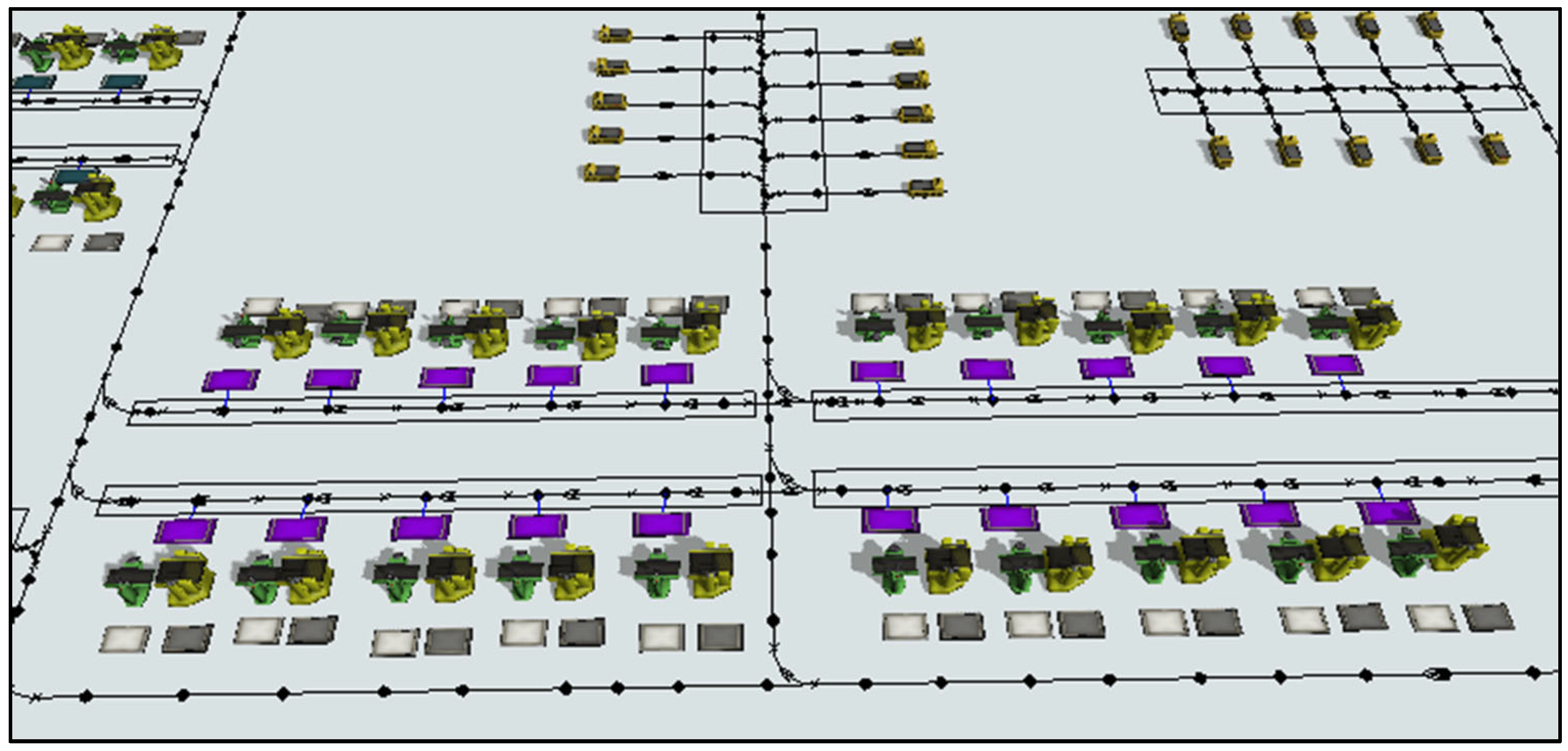
Figure 4 illustrates the model layout developed using FlexSim. A location on the AGV path is represented by a Control Point, a built-in modeling object in FlexSim. The pickup and dropoff points are represented by Queue objects, which are connected to nearby Control Points. Moreover, a control area object is used to represent a CCA that encompasses several Control Points and other objects (e.g., pickup and dropoff points) connected to them.
For simplicity, the congestion levels and movement speeds of all CCAs are determined using an identical congestion function and an identical congestion penalty, which are summarized in Table 4. The congestion level is divided into four ranges using three threshold values, T 1 , k = 3, T 2 , k = 5, and T 3 , k = 7. Moreover, for each unit increase in the congestion level, the movement speed decreases by 15%.

4.2. Experiment Design

In addition to the congestion function and congestion penalty described above, the following model parameters and operational constraints are applied to the simulation model to validate the performance of the proposed system:
  • To validate the performance of the proposed congestion-aware scheduling rules, they are compared against conventional benchmark rules. Specifically, four standard rules—including first in–first out (FIFO) and nearest idle vehicle (NIV)—have been integrated into the job and AGV dispatching frameworks. Consequently, 10 distinct rule sets are employed in this study. Table 5 presents a comprehensive list of job and AGV dispatching rules utilized in the experiment.
2.
The buffer capacity of each pickup point is limited to a maximum of three items to account for actual safety regulations and the spatial constraints of the physical site. The inter-arrival time of a job is classified into three levels: short, normal, and long. The inter-arrival times for each level are uniformly distributed across the range defined by their respective minimum and maximum values (in seconds). The pickup points are grouped into four production lines: Line A (P1–P20), Line B (P21–P40), Line C (P41–P60), and Line D (P61–P80). To simulate dynamic workload changes, the inter-arrival time level of each line is updated every 4 h. The inter-arrival time levels are used to vary congestion levels across pickup areas. For instance, a pickup area serving lines with lower workloads is likely to maintain relatively low congestion. Consequently, the proposed congestion-aware scheduling rules indirectly account for the workload by utilizing congestion information during the scheduling process. Table 6 presents the distribution parameters for the job generation intervals, while Table 7 details the production schedule for each line.
3.
Jobs are classified into 10 distinct types, each assigned to a unique destination (dropoff point). Job types are randomly assigned with equal probability, where type nt jobs are transported to Dnt.
4.
For all job types, the processing time is 300 s, and due dates (di) are uniformly distributed between 2000 and 4000 s. Based on these parameters, the tardiness Ti of an individual item is formulated as
T i = m a x ( C i d i ,   0 )
where C i denotes the completion time of the item. Consequently, if an item is delivered before its due date ( C i     d i ) , the tardiness is recorded as zero.
5.
Each AGV possesses a unit load capacity, meaning it can transport a maximum of one job at a time. The detailed kinematic and battery parameters are configured to match the hardware specifications of real-world AGVs, as follows:
A.
Load/Unload Time: 5 s;
B.
Acceleration/Deceleration: 1 m/s2;
C.
Battery Capacity: 100 AH (Amp-Hour);
D.
Battery Use: 25 Amp;
E.
Idle Battery Use: 0.5 Amp;
F.
Recharge Threshold: 30 AH;
G.
Resume Threshold: 60 AH.
6.
The simulation model operates on a 24 h cycle. The daily schedule includes a total of six scheduled breaks: three short breaks (10 min each) and three long breaks (1 h each). During these break intervals, the material input to the processors within the production lines is suspended. Consequently, the generation of job items is halted, preventing new loads from arriving at the pickup points. Figure 5 illustrates the 24 h operation timeline and break schedule. We implemented these elements to ensure realistic simulation conditions.
7.
The total simulation horizon is set to 345,600 s, covering a continuous four-day operational period from Monday at 08:00 to Friday at 08:00. The experiment evaluates a total of 100 distinct scenarios, derived from the combination of the Job and AGV dispatching rules defined in Table 5. To ensure statistical reliability against stochastic variability, each scenario is replicated 40 times.

4.3. Experiment Result: Tardiness

The performance of dispatching rules was compared using the average tardiness as a performance measure. Table 8 presents the top five scenarios with the lowest average tardiness values. For the full nomenclature and detailed definitions of the dispatching rules, please refer to Table 3. The best-performing scenario (HPCL + NIV) achieved the minimum average tardiness, highlighting the synergy between prioritizing congested pickup points and assigning the nearest idle vehicle. Consistently, the top-performing scenarios were largely dominated by the HPCL and LDCL job dispatching rules, reinforcing the effectiveness of prioritizing jobs based on congestion levels. However, a notable observation in this updated result is the inclusion of the FIFO rule in the fourth rank (FIFO + HCL-LD). This suggests that while congestion-aware strategies are paramount, simple sequential processing can also yield competitive results when paired with specific AGV dispatching rules.
Table 9 presents the bottom five scenarios yielding the highest average tardiness. A distinct and common feature of these scenarios is the exclusive adoption of the STD rule for job dispatching. Regardless of the paired AGV dispatching rule, STD consistently resulted in the highest delays. This confirms that prioritizing tasks solely based on the shortest travel distance leads to significant penalties in average tardiness, likely due to the neglect of distant or difficult-to-reach jobs, causing the starvation phenomenon.
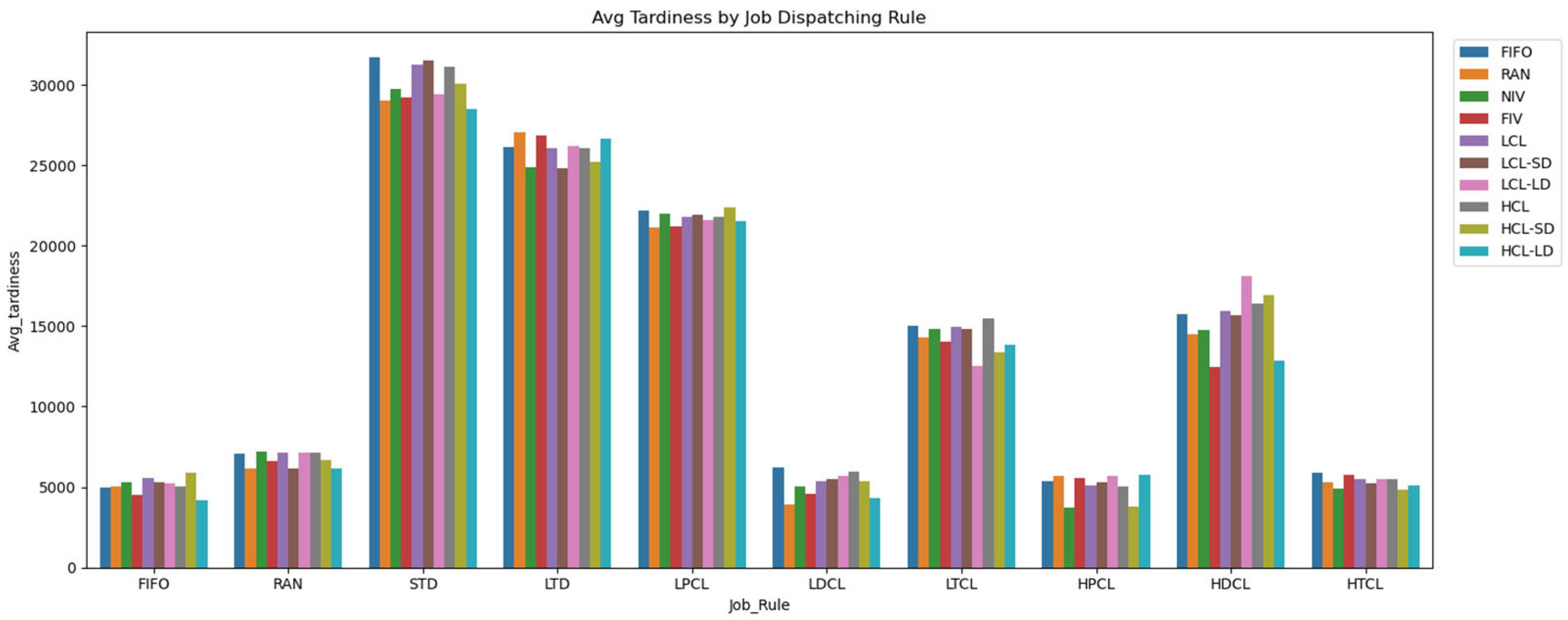
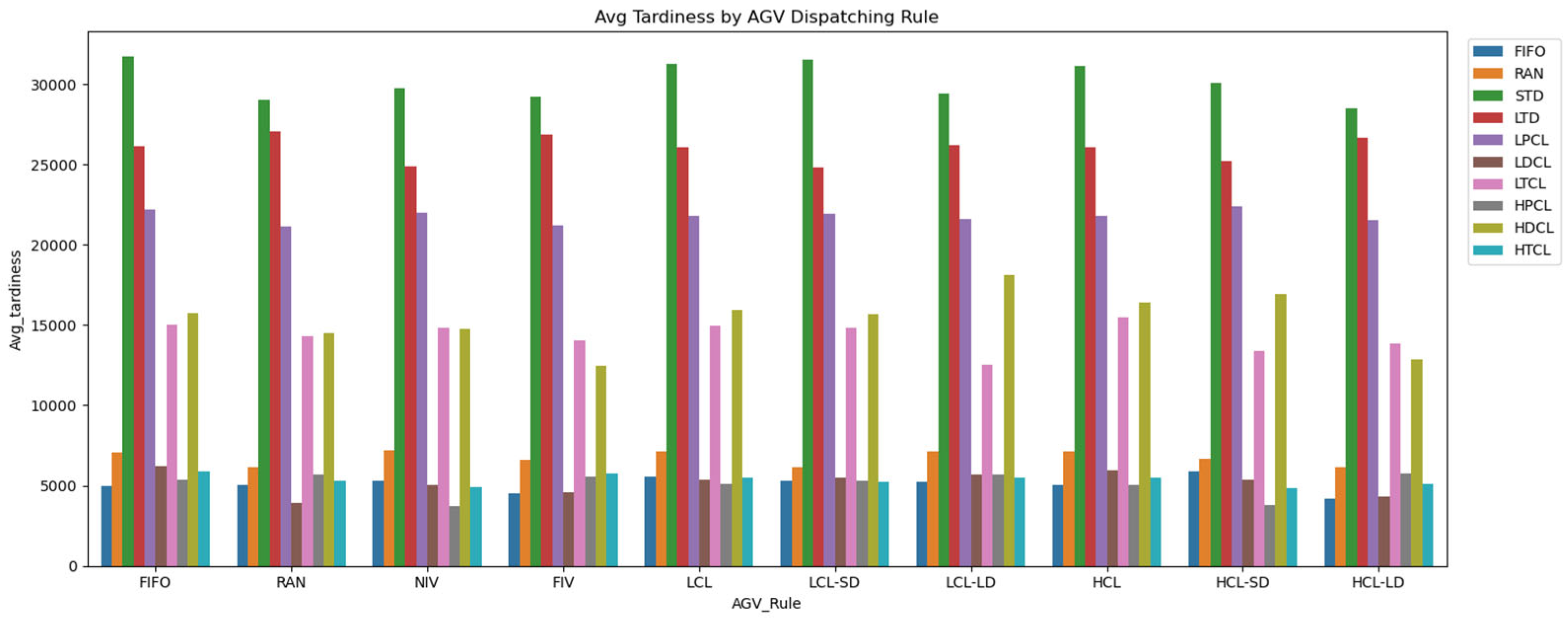
Figure 6 and Figure 7 compare the average tardiness across different job dispatching rules and AGV dispatching rules, respectively. As shown in Figure 6, significant performance disparities arise depending on the job dispatching rule applied. Specifically, distance-based rules (STD; LTD) demonstrated overwhelmingly high average tardiness (with STD exceeding 30,000 s), likely due to the starvation of tasks located on inefficient routes. Notably, while the LPCL rule belongs to the proposed family, it showed relatively high tardiness compared with others, suggesting that prioritizing purely based on the congestion level at the pickup point is insufficient in this context. By contrast, the LDCL, HPCL, and FIFO rules consistently maintained the lowest average tardiness levels. This demonstrates that strategies prioritizing lower congestion at the dropoff point (LDCL), higher congestion at the pickup point (HPCL), or simple sequential processing (FIFO) are the most effective in preventing extreme delays. Crucially, Figure 7 confirms that this performance hierarchy remains virtually identical regardless of the AGV dispatching rule employed. The consistent bar patterns across all AGV scenarios in Figure 7 indicate that the impact of AGV dispatching rules is marginal. Consequently, the findings verify that the job dispatching logic—determining which task to process next—is the dominant factor governing system tardiness, rather than the method of vehicle assignment.

4.4. Experiment Result: Tardy Rate

The performance of dispatching rules was further analyzed using the Tardy Rate. Table 10 presents the top five scenarios with the lowest Tardy Rate values. The best-performing scenarios were primarily driven by the LPCL rule, indicating that prioritizing jobs from less congested pickup points is effective in reducing the frequency of tardiness. A notable observation is the inclusion of the STD rule within the top rankings. While STD yielded the worst performance for average tardiness in Table 9 due to the starvation of specific tasks, its presence in Table 10 suggests that it successfully delivers the majority of jobs on time, albeit with extreme delays in a few outliers.
Table 11 presents the bottom five scenarios yielding the highest Tardy Rate values. A distinct feature of these scenarios is the exclusive adoption of the FIFO rule for job dispatching. Although FIFO showed moderate performance in reducing average tardiness in the previous analysis, these findings indicate it is highly vulnerable in terms of Tardy Rate. This implies that while FIFO processes jobs sequentially, it lacks the mechanism to prioritize urgent tasks or avoid congestion, leading to a significantly higher volume of missed due dates.
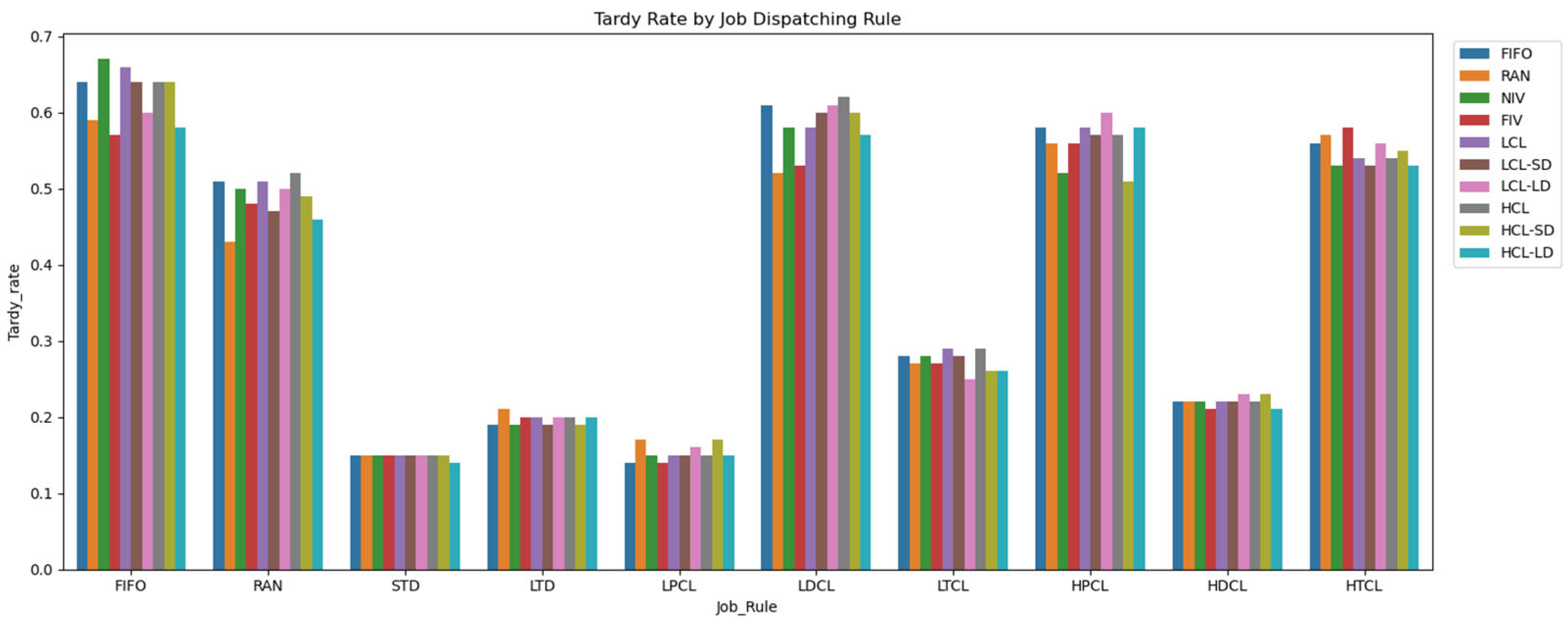
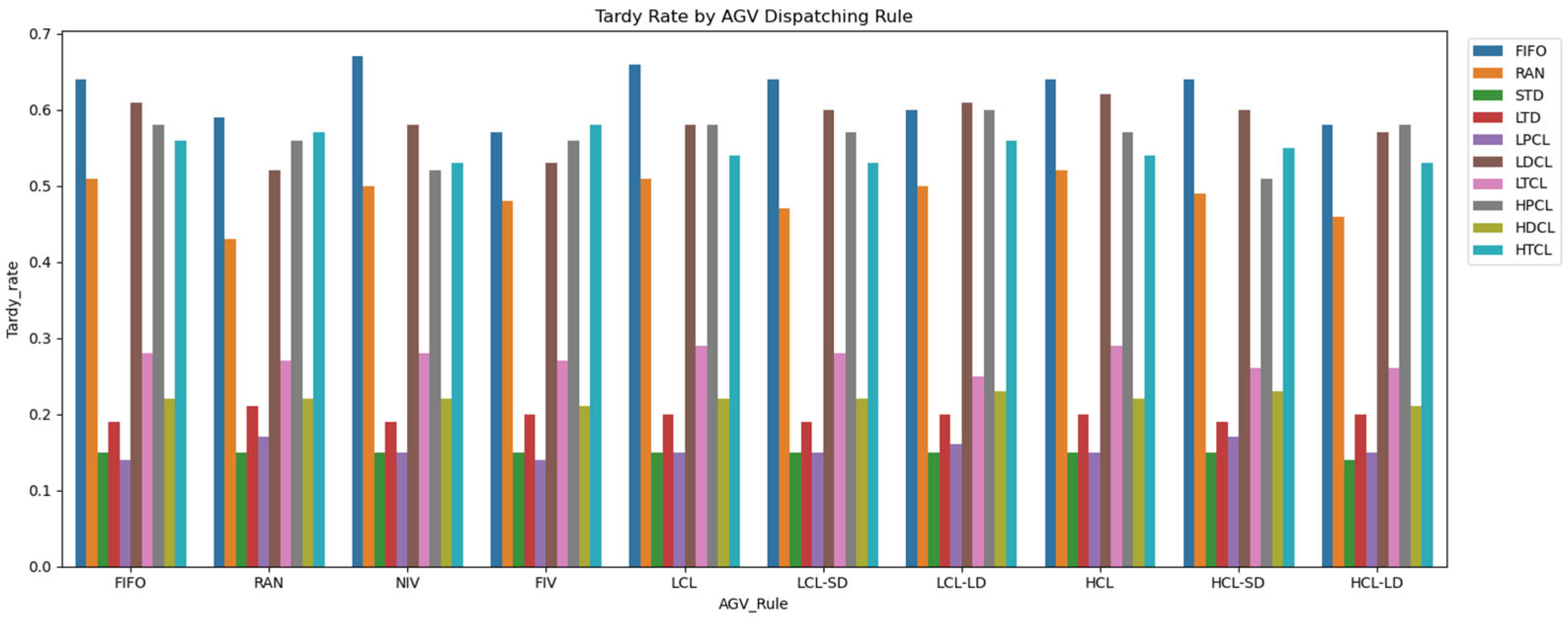
Figure 8 and Figure 9 compare the Tardy Rate across different job dispatching rules and AGV dispatching rules, respectively. As shown in Figure 8, the performance landscape presents a striking inversion compared with the average tardiness results in Figure 6. Specifically, the STD and LPCL rules recorded the lowest Tardy Rates, demonstrating superior performance in this metric. This dramatic shift—particularly for the STD rule, which performed worst in average tardiness—suggests that while STD causes extreme delays for specific long-distance outliers, it is highly efficient at processing a large volume of nearby jobs within their due dates, thereby minimizing the frequency of tardiness. By contrast, the LDCL and HPCL rules were the most effective in minimizing average tardiness and exhibited significantly higher Tardy Rates in Figure 8. Additionally, the FIFO rule continued to show poor performance, demonstrating high Tardy Rates similar to the congested scenarios. Crucially, Figure 9 confirms that this performance hierarchy remains consistent regardless of the AGV dispatching rule employed. The bar patterns across all scenarios in Figure 9 indicate that the AGV dispatching rule has a minimal effect on the Tardy Rate. Consequently, these findings highlight a critical trade-off in job dispatching logic: STD and LPCL are preferable for minimizing the number of late jobs, while LDCL and HPCL are superior for reducing the magnitude of extreme delays.

4.5. Experiment Result: Pickup Stay Time

The analysis was extended to the pickup stay time metric. Table 12 presents the top five scenarios with the lowest pickup stay time values. A distinct feature of these best-performing scenarios is the exclusive dominance of the STD job dispatching rule. This suggests that assigning jobs based on proximity yields a clear advantage in reducing the duration at the pickup areas, with values ranging from approximately 1365.81 s to 1446.06 s.
Table 13 presents the bottom five scenarios yielding the highest pickup stay time values. These scenarios are primarily characterized by the adoption of the FIFO rule, while LDCL also appears in the worst-performing rankings. Despite LDCL and other congestion-based rules demonstrating superior performance in minimizing average tardiness in previous analyses, they resulted in significantly longer pickup stay times compared with STD. The quantitative gap between the best (~1365.81 s) and worst (~4125.45 s) scenarios is substantial. This indicates that pickup stay time is highly sensitive to the choice of job dispatching rules. Consequently, the findings verify that the job dispatching logic—particularly distance-based selection—is a critical factor in optimizing pickup efficiency.
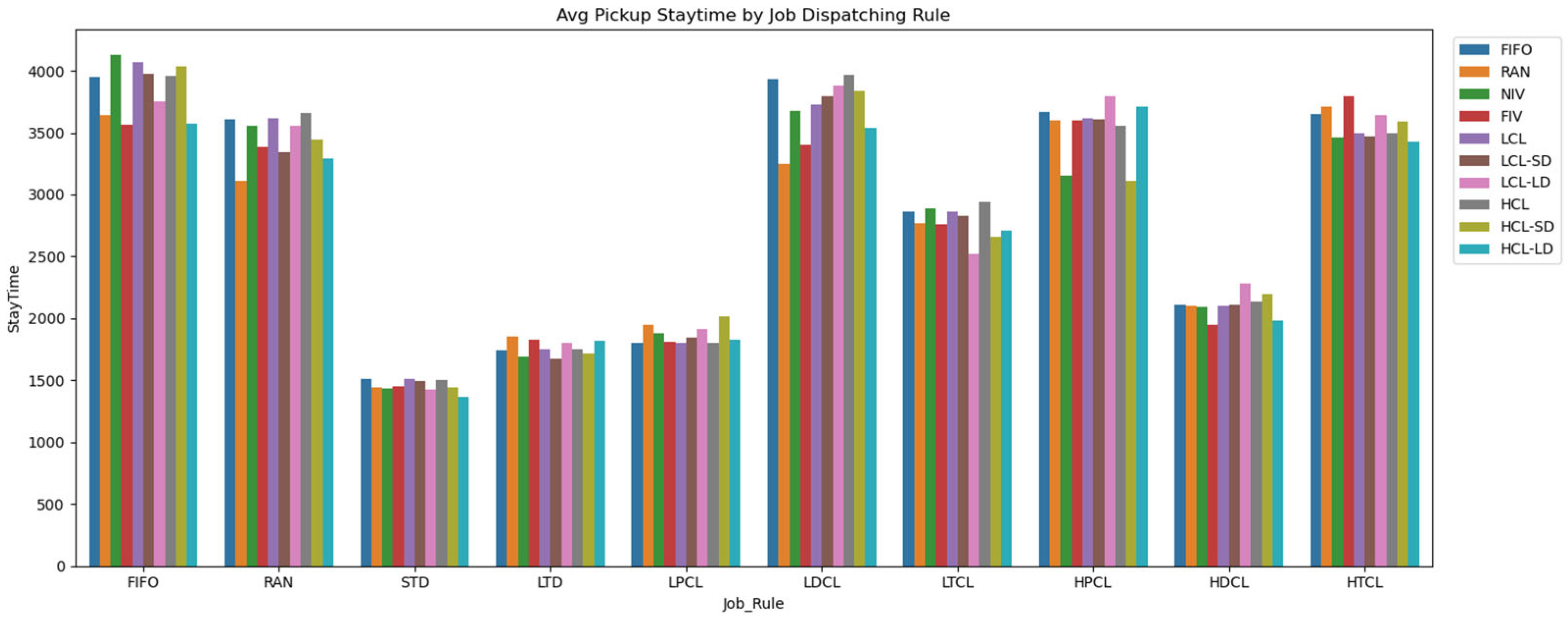
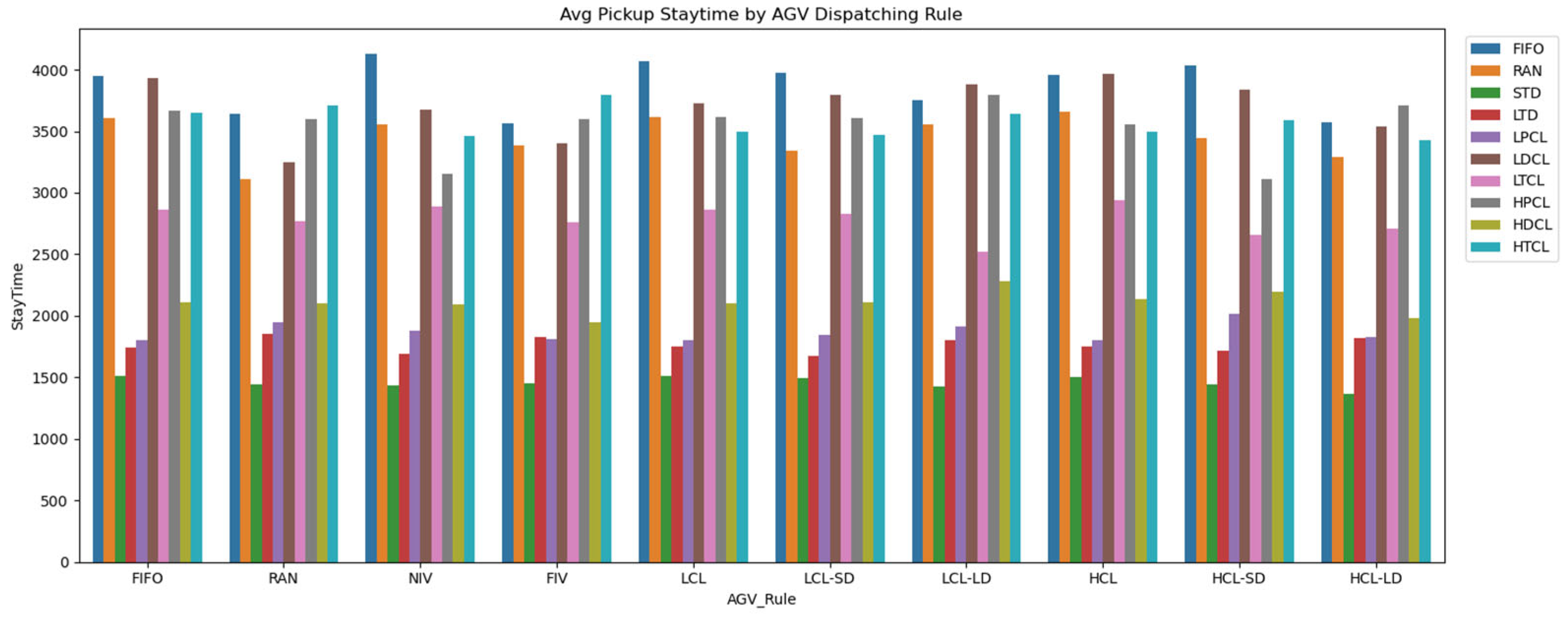
Figure 10 and Figure 11 compare the average pickup stay time across different job dispatching rules and AGV dispatching rules, respectively. As shown in Figure 10, the performance landscape for pickup stay time shows a distinct pattern that contrasts with previous metrics. Specifically, STD recorded the lowest pickup stay time (approximately 1365–1446 s), demonstrating its high efficiency in initiating tasks quickly through proximity-based selection. By contrast, rules such as LDCL and HPCL were the most effective in reducing average tardiness and exhibited significantly higher pickup stay times (exceeding 3500 s). Crucially, Figure 11 confirms that this performance hierarchy is dictated primarily by the job dispatching logic, as the impact of AGV dispatching rules remains marginal with consistent bar patterns across all scenarios. The relationship between pickup stay time and tardiness metrics reveals a critical strategic trade-off. There is a paradoxical correlation between pickup stay time and average tardiness; while STD minimizes the time a job waits at a pickup node, it yields the highest average tardiness due to the starvation of jobs on inefficient routes. This indicates that local pickup efficiency does not necessarily improve the overall magnitude of system delays. However, a positive correlation is observed between pickup stay time and the Tardy Rate. Rules with lower stay times, such as STD and LPCL, also demonstrate the lowest Tardy Rates, suggesting that rapidly initiating transport is effective for increasing the frequency of on-time deliveries. Consequently, the findings verify that STD is preferable for maximizing the number of on-time jobs, whereas LDCL and HPCL are essential for minimizing the overall intensity of system-wide delays despite their higher pickup stay times.

4.6. Experiment Result: AVG Congestion Time

The performance of the AGV fleet was further evaluated based on the average duration that it remained in a congested state. Following the layout defined in Figure 3, the AVG congestion time is calculated as the total time during which the congestion levels of the CCAs were 1 or higher. Table 14 presents the top five scenarios that achieved the lowest AVG congestion time values. A primary feature of these top-performing scenarios is the prevalence of the STD rule for job dispatching, which appears in four of the five entries. By prioritizing the closest available tasks, the STD rule minimizes the absolute time vehicles spend traveling across the shop floor. This reduction in travel time effectively lowers the probability of multiple vehicles occupying the CCA simultaneously, thereby minimizing the duration of inter-vehicle interference and successfully reducing overall congestion time.
Table 15 presents the bottom five scenarios yielding the highest AVG congestion time values. A common feature of these scenarios is the adoption of congestion-based rules such as HPCL, HTCL, LDCL, and LTCL, as well as the FIFO rule. Although these congestion-aware strategies were shown to be highly effective in reducing average tardiness in previous analyses, they appear less effective in minimizing local congestion time within the CCA. This confirms that while these rules prevent extreme system-wide delays by balancing workload, they may inadvertently increase the duration vehicles spend or wait within key control areas, leading to higher localized congestion times.
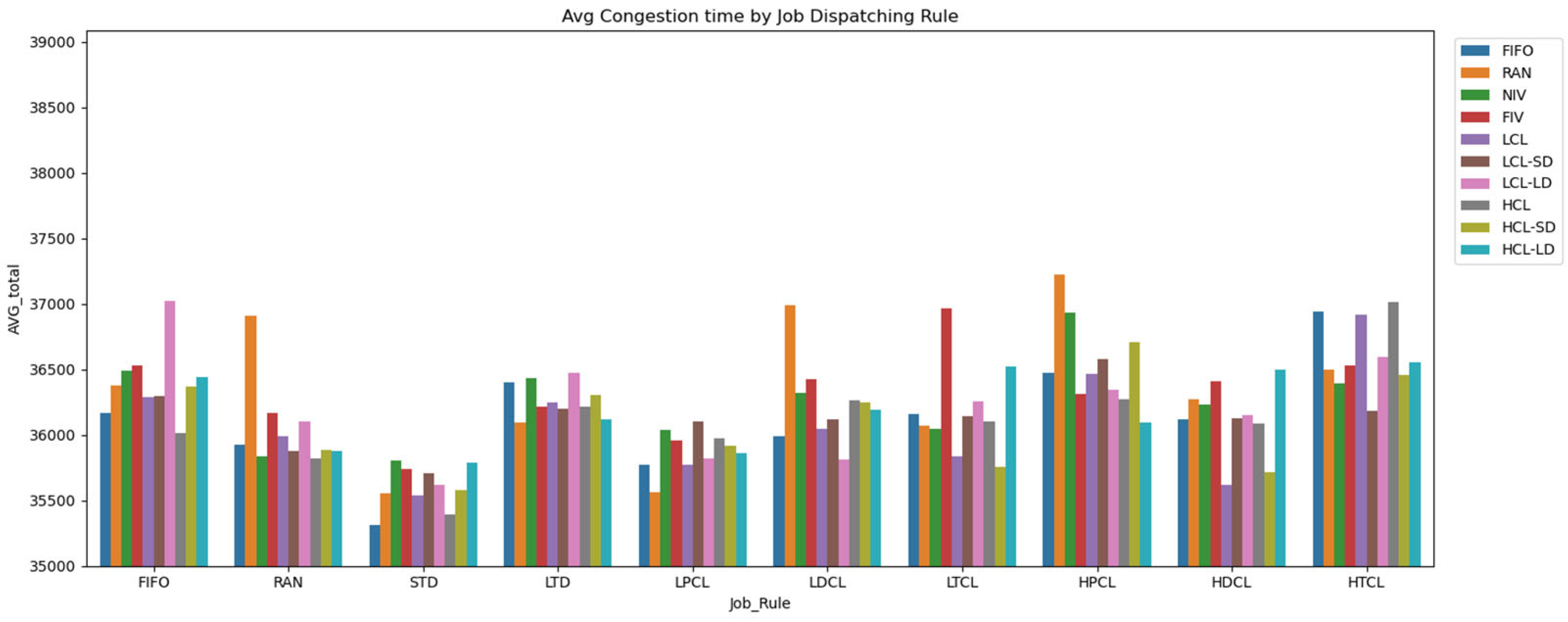
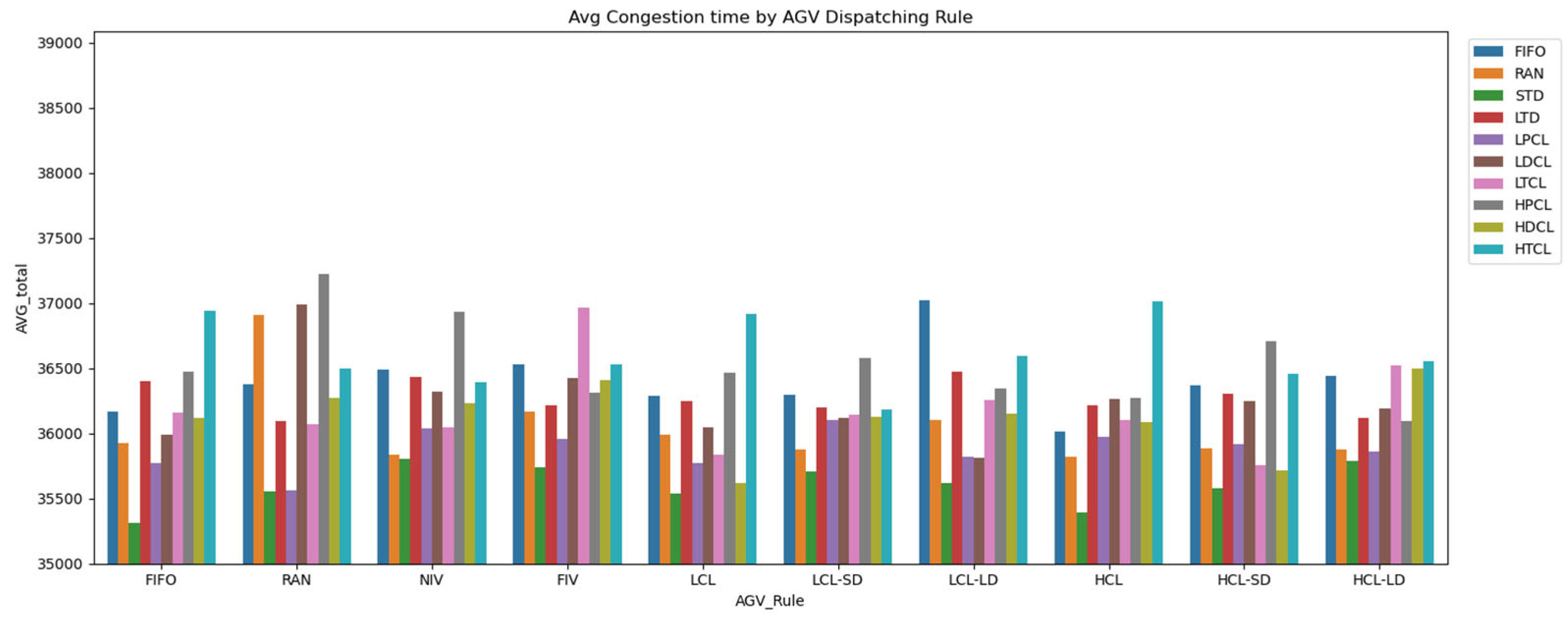
Figure 12 and Figure 13 illustrate that while the STD rule maintains the lowest absolute congestion durations, the proposed congestion-aware rules—particularly LPCL and LDCL—demonstrate significant potential for maintaining a strategic balance between local efficiency and global system performance. As shown in Table 14, the LPCL rule achieved the fifth lowest AVG congestion time (35,564.89 s), performing nearly as effectively as proximity-based rules in minimizing vehicle interference within the CCAs. This suggests that by prioritizing pickup points with lower congestion levels, LPCL can prevent vehicle clusters while avoiding the severe tardiness penalties associated with distance-only logic. The strategic potential of these proposed rules is further reinforced by Figure 6, which proves that although rules like LDCL and HPCL exhibit higher local congestion times in Figure 13, they are vital for system-wide reliability by consistently achieving the lowest average tardiness. This confirms that congestion-aware rules intentionally accept higher local congestion to balance global workloads and prevent system bottlenecks—a strategy that Figure 6 highlights as essential, given that the STD rule’s local efficiency resulted in overwhelmingly high average tardiness exceeding 30,000s. Ultimately, Figure 12 verifies that this performance hierarchy is driven by the job dispatching logic rather than the AGV assignment method, proving that the proposed congestion-level criteria can overcome the inherent limitations of proximity-based dispatching to ensure global punctuality.

5. Conclusions

5.1. Strategic Trade-Offs Between Local Efficiency and Global Punctuality

This study proposes a simulation-based congestion-aware AGV scheduling approach to effectively address the performance degradation and operational inefficiencies caused by traffic congestion in large-scale AGV fleets. As emphasized in the introduction, the fundamental objective of AGV scheduling is to assign the optimal task to the most suitable vehicle at the precise moment it is needed. To achieve this goal within a high-density traffic environment, our approach integrated three comprehensive components: congestion functions to quantify the real-time traffic status, congestion penalties to represent the potential loss during transit, and congestion-aware scheduling rules to guide the decision-making process. The effectiveness of these heuristic dispatching rules was rigorously evaluated using a DES model inspired by real-world manufacturing shop floors. The experimental results obtained by this study yield several significant insights regarding the inefficiencies caused by traffic congestion and validate the effectiveness of the proposed scheduling rules:
First, the empirical evidence indicates that the overall performance of the AGV system is predominantly determined by the job dispatching rule rather than the AGV dispatching rule. This finding suggests that the logic governing which task is selected for processing acts as the primary lever for managing system bottlenecks. Consequently, controlling the inflow of tasks into the system proves to be a more critical factor in maintaining operational stability than the specific method of vehicle allocation.
Second, a distinct trade-off was identified between local operational efficiency and global system punctuality. Proximity-based rules like STD proved highly effective at minimizing localized metrics, achieving the lowest pickup stay time (~1400 s) and AVG congestion time (~35,315 s). However, this local efficiency causes a “starvation phenomenon,” leading to the highest average tardiness (exceeding 30,000s). By contrast, the proposed congestion-aware rules—specifically LDCL and HPCL—effectively minimize the magnitude of system delays by balancing global workloads, even though they incur higher local congestion and stay times.
Third, this study proposes performance measures related to AGV traffic congestion, including pickup stay time and AGV congestion time. Traffic congestion can induce communication-related issues in AGV systems, such as latency and packet loss. While the duration of such latency is typically short and has a negligible impact on traditional operational performance measures like waiting times, minimizing these issues is crucial, as they can lead to collisions or unnecessary speed reductions. In other words, although this study does not directly address technical network parameters like latency or packet loss, it demonstrates that communication system performance can be indirectly managed by controlling congestion through appropriate AGV scheduling.
Finally, the proposed LPCL rule emerged as a robust hybrid solution. While it exhibits relatively high average tardiness, similar to distance-based trends, it successfully minimizes the Tardy Rate and maintains competitive AVG congestion time, ranking among the top performers for local efficiency. Furthermore, this study revealed that increasing rule complexity, such as through composite rules like LCL-SD, does not guarantee improved performance, as secondary objectives can dilute the effectiveness of the primary goal of resolving congestion.
In conclusion, the congestion-aware approach proposed in this study contributed to overcoming the inherent limitations of distance-centered dispatching and optimizing the operational efficiency of large AGV fleets. In increasingly complex logistical environments, integrating dynamic system information—such as node-level congestion status—into dispatching logic proves far more promising for performance optimization than relying on simple geometric distances.

5.2. Future Work

This study is subject to certain limitations that suggest directions for further investigation.
First, the simulation model is restricted to single-load AGVs. Since these AGVs can only transport one unit of payload per trip, they cannot perform task batching, leading to an inefficient accumulation of waiting jobs. Therefore, future research will aim to extend the current model to incorporate multi-load AGVs capable of handling multiple tasks simultaneously.
Second, this paper did not explicitly consider the detailed communication dynamics between AGVs and the control system. Instead, the simulation model assumed that the control system could communicate with AGVs instantaneously whenever required. In future research, we will aim to develop a simulation environment where AGVs interact with an external control system via specific protocols. We plan to investigate how the technical characteristics of the communication system affect the operational performance of the AGV system.
Third, in this study, we primarily considered a unidirectional AGV path network to reflect the actual shop floor characteristics of an automotive parts manufacturing company in Korea. In such unidirectional environments, the congestion count based on Equation (1) serves as a reasonably effective proxy for traffic density. However, modern AGV systems often operate on more intricate path topologies, such as bidirectional or mesh networks, where complex spatial interferences and deadlocks can occur. Therefore, future research should focus on extending the proposed scheduling logic to account for dynamic spatial conflicts and multi-directional flows within these complex network environments.
Fourth, future research will aim to develop a comprehensive dynamic control framework by integrating advanced path planning with adaptive scheduling. While this study focused on static rules to establish a baseline, we acknowledge their limitations in highly fluctuating environments. To address this, we plan to explore reinforcement learning (RL) approaches, where the congestion-aware rules proposed in this study will serve as the action space (action parameters) for the RL agent. This integration will enable the system to adaptively select the optimal dispatching rule and route in real-time, significantly enhancing robustness and throughput in complex, large-scale systems.
Fifth, this paper considers both traditional operational performance measures, such as tardiness, and congestion-based measures, such as AGV congestion time. However, these metrics were addressed using a single-objective framework (or single-criterion priority rules), and multi-objective optimization that considers them simultaneously was not covered in this study. Therefore, future research is needed to apply multi-objective optimization approaches to balance the trade-offs between these operational and congestion-based measures.

Author Contributions

Conceptualization, J.K. (Junwoo Kim); methodology, J.K. (Junwoo Kim); software, J.K. (Jeonghyeon Kim); validation, J.K. (Junwoo Kim); formal analysis, J.K. (Jeonghyeon Kim); investigation, J.K. (Junwoo Kim) and J.K. (Jeonghyeon Kim); data curation, J.K. (Jeonghyeon Kim); writing—original draft preparation, J.K. (Jeonghyeon Kim); writing—review and editing, J.K. (Junwoo Kim); visualization, J.K. (Jeonghyeon Kim); supervision, J.K. (Junwoo Kim); project administration, J.K. (Junwoo Kim); funding acquisition, J.K. (Junwoo Kim). All authors have read and agreed to the published version of the manuscript.

Funding

This research was funded by the National Research Foundation of Korea (NRF) grant provided by the Korea government (MSIT) (NRF-2023R1A2C1003293).

Data Availability Statement

The raw data supporting the conclusions of this article will be made available by the authors on request.

Acknowledgments

During the preparation of this manuscript, the authors used ChatGPT-4o and Gemini 3 for the purposes of language grammar and readability. The authors have reviewed and edited the output and take full responsibility for the content of this publication.

Conflicts of Interest

The authors declare no conflicts of interest.

References

  1. Llopis-Albert, C.; Rubio, F.; Valero, F. Fuzzy-set qualitative comparative analysis applied to the design of a network flow of automated guided vehicles for improving business productivity. J. Bus. Res. 2019, 101, 737–742. [Google Scholar] [CrossRef]
  2. Okumus, F.; Kocamaz, A.F. Cloud based indoor navigation for ROS-enabled automated guided vehicles. In Proceedings of the 2019 International Conference on Artificial Intelligence and Data Processing Symposium (IDAP 2019), Malatya, Turkey, 21–22 September 2019. [Google Scholar]
  3. Li, Z.; Huang, G.Q.; Jiang, Z.; Chu, C. A mechanism for scheduling multi robot intelligent warehouse system face with dynamic demand. J. Intell. Manuf. 2020, 31, 469–480. [Google Scholar] [CrossRef]
  4. Chitsaz, M.; Cordeau, J.F.; Jans, R. A transformation technique for the clustered generalized traveling salesman problem with applications to logistics. Eur. J. Oper. Res. 2020, 285, 444–457. [Google Scholar] [CrossRef]
  5. Le-Anh, T.; De Koster, M. A review of design and control of automated guided vehicle systems. Eur. J. Oper. Res. 2006, 171, 1–23. [Google Scholar] [CrossRef]
  6. Vis, I.F. Survey of research in the design and control of automated guided vehicle systems. Eur. J. Oper. Res. 2006, 170, 677–709. [Google Scholar] [CrossRef]
  7. Oyekanlu, E.A.; Smith, A.C.; Thomas, W.P.; Mulroy, G.; Hitesh, D.; Ramsey, M.; Kuhn, D.J.; Mcghinnis, J.D.; Buonavita, S.C.; Looper, N.A.; et al. A review of recent advances in automated guided vehicle technologies: Integration challenges and research areas for 5G-based smart manufacturing applications. IEEE Access 2020, 8, 202312–202353. [Google Scholar] [CrossRef]
  8. Sedghi, L.; John, J.; Noor-A-Rahim, M.; Pesch, D. Formation control of automated guided vehicles in the presence of packet loss. Sensors 2022, 22, 3552. [Google Scholar] [CrossRef]
  9. Stetter, R. Algorithms and methods for the fault-tolerant design of an automated guided vehicle. Sensors 2022, 22, 4648. [Google Scholar] [CrossRef]
  10. Vakaruk, S.; Sierra-Garcia, J.E.; Mozo, A.; Pastor, A. Forecasting automated guided vehicle malfunctioning with deep learning in a 5G-based industry 4.0 scenario. IEEE Commun. Mag. 2021, 59, 102–108. [Google Scholar] [CrossRef]
  11. Caprihan, R.; Kumar, A.; Stecke, K.E. Evaluation of the impact of information delays on flexible manufacturing systems performance in dynamic scheduling environments. Int. J. Adv. Manuf. Technol. 2013, 67, 311–338. [Google Scholar] [CrossRef]
  12. Liang, C.; Zhang, Y.; Dong, L. A three stage optimal scheduling algorithm for AGV route planning considering collision avoidance under speed control strategy. Mathematics 2023, 11, 138. [Google Scholar] [CrossRef]
  13. Chung, C.H.; Jang, Y.J. Deadlock prevention and multi agent path finding algorithm considering physical constraint for a massive fleet AGV system. Appl. Soft Comput. 2024, 161, 111725. [Google Scholar] [CrossRef]
  14. Park, J.S.; Kim, J.W. Multi-AGV scheduling under limited buffer capacity and battery charging using simulation techniques. Appl. Sci. 2024, 14, 1197. [Google Scholar] [CrossRef]
  15. Schweitzer, F.; Bitsch, G.; Louw, L. Choosing solution strategies for scheduling automated guided vehicles in production using machine learning. Appl. Sci. 2023, 13, 806. [Google Scholar] [CrossRef]
  16. Qiu, L.; Hsu, H.J.; Huang, S.Y.; Wang, H. Scheduling and routing algorithms for AGVs: A survey. Int. J. Prod. Res. 2002, 40, 745–760. [Google Scholar] [CrossRef]
  17. Yang, S.; Meng, L.; Ullah, S.; Zhang, B.; Sang, H.; Duan, P. MILP modeling and optimization of multi-objective three-stage flexible job shop scheduling problem with assembly and AGV transportation. IEEE Access 2025, 13, 25369–25386. [Google Scholar] [CrossRef]
  18. Klei, C.M.; Kim, J. AGV dispatching. Int. J. Prod. Res. 1996, 34, 95–110. [Google Scholar] [CrossRef]
  19. Hu, H.; Jia, X.; He, Q.; Fu, S.; Liu, K. Deep reinforcement learning based AGVs real-time scheduling with mixed rule for flexible shop floor in industry 4.0. Comput. Ind. Eng. 2020, 149, 106749. [Google Scholar] [CrossRef]
  20. Ho, Y.C.; Chien, S.H. A simulation study on the performance of delivery-dispatching rules for multiple-load AGVs. In Proceedings of the 5th Asia-Pacific Industrial Engineering and Management Systems Conference (APIEMS), Brisbane, Australia, 12–15 December 2004; pp. 18.1.1–18.1.15. [Google Scholar]
  21. Ho, Y.C.; Liu, H.C. A simulation study on the performance of pickup-dispatching rules for multiple-load AGVs. Comput. Ind. Eng. 2006, 51, 445–463. [Google Scholar] [CrossRef]
  22. Azimi, P. Alleviating the collision states and fleet optimization by introducing a new generation of automated guided vehicle systems. Model. Simul. Eng. 2011, 2011, 210628. [Google Scholar] [CrossRef]
  23. Pisuchpen, R. A Simulation of AGV dispatching rules for supplying parts to assembly lines. Int. J. Model. Oper. Manag. 2012, 2, 1–25. [Google Scholar] [CrossRef]
  24. Angra, S.; Chanda, A.; Chawla, V. Comparison and evaluation of job selection dispatching rules for integrated scheduling of multi-load automatic guided vehicles serving in variable sized flexible manufacturing system layouts: A simulation study. Manag. Sci. Lett. 2018, 8, 187–200. [Google Scholar] [CrossRef]
  25. Bennis, M.; Debbah, M.; Poor, H.V. Ultrareliable and low-latency wireless communication: Tail, risk, and scale. Proc. IEEE 2018, 106, 1834–1853. [Google Scholar] [CrossRef]
  26. Heger, J.; Voss, T. Optimal scheduling of AGVs in a reentrant blocking job-shop. Procedia CIRP 2018, 67, 41–45. [Google Scholar] [CrossRef]
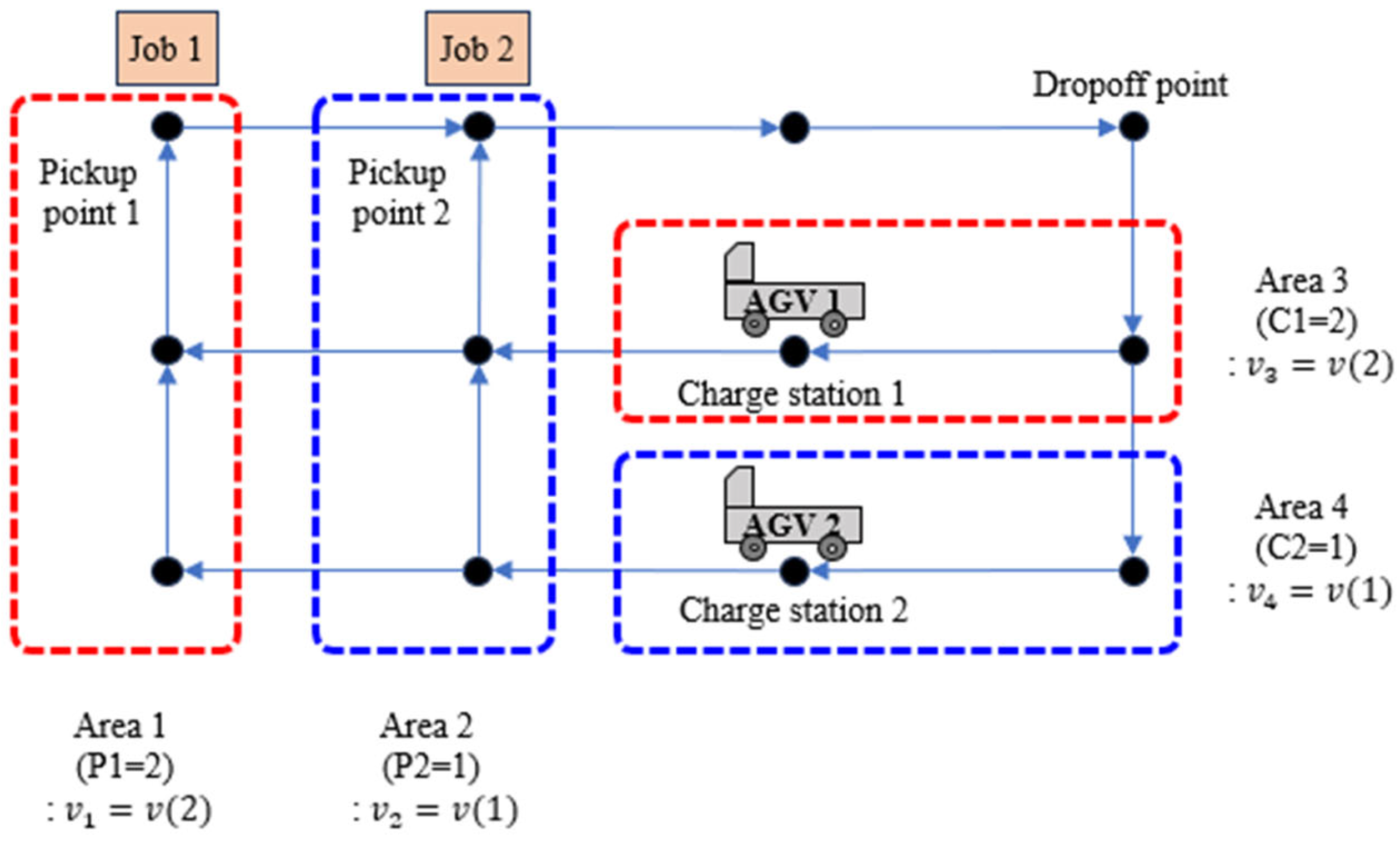
Figure 1. Congestion levels and movement speeds in a simple AGV path network.
Electronics 15 00139 g001
Figure 2. Main flow of AGV scheduling logic.
Electronics 15 00139 g002
Figure 3. Schematic layout of the experimental simulation model.
Electronics 15 00139 g003
Figure 4. Simulation model view in FlexSim.
Electronics 15 00139 g004
Figure 5. Daily operation schedule.
Electronics 15 00139 g005
Figure 6. Average tardiness by job dispatching rule.
Electronics 15 00139 g006
Figure 7. Average tardiness by AGV dispatching rule.
Electronics 15 00139 g007
Figure 8. Tardy Rate by job dispatching rule.
Electronics 15 00139 g008
Figure 9. Tardy Rate by AGV dispatching rule.
Electronics 15 00139 g009
Figure 10. Pickup stay time by job dispatching rule.
Electronics 15 00139 g010
Figure 11. Pickup stay time by AGV dispatching rule.
Electronics 15 00139 g011
Figure 12. AVG congestion time by job dispatching rule.
Electronics 15 00139 g012
Figure 13. AVG congestion time by AGV dispatching rule.
Electronics 15 00139 g013
Table 1. Previous research on AGV scheduling using dispatching rules.
No.Research
Paper
Job
Dispatching 1
AGV
Dispatching 2
Performance MeasureFleet Size
1Ho and Chien (2004) [20]
Ho and Liu
(2006) [21]
FIFO
IDF
LTIS
LWTPT
LAWTPT
SD
GQL
EDT
EADT
SRPT
SST
Workstation Throughput
Average
Flow Time
Average
Tardiness
3
2Azimi
(2011) [22]
FIFO
LQS
LWT
NV
FV
Average
Annual Profit
Average total collisions per day
Average makespan
5~8
3Pisuchpen
(2012) [23]
STF
LTF
Manage AGVs in groupsAverage AGV Cycle time20
4Angra et al. (2018) [24]SRPTF
SSTF
IDF
GWTQF
NVWorkstation Productivity
Average workstation
Utilization
Average AGV Utilization
2
5Hu et a l. (2020) [19] FIFO
EDD
LWT
NV
STD
Average
makespan
Average
Tardiness rate
3
6Park and Kim (2024) [14]FIFO
LDD
SDD
LQB
SQB
LQB
SQB
RAN
LIT
HBL
LBL
LDP
SDP
RAN
Average
Job waiting time
10
1 Job dispatching rules—FIFO: first in–first out; IDF: identical destination first; STF: smallest time balance; LTF: longest time balance; SRPTF: smallest remaining processing time first; SSTF: smallest slack time first; LSTF: longest time in the system first; GWTQF: greatest waiting time in queue first; EDD: earliest due date FIRST; LWT: longest waiting time; LDD: longest distance to destination; SDD: shortest distance to destination; LQB: longest queue in buffer; SQB: shortest queue in buffer; RAN: random. 2 AGV dispatching rules—LTIS: longest time in system; LWTPT: longest waiting time at pickup point; LAWTPT: longest average waiting time at pickup point; SD: shortest distance; GQL: greatest queue length; EDT: earliest due time; EADT: earliest average due time; SRPT: smallest remaining processing time; SST: smallest slack time; NV: nearest vehicle; FV: farthest vehicle; STD: shortest travel distance; LIT: longest idle time; HBL: highest battery level; LBL: lowest battery level; LDP: longest distance to pickup location; SDP: shortest distance to pickup location.
Table 2. Congestion-aware AGV dispatching rules.
RuleSelection Criteria
Lowest Congestion Level (LCL)Selects an AGV in the CCA with the lowest congestion level
Lowest Congestion Level–Shortest Distance (LCL-SD)Selects the nearest AGV in the CCA with the lowest congestion level
Lowest Congestion Level–Longest Distance (LCL-LD)Selects the farthest AGV in the CCA with the lowest congestion level
Highest Congestion Level
(HCL)
Selects an AGV in the CCA with the highest congestion level
Highest Congestion Level–Shortest Distance (HCL-SD)Selects the nearest AGV in the CCA with the highest congestion level
Highest Congestion Level–Longest Distance (HDL-LD)Selects the farthest AGV in the CCA with the highest congestion level
Table 3. Congestion-aware job dispatching rules.
RuleSelection Criteria
Lowest Pickup Point
Congestion Level (LPCL)
Selects the job with the lowest pickup area congestion level
Lowest Dropoff Point
Congestion Level (LDCL)
Selects the job with the lowest dropoff area congestion level
Lowest Total Congestion Level (LTCL)Selects the job with lowest total congestion level
Highest Pickup Point
Congestion Level (HPCL)
Selects the job with the highest pickup area congestion level
Highest Dropoff Point
Congestion Level (HDCL)
Selects the job with the highest dropoff area congestion level
Highest Total Congestion Level (HTCL)Selects the job with the highest total congestion level
Table 4. Congestion function and congestion penalty for CCAs.
Congestion FunctionCongestion Penalty
Congestion Level (l)Tl,kTl+1,kVl (m/s)
0021.00
1240.85
2460.70
360.55
Table 5. Dispatching rules for simulation experiments.
Job Dispatching RuleAGV Dispatching Rule
First In–First Out (FIFO)First In First Out (FIFO)
Random (RAN)Random (RAN)
Shortest Travel Distance (STD)Nearest Idle Vehicle (NIV)
Longest Travel Distance (LTD)Farthest Idle Vehicle (FIV)
Lowest Pickup Point
Congestion Level (LPCL)
Lowest Congestion Level (LCL)
Lowest Dropoff Point
Congestion Level (LDCL)
Lowest Congestion Level–Shortest Distance (LCL-SD)
Lowest Total Congestion Level (LTCL)Lowest Congestion Level–Longest Distance (LCL-LD)
Highest Pickup Point
Congestion Level (HPCL)
Highest Congestion Level
(HCL)
Highest Dropoff Point
Congestion Level (HDCL)
Highest Congestion Level–Shortest Distance (HCL-SD)
Highest Total Congestion Level (HTCL)Highest Congestion Level–Longest Distance (HDL-LD)
Table 6. Inter-arrival time levels.
TypeMin (s)Max (s)
Short15501800
Normal17502050
Long19502300
Table 7. Inter-arrival time levels for production line groups.
GroupTime Shift
0~44~88~1212~1616~2020~24
AShortNormalLongShortNormalLong
BNormalNormalShortShortLongLong
CShortShortNormalNormalLongLong
DLongNormalShortLongNormalShort
Table 8. Top 5 scenarios with the lowest average tardiness values.
Job Dispatching AGV DispatchingAverage Tardiness (s)Confidence
Interval (95%)
Std
Dev
HPCLNIV3728.1311053423
HPCLHCL-SD3772.7012023722
LDCLRAN3945.1112453855
FIFOHCL-LD4184.9811513564
LDCLHCL-LD4321.3312603901
Table 9. Worst 5 scenarios with the highest average tardiness values.
Job Dispatching AGV DispatchingAverage Tardiness (s)Confidence
Interval (95%)
Std
Dev
STDFIFO31,697.1017805513
STDLCL-SD31,547.4017605450
STDLCL31,291.0022036822
STDHCL31,107.9020686405
STDHCL-SD30,089.2024457573
Table 10. Top 5 scenarios with the lowest Tardy Rate values.
Job Dispatching AGV DispatchingTardy RateConfidence
Interval (95%)
Std
Dev
LPCLFIV0.140.020.07
LPCLFIFO0.140.030.08
STDHCL-LD0.140.010.03
LPCLHCL-LD0.150.030.09
LPCLLCL0.150.020.08
Table 11. Worst 5 scenarios with the highest tardy values.
Job Dispatching AGV DispatchingTardy RateConfidence
Interval (95%)
Std
Dev
FIFONIV0.670.070.22
FIFOLCL0.660.070.22
FIFOHCL-SD0.640.080.24
FIFOLCL-SD0.640.080.24
FIFOHCL0.640.080.23
Table 12. Top 5 scenarios with the lowest pickup stay time values.
Job Dispatching AGV DispatchingPickup Stay Time (s)Confidence
Interval (95%)
Std
Dev
STDHCL-SD1365.8196.62311.77
STDLCL-LD1423.76108.58350.36
STDNIV1435.03115.53372.79
STDRAN1439.08105.59340.71
STDHCL-SD1446.06113.99367.82
Table 13. Worst 5 scenarios with the highest pickup stay time values.
Job Dispatching AGV DispatchingPickup Stay Time (s)Confidence
Interval (95%)
Std
Dev
FIFONIV4125.45452.811461.16
FIFOLCL4071.27454.561466.82
FIFOHCL-SD4031.89492.261588.46
FIFOLCL-SD3972.27478.701544.72
LDCLHCL3970.39470.131517.05
Table 14. Top 5 scenarios with the lowest AVG congestion time values.
Job Dispatching AGV DispatchingCongestion Time (s)Confidence
Interval (95%)
Std
Dev
STDFIFO35,315.366742087
STDHCL35,390.366742087
STDLCL35,536.436341963
STDRAN35,551.926441996
LPCLRAN35,564.896592040
Table 15. Worst 5 scenarios with the highest AVG congestion time values.
Job Dispatching AGV DispatchingCongestion Time (s)Confidence
Interval (95%)
Std
Dev
HPCLRAN37,224.504771478
FIFOLCL-LD37,024.674851501
HTCLHCL37,012.776341963
LDCLRAN36,993.746161908
LTCLFIV36,962.395371663
Disclaimer/Publisher’s Note: The statements, opinions and data contained in all publications are solely those of the individual author(s) and contributor(s) and not of MDPI and/or the editor(s). MDPI and/or the editor(s) disclaim responsibility for any injury to people or property resulting from any ideas, methods, instructions or products referred to in the content.