


Abstract
We present an analytical model for the lethargic neutron spectrum (, i.e., per unit of ), which is specifically suited to nuclear fusion environments. The spectrum is represented as the sum of three components: (i) a stretched Maxwellian thermal component, (ii) a windowed power-law epithermal plateau and (iii) a log-normal high-energy peak. While being simple and concise, this model allows for accurate fitting to experimental data or transport calculation results, as well as easy extrapolation for different operating conditions. We present the physical basis of the model and provide guidelines for adjusting it. We also demonstrate how it can accurately reproduce neutron spectra from experiments or Monte Carlo simulations that are representative of various nuclear fusion environments. Finally, we use this model to estimate the soft-error rate (SER) for circuits operating in fusion environments, considering, in addition, analytical forms for the single-event neutron cross-section of the circuit in the thermal and high-energy domains to derive analytical or semi-analytical expressions of the SER.
1. Introduction
Thermonuclear fusion is the process by which two light atomic nuclei, such as those of deuterium and tritium, combine to form a heavier nucleus, releasing a very large amount of energy in the process. In order to overcome the electrostatic repulsion between positively charged nuclei, extreme temperatures are required to reach thermonuclear conditions [1,2]. On Earth, these conditions are achieved in plasmas that are confined using magnetic or inertial methods, such as in tokamaks or high-intensity lasers [3]. Controlled thermonuclear fusion is therefore considered a virtually inexhaustible and clean energy source that produces minimal radioactive waste in the long term [4]. In fusion reactors that use a mixture of deuterium and tritium as fuel, the main reaction releases 14.1 MeV neutrons, which carry around 80% of the produced energy [3]. These neutrons are not confined by the magnetic field and therefore escape from the plasma. They then interact with the walls, inducing an extremely intense neutron flux. This flux plays a central role in the production of tritium in tritium blankets, as well as in the conversion of energy into heat. However, it also presents significant challenges with regard to the resistance of materials to activation and displacement damage [5]. Therefore, controlling the effects of this neutron field is a major challenge in the design of future fusion power plants.
Outside the tokamak chamber, a fraction of the neutron flux from the fusion reactions passes through the confinement structures and propagates towards the peripheral areas of the facility. Although this flux is strongly attenuated and degraded in energy by the thick concrete protective walls, it remains significant and can reach intensities sufficient to affect nearby electronics and sensors [6]. This neutron flux generally has three parts: a peak made up of thermal neutrons (with energies below 1 eV), commonly called a thermal peak; an epithermal plateau, corresponding to neutrons with intermediate energies generally between 1 eV and 1 MeV; a high-energy peak, consisting of neutrons with energies above 1 MeV. Precise knowledge of the energy distribution of neutrons is essential for all types of calculations performed in nuclear fusion facilities. Neutron spectra are essential for estimating the activation and damage of materials, calculating radiation doses and shielding, and determining detector response. Therefore, characterizing these residual fluxes is essential for ensuring the safety, maintenance and qualification of diagnostic and control systems [4]. Modeling and measurement studies are conducted to optimize the architecture of the shields and limit the activation of surrounding structures [7]. In the field of numerical simulation, neutron transport simulations using the Monte Carlo method can produce highly accurate spectra [8,9,10,11]. However, these simulations are computationally expensive and specific to the geometry and configuration of the system. They are also difficult to iterate during repetitive calculations, such as parametric analyses, inverse problems, and uncertainty propagation. In many cases it is necessary to use a simple and compact analytical spectrum model that is continuous, strictly positive and controlled by a small number of parameters with clear physical meaning. Although there are numerous works in the literature on the numerical simulation of fusion neutron spectra using the Monte Carlo method, to the best of our knowledge, no analytical model for these spectra has been proposed until now.
This paper presents a compact and adaptable analytical model for the lethargic neutron spectrum (i.e., , per unit of ), which is particularly well suited to nuclear fusion environments. This analytical model is based on the modeling of the three energy domains of the neutron spectrum measured or calculated outside the tokamak chamber. Thus, this analytical expression is represented as the sum of (i) a stretched Maxwellian thermal component; (ii) a windowed power-law epithermal plateau; and (iii) a log-normal high-energy tail. This model has the advantage of being simple and concise, and allows the experimental data and the results of transport calculations to be faithfully reproduced. The simple and flexible mathematical formulation of the analytical model allows easy interpolation between discrete data or extrapolation beyond rare experimental or simulated points that may be hard to obtain. Such an analytical spectrum allows: (i) to quickly perform parametric simulations for system optimization and sensitivity studies; (ii) to use stable data instead of data from imprecise or noisy measurements; (iii) to quickly perform the convolution calculation with the response functions (activation, dose, detector efficiency) [12,13,14]; (iv) to be reused in different contexts and operating modes after a simple adjustment of a few parameters.
Another motivation for developing an analytical model of the neutron spectrum comes from the field of radiation effects on electronic components [15,16,17], a topic of increasing importance for diagnostic, control, and power conversion systems in fusion facilities [18,19]. The radiation-induced soft-error rate (SER) of a component or circuit is obtained by the convolution of its energy-dependent cross-section with the neutron spectrum [20]. Reliability studies, such as determining safety margins, locating sensitive electronic components and implementing shielding solutions, require an effective assessment of the failure rate of electronic components in different scenarios. A flexible analytical model allows this calculation to be performed quickly and reproducibly, and its parameters can be adjusted to reflect radiation exposure conditions (radiation flux through inputs/outputs, shielding configuration, operating modes), which improves the accuracy of reliability assessments of electronic components.
The paper is organized as follows: Section 2 details the analytical model of the neutron spectrum. Section 3 validates the model by comparing it with experimental or simulated data and proposes a fitting strategy to determine the numerical values of the model parameters. Section 4 discusses the parameter values obtained for various fusion environments and presents analytical derivations of the model to evaluate the SER of circuits operating in fusion neutron fields.
2. Analytical Model for Lethargic Neutron Spectrum
The lethargic fluence rate , also called the lethargic spectrum, of neutrons is obtained from the spectrum per unit energy, as
where is the energy. The unit of the lethargic spectrum (), is cm−2 s−1.
In our modeling approach, the lethargic spectrum of neutrons, , is modeled, from thermal to high energies, as the sum of three analytical functions as
The meaning and unit of each parameter in Equation (2) are detailed in Table 1. In this table, the units for the different model parameters are given with respect to .
Table 1.
The three sub-models of the lethargic spectrum of neutrons given in Equation (2), and the meaning, role and unit of each parameter. The units for the different model parameters are given with respect to = cm−2 s−1.
This analytical spectrum consists of three distinct parts, corresponding to the three energy ranges typically observed in fusion neutron spectra, whether measured or calculated. The analytical spectrum is composed of:
- (a)
- A thermal peak modeled using an extended Maxwell distribution. The factor and the stretch exponent generalize the usual form (, ) [21], allowing for precise fitting of both the rising and descending flanks of the peak ( smoother, steeper). The peak position is given by
- (b)
- An epithermal plateau described by a power law delimited between and . We introduced a transition parameter to avoid unphysical overlap with the thermal and the fast peak while reproducing the mid-energy slope observed on log–log plots.
- (c)
- A high-energy peak modeled by a log-normal distribution. This third term captures the fast bump or tail due to primary fusion neutrons and multiplication or streaming effects.
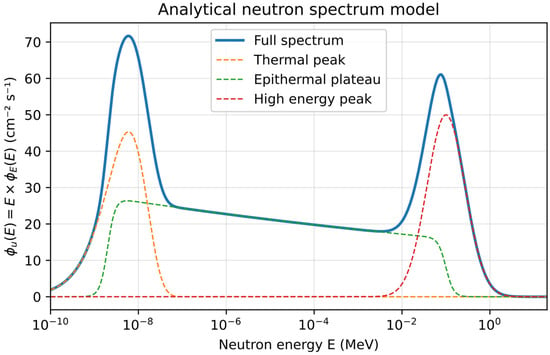
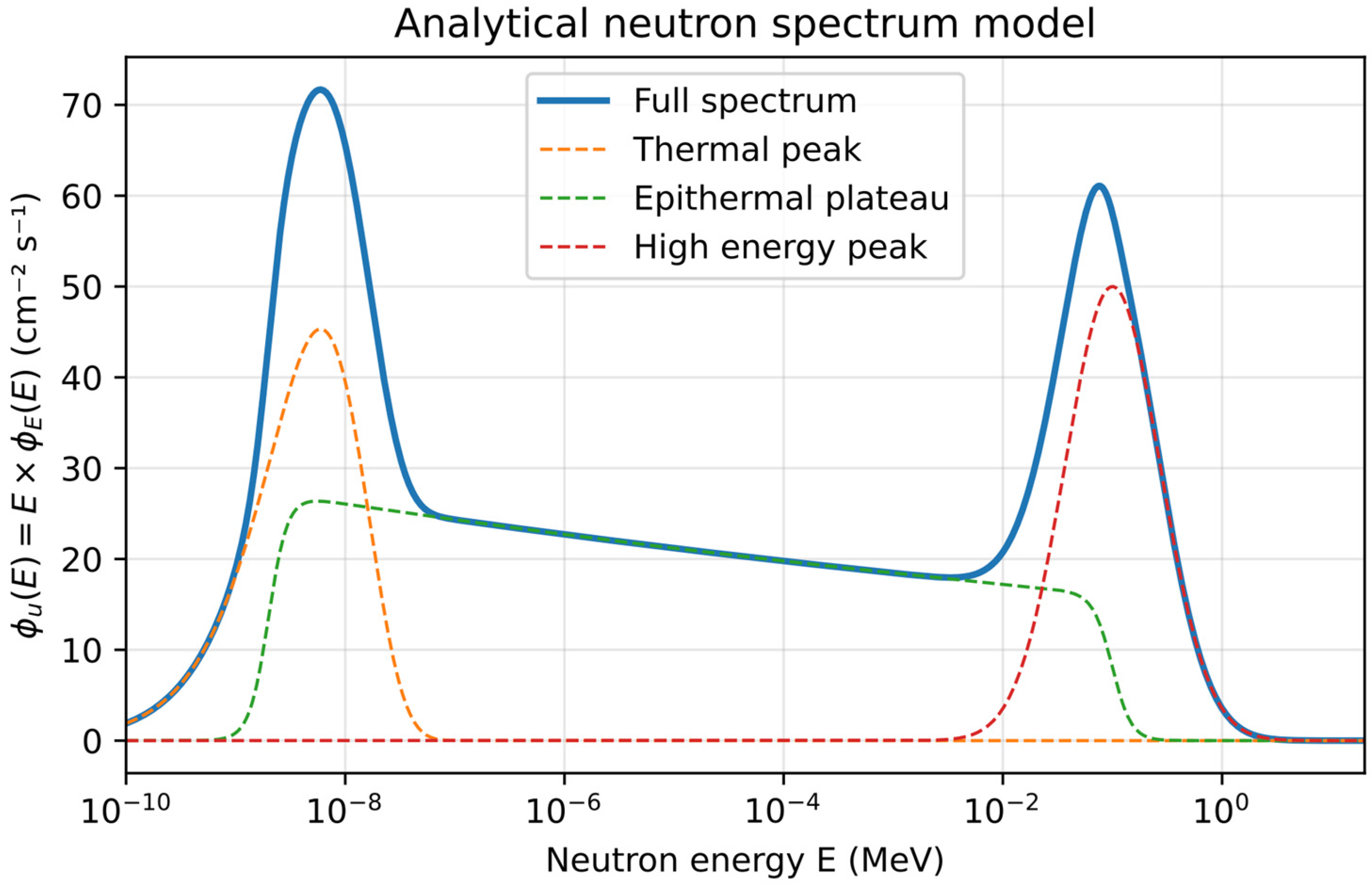
These three components of the analytical model represent distinct regions of the neutron energy spectrum: the moderated or thermalized domain at low energies, an epithermal plateau associated with neutron slowing-down, and a fast-energy tail corresponding to primary fusion reactions. Figure 1 shows a generic lethargic spectrum given by the analytical model and illustrates its decomposition into the three sub-models presented in Equation (2).
Figure 1.
Illustration of the generic neutron analytical spectrum proposed as the sum of three components: a thermal peak, an epithermal plateau and a high-energy peak. Figure generated with: = 2 × 1011 cm−2 s−1 MeV−1, = 1.1, = 0.8, = 4.0 × 10⁻⁹ MeV, = 15 cm−2 s−1 MeV0.03, = 0.03, = 2 × 10⁻⁹ MeV, = 1 × 10⁻¹ MeV, = 5, = 5.0 × 101 cm−2 s−1, = 1 × 10⁻¹ MeV, = 1.
Each part of the model uses only a few parameters that have clear physical meanings, such as slope, energy limits, and peak position or width. This makes the model easier to understand and adjust. The parameters of the “windowed epithermal plateau” (, , ) control how the model opens and closes in energy depending on geometry effects. For this sub-model, two window functions can be defined as
and
These window functions are dimensionless. Using and , the term of the windowed epithermal plateau in Equation (2) becomes
The “stretched Maxwellian” parameters (, , ) allow deviations from an ideal Maxwellian shape due to material composition, temperature variations, self-shielding, or detector effects. The log-normal peak is flexible enough to describe both narrow and broad high-energy features without introducing unphysical negative values. Working in lethargy space for minimizing a logarithmic function ensures stability across several orders of magnitude in energy and flux, preventing the fit from being dominated by the highest-energy bins. The use of smooth windowing further avoids distortions or discontinuities near the plateau edges and enhances the reliability of extrapolations beyond the fitted range.
Finally, if one prefers working with the differential-energy spectrum, obtained from Equation (1) as
each term of Equation (2) simply acquires a factor and no parameter re-scaling is required. For example, the thermal contribution becomes
3. Results
3.1. Model Validation from Various Spectra
In this section, we illustrate how the model can accurately reproduce neutron spectra representative of various nuclear fusion facilities. To accomplish this, we examined the available experimental and simulated neutron environment data in the literature on the following fusion facilities: (i) the neutron environment in front of an equatorial port of the WEST (acronym derived from W Environment in Steady-state Tokamak, where W is the chemical symbol for tungsten) tokamak [22,23,24]; (ii) the neutron environment in a corner of the basement of the Joint European Torus (JET) tokamak building [25,26,27,28]; (iii) the neutron environment in radiation protected areas (RPA) of a typical Future Fusion Power Plant (FFPP) [4,29,30].
For the WEST tokamak, we considered an experimental spectrum measured during the C5 campaign, as explained in [31]. This corresponds to data acquired using a DIAMON spectrometer [32,33] located in close proximity to the tokamak in the experimental hall during a D-D plasma campaign.
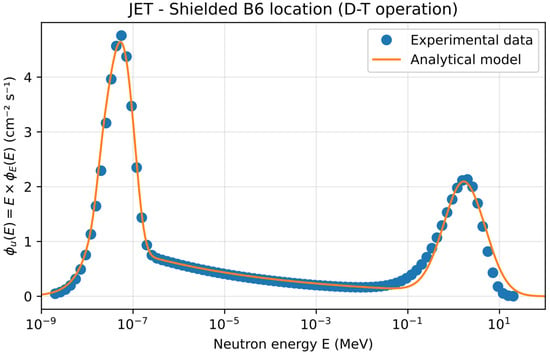
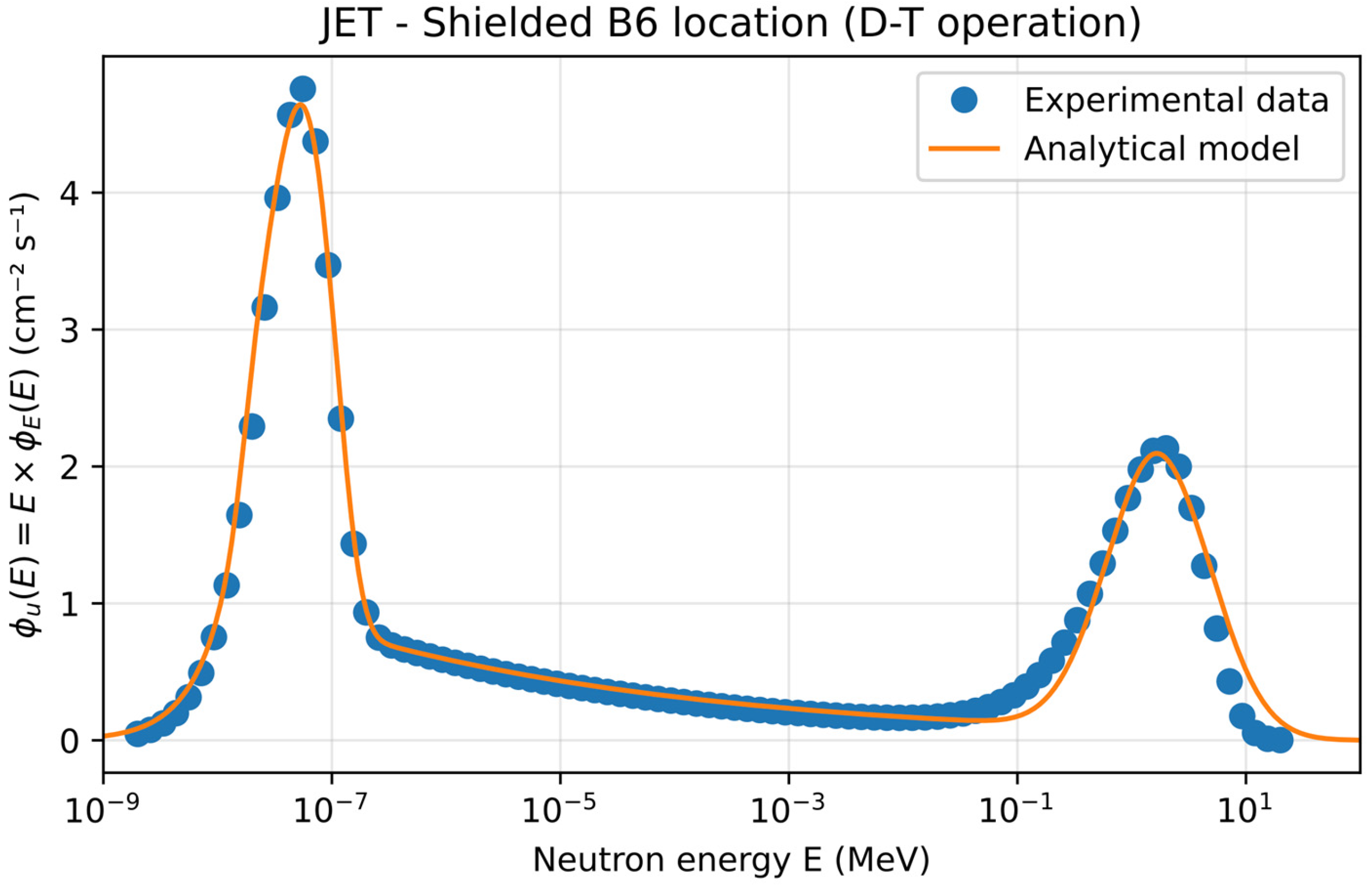
For the JET tokamak, experimental data were acquired with the DIAMON spectrometer at position B6 during the last D-T campaign [34]. This position is located in the basement of the building, separated from the experimental hall by a 1 m thick slab of reinforced concrete.
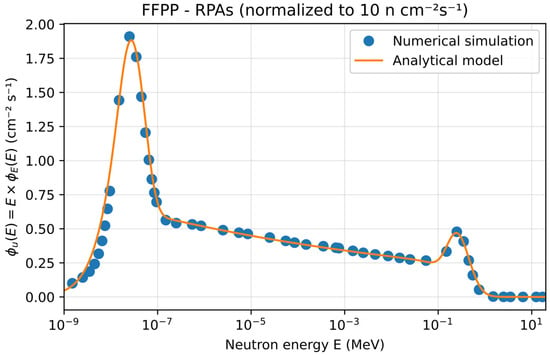
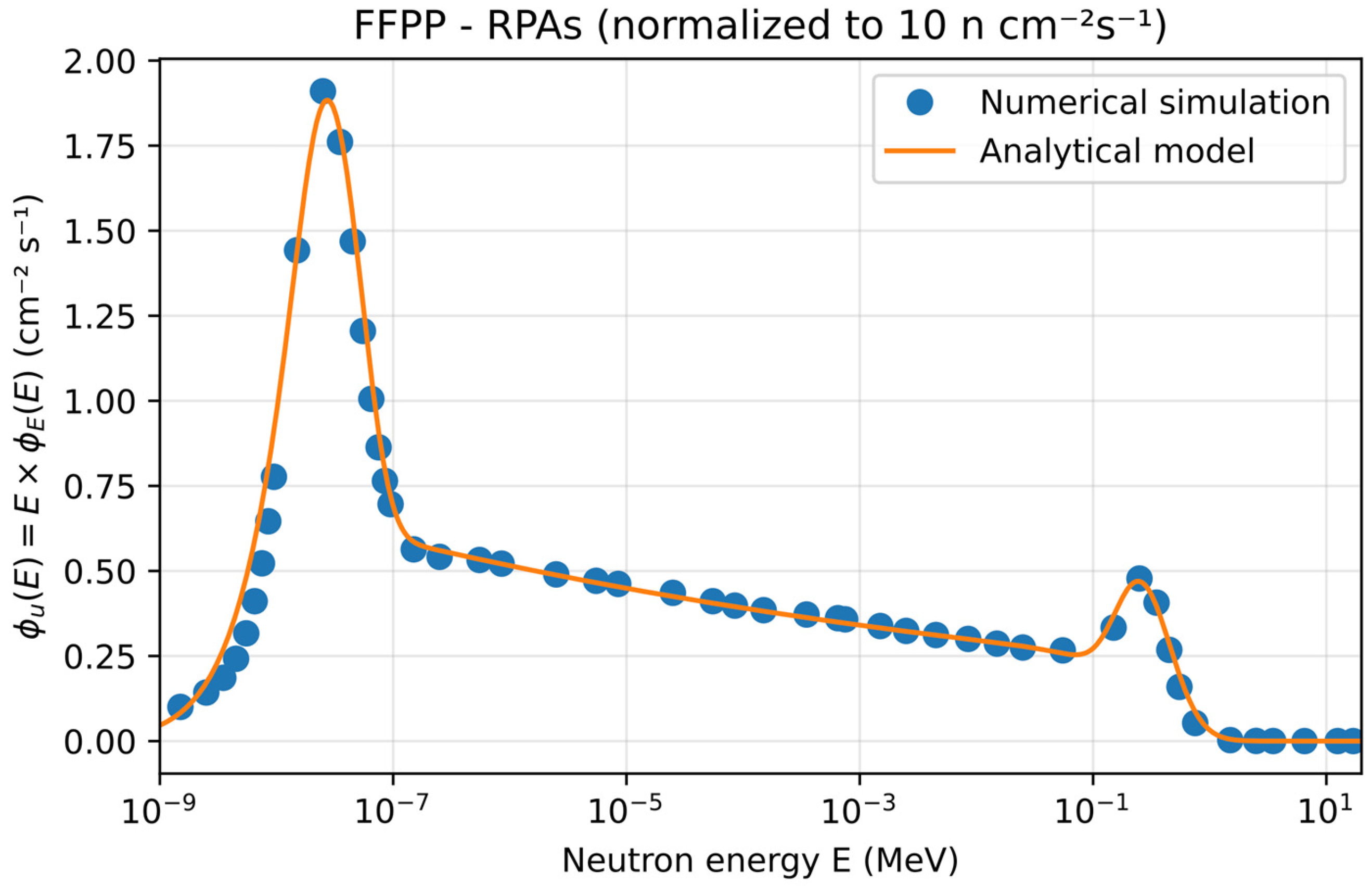
Finally, for FFPP RPAs, we considered simulated data published in Ref. [35] (Monte-Carlo simulation using the code MCNP [36,37]) representative of the attenuated neutron field in FFPP RPAs, where the electronics will be protected against neutrons and other radiation.
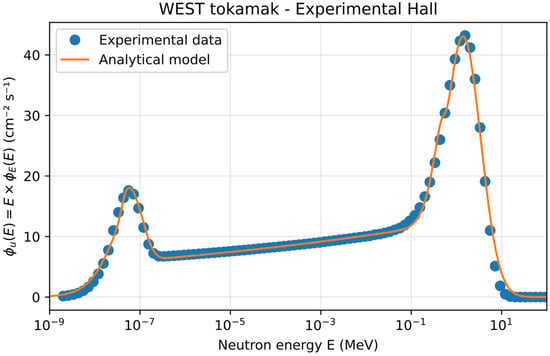
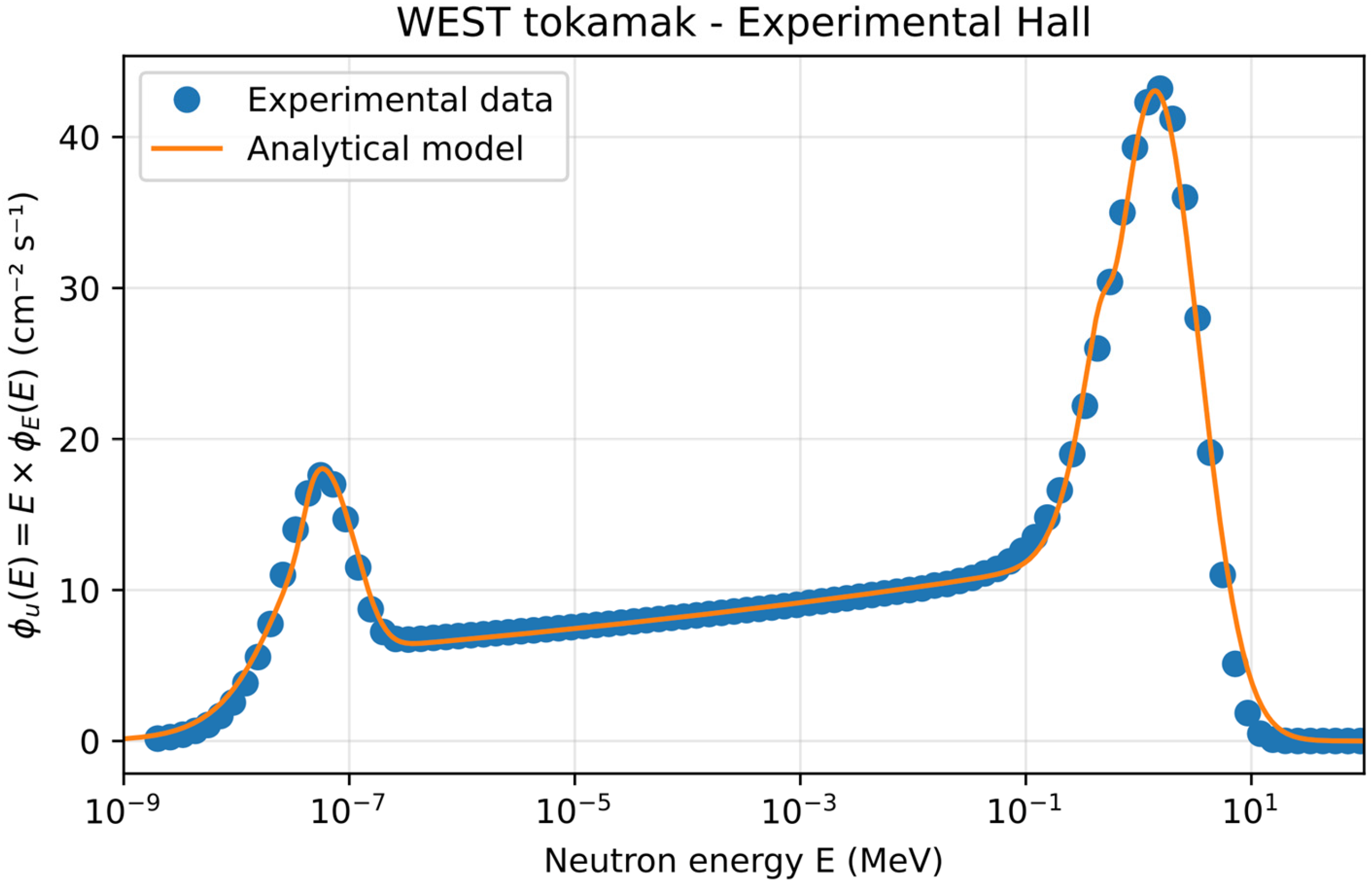
Figure 2, Figure 3 and Figure 4 show a comparison between the model and the experimental or simulated data. The values of all the model parameters that were finely tuned to fit the data are shown in Table 2.
Figure 2.
Comparison between the analytical lethargic spectrum (solid line) and measured data in the fusion environment of WEST tokamak facility.
Figure 3.
Comparison between the analytical lethargic spectrum (solid line) and measured data in the fusion environment of the JET tokamak facility.
Figure 4.
Comparison between the analytical lethargic spectrum (solid line) and simulated data (using the Monte Carlo numerical code MCNP) in FFPP RPAs. The numerical simulation points were graphically extracted from Figure 4 of Ref. [35].
The proposed fitting strategy for these curves is to first estimate on background-subtracted data and then constrain using Equation (3) before finally fitting , , . The next step is to use a central window, excluding a few standard deviations around the peaks, to regress versus in order to obtain a target slope of . Then, while optimizing the parameters , , and , apply this slope so that the plateau is negligible within the peak proximities. Finally, fit the parameters of the high-energy bump (i.e., the amplitude, energy, and width), after subtracting the thermal and the plateau background. Consequently, the analytical model is found to accurately reproduce the three usual regimes of fusion neutron fields—the thermal neutron peak, the epithermal neutron plateau and the fast neutron peak—across various environments, while remaining low-dimensional and continuous.
3.2. Model Implementation
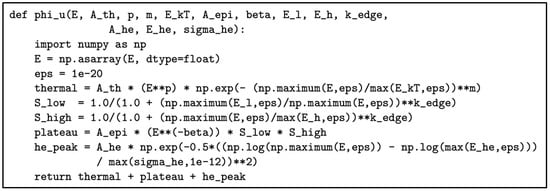
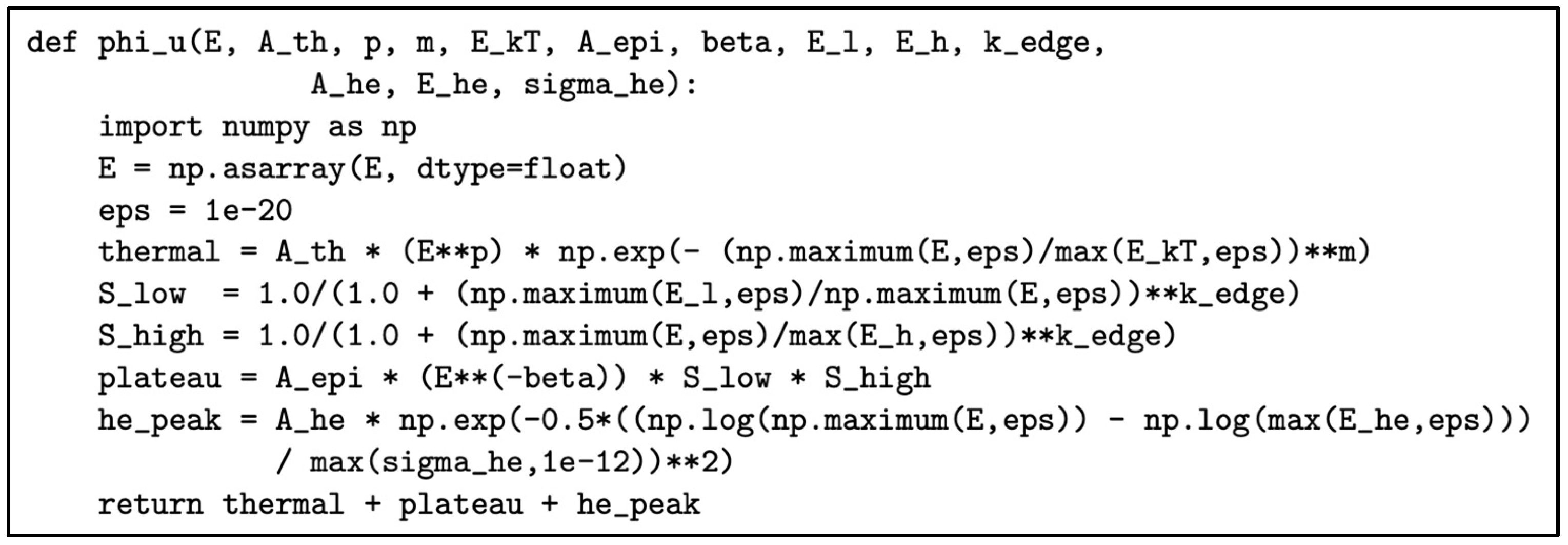
The model proposed in Equation (2) for has the advantage of being completely analytical, using only a few standard mathematical functions. Implementing it in Python 3.14.0 final/NumPy [38] is trivial in the form of a single neutron energy function with 12 input parameters, as shown in Figure 5.
Figure 5.
Implementation of the analytical modeling of the lethargic neutron spectrum given in Equation (2) in Python/NumPy.
4. Discussion
4.1. Fitting of Fusion Neutron Spectra
For the neutron spectrum at WEST tokamak facility (Figure 2), the epithermal plateau extends over a wide energy range of six decades, and the fast peak is relatively large, extending over almost three decades. The model slope, , follows the general trend of the measured spectrum in the medium energy range. As expected in an experimental hall, where additional materials cause more neutron moderation and reduce direct streaming, the thermal component only appears at the lowest energies. If the measured spectrum shows a flatter central plateau, the fit can be improved by slightly decreasing or increasing , without changing the shape of the peak edges.
For the JET spectrum (Figure 3), the model accurately describes the thermal part for both the rise from the base to the peak and the decrease afterward (controlled by parameters and ). The epithermal region is well represented by a straight line in the log–log plot with a slope of . The fast component, modeled as a log-normal function in , adds a smooth positive tail that matches the broad high-energy part of the spectrum without exceeding the middle-energy shoulder.
Finally, for the FFPP RPA spectrum (Figure 4), the model closely follows the thermal shoulder and peak, then continues along the epithermal slope over several energy decades. The smooth windowing defined by and prevents overlap with the thermal or fast regions, which is particularly important in a strongly shielded environment. Small differences can appear near the upper edge when the simulated spectrum shows small bends or transitions, such as those caused by streaming paths or material boundaries, that cannot be fully reproduced by a single power-law plateau. These differences can be mitigated by allowing a slightly sharper edge (increasing the value of ) or, if necessary, by using a two-segment plateau.
In all cases, the main features of the spectrum are preserved: the positions of the thermal peak (controlled by , , and ), the center of the fast peak (around ), and the epithermal slope . This consistency is important for accurate calculations of activation, SER, or dose through response-function folding. The remaining differences appear mostly near the window boundaries or in small details that a single-peak model cannot fully describe. These can be corrected with minor adjustments, such as adding a second thermal component, a second log-normal fast term, or a plateau with two slopes, while keeping the model simple and computationally efficient.
4.2. Application to the Evaluation of the Soft-Error Rate
When a neutron interacts with a semiconductor material in a circuit, several physical processes can occur, depending strongly on its energy. As neutrons are neutral particles, they do not undergo direct electromagnetic interactions with electrons; instead, they primarily interact with atomic nuclei through nuclear reactions, such as elastic or inelastic collisions, or neutron capture reactions [39,40]. In an elastic collision, enough energy can be transferred to the nucleus to move it within the crystal lattice, generating atomic recoil and creating displacement defects [41]. For higher-energy neutrons, inelastic or capture reactions can occur, producing secondary charged particles (such as protons, alpha particles or heavy ions) that deposit a significant amount of energy locally through ionization (a phenomenon known as indirect ionization) [42,43]. This ionization process generates a large number of electron-hole pairs in the material. If these carriers are created near a junction or a sensitive region of the circuit, they can be collected by internal electric fields and then disrupt the stored logic levels [44]. This phenomenon is called a single event effect (SEE) and can manifest in various ways [45]. For example, a soft error can occur in the form of a bit flip in memory, known as a single event upset (SEU) [20,46]. The soft-error rate (SER) corresponds to the frequency with which a device or system experiences, or is likely to experience, soft errors [46]. It is generally expressed as the number of failures over time (FIT) or the mean time between failures (MTBF). FIT is the unit adopted to quantify failures over time, equivalent to one error per billion operating hours of the device. The SER of a circuit is a key indicator of its vulnerability to radiation.
As mentioned in the introduction, in the domain of radiation effects on electronics [47,48], the neutron SER of a given integrated device/circuit is expressed as [20]
where and have been introduced in Equation (1) and is the (macroscopic) SER neutron cross-section of the device/circuit [20], expressed in cm2. The unit of the SER given by Equation (9) is s−1. Values must be multiplied by a factor 3.6 1012 to express the SER in FIT.
In the field of fusion neutron energy, this macroscopic cross-section resulting from the various neutron-circuit material interaction mechanisms is typically represented by two analytical models, as a function of the considered energy domain:
- (a)
- For thermal and slow neutrons (10−3 eV < < 1 eV), the so-called “thermal” circuit cross-section follows a law (where is the neutron velocity) [49]:
where = 26 meV and is the cross-section value for .
In Equation (10), the behavior is linked to the neutron absorption probability in circuit materials as a function of energy [35].
- (b)
- For fast neutrons ( > 0.1 MeV), the high-energy circuit cross-section is generally well described by a saturating Weibull model [50]:
where is the saturation value, is a threshold energy below which the cross-section is null, w is a scale parameter (same dimension and unit as ) and is a shape parameter (no physical dimension). In Equation (11), is the Heaviside step function, equal to 1 for and equal to 0 for [51].
The integration of the energy-dependent cross-section by the neutron spectrum (Equation (9)) can be performed numerically using classical numerical methods, such as the rectangle method or Simpson’s method, particularly the adaptive Simpson’s method [52], which is well suited to this type of integration.
However, working with relatively simple analytical functions for both the cross-section and spectrum gives us the advantage of considering complete analytical developments for the expression of the SER. Below, we present an example of the development for the thermal neutrons part of the spectrum. Considering and restricted to the first term of Equation (1), the thermal neutron SER can be expressed as
which, after integration, gives
where and are the limits of the energy domain in which Equation (10) is valid and is the generalized incomplete gamma function [53],
In practice, , and , the upper incomplete gamma function [53]. Equation (13) thus simplifies to
For the epithermal plateau of the spectrum (the second term of Equation (2)), Equation (9) considered with the thermal cross-section also leads to a useful formulation of its contribution to the circuit SER:
which gives us the following, considering the well-verified approximation on :
Finally, for the fast neutron peak (third term of Equation (2), noted ) combined with the high-energy cross-section,
While the second term has no elementary closed form and must be evaluated numerically, the first integral admits an analytical expression:
where is the standard normal cumulative distribution function [54].
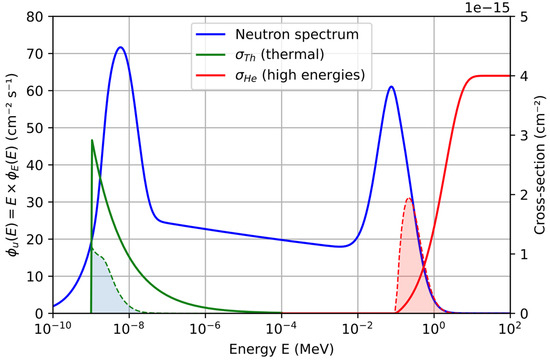
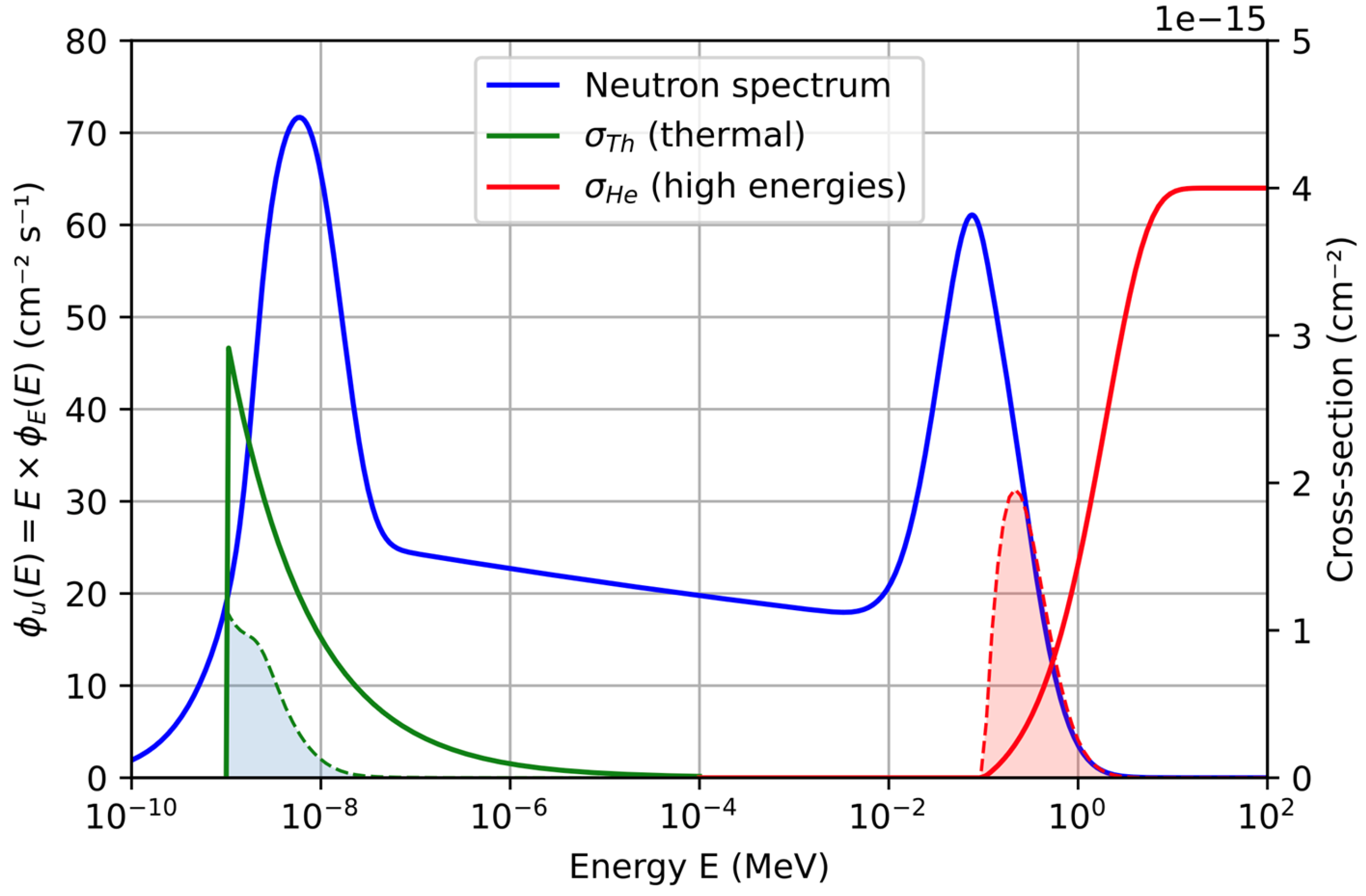
Figure 6 shows the energy profiles of given cross-sections and , superimposed on a typical fusion neutron spectrum. The dashed lines correspond to the products and which illustrate the calculation of the SER from Equation (9) graphically. The SER corresponds to the colored area, which is the integral of the curve. The SER for the green area is , the SER for the red area is . Table 3 gives the comparison of the SER values obtained numerically from Equation (9) or analytically from Equations (15), (17) and (19), respectively, for the thermal peak, the plateau and the high-energy peaks of the neutron spectrum defined in Equation (1). Equation (15) provides an exact value for the SER due to the thermal peak, while Equation (17) provides a very good, though not exact, value for the SER due to the plateau with 1.5% of relative error. This is mainly because Equation (17) supposes that on , which depends on the value of the exponent.
Figure 6.
Generic fusion neutron spectrum (left axis) and neutron cross-sections for thermal and high-energy domains (right axis). The dashed lines correspond to the products and (in a.u.) to illustrate the calculation of the SER which corresponds to the integrals of the curves (colored area), respectively, (green area) and (red area). The parameters for this figure are the same as in Figure 1 for the neutron spectrum. For cross-sections, we used: , , , , .
Table 3.
Numerical and analytical evaluation of the SER from data illustrated in Figure 6. SER values are expressed in FIT (i.e., per 109 h).
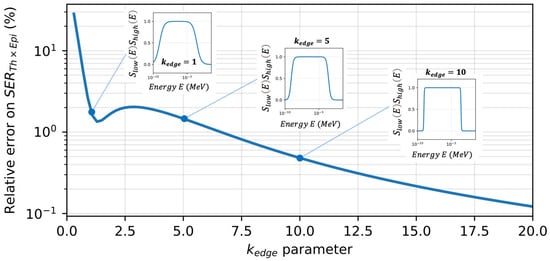
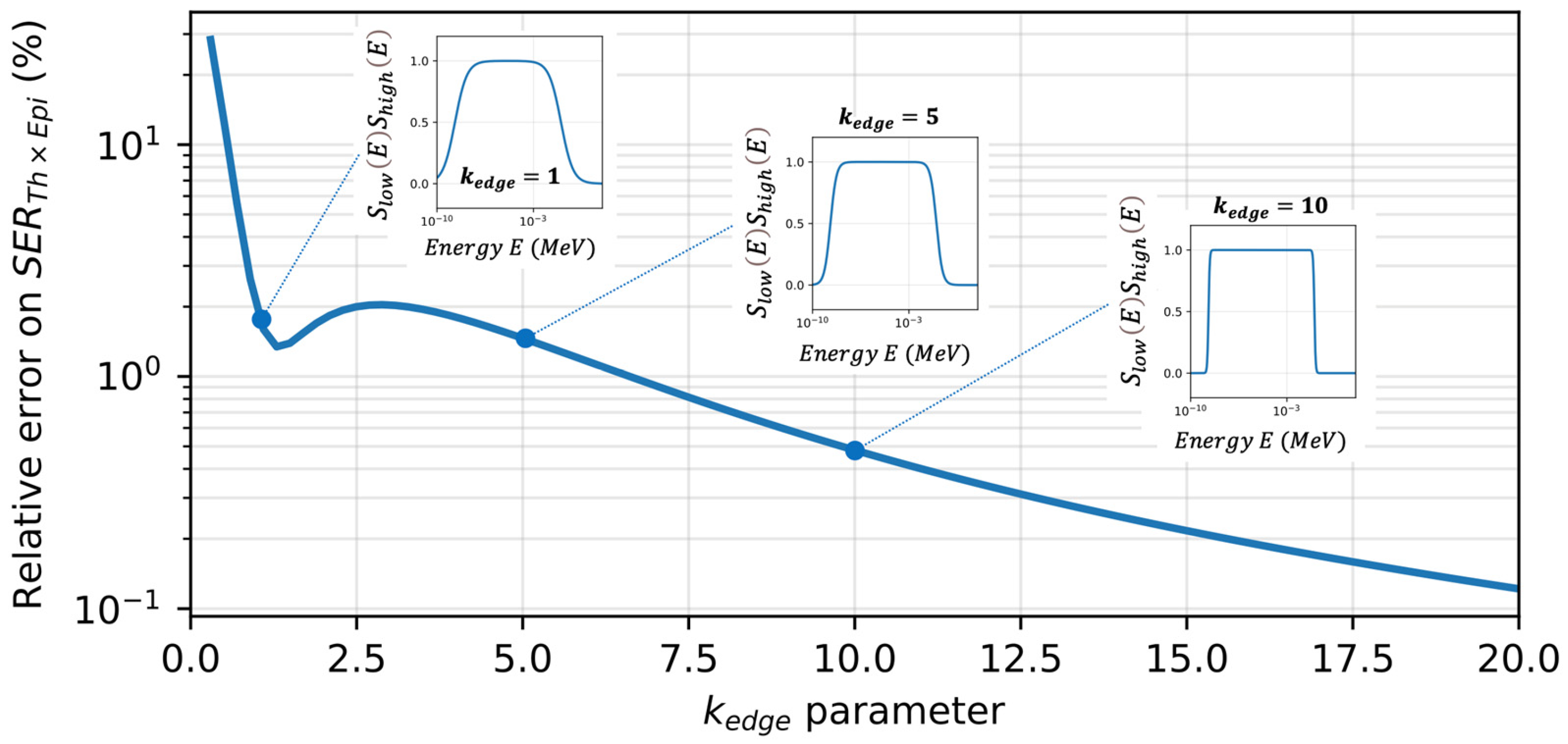
Figure 7 shows the relative error on the analytical given by Equation (17) as a function of the value of the parameter that controls the closing of the windowed plateau (i.e., the extremity edges of the plateau) in the neutron spectrum. This figure indicates that the higher the value of , the greater the accuracy. Finally, for the contribution of the high-energy peak, the analytical SER in Table 3 is based on the numerical evaluation of , which makes the sum non-analytical and leads to a preference for direct numerical integration of this quantity.
Figure 7.
Relative error on the analytical given by Equation (17) as a function of the value of the parameter that controls the closing of the windowed plateau (i.e., the extremity edges of the plateau) in the neutron spectrum. The approximation on improves with an increased value of .
5. Conclusions
In this work, we introduced an analytical model for the lethargic neutron spectrum dedicated to nuclear fusion environments. Despite its simplicity, this formulation achieves an interesting balance between physical interpretation and analytical expression. The model parameters can be easily adjusted using consistent optimization procedures. As it is closed-form, positive and regular, this analytical model is well suited to engineering work requiring speed, parametric sweeps and uncertainty propagation. The model’s ability to reproduce neutron spectra from experiments and Monte Carlo simulations has been demonstrated, and it has been applied to evaluate the soft-error rate in electronic circuits exposed to fusion neutron fields using analytical forms of the circuit cross-sections for neutron-induced single-events. These properties make it a useful, generic spectrum model for nuclear fusion studies and electronic component reliability assessments.
Author Contributions
Conceptualization, J.-L.A. and D.M.; methodology, J.-L.A., D.M. and S.M.; software, J.-L.A. and D.M.; formal analysis, J.-L.A., D.M. and S.M.; investigation, J.-L.A., D.M. and S.M.; writing—review and editing, J.-L.A., D.M. and S.M.; visualization, J.-L.A., D.M. and S.M. All authors have read and agreed to the published version of the manuscript.
Funding
This research received no external funding.
Data Availability Statement
The original contributions presented in this study are included in the article. Further inquiries can be directed to the corresponding author.
Acknowledgments
The authors would like to very sincerely thank Martin Dentan (CEA-IFRM, Cadarache, France) for all the interesting technical discussions surrounding the results presented in this paper.
Conflicts of Interest
The authors declare no conflicts of interest.
References
- Wesson, J. Tokamaks; Oxford University Press: New York, NY, USA, 2011. [Google Scholar]
- Morse, E. Nuclear Fusion; Springer Nature Switzerland AG: Cham, Switzerland, 2018. [Google Scholar]
- Stacey, W.M. Fusion Plasma Physics; WILEY-VCH: Weinheim, Germany, 2012. [Google Scholar]
- ITER: The Way to New Energy. Available online: https://www.iter.org/ (accessed on 16 October 2025).
- Zinkle, S.J.; Ghoniem, N.M. Operating temperature windows for fusion reactor structural materials. Fusion Eng. Des. 2000, 51–52, 55–71. [Google Scholar] [CrossRef] [Scilit]
- Federici, G.; Skinner, C.H.; Brooks, J.N.; Coad, J.P.; Grisolia, C.; Haasz, A.A.; Hassanein, A.; Philipps, V.; Pitcher, C.S.; Roth, J.; et al. Plasma–material interactions in current tokamaks and their implications for next step fusion reactors. Nucl. Fusion 2001, 41, 1967–2137. [Google Scholar] [CrossRef] [Scilit]
- Kikuchi, M.; Lackner, K.; Tran, M.Q. Fusion Physics; International Atomic Energy Agency: Vienna, Austria, 2012. [Google Scholar]
- Ghani, Z.; Turner, A.; Mangham, S.; Naish, J.; Lis, M.; Packer, L.; Loughlin, M. Radiation levels in the ITER tokamak complex during and after plasma operation. Fusion Eng. Des. 2015, 96–97, 261–264. [Google Scholar] [CrossRef] [Scilit]
- López-Revelles, A.J.; Catalán, J.P.; Kolšek, A.; Juárez, R.; García, R.; García, M.; Sanz, J. MCNP model of the ITER Tokamak Complex. Fusion Eng. Des. 2018, 136, 859–863. [Google Scholar] [CrossRef] [Scilit]
- Juarez, R.; Pedroche, G.; Loughlin, M.J.; Pampin, R.; Martinez, P.; De Pietri, M.; Alguacil, J.; Ogando, F.; Sauvan, P.; Lopez-Revelles, A.J.; et al. A full and heterogeneous model of the ITER tokamak for comprehensive nuclear analyses. Nat. Energy 2021, 6, 150–157. [Google Scholar] [CrossRef] [Scilit]
- Juarez, R.; Belotti, M.; Kolsek, A.; López, V.; Alguacil, J.; Pedroche, G.; López-Revelles, A.J.; Martínez-Albertos, P.; De Pietri, M.; Guijosa, P.; et al. ITER full model in MCNP for radiation safety demonstration. Nat. Commun. 2024, 15, 8563. [Google Scholar] [CrossRef] [Scilit]
- Kotnik, D.; Peric, J.; Govekar, D.; Lengar, I. Gamma and neutron dose rate measurements around the KATANA water activation loop at JSI TRIGA reactor. EPJ Web Conf. 2025, 338, 04008. [Google Scholar] [CrossRef] [Scilit]
- Peric, J.; Kotnik, D.; Snoj, L.; Radulović, V. Neutron emission from water activation: Experiments and modeling under fusion-relevant conditions at the KATANA facility. Fusion Eng. Des. 2025, 216, 115052. [Google Scholar] [CrossRef] [Scilit]
- Binda, F.; Eriksson, J.; Ericsson, G.; Hellesen, C.; Conroy, S.; Nocente, M.; Andersson Sundén, E.; JET contributors. Generation of the neutron response function of an NE213 scintillator for fusion applications. Nucl. Instrum. Methods Phys. Res. Sect. A Accel. Spectrometers Detect. Assoc. Equip. 2017, 866, 222–229. [Google Scholar] [CrossRef] [Scilit]
- Messenger, G.C.; Ash, M.S. The Effects of Radiation on Electronic Systems; Springer: Dordrecht, The Netherlands, 1986. [Google Scholar]
- Holmes-Siedle, A.; Adams, L. Handbook of Radiation Effects, 2nd ed; Oxford University Press: Oxford, UK, 2002. [Google Scholar]
- Jeffrey, S.G. An overview of radiation effects in electronics. In Proceedings of the 25th International Conference on the Application of Accelerators in Research and Industry, Grapevine, TX, USA, 12–17 August 2018. [Google Scholar]
- Autran, J.L.; Munteanu, D. Electronics reliability assessment of future power fusion machines: Neutron interaction analysis in bulk silicon. Microelectron. Reliab. 2021, 126, 114223. [Google Scholar] [CrossRef] [Scilit]
- McCracken, G.; Stott, P. Fusion: The Energy of the Universe, 2nd ed.; Academic Press: Oxford, UK, 2012. [Google Scholar]
- Autran, J.L.; Munteanu, D. Soft Errors: From Particles to Circuits; Taylor & Francis/CRC Press: Boca Raton, FL, USA, 2015. [Google Scholar]
- Guénault, T. Statistical Physics, 2nd ed.; Springer: Dordrecht, The Netherlands, 2007. [Google Scholar]
- Presentation of WEST. Available online: https://irfm.cea.fr/en/presentation-of-west/ (accessed on 16 October 2025).
- Bucalossi, J.; Missirlian, M.; Moreau, P.; Samaille, F.; Tsitrone, E.; van Houtte, D.; Batal, T.; Bourdelle, C.; Chantant, M.; Corre, Y.; et al. The WEST project: Testing ITER divertor high heat flux component technology in a steady state tokamak environment. Fusion Eng. Des. 2014, 89, 907–912. [Google Scholar] [CrossRef] [Scilit]
- Bucalossi, J.; Achard, J.; Agullo, O.; Alarcon, T.; Allegretti, L.; Ancher, H.; Antar, G.; Antusch, S.; Anzallo, V.; Arnas, C.; et al. Operating a full tungsten actively cooled tokamak: Overview of WEST first phase of operation. Nucl. Fusion 2022, 62, 042007. [Google Scholar] [CrossRef] [Scilit]
- JET: The Heartbeat of European Fusion Collaboration for Four Decades. Available online: https://euro-fusion.org/devices/jet/ (accessed on 16 October 2025).
- Maggi, C.F.; JET contributors. Overview of T and D-T results in JET with ITER-like wall. Nucl. Fusion 2024, 64, 112012. [Google Scholar] [CrossRef] [Scilit]
- EUROfusion. Breaking New Ground: JET Tokamak’s Latest Fusion Energy Record Shows Mastery of Fusion Processes. Available online: https://euro-fusion.org/eurofusion-news/dte3record/ (accessed on 16 October 2025).
- Rimini, F.G. JET Contributors; the EUROfusion Tokamak Exploitation Team. 40 years of JET operations: A unique contribution to fusion science. Plasma Phys. Control. Fusion 2025, 67, 033001. [Google Scholar] [CrossRef] [Scilit]
- Litaudon, X.; Fantz, U.; Villari, R.; Toigo, V.; Aumeunier, M.H.; Autran, J.-L.; Batistoni, P.; Belonohy, E.; Bradnam, S.; Cecchetto, M.; et al. EUROfusion contributions to ITER nuclear operation. Nucl. Fusion 2024, 64, 112006. [Google Scholar] [CrossRef] [Scilit]
- ITER. The Device. Available online: https://fusionforenergy.europa.eu/the-device/ (accessed on 25 October 2025).
- Autran, J.L.; Moindjie, S.; Munteanu, D.; Dentan, M.; Moreau, P.; Pellissier, F.P.; Bucalossi, J.; Borgese, G.; Malherbe, V.; Thery, T.; et al. Real-Time Characterization of Neutron-Induced SEUs in Fusion Experiments at WEST Tokamak During D-D Plasma Operation. IEEE Trans. Nucl. Sci. 2022, 69, 1558–1578. [Google Scholar] [CrossRef] [Scilit]
- Pola, A.; Rastelli, D.; Treccani, M.; Pasquato, S.; Bortot, D. DIAMON: A portable, real-time and direction-aware neutron spectrometer for field characterization and dosimetry. Nucl. Instrum. Methods Phys. Res. Sect. A Accel. Spectrometers Detect. Assoc. Equip. 2020, 969, 164078. [Google Scholar] [CrossRef] [Scilit]
- Casolaro, P.; Mateu, I.; Mercolli, L.; Pola, A.; Rastelli, D.; Scampoli, P.; Braccini, S. An Innovative Neutron Spectrometer for the Characterization of Complex Neutron Fields. In Proceedings of the IEEE Nuclear Science Symposium and Medical Imaging Conference, Piscataway, NJ, USA, 16–23 October 2021. [Google Scholar]
- Dentan, M.; Moindjie, S.; Cecchetto, M.; Autran, J.L.; Garcia Alia, R.; Naish, R.; Waterhouse, J.; Horton, A.R.; Litaudon, X.; Munteanu, D.; et al. Real-Time SER Measurements of CMOS Bulk 40- and 65-nm SRAMs Combined with Neutron Spectrometry at the JET Tokamak During Its Final D-T Plasma Operation. IEEE Trans. Nucl. Sci. 2025, 72, 1486–1495. [Google Scholar] [CrossRef] [Scilit]
- Dentan, M.; Borgese, G.; Autran, J.L.; Munteanu, D.; Moindjie, S.; Bucalossi, J.; Moreau, P.; Pellissier, F.P.; Santraine, B.; Roche, P.; et al. Preliminary study of electronics reliability in ITER neutron environment. In Proceedings of the 2nd European Conference on Radiation and Its Effects on Components and Systems (RADECS), Venice, Italy, 3–7 October 2022. [Google Scholar]
- Rising, M.E.; Armstrong, J.C.; Bolding, S.R.; Bull, J.S.; Casswell, L.; Clark, A.R.; Forster, R.A.; Frederick, C.S.; Giron, J.F.; Jones, F.B.; et al. The MCNP®6 code: A decade of progress. EPJ—Nucl. Sci. Technol. 2025, 11, LA-UR-24-28294. [Google Scholar] [CrossRef] [Scilit]
- The MCNP® Code. Available online: https://mcnp.lanl.gov/ (accessed on 10 October 2025).
- NumPy. Available online: https://numpy.org/ (accessed on 16 October 2025).
- Gaillard, R. Single Event Effects: Mechanisms and Classification. In Soft Errors in Modern Electronic Systems; Nicolaidis, M., Ed.; Springer: New York, NY, USA, 2011. [Google Scholar]
- Rinard, P. Neutron Interactions with Matter. Los Alamos Technical Report, 1991. Available online: http://www.gammaexplorer.com/lanlreports/lanl1_a/lib-www/la-pubs/00326407.pdf (accessed on 14 November 2025).
- Was, G.S. Fundamentals of Radiation Materials Science: Metals and Alloys; Springer: New York, NY, USA, 2017. [Google Scholar]
- Munteanu, D.; Autran, J.L. Modeling and Simulation of Single-Event Effects in Digital Devices and ICs. IEEE Trans. Nucl. Sci. 2008, 55, 1854–1878. [Google Scholar] [CrossRef] [Scilit]
- Leroy, C.; Rancoita, P.G. Principes of Radiation Interaction Matter and Detection; World Scientific Publishing: Singapore, 2004. [Google Scholar]
- Nakamura, T.; Ibe, E.; Baba, M.; Yahagi, Y.; Kameyama, H. Terrestrial Neutron-Induced Soft Error in Advanced Memory Devices; World Scientific Publishing: Singapore, 2008. [Google Scholar]
- Autran, J.L.; Munteanu, D. Multiscale, Multiphysics Modeling and Simulation of Single-Event Effects in Digital Electronics: From Particles to Systems. IEEE Trans. Nucl. Sci. 2024, 71, 31–66. [Google Scholar] [CrossRef] [Scilit]
- Ziegler, J.F.; Puchner, H. SER—History, Trends and Challenges; Cypress Semiconductor: San Jose, CA, USA, 2004. [Google Scholar]
- Fleetwood, D.M. Radiation effects in a post-Moore world. IEEE Trans. Nucl. Sci. 2021, 68, 509–545. [Google Scholar] [CrossRef] [Scilit]
- Messenger, G.C.; Ash, M.S. Single Event Phenomena; Springer: Dordrecht, The Netherlands, 1997. [Google Scholar]
- Cecchetto, M.; Alía, R.G.; Lerner, G.; Bilko, K.; Pujol, F.S.; Vlachoudis, V.; Cerutti, F. Energy Deposition and Characterization of Single-Event Upset and Latch-Up Cross Sections with 14 MeV and Thermal Neutrons. IEEE Trans. Nucl. Sci. 2025, 72, 2847–2856. [Google Scholar] [CrossRef] [Scilit]
- JESD89B; Measurement and Reporting of Alpha Particle and Terrestrial Cosmic Ray-Induced Soft Errors in Semiconductor Devices. Revision of JESD89A. JEDEC: Arlington, VA, USA, 2021.
- Roy, R.; Olver, F.W.J.; Askey, R.A.; Wong, R. Algebraic and Analytic Methods. In NIST Handbook of Mathematical Functions; Olver, F.W.J., Lozier, D.W., Boisvert, R.F., Clark, C.W., Eds.; Cambridge University Press: New York, NY, USA, 2010; pp. 173–192. [Google Scholar]
- Kuncir, G.F. Algorithm 103: Simpson’s rule integrator. Commun. ACM 1962, 5, 347. [Google Scholar] [CrossRef] [Scilit]
- Paris, R.B. Incomplete Gamma and Related Functions. In NIST Handbook of Mathematical Functions; Olver, F.W.J., Lozier, D.W., Boisvert, R.F., Clark, C.W., Eds.; Cambridge University Press: New York, NY, USA, 2010; pp. 173–192. [Google Scholar]
- Cumulative Distribution Function of the Standard Normal Distribution. Available online: https://www.itl.nist.gov/div898/handbook/eda/section3/eda3671.htm (accessed on 25 October 2025).

Disclaimer/Publisher’s Note: The statements, opinions and data contained in all publications are solely those of the individual author(s) and contributor(s) and not of MDPI and/or the editor(s). MDPI and/or the editor(s) disclaim responsibility for any injury to people or property resulting from any ideas, methods, instructions or products referred to in the content. |
© 2025 by the authors. Licensee MDPI, Basel, Switzerland. This article is an open access article distributed under the terms and conditions of the Creative Commons Attribution (CC BY) license.