Article

Small-Signal Modeling of Asymmetric PWM Control-Based Parallel Resonant Converter
Department of Electrical Engineering, Korea National University of Transportation, Chungju 27469, Republic of Korea
*
Author to whom correspondence should be addressed.
Electronics 2025, 14(24), 4970; https://doi.org/10.3390/electronics14244970
Submission received: 24 November 2025 / Revised: 11 December 2025 / Accepted: 15 December 2025 / Published: 18 December 2025
(This article belongs to the Special Issue New Insights in Power Electronics: Prospects and Challenges)

Abstract

This paper proposes a small-signal model of a DC–DC parallel resonant converter operating in continuous conduction mode based on asymmetric pulse-width modulation (APWM) under light-load conditions. The parallel resonant converter enables soft switching and no-load control over a wide load range because the resonant capacitor is connected in parallel with the load. However, the resonant energy required for soft switching is already sufficient, and the current flowing through the resonant tank is independent of the load magnitude; therefore, as the load decreases, the energy that is not delivered to the load and instead circulates meaninglessly inside the resonant tank increases. This results in conduction loss and reduced efficiency. To address this issue, APWM with a fixed switching frequency is required, which reduces circulating energy and improves efficiency under light-load conditions. Precise small-signal modeling is required to optimize the APWM controller. Unlike PFM or PSFB, APWM includes not only sine components but also DC and cosine components in the control signal due to its asymmetric switching characteristics, and this study proposes a small-signal model that can relatively accurately reflect these multi-harmonic characteristics. The proposed model is derived based on the Extended Describing Function (EDF) concept, and the derived transfer function is useful for systematically analyzing the dynamic characteristics of the APWM-based parallel resonant converter. In addition, it provides information that can systematically analyze the dynamic characteristics of various APWM-based resonant converters and control signals that reflect various harmonic characteristics, and it can be widely applied to future control design and analysis studies. The validity of the model is verified through MATLAB (R2025b) and PLECS (4.7.5) switching-model simulations and experimental results, confirming its high accuracy and practicality.

1. Introduction

Resonant converters are widely used in various applications such as hybrid and electric vehicles [1,2], renewable energy systems [3,4], and power conversion devices [5], due to their advantages of high power density, high efficiency, and the ability to achieve soft switching. Among various resonant converter structures, the parallel resonant converter (PRC) is a DC–DC converter in which the resonant capacitor is connected in parallel with the load. Due to this structural characteristic, the resonant tank current flows regardless of the load magnitude. In addition, because the rate of change in the voltage gain curve is large, the output voltage can be controlled simply by increasing the switching frequency even under no-load conditions, and sufficient resonant energy is secured for soft switching. With these characteristics, the PRC enables soft switching and no-load control over a wide load range. However, since the resonant tank current remains constant regardless of the load, the circulating energy not delivered to the load increases in the light-load region, leading to increased conduction loss and decreased overall efficiency [6]. Therefore, duty control techniques such as phase-shift full-bridge (PSFB) or asymmetric pulse-width modulation (APWM) are required to reduce the conduction loss caused by circulating current [7,8,9,10,11]. Although conventional pulse-frequency modulation (PFM) control can regulate the output voltage, it operates only through frequency modulation with a fixed duty ratio, so the conduction time of the resonant tank remains constant and the circulating current does not decrease. Therefore, to reduce the circulating current, it is necessary to shorten the conduction time of the resonant tank by decreasing the duty ratio and to reduce the input energy delivered to the resonant capacitor.
To overcome these limitations, asymmetric APWM, one of the fixed-frequency-based control methods, has been studied [10,11,12,13,14,15]. Recent studies have demonstrated that applying APWM control to a full-bridge DC–DC converter can effectively reduce circulating energy compared to the conventional phase-shift method and achieve higher efficiency [7]. Reference [8] also verified through systematic analysis and experiments that hybrid application of various duty controls based on APWM can reduce circulating energy and significantly improve light-load efficiency. In addition, reference [10] showed that applying APWM-based duty control under light-load conditions can reduce circulating energy and expand the ZVS range, thereby improving efficiency. Reference [11] presented that applying the APWM control technique to a dual active bridge (DAB)-based parallel resonant converter can significantly extend the ZVS operating range under light-load conditions and effectively reduce current and conduction losses caused by circulating current. Meanwhile, another study presented steady-state analysis identifying the continuous conduction mode (CCM) and discontinuous conduction mode (DCM) boundary conditions for series resonant converters (SRCs) employing APWM [12]. Reference [13] applied APWM–PFM hybrid control to a full-bridge SRC and confirmed that light-load efficiency improved by up to 4%, while reference [14] reported that a half-bridge PRC with a series filter added at the output and APWM control achieved more than 97% efficiency in the 60–100% load range in a 1 kW, 400 V prototype. Furthermore, reference [15] confirmed that, even under high-switching-frequency conditions, applying APWM to a half-bridge SRC maintains stable efficiency with almost no variation across the load range of 50% and above. These research results demonstrate that APWM can contribute to efficiency improvement in various topologies.
In such APWM-based systems, accurate small-signal modeling is essential to achieve stable output voltage control and a satisfactory dynamic response. However, conventional modeling methods such as the state-space averaging technique [16] and sample-data-based modeling techniques [17,18] show limitations when applied to resonant converters. Accordingly, this study proposes a small-signal model by applying the concept of the Extended Describing Function (EDF), which has recently been utilized in various resonant topologies. EDF is a method that approximates nonlinear time-domain systems with slowly varying harmonic coefficients based on the fundamental component approximation and harmonic balance theory, thereby enabling modeling that simultaneously considers both frequency-domain and time-domain behavior [19]. The application of this technique began with SRC and PRCs, and has subsequently been expanded to a wide range of resonant topologies, including LLC and LCC converters [20,21,22,23,24]. Prior studies employing EDF for small-signal modeling have mostly focused on PFM-controlled systems or PSFB implementations. However, this study applies EDF for the first time to an APWM-based PRC to derive a small-signal model. The validity of the proposed small-signal model was verified through MATLAB (R2025b) simulations, PLECS (4.7.5) switching-model-based simulations, and experimental results.

2. Comparison of APWM and PSFB

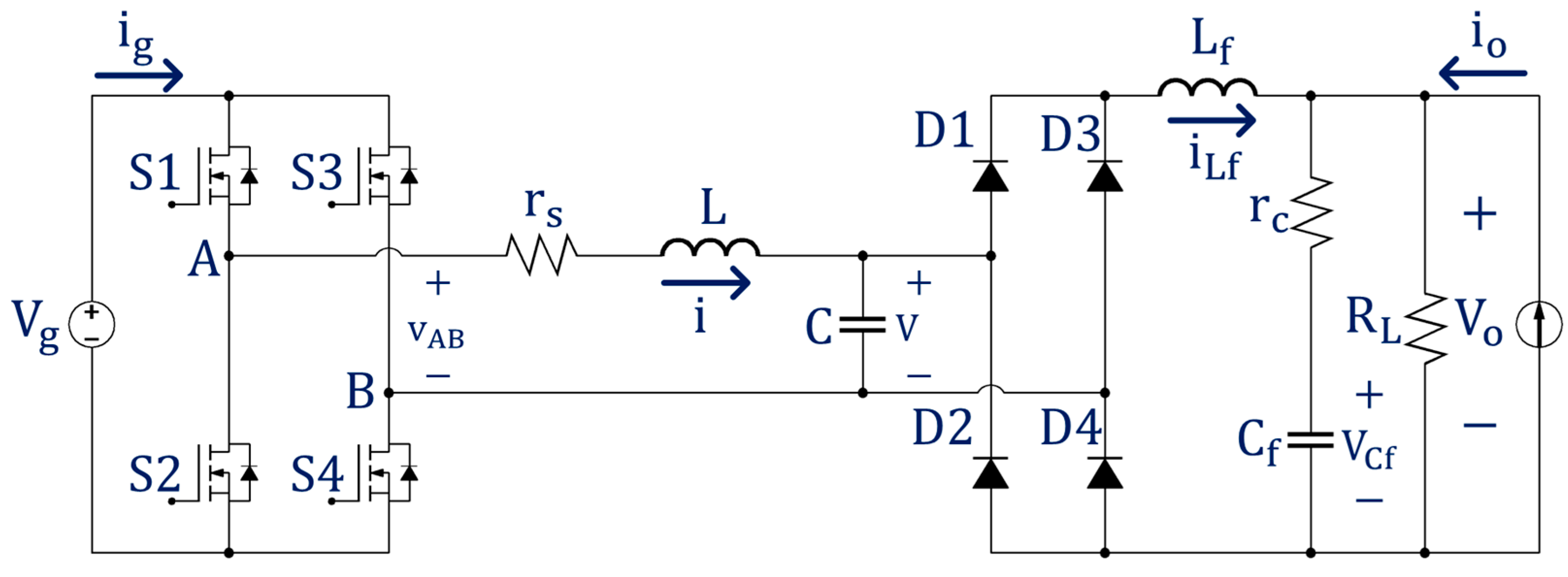
Figure 1 illustrates the equivalent circuit of the parallel resonant converter controlled by APWM. The input voltage is converted into an AC voltage through the switching network of the full-bridge inverter, and the AC output voltage generated by the inverter is applied to the resonant tank. According to the applied AC control signal, the resonant inductor L and the resonant capacitor C exchange energy with each other and perform the resonant operation. Depending on the polarity of the resonant capacitor, the diode rectifier operates, and the resonant AC waveform is converted into DC by the rectifier and the filter inductor L f and filter capacitor C f on the output side, delivering power to the load R L . In this case, the filter inductor L f not only prevents a short circuit between the resonant capacitor C and the output filter capacitor C f but also provides the advantage of allowing the output current to be converted into DC even when the capacitance of the filter capacitor is not large. In addition, r s denotes the equivalent series resistance of the resonant tank, and r c represents the series equivalent resistance of the output filter capacitor. i o indicates the perturbed output current generated by load variations.
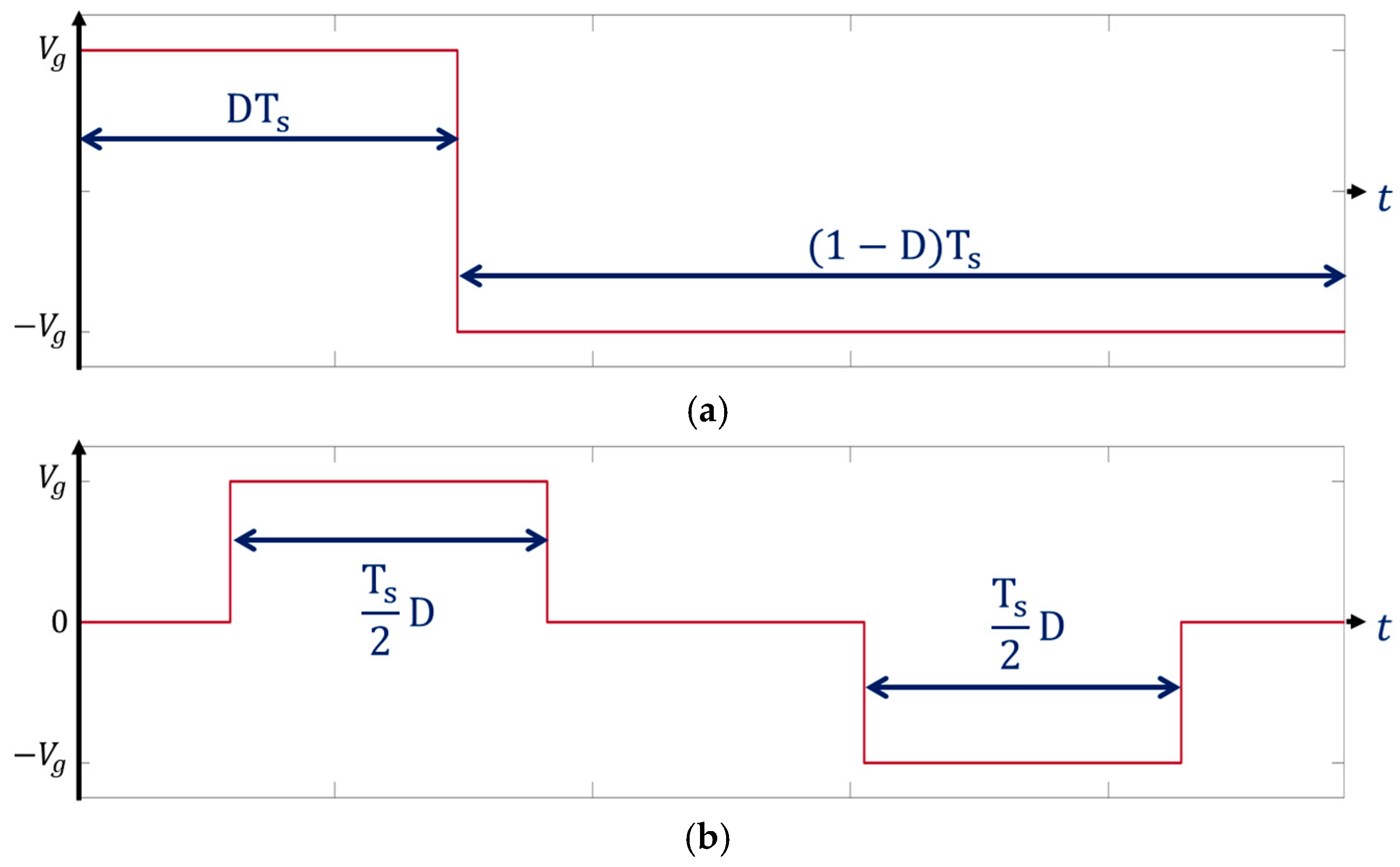
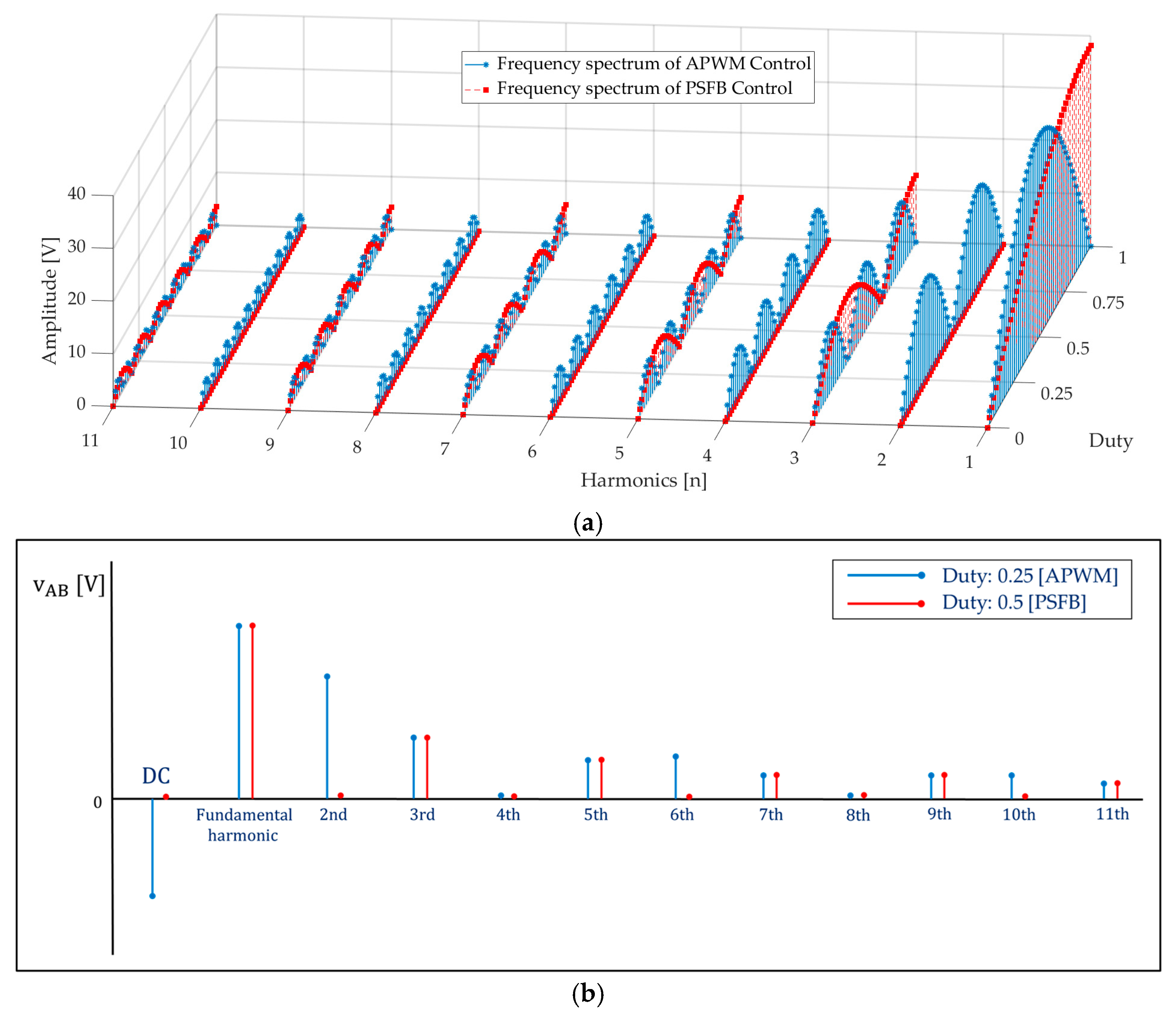
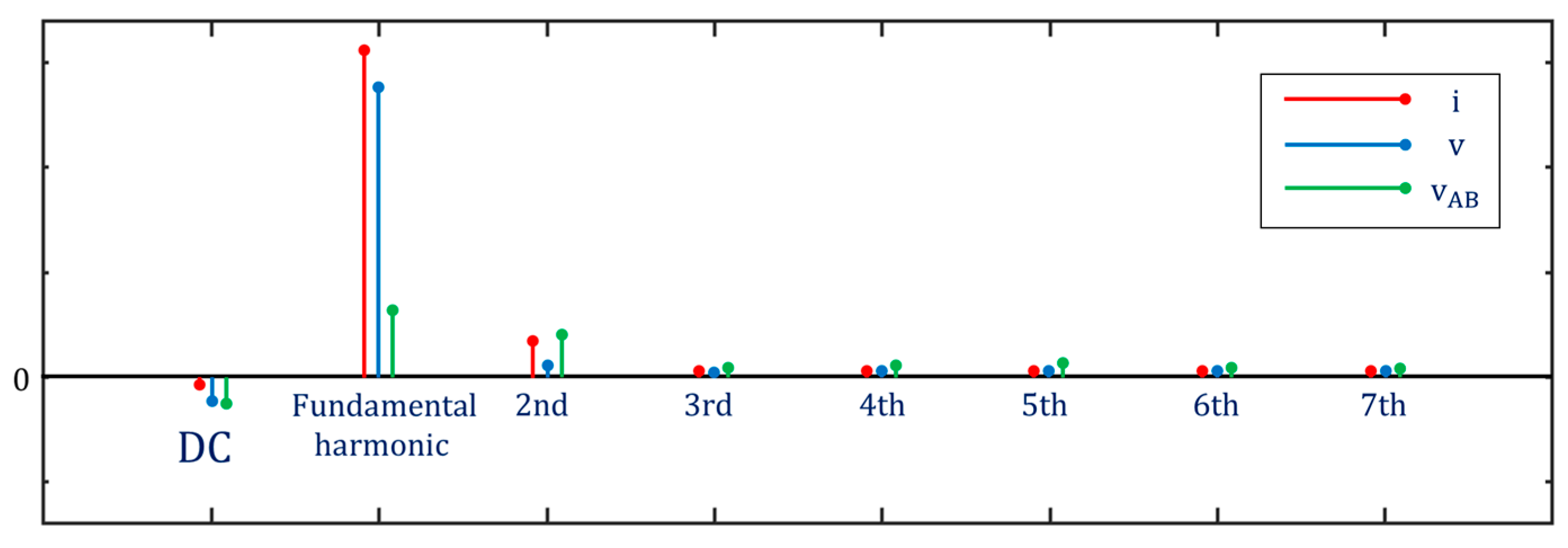
Figure 2 illustrates the full-bridge inverter output voltage v A B applied to the resonant network under APWM and PSFB control. As shown in the figures, APWM maintains a constant RMS value regardless of the duty ratio. Consequently, as the duty ratio decreases, the fundamental component decreases while the harmonic components increase according to the Fourier series expansion. In contrast, PSFB exhibits a reduction in RMS value as the duty ratio decreases, and thus, a larger duty ratio is required compared to APWM to achieve the same output voltage. As a result, under the assumption of identical output voltage, the dominant fundamental component of APWM becomes relatively smaller than that of PSFB, leading to a reduction in circulating current in APWM, which can also be observed from the harmonic spectra in Figure 3.
v AB , PSFB t = n = 1 4 V g n π sin n π 2 d sin π 2 sin n ω s t
v AB , APWM t = V g 2 d 1 + n = 1 2 2 V g n π 1 cos 2 n π d sin n ω s t ϕ
ϕ = tan 1 sin 2 n π d 1 cos 2 n π d
Equations (1.1) and (1.2) represent the Fourier series expansions of the full-bridge inverter voltage v A B for PSFB and APWM, respectively. Equation (1.3) presents the phase term obtained by combining the sine and cosine components in the Fourier series expansion of APWM. Figure 3 compares the frequency spectra of APWM and PSFB obtained by simulating (1.1) and (1.2) in MATLAB (R2025b). Figure 3a provides a three-dimensional representation, where the X-axis denotes the duty ratio, the Y-axis represents the harmonic order n, and the Z-axis indicates the amplitude. Figure 3b show two-dimensional spectra of APWM and PSFB, respectively, illustrating the variation in each harmonic component with respect to the duty ratio. From Figure 3a,b it can be observed that APWM exhibits symmetry about a duty ratio of 0.5 and contains not only odd harmonics but also even harmonics and a DC component. In contrast, PSFB contains only odd-order harmonics.
v o v c , avg = 1 π 0 π v c sin ω s t d t = 2 π v c
v o , PSFB 2 π v c = 2 π n = 1 4 V g n π sin n π 2 d sin π 2 · Z e n ω s L + Z e
v o , APWM 2 π v c = V g 2 d 1 + 2 π n = 1 2 2 V g n π 1 cos 2 n π d · Z e n ω s L + Z e
Z e = R e 1 + n ω s R e C
R e = π 2 8 R L
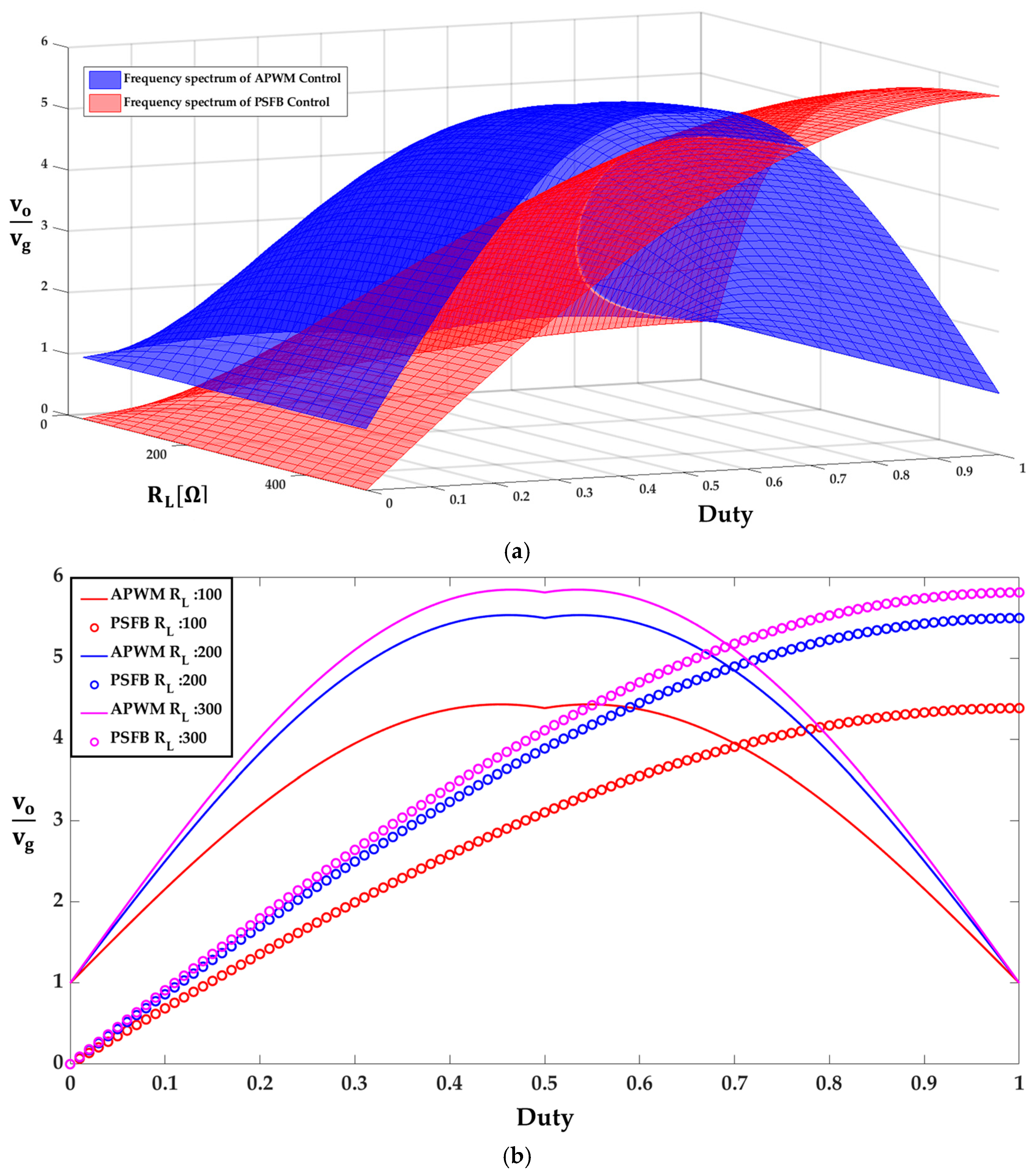
Equations (1.4)–(1.6) represent the output voltages of the PSFB and APWM, respectively. Equations (1.7) and (1.8) define the equivalent impedances of the resonant tank and the load, and Figure 4 was derived in MATLAB (R2025b) by applying Equations (1.1)–(1.6). Figure 4a,b compare the voltage transfer ratios of APWM and PSFB. Figure 4a provides a three-dimensional representation with R L on the X-axis, the duty ratio on the Y-axis, and the voltage transfer ratio on the Z-axis. In Figure 4b, the duty ratio is shown on the X-axis, while the voltage transfer ratio is shown on the Y-axis. From Figure 4a,b, it is observed that the voltage transfer ratio of APWM is higher than that of PSFB. Therefore, a smaller duty ratio can be used to achieve the same output voltage, thereby reducing the circulating current. Furthermore, since APWM contains a DC component unlike PSFB, the voltage transfer ratio does not become zero even when the duty ratio is zero, and it is observed that the voltage transfer ratio of APWM remains higher across all duty-ratio conditions.

3. Small-Signal Modeling

This section describes a systematic modeling procedure for deriving the small-signal model of the PRC, based on the methodology presented in [19,20,21,22,23,24].

3.1. Nonlinear State Equation

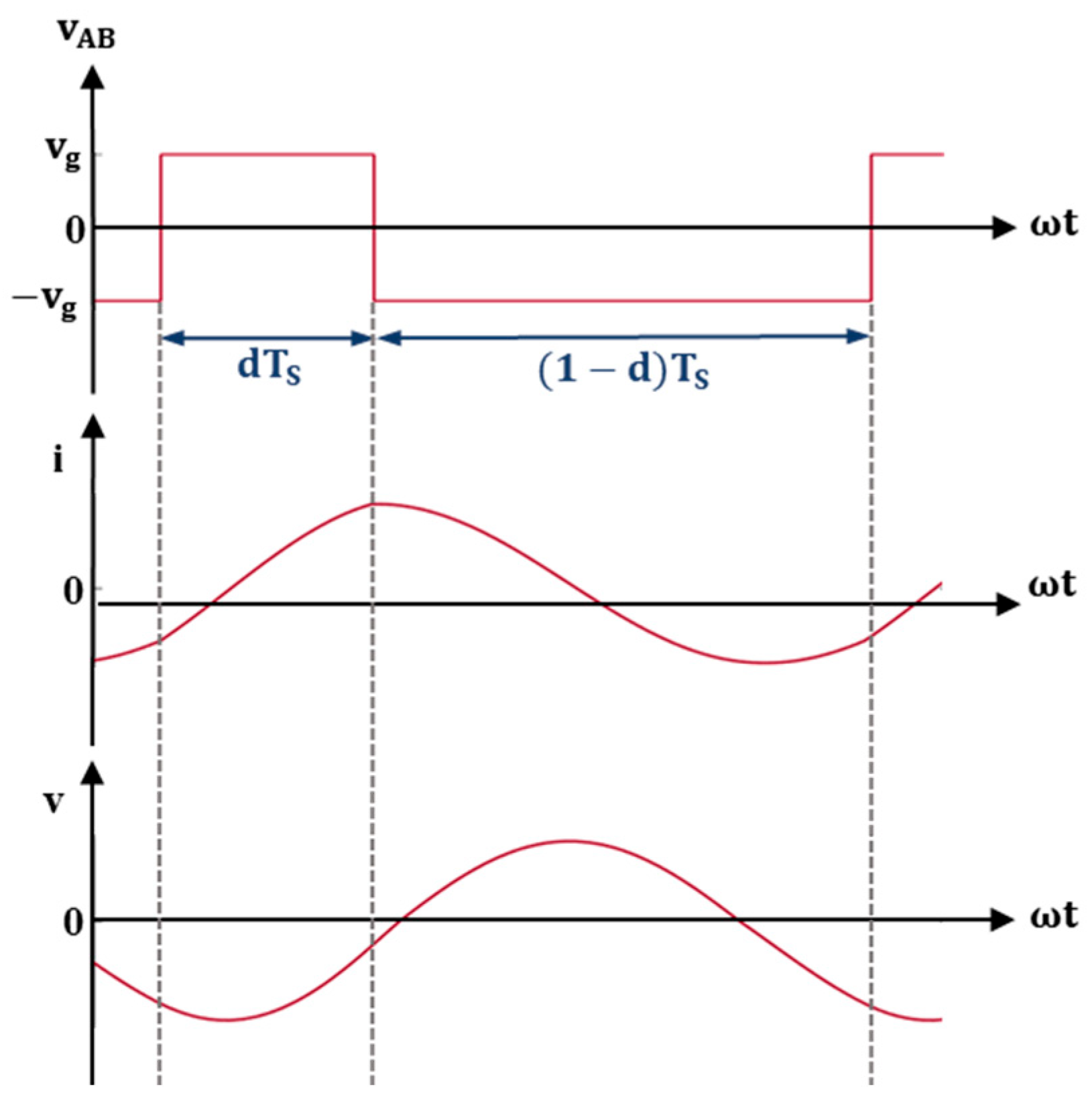
To analyze the dynamic behavior of the circuit shown in Figure 1, the state equations for the state variables are derived under continuous conduction mode (CCM). The power switching network generates a quasi-square voltage v AB , which produces the inductor current and capacitor voltage waveforms shown in Figure 5. The state equations of the PRC are given as follows:
L di dt + ir s + v = v AB
C dv dt + sgn v i Lf = i
L f di Lf dt + i L f r c + 1 r c R L v cf = v i o r c
r c r c C f dv Cf dt + v Cf R L = i Lf + i o
The output variables are expressed as the output voltage of the power stage and the average input current as follows:
v o = i Lf r c + 1 r c R L v cf + i o r c
i g = 1 T s 0 T s i v AB t v g dt
where the equivalent series resistance (ESR) of the output filter capacitor and the load resistance is denoted by r c .
r c = r c R L r c + R L
In this circuit, the output voltage is controlled by asymmetrically adjusting the duty cycle d while keeping the switching frequency constant. The operating point is determined { v g , i o , R L , ω s , d } .

3.2. Harmonic Approximation

In steady state, the waveforms of the switching circuit are periodic and remain nearly periodic even under small-signal modulation. Moreover, due to the filtering characteristics of switching power circuits, the state variables can be expanded into a Fourier series using only a few harmonic components. To analyze the dynamic behavior of these harmonics when the system is modulated, the harmonic coefficients are assumed to vary slowly with time. Representative waveforms of the state variables i L and v C are shown in Figure 5, and by approximating them with their fundamental components, they can be expressed as follows:
i t = I DC + i s t sin ω s t + i c t cos ω s t
v t = V DC + v s t sin ω s t + v c t cos ω s t
Since the values of { i s t , i c t , v s t , v c t } vary slowly with time, their derivatives can be expressed as follows. In this case, the DC component is constant. Therefore, its derivative becomes zero.
di dt = di s dt ω s i c sin ω s t + di c dt + ω s i s cos ω s t
dv dt = dv s dt ω s v c sin ω s t + dv c dt + ω s v s cos ω s t

3.3. Extended Describing Function

The EDF approximates rapidly varying nonlinear functions by combining the harmonic variations in the frequency domain with time-domain functions, yielding slowly varying harmonic coefficients. A key step in the modeling process is to represent these nonlinear functions with a slowly varying harmonic coefficient vector. When the EDF concept is applied, the nonlinear terms are approximated using the DC, sine, and cosine components, and the { f n (⋯)} terms represent the harmonic coefficient functions determined by the operating conditions and state variables. As shown in Figure 6, the parallel resonant converter operates very close to its resonant frequency, and the waveforms of the principal state variables are dominated by their fundamental components. Therefore, only the fundamental component of the Fourier series is used in the EDF derivation.
v AB ( t ) f 1 v g , d + f 2 v g , d sin ω s t + f 3 v g , d cos ω s t
sgn v · i Lf f 4 v s , v c , i L f sin ω s t + f 5 v s , v c , i L f cos ω s t
v f 6 v s , v c
i g f 7 d , i s , i c
f 1 = V g 2 D 1
f 2 = 2 v g π { 1 cos ( 2 π d }
f 3 = 2 v g π sin ( 2 π d )
f 4 = 4 π v s i Lf v p
f 5 = 4 π v c i Lf v p
f 6 = 2 π v P
f 7 = 1 π [ i s 1 cos 2 π d + i c sin ( 2 π d ) ]
v P = v s 2 + v c 2
where v P represents the peak value of the tank voltage.

3.4. Harmonic Balance

To approximate the above nonlinear equations, harmonic balance is applied. By substituting ((3.1)–(5.11)) into ((2.1)–(2.6)) and matching the coefficients of the DC, sine, and cosine terms, the following equations are obtained.
L di s dt ω s i c + i s r s + v s = V es
L di c dt + ω s i s + i c r s + v c = V ec
C dv s dt ω s v c + 4 π v s i Lf v p = i s
C dv c dt + ω s v s + 4 π v c i Lf v p = i c
L f di Lf dt + i Lf r c + 1 r c R L v cf = 2 π v p i o r c
r c r c C f dv Cf dt + v Cf R L = i Lf + i o
V es = 2 v g π { 1 cos ( 2 π d ) }
V ec = 2 v g π sin ( 2 π d )
V DC = V g 2 D 1
It is essential that the input values { v g , i o , ω s , d } of this equation vary more slowly than the switching frequency, ensuring that perturbation and linearization can be carried out at a specific operating point. The output voltage v o and the input current i g are expressed as follows:
v o = i Lf r c + 1 r c R L v cf + i o r c
i g = 1 π i s 1 cos 2 π d + i c sin 2 π d

3.5. Steady-State Solution

In steady state, the state variables remain constant over time; consequently, the new state variables { i s , i c , v s , v c , i Lf , v cf } also stay constant. The steady-state solution is obtained by setting the derivative terms in ((6.1)–(6.11)) to zero and assigning the DC value of the external current source i o to zero. Steady-state quantities are denoted by uppercase letters.
I s = C Ω s V c + V s R e
I c = C Ω s V s + V c R e
V s = α V es + β V ec α 2 + β 2
V c = α V ec β V es α 2 + β 2
I Lf = 2 π V p 4 R e
V Cf = 2 V p π
V p = V s 2 + V c 2
α = 1 L C Ω s 2 + r s R e
β = L Ω s R e + C r s Ω s
R e = π 2 R L 8

3.6. Perturbation and Linearization

To perform perturbation and linearization around the steady-state operating point, the assumptions in Equation (8.1)–(8.6) are applied. Here, i o in Equation (8.1) represents the perturbed output current caused by load variation, not the load current itself. Therefore, the steady-state value of i o is set to zero.
v g = V g + v ^ g , d = D + d ^ ω s = Ω s + ω ^ s , i o = 0 + i ^ o
The small-signal model is linearized as follows, and the state vector is defined as x ^ , the input vector as u ^ , and the output vector as y ^ :
d x ^ d t = A x ^ + B u ^
y ^ = C x ^ + E u ^
x ^ = i ^ s i ^ c v ^ s v ^ c i ^ L f v ^ Cf T
u ^ = v ^ g d ^ f ^ SN i ^ o T
y ^ = v ^ o i ^ g T
By applying perturbation and linearization, the small-signal model of the circuit shown in Figure 1 can be obtained, where the matrices are defined as follows:
A = r s L Z L L 1 L 0 0 0 Z L L r s L 0 1 L 0 0 1 C 0 g s C g sc C 2 k s C 0 0 1 C g cs C g c C 2 k c C 0 0 0 k s L f k C L f r c L f R L f ( R + r c ) 0 0 0 0 r c C f r c r c C f R r c
B = k vs L E ds L I c 0 k vc L E dc L I s 0 0 0 V c 0 0 0 V s 0 0 0 0 r c L f 0 0 0 r c C f r c
C = 0 0 0 0 r c r c r c 2 π { 1 cos 2 π D } 2 π sin ( 2 π D ) 0 0 0 0
E = 0 0 0 r c 0 J d 0 0
The parameters of the model are defined as follows:
Z L = Ω o L
k vs = 2 π { 1 cos 2 π D }
k vc = 2 π sin ( 2 π D )
E ds = 4 V g sin ( 2 π D )
E dc = 4 V g cos ( 2 π D )
g s = 4 I Lf V c 2 V p 3 π
g c = 4 I Lf V s 2 V p 3 π
k s = 2 π α V es + β V ec α 2 + β 2 V es 2 + V ec 2
k c = 2 π β V es + α V ec α 2 + β 2 V es 2 + V ec 2
g sc = C Ω o + 4 I Lf V s V c V p 3 π
g cs = C Ω o + 4 I Lf V s V c V p 3 π
V es = 2 V g π { 1 cos 2 π D }
V ec = 2 V g π sin ( 2 π D )
ω o = 1 LC
J d = 2 { I c sin 2 π D + I s cos ( 2 π D ) }

4. Simulation and Experimental Results

4.1. Simulation Results

To validate the proposed small-signal model, simulations were conducted using the derived state-space matrices. In MATLAB (R2025b), the transfer function was simulated based on the state-space representation, whereas in PLECS (4.7.5), the frequency response was measured by applying small-signal perturbations to the circuit for verification. The circuit parameters used for the simulations are summarized in Table 1.
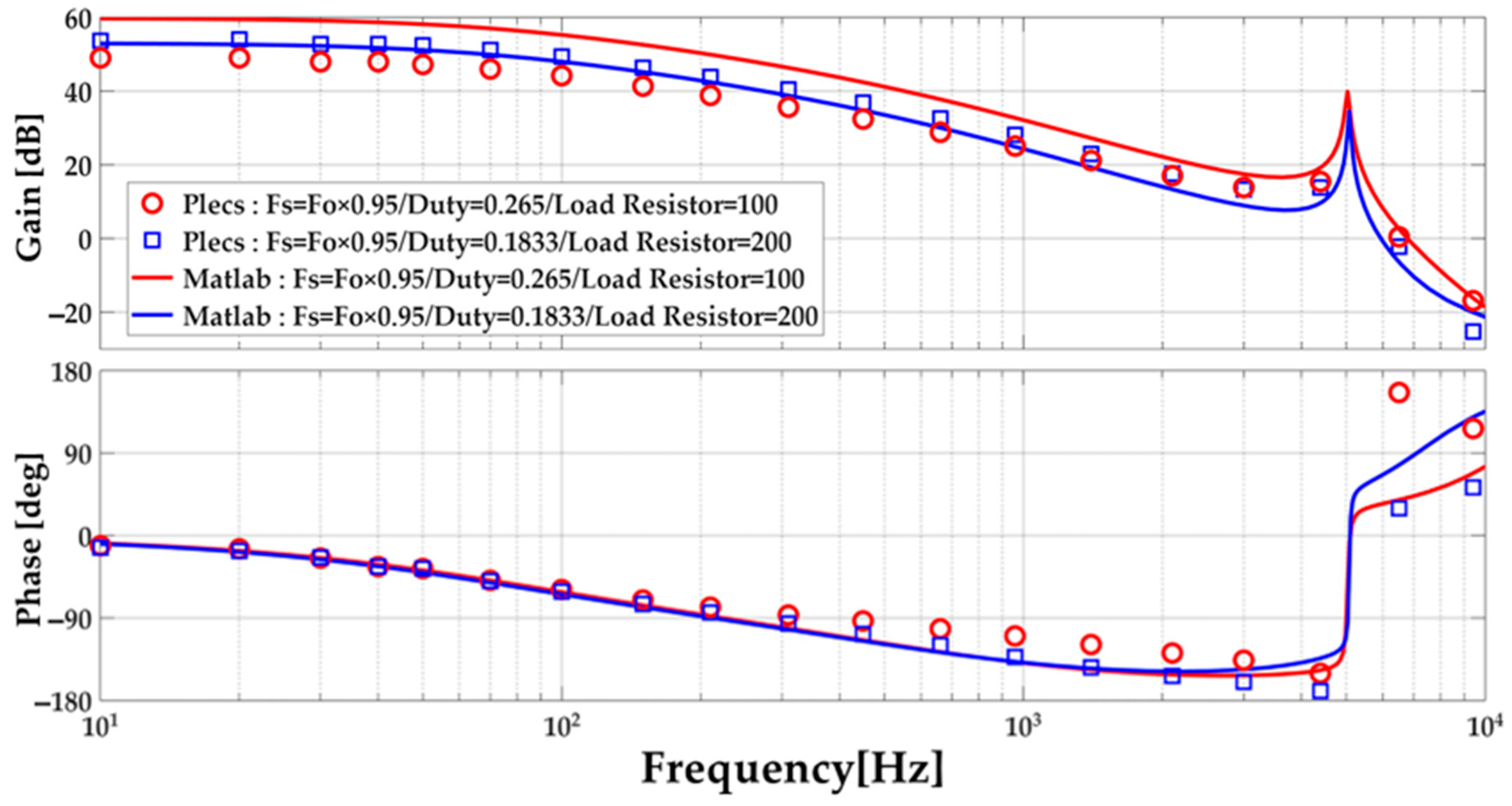
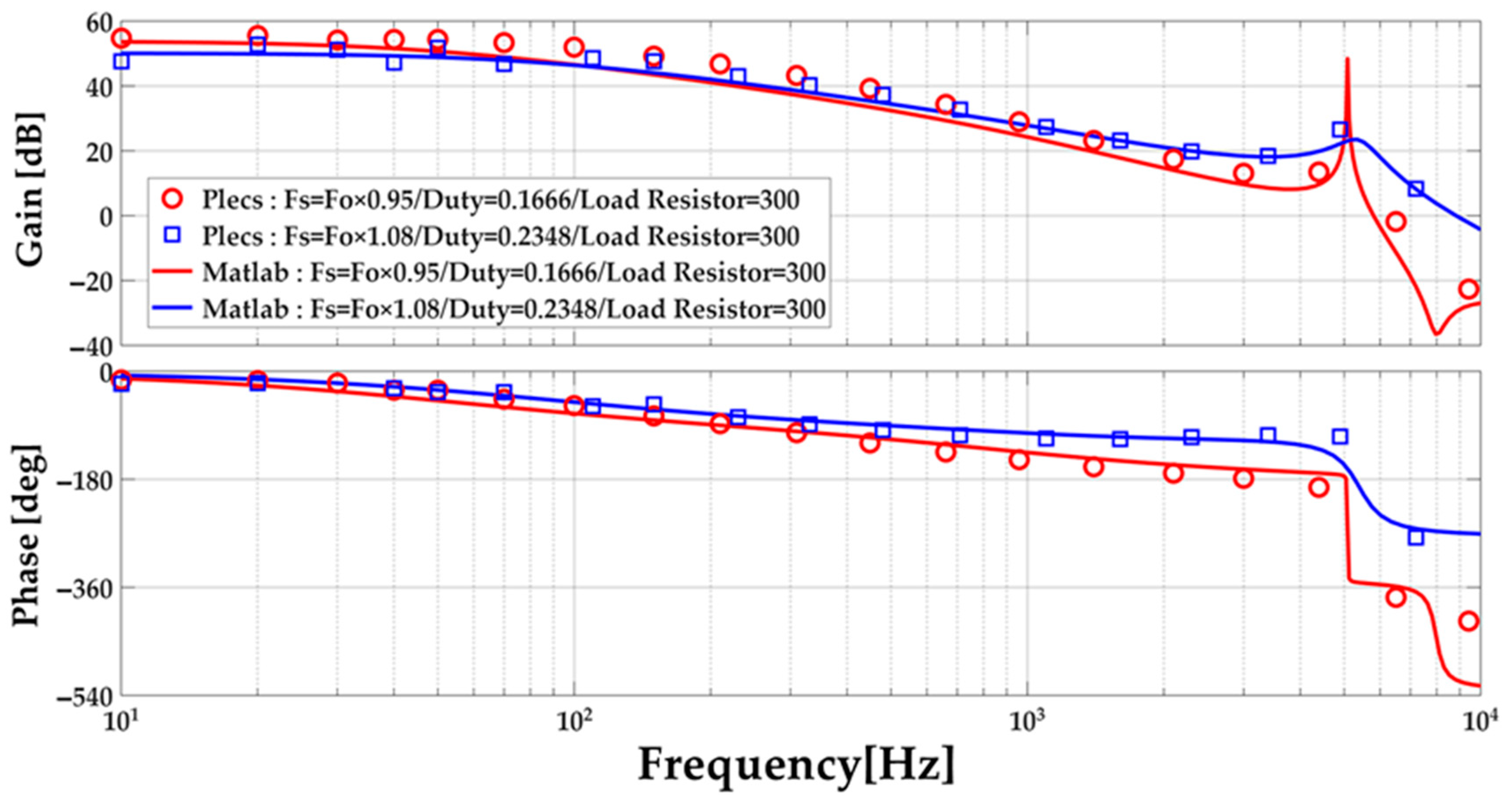
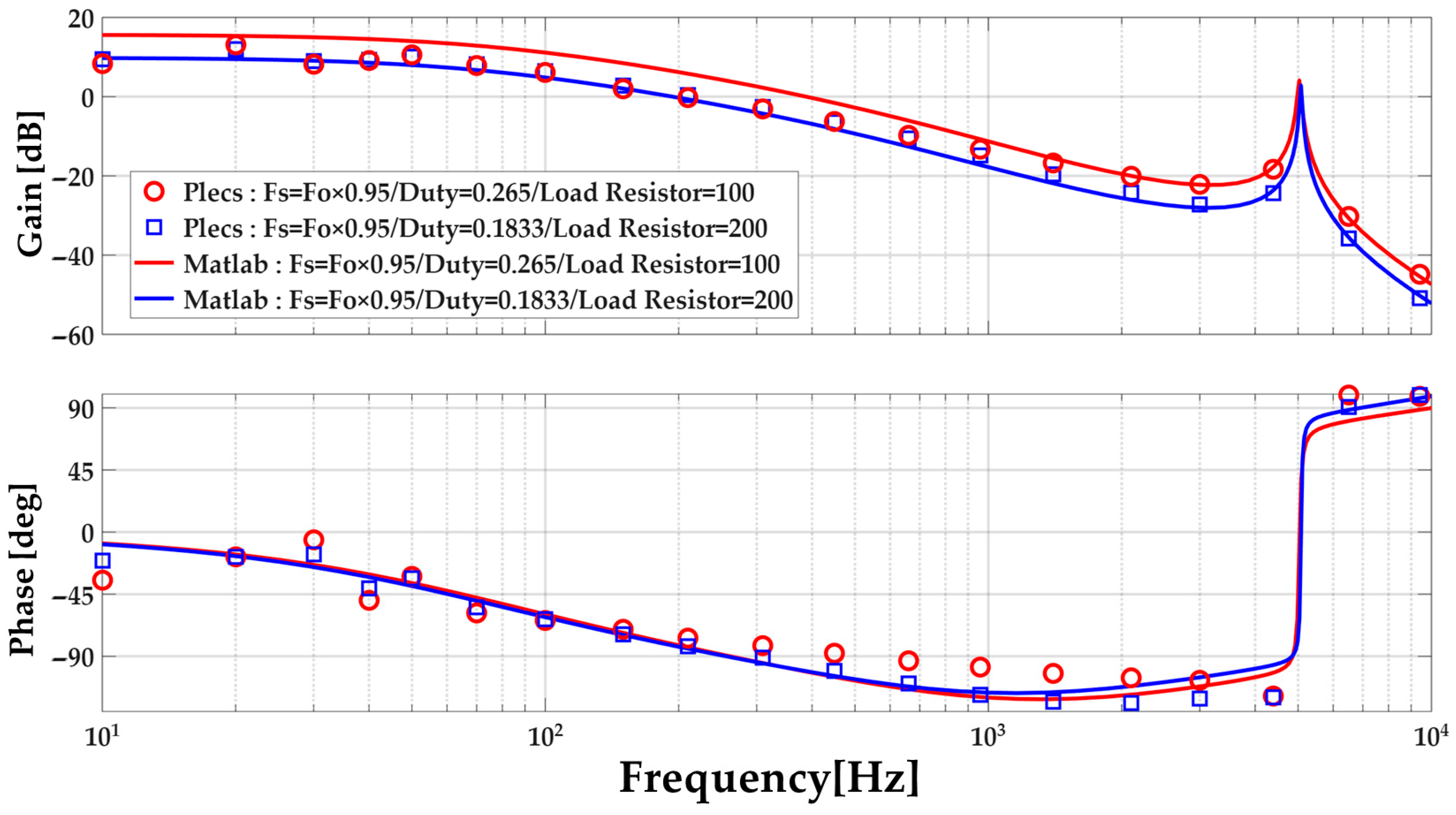
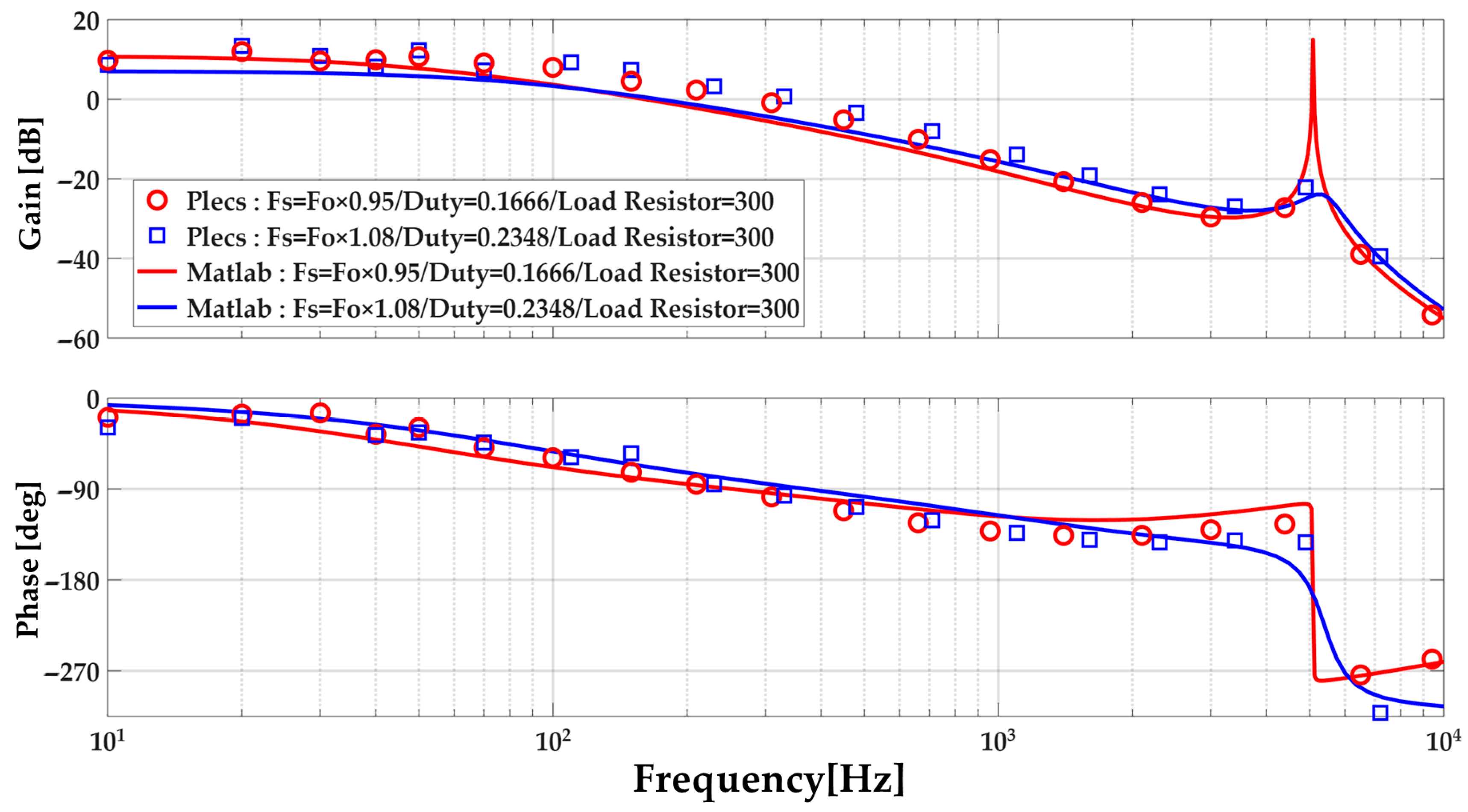
Figure 7, Figure 8, Figure 9, Figure 10, Figure 11 and Figure 12 present the simulation results obtained at various steady-state operating points to validate the proposed small-signal model. First, Figure 7 and Figure 8 show the simulation results for the Control (Duty)-to-Output transfer function v ^ o d ^ . This transfer function shows the dynamic response of the output voltage v ^ o to small variations in the duty cycle d ^ .
In Figure 7, the switching frequency is fixed at F s = 27.36   [ k H z ] (switching-to-resonant frequency ratio F s F o = 0.95 ). For load resistances of R L = 100   [ ] and 200   [ ] , the duty cycle D was set to 0.265 ( 100   [ ] ) and 0.1833 ( 200   [ ] ), respectively, to maintain an output voltage of V o = 100 V . Under identical switching-frequency and output-voltage conditions, the voltage transfer gain typically increases as the load approaches a light-load condition, and the peak of the gain curve varies accordingly with the load. However, this characteristic is strictly valid only in operating regions above the resonant frequency, where the harmonics of the input square wave are sufficiently filtered by the resonant network. Consequently, as shown in Figure 7, this behavior does not clearly appear in the ZCS region. Nevertheless, the simulation results demonstrate that the proposed small-signal model continues to show good agreement with the simulation in the ZCS region, particularly as the load decreases toward light-load conditions.
In Figure 8, to analyze the control characteristics according to duty-cycle variations under a fixed-frequency condition, cases of R L = 300   [ ] with F s F o = 1.08 ( 31.10   [ kHz ] ) and 0.95 ( 27.36   [ kHz ] ) were considered. To maintain the same output voltage, the duty cycle D was adjusted to 0.1666 and 0.2348 , respectively. By comparing the responses obtained from MATLAB and PLECS under these various operating conditions, it is confirmed that the gain and phase characteristics match closely, thereby demonstrating the high accuracy of the proposed small-signal model.
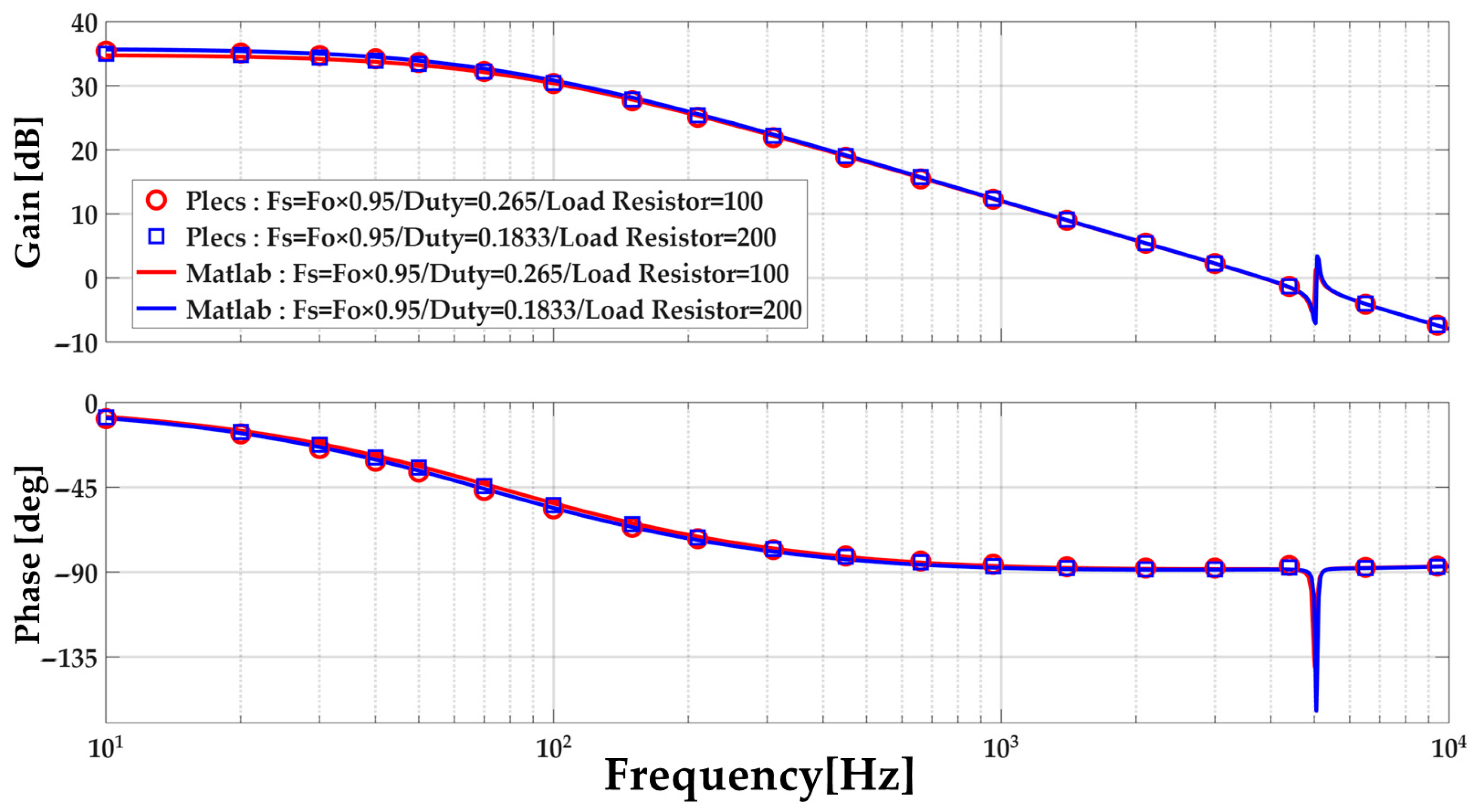
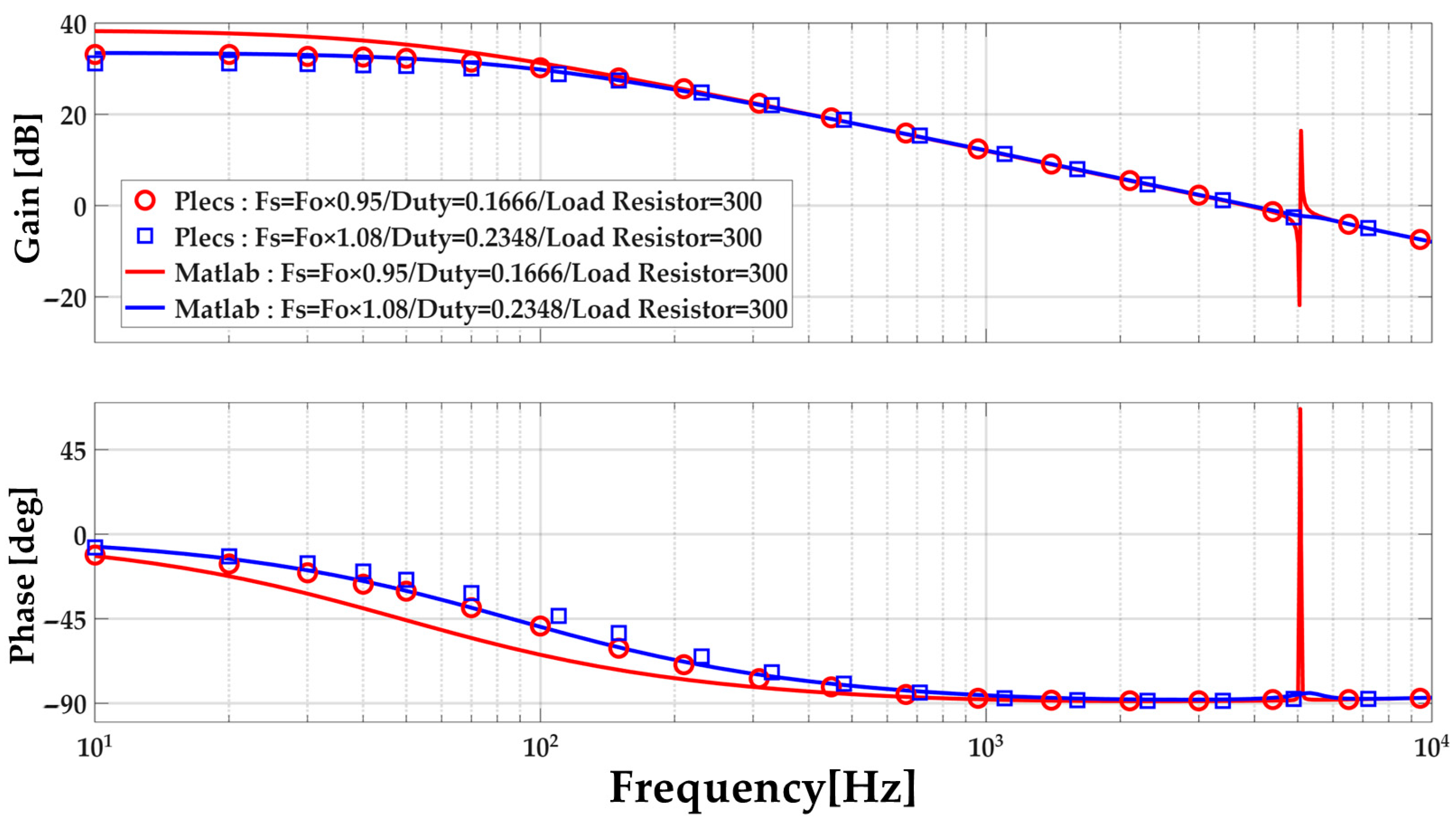
The simulation results in Figure 9 and Figure 10 were used to verify the validity of the Line-to-Output transfer function v ^ o v ^ g . This transfer function shows how small-signal variations in the input voltage v ^ g affect the output voltage v ^ o and is used to evaluate the influence of input voltage disturbances on the output voltage. The operating conditions for verifying the Line-to-Output transfer function were set to be the same as those used in Figure 7 and Figure 8. From the frequency responses obtained from MATLAB (R2025b) and PLECS (4.7.5) shown in Figure 7 and Figure 8, it can be confirmed that the transfer function corresponds well with the simulation results. Through this comparison, the accuracy of the transfer function model was verified.
Figure 11 and Figure 12 present the simulation results obtained to verify the Output Impedance transfer function v ^ o i ^ o . This transfer function shows the influence of the load disturbance i ^ o on the output voltage v ^ o and provides important information for analyzing system stability.
The simulations were performed under the same operating conditions as those used in Figure 7 and Figure 8, and the comparison of the Bode plots obtained from MATLAB (R2025b) and PLECS (4.7.5) confirmed that the two responses are very similar. Through this, it was verified that the Output Impedance transfer function of the proposed small-signal model has high accuracy.

4.2. Experimental Results

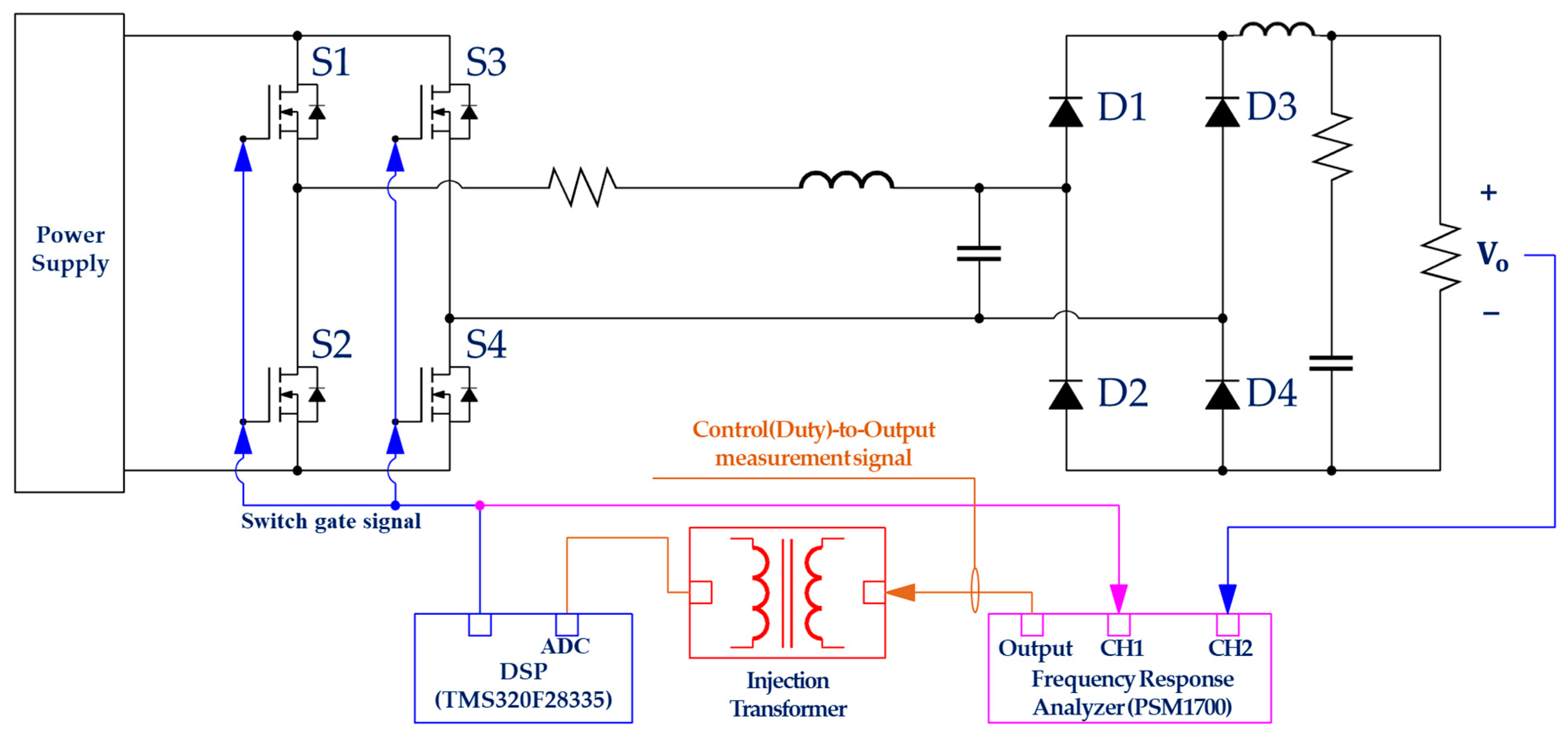
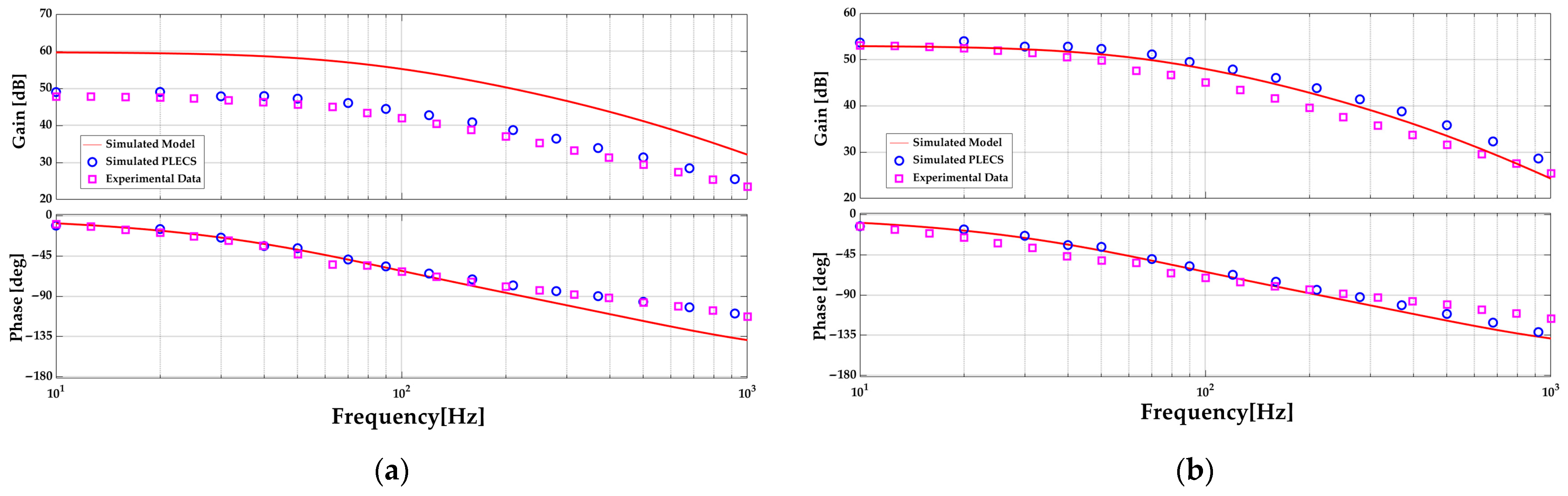
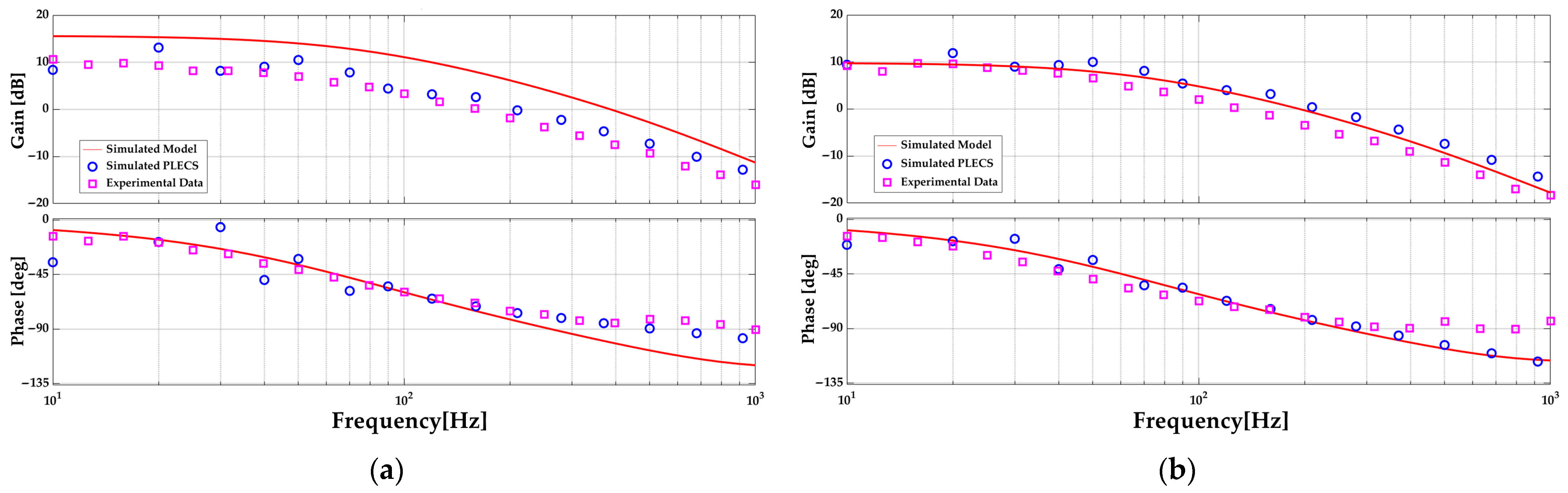
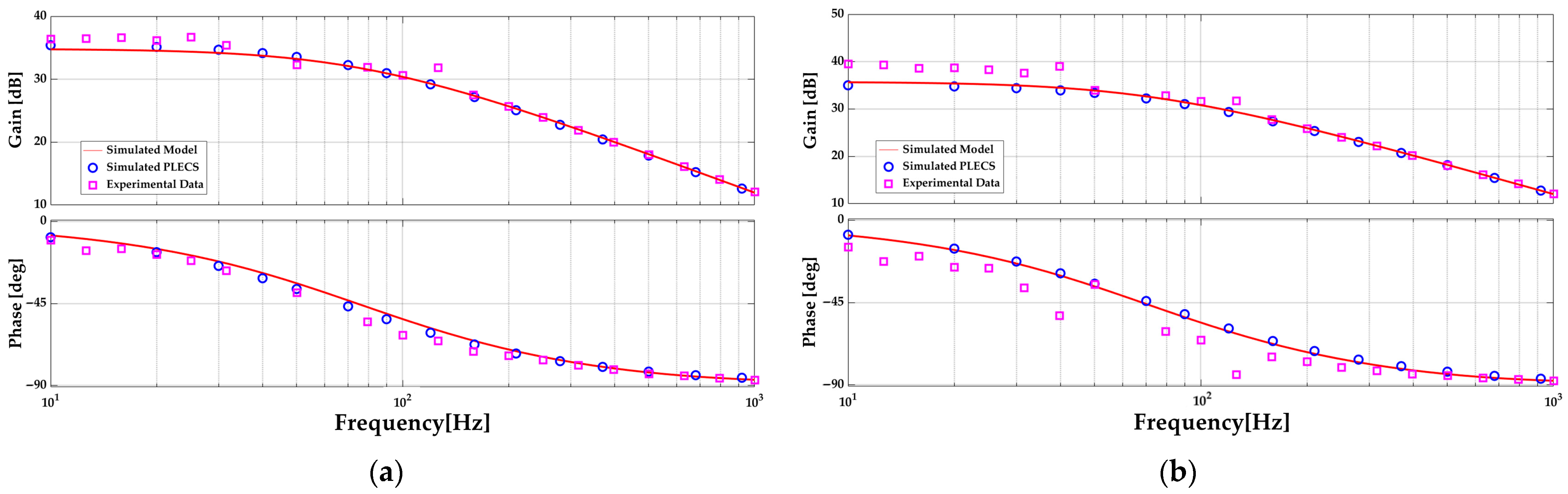
To more reliably verify the transfer functions validated through simulation, experiments were conducted. The PRC was configured based on the specifications listed in Table 1. Gate signals were generated using a TMS320F28335 DSP control board (Texas Instruments, Dallas, TX, USA), and GS66508T GaN transistors (Infineon Technologies, Neubiberg, Germany, 650 [V], 30 [A]) were used as the power switching devices. The resonant inductor was fabricated by winding 19 turns on two CH358125 powder-magnetic cores (ChangSung, Incheon, Republic of Korea), and the resonant capacitor was implemented by combining three R76UR31004030J film capacitors (KEMET, Fort Lauderdale, FL, USA, 0.1 [μF], 2000 [ V dc ]). In the rectification stage, MURS160-13-F diodes (Diodes Incorporated, Plano, TX, USA, 600 [V], 1 [A]) were used, and the output filter employed a film capacitor (ICEL Srl., Montecchio Maggiore, Italy, 40 [μF], 900 [V]). Frequency-response measurements were performed using a PSM1700 Frequency Response Analyzer (Newtons4th Ltd., Loughborough, UK), and parasitic elements such as the transistor R DS (on), inductor winding resistance, and capacitor losses were excluded from the modeling. Figure 13 shows the experimental setup used to measure the Control (Duty)-to-Output transfer function with the PSM1700 Analyzer. In the Control (Duty)-to-Output experiment, the excitation signal from the analyzer was applied to the ADC input of the DSP board, and the DSP superimposed this signal onto the duty-cycle reference before driving the GaN switches. The output voltage was measured on CH2, while the gate signal was measured on CH1 for phase compensation. Although some gain and phase deviations may occur due to parasitic elements, the measurement results provide sufficient accuracy to validate the proposed small-signal model. All transfer-function measurements were performed at V o = 100   [ V ] and Fs = 27.4 [kHz], with two operating conditions: R L = 100   [ Ω ] , D = 0.265 , and R L = 200   [ Ω ] , D = 0.1833 . Figure 14, Figure 15 and Figure 16 compare the MATLAB, PLECS, and experimentally measured results simultaneously and show them up to approximately 1 [kHz]. Although some discrepancies occur at certain operating points, the overall response trends are sufficiently consistent, confirming that the three derived transfer functions have been experimentally validated.

5. Conclusions

In this paper, a small-signal model of a PRC employing asymmetric PWM (APWM) control is proposed. The PRC has an issue in which the circulating current becomes unnecessarily large, and therefore, a duty-based control method such as asymmetric PWM is required to reduce it. Thus, this study presents a small-signal model of an APWM-based PRC operating in CCM by applying the EDF method. Since APWM control includes DC and cosine terms unlike conventional PFM and PSFB, this study proposes a small-signal modeling method applicable even when the control signal contains various harmonic components such as DC, sine, and cosine terms, and verifies its validity based on fundamental-wave modeling. Furthermore, unlike previous studies that have mainly focused on small-signal models based on PFM or PSFB control, this work is significant in that it presents, for the first time, a small-signal model of a PRC applying APWM control under light-load conditions. The proposed model was derived under high-Q-factor conditions near the resonant frequency, and its validity was confirmed by comparing the frequency responses of the transfer functions obtained through MATLAB and PLECS simulations, followed by additional experimental measurements to further verify model accuracy. The proposed model requires further investigation under heavy-load conditions, where the Q-factor decreases, or in the DCM region, and it is expected to be widely applicable to analytical studies such as the control of resonant converters driven by APWM and the dynamic characteristic analysis of such converters.

Author Contributions

Conceptualization, N.-Y.K.; methodology, N.-Y.K.; software, N.-Y.K.; validation, N.-Y.K.; investigation, N.-Y.K.; data curation, N.-Y.K.; writing—original draft preparation, N.-Y.K.; writing—review and editing, K.-J.L.; supervision, K.-J.L.; project administration, K.-J.L. All authors have read and agreed to the published version of the manuscript.

Funding

This work was supported by the Korea Institute of Energy Technology Evaluation and Planning (KETEP) grant funded by the Ministry of Trade, Industry and Energy (MOTIE) (RS-2024-00394769). This work was supported by a Human Resources Development of the Korea Institute of Energy Technology Evaluation and Planning (KETEP) grant funded by the Korea government (No. 20224000000070).

Data Availability Statement

The original contributions presented in this study are included in the article. Further inquiries can be directed to the corresponding author.

Conflicts of Interest

The authors declare no conflicts of interest.

Abbreviations

PFMPulse-Frequency Modulation
PSFBPhase-Shift Full-Bridge
APWMAsymmetric Pulse-Width Modulation
EDFExtended Describing Function
PRCParallel Resonant Converter
SRCSeries Resonant Converter
DABDual Active Bridge
ZVSZero-Voltage Switching
ZCSZero-Current Switching
CCMContinuous Conduction Mode
DCMDiscontinuous Conduction Mode
V g Input Voltage
V o Output Voltage
v A B Full Bridge Inverter Output Voltage
S1, S2, S3, S4Switch
D1, D2, D3, D4Diode
LResonant Inductor
CResonant Capacitor
r s Equivalent Series Resistance of Resonant Tank
r c Equivalent Series Resistance of Filter Capacitor
L f Filter Inductor
C f Filter Capacitor
R L Load Resistance
i ^ o Perturbed Small-Signal Output Current

References

  1. Kwon, Y.D.; Freijedo, F.D.; Wijekoon, T.; Liserre, M. Series Resonant Converter-Based Full-Bridge DC–DC Partial Power Converter for Solar PV. IEEE J. Emerg. Sel. Top. Power Electron. 2024, 2, 1719–1729. [Google Scholar] [CrossRef]
  2. Soumiah, S.; Vengatesh, R.P.; Rajan, S.E. Performance evaluation of single switch high frequency resonant power converter for alternative energy sources. In Proceedings of the 2015 International Conference on Circuits, Power and Computing Technologies [ICCPCT-2015], Nagercoil, India, 19–20 March 2015; pp. 1–10. [Google Scholar]
  3. Kim, J.-W.; Barbosa, P. PWM-Controlled Series Resonant Converter for Universal Electric Vehicle Charger. IEEE Trans. Power Electron. 2021, 12, 13578–13588. [Google Scholar] [CrossRef]
  4. Dao, N.D.; Lee, D.-C.; Phan, Q.D. High-Efficiency SiC-Based Isolated Three-Port DC/DC Converters for Hybrid Charging Stations. IEEE Trans. Power Electron. 2020, 10, 10455–10465. [Google Scholar] [CrossRef]
  5. Phankong, N.; Chudjuarjeen, S.; Bhumkittipich, K.; Hikihara, T. Half bridge soft switching resonant converter with silicon carbide power MOSFETs for induction heating. In Proceedings of the 2016 19th International Conference on Electrical Machines and Systems (ICEMS), Chiba, Japan, 13–16 November 2016; pp. 1–4. [Google Scholar]
  6. Steigerwald, R.L. A comparison of half-bridge resonant converter topologies. IEEE Trans. Power Electron. 1988, 3, 174–182. [Google Scholar] [CrossRef]
  7. Guo, Z.; Zhu, Y.; Sha, D. Zero-Voltage-Switching Asymmetrical PWM Full-Bridge DC–DC Converter with Reduced Circulating Current. IEEE Trans. Ind. Electron. 2021, 5, 3840–3853. [Google Scholar] [CrossRef]
  8. Jain, A.K.; Ayyanar, R. Pwm control of dual active bridge: Comprehensive analysis and experimental verification. IEEE Trans. Power Electron. 2011, 26, 1215–1227. [Google Scholar] [CrossRef]
  9. Zhao, B.; Yu, Q.; Sun, W. Extended-Phase-Shift Control of Isolated Bidirectional DC–DC Converter for Power Distribution in Microgrid. IEEE Trans. Power Electron. 2012, 27, 4667–4680. [Google Scholar] [CrossRef]
  10. Chen, G.; Chen, Z.; Chen, Y.; Feng, C.; Zhu, X. Asymmetric Phase-Shift Modulation Strategy of DAB Converters for Improved Light-Load Efficiency. IEEE Trans. Power Electron. 2022, 37, 9104–9113. [Google Scholar] [CrossRef]
  11. Mahdavifard, M.; Mazloum, N.; Zahin, F.; KhakparvarYazdi, A.; Abasian, A.; Khajehoddin, S.A. An Asymmetrical DAB Converter Modulation and Control Systems to Extend the ZVS Range and Improve Efficiency. IEEE Trans. Power Electron. 2022, 37, 12774–12792. [Google Scholar] [CrossRef]
  12. Lee, K.-J. Steady-State Analysis of Asymmetrical Pulse-Width-Modulated Series Resonant Converter for Light Load Condition. Electronics 2025, 14, 63. [Google Scholar] [CrossRef]
  13. Ryu, S.-H.; Kim, D.-H.; Kim, M.-J.; Kim, J.-S.; Lee, B.-K. Adjustable Frequency–Duty-Cycle Hybrid Control Strategy for Full-Bridge Series Resonant Converters in Electric Vehicle Chargers. IEEE Trans. Ind. Electron. 2014, 61, 5354–5362. [Google Scholar]
  14. Pont, N.C.D.; Bandeira, D.G.; Lazzarin, T.B.; Barbi, I. A ZVS APWM Half-Bridge Parallel Resonant DC–DC Converter with Capacitive Output. IEEE Trans. Ind. Electron. 2019, 7, 5231–5241. [Google Scholar] [CrossRef]
  15. Jain, P.K.; St-Martin, A.; Edwards, G. Asymmetrical pulse-width-modulated resonant DC/DC converter topologies. IEEE Trans. Power Electron. 1996, 3, 413–422. [Google Scholar] [CrossRef]
  16. Middlebrook, R.D.; Cuk, S. A general unified approach to modelling switching-converter power stages. In Proceedings of the 1976 IEEE Power Electronics Specialists Conference, Cleveland, OH, USA, 8–10 June 1976; pp. 18–34. [Google Scholar]
  17. Shortt, D.J.; Lee, F.C. Extensions of the Discrete-Average Models for Converter Power Stages. IEEE Trans. Aerosp. Electron. Syst. 1984, AES-20, 279–289. [Google Scholar] [CrossRef]
  18. Verghese, G.C.; Elbuluk, M.E.; Kassakian, J.G. A General Approach to Sampled-Data Modeling for Power Electronic Circuits. IEEE Trans. Power Electron. 1986, PE-1, 76–89. [Google Scholar] [CrossRef]
  19. Yang, E.X.; Lee, F.C.; Jovanovic, M.M. Small-signal modeling of series and parallel resonant converters. In Proceedings of the APEC ‘92 Seventh Annual Applied Power Electronics Conference and Exposition, Boston, MA, USA, 23–27 February 1992; pp. 785–792. [Google Scholar]
  20. Chang, C.-H.; Chang, E.-C.; Cheng, C.-A.; Cheng, H.-L.; Lin, S.-C. Small Signal Modeling of LLC Resonant Converters Based on Extended Describing Function. In Proceedings of the 2012 International Symposium on Computer, Consumer and Control, Taichung, Taiwan, 4–6 June 2012; pp. 365–368. [Google Scholar]
  21. Tian, S.; Lee, F.C.; Li, Q. Equivalent Circuit Modeling of LLC Resonant Converter. IEEE Trans. Power Electron. 2020, 8, 8833–8845. [Google Scholar] [CrossRef]
  22. Yuan, J.; Wang, N.; Wang, X.; Wang, F.; Liu, M. A Small-Signal Modeling Method for Bidirectional CLLC Resonant Converter. In Proceedings of the IECON 2023—49th Annual Conference of the IEEE Industrial Electronics Society, Singapore, 16–19 October 2023; pp. 1–6. [Google Scholar]
  23. Yang, E.X.; Lee, F.C.; Jovanovic, M.M. Small-signal modeling of LCC resonant converter. PESC ‘92 Record. In Proceedings of the 23rd Annual IEEE Power Electronics Specialists Conference, Toledo, Spain, 29 June–3 July 1992; pp. 941–948. [Google Scholar]
  24. Park, G.-M.; Lee, K.-J. Small-Signal Modeling of Asymmetric PWM Control Based Series Resonant Converter. Electronics 2025, 14, 3394. [Google Scholar] [CrossRef]
Figure 1. Equivalent circuit diagram of parallel resonant converter.
Electronics 14 04970 g001
Figure 2. Comparison of control scheme: (a) proposed APWM control; (b) conventional PSFB control.
Electronics 14 04970 g002
Figure 3. Frequency spectrum comparison of control schemes: (a) 3D comparison of APWM and PSFB; (b) 2D comparison of APWM and PSFB.
Electronics 14 04970 g003
Figure 4. Voltage conversion ratio comparison of control scheme: (a) 3D comparison of APWM and PSFB; (b) 2D comparison of APWM and PSFB.
Electronics 14 04970 g004
Figure 5. Waveforms of resonant tank in PRC.
Electronics 14 04970 g005
Figure 6. Frequency spectrum of resonant tank (inductor current, capacitor voltage, switching voltage).
Electronics 14 04970 g006
Figure 7. Simulation results of Control (Duty)-to-Output transfer function ( R L = 100 Ω , 200 Ω , V o = 100   [ V ] ).
Electronics 14 04970 g007
Figure 8. Simulation results of Control (Duty)-to-Output transfer function ( R L = 300   [ Ω ] , V o = 100   [ V ] ).
Electronics 14 04970 g008
Figure 9. Simulation results of Line-to-Output transfer function ( R L = 100 Ω , R L = 200 Ω , V o = 100   [ V ] ).
Electronics 14 04970 g009
Figure 10. Simulation results of Line-to-Output transfer function ( R L = 300   [ Ω ] ,   V o = 100   [ V ] ).
Electronics 14 04970 g010
Figure 11. Simulation results of Output-Impedance transfer function ( R L = 100 Ω , R L = 200 Ω , V o = 100   [ V ] ).
Electronics 14 04970 g011
Figure 12. Simulation results of Output-Impedance transfer function ( R L = 300   [ Ω ] ,   V o = 100   [ V ] ).
Electronics 14 04970 g012
Figure 13. Experimental hardware configuration for measuring Control (Duty)-to-Output response.
Electronics 14 04970 g013
Figure 14. Experimental results of Control (Duty)-to-Output transfer function for V o = 100   [ V ] : (a) R L = 100   [ Ω ] ; (b) R L = 200   [ Ω ] .
Electronics 14 04970 g014
Figure 15. Experimental results of Line-to-Output transfer function for V o = 100   V : (a) R L = 100   [ Ω ] ; (b) R L = 200   [ Ω ] .
Electronics 14 04970 g015
Figure 16. Experimental results of Output-Impedance transfer function for V o = 100   V : (a) R L = 100   [ Ω ] ; (b) R L = 200   [ Ω ] .
Electronics 14 04970 g016
Table 1. System parameters.
V g 30   [ V ] r c 20   [ m Ω ]
L 101.81   [ μ H ] C 300   [ n F ]
L f 1.462   [ m H ] C f 40   [ μ F ]
r s 60   [ m Ω ] F o 28.8 [kHz]
Disclaimer/Publisher’s Note: The statements, opinions and data contained in all publications are solely those of the individual author(s) and contributor(s) and not of MDPI and/or the editor(s). MDPI and/or the editor(s) disclaim responsibility for any injury to people or property resulting from any ideas, methods, instructions or products referred to in the content.