Article

A Multi-Mode Oscillation Suppression Strategy for Grid-Connected Inverter Systems Based on Amplitude–Phase Reconstruction

1
State Grid Qinghai Electric Power Company Electric Power Research Institute, Xining 810001, China
2
State Grid Qinghai Electric Power Company, Xining 810001, China
3
State Key Laboratory of Alternate Electrical Power System with Renewable Energy Sources, North China Electric Power University, Beijing 102206, China
*
Author to whom correspondence should be addressed.
Electronics 2025, 14(23), 4761; https://doi.org/10.3390/electronics14234761 (registering DOI)
Submission received: 23 October 2025 / Revised: 29 November 2025 / Accepted: 30 November 2025 / Published: 3 December 2025

Abstract

As the primary interface for integrating renewable energy sources such as wind and solar power into the grid, inverters are prone to inducing sub-/super-synchronous or medium-to-high-frequency oscillations during grid-connected operation under weak grid conditions. Optimizing the control structure of a single wind turbine inverter struggles to address multi-mode resonance issues comprehensively. Therefore, a cooperative control strategy for parallel-coupled inverters is proposed. First, a frequency-domain impedance reconstruction method for parallel wind turbines is proposed based on the phase-neutralizing characteristics and damping variation patterns of parallel-coupled impedances. Second, the damping characteristics of inverters are enhanced through the design of an additional damping controller, while the phase-frequency characteristics of wind turbines are improved using active damping based on notch filters. Finally, simulation models based on 2.5 MW permanent magnet synchronous generator (PMSG) units validate the effectiveness of the control strategy. Research results demonstrate that this cooperative control strategy effectively suppresses sub-/super-synchronous and medium-to-high-frequency oscillations: In the 0~300 Hz key oscillation band, the amplitude suppression rate of oscillating current reaches ≥60%, the total harmonic distortion (THD) of the 5th harmonic at the grid connection point decreases from 4.465% to 3.518%.

1. Introduction

China possesses abundant onshore and offshore wind energy resources. Wind farms predominantly utilize permanent magnet synchronous generators (PMSGs) or doubly-fed wind turbines for energy harvesting. Both technologies employ inverters to feed wind power into the grid [1,2]. However, the evolution of power systems toward weak grids, coupled with dynamic interactions between inverters and control systems, has intensified the occurrence of oscillatory instability phenomena [3,4].
Currently, wideband oscillation suppression for inverter grid-connected systems typically employs impedance reconfiguration methods to enhance system damping levels [5,6], primarily involving active damping strategies and additional channels to eliminate harmonic sources. Active damping strategies improve system stability by introducing filters in the current loop to block oscillatory components within the inverter [7]. Reference [8] proposes an active damping control strategy based on measured data identification to optimize the center frequency of an adaptive notch filter, achieving sub-synchronous oscillation suppression in doubly-fed wind farms. Reference [9] introduces voltage feedforward using current as input to form a virtual impedance that suppresses inverter grid-connected oscillations while analyzing the circuit characteristics of different active damping control types. Additional channel control strategies primarily achieve oscillation suppression by forming negative feedback paths for oscillatory components. Reference [10] establishes a data-driven model characterizing the dynamic behavior of double-fed wind farms connecting to the grid. Based on this model, an additional damping control branch was constructed, with matrix parameters updated via system data to adapt to changing operating conditions. However, this approach only addresses low-frequency oscillations within a specific range. Reference [11] designs a robust damping controller for sub-synchronous oscillations by solving the state feedback matrix, providing sufficient damping for direct-drive wind power transmission systems. However, it fails to reveal the controller’s regulatory role from the frequency-domain impedance perspective. Reference [12] introduces admittance reshaping factors in the inner and outer loops of the generator to suppress grid background harmonics by reducing the magnitude of converter admittance, but does not consider the impact of admittance phase angle changes. While the above methods effectively suppress target oscillation modes, most are designed for single-band suppression strategies and fail to cover the multi-mode oscillations (sub-synchronous, super-synchronous, and medium-to-high-frequency) actually present in wind farms.
Regarding oscillation suppression at new energy power plant levels, existing research primarily focuses on enhancing the oscillation suppression capability of static var compensators through optimized retrofitting with external damping devices [13,14], or installing filters at the grid connection point to eliminate oscillatory components [15]. However, adding damping devices inevitably increases economic costs. Moreover, as the transmission capacity of new energy sources grows, the capacity and economic costs of suppression devices also increase accordingly. Consequently, some researchers have explored impedance optimization at the substation level. This approach involves connecting a virtual admittance at the common coupling point and distributing the control objective equally among inverters to achieve impedance reshaping at the substation level, thereby suppressing resonance. However, the selection of control parameters primarily relies on manual judgment and empirical adjustments [16]. Existing multi-unit studies often neglect the coupling effects between the amplitude and phase of multiple units [17,18], failing to systematically analyze the impact of phase neutralization characteristics of parallel units on oscillation damping, resulting in limited suppression effectiveness [19,20].
This paper first establishes a frequency-domain impedance model for the grid-connected inverter of a direct-drive wind turbine. To reduce computational complexity, a dynamic order reduction method for the frequency-domain impedance based on the distributed frequency band of the control loop is proposed. Subsequently, the impedance coupling relationship of the parallel inverter is analyzed. Based on the phase angle neutralization characteristics and the magnitude variation law, a design scheme for reshaping the parallel coupling impedance is proposed. Frequency-domain damping of the inverter is enhanced by adding a damping controller. Active damping based on a notch filter improves the inverter’s phase-frequency characteristics. Control parameters are optimized according to cooperative control strategy requirements and validated in a dual-turbine-infinite grid model. To demonstrate the strategy’s universality, its effectiveness is further verified in a direct-drive wind farm simulation model using the s-domain node admittance matrix method. The main contributions of this paper are as follows: (1) By analyzing the operational frequency bands and degradation frequencies of each control loop, a frequency-band-specific dynamic order-reduction impedance modeling method is proposed; (2) By considering the coupling characteristics between phase and amplitude across multiple machines, a phase-frequency coordinated optimization approach for impedance reshaping in wind power grid-connected systems is proposed. This achieves effective suppression of sub-superfrequency and wideband multi-mode oscillations. Table 1 compares the characteristics of existing direct-drive wind turbine grid-connection control strategies across dimensions such as complexity, efficiency, and feasibility. The amplitude–frequency characteristic co-reconstruction strategy proposed in this paper demonstrates advantages in terms of frequency band coverage, control efficiency, and cost. It also identifies the coordination of heterogeneous multi-type mixed-connection systems as the direction for its optimization.

2. Frequency-Domain Impedance Model of Direct-Drive Wind Farms

2.1. Direct-Drive Wind Turbine Impedance Model Based on Frequency-Domain Small-Signal Disturbance Method

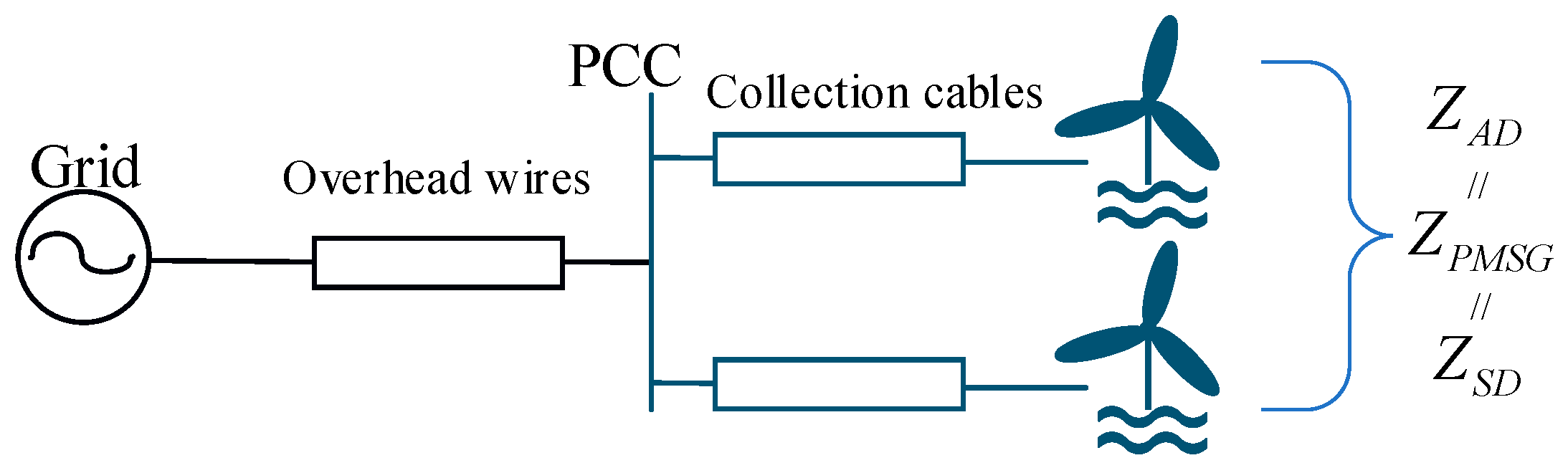
A typical wind farm grid-connected system [21] is shown in Figure 1. The grid-connected system consists of several Permanent Magnetic Synchronous Generators (PMSGs), collection cables, transmission cables, and the onshore grid.
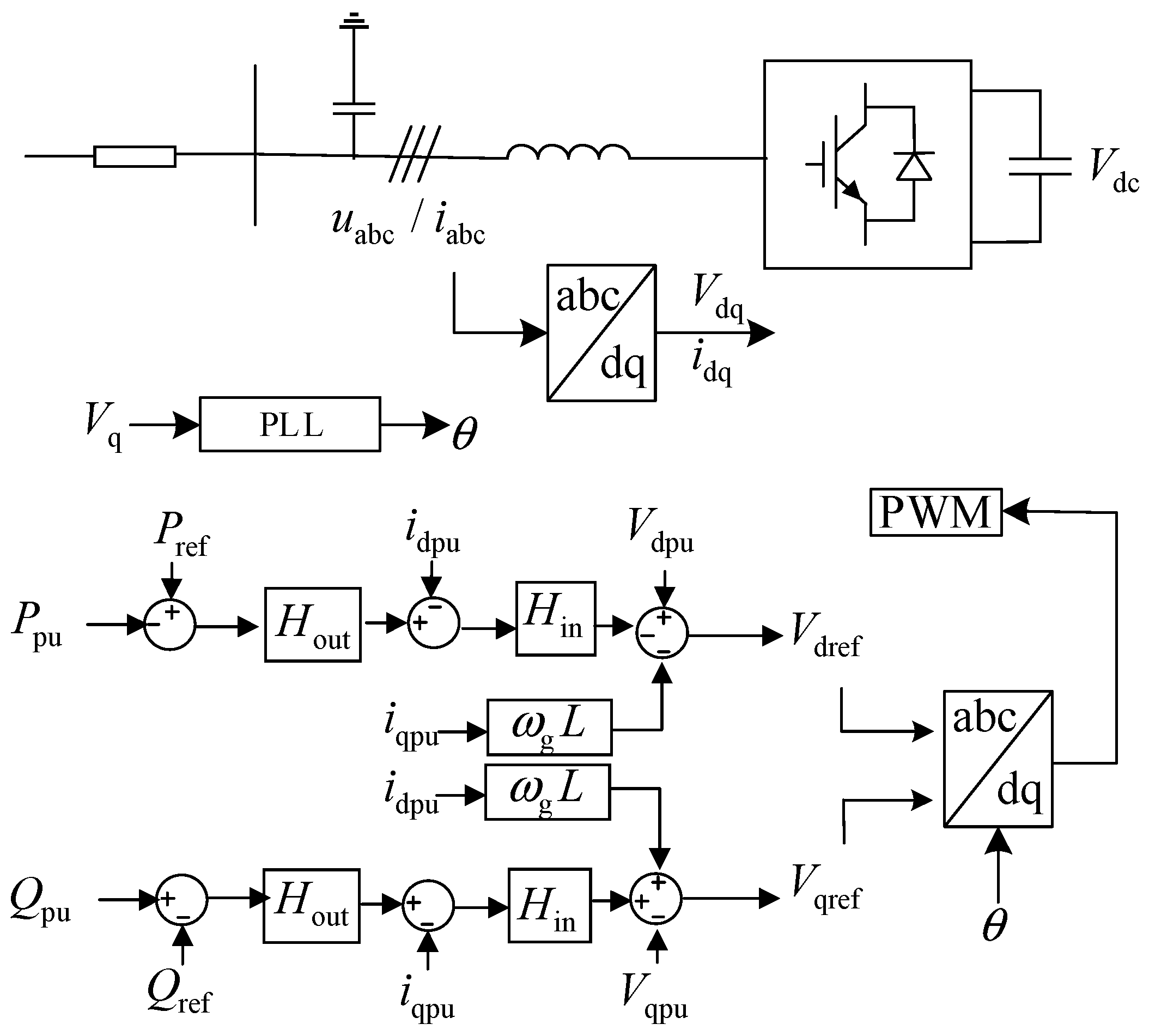
The grid-side converter (GSC) of the PMSG employs a constant-power control strategy. The main control loops are illustrated in Figure A1, where P r e f , Q r e f , P p u , and Q p u represent the active and reactive reference values and actual values, respectively; K p , o u t , K i , o u t , K p , i n and K i , i n denote the proportional and integral coefficients of the power outer loop and current inner loop, respectively. After the control loop obtains the dq-axis voltage reference values V d r e f and V q r e f , it enters the PWM signal modulation module to execute the constant-power control strategy.
Denote the small-signal vector [22] expressions for the PMSG AC port A-phase current and voltage as I a p and U ap . Establish the disturbance transfer functions between the electrical quantities in the control loop and I a and V a . Based on this, further derive the port frequency-domain impedance model of the inverter as shown in Equation (1), where L is the wind turbine outlet inductance value, corresponding to L in Figure A1. G U , t f , u represents the disturbance transfer function for the frequency-specific disturbance component of the small-signal disturbance in the frequency domain from the AC-side voltage to the valve-side voltage. G P L L , t f , u denotes the disturbance transfer function from the phase output of the phase-locked loop (PLL) to the valve-side voltage. G I , t f , u signifies the disturbance transfer function for the frequency-specific disturbance component of the small-signal disturbance in the frequency domain from the AC-side current to the valve-side voltage. G P L L indicates the disturbance transfer function from the AC-side voltage to the phase output of the PLL. For specific parameters and expressions of meaning, refer to Formula (A1).
Z i n v 0 ( s ) = s L G I , t f , u ( s ) G U , t f , u ( s ) + G P L L , t f , u ( s ) 1
G P L L , t f , u ( s ) = G P L L ( s ) G U , t f , u ( s )

2.2. Dynamic Order Reduction Method for PMSG Frequency-Domain Impedance

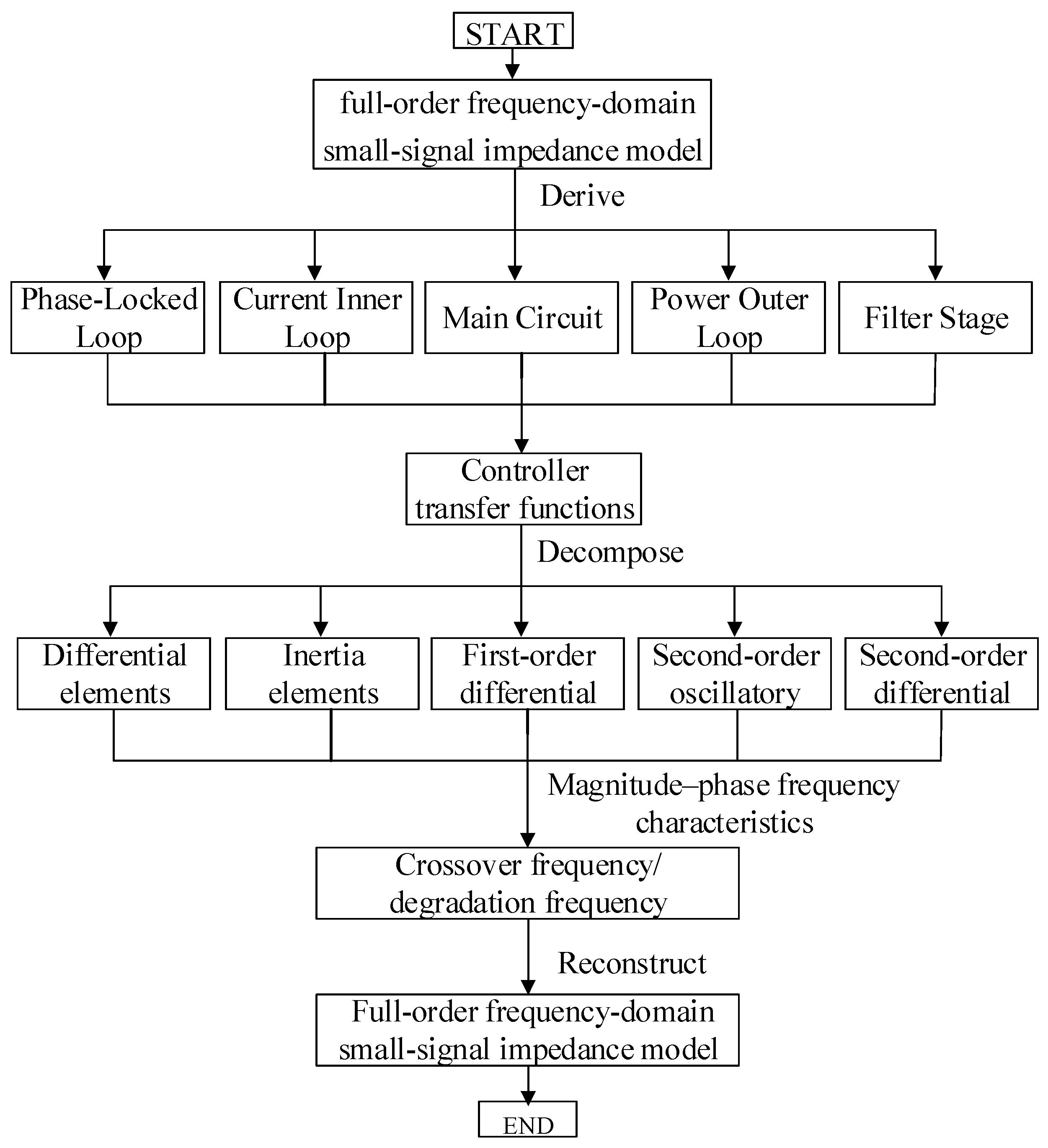
The PMSG control system involves multiple controllers interacting under mutual constraints to achieve flexible control and stable operation according to set objectives. The interplay among different controllers makes it difficult to identify which controller plays a critical role in different frequency bands. To gain a more intuitive understanding of the frequency-domain operation of PMSG controllers while reducing operational and computational complexity, a dynamic order reduction method applicable to the PMSG frequency-domain impedance model is proposed. This approach achieves order reduction of the impedance model across different frequency bands based on the varying influence levels of controllers within each band. The method first establishes the disturbance transfer function of the control loop using the frequency-domain small-signal disturbance method. After decomposing typical loops, it solves for their Bode plots and cut-off frequencies based on their transfer functions. After considering engineering margin and fundamental frequency shift, the controller’s influence band is determined. The controller’s degradation frequency is identified, and beyond this frequency, the link undergoes order reduction simplification. Following degradation of the primary controller, the final PMSG frequency-domain reduced-order impedance model is established.
As shown in Equation (A2) in the Appendix A, the original full-order impedance model exhibits combined interactive effects from the phase-locked loop (PLL), current inner loop, power outer loop, filter stage, and wind turbine outlet inductance. The frequency-domain characteristics of each controller within the impedance model are determined by its inherent performance. This section describes the frequency band distribution characteristics of the controller/elements by determining their influence bands within the full-order impedance. The final term in the denominator represents the dq coupling term in the PLL: G θ , c . In practice, the disturbance from small voltage/current perturbations to the PLL is negligible, exerting minimal influence on the full-order impedance curve of the direct-drive wind turbines. This coupling term can be disregarded, enabling the use of Equation (A3) for dynamic order reduction.
(1)
First, starting from the inherent properties of each control loop transfer function, consider the impact of a specific loop—such as the inner loop as a whole, the outer loop as a whole, or the phase-locked loop—on the frequency-domain impedance expression. This involves deriving the disturbance component transfer function for a given loop based on the disturbance signal and the control loop transmission path.
(2)
Decompose the transfer functions derived in Step 1 for primary control elements into typical components: differential elements, inertia elements, first-order differential elements, second-order oscillatory elements, second-order differential elements, etc. This enables further analysis of the magnitude of influence exerted by a specific element or part of an element within certain frequency bands.
(3)
Analyze the frequency bands where each decomposed typical element acts on the Bode plot of the transfer function. Identify the crossover frequency, and consider a tenfold engineering margin and the fundamental frequency shift to obtain the degradation frequency for that element. Perform order reduction of the transfer function at the degradation frequency, thereby completing the dynamic order reduction of this control element within the full-order impedance expression.
(4)
Repeat the above process for primary control elements, organize the degradation frequencies, and complete the reconstruction of the combined impedance model after dynamic order reduction across different frequency bands. The complete process is shown in the flowchart in Figure 2.
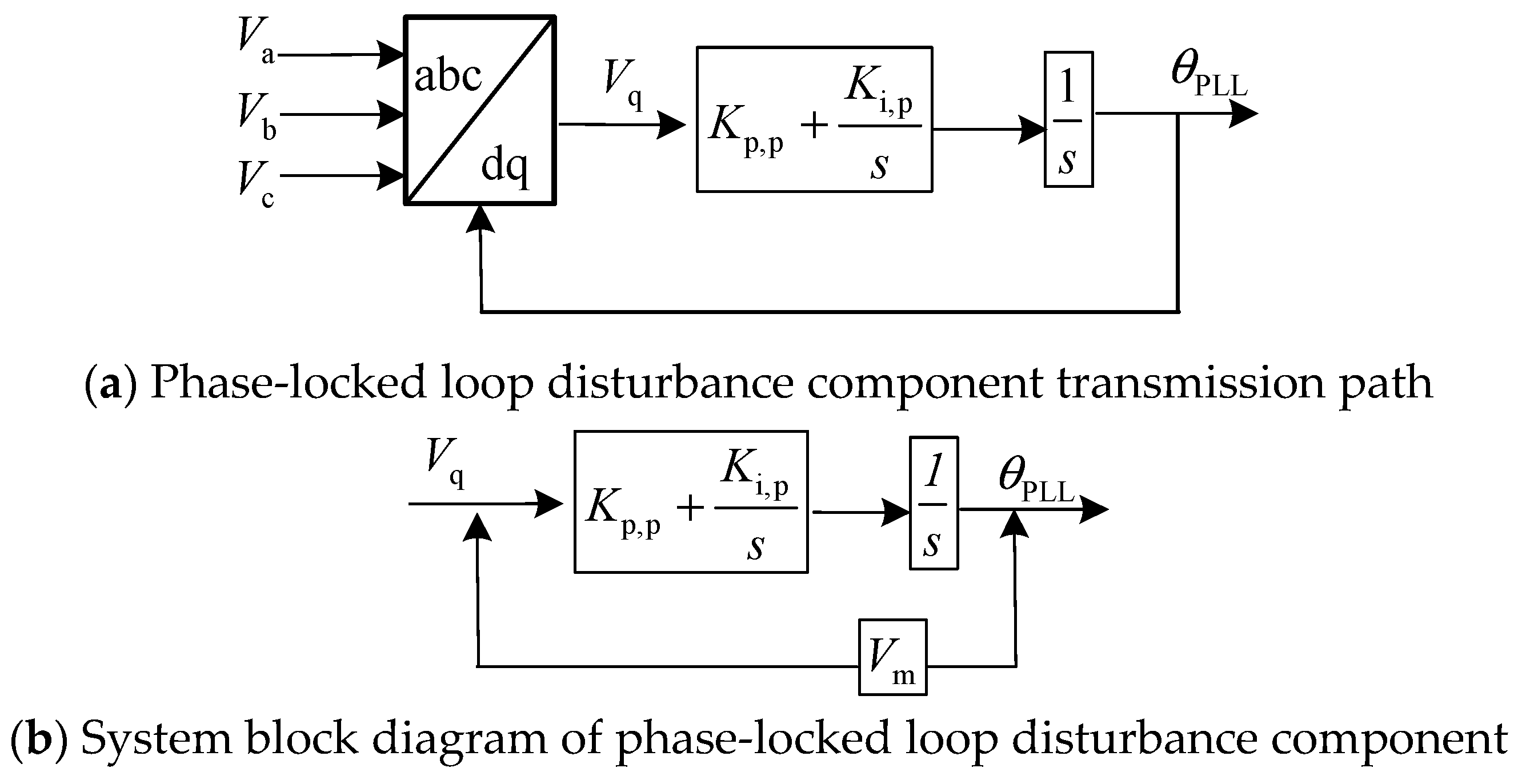
Illustrate the above process using a phase-locked loop (PLL) as an example. The disturbance variable transmission path entering the PLL is shown in Figure A2.
Under PLL control, small-signal AC voltage disturbances introduce small-signal components into the phase-locked angle. Calculating the disturbance transfer function from the AC measurement voltage to the PLL output phase yields:
θ p = H P L L ( s ) 1 + V m H P L L ( s ) U a p H P L L ( s ) = 1 s ( K p , p + K i , p s )
G ( s ) =   V m s H P L L ( s ) =   K i , p V m s 2 ( K p , p K i , p s + 1 )
In the equation, K P , P and K i , p represent the proportional and integral coefficients of the PLL PI stage, respectively. V m denotes the steady-state voltage value. θ p and U a p correspond to the phase disturbance signal component and the AC-side voltage disturbance signal component of the PLL output, respectively. The PLL control loop in the rotating coordinate system, derived from the disturbance transfer function, is shown in Figure A2b.
The PLL small disturbance transfer function incorporates an integrator and a first-order differentiator, with a crossover frequency of K i , p / K p , p and K p , o u t . Before the crossover frequency, the two integrators dominate; after it, both integrator and differentiator contribute, though only the integrator V m K p , p / s remains dominant. Thus, the PLL transfer function post-crossover can be simplified to this single integrator. Considering engineering margin, the degradation frequency point is typically set to ten times the transition frequency: f d g , p . At this point, the original full-order impedance expression G P L L degrades to a single inertia element after f d g , p . The expression then becomes G P L L .
G P L L ( s ) = j G v H P L L ( s ) s s 0 + H P L L ( s ) G v V m
G P L L ( s ) = j G v K p _ p s s 0 + K p , p G v V m
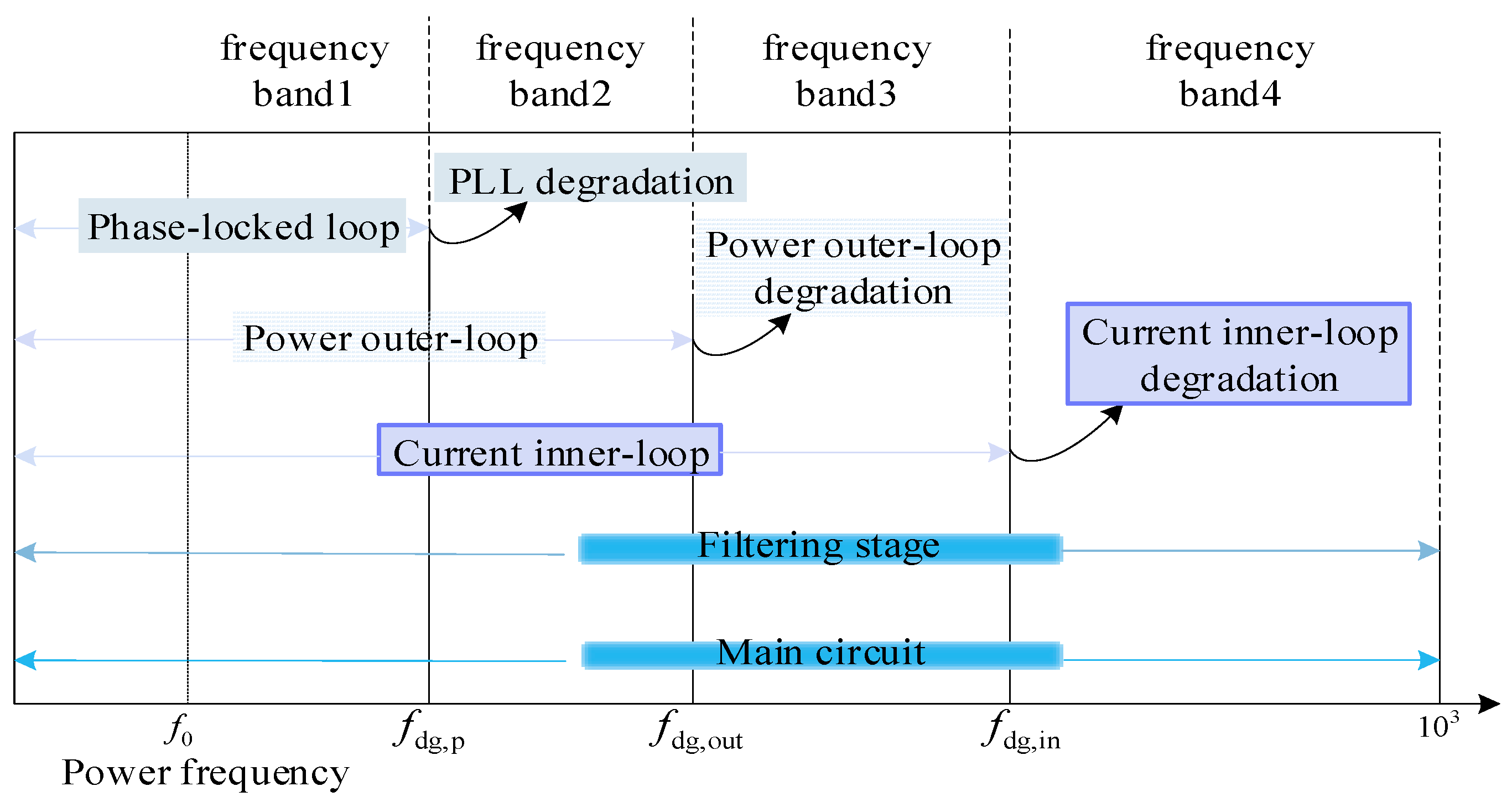
Following the above procedure, solve for the inner-loop degenerate frequency f d g , i n , the outer-loop degenerate frequency f d g , o u t , and the filtering stage degenerate frequency f d g , f . Based on these degradation frequencies, the effective frequency bands for each controller were determined, establishing the frequency band distribution pattern shown in Figure 3.
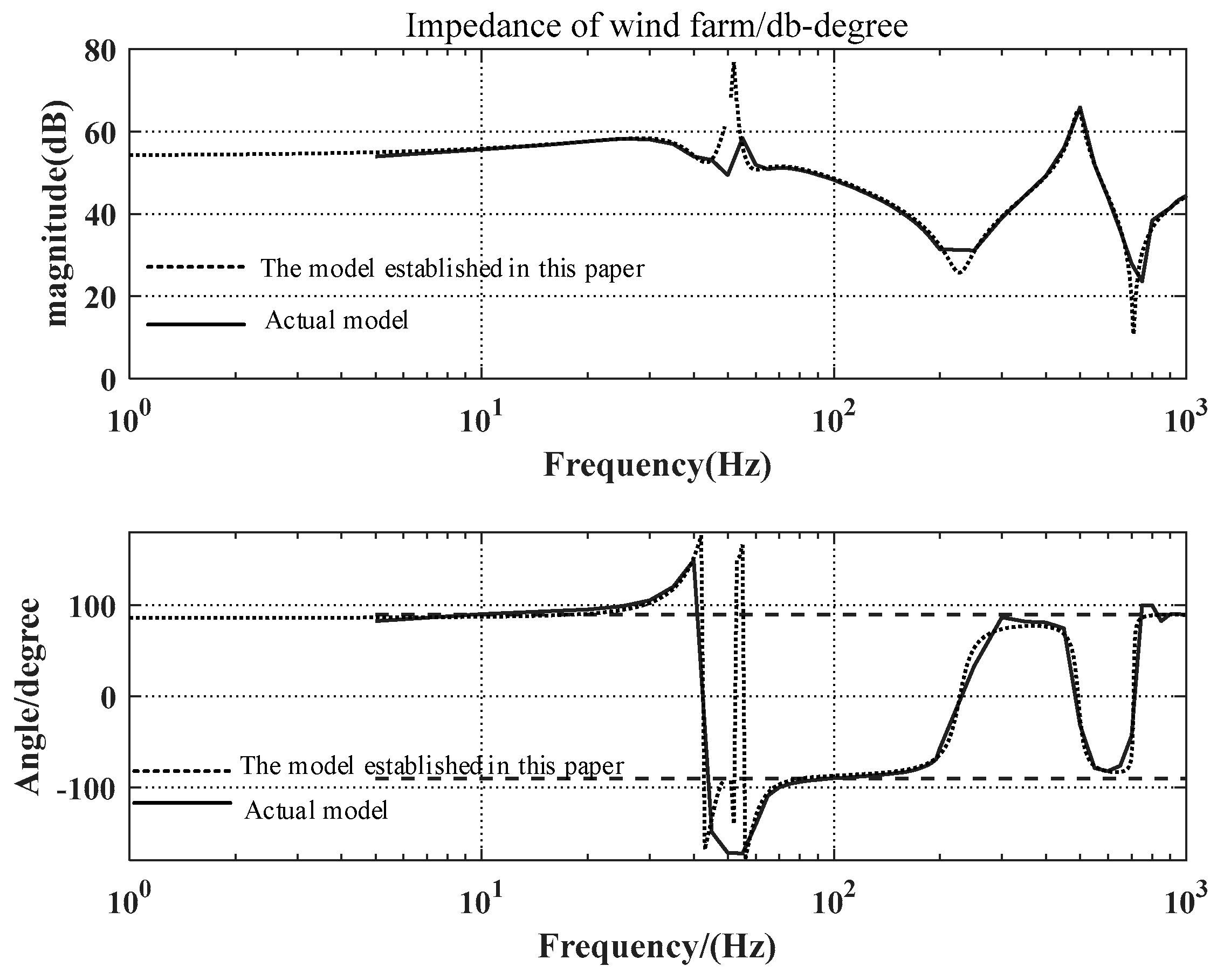
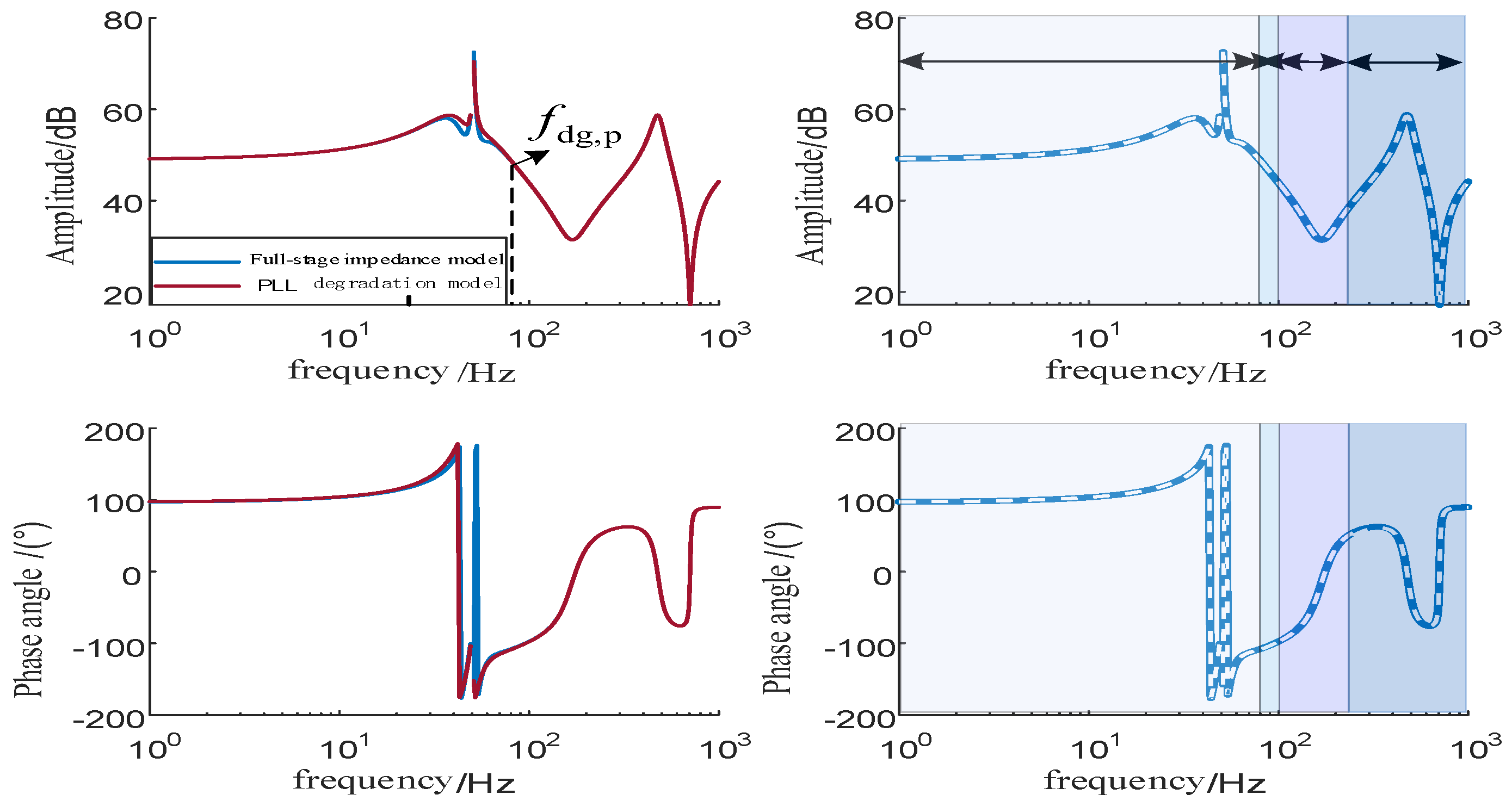
To validate the rationality of model simplification, comparisons between the reduced-order model after PLL degradation and the original full-order model, along with composite frequency band comparisons, are presented. Following the aforementioned dynamic frequency band reduction of the wind turbine impedance model, the resulting frequency band comparisons are shown in Figure 4.
As shown in Figure 4, the impedance characteristics of the reduced-order model and the full-order model are essentially identical. Across the entire frequency range of 0–300 Hz, the maximum deviation in impedance magnitude between the reduced-order and full-order models is only 2 dB, while the maximum phase deviation is ≤10°. Therefore, the reduced-order model accurately reflects the dynamic characteristics of the converter within this frequency band.

3. Analysis of Parallel Impedance Coupling Characteristics

The control systems of the two wind turbines are independent, primarily interacting through external characteristics. A key research direction for suppressing multi-mode resonance in wind farms involves adjusting the impedance characteristics of the two turbines to achieve mutual coordination in external characteristics such as current, voltage, and power, thereby enhancing transmission quality.

3.1. Phase-Frequency Characteristics of Parallel Coupling Impedance

Assuming the impedances of the two wind turbines are Z 1 θ 1 and Z 2 θ 2 , respectively, the parallel-coupled impedance can be expressed as:
Z · = Z 1 Z 2 ( θ 1 + θ 2 ) Z 1 θ 1 + Z 2 θ 2
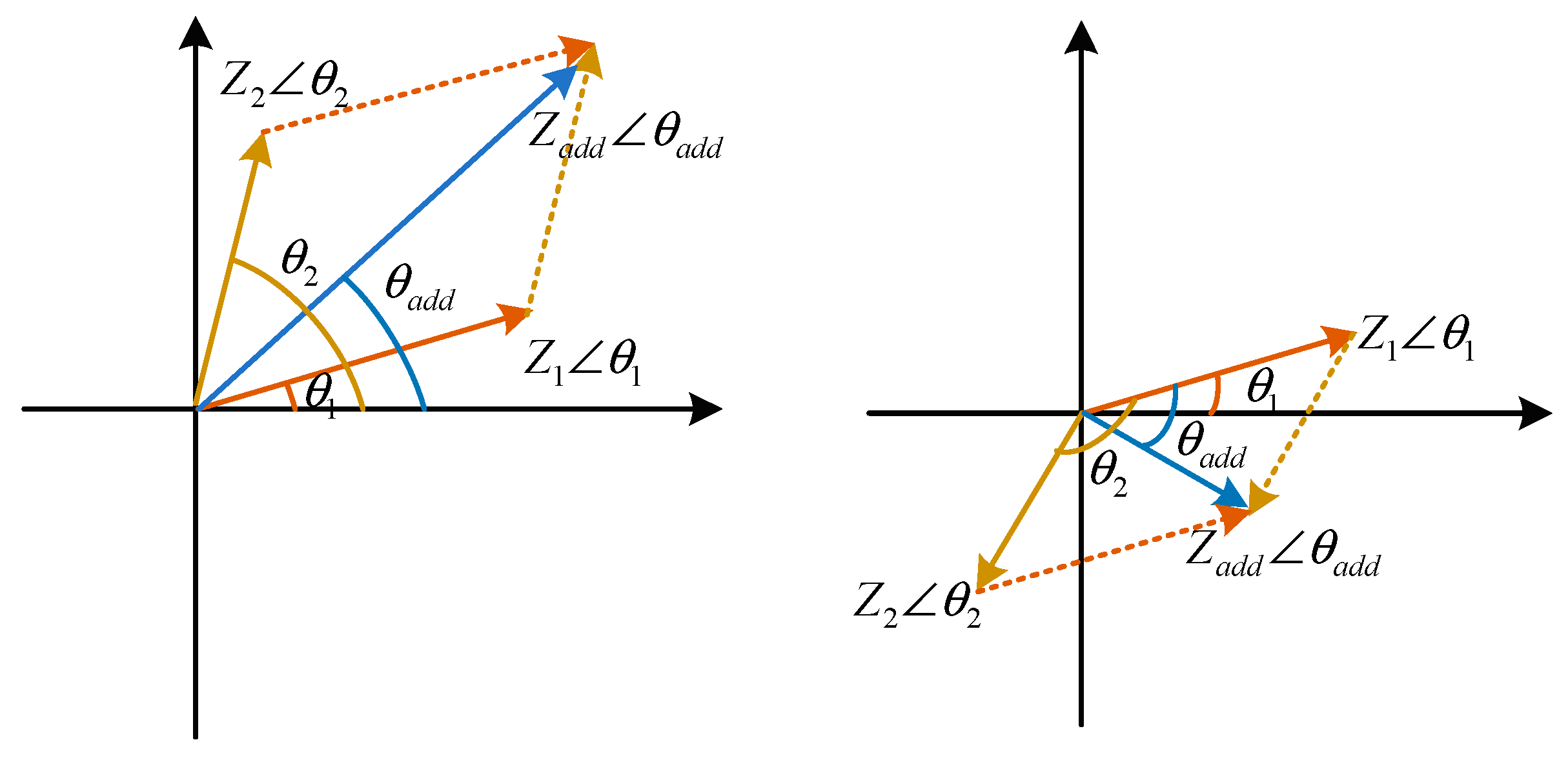
The phase angle of the total impedance after parallel connection is easily obtained as θ = θ 1 + θ 2 θ a d d , where θ a d d is the phase angle after adding the two impedances. As shown in Figure 4, θ a d d lies between θ 1 and θ 2 . This principle is termed phase angle neutralization. Consequently, the phase angle θ after parallel connection also falls between these two values. Therefore, altering the phase angle of one or both wind turbines can modify the impedance phase angle of the parallel inverter. However, care must be taken to avoid parallel resonance between the two wind turbines, where the parallel impedance behaves as purely resistive. The phase angle relationship of parallel impedances is shown in Figure 5.

3.2. Parallel Impedance Damping Characteristics

The range of magnitude values for the impedance after parallel connection of the two wind turbines is:
Z 1 Z 2 Z 1 + Z 2 Z Z 1 Z 2 Z 1 Z 2
The specific values depend on the magnitudes of Z 1 and Z 2 . However, the effect of Z1 and Z2 variations on the parallel impedance can be determined through quantitative relationships. First, rewrite the expression in admittance form:
Y 1 · = 1 Z 1 θ 1 , Y 2 · = 1 Z 2 θ 2
Re ( Y · ) = Z 1 1 cos θ 1 + Z 2 1 cos θ 2
Im ( Y · ) = Z 1 1 sin ( θ 1 ) + Z 2 1 sin ( θ 2 )
Then the admittance after parallel connection is:
Y · =   ( ( Z 1 1 cos θ 1 + Z 2 1 cos θ 2 ) 2 + ( Z 1 1 sin θ 1 + Z 2 1 sin θ 2 ) 2 ) =   Z 1 2 + Z 2 2 + 2 Z 1 2 Z 2 2 cos ( θ 1 θ 2 )
The parallel impedance is:
Z · = 1 Z 1 2 + Z 2 2 + 2 Z 1 2 Z 2 2 cos ( θ 1 θ 2 ) 4
As shown in Equation (13), given the fixed impedance of the first wind turbine, to maximize the magnitude of the parallel-coupled impedance, the magnitude of the second wind turbine’s impedance should be as large as possible, while its phase angle should be as different as possible from that of the first wind turbine.
In summary, by rationally designing the frequency-domain impedances of both wind turbines, the characteristics of the parallel-coupled impedance can be optimized. This improves the dynamic performance of parallel-connected wind turbines, thereby enhancing the stability and reliability of the power transmission system.

4. Additional Control Design

4.1. Additional Damping Control

Power system stabilizers provide positive damping in excitation control systems to reduce oscillatory divergence, making them widely adopted. Its primary principle involves superimposing a control signal onto the excitation control system. When the system is unstable, the input signal causing instability is phase-shifted via a phase shifter and fed back as a control signal into the stabilizer’s control system, forming a feedback loop. This adjusts generator excitation to generate a damping torque, thereby enhancing the generator’s damping effect on power oscillations.
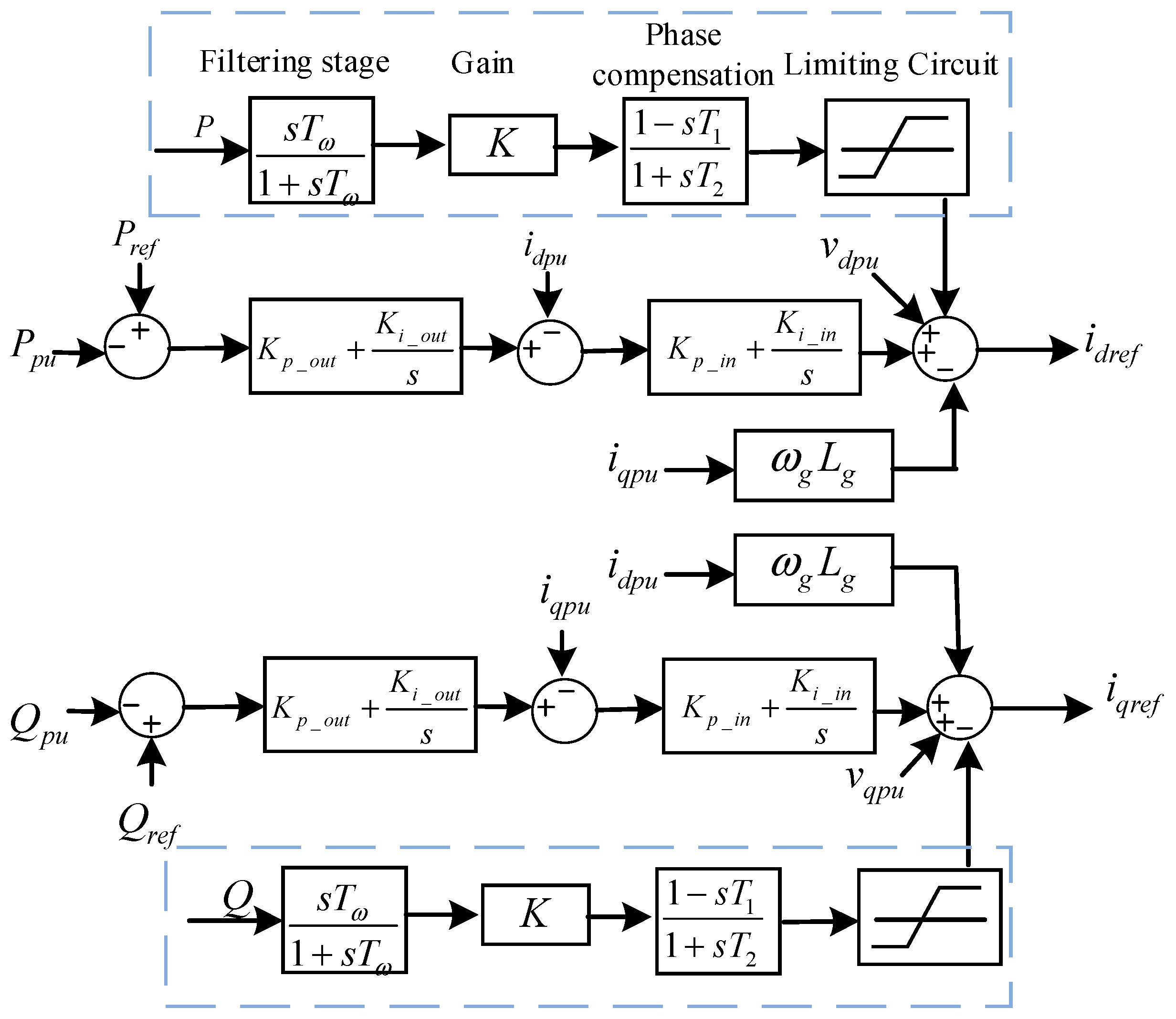
Based on the above, the selection of the damping controller’s input signal requires comprehensive consideration. It must accurately reflect the characteristics or source of system oscillations while being easily measurable and controllable. Since the main output of the wind turbine is power energy, power is chosen as the input signal for the additional control. The control channel, as shown in Figure 6, filters the oscillation signal through a filtering stage, adjusts the phase difference via a phase compensation stage, and selects an appropriate gain to superimpose the oscillation signal onto the output channel, thereby achieving oscillation suppression.
Its primary principle involves superimposing a control signal onto the excitation control system [23]. When the system is unstable, the input signal causing instability is phase-shifted via a phase shifter and fed back as a control signal into the stabilizer’s control system, forming a feedback loop. This adjusts generator excitation to generate a damping torque, thereby enhancing the generator’s damping effect on power oscillations. This control loop primarily consists of four stages: input signal acquisition → filtering stage → phase compensation stage → gain adjustment stage. The input signal is selected as the active power deviation signal from the grid-connected side of the wind turbine, mainly because the power signal can be easily obtained through the sampling module of the wind turbine converter without requiring additional sensors, ensuring strong engineering feasibility. The filtering stage employs a second-order bandpass filter (BPF) to selectively extract power disturbance signals within the oscillation frequency band, thereby preventing non-oscillatory signals from interfering with control performance. The phase compensation stage utilizes a first-order lead/lag correction loop to compensate for phase delays introduced by oscillatory signals within the control channel. The gain adjustment stage dynamically modulates the control signal strength based on the amplitude of system oscillations [24,25].

4.2. Active Damping Based on Trap Filters

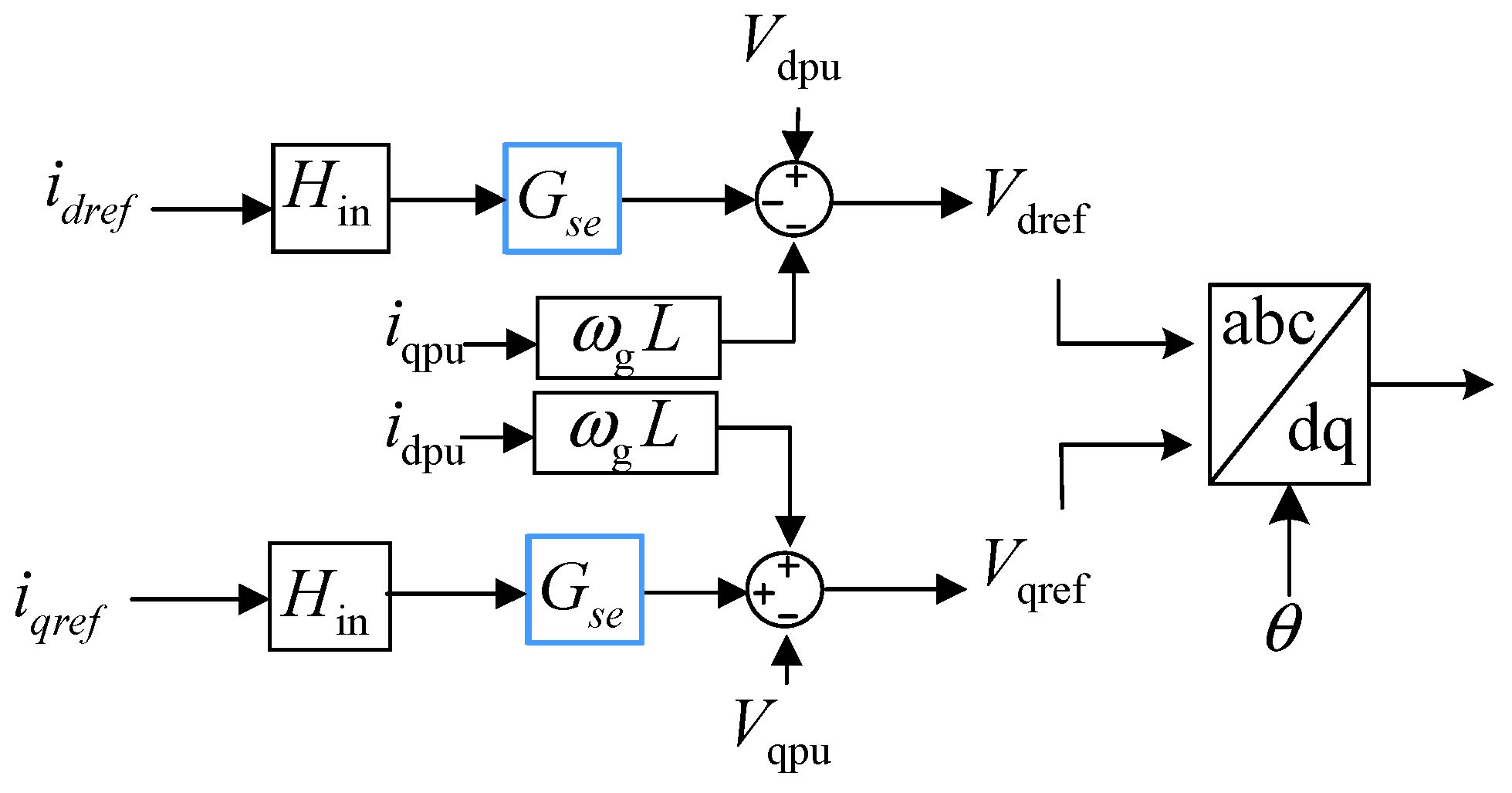
Active damping can be categorized into active damping based on notch filters [26,27] and active damping based on virtual resistors [28]. Active damping control based on notch filters involves altering the overall impedance characteristics of the inverter through series correction in the forward channel containing the current controller. By leveraging the notch filter’s properties to modify the amplitude-frequency response of the original control system, stability is achieved. This approach features a simple control structure, with the primary types of cascaded filters being low-pass filters, notch filters, and lead/lag phase compensators. Figure 7 shows the control channel diagram, where G s e ( s ) represents the transfer function of the desired filter. Adjusting the notch filter modifies the impedance characteristics of the system across specific frequency bands.
As indicated in Section 2.2 regarding frequency band segmentation for direct-drive wind turbines, the current inner loop exerts a non-negligible influence in oscillation-prone frequency domains such as sub-/super-synchronous and mid-to-high frequencies. Therefore, active damping based on notch filters is selected for the system phase characteristic compensation strategy.

4.3. Design of Coupling Impedance for Parallel Wind Turbines

Based on the theoretical analysis and research of parallel coupling impedance in Section 2, this paper enhances the damping characteristics of the first parallel wind turbines through additional damping control. Active damping based on a notch filter is employed to optimize the phase-frequency characteristics of the second parallel wind turbines.
(1) Design Principle: For the additional damping controller, a combination of a bandpass filter and a phase compensation function is selected. The bandpass filter screens oscillation signals, while the phase-leading/lagging function corrects the phase of oscillation signals. This is added to the control loop to achieve an overall enhancement of wind turbines damping within the 0–300 Hz oscillation frequency band prone to oscillation.
For active damping strategies, considering that a single notch filter or filter has difficulty achieving phase correction across the extended 0–300 Hz frequency band, a combination of low-pass filters and notch filters is selected to accomplish this objective. Based on the analysis in Section 2.2, parameter tuning for the active damping strategy follows these principles: The objective is to improve the wind turbine phase-frequency characteristics. The original wind turbine impedance exhibits inductive behavior in the sub-synchronous frequency band and capacitive behavior in the super-synchronous and mid-to-high frequency bands. Therefore, after adding active damping control, the following is desired: Objective Function 1: The wind turbine impedance should approach resistive behavior in both the sub-synchronous/super-synchronous and mid-to-high frequency bands. After parallel connection, the impedance in the sub-synchronous band should be inductive, while in the super-synchronous and mid-to-high frequency bands, it should exhibit relatively weak capacitive behavior. Objective Function 2: The parallel-coupled impedance should be inductive in both the sub-synchronous and super-synchronous frequency bands to effectively avoid resonance with the similarly inductive power grid. Simultaneously, the risk of resonance with another wind turbine must be minimized. This requires positioning the phase angle of the parallel impedance as far as possible from the zero axis. However, to maintain good damping characteristics, the phase angle should not be excessively large, necessitating parameter tuning.
(2) Parameter Tuning: For additional damping control, an iterative method can be employed to determine filter parameters and the time constants of phase-lead/lag functions, which will not be elaborated upon here. After obtaining the complete parameters and impedance characteristics for the additional damping control, proceed with the design and tuning of the active damping control parameters. The parameters requiring tuning are the characteristic frequency of the low-pass filter, the overall transfer function gain, the characteristic frequency of the notch filter, and the damping ratio. When setting notch filter parameters, the quality factor Q must be considered, typically requiring Q > 2.5. Tune these parameters according to the objective functions and constraints defined in Equations (14)–(16).
Objective   1 :   min   f = 1 300 a n g l e ( Z A D )
Objective   2 :   max   f = 1 300 45 a n g l e ( Z A D / / Z S D )
s . t . x 1 = 50 n , 1 n 6 0 < x 2 10 x 3 = 50 n , 1 n 6 0 < x 4 1
In the above equations, x 1 , x 2 , x 3 , and x 4 represent the four parameters requiring tuning: the filter characteristic frequency, transfer function gain, notch filter characteristic frequency, and damping ratio, respectively. ZAD is the total impedance of the wind turbines and the outlet circuit with the active damping strategy applied. ZSD is the total impedance of the wind turbines and the outlet circuit with the additional damping control applied. Objective function 1 seeks the minimum sum of impedance phase angles, and objective function 2 seeks the sum of phase angles for the parallel-coupled impedance, with 45° selected as the target phase angle. The results are shown in Table 2.
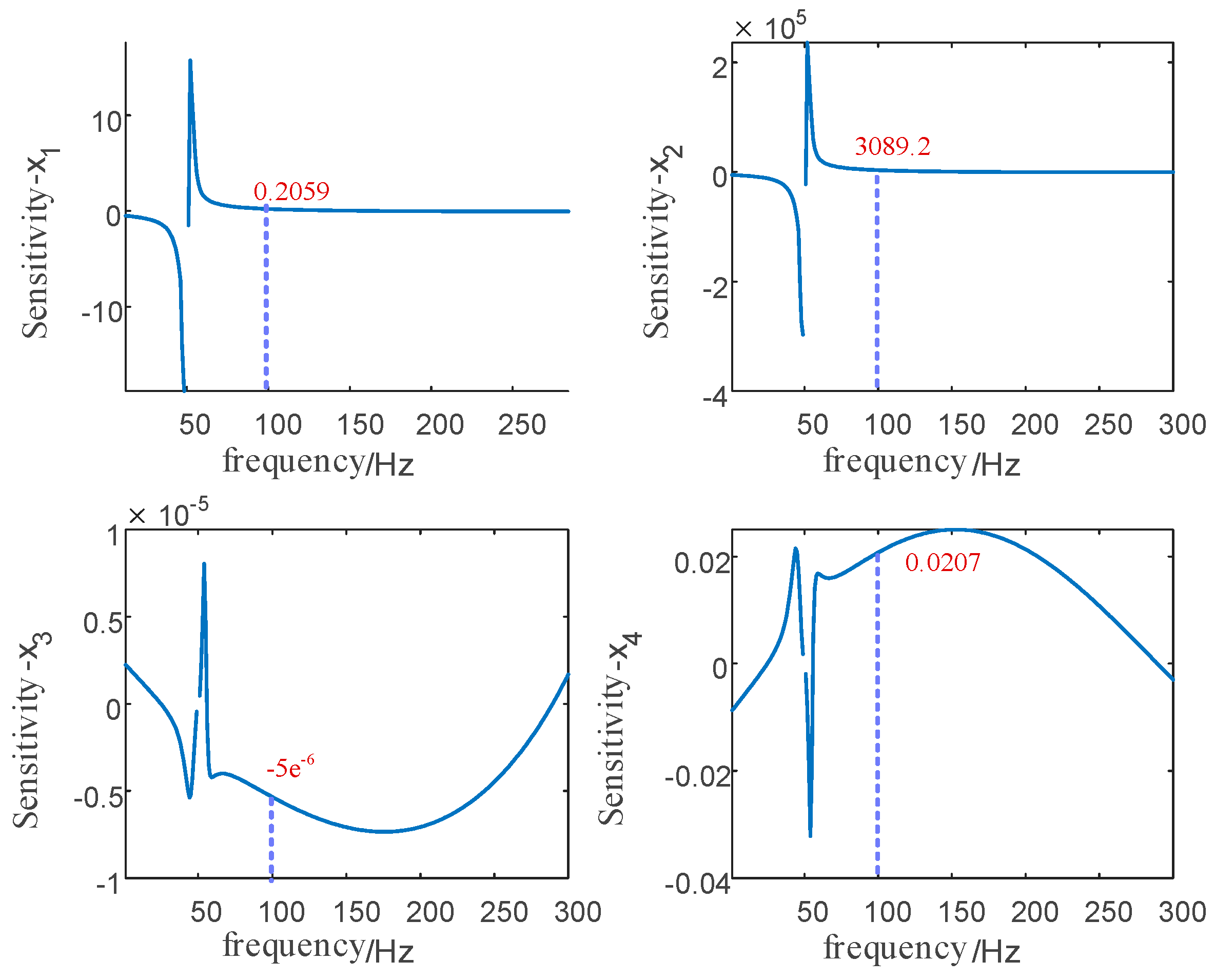
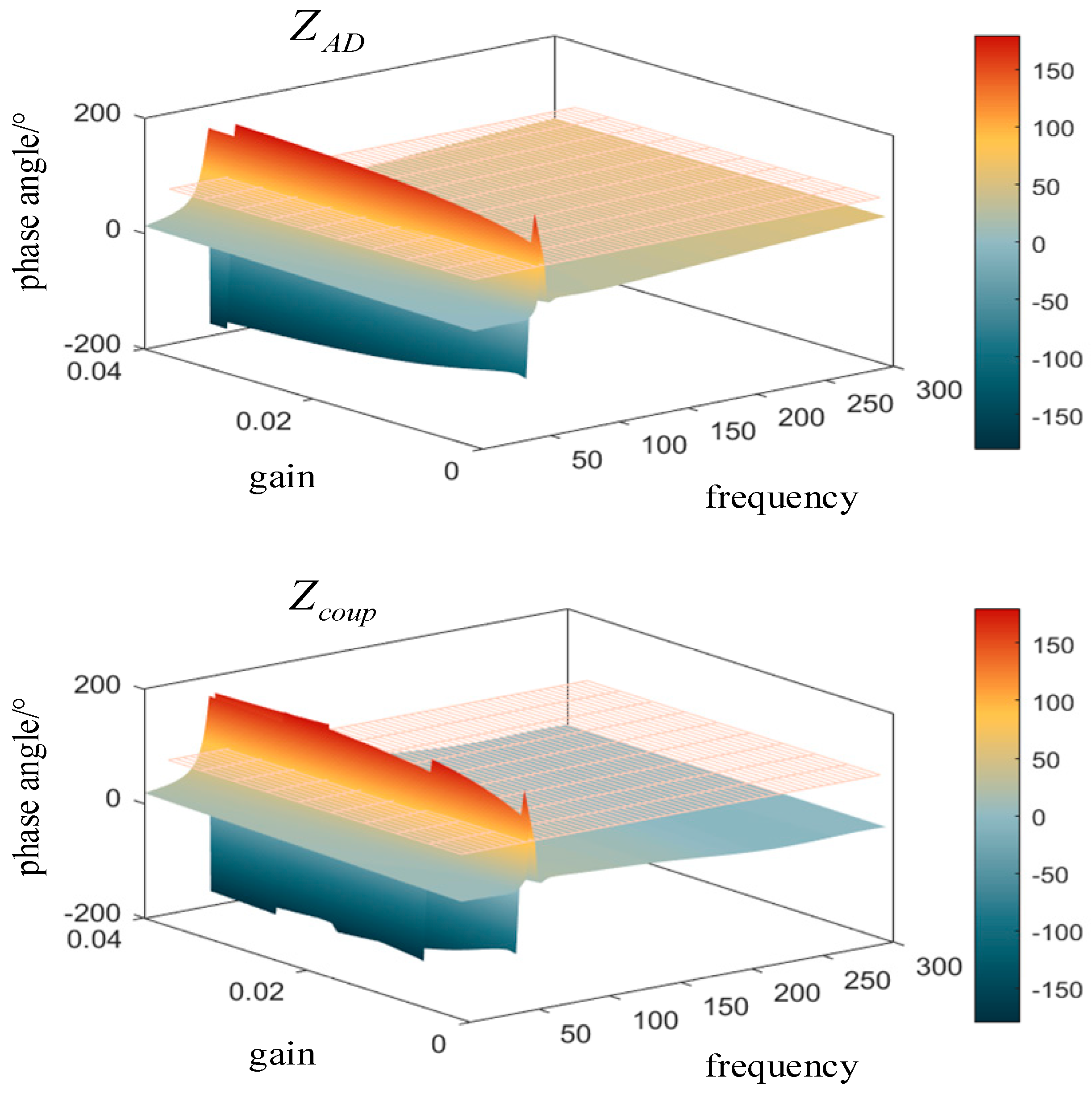
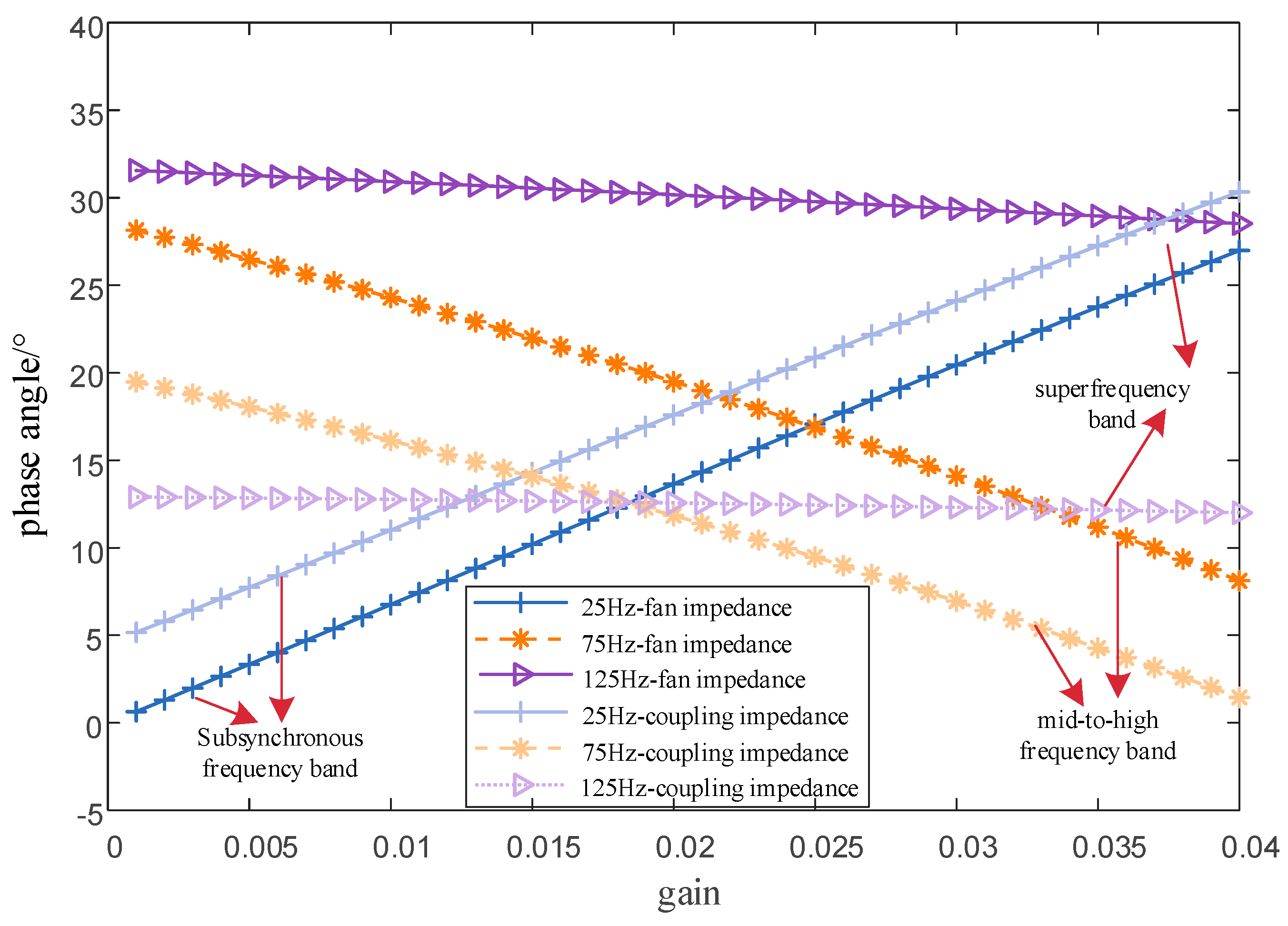
The results indicate that only the gain parameter is inconsistent. Further analysis of parameter sensitivity, as shown in Figure A3, reveals that the impedance phase angle exhibits extremely high sensitivity to gain. Therefore, the relationship between gain and both the wind turbine impedance and coupling impedance is established, as depicted in Figure 8 and Figure 9. Figure 9 specifically presents a cross-section of the three-dimensional relationship among gain, frequency, and phase angle. The phase angle variation is observed to be largely smooth, prompting the selection of three representative frequencies for the sub-/super-synchronous band and the mid-to-highfrequency band. Here, Z c o u p denotes the coupling impedance.
As shown in the figures, impedance in the mid-to-high frequency band exhibits limited sensitivity to gain changes. However, in the sub-/super-synchronous phase, significant variations occur with opposite trends. The phase angle of the wind turbines and parallel coupling impedance increases with rising gain in the sub-synchronous band. At low gain, the coupling impedance approaches resistive behavior. Conversely, in the super-synchronous band, the phase angle decreases with increasing gain, and at high gain, the coupling impedance approaches resistive behavior. To minimize the frequency range where the coupling impedance exhibits resistive characteristics, a gain value of 0.02 was selected as the final parameter.
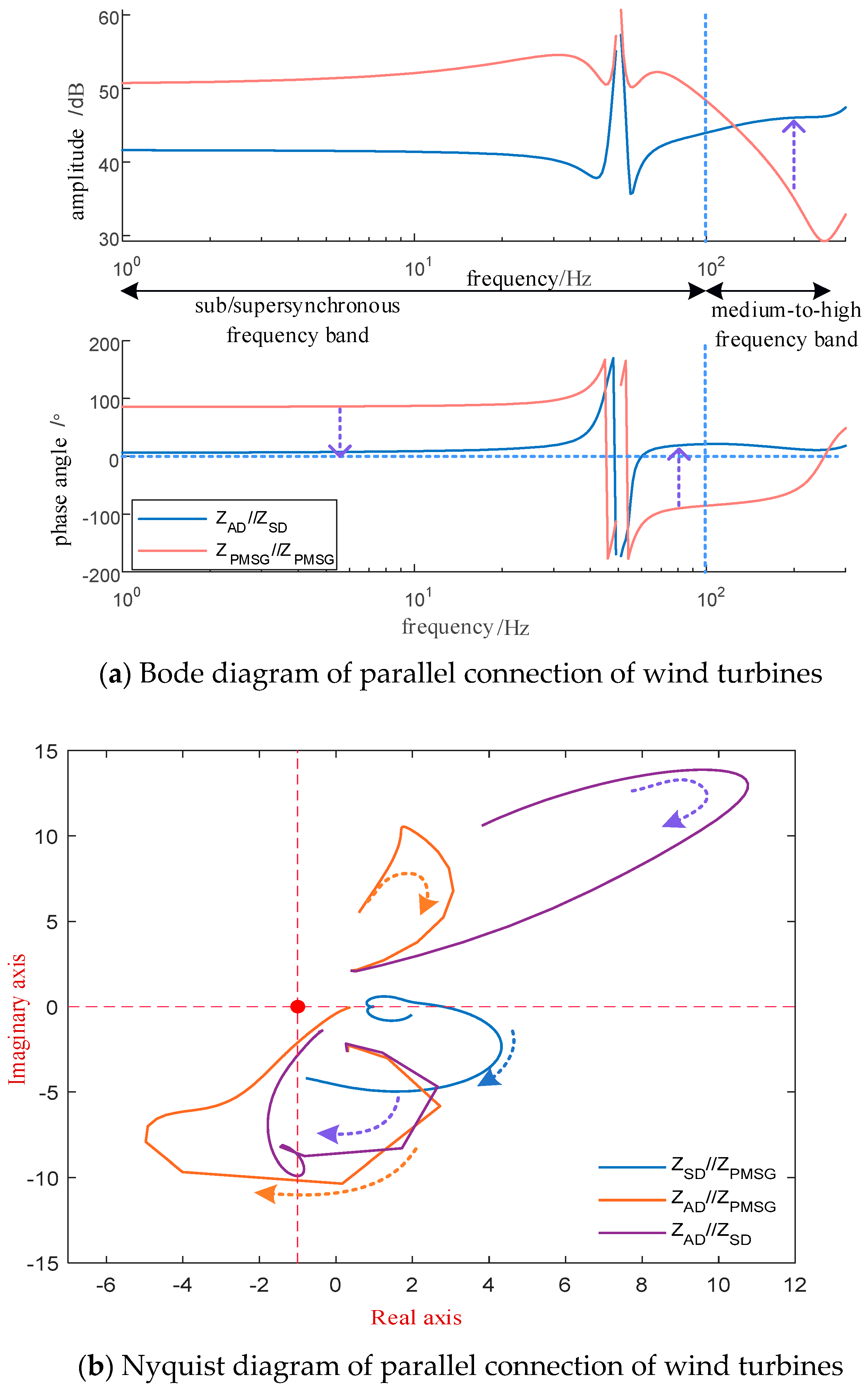
After determining the configuration and parameters of the two control loops, the Bode plot of the parallel impedance and the Nyquist plot of the impedance ratio are shown in Figure 10. The Bode plot indicates that although the amplitude of the parallel coupling impedance decreases in the sub-/super-synchronous frequency bands, it exhibits inductive characteristics. Therefore, there is no resonance risk with the similarly inductive power grid, and it possesses favorable damping properties. In the medium-to-high-frequency bands, the impedance amplitude significantly increases while the phase angle characteristics are optimized. Overall, the impedance characteristics demonstrate higher stability within the 0–300 Hz frequency range.

5. Simulation Verification

5.1. Analysis and Verification of Two Wind Turbines in an Infinite Grid

To validate the theoretical research described in, simulations were first conducted using a dual-wind turbine infinite grid model. Figure 11 shows the model topology. In the simulation system, the transmission lines are modeled as equivalent Π-type circuits. The converter control parameters for the wind turbine generator are derived from an operational wind turbine in a specific location in southern China, employing a full-stage detailed modeling approach. To validate the accuracy of the established wind turbine impedance model against the actual model, the author compared the frequency-domain mathematical model with the time-domain sweep results of the permanent magnet direct-drive wind turbine used. As shown in Figure A4 in the Appendix A, the frequency-domain impedance model of the wind turbine aligns with the time-domain sweep data.
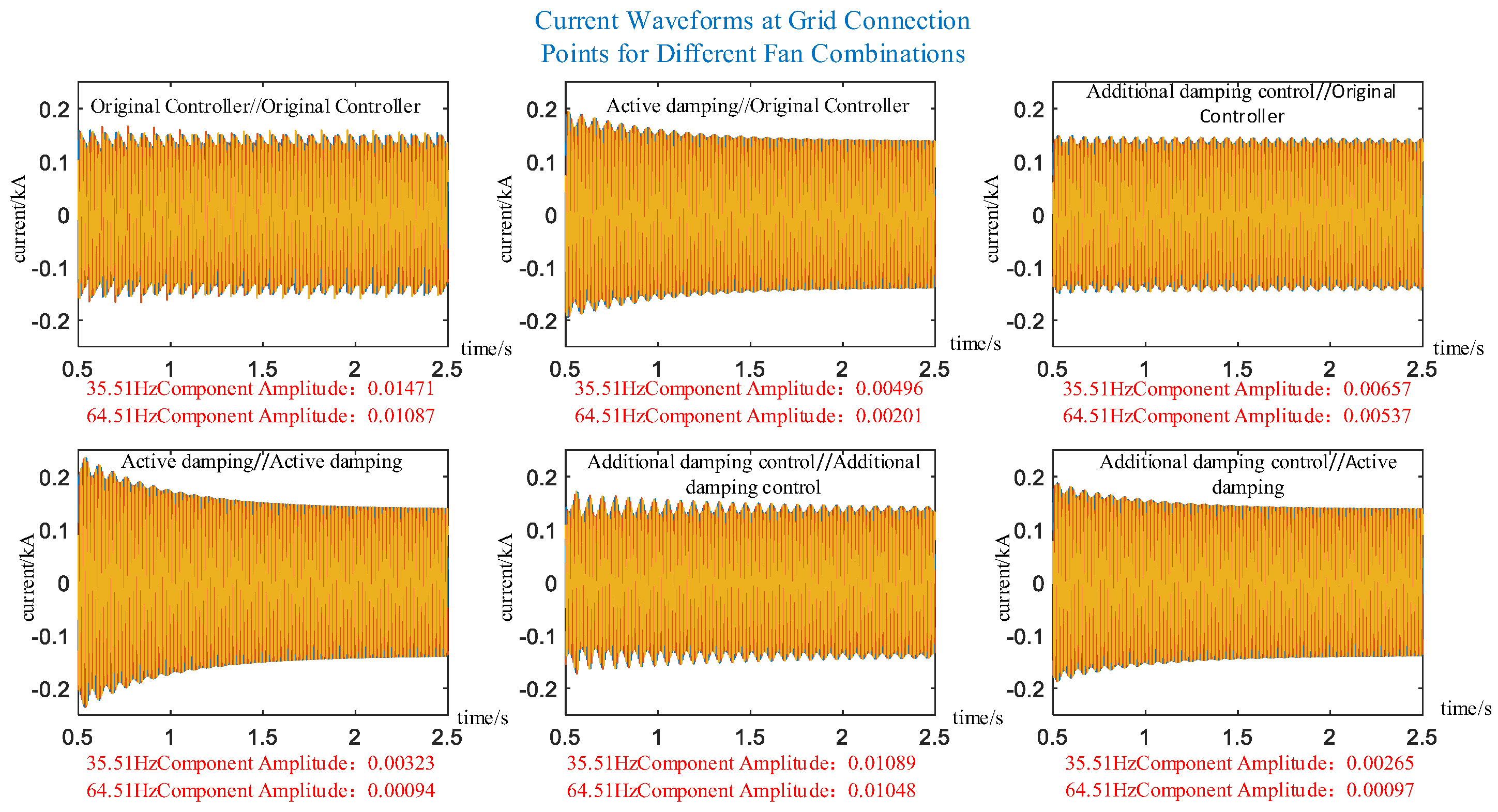
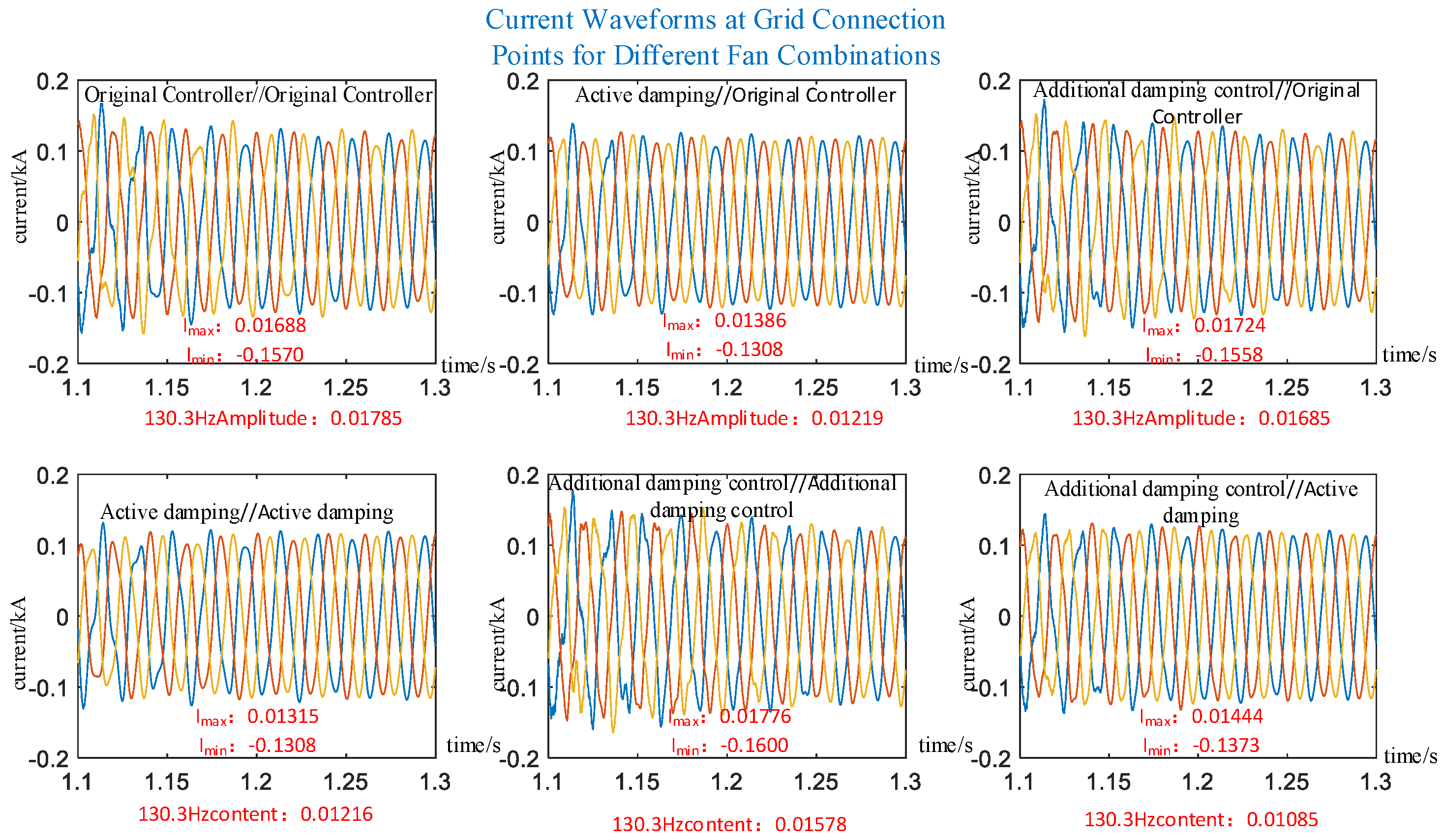
Furthermore, a time-domain simulation analysis of this wind farm was conducted. When grid parameters change, the system exhibits different resonance modes. The time-domain simulation waveforms were recorded for different control structures applied to the terminal wind turbine. The data analysis results are shown in Figure 12. These represent the time-domain responses of the system under disturbance, including sub/supersonic oscillations, medium-to-high-frequency oscillations, and specific harmonic sub-resonance.
Figure 12 presents the PCC current characteristics under different control combinations when grid parameters change: During sub-/super-synchronous frequency band oscillations, when single-unit control is applied, the Active damping group oscillates for 1.8 s, with amplitude values of 0.00496 and 0.00201 for the 35.51 Hz and 64.51 Hz components, respectively. The corresponding amplitudes for the Additional damping control group were 0.00657 and 0.00537. When both units employ additional control, the Active damping//Active damping group oscillates for 1.6 s, with the 35.51 Hz amplitude at 0.00323. The Additional damping control//Additional damping control group shows limited suppression, with the 35.51 Hz amplitude reaching 0.01089. The Additional damping control//Active damping group oscillates for 1.4 s, with the 35.51 Hz amplitude at 0.00265. Under medium-to-high-frequency oscillation conditions, when single units employ control, the Original Controller group shows 130.3 Hz component amplitude of 0.01785, the Active damping group records 0.01219, and the Additional damping control group registers 0.01685; when both units employ additional control, the 130.3 Hz component amplitudes for the Active damping//Active damping, Additional damping control//Additional damping control, and Additional damping control//Active damping groups are 0.01216, 0.01578, and 0.01085, respectively. When sub-/super-synchronous or medium-to-high-frequency oscillations occur, adjusting the wind turbine combination yields varying suppression effects on system resonance. When only a single wind turbine control structure is configured, active damping demonstrates superior suppression performance in the sub-/super-synchronous frequency band compared to additional damping control, due to its significant alteration of inductive/capacitive characteristics in this band. Conversely, in the medium-to-high-frequency band, additional damping control substantially enhances the overall damping of the wind turbines, resulting in superior suppression capability in the medium-to-high-frequency and harmonic frequency bands. When two wind turbines are configured with different control structures, the system demonstrates effective suppression of multi-modal resonance in both the sub-/super-synchronous frequency band and the mid-to-high-frequency band, further validating the accuracy of the aforementioned theoretical research.

5.2. Simulation Model Validation Using the S-Domain Node Admittance Matrix Method

The S-domain node admittance matrix method [29,30,31,32,33,34] shares the same purpose as modal analysis and eigenvalue analysis, all capable of analyzing system resonance stability. The former two rely on the system node admittance matrix, while the latter is based on state-space matrices for analysis. Compared to modal analysis, the S-domain node admittance matrix method can directly solve for the system resonance modes. The principles and procedures of the s-domain node admittance matrix are detailed in the referenced literature and will not be repeated here.
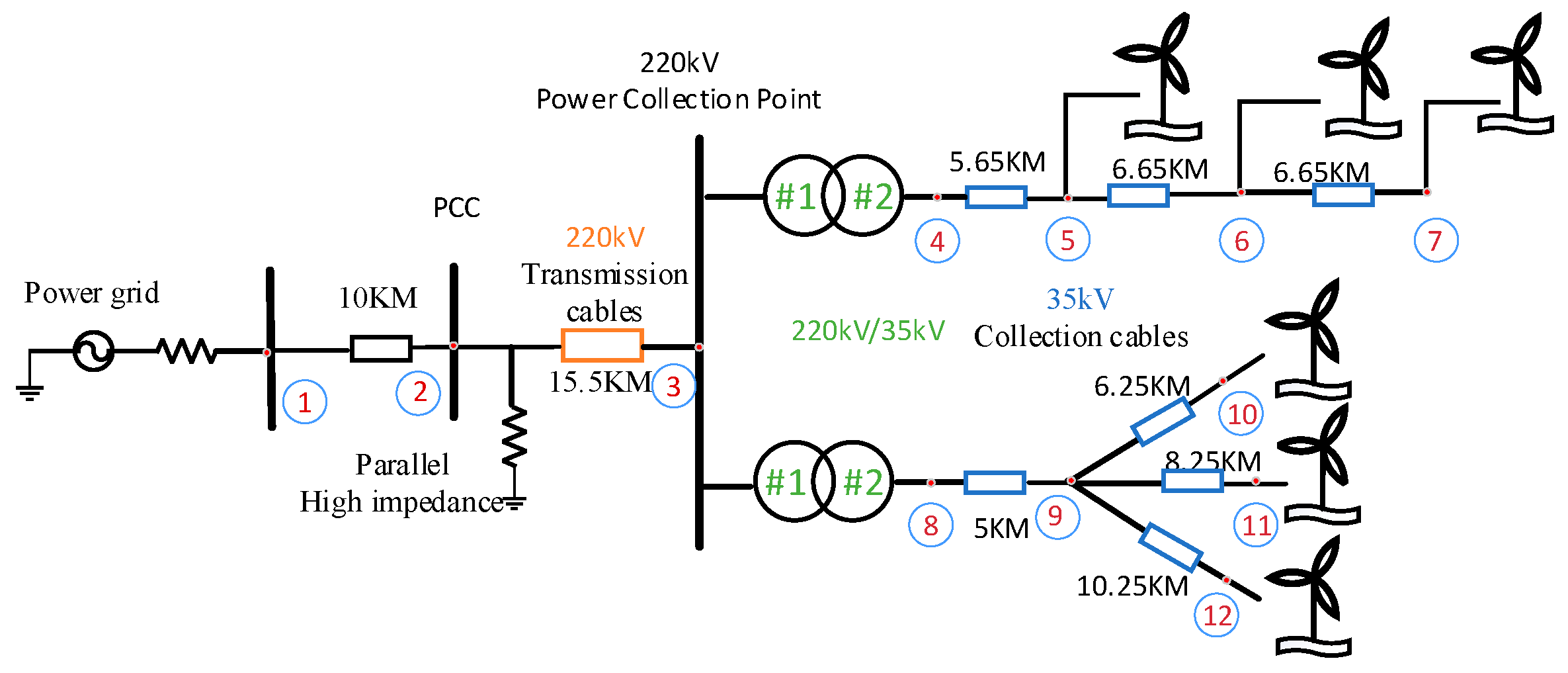
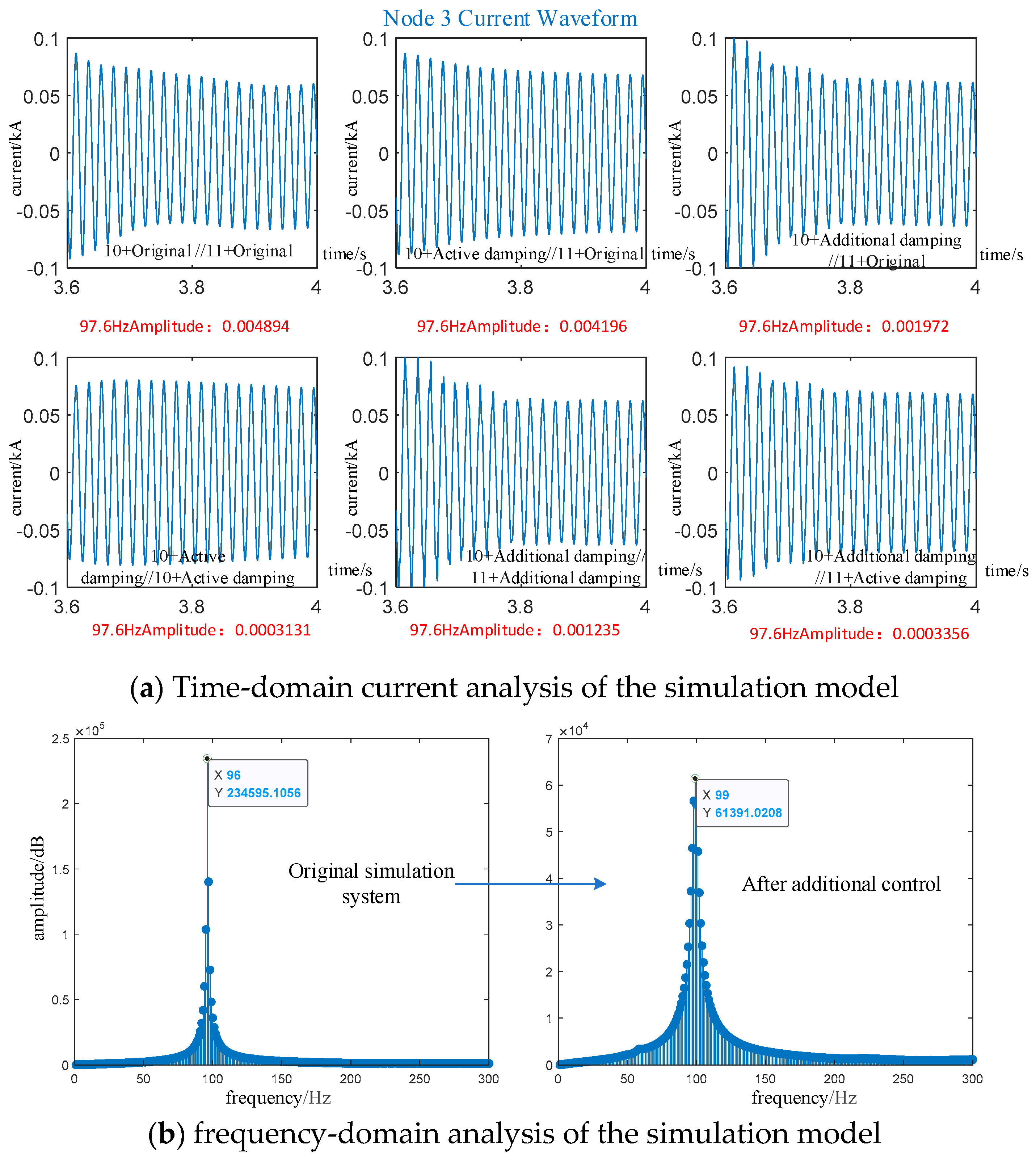
The simulation model constructed for this validation is shown in Figure 13. Electrical energy is transmitted via a 35 kV busbar and then delivered through a 220 kV cable. The system node admittance matrix was constructed for stability analysis, employing a frequency resolution of 1 Hz. Results indicate oscillation risk at 96 Hz, with node 10 in the wind turbine section exhibiting the highest participation factor. After applying disturbances to the system, the resonant mode was excited. An FFT analysis of the time-domain waveform revealed a resonant frequency of 97.6 Hz, closely matching the calculated resonant mode with an error within acceptable limits. Therefore, additional control optimization was performed for the wind turbine at node 10 and the nearest wind turbine at node 11. Figure 14 shows the time-domain waveforms and data analysis results at node 3 of the wind energy collection point under different wind turbine control combinations.
Figure 14a displays the current waveform at node 3. When single-unit operation is employed with control applied, the 97.6 Hz component amplitude is 0.004894 for the Original Controller group, 0.004196 for the Active damping group, and 0.001972 for the Additional damping control group. When both units employ additional control, the 97.6 Hz component amplitudes for the Active damping//Active damping, Additional damping control//Additional damping control, and Additional damping control//Active damping groups are 0.0003131, 0.001235, and 0.0003356, respectively.
When wind turbines 10 and 11 employ different control strategies, system resonance is largely suppressed, with resonance amplitude values comparable to those when both turbines use active damping control. As shown in Figure 14b, after implementing the dual-wind turbine supplementary control, the harmonic amplitude was suppressed from 23,595.1056 dB in the original simulation system to 61,391.0208 dB. The resonance modal analysis results indicate that the resonance mode amplitude without added turbine control is significantly greater than that of the dual-turbine controlled simulation system.
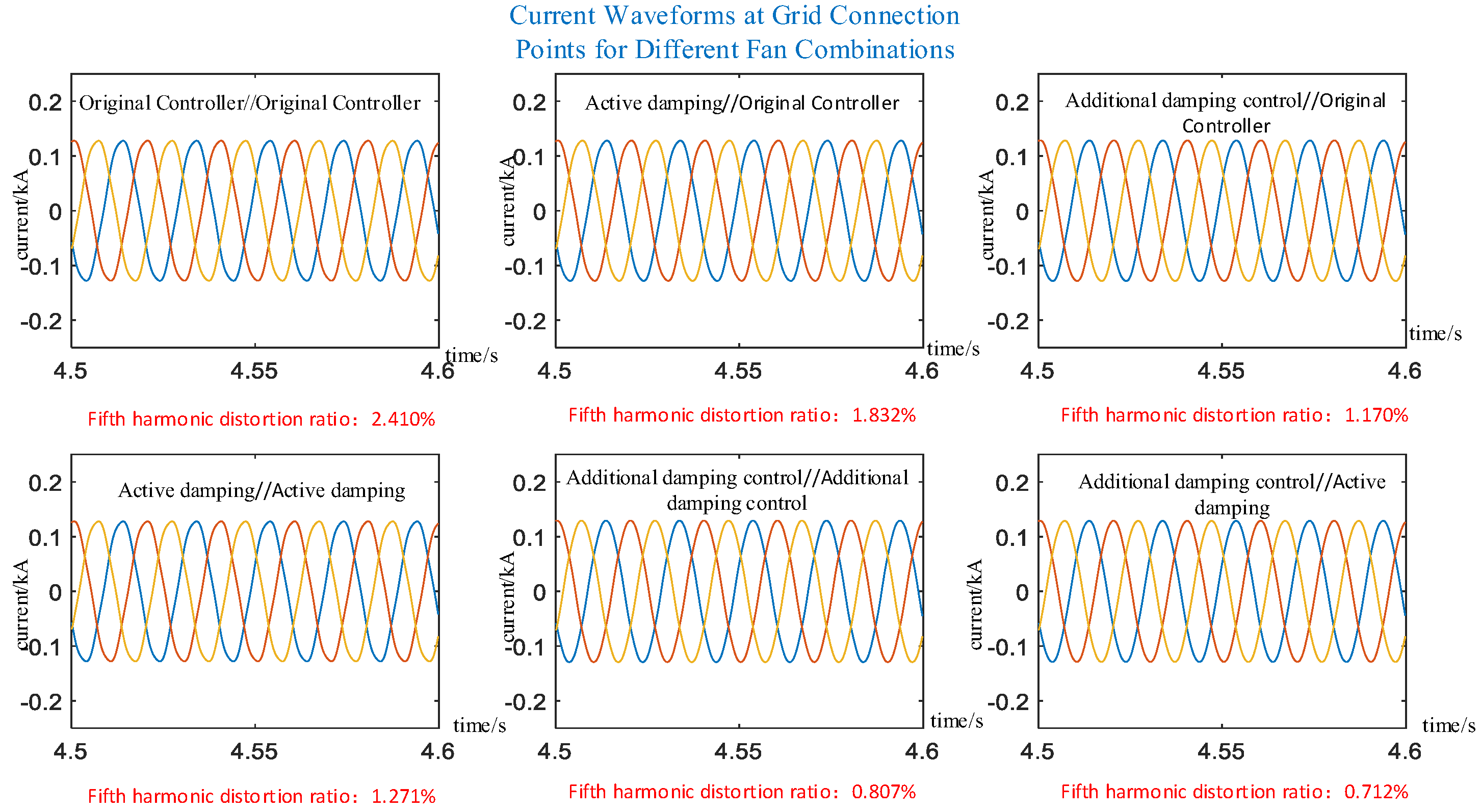
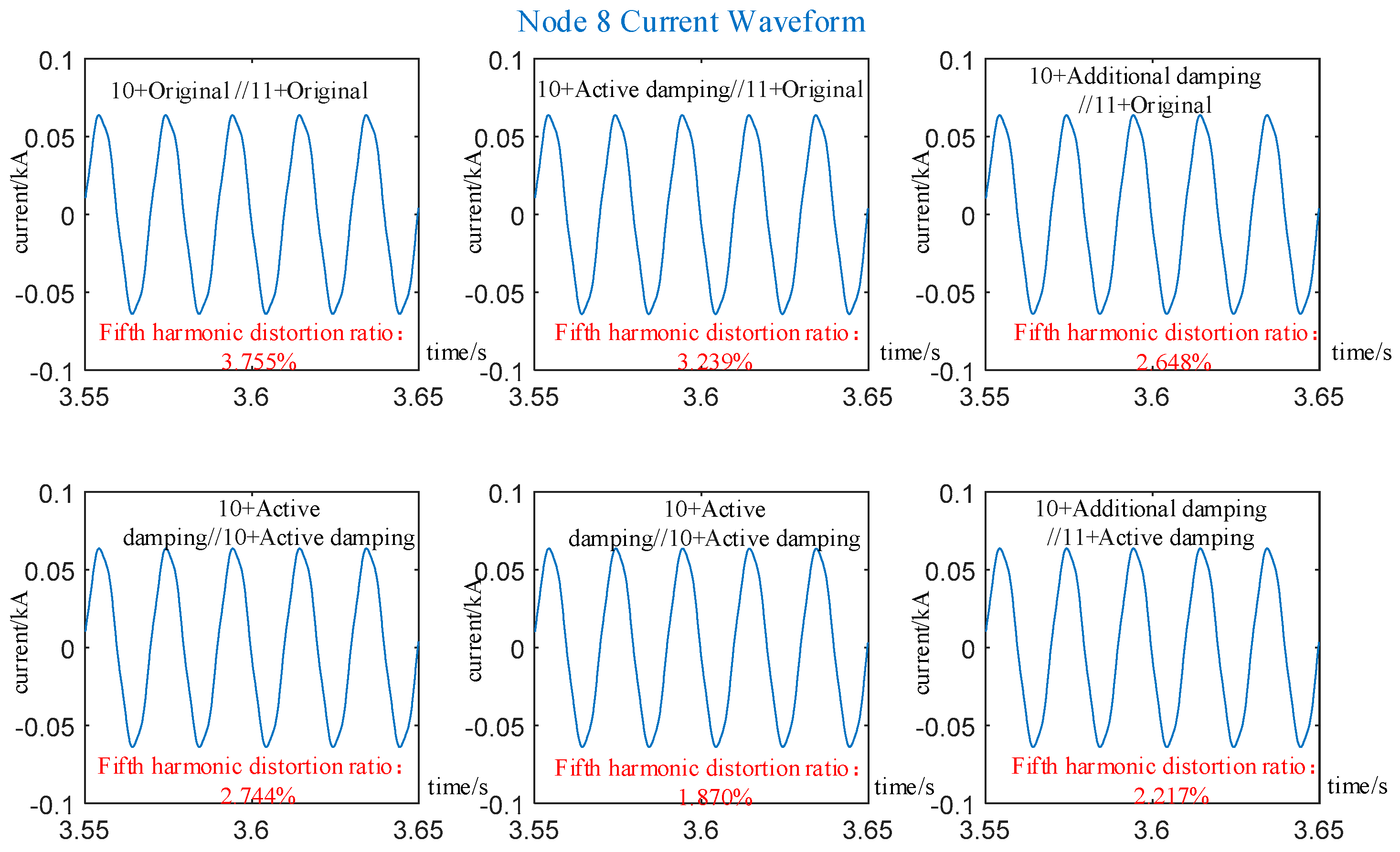
Beyond the aforementioned super-synchronous oscillations, changes in large grid system parameters coupled with harmonic sources can induce specific harmonic sub-resonances. Taking the fifth harmonic as an example, simulation results are shown in Figure 15. Beyond the fifth harmonic distortion rate, variations in frequency component amplitude, theoretically calculated resonance modes, and damping ratios are detailed in Table A1. Regarding harmonic distortion rate, the suppression effect under different dual-wind turbines controls is slightly less than that of dual-additional-damping control. However, the dual-wind turbine controls also exhibit multi-modal resonance suppression capability for sub-/super-synchronous oscillations.
In summary, simulation results indicate that for medium-to-high frequencies, the resonance suppression effect of additional damping control outperforms active damping control. However, for sub-/super-synchronous frequency band oscillations, active damping demonstrates superior performance. Within the 0–300 Hz frequency band, the suppression effectiveness of the original controller combined with any additional control scheme is lower than the synergistic effect of the two control strategies. No mutual interference between controls that weakens suppression capability was observed. This indicates that both control structures can function independently while exhibiting excellent synergistic characteristics, consistent with the theoretical analysis of parallel coupled impedances in Section 4.3.

5.3. Verification of Control Strategy Robustness

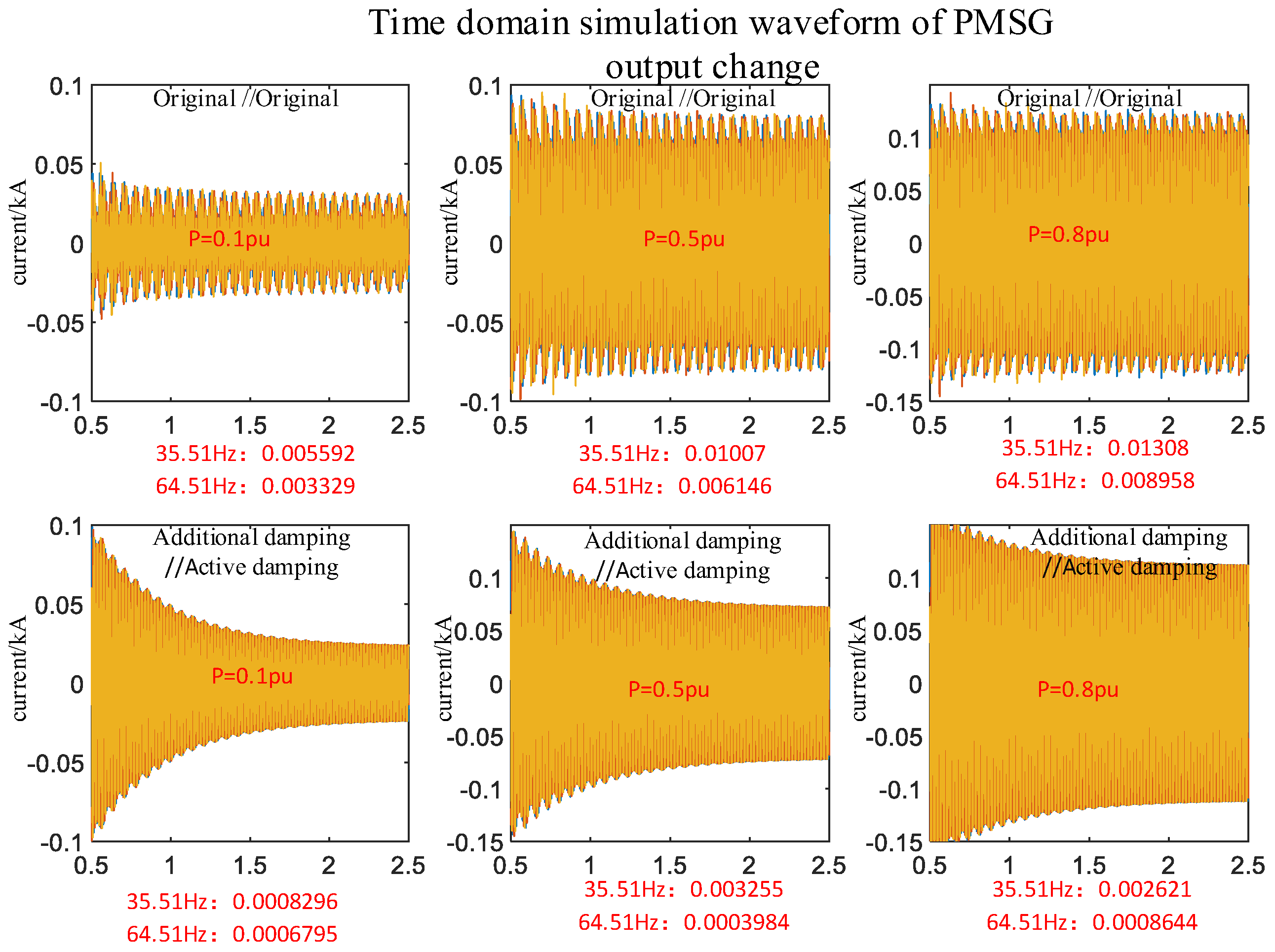
To validate the robustness of the control strategy, simulations were conducted with different wind speed disturbances (0.1, 0.5, 1 p.u.). The results demonstrate that the proposed control strategy remains effective under various operating conditions.
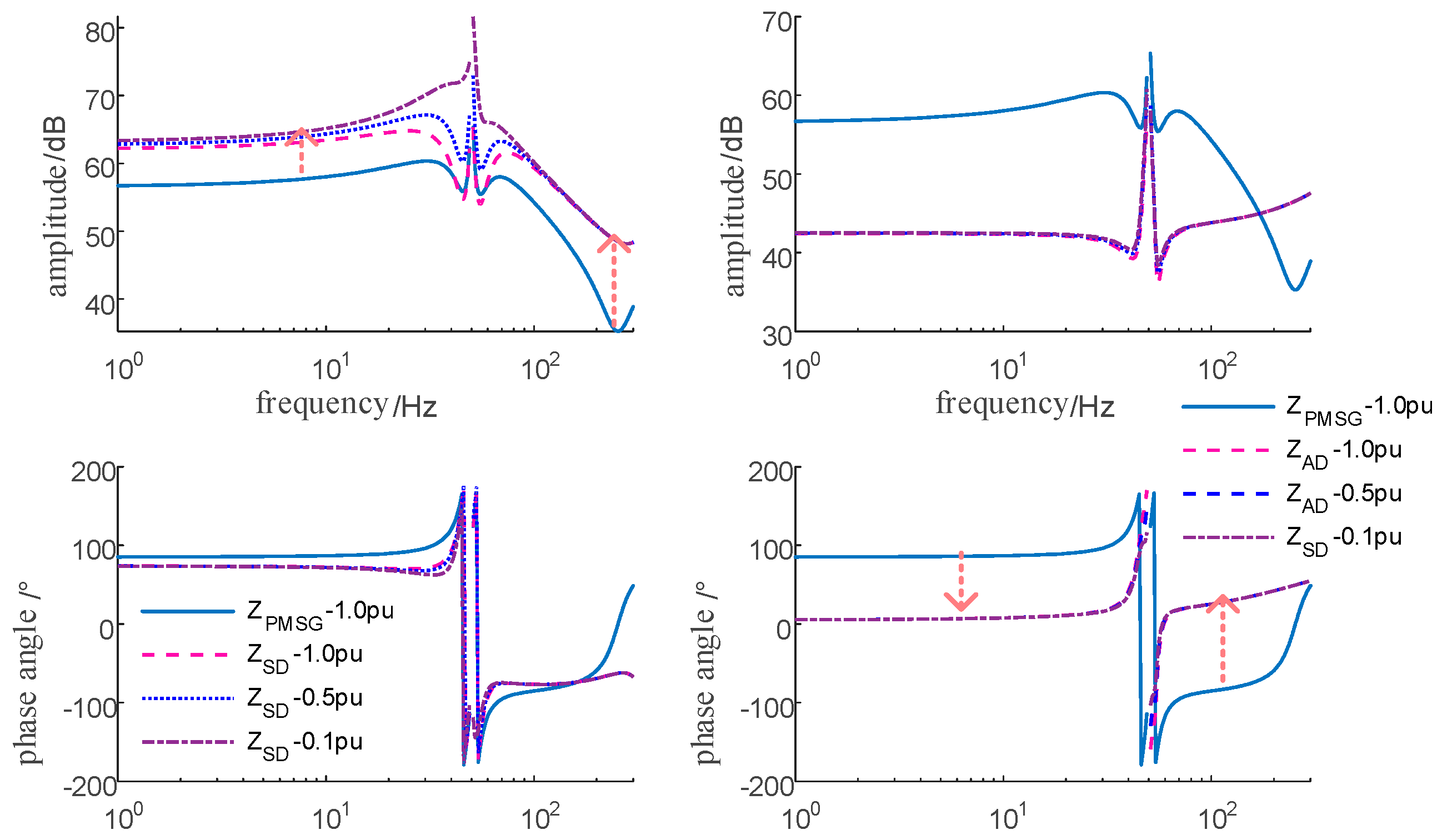
First, the system impedance characteristics were analyzed after implementing the control strategy at different wind speeds, as shown in Figure 16.
As shown in Figure 16, under different wind speed operating conditions, the introduction of the control strategy effectively improves the system impedance of wind turbines in the sub-/super-synchronous and medium-to-high-frequency bands. Furthermore, simulation verification for this scenario yielded grid oscillation curves at various wind speeds, as depicted in Figure 17.
As shown in Figure 17, the oscillation amplitude of the wind turbine varies under different operating conditions. The greater the wind turbine output, the larger the system oscillation amplitude. However, after implementing the control strategy proposed in this paper, the system oscillations can rapidly converge to stability within 1.5 s, and the sub-/super-synchronous oscillation component can be suppressed to less than 30% of its original value.

6. Discussion

This paper focuses on modeling and analysis for wind turbines of uniform model and control strategy. Considering the significant model differences among wind turbines of various types, models, and capacities in actual wind farms, coupled with their distinct wide-band impedance characteristics, modeling and control methods for such wind farms require further research. This paper presents a preliminary control strategy. First, wind turbines of the same model and capacity are aggregated into capacity-equivalent groups. Second, impedance modeling is applied to non-aggregatable turbines to analyze the sensitivity of the overall damping level of the wind farm to changes in the magnitude and phase of each turbine’s impedance, thereby determining the optimal locations for magnitude and phase compensation. Then, considering the coupling effects between magnitude and phase as well as between units, the magnitude and phase compensation quantities are optimized with the goal of achieving the optimal overall damping characteristics of the wind farm, thereby realizing coordinated damping compensation among multiple units at the wind farm level. However, the specific implementation approach requires further research.

7. Conclusions

This paper investigated oscillation issues in direct-drive wind farms caused by grid coupling. First, based on constructing the frequency-domain impedance model of direct-drive wind turbines, a dynamic impedance reduction method suitable for PMSGs was proposed. The coupling characteristics of the inverter impedance were investigated, and a design scheme for the parallel coupling impedance was proposed based on phase angle neutralization properties and the variation patterns of amplitude–frequency characteristics. An impedance optimization and reshaping scheme incorporating additional damping control and active damping based on notch filters was selected according to design requirements, followed by parameter tuning. Validation analysis was conducted using a two-turbine-infinite grid model. Furthermore, to demonstrate the universality of control structure synergy, a generic wind farm simulation model was established. Time-domain simulations and frequency-domain theoretical analysis were performed using the s-domain node admittance method, validating the control strategy’s effectiveness and providing a novel solution for similar engineering challenges.
However, to maximize the demonstration of control effectiveness in this paper, the model was constructed using only six units. How to enhance the system’s resonance suppression capability more efficiently and economically, while maintaining satisfactory suppression performance with fewer added control wind turbines, remains a research direction worthy of further exploration in the future.

Author Contributions

Conceptualization, Y.G., S.S. and T.W.; methodology, H.S. and G.F.; software, X.W., S.S. and T.W.; validation, Y.D.; formal analysis, X.W., S.S. and T.W.; investigation, H.S. and G.F.; resources, H.S. and G.F.; data curation, H.S. and G.F.; writing—original draft preparation, Y.G. and T.W.; writing—review and editing, Y.G. and T.W.; visualization, H.S. and G.F.; supervision, H.S. and G.F.; project administration, H.S. and G.F.; funding acquisition, H.S. and G.F. All authors have read and agreed to the published version of the manuscript.

Funding

This research was funded by the State Grid Qinghai Electric Power Company Science and Technology Project Funding [grant number 522807240011].

Data Availability Statement

All data generated or analyzed during this study are included in this published article. Further information is available from the corresponding author upon reasonable request.

Conflicts of Interest

Authors Haibin Sun, Guobin Fu, Xuebin Wang and Yujie Ding were employed by the company State Grid Qinghai Electric Power Company. The remaining authors declare that the research was conducted in the absence of any commercial or financial relationships that could be construed as a potential conflict of interest. The authors declare that this study received funding from State Grid Qinghai Electric Power Company. The funder was not involved in the study design, collection, analysis, interpretation of data, the writing of this article or the decision to submit it for publication.

Nomenclature

PMSGPermanent Magnet Synchronous Generator
GSCGrid-Side Converter
SVGStatic Var Generator
P r e f , Q r e f Active/Reactive Power Reference Values
P p u , Q p u Active/Reactive Power Actual Values
K p , o u t , K i , o u t Outer Loop Proportional/Integral Coefficients
K p , i n , K i , i n Inner Loop Proportional/Integral Coefficients
U a p , I a p Voltage/Current Small-Signal Vector
G P L L Disturbance Transfer Function from AC-side Voltage to PLL Output Phase
G P L L , t f , u Disturbance Transfer Function from PLL Output Phase to Valve-Side Voltage
G I , t f , u Disturbance Transfer Function from AC-Side Current to Valve-Side Voltage
G U , t f , u Disturbance Transfer Function from AC-Side Voltage to Valve-Side Voltage
Z · Parallel Coupling Impedance
θ 1 , θ 2 Wind Turbine Impedance Phase Angle
Y 1 · , Y 2 · , Y · Wind Turbine Admittance Expression
T ω Filtering Link Time Constant
Z A D Wind Turbine Impedance with Active Damping Structure
Z S D Wind Turbine Impedance with Additional Damping Control Structure
x 1 Characteristic Frequency of the Active Damping Filter
x 3 Notch Frequency of the Active Damping Structure
LInductance Value at the Wind Turbine Terminal
PLLPhase-Locked Loop
SComplex Frequency Domain Variable
K p , p , K i , p PLL Proportional/Integral Coefficients
V m Steady-State Voltage Value
θ p PLL Output Phase Perturbation Signal Component
G θ , c PLL Total Transfer Function dq Coupling Term
f d g , i n Inner Loop Degeneration Frequency
G P L L Degenerated Disturbance Transfer Function from AC-Side Voltage to PLL
f d g , o u t Outer Loop Degeneration Frequency
f d g , f Filtering Link Degeneration Frequency
f d g , p PLL Degeneration Frequency
Z 1 , Z 2 Wind Turbine Impedance Magnitude
Z a d d , θ a d d Parallel Coupling Impedance Magnitude and Phase Angle
T 1 , T 2 Phase Compensation Link Time Constant
G s e Desired Filter Transfer Function
Z c o u p Coupling Impedance after Control Modification
nInteger Variable
x 2 Gain of the Active Damping Structure Transfer Function
x 4 Damping Ratio of the Active Damping Structure Notch Filter

Appendix A

Figure A1. A1 PMSG main control circuit.
Electronics 14 04761 g0a1
G P L L , t f , u = G P L L G θ G U , t f , u = 0.5 K m V d c G l p f G v G I , t f , u = 0.5 K m V d c H i n G l p f G i 0.5 K m V d c H i n H o u t G F G i + j K i G i G l p f G P L L = j G v H P L L s s 0 H P L L G v U m 0 G θ = 0.5 K m V d c G l p f G i I m 0 ( 0.5 sin φ 0.5 j cos φ ) + 0.5 K m V d c K i G l p f G i ( cos φ j sin φ ) + 0.5 K m V d c j ( 0.5 U m 0 G l p f G v ) 0.5 K m V d c ( 0.5 U q r e f 0 0.5 j U d r e f 0 )
In Equation (A1), H i n , H o u t , H P L L represent the transfer functions of the inner and outer loops and the phase-locked loop, respectively; G l p f is the transfer function of the power filtering stage; G F is the transfer function of the dq-axis voltage filtering stage; V d c is the capacitor voltage; G i and G v are the transfer functions for scaling voltage and current values, respectively; K m is a constant coefficient; U m 0 and I m 0 denote steady-state AC voltage and current values; U d r e f 0 and U q r e f 0 represent steady-state dq-axis reference values; s is the frequency domain complex variable; s 0 is the corresponding frequency domain complex variable at power frequency, j is the imaginary unit, φ denotes the steady-state voltage–current phase angle difference; K i = ω g L .
Z i n v 0 = s L + K ( H i n j K i ) G l p f G i + K H i n H o u t G F K o u t K G l p f G v + j G v H P L L s s 0 + K P L L H P L L ( 0.5 K H i n G l p f G i I m 0 ( sin φ j cos φ ) + G θ _ c )
Z i n v = s l + K ( H i n j K i ) G l p f G i + K H i n H o u t G F K o u t K G l p f G v + j G v H P L L s s 0 + K P L L H P L L ( 0.5 K H i n G l p f G i I m 0 ( sin φ j cos φ ) )
Figure A2. Phaselocked loop disturbance transfer function.
Electronics 14 04761 g0a2
Figure A3. Sensitivity of phase angle calculation parameters.
Electronics 14 04761 g0a3
Table A1. Simulation Model Fifth Harmonic Resonance Time-Domain and Frequency-Domain Computational Data.
Fifth Harmonic
Distortion Ratio
Fifth Harmonic Content AmplitudeSystem EigenvalueDamping Ratio
10, 11 Original Controller4.465%0.001989−49.19 + j1561.310.0289
10 + Active, 11 + Original4.191%0.001866−45.4 + j1548.180.02931
10 + Addition,11 + Original3.849%0.001719−47.09 + j1550.140.03036
10, 11 Active3.886%0.001729−46.35 + j1531.870.03024
10, 11 Addition3.147%0.001406−49.99 + j1518.050.0329
10 + Addition, 11 + Active3.518%0.001572−47.53 + j1524.830.03115
Figure A4. Comparison chart of frequency-domain mathematical model and time-domain sweep results.
Electronics 14 04761 g0a4

References

  1. Wu, F.; Fang, C. The estimation of wind power resources in China. In Proceedings of the 2009 World Non-Grid-Connected Wind Power and Energy Conference, Beijing, China, 24–26 September 2009; pp. 1–4. [Google Scholar]
  2. Zhou, Q.; Zhang, J.; Zhang, R.; Zhang, J.; Wang, S.; Li, J. Echos, Suggestions, and Directions on New Energy Development in China under the Grid Parity. In Proceedings of the 2023 7th International Conference on Smart Grid and Smart Cities (ICSGSC), Lanzhou, China, 22–24 September 2023; pp. 250–255. [Google Scholar]
  3. Shi, Z.; Wang, C.; Chen, N.; Ye, X.; Wu, S. Policy Requirements and Economic Affordability of Energy Storage for New Energy. In Proceedings of the 2022 6th International Conference on Power and Energy Engineering (ICPEE), Shanghai, China, 25–27 November 2022; pp. 330–333. [Google Scholar]
  4. Fan, R.; Xiong, Y.; Li, F.; Zhang, P.; Zhang, J.; Han, X.; Zhang, C. Analysis on Development Trend of North China Power Grid under the Background of Building the New Power System. In Proceedings of the 2023 2nd Asian Conference on Frontiers of Power and Energy (ACFPE), Chengdu, China, 20–22 October 2023; pp. 585–590. [Google Scholar]
  5. Zhou, J.; Suo, L.; Wang, Y.; Guo, Y.; Ma, Y. DFIG Band-Specific Impedance Reshaping and Wide-Band Oscillation Suppression Based on an Impedance-Decoupling Model. In Proceedings of the 2025 IEEE 5th New Energy and Energy Storage System Control Summit Forum (NEESSC), Hohhot, China, 15–16 November 2025; pp. 115–120. [Google Scholar]
  6. Wang, N.; Li, H.; Xiong, W.; Wang, R. Small-Signal Stability Analysis and Oscillation Suppression Method for Grid-Following Inverters. In Proceedings of the 2025 IEEE 3rd International Conference on Power Science and Technology (ICPST), Kunming, China, 16–18 May 2025; pp. 162–167. [Google Scholar]
  7. Liu, Z.; Sun, C.; Li, P.; Bin, Z. Study on the negative effect mechanism of the active damping suppression strategy of the wind power grid-connected inverter based on the damping factor. In Proceedings of the 2024 8th International Conference on Electrical, Mechanical and Computer Engineering (ICEMCE), Xi’an, China, 25–27 October 2024; pp. 856–860. [Google Scholar]
  8. Yang, L.; Gao, S.; Zhao, X.; Dong, Y.; Ding, J.; Xia, J.; Wang, H. An Active Damping Method for Harmonic Resonance of PV Station Based on Impetance Measurement. In Proceedings of the 2021 IEEE Sustainable Power and Energy Conference (iSPEC), Nanjing, China, 25–27 November 2021; pp. 142–147. [Google Scholar]
  9. Liu, T.; Liu, Z.; Liu, J.; Tu, Y.; Liu, Z. Comprehensive Analysis of Virtual Impedance-Based Active Damping for LCL Resonance in Grid-Connected Inverters. In Proceedings of the 2018 International Power Electronics Conference (IPEC-Niigata 2018-ECCE Asia), Niigata, Japan, 20–24 May 2018; pp. 2681–2687. [Google Scholar]
  10. Wang, Y.; Li, H.; Zhang, F.; He, Z.; Zhang, J.; Nian, H. Data-Driven Modeling Method of Multi-Operation Impedance Identification for DFIG Based on Transfer Learning Theory. In Proceedings of the 2024 CPSS IEEE International Symposium on Energy Storage and Conversion (ISESC), Xi’an, China, 8–11 November 2024; pp. 377–382. [Google Scholar]
  11. Zhou, F.; Liu, J. A Robust Control Strategy Research on PMSG-Based WECS Considering the Uncertainties. IEEE Access 2018, 6, 51951–51963. [Google Scholar] [CrossRef]
  12. Ren, Z.; Ding, D.; Wang, G.; Li, B.; Wang, Q.; Zhang, G.; Xu, D. Adaptive Virtual Admittance Reshaping-Based Resonance Suppression Strategy for PMSM Drives With Small DC-Link Capacitor. IEEE Trans. Power Electron. 2024, 39, 3109–3121. [Google Scholar] [CrossRef]
  13. Jiang, H.; Ma, S.; Zhou, P.; Xiang, Z.; Song, R.; Huang, R.; Hu, J. An Improved SVG Control Strategy to Suppress Sub-Synchronous Oscillation in Renewable Energy Power System. In Proceedings of the 2023 8th Asia Conference on Power and Electrical Engineering (ACPEE), Tianjin, China, 14–16 April 2023; pp. 2395–2399. [Google Scholar]
  14. Tian, X.; Chi, Y.; Li, Y.; Tang, H.; Liu, C.; Su, Y. Coordinated damping optimization control of sub-synchronous oscillation for DFIG and SVG. CSEE J. Power Energy Syst. 2021, 7, 140–149. [Google Scholar]
  15. Yang, M.; Li, D.; Liu, X.; Fan, L.; Zheng, K.; Chen, Q. Design of Passive Damping Filter for High-Frequency Oscillation Suppression of MMC. In Proceedings of the 2023 IEEE 2nd International Power Electronics and Application Symposium (PEAS), Guangzhou, China, 10–13 November 2023; pp. 1531–1535. [Google Scholar]
  16. Micallef, A.; Apap, M.; Spiteri-Staines, C.; Guerrero, J.M. Mitigation of Harmonics in Grid-Connected and Islanded Microgrids Via Virtual Admittances and Impedances. IEEE Trans. Smart Grid 2017, 8, 651–661. [Google Scholar] [CrossRef]
  17. Zhang, Z.; Wang, H.; Wang, Z.; Ding, G. Sub-synchronous Oscillation Suppression Measures for Doubly-fed Wind Turbine Based on Eigenvalue Analysis Method and Correlation Factor Method. In Proceedings of the 2019 6th International Conference on Systems and Informatics (ICSAI), Shanghai, China, 2–4 November 2019; pp. 234–238. [Google Scholar]
  18. Xu, B.; Wei, Y.; Xu, L.; Liu, Z. Sub-synchronous oscillation mechanism and analysis for wind farm integration through HVDC system. In Proceedings of the 2020 International Conference on Urban Engineering and Management Science (ICUEMS), Zhuhai, China, 24–26 April 2020; pp. 578–583. [Google Scholar]
  19. Feng, G.; Qifei, H.; Zhiguo, H.; Baohui, Z. The research of sub synchronous oscillation in PMSG wind farm. In Proceedings of the 2016 IEEE PES Asia-Pacific Power and Energy Engineering Conference (APPEEC), Xi’an, China, 25–28 October 2016; pp. 1883–1887. [Google Scholar]
  20. An, Z.; Shen, C.; Zheng, Z.; Liu, F.; Zhang, X.; Chang, X.; Wei, W. Analysis on Sub-Synchronous Oscillation Associated with Wind Farms Based on Direct-Driven Wind Generators. In Proceedings of the 2018 37th Chinese Control Conference (CCC), Wuhan, China, 25–27 July 2018; pp. 1282–1286. [Google Scholar]
  21. Rawal, M.; Nauityal, D.C.; Rawat, M.S. Analysis of Small Signal Stability in DFIG Integrated Power System. In Proceedings of the 2021 International Conference on Advances in Electrical, Computing, Communication and Sustainable Technologies (ICAECT), Bhilai, India, 19–20 February 2021; pp. 1–6. [Google Scholar]
  22. Zhu, X.; Zhang, J.; Wang, Y. Supplementary Control of DFIG for Inter-Area Oscillation Damping. In Proceedings of the IECON 2014-40th Annual Conference of the IEEE Industrial Electronics Society, Dallas, TX, USA, 29 October–1 November 2014; pp. 5599–5605. [Google Scholar]
  23. Liu, T.; Zhao, H.; Wang, P. Impedance Model of PMSG-Based Wind Turbine System And Stability Analysis Based on Routh Criterion. In Proceedings of the 2024 7th International Conference on Energy, Electrical and Power Engineering (CEEPE), Yangzhou, China, 26–28 April 2024; pp. 1345–1350. [Google Scholar]
  24. Yang, L.; Xu, Z.; Feng, L.; Zhang, Z.; Xu, Z.; Xing, F. Analysis on Harmonic Resonance of Offshore Wind Farm Transmitted by MMC-HVDC System. In Proceedings of the 2019 IEEE Innovative Smart Grid Technologies—Asia (ISGT Asia), Chengdu, China, 21–24 May 2019; pp. 2296–2301. [Google Scholar]
  25. Tong, H.; Nian, H.; Hu, B.; Li, M.; Zhang, H.; Liu, Q. High-Frequency Resonance Analysis Between DFIG Based Wind Farm with Direct Power Control and VSC-HVDC. In Proceedings of the 2021 24th International Conference on Electrical Machines and Systems (ICEMS), Gyeongju, Republic of Korea, 31 October–3 November 2021; pp. 2207–2212. [Google Scholar]
  26. Ge, H.; Zhen, Y.; Wang, Y.; Wang, D. Research on LCL filter active damping strategy in active power filter system. In Proceedings of the 2017 9th International Conference on Modelling, Identification and Control (ICMIC), Kunming, China, 10–12 July 2017; pp. 476–481. [Google Scholar]
  27. Zou, B.; Bakhshai, A.; Jain, P. Active Damping of LCL Filter Resonance for Grid-Connected Distributed Power Generation Systems. In Proceedings of the IECON 2019-45th Annual Conference of the IEEE Industrial Electronics Society, Lisbon, Portugal, 14–17 October 2019; pp. 4683–4688. [Google Scholar]
  28. Adapa, A.K.; John, V. Virtual Resistor Based Active Damping of LC Filter in Standalone Voltage Source Inverter. In Proceedings of the 2018 IEEE Applied Power Electronics Conference and Exposition (APEC), San Antonio, TX, USA, 4–8 March 2018; pp. 1834–1840. [Google Scholar]
  29. Li, G.; Chen, Y.; Luo, A.; Liu, X. Wideband Harmonic Voltage Feedforward Control Strategy of STATCOM for Mitigating Subsynchronous Resonance in Wind Farm Connected to Weak Grid and LCC HVDC. IEEE J. Emerg. Sel. Top. Power Electron. 2021, 9, 4546–4557. [Google Scholar] [CrossRef]
  30. Yu, Y.X.; Li, H.Y.; Li, Z.W. Impedance modeling and stability analysis of LCL-type grid-connected inverters with different current sampling schemes. In Proceedings of the 2016 IEEE 8th International Power Electronics and Motion Control Conference (IPEMC-ECCE Asia), Hefei, China, 22–26 May 2016; pp. 974–981. [Google Scholar]
  31. Sun, J.; Liu, H. Impedance modeling and analysis of modular multilevel converters. In Proceedings of the 2016 IEEE 17th Workshop on Control and Modeling for Power Electronics (COMPEL), Trondheim, Norway, 27–30 June 2016; pp. 1–9. [Google Scholar]
  32. Lin, Z.; Ruan, X.; Wu, L.; Zhang, H.; Li, W. Multi resonant Component-Based Grid-Voltage-Weighted Feedforward Scheme for Grid-Connected Inverter to Suppress the Injected Grid Current Harmonics Under Weak Grid. IEEE Trans. Power Electron. 2020, 35, 9784–9793. [Google Scholar] [CrossRef]
  33. Sun, J. Impedance-Based Stability Criterion for Grid-Connected Inverters. IEEE Trans. Power Electron. 2011, 26, 3075–3078. [Google Scholar] [CrossRef]
  34. Xu, Z. Resonance stability analysis method based on s-domain node admittance matrix. Electr. Power Autom. Equip. 2023, 43, 1–8. [Google Scholar]
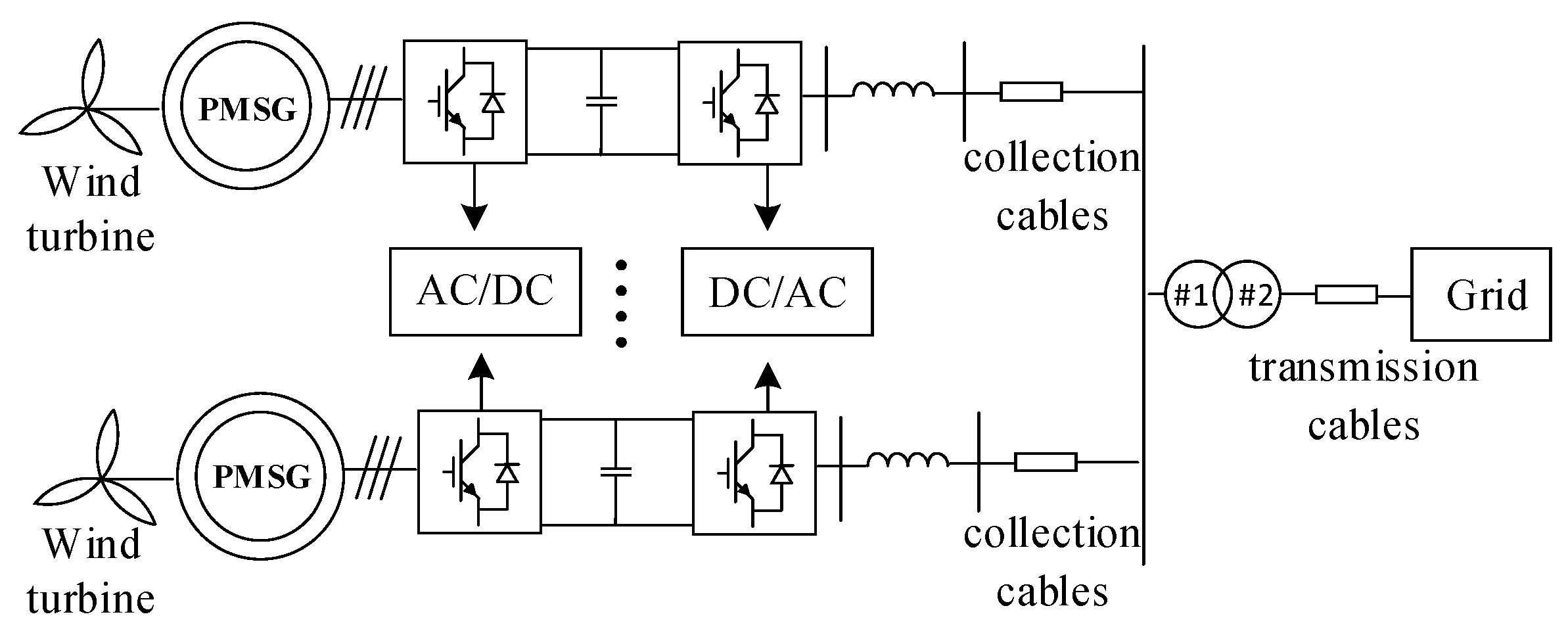
Figure 1. PMSG grid-connected system.
Electronics 14 04761 g001
Figure 2. Dynamic reduction process diagram.
Electronics 14 04761 g002
Figure 3. Frequency band distribution in each control link.
Electronics 14 04761 g003
Figure 4. Comparison of impedance models before and after dynamic reduction.
Electronics 14 04761 g004
Figure 5. Phase angle relationship diagram of parallel impedance.
Electronics 14 04761 g005
Figure 6. Additional damping control block diagram.
Electronics 14 04761 g006
Figure 7. Active damping control block diagram.
Electronics 14 04761 g007
Figure 8. Trend chart of phase angle with gain variation.
Electronics 14 04761 g008
Figure 9. Slice plot of phase angle variation with gain.
Electronics 14 04761 g009
Figure 10. Bode diagram and Nyquist diagram of parallel connection of wind turbines.
Electronics 14 04761 g010
Figure 11. Topology diagram of infinite power grid with dual wind turbines.
Electronics 14 04761 g011
Figure 12. PCC current under different combinations of controlled PMSG when grid parameters change.
Electronics 14 04761 g012aElectronics 14 04761 g012bElectronics 14 04761 g012c
Figure 13. Topology diagram of simulation model.
Electronics 14 04761 g013
Figure 14. Time-domain current and frequency-domain analysis of the simulation model.
Electronics 14 04761 g014
Figure 15. Time-domain current during fifth harmonic resonance.
Electronics 14 04761 g015
Figure 16. Impedance bode diagram when PMSG output change.
Electronics 14 04761 g016
Figure 17. Time domain simulation waveform of PMSG output change.
Electronics 14 04761 g017
Table 1. Comparison table of control strategies in this paper and existing methods.
Research
Literature
Control
Strategy Type
ComplexityEfficiencyFeasibilityController CostCore Limitations
[7]Current Loop FilterModification only to the current loop; SimpleEffective only at sub-synchronous frequencies; No suppression at mid/high frequencies; High control efficiencyHighNo hardware required; Low costOnly targets a single frequency band; Does not account for multi-unit impedance magnitude and phase coupling
[8]Adaptive Notch FilterCan dynamically update to track oscillation frequencyLow computational efficiencyMediumNo hardware required; Low costOnly considers a single machine; Does not account for multi-unit impedance magnitude and phase coupling
[9]Additional Damping BranchAdditional damping channel; Modification is relatively simpleEffective only at sub-synchronous frequencies; No suppression at mid/high frequencies; High control efficiencyHighNo hardware required; Low costOnly targets a single frequency band; Does not account for multi-unit impedance magnitude and phase coupling
[10]Data-Driven ControlCan self-adapt to oscillation frequency; Complex structureLow computational efficiencyLowNo hardware required; Low costOnly targets inter-area low-frequency oscillations; Does not account for multi-unit impedance magnitude and phase coupling
[15]External Compensation DeviceSimpleWide frequency coverage; High efficiencyHighRequires hardware equipment; High costCannot suppress oscillations at their root cause
This PaperCoordinated Reshaping of
Magnitude-Frequence
Characteristics
SimpleCovers sub-/super-synchronous and mid/high frequency bands; High efficiencyHighNo hardware required; Low costCoordinated control for hybrid systems with heterogeneous multi-type units requires further investigation
Table 2. Parameter solution results.
ObjectiveX1X2X3X4
objective 13000.01500.1
objective 23000.04500.1
Disclaimer/Publisher’s Note: The statements, opinions and data contained in all publications are solely those of the individual author(s) and contributor(s) and not of MDPI and/or the editor(s). MDPI and/or the editor(s) disclaim responsibility for any injury to people or property resulting from any ideas, methods, instructions or products referred to in the content.