Article

FDTD Simulation on Signal Propagation and Induced Voltage of UHF Self-Sensing Shielding Ring for Partial Discharge Detection in GIS

1
Xi’an XD Switchgear Electric Co., Ltd., Xi’an 710049, China
2
State Key Laboratory of Electrical Insulation and Power Equipment, Xi’an Jiaotong University, Xi’an 710049, China
*
Author to whom correspondence should be addressed.
Electronics 2025, 14(23), 4757; https://doi.org/10.3390/electronics14234757
Submission received: 24 October 2025 / Revised: 29 November 2025 / Accepted: 1 December 2025 / Published: 3 December 2025
(This article belongs to the Special Issue Polyphase Insulation and Discharge in High-Voltage Technology)

Abstract

Partial discharge (PD) is not only the primary manifestation of insulation deterioration in gas-insulated switchgear (GIS) but also a critical indicator of the equipment’s insulation condition. PD in GIS typically occurs at media interfaces such as the surface of the basin insulator and is characterized by high randomness and low amplitude. Conventional built-in ultra-high frequency sensors exhibit limitations in early warning and detection performance. This study proposes and demonstrates a self-sensing shielding ring embedded within the basin insulator, functioning as a novel UHF sensor. Finite-difference time-domain (FDTD) is a numerical method used to solve problems involving electromagnetic fields. Based on actual GIS structural parameters, a FDTD simulation platform is constructed and a built-in sensor is used as a control to evaluate the receiving performance of the self-sensing shielding ring for PD signals. Time-domain array simulations are conducted to investigate the influence of radial, angular and axial positions on the observed performance. The results show that the proposed shielding ring exhibits broadband and low-reflection characteristics, achieving an average S11 of −6.347 dB, which is significantly lower than those of the built-in sensors (−1.270 dB and −1.274 dB). The results demonstrate that the self-sensing shielding ring enables high sensitivity and the wideband detection of partial discharge, providing a new design approach and technical foundation for online early-warning systems in GIS.

1. Introduction

Gas-insulated switchgear (GIS) is an electrical equipment that encloses high-voltage electrical devices in a metal enclosure filled with a certain pressure of sulfur hexafluoride gas (SF6) [1]. Owing to its compact footprint, efficient operation and maintenance, and high safety and reliability, GIS is increasingly deployed in high-voltage transmission and distribution networks. Partial discharge (PD) is a discharge phenomenon that occurs within the insulation of high-voltage equipment prior to complete breakdown [2,3]. Its damaging effects typically evolve from small, localized regions to widespread insulation failure. In GIS, PD is both a manifestation of insulation deterioration and a key indicator for assessing insulation health [4]. Online PD detection is therefore essential for promptly identifying insulation defects, preventing failures, and enhancing the operational reliability of GIS [5,6].
Common methods for GIS PD detection include the pulse-current method, dis-solved-gas in oil analysis, the ultrasonic method and the ultra-high frequency (UHF) method [7,8]. Among these, the UHF method is widely used for online monitoring because of its strong anti-interference capability, high sensitivity and ability to locate discharge sources [9,10,11]. Bin F. et al. [6] proposed an internal UHF antenna specifically for partial discharge detection in GIS, performing more sensitive than traditional couplers. Tian J. et al. [12] designed a flexible UHF Hilbert antenna, which can be installed internally in GIS to enhance bandwidth and compatibility. Hu X. et al. [13] proposed a high-sensitivity flexible low-profile spiral antenna for PD detection in GIS, improving the detection sensitivity and achieving convenient installation. Although numerous studies have investigated UHF partial discharge detection in GIS, most existing UHF sensors still face several inherent limitations that restrict their performance in practical installations. Conventional built-in sensors are typically mounted in recesses or inspection windows of the metallic enclosure. Their installation or replacement requires depressurizing and opening the GIS, so the sensor positions must be predetermined at the design stage and are difficult to modify for in-service equipment [3,14]. External sensors are installed outside the enclosure and couple through a resin hole to receive the leaking electromagnetic waves. Experimental and theoretical studies have shown that only a relatively narrow frequency band is efficiently coupled [10,15]. Consequently, the signal amplitude at external sensors is significantly lower than that at built-in sensors. As a result, both built-in and external sensors tend to exhibit insufficient sensitivity to weak or intermittent PD activity occurring near the insulator surface, thereby limiting their effectiveness for early warning. Developing high sensitivity sensors tailored to PD on the basin surface therefore has significant engineering value for early warning in GIS.
In response to the limited sensitivity and installation challenges of conventional UHF sensors, recent studies have explored the concept of employing the shielding ring embedded in the basin insulator as an integrated sensing structure [16,17]. Positioned in immediate proximity to the insulator surface where partial discharge is most likely to originate, the cast-in ring offers a natural advantage for detecting weak discharge signals. Moreover, sensor replacement can be carried out concurrently with routine insulator maintenance, eliminating the need for additional machining or dedicated mounting windows. Existing investigations on shielding ring have primarily concentrated on the inherent electromagnetic characteristics of the ring or on the propagation behavior of PD signals at some certain specific positions [18,19]. However, a comprehensive understanding of how such a sensor responds to PD sources distributed across different radial, angular and axial locations remains largely absent. The finite-difference time-domain (FDTD) method has been widely used to simulate the propagation of electromagnetic waves caused by partial discharge in electric power equipment. A large number of studies have verified the effectiveness of using FDTD simulation to assist in the study of GIS UHF signal propagation, localization and diagnosis [20,21,22].
Inspired by the structural characteristics of GIS basin insulator and based on the 1100 kV GIS physical platform, this paper proposes a self-sensing shielding ring that leverages the cast-in metallic ring as an integrated UHF receiving sensor for partial discharge detection. With the aid of a FDTD simulation platform constructed in XFdtd, the electromagnetic coupling mechanism between UHF signals induced by PD and the shielding ring is investigated in detail. Furthermore, a three-dimensional excitation array is established to evaluate the self-sensing shielding ring’s response to PD sources at different radial, angular and axial positions.

2. Simulation Principle of Partial Discharge in GIS

2.1. Principle of Partial Discharge Radiation

An oscillating current is the source of electromagnetic radiation, and the radiated field strength scales with the current magnitude. The elemental current is modeled as an infinitesimally short antenna segment with a uniform current distribution. Its radiation characteristics underpin the analysis of more complex radiators. Figure 1 illustrates the electromagnetic radiation model of an elemental current of magnitude I and length dl. In a spherical coordinate system (r, φ, θ), the electric and magnetic field components produced by this source at an arbitrary point (r, φ, θ) in space can be expressed as follows:
E r = I d l cos θ k 3 2 π ω ε 1 k 3 r 3 sin ω t k r + 1 k 2 r 2 cos ω t k r E θ = I d l sin θ k 3 4 π ω ε 1 k 3 r 3 sin ω t k r + 1 k 2 r 2 cos ω t k r   + Z I d l sin θ k 2 4 π 1 k r sin ω t k r E φ = 0
H r = H θ = 0 H φ = I d l sin θ k 2 4 π 1 k 2 r 2 cos ω t k r 1 k r cos ω t k r
where θ represents the angle between the antenna axis and the observation direction; k is the phase constant of wave propagation in the medium (k = 2π/λ, λ is the wavelength of the electromagnetic wave); r is the distance from the center of the elemental current to the observation point; ω is the angular frequency; Z is the characteristic impedance of the medium; μ is the magnetic permeability; and ε is the permittivity of the medium.

2.2. Interface Connection Conditions

The boundary conditions between electromagnetic media specify the relationships that fields must satisfy across adjacent homogeneous regions. They are not only fundamental to electromagnetic theory but also complement the differential forms of Maxwell’s equations. By the uniqueness theorem, once charge and current distributions are specified, the electromagnetic field is fully determined by the governing equations together with appropriate initial and boundary conditions. In GIS, the inner and outer ring surfaces of the basin insulator often lie at a junction of three media, where field distortion is severe. Understanding boundary conditions at these boundaries is therefore essential for analyzing the propagation characteristics of electromagnetic waves in this region. The integral forms of Maxwell’s equations are given by:
l H d l = S J + D t d S l E d l = S B t d S S B d S = 0 S D d S = q
where H represents the magnetic field intensity; J represents the conduction current; D is the electric displacement vector; E represents the electric field intensity and B is the magnetic induction intensity. By standard vector calculus, the differential form of (3) is given by:
× H = J + D t × E = B t B = 0 D = ρ
In material media, the fields E and B depend on the medium’s properties. Thus, Equation (4) is incomplete and must be closed by appropriate constitutive relations.
D = ε E B = μ H J = σ E
Let ε1 and μ1 denote the permittivity and permeability of medium 1, and ε2 and μ2 those of medium 2. Let n be the unit normal vector at the interface pointing from medium 1 to medium 2. Applying Gauss’s laws for B and D to an infinitesimal pillbox straddling the interface and Faraday’s and Ampere–Maxwell’s laws for E and H to an infinitesimal rectangular loop crossing the interface, the boundary conditions between the two media, in the limit as the pillbox height and loop width go to zero, can be written as:
B 1 n = B 2 n D 2 n D 1 n = ρ σ H 1 t H 2 t = K E 1 t = E 2 t
where ρσ is the surface free-charge density on the interface and K is the surface density of the conduction current. Equation (6) indicates that the tangential component of E and the normal component of B are continuous across the interface. On the interface where there are distributions of free charges and conductive currents, the normal component of D and the tangential component of H are discontinuous.

2.3. Establishment of the Self-Sensing Shielding Ring Simulation Model

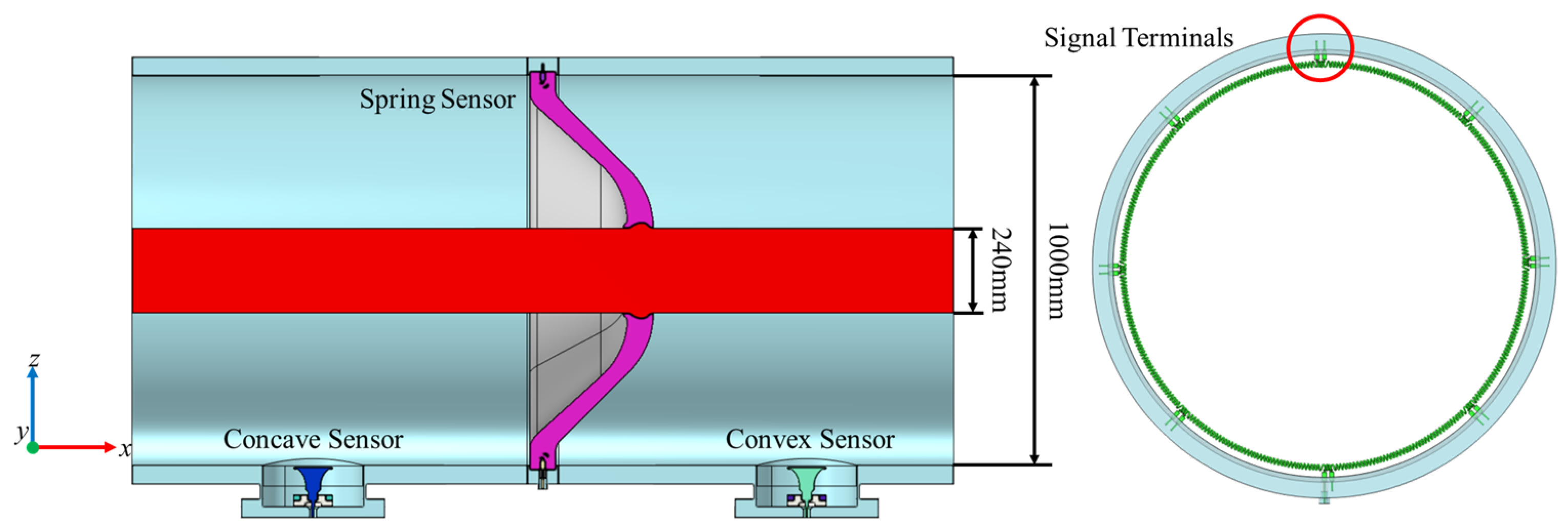
The self-sensing shielding ring consists of a series of interconnected metal springs embedded within the insulator’s epoxy resin. These springs are concentric with the insulator, cast into the epoxy, and arranged to sleeve the outside of the high-voltage conductor. The metal springs homogenize the electric field and eliminate potential air gaps between the epoxy insulation and the aluminum flange. The spring network is brought out to multiple dedicated lead terminals. One extends beyond the insulator edge as the measurement connector, while the others may be left floating, bonded directly to ground, or grounded through a resistor, depending on the configuration. The measurement terminal is used to collect UHF signals generated by partial discharge thereby enabling PD monitoring. To analyze and validate the electromagnetic wave coupling mechanism of the self-sensing shielding ring, a straight-cavity GIS model incorporating the ring is built in XFdtd7.11 using the geometry of a 1100 kV GIS. One built-in UHF sensor is placed on each side of the basin insulator. The sensor on the concave side is referred to as the concave sensor, and the sensor on the convex side as the convex sensor. A PD source is positioned at a specified location within the GIS to simulate the reception characteristics of the three sensors and thereby enable a comparative assessment of their detection performance.

2.3.1. Establishment of the Model

The straight-cavity 1100 kV GIS model is shown in Figure 2. The self-sensing shielding ring is pre-embedded within the insulator’s epoxy resin. The X-axis is aligned with the GIS axis, with +X directed from the concave side of the basin toward the convex side. The Y and Z axes are perpendicular to the GIS axis. The excitation source is applied radially, and the plane of the self-sensing shielding ring is parallel to the yOz plane.

2.3.2. Settings of the Power Supply

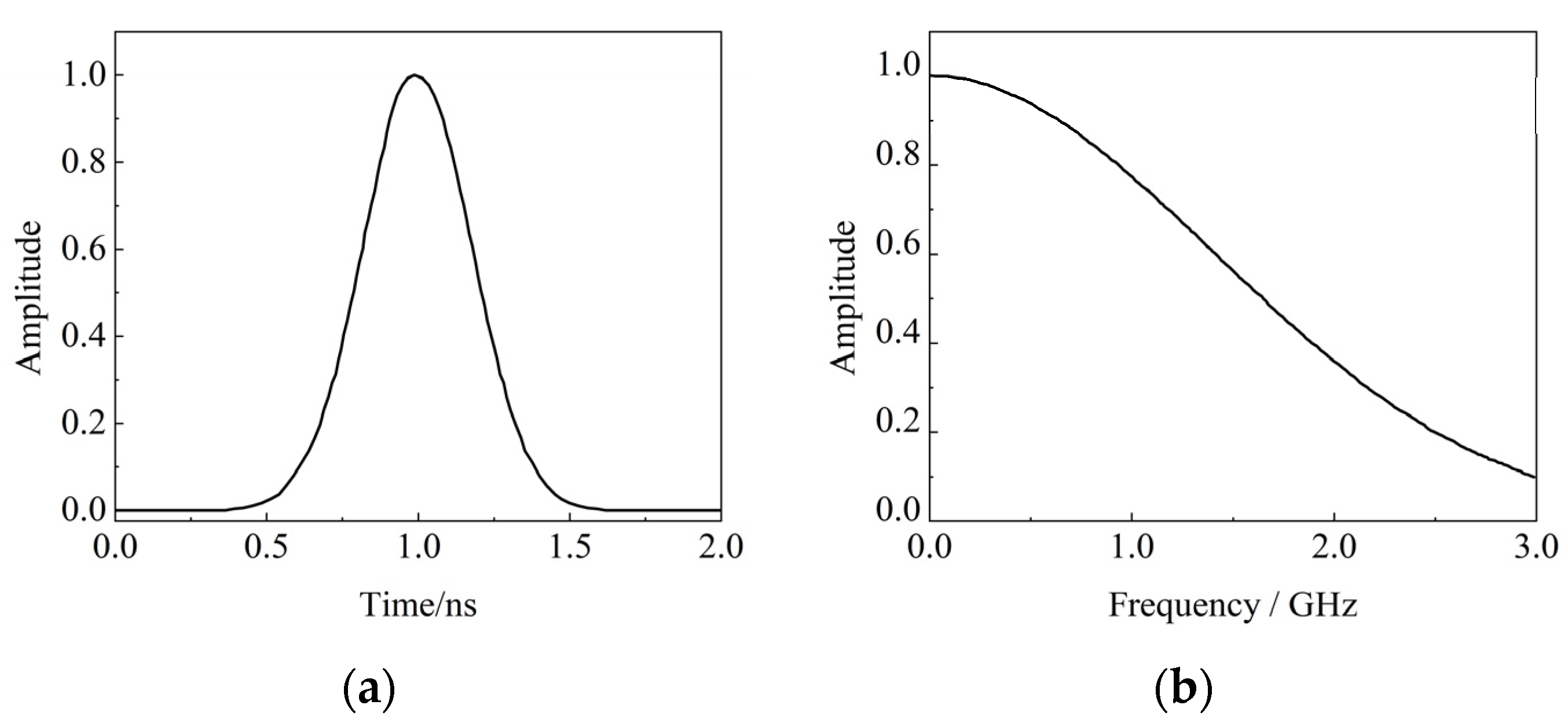
In the simulation, a current source oriented radially which is perpendicular to the surface of the high-voltage conductor is used to emulate PD induced by defects. The source length is 10 mm, its time-domain waveform is a Gaussian pulse. The normalized time-domain waveform and spectrum are shown in Figure 3.

2.3.3. Material Settings

In the simulation of the self-sensing shielding ring, the principal components include metal conductors, the epoxy resin of the basin insulator, and polytetrafluoroethylene (PTFE) used for the lead-out terminal. Each component is assigned appropriate material properties and related parameters. Metal parts are modeled as perfect electric conductors (PEC). The relative permittivity of SF6 gas is set to 1.002. The relative permittivity of PTFE is set to 1.002 and that of the epoxy resin is set to 5.

2.3.4. Grid Size Subdivision

The CFL condition (Courant–Friedrichs–Lewy condition) is a crucial stability criterion in numerical computations, used to determine the relationship between the time step and the spatial step. The physical signal should not span more than one spatial grid cell. Otherwise, the numerical solution will miss information, leading to instability or divergence A structured hexahedral mesh is employed. According to the CFL condition, the maximum cell size δ is constrained to satisfy the following criteria:
δ c / 10 f max
where c is the propagation speed of electromagnetic waves in the model which is approximately the speed of light; fmax is the maximum calculation frequency set in the simulation. Because the main frequencies of partial discharge ultra-high frequency signals are usually below 3 GHz, we set fmax = 3 GHz. Accordingly, the mesh uses a minimum of 15 cells per wavelength, and the smallest geometric feature size is set to 4 mm.

2.3.5. Boundary Condition Settings

To minimize cavity-reflection effects on signal acquisition, all outer boundaries are terminated with 7 perfectly matched layers (PML), providing near–reflection-free absorption. According to the CFL condition, the simulation time step is determined by the mesh spacing, as expressed in Equation (8).
Δ t 1 / c 1 Δ x 2 + 1 Δ y 2 + 1 Δ z 2 = 11.55   ps
where Δx, Δy and Δz are the lengths of the edge of the grid cell. The time step of the simulation software XFdtd 7.11.0 is fixed at 0.978 ps, which meets the requirements of (8).
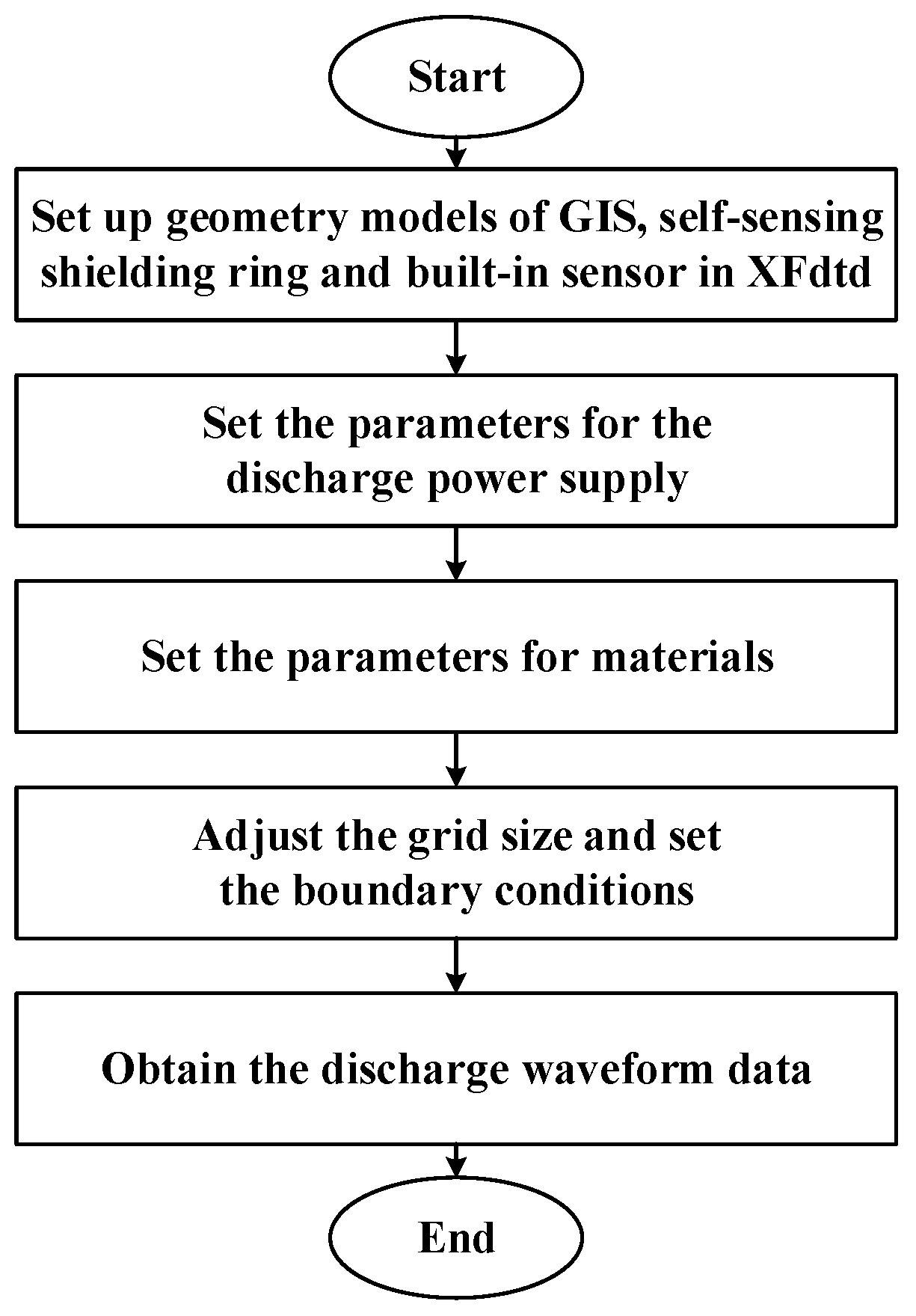
The flowchart of the PD simulation in GIS is shown in Figure 4.

3. Results and Analysis of the Propagation Characteristics Simulation

3.1. Propagation Characteristics of Electromagnetic Waves in the Self-Sensing Shielding Ring

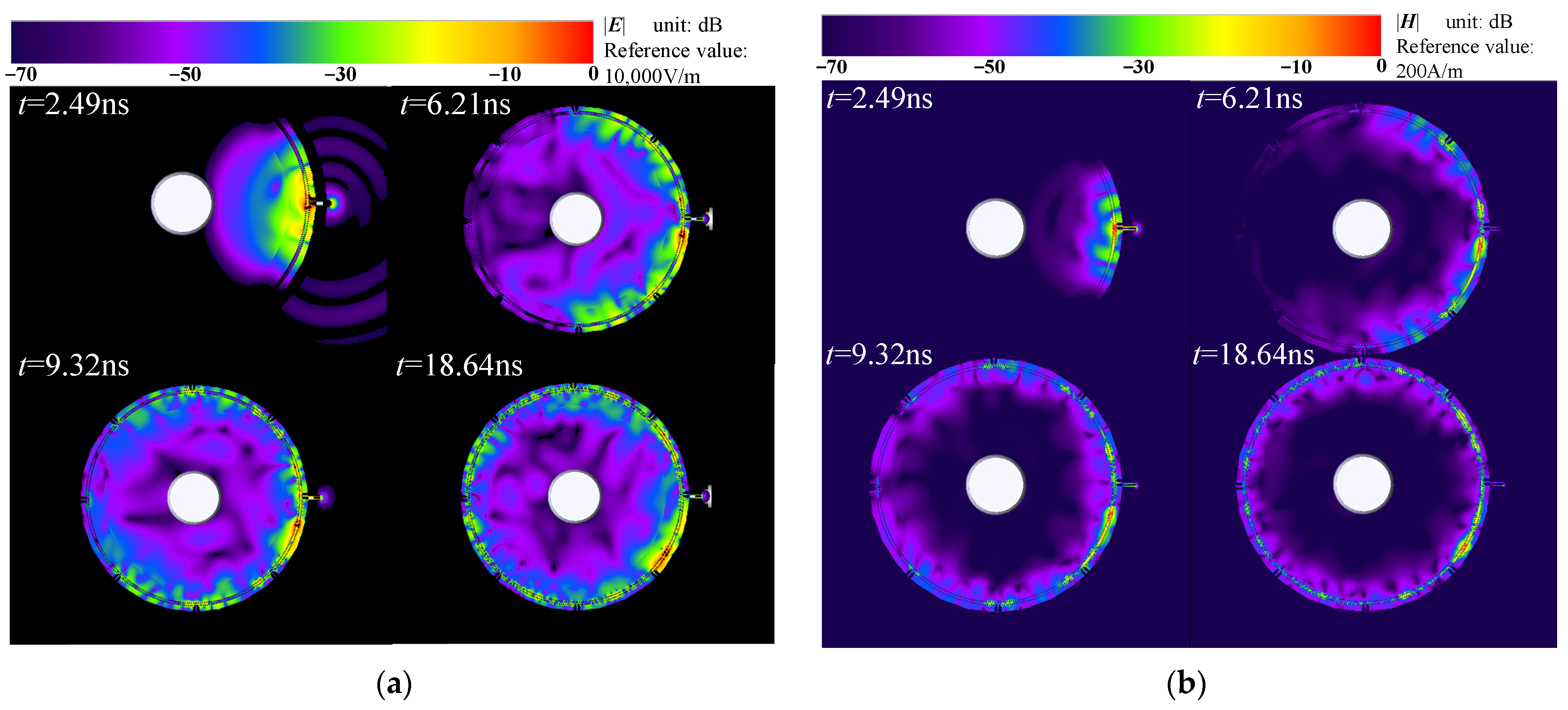
To investigate the propagation of electromagnetic waves in the self-sensing shielding ring when partial discharge occurs, a signal source is set at the signal port of the shielding ring, and a yOz plane sensor is used to observe UHF propagation within the ring. The results are shown in Figure 5. It can be seen that the electromagnetic waves radiated by the partial discharge are captured by the lead-out terminal of the self-sensing shielding ring, and initially propagate in the form of spherical waves in space. Owing to the narrow, elongated cavity and small inner diameter, by t = 6.21 ns the waves traversing the cavity reach the opposite side of the enclosure with substantial attenuation. In parallel, the shielding ring provides a preferential propagation path. By t = 9.32 ns, waves guided by the ring arrive at the opposite side with markedly higher amplitude than those traveling through the cavity. As time progresses, multiple reflections accumulate, producing resonances that eventually fill the entire cavity. The strong coupling between the fields and the multi-section spring structure of the self-sensing shielding ring significantly mitigates signal attenuation.

3.2. S11 Simulation Results and Analysis

Scattering parameters (S parameters) characterize how an electromagnetic network scatters incident wave. Among them, the reflection coefficient S11 is the most commonly used metric for describing an antenna’s input characteristics [23,24]. It quantifies the fraction of energy reflected at the feed point and thus indicates the degree of impedance matching at the input port. Its linear form is defined as follows:
S 11 = Γ = Z in Z 0 Z in + Z 0
where Zin is the equivalent input impedance; Z0 is the system characteristic impedance. The reflection coefficient expressed in decibels is defined as follows:
S 11 , dB = 20 log 10 Γ
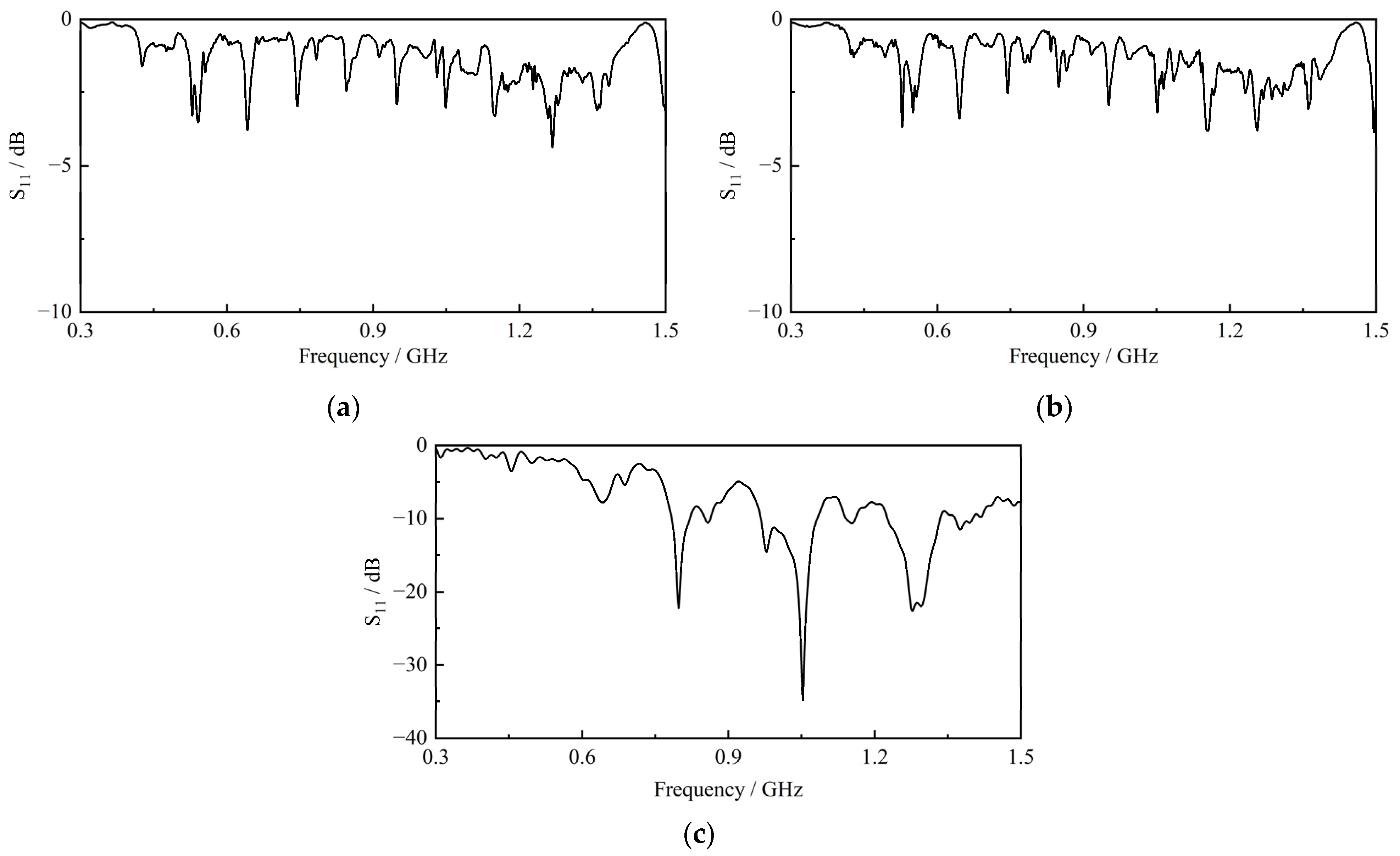
When |S11| is bigger, that is the dB value is more negative, the port reflection is lower, which indicates better impedance matching at that frequency and greater power delivered into the port. In this work, a lower S11 generally implies higher coupling efficiency and a wider effective operating bandwidth. Accordingly, it serves as a useful prior indicator of receiving performance. The simulated S11 responses with the concave sensor, convex sensor, and spring sensor used as the feed point are shown in Figure 6. For the concave sensor, S11 lies mostly above −5 dB within 0.3~1.5 GHz, which exhibits limited effective bandwidth. The convex sensor exhibits similar response characteristics to the concave sensor within the studied frequency range. By contrast, the spring sensor exhibits a distribution of strong resonances from −30 to −10 dB within 0.3~1.5 GHz, with a minimum of −35 dB near 1.05 GHz, indicative of multi-mode, broadband coupling and substantially lower overall reflection.
Let the discrete sampling points of the frequency be fi, the corresponding amplitude be S11 (dB), and the number of samples be N. Quantitative indicators average S11 and average return loss are introduced to reflect the receiving characteristics of the three sensors.
(1)
Average S11
Average S11 is defined as:
S 11 ¯ = 1 N i = 1 N S 11 f i
where average S11 represents the average receiving characteristics of the sensor over a wide frequency band.
(2)
Return loss
Return loss is defined as:
R L = S 11 , dB
The larger the return loss, the better the port matching and the smaller the reflection, allowing the sensor to capture more incident power. The average return loss is the average value of the return loss, reflecting the average matching effect of the port. Its expression is as follows:
R L ¯ = 1 N i = 1 N S 11 ( f i ) = S 11 ¯
The receiving characteristic indicators of the three sensors are shown in Table 1. Within the studied band, the spring sensor exhibits the lowest average S11 and the highest average return loss. These results indicate that the ring achieves markedly superior reception of PD signals compared with conventional built-in sensors.

4. Analysis of Influencing Factors on the Receiving Characteristics of Self-Sensing Shielding Rings

Field experience show that the edges and inner ring surfaces of the GIS basin insulator lie in a critical tri-material junction, where severe electric field distortion leads to a high likelihood of partial discharge. Effective PD monitoring in these regions therefore requires strong receiving performance. To further identify the factors that govern the self-sensing shielding ring’s detection sensitivity to PD signals, this chapter conducts array simulations and compares the impacts of multiple variables on the ring’s sensitivity.

4.1. Array Simulation of Partial Discharge in Self-Sensing Shielding Ring

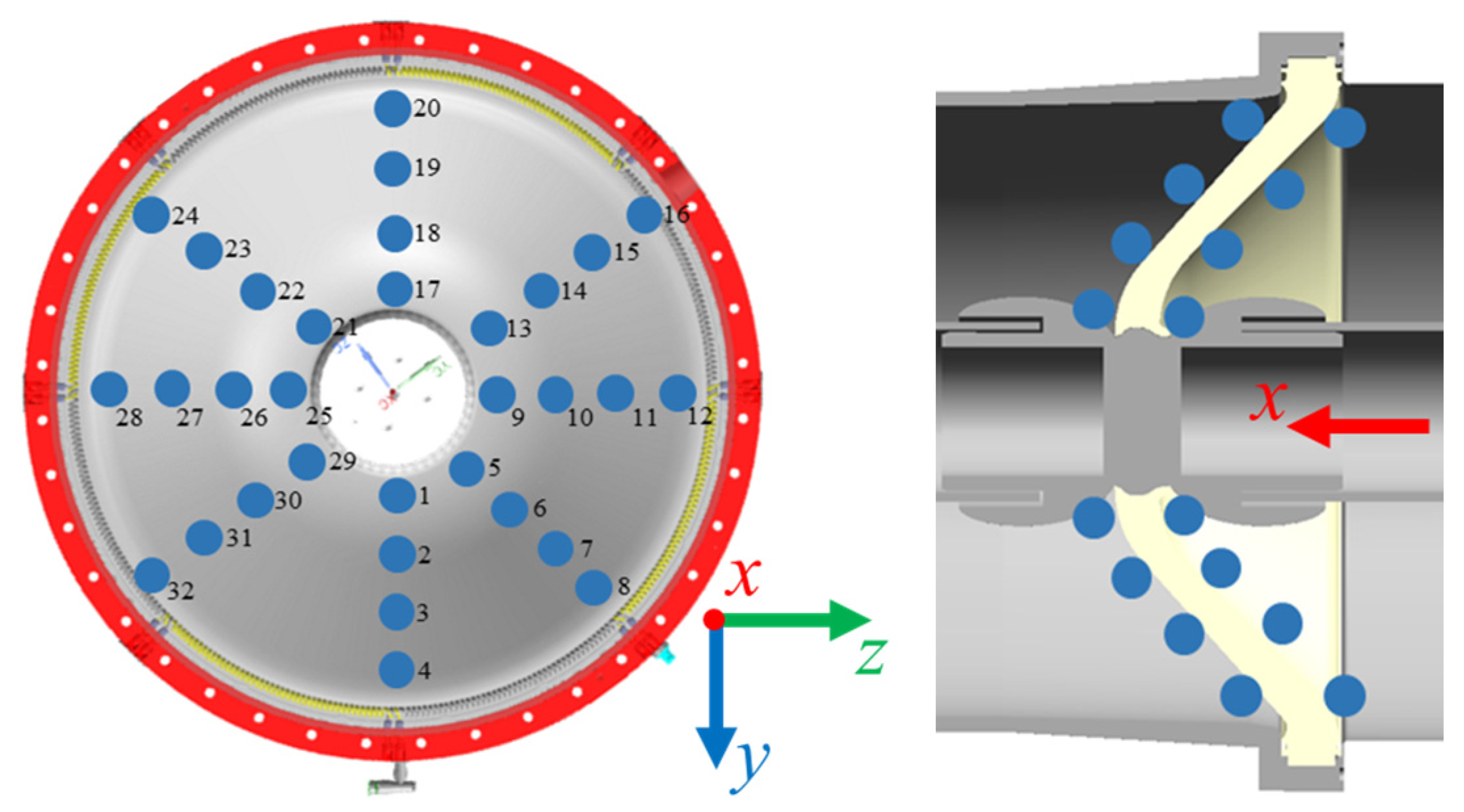
Based on the preceding simulation setup, we varied the location of the PD source to obtain waveform data from the self-sensing shielding ring for PDs occurring at different positions on the basin surface and at positions offset axially on both sides of the basin. The 1100 kV basin insulator divides the GIS into two compartments, and PD sources are placed on both the concave and convex sides. As shown in Figure 7, we define the radial line segment passing through the built-in sensor as 0° and specify eight angular positions (0°, 45° … 315°) and four radial positions (R = 120 mm, R = 240 mm, R = 360 mm and R = 480 mm) on the basin cross-section for source placement, with excitation applied on both concave and convex sides. Along the axial X direction, additional offsets of 0, 100, 200, and 300 mm are introduced, forming a three-dimensional angle-radius-axial array with 256 simulation points. In all cases, the PD source is modeled as a 10 mm current element oriented outward along the radial direction.

4.2. Influence of Radial Position on Detection Sensitivity

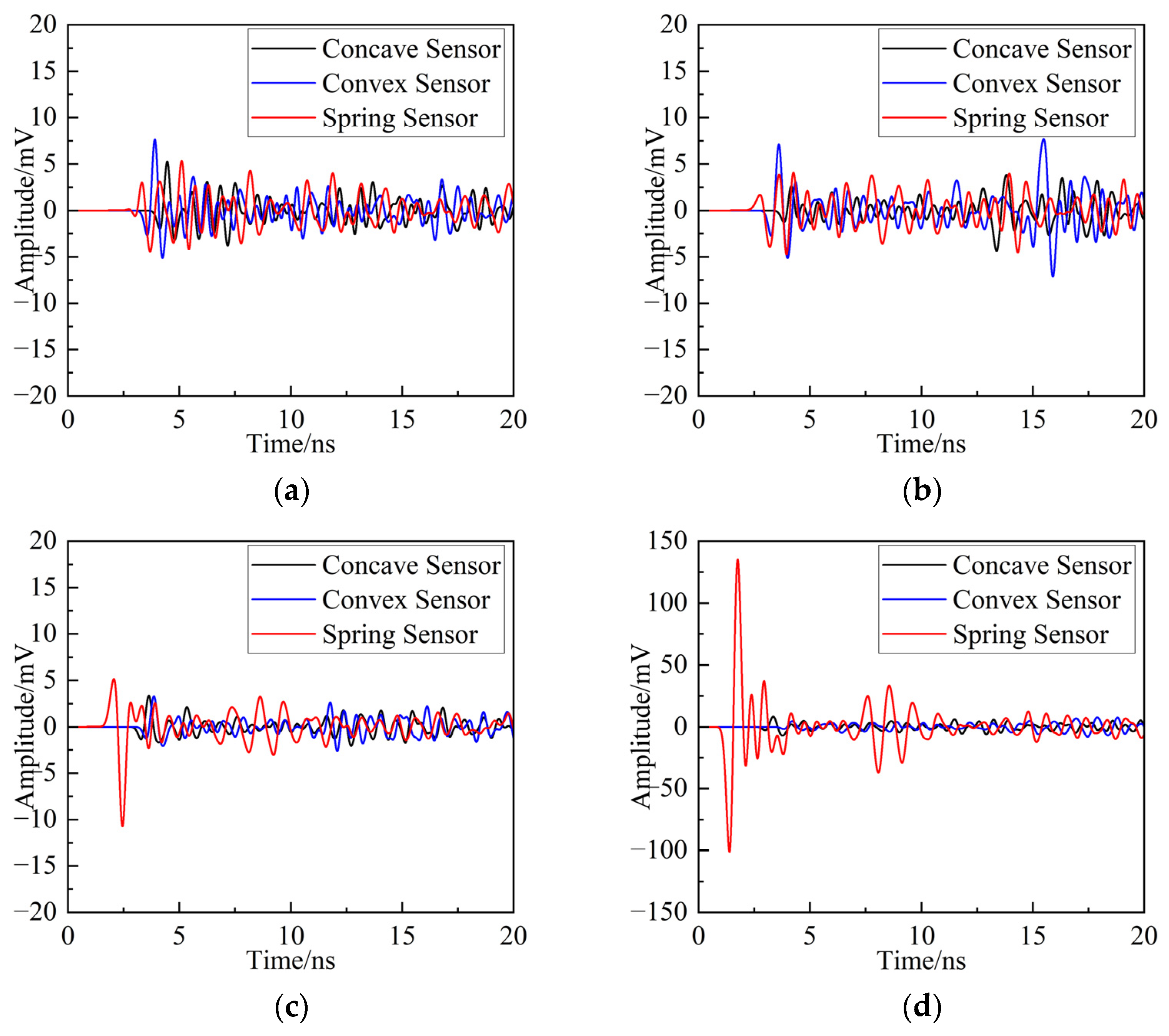
When PD occurs on the basin insulator surface near the inner ring, the signal amplitude at the ring is comparable to or slightly lower than that of the built-in sensor. By contrast, when PD occurs on the outer-ring surface, the ring’s peak response increases nonlinearly, demonstrating high sensitivity to nearby sources. Figure 8 shows representative waveforms for a PD source set at four radial positions along the 0° direction. As the source approaches the basin edge, the amplitude received by the ring reaches 135 mV, far exceeding that of the two built-in sensors. These results indicate that the shielding ring enables rapid response and early warning in the tri-material junction region near the insulator edge.
Because of the insulator geometry and electromagnetic shielding, the built-in sensors constrain electromagnetic-wave propagation to relatively fixed paths. Consequently, their received amplitudes vary only modestly with source distance, yielding more stable performance. In contrast, the self-sensing shielding ring is located close to the insulator surface; the induced electric field and coupling to the source decay rapidly at a rate much faster than 1/r with distance. The signal amplitude rises sharply when the source is nearby. Moreover, as an embedded yet quasi-independent structure composed of multiple interconnected spring segments, the ring exhibits intrinsic resonant frequencies that, when excited, can produce a local enhancement of the received signal.

4.3. Influence of Angle Position on Detection Sensitivity

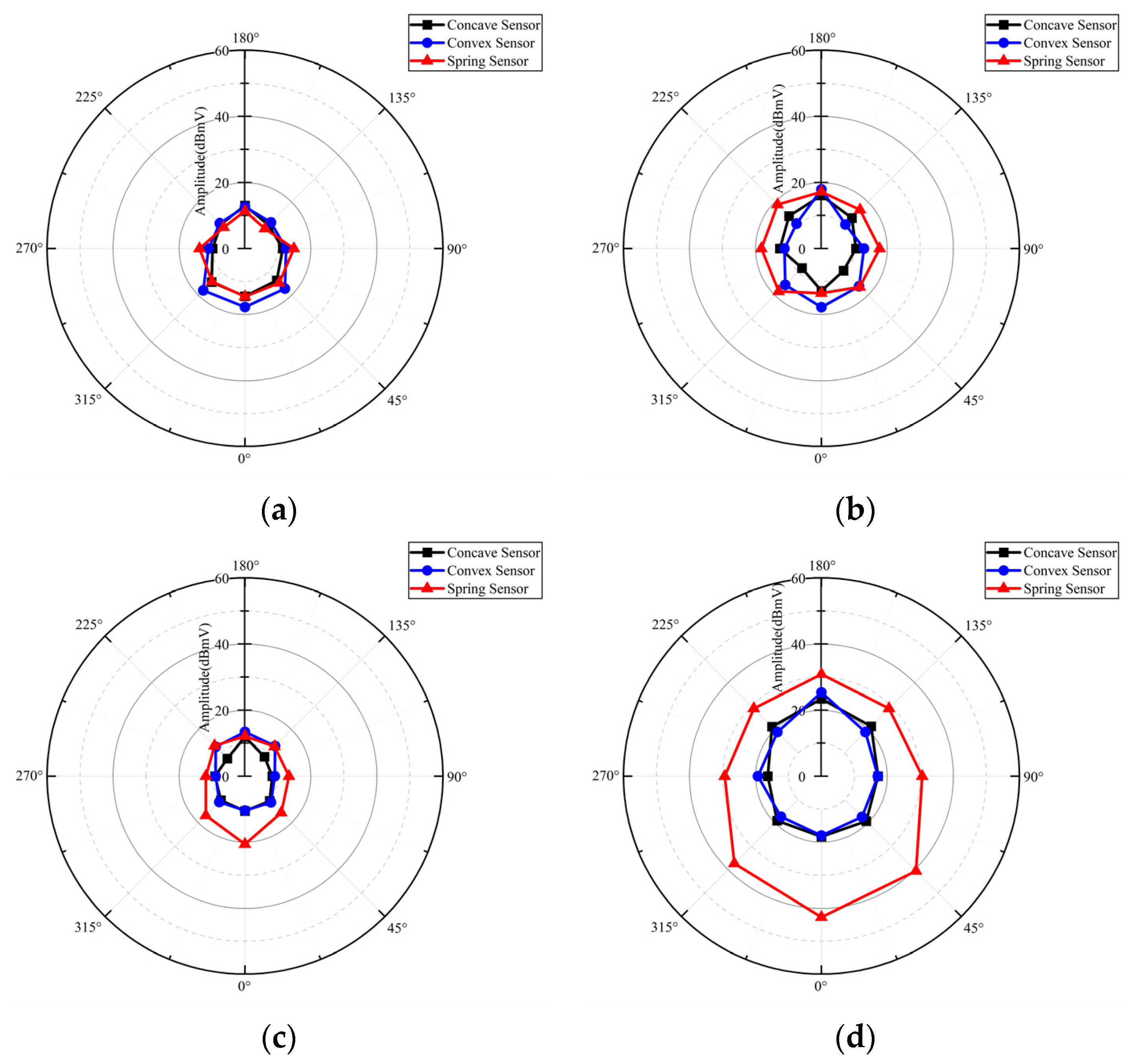
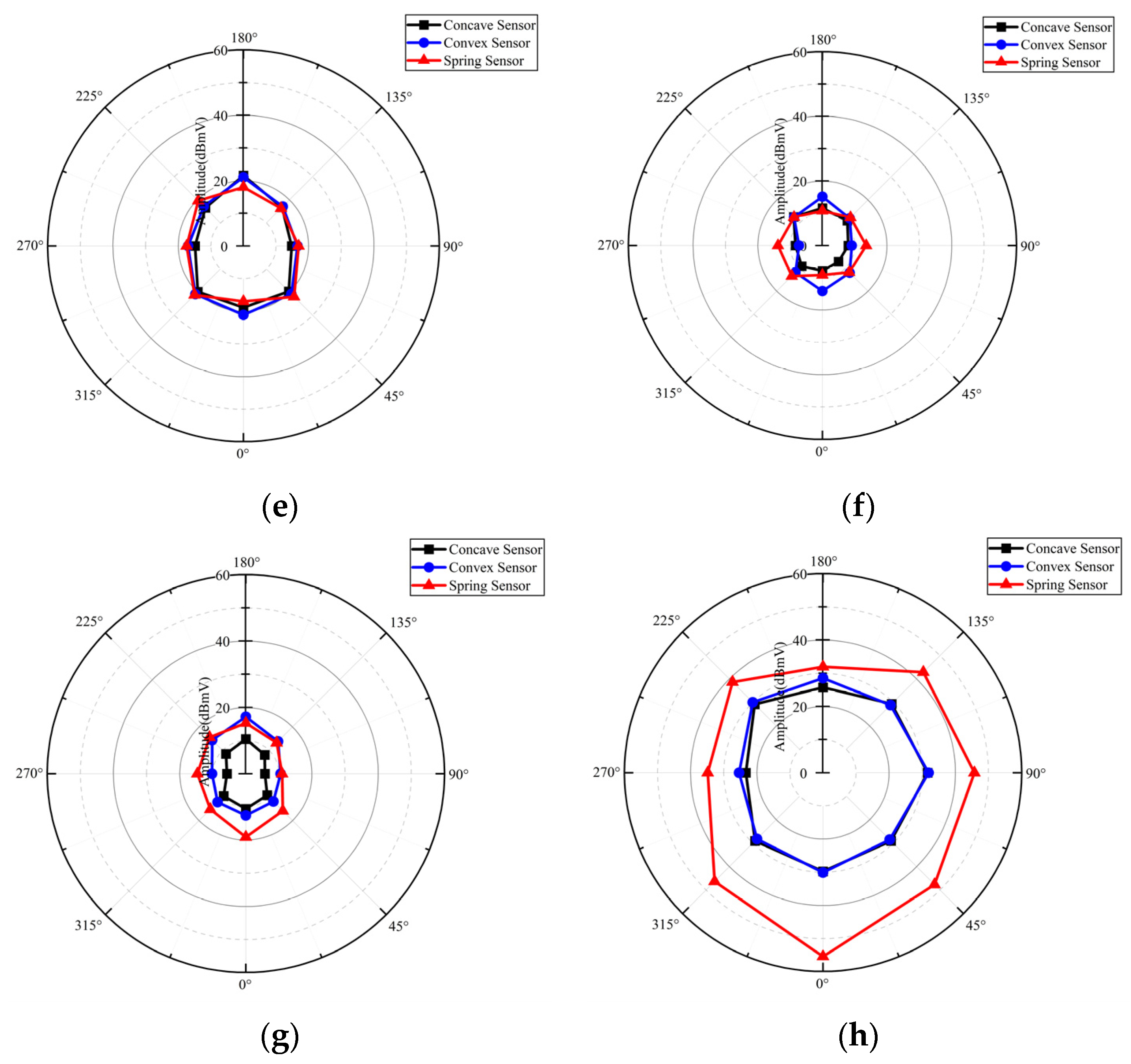
Both the built-in sensors and the receiving port of the self-sensing shielding ring are located along the 0° direction of the basin insulator. Consequently, the angle position influences sensor reception. As shown in Figure 9, we compare the responses for PD at eight angular positions on the basin surface. The built-in sensors exhibit relatively uniform reception across angles, whereas the shielding ring is most sensitive at 0° and shows markedly reduced sensitivity at 180°. This angular dependence holds on both the concave and convex sides. On the concave side, the ring’s peak amplitude is 42.6 dBmV at 0° and 8.5 dBmV at 180°. On the convex side, the corresponding values are 55.4 dBmV and 9.1 dBmV. Thus, the ratio of the ring’s received amplitude at 0° to that at 180° is 4~6, substantially exceeding that of the built-in sensors.
The terminals of the sensing ring and the edges of the basin insulator modify the initial launch and reflection paths of the electromagnetic waves. Edges, internal supports, and metal attachments can obstruct or absorb energy for certain incidence directions, producing a nonuniform angular response. Incidence at 0° is more likely to establish a continuous circumferential current around the ring and to couple efficiently to cavity modes, whereas at 180° structural blockage and phase-inverted reflections reduce the resultant voltage. In addition, the ring’s multi-segment spring architecture can enhance sensitivity for specific angles while suppressing it for others. Its principal receiving axis is misaligned with the 180° incidence, leading to a weak response in that direction.

4.4. Influence of Axial Position on Detection Sensitivity

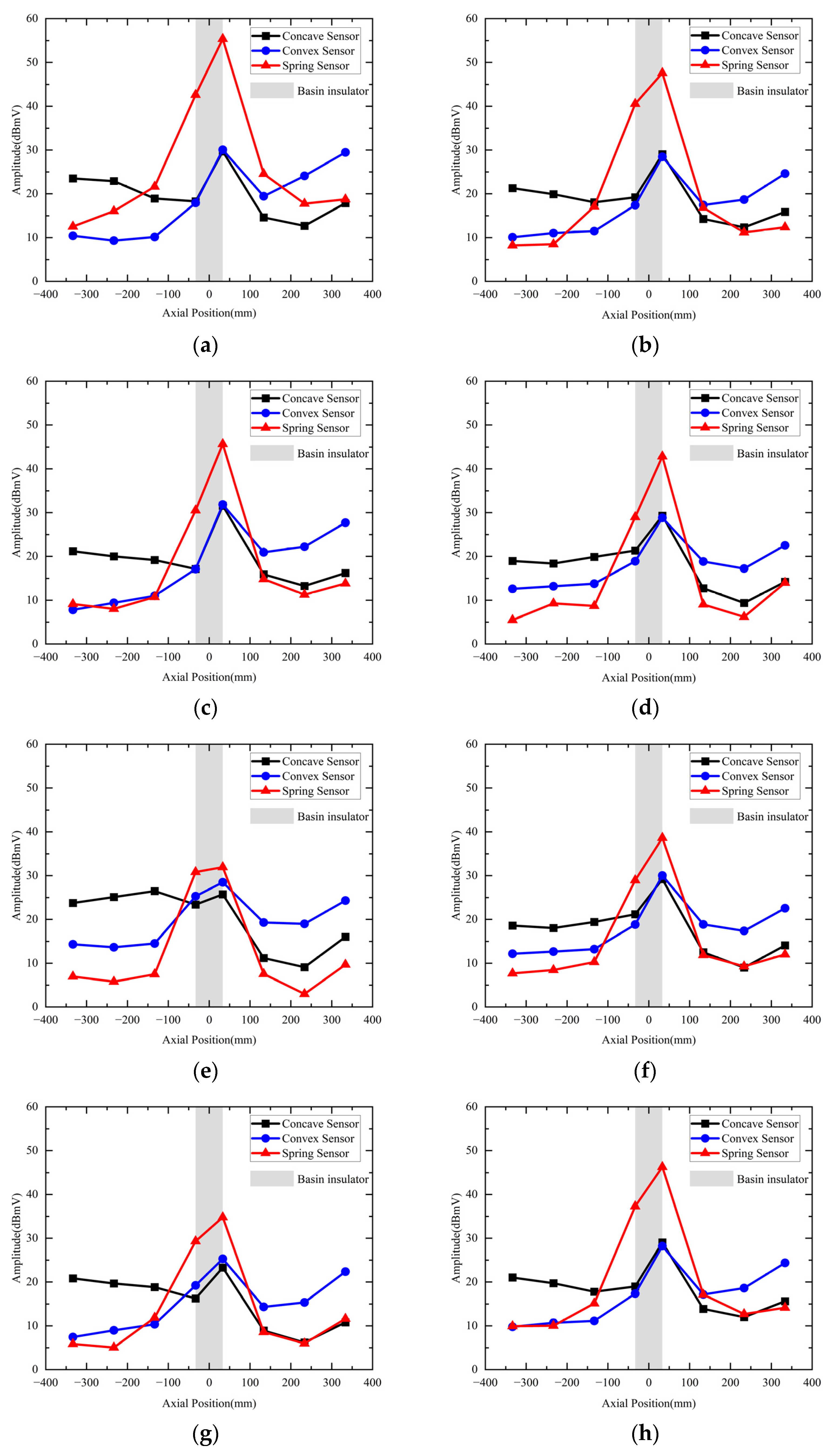
To delineate the effective range over which the self-sensing shielding ring provides high sensitivity PD detection, we vary the axial position of each PD source based on the preceding simulations. The sources placed on the concave and convex sides of the basin are displaced by 100, 200, and 300 mm away from the basin surface (with the edge coordinates defined as x = 33.4 mm on the convex side and x = −33.4 mm on the concave side). The results are summarized in Figure 10, which plots signal amplitude versus axial position for PD occurring at the basin edge in different directions. In the figure, the gray area represents the spatial position where the basin insulator is located. The axial offset has a pronounced impact on the ring’s receiving performance. When the PD source is far from the basin surface, the shielding ring captures the signal ineffectively, and the measured amplitude drops to a level comparable to or slightly below that of the built-in sensor. In contrast, when PD occurs on the basin surface, especially on the convex side, the shielding ring’s captured amplitude is significantly higher than that of the built-in sensor, reaching up to 1.84 times that of the built-in sensor.
The shielding ring comprises multiple spring segments and thus exhibits distributed-parameter behavior. Its circumferential equivalent network can strongly couple with cavity modes at multiple frequencies. As the PD source moves axially away from the basin, the spatial spectrum of the PD field at the ring plane changes. Higher-order modal components decay more rapidly, leading to reduced coupling and degraded receiving performance. Consequently, the measured amplitude decreases with increasing axial distance.

5. Discussion

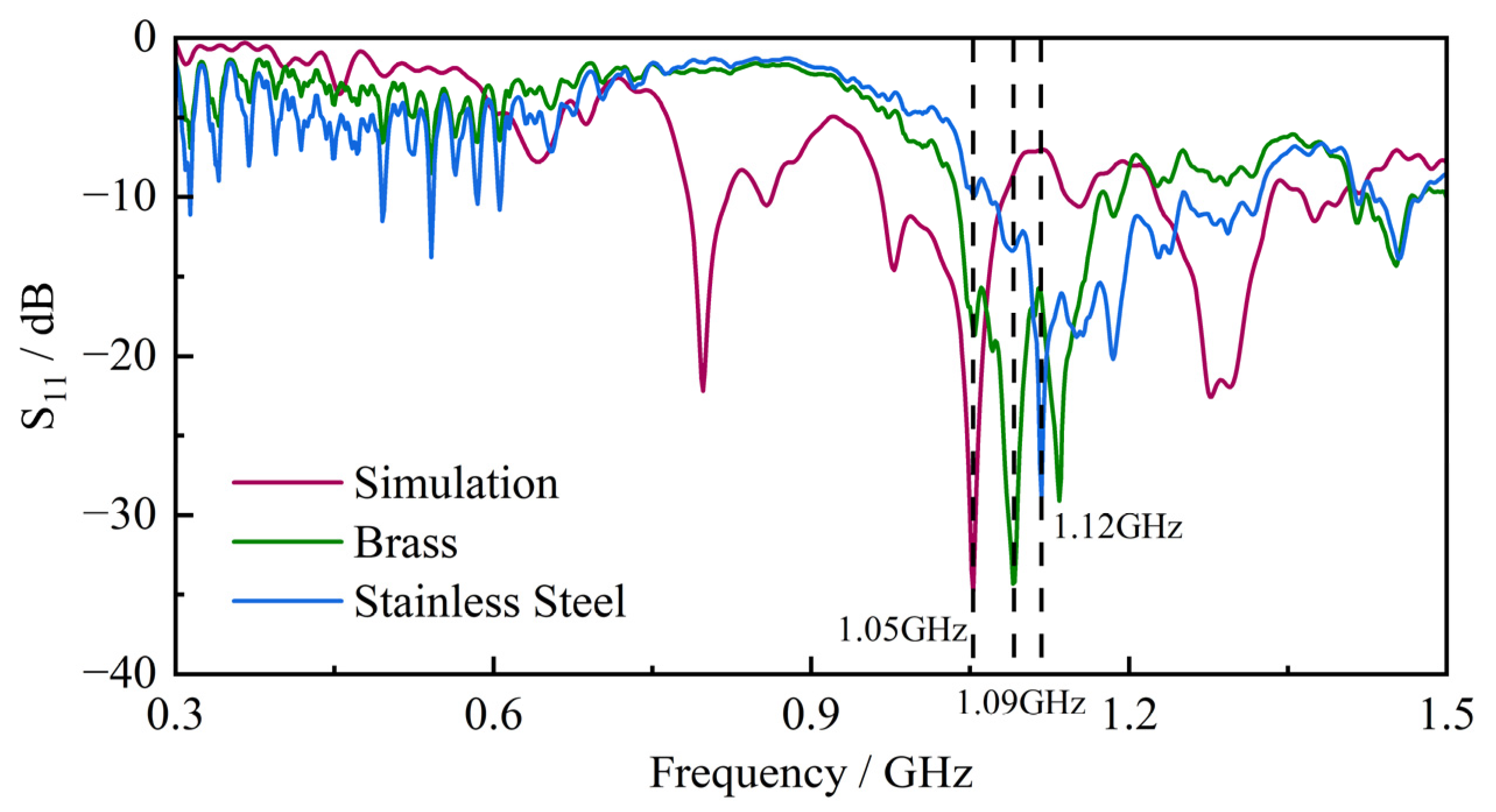
To validate the accuracy of the simulation model, a prototype of the self-sensing shielding ring is fabricated based on the proposed design, and its S11 parameter is measured using a vector network analyzer (VNA). To eliminate the influence of conductor material differences on the electromagnetic characteristics, prototypes made of brass and stainless steel are tested for comparison. The results indicate that the overall trends of the S11 curves obtained from both materials are highly consistent with the simulation, with only minor deviations observed in certain frequency ranges. As shown in Figure 11, the simulation curve exhibits a pronounced resonance peak at 1.05 GHz, where the minimum S11 value reaches −34.8 dB. The measured brass and stainless-steel prototypes present similar reflection valleys at 1.09 GHz and 1.12 GHz, with minimum reflection levels of −34.2 dB and −28.9 dB, respectively. The simulated and measured S11 curves remain consistent within the 0.3~1.5 GHz, including the principal resonance regions, the main reflection valleys and the general magnitude characteristics. All three curves exhibit a dominant resonance peak near approximately 1.05–1.12 GHz., demonstrating that the proposed model can accurately predict the resonance characteristics of the shielding ring structure. The differences that appear in certain narrow frequency intervals primarily arise from physical factors that are not fully considered in the simulation model, such as the conductor conductivity, surface roughness, fabrication tolerances in spring spacing and small variations in assembly conditions. These factors alter the distributed inductance and capacitance of the ring structure, which in turn cause minor frequency shifts or local variations in resonances. However, these resonances contribute only marginally to the coupling of UHF signals induced by partial discharge. This result verifies the reliability of the electromagnetic simulation in capturing the characteristic frequencies and coupling mechanisms, and further confirms that the fabricated self-sensing shielding ring maintains a stable electromagnetic response under practical conditions, providing a solid basis for subsequent structural optimization and engineering applications.

6. Conclusions

Based on the 1100 kV GIS model, this study investigates the electromagnetic characteristics and partial discharge detection performance of a self-sensing shielding ring embedded within the basin insulator. Through multi-dimensional comparisons with conventional UHF sensors and a comprehensive three-dimensional array simulation, the proposed structure demonstrates several distinct strengths. First, the shielding ring exhibits broadband and strong reflection characteristics, with significantly lower S11 levels than those of the concave and convex built-in sensors, indicating superior impedance matching across the dominant frequency bands relevant to UHF partial discharge detection. Second, analysis of radial, angular and axial discharge positions reveals that the shielding ring achieves markedly enhanced sensitivity to PD occurring near the basin surface, particularly at the tri-material junction where discharge is most likely to originate, thereby offering clear advantages for early warning and condition assessment. The consistency between simulation and measurement within the primary resonant regions further reinforces the reliability of the proposed modeling approach.
At the same time, several limitations have also been identified. There are minor discrepancies between simulated and measured responses at certain frequency intervals. The performance of the shielding ring decreases when the discharge source is located far from the basin surface, reflecting its intrinsic near-field sensing characteristics. These factors highlight aspects of the structure that may benefit from refinement. Future research may explore approaches to further enhance the robustness of the sensing response, extend the applicability of the structure under more diverse discharge scenarios and refine modeling accuracy to better capture higher-order electromagnetic behaviors. These efforts will help advance the development of embedded sensing technologies for reliable GIS insulation-condition monitoring.

Author Contributions

Conceptualization, R.L.; methodology, S.W. and R.L.; investigation, W.Z.; data curation, L.L. and H.L.; writing—original draft, S.W. and S.Y.; writing—review and editing, R.L. and D.W.; supervision, G.Z. All authors have read and agreed to the published version of the manuscript.

Funding

This research was funded by the Xi’an XD Switchgear Electric Co., Ltd.

Data Availability Statement

Data is contained within the article.

Acknowledgments

The authors kindly acknowledge the financial support of the Xi’an XD Switchgear Electric Co., Ltd.

Conflicts of Interest

Authors Ruipeng Li, Wei Zhang, Huiwu Liu, Longxing Li, Shurong Yuan and Dong Wang were employed by the company Xi’an XD Switchgear Electric Co., Ltd. The remaining authors declare that the research was conducted in the absence of any commercial or financial relationships that could be construed as a potential conflict of interest. The authors declare that this study received funding from Xi’an XD Switchgear Electric Co., Ltd. The funder was not involved in the study design, collection, analysis, interpretation of data, the writing of this article or the decision to submit it for publication.

Abbreviations

The following abbreviations are used in this manuscript:
FDTDFinite-difference time-domain
UHFUltra-high frequency
GISGas-insulated switchgear
PDPartial discharge
PTFEPolytetrafluoroethylene
PECPerfect electric conductors
CFLCourant–Friedrichs–Lewy
PMLPerfectly matched layers
VNAVector network analyzer

References

  1. Gao, W.; Ding, D.; Liu, W. Research on the Typical Partial Discharge Using the UHF Detection Method for GIS. IEEE Trans. Power Deliv. 2011, 26, 2621–2629. [Google Scholar] [CrossRef]
  2. Judd, M.D.; Farish, O.; Hampton, B. The excitation of UHF signals by partial discharges in GIS. IEEE Trans. Dielectr. Electr. Insul. 2002, 3, 213–228. [Google Scholar] [CrossRef]
  3. Li, T.; Rong, M.; Zheng, C.; Wang, X. Development simulation and experiment study on UHF Partial Discharge Sensor in GIS. IEEE Trans. Dielectr. Electr. Insul. 2012, 19, 1421–1430. [Google Scholar] [CrossRef]
  4. Li, J.; Han, X.; Liu, Z.; Yao, X. A Novel GIS Partial Discharge Detection Sensor with Integrated Optical and UHF Methods. IEEE Trans. Power Deliv. 2016, 33, 2047–2049. [Google Scholar] [CrossRef]
  5. Roslizan, N.D.; Rohani, M.N.; Wooi, C.L.; Isa, M.; Ismail, B.; Rosmi, A.S.; Mustafa, W.A. A review: Partial discharge detection using UHF sensor on high voltage equipment. J. Phys. Conf. Ser. 2020, 1432, 012003. [Google Scholar] [CrossRef]
  6. Bin, F.; Wang, F.; Sun, Q.; Lin, S.; Xie, Y.; Fan, M. Internal UHF antenna for partial discharge detection in GIS. IET Microw. Antennas Propag. 2018, 12, 2184–2190. [Google Scholar] [CrossRef]
  7. Faizol, Z.; Zubir, F.; Saman, N.M.; Ahmad, M.H.; Rahim, M.K.A.; Ayop, O.; Jusoh, M.; Majid, H.A.; Yusoff, Z. Detection Method of Partial Discharge on Transformer and Gas-Insulated Switchgear: A Review. Appl. Sci. 2023, 13, 9605. [Google Scholar] [CrossRef]
  8. Ibrahim, V.M.; Abdul-Malek, Z.; Muhamad, N.A. Status Review on Gas Insulated Switchgear Partial Discharge Diagnostic Technique for Preventive Maintenance. Indones. J. Electr. Eng. Comput. Sci. 2017, 7, 9–17. [Google Scholar] [CrossRef]
  9. Meng, X.; Song, H.; Dai, J.; Luo, L.; Sheng, G.; Jiang, X. Severity Evaluation of UHF Signals of Partial Discharge in GIS Based on Semantic Analysis. IEEE Trans. Power Deliv. 2021, 37, 1456–1464. [Google Scholar] [CrossRef]
  10. Chai, H.; Phung, B.; Mitchell, S. Application of UHF Sensors in Power System Equipment for Partial Discharge Detection: A Review. Sensors 2019, 19, 1029. [Google Scholar] [CrossRef]
  11. Liang, R.; Wu, S.; Chi, P.; Peng, N.; Li, Y. Optimal Placement of UHF Sensors for Accurate Location of Partial Discharge in Gas-Insulated Switchgear. Energies 2019, 12, 1173. [Google Scholar] [CrossRef]
  12. Tian, J.; Zhang, G.; Ming, C.; He, L.; Liu, Y.; Liu, J.; Zhang, X. Design of a Flexible UHF Hilbert Antenna for Partial Discharge Detection in Gas-Insulated Switchgear. IEEE Antennas Wirel. Propag. Lett. 2022, 22, 794–798. [Google Scholar] [CrossRef]
  13. Hu, X.; Zhang, G.; Liu, X.; Chen, K.; Zhang, X. Design of High-Sensitivity Flexible Low-Profile Spiral Antenna Sensor for GIS Built-in PD Detection. Sensors 2023, 23, 4722. [Google Scholar] [CrossRef] [PubMed]
  14. Jia, Y.; Yang, J.; Rong, L.; Tao, F. Performance Comparison of Typical Built-In UHF Sensors Used for GIS PD Detection. Appl. Mech. Mater. 2014, 672–674, 1143–1150. [Google Scholar] [CrossRef]
  15. Hikita, M.; Ohtsuka, S.; Teshima, T.; Okabe, S.; Kaneko, S. Electromagnetic (EM) wave characteristics in GIS and measuring the EM wave leakage at the spacer aperture for partial discharge diagnosis. IEEE Trans. Dielectr. Electr. Insul. 2007, 14, 453–460. [Google Scholar] [CrossRef]
  16. Ma, G.M.; Li, C.R.; Chen, W.J.; Zhang, B.; Li, Z.B. VFTO Measurement System Based on the Embedded Electrode in GIS Spacer. IEEE Trans. Power Deliv. 2012, 27, 1998–2003. [Google Scholar] [CrossRef]
  17. Hoshino, T.; Maruyama, S.; Sakakibara, T.; Ohtsuka, S.; Hikita, M.; Ueta, G.; Okabe, S. Sensitivity of UHF coupler and loop electrode with UHF method and their comparison for detecting partial discharge in GIS. In Proceedings of the 2008 International Conference on Condition Monitoring and Diagnosis, Beijing, China, 21–24 April 2008; IEEE: New York, NY, USA. [Google Scholar]
  18. Shuheng, D.; Na, W.; Haodong, L.; Teng, J. Optimization Design of Grading Ring for 220 kV Basin type Insulator Based on Finite Element Method and Neural Network Method. Insul. Surge Arresters 2018, 54, 79–85. [Google Scholar]
  19. Ye, H.; Man, Y.; Qian, Y.; Cao, L.; Sheng, G.; Jiang, X. Simulation study of attenuation of ultrahigh frequency electromagnetic wave by salver-shaped insulator in GIS. Przegląd Elektrotechniczny 2013, 89, 122–125. [Google Scholar]
  20. Li, X.; Wang, X.; Yang, A.; Rong, M. Partial discharge source localization in GIS based on image edge detection and support vector machine. IEEE Trans. Power Deliv. 2019, 34, 1795–1802. [Google Scholar] [CrossRef]
  21. Li, T.; Wang, X.; Zheng, C.; Liu, D.; Rong, M. Investigation on the placement effect of UHF sensor and propagation characteristics of PD-induced electromagnetic wave in GIS based on FDTD method. IEEE Trans. Dielectr. Electr. Insul. 2014, 21, 1015–1025. [Google Scholar] [CrossRef]
  22. Yao, R.; Zhang, Y.; Si, G.; Wu, C.; Yang, N.; Wang, Y. Simulation analysis on the propagation characteristics of electromagnetic wave in T-branch GIS based on FDTD. In Proceedings of the 2015 IEEE 15th Mediterranean Microwave Symposium (MMS), Lecce, Italy, 30 November–2 December 2015; IEEE: New York, NY, USA, 2015. [Google Scholar]
  23. Zhang, G.; Tian, J.; Zhang, X.; Liu, J.; Lu, C. A flexible planarized biconical antenna for partial discharge detection in gas-insulated switchgear. IEEE Antennas Wirel. Propag. Lett. 2022, 21, 2432–2436. [Google Scholar] [CrossRef]
  24. Salah, W.S.; Gad, A.H.; Attia, M.A.; Eldebeikey, S.M.; Salama, A.R. Design of a compact ultra-high frequency antenna for partial discharge detection in oil immersed power transformers. Ain Shams Eng. J. 2022, 13, 101568. [Google Scholar] [CrossRef]
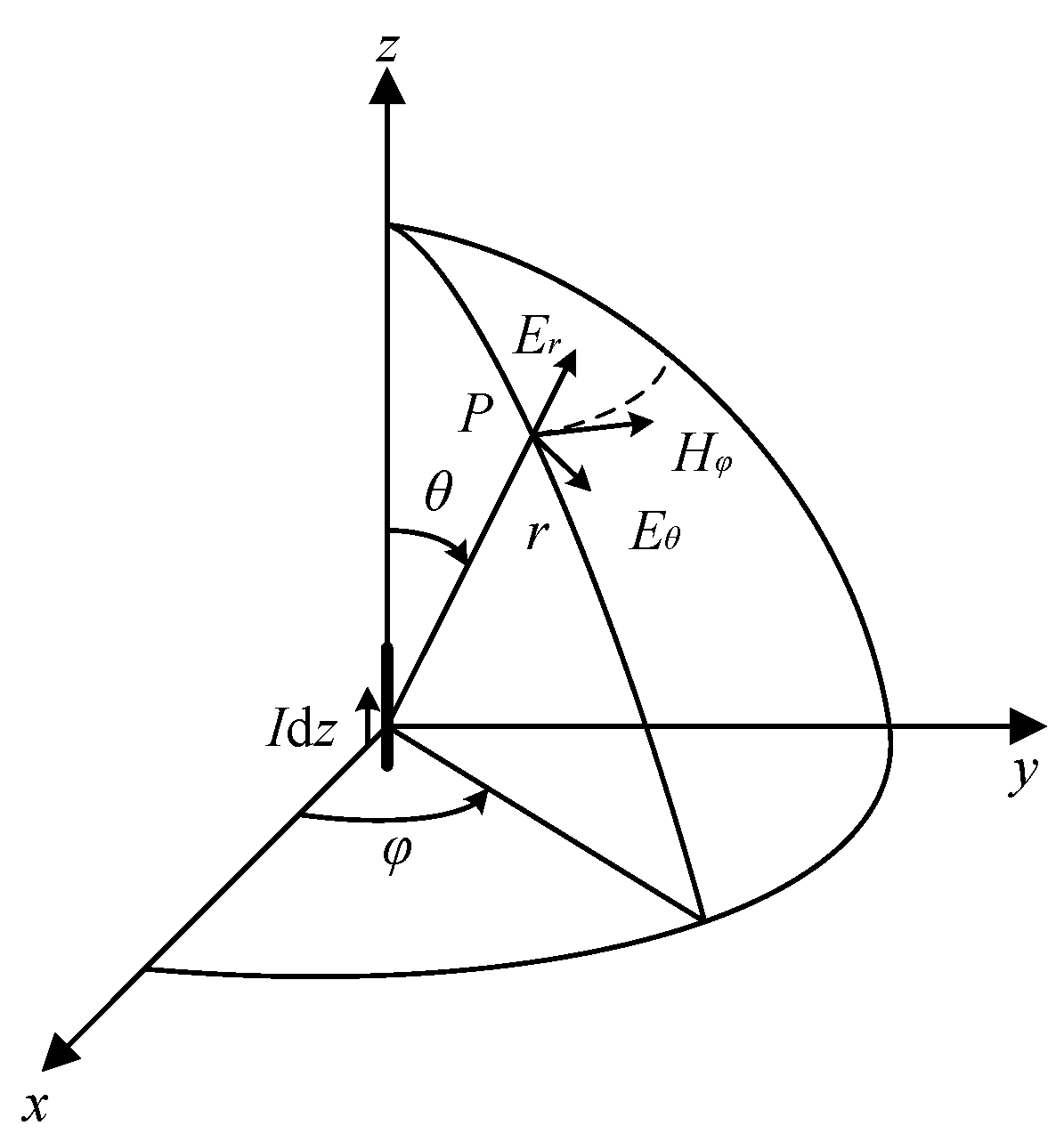
Figure 1. Schematic diagram of the electromagnetic radiation model of the primary current.
Electronics 14 04757 g001
Figure 2. Axial section diagram of the straight-cavity 1100 kV GIS model. The red circle indicates the signal terminals of the self-sensing shielding ring.
Electronics 14 04757 g002
Figure 3. Normalized time-domain waveform and spectrum of the pulse. (a) Time-domain waveform of the pulse; (b) Spectrum of the pulse.
Electronics 14 04757 g003
Figure 4. The flowchart of the PD simulation in GIS.
Electronics 14 04757 g004
Figure 5. Propagation process of ultrahigh-frequency electromagnetic wave signals in the shielding ring. (a) Propagation of electric field intensity E; (b) Propagation of magnetic field intensity H.
Electronics 14 04757 g005
Figure 6. S11 simulation results. (a) S11 curve of the concave sensor; (b) S11 curve of the convex sensor; (c) S11 curve of the spring sensor.
Electronics 14 04757 g006
Figure 7. Schematic diagram of the cross-section of the 1100 kV GIS model. The numbers and blue dots represent the positions of the partial discharge sources in the simulation.
Electronics 14 04757 g007
Figure 8. Waveform diagrams of the sensors when the partial discharge source is located at four radial positions in the 0° direction. (a) R = 120 mm; (b) R = 240 mm; (c) R = 360 mm; (d) R = 480 mm.
Electronics 14 04757 g008
Figure 9. Receiving characteristics of the sensor for the partial discharge signals occurring at 8 different angles under the same radial distance. (a) Concave side, R = 120 mm; (b) Concave side, R = 240 mm; (c) Concave side, R = 360 mm; (d) Concave side, R = 480 mm; (e) Convex side, R = 120 mm; (f) Convex side, R = 240 mm; (g) Convex side, R = 360 mm; (h) Convex side, R = 480 mm.
Electronics 14 04757 g009aElectronics 14 04757 g009b
Figure 10. Relationship between the signal amplitude and the axial position when partial discharge occurs at the edge of the basin (R = 480 mm) in different directions. (a) 0° direction; (b) 45° direction; (c) 90° direction; (d) 135° direction; (e) 180° direction; (f) 225° direction; (g) 270° direction; (h) 315° direction.
Electronics 14 04757 g010
Figure 11. Comparison of S11 between simulation and actual measurement.
Electronics 14 04757 g011
Table 1. Receiving characteristic indicators of the sensor.
Evaluation IndexConcave SensorConvex SensorSpring Sensor
Average S11 (dB)−1.270−1.274−6.347
Average RL (dB)1.2701.2746.347
Disclaimer/Publisher’s Note: The statements, opinions and data contained in all publications are solely those of the individual author(s) and contributor(s) and not of MDPI and/or the editor(s). MDPI and/or the editor(s) disclaim responsibility for any injury to people or property resulting from any ideas, methods, instructions or products referred to in the content.