Article

Assessment of GNSS-Based InBSAR Deformation Monitoring Using GB-SAR and D-GNSS Measurements

1
The School of Information and Electronics, Beijing Institute of Technology, Beijing 100081, China
2
The Key Laboratory of Electronic and Information Technology in Satellite Navigation, Beijing Institute of Technology, Beijing 100081, China
3
Chongqing Innovation Center, Beijing Institute of Technology, Chongqing 401100, China
4
Institute of Space and Earth Information Science, The Chinese University of Hong Kong, Hong Kong 999077, China
*
Authors to whom correspondence should be addressed.
Electronics 2025, 14(23), 4749; https://doi.org/10.3390/electronics14234749

Submission received: 3 November 2025 / Revised: 28 November 2025 / Accepted: 28 November 2025 / Published: 2 December 2025

Abstract

GNSS-based InBSAR can be used for 3D deformation monitoring due to its remote sensing capability, simultaneous use of multiple transmitters of opportunity, and high-accuracy potential. Mature GB-SAR and D-GNSS measurements can be used for comprehensive accuracy assessment, which has become a prominent focus in recent research. However, inter-system accuracy has not been fully assessed due to DEM errors, resolution cell variance, and limitations in accuracy mapping. This paper proposes an accuracy assessment algorithm for GNSS-based InBSAR. First, the global DEM error is accurately estimated by associating multi-angle images to correct the positions of inter-system PSs. Second, the intersection of resolution cells is introduced to address inter-system resolution cell variance and obtain inter-system coregistered PSs. Third, a mathematical operator model is developed to map different deformation directions for inter-system accuracy assessment. Raw data verify the validity of the proposed algorithm and model. In the first experimental scene with continuous deformation, the system achieves an LOS accuracy of 3.1 mm compared with GB-SAR. In the second experimental scene with invisible deformation, it achieves 3D accuracies of 2.2, 2.5, and 4.3 mm using D-GNSS as the reference and an LOS accuracy of 2.6 mm using GB-SAR as the reference. The results show that the method provides an effective solution for inter-system accuracy assessment.

1. Introduction

Deformation monitoring is critical for the prevention of geological disasters, with two widely used classical deformation monitoring techniques. The first primarily relies on personnel visiting the site to deploy D-GNSS [1]. However, for emergency high-elevation or high-risk landslides, there are significant system-deployment challenges with this approach [2]. The second technique, InSAR, provides deformation across the whole scene but only along the LOS direction. Its typical revisit interval (about 10 days) does not satisfy the requirements for near-real-time landslide warnings [3]. GNSS-based InBSAR uses GNSS satellites as transmitters, as well as a stationary ground receiver that captures reflected navigation signals [4].
Compared with traditional techniques, GNSS-based InBSAR offers several advantages. First, it operates as a remote sensing monitoring mode: deformation can be monitored solely by receiving reflected signals from the scene [5,6]. Second, satellites provide abundant observation resources. At any position and time on Earth’s surface, navigation systems typically ensure visibility of at least 12 satellites from diverse angles [7,8,9]. Combining observations from different satellites enables the retrieval of 3D, high-frequency deformation histories [10]. Consequently, GNSS-based InBSAR is well suited for landslide monitoring.
Relative to conventional InSAR, GNSS-based InBSAR has a shorter research history, and its accuracy has not been rigorously assessed [11]. Furthermore, the combined effects of DEM errors, inter-system resolution differences, and varying LOS directions pose significant challenges in utilizing GB-SAR and D-GNSS datasets for accuracy assessment [12].
This issue is specifically manifested as follows. First, differing inter-system configurations prevent coregistration of multi-angle deformation monitoring in the range-Doppler domain [13]. Monitoring results must be projected onto the ground plane for multi-angle geocoding and coregistration. When DEM errors exist between the actual terrain and the imaging plane, the target focus position and the corresponding deformation result are offset [14]. The magnitude and direction of these offsets depend on the system configuration [15]. Compensation for DEM-induced offsets is therefore essential for inter-system assessment.
Second, navigation signals have low bandwidth, which limits resolution [16]. Deformation sampling density in GNSS-based InBSAR and GB-SAR is fundamentally governed by their spatial resolutions. Differences in signal frequency and antenna mainlobe alter the scene RCS, producing spatially varying deformation density [17]. Thus, differences in resolution and RCS must be compensated. Integrating high-precision, 3D pointwise D-GNSS measurements into inter-system monitoring also remains a challenge.
Third, validating GNSS-based InBSAR deformation monitoring results requires comparisons with other monitoring systems. However, inter-system discrepancies prevent alignment of measurements for the same target [18]. GNSS-based InBSAR is a bistatic, 3D surface-deformation monitoring radar; GB-SAR is a monostatic, 1D surface-deformation monitoring radar; and D-GNSS provides 3D point measurements. Differences in configuration, LOS direction, and monitoring mode complicate assessment.
Algorithms for DEM-error compensation have been widely studied. In [19], the authors evaluated global DEMs for 3D change detection and compared filtering methods to improve reliability; they also explored combined DEMs and cloud computing to enhance 3D change description. The authors of [20] proposed a multi-level interpolation filter for LiDAR point clouds, achieving higher accuracy than classical methods in forested areas. In [21], a new SAR filtering algorithm was developed to correct terrain-induced phase errors by dividing and filtering nonlinear phase components; the method was validated through theoretical analysis and simulation. The authors of [22] developed an improved stacked InSAR algorithm to effectively eliminate the influence of DEM errors on deformation monitoring through vertical baseline averaging technique, without explicitly estimating DEM errors. These algorithms focus on local DEM optimization. In contrast, GNSS-based InBSAR uses diverse bistatic configurations and provides many viewing angles that can be used for DEM-error compensation. The rich viewing angles can be used for DEM-error compensation. Consequently, current algorithms are not directly applicable to inter-system DEM-error compensation.
For inter-system coregistration and PS selection, several single-system methods exist. The authors of [23] developed a PS interferometry method that incorporates a temporary PS into iterative parameter estimation, enhancing coherence and TPS count; Sentinel-1 data validated its efficacy for detecting nonlinear motion. In [24], random matrix theory was used to analyze SAR data covariance matrices to distinguish low-coherence pixels from noise, improve PS and distributed-scatterer extraction and time-series accuracy, and enable the detection of multiple targets in layover pixels. In [25], GNSS-based InBSAR used an enhanced Kriging interpolator with adaptive thresholding and spherical model refitting to improve deformation field accuracy despite low SNR and resolution. Resolution differences, however, still complicate deformation extraction. The authors of [26] compared fractional vegetation-cover estimation methods at fine spatial resolutions and found that gap probability theory performed best overall, while pixel dichotomy models (based on the normalized difference vegetation index and near-infrared reflectance) suited forests and sparse grasses. The authors of [27] proposed a reference-based super-resolution method with progressive spatial adaptation and spatial correction modules to improve matching and correct scale/orientation. In [28], an end-to-end GAN-based spatiotemporal fusion method was used to fuse remote sensing images and improve temporal-change prediction accuracy with limited prior information. Nevertheless, these algorithms are not suitable for inter-system coregistration.
Because translating deformation accuracy and spatiotemporal density across systems is difficult, few studies address inter-system assessments; most focus on a single monitoring type. In [29], displacement directions were estimated via nonlinear equations using three ground-based multiple-input–multiple-output radars to measure 3D deformation of a DCR; the geometric dilution of precision analysis confirmed the feasibility and accuracy of the method. The authors of [30] validated a 3D deformation retrieval algorithm for GNSS-based InBSAR, achieving better than 5 mm accuracy in all directions and demonstrating the method’s potential for landslide prediction and infrastructure monitoring. In [31], a bidirectional gated recurrent unit multioutput surface deformation prediction network for deformation monitoring in InSAR achieved millimeter-level accuracy, useful for geological disaster warnings and structural health monitoring. Existing methods are therefore unsuitable for inter-system accuracy assessment because they do not resolve inter-system DEM-error compensation, PS coregistration, and deformation projection issues; therefore, a new algorithm is needed.
In this paper, an accuracy assessment algorithm is proposed for GNSS-based InBSAR, GB-SAR, and D-GNSS. We introduce a dynamic DEM-error compensation method that uses inter-system differential offset analysis across heterogeneous configurations for positional rectification. Spatiotemporal density matching functions as an inter-system synchronization paradigm, and deformation projection coupled with accuracy-metric conversion enables inter-system precision evaluation. This paper is organized as follows. Section 2 establishes the deformation phase model and 3D inversion for GNSS-based InBSAR. Section 3 describes the proposed algorithm. Section 4 details experiments with two natural scenes and presents the results. Section 5 discusses the findings, and Section 6 concludes this paper.

2. Signal Model

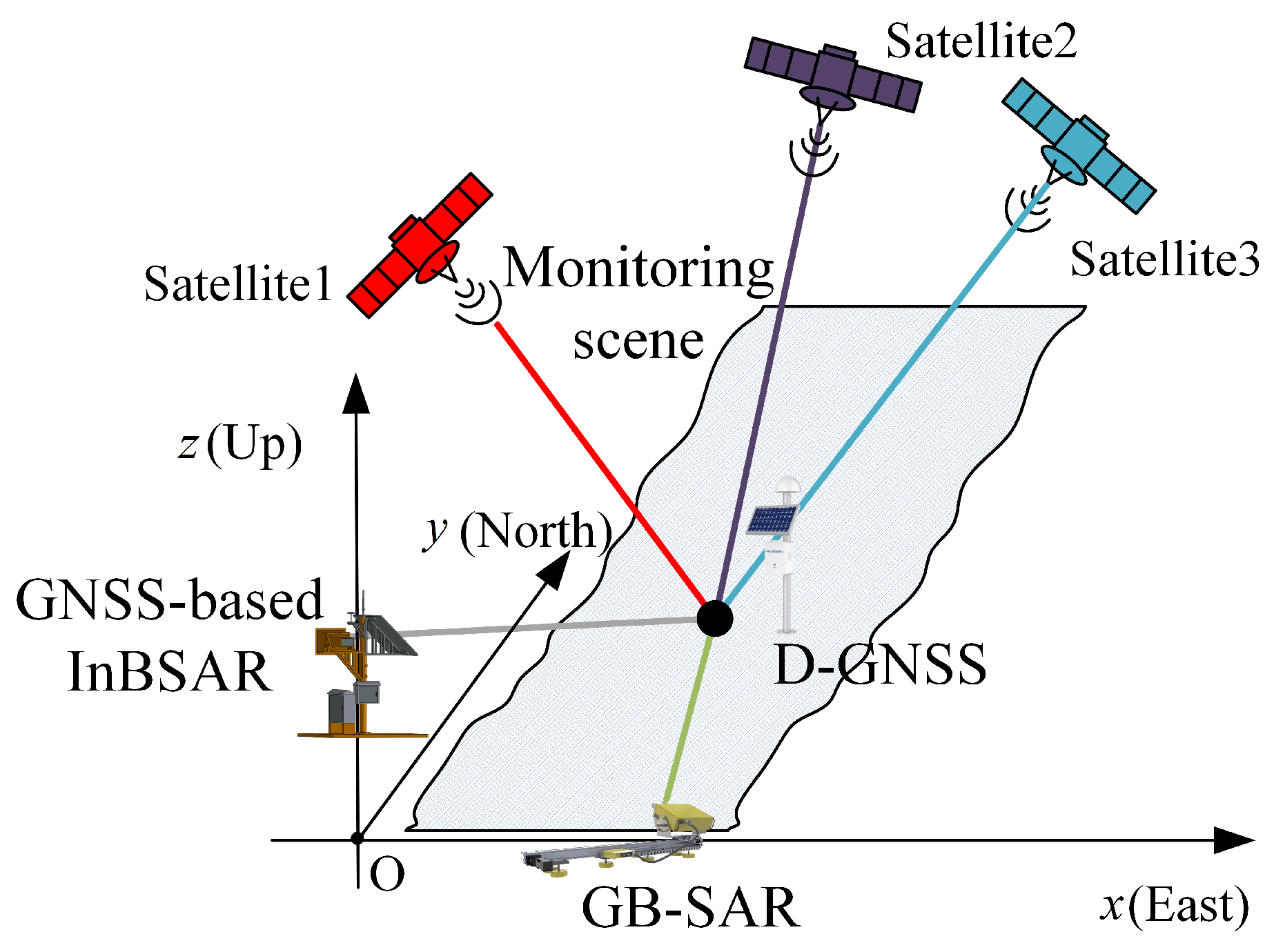
The inter-system configuration is illustrated in Figure 1. GNSS-based InBSAR and GB-SAR are remote sensing monitoring modes, and D-GNSS is a direct monitoring mode. An East–North–Up coordinate system is used. For GNSS-based InBSAR, 3D deformation monitoring is achieved by simultaneously using different GNSS satellites as transmitters. For GB-SAR, the transmitted signal is reflected by the monitoring scene and then received by the system itself, thereby enabling LOS-direction deformation monitoring. D-GNSS obtains 3D deformation from changes in the positioning of the deployed receiver. Therefore, the inter-system configuration, LOS direction, and monitoring modes differ. To achieve deformation accuracy assessment, the inter-system model must be established.
First, the resolution model is established. For a target Q in GNSS-based InBSAR, the ambiguity function of any nearby target A is expressed as
χ G N A , Q = exp j 2 π Φ S A + Φ R A T P ( Q ) P ( A ) λ G N · p C A 2 cos β / 2 Θ T P ( Q ) P ( A ) c · m A 2 ( ω S A + ω R A ) T P ( Q ) P ( A ) λ G N ,
where Φ S A and Φ R A are the unit vectors from the transmitter and receiver to target A. P ( A ) and P ( Q ) denote the target positions. p C A is the autocorrelation function of the C/A code. β is the bistatic angle. Θ is the unit vector along its bisector. m A is the envelope of the azimuth pulse compression. ω S A and ω R A are the equivalent angular-velocity vectors of the transmitter and receiver. λ G N is the wavelength used in GNSS-based InBSAR.
The ambiguity function of GB-SAR, simplified by the bistatic geometry, is expressed as
χ G B A , Q = exp j 2 π Φ R A T P ( Q ) P ( A ) λ G B · p L F M 2 Θ T P ( Q ) P ( A ) c · m A 2 ω R A T P ( Q ) P ( A ) λ G B ,
where p L F M is the autocorrelation function of the linear-frequency-modulated pulse signal and λ G B is the wavelength used in GB-SAR. Differences in configuration and signal parameters lead to resolution differences between GNSS-based InBSAR and GB-SAR.
Next, a 3D deformation model is established. For target Q, the image phase at time t k is
φ Q , t k = 2 π λ P ( S , t k ) P ( Q , t k ) P ( S , t k ) P ( R ) + φ n Q , t k ,
where P ( S ) , P ( R ) , and P ( Q ) are the positions of the satellite, receiver, and target, and φ n is the noise-phase error in the echo. Let t n be the reference time. The interferometric phase is
Δ φ Q , t k , t n = φ Q , t k φ Q , t n = 2 π λ ( P S , t k P Q , t k + P ( R ) P Q , t k P S , t k P ( R ) ) 2 π λ ( P S , t n P Q , t n + P ( R ) P Q , t n P S , t n P ( R ) ) + Δ φ n Q , t k , t n = Δ φ d + Δ φ t Q , t k + Δ φ n Q , t k , t n ,
where Δ φ d is the deformation phase. The topographic phase Δ φ t Q , t k is calculated as
Δ φ t Q , t k = 2 π λ P S , t k P S , t n T P S , t k , t n P Q , t n P S , t k , t n P Q , t n P S , t k , t n P ( R ) P S , t k , t n P ( R ) .
Δ φ n Q , t k , t n is the interferometric-phase error, including the atmospheric component.
After obtaining the LOS-direction deformation results, 3D deformation can be derived by combining measurements from multiple satellites. For M satellites, the 3D deformation is
Δ D x Δ D y Δ D z = H 1 · λ 2 π Δ φ d 1 Δ φ d 2 Δ φ dM ,
where Δ D x , y , z denotes the 3D deformation in the east, north, and up directions. H is the observation matrix that captures the projection relationship:
H = 2 π λ P S 1 , t k , t n P Q , t n T P S 1 , t k , t n P Q , t n + P ( R ) P Q , t n T P ( R ) P Q , t n P S 2 , t k , t n P Q , t n T P S 2 , t k , t n P Q , t n + P ( R ) P Q , t n T P ( R ) P Q , t n P S M , t k , t n P Q , t n T P S M , t k , t n P Q , t n + P ( R ) P Q , t n T P ( R ) P Q , t n .
Δ φ dm ( m = 1 , 2 , , M ) is the deformation phase along the mth bistatic direction. Because the system is overdetermined, the 3D deformation is obtained using least-squares estimation.
Similar to the single-angle deformation results of GNSS-based InBSAR, the deformation of target Q in GB-SAR is
Δ D G B ( Q ) = λ G B 2 π ( Δ φ d ( Q ) + Δ φ n ( Q ) ) ,
where Δ φ d ( Q ) is the deformation phase along the monostatic LOS direction and Δ φ n ( Q ) is the noise phase.
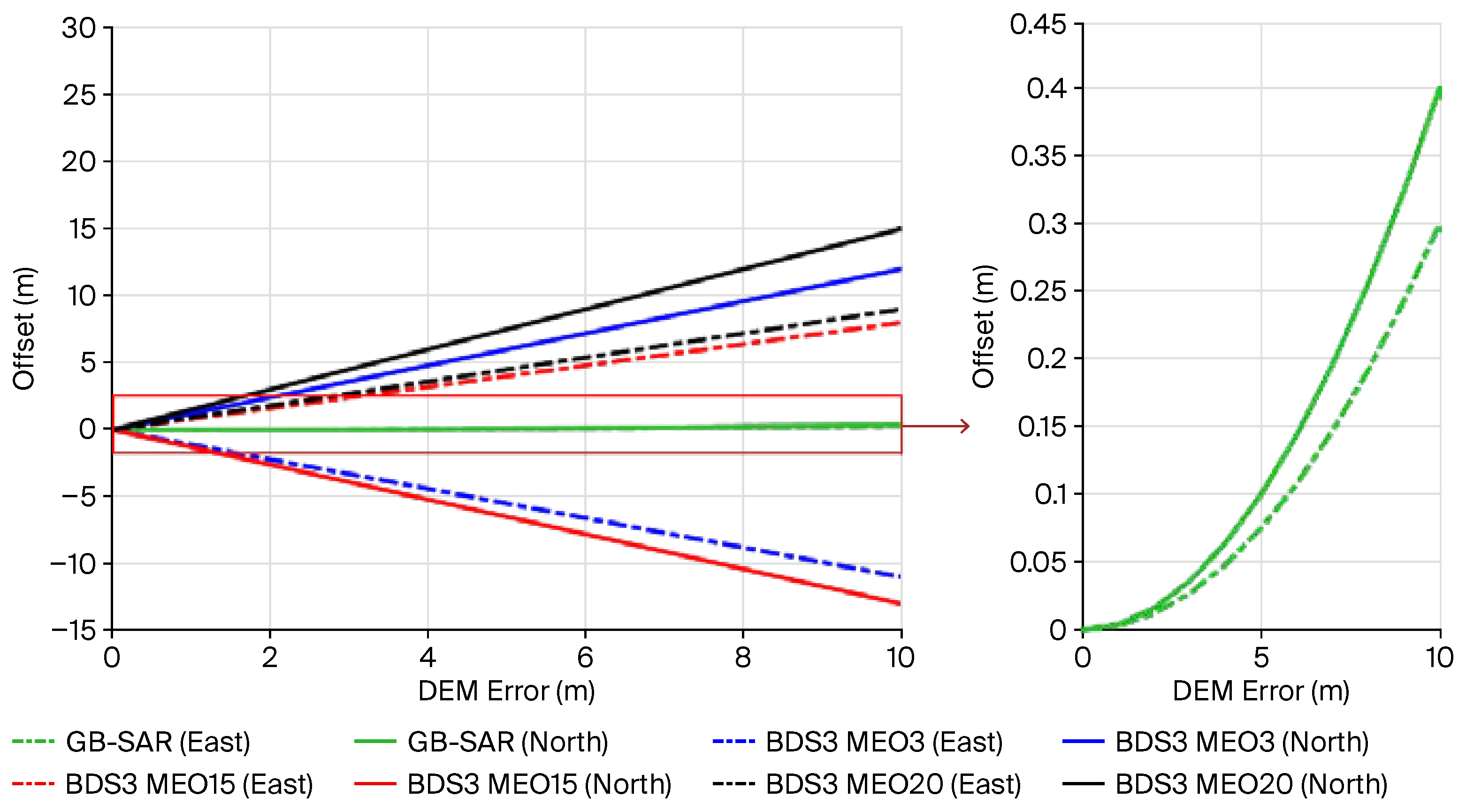
However, for inter-system assessment, the first problem is that PS positions are offset due to DEM error. Meanwhile, the offsets of the same target in GNSS-based InBSAR and GB-SAR differ. The differing radar configurations result in offsets that vary in both direction and magnitude. The transmitter parameters are shown in Table 1, and the simulated offsets are shown in Figure 2. The same DEM error changes both the direction and the magnitude of the offset in different configurations. The offset and DEM error are linear for different bistatic configurations of GNSS-based InBSAR. However, the offsets induced by DEM error in GB-SAR are nonlinear.
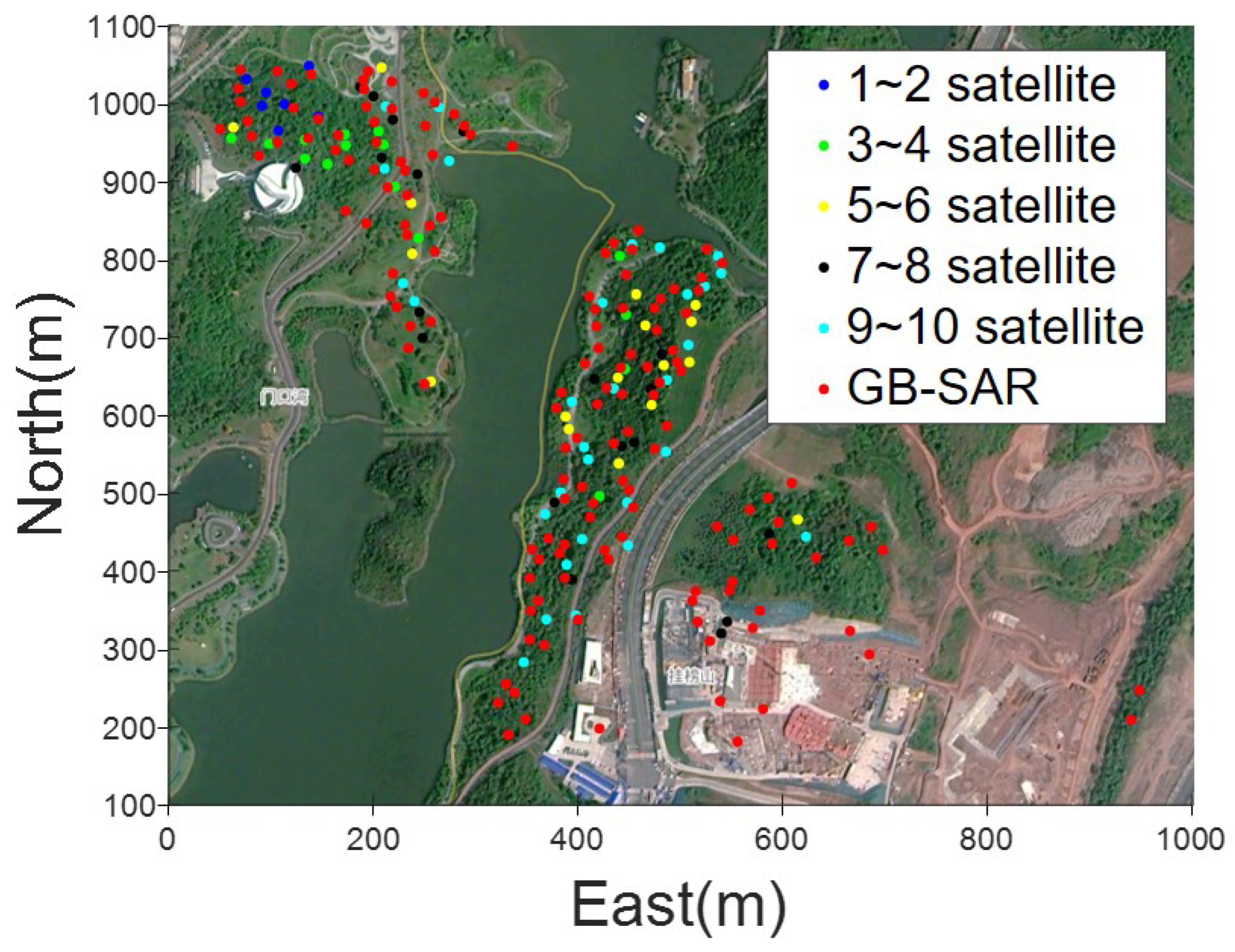
Meanwhile, due to differences in bistatic configuration, some PSs can be monitored by only a limited number of satellites. The PS-selection results are shown in Figure 3 and Table 2, where the different colors indicate the number of satellites. This schematic represents the scenario used in subsequent experiments. Geocoding is performed based on PS positions, and the axes indicate positions relative to the radar receiver. Many PSs are monitored by GB-SAR. Most PSs can be monitored by more than three satellites, enabling 3D deformation monitoring. The remaining PSs cannot be used for 3D deformation because measurements along a single LOS direction are insufficient for 3D retrieval. Meanwhile, the accuracy of PSs increases with more monitoring satellites. However, only a small number of PSs can be used for inter-system assessment with high accuracy.
Finally, in the deformation verification process, differences in the bandwidth of GNSS-based InBSAR and GB-SAR signals lead to different resolutions. As shown in Table 3, GNSS-based InBSAR uses an L-band navigation signal with a bandwidth of 10 Mhz and a synthetic-aperture time of 10 min, resulting in resolution cell sizes of approximately 5 m in the azimuth direction and 10 m in the range direction. GB-SAR uses a Ku-band signal with a bandwidth of 600 Mhz and a synthetic-aperture length of 1.2 m. The resolution cell sizes are approximately 7.5 m (at a range of about 1000 m) in the azimuth direction and 0.15 m in the range direction. Therefore, GB-SAR can monitor multiple PSs, whereas GNSS-based InBSAR can monitor only a single PS. As a result, deformation accuracy assessment cannot be directly performed.
In summary, an algorithm capable of mitigating DEM errors, reconciling resolution disparities, handling variations in LOS direction, and supporting inter-system accuracy assessment is required.

3. Algorithm

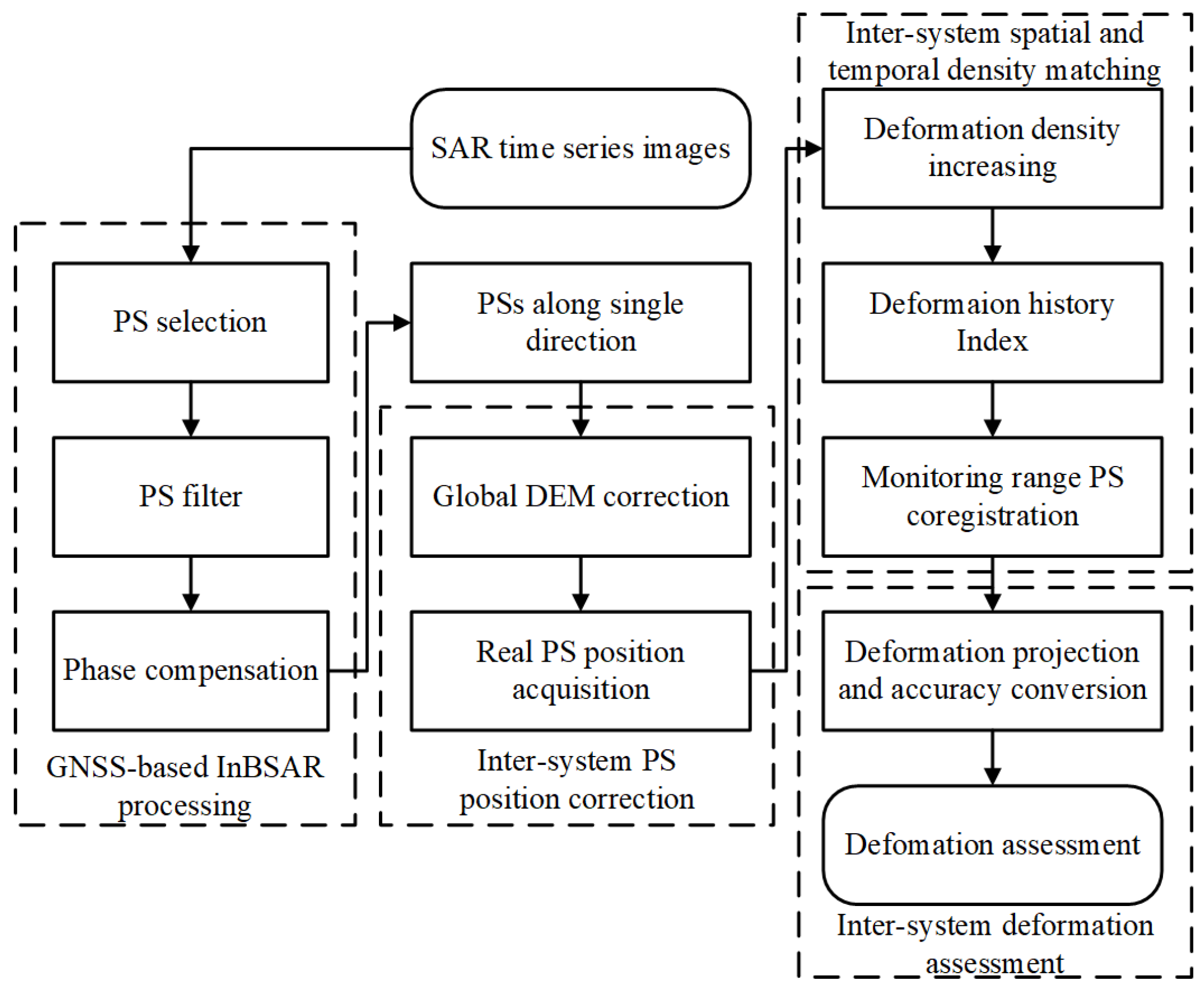
The deformation of the GNSS-based InBSAR can be obtained from our previous work. In this section, we propose an inter-system PS coregistration, deformation calibration, and accuracy assessment algorithm for evaluating the GNSS-based InBSAR framework. A dynamic DEM-error compensation mechanism is introduced, which leverages differential offset analysis across heterogeneous system configurations to achieve position correction. Spatial and temporal density alignment provides an inter-system synchronization framework. Inter-system accuracy is assessed through deformation projection and accuracy transformation. The flowchart of the proposed algorithm is shown in Figure 4.

3.1. Inter-System DEM-Error Compensation

Due to differences in inter-system configurations, assessment is not possible in the range-Doppler dimension. Coregistration can only be achieved after geocoding; however, DEM errors will cause offsets in the geocoded position. The magnitude and direction of these offsets vary between systems and affect subsequent accuracy assessment. Therefore, DEM errors must be compensated for.
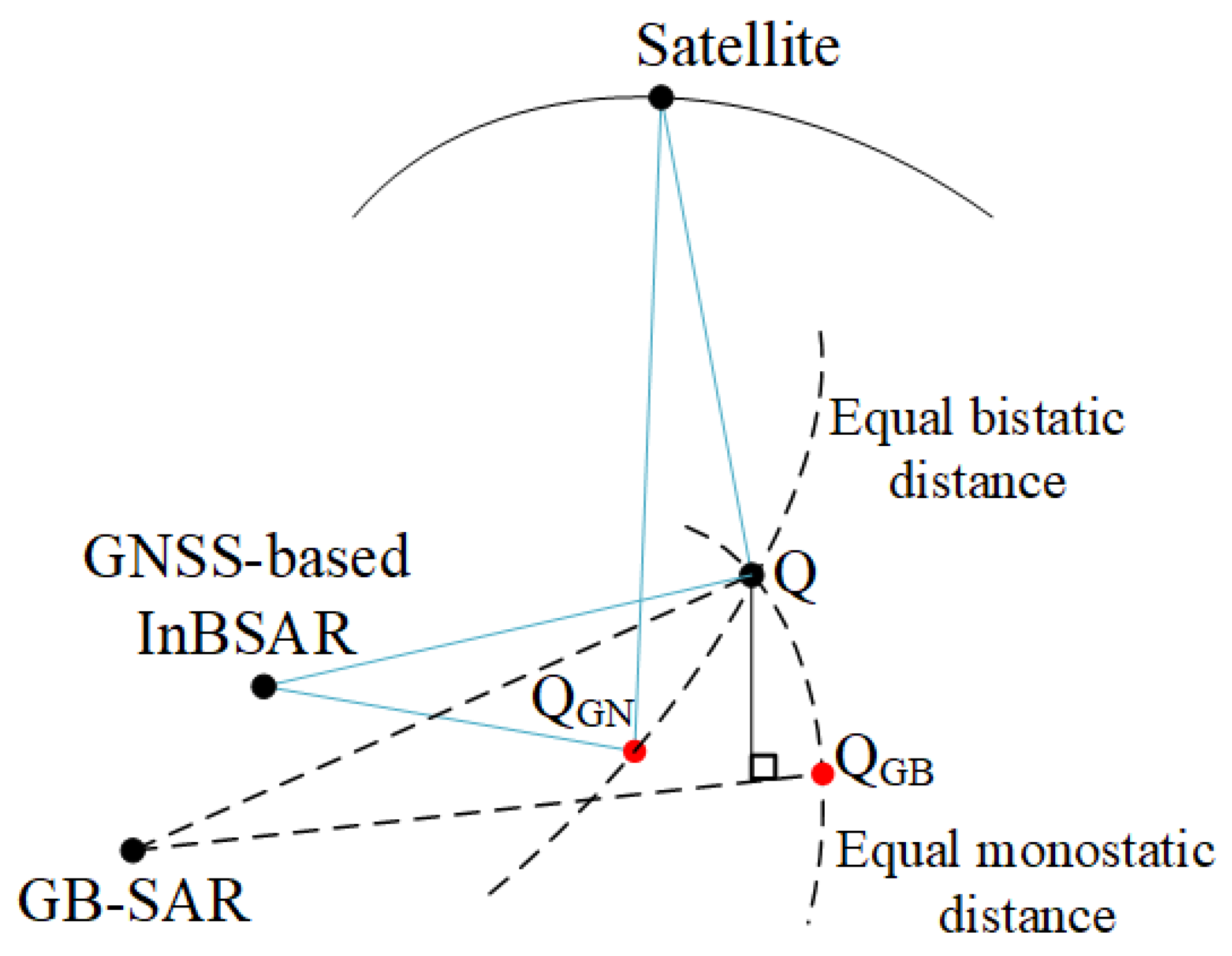
Since a plane is used for imaging during radar signal processing, as shown in Figure 5, DEM errors in the real terrain and the imaging plane lead to PS offsets. Let Q be a target simultaneously monitored by GNSS-based InBSAR and GB-SAR, recorded as Q G N by GNSS-based InBSAR and Q G B by GB-SAR. The largest source of error during DEM acquisition is the radar DEM, resulting in a global DEM error in the monitoring area. Therefore, DEM error must be compensated for the entire scene. DEM errors introduce an overall offset into the image and are the main factor in inter-system coregistration. DEM-error compensation can be performed based on the energy of SAR images under different bistatic configurations. The number of GNSS satellites is sufficient for DEM-error compensation. At the same time, differences in signal frequency, bandwidth, configuration, and antenna beam are too large for GB-SAR images to be used for DEM-error compensation.
Based on the scattering characteristics of the scene, let positions where the SNR exceeds a threshold define the valid area. The center P c ( m , h ) of the valid area under the mth bistatic configuration is recorded as
P c ( m , h ) = m e a n { ( x , y ) I ( m , x , y , h ) > T S A R } ,
where I ( m , x , y , h ) is the amplitude at ( x , y ) of the mth SAR image; h is the DEM variation; and T S A R is the valid-area SNR threshold. The distance sum of the center under different bistatic configurations is
D c ( h ) = 1 2 m = 1 M n m M P c ( m , h ) P c ( n , h ) .
A more realistic DEM can then be obtained by
Δ h ^ = a r c m i n D c ( h ) .
After DEM-error compensation, the true position can be obtained.
GNSS-based InBSAR is a bistatic radar configuration, and its relationship between offset and DEM is complex. The true position P ( Q G N ) can be calculated as
P x y ( Q G N ) P x y ( Q G N ) G x y T ( Q G N ) V x y T ( S ) 1 G z ( Q G N ) V z ( S ) Δ h ^ ,
where V ( S ) is the satellite velocity vector. x, y, and z represent east, north, and up components. G ( Q G N ) is the projection vector:
G ( Q G N ) = P ( S ) P ( Q G N ) P ( S ) P ( Q G N ) + P ( R ) P ( Q G N ) P ( R ) P ( Q G N ) .
A GNSS-based InBSAR receiver is used for different configurations. The azimuth angles of transmitters relative to the scene differ, while satellite signals propagate downward. AR images under different configurations have similarities, and minimizing the offsets between these imaging results allows accurate DEM-error compensation.
GB-SAR is a monostatic radar configuration, where PS positions are relative to the radar’s azimuth beam plane. When DEM errors exist, the true position of Q is closer to the radar than Q G B . Since the distances from the radar to both Q and Q G B are equal,
P ( Q G B ) P ( R ) = P ( Q ) P ( R ) .
Therefore, the true position P ( Q G B ) can be expressed as
P ( Q G B ) = P ( Q G B ) + P ( Q G B ) P ( R ) x y P ( Q G B ) P ( R ) x y P ( Q G B ) P ( Q ) z .
By applying offset correction to both GB-SAR and GNSS-based InBSAR data, the true PS positions can be obtained.

3.2. Inter-System Spatial and Temporal Density Difference Compensation

The spatial and temporal resolution of deformation monitored by GB-SAR is higher than that of GNSS-based InBSAR. Moreover, Table 2 shows that 3D PS accuracy in GNSS-based InBSAR depends on the number of satellites, and few PSs have high accuracy. Therefore, the spatial and temporal resolution of deformation must be increased.
The number and positions of PSs monitored under different bistatic configurations vary. After position correction, positions P o m can be obtained along a single direction. Under the mth bistatic configuration, suppose L PSs can be monitored. The positions and deformations are defined as
P o m = P ( Q 1 , m ) , P ( Q 2 , m ) , , P ( Q L , m ) .
PSs vary across bistatic configurations, and some PSs cannot be monitored under all configurations. Unmonitored PSs require supplementation. PSs after association are
[ P 1 , P 2 , , P M ] = [ P o 1 , P o 2 , , P o M ] ,
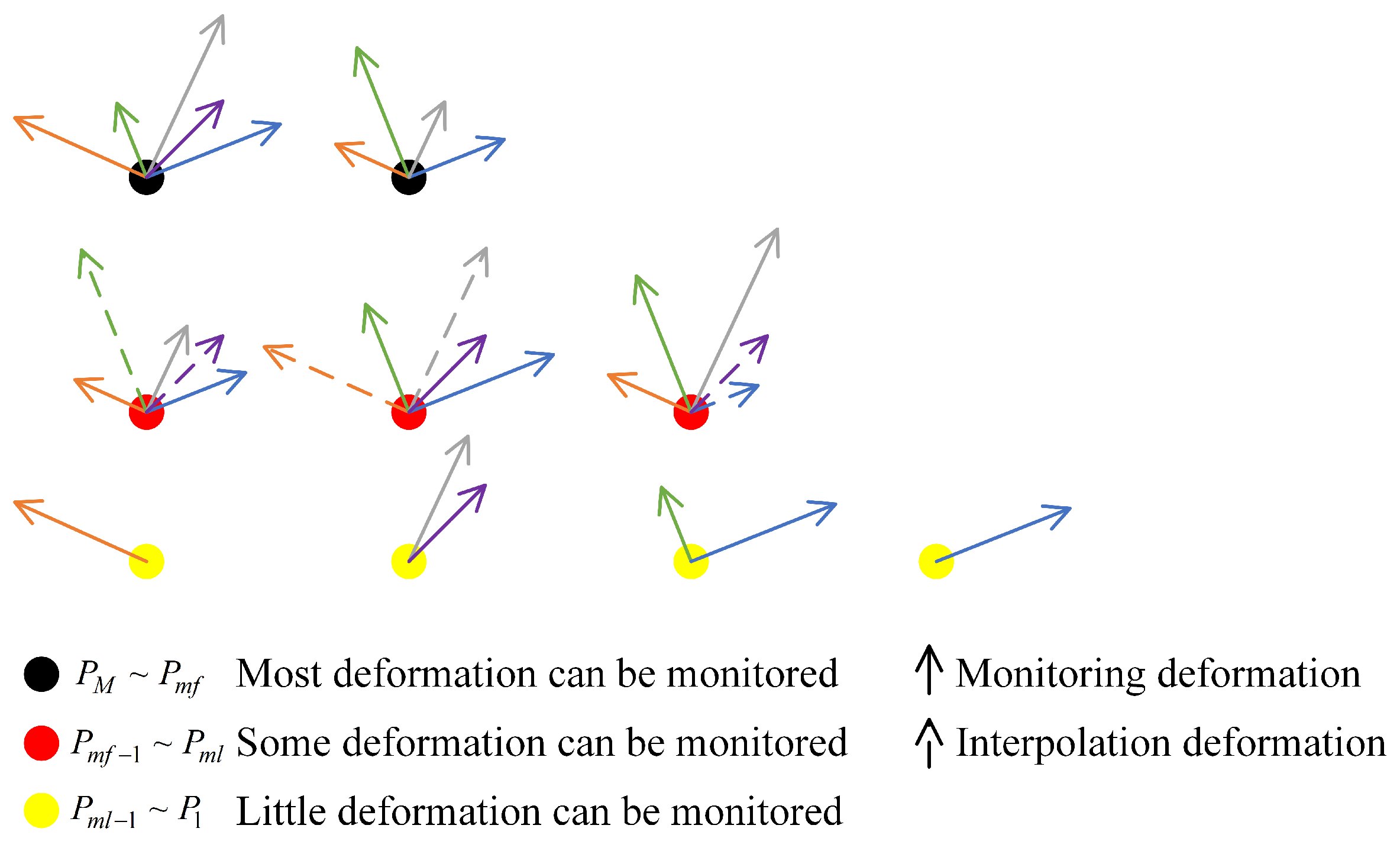
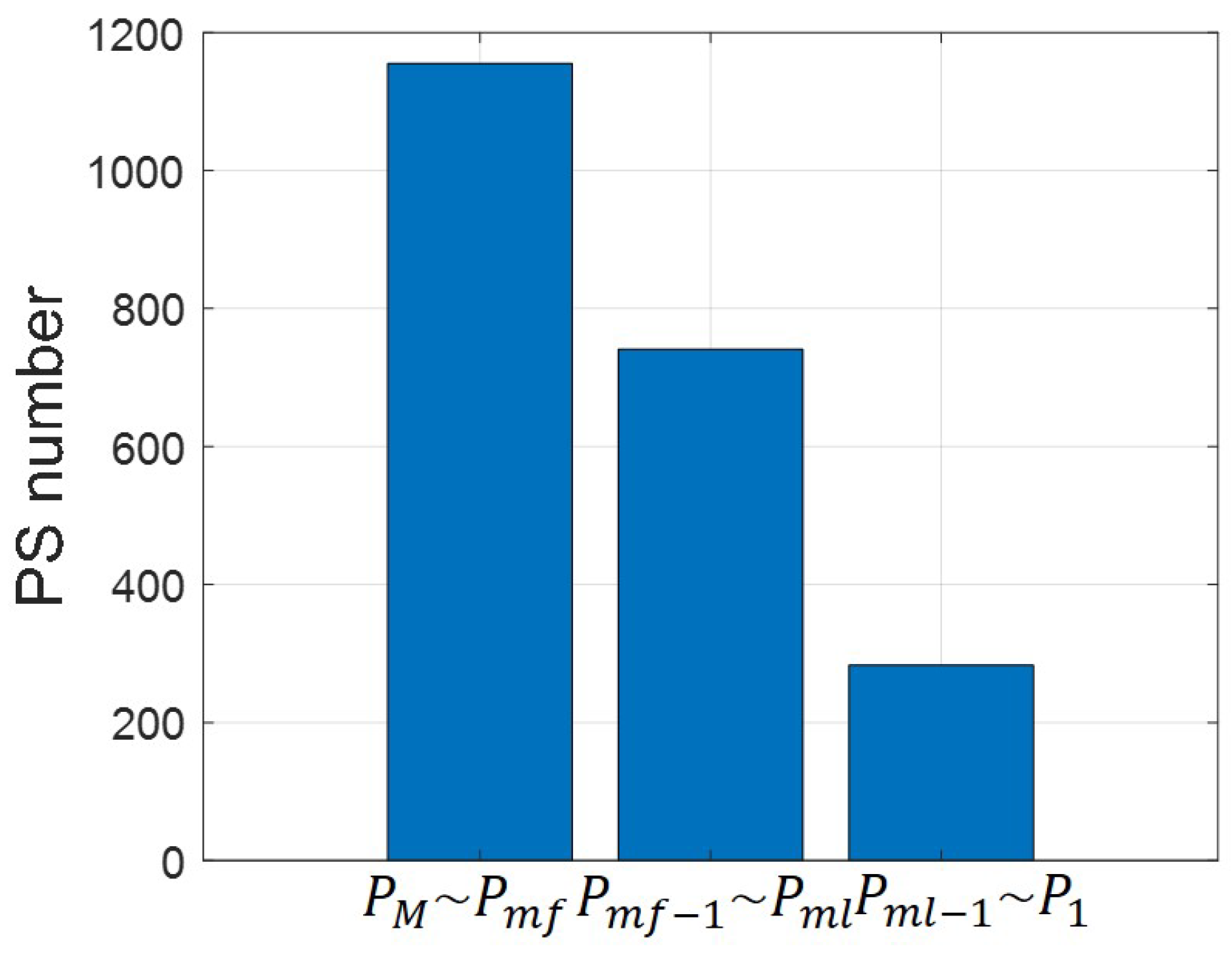
where P m represents the set of PSs monitored m times. Because deformation is spatially continuous, missing deformation values are supplemented by interpolation. Areas monitored in only a few bistatic configurations required limited interpolation. PSs Q S monitored fewer than m f but more than m l times are not considered fully monitored, while PSs monitored fewer than m l times are unreliable and not processed. As shown in Figure 6, PSs in P M to P m f are fully monitored and require no interpolation; PSs in P m f 1 to P m l are partially monitored, and deformation in the remaining direction is obtained by interpolation; PSs in P m l 1 to P 1 are monitored too few times and are not processed.
Deformation is spatially continuous and exhibits greater consistency over shorter distances. Therefore, Kriging interpolation is used to obtain the deformation along a single direction as
Δ D ^ ( Q , m ) = l = 1 L λ l [ Δ D ( Q l , m ) E ( Δ D ) ] + E ( Δ D ) s . t . P ( Q l ) P ( Q ) < R i ,
where Δ D ^ ( Q , m ) is the interpolated deformation; λ l is the Kriging weight coefficient; Δ D ( Q l , m ) is the deformation monitored at another position; E ( Δ D ) = E ( Δ D ( Q l , m ) ) is the expectation of the monitored deformation; and R i is the interpolation distance. After interpolation of each PS, the deformation in P m f 1 to P m l is complete.
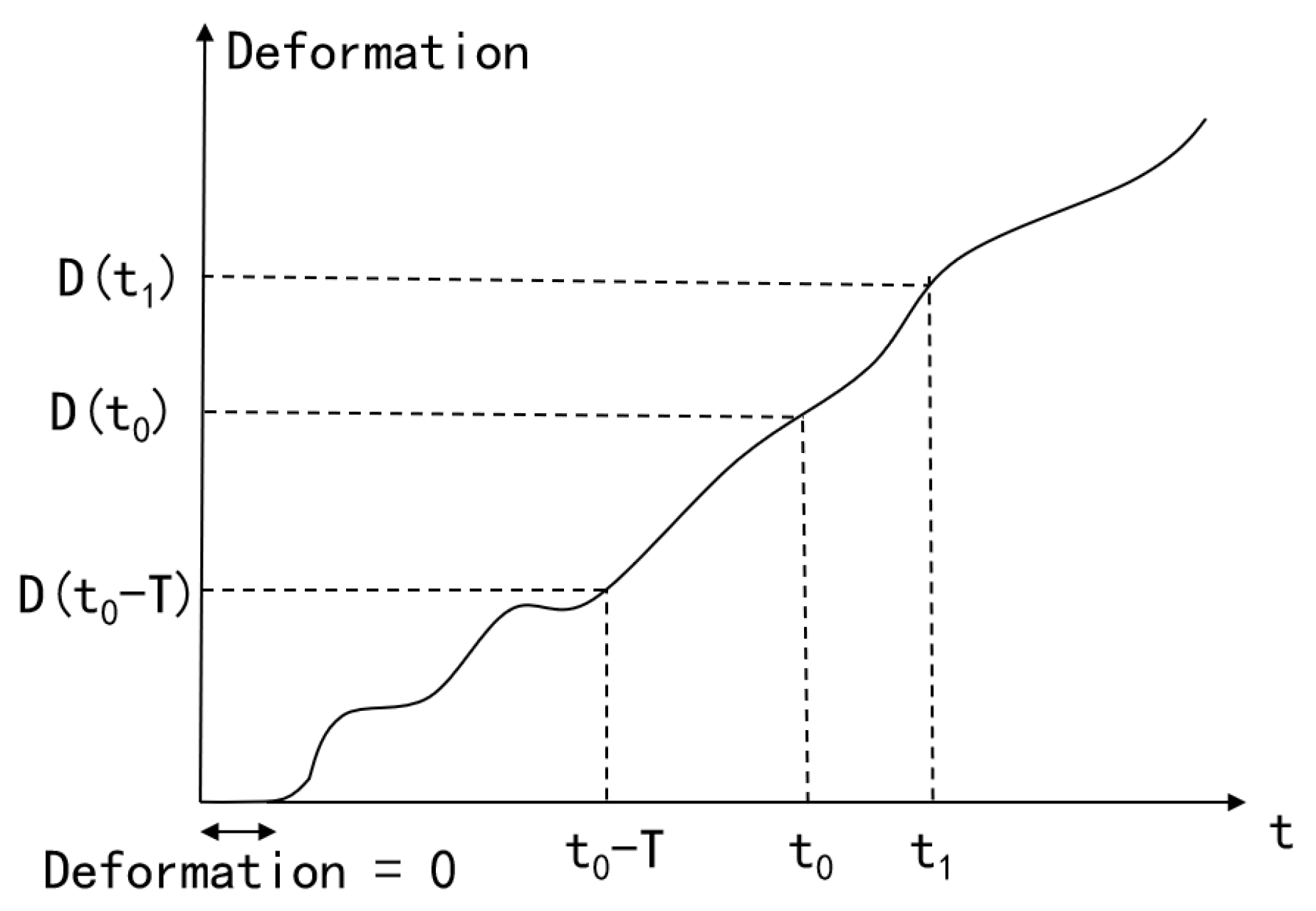
Subsequently, the 3D and cumulative high-frequency deformation histories of each PS can be calculated. Assuming that the deformation history of target Q is denoted as D ( t ) , as shown in Figure 7, the deformation monitored by GNSS-based InBSAR can be expressed as
Δ D x , y , z ( t 0 ) = D x , y , z ( t 0 ) D x , y , z ( t 0 T ) + σ ( t 0 ) ,
where T is the repeat-pass interval, t 0 is the monitoring time, and σ ( t 0 ) is the measurement error. Assuming that the deformation in the monitoring scene is uniform, the cumulative deformation history after obtaining the interferometric deformation is expressed as
D x , y , z ( t 1 ) = D x , y , z ( t 0 ) + t 1 t 0 T Δ D x , y , z ,
where t 1 is the time of the next deformation measurement. By combining multiple sets of 3D deformation results, the high-frequency deformation history of the monitored area can be obtained.

3.3. Inter-System Deformation Information Extraction

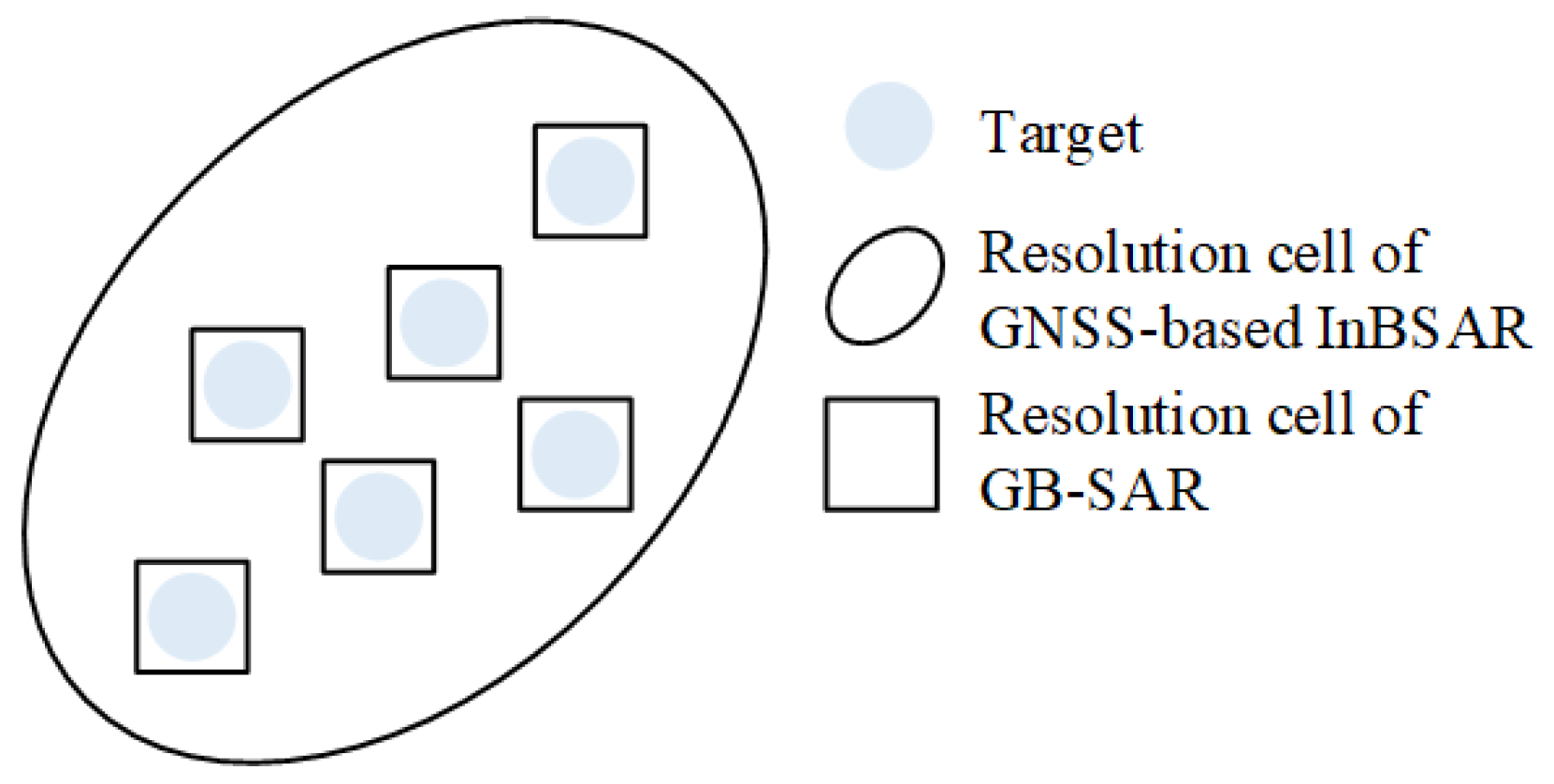
After interpolation, the optimized spatial resolution of GNSS-based InBSAR deformation remains lower than that of GB-SAR due to the large inter-system resolution variation. As shown in Figure 8, when the imaging grid interval is identical, GB-SAR can distinguish more targets. Differences in the number of PSs within a resolution cell require inter-system coregistration.
GNSS-based InBSAR weights the deformation information of all targets within the principal target’s resolution cell, and the result assigned to each monitored PS represents the deformation of the entire cell. GB-SAR, with its higher resolution and denser PS distribution, resolves multiple targets within the same GNSS-based InBSAR resolution cell. Thus, a single GNSS-based InBSAR resolution cell can represent the deformation of multiple GB-SAR PSs, enabling inter-system coregistration based on GNSS-based InBSAR PSs. The resolution cell is selected using (1). Meanwhile, the radar monitoring distance is short, so the transmitter direction vector is nearly constant for each target, whereas the receiver direction varies greatly. As a result, the bistatic angle exhibits strong spatial variation, and the resolution differs across the scene. Each resolution cell must therefore be selected independently.
The resolution cell range of Q is defined as
S ( Q , m ) = x , y I m , x , y > I ( Q ) 3 d B .
According to Equation (17), the phase of some PSs is obtained through interpolation; therefore, the resolution cell cannot be reliably obtained for PSs in P m f to P m l . The theoretical resolution cells for all configurations are obtained by simulating the positions of all PSs. The true resolution cell is an expanded version of the theoretical cell and exhibits an elliptical shape. By measuring the major-axis length L of the ellipse, the range resolution R a can be approximated as L. The expansion coefficient of a resolution cell is defined as
f ( Q ) = R a _ r ( Q ) R a _ t ( Q ) ,
where R a _ r ( Q ) and R a _ t ( Q ) denote the true and theoretical range resolutions. After computing the expansion coefficients for all resolution cells, their average f ¯ is used to uniformly enlarge the theoretical resolution cell and obtain the resolution cells of unmonitored PSs.
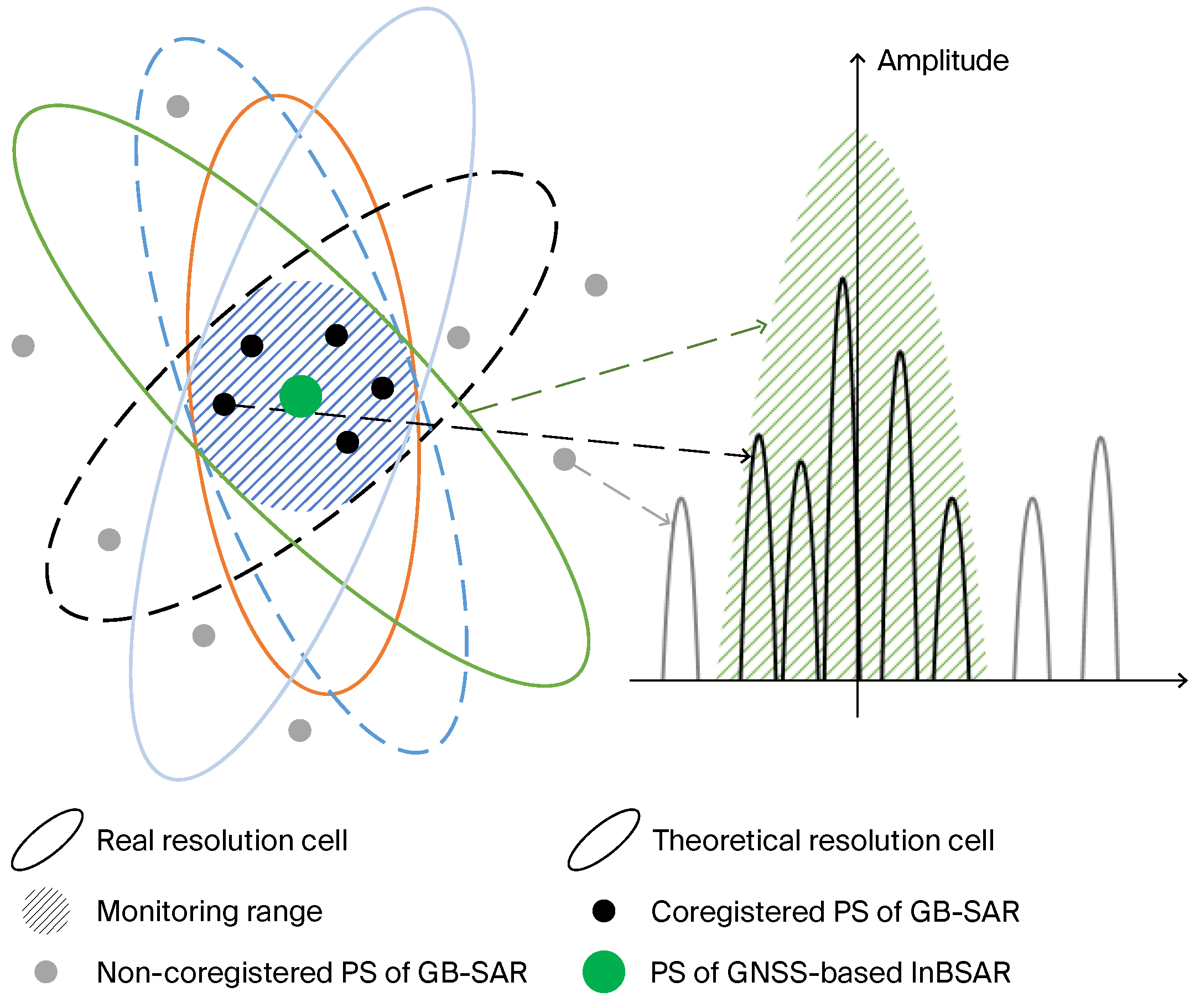
GNSS-based InBSAR and GB-SAR resolutions differ substantially: targets distinguishable by GB-SAR may appear as a single target in GNSS-based InBSAR, as shown in Figure 9. Because the range direction and size of the resolution cell vary across configurations, the monitoring range M r ( Q ) is defined as the intersection of all resolution cells:
M r ( Q ) = S ( Q , 1 ) S ( Q , 2 ) S ( Q , M ) .
All GB-SAR PSs within this monitoring range are coregistered for inter-system assessment:
C o = Q G B Q G B M r ( Q ) .

3.4. Inter-System Accuracy Assessment

In GNSS-based InBSAR, deformation is estimated along the east, north, and up directions, whereas GB-SAR measures deformation along the LOS direction. Therefore, once the deformation histories of the same target (coregistration PS) are obtained, accuracy assessment cannot be performed directly. In addition, when a deformation area is present, its accuracy must also be evaluated due to the spatial continuity of deformation.
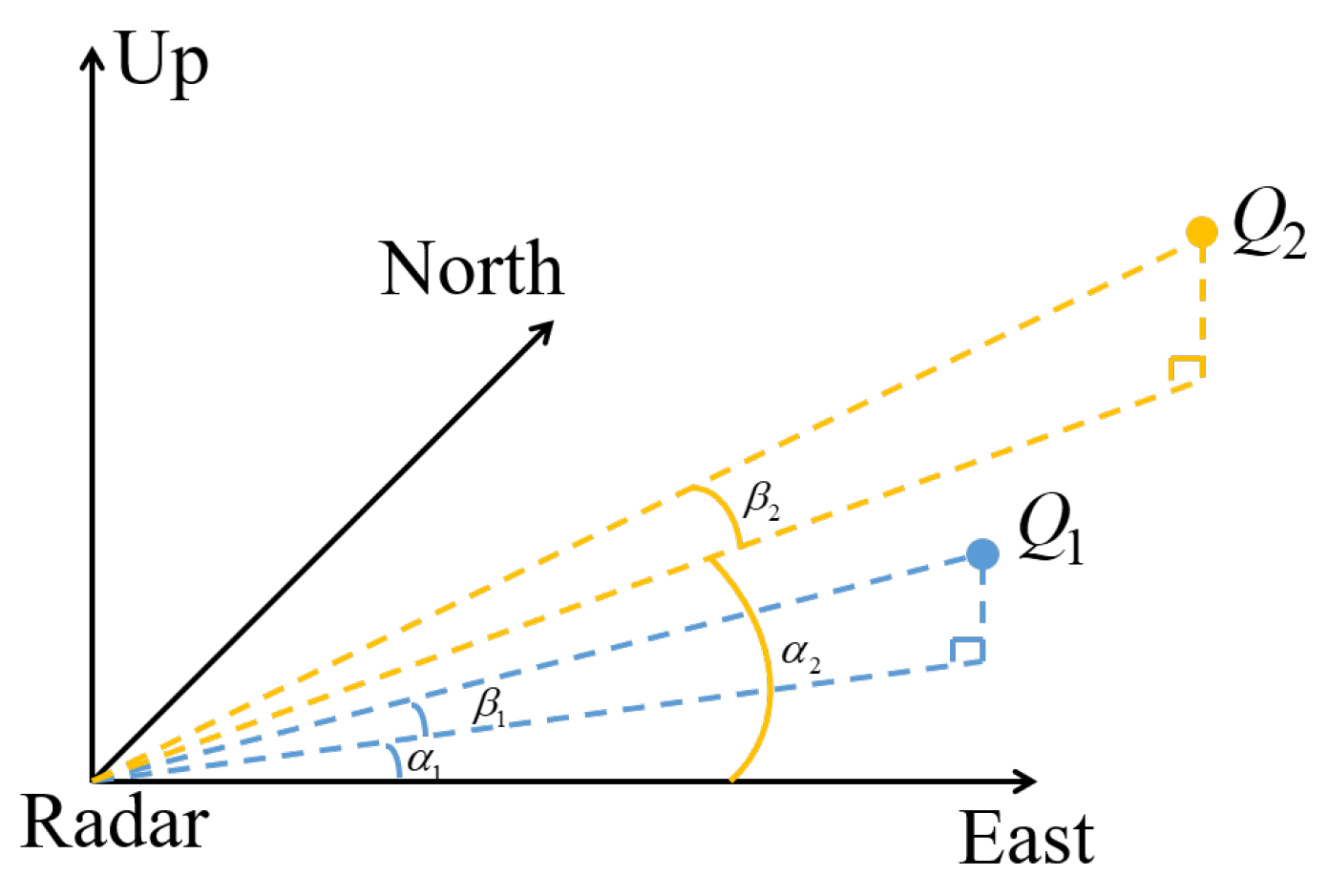
Based on each PS’s position relative to the radar as shown in Figure 10, the azimuth and pitch angles of PSs are denoted as α and β . The deformation projection is expressed as
D p ( Q G N , t ) = D x Q G N , t cos α cos β + D y Q G N , t sin α cos β + D z Q G N , t sin β .
The accuracy along different directions is given by
ε x , y , z , p Q = ( 1 T t = 1 T ( D x , y , z , p Q G N , t D x , y , z , p Q G B , t ) 2 ) 1 2 ,
where D Q G B , t represents the deformation history monitored by GB-SAR, T is the monitoring duration, and the deformation ( D x , y , z ( Q G B , t ) ) is unknown.
The projection accuracy can be converted to the 3D accuracy ε x , y , z as
ε p = ( cos 2 α cos 2 β ε x 2 + sin 2 α cos 2 β ε y 2 + sin 2 β ε z 2 + 2 cos α cos β sin β ε x ε z + 2 sin α cos β sin β ε y ε z + 2 cos α sin α cos 2 β ε x ε y ) 1 2 .
According to (6) and (7), the 3D accuracy is obtained from the deformation accuracy along the LOS direction and the observation matrix H :
[ ε x , ε y , ε z ] T = H 1 [ ε 1 , ε 2 , , ε M ] T ,
where ε 1 , ε 2 , , ε M are the monitoring accuracies for M satellites. Because satellites are uniformly distributed, the ratio between elevation accuracy and horizontal accuracy can be expressed for all bistatic configurations as ε x = η y ε y = η z ε z , where η y and η z are accuracy-scaling factors that vary across scenes.
Using the GB-SAR deformation as the reference, the inter-system accuracy of each PS along the LOS direction is obtained. Due to variations in LOS direction and SNR, the monitoring accuracy differs among PSs. To evaluate the accuracy of GNSS-based InBSAR, a statistical measure is used: the projection accuracy of each PS is converted to obtain the 3D accuracy, and the accuracies of all PSs are averaged to derive the scene-level accuracy ε x ¯ , ε y ¯ , and ε z ¯ .
Meanwhile, the monitoring position accuracy is used to assess the deformation monitoring capability of GNSS-based InBSAR, specifically the proportion of the true deformation area that can be captured. Differences in system configurations cause GB-SAR and GNSS-based InBSAR to represent the same deformation area differently. The PS with the maximum deformation is used as the reference, and PSs with large deformation are selected as
a r e a Q = Q D Q , t e > T d e f o max D t e ,
where t e is the final observation time and T d e f o is the deformation area threshold. After selecting the PSs with significant deformation, the deformation areas a r e a G B and a r e a G N for GB-SAR and GNSS-based InBSAR are obtained by computing the convex hull (the smallest convex polygon enclosing the selected PSs).
The deformation area accuracy is expressed as
γ = S a r e a G B a r e a G N S a r e a G B ,
where S denotes the deformation area.

4. Raw Data Processing

In this section, inter-system raw data are used to demonstrate the deformation monitoring capability of GNSS-based InBSAR. Two experiments were carried out to validate the algorithm. One experimental scene was a natural landslide with measurable deformation, while the other was an artificial ecological park with invisible deformation. The monitoring results agreed with the ground truth for both scenes. To ensure consistent viewing geometry, GNSS-based InBSAR and GB-SAR were colocated.

4.1. Natural Landslide Experiment

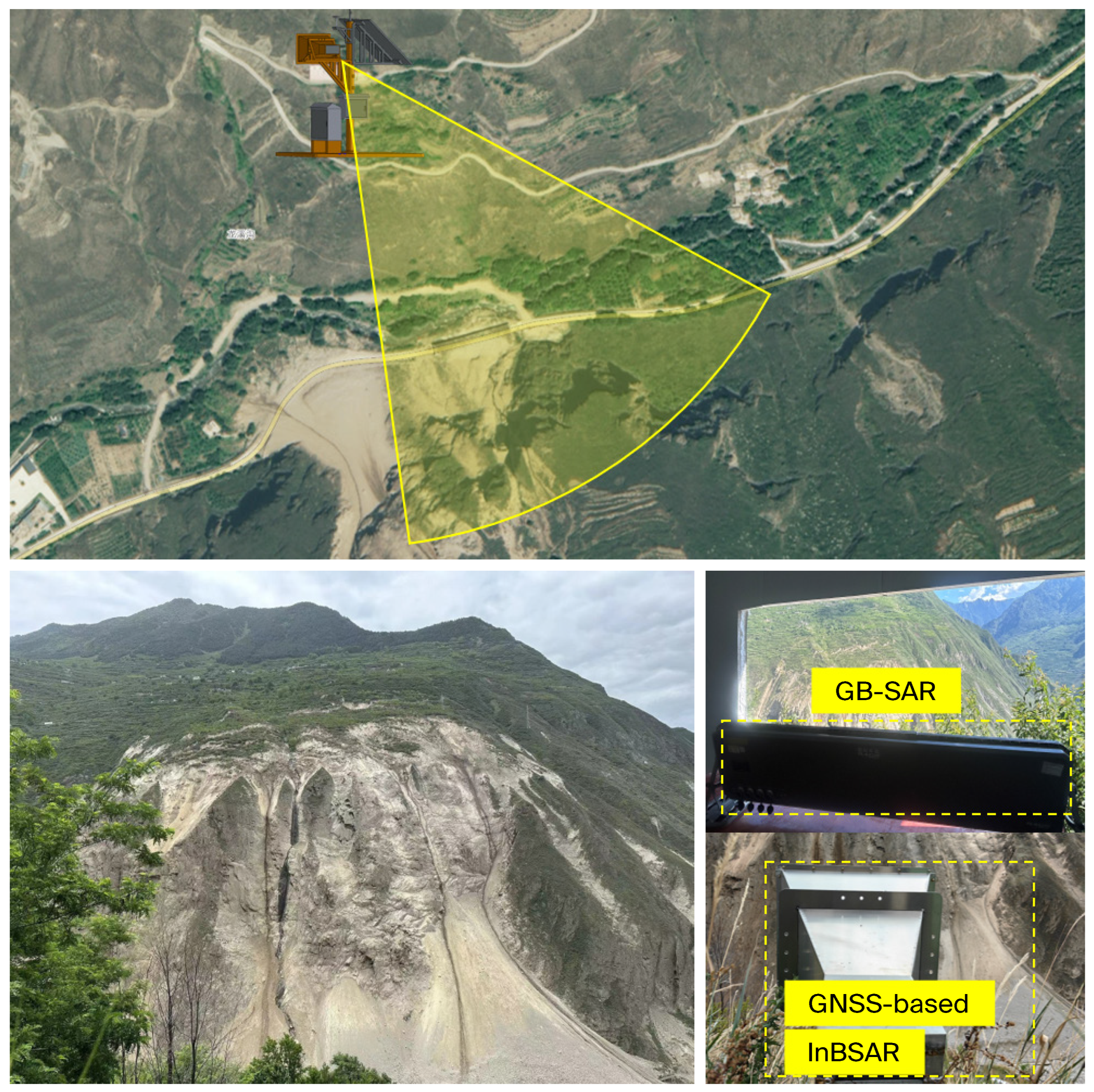
The natural landslide experiment was conducted in Chongqing, and the experimental scene is shown in Figure 11. The slope is steep, and the deformation is continuous. Due to the precipitous terrain, it was difficult to deploy D-GNSS. Therefore, only remote sensing monitoring was used, with GNSS-based InBSAR and GB-SAR placed on the opposite side of the landslide.
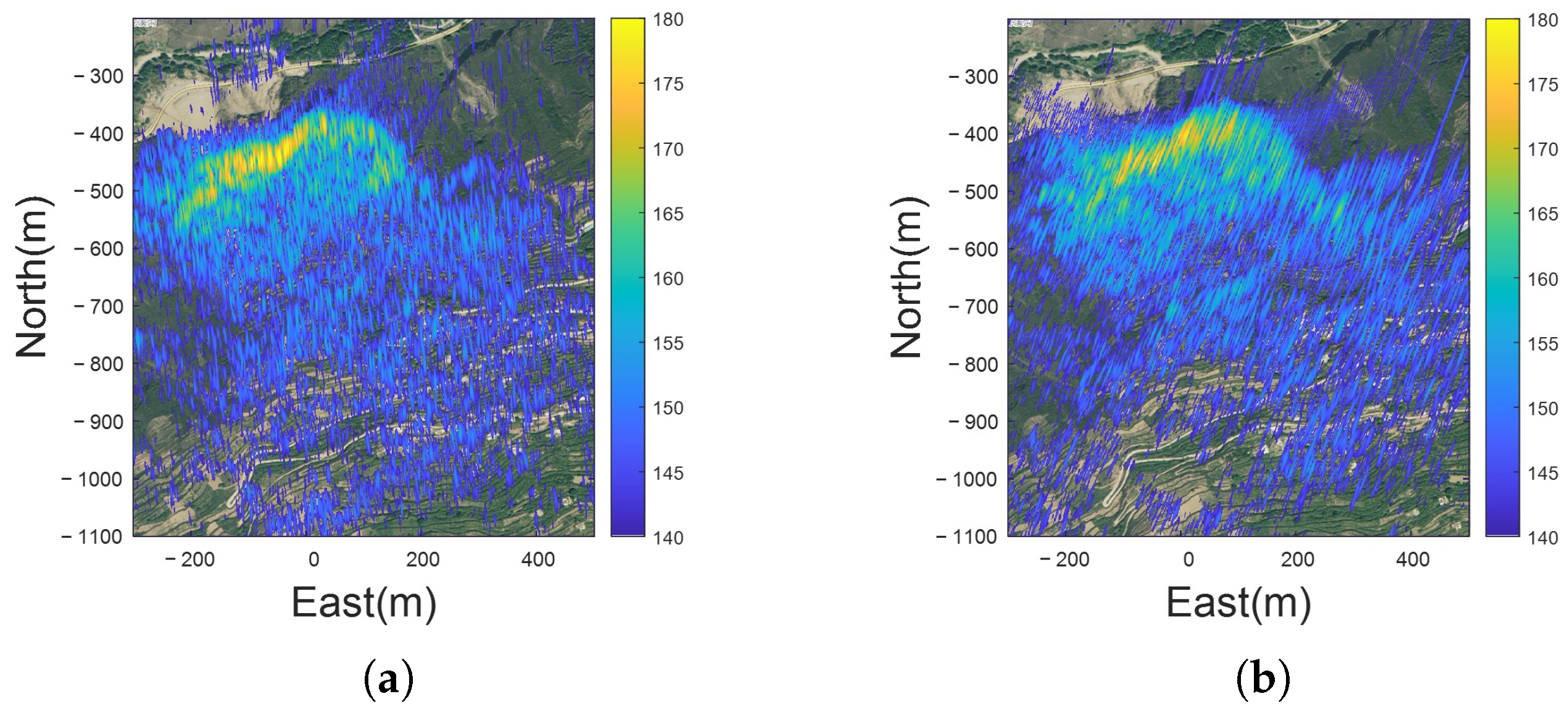
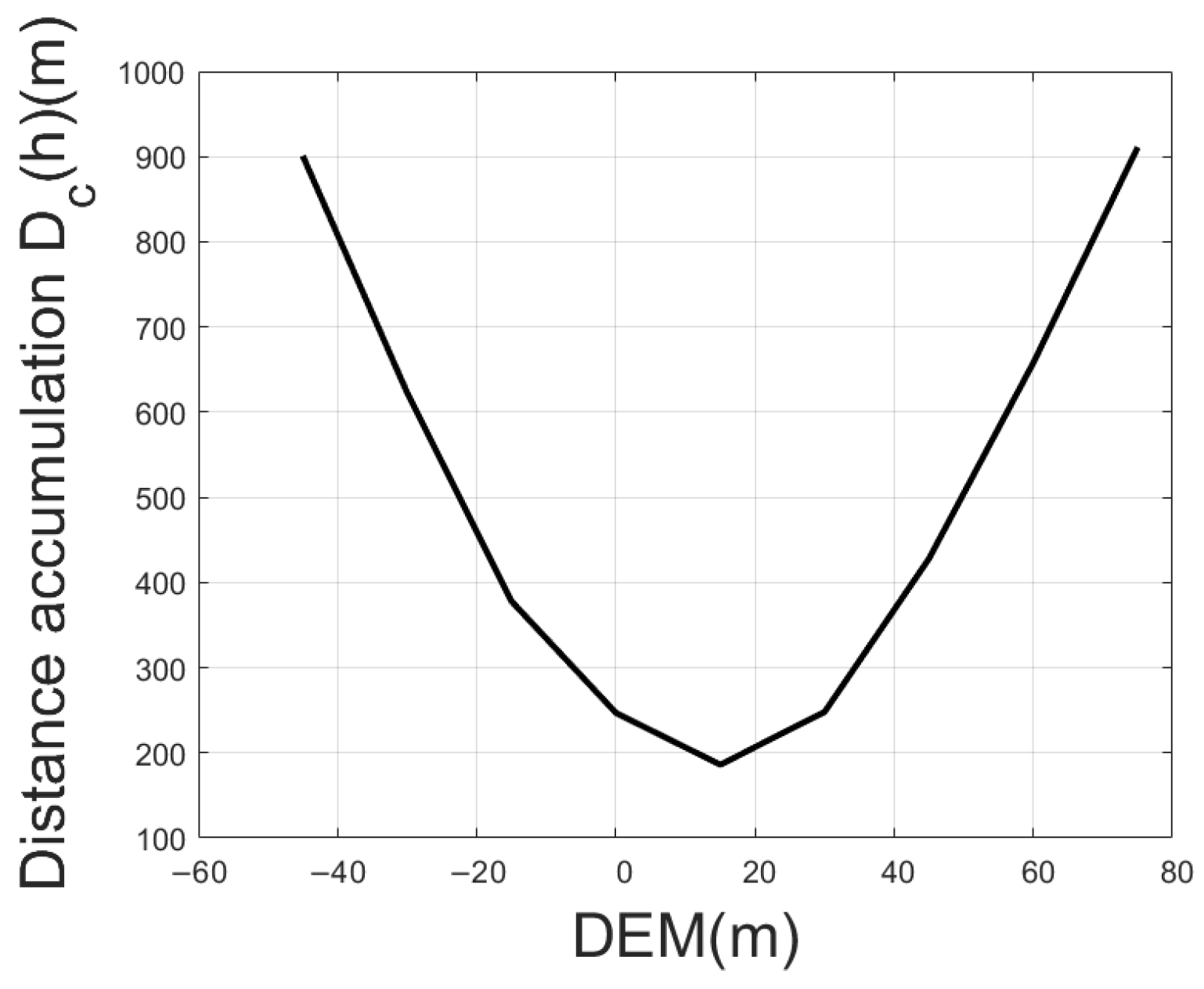
The experimental period ran from 1 August 2024 to 30 August 2024. During processing, SRTM DEM data were used for image-plane fitting. The DEM preserved relative heights but exhibited a bias in absolute elevation. The resulting SAR images are shown in Figure 12a,b and represent different geocoding outcomes. A high-energy scattering area is visible, but its location differs among satellite datasets; therefore, DEM correction was required. An energy threshold of 20 dB was applied, and SAR images from ten satellites were used for DEM-error estimation. Offsets between image centers were calculated, and the traversed DEM results in Figure 13 were obtained. A search was conducted within ±100 m at 5 m increments. When the global DEM offset was 15 m, the high-energy scattering areas across satellite images aligned most closely, indicating that the DEM was closest to the true scene.
Offset compensation was then performed according to the DEM error, and the compensation result at the scene center is shown in Table 4. Because the distance between the scene center and the radar was much larger than the DEM error, GB-SAR was not sensitive to DEM errors. The offsets caused by DEM errors in GNSS-based InBSAR varied. The resulting PSs after offset compensation are shown in Figure 14. When m f was set to 7, 53% of PSs could be monitored by most satellites; when m l was set to 3, 34% of PSs could be monitored by some satellites, and unmonitored deformation was obtained through interpolation; and the remaining 13% of PSs could only be monitored by a few satellites and were not processed.
Resolution cell extraction was based on extreme points, and eigenvalue decomposition was used to extract the main interferometric phase. The atmospheric phase error at the transmitter was compensated by the direct signal, and the atmospheric phase at the receiver was linearly related to the distance of the PS. The PS selection threshold was set to 20 dB, matching the image energy threshold, enabling sub-millimeter-level LOS deformation monitoring accuracy. Kriging interpolation was performed with an exponential variogram (nugget: 8.2; sill: 50; range: 420 m), using a 500 m search radius and 20–50 neighbors. Satellite positions were predicted using broadcast ephemeris, allowing selective acquisition of only compatible data without discard. Atmospheric errors between the satellite and scene were compensated through direct-wave synchronization. Since the monitoring scene and receiver shared similar DEM, and the atmospheric refractive index remained effectively constant during signal propagation from target reflection to receiver, scene-to-receiver atmospheric errors became distance-dependent relative to targets. These atmospheric refractive-index variations were determined through linear fitting of the acquired data and could not be predetermined, as they varied with each dataset.
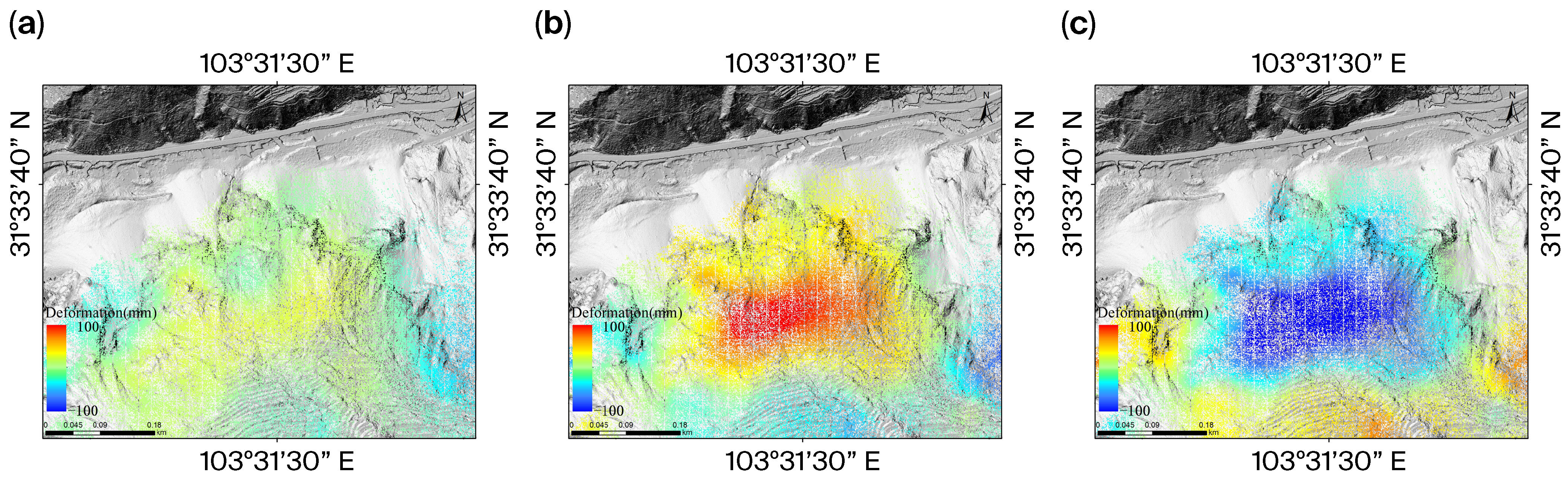
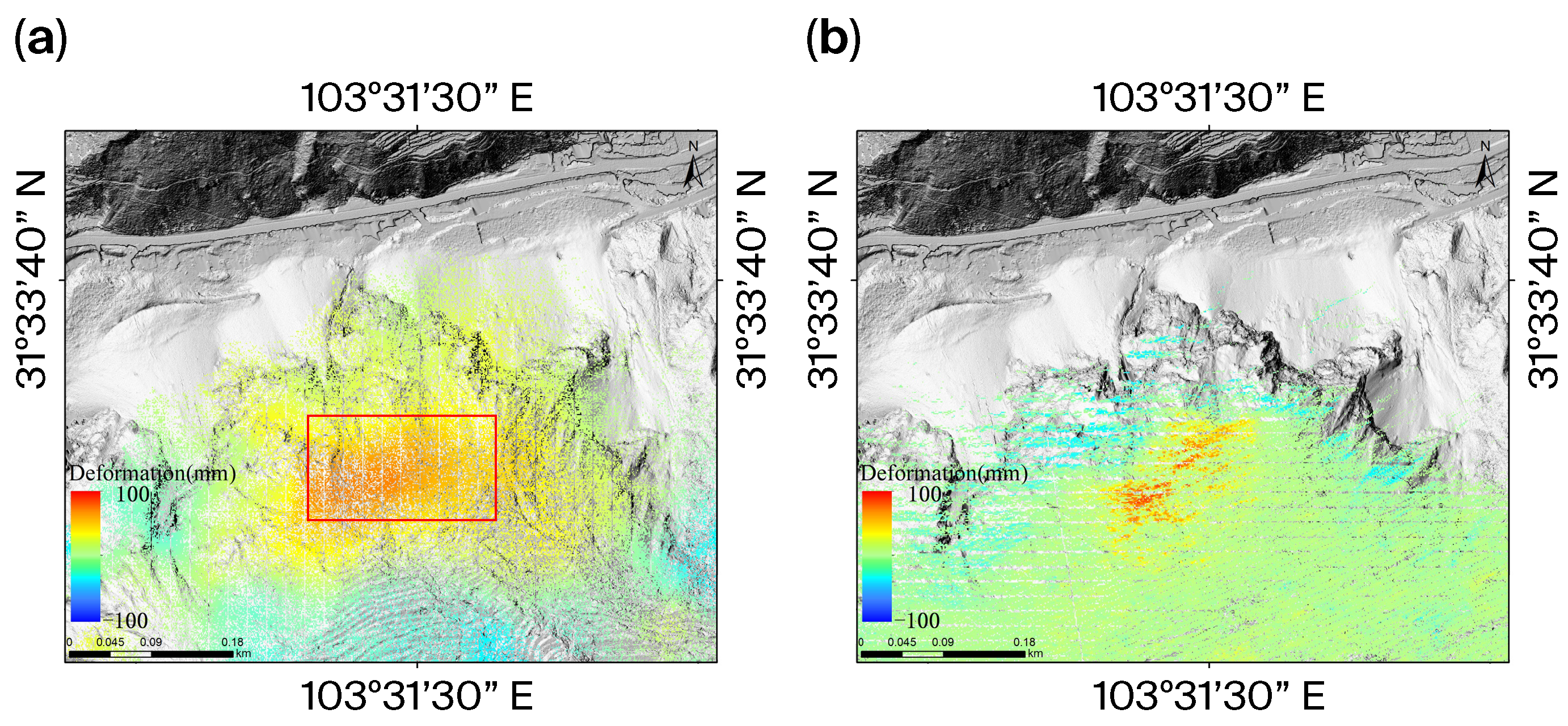
The 3D deformation monitoring results obtained after phase extraction, error compensation, 3D backprojection, and deformation accumulation are shown in Figure 15a–c. Deformation was large in the north and up directions, with a maximum of 150 mm, consistent with natural landslide characteristics. GNSS-based InBSAR clearly monitored deformation at the landslide location. The accumulated deformation was projected in the GB-SAR LOS direction, as shown in Figure 16a. The deformation results obtained after DEM correction for GB-SAR are shown in Figure 16b. Both systems monitored deformation at 250 m east and 800 m north of the radar, consistent with the results of the field survey. Therefore, the red-boxed area is defined as the main study area.
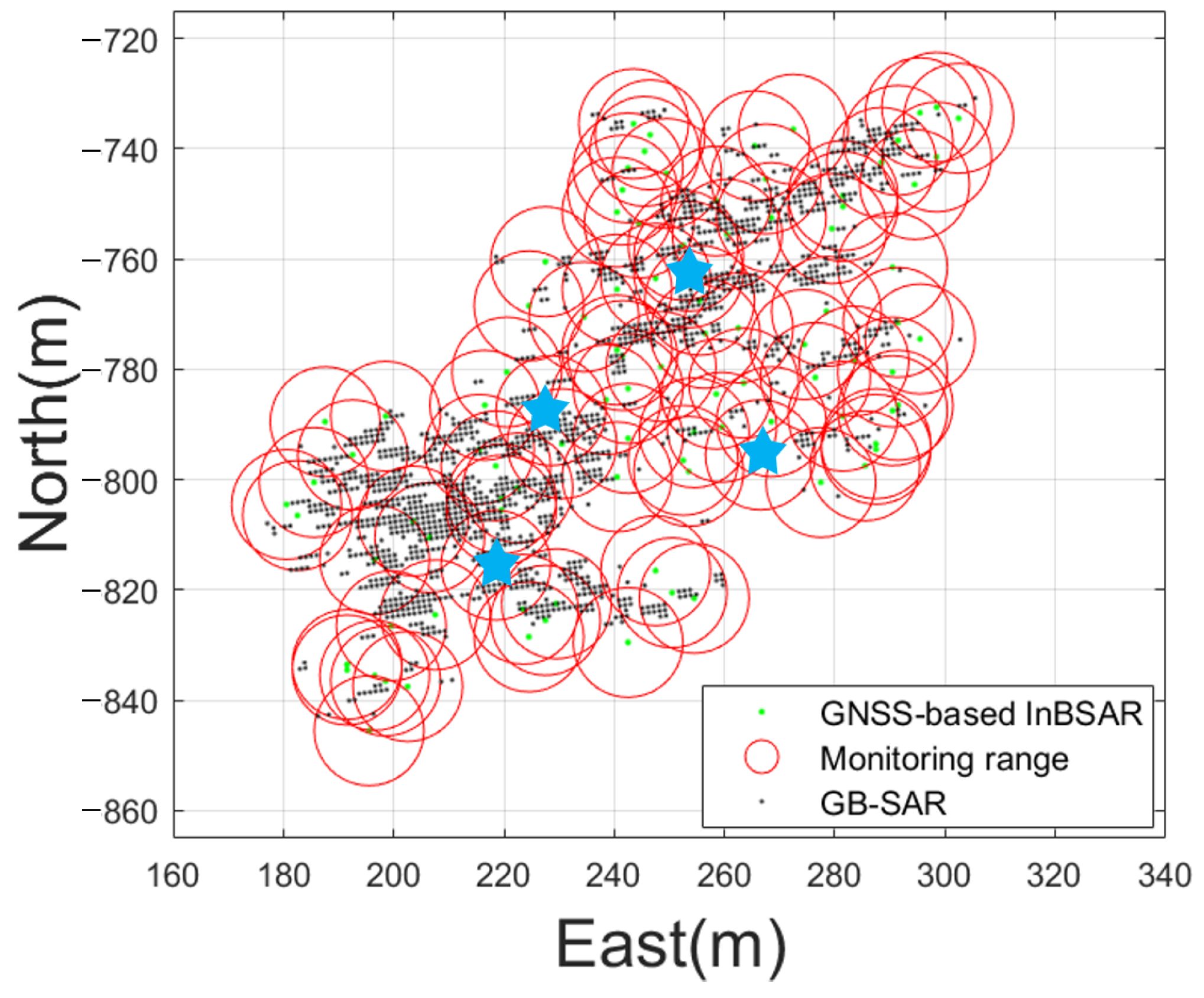
From the deformation results, GB-SAR monitoring varied considerably, even for closely spaced PSs, whereas GNSS-based InBSAR yielded highly consistent results. Therefore, for each PS in the GNSS-based InBSAR deformation area, GB-SAR PSs within the resolution overlap range were selected for comparison. If no GB-SAR PS was available, the PS was excluded. A total of 100 PSs were selected for comparison, and their distribution is shown in Figure 17. GNSS-based InBSAR PSs are shown as yellow points, the red areas indicate the GB-SAR search ranges, and the black points mark the selected GB-SAR PSs.
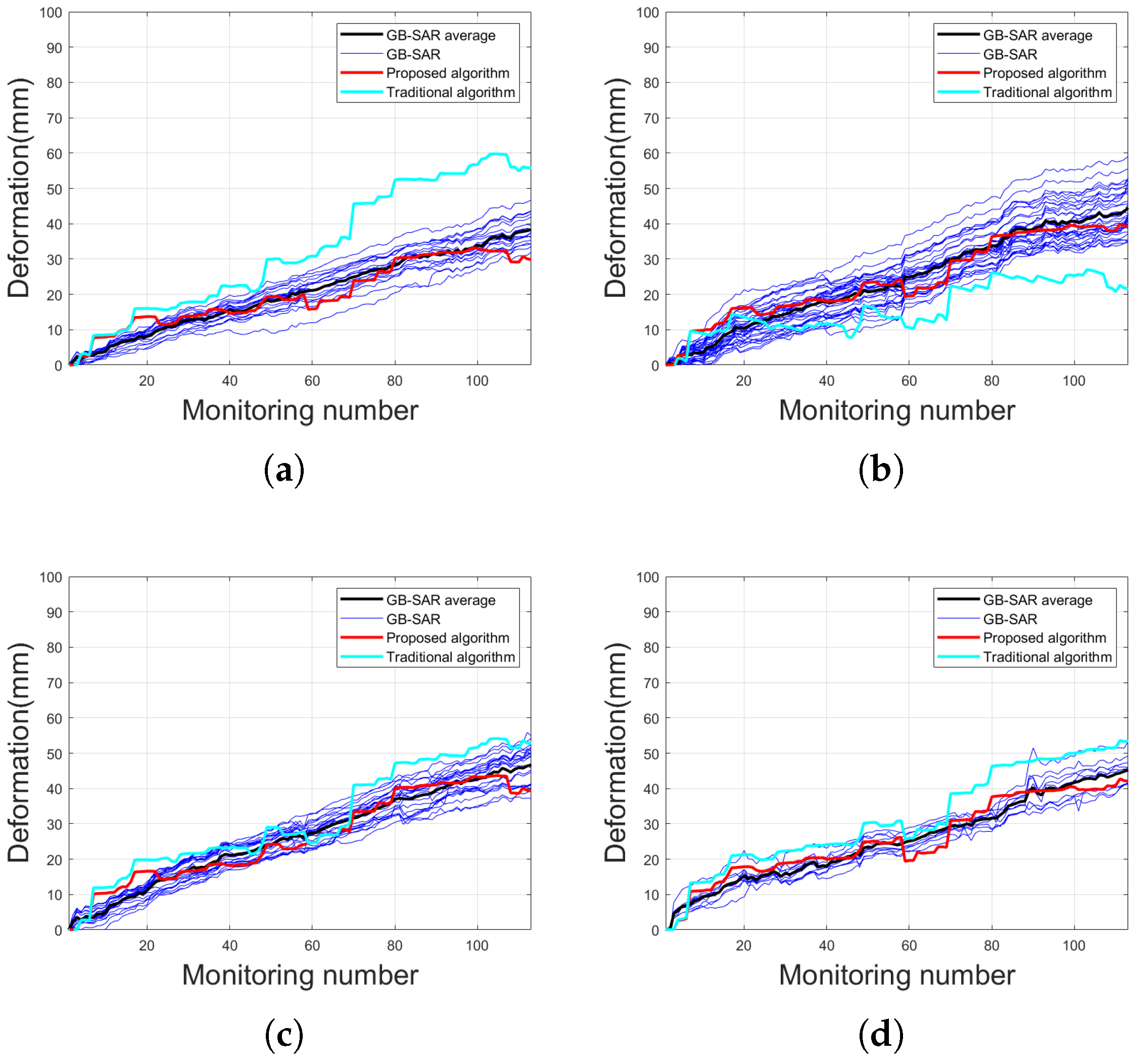
Time matching was performed on the deformation monitoring data of the two radars. The GB-SAR sampling rate was high, with deformation updates every 10 min. Therefore, the same sampling times as GNSS-based InBSAR were selected, yielding 122 deformation tracks. The deformation histories of four PSs were selected for comparison, as shown in Figure 17, and their locations are shown as blue stars. Figure 18 shows that deformation trends were consistent. The red line represents the proposed algorithm, which agreed better with GB-SAR. The average deformation history accuracy was 2.6 mm. The cyan line represents the classical algorithm; without DEM-error compensation and inter-system matching, the LOS accuracy was only 9.7 mm. Taking GB-SAR as the true deformation, the accuracy of each GNSS-based InBSAR PS is shown in Figure 19, and the mean LOS accuracy was 3.1 mm. After 3D conversion, most PS accuracies were below 2 mm in the east and north directions, and below 5 mm in the up direction. The average accuracies for the whole scene were 1.8, 1.6, and 4.6 mm.
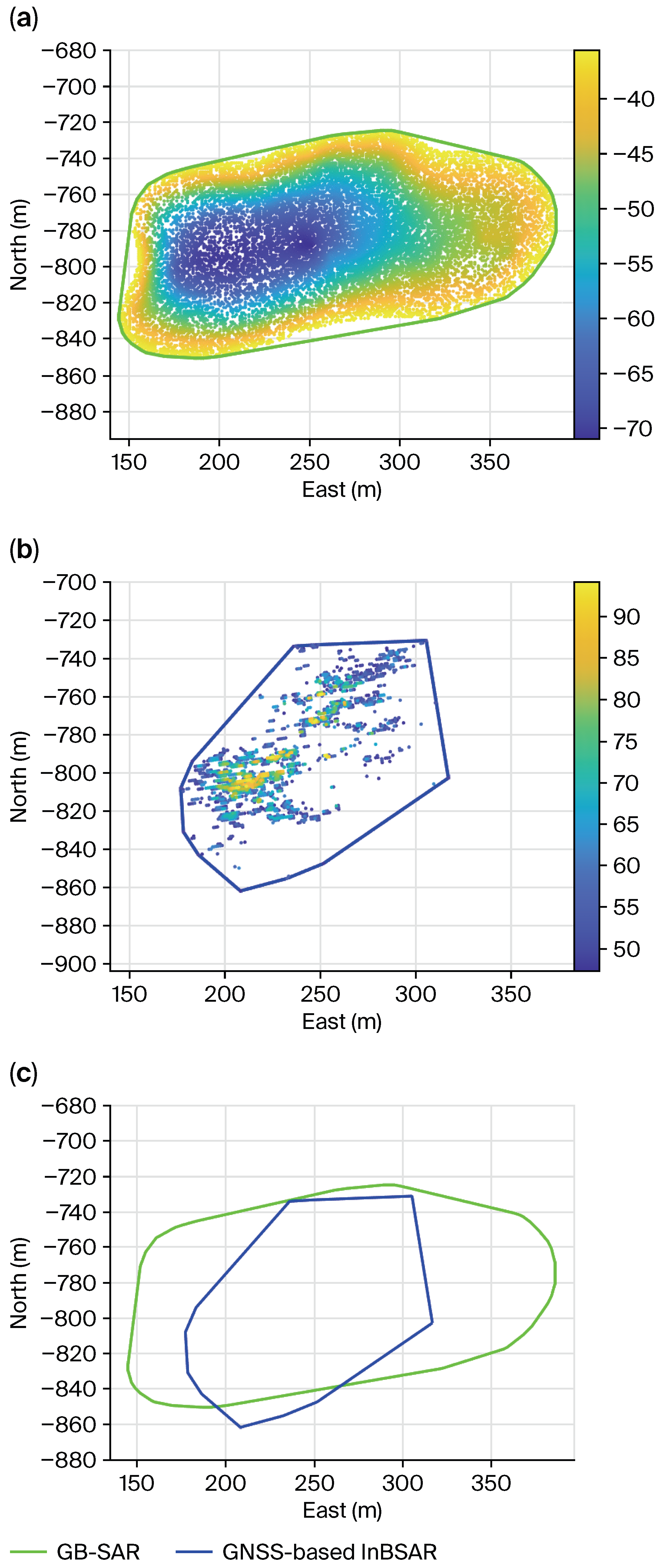
Fifty percent of the maximum GNSS-based InBSAR deformation was used as the threshold T d e f o , to delineate the deformation area. The contour was defined by the edge PSs of the deformation area, and the resulting contour is shown in Figure 20a. GB-SAR deformation was processed similarly, and its contour is shown in Figure 20b. Due to differences in radar regimes, PS distribution and density differed. The two deformation areas are compared in Figure 20c. The GNSS-based InBSAR deformation area a r e a G N was 8482 m 2 , and the GB-SAR deformation area a r e a G B was 5092 m 2 . Their overlap was 4284 m 2 , yielding a deformation area accuracy above 90%.

4.2. Artificial Ecological Park Monitoring Experiment

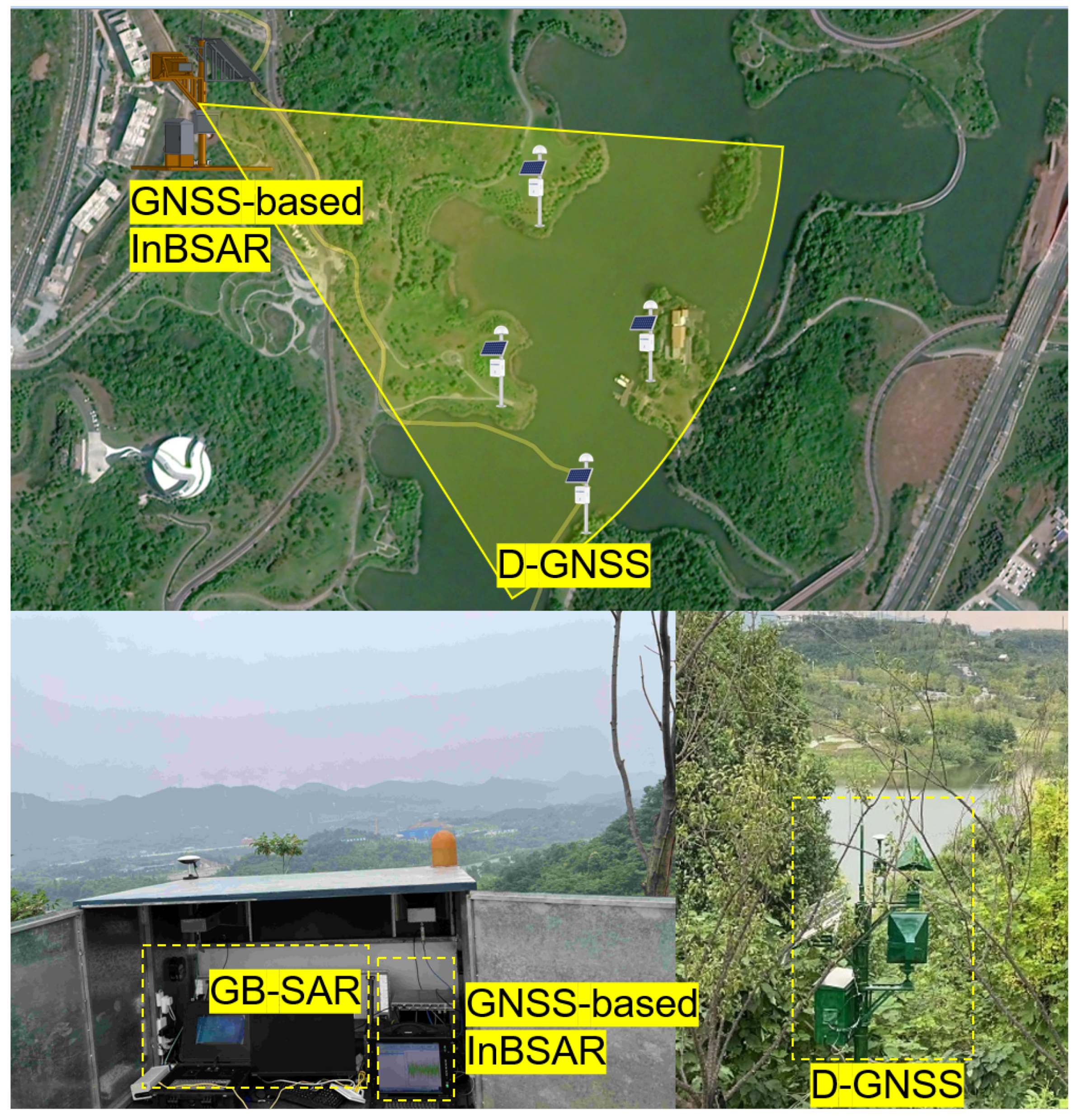
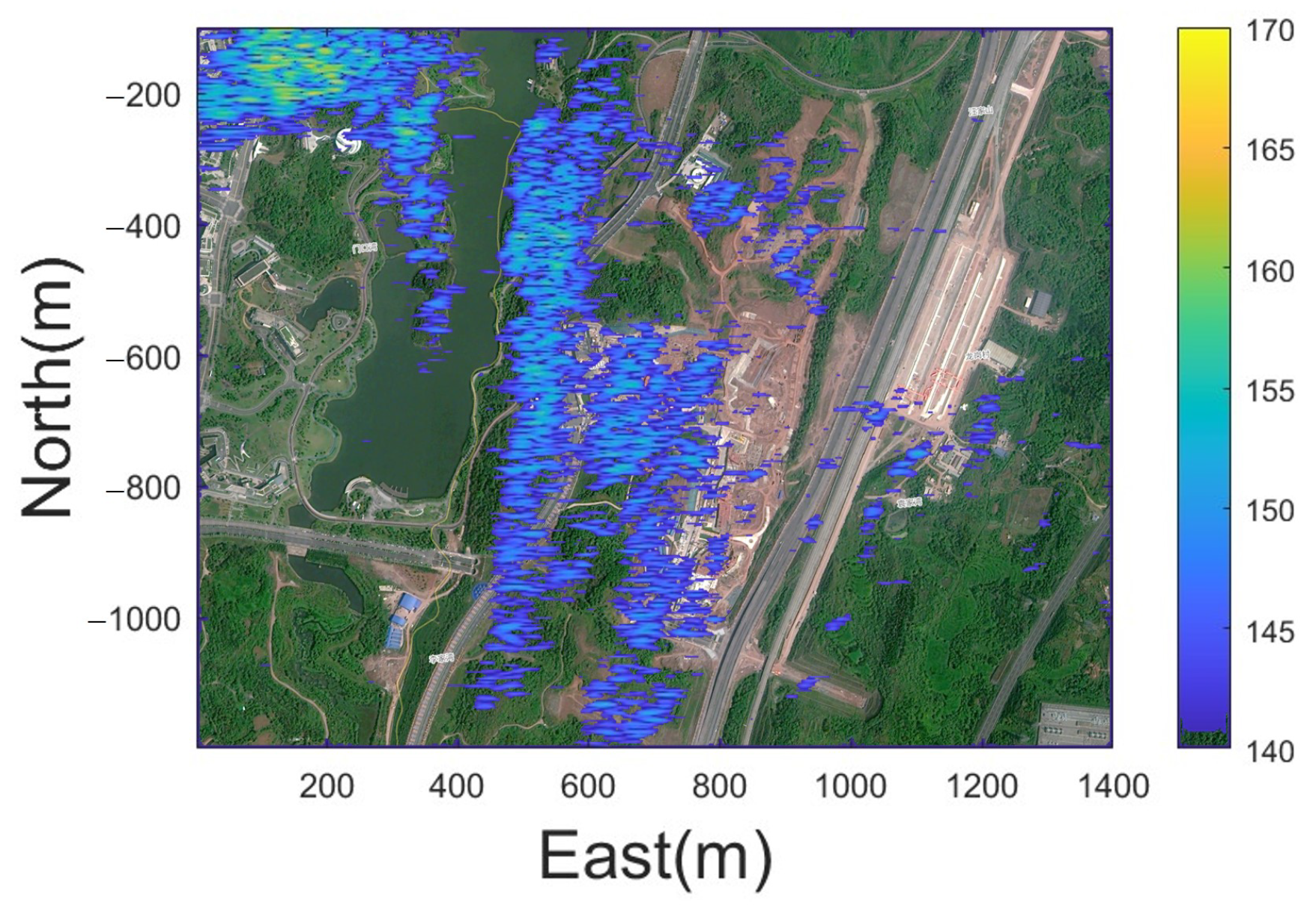
Invisible deformation verification was carried out in a natural slope in Chongqing. The experimental scene is shown in Figure 21. The site is geologically stable, with long-term deformation essentially invisible. Therefore, GNSS-based InBSAR, GB-SAR, and four D-GNSS were deployed. The experiment ran from 1 August 2024 to 30 August 2024. During data processing, DEM fitting was more effective and imaging deviations were negligible because the topography of the scene was mild. The imaging results are shown in Figure 22, where the lake outline is clearly visible and PSs are evident on the ground.
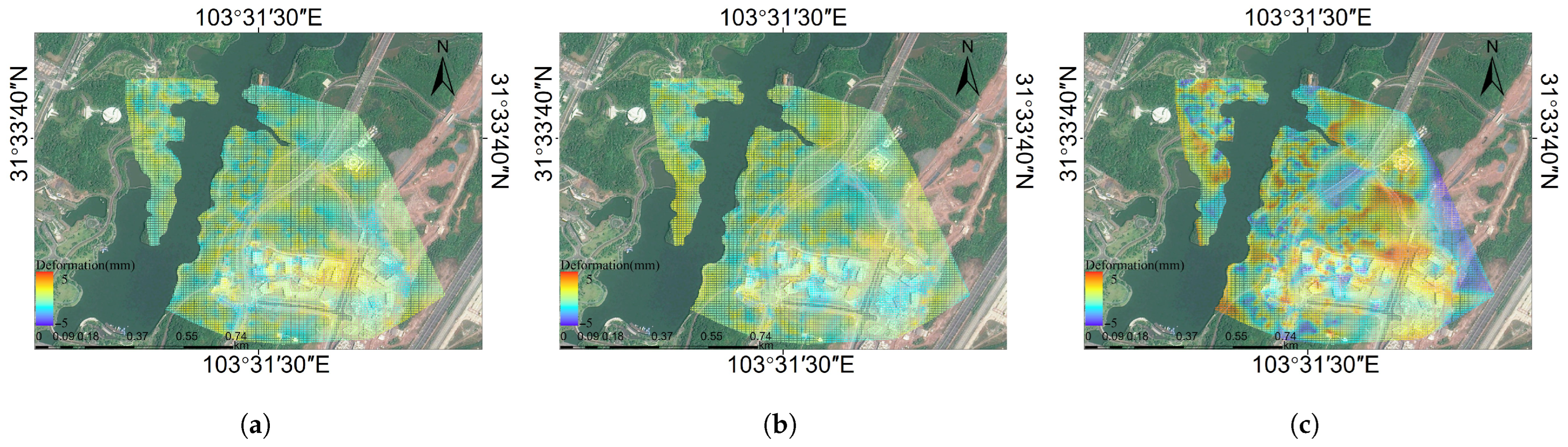
The results for the full scene after deformation monitoring are shown in Figure 23. A total of 795 PSs were monitored, most of which were extracted from high-energy areas of the SAR image, consistent with the image’s scattering properties. During the monitoring period, the maximum GNSS-based InBSAR deformation was 5.1 mm in the up direction. Only minor deformation was detected; thus, the scene was regarded as having invisible changes.
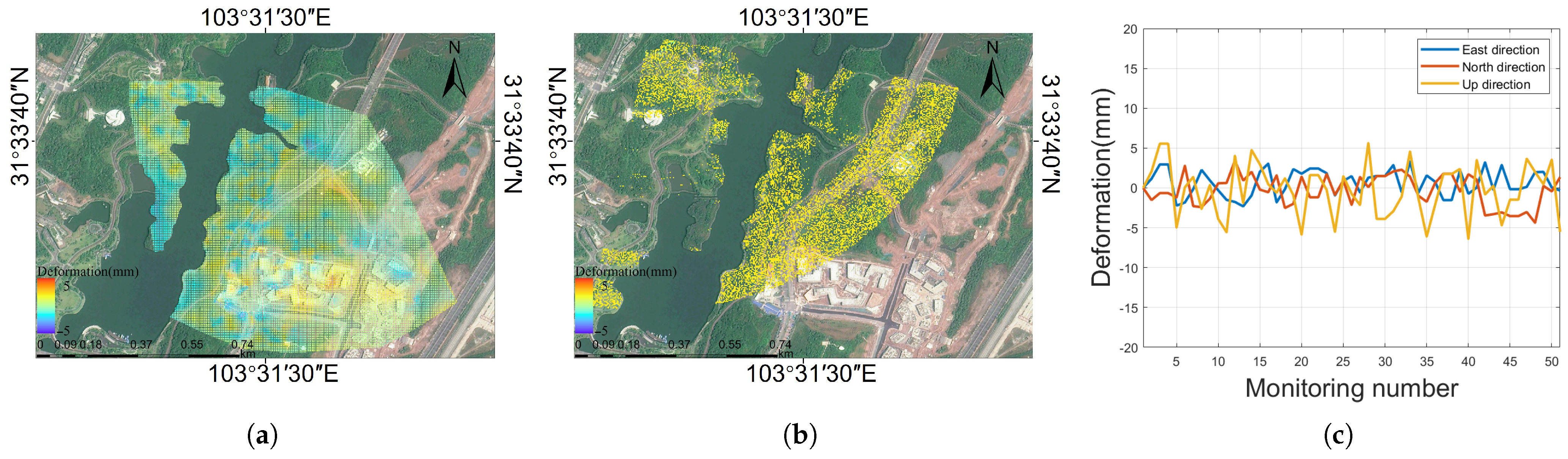
GNSS-based InBSAR PS deformation was projected onto the GB-SAR LOS, as shown in Figure 24a. The maximum GB-SAR deformation was 4.7 mm. The D-GNSS and GB-SAR monitoring results are shown in Figure 24b,c. In terms of the LOS direction, both systems detected only minor deformation, and their maxima were 4.9 mm and 6.1 mm, respectively. However, deformation in the up direction fluctuated significantly, consistent with D-GNSS configuration characteristics.
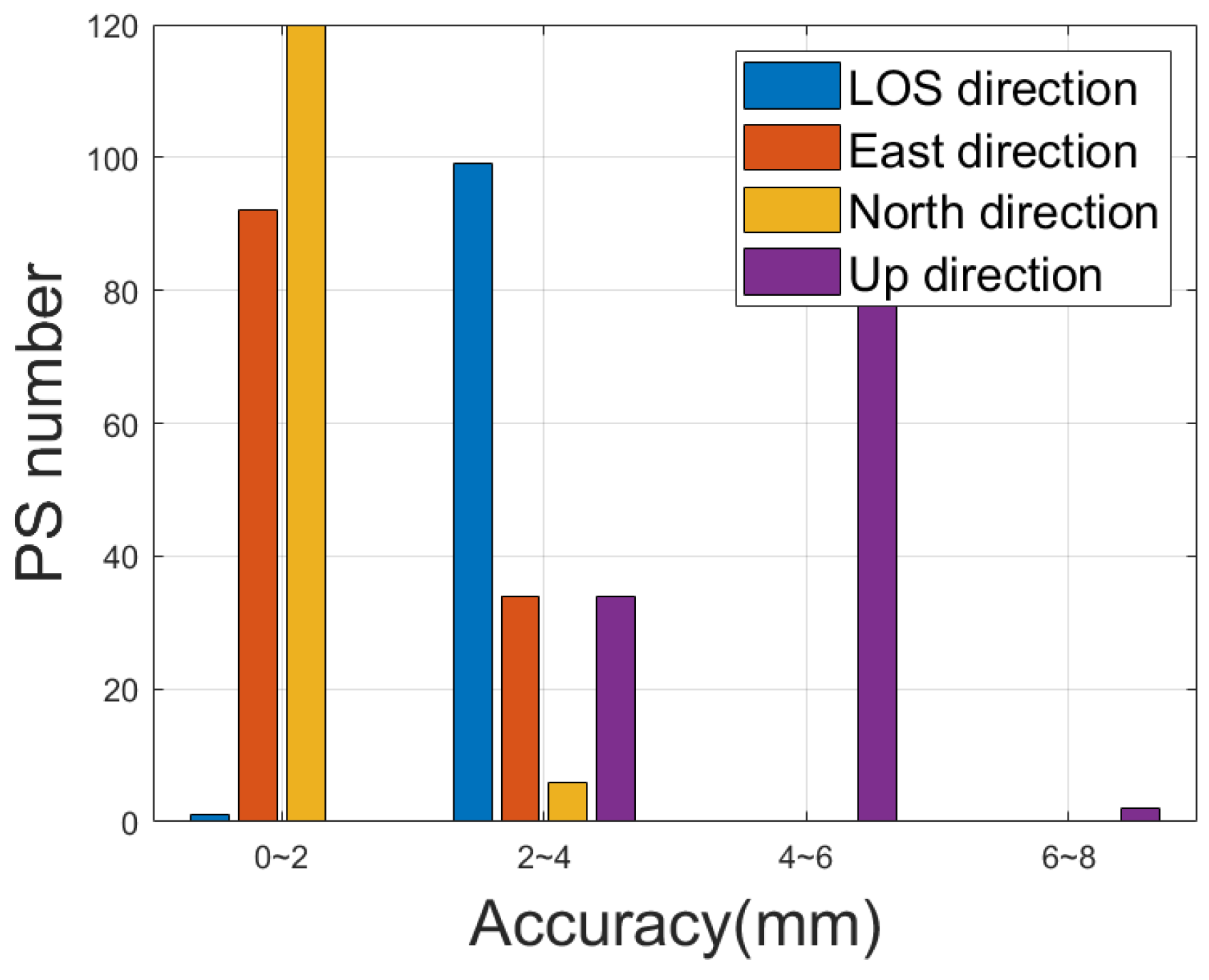
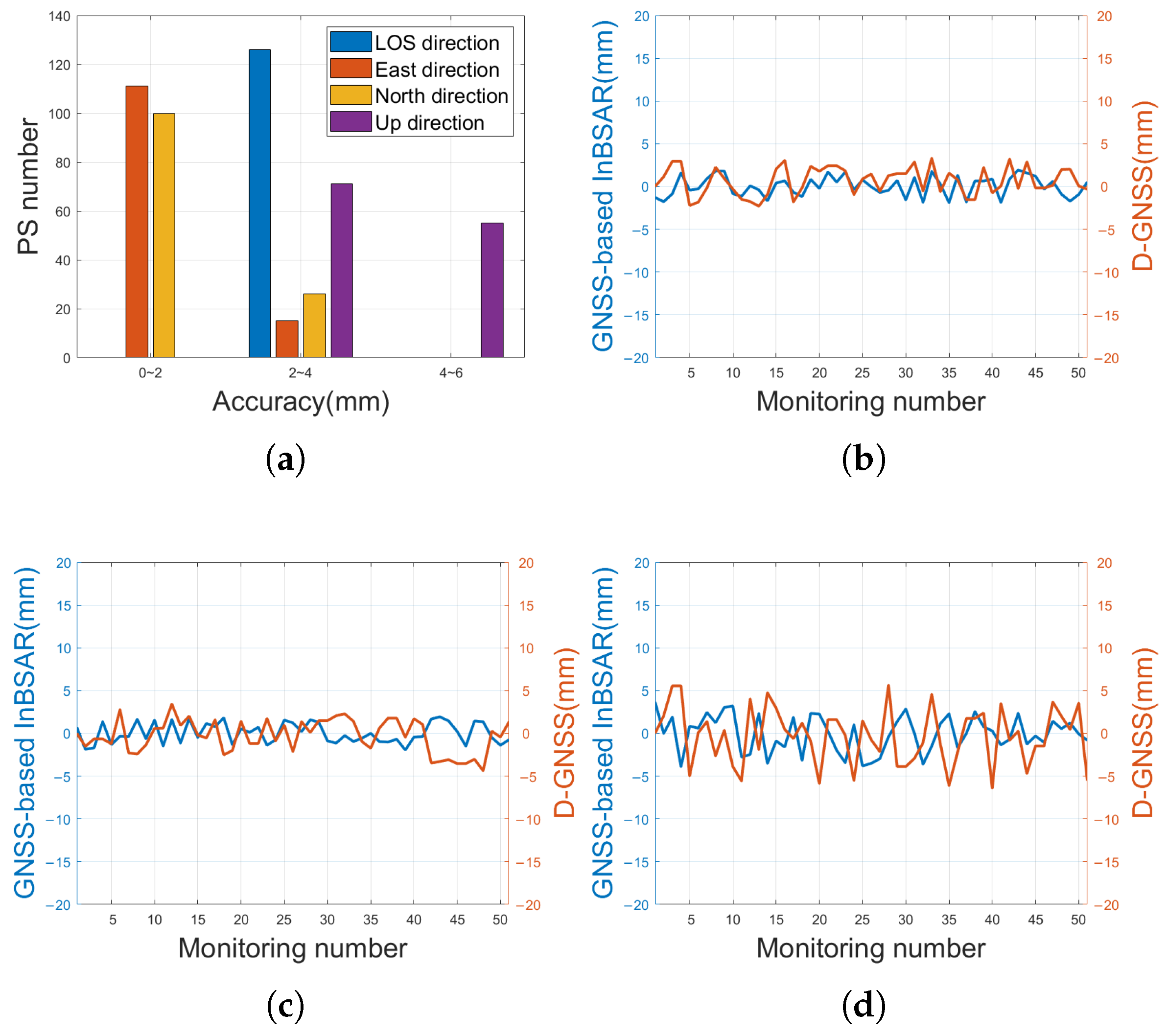
For each GNSS-based InBSAR PS, all GB-SAR PSs in the monitoring range were selected for comparison, with GB-SAR taken as the true value. The accuracy distribution is shown in Figure 25a. A total of 126 PSs were matched, with an average accuracy of 2.6 mm. Data from 20 satellites were used for processing. Considering all bistatic configurations, the accuracy ratio was ε x = 0.9 ε y = 0.4 ε z . After conversion, the 3D accuracy was 1.6, 1.7, and 4.0 mm along the east, north, and up directions.
The nearest PS to each D-GNSS was selected for comparison. The deformation histories are shown in Figure 25b–d. The D-GNSS and GNSS-based InBSAR results were intertwined, with small fluctuations in the east and north directions and larger fluctuations in the up direction. The D-GNSS results were taken as the true values, with accuracies of 2.2, 2.5, and 4.3 mm in the east, north, and up directions, respectively.
Table 5 summarizes the deformation accuracies of the three systems. Because deformation was essentially invisible, zero was taken as the true value. The ground-based D-GNSS system was reinforced and introduced no additional true-value errors. GB-SAR monitored many PSs with near-zero deformation, optimizing accuracy to 0.2 mm when using zero as the reference. The GNSS-based InBSAR deformation accuracy relative to zero was 2.5 mm; when the GB-SAR results were used as the reference, the accuracy decreased to 2.6 mm, corresponding to 1.0, 1.1, and 2.5 mm in 3D. D-GNSS, as a 3D system, reached 1.7, 1.9, and 3.3 mm relative to zero. Using the same reference, GNSS-based InBSAR reached 1.2, 1.2, and 2.1 mm in 3D. When the D-GNSS results were used as the reference, the GNSS-based InBSAR accuracy decreased to 2.2, 2.5, and 4.3 mm.
In the error analysis of GNSS-based InBSAR, most errors were compensated for, leaving only small residuals that did not affect monitoring of uniform or invisible deformation. Remaining deformation errors mainly arose from the adaptive estimation of the atmospheric error at the receiving end and the DEM error. Further research is needed for scenes with accelerated deformation.

5. Discussion

Most existing cross-system validations focus on spaceborne InSAR and D-GNSS. Due to differences in monitoring principles, these studies typically validate deformation using directly position-matched points, with temporal and spatial interpolation applied to align the data [32]. In contrast, GNSS-based InBSAR and GB-SAR often assume non-deformed areas as ground truth or rely on active transponders with controlled deformation [33]. In this paper, the accuracy of GNSS-based InBSAR is evaluated using established deformation monitoring measurements. GB-SAR can achieve sub-millimeter-level LOS accuracy, and D-GNSS can achieve millimeter-level 3D accuracy. When these two measurements are used as true values, their additional accuracy is included in the assessment of GNSS-based InBSAR. In deformation-based verification, millimeter-level monitoring accuracy is considered reliable. However, when verifying invisible deformation, trend-based accuracy is lower than the true measurement accuracy, although still of the same order.
In summary, the proposed method effectively validates the deformation monitoring results of GNSS-based InBSAR in natural scenarios, but several limitations should be considered: the deformation comparisons among GNSS-based InBSAR, GB-SAR, and D-GNSS must originate from identical targets to avoid potential errors; the accuracy assessment may become unreliable when the actual deformation magnitude is comparable to the accuracy level. These limitations highlight opportunities for future research, such as developing an inter-system artificial calibrator capable of providing homogeneous targets with known deformation. Despite these limitations, our approach contributes valuable insights for verifying the accuracy of GNSS-based InBSAR.

6. Conclusions

This article proposes an accuracy assessment algorithm using GB-SAR and D-GNSS measurements for GNSS-based InBSAR. First, images from different satellites are used for DEM-error compensation, and the optimized DEM is then used to determine the true positions of inter-system PSs. Second, inter-system spatial and temporal density differences are calibrated, and lastly, inter-system accuracy is assessed using 1D and 3D deformation-transformation models. Measured data from a natural landslide and an artificial ecological park are used to validate the algorithm. When large-magnitude deformation occurs, the deformation area accuracy exceeds 90%, and the mean LOS accuracy reaches 3.1 mm compared with GB-SAR. When small-magnitude deformation occurs, the 3D accuracy reaches 2.2, 2.5, and 4.3 mm using D-GNSS as the reference, and LOS accuracy reaches 2.6 mm using GB-SAR as the reference. The proposed method addresses the challenge of obtaining homologous points between GB-SAR and GNSS-based InBSAR caused by DEM errors. It also addresses issues related to cross-system resolution differences and variations in deformation direction.

Author Contributions

Conceptualization, Z.X. and F.L.; methodology, Z.X. and Z.W.; validation, Z.X., D.Y., and Y.D.; formal analysis, Z.X.; resources, F.L.; writing—original draft preparation, Z.X.; writing—review and editing, Z.X.; visualization, Y.L.; supervision, Y.L.; project administration, Y.L.; funding acquisition, F.L. All authors have read and agreed to the published version of the manuscript.

Funding

This research was funded by the National Key R&D Program of China (Grant 2021YFB3901400) and the National Natural Science Foundation of China (Grant No. 62071045).

Data Availability Statement

Data are contained within the article.

Conflicts of Interest

The authors declare no conflict of interest.

Abbreviations

The following abbreviations are used in this manuscript:
GNSS-based InBSARglobal navigation satellite system-based bistatic synthetic-aperture radar
GB-SARground-based synthetic-aperture radar
D-GNSSdifferential global navigation satellite system
DEMdigital elevation model
PSpersistent scatterer
LOSline of sight
InSARinterferometric synthetic-aperture radar
RCSradar cross-section
GANgenerative adversarial network

References

  1. Baade, J.; Schmullius, C. TanDEM-X IDEM precision and accuracy assessment based on a large assembly of differential GNSS measurements in Kruger National Park, South Africa. ISPRS J. Photogramm. Remote Sens. 2016, 119, 496–508. [Google Scholar] [CrossRef]
  2. Wang, Y.; Luo, J.; Dong, J.; Mallorqui, J.J.; Liao, M.; Zhang, L.; Gong, J. Sequential polarimetric phase optimization algorithm for dynamic deformation monitoring of landslides. ISPRS J. Photogramm. Remote Sens. 2024, 218, 84–100. [Google Scholar] [CrossRef]
  3. Yang, J.; Cao, Z.; Li, Q.; Li, Y. Millimeter-Wave Interferometric Synthetic Aperture Radiometer Imaging via Non-Local Similarity Learning. Electronics 2025, 14, 3452. [Google Scholar] [CrossRef]
  4. Wu, Y.; Qi, X.; Huang, L.; Zhang, B.; Zhang, W.; Yan, L. Enhanced BP Algorithm Combined With Semantic Segmentation and Subaperture for Improving Agricultural Scene Image Quality in GEO SAR. IEEE J. Sel. Top. Appl. Earth Obs. Remote Sens. 2025, 18, 3043–3056. [Google Scholar] [CrossRef]
  5. Pastina, D.; Santi, F.; Pieralice, F.; Antoniou, M.; Cherniakov, M. Passive Radar Imaging of Ship Targets With GNSS Signals of Opportunity. IEEE Trans. Geosci. Remote Sens. 2021, 59, 2627–2642. [Google Scholar] [CrossRef]
  6. Zhu, B.; Wang, Y.; Yu, H. An Algorithm Measuring Urban Building Heights by Combining the PS-InSAR Technique and Two-Stage Programming Approach Framework. IEEE J. Sel. Top. Appl. Earth Obs. Remote Sens. 2023, 16, 7624–7635. [Google Scholar] [CrossRef]
  7. Fang, Y.; Chen, J.; Wang, P.; Zhou, X. An Image Formation Algorithm for Bistatic SAR Using GNSS Signal With Improved Range Resolution. IEEE Access 2020, 8, 80333–80346. [Google Scholar] [CrossRef]
  8. Guo, Y.; Yu, Z.; Li, J.; Li, C. Focusing Multistatic GEO SAR With Two Stationary Receivers Based on Spectrum Gap Alignment and Recovery. IEEE J. Sel. Top. Appl. Earth Obs. Remote Sens. 2024, 17, 1949–1960. [Google Scholar] [CrossRef]
  9. Zhang, Q.; Niu, X.; Shi, C. Impact Assessment of Various IMU Error Sources on the Relative Accuracy of the GNSS/INS Systems. IEEE Sensors J. 2020, 20, 5026–5038. [Google Scholar] [CrossRef]
  10. Guo, A.; Hu, J.; Sun, Q.; Zhou, D.; Chen, Y.; Zheng, W.; Han, B.; Li, J. Revealing Hidden Deformation Patterns in Shallow Creeping Landslides: A Data-Driven InSAR Phase Filtering Method Addressing Geometric Distortions. IEEE Trans. Geosci. Remote Sens. 2025, 63, 5214822. [Google Scholar] [CrossRef]
  11. Li, H.; Wang, J.; Wu, S.; Gao, Y.; Wang, Y.; Nie, G. Transforming Structural Health Monitoring: Leveraging Multisource Data Fusion With Two-Stage Encoder Transformer for Bridge Deformation Prediction. IEEE Trans. Instrum. Meas. 2025, 74, 2520613. [Google Scholar] [CrossRef]
  12. Zhang, X.; Zhang, C.; Li, Z.; Li, Y.; Cao, Y.; Zhao, Y.; Zhou, J.; He, K.; Wang, X. Asymmetric Deformation Induced by Underground Mining: A Case Study of a Mine in Shaanxi, China. IEEE J. Sel. Top. Appl. Earth Obs. Remote Sens. 2025, 18, 17368–17385. [Google Scholar] [CrossRef]
  13. Kim, H.; Heo, J.; Lee, S.; Jung, Y. SARDIMM: High-Speed Near-Memory Processing Architecture for Synthetic Aperture Radar Imaging. Appl. Sci. 2024, 14, 7601. [Google Scholar] [CrossRef]
  14. Santi, F.; Bucciarelli, M.; Pastina, D.; Antoniou, M.; Cherniakov, M. Spatial Resolution Improvement in GNSS-Based SAR Using Multistatic Acquisitions and Feature Extraction. IEEE Trans. Geosci. Remote Sens. 2016, 54, 6217–6231. [Google Scholar] [CrossRef]
  15. Santi, F.; Antoniou, M.; Pastina, D. Point Spread Function Analysis for GNSS-Based Multistatic SAR. IEEE Geosci. Remote Sens. Lett. 2015, 12, 304–308. [Google Scholar] [CrossRef]
  16. Horn, B.K.P. Round-Trip Time Ranging to Wi-Fi Access Points Beats GNSS Localization. Appl. Sci. 2024, 14, 7805. [Google Scholar] [CrossRef]
  17. Wang, X.; He, X. Evaluation of Multisignal and Multiorbit Multipath Reflectometry of BeiDou Navigation Satellite System. IEEE Geosci. Remote Sens. Lett. 2023, 20, 1503305. [Google Scholar] [CrossRef]
  18. Li, P.; Li, Z.; Mao, W.; Shi, Q.; Lin, Q. Fusion of InSAR and GNSS Based on Adaptive Spatio-Temporal Kalman Model for Reconstructing High Spatio-Temporal Resolution Deformation. IEEE J. Sel. Top. Appl. Earth Obs. Remote Sens. 2024, 17, 19616–19626. [Google Scholar] [CrossRef]
  19. Capolupo, A. Improving the Accuracy of Global DEM of Differences (DoD) in Google Earth Engine for 3-D Change Detection Analysis. IEEE J. Sel. Top. Appl. Earth Obs. Remote Sens. 2021, 14, 12332–12347. [Google Scholar] [CrossRef]
  20. Chen, C.; Wang, M.; Chang, B.; Li, Y. Multi-Level Interpolation-Based Filter for Airborne LiDAR Point Clouds in Forested Areas. IEEE Access 2020, 8, 41000–41012. [Google Scholar] [CrossRef]
  21. Li, Y.; Xiang, W.; Chen, W. SAR Filtering Algorithm for Detecting Terrain Relief Targets. IEEE Geosci. Remote Sens. Lett. 2023, 20, 4011905. [Google Scholar] [CrossRef]
  22. Song, X.; Zhang, L.; Lu, Z.; Liang, H. Robust Stacking InSAR: Mitigating DEM Errors for Precise Deformation Rate Retrieval. IEEE Trans. Geosci. Remote Sens. 2025, 63, 5218613. [Google Scholar] [CrossRef]
  23. Dörr, N.; Schenk, A.; Hinz, S. Fully Integrated Temporary Persistent Scatterer Interferometry. IEEE Trans. Geosci. Remote Sens. 2022, 60, 4412815. [Google Scholar] [CrossRef]
  24. Navneet, S.; Kim, J.W.; Lu, Z. A New InSAR Persistent Scatterer Selection Technique Using Top Eigenvalue of Coherence Matrix. IEEE Trans. Geosci. Remote Sens. 2018, 56, 1969–1978. [Google Scholar] [CrossRef]
  25. Liu, F.; Zeng, X.; Gao, J.; Wang, Z. Deformation Field Formation Algorithm Based on Modified Kriging Interpolator in GNSS-Based InBSAR. IEEE Geosci. Remote Sens. Lett. 2024, 21, 4009405. [Google Scholar] [CrossRef]
  26. Zhao, J.; Li, J.; Liu, Q.; Zhang, Z.; Dong, Y. Comparative Study of Fractional Vegetation Cover Estimation Methods Based on Fine Spatial Resolution Images for Three Vegetation Types. IEEE Geosci. Remote Sens. Lett. 2022, 19, 2508005. [Google Scholar] [CrossRef]
  27. Wang, D.; Yang, X.; Pu, Q.; Jeon, G.; Liu, K. PSAM: Progressive Spatial Adaptive Matching for Reference-Based Super Resolution. IEEE Signal Process. Lett. 2023, 30, 1717–1721. [Google Scholar] [CrossRef]
  28. Song, Y.; Zhang, H.; Huang, H.; Zhang, L. Remote Sensing Image Spatiotemporal Fusion via a Generative Adversarial Network With One Prior Image Pair. IEEE Trans. Geosci. Remote Sens. 2022, 60, 5528117. [Google Scholar] [CrossRef]
  29. Deng, Y.; Hu, C.; Tian, W.; Zhao, Z. 3-D Deformation Measurement Based on Three GB-MIMO Radar Systems: Experimental Verification and Accuracy Analysis. IEEE Geosci. Remote Sens. Lett. 2021, 18, 2092–2096. [Google Scholar] [CrossRef]
  30. Liu, F.; Fan, X.; Zhang, T.; Liu, Q. GNSS-Based SAR Interferometry for 3-D Deformation Retrieval: Algorithms and Feasibility Study. IEEE Trans. Geosci. Remote Sens. 2018, 56, 5736–5748. [Google Scholar] [CrossRef]
  31. Huo, T.; He, Y.; Zhang, L.; Yang, W.; Tang, J.; Zhang, Q.; Lu, J.; Zhang, Y. GLER-BiGRUnet: A Surface Deformation Prediction Model Fusing Multiscale Features of InSAR Deformation Information and Environmental Factors. IEEE J. Sel. Top. Appl. Earth Obs. Remote Sens. 2024, 17, 14848–14861. [Google Scholar] [CrossRef]
  32. Dai, S.; Zhang, Z.; Li, Z.; Liu, X.; Chen, Q. Prediction of Mining-Induced 3-D Deformation by Integrating Single-Orbit SBAS-InSAR, GNSS, and Log-Logistic Model (LL-SIG). IEEE Trans. Geosci. Remote Sens. 2023, 61, 5222213. [Google Scholar] [CrossRef]
  33. Yu, J.; Zhu, Y.; Deng, Z.; Zhao, Y. A Satellite Selection Algorithm for GNSS-R InSAR Elevation Deformation Retrieval. IEEE Geosci. Remote Sens. Lett. 2025, 22, 4500305. [Google Scholar] [CrossRef]
Figure 1. Configuration of GNSS-based InBSAR. The colors represent the different bistatic configurations.
Electronics 14 04749 g001
Figure 2. Simulation of offsets in the east and north directions. The offset is more sensitive to DEM errors in GNSS-based InBSAR, while the relationship between the offset and DEM error is nonlinear in GB-SAR.
Electronics 14 04749 g002
Figure 3. PS selection for GB-SAR and different GNSS-based InBSAR configurations. The number of PSs monitored by GB-SAR is much larger than that monitored by GNSS-based InBSAR. Most PSs can be monitored by more than three satellites.
Electronics 14 04749 g003
Figure 4. Flowchart of the proposed algorithm.
Electronics 14 04749 g004
Figure 5. When DEM errors exist, PSs are offset. The target Q on real terrain appears as Q G B in GB-SAR and Q G N in GNSS-based InBSAR.
Electronics 14 04749 g005
Figure 6. The density of PSs increases. The colors of the deformation arrows represent different bistatic configurations. PSs monitored by at least m l satellites are retained; otherwise, their deformation is considered unreliable and not processed.
Electronics 14 04749 g006
Figure 7. Concept of high-frequency deformation estimation. Mean filtering is applied to improve the temporal resolution of the deformation.
Electronics 14 04749 g007
Figure 8. Inter-system resolution differences. Multiple GB-SAR resolution cells are represented as a single resolution cell in GNSS-based InBSAR.
Electronics 14 04749 g008
Figure 9. Monitoring range of a PS. The colors represent the resolution cells under different bistatic configurations. The direction and size of the resolution vary across configurations. The monitoring range is defined as the intersection of all resolution cells.
Electronics 14 04749 g009
Figure 10. Geometric relationship between the PS and the radar. The angle between the LOS direction and the horizontal plane is denoted by β , and the angle between the projection onto the horizontal plane and the east direction is denoted by α .
Electronics 14 04749 g010
Figure 11. Experimental scene: natural landslide with measurable deformation. The bottom-right image shows the GB-SAR and GNSS-based InBSAR locations.
Electronics 14 04749 g011
Figure 12. Imaging results of the scene: (a,b) geocoded SAR images from two different satellites. The location of the monitoring area differs.
Electronics 14 04749 g012
Figure 13. Global DEM-error compensation: When the global DEM error is set to 15 m, the multi-angle SAR images show the smallest difference.
Electronics 14 04749 g013
Figure 14. PS selection for GNSS-based InBSAR: Most PSs (1155) are fully monitored; some (741) are partially monitored; and a small number (283) are monitored only a few times and are therefore not processed.
Electronics 14 04749 g014
Figure 15. Geocoding of cumulative 3D deformation: (ac) GNSS-based InBSAR deformation in the east, north, and up directions. Red and blue represent deformation in opposite directions. The results show deformation of up to 70 mm and −80 mm in the north and up directions, consistent with the true scene.
Electronics 14 04749 g015
Figure 16. Geocoding of deformation in the LOS direction. (a) LOS-projected deformation from GNSS-based InBSAR, where the red-boxed area is defined as the main study area. (b) LOS-projected deformation from GB-SAR. One deformation area was monitored by both radars, with deformation reaching up to 80 mm in the LOS direction.
Electronics 14 04749 g016
Figure 17. PS matching between GNSS-based InBSAR and GB-SAR: One GNSS-based InBSAR PS corresponds to multiple GB-SAR PSs. A total of 100 PSs are available for comparison in the study area, where the 4 blue stars are the subsequent PSs focusing on deformation history.
Electronics 14 04749 g017
Figure 18. Deformation history comparison for 4 coregistered PSs: GNSS-based InBSAR and GB-SAR monitor consistent deformation trends. (ad) are the deformation histories of PS corresponding to the aforementioned four blue stars. The thin blue lines represent the deformation histories of the PSs within the monitoring range M r ; the black line represents the average; and the red and cyan lines represent the GNSS-based InBSAR deformation history using the proposed and classical algorithms. The average accuracy of the proposed and classical algorithms is 2.6 mm and 9.7 mm, respectively, for the 4 coregistered PSs.
Electronics 14 04749 g018
Figure 19. Accuracy statistics of the coregistered PSs: The best accuracy is better than 2 mm; the average LOS accuracy is 3.1 mm; and the average 3D accuracy in the north, east, and up directions is 1.8 mm, 1.6 mm, and 4.6 mm, respectively.
Electronics 14 04749 g019
Figure 20. Large-magnitude deformation area selection: (a) Large-magnitude deformation area detected by GNSS-based InBSAR. (b) Large-magnitude deformation area detected by GB-SAR. (c) Intersection of the two. Both systems detect the same large-magnitude deformation area, with a deformation coincidence rate above 90%.
Electronics 14 04749 g020
Figure 21. Experimental scene: Artificial ecological park with invisible deformation. The top image shows the radar location; the bottom-left image shows the GNSS-based InBSAR and GB-SAR locations; and the bottom-right image shows the D-GNSS location on the opposite side of the lake.
Electronics 14 04749 g021
Figure 22. SAR image of the artificial ecological park: High backscatter energy is observed on both sides of the lake, and the lake boundaries are clearly visible.
Electronics 14 04749 g022
Figure 23. Deformation monitoring using GNSS-based InBSAR: (ac) Deformation in the east, north, and up directions. No large-magnitude deformation is observed in the scene.
Electronics 14 04749 g023
Figure 24. Deformation results from all monitoring systems: (a) LOS-projected deformation from GNSS-based InBSAR. (b) Deformation from GB-SAR. (c) Deformation at the D-GNSS position. Although the output modes differ, no large-magnitude deformation is detected.
Electronics 14 04749 g024
Figure 25. Inter-system deformation assessment results (The blue line represents GNSS-based InBSAR. The orange line represents D-GNSS): (a) Accuracy statistics of the coregistered PSs, where the mean accuracy along the LOS, east, north, and up directions is 2.6, 1.6, 1.7, and 4.0 mm, respectively. (bd) 3D deformation comparison results at the D-GNSS position, with accuracies of 2.2, 2.5, and 4.3 mm in the east, north, and up directions, respectively.
Electronics 14 04749 g025
Table 1. Transmitter parameters with respect to the scene.
TransmitterAzimuth ( ° )Pitch ( ° )
BDS3 MEO333159
BDS3 MEO1521746
BDS3 MEO2027624
GB-SAR3030
Table 2. Three-dimensional deformation monitoring accuracy.
Satellite CountEast (mm)North (mm)Up (mm)PS Count
1∼26.17.314.77
3∼43.13.58.415
5∼62.32.45.917
7∼81.92.05.119
9∼101.92.05.119
Table 3. Inter-system resolutions.
TransmitterAzimuth ResolutionRange Resolution
BDS3 MEO34.3 m9.9 m
BDS3 MEO154.9 m8.7 m
BDS3 MEO203.4 m9.4 m
GB-SAR7.5 m (about 1000 m)0.15 m
Table 4. Offset compensation for the scene center.
TransmitterAzimuth ( ° )Pitch ( ° )East Offset (m)North Offset (m)
BDS2 IGSO2558113−15
BDS2 IGSO318960−1416
BDS2 IGSO5335751218
BDS2 IGSO61975216−12
BDS3 MEO1110381315
BDS3 MEO12246401217
BDS3 MEO1634860−1912
BDS3 MEO22291291212
BDS3 MEO26773214−13
BDS3 ME9692914−16
GB-SAR2651513
Table 5. Monitoring accuracies of the three systems.
TypeDimensionReferenceAccuracy (mm)
GB-SAR1D00.2
GNSS-based InBSAR1D02.5
GNSS-based InBSAR1DGB-SAR2.6
GNSS-based InBSAR3DGB-SAR1.6, 1.7, 4.0
D-GNSS3D01.7, 1.9, 3.3
GNSS-based InBSAR3D01.2, 1.2, 2.1
GNSS-based InBSAR3DD-GNSS2.2, 2.5, 4.3
Disclaimer/Publisher’s Note: The statements, opinions and data contained in all publications are solely those of the individual author(s) and contributor(s) and not of MDPI and/or the editor(s). MDPI and/or the editor(s) disclaim responsibility for any injury to people or property resulting from any ideas, methods, instructions or products referred to in the content.