Article

A Novel Color Image Encryption Method Based on Hierarchical Surrogate-Assisted Optimization

by
Gao-Yuan Liu
1,
Ying Yu
2,*,
Hui-Qi Zhao
3,
Tian-Yu Gao
4 and
Zhi-Yang Chen
1
1
School of Information and Intelligent Engineering, University of Sanya, Sanya 572022, China
2
Academician Rong Chunming Workstation, University of Sanya, Sanya 572022, China
3
College of Intelligent Equipment, Shandong University of Science and Technology, Tai’an 271000, China
4
Department of Electrical and Computer Engineering, Whiting School of Engineering, Johns Hopkins University, 3400 North Charles Street, Baltimore, MD 21218, USA
*
Author to whom correspondence should be addressed.
Electronics 2025, 14(23), 4716; https://doi.org/10.3390/electronics14234716
Submission received: 22 October 2025 / Revised: 26 November 2025 / Accepted: 27 November 2025 / Published: 29 November 2025
(This article belongs to the Special Issue Advances in Cryptography and Image Encryption)

Abstract

To address the limitations of traditional image encryption algorithms in key optimization and encryption quality assessment, in this paper we propose a framework for image encryption based on surrogate-assisted differential evolution. First, we construct a novel fitness function based on pixel correlation, which quantitatively evaluates and optimizes encryption quality by minimizing the pixel correlation coefficient. Second, we propose an adaptive hierarchical surrogate-assisted differential evolution algorithm (HSADE-IQUA), which combines global and local phases. In the global optimization phase, HSADE-IQUA significantly improves the convergence speed and solution quality in constrained optimization through adaptive parameter control. In the local optimization phase, the population size is dynamically adjusted using the exponential moving average (EMA), achieving a balance between exploration and exploitation. The performance of HSADE-IQUA has been validated on a commonly used expensive optimization benchmark suite, achieving excellent experimental results. Third, a Chen hyperchaotic-DNA coding fusion encryption framework optimized by HSADE-IQUA (HSADE-IQUA-DNA) was constructed and tested on standard computer vision images, labeled datasets, and remote sensing images, proving that HSADE-IQUA-DNA can significantly reduce pixel correlation, effectively resist exhaustive attacks, noise attacks, and shearing attacks, and accurately recover the original image. Compared with traditional chaotic image encryption, HSADE-IQUA-DNA not only has a bottleneck in parameter optimization but also alleviates the single-key issue, further improving encryption security.

1. Introduction

With the widespread application of digital images in social media, cloud storage, and the Internet of Things, the secure transmission of image data has become a key challenge in the field of information security [1,2,3]. More than 2.5 billion digital images are generated globally every day which contain a wealth of sensitive information involving personal privacy, trade secrets, and national security [4]. When traditional text encryption algorithms [5,6] are applied directly to image encryption, they ignore the high redundancy, strong correlation, and multidimensional characteristics of image data, resulting in low encryption efficiency and making them susceptible to statistical analysis attacks. Therefore, there is an urgent need to design efficient encryption algorithms that specifically target image features to ensure the security of cyberspace.
Presently, there are four main design ideas for image encryption: (1) Image encryption based on public key or symmetric key cryptography, which applies algorithms such as AES [7] and DES [8] to image data to encrypt the entire image by byte or bit. However, due to strong adjacent correlation between image pixels, the efficiency of directly using AES pixel-by-pixel encryption is low, so it is often optimized in combination with image characteristics [9]; (2) Image encryption based on compressed sensing, which uses a random measurement matrix to sample and compress sparse signals during the image encryption process, achieves the effects of compression and encryption at the same time. In 2008, Orsdemir et al. [10] first proposed a framework for “sampling while encrypting” using a pseudo-random measurement matrix combined with a key. Later, in 2011, Zhang et al. [11] proposed applying compressed sensing to pre-encrypted images. In 2014, Zhou et al. [12] proved it is possible to use a controllable part of the Hadamard algorithm. The measurement matrix achieves compression and encryption simultaneously in the image domain; (3) Image encryption based on deep learning. In recent years, researchers have begun to explore using deep learning models to automatically learn image encryption mappings such as Abadi et al. [13], which first used a generative adversarial network (GAN) to train a generator to transform the original image into a noise-like “encrypted image” and the discriminator acts as an attacker to promote the generator to produce unrecognizable results. Feng et al. [14] combined chaotic mapping with CNN to extracted high-level features and enhance the encryption effect, while the chaotic sequence provides randomness, the two complement each other to improve the algorithm’s resistance to attacks. However, deep learning methods often require significant time; (4) Image encryption based on chaotic systems. Chaotic systems are sensitive to initial conditions and have strong pseudo-randomness and ergodicity, which is usually used to encrypt the image. The classic approach uses logistic mapping, Cat mapping, and similar methods to generate key streams [15,16], which use chaotic sequences to perform complex transformations on the positions and grayscales of image pixels. However, these mappings are susceptible to parameter estimation and chosen/known plaintext attacks due to their low dimensionality, small parameter space, and the tendency to exhibit periodic windows and non-uniformity under limited precision, the hyperchaotic systems can avoid these shortcomings. However, chaotic encryption is a deterministic one-to-one mapping uniquely determined by the key, and decryption must replicate the same trajectory, which makes the optimal key for a image usually single. Moreover, this approach is also often used in combination with other methods such as AES, compressed sensing, and DNA coding [17,18,19].
Nowadays, as evolutionary computing and encryption technologies like chaos theory and DNA coding [20,21] have advanced, researchers have found that integrating these methods can enhance image encryption algorithm performance. Since image encryption typically involves large-scale pixel-level operations, direct optimization on the true evaluation function incurs extremely high computational costs, making it difficult for traditional evolutionary algorithms to obtain high-quality solutions within an acceptable timeframe [22]. To reduce optimization costs, we introduce a surrogate model to approximate the true evaluation provides a feasible and effective approach [23]. Therefore, we propose an adaptive hierarchical surrogate-assisted differential evolution algorithm (HSADE-IQUA), which constructs a hierarchical surrogate-assisted evolutionary framework, effectively integrating global and local fine-grained searches, and coordinating true and surrogate evaluations at different levels, thereby efficiently optimizing the single-key issue of hyperchaotic system parameters and DNA encoding strategies during image encryption. The main contributions of this paper are as follows:
  • Designed a fitness function for image encryption suitable for metaheuristic algorithms;
  • Proposed an adaptive hierarchical surrogate-assisted differential evolution algorithm (HSADE-IQUA) that combines global and local search. Further applied to the Chen hyperchaotic system and DNA encoding, the HSADE-IQUA-DNA image encryption algorithm was proposed;
  • We tested the performance of HSADE-IQUA from multiple perspectives, including parameter sensitivity testing, benchmark function testing, and statistical analysis. The test results validated HSADE-IQUA’s excellent performance;
  • We conducted experiments on benchmark images, deep learning training images with anchor boxes, and real remote sensing images using the proposed HSADE-IQUA-DNA. The experimental results demonstrate that HSADE-IQUA-DNA fully preserves image information and is resistant to exhaustive, noise, and cropping attacks.
The rest of this paper is organized as follows: Section 2 is the related works, covering the technical principles and research status relevant to this study. Section 3 presents the proposed method, detailing the fitness function, adaptive hierarchical surrogate-assisted differential evolution algorithm (HSADE-IQUA), optimized hyperchaotic system, and DNA encoded image encryption algorithm (HSADE-IQUA-DNA). Section 4 contains experiments and analysis, including the HSADE-IQUA benchmark test and the HSADE-IQUA-DNA image encryption experiment. Section 5 provides a conclusion and future work.

2. Related Works

2.1. Chaos Theory

Chaotic systems are widely used in cryptography due to their unique ergodicity, sensitivity to initial conditions, pseudo-randomness, and bounded trajectories [24]. In various chaotic systems, the Lyapunov exponent is a key indicator for measuring the intensity of chaos. A positive Lyapunov exponent indicates the extreme sensitivity of the system to initial conditions [25]. The Logistic chaos map is the most classic chaotic map, as shown in Equation (1):
y n + 1 = μ × y n ( 1 y n )
where y n is the state value of the system at the n-th moment, μ ( 0 , 4 ] , 3.57 μ 4 , the Lyapunov exponent is greater than 0, and the system is completely in a chaotic state, as shown in Figure 1 when μ < 3 the system converges to a single fixed point, while increasing μ causes successive period-doubling bifurcations. Around μ 3.57 , the branches become a dense set of points, indicating the onset of chaos, which shows the small changes in μ can lead to drastically different trajectories, highlighting the strong sensitivity and complex dynamics that make the logistic map suitable for cryptographic applications.
A hyperchaotic system [26] is generally defined as a system of differential equations with four or more dimensions and at least two or more positive Lyapunov exponents. In 1999, Professor Guanrong Chen proposed the Chen hyperchaotic system [27], as shown in Equation (2).
x = a ( y x ) + w , y = d x x z + c y , z = x y b z , w = y z + r w .
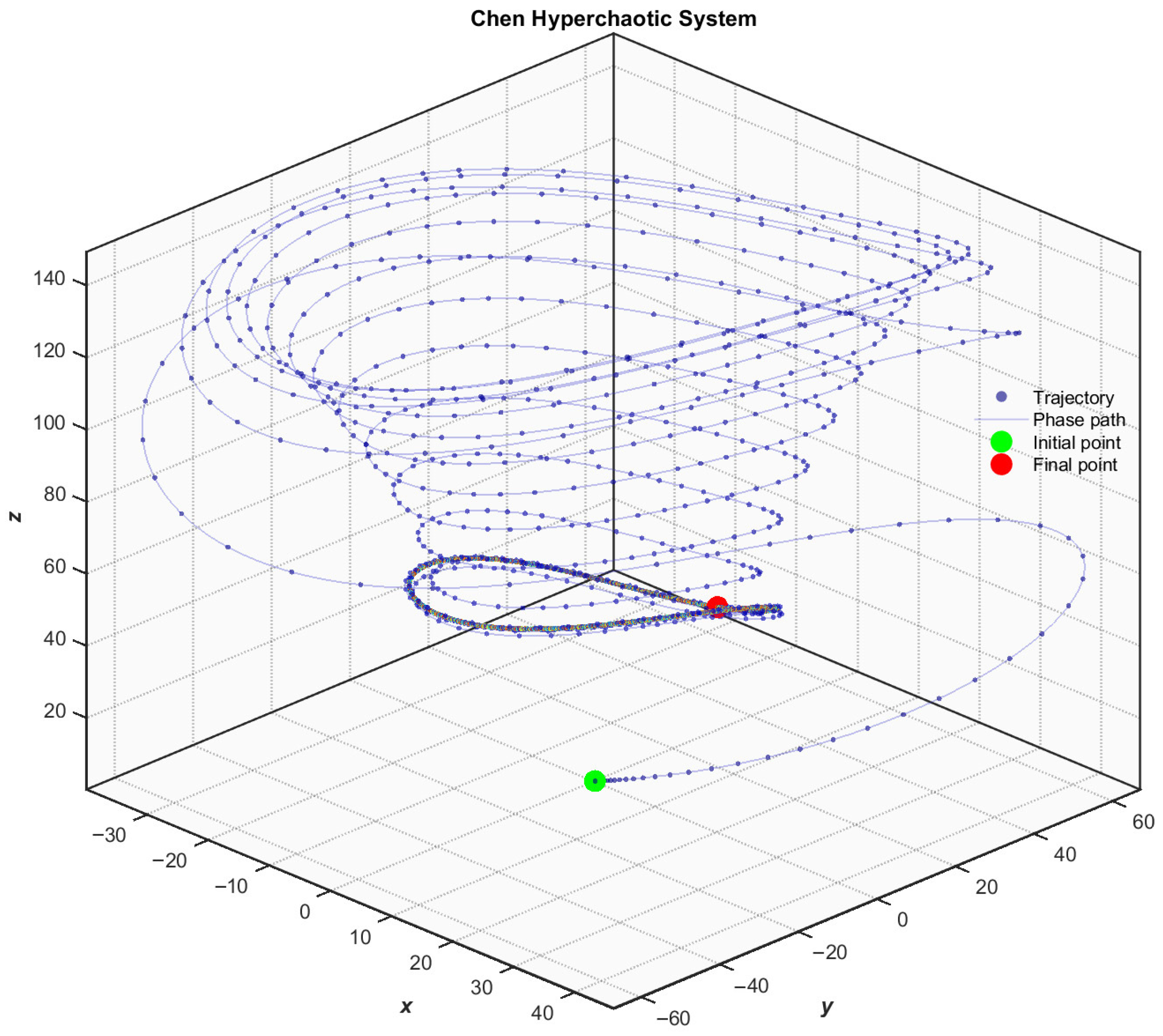
where x, y, z, and w are the system’s state variables, and a, b, c, d, and r are the system’s control parameters. When a = 35 , b = 3 , c = 12 , d = 7 , and 0.085 r 0.798 , the system exhibits hyperchaotic motion, as shown in Figure 2.

2.2. DNA Coding Rules

DNA encoding rules are one of the core concepts in the intersection of bioinformatics and cryptography. They rely on the Watson–Crick pairing rule [28] to map binary information m { 0 , 1 } k to a decodable codeword of a four-tuple string x Σ n that satisfies biochemical and channel constraints, i.e., { 0 , 1 } k Σ n . Table 1 shows eight DNA encoding and decoding methods that comply with the Watson–Crick pairing rule.
Since there are eight eligible DNA encoding methods, each with its own set of algorithms, each common algorithm corresponds to eight different DNA algorithms. Suppose we want to perform addition and XOR operations on two base sequences, S 1 : { ACGTACGT } and S 2 : { TGCAATGC } . According to the DNA encoding rules, we can obtain two results, S 3 : { TTTTAAAA } and S 4 : { TTTTAGAG } . The calculation process is shown in Equations (3) and (4).
ACGTACGT 00 01 10 11 00 01 10 11 + TGCAATGC 11 10 01 00 00 11 10 01 TTTTAAAA 11 11 11 11 00 00 00 00
ACGTACGT 00 01 10 11 00 01 10 11 TGCAATGC 11 10 01 00 00 11 10 01 TTTTAGAG 11 11 11 11 00 10 00 10

2.3. Differential Evolution (DE)

Differential Evolution (DE) is a population-based global optimization method proposed by Storn and Price in 1997 [29]. Its core idea is to use the “difference vector” between individuals in the current population as the search direction and adaptive step size. The algorithm constructs differential perturbations from several individuals to generate mutant individuals, and then generate the optimal solution through crossover. Before starting the optimization, DE first needs to initialize a set of P o p × D random solutions X = [ x 1 , 1 , x 1 , 2 , , x 1 , D ; x 2 , 1 , x 2 , 2 , , x 2 , D ; ; x P o p , 1 , x P o p , 2 , , x P o p , D ] , as shown in Equation (5).
x i , j = j + r i , j ( ub j b j )
Differential mutation: DE uses vector differences to form a “perturbation vector,” creating mutant individuals v i g . This stage is central to the differential evolution algorithm. Several parent individuals are randomly or according to a predetermined rule selected from the current population. Their differential vectors are calculated, and the stride is adjusted by a scaling factor. This differential vector is added to a selected basis vector to make mutant individuals. The mutation strategies usually used include DE/rand/1, DE/best/1, DE/rand/2, DE/current-to-best/1, and current-to-pbest/1, as shown in Equations (6)–(9). These strategies achieve different trade-offs between exploration and exploitation using different basis vectors and differential logarithms.
DE/rand/1
v i = x r 1 + F ( x r 2 x r 3 )
DE/best/1
v i = x best g + F ( x r 1 x r 2 )
DE/rand/2
v i = x r 1 + F ( x r 2 x r 3 + x r 4 x r 5 )
DE/current-to-best/1
v i = x r 1 + F ( x best x i ) + F ( x r 1 x r 2 )
where F ( 0 , 2 ) is the scaling factor, r 1 , r 2 , r 3 are random indices that are different from each other and different from i, and x best g is the current optimal individual.
Crossover: The mutation vector is recombined with the corresponding target vector to form a test individual. This preserves the parent structure while injecting new information from the differential mutation. For each dimension, genes are copied from the mutation vector with probability C R , as shown in Equation (10).
u i , j g = v i , j g , if r C R or j = j r a n d x i , j g , else
where, C R [ 0 , 1 ] , j r a n d is a randomly selected dimension of v i , j g .
Selection: In this phase, each target vector competes greedily with its corresponding test individual in a one-on-one competition. The best candidates, ranked by fitness, are retained for the next generation. This deterministic, local competition ensures the population’s optimal value does not decrease and incorporates improvements from crossover and mutation efficiently, as shown in Equation (11).
x i g + 1 = u i ( g ) , if f ( u i ( g ) ) f ( x i ( g ) ) x i ( g ) , else
where f represents the fitness function. DE has been widely used in many fields [30,31,32,33,34,35], and researchers have proposed many improvements with excellent results. For example, Brest et al. [36] implemented an adaptive mechanism for the parameters F and C R in jDE; Zhang and Sanderson [37] introduced external historical archives into DE and adopted parameter adaptation, taking into account both exploration and development; Wang et al. [38] proposed CoDE using a composite trial vector generation strategy; and the HARD-DE algorithm proposed by Meng et al. [39] is considered the best algorithm for solving the a i r 2 w a t e r model.

2.4. QUasi-Affine TRansformation Evolution (QUATRE)

The QUATRE algorithm is a collaborative evolutionary algorithm based on quasi-affine transformations. It was proposed by Meng et al. [40] in 2016, and the algorithm uses particle collaborative evolution during the update process to solve the bias problem in the differential evolution algorithm (DE). The algorithm has a simple structure and is widely used in engineering optimization problems [41]. The core mathematical model is shown in Equation (12).
x i , j = M x i , j + M ¯ B
where M is the coevolution matrix, ⊗ represents term-by-term multiplication, and M ¯ is the element-by-element inversion of M , as shown in Equation (13).
M = 0 0 1 0 0 1 0 0 0 0 1 1 0 0 0 0 1 0 0 0 1 1 1 1 0 0 0 0 1 1 1 1 = M ¯
where B is the population mutation matrix, which has six common forms, as shown in Equations (14)–(19).
QUATRE/best/1
B = x best g + F ( x r 1 x r 2 )
QUATRE/rand/1
B = x r 1 + F ( x r 2 x r 3 )
QUATRE/rand/2
B = x r 1 + F ( x r 2 x r 3 ) + F ( x r 3 x r 4 )
QUATRE/target/1
B = x i + F ( x r 1 x r 2 )
QUATRE/target/2
B = x i + F ( x r 1 x r 2 ) + F ( x r 3 x r 4 )
QUATRE/best/2
B = x best g + F ( x r 1 x r 2 ) + F ( x r 3 x r 4 )

2.5. Radial Basis Function

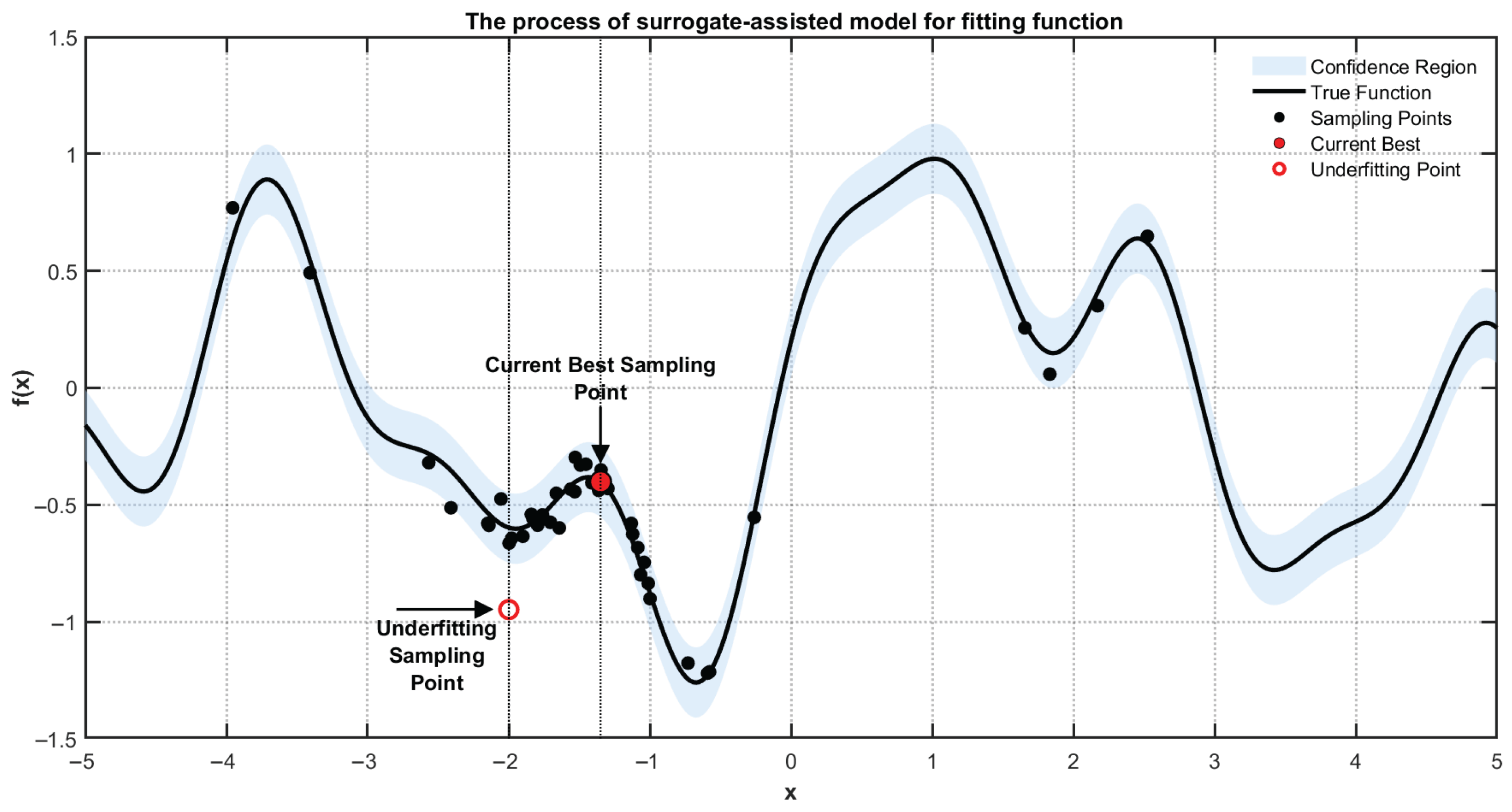
The radial basis function (RBF) is a commonly used surrogate model, primarily used to approximate complex and computationally expensive objective functions, as shown in Figure 3. Due to RBF basis functions with local characteristics, the model can perform high-precision approximations within local regions of the solution space, effectively capturing local variations in the objective function and reducing computational overhead during optimization. RBF typically uses a Gaussian function as shown in Equation (20):
φ ( x c i ) = exp x c i σ i 2
where x is the input vector, c i is the center of the i-th basis function, σ i is the width function of the basis function, and the output of the RBF consists of a linear combination of the basis functions, as shown in Equation (21):
P r e d i c t ( x ) = i = 1 N ω i φ ( x c i )
where P r e d i c t ( x ) is the RBF approximation of the target function, N is the number of radial basis functions, and ω i is the weight of the basis function.
There are also many achievements in improving DE by using surrogate models, such as SHADE proposed by Tanabe and Fukunaga [42] using history-driven parameter adaptation; Yu et al. [43] proposed SADE-FI for high-dimensional problems, which uses global and local agents for fitness inference and sampling decisions during the optimization process; SA-DE proposed by Gu et al. [44] adaptively divides the variable space into multiple subspaces and combines it with agent search to achieve large-scale expensive optimization in 1000 dimensions.

3. Proposed Method

In sensitive applications such as medical diagnostics [45] and satellite remote sensing [46], the visual information in the original images must be protected from irreversible distortion to ensure that the decrypted images can be restored without loss of quality, thus supporting accurate interpretation and decision-making by experts. Inspired by these observations, this paper focuses on encrypting the original images to avoid introducing additional artifacts during encryption that may interfere with expert visual analysis. In this context, chaos-based image encryption combined with DNA coding has been shown to further enhance security and robustness: chaotic systems provide key-dependent pseudo-random permutations and diffusions, while DNA coding maps pixel values into quaternary symbol sequences to significantly enlarge the key space, strengthening the confusion–diffusion effect, and improving resistance to statistical and differential attacks [47].

3.1. Fitness Function Based on Pixel Correlation

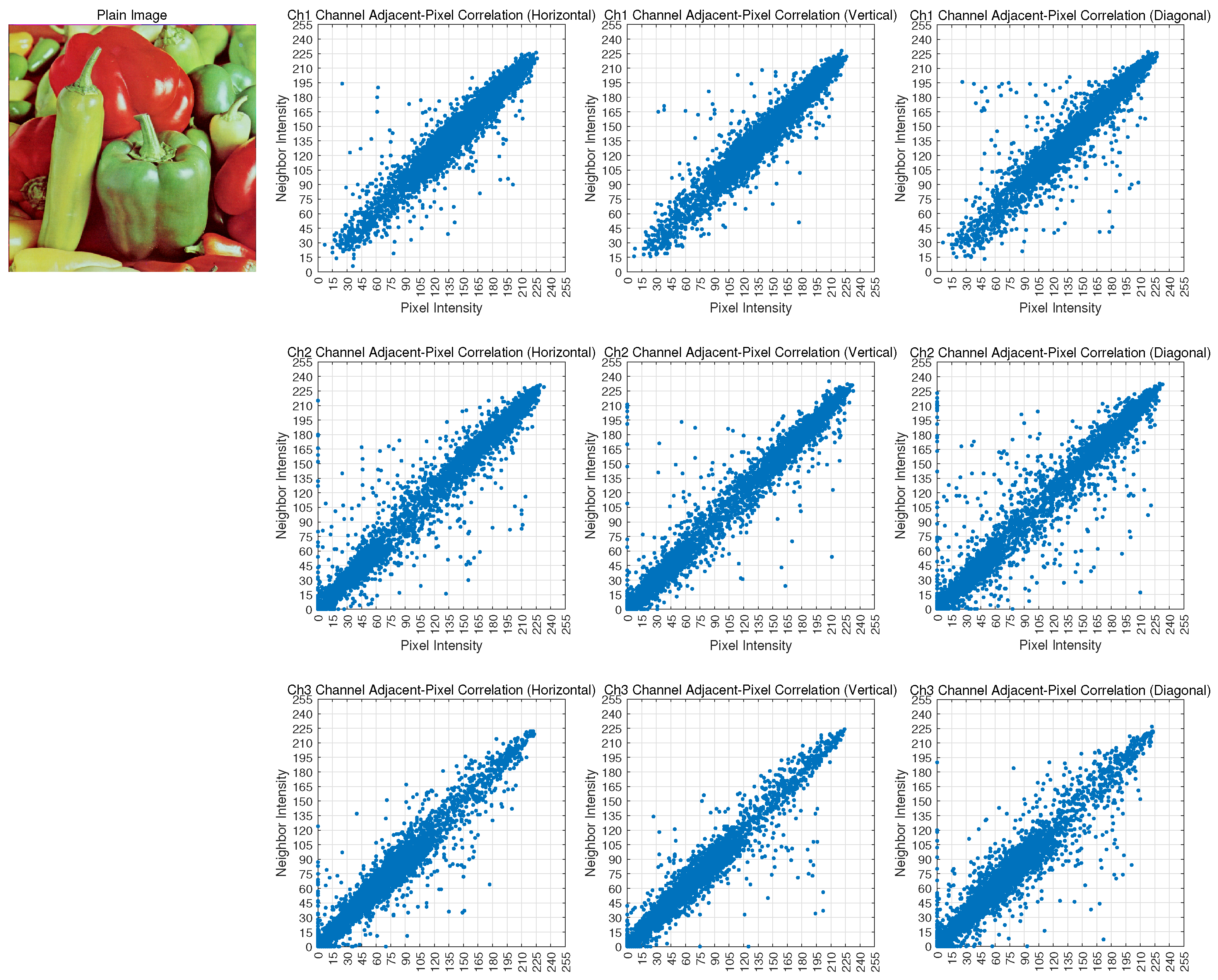
Natural images exhibit significant redundancy in the spatial domain, with adjacent pixels showing strong correlation in the horizontal, vertical, and diagonal directions, which shown in Figure 4. This characteristic makes the image vulnerable to statistical analysis attacks [48]. Consequently, an effective encryption algorithm must greatly reduce pixel correlation in the original image, making the encrypted image statistically resemble random noise. In recent years, metaheuristic algorithms have been widely used in the optimization of chaotic image encryption parameters. Generally speaking, researchers optimize from two perspectives: the initial parameters and control parameters of the chaotic system [49] and the fitness function design. However, the existing methods generally have the following scientific defects in the fitness function design:
(1)
Reliance on a single information entropy measure.
Employing information entropy as the fitness function is common. The aim is to maximize the entropy value of the encrypted image toward the ideal of 8, as in Equation (22) used by Ferdush et al. [50] to optimize encrypted images.
F i t = H ( C ) = n = 0 2 N 1 P ( S i ) log 1 P ( S i )
where, C represents the encrypted image, and P ( S i ) is the probability of occurrence of pixel S i . However, information entropy only measures the global uniformity of pixel values and cannot reflect the spatial correlation characteristics of pixels. An image with high entropy may still have significant pixel correlation in local areas, leaving a potential vulnerability to statistical attacks.
(2)
There is a conflict in the linear weighted combination.
At present, some relevant scholars [51] use the linear weighted method to combine information entropy and correlation coefficient (Equation (26)) into a fitness function, as shown in Equation (23).
F i t = w 1 · H ( C ) + w 2 · C o r r e l a t i o n
where, w 1 and w 2 are weights, and C o r r e l a t i o n is pixel correlation. This method has the inherent drawback that the weight coefficients w 1 and w 2 must be manually preset. Different image characteristics may require different weight configurations, resulting in a lack of adaptability. Furthermore, the dimensions and numerical ranges of entropy and correlation differ significantly in the original image, and their optimization directions are essentially opposite. A simple linear combination cannot guarantee stable convergence of the optimization process.
(3)
Ignoring the channel coupling of color images.
In addition, there are many studies [52,53] that are only applicable to grayscale images and cannot encrypt color images which shown in Equation (24) or the independent processing of the RGB channels of color images ignores the coupling effect between channels in color image encryption which shown in Equation (25). An effective color image encryption algorithm should reduce both intra-channel and inter-channel correlations, and a single-channel optimization strategy cannot guarantee the overall encryption quality.
F i t = C o r r e l a t i o n
F i t = w 1 H * H ( C ) 2 + w 2 Correlation ( h ) 2 + Correlation ( v ) 2 + Correlation ( d ) 2 + w 3 χ 2 χ 2 2
where H * = 8 is the theoretical upper limit of image information entropy, C o r r e l a t i o n ( h ) , C o r r e l a t i o n ( v ) , and C o r r e l a t i o n ( d ) are the correlation coefficients of adjacent pixels in three directions, χ 2 is the chi-square value of the uniform histogram, and w 1 , w 2 , and w 3 are manually set weights.
To solve the above problems, we innovatively propose a fitness function based on pixel correlation, which transforms the encryption parameter optimization problem into a mathematical programming problem with a clear optimization objective. The function uses the absolute value of the sum of the three-channel pixel correlation coefficients ( C C ), as shown in Equations (26) and (27).
ρ = N i = 1 N ( x i y i ) i = 1 N x i × i = 1 N y i N i = 1 N x i 2 ( i = 1 N x i ) 2 × N i = 1 N y i 2 ( i = 1 N y i ) 2 = C C
F i t = c h = 1 n ρ c h
where ρ [ 1 , 1 ] is the correlation coefficient, x i and y i represent the grayscale values of adjacent pixels in a specific direction (horizontally, vertically, or diagonally), N is the number of randomly selected pixel pairs, ρ c h is the correlation coefficient of the RGB or multispectral color channels corresponding to n : { c h 1 , c h 2 , c h 3 } , | · | is the absolute value, and F [ 0 , 1 ] is the fitness function. Since F [ 0 , 1 ] has a clear lower bound of 0 and the optimization also searches towards the global minimum region, F also has a decreasing property. The lower the correlation, the better the encryption effect. Therefore, the proposed F can transform the image encryption problem into a convex optimization [54].

3.2. Adaptive Hierarchical Assisted Agent Differential Evolution Algorithm (HSADE-IQUA)

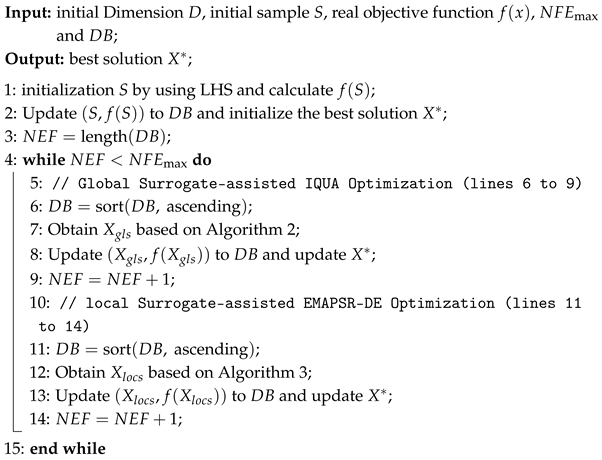
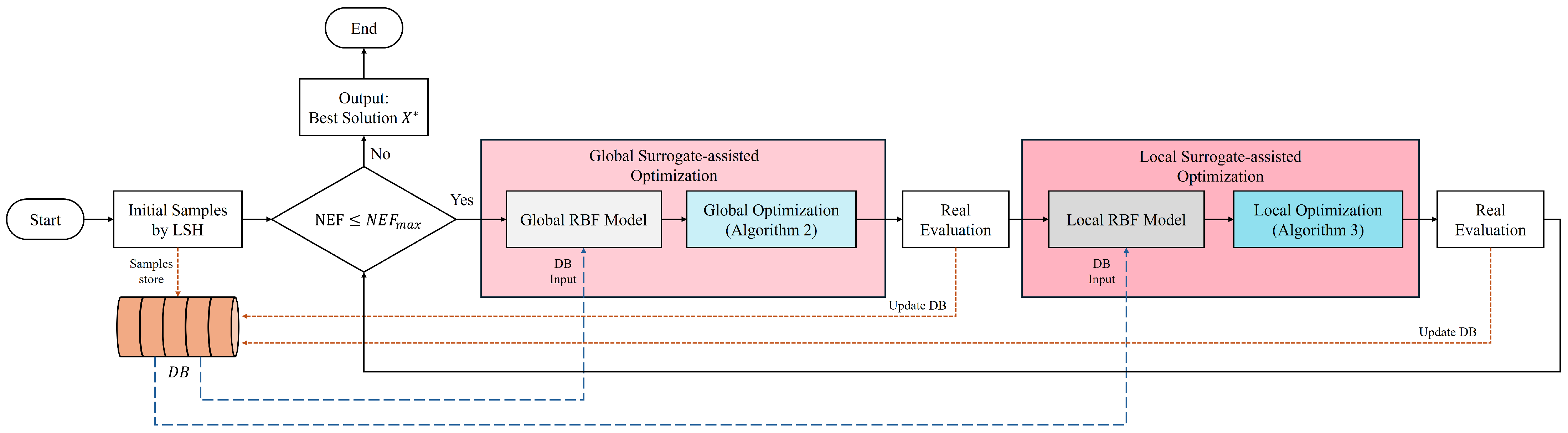
The Adaptive Hierarchical Surrogate-Assisted Differential Evolution with Improved QUATRE (HSADE-IQUA) proposed in this paper adopts a hierarchical surrogate-assisted evolution framework that combines global search with local search, as shown in Figure 5. The core idea of the algorithm is to use the surrogate model to reduce the number of expensive true function evaluations, while improving the search efficiency and solution quality through adaptive mechanisms. HSADE-IQUA maintains a sample database D B = { ( x i , f ( x i ) ) } that is updated online with iterations. Its samples are generated in the solution space [ u b , l b ] R D by Latin hypercube initialization [55]. When D < 100 , 100 initial samples are generated, and when D 150 , 150 initial samples are generated.
HSADE-IQUA alternates between performing global surrogate-assisted optimization based on IQUA and local surrogate-assisted optimization based on EMAPSR-DE within a single iteration. Both components extract training subsets from the database to construct RBF networks and generate candidate solutions on the surrogate model. Only one candidate selected by the proxy is evaluated and incorporated into the database. The candidate is sorted in ascending order of fitness and terminates when the maximum number of true evaluations, N F E m a x , is reached. Algorithm 1 shows the pseudocode of HSADE-IQUA. The detailed design of IQUA and EMAPSR-DE is shown in Section 3.2.1 and Section 3.2.2, respectively.
Algorithm 1: Pseudocode of HSADE-IQUA
Electronics 14 04716 i001
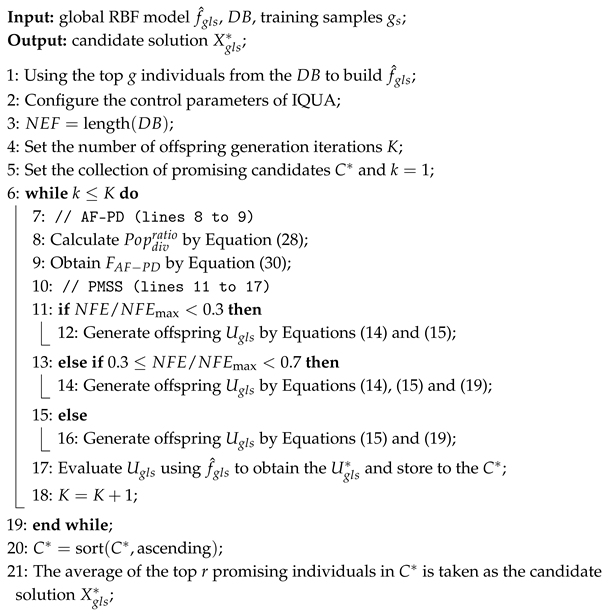
Algorithm 2: Pseudocode of IQUA
Electronics 14 04716 i002
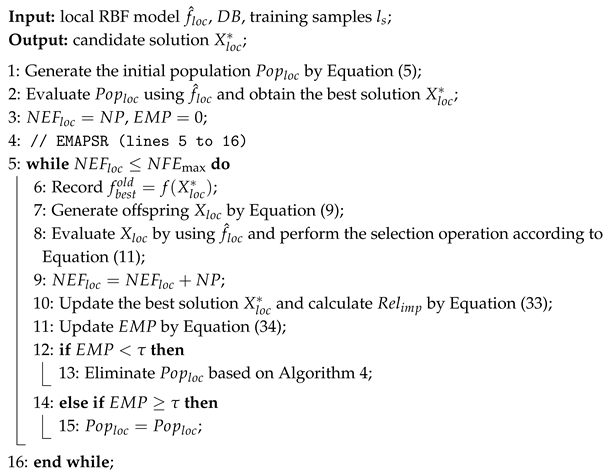
Algorithm 3: Pseudocode of EMAPSR-DE
Electronics 14 04716 i003

3.2.1. Global Surrogate-Assisted Optimization (IQUA)

The global surrogate-assisted optimization phase employs an improved quasi-affine transformation evolution (IQUA) strategy to generate high-quality RBF candidate solutions. This phase first selects g s current optimal samples from the database for RBF training. IQUA then generates a high-quality candidate set to guide RBF fitting. Building on the original QUATRE, we introduce an adaptive scaling factor for process and diversity reference (AF-PD) and process-based mutation strategy selection (PMSS). Algorithm 2 shows the pseudocode for the IQUA.
(1)
AF-PD
As shown in the original QUATRE Equations (14)–(19), which use a stationary scaling factor F. This setting is difficult to adapt to different optimization stages and problem characteristics. Therefore, we introduce an AF-PD mechanism that adaptively adjusts F by comprehensively considering both population diversity and optimization progress. The traditional population diversity is obtained from Equation (28).
P o p d i v = 1 D d = 1 D 1 N P i = 1 P o p ( x i , d x ¯ d ) 2
where x ¯ d is the mean of x in dimension d. However, traditional approaches are severely affected by the scale of the problem [56], and exponential numerical disasters occur as the dimension of the problem increases. Therefore, we use the normalized diversity ratio to eliminate the influence of spatial scale, as shown in Equation (29).
P o p d i v r a t i o = P o p d i v m a x r a n g e = 1 D d = 1 D 1 N P i = 1 P o p ( x i , d x ¯ d ) 2 1 D d = 1 D ( u b d l b d )
This ratio reflects the relative size of the population diversity relative to the search space, P o p d i v r a t i o [ 0 , 1 ] . The optimization progress is determined by p r o g r e s s = N F E / ( N F E m a x ) , and F A F P D can be expressed as Equations (30)–(32):
F A F P D = w 1 · F d i v + w 2 · F p r o g
F d i v = max ( 0.3 , min ( 1.0 , F · ( 0.5 + P o p d i v r a t i o ) ) )
F p r o g = F · ( 1.2 0.5 · p r o g r e s s )
where w 1 = 0.7 , w 2 = 0.3 are obtained from the parameter sensitivity analysis in Section 4.1.1. This weighted combination enables the algorithm to respond to the immediate state of the population while conforming to the overall optimization process.
(2)
PMSS
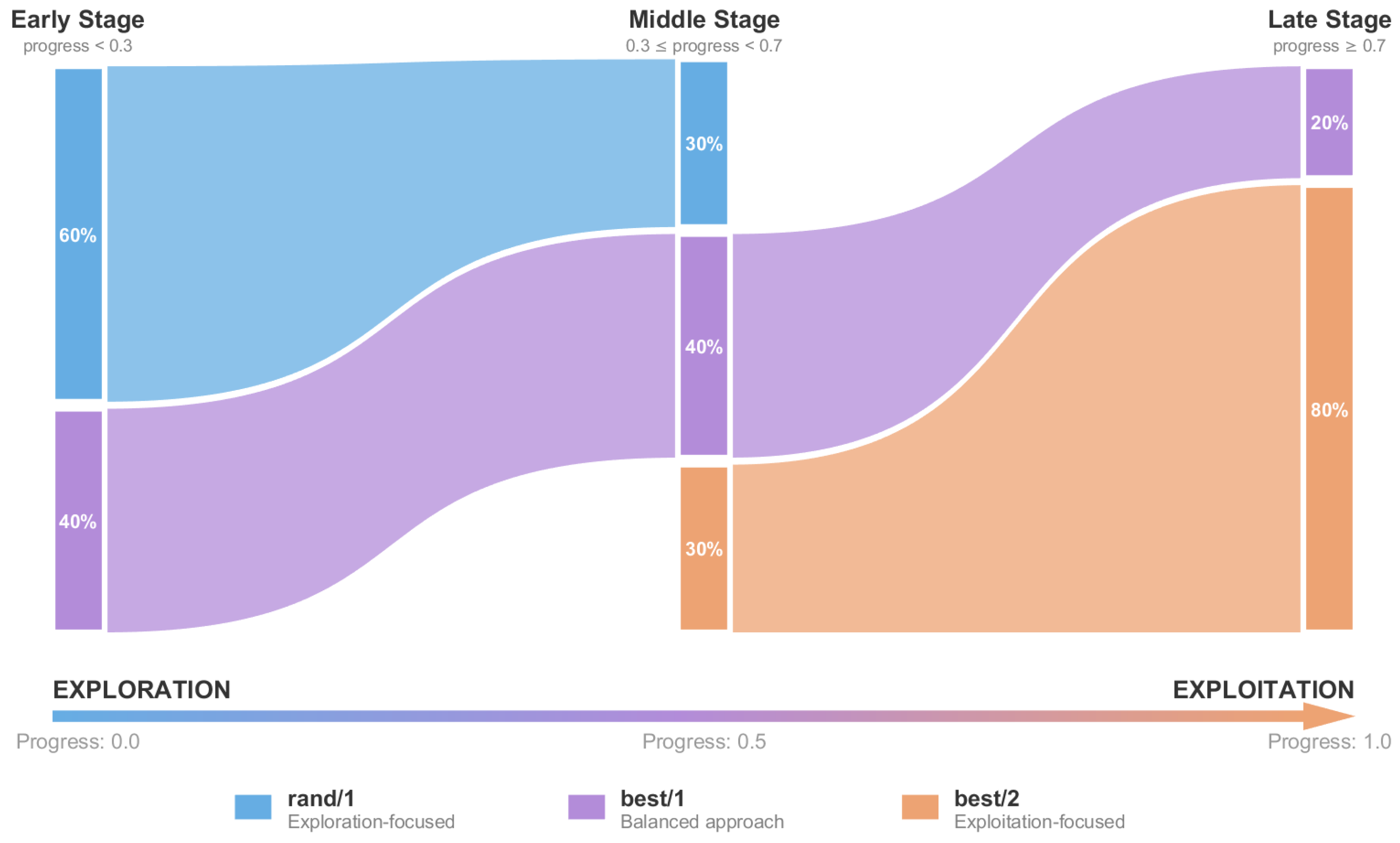
In terms of mutation strategies, IQUA selects different mutation matrices based on the optimization progress and samples individuals from the three basic strategies of Equations (14), (15) and (19) with probability. In the early stage of p r o g r e s s < 0.3 , we choose Equations (14) and (15), with the extraction ratios of rand/1 and best/1 being 60% and 40%, respectively. rand/1 constructs the differential direction with three random individuals and has a strong global exploration ability. best/1 uses the current global optimal individual as the basis vector, tends to develop locally, and can quickly compress the search radius. The mixed use of the two helps to quickly identify potential optimal areas in the early stage. In the middle stage of 0.3 p r o g r e s s < 0.7 , the algorithm needs to take into account both global exploration and local development. At this time, all three mutation strategies are used, with the extraction ratios of 30%, 40%, and 30%. Equation (19) is best/2, which takes the current individual as the starting point, superimposes its guidance vector pointing to the global optimal solution and a set of random differential terms, balancing both exploration and convergence speed. The combined use of the three can not only maintain the ability to escape the local optimum but also ensure directional advancement towards the optimal solution. In the later stage of p r o g r e s s 0.7 , Equation (15) best/1 and Equation (19) are used. best/2, fully shifting to the development phase, refining the search around the current optimal solution with a higher greediness. The transformation of each PMSS strategy is shown in Figure 6, which shows how HSADE-IQUA gradually shifts from exploration-oriented rand/1 to exploitation-oriented best/2, enabling efficient search for secure chaotic and DNA parameters under a tight evaluation budget and the width of colored band represents the probability of each mutation strategy being selected.

3.2.2. Local Surrogate-Assisted Optimization (EMAPSR-DE)

In the local surrogate-assisted optimization, the algorithm selects l s = 50 optimal samples from the D B , and then trains the RBF surrogate model in the same way locally, and uses the meta-heuristic algorithm to perform fine-grained guidance on the agent in a smaller interval. In 2014, Tanabe and Fukunaga added Linear Population Size Reduction (LPSR) to SHADE and proposed L-SHADE [57]. As the optimization process progresses, the population size is gradually reduced, and the computational efficiency is improved while ensuring the search quality. To avoid excessive overhead on the local surrogate model, we introduced an improved rate monitoring mechanism based on the exponential moving average (EMA) and congestion detection, proposed the Exponential Moving Average (EMA)-driven Population Size Reduction (EMAPSR) strategy, and applied it to the original DE to propose EMAPSR-DE. The EMAPSR-DE’s pseudocode is shown in Algorithm 3.
Traditional LPSR strategies use linear or pre-set population reduction schedules, which are not adaptable to the search state and convergence characteristics of different problems. Therefore, we calculate the EMA using Equations (33) and (34) to monitor the relative rate of improvement during the optimization process and determine whether the population should be reduced.
R e l i m p = max { 0 , ( f b e s t o l d f b e s t n e w ) / ( | f b e s t o l d | + ε ) }
E M A = β × E M P + ( 1 β ) × R e l i m p
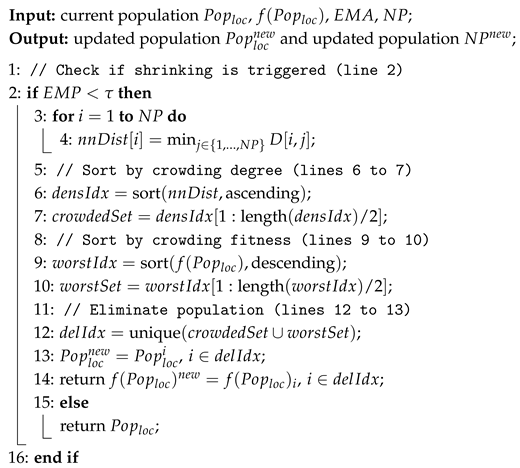
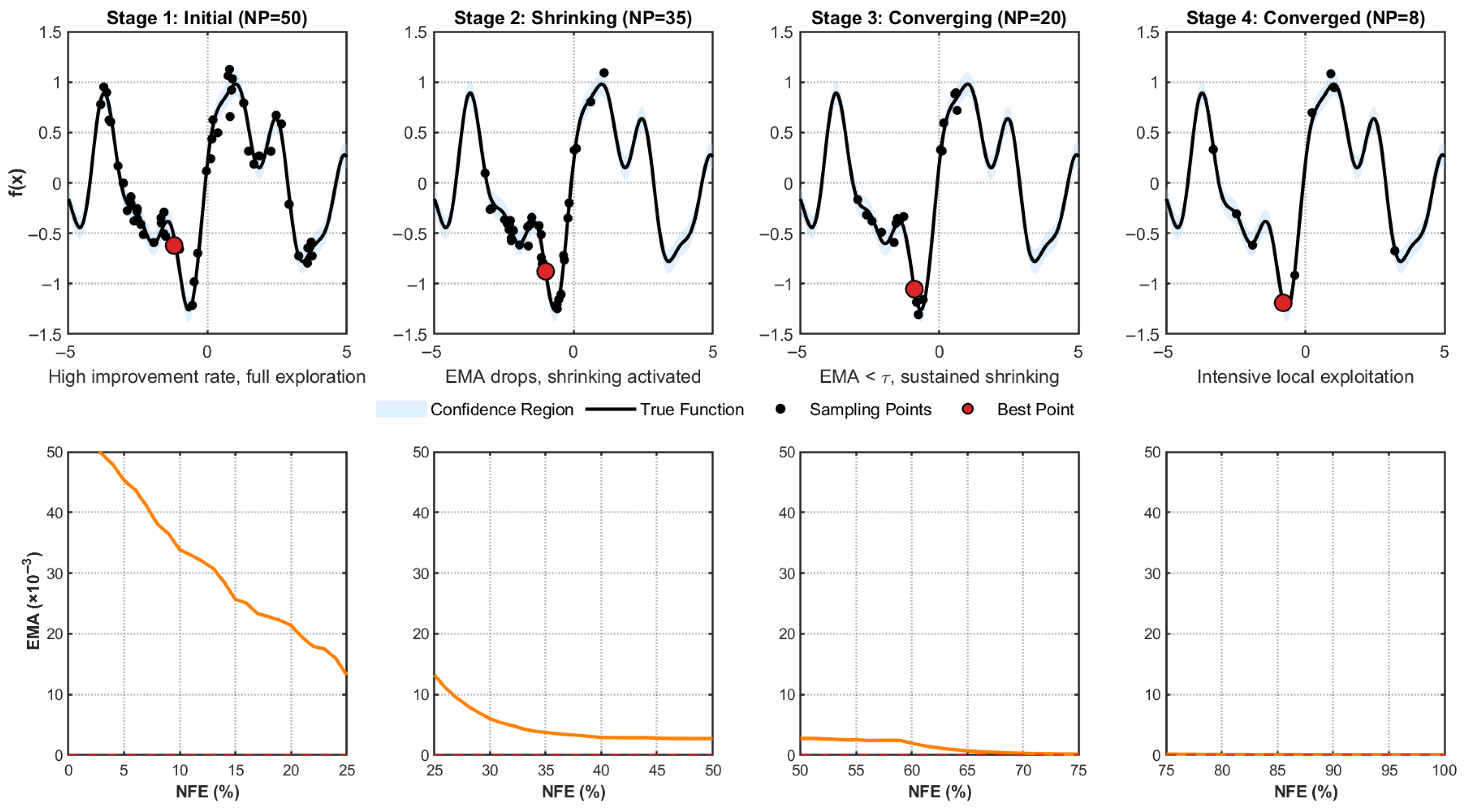
where R e l i m p is the true improvement rate, f b e s t o l d is the current optimal fitness, f b e s t n e w is the fitness of the new population generated by the DE operation, ε = 10 12 prevents division by zero, β = 0.8 is the decay coefficient, and the initial E M A = 0 . When the E M P threshold is triggered, the algorithm uses a combination of the “most crowded individual” and the “worst fitness individual” to determine the individuals to be eliminated. Algorithm 4 shows the pseudocode for population elimination, and Figure 7 shows the effect of the EMAPSR strategy. Once the EMA falls below the predefined threshold, the algorithm reduces the population size to decrease the number of expensive evaluations and concentrates the search on more promising regions, which in turn affects the selection of the final encryption keys.
Algorithm 4: Pseudocode of EMAPSR
Electronics 14 04716 i004

3.2.3. Computational Complexity of HSADE-IQUA

The computational cost of HSADE-IQUA mainly comes from three parts: (1) expensive real evaluations of the objective function; (2) construction of hierarchical surrogate models and differential evolution in the global stage; (3) surrogate construction and improved QUATRE in the local stage. The overall computational complexity T of HSADE-IQUA can be expressed as Equation (35).
T = F · T F + N G · T G + N L · T L T G = T g + T g s a o T L = T l + T l s a o
where, F, N G , and N L denote the number of real function evaluations, the number of activations of the global stage, and the number of activations of the local stage, respectively. T g and T l denote the costs of constructing the global and local RBF surrogate models, respectively. T g s a o and T l s a o represent the computational costs of differential evolution in the global exploration and local exploitation stages, respectively. T F is the computational cost of a single real evaluation. It should be emphasized that HSADE-IQUA is designed for solving expensive optimization problems (EOPs), which generally recognize that T f is extremely expensive and dominates the overall complexity T [58], whereas T G , T L , AF PD , PMSS , and EMAPSR grow roughly linearly with the population size and dimensionality and are negligible compared with the real evaluation cost.

3.3. HSADE-IQUA Optimized Image Encryption Algorithm (HSADE-IQUA-DNA))

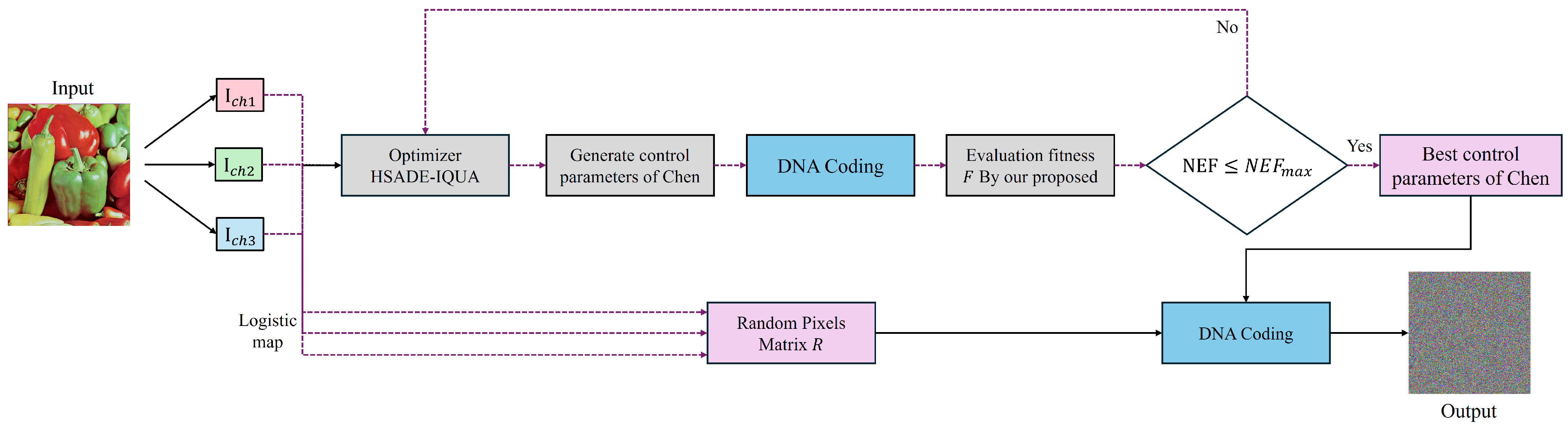
Image encryption technology is the core of this article. This section will detail the process of using HSADE-IQUA to optimize the Chen hyperchaotic system and DNA encoding encryption. Figure 8 illustrates the overall HSADE-IQUA-DNA image encryption pipeline, which starts from the channels of the input plain image, HSADE-IQUA optimizes the control parameters of the Chen hyperchaotic system with respect to the our proposed pixel-based fitness (Equation (27)), and the optimized parameters are then used together with a logistic-map-driven random matrix and DNA coding to generate the final ciphertext image.
(1)
Pixel acquisition
To uniformly process images of different types and numbers of channels, assume that the input image tensor I { 0 , , L 1 } ( M × N × C h ) , where M × N is the image space scale and C h is the number of channels, and use Equation (36) to decompose I into three two-dimensional matrices.
I c h 1 I ( : , : , c h 1 ) I c h 2 I ( : , : , c h 2 ) I c h 3 I ( : , : , c h 3 )
where I c h 1 , I c h 2 and I c h 3 are any three different channels of the color image.
(2)
Chaos key initialization
We construct the initial Logistic value x 0 based on the two-channel pixel sum, as shown in Equation (37).
x t 0 = i = 1 M j = 1 N I c h 1 ( i , j ) + i = 1 M j = 1 N I c h 2 ( i , j ) 255 · M · N · 2
with the control parameter μ = 3.9999 , the initial value x l 0 drives Equation (1) to generate the logistic sequence { p n } , quantize it to an 8-bit integer sequence, and rearrange it into a single-channel random matrix R ( M × N ) . x l 0 and μ are two keys calculated from the plaintext. The key set, denoted as K, is shown in Equation (38).
K = ( μ , x l 0 , X 1 * , X 2 * , X 3 * , X 4 * , x x 0 , x x 1 )
where X 1 * , X 2 * , X 3 * , X 4 * are the optimal parameter vector X * of the Chen hyperchaotic system obtained by the optimizer, and x x 0 , x x 1 are two redundant keys to resist clipping attacks.
(3)
HSADE-IQUA Optimization
To maximize the randomness of the ciphertext and weaken pixel correlation, we use the four initial values X p : { X 1 , X 2 , X 3 , X 4 } of the Chen hyperchaotic system as decision variables generated by HSADE-IQUA. Equation (39) shows the mapping of the Chen system initial values and key sequences from X 1 , X 2 , X 3 , X 4 and the plaintext.
( X p , I c h 1 , I c h 2 , I c h 3 ) { X , Y , Z , H }
where X, Y, Z, and H are the four key sequences of the Chen hyperchaotic system. Before obtaining the initial value of the Chen hyperchaotic system, the plaintext must first be normalized, as shown in Equations (40) and (41).
S = i = 1 M j = 1 N ( I c h 1 ( i , j ) + I c h 2 ( i , j ) + I c h 3 ( i , j ) )
I ¯ = S 255 · M · N · 3
where I ¯ is the normalized plaintext feature. Subsequently, a scaled perturbation is applied according to X p . To enhance the plaintext relevance in the key space, we further extract bit-plane features from the pixels as shown in Equation (42).
I b i t k = i , j ( I c h m ) m · M · N , c h { c h 1 , c h 2 , c h 3 }
where I b i t k is the bit-plane feature on the k-th bit-plane feature, ∧ represents the bitwise AND operation, m { 51 , 85 , 170 , 204 } is the bit mask, and the m-ary conversion is shown in Table 2.
Finally, the initial values of Chen’s hyperchaotic system { X c 0 , Y c 0 , Z c 0 , H c 0 } are recorded as Equation (43).
X c 0 = 35 + 5 X p 1 + I b i t 1 + I ¯ Y c 0 = 7 + 3 X p 2 + I b i t 2 + I ¯ Z c 0 = 26 + 5 X p 3 + I b i t 3 + I ¯ H c 0 = 4 + 2 X p 4 + I b i t 4 + I ¯
Then, according to the initial value of Chen hyperchaotic system, the built-in Runge-Kutta function ode45 of Matlab is used to calculate Equation (43) Chen hyperchaotic system to obtain four continuous chaotic sequences { X n , Y n , Z n , H n } . Since DNA coding requires the sequence to be discretized, Equation (44) is used to project the continuous chaotic sequence into discrete space.
α d = ( round ( 10 4 X c 0 ) mod 8 ) + 1 { 1 , , 8 } β d = ( round ( 10 4 Y c 0 ) mod 8 ) + 1 { 1 , , 8 } γ d = ( round ( 10 4 Z c 0 ) mod 4 ) + 1 { 1 , 2 , 3 , 4 } δ d = ( round ( 10 4 H c 0 ) mod 8 ) + 1 { 1 , , 8 }
where α d is the DNA encoding rule index of the plaintext block, β d is the DNA encoding rule index of R, γ d is the DNA logical operation type, and δ d is the DNA decryption rule index. After DNA encoding, the ciphertext image I e n is generated, and its fitness is evaluated using Equation (27). This process is iterated in HSADE-IQUA until the termination condition is reached, and K is output.
(4)
Image decryption
Image decryption requires the inverse operation of the DNA code. For example, if encryption used addition, decryption requires subtraction. Furthermore, ciphertext decryption requires the use of the K output from HSADE-IQUA-DNA to decrypt the original plaintext.

4. Experiment and Analysis

To test the performance of our proposed HSADE-IQUA and HSADE-IQUA-DNA, we conducted surrogate-assisted evolutionary algorithms (SAEAs) benchmarks and various image encryption experiments. The surrogate-assisted evolutionary computing benchmark consists of a parameter sensitivity test and a SAEAs comparison experiment. The image encryption experiments utilize multiple data sources, including Standard computer vision images, dataset images, and real multispectral remote sensing images. All experiments were conducted on a laptop equipped with an Intel(R) Core(TM) i9-14900HX processor, 32 GB of RAM, and a 64-bit Windows 11 operating system, running the MATLAB R2024b environment.

4.1. Benchmark Results and Analysis of SAEAs

To verify the performance of HSADE-IQUA, we conducted experiments using eight common expensive benchmark functions, including 1 unimodal function, 4 multimodal functions, and 3 complex functions [59]. Table 3 shows the detail attributes of these expensive benchmark functions.
In the experiment, the maximum number of true evaluations of HSADE-IQUA was set to 1000. When D < 100 , the initial sample S = 100 , and when D 100 , the initial sample S = 150 . The algorithm performance was evaluated using the mean optimal value (mean) and standard deviation (std.), and statistical tests were performed using the Wilcoxon rank sum test [60] and the Friedman test [61] with a significance level of p = 0.05 . “+”, “−” and “≈” respectively indicate that HSADE-IQUA is significantly better, similar or worse than the comparison algorithm.

4.1.1. Parameter Sensitivity Analysis

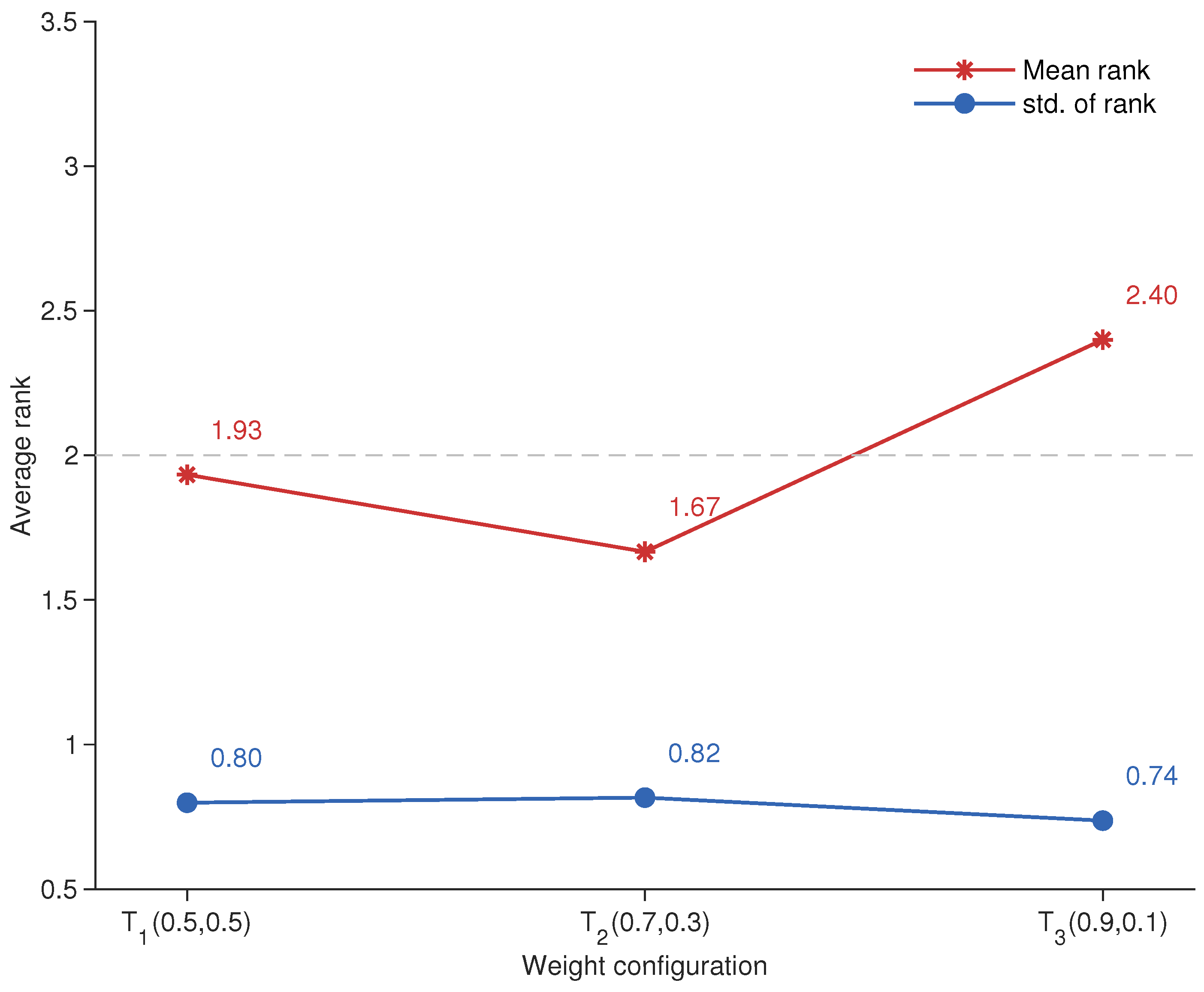
The IQUA we proposed includes an adaptive parameter F A F P D to balance exploration and exploitation in global surrogate-assisted optimization. The weight parameters w 1 and w 2 of this mechanism have a significant impact. In order to systematically test the impact of parameter configuration on algorithm performance, we designed the following experiments. In the metaheuristic algorithm, first, extensive global exploration is required to seek more potential optimal positions. F d i v includes the calculation of P o p d i v r a t i o . The higher the P o p d i v r a t i o , the more dispersed the population search space is [62], which is more important for the algorithm exploration and exploitation conversion. To keep w 1 w 2 , we set T 1 : ( 0.5 , 0.5 ) , T 2 : ( 0.7 , 0.3 ) and T 3 : ( 0.9 , 0.1 ) for ( w 1 , w 2 ) respectively, and select f 1 ( x ) f 5 ( x ) for 30D, 50D and 100D tests. Table 4 shows the result of parameter sensitivity test and Figure 9 shows the average rank of weight sensitivity.
In Table 4, T 2 achieves lower mean error on multiple functions and high-dimensional problems, with variance comparable to or smaller than that of T 1 and T 3 . In Figure 9, T 2 also maintains the lowest mean ranking, and its std ranking is not significantly different from T 1 and T 3 . Therefore, we select { ( w 1 , w 2 ) : ( 0.7 , 0.3 ) } as the optimal weight for HSADE-IQUA and apply it to all subsequent experiments. Furthermore, the experimental results in Table 4 demonstrate that HSADE-IQUA is robust, with no significant differences in experimental performance due to different algorithm parameter settings.

4.1.2. Benchmark Analysis

To verify the performance of HSADE-IQUA, we compared it with two surrogate-assisted DE algorithms, SADE-AMSS and LSADE [63], SHPSO [64], and a state-of-the-art (SOTA) surrogate-assisted evolutionary algorithm ESAO [65]. These algorithms were tested on the eight functions listed in Table 3 with 30D, 50D, and 100D dimensions. Each test function was independently tested 20 times. Table 5 shows the experimental results.
It is clear from Table 5 that our proposed HSADE-IQUA achieves significant advantages in different dimensions. In the 30D benchmark, HSADE-IQUA achieves the best results on ELLIPSOID and ROSENBROCK, GRIEWANK, ACKLEY, and two CEC2005 test problems. In particular, HSADE-IQUA achieved a target value of 1.6640 × 10 8 on the ELLIPSOID unimodal function, which is an order of magnitude better than SADE-AMSS and LSADE, demonstrating its excellent balanced exploration-exploitation performance. In the 50D experiment, the advantage of HSADE-IQUA became more significant, achieving the best results on all 8 benchmark problems and significantly outperforming ESAO on multiple unimodal functions. For example, on the RASTRIGIN problem, HSADE-IQUA achieved a fitness value of 1.4916 × 10 2 , which is better than ESAO’s 4.4150 × 10 2 , and achieved a 66.21% improvement in fitness, indicating its excellent ability to escape local optimality and its enhanced scalability and robustness as the problem dimension increases. In the 100D test, HSADE-IQUA maintained its competitive advantage, winning 7 out of 8 problems, especially in the complex hybrid combination functions CEC05_f11, CEC05_f19 and CEC05_f20, it outperforms all competitors, further proving that HSADE-IQUA has the ability to perform expensive optimization [66].
The statistical significance analysis of the Wilcoxon signed rank test in Table 5 also proves that HSADE-IQUA has similar cases with SADE-AMSS only on CEC05_f11, and shows overwhelming statistical advantages in other tests, indicating that the PMSS strategy and IQUA strategy adopted by HSADE-IQUA are significantly better than the traditional auxiliary memory mutation strategy adopted in SADE-AMSS. Compared with LSADE, statistical similarities only occur on ACKLEY-50D and CEC05_f11-100D. This statistical evidence shows that as a surrogate-assisted DE variant, HSADE-IQUA has a completely different optimization mechanism from SADE-AMSS and LSADE, and is a fundamentally different and more effective surrogate-assisted differential evolution method. In addition, in the Friedman test, HSADE-IQUA achieved the first place in rank mean, significantly outperforming other comparison algorithms of SAEAs.

4.2. Image Encryption Experimental Results and Analysis

To test the advantages of HSADE-IQUA-DNA and demonstrate the superiority of SAEAs in the field of image encryption, we used the original DE-DNA with traditional metaheuristic algorithms, Chen-DNA without optimization, traditional AES encryption, and SADE-AMSS-DNA as controls. In this section, all experiments were conducted 20 times independently.

4.2.1. Standard Computer Image Experiment Results and Analysis

Before encrypting real images, we first conduct experiments using the standard computer vision images “Baboon”, “Peppers”, and “kodim23”. The experimental results are shown in Table 6.
Table 6 clearly shows that the SAEAs method demonstrates significant advantages over the traditional metaheuristic method DE-DNA on all test images, achieving improvements of 83.8%, 72.2%, and 98.3% on the Baboon, Peppers, and Kodim23 images, respectively. Among SAEAs, HSADE-IQUA-DNA outperforms SADE-AMSS-DNA, achieving relative improvements of 6.6%, 17.5%, and 63.0% on the Baboon, Peppers, and Kodim23 images, respectively. And compared with ESAO-DNA, HSADE-IQUA-DNA further reduces the evaluation metric by 4.1%, 27.2%, and 71.9% on the Baboon, Peppers, and Kodim23 images. In addition, from the perspective of order of magnitude, HSADE-IQUA-DNA obtained fitness values of 4.23407 × 10 6 , 6.99416 × 10 6 and 2.82357 × 10 7 on the three test images, respectively, while Chen-DNA only achieved 6.90000 × 10 3 , 4.35000 × 10 2 and 9.40000 × 10 3 , respectively, achieving an improvement of 3–4 orders of magnitude. This fully demonstrates the effectiveness of introducing the evolutionary optimization framework in the field of image encryption, and that the surrogate-assisted method has stronger robustness and adaptability when dealing with different image features. The information entropy of the original and encrypted images is shown in Table 7.
NPCR (Number of Pixels Change Rate) and UACI (Unified Average Changing Intensity) are also crucial metrics for evaluating encryption. NPCR measures the percentage of pixels in the ciphertext image that change after a small change in the plaintext. As shown in Equation (45), the closer it is to 100 % , the better the algorithm’s diffusion and the stronger its resistance to differential attacks [67].
NPCR = i = 1 M j = 1 N Z ( i , j ) M × N × 100 % .
where C 1 ( i , j ) and C 2 ( i , j ) represent the grayscale values of the two encrypted images at the i-th row and j-th column, respectively; D ( i , j ) is a pixel change indicator function, which is assigned the value 0 when C 1 ( i , j ) = C 2 ( i , j ) , otherwise is 1, as shown in Equation (45).
D ( i , j ) = 0 , C 1 ( i , j ) = C 2 ( i , j ) , 1 , C 1 ( i , j ) C 2 ( i , j ) ,
UACI reflects the average change in grayscale intensity between the two ciphertext images after a small change in the plaintext. The closer it is to the theoretical value of 8-bit grayscale (approximately 33 % ) [68], the larger the pixel value change and the stronger the resistance to differential attacks, as shown in Equation (47).
UACI = 1 M × N i = 1 M j = 1 N C 1 ( i , j ) C 2 ( i , j ) 255 × 100 % .
Table 8 shows the NPCR and UACI results obtained by HSADE-IQUA-DEN after encrypting standard computer vision images.
As shown in Table 8, the proposed HSADE-IQUA-DEN scheme achieves NPCR values of 99.61% for all three standard test images and UACI values of 33.48%, 33.46%, and 33.51% for Baboon, Peppers, and Kodim23, respectively. The obtained results are close to the theoretical counterparts, indicating that the proposed algorithm provides near-optimal diffusion and exhibits strong resistance to differential attacks.
To further demonstrate the performance of HSADE-IQUA-DNA, we also conducted the following histogram statistics experiments, anti-clipping attack experiments, anti-noise experiments, and key capacity analysis. Moreover, Appendix A presents a comparison of HSADE-IQUA-DNA with the latest literature.
(1)
Histogram Statistics Experiment
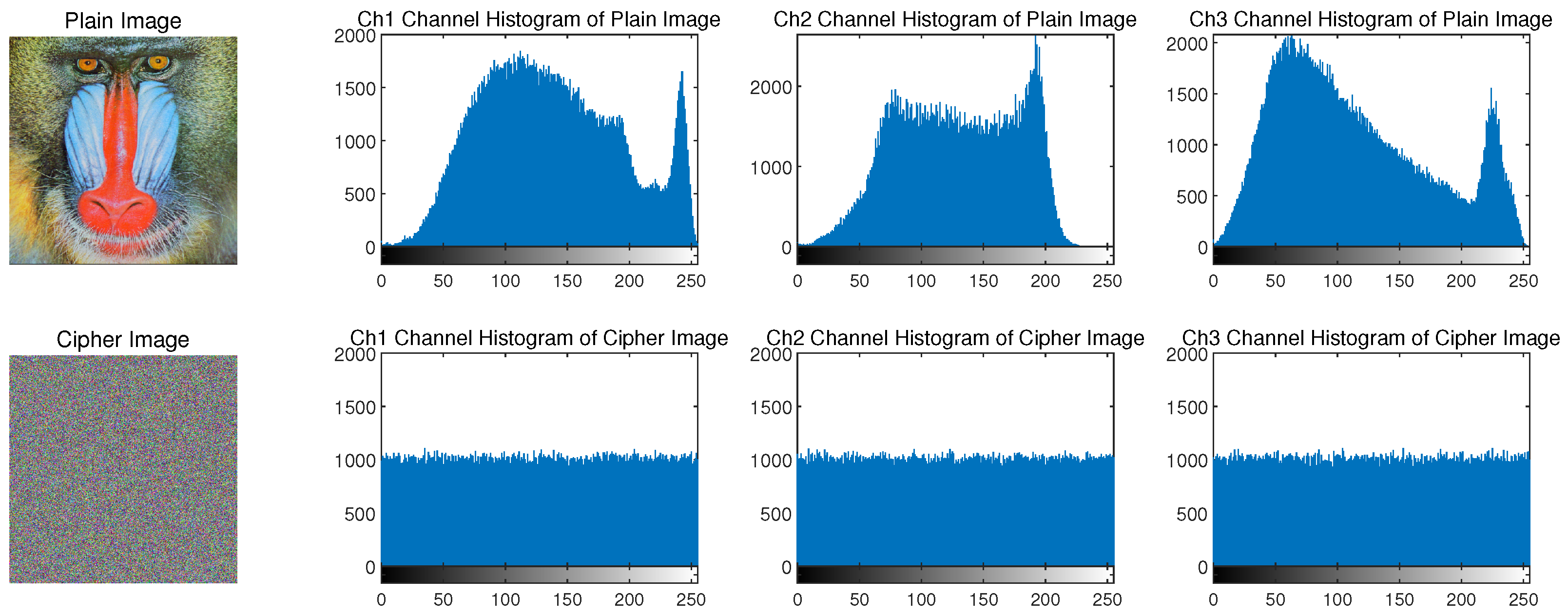
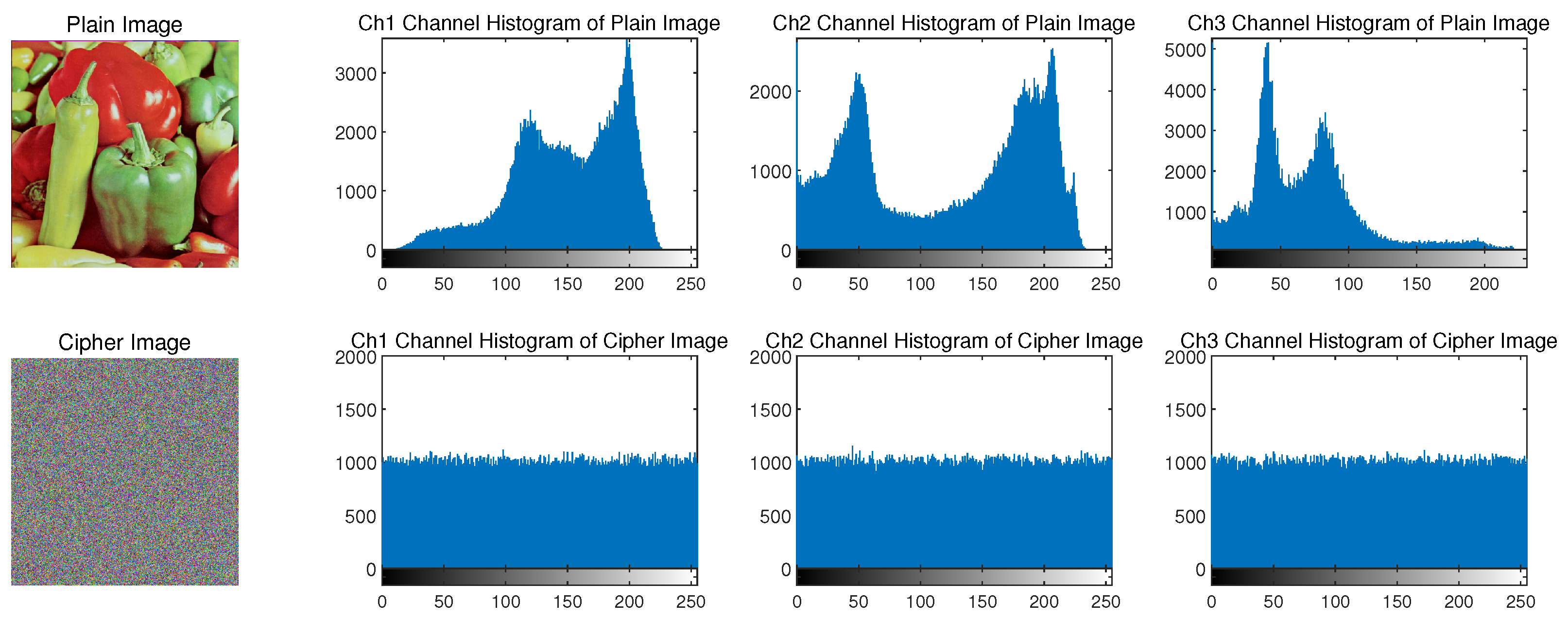
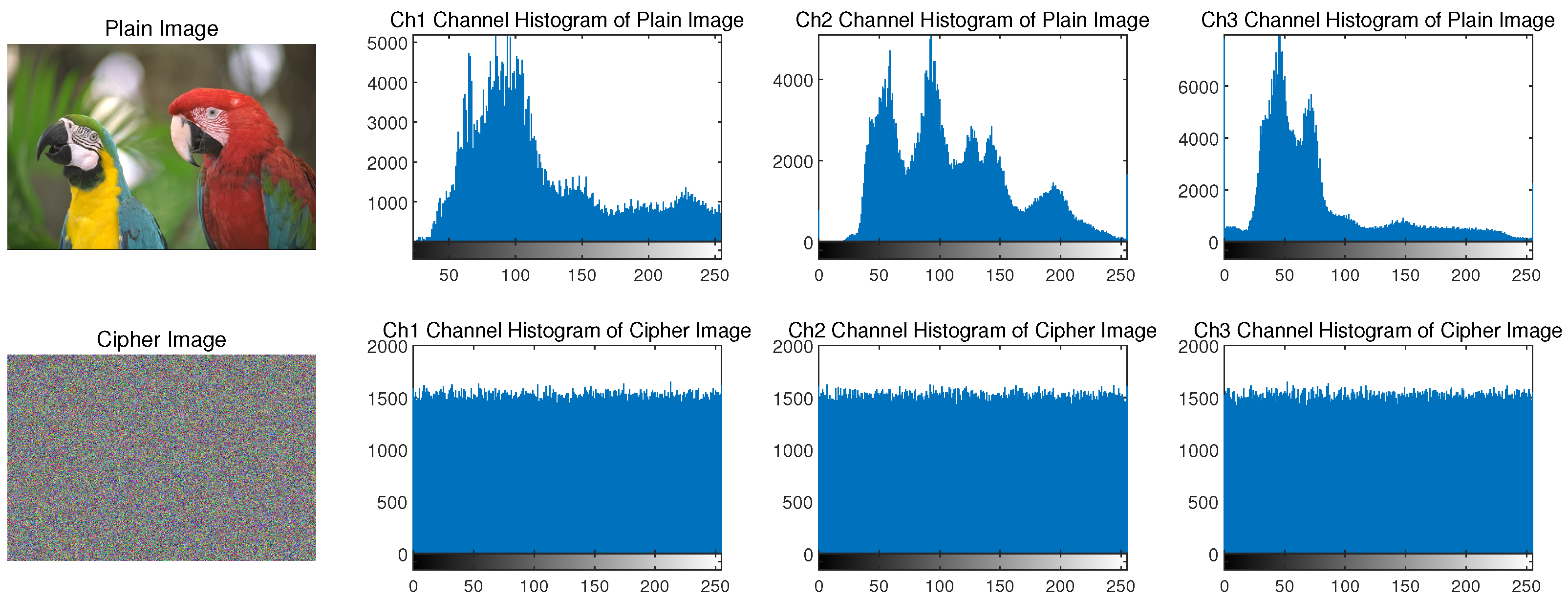
Figure 10, Figure 11 and Figure 12 show the three-channel histograms of the “Baboon,” “Peppers,” and “Kodim23” images, respectively. As can be seen from the images, the histograms of the three channels of the original input images fluctuate, while the histograms of the three channels of the ciphertext images are flat and pseudo-random, hiding the statistical properties of the original images. This effectively protects against large-scale histogram-based statistical attacks against images.
(2)
Anti-clipping attack experiments
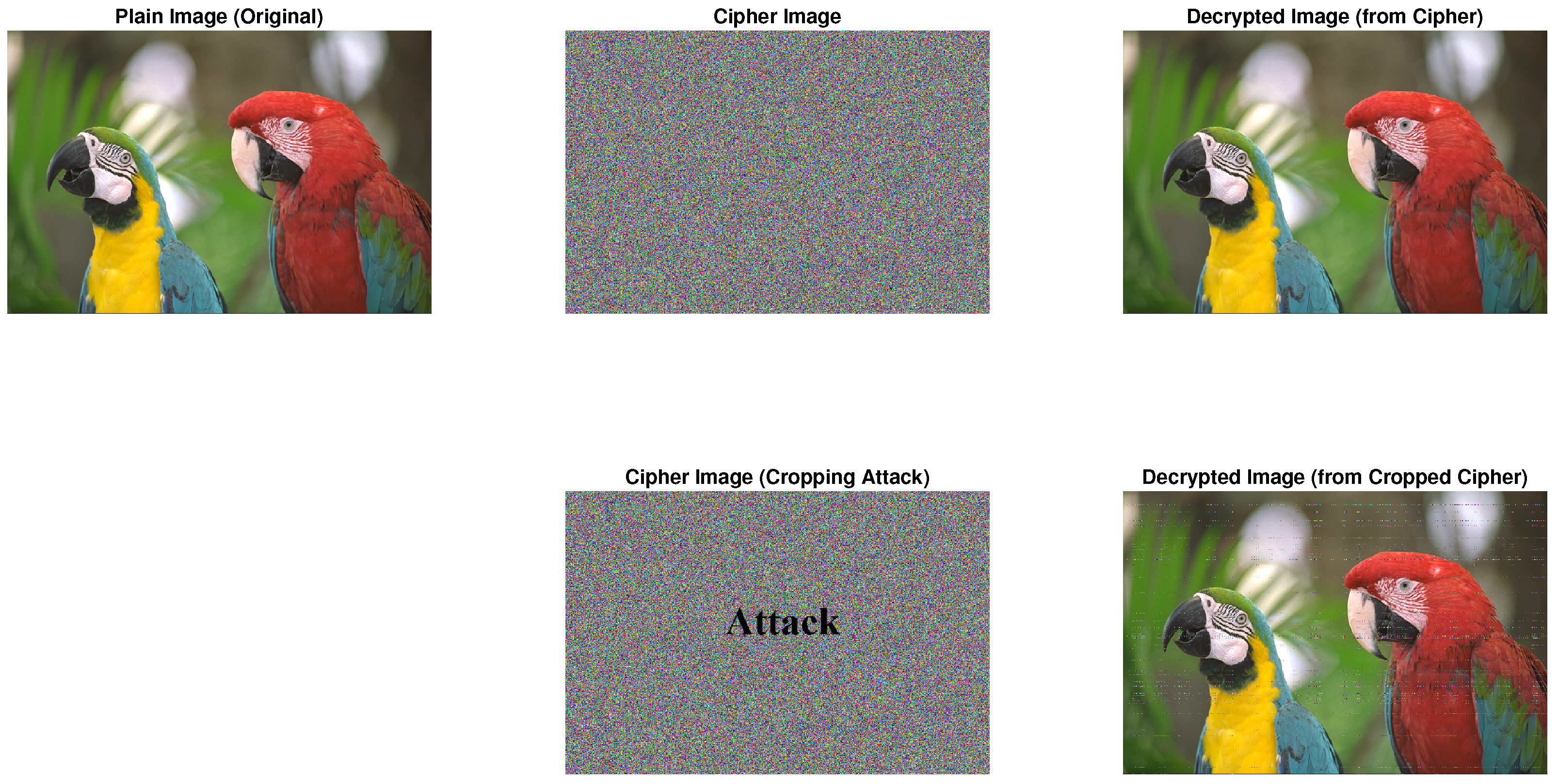
To evaluate the ability of the proposed HSADE-IQUA-DNA algorithm to resist data loss attacks, we conducted a cropping experiment on ciphertext images. We selected the standard test image “Kodim23” as the plaintext input and performed a cropping attack on the generated ciphertext. This attack replaces a continuous region of pixels with zero pixels and labels them “Attack”. Figure 13 shows the experimental results.
Although some areas of the ciphertext image are clipped, the HSADE-IQUA-DNA algorithm spreads the clipped parts to the entire image, minimizing the impact of cropping on the local area, we can still obtain all the image information from the decrypted image.
(3)
Anti-noise experiments
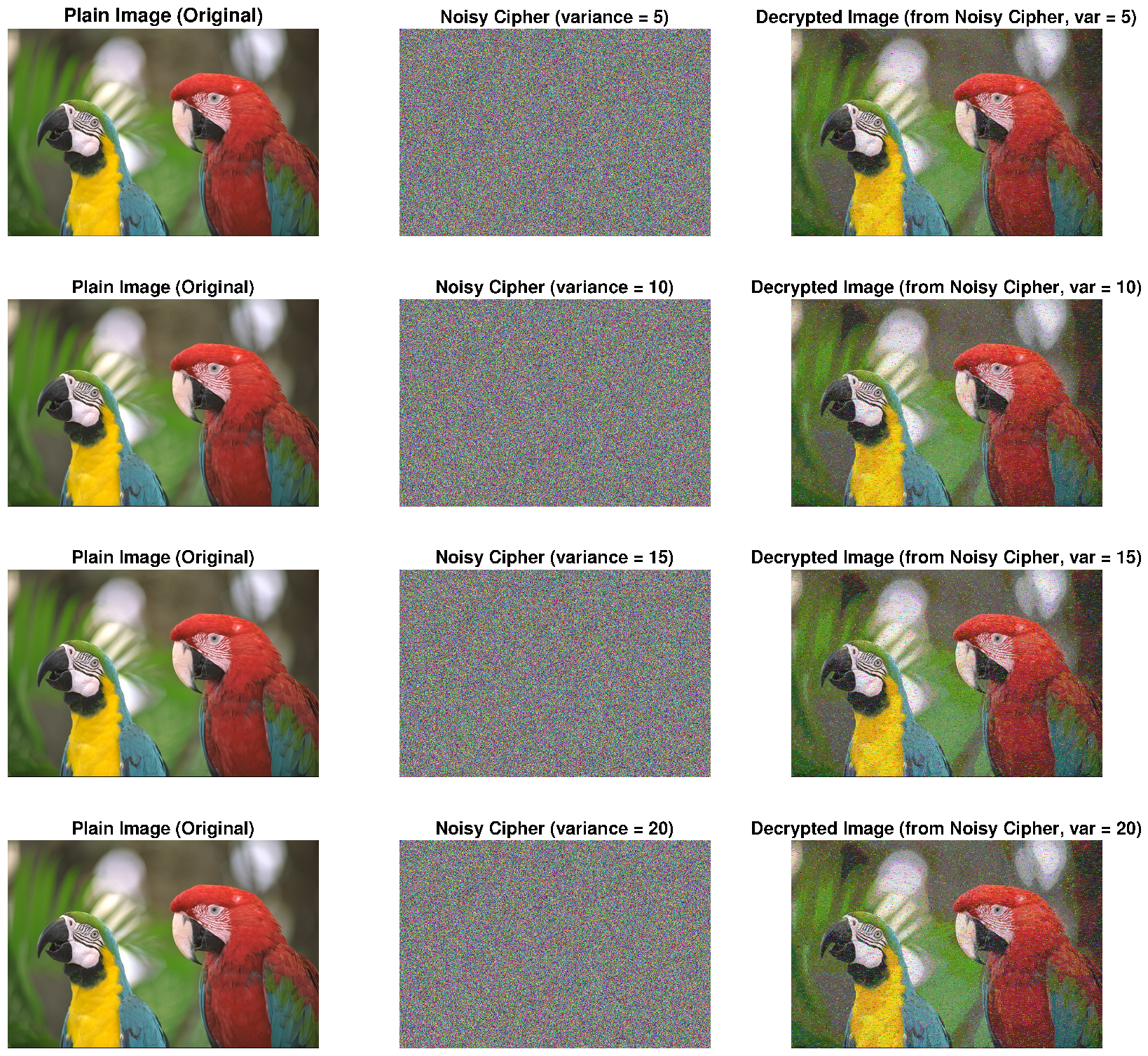
During image transmission, ciphertext images are often contaminated by various forms of noise. To evaluate the noise immunity of the proposed HSADE-IQUA-DNA cryptosystem, we added varying degrees of Gaussian noise to the ciphertext images to simulate realistic channel degradation scenarios. We added Gaussian noise of σ 2 { 5 , 10 , 15 , 20 } to the ciphertext images and then decrypted them to recover the plaintext.
Figure 14 shows the experimental results under four noise intensities. Despite the noise contamination of the ciphertext, the decrypted image exhibits similar fidelity to the original plaintext. Even under the most severe noise condition of σ 2 = 20 , the recovered image retains clear semantic content, with structural details, color, and texture information well preserved. This demonstrates that the HSADE-IQUA optimized encryption algorithm effectively transforms high-amplitude local perturbations into low-amplitude global changes, thereby maintaining image quality.
(4)
Key capacity analysis
We conduct a comprehensive key space analysis using the “Baboon” image, the keys μ , x 0 , X n , Y n , Z n , H n , x x 0 , x x 1 are obtained through the encryption algorithm. The control parameter μ of the logistic map is selected with 10 4 precision in the interval [ 3.9000 , 4.0000 ] , resulting in 10 3 possible values. The initial values of the logistic maps are quantized with 10 4 precision in the interval ( 0 , 1 ) , respectively, generating 10 4 candidate values each. The four-dimensional initial states X ( 0 ) , Y ( 0 ) , Z ( 0 ) , and H ( 0 ) of the Chen hyperchaotic system are also discretized with 10 4 precision in the range [ 100.0 , 100.0 ] , with each state variable contributing 2 × 10 6 possibilities. In addition, the block parameters x x 0 and x x 1 in the image scrambling process are selected with a step size of 4 in the interval [ 256 , 4096 ] , each providing 961 choices. The total key space size of the system reaches 1.4773 × 10 46 , which is equivalent to a binary key length of 153.37 bits. This key space size far exceeds the 128-bit security threshold recognized by cryptography. Even on a high-performance computing cluster capable of decrypting 10 15 decryptions per second, an exhaustive search would still take 4.69 × 10 23 years. If the key is expanded to 16-bit precision, the total key space size reaches 1.4773 × 10 127 , providing an even greater security margin.

4.2.2. Experimental Results and Analysis of Object Detection Dataset

To further evaluate the universality of the proposed HSADE-IQUA-DNA encryption scheme, we conducted image encryption experiments using the DIOR remote sensing dataset [69]. DIOR is a large-scale optical remote sensing target detection benchmark dataset. The dataset contains 23,463 high-resolution remote sensing images covering 20 target categories with an image size range of 800 × 800 . The images in the DIOR dataset are collected from different sensor platforms and imaging conditions, with complex background textures, multi-scale targets, and rich semantic information.
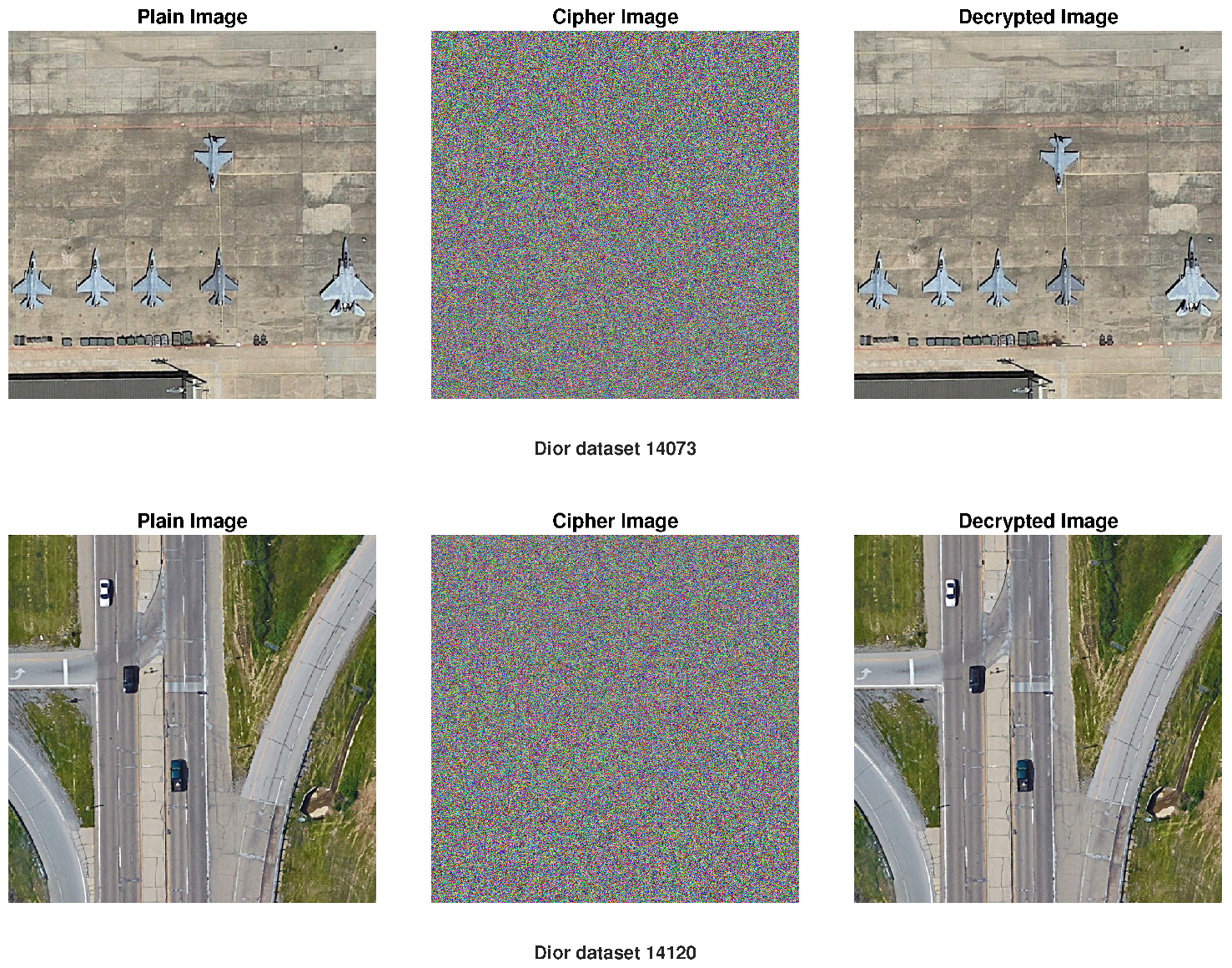
We selected two images, 14073 and 14120, from the DIOR dataset. Sample 14073 contains a high-contrast military aircraft on a heterogeneous terrain background, and sample 14120 presents a complex road network structure with different lighting conditions. Figure 15 shows the results of HSADE-IQUA-DNA encryption and decryption of images 14073 and 14120.
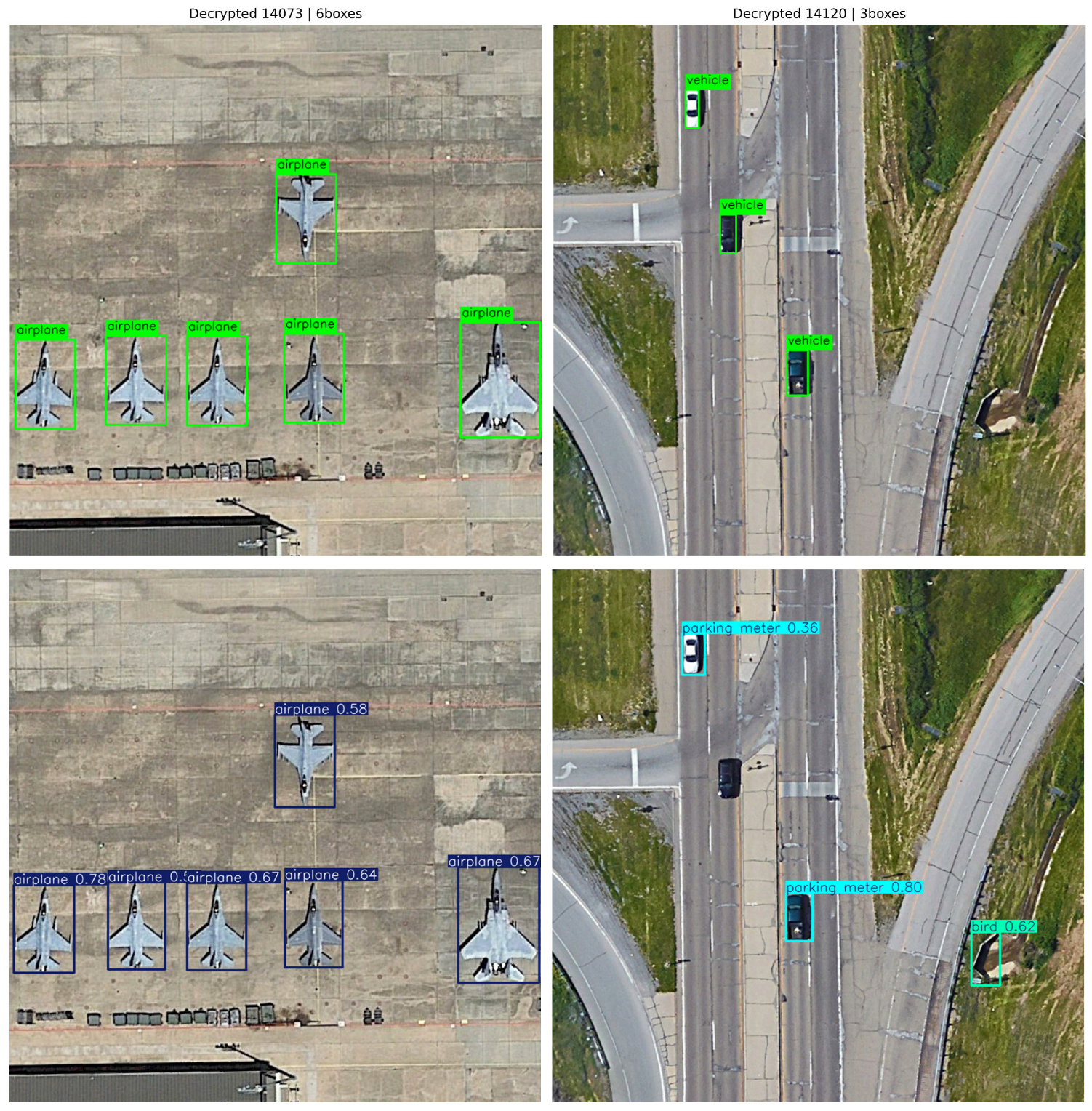
We further verified the actual situation of decrypted images in target detection and conducted decrypted image inference tests using Ultralytics’ Yolo11 tiny [70] in a Windows 11 environment with python=3.10.18 and pytorch=2.2.0. Figure 16 shows the results of true labels and target detection. The predicted bounding boxes and categories on the original and decrypted images are almost identical, which confirms that our encryption–decryption process does not introduce noticeable distortions that would harm target detection.

4.2.3. Experimental Results and Analysis of Real Remote Sensing Images

Remote sensing images usually contain a large amount of sensitive information. To fully verify the use of HSADE-IQUA-DNA in real-world scenarios, we obtained Sentinel-2 images from the official website of the European Space Agency’s Copernicus Data Center to conduct remote sensing image encryption tests and attempted to perform vegetation cover analysis on the decrypted images.
(1)
Remote sensing data introduction
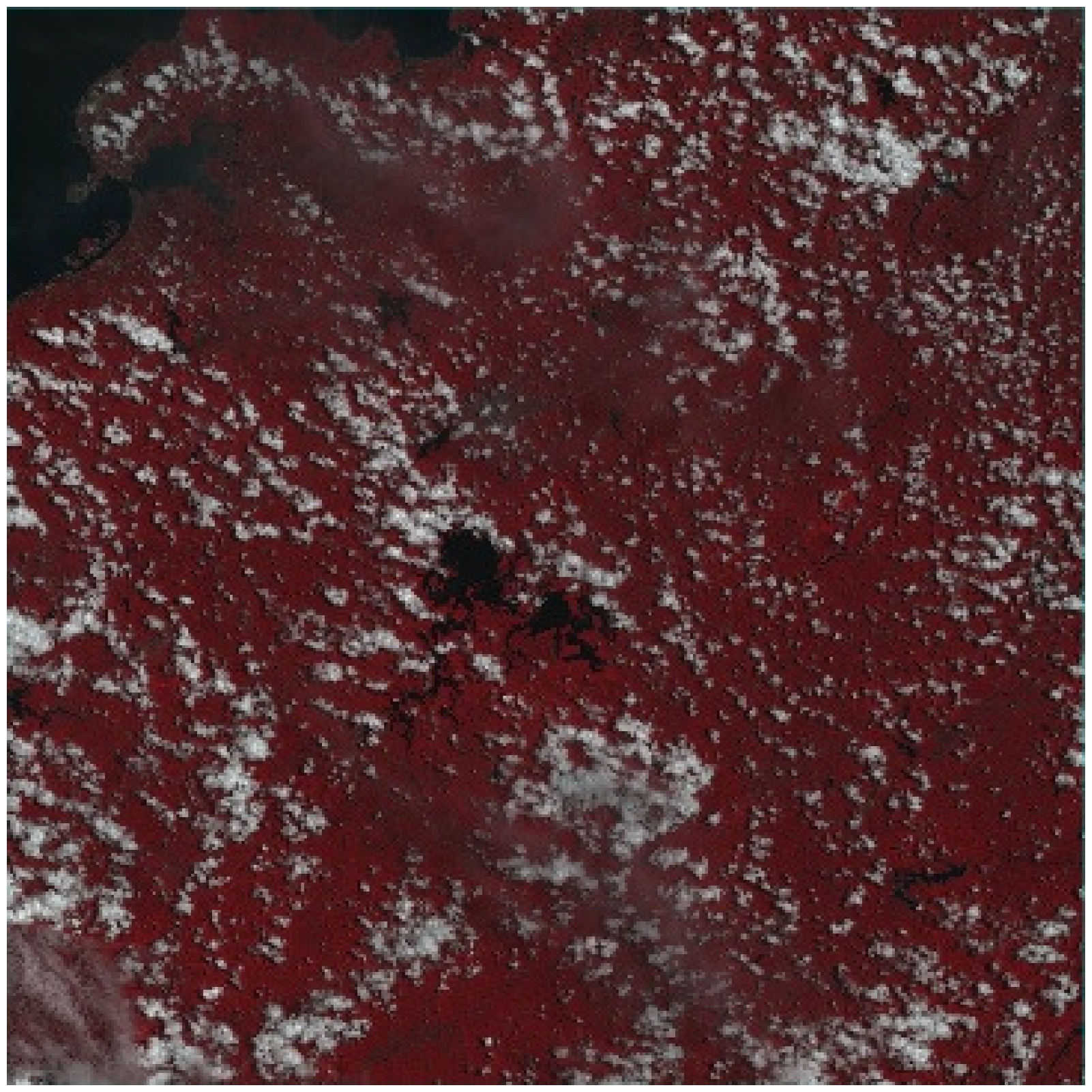
In this paper, we use the Sentinel-2 Level-2A product which is the atmospherically corrected surface reflectance product, S2C_MSIL2A_20250705T030601_N0511_R075_T49QCB_20250705T065358 multispectral image. Its projection coordinate system is WGS 1984 UTM Zone 49N, with a pixel size of 10 , 980 × 10 , 980 and a spatial resolution of 10 m. It contains four spectral bands, as shown in Table 9. Figure 17 shows the false-color composite image using the B8–B4–B3 bands.
(2)
Remote sensing image encryption results
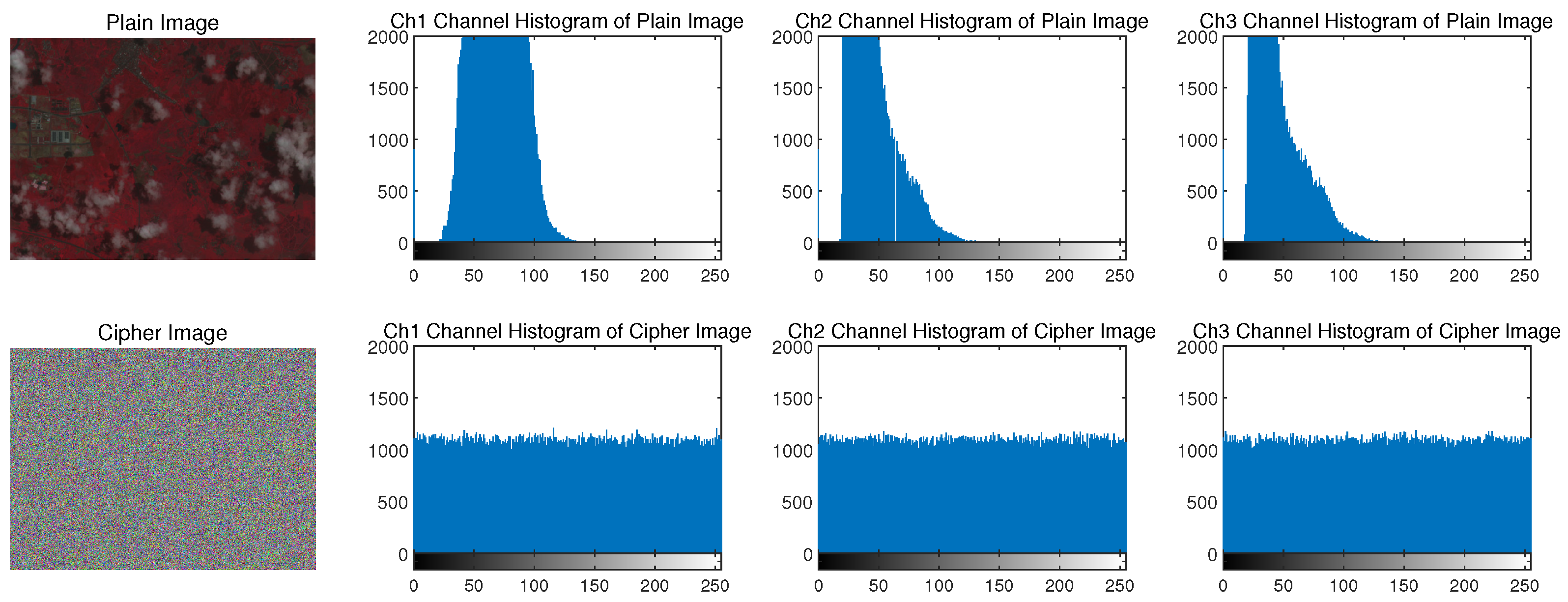
Considering computational efficiency, we encrypt parts of Figure 17 using HSADE-IQUA-DNA. Figure 18 shows the original image and the encrypted channel histograms. The histogram distributions of each channel are flat, and the frequencies of occurrence of each grayscale level are consistent, which is consistent with the statistical characteristics of a standard pseudo-random sequence. This effectively eliminates the histogram peaks and valleys caused by differences in ground feature types in the original image.
Table 10 shows the change in pixel correlation coefficients before and after image encryption. All channel correlation coefficients approach 0, effectively hiding image information. Table 11 shows the change in information entropy across each channel. All channel entropy approaches 8, demonstrating that HSADE-IQUA-DNA effectively disrupts the texture and structure information in the original remote sensing image, achieving full randomization of the plaintext information and ensuring the unpredictability of the ciphertext data meets cryptographic security standards.
Remote sensing images are an important form of geospatial data, containing not only pixel matrices but also rich geographic and optical information. However, when images are encrypted using algorithms, information loss can occur. Traditional image encryption algorithms focus only on pixel values, which leads to the loss of critical metadata and severely impacts the application value of decrypted images in geographic information systems. To address this issue, we pre-read and save the physical and optical information and re-embed this metadata into the recovered image file during the decryption process, ensuring that the decrypted remote sensing image retains its full geolocation capabilities and quantitative analysis capabilities. This mechanism ensures both the security of pixel data and the application integrity of remote sensing imagery.
(3)
Analysis of vegetation coverage of decrypted image
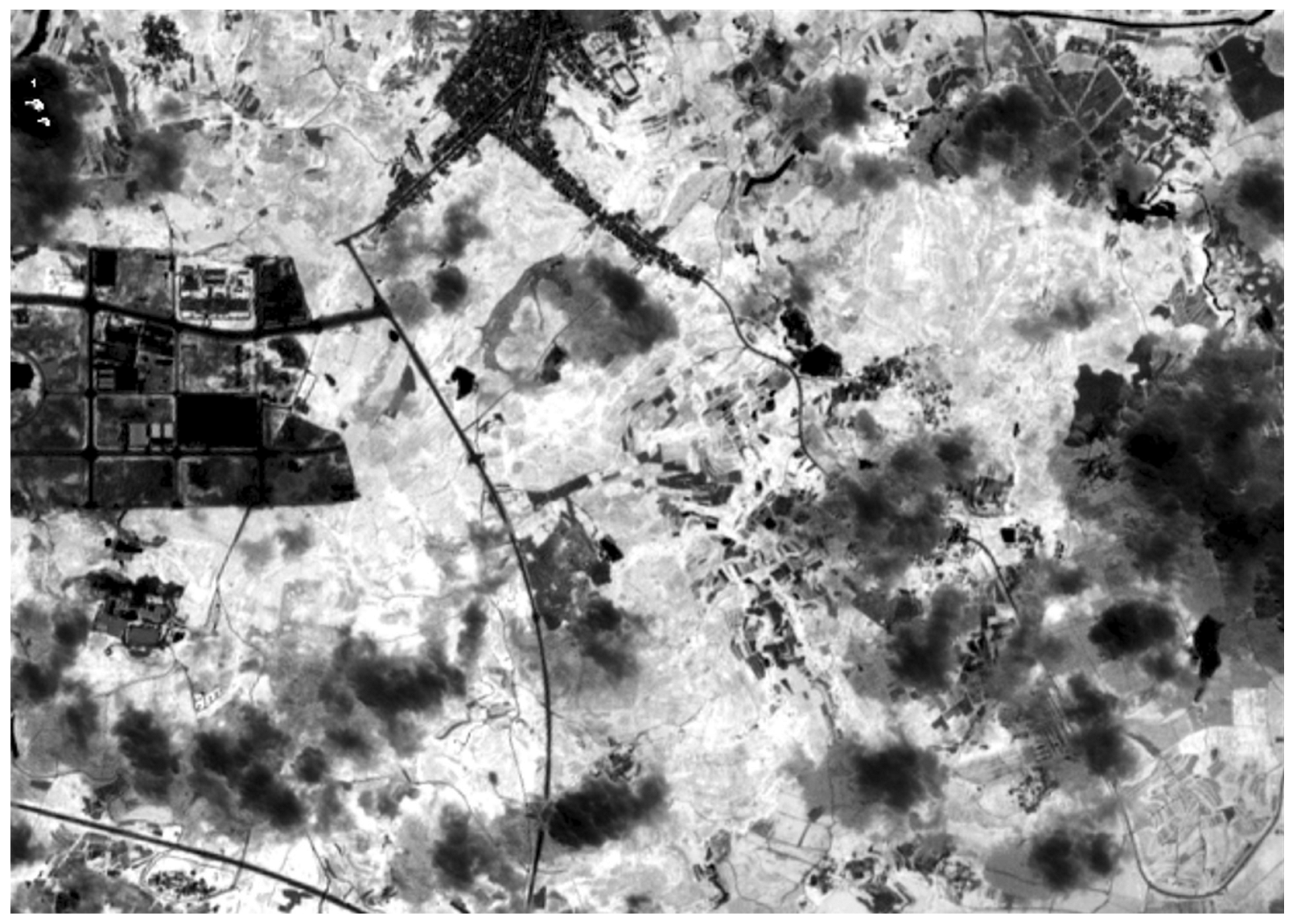
Vegetation coverage is an important parameter for quantitatively evaluating the status of surface vegetation. It is usually obtained by inverting remote sensing vegetation indices such as the Normalized Difference Vegetation Index (NDVI) [71]. Given that the calculation of vegetation coverage involves nonlinear operations on multi-band spectral information, its numerical accuracy is highly sensitive to the integrity of the original spectral data. Therefore, through quantitative comparative analysis of vegetation coverage after the encryption-decryption process, the information fidelity of the proposed algorithm in the ciphertext domain transformation can be effectively verified, providing an objective quantitative basis for evaluating the lossless reversibility of remote sensing image encryption systems. This paper uses ENVI 5.6 to calculate the NDVI index, as shown in Equation (48).
N D V I = N I R R N I R + R
where N I R is the near-infrared band and R is the infrared band. The calculated image is shown in Figure 19.
Afterwards, the vegetation cover is calculated as shown in Equation (49).
FVC = 0 , b 1 < NDVI soil , 1 , b 1 > NDVI veg , b 1 NDVI soil NDVI veg NDVI soil , NDVI soil b 1 NDVI veg .
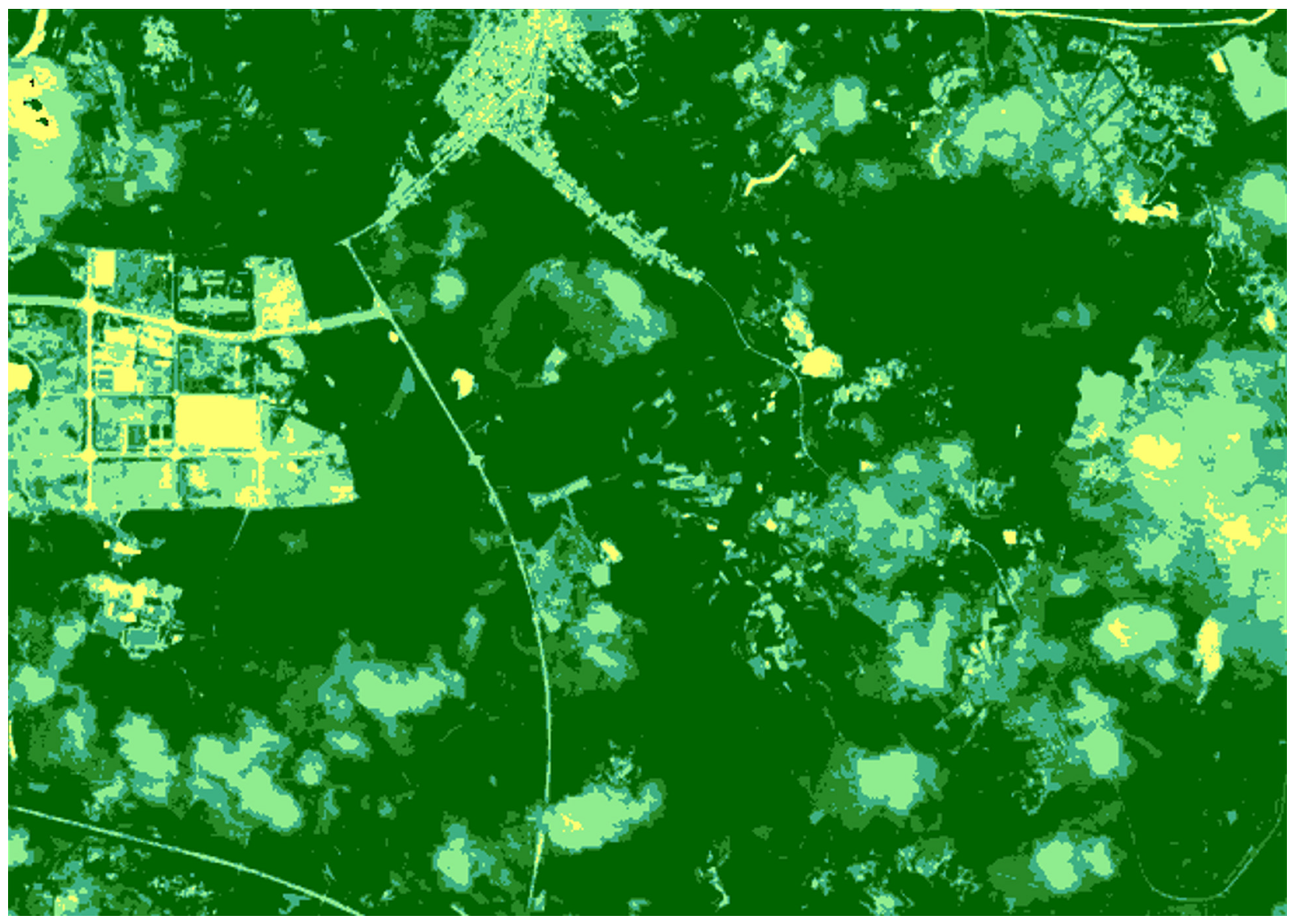
where N D V I s o i l and N D V I v e g represent the NDVI values for bare soil and pure vegetation, respectively. In this paper, N D V I s o i l = 0.019608 and N D V I v e g = 0.529412 . To visually demonstrate the spatial distribution characteristics of vegetation cover, we used a hierarchical color mapping method to visualize different cover levels. In the constructed pseudo-color scheme, the color gradient follows the gradient of vegetation cover: bare soil ( F V C 10 % ), low cover ( 10 % < F V C 30 % ), medium-low cover ( 30 % < F V C 40 % ), medium cover ( 45 % < F V C 60 % ), and high cover ( F V C > 60 % ). Color saturation is positively correlated with vegetation cover value. Figure 20 shows the spatial distribution pattern of vegetation cover in the decrypted remote sensing image of the study area, verifying the ability of the proposed algorithm to accurately recover the spatial characteristics of vegetation information during the inverse transformation of the encrypted domain.

5. Conclusions

Digital image security remains a key challenge in global data governance [72]. Traditional encryption algorithms struggle to provide adequate protection against evolving threats. To address this issue, we propose a novel surrogate-assisted differential evolution framework for optimizing image encryption systems. Our core contribution lies in the proposal of a meta-heuristic universal image encryption fitness function and a hierarchical surrogate-assisted differential evolution algorithm (HSADE-IQUA) optimized Chen hyperchaotic system-DNA image encryption algorithm (HSADE-IQUA-DNA). Our performance evaluation on a standard expensive optimization benchmark confirms the superior optimization performance of HSADE-IQUA, and two statistical tests, the Wilcoxon rank sum test and the Friedman test, demonstrate that HSADE-IQUA is a novel surrogate-assisted differential computation method. Experiments on standard computer vision images, annotated datasets, and remote sensing data show that HSADE-IQUA-DNA significantly reduces pixel correlation while maintaining complete recovery of image information, achieving an improvement of 3–4 orders of magnitude compared to Chen-DNA without the optimizer. Furthermore, this method demonstrates robustness against brute-force attacks, noise interference, and cropping, effectively overcoming the single-key limitations inherent in traditional chaotic encryption methods. In the future, we will extend this framework to multi-objective optimization scenarios to balance encryption strength and computational efficiency, and explore the application of large models in metaheuristic algorithms and information hiding.

Author Contributions

Methodology, G.-Y.L. and H.-Q.Z.; software, T.-Y.G.; validation, G.-Y.L. and Y.Y.; formal analysis, G.-Y.L., Y.Y. and H.-Q.Z.; writing—original draft preparation, G.-Y.L. and Y.Y.; writing—review and editing, G.-Y.L., Y.Y. and Z.-Y.C.; visualization, G.-Y.L. and H.-Q.Z.; project administration, Y.Y.; funding acquisition, Y.Y. All authors have read and agreed to the published version of the manuscript.

Funding

This research was funded by Teaching Reform Research Project of Higher Education Institutions in Hainan Province, Hnjg2024ZC-115.

Data Availability Statement

The original data presented in this study are included in the article.

Conflicts of Interest

The authors declare no conflicts of interest.

Appendix A

Table A1, Table A2 and Table A3 provide an additional comparison with several recently published color image encryption schemes in terms of pixel correlation. For three widely used test images, Baboon, Peppers, and kodim23, we report the correlation coefficients of adjacent pixels in the horizontal, vertical and diagonal directions for each RGB channel. For the compared methods, the correlation values were either taken directly from the corresponding papers when available, or recomputed using this paper’s contrast algorithm under the same experimental settings.
Table A1. Correlation coefficients of adjacent pixels for the Baboon image.
AlgorithmHorizontalVerticalDiagonal
Ch1Ch2Ch3Ch1Ch2Ch3Ch1Ch2Ch3
HSADE-IQUA0.0034590.00337340.0008789 0.0045683 0.00474870.0045432 0.0037534 0.00797 0.009507
Ref. [73]0.00180.0043 0.0015 0.005 0.0055 0.003 0.0096 0.0061 0.0029
Ref. [74]0.00810.02250.0071 0.0032 0.0133 0.0075 0.0185 0.01750.0338
Ref. [75] 0.0111 0.0031 0.008 0.0161 0.0038 0.0007 0.0031 0.004 0.0012
Ref. [76] 0.0193 0.0113 0.0342 0.0327 0.01210.006 0.0348 0.0170.0254
Ref. [77] 0.0078139 0.00181010.013868 0.0003971 0.0055859 0.0006205 0.011955 0.017032 0.011271
Table A2. Correlation coefficients of adjacent pixels for the Peppers image.
AlgorithmHorizontalVerticalDiagonal
Ch1Ch2Ch3Ch1Ch2Ch3Ch1Ch2Ch3
HSADE-IQUA-DNA0.0112750.010328 0.011555 0.00454650.00711750.0032311 0.014007 0.017653 0.006748
Ref. [73]0.0081 0.0037 0.0053 0.0074 0.007 0.0012 0.0053 0.0026 0.0077
Ref. [78] 0.0073098 0.0044152 0.0046159 0.0014081 0.0047943 0.0079889 0.0030486 0.00010091 0.0075955
Chen-DNA0.0046581 0.015304 0.0150980.01217 0.039126 0.0062174 0.011872 0.017426 0.023315
DE-DNA 0.01075 0.00968590.00786370.00312610.0055742 0.017986 0.020536 0.0233660.013708
SADE-AMSS-DNA0.0102370.000628730.00787860.030542 0.0021285 0.02265 0.0049145 0.019592 0.01305
Table A3. Correlation coefficients of adjacent pixels for the kodim23 image.
AlgorithmHorizontalVerticalDiagonal
Ch1Ch2Ch3Ch1Ch2Ch3Ch1Ch2Ch3
HSADE-IQUA-DNA 0.01075 0.00968590.00786370.00312610.0055742 0.017986 0.020536 0.0233660.013708
Chen-DNA0.0063536 0.015121 0.03094 0.0085522 0.022079 0.003015 0.0069991 0.01012 0.003104
DE-DNA0.000315370.0178070.0000307070.00708020.0042869 0.000665 0.00798130.0093530.022275
SADE-AMSS-DNA0.0032449 0.0013202 0.018599 0.0086151 0.019872 0.029301 0.0079311 0.01944 0.0179
ESAO-DNA0.028455 0.017473 0.0061859 0.0027565 0.023471 0.0022043 0.035954 0.01503 0.005985
AES 0.0091 0.007 0.01760.01810.00790.00180.000092764 0.0188 0.0072

References

  1. Afzal, I.; Parah, S.A.; Hurrah, N.N.; Song, O. Secure patient data transmission on resource constrained platform. Multimed. Tools Appl. 2024, 83, 15001–15026. [Google Scholar] [CrossRef]
  2. Alqaralleh, B.A.; Vaiyapuri, T.; Parvathy, V.S.; Gupta, D.; Khanna, A.; Shankar, K. Blockchain-assisted secure image transmission and diagnosis model on Internet of Medical Things Environment. Pers. Ubiquitous Comput. 2024, 28, 17–27. [Google Scholar] [CrossRef]
  3. Yang, Z.; Chen, M.; Li, G.; Yang, Y.; Zhang, Z. Secure semantic communications: Fundamentals and challenges. IEEE Netw. 2024, 38, 513–520. [Google Scholar] [CrossRef]
  4. Doss, A.F. Data Privacy & National Security: A Rubik’s Cube of Challenges and Opportunities That Are Inextricably Linked. Duquesne Law Rev. 2021, 59, 231. [Google Scholar]
  5. Zia, U.; McCartney, M.; Scotney, B.; Martinez, J.; AbuTair, M.; Memon, J.; Sajjad, A. Survey on image encryption techniques using chaotic maps in spatial, transform and spatiotemporal domains. Int. J. Inf. Secur. 2022, 21, 917–935. [Google Scholar] [CrossRef]
  6. Alghamdi, Y.; Munir, A. Image encryption algorithms: A survey of design and evaluation metrics. J. Cybersecur. Priv. 2024, 4, 126–152. [Google Scholar] [CrossRef]
  7. Zeghid, M.; Machhout, M.; Khriji, L.; Baganne, A.; Tourki, R. A modified AES based algorithm for image encryption. Int. J. Comput. Sci. Eng. 2007, 1, 70–75. [Google Scholar]
  8. Zhang, Y.; Liu, W.; Cao, S.; Zhai, Z.; Nie, X.; Dai, W. Digital image encryption algorithm based on chaos and improved DES. In Proceedings of the 2009 IEEE International Conference on Systems, Man and Cybernetics, San Antonio, TX, USA, 11–14 October 2009; pp. 474–479. [Google Scholar]
  9. Sun, F.; Lv, Z. A secure image encryption based on spatial surface chaotic system and AES algorithm. Multimed. Tools Appl. 2022, 81, 3959–3979. [Google Scholar] [CrossRef]
  10. Orsdemir, A.; Altun, H.O.; Sharma, G.; Bocko, M.F. On the security and robustness of encryption via compressed sensing. In Proceedings of the MILCOM 2008—2008 IEEE Military Communications Conference, San Diego, CA, USA, 16–19 November 2008; pp. 1–7. [Google Scholar]
  11. Zhang, X.; Ren, Y.; Feng, G.; Qian, Z. Compressing encrypted image using compressive sensing. In Proceedings of the 2011 Seventh International Conference on Intelligent Information Hiding and Multimedia Signal Processing, Dalian, China, 14–16 October 2011; pp. 222–225. [Google Scholar]
  12. Zhou, N.; Zhang, A.; Zheng, F.; Gong, L. Novel image compression–encryption hybrid algorithm based on key-controlled measurement matrix in compressive sensing. Opt. Laser Technol. 2014, 62, 152–160. [Google Scholar] [CrossRef]
  13. Abadi, M.; Andersen, D.G. Learning to protect communications with adversarial neural cryptography. arXiv 2016, arXiv:1610.06918. [Google Scholar] [CrossRef]
  14. Feng, L.; Du, J.; Fu, C.; Song, W. Image encryption algorithm combining chaotic image encryption and convolutional neural network. Electronics 2023, 12, 3455. [Google Scholar] [CrossRef]
  15. Fridrich, J. Symmetric ciphers based on two-dimensional chaotic maps. Int. J. Bifurc. Chaos 1998, 8, 1259–1284. [Google Scholar] [CrossRef]
  16. Baptista, M. Cryptography with chaos. Phys. Lett. A 1998, 240, 50–54. [Google Scholar] [CrossRef]
  17. Arab, A.; Rostami, M.J.; Ghavami, B. An image encryption method based on chaos system and AES algorithm. J. Supercomput. 2019, 75, 6663–6682. [Google Scholar] [CrossRef]
  18. Sun, C.; Wang, E.; Zhao, B. Image encryption scheme with compressed sensing based on a new six-dimensional non-degenerate discrete hyperchaotic system and plaintext-related scrambling. Entropy 2021, 23, 291. [Google Scholar] [CrossRef]
  19. Wang, X.; Liu, C. A novel and effective image encryption algorithm based on chaos and DNA encoding. Multimed. Tools Appl. 2017, 76, 6229–6245. [Google Scholar] [CrossRef]
  20. Bi, Y.; Xue, B.; Mesejo, P.; Cagnoni, S.; Zhang, M. A survey on evolutionary computation for computer vision and image analysis: Past, present, and future trends. IEEE Trans. Evol. Comput. 2022, 27, 5–25. [Google Scholar] [CrossRef]
  21. Kaur, M.; Singh, S.; Kaur, M. Computational image encryption techniques: A comprehensive review. Math. Probl. Eng. 2021, 2021, 5012496. [Google Scholar] [CrossRef]
  22. He, C.; Zhang, Y.; Gong, D.; Ji, X. A review of surrogate-assisted evolutionary algorithms for expensive optimization problems. Expert Syst. Appl. 2023, 217, 119495. [Google Scholar] [CrossRef]
  23. Jin, Y. Surrogate-assisted evolutionary computation: Recent advances and future challenges. Swarm Evol. Comput. 2011, 1, 61–70. [Google Scholar] [CrossRef]
  24. Hamadi, S.J.; Mohammed, E.A. Chaotic Systems in Cryptography: An Overview of Feature-Based Methods. Al-Salam J. Eng. Technol. 2025, 4, 164–172. [Google Scholar] [CrossRef]
  25. Ali, F.; Jhangeer, A.; Muddassar, M. Comprehensive classification of multistability and Lyapunov exponent with multiple dynamics of nonlinear Schrödinger equation. Nonlinear Dyn. 2025, 113, 10335–10364. [Google Scholar] [CrossRef]
  26. Benkouider, K.; Sambas, A.; Bonny, T.; Al Nassan, W.; Moghrabi, I.A.; Sulaiman, I.M.; Hassan, B.A.; Mamat, M. A comprehensive study of the novel 4D hyperchaotic system with self-exited multistability and application in the voice encryption. Sci. Rep. 2024, 14, 12993. [Google Scholar] [CrossRef]
  27. Chen, G.; Ueta, T. Yet another chaotic attractor. Int. J. Bifurc. Chaos 1999, 9, 1465–1466. [Google Scholar] [CrossRef]
  28. Meng, F.Q.; Wu, G. A color image encryption and decryption scheme based on extended DNA coding and fractional-order 5D hyper-chaotic system. Expert Syst. Appl. 2024, 254, 124413. [Google Scholar] [CrossRef]
  29. Storn, R.; Price, K. Differential evolution–a simple and efficient heuristic for global optimization over continuous spaces. J. Glob. Optim. 1997, 11, 341–359. [Google Scholar] [CrossRef]
  30. Ren, C.; Meng, Z. A survey on expensive optimization problems using differential evolution. Appl. Soft Comput. 2025, 170, 112727. [Google Scholar] [CrossRef]
  31. de Jesús Rubio, J.; Orozco, E.; Cordova, D.A.; Hernandez, M.A.; Rosas, F.J.; Pacheco, J. Observer-based differential evolution constrained control for safe reference tracking in robots. Neural Netw. 2024, 175, 106273. [Google Scholar] [CrossRef] [PubMed]
  32. Gupta, P.; Rustam, F.; Kanwal, K.; Aljedaani, W.; Alfarhood, S.; Safran, M.; Ashraf, I. Detecting thyroid disease using optimized machine learning model based on differential evolution. Int. J. Comput. Intell. Syst. 2024, 17, 3. [Google Scholar] [CrossRef]
  33. Zhang, L.; Lu, G.; Yan, X.; Xia, P.; Chen, Z.; Wu, D. A differential evolution optimized hybrid XGBoost for accurate carbon emission prediction. Environ. Model. Softw. 2025, 193, 106627. [Google Scholar] [CrossRef]
  34. Song, Z.; Sun, L.; Matsveichuk, N.; Sotskov, Y.; Jiang, S.; Yu, Y. Differential evolution based on individual information parameter setting and diversity measurement of aggregated distribution. Swarm Evol. Comput. 2025, 92, 101793. [Google Scholar] [CrossRef]
  35. Zhang, Y.; Li, S.; Wang, Y.; Yan, Y.; Zhao, J.; Gao, Z. Self-adaptive enhanced learning differential evolution with surprisingly efficient decomposition approach for parameter identification of photovoltaic models. Energy Convers. Manag. 2024, 308, 118387. [Google Scholar] [CrossRef]
  36. Brest, J.; Greiner, S.; Boskovic, B.; Mernik, M.; Zumer, V. Self-adapting control parameters in differential evolution: A comparative study on numerical benchmark problems. IEEE Trans. Evol. Comput. 2006, 10, 646–657. [Google Scholar] [CrossRef]
  37. Zhang, J.; Sanderson, A.C. JADE: Adaptive differential evolution with optional external archive. IEEE Trans. Evol. Comput. 2009, 13, 945–958. [Google Scholar] [CrossRef]
  38. Wang, Y.; Cai, Z.; Zhang, Q. Differential evolution with composite trial vector generation strategies and control parameters. IEEE Trans. Evol. Comput. 2011, 15, 55–66. [Google Scholar] [CrossRef]
  39. Meng, Z.; Pan, J.S. HARD-DE: Hierarchical archive based mutation strategy with depth information of evolution for the enhancement of differential evolution on numerical optimization. IEEE Access 2019, 7, 12832–12854. [Google Scholar] [CrossRef]
  40. Meng, Z.; Pan, J.S. QUasi-Affine TRansformation Evolution with External ARchive (QUATRE-EAR): An enhanced structure for differential evolution. Knowl.-Based Syst. 2018, 155, 35–53. [Google Scholar] [CrossRef]
  41. Meng, Z.; Pan, J.S.; Li, X. The quasi-affine transformation evolution (QUATRE) algorithm: An overview. In Proceedings of the The Euro-China Conference on Intelligent Data Analysis and Applications, Malaga, Spain, 9–11 October 2017; Springer: Cham, Switzerland, 2017; pp. 324–333. [Google Scholar]
  42. Tanabe, R.; Fukunaga, A. Success-history based parameter adaptation for differential evolution. In Proceedings of the 2013 IEEE Congress on Evolutionary Computation, Cancun, Mexico, 20–23 June 2013; pp. 71–78. [Google Scholar]
  43. Yu, L.; Ren, C.; Meng, Z. A surrogate-assisted differential evolution with fitness-independent parameter adaptation for high-dimensional expensive optimization. Inf. Sci. 2024, 662, 120246. [Google Scholar] [CrossRef]
  44. Gu, H.; Wang, H.; Jin, Y. Surrogate-assisted differential evolution with adaptive multisubspace search for large-scale expensive optimization. IEEE Trans. Evol. Comput. 2022, 27, 1765–1779. [Google Scholar] [CrossRef]
  45. Zhou, J.; Li, J.; Di, X. A novel lossless medical image encryption scheme based on game theory with optimized ROI parameters and hidden ROI position. IEEE Access 2020, 8, 122210–122228. [Google Scholar] [CrossRef]
  46. Liu, R.; Zhou, Q.; Liu, J.; Zhang, Y.; Hui, Z.; Zhang, X. Separable reversible data hiding in encrypted images for remote sensing images. Entropy 2023, 25, 1632. [Google Scholar] [CrossRef]
  47. Chai, X.; Gan, Z.; Yuan, K.; Chen, Y.; Liu, X. A novel image encryption scheme based on DNA sequence operations and chaotic systems. Neural Comput. Appl. 2019, 31, 219–237. [Google Scholar] [CrossRef]
  48. Shahna, K.; Mohamed, A. A novel image encryption scheme using both pixel level and bit level permutation with chaotic map. Appl. Soft Comput. 2020, 90, 106162. [Google Scholar] [CrossRef]
  49. Kocak, O.; Erkan, U.; Toktas, A.; Gao, S. PSO-based image encryption scheme using modular integrated logistic exponential map. Expert Syst. Appl. 2024, 237, 121452. [Google Scholar] [CrossRef]
  50. Ferdush, J.; Mondol, G.; Prapti, A.P.; Begum, M.; Sheikh, M.N.A.; Galib, S.M. An enhanced image encryption technique combining genetic algorithm and particle swarm optimization with chaotic function. Int. J. Comput. Appl. 2021, 43, 960–967. [Google Scholar] [CrossRef]
  51. Enayatifar, R.; Abdullah, A.H.; Lee, M. A weighted discrete imperialist competitive algorithm (WDICA) combined with chaotic map for image encryption. Opt. Lasers Eng. 2013, 51, 1066–1077. [Google Scholar] [CrossRef]
  52. Afify, Y.M.; Sharkawy, N.H.; Gad, W.; Badr, N. A new dynamic DNA-coding model for gray-scale image encryption. Complex Intell. Syst. 2024, 10, 745–761. [Google Scholar] [CrossRef]
  53. Olvera-Martinez, L.; Cedillo-Hernandez, M.; Diaz-Rodriguez, C.A.; Faustinos-Morales, L.; Cedillo-Hernandez, A.; Garcia-Ugalde, F.J. Symmetric Grayscale Image Encryption Based on Quantum Operators with Dynamic Matrices. Mathematics 2025, 13, 982. [Google Scholar] [CrossRef]
  54. Tan, K.C.; Feng, L.; Jiang, M. Evolutionary transfer optimization-a new frontier in evolutionary computation research. IEEE Comput. Intell. Mag. 2021, 16, 22–33. [Google Scholar] [CrossRef]
  55. Rosli, S.J.; Rahim, H.A.; Abdul Rani, K.N.; Ngadiran, R.; Ahmad, R.B.; Yahaya, N.Z.; Abdulmalek, M.; Jusoh, M.; Yasin, M.N.M.; Sabapathy, T.; et al. A hybrid modified method of the sine cosine algorithm using Latin hypercube sampling with the cuckoo search algorithm for optimization problems. Electronics 2020, 9, 1786. [Google Scholar] [CrossRef]
  56. Bellman, R. Dynamic programming. Science 1966, 153, 34–37. [Google Scholar] [CrossRef] [PubMed]
  57. Tanabe, R.; Fukunaga, A.S. Improving the search performance of SHADE using linear population size reduction. In Proceedings of the 2014 IEEE Congress on Evolutionary Computation (CEC), Beijing, China, 6–11 July 2014; pp. 1658–1665. [Google Scholar]
  58. Li, F.; Cai, X.; Gao, L.; Shen, W. A surrogate-assisted multiswarm optimization algorithm for high-dimensional computationally expensive problems. IEEE Trans. Cybern. 2020, 51, 1390–1402. [Google Scholar] [CrossRef]
  59. Suganthan, P.N.; Hansen, N.; Liang, J.J.; Deb, K.; Chen, Y.P.; Auger, A.; Tiwari, S. Problem Definitions and Evaluation Criteria for the CEC 2005 Special Session on Real-Parameter Optimization; KanGAL Report Number 2005005; Kanpur Genetic Algorithms Laboratory: Kanpur, India, 2005. [Google Scholar]
  60. Wilcoxon, F. Individual comparisons by ranking methods. In Breakthroughs in Statistics: Methodology and Distribution; Springer: New York, NY, USA, 1992; pp. 196–202. [Google Scholar]
  61. Friedman, M. The use of ranks to avoid the assumption of normality implicit in the analysis of variance. J. Am. Stat. Assoc. 1937, 32, 675–701. [Google Scholar] [CrossRef]
  62. Tan, K.C.; Goh, C.K.; Yang, Y.; Lee, T.H. Evolving better population distribution and exploration in evolutionary multi-objective optimization. Eur. J. Oper. Res. 2006, 171, 463–495. [Google Scholar] [CrossRef]
  63. Kůdela, J.; Matoušek, R. Combining Lipschitz and RBF surrogate models for high-dimensional computationally expensive problems. Inf. Sci. 2023, 619, 457–477. [Google Scholar] [CrossRef]
  64. Yu, H.; Tan, Y.; Zeng, J.; Sun, C.; Jin, Y. Surrogate-assisted hierarchical particle swarm optimization. Inf. Sci. 2018, 454, 59–72. [Google Scholar] [CrossRef]
  65. Wang, X.; Wang, G.G.; Song, B.; Wang, P.; Wang, Y. A novel evolutionary sampling assisted optimization method for high-dimensional expensive problems. IEEE Trans. Evol. Comput. 2019, 23, 815–827. [Google Scholar] [CrossRef]
  66. Li, J.Y.; Zhan, Z.H.; Zhang, J. Evolutionary computation for expensive optimization: A survey. Mach. Intell. Res. 2022, 19, 3–23. [Google Scholar] [CrossRef]
  67. Wu, Y.; Noonan, J.P.; Agaian, S. NPCR and UACI randomness tests for image encryption. Cyber J. Multidiscip. J. Sci. Technol. J. Sel. Areas Telecommun. (JSAT) 2011, 1, 31–38. [Google Scholar]
  68. Lakshmi, C.; Nithya, C.; Thenmozhi, K.; Sivaraman, R.; Yasvanthira Sri, D.; Vinizia, B.; Subashini, R.; Meikandan, P.V.; Mahalingam, H.; Amirtharajan, R. Reconfigurable security solution based on hopfield neural network for e-healthcare applications. Sci. Rep. 2025, 15, 5628. [Google Scholar] [CrossRef] [PubMed]
  69. Li, K.; Wan, G.; Cheng, G.; Meng, L.; Han, J. Object detection in optical remote sensing images: A survey and a new benchmark. ISPRS J. Photogramm. Remote Sens. 2020, 159, 296–307. [Google Scholar] [CrossRef]
  70. Sapkota, R.; Karkee, M. Comparing YOLOv11 and YOLOv8 for instance segmentation of occluded and non-occluded immature green fruits in complex orchard environment. arXiv 2024, arXiv:2410.19869. [Google Scholar]
  71. Xue, J.; Su, B. Significant remote sensing vegetation indices: A review of developments and applications. J. Sens. 2017, 2017, 1353691. [Google Scholar] [CrossRef]
  72. Hameed, K.; Naha, R.; Hameed, F. Digital transformation for sustainable health and well-being: A review and future research directions. Discov. Sustain. 2024, 5, 104. [Google Scholar] [CrossRef]
  73. Yao, Y.; Xu, X.; Jiang, Z. A New Chaotic Color Image Encryption Algorithm Based on Memristor Model and Random Hybrid Transforms. Appl. Sci. 2025, 15, 913. [Google Scholar] [CrossRef]
  74. Meng, F.; Wu, G.; Zhang, J. A novel color image encryption algorithm based on fractional-order conservative memristive hyperchaotic system and extended zig-zag transform. J. King Saud Univ. Comput. Inf. Sci. 2025, 37, 151. [Google Scholar] [CrossRef]
  75. İhsan, A.; Doğan, N. An innovative image encryption algorithm enhanced with the Pan-Tompkins Algorithm for optimal security. Multimed. Tools Appl. 2024, 83, 82589–82619. [Google Scholar] [CrossRef]
  76. Sun, S.; Yang, W.; Yin, Y.; Tian, X.; Li, G.; Deng, X. A color image encryption scheme utilizing a logistic-sine chaotic map and cellular automata. Sci. Rep. 2025, 15, 21603. [Google Scholar] [CrossRef]
  77. Xu, Y.; Liu, J.; You, Z.; Zhang, T. A novel color image encryption algorithm based on hybrid two-dimensional hyperchaos and genetic recombination. Mathematics 2024, 12, 3457. [Google Scholar] [CrossRef]
  78. Al-Dayel, I.; Nadeem, M.F.; Khan, M.A.; Abraha, B.S. An image encryption scheme using 4-D chaotic system and cellular automaton. Sci. Rep. 2025, 15, 19499. [Google Scholar] [CrossRef] [PubMed]
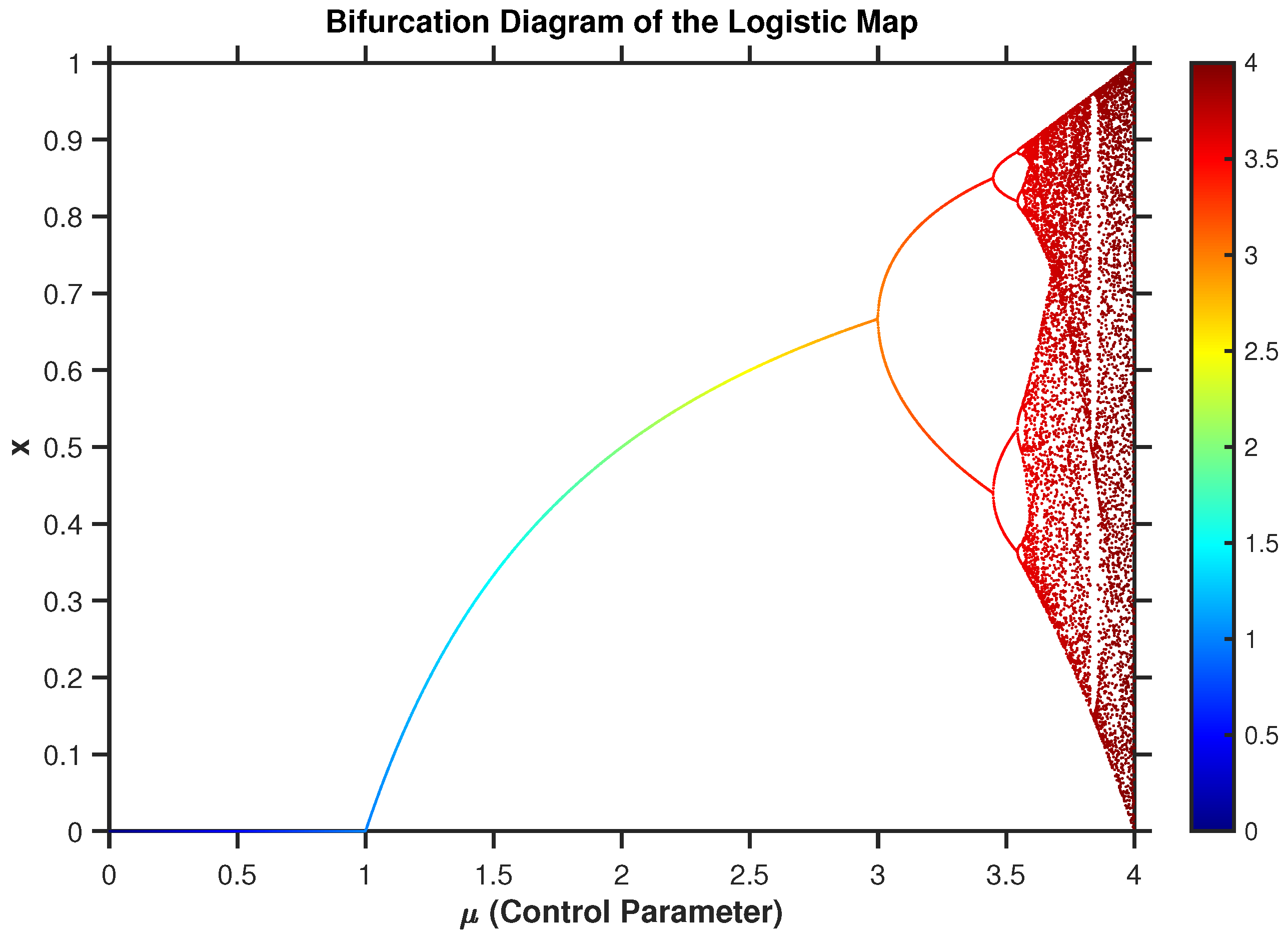
Figure 1. Bifurcation diagram of the logistic map.
Electronics 14 04716 g001
Figure 2. Chen hyperchaotic system motion trajectory.
Electronics 14 04716 g002
Figure 3. RBF surrogate model fitting function process.
Electronics 14 04716 g003
Figure 4. Adjacent-pixel correlation of the plain image.
Electronics 14 04716 g004
Figure 5. HSADE-IQUA flow chart.
Electronics 14 04716 g005
Figure 6. Sankey diagram of PMSS strategy.
Electronics 14 04716 g006
Figure 7. Schematic diagram of EMAPSR strategy.
Electronics 14 04716 g007
Figure 8. HSADE-IQUA-DNA encryption process.
Electronics 14 04716 g008
Figure 9. Average rank of weight factor sensitivity.
Electronics 14 04716 g009
Figure 10. Comparison of image histograms before and after encryption of Baboon.
Electronics 14 04716 g010
Figure 11. Comparison of image histograms before and after encryption of Peppers.
Electronics 14 04716 g011
Figure 12. Comparison of image histograms before and after encryption of kodim23.
Electronics 14 04716 g012
Figure 13. Anti-clipping test results.
Electronics 14 04716 g013
Figure 14. HSADE-IQUA-DNA decryption under noisy ciphertexts.
Electronics 14 04716 g014
Figure 15. Remote sensing images from DIOR dataset.
Electronics 14 04716 g015
Figure 16. Decrypting image object detection model inference results.
Electronics 14 04716 g016
Figure 17. False color composite remote sensing image.
Electronics 14 04716 g017
Figure 18. Comparison of image histograms before and after encryption of False color remote sensing image.
Electronics 14 04716 g018
Figure 19. NDVI calculation result map derived from the decrypted Sentinel-2 image.
Electronics 14 04716 g019
Figure 20. Decrypted image vegetation cover analysis results.
Electronics 14 04716 g020
Table 1. Binary encoding for DNA.
12345678
A0000010110101111
T1111101001010000
G0110001100110110
C1001110011001001
Table 2. Binary conversion for bit interleaving.
DecimalBinaryExtracted Bits
8501010101Odd bits
17010101010Even bits
5100110011Low bit pairs
20411001100High bit pairs
Table 3. Description of eight expensive benchmark problems.
Benchmark Function f ( x ) Function TypeRangeOptimal Value
f 1 ( x ) = ELLIPSOIDUnimodal Function[−5.12, 5.12]0
f 2 ( x ) = ROSENBROCKMultimodal Function[−5.12, 5.12]0
f 3 ( x ) = ACKLEYMultimodal Function[−2.048, 2.048]0
f 4 ( x ) = GRIEWANKMultimodal Function[−32.76, 32.76]0
f 5 ( x ) = RASTRIGINMultimodal Function[−600, 600]0
f 6 ( x ) = CEC05_f11Highly Complex Function[−5, 5]90
f 7 ( x ) = CEC05_f19Highly Complex Function[−5, 5]10
f 8 ( x ) = CEC05_f20Highly Complex Function[−5, 5]10
Table 4. The parameter sensitivity result of F A F P D weight configuration.
ProblemDim T 1 ( 0.5 , 0.5 ) T 2 ( 0.7 , 0.3 ) T 3 ( 0.9 , 0.1 )
ELLIPSOID302.099 × 10−8 ± 1.735 × 10−81.300 × 10−8 ± 8.459 × 10−91.693 × 10−8 ± 2.387 × 10⁻⁸
ELLIPSOID507.236 × 10−5 ± 6.952 × 10−55.474 × 10−5 ± 5.198 × 10−54.550 × 10−5 ± 4.471 × 10⁻⁵
ELLIPSOID1002.802 × 10−1 ± 4.434 × 10−19.850 × 10−2 ± 1.772 × 10−11.123 × 10−1 ± 1.878 × 10⁻¹
ROSENBROCK309.711 × 101 ± 8.687 × 1019.715 × 101 ± 8.366 × 1011.147 × 102 ± 8.022 × 101
ROSENBROCK508.218 × 101 ± 1.256 × 1021.660 × 102 ± 1.589 × 1021.113 × 102 ± 1.351 × 10²
ROSENBROCK1003.459 × 102 ± 2.666 × 1022.924 × 102 ± 2.665 × 1023.945 × 102 ± 3.248 × 10²
ACKLEY302.429 × 101 ± 3.119 × 10−12.434 × 101 ± 3.757 × 10−12.461 × 101 ± 9.297 × 10⁻¹
ACKLEY504.575 × 101 ± 4.442 × 10−14.570 × 101 ± 2.886 × 10−14.591 × 101 ± 4.615 × 10⁻¹
ACKLEY1009.778 × 101 ± 2.349 × 10−19.776 × 101 ± 3.710 × 10−19.791 × 101 ± 2.086 × 10⁻¹
GRIEWANK308.682 × 10−1 ± 9.683 × 10−11.187 × 100 ± 1.018 × 1009.357 × 10−1 ± 8.988 × 10⁻¹
GRIEWANK506.104 × 10−1 ± 8.144 × 10−19.428 × 10−1 ± 1.229 × 1006.112 × 10−1 ± 7.967 × 10⁻¹
GRIEWANK1003.661 × 10−2 ± 7.003 × 10−22.367 × 10−2 ± 1.017 × 10−23.681 × 10−2 ± 6.136 × 10⁻²
RASTRIGIN305.049 × 10−3 ± 6.754 × 10−35.042 × 10−3 ± 9.812 × 10−35.676 × 10−3 ± 7.977 × 10⁻³
RASTRIGIN507.102 × 10−3 ± 9.100 × 10−34.593 × 10−3 ± 1.045 × 10−21.394 × 10−2 ± 4.557 × 10⁻²
RASTRIGIN1002.079 × 10−2 ± 2.681 × 10−21.563 × 10−2 ± 6.009 × 10−31.498 × 10−2 ± 5.939 × 10⁻³
Bold indicates the best.
Table 5. Comparison results of different algorithms on benchmark problems.
ProblemDimHSADE-IQUASADE-AMSSLSADESHPSOESAO
ELLIPSOID30D1.66 × 10−8 ± 1.18 × 10−81.68 × 101 ± 1.52 × 101 (+)8.47 × 10⁻³ ± 3.22 × 10⁻³ (+)6.00 × 101 ± 2.48 × 101 (+)9.43 × 10⁻⁵ ± 2.75 × 10⁻⁵ (+)
ELLIPSOID50D5.53 × 10−5 ± 5.32 × 10−53.54 × 101 ± 2.53 × 101 (+)1.51 × 100 ± 1.52 × 100 (+)2.31 × 10² ± 7.38 × 101 (+)3.65 × 10⁻¹ ± 4.31 × 10⁻¹ (+)
ELLIPSOID100D1.05 × 10−1 ± 2.31 × 10−19.00 × 101 ± 5.42 × 101 (+)1.16 × 10² ± 3.49 × 101 (+)1.42 × 10³ ± 4.47 × 10² (+)5.40 × 10² ± 6.59 × 101 (+)
ROSENBROCK30D2.37 × 101 ± 1.30 × 1001.24 × 102 ± 6.24 × 101 (+)2.73 × 101 ± 1.03 × 100 (+)9.66 × 101 ± 3.91 × 101 (+)2.44 × 101 ± 1.02 × 100 (+)
ROSENBROCK50D4.59 × 101 ± 8.28 × 10−11.93 × 102 ± 8.74 × 101 (+)4.79 × 101 ± 1.16 × 100 (+)2.24 × 10² ± 9.45 × 101 (+)4.73 × 101 ± 1.47 × 100 (+)
ROSENBROCK100D9.78 × 101 ± 3.69 × 10−14.70 × 102 ± 2.63 × 10² (+)1.26 × 10² ± 2.32 × 101 (+)6.74 × 10² ± 1.75 × 10² (+)2.87 × 10² ± 2.96 × 101 (+)
ACKLEY30D6.31 × 10−1 ± 6.77 × 10−18.11 × 100 ± 2.80 × 100 (+)8.02 × 10⁻¹ ± 9.28 × 10⁻¹ (≈)1.00 × 101 ± 1.11 × 100 (+)4.56 × 100 ± 1.64 × 100 (+)
ACKLEY50D5.29 × 10−1 ± 1.84 × 10−18.58 × 100 ± 2.45 × 100 (+)8.00 × 100 ± 2.76 × 100 (+)1.19 × 101 ± 9.58 × 10⁻¹ (+)7.98 × 10⁻¹ ± 1.04 × 100 (≈)
ACKLEY100D1.90 × 10−1 ± 6.98 × 10−37.83 × 100 ± 2.82 × 100 (+)1.46 × 101 ± 1.42 × 100 (+)1.29 × 101 ± 6.67 × 10⁻¹ (+)7.97 × 100 ± 3.33 × 100 (+)
GRIEWANK30D4.31 × 10−3 ± 7.49 × 10−35.57 × 101 ± 1.89 × 101 (+)5.95 × 10⁻² ± 3.61 × 10⁻² (+)1.14 × 100 ± 9.16 × 10⁻² (+)9.45 × 10⁻¹ ± 4.55 × 10⁻² (+)
GRIEWANK50D2.12 × 10−3 ± 3.87 × 10−31.92 × 101 ± 1.35 × 101 (+)8.36 × 10⁻¹ ± 1.19 × 10⁻¹ (+)1.14 × 100 ± 4.96 × 10⁻² (+)9.29 × 10⁻¹ ± 5.31 × 10⁻² (+)
GRIEWANK100D1.83 × 10−2 ± 1.42 × 10−22.93 × 101 ± 2.58 × 101 (+)9.44 × 100 ± 2.62 × 100 (+)1.15 × 100 ± 6.47 × 10⁻² (+)1.99 × 101 ± 2.14 × 100 (+)
RASTRIGIN30D9.41 × 101 ± 8.54 × 1011.06 × 102 ± 3.96 × 101 (+)7.13 × 101 ± 1.73 × 101 (+)2.56 × 10² ± 1.83 × 101 (+)2.49 × 10² ± 2.94 × 101 (+)
RASTRIGIN50D1.49 × 102 ± 3.36 × 1012.62 × 102 ± 4.71 × 101 (+)1.51 × 10² ± 1.60 × 10² (+)4.72 × 10² ± 3.22 × 101 (+)4.42 × 10² ± 2.93 × 101 (+)
RASTRIGIN100D3.04 × 102 ± 2.41 × 1027.36 × 102 ± 9.59 × 101 (+)3.82 × 10² ± 7.27 × 101 (+)9.80 × 10² ± 3.09 × 101 (+)9.83 × 10² ± 2.86 × 101 (+)
CEC05_f1130D1.32 × 102 ± 2.93 × 1001.35 × 102 ± 2.32 × 100 (≈)1.36 × 10² ± 1.50 × 100 (+)1.35 × 10² ± 1.88 × 100 (≈)1.36 × 10² ± 1.36 × 100 (≈)
CEC05_f1150D1.63 × 102 ± 4.05 × 1001.71 × 102 ± 2.68 × 100 (≈)1.71 × 10² ± 2.66 × 100 (+)1.72 × 10² ± 1.80 × 100 (≈)1.71 × 10² ± 2.09 × 100 (≈)
CEC05_f11100D2.64 × 102 ± 2.74 × 1002.63 × 102 ± 2.21 × 100 (≈)2.63 × 10² ± 3.93 × 100 (≈)2.64 × 10² ± 2.83 × 100 (≈)2.62 × 10² ± 2.66 × 100 (≈)
CEC05_f1930D1.15 × 103 ± 4.62 × 1011.03 × 103 ± 5.76 × 101 (+)9.63 × 10² ± 4.21 × 101 (+)1.16 × 10³ ± 2.84 × 101 (≈)9.28 × 10² ± 5.96 × 100 (+)
CEC05_f1950D9.66 × 102 ± 1.15 × 1021.17 × 103 ± 6.06 × 101 (+)1.05 × 10³ ± 5.97 × 101 (+)1.20 × 10³ ± 2.63 × 101 (+)9.77 × 10² ± 3.25 × 101 (+)
CEC05_f19100D9.65 × 102 ± 8.74 × 1011.28 × 103 ± 1.68 × 10² (+)1.42 × 10³ ± 3.40 × 101 (+)1.44 × 10³ ± 6.11 × 101 (+)1.38 × 10³ ± 2.93 × 101 (+)
CEC05_f2030D1.10 × 103 ± 7.07 × 1011.04 × 103 ± 4.31 × 101 (+)9.56 × 10² ± 3.65 × 101 (+)1.16 × 10³ ± 3.87 × 101 (+)9.30 × 10² ± 4.33 × 101 (+)
CEC05_f2050D9.39 × 102 ± 8.79 × 1011.12 × 103 ± 4.30 × 101 (+)1.04 × 10³ ± 6.62 × 101 (+)1.20 × 10³ ± 2.85 × 101 (+)9.71 × 10² ± 3.59 × 101 (+)
CEC05_f20100D9.69 × 102 ± 9.80 × 1011.29 × 103 ± 1.48 × 10² (+)1.41 × 10³ ± 3.47 × 101 (+)1.48 × 10³ ± 5.37 × 101 (+)1.38 × 10³ ± 2.68 × 101 (+)
Statistical TestsDimHSADE-IQUASADE-AMSSLSADESHPSOESAO
Friedman
rank mean
30D1.883.752.384.382.62
50D1.253.752.54.882.62
100D1.533.124.253.12
Bold indicates the best.
Table 6. The experimental results of image encryption algorithm.
Image Encryption AlgorithmStandard Computer Vision Images
BaboonPepperskodim23
HSADE-IQUA-DNA4.23 × 10−66.99 × 10−62.82 × 10−7
DE-DNA2.70 × 10−52.78 × 10−53.14 × 10−5
SADE-AMSS-DNA4.53 × 10−68.48 × 10−67.63 × 10−7
ESAO-DNA4.07 × 10−69.61 × 10−61.00 × 10−6
Chen-DNA6.90 × 10−34.35 × 10−29.40 × 10−3
AES7.75 × 10−28.26 × 10−31.86 × 10−2
Bold indicates the best.
Table 7. Comparison of image information entropy before and after encryption.
AlgorithmBaboonPepperskodim23
Ch1Ch2Ch3Ch1Ch2Ch3Ch1Ch2Ch3
Original7.70677.47447.75207.33887.49607.05837.46997.48147.1650
HSADE-IQUA-DNA7.99947.99947.99937.99947.99957.99937.99957.99967.9995
DE-DNA7.99937.99947.99937.99937.99937.99927.99957.99957.9995
SADE-AMSS-DNA7.99927.99927.99937.99937.99937.99947.99957.99957.9995
ESAO-DNA7.99927.99947.99927.99937.99947.99947.99957.99957.9996
Chen-DNA7.99937.99947.9997.99937.99927.99917.99957.99967.9996
AES7.99937.99937.99937.99937.99947.99927.99957.99967.9995
Table 8. NPCR and UACI values of standard test images.
Standard Computer Vision ImagesEvaluation Indicators
NPCRUACI
Baboon99.6120%33.4769%
Peppers99.6103%33.4579%
kodim2399.6145%33.5077%
Table 9. Sentinel-2 multispectral image parameters.
BandWavelengthBandwidth
B2 (Blue)489 nm107 nm
B3 (Green)560.6 nm77 nm
B4 (Red)666.5 nm73 nm
B8 (Near-infrared)834.6 nm162 nm
Table 10. Correlation of adjacent pixels in B8-B4-B3 band channels between false color image and ciphertext image.
ParameterB8B4B3
OriginalEncryptedOriginalEncryptedOriginalEncrypted
Horizontal correlation0.950260.0048790.98103−0.00344830.9832−0.004604
Vertical correlation0.95777−0.0104750.981350.0198210.982680.015622
Diagonal correlation0.920380.0137080.96808−0.00706060.97194−0.0018774
Table 11. Information entropy of ciphertext false color remote sensing image.
ChannelPlaintext Information EntropyCiphertext Information Entropy
B86.08837.9994
B45.21687.9994
B35.10097.9993
Disclaimer/Publisher’s Note: The statements, opinions and data contained in all publications are solely those of the individual author(s) and contributor(s) and not of MDPI and/or the editor(s). MDPI and/or the editor(s) disclaim responsibility for any injury to people or property resulting from any ideas, methods, instructions or products referred to in the content.