ObsBattery: Position-Aware Federated Learning with Dueling DQN Clustering and Training Adaptation for Satellite Battery Prediction

 and
and
Abstract
1. Introduction
- We consider the impact of satellite position on satellite battery parameter prediction and satellite energy supply and formulate the problem model.
- We propose a location-aware satellite battery parameter prediction method ObsBattery based on cluster FL. ObsBattery clusters satellites according to their positions and applies the position information to the training of prediction models. Compared with traditional methods, the model accuracy is improved by about 9%.
- We propose optimizing the energy consumption in the FL process based on location information, which sets different numbers of training rounds according to the location of the satellite. Compared with the traditional method, the energy efficiency is improved by 6.2%.
2. Related Work
2.1. Satellite Battery Dynamics Prediction
2.2. Energy-Awared Federated Learning
3. System Overview
3.1. Related Terms
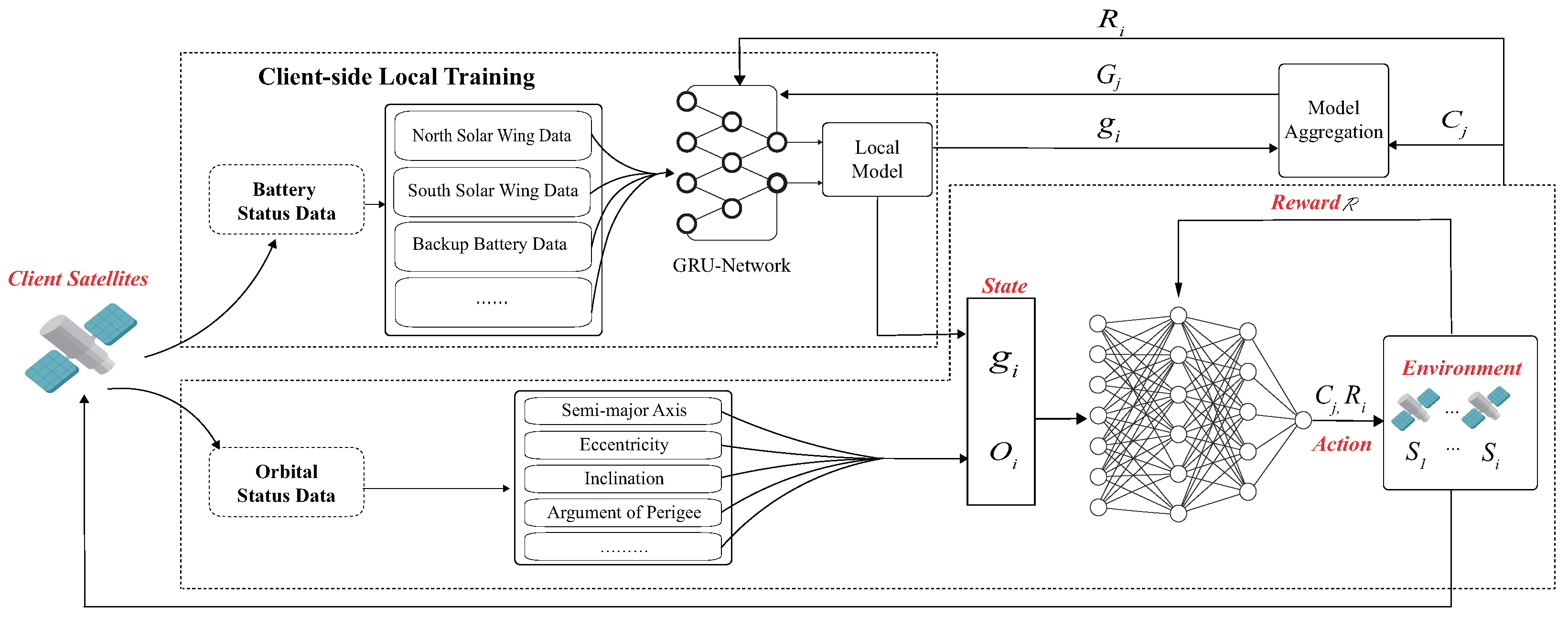
- Client Satellites: Client Satellites (CSs) refer to satellites with battery parameter prediction requirements. These CSs are equipped with onboard processing capabilities, allowing them to locally run neural network models and perform real-time analysis of battery parameter changes. Based on their distance from the Earth’s surface, CSs can be categorized into three types: Low Earth Orbit (LEO), Medium Earth Orbit (MEO), and Geostationary Earth Orbit (GEO) CSs. This paper uses data from LEO satellites for scheme design and related experiments. LEO CSs positioned at altitudes between 200 and 2000 km form the primary components of satellite constellations, handling the majority of satellite-to-ground data transmission tasks [23]. LEO CS payloads are typically smaller, with relatively low onboard processing capabilities. Additionally, due to their proximity to Earth, LEO CSs travel at the highest orbital speeds, typically around 27,000 km/h.
- Satellite Battery System: The satellite energy system comprises two primary components: dual solar wings (north and south) and a backup battery management system. These components work in concert to support continuous and efficient energy harvesting, storage, and regulation throughout the satellite’s operation [24].
- –
- Dual Solar Wings (North and South): Mounted on opposite sides of the satellite, the solar wings collect solar energy depending on the satellite’s orientation relative to the sun. Their complementary positioning enables consistent power generation across orbital cycles, maximizing energy intake during sunlit phases regardless of attitude or orbital path.
- –
- Backup Battery Management System: While the solar wings serve as the primary power source, the backup battery system ensures uninterrupted operation during eclipse phases. It stores surplus energy generated during sunlight exposure and supplies power when solar input is unavailable, thus maintaining stable power delivery for critical functions.
- –
- Current: The electrical current flowing through the north and south solar wings indicates the actual energy being generated by the solar arrays. By predicting current levels, it is possible to detect irregularities such as shading, degradation of solar cells, or connection issues, which could compromise energy collection and distribution.
- –
- Voltage: The voltage readings from the solar wings and backup battery system reflect the operational status of the power supply. Sudden drops or spikes in voltage can signify problems such as circuit malfunctions, overcharging, or energy distribution imbalances. Accurate voltage prediction ensures the system remains stable and prevents overloading or power outages.
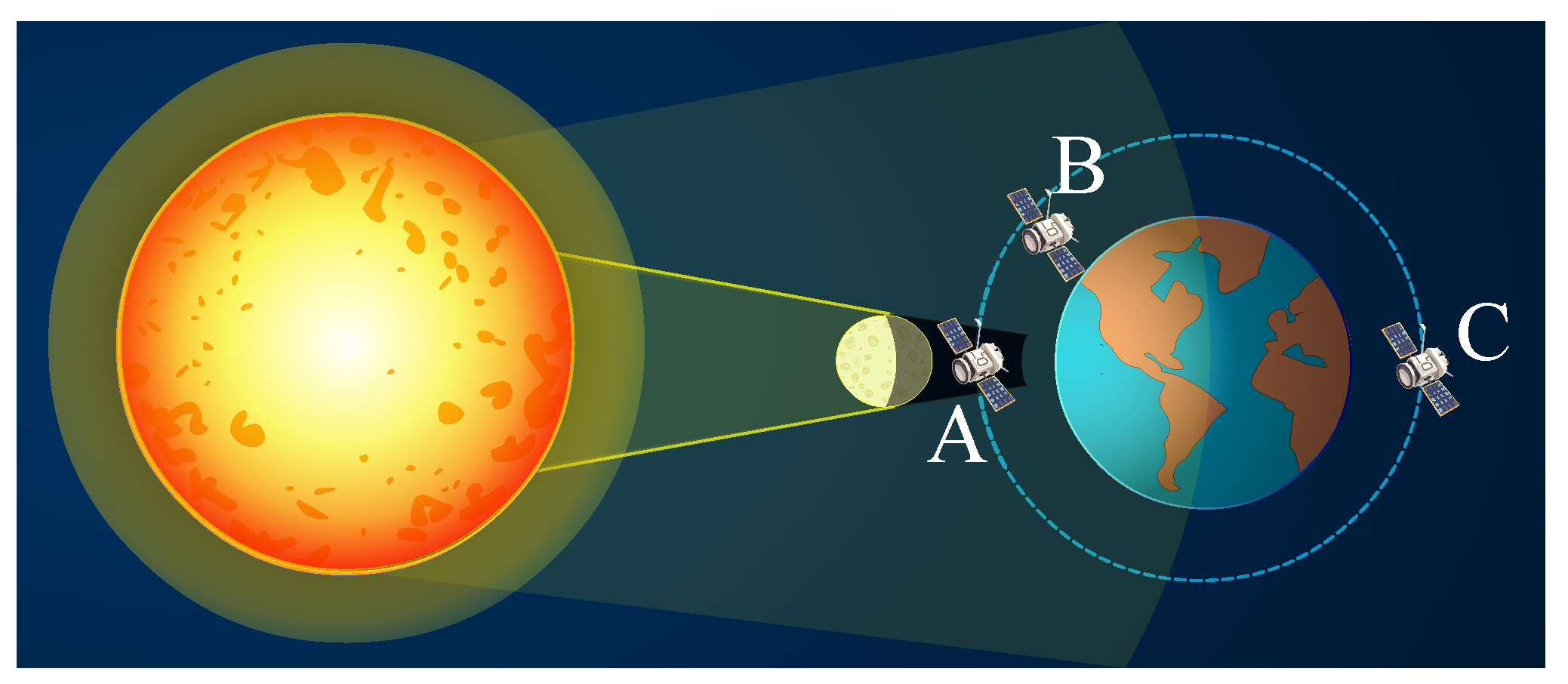
- Satellite Position: The position of a CS is directly related to its orbital elements. As the CS moves and time progresses, it continuously transitions between three states: sunlight, Earth shadow, and Lunar shadow. The CS’s battery behavior also varies across these three states, exhibiting different characteristics in each [27].
- –
- Sunlight: When in direct sunlight, the CS can maximize solar energy collection, ensuring that its solar panels operate at peak efficiency. Typically, CSs spend the majority of their orbital time in sunlight.
- –
- Earth Shadow: When a CS moves to the far side of the Earth, sunlight is blocked by the Earth. The closer the CS is to the center of Earth’s shadow, the lower the energy generation capacity of its solar panels. Typically, a CS remains in Earth’s shadow for a relatively short period.
- –
- Lunar Shadow: Similar to Earth’s shadow, when a CS is blocked by the Moon, the energy generation capacity of its solar panels also decreases. However, due to the smaller size of the Moon, the CS spends a shorter time in Lunar shadow. As a result, the CS’s battery dynamics during this period is more unstable.
- Gateway Station: Gateway Station (GS) is a critical component in a satellite constellation, primarily responsible for orchestrating the CSs. It uplinks commands to CSs to adjust their operations, such as orbital maneuvers, attitude control, and system configuration. It downlinks telemetry data from satellites, providing real-time monitoring of their status. A typical GS can manage varying portions of the Earth’s surface depending on the satellite’s orbit. For LEO satellites, a single GS typically covers an area with a radius of 300–500 km, corresponding to approximately 0.5–1% of the Earth’s surface. In contrast, a GS for MEO satellites can cover a much broader region—typically 5–10% of the surface—while a GS serving GEO satellites may cover up to one-third of the Earth. Owing to the GS’s role as the central hub for coordinating CS activities, we designate it as the central controller in the ObsBattery system. Its primary responsibilities include synchronizing information across CSs, performing model aggregation, and managing model updates in FL framework.
3.2. Workflow of ObsBattery
- (1)
- Initial Model Preparation: At the beginning of each communication cycle, the GS prepares a set of global models by initializing multiple cluster templates based on anticipated variations in sunlight intensity. These models are not yet bound to specific satellites, as the actual CS grouping has not been determined. This step serves as the foundation for subsequent assignment.
- (2)
- CS Identification: The GS broadcasts a query to all satellites within its coverage to detect available participants. Satellites that are willing to join the current training round respond with a beacon and register as CSs.
- (3)
- Dueling DQN-Based CS Clustering: Once the set of active CSs is identified, the GS uses their static attributes—such as battery capacity and orbital parameters (i.e., the Six Keplerian Elements)—along with the current timestamp to compute their real-time positions. A Dueling Deep Q-Network (Dueling DQN) then assigns each CS to the most appropriate cluster based on its current location and expected solar exposure.
- (4)
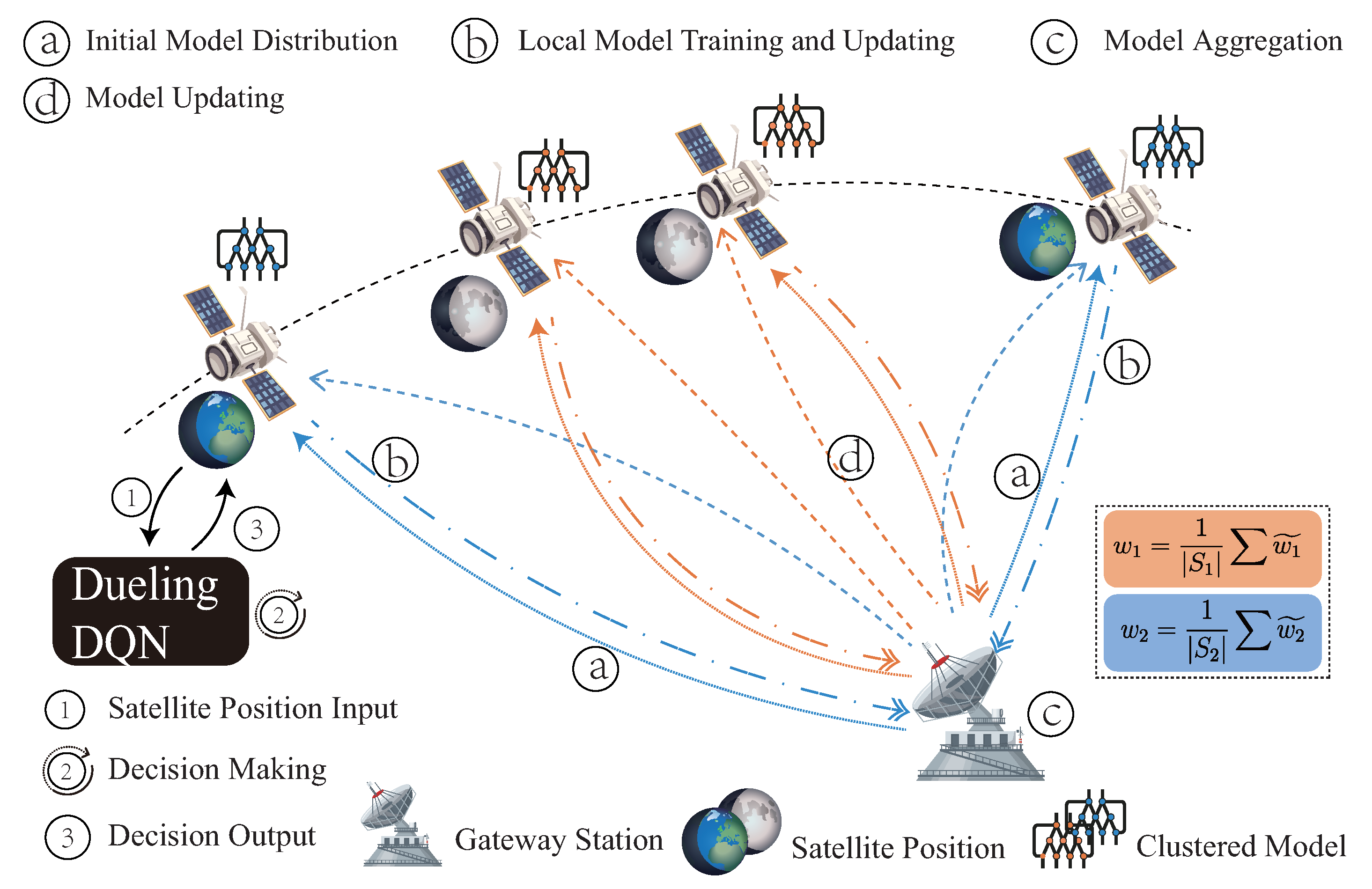
- Model Distribution and Training Round Decision: The GS distributes the newest global models to the CSs according to its assigned cluster (Process a in Figure 2). In addition, to balance energy usage and model performance, the Dueling DQN also determines the number of local training rounds for each CS. Satellites with higher solar input are allowed to train longer, while those under low sunlight operate fewer rounds to conserve power. After completing the assigned local training rounds, each CS uploads its locally updated model to the GS for aggregation (Process b in Figure 2).
- (5)
- Model Aggregation and Update: ObsBattery adopts an online FL paradigm: when a CS uploads its local model, the GS immediately updates the corresponding cluster’s global model and broadcasts the new version. Steps 4–5 are then repeated periodically to adapt to dynamic changes in satellite positions and energy states. These processes correspond to c and d in Figure 2.
4. Problem Description and Formulation
4.1. Satellite Position and Battery Capacity
4.2. Satellite Clustering
4.3. Battery Parameter Prediction
4.4. Training Cost and Battery Efficiency
4.5. Optimization Objective
5. ObsBattery Framework
5.1. GRU-Based FL Battery Parameter Prediction
- (a)
- Update Gate (): Given that the current input includes both position data and battery parameters , the update gate is calculated as follows:where is the previous hidden state, and are the satellite’s position and battery parameter at time t, and are the weight matrix and bias term, and denotes the sigmoid activation function.
- (b)
- Reset Gate ():where and are the weight matrix and bias term for the reset gate.
- (c)
- Candidate Hidden State ():where and are the weight matrix and bias term, and tanh is the hyperbolic tangent activation function.
- (d)
- Final Hidden State ():
5.2. Dueling DQN-Based Joint Decision for Clustering and Training Rounds
5.2.1. MDP Formulation
- State : Represents the environment and model status of satellite at time t. It is defined as follows:where is the satellite’s real-time orbital position, and denotes the current state of its battery prediction model. In implementation, expands to the six Keplerian elements (and derived illumination when available), while is a compact feature vector summarizing the current prediction model (e.g., recent loss statistics and hidden representation), giving a fixed-dimensional state input.
- Action : Consists of two parts:where indicates the assigned cluster, and specifies the number of local training rounds. Thus the discrete action space size is ; each action index encodes a pair (cluster ID, local round count), enabling the agent to jointly pick grouping and computational intensity.
- Transition function : Captures the stochastic evolution of satellite states under orbital motion and model updates. Although not modeled explicitly, it is implicitly learned through exploration.
- Reward function : Balances prediction performance and battery cost. Following the objective in Equation (13), it is defined as follows:where is the prediction error defined at Equation (8), is the battery efficiency ratio defined at Equation (12); , are weights that control the trade-off between accuracy and energy, with values depending on the requirements of different tasks for model accuracy.
- Discount factor : A scalar that controls the relative importance of future rewards.
5.2.2. Dueling DQN Solution
| Algorithm 1 Dueling DQN for Clustering and Training Decision. |
Input: Satellite states Output: Cluster , rounds
|
5.3. Integration Algorithm of FL and Dueling DQN
6. Simulation
6.1. Experimental Environment and Dataset Setup
6.2. Simulation Design
| Algorithm 2 FL with Dueling DQN-Based Satellite Clustering and Training Optimization. |
Input: Satellite local data, initial global model, clustering strategy, maximum number of iterations. Output: Converged global model.
|
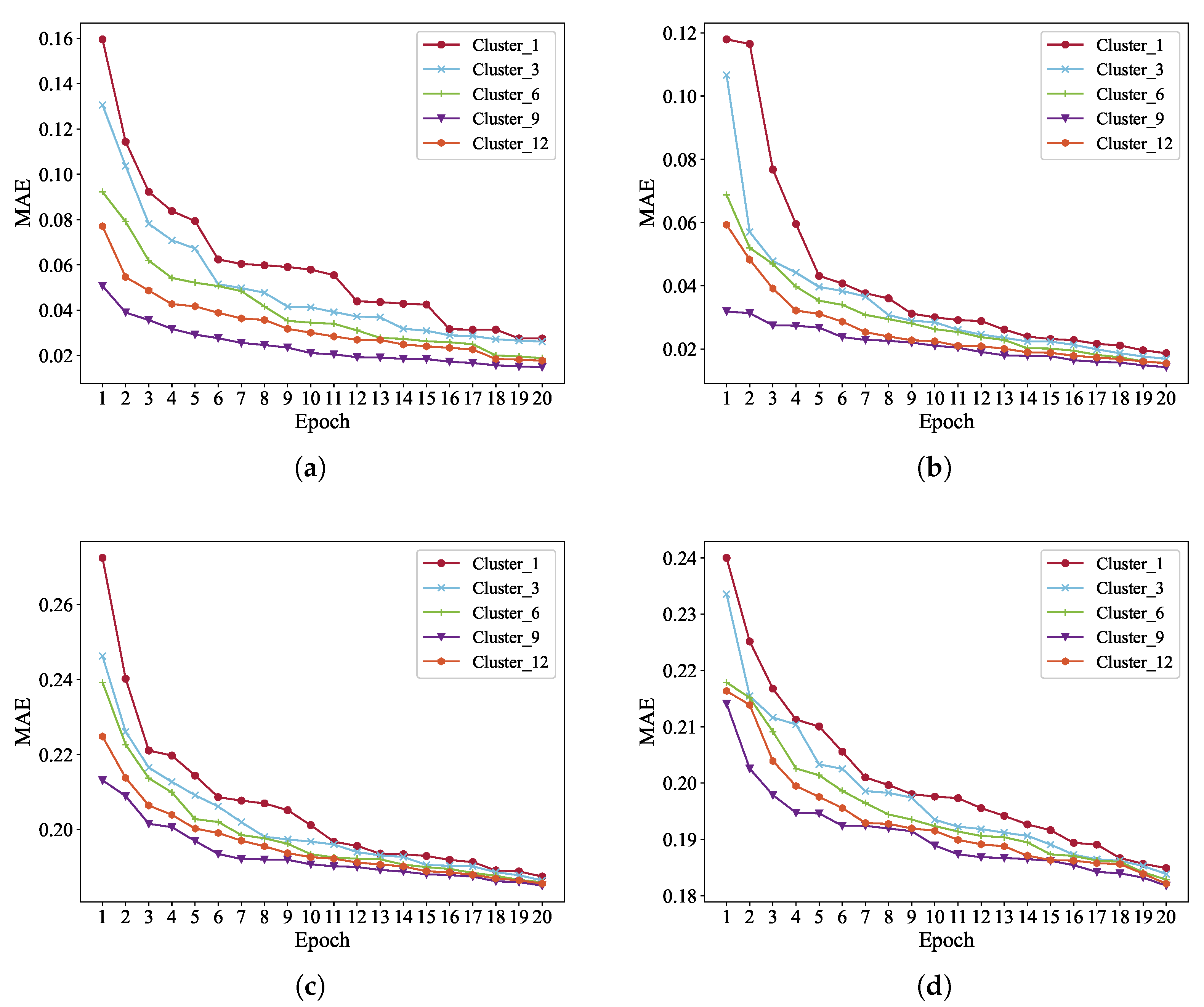
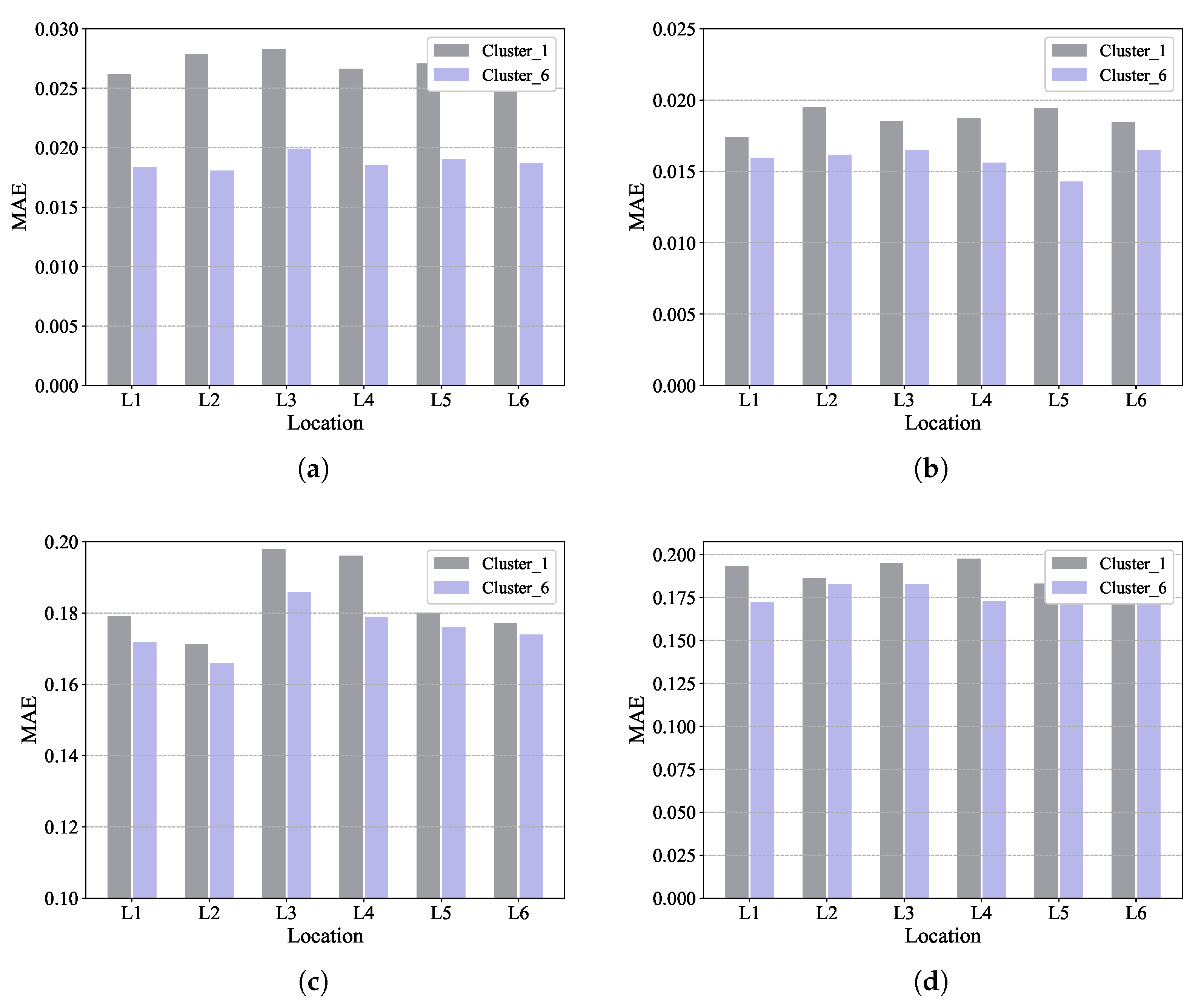
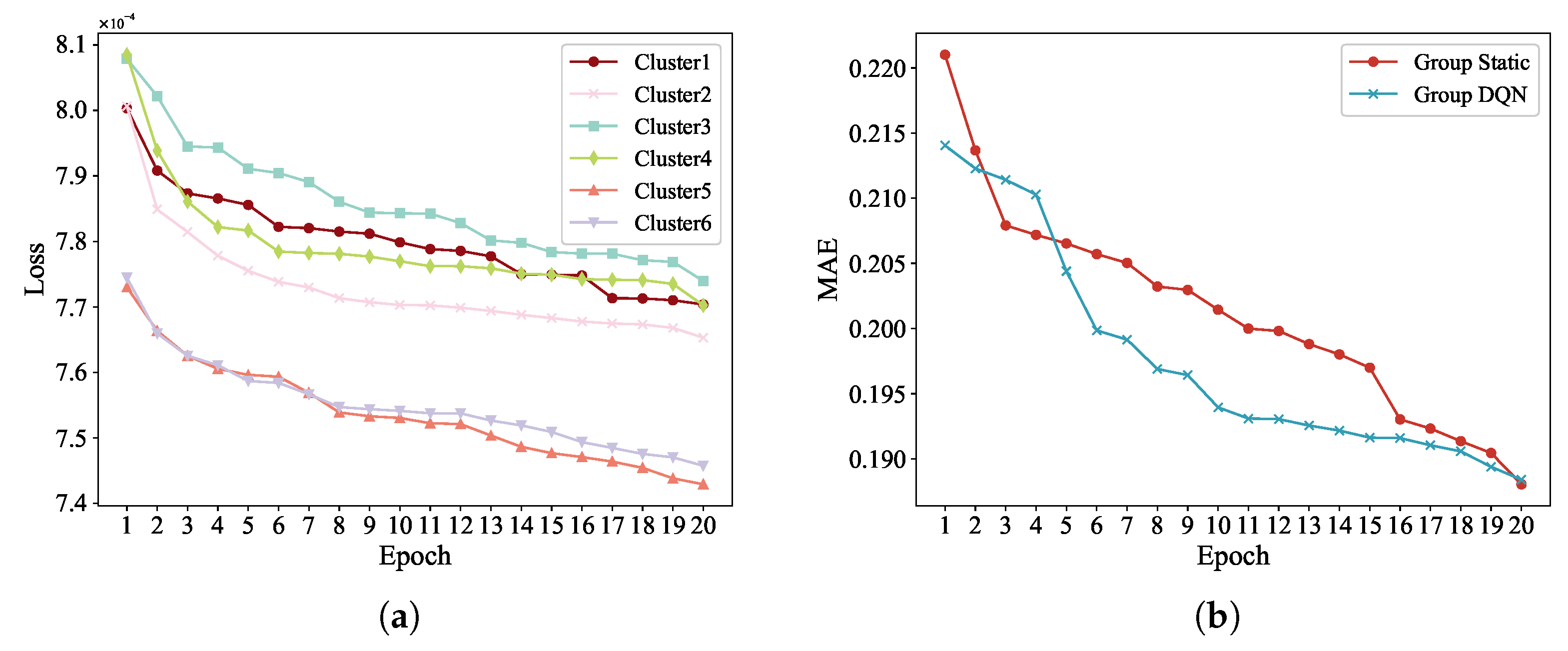
- To investigate the effect of clustering on model accuracy, we compare the performance of a non-clustering approach (i.e., a single global model shared by all satellites) with scenarios involving varying numbers of clusters. To ensure a fair comparison, the same number of training rounds is applied across all clusters.
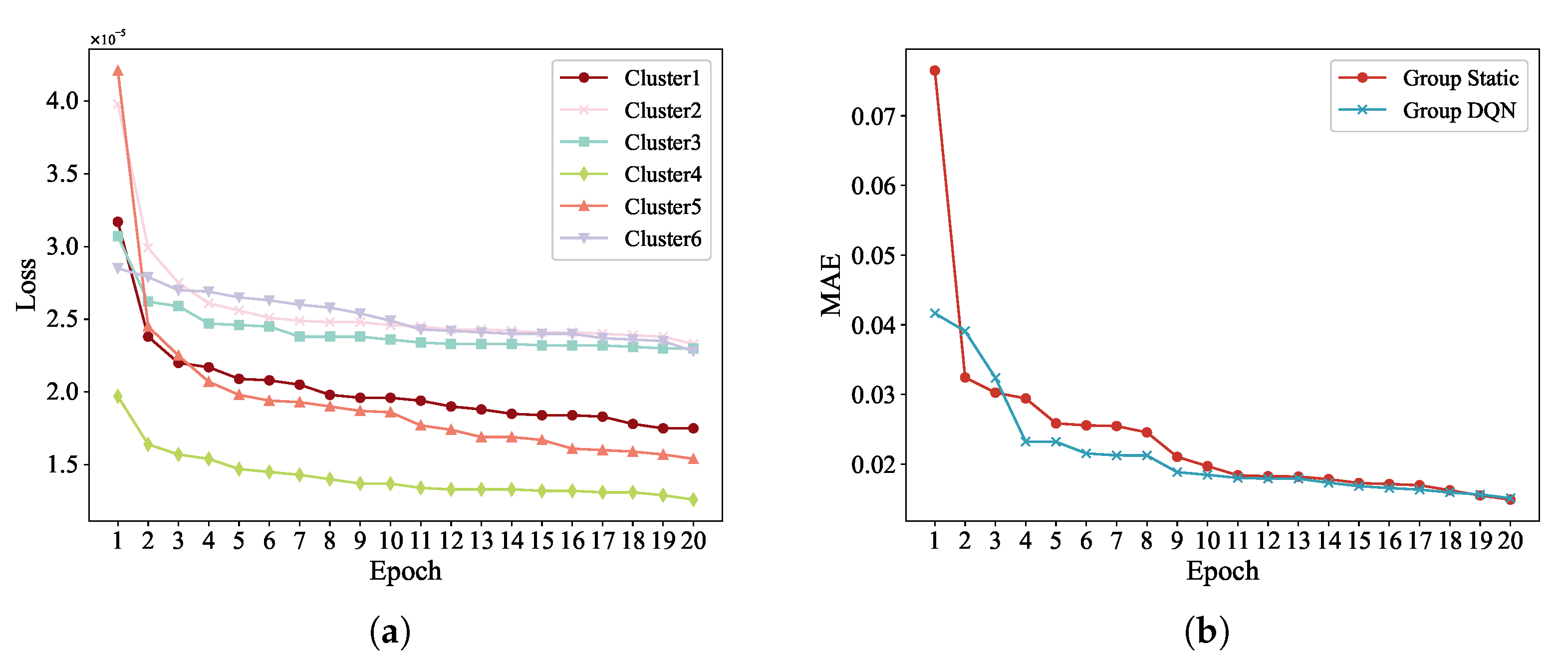
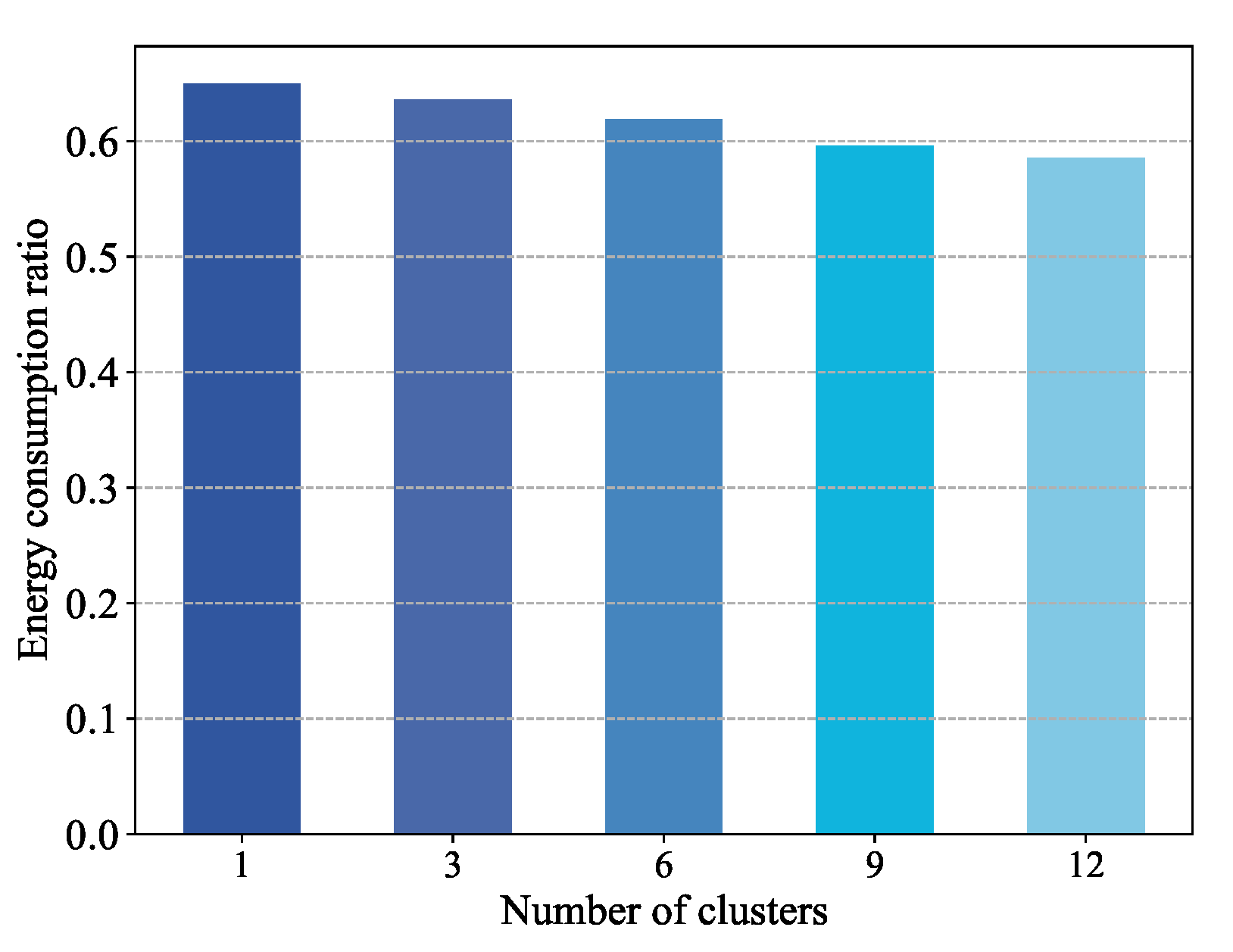
- To evaluate the energy consumption efficiency of the FL training process, we measure the training parameters of the satellite model under different public health strategies, as shown in Equation (12). The purpose is to investigate the impact of adjusting the number of training rounds on the model convergence effect and the energy efficiency of the training process.
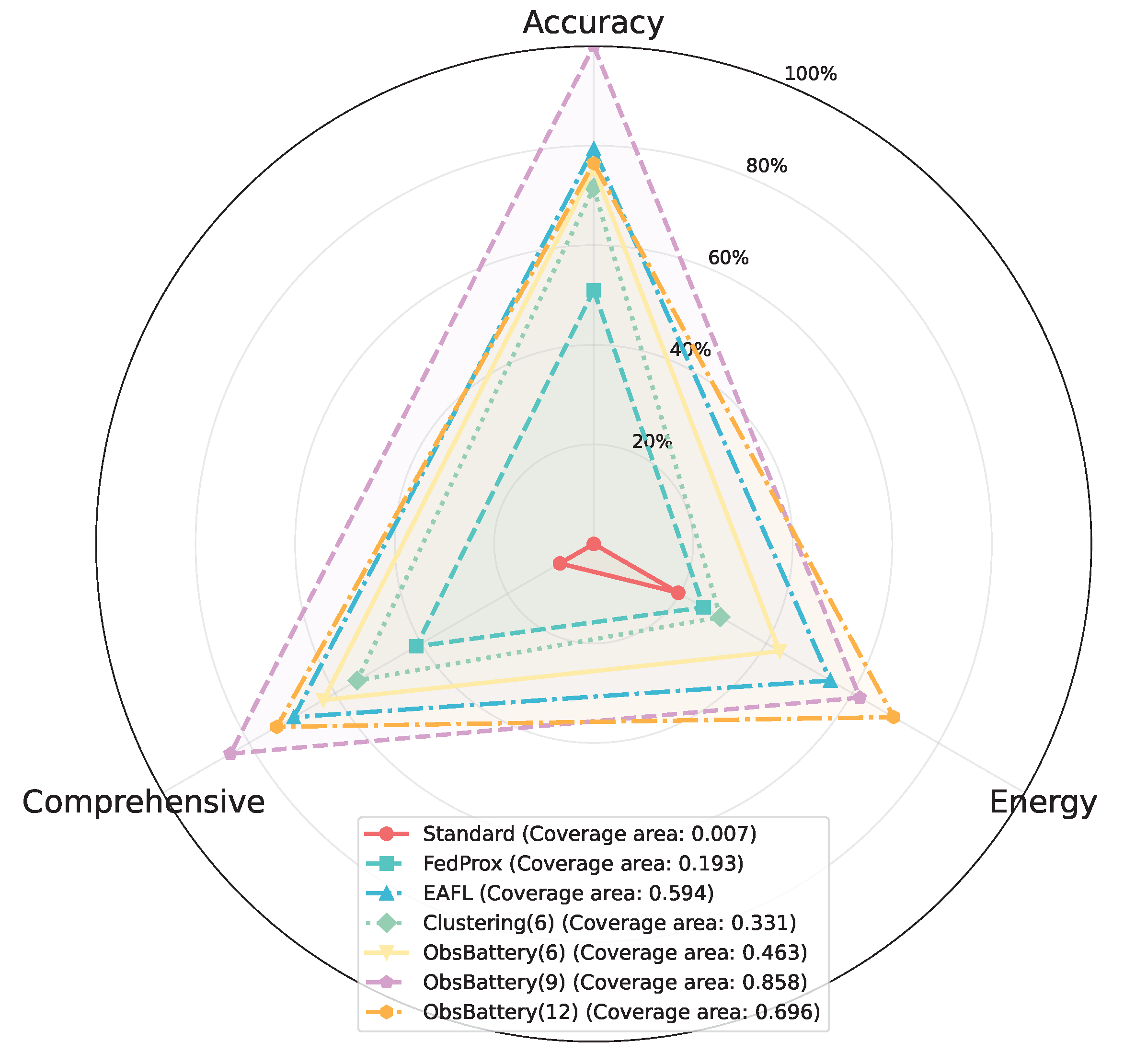
- The comprehensive performance simulation combines the previous two experiments and evaluates the system’s overall performance, considering both model accuracy and energy consumption. We compare ObsBattery’s approach with other FL solutions regarding the balance between training efficiency, energy usage, and model prediction accuracy. In this context, we compare ObsBattery against baseline schemes with no clustering or dynamic training control, referred to as the Standard Group.
6.3. Clustering Accuracy Evaluation
- Cluster_1 (Standard Group): No clustering; all satellites share a single global model.
- Cluste_3: Satellites are grouped into 3 clusters.
- Cluster_6: Satellites are grouped into 6 clusters.
- Cluster_9: Satellites are grouped into 9 clusters.
- Cluster_12: Satellites are grouped into 12 clusters.
6.4. Energy Efficiency Evaluation
- Group Static: Satellites are divided into six clusters, and each satellite performs a fixed number of local training rounds.
- Group DQN: Satellites are also divided into six clusters, but the number of training rounds for each satellite is dynamically adjusted by the Dueling DQN agent, within a bounded range of 3 to 15.
6.5. Comprehensive Performance Evaluation
- Standard Group: A conventional FL method resembling FedAvg, where satellites share a single global model without clustering or adaptive training round control.
- FedProx: An FL algorithm that extends FedAvg by introducing a proximal term in the local objective to address heterogeneity in data and computation capabilities [29].
- EAFL: An energy-aware FL strategy that selectively involves satellites with sufficient battery levels, aiming to optimize time-to-accuracy while minimizing energy depletion [17].
- Clustering Only (6): An enhanced FL method that partitions satellites into six clusters to train localized models, but does not apply dynamic adjustment of training epochs.
- ObsBattery (6): The proposed method with six clusters and Dueling DQN-based adaptive training round control to optimize both performance and energy efficiency.
- ObsBattery (9): A variant of ObsBattery using nine clusters, found to achieve the best overall balance between accuracy and energy consumption.
- ObsBattery (12): A variant using twelve clusters, which further improves energy allocation granularity but may reduce accuracy due to over-segmentation of data.
7. Conclusions
Author Contributions
Funding
Institutional Review Board Statement
Informed Consent Statement
Data Availability Statement
Conflicts of Interest
Abbreviations
| t | Index of discretized time slot (in seconds) |
| The i-th client satellite (CS) | |
| S | Set of all active client satellites |
| Battery parameter dataset of satellite | |
| Observed battery status vector of at time t | |
| Predicted battery status of at time by local model | |
| Sequence of battery status from to t | |
| Six Keplerian Elements (orbital parameters) of satellite | |
| Real-time orbital state of at time t | |
| Illumination intensity of at time t | |
| Cluster j containing satellites with similar energy profiles | |
| M | Total number of clusters |
| Binary indicator whether | |
| Local model of satellite in cluster | |
| Global model aggregated from satellites in cluster | |
| Battery status of at time t predicted by | |
| Predicted sequence by global model | |
| Local one-step prediction error of at time t | |
| Mean prediction error (MAE) of global model over | |
| Number of local training rounds performed by | |
| Total energy consumed by for local training | |
| Computation capability of | |
| Communication rate of | |
| Orbital impact factor of during round r | |
| Power supply capacity of |
| E | Minimum battery reserve for basic satellite operation |
| Battery efficiency ratio of during training | |
| Trade-off weights between accuracy and energy | |
| Thresholds for model accuracy and energy constraints |
References
- Lee, J.; Kim, E.; Shin, K.G. Design and management of satellite power systems. In Proceedings of the 2013 IEEE 34th Real-Time Systems Symposium, Vancouver, BC, Canada, 3–6 December 2013; pp. 97–106. [Google Scholar]
- Rodrigues, I.P.; Oliveira, P.A.; Ambrosio, A.M.; Chagas, R.A. Modeling satellite battery aging for an operational satellite simulator. Adv. Space Res. 2021, 67, 1981–1999. [Google Scholar] [CrossRef] [Scilit]
- Cao, M.; Zhang, T.; Yu, B.; Liu, Y. A method for interval prediction of satellite battery state of health based on sample entropy. IEEE Access 2019, 7, 141549–141561. [Google Scholar] [CrossRef] [Scilit]
- Suo, M.; Zhu, B.; An, R.; Sun, H.; Xu, S.; Yu, Z. Data-driven fault diagnosis of satellite power system using fuzzy Bayes risk and SVM. Aerosp. Sci. Technol. 2019, 84, 1092–1105. [Google Scholar] [CrossRef] [Scilit]
- Yun, S.T.; Kong, S.H. Data-driven in-orbit current and voltage prediction using Bi-LSTM for LEO satellite lithium-ion battery SOC estimation. IEEE Trans. Aerosp. Electron. Syst. 2022, 58, 5292–5306. [Google Scholar] [CrossRef] [Scilit]
- Wang, C.; Lu, N.; Wang, S.; Cheng, Y.; Jiang, B. Dynamic long short-term memory neural-network-based indirect remaining-useful-life prognosis for satellite lithium-ion battery. Appl. Sci. 2018, 8, 2078. [Google Scholar] [CrossRef] [Scilit]
- Luo, T.; Liu, M.; Shi, P.; Duan, G.; Cao, X. A hybrid data preprocessing-based hierarchical attention BiLSTM network for remaining useful life prediction of spacecraft lithium-ion batteries. IEEE Trans. Neural Netw. Learn. Syst. 2023, 35, 18076–18089. [Google Scholar] [CrossRef] [Scilit] [PubMed]
- Gao, M.; Xu, G.; Song, Z.; Zhang, Q.; Zhang, W. Performance Analysis of LEO Satellite-Assisted Deep Space Communication Systems. IEEE Trans. Aerosp. Electron. Syst. 2025, 61, 12628–12648. [Google Scholar] [CrossRef] [Scilit]
- Qiu, X.; Liao, S.; Yang, D.; Li, Y.; Wang, S. Visual geo-localization and attitude estimation using satellite imagery and topographical elevation for unmanned aerial vehicles. Eng. Appl. Artif. Intell. 2025, 153, 110759. [Google Scholar] [CrossRef] [Scilit]
- Shangguang, W.; Qiyang, Z.; Ruolin, X.; Fei, Q.; Mengwei, X. The first verification test of space-ground collaborative intelligence via cloud-native satellites. China Commun. 2024, 21, 208–217. [Google Scholar] [CrossRef] [Scilit]
- Chen, H.; Xiao, M.; Pang, Z. Satellite-based computing networks with federated learning. IEEE Wirel. Commun. 2022, 29, 78–84. [Google Scholar] [CrossRef] [Scilit]
- Li, Q.; Wang, S.; Ma, X.; Zhou, A.; Wang, Y.; Liu, X.; Huang, G. Battery-Aware Energy Optimization for Satellite Edge Computing. IEEE Trans. Serv. Comput. 2024, 17, 437–451. [Google Scholar] [CrossRef] [Scilit]
- Amiri, M.N.; Håkansson, A.; Burheim, O.S.; Lamb, J.J. Lithium-ion battery digitalization: Combining physics-based models and machine learning. Renew. Sustain. Energy Rev. 2024, 200, 114577. [Google Scholar] [CrossRef] [Scilit]
- Jondhle, H.; Nandgaonkar, A.B.; Nalbalwar, S.; Jondhle, S.; Iyer, B.R. Recurrent Neural Network-Based Energy Management System in Electric Vehicle Application with Hybrid Energy Sources. In ICT: Innovation and Computing; Joshi, A., Mahmud, M., Ragel, R.G., Karthik, S., Eds.; Springer: Singapore, 2024; pp. 57–70. [Google Scholar] [CrossRef] [Scilit]
- Wang, Y.; Tian, J.; Sun, Z.; Wang, L.; Xu, R.; Li, M.; Chen, Z. A comprehensive review of battery modeling and state estimation approaches for advanced battery management systems. Renew. Sustain. Energy Rev. 2020, 131, 110015. [Google Scholar] [CrossRef] [Scilit]
- Nascimento, R.G.; Corbetta, M.; Kulkarni, C.S.; Viana, F.A. Hybrid physics-informed neural networks for lithium-ion battery modeling and prognosis. J. Power Sources 2021, 513, 230526. [Google Scholar] [CrossRef] [Scilit]
- Arouj, A.; Abdelmoniem, A.M. Towards Energy-Aware Federated Learning on Battery-Powered Clients. In Proceedings of the 1st ACM Workshop on Data Privacy and Federated Learning Technologies for Mobile Edge Network, Sydney, NSW, Australia, 17 October 2022; pp. 7–12. [Google Scholar] [CrossRef] [Scilit]
- Albelaihi, R.; Yu, L.; Craft, W.D.; Sun, X.; Wang, C.; Gazda, R. Green Federated Learning via Energy-Aware Client Selection. In Proceedings of the GLOBECOM 2022—2022 IEEE Global Communications Conference, Rio de Janeiro, Brazil, 4–8 December 2022; pp. 13–18. [Google Scholar] [CrossRef] [Scilit]
- Zaw, C.W.; Pandey, S.R.; Kim, K.; Hong, C.S. Energy-Aware Resource Management for Federated Learning in Multi-Access Edge Computing Systems. IEEE Access 2021, 9, 34938–34950. [Google Scholar] [CrossRef] [Scilit]
- Yu, C.; Shen, S.; Zhang, K.; Zhao, H.; Shi, Y. Energy-Aware Device Scheduling for Joint Federated Learning in Edge-assisted Internet of Agriculture Things. In Proceedings of the 2022 IEEE Wireless Communications and Networking Conference (WCNC), Austin, TX, USA, 10–13 April 2022; pp. 1140–1145. [Google Scholar] [CrossRef] [Scilit]
- Aloqaily, M.; Ridhawi, I.A.; Guizani, M. Energy-Aware Blockchain and Federated Learning-Supported Vehicular Networks. IEEE Trans. Intell. Transp. Syst. 2022, 23, 22641–22652. [Google Scholar] [CrossRef] [Scilit]
- Li, Y.; Liang, W.; Li, J.; Cheng, X.; Yu, D.; Zomaya, A.Y.; Guo, S. Energy-Aware, Device-to-Device Assisted Federated Learning in Edge Computing. IEEE Trans. Parallel Distrib. Syst. 2023, 34, 2138–2154. [Google Scholar] [CrossRef] [Scilit]
- Xu, Y.; Liu, Y.; Lei, M.; Gao, M.; Fang, Z.; Jiang, C. Joint pseudo-range and Doppler positioning method with LEO Satellites‘ signals of opportunity. Satell. Navig. 2025, 6, 10. [Google Scholar] [CrossRef] [Scilit]
- Liu, Y.; Cheng, Y.; Bao, K.; Li, H.; Wan, Z. Design of Power Supply System for High Power SAR Satellite. J. Phys. Conf. Ser. 2022, 2361, 012016. [Google Scholar] [CrossRef] [Scilit]
- Kang, S.; Gao, Y.; Song, Y.; Zhou, R.; Pang, J. Parameter probabilistic prediction for satellite power system based on unsupervised multi-dimensional sequence segmentation. Aerosp. Sci. Technol. 2024, 146, 108933. [Google Scholar] [CrossRef] [Scilit]
- Ren, S.; Hu, W.; Kyle, B.; Dylan, H.; Laura, M.; Brian, M.; Jordan, M. Automated Extraction of Energy Systems Information from Remotely Sensed Data: A Review and Analysis. Appl. Energy 2022, 326, 119876. [Google Scholar] [CrossRef] [Scilit]
- Liu, Y.; Guo, X.; Yang, X. Beidou Ephemeris Analysis and Real-Time Satellite Position Calculation. Mod. Navig. 2022, 13, 109–113. [Google Scholar]
- Wang, Z.; Schaul, T.; Hessel, M.; Hasselt, H.; Lanctot, M.; Freitas, N. Dueling network architectures for deep reinforcement learning. In Proceedings of the International Conference on Machine Learning, New York, NY, USA, 19–24 June 2016; pp. 1995–2003. [Google Scholar]
- Li, T.; Sahu, A.K.; Zaheer, M.; Sanjabi, M.; Talwalkar, A.; Smith, V. Federated optimization in heterogeneous networks. Proc. Mach. Learn. Syst. 2020, 2, 429–450. [Google Scholar]




| Layer | Input | Output | Parameters |
|---|---|---|---|
| GRU | (B, 15, 1) | (B, 15, 64) | 12,480 |
| Fully Connected | (B, 64) | (B, 1) | 65 |
| Algorithm | Accuracy | Energy | Comprehensive |
|---|---|---|---|
| Standard Group | 0.759 | 0.779 | 0.767 |
| FedProx | 0.811 | 0.785 | 0.801 |
| EAFL | 0.840 | 0.815 | 0.830 |
| Clustering only (6) | 0.832 | 0.789 | 0.815 |
| ObsBattery (6) | 0.836 | 0.803 | 0.823 |
| ObsBattery (9) | 0.861 | 0.822 | 0.845 |
| ObsBattery (12) | 0.837 | 0.830 | 0.834 |
Disclaimer/Publisher’s Note: The statements, opinions and data contained in all publications are solely those of the individual author(s) and contributor(s) and not of MDPI and/or the editor(s). MDPI and/or the editor(s) disclaim responsibility for any injury to people or property resulting from any ideas, methods, instructions or products referred to in the content. |
© 2025 by the authors. Licensee MDPI, Basel, Switzerland. This article is an open access article distributed under the terms and conditions of the Creative Commons Attribution (CC BY) license (https://creativecommons.org/licenses/by/4.0/).
Share and Cite
Jiang, S.; Wang, B.; Zhang, X.; Jiang, Y.; Liu, S.; Zhao, Z.; Li, R.; Chen, X. ObsBattery: Position-Aware Federated Learning with Dueling DQN Clustering and Training Adaptation for Satellite Battery Prediction. Electronics 2025, 14, 4697. https://doi.org/10.3390/electronics14234697
Jiang S, Wang B, Zhang X, Jiang Y, Liu S, Zhao Z, Li R, Chen X. ObsBattery: Position-Aware Federated Learning with Dueling DQN Clustering and Training Adaptation for Satellite Battery Prediction. Electronics. 2025; 14(23):4697. https://doi.org/10.3390/electronics14234697
Chicago/Turabian StyleJiang, Shuo, Boyu Wang, Xuan Zhang, Yaoxian Jiang, Shuyi Liu, Zhenyu Zhao, Ruide Li, and Xiao Chen. 2025. "ObsBattery: Position-Aware Federated Learning with Dueling DQN Clustering and Training Adaptation for Satellite Battery Prediction" Electronics 14, no. 23: 4697. https://doi.org/10.3390/electronics14234697
APA StyleJiang, S., Wang, B., Zhang, X., Jiang, Y., Liu, S., Zhao, Z., Li, R., & Chen, X. (2025). ObsBattery: Position-Aware Federated Learning with Dueling DQN Clustering and Training Adaptation for Satellite Battery Prediction. Electronics, 14(23), 4697. https://doi.org/10.3390/electronics14234697