Article

Robust Predictors of Mobile Phone Reliance for Information Seeking: A Multi-Stage Empirical Analysis and Validation


by
Daniel Homocianu
and
Vasile-Daniel Păvăloaia
*
Department of Accounting, Business Information Systems and Statistics, Faculty of Economics and Business Administration, Alexandru Ioan Cuza University of Iasi, 700506 Iasi, Romania
*
Author to whom correspondence should be addressed.
Electronics 2025, 14(23), 4679; https://doi.org/10.3390/electronics14234679
Submission received: 20 October 2025 / Revised: 22 November 2025 / Accepted: 25 November 2025 / Published: 27 November 2025
(This article belongs to the Special Issue Advanced Research in Technology and Information Systems, 2nd Edition)

Abstract

This study examines factors driving reliance on mobile phones as a primary information source. Using Information-Seeking Complementarity Theory (ISCT), which posits that frequent use of diverse media channels builds digital habits that reinforce mobile reliance, we analyze World Values Survey (WVS) Time Series 1981–2022 (v4.0), validated with WVS v5.0 and Integrated Values Survey (IVS). A multi-stage pipeline integrates AdaBoost (R 4.3.1), LASSO/BMA (Stata v17), Histogram Gradient Boosting (Python 3.12.7), and mixed-effects logistic regression. Missing data (DK/NA) were excluded or median-imputed. The final model (AUC-ROC > 0.85) identifies five robust predictors: age (negative), and positive associations with digital mail, online social networks, peer interaction, and radio listening—all stable across methods, datasets, and reverse causality checks. Subgroup analysis reveals stronger effects among males, unmarried individuals, urban residents, and higher education/employment groups. Nomograms enable probabilistic forecasting and policy simulation. By identifying technology-agnostic behavioral drivers validated across three decades of global survey data (1981–2022), with mobile reliance measured from 2010 onward, this work provides a transparent, replicable predictive framework with implications for emerging AI and wearable contexts.

1. Introduction

In recent years, mobile phones have become ubiquitous devices that have transformed how we access information and engage in e-commerce [1]. With the advent of smartphones and the increasing availability of internet connectivity, individuals now have instant access to a wealth of information and online transactions [2]. The development of mobile technology has provided new ways for information seeking and online shopping, revolutionizing our interaction with the digital world [3,4].

1.1. Research Context and Rationale

The use of mobile phones as a source of information significantly impacted how individuals seek and consume information. Research by [5] demonstrated that mobile phones have become primary devices for accessing information, surpassing traditional sources such as desktop computers and laptops [6]. The convenience, portability, and proliferation of mobile applications tailored for specific information needs further enhanced this role [7,8,9].
In addition to information seeking, mobile phones have emerged as powerful tools for e-commerce. The growth of mobile e-commerce (m-commerce) also relies on the increasing number of smartphone users, their affordability, and the availability of mobile-optimized websites and apps [10,11,12]. Studies have shown that mobile phones have become an integral part of the online shopping experience [13]. According to research by [14], mobile e-commerce has experienced substantial growth, with consumers increasingly relying on their mobile phones for product searches, price comparisons, and online purchases.
The rise of m-commerce is due to several factors [15]. First, mobile phones contribute to a seamless and personalized shopping experience, empowering users to inspect products, conduct price comparisons, read reviews, and make straightforward purchases with just a few taps [16,17]. Secondly, integrating mobile payment systems has simplified the payment process, enhancing the convenience and security of mobile transactions [18]. Thirdly, location-based services and personalized recommendations on mobile platforms improved the overall shopping experience by tailoring offers and promotions to individual preferences [19,20]. Fourthly, a diverse range of businesses have emerged and become accessible through digital social networks (SNs) for e-commerce purposes [21].
When first exploring the comprehensive dataset of the WVS (version 4.0), a specific variable emerged. It captured the frequency of using a mobile phone as an information source [22]. This variable exhibited strong correlations with five other variables. Using various data mining tools and techniques, along with additional datasets from the same provider, the current analysis expands the understanding of the above topic [23,24,25].

1.2. Novelty and Contributions

This study addresses a critical gap by providing a robust, data-driven analysis of the key variables that influence a person’s use of a mobile phone as a source of information. Our research focuses on identifying how these core variables (age, frequency of using digital mail, online social networks, peer communication, and radio) are associated with mobile information acquisition behavior. By focusing on these specific predictors, we aim to provide a nuanced understanding of user patterns. The necessity of this research lies in its practical application: the findings are essential for designing user-centric mobile applications and informing policy decisions aimed at fostering digital inclusion. Our comprehensive methodology, which employs multiple analytical techniques to confirm these variables, demonstrates the feasibility and rigor of our approach in creating a reliable predictive model.
Furthermore, this study offers valuable insights for designing user interfaces (UI) for mobile operating systems and dedicated applications, as UI design is the initial point of interaction between users and applications and is crucial for success regardless of complexity, functionality, or performance [26,27,28].
While we employed known software and algorithms, the novelty and significance of this work do not stem from the creation of new computational tools but rather from their unique application and systematic integration to address a critical gap in the literature. Therefore, we can mention a threefold contribution:
(a)
Methodological Fusion: We proposed a new, multi-stage analytical framework centered on feature selection through rigorous triangulation. This approach systematically combines multiple Data Mining (DM) techniques (including HGB, AdaBoost, and Lasso methods) with traditional statistical models (e.g., Logit). Crucially, we empirically demonstrate the superiority of this triangulated approach as a robustness filter over single-method optimization (e.g., HGB). Specifically, while a single HGB selection yielded a higher raw predictive score based on AUC-ROC, this set proved structurally unstable in the Logit framework, experiencing a severe drop in performance and a loss of statistical significance for key variables. Our methodology, by contrast, identifies a minimal set of core predictors that maintain superior performance (e.g., AUC-ROC) and robustness across all tested frameworks, providing an unprecedented level of confidence in the generalizability of the findings.
(b)
Empirical Contribution: To our knowledge, this is one of the first studies to apply such a comprehensive framework to the specific, cross-national WVS/IVS dataset, providing a new empirical understanding of a rapidly evolving social phenomenon. The latter includes uncovering novel predictors like radio usage, reflecting traditional media integration in digital behaviors.
(c)
Practical Tool: One of the final products of this research, the nomogram, is a significant contribution (in itself). It transforms complex research outputs into an intuitive tool for UI designers and policymakers, enabling simulations for optimizing application features (e.g., low-literacy interfaces).
While basic descriptive analyses (e.g., time-series or group-based tabulations on WVS/IVS data) highlight trends in mobile phone reliance across time, regions, and age groups, they lack the capacity to identify strong predictors, address biases such as multicollinearity, or support forecasting. The multi-stage framework presented here fills these gaps by integrating statistical methods to uncover stable associations, achieve high predictive accuracy (AUC-ROC > 0.85), and generate practical tools like nomograms for simulation—offering deeper explanations and actionable insights.
Unlike standard time-series or trend regressions that capture linear shifts over time or across groups, this framework reveals nonlinear effects (e.g., through HGB) and subgroup-specific patterns often missed in aggregate models. It also enables precise probabilistic forecasting and provides visual policy instruments for individual-level simulation—capabilities that extend beyond conventional longitudinal approaches.
Moreover, although the pipeline integrates multiple ML and statistical layers for robustness, the final sparse LOGIT model and nomogram ensure high interpretability and direct policy applicability—transforming complex outputs into intuitive, simulation-ready tools that simpler models with comparable accuracy cannot match in transparency or actionability.
In terms of comparison with a longitudinal panel model, while the latter might capture broad trends in age or digital activity, the repeated cross-sectional structure of WVS/IVS, combined with high noise and collinearity, demands ensemble triangulation to identify stable, non-spurious predictors. Boosting and regularization (Stages 1–4) are conceptually essential to filter robust signals—yielding a sparse, policy-ready model that simpler longitudinal regression cannot guarantee.

2. Short Literature Review

The use of mobile phones as a primary information source has augmented rapidly and transformed individual access and engagement with data in daily life. One can trace this trend back to technological innovations, beginning with the release of the first Personal Digital Assistant (PDA) in 1984, which introduced handheld computing and laid the foundation for mobile information access [29]. Over the decades, significant milestones, such as the launch of smartphones in the early 2000s and the proliferation of mobile internet, have made mobile phones indispensable tools for information-seeking behaviors [30].

2.1. Overview and Main Research Questions

Mobile technology has significantly transformed e-commerce engagement. Research underscores that smartphones are now the primary devices for accessing information, surpassing traditional sources [5,6]. The convenience and portability of mobile phones enable users to access information at any moment and from any location. These cause them to stay connected with the digital world and remain informed about the latest news, updates, and developments [7].
Additionally, mobile applications tailored to specific information needs have enhanced the role of mobile phones as critical information sources [8,9]. In the realm of e-commerce, the proliferation of mobile-optimized websites and apps, together with the increasing number of smartphone users, has fueled the growth of mobile commerce [10,11,12]. Studies highlight that mobile phones have become integral to online shopping, facilitating product searches, price comparisons, and purchases with ease [14].
Furthermore, the broad applicability of mobile phones is evident in various contexts. For instance, research explores mobile phone usage and associations with cultural values, location-induced specificity, and public support for specific communities [31,32,33]. Mobile phones are also a topic of discussion concerning lower trust levels, moral progress, intimate partner violence against women, female egalitarian values in protests, and financial emancipation [23,34,35,36,37].
Given that the use of SN via mobile technologies has generalized exponentially in the last ten years [4,38], the question arises whether access to information with the mobile phone is partially associated with the use of SN, communication and information sharing with friends and people with common interests (Hypothesis No.1 or H1).
In terms of access to relevant information and trust in information sources, a large number of applications available today on mobile devices are designed to verify email conversations and perform sentiment analysis starting from emails. These applications rely on various classification and feature selection algorithms, reflecting the growing academic and practical interest in this attractive field [39,40]. The latter category should also include the use of ensembles of classifiers (e.g., those based on the Boosted Bayesian approach) for similar or related purposes such as email spam classification [41,42,43,44]. Checking e-mail via mobile technologies has become a widespread practice, reflecting the evolution of traditional mail communication into the digital format. Based on the above, the question that arises is whether access to information using a mobile phone is partially associated with access to email (Hypothesis No.2 or H2).
Regarding the use of mobile devices as an information source in higher education, there are opinions suggesting that technology entangles with everything people do. This entanglement with everyday activities means that mobile technology can no longer be separated from pedagogy. Mobile devices repurposed for educational needs have proven to be a promising and successful approach. They are becoming ubiquitous in higher education. However, disparities in technical infrastructure and Internet access within institutions still pose significant accessibility issues [45,46,47]. Given that the use of educational tools via mobile technologies has experienced an unprecedented growth in recent years, another research question arises. Whether access to information via mobile phones is partly associated with the use of e-learning tools and communication with teachers and colleagues (Hypothesis No.3 or H3).
In addition, these days we must consider the use of mobile devices as an information source together with other well-established channels, such as radio, TV, blogs, and YouTube channels [48,49,50,51,52,53]. The same applies in the context of exploring the evolution and impact of virtualization technology on mobile devices [54]. It could increase accessibility by using VMs (with a broader range of traditional applications and related functionalities) on mobile devices [55]. Given that the use of alternative channels such as radio, TV, blogs, and YouTube channels, together with or through mobile technologies, has grown exponentially in recent years, an additional question arises. To what extent is access to information via mobile phones associated with the use of alternative channels (Hypothesis No. 4 or H4)?
This diverse array of studies emphasizes the multifaceted impact of mobile phones beyond merely information access and e-commerce.

2.2. Common Predictors and Contrasting Findings

From a global perspective, the usage of mobile phones as an information source reflects diverse socio-economic, cultural, and technological contexts.
In terms of differences between developed and developing countries regarding mobile phone use, it is worth mentioning some facts. In developing nations, mobile devices often serve as primary internet access points. Consequently, they bypass traditional infrastructures. This phenomenon, known as leapfrogging [56], enables these countries to adopt advanced technologies with minimal reliance on legacy systems. However, challenges persist. The digital divide is influenced by factors such as income, education, and geographic location, affecting the individual ability to access and effectively use information and communication technologies [57,58]. In developed regions, mobile phones are predominantly used for instant access to information, driven by high smartphone penetration and robust internet infrastructure [6]. Conversely, in developing regions, mobile phones often serve as the primary or sole means of accessing information. They help bridge the digital divide where traditional internet access might be limited [32]. This disparity suggests the critical role of mobile technology in enhancing information accessibility across varying socio-economic landscapes.
Moreover, recent developments, such as the implementation of laws restricting smartphone use in schools, reflect growing concerns about the impact of technology on youth [59].
Furthermore, cultural factors influence mobile phone usage patterns. For instance, research indicates significant regional variations, with mobile phones supporting local cultural practices and information dissemination methods [31].
In regions with strong SN engagement, mobile phones facilitate information access. It is also about community building plus social movements, as seen in studies examining public support for LGBTQ (Lesbian, Gay, Bisexual, Transgender, and Queer or Questioning) rights and female egalitarian values in protests [33,36]. Consequently, collectivist societies (e.g., China, Japan, and many countries in Latin America) may emphasize group communication via messaging apps and see greater applicative utility. Individualistic cultures (e.g., U.S., Australia, and the UK) may prioritize personal application design and content [60].
Even more, the latter authors put that in a larger set, namely those five cultural values (individualism/collectivism, masculinity/femininity, power distance, uncertainty avoidance, and long-term orientation) of Hofstede. These five act as mediators in the context of analyzing the continued intention to use mobile social media applications [61].
Thus, masculinity versus femininity might influence user engagement based on cultural preferences for assertiveness vs. collaboration. Masculine cultures (e.g., Japan, Germany, and the U.S.), which value competitiveness and achievement, might use such technologies more for self-promotion and status display. Feminine cultures (e.g., Sweden, Norway, and the Netherlands), which prioritize cooperation and quality of life, may use them more for building relationships and shared experiences [62].
In high power-distance cultures (e.g., Russia, Mexico, and India), there is a greater acceptance of unequal power distribution and authority. The use of such technologies in these contexts might emphasize hierarchical structures and respect for authority figures.
In low power-distance cultures (e.g., Denmark, Sweden, and the Netherlands), people tend to favor equality and open communication. Such use often fosters informal interactions and encourages a more egalitarian approach, where individuals feel free to express opinions and engage directly with others, regardless of status [63].
In high uncertainty avoidance cultures (e.g., Greece, Japan, and Argentina), people prefer structure, rules, and predictability. Such use may reflect a preference for clear guidelines and less risk-taking in online interactions.
In low uncertainty avoidance cultures, such as the UK, Sweden, and the U.S., there is (more) tolerance for ambiguity, flexibility, and experimentation. Such usage behaviors in these cultures might include more innovation, spontaneity, and openness to new trends or ideas [64].
In long-term orientation cultures, such as China, Japan, and South Korea, there is a strong orientation to future rewards, persistence, and planning. The use of such technologies in these cultures may reflect a preference for maintaining long-term relationships and thoughtful, strategic engagement.
In short-term orientation cultures (e.g., the United States, Canada, and many Middle Eastern countries), the emphasis is on immediate results and the present. Such usage behaviors might focus on instant gratification, trends, and short-term interactions [65].
Moreover, usability is a key predictor of the continued intention to use mobile applications at the individual level. The former includes visual support of task goals, cognitive interaction, efficient interaction, functional support of user needs, and ergonomic support. This finding is confirmed by other contributions [60,66,67]. This predictor (under the form of the perceived ease of use) seems to have a greater impact on outcomes related to the adoption of new technologies. It particularly affects individuals with masculine values, measuring a specific degree of preference for achievement, assertiveness, and material success [68,69]. These global variations underscore the need for context-specific strategies when implementing mobile technology. The latter also applies when it comes to optimizing information access. They also help leverage the full potential of mobile phones in diverse cultural and socio-economic settings [70,71].
The literature presents a nuanced understanding of the impact of mobile technology on information-seeking and e-commerce. While some researchers [5,6] emphasize the dominance of mobile phones in information access, studies like those by [10,11] focus on the seamless shopping experiences facilitated by mobile phones. Research by [16,17] underscores the personalized shopping experiences enabled by mobile phones, highlighting the convenience and security offered by mobile payment systems [18].
While various studies explore the convenience of mobile e-commerce, few address the inclusive design principles necessary for elderly users, as underlined by [72,73,74,75,76]. The latter emphasized that mobile application technologies designed to assist seniors and people with disabilities should incorporate accessibility features. These features include automatic reading and adjustment of font and image dimensions, text enlargement options, customized color schemes, audio descriptions and voice commands, accessibility maps, and location awareness.
The analyzed authors [77] mentioned the Older Adult-Friendly Mobile Apps Features Checklist of [78]. The latter contains six considerations and corresponding features for each:
-
Background (avoid abrupt brightness changes, use colors sparingly, and maintain high contrast between foreground and background elements);
-
Browsing (avoid scroll bars and overlapping pop-ups);
-
Cognition (provide sufficient time to read content and simplify decision-making by offering fewer choices, reducing cognitive load);
-
Content (eliminate irrelevant information, highlight key points, use simple and unambiguous language, and ensure consistent, user-friendly layout and navigation);
-
Graphics (avoid animations, ensure all images have alt tags, and use simple, meaningful icons to improve accessibility and clarity);
-
Target (avoid requiring double clicks and use larger, more visible targets to improve usability and accessibility). Judging by this list of additional requirements, access to information via the mobile phone is to the advantage of younger users (Hypothesis No. 5 or H5) [79].
Other studies have examined mobile phone usage in relation to cultural values, preferences for television versus the internet as sources of information, and public support for specific community-related issues [31,33,80]. They highlight the need for further integrated research aimed at developing a holistic understanding of mobile phone usage patterns.
Regulations and privacy policies significantly shape the extent to which individuals use mobile phones as a source of information. Governments worldwide implement varying degrees of regulation concerning data privacy, internet access, and content moderation, which directly influence trust and engagement with mobile platforms [81] for most users. Strict data protection laws, such as the European Union General Data Protection Regulation (GDPR) [82], aim to safeguard user privacy by imposing stringent requirements on data collection and processing. While these measures enhance security, they can also create barriers for information access by limiting personalized content recommendations and cross-platform data sharing. Conversely, in regions with less stringent regulations, users may have greater access to diverse sources of information but at the cost of potential data exploitation, misinformation, and surveillance [83]. Additionally, government-imposed internet restrictions—such as website censorship, social media bans, or internet shutdowns—can severely limit the use of mobile phones for obtaining information, particularly in authoritarian regimes [84]. The balance between privacy protection and information accessibility remains a crucial factor in understanding mobile phone usage (as an information tool), as regulatory frameworks continue to evolve globally.
Moreover, the modulation of mobile phone use by legal frameworks extends beyond broad privacy regulations (such as the GDPR) to include more granular policies that affect content access and application functionality. For example, laws governing data localization, which require data to persist on servers within certain country borders [85,86], can influence the types of cloud-based services and applications [87,88] available to users, potentially limiting access to international information sources. Similarly, intellectual property laws and digital rights management (DRM) can restrict how users consume and share digital content, affecting the utility of mobile devices for accessing media and academic resources [89,90].
Although mobile phones offer significant advantages as sources of information, increasing dependence presents several risks, including misinformation, digital addiction, and reduced critical thinking skills. All have been widely documented [91]. The rapid dissemination of unverified information through mobile-based SN platforms can contribute to misinformation spread, affecting public opinion and decision-making [92]. Additionally, excessive reliance on mobile devices for information may reduce engagement with diverse sources, potentially reinforcing confirmation biases and limiting exposure to alternative perspectives [93]. Therefore, evolving anti-disinformation and hate speech laws in some jurisdictions may lead platforms to implement stricter content moderation, which, while curbing harmful content, can also be perceived as censorship, thereby impacting user trust in the mobile information ecosystem. These legal layers create a complex landscape where the free flow of information continuously changes, demonstrating how legal and technological infrastructures intertwine in shaping mobile information-seeking behaviors [94,95].
In terms of the techniques used, most of the research approaches indicate complementary methods. These methods include logistic regression, decision tree, K-nearest neighbors (KNN), Gaussian Naive Bayes, ADA BOOST, Structural Equation Modeling (SEM), and even sophisticated machine learning (ML) and deep learning (DL)—based methods [43,44,60,96].

2.3. Existing Gaps

The discussion reveals a comprehensive yet fragmented understanding of the impact of mobile technology on information-seeking and e-commerce. Mobile phones are celebrated for their convenience and portability, leading to enhanced information access and e-commerce engagement. Still, there are critical gaps in understanding the predictors of mobile phone usage as an information source.
The gaps in existing studies (Table A2, Appendix A), such as their focus on specific time periods, regions, or demographic groups, highlight the need for broader, more inclusive research. Moreover, the challenges associated with the digital divide and the necessity for inclusive interface design, particularly for elderly users, point to areas requiring further investigation. By integrating findings from large and diverse datasets with demographic diversity and employing robust validation techniques, research could reveal more, in terms of highly generalizable insights and practical and more intuitive tools for policymakers, researchers, and designers. The goal is to support them as effective contributors to the long-term improvement of mobile applications with reliable informational support.
The additional use of nomograms as intuitive and versatile visual tools can support analysts and managers. They can easily identify and eliminate model redundancies during intermediate exploratory stages by performing comparisons in terms of predictor magnitude. Further, nomograms facilitate intuitive calculus and interpretation of the models, calculate the probabilities, and make predictions based on summed predictor scores transformed into probabilities [97,98,99]. When large datasets allow additional continent-based filters facilitate the analysis of how key predictors in a general or global model behave within regional (continental) contexts. When coupled with these filters, the use of nomograms enhanced with annotations, in the form of scores corresponding to the magnitude of predictors for resulting specific models, makes it possible to identify potential deviations from the overall model [100,101].

3. Materials and Methods

3.1. Key Data Selection Steps

This study utilized the comprehensive WVS dataset, specifically version 4.0 (WVS_TimeSeries_4_0.dta for Stata), which consists of 1045 variables and 450,869 raw observations. This dataset served as the primary source for all selection stages. A part of them relied on Stata 17.0 (multi-processing/parallel edition). Stata and all other tools ran on a Windows VM with four virtual CPUs and 32 GB RAM.
To ensure robustness and validity of the results, two additional datasets supported explorations alongside the primary WVS one. The first is IVS, available at https://www.worldvaluessurvey.org/WVSEVStrend.jsp (accessed on 1 March 2025). This independent dataset resulted after merging the EVS Trend File (1981–2017) with the WVS Trend dataset (1981–2022) as detailed in Appendix D (Table A15). The second was the most recent version of the WVS dataset v5.0 (WVS_Time_Series_1981–2022_stata_v5_0.dta for Stata), which includes 1046 variables and 443,488 raw observations. These last two datasets (IVS and WVS v5.0) served additional validation and robustness tests. These datasets are similar to the original WVS v4.0. By comparing the results across all three sources, the study validates the generalizability of the conclusions, ensuring their consistency and reliability. This multi-dataset approach helps mitigate potential biases or limitations inherent in the WVS dataset, strengthening the overall credibility of the findings across different (yet similar) data sources. We considered all three datasets for their global coverage, methodological rigor, and established use in cross-national research. Data harmonization across waves and countries followed the official WVS/EVS protocols (Common EVS/WVS Dictionary, 2022) and the merge syntax for Stata fully available and described at https://www.worldvaluessurvey.org/WVSEVStrend.jsp. The official merge script explicitly uses this dictionary for variable replication criteria and loads pre-harmonized EVS (ZA7503_v3-0-0) and WVS (Trends_VS_1981_2022_v4_0) trend files from GESIS/JD Systems. More, it appends datasets, recodes missing data, standardizes labels, and orders variables, ensuring post hoc consistency across waves and countries. Wave/country identifiers and errata corrections confirm the rigorous harmonization protocols outlined, with no discrepancies. Moreover, we validated via mixed-effects models with fixed effects (Stage 8) and tabulations (Table A7 and Table A8), confirming consistent coding and support.
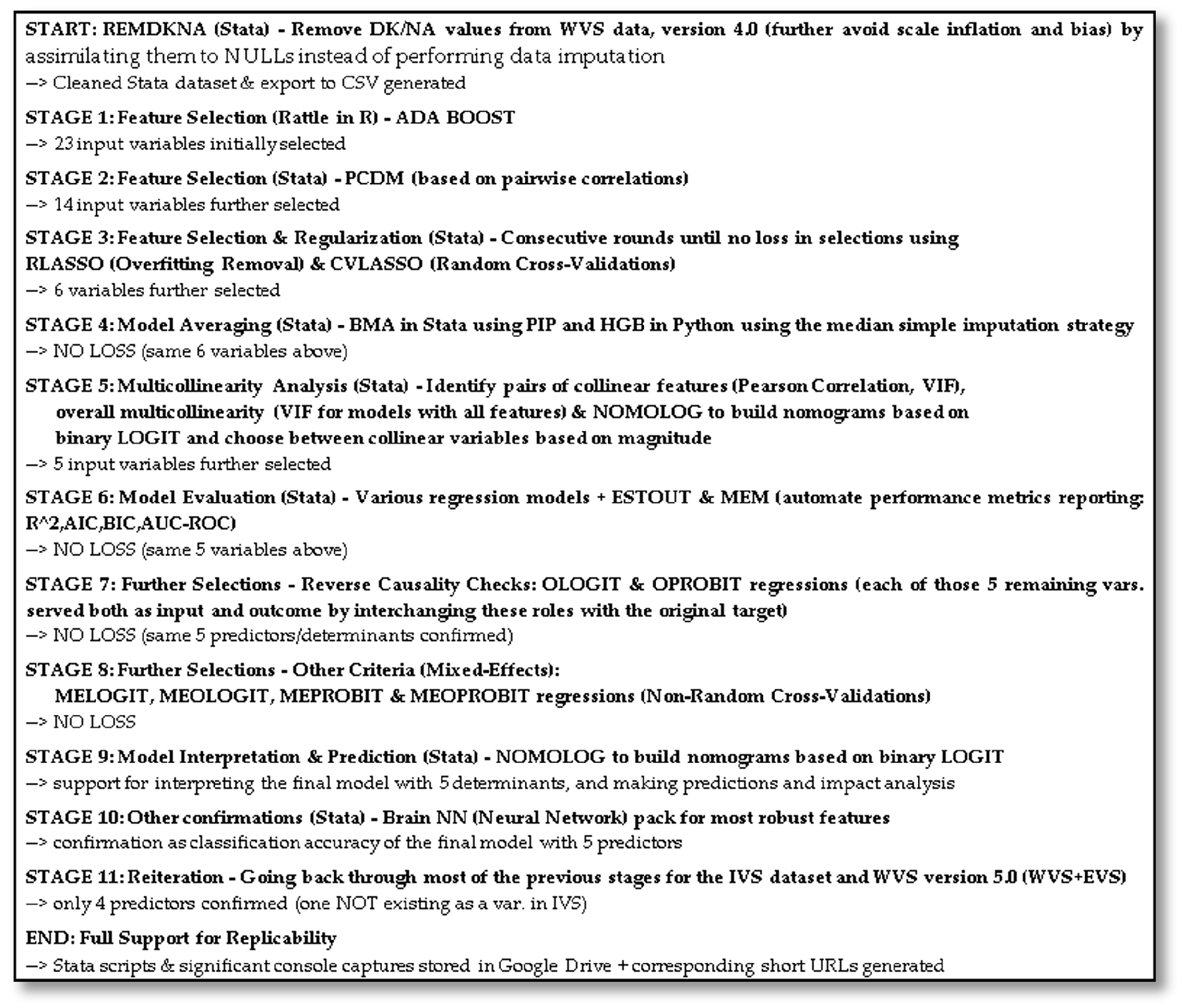
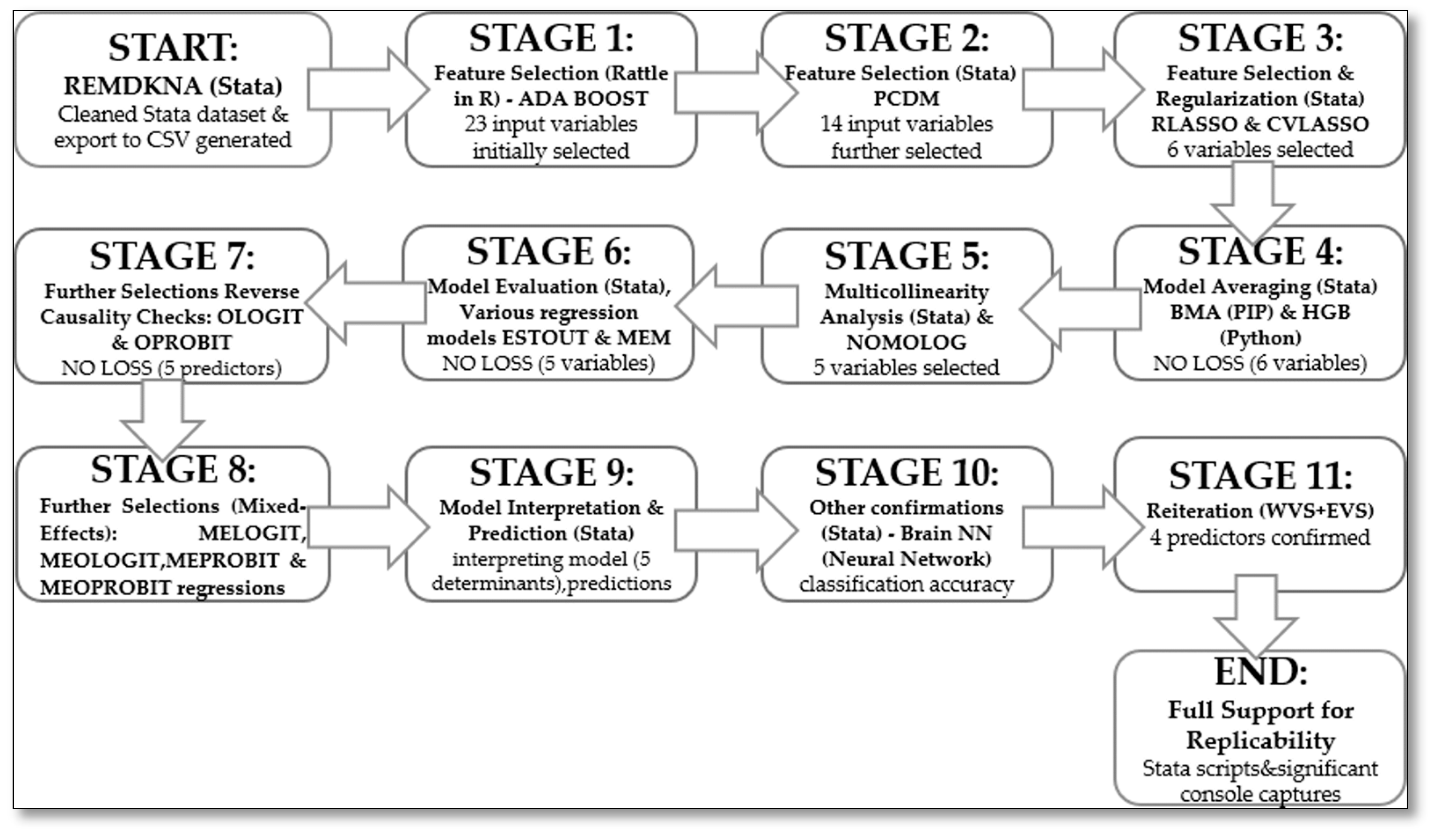
The methodological fusion followed a hierarchical and iterative process rather than a simple performance-based comparison. Each stage built systematically on the previous one (as shown in Figure 1), starting with broad feature selection (STAGE 1) and progressively narrowing down variables through regularization (RLASSO/CVLASSO), Bayesian averaging, multicollinearity and reverse causality diagnostics, and other validation tests and checks (mixed-effects, neural networks, nomograms) confirming the robustness and generalizability of findings. In this way, the framework operationalized fusion through multi-stage triangulation, integrating data mining, statistical, and machine learning approaches in a sequential–confirmatory design that balanced accuracy with interpretability.
While the intermediate stages of the methodology used (Figure 1 and Figure A1, Appendix A) enhance robustness, the pipeline converges on an interpretable LOGIT model and nomogram (Stage 9), ensuring findings remain transparent and policy-relevant.
Moreover, a table synthesizing and contrasting the conceptual limitations of longitudinal models with the necessity of ensemble methods (Figure 1 and Figure A1, Appendix A) for robust, policy-relevant insights in repeated cross-sectional survey data is available in Appendix A (Table A1).
The WVS dataset v 4.0 was prepared for the initial selection stage (Stage 1) using the ADA BOOST technique implemented in the Rattle (v 5.5.1) library of R (v 4.1.3, x64) following approaches outlined in previous studies [102,103,104]. We developed, tested, and executed a customized script sequence for this purpose. This sequence, summarized in Figure 1 and well documented in Listing A1 (Appendix A) and implemented using REMDKNA v 1.1, a custom Stata command (.ado file) [105] included several steps, such as removal of the DK/NA values coded as negative values in the WVS dataset by assimilation to NULL (see Table A9, Appendix B), adjusting the scales, and creating a binary-derived target variable (E260BBin detailed in Listing A2, Appendix A) based on other research [106]. We have used both forms of the targeted variable throughout the analysis to support selection, validation, and robustness testing. The latter ensured no informational loss or bias (during the preprocessing stage).
The main reason for removing DK/NA values was to avoid artificially increasing the scales, augmenting collinearity, and distorting accuracy measurements, together with other performance metrics for models, and disastrous effects on data mining and model exploration tasks, as other researchers reported [105,107]. Using similar data, the study referred to by the latter reference shows such examples of undesirable effects. These include false indications of redundancy due to artificially inflated variable scales and resulting collinearity, misleading rankings based on exaggerated predictor effect magnitudes, and unnecessary complexity in the variable selection process during the exploratory approach. The underlying rationale of REMDKNA focuses on recognizing key limitations of data imputation practices. These approaches replace missing values with the mean, median, or otherwise generated values, either across the entire dataset or within specific clusters (such as those based on socio-economic criteria). It also depends on the specifics of the data imputation approach applied [108,109]. Still, there is no guarantee for the respondents corresponding to the missing responses (in terms of proper approximation using one or more data imputation approaches). The respondent might not have responded in the way suggested by such approaches. Therefore, the DK/NA values were first assimilated to NULL (by REMDKNA). No bias was allowed by further avoiding data imputation (for ADA BOOST and all other conservative approaches in Stata). While reducing the sample size, this approach was a deliberate and necessary trade-off to ensure the authenticity and reliability of the model inputs, ultimately leading to a more robust and trustworthy final model. Still, when using HGB in Python (Stage 4, Appendix A, Figure A1), a more flexible approach was considered, namely the median simple imputation strategy. The latter replaces each missing value in a dataset with the median value of the variable’s available, non-missing data points in a straightforward and computationally inexpensive way. Unlike the mean, the median as a measure of central tendency is not affected by extreme outlier values.
The output obtained in the initial selection (Stage 1), which leveraged ADA BOOST, served as input for the following stage. Thus, in stage 2, the PCDM tool (version 1.1, 12 July 2022) was deployed using Stata [110]. The methodological foundation for this stage relied on pairwise correlations (Listing A3, Appendix A), a technique corroborated by recent works [42,111,112]. A key aspect considered in this stage was the inclusion of both forms of the target variable.
The results from the second stage subsequently served the third (Stage 3), which utilized two commands from the LASSO pack in Stata, namely RLASSO (version 1.0.10 13 January 2019 in Stata) which served as the principal method for overfitting removal used in this research, and CVLASSO (version 1.0.09 28 June 2019 in Stata) utilized as the base form of cross-validation used in this study [113,114,115]. RLASSO is known for its efficiency in overfitting removal, while CVLASSO performs random cross-validation (Listing A4, Appendix A).
The analytical process continued with BMA (Stage 4), which further refined model robustness based on the PIP (PIP—Posterior Inclusion Probability representing the probability of a predictor being a part of the valid model) value of possible predictors. The multi-collinearity analysis (Stage 5) was the next one. Then the model evaluation based on different types of regressions (Stage 6) and reverse causality checks (Stage 7) using OLogit and OProbit.
Beyond random criteria (CVLASSO), this study also employed well-established mixed-effects models [116] to perform non-random cross-validations (Stage 8). For the binary outcome, this involved using MELOGIT or Multilevel Mixed-Effects LOGIT in Stata (version 1.1.10, 5 May 2021) and MEPROBIT or Multilevel Mixed-Effects PROBIT in Stata (version 1.1.11, 5 May 2021) regressions for the binary form of the outcome and MEOLOGIT or Multilevel Mixed-Effects Ordinal LOGIT in Stata (version 1.3.3, 5 May 2021) and MEOPROBIT or Multilevel Mixed-Effects Ordinal PROBIT in Stata (version 1.3.3, 5 May 2021) for the original format of the target. The variables used for such non-random cross-validations are widely accepted. They are: gender (X001), age (X003), marital status (X007), number of people in household (X013), education level (X025R), employment status (X028), social class (X045), settlement size (X049), country code (S003), and year of survey (S020). We chose these variables above due to their relevance and high proportion of valid observations.
For Stage 5, we examined the remaining influences obtained from the previous stages for collinearity using a matrix with correlation coefficients [117,118]. The correlation coefficients mean an assessment of both the intensity and orientation of the linear relation between pairs of variables. Identifying redundancies or high correlations between the remaining influences relies on analyzing these coefficients. Redundancies or high correlations between predictors can indicate collinearity. The latter can affect the stability and interpretability of the regression models. A matrix with correlation coefficients allowed a comprehensive assessment of the relationships between the remaining influences. By examining the magnitude of the correlation coefficients, it was possible to identify highly correlated and potentially redundant variables. In such cases, we should remove one of the highly correlated variables to mitigate the issue of collinearity and improve model stability and interpretability. The final set of non-redundant influences resulted after considering the correlation coefficients and addressing all collinearity issues. That formed the basis for the subsequent analysis and interpretation of the regression models.
In addition, the collinearity assessments (Stage 5) stood on considering dynamic maximum acceptable limits for VIF (VIF—Variance Inflation Factor measuring collinearity in regression models) in two forms: the first one is focused on identifying pairs of collinear influences [119,120,121,122], while the second had as the primary goal to identify overall multi-collinearity issues considering all remaining influences at once [123,124].
In Stage 6, we employed various regression models for both outcome forms, which served to test the remaining influences. These models included OLS (Ordinary Least Squares), LOGIT, SCOBIT as Skewed LOGIT, and PROBIT for the binary format of the target variable, as well as OLOGIT or Ordered LOGIT, and OPROBIT/Ordinal PROBIT for the original form considering a scale [125,126,127,128]. These different regression models were employed to thoroughly examine the impact of the remaining influences on the target variable and assess their significance.
To conclude, the regression models used address the specific characteristics of the data and the objectives of the analysis. Therefore, mixed-effects models (MELOGIT, MEPROBIT, MEOLOGIT, and MEOPROBIT) considered the target variables in both binary and ordinal form, served for non-random cross-validations (with precisely defined criteria—Stage 8). OLS regressions handled collinearity, while the LOGIT ones served to measure precision, but also to generate prediction nomograms (target in binary format). SCOBIT addressed non-normal distribution disorders, and PROBIT models were used alternatively for binary data. Finally, we used OLOGIT/OPROBIT for the variable to be analyzed in ordinal format, ensuring that each model choice is optimal from this point (the original scale format of the target) as well.
Reporting model evaluation metrics is a mighty aspect of analyzing regression models (Stage 6). In addition to commonly used evaluation metrics such as R-squared, AIC (Akaike Information Criterion), BIC (Bayesian Information Criterion), and p-values (significance), there are additional tools and commands in Stata that can assist in reporting default and custom model evaluation metrics [129]. One such tool is ESTOUT in Stata (version 3.17, 2 June 2014), developed by [130]. ESTOUT provides a comprehensive summary of regression models, including model fit statistics, coefficient estimates, standard errors, confidence intervals, and other model diagnostics. It is a streamlined instrument that helped us generate tables with model results and evaluation metrics for multiple models. Another tool is MEM (Model Evaluation Metrics, version 1.1, 24 August 2022, in Stata), developed by [124]. MEM is a flexible and customizable command for model evaluation in Stata. It helps users define and compute various model evaluation metrics starting from their specific requirements. It supports the generation of tables with coefficients, standard errors, p-values, and other model evaluation metrics for different regression models. ESTOUT and MEM provide Stata users with additional options and flexibility in reporting model evaluation metrics beyond the default options available in Stata. These tools are effective for generating comprehensive and customized tables that summarize the results of regression models. Thus, they make it easier to interpret and perform comparative evaluations in terms of the performance (of different models).
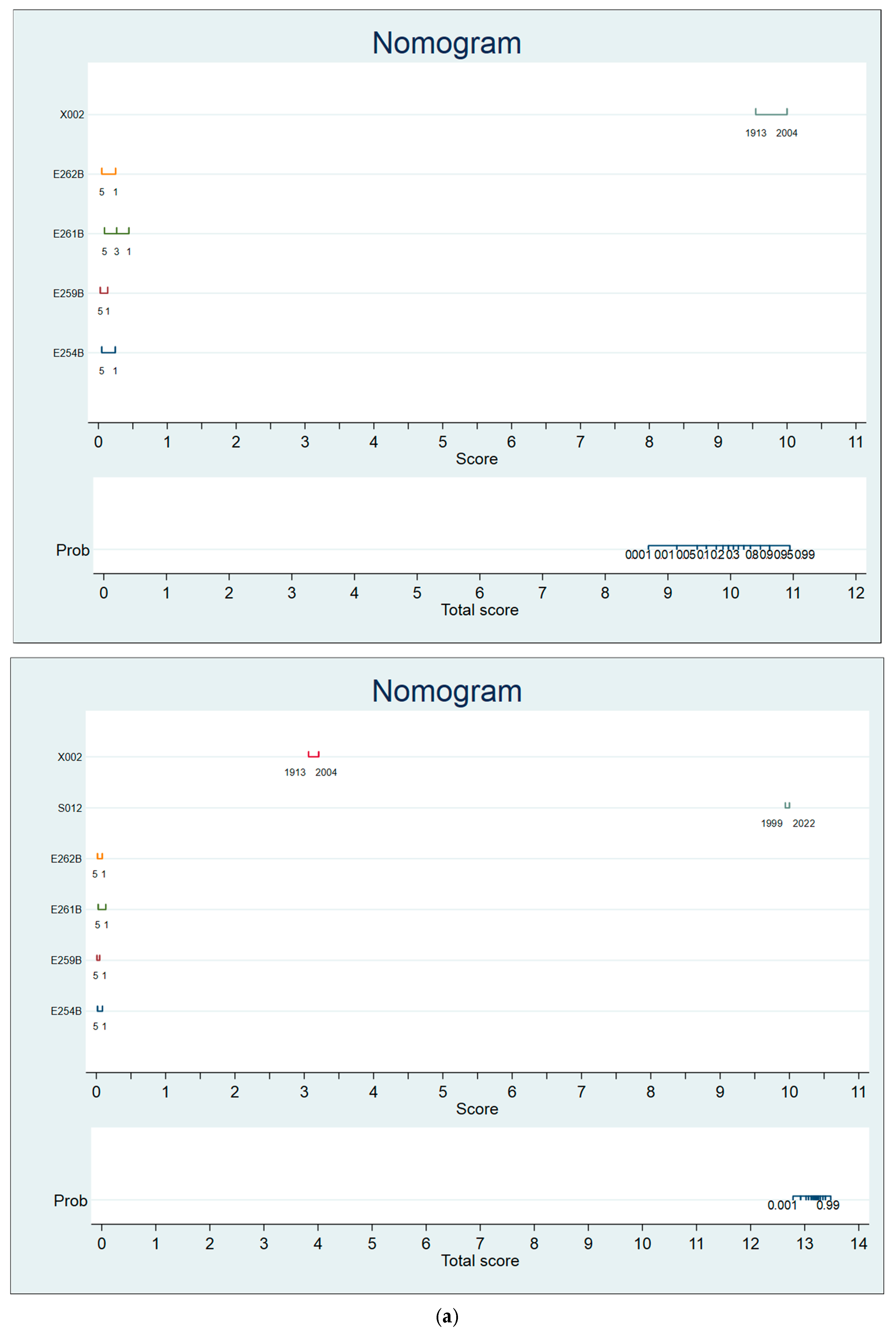
The NOMOLOG (Nomogram generator for LOGIT in Stata) command was also used (version 4.76.0f, 26 August 2014) [131]. The latter is a Stata package that allows for the construction of nomograms [132,133,134,135,136], which are graphical representations of logistic regression models. To install the NOMOLOG package, we can use the following command in Stata: net install st0391_1, from (http://www.stata-journal.com/software/sj15-3). The NOMOLOG command provides a visual image (nomogram) of the predicted probabilities and the effects of different predictor variables on the outcome for a LOGIT model. This nomogram brings an intuitive way to compare collinear variables during some selection steps (Stage 5) by analyzing their relative magnitudes, as reflected in the lengths of the segmented lines. In interpreting the final model (Stage 9), a nomogram allows users to make predictions by aligning predictor variable values with corresponding scores, which then sum up to calculate a total score and probability. Using a nomogram involves drawing imaginary perpendicular lines on the X-axis to locate corresponding scores, enabling a straightforward calculation of probabilities with minimal effort. Supplemental guidance on how to interpret nomograms and turn them into insights or even competitive diagnostic and predictive tools (augmented nomograms) is also available in this paper. The latter relies on using at least two similar examples [137,138].
To ensure robustness in the models and account for regional peculiarities, we performed tabulations by count using tabulate in tabstat in Stata (version 2.9.5, 24 May 2021). The tabulations examined the support (waves and countries) in the WVS dataset [139], ensuring comprehensive representation. They also provided information on the distribution and frequency of observations across different waves and countries. Another scope of these tabulations is to gain insights into the representation and variability of the data, allowing for a comprehensive understanding of the data characteristics.
All Stata scripts (for processing, selection, and analysis) utilized in this study are available online in two persistent Google Drive containers shared and accessible through the following links: https://tinyurl.com/ms3n3s9v (for WVS, version 4.0 and IVS data) and https://tinyurl.com/2utdjpmr (only for WVS data, version 5.0). To ensure seamless downloading of most scripts, the corresponding URL (Uniform Resource Locator) benefited from an update in the specific syntax (&export=download at the end). This modification eliminates the need for additional confirmation steps, allowing for a straightforward one-step download process.
Furthermore, the proposed multi-stage framework was designed for both scalability and reproducibility. Each analytical stage relies on widely available, cross-platform software (R v 4.1.3, Stata v17, and Python 3.12.7) and open-source libraries (e.g., Rattle, scikit-learn). This structure enables other researchers to replicate the entire workflow or extend it to different datasets with minimal adaptation. The full scripts and parameter settings publicly available via the provided persistent links ensure that every step, from data preprocessing to validation, can be transparently re-executed and independently verified.
The complexity of the proposed framework (Figure 1 and Figure A1, Appendix A) is also due to the principal motivation related to robust research and identifying robust predictors (as suggested in the title). Specifically, this is an accepted practice in data science, according to the scientific principles of triangulation, cross-validation, and replicability. Deep learning techniques were not included because the study’s primary goal was to identify stable, interpretable predictors across statistical and machine-learning paradigms. Deep learning models typically function as low-interpretability black boxes and require substantially larger datasets and GPU-based hardware to yield meaningful gains for tabular data. Accordingly, we selected methods better suited to explanatory modeling and cross-method triangulation.
The triangulation framework described in this paper is conceptually distinct from collaborative or hairy modeling approaches. Unlike collaborative modeling, which relies on stakeholder co-creation of a single shared model through workshops or elicitation, and hairy modeling, which integrates heterogeneous real-time data into complex, multi-scale simulations, our method applies multiple independent statistical algorithms (e.g., logistic regression, HGB, AdaBoost) to pre-existing, harmonized survey data (EVS/WVS) for convergent validation of a fixed predictor set. No stakeholder input is used in model construction, and no dynamic system simulation is performed. This methodological triangulation [140] aims solely to reduce method-specific bias and confirm robustness across analytical lenses—not to build consensus or model emergent complexity.
Still, this triangulation framework is dataset-agnostic and applies to any large-scale behavioral survey. While Stata commands such as REMDKNA, PCDM, and VCPR leverage the standardized missing-value system of WVS/EVS for efficient preprocessing, the methodological core (convergent validation via multiple algorithms) is software-independent and can be replicated in R and Python with other data.
We acknowledge that the methodological framework employs a wide range of statistical and DM techniques. Statistical methods (e.g., LOGIT, OLOGIT, OPROBIT, MELOGIT, MEOLOGIT) provide rigorous hypothesis testing and model validation, grounding the analysis in established econometric practices. DM techniques (e.g., REMDKNA, PCDM, NOMOLOG) typically serve data preprocessing, pattern discovery, and feature selection. ML techniques (e.g., Ada Boost, RLASSO, CVLASSO, BMA, HGB, and Brain NN) focus on predictive modeling, classification, or regression. However, many methods (e.g., AdaBoost, HGB) straddle DM categories due to their versatility. This categorization stands on the primary application of these techniques in this study, with justifications grounded in the manuscript (Appendix A) and the literature [141,142,143]. We intentionally chose this approach. It does not add unnecessary complexity and ensures the robustness and validity of our findings from multiple perspectives. The initial use of techniques such as AdaBoost, RLASSO, and CVLASSO (Stages 1, 3) served as a crucial first step for objective feature selection and regularization, helping to identify the most significant predictors from our extensive dataset. Subsequently, we employed diverse models in a multi-stage process (Stages 4, 6, 8, 10), including BMA, HGB, mixed-effects models, and a neural network (Brain NN) to demonstrate that our key findings were not an artifact of a single modeling approach and were consistent across different algorithmic assumptions. This multi-model validation significantly strengthens the confidence in our results. Finally, the development of the nomogram (Stage 9) also aims to bridge the gap between sophisticated data science and practical application. It consolidates the insights from our best predictive model into a simple, visual tool that offers actionable, real-world utility for practitioners and policymakers who may not have a background in data science. In essence, each method serves a distinct purpose, from feature selection and model validation to creating a practitioner-friendly output. Moreover, the robustness of this multi-stage framework stems from methodological triangulation [144], integrating various algorithms (AdaBoost, RLASSO, CVLASSO, BMA, HGB, Brain NN), DM (PCDM, REMDKNA, NOMOLOG), and statistical methods (LOGIT, OLOGIT, OPROBIT, MELOGIT, MEOLOGIT, MEPROBIT) to mitigate single-method limitations like overfitting or bias [145]. This combination cross-verifies predictors. Moreover, AdaBoost ranks features. RLASSO/CVLASSO ensures sparsity. BMA addresses uncertainty, and HGB captures nonlinearities. The advantage of this combination is the fact that it is empirically validated by consistent identification of core predictors across three diverse datasets—World Values Survey (WVS v4.0, v5.0) and Integrated Values Survey (IVS)—with AUC-ROC greater than 0.85 (Stages 6–8), reflecting real-world generalizability [146].

3.2. Additional Tests and Validations

Additionally (Stage 10), the Brain NN pack (version 10.0) in Stata (https://github.com/ThorstenDoherr/brain, accessed on 1 March 2025) is responsible for implementing backpropagation artificial neural networks. It was used in several configurations (varying the number of hidden layers, the training factor eta, and the number of backpropagation iterations, with the batch size set to 100). The goal of the lightweight feed-forward neural networks implemented using Stata’s Brain NN pack was to assess the stability of the selected predictors under a nonlinear model. This neural architecture is computationally efficient for tabular data and complements the triangulated design by providing a non-parametric benchmark without the opacity and data requirements of deep learning models. In addition, Brain NN comes with the benefit of the parallelization of training.
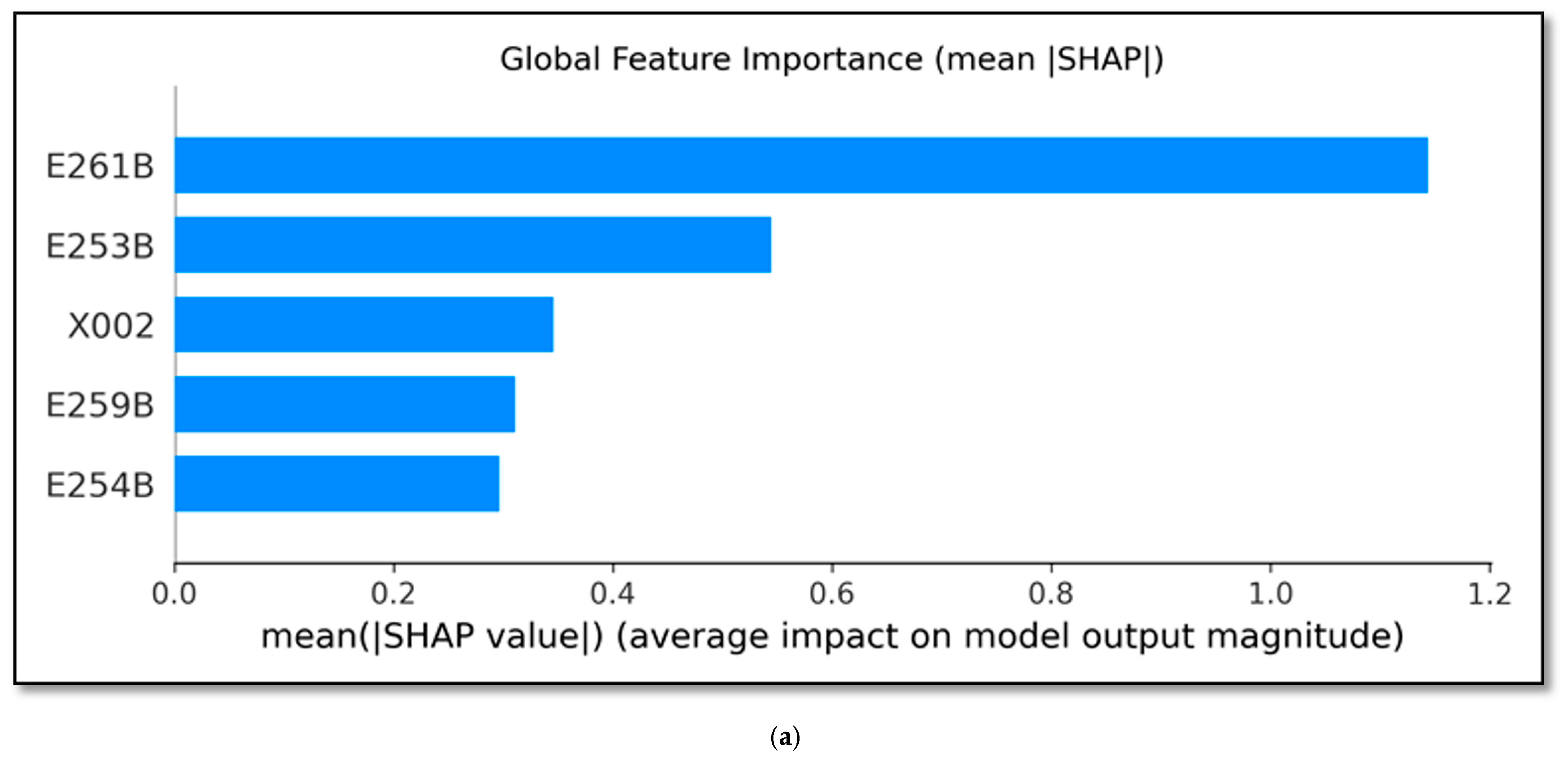
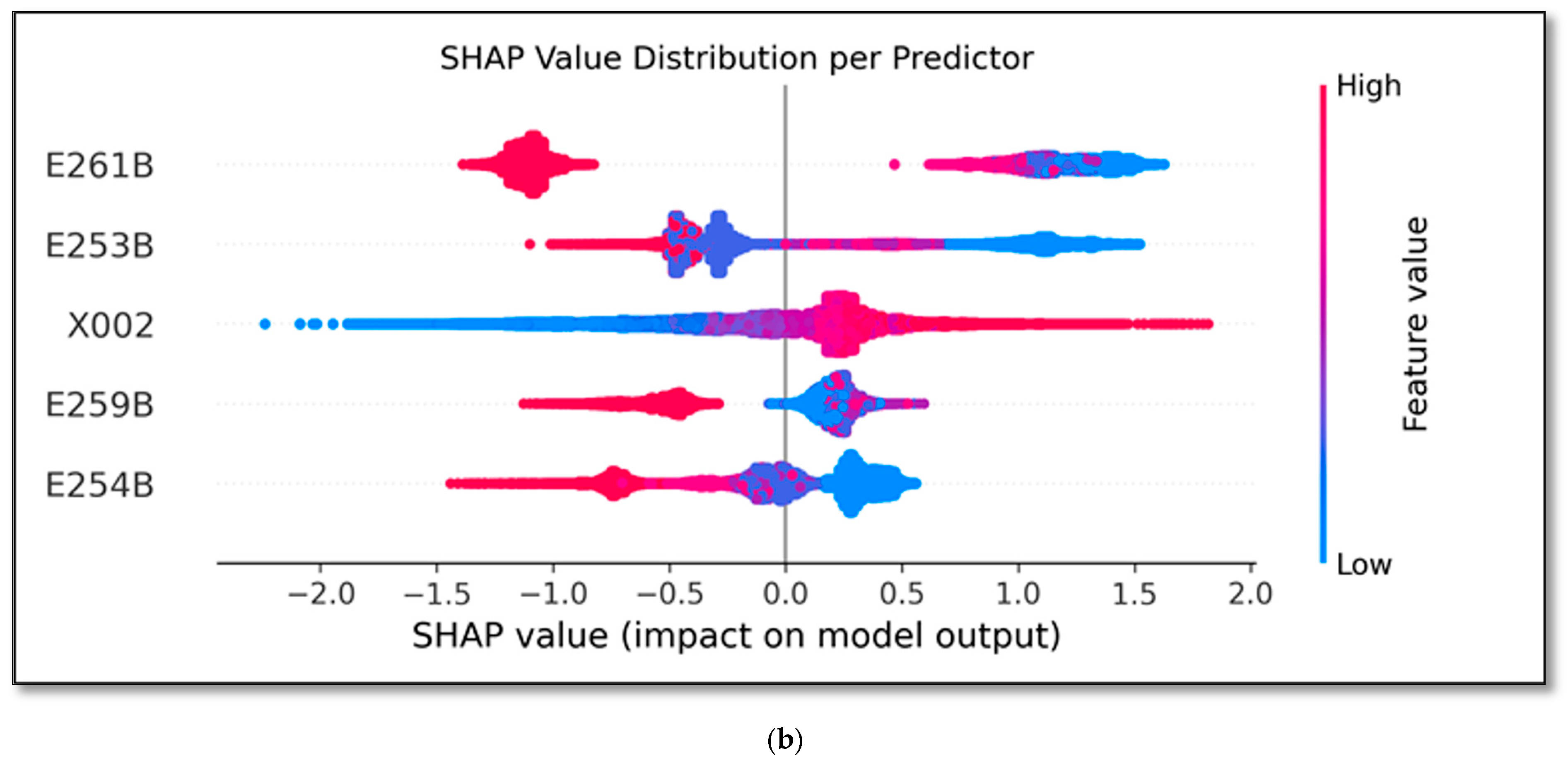
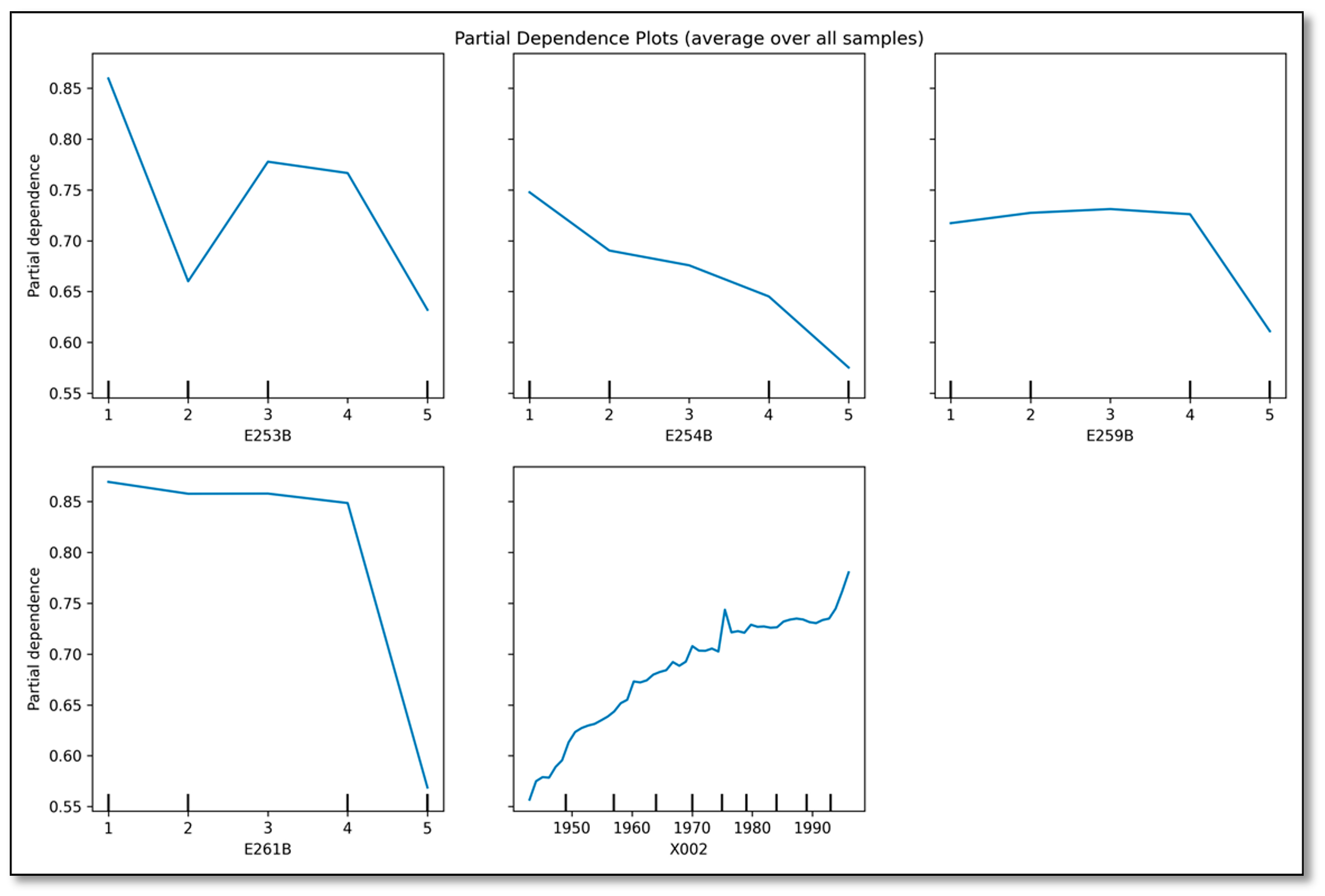
Moreover, additional tests focused on two possible predictors not selected using this approach (ADA BOOST, CVLASSO, and RLASSO). These predictors were X025R—Highest educational level attained: Lower, Middle, and Upper, and X001-Sex: Male and Female. The tests additionally considered BMA (version 1.0, 6 May 2011 in Stata) [147] that, given a few candidate parametric families, generates the Posterior Inclusion Probabilities (PIP) of possible predictors (as a form of quantifying the input uncertainty). More than this, a Histogram-based Gradient Boosting (HGB) algorithm [148] with 10-fold cross-validation, shuffling, parallel execution, and accuracy and importance calculations (top 25 features after three repeats) was tested (stage 4) in Python 3.12.7 via a Spyder IDE (for WVS data in both versions, namely 4.0 and 5.0 (Each .py file (https://tinyurl.com/5bwwa82a and https://tinyurl.com/mpa2hb6f) in both online supporting folders (https://tinyurl.com/ms3n3s9v and https://tinyurl.com/2utdjpmr))). Following the same logic behind CVLASSO in Stata (by default, 10-fold), the primary purpose of using the 10-fold stratified cross-validation approach for HGB [149] is to ensure the robustness of our models. The 10-fold stratified cross-validation process involves partitioning the dataset into 10 equally sized subsets, or folds. During each of the 10 iterations, we reserved a single fold (10% of the data) for testing. The remaining nine folds (90% of the data) are for training the model. The latter repeats 10 times, until every fold has served as the test set exactly once. This method ensures that the class distribution of the target variable is maintained consistently across both training and testing sets, preventing potential bias in the evaluation. We assessed the model performance by calculating the accuracy score for each test fold [150]. Starting from HGB, a partial dependence plot (PDP) [151] drawing the marginal effect of each predictor on the predicted probability and two SHAP (Shapley Additive Explanations) [152] representations were obtained (a global importance chart showing the strongest predictors, and a summary Bee Swarm plot illustrating the distribution and direction for each individual feature—Appendix D, Figure A6a,b and Figure A7). Moreover, we additionally tested different regression types (SCOBIT in Stata—version 1.12.1, 19 December 2018; LOGIT in Stata—version 11.3.1, 25 June 2020; PROBIT in Stata—version 11.3.1, 25 June 2020; OLOGIT in Stata—version 11.4.2, 25 June, 2020; ordered PROBIT or OPROBIT in Stata—version 11.4.2, 25 June 2020; and OLS named regress in Stata—version 1.3.3, 9 December 2020) in models including these two potential candidates. Some other tests (similar ones) relied on the second dataset (IVS), which supports the validations.
Regarding the normality of distributions for the final models, the Shapiro–Wilk test for normality of data in Stata served. However, it was complemented by generating histograms designed for displaying and inspecting the distribution of variables [153,154], ensuring a comprehensive evaluation. The rejection of normality for certain variables justified the use of alternative modeling approaches, such as the SCOBIT regression, which accommodates deviations from normal or logistic distributions. This combined approach strengthens the robustness of the findings by addressing potential distributional concerns.
Regarding heteroskedasticity, the vce(robust) option in Stata supported the generation of robust standard errors [155,156]. The latter is responsible for correcting the error bias that may arise from the non-constant variance in residuals, improving the reliability of coefficient estimates. This approach commonly supports heteroskedasticity-robust inference. However, given the widespread application of robust standard errors in the regression models, the impact of heteroskedasticity on inference is expected to be minimized.

3.3. Demographic Analysis

Demographic analysis is also available to offer a comprehensive understanding of information retrieval behavior through mobile devices. Such an analysis usually includes dedicated stages. Identifying relevant demographic variables is the first step. The latter is followed by reporting the descriptive statistics, tabulations, cross-tabulations, and data visualization for the input variables and each of the demographic categories. The last ones also include statistical tests, regression analyses, and interpretations.
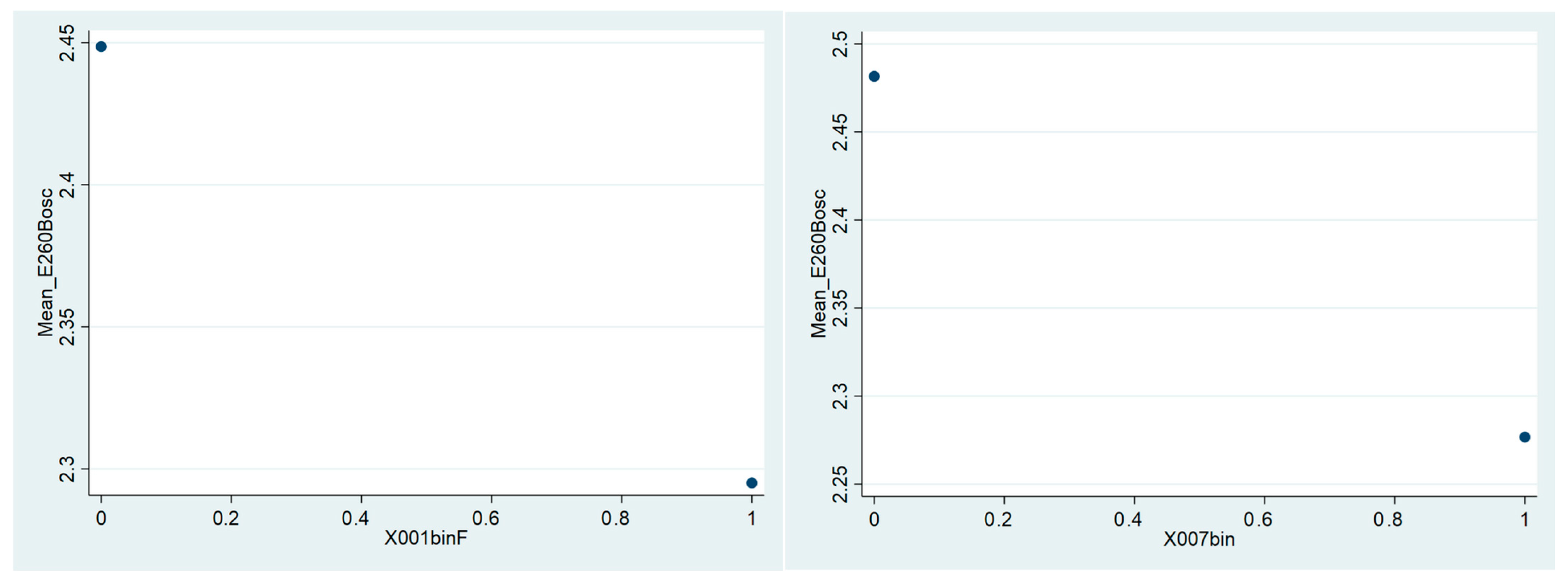
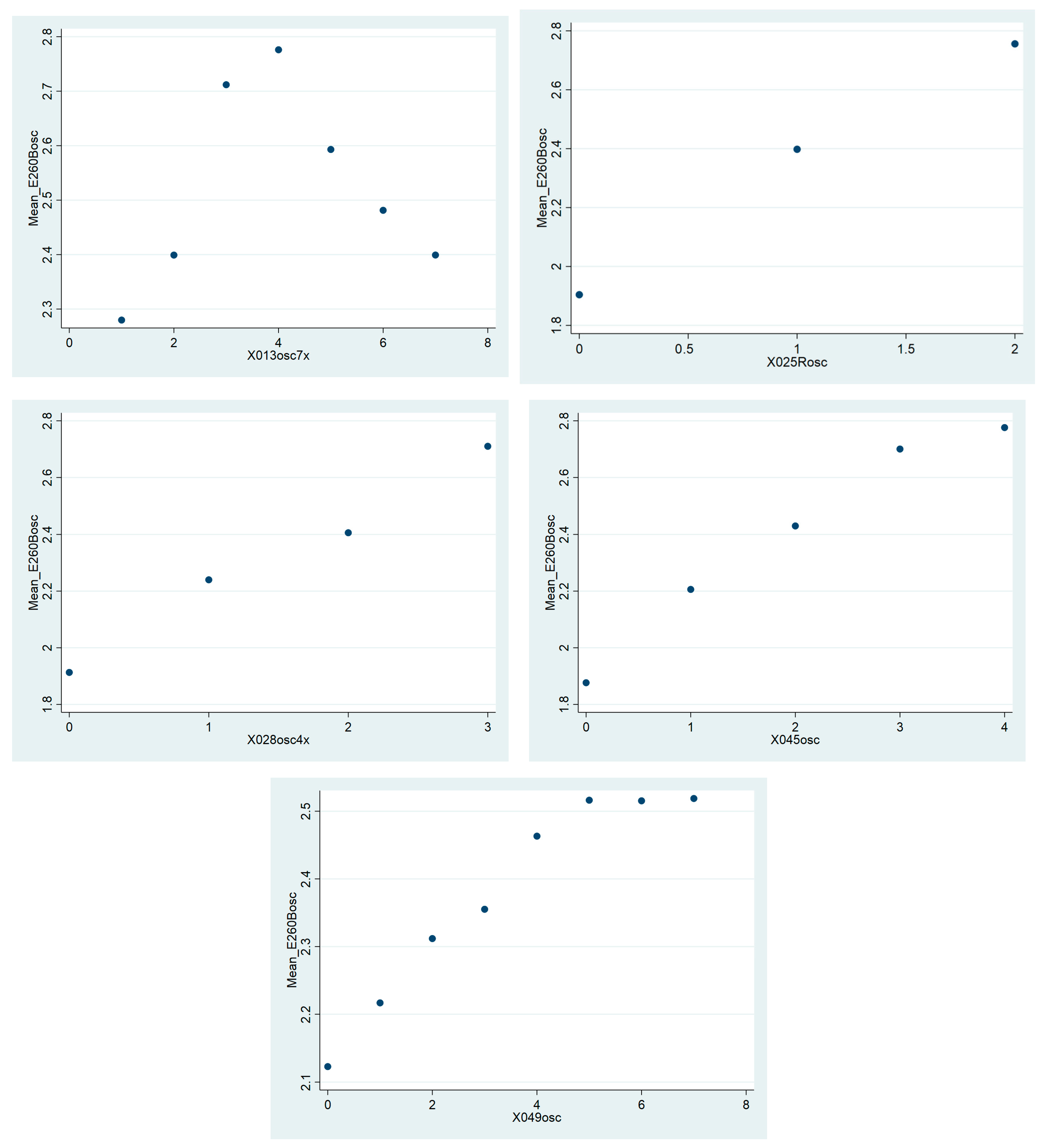
In terms of testing the linearity, scatter plot graphs (between the dependent variable and each from the list of independent ones) have been generated [157,158].

4. Results

4.1. Outcomes of the Main Selection Steps

The following section includes detailed results. They emerged after each selection stage and additional tests (as described in Section 3).
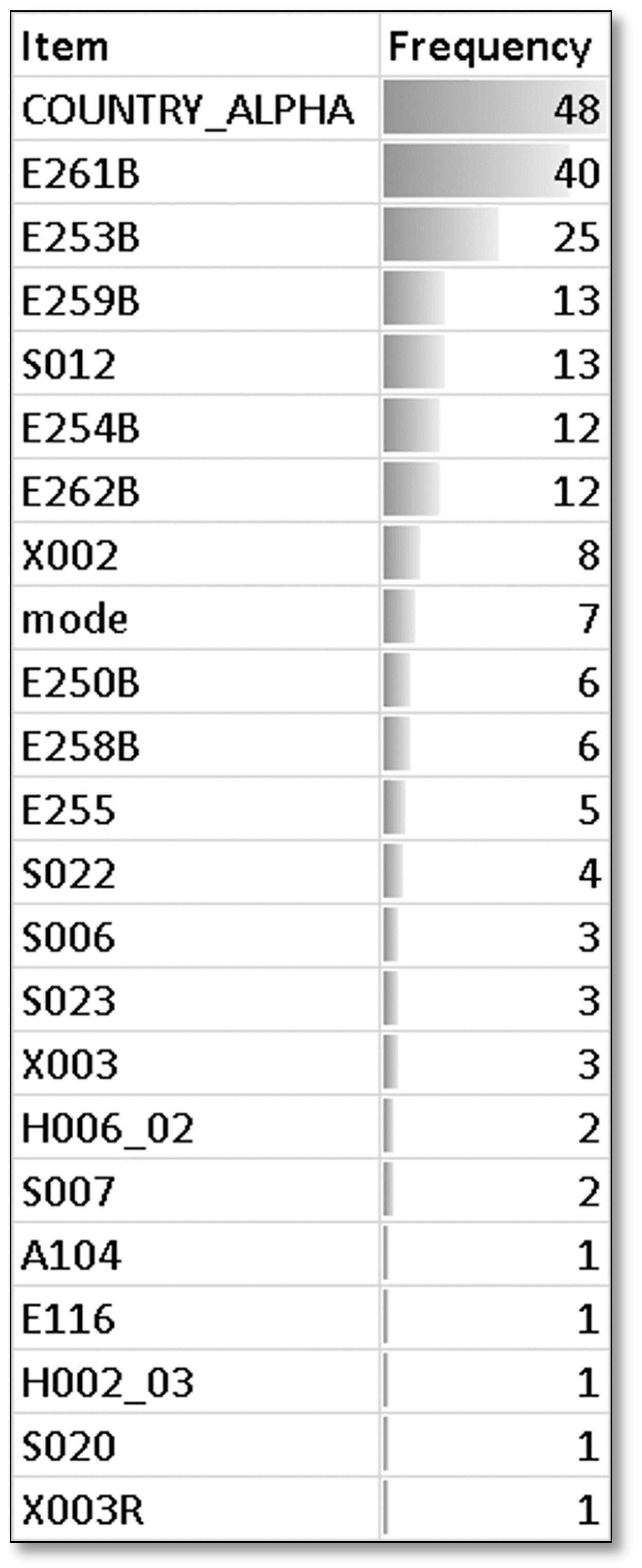
After conducting the initial selection (Stage 1) using ADA BOOST within the Rattle pack of R (accessible at https://rattle.togaware.com), on the exported .csv file of the cleaned WVS dataset, a set of 23 variables emerged.
These 23 variables were identified as influential during the selection process (Stage 1), as depicted in Figure 2.
The following step involved determining the number of valid observations for the target variables at the beginning of the second selection stage (Stage 2). The custom command PCDM (pcdm E260B E260BBin) was used for this purpose, resulting in 178,339 non-NULL records. This information supported the choice of the minimum support parameter for the subsequent launch of PCDM. The minimum support considered was one plus a half of the total valid observations (as a number) for the target variable. That meant approximately 89,170. Additionally, the maximum accepted p-value (significance) is 0.001 (meaning at most one error in a thousand cases). Moreover, 0.1 is the minimum acceptable absolute value of the correlation coefficient (non-negligible correlations).
In the second launch of PCDM, only 22 out of the 23 variables from the first stage were considered, excluding the variable COUNTRY_ALPHA (a string variable). The PCDM command was executed with the following variables: E260B, A104, E116, E250B, E253B, E254B, E255, E258B, E259B, E261B, E262B, H002_03, H006_02, mode, S006, S007, S012, S020, S022, S023, X002, X003, and X003R. The same command also ran with the variable E260BBin.
The intersection of the results from this stage (Stage 2) yielded only 14 variables: E253B, E254B, E259B, E261B, E262B, S007, S012, S020, S022, S023, X002, X003, and X003R.
These variables served as input for the subsequent selections (Stage 3) based on RLASSO and CVLASSO.
In the first run of RLASSO for both forms of the outcome (RLASSO E260B A104 E253B E254B E259B E261B E262B S007 S012 S020 S022 S023 X002 X003 X003R and RLASSO E260BBin A104 E253B E254B E259B E261B E262B S007 S012 S020 S022 S023 X002 X003 X003R), only seven variables emerged (A104, E253B, E254B, E259B, E261B, E262B, and X002). They were the intersection subset for both forms of the target.
In the first run of CVLASSO, starting from the remaining variables, only A104 was dropped. In the second run of RLASSO and CVLASSO, considering both outcome forms and the remaining six variables, no loss emerged.
For a detailed description of these variables, see Table A3. For descriptive statistics, refer to Table A4, Appendix B.
In the next stage (Stage 4), BMA and HGB preserved all six remaining variables (no loss). In fact, they have also confirmed the intersection between CVLASSO, RLASSO, and HGB when using the 4.0 version of WVS data (top 25 features—https://tinyurl.com/bdcpf3ez, accessed on 1 March 2025—and accuracy scores on each test fold of almost 0.83 or even more (The first .csv file (https://tinyurl.com/yc3vbkry) in the first online supporting folder (https://tinyurl.com/ms3n3s9v))).
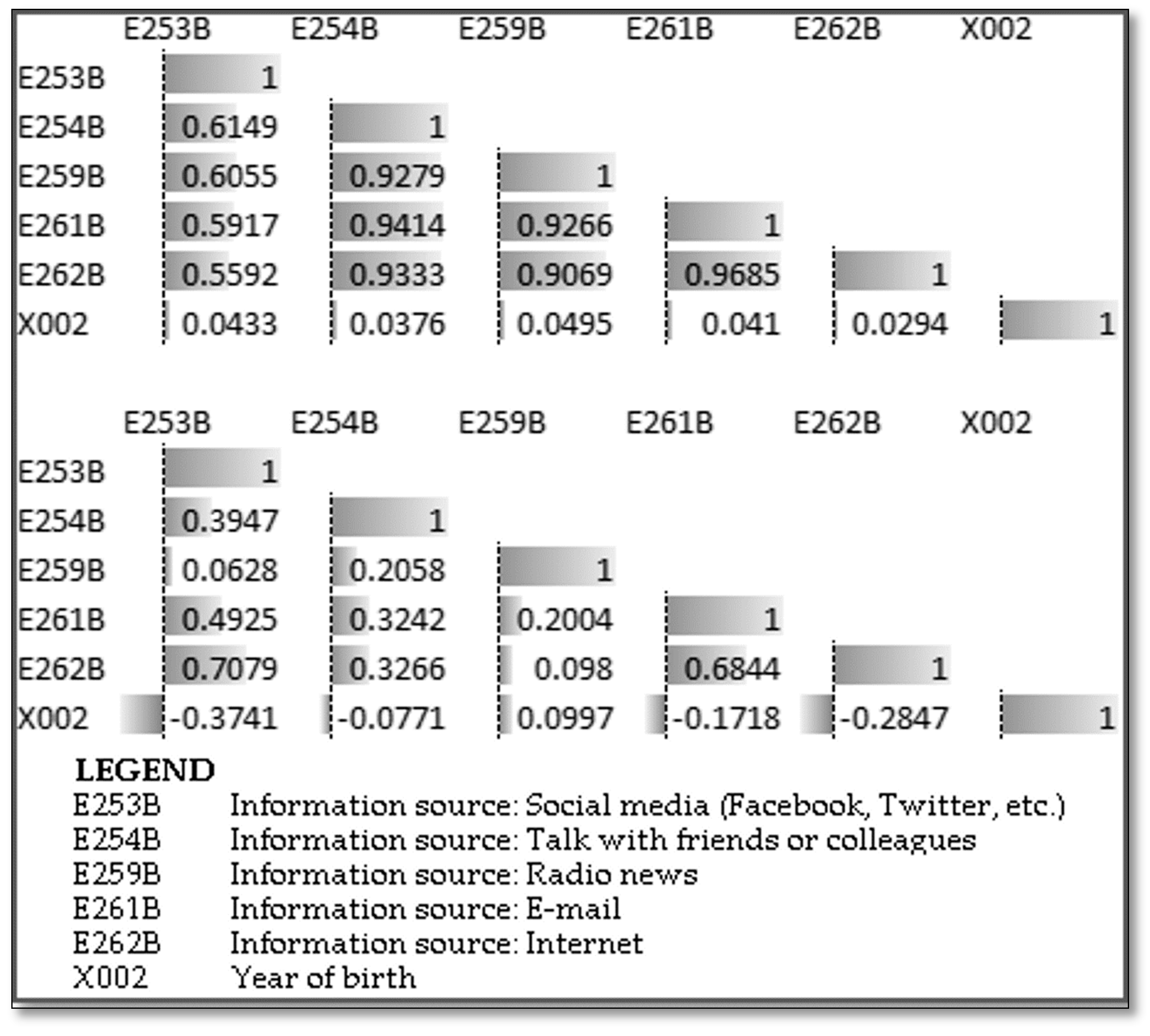
During the verification of collinearity (Stage 5), a correlation coefficient matrix was examined (Figure 2pwcorr E253B E254B E259B E261B E262B X002 using pwcorr—version 3.1.1 1 May 2018 in Stata), specifically exploring the correlations between these six remaining variables E253B, E254B, E259B, E261B, E262B, and X002. The analysis revealed two instances of collinear combinations: E253B-E262B and E261B-E262B. These combinations exhibited moderate to strong correlation coefficients, indicating a high correlation between the predictors [118]. Consequently, in this case, the variable E262B (Information source: Internet) was dropped from the analysis (refer to Table A5, Appendix B). This decision resulted from the fact that E262B appears in two collinearity issues: with E253B (Information source: social media) and E261B (Information source: E-mail). Moreover, E261B exhibited a greater magnitude (larger segment in Figure A2, Appendix C).
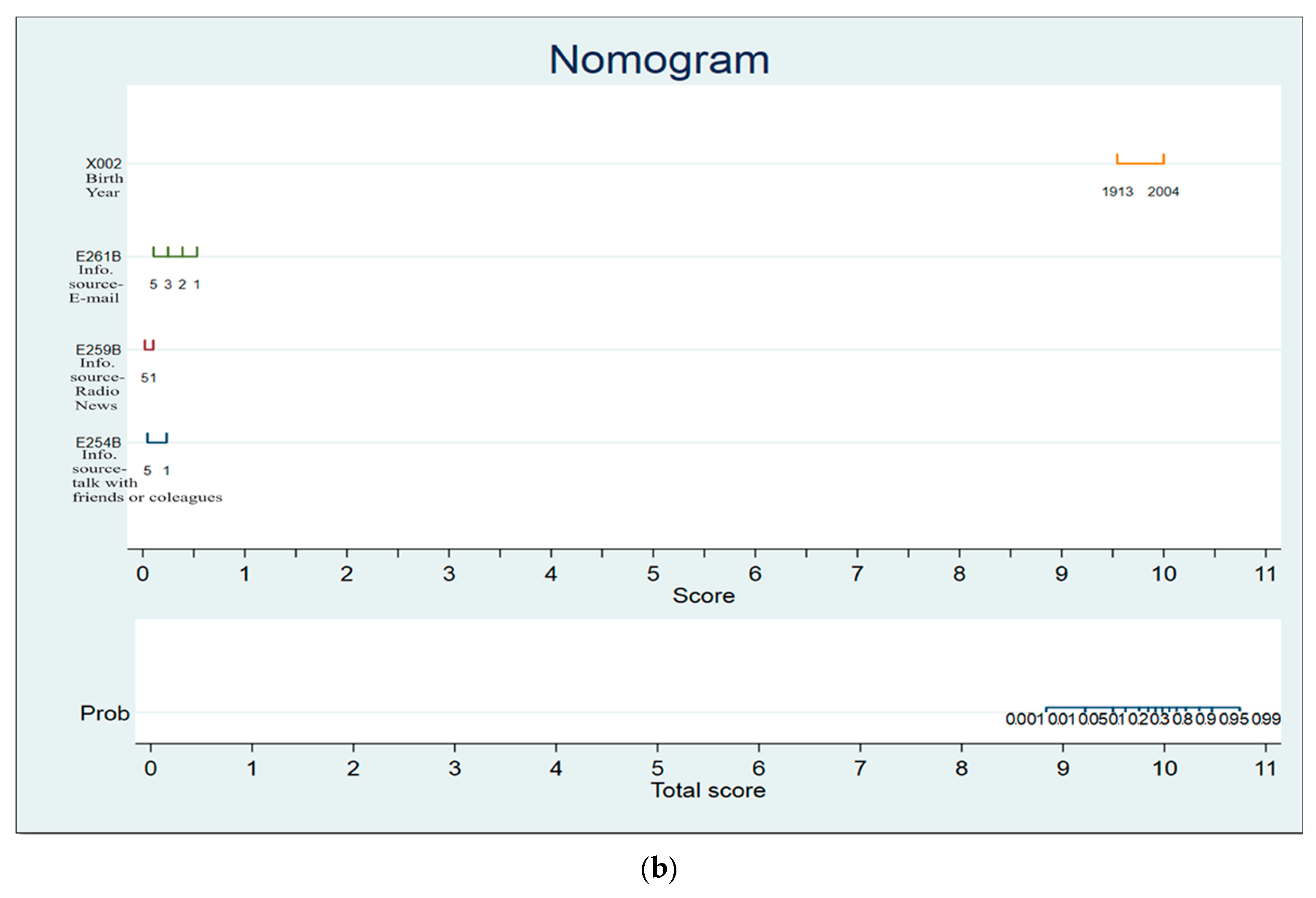
An additional test (available online at https://tinyurl.com/yc5e86pv) using the VIF (assessed against a maximum limit depending on the model R-squared) supported the confirmation of existing collinearity [119]. It discovered again those two pairs, namely E253B-E262B and E261B-E262B. Moreover, a prediction nomogram with six influences (Figure A2, Appendix C) supported the confirmation of removal for E262B. The latter applies when considering its lower overall graphical effect (when measured against that of E261B) and its equality in such terms with E253B.
The removal of E262B (Information source: Internet) means an expected tiny decrease in the classification accuracy (from 0.8772 to 0.8714). However, it also led to a consistent reduction in redundancy in the form of the maximum value of the correlation coefficient between predictors (from ~0.71—between E262B and E253B to ~0.49—between E261B and E253B), as seen in Figure 3 and in the performance results captured and available at https://tinyurl.com/yc5e86pv.
This removal (E262B) was a necessary step to mitigate multi-collinearity, which can inflate the variance and standard error of coefficient estimates, potentially distorting the reliability of the prediction model. A minor trade-off in classification accuracy consequently resulted from the prioritizing of model interpretability and stability. The latter ensures that the remaining predictors provide unbiased and meaningful contributions.
In addition, a new stage of collinearity checks focused on the remaining five influences. This time, two types of VIF-based collinearity checks have the focus (the first one is focused on identifying pairs of collinear influences (VCPR-version 1.3 21 November 2023 in Stata [122]), while the second had as a goal to identify and report overall multi-collinearity issues considering all five influences at once (MEM-version 1.1 24 August 2022 in Stata) and a computed maximum VIF value measured against the maximum tolerance which is equal with 1/(1−model R–squared) according with [119,120,121,122]).
No further evidence of collinear pairs and multi-collinearity emerged (do script and console.pdf capture with commands, their results, and comments available at the end of the online resources at https://tinyurl.com/2avjc4n9 and https://tinyurl.com/3b9y2d2t). The latter also stands on the tests performed on IVS and WVS, version 5.0 (validation datasets) available at the end of the online resources at https://tinyurl.com/hru48zzs and https://tinyurl.com/2nck8zdr (IVS) and https://tinyurl.com/mrxz3d59 and https://tinyurl.com/27vzw73s, respectively (WVS, version 5.0).
Following the step above, several regression models emerged (Stage 6). These models consistently confirmed the presence of the five variables that remained influential throughout the analysis. The details of these variables, along with their corresponding regression results, are depicted in Table A6, Appendix B. These five variables are: E253B, E254B, E259B, E261B, and X002.
In addition, reverse causality checks (Stage 7 online available at http://tinyurl.com/42v7r8je) were performed using OLOGIT and Ordinal PROBIT (OPROBIT) regressions and the original form of the target variable (E260B). In each regression that considered only one of those five variables above, the latter served as input and target, interchanging these roles with E260B (regression pairs). The R-squared should be larger (a higher amount of variability explained by the model) and (or) AIC and BIC lower (better fit or more information value) in the models in which they served as input versus those in which they act as outcome. The latter would lead to the conclusion that each of those five behaves more as a determinant (cause) of E260B, rather than an effect of it.
All five variables above (all used in the second nomogram—Figure 4) passed these reverse causality checks when considered as input in five models with just one predictor. In contrast, the other five models, where they served as outcome, and the original target (E260B) as input, were tested with OLOGIT (results in Table A10, Appendix C) and OPROBIT (results in Table A11, Appendix C). For relatively close values of R-squared, the lower ones of AIC and BIC confirmed these validations.
When performing non-random cross-validations (Stage 8—Table A12 and Table A13, Appendix C) using MELOGIT, MEPROBIT (the binary form of the outcome), MEOLOGIT, and MEOPROBIT (the original format of the target as a scale), those five variables (Figure 4) confirmed with no loss of significance. All of them had *** meaning significant at 1‰ on each subset corresponding to each value of those ten cross-validation criteria (variables) that were considered (X001-Sex, X003-Age, X007-Marital Status, X013-Number of people in household, X025R-Education level, X028-Employment status, X045-Social class, X049-Settlement size, S003-Numeric country code, S020-Survey Year). The last one (S020) failed to be considered in the core list of predictors (Figure 4) due to not being present at the intersection of features selected by all approaches used up to stage 4 (including it) in both versions of the WVS dataset considered in this paper (4.0 and 5.0).
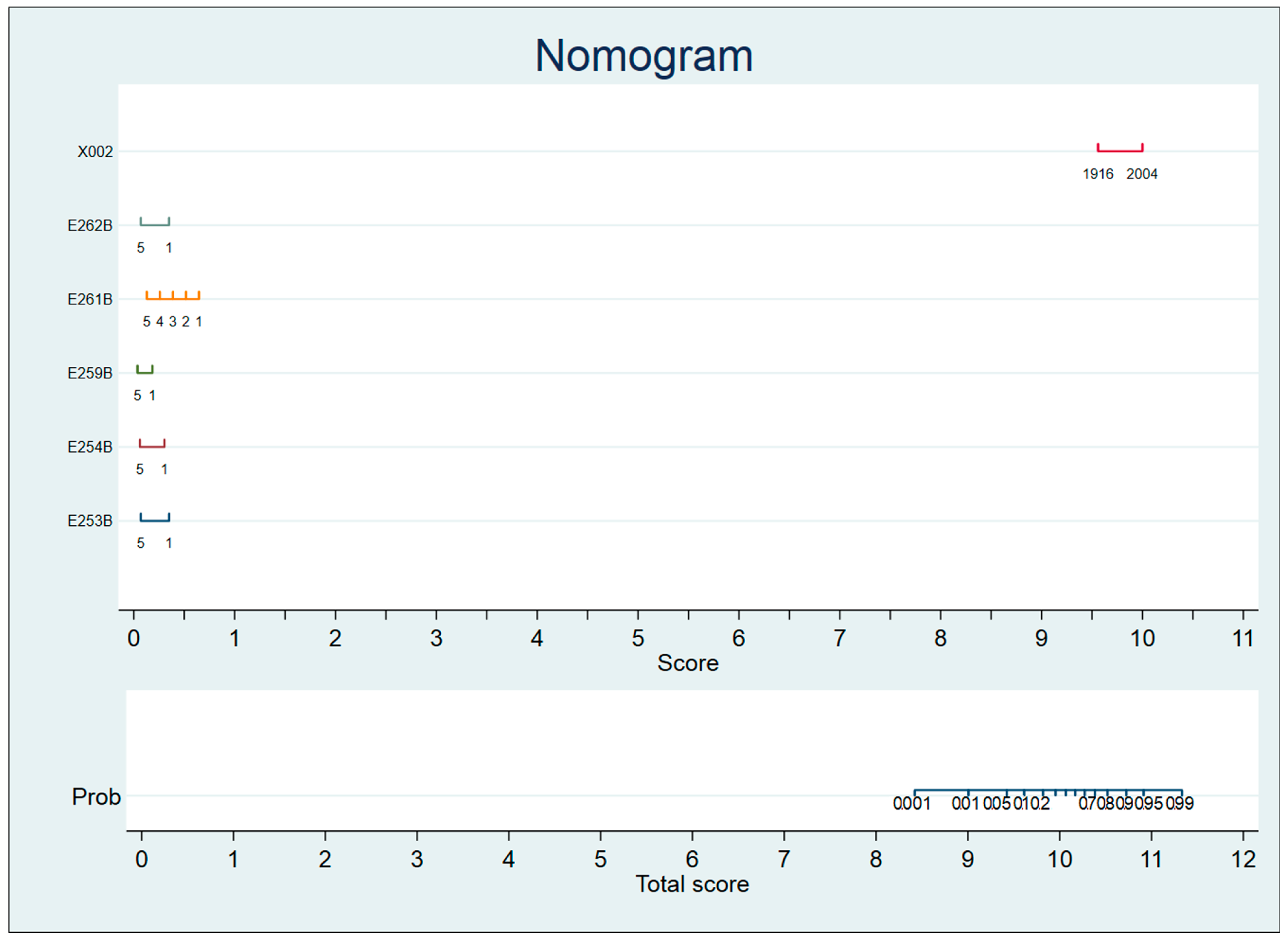
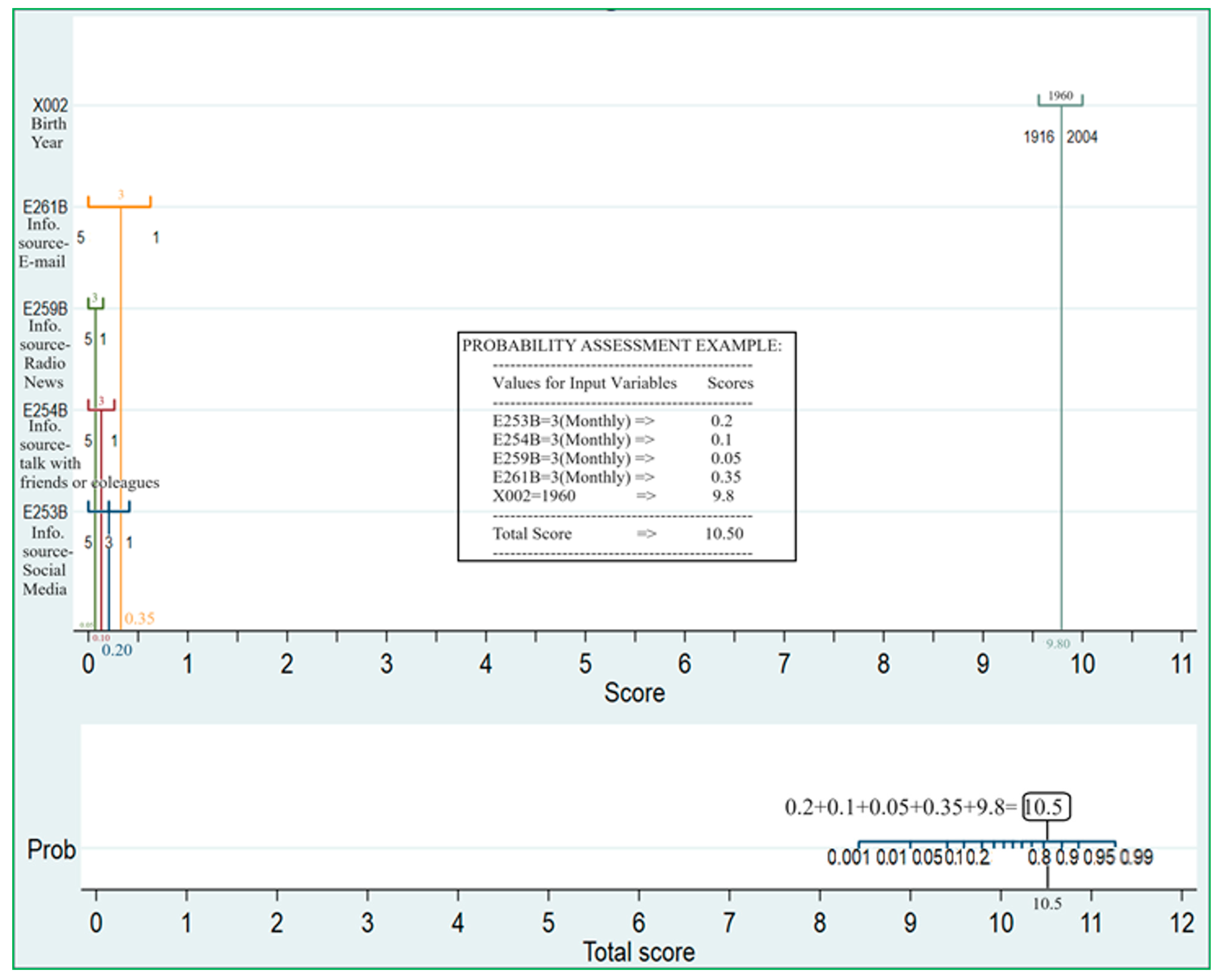
The nomogram in Figure 4 (Stage 9) was constructed based on the binary logistic model presented in Table A6, model 2 (Appendix B). This nomogram represents five resilient influences. An example of an assessment leading to a probability greater than 0.8 (on the Total score X-axis) resides in Figure 4. The model stands on a substantial number of intersecting observations and corresponding support. It is about 87,741 cases, accounting for 49.2% of the total valid records for the target variable. The model exhibits a substantial R2 value of 0.332, indicating a considerable volume of variance explained, and its classification accuracy is good, as reflected by the AUC-ROC (Area under the Receiver Operating Characteristic Curve as a metric for evaluating the performance of classification models) value of 0.8714.
Beyond these statistical validations, the predictive model illustrated in the nomogram (Figure 4) offers valuable real-world applications for policymakers, researchers, and businesses. It enables stakeholders to assess and enhance mobile phone usage as a source of information across diverse demographic groups. The nomogram clearly depicts the five key influences—birth year, frequency of electronic mail use, digital social network engagement, interpersonal conversations, and radio news consumption. It also includes a built-in simulation scenario based on a middle/average value for each variable (the text box in the center of Figure 4), showing how every single variable contributes when visually and intuitively computing a total score and a corresponding probability value.
To make this utility more concrete, we consider a practical application for UI designers. Using the nomogram, they can simulate how changes in user behavior or demographics directly influence the likelihood of a person using a mobile phone for information. For example, by following the scales in Figure 4, a designer can observe that an increase in the frequency of electronic mail use (a shift from value 3- monthly to 1- daily), translates into a significant increase in the final probability (0.6 instead of 0.35, when dragging the perpendicular on X for E261B, which contributes to a total score of 10.75 instead of 10.5 (Figure 4) and translates into a corresponding probability now greater than 0.9 instead of 0.8 on the Prob axis or ΔP = 10%). Similarly, a comparable increase in engagement with social media or radio news (same shift from 3 to 1) still has positive effects, but with different magnitudes. For E259B as Information from radio news, ΔP = 5% (e.g., a total score of 10.6 instead of 10.5—Figure 4, and a slight increase from 0.8 to 0.85 on the Prob axis for a lower code value, such as 1—Daily). Conversely, a less frequent engagement (a higher code value, such as 5—Never) with these sources decreases the probability. In the case of birth year, the nomogram shows that a shift from an older generation (e.g., 1960) to a younger one (e.g., 2004) directly leads to an increase in probability. By contrast, a decrease in age (e.g., targeting people born between 1945 and 1950) would generate a slight decrease in probability (from 0.8 to 0.75 for a corresponding total score of 10.4 instead of 10.5—Figure 4) or ΔP = −5%. The latter applies to the overall model based on all valid data without considering a specific subset corresponding to a particular location or respondent group (based on precise filters).
To transform this step-by-step simulation above with a consistent increase in overall probability (∑ΔP = 10% for a total score of 10.75) into an actionable policy recommendation plan, we have designed an explicit operationalization (Appendix D, Table A19). When starting from the resulting peculiar models, we expect UI designers to simulate more specific user profiles and justify, for instance, the simplification of navigation and the minimization of data usage, knowing that these features would be most beneficial for users with lower-end devices or limited data plans. Moreover, by understanding that access to electricity and education (for the users) significantly influences their mobile information use, the designer could prioritize features that function effectively with intermittent power or a low-literacy interface.
Thus, the nomograms enable users to evaluate how variations in these factors contribute to the overall probability of utilizing mobile devices for information.
The aligned scales provide a straightforward method for quantifying scores (Figure 4), enabling UI designers, researchers, policymakers, and businesses to identify specific user behaviors and preferences.
Moreover, this simulation-based approach enables designers to move from abstract statistical findings to actionable decisions that directly enhance user experience and increase the potential for widespread adoption of an application.
This information can guide targeted interventions (such as improving digital literacy programs for older adults or optimizing user interface designs to accommodate different demographic needs). Ultimately, this approach fosters more inclusive access to information through mobile technology.

4.2. Results of Additional Tests and Validations

The raw results of using the Brain NN pack in Stata in different setups (Stage 10) are also available (online at http://tinyurl.com/5fpsrv75 and synthesized in Table A14, Appendix C). The same five determinants appear in all NN models, confirming good classification accuracy (The accuracy was computed as (TP + TN)/(TP + TN + FN + FP), where TP stands for True Positives, TN for True Negatives, FP for False Positives, and FN for False Negatives, according to the details provided by the help brain command.) (values greater than 80%, as seen in the right column of Table A14, Appendix C) in all tested configurations. Regardless of these setups, depending on the number of hidden layers, iterations, and training factor, all models based on backpropagation artificial neural networks using the Brain NN pack in Stata brought clear confirmations. These confirmations were related to the classification accuracy. Although less interpretable in all configurations, they indicated (like the LOGIT-based ones—https://tinyurl.com/yc5e86pv) good accuracy (values of more than 80). As seen in Table A14, Appendix C, they range approximately between 82 and 84. Similar results (https://tinyurl.com/2fekv9k3) confirming the same accuracy performance emerged based on tests performed with the Brain NN pack on the latest version (5.0) of the WVS data.
When positioning the five previously confirmed determinants (Figure 4) in the list of results provided in the initial selection stage with Ada Boosting, we will notice that they are at the top. The latter is where the frequencies of use (based on the number of splits when constructing classification trees) are higher (Figure 2). It also suggests that we are dealing with a classification technique that often leads to robust results. Moreover, the SHAP (SHAP values available at https://tinyurl.com/murjffzf) and PDP representations for the HGB model (Appendix D, Figure A6a,b and Figure A7) confirm the dominance of email (E261B) and social media use (E253B), aligning with the results from logistic regressions (Stage 6), and enhancing interpretability beyond nomograms (Stage 9 and Figure 4).
When testing the potential inclusion of X025R (Highest educational level attained: Lower, Middle, and Upper) and X001 (Gender: Male and Female) suggested by previous research, the results indicated a failure. And that in terms of passing the selection tests based on ADA BOOST, CVLASSO, RLASSO, and, additionally, BMA for both forms of the outcome (binary and original scale). Moreover, they lost their significance and added errors in the models, regardless of the type of regression. Two links for the script dedicated to testing these two variables (version 4.0 of WVS data) and captures of the console output as .pdf (indicating commands, their results, and comments) are also included (https://tinyurl.com/2avjc4n9 and https://tinyurl.com/3b9y2d2t—the first part of these online resources). In addition, these two (X025R and X001) also failed the tests performed on the second dataset (IVS—Stage 11, used for validating the findings obtained using WVS data, version 4.0). More details are available as an additional testing script and a corresponding console capture (the first part of the online resources at https://tinyurl.com/hru48zzs and https://tinyurl.com/2nck8zdr).
We agree that a purely algorithmic explanation can be a drawback in a study on social issues. The exclusion of certain variables, such as gender and educational level, which are often considered significant in social research, deserves a more nuanced discussion. We believe that the reason these variables are not selected is not necessarily due to a lack of significance, but rather because their influence on mobile information acquisition is already available in the five robust predictors in our model. For instance, variables related to digital social network engagement and e-mail use may act as proxies (for the educational level and social and economic status). Individuals with higher levels of education or well-defined professional roles are more likely to use these platforms, thereby making these predictors more direct and specific indicators of information-seeking behavior than a broad category like education. Similarly, the birth year variable may serve as a proxy for generational differences in digital literacy and technology adoption, which in turn implicitly account for differences (otherwise easy to associate with gender). By using the most direct and specific behavioral proxies, our model avoids a black box. It also brings a more precise and behavioral explanation for mobile phone use as an information source.
The results of the Shapiro–Wilk test (more details at https://tinyurl.com/556dk485) and those from the histograms (https://tinyurl.com/mr3tryyj) indicate the distribution of variables leading to the rejection of the hypothesis. The hypothesis was that the variables corresponding to the five most robust determinants follow a normal distribution.
Still, the results of other modeling approaches, such as SCOBIT [159] regressions (an alternative arrangement for the disturbances from normality/logistic distribution), indicated robust predictors (Model 3, Table A6, Appendix B and Model 3, Table A17, Appendix D).
Regarding heteroskedasticity, the results of most regressions performed in this study include robust standard errors (e.g., Table A6, Appendix B, together with most tables in Appendix C). Therefore, we expect the impact of heteroskedasticity on inference to be minimal by correcting the error bias that may arise from the non-constant variance in residuals.
The results of testing the linearity using scatter plot graphs between the dependent variable and each independent variable (test script at https://tinyurl.com/3hrphw7j and console capture at https://tinyurl.com/msspssk5) confirmed the corresponding hypothesis. It involved an additional conversion script (https://tinyurl.com/48frmven) for reversing the scales and setting them to start from 0 while replacing text labels with numbers to avoid errors (Never-0 up to Daily-4).
We decide not to include interaction terms between independent variables for a simple reason: the substantial complexity and volume of interactions (for reporting). Specifically, four categorical predictors (E253B, E254B, E259B, and E261B) each have five distinct values, leading to a combinatorial explosion when considering interactions. Moreover, the year of birth variable (X002) introduces an additional 85 distinct values (As a result of using the tabulate command in Stata, with the specification of the Non NULL condition for both the target variable and those five most robust predictors, namely tabulate X002 if E260BBin!=. & E253B!=. & E254B!=. & E259B!=. & E261B!=. & X002!=.), further complicating the analysis. Given these constraints, the number of interaction terms would be impractically large, making the results difficult to interpret and communicate effectively. Additionally, ensuring statistical robustness across such a vast number of interaction terms would require significantly larger sample sizes, which may not be feasible. More, in terms of statistical redundancy and instability, LASSO (Stage 3) and BMA (Stage 4) systematically penalize redundant terms (any interaction would fail selection due to high collinearity). Even more, including interactions would generate a policy utility compromise by visually overcomplicating the nomogram (our primary policy simulation tool) and requiring multidimensional grids or conditional scoring, reducing accessibility for non-technical audiences, and violating degree-of-freedom constraints in subgroup estimation. Thus, to maintain clarity and focus on the most influential predictors, interaction effects are not present in the reported analysis.
A sensitivity analysis comparing standard omission (N = 87,741) and global median imputation (N = 439,978) was also included (https://tinyurl.com/49a8et8e). All five predictors were retained. While directions remain consistent, the median imputation significantly alters effect sizes and reduces model fit and accuracy (Pseudo R2: from 0.3320 to 0.2101; AUC-ROC: from 0.8714 to 0.7592). This is expected because imputing DK/NA cases with modal responses (median = 2 or Weekly) introduces noise and compresses variance. Therefore, standard omission is preferred for coefficient accuracy, while median imputation increases sample size but underestimates and/or overestimates associations. Consequently, the results are robust in predictor selection, while sensitive in magnitude.
The superiority of this combined, triangulated feature selection framework (Figure 1 and Figure A1, Appendix A) over a single-method approach such as HGB was quantitatively demonstrated (https://tinyurl.com/55s9268j). Although the HGB model using its top 25 features reached a higher predictive score (AUC-ROC: 0.8987) than the five-feature configuration (AUC-ROC: 0.8490) derived from the fusion approach (Figure 4), a critical robustness check showed that this apparent gain was algorithm-dependent. When the same 25 features (18 after removing missing or collinear variables) were applied in a conventional LOGIT model, performance dropped sharply (AUC-ROC = 0.8094). In contrast, the five predictors retained through the triangulated framework achieved a superior and stable AUC-ROC of 0.8714 (Model 2, Table A6, Appendix B; Figure 4). Moreover, two of the 18 predictors (S022 and S016) completely lost statistical significance in the LOGIT model, confirming instability under single-method selection. These results clearly quantify the performance and stability gap in favor of the proposed multi-stage framework, which operates as a robustness filter ensuring that the final predictors remain generalizable and theoretically consistent across both data mining and econometric paradigms.

4.3. Demographic Analysis Outcomes

The results of the additional demographic analysis are available online in the same main container (https://tinyurl.com/ms3n3s9v), more precisely in the “demographic analysis” subfolder.
The visualizations (in a subfolder named “4visualize” and Figure A3, Appendix C) intuitively indicate how the target variable behaves (at the mean). These visualizations consider all seven variables considered in this demographic analysis. The latter means higher values for male-X001 and for not-married respondents-X007. The maximum occurred for four people in a household (X013). There is a positive linear relationship between the target variable and the education level (X025R, measured as Lower, Middle and Upper). The same type of relation as the previous one resulted when considering employment status (X028), re-coded with larger values for full-time jobs. The same applied to the social class re-coded with larger values for the upper class. A similar dependence occurred on settlement size when considering the highest scale value (communities with more than 500.000 people). The age variable (X003) is not present in this demographic analysis. The latter occurs because it derives from the year of birth (X002), which already exists in the core model.
The identified predictors significantly enhance our understanding of mobile phone usage as a source of information. They illustrate how various demographic and behavioral factors converge to influence information-seeking behavior.
Age emerges as a critical determinant. Younger individuals have a higher engagement with mobile technology due to greater digital literacy. Older respondents face challenges linked to less exposure and adaptability to new tools.
Furthermore, gender disparities reveal interesting trends, as male respondents tend to exhibit higher levels of mobile phone use for information access. The latter is due to occupational differences, technology-related confidence, or cultural norms influencing digital adoption. Similarly, individuals with higher levels of education are more likely to rely on mobile phones as a source of information, potentially due to better digital skills and greater exposure to online resources.
Additionally, socioeconomic status plays a crucial role. Those from higher social classes and individuals employed in full-time jobs demonstrate a stronger inclination towards mobile-based information-seeking. The latter can relate to both affordability and the necessity of real-time information access for professional purposes. Similarly, urbanization level is a key factor, as individuals residing in larger settlements, particularly those exceeding 500,000 inhabitants, exhibit a higher reliance on mobile phones for obtaining information. This trend may stem from improved internet infrastructure, increased digital exposure, and a higher concentration of information-based occupations in urban settings.
The frequent use of electronic mail, reliance on social media, interpersonal discussions, and consumption of traditional radio news further underscore the diverse pathways through which people access information. These various channels highlight the different ways people use mobile devices to stay informed. Notably, the interplay between these predictors highlights the need for tailored strategies in interface design. These strategies are crucial for bridging the digital divide, especially for older adults.

5. Discussion

5.1. Main Findings

In reviewing the primary predictors influencing the use of mobile phones as a predominant information source, it becomes evident that age (validation of H5), use of electronic mail for information retrieval (validation of H2), reliance on social media platforms (validation of both H1 and H3), interpersonal discussions with friends or colleagues (validation of both H1 and H3), and traditional radio news consumption (partial validation of H4) play pivotal roles. The latter stands on multiple studies, including [4,38,39,40,45,46,47,48,50,72,79]. Most references to them in the literature correspond to influences or correlations with accessing information via mobile devices, while causal aspects are usually not present. Bounded by their impact (predictors or determinants) and prevalence (magnitude of effects), they can nevertheless highlight the evolving landscape of information consumption through mobile technology.
The highest potential probability for the optimal combination of variable values, represented on the extreme right side of the graph (Figure 4), is remarkably high. It exceeds 0.99 (99%) for a total score close to 11.75. This exceptional scenario corresponds to respondents born in 2004 (X002 = 2004) with an individual nomogram score approaching 10. Additionally, it involves daily use of the electronic mail service (E261B = 1), for a specific score of approximately 0.75, daily reception of radio news (E259B = 1) with a corresponding score close to 0.2, daily conversations with friends or colleagues to stay updated (E254B = 1) yielding a score above 0.3, and daily utilization of digital SN as an information source (E253B = 1) resulting in a score of 0.5. The graphical representation in Figure 4 effectively illustrates the magnitude of marginal effects for the respective variables, offering improved comparability compared to raw coefficients in Model 2 (Table A6, Appendix B).
Furthermore, this nomogram supports the comprehension of the cumulative effect size. The latter applies by visualizing the scaled amplitude. Notably, when considering the descending order of importance, E261B (use of the electronic mail) and E253B (social media—Facebook, Twitter, etc.) emerge as the top two influential variables, followed by X002 (birth year), E254B (Talk with friends or colleagues), and E259B (Radio News).
This order aligns with the findings from the ADA BOOST technique employed in Rattle (see Figure 2), which ranks the variables based on the number of splits when constructing classification trees. Moreover, these results are consistent with existing literature in the field of e-commerce [160,161,162,163,164,165,166].
Regarding the negative link between the target variable and the age (or the positive one between the target and the birth year as proven for both datasets, WVS 4.0—Figure 4 for Model 2 in Table A6, Appendix D, and IVS—Figure A5b for Model 2 in Table A17, Appendix D), this is a common finding that raises a lot of questions about the digital divide and possible strategies for inclusive interface design.
In terms of the digital divide, the afferent type of literacy tends to decrease with age. The latter is due to factors like less exposure to technology, lower adaptability to new tools, and fewer opportunities for training [167,168,169,170,171,172]. Therefore, the fact that this finding (associated with the age of the respondent) has the highest magnitude, as shown in this research and in the nomograms presented, is not accidental. In terms of strategies for inclusive interface design, some authors [73] emphasized that mobile technology design principles and solutions should fit the specific physical and cognitive profile (that of the elderly users). This adoption should consider existing sensor-related, motor, and cognition impairments. They mention user-centered design and also the presence of large screens and buttons (instead of touch screens), significant space between buttons, big fonts, considerable color contrast, speech recognition, voice commands, and voice response. Additionally, they emphasize minimum display items, a simple and intuitive navigation process, navigation assistance, a permanent indication of the current position within the information space, and tasks together with their status while showing the next one [173,174,175,176].

5.2. Support and Additional Checks and Validations

Upon examining the chronological coverage of the five variables and their respective influences in the WVS (Table A7, Appendix B), it becomes apparent that only the last two waves include the relevant questions and corresponding answers. These waves are Wave 6 (2010–2014) and Wave 7 (2017–2022). This outcome is intuitive, considering the significant advancements in smartphone and digital social network applications after 2010 [177,178]. Nevertheless, it is worth mentioning that one exception exists: the variable E253B (Information source: social media—Facebook, Twitter, etc.)—exclusively included in the last wave (Wave 7).
Conducting a similar assessment using country codes (tabstat E260B E260BBin E253B E254B E259B E261B E262B X002, by (S003) statistics (count)—Table A8, Appendix B), it resulted that out of 108 countries, only 83 countries supported most of the variables. The same exception occurred for E253B. The remaining 65 out of those 83 countries included the variable E253B. When using the second dataset (IVS) for validating those five predictors corresponding to the main findings, E253B (Information source—social media) was the only one that did not exist here (Table A16, Appendix D vs. Table A5, Appendix B and Table A17, Appendix D vs. Table A6, Appendix B). Therefore, it was simply excluded from validation using IVS. The other four were fully confirmed. We included additional testing and exploration script sequences and some console captures (all available online at https://tinyurl.com/yck9h3yr and https://tinyurl.com/54yj5bne for Stata and https://tinyurl.com/rnkwev5z and https://tinyurl.com/twdpu9fp for both Rattle—Figure A4, Appendix D, and Stata—Figure A5a,b, Appendix D).
Using this second dataset means much more in terms of generalizability. The latter also better supports the findings that hold up across different datasets or populations, and the fact that they are not specific to the first dataset used (WVS).
Although present in the dataset and initially identified through a variable search using the keyword Internet, four other related influences did not exhibit sufficient significance and robustness. Therefore, these influences are not available in the final models depicted in Figure 4. These influences include E282—Political Actions using the Internet: Exploring information related to politics, E283—Political Actions using the Internet: Signing an electronic petition, E284—Political Actions using the Internet: Motivating others to engage in political activities (of any kind). They also include E285—Political Actions using the Internet: Coordinating political events, activities, protests, and similar initiatives. Similarly, the same applies to other variables manually searched using the keyword Information such as E248B—Information source: Daily newspaper, E249—Information source: News broadcasts on radio or TV, E250—Information source: Printed magazines, E251—Information source: In-depth reports on radio or TV, E252—Information source: Books, E258B—Information source: TV news, H010—Government has the right: Monitor all electronic mails and any other information exchange, and H011—Government has the right: Collect information about anyone living in the country. Additionally, variables identified using keywords like Government has the right, the right, or commerce, such as H006_06—Worries: Government wire-tapping or reading my mail or electronic one, H009—Government has the right: Conduct video surveillance of individuals in public spaces, E069_04—Confidence: The Press, and E069_30—Confidence: The Free Commerce Treaty, did not meet the criteria for inclusion in the final models [179,180,181,182,183].
Moreover, only a sublist (of the aforementioned list of variables previously checked) is available in the dataset used for validations and robustness checks (IVS). This subset consisted of E248B, E250, E258B, H010, H011, H009, E069_04, and E069_30. However, E250 and E069_30 did not meet the support criteria for further tests, as they had less than half of the total number of observations available for the target variable. The rest of them, except for E248B and E258B, were not selected when using BMA, CVLASSO, and RLASSO. When included in regressions together with the most robust predictors already identified in WVS 4.0 and available also here (IVS), namely four (E254B, E259B, E261B, and X002) of those five above (beginning of discussion), E248B proved to be collinear with E259B and with E258B. In addition, its lower magnitude (when compared to that of E259B) as seen in another prediction nomogram for selection purposes (additional testing script and console capture available online at https://tinyurl.com/bdh5f5tr and https://tinyurl.com/4h88u7kj), made it unsuitable for inclusion in the final model. An argument for removing E258B is that, in two combinations (only with E259B and E261B, as already confirmed), it loses significance in some regressions. An additional argument for dropping both E248B and E258B is that they did not result in the first place (selections based on the WVS data).
The five selected influences (as illustrated in Figure 4 and Table A6, Appendix B) offer insights into the simplicity requirements for mobile applications. The latter applies when such applications serve as a source of information. These influences, among numerous others present in the extensive data collection, also provide significant ideas about the desired simplicity of the user interface. In essence, this implies that the interface of any mobile application catering to e-commerce should be as straightforward as checking an e-mail inbox or liking a Facebook page or post (the second and third highest impact of e-mail and social media as a source of information, as seen in the nomogram in Figure 4-Model 2 in Table A6, Appendix B). Engaging in direct conversations or video conferencing with loved ones should also be similarly simple, further emphasizing the need for intuitive and easy-to-use interfaces in mobile applications. It should also allow users to effortlessly switch between radio buttons to change preset frequencies or present a user interface designed like a game tailored for younger individuals or children [184,185,186,187,188,189,190]. These examples show the utility and success of employing simplified information, such as user-generated ratings on product quality for new e-commerce transactions [191,192,193].

5.3. Delimitation from Previous Findings

Of course, there are also other studies in which using mobile phones appears to be a topic of interest, but none of these confirm these five predictors (at once) when considering mobile phones as an information source. For instance, when using mobile phones, but in association with cultural values, lower trust, and television versus the internet for information seeking. Additionally, disparities between regions, public support for LGBTQ, moral progress, intimate partner violence against women, female egalitarian values in their role in protests, or financial emancipation are also relevant factors. These topics appear in various studies [23,31,32,33,34,35,36,37,80].
To delineate these insights from the existing research, it is worth mentioning that most of the existing quantitative studies use data limited in terms of time (a questionnaire at a precise moment, a survey applied within a given period/wave). These studies are also limited in space, covering only one region, country, or continent, or at most comparisons between a limited number of such locations.
In addition, most studies do not state the purpose of identifying the core intersecting predictors of using mobile phones as a source of information. The latter is especially true when starting from a dataset so varied in time, space, and socio-demographic characteristics (of respondents). To such arguments, it added that most studies do not simultaneously use cross-validation according to random (10-fold) and non-random criteria. These include socio-economic features, different versions of the same dataset, or even different datasets with similar variables, etc.
Moreover, by offering NOMOGRAMS for probability prediction, impact analysis, and visual interpretation, this study provides practical tools for decision-makers, researchers, and designers. Such tools help professionals to understand and improve mobile applications.

5.4. Potential Implications

This study offers a range of insights with significant implications for various domains, particularly as mobile phones continue to shape information-seeking behaviors worldwide. The validation of predictive models using advanced techniques (such as ADA BOOST, LASSO, BMA, and neural networks) underscores the reliability of these findings. For example, public health organizations might use these methods to identify how different demographic groups access critical information via mobile platforms, ensuring their messages reach the right audiences effectively. As an additional case, a health agency could rely on such models to determine whether SMS alerts or social media campaigns are more effective for different age groups when disseminating emergency health updates.
The longitudinal nature of the data, spanning decades of the WVS, provides a rare opportunity. It allows us to observe the evolving role of mobile phones in society. These insights reveal generational shifts in how technology is used (such as younger users increasingly relying on mobile devices for education and news consumption). Such trends highlight the need for educational tools that cater to the preferences and habits of this demographic.
The cross-cultural scope of the study further uncovers unique regional and cultural drivers behind mobile usage. For instance, in collectivist societies, mobile applications that prioritize group interactions—such as family chat features or community-focused content—may see higher adoption rates.
These findings are equally valuable for businesses seeking to optimize mobile platforms. By integrating features such as personalized recommendations and seamless navigation, companies can enhance user engagement and drive growth, particularly in e-commerce and social media sectors.
Application developers get in touch with a roadmap for user-centric design. The study emphasizes intuitive interfaces and effective and efficient communication tools as crucial elements. For older users, this might mean designing apps with larger text, voice command capabilities, or simplified navigation, ensuring accessibility across diverse user groups. Similarly, marketers can leverage these insights to create campaigns that resonate with their audiences. Highlighting the speed, accessibility, and interactivity of mobile platforms, for example, can effectively target tech-savvy younger consumers through interactive content or content presented in the form of a game (gamified).
The findings also underline the urgent need for digital literacy initiatives, particularly for older adults (the heaviest impact of year of birth and, consequently, age, as observed in the nomograms in Figure 4-Model 2 in Table A6, Appendix B, and Figure A5b-Model 2 in Table A17, Appendix D) and underserved communities. Empowering individuals through community workshops on mobile banking or health apps can bridge the digital divide and foster greater inclusivity. Local governments or non-profit organizations could organize hands-on workshops where seniors practice using mobile banking apps or online health services with guided support. For policymakers, the results suggest actionable strategies to tackle barriers to mobile phone access, such as improving digital infrastructure in rural areas or subsidizing connectivity for low-income families. These measures can ensure equitable access to information and create more informed and connected societies.
The role of mobile phones in encouraging communication is especially critical for remote or isolated communities. Digital connectivity serves as a lifeline in these areas. For example, localized messaging apps can strengthen social ties and support during emergencies. Similarly, the integration of mobile technology into education offers exciting possibilities. When using mobile tools to enhance teaching methods, educators can create dynamic and interactive learning environments that prepare students for a future more based on technology. For example, schools could integrate mobile-friendly learning apps that offer quizzes or interactive lessons, helping students engage with course materials beyond traditional classroom settings.
The demographic patterns observed in the study highlight areas for targeted interventions. Efforts to improve education and employment opportunities, for instance, can amplify the benefits of mobile information-seeking behavior among less-advantaged groups. Urban planners might also focus on tailoring digital infrastructure investments for smaller communities, reducing disparities between urban and rural areas. Furthermore, the data inspires future research into why certain demographic groups, such as unmarried individuals or those in large households, exhibit higher mobile usage. Longitudinal and cross-cultural studies could shed light on how these trends vary or evolve in time.
Moreover, the study mentions the ethical implications of increasing reliance on mobile phones for information. Concerns around data privacy, technological exclusion, and digital inequities must be a topic of interest to ensure fair access and user protection. Transparent data policies, inclusive application designs, and affordable mobile technologies are just a few ways developers and policymakers can navigate these challenges. These actions help foster trust and equity in an increasingly digital world.
In terms of implementing recommendations in resource-limited settings, there are some other relevant emerging ideas. For instance, while this study highlights the transformative potential of mobile phones in information-seeking behavior (confirmed by the Logistic regression-based risk prediction nomogram in Figure 4 and the regression models in Table A6, Appendix B), implementing these insights in resource-limited settings presents distinct challenges. Limited digital infrastructure, affordability barriers, and low digital literacy often hinder widespread adoption of mobile devices. To overcome these obstacles, governments and organizations can prioritize low-cost mobile solutions, such as subsidized internet access, partnerships with telecom providers for reduced data plans, and the promotion of feature phones with essential internet capabilities.
Additionally, leveraging offline-accessible mobile applications—such as pre-downloaded educational content or SMS-based health advisories—can ensure critical information reaches users without requiring constant internet access.
Moreover, digital literacy programs must tailor local constraints by focusing on community-driven initiatives. In areas where formal education is limited, peer-led training workshops or collaborations with local leaders can enhance mobile proficiency. For example, integrating mobile literacy components into existing community gatherings or health campaigns can maximize outreach. Similarly, simplified user interfaces with voice command options and multilingual support can enhance accessibility for users with limited literacy. By adopting context-sensitive strategies, the benefits of mobile technology can extend to even the most underserved populations, fostering greater inclusivity in digital information access.
We also provided a cost–benefit analysis for implementing the recommendations in resource-limited settings (Table A18, Appendix D section).
If accounting for implications in developing countries, the discussion partially overlaps with the one focused on resource-limited settings. Both contexts share specific challenges (such as limited infrastructure, low digital literacy, and affordability barriers). In terms of differences, while resource-limited settings may focus more on specific local challenges, the discussion on developing countries often relies on national strategies and a broader understanding (of the long-term economic, political, and cultural dynamics affecting access to technology). In essence, the general recommendations for resource-limited settings apply within developing countries. Still, resource-limited settings may also include specific localized interventions within wealthier nations.
As mobile technology continues to evolve, one potential long-term implication of these findings is the gradual transition from traditional mobile devices to emerging wearable technologies, such as smart glasses, or their simultaneous or interdependent use [194]. The growing reliance on mobile phones for information-seeking suggests a demand for even more seamless, hands-free, and immersive digital experiences. Smart glasses, equipped with Augmented Reality (AR) capabilities and AI-driven assistance, have the potential to revolutionize information access by integrating real-time data overlays into the personal field of vision [195]. The latter could enhance efficiency in various domains (from education and healthcare to navigation and social interactions). Unlike smartphones, which require manual operation and screen interaction, smart glasses offer a more natural way to consume and interact with digital content. For example, instead of unlocking a phone and searching for information, users could receive instant visual updates, voice-activated responses, or even AI-generated summaries displayed in their line of sight. Moreover, the shift towards smart glasses could bridge digital literacy gaps by providing intuitive, gesture-based interfaces and personalized learning experiences. However, challenges such as miniaturization (including battery life, processing power, display technology, connectivity and sensors, and user comfort and design), privacy concerns, affordability, and social acceptance must be of concern before widespread adoption can occur. If overcoming these barriers, smart glasses could eventually replace mobile phones as the dominant tool for information-seeking, signaling a transformative shift in human-technology interaction.
Nevertheless, the core predictors identified in this study are not tethered to any specific device but represent enduring behavioral functions that are likely to persist—or adapt—across technological platforms. Specifically, radio serves as a proxy for passive, ambient exposure to public narratives, a role that may evolve into AI-curated audio streams, podcasts, or AR soundscapes (with strongest effects observed among older adults and rural populations). Email and social network use reflect digital habit formation and routine engagement, functions expected to transition into AI-mediated equivalents such as proactive notifications or personalized generative feeds. Age captures generational imprinting, which will continue to shift as younger cohorts—raised with AR, voice, and wearable interfaces—enter the information ecosystem.
The central finding (that cross-channel media routines and ambient exposure drive reliance on mobile or future wearable information sources) is technology-agnostic and empirically validated across last two waves (internet and smartphone era vs. post-smartphone dominance). Thus, while smart glasses or AI agents may become the dominant interface, the underlying behavioral mechanisms are expected to remain operative. Future iterations of global surveys (WVS, IVS, or successors) should incorporate items on AI assistant dependency, wearable information access, and AR integration to assess whether these new modalities reinforce, reshape, or supplant the current predictor structure.

5.5. Limitations

This study has inherent data-related limitations due to its reliance on self-reported data from the WVS and IVS datasets. The use of this type of data may introduce several biases that warrant critical discussion. Recall bias may occur as participants report on past behaviors, and their memory may not be entirely accurate. Additionally, desirability bias can influence responses, where individuals may consciously or unconsciously provide answers they believe are socially acceptable rather than a true reflection of their actual behaviors. Furthermore, the use of a single survey instrument across diverse cultures can lead to inconsistent definitions or interpretations of survey items. The latter can potentially affect the comparability of the data. The focus on mobile phone usage frequency also simplifies user engagement while failing to differentiate between light and heavy users, which is another limitation. However, no globally comparable objective behavioral data exist for the period 1981–2022. In addition, this multi-stage robustness filter (many independent statistical/ML techniques and three datasets) retains only predictors that replicate across methods, waves, and continents greatly reducing the chance that findings are artifacts of reporting bias. Moreover, reverse-causality checks and non-random cross-validations by country/year further confirm that the identified associations are structurally stable, not transient desirability effects.
We also acknowledge that the datasets stand on secondary data, which is a known limitation. However, our use of the World Values Survey and Integrated Values Survey was a deliberate choice to ensure a broad, cross-national scope, a substantial sample size and global comparability. And that would not be feasible with primary data collection. The design of our rigorous multi-stage methodology allows the mitigation of the inherent drawbacks of self-reported, secondary data, including various biases and inconsistencies across cultures, thereby ensuring the robustness of our findings. Moreover, we additionally mitigate this by: leveraging multi-wave pooling (1981–2022) with wave-fixed effects to approximate longitudinal trends (1); applying subgroup-stratified models to reveal differential predictor strength across demographics (2); replicating core findings in the independent IVS dataset (3). Future primary longitudinal studies in single countries could complement these insights, though at the cost of cross-national comparability.
Although Stage 7 rigorously tests and rules out reverse causality (Table A10 and Table A11), the study remains correlational. We cannot definitively establish why the five predictors influence mobile information reliance. Plausible mechanisms include: Cognitive habit formation (frequent email/social network use builds digital routines that spill over to mobile news-seeking); Social learning (Peer interaction and radio exposure normalize mobile platforms via observational learning); Generational imprinting (Younger birth cohorts adopt mobile-first behaviors due to early-life technology exposure). These mechanisms are inferred from behavioral theory (e.g., Technology Acceptance Model, Diffusion of Innovations) but not empirically isolated, while our contribution is to identify a minimal, globally robust predictor set, a necessary foundation for such targeted research.
Additionally, while the datasets provide a broad global perspective, they may not fully reflect diverse usage patterns or account for regional nuances.
Contextual and cultural factors also present challenges. The findings are robust for the surveyed regions. They may not generalize about other populations or contexts. Urban-rural dynamics, economic disparities, and cultural influences on technology adoption remain underexplored. While regional and cultural variations are significant, the goal was to isolate predictors that are consistent and resilient across these variables. This approach contributes to a deeper understanding of mobile phone usage on a global scale. The country code, although numeric, does not represent an intensity value and lacks a specific scale that can serve in regression models. Including it in this form could lead to misleading conclusions. Therefore, it contributed only to cross-validation. The aim was generalizability (the variable with code S003, namely Numeric country code, on the lower left of Table A12 and Table A13, Appendix C).
Regarding generalizability, the reliance on limited normality assumptions and the exclusive application of SCOBIT regressions as a compensatory approach could potentially constrain the broader relevance of the outcomes.
Moreover, rapid technological evolution, including advancements such as AI and IoT, may shift the relevance of identified predictors over time, limiting the longevity of these insights.
Finally, gaps remain in understanding the deeper mechanisms of mobile phone use. Predictor interactions, such as the combined effects of income, education, and digital literacy, were not entirely examined. Behavioral drivers of information-seeking via mobile phones also require further investigation. The role of emerging technologies (such as their integration with AI and IoT) is another area that needs attention. It will likely transform how users interact with mobile devices for information.

5.6. Addressing the Limitations in Further Directions

Recognizing the limitations of this study opens exciting opportunities for future research. These directions not only address existing gaps but also pave the way for more comprehensive and nuanced insights into mobile phone usage as a source of information.
In terms of data limitation, to overcome the challenges of self-reported data, future studies can integrate objective usage metrics. These could include application activity logs or data about the screen time. This approach would provide a richer, more accurate picture of mobile phone behavior. Additionally, expanding the scope to include multiple datasets beyond the WVS and IVS could capture a broader spectrum of global usage patterns. The latter would ensure findings that reflect the diversity of user experiences.
To expand generalizability and enhance the applicability of findings, future research could target more diverse samples, extending beyond the WVS and IVS. Including populations from underrepresented regions or those with varying social and economic conditions could ensure the conclusions resonate across a broader range of contexts.
In terms of tracking technological evolution, given the rapid pace of technological advancements, longitudinal studies are crucial. By monitoring mobile phone usage over time, researchers can determine whether the predictors identified in this study remain relevant or evolve together with changing technologies and societal norms.
When it comes to exploring cultural nuances, delving deeper into the cultural dimensions of mobile phone usage could uncover fascinating insights. Future research may find how cultural values and practices shape technology adoption and usage patterns. Comparative studies across regions or cultures could also shed light on unique behaviors and preferences, enriching the global understanding of mobile phone use. Moreover, country-dependent derived numerical indicators (such as GDP or the stock market-to-GDP ratio, as well as governance indicators) may contribute to more specialized studies. Such localized metrics will enable more nuanced analysis of how regional factors influence mobile phone usage, with a stronger focus on local peculiarities.
When accounting for context, future studies could examine how factors such as urban versus rural settings or varying economic conditions interact with identified predictors. Unpacking these contextual influences would provide a more layered understanding of mobile phone use.
In terms of bridging access and literacy gaps, access to technology and digital literacy remain critical barriers for many populations. Future research could investigate how these factors affect mobile phone use. The latter is particularly relevant for underserved groups. Identifying these disparities could guide interventions aimed at promoting equitable access to digital resources.
When it comes to understanding predictor interactions, while this study focuses on individual predictors, future research could explore how these factors interact. Using advanced statistical techniques to analyze interaction effects might reveal new insights into how combined influences drive mobile phone usage patterns.
When aiming to unpack behavioral motivations and insights (or better capture why) behind mobile phone usage, qualitative methods such as interviews or focus groups could be employed. These approaches would offer richer behavioral insights, shedding light on the motivations, attitudes, and habits that underpin mobile phones use for information-seeking.
Finally, in terms of integration of emerging technologies, as new technologies like artificial intelligence and the Internet of Things become increasingly integrated into mobile ecosystems, future research could explore their impact on mobile phone usage. Examining how these innovations shape information-seeking behaviors would ensure findings remain relevant in a rapidly evolving technological landscape.

6. Conclusions

This study significantly enhances our understanding of mobile phone usage patterns as a primary source of information. It utilizes a recent and comprehensive dataset from the WVS (Time Series 1981–2022, v4.0, alongside the IVS and WVS—version 5.0, the last two for validation purposes). By employing a diverse range of advanced analytical techniques, this research identifies five robust predictors that are crucial to mobile phone information use. These techniques include the treatment of DK/NA values (REMDKNA) in Stata, ADA BOOST via Rattle in R, PCDM, RLASSO, CVLASSO, and BMA in Stata, HGB in Python, and mixed effects models for non-random cross-validations also in Stata.
The findings underscore that age is a significant determinant, revealing a negative association whereby younger individuals exhibit a greater propensity to use mobile devices for information retrieval. Additionally, the frequency of using alternative information channels positively correlates with mobile phone usage. These channels include digital mail, online SN, communication with friends or colleagues, and radio broadcasts.
The confirmation of these predictors through rigorous analysis of the WVS dataset (version 4.0) adds to the robustness of the findings. Their validation via the IVS and WVS (version 5.0), except for social media, which is absent in the IVS, further strengthens the results.
The classification model developed in this study demonstrates good (near excellent) classification accuracy. It is also free of redundancy and contains core components passing reverse causality checks, thereby ensuring its reliability. Such results, coupled with the robust predictors identified, confirm the core conclusions of our research.
Importantly, this research provides practical tools in the form of nomograms for probability prediction, impact analysis, and visual computation and interpretation. These target policymakers, researchers, and application designers alike. These intuitive visual tools can serve dual purposes. They help analysts identify and eliminate redundancies during exploratory stages and enable managers to interpret patterns, compute probabilities, and make informed predictions based on variable values and their corresponding summed scores. The insights derived from the nomograms provide concrete guidance for developing targeted interventions and more inclusive digital products.
The originality and significance of this study lie in its empirical identification of key factors influencing mobile phone usage for information. This contribution enhances the broader literature on mobile communication and social media.
Notably, the demographic analysis reveals that higher values for the target variable are associated with males, unmarried individuals, and households of four people. Furthermore, the research shows that usage increases with higher education levels, full-time employment, social class, and within communities of over 500,000 people.
These insights are essential for designing effective user interfaces for mobile applications. They provide a foundation for enhancing usability and accessibility tailored to the identified predictors.
Ultimately, this study sheds light on the dynamics of mobile information consumption. Moreover, it also offers practical implications for improving mobile applications, ensuring they are user-friendly and meet the diverse needs of varying demographic groups. Even more, policymakers should monitor whether AI agents and wearables shift reliance patterns, though ambient media (e.g., radio, podcasts) and digital habit formation are likely to remain central. Therefore, the novelty lies in the methodological rigor and the practical, tangible output that extends the usability of our findings beyond the academic community.

Author Contributions

Conceptualization, D.H. and V.-D.P.; Methodology, D.H. and V.-D.P.; Software, D.H.; Validation, D.H.; Formal analysis, V.-D.P.; Investigation, D.H.; Data curation, D.H.; Writing—original draft, D.H.; Writing—review & editing, V.-D.P.; Visualization, V.-D.P.; Supervision, D.H.; Funding acquisition, V.-D.P. All authors have read and agreed to the published version of the manuscript.

Funding

This research received no external funding.

Institutional Review Board Statement

The study conducted by the WVS adhered to the principles and guidelines outlined in the Declaration of Helsinki. This ensured that the research was conducted ethically and with consideration for the rights and well-being of the participants involved.

Informed Consent Statement

Informed consent was obtained by the WVS from all subjects involved in the study, ensuring their voluntary participation and understanding of the research aims and procedures. As a secondary data analysis with no direct human subject interaction, this study relies on the WVS’s established ethical protocols and does not require additional Institutional Review Board approval or informed consent documentation.

Data Availability Statement

The main dataset used in the study was obtained from the WVS. More precisely it is about the .dta file inside an archive, namely <<WVS TimeSeries 1981 2022 Stata v4 0.zip>>—https://www.worldvaluessurvey.org/WVSDocumentationWVL.jsp, accessed on 31 January 2023, the <<Data and Documentation>> menu, the <<Data Download>> option, and the TimeSeries section. The same for WVS TimeSeries 1981 2022 Stata v5 0.zip, accessed on 26 June 2025 and IVS (https://www.worldvaluessurvey.org/WVSEVStrend.jsp, accessed on 26 April 2024).

Acknowledgments

The author extends their gratitude to the WVS and all the supporting projects for providing access to the datasets and granting permission to explore and publish the research results. Their collaboration and assistance have been instrumental in conducting this study. This acknowledgment refers solely to institutional contributions, with no individuals named or requiring consent.

Conflicts of Interest

The author declares that there are no conflicts of interest regarding the research conducted in this study.

Appendix A

Figure A1. Step-by-step schematic representation of the techniques used. Source: The authors’ own projection.
Electronics 14 04679 g0a1
Table A1. Longitudinal vs. Multi-Stage Ensemble Approach.
CriterionStraightforward Longitudinal ModelMulti-Stage Ensemble (This Study)
Data compatibilityRequires balanced panelHandles repeated cross-sections
Predictor robustnessProne to collinearity/spuriousnessTriangulated stability
Nonlinear/heterogeneous effectsAssumed linear/homogeneousCaptured (HGB, subgroup analysis)
Causal inference supportLimitedReverse causality checks (Stage 7)
Policy interpretabilityCoefficients onlyNomogram-based simulation
Table A2. Short summarization of representative prior work.
Study (Author, Year)Focus/Main FindingsMethodsLimitations/Gaps
Levine et al. (2012) [5]Mobile phones as primary info devices, surpassing desktops; impacts on multitasking/distractibility.Survey-based analysis of mobile media use.Limited to U.S. context; descriptive, no robust predictors or global validation; ignores cultural variations.
Sher et al. (2022) [6]Mobile dominance in info access; time-of-day/weekend patterns in LMS usage.Analysis of LMS logs from blended learning.Focus on educational settings; no cross-national data; lacks predictive modeling for broader behaviors.
Yu et al. (2022) [7]Convenience/portability enhances info access; changes in electronic news habits.Comparative survey of university students.Region-specific (likely Asia); no integration of alternative channels (e.g., radio); limited to young demographics.
Neggaz et al. (2023) [8]Mobile apps for specific info needs; boosted optimization for facial analysis.ML-based boosting algorithm testing.Technical focus on algorithms; no behavioral predictors; lacks empirical validation on survey data like WVS.
Alqahtani & Goodwin (2012) [10]Growth of m-commerce via smartphones; affordability drives adoption.Literature review and conceptual model.Descriptive; no quantitative predictors; ignores age/digital divide effects.
Barry & Jan (2018) [11]Seamless shopping via mobile-optimized sites/apps.Case study/review of m-commerce trends.Limited to e-commerce; no global/cross-cultural analysis; lacks robust statistical validation.
Salehan et al. (2018) [31]Mobile usage linked to cultural values (e.g., individualism); global trends.Cross-country trend analysis using secondary data.Aggregate-level; no individual predictors (e.g., age, SN use); limited to associations, not causation.
Kushlev & Proulx (2016) [23]Mobile info consumption linked to lower trust; social costs.Empirical study on mobile use and trust.Focus on negative outcomes; small sample; no predictive tools or multi-method triangulation.
Hoehle et al. (2015) [60]Cultural values mediate mobile app use intention; usability as key predictor.SEM on four-country survey data.Limited countries; no integration with traditional media; ignores elderly/inclusive design gaps.
Pattison & Stedmon (2006) [72]Inclusive design for older users in mobile phones.Human factors/ergonomics review.Conceptual; no empirical global data; highlights but does not address digital divide quantitatively.
Iancu & Iancu (2020) [73]Mobile tech design for elderly; theoretical overview.Literature synthesis on accessibility.Theoretical; no predictive models; limited to design principles, not behavioral predictors.
Kasemsarn et al. (2024) [76]Museums/apps for older/mobility-impaired; inclusive principles/digital storytelling.Literature review on heritage accessibility.Domain-specific (museums); no broad survey validation; lacks tools for policy simulation (e.g., nomograms).
Listing A1. Stata recoding script with numbered lines applicable at least to WVS or IVS datasets and meant to drop DK/NA values coded as negative ones and responsible for artificially increasing the scale of all variables.
1 local nvar = c(k)
2 local k = 0
3 foreach v of varlist _all {
4 local k = ‘k’ + 1
5 di “Removing DK/NA from VAR.‘v’ = ‘: var label ‘v’’”
6 capture replace ‘v’ = . if ‘v’! = . & ‘v’ < 0
7 if !_rc {
8 di “OK!”
9 }
10 else {
11 di “EXCEPTION !!!”
12 }
13 local perc=int(‘k’/‘nvar’*100)
14 window manage maintitle “Removing DK/NA: Step ‘k’ of ‘nvar’ (‘perc’% done)!”
15 }
16 window manage maintitle “Stata”
(Online at https://drive.google.com/u/0/uc?id=1NMCmr0m10gOqkFVNn45ePltW-Hib4sMH&export=download)
Listing A2. Simple Stata script for deriving the binary format of the target variables (WVS dataset, version 4.0) and checking its values when comparing them to the ones of the original form.
1 generate E260BBin=.
2 replace E260BBin = 1 if E260B!=. & E260B>=1 & E260B<=4
3 replace E260BBin = 0 if E260B==5
4 label list E260B
5 tabulate E260B
6 tabulate E260BBin
(Online at https://drive.google.com/u/0/uc?id=1BAIYNAizhRp4beeXxBBiTtvqHrxsMLIW&export=download)
Listing A3. Simple Stata script for selecting the variables most correlated with the outcome using the PCDM custom command using the WVS dataset (version 4.0).
1 pcdm E260B E260BBin
2 pcdm E260B A104 E116 E250B E253B E254B E255 E258B E259B E261B E262B H002_03 H006_02 mode S006 S007 S012 S020 S022 S023 X002 X003 X003R, minacc(0.1) minn(89,170) maxp(0.001)
3 pcdm E260BBin A104 E116 E250B E253B E254B E255 E258B E259B E261B E262B H002_03 H006_02 mode S006 S007 S012 S020 S022 S023 X002 X003 X003R, minacc(0.1) minn(89,170) maxp(0.001)
4 *=> A104 E253B E254B E259B E261B E262B S007 S012 S020 S022 S023 X002 X003 X003R
(Online at https://drive.google.com/u/0/uc?id=1bsgjtfzTUD26GE1ewieSLggEK8w_TWmo&export=download)
Listing A4. Simple Stata script for performing consecutive selections until convergence using the RLAASO and CVLASSO commands using the WVS dataset (version 4.0).
1 rlasso E260B A104 E253B E254B E259B E261B E262B S007 S012 S020 S022 S023 X002 X003 X003R
2 rlasso E260BBin A104 E253B E254B E259B E261B E262B S007 S012 S020 S022 S023 X002 X003 X003R
3 *=> E260BBin A104 E253B E254B E259B E261B E262B X002
4 cvlasso E260B A104 E253B E254B E259B E261B E262B X002
5 cvlasso, lse
6 cvlasso E260BBin A104 E253B E254B E259B E261B E262B X002
7 cvlasso, lse
8 cvlasso E260B E253B E254B E259B E261B E262B X002
9 cvlasso, lse
10 cvlasso E260BBin E253B E254B E259B E261B E262B X002
11 cvlasso, lse
12 rlasso E260B E253B E254B E259B E261B E262B X002
13 rlasso E260BBin E253B E254B E259B E261B E262B X002
14 *=> Convergence/No removal (stable set of influences)
(Online at https://drive.google.com/u/0/uc?id=1l93pJRBM06CtesmhW88HAzil1cb_uBip&export=download)

Appendix B

Table A3. The names, descriptions, and coding of the most relevant WVS items (version 4.0 of this dataset) used in this study.
VariableShort DescriptionCoding Details
E260BInformation source: Mobile phone (target variable—scale form)1-Daily, 2-Weekly, 3-Monthly, 4-Less than Monthly, 5-Never
E260BBinInformation source: Mobile phone (target variable—binary format)1-for E260B >=1 and <=4; 0-for E260B = 5
E253BInformation source: Social media (Facebook, Twitter, etc.)1-Daily, 2-Weekly, 3-Monthly, 4-Less than Monthly, 5-Never
E254BInformation source: Talk with friends or colleagues1-Daily, 2-Weekly, 3-Monthly, 4-Less than Monthly, 5-Never
E259BInformation source: Radio news1-Daily, 2-Weekly, 3-Monthly, 4-Less than Monthly, 5-Never
E261BInformation source: E-mail1-Daily, 2-Weekly, 3-Monthly, 4-Less than Monthly, 5-Never
E262BInformation source: Internet1-Daily, 2-Weekly, 3-Monthly, 4-Less than Monthly, 5-Never
X002Year of birthvalues between 1886 and 2004
Source: Own findings using seven times the LABEL LIST command in Stata 17.
Table A4. Descriptive statistics for the key WVS items (version 4.0 of this dataset) used in this study after removing their DK/NA values and executing all selection steps except collinearity removal but not specifying the non-NULL condition.
VariableN (Obs.)MeanSt.Dev.MinMedianMax
E260B178,3392.631.78125
E260BBin178,3390.690.46011
E253B90,7262.691.8125
E254B178,4952.181.42125
E259B178,5882.811.69125
E261B177,2863.571.67155
E262B177,7142.91.8125
X002439,9781964.4318.35188619662004
Source: Own calculations using the UNIVAR command (version 1.1.2, 1 November 1997) in Stata 17 followed only by the entire list of the variables above (univar E260B E260BBin E253B E254B E259B E261B E262B X002).
Table A5. Descriptive statistics for the key WVS items (version 4.0 of this dataset) used in this study after removing their DK/NA values and executing all selection steps, including collinearity removal and the non-NULL condition specified for all variables.
VariableN (Obs.)MeanSt.Dev.MinMedianMax
E260B87,7412.441.73115
E260BBin87,7410.730.44011
E253B87,7412.71.8125
E254B87,7412.351.45125
E259B87,7413.11.69135
E261B87,7413.551.66145
X00287,7411975.6416.43191619782004
Source: Own calculations using the UNIVAR command (version 1.1.2, 1 November 1997) in Stata 17 followed by the entire list of the variables above and a non-NULL condition for all (univar E260B E260BBin E253B E254B E259B E261B X002 if E260B!=. & E260BBin!=. & E253B!=. & E254B!=. & E259B!=. & E261B!=. & X002!=.).
Table A6. Different regression models as built using the five most relevant remaining influences identified in the study to determine the relationship between these influences and the target variable based on WVS data (version 4.0).
Model No.(1)(2)(3)(4)(5)(6)(7)
Target VariableE260BBin
(Information source: Mobile phone—binary form)
E260BBinE260BBinE260BBinE260B
(Information source: Mobile phone—scale form)
E260BE260B
Regression TypeOLSLOGITSCOBITPROBITOLSOLOGITOPROBIT
E253B
(Information source: Social media)
−0.0740 ***−0.4186 ***−0.9218 ***−0.2417 ***0.3305 ***0.4410 ***0.2557 ***
(0.0010)(0.0063)(0.0548)(0.0035)(0.0038)(0.0053)(0.0030)
E254B
(Information source: Talk with friends or colleagues)
−0.0443 ***−0.2651 ***−0.4785 ***−0.1557 ***0.2092 ***0.3117 ***0.1810 ***
(0.0011)(0.0064)(0.0220)(0.0038)(0.0040)(0.0057)(0.0033)
E259B
(Information source: Radio news)
−0.0211 ***−0.1498 ***−0.2538 ***−0.0893 ***0.0679 ***0.0957 ***0.0588 ***
(0.0008)(0.0059)(0.0137)(0.0034)(0.0029)(0.0047)(0.0027)
E261B
(Information source: E-mail)
−0.0533 ***−0.6341 ***−1.7006 ***−0.3199 ***0.2254 ***0.3603 ***0.2183 ***
(0.0008)(0.0116)(0.1161)(0.0054)(0.0033)(0.0054)(0.0032)
X002
(Year of birth)
0.0028 ***0.0203 ***0.0341 ***0.0121 ***−0.0093 ***−0.0134 ***−0.0082 ***
(0.0001)(0.0006)(0.0015)(0.0004)(0.0003)(0.0005)(0.0003)
_cons−4.2237 ***−33.7885 ***−50.5590 ***−20.5299 ***18.4061 ***
(0.1693)(1.2081)(2.4583)(0.7010)(0.6186)
lnalpha −1.1583 ***
(0.0650)
cut1 −22.8815 ***−14.0814 ***
(0.9543)(0.5605)
cut2 −22.1901 ***−13.6788 ***
(0.9544)(0.5605)
cut3 −21.8614 ***−13.4884 ***
(0.9544)(0.5606)
cut4 −21.4249 ***−13.2367 ***
(0.9543)(0.5605)
N87,74187,74187,74187,74187,74187,74187,741
chi-squared 17,218.9490 19,397.2846 30,872.957534,542.1763
p0.00000.0000 0.00000.00000.00000.0000
R-squared0.32870.3320 0.32850.39830.18900.1891
AIC70,518.352367,801.376067,457.531568,153.9530300,462.5556177,927.0057177,884.4839
BIC70,574.645267,857.668967,523.206568,210.2458300,518.8485178,011.4450177,968.9232
RMSE0.3616 1.3408
AUC-ROC 0.8714 0.8708
Source: Own calculations in Stata 17 (the source script for generating this table is available at: https://drive.google.com/u/0/uc?id=1m7uq0pMp_4TCnj8uZ7ZmmK72_9rLtI6K&export=download). Notes: Robust standard errors are between round parentheses. The raw coefficients emphasized using *** are significant at 1‰.
Table A7. The support for those five most robust influences considering the chronology of the WVS.
S002VS
(Chronology of Waves)
E260BE260BBinE253BE254BE259BE261BE262BX002
1981–1984000000011,324
1989–1993000000027,331
1994–1998000000076,448
1999–2004000000059,979
2005–2009000000084,887
2010–201485,01385,013085,24285,26284,82684,97487,315
2017–202293,32693,32690,72693,25393,32692,46092,74092,694
Total178,339178,33990,726178,495178,588177,286177,714439,978
Source: Own calculations using the following command in Stata 17: tabstat E260B E260BBin E253B E254B E259B E261B E262B X002, by(S002VS) statistics (count).
Table A8. The support for those five most robust influences considering the country codes as defined in the WVS.
S003 (Numeric Country Code)E260BE260BBinE253BE254BE259BE261BE262BX002
Albania00000001994
Algeria11791179011781184116111652482
Andorra997997100199910019999992007
Azerbaijan10021002010021002100210023003
Argentina1995199575920072005196619847401
Australia32063206032403228320932197949
Bangladesh11831183111911721177112411284220
Armenia23112311121823102307230723094323
Bolivia20482048202520592064202120302067
Bosnia Herzegovina00000001200
Brazil32083208172932193216319332125889
Bulgaria00000002073
Myanmar12001200120012001200120012001200
Belarus15151515015171523150315174642
Canada401840184018401840184018401811,076
Chile1978197899019841990198319866700
China512451243023512551195106512010,827
Taiwan24482448122324402451245224504459
Colombia302830281520303130313026302612,069
Croatia00000001191
Cyprus1986198698819821975196719713048
Czechia11931193119511951194119211943271
Dominican Rep.0000000414
Ecuador23972397118423962398239123902402
El Salvador00000001254
Ethiopia12061206109911891209108610952730
Estonia14971497015161523151115182554
Finland00000002000
France00000001001
Georgia12001200012011201120012004710
Palestine99599509939989939951000
Germany35633563152735713574356635687657
Ghana15521552015521552155215523086
Greece11971197111911991196111311161200
Guatemala11891189119811931185118411862229
Haiti19371937019371937193819380
Hong Kong20752075207520752075207320733237
Hungary00000001656
India407840780407840784078407812,525
Indonesia31643164298031983182295929906214
Iran14951495149614981497149614966681
Iraq23782378118823872369235623667426
Israel00000001191
Italy00000001012
Japan37343734133037553737373037349523
Kazakhstan27312731122227132724271627232776
Jordan23962396119823952398239423974826
Kenya12541254124512451253122412401259
South Korea24212421124524272415242124247343
Kuwait12251225012421219121912321245
Kyrgyzstan26942694119526912696268326913743
Lebanon23772377120023792388236823792400
Latvia00000001200
Libya32673267118432783262322932503316
Lithuania00000001009
Macau1019101910181022101910161018813
Malaysia26132613131326132613261326133813
Maldives10381038103210311033102810291036
Mali00000001428
Mexico373837381739373937413738373811,707
Mongolia16381638163816381638163816381638
Moldova00000003037
Montenegro00000001298
Morocco12001200120012001200120012004848
Netherlands38953895199938523888388638955097
New Zealand1748174898017931796174417773963
Nicaragua12001200120012001200120012001200
Nigeria29892989121729902994298129787988
Norway00000002152
Pakistan31173117190831143105306730495919
Peru25772577136825712587255725626822
Philippines23952395120023972396239823984800
Poland95895809639629589604052
Puerto Rico10991099110211061089108211052991
Qatar10601060010601060106010601053
Romania27232723121827162748268527025755
Russia417741771774424542194167421310,342
Rwanda15271527015271527152715273034
Saudi Arabia00000001502
Serbia10291029102710301031102910334739
Singapore39753975200639763976397539765463
Slovakia11971197119611911195119511952761
Vietnam12001200120012001200120012003695
Slovenia10611061010601065106010623100
South Africa353135310353135313531353116,694
Zimbabwe27102710117927102713267626793713
Spain00000006319
Sweden11941194011971199119711987354
Switzerland00000003845
Tajikistan12001200120012001200120012001200
Thailand26692669148926582662266326724216
Trinidad and Tob99299209899939859872000
Tunisia23762376119123852403237023762410
Turkey399739972405399639893980399511,686
Uganda00000001002
Ukraine27452745124926662705272827416587
North Macedonia00000002050
Egypt27172717119427182722271527178770
United Kingdom25962596259825972599259425994586
Tanzania00000001146
United States472947292562473547274737472012,962
Burkina Faso00000001479
Uruguay1978197899619771987197719853999
Uzbekistan15001500015001500150015001500
Venezuela11901190119011901190119011903590
Yemen95595509819898858901000
Zambia00000001500
Northern Ireland446446445445446445445414
Total178,339178,33990,726178,495178,588177,286177,714439,978
Source: Own computation using the tabstat command in Stata 17 (tabstat E260B E260BBin E253B E254B E259B E261B E262B X002, by(S003) statistics (count)).
Table A9. Frequency of values for the target variable (E260B) before (top) and after (bottom) removing the artificial increase in scales due to the original encoding of DK/NA values as negative numbers by WVS (1remove_DKNA.do or the remdkna command in Stata).
E260B—Information Source: Mobile Phone (B)Freq. (Before REMDKNA)Percent (Before REMDKNA)Cum. (Before REMDKNA)
Missing; Unknown3470.080.08
Not asked270,41559.9860.05
No answer10080.2260.28
Don’t know7600.1760.45
Daily84,76318.879.25
Weekly18,4834.183.34
Monthly83011.8485.19
Less than monthly11,2122.4987.67
Never55,58012.33100
Total450,869100-
E260B—Information Source: Mobile Phone (B)Freq. (After REMDKNA)Percent (After REMDKNA)Cum. (After REMDKNA)
Daily84,76347.5347.53
Weekly18,48310.3657.89
Monthly83014.6562.55
Less than monthly11,2126.2968.83
Never55,58031.17100
Total178,339100-
Source: Own processing using the script sequence in Listing A1.

Appendix C

Table A10. Reverse causality checks using OLOGIT regressions.
ModelModel1Model2Model3Model4Model5Model6Model7Model8Model9Model10
Input/Target Var.E260BE253BE260BE254BE260BE259BE260BE261BE260BX002
E253B
(Information source: Social media)
0.6843 ***
(−0.0045)
E254B
(Information source: Talk with friends or colleagues)
0.5078 ***
(−0.0035)
E259B
(Information source:
Radio news)
0.1898 ***
(−0.0028)
E261B
(Information source:
E-mail)
0.6046 ***
(−0.0032)
X002
(Year of birth)
−0.0292 ***
(−0.0003)
E260B
(Information source:
Mobile phone—scale form)
0.7194 *** 0.3813 *** 0.1727 *** 0.5932 *** −0.2491 ***
(−0.0048) (−0.0027) (−0.0026) (−0.003) (−0.0024)
N90,40590,405177,518177,518177,617177,617176,719176,719174,628174,628
Chi-squared23,128.565922,836.139120,665.452620,105.30494489.89564286.631635,243.686137,867.40911,222.99710,679.8848
P0.00000.00000.00000.00000.00000.00000.00000.00000.00000.0000
R-squared0.13750.13840.0530.04590.01110.00940.09250.09430.02620.0076
AIC195,027.077197,208.765426,536.286467,382.566445,602.806511,724.316406,784.477421,084.352430,886.6921,445,048.39
BIC195,074.137197,255.825426,586.72467,433445,653.243511,774.753406,834.889421,134.764430,937.0441,445,964.8
Source: Own computation in Stata 17 (online script at https://drive.google.com/u/0/uc?id=1LHyJ_x95-ZW49X7bnRDe7DiIt_p0JBBR&export=download). Notes: Robust standard errors are between round parentheses. The raw coefficients emphasized using *** are significant at 1‰. Green font vs. Red font suggest better (smaller AIC and BIC, larger R-squared) vs. worse (vice versa) model for each pair (vertical borders).
Table A11. Reverse causality checks using OPROBIT regressions.
ModelModel1Model2Model3Model4Model5Model6Model7Model8Model9Model10
Input/Target Var.E260BE253BE260BE254BE260BE259BE260BE261BE260BX002
E253B
(Information source: Social media)
0.4029 ***
(−0.0025)
E254B
(Information source: Talk with friends or colleagues)
0.3053 ***
(−0.0021)
E259B
(Information source:
Radio news)
0.1157 ***
(−0.0017)
E261B
(Information source:
E-mail)
0.3662 ***
(−0.0019)
X002
(Year of birth)
−0.0181 ***
(−0.0002)
E260B
(Information source:
Mobile phone—scale form)
0.4224 *** 0.2291 *** 0.1041 *** 0.3545 *** −0.1457 ***
(−0.0026) (−0.0016) (−0.0016) (−0.0018) (−0.0014)
N90,40590,405177,518177,518177,617177,617176,719176,719174,628174,628
Chi-squared25,945.982725,431.20321,247.391721,521.28764594.06894412.513137,695.685238,542.228311,556.756111,130.298
p0000000000
R-squared0.13550.13470.05160.0470.01110.00940.09320.09410.02640.0079
AIC195,461.138198,055.951427,136.336466,861.672445,629.349511,758.999406,463.445421,156.312430,780.016144,4671.88
BIC195,508.199198,103.011427,186.77466,912.106445,679.786511,809.436406,513.857421,206.723430,830.3681,445,588.29
Source: Own computation in Stata 17 (online script at https://drive.google.com/u/0/uc?id=1j_zvk3CHmPgq6SvudNhK5dqWfnv0jT_0&export=download). Notes: Robust standard errors are between round parentheses. The raw coefficients emphasized using *** are significant at 1‰. Green font vs. Red font suggest better (smaller AIC and BIC, larger R-squared) vs. worse (vice versa) model for each pair (vertical borders).
Table A12. Non-random cross-validations using MELOGIT and MEOLOGIT regressions.
MELOGIT/MEOLOGITModel1Model2Model3Model4Model5Model6Model7Model8Model9Model10Model11Model12Model13Model14Model15Model16Model17Model18Model19Model20
OutcomeE260BBinE260BBinE260BBinE260BBinE260BBinE260BBinE260BBinE260BBinE260BBinE260BBinE260BE260BE260BE260BE260BE260BE260BE260BE260BE260B
E253B
(Information source: Social media)
−0.4186 ***−0.4179 ***−0.4213 ***−0.4169 ***−0.4175 ***−0.4166 ***−0.4138 ***−0.4152 ***−0.4384 ***−0.4162 ***0.4408 ***0.4382 ***0.4422 ***0.4385 ***0.4403 ***0.4401 ***0.4407 ***0.4390 ***0.4589 ***0.4371 ***
(−0.026)(−0.0066)(−0.0108)(−0.0077)(−0.0521)(−0.0149)(−0.0137)(−0.0197)(−0.0298)(−0.023)(−0.0194)(−0.0074)(−0.0158)(−0.0132)(−0.0271)(−0.009)(−0.0119)(−0.0141)(−0.0282)(−0.0169)
E254B
(Information source: Talk with friends or colleagues)
−0.2650 ***−0.2628 ***−0.2640 ***−0.2663 ***−0.2656 ***−0.2636 ***−0.2644 ***−0.2672 ***−0.2579 ***−0.2697 ***0.3122 ***0.3101 ***0.3101 ***0.3127 ***0.3120 ***0.3121 ***0.3127 ***0.3134 ***0.2974 ***0.3150 ***
(−0.0286)(−0.0081)(−0.0046)(−0.0088)(−0.0232)(−0.0196)(−0.0064)(−0.0145)(−0.0163)(−0.0165)(−0.0181)(−0.0067)(−0.0051)(−0.006)(−0.0145)(−0.0116)(−0.0057)(−0.0137)(−0.0159)(−0.0181)
E259B
(Information source: Radio news)
−0.1498 ***−0.1524 ***−0.1510 ***−0.1522 ***−0.1491 ***−0.1493 ***−0.1459 ***−0.1494 ***−0.1688 ***−0.1577 ***0.0963 ***0.0963 ***0.0961 ***0.0973 ***0.0951 ***0.0958 ***0.0887 ***0.0944 ***0.1086 ***0.0977 ***
(−0.0115)(−0.008)(−0.012)(−0.0089)(−0.0049)(−0.0115)(−0.0075)(−0.0119)(−0.0129)(−0.0047)(−0.0107)(−0.0056)(−0.0085)(−0.0077)(−0.0053)(−0.01)(−0.0075)(−0.0133)(−0.0122)(−0.0108)
E261B
(Information source:
E-mail)
−0.6340 ***−0.6399 ***−0.6370 ***−0.6380 ***−0.6328 ***−0.6339 ***−0.6243 ***−0.6369 ***−0.6739 ***−0.6390 ***0.3608 ***0.3629 ***0.3623 ***0.3623 ***0.3602 ***0.3608 ***0.3516 ***0.3596 ***0.4001 ***0.3619 ***
(−0.0183)(−0.0192)(−0.0078)(−0.0581)(−0.0431)(−0.064)(−0.0369)(−0.0209)(−0.0614)(−0.0946)(−0.0014)(−0.0061)(−0.0092)(−0.0093)(−0.0214)(−0.0134)(−0.0105)(−0.0135)(−0.0238)(−0.042)
X002
(Year of birth)
0.0202 ***0.0262 ***0.0211 ***0.0186 ***0.0203 ***0.0174 ***0.0196 ***0.0202 ***0.0231 ***0.0201 ***−0.0134 ***−0.0242 ***−0.0142 ***−0.0125 ***−0.0134 ***−0.0115 ***−0.0130 ***−0.0133 ***−0.0150 ***−0.0134 ***
(−0.0012)(−0.0013)(−0.0009)(−0.0028)(−0.0038)(−0.0023)(−0.0013)(−0.0013)(−0.0036)(−0.0049)(−0.0003)(−0.0022)(−0.0009)(−0.0024)(−0.0016)(−0.002)(−0.0004)(−0.0018)(−0.0026)(−0.0037)
_cons−33.7671 ***−45.4276 ***−35.5040 ***−30.4154 ***−33.9865 ***−28.2662 ***−32.5541 ***−33.7607 ***−39.0467 ***−33.4129 ***
(−2.4971)(−2.6269)(−1.8546)(−5.7798)(−7.852)(−4.8731)(−2.6713)(−2.5541)(−7.361)(−10.0081)
var(_cons [X001])
(Gender)
0.0000 0.0004 ***
(0.0000) (−0.0001)
var(_cons [X003])
(Age)
0.0360 *** 0.0455 **
(−0.0073) (−0.014)
var(_cons [X007])
(Marital status)
0.0069 * 0.0064 *
(−0.0029) (−0.0027)
var(_cons [X013])
(Number of people
in household)
0.0137 0.0299
(−0.011) (−0.0333)
var(_cons [X025R])
(Education level)
0.0000 0.0000
(0.0000) (0.0000)
var(_cons [X028])
(Employment status)
0.0108 ** 0.0056 *
(−0.0034) (−0.0023)
var(_cons [X045])
(Social class)
0.0078 *** 0.0017 **
(−0.0021) (−0.0006)
var(_cons [X049])
(Settlement size)
0.0071 * 0.0074 **
(−0.0031) (−0.0028)
var(_cons [S003])
(Country code)
0.5129 *** 0.4610 ***
(−0.1021) (−0.0887)
var(_cons [S020])
(Year of survey)
0.0747 0.0702
(−0.0467) (−0.0416)
N87,70487,73487,37987,16587,07186,85682,97286,68687,74187,74187,70487,73487,37987,16587,07186,85682,97286,68687,74187,741
AIC67,770.628967,637.994667,480.396867,360.500567,364.79367,060.819464,400.580967,076.237862,934.875167,257.6101177,832.158177,699.841177,048.931176,674.575176,551.535176,140.688169,260.844175,691.124170,411.14177,113.989
BIC67,789.392467,703.66967,536.664967,426.129467,383.54267,126.423564,447.212267,141.828263,000.550167,304.5208177,841.54177,793.662177,114.577176,768.331176,579.658176,206.292169,298.149175,775.455170,504.96177,179.664
Source: Own computation in Stata 17 (online script at https://drive.google.com/u/0/uc?id=1_646hyruIgh88WBHTl6tG-c18tF8wd6F&export=download). Notes: Robust standard errors are between round parentheses. The raw coefficients emphasized using *, **, and *** are significant at 5%, 1% and 1‰. Green font suggests models not losing significance depending on the cross-validation criteria specified on the left (inside var(_cons[…])).
Table A13. Non-random cross-validations using MEPROBIT and MEOPROBIT regressions.
MEPROBIT/MEOPROBITModel1Model2Model3Model4Model5Model6Model7Model8Model9Model10Model11Model12Model13Model14Model15Model16Model17Model18Model19Model20
OutcomeE260BBinE260BBinE260BBinE260BBinE260BBinE260BBinE260BBinE260BBinE260BBinE260BBinE260BE260BE260BE260BE260BE260BE260BE260BE260BE260B
E253B
(Information source: Social media)
−0.2417 ***−0.2410 ***−0.2430 ***−0.2406 ***−0.2411 ***−0.2404 ***−0.2395 ***−0.2399 ***−0.2512 ***−0.2403 ***0.2556 ***0.2539 ***0.2564 ***0.2543 ***0.2553 ***0.2551 ***0.2552 ***0.2546 ***0.2663 ***0.2535 ***
(−0.0167)(−0.0038)(−0.0058)(−0.0057)(−0.0319)(−0.0095)(−0.0091)(−0.0107)(−0.0166)(−0.0132)(−0.0118)(−0.0039)(−0.0077)(−0.0072)(−0.0179)(−0.0054)(−0.0075)(−0.0081)(−0.0161)(−0.0096)
E254B
(Information source: Talk with friends or colleagues)
−0.1556 ***−0.1543 ***−0.1550 ***−0.1564 ***−0.1560 ***−0.1546 ***−0.1553 ***−0.1568 ***−0.1487 ***−0.1582 ***0.1813 ***0.1800 ***0.1802 ***0.1816 ***0.1812 ***0.1811 ***0.1816 ***0.1820 ***0.1710 ***0.1827 ***
(−0.0172)(−0.0047)(−0.004)(−0.0057)(−0.0149)(−0.0123)(−0.0045)(−0.009)(−0.0096)(−0.0093)(−0.0112)(−0.0039)(−0.003)(−0.0038)(−0.0097)(−0.007)(−0.0032)(−0.0083)(−0.0093)(−0.011)
E259B
(Information source: Radio news)
−0.0893 ***−0.0903 ***−0.0896 ***−0.0906 ***−0.0889 ***−0.0887 ***−0.0871 ***−0.0892 ***−0.0980 ***−0.0934 ***0.0592 ***0.0591 ***0.0589 ***0.0597 ***0.0585 ***0.0587 ***0.0549 ***0.0580 ***0.0661 ***0.0605 ***
(−0.0068)(−0.0046)(−0.0067)(−0.0053)(−0.0015)(−0.0067)(−0.004)(−0.007)(−0.0074)(−0.0039)(−0.0063)(−0.0034)(−0.0051)(−0.0043)(−0.0025)(−0.0056)(−0.0042)(−0.0076)(−0.0071)(−0.0057)
E261B
(Information source:
E-mail)
−0.3198 ***−0.3229 ***−0.3215 ***−0.3224 ***−0.3194 ***−0.3199 ***−0.3134 ***−0.3206 ***−0.3417 ***−0.3221 ***0.2186 ***0.2201 ***0.2196 ***0.2195 ***0.2182 ***0.2187 ***0.2137 ***0.2179 ***0.2352 ***0.2189 ***
(−0.0048)(−0.007)(−0.0027)(−0.0192)(−0.0157)(−0.0195)(−0.0161)(−0.0095)(−0.0239)(−0.0404)(−0.0002)(−0.0034)(−0.0047)(−0.0046)(−0.0116)(−0.0083)(−0.0063)(−0.0081)(−0.0133)(−0.024)
X002
(Year of birth)
0.0121 ***0.0156 ***0.0126 ***0.0111 ***0.0122 ***0.0105 ***0.0117 ***0.0121 ***0.0135 ***0.0120 ***−0.0082 ***−0.0143 ***−0.0088 ***−0.0076 ***−0.0082 ***−0.0070 ***−0.0080 ***−0.0081 ***−0.0091 ***−0.0082 ***
(−0.0007)(−0.0008)(−0.0005)(−0.0016)(−0.0022)(−0.0014)(−0.0007)(−0.0007)(−0.0021)(−0.0029)(−0.0002)(−0.0011)(−0.0005)(−0.0015)(−0.0011)(−0.0012)(−0.0003)(−0.001)(−0.0016)(−0.0023)
_cons−20.5187 ***−27.3435 ***−21.6102 ***−18.5761 ***−20.6474 ***−17.3468 ***−19.8562 ***−20.4965 ***−23.1771 ***−20.4118 ***
(−1.4951)(−1.5225)(−0.9942)(−3.3779)(−4.5297)(−2.8223)(−1.4287)(−1.3829)(−4.1373)(−5.8688)
var(_cons [X001])
(Gender)
0.0000 0.0002 ***
(0.0000) (0.0000)
var(_cons[X003])
(Age)
0.0120 *** 0.0153 ***
(−0.0024) (−0.0041)
var(_cons[X007])
(Marital status)
0.0024 * 0.0021 *
(−0.001) (−0.0009)
var(_cons[X013])
(Number of people
in household)
0.0054 0.0118
(−0.0052) (−0.0124)
var(_cons[X025R])
(Education level)
0.0000 0.0000
(0.0000) (0.0000)
var(_cons[X028])
(Employment status)
0.0037 ** 0.0021 *
(−0.0012) (−0.0008)
var(_cons[X045])
(Social class)
0.0029 ** 0.0007 **
(−0.0009) (−0.0002)
var(_cons[X049])
(Settlement size)
0.0024 * 0.0024 **
(−0.0011) (−0.0009)
var(_cons[S003])
(Country code)
0.1660 *** 0.1538 ***
(−0.0333) (−0.0285)
var(_cons[S020])
(Year of survey)
0.0256 0.0251
(−0.0152) (−0.0144)
N87,70487,73487,37987,16587,07186,85682,97286,68687,74187,74187,70487,73487,37987,16587,07186,85682,97286,68687,74187,741
AIC68,121.205867,982.19567,824.831967,704.679567,710.079567,402.059964,729.716567,427.860563,195.326167,594.3494177,791.077177,645.439177,000.599176,624.35176,505.075176,086.464169,233.635175,649.294170,377.29177,054.715
BIC68,130.587568,047.869567,881.167,770.308567,728.828567,467.664647,76.347867,493.450963,261.001167,641.2602177,809.84177,739.26177,056.867176,718.105176,523.824176,152.068169,270.94175,724.254170,471.11177,120.39
Source: Own computation in Stata 17 (online script at https://drive.google.com/u/0/uc?id=1ZA4a1Tl14NedNrdxCgkCpeYlcixQbfyg&export=download). Notes: Robust standard errors are between round parentheses. The raw coefficients emphasized using *, * *, and *** are significant at 5%, 1% and 1‰. Green font suggests models not losing significance depending on the cross-validation criteria specified on the left (inside var(_cons[…])).
Table A14. Synthetic results of using the Brain NN pack in Stata on the WVS data (version 4.0).
Number of Hidden LayersNumber of IterationsTraining Factor—EtaR–squareAccuracy (%)
1010000.050.729683.3578
1010000.150.728483.3350
1010000.250.717082.3617
1020000.050.72883.073
1020000.150.724482.9658
1020000.250.714382.5441
1030000.050.730683.4114
1030000.150.727383.3681
1030000.250.721483.0957
1510000.050.719082.8085
1510000.150.721382.9749
1510000.250.721983.2222
1520000.050.728383.2507
1520000.150.7383.3852
1520000.250.728583.3841
1530000.050.730583.4285
1530000.150.729283.3738
1530000.250.7283.0832
2010000.050.729283.3761
2010000.150.721383.0957
2010000.250.720783.155
2020000.050.727183.1379
2020000.150.723483.2416
2020000.250.716382.902
2030000.050.723583.2302
2030000.150.722983.2131
2030000.250.723283.3373
Figure A2. First nomogram (simple) as support for choosing between variables (drop of E262B) from three involved in two collinear pairs (E253B–E262B and E261B–E262B) based on their magnitudes of effects when using WVS data (version 4.0).
Electronics 14 04679 g0a2
Figure A3. Two-way graphical representations of the relations between each variable from the socio-demographic category and the target on average, starting from its scale format in WVS 4.0 (Stata script at https://tinyurl.com/32azfmnr).
Electronics 14 04679 g0a3aElectronics 14 04679 g0a3b

Appendix D

Figure A4. The outcomes of the first selection (Stage 1, under the form of the frequency of variables actually used) as performed using ADA BOOST within the Rattle package of R and another dataset (IVS, in the .csv exported format).
Electronics 14 04679 g0a4
Figure A5. (a) Nomograms as support for choosing between variables (drop of S012 and E262B) from three involved in two collinear pairs (E261B–E262B and S012–X002) based on their magnitudes of effects (https://tinyurl.com/twdpu9fp, pages 11–14 and https://tinyurl.com/54yj5bne, pages 10 and 11) when using another dataset (IVS). (b) Nomogram for predicting the probability of using a mobile phone as information source afferent to the best model as accuracy (AUC-ROC = 0.8160), resilience, and support (N = 171,901) generated using logit & nomology in Stata (https://tinyurl.com/54yj5bne, pages 11, 12 and 22) and another dataset (IVS)—Model 2 in Table A17, Appendix D.
Electronics 14 04679 g0a5aElectronics 14 04679 g0a5b
Figure A6. (a) Global SHAP feature importance based on WVS data (v.4.0) and HGB (Python—https://tinyurl.com/ykzerpzy). (b) SHAP summary Bee Swarm plot illustrating the distribution and direction of individual feature contributions based on WVS data (v.4.0) and HGB (Python—https://tinyurl.com/ykzerpzy).
Electronics 14 04679 g0a6aElectronics 14 04679 g0a6b
Figure A7. Partial dependence plots (PDP) showing the marginal effect of each predictor on predicted probability based on WVS data (v.4.0) and HGB (Python—https://tinyurl.com/ykzerpzy).
Electronics 14 04679 g0a7
Table A15. Short description of the IVS dataset.
IVSEVS Trend FileWVS Trend File
Survey period1981–20221981–20171981–2022
Number of waves757
Number of cases663.965224.434442.473
Number of variables838635732
Countries/territories12049108
Number of surveys464160306
Table A16. Descriptive statistics for the target variable and the four most relevant remaining influences common to WVS and IVS data used in this study after removing their DK/NA values.
VariableN (Obs.)MeanSt. Dev.MinMedianMax
E260B171,9012.641.79125
E260BBin171,9010.680.46011
E254B171,9012.181.42125
E259B171,9012.831.7125
E261B171,9013.581.67155
X002171,9011972.7316.81191319752004
Source: Own calculations using the UNIVAR command (version 1.1.2, 1 November 1997) in Stata 17 followed by the entire list of the variables above and a non-NULL condition for all (univar E260B E260BBin E254B E259B E261B X002 if E260B!=. & E260BBin!=. & E254B!=. & E259B!=. & E261B!=. & X002!=. Note: E253B (Information source: Social media) is not existing at the intersection of WVS and IVS datasets.
Table A17. Different regression models considering the four most relevant remaining influences common to WVS and IVS data.
Model No.(1)(2)(3)(4)(5)(6)(7)
Target VariableE260BBinE260BBinE260BBinE260BBinE260BE260BE260B
Regression TypeOLSLOGITSCOBITPROBITOLSOLOGITOPROBIT
E254B
(Information source: Talk with friends or colleagues)
−0.0561 ***−0.2827 ***−0.5311 ***−0.1692 ***0.2671 ***0.3530 ***0.2078 ***
(0.0008)(0.0041)(0.0163)(0.0025)(0.0029)(0.0039)(0.0023)
E259B
(Information source: Radio news)
−0.0221 ***−0.1246 ***−0.2335 ***−0.0749 ***0.0710 ***0.0932 ***0.0567 ***
(0.0006)(0.0037)(0.0095)(0.0022)(0.0023)(0.0032)(0.0019)
E261B
(Information source: E-mail)
−0.0884 ***−0.6411 ***−1.7086 ***−0.3490 ***0.3662 ***0.4825 ***0.2911 ***
(0.0006)(0.0058)(0.0719)(0.0029)(0.0023)(0.0034)(0.0020)
X002
(Year of birth)
0.0053 ***0.0301 ***0.0544 ***0.0182 ***−0.0202 ***−0.0260 ***−0.0158 ***
(0.0001)(0.0004)(0.0015)(0.0002)(0.0002)(0.0003)(0.0002)
_cons−9.3355 ***−54.9435 ***−94.2903 ***−33.3224 ***40.4795 ***
(0.1208)(0.7245)(2.4669)(0.4211)(0.4431)
lnalpha −1.1989 ***
(0.0407)
cut1 −48.7565 ***−29.5915 ***
(0.5999)(0.3570)
cut2 −48.2092 ***−29.2648 ***
(0.5998)(0.3569)
cut3 −47.9520 ***−29.1118 ***
(0.5997)(0.3569)
cut4 −47.5784 ***−28.8906 ***
(0.5995)(0.3568)
N171,901171,901171,901171,901171,901171,901171,901
Chi-squared 29,375.6194 34,000.0736 46,704.880950,964.0623
p0.00000.0000 0.00000.00000.00000.0000
R-squared0.24900.2319 0.22980.29190.13350.1339
AIC175,061.6152164,571.0977163,971.2185165,014.1210628,085.6018377,315.8048377,144.2028
BIC175,111.8885164,621.3710164,031.5465165,064.3944628,135.8752377,396.2421377,224.6402
RMSE0.4026 1.5037
AUC-ROC 0.8160 0.8151
Source: Own calculations in Stata 17 (the source script for generating this table is available online at: https://drive.google.com/u/0/uc?id=1kd8Tns_SUdZ-oRwZkt1nWGtg7_ZAFzuw&export=download and https://drive.google.com/u/0/uc?id=18hco57Q9225fTon0oextCFy6jaacYVlM&export=download). Notes: The raw coefficients emphasized using *** is significant at 1‰.
Table A18. Potential trade-offs of implementing recommendations in resource-limited settings as a short cost–benefit analysis.
RecommendationPotential CostsExpected Benefits
Subsidized internet and data plansRequires government funding or telecom partnerships; potential revenue loss for providersIncreases digital inclusion, enabling access to vital services like education and healthcare
Offline-accessible mobile appsDevelopment and maintenance costs; limited content updatesEnsures access to critical information without constant internet connectivity
Peer-led digital literacy
programs
Training costs; requires community engagement effortsEmpowers users with mobile skills, increasing adoption and effective usage
Simplified user interfacesDevelopment costs for app redesign; potential limitations in functionalityEnhances accessibility for users with low literacy, improving engagement
Infrastructure investment in rural areasHigh initial costs for network expansion and maintenanceReduces urban-rural digital divide, enabling equitable access to mobile technology
Public–private partnershipsRequires negotiation and long-term collaborationShares costs between stakeholders, ensuring sustainable solutions for mobile accessibility
Table A19. Getting from a step-by-step nomogram-based simulation to policy simulations and action.
InterventionΔP (Delta Probability—Example)Design/Policy Implication
Promote daily email use (E261B)0.9 − 0.8 = 0.1Integrate email digests to reduce
mobile dependency
Increase radio news access (E259B)0.85 − 0.8 = 0.05Cache audio for offline/low-data users
Target older users born between 1945 and 1950 (X002)0.75 − 0.8 = −0.05Prioritize desktop/web interfaces
∑ΔP (Sum of all increases/decreases in ΔP)0.1 or 10%

Appendix E. List of Abbreviations

Appendix E.1. General Acronyms

AI—Artificial Intelligence (AI refers to computer systems or machines that can mimic human intelligence. These systems can learn from data, make decisions, and solve problems, often without being explicitly programmed for every specific task.)
AMD—Advanced Micro Devices (AMD is an American multinational semiconductor company headquartered in Santa Clara, California. AMD designs and produces computer processors, graphics technologies, and other semiconductor products for both business and consumer markets.)
CPU—Central Processing Unit (It is the main processor in a computer, responsible for executing instructions and managing tasks, often referred to as the so-called brain of the computer.)
DK/NA—It labels responses indicating a lack of opinion, applicable across survey or questionnaire responses where participants select Do Not Know, No Answer, Not Applicable, or Not Asked.
DM—Data Mining or the process of analyzing large databases to extract meaningful patterns and knowledge, often employing machine learning tools to manage the complexity associated with high-dimensional data.
IoT—Internet of Things (It describes a network of physical objects such as smart home devices, wearable items, or industrial sensors connected to the internet. These objects collect and exchange data, allowing them to interact with each other and with users.)
LGBTQ—Lesbian, Gay, Bisexual, Transgender, Queer or Questioning (It is an inclusive acronym for individuals identifying as lesbian, gay, bisexual, transgender, or queer/questioning. It represents a diverse range of sexual orientations and gender identities.)
ML—Machine Learning is a field of Artificial Intelligence (AI) where computer systems learn from data to identify patterns, make predictions, and improve performance on tasks without being explicitly programmed. ML algorithms are trained on large datasets to build models that can perform specific actions, such as classifying data, making recommendations, or generating new content.
NN—Neural Network (NN is an ML model inspired by the structure of the human brain. It consists of layers of interconnected nodes (neurons) that can recognize patterns and learn complex relationships in data.)
OS—Operating System (It represents the software that manages the hardware and software resources of a computer, providing essential services and enabling user interaction with the system. Examples include Windows, macOS, Linux, Android, and iOS.)
RAM—Random Access Memory (It is a type of computer memory that temporarily stores data and instructions while the CPU is working. It enables quick access to information and enhances processing speed.)
SN—Social Networks (also known as Social Media)
UI—User Interface (It is the visual and interactive layer of software that allows users to interact with digital devices, including buttons, menus, and design elements that facilitate user experience.)
URL—Uniform Resource Locator (It is the web address used to access online resources. It specifies the network location or retrieval mechanism for a resource on the internet.)
VM—Virtual Machine (It is a software-based emulation of a physical computer. It runs an operating system and applications just like a physical computer, but operates independently of the underlying hardware.)
WVS—World Values Survey (The World Values Survey is a global research project that investigates human values, beliefs, and cultural changes across societies. It collects data from representative national samples worldwide to understand how these values and beliefs vary over time and between cultures.)

Appendix E.2. Glossary for Specialized Technical Terms and Corresponding Acronyms

ADA BOOST—Adaptive Boosting (ADA BOOST is an ML technique formulated by Yoav Freund and Robert Schapire in 1995. It combines multiple weak classifiers to create a strong classifier by focusing on misclassified instances, with each subsequent model prioritizing more challenging cases. In Rattle, ADA BOOST uses decision trees.
AIC—Akaike Information Criterion (It is a measure used in model selection to balance goodness-of-fit and model complexity. Lower AIC values indicate a better model, as it seeks to minimize the amount of information lost.)
AUC—ROC as Area under the ROC Curve (It is a metric for evaluating the performance of classification models. It measures the area under the Receiver Operating Characteristic (ROC) curve, with values closer to 1.0 indicating better model performance.)
BIC—Bayesian Information Criterion (It is another model selection criterion similar to AIC, but applies a greater penalty for models with more parameters, aiming for simplicity and precision.)
BMA—Bayesian Model Averaging (BMA is a statistical method that averages multiple models based on their posterior probabilities. This approach helps account for model uncertainty by considering several plausible models rather than selecting just one.)
CVLASSO—Cross-Validation LASSO (It is a Stata command that uses cross-validation to optimize the LASSO-Least Absolute Shrinkage and Selection Operator technique for variable selection, helping improve model stability and accuracy.)
ESTOUT—Estimation Output Package (It is a Stata package for assembling regression results from multiple models into a single, formatted table in the Stata console, which simplifies comparison and reporting of models)
GB—Gradient Boosting (GB is an ML technique used for regression and classification tasks that builds a predictive model in an iterative, sequential manner. It combines multiple weak learners, typically decision trees, to create a strong learner by minimizing a loss function. Each subsequent tree focuses on correcting the errors made by the previous ones, improving overall model accuracy. Gradient Boosting is known for its flexibility, efficiency, and ability to handle various data types, making it popular for complex predictive tasks.)
HGB—Histogram Gradient Boosting (It is a Gradient Boosting algorithm that uses a histogram-based approach to accelerate the tree-building process, making it much faster and more scalable than traditional gradient boosting methods, while often maintaining comparable or even better predictive accuracy)
IDE—Integrated Development Environment (It is an indispensable tool for modern software development, providing a strong and cohesive environment for programmers to write, test, and deploy their applications efficiently)
IVS—Integrated Values Survey (The Integrated Values Survey combines data from the World Values Survey (WVS) and the European Values Survey (EVS) to create a more comprehensive global dataset. It harmonizes responses to explore and compare values and beliefs across a broader range of countries and regions.)
KNN (K-nearest neighbors): A non-parametric ML algorithm used for classification and regression tasks. It predicts the output for a data point based on the majority class (classification) or average (regression) of its K nearest neighbors in the feature space.
LASSO as Least Absolute Shrinkage and Selection Operator (LASSO is a statistical technique used for variable selection in regression analysis. It applies a shrinkage penalty to the model, reducing some coefficients to zero, which helps in selecting the most important predictors. This approach is helpful when aiming to improve model accuracy and manage overfitting by simplifying the model.)
LOGIT—Logistic Model, or Logistic Regression (It is a statistical model used for binary or ordinal outcome variables. It estimates the probability of a particular outcome by applying a logistic function to predictor variables.)
MELOGIT—Mixed-Effects LOGIT or multilevel logistic regression for binary outcomes with mixed-effects
MEM—Model Evaluation Metrics (MEM is a Stata command developed to evaluate the performance of statistical models, providing metrics such as R-squared, AIC, BIC, AUC-ROC, for assessing model quality and fit. It was validated through parallel processing tests [124] on large tabular datasets like WVS/IVS, showing superior efficiency over Stata’s default options—e.g., ESTOUT)
MEOLOGIT—Multilevel Mixed-Effects Ordinal LOGIT or multilevel ordered LOGISTIC regression for ordinal outcomes with mixed-effects
MEOPROBIT—Multilevel Mixed-Effects Ordinal PROBIT or multilevel ordered PROBIT regression for ordinal outcomes using a PROBIT link with mixed-effects
MEPROBIT—Mixed-Effects PROBIT or multilevel PROBIT regression for binary outcomes using a PROBIT link with mixed-effects
NOMOLOG—Nomogram generator for LOGIT regressions developed by Alexander Zlotnik and Victor Abraira in 2015 (It is a tool for creating nomograms as graphical representations based on logistic regression models, which can visually assess and predict outcomes. It was published in The Stata Journal [131], and it has been widely adopted and validated in many ways (including methods such as bootstrap resampling for calibration and discrimination assessment) in peer-reviewed studies with nomograms for risk prediction, particularly in medical sciences—e.g., [132,133,134,135] or [136]. In this study, NOMOLOG was used in Stage 5 for collinearity removal and in Stage 9 for final model interpretation, consistent with its established role in predictive visualization)
OLOGIT—Ordered LOGIT (It is a regression model used for ordinal outcomes, where response categories have a natural order. It is commonly applied in survey analysis when responses fall into ordered categories.)
OLS—Ordinary Least Squares (It is a method for estimating the coefficients in linear regression by minimizing the sum of squared residuals, thus providing a best-fit line for data.)
OPROBIT—Ordered PROBIT (It is similar to Ordered LOGIT but assumes a normal distribution for error terms, making it another common choice for modeling ordinal data.)
PCDM as Pairwise Correlation-based Data Mining (PCDM is a statistical technique used in the Stata software for selecting variables. By analyzing correlations between pairs of variables, PCDM helps identify the most relevant variables for inclusion in statistical models, enhancing the robustness of the analysis.)
PIP—Posterior Inclusion Probability (In BMA, PIP represents the probability that a given predictor is included in the valid model, aiding in variable selection.)
PROBIT is a regression model for binary outcome variables that uses a special link function, assuming the errors follow a standard normal distribution. It estimates the probability of an event occurring based on predictor variables.
REMDKNA—Remove DK/NA values (It is a data-cleaning process to remove responses labeled as Do Not Know or No Answer from analyses to avoid bias from missing or irrelevant data. It was introduced and validated in a dedicated peer-reviewed eJournal article [105]—https://doi.org/10.2139/ssrn.4759469. Validation involved empirical testing on survey datasets like WVS/IVS, demonstrating reduced bias in scale inflation and collinearity. While independent use in other studies is limited due to its recency, it was reapplied here across WVS versions 4.0/5.0 and IVS datasets, yielding consistent results.)
RLASSO—Rigorous LASSO (It is a Stata command that applies a more stringent LASSO (Least Absolute Shrinkage and Selection Operator) technique for robust variable selection, especially in high-dimensional datasets.)
SCOBIT—Skewed LOGIT (It is a variation of the LOGIT model used when the distribution of the dependent variable looks skewed, helping improve the model fit for such data.)
VIF—Variance Inflation Factor (It measures multicollinearity in regression models, with high VIF values indicating collinearity issues that could distort model estimates.)

References

  1. Ali, I.; Warraich, N.F. Modeling the process of personal digital archiving through ubiquitous and desktop devices: A systematic review. J. Librariansh. Inf. Sci. 2022, 54, 132–143. [Google Scholar] [CrossRef]
  2. Alsmadi, A.A.; Shuhaiber, A.; Alhawamdeh, L.N.; Alghazzawi, R.; Al-Okaily, M. Twenty years of mobile banking services development and sustainability: A bibliometric analysis overview (2000–2020). Sustainability 2022, 14, 10630. [Google Scholar] [CrossRef]
  3. Bharti, P.; Grewal, H.S.; Singhal, C.; Kargeti, H. Evaluating the webrooming behaviour for mobile phones. Int. J. Bus. Innov. Res. 2022, 27, 166–181. [Google Scholar] [CrossRef]
  4. Okmi, M.; Por, L.Y.; Ang, T.F.; Al-Hussein, W.; Ku, C.S. A systematic review of mobile phone data in crime applications: A coherent taxonomy based on data types and analysis perspectives, challenges, and future research directions. Sensors 2023, 23, 4350. [Google Scholar] [CrossRef] [PubMed]
  5. Levine, L.E.; Waite, B.M.; Bowman, L.L. Mobile media use, multitasking and distractibility. Int. J. Cyber Behav. Psychol. Learn. 2012, 2, 15–29. [Google Scholar] [CrossRef]
  6. Sher, V.; Hatala, M.; Gašević, D. When Do Learners Study? An Analysis of the Time-of-Day and Weekday-Weekend Usage Patterns of Learning Management Systems from Mobile and Computers in Blended Learning. J. Learn. Anal. 2022, 9, 1–23. [Google Scholar] [CrossRef]
  7. Yu, H.Y.; Tsoi, Y.Y.; Rhim, A.H.R.; Chiu, D.K.; Lung, M.M.W. Changes in habits of electronic news usage on mobile devices in university students: A comparative survey. Libr. Hi Tech 2022, 40, 1322–1336. [Google Scholar] [CrossRef]
  8. Neggaz, I.; Neggaz, N.; Fizazi, H. Boosting Archimedes optimization algorithm using trigonometric operators based on feature selection for facial analysis. Neural Comput. Appl. 2023, 35, 3903–3923. [Google Scholar] [CrossRef]
  9. Söderlund, C.; Lundin, J. What is an information source? Information design based on information source selection behavior. Commun. Des. Q. Rev. 2017, 4, 12–19. [Google Scholar] [CrossRef]
  10. Alqahtani, A.S.; Goodwin, R. E-commerce smartphone application. Int. J. Adv. Comput. Sci. Appl. 2012, 3, 54–59. [Google Scholar] [CrossRef]
  11. Barry, M.; Jan, M.T. Factors influencing the use of m-commerce: An extended technology acceptance model perspective. Int. J. Econ. Manag. Account. 2018, 26, 157–183. [Google Scholar]
  12. Taneja, B. The Digital Edge for M-Commerce to Replace E-Commerce. In Emerging Challenges, Solutions, and Best Practices for Digital Enterprise Transformation; IGI Global: Hershey, PA, USA, 2021; pp. 299–318. [Google Scholar]
  13. Huang, Z. An empirical study on consumers’ intention to purchase mobile apps. Inf. Dev. 2016, 32, 301–312. [Google Scholar]
  14. Ling, H.; Yen, D.C. Mobile e-commerce: A review and research agenda. Inf. Manag. 2020, 57, 103168. [Google Scholar]
  15. Wang, X.T.; Wang, X.D. Socialization, Traffic Distribution and E-Commerce Trends: An Interpretation of the “Pinduoduo” Phenomenon. China Econ. 2019, 14, 56–72. [Google Scholar] [CrossRef]
  16. Piotrowicz, W.; Cuthbertson, R. Introduction to the special issue information technology in retail: Toward omnichannel retailing. Int. J. Electron. Commer. 2014, 18, 5–16. [Google Scholar] [CrossRef]
  17. Bhat, J.R.; AlQahtani, S.A.; Nekovee, M. FinTech enablers, use cases, and role of future internet of things. J. King Saud Univ. Comput. Inf. Sci. 2023, 35, 87–101. [Google Scholar] [CrossRef]
  18. Khan, M.N. A Proposed Taxonomy of Cybersecurity Risk in Mobile Applications. Int. J. Inf. Syst. Comput. Technol. 2022, 1, 23–29. [Google Scholar] [CrossRef]
  19. Sheng, X.; Wang, F.; Zhu, Y.; Liu, T.; Chen, H. Personalized Recommendation of Location-Based Services Using Spatio-Temporal-Aware Long and Short Term Neural Network. IEEE Access 2022, 10, 39864–39874. [Google Scholar] [CrossRef]
  20. Deng, Z.; Lu, Y.; Wei, K.K.; Zhang, J. Understanding customer satisfaction and loyalty: An empirical study of mobile instant messages in China. Int. J. Inf. Manag. 2019, 44, 166–180. [Google Scholar] [CrossRef]
  21. Almtiri, Z.; Miah, S.J.; Noman, N. Application of E-commerce Technologies in Accelerating the Success of SME Operation. In Proceedings of the Seventh International Congress on Information and Communication Technology, Lecture Notes in Networks and Systems, London, UK, 21–24 February 2022; Springer: Singapore, 2023; Volume 448, pp. 463–470. [Google Scholar] [CrossRef]
  22. Homocianu, D. Investigating Patterns in mobile phone usage: An empirical exploration using multiple techniques. Inf. Theory Res. eJournal 2024. [Google Scholar] [CrossRef]
  23. Kushlev, K.; Proulx, J.D. The social costs of ubiquitous information: Consuming information on mobile phones is associated with lower trust. PLoS ONE 2016, 11, e0162130. [Google Scholar] [CrossRef]
  24. Post, D. Adult literacy benefits? New opportunities for research into sustainable development. Int. Rev. Educ. 2016, 62, 751–770. [Google Scholar] [CrossRef]
  25. Xu, X. Trust and financial inclusion: A cross-country study. Financ. Res. Lett. 2020, 35, 101310. [Google Scholar] [CrossRef]
  26. Chang, J.J.; binti Zahari, N.S.H.; Chew, Y.H. The design of social media mobile application interface for the elderly. In Proceedings of the 2018 IEEE Conference on Open Systems (ICOS), Langkawi, Malaysia, 21–22 November 2018; pp. 104–108. [Google Scholar]
  27. Sun, X.; May, A. A comparison of field-based and lab-based experiments to evaluate user experience of personalised mobile devices. Adv. Hum. Comput. Interact. 2013, 2013, 619767. [Google Scholar] [CrossRef]
  28. Moran, K.; Li, B.; Bernal-Cárdenas, C.; Jelf, D.; Poshyvanyk, D. Automated reporting of GUI design violations for mobile apps. In Proceedings of the 40th International Conference on Software Engineering, Gothenburg, Sweden, 27 May–3 June 2018; pp. 165–175. [Google Scholar]
  29. Wooldridge, K.; Ashurst, S. Technology Applied: A Business Leader’s Guide to Software, Systems and IT Projects; CRC Press: Boca Raton, FL, USA, 2024. [Google Scholar]
  30. Kornelakis, A.; Petrakaki, D. Technological innovation, industry platforms or financialization? A comparative institutional perspective on Nokia, Apple, and Samsung. Bus. Hist. 2024, 66, 1–26. [Google Scholar] [CrossRef]
  31. Salehan, M.; Kim, D.J.; Lee, J. Are there any relationships between technology and cultural values? A country-level trend study of the association between information communication technology and cultural values. Inf. Manag. 2018, 55, 725–745. [Google Scholar] [CrossRef]
  32. Litorp, H.; Kågesten, A.; Båge, K.; Uthman, O.A.; Nordenstedt, H.; Fagbemi, M.; Puranen, B.; Ekström, A.M. Gender norms and women’s empowerment as barriers to facility birth: A population-based cross-sectional study in 26 Nigerian states using the World Values Survey. PLoS ONE 2022, 17, e0272708. [Google Scholar] [CrossRef]
  33. Dall’Agnola, J. Smartphones and public support for LGBTQ+ in Central Asia. Cent. Asian Surv. 2023, 43, 123–142. [Google Scholar] [CrossRef]
  34. Verhoeven, P. The Innovation of Values: Exploring the role of news media exposure and communication in moral progress in The Netherlands. Mass Commun. Soc. 2022, 27, 173–195. [Google Scholar] [CrossRef]
  35. Martínez, P.R. Shifting values. Comp. Sociol. 2023, 22, 639–664. [Google Scholar] [CrossRef]
  36. Parhizkari, S. Exploring the role of female egalitarian values in the 2022 protests in Iran, using data from the World Values Survey. Int. Rev. Sociol./Rev. Int. Sociol. 2024, 34, 1–25. [Google Scholar] [CrossRef]
  37. Ndofirepi, T.M.; Steyn, R. Income elasticity of information technology and financial emancipation in South Africa. Deleted J. 2023, 58, 539–553. [Google Scholar] [CrossRef]
  38. Gandhi, M.; Kar, A.K. Dress to impress and serve well to prevail—Modelling regressive discontinuance for social networking sites. Int. J. Inf. Manag. 2024, 76, 102756. [Google Scholar] [CrossRef]
  39. Srinivasarao, U.; Sharaff, A. Sentiment analysis from email pattern using feature selection algorithm. Expert Syst. 2021, 41, e12867. [Google Scholar] [CrossRef]
  40. Krishnamoorthy, P.; Sathiyanarayanan, M.; Proença, H.P. A novel and secured email classification and emotion detection using hybrid deep neural network. Int. J. Cogn. Comput. Eng. 2024, 5, 44–57. [Google Scholar] [CrossRef]
  41. Mohammad, R.M.A. A lifelong spam emails classification model. Appl. Comput. Inform. 2020, 20, 35–54. [Google Scholar] [CrossRef]
  42. Ayo, F.E.; Ogundele, L.A.; Olakunle, S.; Awotunde, J.B.; Kasali, F.A. A hybrid correlation-based deep learning model for email spam classification using fuzzy inference system. Decis. Anal. J. 2023, 10, 100390. [Google Scholar] [CrossRef]
  43. Adnan, M.; Imam, M.O.; Javed, M.F.; Murtza, I. Improving spam email classification accuracy using ensemble techniques: A stacking approach. Int. J. Inf. Secur. 2023, 23, 505–517. [Google Scholar] [CrossRef]
  44. Tusher, E.H.; Ismail, M.A.; Rahman, M.A.; Alenezi, A.H.; Uddin, M. Email spam: A comprehensive review of optimize detection methods, challenges, and open research problems. IEEE Access 2024, 12, 143627–143657. [Google Scholar] [CrossRef]
  45. Jandrić, P.; Knox, J.; Besley, T.; Ryberg, T.; Suoranta, J.; Hayes, S. Postdigital science and education. Educ. Philos. Theory 2018, 50, 893–899. [Google Scholar] [CrossRef]
  46. Li, X.; Ortiz, P.J.; Browne, J.; Franklin, D.; Oliver, J.Y.; Geyer, R.; Zhou, Y.; Chong, F.T. Smartphone Evolution and Reuse: Establishing a More Sustainable model. In Proceedings of the 39th International Conference on Parallel Processing, San Diego, CA, USA, 13–16 September 2010; pp. 476–484. [Google Scholar] [CrossRef]
  47. Vallis, C.J.; Nguyen, H.T.; Norman, A. Cross-cultural adaptation of educational design patterns at scale. J. Work. Appl. Manag. 2024, 16, 253–268. [Google Scholar] [CrossRef]
  48. Westlund, O. The Production and Consumption of News in an age of Mobile Media: Reflections on the Transistor Radio. In The Routledge Companion to Mobile Media; Routledge: London, UK, 2014; pp. 135–145. [Google Scholar]
  49. Mhagama, P. Expanding access and participation through a combination of community radio and mobile phones: The experience of Malawi. J. Afr. Media Stud. 2015, 7, 267–280. [Google Scholar] [CrossRef] [PubMed]
  50. Karnowski, V.; Knop-Huelss, K.; Olbermann, Z. Mobile news access, mobile news repertoires, and users’ tendency to talk about the news—An experience sampling study on mobile news consumption. Online Media Glob. Commun. 2024, 3, 213–234. [Google Scholar] [CrossRef]
  51. Ambrose, D. Social and Mobile Media in Times of Disaster. In Transnational Broadcasting in the Indo Pacific; Wake, A., Ed.; Palgrave Macmillan: Cham, Switzerland, 2024. [Google Scholar] [CrossRef]
  52. Bivens, R.K. The Internet, Mobile Phones and Blogging. Journal. Pract. 2008, 2, 113–129. [Google Scholar] [CrossRef]
  53. Thirakulwanich, A.; Sawmong, S. Factors Influencing Shoppers’ Behavioral Intention to Purchase Smart Phones: Digital Transformation Through YouTube User Generated Content. In Innovations in Digital Economy. SPBPU IDE 2021. Communications in Computer and Information Science; Rodionov, D., Kudryavtseva, T., Skhvediani, A., Berawi, M.A., Eds.; Springer: Cham, Switzerland, 2022; Volume 1619. [Google Scholar] [CrossRef]
  54. Ranjan, R.R.; Bargavi, S.M. Virtual Smartphones: Exploring the Evolution and Impact of Virtualization Technology on Mobile Devices. Asian J. Basic Sci. Res. 2024, 6, 92–99. [Google Scholar] [CrossRef]
  55. Duy, H.V.; Xuan, T.N.; Huyen, T.H.M.; Dinh, T.N.; Khanh, T.N.; Quy, T.H.; Hai, P.B.; Van, T.T.; Tran, T. Deploying Virtual Desktop Infrastructure with Open-Source Platform for Higher Education. In Creative Approaches Towards Development of Computing and Multidisciplinary IT Solutions for Society; Bijalwan, A., Bennett, R., Jyotsna, G.B., Mohanty, S.N., Eds.; Wiley Online Library: Hoboken, NJ, USA, 2024. [Google Scholar] [CrossRef]
  56. Bala, P. The Impact of Mobile Broadband and Internet Bandwidth on Human Development—A Comparative Analysis of Developing and Developed Countries. J. Knowl. Econ. 2024, 15, 16419–16453. [Google Scholar] [CrossRef]
  57. Vimalkumar, M.; Singh, J.B.; Sharma, S.K. Exploring the Multi-Level Digital Divide in Mobile Phone adoption: A comparison of Developing nations. Inf. Syst. Front. 2020, 23, 1057–1076. [Google Scholar] [CrossRef]
  58. Elena-Bucea, A.; Cruz-Jesus, F.; Oliveira, T.; Coelho, P.S. Assessing the role of age, education, gender and income on the digital Divide: Evidence for the European Union. Inf. Syst. Front. 2020, 23, 1007–1021. [Google Scholar] [CrossRef]
  59. Smale, W.T.; Hutcheson, R.; Russo, C.J. Cell phones, student rights, and school safety: Finding the right balance. Can. J. Educ. Adm. Policy 2021, 195, 49–64. [Google Scholar] [CrossRef]
  60. Hoehle, H.; Zhang, X.; Venkatesh, V. An espoused cultural perspective to understand continued intention to use mobile applications: A four-country study of mobile social media application usability. Eur. J. Inf. Syst. 2015, 24, 337–359. [Google Scholar] [CrossRef]
  61. Luo, L. Analysis of Japanese cultural patterns—Based on Hofstede’s value dimensions and Minkov’s cultural dimensions. Int. J. Educ. Humanit. 2024, 14, 367–374. [Google Scholar] [CrossRef]
  62. Merkin, R.S. Masculinity-Femininity Applied to Cooperative and Competitive Facework. In Saving Face in Business; Palgrave Macmillan: New York, NY, USA, 2018. [Google Scholar] [CrossRef]
  63. Matusitz, J.; Musambira, G. Power Distance, Uncertainty Avoidance, and Technology: Analyzing Hofstede’s Dimensions and Human Development Indicators. J. Technol. Hum. Serv. 2013, 31, 42–60. [Google Scholar] [CrossRef]
  64. Bao, Y. The effect of principal transformational leadership on teacher innovative behavior: The moderator role of uncertainty avoidance and the mediated role of the sense of meaning at work. Front. Educ. 2024, 9, 1378615. [Google Scholar] [CrossRef]
  65. Lin, H.; Lou, L. A Study on Cross-Cultural Business Communication Based on Hofstede’s Cultural Dimensions Theory. Open J. Soc. Sci. 2024, 12, 352–368. [Google Scholar] [CrossRef]
  66. Weichbroth, P. Usability Testing of Mobile Applications: A Methodological framework. Appl. Sci. 2024, 14, 1792. [Google Scholar] [CrossRef]
  67. Kazdaloglu, A.E.; Yildiz, K.C.; Pekpazar, A.; Calisir, F.; Gumussoy, C.A. Conceptualization and survey instrument development for mobile application usability. Univers. Access Inf. Soc. 2024, 24, 555–584. [Google Scholar] [CrossRef]
  68. Venkatesh, V.; Morris, M.G.; Sykes, T.A.; Ackerman, P.L. Individual reactions to new technologies in the workplace: The role of gender as a psychological construct. J. Appl. Soc. Psychol. 2004, 34, 445–467. [Google Scholar] [CrossRef]
  69. Hofstede, G. Masculinity at the national cultural level. In APA Handbook of Men and Masculinities; American Psychological Association: Washington, DC, USA, 2015; pp. 173–186. [Google Scholar] [CrossRef]
  70. Hassan, K.; Naoual, O.T. Leveraging technology for equity: A literature review on e-inclusion and its potential to advance young people’s socioeconomic inclusion. Rev. Int. Rech. Sci. 2024, 2, 1936–1952. [Google Scholar] [CrossRef]
  71. Pyram, S. Future directions for context in ICT4D: A systematic literature review. Inf. Dev. 2024, 35, 02666669241248149. [Google Scholar] [CrossRef]
  72. Pattison, M.; Stedmon, A.W. Inclusive design and human factors: Designing mobile phones for older users. PsychNology J. 2006, 4, 267–284. [Google Scholar]
  73. Iancu, I.; Iancu, B. Designing mobile technology for elderly. A theoretical overview. Technol. Forecast. Soc. Change 2020, 155, 119977. [Google Scholar] [CrossRef]
  74. Ribeiro, F.R.; Silva, A.; Barbosa, F.; Silva, A.P.; Metrôlho, J.C. Mobile applications for accessible tourism: Overview, challenges and a proposed platform. Inf. Technol. Tour. 2018, 19, 29–59. [Google Scholar] [CrossRef]
  75. Roussou, M.; Katifori, A. Flow, Staging, Wayfinding, Personalization: Evaluating User Experience with Mobile Museum Narratives. Multimodal Technol. Interact. 2018, 2, 32. [Google Scholar] [CrossRef]
  76. Kasemsarn, K.; Sawadsri, A.; Harrison, D.; Nickpour, F. Museums For Older Adults and Mobility-Impaired People: Applying Inclusive Design Principles and Digital Storytelling Guidelines—A Review. Heritage 2024, 7, 1893–1916. [Google Scholar] [CrossRef]
  77. Chua, C.S.; Lim, W.M.; Teh, P.-L. Designing age-friendly mobile apps: Insights from a Mobility App Study. Act. Adapt. Aging 2023, 48, 409–429. [Google Scholar] [CrossRef]
  78. Díaz-Bossini, J.-M.; Moreno, L. Accessibility to mobile interfaces for older people. Procedia Comput. Sci. 2014, 27, 57–66. [Google Scholar] [CrossRef]
  79. Childs, C.; Holland, F. Young peoples’ lived experiences of shifts between face-to-face and smartphone interactions: An interpretative phenomenological analysis. J. Youth Stud. 2022, 27, 57–72. [Google Scholar] [CrossRef]
  80. Shaikh, S.J. Television versus the Internet for Information Seeking: Lessons from Global Survey Research. Int. J. Commun. 2017, 11, 4744–4756. [Google Scholar]
  81. Karale, A. The challenges of IoT addressing security, ethics, privacy, and laws. Internet Things 2021, 15, 100420. [Google Scholar] [CrossRef]
  82. Goyal, N.; Howlett, M.; Taeihagh, A. Why and how does the regulation of emerging technologies occur? Explaining the adoption of the EU General Data Protection Regulation using the multiple streams framework. Regul. Gov. 2021, 15, 1020–1034. [Google Scholar] [CrossRef]
  83. Kavin, B.P.; Karki, S.; Hemalatha, S.; Singh, D.; Vijayalakshmi, R.; Thangamani, M.; Haleem, S.L.A.; Jose, D.; Tirth, V.; Kshirsagar, P.R.; et al. Machine Learning-Based secure data acquisition for fake accounts detection in future mobile communication networks. Wirel. Commun. Mob. Comput. 2022, 2022, 6356152. [Google Scholar] [CrossRef]
  84. Grinko, M.; Qalandar, S.; Randall, D.; Wulf, V. Nationalizing the internet to break a protest movement: Internet Shutdown and Counter-Appropriation in Iran of late 2019. In Proceedings of the ACM on Human-Computer Interaction, Vancouver, BC, Canada, 28 September–1 October 2022; Volume 6, pp. 1–21. [Google Scholar] [CrossRef]
  85. Selby, J. Data localization laws: Trade barriers or legitimate responses to cybersecurity risks, or both? Int. J. Law Inf. Technol. 2017, 25, 213–232. [Google Scholar] [CrossRef]
  86. Taylor, R.D. “Data localization”: The internet in the balance. Telecommun. Policy 2020, 44, 102003. [Google Scholar] [CrossRef]
  87. Airinei, D.; Homocianu, D. Cloud computing based web applications. Examples and considerations on google apps script. In Proceedings of the IE 2017 International Conference, Seoul, Republic of Korea, 21–25 August 2017. [Google Scholar] [CrossRef]
  88. Lula, P.; Dospinescu, O.; Homocianu, D.; Sireteanu, N. An advanced analysis of cloud computing concepts based on the computer science ontology. Comput. Mater. Contin. 2021, 66, 2425–2443. [Google Scholar] [CrossRef]
  89. Garba, A.; Dwivedi, A.D.; Kamal, M.; Srivastava, G.; Tariq, M.; Hasan, M.A.; Chen, Z. A digital rights management system based on a scalable blockchain. Peer-to-Peer Netw. Appl. 2020, 14, 2665–2680. [Google Scholar] [CrossRef]
  90. Edam-Agbor, I.B.; Akin-Fakorede, O.O. Digital rights management (DRM) and digital privacy of online resources in academic libraries in Cross River State. Libr. Inf. Perspect. Res. 2025, 7, 51–61. [Google Scholar] [CrossRef]
  91. Islam, M.R. Unplugging the threat: How internet addiction among adolescents undermines learning behavior. SN Soc. Sci. 2024, 4, 161. [Google Scholar] [CrossRef]
  92. Shirish, A.; Srivastava, S.C.; Chandra, S. Impact of mobile connectivity and freedom on fake news propensity during the COVID-19 pandemic: A cross-country empirical examination. Eur. J. Inf. Syst. 2021, 30, 322–341. [Google Scholar] [CrossRef]
  93. Paulus, D.; Fathi, R.; Fiedrich, F.; Van De Walle, B.; Comes, T. On the Interplay of Data and Cognitive Bias in Crisis Information Management. Inf. Syst. Front. 2022, 26, 391–415. [Google Scholar] [CrossRef]
  94. Tan, N. Electoral management of digital campaigns and disinformation in East and Southeast Asia. Elect. Law J. Rules Politics Policy 2020, 19, 214–239. [Google Scholar] [CrossRef]
  95. Romanishyn, A.; Malytska, O.; Goncharuk, V. AI-driven disinformation: Policy recommendations for democratic resilience. Front. Artif. Intell. 2025, 8, 1569115. [Google Scholar] [CrossRef]
  96. Roumeliotis, K.I.; Tselikas, N.D.; Nasiopoulos, D.K. Next-Generation spam filtering: Comparative Fine-Tuning of LLMs, NLPs, and CNN models for email spam classification. Electronics 2024, 13, 2034. [Google Scholar] [CrossRef]
  97. Mottola, G.; Cocconcelli, M. Nomograms in the history and education of machine Mechanics. Found. Sci. 2023, 29, 125–155. [Google Scholar] [CrossRef]
  98. Zhu, M.; Li, Y.; Wang, W.; Liu, Y.; Tong, T.; Liu, Y. Development, validation and visualization of a web-based nomogram for predicting risk of new-onset diabetes after percutaneous coronary intervention. Sci. Rep. 2024, 14, 13652. [Google Scholar] [CrossRef] [PubMed]
  99. Wu, C.; Zhu, S.; Wang, Q.; Xu, Y.; Mo, X.; Xu, W.; Xu, Z. Development, validation, and visualization of a novel nomogram to predict depression risk in patients with stroke. J. Affect. Disord. 2024, 365, 351–358. [Google Scholar] [CrossRef]
  100. Homocianu, D.; Plopeanu, A.; Florea, N.; Andrieș, A.M. Exploring the Patterns of Job Satisfaction for Individuals Aged 50 and over from Three Historical Regions of Romania. An Inductive Approach with Respect to Triangulation, Cross-Validation and Support for Replication of Results. Appl. Sci. 2020, 10, 2573. [Google Scholar] [CrossRef]
  101. Homocianu, D. Global Patterns of Parental Concerns about Children’s Education: Insights from WVS Data. Societies 2025, 15, 30. [Google Scholar] [CrossRef]
  102. Karabulut, E.M.; Ibrikci, T. Analysis of Cardiotocogram Data for Fetal Distress Determination by Decision Tree-Based Adaptive Boosting Approach. J. Comput. Commun. 2014, 2, 32–37. [Google Scholar] [CrossRef]
  103. Liu, H.; Chen, C. Spatial air quality index prediction model based on decomposition, adaptive boosting, and three-stage feature selection: A case study in China. J. Clean. Prod. 2020, 265, 121777. [Google Scholar] [CrossRef]
  104. Staerk, C.; Mayr, A. Randomized boosting with multivariable base-learners for high-dimensional variable selection and prediction. BMC Bioinform. 2021, 22, 441. [Google Scholar] [CrossRef]
  105. Homocianu, D. An approach to automatically remove negatively coded Do Not Know/No Answer values in some Stata datasets. Data Sci. Data Anal. Inform. eJournal 2024. [Google Scholar] [CrossRef]
  106. Tsikriktsis, N.A. Review of techniques for treating missing data in OM survey research. J. Oper. Manag. 2005, 24, 53–62. [Google Scholar] [CrossRef]
  107. Acuña, E.; Rodriguez, C. The treatment of missing values and its effect on classifier accuracy. In Classification, Clustering, and Data Mining Applications. Studies in Classification, Data Analysis, and Knowledge Organisation; Banks, D., McMorris, F.R., Arabie, P., Gaul, W., Eds.; Springer: Berlin/Heidelberg, Germany, 2004; pp. 639–647. [Google Scholar]
  108. Osman, M.S.; Abu-Mahfouz, A.M.; Page, P.R. A survey on Data Imputation Techniques: Water Distribution System as a use case. IEEE Access 2018, 6, 63279–63291. [Google Scholar] [CrossRef]
  109. Zhang, Y.; Zhang, R.; Zhao, B. A systematic review of generative adversarial imputation network in missing data imputation. Neural Comput. Appl. 2023, 35, 19685–19705. [Google Scholar] [CrossRef]
  110. Homocianu, D.; Airinei, D. PCDM and PCDM4MP: New Pairwise Correlation-Based Data Mining Tools for Parallel Processing of Large Tabular Datasets. Mathematics 2022, 10, 2671. [Google Scholar] [CrossRef]
  111. Hanberry, B.B. Practical guide for retaining correlated climate variables and unthinned samples in species distribution modeling, using random forests. Ecol. Inform. 2023, 79, 102406. [Google Scholar] [CrossRef]
  112. Huang, S.; Sun, J.; Feng, Y. PCABM: Pairwise Covariates-Adjusted Block Model for Community Detection. J. Am. Stat. Assoc. 2023, 119, 2092–2104. [Google Scholar] [CrossRef]
  113. Ahrens, A.; Hansen, C.B.; Schaffer, M.E. Lassopack: Model selection and prediction with regularized regression in Stata. Stata J. Promot. Commun. Stat. Stata 2020, 20, 176–235. [Google Scholar] [CrossRef]
  114. Liu, Y. Adaptive lasso variable selection method for semiparametric spatial autoregressive panel data model with random effects. Commun. Stat.-Theory Methods 2022, 53, 2122–2140. [Google Scholar] [CrossRef]
  115. Ogundimu, E.O. On Lasso and adaptive Lasso for non-random sample in credit scoring. Stat. Model. 2022, 24, 115–138. [Google Scholar] [CrossRef]
  116. DeBruine, L.M.; Barr, D.J. Understanding Mixed-Effects Models through data simulation. Adv. Methods Pract. Psychol. Sci. 2021, 4, 251524592096511. [Google Scholar] [CrossRef]
  117. Mukaka, M.M. A guide to appropriate use of correlation coefficient in medical research. Malawi Med. J. 2012, 24, 69–71. [Google Scholar] [PubMed]
  118. Schober, P.; Boer, C.; Schwarte, L.A. Correlation coefficients: Appropriate use and interpretation. Anesth. Analg. 2018, 126, 1763–1768. [Google Scholar] [CrossRef] [PubMed]
  119. Vatcheva, K.P.; Lee, M.J.; McCormick, J.B.; Rahbar, M.H. Multi-collinearity in Regression Analyses Conducted in Epidemio-545 logic Studies. Epidemiology 2016, 6, 227. [Google Scholar] [CrossRef]
  120. Imdadullah, M.; Aslam, M.; Altaf, S. mctest: An R Package for Detection of Collinearity among Regressors. R J. 2016, 8, 495. [Google Scholar] [CrossRef]
  121. Freund, R.J.; Wilson, W.J.; Sa, P. Regression Analysis: Statistical Modeling of a Response Variable; Academic Press: Cambridge, MA, USA, 2006. [Google Scholar]
  122. Tîrnăucă, C.; Homocianu, D. Pairwise collinearity detection using parallel algorithms. Preliminary details. Comput. Theory eJournal 2024, 1–13. [Google Scholar] [CrossRef]
  123. Kim, J.H. Multicollinearity and misleading statistical results. Korean J. Anesthesiol. 2019, 72, 558–569. [Google Scholar] [CrossRef]
  124. Homocianu, D.; Tîrnăucă, C. MEM and MEM4PP: New Tools Supporting the Parallel Generation of Critical Metrics in the Evaluation of Statistical Models. Axioms 2022, 11, 549. [Google Scholar] [CrossRef]
  125. Tay, R. Comparison of the binary logistic and skewed logistic (Scobit) models of injury severity in motor vehicle collisions. Accid. Anal. Prev. 2016, 88, 52–55. [Google Scholar] [CrossRef]
  126. Dey, E.L.; Astin, A.W. Statistical alternatives for studying college student retention: A comparative analysis of logit, probit, and linear regression. Res. High. Educ. 1993, 34, 569–581. [Google Scholar] [CrossRef]
  127. Fullerton, A.S. A conceptual framework for ordered logistic regression models. Sociol. Methods Res. 2009, 38, 306–347. [Google Scholar] [CrossRef]
  128. Daykin, A.R.; Moffatt, P.G. Analyzing ordered responses: A review of the ordered probit model. Underst. Stat. Stat. Issues Psychol. Educ. Soc. Sci. 2002, 1, 157–166. [Google Scholar] [CrossRef]
  129. Lai, K. Using Information Criteria Under Missing Data: Full Information Maximum Likelihood Versus Two-Stage Estimation. Struct. Equ. Model. Multidiscip. J. 2021, 28, 278–291. [Google Scholar] [CrossRef]
  130. Jann, B. Making regression tables simplified. Stata J. Promot. Commun. Stat. Stata 2007, 7, 227–244. [Google Scholar] [CrossRef]
  131. Zlotnik, A.; Abraira, V.A. General-purpose nomogram generator for predictive logistic regression models. Stata J. Promot. Commun. Stat. Stata 2015, 15, 537–546. [Google Scholar] [CrossRef]
  132. Chowdhury, N.H.; Reaz, M.B.I.; Ali, S.H.M.; Ahmad, S.; Crespo, M.L.; Cicuttin, A.; Haque, F.; Bakar, A.A.A.; Bhuiyan, M.A.S. Nomogram-Based Chronic Kidney Disease Prediction Model for Type 1 diabetes mellitus patients using routine pathological data. J. Pers. Med. 2022, 12, 1507. [Google Scholar] [CrossRef]
  133. Chowdhury, M.E.H.; Rahman, T.; Khandakar, A.; Al-Madeed, S.; Zughaier, S.M.; Doi, S.A.R.; Hassen, H.; Islam, M.T. An Early Warning Tool for Predicting Mortality Risk of COVID-19 Patients Using Machine Learning. Cogn. Comput. 2024, 16, 1778–1793. [Google Scholar] [CrossRef]
  134. Kim, J.G.; Park, S.; Kim, H.; Yeom, J.S. Development and Validation of a Risk-Prediction Nomogram for Chronic Low Back Pain using a National Health Examination Survey: A Cross-Sectional study. Healthcare 2023, 11, 468. [Google Scholar] [CrossRef]
  135. Narayana, Y.V.; Chhapola, V.; Tiwari, S.; Debnath, E.; Aggarwal, M.; Prakash, O. Diagnosis of bacterial infection in children with relapse of nephrotic syndrome: A personalized decision-analytic nomogram and decision curve analysis. Pediatr. Nephrol. 2023, 38, 2689–2698. [Google Scholar] [CrossRef]
  136. De Almeida, M.J.; Camandaroba, M.P.G.; Nassar, A.P., Jr.; De Jesus, V.H.F. Short-term survival of patients with advanced pancreatic cancer admitted to intensive care unit: A retrospective cohort study. Ecancermedicalscience 2022, 16, 1475. [Google Scholar] [CrossRef]
  137. Homocianu, D. Exploring the Predictors of Co-Nationals’ Preference over Immigrants in Accessing Jobs—Evidence from World Values Survey. Mathematics 2023, 11, 786. [Google Scholar] [CrossRef]
  138. Homocianu, D. Life Satisfaction: Insights from the World Values Survey. Societies 2024, 14, 119. [Google Scholar] [CrossRef]
  139. Jann, B. Tabulation of multiple responses. Stata J. Promot. Commun. Stat. Stata 2005, 5, 92–122. [Google Scholar] [CrossRef]
  140. Denzin, N.K. Triangulation 2.0. J. Mix. Methods Res. 2012, 6, 80–88. [Google Scholar] [CrossRef]
  141. Fayyad, U.M.; Piatetsky-Shapiro, G.; Smyth, P. From data mining to knowledge discovery in databases. AI Mag. 1996, 17, 37–54. [Google Scholar] [CrossRef]
  142. Angeioplastis, A.; Aliprantis, J.; Konstantakis, M.; Tsimpiris, A. Predicting Student Performance and Enhancing Learning Outcomes: A Data-Driven approach using educational data mining techniques. Computers 2025, 14, 83. [Google Scholar] [CrossRef]
  143. Tahir, M.; Abdullah, A.; Udzir, N.I.; Kasmiran, K.A. A systematic review of machine learning and deep learning techniques for anomaly detection in data mining. Int. J. Comput. Appl. 2025, 47, 169–187. [Google Scholar] [CrossRef]
  144. Mathison, S. Why Triangulate? Educ. Res. 1988, 17, 13–17. [Google Scholar] [CrossRef]
  145. Russo, D.; Zou, J. How much does your data exploration overfit? Controlling bias via information usage. IEEE Trans. Inf. Theory 2019, 66, 302–323. [Google Scholar] [CrossRef]
  146. Hong, Q.N.; Fàbregues, S. A critical reflection of generalization in mixed methods research. Eval. Rev. 2025, 49. [Google Scholar] [CrossRef]
  147. De Luca, G.; Magnus, J.R. Bayesian model averaging and weighted-average least squares: Equivariance, stability, and numerical issues. Stata J. Promot. Commun. Stat. Stata 2011, 11, 518–544. [Google Scholar] [CrossRef]
  148. Jurkiewicz, P.; Kadziołka, B.; Kantor, M.; Domżał, J.; Wójcik, R. Machine Learning-Based Elephant Flow Classification on the First Packet. IEEE J. Mag. 2024, 12, 105744–105760. [Google Scholar] [CrossRef]
  149. Fitriyani, N.L.; Syafrudin, M.; Chamidah, N.; Rifada, M.; Susilo, H.; Aydin, D.; Qolbiyani, S.L.; Lee, S.W. A novel approach utilizing bagging, histogram gradient boosting, and advanced feature selection for predicting the onset of cardiovascular diseases. Mathematics 2025, 13, 2194. [Google Scholar] [CrossRef]
  150. Elshewey, A.M.; Shams, M.Y.; Tawfeek, S.M.; Alharbi, A.H.; Ibrahim, A.; Abdelhamid, A.A.; Eid, M.M.; Khodadadi, N.; Abualigah, L.; Khafaga, D.S.; et al. Optimizing HCV disease Prediction in Egypt: The HYOPTGB Framework. Diagnostics 2023, 13, 3439. [Google Scholar] [CrossRef] [PubMed]
  151. Kerrigan, D.; Barr, B.; Bertini, E. PDPILoT: Exploring partial dependence plots through ranking, filtering, and clustering. IEEE Trans. Vis. Comput. Graph. 2025, 31, 7377–7390. [Google Scholar] [CrossRef]
  152. Merabet, K.; Di Nunno, F.; Granata, F.; Kim, S.; Adnan, R.M.; Heddam, S.; Kisi, O.; Zounemat-Kermani, M. Predicting water quality variables using gradient boosting machine: Global versus local explainability using SHapley Additive Explanations (SHAP). Earth Sci. Inform. 2025, 18, 298. [Google Scholar] [CrossRef]
  153. Shapiro, S.S.; Wilk, M.B. An analysis of variance test for normality (Complete samples). Biometrika 1965, 52, 591. [Google Scholar] [CrossRef]
  154. Monter-Pozos, A.; González-Estrada, E. On testing the skew normal distribution by using Shapiro–Wilk test. J. Comput. Appl. Math. 2024, 440, 115649. [Google Scholar] [CrossRef]
  155. Cribari-Neto, F.; Da Glória, A.; Lima, M. New heteroskedasticity-robust standard errors for the linear regression model. Braz. J. Probab. Stat. 2014, 28, 83–95. [Google Scholar] [CrossRef]
  156. González-Coya, E.; Perron, P. Estimation in the presence of heteroskedasticity of unknown form: A Lasso-based approach. J. Econom. Methods 2023, 13, 29–48. [Google Scholar] [CrossRef]
  157. Park, C.G.; Lee, K.E. A linearity test statistic in a simple linear regression. J. Korean Data Inf. Sci. Soc. 2014, 25, 305–315. [Google Scholar] [CrossRef]
  158. Wulansari, O.D.; Suryanto, N.; Santi, D.E. The Relationship between Service Quality and Customer Satisfaction with the Intention to Choose a Hospital Again. Int. J. Multidiscip. 2024, 5, 648–663. [Google Scholar] [CrossRef]
  159. Nagler, J. Scobit: An alternative estimator to Logit and Probit. Am. J. Political Sci. 1994, 38, 230. [Google Scholar] [CrossRef]
  160. Hu, N.; Bose, I.; Gao, Y.; Liu, L. Manipulation in digital word-of-mouth: A reality check for book reviews. Decis. Support Syst. 2011, 50, 627–635. [Google Scholar] [CrossRef]
  161. Herold, D.K. Whisper campaigns: Market risks through online rumours on the Chinese Internet. China J. Soc. Work 2015, 8, 269–283. [Google Scholar] [CrossRef]
  162. Turban, E.; King, D.; Lee, J.K.; Liang, T.P.; Turban, D.C. Marketing and advertising in e-commerce. In Electronic Commerce: A Managerial and Social Networks Perspective; Springer: Berlin/Heidelberg, Germany, 2015; pp. 403–456. [Google Scholar] [CrossRef]
  163. Raharja, S.U.J.; Kostini, N.; Muhyi, H.A.; Rivani. Utilisation analysis and increasing strategy: E-commerce use of SMEs in Bandung, Indonesia. Int. J. Trade Glob. Mark. 2019, 12, 287–299. [Google Scholar]
  164. Sharmin, F.; Sultan, M.T.; Badulescu, D.; Badulescu, A.; Borma, A.; Li, B. Sustainable destination marketing ecosystem through smartphone-based social media: The consumers’ acceptance perspective. Sustainability 2021, 13, 2308. [Google Scholar] [CrossRef]
  165. Fareniuk, Y.; Chornous, G. Optimization of Media Strategy via Marketing Mix Modeling in Retailing. Ekonomika 2023, 102, 6–25. [Google Scholar] [CrossRef]
  166. Heinemann, G. Business Model of Online Trade. In The New Online Trade: Business Models, Business Systems and Benchmarks in E-Commerce; Springer Fachmedien Wiesbaden: Wiesbaden, Germany, 2023; pp. 65–177. [Google Scholar]
  167. Schreurs, K.; Quan-Haase, A.; Martin, K. Problematizing the digital literacy paradox in the context of older adults’ ICT use: Aging, media discourse, and Self-Determination. Can. J. Commun. 2017, 42, 359–377. [Google Scholar] [CrossRef]
  168. Lev-On, A.; Abu-Kishk, H.; Steinfeld, N. Joining and gaining knowledge from Digital Literacy courses: How Perceptions of Internet and Technology Outweigh Socio-Demographic Factors. Media Commun. 2022, 10, 347–356. [Google Scholar] [CrossRef]
  169. Korkmaz, M.; Akçay, A.O. Determining digital literacy levels of primary school teachers. J. Learn. Teach. Digit. Age 2023, 9, 1–16. [Google Scholar] [CrossRef]
  170. Hyun, B.; Hwang, S.; Yi, E. Digital New normal: A new era of artificial neural networks application for the elderly’s intention to use non-face-to-face leisure service. Res. Sq. 2024. [Google Scholar] [CrossRef]
  171. Carlo, S.; Nanetti, S. COVID-19 emergency: Boosting digitalization and a missed opportunity for acquiring digital literacy in the old population. Soc. Teor. Emp. Polit. Ir Prakt. 2024, 28, 54–70. [Google Scholar] [CrossRef]
  172. Zervas, I.; Stiakakis, E. Digital skills in vocational education and training: Investigating the impact of Erasmus, digital tools, and educational platforms. J. Infrastruct. Policy Dev. 2024, 8, 8415. [Google Scholar] [CrossRef]
  173. Damant, J.; Knapp, M. What Are the Likely Changes in Society and Technology Which Will Impact Upon the Ability of Older Adults To Maintain Social (Extra-Familial) Networks of Support Now, in 2025 and in 2040? 2015. Available online: https://api.semanticscholar.org/CorpusID:153628159 (accessed on 1 March 2025).
  174. Bong, W.K.; Chen, W.; Bergland, A. Tangible User Interface for social Interactions for the Elderly: A Review of literature. Adv. Hum.-Comput. Interact. 2018, 2018, 7249378. [Google Scholar] [CrossRef]
  175. Hofmann, B. On value-judgements and ethics in health technology assessment. Poiesis Prax. 2005, 3, 277–295. [Google Scholar] [CrossRef]
  176. Lewis, J.E.; Neider, M.B. Designing wearable technology for an aging population. Ergon. Des. 2017, 25, 4–10. [Google Scholar] [CrossRef]
  177. Carrier, M. From Smartphones to Social Media: How Technology Affects Our Brains and Behavior; ABC-CLIO: Santa Barbara, CA, USA, 2018. [Google Scholar]
  178. Garavaglia, E.; Caliandro, A.; Melis, G.; Sala, E.; Zaccaria, D. Contrasting ageism in research on older adults and digital technologies: A methodological reflection. In Digital Ageism; Rosales, A., Fernández-Ardèvol, M., Svensson, J., Eds.; Routledge: London, UK, 2023; pp. 248–265. [Google Scholar] [CrossRef]
  179. Sui, D.Z.; Rejeski, D.W. Environmental impacts of the emerging digital economy: The e-for-environment e-commerce? Environ. Manag. 2002, 29, 155–163. [Google Scholar] [CrossRef] [PubMed]
  180. Blasco-Arcas, L.; Hernandez-Ortega, B.; Jimenez-Martinez, J. Adopting television as a new channel for e-commerce. The influence of interactive technologies on consumer behavior. Electron. Commer. Res. 2013, 13, 457–475. [Google Scholar] [CrossRef]
  181. Udo, G.J. Privacy and security concerns as major barriers for e-commerce: A survey study. Inf. Manag. Comput. Secur. 2001, 9, 165–174. [Google Scholar] [CrossRef]
  182. Yu, X.; Wu, P. Image enhancement of cross-border E-commerce logistics video surveillance based on partial differential equations. Adv. Math. Phys. 2021, 2021, 9544018. [Google Scholar] [CrossRef]
  183. Malkawi, B.H. E-commerce in light of international trade agreements: The WTO and the United States-Jordan Free Trade Agreement. Int. J. Law Inf. Technol. 2007, 15, 153–169. [Google Scholar] [CrossRef]
  184. Van Le, D. Building a fluid mechanics multiple-choice test program for smartphones with android operating system. VNUHCM J. Sci. Technol. Dev. 2023, 26, 2637–2644. [Google Scholar]
  185. Edjah, J.O.; Nkrumah, I.K. Do gender and age jointly or individually moderate the effects of cognitive and behavioral therapies on addiction to mobile phone calling behavior. Mediterr. J. Soc. Behav. Res. 2023, 7, 15–18. [Google Scholar] [CrossRef] [PubMed]
  186. Molina León, G.; Lischka, M.; Luo, W.; Breiter, A. Mobile and Multimodal? A Comparative Evaluation of Interactive Workplaces for Visual Data Exploration. Comput. Graph. Forum 2022, 41, 417–428. [Google Scholar] [CrossRef]
  187. Shwetha, A.N.; Sumathi, R.; Prabodh, C.P. A Survey on Mobile Application Development Models. In Mobile Application Development: Practice and Experience: 12th Industry Symposium in Conjunction with 18th ICDCIT 2022; Springer Nature: Singapore, 2023; pp. 1–9. [Google Scholar]
  188. Wan Ahmad, W.F.; Ahmad Harnaini, A.F. Designing a mobile application for children: Space science. J. Inf. Technol. Manag. 2022, 14, 124–140. [Google Scholar]
  189. Yu, N.; Huang, Y.T. Why do people play games on mobile commerce platforms? An empirical study on the influence of gamification on purchase intention. Comput. Hum. Behav. 2022, 126, 106991. [Google Scholar] [CrossRef]
  190. Dimitriadis, P.; Dimokas, N.; Karvelis, P. Safe Driving Mobile Application using Gamification. In Proceedings of the 2022 7th South-East Europe Design Automation, Computer Engineering, Computer Networks and Social Media Conference (SEEDA-CECNSM), Ioannina, Greece, 23–25 September 2022; IEEE: Piscataway, NJ, USA, 2022; pp. 1–6. [Google Scholar]
  191. Denguir-Rekik, A.; Montmain, J.; Mauris, G. E-commerce site evaluations, comparisons and recommendations within a possibilistic framework. In Proceedings of the 11th International Conferenceon Information Processing and Management of Uncertainty in Knowledge-Based Systems (IPMU’06), Paris, France, 2–7 July 2006; pp. 770–777. [Google Scholar]
  192. Flanagin, A.J.; Metzger, M.J.; Pure, R.; Markov, A.; Hartsell, E. Mitigating risk in ecommerce transactions: Perceptions of information credibility and the role of user-generated ratings in product quality and purchase intention. Electron. Commer. Res. 2014, 14, 1–23. [Google Scholar] [CrossRef]
  193. Vaidya, N.; Khachane, A.R. Recommender systems-the need of the ecommerce ERA. In Proceedings of the 2017 International Conference on Computing Methodologies and Communication (ICCMC), Erode, India, 18–19 July 2017; IEEE: Piscataway, NJ, USA, 2022; pp. 100–104. [Google Scholar]
  194. Jeong, I.; Kim, K.; Jung, J.; Cho, J. YOLOV8-Based XR Smart Glasses mobility assistive system for aiding outdoor walking of visually impaired individuals in South Korea. Electronics 2025, 14, 425. [Google Scholar] [CrossRef]
  195. Ambika, A.; Shin, H.; Jain, V. Immersive technologies and consumer behavior: A systematic review of two decades of research. Aust. J. Manag. 2023, 50, 55–79. [Google Scholar] [CrossRef]
Figure 1. The methodology schema.
Electronics 14 04679 g001
Figure 2. The outcomes of the first selection stage: frequency of variables actually used (performed using ADA BOOST within the Rattle package of R and the cleaned form of the WVS dataset, version 4.0—.csv exported format).
Electronics 14 04679 g002
Figure 3. Augmented collinearity view via a matrix with correlation coefficients only for the remaining six influences (using the PWCORR command in Stata for the WVS data, version 4.0, before and after removing the artificial increase in scales due to the original encoding of DK/NA values as negative numbers by WVS).
Electronics 14 04679 g003
Figure 4. Second nomogram (augmented) for visually computing the probability of using a mobile phone as an information source afferent to the best model (Model 2 in Table A6, Appendix B) as accuracy (AUC-ROC = 0.8714), resilience, and support (N = 87,741), using LOGIT & NOMOLOG in Stata on WVS data (version 4.0) and visual enrichments in the graphics editing tool built into the Windows OS.
Electronics 14 04679 g004
Disclaimer/Publisher’s Note: The statements, opinions and data contained in all publications are solely those of the individual author(s) and contributor(s) and not of MDPI and/or the editor(s). MDPI and/or the editor(s) disclaim responsibility for any injury to people or property resulting from any ideas, methods, instructions or products referred to in the content.