2. Background and Related Work
2.1. Defected Ground Structures (DGS)-Based Isolation Improvement Techniques
Defected Ground Structures (DGS) are geometric slots etched into the ground plane of a circuit, such as an antenna, designed to enhance its performance. Due to their design, DGS can also be classified as imperfect structures. These structures can consist of a single slot or a set of slots, arranged either periodically or non-periodically [
19].
DGS can be modeled as an equivalent resonant circuit, consisting of a parallel inductance (
Lc) and capacitance (
Cc) [
20]. The resonant frequency (
f0) of this circuit, where the maximum coupling attenuation occurs, is given by the following equation:
Here, Lc and Cc are directly dependent on the geometry of the defect. By adjusting the dimensions of the slot in the ground plane, it is possible to tune the resonant frequency (f0) to the antennas operating frequency, which leads to a significant reduction in mutual coupling between the elements.
Defected Ground Structures which can take on diverse geometries, are effectively employed in microstrip antennas and other compact microwave circuits. They are used for implementing filters, suppressing unwanted surface waves, and controlling harmonics [
21].
Mutual coupling significantly impacts key antenna parameters like input impedances, radiation patterns, and the gain of antenna arrays. However, DGS has proven particularly effective at reducing these effects. In particular, the dumbbell-shaped DGS has been successfully implemented in microstrip antenna arrays to achieve this benefit [
22].
Owing to these benefits, various authors have proposed the use of DGS to enhance isolation in MIMO antenna arrays, as described in the studies presented below.
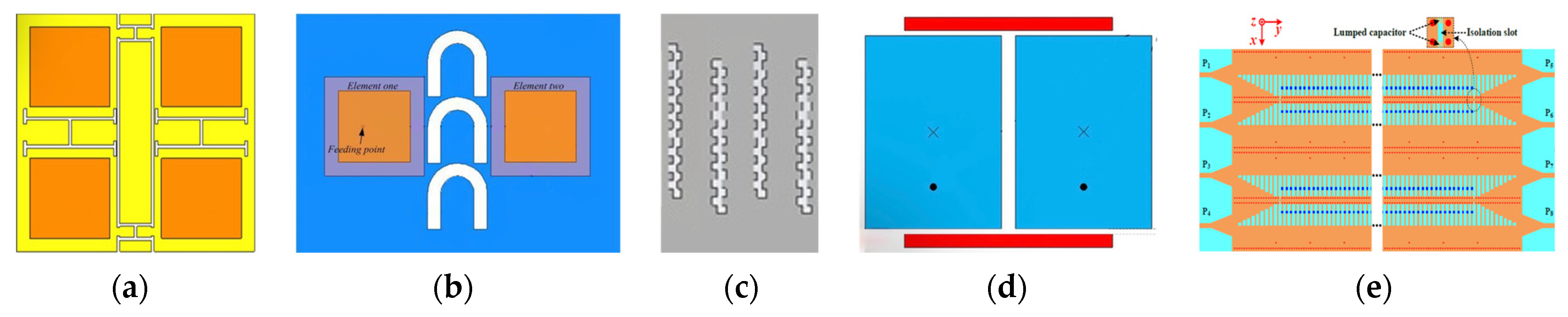
Figure 1 and
Figure 2 illustrate some of the DGS geometries employed in the reviewed works.
In [
23], three types of DGS in a microstrip line were analyzed and compared: a simple ‘U’-shaped DGS, a dumbbell-shaped DGS, and a double ‘U’-shaped DGS placed back-to-back. According to the reported results, the double ‘U’-shaped DGS positioned back-to-back exhibited the best coupling reduction. Due to its superior performance, this configuration was implemented on the ground plane of a two-element rectangular patch antenna array. This array had a resonant frequency of 6 GHz, was fed by coaxial probes, and was mounted on a substrate with a thickness (
h) of 2.0 mm and a relative permittivity (
ɛr) of 10.2.
Two DGS separations were evaluated: 43.5 mm and 28.0 mm. Results indicated that the 28.0 mm separation achieved a greater reduction in mutual coupling, leading to an isolation increase of up to 15.1 dB and doubling the rejection bandwidth (from 5.76 to 6.15 GHz). In contrast, with a 43.5 mm separation, the isolation increased by 7.2 dB.
Another proposal is presented in [
24], which describes a MIMO antenna designed to operate in the 2.7 GHz (WLAN) and 3.95 GHz (WiMAX) bands. This antenna utilized an FR4 substrate with
h of 0.8 mm and a
ɛr of 4.4. ‘C’-shaped and ‘T’-shaped DGS were added to this antenna, resulting in a reduction in mutual coupling. However, six pairs of slots were needed to achieve significant isolation.
The ground plane was etched with slots measuring 21 mm × 0.5 mm. These additions enhanced the MIMO antenna’s performance across both operating bands. For mutual coupling reduction, an isolation of less than 18 dB was achieved in the lower band and less than 20 dB in the upper band.
In the study presented in [
25], a two-element rectangular patch antenna array, designed for a resonant frequency of 6 GHz, is featured. This array was constructed on a substrate with a
ɛr of 10.2 and
h of approximately 1.27 mm. For this work, the authors proposed integrating a dumbbell-shaped DGS, positioned vertically between the two patch antennas.
The array without DGS exhibited a mutual coupling of –9.63 dB. However, upon introducing the DGS, the mutual coupling was reduced to −27.91 dB, representing a decrease of 18.28 dB. Additionally, the DGS geometry created a rejection band within the operating frequency range, indicating that surface waves, responsible for inter-radiator coupling, were significantly attenuated at the operation band of the array.
In [
26], a two-element patch antenna array operating at 5.8 GHz and fed by coaxial probes is proposed. The array utilizes a polytetrafluoroethylene (PTFE) substrate with a
ɛr of 3.5 and
h of 1.524 mm. Initially, a dumbbell-shaped DGS was designed and placed between the two antennas. However, after conducting measurements and analysis, the initial design was optimized by transforming its geometry into a ‘Z’-shaped structure. This process resulted in a final, more efficient design, adopting a zigzag configuration.
Subsequently, the results were evaluated based on the DGS position, testing its placement at the top, center, and bottom of the array, while always keeping it between the two antennas. Since the results were better when the DGS was located at the top and bottom, two DGS units were incorporated. The results showed that the antenna array initially had a mutual coupling of −5.3 dB; with the incorporation of the DGS, this was reduced to −34.1 dB, representing a significant improvement of 28.8 dB.
Another relevant contribution is presented in [
27], which conducted a comparative analysis between EBG (Electromagnetic Band Gap) and DGS structures applied to a microstrip patch antenna resonating at 2.4 GHz. The study focused on evaluating the effect of including different DGS geometries—specifically ‘+’, ‘X’, and ‘H’ shapes—in the antenna’s ground plane. These structures were implemented in three distinct configurations: a single central slot, two slots positioned at the corners near the feed point, and four slots distributed at the edges of the patch.
The antennas were fabricated on an FR4 substrate with a ɛr of 3.9 and h of 2 mm. Significant improvements were observed upon incorporating the DGS compared to the original design, which exhibited S11 of −21.16 dB, a gain of 4.047 dB, and a radiation efficiency of 51%. Specifically, the configuration with four ‘+’-shaped slots achieved an S11 of −25.28 dB, a gain of 5.469 dB, an efficiency of 71.91%, and a reduction in the physical size of the patch by up to 4.25%.
Although the study presented in [
27] does not explicitly report mutual coupling or port isolation values, the obtained results demonstrate a considerable improvement in the antenna’s overall performance. The implementation of DGS structures contributed to increased gain, enhanced radiation efficiency, and a reduction in the physical size of the patch. This validates their effectiveness as a passive technique for optimizing key electromagnetic parameters in microstrip antennas.
In [
28], a two-element microstrip antenna array was presented for dual-band MIMO applications (2.3 GHz and 4 GHz). The aim was to increase isolation between the radiating elements without significantly affecting their radiation performance. To achieve this, a DGS structure based on two Rectangular Co-directional Split Ring Resonators (RCSRR) was proposed. These were etched into the ground plane and strategically placed in the intermediate region between the two patches to interrupt surface currents causing mutual coupling. The separation between the patches was 34 mm.
The design was optimized for a dual-band response by varying length, width, and separation of the ring resonators. The antenna itself was fabricated on a substrate with a ɛr of 9.8 and h of 3 mm, with each patch fed by a coaxial probe. Measurements confirmed that the isolation achieved with the DGS exceeded 25 dB in both bands, reaching peak values close to 40 dB at 2.3 GHz and 28 dB at 4 GHz. Additionally, the maximum gain obtained was 2.37 dBi at 2.3 GHz and 4.64 dBi at 4 GHz, while the Envelope Correlation Coefficient (ECC) remained low, indicating strong performance for spatial diversity in MIMO systems.
Another example of application is presented in [
29], where a surrogate model-assisted design is proposed to optimize a DGS aiming to reduce mutual coupling in a 2 × 2 MIMO microstrip antenna array operating at a resonant frequency of 2.45 GHz. The array is mounted on an F4B substrate with a
ɛr of 4.4 and
h of 1.524 mm. The patches are symmetrically organized with a center-to-center separation of 0.37λ, where λ is the free-space wavelength at 2.45 GHz. The close proximity between the elements results in high mutual coupling, which motivated the use of an ‘H’-shaped DGS.
Initially, a single DGS was placed in the E-plane, which successfully reduced coupling by 10 dB in both the E- and H-planes. To further improve decoupling, a second DGS was then added in the H-plane, leading to an attenuation of 27 dB in the E-plane and 20 dB in the H-plane. This specific configuration marks one of the first designs to achieve simultaneous coupling reduction in both planes using just two DGS elements. The entire design process was optimized using machine learning, specifically a surrogate model, which allowed for the precise adjustment of the DGS geometric parameters without requiring extensive simulations in CST for every single variation.
The DGS were positioned between the patches along both the E- and H-planes. The final design demonstrated a significant reduction in S12 and S13 coupling coefficients to below −20 dB, validated by both simulations and experimental measurements.
In [
30], a periodic DGS comprising three serially placed ‘U’-shaped elements etched onto the ground plane is proposed, specifically positioned between two coplanar microstrip patch antennas. The patches have horizontal linear polarization and are aligned along the X-axis, while the DGS is distributed vertically (Y-axis), with a center-to-center separation of 22 mm between each DGS element. The array was designed to operate at a center frequency of 3.6 GHz, utilizing a substrate with a
ɛr of 3 and
h of 4 mm. Each patch measures 21.5 mm, and the center-to-center spacing between them is 50 mm, corresponding to 0.6λ
0.
The implementation of this periodic DGS successfully reduced mutual coupling by over −10 dB, without notably affecting the primary lobes of the radiation patterns. Additionally, a significant phenomenon of polarization rotation was observed in the coupled signal: exciting an antenna with horizontal polarization induced a coupled signal with vertical polarization in the adjacent antenna. This mechanism further weakens the coupling by reducing the orientation matching between the radiated fields.
In [
31], a meander-line shaped DGS is presented to reduce mutual coupling between two E-plane paired patch antennas. The meander-shaped slots were etched onto the ground plane of an FR4 substrate with
ɛr of 4.3 and
h of 1.6 mm. The array consists of two rectangular patches, each 15 × 20 mm
2, separated by 32.5 mm center-to-center (0.5λ
0) and fed by a microstrip line with a 5.3 mm inset for impedance matching.
The DGS is composed of four meander slots placed between the radiating elements. Their location was optimized to maximize isolation, with horizontal separations between the slots of 4.4 mm and 14 mm, and a vertical separation of 2 mm. This configuration achieved a significant improvement in isolation, increasing from 23 dB to 52 dB at the operating frequency, which slightly shifted from 4.74 GHz to 4.8 GHz. Additionally, an increase in gain of 0.6 dBi was obtained, highlighting the design’s effectiveness in terms of electromagnetic performance, manufacturing simplicity, and low cost due to the use of accessible materials like FR4.
Additionally, [
32] presents a two-element MIMO antenna design with rectangular patches in an H-plane configuration. These are mounted on an FR4 substrate with a
ɛr of 4.4 and
h of 1.6 mm, operating at a resonant frequency of 5.4 GHz. The study’s primary objective was to increase isolation in ultra-compact configurations. To achieve this, a decoupling structure composed of two microstrip lines was implemented near the upper and lower radiating edges of each patch. These lines excite an orthogonal mode (TM
10) in the unexcited patch, while the excited patch operates in TM
01 mode, thereby reducing mutual coupling by altering the direction of the electric field at the edges of the passive patch.
The design was simulated in HFSS and then fabricated. The initial design, lacking any decoupling technique, exhibited an isolation of only 4 dB. By incorporating a single microstrip line, isolation improved to 21 dB, and with both lines, it reached 30 dB, a 26 dB enhancement over the baseline. The array’s elements were separated by 0.017λ0, its ECC was significantly less than the acceptable value of 0.5, and it achieved a maximum gain of 3.8 dBi.
Finally, in [
33], a quasi-uniform beam-scanning antenna array is proposed, featuring both end-fire radiation and dual functionality for integrated sensing and communication (ISAC) applications in intelligent transportation systems. The design is based on a substrate integrated waveguide (SIW) structure fabricated on a F4B substrate (
ɛr = 2.2,
h = 0.5 mm) that incorporates sub-wavelength slots and tunable varactor diodes. This configuration enables the antenna to operate in both frequency-scanning (FS) and fixed-frequency electronic-scanning (ES) modes.
To enhance impedance matching and isolation between the elements, metallic vias are integrated into the design. The technique successfully maintains the mutual coupling below −20 dB across the 5.6 to 6.3 GHz operating band.
Experimental results validate the array’s dual functionality, showing a continuous beam scan exceeding 50° in FS mode and over 65° in ES mode at a fixed frequency of 5.9 GHz. The maximum gain is 9.8 dBi in FS mode and 9.3 dBi in ES mode, with radiation efficiencies of 72.6% and 71.2%, respectively.
Table 1 summarizes the results from the previously mentioned articles.
2.2. Metamaterials Based Isolation Enhancement Techniques
The electromagnetic properties of all naturally occurring materials can be determined from two parameters: magnetic permeability and electric permittivity. These parameters enable the characterization of any material’s response when interacting with an electromagnetic wave [
34].
Magnetic permeability and electric permittivity, denoted by the symbol μ, and ɛ, respectively, depending on the material, can be a scalar quantity in a linear, homogeneous, and isotropic medium, or a complex number when the material presents energy losses or it is frequency dependent. The permeability measures a material’s resistance to a magnetic field, or equivalently, its ability to allow a magnetic field to penetrate through it. If a material has higher magnetic permeability, it will permit greater propagation of magnetic flux lines through its structure. On the other hand, the permittivity corresponds to a material’s physical property that measures its opposition to an electric field; that is, its ability to permit the formation of an electric field within its structure. Both of which are related to the refractive index
[
35].
A metamaterial is a class of artificially engineered material. Unlike conventional materials whose properties stem from their inherent chemical composition, metamaterials derive their unique and often extraordinary characteristics primarily from their precisely designed internal structure, geometry, size, orientation, and arrangement [
36,
37].
These intricate internal structures are typically much smaller than the wavelength of the phenomena they are intended to interact with—be it light, sound, or microwaves. By meticulously crafting these sub-wavelength architectures, metamaterials can exhibit properties rarely observed in naturally occurring substances. Such properties include, but are not limited to, a negative refractive index (causing waves to bend in the “opposite” direction), perfect lensing (surpassing the diffraction limit of traditional lenses), or the ability to achieve perfect absorption or cloaking, effectively manipulating waves to render objects undetectable or to absorb specific frequencies entirely.
Metamaterials offer transformative capabilities for antenna design by leveraging unique properties derived from their engineered sub-wavelength structures. This allows engineers to overcome traditional antenna limitations. Some of metamaterial applications in antenna design are Miniaturization, Performance Enhancement, and Mutual Coupling Reduction, among others.
An example of metamaterial application is found in [
38], where Folded Split-Ring Resonators (FSRRs) are implemented to reduce mutual coupling in a two-element patch antenna array. These coaxial-fed antennas operate at 5.2 GHz and are mounted on an FR4 substrate with a
ɛr of 4.4 and
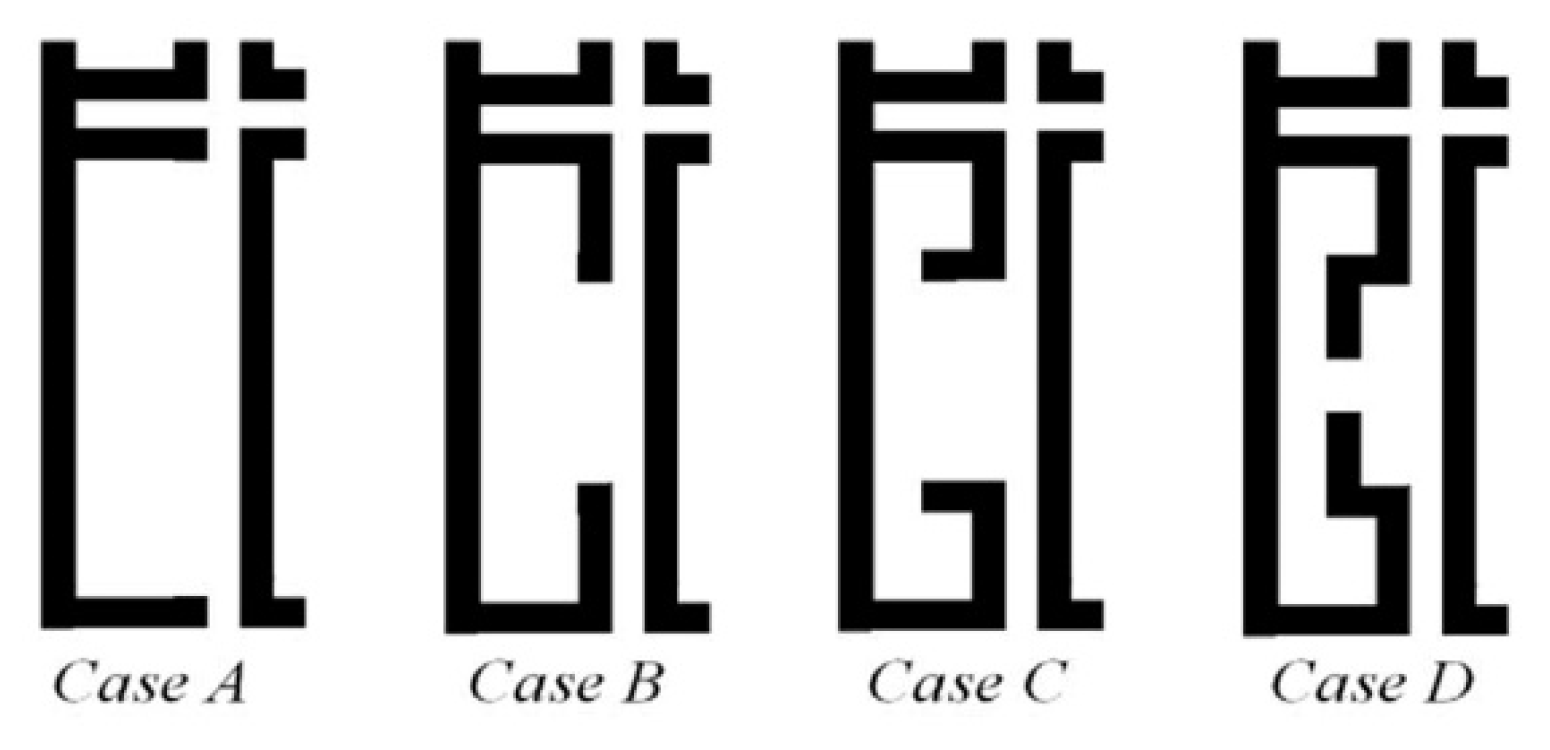
h varying between 0.2 and 3.2 mm. Initially, two designs were proposed: the first consisted of two rows of FSRRs, with the first row interconnected while the second was not. The second design involved a single row of modified FSRRs, to which additional arms were added to improve performance. Both designs were verified through simulations.
Subsequently, four additional cases were proposed (presented in
Figure 5) and re-evaluated, each with two rows of FSRRs. While the mutual coupling in the array without FSRRs was −15 dB, implementing a single row of the second design reduced the coupling to −45 dB. Furthermore, using two rows of the fourth design from the second proposal yielded a reduction of up to −56 dB.
A second example is presented in [
39], featuring a two-patch MIMO antenna. These antennas are separated by 11 mm edge-to-edge, operate at 5.3 GHz, and are printed on an FR4 substrate with a
ɛr of 4.4 and
h of 1.6 mm. This work proposes using an array of five modified Split Ring Resonators (SRRs) positioned between the two antennas.
Upon applying the ring resonators, the center frequency shifted slightly to 5.9 GHz, resulting in a mutual coupling reduction from −15 dB to −27.5 dB—an improvement of up to 12.5 dB. Significantly, the incorporation of these resonators did not affect the MIMO antenna’s bandwidth or its radiation patterns.
In [
40], the use of wavelength resonators, specifically Complementary Split Ring Resonators (CSRRs) and Open Slot Split Ring Resonators (OSSRRs), is proposed to reduce mutual coupling in a two-element antenna array. These antennas are fed by a quarter-wave transformer and have an edge-to-edge separation of 0.048λ. The design is implemented on an FR4 substrate with a
ɛr of 4.4 and
h of 1.6 mm.
The OSSRR structure was integrated into the ground plane, with two such structures placed between the antennas. Tests involved varying the separation distance between these OSSRRs (2 mm, 3 mm, 4 mm, 5 mm, and 6 mm). The most significant reduction in mutual coupling was observed at a 6 mm separation, where it decreased to −37 dB, a substantial improvement from the initial −10 dB observed without the OSSRRs.
Similarly, in [
41], CSRRs are implemented in an antenna composed of two crossed printed dipoles. These dipoles are mounted perpendicularly on an aluminum ground plane and fed by microstrip baluns. The CSRRs were symmetrically etched into the dipole arms to broaden the impedance bandwidth and enhance antenna performance. The antenna was constructed on a PTFE substrate with a
ɛr of 2.2 and
h of 2 mm.
With the incorporation of the CSRRs, a bandwidth of 1.02 GHz to 2.03 GHz was achieved, along with an increase in gain from 4.7 to 6.1 dBi across the entire operating band. Furthermore, mutual coupling was reduced to −30 dB, representing an improvement of approximately 18 dB, considering that without these structures, mutual coupling was −12 dB.
Additionally, the isolation between the two linear polarizations is greater than 25 dB. This indicates the antenna’s ability to keep horizontal and vertical polarizations separated, a key aspect in dual-polarized antennas for preventing interference between channels.
In [
42], a dual-band metamaterial compact (DBMC) structure is proposed to enhance isolation in a two-element MIMO patch antenna array. This array operates in the 2.4 GHz and 5.25 GHz WLAN bands. The antennas are mounted on an FR4 substrate with a
ɛr of 4.4 and
h of 1.6 mm, sharing a common ground plane. Although the exact separation between the patches is not explicitly mentioned, the design is optimized for compact configurations.
The decoupling structure consists of two columns of six integrated Interdigital Split Ring Resonator (ISRR) metamaterial cells, symmetrically placed between the radiating elements. These ISRRs are designed to exhibit negative permeability bands at both operating frequencies, which effectively blocks the propagation of surface waves.
Through this integration, mutual coupling was reduced by −15 dB at 2.5 GHz and −9 dB at 5.25 GHz. The achieved gain was 2 dBi in the lower band and 4.6 dBi in the upper band, all without compromising the radiation patterns or bandwidth. Both HFSS simulations and experimental measurements validated the design.
The study in [
43] proposes a dual-band MIMO array with low mutual coupling, achieved by incorporating a dual-frequency metamaterial structure placed between two identical rectangular patch antennas. The system operates in the 2.4 GHz and 5.8 GHz WLAN bands and is printed on an FR4 substrate with a
ɛr of 4.4 and
h of 1.6 mm. The antennas are fed by coaxial probes, share a common ground plane, and are separated by a 2 × 6 array of metamaterial cells designed to generate high impedance in both operating bands.
HFSS simulations demonstrate that integrating the metamaterial enhances isolation between radiating elements to over 20 dB at both frequencies, indicating a significant reduction in mutual coupling. Furthermore, the resulting radiation patterns retain sufficient directivity for WLAN base station applications, with no adverse effects on radiation properties or bandwidth.
Conversely, ref. [
44] focuses on reducing mutual coupling between two patch antennas designed to operate in the 28 GHz band, using a metamaterial structure based on CSRRs. The antennas are printed on a Roger RT/Duroid 5880 substrate with a
ɛr of 2.2 and
h of 0.508 mm. They are separated by 7.49 mm center-to-center, which corresponds to an edge-to-edge distance of 0.4λ.
To achieve electromagnetic decoupling, two arrays of Complementary Split-Ring Resonators (CSRRs) in a 2 × 5 configuration were implemented: one etched onto the common ground plane and another on a floating plane situated between the antennas. This setup effectively redistributes surface currents and blocks the direct propagation of the electromagnetic field between the radiating elements. Consequently, isolation improved significantly from 16 dB (without CSRRs) to 47.7 dB (with CSRRs), representing an enhancement of 31.7 dB.
In [
45], a technique for reducing mutual coupling in a two-patch antenna array using modified Split Ring Resonator (MSRR)-based metamaterial structures is presented. The antennas are designed to operate at 5.3 GHz and are mounted on an FR4 substrate with a
ɛr of 4.4 and
h of 1.2 mm. The edge-to-edge separation between the patches is 21.5 mm, which is approximately 0.38λ
0.
The MSRR unit comprises two concentric rings with symmetrical slots, arranged in a 1 × 6 array on each side of the antenna array. HFSS simulations demonstrate that with these structures implemented, isolation improves from 22 dB to 45 dB, a total enhancement of 23 dB. The design does not alter the center frequency or the array’s radiation characteristics, which was validated through current distribution analysis and radiation pattern evaluations.
Another application is presented in [
46], which features a metamaterial-based isolation structure to improve the performance of a 2 × 2 T-R (transmitter-receiver) patch antenna array operating at 6.19 GHz. The goal was to significantly reduce coupling between the transmitting and receiving elements. Each T-R set is printed on an FR4 substrate with a
ɛr of 4.4 and
h of 1.6 mm. The separation between the two antenna sets is 19 mm.
The proposed technique involves inserting two columns of metamaterial cells between the transmit and receive blocks. These cells are designed to exhibit high impedance within the band of interest, effectively suppressing wave propagation between the blocks. This configuration improves isolation from 35 dB to 67 dB, representing a 32 dB gain. Furthermore, the radiation pattern remains virtually unchanged, and impedance matching is also enhanced.
This design was validated by HFSS simulations and shows potential for applications in FMCW monostatic radars, as it improves the detection of nearby objects.
In [
47] presents another application example aimed at improving isolation in compact MIMO antenna systems. This work proposes a flower-shaped absorbing metamaterial, designed to operate at 5.5 GHz within the WiMAX band. The absorbing metamaterial consists of four symmetrically arranged square split rings, etched onto a 1 mm
h FR4 substrate with a
ɛr of 4.4, forming a linear array of four cells positioned between the two antenna patches.
The MIMO array consisted of two 12.2 × 16.1 mm2 patches, separated 30 mm center-to-center (equivalent to λ0/2), and fed by a quarter-wave transformer. Thanks to the metamaterial, mutual coupling was reduced from −22.1 dB to −43.7 dB, representing an improvement of 21.6 dB. This enhancement was validated through both simulations and measurements, which also showed a gain increase from 7.53 dB to 7.74 dB and a slight rise in radiation efficiency (from 66.6% to 68%).
In [
48], a dual-port, dual-band MIMO antenna is proposed for millimeter-wave 5G IoT applications, with its performance optimized through the integration of a dielectric lens. The antenna is constructed on a Rogers RT/Duroid 5880 substrate (
ɛr = 2.2,
h = 0.254 mm), a material widely employed in high-frequency systems due to its minimal dielectric losses. The system is configured with two MIMO elements in a dual-port arrangement, operating at 26 GHz and 38 GHz. As shown in
Figure 4e, the inclusion of the integrated dielectric lens effectively focuses the radiated beam and mitigates mutual interference between the antenna elements.
The study reports significant performance enhancements. Initial mutual coupling was notably high, but with the addition of a metamaterial, the isolation was improved to 25 dB at 26 GHz and 12 dB at 38 GHz. Concurrently, the gain was boosted from approximately 6 dBi to 10.2 dBi, while maintaining a radiation efficiency exceeding 85%. The ECC was also kept below 0.05, confirming low element correlation and robust MIMO performance.
This research demonstrates that integrating dielectric lenses into millimeter-wave MIMO arrays is an effective method for concurrently enhancing both isolation and gain without increasing the overall array footprint. This makes the technique particularly valuable for compact 5G IoT systems.
Additionally, in [
49], a compact 2 × 2 MIMO antenna for 5G smartphones operating in the 6.4 to 7.1 GHz band is presented. The antenna is fabricated on a Rogers RO4003C substrate with a
ɛr of 3.55 and
h of 0.508 mm. Its performance was enhanced by integrating a concentric ring resonator (CRR) metamaterial layer on a 0.204 mm thick substrate.
The implementation of this technique resulted in a significant improvement in mutual coupling, which was reduced to values below −21.7 dB in the physical prototype, while the ECC remained below 0.025. The antenna’s gain increased by at least 1.5 dB, and the total radiation efficiency exceeded 75%. These results demonstrated that the application of metamaterials is an effective strategy for simultaneously enhancing gain and isolation in compact designs without increasing the device’s footprint.
Finally, in [
50], a compact 2 × 2 MIMO antenna for 5G applications was represented, operating in the 5.9 to 6.1 GHz band. The reference antenna was fabricated on an FR4 substrate with a
ɛr of 4.4 and
h of 1.5 mm. To reduce mutual coupling, the work proposed two designs utilizing a metasurface superstrate technique based on split-ring resonators (SRRs). The implementation of double-layer metasurface (Antenna 3) proved to be the most successful approach, achieving a reduction in mutual coupling from −24 dB to −46 dB, which represented an increment of 22 dB. In addition to the improved isolation, this design increased the gain from 4.71 dB to 6.79 dB and maintained a total efficiency exceeding 50%. These results demonstrate that the use of metasurface superstrates is an effective strategy for coupling reduction in MIMO systems.
Table 2 summarizes the results from the previously mentioned articles.
2.3. Fractal Geometries Based Isolation Improvement Techniques
Fractals are geometric formations that display iterative processes with a common characteristic: they repeat infinitely. Thus, a fractal construction can be conceived as a self-similar figure, meaning all its parts are replicated at different scales [
51].
A prominent application of fractals is their use in antennas for high radio frequencies, especially in mobile phones. Using fractals offers two main advantages: the space-filling property of some fractals, like variations in the Koch curve, allows for designing fractal antennas with high response in a relatively small space. Additionally, fractal antennas can be multiband—depending on their geometry—as their resonant frequencies reflect the fractal’s self-similarity, or, in some cases, they can exhibit a frequency-independent response [
52].
In the case of fractal antennas, there is no single, general mathematical expression that can describe their electrical behavior. This is because each geometry (Koch, Hilbert, Sierpinski, Minkowski, among others) is defined by its own unique construction and scaling rules [
53]. Consequently, the effective electrical length and, therefore, the resonant frequency, are directly dependent on the specific fractal type and the number of iterations applied in its design. While all fractal configurations can be analyzed using the classic relationship between resonant frequency and effective electrical length, the method for calculating this length varies significantly with each specific geometry. Thus, it is not possible to establish a universal equation that is applicable to all fractal structures.
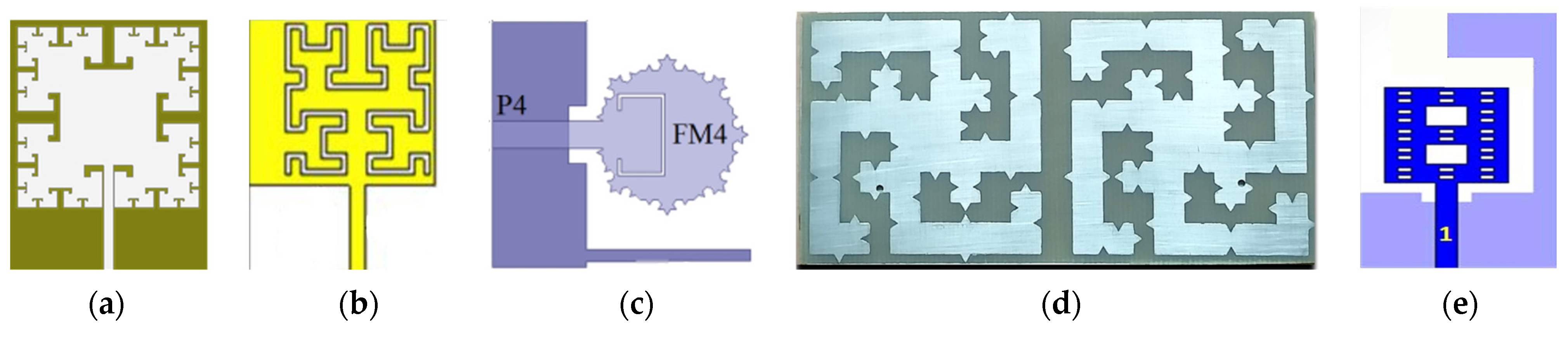
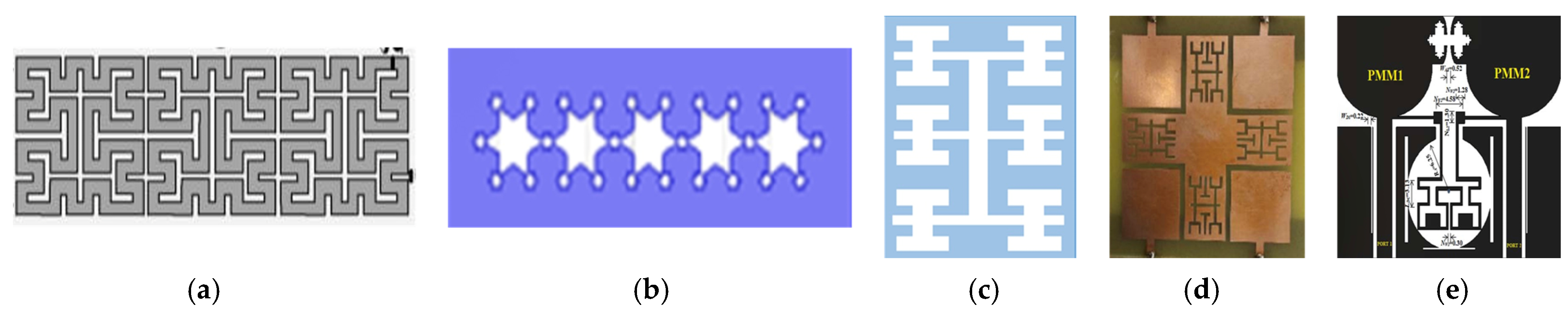
Figure 6 and
Figure 7 present some of the most employed fractals in antennas, either to improve the electric characteristics, as well as size reduction or isolation increases.
In [
54], a MIMO antenna with Koch fractal geometry and ‘T’-shaped slots is presented, operating at 1.1 GHz. The antennas are separated by a distance of 0.251λ
0 and designed on an FR4 substrate with a
ɛr of 4.4 and
h of 1.58 mm.
While the initial mutual coupling was not specified in this work, the results demonstrated a reduction to less than −60 dB, indicating exceptionally high isolation. Furthermore, an ECC below 0.0002 was achieved, signifying outstanding independence between the antenna elements. Ultimately, the use of fractal geometry facilitated a reduction in the antenna’s overall size, optimizing its design for compact MIMO applications. This technique proves particularly advantageous for portable and space-constrained devices.
Another example of application is found in [
55], which presents a two-element MIMO antenna with rectangular patch antennas. Each is fed by a 50 Ω microstrip line. The antenna operates in a frequency range of 3735 to 5460 MHz and is constructed on an FR4 substrate with a relative
ɛr of 4.4 and
h of 0.8 mm and 1 mm. Two antennas with different substrate thicknesses were fabricated to evaluate their performance.
The design incorporated a Hilbert curve up to its third iteration, integrated within the antenna area. Additionally, slots were introduced along the top and bottom of the substrate, with a ring further incorporated into these slots. Collectively, these modifications aimed to reduce mutual coupling between the antenna elements.
Results show that, without the fractal structure, mutual coupling between the MIMO antenna elements was approximately −10 dB. However, implementing the Hilbert curve and the slots on the back of the substrate reduced mutual coupling to −19 dB for the 0.8 mm thick substrate and −18.5 dB for the 1 mm thick substrate.
A different fractal configuration is presented in [
56], featuring an Ultra-Wideband (UWB) MIMO antenna based on orthogonal fractal geometry. This antenna operates in a frequency range of 3–10.6 GHz with a rejection band at the WLAN frequency (5.15–5.85 GHz). This rejection band is achieved using a C-shaped slot within the antenna’s structure. The antennas are mounted on an FR4 substrate with a
ɛr of 4.4 and
h of 1.6 mm.
Stubs were incorporated into the ground plane to reduce mutual coupling in conjunction with the fractal structure, as they function as electromagnetic reflectors. Prior to these modifications, mutual coupling measured approximately −12 dB. Following their implementation, this was reduced to less than −17 dB, and the ECC decreased to below 0.005.
Another fractal configuration is implemented in [
57], featuring a two-element heptaband MIMO antenna that proposes a hybrid ‘Quadric-Koch’ fractal geometry. This geometry is a modification of ‘Quadric-Koch,’ resembling a swastika arm but with the fractal applied to its contour.
This MIMO antenna operates in the frequency bands of 0.95–1.02 GHz (GSM 900), 1.73–1.79 GHz (GSM 1800), 2.68–2.85 GHz (LTE-A), 3.66–3.7 GHz, 4.20–4.40 GHz, 5.93–6.13 GHz (UWB), and 5.50–5.65 GHz. The antennas are designed on an FR4 substrate with a ɛr of 4.3 and h of 0.8 mm, and they are separated by a distance of 5 mm.
Results indicate that at lower frequencies, mutual coupling is −17 dB, while at higher frequencies, it reaches −25 dB. This demonstrates that employing hybrid fractals is an efficient alternative for MIMO antenna design, as it enables miniaturization, radiation stability, and high isolation without requiring additional structures, such as those presented in [
32]. An affine fractal is also proposed for mutual coupling reduction, as shown in [
58]. This work describes a four-element UWB MIMO antenna featuring an ‘8’-shaped affine fractal. The antenna operates from 3.1 GHz to 11 GHz and is designed on a Rogers RO4350B substrate with a
ɛr of 3.5 and
h of 0.8 mm.
The proposed fractal is generated from the zeroth iteration, scaling a square by a factor of five vertically and three horizontally. The design was developed up to the second iteration, resulting in a 24.88% size reduction compared to the non-iterated structure. Additionally, L-shaped stubs were incorporated; these, combined with the fractal structure, help decrease mutual coupling. The inclusion of these stubs reduced the lower cutoff frequency of the return loss (S11) from 4.1 GHz to 3.1 GHz. Furthermore, mutual isolation was improved, achieving values below −16 dB.
As a strategy to reduce mutual coupling in compact antenna arrays, [
59] proposes a combination of UC-EBG (Uniplanar Compact Electromagnetic Band-Gap) and cross-slots. This is applied to a two-patch antenna array operating at 5.05 GHz. The antennas are mounted on a substrate with a ɛ
r of 2.65 and
h of 1 mm. The radiators are separated by 0.22λ
0 edge-to-edge, forming a highly compact 30 × 50 mm
2 configuration.
The UC-EBG structure, based on the third iteration of the Moore curve (derived from the Hilbert curve), was implemented as a central row between the two patches. Additionally, three cross-slots were etched onto the ground plane, serving as a supplementary bandgap structure. Results indicate an isolation improvement of 13 dB with the UC-EBG alone, and up to 16 dB when combining the UC-EBG with the cross-slots, achieving S21 values below 33 dB. The design was validated through both simulation and measurements, demonstrating good experimental correspondence, a bandwidth of 2.5%, and virtually unaltered radiation patterns.
In [
60], a technique for mutual coupling reduction in a millimeter-wave antenna array is proposed, utilizing a fractal defective ground structure (Fractal-DGS) based on a six-pointed star. The design is implemented in a 1 × 2 array of square patch antennas, printed on a substrate with a
ɛr of 2.2 and
h of 0.787 mm. The patches are separated by 3 mm, and the system is optimized to operate at a frequency of 11.59 GHz.
The Fractal-DGS is generated by etching star-shaped fractal slots into the ground plane between radiating elements. This creates a series LC-type equivalent structure that functions as a surface wave filter. HFSS simulations were conducted to compare the design with and without the DGS. Results indicate that the conventional design exhibits a mutual coupling of −15 dB, whereas the Fractal-DGS structure reduces this to −33 dB, achieving an 18 dB improvement.
Additionally, the array achieved a gain of 9.868 dBi, which is higher than conventional antenna arrays, while maintaining good directionality. This technique proved suitable for millimeter-wave communication systems applications, providing high isolation and a compact structure.
To enhance isolation in space-constrained vehicular systems, [
61] introduces a fractal decoupling structure implemented between two PIFA-type antennas. These antennas operate vertically on a horizontal substrate. The design is optimized to work in a 3.17 to 4.15 GHz range, with a center frequency of 3.5 GHz. The antennas are separated by 0.17λ
0 equivalent to 15 mm. An FR4 substrate is used, featuring a
ɛr of 4.4 and
h of 1 mm.
The decoupling structure features four fractal slots interconnected by a central linear slot. Each slot incorporates substructures that generate multiple current paths, thereby extending the decoupling bandwidth. Simulation and measurement results demonstrate an isolation improvement of up to 32 dB, with a variation between 8 and 32 dB observed within the operating range. Notably, the design maintains the aerodynamic “shark fin” shape commonly found in automotive antenna systems.
Conversely, in [
62], a decoupling technique for compact antenna arrays is presented. It is based on an Electromagnetic Band Gap (EMBG) structure with fractal geometry inspired by the third iteration of the Moore curve. The array consists of four patch antennas printed on an FR4 substrate with a
ɛr of 4.3 and
h of 1.6 mm. The elements are separated by 0.5λ
0, centered at 8 GHz. The fractal structure is implemented by crossing microstrip lines with interconnected Y-shaped fractal slots and inverted T-shaped slots, etched into each arm of the cross.
This proposal seeks to overcome the limitations of traditional EBG methods, which often necessitate large areas and metallic vias, thus simplifying fabrication. The design was experimentally validated, demonstrating a significant improvement in antenna isolation, with a maximum increase of 24 dB and an average improvement of 18.7 dB across the 8–9.25 GHz band.
Additionally, radiation efficiency improved from 70% to 88%, and the measured gain ranged between 4 and 7 dBi without significant pattern distortion. It was also demonstrated that the structure maintains its operating band at 1.25 GHz and is viable for MIMO and SAR applications in densely packed configurations.
Finally, as an innovative proposal for compact UWB MIMO systems, [
63] introduces a fractal neutralization line based on the second iteration of the Hilbert curve. This is combined with a Minkowski-type fractal edge geometry on the monopoles and a modified circular defect in the ground plane. The antenna is mounted on an FR4 substrate with a
ɛr of 4.4 and
h of 1.6 mm, occupying an area of 26.75 × 32.94 mm
2. The two radiating elements are separated by just 0.52 mm, making it one of the most compact MIMO antennas reported in the literature.
The design achieves ultra-wideband coverage from 3.05 to 13.5 GHz, featuring dual rejection in the WiMAX (3.3–3.7 GHz) and C-Band (3.7–4.2 GHz) frequencies. This is accomplished through the implementation of a Hilbert curve and rectangular slots in the ground plane. Without decoupling techniques, isolation remains below 10 dB. However, with the fractal neutralization line and the Defected Ground Structure (DGS), an isolation improvement exceeding 20 dB is realized, reaching values of 22 dB or less across most of the operational range.
Table 3 summarizes the results from the previously mentioned articles.
2.4. Neutralization Lines Based Isolation Improvement Techniques
A neutralization line (NL) consists of a conductor or metallic strip connecting two antennas at specific points on their radiating elements or feed lines. Its purpose is to compensate for coupling between elements, thereby reducing electromagnetic interference. When positioned correctly, it can achieve effective decoupling across a broad bandwidth while maintaining proper impedance matching in the antennas [
64].
The performance of the neutralization line depends on its dimensions and location within the array. Generally, the line’s length is designed based on the wavelength (λ) at which the antenna operates. For effective mutual coupling cancellation, it is typically designed with an electrical phase shift of 180° or odd multiples of this angle relative to the coupled signal. If the line is too short, adequate cancellation will not be achieved; conversely, if it is too long, it can introduce unwanted resonances that affect system performance.
The neutralization lines are modeled as a transmission line that introduces an additional current path. This path is intentionally designed to produce a coupled signal that is of equal magnitude and opposite phase to the original coupled signal, thereby generating a cancellation effect. The input impedance of this neutralization line can be analyzed using the classical transmission line equation [
65]:
In the transmission line equation, Z0 denotes the characteristic impedance of the line, while ZL represents the load impedance connected at its termination, which corresponds to the effective load rather than strictly the non-radiating edge of the antenna. The parameter β is the phase constant of the line, and l refers to the physical length of the transmission line.
The cancellation condition is achieved when the currents are in antiphase, which can be represented as:
where
In is the current introduced by the neutralization line and
Ic is the original mutual coupling current between the antennas. This destructive interference results in a significant reduction in the |
S21| parameter, which quantifies the isolation between the two antenna ports.
Neutralization lines can also function as passive filters. Depending on their design, they are capable of blocking specific unwanted frequencies, which in turn enhances the electromagnetic isolation of the system [
66].
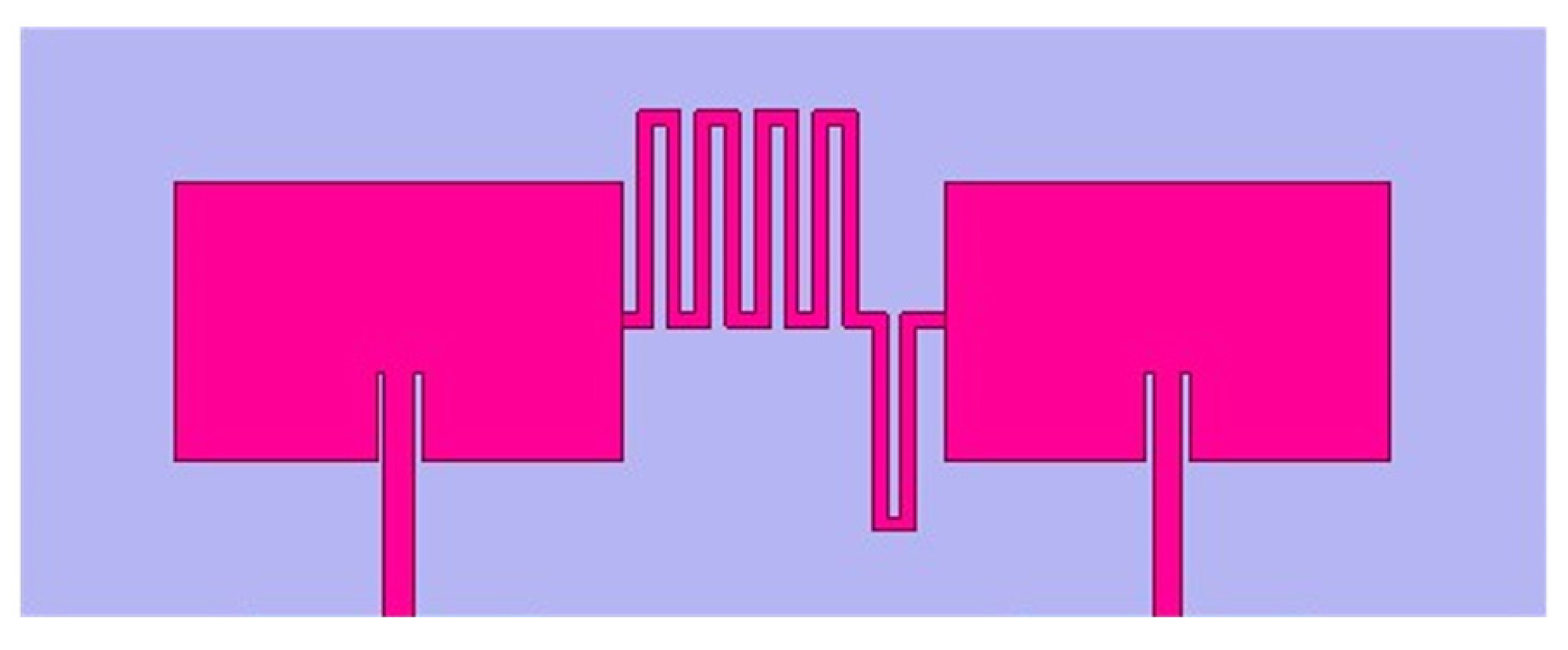
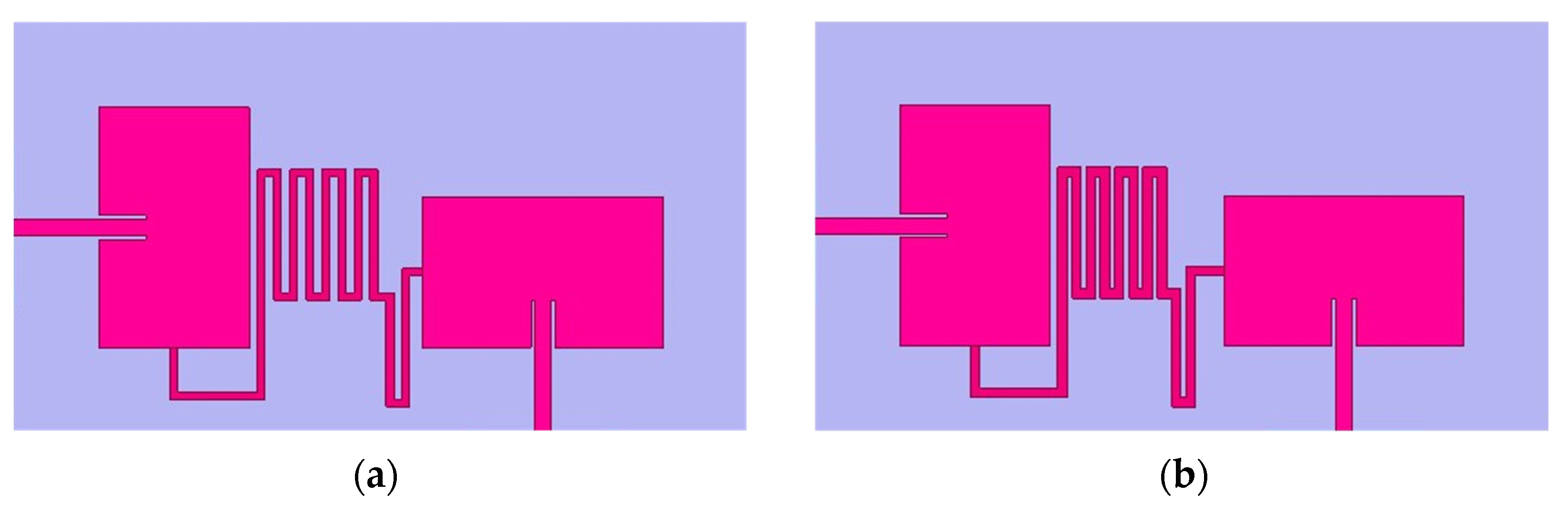
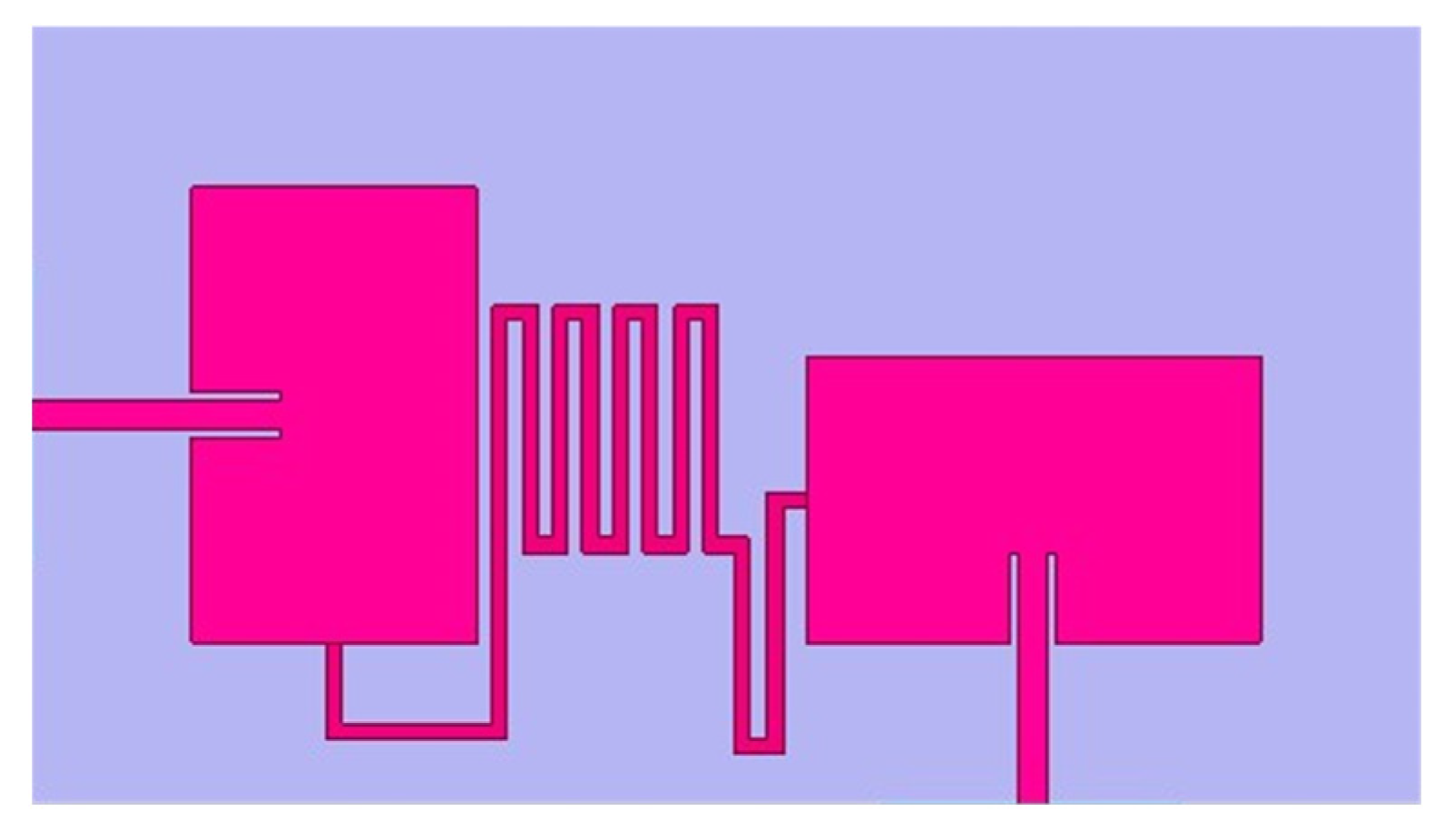
Figure 8 and
Figure 9 present different configurations of neutralization lines applied in inter-antennas isolation.
In [
67], a compact UWB MIMO antenna with a broadband neutralization line is presented to reduce mutual coupling. The antenna operates in the 3.1–5 GHz band and is mounted on an FR4 substrate with a
ɛr of 4.3 and
h of 0.8 mm. The design proposed in [
60] incorporates two neutralization lines with a 180° phase shift and a metallic disc. This structure enables multiple current paths of different lengths, which helps to cancel the coupling current.
The MIMO antenna utilized two printed monopoles, separated by merely 2.2 mm, which initially led to significant mutual coupling. To optimize performance, a parametric sweep of the neutralization line’s circular radius was performed, ranging from 2.2 mm to 2.8 mm. The most effective reduction in mutual coupling was observed with a radius of 2.8 mm. Prior to the implementation of the neutralization line, the MIMO antenna’s mutual coupling ranged between −10 dB and −12 dB. Following the implementation, the isolation improvement achieved ranged from 12 to 25 dB, depending on the frequency within the operating interval.
A second application example of NL is presented in [
68], proposing a compact UWB MIMO antenna with a fractal neutralization line, combining two electromagnetic isolation methods. This antenna operates in a 3.2–12 GHz (UWB) frequency band and includes a rejection band for WLAN (5.5 GHz) and INSAT/Super-Extended C-band (6.3–7.27 GHz).
The MIMO antenna consists of two planar circular monopoles, separated by 0.38 mm and orthogonally mounted. The design is fabricated on an FR4 substrate with a ɛr of 4.3 and h of 1.6 mm. It was positioned near the monopoles’ feed points to maximize isolation, in combination with a rectangular stub, which helps improve impedance and reduce mutual coupling. Additionally, C-shaped slots were implemented in the antenna area to generate the mentioned rejection bands.
Upon implementing the fractal neutralization line, an isolation exceeding 18 dB was achieved across the entire UWB band. Previously, without this fractal line, mutual coupling was less than −10 dB in certain sections of the band.
In [
69], a compact triband MIMO antenna with high isolation capacity is presented. This design is based on the use of two neutralization lines: one U-shaped line connected to the feed lines, and another inverted U-shaped line directly attached to the radiating patches. The system operates in three bands: 2.24–2.45 GHz, 3.3–4 GHz, and 5.6–5.75 GHz. It is printed on an FR4 substrate with a
ɛr of 4.4 and
h of 0.8 mm. The radiating elements are monopoles with meandered branches, separated by only 4 mm (0.03λ
0), which typically leads to strong mutual coupling in conventional designs.
The neutralization lines operate by introducing additional paths that generate selective resonant modes with a 180° phase shift, thereby functioning as band-stop filters. This technique successfully reduced mutual coupling from levels exceeding −10 dB to −15 dB in the lower band (2.3 GHz), −30 dB in the mid-band (3.5 GHz), and −20 dB in the upper band (5.7 GHz), achieving improvements of up to 20 dB.
In [
70], a similar design to the one proposed in [
69] is presented. The key difference is that this design incorporates only one U-shaped neutralization line. It also proposes a method based on Characteristic Mode Theory (CMT) for its design and optimization. This theory involves identifying coupled and uncoupled modes and then, designing a metallic line that introduces currents opposite to the coupling currents, effectively reducing interference between the antenna elements. This approach allows for more efficient optimization of the neutralization line’s location and parameters compared to traditional methods, thereby reducing optimization time.
This antenna operates in the 2.4 GHz and 5.8 GHz WLAN bands. Its elements are separated by 20 mm and are mounted on an FR4 substrate with a ɛr of 4.4 and h of 0.8 mm. Experimental results indicated no significant improvement at 2.4 GHz. However, at 5.8 GHz, an enhancement of up to 18 dB was observed, leading to coupling below −21 dB. Consequently, based on previous work, it is concluded that a single neutralization line may be insufficient for achieving improved isolation across all operating frequencies in multiband systems.
In [
71], an effective technique for reducing mutual coupling in a dual-frequency MIMO antenna array is proposed. It uses two neutralization lines directly connected to the edges of each radiating patch. The system is designed to operate in two central bands around 2.4 GHz and 5.2 GHz, typical for WLAN applications.
Neutralization lines were optimized in both geometry and length to maximize current phase shift and enhance isolation across both bands. Simulations revealed that the conventional design, lacking neutralization lines, exhibited coupling greater than −10 dB. However, with the inclusion of both lines, isolation improved to exceed 25 dB at 2.4 GHz and 35 dB at 5.2 GHz, respectively.
Conversely, in [
72], a novel configuration for MIMO systems is proposed. It is based on two interleaved 2 × 1 triangular patch antenna arrays, utilizing a single neutralization line to enhance electromagnetic isolation. The array is designed to operate at 2.45 GHz and is implemented on a Taconic RF-35 substrate with a
ɛr of 3.5 and
h of 2.032 mm. The closest elements are separated by 0.22λ
0, which results in strong mutual coupling of −7.81 dB without decoupling techniques.
The neutralization line was designed with a total length of 41.4 mm, optimized via FEM simulation to produce a 180° phase shift. This line was strategically positioned between the closest patches, leveraging the alignment of their centroids to facilitate inverse current coupling. This technique successfully reduced mutual isolation to 29.06 dB, achieving an improvement of 21.25 dB. Notably, isolation remained above 20 dB across the entire operating band where S11 was less than −10 dB.
Additionally, in [
73], two compact MIMO antenna configurations (2 × 2 and 4 × 4) for UWB applications are explored. Both are implemented on an FR4 substrate with a
ɛr of 4.4 and
h of 1.6 mm. Both configurations utilize a neutralization line to improve electromagnetic isolation between closely spaced radiating elements. In the 2 × 2 version, the antennas are separated by 4 mm, while in the 4 × 4, the distance between adjacent elements is 8 mm vertically and 33.3 mm between horizontal ground planes.
In the 2 × 2 structure, a neutralization line comprising two thin strips and a central rectangular metallic block is used. It is placed on the ground plane between two semicircular printed monopoles. This configuration achieves an operating band of 3.51–9.89 GHz with a measured isolation of 22 dB. For the 4 × 4 configuration, an extended design based on the 2 × 2, an isolation of 23 dB is achieved across the entire 3.52–10.08 GHz band, along with a radiation efficiency of 70.01% to 79.87% and gain between 0.95 and 2.91 dBi.
Yet another application example is presented in [
74], which proposes a compact MIMO antenna for 5G applications. It features high isolation between elements due to the use of a neutralization line. The design is based on an array of two symmetrical antennas mounted on opposite sides of a 120 × 60 mm
2 ground plane, utilizing two FR4 substrates with a
ɛr of 4.4 and
h of 0.8 mm, placed vertically. Each element has a size of 7.6 × 3.5 mm
2 (equivalent to 0.089λ
0 × 0.041λ
0 at 3.5 GHz).
The neutralization line, consisting of a 7 mm long metallic strip, was strategically placed between each antenna pair. This component is designed to generate a current that opposes the surface-induced coupling. Simulations indicate that mutual coupling, initially at −6 dB without the neutralization line, was reduced to −14 dB in simulation and −16 dB in measurement within the 3.4–3.6 GHz band. Furthermore, the design successfully maintained the desired radiation pattern and exhibited minimal frequency deviation, showing good correlation between simulated and measured results.
Similarly, [
75] presents an unplanar dual-band MIMO antenna design with high decoupling efficiency, implementing a neutralization line optimized in both position and width. The antenna operates in the 2.4–2.7 GHz and 4.4–6.7 GHz bands, fully covering WLAN applications. The system is based on two double T-shaped printed monopoles, mounted on an FR4 substrate with a
ɛr of 4.3,
h of 1.6 mm, and a total size of 36 × 33.5 mm
2. The separation between the radiating elements is 3 mm (0.024λ
0).
The neutralization line, with a length of λg/4 (guided wavelength) centered at 2.4 GHz (16.5 mm), connects the two radiators to introduce an inverse coupled current. Parametric sweeps were conducted to optimize the neutralization line’s position and width. It was observed that these variables significantly affected only the lower band’s performance, with no impact on the upper band.
Mutual isolation improved from greater than 10 dB to 30 dB at 2.4 GHz and to 17 dB at 5.5 GHz. Furthermore, measurements showed reasonable agreement with simulations, thereby validating the effectiveness of the decoupling technique.
Finally, in [
76], a compact Coplanar Waveguide-fed UWB MIMO antenna design is presented. This design incorporates a vertical T-shaped neutralization line etched into the ground plane. The system consists of two symmetrical modified radiators on an FR4 substrate with a
ɛr of 4.4 and
h of 1.6 mm, occupying a total area of 46 × 46 mm
2. The primary objective of the neutralization line is to force the surface current’s path, preventing it from flowing directly to the second radiator, thereby increasing the effective coupling length and reducing its magnitude.
The antenna operates across a bandwidth ranging from 2.7 to 12.38 GHz, achieving an isolation of 16.2 dB (measured) and 16.5 dB (simulated) throughout the entire UWB band. This represents a 5.3 dB improvement in coupling compared to the design without a neutralization line, which showed only 11.2 dB of isolation. Radiation efficiency remains above 50% across most of the operating band, though a slight drop is observed at higher frequencies due to dielectric losses.
Table 4 summarizes the results from the previously mentioned articles.
3. Design, Fabrication and Experimental Validation of Isolation Techniques
Based on the previously mentioned works, a comparative analysis was conducted to corroborate the efficiency of the electromagnetic isolation techniques described in the literature. For this, two different MIMO array configurations were designed and analyzed using rectangular patch antennas: one with elements positioned in parallel, and another with an orthogonal arrangement. In both configurations, the target frequency was 5 GHz, and the edge-to-edge separation distance between the radiating elements was λe/2 (21.931 mm), where λe is the guided wavelength in the substrate. The choice of patch antennas was justified by their low profile, ease of fabrication, and adaptability for electromagnetic isolation techniques. Additionally, the inset feed technique was applied to match the feed line to a 50 Ω impedance within the patch.
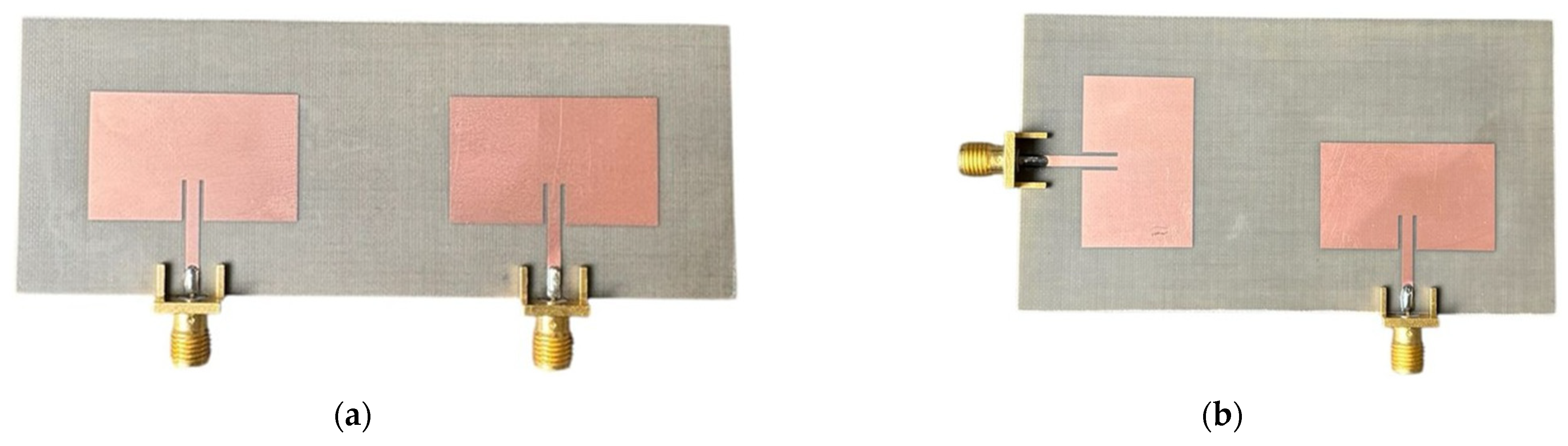
Both array configurations (parallel and orthogonal arrangements) were fabricated to corroborate the initial isolation and compare the results obtained through simulation and measurement. The prototypes are presented in
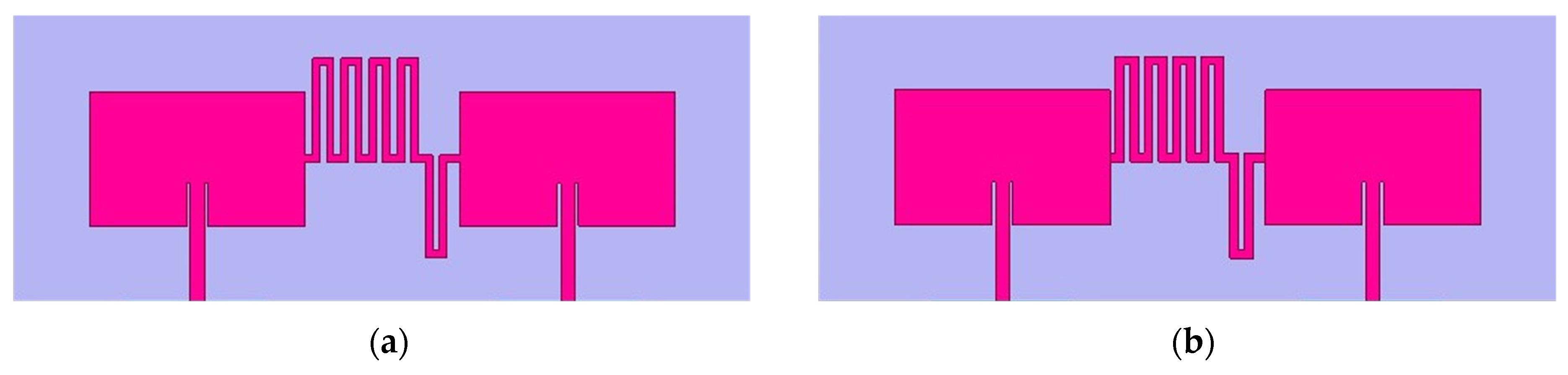
Figure 10.
For the parallel configuration, the simulated isolation was 34.301 dB, while the measured value was 29.219 dB. In the orthogonal configuration, simulation yielded an isolation of 31.628 dB, and measurement indicated a value of 36.575 dB.
3.1. DGS Implementation
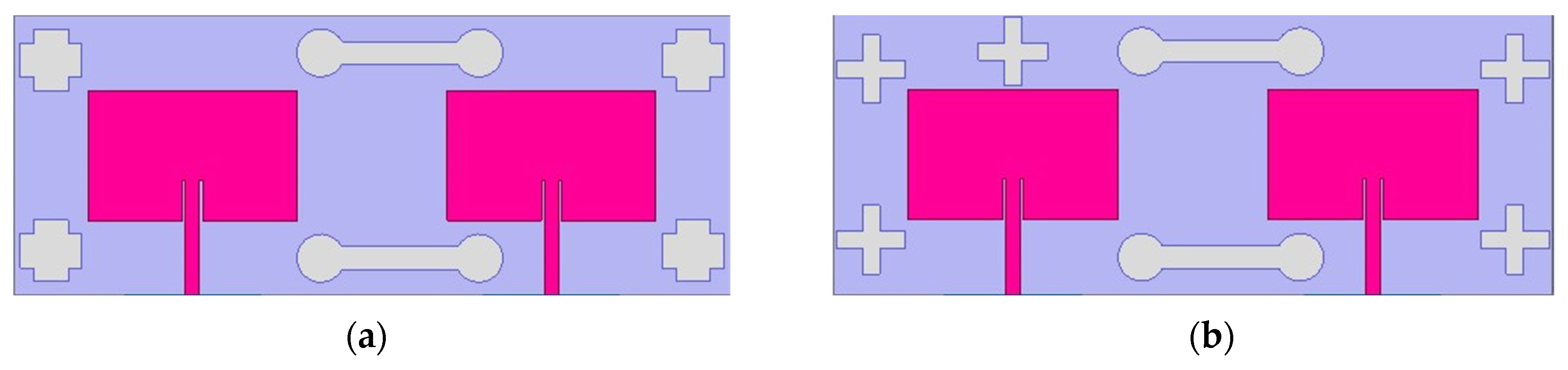
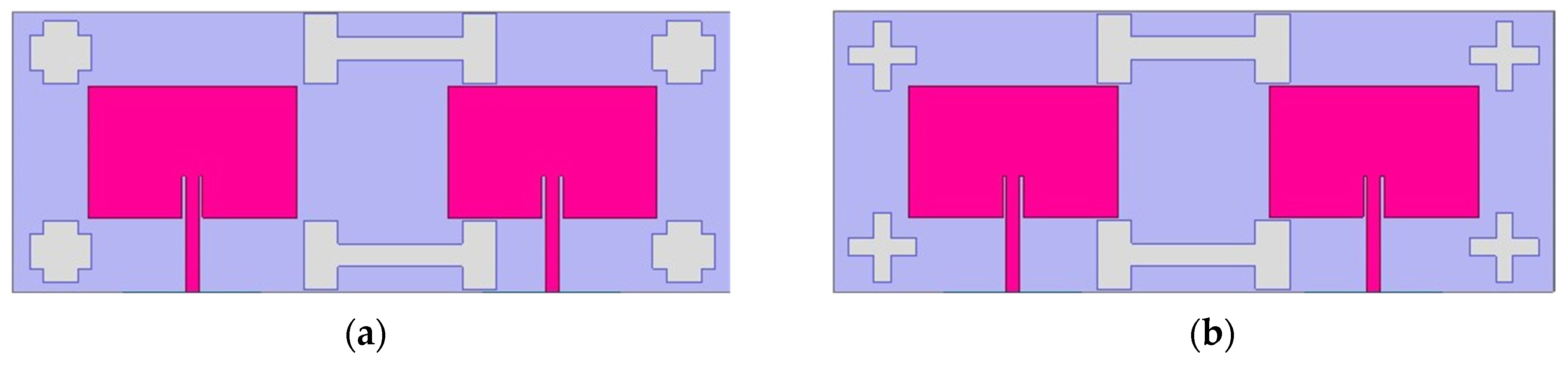
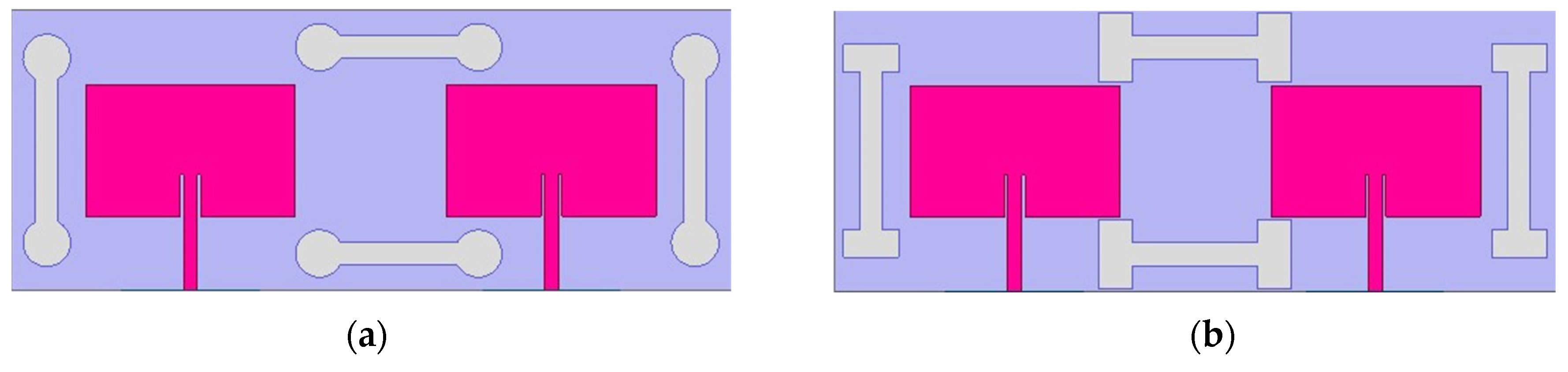
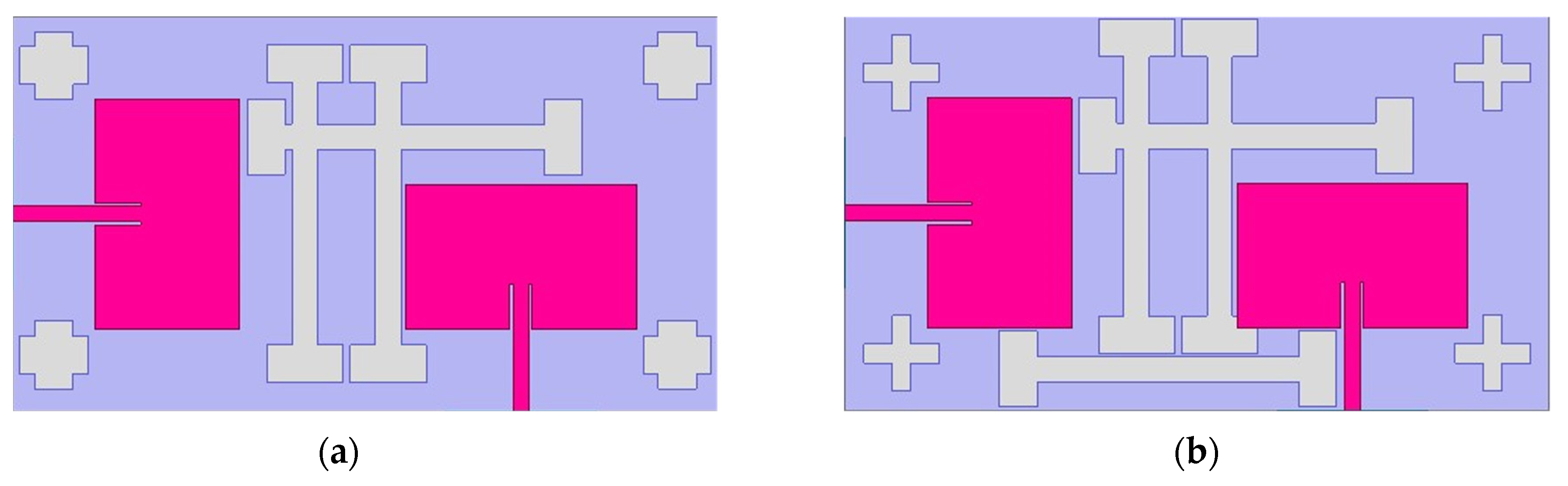
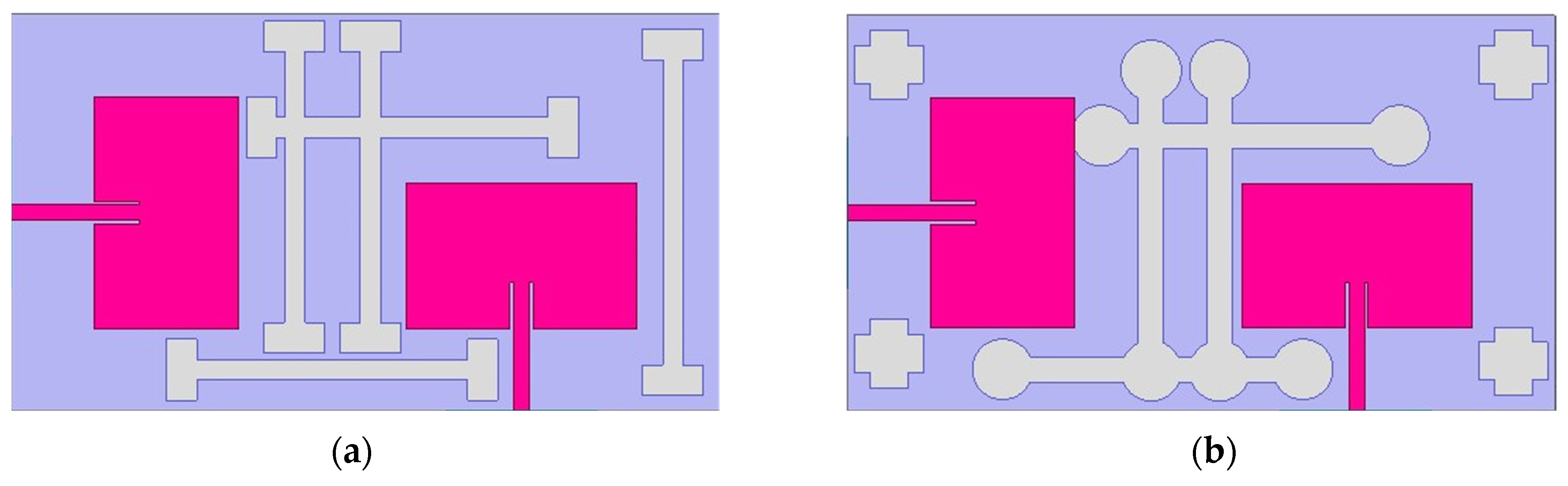
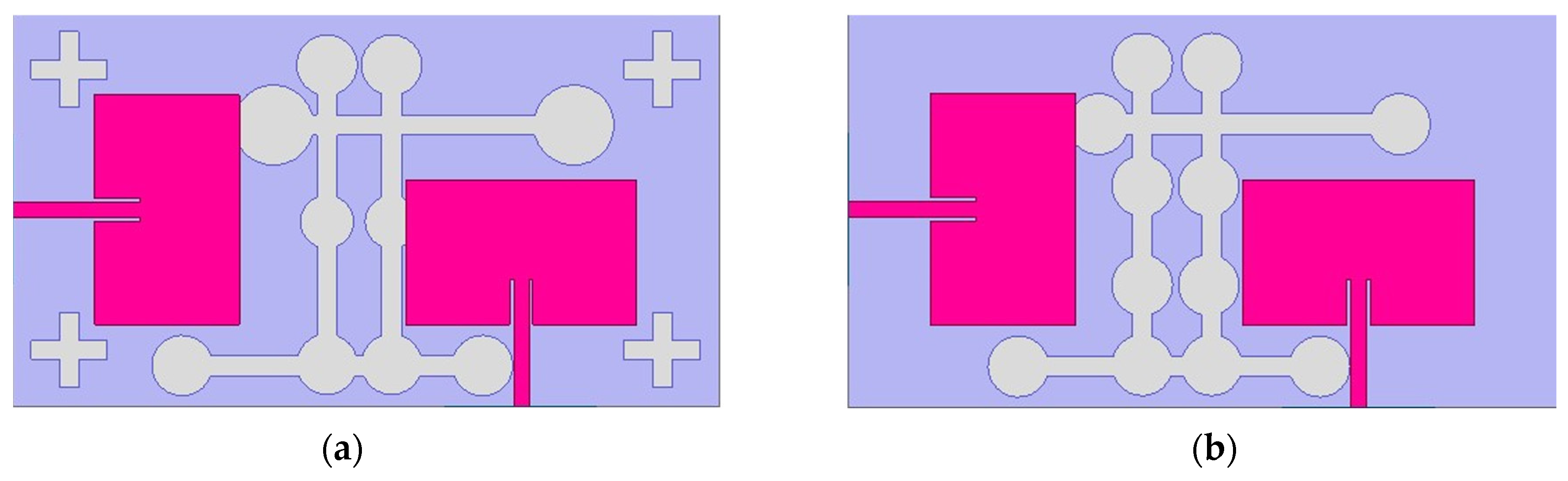
As the first electromagnetic isolation technique, multiple designs based on Defected Ground Structures (DGS) were implemented. In total, six distinct configurations for the parallel arrangement and another six for the orthogonal arrangement were analyzed. All designs included slotted DGS geometries on the ground plane were developed and simulated using ANSYS HFSS, version 19.0, 2018 software.
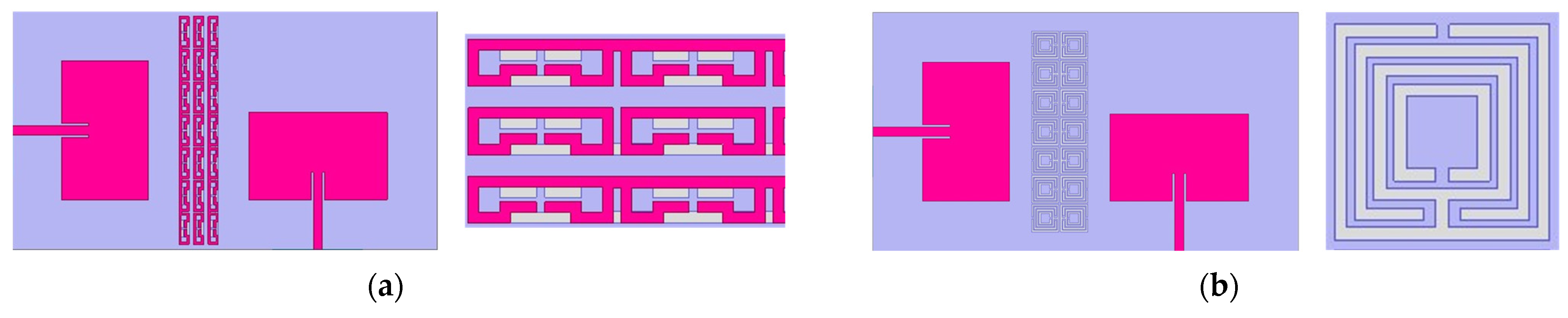
Figure 11,
Figure 12,
Figure 13,
Figure 14,
Figure 15 and
Figure 16 display the DGS configurations employed in the antenna arrays.
The obtained results are presented comparatively in
Table 5 (parallel configuration) and
Table 6 (orthogonal configuration). These simulations allowed for evaluating the impact of the different DGS geometries on coupling, without altering the central operating frequency or the antenna separation.
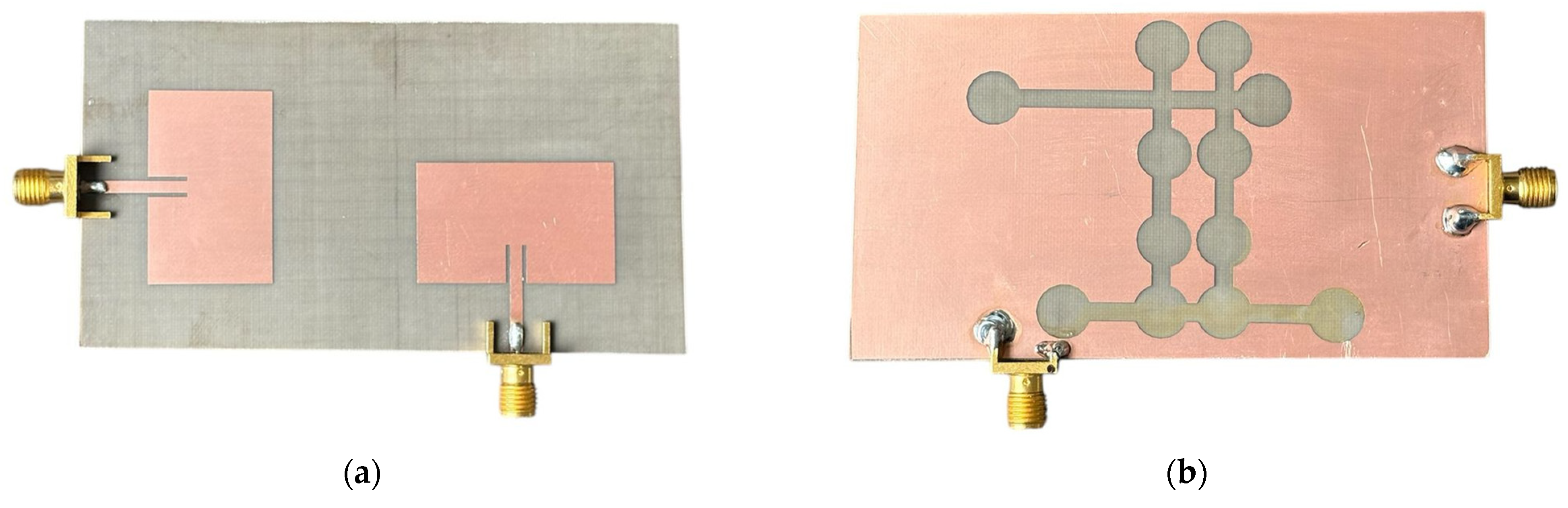
The circular dumbbell, implemented in the orthogonal configuration, demonstrated the best performance in terms of increased isolation between antennas, showing an 18.74 dB improvement. Based on these findings, an array featuring this geometry was fabricated as an electromagnetic isolation technique to corroborate the data obtained from ANSYS HFSS simulations.
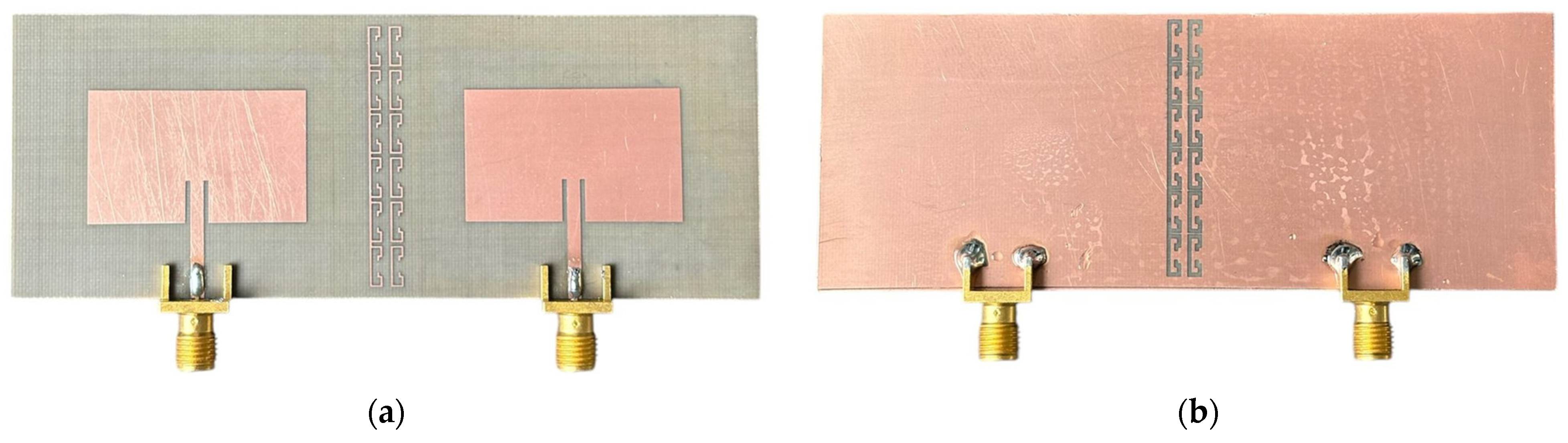
The antennas were fabricated on an RT/Duroid 5580™ substrate, which has a
ɛr of 2.2 and
h of 1.27 mm. Both the radiating elements and the DGS structures were etched using a Raycus fiber optic laser equipped with an SL-1064-112-163G output lens.
Figure 17 illustrates the fabricated antenna from both sides, to which two SMA connectors were subsequently soldered.
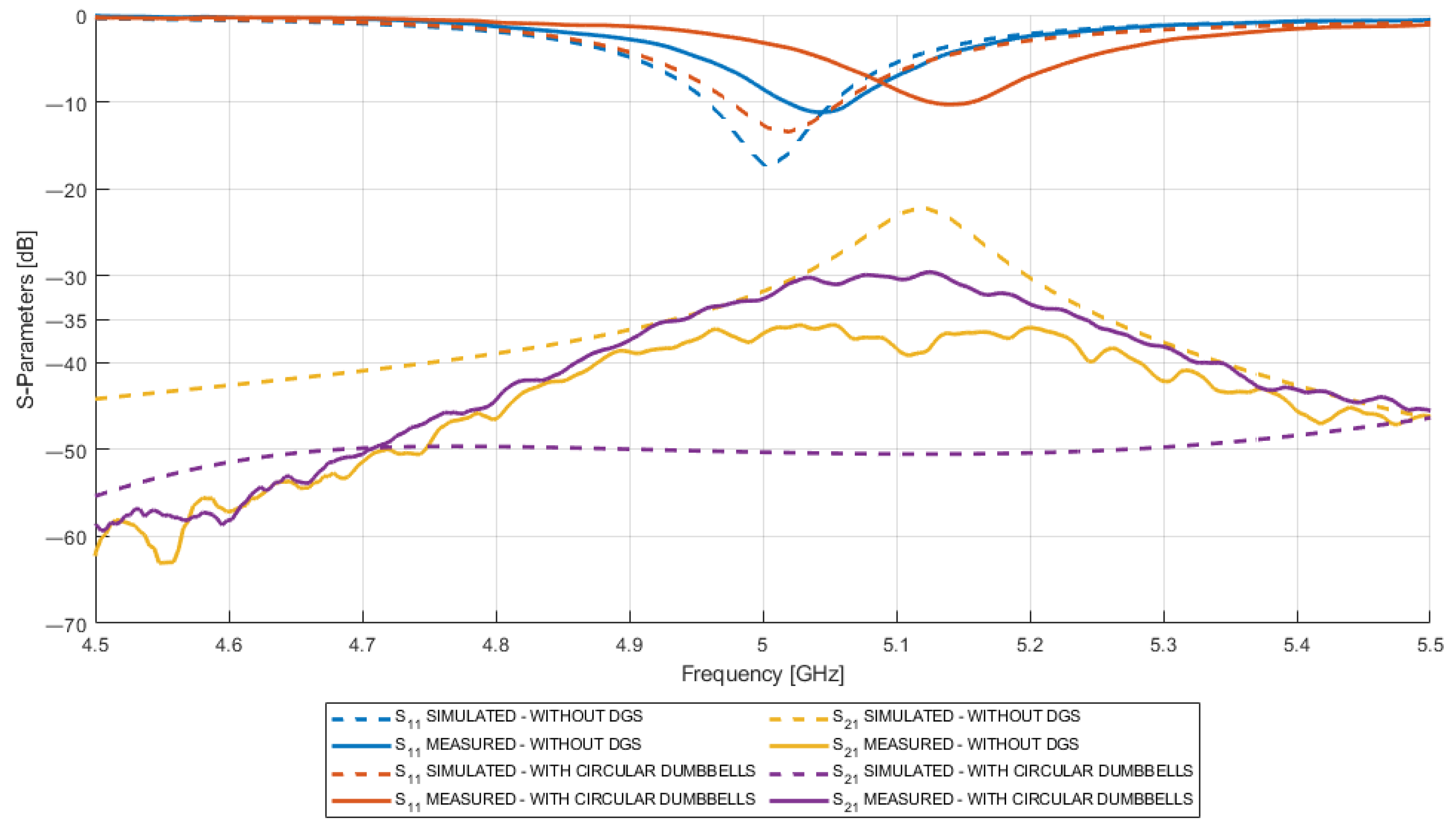
Measurements were conducted using an Agilent Technologies E8362B vector network analyzer. The results obtained are displayed in the S-parameter plot shown in
Figure 18.
While the isolation achieved was acceptable, the results indicate that the improvement observed in the simulation was not reached. This discrepancy may be due to geometrical imperfections generated during the fabrication process, such as ill-defined edges or over-etching in the DGS slots, which could alter the structure’s intended cutoff frequency.
Despite these potential limitations, the DGS design achieved a minimum isolation of 30.4654 dB and a value of 33.618 dB at 5 GHz. This validates its effectiveness as a passive decoupling technique, although its performance is dependent on precise fabrication.
3.2. Metamaterials Implementation
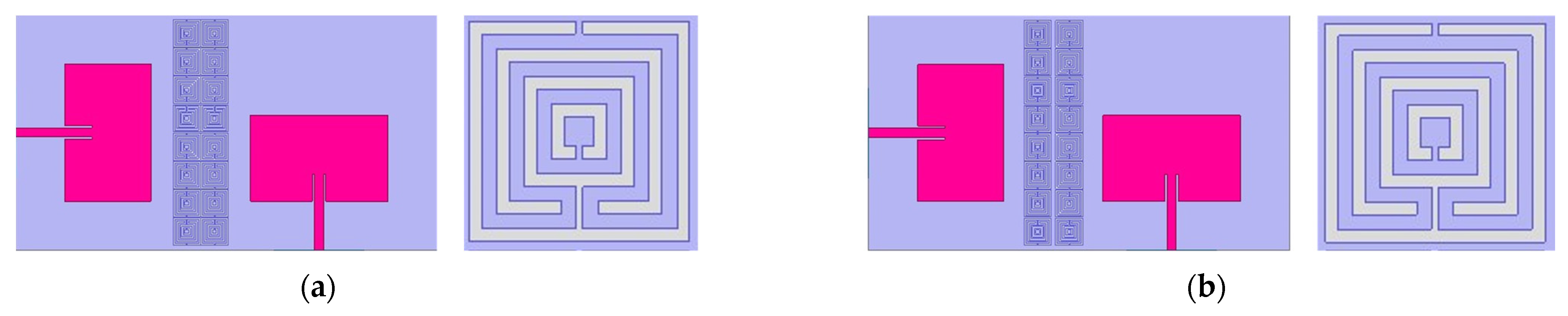
Figure 19,
Figure 20,
Figure 21 and
Figure 22 show the configurations employed in the antenna array which include the different metamaterial geometries for isolation increase, inspired by previously reported designs [
36,
37].
Additionally,
Table 7 and
Table 8 present the results obtained from the proposed designs that incorporate metamaterial structures. For both configurations, four distinct designs were developed, all of which were simulated using ANSYS HFSS software.
Based on the simulation results, the design that showed the greatest increase in isolation implemented a 6 × 2 array of resonant rings. However, due to the reduced distance between rows, it was deemed more appropriate to fabricate the design corresponding to the parallel configuration, featuring a 6 × 2 array of split resonant rings.
Figure 23 displays the fabricated antenna from both sides, including the soldered SMA connectors.
The measurements of its S-parameters are presented in
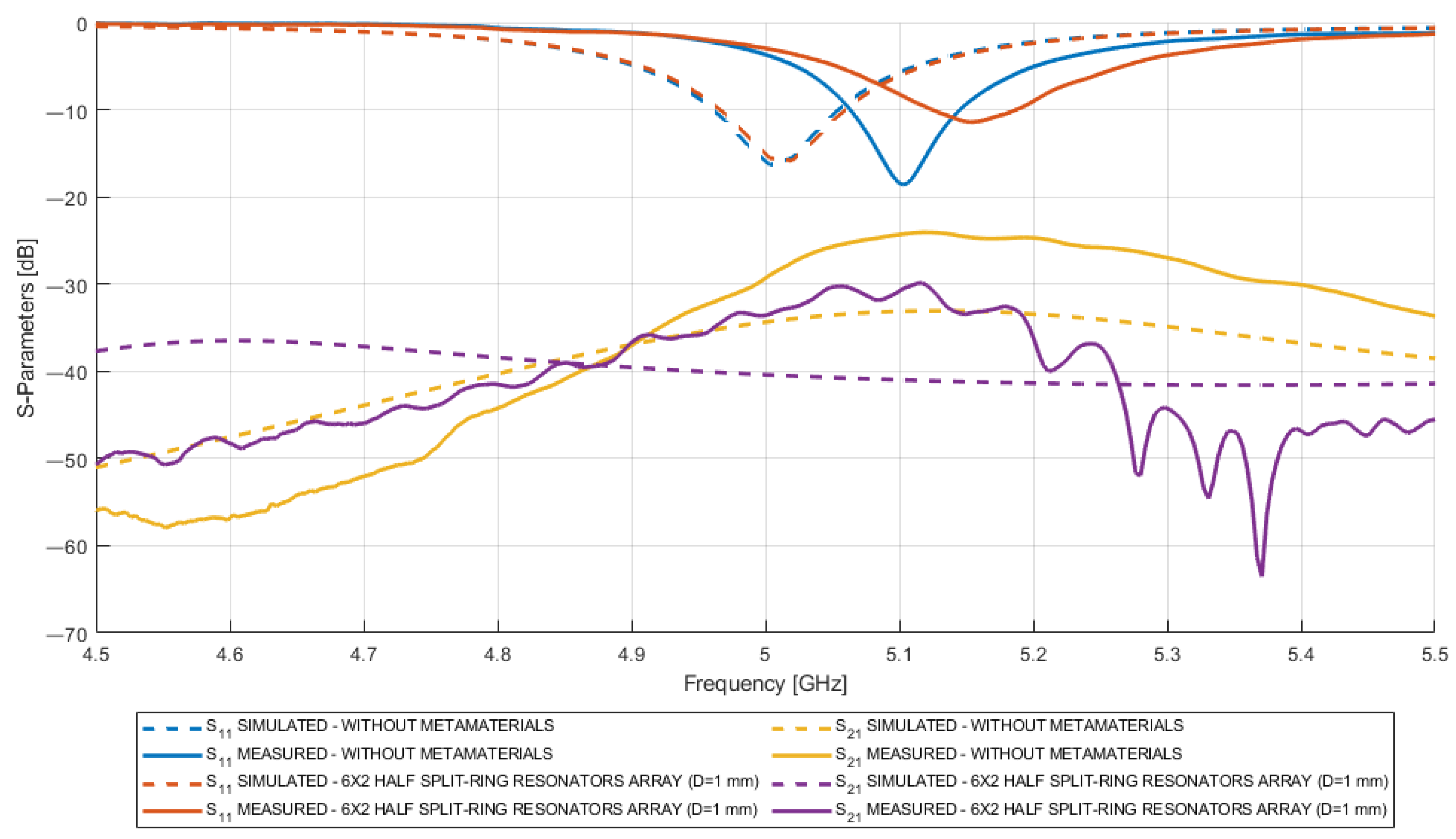
Figure 24, which compares the results obtained through simulation with those measured, aiming to corroborate the effectiveness of metamaterials as an isolation technique.
Unlike other designs, the array with metamaterial structures exhibited more consistent performance with minimal variation in the measured values. A minimum isolation of 33.2421 dB and a value of 33.5786 dB at 5 GHz were obtained, indicating good performance under real-world conditions.
The geometry and orientation of the resonant rings effectively suppressed mutual coupling, as indicated by these results. While this type of structure necessitates a more detailed design process, the experimental outcomes aligned with expectations, validating its implementation as an effective alternative in compact applications where isolation between radiating elements is critical.
3.3. Fractal Geometries Implementation
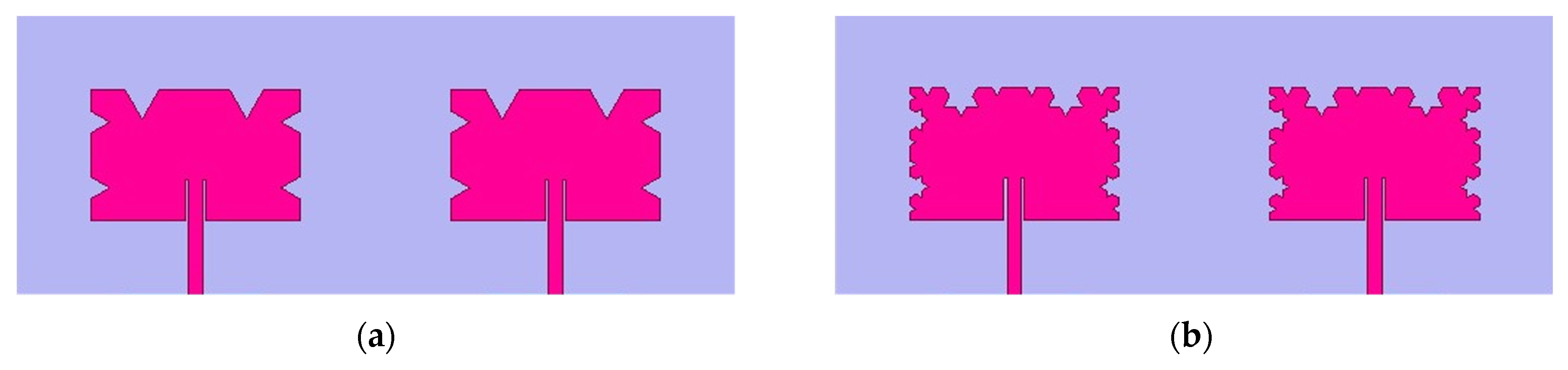
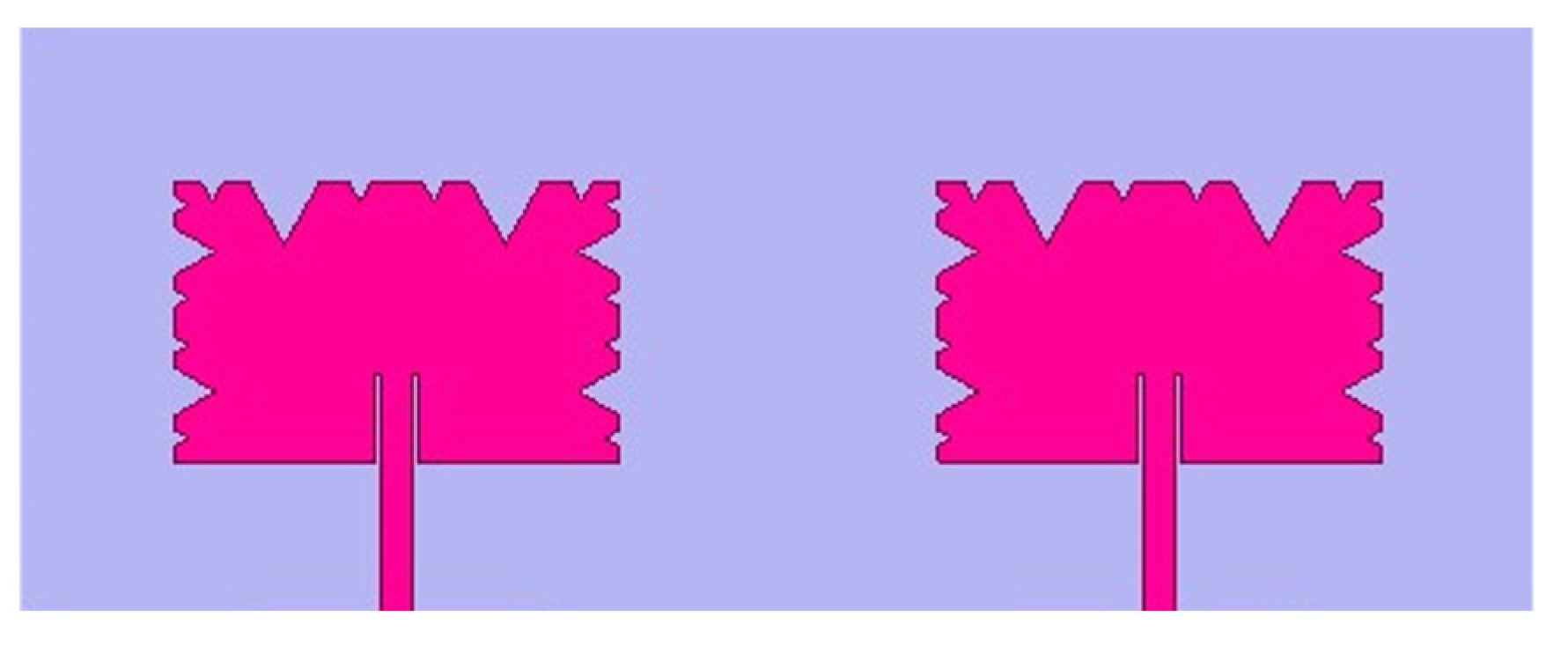
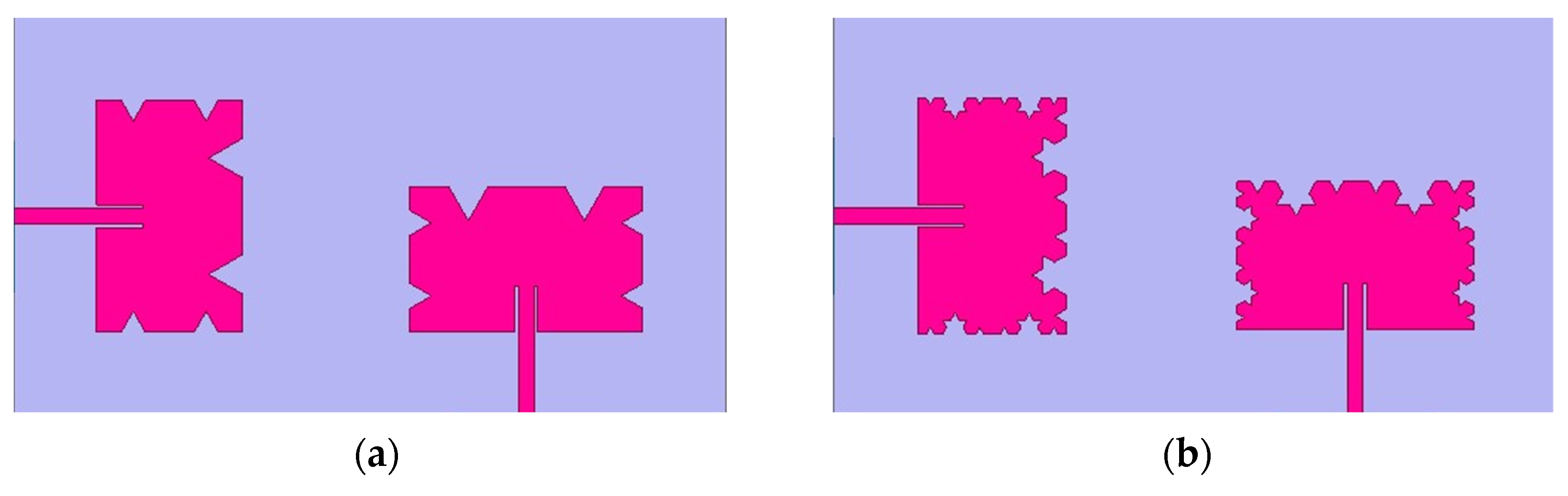
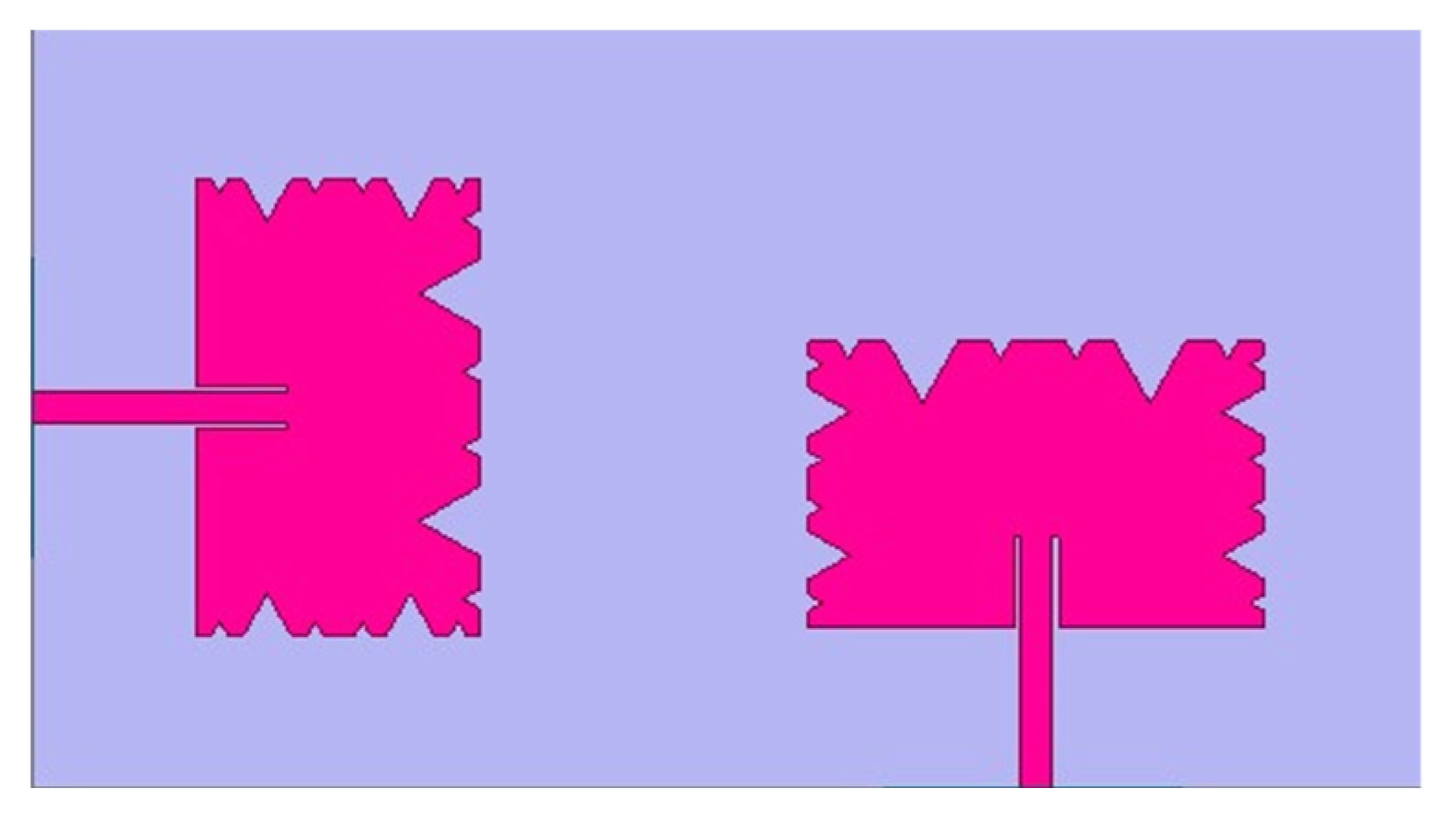
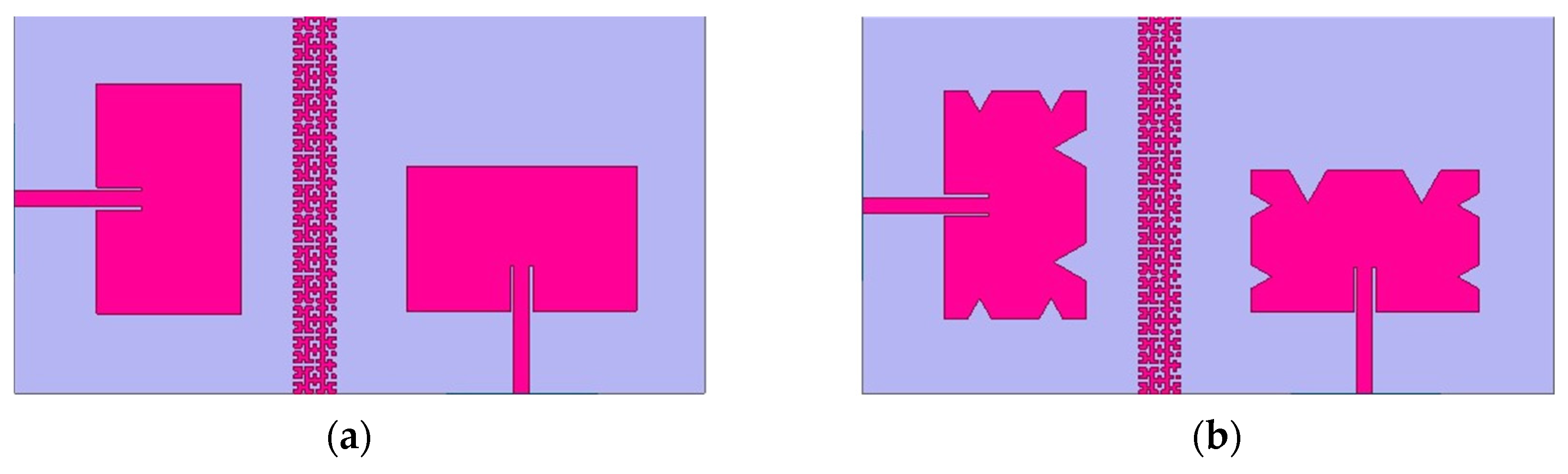
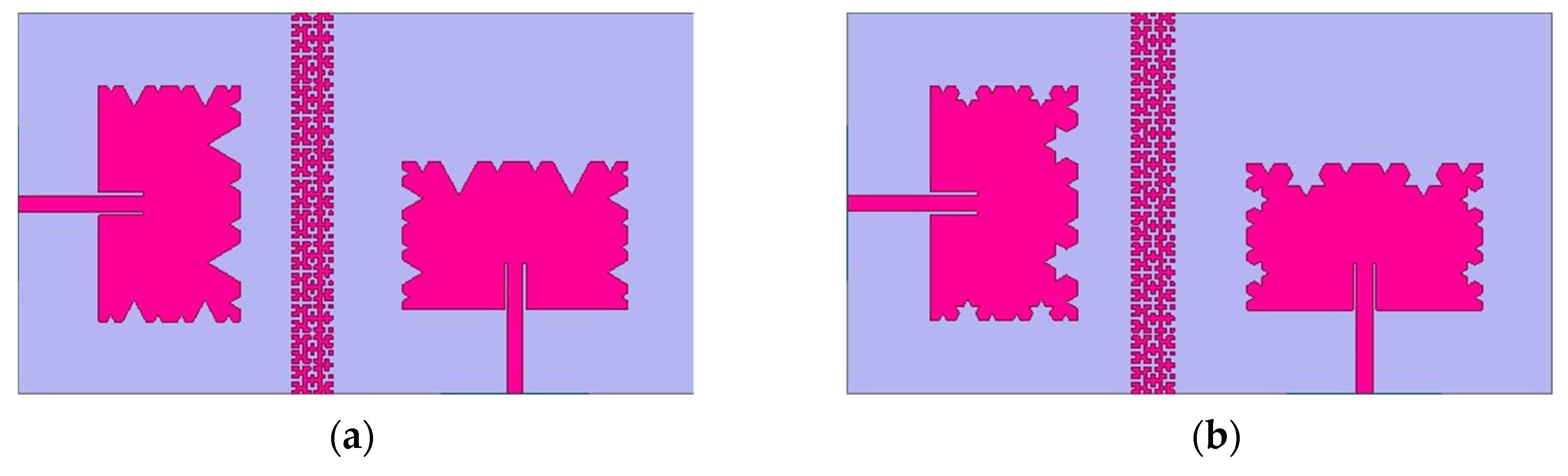
Regarding fractal geometries, the Koch curve around the patch antennas is proposed, implementing its first and second iterations.
Figure 25,
Figure 26,
Figure 27 and
Figure 28 display the antennas with fractal configurations.
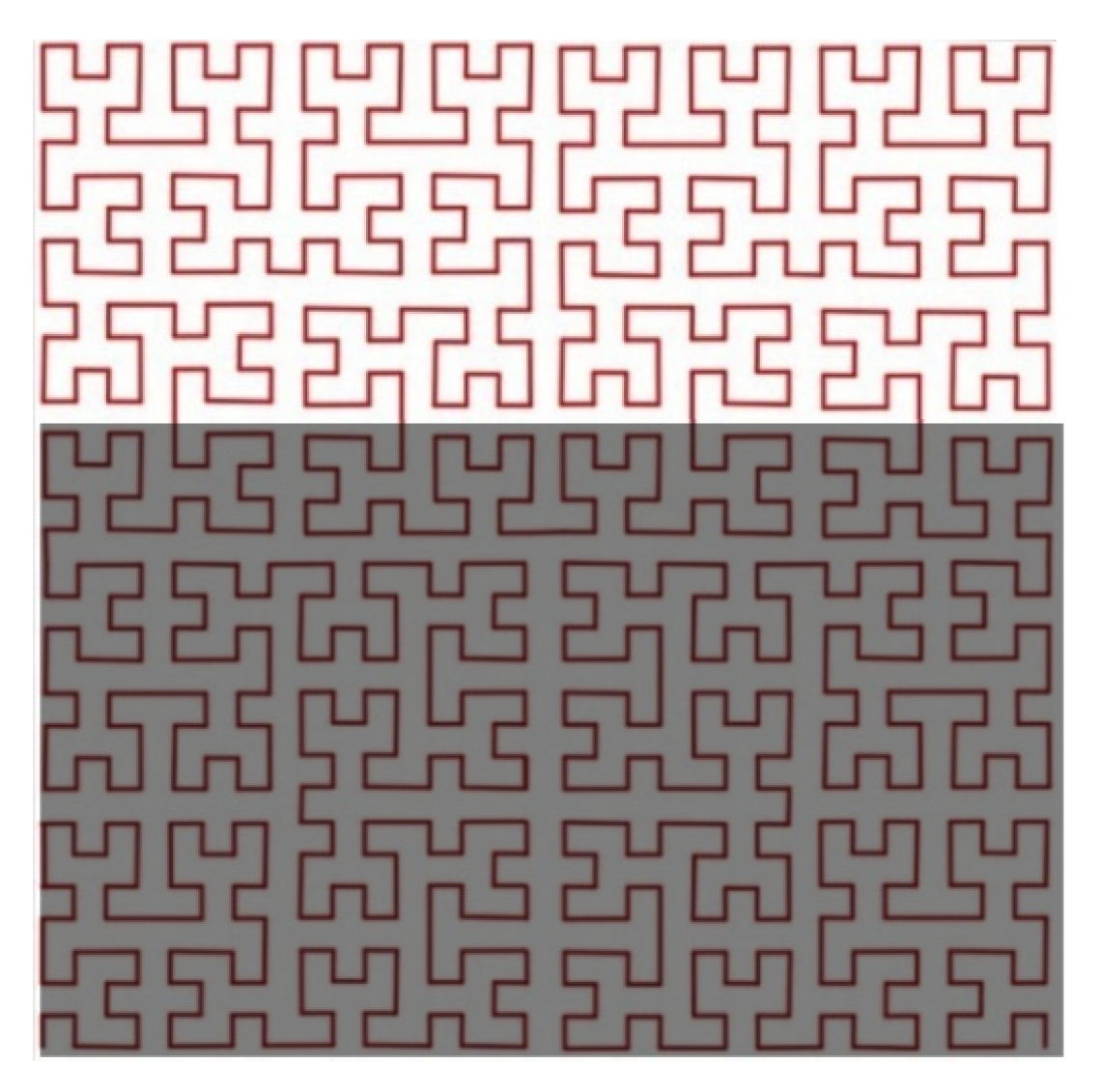
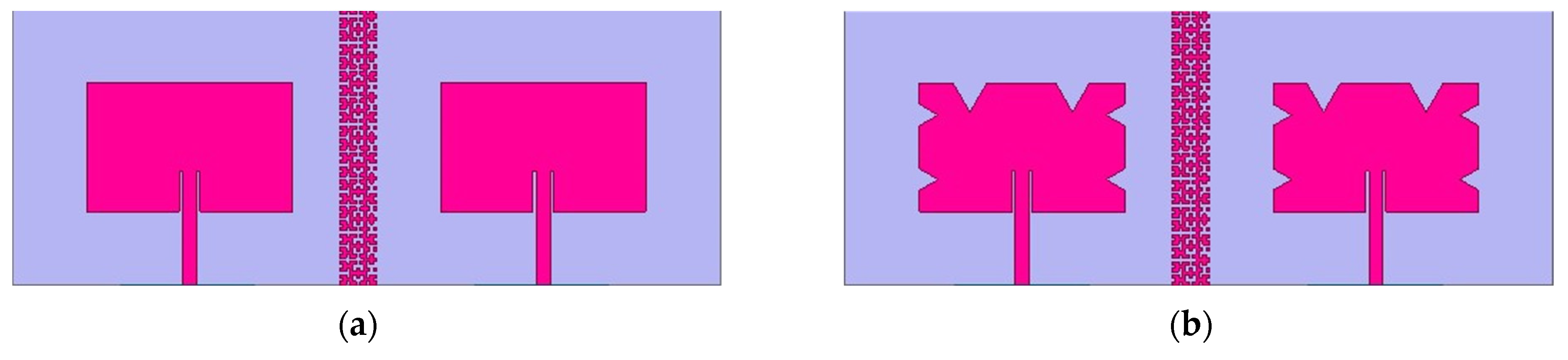
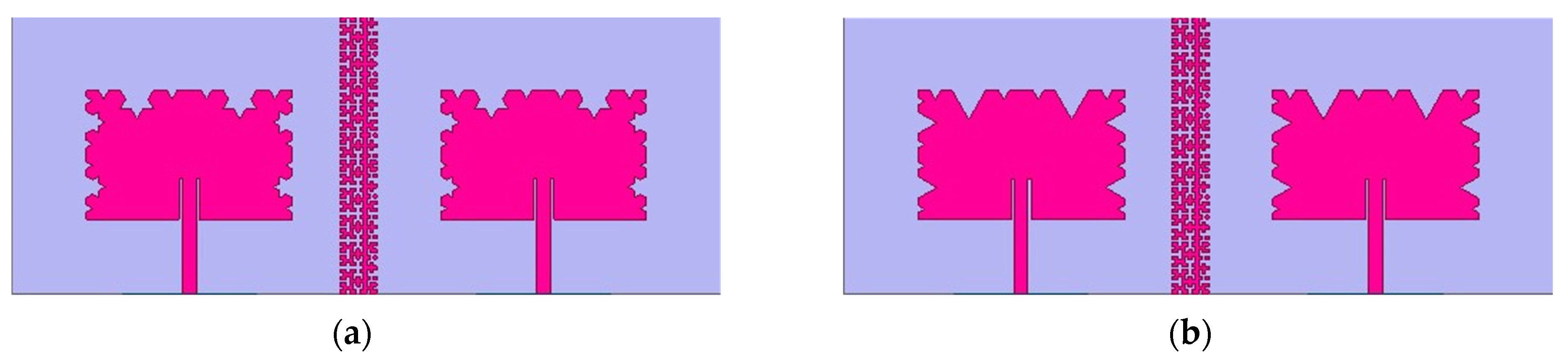
However, the initial results were not as expected, as the isolation increase was less than 3 dB. Therefore, for complementing the design, a Hilbert curve placed as a barrier between both antennas is also used. It should be noted that only the unshaded portion of the curve was employed, as shown in
Figure 29, since this section corresponds to the part physically used as a barrier in the design. This was implemented in two variants: one where it was located only on the top plane, as depicted in
Figure 30,
Figure 31,
Figure 32,
Figure 33,
Figure 34 and
Figure 35, and another where it was also placed on the ground plane (bottom plane; as shown in
Figure 32 and
Figure 35).
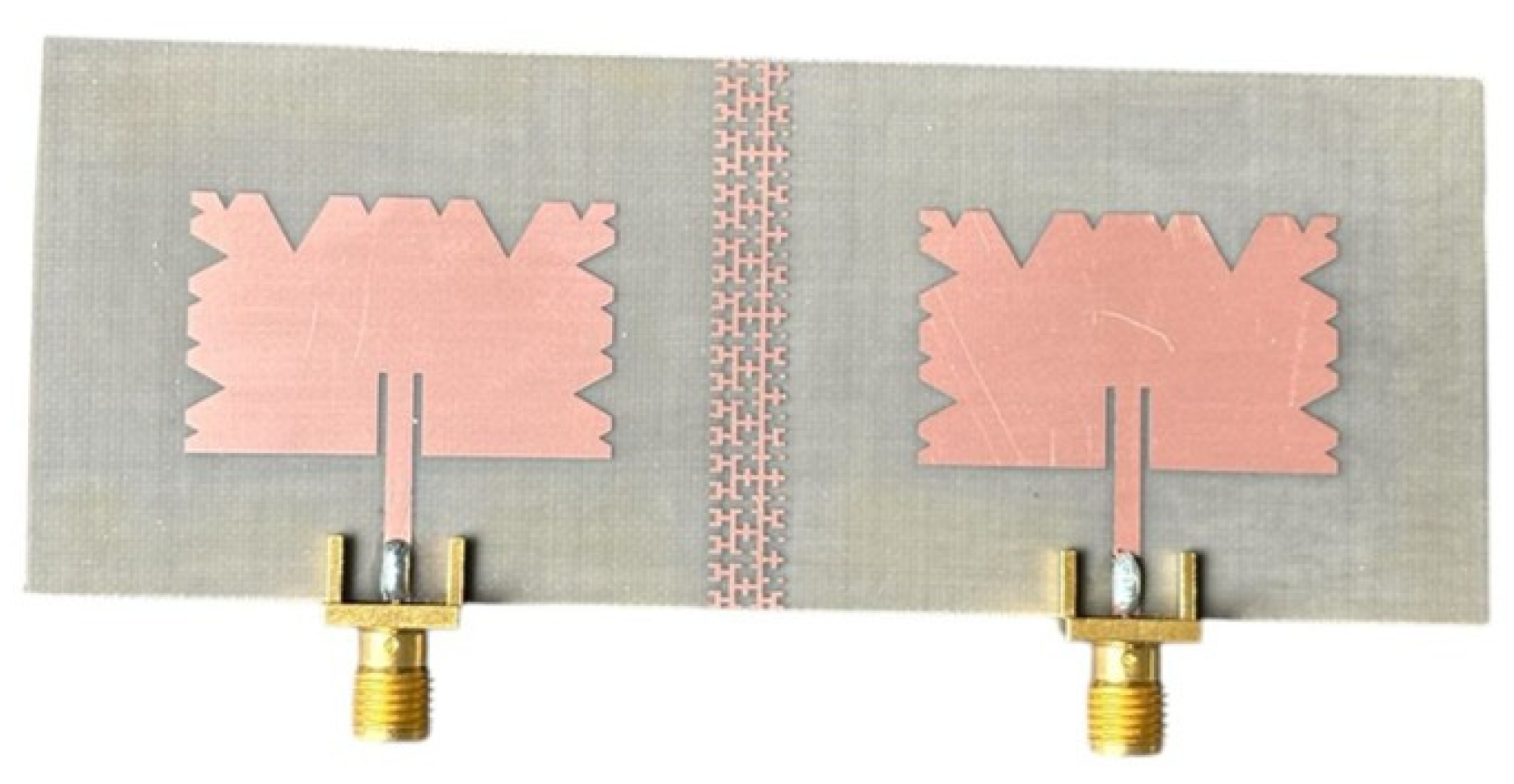
The design with the best performance was the parallel configuration, which implemented the incomplete second iteration of the Koch curve (i.e., only with the horizontal iterations) along with a Hilbert curve barrier between the two antennas. This prototype design is shown in
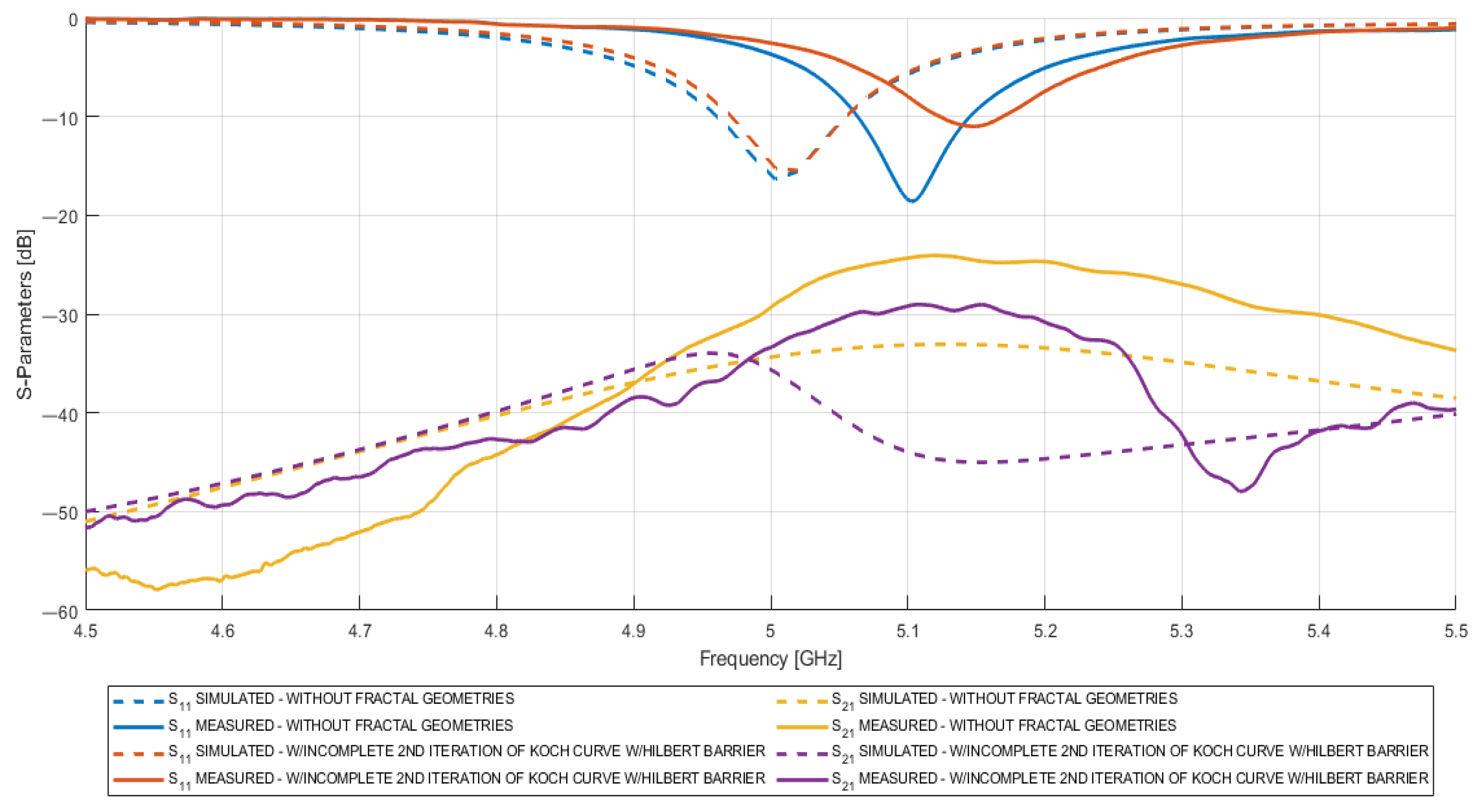
Figure 36 and was selected for fabrication and measurement. The results obtained from these measurements are presented in
Figure 37.
According to the data obtained, the use of fractal structures improved isolation compared to the base design, achieving a minimum value of 29.11 dB and an isolation of 33.37 dB at 5 GHz. While not all implemented fractal patterns showed consistent improvements, some combinations of Hilbert curves and complex contours did demonstrate a significant reduction in coupling.
This improvement can be attributed to the fact that fractal structures increase the effective contour length without increasing the physical size of the patch. This alteration in the current’s path helps reduce areas of direct coupling between elements, thereby favoring isolation in compact configurations.
3.4. Neutralization Lines Implementation
Finally, for the neutralization line technique, three designs with varying lengths and widths were proposed. The goal was to generate phase shifts of 180° or odd multiples thereof, aiming to counteract the mutual coupling between the currents of the radiating elements.
Figure 38,
Figure 39,
Figure 40 and
Figure 41 present the different configurations of the NL employes in the antenna arrays.
Table 13 and
Table 14 present the results obtained from these simulations for both configurations.
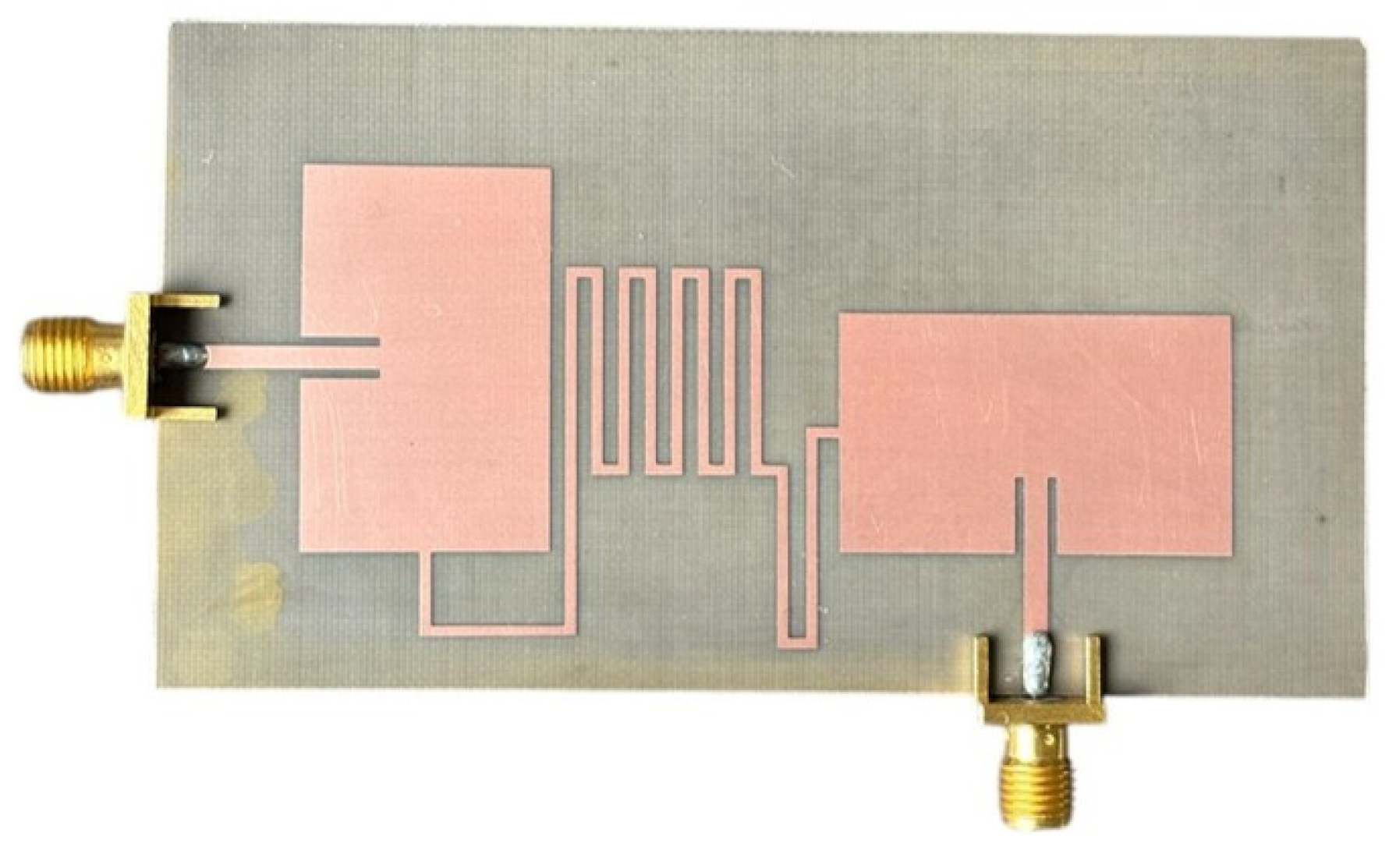
Among the six designs evaluated, the one demonstrating the most significant isolation improvement was implemented in an orthogonal configuration. This particular design incorporated a neutralization line measuring 203.201 mm in length and 0.98 mm in width, which yielded an improvement of 19.1757 dB. Based on this promising result, the design was subsequently fabricated (as depicted in
Figure 42) to facilitate corresponding measurements and verify the effectiveness of the neutralization line.
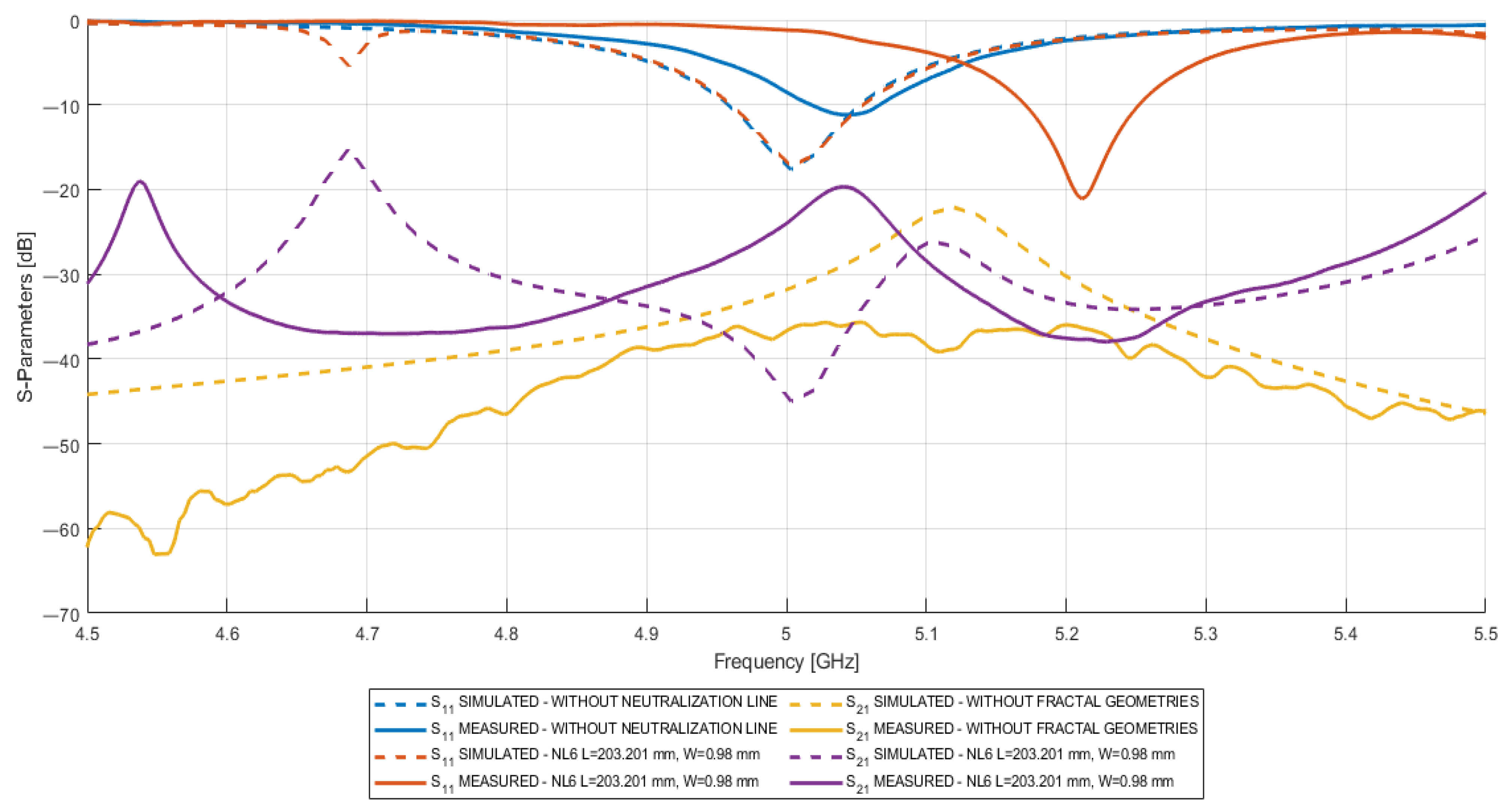
Figure 43 presents the measurement results.
In this case, the results revealed a contrasting behavior. While a minimum isolation of 37.6889 dB was achieved, the corresponding value at 5 GHz was considerably lower: 23.8883 dB. This difference suggests that the effective cancellation generated by the line does not occur precisely at the target frequency, which limits its practical applicability if not properly adjusted.
The primary cause of this low field cancellation between both antennas can be explained by the phenomenon observed in
Figure 29. For the neutralization line to function effectively, the fields generated by both antennas must have similar magnitudes and opposite phases. This highlights the importance of the line having an electrical length of 180° or odd multiples of this value.
However, as the graph shows, both antennas are not tuned to the same frequency. This means that at 5 GHz, the generated fields do not have equivalent magnitudes or opposite phases, making it difficult to meet the necessary conditions for effective mutual coupling cancellation. This means that the resonant frequency of the radiating elements involved in the technique’s application must first be ensured.
Finally,
Table 15 summarizes the best results obtained for each technique, including the array type, the substrate used, and the measured and simulated isolation.
5. Conclusions
In this work, a study of various electromagnetic isolation techniques, primarily based on Defected Ground Structures, metamaterials, fractals, and neutralization lines, was conducted. A compilation and analysis of different cases of these structures, as presented in the state-of-the-art, were performed. It is noteworthy that the specific technique employed for each designed geometry in MIMO antennas is highly dependent on the type of radiator used, as well as the available space for its application. Additionally, an independent study of the different techniques was conducted and applied to a patch antenna array operating at 5 GHz. To gain a broader perspective, two types of antenna arrays were employed: the first with parallel antennas, and the second with antennas in an orthogonal configuration.
In the simulation, the results showed that the DGS and neutralization line techniques were the most effective in terms of isolation, achieving improvements of 18.7 dB and 19.1 dB, respectively, compared to the baseline configuration. These values represent a reduction of more than 98% in the coupled power, considering that an improvement of only 3 dB is equivalent to a 50% decrease in the energy transferred between antennas. For their part, metamaterials and fractal geometries also demonstrate significant improvements, with gains of 6.1 dB and 3.1 dB, respectively. It is worth noting that, in all cases, these improvements were achieved without compromising gain (with variations of less than 0.05 dBi) or radiation efficiency, which remained above 98%.
In the experimental stage, although the improvements observed in the simulation were partially replicated, deviations were identified that are attributable to manufacturing process factors, such as the laser equipment’s scale configuration and the precision in patch alignment. Specifically, in the case of the neutralization line, the resonance frequency shifted from what was expected, which suggests that dimensional errors during etching affected its performance. Although this technique showed the best result in simulation (50.80 dB), its measured performance was the lowest (23.88 dB), evidencing its high sensitivity to manufacturing errors. In contrast, techniques based on DGS, metamaterials, and fractals demonstrated greater stability between simulation and measurement. Metamaterials stood out as the strategy with the best measured isolation (33.57 dB), followed very closely by the configurations with fractals (33.37 dB) and DGS (32.61).
However, it should be emphasized that all techniques achieved at least a 3 dB reduction in mutual coupling between antennas. When comparing these findings with previously published results, which showed improvements greater than 10 dB, it can be concluded that the selection of an isolation technique should align with the specific radiator being used. This is because each radiator, with its unique geometry, generates specific electromagnetic fields that can be attenuated according to their propagation modes. Therefore, it can be asserted that a metamaterial-based technique might not be as efficient as a fractal for a particular radiator or vice versa. Consequently, to implement an efficient isolation technique in a MIMO array, it is necessary to observe the generated current distribution, the propagated electric field, and the dominant propagation modes that most influence the coupling between radiating elements, as well as the available space for implementing the technique.