1. Introduction
The advancement of distributed energy resources (DERs) and green transportation technologies is an essential strategy to address global climate change. The energy sector is increasingly adopting high levels of integration of renewable energy due to its low carbon emissions, emphasizing the need to decarbonize the transport sector [
1,
2]. Recent data show that global greenhouse gas emissions reached a record high of 57.1 Gt CO
2 in 2023, with the transport sector being the second-largest source, contributing 8.4 Gt CO
2, i.e., 15% [
3]. In contrast, the global EV and FCEV market has experienced substantial growth in recent years. Global EV sales increased by approximately 75% between 2015 and 2023, while the worldwide stock of FCEVs expanded by approximately 20% compared with 2022 [
4]. Electrifying the transportation sector through the transition to electric vehicles (EVs) and fuel-cell electric vehicles (FCEVs) is considered a promising solution to significantly reduce the emissions of conventional fossil-fueled vehicles, especially when powered by renewable energy sources [
5]. EVs rely on rechargeable batteries for propulsion, eliminating the need for internal combustion engines. In contrast, for traction, FCEVs convert hydrogen into electric power through fuel cells, providing advantages such as longer driving ranges, faster refueling, and no battery degradation issues [
6]. With the proliferation of EVs and FCEVs, the environmental benefits will be maximized when paired with a clean energy supply, making it a crucial element in global efforts to mitigate global warming issues [
7,
8].
The design and provision of efficient and economical fast-charging facilities are critical milestones in ensuring reliable energy supply for EVs and FCEVs, minimizing operational costs, reducing negative impacts on the power grid [
9], and enhancing their flexibility and resilience to threats [
10]. Although fast-charging stations (FCSs) combined with DERs can ease quick recharging for EVs and lower hydrogen costs for FCEVs, these advantages are diminished if these stations depend solely on a conventional grid powered predominantly by fossil fuels. Therefore, integrating DERs can sustain and even improve the benefits of widespread adoption of EVs and FCEVs, ensuring a cleaner energy supply, leveraging the adverse impact of fast charging on the utility grid, and minimizing environmental impacts.
1.1. Literature Review
Recent studies have extensively investigated the deployment of EV charging infrastructure, focusing on optimal location and sizing strategies [
11,
12,
13]. In [
11], particle swarm optimization was applied to identify the optimal FCS sizes and locations, considering investment, operation, maintenance, grid loss, and reliability costs. Hashemian et al. proposed a mixed-integer linear programming model to jointly optimize locations and sizes of FCSs on coupled transportation–distribution networks with the aim of minimizing user travel and waiting times and enhancing the performance of the distribution network [
12]. Furthermore, a two-stage method was introduced in [
13] to determine the number and types of charging stations in parking areas, along with scheduling strategies to balance service quality and operational costs. While the authors addressed the joint siting and sizing of FCSs for EVs, the integration of FCEVs as an alternative to complement EV solutions and their associated refueling facilities remains an open research topic.
Building on efforts in EV infrastructure, a similar focus has been placed on hydrogen fueling systems for FCEVs. However, despite growing industrial interest, the hydrogen market still struggles to align investments between vehicle deployment and fueling infrastructure. To address this, [
14] proposes a strategic deployment framework for hydrogen refueling stations in South Korea, employing three mathematical models to optimize placements on roads, highways, and bus networks. However, the high cost and extensive development needs of hydrogen production and distribution infrastructure pose major challenges to the rapid and sustainable adoption of FCEVs [
15]. Consequently, Wijayasekera et al. analyzed the status and future prospects of hydrogen bus fleets, highlighting clean hydrogen production, fuel-cell advances, and strategies to enhance the environmental and economic viability of hydrogen-based public transport systems [
16].
To meet the substantial power demands for both the rapid charging of EVs and the hydrogen refueling of FCEVs, FCS deployment requires either grid connection capacity upgrades or DER integration to buffer energy between the grid and the charging station. In [
17], the authors addressed this challenge by formulating an optimization model to minimize energy storage system (ESS) costs, improve EV resilience, and reduce peak load, thus determining the optimal ESS size for fast-charging applications. Similarly, a methodology for the sizing of stationary ESSs in FCSs operating with limited grid connection capacity was proposed [
18]. The approach incorporates acceptable waiting times for electric vehicles and conducts an economic assessment comparing the costs associated with the deployment of stationary ESSs against those of the upgrade of the grid infrastructure, aiming to identify the most cost-effective strategy to improve the performance and economic viability of FCSs. In [
19], a flexible interconnection architecture with an electrical–hydrogen hybrid storage system and a hierarchical power management strategy was proposed to enable coordinated, real-time operation of a central railway power system. However, while storage technologies help smooth supply and demand, integrating renewable energy into FCSs can further enhance clean energy supply for EVs and FCEVs.
Further research has expanded the concept of FCSs by integrating renewable energy resources to improve economic performance and environmental sustainability. In [
20], a cooperative energy management framework was introduced for a virtual energy hub which integrates electric buses, EVs, battery energy storage systems, and solar PV generation. The framework uses a three-stage decision-making model to optimize energy utilization, minimize costs, and improve grid support. In terms of the coupling of renewable generation and energy storage with FCSs, our previous study proposed an integrated framework for the optimal planning and operation of fast EV charging stations equipped with PV systems and ESSs, seeking to maximize profitability through optimal planning and energy management, accounting for investment, operational, and penalty costs [
21]. However, the work did not consider the hydrogen system or the inherent uncertainties associated with solar PV output and EV charging demand. In [
22], a coordinated operation model was proposed to align urban transportation networks and power distribution systems by leveraging hydrogen refueling service fees. The model was designed to minimize travel, operational, and environmental costs while simultaneously addressing uncertainties in renewable energy generation and optimizing fueling behaviors for hydrogen fuel-cell electric vehicles. The work targeted a city-wide network. Zhang et al. introduced a method to minimize the total installation cost of a hydrogen fueling station with PV systems while simultaneously maximizing revenue [
23]. However, to attract private investment in public-like FCS projects, it is essential to address the underexplored challenge of co-optimizing FCS service components and DERs, such as renewable energy resources, ESSs, and hydrogen resources, for cost-effective long-term configuration and operation. Moreover, the explicit treatment of dynamic geographical impacts, renewable generation uncertainties, and stochastic EV/FCEV demand remains largely overlooked, representing a key gap that this study seeks to address.
Table 1 summarizes the research gaps in the literature review.
1.2. Contributions
Limited fast-charging infrastructure and economic viability remain the main barriers to large-scale adoption of EVs and FCEVs. To address these challenges, this study proposes a comprehensive framework for the joint optimization of FCS configuration and operation, integrating DERs and hydrogen systems. The framework considers the uncertainties associated with solar PV generation and EV charging [FCEV refueling] demands. The optimization problem is formulated as mixed-integer quadratic programming (MIQP), which is an NP-hard problem. To facilitate computational tractability, a relaxation approach is employed by treating integer variables as continuous and using the convexity of quadratic terms under certain conditions to enable efficient solution generation. The performance of this relaxation technique is benchmarked against an integer projection method to evaluate solution quality and practical feasibility. The specific contributions of this research study are as follows:
Co-optimization of FCS configuration and operation: This study formulates a joint optimization framework for the optimal configuration and scheduling of an FCS integrated with DERs and hydrogen systems. The framework aims to maximize overall profit by integrating the costs associated with investment, operational, maintenance, and peak demand penalties. Its effectiveness is evaluated in dynamic geographical settings.
Robust optimization under uncertainties: This study considers uncertainties in PV output and EV/FCEV charging demand and applies a robust optimization approach to help the FCS operator manage fluctuations and ensure stable profits.
Real-world deployment considerations: The proposed framework uses a land-use cost function to optimize the economic installation of DERs across diverse area types. It also explicitly models grid capacity with overage peak penalties to meet practical utility integration requirements.
Real-time adaptation strategy: A real-time strategy is proposed to update operational decisions in real time as uncertainties in PV output and EV/FCEV charging demand unfold throughout the day.
The remainder of this paper is organized as follows:
Section 2 outlines the system model of an FCS integrated with DERs and hydrogen systems.
Section 3 presents the mathematical formulation of an optimization strategy for the joint configuration and operation of the FCS, considering uncertainties in renewable generation and EV/FCEV demand.
Section 4 presents a case study and a discussion of the numerical results. Then
Section 5 concludes the paper and summarizes key contributions and future research directions.
2. System Model
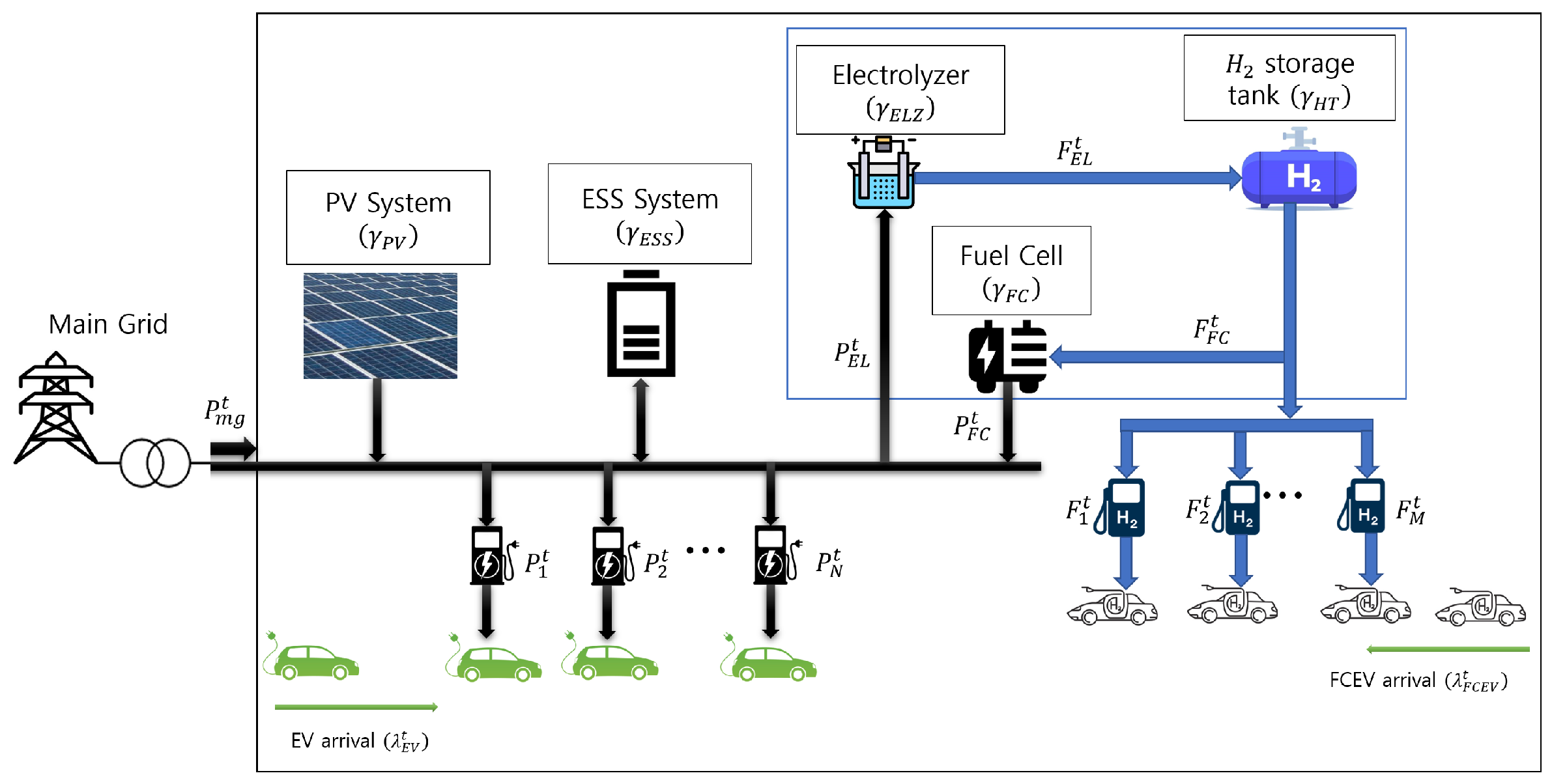
Figure 1 illustrates the system model of this work. We consider an FCS that integrates local power resources, a hydrogen system, and EV/FCEV chargers. Let
and
denote sets of fast chargers for EVs and hydrogen dispensers for FCEVs, respectively, where
and
are the numbers of chargers and hydrogen dispensers, respectively. The FCS local supply system comprises a solar PV generator, an ESS to manage energy dispatch by charging and discharging as needed to smooth system operations, and a stationary fuel cell (FC). The FCS also comprises a hydrogen system consisting of an electrolyzer, a hydrogen storage tank (HT), and a stationary FC for on-site hydrogen production, storage, and power conversion. This hybrid supply strategy improves operational flexibility and reduces grid dependence during peak periods.
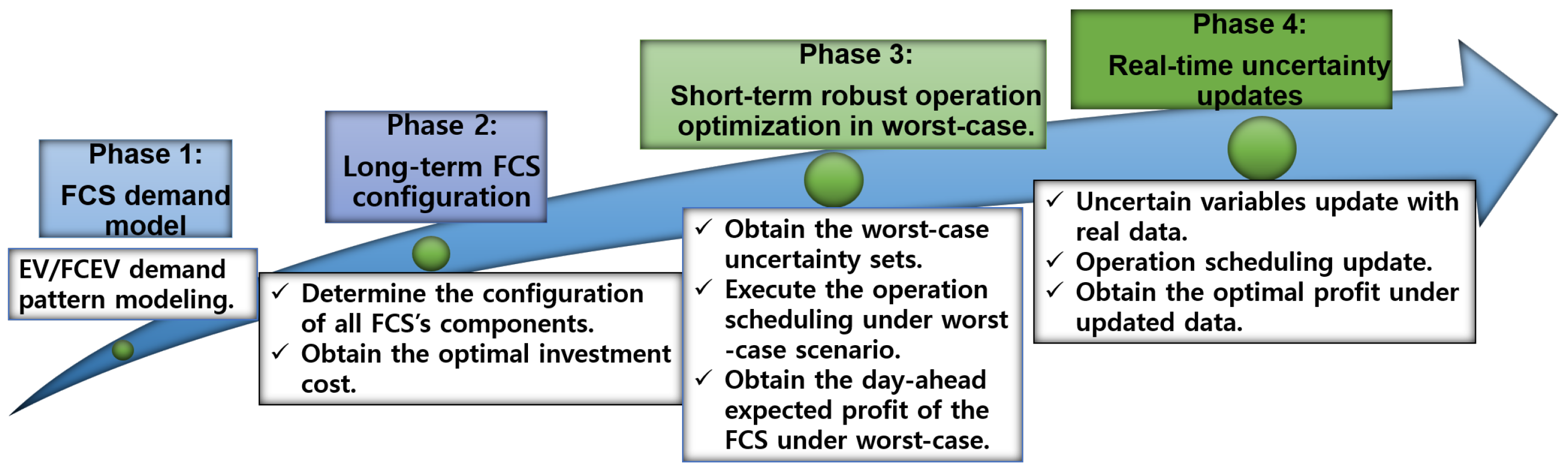
During the long-term planning horizon, the FCS operator makes investment decisions in the capacity of the service and power components, while in the short-term operational period, it schedules electric power and hydrogen resources. The scheduling of daily operations is discretized into T intervals, i.e., . Each vehicle is assumed to complete its fast charging [refueling] in a single time slot , allowing for convenient scheduling and resource allocation. Each charger [dispenser] [] serves at most one EV [FCEV] per time slot, and the charging [refueling] process starts and ends within the same time slot.
Note that due to limited infrastructure, not all arriving vehicles can be served immediately. When arrivals exceed available chargers[dispensers], vehicles queue in waiting areas. If both service and waiting areas are full, additional arrivals are rejected.
The EV fast charger power and FCEV dispenser hydrogen flow are modeled as non-deferrable, inelastic loads that must be met immediately upon request and cannot be shifted to another time. Consequently, the EV charging power in each charger
and hydrogen flow in each FCEV dispenser
are constrained by their respective rated capacities, ensuring compliance with equipment limits. They are formulated as follows:
Equations (
1) and (
2) enforce the technical specifications of the charging and refueling infrastructure, ensuring operational feasibility in all scenarios.
The FCS is powered by a combination of solar PV output, main-grid electricity, and the energy supplied by the FC, if any. Given an investment decision in solar PV capacity
, the available solar PV power in scenario
s at time
t is constrained by
In cases when solar PV and ESS energy is insufficient to meet the EV [FCEV] charging [refueling] demands, the FCS supplements its supply by purchasing electricity from the grid. The limit of the main-grid power purchase in scenario
s at time
t is defined as
where
denotes the technical limit of the power line connecting the FCS to the grid. While the grid is assumed to supply total demand within this limit, exceeding it may trigger peak demand penalties or operational risks due to the high power requirements of EV chargers and electrolyzers. In contrast, solar PV generation does not incur fuel costs, making its marginal cost negligible. Hence, the FCS operator is incentivized to prioritize PV utilization over grid power to minimize operating costs and improve system sustainability.
To mitigate solar PV generation intermittency and ensure smooth power supply, the FCS operator actively manages ESS charging and discharging to balance supply and demand in real time. During long-term planning, the operator determines the ESS energy capacity
and PCS capacity
, which restrict the maximum allowable charge and discharge in each scenario
s and time
t as follows:
where
and
denote the charging and discharging power of the ESS, respectively.
The evolution of the ESS state of charge (SoC) is influenced by both the charging efficiency
and the discharging efficiency
. The SoC level and its constraint in
s at
t are defined as
where
and
denote the minimum and maximum levels of state of charge, respectively. Equation (
9) enforces a cyclical SoC constraint, requiring the terminal SoC at the end of the day to match its initial value, ensuring inter-day operational independence and preserving long-term storage integrity.
During the long-term configuration horizon, the FCS operator also determines the capacities of key hydrogen components: the electrolyzer , HT , and FC . In the short-term operation period, the FCS operator manages the main-grid and solar PV power to run the electrolyzer, produce hydrogen for the refueling of FCEVs, and store any surplus. Stored hydrogen can be reconverted to electricity through the FC for grid export or peak demand supply, improving system flexibility and economic efficiency.
Electrolyzer Operation: Hydrogen is produced on site using an electrolyzer powered by solar PV and/or main-grid electricity. Let
and
denote the power consumption of the electrolyzer and the amount of hydrogen produced in
s at
t, respectively. Hydrogen production is modeled by
where
,
, and
denote the electrolyzer efficiency, the hydrogen density, and the higher heating value of hydrogen, respectively. The operation of the electrolyzer is constrained by its power rating and hydrogen production as follows:
where
denotes the maximum amount of hydrogen produced.
Hydrogen Storage Tank (HT) operation: The HT enables the temporal decoupling of hydrogen production and consumption. Its hydrogen mass state
evolves with the inflows of the electrolyzer and the outflows to both the FCEV and the FC and accounts for dissipation losses
. The state of hydrogen mass in
s at time
t is defined as
The HT must operate within the safe operating limits as given by
where
and
represent the minimum and maximum states of the hydrogen mass, respectively. Similarly to the ESS, the storage level at the end of the day is equal to its initial level, ensuring inter-day consistency and long-term system reliability. That is,
Stationary Fuel-Cell (FC) Operation: The hydrogen produced is used primarily to meet the FCEV demand. However, it can also be consumed by an FC to generate electricity, either for grid export or internal use during peak-load periods. The linear relationship between the hydrogen consumed by the FC,
, and the power produced,
, in scenario
s at time
t is described as
where the operation of the FC is based on its efficiency
. The two limit constraints of FC operation are
5. Conclusions and Future Work
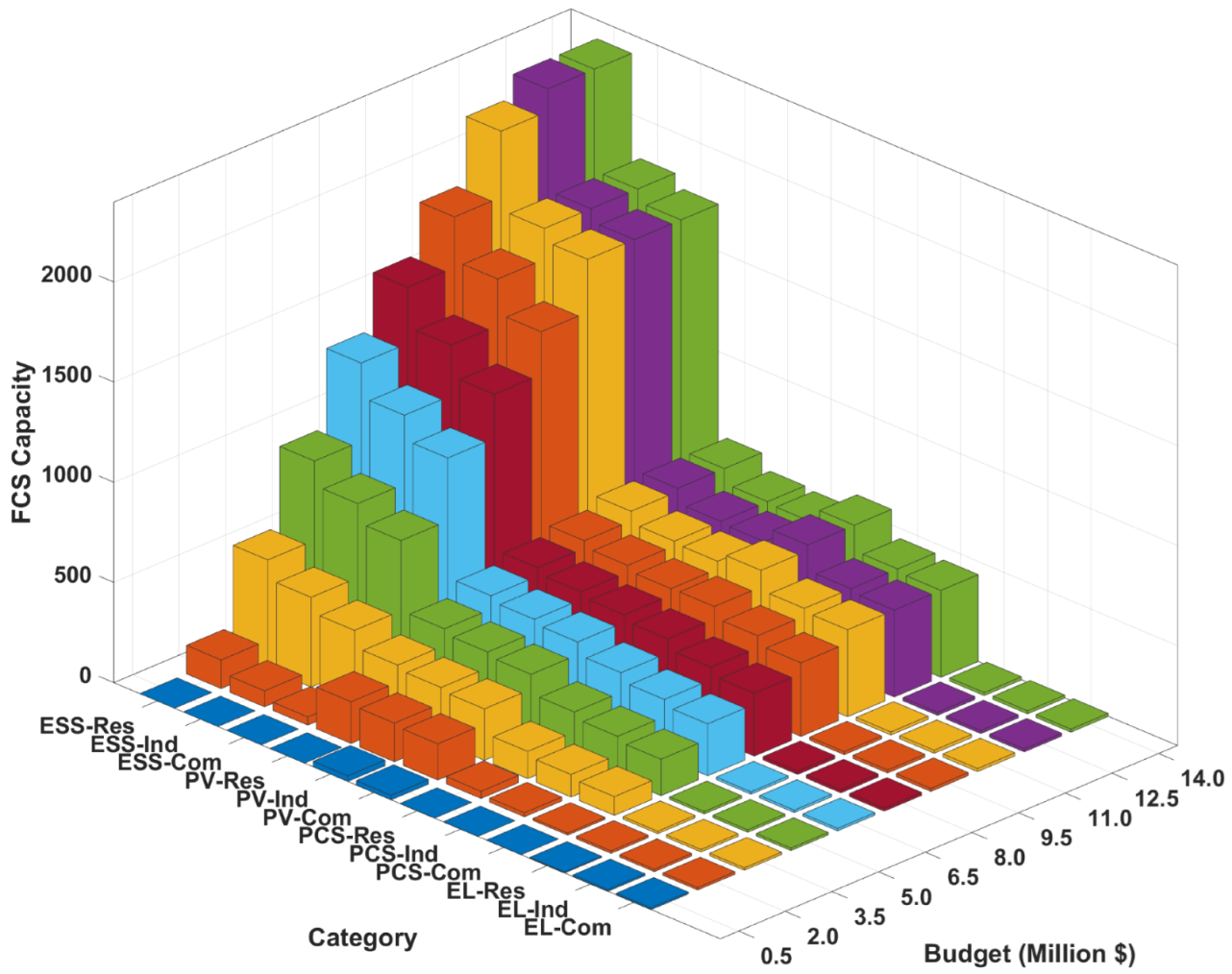
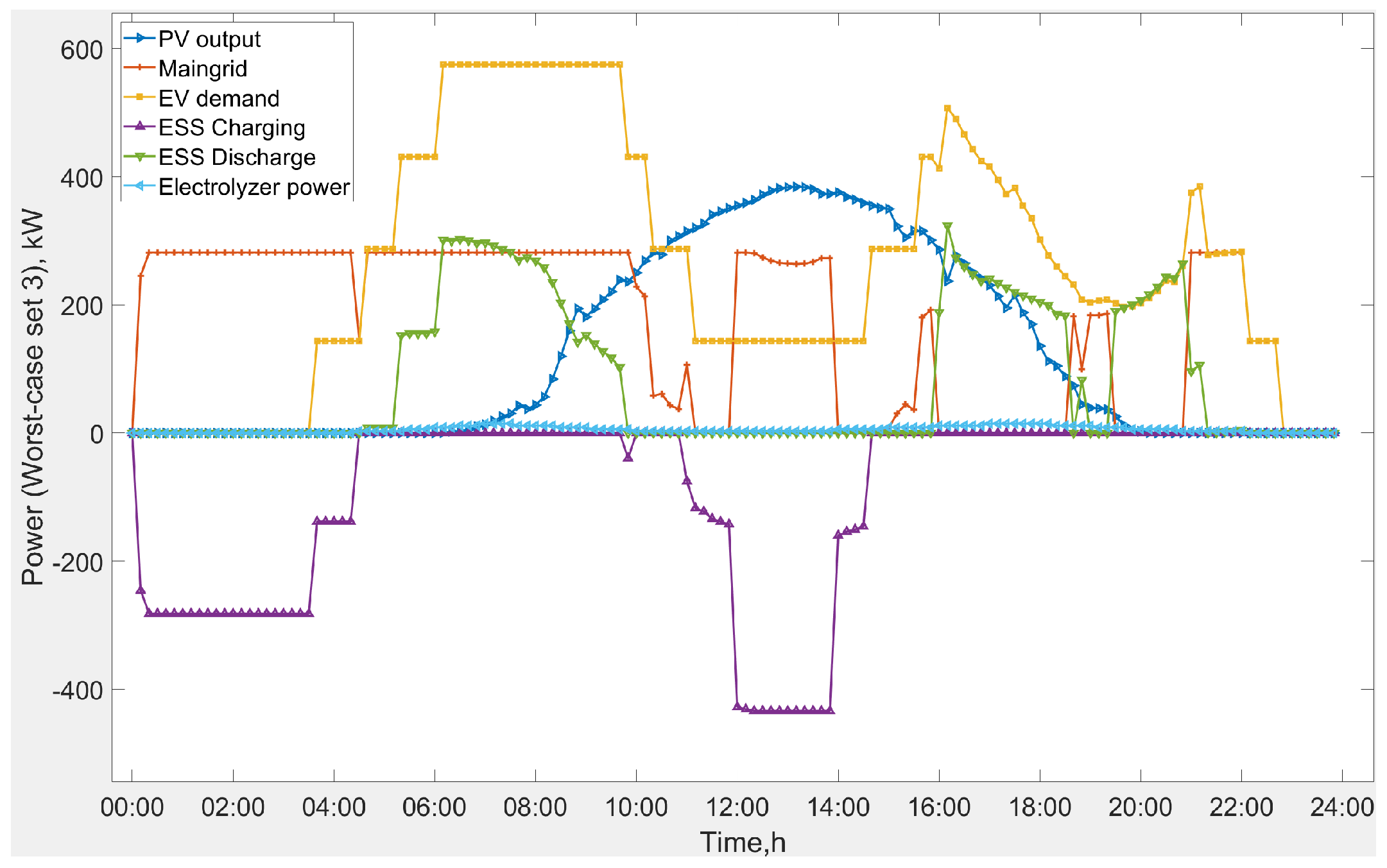
Fast-charging stations (FCSs) are crucial to accelerating the adoption of electric vehicles (EVs) and fuel-cell electric vehicles (FCEVs). Efficient configuration and operational strategies enhance financial viability, attract private investment, and ensure adequate supply to meet the growing demand for EV charging and FCEV refueling. This study proposed an integrated optimization framework for the joint configuration and operation of FCSs that incorporate distributed energy resources (DERs), including solar PV generation, energy storage systems (ESSs), power conversion systems (PCSs), electrolyzers (ELs), hydrogen storage tanks (HTs), and stationary fuel cells (FCs). Using robust optimization to account for uncertainties in solar PV output and EV [FCEV] charging [refueling] demand, the proposed framework aims to maximize FCS profit while considering investment, peak demand penalties, and operating and maintenance costs. The proposed problem is formulated as a mixed-integer quadratic programming (MIQP) model to ensure a practical, real-world context. To enhance tractability, the MIQP model was relaxed to a convex formulation, enabling efficient computation and scalability. A projection technique confirmed that the relaxed solution remained a good suboptimal solution with a negligible performance gap (<0.1%). The framework effectively determined optimal investment and real-time power scheduling strategies for different budget levels and uncertainty scenarios. Under the most adverse conditions, the real-time adaptation approach achieved a 3.32% increase in operational profit compared with the deterministic benchmark. These results demonstrate the effectiveness of the proposed real-time strategy in managing uncertainties more efficiently than static worst-case models, underscoring the practical value of integrating robust optimization with data-driven uncertainty modeling for multi-energy FCS systems.
However, the proposed framework heavily relies on the accuracy of forecasts, particularly for PV output and EV/FCEV arrival patterns. Therefore, future work will focus on enhancing the framework’s robustness, allowing it to perform effectively even with inaccurate forecasts. Another avenue for future research is analyzing the impact of FCS integration on distribution systems to increase hosting capacity.