Article

Hybrid FSO/RF Communications in Space–Air–Ground Integrated Networks: A Reduced Overhead Link Selection Policy


1
Department of Digital Industry Technologies, National and Kapodistrian University of Athens (NKUA), 34400 Psahna, Greece
2
Department of Physics, National and Kapodistrian University of Athens, 15784 Athens, Greece
3
Department of Social and Educational Policy, University of the Peloponnese, 20100 Korinthos, Greece
4
College of Computer Science and Electronic Engineering, Hunan University, Changsha 410082, China
*
Author to whom correspondence should be addressed.
Electronics 2024, 13(4), 806; https://doi.org/10.3390/electronics13040806

Submission received: 8 January 2024 / Revised: 2 February 2024 / Accepted: 15 February 2024 / Published: 19 February 2024

Abstract

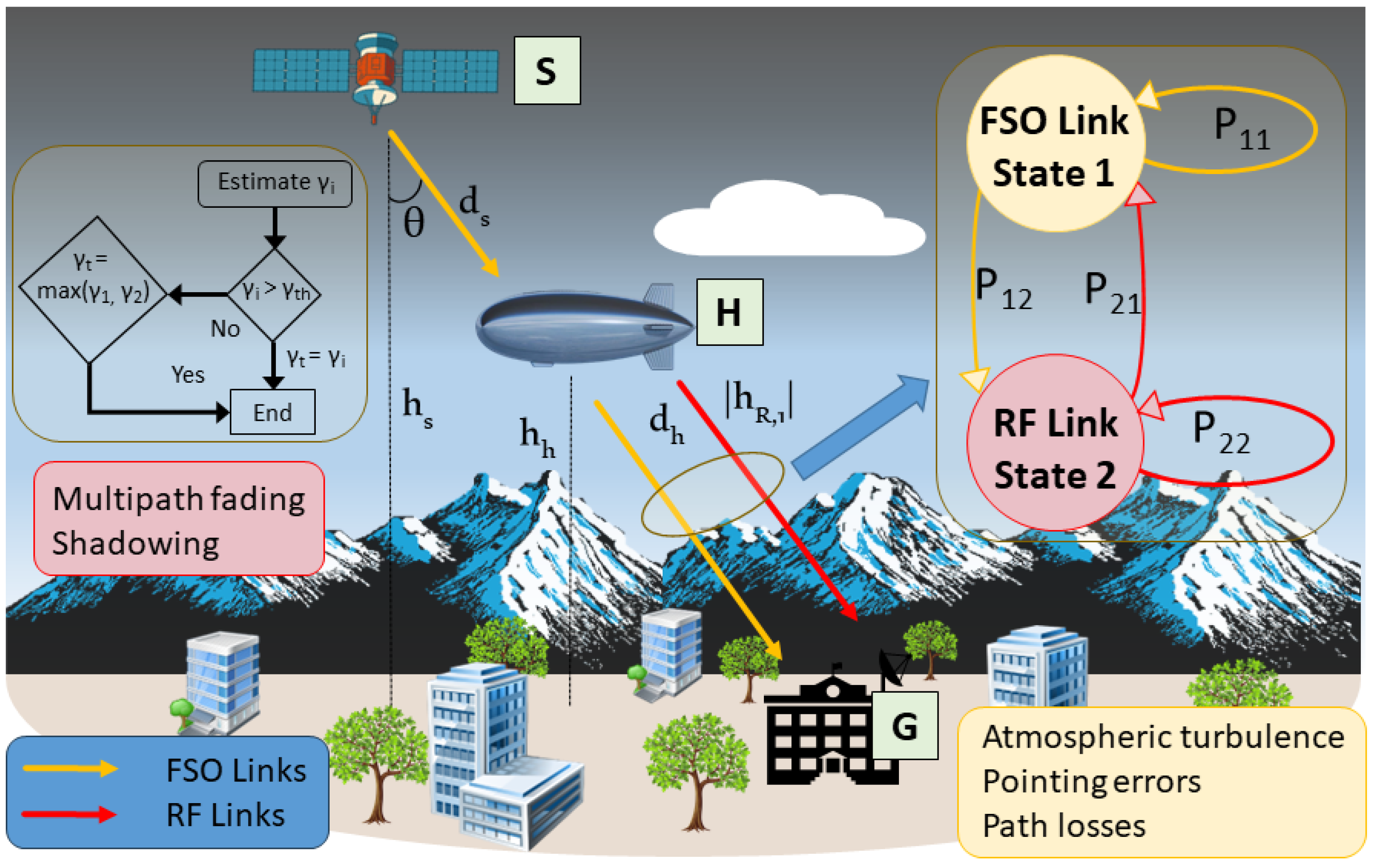
Space–air–ground integrated network (SAGIN) is considered an enabler for sixth-generation (6G) networks. By integrating terrestrial and non-terrestrial (satellite, aerial) networks, SAGIN seems to be a quite promising solution to provide reliable connectivity everywhere and all the time. Its availability can be further enhanced if hybrid free space optical (FSO)/radio frequency (RF) links are adopted. In this paper, the performance of a hybrid FSO/RF communication system operating in SAGIN has been analytically evaluated. In the considered system, a high-altitude platform station (HAPS) is used to forward the satellite signal to the ground station. Moreover, the FSO channel model assumed takes into account the turbulence, pointing errors, and path losses, while for the RF links, a relatively new composite fading model has been considered. In this context, a new link selection scheme has been proposed that is designed to reduced the signaling overhead required for the switching operations between the RF and FSO links. The analytical framework that has been developed is based on the Markov chain theory. Capitalizing on this framework, the performance of the system has been investigated using the criteria of outage probability and the average number of link estimations. The numerical results presented reveal that the new selection scheme offers a good compromise between performance and complexity.
Keywords: composite fading; free space optical communications; hybrid FSO/RF communications; network selection; reduced signaling overhead; space–air–ground integrated networks composite fading; free space optical communications; hybrid FSO/RF communications; network selection; reduced signaling overhead; space–air–ground integrated networks