1. Introduction
The exponential growth of remote sensing data has showcased the powerful capabilities of deep learning models in scene interpretation [
1,
2,
3,
4]. However, these models are highly susceptible to adversarial examples, which are generated by intentionally adding subtle perturbations to clean images, misleading the model into making incorrect predictions [
5,
6,
7,
8]. This vulnerability poses serious threats to practical applications, including thermal imaging data tampering [
9,
10], false alarms in environmental monitoring [
11], the misjudgment of material properties [
12], interference with lightlaser detection and ranging (LiDAR) sensing systems [
13], and the misidentification of military targets [
14]. Consequently, enhancing the robustness and reliability of these models is imperative in preventing potential catastrophic impacts.
Adversarial examples were first systematically explored in the field of natural images by Christian Szegedy et al. [
15]. This work demonstrated that clean inputs can be maliciously modified to produce erroneous model predictions, drawing widespread attention to the robustness of deep models. The study [
16] later proposed the basic iterative method to yield adversarial examples and further evaluate model performance. Since then, a multitude of algorithms for the generation of adversarial examples and the defense against adversarial perturbation have been developed [
17,
18,
19,
20,
21]. Research on adversarial examples has permeated into various fields, including medical diagnosis, information security, identity recognition, and, more recently, remote sensing. For instance,
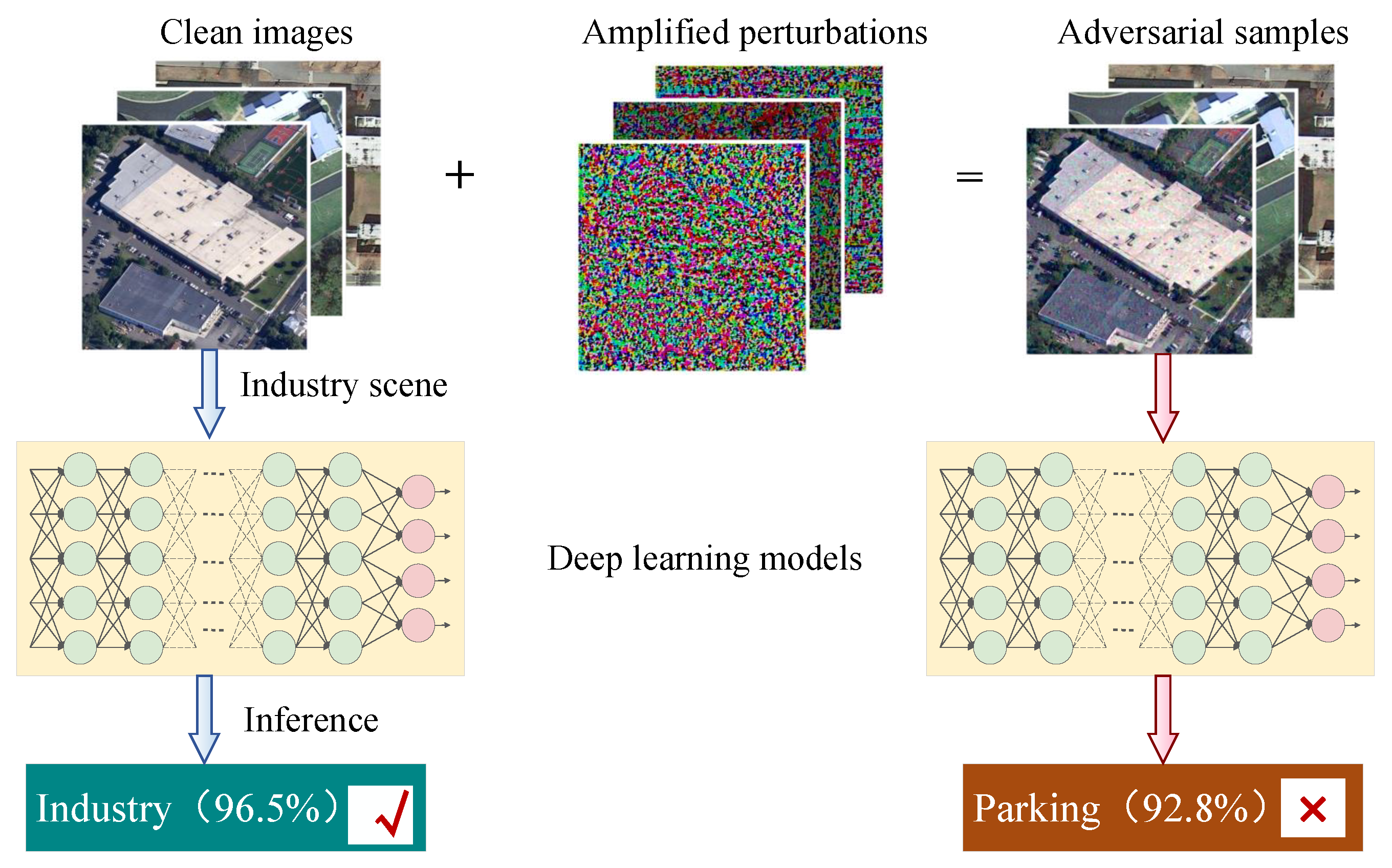
Figure 1 illustrates an example of adversarial sample recognition in a robust remote sensing scene classification model. The trained model can accurately infer the categories of industrial scene images with high confidence. However, after introducing adversarial perturbations into the industrial scene image, the model erroneously predicts the category as “Parking” with 92.8% confidence. Such vulnerabilities could lead to catastrophic consequences and significant losses, particularly in areas like autonomous drone navigation, military operations, and privacy protection.
Currently, strategies for defending against adversarial samples and enhancing model robustness in remote sensing scene classification fall into two main categories: adversarial training and adversarial sample purification. Adversarial training, the earliest and most widely adopted method, involves integrating adversarial samples into the training dataset alongside clean data. This continuous exposure forces the model to develop enhanced robustness by learning to recognize and resist such perturbations. Common techniques for generating adversarial samples in adversarial training include fast gradient sign method (FGSM) [
17], basic iterative method (BIM) [
18], projected gradient descent (PGD) [
19], Carlini and Wagner attack (C&W) [
20], and free adversarial training (FreeAT) [
21]. While these approaches significantly boost model robustness, they also increase computational costs and training times, especially with large-scale datasets and complex models. Adversarial example purification involves generative models to refine images perturbed by adversarial attacks before classification [
22,
23,
24,
25,
26,
27]. For instance, Sun et al. [
22] employed a generative adversarial network to generate images matching the distribution of clean samples by inputting random noise and clean samples. Similarly, Nie et al. [
23] introduced noise to adversarial examples in a diffusion model’s forward process, then solved the reverse stochastic differential equation to recover clean images, effectively purifying the adversarial examples. However, this purification process is computationally intensive and time-consuming. For instance, purification using diffusion models necessitates a graphics processing unit with 32 GB of memory due to the complex computations involved, making the training process both costly and lengthy [
28,
29]. Notably, adversarial training and purification methods often neglect the distributional discrepancies between adversarial samples and clean images, limiting robustness across a broader range of adversarial samples. In contrast, our approaches tackle the problem from a data distribution perspective, explicitly treating the problem as an unsupervised domain adaptation task, enabling more effective adaptation to diverse adversarial conditions.
In our view, it is widely recognized that the distributions of clean images and adversarial samples exhibit disparities due to perturbations that modify the original data distribution. Considering the perspective of data feature distribution, we advocate for integrating unsupervised domain adaptation training methods into the domain of defending against adversarial samples. Specifically, we propose a robust generative adversarial network (RGAN) for the processing of remote sensing scene classification tasks. This method leverages a clean image dataset as the source domain; correspondingly, the adversarial samples are considered the target domain. It involves acquiring knowledge from the source domain data and applying it to the target domain. Our approach significantly bolsters the model’s ability to identify target domain data. Furthermore, encouraged by the work in [
30], we employ a linear polynomial loss function in place of the cross-entropy loss function. This substitution enhances the model’s capability to learn more details and features from both the source and target domains. Through adversarial learning on both domains, the network ultimately demonstrates robust performance against adversarial samples. Finally, to evaluate the robustness of our model, we conducted a family of experiments on the RSSCN7 datasets and the SIRI-WHU dataset. Adversarial samples with varying perturbations are generated by the FGSM and PGD algorithms for both training and validation. The experimental results indicate that our algorithm achieves the accurate classification of remote sensing scenes while demonstrating robustness against adversarial perturbations. The significant contributions of our work include the following:
- (1)
Considering the characteristics of the data distribution, exploring unsupervised domain adaptation methods involves transferring representations learned from a source domain of clean samples to enhance the model’s generalization capability for adversarial samples in the target domain.
- (2)
A novel RGAN framework is developed to align the features of clean images and adversarial samples in feature space to minimize distribution discrepancies. This ensures that the model retains excellent classification performance in adversarial environments.
- (3)
A linear polynomial loss function is utilized to optimize the model’s capacity to learn robust representations from both clean and adversarial data, strengthening its resistance to adversarial perturbations.
2. Related Works
2.1. Description of Adversarial Samples
Adversarial samples are created by applying subtle perturbations to input data, which are usually imperceptible to humans but can significantly alter the output of machine learning models. The purpose of adversarial samples is to test the robustness and security of models, assessing their resilience to anomalous or malicious inputs. In the context of remote sensing, adversarial samples can cause misclassification, adversely affecting the interpretation and application of remote sensing data. Therefore, studying and addressing adversarial samples is crucial for enhancing the reliability and robustness of models.
The process of creating adversarial samples can be formally outlined as follows: a clean input image
x referring to the corresponding true label
y is provided, along with a target model
, where
represents the trainable parameters, and the model accurately assigns
x into the class
y. The objective of creating a set of an adversarial sample
is to maintain as much similarity to
x as possible under a defined distance metric, while deliberately causing the model
f to produce a different prediction for
compared to
x.
where
is the perturbation added to the clean input
x. This perturbation must satisfy two conditions:
where
d is a distance metric (e.g.,
,
,
norm), while
is a small value representing the permissible level of perturbation.
represents the predicted class of the classification target model
for the input
x, which corresponds to the class with the highest predicted probability. Similarly,
represents the predicted class for the perturbed input
. The formula indicates that by adding perturbations, the model can produce different predictions for
x and
.
2.2. Classic Methods for Generating Adversarial Samples
(1) Fast gradient sign method. This is a classic technique for rapidly producing adversarial samples, proposed by Goodfellow et al. These researchers were able to ascertain that the linear behavior of deep neural networks in high-dimensional spaces is a primary factor in the generation of adversarial examples. To address this issue, they designed a one-step method to quickly generate adversarial samples by effectively computing adversarial perturbations. The core idea is to maximize the change in the loss function by aligning the perturbation direction with the gradient direction, thereby causing significant changes in the classifier’s output.
In a white-box setting, the process commences with the calculation of the gradient of the loss function, designated as
, with respect to the input
x. Thereafter, the sign function, represented as
, is applied to this gradient in order to ascertain its direction. Subsequent to this, the resulting gradient direction is multiplied by the step size, thereby producing the adversarial perturbation
. The final stage of the process involves the addition of a perturbation generated from the gradient to the original input. This results in the creation of an adversarial sample
. The process involved can be outlined as follows:
In this context, denotes the first-order derivative of the loss function, and indicates the sign (positive or negative) of the gradient during differentiation. The FGSM method can quickly produce adversarial samples with any norm distance by controlling the parameter .
(2) Projected gradient descent. This is a gradient-based iterative attack. The main difference between these two methods is that FGSM performs a single iteration (one step), whereas PGD involves multiple iterations (multiple steps). In PGD, each iteration takes a small step, with the perturbation being adjusted to remain within a defined range. The objective function of PGD is to maximize the loss function
at the adversarial example
, while ensuring that
remains within the permissible perturbation range.
where
signifies the distribution of the sample space and
is the maximum range of permissible perturbations. The purpose of PGD is to identify a point
within the hypersphere defined by the perturbation range
that exhibits the greatest loss function value. The specific PGD adversarial sample generation iteration is as follows:
where
is the step size and
projects the sample back into the
-ball around
x.
In summary, the FGSM method stands out for its computational efficiency, enabling the quick generation of adversarial samples. Conversely, the PGD method is regarded as the most effective technique among all first-order adversarial attacks. In our research, we utilize both methods to create adversarial samples, which helps in assessing and improving the robustness of models.
3. Proposed Methodology
3.1. Problem Description
In the domain of remote sensing scene classification models, . Given a dataset consisting of N clean images, drawn from distribution . Each represents a clean image paired with its corresponding label . Additionally, there exists an adversarial sample dataset comprising M samples , conforming to distribution . Here, denotes the i-th adversarial sample, and its label is unknown. We designate as the source domain for clean images, and is designated as the target domain for adversarial samples. The classification model encounters challenges when tasked with distinguishing between x (clean image) and (adversarial samples): (1). Despite x and appearing similar and being semantically consistent, due to the adversarial perturbation alters the feature distribution of , Consequently, the classification model struggles to classify x and consistently. (2) The model trained directly on may not generalize effectively to . Therefore, any adversarial sample could be misclassified by the trained model.
The objective was to construct a robust classification model that can accurately predict adversarial samples in the target domain by leveraging the learned robust representation from the clean image data domain. To address this task, we devised a framework utilizing unsupervised domain adaptation for classifying scenes in remote sensing images.
3.2. Overview of Model Architecture
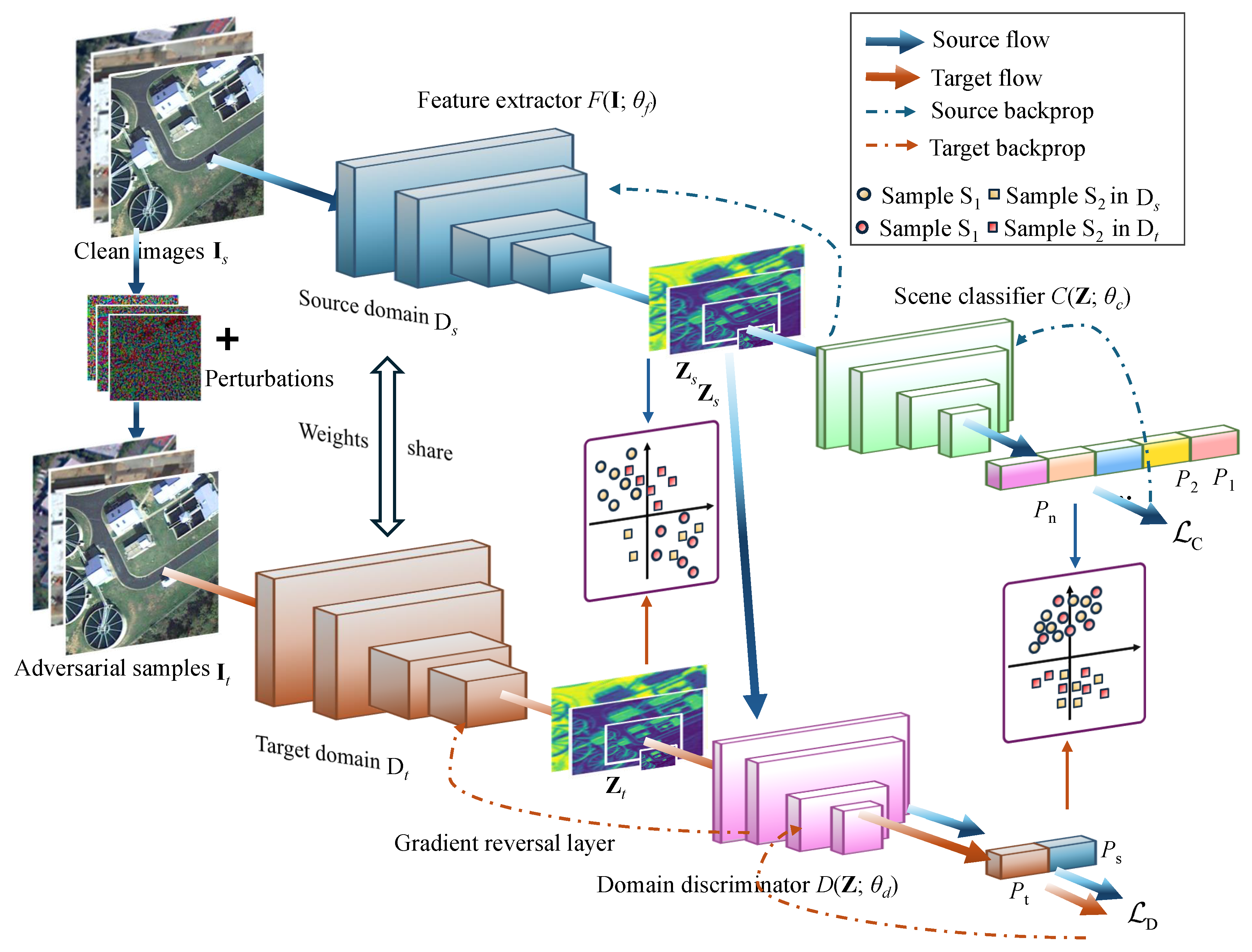
Based on domain adaptation learning methods, we developed a robust generative adversarial network (RGAN) designed for the precise classification and recognition of adversarial samples, as illustrated in
Figure 2. This network consists of three key components: a feature extractor
, a scene classifier
, and a domain discriminator
. Additionally, the encoder and domain discriminator are augmented with a gradient reversal layer (GRL), which is responsible for reversing the gradient direction during propagation. This layer is used to align features between the source and target domains, facilitating the learning of domain-invariant features. Here,
represents the input image from clean images or adversarial samples, and
denotes the intermediate feature tensor. The parameters
,
, and
are the trainable parameters of each partial component, respectively.
The information flow within the network during training proceeds as follows: the feature extractor encodes features from the input image . These extracted features are then fed into the scene classifier to predict the image’s classification label. Concurrently, is passed into the domain discriminator to determine whether the sample originates from the source domain or the target domain. The classification loss and domain discrimination loss are computed, and the parameters , , and are optimized through backpropagation, ensuring that the model performs effectively across both domains.
3.3. Feature Extractor
To ensure exceptional feature extraction capability while accelerating network inference speed, we integrated the ResNet34 backbone network as the feature extractor C within the RGAN framework. This extractor processes input samples from either the source or target domain, producing feature vectors in latent space. The feature extractor C includes an initial layer, layer0, followed by four residual layers, layer1 to layer4.
The initial layer, layer0, comprises a convolutional layer with 64 kernels and a stride of 2, followed by a max-pooling layer. Each residual layer, layer1 to layer4, consists of 3, 4, 6, and 3 residual units, respectively. Each unit includes a convolutional layer followed by an ReLU activation function. The number of channels for the four residual layers is 64, 128, 256, and 512, respectively.
The output from the layer of the ResNet34 backbone is transformed into a feature vector that feeds into either the scene classifier C or the domain discriminator D.
3.4. Domain Discriminator
The domain discriminator D is designed to classify data in the feature space, distinguishing the origin of the data between different domains. The domain classifier comprises four convolutional layers with a kernel size. Specifically, convolutional layer1 includes 256 kernels, convolutional layer2 includes 128 kernels, convolutional layer3 includes 32 kernels, and convolutional layer4 includes 2 kernels. Each convolutional layer is activated using the leaky ReLU function.
These four convolutional layers collectively reduce the channel dimensionality of the input 512-dimensional feature tensor. Global average pooling is employed instead of fully connected layers to flatten the feature maps, thereby reducing model parameters and accommodating input images of varying sizes without the constraints imposed by fully connected layers.
The domain classifier ultimately outputs a feature tensor, indicating the probability ( or ) that the features originate from either the source domain or the target domain, respectively.
3.5. Scene Classifier
The scene classifier primarily assesses the probability that a feature tensor belongs to a specific category. It consists of four convolutional layers with a kernel size, comprising 256, 128, 64, and n kernels, where n represents the number of classification categories. Each convolutional layer is followed by a leaky ReLU activation function.
Through these four convolutional layers, the channel dimensionality of the input 512-dimensional feature tensor is reduced. Global average pooling is then applied to flatten the feature maps into a one-dimensional vector. Finally, the classifier outputs a feature vector representing the probability , , …, across all classification categories.
3.6. Loss Function
The domain adaptation loss function typically consists of two components: the scene classifier loss and the domain discriminator loss . The classification loss ensures that the model performs well on labeled source domain data, while the domain discrepancy loss encourages the feature representations of the source and target domains to be similar. For the classifier loss , it calculates the distance between the predicted classification probability of clean images from the source domain and their true labels y, which is a measure used to show how well a classifier C performs in conjunction with a feature extractor F. Cross-entropy loss is a standard choice for classification tasks.
In our work, to augment the model’s capacity for learning more robust and generalizable features, thereby improving its adaptability to adversarial samples, we introduce a linear polynomial loss function
, termed PolyLoss, to guide model training, which evolved from the Taylor series expansion of cross-entropy. The calculation process is as follows:
where
N denotes the number of classes, while
y and
p indicate the true label and predicted probability for class
i, respectively. The variable
j represents the number of terms in the polynomial. Based on Equations (7) and (8), by incorporating a hyperparameter
a to adjust the polynomial coefficients, PolyLoss can be obtained.
From Equation (
9), it is evident that implementing PolyLoss requires minimal code changes and adjustments of hyperparameters. Furthermore, hyperparameters can be tailored to different tasks to achieve better results. In this study, the hyperparameter
a is set to 1.3. The classifier loss is expressed as follows:
By substituting cross-entropy with PolyLoss, which incorporates a series of additional terms, the model is better able to capture the intricacies and complexities of the data. This approach enhances the performance of remote sensing scene classification models.
The domain discriminator loss
consists of two components: the source domain loss and the target loss. The source domain loss
is computed by measuring the discrepancy between the feature vectors extracted from clean samples in the source domain and their corresponding true labels
. The target domain loss
is computed by measuring the discrepancy between the feature vectors extracted from adversarial samples in the target domain and their corresponding labels
.
4. Experiments and Results
4.1. Datasets Description
RSSCN7 dataset: This dataset contains 2800 remote sensing images, each with a pixel size of 400 × 400. These images were collected from Google Earth and come from different seasons and weather conditions. They were sampled at four different scales, 1:700, 1:1300, 1:2600, and 1:5200, with 100 images at each scale. The images include seven scene categories, such as grass, field, forest, parking, etc., with 400 images in each category. The dataset is divided in a 7:3 ratio, resulting in 1960 images for training and 840 images for testing. The diversity and varying scales of the scene images contribute to the dataset’s complexity and present significant challenges.
SIRI-WHU dataset: This dataset includes 12 categories of scenes such as farmland, commercial areas, ports, parks, rivers, and more, with a total of 2400 images. Each category contains 200 images, with each image having a pixel size of 200 × 200 and a spatial resolution of 2 m. The dataset primarily covers urban areas in China. The data are divided into a training set and a test set in a ratio of 7:3, with 1680 images for training and 720 images for testing.
4.2. Evaluation Metrics
In order to ascertain the efficacy of the methodology outlined in this paper, four evaluation metrics were adopted: accuracy (Acc), precision (P), recall (R), and F1-score (F1). In statistical terms, accuracy is defined as the proportion of accurately predicted samples relative to the total number of samples. Precision measures the ratio of correctly identified positive samples to the total samples predicted as positive by the model. Recall quantifies the fraction of actual positive samples correctly identified among all samples predicted as positive. The F1-score is a single metric that balances both precision and recall, calculated as the harmonic mean of the two. In the context of remote sensing scene classification, higher values of these metrics are indicative of superior model performance. The details of the four evaluation metrics are described below.
where TP represents a true example sample, while TN, FP, and FN correspond to true negative, false positive, and false negative example samples, respectively.
4.3. Experimental Settings
- (1)
Experimental environment. Our algorithm was implemented on the PyTorch 1.11.0 deep learning framework. The experimental platform was a server on a 64-bit Ubuntu 20.04 system, with an Intel Xeon R processor w–2255 (3.70 GHz) CPU, GPU (Nvidia RTX 4000) with 16 GB of graphical memory, used to accelerate image processing.
- (2)
Training settings. The training process was conducted with a batch size of 16 and 100 epochs. We constructed a linear regularization cross-entropy loss function for backpropagation. The Adam optimizer was employed to update the model parameters; the initial learning rate, specific to each dataset, was fixed at 0.0001.
- (3)
Data preprocessing. To enhance data diversity and improve the model’s generalization performance, we employed data augmentation techniques to expand the primary dataset. The basic operations of horizontal flip, random rotation, and scale operation at a probability of 0.3 were used to perform data augmentation. In addition, random crop, brightness enhancement, and contrast enhancement were also applied.
4.4. Adversarial Sample Generation
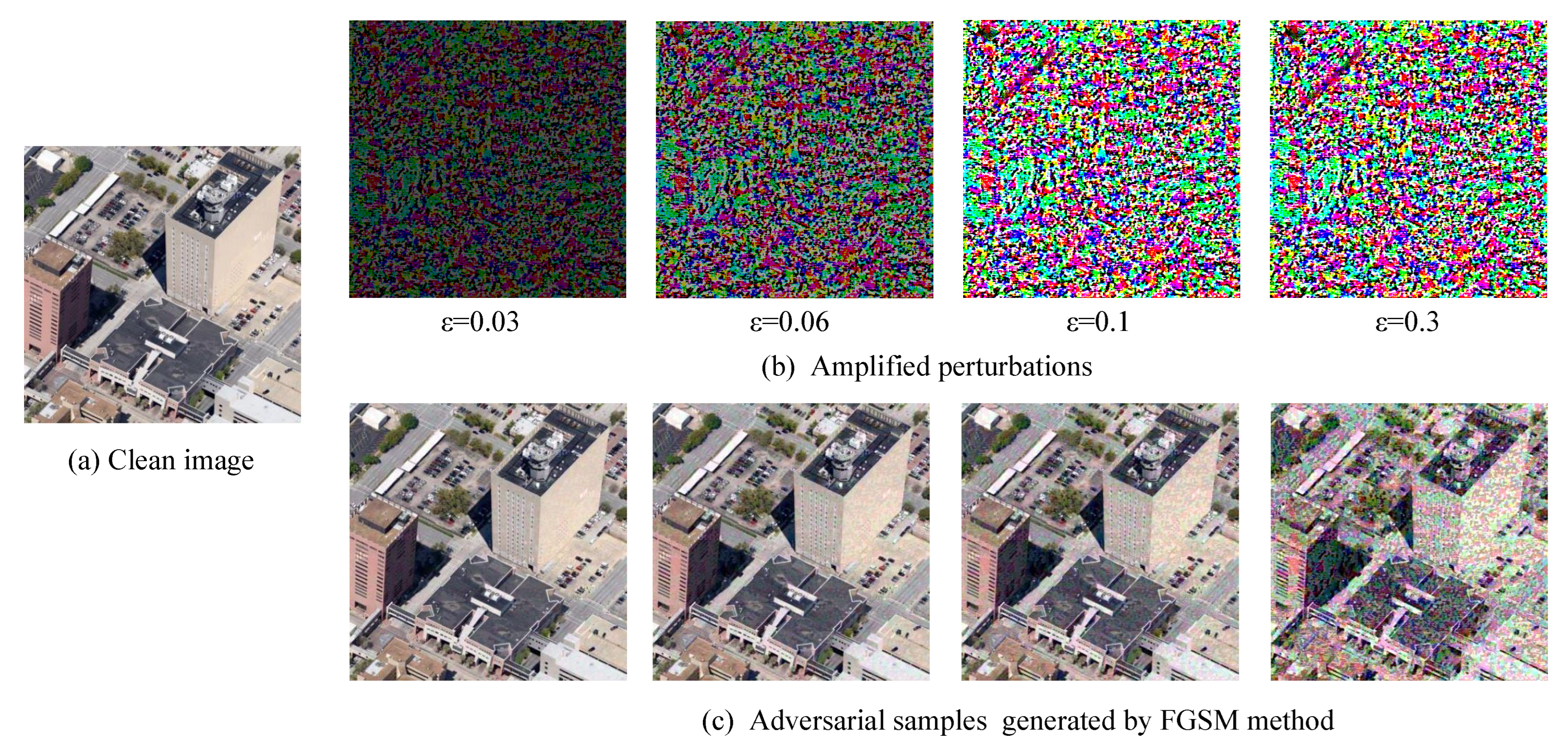
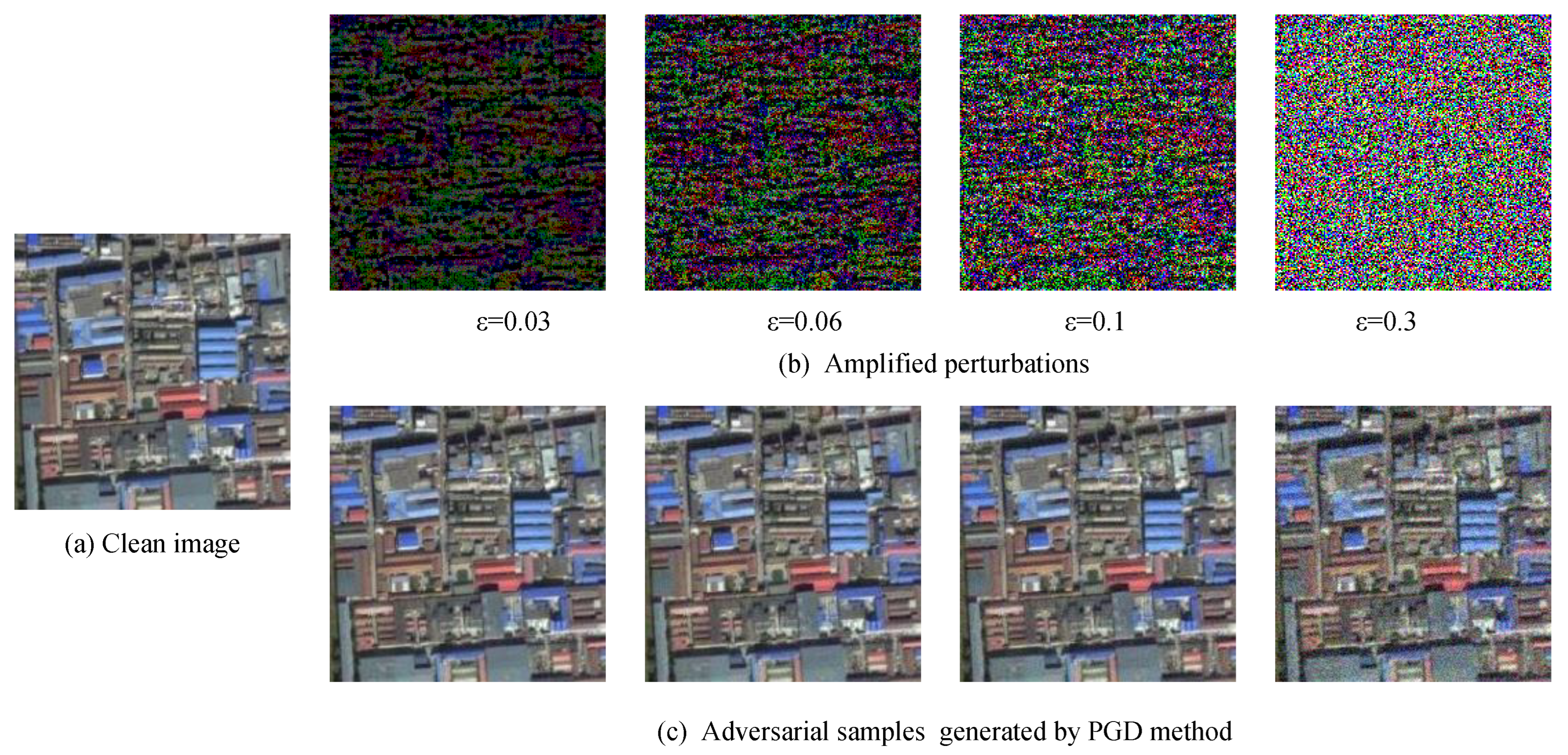
To assess the robustness of the model, we utilized two methods, e.g., FGSM and PGD, to generate adversarial samples with different perturbations on both the RSSCN7 dataset and the SIRI-WHU dataset. For FGSM adversarial samples, perturbation magnitudes
were set to 0.01, 0.06, 0.03, 0.1, and 0.3.
Figure 3 depicts adversarial samples produced through the application of the FGSM approach on the RSSCN7 Dataset. As PGD adversarial samples are recognized as the strongest first-order adversarial samples, generated in a single iteration, they exhibit significantly higher adversarial potency against the model compared to FGSM adversarial samples. Therefore, we set the number of iterations to 1 for PGD, with a perturbation space ranging from −0.5 to 0.5, and perturbation magnitudes of 0.06, 0.03, 0.1, and 0.3.
Figure 4 showcases the adversarial samples created through the use of the PGD algorithm on the SIRI-WHU dataset. We trained the model using two types of adversarial samples with a perturbation magnitude of 0.03 and tested the model’s adversarial robustness against the remaining adversarial samples.
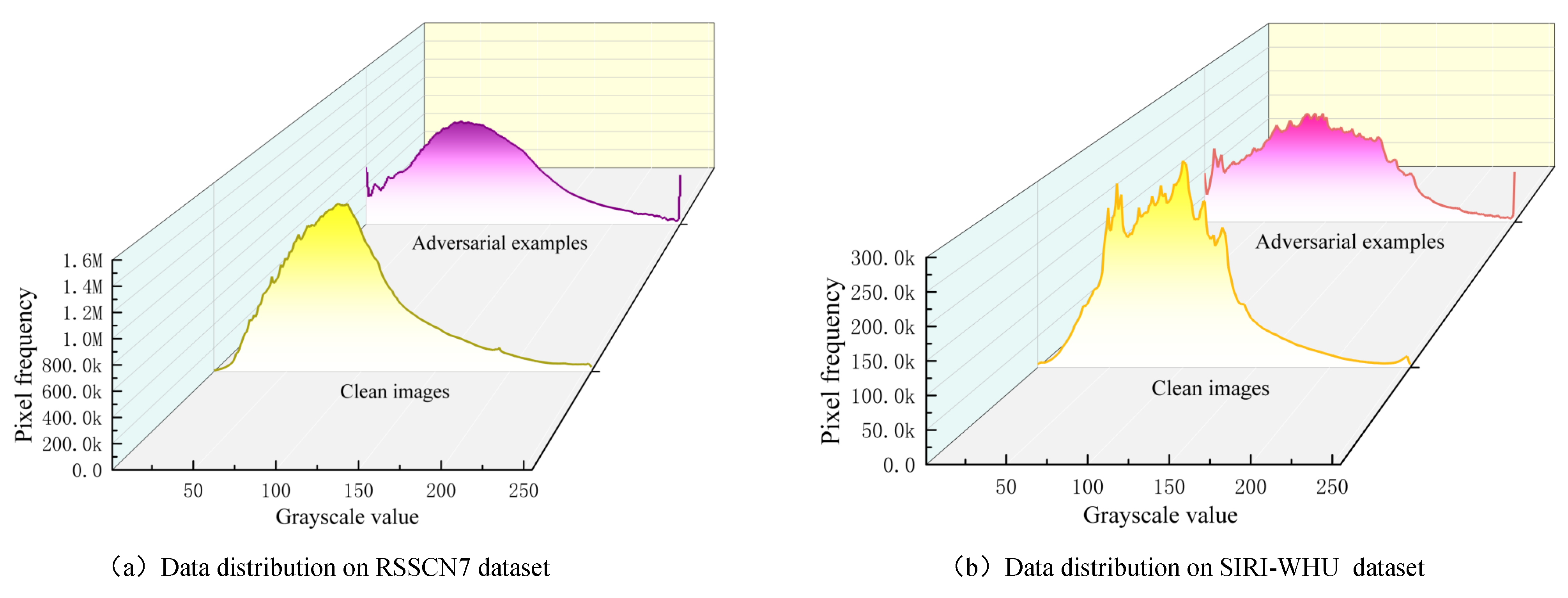
For the purpose of visually demonstrating the distinctions between clean images and adversarial samples, we utilized histograms to statistically represent the pixel frequency distributions of both types, as depicted in
Figure 5. In this case, the perturbation magnitude is set to 0.3. Notably, the grayscale values with higher frequency occurrences are noticeably different, indicating significant discrepancies between the two categories of samples. Such visual representations offer valuable insights into the nature and characteristics of adversarial perturbations, aiding in our understanding of their impact on image perception and model behavior.
4.5. Ablation Experiments
(1) Ablation study of domain adaptation training. To validate the effectiveness of the proposed method, we conducted a series of ablation studies. First, clean samples were used as the source domain dataset, while FGSM adversarial samples with a perturbation magnitude of 0.03 were used as the target domain dataset. Then, three methods—standard classification training (adversarial samples are not involved in training), adversarial training (adversarial samples are incorporated in training), and our proposed domain adaptation training strategy (adversarial samples as the target domain are involved)—were applied separately on the SIRI-WHU and RSSCN7 datasets for model training. Finally, both the test set from the clean sample dataset and the corresponding adversarial sample test set were used to evaluate model performance. Standard accuracy (SAcc) and robust accuracy (RAcc) were used as metrics to measure model classification accuracy.
Table 1 provides a clear presentation of the ablation study results on both datasets. In terms of the RSSCN7 dataset, the standard accuracy of the domain adaptation is 74.2%, which is a 17.5% improvement over adversarial training. The robust accuracy reaches 74.1%, significantly surpassing the robust accuracy of standard training. On the SIRI-WHU dataset, the domain adaptation SAcc and RAcc are 81.7% and 79.6%, respectively, achieving a good balance.
Additionally, we measured the average training time per epoch for the three methods. Standard training, which does not involve adversarial samples, has the shortest training time (14.04 s on the RSSCN7 dataset). Adversarial training, requiring the generation and inclusion of adversarial samples, results in a longer training time. Our method, which incorporates both the source domain (clean samples) and the target domain (adversarial samples) and updates parameters for a domain discriminator, has the longest training time (30.85 s) but delivers the best overall performance.
(2) Ablation study of loss function. We conducted a comparison of loss functions using the RSSCN7 dataset. The proposed RGAN, trained with cross-entropy loss, achieves a standard accuracy of 72.1% and a robust accuracy of 71.5% on clean and adversarial samples. When trained with the linear polynomial loss, the model is improved to 74.2% in standard accuracy and 74.1% in robust accuracy, showing gains of 2.1% and 2.6%, respectively, over cross-entropy loss.
4.6. Quantitative Comparison
(1) Results on the RSSCN7 dataset.
Table 2 displays the classification results of the proposed algorithm for each scene category in the RSSCN7 dataset. The table reveals a notable trend: when confronted with attacks from adversarial samples, the robust accuracy of the standard training method experiences a significant decline, indicating the model’s poor robustness under such conditions. For instance, the robust accuracy of the parking category plummets to a mere 4.1%, highlighting a stark reduction in recognition capability against adversarial samples. While adversarial training demonstrates effectiveness in handling adversarial samples, there is a marginal decrease in standard accuracy. However, our proposed method offers a notable improvement in the model’s robust accuracy when compared to standard training. Notably, the robust accuracy of the parking category sees a substantial increase to 75.4%. In contrast, standard accuracy experiences a marked enhancement of 42.5% when compared to standard training.
To further demonstrate the effectiveness of the proposed algorithm, we evaluated the RGAN model based on both clean and adversarial samples, with the classification performance metrics presented in
Table 3. For clean images, the precision (P) of the domain-adapted trained model consistently exceeds 0.65, and the recall (R) is above 0.6. The model performs exceptionally well in the forest category, with both precision and recall exceeding 0.85. Except for the industrial category, the F1-scores for all categories are above 0.7, indicating robust classification performance across various scene categories for clean samples. Regarding adversarial samples, the model also demonstrates strong robustness performance, with precision and recall showing favorable results across different categories. The F1-scores for all categories, except the industrial area, are above 0.7, underscoring the model’s substantial robustness against adversarial attacks. The robust performance based on both clean and adversarial samples highlights the effectiveness and resilience of the domain-adapted trained model.
(2) Results on the SIRI-WHU dataset. The SIRI-WHU dataset presents a significant challenge due to its inclusion of 12 distinct scene categories. When dealing with adversarial samples across these varied scenes, the model trained with our proposed algorithm demonstrates commendable classification performance, displayed in
Table 4. Compared to standard training, the RAcc of the RGAN model improves across all categories, with the exception of the industrial category. Furthermore, in comparison to adversarial training, our model achieves enhancements in both standard accuracy and robust accuracy. For example, in the agriculture category, the domain-adapted model shows an increase of 38.4% in SAcc and 2.5% in RAcc. This indicates that our model possesses superior generalization capabilities.
Table 5 showcases the classification performance metrics of the proposed method based on clean and adversarial samples in the SIRI-WHU dataset. In terms of clean images, precision for clean samples is above 0.64 across all categories, with the park category being the lowest at 0.64. Recall for all categories exceeds 0.7. The F1-scores for all categories are above 0.7, indicating the model’s strong classification performance across various scene categories for clean samples. For adversarial samples, the model maintains strong performance, with favorable precision and recall across different categories. The water category shows the best results, with a precision of 0.98 and a recall of 0.96. F1-scores are above 0.7 for all categories except grassland and park, which are at 0.67. These results demonstrate the model’s significant robustness against adversarial attacks across diverse scene categories.
4.7. Effects of Adversarial Perturbations on Model Performance
In order to evaluate the model’s performance against adversarial perturbations with varying magnitudes, we used the trained RGAN framework to test the classification accuracy of adversarial samples generated by FGSM and PGD methods. Specifically, the FGSM and PGD test samples included three levels of perturbation: 0.03, 0.06, and 0.10. We calculated the proportion of adversarial samples that are correctly classified relative to the total number of samples.
Table 6 displays the experimental results of adversarial sample attacks based on the RSSCN7 dataset. The findings suggest that as the adversarial perturbation increases, the model’s robust accuracy decreases for both FGSM and PGD adversarial samples. However, the impact of PGD adversarial samples on model performance is observed to be more significant compared to FGSM adversarial samples.
Table 7 displays the experimental results of adversarial sample attacks on the SIRI-WHU dataset. When the perturbations
are set to 0.03, 0.06, and 0.01, the model’s classification accuracies are 79.6%, 77.8%, and 76.7%, respectively. FGSM adversarial samples have a relatively small impact on the model’s performance, whereas PGD causes the model’s classification accuracy to drop from 77.4% to 60.6%.
4.8. Visual Analysis
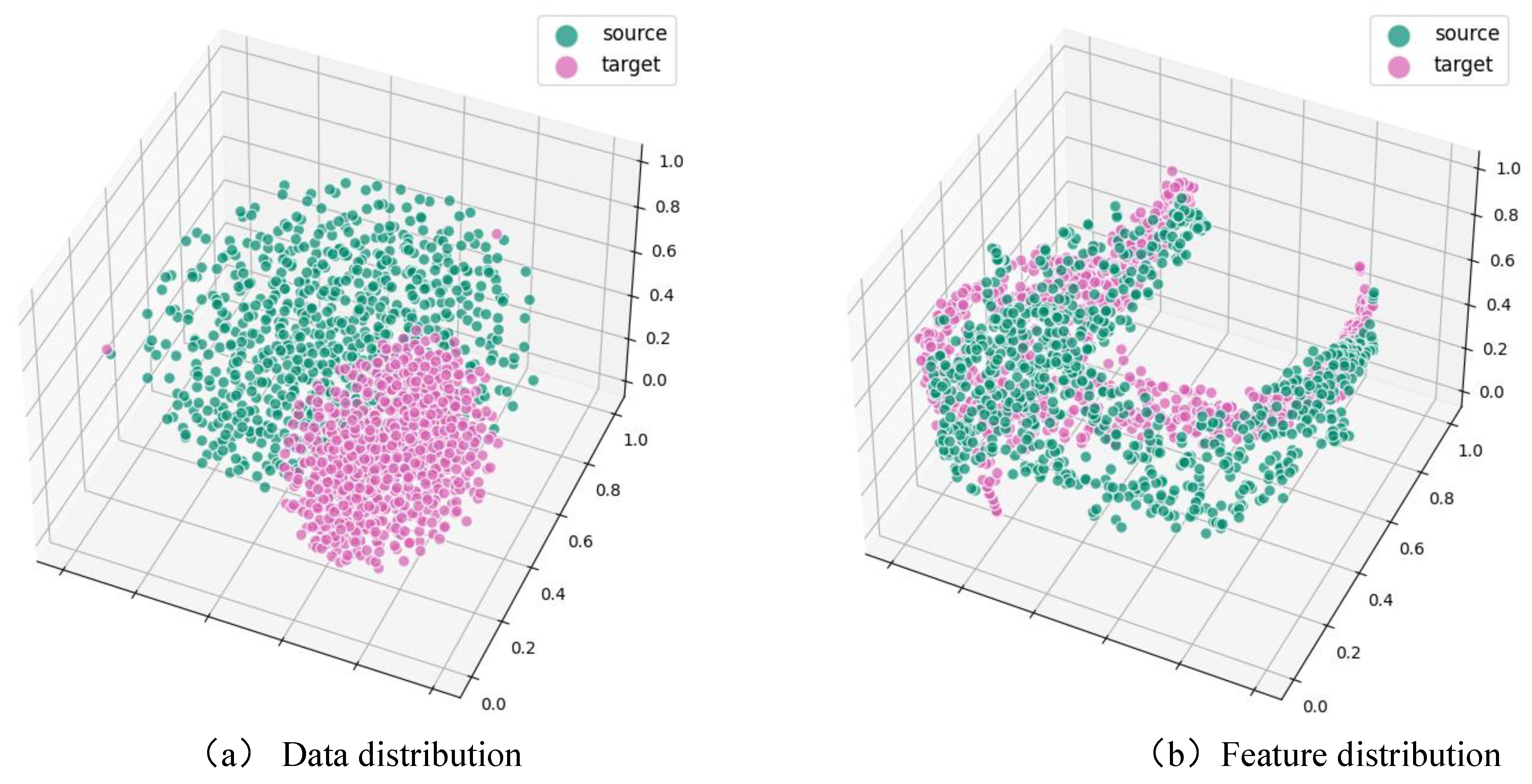
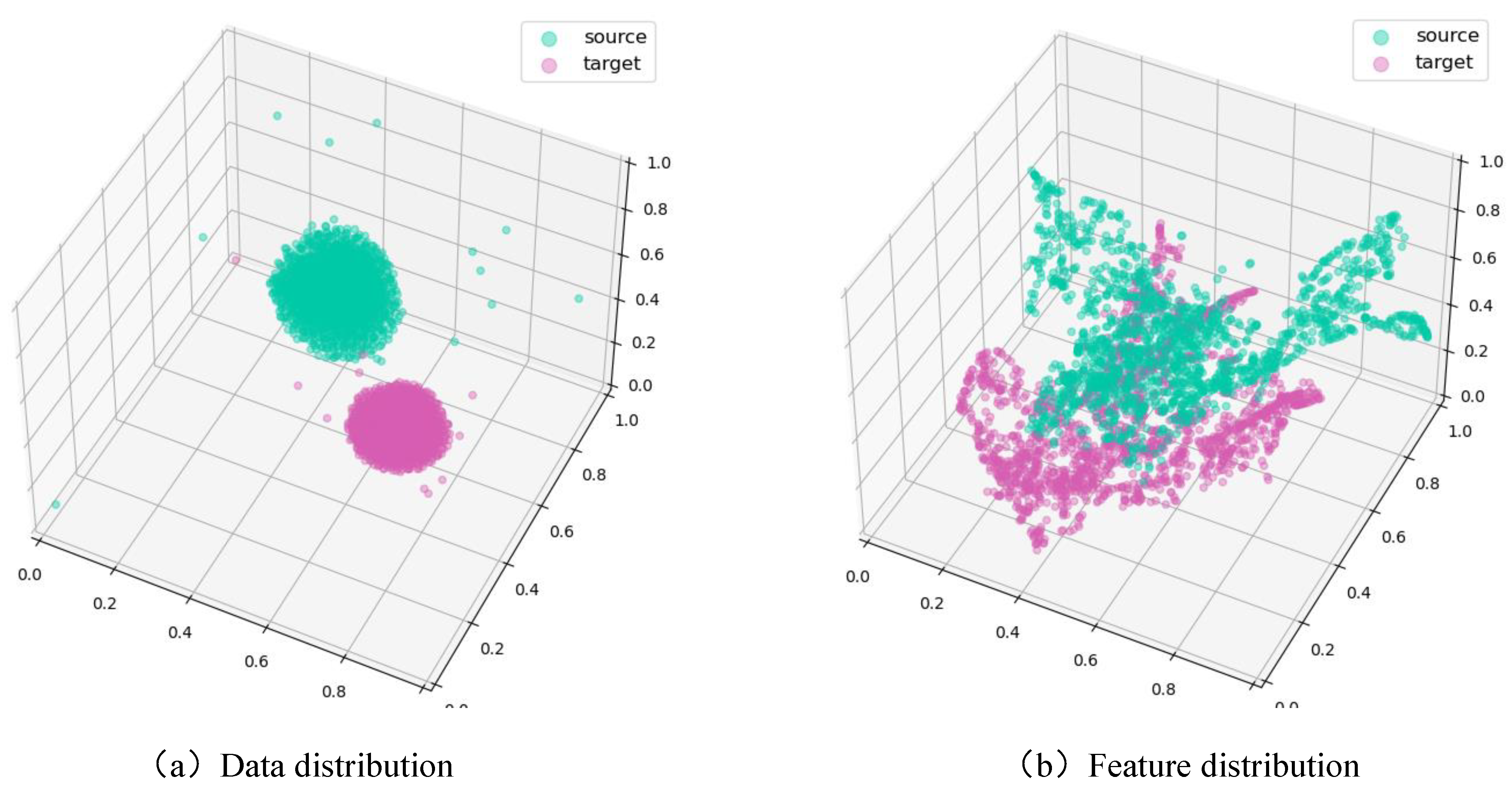
To examine the representation distribution in 3D space on the RSSCN7 dataset, we utilized the technique of t-distributed stochastic neighbor embedding (t-SNE), as depicted in
Figure 6. The source domain comprises clean samples, while the target domain comprises adversarial samples. The t-SNE technique, renowned for its effectiveness in visualizing high-dimensional data by converting it to two or three dimensions, was employed to visualize the original feature distribution in 3D space, as shown in
Figure 6a. t-SNE effectively groups similar data points together, facilitating the identification of clusters within the data. A noticeable separation exists between the clusters of clean and adversarial samples, highlighting the inherent differences in their data distributions. This separation underscores the distinct characteristics of each domain, emphasizing the need for effective domain adaptation techniques to bridge this gap.
To enhance the model’s ability to accurately recognize adversarial samples, we employed a domain adaptation technique to align the features of both clean and adversarial samples in the latent feature vector space. This alignment mitigates feature discrepancies, thereby improving the model’s classification accuracy. As illustrated in
Figure 6b, the feature distributions of the source and target domains are closely aligned, are uniformly distributed, and have a significant degree of overlap. This alignment confirms the effectiveness of the proposed algorithm.
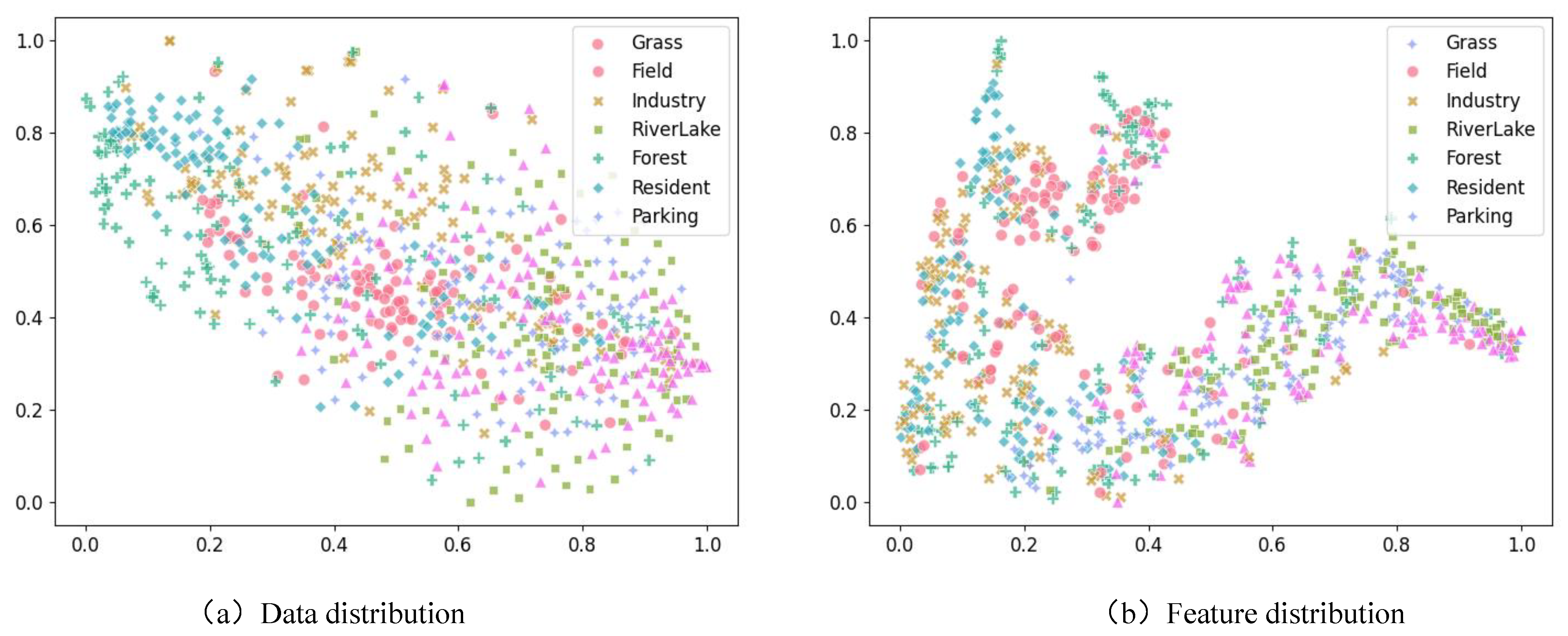
Figure 7 presents the 2D t-SNE visualization of the representation distribution for each category of adversarial samples in the test set of the RSSCN7 dataset. The original data distribution of these adversarial samples is illustrated in
Figure 7a. It is observed that the original data distribution of the seven scene categories is uniform, making it challenging to distinguish each category based solely on basic data characteristics.
Figure 7b visualizes the feature distribution of the seven categories, extracted using the proposed method. This provides a clear overview of how each category is represented within the test set. It is evident that the adversarial sample features are well represented in the feature space, facilitating the distinction and recognition of each type of scene.
The representation distribution of clean and adversarial samples based on the SIRI-WHU dataset is observed based on t-SNE visualization. As seen from
Figure 8a, clean images and adversarial samples form distinct clusters, indicating different distributions in the feature space. After applying domain adaptation techniques,
Figure 8b shows that the previously distinct clusters of clean and adversarial samples become more aligned. This alignment suggests that the domain adaptation method is effective in bridging the gap between the two distributions, leading to more robust model performance. The visual evidence of cluster alignment post-adaptation is a compelling indicator of the method’s success, reinforcing the overall findings of this study.
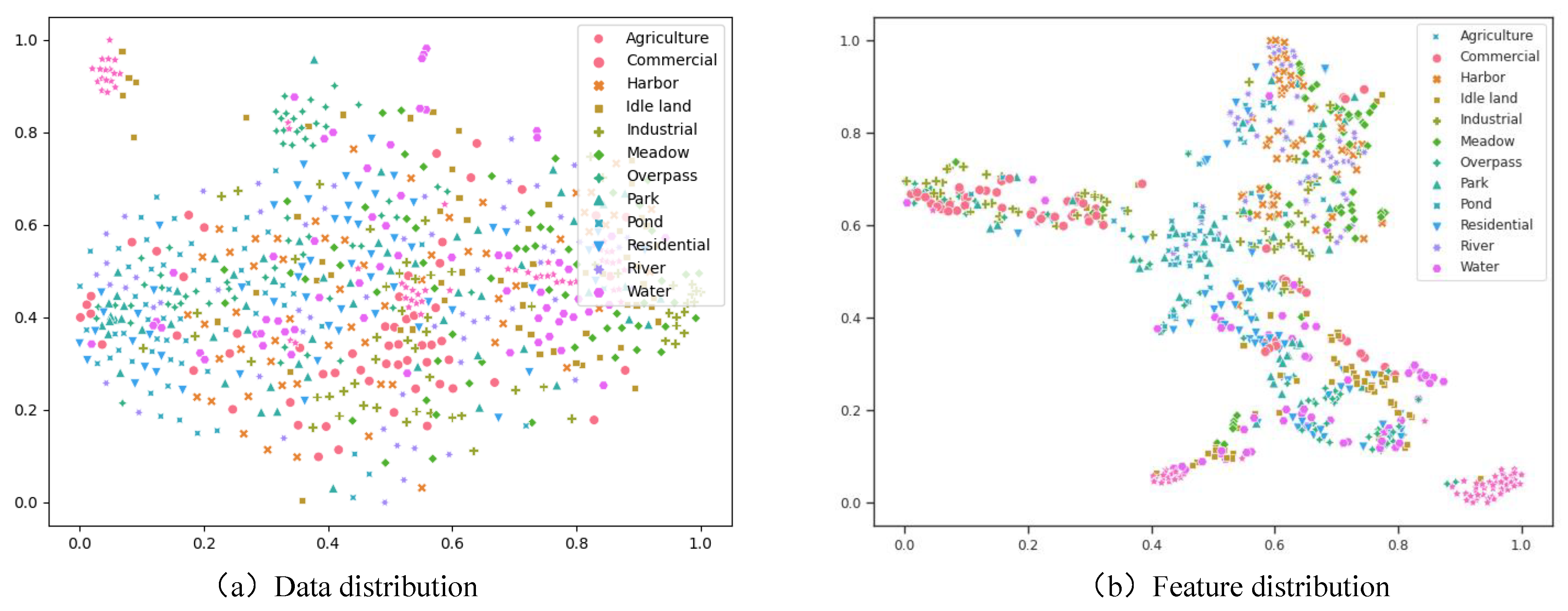
To gain clearer insights into the characteristics of adversarial samples, we used 2D T-SNE plots to illustrate the feature distribution for each category of adversarial samples in the SIRI-WHU dataset.
Figure 9 illustrates the visualization results. The SIRI-WHU dataset includes 12 categories of remote sensing scenarios. Due to the unique characteristics of remote sensing scenes, which exhibit small interclass differences and large intraclass variability, the original data distribution is relatively balanced. This increases the difficulty of model classification. This is demonstrated by
Figure 9a. By using the proposed algorithm for feature mapping and alignment, the model can effectively represent the characteristics of adversarial samples. The differences in distances between different categories are also apparent, which can significantly enhance the model’s discriminative ability. For instance, as shown in
Figure 9b, commercial and industrial areas have similar features and are located close to each other in the distribution. In contrast, commercial areas and water regions have significantly different features, resulting in a greater distance between their distributions.
5. Conclusions
The robustness of deep learning models, particularly their resilience against adversarial perturbations in open and complex environments, has been a central focus in the field of computer vision. This paper proposes a robust generative adversarial network for remote sensing scene interpretation tasks which is capable of effectively recognizing adversarial samples. Considering that adversarial perturbations alter the data distribution of clean samples, we adopted an unsupervised domain adaptation approach to learn robust representation. By treating clean images as the source domain and adversarial samples as the target domain, aligning their features in the feature space, and extracting domain-invariant features, this method enabled the network to achieve high classification performance in the adversarial sample domain as well. To capture finer details and handle outliers better, we utilized a linear polynomial loss function for enhancing adversarial training. Furthermore, the model’s robustness was evaluated by generating adversarial samples with varying types and magnitudes of perturbations based on the RSSCN7 and SIRI-WHU datasets. The experimental results demonstrate that our framework performs robustly on both clean and adversarial samples. However, our work was constrained by the comparatively simple scene categories used and the limited scale of the dataset.
In the future, our research directions include the following: (1) expanding our research to handle even more diverse and complex remote sensing scenarios, (2) developing and adopting diverse robustness evaluation metrics to comprehensively assess the model’s performance in adversarial environments from different perspectives, and (3) exploring and extending the impact and behavior of adversarial samples in various remote sensing fields, such as object detection and real-time semantic segmentation.