Article

Learning Statics through Physical Manipulative Tools and Visuohaptic Simulations: The Effect of Visual and Haptic Feedback


by
Yoselyn Walsh
1,2 and
Alejandra J. Magana
2,*
1
Tecnológico de Costa Rica, Industrial Design Engineering School, Cartago P.O. Box 159-7050, Costa Rica
2
Department of Computer and Information Technology, Purdue University, West Lafayette, IN 47907, USA
*
Author to whom correspondence should be addressed.
Electronics 2023, 12(7), 1659; https://doi.org/10.3390/electronics12071659

Submission received: 26 January 2023 / Revised: 12 March 2023 / Accepted: 27 March 2023 / Published: 31 March 2023

Abstract

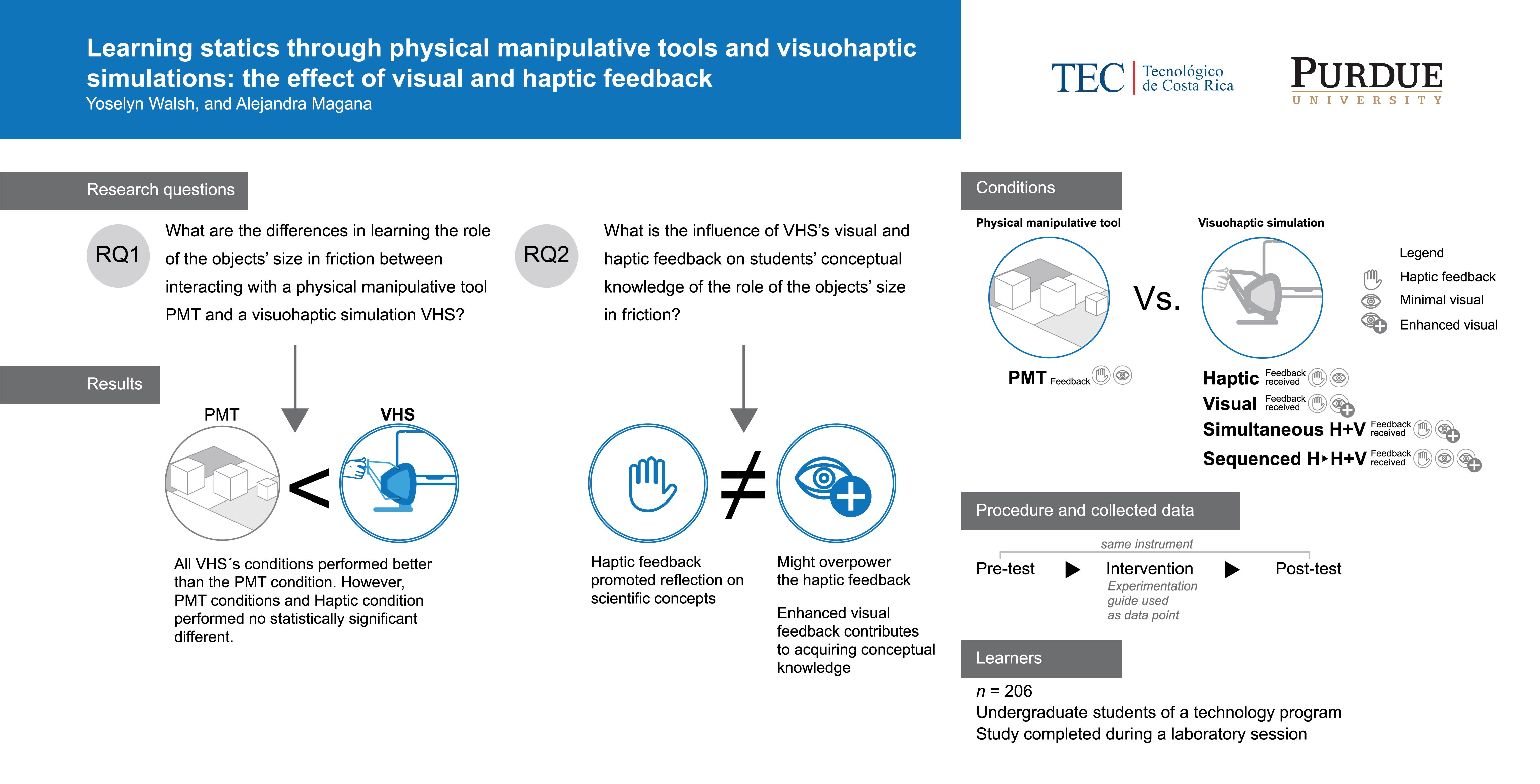
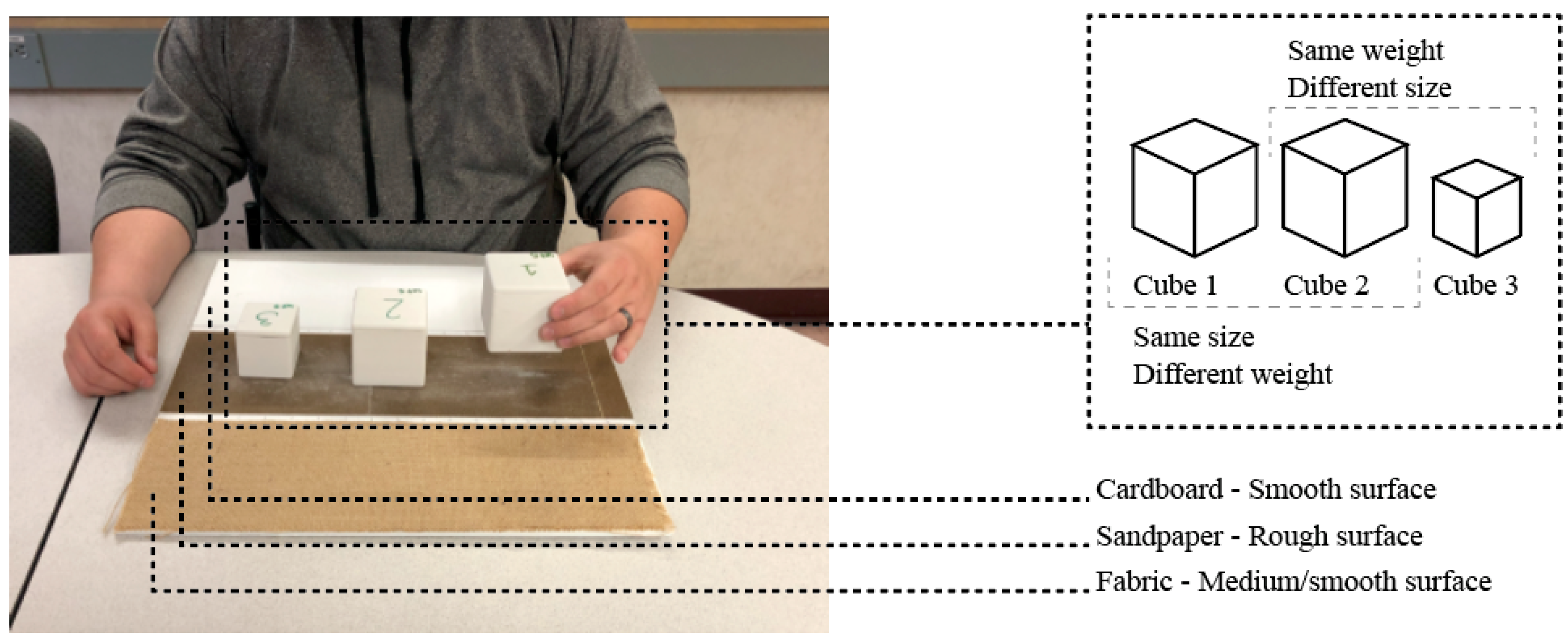
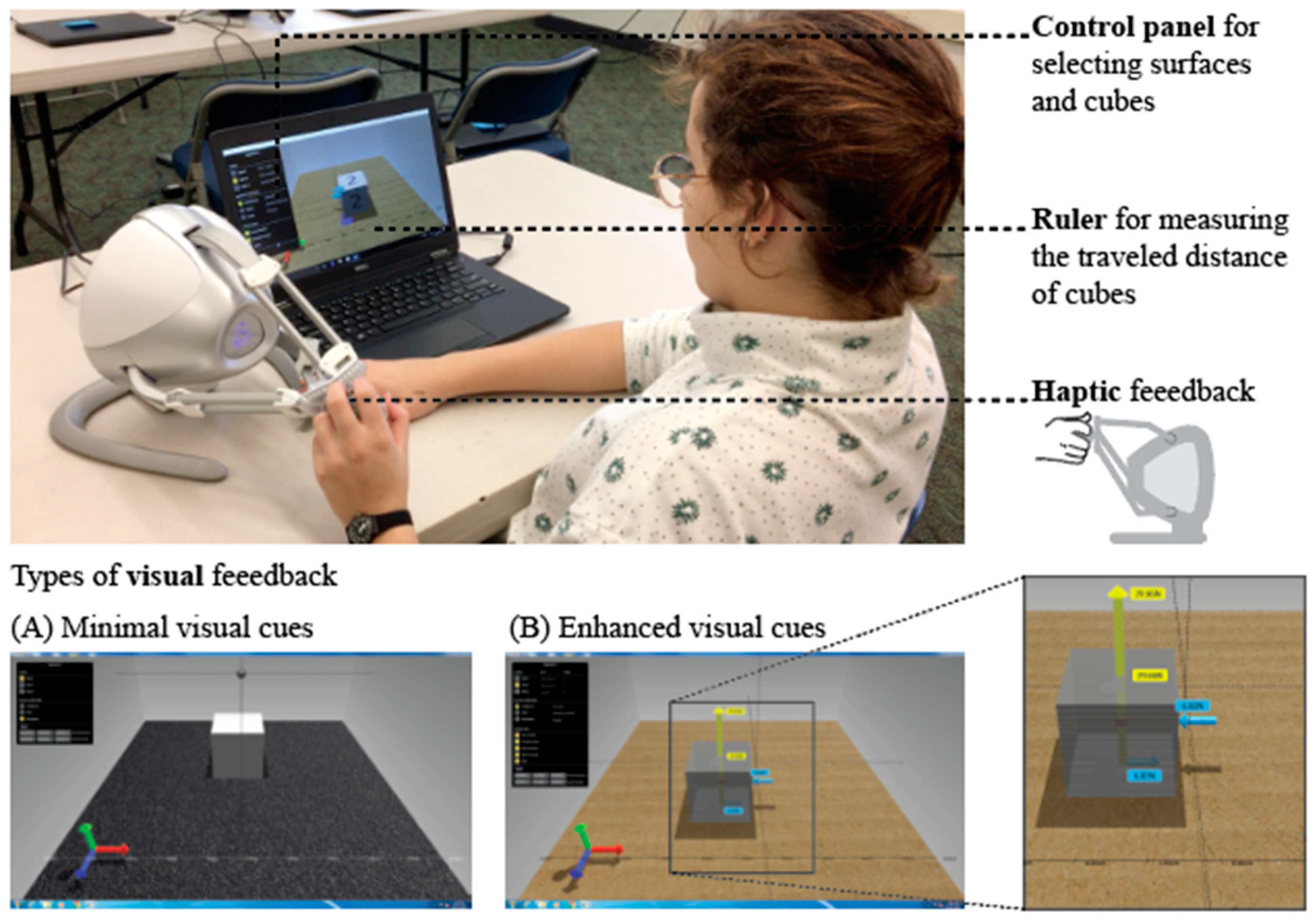
In this study, we: (a) compared the differences in the learning of friction concepts between a physical manipulative tool (PMT) and a visuohaptic simulation (VHS) in four different configurations (visually enhanced feedback on/off, force feedback on/off), and (b) analyzed the influence of the visual and haptic feedback for learning the concept of friction. Specifically, this study explored the role of an object’s size in friction. In a three-stage experiment (i.e., pre-test, experimentation, and post-test), 206 undergraduate students compared the friction force, speed, acceleration, and traveled distance between two cubes with the same weight but different sizes pushed on a smooth surface. Our results suggest that (a) VHS was an effective tool for promoting the learning of friction concepts actively, (b) learners in the VHS condition outperformed the learners in the PMT condition (PMT < VHS), (c) the easy identification of the forces by enhanced visual cues promoted the acquisition of scientific knowledge, (d) the haptic feedback promoted a grounded experience for learning about friction, and (e) learners in the Sequenced (H→H + V) condition had more learning benefits than the Simultaneous (H + V), Visual, and Haptic conditions. Students in the Sequenced (H→H + V) condition took advantage of the affordances of the virtual and physical manipulatives. The implication for teaching and learning is that the virtual and physical affordances of the learning tools and the students’ prior knowledge must be considered in the design of the VHS to enhance learning. For the education research, the study implied that body actions positively impacted the learning experience.
Keywords: haptic; affordances; physical manipulative; visuohaptic simulation; conceptual learning; statics haptic; affordances; physical manipulative; visuohaptic simulation; conceptual learning; statics
Graphical Abstract