Floating Photovoltaic Systems Coupled with Pumped Hydroplants under Day-Ahead Electricity Market Conditions: Parametric Analysis



Abstract
1. Introduction
- (i)
- Water savings. Water savings are due to the reduction in water evaporation due to the partial coverage of the reservoirs in the systems. This value is estimated to depend on climate conditions and the percentage of area covered [8].
- (ii)
- Water quality. In terms of water quality, the lack of light produced by partial water cover creates algae blooms [9].
- (i)
- No land occupancy. The large land area occupied by ground-mounted plants competes with agricultural or green zones [14]. With plants, this disadvantage is resolved.
- (ii)

- (i)
- Analysing the size of a floating power plant under Iberian electricity market conditions. To do so, the available reservoir area, terrain elevations, and existing electrical infrastructure at the pumped-storage hydroelectric power plant must be estimated.
- (ii)
- Analysing how the efficiency of the pumping process of the hydroelectric power plant affects the mode of operation of both plants under Iberian electricity market conditions.
- (iii)
- Analysing the energy storage possibilities of a floating power plant when both plants are operated under Iberian electricity market conditions.
- (iv)
- Analysing the optimal mode of operation of an integrated floating -hydroelectric power plant in order to obtain the maximum economic benefit.
2. Context for the Case Study Location
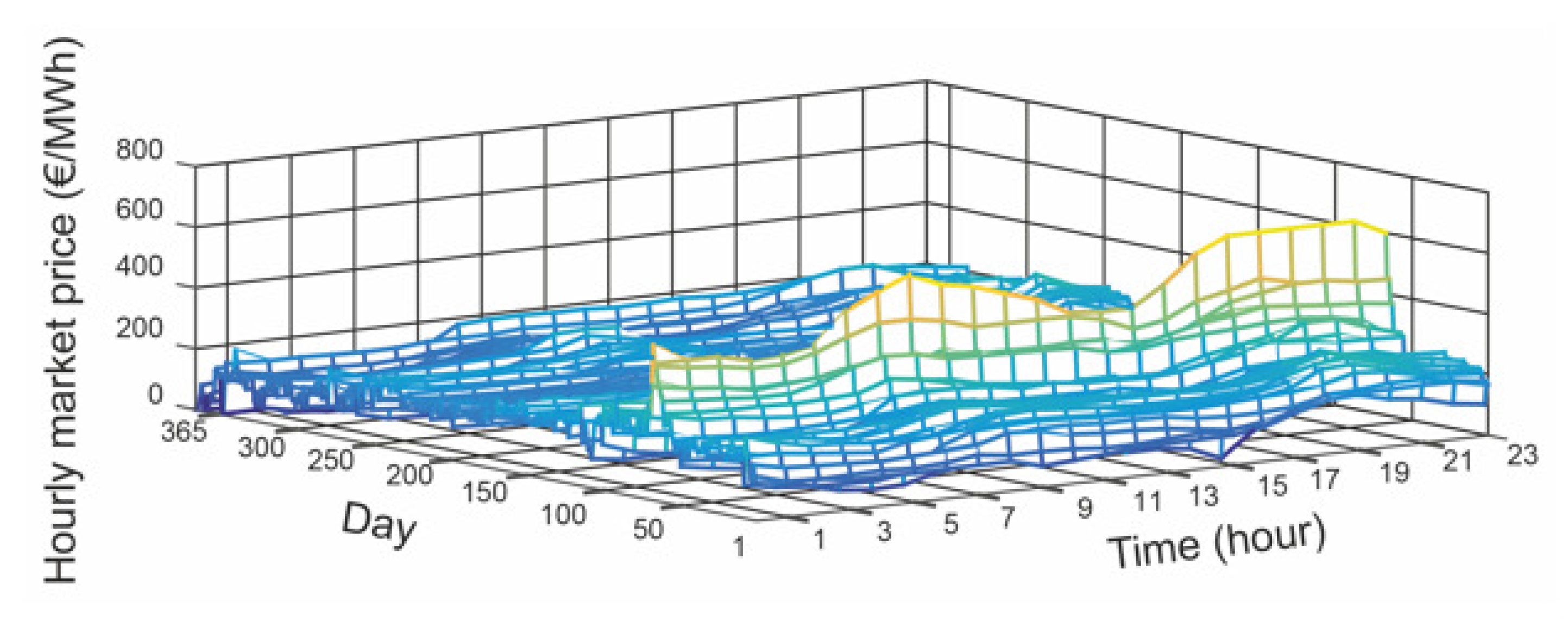
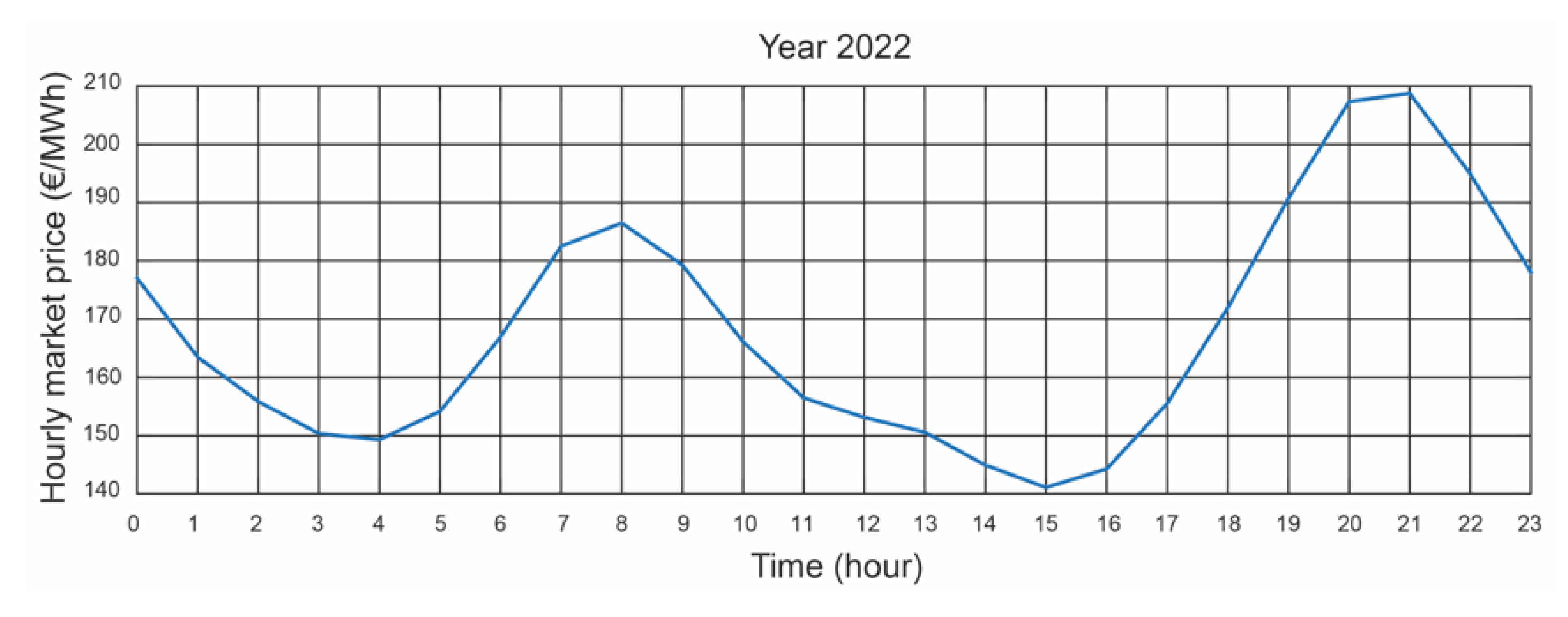
2.1. Description of the Day-Ahead Market
- (i)
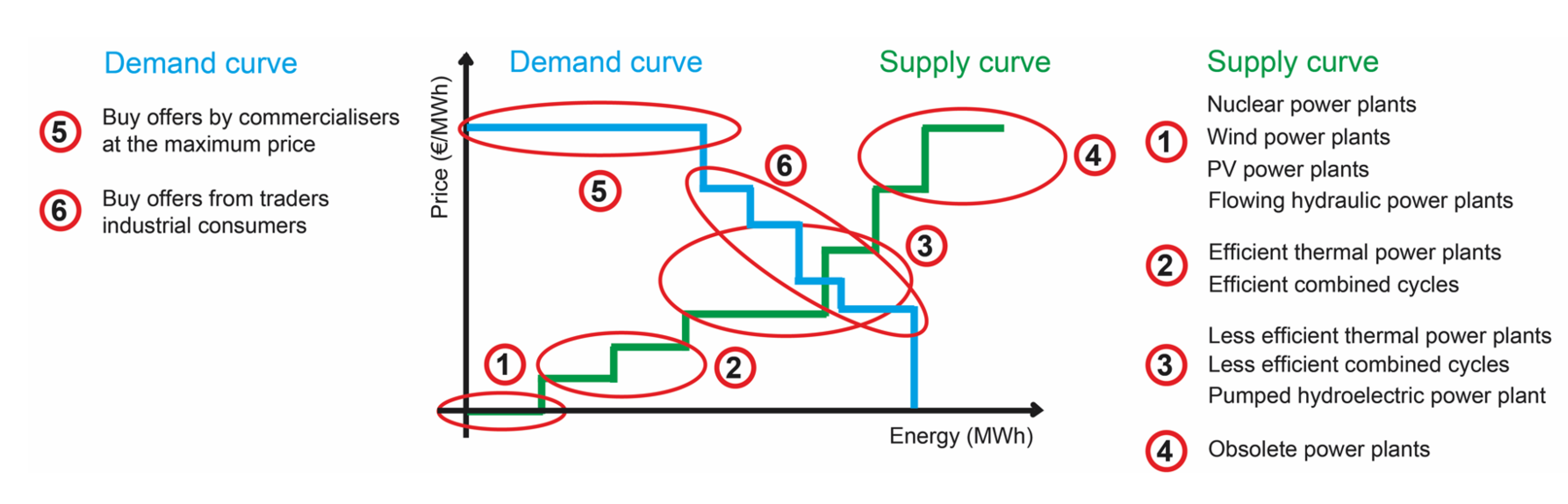
- If , the net production of the electricity system is lower than scheduled in the market and thus more energy is required.
- (ii)
- If , the net production of the electricity system is greater than scheduled in the market and thus less energy is required.
- (i)
- Deviation in favour. This is a deviation that occurs in the same direction as the market need. For example, the power plant produces less energy than scheduled and the , or when the power plant produces more energy than scheduled and the .
- (ii)
- Against deviation. This is a deviation that occurs in the opposite direction to the market need. For example, the power plant produces less energy than scheduled and the , or when the power plant produces more energy than scheduled and the .Deviations have an economic impact, which are either positive or negative. Therefore, deviations in favour are associated with a price () and deviations against are associated with a cost (). sets the and the . The cost of deviation () is the difference between the absolute value of the marginal market price and the ().
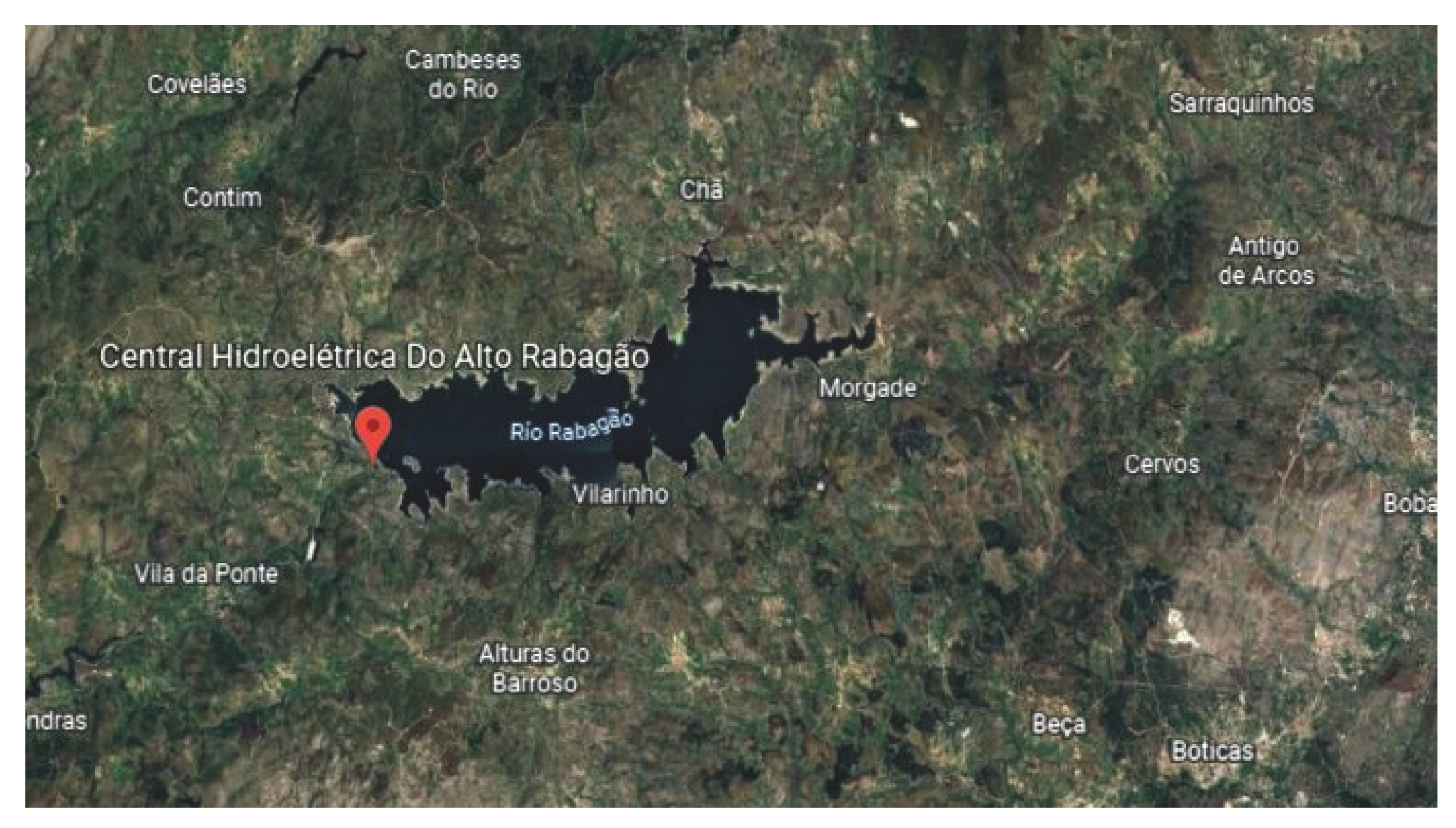
2.2. Case under Study
3. Methodology
- (i)
- Deducing possible modes of operation.
- (ii)
- Parametric analysis.
- (iii)
- Meteorological data selection.
- (iv)
- power plant design.
- (v)
- power plant size
3.1. Deducing Possible Modes of Operation
- (i)
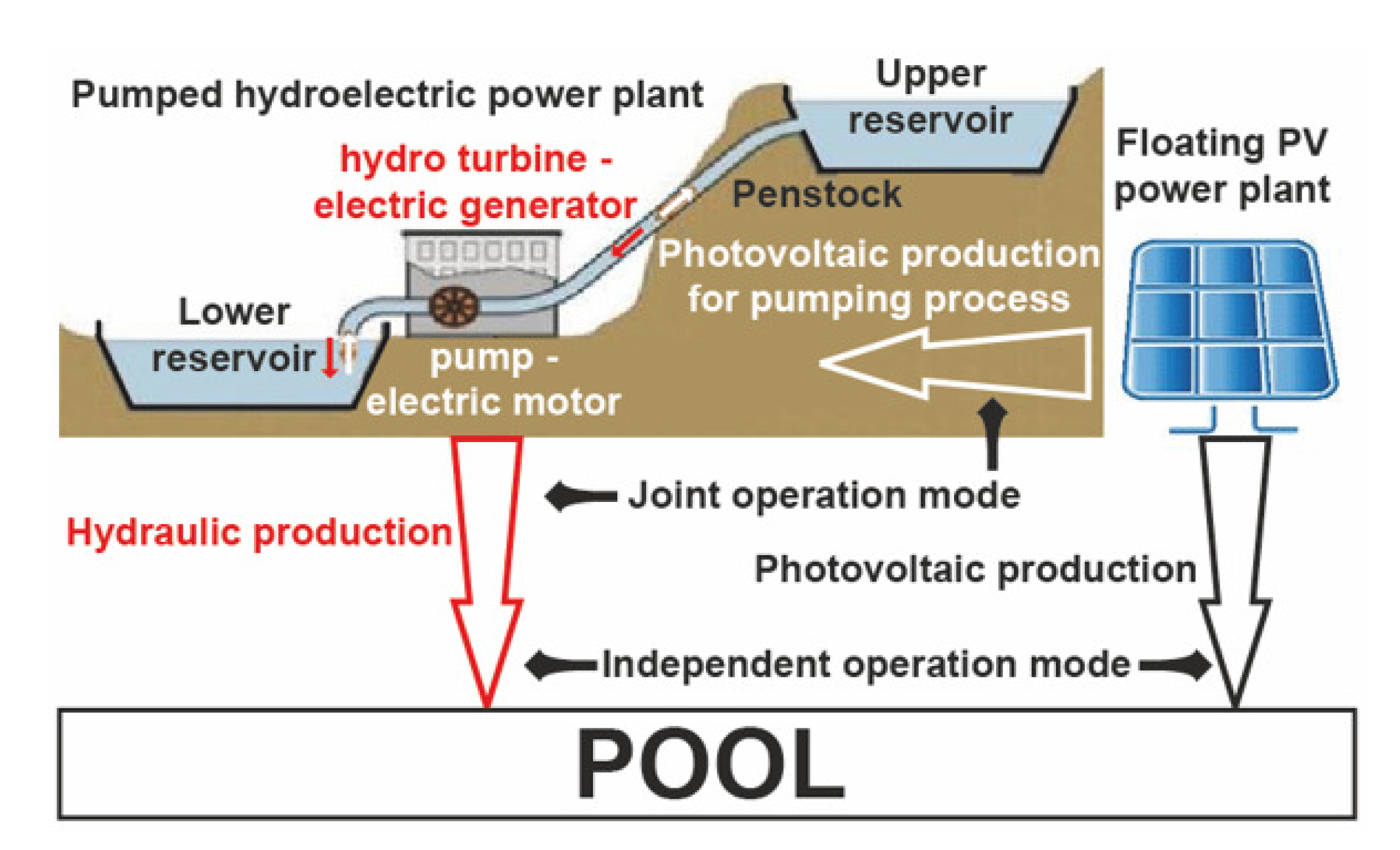
- Continuous operation of the hydropower plant, i.e., 24 h a day, is a mode of operation that would deplete the available water in the upper reservoir, meaning there would not be a sufficient annual flow to maintain the required average flow at full power. Therefore, the mode of operation of a hydroelectric power plant is intermittent. Forecasting the times with the highest energy prices determines the operating times of the hydropower plants. The water stored in the upper reservoir is conserved for use during the times that provide the greatest economic benefit. The rest of the time, it can operate in pumping mode. Due to the mode of operation of these plants, the transmission lines to the grid also operate intermittently. Therefore, they can be used by a floating plant.
- (ii)
- Selling electricity as it is generated would be the operation mode of a floating power plant without the possibility of storing energy (Mode A). If the floating power plant has a storage system, as in this case, another mode of operation is to store electricity, in the form of stored water, as it is generated (Mode B). To do this, water would be pumped from the lower reservoir to the upper reservoir. In this way, a greater economic benefit could be obtained by turbining this water at times of high prices. Considering Modes A and B, it is also possible to sell and store electricity simultaneously as it is generated (Mode C).
- (i)
- Case 1: No deviation. This would be the ideal case (a highly unlikely situation). The energy bid on day coincides with the energy available on day D. This case is characterised by the absence of a penalty, as there are no deviations. The marginal market price would be the selling price. The floating plant operates in Mode A (selling electricity as it is generated). The two power plants operate independently.
- (ii)
- Case 2: An upward deviation (energy bid on day is less than the energy available on day D) and . As the deviation is in favour of the system, there is no penalty, and a collection right is generated. The marginal market price would be the selling price. The floating plant operates in Mode A (selling electricity as it is generated). The two plants operate independently of each other.
- (iii)
- Case 3: An upward deviation (energy bid on day is less than the energy available on day D) and . As the deviation goes against the system, the right to be charged for the surplus energy will be lower than the marginal market price. Therefore, the floating plant may store the surplus energy in order to sell it on another day at the marginal market price. The floating plant operates in Mode C. The joint operation of the two plants may be the best option. In this case, the size of the floating plant will be a determining factor in the choice of its mode of operation. The efficiency of the pumping process also influences the choice.
- (iv)
- Case 4: An downward deviation (the energy bid on day is greater than the energy available on day D) and . As the deviation is against the system, a payment obligation is generated. This price is higher than the market price. Therefore, it is the worst situation for the floating plant as the plant loses money. The floating plant operates in Mode A (selling electricity as it is generated). The mode of operation will be joint, as the pumped hydroelectric power plant helps to cover the energy imbalance of the floating power plant.
- (v)
- Case 5: An downward deviation (the energy bid on day is greater than the energy available on day D) and . As the deviation is in favour of the system, there is no penalty. The marginal market price would be the selling price. The floating plant operates in Mode A (selling electricity as it is generated). The two plants operate independently of each other.
3.2. Parametric Analysis of a Pumped Hydroelectric Storage Power Plant
3.2.1. Generation Mode
3.2.2. Pumping Mode
3.3. Parametric Analysis of a Floating PV Power Plant
3.3.1. Technology Used to Manufacture of the Module
3.3.2. Electrical Efficiency
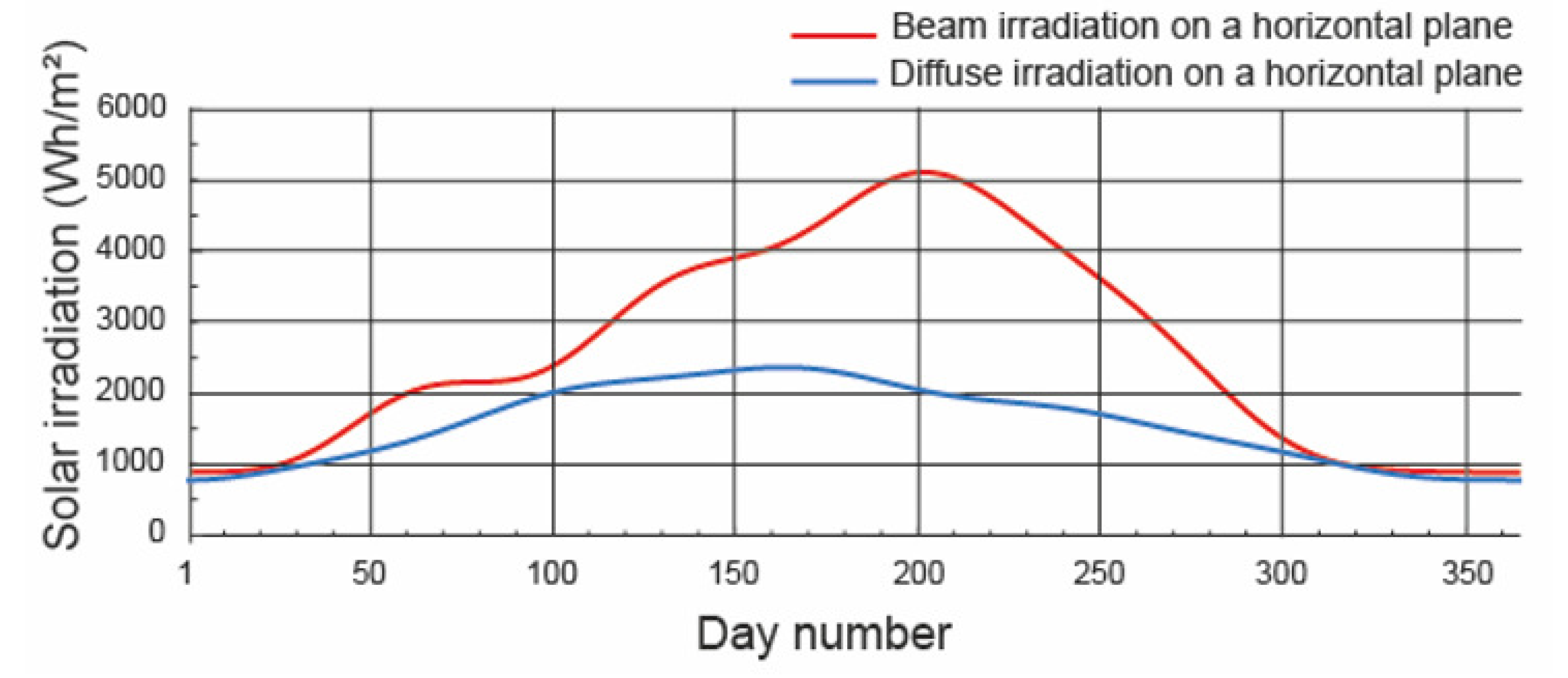
3.3.3. Incident Solar Irradiance
3.3.4. Number and Dimensions of PV Modules
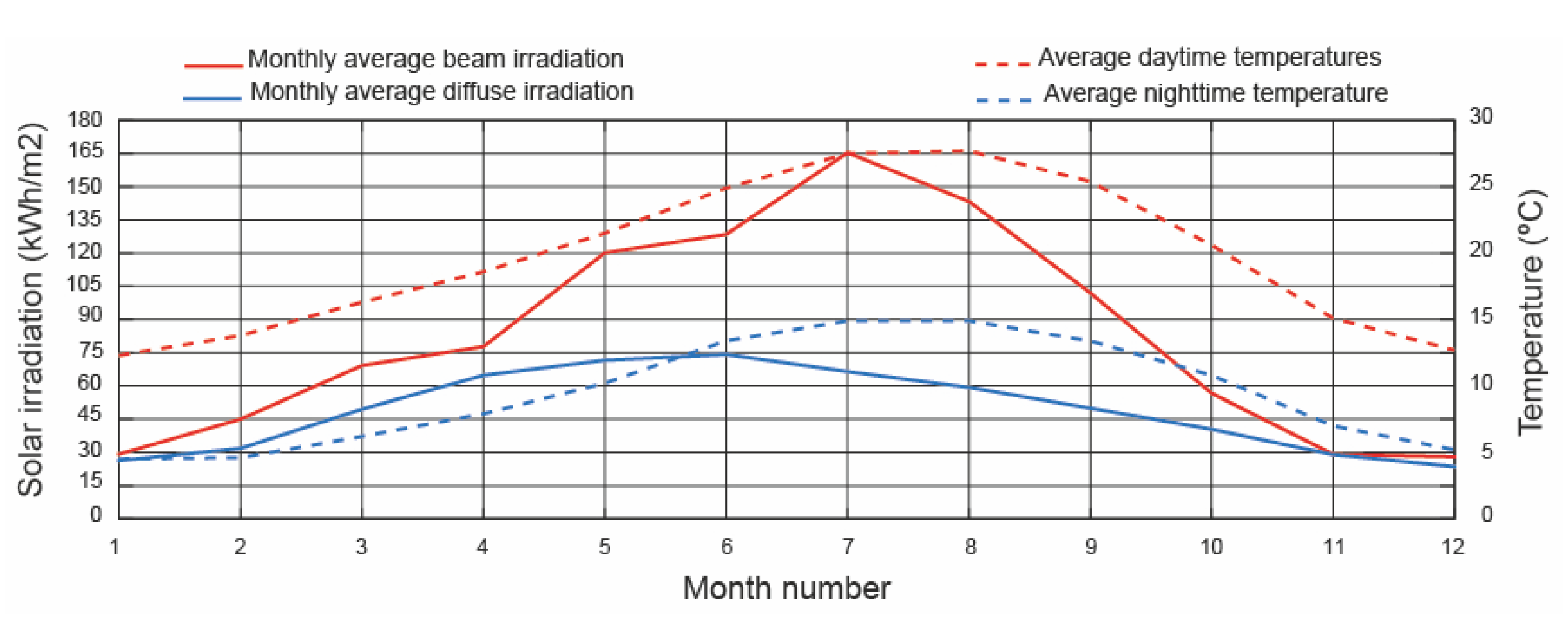
3.4. Meteorological Data Selection
3.5. The Power Plant Design
- (i)
- The shape of the available area. In ground-mounted power plants, the irregular shape of the ground greatly influences the design [46]. In the case of power plants, complex irregular shapes are not possible due to the nature of the floating platform. Therefore, the design of power plants is more similar to designs with regular shapes [51]. The dimensions of the main floating body component chosen defines the shape of the power plant. The system chosen for mounting the modules uses two main floating bodies. Each of them has the following dimensions: (mm) [52]. The usual shape of power plants is rectangular, or they can be decomposed into this type of shape [53,54].
- (ii)
- The tilt angle. Another aspect is the tilt angle of the modules. In ground-mounted photovoltaic plants, the tilt angle is chosen to maximise the incident solar irradiance on the modules. This tilt angle is related to the latitude at the site. In power plants, on the other hand, the tilt angle is chosen to ensure the stability of the modules. Therefore, tilt angles are chosen that are not related to the latitude at the site. With systems, the tilt angle is chosen in accordance with the stability of the floating platform. The tilt angle of a module must avoid the detrimental effects of wind loads, waves and water currents. Therefore, floating platforms limit the tilt angle of modules. Specifically, there are three standard values for tilt angles: 5 () [52,55], 12 () [56]. In [18], the power plants using each of these tilt angles are summarised.
- (iii)
- The orientation. As is the case with ground-mounted photovoltaic plants, the use of an optimal orientation is not a problem. Therefore, the optimum orientation is 0 () in the northern hemisphere and 180 () in the southern hemisphere [42]. As the chosen power plant is in the northern hemisphere, an orientation of 0 () will be used.
- (iv)
- The shading effect between modules. Due to the connecting floating body component, which connects the main floating bodies to each other, and the low tilt angle of the modules, the shading between modules will be quite low. However, the algorithm will take this into account.
- (v)
- (vi)
- Only one commercial module model will be used. The model chosen is the JAM72S30 525-550/MR, which is manufactured by JASolar. The characteristics of the module are as follows: power, 550 (); dimensions, (mm); and surface area, (m2). The algorithm works for any module.
- (vii)
- power plant configuration. In ground-mounted photovoltaic plants, several rack configurations can be used [46]: , , , , , etc. In systems, by contrast, the configuration is typically used to minimise wind loads on the modules.
- (viii)
- (ix)
- The number of modules. According to the dimensions of the modules and the main floating bodies, the basic configuration will be modules. An almost square shape measuring (m) ( (m2)), and a power of () is obtained with these configurations. This basic unit is surrounded by floating connecting bodies. The connection floating body acts as a foothold during the construction and maintenance of the system. The dimensions of the connection floating bodies vary depending on the manufacturer. In this study, they have the following dimensions: (mm) [52].
- (i)
- The determination of total solar irradiance (). This can be calculated using Equation (12) and the restrictions indicated above.
- (ii)
- The determination of the total surface area of the modules (). The total surface area of the modules () can be found withwhere is the number of modules, is the module width, and is the module length. The shadows that each row casts on the adjacent row in the longitudinal direction is an aspect taken into account by the algorithm designed.
- (iii)
- The determination of the total energy. The total energy can be determined by the following equation:
3.6. The Power Plant Size
- (i)
- The power of the power plant. The power of the power plant is 67 (MW) and its capacity is 973 (GWh).
- (ii)
- The area available for deployment of plant. The available area is 2200 (ha).
- (iii)
- The volume of water in the upper reservoir. The size of the power plant to supply the electrical energy required to raise the water level of the upper reservoir by a certain level by means of the pumping mode of operation of the plant.
- (iv)
- The pumping mode. The size of the plant to supply the electrical energy required for the pumping mode of operation of the plant.
- (v)
- The number of operating hours of the plant. The size of the power plant to supply the electrical energy necessary to increase the number of operating hours of the plant.
4. Results and Discussion
4.1. The Area Available for Deployment of an Plant
4.2. The Volume of Water in the Upper Reservoir
4.3. Usual Operation of the PHS Plant
4.4. Operation of the PHS Plant Together with the FPV Plant
4.4.1. 4 h of Daily Plant Operation
4.4.2. 5 or More Daily Hours of Plant Operation
5. Conclusions
- (i)
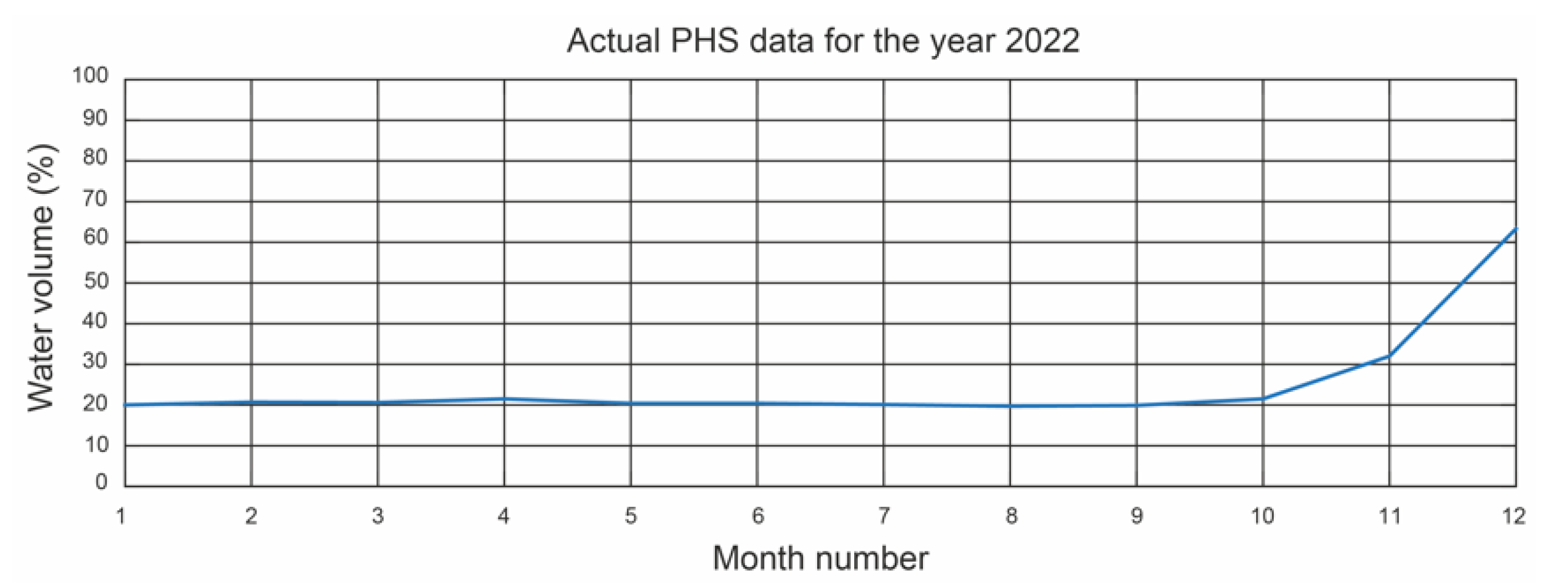
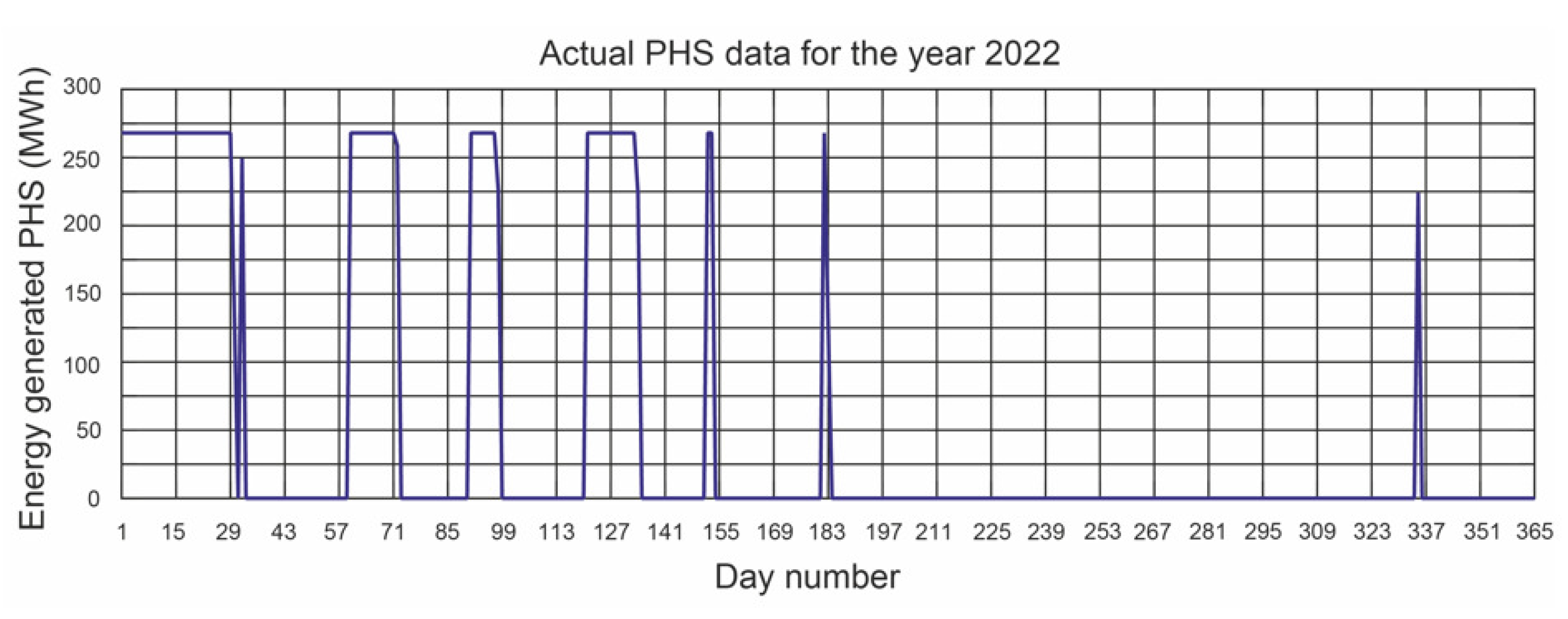
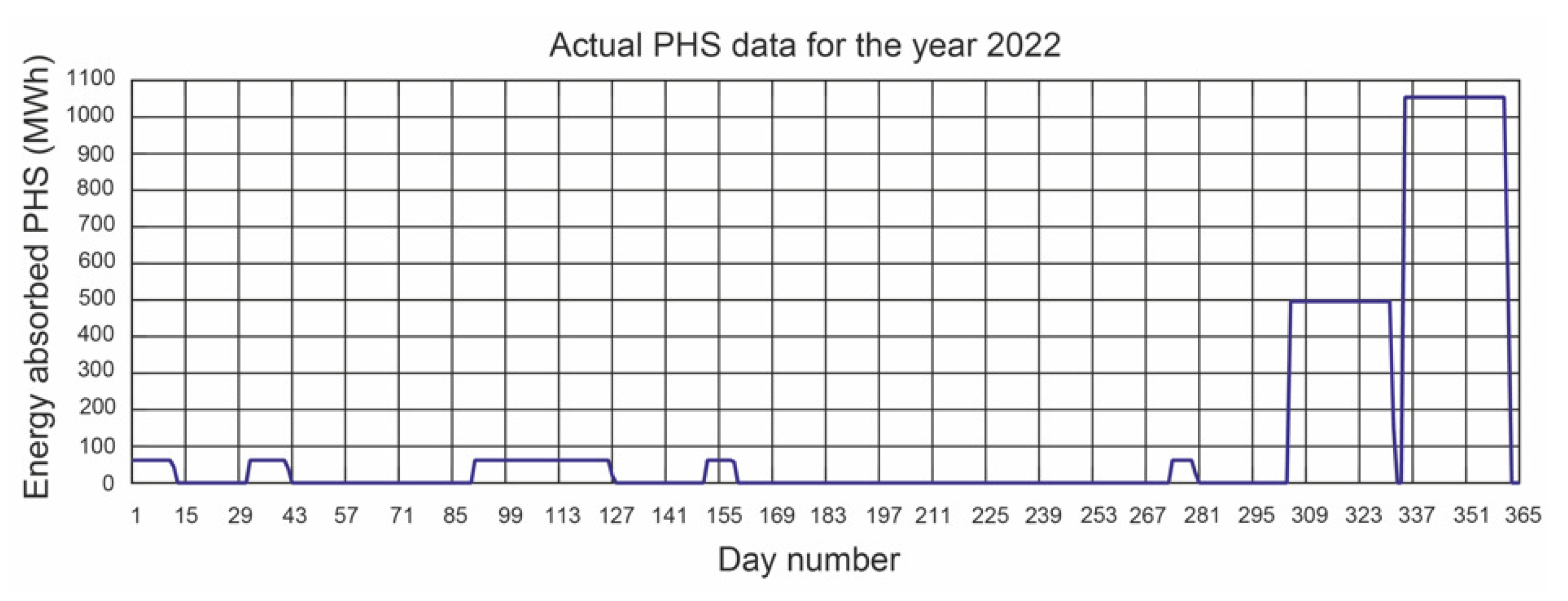
- The actual data showed that the volume of water available in the upper reservoir is a critical parameter that determines the plant operating days. The plant only operated of the days in 2022. In addition, more energy is absorbed in the pumping process than the energy generated by the plant. Therefore, the economic benefit was negative.
- (ii)
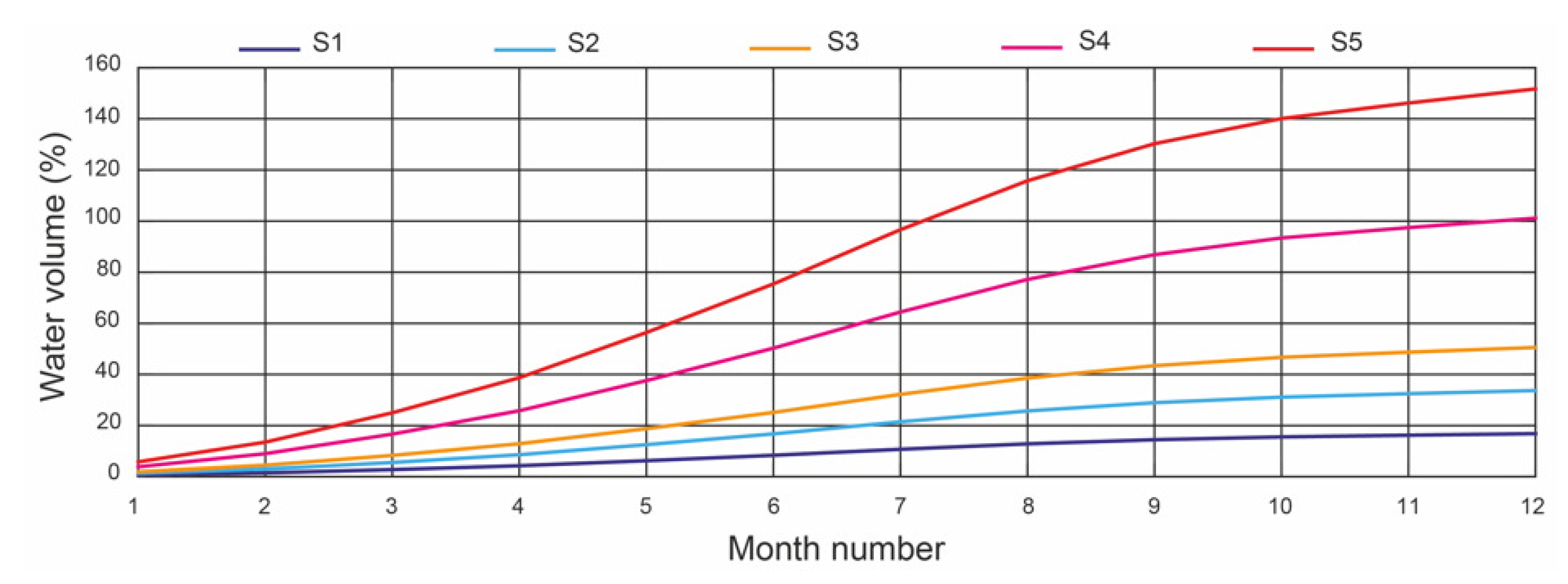
- The sizes of the plants analysed occupy a very small body of water compared to the total surface area of the upper reservoir, specifically, for , for , for , for , and for .
- (iii)
- The plant sizes analysed have the capacity to reach significant higher reservoir levels (if all the energy generated by the plant sizes was used to pump water), specifically, for , for , for , for and for .
- (iv)
- In total, of the water volume of the upper reservoir is obtained with an occupied water body surface of .
- (i)
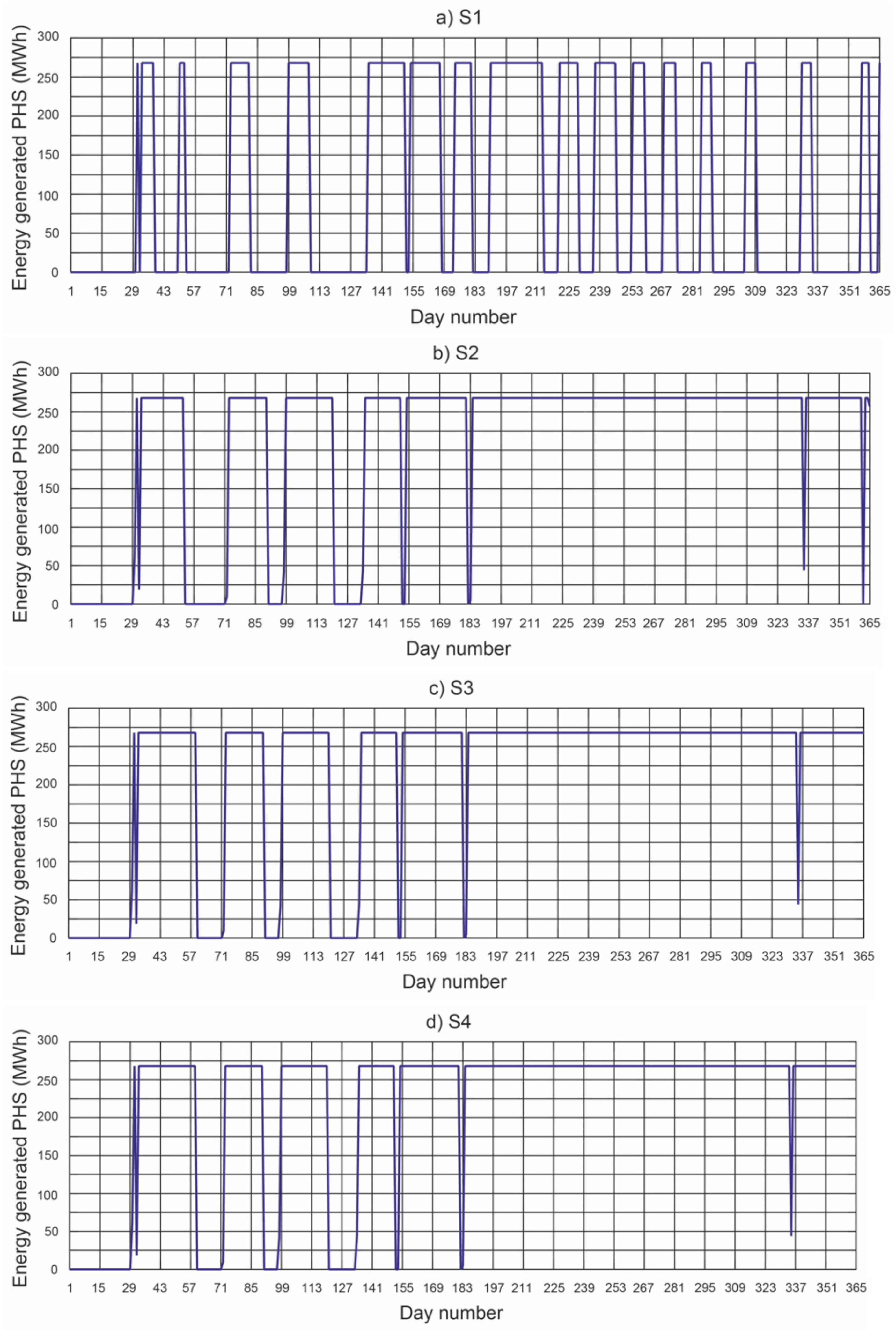
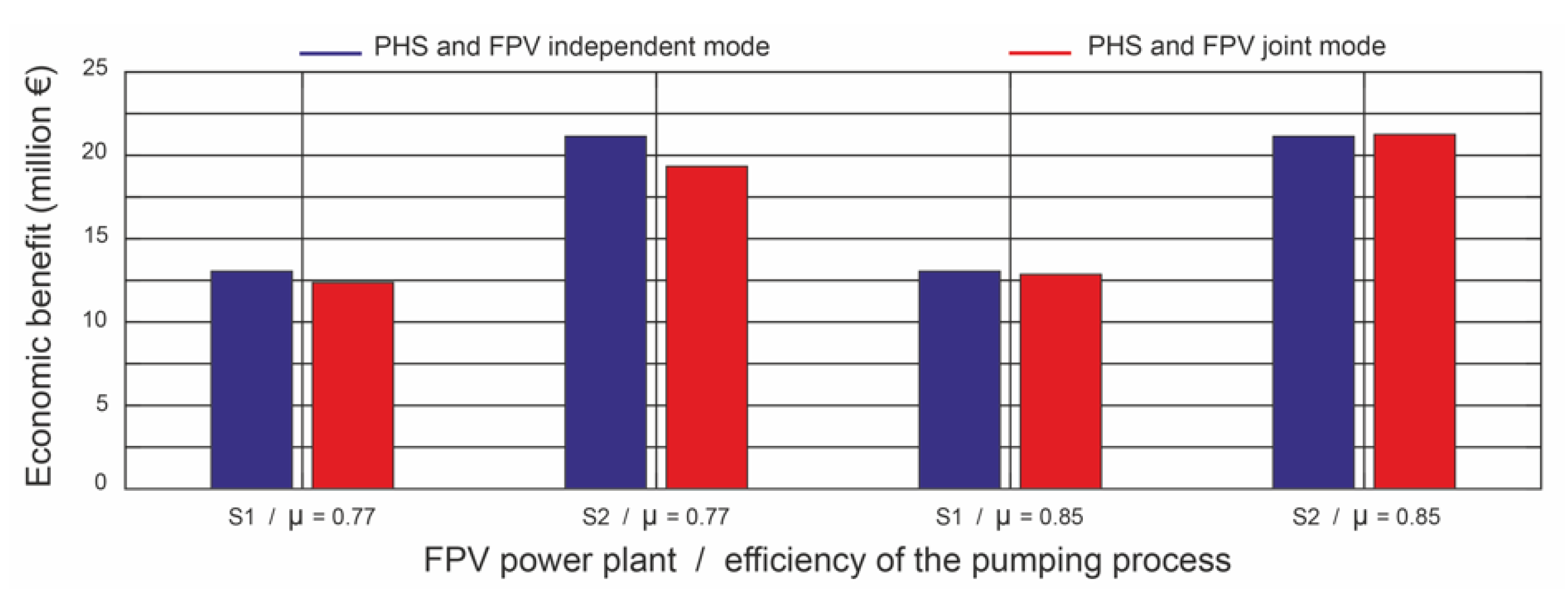
- During joint operation of both plants, the size plant is not able to operate the plant every day of the year. In addition, the economic benefit is slightly higher with the independent operation mode (Case 1: No deviations), regardless of the value of the total process efficiency parameter analysed. However, if deviations of occur in Cases 3 and 4, the economic benefit is slightly higher in the joint operation mode.
- (ii)
- During the joint operation of both plants, the size of the plant is able to operate the plant every day of the year. If the total process efficiency is , this mode of operation earns a slightly higher economic benefit than the independent operation of both plants (Case 1: No deviations).
- (iii)
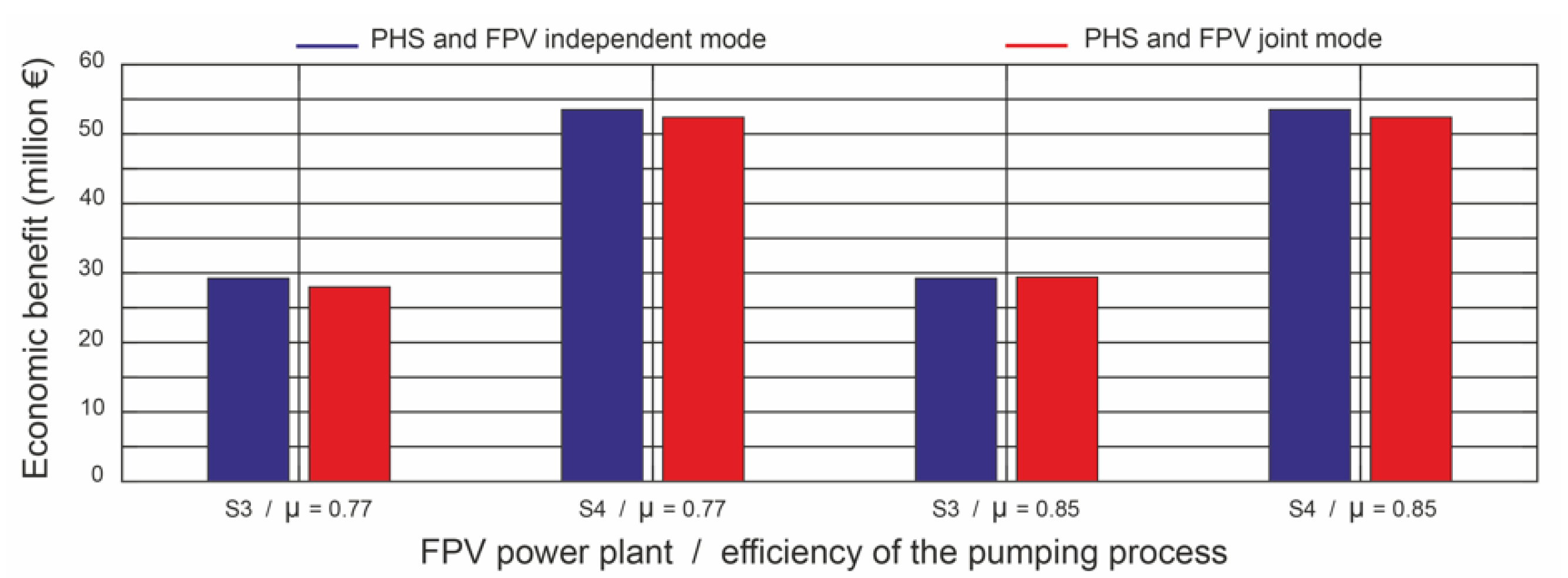
- During joint operation of both plants, the plant sizes and are able to operate the plant every day of the year and, in addition, obtain a surplus water volume of and , respectively, of the capacity of the upper reservoir.
- (iv)
- During joint operation of both plants, the size of plant is able to operate the plant every day of the year and sell the surplus energy directly as it is generated (in this case, no water is stored). If the total process efficiency is , this mode of operation earns a slightly higher economic benefit than the independent operation mode of both plants (Case 1: No deviations).
- (v)
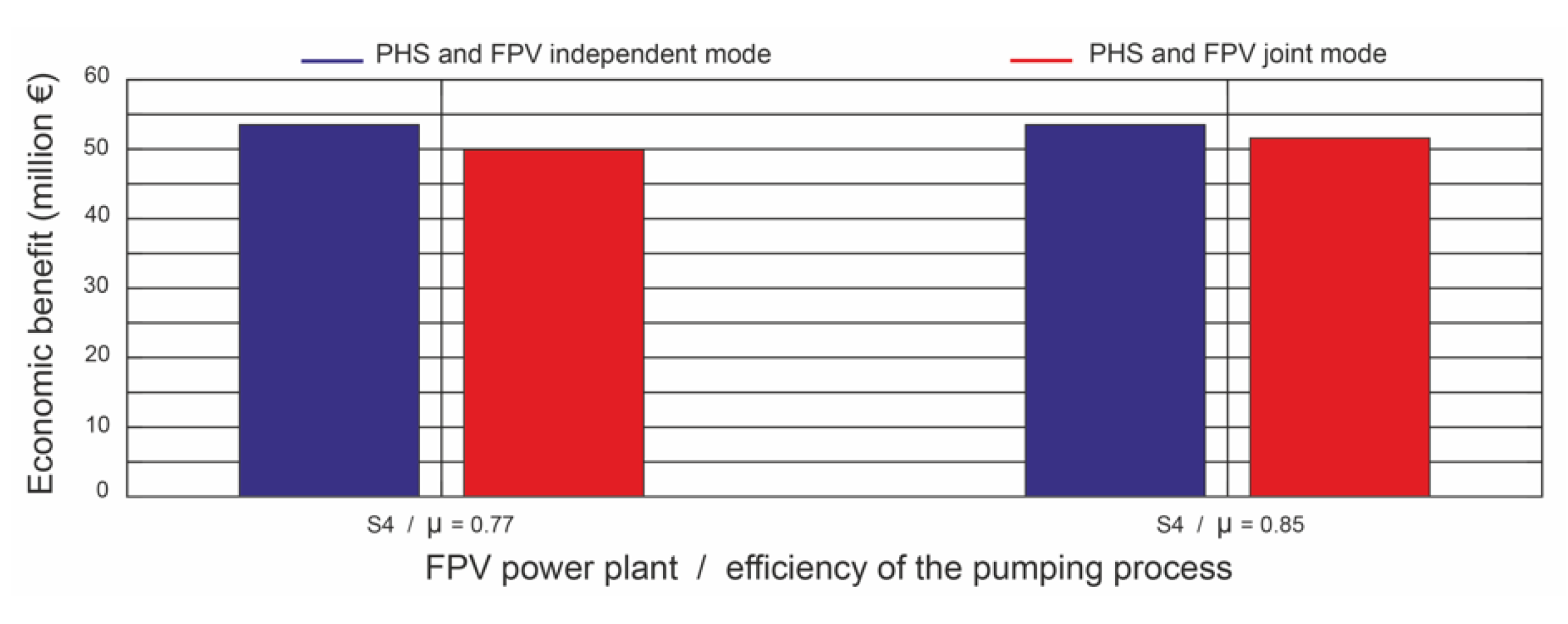
- In the joint operation of both plants, the plant size is able to operate the plant every day of the year and sell the surplus energy directly as it is generated (in this case, no water is stored). The economic benefit is slightly higher with the independent operation mode (Case 1: No deviations), regardless of the value of the total process efficiency parameter analysed.
Author Contributions
Funding
Data Availability Statement
Acknowledgments
Conflicts of Interest
Nomenclature
| Total surface area of the modules (m2) | |
| Total energy (Wh) | |
| g | Acceleration due to gravity (m/s2) |
| Total irradiation on a tilted surface (Wh/m2) | |
| Available head (m) | |
| Elevating head (m) | |
| Beam irradiance on a horizontal surface (W/m2) | |
| Diffuse irradiance on a horizontal surface (W/m2) | |
| Total irradiance on a tilted surface (W/m2) | |
| Water pumping coefficient (W· s/m3) | |
| Turbine generating coefficient (W· s/m3) | |
| Module PV length (m) | |
| Normal operating cell temperature () | |
| n | Ordinal of the day (day) |
| Power input of the electric motor (W) | |
| Power output of the electric generator (W) | |
| Power output of the module (W/m2) | |
| Power output of the hydro turbine (W) | |
| Turbined flow rate (m3/s) | |
| Pumped flow rate (m3/s) | |
| T | Solar time (h) |
| Ambient temperature () | |
| cell temperature (C) | |
| Reference temperature (C) | |
| Sunrise solar time (h) | |
| Sunset solar time (h) | |
| Module PV width (m) | |
| Solar absorptance of layer (dimensionless) | |
| Tilt angle of photovoltaic module () | |
| Temperature coefficient (1/C) | |
| Azimuth angle of photovoltaic module () | |
| Solar declination () | |
| PV module efficiency (%) | |
| Electric generator efficiency (%) | |
| Motor generator efficiency (%) | |
| Pump efficiency (%) | |
| module efficiency at the reference temperature (%) | |
| Hydro turbine efficiency (%) | |
| Incidence angle () | |
| Zenith angle of the Sun () | |
| Latitude angle () | |
| Total pumping process efficiency (%) | |
| Density of water (kg/m3) | |
| Ground reflectance (dimensionless) | |
| Solar transmittance of glazing (dimensionless) | |
| Hour angle () |
References
- The Paris Agreement. Paris Agreement. In Proceedings of the Conference of the Parties to the United Nations Framework Convention on Climate Change (21st Session), Paris, France, 30 November–13 December 2015.
- Bouckaert, S.; Pales, A.F.; McGlade, C.; Remme, U.; Wanner, B.; Varro, L.; D’Ambrosio, D.; Spencer, T.; Abergel, T.; Arsalane, Y.; et al. Net Zero by 2050: A Roadmap for the Global Energy Sector. International Energy Agency (IEA). 2021. Available online: https://www.iea.org/reports/net-zero-by-2050 (accessed on 10 April 2023).
- BPIE. 9 Ways to Make the Energy Performance of Buildings Directive More Effective. 2016. Available online: http://bpie.eu/wp-content/uploads/2016/08/EPBD-paper_Eng.pdf (accessed on 27 January 2023).
- BP Statistical Review of World Energy. 2021. Available online: https://www.bp.com/content/dam/bp/business-sites/en/global/corporate/pdfs/energy-economics/statistical-review/bp-stats-review-2021-full-report.pdf (accessed on 27 January 2023).
- Barbón, A.; Fortuny Ayuso, P.; Bayón, L.; Silva, C.A. A comparative study between racking systems for photovoltaic power systems. Renew. Energy 2021, 180, 424–437. [Google Scholar] [CrossRef] [Scilit]
- Lin, F.; Zhang, Y.; Wang, J. Recent advances in intra-hour solar forecasting: A review of ground-based sky image methods. Int. Forecast. 2023, 39, 244–265. [Google Scholar] [CrossRef] [Scilit]
- U.S. Department of Energy, Energy Efficiency and Renewable Energy. Types of Hydropower Plants. 2023. Available online: https://www.energy.gov/eere/water/types-hydropower-plants (accessed on 10 April 2023).
- Agrawal, K.K.; Jha, S.K.; Mittal, R.K.; Vashishtha, S. Assessment of floating solar PV (FSPV) potential and water conservation: Case study on Rajghat Dam in Uttar Pradesh, India. Energy Sustain. Dev. 2022, 66, 287–295. [Google Scholar] [CrossRef] [Scilit]
- Sanseverino, I.; Conduto, D.; Pozzoli, L.; Dobricic, S.; Lettieri, T. Algal Bloom and Its Economic Impact, European Commission, Joint Research Centre. 2016. Available online: https://op.europa.eu/en/publication-detail/-/publication/4d384d1b-1804-11e6-ba9a-01aa75ed71a1/language-en (accessed on 10 April 2023).
- Muñoz-Cerón, E.; Osorio-Aravena, J.C.; Rodríguez-Segura, F.J.; Frolova, M.; Ruano-Quesada, A. Floating photovoltaics systems on water irrigation ponds: Technical potential and multi-benefits analysis. Energy 2023, 271, 127039. [Google Scholar] [CrossRef] [Scilit]
- Nguyen, N.H.; Le, B.C.; Nguyen, L.N.; Bui, T.T. Technical analysis of the large capacity grid-connected floating photovoltaic system on the hydropower reservoir. Energies 2023, 16, 3780. [Google Scholar] [CrossRef] [Scilit]
- Al-Widyan, M.; Khasawneh, M.; Abu-Dalo, M. Potential of floating photovoltaic technology and their effects on energy output, water quality and supply in Jordan. Energies 2021, 14, 8417. [Google Scholar] [CrossRef] [Scilit]
- Padilha Campos Lopes, M.; Nogueira, T.; Leandro Santos, A.J.; Castelo Branco, D.; Pouran, H. Technical potential of floating photovoltaic systems on artificial water bodies in Brazil. Renew. Energy 2022, 181, 1023–1033. [Google Scholar] [CrossRef] [Scilit]
- Martín-Chivelet, N. Photovoltaic potential and land-use estimation methodology. Energy 2016, 94, 233–242. [Google Scholar] [CrossRef] [Scilit]
- El Hammoumi, A.; Chalh, V.; Allouhi, A.; Motahhir, S.; El Ghzizal, A.; Derouich, A. Design and construction of a test bench to investigate the potential of floating PV systems. J. Clean. Prod. 2021, 278, 123917. [Google Scholar] [CrossRef] [Scilit]
- Liu, H.; Krishna, V.; Lun Leung, J.; Reindl, T.; Zhao, L. Field experience and performance analysis of floating PV technologies in the tropics. Prog. Photovolta. Res. Appl. 2018, 26, 957–967. [Google Scholar] [CrossRef] [Scilit]
- Cramton, P. Electricity market design. Oxf. Rev. Econ. Policy 2017, 33, 589–612. [Google Scholar] [CrossRef] [Scilit]
- Barbón, A.; Gutiérrez, A.; Bayón, L.; Bayón-Cueli, C.; Aparicio-Bermejo, J. Economic analysis of a pumped hydroelectric storage-integrated floating PV system in the day-ahead Iberian electricity market. Energies 2023, 16, 1705. [Google Scholar] [CrossRef] [Scilit]
- Jurasz, J.; Canales, F.A.; Kies, A.; Guezgouz, M.; Beluco, A. A review on the complementarity of renewable energy sources: Concept, metrics, application and future research directions. Sol. Energy 2020, 195, 703–724. [Google Scholar] [CrossRef] [Scilit]
- Kougias, I.; Szabó, S. Pumped hydroelectric storage utilization assessment: Forerunner of renewable energy integration or Trojan horse? Energy 2017, 140, 318–329. [Google Scholar] [CrossRef] [Scilit]
- Rehman, S.; Al-Hadhrami, L.M.; Alam, M.M. Pumped hydro energy storage system: A technological review. Renew. Sustain. Rev. 2015, 44, 586–598. [Google Scholar] [CrossRef] [Scilit]
- Margeta, J.; Glasnovic, Z. Theoretical settings of photovoltaic-hydro energy system for sustainable energy production. Solar Energy 2012, 86, 972–982. [Google Scholar] [CrossRef] [Scilit]
- Rauf, H.; Gull, M.S.; Arshad, N. Complementing hydroelectric power with floating solar PV for daytime peak electricity demand. Renew. Energy 2020, 162, 1227–1242. [Google Scholar] [CrossRef] [Scilit]
- Kocaman, A.S.; Modi, V. Value of pumped hydro storage in a hybrid energy generation and allocation system. Appl. Energy 2017, 205, 1202–1215. [Google Scholar] [CrossRef] [Scilit]
- Glasnovic, Z.; Margeta, J. The features of sustainable solar hydroelectric power plant. Renew. Energy 2009, 34, 1742–1751. [Google Scholar] [CrossRef] [Scilit]
- Bhattacharjee, S.; Nayak, P.K. PV-pumped energy storage option for convalescing performance of hydroelectric station under declining precipitation trend. Renew. Energy 2019, 135, 288–302. [Google Scholar] [CrossRef] [Scilit]
- Ciucci, M. Internal Energy Market, Fact Sheets on the European Union. 2022. Available online: https://www.europarl.europa.eu/factsheets/en/sheet/45/internal-energy-market (accessed on 27 January 2023).
- EDP. Available online: https://portugal.edp.com/en/alto-rabagao-hydro-power-plant (accessed on 27 December 2022).
- Bayón, L.; Grau, J.M.; Ruiz, M.M.; Suárez, P.M. Mathematical modelling of the combined optimization of a pumped-storage hydro-plant and a wind park. Math. Comput. Model. 2013, 57, 2024–2028. [Google Scholar] [CrossRef] [Scilit]
- Ibrahim, H.; Ilinca, A.; Perron, J. Energy storage systems–characteristics and comparisons. Renew. Sustain. Energy Rev. 2008, 12, 1221–1250. [Google Scholar] [CrossRef] [Scilit]
- Khalil Zidane, T.E.; Bin Adzman, M.R.; Naim Tajuddin, M.F.; Mat Zali, S.; Durusu, A. Optimal configuration of photovoltaic power plant using grey wolf optimizer: A comparative analysis considering CdTe and c-Si PV modules. Sol. Energy 2019, 188, 247–257. [Google Scholar] [CrossRef] [Scilit]
- Kalogirou, S.A.; Agathokleous, R.; Panayiotou, G. On-site PV characterization and effect of soiling on their performance. Energy 2013, 51, 439–446. [Google Scholar] [CrossRef] [Scilit]
- Skoplaki, E.; Palyvos, J.A. On the temperature dependence of photovoltaic module electrical performance: A review of efficiency/power correlations. Sol. Energy 2009, 83, 614–624. [Google Scholar] [CrossRef] [Scilit]
- Evans, D.L. Simplified method for predicting photovoltaic array output. Sol. Energy 1981, 27, 555–560. [Google Scholar] [CrossRef] [Scilit]
- Kichou, S.; Skandalos, N.; Wolf, P. Floating photovoltaics performance simulation approach. Heliyon 2022, 8, 11896. [Google Scholar] [CrossRef] [Scilit] [PubMed]
- Lawrence Kamuyu, W.C.; Rok Lim, J.; Sub Won, C.; Keun Ahn, H. Prediction model of photovoltaic module temperature for power performance of floating PVs. Energies 2018, 11, 447. [Google Scholar] [CrossRef] [Scilit]
- Dutra Silva, D.; Marson, V.; Rodrigues de Souza, R.; Diehl de Oliveira, J.; Campos Silva, J.B.; Cardoso, E.M. A new predictive model for a photovoltaic module’s surface temperature. Energy Rep. 2022, 8, 15206–15220. [Google Scholar] [CrossRef] [Scilit]
- Skoplaki, E.; Palyvos, J.A. Operating temperature of photovoltaic modules: A survey of pertinent correlations. Renew. Energy 2009, 34, 23–29. [Google Scholar] [CrossRef] [Scilit]
- Mattei, M.; Notton, G.; Cristofari, C.; Muselli, M.; Poggi, P. Calculation of the polycrystalline PV module temperature using a simple method of energy balance. Renew. Energy 2006, 31, 553–567. [Google Scholar] [CrossRef] [Scilit]
- Choi, Y.K. A study on power generation analysis of floating PV system considering environmental impact. Int. J. Softw. Eng. Appl. 2014, 8, 75–84. [Google Scholar] [CrossRef] [Scilit]
- Oliveira-Pinto, S.; Stokkermans, J. Assessment of the potential of different floating solar technologies–Overview and analysis of different case studies. Energy Convers. Manag. 2020, 211, 112747. [Google Scholar] [CrossRef] [Scilit]
- Duffie, J.A.; Beckman, W.A. Solar Engineering of Thermal Processes, 4th ed.; John Wiley & Sons: New York, NY, USA, 2013. [Google Scholar]
- Barbón, A.; Fortuny Ayuso, P.; Bayón, L.; Fernández-Rubiera, J.A. Predicting beam and diffuse horizontal irradiance using Fourier expansions. Renew. Energy 2020, 154, 46–57. [Google Scholar] [CrossRef] [Scilit]
- WRDC. World Radiation Data Centre. 2022. Available online: http://wrdc.mgo.rssi.ru/ (accessed on 27 January 2023).
- Bhavani, S.; Chithambaram, V.; Muthucumaraswamy, R.; Shanmugan, S.; Essa, F.A.; Elsheikh, A.H.; Selvaraju, P.; Janarthanan, B. Laplacian tactic for the prediction of the temperature components of solar cooker with logical prediction by fuzzy rules. Sol. Energy 2022, 236, 369–382. [Google Scholar] [CrossRef] [Scilit]
- Barbón, A.; Bayón-Cueli, C.; Bayón, L.; Carreira-Fontao, V. A methodology for an optimal design of ground-mounted photovoltaic power plants. Appl. Energy 2022, 314, 118881. [Google Scholar] [CrossRef] [Scilit]
- Hottel, H.C. A simple model for estimating the transmittance of direct solar radiation through clear atmosphere. Sol. Energy 1976, 18, 129–134. [Google Scholar] [CrossRef] [Scilit]
- Liu, B.Y.H.; Jordan, R.C. The interrelationship and characteristic distribution of direct, diffuse and total solar radiation. Sol. Energy 1960, 4, 1–19. [Google Scholar] [CrossRef] [Scilit]
- PVGIS, Joint Research Centre (JRC). 2022. Available online: http://re.jrc.ec.europa.eu/pvg_tools/en/tools.html#PVP (accessed on 27 January 2023).
- Ghigo, A.; Faraggiana, E.; Sirigu, M.; Mattiazzo, G.; Bracco, G. Design and analysis of a floating photovoltaic system for offshore installation: The case study of Lampedusa. Energies 2022, 15, 8804. [Google Scholar] [CrossRef] [Scilit]
- Bayón-Cueli, C.; Barbón, A.; Fernández-Conde, A.; Bayón, L. Optimal distribution of PV modules on roofs with limited space. In Proceedings of the 2021 IEEE International Conference on Environmental and Electrical Engineering (EEEIC2021), Bari, Italy, 7–10 September 2021; pp. 50–55. [Google Scholar]
- Isifloating. Available online: https://www.isifloating.com/en/solar-flotante-isifloating-by-isigenere-english/ (accessed on 27 January 2023).
- Osborne, M. Sungrow Targets Teading Role in Supply of Floating Solar Systems to Booming Market. Available online: https://www.pv-tech.org/sungrow-targets-leading-role-in-supply-of-floating-solar-systems-to-booming/ (accessed on 10 April 2023).
- Sahu, A.; Yadav, N.; Sudhakar, K. Floating photovoltaic power plant: A review. Renew. Sustain. Energy Rev. 2016, 66, 815–824. [Google Scholar] [CrossRef] [Scilit]
- Ciel. Available online: https://ciel-et-terre.net/solutions/products/ (accessed on 27 January 2023).
- Intech. Available online: https://intechcleanenergy.com/floating-panels.php (accessed on 27 January 2023).
- Muneer, T. Solar Radiation and Day Light Models, 1st ed.; Elsevier: Oxford, UK, 2004. [Google Scholar]
- Dobos, E. Albedo. Encycl. Soil Sci. 2006, 2, 24–25. [Google Scholar]
- Weihs, P.; Mursch-Radlgruber, E.; Hasel, S.; Gützer, C.; Brandmaier, M.; Plaikner, M. Investigation of the effect of sealed surfaces on local climate and thermal stress. In EGU General Assembly Conference Abstracts; Copernicus GmbH: Göttingen, Germany, 2015; p. 12616. [Google Scholar]
- Pérez-Gallardo, J.R.; Azzaro-Pantel, C.; Astier, S.; Domenech, S.; Aguilar-Lasserre, A. Ecodesign of photovoltaic grid-connected systems. Renew. Energy 2014, 64, 82–97. [Google Scholar] [CrossRef] [Scilit]
- ESIOS, 2023; Iberian Market Operator, Market Results. Available online: https://www.esios.ree.es/es/mercados-y-precios (accessed on 27 January 2023).
- SNIRH. 2023. Available online: https://snirh.apambiente.pt/index.php?idMain=1&idItem=1.3&sbaciaid=&szonas=&salbufeirasimbolo=03J/03A&n_mesBOLETIM=01&n_anoH= (accessed on 27 January 2023).



| Parameter | Size | ||||
|---|---|---|---|---|---|
| Designation | S1 | S2 | S3 | S4 | S5 |
| Power (MWp) | 33.50 | 67.10 | 100.65 | 201.30 | 301.95 |
| Occupied area (hm) | 22.39 | 44.78 | 67.18 | 134.35 | 201.53 |
| Occupied area (%) | 1.018 | 2.04 | 3.05 | 6.12 | 9.16 |
| Number of total PV modules | 61,000 | 122,000 | 183,000 | 366,000 | 549,000 |
| Annual energy (GWh) | 49.82 | 99.65 | 149.47 | 298.94 | 448.41 |
Disclaimer/Publisher’s Note: The statements, opinions and data contained in all publications are solely those of the individual author(s) and contributor(s) and not of MDPI and/or the editor(s). MDPI and/or the editor(s) disclaim responsibility for any injury to people or property resulting from any ideas, methods, instructions or products referred to in the content. |
© 2023 by the authors. Licensee MDPI, Basel, Switzerland. This article is an open access article distributed under the terms and conditions of the Creative Commons Attribution (CC BY) license (https://creativecommons.org/licenses/by/4.0/).
Share and Cite
Barbón, A.; Aparicio-Bermejo, J.; Bayón, L.; Georgious, R. Floating Photovoltaic Systems Coupled with Pumped Hydroplants under Day-Ahead Electricity Market Conditions: Parametric Analysis. Electronics 2023, 12, 2250. https://doi.org/10.3390/electronics12102250
Barbón A, Aparicio-Bermejo J, Bayón L, Georgious R. Floating Photovoltaic Systems Coupled with Pumped Hydroplants under Day-Ahead Electricity Market Conditions: Parametric Analysis. Electronics. 2023; 12(10):2250. https://doi.org/10.3390/electronics12102250
Chicago/Turabian StyleBarbón, Arsenio, Javier Aparicio-Bermejo, Luis Bayón, and Ramy Georgious. 2023. "Floating Photovoltaic Systems Coupled with Pumped Hydroplants under Day-Ahead Electricity Market Conditions: Parametric Analysis" Electronics 12, no. 10: 2250. https://doi.org/10.3390/electronics12102250
APA StyleBarbón, A., Aparicio-Bermejo, J., Bayón, L., & Georgious, R. (2023). Floating Photovoltaic Systems Coupled with Pumped Hydroplants under Day-Ahead Electricity Market Conditions: Parametric Analysis. Electronics, 12(10), 2250. https://doi.org/10.3390/electronics12102250