Article

Intelligent Distributed Swarm Control for Large-Scale Multi-UAV Systems: A Hierarchical Learning Approach


Department of Electrical and Biomedical Engineering, University of Nevada, Reno, NV 89557, USA
*
Author to whom correspondence should be addressed.
Electronics 2023, 12(1), 89; https://doi.org/10.3390/electronics12010089

Submission received: 11 November 2022 / Revised: 14 December 2022 / Accepted: 19 December 2022 / Published: 26 December 2022

Abstract

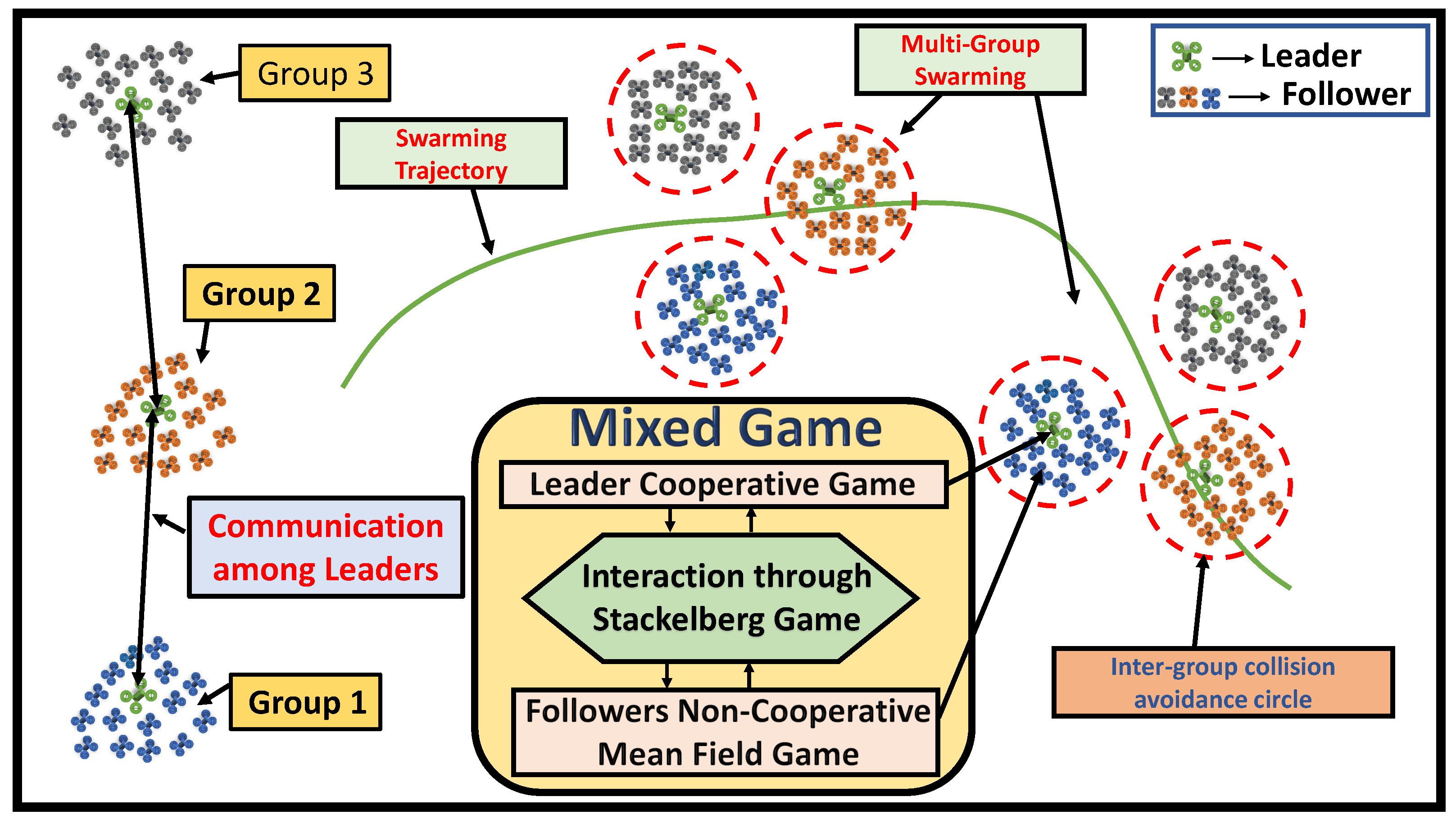
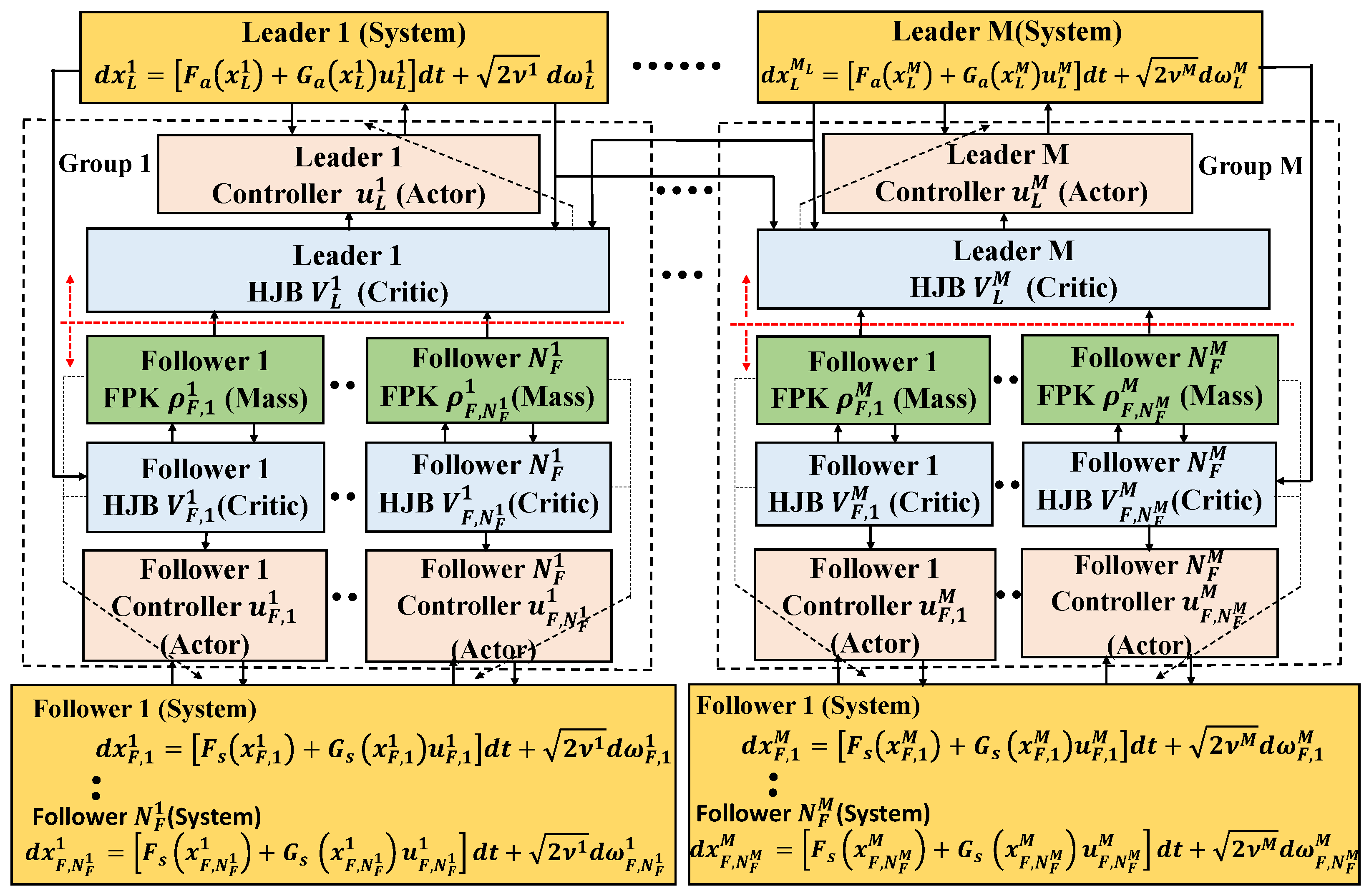
In this paper, a distributed swarm control problem is studied for large-scale multi-agent systems (LS-MASs). Different than classical multi-agent systems, an LS-MAS brings new challenges to control design due to its large number of agents. It might be more difficult for developing the appropriate control to achieve complicated missions such as collective swarming. To address these challenges, a novel mixed game theory is developed with a hierarchical learning algorithm. In the mixed game, the LS-MAS is represented as a multi-group, large-scale leader–follower system. Then, a cooperative game is used to formulate the distributed swarm control for multi-group leaders, and a Stackelberg game is utilized to couple the leaders and their large-scale followers effectively. Using the interaction between leaders and followers, the mean field game is used to continue the collective swarm behavior from leaders to followers smoothly without raising the computational complexity or communication traffic. Moreover, a hierarchical learning algorithm is designed to learn the intelligent optimal distributed swarm control for multi-group leader–follower systems. Specifically, a multi-agent actor–critic algorithm is developed for obtaining the distributed optimal swarm control for multi-group leaders first. Furthermore, an actor–critic–mass method is designed to find the decentralized swarm control for large-scale followers. Eventually, a series of numerical simulations and a Lyapunov stability proof of the closed-loop system are conducted to demonstrate the performance of the developed scheme.
Keywords: game theory; reinforcement learning; adaptive dynamic programming; LS-MAS game theory; reinforcement learning; adaptive dynamic programming; LS-MAS