Article

A Study on the Relationship between RPE and sEMG in Dynamic Contraction Based on the GPR Method
1
College of Instrumentation and Electrical Engineering, Jilin University, Changchun 130061, China
2
Physical Education College, Jilin University, Changchun 130061, China
3
Tsinghua Shenzhen International Graduate School, Tsinghua University, Shenzhen 518055, China
4
School of Instrument Science and Engineering, Southeast University, Nanjing 210096, China
*
Author to whom correspondence should be addressed.
Electronics 2022, 11(5), 691; https://doi.org/10.3390/electronics11050691

Submission received: 26 December 2021 / Revised: 14 February 2022 / Accepted: 18 February 2022 / Published: 24 February 2022

Abstract

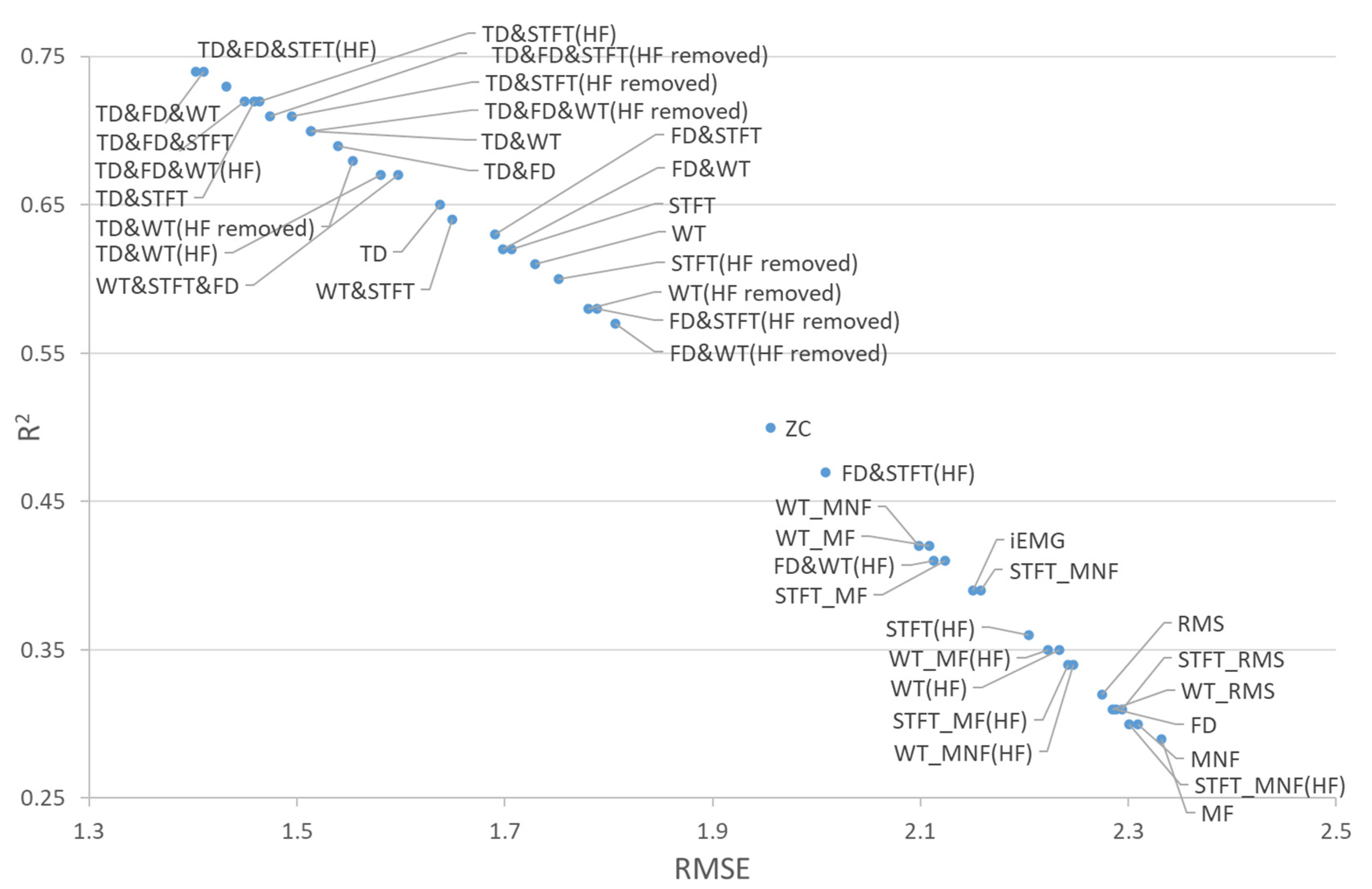
The rating of perceived exertion (RPE) and surface electromyography (sEMG) describe exercise intensity subjectively and objectively, while there has been a lack of research on the relationship between them during dynamic contractions to predict exercise intensity, comprehensively. The purpose of this study was to establish a model of the relationship between sEMG and RPE during dynamic exercises. Therefore, 20 healthy male subjects were organized to perform an incremental load test on a cycle ergometer, and the subjects’ RPEs (Borg Scale 6–20) were collected every minute. Additionally, the sEMGs of the subjects’ eight lower limb muscles were collected. The sEMG features based on time domain, frequency domain and time–frequency domain methods were extracted, and the relationship model was established using Gaussian process regression (GPR). The results show that the sEMG and RPE of the selected lower limb muscles are significantly correlated (p < 0.05) but that they have different monotonic correlation degrees. The model that was established with all three domain features displayed optimal performance and when the RPE was 13, the prediction error was the smallest. The study is significant for lower limb muscle training strategy and quantification of training intensity from both subjective and objective aspects, and lays a foundation for sEMG further applications in rehabilitation medicine and sports training.
Keywords: dynamic contraction; training intensity; sEMG; RPE; IEMG; step incremental load test dynamic contraction; training intensity; sEMG; RPE; IEMG; step incremental load test