

A Novel Multistrategy-Based Differential Evolution Algorithm and Its Application

 and
and 
Abstract
1. Introduction
- (1)
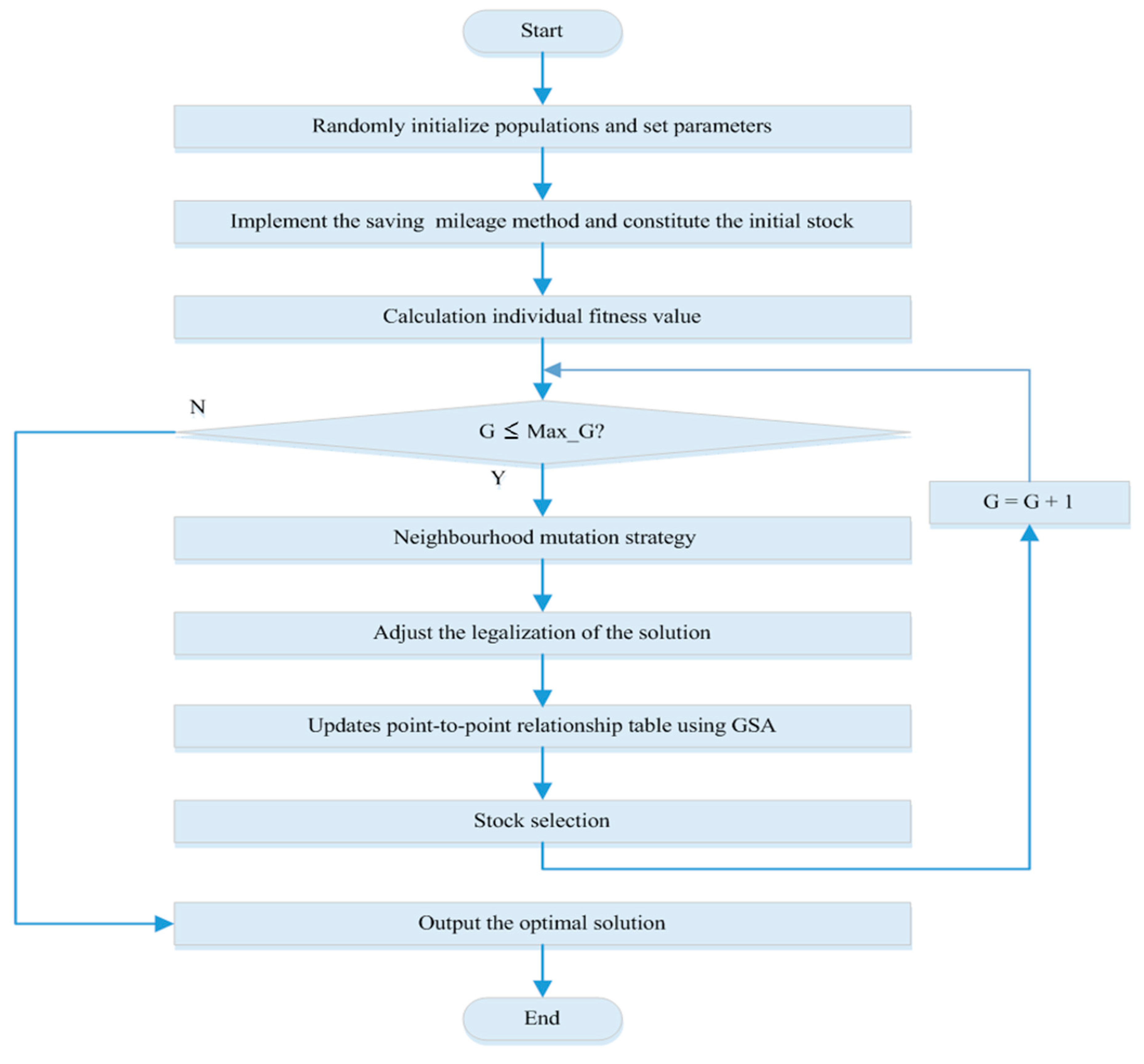
- A new multistrategy DE algorithm, namely SEGDE, is developed to improve the solution quality and the search efficiency in solving the CVRPs.
- (2)
- The saving mileage algorithm is used to initialize the population of the DE to ensure the initial solution quality and improve the search efficiency.
- (3)
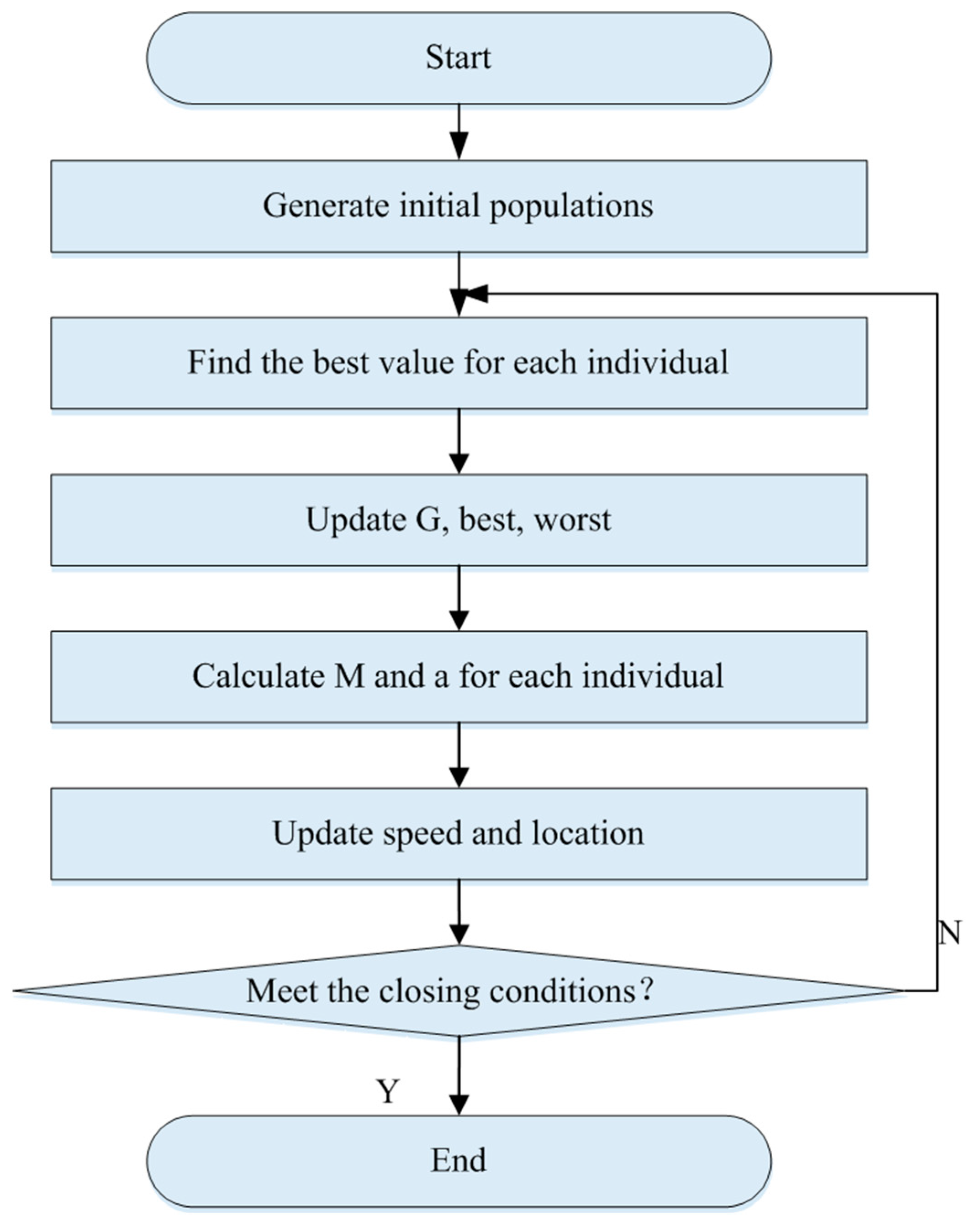
- The sorting and coding strategy is used to adjust the differential mutation strategy, and the vectors are added and subtracted.
2. Related Works
3. Differential Evolution Algorithm
3.1. Initialization
3.2. Mutation
3.3. Crossover
3.4. Selection
4. Modeling Capacitated Vehicle Routing
4.1. Model Assumptions
- (1)
- The distribution center is assigned to complete a series of demand point distribution services.
- (2)
- The relative geographical location and the corresponding demand quantity of the distribution center and each demand point are given clearly.
- (3)
- Vehicle distribution is completed and returned to the designated distribution center.
- (4)
- The vehicles have the same specifications, and there are no errors.
- (5)
- There is no consideration of urban traffic congestion.
- (6)
- The distribution vehicles always travel at a constant speed, and the distribution cost is equal within the unit distance, so the travel distance can represent the distribution cost.
- (7)
- Each demand point shall be served by only one delivery vehicle, and the sum of the requirements of all the demand points of the vehicle service shall be less than or equal to the rated load limit of the vehicle.
4.2. Symbolic Description
4.3. Objective Optimization Function
5. A Multistrategy-Based Differential Evolution Algorithm
5.1. Population Initialization Strategy
5.2. Differential Mutation Strategy
5.3. Variable Correlation Using GSA
5.4. Model of the SEGDE
6. Experimental Calculation and Analysis
6.1. Experimental Data
6.2. Experimental Environment and Parameter Settings
6.3. Experimental Results and Analysis
6.4. Discussion
7. Conclusions
Author Contributions
Funding
Institutional Review Board Statement
Informed Consent Statement
Data Availability Statement
Conflicts of Interest
References
- Hulagu, S.; Celikoglu, H.B. An electric vehicle routing problem with intermediate nodes for shuttle fleets. IEEE Trans. Intell. Transp. Syst. 2022, 23, 1223–1235. [Google Scholar] [CrossRef]
- Yang, Y.; Chen, H.; Heidari, A.A.; Gandomi, A.H. Hunger games search: Visions, conception, implementation, deep analysis, perspectives, and towards performance shifts. Expert Syst. Appl. 2021, 177, 114864. [Google Scholar] [CrossRef]
- Felipe, A.; Ortuno, M.T.; Righini, G.; Tirado, G. A heuristic approach for the green vehicle routing problem with multiple technologies and partial recharges. Transp. Res. Part E-Logist. Transp. Rev. 2014, 71, 111–128. [Google Scholar] [CrossRef]
- Ahmadianfar, I.; Heidari, A.A.; Noshadian, S.; Chen, H.; Gandomi, A.H. INFO: An efficient optimization algorithm based on weighted mean of vectors. Expert Syst. Appl. 2022, 195, 116516. [Google Scholar] [CrossRef]
- Wang, Z.; Sheu, J.B. Vehicle routing problem with drones. Transp. Res. Part B-Methodol. 2019, 122, 350–364. [Google Scholar] [CrossRef]
- Dorling, K.; Heinrichs, J.; Messier, G.G.; Magierowski, S. Vehicle routing problems for drone delivery. IEEE Trans. Syst. Man Cybern.-Syst. 2017, 47, 70–85. [Google Scholar] [CrossRef]
- Wang, X.Y.; Shao, S.; Tang, J.F. Iterative local-search heuristic for weighted vehicle routing problem. IEEE Trans. Intell. Transp. Syst. 2021, 22, 3444–3454. [Google Scholar] [CrossRef]
- Wang, H.; Li, M.H.; Wang, Z.Y.; Li, W.; Hou, T.J.; Yang, X.Y.; Zhao, Z.Z.; Wang, Z.F.; Sun, T. Heterogeneous fleets for green vehicle routing problem with traffic restrictions. In IEEE Transactions on Intelligent Transportation Systems; IEEE: Piscataway, NJ, USA, 2022. [Google Scholar] [CrossRef]
- Khaitan, A.; Mehlawat, M.K.; Gupta, P.; Pedrycz, W. Socially aware fuzzy vehicle routing problem: A topic modeling based approach for driver well-being. Expert Syst. Appl. 2022, 205, 117655. [Google Scholar] [CrossRef]
- Ahmadianfar, I.; Heidari, A.A.; Gandomi, A.H.; Chu, X.; Chen, H. Run beyond the metaphor: An efficient optimization algorithm based on Runge Kutta method. Expert Syst. Appl. 2021, 181, 115079. [Google Scholar] [CrossRef]
- Oztas, T.; Tus, A. A hybrid metaheuristic algorithm based on iterated local search for vehicle routing problem with simultaneous pickup and delivery. Expert Syst. Appl. 2022, 202, 117401. [Google Scholar] [CrossRef]
- Feng, B.; Wei, L.X. An improved multi-directional local search algorithm for vehicle routing problem with time windows and route balance. Appl. Intell. 2022, 1–13. [Google Scholar] [CrossRef]
- Thiebaut, K.; Pessoa, A. Approximating the chance-constrained capacitated vehicle routing problem with robust optimization. 4OR-A Q. J. Oper. Res. 2022, 1–19. [Google Scholar] [CrossRef]
- Li, S.; Chen, H.; Wang, M.; Heidari, A.A.; Mirjalili, S. Slime mould algorithm: A new method for stochastic optimization. Futur. Gener. Comput. Syst. 2020, 111, 300–323. [Google Scholar] [CrossRef]
- Storn, R.; Price, K. Differential Evolution: A Simple and Efficient Adaptive Scheme for Global Optimization over Continuous Spaces; Technical Report; TR-95-012; International Computer Science Institute: California, CA, USA, 1995. [Google Scholar]
- Yusuf, I.; Baba, M.S.; Iksan, N. Applied genetic algorithm for solving rich VRP. Appl. Artif. Intell. 2014, 28, 957–991. [Google Scholar] [CrossRef]
- Akpinar, S. Hybrid large neighbourhood search algorithm for capacitated vehicle routing problem. Expert Syst. Appl. 2016, 61, 28–38. [Google Scholar] [CrossRef]
- Zhang, D.F.; Cai, S.F.; Ye, F.R.; Si, Y.W.; Nguyen, T.T. A hybrid algorithm for a vehicle routing problem with realistic constraints. Inf. Sci. 2017, 394, 167–182. [Google Scholar] [CrossRef]
- Dechampai, D.; Tanwanichkul, L.; Sethanan, K.; Pitakaso, R. A differential evolution algorithm for the capacitated VRP with flexibility of mixing pickup and delivery services and the maximum duration of a route in poultry industry. J. Intell. Manuf. 2017, 28, 1357–1376. [Google Scholar] [CrossRef]
- Gutierrez, A.; Dieulle, L.; Labadie, N.; Velasco, N. A multi-population algorithm to solve the VRP with stochastic service and travel times. Comput. Ind. Eng. 2018, 125, 144–156. [Google Scholar] [CrossRef]
- Fallah, M.; Tavakkoli-Moghaddam, R.; Alinaghian, M.; Salamatbakhsh-Varjovi, A. A robust approach for a green periodic competitive VRP under uncertainty: DE and PSO algorithms. J. Intell. Fuzzy Syst. 2019, 36, 5213–5225. [Google Scholar] [CrossRef]
- Altabeeb, A.M.; Mohsen, A.M.; Ghallab, A. An improved hybrid firefly algorithm for capacitated vehicle routing problem. Appl. Soft Comput. 2019, 84, 105728. [Google Scholar] [CrossRef]
- Altabeeb, A.M.; Mohsen, A.M.; Abualigah, L.; Ghallab, A. Solving capacitated vehicle routing problem using cooperative firefly algorithm. Appl. Soft Comput. 2021, 108, 107403. [Google Scholar] [CrossRef]
- Xiao, J.H.; Zhang, T.; Du, J.G.; Zhang, X.Y. An evolutionary multiobjective route grouping-based heuristic algorithm for large-scale capacitated vehicle routing problems. IEEE Trans. Cybern. 2021, 51, 4173–4186. [Google Scholar] [CrossRef] [PubMed]
- Jia, Y.H.; Mei, Y.; Zhang, M.J. A bilevel ant colony optimization algorithm for capacitated electric vehicle routing problem. IEEE Trans. Cybern. 2022, 52, 10855–10868. [Google Scholar] [CrossRef] [PubMed]
- Jiang, H.; Lu, M.X.; Tian, Y.; Qiu, J.F.; Zhang, X.Y. An evolutionary algorithm for solving Capacitated Vehicle Routing Problems by using local information. Appl. Soft Comput. 2022, 117, 108431. [Google Scholar] [CrossRef]
- Deng, W.; Ni, H.C.; Liu, Y.; Chen, H.L.; Zhao, H.M. An adaptive differential evolution algorithm based on belief space and generalized opposition-based learning for resource allocation. Appl. Soft Comput. 2022, 127, 109419. [Google Scholar] [CrossRef]
- Zhang, X.Y.; Chen, L.; Gendreau, M.; Langevin, A. A branch-and-cut algorithm for the vehicle routing problem with two-dimensional loading constraints. Eur. J. Oper. Res. 2022, 302, 259–269. [Google Scholar] [CrossRef]
- Song, Y.J.; Cai, X.; Zhou, X.; Zhang, B.; Chen, H.; Li, Y.G.; Deng, W.; Deng, W. Dynamic hybrid mechanism-based differential evolution algorithm and its application. Expert Syst. Appl. 2023, 213, 118834. [Google Scholar] [CrossRef]
- Niu, Y.Y.; Shao, J.; Xiao, J.H.; Song, W.; Cao, Z.G. Multi-objective evolutionary algorithm based on RBF network for solving the stochastic vehicle routing problem. Inf. Sci. 2022, 609, 387–410. [Google Scholar] [CrossRef]
- Deng, W.; Zhang, L.R.; Zhou, X.B.; Zhou, Y.Q.; Sun, Y.Z.; Zhu, W.H.; Chen, H.Y.; Deng, W.Q.; Chen, H.L.; Zhao, H.M. Multi-strategy particle swarm and ant colony hybrid optimization for airport taxiway planning problem. Inf. Sci. 2022, 612, 576–593. [Google Scholar] [CrossRef]
- Gu, R.X.; Poon, M.; Luo, Z.H.; Liu, Y.; Liu, Z. A hierarchical solution evaluation method and a hybrid algorithm for the vehicle routing problem with drones and multiple visits. Transp. Res. Part C Emerg. Technol. 2022, 141, 103733. [Google Scholar] [CrossRef]
- Azad, U.; Behera, B.K.; Ahmed, E.A.; Panigrahi, P.K.; Farouk, A. Solving vehicle routing problem using quantum approximate optimization algorithm. In IEEE Transactions on Intelligent Transportation Systems; IEEE: Piscataway, NJ, USA, 2022. [Google Scholar] [CrossRef]
- Lai, Y.X.; Yang, F.; Meng, G.; Lu, W. Data-driven flexible vehicle scheduling and route optimization. In IEEE Transactions on Intelligent Transportation Systems; IEEE: Piscataway, NJ, USA, 2022. [Google Scholar] [CrossRef]
- Voigt, S.; Frank, M.; Fontaine, P.; Kuhn, H. Hybrid adaptive large neighborhood search for vehicle routing problems with depot location decisions. Comput. Oper. Res. 2022, 146, 105856. [Google Scholar] [CrossRef]
- Seyfi, M.; Alinaghian, M.; Ghorbani, E.; Catay, B.; Sabbagh, M.S. Multi-mode hybrid electric vehicle routing problem. Transp. Res. Part E-Logist. Transp. Rev. 2022, 166, 102882. [Google Scholar] [CrossRef]
- Cai, Y.Q.; Cheng, M.Q.; Zhou, Y.; Liu, P.Z.; Guo, J.M. A hybrid evolutionary multitask algorithm for the multiobjective vehicle routing problem with time windows. Inf. Sci. 2022, 612, 168–187. [Google Scholar] [CrossRef]
- Wen, M.Y.; Sun, W.; Yu, Y.; Tang, J.F.; Ikou, K. An adaptive large neighborhood search for the larger-scale multi depot green vehicle routing problem with time windows. J. Clean. Prod. 2022, 374, 133916. [Google Scholar] [CrossRef]
- Ma, B.S.; Hu, D.W.; Wang, Y.; Sun, Q.; He, L.W.; Chen, X.Q. Time-dependent vehicle routing problem with departure time and speed optimization for shared autonomous electric vehicle service. Appl. Math. Model. 2023, 113, 333–357. [Google Scholar] [CrossRef]
- Zhou, X.B.; Ma, H.J.; Gu, J.G.; Chen, H.L.; Deng, W. Parameter adaptation-based ant colony optimization with dynamic hybrid mechanism. Eng. Appl. Artif. Intell. 2022, 114, 105139. [Google Scholar] [CrossRef]
- Ren, Z.; Han, X.; Yu, X.; Skjetne, R.; Leira, B.J.; Sævik, S.; Zhu, M. Data-driven simultaneous identification of the 6DOF dynamic model and wave load for a ship in waves. Mech. Syst. Signal Process. 2023, 184, 109422. [Google Scholar] [CrossRef]
- Chen, H.Y.; Miao, F.; Chen, Y.J.; Xiong, Y.J.; Chen, T. A hyperspectral image classification method using multifeature vectors and optimized KELM. IEEE J. Sel. Top. Appl. Earth Obs. Remote Sens. 2021, 14, 2781–2795. [Google Scholar] [CrossRef]
- Xu, G.; Dong, W.; Xing, J.; Lei, W.; Liu, J. Delay-CJ: A novel cryptojacking covert attack method based on delayed strategy and its detection. Digit. Commun. Netw. 2022, in press. [CrossRef]
- Yao, R.; Guo, C.; Deng, W.; Zhao, H.M. A novel mathematical morphology spectrum entropy based on scale-adaptive techniques. ISA Trans. 2022, 126, 691–702. [Google Scholar] [CrossRef]
- Li, T.Y.; Shi, J.Y.; Deng, W.; Hu, Z.D. Pyramid particle swarm optimization with novel strategies of competition and cooperation. Appl. Soft Comput. 2022, 121, 108731. [Google Scholar] [CrossRef]
- Zhao, H.M.; Liu, J.; Chen, H.Y.; Chen, J.; Li, Y.; Xu, J.J.; Deng, W. Intelligent diagnosis using continuous wavelet transform and gauss convolutional deep belief network. In IEEE Transactions on Reliability; IEEE: Piscataway, NJ, USA, 2022. [Google Scholar] [CrossRef]
- Wu, D.; Wu, C. Research on the time-dependent split delivery green vehicle routing problem for fresh agricultural products with multiple time windows. Agriculture 2022, 12, 793. [Google Scholar] [CrossRef]
- Xu, G.; Bai, H.; Xing, J.; Luo, T.; Xiong, N.N. SG-PBFT: A secure and highly efficient distributed blockchain PBFT consensus algorithm for intelligent Internet of vehicles. J. Parallel Distrib. Comput. 2022, 164, 1–11. [Google Scholar] [CrossRef]
- Wei, Y.Y.; Zhou, Y.Q.; Luo, Q.F.; Deng, W. Optimal reactive power dispatch using an improved slime Mould algorithm. Energy Rep. 2021, 7, 8742–8759. [Google Scholar] [CrossRef]
- Zhang, Z.; Huang, W.G.; Liao, Y.; Song, Z.; Shi, J.; Jiang, X.; Shen, C.; Zhu, Z. Bearing fault diagnosis via generalized logarithm sparse regularization. Mech. Syst. Signal Process. 2022, 167, 108576. [Google Scholar] [CrossRef]
- Chen, H.Y.; Fang, M.; Xu, S. Hyperspectral remote sensing image classification with CNN based on quantum genetic-optimized sparse representation. IEEE Access 2020, 8, 99900–99909. [Google Scholar] [CrossRef]
- Zhang, X.Y.; Duan, H.B. An improved constrained differential evolution algorithm for unmanned aerial vehicle global route planning. Appl. Soft Comput. 2014, 26, 270–284. [Google Scholar] [CrossRef]
- Teoh, B.E.; Ponnambalam, S.G.; Kanagaraj, G. Differential evolution algorithm with local search for capacitated vehicle routing problem. Int. J. Bio-Inspired Comput. 2015, 7, 321–342. [Google Scholar] [CrossRef]
- Pitakaso, R.; Sethanan, K.; Srijaroon, N. Modified differential evolution algorithms for multi-vehicle allocation and route optimization for employee transportation. Eng. Optim. 2019, 52, 1225–1243. [Google Scholar] [CrossRef]
- Xing, L.N.; Liu, Y.Y.; Li, H.Y.; Wu, C.C.; Lin, W.C.; Song, W. A hybrid discrete differential evolution algorithm to solve the split delivery vehicle routing problem. IEEE Access 2020, 8, 207962–207972. [Google Scholar] [CrossRef]
- Sethanan, K.; Jamrus, T. Hybrid differential evolution algorithm and genetic operator for multi-trip vehicle routing problem with backhauls and heterogeneous fleet in the beverage logistics industry. Comput. Ind. Eng. 2020, 146, 106571. [Google Scholar] [CrossRef]
- Hameed, A.S.; Aboobaider, B.M.; Mutar, M.L.; Choon, N.H. A new hybrid approach based on discrete differential evolution algorithm to enhancement solutions of quadratic assignment problem. Int. J. Ind. Eng. Comput. 2020, 11, 51–72. [Google Scholar] [CrossRef]
- Liu, W.L.; Gong, Y.J.; Chen, W.N.; Liu, Z.Q.; Wang, H.; Zhang, J. Coordinated charging scheduling of electric vehicles: A mixed-variable differential evolution approach. IEEE Trans. Intell. Transp. Syst. 2020, 21, 5094–5109. [Google Scholar] [CrossRef]
- Moonsri, K.; Sethanan, K.; Worasan, K.; Nitisiri, K. A hybrid and self-adaptive differential evolution algorithm for the multi-depot vehicle routing problem in EGG distribution. Appl. Sci. 2022, 12, 35. [Google Scholar] [CrossRef]
- Chai, X.Z.; Zheng, Z.S.; Xiao, J.M.; Yan, L.; Qu, B.Y.; Wen, P.W.; Wang, H.Y.; Zhou, Y.; Sun, H. Multi-strategy fusion differential evolution algorithm for UAV path planning in complex environment. Aerosp. Sci. Technol. 2022, 121, 107287. [Google Scholar] [CrossRef]
- Wu, P.; Xu, L.; D’Ariano, A.; Zhao, Y.X.; Chu, C.B. Novel formulations and improved differential evolution algorithm for optimal lane reservation with task merging. In IEEE Transactions on Intelligent Transportation Systems; IEEE: Piscataway, NJ, USA, 2022. [Google Scholar] [CrossRef]
- Hou, Y.; Wu, Y.L.; Han, H.G. Multistate-constrained multiobjective differential evolution algorithm with variable neighborhood strategy. In IEEE Transactions on Cybernetics; IEEE: Piscataway, NJ, USA, 2022. [Google Scholar] [CrossRef]
- Chen, M.C.; Yerasani, S.; Tiwari, M.K. Solving a 3-dimensional vehicle routing problem with delivery options in city logistics using fast-neighborhood based crowding differential evolution algorithm. J. Ambient. Intell. Humaniz. Comput. 2022, 1–14. [Google Scholar] [CrossRef]
- Deng, W.; Xu, J.; Song, Y.; Zhao, H.M. Differential evolution algorithm with wavelet basis function and optimal mutation strategy for complex optimization problem. Appl. Soft Comput. 2021, 100, 106724. [Google Scholar] [CrossRef]
- Li, X.; Zhao, H.; Yu, L.; Chen, H.; Deng, W.Q.; Deng, W. Feature extraction using parameterized multisynchrosqueezing transform. IEEE Sens. J. 2022, 22, 14263–14272. [Google Scholar] [CrossRef]
- Wu, X.; Wang, Z.C.; Wu, T.H.; Bao, X.G. Solving the family traveling salesperson problem in the adleman–lipton model based on DNA computing. IEEE Trans. NanoBioscience 2021, 21, 75–85. [Google Scholar] [CrossRef]
- Abu-Monshar, A.; Al-Bazi, A. A multi-objective centralised agent-based optimisation approach for vehicle routing problem with unique vehicles. Appl. Soft Comput. 2022, 125, 109187. [Google Scholar] [CrossRef]
- Torres, F.; Gendreau, M.; Rei, W. Vehicle routing with stochastic supply of crowd vehicles and time windows. Transp. Sci. 2021, 56, 631–653. [Google Scholar] [CrossRef]
- Kuo, R.J.; Lu, S.H.; Mara, S.T.W. Vehicle routing problem with drones considering time windows. Expert Syst. Appl. 2022, 191, 116264. [Google Scholar] [CrossRef]
- Ochelska-Mierzejewska, J.; Poniszewska-Maranda, A.; Maranda, W. Selected genetic algorithms for vehicle routing problem solving. Electronics 2022, 10, 3147. [Google Scholar] [CrossRef]
- Lei, D.M.; Cui, Z.Z.; Li, M. A dynamical artificial bee colony for vehicle routing problem with drones. Eng. Appl. Artif. Intell. 2022, 107, 104510. [Google Scholar] [CrossRef]
- Sheng, Y.K.; Lan, W.L. Application of Clarke-Wright Saving Mileage Heuristic Algorithm in Logistics Distribution Route Optimization; Trans Tech Publications Ltd.: Baech, Switzerland, 2011. [Google Scholar]
- Hosseinabadi, A.A.R.; Vahidi, J.; Balas, V.E.; Mirkamali, S.S. OVRP_GELS: Solving open vehicle routing problem using the gravitational emulation local search algorithm. Neural Comput. Appl. 2017, 29, 955–968. [Google Scholar] [CrossRef]



| Name | Key Points | Advantages | Disadvantages |
|---|---|---|---|
| Zhang et al. [52] | Constrained DE | Improve optimization performance | Lack of population diversity |
| Teoh et al. [53] | Local search-based DE | Explore new search areas | Lack of global searchability |
| Pitakaso et al. [54] | Five modified DE | Improve population diversity | Fall into local optimal value |
| Xing et al. [55] | Hybrid discrete DE | Avoid the prematurity and ensure the solution quality | Slow convergence to some extent |
| Sethanan et al. [56] | Hybrid DE with a genetic operator | Balance the exploration ability | Fall into local optimal value |
| Hameed et al. [57] | Hybrid algorithm | Enhance solutions, to reduce the distances between the locations | Increase the time complexity |
| Liu et al. [58] | Mixed-variable DE | Hierarchical mixed-variable mutation operator | Lack of population diversity |
| Moonsri et al. [59] | Hybrid and self-adaptive DE | Self-adaptive mutation strategy | Fall into local optimal value |
| Chai et al. [60] | Multistrategy fusion DE | Enhance population diversity | Slow convergence to some extent |
| Hou et al. [62] | Multistate-constrained MODE | Enhance the optimization effectiveness | Increase the time complexity |
| Chen et al. [63] | Fast-neighborhood DE | Faster convergence | Lack of population diversity |
| Symbols | Meaning |
|---|---|
| m | Number of vehicles in distribution center |
| n | Number of customer points |
| Q | Vehicle capacity |
| di | The requirement for customer points I, di > 0(i > 0), and D0 = 0 |
| cij | The distance from point i to point j |
| Xijk | The degree of delivery requirements from the k vehicle distribution Point i to point j |
| V | A collection of distribution centers and customer points |
| 7 | 4 | 3 | 5 | 2 | 1 | 6 | |
| 5 | 2 | 1 | 3 | 7 | 4 | 6 | |
| 2 | 2 | 2 | 2 | −5 −5 | −3 −3 | 0 | |
| 5 | 1 | 3 | 4 | 2 | 7 | 6 | |
| 2 | 3 | 5 | 1 | 7 | 6 | 4 | |
| 3 | −2 −2 | −2 −2 | 3 | −5 −5 | 1 | 2 | |
| rand Rand | 0.18 | 0.22 | 0.53 | 0.78 | 0.61 | 0.39 | 0.42 |
| 1 | 1 | 3 | 1 | 1 | 5 | 1 | |
| 5 | 1 | 3 | 1 | 1 | 7 | 6 | |
| Algorithms | Parameter Settings |
|---|---|
| SA | delta = 0.85, T = 150, Np = 100 |
| GA | CR = 0.7, F = 0.5, Np = 100 |
| DE | CR = 0.9, F = 0.5, Np = 100 |
| SEGDE | Fmin = 0.5, Fmax = 0.9, CR = 0.9, Np = 100 |
| Test Data | Opt. | SA | GA | MS | IMS | DE | SEGDE |
|---|---|---|---|---|---|---|---|
| A32_5 | 784 | 739 | 850 | 842 | 827 | 1426 | 813 |
| A33_5 | 661 | 740 | 700 | 713 | 700 | 1194 | 680 |
| A33_6 | 742 | 924 | 798 | 775 | 743 | 1233 | 746 |
| A34_5 | 778 | 895 | 856 | 810 | 793 | 1347 | 789 |
| A36_5 | 799 | 814 | 897 | 826 | 806 | 1367 | 805 |
| A37_5 | 669 | 806 | 752 | 705 | 708 | 1366 | 685 |
| A37_6 | 949 | 949 | 1047 | 975 | 974 | 1595 | 954 |
| A38_5 | 730 | 908 | 789 | 765 | 751 | 1497 | 734 |
| A39_5 | 822 | 1009 | 954 | 898 | 894 | 1575 | 871 |
| A39_6 | 831 | 1011 | 940 | 861 | 848 | 1618 | 852 |
| A44_6 | 937 | 1021 | 974 | 985 | 1785 | 1534 | 943 |
| A45_6 | 944 | 1231 | 1111 | 1005 | 955 | 2093 | 963 |
| A45_7 | 1146 | 1431 | 1282 | 1200 | 1178 | 1968 | 1203 |
| A46_7 | 914 | 1431 | 1068 | 940 | 934 | 1862 | 935 |
| A48_7 | 1073 | 1343 | 1280 | 1110 | 1102 | 2180 | 1129 |
| Test Data | Opt. | SA | GA | MS | IMS | DE | SEGDE |
|---|---|---|---|---|---|---|---|
| E22_K4 | 375 | 394 | 375 | 388 | 375 | 441 | 375 |
| E23_K3 | 569 | 575 | 575 | 621 | 574 | 888 | 569 |
| E30_K3 | 508 | 564 | 557 | 532 | - | 976 | 508 |
| E33_K4 | 835 | 929 | 904 | 841 | 841 | 1180 | 841 |
| E51_K5 | 521 | 697 | 685 | 582 | - | 1315 | 575 |
| Test Data | Opt. | SA | GA | MS | IMS | DE | SEGDE |
|---|---|---|---|---|---|---|---|
| P16_K8 | 450 | 889 | 451 | 478 | 472 | 452 | 451 |
| P19_K2 | 212 | 213 | 213 | 237 | 219 | 276 | 213 |
| P20_K2 | 216 | 217 | 218 | 234 | 247 | 452 | 217 |
| P21_K2 | 211 | 213 | 213 | 236 | 233 | 318 | 213 |
| P22_K2 | 216 | 222 | 219 | 240 | 234 | 317 | 218 |
| P22_K8 | 589 | 589 | 589 | 591 | 590 | 624 | 589 |
| P23_K8 | 529 | 541 | 532 | 537 | 537 | 633 | 531 |
| P40_K5 | 458 | 561 | 526 | 516 | 484 | 629 | 508 |
| P45_K5 | 510 | 616 | 614 | 569 | 519 | 1142 | 563 |
| Test Data | Opt. | SA | GA | DE | SEGDE |
|---|---|---|---|---|---|
| B31_K5 | 672 | 697 | 706 | 886 | 679 |
| B34_K5 | 788 | 839 | 799 | 1186 | 790 |
| B35_K5 | 955 | 1021 | 991 | 1665 | 970 |
| B38_K6 | 805 | 887 | 845 | 1343 | 825 |
| B39_K5 | 549 | 649 | 577 | 1314 | 563 |
| B41_K6 | 829 | 989 | 880 | 1565 | 838 |
| B43_K6 | 742 | 907 | 833 | 1387 | 775 |
| B44_K7 | 909 | 1139 | 1058 | 1725 | 931 |
| B45_K5 | 751 | 918 | 880 | 1631 | 755 |
| B45_K6 | 678 | 888 | 791 | 1317 | 698 |
| B50_K7 | 741 | 1006 | 879 | 1875 | 766 |
| B50_K8 | 1312 | 1462 | 1401 | 2132 | 1352 |
| B31_K5 | 672 | 697 | 706 | 886 | 679 |
| B34_K5 | 788 | 839 | 799 | 1186 | 790 |
| B35_K5 | 955 | 1021 | 991 | 1665 | 970 |
Publisher’s Note: MDPI stays neutral with regard to jurisdictional claims in published maps and institutional affiliations. |
© 2022 by the authors. Licensee MDPI, Basel, Switzerland. This article is an open access article distributed under the terms and conditions of the Creative Commons Attribution (CC BY) license (https://creativecommons.org/licenses/by/4.0/).
Share and Cite
Wang, J.; Shang, S.; Jing, H.; Zhu, J.; Song, Y.; Li, Y.; Deng, W. A Novel Multistrategy-Based Differential Evolution Algorithm and Its Application. Electronics 2022, 11, 3476. https://doi.org/10.3390/electronics11213476
Wang J, Shang S, Jing H, Zhu J, Song Y, Li Y, Deng W. A Novel Multistrategy-Based Differential Evolution Algorithm and Its Application. Electronics. 2022; 11(21):3476. https://doi.org/10.3390/electronics11213476
Chicago/Turabian StyleWang, Jinyin, Shifan Shang, Huanyu Jing, Jiahui Zhu, Yingjie Song, Yuangang Li, and Wu Deng. 2022. "A Novel Multistrategy-Based Differential Evolution Algorithm and Its Application" Electronics 11, no. 21: 3476. https://doi.org/10.3390/electronics11213476
APA StyleWang, J., Shang, S., Jing, H., Zhu, J., Song, Y., Li, Y., & Deng, W. (2022). A Novel Multistrategy-Based Differential Evolution Algorithm and Its Application. Electronics, 11(21), 3476. https://doi.org/10.3390/electronics11213476