Skip to Content
ElectronicsElectronics
  • Feature Paper
  • Article
  • Open Access

24 September 2022

Context-Based, Predictive Access Control to Electronic Health Records

,
,
,
and
1
Department of Informatics, University of Piraeus, Karaoli & Dimitriou 80, 18534 Piraeus, Greece
2
School of Business, Department of Business Administration, Athens University of Economics and Business, Patission 76, 10434 Athens, Greece
3
Institute of Communications and Computer Systems, Iroon Polytechniou 9, 15780 Zografou, Greece
*
Author to whom correspondence should be addressed.

Abstract

Effective access control techniques are in demand, as electronically assisted healthcare services require the patient’s sensitive health records. In emergency situations, where the patient’s well-being is jeopardized, different healthcare actors associated with emergency cases should be granted permission to access Electronic Health Records (EHRs) of patients. The research objective of our study is to develop machine learning techniques based on patients’ time sequential health metrics and integrate them with an Attribute Based Access Control (ABAC) mechanism. We propose an ABAC mechanism that can yield access to sensitive EHRs systems by applying prognostic context handlers where contextual information, is used to identify emergency conditions and permit access to medical records. Specifically, we use patients’ recent health history to predict the health metrics for the next two hours by leveraging Long Short Term Memory (LSTM) Neural Networks (NNs). These predicted health metrics values are evaluated by our personalized fuzzy context handlers, to predict the criticality of patients’ status. The developed access control method provides secure access for emergency clinicians to sensitive information and simultaneously safeguards the patient’s well-being. Integrating this predictive mechanism with personalized context handlers proved to be a robust tool to enhance the performance of the access control mechanism to modern EHRs System.

1. Introduction

Handling access to medical information is essential as the safeguarding of the patient’s sensitive data privacy, e.g., her health history, is of prime importance. Access control models are related to the privileges an entity has upon handling particular data objects. These are based on user identity access control models, such as Role-Based Access Control (RBAC), Discretionary Access Control (DAC) and Mandatory Access Control (MAC) [1]. As well as these static approaches, the Attribute-Based Access Control (ABAC) paradigm has been developed, which is dynamic and flexible in nature [2]. In ABAC, there are connections’ snapshots that are produced and dynamically altered based on the current context, instead of statically-defined lists of permissions that link entities with objects.
In the medical sector, contextual information which characterizes an emergency in a patient’s healthcare state should be deemed when controlling access to the healthcare sensitive information to guarantee the most efficient treatment. Accordingly, the implementation of access control models which integrate the context concept, such as the notion of dynamically changing contextual attributes which indicate the current status, is needed. More specifically, context is considered as any information characterizing the status of an entity, such as person, place or object, related to the association between an application and a requestor [3]. Exploiting contextual data facilitates the implementation of access control policies by taking into account the conditions of access requests’ evaluation. For instance, in critical situations, an emergency healthcare professional intends to partially access the patient’s healthcare data to properly address a critical condition. The values of contextual information are obtained, for instance, from IoT devices, such as a wearable able to gauge blood pressure. We report that context handlers are beneficial for implementing processes of dynamic authorization which consider the critical status of a specific medical acute care event before making a decision on access control. In critical conditions, the emergency medical teams should access immediately the patients’ medical records.
The research objective of our study is the investigation of whether real-time health data, e.g., from medical devices and sensors, can be used to identify acute care conditions and permit access to sensitive medical information. We examine the application of machine learning methods to derive dynamic and personalized access control policies for yielding access decisions with respect to sensitive EHRs data based on the current context. Specifically, we are going to use the patient’s recent health history in order to predict key health metrics of the next couple of hours by implementing Long Short Term Memory (LSTM) Neural Networks (NNs) and use the predicted values to assess the criticality of the health condition of the patient. Our research takes advantages of recent developments in Artificial Intelligence in solving complex technical problems, see, e.g., in engineering [4], image processing [5] and e-commerce [6]. We develop an intelligent access control mechanism, which, based on a prediction model and a personalized fuzzy context handler [7], examines recent health metrics of a patient and outputs the patient’s health criticality assessment, which, in turn, controls access to the EHRs system.

3. Methods

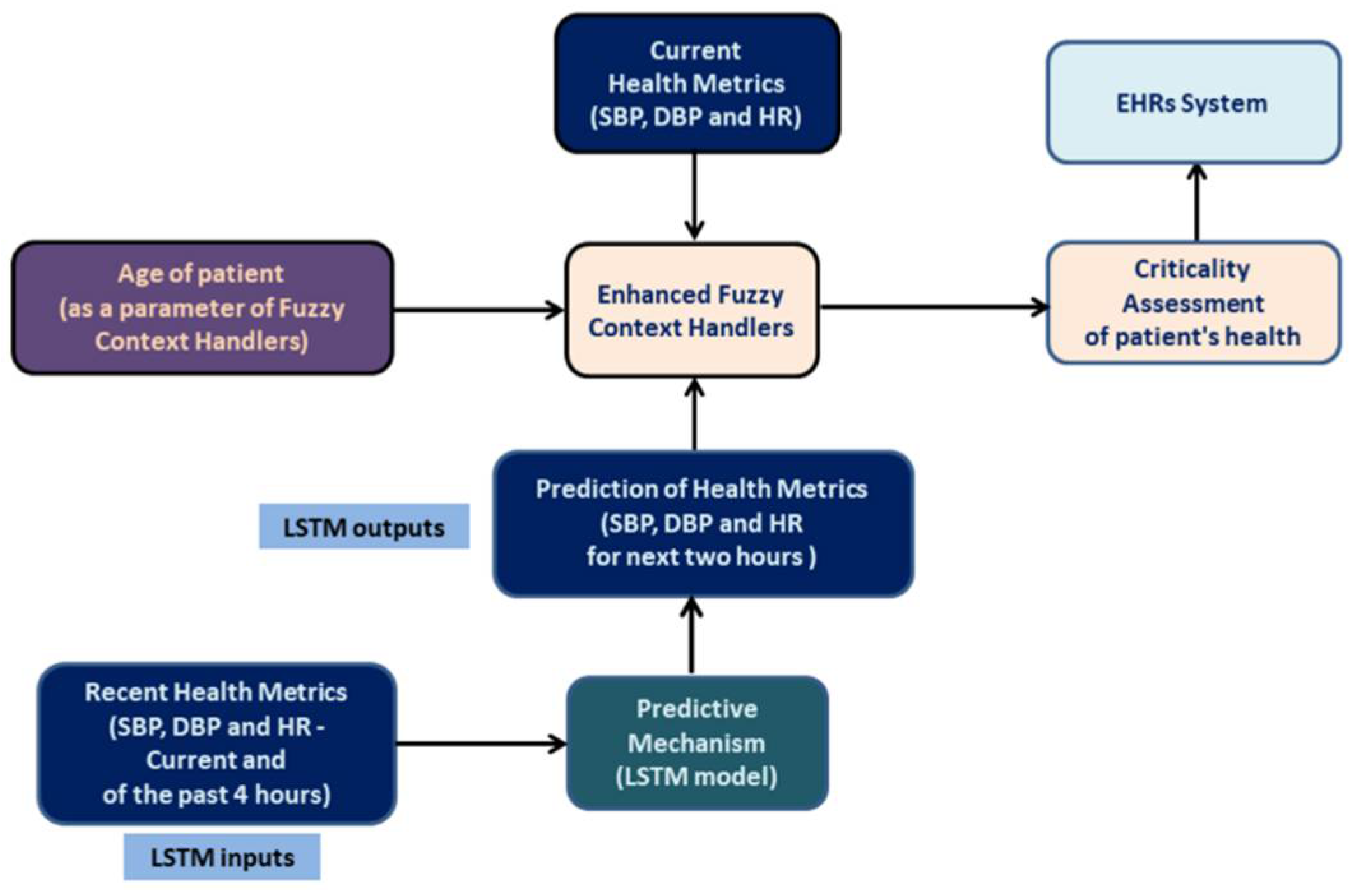
In this study, we extend our previous work on context-aware access policies [7] by considering, apart from the patient’s current health situation, the prognosis of the patient’s future health status. The proposed methodology delivers an access control mechanism which relies on Attribute-based Access Control (ABAC). The methodology combines machine learning techniques to predict the patient’s upcoming health condition along with fuzzy logic to reason about the context of the access request (Figure 1).
Figure 1. Methodology.
The predictive mechanism, implemented with LSTM, receives as input the recent health metrics and outputs the predictions of health metrics for the next two hours. Subsequently, the fuzzy context handler assesses the criticality of the future health status of the patient, by taking into consideration (i) the patient’s age, (ii) the current health metrics and (iii) the predicted health metrics for the next two hours. The criticality assessment determines the decision about granting or not emergency access by healthcare professionals to the EHRs system.

3.1. Fuzzy Context Handlers

A context handler in XACML [59] is a system entity which transforms access requests from the initial format of requests to the canonical form of XACML [60]. Apart from using, or not, the XACML architecture, context handlers are exploited in ABAC to transform the attribute representations into mediums related to the environment of the application. Lower-level context is beneficial for uplifting context of higher level and understanding emergency conditions, for example in the situation of an acute care healthcare dispatcher case. This knowledge is responsible for determining if access to private medical information should be permitted or not.
In our earlier work [7], we developed context handlers governed by fuzzy rules to identify critical situations. A fuzzy context handler uses fuzzy rules that associate contextual attributes with fuzzy values and generates as output an assessment of the criticality of the incident. The related contextual attributes, which are represented in a context model, are presented in detail in [61]. Here, we extend the fuzzy context handlers by taking into consideration apart from the patient’s current state her future one as well, by predicting the patient’s future health status.

3.2. Predicting Mechanism

To implement the prediction mechanism, we rely on the long short term memory (LSTM) model [48], a variant of the recurrent neural network which is used to predict the patient’s future health metrics. LSTM networks have the capability of learning long-term dependencies. The LSTM network outperforms others in the prediction of the next sequence of process instances, because it predicts the next one by storing lengthy input sentences. The LSTM prediction exhibits a considerable rise and aligns with the actual time series data [62].
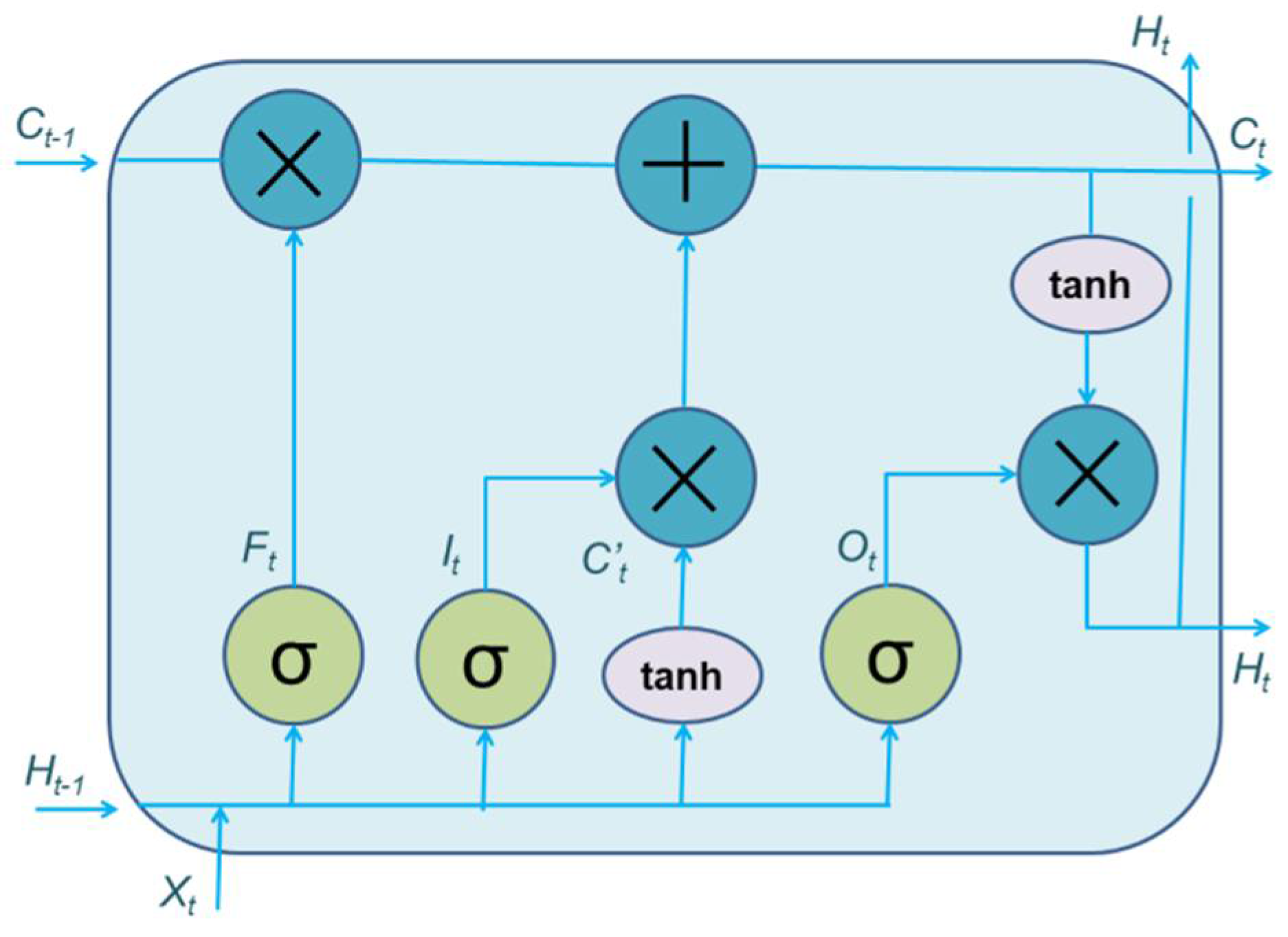
The basic structure (i.e., a cell) of an LSTM module, as illustrated in Figure 2, comprises three separate gates: input, output and forget. Each cell persists values over arbitrary time intervals while the three mentioned gates adjust the information flow coming into and out of the cell. There are three sigmoid gates, to protect and control the cell state. Each sigmoid gate decides what information should be ignored from the cell state. Calculating the output of a cell involves first the decision on which information to remove from the previous cell. Output “1” or “0” indicate that all previous information should be kept or discarded, respectively. Additionally, the tanh gate serves to convert values to be between −1 and 1. This special structure, apart from the input Xt, takes, additionally as input, the output of the previous block Ht−1 along with the memory from the previous LSTM block Ct−1. The final output Ht is given by Formula (1).
H t = O t tan h C t
where:
O t =   σ W o · H t 1 , X t + b o
C t = F t C t 1 + I t C t
C t =   tan h W c · H t 1 , X t + b c
I t =   σ W i ·   H t 1 , X t + b i
F t =   σ W f ·   H t 1 , X t + b f
Figure 2. LSTM block architecture.
In the above equations, Wf, Wi, Wc and Wo are weights and bf, bi, bc and bo are biases, which are learned during the training phase of the network. We perform multi-step forecasting [63] of two next steps based on multivariate input time series.
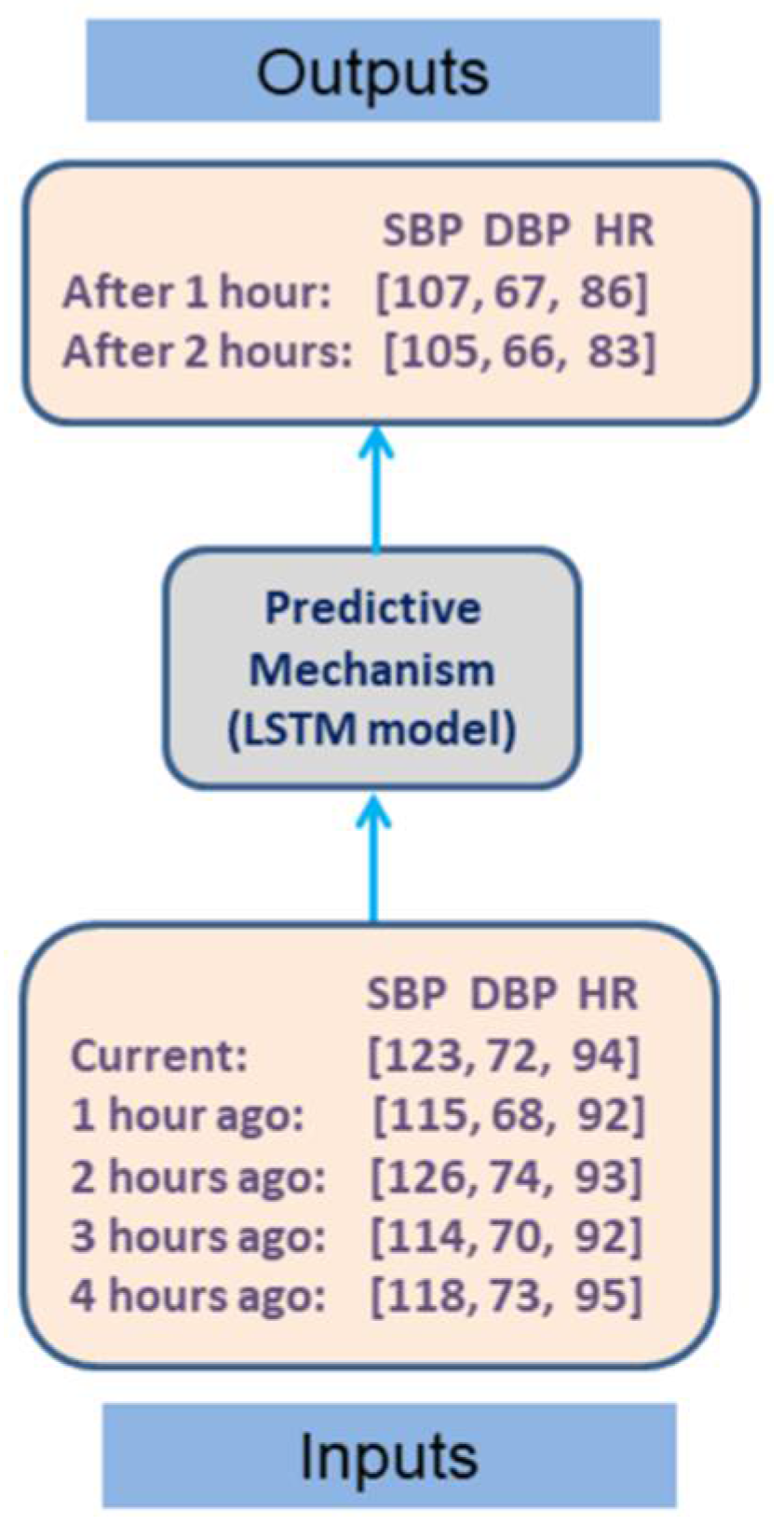
As illustrated in Figure 3, the recent health metrics of SBP, DBP and HR are taken into consideration and constitute the input for the multivariate multi-step LSTM model we developed. The model outputs the prediction of these three health metrics for the next two hours.
Figure 3. LSTM model example.
Next, we discuss an example use case in which our proposed system is used to assess the overall health situation of a patient (i.e., its criticality) for driving the access control decision with respect to emergency access to a certain EHR. In our previous work [7], we developed a fuzzy context handler which is able to map the input fuzzy variables Systolic Blood Pressure (m1) and Diastolic Blood Pressure (m2) to fuzzy values ‘Low’, ‘Normal’, ‘Elevated’ and ‘High’, while the input fuzzy variable Heart Rate (m3) to fuzzy values ‘Low’, ‘Medium’ and ‘High’. Last, the output fuzzy variable Criticality, is mapped to values ‘Low’, ‘Medium’ and ‘High’.
In a general case, we can have the n health metrics m1 − mn. After having defined the fuzzy sets, the fuzzy rules per fuzzy variable are defined based on our previous work [7]. An example of a fuzzy rule regarding the SBP is “If SBP is Low then Criticality is High”. After this step, the fuzzy inferencing process is implemented, where the percentage of criticality is deduced per health metric.
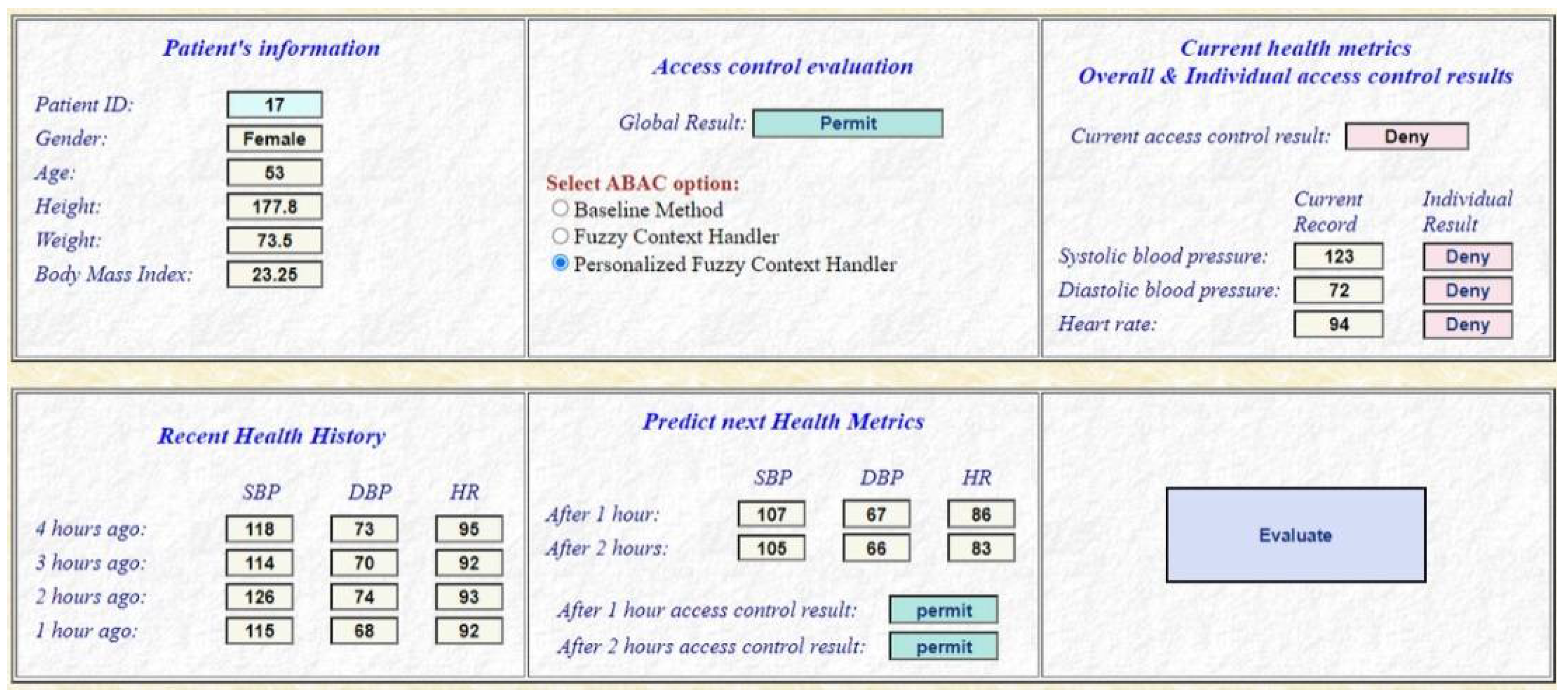
For example, for the health metrics of SBPcurrent = 123 mmHg, DBPcurrent = 72 mmHg and HRcurrent = 94 bpm, as presented in the current values of the patient with ID 17, shown in Figure 3, we deduce the following respective criticalities of: (i) criticality(SBPcurrent = 123 mmHg) = 33%, (ii) criticality(DBPcurrent = 72 mmHg) = 38.61% and (iii) criticality(HRcurrent = 94 bpm) = 63.6%. In this particular example, neither case is critical, because, as stated in our work [7], for a case to be critical, it should meet the maximum criticality percentage, which is 67% according to the specific fuzzy inferencing process. Therefore, after having calculated if the current case is critical or not, we proceed to the calculation of the criticality for next two hours. In order to proceed to this particular calculation, we need to have at our disposal the values for the next two hours per each health metric. In order to achieve this goal, we predict these next two hours’ health values by implementing LSTM NNs by taking into consideration the last four-hour health history and the current health metrics. This particular prediction is essential for the emergency doctor so that he has at his disposal a thorough perception of the patient’s clinical profile, and, additionally, is considered as input for the fuzzy context handlers.
As seen throughout this example, the fuzzy context handlers, by having at their disposal the current health metrics of SBP, DBP and HR, will make the criticality assessment (Figure 1) of the respective future health metrics for the next two hours. For example, as seen in Figure 3, if the patient, has for the last five hours, the following values, regarding the health metrics of SBP, DBP and HR, respectively: (i) 118 mmHg, 114 mmHg, 126 mmHg, 115 mmHg and 123 mmHg; (ii) 73 mmHg, 70 mmHg, 74 mmHg, 68 mmHg and 72 mmHg; and (iii) 95 bpm, 92 bpm, 93 bpm, 92 bpm and 94 bpm, then our system predicts as their corresponding future two-hour SBP, DBP and HR values, respectively: (i) 107 mmHg and 105 mmHg, (ii) 67 mmHg and 66 mmHg and (iii) 86 bpm and 83 bpm.
After this specific step, we proceed to the criticality calculation of these future health metrics. Therefore, the criticality percentages for the next hour are: (i) criticality(SBPafter-1-h = 107 mmHg) = 60.2%, (ii) criticality(DBPafter-1-h = 67 mmHg) = 67% and (iii) criticality(HRafter-1-h = 86 bpm) = 36.4%. Therefore, in this case, for the next hour we conclude that the situation is critical, because the criticality of at least one of the health metrics case reaches the maximum percentage of 67% according to the fuzzy inferencing process. Therefore, regarding the next two hours’ case, we have the following criticality percentages: (i) criticality(SBPafter-2-h = 105 mmHg) = 67%, (ii) criticality(DBPafter-2-h = 66 mmHg) = 67% and (iii) criticality(HRafter-2-h = 83 bpm) = 33%, where we conclude that similarly to the after one hour case the patient’s situation is critical because at least one of the criticality percentages reaches its’ maximum level.
The overall criticality result is deduced based on the three individual results of the patient’s current and future state. In this case, even if regarding the current situation the patient’s situation is not considered critical, it is critical for both after one and two hours. The overall critically result is deduced based on the Equation (8) of Section 4.2 which states that even one of the current or future states is critical, then in case the requestor is an emergency doctor, he can be granted access to the patient’s EHRs.
Our methodology regarding the prediction of the patient’s future health metrics is presented in the following Algorithm 1.
Algorithm 1 Prediction of future health metrics
CHOOSE NUMBER OF INPUT STEPS (health history of last 4 h)
  input_steps ← 5
CHOOSE OUTPUT STEPS (future health metrics of the next two hours)
  output_steps ← 2
CHOOSE FEATURES (number of health metrics)
  features ← 3
REPEAT FOR ALL DATA FILES
  READ EACH DATASET’S FILE PER PATIENT
  SELECT TRAIN AND TEST SETS
    data_train, data_test ← devide(dataset, 0.8)
  SPLIT DATA ACCODING TO INPUT AND OUTPUT STEPS
    X_train, Y_train ← split_dataset(data_train, input_steps)
    X_test, Y_test ← split_dataset(data_test, input_steps)
  RESHAPE X_train and X_test
    Reshape X_train, X_test into (samples, inpute_steps, features)
  DEFINE MODEL
    add(LSTM(200, activation = ‘relu’, input_shape = (input_steps, features)))
    add(RepeatVector(output_steps))
    add(LSTM(200, activation = ‘relu’, return_sequences = True))
    add(TimeDistributed(Dense(features)))
  COMPILE MODEL
    compile(optimizer = ‘adam’, loss = ‘mse’)
  FIT MODEL (to improve the weights and biases of the network)
    model.fit(X_train, Y_train, epochs = 200, verbose = 0)
  EVALUATE MODEL
  SAVE MODEL
    model.save(model_file)
END REPEAT
INPUT A PATIENT’S HEALTH METRICS FOR THE LAST 4 HOURS METRICS
  input_metrics:
    sbp_current, dbp_current, hr_current current health metrics
    sbp_before_1, dbp_before_1, hr_ before_1 health metrics before 1 h
    sbp_ before_2, dbp_ before_2, hr_before_2 health metrics before 2 h
    sbp_ before_3, dbp_ before_3, hr_before_3 health metrics before 3 h
    sbp_before_4, dbp_before_4, hr_before_4 health metrics before 4 h
PREDICT AND OUTPUT PATIENT’S FUTURE HEALTH METRICS
  output_metrcs:
    sbp_next_1, dbp_next_1, hr_next_1 predicted health metrics after 1 h
    sbp_next_2, dbp_next_2, hr_next_2 predicted health metrics after 2 h
output_metrics ← model_file.predict(input_metrics)

4. Evaluation

4.1. Technical Implementation

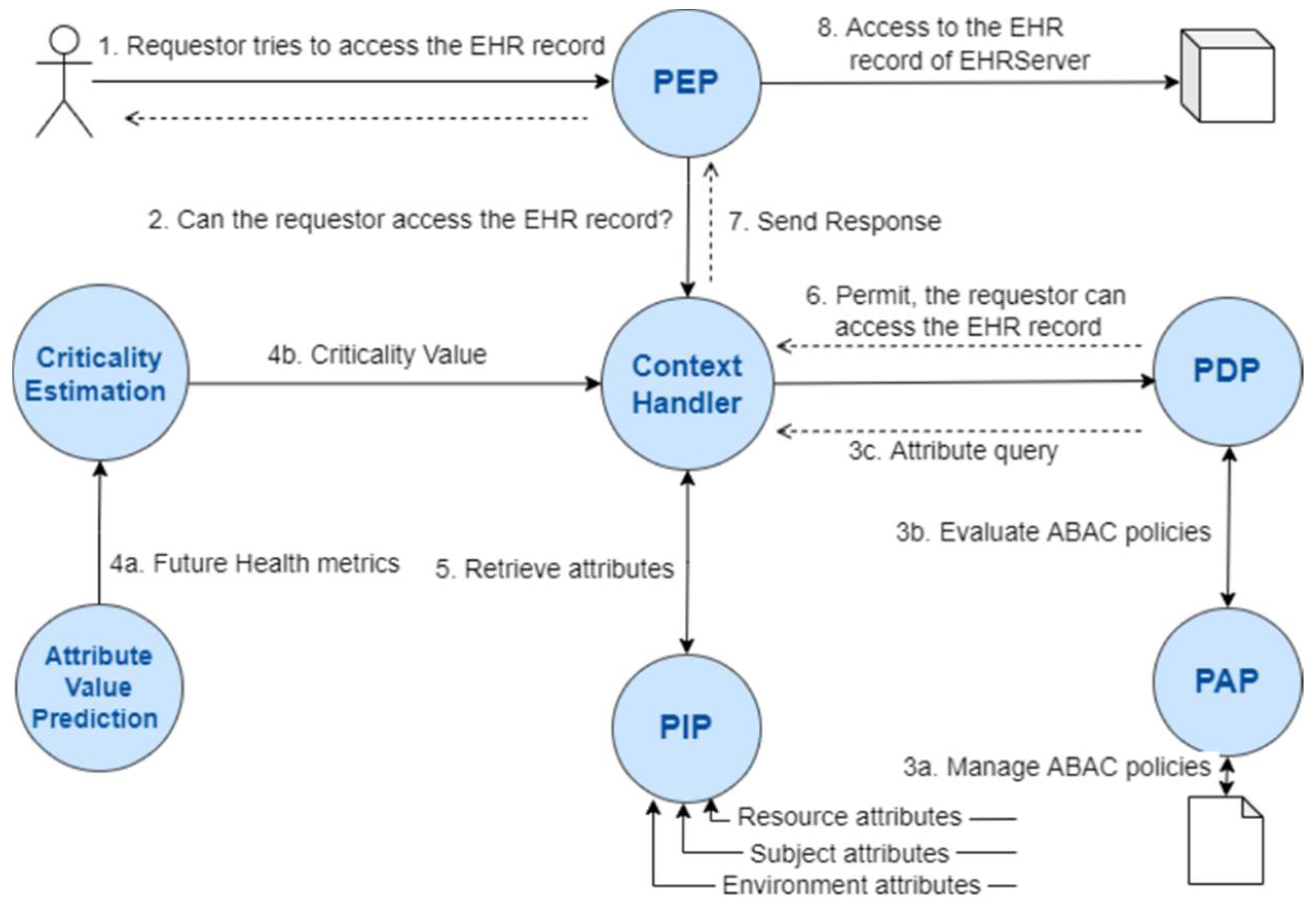
We utilize the XACML architecture to implement the proposed context-based, predictive access control mechanism. XACML also known as a policy-based access control (PBAC) system, where attribute values associated with a resource, an action or a user are perceived as inputs into the access control decision, regarding a given user, a particular target resource and a specific way of access. RBAC can additionally be implemented in XACML as a specialization of ABAC. The XACML architecture contains: (a) the Policy Enforcement Point (PEP), able to protect data and applications, to intercept requests and to propagate authorization requests directed to the Policy Decision Point (PDP); (b) the Policy Information Point (PIP) that connects external attribute sources; and (c) the Policy Administration Point (PAP) responsible for handling access policies.
Policies in ABAC associate attributes, to characterize allowable or not actions, and to grant or deny access to personal information. For instance, when a requestor intends to be granted access to a particular medical information, PDP intercepts her request. PDP evaluates related policies handled by PAP and exploiting attributes retrieved from PIP. ABAC has been used to manage access to EHR platforms [64].
To evaluate our work, we implemented the context-based, predictive access control mechanism based on the XACML architecture and integrated it in EHRServer [65]. EHRServer is a clinical information management system on the basis of the standard of openEHR [66]. A bird’s eye view of the integrated system architecture is shown in Figure 4. The context handler communicates with the criticality evaluation mechanism, which, after having received the patient’s current health metrics, recent health history, age and the prediction of the future health metrics’ values for the next two hours, is able to calculate via the inferencing process the criticality level of the patient, by considering her current and future state for the two hours as well.
Figure 4. Integrated context-based, predictive access control in the XACML Architecture.
We implemented python’s tensorflow and keras in order to develop the LSTM RNNs trained model per patient which predicts her future health metrics based on her recent health history. All trained models were integrated in our web user interface (Figure 5) so as to output the respective predictions by implementing the trained models and to calculate the respective results per patient on the fly.
Figure 5. Web user interface of context-based, predictive access control.
The web user interface is divided into six panes. In the upper left pane, the patient‘s ID, gender, age, height, weight and BMI are presented, while in the upper center pane, the system’s global access decision is presented. Below this feature, the ABAC selectable options are illustrated, which are the following: (i) the baseline ABAC, which handles basic thresholds as limits so as to permit or not access; (ii) the ABAC non-personalized case, which considers only the fuzzy inferencing process; and (iii) the ABAC personalized case, which considers the fuzzy inferencing process as well as the personalization aspect of age. All the three ABAC methods above take into consideration the SBP, DBP and HR health metrics, as presented in our previous work [7] regarding the patient’s diagnosis of present medical status, and we extend it in our current approach by including the patient’s prognosed health metrics after one or two hours by leveraging LSTM NNs. In the upper right pane, the patient’s current health metrics are demonstrated along with the current health status result of the prognostic context handlers case, which has already been selected on the previous pane, as well as the individual access results per health metric regarding the patient’s current status. In the lower left pane, the patient’s current health history within the last five hours is presented. In the lower center pane, our LSTM NN mechanism predicts the health metrics values for the next two hours along with the corresponding access requests by leveraging the fuzzy inferencing system of our previous work [7]. Finally, in the lower right pane, there is the button “Evaluate” for the system’s decision based on the chosen ABAC case.

4.2. Evaluation Scenarios and Datasets

We tested three scenarios as follows: first, access control was handled by the baseline ABAC. In particular, if the requestor is an emergency department (ED) health professional and at least one of the patients’ health metrics values is above the suggested threshold, then the patient’s situation is critical and, thus, the health professional can have access to the patient‘s healthcare data. The policy rule is presented as follows:
If   requestor = ED   Cilinician   AND contextual   expression   ( SBP CURRENT > SBP THRESHOLD   OR DBP CURRENT > DBP THRESHOLD   OR HR CURRENT > HR THRESHOLD   OR SBP AFTER _ 1 _ HOUR > SBP THRESHOLD   OR DBP AFTER _ 1 _ HOUR > DBP THRESHOLD   OR HR AFTER _ 1 _ HOUR > HR THRESHOLD   OR SBP AFTER _ 2 _ HOURS > SBP THRESHOLD   OR DBP AFTER _ 2 _ HOURS > DBP THRESHOLD   OR HR AFTER _ 2 _ HOURS > HR THRESHOLD ) then   Critical   Situation
In the second and third scenarios, we modified policy rule (7) with non-personalized and personalized context handlers, respectively. The policy rule now includes the patient’s predicted health metrics after one or two hours. (For details about how personalization in context handlers is achieved, please refer to [7]).
If   ( requestor = ED   Clinician   AND context   expression   ( ( CRITICAL SITUATION _ CURRENT = true )   OR ( C R I T I C A L SITUATION _ AFTER _ 1 _ HOUR = true )   OR ( C R I T I C A L SITUATION _ AFTER _ 2 _ HOURS = true ) ) ) then   Critical   Situation
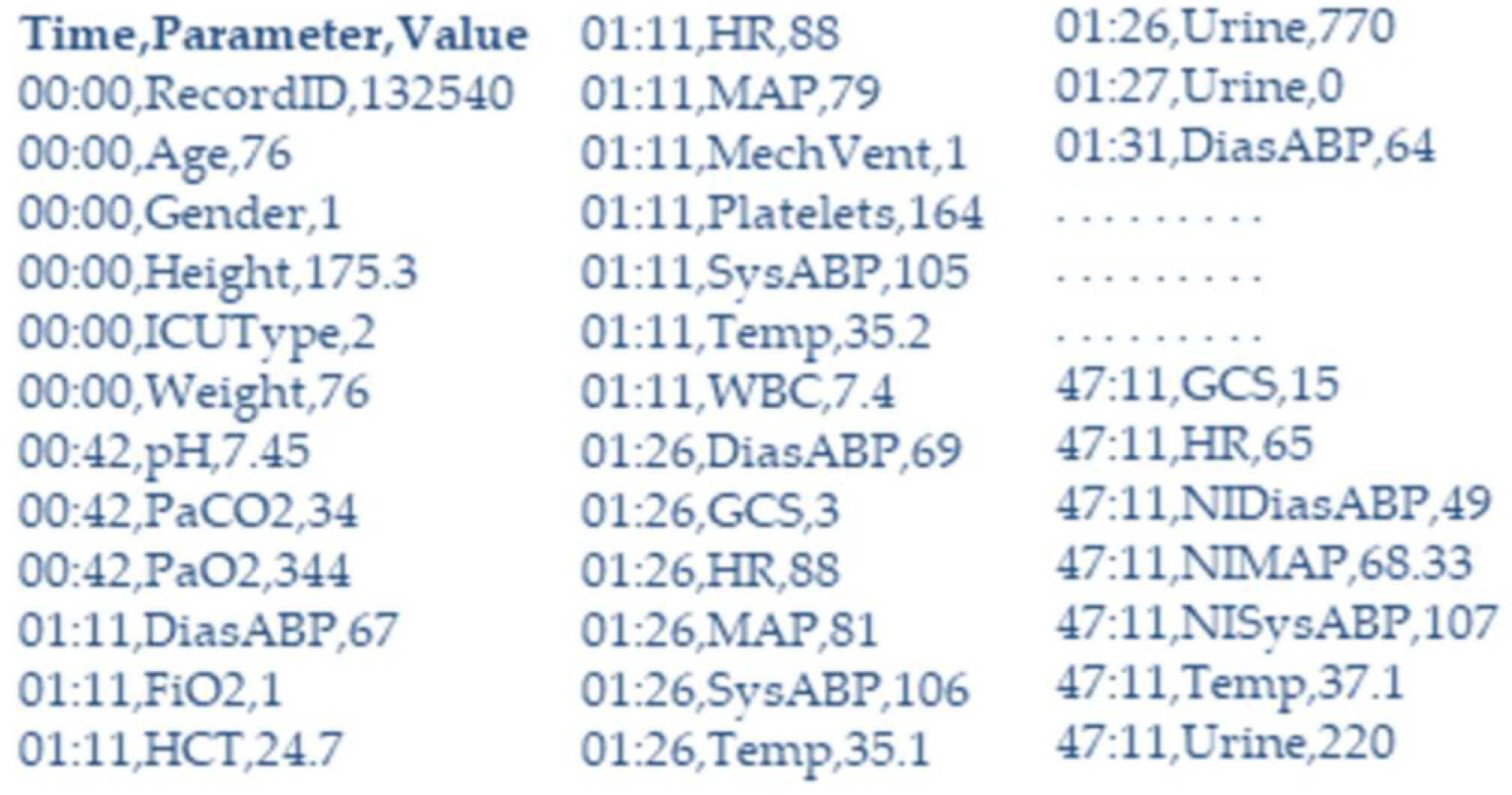
We tested the three scenarios using the publicly available dataset [67], comprising 4000 patients and including one file per patient. Each patient file, among others, includes SBP, DBP and HR health metrics history. These time-series sequential data are taken sporadically every ten minutes, or twenty minutes or even 1 h or more. The raw format of the dataset is shown in Figure 6.
Figure 6. Initial data file before processing of patient with ID 132540.
The first lines of each file, annotated with time “00:00”, indicate the beginning of the metrics’ recording. The first lines denote the characteristics of each patient including age, gender, height or weight. Subsequent lines contain time-series measurements, recorded in chronological order, and the related timestamps from the beginning of the measurements. These measurements were reported at regular intervals ranging from hourly to daily, or at non-frequent timestamps. The metrics of interest to our study are Systolic Arterial Blood Pressure (SysABP), Diastolic Arterial Blood Pressure (DiaABP) and Heart Rate (HR).
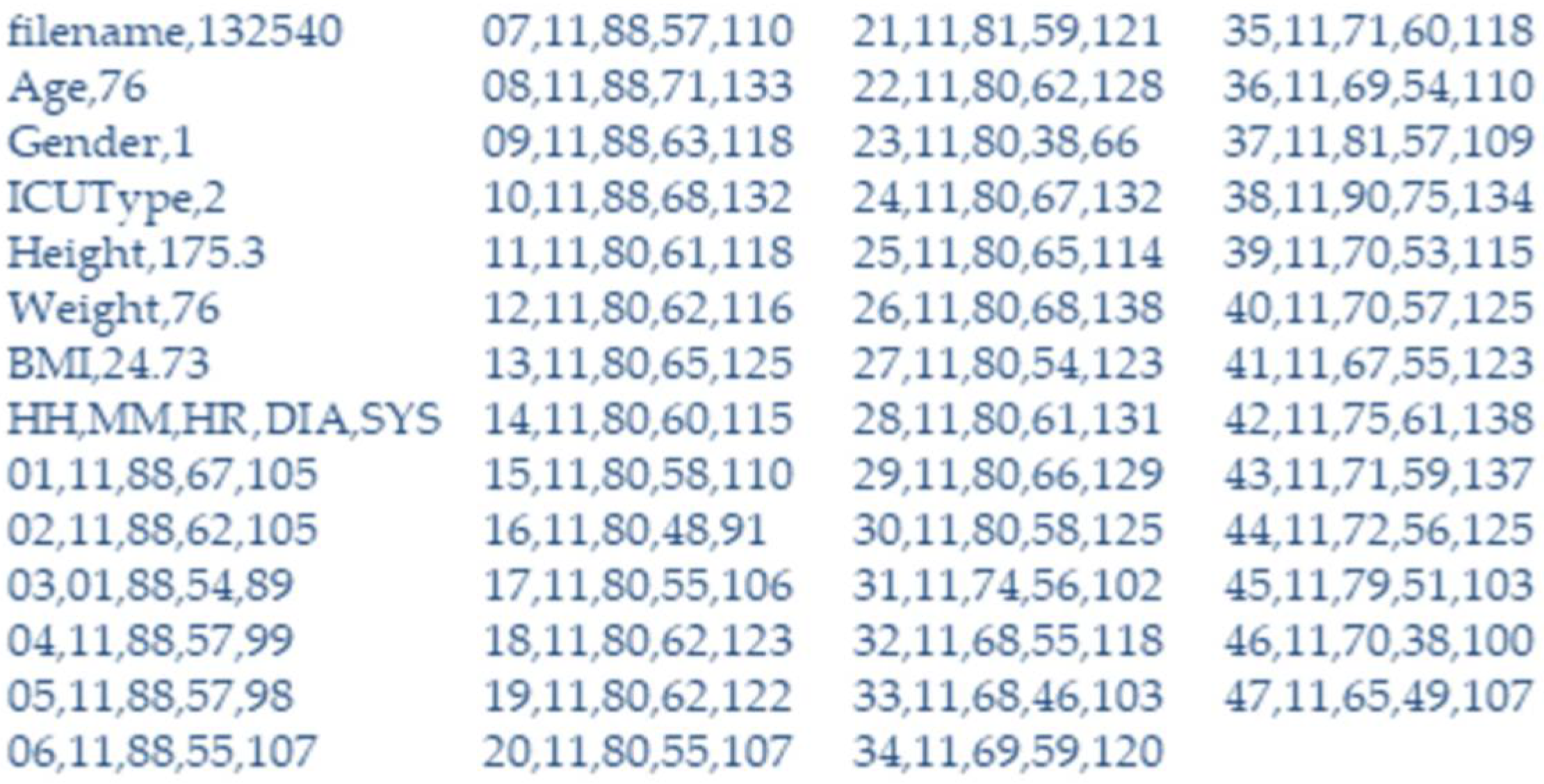
We developed an additional software component to extract the health metrics of every hour, and we excluded all the files that had time gaps more than one hour. An example file is shown in Figure 7.
Figure 7. Data file after processing of patient with ID 132540.
After data pre-processing, 2086 patient files remained. For each patient, a trained prediction model was developed and used for the prediction of the criticality for the next couple of hours.

4.3. Results

Table 1 presents the error in criticality prediction after one and two hours, for the three previously-mentioned cases of: (i) baseline ABAC method, (ii) ABAC with non-personalized fuzzy context handler and (iii) ABAC with personalized context handler as described in our previous work [7].
Table 1. Error of the predicted criticality.
The total number of patients whose future health state is falsely predicted per ABAC case is calculated using Formula (9). This number comprises the patients who are: (i) in non-critical state based on both of the predictions of the next two hours, but in a critical situation based on the real next two-hour situation where at least one the situations of the next two hours is critical, and (ii) in critical state based on at least one of the next two hours prediction, but in a non-critical situation based on both health states of the real next two hours. Formula (10) computes the falsely predicted criticality percentage (criticality prediction error).
Number _ of _ Patients _ Total _ Error   = Number   of   patients   where contextual   expression   ( ( ( C R I T I C A L PREDICTED _ SITUATION _ AFTER _ 1 _ HOUR = false   AND C R I T I C A L PREDICTED _ SITUATION _ AFTER _ 2 _ HOURS = false )   AND ( C R I T I C A L REAL _ SITUATION _ AFTER _ 1 _ HOUR = true   OR C R I T I C A L REAL _ SITUATION _ AFTER _ 2 _ HOURS = true ) )   AND ( ( C R I T I C A L PREDICTED _ SITUATION _ AFTER _ 1 _ HOUR = true   OR C R I T I C A L PREDICTED _ SITUATION _ AFTER _ 2 _ HOURS = true )   AND ( C R I T I C A L REAL _ SITUATION _ AFTER _ 1 _ HOUR = false   AND C R I T I C A L REAL _ SITUATION _ AFTER _ 2 _ HOURS = false ) ) )
Criticality _ Prediction _ Error = Number _ of _ Patients _ Total _ Error Number _ of _ all _ patients     100
The criticality prediction in the ABAC with personalized context handler case exhibits the lowest percentage error (6.86%) while the corresponding errors of the ABAC with non-personalized context handler and the baseline method are 17.31% and 17.74%, respectively.

5. Conclusions

In emergency healthcare situations, the health criticality of patients should be considered when permitting access to their EHRs. That is, recognizing life threatening situations in automated healthcare access control systems is imperative. Our work introduces an innovative access control method by taking into consideration machine learning techniques by estimating the patient’s future health metrics, based on her recent history. The access control method provides secure access for emergency healthcare professionals to sensitive healthcare information and simultaneously safeguarding the patient’s health.
Results show that personalization of fuzzy context handlers improves the accuracy of the access control results, in comparison with non-personalized context handlers. Our evaluation has shown that the Personalized ABAC Fuzzy Context Handler exhibits a low percentage error in predicting the overall health criticality of a patient. The integration of the predictive mechanism within the personalized context handler proved to be a robust tool to enhance the efficiency of the access control mechanism in EHRs System.
Limitations of our approach include the incorporation of only the patient’s age and a small number of health metrics in the fuzzy rules. Additional metrics, such as BMI, existence of chronic diseases, the glucose and the oxygen levels in blood or smoking or drinking habits, could be included in the future.

Author Contributions

Conceptualization, E.P., D.A., Y.V., I.P. and G.M.; methodology, E.P., D.A., Y.V., I.P. and G.M.; software, E.P.; validation, D.A. and I.P.; formal analysis, D.A. and G.M.; investigation, D.A., Y.V., I.P. and G.M.; resources and data curation, E.P. All authors have read and agreed to the published version of the manuscript.

Funding

This research has received funding from the EU, project H2020 826093, Asclepios (https://www.asclepios-project.eu/, (accessed on 26 August 2022)).

Data Availability Statement

PPG-BP Database dataset: https://figshare.com/articles/dataset/PPG-BP_Database_zip/5459299, accessed on 8 April 2022; PHYSIONET Dataset https://physionet.org/content/challenge-2012/1.0.0/, accessed on 8 April 2022.

Conflicts of Interest

The authors declare no conflict of interest.

References

  1. Ferrari, E. Access Control in Data Management Systems. Synth. Lect. Data Manag. 2010, 2, 1–117. [Google Scholar] [CrossRef]
  2. Hu, V.C.; Ferraiolo, D.; Kuhn, R.; Schnitzer, A.; Sandlin, K.; Miller, R.; Scarfone, K. Guide to Attribute Based Access Control (ABAC) Definition and Considerations. NIST Spec. Publ. 2013, 800, 162. [Google Scholar] [CrossRef]
  3. Dey, A.K. Understanding and Using Context. Pers. Ubiquitous Comput. 2001, 5, 4–7. [Google Scholar] [CrossRef]
  4. Yao, R.; Guo, C.; Deng, W.; Zhao, H. A novel mathematical morphology spectrum entropy based on scale-adaptive techniques. ISA Trans. 2021, 126, 691–702. [Google Scholar] [CrossRef] [PubMed]
  5. Chen, H.; Miao, F.; Chen, Y.; Xiong, Y.; Chen, T. A Hyperspectral Image Classification Method Using Multifeature Vectors and Optimized KELM. IEEE J. Sel. Top. Appl. Earth Obs. Remote Sens. 2021, 14, 2781–2795. [Google Scholar] [CrossRef]
  6. Wu, D.; Wu, C. Research on the Time-Dependent Split Delivery Green Vehicle Routing Problem for Fresh Agricultural Products with Multiple Time Windows. Agriculture 2022, 12, 793. [Google Scholar] [CrossRef]
  7. Psarra, E.; Verginadis, Y.; Patiniotakis, I.; Apostolou, D.; Mentzas, G. Accessing electronic health records in critical incidents using context-aware attribute-based access control. Intell. Decis. Technol. 2021, 1–13, preprint. [Google Scholar] [CrossRef]
  8. Ben-Assuli, O.; Ziv, A.; Sagi, D.; Ironi, A.; Leshno, M. Cost-effectiveness evaluation of EHR: Simulation of an abdominal aortic aneurysm in the emergency department. J. Med. Syst. 2016, 40, 1–13. [Google Scholar] [CrossRef] [PubMed]
  9. Povey, D. Optimistic security: A new access control paradigm. In Proceedings of the 1999 workshop on New security paradigms, Caledon Hills, ON, Canada, 22–25 September 1999; pp. 40–45. [Google Scholar]
  10. Saberi, M.A.; Adda, M.; Mcheick, H. Towards an ABAC Break-Glass to access EMRs in case of emergency based on Blockchain. In Proceedings of the 2021 IEEE International Conference on Digital Health (ICDH), Online, 11–15 September 2021; pp. 220–222. [Google Scholar]
  11. Saberi, M.A.; Adda, M.; Mcheick, H. Break-Glass Conceptual Model for Distributed EHR management system based on Blockchain, IPFS and ABAC. Procedia Comput. Sci. 2022, 198, 185–192. [Google Scholar] [CrossRef]
  12. Manasa, D.; Khanna, K.R. Sharing of PHR’s in Cloud Computing. Int. J. Comput. Sci. Netw. Secur. (IJCSNS) 2015, 15, 86. [Google Scholar]
  13. Tsegaye, T.; Flowerday, S. A Clark-Wilson and ANSI role-based access control model. Inf. Comput. Secur. 2020, 28, 373–395. [Google Scholar] [CrossRef]
  14. Li, M.; Yu, S.; Ren, K.; Lou, W. Securing Personal Health Records in Cloud Computing: Patient-Centric and Fine-Grained Data Access Control in Multi-owner Settings. In Proceedings of the International Conference on Security and Privacy in Communication Systems, Washington, WA, USA, 21–23 October 2021; Springer: Berlin/Heidelberg, Germany, 2010; pp. 89–106. [Google Scholar] [CrossRef]
  15. Jagdale, V.; Kekan, D.; Baride, I. Secure Sharing of Personal Health Records in Cloud using Attribute-based Encryption. Int. J. Comput. Sci. Mob. Comput. 2015, 4, 309–312. [Google Scholar]
  16. Farinha, P.; Cruz-Correia, R.; Antunes, L.; Almeida, F.; Ferreira, A. From Legislation to Practice—A Case Study of Break the Glass in Healthcare. In Proceedings of the International Conference on Health Informatics, Arlington, VI, USA, 11–12 November 2010; Volume 2, pp. 114–120. [Google Scholar]
  17. Brucker, A.D.; Petritsch, H. Extending access control models with break-glass. In Proceedings of the 14th ACM Symposium on Access Control Models and Technologies, Athens, Greece, 11–15 June 2014; pp. 197–206. [Google Scholar]
  18. Georgakakis, E.; Nikolidakis, S.A.; Vergados, D.D.; Douligeris, C. Spatio temporal emergency role based access control (STEM-RBAC): A time and location aware role based access control model with a break the glass mechanism. In Proceedings of the 2011 IEEE Symposium on Computers and Communications (ISCC), Washington, DC, USA, 28 June–1 July 2011; pp. 764–770. [Google Scholar] [CrossRef]
  19. Kabbani, B.; Laborde, R.; Barrère, F.; Benzekri, A. Managing Break-The-Glass using Situation-oriented authorizations. In Proceedings of the 9ème Conférence sur la Sécurité des Architectures Réseaux et Systèmes d’Information-SAR-SSI, Paris, France, 13–16 May 2014. [Google Scholar]
  20. Marinovic, S.; Craven, R.; Ma, J.; Dulay, N. Rumpole: A flexible break-glass access control model. In Proceedings of the 16th ACM Symposium on Access Control Models and Technologies, New York, NY, USA, 7–9 June 2011; pp. 73–82. [Google Scholar]
  21. Maw, H.A.; Xiao, H.; Christianson, B.; Malcolm, J.A. An evaluation of break-the-glass access control model for medical data in wireless sensor networks. In Proceedings of the 2014 IEEE 16th International Conference on E-Health Networking, Applications and Services (Healthcom), Natal, Brazil, 15–18 October 2014; pp. 130–135. [Google Scholar] [CrossRef]
  22. Guan, S.; Wang, Y.; Shen, J. Fingerprint-based access to personally controlled health records in emergency situations. Sci. China Inf. Sci. 2018, 61, 059103. [Google Scholar] [CrossRef]
  23. Künzi, J.; Koster, P.; Petković, M. Emergency Access to Protected Health Records. MIE 2009, 150, 705–709. [Google Scholar] [CrossRef]
  24. Covington, M.J.; Sastry, M.R. A contextual attribute-based access control model. In On the Move to Meaningful Internet Systems 2006: OTM 2006 Workshops; Springer: Berlin/Heidelberg, Germany, 2006; pp. 1996–2006. [Google Scholar]
  25. Mahalle, P.N.; Thakre, P.A.; Prasad, N.R.; Prasad, R. A fuzzy approach to trust based access control in internet of things. In Wireless VITAE; IEEE: Piscataway, NJ, USA, 2013; pp. 1–5. [Google Scholar]
  26. D’Aniello, G.; Loia, V.; Orciuoli, F. A multi-agent fuzzy consensus model in a Situation Awareness framework. Appl. Soft Comput. 2015, 30, 430–440. [Google Scholar] [CrossRef]
  27. De Maio, C.; Fenza, G.; Furno, D.; Loia, V. Swarm-based semantic fuzzy reasoning for situation awareness computing. In Proceedings of the 2012 IEEE International Conference on Fuzzy Systems, Brisbane, Australia, 10–15 June 2012; pp. 1–7. [Google Scholar] [CrossRef]
  28. Nomikos, G.D.; Dounias, G.; Tselentis, G.; Vemmos, K. Conventional vs. fuzzy modeling of diagnostic attributes for classifying acute stroke cases. In Proceedings of the ESIT-2000, European Symposium on Intelligent Techniques, Aachen, Germany, 9–13 September 2000; pp. 192–200. [Google Scholar]
  29. Mahmood, U.; Al-Jumaily, A. Type-2 fuzzy classification of blood pressure parameters. In Proceedings of the 2007 3rd International Conference on Intelligent Sensors, Sensor Networks and Information, Piscataway, NJ, USA, 3–6 December 2007; pp. 595–600. [Google Scholar]
  30. Djam, X.Y.; Kimbi, Y.H. Fuzzy expert system for the management of hypertension. Pac. J. Sci. Technol. 2011, 12, 390–402. [Google Scholar]
  31. Moameri, S.; Samadinai, N. Diagnosis of coronary artery disease via a Novel Fuzzy expert system optimized by CUCKOO SEARCH. Int. J. Eng. 2018, 31, 2028–2036. [Google Scholar]
  32. Zerkouk, M.; Mhamed, A.; Messabih, B. A User Profile Based Access Control Model and Architecture. Int. J. Comput. Networks Commun. 2013, 5, 171–181. [Google Scholar] [CrossRef]
  33. Røstad, L.; Nytrø, Ø. Personalized access control for a personally controlled health record. In Proceedings of the 2nd ACM Workshop on Computer Security Architectures—CSAW’08, Alexandria, VA, USA, 16 June 2008; pp. 9–16. [Google Scholar] [CrossRef]
  34. Petković, M.; Conrado, C.; Hammoutène, M. Cryptographically Enforced Personalized Role-Based Access Control. Secur. Priv. Dyn. Environ. 2006, 8, 364–376. [Google Scholar] [CrossRef]
  35. Son, J.; Kim, J.-D.; Na, H.-S.; Baik, D.-K. Dynamic access control model for privacy preserving personalized healthcare in cloud environment. Technol. Health Care 2015, 24, S123–S129. [Google Scholar] [CrossRef] [PubMed]
  36. Simpao, A.F.; Ahumada, L.M.; Gálvez, J.; Rehman, M.A. A Review of Analytics and Clinical Informatics in Health Care. J. Med. Syst. 2014, 38, 1–7. [Google Scholar] [CrossRef] [PubMed]
  37. Cortada, J.W.; Gordon, D.; Lenihan, B. The Value of Analytics in Healthcare: From Insights to Outcomes; IBM Global Business Services, Executive Report: Armonk, NY, USA, 2012. [Google Scholar]
  38. Tomar, D.; Agarwal, S. A survey on Data Mining approaches for Healthcare. Int. J. Bio-Sci. Bio-Technol. 2013, 5, 241–266. [Google Scholar] [CrossRef]
  39. Lustig, I.; Dietrich, B.; Johnson, C.; Dziekan, C. The analytics journey. Anal. Mag. 2010, 3, 11–13. [Google Scholar]
  40. Khalifa, M. Health Analytics Types, Functions and Levels: A Review of Literature. ICIMTH 2018, 251, 137–140. [Google Scholar] [CrossRef]
  41. Basu, A.T.A.N.U. Five pillars of prescriptive analytics success. Anal. Mag. 2013, 2, 8–12. [Google Scholar]
  42. Bernstein, J.H. The Data-Information-Knowledge-Wisdom Hierarchy and its Antithesis. NASKO 2009, 2, 68. [Google Scholar] [CrossRef]
  43. Khalifa, M. Reducing Emergency Department Crowding Using Health Analytics Methods: Designing AnEvidence Based Decision Algorithm. Procedia Comput. Sci. 2015, 63, 409–416. [Google Scholar] [CrossRef][Green Version]
  44. Madsen, L. Healthcare Business Intelligence: A Guide to Empowering Successful Data Reporting and Analytics; John Wiley & Sons: Hoboken, NJ, USA, 2012. [Google Scholar]
  45. Kohn, M.S.; Sun, J.; Knoop, S.; Shabo, A.; Carmeli, B.; Sow, D.; Syed-Mahmood, T.; Rapp, W. IBM’s health analytics and clinical decision support. Yearb. Med. Inform. 2014, 23, 154–162. [Google Scholar]
  46. Chen, H.; Chiang, R.H.; Storey, V.C. Business intelligence and analytics: From big data to big impact. MIS Q. 2012, 36, 1165–1188. [Google Scholar] [CrossRef]
  47. Bates, D.W.; Saria, S.; Ohno-Machado, L.; Shah, A.; Escobar, G. Big Data In Health Care: Using Analytics To Identify And Manage High-Risk And High-Cost Patients. Health Aff. 2014, 33, 1123–1131. [Google Scholar] [CrossRef]
  48. Hochreiter, S.; Schmidhuber, J. Long short-term memory. Neural Comput. 1997, 9, 1735–1780. [Google Scholar] [CrossRef] [PubMed]
  49. Yin, J.; Han, J.; Xie, R.; Wang, C.; Duan, X.; Rong, Y.; Zeng, X.Y.; Tao, J. MC-LSTM: Real-Time 3D Human Action Detection System for Intelligent Healthcare Applications. IEEE Trans. Biomed. Circuits Syst. 2021, 15, 259–269. [Google Scholar] [CrossRef]
  50. Kadri, F.; Baraoui, M.; Nouaouri, I. LSTM-based deep learning approach with application to predicting hospital emergency department admissions. In Proceedings of the 2019 International Conference on Industrial Engineering and Systems Management (IESM), Shanghai, China, 25–27 September 2019; pp. 1–6. [Google Scholar]
  51. Tsai, F.S.; Weng, Y.M.; Ng, C.J.; Lee, C.C. Embedding stacked bottleneck vocal features in a LSTM architecture for automatic pain level classification during emergency triage. In Proceedings of the 2017 Seventh International Conference on Affective Computing and Intelligent Interaction (ACII), San Antonio, TX, USA, 23–26 October 2017; pp. 313–318. [Google Scholar]
  52. Mantas, J. Using long short-term memory (LSTM) neural networks to predict emergency department wait time. The Importance of Health Informatics in Public Health during a Pandemic. Stud. Health Technol. Inform. 2020, 272, 199. [Google Scholar]
  53. Nwakanma, C.I.; Islam, F.B.; Maharani, M.P.; Kim, D.S.; Lee, J.M. Iot-based vibration sensor data collection and emergency detection classification using long short term memory (lstm). In Proceedings of the 2021 International Conference on Artificial Intelligence in Information and Communication (ICAIIC), Rome, Italy, 5–9 April 2021; pp. 273–278. [Google Scholar]
  54. Reddy, B.K.; Delen, D. Predicting hospital readmission for lupus patients: An RNN-LSTM-based deep-learning methodology. Comput. Biol. Med. 2018, 101, 199–209. [Google Scholar] [CrossRef] [PubMed]
  55. Zhang, W.; Li, L.; Zhu, Y.; Yu, P.; Wen, J. CNN-LSTM neural network model for fine-grained negative emotion computing in emergencies. Alex. Eng. J. 2022, 61, 6755–6767. [Google Scholar] [CrossRef]
  56. Mou, H.; Yu, J. CNN-LSTM Prediction Method for Blood Pressure Based on Pulse Wave. Electronics 2021, 10, 1664. [Google Scholar] [CrossRef]
  57. Chae, M.; Han, S.; Lee, H. Outdoor Particulate Matter Correlation Analysis and Prediction Based Deep Learning in the Republic of Korea. Electronics 2020, 9, 1146. [Google Scholar] [CrossRef]
  58. Mumtaz, R.; Zaidi, S.; Shakir, M.Z.; Shafi, U.; Malik, M.M.; Haque, A.; Mumtaz, S.; Zaidi, S. Internet of Things (IoT) Based Indoor Air Quality Sensing and Predictive Analytic—A COVID-19 Perspective. Electronics 2021, 10, 184. [Google Scholar] [CrossRef]
  59. Oasis-open.org. Available online: http://docs.oasis-open.org/xacml (accessed on 16 September 2021).
  60. Quirolgico, S.; Hu, V.; Karygiannis, T. Access Control for SAR Systems; Department of Commerce US: Washington, DC, USA, 2011. [CrossRef]
  61. Psarra, E.; Verginadis, Y.; Patiniotakis, I.; Apostolou, D.; Mentzas, G. A Context-Aware Security Model for a Combination of Attribute-Based Access Control and Attribute-Based Encryption in the Healthcare Domain. In Proceedings of the Workshops of the International Conference on Advanced Information Networking and Applications, Caserta, Italy, 15–17 April 2020; Springer: Cham, Switzerland, 2020; pp. 1133–1142. [Google Scholar] [CrossRef]
  62. Rasjid, Z.E.; Setiawan, R.; Effendi, A. A Comparison: Prediction of Death and Infected COVID-19 Cases in Indonesia Using Time Series Smoothing and LSTM Neural Network. Procedia Comput. Sci. 2021, 179, 982–988. [Google Scholar] [CrossRef]
  63. Brownlee, J. Deep learning for time series forecasting: Predict the future with MLPs, CNNs and LSTMs in Python. In Machine Learning Mastery; Jason Brownlee: Cambridge, MA, USA, 2018. [Google Scholar]
  64. Joshi, M.; Joshi, K.; Finin, T. Attribute Based Encryption for Secure Access to Cloud Based EHR Systems. In Proceedings of the 2018 IEEE 11th International Conference on Cloud Computing (CLOUD), San Francisco, CA, USA, 2–7 July 2018. [Google Scholar]
  65. Gutierrez, P.P. Cloud EHRServer by CaboLabs. Available online: https://cloudehrserver.com/ (accessed on 18 September 2021).
  66. Sam Heard, T.B. OpenEhr Home. Available online: https://www.openehr.org/ (accessed on 18 September 2021).
  67. Silva, I.; Moody, G.; Mark, R.; Celi, L.A. Predicting Mortality of ICU Patients: The PHYSIONET/Computing in Cardiology Challenge 2012. Predicting Mortality of ICU Patients: The PhysioNet/Computing in Cardiology Challenge 2012 v1.0.0. Available online: https://physionet.org/content/challenge-2012/1.0.0/ (accessed on 24 March 2020).
Publisher’s Note: MDPI stays neutral with regard to jurisdictional claims in published maps and institutional affiliations.

Article Metrics

Citations

Article Access Statistics

Multiple requests from the same IP address are counted as one view.