


Practices of Motivators in Adopting Agile Software Development at Large Scale Development Team from Management Perspective
 , , , ,
Abstract
1. Introduction and Background
- RQ1
- What are the solutions/practices in ASDM used to address motivators in large-scale situations from a management perspective?
2. Research Methodology
- Define the research objective.
- Conduct several example searches; review the scopes.
- Define the search string; identify inclusion and exclusion criteria.
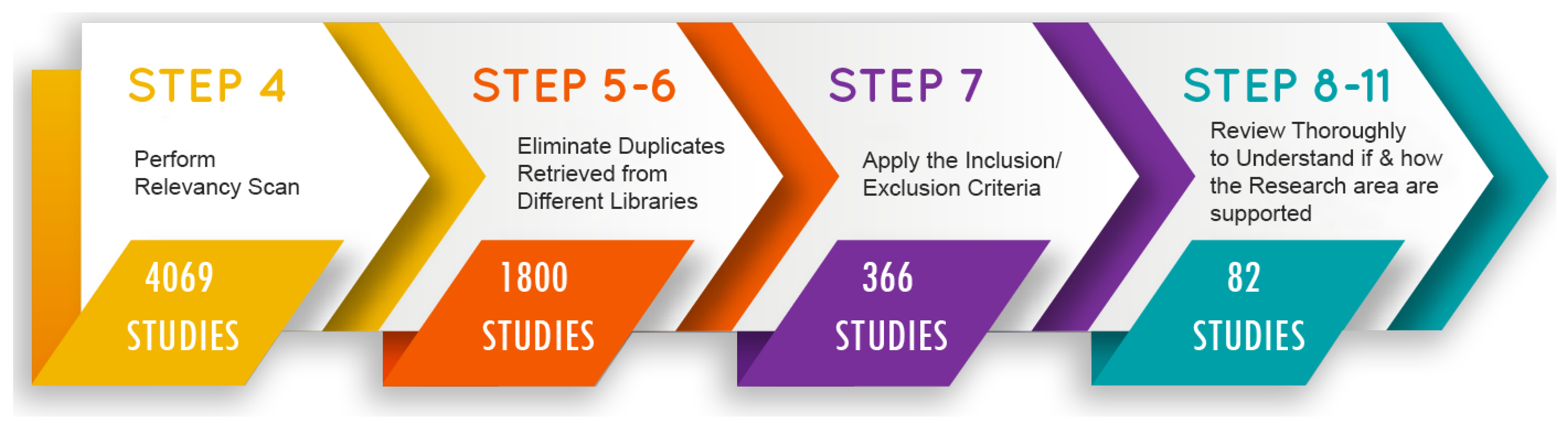
- Conduct an initial search.
- Review the title, abstract, and keywords of the initially retrieved studies.
- Revise inclusion and exclusion criteria; select potentially relevant studies.
- Remove duplicate studies.
- Review potentially relevant studies selected; discuss any issues.
- Review the entire contents of initially selected studies (including the references section for identifying studies that were potentially missed); identify relevant ones.
- Review relevant studies selected; discuss any issues.
- Identify the final set of relevant studies.
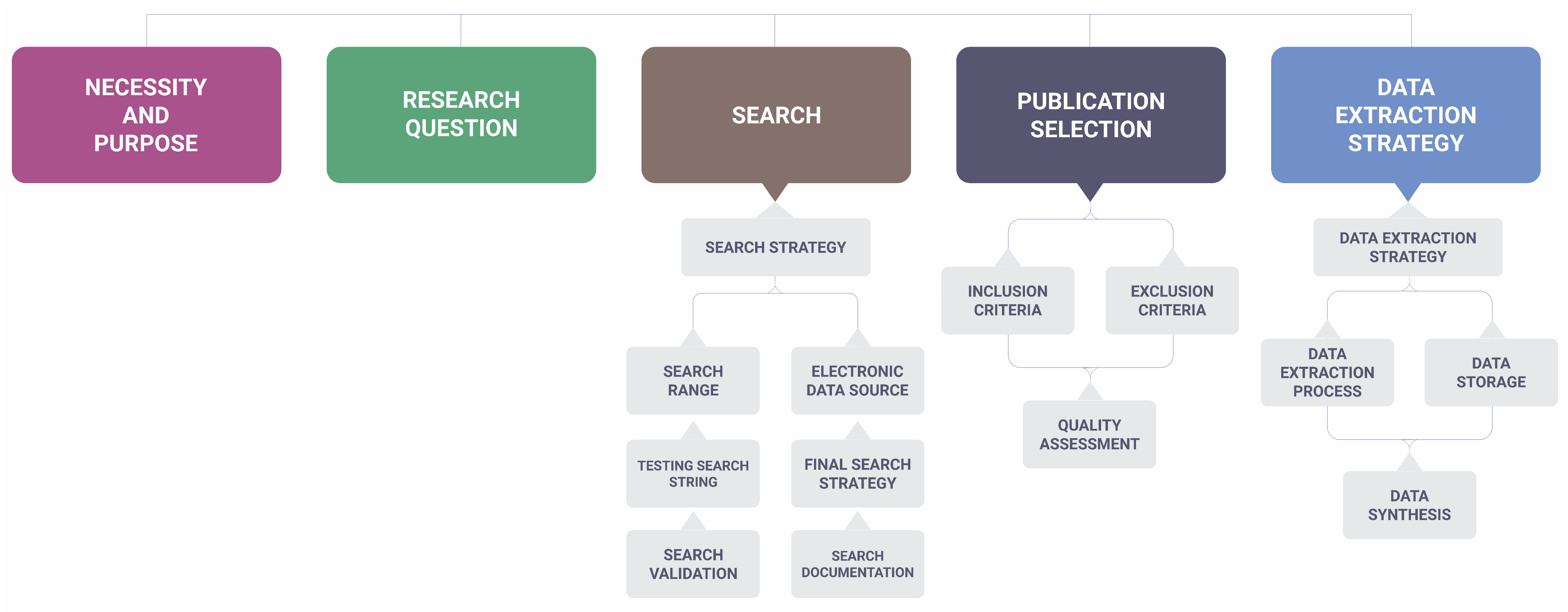
2.1. Search Strategy
2.1.1. Search String
2.1.2. Trial Search String
2.1.3. Lengthy Search String
2.1.4. Smaller Search Sub-Strings
- Step 1:
- Derivation of Major TermsTo guide key terms, perceive population, intervention, and outcome from research questions.
- Step 2:
- Identification of Alternative Spellings and SynonymsFound the alternative spellings and synonyms for these major terms.
- Step 3:
- Verification of KeywordsValidated the key words in any related paper.
- Step 4:
- Use of Boolean Operators for ConjunctionThe Boolean operators (AND/OR) were used to combine search segments which were related to our research topic. The "OR" operator was used for combing alternative spellings and synonyms, and the "AND" operator was used for combing major terms.
- String1: (“Agile technology OR agile methods”) AND (“large-scale development teams”) OR (“motivators” OR “positive impact”) AND (“Practices” OR “Solutions”).
- String2: (“Agile Method”) AND (“Development Team”) AND (“Success Factors” OR “Positive Impacts” OR “Promoters”) AND (“Practices” OR “Solutions”).
- String3: (“Agile Software Development” OR “Agile System Development”) AND (“Large Development Team”) AND (factors OR supporters OR “key factors”) AND (“Practices” OR “Solutions”).
2.2. Publication Selection
Inclusion and Exclusion Criteria
2.3. Selecting Primary Sources
2.4. Publication Quality Assessment
- Is it clear in what way the solution or practices for the success factors in the adoption of ASDM at a large scale were identified?
- Are there adequate data to support the results?
- Is the researcher reporting on favorable results more than adverse results?
- Is the objective of the research clearly defined?
- Are the outcomes of the research connected to the objective of the research?
- Is the ASDM context discussed clearly?
2.5. Data Extraction
2.6. Data Analysis
2.7. Classification of Practices
3. Results and Discussion
3.1. Strong Executive Support
- Manage the product and separate quality assurance groups.
- For a team to be effective and successful, all team members should be able to adapt to the ever changing requirements in the task environment.
- The ability to easily respond to change requirements of the customer.
- The team members must support each other during the whole work flow of the project.
- Trust building among the members of the agile team help the team function as one unit.
3.2. Cooperative Organizational Culture
- Focus on the importance of the culture and understand the main challenge to successful agile development on a large scale.
- Mutual understanding can be achieved by having active cross-cultural communication programs through the use of short visits and face-to-face communication.
- There are differences in norms and values among cultures.
- Be near the client for better communication.
- Better use of middlemen can reduce the communication barrier with clients.
- Time management techniques should be used to understand different time zones.
- A common set of development tools and policies should be used to facilitate common understanding.
3.3. Face-to-Face Meetings
- Interactions among the developers should be closer and more frequent as compared to the traditional method of development.
- Regular face-to-face meetings should be established, as they provide clear communication.
- A proper working schedule should be followed.
- Customer commitment and presence, along with freedom, should be provided.
- Sharing problems and issues from their work can help the team to keep track of their progress.
3.4. Dedicated Management
- Effective crew coordination is in large part a function of effective team communications.
- The communication elements required of a worker in a front line manufacturing team are the same as in a management team.
- Management concepts, emphasizing how to be an efficient team player.
- For better implementation and maintenance phases, they plan accordingly.
3.5. Team Competency—Agile Development Expertise
- Remembering that agile development is being promoted as a means for reducing time, improving quality, increasing productivity, gaining efficiency, and becoming cost effective.
- Continuous feedback to the customer that supports successful development and delivery of the software; and continuous planning, integration, and testing.
- Integrate efficiency, flexibility, and quality into development practices in order to compete within the market.
- Communicate: the team in general deal with the various issues and problems that arise from the development efforts.
- Competency-based management has been a growing trend in organizations.
3.6. Agile Development Environment
- The use of Web applications and software for agile artifacts.
- Communication methods for better communication with remote teams.
- A hybrid approach should be adopted using both local and remote teams.
3.7. Team Encouragement
- Team members support their followers and appreciate their contributions.
- Provisions of coaching and positive feedback should be given to team members for higher goal achievement.
- Gather performance feedback from team members.
- Assess and cultivate teamwork skills.
- Create a dialogue of feedback with each team member to encourage, challenge, and inform each other.
3.8. Customer Satisfaction
- Perfect quality along with the right time, place, and price.
- The effective value of a critical measure defined by the customer is also created in the customer project.
- Agile methods work better with changing requirements.
- Software delivery does not depend on the availability of the customers on site always.
- Satisfying continuous customer requirements and being able to deliver continuously.
3.9. Strong Collaboration with the Customer
- Utilize the time zone differences by managing the working hours between the two sites in such a way that can lead towards 24 h development.
- The 24 working hours should be divided between the time zones that development does not stop.
- Visits to the sites should be promoted.
- Enhance active involvement in all aspects of development for better understanding with customer.
- Confidence should be given to both formal and informal meetings among all stakeholders.
- Data should be shared with the customer at all stages.
- Software configuration management should be used to manage the different components of the software system.
- Increased dependency on the partners should be encouraged.
- Regular meetings with the customer will give better reviews and feedback
- Communication among team members should be ensured.
- Good management among one another, the project team and top management along with the customers.
- The role of the customer should be expanded to process of development of product along with discussing the important features, prioritizing requirements and user demands from time to time.
- Closely engage the customers into the development phase.
3.10. Sustainable Planning
- Attempt to understand and improve the current climatic and economic problem of software organizations.
- Current practices only focus on sustainability for software developers.
- Practices in software processes to efficiently ensure services, lower costs, and better systems control
- The deployment and implementation of software systems for better contribution to sustainable processes.
- The adoption of agile methodology for sustained software organizations varies with the network physical infrastructure.
3.11. Use of Automated Software Tools
- Install disaster recovery software application.
- The reuse of software modules for knowledge using coding.
- Manage efficiently control life cycle to avoid data redundancy.
- Efficient coding applications for software development.
- Delete old and unused servers from the database.
- New software systems should operate in energy efficient methods.
3.12. Scheduled Trainings for Team Members
- Individual competency should be streamlined with the team requirements for performance and efficiency.
- By providing training for the team, we can get better results faster.
3.13. Strong Collaboration and Communication
- Frequent visits between team members and customers to maintain collaboration.
3.14. Risk Management
- Extensive work has been done in Risk Management and present work that is needed for further consideration.
- Customer commitments and presence have full authority over other issues.
- Study the current approaches and find out new ways of new areas to explore.
- If risk is planned carefully initially the percentage of failure is reduced.
- If risk is managed carefully the chances of failure are reduced.
- Risks associated with high company effect are identified by the departments.
- Assessed, and mitigated the risk properly and communicate to your entire organization.
3.15. Knowledge Sharing Management
- Use latest technology and processes for knowledge sharing and management.
- Establish how new procedures can be introduced into the workforce for smooth information sharing among new and old team employees.
- Team level collaboration and knowledge should be shared for adaptability for both large and small scale teams.
3.16. Quality Production Using Pair Programming
- Better competition through service provision.
- Provision of best services design and execution.
- Follow strict time development schedule.
- Establish mutual trust.
- Standard RE models should be used for conducting Requirements Engineering phase.
- Improve client-vendor communication.
- Ensure that the client requirements of response time, flexibility, usability and reliability are met.
3.17. Mechanism for Change Management
- In different situations the capacity should work effectively, as change management is known to be unpredictable.
- Change in the organization needs to be done in a collaborative way with the old problems being shared with the employees along with the new benefits of the new system.
- Frequently meet with your change team employees and encouraging them to share their feedback and provide what works and what is not working.
- Awareness to the employees that this is a learning curve and it will have its share of questions, concerns and suggestions which are all entertained.
3.18. Leadership Strong Commitment and Team Autonomy
- Fostering trustful ties with the client.
- Additional favors in development of mutually beneficial partnership.
- Apply effort and other resources for maintaining on going relationships.
- The other factors related to customer satisfaction and service along with both financial performance, internal business and growth should be considered.
- Better learning requires to understand and listen to other ideas and opinions.
3.19. Pilot Project in Case of No Experience
- Confidence in the working principle of Agile would be so suitable and also gaining acceptance of its approach is increased.
- Various learning experiments vied insights into the problems and who they were mitigated.
- To have better communication and contact constant contact was maintained in a working environment.
- Pilot projects success and failures tend to give stakeholders information at an early stage about the project.
- If the pilot project was not received well but over all the idea is good and should be pushed, gives the project team staff an opportunity to adopt a new strategy for better success.
3.20. Training and Learning and Briefing of Top Management on Agile
- Agile software development has specific management roles which keep a hold on both the unique and difficult processes.
- Following the roles and techniques for better planning and flexibility and learning.
- Have a better organization and learning mechanism to deal with the complexity and unpredictability of agile software projects.
3.21. Requirement Management Using Agile-Oriented Requirement Management Process
- They turn the business potential into actual competitiveness on the market.
- Requirement management is all about learning and documenting the work to be performed by the project, and ensuring compatibility with resources.
- Resolving, analyze, specify, validate, and manage software requirements.
- Dealing with crosscutting requirements systematically, and this can be integrated by agile software development methodologies.
4. Study Limitations
5. Conclusions and Future Work
- Provide software project managers knowledge that can assist them in implementing and adopting ASDM at large scales. Our results recommend that software project managers should adopt all of the reported practices for SFs, especially those reported with greater percentages.
- Increase team cohesiveness, as it will guide both sides toward understanding each other’s requirements and goals, in order to sustain long term commitment.
- Provide assistance of understanding SF practices to ensure a successful transformation.
- We will validate the practices identified through the SLR by conducting an empirical investigation of the agile software development industry.
- The practices/solutions in scaled ASDM from the team’s perspective will be identified and analyzed.
- We will analyze the critical risk in the transformation to ASDM from a management perspective.
- We shall determine the underlying reasons for why some factors are not important for specific groups of ASD companies.
Funding
Acknowledgments
Conflicts of Interest
Appendix A
| S. No. | Paper Title | Authors/Date of Review |
| 1 | A survey study of critical success factors in agile software projects | Chow, T., & Cao, D. B. (2008). |
| 2 | Communities of Practice in a Large Distributed Agile Software Development Organization — Case Ericsson | Paasivaara, M., & Lassenius, C. (2014). |
| 3 | Risks in distributed agile development: A review | Shrivastava, S. V., & Rathod, U. (2014) |
| 4 | The impact of inadequate customer collaboration on self-organizing Agile teams | Hoda, R., Noble, J., & Marshall, S. (2011). |
| 5 | A Framework for Understanding the Factors Influencing Pair Programming Success | Ally, M., Darroch, F., & Toleman, M. (June 2005). |
| 6 | A Model for Adopting Sustainable Practices in Software Based Organizations | Mazlina, A. M., & Awanis, R. (2017). |
| 7 | A Quantitative Study on Critical Success Factors in Agile Software Development Projects; Case Study IT Company | Nasehi, A. (2013). |
| 8 | A survey study of critical success factors in agile software projects | Chow, T., & Cao, D. B. (2008) |
| 9 | A survey study of critical success factors in agile software projects in former Yugoslavia IT companies | Stankovic, D., Nikolic, V., Djordjevic, M., & Cao, D. B. (2013). |
| 10 | Adopting Agile Software Development Practices: Success Factors, Changes Required, and Challenges | Misra, S. C. (2007). |
| 11 | Agile Adoption in IT Organizations | Ghani, I., & Bello, M. (2015). |
| 12 | Agile software development: adaptive systems principles and best practices | Meso, P., & Jain, R. (2006). |
| 13 | Challenges of Migrating to Agile Methodologies | Nerur, S., Mahapatra, R., & Mangalaraj, G. (2005). |
| 14 | Agile software development | Cockburn, A. (2002). |
| 15 | Agile principles and achievement of success in software development: A quantitative study in Brazilian organizations | de Souza Bermejo, P. H., Zambalde, A. L., Tonelli, A. O., Souza, S. A., Zuppo, L. A., & Rosa, P. L. (2014). |
| 16 | Agile process in software engineering and extreme programming( 2009) | Abrahamsson, P., Marchesi, M., & Maurer, F. (2009). |
| 17 | Agile process in software engineering and extreme programming (2017) | Baskerville, P. A. R., Fitzgerald, K. C. B., & Wang, L. M. X. |
| 18 | Agile Processes in Software Engineering and Extreme Programming (2014) | Abrahamsson, P., Marchesi, M., & Maurer, F. (2009). |
| 19 | Agile Project Management: | Hoda, R., Noble, J., & Marshall, S. (2008) |
| 20 | Agile Software Development Methodologies and Practices | Williams, L. (2010). |
| 21 | Agile transition and adoption human-related challenges and issues: A Grounded Theory approach | Gandomani, T. J., & Nafchi, M. Z. (2016). |
| 22 | Agile User Experience Development in a Large Software Organization: Good Expertise but Limited Impact | Kuusinen, K., Mikkonen, T., & Pakarinen, S. (2012) |
| 23 | The Top 10 Burning Research Questions from Practitioners | Freudenberg, S., & Sharp, H. (2010). |
| 24 | Are you biting off more than you can chew? A case study on causes and effects of over-scoping in large-scale software engineering | Bjarnason, E., Wnuk, K., & Regnell, B. (2012). |
| 25 | Challenges and success factors for large-scale agile transformations: A systematic literature review | Dikert, K., Paasivaara, M., & Lassenius, C. (2016). |
| 26 | Agile adoption story from NHN | Kim, E., & Ryoo, S. (July 2012). |
| 27 | Agile Success Factors A qualitative study about what makes agile projects successful | Kropp, M. (2015). |
| 28 | Cost and time project management success factors for information systems development projects | Sanchez, O. P., & Terlizzi, M. A. (2017). |
| 29 | Critical success factors for implementation of supply chain management in Indian small and medium enterprises and their impact on performance | Kumar, R., Singh, R. K., & Shankar, R. (2015). |
| 30 | Critical Success Factors for Rapid, Innovative Solutions | Lane, J. A., Boehm, B., Bolas, M., Madni, A., & Turner, R. (July 2010). |
| 31 | Identifying some important success factors in adopting agile software development practices | Subhas Chandra Misraa, Vinod Kumar, Uma Kumar 2009 |
| 32 | The impact of supply chain management practices on performance of SMEs | Lenny Koh, S. C., Demirbag, M., Bayraktar, E., Tatoglu, E., & Zaim, S. (2007). |
| 33 | Agile Practices for the Global Teaming Model | |
| 34 | The effects of internal resources and partnership quality on firm performance: An examination of Indian BPO providers | Lahiri, S., & Kedia, B. L. (2009). |
| 35 | Practices for Implementation of the Critical Success Factors in Software Outsourcing Partnership from Vendors’ Perspective: A Literature Review | Ali, S., & Khan, S. U. (2016). |
| 36 | Research Review on Open Innovation: Literature Review and Best Practices | West, J., & Bogers, M. (2014). |
| 37 | Routine inter-dependencies as a source of stability and flexibility. A study of agile software development teams | Dönmez, D., Grote, G., & Brusoni, S. (2016). |
| 38 | Scaling up the Planning Game: Collaboration Challenges in Large-Scale Agile Product Development | Evbota, F., Knauss, E., & Sandberg, A. (May 2016). |
| 39 | Software teams and their knowledge networks in large-scale software development | Šmite, D., Moe, N. B., Š?blis, A., & Wohlin, C. (2017). |
| 40 | Stragetic factors in agile software development method adaptation | Lal, R. (2011). |
| 41 | Success Factors for Building and Managing High Performance Agile Software Development Teams | Nguyen, D. S. (2016). |
| 42 | Success Factors of Agile Software Development | Misra, S. C., Kumar, V., & Kumar, U. (2006). |
| 43 | Success factors for implementation of novel decentralized diagnostics: How publicly funded multidisciplinary innovation networks can disrupt German Healthcare | Hanke, M. (2017). |
| 44 | Why Do Customer Relationship Management Applications Affect Customer Satisfaction? | Mithas, S., Krishnan, M. S., & Fornell, C. (2005). |
| 45 | The impact of supply chain management practices on performance of SMEs performance of SMEs | Lenny Koh, S. C., Demirbag, M., Bayraktar, E., Tatoglu, E., & Zaim, S. (2007). |
| 46 | Do Agile Software Development Practices Increase Customer Satisfaction in Systems Engineering Projects? | Kohlbacher, M., Stelzmann, E., & Maierhofer, S. (April 2011). |
| 47 | Do not Forget to Breathe: A Controlled Trial of Mindfulness Practices in Agile Project Teams | den Heijer, P., Koole, W., & Stettina, C. J. (May 2017). |
| 48 | Educating for Sustainability: Competencies & Practices for Transformative Action | Frisk, E., & Larson, K. L. (2011). |
| 49 | Empirical studies of geographically distributed agile development communication challenges: A systematic review | Alzoubi, Y. I., Gill, A. Q., & Al-Ani, A. (2016). |
| 50 | Empirical Investigation on Success Factors in Adapting Agile Methodology in Software Development at Public Organizations | Alzoubi, Y. I., Gill, A. Q., & Al-Ani, A. (2016). |
| 51 | Excessive software development: Practices and penalties | Shmueli, O., & Ronen, B. (2017). |
| 52 | Exploring differences between smaller and large organizations’ corporate governance of information technology | Wilkin, C. L., Couchman, P. K., Sohal, A., & Zutshi, A. (2016). |
| 53 | Exploring the role of lean thinking in sustainable business practice: A systematic literature review | Caldera, H. T. S., Desha, C., & Dawes, L. (2017). |
| 54 | Extreme programing and agile process in software engineering | Marchesi, M., & Succi, G. (2003). |
| 55 | Factors associated with the software development agility of successful projects | Sheffield, J., & Lemétayer, J. (2013) |
| 56 | Factors that motivate software engineering teams: A four country empirical study | Verner, J. M., Babar, M. A., Cerpa, N., Hall, T., & Beecham, S. (2014). |
| 57 | Practices for Software Integration Success Factors in GSD Environment | I lyas, M., & Khan, S. U. (June 2016). |
| 58 | From Anarchy to Sustainable Development: Scrum in Less Than Ideal Conditions | Therrien, I., & LeBel, E. (August 2009). |
| 59 | How agile are industrial software development practices? | Hansson, C., Dittrich, Y., Gustafsson, B., & Zarnak, S. (2006). |
| 60 | Identify and Classify Critical Success Factor of Agile Software Development Methodology Using Mind Map | El Hameed, T. A., Latif, M. A. E., & Kholief, S. (2016). |
| 61 | Implementing Agile project methods in globally distributed teams | Gillo Nilsson, C., & Karlsson, D. (2015). |
| 62 | Knowledge Management in New Product Teams: Practices and Outcomes | Gillo Nilsson, C., & Karlsson, D. (2015). |
| 63 | Knowledge Management: Practices and Challenges | |
| 64 | Knowledge Sharing: Agile Methods vs. Tayloristic Methods | Chau, T., Maurer, F., & Melnik, G. (2003, June). |
| 65 | Scale and responsive in large scale software development | Olsson, H., Sandberg, A., Bosch, J., & Alahyari, H. (2014). |
| 66 | Managerial Execution in Public Administration: Practices of Managers When Implementing Strategic Objectives | Sabourin, V., & Sefa, E. (2012). |
| 67 | Modeling continuous integration practice differences in industry software development | Ståhl, D., & Bosch, J. (2014). |
| 68 | Motivations and measurements in an agile case study | Layman, L., Williams, L., & Cunningham, L. (November 2004). |
| 69 | Moving from traditional to agile software development methodologies also on large, distributed projects. | Papadopoulos, G. (2015). |
| 70 | Operation of management control practices as a package—A case study on control system variety in a growth firm context | Sandelin, M. (2008). |
| 71 | Business Governance Best Practices of Virtual Project Teams | Hamersly, W. J. (2015). |
| 72 | Deepening Our Understanding of Communities of Practice in Large-Scale Agile Development | Paasivaara, M., & Lassenius, C. (July 2014). |
| 73 | process industry practices (pip): creation of industry practices | Mohla, D. L., Shannon, S. W., Sims, L., & Zerda, R. L. (September 1998). |
| 74 | Product focus software process improvement | Zahran, S. (2009). |
| 75 | Refining a model for sustained usage of agile methodologies | Senapathi, M., & Drury-Grogan, M. L. (2017). |
| 76 | Requirements for a successful buyer-supplier collaboration in new product development | ENGLESSON, P., & OHLIN, M. (2017). |
| 77 | Tailoring Agile in the Large: Experience and Reflections from a Large-Scale Agile Software Development Project | Rolland, K. H., Mikkelsen, V., & Næss, A. (May 2016). |
| 78 | doing competencies well: best practices in competency modeling | Campion, M. A., Fink, A. A., Ruggeberg, B. J., Carr, L., Phillips, G. M., & Odman, R. B. (2011). |
| 79 | Factors that motivate software engineering teams: A four country empirical study | Verner, J. M., Babar, M. A., Cerpa, N., Hall, T., & Beecham, S. (2014). |
| 80 | Workplace design, complementarities among work practices and the formation of competencies. Evidence form Italian employees | Leoni, R. (2012). |
| 81 | Towards an Agile Feature Composition for a Large Scale Software Product Lines | Dehmouch, I. (2014, May). |
| 82 | Critical factors in software outsourcing: a pilot study | Oza, N., Hall, T., Rainer, A., & Grey, S. (November 2004). |
Appendix B. List of Practices
| 1. Manage the product and separate quality assurance groups. |
| 2. For any successful and effective team, the members need to be adaptable to any change in the task environment. |
| 3. The ability to easily respond to change requirements of the customer. |
| 4. The team members must be support each other for executing workflow of the project. |
| 5. The members of the agile team should be mature in trust building to make it function |
| 6. Briefly move the selected programmers to the Clients site. |
| 7. Differences among other departments of the organizations should be reduced. |
| 8. Focus on the importance of the Culture and understand what main blockage in the successful migration to the Agile development on a large scale. |
| 9. Mutual understanding can be achieved by having active cross cultural communication programs through the use of short visits and face-to-face communication. |
| 10. Different skill training which can be a combination of formal communication languages, client specific requirements, or either domain specific along with logical thinking. |
| 11. There will be difference in Norms and Values from other cultures. |
| 12. Move to the client’s site for better communication. |
| 13. Better use of middlemen can be made to adjust the communication barrier among clients. |
| 14. Time management techniques should be used to understand the different time zones. |
| 15. A common set of development tools and policies should be used to facilitate a common understanding. |
| 16. A communication protocol should be established so that it can overcome communication issues and barriers. |
| 17. Interaction among the developers is closer and more frequent as compared to the traditional method of development. |
| 18. Regular face-to-face meetings should be established as they follow the strong communication method which is very successful. |
| 19. Proper working schedule should be followed. |
| 20. Customer commitment and presence along with freedom should be provided. |
| 21. Meeting with the managers should not send the wrong message that they are meeting because of any issue or missed deadline. |
| 22. Sharing problems and issues from their work can help the team to keep track of their progress. |
| 23. State the effective crew coordination is in large part a function of effective Team communications. |
| 24. The communication elements required of customer in a front-line manufacturing team be the same as management team. |
| 25. Managing efficient team properties like team buildup, meeting tasks deadlines, policy and context, life cycles, and needs of the management. |
| 26. Management concepts, emphasizing that how to be an efficient team player. |
| 27. For better implementation and maintenance phases he plans accordingly. |
| 28. Agile development is being promoted as a mean for reducing time, improving quality, increasing productivity, gaining efficiency, and becoming cost effective. |
| 29. Continuous feedback to the customer that supports successful development and delivery of the software, and continuous planning, integration, and testing. |
| 30. Integrate efficiency, flexibility, and quality in their development practices in order to compete with the fast development. |
| 31. The team can assess its objectives, priorities, time management allocations and performance assessment. |
| 32. Communicate, the team in general deal with the various issues and problems that arise from the development effort. |
| 33. Competency-based management has been a growing trend in organizations. |
| 34. Distribute work equally and assign ownership to every individual. |
| 35. Use of Web applications and software for agile artifacts. |
| 36. Communication methods for better communication with remote teams. |
| 37. Commitment should be based on product and delivery satisfaction. |
| 38. Room for proper training along with the demos should be done frequently. |
| 39. Hybrid approach should be adopted with both sets of team members from local and remote teams. |
| 40. Team members support the followers and appreciate their contribution. |
| 41. Provision of the coaching and positive feedback should be given to the performing and motivated team members for higher goal achievement. |
| 42. Gather Performance Feedback from Team Members. |
| 43. Assess and Cultivate Teamwork Skills. |
| 44. Learn and acknowledge your employees’ personal career objectives. |
| 45. Show team respect through consistency and empowerment. |
| 46. Create a dialogue of feedback with each team member to encourage, challenge, and inform each other. |
| 47. Perfect Quality along with the Right Time, Place, and Price. |
| 48. The effective value of a critical measure defined by the customer is also created in the customer project. |
| 49. Agile methods work better with changing requirements. |
| 50. Software delivery does not depend on the availability of the customers on site always. |
| 51. Satisfying continuous customer requirements and being able to deliver continuously. |
| 52. The 24 working hours should be divided between the time zones that development does not stop. |
| 53. Visits to the sites should be promoted. |
| 54. Enhance active involvement in all aspects of development for better understanding with customer. |
| 55. Confidence should be given to both formal and informal meetings among all stakeholders. |
| 56. Data should be shared with the customer at all stages. |
| 57. Software configuration management should be used to manage the different components of the software system. |
| 58. Increased dependency on the partners should be encouraged. |
| 59. Regular meetings with the customer will give better reviews and feedback. |
| 60. Communication among team members should be ensured. |
| 61. Good management among one another, the project team and top management along with the customers. |
| 62. The role of the customer should be expanded to process of development of product along with discussing the important features, prioritizing requirements and user demands from time to time. |
| 63. Closely engage the customers into the development phase. |
| 64. Attempt to understand and improve the current climatic and economic problem of software organizations. |
| 65. Current practices only focus on sustainability for software developers. |
| 66. Practices in software processes to efficiently ensure services, lower costs, and better systems control. |
| 67. The deployment and implementation of software systems for better contribution to sustainable processes. |
| 68. The adoption of agile methodology for sustained software organizations varies with the network physical infrastructure. |
| 69. How to attain present goals without compromising the future generations and for them to achieve their goals. |
| 70. Knowledge management tools should be used to carry out data de-duplication. |
| 71. Install disaster recovery software application. |
| 72. Data de-duplication rightsizing software equipment, storage tiring. |
| 73. The reuse of software modules for knowledge using coding. |
| 74. Manage efficiently control life cycle to avoid data redundancy. |
| 75. Efficient coding applications for software development. |
| 76. Delete old and unused servers from the database. |
| 77. New software systems should operate in energy efficient methods. |
| 78. Understand the effect of software usage on the Environment. |
| 79. Sharing information continuously will increase the agile practices. |
| 80. Reduced delivery schedules and increased return on investments. |
| 81. Individual competency should be streamed with the team requirements for it to perform better and efficiently. |
| 82. Arrange Trainings and meeting for the team to get work together effectively and increase competency levels. |
| 83. Training for the team we can get better results faster. |
| 84. Remote communication with their team to work effectively and efficiently. |
| 85. Frequent visits between team members and customers to maintain collaboration. |
| 86. Focus on risks related to customers, communication, and stakeholders. |
| 87. Deliver final software to the end users quicker than traditional approaches. |
| 88. Involve the customer in agile projects. |
| 89. Extensive work has been done in Risk Management and present work that is needed for further consideration. |
| 90. Customer commitments and presence have full authority over other issues. |
| 91. Study the current approaches and find out new ways of new areas to explore. |
| 92. If risk is planned carefully initially the percentage of failure is reduced. |
| 93. If risk is managed carefully the chances of failure are reduced. |
| 94. Risks associated with high company effect are identified by the departments. |
| 95. Assessed and mitigated the risk properly and communicate to your entire organization. |
| 96. After you have assumed the initial risk assessment then you should put the relevant risk controls for mitigation and monitoring. |
| 97. Sharing of knowledge, expectations and concerns in work ethics should be done through video conferences, emails, and calls. |
| 98. Use latest technology and processes for knowledge sharing and management. |
| 99. Variance analysis should be used when and where it is needed. |
| 100. Establish how new procedures can be introduced into the workforce for smooth information sharing among new and old team employees. |
| 101. Convert tacit knowledge to explicit knowledge by documentation and process description. |
| 102. Implement new domain and technical trainings to update the database and better profiling of the employees. |
| 103. Team level collaboration and knowledge should be shared for adoptability for both large- and small-scale teams. |
| 104. Improved capability of the various vendors of better implementation of SPI certifications, i.e., CMM and CMMI. |
| 105. Improving product quality through proper monitoring. |
| 106. Better competition through service provision. |
| 107. Better ways of providing interaction among team players for better tacit knowledge sharing. |
| 108. Hiring process should be based on good job skills. |
| 109. Provision of best services design and execution. |
| 110. Follow strict time development schedule. |
| 111. Establish mutual trust. |
| 112. Offer quality management trainings. |
| 113. Standard RE models should be used for conducting Requirements Engineering phase. |
| 114. Improve client-vendor communication. |
| 115. Ensure that the client requirements of response time, flexibility, usability, and reliability are met. |
| 116. Ensuring that there is provision of global talent, and the delivery models should be world class. |
| 117. Efficient problem solving, better communication and strong collaboration among team members. |
| 118. In different situations the capacity should work effectively, as change management is known to be unpredictable. |
| 119. Team members should have clear set priorities and they should be kept moving ahead to reach other goals. |
| 120. Change in the organization needs to be done in a collaborative way with the old problems being shared with the employees along with the new benefits of the new system. |
| 121. Sudden changes to the working environment should not be introduced as it is rejected, and employees are not able to adjust to it. |
| 122. Release of information change should be done quickly and then the incremental steps involved should be performed. |
| 123. Frequently meet with your change team employees and encouraging them to share their feedback and provide what works and what is not working. |
| 124. Awareness to the employees that this is a learning curve, and it will have its share of questions, concerns and suggestions which are all entertained. |
| 125. Fostering trustful ties with the client. |
| 126. Additional favors in development of mutually beneficial partnership. |
| 127. Apply effort and other resources for maintaining on going relationships. |
| 128. “Future orientation” plans both long range and short range should be discussed. |
| 129. The other factors related to customer satisfaction and service along with both financial performance, internal business and growth should be considered. |
| 130. Better learning requires to understand and listen to other ideas and opinions. |
| 131. Confidence in the working principle of Agile would be so suitable and gaining acceptance of its approach is increased. |
| 132. Various learning experiments vided insights into the problems and who they were mitigated. |
| 133. To have better communication and contact constant contact was maintained in a working environment. |
| 134. By using and creating project through Agile more confidence was given to the development team members. |
| 135. Pilot projects success and failures tend to give stakeholders information at an early stage about the project. |
| 136. If the pilot project was not received well but overall, the idea is good and should be pushed, gives the project team staff an opportunity to adopt a new strategy for better success. |
| 137. Agile software development has specific management roles which keep a hold on both the unique and difficult processes. |
| 138. Following roles and techniques for better planning and flexibility and learning. |
| 139. Have a better organization and learning mechanism to deal with the complexity and unpredictability of agile software projects. |
| 140. To better understand the specific management functions a unique and complex process and its activities should be implemented. |
| 141. Training and learning approached should be increased in terms of skills diversity. |
| 142. National Training Framework should be adopted which is linked to accredited training. |
| 143. Requirements management is all about learning and documenting the work to be performed by the project and ensuring compatibility with resources. |
| 144. Resolving, analyze, specify, validate, and manage software requirements. |
| 145. They turn the business potential into actual competitiveness on the market. |
| 146. They define the requirements in terms of goals which are well understood by the stakeholders. |
| 147. Deals with crosscutting requirements systematically and this can be integrated by agile software development methodologies. |
Appendix C
| Science Direct | |
| P1 | A survey study of critical success factors in agile software projects in former Yugoslavia IT companies |
| P2 | Identifying Some Important Success Factors In Adopting Agile Software Development Practices |
| P3 | The lean gap: A review of lean approaches to large-scale software systems development |
| P4 | The impact of inadequate customer collaboration on self-organizing Agile teams |
| P5 | A comparison of issues and advantages in agile and incremental development between state of the art and an industrial case |
| P6 | A comparison of issues and advantages in agile and incremental development between state of the art and an industrial case |
| P7 | Challenges of shared decision-making: A multiple case study of agile software development |
| IEEE | |
| P8 | A survey study of critical success factors in agile software projects |
| P9 | It’s not the pants, it’s the people in the pants” Learning’s from The Gap Agile Transformation – What Worked, How We Did it, and What Still Puzzles Us |
| P10 | Agility in a Large-Scale System Engineering Project: A Case-Study of an Advanced Communication System Project |
| P11 | The Virtual Agile Enterprise: Making the Most of a Software Engineering Course |
| P12 | Distributed Agile Development: Using Scrum in a Large Project |
| P13 | Governance of an Agile Software Project |
| P14 | Construction of an Agile Software Product-Enhancement Process by Using an Agile Software Solution Framework (ASSF) and Situational Method Engineering |
| P15 | Scaling Agile: Finding your Agile Tribe |
| P16 | Experiences on Agile seating, facilities and solutions Multisite environment |
| P17 | Agile Transformation: What is it about? |
| P18 | Inter-team Coordination in Large-Scale Globally distributed Scrum: Do Scrum-of-Scrums Really Work? |
| P19 | Hidden Facilitators of Agile Transition: Agile Coaches and Agile Champions |
| P20 | Applying Agile Methodologies in Industry Projects: Benefits and Challenges |
| P21 | Exploratory Study of Architectural Practices and Challenges in Using Agile Software Development Approaches |
| P22 | Agile Project Leadership – My Top 10 Value Driven Principles |
| P23 | Migrating From SharePoint to a Better Scrum Tool |
| P24 | Enterprise Scrum: Scaling Scrum to the Executive Level |
| P25 | How BMC is Scaling Agile Development |
| P26 | Fast & Predictable – A Lightweight Release Framework Promotes Agility through Rhythm and Flow |
| Google Scholar | |
| P27 | A Quantitative Study on Critical Success Factors in Agile Software Development Projects; Case Study IT Company |
| P28 | Adopting Agile Software Development Practices: Success Factors, Changes Required, and Challenges |
| P29 | Investigating Adoption Of Furthermore, Success Factors For Agile Software Development In Malaysia |
| P30 | Success Factors for Building and Managing High Performance Agile Software Development Teams |
| P31 | An Empirical Study into Social Success Factors for Agile Software Development |
| P32 | Success Factors of Agile Software Development |
| P33 | Critical Success Factors in Distributed Agile for Outsourced Product Development |
| P34 | Agile Adoption in IT Organizations |
| P35 | Agile Software Development in Distributed Environments |
| P36 | A Bayesian Based Method for Agile Software Development Release Planning and Project Health Monitoring |
| P37 | A contingency fit model of critical success factors for software development projects:A comparison of agile and traditional plan-based methodologies |
| P38 | Agile in global software engineering: an exploratory experience |
| P39 | Agile Success Factors A qualitative study about what makes agile projects successful |
| P40 | Identify and Classify Critical Success Factor of Agile Software Development Methodology Using Mind Map |
| P41 | Agile principles and achievement of success in software development: A quantitative study in Brazilian organizations |
| P42 | How Agile Are You Thinking? – An Exploratory Case Study |
| P43 | Agile Software Development Framework in a Small Project Environment |
| P44 | Risks of Agile Software Development: Learning from Adopters |
| P45 | Agile transition and adoption human-related challenges and issues: A Grounded Theory approach |
| P46 | Empirical Investigation on Success Factors in Adapting Agile Methodology in Software Development at Public Organizations |
| SpringerLink | |
| P47 | Technical Dependency Challenges in Large-Scale Agile Software Development |
| P48 | Tailoring Agile in the Large Experience and Reflections |
| P49 | Towards Principles of Large-Scale Agile Development |
| P50 | Scaling up the Planning Game: Collaboration Challenges in Large-Scale Agile Product Development |
| P51 | Towards Agile and Beyond: An Empirical Account on the Challenges Involved When Advancing Software Development Practices |
| P52 | Agile Software Development in Practice |
| ACM | |
| P53 | Best Managerial Practices in Agile Development |
| P54 | Supported Approach for Agile Methods Adaptation: An Adoption Study |
| P55 | Communication Factors for Speed and Reuse in Large Scale Agile Software Development |
| P56 | Motivations and Measurements in an Agile Case Study |
| P57 | A Case Study on Benefits and Side-Effects of Agile Practices in Large-Scale Requirements Engineering |
| P58 | Inter-team Coordination in Large-Scale Globally Distributed Scrum: Do Scrum-of-Scrums Really Work? |
References
- Collier, K. Agile Analytics: A Value-Driven Approach to Business Intelligence and Data Warehousing; Addison-Wesley: Boston, MA, USA, 2012. [Google Scholar]
- Libro, X. Kent Beck and Cynthia Andres, Extreme Programming Explained: Embrace Change, (The XP Series); Addison-Wesley: Boston, MA, USA, 2004. [Google Scholar]
- Kropp, M.; Meier, A. Agile Success Factors. Retrieved May 2015, 12, 2015. [Google Scholar]
- Bavani, R. Critical success factors in distributed agile for outsourced product development. In Proceedings of the CONSEG-09: International Conference on Software Engineering, Chennai, India, 17–19 December 2009; pp. 75–79. [Google Scholar]
- Paasivaara, M.; Lassenius, C. Challenges and success factors for large-scale agile transformations: A research proposal and a pilot study. In Proceedings of the Scientific Workshop Proceedings of XP2016, New York, NY, USA, 24 May 2016; pp. 1–5. [Google Scholar]
- Daniel, D.R. Management information crisis. Harv. Bus. Rev. 1961, 39, 111–121. [Google Scholar]
- Rockart, J.F. Chief executives define their own data needs. Harv. Bus. Rev. 1979, 57, 81–93. [Google Scholar] [PubMed]
- Rockart, J.F.; Bullen, C.V. The Rise of Managerial Computing: The Best of the Center for Information Systems Research Sloan School of Management; Dow Jones-Irwin: Cambridge, MA, USA, 1986. [Google Scholar]
- Abrahamsson, P.; Salo, O.; Ronkainen, J.; Warsta, J. Agile software development methods: Review and analysis. arXiv 2017, arXiv:1709.08439. [Google Scholar]
- Boehm, B.; Turner, R. Management challenges to implementing agile processes in traditional development organizations. IEEE Softw. 2005, 22, 30–39. [Google Scholar] [CrossRef]
- Khan, S.U.; Niazi, M.; Ahmad, R. Empirical investigation of success factors for offshore software development outsourcing vendors. IET Softw. 2012, 6, 1–15. [Google Scholar] [CrossRef]
- Nasehi, A. A Quantitative Study on Critical Success Factors in Agile Software Development Projects; Case Study IT Company, University of Boras: Borås, Sweden, 2013. [Google Scholar]
- Misra, S.C. Adopting Agile Software Development Practices: Success Factors, Changes Required and Challenges. Ph.D. Thesis, Carleton University, Ottawa, ON, Canada, 2007. [Google Scholar]
- Fitzgerald, B.; Hartnett, G.; Conboy, K. Customising agile methods to software practices at Intel Shannon. Eur. J. Inf. Syst. 2006, 15, 200–213. [Google Scholar] [CrossRef]
- Martini, A.; Pareto, L.; Bosch, J. Communication factors for speed and reuse in large-scale agile software development. In Proceedings of the 17th International Software Product Line Conference, New York, NY, USA, 26–30 August 2013; pp. 42–51. [Google Scholar]
- Papadopoulos, G. Moving from traditional to agile software development methodologies also on large, distributed projects. Procedia-Soc. Behav. Sci. 2015, 175, 455–463. [Google Scholar] [CrossRef]
- Abrar, M.F.; Khan, M.S.; Ali, S.; Ali, U.; Majeed, M.F.; Ali, A.; Amin, B.; Rasheed, N. Motivators for large-scale agile adoption from management perspective: A systematic literature review. IEEE Access 2019, 7, 22660–22674. [Google Scholar] [CrossRef]
- Wohlin, C.; Mendes, E.; Felizardo, K.R.; Kalinowski, M. Guidelines for the search strategy to update systematic literature reviews in software engineering. Inf. Softw. Technol. 2020, 127, 106366. [Google Scholar] [CrossRef]
- AbdEl Hameed, T.; Latif, M.A.E.; Kholief, S. Identify and classify critical success factor of agile software development methodology using mind map. Int. J. Adv. Comput. Sci. Appl. 2016, 7, 83–92. [Google Scholar]
- Chow, T.; Cao, D.B. A survey study of critical success factors in agile software projects. J. Syst. Softw. 2008, 81, 961–971. [Google Scholar] [CrossRef]
- Talluri, M.; Haddad, H.M. Best managerial practices in agile development. In Proceedings of the 2014 ACM Southeast Regional Conference, New York, NY, USA, 28–29 March 2014; pp. 1–5. [Google Scholar]
- Cooke-Davies, T. The “real” success factors on projects. Int. J. Proj. Manag. 2002, 20, 185–190. [Google Scholar] [CrossRef]
- Evbota, F.; Knauss, E.; Sandberg, A. Scaling Up the Planning Game: Collaboration Challenges in Large-Scale Agile Product Development. In International Conference on Agile Software Development; Springer: Cham, Switzerland, 2016; pp. 28–38. [Google Scholar]
- Cockburn, A.; Highsmith, J. Agile software development, the people factor. Computer 2001, 34, 131–133. [Google Scholar] [CrossRef]
- Hoang, B.; Khatkar, B.; Momoh, J.; Tu, W. Distributed Development and Scaling of Agile Methods; University of Calgary: Ottawa, ON, Canada, 2003; pp. 1–9. [Google Scholar]
- Abrahamsson, P.; Marchesi, M.; Maurer, F. Agile Processes in Software Engineering and Extreme Programming; Springer: Berlin/Heidelberg, Germany, 2009. [Google Scholar]
- Kupiainen, E.; Mäntylä, M.V.; Itkonen, J. Using metrics in Agile and Lean Software Development—A systematic literature review of industrial studies. Inf. Softw. Technol. 2015, 62, 143–163. [Google Scholar] [CrossRef]
- Fontana, R.M.; Fontana, I.M.; da Rosa Garbuio, P.A.; Reinehr, S.; Malucelli, A. Processes versus people: How should agile software development maturity be defined? J. Syst. Softw. 2014, 97, 140–155. [Google Scholar] [CrossRef]
- Nagy, A.; Njima, M.; Mkrtchyan, L. A bayesian based method for agile software development release planning and project health monitoring. In Proceedings of the 2010 International Conference on Intelligent Networking and Collaborative Systems, Thessaloniki, Greece, 24–26 November 2010; pp. 192–199. [Google Scholar]
- Hoda, R.; Noble, J.; Marshall, S. The impact of inadequate customer collaboration on self-organizing Agile teams. Inf. Softw. Technol. 2011, 53, 521–534. [Google Scholar] [CrossRef]
- Meso, P.; Jain, R. Agile software development: Adaptive systems principles and best practices. Inf. Syst. Manag. 2006, 23, 19–30. [Google Scholar] [CrossRef]
- Nerur, S.; Mahapatra, R.; Mangalaraj, G. Challenges of migrating to agile methodologies. Commun. ACM 2005, 48, 72–78. [Google Scholar] [CrossRef]
- Dönmez, D.; Grote, G. Two sides of the same coin–how agile software development teams approach uncertainty as threats and opportunities. Inf. Softw. Technol. 2018, 93, 94–111. [Google Scholar] [CrossRef]
- Dikert, K.; Paasivaara, M.; Lassenius, C. Challenges and success factors for large-scale agile transformations: A systematic literature review. J. Syst. Softw. 2016, 119, 87–108. [Google Scholar] [CrossRef]
- den Heijer, P.; Koole, W.; Stettina, C.J. Don’t Forget to Breathe: A Controlled trial of Mindfulness Practices in Agile Project Teams; International Conference on Agile Software Development; Springer: Berlin/Heidelberg, Germany, 2017; pp. 103–118. [Google Scholar]
- Shmueli, O.; Ronen, B. Excessive software development: Practices and penalties. Int. J. Proj. Manag. 2017, 35, 13–27. [Google Scholar] [CrossRef]
- Marchesi, M.; Succi, G. Extreme programming and agile processes in software engineering. In Proceedings of XP; Springer: Berlin/Heidelberg, Germany, 2003. [Google Scholar]
- Lindvall, M.; Rus, I. Process diversity in software development. IEEE Softw. 2000, 17, 14. [Google Scholar] [CrossRef]
- Nguyen, D.S. Success factors for building and managing high performance agile software development teams. Int. J. Comput. 2016, 20, 51–82. [Google Scholar]
- Paasivaara, M.; Lassenius, C. Communities of practice in a large distributed agile software development organization—Case Ericsson. Inf. Softw. Technol. 2014, 56, 1556–1577. [Google Scholar] [CrossRef]
- Lee, S.; Yong, H.S. Agile Software Development Framework in a Small Project Environment. JIPS 2013, 9, 69–88. [Google Scholar] [CrossRef]
- Poole, C.J. Distributed Product Development Using Extreme Programming. In International Conference on Extreme Programming and Agile Processes in Software Engineering; Springer: Berlin/Heidelberg, Germany, 2004; pp. 60–67. [Google Scholar]
- Verner, J.M.; Babar, M.A.; Cerpa, N.; Hall, T.; Beecham, S. Factors that motivate software engineering teams: A four country empirical study. J. Syst. Softw. 2014, 92, 115–127. [Google Scholar] [CrossRef]
- Ally, M.; Darroch, F.; Toleman, M. A Framework for Understanding the Factors Influencing Pair Programming Success. In International Conference on Extreme Programming and Agile Processes in Software Engineering; Springer: Berlin/Heidelberg, Germany, 2005; pp. 82–91. [Google Scholar]
- Shrivastava, S.V.; Rathod, U. Risks in distributed agile development: A review. Procedia-Soc. Behav. Sci. 2014, 133, 417–424. [Google Scholar] [CrossRef][Green Version]
- Shatil, A.; Hazzan, O.; Dubinsky, Y. Agility in a large-scale system engineering project: A case-study of an advanced communication system project. In Proceedings of the 2010 IEEE International Conference on Software Science, Technology & Engineering, Herzlia, Israel, 15–16 June 2010; pp. 47–54. [Google Scholar]
- Anthony, B.; Majid, M.A.; Romli, A. A model for adopting sustainable practices in software based organizations. In Proceedings of the 2017 8th International Conference on Information Technology (ICIT), Amman, Jordan, 17–18 May 2017; pp. 26–35. [Google Scholar]
- Williams, L. Agile software development methodologies and practices. In Advances in Computers; Elsevier: Amsterdam, The Netherlands, 2010; Volume 80, pp. 1–44. [Google Scholar]
- Ghani, I.; Bello, M. Agile adoption in IT organizations. KSII Trans. Internet Inf. Syst. 2015, 9, 3231–3248. [Google Scholar]
- Lane, J.A.; Boehm, B.; Bolas, M.; Madni, A.; Turner, R. Critical Success Factors for Rapid, Innovative Solutions. In International Conference on Software Process; Springer: Berlin/Heidelberg, Germany, 2010; pp. 52–61. [Google Scholar]
- Stankovic, D.; Nikolic, V.; Djordjevic, M.; Cao, D.B. A survey study of critical success factors in agile software projects in former Yugoslavia IT companies. J. Syst. Softw. 2013, 86, 1663–1678. [Google Scholar] [CrossRef]
- Hanke, M. Success Factors for Implementation of Novel Decentralized Diagnostics: How Publicly Funded Multidisciplinary Innovation Networks Can Disrupt German Healthcare. Ph.D. Thesis, Hochschule Furtwangen, Furtwangen im Schwarzwald, Germany, 2017. [Google Scholar]
- Williams, L.; Kessler, R.R. Pair Programming Illuminated; Addison-Wesley Professional: Boston, MA, USA, 2003. [Google Scholar]
- Misra, S.C.; Kumar, V.; Kumar, U. Identifying some important success factors in adopting agile software development practices. J. Syst. Softw. 2009, 82, 1869–1890. [Google Scholar] [CrossRef]
- Gallis, H.; Arisholm, E.; Dyba, T. An initial framework for research on pair programming. In Proceedings of the 2003 International Symposium on Empirical Software Engineering, Rome, Italy, 30 September–1 October 2003; pp. 132–142. [Google Scholar]
- Lui, K.M.; Chan, K.C.C. When Does a Pair Outperform Two Individuals. In International Conference on Extreme Programming and Agile Processes in Software Engineering; Springer: Berlin/Heidelberg, Germany, 2003; pp. 225–233. [Google Scholar]
- Sharifabdi, K.; Grot, C. Team Development and pair programming-tasks and challenges of the XP coach. In Proceedings of the 3rd International Conference on Extreme Programming and Flexible Processes in Software Engineering (XP2002), Sardinia, Italy, 26–30 May 2002; pp. 166–169. [Google Scholar]
- Williams, L.; Kessler, R.R.; Cunningham, W.; Jeffries, R. Strengthening the case for pair programming. IEEE Softw. 2000, 17, 19–25. [Google Scholar] [CrossRef]
- Gillo Nilsson, C.; Karlsson, D. Implementing Agile Project Methods in Globally Distributed Teams. Master’s Thesis, Karlstad Buisness School, Karlstad, Sweden, 2015. [Google Scholar]
- Chau, T.; Maurer, F.; Melnik, G. Knowledge sharing: Agile methods vs. tayloristic methods. In Proceedings of the WET ICE 2003 Proceedings Twelfth IEEE International Workshops on Enabling Technologies: Infrastructure for Collaborative Enterprises, Linz, Austria, 11 June 2003; pp. 302–307. [Google Scholar]
- Sulayman, M.; Urquhart, C.; Mendes, E.; Seidel, S. Software process improvement success factors for small and medium Web companies: A qualitative study. Inf. Softw. Technol. 2012, 54, 479–500. [Google Scholar] [CrossRef]
- Ali, S.; Khan, S.U. Critical Success Factors for Software Outsourcing Partnership (SOP): A Systematic Literature Review. In Proceedings of the 2014 IEEE 9th International Conference on Global Software Engineering, Shanghai, China, 18–21 August 2014; pp. 153–162. [Google Scholar]

| Inclusion Criteria | Exclusion Criteria |
|---|---|
| Papers that refers to practices for the Success Factors in the adoption of ASDM at large scale from management perspectives. | Papers that are not related to the Research Question. |
| Papers that are transcribed in English only and full text is available. | Papers that do not follow inclusion criteria. |
| S. No. | Success Factors | Frequency out of 58 | Percentage | Paper ID |
|---|---|---|---|---|
| 1 | Leadership strong commitment and team autonomy | 26 | 45% | P1, P2, P4, P5, P6, P7, P8, P9, P11, P12, P13, P14, P15, P17, P21, P22, P23, P24, P25, P26, P27, P28, P29, P51, P54, P57 |
| 2 | Cooperative organizational culture | 25 | 44% | P3, P5, P10, P16, P18, P19, P20, P21, P30, P31, P32, P33, P34, P35, P36, P37, P38, P39, P40, P41, P42, P43, P44, P45, P46 |
| 3 | Team competency—agile development expertise | 23 | 40% | P8, P9, P10, P16, P18, P19, P20, P21, P30, P31, P32, P33, P34, P35, P36, P37, P38, P39, P40, P47, P48, P49, P50 |
| 4 | Training and learning and briefing of top management on agile | 23 | 40% | P1, P2, P3, P6, P8, P14, P19, P21, P30, P31, P33, P34, P35, P36, P37, P51, P52, P53, P54, P55, P56, P57, P58 |
| 5 | Customer satisfaction | 21 | 37% | P7, P13, P15, P16, P19, P21, P30, P31, P33, P34, P35, P36, P37, P41, P42, P43, P44, P45, P46, P47, P48 |
| 6 | Strong collaboration with customer | 21 | 37% | P3, P13, P15, P16, P19, P21, P30, P31, P33, P34, P35, P36, P37, P41, P42, P43, P44, P45, P46 |
| 7 | Sustainable planning | 19 | 33% | P9, P11, P12, P16, P19, P21, P30, P31, P33, P34, P35, P36, P37, P41, P42, P43, P44, P45, P46 |
| 8 | Requirements management using agile-oriented requirement management process | 18 | 32% | P11, P12, P16, P19, P21, P30, P31, P33, P34, P35, P36, P37, P41, P42, P53, P54, P55, P56 |
| 9 | Use of automated software tools | 15 | 26% | P19, P21, P30, P31, P33, P34, P35, P36, P37, P41, P42, P43, P54, P55, P58 |
| 10 | Scheduled trainings for team members | 15 | 26% | P20, P21, P30, P31, P33, P34, P35, P36, P37, P41, P42, P43, P54, P55, P58 |
| 11 | Strong collaborations and communications | 14 | 25% | P21, P29, P21, P23, P24, P35, P36, P37, P41, P42, P43, P44, P45, P48 |
| 12 | Face-to-face meetings | 13 | 23% | P19, P21, P23, P24, P25, P26, P37, P41, P42, P43, P44, P25, P47 |
| 13 | Strong executive support | 12 | 21% | P21, P23, P24, P25, P26, P37, P41, P42, P43, P54, P55, P57 |
| 14 | Risk management | 12 | 21% | P11, P13, P24, P25, P26, P37, P41, P42, P43, P44, P45, P47 |
| 15 | Mechanism for change management | 8 | 14% | P25, P26, P37, P41, P42, P43, P44, P45 |
| 16 | Knowledge sharing management | 7 | 13% | P25, P26, P27, P32, P33, P44, P55 |
| 17 | Quality production using pair programming | 7 | 13% | P15, P16, P27, P32, P43, P44, P51 |
| 18 | Dedicated management | 6 | 11% | P16, P17, P22, P33, P44, P58 |
| 19 | Pilot project in case of no experience | 5 | 9% | P19, P22, P25, P31, P47 |
| 20 | Agile development environment | 3 | 6% | P11, P25, P27 |
| 21 | Team encouragement | 3 | 6% | P21, P25, P34 |
| S. No. | Practices for Implementing Strong Executive Support Identified through SLR | % of Practices Identified through SLR |
|---|---|---|
| 1. | Manage the product and separate quality assurance groups. | 36% |
| 2. | For any successful and effective team the members need to be adaptable to any change in the task environment. | 34% |
| 3. | The ability to easily respond to change requirements of the customer. | 30% |
| 4. | The team members must be support each other for executing Work flow of the project. | 32% |
| 5. | The members of the agile team should be mature in trust building to make it function as one unit. | 32% |
| S. No. | Implementing the Practices of Cooperative Organizational Culture by SLR | % of Practices Identified through SLR |
|---|---|---|
| 1. | Briefly move the selected programmers to the Clients site. | 24% |
| 2. | Differences among other departments of the organizations should be reduced. | 23% |
| 3. | Focus on the importance of the Culture and understand what is main blockage in the successful migration to the Agile development on a large scale. | 28% |
| 4. | Mutual understanding can be achieved by having active cross cultural communication programs through the use of short visits and face-to-face communication. | 30% |
| 5. | Different skill training which can be a combination of formal communication languages, client specific requirements, or either domain specific along with logical thinking. | 24% |
| 6. | There will be difference in Norms and Values from other cultures. | 29% |
| 7. | Move to the clients site for better communication. | 32% |
| 8. | Better use of middlemen can be made to adjust the communication barrier among clients. | 25% |
| 9. | Time management techniques should be use to understand the different time zones. | 30% |
| 10. | A common set of development tools and policies should be used to facilitate a common understanding. | 26% |
| 11. | A communication protocol should be established so that it can overcome communication issues and barriers. | 24% |
| S. No. | Practices for Implementing Face-to-Face Meetings Identified through SLR | % of Practices Identified through SLR |
|---|---|---|
| 1. | Interaction among the developers is more close and frequent as compared to the traditional method of development. | 26% |
| 2. | Regular face-to-face meetings should be established as they follow the strong communication method which is very successful. | 28% |
| 3. | Proper working schedule should be followed. | 29% |
| 4. | Customer commitment and presence along with freedom should be provided. | 30% |
| 5. | Meeting with the managers should not send the wrong message that they are meeting because of any issue or missed deadline. | 17% |
| 6. | Sharing problems and issues from their work can help the team to keep track of their progress. | 20% |
| S. No. | Practices for Implementing Dedicated Management Identified through SLR | % of Practices Identified through SLR |
|---|---|---|
| 1. | State the effective crew coordination is in large part a function of effective Team communications. | 23% |
| 2. | The communication elements required of customer in a front line manufacturing team be the same as management team. | 20% |
| 3. | Managing efficient team properties like team buildup, meeting tasks deadlines, policy and context, life cycles, and needs of the management. | 17% |
| 4. | Management concepts, emphasizing that how to be an efficient team player. | 21% |
| 5. | For better implementation and maintenance phases they plan accordingly. | 23% |
| S. No. | Practices for Implementing Team Competency—Agile Development Expertise Identified through SLR | % of Practices Identified through SLR |
|---|---|---|
| 1. | Agile development is being promoted as a mean for reducing time, improving quality, increasing productivity, gaining efficiency, and becoming cost effective | 21% |
| 2. | Continuous feedback to the customer that supports successful development and delivery of the software; and continuous planning, integration and testing. | 27% |
| 3. | Integrate efficiency, flexibility and quality in their development practices in order to compete with the fast development. | 31% |
| 4. | The team can assess its objectives, priorities, time management allocations and performance assessment. | 17% |
| 5. | Communicate, the team in general deal with the various issues and problems that arise from the development effort. | 20% |
| 6. | Competency-based management has been a growing trend in organizations. | 20% |
| S. No. | Practices for Implementing Team Competency—Agile Development Expertise Identified through SLR | % of Practices Identified through SLR |
|---|---|---|
| 1. | Distribute work equally and assign ownership to every individual. | 26% |
| 2. | Use of Web applications and software for agile artifacts. | 32% |
| 3. | Communication methods for better communication with remote teams. | 36% |
| 4. | Commitment should be based on product and delivery satisfaction. | 26% |
| 5. | Room for proper training along with the demos should be done frequently. | 23% |
| 6. | Hybrid approach should be adopted with both sets of team members from local and remote teams. | 31% |
| S. No. | Practices for Implementing Team Encouragement Identified through SLR | % of Practices Identified through SLR |
|---|---|---|
| 1. | Team members support the followers and appreciate their contribution. | 28% |
| 2. | Provision of the coaching and positive feedback should be given to the performing and motivated team members for higher goal achievement. | 26% |
| 3. | Gather Performance Feedback from Team Members. | 26% |
| 4. | Assess and Cultivate Teamwork Skills. | 25% |
| 5. | Learn and acknowledge your employees’ personal career objectives. | 20% |
| 6. | Show team respect through consistency and empowerment. | 23% |
| 7. | Create a dialogue of feedback with each team member to encourage, challenge, and inform each other. | 25% |
| S. No. | Practices for Implementing Customer Satisfaction Identified through SLR | % of Practices Identified through SLR |
|---|---|---|
| 1. | Perfect Quality along with the Right Time, Place, and Price. | 26% |
| 2. | The effective value of a critical measure defined by the customer is also created in the customer project. | 25% |
| 3. | Agile methods works better with changing requirements. | 28% |
| 4. | Software delivery does not depend on the availability of the customers on site always. | 28% |
| 5. | Satisfying continuous customer requirements and being able to deliver continuously. | 29% |
| S. No. | Practices for Implementing Strong Collaboration with Customer | % of Practices Identified through SLR |
|---|---|---|
| 1. | The 24 working hours should be divided between the time zones that development does not stop. | 30% |
| 2. | Visits to the sites should be promoted. | 28% |
| 3. | Enhance active involvement in all aspects of development for better understanding with customer. | 29% |
| 4. | Confidence should be given to both formal and informal meetings among all stakeholders. | 26% |
| 5. | Data should be shared with the customer at all stages. | 28% |
| 6. | Software configuration management should be used to manage the different components of the software system. | 28% |
| 7. | Increased dependency on the partners should be encouraged. | 29% |
| 8. | Regular meetings with the customer will give better reviews and feedback. | 28% |
| 9. | Communication among team members should be ensured. | 29% |
| 10. | Good management among one another, the project team and top management along with the customers. | 28% |
| 11. | The role of the customer should be expanded to process of development of product along with discussing the important features, prioritizing requirements and user demands from time to time. | 25% |
| 12. | Closely engage the customers into the development phase. | 25% |
| S. No. | Practices for Implementing Sustainable Planning Identified through SLR | % of Practices Identified through SLR |
|---|---|---|
| 1. | Attempt to understand and improve the current climatic and economic problem of software organizations. | 28% |
| 2. | Current practices only focus on sustainability for software developers. | 30% |
| 3. | Practices in software processes to efficiently ensure services, lower costs, and better systems control. | 34% |
| 4. | The deployment and implementation of software systems for better contribution to sustainable processes. | 25% |
| 5. | The adoption of agile methodology for sustained software organizations varies with the network physical infrastructure. | 25% |
| 6. | How to attain present goals without compromising the future generations and for them to achieve their goals. | 24% |
| S. No. | Practices for Implementing Use of Automated Software Tools Identified through SLR | % of Practices Identified through SLR |
|---|---|---|
| 1. | Knowledge management tools should be used to carry out data de-duplication. | 14% |
| 2. | Install disaster recovery software application. | 26% |
| 3. | Data de-duplication rightsizing software equipment, storage tiring. | 19% |
| 4. | The reuse of software modules for knowledge using coding. | 28% |
| 5. | Manage efficiently control life cycle to avoid data redundancy. | 26% |
| 6. | Efficient coding applications for software development. | 41% |
| 7. | Delete old and unused servers from the database. | 28% |
| 8. | New software systems should operate in energy efficient methods. | 31% |
| 9. | Understand the effect of software usage on the Environment. | 23% |
| S. No. | Practices for Implementing Scheduled Training for Team Members Identified through SLR | % of Practices Identified through SLR |
|---|---|---|
| 1. | Sharing information continuously will increase the agile practices. | 14% |
| 2. | Reduced delivery schedules and increased return on investments. | 19% |
| 3. | Individual competency should be streamed with the team requirements for it to perform better and efficiently. | 21% |
| 4. | Arrange Trainings and meeting for the team to get work together effectively and increase competency levels. | 19% |
| 5. | Training for the team we can get better results faster. | 23% |
| S. No. | Practices for Implementing Strong Collaborations and Communications Identified through SLR | % of Practices Identified through SLR |
|---|---|---|
| 1. | Remote communication with their team to work effectively and efficiently. | 15% |
| 2. | Frequent visits between team members and customers to maintain collaboration. | 23% |
| 3. | Focus on risks related to customers, communication and stakeholders. | 19% |
| 4. | Deliver final software to the end users more quicker than traditional approaches. | 17% |
| 5. | Involve the customer in agile projects. | 14% |
| S. No. | Practices for Implementing Risk Management Identified through SLR | % of Practices Identified through SLR |
|---|---|---|
| 1. | Extensive work has been done in Risk Management and present work that is needed for further consideration. | 26% |
| 2. | Customer commitments and presence have full authority over other issues. | 23% |
| 3. | Study the current approaches and find out new ways of new areas to explore. | 25% |
| 4. | If risk is planned carefully initially the percentage of failure is reduced. | 28% |
| 5. | If risk is managed carefully the chances of failure are reduced. | 21% |
| 6. | Risks associated with high company effect are identified by the departments. | 23% |
| 7. | Assessed and mitigated the risk properly and communicate to your entire organization. | 24% |
| 8. | After you have assumed the initial risk assessment then you should put the relevant risk controls for mitigation and monitoring. | 14% |
| S. No. | Practices for Implementing Risk Management Identified through SLR | % of Practices Identified through SLR |
|---|---|---|
| 1. | Sharing of knowledge, expectations and concerns in work ethics should be done through video conferences, emails, and calls. | 24% |
| 2. | Use latest technology and processes for knowledge sharing and management. | 26% |
| 3. | Variance analysis should be used when and where it is needed. | 20% |
| 4. | Establish how new procedures can be introduced into the workforce for smooth information sharing among new and old team employees. | 26% |
| 5. | Convert tacit knowledge to explicit knowledge by documentation and process description. | 20% |
| 6. | Implement new domain and technical trainings to update the database and better profiling of the employees. | 24% |
| 7. | Team level collaboration and knowledge should be shared for adoptability for both large and small scale teams. | 26% |
| S. No. | Practices for Implementing Quality Production Using Pair Programming Identified through SLR | % of Practices Identified through SLR |
|---|---|---|
| 1. | Improved capability of the various vendors of better implementation of SPI certifications, i.e., CMM and CMMI. | 15% |
| 2. | Improving product quality through proper monitoring. | 17% |
| 3. | Better competition through service provision. | 20% |
| 4. | Better ways of providing interaction among team players for better tacit knowledge sharing. | 14% |
| 5. | Hiring process should be based on good job skills. | 15% |
| 6. | Provision of best services design and execution. | 24% |
| 7. | Follow strict time development schedule. | 28% |
| 8. | Establish mutual trust. | 24% |
| 9. | Offer quality management trainings. | 19% |
| 10. | Standard RE models should be used for conducting Requirements Engineering phase. | 23% |
| 11. | Improve client-vendor communication. | 28% |
| 12. | Ensure that the client requirements of response time, flexibility, usability and reliability are met. | 20% |
| 13. | Ensuring that there is provision of global talent and also the delivery models should be world class. | 19% |
| S. No. | Practices for Implementing Mechanism for Change Management Identified through SLR. | % of Practices Identified through SLR |
|---|---|---|
| 1. | Efficient problem solving, better communication and strong collaboration among team members. | 15% |
| 2. | In different situations the capacity should work effectively, as change management is known to be unpredictable. | 20% |
| 3. | Team members should have clear set priorities and they should be kept moving ahead to reach other goals. | 25% |
| 4. | Change in the organization needs to be done in a collaborative way with the old problems being shared with the employees along with the new benefits of the new system. | 23% |
| 5. | Sudden changes to the working environment should not be introduced as it is rejected and employees are not able to adjust to it. | 12% |
| 6. | Release of information change should be done quickly and then the incremental steps involved should be performed. | 17% |
| 7. | Frequently meet with your change team employees and encouraging them to share their feedback and provide what works and what is not working. | 20% |
| 8. | Awareness to the employees that this is a learning curve and it will have its share of questions, concerns and suggestions which are all entertained. | 23% |
| S. No. | Practices for Implementing Leadership Strong Commitment and Team Autonomy Identified through SLR | % of Practices Identified through SLR |
|---|---|---|
| 1. | Fostering trustful ties with the client. | 24% |
| 2. | Additional favors in development of mutually beneficial partnership. | 20% |
| 3. | Apply effort and other resources for maintaining on going relationships. | 26% |
| 4. | “Future orientation” plans both long range and short range should be discussed. | 18% |
| 5. | The other factors related to customer satisfaction and service along with both financial performance, internal business and growth should be considered. | 24% |
| 6. | Better learning requires to understand and listen to other ideas and opinions. | 23% |
| S. No. | Practices for Implementing Pilot Project in Case of No Experience Identified through SLR | % of Practices Identified through SLR |
|---|---|---|
| 1. | Confidence in the working principle of Agile would be so suitable and also gaining acceptance of its approach is increased. | 20% |
| 2. | Various learning experiments vided insights into the problems and who they were mitigated. | 23% |
| 3. | To have better communication and contact constant contact was maintained in a working environment. | 26% |
| 4. | By using and creating project through Agile more confidence was given to the development team members. | 23% |
| 5. | Pilot projects success and failures tend to give stakeholders information at an early stage about the project. | 24% |
| 6. | If the pilot project was not received well but over all the idea is good and should be pushed, gives the project team staff an opportunity to adopt a new strategy for better success. | 14% |
| S. No. | Practices for Implementing Training and Learning and Briefing of Top Management on Agile Identified through SLR | % of Practices Identified through SLR |
|---|---|---|
| 1. | Agile software development has specific management roles which keep a hold on both the unique and difficult processes. | 25% |
| 2. | Following roles and techniques for better planning and flexability and learning. | 23% |
| 3. | Have a better organization and learning mechanism to deal with the complexity and unpredictability of agile software projects. | 28% |
| 4. | To better understand the specific management functions a unique and complex process and its activities should be implemented. | 14% |
| 5. | Training and learning approached should be increased in terms of skills diversity. | 13% |
| 6. | National Training Framework should be adopted which is linked to accredited training. | 15% |
| S. No. | Practices for Implementing Requirements Management Using Agile-Oriented Requirement Management Process Identified through SLR | % of Practices Identified through SLR |
|---|---|---|
| 1. | Requirements management is all about learning and documenting the work to be performed by the project, and ensuring compatibility with resources. | 15% |
| 2. | Resolving, analyze, specify, validate and manage software requirements. | 17% |
| 3. | They turn the business potential into actual competitiveness on the market. | 20% |
| 4. | They define the requirements in terms of goals which are well understood by the stakeholders. | 14% |
| 5. | Deals with crosscutting requirements systematically and this can be integrated by agile software development methodologies. | 15% |
Publisher’s Note: MDPI stays neutral with regard to jurisdictional claims in published maps and institutional affiliations. |
© 2021 by the authors. Licensee MDPI, Basel, Switzerland. This article is an open access article distributed under the terms and conditions of the Creative Commons Attribution (CC BY) license (https://creativecommons.org/licenses/by/4.0/).
Share and Cite
Khan, R.A.; Abrar, M.F.; Baseer, S.; Majeed, M.F.; Usman, M.; Ur Rahman, S.; Cho, Y.-Z. Practices of Motivators in Adopting Agile Software Development at Large Scale Development Team from Management Perspective. Electronics 2021, 10, 2341. https://doi.org/10.3390/electronics10192341
Khan RA, Abrar MF, Baseer S, Majeed MF, Usman M, Ur Rahman S, Cho Y-Z. Practices of Motivators in Adopting Agile Software Development at Large Scale Development Team from Management Perspective. Electronics. 2021; 10(19):2341. https://doi.org/10.3390/electronics10192341
Chicago/Turabian StyleKhan, Rashid Ali, Muhammad Faisal Abrar, Samad Baseer, Muhammad Faran Majeed, Muhammad Usman, Shams Ur Rahman, and You-Ze Cho. 2021. "Practices of Motivators in Adopting Agile Software Development at Large Scale Development Team from Management Perspective" Electronics 10, no. 19: 2341. https://doi.org/10.3390/electronics10192341
APA StyleKhan, R. A., Abrar, M. F., Baseer, S., Majeed, M. F., Usman, M., Ur Rahman, S., & Cho, Y.-Z. (2021). Practices of Motivators in Adopting Agile Software Development at Large Scale Development Team from Management Perspective. Electronics, 10(19), 2341. https://doi.org/10.3390/electronics10192341

