You are currently viewing a new version of our website. To view the old version click .
Electronics
  • Article
  • Open Access

8 September 2021

Explainable Sentiment Analysis: A Hierarchical Transformer-Based Extractive Summarization Approach †
,
,
and
1
Unit of Computer Systems and Bioinformatics, Department of Engineering, Università Campus Bio-Medico di Roma, 00128 Rome, Italy
2
ItaliaNLP Lab, Istituto di Linguistica Computazionale “Antonio Zampolli” (ILC—CNR), 56124 Pisa, Italy
*
Author to whom correspondence should be addressed.
This paper is an extended version of our paper published in ESWC 2021.
This article belongs to the Special Issue Deep Learning and Explainability for Sentiment Analysis

Abstract

In recent years, the explainable artificial intelligence (XAI) paradigm is gaining wide research interest. The natural language processing (NLP) community is also approaching the shift of paradigm: building a suite of models that provide an explanation of the decision on some main task, without affecting the performances. It is not an easy job for sure, especially when very poorly interpretable models are involved, like the almost ubiquitous (at least in the NLP literature of the last years) transformers. Here, we propose two different transformer-based methodologies exploiting the inner hierarchy of the documents to perform a sentiment analysis task while extracting the most important (with regards to the model decision) sentences to build a summary as the explanation of the output. For the first architecture, we placed two transformers in cascade and leveraged the attention weights of the second one to build the summary. For the other architecture, we employed a single transformer to classify the single sentences in the document and then combine the probability scores of each to perform the classification and then build the summary. We compared the two methodologies by using the IMDB dataset, both in terms of classification and explainability performances. To assess the explainability part, we propose two kinds of metrics, based on benchmarking the models’ summaries with human annotations. We recruited four independent operators to annotate few documents retrieved from the original dataset. Furthermore, we conducted an ablation study to highlight how implementing some strategies leads to important improvements on the explainability performance of the cascade transformers model.

1. Introduction

As more and more content is shared by people on the web, the use of automated sentiment analysis (SA) tools has become increasingly present. Just think of solutions for monitoring public opinion on social media, or for drawing feedbacks from products or services reviews, to understand what consumers like and do not. Performing SA on free text has already been shown its importance in literature, even in multimodal tasks, where adding features extracted from free text is essential for good performance in sentiment classification of audio and videos [1]. However, today’s systems often lack transparency, as they cannot provide an interpretation of their reasoning. In recent years, this has been a well-known problem in the scientific community. In fact, the contribution that artificial intelligence (AI) algorithms are making in shaping tomorrow’s society is constantly growing. Given the high performance that today’s models can achieve, their application is spanning an increasingly large landscape of fields. This is motivating a rapid paradigm shift in the use of these technologies. We are moving from a paradigm in which AI models are required to deliver the highest possible performance, to one in which such systems are required to provide information about taken decisions that is interpretable by humans. We are referring to the explainable artificial intelligence (XAI) paradigm. As stated by DARPA’s XAI program launched in 2017, the main goal of XAI is to create a suite of models that provide an explanation without affecting performance [2,3,4]. That is, to pass from the concept of black-box models, in which it is hard (or even impossible) to get any sort of explanation from them, to white-box ones, in which the model also provides results that are understandable by the final users, or at least by the experts in the application domain [5]. This may lead systems of the near future to address the needs of government organizations and the users who use them, such as the right to explanation, which can raise the reliability of users in the system, and the right to decision rejection, especially in applications where a human-the-loop approach is expected (Articles 13–15, 22 of the EU GDPR). Additionally, the natural language processing (NLP) community is beginning to approach to this new paradigm [6]. However, the task of explaining NLP systems is certainly not an easy one, in a context where models based on deep neural networks, usually referred to as the least explicable models of machine learning, take the lead. In fact, since the transformer architecture was introduced by Vaswani et al. [7] (Section 2.3), the NLP research has made great strides. In an effort to investigate the behavior of these models and provide some sort of human-understandable interpretation, the weights of the attention mechanism inherent in these structures have often been taken into account (Section 2.5). In this work, we propose and compare two transformer-based models to perform tasks of sentiment analysis, while retrieving an explanation of the models’ decisions through a summary built by extracting the sentences of the document that are the most informative for the task in hand. That is, we exploited the extractive (single document) summarization paradigm (Section 2.2). In particular, for one of the two models, we made use of the attention weights of the transformer model to get insights on the most relevant sentences. To do so, we exploited a hierarchical configuration (Section 2.4). We evaluated our models on a binary sentiment classification task. However, the underlying structures may be easily adapted for any document classification task. To evaluate the classification performance, we used the IMDB movie reviews dataset [8]. To also assess the explainability performance, we annotated some samples of the dataset to retrieve human extractive summaries from the training and test sets, and then assessed the overlap between these and the models’ ones. The annotation phase was necessary since, to the best of our knowledge, this is the first kind of work trying to exploit model architectures to retrieve an extractive summary of a document while performing its sentiment classification (Section 2.1).
The main contributions of this work may be resumed as:
  • A new approach to explain document classification tasks as sentiment analysis, by providing extractive summaries as the explanation of the model decision;
  • Exploring use of attention weights of a hierarchical transformer architecture as a base to achieve extractive summaries as an explanation of the document classification task;
  • A new annotated dataset for the evaluation of extractive summaries as an explanation of a sentiment analysis task. We shared the annotated dataset together with the algorithm code on our Github page (www.github.com/lbacco/ExS4ExSA, accessed on 28 June 2021);
  • Two different proposed models, both based on transformer architectures, analyzed in terms of the performance in both the classification and explanation tasks.
Furthermore, we proposed an ablation study for the hierarchical model, to evaluate the impact of (sentence) masking and positional embedding, and the role of the first transformer when it is frozen during the training phase. Additionally, we implemented a new a posteriori metric to evaluate the models’ summaries with no regard to prior annotations.

3. Materials and Methods

3.1. Data

To benchmark our models, we used the IMDB Large Movie Review Dataset. Such a dataset consists of 50 K movie reviews written in English and collected by [8]. Those reviews (no more than 30 reviews per movie) were highly polarized, as a negative review corresponds to a s c o r e 4 (out of 10), and a positive one has a s c o r e 7 . We downloaded the data through the Tensorflow (www.tensorflow.org/datasets/catalog/imdb_reviews, accessed on 15 January 2021) API. The data are already divided into two equivalent sets, one for training and one for testing (plus 50 K unlabeled reviews that might be used for unsupervised learning, not used in this work). Each of the subsets presents a 50:50 proportion between negative and positive examples. To assess the explainability of our methods we randomly extracted a total of 150 reviews, divided into two subsets, 50 from the training set and 100 from the test set. Documents were chosen by maintaining the proportion between the two classes, ensuring that both the models can correctly classify them. Four annotators were instructed to select the three most important (out of N = 15 ) sentences in each document. To make such a choice, the annotator is allowed to look at the sentiment of the document. To evaluate the agreement between the annotators, we calculated the so-called Krippendorff’s alpha. First proposed by Klaus Krippendorff [62], to which it owes its name, it is a statistic measure of the inter-annotator agreement or reliability. The strength of this index is to apply to any number of annotators, no matter the missing data, and it can be used on various levels of measurement, such as binary, nominal, and ordinal. This measure may be calculated as in Equation (1) (https://github.com/foolswood/krippendorffs_alpha, accessed on 25 January 2021).
α = 1 D o D e [ 0 , 1 ]
where D o is the disagreement o b s e r v e d , and D e is the disagreement e x p e c t e d by chance. Since Krippendorff’s alpha is calculated by comparing the pairs within each unit, those samples presenting at most one annotation are eliminated. However, in this case, each sample (sentence) is automatically annotated as within the three most important sentences or not. Hence, such an elimination phase was not required. Values of α less then 0.667 are often discarded, while values above 0.8 are often considered as ideal [63,64]. Anyway, except for α = 1 , we could say that there is no such thing as a magical number as a threshold for this kind of analysis, especially for tasks as much subjective as this one. In our case, α t r a i n i n g = 0.47 and α t e s t = 0.61 .

3.2. Models

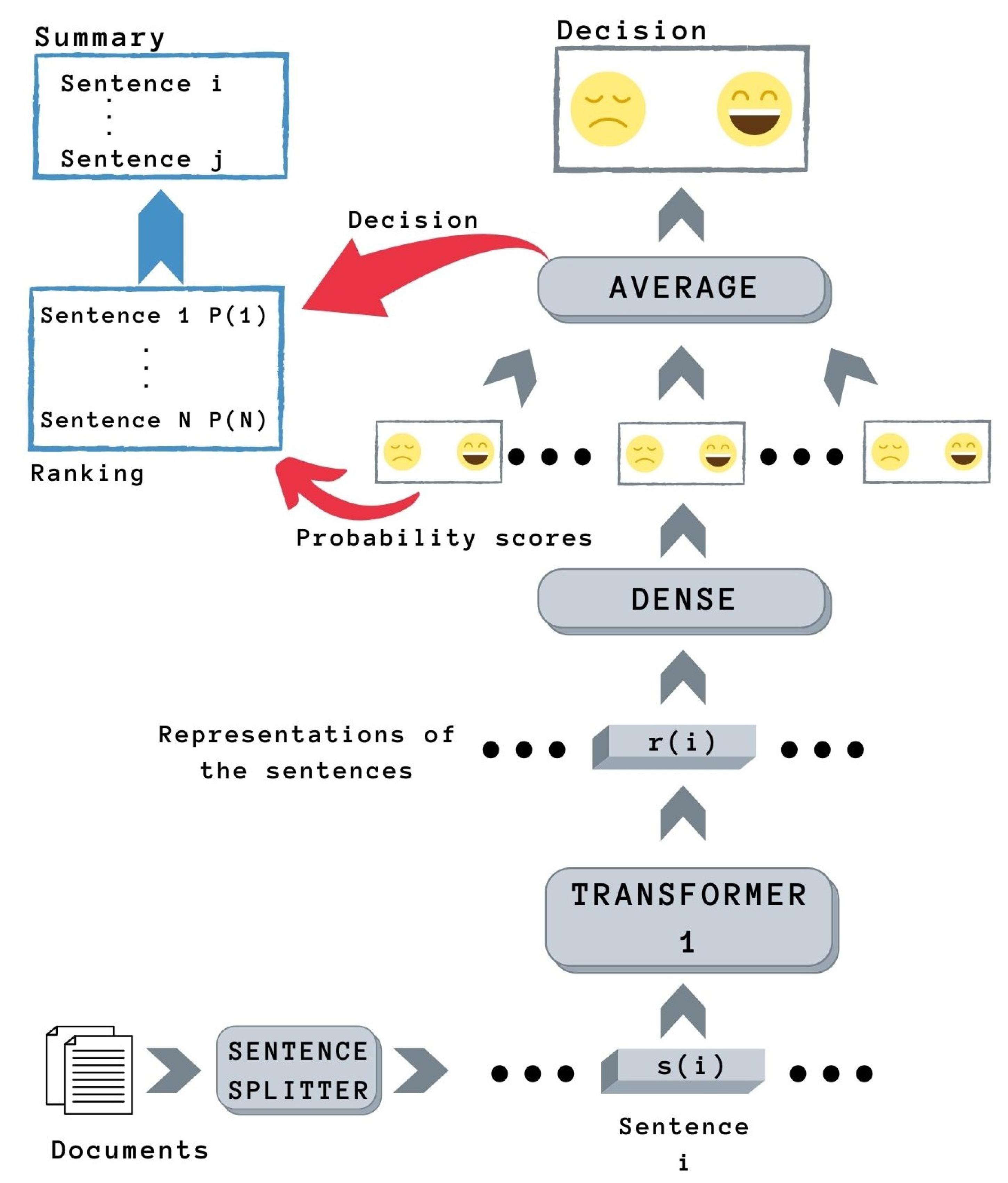
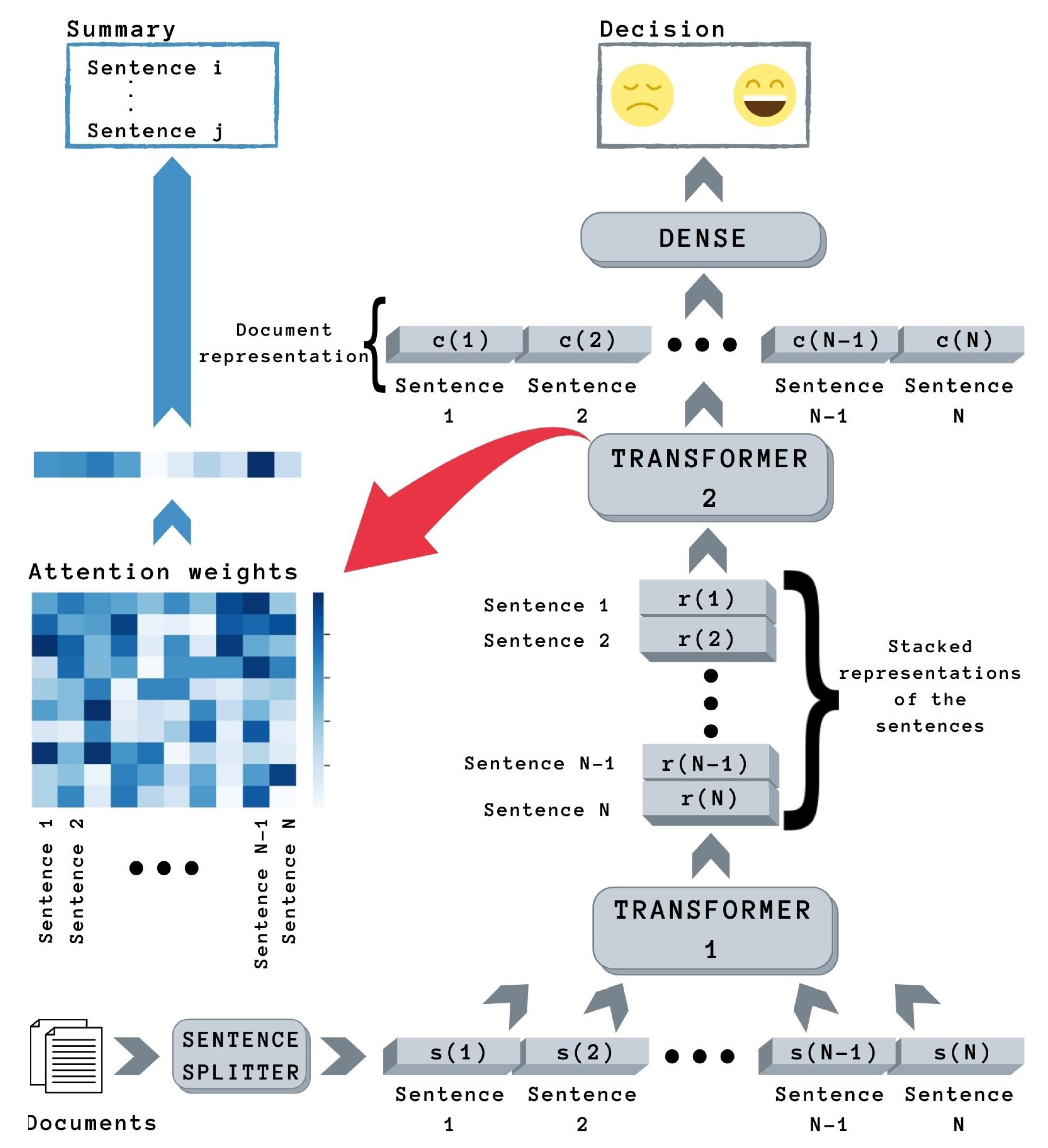
Here, we illustrate the two proposed architectures. To provide a visual explanation of them, we report the simplified schemes in Figure 1 and Figure 2.
Figure 1. Hierarchical transformers model.
Figure 2. Sentence classification combiner model.

3.2.1. Explainable Hierarchical Transformer (ExHiT)

The first model exploits a hierarchical architecture, consisting of two transformers ( T 1 and T 2 ) in cascade (Figure 1). Because of its nature, we like to refer at this as the ExplainableHierarchicalTransformer (ExHiT). The input of the first transformer is a sequence of t tokens, while the output is an embedding representation of that sequence. Each sequence represents one of the N sentences { s 1 s N } in which the document is divided. If a document can be divided into just m N sentences, then N m empty sentences (just the special tokens) are added to the document. After T 1 has elaborated the N sequences, the new generated representations { r 1 r N } are stacked together to become the input of T 2 . T 2 then outputs a contextual representation c i for the i-th sentence that depends on the other sentences ( c i = f ( r 1 r N ) ). By merging these contextual representations we obtain an unique document representation d = U ( c 1 c N ) . In this work, we investigated the following merging strategies:
  • By concatenation: U ( . ) = C o n c a t ( . ) ;
  • By averaging: U ( . ) = A v g ( . ) ;
  • By masked averaging: U ( c 1 c N ) = A v g ( c 1 c m ) with m N , for which { s m + 1 s N } is the set of the added empty sentences;
  • By the application of a Bidirectional LSTM: U ( . ) = B i L S T M ( . ) .
Then, vector d is given as input to a classification layer. In this work, such a layer consists of a two-units fully-connected dense layer with the softmax activation for the binary classification task. Other than the contextual representations, we were able to retrieve from T 2 also the self-attention weights for each head of each layer inside the transformer itself. To give more importance to the interpretability of the model instead of the performance, T 2 consists only of two layers and just one head per layer. In this way, it is easier to extract valuable information. By averaging the attention weights associated with a specific sentence, we extracted the score of that sentence. The sentences are ranked through such a score, and the most important ones are then selected to provide an extractive summary of the document. Such a summary serves then as the explanation of the model decision.

3.2.2. Sentence Classification Combiner Model (SCC)

This second model has a simpler architecture (Figure 2), requiring just one transformer model in its pipeline. The input of this transformer is again a sequence of t tokens, i.e., the single sentence s i . Again, its output is a new representation r i of that sentence. Such representation is given in input to a dense layer to classify the sentiment of the sentence, outputting two probability scores, one for each class. Then, the negative scores are averaged together, and the same for the positive ones, to get a final rating for each class. The prediction of the overall document sentiment will be given by whoever has the greatest final score. Knowing the decision of the model, the sentences are ranked by the inherent probability score. Then, the most relevant ones are extracted to build the summary of the document, serving as an explanation of the model decision.

3.2.3. Parameters

In the following, we listed the main features of the two models used in the experiment’s session:
  • T1: For a fair comparison, the first transformer model was the same for both the architectures; we opted to use the pre-trained version of RoBERTa [36];
  • T2: We used a transformer with two layers, one head per layer; this choice was motivated to facilitate the explainability phase;
  • N: The maximum number of sentences per document was set to 15; by this way, we ensured that the 75% of the training documents were elaborated in their entirety;
  • t: The maximum number of tokens per sentence was set to 32, comprehensive of the two special delimiter tokens; by this way, we ensured that the 75% of the training sentences were elaborated without being truncated.
In addition to the two models, we implemented a pre-processing phase consisting of the replacement of the tokens ’<\br><\br>’ with the newline character, and, obviously, a sentence splitting step. We used the sentence tokenizer provided by NLTK. Furthermore, for documents that do not reach N number of sentences, empty sentences (consisting of just the special tokens) were added up to N. Similar reasoning was applied to sentences that do not reach the t number of tokens: in these cases, the sequences were zero-padded on the right, and an attention mask was applied.

4. Experiments

The SCC model was trained on the single sentence classification task, with a batch size of 240 sequences. Thus, the transformer together with the dense layer has been trained to classify the sentiment of every single sentence. After that, the average layer has been added on top of the trained model to perform the document classification (and its explanation) in the test phase. For what concerns the ExHiT model, the experiments followed two different fashions, always maintaining a batch size of 8 documents.

4.1. Joint Training

In this kind of experiment, the entire model was jointly trained on the document classification task. In this conceptualization, the weights of both the two transformers, the dense layer and, eventually, the merging layer (BiLSTM) were allowed to be updated during the training phase.

4.2. Ablation Study

In this kind of study, a model is modified by adding or removing some features from its architecture. In a first experiment, we added to the model the following features:
  • Sinusoidal sentence positional embedding for T2 (SPE): following the original works on the transformers architectures, we added the positional embedding to the sentence embedding in input to the second transformer;
  • Sentence masking for T2 (SM): following the principle of the attention mask for the padded token of the sequences in input to the first transformer, we applied an attention mask on the empty sentences added at the bottom of the document.
These two items were added under the hypothesis that encoding the relative position between the sentences and masking the empty sentences may improve the model performance. In a second experiment, we froze the weights from the first transformer also during the training. This experiment was conducted to investigate the following hypothesis: by freezing its weights, no knowledge can be learned by T1 during the training phase; thus, this configuration should force the second transformer to learn the most important features from the document to perform the task it is trained for. Even if it could lead to degradation in the sentiment classification performance, if this assumption was confirmed, it could potentially lead to improving the explanation performances.
The ablation study experiments were conducted using the ExHiT model implementing the concatenation merging strategy.

5. Results

The proposed models were evaluated for both sentiment analysis and explainability outcomes. In Table 1, we reported the sentiment analysis results achieved in terms of accuracy, and precision, recall, and F1-score per class. For the ExHiT model, various proposed merging strategies were tested. As the accuracy column highlights, changing the merging strategy does not significantly affects classification performance.
Table 1. Sentiment analysis results in terms of accuracy, and precision, recall, and F1-score per class.
Following the same structure, in Table 2 we reported the explainability outcomes in terms of precision averaged over all the documents. The performances are reported for different annotators’ agreements, i.e., we built summaries by grouping the sentences for which at least one, two, or three out of the four annotators judged them among the most important ones. This implies that some annotators’ summaries of the j-th document may contain more than three sentences ( N j > 3 , especially in the first case) or less than three sentences ( N j < 3 , especially in the latter case). Therefore, we extracted the first N j sentences in the machine’s ranking and evaluated the overlap of these summaries with the annotators’ ones. The formula of the introduced explainability metric is reported in Equation (2):
P r e c i s i o n = 1 D j D T P j N j [ 0 , 1 ]
where D is the number of documents, N j is the number of sentences in the annotators’ summary, and T P j is the number of well-selected sentences in the system summary of the j-th document. Documents for which N j was equal to 0 were excluded from the computation. This may happen, in particular, where an agreement of at least three annotators was required. About the ExHiT performance, the results of the best layer are reported. In general, the ranking from the first layer slightly outperformed the rankings from the last layer and the rankings obtained by averaging both layers. Furthermore, the empty sentences were removed by the machine rankings.
Table 2. Explainability performance in terms of precision (averaged over all documents) for different annotators agreements, evaluated on both the annotated documents from training and test sets. For ExHiT model the performances from the first layer are reported, except when the rankings from the last layer 1 or from the average of layers a have shown better results.
For what concerns the ablation study on the ExHiT model, we combined the configurations described in Section 4.2, exploiting only the concatenation merging strategy. We reported the results of these experiments in Table 3, both in terms of accuracy and explainability precision. Again, the explainability performances are related with the first layer in general, except when the last layer or an average between both presents (slightly) better summaries. However, in the models implementing the sentence masking for the second transformer we found out a greater degree of agreement between the layers, and it was not rare to see the precision scores from the first layer only slight higher than the scores retrieved from the last layer (or the scores obtained by averaging the attention weights from both layers).
Table 3. Ablation study outcomes for the ExHiT model, both in terms of accuracy and explainability precision. SM stands for sentence masking, SPE stands for sentence positional embeddings. Frozen T1 indicates that the the weights of T1 were frozen during the training. The model is intended to implement the concatenation merging strategy. As in Table 2, results from the last layer or from the average of layers are indicated with the apices 1 and a, respectively. Otherwise, the reported results are intended to be related with the first layer.
In Table 2 and Table 3, we compared the different models’ explainability with what we may call the explainability precision. Such a metric may take place with a priori annotations, i.e., the annotations are made on the original documents. To conduct a more in-depth analysis on the explainability error, we are also proposing a new metric that takes advantage of a posteriori annotations, i.e., the annotations are made on the (N=) 3-sentences summaries retrieved by each model. Here, the annotators were instructed to annotate each sentence as (1), negative (−1) or neutral (0) depending on the polarity of the document it lets them understand. The final score of the model exploits a sort of mean absolute error (MAE) for discrete variables. Hence, the total score is computed by following Equation (3)
1 1 2 M A E = 1 1 2 D j D 1 N j i N j | c j s j , i | [ 0 , 1 ]
where D is the number of documents, N is the number of sentences per summary, c j is the predicted class of the j-th document, and s j , i is the annotated score of the i-th sentence (of the j-th document), and 1 2 is a corrective factor to map the range of the MAE function (and, therefore, of the score) into an interval of [ 0 , 1 ] . In particular, in our case we fixed N j to be equal to N = 3 , also excluding the documents with less than 3 sentences from the computation of the total score). In this case, the previous equation may be rewritten in the form of the following equation:
1 1 2 M A E = 1 1 2 D N j D i N | c j s j , i | [ 0 , 1 ]
The contribution of each sentence 1 2 | c j s j , i | to the total score is, therefore, equal to 0 if the prediction and the sentence score belong to the same class, −1 if they belong to opposite classes, and 1 2 if the sentence is annotated as neutral. Thus, the total score is a real number that lies in the range between 0 (dramatic extreme case, in which all the sentences belongs to the class opposite of the prediction) and 1 (desirable extreme case, in which all sentences belongs to the same class of the prediction). In particular, if the score is equal to 1 2 , it means that all the extracted sentences are evaluated as neutral by the humans (or that the number of well-ranked sentences counterbalances the number of the sentences classified as belonging to the class opposite of the prediction). Thus:
  • If 1 1 2 M A E < 1 2 the model performance is worst than if it chose all neutral sentences;
  • If 1 1 2 M A E > 1 2 the model is going better than if it chose all neutral sentences.
To avoid any bias for the annotators deriving from the prediction of the model or from the other sentences of the document, the predicted class was obscured and the sentences of all the documents were shuffled together. The annotations were performed just for three of the models trained in this work, as reported in Table 4. In particular, the results about the ExHiT-based systems come from the attention head of the first layer of the second transformer.
Table 4. Explainability performance in terms of the proposed score, reported in Equation (4), and percentage of summary’s sentences annotated as neutral. The ExHiT models are intended to be implemented with the concatenation merging strategy, and the summaries built by the first layer are analyzed.

6. Discussion

By analyzing Table 1, the SCC model seems to achieve a slightly better overall performance. However, it is interesting to notice that SCC results are particularly good for the precision for the negative class and the recall for the positive one while achieving the worst performances for their counterpart metrics, for which the best results are obtained by ExHiT using the concatenation merging strategy. About Table 2, the ExHiT explainability results are lower than those achieved by SCC, with respect to all the merging strategies. This outcome may be due to an influence of the task on the two models: it may be noticed that the task the second model accomplishes is closer to the one performed by the annotators. It may, therefore, help the SCC model in the explainability task. Furthermore, the average merging strategy leads to better performance than the masked one, especially with respect to the test set (∼+5%). This seems to suggest that masking the empty sentences from the average combination after the elaboration of the second transformer does not help the model to better understand the task.
For what concerns the ablation study conducted in this work, the obtained results are very interesting (Table 3), in particular, for what regards the explainability performance. In fact, while the sentiment classification did not show significant improvements in terms of accuracy, ExHiT models implementing the empty sentence masking have shown significant improvements in terms of explainability precision, achieving results comparable with the SCC model. In some cases, it reaches even better outcomes, especially when it is combined with the introduction of the sinusoidal sentence position embeddings, a strategy that has shown explainability improvements even when implemented alone. Furthermore, exploiting a qualitative analysis of the outcomes of the various models, it has been observed how the ExHiT-based systems “suffer” from the noisy empty sentences added to achieve the maximum number of the sentence required by the architecture, with the exception of the models implementing the sentence mask. This behavior is highlighted in Table 5, reporting the sentences from the same document ranked by two ExHiT models, one not implementing the sentence mask and one that does it, respectively. In the example reported here, it is easy to notice the presence of the empty sentences among the first positions of the ranking built by the former, while they are always ignored by the latter model itself and thus put on the bottom part of the constructed ranking.
Table 5. Example of document summary generated by two ExHiT models, one implementing sentence masking (right) and the other without the sentence mask (left). The index columns indicate the position of each sentence in the original document.
These considerations seem to suggest that the sentence mask is essential to filter out the noisy empty sentences and, therefore, better understand the task. However, with or without sentence masking, the performances of the classification task of the two kinds of models are not so far from each other. Thus, we hypothesized that, in absence of the sentence masking, the model captures other kinds of information from the text and learns how to use them to perform the sentiment analysis task. Exploiting these features thus leads to good performance in the main task, but being inherently less interpretable for humans it is inevitable for the model to reach worse explainability performance.
The performed ablation study reports interesting results when T1 weights are frozen during the training phase. In this case, the model has shown good improvements in terms of explainability precision. This seems to confirm our hypothesis that freezing the first transformer prevents it from adapting to the task during training and then forces the second transformer to boost its ability to extract important information from the sentences. In fact, the results in Table 3 show that this trick can in part compensate for the absence of sentence masking, at the cost of ∼3 percentage points on the classification accuracy.
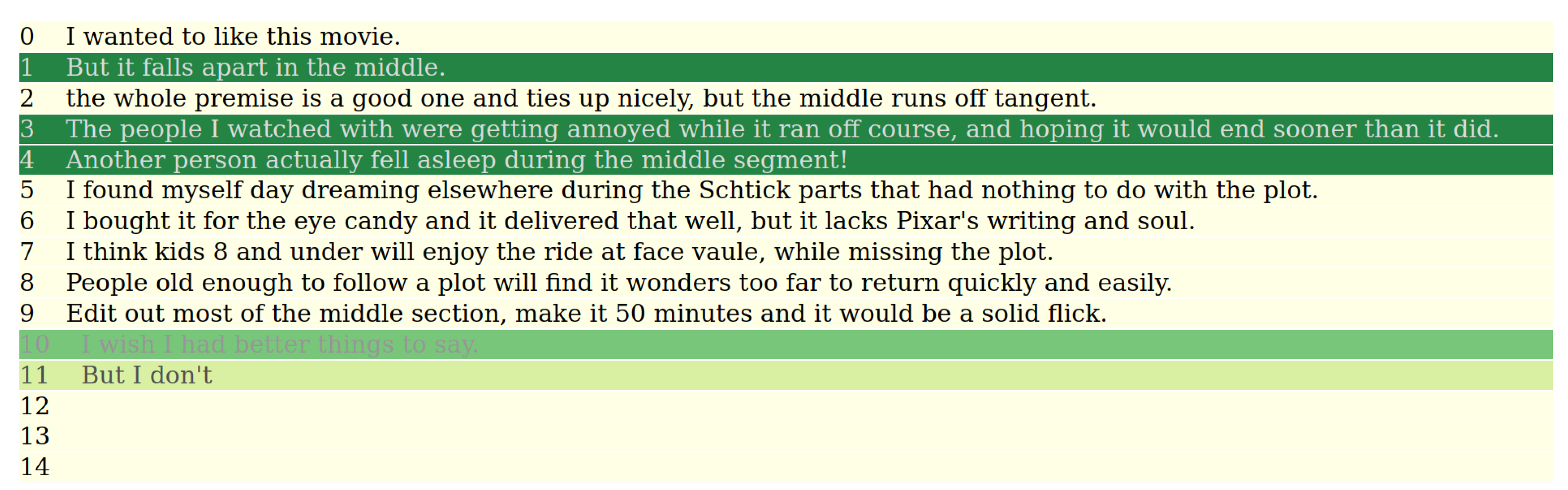
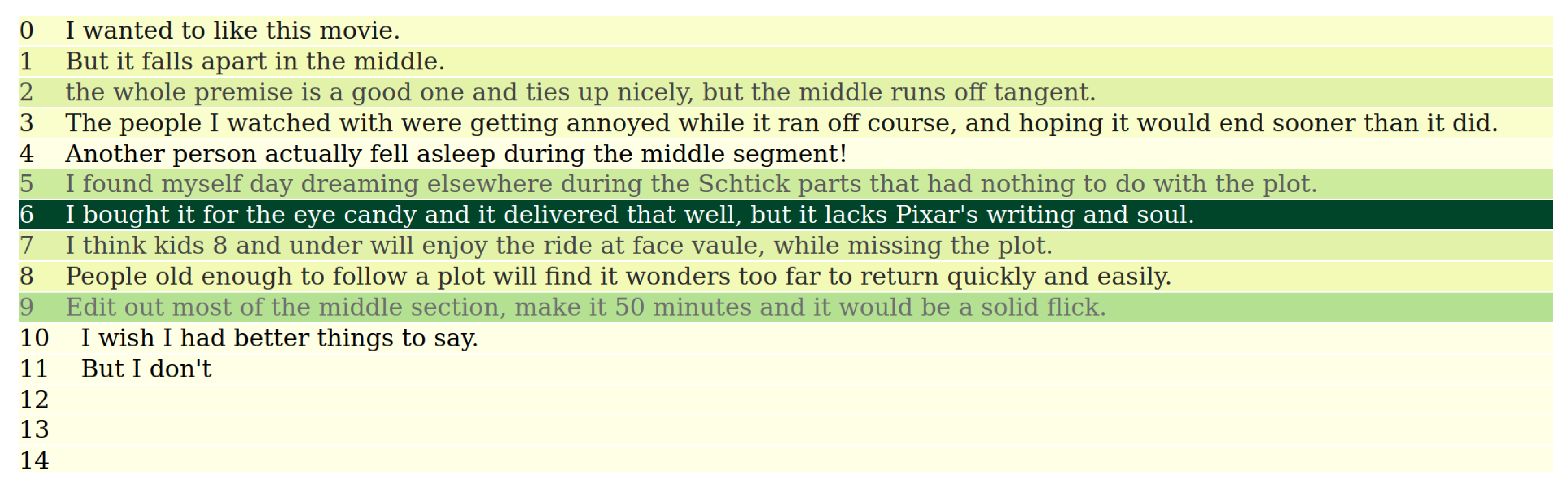
For what concerns explainability, in Table 4 results in terms of MAE are reported for some models. We proposed this kind of metric after visualizing models’ outcomes. Figure 3 shows an example of document annotation performed by the annotators, in which darker background means higher relevance in the document, computed as the average of agreement among the annotators. Figure 4 shows the annotations performed by the SCC model on the same example. Again, darker background means higher relevance, in this case in terms of the probability scores.
Figure 3. Example of document annotation performed (a priori) by the instructed annotators.
Figure 4. Example of document annotation performed by the SCC model during the classification.
As it can be seen, if we consider the case of agreement of at least three out of the four annotators, the explainability precision would be null. In fact, the annotators’ summary would be built by extracting the sentences numbered as {1, 3, and 4} while the model’s summary would consist of the sentences numbered as {5, 6, and 9}. However, at a further analysis, it seems clear that the second set of sentences contain a negative sentiment, as well as the first set. Thus, the introduction of such a posteriori metric was necessary to perform a fairer comparison between the models. Unfortunately, being a posteriori metric brings the drawback to perform human annotations on the outcomes of each model we want to compare. For this reason, this analysis was limited only to three of the developed models. The outcomes in terms of this metric (Table 4) still show the SCC model to outperform the other(s). Very interestingly, for the test dataset, it achieves a very high score, greater than 92%. This seems to suggest that this model not only can achieve a near state-of-the-art accuracy in the sentiment analysis task but also provides a very accurate extractive summary as an explanation of the predicted class. However, to compute this metric the introduction of a new class, the neutral one, was necessary to perform the annotations. The reason is, of course, we cannot exclude a priori that some summary extracted from the template may contain uninformative sentences with respect to the sentiment of the full review. In particular, for both kinds of models, many of the sentences classified by annotators as neutral are excerpts of plot narration. For example, the sentence
But success has it’s downside, as Macbeth soon finds out, when he has to go to hideous lengths to protect his murderous secret.
is simply a description of a plot passage in the movie Macbeth—The tragedy of ambition and contains no information about the sentiment of the review provided by the user and, therefore, would be impossible for an annotator to classify as black or white. Another kind of sentence extracted by the models is sentences that may gain a sentiment sense only if seen together with the previous or next parts of the document. For example, the sentence
You’ll be glad you did.
has no particular sentiment when picked alone and gives no clue about the polarity of the document. In fact, it is licit for an annotator to wonder: I’ll be glad I did what?. Thus, this sentence alone does not give good hints to guess the sentiment nature of the document. However, if you look at this sentence inside its context
Do yourself a favor and avoid this movie at all costs. You’ll be glad you did.
it can be easily noticed that it enforces the negative sense of the previous part of the discourse. The annotators reported this kind of behavior for the ExHiT model, in particular, and this seems to be confirmed by the last two columns of Table 4, where a greater percentage of neutral annotations is reported for both training and test set with respect to the SCC model. This seems to suggest that the ExHiT model it is less suited to perform single sentence-extractive summaries, because of a more contextual understanding of the document classification task. However, the ExHiT version implementing both the sentence masking and positional embeddings has been reported to less show this behavior. In fact, its neutral percentage is way lower than the simpler version. In the case of the training set, it is even lower than the SCC system. Furthermore, also the proposed score presents a significant improvement. These outcomes suggest, once again, how these components are of great importance to the interpretability of the hierarchical model.

7. Conclusions

In this work, we proposed two transformer-based architectures to perform a task of (document) sentiment analysis classification while also providing an extractive summary of the classified document as an explanation of the model decision. These architectures were designed to exploit the inherent hierarchy of documents, with the lower part of the model consisting of a transformer working at the intra-sentence tokens level, and the higher part working at the inter-sentences level. In the ExHiT case, the higher part consists of another transformer, one layer implementing some merging strategy, and a classifier layer. In the SCC case, the higher part just consists of an averaging layer to provide the document classification by averaging the classification scores of the single sentences constituting the whole text. For both models, the summary is built by extracting the original sentences from the document. The extraction phase takes place after ranking those sentences depending on the scores intrinsically computed by the two models. In the former case, we exploited the self-attention weights of the second transformer to produce those rankings, in the latter we used the probability scores assigned by the lower part of the system to the single sentences. To evaluate the built summaries, we proposed two metrics. However, by comparing the explainability results in Table 3 and Table 4, the tested models seem to share the same behavior with regard to both the proposed explainability metrics. Therefore, although being less fairer to the models themselves, it would not be wrong to prefer the precision metric over the other one to compare the explainability of different systems.
To the best of our knowledge, this is the first attempt to build a document classification paradigm of models that generate an extractive summary in order to provide an easy to interpret explanation to the user. Therefore, such models may be implemented in the near future in some industrial applications, such as customer care or market research tools. Both the proposed models have, in fact, achieved good classification results, not so far from the works at the state-of-the-art on the IMDB dataset, while also performing an explanation in the form of a summary. The explainability component of the models, achieving good results, as well as the classification one, is a feature that may become essential in several applications. For example, while sentiment analysis may help to mark customer messages and reviews, the explainability part may be helpful to get quick insights about the strengths and the weaknesses of some product or service. Furthermore, both underlying architectures allow their easy adaptation in any document classification task (e.g., topic classification). Plus, both models may be applied to any language: the only restriction is to use the suitable pre-trained model as T1, i.e., a transformer model that has been pre-trained on the task language (or, at least, in a multilingual fashion). This is an interesting point of view for the next research works to focus on. Sentiment analysis is, in fact, a task that particularly relies on the lexical meaning of the individual sentences. Therefore, evaluating our models on a different kind of task may show ExHiT outperforming the SCC model because of its ability to get more insights from the context of the other sentences in the document. In particular, since both models hide the potential to be able to operate on tasks involving longer documents, which is a sort of limitation for traditional transformer architectures, it would be very interesting to study if they can overcome such a limit by applying them to tasks requiring large documents, say several hundreds of tokens (or even more!). Another attractive idea to follow is to go in-depth with the analyses in the ablation study for the ExHiT architecture. We have shown how masking the empty sentences and adding the positional embedding may play an important role for the model, and how freezing the first transformer during training may force the higher part to learn more interpretable features. Future research may extend this kind of study by evaluating the performance (both in terms of classification and explainability) achieved by deeper models, e.g., adding more layers and self-attention heads to the second transformer. To conclude, the explainability at a finer granularity (the tokens level) may be explored by investigating the attention weights of the first transformer for both kinds of architectures, e.g., by highlighting the most important words in each sentence.

Author Contributions

Conceptualization: F.D. and M.M.; methodology: L.B., A.C., F.D. and M.M.; software: L.B. and A.C.; validation: A.C., F.D. and M.M.; formal analysis: M.M.; investigation: L.B.; resources: F.D.; data curation: L.B. and A.C.; writing—original draft preparation: L.B.; writing—review and editing: A.C., F.D. and M.M.; visualization: L.B.; supervision: F.D. and M.M.; project administration: F.D. and M.M.; funding acquisition: F.D. All authors have read and agreed to the published version of the manuscript.

Funding

This research received no external funding.

Data Availability Statement

Data used in this work come from the IMDB Large Movie Review Dataset. It was downloaded using the Tensorflow (https://www.tensorflow.org/datasets/catalog/imdb_reviews, accessed on 15 January 2021) API. Part of this dataset were also extracted and annotated to evaluate the explainability performance of our models. These annotations are available on our GitHub page (www.github.com/lbacco/ExS4ExSA, accessed on 28 June 2021), together with the codes used to assess the quality of the annotations and the code used in this work.

Conflicts of Interest

The authors declare no conflict of interest.

Abbreviations

The following abbreviations are used in this manuscript:
ExHiTExplainable hierarchical transformer
MAEMean absolute error
SCCSentence classification combiner
SMSentence mask(ing)
SPE(sinusoidal) Sentence positional embeddings

References

  1. Dashtipour, K.; Gogate, M.; Cambria, E.; Hussain, A. A novel context-aware multimodal framework for persian sentiment analysis. arXiv 2021, arXiv:2103.02636. [Google Scholar]
  2. Gunning, D. Explainable Artificial Intelligence (XAI); Defense Advanced Research Projects Agency (DARPA): Arlington County, VA, USA, 2017. [Google Scholar]
  3. Gunning, D.; Aha, D. DARPA’s explainable artificial intelligence (XAI) program. AI Mag. 2019, 40, 44–58. [Google Scholar]
  4. Arrieta, A.B.; Díaz-Rodríguez, N.; Del Ser, J.; Bennetot, A.; Tabik, S.; Barbado, A.; García, S.; Gil-López, S.; Molina, D.; Benjamins, R.; et al. Explainable Artificial Intelligence (XAI): Concepts, taxonomies, opportunities and challenges toward responsible AI. Inf. Fusion 2020, 58, 82–115. [Google Scholar] [CrossRef] [Green Version]
  5. Loyola-Gonzalez, O. Black-box vs. white-box: Understanding their advantages and weaknesses from a practical point of view. IEEE Access 2019, 7, 154096–154113. [Google Scholar] [CrossRef]
  6. Danilevsky, M.; Qian, K.; Aharonov, R.; Katsis, Y.; Kawas, B.; Sen, P. A survey of the state of explainable AI for natural language processing. arXiv 2020, arXiv:2010.00711. [Google Scholar]
  7. Vaswani, A.; Shazeer, N.; Parmar, N.; Uszkoreit, J.; Jones, L.; Gomez, A.N.; Kaiser, Ł.; Polosukhin, I. Attention is all you need. In Proceedings of the Advances in Neural Information Processing Systems, Long Beach, CA, USA, 4–9 December 2017. [Google Scholar]
  8. Maas, A.; Daly, R.E.; Pham, P.T.; Huang, D.; Ng, A.Y.; Potts, C. Learning word vectors for sentiment analysis. In Proceedings of the 49th Annual Meeting of the Association for Computational Linguistics: Human Language Technologies, Portland, Oregon, 19–24 June 2011; pp. 142–150. [Google Scholar]
  9. Liu, B. Sentiment analysis and opinion mining. Synth. Lect. Hum. Lang. Technol. 2012, 5, 1–167. [Google Scholar] [CrossRef] [Green Version]
  10. McGlohon, M.; Glance, N.; Reiter, Z. Star quality: Aggregating reviews to rank products and merchants. In Proceedings of the Fourth International AAAI Conference on Weblogs and Social Media, Washington, DC, USA, 23–26 May 2010. [Google Scholar]
  11. Zarzour, H.; Al shboul, B.; Al-Ayyoub, M.; Jararweh, Y. Sentiment Analysis Based on Deep Learning Methods for Explainable Recommendations with Reviews. In Proceedings of the 2021 12th International Conference on Information and Communication Systems (ICICS), Valencia, Spain, 24–26 May 2021; pp. 452–456. [Google Scholar]
  12. Gite, S.; Khatavkar, H.; Kotecha, K.; Srivastava, S.; Maheshwari, P.; Pandey, N. Explainable stock prices prediction from financial news articles using sentiment analysis. PeerJ Comput. Sci. 2021, 7, e340. [Google Scholar] [CrossRef]
  13. Joshi, M.; Das, D.; Gimpel, K.; Smith, N.A. Movie reviews and revenues: An experiment in text regression. In Proceedings of the Human Language Technologies: The 2010 Annual Conference of the North American Chapter of the Association for Computational Linguistics, Los Angeles, CA, USA, 2–4 June 2010; pp. 293–296. [Google Scholar]
  14. Hu, M.; Liu, B. Mining opinion features in customer reviews. AAAI 2004, 4, 755–760. [Google Scholar]
  15. Silveira, T.D.S.; Uszkoreit, H.; Ai, R. Using Aspect-Based Analysis for Explainable Sentiment Predictions. In Proceedings of the CCF International Conference on Natural Language Processing and Chinese Computing, Zhengzhou, China, 14–18 October 2019. [Google Scholar]
  16. Baccianella, S.; Esuli, A.; Sebastiani, F. Sentiwordnet 3.0: An enhanced lexical resource for sentiment analysis and opinion mining. In Proceedings of the International Conference on Language Resources and Evaluation, LREC 2010, Valletta, Malta, 17–23 May 2010. [Google Scholar]
  17. Cambria, E.; Speer, R.; Havasi, C.; Hussain, A. Senticnet: A publicly available semantic resource for opinion mining. In Proceedings of the AAAI Fall Symposium: Commonsense Knowledge, Arlington, VA, USA, 11–13 November 2010. [Google Scholar]
  18. Zhang, Y.; Lai, G.; Zhang, M.; Zhang, Y.; Liu, Y.; Ma, S. Explicit factor models for explainable recommendation based on phrase-level sentiment analysis. In Proceedings of the 37th International Acm Sigir Conference on Research & Development in Information Retrieval, Gold Coast, Australia, 6–11 July 2014. [Google Scholar]
  19. Zhao, A.; Yu, Y. Knowledge-enabled BERT for aspect-based sentiment analysis. Knowl. Based Syst. 2021, 227, 107220. [Google Scholar] [CrossRef]
  20. Bacco, L.; Cimino, A.; Dell’Orletta, F.; Merone, M. Extractive Summarization for Explainable Sentiment Analysis Using Transformers. 2021. Available online: https://openreview.net/pdf?id=xB1deFXLaF9 (accessed on 7 July 2021).
  21. El-Kassas, W.S.; Salama, C.R.; Rafea, A.A.; Mohamed, H.K. Automatic text summarization: A comprehensive survey. Expert Syst. Appl. 2020, 165, 113679. [Google Scholar] [CrossRef]
  22. Elman, J.L. Finding structure in time. Cogn. Sci. 1990, 14, 179–211. [Google Scholar] [CrossRef]
  23. Schuster, M.; Paliwal, K.K. Bidirectional recurrent neural networks. IEEE Trans. Signal Process. 1997, 45, 2673–2681. [Google Scholar] [CrossRef] [Green Version]
  24. Bengio, Y.; Simard, P.; Frasconi, P. Learning long-term dependencies with gradient descent is difficult. IEEE Trans. Neural Netw. 1994, 5, 157–166. [Google Scholar] [CrossRef]
  25. Hochreiter, S.; Schmidhuber, J. Long short-term memory. Neural Comput. 1997, 9, 1735–1780. [Google Scholar] [CrossRef]
  26. Cho, K.; Van Merriënboer, B.; Gulcehre, C.; Bahdanau, D.; Bougares, F.; Schwenk, H.; Bengio, Y. Learning phrase representations using RNN encoder-decoder for statistical machine translation. arXiv 2014, arXiv:1406.1078. [Google Scholar]
  27. Sundermeyer, M.; Schlüter, R.; Ney, H. LSTM neural networks for language modeling. In Proceedings of the Thirteenth Annual Conference of the International Speech Communication Association, Portland, Oregon, 9–13 September 2012. [Google Scholar]
  28. Sundermeyer, M.; Ney, H.; Schlüter, R. From feedforward to recurrent LSTM neural networks for language modeling. IEEE/ACM Trans. Audio Speech Lang. Process. 2015, 23, 517–529. [Google Scholar] [CrossRef]
  29. Larochelle, H.; Hinton, G.E. Learning to combine foveal glimpses with a third-order boltzmann machine. In Proceedings of the Advances in Neural Information Processing Systems, Vancouver, BC, Canada, 6–9 December 2010. [Google Scholar]
  30. Bahdanau, D.; Cho, K.; Bengio, Y. Neural machine translation by jointly learning to align and translate. arXiv 2014, arXiv:1409.0473. [Google Scholar]
  31. Radford, A.; Narasimhan, K.; Salimans, T.; Sutskever, I. Improving Language Understanding by Generative Pre-Training. 2018. Available online: https://s3-us-west-2.amazonaws.com/openai-assets/research-covers/language-unsupervised/language_understanding_paper.pdf (accessed on 8 February 2021).
  32. Radford, A.; Wu, J.; Child, R.; Luan, D.; Amodei, D.; Sutskever, I. Language Models are Unsupervised Multitask Learners. 2019. Available online: https://d4mucfpksywv.cloudfront.net/better-language-models/language_models_are_unsupervised_multitask_learners.pdf (accessed on 8 February 2021).
  33. Brown, T.B.; Mann, B.; Ryder, N.; Subbiah, M.; Kaplan, J.; Dhariwal, P.; Neelakantan, A.; Shyam, P.; Sastry, G.; Askell, A.; et al. Language models are few-shot learners. arXiv 2020, arXiv:2005.14165. [Google Scholar]
  34. Yang, Z.; Dai, Z.; Yang, Y.; Carbonell, J.; Salakhutdinov, R.R.; Le, Q.V. Xlnet: Generalized autoregressive pretraining for language understanding. In Proceedings of the Advances in Neural Information Processing Systems, Vancouver, BC, Canada, 8–14 December 2019. [Google Scholar]
  35. Devlin, J.; Chang, M.W.; Lee, K.; Toutanova, K. Bert: Pre-training of deep bidirectional transformers for language understanding. arXiv 2018, arXiv:1810.04805. [Google Scholar]
  36. Liu, Y.; Ott, M.; Goyal, N.; Du, J.; Joshi, M.; Chen, D.; Levy, O.; Lewis, M.; Zettlemoyer, L.; Stoyanov, V. Roberta: A robustly optimized bert pretraining approach. arXiv 2019, arXiv:1907.11692. [Google Scholar]
  37. Sanh, V.; Debut, L.; Chaumond, J.; Wolf, T. DistilBERT, a distilled version of BERT: smaller, faster, cheaper and lighter. arXiv 2019, arXiv:1910.01108. [Google Scholar]
  38. Wolf, T.; Chaumond, J.; Debut, L.; Sanh, V.; Delangue, C.; Moi, A.; Rush, A.M. Transformers: State-of-the-art natural language processing. In Proceedings of the 2020 Conference on Empirical Methods in Natural Language Processing: System Demonstrations, Stroudsburg, PA, USA, 16–20 November 2020. [Google Scholar]
  39. Pan, S.J.; Yang, Q. A survey on transfer learning. IEEE Trans. Knowl. Data Eng. 2009, 22, 1345–1359. [Google Scholar] [CrossRef]
  40. Wang, A.; Singh, A.; Michael, J.; Hill, F.; Levy, O.; Bowman, S.R. Glue: A multi-task benchmark and analysis platform for natural language understanding. arXiv 2018, arXiv:1804.07461. [Google Scholar]
  41. Peters, M.E.; Neumann, M.; Iyyer, M.; Gardner, M.; Clark, C.; Lee, K.; Zettlemoyer, L. Deep contextualized word representations. arXiv 2018, arXiv:1802.05365. [Google Scholar]
  42. Howard, J.; Ruder, S. Universal language model fine-tuning for text classification. arXiv 2018, arXiv:1801.06146. [Google Scholar]
  43. Pappagari, R.; Zelasko, P.; Villalba, J.; Carmiel, Y.; Dehak, N. Hierarchical transformers for long document classification. In Proceedings of the 2019 IEEE Automatic Speech Recognition and Understanding Workshop (ASRU), Singapore, 14–18 December 2019. [Google Scholar]
  44. Pelicon, A.; Pranjić, M.; Miljković, D.; Škrlj, B.; Pollak, S. Zero-shot learning for cross-lingual news sentiment classification. Appl. Sci. 2020, 10, 5993. [Google Scholar] [CrossRef]
  45. Zhang, X.; Wei, F.; Zhou, M. HIBERT: Document level pre-training of hierarchical bidirectional transformers for document summarization. arXiv 2019, arXiv:1905.06566. [Google Scholar]
  46. Xu, S.; Zhang, X.; Wu, Y.; Wei, F.; Zhou, M. Unsupervised Extractive Summarization by Pre-training Hierarchical Transformers. arXiv 2020, arXiv:2010.08242. [Google Scholar]
  47. Vig, J. A multiscale visualization of attention in the transformer model. arXiv 2019, arXiv:1906.05714. [Google Scholar]
  48. Kovaleva, O.; Romanov, A.; Rogers, A.; Rumshisky, A. Revealing the dark secrets of BERT. arXiv 2019, arXiv:1908.08593. [Google Scholar]
  49. Voita, E.; Serdyukov, P.; Sennrich, R.; Titov, I. Context-aware neural machine translation learns anaphora resolution. arXiv 2018, arXiv:1805.10163. [Google Scholar]
  50. Goldberg, Y. Assessing BERT’s syntactic abilities. arXiv 2019, arXiv:1901.05287. [Google Scholar]
  51. Wolf, T. Some Additional Experiments Extending the Tech Report “Assessing BERTs Syntactic Abilities” by Yoav Goldberg. 2019. Available online: https://huggingface.co/bert-syntax/extending-bert-syntax.pdf (accessed on 5 February 2021).
  52. Hewitt, J.; Manning, C.D. A structural probe for finding syntax in word representations. In Proceedings of the 2019 Conference of the North American Chapter of the Association for Computational Linguistics: Human Language Technologies, Minneapolis, MN, USA, 2–7 June 2019; Volume 1, pp. 4129–4138. [Google Scholar]
  53. Raganato, A.; Tiedemann, J. An analysis of encoder representations in transformer-based machine translation. In Proceedings of the 2018 EMNLP Workshop BlackboxNLP: Analyzing and Interpreting Neural Networks for NLP, Brussels, Belgium, 1 November 2018. [Google Scholar]
  54. Vig, J.; Belinkov, Y. Analyzing the structure of attention in a transformer language model. arXiv 2019, arXiv:1906.04284. [Google Scholar]
  55. Voita, E.; Talbot, D.; Moiseev, F.; Sennrich, R.; Titov, I. Analyzing multi-head self-attention: Specialized heads do the heavy lifting, the rest can be pruned. arXiv 2019, arXiv:1905.09418. [Google Scholar]
  56. Franz, L.; Shrestha, Y.R.; Paudel, B. A deep learning pipeline for patient diagnosis prediction using electronic health records. arXiv 2020, arXiv:2006.16926. [Google Scholar]
  57. Letarte, G.; Paradis, F.; Giguère, P.; Laviolette, F. Importance of self-attention for sentiment analysis. In Proceedings of the 2018 EMNLP Workshop BlackboxNLP: Analyzing and Interpreting Neural Networks for NLP, Brussels, Belgium, 1 November 2018. [Google Scholar]
  58. Bodria, F.; Panisson, A.; Perotti, A.; Piaggesi, S. Explainability Methods for Natural Language Processing: Applications to Sentiment Analysis (Discussion Paper). 2020. Available online: http://ceur-ws.org/Vol-2646/18-paper.pdf (accessed on 17 January 2021).
  59. Ribeiro, M.T.; Singh, S.; Guestrin, C. “Why should i trust you?” Explaining the predictions of any classifier. In Proceedings of the 22nd ACM SIGKDD International Conference on Knowledge Discovery and Data Mining, San Francisco, CA, USA, 13–17 August 2016. [Google Scholar]
  60. Zhang, Y.; Song, K.; Sun, Y.; Tan, S.; Udell, M. “Why Should You Trust My Explanation?” Understanding Uncertainty in LIME Explanations. arXiv 2019, arXiv:1904.12991. [Google Scholar]
  61. Sundararajan, M.; Taly, A.; Yan, Q. Axiomatic attribution for deep networks. In Proceedings of the International Conference on Machine Learning, Sydney, Australia, 6–11 August 2017; pp. 3319–3328. [Google Scholar]
  62. Krippendorff, K. Estimating the reliability, systematic error and random error of interval data. Educ. Psychol. Meas. 1970, 30, 61–70. [Google Scholar] [CrossRef]
  63. Krippendorff, K. Content Analysis: An Introduction to Its Methodology, 2nd ed.; SAGE Publications, Inc.: Thousand Oaks, CA, USA, 2004. [Google Scholar]
  64. Krippendorff, K. Reliability in content analysis: Some common misconceptions and recommendations. Hum. Commun. Res. 2004, 30, 411–433. [Google Scholar] [CrossRef]
Publisher’s Note: MDPI stays neutral with regard to jurisdictional claims in published maps and institutional affiliations.

Article Metrics

Citations

Article Access Statistics

Multiple requests from the same IP address are counted as one view.