Article

Agro-Industrial Kiwifruit and Apple Waste as a Renewable Feedstock for Biomethane Production—A Study of Feedstock Viability

by
Enola Brecht
1,2 and
Peter Kovalsky
1,*
1
School of Engineering, University of Waikato, Private Bag 3105, Hamilton 3240, New Zealand
2
Department of Biotechnology, University of Applied Sciences Mannheim, Paul-Wittsack-Straße 10, 68163 Mannheim, Germany
*
Author to whom correspondence should be addressed.
Resources 2026, 15(3), 41; https://doi.org/10.3390/resources15030041

Submission received: 20 January 2026 / Revised: 24 February 2026 / Accepted: 27 February 2026 / Published: 4 March 2026

Abstract

New Zealand’s kiwifruit and apple industries generate substantial quantities of organic residues during thinning and harvest, much of which is composted or disposed of in landfills due to logistical constraints. This study evaluates the potential of these residues as feedstock for biomethane production via anaerobic digestion (AD), followed by hydrogen generation through steam methane reforming (SMR). Two feedstock mixtures were examined: a 50:50 kiwifruit–apple blend and a 40:40:20 kiwifruit–apple–potato mixture, designed to mitigate acidification. Cow manure served as a cost-effective inoculum. Physicochemical analysis confirmed high moisture and volatile solids content, indicating strong biodegradability, although low nitrogen content suggests the need for co-digestion in full scale systems. Biomethane potential (BMP) tests yielded up to 45 mL CH4/gVS at an ISR of 4, corresponding to 46.5% carbon conversion. Scaling to an annual waste volume of 476 t suggests a potential biomethane yield of approximately 18,000 m3. SMR simulations demonstrated technical feasibility, with methane conversion increasing from 46% under baseline conditions to >85% under optimized steam to carbon ratios and residence times. Hydrogen yields of ~7600 m3/year were estimated. This study provides a practical foundation for valorizing fruit waste into renewable biomethane and hydrogen, supporting New Zealand’s circular economy and decarbonization goals.

1. Introduction

New Zealand is a major global producer of kiwifruit and apples, generating approximately 700,000–800,000 t of kiwifruit annually and exporting over 65% of its apple harvest. These industries also produce significant volumes of organic waste during thinning and harvest. Thinning is performed multiple times each season to optimize the fruit size and quality. Although some residues are composted, mixed or contaminated fruit waste from packhouses is often landfilled, due to transport costs and limited regional composting capacity. Because organic waste in landfills generates methane, diverting these residues toward anaerobic digestion offers both waste management and emissions reduction benefits.
Over 80% from the 13,610 hectares of the crop are grown in the Bay of Plenty region [1,2]. Similarly, New Zealand leads in apple production with a yield of 61 tons per hectare, which exceeds the global average of 23.4, and exports 65% of its harvest [3]. However, both industries face the challenge of generating large amounts of organic waste during thinning and harvest. Thinning is performed multiple times during the growing season to optimize fruit quality by removing low-value or excess fruits, which is a critical practice for achieving export standards [2,4,5]. Despite its high organic content, most fruit waste from the kiwifruit and apple industries is either composted or sent to landfills, contributing to greenhouse gas emissions. In 2022, around three-quarters of waste sector emissions in New Zealand originated from landfill sites [6]. Although some residues are composted, waste audits conducted by the New Zealand Ministry for the Environment consistently show that putrescible organic waste remains one of the largest components of Class 1 landfills, largely due to logistical constraints and limited regional composting capacity [7,8]. As efforts to cut greenhouse gas emissions and promote a circular economy intensify, repurposing this waste into hydrogen through digestion presents a promising solution.
This article explores the potential of using this organic waste as feedstock for hydrogen production in New Zealand as a renewable alternative to fossil-based hydrogen. Given the nature of the feedstock, the chosen process must capitalize on its high organic content and water-rich composition, necessitating a biotechnological approach. Furthermore, this process is designed to be synergistic with existing infrastructure and technology to minimize investment costs.
Hydrogen is an increasingly important clean energy carrier for New Zealand’s transition to net zero emissions by 2050 [9,10]. Current domestic hydrogen production relies primarily on natural gas based steam methane reforming (SMR), which emits 10–19 t CO2 per ton of hydrogen [11,12]. As natural gas availability declines and decarbonization pressures increase, alternative renewable feedstocks are needed. Fruit waste, with its high moisture and carbohydrate content, represents a promising substrate for biological conversion to biogas, which can then be upgraded and reformed to hydrogen.
With impending natural gas shortages and the country’s carbon neutrality commitments, facilities like Methanex, Evonik, and Agri-Ballance must transition to low-carbon hydrogen production in the near future [10,13]. This shift is also evident in the transport sector, where hydrogen adoption remains in its early stages, but fueling stations are being established across the country [14].
A range of biological and thermochemical pathways for hydrogen production from fruit waste have been explored, including microbial electrohydrogenesis, light fermentation, dark fermentation, and ethanol reforming. However, these methods face challenges such as low yields, high costs, or limited scalability. Anaerobic digestion (AD) followed by SMR offers a practical and scalable pathway that leverages existing infrastructure while utilizing high moisture organic waste.
Microbial electrohydrogenesis utilizes exoelectrogenic bacteria in microbial electrolysis cells to convert organic matter into hydrogen. While promising for organic waste utilization and mild operating conditions, its current low efficiency, high costs, and need for specific electrode materials limit its viability [15,16,17,18].
Light fermentation employs photosynthetic bacteria or microalgae to generate hydrogen from solar energy. However, its low light conversion efficiency due to saturation effects and the requirement for large-scale photobioreactors make it impractical for commercial applications [19,20,21].
Dark fermentation is an anaerobic process in which microorganisms break down carbohydrates to produce hydrogen. Species such as Enterobacter, Bacillus, and Clostridium utilize hydrogenase enzymes to re-oxidize reduced cofactors like ferredoxin and NAD. Among them, Clostridium achieves the highest yield (2.36 mol H2 per mol glucose), though this remains relatively low [22]. Byproduct accumulation and the need for specific microbial cultures further hinder its scalability in New Zealand [19,21].
Cell-free synthetic pathway biotransformation (SyPaB) employs purified enzymes and coenzymes for hydrogen production, offering higher reaction rates compared to cell-based processes [23]. This method achieves a favorable energy efficiency ratio of 1.22 (hydrogen output to carbohydrate input) by absorbing ambient waste heat [24]. However, its reliance on costly enzyme production, purification, and stabilization limits its economic feasibility.
Ethanol fermentation with reforming combines bioethanol production from biomass with ethanol steam reforming to generate hydrogen. Due to its low toxicity, low volatility, ease of handling, and established storage and transport infrastructure, ethanol is an attractive chemical compound for sustainable hydrogen production [25]. While scalable and compatible with renewable feedstocks [26,27,28], this method was not chosen.
While each method offers unique advantages, it also presents critical limitations that currently hinder large-scale implementation in New Zealand. By contrast, anaerobic digestion followed by SMR presents a viable pathway due to its ability to convert high-moisture organic waste into biogas efficiently, while leveraging already existing SMR infrastructure for hydrogen production.
AD proceeds through hydrolysis, acidogenesis, acetogenesis, and methanogenesis, producing biogas composed primarily of methane and carbon dioxide. Maintaining a stable pH, temperature, and carbon/nitrogen (C/N) ratio is essential for efficient digestion. Fruit waste is highly biodegradable but typically nitrogen deficient, suggesting that co-digestion with nitrogen rich substrates may be required in full scale applications.
During this process, organic matter is broken down, producing methane, carbon dioxide, and trace amounts of ammonia and hydrogen sulfide [29,30]. In the hydrolysis phase, enzymes degrade complex polymers into simpler compounds; however, lignocellulosic materials often require pretreatment to enhance biodegradability [31,32,33]. Acidogenesis then converts these monomers into volatile fatty acids (VFAs). Excessive accumulation can lead to acidification, disrupting the process [31,34]. During acetogenesis, VFAs are further converted into acetate, with hydrogenotrophic methanogens consuming hydrogen to maintain favorable conditions for acetogenic microorganisms [31,35]. Methanogenesis completes the process, producing methane under anaerobic conditions. Approximately two-thirds of the methane is derived from the methyl group of acetate (acetoclastic methanogenesis), while about one-third originates from hydrogen via the carbon dioxide reduction pathway (hydrogenotrophic methanogenesis). Additionally, certain methanogens can utilize alternative substrates such as methanol and formate [31,36]. However, methanogens are slow-growing and highly sensitive to oxygen, making them a key limiting factor in AD efficiency [31,37].
Several factors influence AD performance, including the temperature, pH, mixing, organic loading rate, C/N ratio, and hydraulic retention time. Maintaining optimal conditions is critical to prevent acidification, the accumulation of inhibitory compounds, and process imbalances that could reduce the methane production efficiency [29,31,38,39,40,41]. AD systems can be classified as wet or dry digesters. Wet digesters, which are more commonly used, process feedstocks with a solid content below 15%, typically in slurry form, making them suitable for liquid-rich materials. In contrast, dry digesters handle feedstocks with over 15% solids, often in a stackable form [42]. Agricultural fruit waste spans both categories, including early-thinning byproducts and ripened fruit, where the latter are better suited for wet digestion.
Before use in SMR, the biogas must be purified to biomethane to prevent catalyst poisoning and system corrosion. Hydrogen sulfide (H2S) is the primary contaminant, posing a significant sulfur poisoning risk [43]. Common H2S removal methods include water and alkaline scrubbing, activated carbon filtration, and biological approaches such as Thiobacillus-based biofiltration, which is cost-effective and highly efficient [44].
In conventional steam methane reforming, methane reacts endothermically with steam to produce hydrogen and carbon monoxide. This is followed by the water–gas shift reaction, which converts CO into CO2 while generating additional hydrogen. While these two reactions define the system at equilibrium, the process typically operates far from equilibrium [45]. SMR takes place in tubular reactors (10–13 m long, 100 mm in diameter) at temperatures of 700–1000 °C and pressures of 15–50 bar, with catalyst pellets enhancing reaction efficiency. Heat is supplied externally by burning fuel gas with air in furnace burners surrounding the reactor tubes [46,47].
Catalyst selection is critical, influencing the reaction efficiency, heat transfer, and pressure drop while also being a key cost factor [48,49]. Beyond the physical properties of pellet shape and size, the catalytic performance is influenced by active metals, promoter effects, support materials, particle size, and metal coordination states. While noble metals (Ru, Rh, Pd, Pt) exhibit high activity and low carbon deposition, their high cost limits widespread industrial use. Instead, nickel-based catalysts are preferred for their affordability, with optimal particle sizes of 2–3 nm minimizing carbon formation [50,51,52]. Secondary metals such as iron (Fe) can further enhance the catalytic performance [50]. Catalyst deactivation occurs through chemical, thermal, or mechanical mechanisms. Chemical deactivation includes poisoning, where impurities such as H2S or strongly adsorbed species block active catalytic sites, as well as fouling due to coke or carbon deposits from hydrocarbon cracking or condensation reactions [43,50,53].
Industrial SMR processes typically employ fixed-bed reactors [53], producing gas compositions of 75–80% H2, 20–25% CO2, and 0.5–2% CO [54]. To minimize emissions, carbon capture is essential, while hydrogen purification is necessary for various applications. Separation technologies include both chemical and physical methods, with pressure swing adsorption (PSA) being the most widely used, achieving purities of 96–99.999% [54,55].
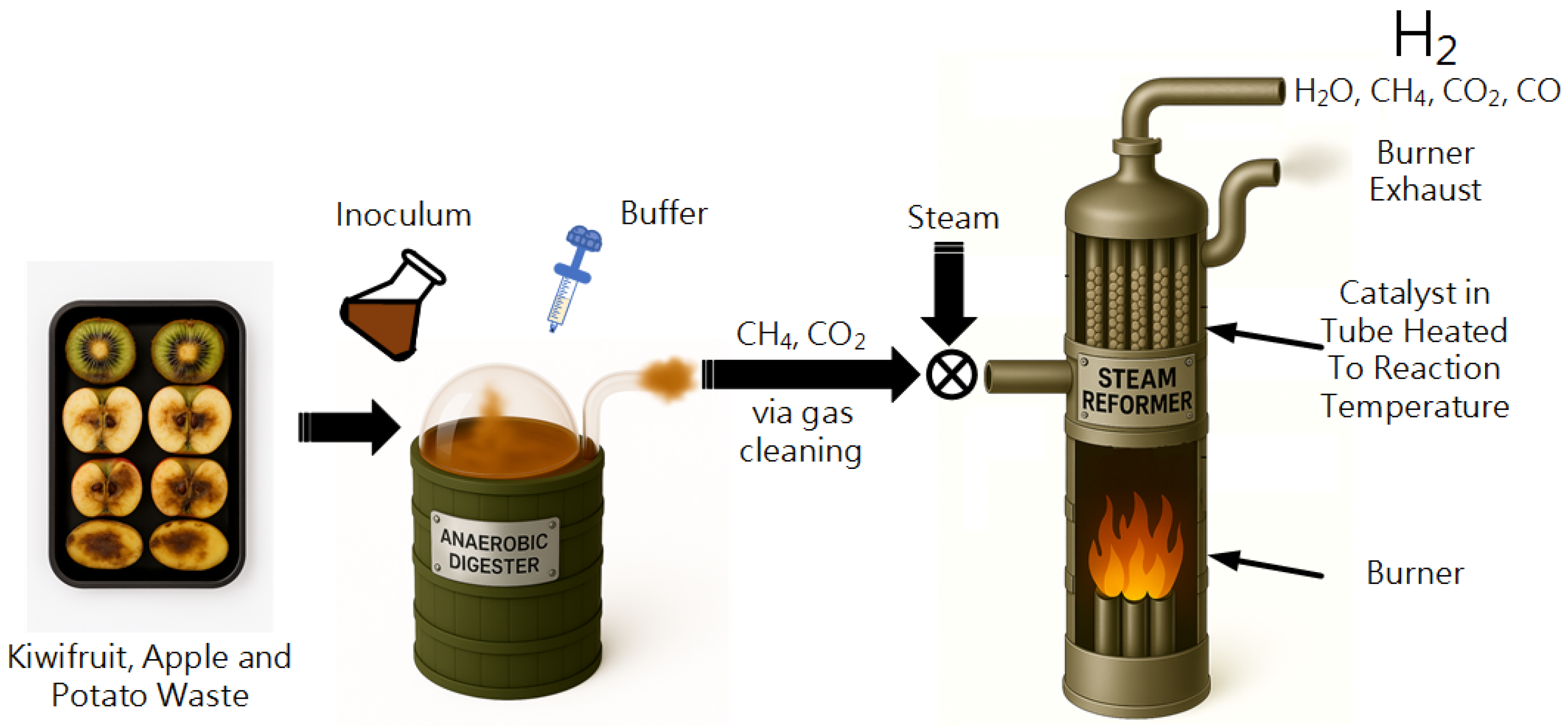
This study evaluates the physicochemical characteristics of kiwifruit and apple waste, assesses biomethane potential through BMP assays, and models hydrogen production via SMR using COMSOL Multiphysics 5.4. Fresh fruit was used as a controlled proxy for agro-industrial waste due to the inconsistent availability of packhouse rejects; previous studies show that ripe fruit and fruit waste exhibit comparable physicochemical properties. The process flow is illustrated in Figure 1.
To achieve this, the study follows a structured approach, beginning with a detailed physicochemical analysis of the feedstock and inoculum to assess key parameters influencing process efficiency. Biomethane potential (BMP) tests are conducted to evaluate methane production from different feedstock mixtures, while gas composition analysis provides insights into fermentation dynamics and carbon conversion efficiency. Finally, the SMR process is examined through theoretical simulations to estimate the hydrogen yield and assess potential catalyst deactivation issues, establishing the feasibility of biomethane as a feedstock.

2. Materials and Methods

2.1. Substrate and Inoculum Analysis Technique

Two feedstock mixtures were prepared: (1) 50:50 kiwifruit–apple and (2) 40:40:20 kiwifruit–apple–potato. Potatoes were included to moderate the rapid acidification due to their slower starch degradation. Fresh fruit was purchased from local retailers as a proxy for agro-industrial waste. All materials were unwashed, chopped and blended to uniform consistency.
Cow manure was collected fresh from a local paddock and used as inoculum. Physicochemical parameters including total solids (TS), volatile solids (VS), pH, alkalinity, ammonium, COD, total carbon, and total nitrogen were measured experimentally. Trace elements, sulfur, and phosphorus were analyzed via ICP MS. All values are reported on a wet mass basis unless otherwise stated.
The mixed inoculum and blended feedstock samples were characterized by total solids (TS), volatile solids (VS), and ash content by the APHA method 2540 B and 2540 E using an FHX-14 Daihan Scientific muffle furnace (Daihan Scientific Co., Ltd., Wonju-si, Republic of Korea). The alkalinity was determined using the Alkaphot Palintest (0–500 mg/L CaCO3), where freshly blended feedstock samples were diluted 100- to 200-fold, and measurements were performed using program 02 (Total Alkalinity) on the Palintest Photometer 7500 Bluetooth (Palintest, APAC, Australia; produced in Gateshead, UK). The ammonium content was measured using the Palintest program 62 (Ammonium). Freshly blended samples were diluted at ratios of 1:100 or 1:150 to ensure the readings fell within the test range (0–100 mg/L NH4). For Total Sulfur (TSu), Total Phosphorus (TP), trace elements, Chemical Oxygen Demand (COD), Total Carbon (TC), and Total Nitrogen (TN), different sample preparation methods were applied. Inoculum samples were dried and ground, while feedstock samples were freeze-dried and homogenized using a ball mill at 1620 RPM for 20 s. COD was measured using high-range Hach digestion vials (20–1500 mg/L). TSu, TP, and trace elements in the feedstock were analyzed via inductively coupled plasma mass spectrometry (ICP-MS) using an Agilent ICP-QQQ 8900 system (Agilent Technologies, Singapore). TN and TC analyses were outsourced to Lincoln University and conducted using an Elementar Analyzer (Elementar, Langenselbold, Germany).

2.2. Biochemical Methane Potential (BMP) Assay Technique

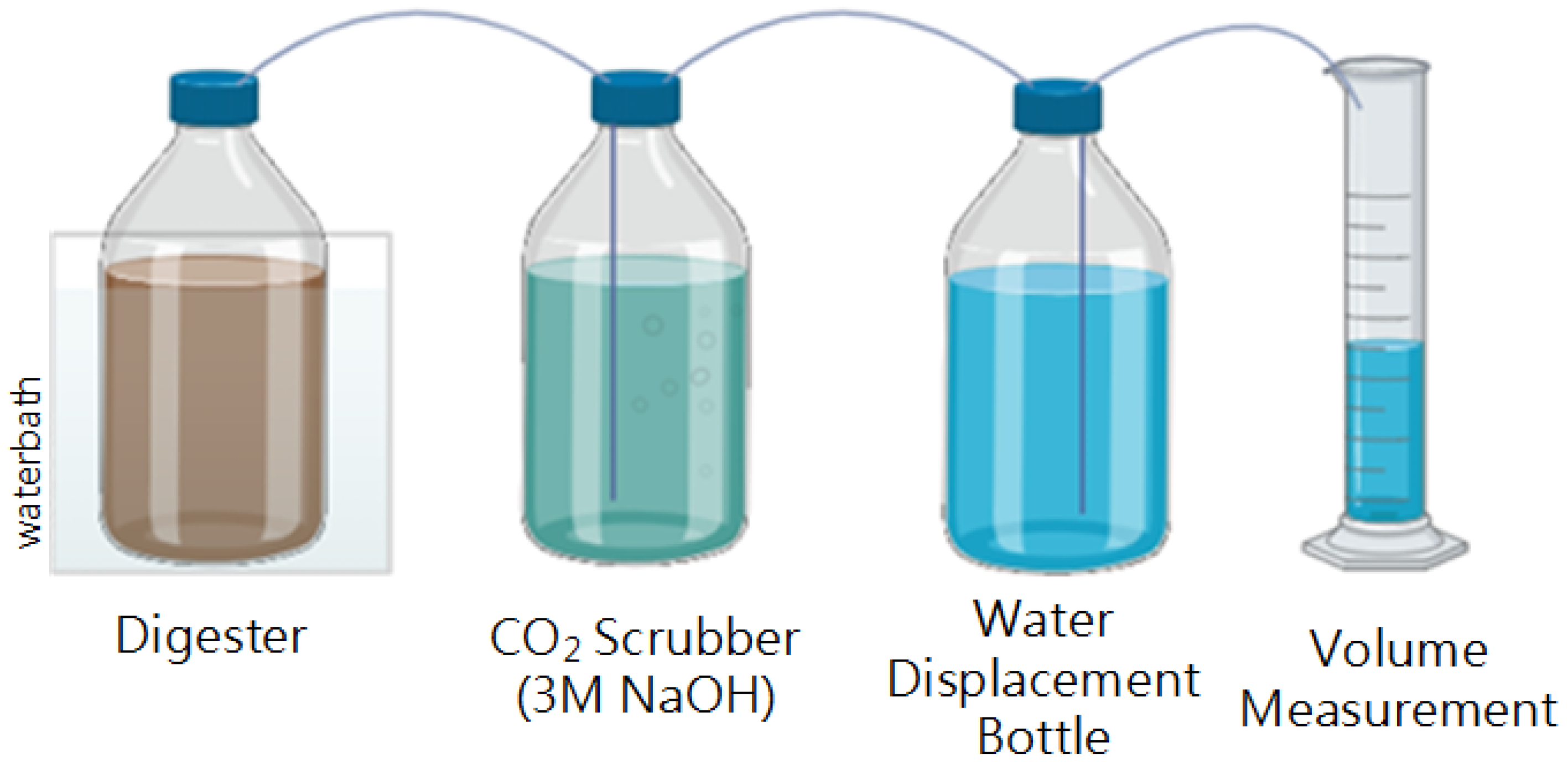
BMP tests were conducted using batch experiments with a volume displacement setup, incorporating a CO2 scrubber. The experimental system consisted of 1 L Schott bottles as digesters, a CO2 scrubber, and 1.5 L water bottles for gas measurement (Figure 2). Gas flow into the NaOH and water bottles was facilitated by bulkhead fittings installed to the caps. All bottles were interconnected using 3 mm PVC tubing.
The two different feedstock mixtures were tested under the conditions summarized in Table 1, following a protocol adapted from Angelidaki et al. [56]. Before each experimental run, the system was sealed with heavy-duty thread seal tape and pressure tested by injecting air and verifying that pressure remained stable. To eliminate residual oxygen, the headspace was flushed with nitrogen. Digesters were incubated at 37 ± 1 °C and manually shaken daily. Methane volumes were corrected to standard conditions. Each condition was run in triplicate, with triplicate inoculum blanks. Methane production from blanks was subtracted from sample values. The results are reported as the mean value.
Gas composition (CH4, CO2) was measured using gas chromatography (Shimadzu 2010 Plus) equipped with a TCD detector, using a Shincarbon ST 120/100 column (Shimadzu Scientific Instruments (Oceania) Pty Limited, Sydney, Australia), injector temperature 150 °C at 110 kPa, and nitrogen as carrier gas. The oven temperature was held at 30 °C for 5 min, ramped at 16.67 °C/min to 80 °C, then at 30 °C/min to 250 °C, and then held for 8 min.

System Optimization/Validation

Trial tests revealed an initial increase in displaced water that stagnated over the first night, likely due to gas expansion and degassing during temperature equilibration. Control experiments with water-filled digester bottles at different temperatures (4 °C, room temperature, and 35 °C) confirmed this hypothesis, as water displacement only occurred in the first two. These findings underscore the necessity of preheating the digester contents before BMP startup to prevent measurement artifacts.
In the literature, an optimal range of initially loaded VS is recommended. While Holliger et al. mention a total volatile solids concentration between 20 and 60 gVS/L, Ohemeng-Ntiamoah et al. recommend a substrate loading range of 10 to 60 gVS/L, while ensuring that the mass of inoculum exceeds the substrate mass [57]. However, adhering to these recommendations led to severe foaming, which pressurized the digester bottles. Reducing the working volume and organic loading to 10–20 gVS/L effectively mitigated this issue.

2.3. Theoretical Maximum Methane Yield

The chemical formula of both feedstock mixtures was determined, from which the theoretical maximum biomethane yield (TMBY) was calculated based on the following formula, developed by Buswell and Mueller [58]:
C n H a O b   + n a 4 b 2 H 2 O   n 2 a 8 + b 4 C O 2 + n 2 +   a 4   b 8 C H 4
This model neglects factors like inhibition due to ammonia or hydrogen sulfide contamination of biogas and will deviate from the experimental data due to certain assumptions and the dynamic nature of AD.
The TMBY of the feedstock mixtures was determined based on the biochemical composition of the individual feedstock components. The moisture content, as well as the fractions of carbohydrates, crude protein, and crude fat were taken from the literature for kiwifruit, apple, and potato [59] separately. The mass of each feedstock component was calculated based on the total input mass and fruit ratios per experiment. These masses were multiplied by the respective carbohydrate, fat, and protein fractions to obtain the mass of each biochemical component. Assuming average elemental compositions, as shown in Table 2, the molecular weights were calculated, and the corresponding molar amounts were determined by dividing each component’s mass by its molecular weight.
From these values, the moles of individual elements (C, H, O, and N) were calculated by multiplying the number of moles of each biochemical fraction by the number of carbon, hydrogen, oxygen, and nitrogen atoms present in its molecular structure. By summing the moles of element across all fractions, the total moles of carbon in the input feedstock mass were determined. The number of methane and carbon dioxide moles were determined using the following relationships:
n C O 2 = n ( C ) 2 n H 8 + n ( O ) 4
n C H 4 = n ( C ) 2 + n H 8 n ( O ) 4
By multiplying their respective moles by their molecular weights, the masses of CH4 and CO2 were then obtained. The volume of each gas was calculated by dividing its mass by its respective density. The resulting volumes of CH4 and CO2 were then summed for each feedstock mixture and ISR condition.
V b i o g a s = n C O 2 × M W ( C O 2 ) ρ ( C O 2 ) + n C H 4 × M W ( C H 4 ) ρ ( C H 4 )

2.4. Steam Methane Reforming (SMR) Modeling and Simulation Setup

The feasibility of using biomethane as a feedstock for SMR was analyzed through a novel 3D dynamic simulation in COMSOL Multiphysics, with a focus on assessing the performance of a nickel-based catalyst and the overall viability of hydrogen production from biomethane as an alternative to natural gas. The simulation comprised separate tube side and burner side physics representing the mass, energy and momentum transport. The tube was modeled using physics for transport of concentrated species, heat transfer in porous media and Darcy’s Law. For the burner section, the physics used were heat transfer in fluids and laminar flow. The tube length comprised the full length of the catalyst in the reactor, thus effectively implementing a tubular plug flow reactor.
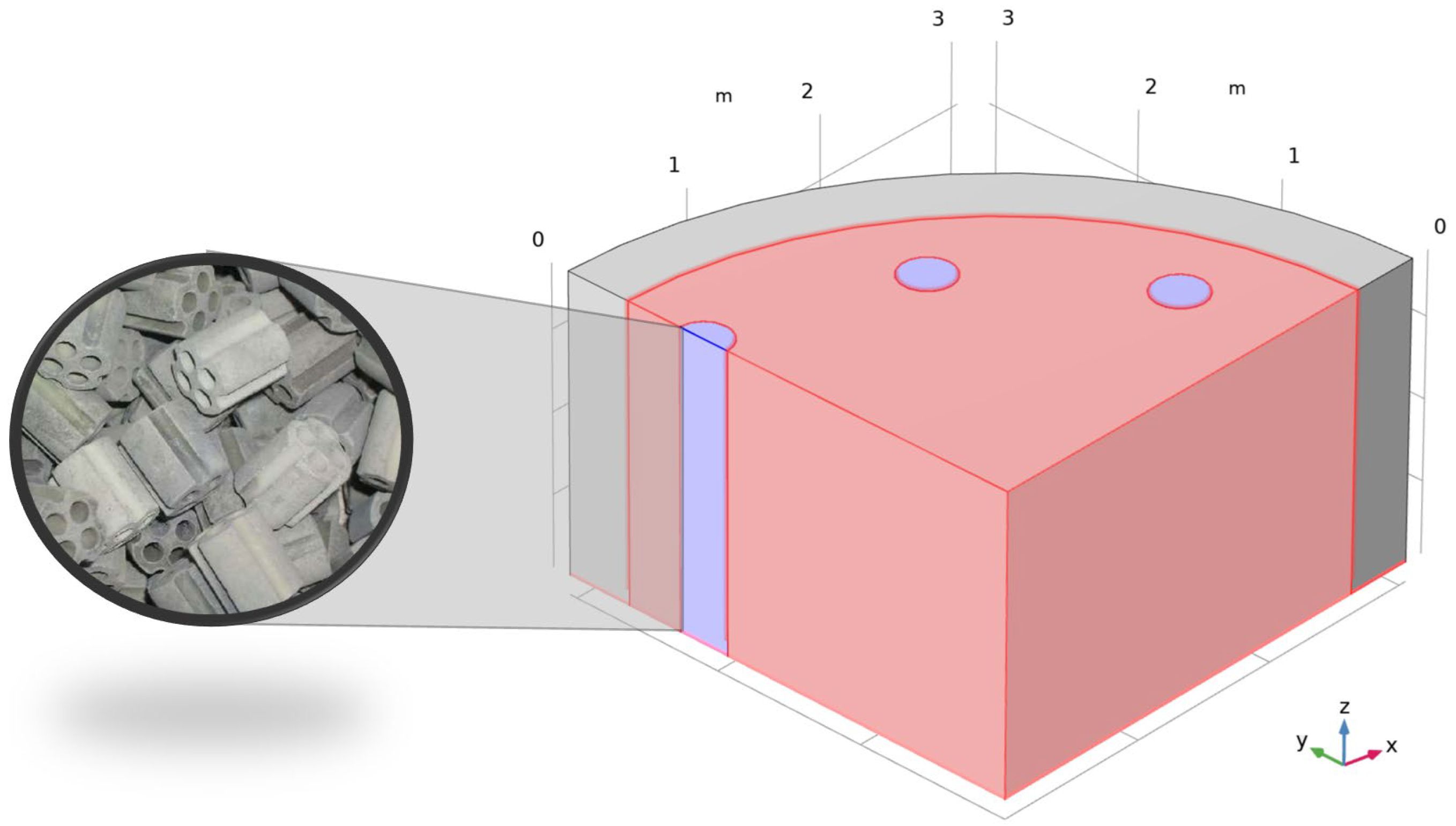
Detailed reaction engineering, physics-based modeling, and an evaluation of deactivation mechanisms such as sulfur poisoning were incorporated. Boundary conditions based on physics applying to the steam reformer were set, according to known measured process parameters (pressure, temperature and flow rates), composition and material properties, and physical constraints. The reformer was operated concurrent with the inlet temperature to the reactor of 652 °C in accordance with the process operating conditions. The values for the tube alloy wall thermodynamic properties used in the COMSOL simulation were derived from Lao et al. 2016 [60], in addition to the properties for the catalyst Katalco 23-4Q, Johnson Matthey, Billingham, UK). Convective and radiative heat transfer (emissivity of 0.65) along the reactor length provided heat for the endothermic reactions occurring in the tube reactor. Convective heat losses from the reformer exterior to the ambient environment (at 25 °C) were included. The thermal properties for Kaowool [61] were used for the insulation to the exterior of the reformer column. Figure 3 shows the cross section of the column with a burner radius of 2.6 m, tube radius of 0.16 m and total column radius of 3 m. For the simulation, the geometry was simplified to a quadrant and facilitated by symmetric boundary conditions.
For Darcy’s Law, the permeability of the porous media was calculated as 1 × 10⁻⁹ m2, with inlet and outlet pressures of 16.64 bar and 16.57 bar, respectively. The burner inlet temperature was 947 °C.
The reactions taking place in the reformer tubes are as follows:
C H 4 +   H 2 O   C O + 3 H 2       Δ H 298 o = 206   k J / m o l
C O + H 2 O   C O 2 + H 2     Δ H 298 o = 41.4   k J / m o l
C 2 H 6 + 2 H 2 O   2 C O + 5 H 2       Δ H 298 o = 84.7   k J / m o l
C 3 H 8 + 3 H 2 O   3 C O + 7 H 2       Δ H 298 o = 103.85   k J / m o l
C 4 H 10 + 4 H 2 O   4 C O + 9 H 2       Δ H 298 o = 126.2   k J / m o l
The basis of the SMR kinetics is the Langmuir–Hinshelwood–Hougen–Watson (LHHW) model for reactions taking place on the surface of a catalyst. The kinetics for the methane formation was taken from Xu and Froment [62], whilst the higher order hydrocarbon reaction kinetics was taken from Seong [63]. For this study, a steam to carbon ratio of 5.6 was used. To factor in the reduction in catalyst performance due to carbon deposition, a first order kinetic expression for change in porosity ε was implemented according to /dt =kporε, which gave a rate constant kpor of 0.03/year. This was the basis for the calculation of the 5-year catalyst performance. Similarly, the reduction in catalyst lifetime due to sulfur poisoning was based on model of Rostrup–Neilsen [64].
To estimate hydrogen yields, the hydrogen mole fraction was taken at the outlet of the tubular reactor section from a steady-state simulation.

2.5. Ideation of Graphical Content

The process of creating the icon illustrations contained in Figure 1, such as the feed and unit operations, was AI generated, created in ChatGPT 4.0 through a series of prompts. These prompts were iterative in nature with emphasis on conceptualizing a graphic that illustrates the formation and passage of biomethane through the process to the end product as hydrogen. The fruit tray icon was produced by a prompt asking for a graphic containing kiwifruit, potato and apple in a state of partial degradation. The digester image was returned by a prompt asking for an image of a digester where the biomethane is rendered as a brown gas exiting the unit. Finally, the reformer image was produced by a prompt asking for the tube side to expose the catalyst to view with the hot side gas in bottom-up flow direction producing a hydrogen rich product stream and a visible exhaust. The prompt also asked for the burner section to be in view.

3. Results

3.1. Substrate and Inoculum Analysis

The physicochemical characteristics (on a wet basis) of the two feedstocks and the inoculum are presented in Table 3. Both feedstocks exhibited a high moisture content, with 84.3% for Feedstock 1 (Fs1) and 83.1% for Feedstock 2 (Fs2), which is typical for fruit-based substrates. The inoculum also exhibited a high moisture content of 85.3%, which supports microbial distribution and improves substrate accessibility. Its total solids content was measured at 14.7%, with a VS fraction of 11.5%, representing a considerable amount of readily degradable organic matter. The total solids content of Fs1 and Fs2 was 15.6% and 16.9%, respectively, while the VS were 15.2% and 16.6%. The high VS fractions indicate a substantial amount of biodegradable organic matter, supporting their potential for efficient biogas production. The feedstocks displayed acidic pH values, which can be attributed to the natural acidity of kiwifruit. In contrast, the inoculum exhibited a slightly alkaline pH, which is favorable for stabilizing the digestion process. Alkalinity plays a critical role in maintaining the pH stability within the digester. In Fs1, it was measured at 5222 mg/L CaCO3, and in Fs2, at 6236 mg/L CaCO3. Notably, the inoculum had a substantially higher alkalinity of 13,605 mg/L CaCO3, highlighting its strong buffering capability, which helps stabilize digestion conditions. Chemical oxygen demand, which represents the total oxidizable organic content, was measured at 150 mg/g wet mass (WM) for Fs1 and 152 mg/g WM for Fs2. The COD of cow manure was also substantial with 154 mg/g WM, providing an additional source of biodegradable matter in the system, enhancing the total digestion potential.
The macro- and micronutrient concentrations obtained by ICP-MS are reported in Table 4. Macronutrients such as carbon, nitrogen, phosphorus, sulfur, potassium, and calcium are fundamental for microbial metabolism during digestion. Fs1 contained 39.9% total carbon and 0.40% total nitrogen, resulting in a C/N ratio of 99.9, while Fs2 showed 39.4% carbon and 0.66% nitrogen, corresponding to a C/N ratio of 58.9. These values indicate a potential nitrogen deficiency, particularly in feedstock mixture 1. Furthermore, Fs1 contained 0.1079% phosphorus and 0.0541% sulfur, and Fs2 contained 0.0171% phosphorus and 0.0877% sulfur. The potassium levels were higher, with 1.19% in Fs1 and 1.65% in Fs2, suggesting adequate availability for microbial activity. Trace levels of micronutrients, including manganese, zinc, copper, cobalt, molybdenum, and selenium, were detected in both substrates. Importantly, heavy metals such as cadmium, mercury, arsenic, and lead were either absent or detected at negligible concentrations, minimizing the risk of toxicity or long-term accumulation within the digestion system.
Both feedstocks exhibited a high moisture content (83–84%) and high VS fractions (15–17%), indicating strong biodegradability. The inoculum exhibited high alkalinity (13,605 mg/L CaCO3), providing buffering capacity. However, the low nitrogen content suggests that co-digestion with nitrogen-rich substrates would be required for optimal performance in full-scale systems.

3.2. Biochemical Methane Potential (BMP) Assay

The results of the BMP tests for both feedstock mixtures at different inoculum-to-substrate ratios are presented in Table 5. Under ISR 4 conditions, approximately 2.2 gVS of substrate were applied, while the ISR 2 conditions involved nearly double the input, with 4.3–4.7 gVS. Volatile solid destruction was low in three of the four conditions. Fs1 at ISR 2 and ISR 4, as well as Fs2 at ISR 2, all exhibited rates around 9–10%. In contrast, Fs2 under ISR 4 achieved a notably higher VS destruction of 50.1%, indicating substantially improved degradability under these conditions. A similar trend was observed in the carbon conversion efficiencies. For Fs1, ISR 2 and ISR 4 and Fs2 at ISR 2, around 8–10% of the initial carbon from the substrate was converted into carbon in gaseous products (methane and CO2). In comparison, Fs2 under ISR 4 showed a markedly higher carbon conversion of 46.5%.
The accumulated methane volumes further support this trend. Fs1 under ISR 2 and Fs2 under ISR 2 produced 249.5 and 207.2 NmL (normalized to 273 K and 1 atm) of methane, respectively, while Fs1 under ISR 4 generated only 136.1 NmL. Variability in the accumulated methane volumes was on the order of ±30–50% between runs. Once again, Fs2 under ISR 4 significantly outperformed all others, with a total methane production of 481.9 NmL. In terms of the BMP values, Fs2 under ISR 4 again stands out, reaching 44.7 NmL CH4/gVS, which is more than double the yield of any other condition, which ranged from 12.5 to 17.7 NmL CH4/gVS.
Moreover, the TMBY calculated from feedstock composition was consistently higher under ISR 2 conditions across both feedstocks, with 161.7 and 199.2 mLCH4/gVS for Fs1 and Fs2, respectively, compared to ISR 4 with 98.2 and 118.5 mLCH4/gVS. This is expected, as a lower ISR introduces more organic material per unit of inoculum, thereby increasing the theoretical methane potential. A notable discrepancy of approximately a factor of 10 was observed when comparing the BMP results to the TMBY. This difference reflects the well-known gap between idealized theoretical potentials and actual process performance but also implies that there is room for optimization of the BMP test conditions. Theoretical values assume complete degradation and conversion of all organic matter into methane under optimal conditions, which is rarely achieved in practice due to microbial maintenance requirements, substrate recalcitrance, biomass synthesis, and operational limitations.
In summary, the results confirm that both the feedstock composition and inoculum-to-substrate ratio play a crucial role in methane production. Although the overall methane yields, carbon conversion, and VS destruction were moderate to low, the condition Fs2 at ISR 4 showed the best performance, suggesting potential benefits from even higher ISR values. Importantly, the successful generation of biogas in this initial study demonstrates the viability of agro-industrial kiwi and apple waste as a feedstock. With further research and process optimization, significantly improved methane yields may be achievable.

3.3. Steam Methane Reforming (SMR) Modeling and Simulation

The performance characteristics of the SMR process comparing biomethane and natural gas are summarized in Table 6. As expected for SMR, substantial heat input is required to sustain the reaction rates and maintain the conversion efficiency. The heat of reaction for biomethane was calculated at 30.2 kW/m3, slightly lower than the 32 kW/m3 required for natural gas. This difference is attributed to the absence of higher-order hydrocarbons in biomethane, which typically demand additional energy for reforming.
Catalyst deactivation due to sulfur poisoning is a critical limitation in biomethane reforming. The simulated sulfur coverage on the catalyst surface reached 95%, indicating near-complete deactivation. In comparison, natural gas showed a sulfur coverage of 69%, suggesting that while both fuels pose a risk of catalyst poisoning, the threat is more severe with biomethane. While biomethane presents a higher risk of sulfur poisoning, natural gas is more prone to coke formation due to the presence of higher-order hydrocarbons, which crack more readily, contributing to the porosity loss of the catalyst and additional long-term performance degradation.
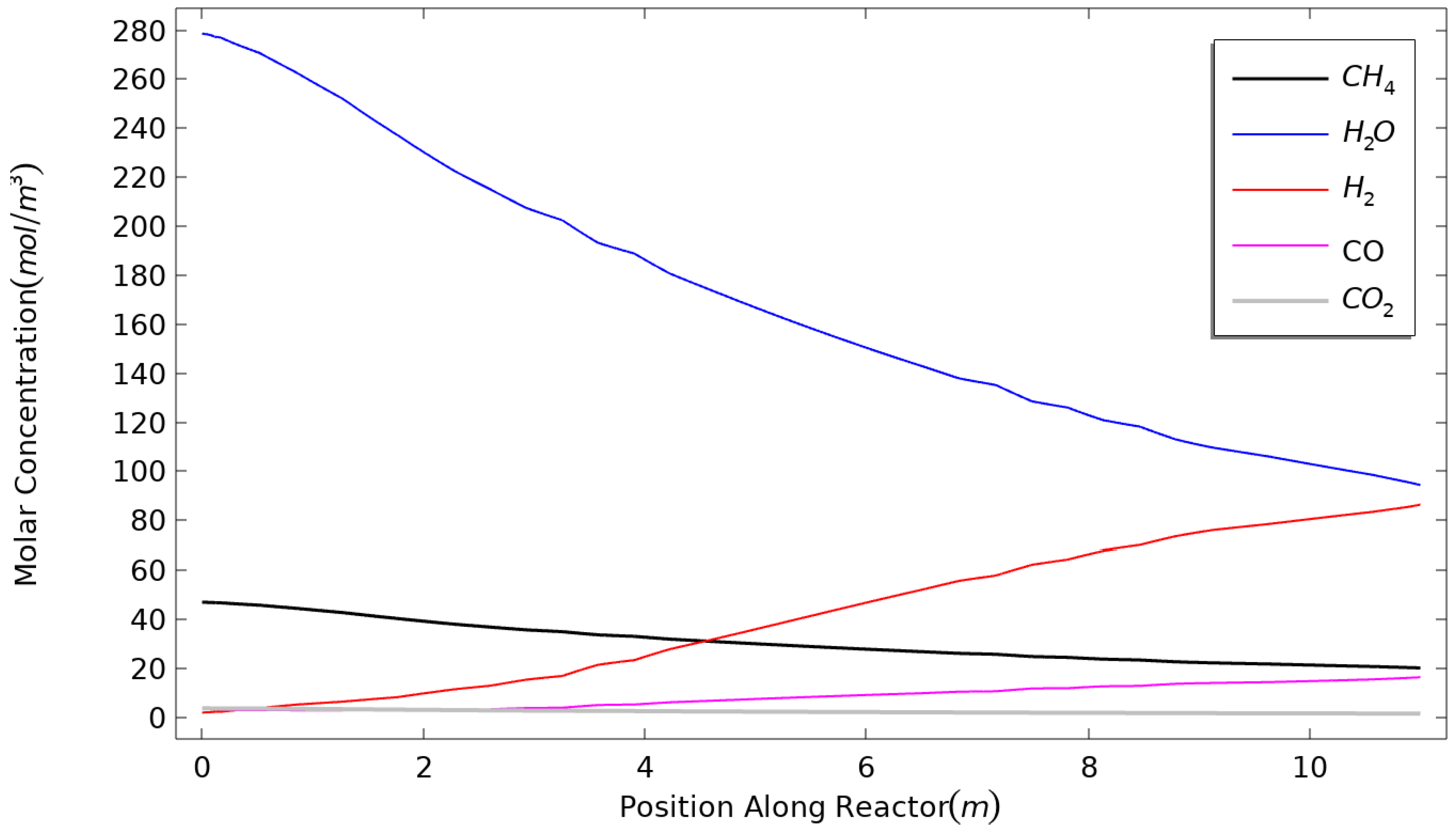
Figure 4, supported by the data presented in Table 7, illustrates the molar concentration profiles of key gas components along the reactor length. Although the inlet compositions for both natural gas and biomethane were identical in the simulation, the outlet hydrogen concentration was higher for biomethane at 91 mol/m3 compared to 86 mol/m3 for natural gas, confirming its high suitability for hydrogen production. Despite this advantage, the methane conversion efficiency for biomethane reached only 46% and 43% for natural gas, indicating the potential for further optimization of the process parameters to enhance the methane utilization and hydrogen output.
Simulations over a five-year operational period reveal notable differences in catalyst performance and gas composition for SMR using biomethane versus natural gas, as shown in Table 7. With a fresh catalyst, both feedstocks yield comparable hydrogen concentrations, with 69.1 mol% for biomethane and 69.3 mol% for natural gas. However, after five years, the hydrogen output declines more sharply for biomethane, dropping to 44.8 mol% compared to 57.0 mol% for natural gas. The methane slip nearly doubles in the biomethane case, from 16.7 to 39.5 mol%, while it increases more moderately in natural gas reforming from 16.2 to 26.6 mol%. Similarly, the CO2 levels rise significantly for biomethane, from 1.13 to 3.22 mol%, but only slightly for natural gas, from 1.31 to 1.81 mol%. These results highlight the need for effective sulfur removal strategies when reforming biomethane.
Overall, the molar concentration profiles highlight biomethane’s strong potential as a feedstock for hydrogen production via SMR. Compared to natural gas, biomethane reforming is more energy-efficient, requiring lower heating input, and poses a lower risk of coke formation. However, its long-term operational stability is more vulnerable to sulfur poisoning.

3.4. Scaling to Annual Waste Volumes

Assuming a representative kiwifruit orchard of 4.5 hectares, with an average plant density of 10,000 vines per hectare and a yield of 100 fruits per vine, it is estimated that approximately 60% of the fruits are thinned during cultivation. This results in an annual surplus of 2,700,000 discarded kiwifruits. With an average fruit weight of 70 g, this corresponds to approximately 190 tons of kiwifruit waste per orchard. In this study, two feedstock mixtures were investigated for anaerobic digestion. Feedstock 2 (Fs2), consisting of kiwifruit, apple, and potato in a 40:40:20 wet weight ratio, demonstrated the highest biogas yield and was therefore selected as the basis for this hydrogen potential estimation. Accordingly, the model assumes an additional 190 tons of apple waste and 80 tons of potato waste, resulting in a total of 476 tons of agro-industrial waste redirected from landfilling toward biohydrogen production. Based on the analysis of the carbon and moisture content of the feedstock mixture, the total input of carbon was estimated at 32 tons. From the BMP trials, a carbon-to-methane conversion efficiency of 46.5% was determined for Feedstock 2. Assuming an average biogas methane concentration of 60% and applying the molecular weight and density of methane, the resulting methane volume was calculated to be approximately 18,000 m3. The methane produced is then fed into a steam methane reforming unit. Based on the simulation results, a molar methane-to-hydrogen conversion efficiency of 46% was assumed under the evaluated conditions. This corresponds to a total hydrogen volume of approximately 7600 m3.

4. Discussion

4.1. Substrate and Inoculum Analysis

Fruit waste is highly biodegradable but nitrogen deficient, indicating that co-digestion with manure or other nitrogen rich substrates would be necessary in full scale systems. The BMP results confirm that potato supplementation improves the stability by moderating the acidification.
The physicochemical properties of the feedstocks and inoculum provide important insights into their suitability for anaerobic digestion and their potential to support stable and efficient biogas production. Notably, the alkalinity levels measured in both feedstock mixtures exceeded the typical range reported for anaerobic digesters, which is between 1500 and 5000 mg/L [65]. This elevated buffering capacity is particularly beneficial given the acidic starting pH of the mixtures, offering protection against acidification during the hydrolytic and acidogenic phases. Ammonium concentrations in both mixtures remained well below inhibitory levels commonly reported at 1500–3000 mg/L at a pH higher than 7.4, ensuring that the methanogenic activity would not be adversely affected.
The COD content of both feedstock mixtures was comparable, but the actual loading concentrations of 3.10–6.61 g/L were modest relative to other studies. For instance, Dhar et al. used initial loadings of 5.1, 10.4, and 15.2 g/L COD, yielding 9.3, 10.7, and 17.7 L of biogas [66]. This suggests that while the feedstocks possess reasonable biodegradability, the relatively low organic loading in this study may have limited their maximum methane potential. Future experiments could explore higher loading rates to assess yield improvements.
The C/N ratios observed in both Fs1 (99.9) and Fs2 (58.9) were markedly above the optimal range, with values ranging from 20:1 to 30:1 for methanogenesis and 10:1 to 45:1 for hydrolysis [29]. While such ratios minimize ammonia toxicity, they may lead to nitrogen deficiency, impairing microbial growth and slowing methane production. Future studies should investigate nitrogen supplementation or co-digestion with nitrogen-rich substrates to restore balance and enhance the biodegradability. A nutrient comparison with a standard supplementation strategy based on Du Preez et al. [66] revealed that the potassium levels were sufficient. In contrast, phosphorus concentrations (7–12 mg/L) were markedly lower than the recommended 60 mg/L, suggesting a potential nutrient limitation. To address this, targeted phosphorus supplementation—aligned with microbial demand—could enhance the digestion performance while minimizing the risks associated with nutrient oversupply. Nonetheless, any supplementation strategy must carefully consider the microbial requirements, the potential inhibitory effects of excess nutrients, and the economic feasibility. It is also important to note that elemental analysis reflects the total nutrient content but does not necessarily indicate bioavailability, which may be affected by processes such as precipitation and adsorption within the digester matrix.
Finally, the inoculum exhibited characteristics of high-quality seeding material, as per Hollinger et al. [67]. The measured alkalinity exceeds 3000 mg/L, the threshold characteristic of high-quality inoculum for BMP testing, confirming its robust buffering capacity. The pH falls within the optimal range of 7.0 to 8.5 for methanogenic activity, as recommended. Additionally, the ammonium concentration is well below the suggested upper limit of 2500 mg/L, reducing the risk of ammonia inhibition and further confirming the inoculum’s suitability for anaerobic digestion.
Overall, the nutrient profiles, buffering capacity, and organic content of both the feedstocks and the inoculum confirm their fundamental suitability for anaerobic digestion. These characteristics support the potential of agro-industrial kiwifruit and apple waste as promising resources for low-carbon hydrogen production.

4.2. Biochemical Methane Potential (BMP) Assay

The BMP tests were conducted to evaluate the anaerobic biodegradability and methane potential of agro-industrial kiwifruit and apple waste. The results indicate that both the feedstock composition and the inoculum-to-substrate ratio significantly influenced the methane production. Among the tested conditions, the feedstock F2 at ISR 4 achieved the highest methane yield, reaching up to 45 mL CH4/gVS.
For comparison, Kawai et al. reported methane yields of 435 mL CH4/gVS for food waste at ISR 3 and 269 mL CH4/gVS at ISR 2, supporting the trend observed in this study that a higher ISR enhances the digestion performance. However, these reported yields are approximately ten times higher than the ones achieved in this study. Similarly, a review by Ohemeng-Ntiamoah et al. [56] indicates that methane yields for comparable substrates typically range between 400 and 500 mL CH4/gVS, with some studies reporting values closer to 100 mL CH4/gVS, highlighting the substantial variability depending on the feedstock characteristics and process conditions.
A study by Hull-Cantillo et al. reported volatile solid destruction rates between 47 and 53% during BMP tests with liquid dairy effluent sludge [68]. In comparison, only condition F2,4 in the present study reached a similar range, while the others showed considerably lower VS removal, suggesting suboptimal digestion. Similarly, Gao et al. investigated the anaerobic digestion of wheat straw and reported a VS degradation rate of 50.13% by day 24, alongside a detailed carbon flow analysis that revealed 49.96% of the initial carbon was converted to biogas, and 44.43% was retained in the solid digestate, with 5.61% in the liquid phase [69]. Again, only the carbon conversion efficiency of F2,4 aligns well with those findings, indicating favorable digestion performance under optimized ISRs. In contrast, the lower conversion rates in the other experiments may point to early acidification, resulting in incomplete substrate utilization.
Despite the comparatively low yields in this study, the results underline the potential of the tested feedstocks for biogas production, though significant improvements are needed. Enhancing the buffering system and supplementing key nutrients, especially nitrogen and phosphorus, which were shown to be deficient, may improve the digestion efficiency. Nonetheless, nutrient addition should be carefully tailored to the microbial demand, as unspecific supplementation could negatively impact the process stability or increase costs. Future studies should furthermore investigate whether increasing the ISR can effectively stabilize the process and enhance methane generation.
Other possible reasons for the limited methane production include the accumulation of volatile fatty acids, which were not measured in this study, or the presence of inhibitory compounds such as pesticide residues or preservatives in the fruit waste. While no heavy metals were detected in the feedstock mixtures, the presence of unidentified inhibitors cannot be ruled out. Should further optimization efforts, including nutrient supplementation and improved buffering, not yield significant improvement, the quality or microbial activity of the inoculum itself may be the primary limiting factor.
Overall, this study lays essential groundwork for evaluating the anaerobic digestion potential of kiwifruit and apple waste. The inclusion of potato in Fs2 appears to serve its purpose as a co-substrate that moderates acidification and improves the C/N ratio, contributing to more stable digestion dynamics. These initial findings underscore both the feasibility and the challenges of using these agro-industrial residues for biogas production, pointing to the need for further optimization in terms of the substrate formulation, nutrient supplementation, and inoculum quality to unlock their full potential.

4.3. Steam Methane Reforming (SMR) Simulation

Consequently, biomethane reforming is more energy-efficient and requires less heating compared to natural gas. In theory, this improved efficiency could enable the use of shorter reformers, thereby reducing the equipment costs. However, these assumptions require validation through experimental or industrial-scale studies.
Biomethane shows strong potential for hydrogen production, yielding 91 mol/m3 H2 compared to 86 mol/m3 from natural gas. However, its current methane conversion efficiency of 46% indicates room for improvement. Studies suggest that optimizing conditions such as the residence time, steam-to-carbon ratio, temperature, and pressure could raise the conversion efficiency to nearly 90% [70]. It would be recommended in future studies to examine the variability in performance against these parameters by way of a sensitivity analysis.
Desulfurization costs for biogas (0.02–0.05 NZD/m3) are modest relative to the hydrogen value. The catalyst lifetime may decrease by 15–25% due to sulfur exposure, increasing the replacement frequency from 5 years to ~4 years.
Using 476 t of waste to produce 7600 m3 of hydrogen would avoid 70 t CO2-eq/year, depending on the natural-gas-based SMR baseline. New Zealand’s fruit industries generate >100,000 t of residues annually, indicating strong scalability.

5. Conclusions

This study demonstrates the technical feasibility of converting kiwifruit and apple waste into biomethane and hydrogen through anaerobic digestion and steam methane reforming. The feedstocks exhibited high biodegradability, with methane yields reaching 45 mL CH4/gVS and carbon conversion efficiencies up to 46.5%. However, their low nitrogen content and rapid acidification highlight the need for co-digestion strategies and feedstock balancing in full-scale applications.
Steam methane reforming of biogas was successfully modeled, with the methane conversion increasing from 46% to over 85% under optimized steam-to-carbon ratios, residence times, and inlet temperatures. Preliminary techno-economic analysis suggests that desulfurization costs and catalyst replacement cycles are manageable and that biomethane-based hydrogen production can be competitive with natural gas-based SMR under favorable conditions.
Scaling the process to 476 t of annual fruit waste could yield approximately 18,000 m3 of biomethane and 7600 m3 of hydrogen, avoiding an estimated 70 t CO2-equivalent emissions per year. Given the large volume of fruit residues generated in New Zealand (>100,000 t/year), this offers strong potential for circular resource utilization and contributes to national decarbonization goals.
Future work should focus on continuous digestion trials, co-digestion optimization, biogas upgrading, and full lifecycle economic modeling. Comparative analysis with other fruit-waste-to-hydrogen studies highlights the importance of substrate selection, pretreatment, and catalyst durability, providing clear directions for process refinement and scale-up.

Author Contributions

Conceptualization, E.B. and P.K.; Methodology, E.B.; Software, P.K.; Validation, E.B. and P.K.; Formal analysis, E.B.; Investigation, E.B.; Writing—original draft preparation, E.B.; Visualization, E.B.; Writing—review and editing, P.K.; Supervision, P.K. All authors have read and agreed to the published version of the manuscript.

Funding

This research received no external funding.

Data Availability Statement

Data are contained within the article.

Acknowledgments

We acknowledge the technical staff at the University of Waikato for assisting with this research. We acknowledge ChatGPT for producing icon graphics in the illustrations presented in this paper.

Conflicts of Interest

The authors declare no conflicts of interest.

References

  1. About the Horticulture Industry in New Zealand. Available online: https://www.hortnz.co.nz/about-us/ (accessed on 7 January 2025).
  2. NZKGI. Kiwifruit Book; NZKGI New Zealand Kiwifruit Grower: Tauranga, New Zealand, 2022; pp. 37–48. [Google Scholar]
  3. Apple and Pears—The Market. Available online: https://www.tupu.nz/en/fact-sheets/apples-and-pears/ (accessed on 8 January 2025).
  4. Apple Thinning 2024. Available online: https://www.bostock.nz/news/apple-thinning-2024 (accessed on 8 January 2025).
  5. Growing and Orchard Management. Available online: https://www.whitehallfruitpackers.co.nz/page/growing-and-orchard-management/ (accessed on 7 January 2025).
  6. Waste Sector Emissions. Available online: https://environment.govt.nz/facts-and-science/waste/waste-sector-emissions/#about-waste-emissions-data (accessed on 8 January 2025).
  7. Ministry for the Environment. New Zealand Waste Assessment: Composition of Waste Disposed to Landfill; Ministry for the Environment: Wellington, New Zealand, 2019. Available online: https://environment.govt.nz (accessed on 14 February 2026).
  8. Ministry for the Environment. National Waste Data Framework: Summary Report; Ministry for the Environment: Wellington, New Zealand, 2021. Available online: https://environment.govt.nz (accessed on 14 February 2026).
  9. Evro, S.; Oni, B.A.; Tomomewo, O.S. Carbon neutrality and hydrogen energy systems. Int. J. Hydrogen Energy 2024, 78, 1449–1467. [Google Scholar] [CrossRef]
  10. Climate Change Response (Zero Carbon) Amendment Bill. Available online: https://www.legislation.govt.nz/bill/government/2019/0136/latest/LMS183736.html (accessed on 24 February 2025).
  11. Mbie, A. Vision for Hydrogen in New Zealand. Energy Strategies for New Zealand. 2019. Available online: https://www.mbie.govt.nz/building-and-energy/energy-and-natural-resources/energy-strategies-for-new-zealand/ (accessed on 19 August 2021).
  12. Blasio, N.D. The Colors of Hydrogen. Available online: https://www.belfercenter.org/research-analysis/colors-hydrogen (accessed on 25 February 2024).
  13. Urgent Action Taken to Bolster Energy Security. Available online: https://www.beehive.govt.nz/release/urgent-action-taken-bolster-energy-security (accessed on 25 February 2025).
  14. H2 Stations Map. Available online: https://www.h2stations.org/stations-map/?lat=49.139384&lng=11.190114&zoom=2 (accessed on 3 January 2025).
  15. Cheng, S.; Logan, B.E. Sustainable and efficient biohydrogen production via electrohydrogenesis. Proc. Natl. Acad. Sci. USA 2007, 104, 18871–18873. [Google Scholar] [CrossRef] [PubMed]
  16. Wang, L.; Chen, Y.; Ye, Y.; Lu, B.; Zhu, S.; Shen, S. Evaluation of low-cost cathode catalysts for high yield biohydrogen production in microbial electrolysis cell. Water Sci. Technol. 2011, 63, 440–448. [Google Scholar] [CrossRef] [PubMed]
  17. Chakraborty, A.; Gole, A.; Samanta, A.; Ghosh, D. Microbial electrolysis cells for effective biohydrogen biogenesis from biowastes. In Advances in Environmental Electrochemistry; Elsevier: Amsterdam, The Netherlands, 2024; pp. 55–87. [Google Scholar]
  18. Noori, M.T.; Rossi, R.; Logan, B.E.; Min, B. Hydrogen production in microbial electrolysis cells with biocathodes. Trends Biotechnol. 2024, 42, 815–828. [Google Scholar] [CrossRef]
  19. Hallenbeck, P.C.; Benemann, J.R. Biological hydrogen production; fundamentals and limiting processes. Int. J. Hydrogen Energy 2002, 27, 1185–1193. [Google Scholar] [CrossRef]
  20. Ren, C.; Zhang, S.; Li, Q.; Jiang, Q.; Li, Y.; Gao, Z.; Cao, W.; Guo, L. Pilot composite tubular bioreactor for outdoor photo-fermentation hydrogen production: From batch to continuous operation. Bioresour. Technol. 2024, 401, 130705. [Google Scholar] [CrossRef]
  21. Goveas, L.C.; Nayak, S.; Kumar, P.S.; Vinayagam, R.; Selvaraj, R.; Rangasamy, G. Recent advances in fermentative biohydrogen production. Int. J. Hydrogen Energy 2024, 54, 200–217. [Google Scholar] [CrossRef]
  22. Hawkes, F.; Dinsdale, R.; Hawkes, D.; Hussy, I. Sustainable fermentative hydrogen production: Challenges for process optimisation. Int. J. Hydrogen Energy 2002, 27, 1339–1347. [Google Scholar] [CrossRef]
  23. Humaira, A.H.A.; Ali, S.; Franco, M.; Irfan, M. Cell-Free Systems: Platform for Sustainable Commercial Biomanufacturing of Biochemicals. Punjab Univ. J. Zool. 2024, 39, 213–230. [Google Scholar] [CrossRef]
  24. Zhang, Y.P.; Sun, J.; Zhong, J.-J. Biofuel production by in vitro synthetic enzymatic pathway biotransformation. Curr. Opin. Biotechnol. 2010, 21, 663–669. [Google Scholar] [CrossRef]
  25. Contreras, J.; Salmones, J.; Colín-Luna, J.; Nuño, L.; Quintana, B.; Córdova, I.; Zeifert, B.; Tapia, C.; Fuentes, G. Catalysts for H2 production using the ethanol steam reforming (a review). Int. J. Hydrogen Energy 2014, 39, 18835–18853. [Google Scholar] [CrossRef]
  26. Chen, W.-H.; Biswas, P.P.; Ong, H.C.; Hoang, A.T.; Nguyen, T.-B.; Dong, C.-D. A critical and systematic review of sustainable hydrogen production from ethanol/bioethanol: Steam reforming, partial oxidation, and autothermal reforming. Fuel 2023, 333, 126526. [Google Scholar] [CrossRef]
  27. Behera, S.S.; Saranraj, P.; Ray, R.C. Microbial bioethanol fermentation technologies—Recent trends and future prospects. Biofuels Biorefining 2022, 1, 75–108. [Google Scholar]
  28. Jahromi, A.F.; Ruiz-López, E.; Dorado, F.; Baranova, E.A.; de Lucas-Consuegra, A. Electrochemical promotion of ethanol partial oxidation and reforming reactions for hydrogen production. Renew. Energy 2022, 183, 515–523. [Google Scholar] [CrossRef]
  29. Wellinger, A.; Murphy, J.P.; Baxter, D. The Biogas Handbook: Science, Production and Applications; Elsevier: Amsterdam, The Netherlands, 2013. [Google Scholar]
  30. Sihlangu, E.; Luseba, D.; Regnier, T.; Magama, P.; Chiyanzu, I.; Nephawe, K.A. Investigating methane, carbon dioxide, ammonia, and hydrogen sulphide content in agricultural waste during biogas production. Sustainability 2024, 16, 5145. [Google Scholar] [CrossRef]
  31. Meegoda, J.N.; Li, B.; Patel, K.; Wang, L.B. A review of the processes, parameters, and optimization of anaerobic digestion. Int. J. Environ. Res. Public Health 2018, 15, 2224. [Google Scholar] [CrossRef]
  32. Ma, J.; Frear, C.; Wang, Z.-w.; Yu, L.; Zhao, Q.; Li, X.; Chen, S. A simple methodology for rate-limiting step determination for anaerobic digestion of complex substrates and effect of microbial community ratio. Bioresour. Technol. 2013, 134, 391–395. [Google Scholar] [CrossRef]
  33. Lin, L.; Yan, R.; Liu, Y.; Jiang, W. In-depth investigation of enzymatic hydrolysis of biomass wastes based on three major components: Cellulose, hemicellulose and lignin. Bioresour. Technol. 2010, 101, 8217–8223. [Google Scholar] [CrossRef]
  34. Akuzawa, M.; Hori, T.; Haruta, S.; Ueno, Y.; Ishii, M.; Igarashi, Y. Distinctive responses of metabolically active microbiota to acidification in a thermophilic anaerobic digester. Microb. Ecol. 2011, 61, 595–605. [Google Scholar] [CrossRef]
  35. Stams, A.J.; Plugge, C.M. Electron transfer in syntrophic communities of anaerobic bacteria and archaea. Nat. Rev. Microbiol. 2009, 7, 568–577. [Google Scholar] [CrossRef]
  36. Ferry, J.G. The chemical biology of methanogenesis. Planet. Space Sci. 2010, 58, 1775–1783. [Google Scholar] [CrossRef]
  37. Kiener, A.; Leisinger, T. Oxygen sensitivity of methanogenic bacteria. Syst. Appl. Microbiol. 1983, 4, 305–312. [Google Scholar] [CrossRef] [PubMed]
  38. Mao, C.; Feng, Y.; Wang, X.; Ren, G. Review on research achievements of biogas from anaerobic digestion. Renew. Sustain. Energy Rev. 2015, 45, 540–555. [Google Scholar] [CrossRef]
  39. Craggs, R. Potential Energy Recovery by Anaerobic Digestion of Dairy Farm Waste; NIWA: Hamilt, New Zealand, 2006. [Google Scholar]
  40. Hartmann, H.; Ahring, B.K. Strategies for the anaerobic digestion of the organic fraction of municipal solid waste: An overview. Water Sci. Technol. 2006, 53, 7–22. [Google Scholar] [CrossRef]
  41. Kougias, P.; Boe, K.; Angelidaki, I. Effect of organic loading rate and feedstock composition on foaming in manure-based biogas reactors. Bioresour. Technol. 2013, 144, 1–7. [Google Scholar] [CrossRef]
  42. Types of Anaerobic Digesters. Available online: https://www.epa.gov/anaerobic-digestion/types-anaerobic-digesters#:~:text=A%20wet%20digester%20or%20low,than%2015%20percent%20solids%20content (accessed on 25 February 2025).
  43. Bartholomew, C.H. Mechanisms of catalyst deactivation. Appl. Catal. A Gen. 2001, 212, 17–60. [Google Scholar] [CrossRef]
  44. Stewart, D.; Trangmar, B.B. Methane from Animal Waste Management Systems; Ministry of Agriculture and Forestry: Wellington, New Zealand, 2008. [Google Scholar]
  45. Severinsen, I.; Herritsch, A.; Watson, M. Modeling kinetic, thermodynamic, and operational effects in a steam methane reformer. Part A: Reformer output. Ind. Eng. Chem. Res. 2021, 60, 2041–2049. [Google Scholar] [CrossRef]
  46. Dincer, I. Comprehensive Energy Systems; Elsevier: Amsterdam, The Netherlands, 2018. [Google Scholar]
  47. Quirino, P.; Amaral, A.; Pontes, K.V.; Rossi, F.; Manenti, F. Impact of kinetic models in the prediction accuracy of an industrial steam methane reforming unit. Comput. Chem. Eng. 2021, 152, 107379. [Google Scholar] [CrossRef]
  48. Young, A.; Henderson, S.; Buchanan, L.; Hall, D.; Bishop, C. Failure of commercial extruded catalysts in simple compression and bulk thermal cycling. Int. J. Appl. Ceram. Technol. 2018, 15, 74–88. [Google Scholar] [CrossRef]
  49. Murkin, C.; Brightling, J. Eighty years of steam reforming. Johns. Matthey Technol. Rev. 2016, 60, 263–269. [Google Scholar] [CrossRef]
  50. Chen, L.; Qi, Z.; Zhang, S.; Su, J.; Somorjai, G.A. Catalytic hydrogen production from methane: A review on recent progress and prospect. Catalysts 2020, 10, 858. [Google Scholar] [CrossRef]
  51. Vogt, C.; Kranenborg, J.; Monai, M.; Weckhuysen, B.M. Structure sensitivity in steam and dry methane reforming over nickel: Activity and carbon formation. ACS Catal. 2019, 10, 1428–1438. [Google Scholar] [CrossRef]
  52. Jones, G.; Jakobsen, J.G.; Shim, S.S.; Kleis, J.; Andersson, M.P.; Rossmeisl, J.; Abild-Pedersen, F.; Bligaard, T.; Helveg, S.; Hinnemann, B. First principles calculations and experimental insight into methane steam reforming over transition metal catalysts. J. Catal. 2008, 259, 147–160. [Google Scholar] [CrossRef]
  53. Ganguli, A.; Bhatt, V. Hydrogen production using advanced reactors by steam methane reforming: A review. Front. Therm. Eng. 2023, 3, 1143987. [Google Scholar] [CrossRef]
  54. Król, A.; Gajec, M.; Holewa-Rataj, J.; Kukulska-Zając, E.; Rataj, M. Hydrogen purification technologies in the context of its utilization. Energies 2024, 17, 3794. [Google Scholar] [CrossRef]
  55. Lider, A.; Kudiiarov, V.; Kurdyumov, N.; Lyu, J.; Koptsev, M.; Travitzky, N.; Hotza, D. Materials and techniques for hydrogen separation from methane-containing gas mixtures. Int. J. Hydrogen Energy 2023, 48, 28390–28411. [Google Scholar] [CrossRef]
  56. Ohemeng-Ntiamoah, J.; Datta, T. Perspectives on variabilities in biomethane potential test parameters and outcomes: A review of studies published between 2007 and 2018. Sci. Total Environ. 2019, 664, 1052–1062. [Google Scholar] [CrossRef]
  57. Buswell, A.; Mueller, H. Mechanism of methane fermentation. Ind. Eng. Chem. 1952, 44, 550–552. [Google Scholar] [CrossRef]
  58. Ragab, S.S.; Khader, S.A.; Abd Elhamed, E.K. Nutritional and chemical, studies on kiwi (Actinidia deliciosa) fruits. J. Home Econ. 2019, 29, 4. [Google Scholar]
  59. Onivogui, G.; Zhang, H.; Mlyuka, E.; Diaby, M.; Song, Y. Chemical composition, nutritional properties and antioxidant activity of monkey apple (Anisophyllea laurina R. Br. ex Sabine). J. Food Nutr. Res. 2014, 2, 281–287. [Google Scholar] [CrossRef]
  60. Sablani, S.S.; Mujumdar, A.S. 27 Drying of Potato, Sweet Potato, and Other Roots; Taylor & Francis Group, LLC: Abingdon, UK, 2006. [Google Scholar]
  61. MatWeb. Thermal Ceramics Kaowool Blanket—Material Data Sheet. Available online: https://www.matweb.com/search/datasheet.aspx?matguid=cb830e74bc69422aa560a7b57494955a (accessed on 23 February 2026).
  62. Xu, J.; Froment, G.F. Methane steam reforming, methanation and Water-Gas Shift: I. Intrinsic kinetics. AIChE J. 1989, 35, 88–96. [Google Scholar] [CrossRef]
  63. Seong, M.; Cho, J.-H.; Lee, Y.-C.; Park, Y.-K.; Jeon, J.-K. Reactor Sizing for Steam Reforming of Natural Gas Over Nickel and Ruthenium Catalysts. J. Nanoelectron. Optoelectron. 2013, 8, 599–602. [Google Scholar] [CrossRef]
  64. Rostrup-Nielsen, J.R. Promotion by Poisoning, in Studies in Surface Science and Catalysis; Bartholomew, C.H., Butt, J.B., Eds.; Elsevier: Amsterdam, The Netherlands, 1991; pp. 85–101. [Google Scholar]
  65. Schnaars, K. What every operator should know about anaerobic digestion. Water Environ. Technol. 2012, 24, 82–83. [Google Scholar]
  66. Dhar, H.; Kumar, P.; Kumar, S.; Mukherjee, S.; Vaidya, A.N. Effect of organic loading rate during anaerobic digestion of municipal solid waste. Bioresour. Technol. 2016, 217, 56–61. [Google Scholar] [CrossRef]
  67. Holliger, C.; Alves, M.; Andrade, D.; Angelidaki, I.; Astals, S.; Baier, U.; Bougrier, C.; Buffière, P.; Carballa, M.; De Wilde, V.; et al. Towards a standardization of biomethane potential tests. Water Sci. Technol. 2016, 74, 2515–2522. [Google Scholar] [CrossRef]
  68. Hull-Cantillo, M.; Lay, M.; Kovalsky, P. Anaerobic Digestion of Dairy Effluent in New Zealand, Time to Revisit the Idea? Energies 2023, 16, 2859. [Google Scholar] [CrossRef]
  69. Gao, J.; Li, J.; Wachemo, A.C.; Yuan, H.; Zuo, X.; Li, X. Mass conversion pathway during anaerobic digestion of wheat straw. RSC Adv. 2020, 10, 27720–27727. [Google Scholar] [CrossRef]
  70. Pashchenko, D.; Makarov, I. Carbon deposition in steam methane reforming over a Ni-based catalyst: Experimental and thermodynamic analysis. Energy 2021, 222, 119993. [Google Scholar] [CrossRef]
Figure 1. Process overview of production of hydrogen using methane produced by kiwifruit and potato waste.
Resources 15 00041 g001
Figure 2. BMP test apparatus with the digester bottle submerged in a water bath (artwork created in https://www.biorender.com/).
Resources 15 00041 g002
Figure 3. Cross section of the modeled reformer illustrating the burner side (pink), tube side (purple) packed with catalyst, and insulation (gray).
Resources 15 00041 g003
Figure 4. Molar concentration over reactor length.
Resources 15 00041 g004
Table 1. Experimental parameters.
ParameterFeedstock Mixture 1 1Feedstock Mixture 2 2
Working volume (mL)750750
Headspace volume (mL)616616
Temperature (°C)37 ± 137 ± 1
Starting pH7.0–7.17.0–7.1
Buffer, concentration (g/L)Na2CO3, 1.5Na2CO3, 1.5
ISR 32 & 42 & 4
Loading inoculum (g)86 & 8079 & 79
Loading substrate (g)32 &1530 & 15
OLR (gVS) 414.1 & 10.912.9 & 10.8
OLR (gCOD) 516.5 & 13.115.5 & 13.1
Mixingmanual shaking once a daymanual shaking once a day
Number of replicates3 per condition3 per condition
Duration (d)3030
1 50:50 kiwi:apple, 2 40:40:20 kiwi:apple:potato, 3 inoculum-to-substrate ratio (VSinoculum/VSsubstrate), 4 organic loading rate in g volatile solids, 5 organic loading rate in g chemical oxygen demand.
Table 2. Elemental composition of biochemical fractions.
Carbon
C
Hydrogen
H
Oxygen
O
Nitrogen
N
Molecular weight (g/mol)1211614
Carbohydrate61260
Protein4611
Fat163120
Table 3. Physical and chemical properties of feedstock and inoculum (wet-mass basis).
CharacteristicFeedstock 1 1Feedstock 2 2Inoculum
Volatile solids (%)15.216.611.5
Total solids (%)15.616.914.7
Moisture content (%)84.383.185.3
pH3.443.838.43
Alkalinity (mg/L CaCO3)5222623613,605
Ammonium (mg/L NH4)18.524.8194
Chemical oxygen demand (mg/g WM) 3150152154
1 50:50 kiwi:apple, 2 40:40:20 kiwi:apple:potato, 3 per wet mass.
Table 4. Elemental composition of feedstock mixtures.
Characteristic *Feedstock 1Feedstock 2
Total Carbon of DM (%)39.939.4
Total Nitrogen of DM (%)0.400.66
C/N Ratio on DM Basis99.958.9
Total Phosphorus of DM (%)0.10790.0171
Total Sulfur of DM (%)0.05410.0877
Total Potassium of DM (%)1.18721.6455
Total Calcium of DM (%)0.11130.0566
* Values are reported on a dry matter basis.
Table 5. Biomethane potential analysis findings.
SampleVS from
Substrate (g)
VS Destruction
of Substrate (%)
Carbon
Conversion (%)
Accumulated
Methane (NmL) 1
BMP
(NmLCH4/gVS)
TMBY
(mLCH4/gVS)
Fs1, ISR24.79.709.74249.517.7161.7
Fs1, ISR42.210.110.1136.112.598.2
Fs2, ISR24.38.668.05207.216.0199.2
Fs2, ISR42.250.146.5481.944.7118.5
1 NmL has been adjusted to a standard pressure of 1 atm and a temperature of 273.15 K.
Table 6. SMR performance characteristics.
CharacteristicBiogasNatural Gas
Heat of reaction (kW/m3)30.232
Sulfur coverage (%)9569
Outlet concentration of H2 (mol/m3)9186
Conversion efficiency (%)4643
Table 7. Comparison of outlet gas composition.
CharacteristicBiogasNatural Gas
New CatalystH2 (mol%)69.169.3
CO2 (mol%)1.131.31
CO (mol%)12.813.2
CH4 (mol%)16.716.22
Five-year-old CatalystH2 (mol%)44.857.0
CO2 (mol%)3.221.81
CO (mol%)12.314.5
CH4 (mol%)39.526.6
Disclaimer/Publisher’s Note: The statements, opinions and data contained in all publications are solely those of the individual author(s) and contributor(s) and not of MDPI and/or the editor(s). MDPI and/or the editor(s) disclaim responsibility for any injury to people or property resulting from any ideas, methods, instructions or products referred to in the content.