
Article

Genesis of Gold Mineralization at Rodruin Prospect, Eastern Desert, Egypt: Evaluating Metamorphic vs. Magmatic Fluid Contributions

1
Geology Department, Faculty of Science, Fayoum University, Al-Fayoum 63514, Egypt
2
Geology Department, Faculty of Science, Menofia University, Shebin El Koum 32511, Egypt
3
Geology Department, Faculty of Science, Tanta University, Tanta 31527, Egypt
4
Nuclear Materials Authority, Cairo 11381, Egypt
*
Author to whom correspondence should be addressed.
Resources 2026, 15(2), 29; https://doi.org/10.3390/resources15020029
Submission received: 3 December 2025 / Revised: 29 January 2026 / Accepted: 3 February 2026 / Published: 9 February 2026
(This article belongs to the Special Issue Mineral Resource Management 2025: Assessment, Mining and Processing)

Highlights

Rodruin mineralization occurs in quartz–carbonate veins within a shear zone hosted by metasediments. It exhibits hybrid features characteristic of both orogenic and polymetallic vein systems. Ore-forming fluids are predominantly derived from metamorphic devolatilization, with minor magmatic contributions. Carbonates are genetically linked to granitoid intrusions.

Abstract

This study investigates the genesis of gold mineralization at the Rodruin prospect in the central Eastern Desert (CED) of Egypt, with the aim of constraining the relative contributions of metamorphic and magmatic fluids to ore formation. Gold mineralization at Rodruin is hosted by quartz–carbonate veins emplaced within a shear zone that transects low-grade metasedimentary sequences intruded by Ediacaran post-tectonic granitoids. It exhibits characteristics transitional between orogenic turbidite-hosted and polymetallic vein-type mineralization. Although metamorphic devolatilization is interpreted to have generated the dominant ore-forming fluids, adjacent granitoid intrusions acted primarily as a thermal engine, with only a limited direct input of magmatic-hydrothermal fluids. This interpretation is supported by the occurrence of magmatic-affiliated mineral inclusions (monazite, cassiterite, and zircon) coupled with generally low concentrations of trace elements typically enriched in granitic magmatic-hydrothermal fluids (Sb, Bi, Mo, W, Sn, Nb, and Ta), collectively indicating a subordinate magmatic contribution. Rare earth element (REE) patterns of the ore samples closely resemble those of the nearby granitoids, displaying LREE enrichment; however, a distinct positive Eu anomaly is restricted to the ore assemblages and is attributed to hydrothermal feldspar alteration supporting magmatic involvement in ore formation. Carbon and oxygen isotope compositions (δ13C = −6.6 to −2.36‰; δ18O = +15.7 to +19.7‰), together with REE signatures comparable to primitive mantle values and textural evidence for synchronous sulfide–carbonate precipitation, manifested by rhythmic banding of carbonates and sulfides unequivocally indicate a hydrothermal–metasomatic origin. Collectively, these lines of evidence support a hybrid metamorphic–magmatic model in which gold and associated base metals were predominantly transported by metamorphic fluids, whose mobilization and focusing were enhanced by the thermal influence of Younger granitic intrusions, whereas magmatic-hydrothermal fluids contributed only a minor proportion to the overall metal budget.

1. Introduction

The Eastern Desert (ED) of Egypt has long been recognized as one of the world’s most prolific ancient gold-producing regions. To date, approximately 246 gold deposits and occurrences have been documented across the ED and Sinai Peninsula [1]. The genesis of gold mineralization in this province has traditionally been explained by two end-member genetic models. The magmatic–hydrothermal model attributes mineralization to fluids exsolved during the late-stage crystallization of granitoid intrusions [2], whereas the metamorphic-devolatilization model links gold transport to metamorphic fluids released from volcano-sedimentary and ophiolitic sequences during the collisional events that constructed the Arabian–Nubian Shield [3,4]. Exceptional orogenic gold deposits may also form from fluids derived from chemical reactions associated with hydrocarbon degradation [5]. Nevertheless, growing evidence from global analogous demonstrates that ore-forming systems commonly involve fluids derived from multiple sources (e.g., [6,7,8]). In this context, the Rodruin mineralization exhibits features characteristic of both turbidite-hosted orogenic and polymetallic vein-type gold deposits. Given the substantial differences between these deposit types in terms of grade, tonnage, and exploration strategies, a precise genetic classification of the Rodruin system is critical for effective resource evaluation and exploration targeting.
The Rodruin prospect was initially identified by Aton Resources, a Canadian gold exploration company, in December 2017 through integrated remote sensing and geochemical surveys, which also documented remnants of ancient underground mining along the South Ridge, particularly within the Central Buttress area [9]. Subsequent grab and channel sampling, followed by reverse circulation (RC) drilling, confirmed the presence of high-grade gold mineralization, with assays reaching up to 12 g/t Au from gossanous carbonate zones [10]. Further evidence of exceptional gold enrichment was reported from ancient workings on the North Ridge, where a later sample returned an assay of 321 g/t Au [11]. Harraz et al. [12] demonstrated that Au–Zn (Ag–Cu–Pb) mineralization is structurally controlled, occurring predominantly within shear zones developed along lithological contacts and fold hinges, and affecting carbonate units and intensely altered metasedimentary rocks. In contrast, stratiform Zn–Ag (±Pb–Cu) mineralization is restricted to dolomitic–sideritic and carbonaceous pyritic shale horizons. Variations in Zn ratios among ore zones further indicate the involvement of Zn-saturated but Pb-undersaturated hydrothermal fluids, rather than a Pb–Zn-rich volcanic source [13].
This study integrates detailed field observations, petrographic analysis, and comprehensive geochemical investigations to elucidate the genesis and evolution of gold mineralization at the Rodruin prospect, which is hosted by metamorphic rock assemblages intruded by granitoid bodies. Particular emphasis is placed on evaluating the relative contributions of metamorphic devolatilization and granitoid-derived magmatic fluids to ore formation. Using Rodruin in the central Eastern Desert (CED) of Egypt as a representative case study, the specific objectives of this research are to: (1) delineate the geological, structural, and lithological controls governing gold and associated base-metal sulfide mineralization; (2) reconstruct the physicochemical conditions of ore formation through integrated petrographic, mineralogical, and alteration studies; (3) constrain the sources and evolutionary pathways of ore-forming fluids using whole-rock, mineral-chemical, and isotopic signatures of associated carbonate phases, thereby discriminating between metamorphic and magmatic contributions; (4) establish the temporal relationships among regional metamorphism, deformation, granitoid emplacement, and gold deposition; (5) evaluate the roles of fluid–rock interaction and fluid mixing in triggering gold precipitation; and (6) develop a robust, integrated genetic model for the Rodruin prospect that can be extrapolated to analogous gold-bearing terranes throughout the Arabian–Nubian Shield, with direct implications for regional-scale exploration strategies.

2. Methodology

Petrographic and ore mineralogical investigations were performed on 42 polished thin sections using transmitted and reflected light microscopy with a polarizing microscope (Leica DM750P, Leica, Amsterdam, The Netherlands). Detailed characterization of ore and host rock mineral chemistry was carried out on polished thin sections using a MERLIN scanning electron microscope (Zeiss, Oberkochen, Germany) equipped with an Oxford Instruments INCAx-act energy-dispersive X-ray spectrometer (EDS) at the Institute of Chemistry, Saint Petersburg State University, St. Petersburg, Russia. Analytical measurements were conducted under operating conditions of 30 kV accelerating voltage, a spot size of 40–45 μm, and a working distance of 10–14 mm.
After standard crushing, splitting, pulverization, and homogenization, 17 representative samples of metasediments, carbonates, and ores were analyzed for major oxides and approximately 30 trace elements, including REEs. Major oxides were determined using a XRF spectrometer (PHILIPS X-UNIQUE II, PHILIPS, Amsterdam, The Netherlands) at Southern Federal University (Rostov-on-Don, Russia), while trace and REE concentrations were measured by ICP–MS (ELAN-6100, PerkinElmer, Norwalk, CT, USA) at the Institute of Mineralogy, Geochemistry, and Crystal Chemistry of Rare Elements (IMGRE), Moscow, Russia, with a detection limit of 0.005 ppm. Accuracy and reproducibility were ensured through the use of certified reference materials (e.g., USGS standards like AGV-2, BHVO-2) and repeated analyses. REE concentrations were normalized to primitive mantle values following [14] to facilitate source interpretation and comparison across lithologies.
Ten hand-picked carbonate fractions (mainly calcite veins) were analyzed for carbon and oxygen isotopes to determine their origin. Isotopic analyses were performed using a mass spectrometer (Thermo-Finnigan Deltaplus, Waltham, MA, USA) at IGEM-RAS (Moscow). Calibration was based on international (V-PDB, V-SMOW) and laboratory standards (NBS-18, NBS-19, MCA-8, ATC-1). CO2 was extracted from carbonates via orthophosphoric acid digestion [15]. Sample sizes averaged 0.35 mg, and replicate measurements showed analytical precision of ±0.1‰ for δ13C (PDB) and ±0.2‰ for δ18O (SMOW), ensuring high confidence in the isotopic data.

3. Regional Geological Setting

The Egyptian basement complex constitutes the northern segment of the Arabian–Nubian Shield (ANS) and represents the northeastern continuation of the East African Orogen. The ANS, recognized as the world’s largest expanse of juvenile Neoproterozoic crust, was assembled through the accretion of intra-oceanic volcanic arcs along ophiolitic suture zones during the convergence and collision of East and West Gondwana, culminating in the closure of the Mozambique Ocean [16,17].
Basement rocks of the CED (Figure 1) are organized into three principal structural floors that developed during two prolonged tectono-magmatic cycles [18]:
(a)
Tonian structural floor.
This floor is represented by migmatitic granitic gneisses forming the cores of large gneiss domes, such as Meatiq and Sibai. U–Pb zircon ages indicate initial formation between 744 ± 10 and 719 ± 10 Ma [19], although younger ages around ~631 Ma reflect subsequent tectono-thermal rejuvenation during later Pan-African events [20,21].
(b)
Cryogenian structural floor.
This floor comprises metavolcanic sequences dated at ~712 Ma [22], with inferred protolith ages approaching ~750 Ma [23], reflecting widespread island-arc magmatism and associated volcaniclastic deposition.
(c)
Ediacaran structural floor.
This youngest floor includes the Hammamat molasse-type sediments (585 ± 15 Ma; [24]) and the Dokhan volcanic suite, dated between 592 and 630 Ma [25], which collectively record post-orogenic sedimentation and volcanism.
The first tectono-magmatic cycle was dominated by subduction-related processes that generated ophiolitic assemblages and island-arc terranes subsequently accreted to the continental margin [26]. During this cycle, mafic to ultramafic intrusions—including serpentinites, amphibolites, and metagabbro–diorite complexes—were emplaced between 788 ± 13 and 736.5 ± 1.2 Ma [20]. These were followed by intrusion of I-type Older Granitoids, principally tonalites and granodiorites, into the metavolcanic sequences between ~750 and 614 Ma [20,27].
The second tectono-magmatic cycle corresponds to post-collisional crustal extension and lithospheric thinning, which produced the Dokhan volcanic suite and voluminous Younger Granitoids of predominantly A-type affinity. These granitoids—including syenogranites, alkali-feldspar granites, and subordinate granodiorites—intruded all pre-existing units, including the Hammamat sediments, between ~610 and 550 Ma [28,29,30,31,32,33,34].
Gold mineralization in the ED is fundamentally controlled by this lithological heterogeneity and the structural architecture imposed by Pan-African tectonism. Favorable host rocks include ophiolitic ultramafic–mafic complexes, island-arc metavolcanic and volcaniclastic sequences, and syn- to late-tectonic granitoids [35,36,37,38]. These lithologies underwent greenschist- to amphibolite-facies metamorphism during the Pan-African orogeny, resulting in the development of regional thrust systems and crustal-scale shear zones that focused metamorphic fluid flow. Consequently, gold mineralization is predominantly orogenic in style and is localized along major transpressional and transtensional shear zones, particularly at lithological boundaries that facilitated brittle–ductile deformation, quartz-vein emplacement, and efficient gold precipitation [35,39,40].
In many sectors of the ED, gold mineralization is both spatially and genetically linked to late- to post-orogenic granitic intrusions. Gold–sulfide assemblages are commonly hosted within felsite dikes, silicified zones, and pervasively altered granitoids, reflecting the operation of hydrothermal systems driven by post-subduction magmatism [41]. Emplacement of granitoid bodies provided a sustained thermal input and locally introduced magmatic fluids, thereby enhancing fluid circulation and promoting gold precipitation along pre-existing shear zones and lithological boundaries [2]. Structural control is dominated by major elements of the Najd Fault System, particularly NW–SE and NNW–SSE-trending shear zones, which serve as principal conduits for mineralizing fluids. These structures host auriferous quartz veins and associated sulfide assemblages—most notably pyrite and arsenopyrite—within zones of intense brittle–ductile deformation [42].

4. Geology of the Rodruin Prospect

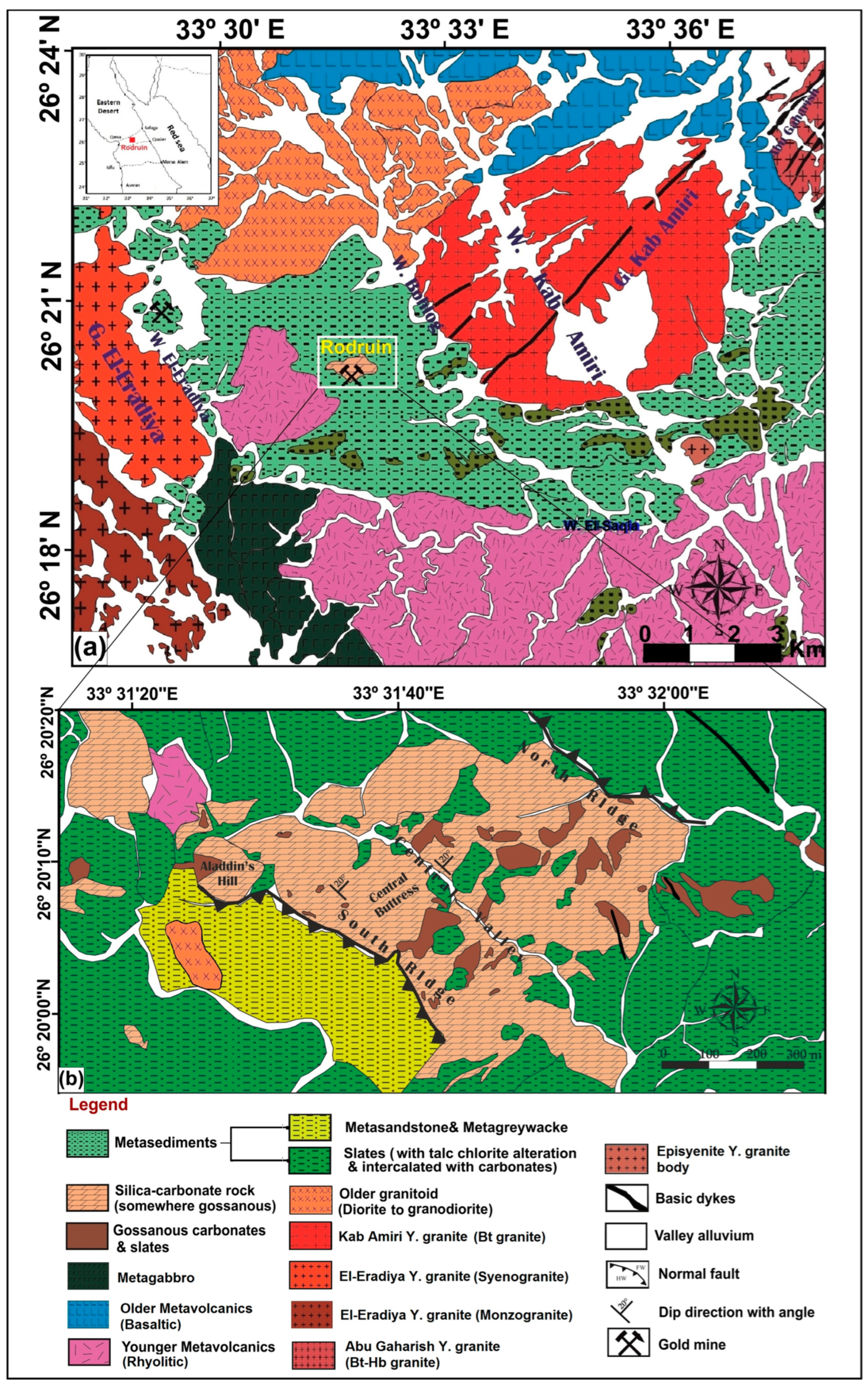
The Rodruin prospect is located in the CED of Egypt between latitudes 26°20′–26°20′20″ N and longitudes 33°31′20″–33°32′ E (Figure 2a,b). It occupies a ~7 km-wide structurally controlled corridor situated between the Kab Amiri and El-Eradiya granitic plutons and lies approximately 1.5 km west of the Kab Amiri intrusion. The area is readily accessible via Wadi Boholg, which branches from the western margin of the Kab Amiri pluton, as well as through subsidiary valleys extending northward from Wadi El-Saqia to the south.
Geologically, the Kab Amiri–Rodruin area forms part of the Neoproterozoic Pan-African nappe assemblage and is characterized by a complex association of dismembered ophiolitic fragments, island-arc metavolcanic sequences, and granitoid intrusions (Figure 2a). Comparable lithological assemblages elsewhere in the ED are well known to host significant gold mineralization (e.g., [37]), commonly attributed to hydrothermal fluid circulation and metamorphic devolatilization focused along major structural discontinuities. Within the CED, these discontinuities are primarily associated with transpressional and transtensional deformation regimes, which facilitated granitoid emplacement and the development of extensive hydrothermal alteration systems [43,44].
Figure 2. Geological maps of (a) Wadi Kab Amiri Area, and its surroundings, Eastern Desert, Egypt (modified after [45,46,47,48]) and (b) the Rodruin prospect (West Wadi Bohlog area) after [9].
Resources 15 00029 g002
Metasedimentary successions of the ED exhibit flysch-like characteristics and are dominated by pelitic to psammito-pelitic units, metagreywackes, metasiltstones, and subordinate metaconglomerates. These sediments were deposited in arc-related basins—including inter-arc, intra-arc, and back-arc settings—along an active continental margin during the Neoproterozoic. Subsequent arc–arc and arc–continent collision events resulted in intense deformation and regional metamorphism, attaining lower- to upper-greenschist facies conditions [49,50].
At Rodruin, the host rocks are dominated by dolomitic metasedimentary sequences composed principally of metagreywackes, slates, quartzites, and silica–carbonate units. These lithologies form an arcuate belt around the southern margin of the Kab Amiri pluton (Figure 2a). The protoliths are interpreted to have been derived predominantly from epiclastic sources rather than volcaniclastic material, despite minor volcanic activity documented near the South Ridge (Figure 2b). The stratigraphic succession comprises: (a) basal metagreywackes and quartzites; (b) interbedded slates, including gossanous, carbonated, and argillic varieties; (c) silica–carbonate rocks; and (d) an upper cap of gossanous carbonates. Isolated klippen of Younger Felsic Metavolcanics are locally preserved within the metasedimentary sequence (Figure 2b). Additionally, rhyolitic lapilli tuffs crop out along the North Ridge, and the sedimentary succession is intruded by north–south-trending andesitic dykes.
Carbonate units at Rodruin locally exhibit well-preserved stromatolitic textures, indicating deposition in shallow, relatively stable marginal marine environments. This sedimentary origin contrasts with carbonate occurrences at the nearby Hamama prospect, where carbonate rocks have been interpreted as hydrothermal–metasomatic in origin and subsequently modified by meteoric water interaction [51,52].
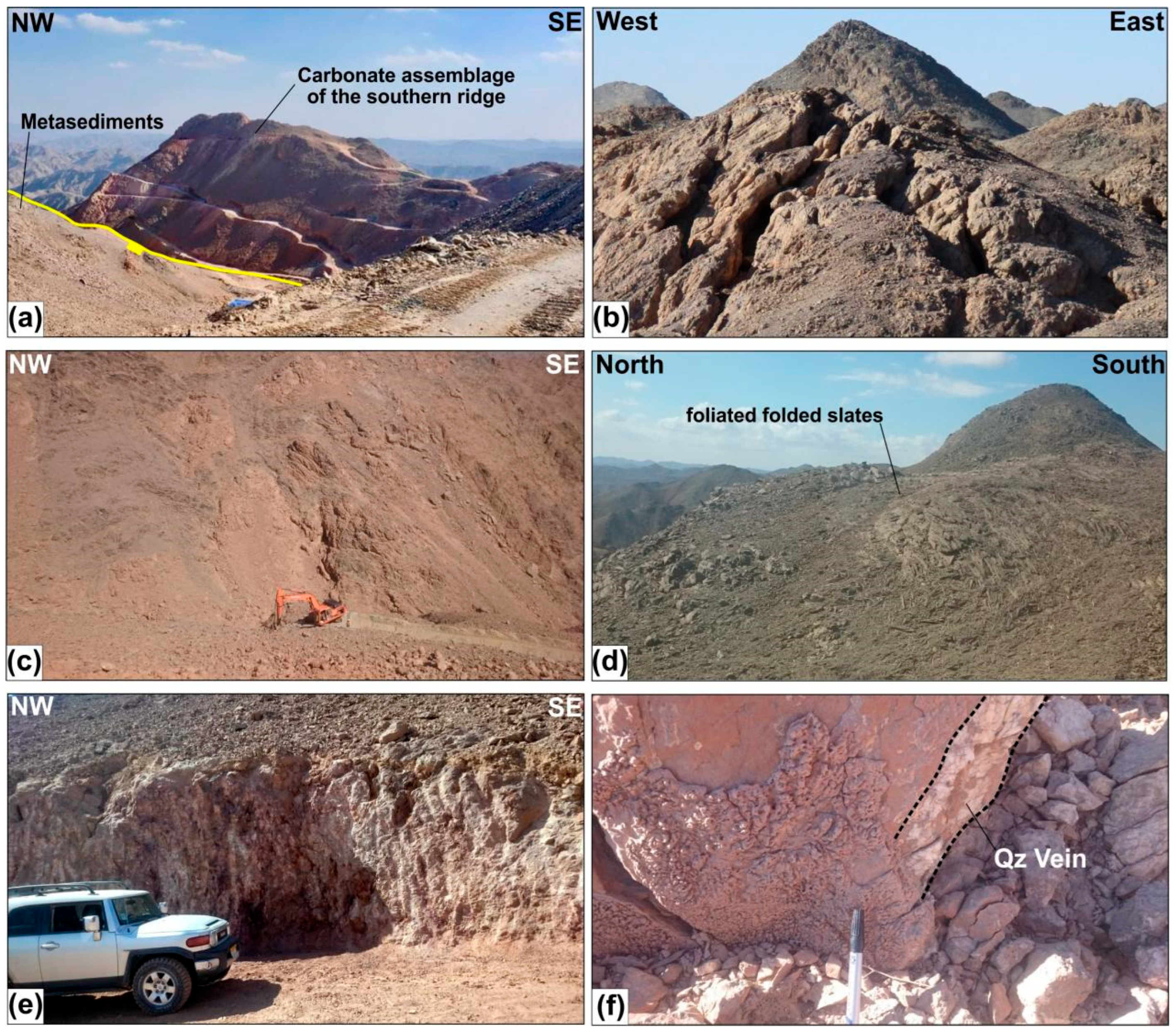
The slates at Rodruin are grayish-green to reddish-brown, strongly foliated, and locally hematized, exhibiting microfolds and shear-induced microfaults infilled with clay and diagenetic gypsum (Figure 3, Figure 4 and Figure 5). Progressive shearing reoriented quartz and phyllosilicate grains into elongate forms, imparting a distinctive pinstriped texture. At higher stratigraphic levels, carbonate–slate intercalations host silica–carbonate and talc–chlorite–carbonate rocks, which are frequently mineralized with malachite and chrysocolla along foliation planes (Figure 4a and Figure 5c).
Auriferous, gossanous quartz veins with an E–W orientation occur within both slates and carbonate units at Aladdin’s Hill and the western Rodruin area. Metagreywackes and quartzites south of Aladdin’s Hill display quartz- and mica-rich graded laminations. Overlying carbonate units, dipping approximately 20° NE, form dense, iron-stained beds tens of meters thick, extending over an area of ~1.2 × 0.6 km (Figure 2b). These units host iron- and base-metal-enriched zones that form a gossanous cap. An isolated rhyolitic dome (~100 × 200 m) in the northwestern sector represents a remnant exposure of the Younger Metavolcanic nappe [10].
Metasedimentary and mafic metavolcanic rocks south of the Kab Amiri granite are tectonically emplaced alongside small ophiolitic ultramafic bodies and intruded by older granodioritic plutons to the north, as well as by several younger granitoid bodies of variable composition. The dominant Kab Amiri pluton comprises a central biotite granite core encircled by garnetiferous two-mica granite. It intrudes ultramafic and serpentinized lithologies that were tectonically emplaced over sheared metavolcanic–metasedimentary assemblages [48]. To the west, the El-Eradiya Younger granite transitions from syenogranite in its western margin to monzogranite eastward [34], whereas the Abu Gaharish Younger granite, composed of hornblende–biotite granite, occurs northeast of the Kab Amiri pluton [37].

5. Mineralization and Structures

Gold mineralization at the Rodruin prospect is tectonically controlled and closely associated with transpressional Najd fault system-related shear zones. These shear zones acted as pathway corridors for the hydrothermal fluids. Repeated reactivation and rejuvenation of such tectonic elements enhance the permeability and promoting gold deposition during late Neoproterozoic deformation.
Geological analysis and drilling activities (Aton Company) at the Rodruin prospect delineate a large structurally controlled mineralized system developed along NW-oriented major shear zone. The strike of this shear zone extends for 1–1.2 km length, ~500 m in width, and reaching an estimated vertical continuity of 200–250 m. This system hosts an inferred mineralized tonnage of 200–300 Mt. Mineralization is dominantly confined to dolomitic carbonate rocks affected by intense shearing, where it occurs as disseminated and pod-shaped sulfide assemblages enriched in Au, Ag, Zn, and locally Cu. At surface, mineralization is expressed as strongly weathered, gossanous, gold-rich carbonate rocks, marked by pronounced supergene enrichment in Zn–Cu–Pb. Primary gold is predominantly associated with pyrite and chalcopyrite within quartz–carbonate lodes and phyllically altered metasedimentary host rocks, with the highest gold grades concentrated around Aladdin’s Hill. In contrast, gossans developed along the South Ridge are characterized by exceptionally high zinc contents locally exceeding 30%, yet remain depleted in Cu, Pb, and As. Surrounding wall rocks exhibit intense hydrothermal alteration, dominated by carbonatization, chloritization, and sericitization, particularly along and adjacent to auriferous vein contacts.
The prospect’s rugged topography comprises two circular hills—Aladdin’s Hill (east) and the northern Hill with two ENE-trending ridges separated by the Central Valley (Figure 3a). These two ridges appear as horst block, developed between two NW-oriented normal faults. Faults define the tectonic contacts between lithological units, particularly the WNW-trending major fault along the South Ridge, marking the boundary between footwall slates and hanging-wall carbonate units. These carbonates dip ~20° NE as dragged beds overlying the slates. NW-trending foliation, stretching lineation, and minor folds are well developed in the footwall slates. It is worth noting that the footwall carbonate assemblage are developed as dragged folds whilst the hangingwall slates show NW-oriented foliation, stretching lineation, and minor folds. Another NW-striking normal fault represents the NE boundary of the northern ridge, juxtaposing the Carbonate assemblage against the slates.
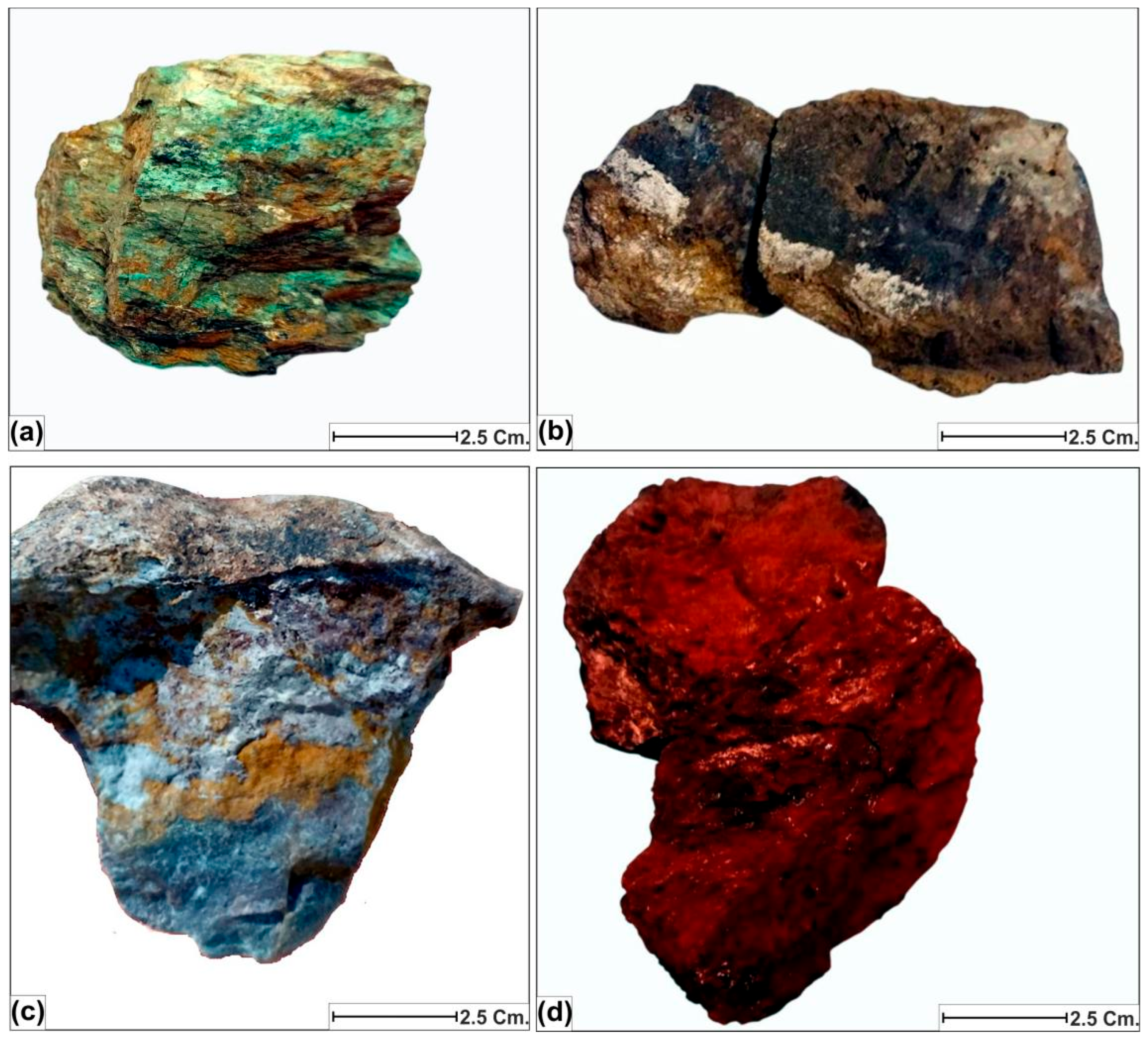
Mineralization is structurally controlled by parallel NW–WNW shear zones formed during transpressional deformation associated with the Najd fault system [53]. Ore fluids migrated along foliations and carbonate vugs, producing auriferous quartz veins and widespread hydrothermal alteration zones in green (Figure 4a), brown, white (Figure 4b), yellow (Figure 4c), red (Figure 4d), and black (Figure 4b) hues—reflecting variable fluid chemistry and mineralogy. Evidence from auriferous quartz-rich zones on the North Ridge suggests a separate, higher-grade phase of mineralization (Figure 4c). The permeability of slates and metagraywackes enhanced fluid flow and metal mobility, especially Cu and Mn. Overall, the mineralization is interpreted as post-metamorphic, forming during late ductile–brittle deformation within structurally focused shear zones.

6. Host Rock Petrography

6.1. Clastic Metasediments

The Rodruin prospect hosts a diverse suite of epiclastic metasedimentary rocks, including slates, quartzites, and metagreywackes, frequently interbedded with carbonate units. These rocks display variable grain size, metamorphic grade, and relative proportions of quartz, phyllosilicates, and clay minerals.
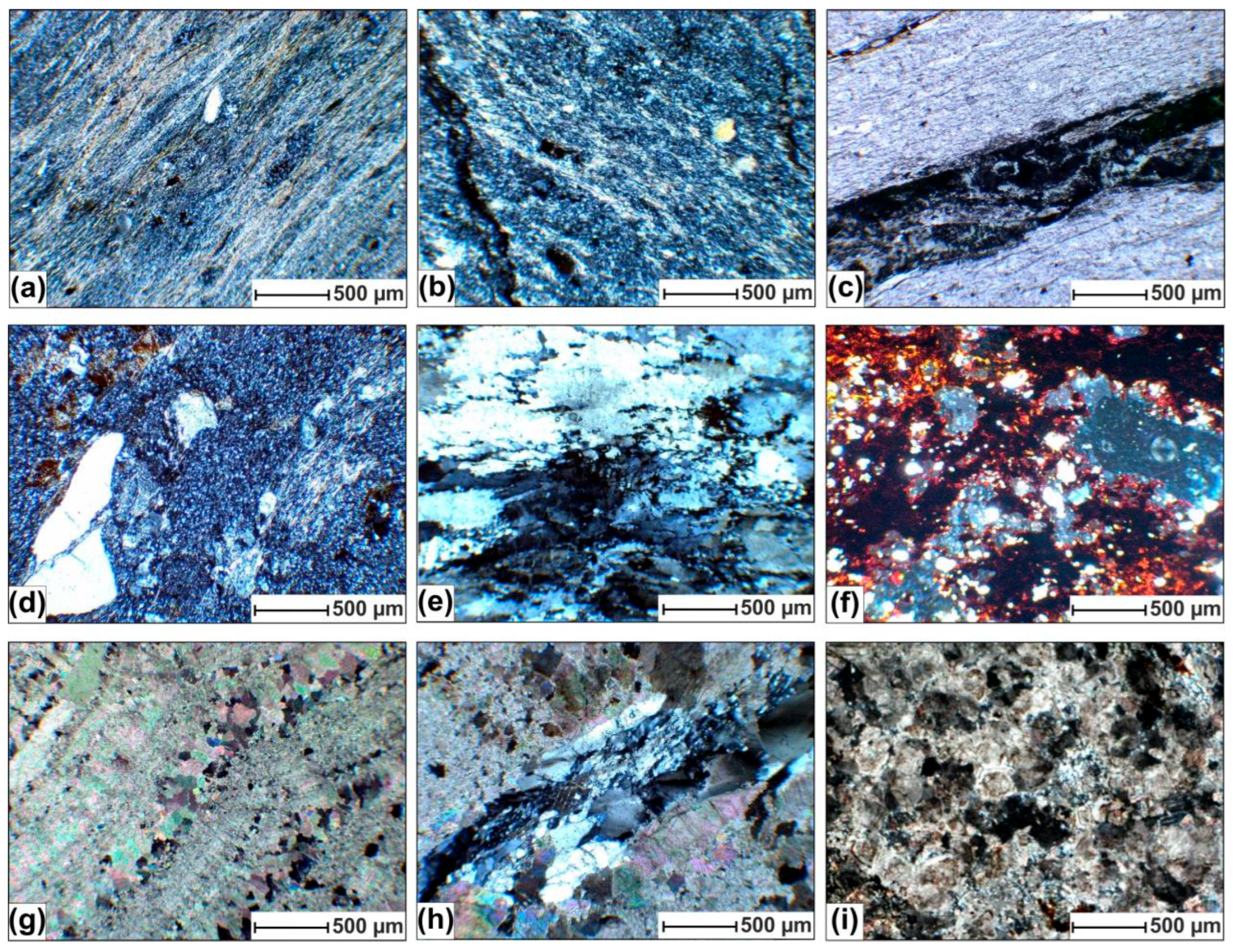
Slates are fine-grained and exhibit well-developed, continuous slaty foliation (Figure 5a–c). The matrix is composed of clay, quartz, sericite, and chlorite aggregates, along with opaque minerals—predominantly hematite—and locally crosscut by fine carbonate veinlets (Figure 5b). Foliation is defined by the alignment of mica, chlorite, and clay minerals, and is occasionally accentuated by malachite, iron oxides, or carbonate infill (Figure 5c). Detrital quartz grains are generally sub-rounded, and evidence of brittle deformation is recorded as fractured quartz grains and fragmented muscovite ribbons. Collectively, these characteristics indicate that the slates likely originated through low-grade regional metamorphism of volcanic tuffs and ash-rich epiclastic sediments.

6.2. Metagraywackes and Quartzites

Metagreywackes at the Rodruin prospect are poorly sorted and composed of sub-rounded sand-sized grains of quartz, feldspar, and lithic fragments, with subordinate mica and chlorite. These clasts are set within a fine-grained matrix consisting of clay minerals, comminuted quartz, chlorite, sericite, epidote, and carbonates (Figure 5d). Disseminated pyrite occurs as cubic grains and is frequently oxidized to iron oxides along grain boundaries.
Quartzites are dominated by quartz, with minor feldspar and carbonate, and commonly exhibit reddish-brown iron oxide staining (Figure 5f). Two samples display medium-grained granoblastic textures, whereas a recrystallized sample exhibits foliation-parallel stretching, interlocking serrated grains, and variable grain sizes ranging from coarse (0.5–2 mm) to fine (0.001–0.01 mm) (Figure 5e). These features indicate recrystallization under low- to medium-grade metamorphic conditions with differential stress contributing to foliation development.

6.3. Carbonate Rocks

Mineralogical analysis of carbonate rocks at Rodruin allows classification into five distinct types:
(a)
Pure non-mineralized carbonates (Samples 25-RO, GPS-35, GPS-84), composed predominantly of calcite and dolomite with minor talc (Figure 5i and Figure 6c).
(b)
Mineralized or gossanous carbonates (Samples 5-RO, 15-RO), consisting of calcite, dolomite, and ore minerals or their alteration products (oxides/hydroxides).
(c)
Silica–carbonate rocks (Sample 48-RO), dominated by calcite and quartz (Figure 5h).
(d)
Carbonated metasediments (Samples 10-RO, 13-RO, 18-RO, 23-RO), comprising calcite, dolomite, clay minerals, and minor talc.
(e)
Talc–carbonate rocks, composed of dolomite, calcite, and talc (Figure 6e).
Calcite occurs in two generations: large subhedral grains and fine anhedral grains, with some euhedral crystals exhibiting rhombohedral cleavage. Dolomite rhombs are euhedral, zoned, and commonly display iron oxide precipitates along cleavage planes (Figure 5i). Most carbonate units are dolomitic, often contain quartz, and are iron-stained in the oxidation zone. Talc–carbonate assemblages are uncommon and typically restricted to deep, structurally deformed, or faulted zones. Observed textures include colloform, spherulitic, and banded varieties; banded carbonates exhibit variable grain sizes (Figure 5g) and locally host framboidal pyrite, indicative of late-stage precipitation under low-energy, cavity-controlled conditions.

7. Ore Mineralogy and Paragenesis

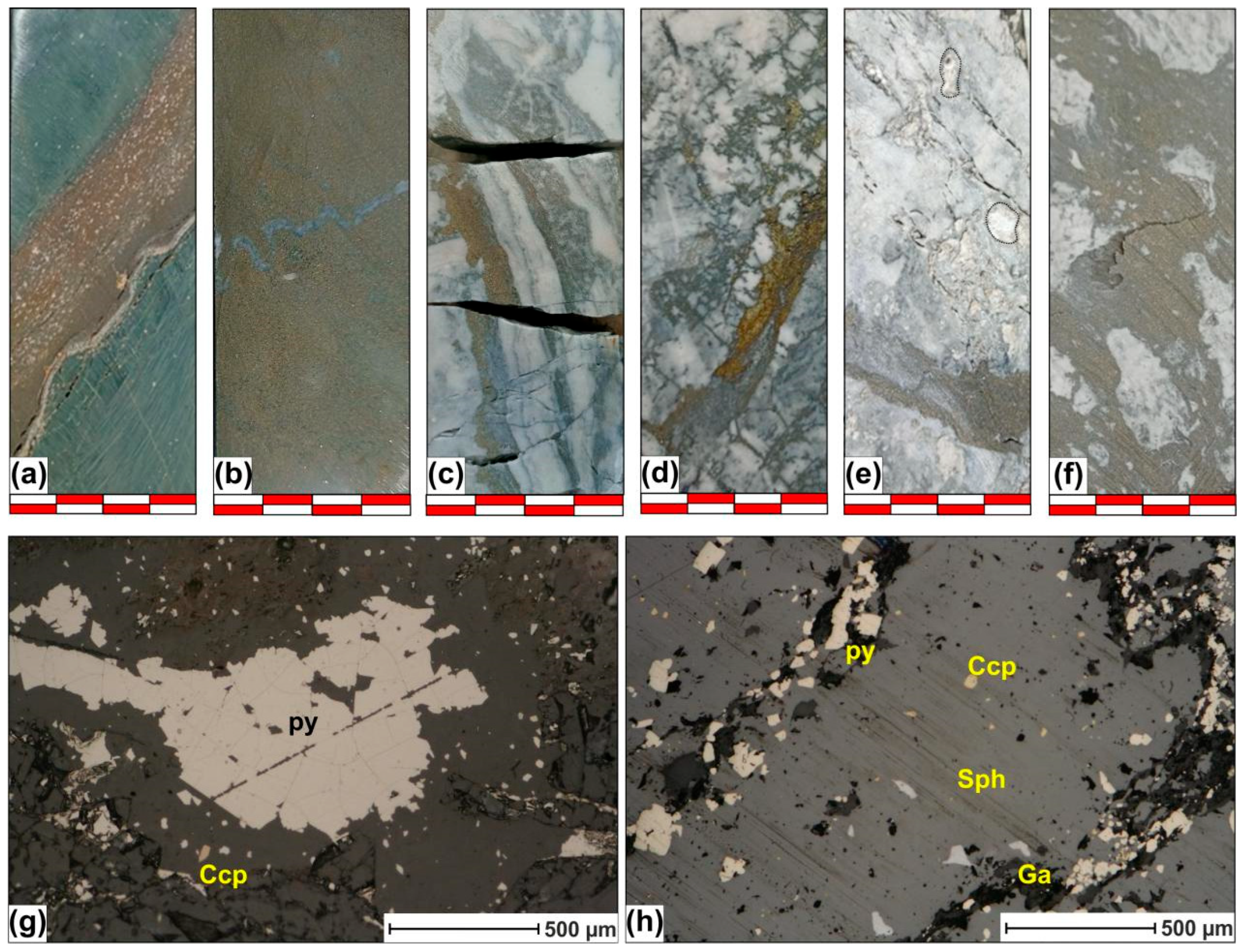
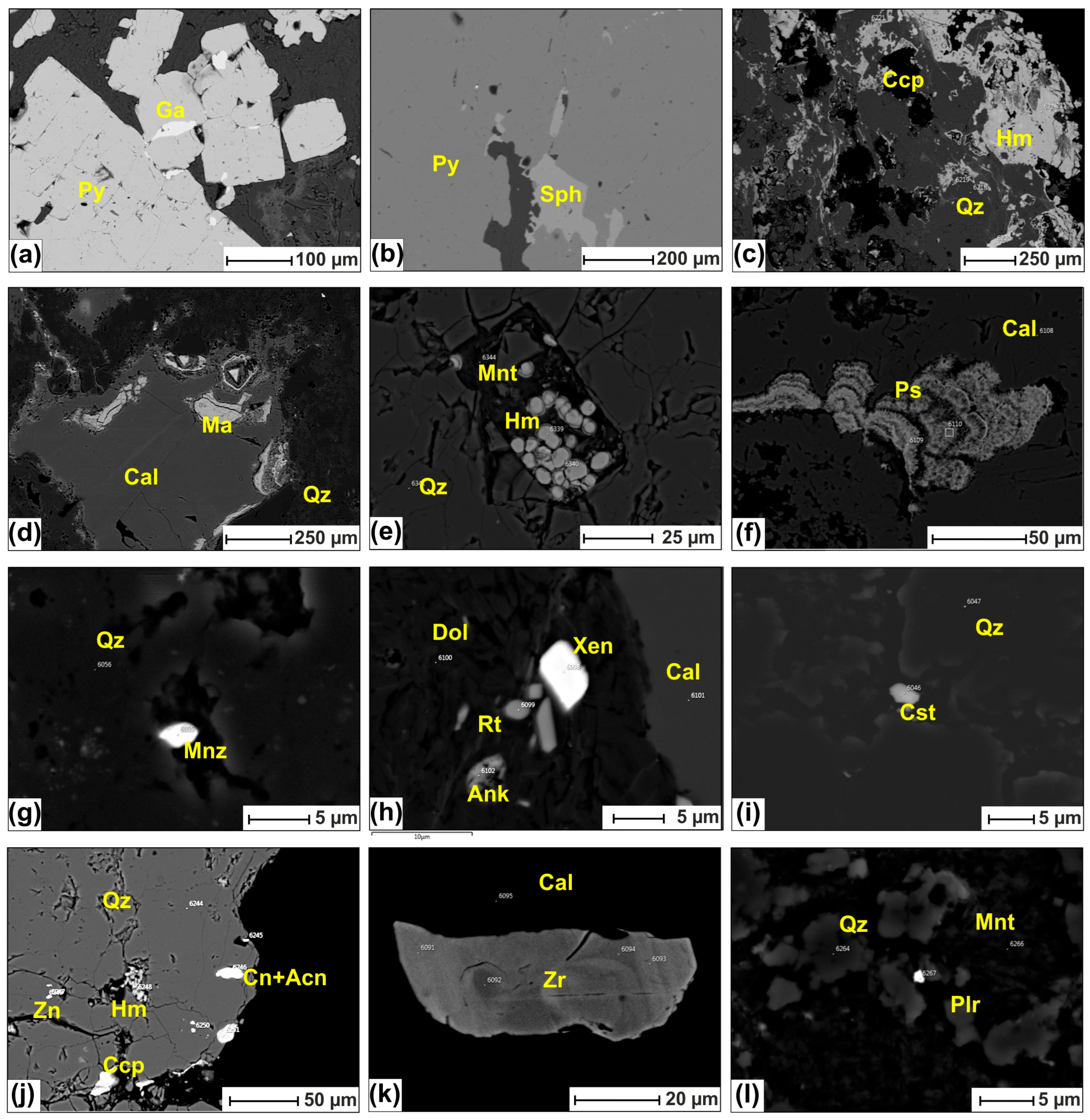
The fresh ore at Rodruin is dominated by pyrite and sphalerite (Figure 6b–h, Figure 7a,b and Figure 8), with subordinate chalcopyrite (Figure 7c,j). Two pyrite generations are distinguished: (a) primary, large subhedral grains, and (b) secondary sieve-textured porphyroblasts filling voids in dissolved carbonate host rocks. Massive sulfide zones from deeper cores are predominantly sphalerite (Figure 6b,f,h). Carbonates and carbonate-bearing ores frequently contain mineral inclusions derived from felsic magmatic-hydrothermal sources, including cassiterite (Figure 7i), monazite (Figure 7g), xenotime (Figure 7h), zircon (Figure 7k), and cinnabar (Figure 7j).
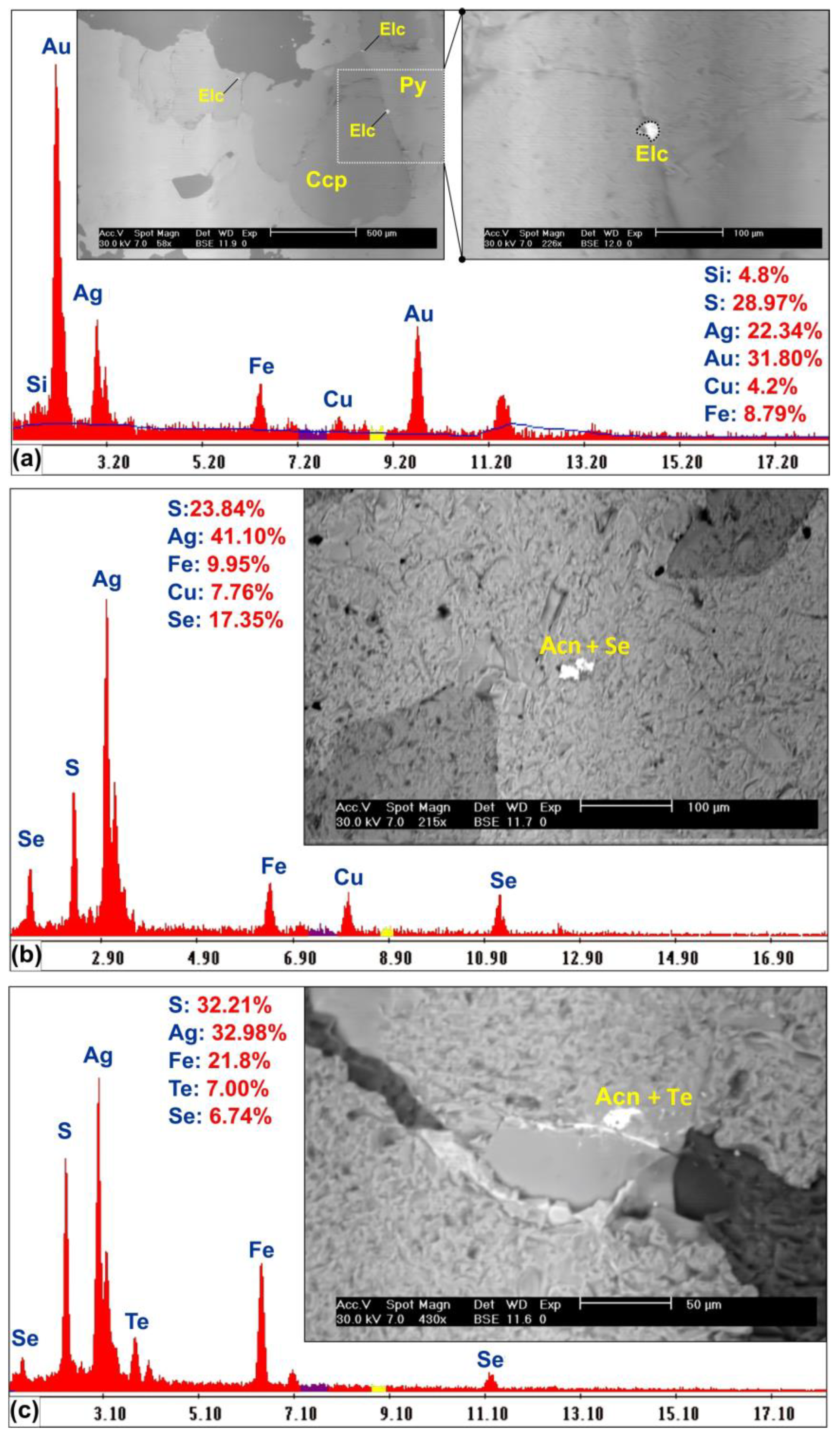
Galena and chalcopyrite commonly occur as inclusions within sphalerite (Figure 7h), whereas minor sphalerite is interstitial to pyrite (Figure 7b), indicating a paragenetic sequence in which pyrite and chalcopyrite crystallized first, followed by sphalerite and galena. Cassiterite is occasionally interstitial between quartz grains or positioned between pyrite and chalcopyrite (Figure 7i). Cinnabar occurs intergrown with acanthite as fine inclusions within quartz and late pyrite (Figure 7g). Gold occurs as fine interstitial electrum grains (~20 × 30 µm) containing approximately 22 at.% Ag, preferentially localized along pyrite–chalcopyrite grain boundaries (Figure 8a). Silver is most commonly present as native silver, Se-bearing acanthite (Ag2S; Figure 8b), and as tellurium-bearing acanthite (Figure 8c), with subordinate occurrences of the silver telluride hessite (Ag2Te).
Sulfide and oxide minerals at Rodruin are closely intergrown with carbonate phases (Figure 6c–g) and, less frequently, with quartz (Figure 7j), as observed in both core samples and under polarizing and scanning electron microscopes. Textural relationships are complex and vary between samples. In some cores, evidence of carbonate dissolution by ore-forming fluids is apparent (Figure 6f), whereas in others, sulfides preferentially precipitate along the rims of carbonate bands (Figure 6c,e). Microscopically, pyrite and chalcopyrite are commonly hosted within a quartz–carbonate matrix (Figure 6g), suggesting either overlapping crystallization or a sequential paragenesis in which carbonate deposition and sulfide precipitation were closely linked.
The paragenetic sequence of ore and host mineral assemblages at the Rodruin prospect (Table 1) was reconstructed through a systematic evaluation of microscopic textural relationships, including cross-cutting, replacement, overgrowth, and inclusion features. This interpretation was further constrained by mineral growth habits, identification of successive crystallization stages, field-scale observations of vein cross-cutting relationships, and the consistency of geochemical signatures across mineral phases.
The evolution of mineralization can be subdivided into four principal stages that postdate the deposition of the host sediments within an active orogenic setting. The initial stage corresponds to arc–arc suturing accompanied by greenschist-facies metamorphism under a compressional tectonic regime. During this phase, metamorphic fluids mobilized gold, accompanied by a limited sulfide assemblage dominated by early pyrite (Py-I), with subordinate chalcopyrite and tellurides, precipitated at moderate temperatures.
Subsequently, granitoid intrusion triggered two successive stages of sulfide mineralization. The first, high-temperature stage was characterized by the deposition of pyrite-II, chalcopyrite, and cassiterite, and was contemporaneous with intense carbonation of the metasedimentary host rocks. This stage reflects enhanced fluid–rock interaction driven by elevated thermal gradients associated with magmatic emplacement.
The final stage coincided with the late crystallization of the granitoids and involved the circulation of lower-temperature hydrothermal fluids. These fluids precipitated sphalerite and galena, with minor chalcopyrite, cinnabar, and xenotime, marking the waning phase of hydrothermal activity and the completion of the Rodruin mineralization sequence.
At the surface, carbonate and metasedimentary rocks exhibit extensive oxidation of primary sulfides (Figure 7c–f). More resistant sulfides, such as pyrite and chalcopyrite, persist, whereas less stable minerals have been largely transformed into oxides and hydroxides, including hematite, goethite, pyrolusite (Figure 7f), litharge (PbO), cuprite (Cu2O), and zincite (ZnO). Mixed aggregates of Fe, Mn, Mg, Zn, and Cu oxides and hydroxides are widespread within carbonate units (Figure 7d), reflecting post-depositional reworking and supergene enrichment. Secondary carbonates, including malachite and rhodochrosite, were identified using SEM-EDX analyses. Non-metallic phases comprise calcite, quartz, dolomite, and subordinate barite, clay minerals, and talc (Figure 7c–f).

8. Results of Geochemical Analyses

8.1. Whole-Rock Geochemistry

Seventeen ICP-MS analyses were conducted on rock samples from the Rodruin prospect, including metasediments (10 samples: three slates, three carbonated slates, four metagraywackes), carbonate rocks (three samples), gossanous ores (two samples), and fresh ore (two samples) (Table 2).

8.1.1. Major Elements

Metasedimentary and carbonate rocks at Rodruin exhibit substantial variation in major-element compositions (Table 1). Silica content in the metasediments ranges from 34.5 wt.% in carbonated slates to 73.4 wt.% in siliceous metagreywackes, with an average of 56.7 wt.%. Slates generally have lower SiO2 (~50.6 wt.%), attributable to their higher phyllosilicate content, intercalated carbonate layers, and the presence of sulfides and oxides. Alumina (Al2O3) concentrations are elevated, ranging from 8.3 to 18.6 wt.%, reflecting the abundance of clay minerals and mica within the matrix.
All metasedimentary rocks at Rodruin are markedly K2O-depleted, averaging ~0.67 wt.%, likely due to feldspar leaching during chemical weathering. Fe2O3 contents range from 3.3 to 8.3 wt.% (avg. 6.4 wt.%), whereas MgO varies from 1.27 to 12.77 wt.%. Elevated Fe2O3 + MgO concentrations in slates reflect high chlorite [(Mg,Fe)3(Si,Al)4O10(OH)2·(Mg,Fe)3(OH)6] content, while other metasediments are enriched in iron oxides and pyrite. Variations in MgO are influenced by dolomitic carbonate intercalation; slates average 5.4 wt.% MgO, suggesting contributions from post-depositional dolomitization or mafic detrital input.
The Index of Compositional Variability in Table 3 (ICV = (Fe2O3 + K2O + Na2O + CaO + MgO + TiO2)/Al2O3) ranges from 0.53 to 4.2, with an average of 1.43, consistent with deposition in geochemically mature, tectonically active environments [54].
Carbonate units at Rodruin are enriched in CaO and MgO, which together average 53.6 wt.% (Table 3), with Fe2O3 averaging 3.5 wt.%. Variations in iron content likely reflect differing hydrothermal fluid inputs. Dolomite and magnesite locally host minor Mn oxides (pyrolusite), interpreted as sedimentary in origin. Strong positive correlations between CaO and MgO, weak MgO–Fe2O3 correlations, and negative correlations between MgO and base metals indicate distinct sources for magnesium and metals, with Mg primarily derived from seawater-influenced dolomitization.
Ore samples from Rodruin are marked by pronounced enrichment in Fe2O3 (average 28.6 wt.%), CaO (18.9 wt.%), MgO (9.9 wt.%), and SiO2 (average 14.5 wt.%, reaching up to 40.8 wt.; Table 3). This geochemical signature reflects the dominance of pyrite, often preserved as iron oxides within gossanous ores, and disseminated within silicified dolomitic carbonate rocks, with subordinate silicate contributions derived from the surrounding metasedimentary host rocks. Strong positive correlations between Fe2O3 and base metals (Cu, Zn, Pb), as well as As, Ag, and Te (Table 4), are consistent with petrographic evidence showing a close spatial and genetic association between pyrite and coexisting base-metal sulfides and precious ore minerals.

8.1.2. Trace Elements

Metasedimentary rocks at Rodruin are enriched in Mn, V, and Ba. Manganese occurs predominantly as pyrolusite and, more rarely, as rhodochrosite, vanadium as vanadiferous oxides, hydroxides, and vanadinite, and barium as hydrothermal barite, typically concentrated in oxidation zones associated with sulfide mineralization. Chalcophile elements (Zn, Cu, Pb, As) display moderate and variable concentrations, ranging from a few ppm up to 2.5 wt.%, reflecting post-depositional hydrothermal alteration. Elevated Zr (~41 ppm) suggests input from a felsic protolith.
Carbonate units are enriched in Sr, V, Zn, and As, with strontium occurring as barite inclusions (up to 2 wt.%). Oxidized sulfides, particularly pyrite and chalcopyrite, host minor Mn, Co, Ni, V, and Cr. Accessory monazite and xenotime within both carbonates and metasediments likely reflect wall-rock assimilation or contamination from granitic sources or introduction via hydrothermal fluids, or could alternatively originate from metamorphic processes.
Ore samples are strongly enriched in Zn (2.5 wt.%), Pb (0.4 wt.%), Cu (0.2 wt.%), and Mn (0.2 wt.%), alongside elevated concentrations of Ba, As, V, Sr, Zr, and Ga. Minor trace elements typically enriched in granitic magmatic fluids—including Sb, Bi, Mo, W, Sn, Rb, Be, Y, Nb, and Ta—indicate contributions from magmatic-hydrothermal fluids derived from surrounding Younger granitic intrusions. Strong positive correlations between base metals, Ag, As, and elements characteristic of granitic fluids (Table 4) further support a significant magmatic-hydrothermal component in ore formation.

8.1.3. Rare Earth Elements (REEs)

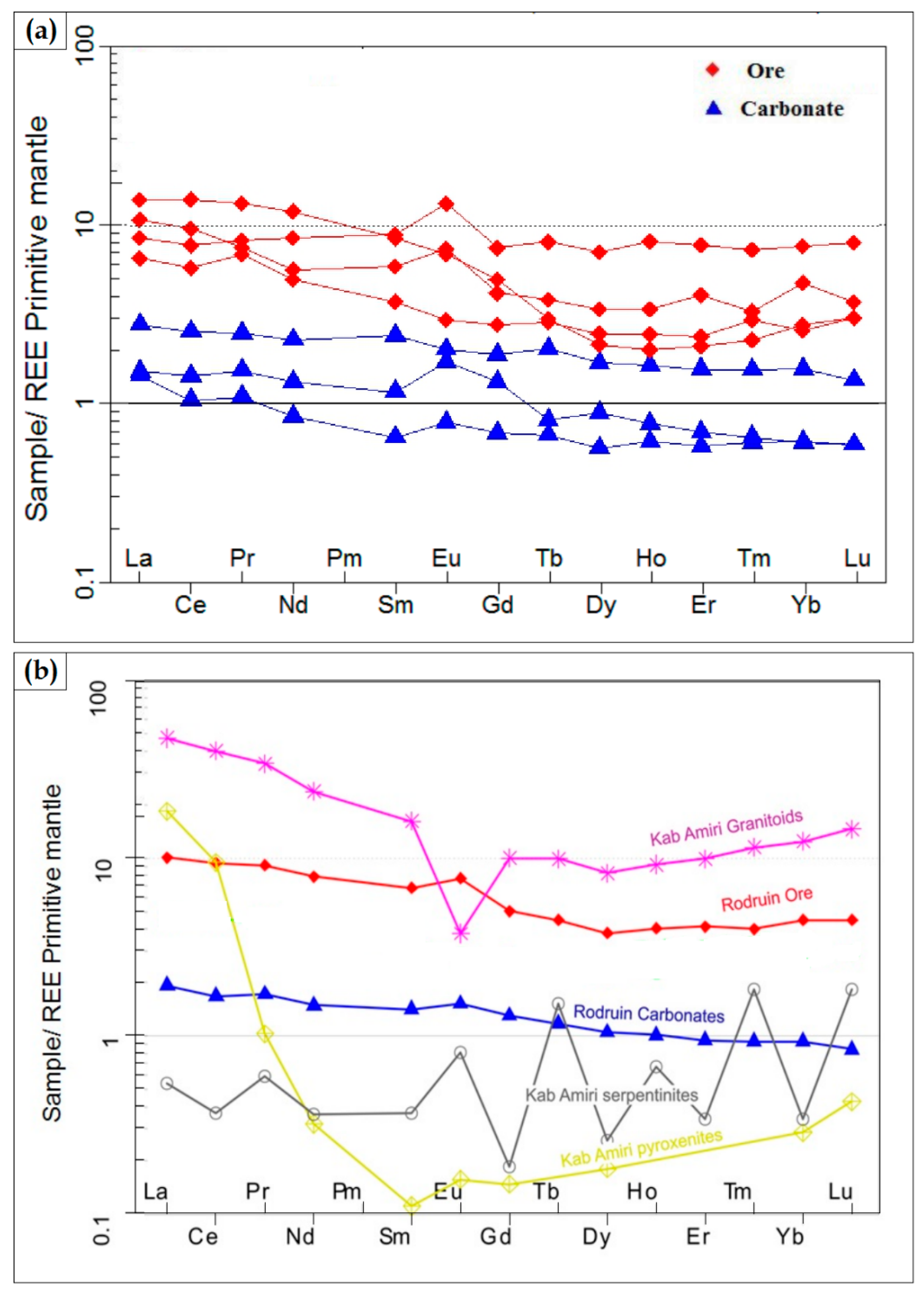
Rare earth element (REE) concentrations were normalized to primitive mantle values [14] to assess the sources and evolution of mineralizing fluids (Figure 9). Carbonates contain 0.8–2× primitive mantle REE, whereas ores are enriched 4–10× (ΣREE: carbonates ~10 ppm; fresh and gossanous ore ~49 ppm). Carbonates exhibit REE patterns broadly similar to primitive mantle values, with minimal LREE–HREE fractionation ((La/Yb)N ≈ 2.2) and minor positive Eu anomalies, suggesting a partial mantle contribution. In contrast, elevated REE concentrations in ore samples indicate hydrothermal fluids as the dominant source (Figure 9a,b).

8.2. Carbon and Oxygen Isotopes

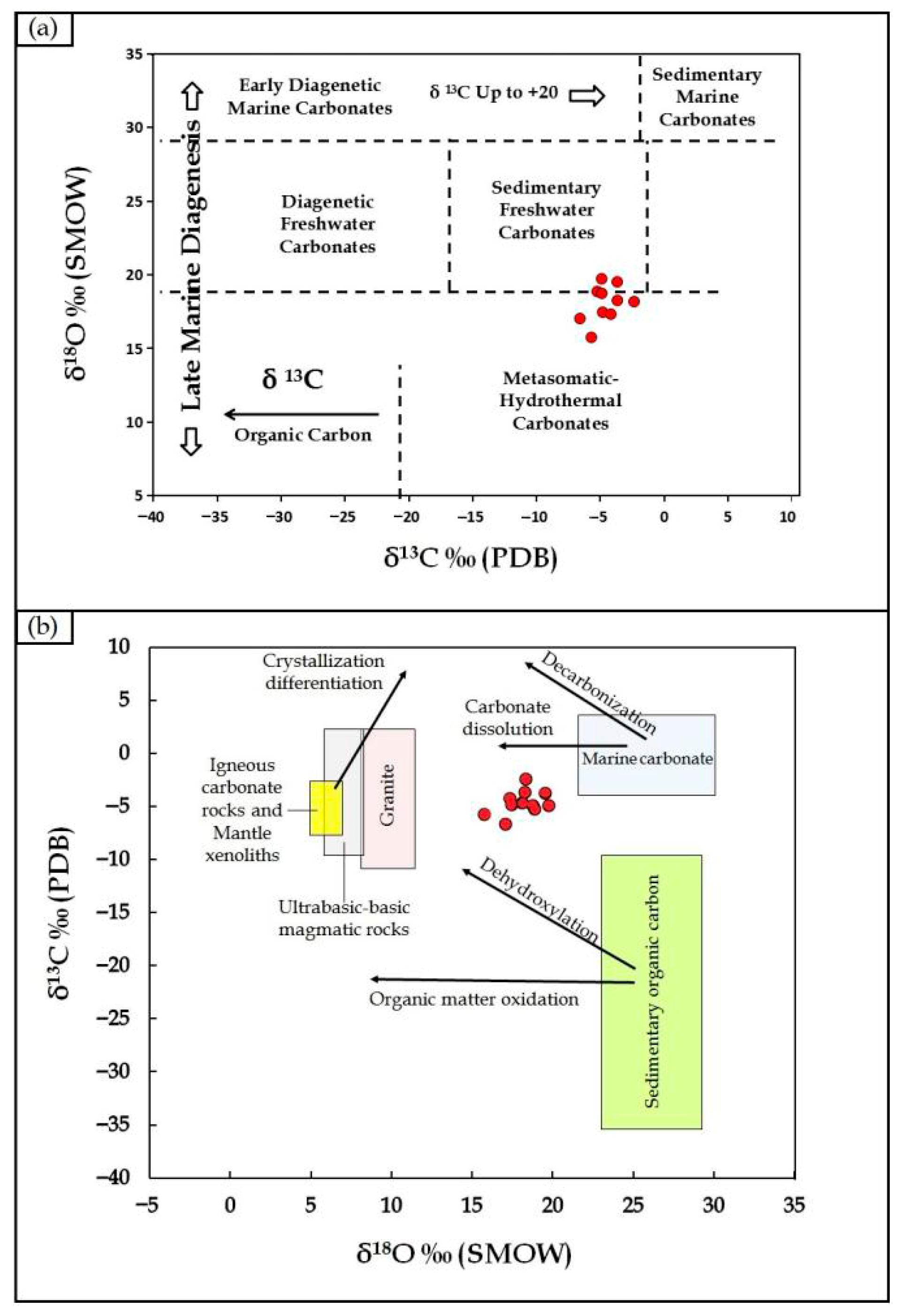
Carbonate samples from Rodruin exhibit δ13C values ranging from −6.6 to −2.36‰ (average −4.47‰) and δ18O values between +15.7 and +19.72‰ (average +18.09‰) (Table 5), consistent with a metasomatic–hydrothermal origin (Figure 10a). The δ13C values (~−4 to −5‰) suggest minimal contribution from biological carbon, in contrast to typical terrestrial biomass (−26 ± 7‰; [58]). Both δ13C and δ18O values appear largely unaffected by low-grade greenschist-facies metamorphism of the host metasediments, preserving the signature of original carbonate deposition. High-temperature processes, such as amphibolite-facies metamorphism or decarbonation, would be expected to lower δ13C and δ18O; however, the Rodruin carbonates closely follow trends characteristic of marine-influenced carbonate dissolution (Figure 10b; [59,60,61]).

9. Discussion

9.1. Type of Mineralization (Polymetallic or Orogenic?)

The genesis of gold deposits in the Egyptian ED remains debated, with multiple genetic models proposed. A prevailing interpretation links quartz and quartz–carbonate–gold veins to the emplacement of post-orogenic Younger granites, implying a polymetallic vein-type affinity [35,65]. Almond et al. [66] emphasized that gold deposition coincided with shearing events during regional cooling following granite intrusion. Other studies associate mineralization with late Pan-African transpressional tectonics [67,68]. Alternative hypotheses attribute hydrothermal mineralization either to metamorphic devolatilization, early Paleozoic magmatic cooling (e), or early Cambrian subduction-related calc-alkaline intrusions (e). A complementary interpretation suggests that mineralization originated from devolatilization of host volcano-sedimentary rocks during orogenic tectonics associated with arc–arc and arc–continent collisions within the Arabian–Nubian Shield, supporting classification of Rodruin as a turbidite-hosted orogenic gold deposit [3,37,38].
Turbidite-hosted orogenic and polymetallic vein-type gold deposits share several characteristics: carbonate-rich host rocks, formation in subduction-related settings, variable host rock ages, structurally controlled vein-type mineralization, similar alteration mineralogy, low-salinity ore fluids, and comparable δ18O values in quartz. However, they differ in host rock lithology, ore morphology, tonnage, structural regime, gangue and ore mineralogy, metal associations and zonation, ore textures, fluid inclusion and sulfur isotope signatures [69]. Accurately distinguishing these deposit types is essential for classifying Rodruin and understanding its exploration potential (Table 6).
Polymetallic vein-type deposits, also referred to as carbonate-replacement deposits, are typically characterized by quartz–carbonate veins containing Ag–Pb–Zn disseminated sulfides, with subordinate Au and Ag. They form from high-temperature magmatic fluids related to felsic hypabyssal intrusions, usually hosted in sedimentary (commonly carbonate) units within metamorphic terranes [76,100,101]. While some aspects of this definition resemble Rodruin, the high-temperature magmatic nature of ore-forming fluids at Rodruin remains unconfirmed.
Although polymetallic veins generally require sedimentary hosts, Rodruin mineralization occurs within metasedimentary rocks. Polymetallic deposits often exhibit complex metal zoning and characteristic alteration assemblages [77,97]. For example, the Mole granite in Australia displays four distinct zonal fields: central wolframite–bismuthinite mineralization surrounded by cassiterite, arsenopyrite, and chalcopyrite, with sphalerite–galena at the periphery [97]; such zonation is absent at Rodruin.
Polymetallic vein deposits commonly form in continental-margin and island-arc volcanic–plutonic belts under extensional tectonics [77]. In contrast, Rodruin mineralization is confined to shear zones, reflecting compressional to transpressional tectonics [12]. Additionally, polymetallic veins are typically associated with Mesozoic–Cenozoic magmatic intrusions [74,76,77], whereas Rodruin’s Younger granites are Neoproterozoic [23]. Despite these differences, polymetallic vein deposits share several similarities with Rodruin, including diverse ore textures (disseminated, stockwork, breccia, massive) and strong structural and lithological control over high-grade ore localization [76,80].
Mineral inclusions derived from felsic magmatic intrusions—such as monazite, zircon, cassiterite, and rutile—and trace elements typically enriched in granitic magmatic fluids (Sb, Bi, Mo, W, Nb, Ta, Sn) occur in both mineralized and non-mineralized carbonates and ores, with minor presence in clastic metasediments. This distribution suggests a possible contribution from magmatic–hydrothermal fluids; however, it could alternatively be explained by wall-rock assimilation or metamorphic processes. Primitive-mantle-normalized REE patterns of Rodruin ores correlate closely with Kab Amiri granitoids but not with mafic units such as serpentinites and pyroxenites (Figure 9b), indicating minimal contribution from mafic intrusions. Positive Eu anomalies in the ore are consistent with hydrothermal processes [102] or interaction with basement lithologies [103], whereas the distinct REE signatures of serpentinites and pyroxenites imply that metals were primarily sourced via metamorphic devolatilization of the metasedimentary host rocks.
Orogenic (lode or mesothermal) gold deposits are typically classified based on host rock into turbidite-, greenstone-, and BIF-hosted types [39,81,104]. These systems form under compressional to transpressional deformation in regionally metamorphosed belts at convergent boundaries, where shear zones enhance fluid permeability and facilitate gold deposition [39,105,106].
Rodruin exhibits many features characteristic of turbidite-hosted gold deposits. It is hosted in metamorphosed clastic sediments deposited in a subduction-related island-arc environment [49,81], and the host rocks are Mesoproterozoic–Paleoproterozoic in age. Mineralization is controlled by bedding-parallel quartz–carbonate veins, folds, brittle–ductile shear zones, and sulfide-bearing sedimentary horizons, reflecting both structural and lithological controls. Rodruin combines large tonnage with high-grade gold, comparable to known turbidite-hosted deposits [54,70,81]. The ore assemblage is dominated by pyrite with minor base-metal sulfides, gold, and accessory minerals such as cassiterite, cinnabar, and silver-tellurides, consistent with the relatively simple mineralogy of turbidite-hosted systems [83,87,89,91]. Metal associations (Au, Ag, As, Fe, Pb, Zn, ±Cu, ±Sb, occasionally ±Bi–Te–W) and the absence of clear zonation further support this classification [81,90,93,94,95]. Gangue mineralogy, dominated by quartz and carbonates, is also consistent with turbidite-hosted deposits.
Temperature constraints for ore formation, inferred from regional thermobarometry and analogues in the ED, suggest metamorphic devolatilization of ophiolitic and metasedimentary rocks occurred at 370–560 °C and 400–500 °C, respectively [3,4]. When combined with geochemical (trace element and REE) and isotopic evidence, these data strongly support a mixed metamorphic–magmatic fluid model for Rodruin.

9.2. Origin of Carbonate Rocks

The intercalation of carbonate rocks with metasedimentary units at the Rodruin prospect represents a complex feature that requires detailed investigation of their origin, tectonic setting, and relationship with ore and basement lithologies. To address this, we integrated field observations, mineralogical analyses, major- and trace element geochemistry, and stable isotope (C and O) studies.
Carbonation of mafic and ultramafic rocks via CO2-rich fluids is a well-documented process that produces secondary carbonates and associated minerals [107]. Talc occurs locally within shear-zone fractures and is interpreted as a product of carbonation, resulting from hydrothermal fluid interaction with mafic components of metasediments or with dolomite. Mineralized carbonates at Rodruin vary in ore content, with iron as the dominant metallic component.
Geochemically, the carbonates are primarily dolomitic and enriched in Mg, Fe, and Si. Representative major oxide compositions for samples GPS-84, GPS-35, 8RO, and 1RO are: CaO ~ 36 wt.%, MgO ~ 13 wt.%, Fe2O3 ~ 11 wt.%, and SiO2 ~ 6 wt.%. Elevated concentrations of metals (Fe, Cr, Ni, Co, Cu, Mg, Mn, V, Zn, Cd, Au, Ag, As, Y, REEs) and non-metals (Ba, Sr) suggest either hydrothermal crystallization or interaction with adjacent basement lithologies.
All carbonate-bearing rocks—including non-mineralized, gossanous, and ore-bearing carbonates—display similar REE patterns, albeit with varying abundances and anomalies, highlighting hydrothermal fluids as the primary source of REEs. Primitive-mantle-normalized REE patterns are generally flat, indicating a mantle contribution, while the average (La/Yb)N ratio (~2.21) and high MnO (~0.2 wt.%) are consistent with transport and crystallization in fluid-dominated hydrothermal systems [108]. Positive Eu anomalies in carbonates likely reflect either substitution of Ca2+ by Eu2+ from hydrothermal fluids or interaction with basement lithologies [103], a pattern commonly observed in submarine hydrothermal and massive sulfide systems [18,102,109,110,111]. Minor negative Ce anomalies suggest influence from meteoric water.
Field and petrographic observations show banded and colloform textures, as well as well-developed zoning in dolomites, indicating that the carbonates preserve their original geochemical signature and were largely unaffected by subsequent low-grade greenschist-facies metamorphism. Stable isotope data further constrain the fluid regime: δ13C values are light and homogeneous, consistent with hydrothermal derivation and negligible contribution from organic or sedimentary carbon sources. Heavy δ13C values suggest elevated biological productivity in a confined, redox-stratified marine environment [112]. δ18O values (+15.7 to +19.7‰, V-SMOW) are consistent with high-temperature aqueous fluids, suggesting interaction between metamorphic and magmatic fluids. These values plot predominantly within the hydrothermal–metasomatic carbonate field, with a few samples approaching sedimentary freshwater compositions, possibly influenced by quartz or surface water during late alteration. Comparable δ18O–δ13C trends have been reported for hydrothermal carbonates in the Hamama VMS deposit and other ED settings [51,113].
Low Th/U ratios (0.01–0.5) in carbonates and ore indicate depletion of large-ion lithophile elements in mantle-derived fluids, consistent with processes such as crustal extraction [114]. CO2 derived from metamorphic devolatilization of carbonate-rich metasediments likely played a significant role in ore-fluid composition. Decarbonation reactions during Pan-African orogenic metamorphism would release CO2-rich fluids capable of modifying fluid chemistry and promoting mineral precipitation. Minor interaction with magmatic-derived fluids further supports a hybrid metamorphic–magmatic origin for the ore-forming system.
Integrating field, petrographic, geochemical, and isotopic evidence supports a hydrothermal–metasomatic origin for Rodruin carbonates, with minor modification by meteoric fluids. CO2-rich hydrothermal fluids circulated through basement rocks during the Neoproterozoic, facilitated by deformation and metamorphism, and were trapped in veins, dykes, and alteration zones. Hydrothermal activity occurred in at least two overlapping stages: an initial stage forming silica–carbonate rocks, followed by sulfide mineralization with gold. These events postdate host rock formation and are temporally associated with the crystallization of Ediacaran (~600 Ma) post-tectonic granites.

9.3. Genesis and Evolution of Ore-Forming Fluids

Regarding ore-forming fluids, most studies favor a metamorphic origin (e.g., [115]) or a hybrid metamorphic–magmatic source [12,35,65], although fluid composition likely varies among different mineralization events. Multi-sourced ore fluids are now widely recognized as a hallmark of many hydrothermal systems, reflecting the complex interplay of fluids from multiple reservoirs during mineralization. Ore fluids commonly comprise varying proportions of magmatic, metamorphic, basinal, and meteoric components, which may interact both spatially and temporally along structurally focused conduits such as shear zones, faults, and fractures. For instance, Augustin and Gaboury [6] identified four hydrothermal events and at least two distinct fluid reservoirs contributing to gold deposition in multiple deposits, highlighting both magmatic and metamorphic fluid contributions. Magmatic fluids primarily provide heat, metals, sulfur, and volatiles, whereas metamorphic fluids, released during devolatilization, are typically H2O–CO2-rich and highly effective at transporting gold and associated metals over regional scales. Basinal and meteoric fluids may act as metal-leaching or diluting agents, modifying fluid composition, redox state, and pH, thereby promoting precipitation through fluid mixing, cooling, and fluid–rock interaction [6,7,8].
The mineralization at the Rodruin prospect evolved through a multi-stage paragenetic sequence reflecting the progressive interaction of metamorphic, magmatic–hydrothermal, and supergene processes. The earliest stage involved the deposition of clastic host sediments dominated by quartz, feldspars, and clay minerals within an active orogenic setting. Subsequent arc–arc collision initiated regional greenschist-facies metamorphism and devolatilization of the metasedimentary rocks, generating metamorphic fluids that migrated along arc–arc suture zones and shear zones, leading to the formation of orogenic gold mineralization. Ore deposition during this stage was characterized by the crystallization of primary pyrite and chalcopyrite, accompanied by gold and silver minerals, including hessite and acanthite. During the Neoproterozoic, the emplacement of Younger granitoids introduced magmatic fluids that caused extensive carbonation of the metasediments and contributed minor felsic magmatic minerals, such as monazite, cassiterite, and zircon, to the ore system. Continued release of late-stage hydrothermal fluids from the granitoids resulted in additional sulfide mineralization dominated by relatively low-temperature assemblages, including sphalerite, galena, and locally cinnabar. Finally, prolonged supergene alteration and oxidation of the sulfide-rich ore body at surface led to the development of a well-defined gossanous cap composed mainly of hematite, goethite, cuprite, zincite, and litharge.
A regional comparison with other Egyptian gold deposits, particularly the Abu Marawat orogenic gold system, provides additional context. Abu Marawat is characterized by structurally controlled, quartz-vein-hosted gold along contacts between mafic to intermediate metavolcanics and overlying volcaniclastic units, closely associated with shear zones and brittle–ductile deformation. Rodruin and Abu Marawat share similar host rock associations, vein-controlled mineralization, alteration assemblages (carbonate, sericite, chlorite, silica), and ore mineralogy dominated by pyrite with subordinate base-metal sulfides. Fluid inclusion and electron microprobe studies at Abu Marawat indicate low- to moderate-salinity aqueous to aqueous–carbonic fluids, consistent with orogenic gold systems, with gold and base metals mobilized from surrounding mafic rocks by fluids potentially sourced from granitoid intrusions [116].
Similarly, at Rodruin, metamorphic fluids carried the bulk of gold and base metals, facilitated by thermal input from the Kab Amiri Younger granite, while magmatic fluids contributed only minor amounts to the overall metal budget. This hybrid fluid–metal model provides a robust framework for interpreting Rodruin’s mineralization and underscores its significance within the Egyptian segment of the Arabian–Nubian Shield. Overall, the mineralogical, geochemical, structural, and isotopic characteristics of Rodruin are most consistent with orogenic gold deposits, with minor magmatic contributions supporting a hybrid metamorphic–magmatic origin for the ore-forming fluids [12,117].

10. Conclusions

  • The Rodruin mineralization is a high-grade quartz carbonate Zn-Cu-Pb-(Au) mineralization restricted to NW- and WNW-striking shear zones in metasedimentary rocks (slates, metagraywackes, and quartzites) with minor exposures of metavolcanics in a structural corridor between two huge granitic plutons, Kab Amiri to the east and El-Eradiya to the west.
  • The fresh ore is composed of pyrite, sphalerite, galena, chalcopyrite, rare cassiterite, cinnabar, native silver, hessite, tetrahedrite, and gold, respectively, in decreasing order. Non-metallic gangue minerals include quartz, calcite, dolomite, chlorite, barite, and rhodochrosite. Pyrite is found in two generations: (a) early formed coarse euhedral to subhedral grain, and (b) late-stage fine grains related to carbonate formation. The paragenetic sequence indicates that the earliest mineralization stage was characterized by the crystallization of first-generation pyrite and chalcopyrite, followed by a later stage marked by the deposition of sphalerite and galena.
  • The Rodruin mineralizations and associated alteration zones exhibit the characteristic features of orogenic turbidite-hosted gold deposits. Nevertheless, the mineralogical and geochemical signatures reveal a discernible magmatic contribution, suggesting that the ore-forming fluids were derived from a hybrid metamorphic–magmatic source.
  • The ore is hosted in Neoroterozoic metasedimentary rocks formed in a subduction-related tectonic environment. The ore body is characterized by large tonnage, high gold grades, and steeply dipping veins, reflecting a tectonic regime that evolved from compression to transpression, later accompanied by extensional deformation. These structural and tectonic features, along with ore mineralogy, metal associations, and the absence of significant metal zonation, closely resemble turbidite-hosted gold deposits. However, the widespread occurrence of felsic-magmatic mineral inclusions in both carbonates and mineralized metasediments, together with the presence of granitophilic elements in the ores, indicates a strong link between the mineralization and granitoid activity. Furthermore, the rare earth element (REE) patterns of the ore closely correlate with those of the Kab Amiri granitoids rather than ultramafic intrusions, suggesting the contribution of magmatic fluids to ore formation. Collectively, these observations support a hybrid magmatic–metamorphic origin for the ore-forming fluids at Rodruin.
  • Field, mineralogical, and geochemical characteristics, along with the isotopic composition of Rodruin carbonates, point to their crystallization under hydrothermal conditions with the involvement of metasomatic fluids and their genetic relationship with ore mineralization.
  • The ore-forming fluids were predominantly metamorphic in origin and transported gold and base metals, with their mobilization driven by thermal input from the Younger Kab Amiri granitic intrusion; magmatic fluids contributed only a minor proportion to the overall metal budget.

Author Contributions

A.S.M.: Formal analysis, Writing—original draft, Methodology. H.A.E.-D.: Writing—original draft, Methodology. M.A.E.-L.: Writing—review and editing, Methodology. A.S.: Writing—review and editing, Methodology. M.D.: Writing—review and editing, Methodology, Supervision. F.S.: Writing—original draft, Methodology. M.M.G.: Formal analysis, Writing—review and editing. All authors have read and agreed to the published version of the manuscript.

Funding

This research received no external funding.

Data Availability Statement

The datasets used and/or analysed during the current study available from the corresponding author on reasonable request.

Conflicts of Interest

The authors declare no competing interests.

References

  1. El-Wardany, R.; Jiao, J. Perspective Chapter: History and Classification of Gold Mineralization in Egypt. In Rare Earth Elements-Emerging Advances, Technology Utilization, and Resource Procurement; IntechOpen: London, UK, 2023. [Google Scholar] [CrossRef]
  2. Botros, N. The role of the granite emplacement and structural setting on the genesis of gold mineralization in Egypt. Ore Geol. Rev. 2015, 70, 173–187. [Google Scholar] [CrossRef]
  3. Abu-Alam, T.; El Monsef, M.A.; Grosch, E. Shear-zone hosted gold mineralization of the Arabian–Nubian Shield: Devolatilization processes across the greenschist–amphibolite-facies transition. Geol. Soc. Lond. Spec. Publ. 2019, 478, 287–313. [Google Scholar] [CrossRef]
  4. Zoheir, B.; Emam, A.; Abd El-Wahed, M.; Soliman, N. Gold endowment in the evolution of the Allaqi-Heiani suture, Egypt: A synthesis of geological, structural, and space-borne imagery data. Ore Geol. Rev. 2019, 110, 102938. [Google Scholar] [CrossRef]
  5. Gaboury, D. The Neglected Involvement of Organic Matter in Forming Large and Rich Hydrothermal Orogenic Gold Deposits. Geosciences 2021, 11, 344. [Google Scholar] [CrossRef]
  6. Augustin, J.; Gaboury, D. Multi-stage and multi-sourced fluid and gold in the formation of orogenic gold deposits in the world-class Mana district of Burkina Faso—Revealed by LA-ICP-MS analysis of pyrites and arsenopyrites. Ore Geol. Rev. 2019, 104, 495–521. [Google Scholar] [CrossRef]
  7. Wang, Y.; Xu, J.; Ding, R.; Zhang, H.; Cheng, X.; Bian, C. Ore Forming Fluids of Several Gold Deposits in the Irtysh Gold Belt, Xinjiang, China. J. Earth Sci. 2020, 31, 298–312. [Google Scholar] [CrossRef]
  8. Webb, S.; Torvela, T.; Chapman, R.; Savastano, L.; Jamieson, R.; Boyce, A.; Tait, A.; Hollis, S.; Pashley, V. Constraining the fluid sources of gold-bearing veins in orogenic belts using sulfur and lead isotopes: A case study from Loch Tay, Scotland (UK). Ore Geol. Rev. 2025, 181, 106619. [Google Scholar] [CrossRef]
  9. Aton Resources. Aton Announces the Discovery of a Large New Zone of Au-Zn Mineralization at the New Rodruin Prospect. Vancouver: 5. 2017. Available online: https://atonresources.com/site/assets/files/1259/nr_2017-12-18.pdf (accessed on 8 August 2025).
  10. Aton Resources. Aton Reports Results of Rock Chip Sampling over Ancient Workings in the Aladdin’s Hill Area at Rodruin, with Samples Averaging 3.75 G/T Gold, Including Individual Samples Grading up to 18.15 G/T Gold. Vancouver: 8. 2018. Available online: https://atonresources.com/site/assets/files/1308/20180904_nr_aan_rodruin_ah_rock_chip_results_sedar.pdf (accessed on 8 August 2025).
  11. Aton Resources. Aton Drills Further High Grade Gold-Polymetallic Sulphide Mineralisation at Rodruin, Returning 7.04 g/t Gold, 47.2 g/t Silver, 0.63% Copper and 7.18% Zinc over 36.9 Metres. Vancouver: 8. 2022. Available online: https://atonresources.com/site/assets/files/1547/20220601_nr_aan_announces_36_9m_7_04_gt_au_from_rodr.pdf (accessed on 8 August 2025).
  12. Harraz, H.; Hamdy, M.; Aly, S.; Abd Ella, S. Geochemical Exploration and Evolution of Rodruin Au-Zn(±Pb±Ag) Prospected Area in the Golden Triangle -Egypt. The Eleventh International Symposium On Geophysics; Tanta University: Tanta, Egypt, 2020. [Google Scholar]
  13. Harraz, H.; Hamdy, M.; Aly, S.; Abdlla, S. Genetic and exploration implications of the zinc ratio [100 Zn/(Zn+ Pb)] in the Rodruin prospecting area of the Golden Triangle-Egypt. Delta J. Sci. 2022, 43, 49–62. [Google Scholar] [CrossRef]
  14. McDonough, W.F.; Sun, S. The composition of the Earth. Chem. Geol. 1995, 120, 223–253. [Google Scholar] [CrossRef]
  15. McCrea, J.M. On the isotopic chemistry of carbonates and a paleotemperature scale. J. Chem. Phys. 1950, 18, 849–857. [Google Scholar] [CrossRef]
  16. Stern, R.J. Arc assembly and continental collision in the Neoproterozoic East African Orogen: Implications for the consolidation of Gondwanaland. Annu. Rev. Earth Planet. Sci. 1994, 22, 319–351. [Google Scholar] [CrossRef]
  17. Kröner, A.; Stern, R.J. AFRICA|Pan-african orogeny. In Encyclopedia of Geology; Elsevier: Amsterdam, The Netherlands, 2005; pp. 1–12. [Google Scholar]
  18. Mahmoud, A.; Dyakonov, V. Paleovolcanic model for the evolution of the basement complex of the central part of Egyptian Eastern Desert. News Ural. State Min. Univ. 2019, 3, 20–26. [Google Scholar]
  19. Ali, K.A.; Kröner, A.; Hegner, E.; Wong, J.; Li, S.-Q.; Gahlan, H.A.; Abu El Ela, F.F. U–Pb zircon geochronology and Hf–Nd isotopic systematics of Wadi Beitan granitoid gneisses, South Eastern Desert, Egypt. Gondwana Res. 2015, 27, 811–824. [Google Scholar] [CrossRef]
  20. Andresen, A.; Abu El-Rus, M.A.; Myhre, P.I.; Boghdady, G.Y.; Corfu, F. U–Pb TIMS age constraints on the evolution of the Neoproterozoic Meatiq Gneiss Dome, Eastern Desert, Egypt. Int. J. Earth Sci. 2009, 98, 481–497. [Google Scholar] [CrossRef]
  21. Stern, R.J. Neoproterozoic formation and evolution of Eastern Desert continental crust—The importance of the infrastructure-superstructure transition. J. Afr. Earth Sci. 2018, 146, 15–27. [Google Scholar] [CrossRef]
  22. Stern, R.J.; Kröner, A.; Rashwan, A.A. A late Precambrian (∼710 Ma) high volcanicity rift in the southern Eastern Desert of Egypt. Int. J. Earth Sci. 1991, 80, 155–170. [Google Scholar] [CrossRef]
  23. Ali, K.A.; Stern, R.J.; Manton, W.I.; Kimura, J.-I.; Khamees, H.A. Geochemistry, Nd isotopes and U–Pb SHRIMP zircon dating of Neoproterozoic volcanic rocks from the Central Eastern Desert of Egypt: New insights into the ∼750 Ma crust-forming event. Precambrian Res. 2009, 171, 1–22. [Google Scholar] [CrossRef]
  24. Willis, K.; Stern, R.; Clauer, N. Age and geochemistry of late precambrian sediments of the hammamat series from the Northeastern desert of Egypt. Precambrian Res. 1988, 42, 173–187. [Google Scholar] [CrossRef]
  25. Breitkreuz, C.; Eliwa, H.; Khalaf, I.; El Gameel, K.; Bühler, B.; Sergeev, S.; Larionov, A.; Murata, M. Neoproterozoic SHRIMP U–Pb zircon ages of silica-rich Dokhan Volcanics in the North Eastern Desert, Egypt. Precambrian Res. 2010, 182, 163–174. [Google Scholar] [CrossRef]
  26. Stern, R.J. Subduction zones. Rev. Geophys. 2002, 40, 3-1–3-38. [Google Scholar] [CrossRef]
  27. Hamimi, Z.; El-Barkooky, A.; Frías, J.M.; Fritz, H.; Abd El-Rahman, Y. (Eds.) The Geology of Egypt; Springer: Cham, Switzerland, 2020; p. 711. [Google Scholar]
  28. El Bahariya, G.A. An Overview on the Classification and Tectonic Setting of Neoproterozoic Granites of the Nubian Shield, Eastern Desert, Egypt; IntechOpen: London, UK, 2021; 19p. [Google Scholar] [CrossRef]
  29. Dessouky, O.K.; Li, H.; Ali, H.H.; Dardier, A.M.; Ali, K.A.; Pirajno, F.; Saleh, G.M.; Omran, A.A.; Hassan, I.S.; Luo, Z.; et al. Ediacaran anorogenic alkaline magmatism and wolframite mineralization linked to mantle plume activity in the north Arabian-Nubian Shield (Egypt). Geochemistry 2024, 84, 126119. [Google Scholar] [CrossRef]
  30. Fathy, A.; Azer, M.K.; Mahmoud, A.S.; Sayed, F.; Masoud, A.A.; Abanumay, F.A. Structurally-controlled radioactive and rare metal mineralizations associated with potassic alteration in Umm Ara granitoids, southern Eastern Desert, Egypt: Implications from remote sensing, whole-rock chemistry, and geophysical data. J. Geochem. Explor. 2026, 283, 107990. [Google Scholar] [CrossRef]
  31. Mahmoud, A.S.; Fathy, A.; Masoud, A.A.; Abdelhameed, A.M.; Azer, M.K. Integrating EnMAP hyperspectral data and geochemical analysis for rare metal exploration: A case study in Abu Rushied granite, Southeastern Desert, Egypt. Adv. Space Res. 2025, 76, 4162–4182. [Google Scholar] [CrossRef]
  32. Moussa, E.M.; Stern, R.J.; Manton, W.I.; Ali, K.A. SHRIMP zircon dating and Sm/Nd isotopic investigations of Neoproterozoic granitoids, Eastern Desert, Egypt. Precambrian Res. 2008, 160, 341–356. [Google Scholar] [CrossRef]
  33. Shereif, A.S.; Shebl, A.; Abdellatif, M.; Abdelkader, M.A.; Badawi, M.; Mahmoud, A.S.; Csámer, Á. Integrated Remote Sensing and Geophysical Data for Delineating the Radioactive Mineralization Bearing-alteration zones, El-Missikat and El-Erediya areas, Central Eastern Desert, Egypt. Remote Sens. Appl. Soc. Environ. 2025, 38, 101624. [Google Scholar] [CrossRef]
  34. Shereif, A.S.; Shebl, A.; Mahmoud, A.S.; Csámer, Á. Enhanced Lithological Mapping in El-Missikat and El-Erediya Areas, Central Eastern Desert, Egypt, Leveraging Remote Sensing Techniques and Machine Learning Algorithms. IEEE Trans. Geosci. Remote Sens. 2024, 62, 4512527. [Google Scholar] [CrossRef]
  35. Botros, N.S. A new classification of the gold deposits of Egypt. Ore Geol. Rev. 2004, 25, 1–37. [Google Scholar] [CrossRef]
  36. Mahmoud, A.S.; Dyakonov, V.V.; Dawoud, M.I.; Kotelnikov, A.E. Mineral composition, textures and gold habit of the Hamama mineralizations (Central Eastern Desert of Egypt). RUDN J. Eng. Res. 2018, 19, 537–551. [Google Scholar] [CrossRef]
  37. Mahmoud, A.S.; El-Dokouny, H.A.; Ghoneim, M.M.; Dolomanova-Topol, A.A.; Dyakonov, V.V.; Vikent’ev, I.V.; El-Lithy, M.A.; Dawoud, M. Origin and Characteristics of Ore-Forming Fluids of the Abu Gaharish Orogenic Gold Deposits, Central Eastern Desert, Egypt: Evidence from Alteration Geochemistry, Mineral Chemistry and Fluid Inclusions. Arab. J. Sci. Eng. 2025, 50, 6745–6778. [Google Scholar] [CrossRef]
  38. Zoheir, B.A.; Johnson, P.R.; Goldfarb, R.J.; Klemm, D.D. Orogenic gold in the Egyptian Eastern Desert: Widespread gold mineralization in the late stages of Neoproterozoic orogeny. Gondwana Res. 2019, 75, 184–217. [Google Scholar] [CrossRef]
  39. Groves, D.I.; Goldfarb, R.J.; Gebre-Mariam, M.; Hagemann, S.; Robert, F. Orogenic gold deposits: A proposed classification in the context of their crustal distribution and relationship to other gold deposit types. Ore Geol. Rev. 1998, 13, 7–27. [Google Scholar] [CrossRef]
  40. Zoheir, B.A. Structural controls, temperature–pressure conditions and fluid evolution of orogenic gold mineralisation at the Betam mine, south Eastern Desert, Egypt. Miner. Depos. 2008, 43, 79–95. [Google Scholar] [CrossRef]
  41. El-Wardany, R.M.; Jiao, J.; Zoheir, B.; Kumral, M.; Kaya, M.; Abdelnasser, A. Post-Subduction Granite Magmatism and Gold-Sulfide Mineralization in the Abu Zawal (Fatira) Area, Eastern Desert, Egypt. Minerals 2023, 13, 489. [Google Scholar] [CrossRef]
  42. Abd El-Wahed, M.A.; Kamh, S.; Abu Anbar, M.; Zoheir, B.; Hamdy, M.; Abdeldayem, A.; Lebda, E.M.; Attia, M. Multisensor satellite data and field studies for unravelling the structural evolution and gold metallogeny of the Gerf ophiolitic nappe, Eastern Desert, Egypt. Remote Sens. 2023, 15, 1974. [Google Scholar] [CrossRef]
  43. Fowler, T. Pan-African granite emplacement mechanisms in the Eastern Desert, Egypt. J. Afr. Earth Sci. 2001, 32, 61–86. [Google Scholar] [CrossRef]
  44. Helmy, H.M.; Kaindl, R.; Fritz, H.; Loizenbauer, J. The Sukari Gold Mine, Eastern Desert? Egypt: Structural setting, mineralogy and fluid inclusion study. Miner. Depos. 2004, 39, 495–511. [Google Scholar] [CrossRef]
  45. Abd El-Naby, H.H. Genesis of secondary uranium minerals associated with jasperoid veins, El Erediya area, Eastern Desert, Egypt. Miner. Deposita 2008, 43, 933–944. [Google Scholar] [CrossRef]
  46. El-Gamal, H.; Sidique, E.; Farid, M.E.-A. Considerable radioactivity levels in the granitic rocks of the central areas of the Eastern Desert, Egypt. Environ. Sci. Pollut. Res. 2018, 25, 29541–29555. [Google Scholar] [CrossRef] [PubMed]
  47. Elsaid, M.; Aboelkhair, H.; Dardier, A.; Hermas, E. Investigation of a relation between radiogenic heat production and kinetic surface temperature from multispectral ASTER-TIR data: A case study on Elmissikat-Eleridiya granites, Central Eastern Desert, Egypt. Arab. J. Geosci. 2014, 7, 4615–4628. [Google Scholar] [CrossRef]
  48. Gaafar, I.; Aboelkhair, H. Analysis of Geological and Geophysical Datasets for Radioelement Exploration in Kab Amiri Area, Central Eastern Desert, Egypt. Open Geol. J. 2014, 8, 34–53. [Google Scholar] [CrossRef]
  49. El Bahariya, G. Geology, geochemistry, and source characteristics of Neoproterozoic arc-related clastic metasediments, Central Eastern Desert, Egypt. Arab. J. Geosci. 2018, 11, 87. [Google Scholar] [CrossRef]
  50. El Kassas, I.; Bakhit, F. Geology of Wadi Atalla-El Missikat area, Eastern Desert, Egypt. Qatar Univ. Sci. Bull. 1989, 9, 227–244. [Google Scholar]
  51. Mahmoud, A.S.; Dyakonov, V.V.; E Kotelnikov, A. Genesis and evolution of the Hamama volcanic massive sulphide deposits, Egypt. In Proceedings of the IOP Conference Series: Materials Science and Engineering; IOP Publishing: Bristol, UK, 2019. [Google Scholar]
  52. Mahmoud, A.S.; Dyakonov, V.V.; Kotelnikov, A.E.; Dawoud, M.; El-Dokouny, H.A. Vertical Zoning and Geochemical Anomaly Fields of the Hamama Gold Deposit in the Central Part of Egypt’s Eastern Desert. Geol. Ore Depos. 2021, 63, 156–171. [Google Scholar] [CrossRef]
  53. Abd El-Wahed, M.A.A. Shear-related gold mineralization in the Egyptian Nubian Shield, East African orogenic belt. Mediterr. Geosci. Rev. 2025, 7, 185–253. [Google Scholar] [CrossRef]
  54. Cox, R.; Lowe, D.R.; Cullers, R. The influence of sediment recycling and basement composition on evolution of mudrock chemistry in the southwestern United States. Geochim. Cosmochim. Acta 1995, 59, 2919–2940. [Google Scholar] [CrossRef]
  55. El Dien, H.G.; Hamdy, M.; El-Ela, A.S.; Abu-Alam, T.; Hassan, A.; Kil, Y.; Mizukami, T.; Soda, Y. Neoproterozoic serpentinites from the Eastern Desert of Egypt: Insights into Neoproterozoic mantle geodynamics and processes beneath the Arabian-Nubian Shield. Precambrian Res. 2016, 286, 213–233. [Google Scholar] [CrossRef]
  56. Kharbish, S.; El-Awady, A. Geochemistry and geotectonic significance of neoproterozoic ophiolitic peridotites and pyroxenites: Kab Amiri, Eastern Desert, Egypt. Acta Univ. Mattiae Belii Ser. Environ. Manag. 2018, 20, 38–45. [Google Scholar] [CrossRef]
  57. El Mezayen, A.M.; Ibrahim, E.; El-Feky, M.G.; Omar, S.M.; El-Shabasy, A.; Taalab, S.A. Mineralogical and Geo-chemical Studies on Kab Amiri Altered Granetic Rocks and Associated Pegmatite, Central Eastern Desert of Egypt. Int. J. Min. Sci. 2020, 6, 11–33. [Google Scholar]
  58. Schidlowski, M. Application of stable carbon isotopes to early biochemical evolution on Earth. Annu. Rev. Earth Planet. Sci. 1987, 15, 47. [Google Scholar] [CrossRef]
  59. Baker, A.J.; Fallick, A.E. Heavy carbon in two-billion-year-old marbles from Lofoten-Vesterȧlen, Norway: Implications for the Precambrian carbon cycle. Geochim. Cosmochim. Acta 1989, 53, 1111–1115. [Google Scholar] [CrossRef]
  60. Hodgskiss, M.S.; Crockford, P.W.; Turchyn, A.V. Deconstructing the Lomagundi-Jatuli Carbon Isotope Excursion. Annu. Rev. Earth Planet. Sci. 2023, 51, 301–330. [Google Scholar] [CrossRef]
  61. Jacobsen, S.B.; Kaufman, A.J. The Sr, C and O isotopic evolution of Neoproterozoic seawater. Chem. Geol. 1999, 161, 37–57. [Google Scholar] [CrossRef]
  62. Kuleshov, V.N. Evolution of Isotopic Carbon Dioxide–Water Systems in Lithogenesis: Communication 1. Sedimentogenesis and Diagenesis. Lithol. Miner. Resour. 2001, 36, 429–444. [Google Scholar] [CrossRef]
  63. Hoefs, J. Stable Isotope Geochemistry; Springer: Berlin/Heidelberg, Germany, 2009. [Google Scholar]
  64. Tang, H.-S.; Chen, Y.-J.; Santosh, M.; Zhong, H.; Yang, T. REE geochemistry of carbonates from the Guanmenshan Formation, Liaohe Group, NE Sino-Korean Craton: Implications for seawater compositional change during the Great Oxidation Event. Precambrian Res. 2013, 227, 316–336. [Google Scholar] [CrossRef]
  65. Botros, N.S. Metallogeny of gold in relation to the evolution of the Nubian Shield in Egypt. Ore Geol. Rev. 2002, 19, 137–164. [Google Scholar] [CrossRef]
  66. Almond, D.C.; Ahmed, F.; Shaddad, M.Z. Setting of gold mineralization in the northern Red Sea Hills of Sudan. Econ. Geol. 1984, 79, 389–392. [Google Scholar] [CrossRef]
  67. Harraz, H.; Ashmawy, M. Structural and lithogeochemical constraints on the localization of gold deposits at the El Sid-Fawakhir gold mine area, Eastern Desert, Egypt. Egypt. J. Geol. 1994, 38, 629–648. [Google Scholar]
  68. Sabet, A.; Bondonosov, V. The gold ore formations in the Eastern Desert of Egypt. Ann. Geol. Surv. Egypt 1984, 16, 35–42. [Google Scholar]
  69. Mahmoud, A.; Abdelsamad, M.; Taha, A.; Mansour, A.; Nassif, M.; Abdelfatah, S.; Saleeb, M.; Khaled, R. Distinguishing Algorithm for Gold Deposit Types. J. Geol. Explor. 2024, 3, 84–121. [Google Scholar] [CrossRef]
  70. Berge, J. Paleoproterozoic, turbidite-hosted, gold deposits of the Ashanti gold belt (Ghana, West Africa): Comparative analysis of turbidite-hosted gold deposits and an updated genetic model. Ore Geol. Rev. 2011, 39, 91–100. [Google Scholar] [CrossRef]
  71. Chen, W.; Lu, H.; Wang, Z.; Hu, R.; Wu, X.; Keita, M.; Zhu, X. Preliminary study on relationship between volcaniclastic turbidites and gold deposits of the Xiajiang Group of Neoproterozoic Qingbaikouan in southeastern Guizhou Province. J. Palaeogeogr. 2006, 8, 487–497. [Google Scholar]
  72. Morris, H.T.; Cox, D.P. Descriptive model of polymetallic replacement deposits. Miner. Depos. Models US Geol. Surv. Bull. 1986, 1693, 99–100. [Google Scholar]
  73. Glasson, M.J.; Keays, R.R. Gold mobilization during cleavage development in sedimentary rocks from the auriferous slate belt of central Victoria: Some important boundary conditions. Econ. Geol. 1978, 73, 496–511. [Google Scholar] [CrossRef]
  74. Norton, J.J. Gold-Bearing Polymetallic Veins and Replacement Deposits; US Government Printing Office: Washington, DC, USA, 1989. [Google Scholar]
  75. Boucher, R.K.; Rossiter, A.G.; Fraser, R.M.; Turnbull, D.G. Review of the structural architecture of turbidite-hosted gold deposits, Victoria, Australia. Appl. Earth Sci. 2015, 124, 136–146. [Google Scholar] [CrossRef]
  76. Cox, D.P. Descriptive model of polymetallic veins, Mineral deposit models. US Geol. Surv. Bull. 1986, 1693, 125. [Google Scholar]
  77. Maffini, M.N.; Wemmer, K.; Radice, S.; Oriolo, S.; D’Eramo, F.; Coniglio, J.; Demartis, M.; Pinotti, L. Polymetallic (Pb-Zn-Cu-Ag ± Au) vein-type deposits in brittle-ductile transtensional shear zones, Eastern Sierras Pampeanas (Argentina): Age constraints and significance for the Late Paleozoic tectonic evolution and metallogenesis. Ore Geol. Rev. 2017, 89, 668–682. [Google Scholar] [CrossRef]
  78. Cox, S.; Wall, V.; Etheridge, M.; Potter, T. Deformational and metamorphic processes in the formation of mesothermal vein-hosted gold deposits—Examples from the Lachlan Fold Belt in central Victoria, Australia. Ore Geol. Rev. 1991, 6, 391–423. [Google Scholar] [CrossRef]
  79. Oberthür, T.; Vetter, U.; Schmidt Mumm, A.; Weiser, T.; Amanor, J.; Gyapong, W.A.; Kumi, R.; Blenkinsop, T. The Ashanti Gold Mine at Obuasi, Ghana: Mineralogical, geochemical, stable isotope and fluid inclusion studies on the metal-logenesis of the deposit. Geol. Jahrb. Reihe 1994, D100, 34–129. [Google Scholar]
  80. Ridley, J. Ore Deposit Geology; Cambridge University Press: Cambridge, UK, 2013. [Google Scholar]
  81. Robert, F.; Poulsen, K.; Dubé, B. Gold deposits and their geological classification. Proc. Explor. 1997, 97, 209–220. [Google Scholar]
  82. Long, K.R. Grade and Tonnage Models for Coeur d’Alene-Type Polymetallic Veins; US Geological Survey: Reston, VA, USA, 1998. [Google Scholar]
  83. Ramsay, W.; Bierlein, F.; Arne, D.; VandenBerg, A. Turbidite-hosted gold deposits of Central Victoria, Australia: Their regional setting, mineralising styles, and some genetic constraints. Ore Geol. Rev. 1998, 13, 131–151. [Google Scholar] [CrossRef]
  84. Lefebure, D.V.; Church, B.N. Polymetallic veins Ag-Pb-Zn±Au. In British Columbia Geological Survey Mineral Deposit Profiles, 1995 to 2012; Updated with New Profiles for VMS, Porphyry, and Mafic-Ultramafic Deposits; British Columbia Geological Survey: Victoria, BC, Canada, 2022; 20p. Available online: https://emrlibrary.gov.yk.ca/ygs/open_files/2005/2005-5/i05_polymetallic_veins_ag_pb_zn.pdf (accessed on 8 August 2025).
  85. Cox, D.P.; Singer, D.A. Mineral Deposit Models (No. 1693); USGPO: Washington, DC, USA, 1986. [Google Scholar]
  86. Goldfarb, R.J.; Snee, L.W.; Miller, L.D.; Newberry, R.J. Rapid dewatering of the crust deduced from ages of mesothermal gold deposits. Nature 1991, 354, 296–298. [Google Scholar] [CrossRef]
  87. Ugarkar, A.; Malapur, M.; Kumar, B.C. Archean turbidite hosted orogenic gold mineralization in the Gadag greenstone belt, Western Dharwar Craton, Peninsular India. Ore Geol. Rev. 2016, 72, 1224–1242. [Google Scholar] [CrossRef]
  88. Gao, Z.; Kwak, T. The geochemistry of wall rock alteration in turbidite-hosted gold vein deposits, central Victoria, Australia. J. Geochem. Explor. 1997, 59, 259–274. [Google Scholar] [CrossRef]
  89. Bierlein, F.P.; Arne, D.C.; Cartwright, I. Stable isotope (C, O, S) systematics in alteration haloes associatedwith orogenic gold mineralization in the Victorian gold province, SE Australia. Geochem. Explor. Environ. Anal. 2004, 4, 191–211. [Google Scholar] [CrossRef]
  90. Haeberlin, Y.; Moritz, R.; Fontbote, L.; Cosca, M. Carboniferous Orogenic Gold Deposits at Pataz, Eastern AndeanCordillera, Peru: Geological and Structural Framework, Paragenesis, Alteration, and 40Ar/39Ar Geochronology. Econ. Geol. 2004, 99, 73–112. [Google Scholar] [CrossRef]
  91. Smith, T.J.; Cloke, P.L.; Kesler, S.E. Geochemistry of fluid inclusions from the McIntyre-Hollinger gold deposit, Timmins, Ontario, Canada. Econ. Geol. 1984, 79, 1265–1285. [Google Scholar] [CrossRef]
  92. Zhou, Z.; Wen, H.; de Fourestier, J.; Qin, C.; Liu, L. Sulphur and metal sources of polymetallic vein-type, sedimentary exhalative-type and Mississippi Valley-type Zn–Pb deposits along the southeast margin of the Yangtze Block. Ore Geol. Rev. 2022, 147, 104957. [Google Scholar] [CrossRef]
  93. Groves, D.I.; Goldfarb, R.J.; Robert, F.; Hart, C.J.R. Gold Deposits in Metamorphic Belts: Overview of Current Understanding, Outstanding Problems, Future Research, and Exploration Significance. Econ. Geol. 2003, 98, 1–29. [Google Scholar] [CrossRef]
  94. Pitcairn, I.K.; Teagle, D.A.H.; Craw, D.; Olivo, G.R.; Kerrich, R.; Brewer, T.S. Sources of Metals and Fluids in Orogenic Gold Deposits: Insights from the Otago and Alpine Schists, New Zealand. Econ. Geol. 2006, 101, 1525–1546. [Google Scholar] [CrossRef]
  95. Steven, N.M.; Armstrong, R.A.; Moore, J.M. The Sandamap Noord Gold Prospect, Central Namibia: Discovery of a New Style of Turbidite-Hosted Gold Mineralization. Int. Geol. Rev. 1993, 35, 840–854. [Google Scholar] [CrossRef]
  96. Jovic, S.M.; Guido, D.M.; Ruiz, R.; Páez, G.N.; Schalamuk, I.B. Indium distribution and correlations in polymetal-lic veins from Pingüino deposit, Deseado Massif, Patagonia, Argentina. Geochem. Explor. Environ. Anal. 2011, 11, 107–115. [Google Scholar] [CrossRef]
  97. Audétat, A.; Günther, D.; Heinrich, C.A. Causes for Large-Scale Metal Zonation around Mineralized Plutons: Fluid Inclusion LA-ICP-MS Evidence from the Mole Granite, Australia. Econ. Geol. 2000, 95, 1563–1581. [Google Scholar] [CrossRef]
  98. Bierlein, F.P.; Fuller, T.; Stüwe, K.; Arne, D.C.; Keays, R.R. Wallrock alteration associated with turbidite-hosted gold deposits. Examples from the Palaeozoic Lachlan Fold Belt in central Victoria, Australia. Ore Geol. Rev. 1998, 13, 345–380. [Google Scholar] [CrossRef]
  99. Leader, L.D.; Robinson, J.A.; Wilson, C.J.L. Role of faults and folding in controlling gold mineralisation at Fosterville, Victoria. Aust. J. Earth Sci. 2010, 57, 259–277. [Google Scholar] [CrossRef]
  100. Haynes, S.J. Vein-type ore deposits: Introduction. Ore Geol. Rev. 1993, 8, 205–211. [Google Scholar] [CrossRef]
  101. Sangster, D. Felsic intrusion-associated silver-lead-zinc veins In Canadian mineral deposit types: A geological synopsis. Geol. Surv. Can. Rep. 1984, 36, 66. [Google Scholar]
  102. Douville, E.; Bienvenu, P.; Charlou, J.L.; Donval, J.P.; Fouquet, Y.; Appriou, P.; Gamo, T. Yttrium and rare earth elements in fluids from various deep-sea hydrothermal systems. Geochim. Cosmochim. Acta 1999, 63, 627–643. [Google Scholar] [CrossRef]
  103. Kendrick, M.A.; Plümper, O.; Zhao, J.-X.; Feng, Y.; Defliese, W.F.; Müller, I.A.; Ziegler, M. Exhumation and carbonation of the Atlantis Bank core complex constrained by in situ U-Pb dating and Δ47 thermometry of calcite veins, SW Indian Ridge. Earth Planet. Sci. Lett. 2022, 584, 117474. [Google Scholar] [CrossRef]
  104. Kerrich, R. Perspectives on genetic models for lode gold deposits. Miner. Depos. 1993, 28, 362–365. [Google Scholar] [CrossRef]
  105. Goldfarb, R.J.; Baker, T.; Dubé, B.; Groves, D.I.; Hart, C.J.R.; Gosselin, P.; Hedenquist, J.W.; Thompson, J.F.H.; Richards, J.P. Distribution, character and genesis of gold deposits in metamorphic terrains. In Economic Geology, 100th Anniversary Volume; GeoScienceWorld: McLean, VA, USA, 2005; pp. 407–450. [Google Scholar] [CrossRef]
  106. Vearncombe, J.; Zelic, M. Structural paradigms for gold: Do they help us find and mine? Appl. Earth Sci. 2015, 124, 2–19. [Google Scholar] [CrossRef]
  107. Kelemen, P.B.; Matter, J. In situ carbonation of peridotite for CO2storage. Proc. Natl. Acad. Sci. USA 2008, 105, 17295–17300. [Google Scholar] [CrossRef]
  108. Dubinina, E.O.; Chugaev, A.V.; Ikonnikova, T.A.; Avdeenko, A.S.; Yakushev, A.I. Sources and fluid regime of quartz-carbonate veins at the Sukhoi Log gold deposit, Baikal-Patom Highland. Petrology 2014, 22, 329–358. [Google Scholar] [CrossRef]
  109. Barrett, T.J.; Jarvis, I.; Jarvis, K.E. Rare earth element geochemistry of massive sulfides-sulfates and gossans on the Southern Explorer Ridge. Geology 1990, 18, 583–586. [Google Scholar] [CrossRef]
  110. Owen, R.M.; Olivarez, A.M. Geochemistry of rare earth elements in pacific hydrothermal sediments. Mar. Chem. 1988, 25, 183–196. [Google Scholar] [CrossRef]
  111. Peter, J.M.; Goodfellow, W.D. Mineralogy, bulk and rare earth element geochemistry of massive sulphide-associated hydrothermal sediments of the Brunswick Horizon, Bathurst Mining Camp, New Brunswick. Can. J. Earth Sci. 1996, 33, 252–283. [Google Scholar] [CrossRef]
  112. Chen, Y.; Li, H.; Gu, S.; Lash, G.G.; Li, D.; Zheng, C.; Wang, L.; Duan, L. Timing and origin of the Lomagundi-Jatuli Event: Insights from U Pb geochronology, C-O-Fe isotopes and REE compositions from the Jingshan Group, North China Craton. Palaeogeogr. Palaeoclim. Palaeoecol. 2024, 656, 112574. [Google Scholar] [CrossRef]
  113. Stern, R.J.; Gwinn, C.J. Origin of late precambrian intrusive carbonates, eastern desert of Egypt and Sudan: C, O and Sr isotopic evidence. Precambrian Res. 1990, 46, 259–272. [Google Scholar] [CrossRef]
  114. McLennan, S.M.; Taylor, S.R. Sedimentary Rocks and Crustal Evolution: Tectonic Setting and Secular Trends. J. Geol. 1991, 99, 1–21. [Google Scholar] [CrossRef]
  115. El Mezayen, A.; Hassaan, M.; El-Hadad, M.; Hassanein, M. Petrography, geochemistry and ore microscopy of Abu Marawat metavolcanics and associated gold mineralisation, North Eastern Desert, Egypt. Bull. Fac. Sci. Al-Azhar Univ. 1995, 6, 1999–2021. [Google Scholar]
  116. Zoheir, B.; Akawy, A. Genesis of the Abu Marawat gold deposit, central Eastern Desert of Egypt. J. Afr. Earth Sci. 2010, 57, 306–320. [Google Scholar] [CrossRef]
  117. Klemm, D.; Klemm, R.; Murr, A. Gold of the Pharaohs—6000 years of gold mining in Egypt and Nubia. J. Afr. Earth Sci. 2001, 33, 643–659. [Google Scholar] [CrossRef]
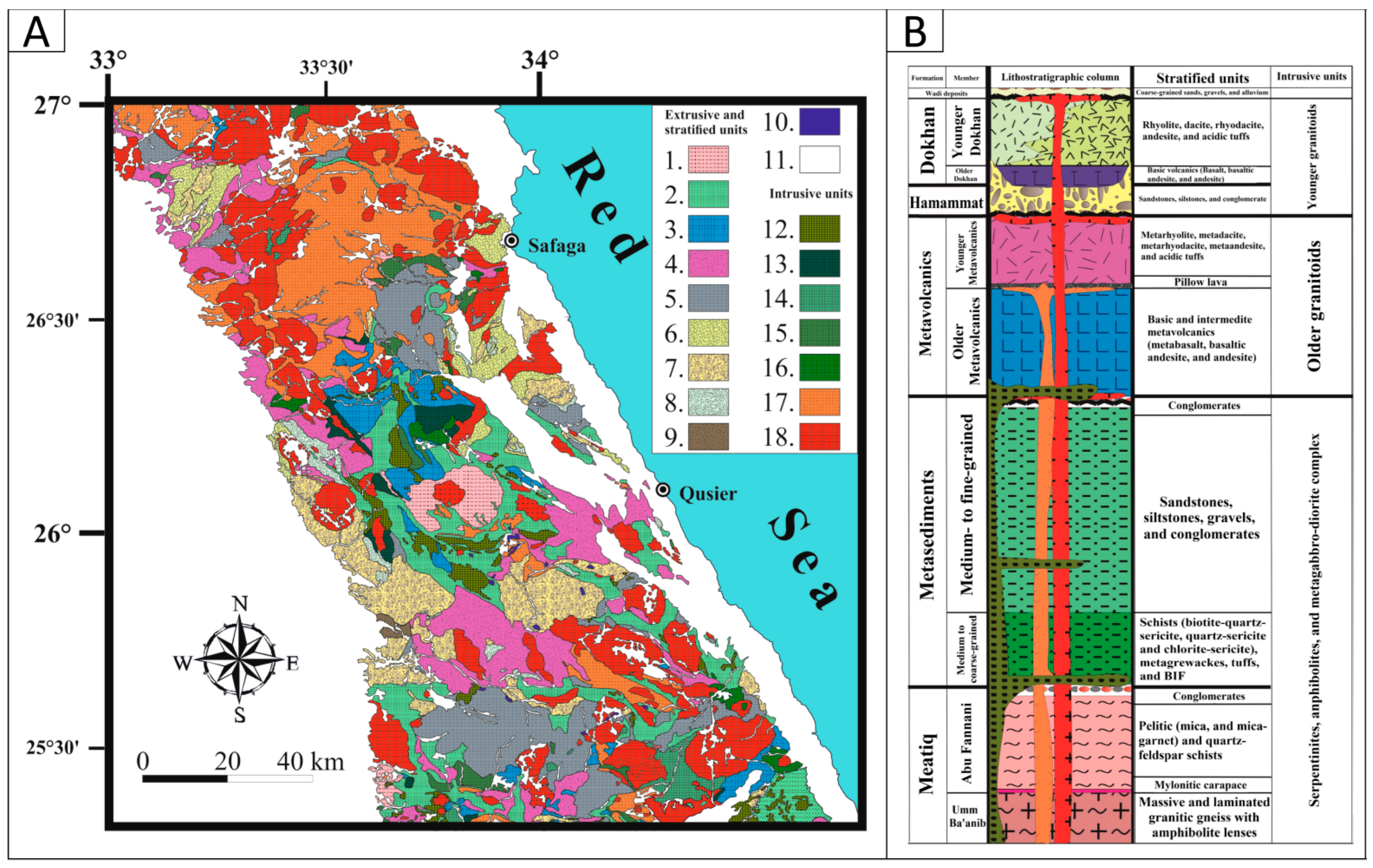
Figure 1. (A) Geological map of the central and part of northern ED around Meatiq dome, showing the main rock units of ED; (B) Stratigraphic sequence of CED basement complex and related intrusions (After, [18]). Legend: 1—Melanocratic, medium- to high-grade gneisses and schists; 2—metasediments (metamorphosed shelf sediments with pyroclastics); 3—Serpentinites, talc-carbonate and related rocks; 4—Metagabbro; 5—Metagabbro to metadiorite undifferentiated; 6—Intrusive Metagabbro to metadiorite; 7—basic metavolcanics; 8—felsic to intermediate metavolcanics with metapyroclastics; 9—undifferentiated metavolcanics; 10—Older granitoids (Calc-alkaline quartz diorite to granodiorite); 11—Younger granitoids (alkaline alkali-feldspar granite); 12—Hammamat clastics (Molasse-type conglomerates to siltstone); 13—Andesitic Dokhan volcanics; 14—Rhyolitic Dokhan volcanics (or post-Hammamat felsite); 15—Fresh gabbro, norite and troctolite; 16—Post-Hammamat felsite, felsite porphyry and quartz porphyry; 17—trachyte plugs and sheets; 18—Phanerozoic sedimentary cover.
Resources 15 00029 g001
Figure 3. Field photographs of the Rodruin prospect, (a) General view of South Ridge showing it steep dip, the yellow line represent a NW-oriented normal fault plane juxtaposing carbonates against metasediment; (b) Ancient underground mine workings targeting auriferous quartz veins in the Aladdin’s Hill; (c) Intercalation of carbonates with slates in the upper section of the metasediments; (d) Slate showing pencil structure, strong foliation and minor folding; (e) Gossanous carbonates at the top of south ridge where spiral pit is located; (f) small quartz vein (dashed lines), in the Aladdin’s Hill, cut in carbonates which show exfoliation.
Resources 15 00029 g003
Figure 4. Variations in rock coloration resulting from alteration processes and mineralogical composition: (a) green coloration produced by malachite along foliation planes of slates; (b) white coloration due to zinc carbonate minerals and brown hues resulting from iron hydroxides; (c) auriferous quartz veins exhibiting yellow limonite staining; (d) red coloration caused by hematite formed after the oxidation of iron sulfides.
Resources 15 00029 g004
Figure 5. Photomicrographs for Rodruin metasediments, (a) fine-grained foliated slate with chlorite, and sericite defining the foliation; (b) fine veinlites of calcite invading the foliation plane in the slate; (c) malachite in between lamella in slate; (d) metagreywacke with fine-grained clay-size matrix and large phenocrysts of quartz; (e) Quartzite with recrystallized and sheared quartz grains; (f) Iron oxide solutions highly invaded metasediments, (g) alternative bands of fine and coarse-grained calcite in carbonate rocks; (h) Sheared quartz in carbonate rocks; (i) Rhombs of dolomite and iron oxides of carbonate rocks.
Resources 15 00029 g005
Figure 6. (af) Photographs of half-core samples (about 10 cm in diameter, red and white measuring approximately 2.5 cm) from the Rodruin prospect showing mineralogical, micro-structural and textural features, and (g,h) Photomicrographs for core samples (f), (b), respectively. (a) Oxidized sulfides, clay, gypsum, and carbonate deposited along a shear zone in volcaniclastic metasediments; (b) massive sulfides, mainly of pyrite and sphalerite, with an intensely folded fine quartz vein; (c) successive banding of carbonate in the core, metasediments in the central part, and sulfides in the outer part; (d) brecciation of carbonates and metasediments and both cut by a chalcopyrite vein; (e) dolomitic carbonates are altered to talc (circled) in vugs and along fractures; (f) sulfides locally replaced and digested the carbonates, leaving relict fragments preserved as clasts; (g) clasts of pyrite (Py) and chalcopyrite (Ccp) in quartz-carbonate matrix; (h) massive ore with sphalerite (Sph) containing inclusions of galena (Ga), pyrite, and chalcopyrite.
Resources 15 00029 g006
Figure 7. SEM images showing mineralogy of host rock metasediments, carbonates and ore minerals, (a,b) mineralogy of fresh ore; (cf) mineralogy of ore from oxidation zone; (gk) mineral inclusions in carbonates and ores sourced from felsic magmatic rocks; (l) mineral inclusions sourced from mafic rocks; (a) Euhedral pyrite (Py) with inclusions of galena (Ga) in quartz-carbonate matrix of fresh ore; (b) Pyrite hosting sphalerite (Sph) in fresh ore; (c) patches of reworked iron oxide minerals with quartz and fine inclusions of chalcopyrite; (d) oxidized mineral aggregates (Ma) of variable composition along grain boundary of calcite (Cal); (e) Oxidized pyrite framboids to hematite (Hm) within cavity left by pyrite; (f) botryoidal pyrolusite (Ps) filling fracture in carbonates; (g) Monazite (Mnz) grain within quartz, (h) inclusions of xenotime (Xen), and rutile (Rt) in carbonates of calcite, dolomite (Dol), and ankerite (Ank), (i) Cassiterite (Cst) grain in between quartz grains; (j) Quartz grain hosting inclusion of acanthite (Acn), cinnabar (Cn), zincite (Zn), chalcopyrite (Ccp), and hematite; (k) Aggregate of zircon (Zr) hosted in carbonate; (l) grain of polarite? (Plr) Pd(Bi,Pb) (ultramafic-sourced mineral) in a gossanous matrix of quartz and montmorillonitic clay (Mnt).
Resources 15 00029 g007
Figure 8. SEM images with EDX analysis (At. %) of gold- and silver-bearing minerals, (a) fine electrum (Elc) grain (20 × 30 µm) along the boundary between pyrite and chalcopyrite, (b) Selenium-bearing acanthite (Acn + Se) in carbonates, and (c) Tellurium-bearing acanthite (Can + Te) along the boundary of quartz and carbonates.
Resources 15 00029 g008
Figure 9. (a) Primitive mantle-normalized REE pattern of concentrations of Rodruin carbonates and ores; (b) Primitive mantle-normalized REE pattern of average concentrations of Rodruin carbonates, and ore compared to surrounding lithologies including Kab Amiri granitoids, serpentinites and pyroxenites. Values of normalization from [14], average values for serpentinites from [55], for pyroxenites from [56] and for granite from [57].
Resources 15 00029 g009
Figure 10. δ 18O and δ 13 C isotopic composition diagrams of the Rodruin carbonates: (a) after [62]; (b) after [63,64].
Resources 15 00029 g010
Table 1. Paragenetic sequence of the Rodruin mineralization.
Resources 15 00029 i001
Note: the thickness of the lines is proportional with abundance of the mineral in the rock.
Table 2. XRF analyses of major oxides and ICP-MS analyses of trace and REEs of the studied samples. Minus values mean below this value.
MetagreywackesSlateCarbonated SlateSilica-CarbonatePure CarbonateGossanous OreFresh Ore
11Rh4RO2Rh4Rh13Rh21Rh27Rh23Rh22Rh18RO1ROGPS-35GPS-848RO16Rh12RC10RC
Major Oxides (wt.%)
SiO263.7460.8165.1373.4746.2963.1949.3458.6651.6634.5613.52.227.21.540.8213.631.96
Al2O310.8310.5713.1213.818.6314.7515.5513.2115.238.340.360.742.420.2413.337.840.09
Fe2O36.825.715.923.358.156.117.615.826.358.294.123.253.0834.2622.4432.7824.85
MgO7.723.646.771.276.791.5812.773.292.575.4110.5812.217.6411.679.295.5413.14
CaO2.885.661.860.280.244.040.28.828.7818.6745.5344.2340.7323.610.1812.5339.33
MnO0.070.1780.0680.20.050.080.090.090.070.240.1030.2580.2090.8830.0680.1120.046
Na2O0.460.431.281.50.451.90.121.393.621.861.071.320.940.542.220.180.06
K2O0.350.510.480.652.490.550.220.220.920.390.220.540.240.030.111.250.01
TiO20.620.230.530.30.730.410.340.440.50.420.010.010.010.050.130.330.02
P2O50.060.060.050.050.10.070.060.080.060.050.040.060.040.020.030.020.02
Total93.5587.7995.294.8783.9292.6886.392.0289.7678.2375.5364.8462.5172.888.6274.2179.52
Trace Elements (ppm)
Be000.1780.350.8840.7720.3690.370.7510.39300.7800.360.3290.290.48
V157.21446.876176.09688.679195.136128.202201.961157.917267.139129.30834.46457.35139.494116185.062669.26
Cr92.79114.87628.46319.6620.799225.87629.88915.21435.3326.01510.55310.8555.41640.46846.09489.4455.32
Ni22.9289.36410.2318.24771.80130.80119.18811.84819.75811.25612.1838.5737.69534.0518.06662.782.89
Cu22.5526.938201.68420.208118.24890.12966.15343.9998.99643.194.79517.4123.92925.8541.9727540115.58
Zn383.95633.841159.8488.81591.28762.95194.29389.10469.02885.78338.48382.96551.88364.6661862.05101,561269.52
Pb49.2684.2895.166.0987.633.8788.1292.9823.4978.5923.4741.8894.61712.369.86614,532669.27
Ga15.4352.87715.23315.50821.76812.90915.93913.23113.68211.5322.2243.9081.24712.58121.53112.5610.48
As53.15914.72310.23410.87111.96129.07325.75729.70729.97812.08515.84629.45424.90232.58610.946017.58
Rb7.1171.45719.13117.51344.08122.2952.8835.03516.0888.3340.5732.9420.8478.5821.9284.733.54
Sr38.60874.66273.531132.65113.857118.59713.15880.8289.097145.76591.6273.155100.218140.7142.687143.92108.54
Y6.1294.1174.00911.5065.88324.7722.8437.2563.05311.5373.9076.9132.983.587.9617.5829.17
Zr72.6815.30627.6495.41957.93530.03727.35431.6658.82457.157.47516.155.6386.57890.27918.56312.33
Nb1.4450.2780.7572.3641.5480.8380.2960.7020.3372.2560.1080.220.0931.552.1251.8940.57
Mo7.0556.2956.2586.0796.09613.3310.8461.3741.5867.8876.1631.7010.7551.285.4140.5850.86
W0.7960.0200.8951.0570.5870000.26500.0200.271.0530.540.58
Ag40.160.2320.5162.0830.2561.9140.2240.3670.5930.3120.9440.353.534.45513.52528.12
Cd0.3620.056000.253−0.0050.0400.0870.2330.31500.2910.020.0326.8190.68
Sn3.6222.9573.4114.1144.385.5113.3193.2643.2843.913.2992.6122.463.593.74628.88312.58
Sb3.4080.3611.1931.5871.3910.7380.5910.4080.7050.8210.3350.4470.2240.842.0912.5870.85
Te0.1070.1320.1660.2490.4660.0740.770.1720.0750.2490.2050.170.4410.230.17920.81813.27
Cs0.1540.1810.3050.3790.6130.8660.0230.0910.3060.2390.0440.130.0410.5410.6440.2460.57
Ba1937.85118.975161.325269.1212473.266131.87749.12453.331173.535148.9893.18899.46121.506891.56865.616101458.47
Hf1.9990.0480.6792.8541.8440.7780.8030.8670.241.6680.0530.5230.0051.252.4550.580.02
Ta0.2760.0180.1420.4230.2820.1590.0590.1280.0280.3860.0050.0360.0060.0560.4240.780.27
Bi0.0460.0170.0510.0190.1950.1180.050.030.0420.1340.0610.0170.0160.0420.0140.040.06
Th0.680.1450.3120.7430.7630.2420.2990.2490.0931.0960.0320.1790.0512.161.4130.8780.23
U1.1160.0470.1250.370.2810.1660.1580.1660.180.3382.160.3540.3330.4590.5341.8680.73
REE (ppm)
La2.7571.5132.415.6456.0233.3523.3670.8770.9514.9350.991.8130.9364.279.1765.597.07
Ce6.8983.4616.72416.47814.1289.8378.5082.0542.25511.8292.4044.2781.7529.7523.78913.0916.21
Pr0.8880.5311.0212.5142.0331.5221.2970.3190.3561.7550.390.6350.2781.773.4372.131.92
Nd3.3932.3114.89611.928.7347.7716.5911.7752.0448.3461.6512.8641.066.2615.21210.787.14
Sm0.7460.6431.2782.6472.0332.2451.6080.660.6812.5050.4730.9870.2621.533.4733.642.423
Eu0.3690.220.3610.5230.8280.6230.3310.2320.2670.7490.2660.3120.1210.4561.0692.061.147
Gd0.6640.8841.1771.8291.6163.3280.7890.9320.7972.5790.7181.0280.371.522.7364.122.291
Tb0.1310.1350.1470.270.2050.6470.0720.1510.1240.4080.080.2020.0660.2860.2990.8080.382
Dy0.9870.7860.7711.7931.0943.7880.5381.070.7092.3880.5971.1420.3791.671.4544.8032.295
Ho0.2430.1220.1660.4920.2190.870.1240.2620.1380.4730.1150.2450.0910.3650.2991.2240.51
Er0.9230.3390.5682.020.7152.7970.3560.9070.4181.3730.3030.6840.2531.040.9253.4451.785
Tm0.1720.050.0820.2410.1120.3980.0780.1430.0710.240.0440.1060.0410.2010.1560.5010.226
Yb1.1290.3390.5671.8810.892.0720.5571.0440.551.5840.2670.6940.271.1431.2223.422.125
Lu0.2220.0560.0940.2910.1550.3880.090.1740.0980.2220.040.0920.040.2080.2070.5530.255
Table 3. Average geochemical characteristic values and ratios of different lithologies and ores.
SlatesMetagreywackesOverall MetasedimentsCarbonatesGossanous OreFresh OreOverall Ore
SiO2 (wt.%)50.6165.7856.687.6421.167.7914.47
Al2O3 (wt.%)14.2812.0813.41.176.783.965.37
CaO (wt.%)6.792.675.1443.4911.8925.9318.91
MgO (wt.%)5.44.855.1810.149.3410.489.91
Fe2O3 (wt.%)7.055.456.413.4828.3528.8128.58
Al2O3/Na2O9.1713.1610.31.054.9133.047.16
K2O/Na2O0.510.580.520.30.055.252.14
ICV1.541.221.43----
ΣREE27.0224.9226.189.846.350.948.96
(La/Yb)N1.972.132.032.213.561.542.36
(La/Sm)N1.251.441.321.371.571.351.52
(Gd/Yb)N1.210.941.111.41.480.961.11
Eu/Eu*0.930.910.921.1211.61.33
Ce/Ce*0.981.0310.890.980.960.99
Th/U2.121.131.560.233.680.391.3
Cr/V0.320.330.320.210.30.970.48
Y/Ni0.330.50.370.510.271.650.24
Note: Ce/Ce* indicates the Cerium anomaly = CeN/√(LaN + NdN) and Eu/Eu* is the Europium anomaly = EuN/√(SmN + GdN).
Table 4. Correlation matrix for some major and trace elements in Rodruin rocks. Strong positive correlation index values (>0.5) are given in bold.
SiO2Fe2O3MgOCaOCuZnPbAsZrNbMoWAgSnSbTeTaThUƩREE
SiO21
Fe2O3−0.51
MgO−0.680.351
CaO−0.850.050.531
Cu−0.240.54−0.11−0.051
Zn−0.240.54−0.1−0.0511
Pb−0.260.55−0.09−0.02111
As−0.250.53−0.1−0.030.990.990.991
Zr0.260.26−0.06−0.46−0.16−0.15−0.17−0.161
Nb0.190.4−0.26−0.450.280.290.270.260.831
Mo0.55−0.36−0.46−0.37−0.27−0.27−0.28−0.280.260.271
W0.20.3−0.11−0.410.120.130.120.10.690.730.351
Ag−0.450.640.40.270.370.360.40.35−0.130.07−0.360.291
Sn−0.310.64−0.010.030.940.930.950.92−0.180.27−0.270.230.651
Sb0.230.34−0.08−0.450.440.450.440.460.530.640.150.690.240.421
Te−0.410.650.130.170.840.830.860.82−0.260.16−0.380.180.80.970.341
Ta0.040.49−0.21−0.320.710.710.710.680.390.790.060.660.420.740.720.661
Th−0.170.690.16−0.220.140.150.140.140.790.76−0.010.460.060.110.410.040.411
U−0.410.330.250.380.550.560.560.56−0.10.09−0.080.120.330.550.380.520.370.041
ƩREE−0.010.6−0.02−0.320.40.40.40.350.550.780.180.780.470.520.520.470.820.570.131
Table 5. Stable isotopic composition of carbon and oxygen of carbonates separated from the Rodruin prospect.
Sample18O
V-SMOW
St. Dev.13C
PDB
St. Dev.% Carbonate in the Separated SampleMineralogy of Whole Sample
13-RO18.250.09−3.670.0249.91Carbonated slate rich in iron oxides and hydroxides and carbonate with minor pyrite.
48-RO19.720.22−4.900.0652.44Silica carbonate rock with spherulitic calcite in fine grained quartz.
20-RO19.510.03−3.680.0761.88Banded carbonates of calcite, dolomite and rare magnesite.
15-RO17.450.02−4.820.0364.35Gossanous carbonate composed of calcite, dolomite, quartz with oxides and hydroxides of iron, manganese, zinc and copper with minor pyrite.
25-RO15.740.01−5.710.0582.16Pure carbonate composed of calcite and dolomite.
5-RO17.320.06−4.180.0487.11Gossanous silica-carbonate composed of calcite, minor quartz, pyrite, and hematite.
14-RO18.290.02−2.360.0487.31Gossanous quartzite composed of quartz, magnetite, rhodochrosite, pyrolusite, calcite, dolomite, and mixed mineral aggregate.
GPS-8418.860.02−5.250.0789.70Banded carbonates composed of calcite with minor talc
10-RO18.730.00−4.890.0492.81Carbonated slate composed of dolomite, muscovite, sericite, and quartz.
23-RO17.020.04−6.600.04100.00Carbonated metagreywacke with calcite, talc and quartz.
Average18.090.05−4.610.0559.14
Table 6. The prominent host rock, ore geological, and mineralogical characteristics of turbidite-hosted and polymetallic vein-type gold deposits in comparison to Rodruin.
Turbidite-HostedPolymetallic Vein-TypeRodruin
Host rock typesGraywacke sandstone, shale or pyroclastic and epiclastic sediments containing chemical sediments (graphitic chert, graphitic schist) as major components and minor lava [70,71].Carbonate-rich sedimentary rocks are the most common host (dolomite, limestone, sandstone, and shale) intruded by intermediate- to felsic-composition igneous stocks, dikes, and sills [72].Carbonate-rich metasediments (Graywackes, slate, phyllite) and carbonates
Characteristic features of the host rockDeformed and metamorphosed, Mn-rich graphite-rich sediments [73].Carbonates are rich in Zn and Pb [72,74].Deformed and metamorphosed metasediments. The carbonates are rich in Zn, Pb, and locally Mn.
Tectonic settingSubduction-related assemblage especially island arcs [70].Continental margin and island arc volcanic-plutonic belts [74]. Fore arc basin
Host rock ageAll ages, mostly Archean [70,75].All ages, mostly Mesozoic to Cenozoic [74,76,77].Neoproterozoic host rock
Source of fluidsFrom metamorphic origin with small contribution from igneous sources [37,78,79].Magmatic-hydrothermal origin; sourced from the same intrusion [74,76,80].No evidence for metamorphic fluids, but small contribution from igneous origin
Shape and nature of oreBedding-parallel laminated quartz-carbonate veins in folds and brittle-ductile shear zones and massive-sulfidic sedimentary rock [81].Veins with disseminated, stockwork, breccia sulfides, and small massive sulfide pods in the vein and in altered wall-rock [74,82].Bedding-parallel laminated quartz-carbonate veins in folds and brittle-ductile shear zones
Deposit size or tonnageUsually large (10–20 Mt), some are small less than or of order of 1 Mt ore [70].Small (10,000 T) to very large (as much as 30–40 MT) [74,76,82].Large size and tonnage
GradeHigh-grade gold specially in veins that in intersections with carbonaceous slates [54,81,83].0.5–10 g/t Au; average 5 g/t [84].High grade
Localization of mineralizationStructurally and lithologically controlled [54,75,78].Lithologically and structurally controlled (in areas of high permeability: intrusive contacts, fault intersections, and breccia), concentrated in zones of local domal uplift [76,85].Lithologically and structurally controlled (in areas of high permeability in slate)
Depth of formation4–15 km [80].Shallow, few kilometers depth in the crust [77].Not defined
Structural regimeShear Zones in compression to transpression with extensional [70,86,87]. Extensional tectonic regime [77].Compression to transpression with extensional (Shear Zones)
Ore body dippingSteeply dipping [88].Steeply dipping [77].Steeply dipping
Ore MineralogyPyrite, arsenopyrite, ±sphalerite, ±chalcopyrite, ±galena, ±pyrrhotite, and gold [83,87,89,90,91].Pyrite, sphalerite, galena, argentite, electrum ±enargite ±digenite, chalcopyrite, pyrrhotite, tetrahedrite, barite, hessite, petzite, pyrargyrite ±bornite ±arsenopyrite [72,92].Pyrite, sphalerite, chalcopyrite, galena, gold, Cassiterite, Cinnabar, silver-telluride
Metal associationAu, Ag, As, Fe, Pb, Zn, ±Cu, ±Sb, ±Bi-Te-W [81,90,93,94,95].W, Bi, Sn, Mo, Cu, Pb, Zn, As, Ag, Zn, Cu, U, Au, Ag [77,80,96].Au, Ag, Fe, Zn, Cu, Pb, As, Sb, Sn
Metal zonationAbsent (No zoning)Distinct metal zonation [80,97].Absent
Alteration mineralogyCarbonatization, de-silicification, sericitization, chloritization, tourmalinization, and albitization [81,98].Chlorite– sericite, silicification, and carbonate alteration [80,85].Carbonatization, Chloritization, silicification, and talc alteration
Gangue mineralogyQuartz, ankerite, chlorite, sericite, carbonaceous matter, with subordinate plagioclase [87].Calcite, quartz, and fluorite [84,92,96].Quartz, calcite, dolomite, ankerite, chlorite, barite, feldspar, and rhodochrosite
Ore textureLaminated-banded [99].Colloform, disseminated, and massive textures [80].Laminated-banded, disseminated, and small massive pods
Disclaimer/Publisher’s Note: The statements, opinions and data contained in all publications are solely those of the individual author(s) and contributor(s) and not of MDPI and/or the editor(s). MDPI and/or the editor(s) disclaim responsibility for any injury to people or property resulting from any ideas, methods, instructions or products referred to in the content.